Edwardsville City Zoning Code
APPENDIX B
I-55 ZONING CORRIDOR18
Editor's note— Ord. No. 6753-08-2022, § 2B(Exh. A), adopted August 16, 2022, repealed app. I, §§ 1.0—5.0 and enacted a new app. B as set out herein. Former app. I pertained to similar subject matter and derived from Ord. No. 6016-07-16, adopted July 19, 2016.
Sec. 1. - Purpose.
The City of Edwardsville I-55 Corridor Zoning District represents the city's commitment to residents' quality of life, sustainability, and smart growth by adhering to the following principles:
A.
Citizen and community connection: Balance the needs of residents, developers, civic leaders and landowners by ensuring all participate in ongoing planning and development of the district. Maintain the quality and character of development in the I-55 District as first envisioned with Glen Carbon and Madison County.
B.
Economic development: Generate a sustainable and resilient economy for the I-55 District (in support of the entire city) through regulations that achieve desired outcomes in a creative and flexible manner.
C.
Development form: Promote compact, pedestrian-friendly and mixed-use neighborhoods, with many activities of daily life available within walking distance. The intensity of development should support transit in commercial areas and residential areas located near main roads.
D.
Urban design: Reinforce community design that results in interesting, human-scaled places. Development should connect people with places and each other.
E.
Architectural character: Design new developments that respond to the local traditions of residential and commercial architecture, so they result in unique places that maintain Edwardsville's character.
F.
Environmental design: Build mixed-use developments that are compact, accessible to other areas, and support walkability. Incorporate stormwater management systems that apply natural best management practices (BMPs) to increase permeability and reduce the need for impermeable stormwater management infrastructure.
(Ord. No. 6753-08-2022, § 2B(Exh. A), 8-16-2022)
Sec. 2. - Applicability.
The I-55 Corridor Zoning District shall apply to areas as indicated on the City of Edwardsville Zoning map.
(Ord. No. 6753-08-2022, § 2B(Exh. A), 8-16-2022)
Sec. 3. - Subdistricts.
In order to meet the intent of the City of Edwardsville Comprehensive Plan and address the various development considerations of the District, the I-55 Corridor Zoning District is further designated into five subdistricts as described below and shown in Figure 1 below.
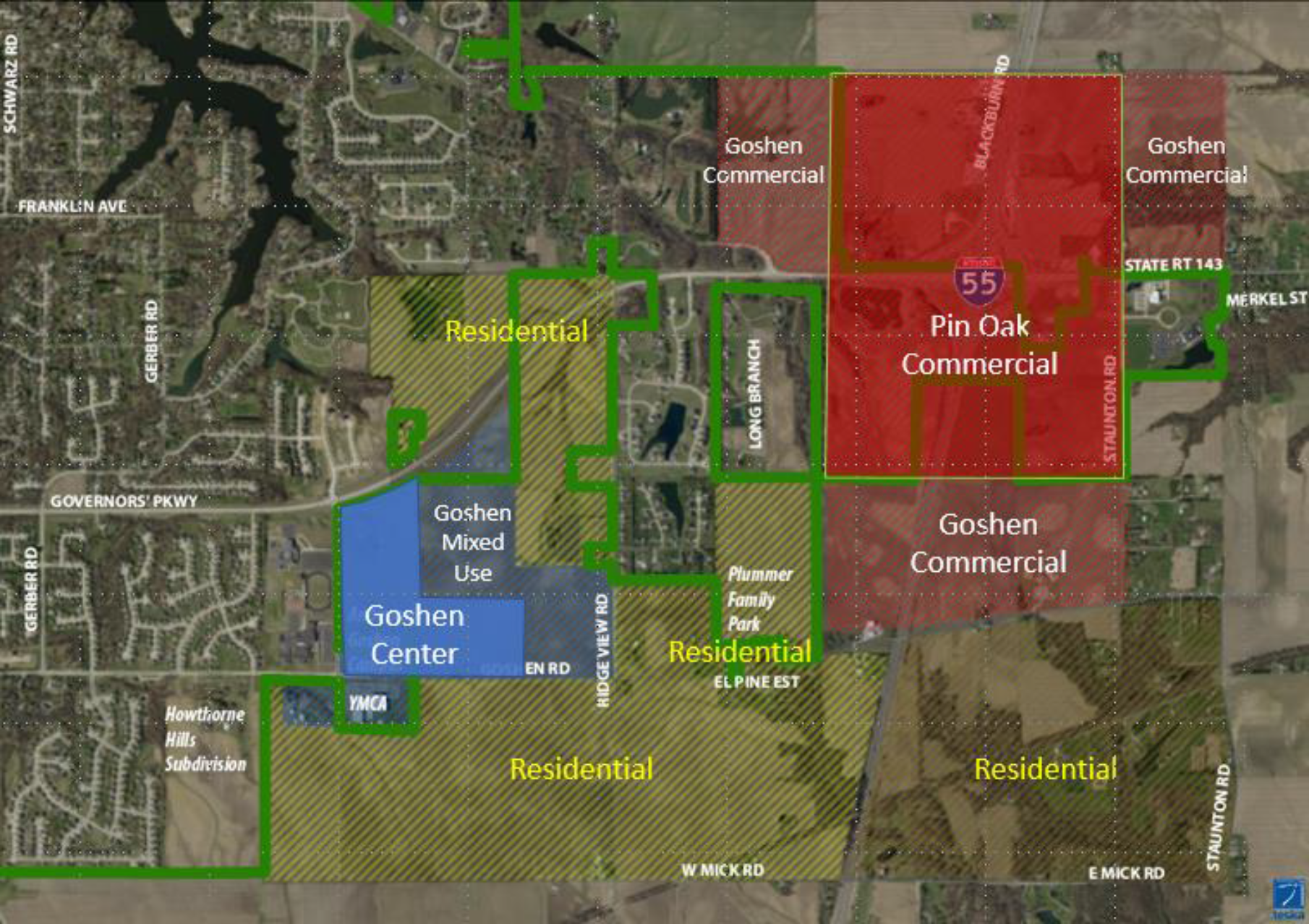
Figure 1:I-55 Zoning Subdistricts
A.
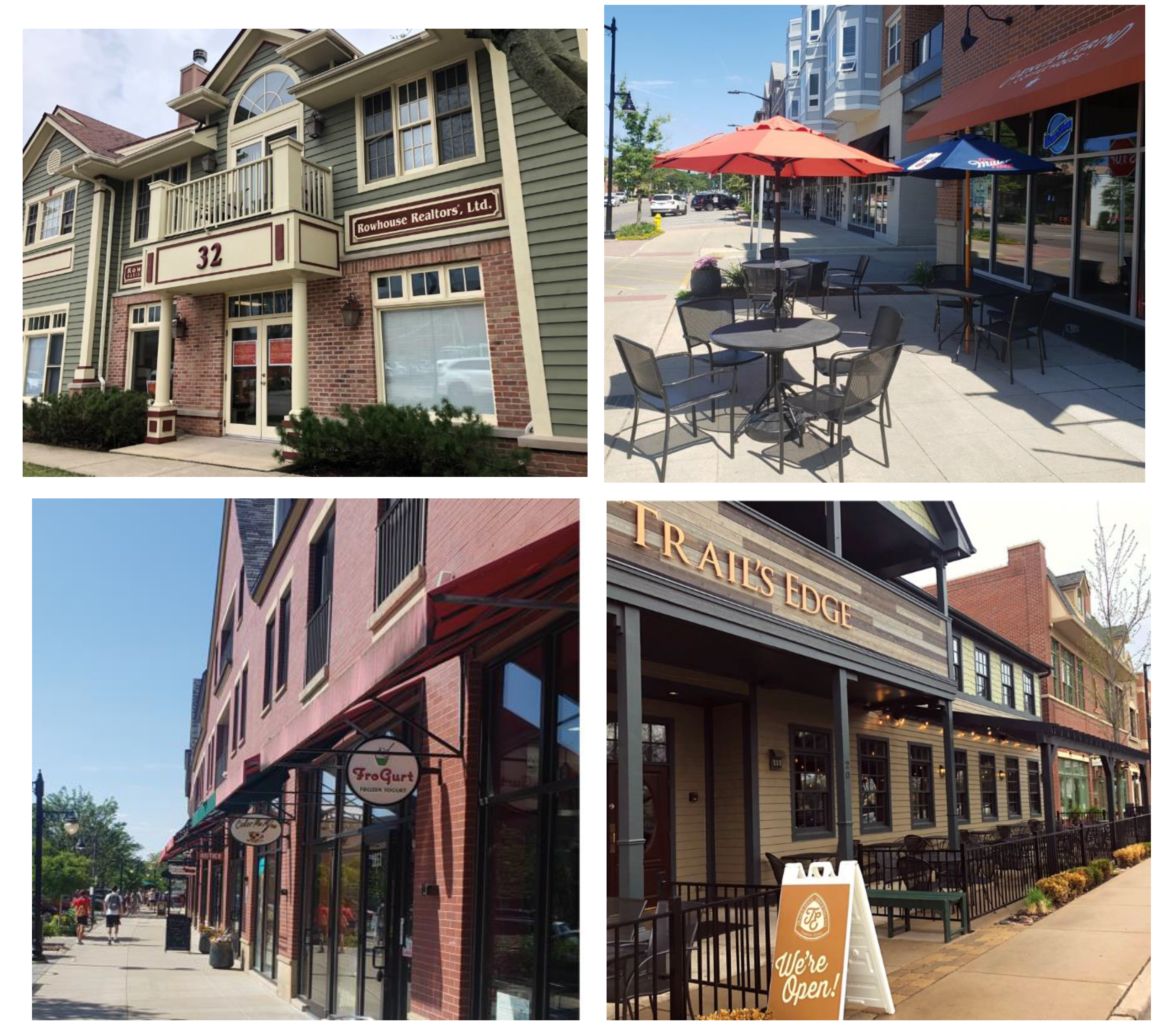
Goshen Center: The Goshen Center subdistrict is the focal point of the I-55 Corridor area and has a primary commercial and office focus. The area is highly pedestrian in character with visitors and residents getting to and around the subdistrict easily on foot or bike. Connections to existing and planned trails to support this easy access are an important element of the area. If driving to the district, the goal is to park a vehicle once for multiple stops in the district. The subdistrict provides dining, retail, personal service, and workplace opportunities for residents and includes small retail, walkable streets, office, medical, etc. Mixed use development that includes residential living is encouraged in the area.
To create a consistent character and scale in Goshen Center, all new development will be considered by the city as a planned unit development and required to be a minimum of 15 acres in size. Further, to support a compact and successful mixed-use development the City will consider new developments adjacent to existing developments to be more appropriate and in keep with development standards. Similarly, the success of this subdistrict depends on compact development to support the scale and type of desired uses, as well as the walkable urban form. Therefore, the city expects that after sufficient area has been developed to establish a strong sense of place and reflect market demand, the balance of undeveloped area could be rezoned to Goshen Mixed Use.
B.
Goshen mixed use: A mixed-use area that is primarily pedestrian, but accommodates vehicular use. It has a denser, urban character and is a unique, attractive, and memorable destination for visitors and residents. The subdistrict has an interconnected network that provides convenient routes for pedestrians and bicyclists, connecting to passive and active open space and recreation trails. The development pattern encourages vertical mixed use buildings that include retail, office, and residential uses in the same structure. Other uses appropriate for the subdistrict include civic functions, senior housing, cultural/religious facilities, and entertainment activities.
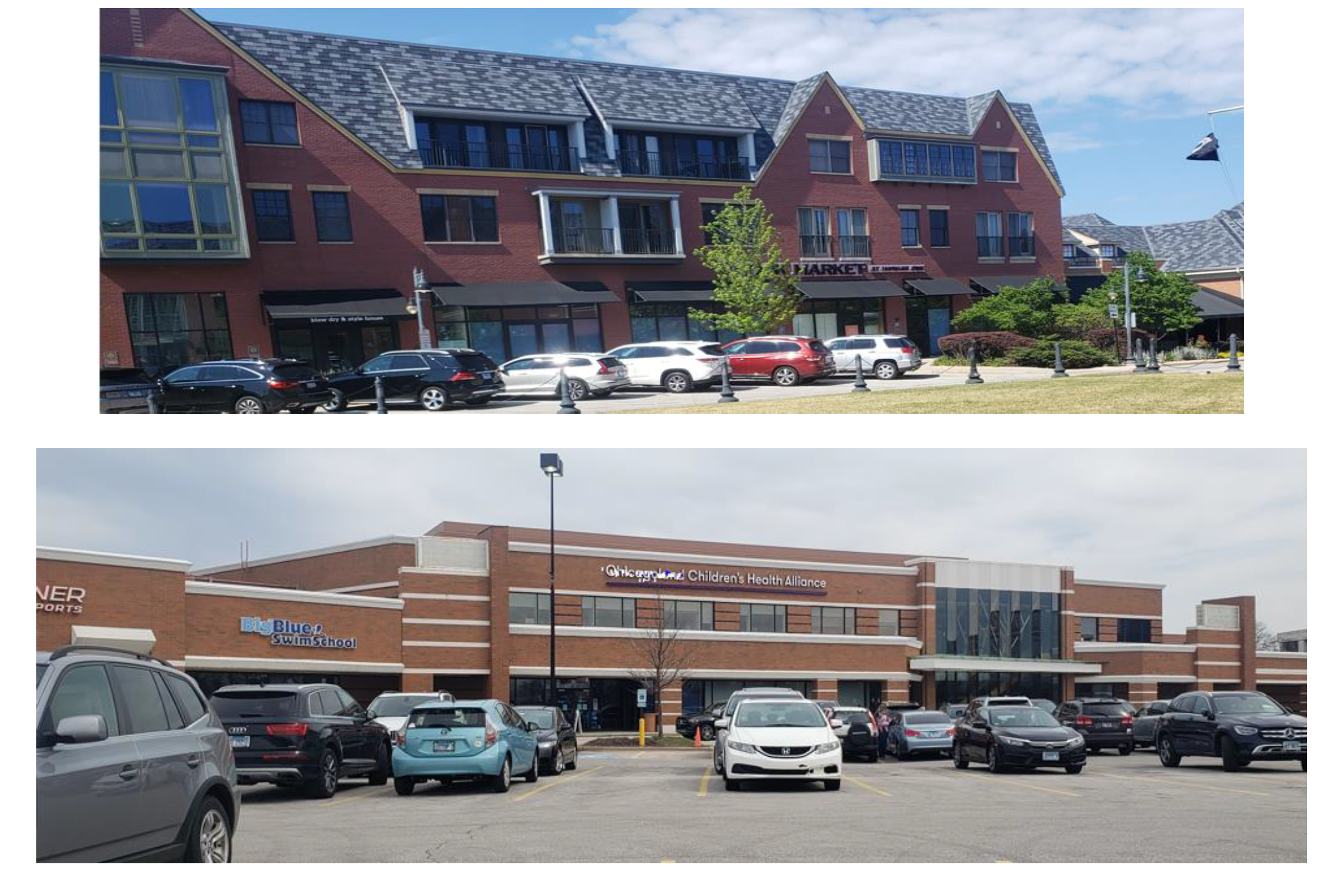
C.
Goshen commercial: The Goshen commercial subdistrict is a predominantly office and employment area, and may include commercial and civic functions; the area services Edwardsville and the surrounding region. The district will have an interconnected roadway network that disperses traffic and provides convenient routes for pedestrians and bicyclists as well as being well connected to passive and active open space and recreation trails.
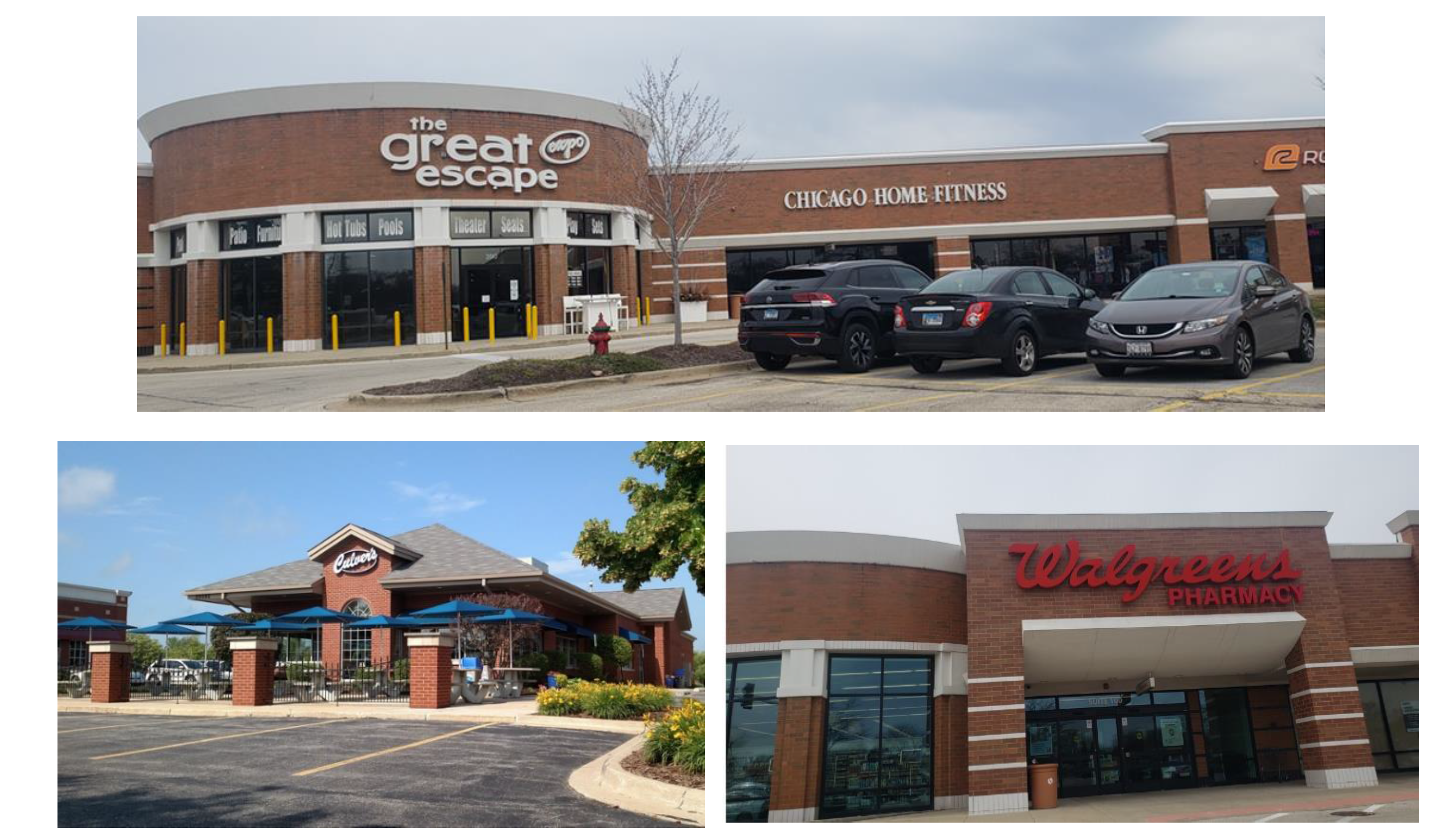
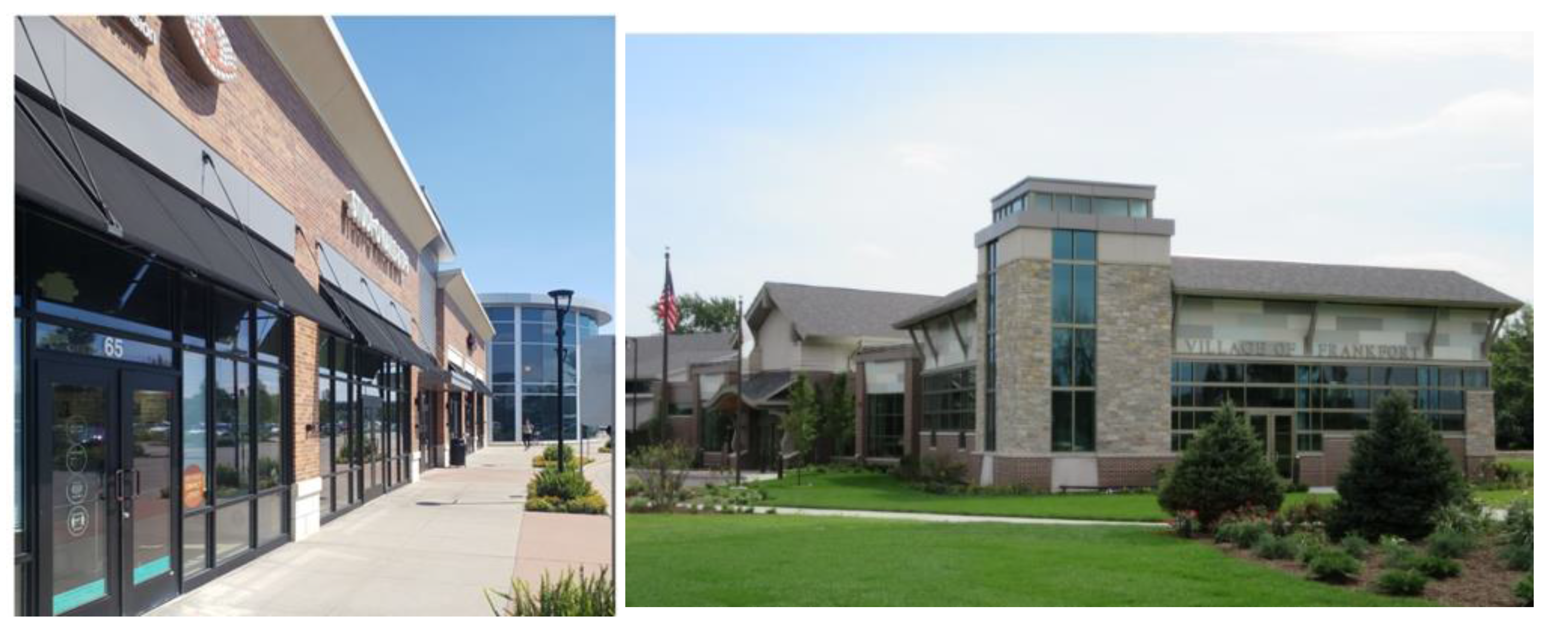
D.
Pin Oak commercial: The subdistrict takes its character from being most closely located to the I-55/State Rt. 143 Interchange. Development in the area reflects the types of office, commercial, medical, and unique uses that locate close to interchanges to draw on their regional access and high visibility. As this area is a gateway to Edwardsville, it is to be characterized by development in keeping with the city's design guidelines, consideration of I-55 District development standards, and evaluated through city review processes.
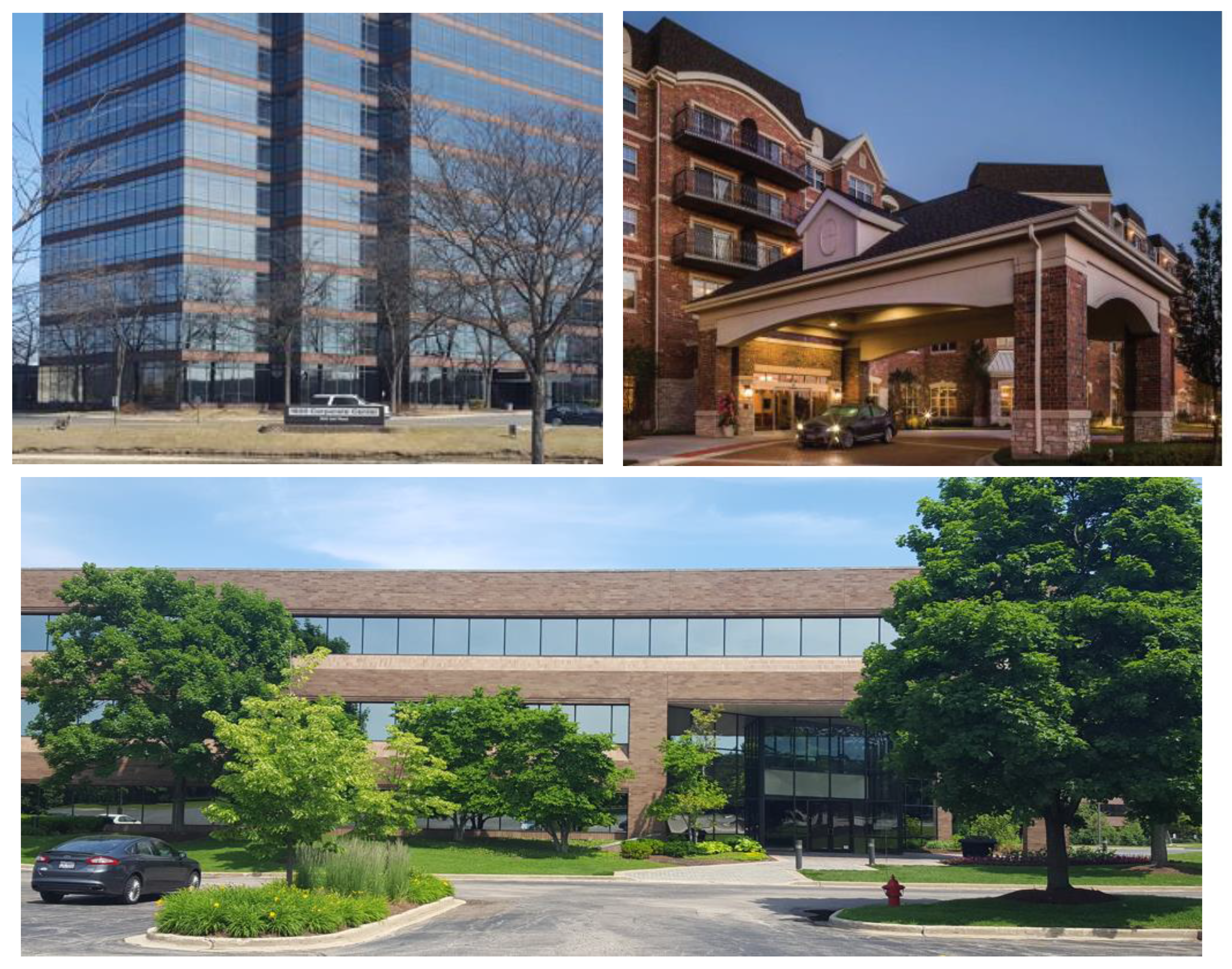
E.
Residential: This subdistrict is characterized by a variety of residential uses and housing types developed as neighborhoods. Townhome neighborhoods are appropriate within this district. The neighborhoods are easily traveled by car, bicycle or walking to adjacent neighborhoods, recreation areas, community uses, and commercial areas. The area may include community and cultural uses and is connected to local and regional passive and active open space and recreation trails.
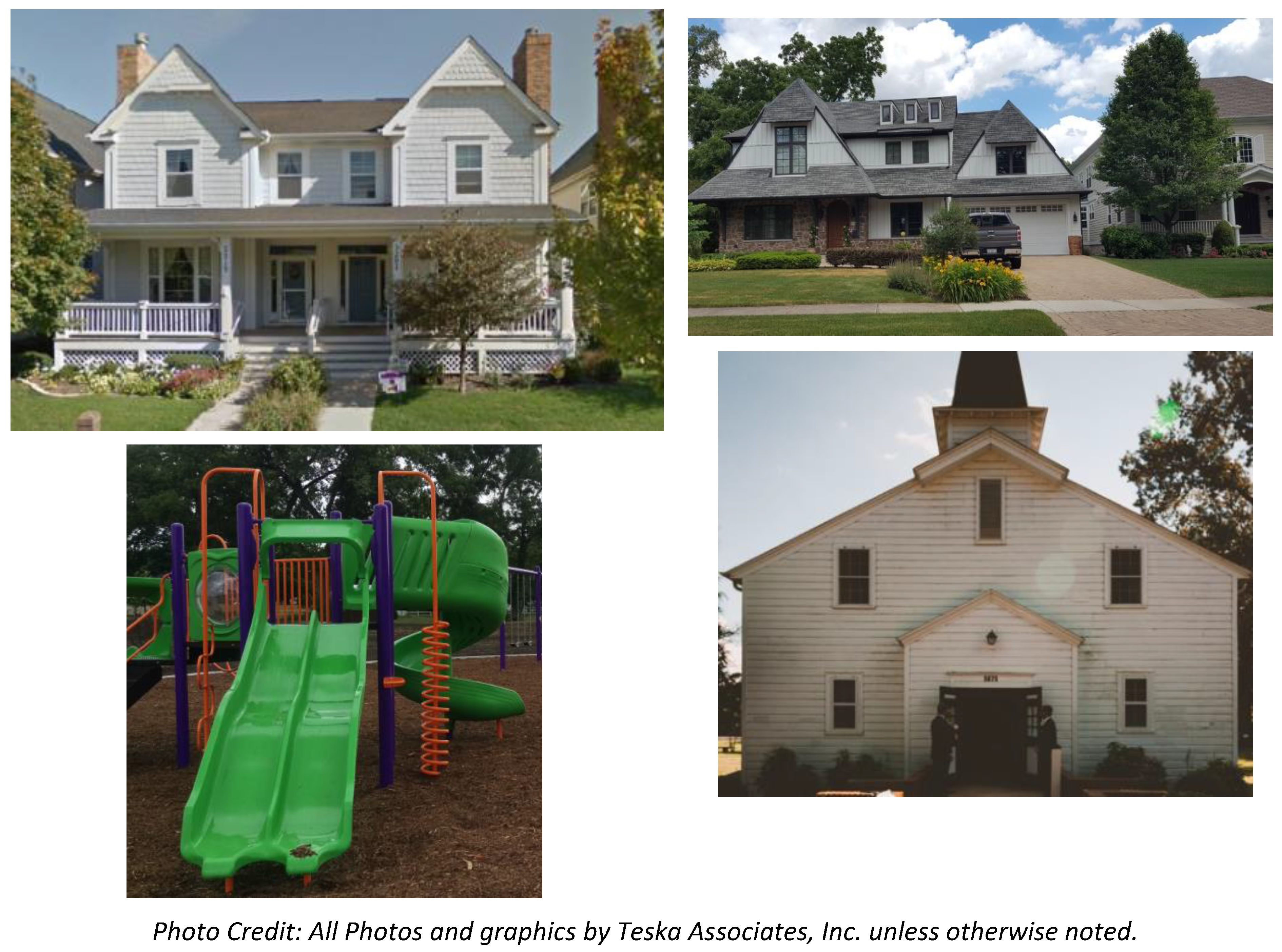
(Ord. No. 6753-08-2022, § 2B(Exh. A), 8-16-2022)
Sec. 4. - Other applicable ordinances.
All new development or subdivision proposals shall adhere to all sections of the I-55 Development Code. Items not specifically addressed in the I-55 Development Code shall adhere to the regulation of the City of Edwardsville City Code, including but not limited to the following:
A.
Design guidelines: Appendix A
B.
Buildings and building regulations:Chapter 18
C.
Flood prevention ordinances.1242.06: Floodplain
D.
Land Subdivision Code: Appendix A - Division 1
E.
Landscaping and screening: Appendix B - Chapter 1228
F.
Lighting controls: Section 1250.10
G.
Off-street parking and loading: Section 1250.13
H.
Sign:Chapter 94
I.
Soil erosion and sediment control: Appendix A - Division 2
J.
Stormwater control: Appendix A - Division 3
K.
Streets and sidewalks:Chapter 102
L.
Subdivision design and improvement standards: Appendix A - Article 5
M.
Zoning definitions, procedures and standards: Appendix B
(Ord. No. 6753-08-2022, § 2B(Exh. A), 8-16-2022)
Sec. 5. - Additional parking requirements.
In addition to off-street parking and loading requirements in section 1250.13 of the City Code, the following parking regulations shall apply in all I-55 subdistricts except residential:
A.
Cross-access between adjacent lots. Where parking lots for separate uses are adjacent to one another and the opportunity for connected cross-access exists, such access is in encouraged. Cross-access should be done in a logical manner that results in safe and efficient circulation between adjacent parking areas.
B.
Shared parking.
1)
Description. Shared parking is an arrangement whereby two or more owners of nonresidential properties or uses with different peak-hour parking demands use the same off-street parking spaces to satisfy their off-street parking requirements.
2)
General. The zoning administrator may approve shared parking areas, subject to the following standards:
a)
Eligible uses. Shared parking is allowed among land uses that can evidence differing operations, peak parking demand times, or specific circumstances that facilitate successful shared parking.
b)
Ineligible uses. Accessible parking spaces (for persons with disabilities) may not be shared and must be located on-site.
c)
Location. Shared parking spaces shall be located within 750 feet of the primary entrance of all uses served, unless shuttle bus service is provided to the parking lot.
d)
Shared parking. Applicants wishing to use shared parking as a means of satisfying parking requirements shall submit an analysis to the zoning administrator that clearly demonstrates the feasibility of shared parking. It shall address, at minimum, the size and type of the proposed development, the composition of tenants, the anticipated rate of parking turnover and the anticipated peak parking and traffic loads for all uses that will be sharing parking spaces. Applications for shared parking shall be submitted by or authorized by the property owner.
e)
Agreement. Applicants must provide a shared parking agreement in a form approved by the city attorney and executed by the parties establishing the shared parking spaces and the City of Edwardsville. Shared parking privileges will continue in effect only as long as the agreement, binding on all parties, remains in force. Should the agreement cease to be in force, or should the intensity of a business that is party to the agreement increase, parking must be provided as otherwise required within this article. Shared parking agreements shall be recorded with Madison County Recorder's Office for all properties involved in the agreement.
f)
Shared parking within shopping centers. Cumulative parking requirements for mixed-use occupancies may be reduced where it can be determined that the peak requirement of the several occupancies occurs at different times during the day. For a shared parking arrangement, the zoning administrator may make an administrative adjustment that reduces the off-street parking requirements for each participating commercial property. To approve such an administrative adjustment, the zoning administrator shall find:
i)
The collective parking area is located within 750 feet walking distance of each of the uses, as measured from the entrance of each use to the nearest parking space in the collective parking area.
ii)
Convenient, safe, accessible and visible pedestrian connections are located between the facilities and all of the shared properties.
iii)
A shared parking study shows that the commercial properties do not have the same hours of operation.
iv)
Applicant provide a shared parking agreement in a form approved by the city attorney or lease rider between the parties sharing parking spaces.
C.
Bicycle parking.
1)
All nonresidential developments which provide automobile parking facilities shall provide bicycle parking facilities (bike racks) at a ratio of at least one bicycle parking space for every ten automobile parking spaces.
2)
Multi-family developments shall provide interior bicycle parking facilities for building residents at a ratio of at least one bicycle parking space for every three dwelling units. Such bicycle parking facilities must be provided near the building entrance accessible to the street. Multi-family developments shall also provide bicycle parking facilities for visitors/public at a ratio of at least one bicycle parking space for every 20 automobile parking spaces provided.
3)
No development, except a one- or two-family development, shall have fewer than three bicycle parking spaces nor be required to exceed a maximum of ten such spaces.
4)
Bicycle parking facilities for nonresidential developments shall be located a maximum distance of 50 feet from the building entrance, or shall be located at least as close as the closest automobile space. Said bicycle parking shall not impede pedestrian traffic.
5)
Each bicycle parking facility shall include a metal anchor sufficient to secure the bicycle frame when used in conjunction with a user supplied lock.
D.
Land banked future parking.
1)
Land banking future parking. The city council may grant relief from city parking requirements to allow banking of up to 25 percent of the required parking spaces, provided that:
a)
Sufficient evidence shall be provided by the applicant that supports the reduced parking needs.
b)
The area proposed for land banking of parking spaces shall be an area suitable for parking at a future time.
c)
Landscaping of the land-banked area shall be in full compliance of the zoning regulations and, at a minimum, landscaped with turf grass. As a result of site plan review, additional landscaping of the land-banked area may be required.
d)
The land banking area will not be used for any other use. The land banked parking area cannot be used to fulfill other landscaping, greenspace, or stormwater detention/retention requirements within this appendix.
2)
As part of the site plan review process, the applicant shall show the area to be banked on the site plan and marked as "Land-Banked Future Parking."
3)
The zoning administrator at their sole discretion, on the basis of increased parking demand for the use, or provided parking proving to be inadequate, may require the conversion of all or part of the land-banked area to off-street parking spaces. The owner may convert the land-banked area to parking, subject to all required permits.
(Ord. No. 6753-08-2022, § 2B(Exh. A), 8-16-2022)
Sec. 6. - Lot and bulk standards.
Table 1: I-55 Corridor Zoning District Bulk Standards
1 In order to ensure thorough and complete development of the area, PUDs considered in the Goshen Center subdistrict shall be a minimum of 15 acres. Smaller zoning lots are allowed within the development area to accommodate for ownership and phased development. All development in the Goshen Center subdistrict shall be considered for approval by the city in the form of planned unit development.
2 Interior side yard setbacks shall be zero feet, except when side building pedestrian access is provided between an adjacent building. In such case, the interior side yard facade shall be setback a minimum of ten feet and a maximum of 20 feet from the existing adjacent building facade.
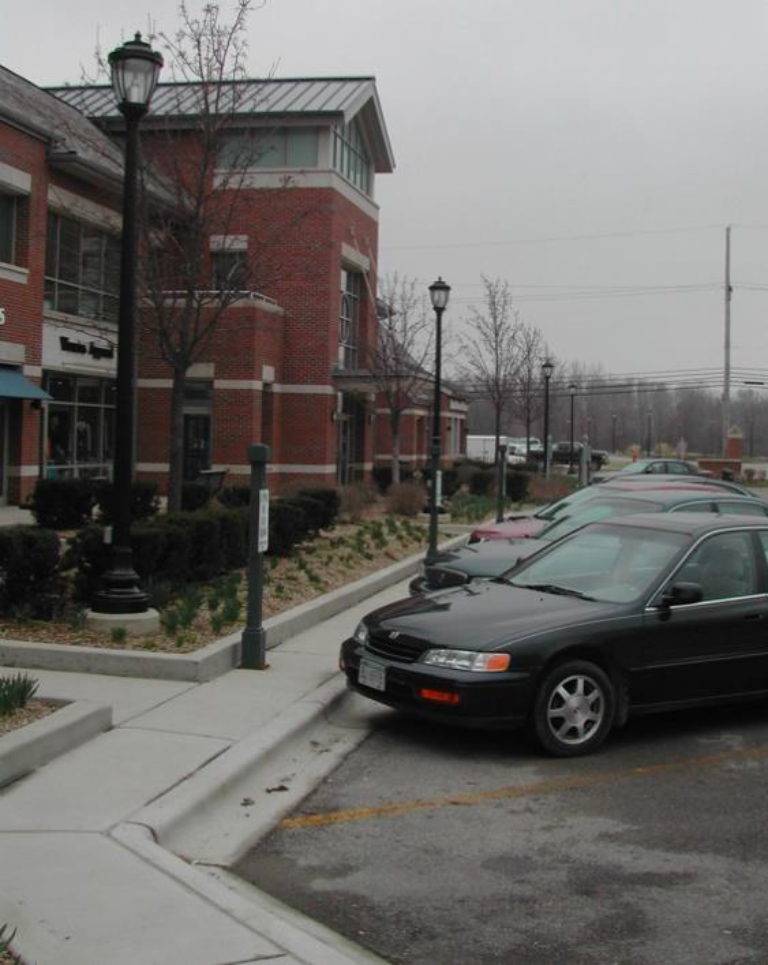
3 Parking is allowed in the rear yard. Blocks are to be designed around internal circulation to the rear of the buildings as indicated in Figure 2.
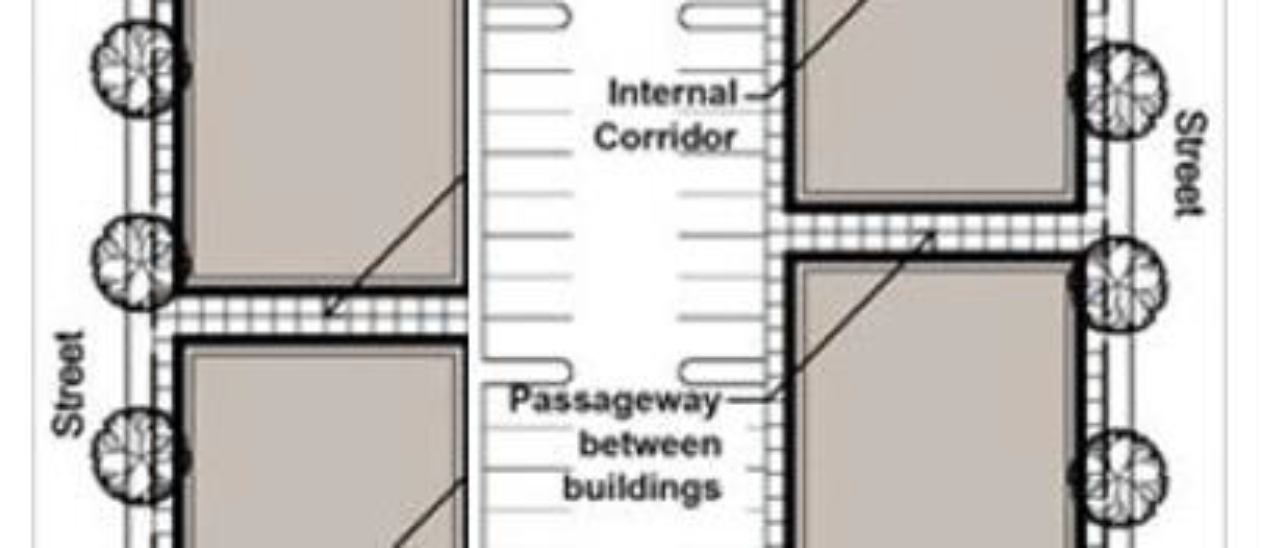
4 Building frontages shall be a minimum of 85 percent of the block face on primary streets and a minimum of 75 percent of the block face on secondary streets. Gaps between buildings shall be designated for specific uses including but not limited to: Pedestrian walkway, public art, outdoor dining, seating area, architectural elements (Trellises, landscaping, archways, etc.).
5 A parking setback of five feet shall be observed in the Goshen Mixed Use subdistrict for the purpose of providing a landscaping buffer.
(Ord. No. 6753-08-2022, § 2B(Exh. A), 8-16-2022)
Sec. 7. - Design standards.
In addition to the bulk standards defined in section 6 above, Design Standards are established for character forming elements required of each new development. These design elements create a level of design quality and consistent character that is in keeping with the city's Comprehensive Plan and community development practices and policies. These elements are required in the I-55 subdistricts as indicated below and may be varied as part of the planned unit development process where a development outcome of similar intent and quality is evidenced and provided as part of that process.
A.
Design standards for all I-55 subdistricts:
1)
Accessory structure design standards:
a)
Trash disposal facilities shall be located to the rear properties and shall be screened by a trash enclosure as specified in chapter 98 (Solid waste), of the City Code. However, in the I-55 subdistricts, no wood, vinyl, or chain link with slats may be used in the construction of dumpster enclosures.
b)
Max height of any accessory structure is 15 feet.
2)
Transitional buffer yard: When a lot is abutting a residential use, the abutting setback shall match that of the abutting residential district. Parking shall not be allowed in transitional buffer yards. Additional requirements shall be as specified in section 1228.08 - Transitional Buffer Yard Requirement and Landscaping, of the City Code.
3)
Landscaping and screening: In addition to any landscaping requirements specified in this section (Appendix B), additional landscaping requirements as specified in section 1228 Landscaping and Screening of the City Code shall apply. Where there is a conflict between the regulations of this section and section 1228, the more restrictive requirement shall apply.
4)
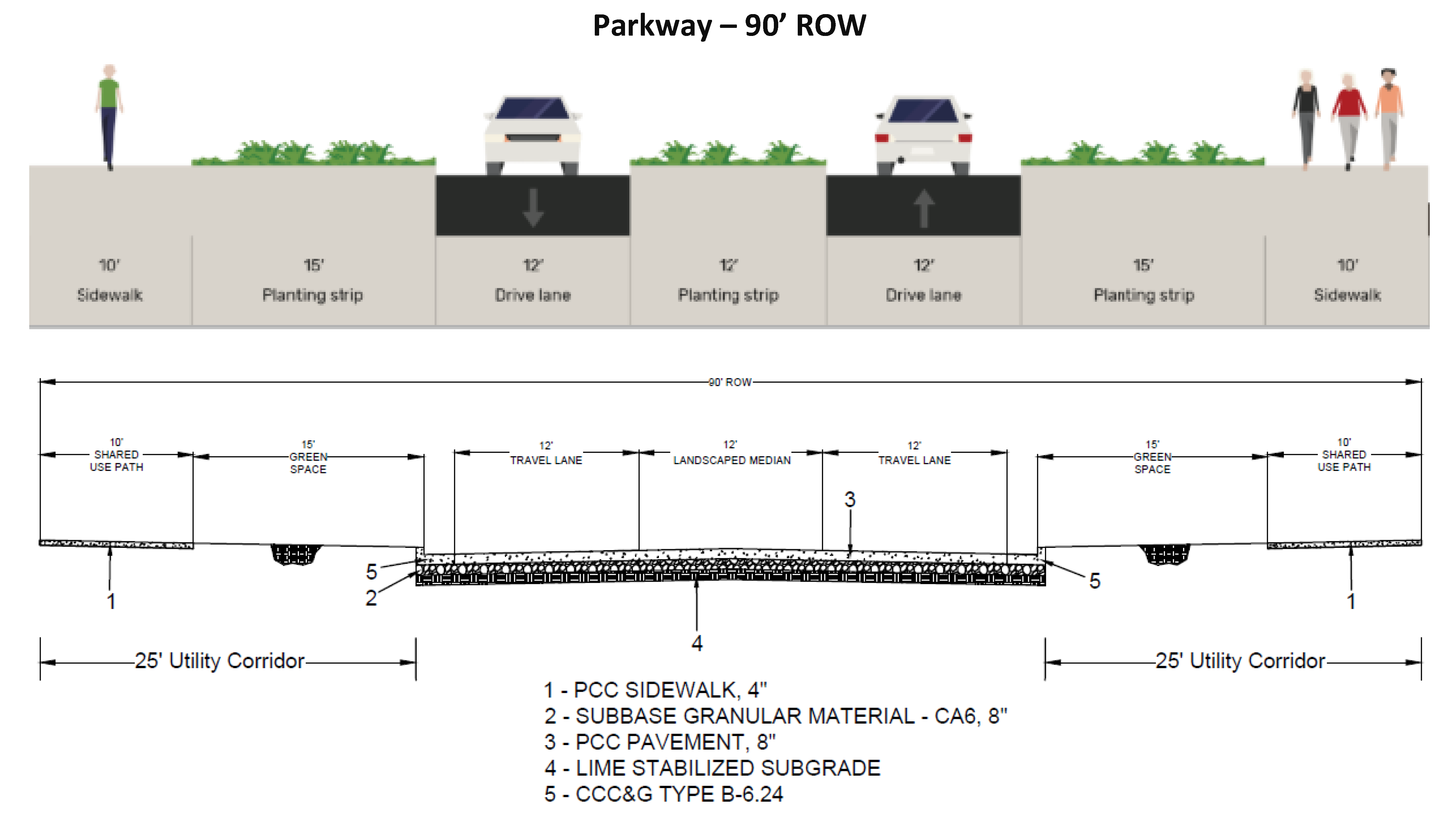
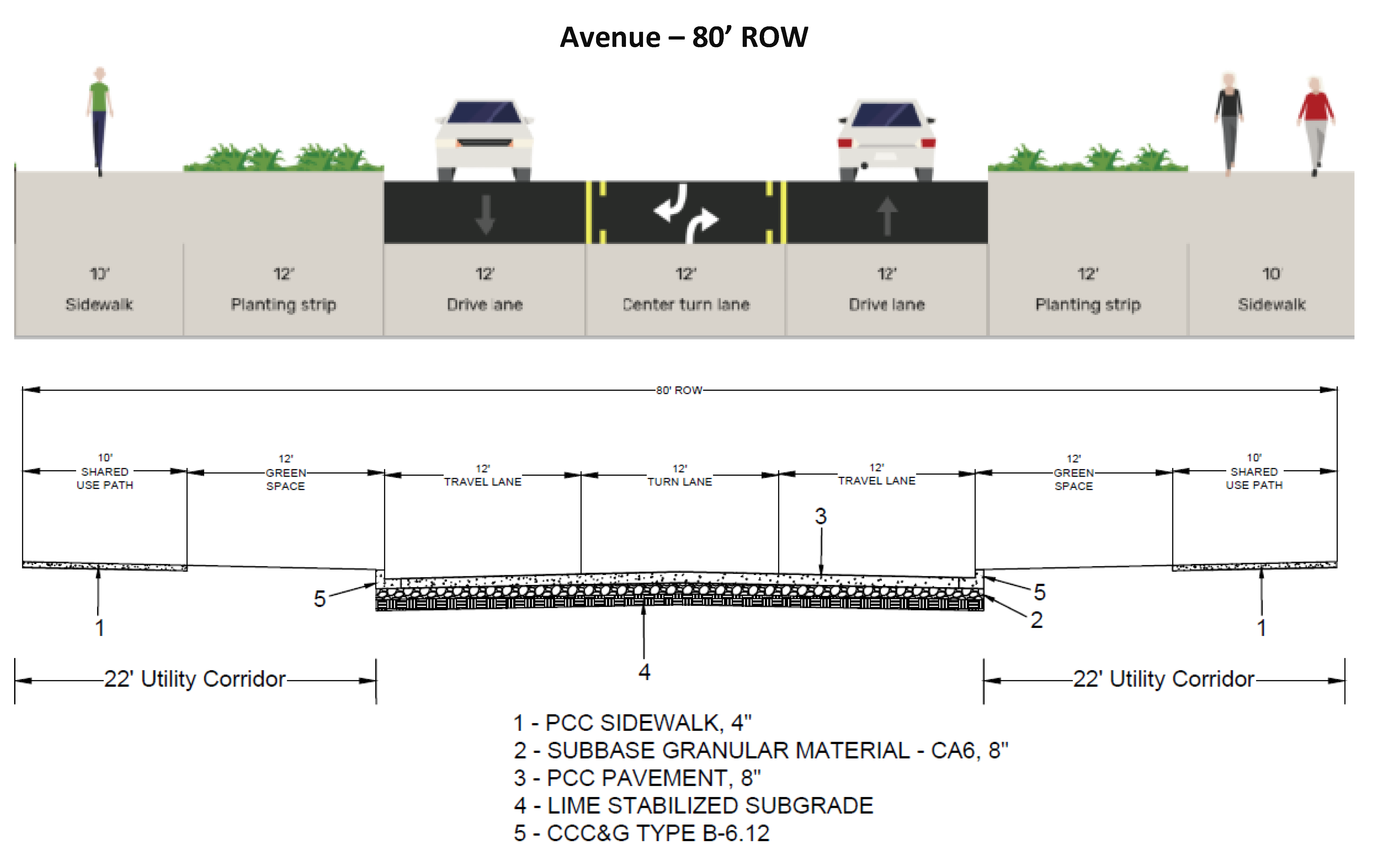
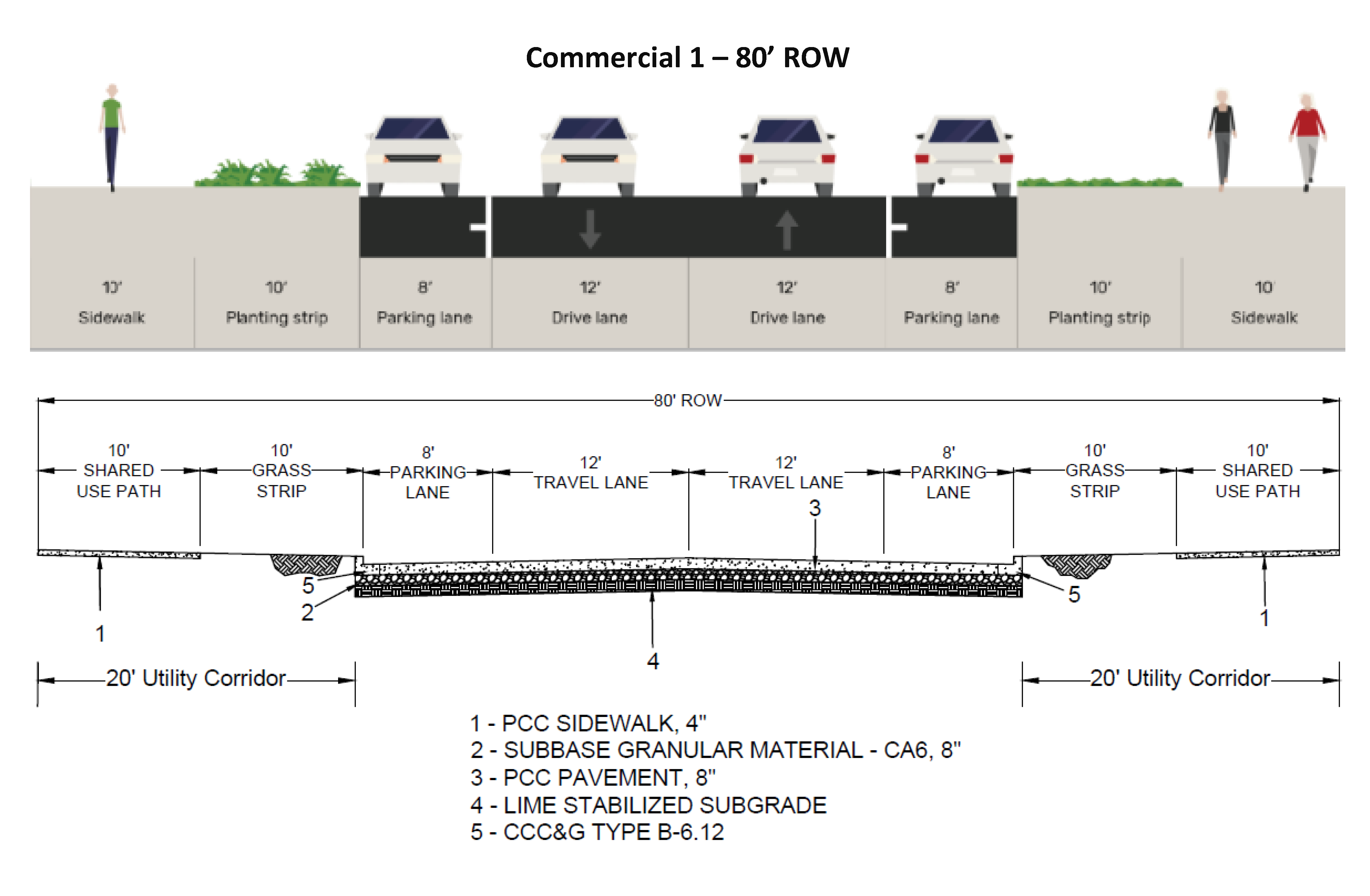
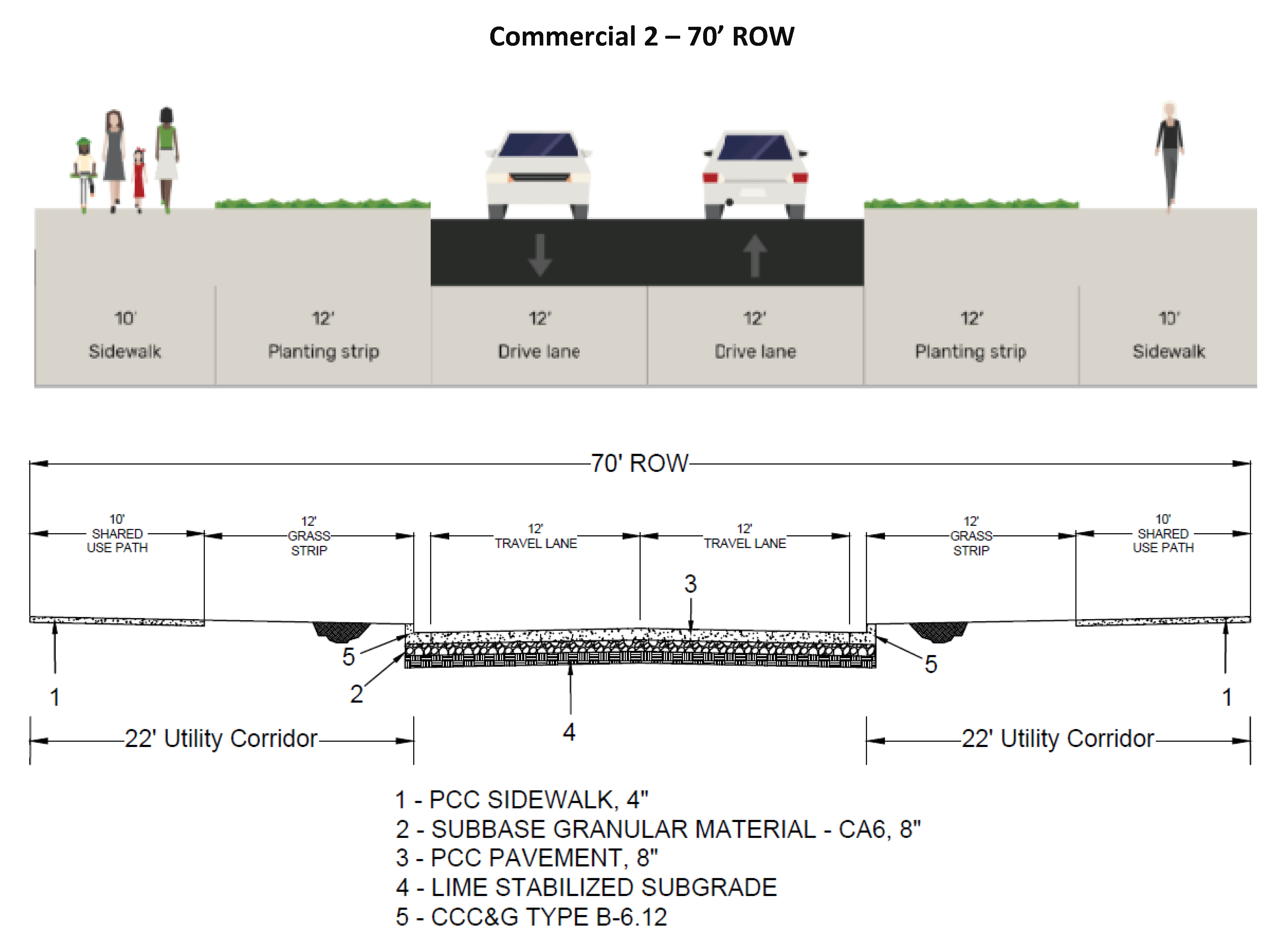
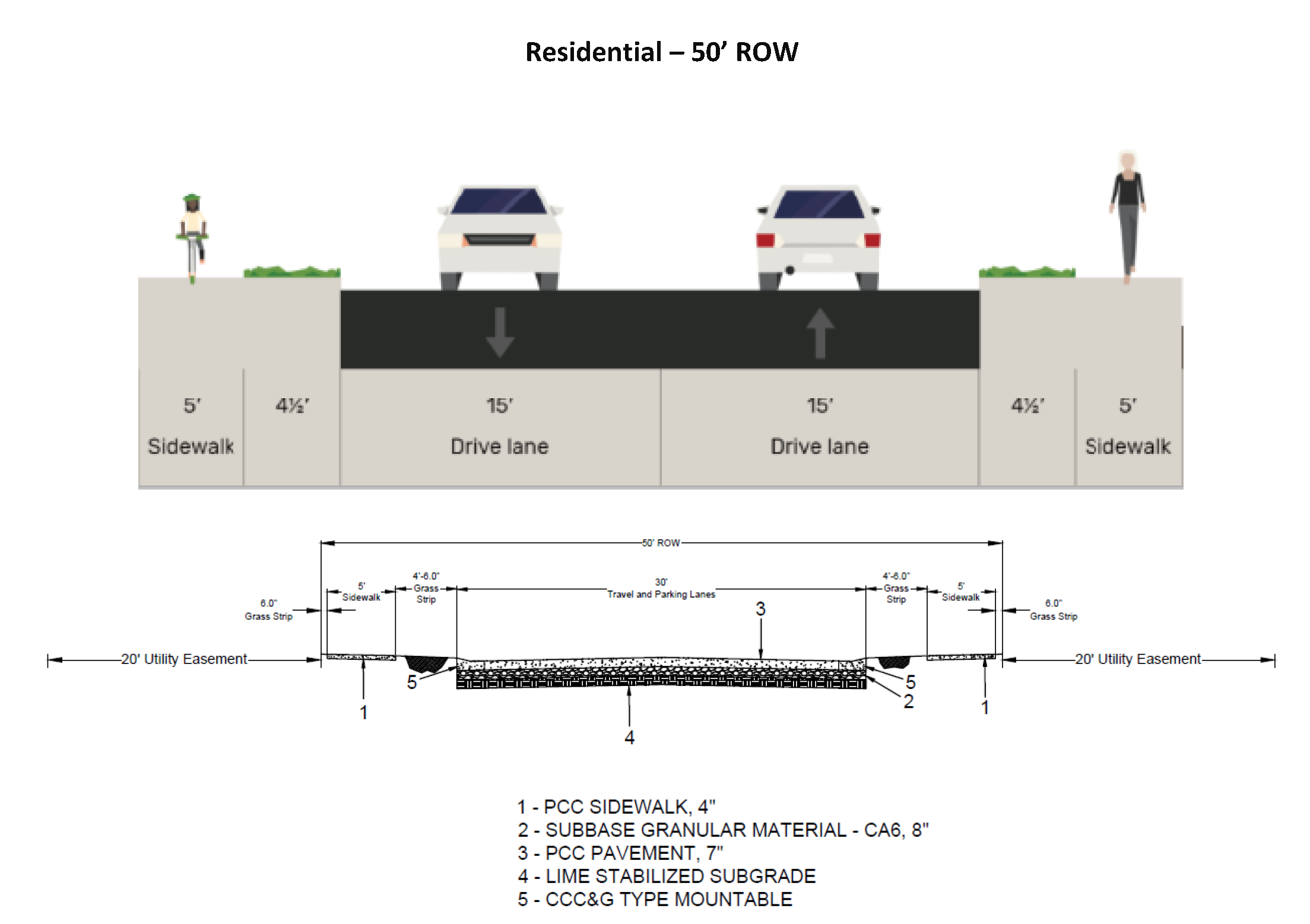
Rights-of-way and roadway configurations: Each road constructed in the I-55 Corridor District shall meet the right-of-way width and roadway cross-section standards as determined by the director of public works. Such determination shall be as specified in the I-55 Corridor transportation element (and depicted at the end of this section in Figure 6) as either the main street, parkway, avenue, commercial street 1, commercial street 2. The director of public works may refine the standards for each of these roadway configurations as required to meet current City standards and specification, or to reflect unique site conditions.
B.
Goshen Center design standards.
1)
Roadways in this subdistrict shall be designated as described in section 12 for the purposes of defining bulk, design, and use standards. Primary roads shall be those carrying more traffic and serving as main access to and through roads in this district. Secondary roads shall be all other roads. Primary roads in this district shall include: Gusewelle Road, Ridge View Road, Goshen Road, Governors' Parkway, and District Drive. Other roads may be designed by the zoning administrator as primary roads based on the criteria listed in this section and how the roadway will function. Right-of-way and cross section of all roadways shall be determined by the director of public works.
2)
No residential uses are allowed on the first floor, but are permitted on the second and third floors.
3)
Location of parking:
a)
No off-street parking established after the effective date of this ordinance shall be permitted within 50 feet of the right-of-way of a primary road. In addition, no parking may be located between the principal building and the right-of-way.
b)
Off street parking shall not be accessed from a primary road.
c)
Parking is permitted in the rear yard only.
d)
Parking may be allowed in a side yard for properties fronting on a secondary road (but may not represent more than 33 percent of the block frontage).
e)
Cross access easements and shared parking agreements shall be provided for as part of all off street parking facilities.
f)
All off street parking shall be designed with a clearly marked and safe path from the parking area to a building entrance or a sidewalk/path leading to a building entrance.
4)
Landscaping: Any off street parking along, abutting, or visible from a secondary road shall have a 100 percent screen with a 3-foot hedge along the secondary road, such landscaping shall not be counted toward required landscaping point totals per chapter 1228 (Landscaping and screening).
5)
Drive thrus: Drive thrus are not permitted as a principal or special use in Goshen Center.
6)
Use area: No use located in the Goshen Center subdistrict shall occupy more than 10,000 square feet of floor area in any building(s) or structure(s) without obtaining a special use.
7)
Corner lots:
a)
Principal structures on all corner lots shall be built to the property line on both street frontages.
b)
Vision triangle shall be observed for all corner lots.
8)
Building orientation:
a)
The primary entrance of any principal structure shall be oriented to the front property line and lead directly to the public sidewalk.
b)
Secondary entry to principal structures is permitted and encouraged to provide access from parking areas.
c)
In cases where a principal structure abuts more than one street, and one of those streets is a primary road, the primary entrance of any principal structure shall be oriented to the primary road.
d)
Passageways between buildings are allowed to reach fronts of the buildings and must be at least ten feet in width but not more than 20 feet unless designated for outdoor dining or gather spaces, in which case permanent architectural features such as trellises, public art, or seating areas are required to be incorporated into the area.
e)
Public facing facades: Walls that face streets, parking lots and/or connecting pedestrian walkways must not have a blank, uninterrupted length of greater than 40 feet without including a change in texture or masonry pattern, windows or other equivalent elements that subdivide the wall into human scale proportions.
9)
Building design and location:
a)
Building massing: Building designs shall have characteristics illustrating a base, middle and top.
b)
Relationship to adjacent buildings: Building elements shall, to the extent possible, be used to align with and complement such elements on adjacent buildings. This may include location and size of windows, building stories, columns, awnings, roof details, and other structural and architectural elements.
c)
Building stories: The stories of a building interior shall be discernable from the exterior of the structure and convey logically proportioned upper floors by use of design elements such as: orientation or spacing of windows, use of moldings, windowsills, lintels, brick detailing, or stringcourses, or application of other architectural elements. These design elements shall create a comfortable pedestrian scale at the ground floor of the building as reflected in signage, seating areas, window size, etc.
d)
Horizontal building elements: Horizontal building elements are encouraged to create visual interest in a building. Cornices or awnings are examples of such elements that may be used to accomplish this objective.
e)
Vertical building elements: The use of architectural elements is required to create visual interest, breaks in horizontal areas, and articulation in the building. This may be provided by design elements such as the orientation or spacing of windows, trim located on the building, columns, or application of other architectural features.
f)
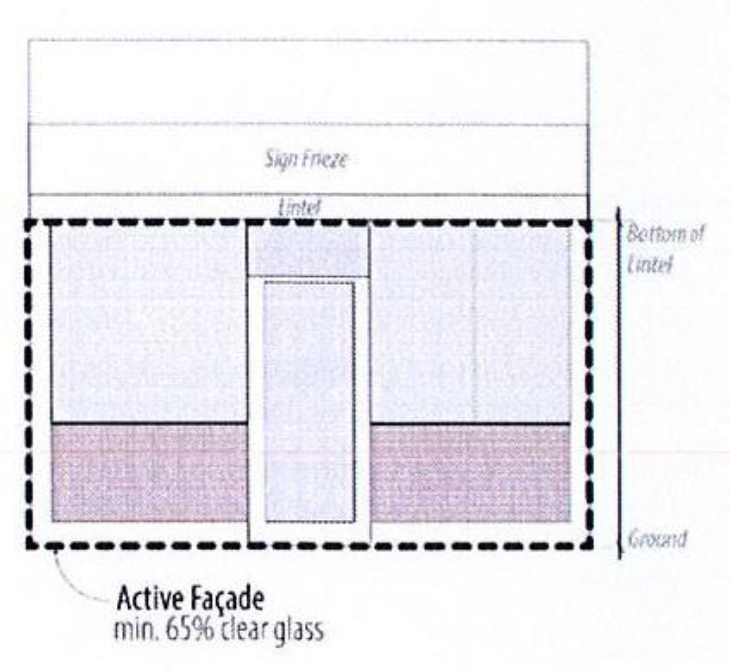
Active facades: Ground floor facades visible from a public sidewalk shall include a minimum of 65 percent clear glass.
g)
Mechanical equipment: Mechanical and utility equipment located on building rooftops or on the ground shall be located or screened so as not to be readily visible by pedestrians on adjacent sidewalks or from a distance.
h)
Service functions: Buildings should be sited so that portions of the building designed for service uses, such as loading docks and dumpster enclosures, are not readily visible from the street or sidewalk.
10)
Standards for road/ROW configuration:
a)
Minimum block length 200 feet. Maximum block length 400 feet.
b)
Minimum areas set aside for a civic green = 40,000 sf
c)
On street parking is required on primary and secondary streets as either parallel or angle parking.
d)
Sample block layout is shown in Figure 3 below.
e)
Sample orientations of varying land uses are shown in Figure 4 below.
11)
Civic green: Goshen Center development shall have civic green. A civic green is an open space consisting of lawn and informally framed by trees and shrubs, typically furnished with paths, benches, and open shelters. These spaces are intended for a moderate amount of foot traffic. The green may be framed by abutting streets or structures.
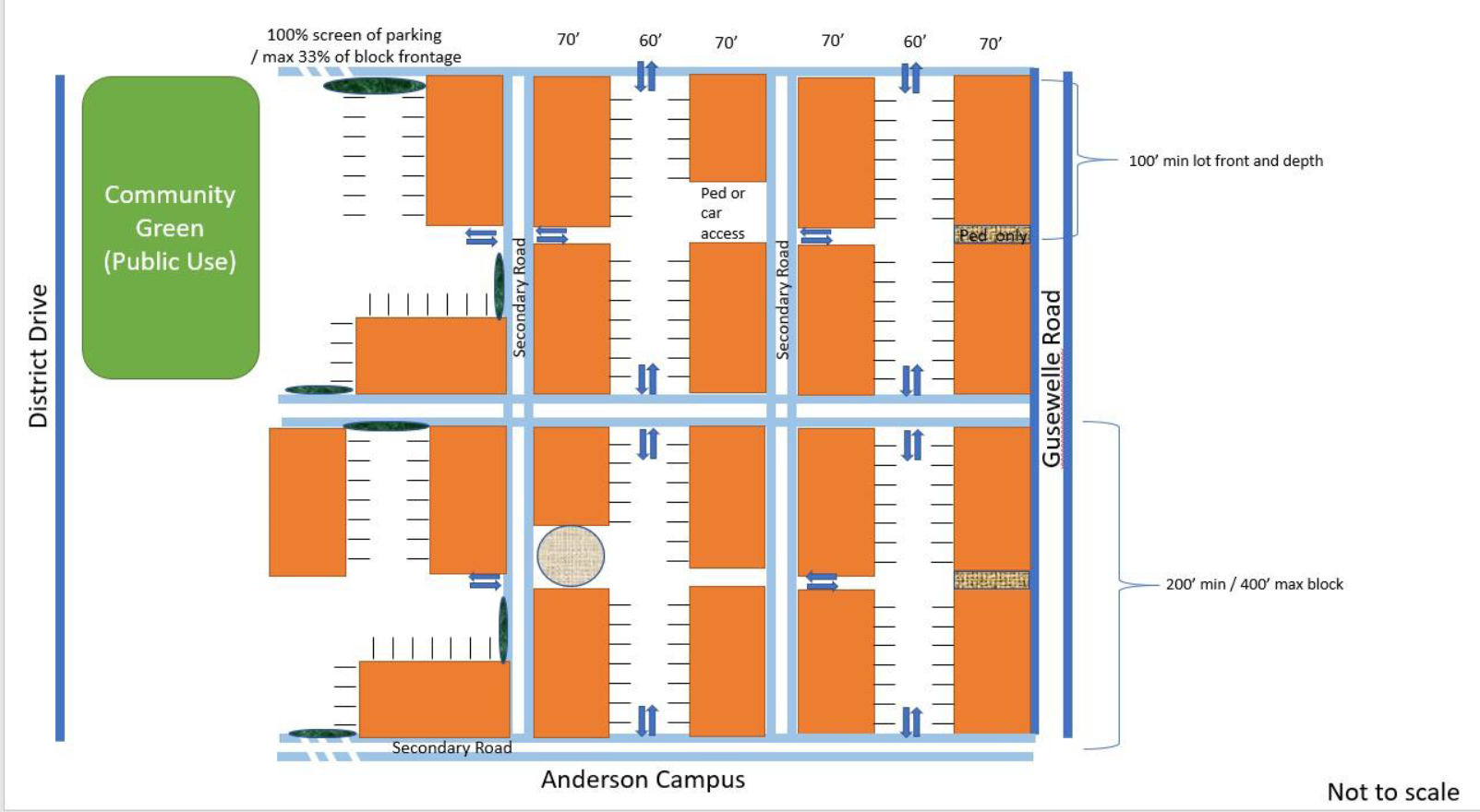
Figure 3: Example Roadway Layout
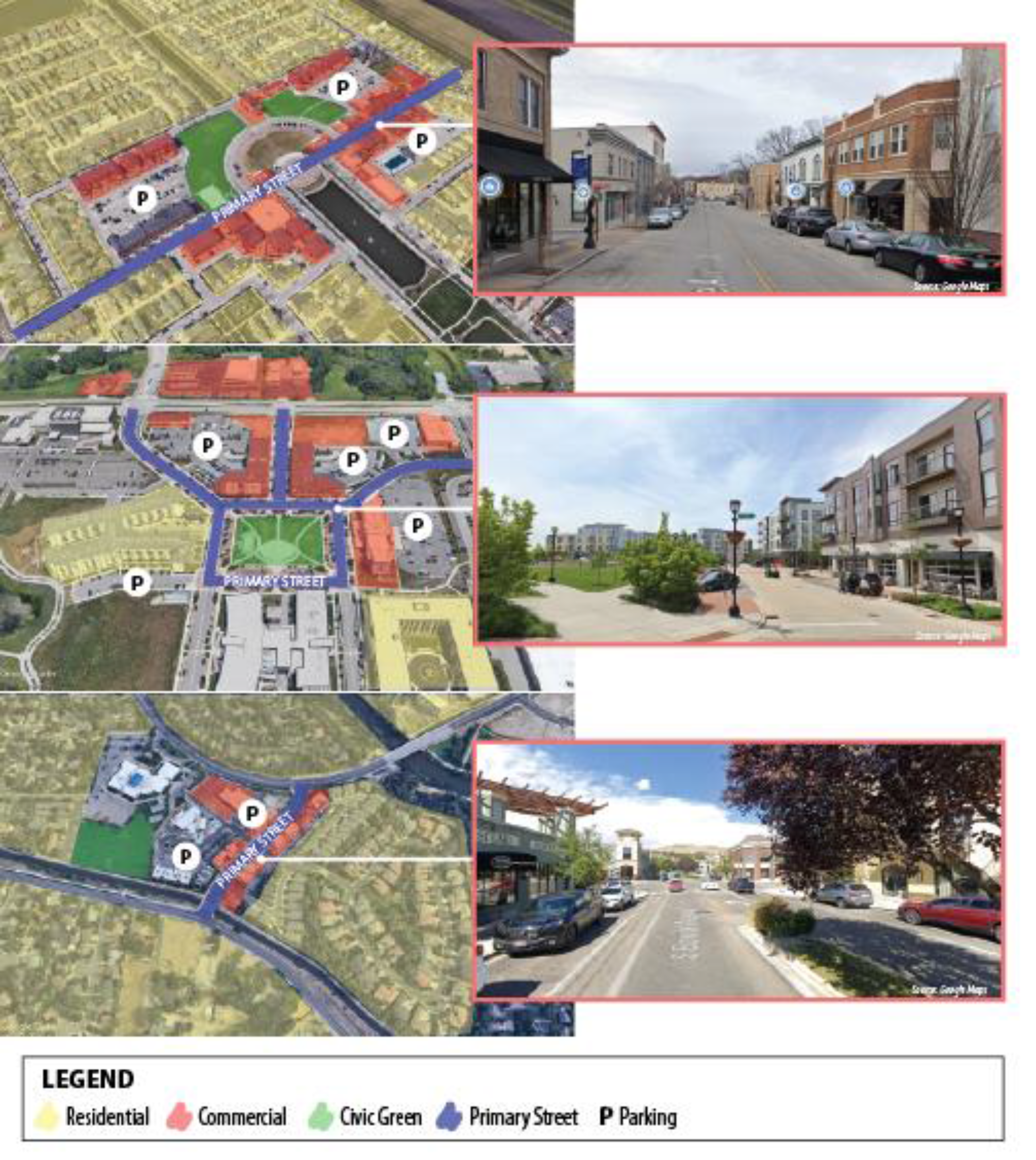
FIgure 4: Example Land Use Orientations*
Images: Google Maps
*Images are meant to show examples of orientation of commercial uses to residential uses, or open space uses. Images are not meant to convey bulk regulations, architectural features, or parking requirements regulated by this Code.
C.
Goshen Mixed Use Design Standards
1)
Location of parking:
a)
No more than a double row of off-street parking shall be permitted between the principal structure and the front property line.
b)
Parking may be allowed in the side yard, but not between the front line of the principal structure (extended) and the front property line.
c)
Parking is allowed in the rear yard.
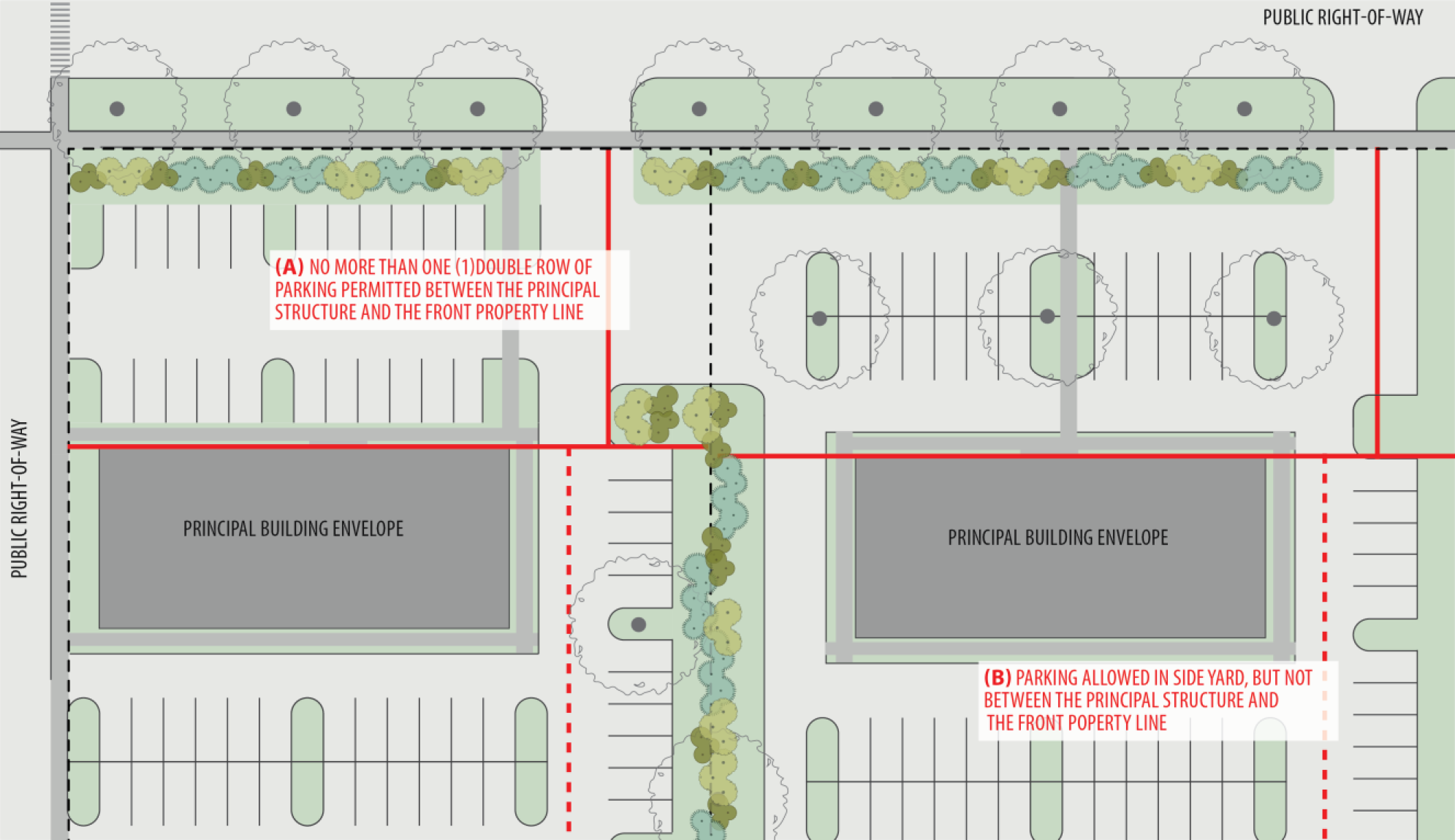
Figure 5: Parking Example
d)
Cross access easements and shared parking agreements shall be provided for as part of all off street parking facilities.
e)
All off street parking shall be designed with a clearly marked and safe path from the parking area to a building entrance or a sidewalk/path leading to a building entrance or additional retail frontage.
2)
Landscaping:
a)
Foundation planting shall be required for all principal structures.
b)
For the purposes of the I-55 Zoning District, foundation planting shall be defined as: An area of sod, low ground covering plants, flowering plants, and or shrubs abutting and designed to blend into the foundation of building areas visible to the public (generally the front and side of the buildings).
c)
Any off-street parking along, abutting, or visible from the public right-of-way shall have a 100 percent screen with a 3-foot hedge, such landscaping shall not be counted toward required landscaping point totals per chapter 1228 (Landscaping and screening).
3)
Drive thrus: Drive thrus are permitted as a special use in Goshen Mixed Use District. Landscape screening shall be provided on all sides of a drive through lane that abut a street.
4)
Corner lots: Vision triangle shall be observed for all corner lots.
5)
Building orientation:
a)
Primary building entrance(s) shall be oriented to the front property line and ROW.
b)
Passageways between buildings are allowed but must be at least ten feet but not more than 20 feet.
6)
Public facing facades: Walls that face streets, parking lots and/or connecting pedestrian walkways must not have a blank, uninterrupted length of greater than 20 feet without including two or more of the following: change in plan, change in texture or masonry pattern, windows or other equivalent elements that subdivide the wall into human scale proportions.
(Ord. No. 6753-08-2022, § 2B(Exh. A), 8-16-2022)
Sec. 8. - Design guidelines.
Citywide design guidelines (Appendix A of Appendix B of the City Code) shall be applied in the review process for any development in the I-55 District. Those standards are augmented by additional design guidelines shown below, which are reflective of unique characteristics of certain subdistricts. The design guidelines presented in this subsection are not specifically required to be incorporated into a development. Where appropriate for the site, structure and design, the building elements identified here are presented as options for how citywide design guidelines may be met in the I-55 District.
A.
Intent: Building frontage elements in this section should be considered by developers, property owners and designer to be incorporated into design of buildings in the Goshen Center and Goshen Mixed Use Subdistricts. When applied, they should be in context of existing structures or consistent with an overall design plan for multiple buildings.
B.
Applicability: Use of these design elements will be considered by the plan commission and city council regarding planned unit developments and special uses. If no such zoning process is required, these elements will be considered through the site plan review process.
C.
Building frontage types appropriate in the Goshen Center and pedestrian oriented areas of Goshen Mixed-Use Subdistricts.
1)
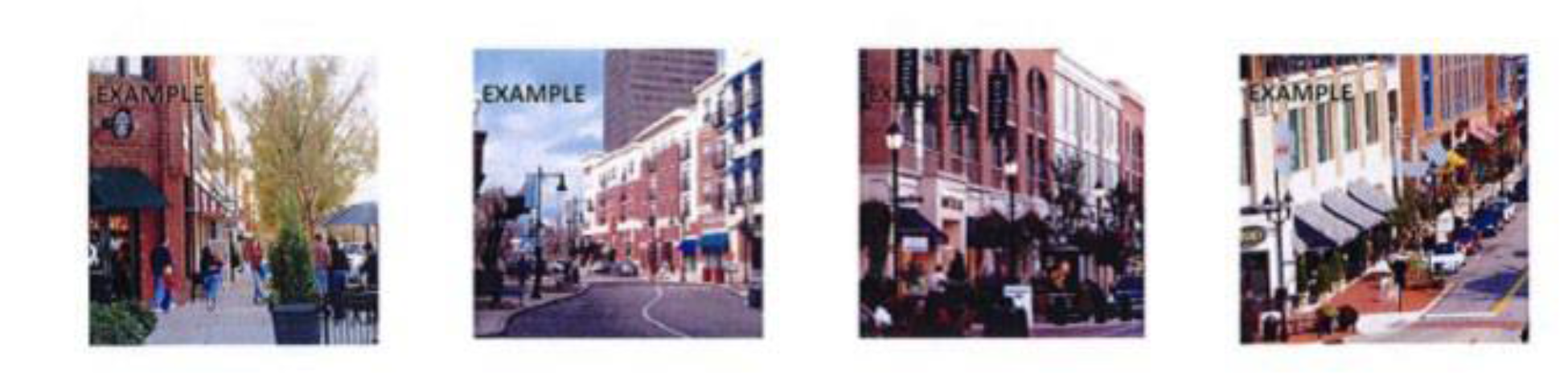
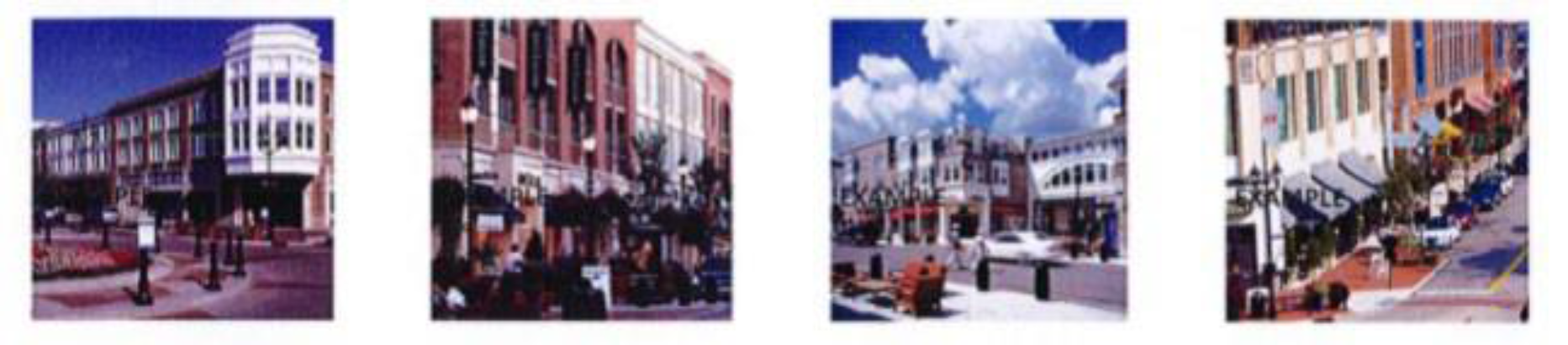
Awnings and canopies: A canopy is a cantilevered structure, often retractable, made of canvas or similar material. The covering protects pedestrians from the elements and should enhance the appearance of a building facade.
2)
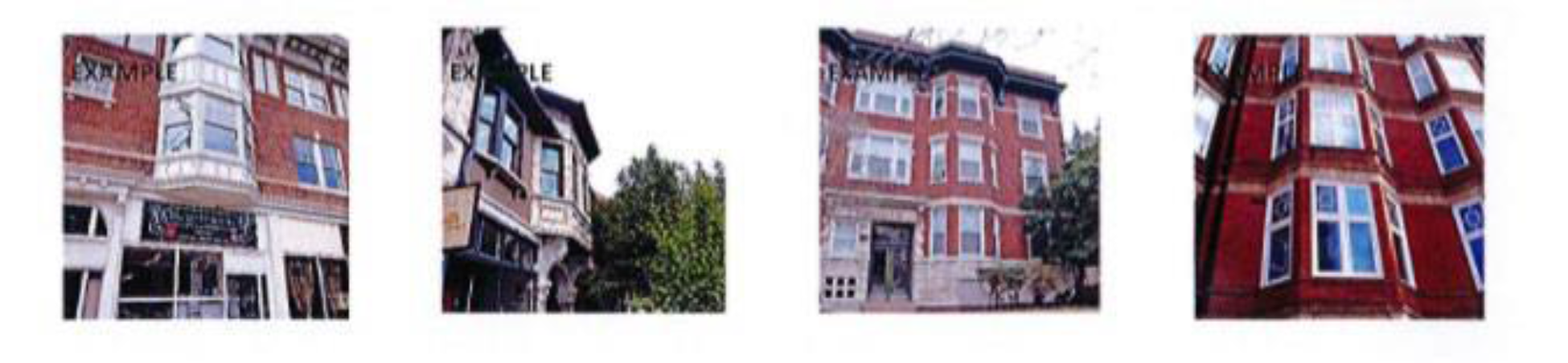
Bay windows: Bay windows add character, variety, and physical depth to buildings. When bay windows are included forward of the build-to line by no more than two feet, when authorized by the zoning administrator.
3)
Storefront: A storefront should be oriented toward pedestrian areas with the entrance at sidewalk grade and easy to identify. The storefront should be transparent so merchandise and activities in the store can be seen. An overhang, canopy, shading element, or awning that encroaches over the sidewalk can be used to enhance the storefront.
4)
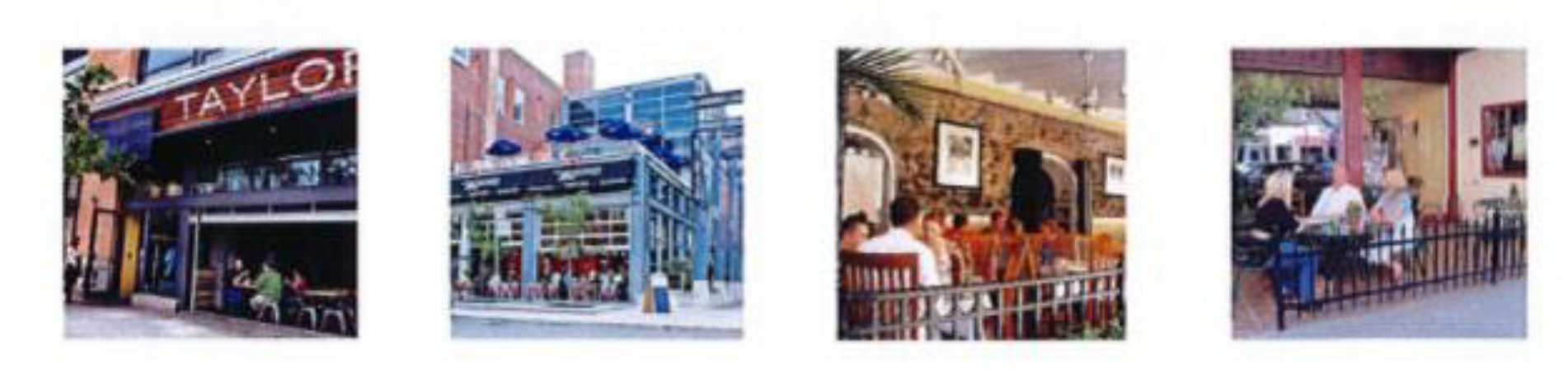
Outdoor cafe: An outdoor cafe accommodates outdoor seating for restaurants and cafes. Where possible, outdoor cafes should be located on private property. All outdoor cafe areas must meet the requirements of chapter 22, article V, (Outdoor dining on sidewalk).
D.
Building frontages considered appropriate in pedestrian oriented areas of the Goshen Mixed Use Subdistrict. The architectural elements noted in this subsection D are not compatible or appropriate with all architectural styles or forms of development. The elements described below should only be applied in situations where they are in keeping with the architectural and visitor use objectives of the development. The city will apply this consideration as it evaluates whether city wide architectural guideline requirements are met.
1)
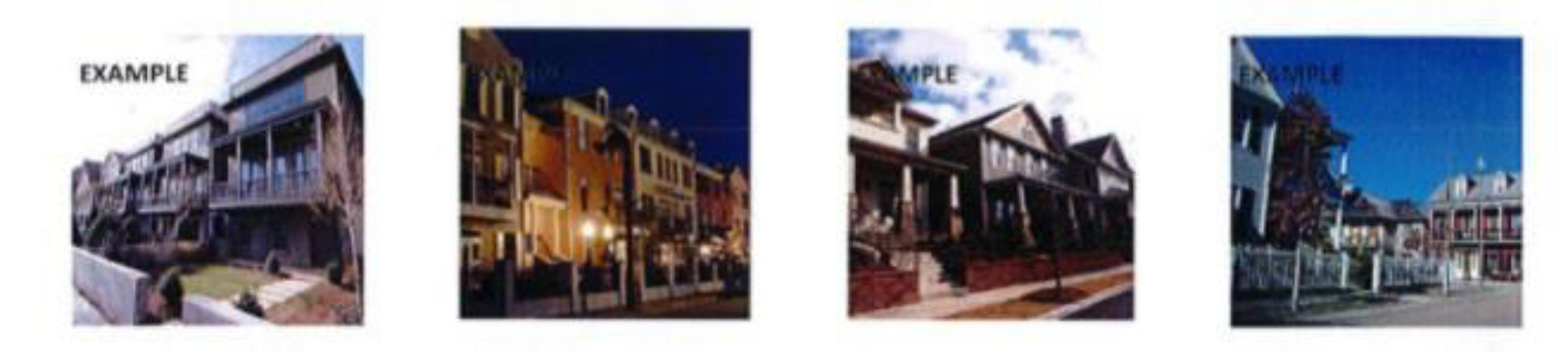
Balconies: Balconies may or may not have roofs, but are open, outdoor, non-air-conditioned parts of the buildings. On corners, balconies may wrap around the side of the building facing the side streets. Balconies that occur in front of the build-to-line shall not extend past the curb line.
2)
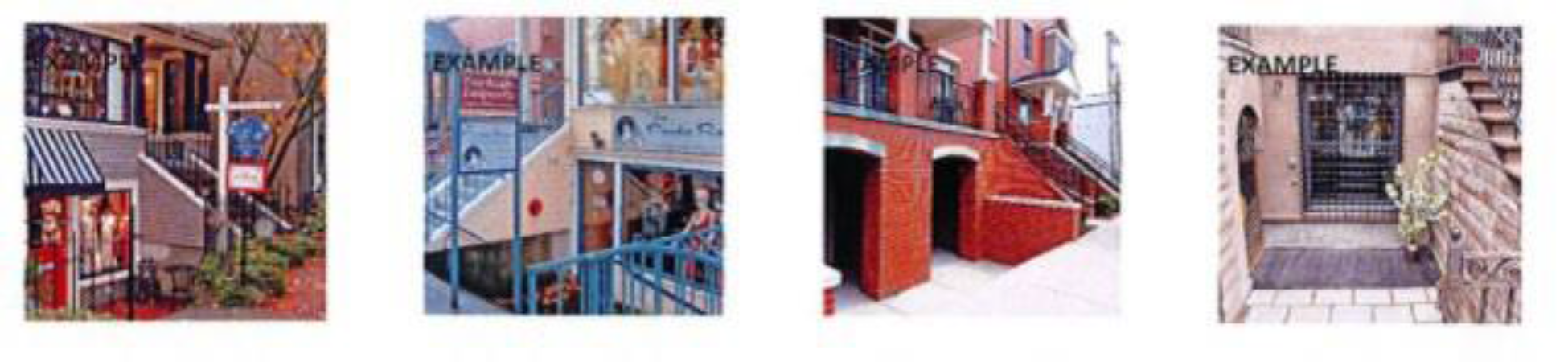
Terrace and light court: This architectural design is where the facade is set back from the property line by an elevated terrace or sunken light court. This buffers residential use from urban sidewalks and removes the private yard from public encroachment. The terrace is suitable for conversion to outdoor cafes as the eye of the sitter is level with that of the standing passerby.
E.
Building frontages in the in Pin Oak Commercial District. In addition to citywide design guidelines, development in the Pin Oak commercial subdistrict should integrate the following considerations:
1)
Encourage a sense of arrival through the placement of significant buildings and attractive architectural facades.
2)
Highlight city entry points at the interchange and buildings sited near there with character creating features like intensive landscaping, public art, water features, etc.
3)
Improve visual aesthetic of roadways using landscaping and streetscape amenities (gateway and wayfinding signage, lighting, pedestrian paths), planted medians, and landscaped setback areas.
4)
Edwardsville gateway signs with complementary landscaping should be located in the area.
(Ord. No. 6753-08-2022, § 2B(Exh. A), 8-16-2022)
Sec. 9. - Land uses.
Permitted and special uses permitted by subdistrict are shown in Table 2.
Table 2: I-55 Corridor Zoning District Land Use Table
(Ord. No. 6753-08-2022, § 2B(Exh. A), 8-16-2022)
Sec. 10. - Standards for residential subdivisions.
Any development within the I-55 District that includes a subdivision of property shall be subject to the City of Edwardsville Land Development Code. In addition, such developments shall be subject the requirements of this I-55 Zoning district and the following standards:
A.
Paths: Paths serving both pedestrians and bicyclists shall be provided as part of new subdivisions.
B.
Connectivity/paths: Pedestrian and bicyclist paths provided as part of subdivisions shall make safe and convenient connections to the Goshen Center, adjacent neighborhoods, nearby business areas, nearby regional trails, and other destinations as may be identified by the city. Where the potential for future connections from the proposed development may exist, accommodations such as stubbed paths, trailheads, etc. shall be provided by the subdivider.
C.
Connectivity—vehicles: The road system developed as part of a subdivision shall provide safe and convenient connections to existing and planned roadways on adjacent properties and in the I-55 District generally. In addition, cul-de-sacs are discouraged and should be considered only when unique topography or existing land conditions (such as wetlands) make connections impractical.
(Ord. No. 6753-08-2022, § 2B(Exh. A), 8-16-2022)
Sec. 11. - Supplemental regulations.
Uses listed below, whether permitted or special uses in the I-55 Corridor District, shall meet the follow additional requirements:
A.
Hotels.
1)
Hotels permitting guests to have dogs shall provide a designated dog walking area on the site. Such area shall be away from primary entrances and provide materials and facilities for disposal of dog waste.
2)
Hotels located adjacent to residential uses shall confirm to transitional buffer yard requirement and landscaping standards per section 1228-08 of the City Code.
3)
Hotels located within 1,000 feet of complementary uses or amenities (restaurants, coffee shops, recreation areas, trails, etc.) shall provide clear and safe pedestrian connections to such uses, or to sidewalks or other pedestrian connections that access such uses.
B.
Fuel centers.
1)
Fuel pumps shall be set back at least 40 feet from the right-of-way line or from any residential property line, and at least 85 feet from any school, hospital, church, or other place of public assembly.
2)
No aspect of gas station operations may incorporate any part of a public right-of-way in its design or operation.
3)
No repair functions as accessory or principal uses shall be allowed.
4)
Any inoperable vehicles stored on the site shall be located there for no more than three days.
5)
Outdoor storage and display of merchandise associated with the use is permitted, but may not exceed a total area of 100 square feet and must be set back a minimum of 20 feet from any property line.
6)
No accessory personal service may be allowed as part of a fuel center. Such accessory personal services shall be defined to include, but not be limited to showers, barbers, laundry facilities available to customers and sleeping facilities.
7)
Overnight parking of trucks or other motor vehicles shall not be allowed.
8)
A landscape perimeter of no less than 15 feet shall be provided along the front property line and include sod, low ground covering plants, flowering plants, and or shrubs.
(Ord. No. 6753-08-2022, § 2B(Exh. A), 8-16-2022)
Sec. 12. - Transportation.
A.
No cul-de-sac may be installed in any district without providing a ten foot shared use path that connects the sidewalk at the terminus of the cul-de-sac to the transportation network opposite the cul-de-sac.
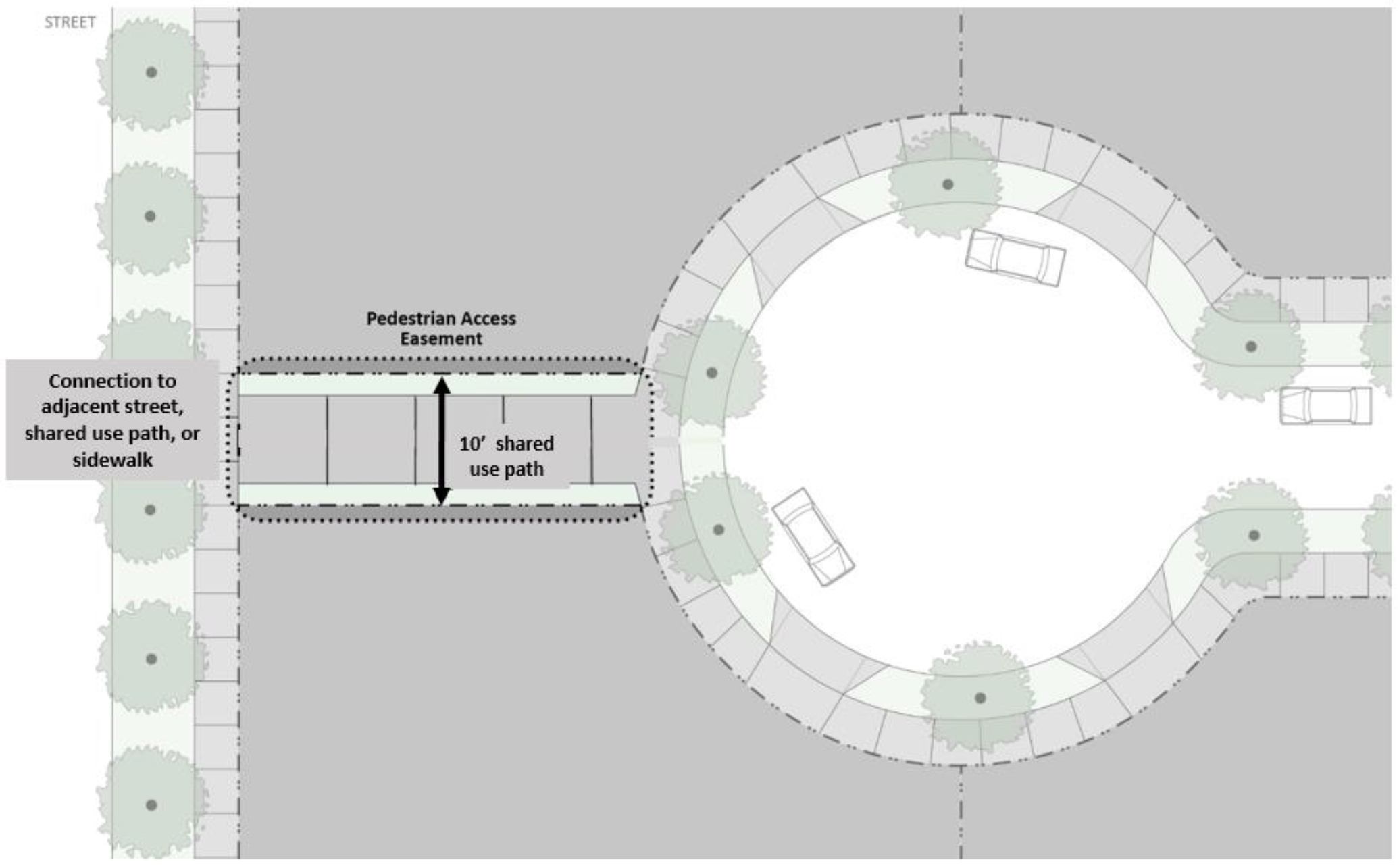
Figure 6: Cul-De-Sac Connection
B.
A variety of street cross sections are permitted in the I-55 Corridor. Generally, the following alignments are planned for:
1.
North-south roadway connecting Governors' Parkway to Goshen Road between District Drive and Ridgeview Road.
a.
Main street cross section is appropriate for this primary thoroughfare
2.
East-west roadway connecting District Drive and Ridgeview Road.
a.
Main street cross section is appropriate for this primary thoroughfare.
3.
A southern extension of Raymond Road to Governors' Parkway is planned. This roadway shall intersect with the northern extent of the north-south road described in item A.
4.
The north-south and east-west roadways, as described in 1 and 2 above, shall intersect and/or flank the community green.
C.
The cross-sections provided in Figure 7 are permitted as shown below. The public works director shall determine the appropriate roadway cross sections during plan review. Table 3 identifies the street cross sections that are permissible both within and adjacent to each subdistrict.
Table 3: I-55 Corridor Zoning District Street Cross Sections
Figure 7: Roadway Cross Sections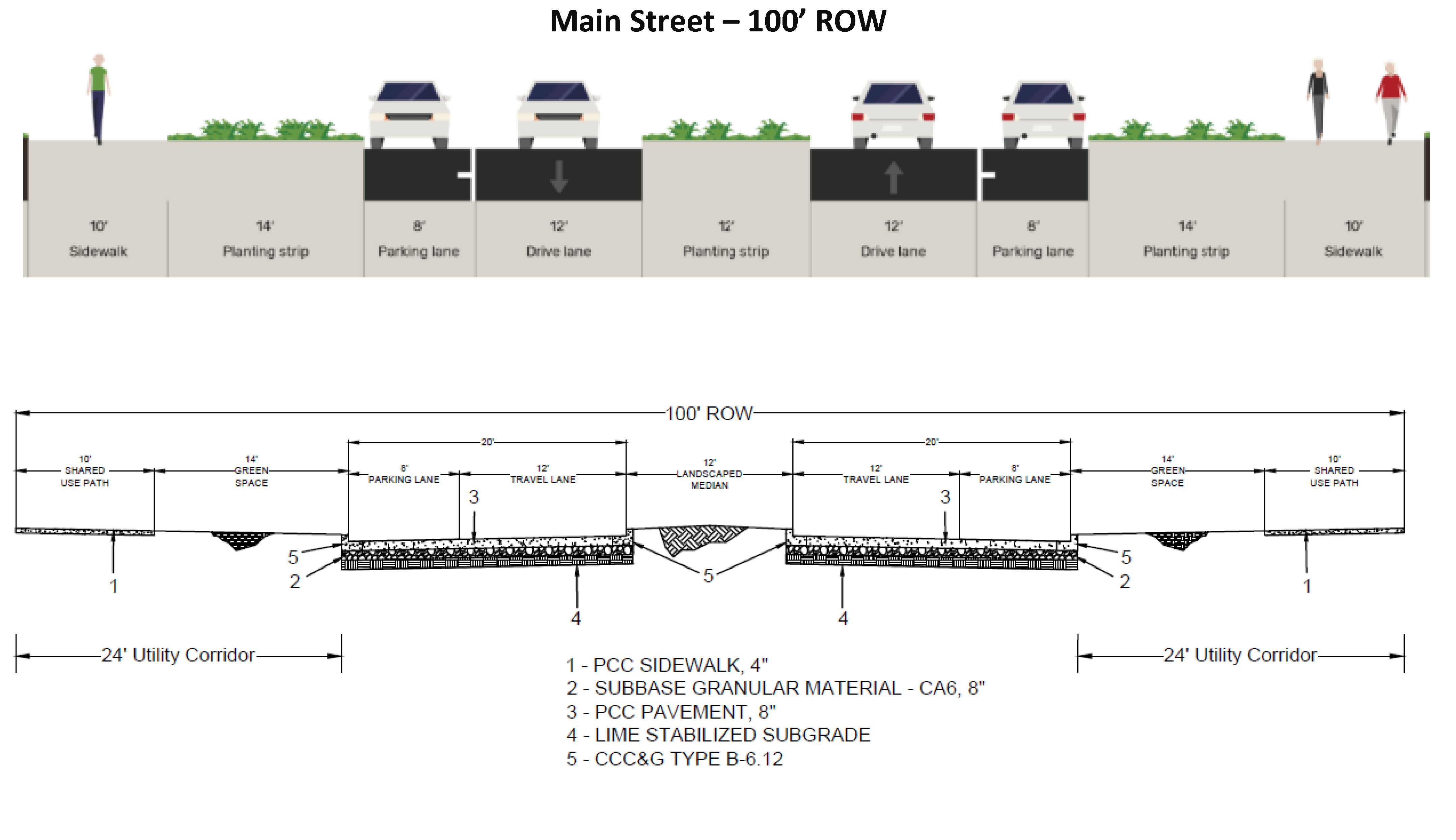
Figure 7: Roadway Cross Sections