
Edwardsville City Zoning Code
CHAPTER 1250
LOT COVERAGE AND UTILIZATION16
Cross reference— Application of district regulations, § 1248.01; building permits, § 1248.01.2; overall district development requirements, § 1248.02; nonconforming uses, § 1248.03.
1250.01 - Maintenance of yards and open spaces.
The maintenance of yards, courts and other open spaces and minimum lot area legally required for a building shall be a continuing obligation of the owner of such building or of the property on which it is located, as long as the building is in existence. Furthermore, no minimum yards, courts or other open space or minimum lot area allocated to any building shall, by virtue of change of ownership or for any other reason, be used to satisfy yard, court or other open space or minimum lot area requirements for any other building.
1250.02 - Zoning lots.
No improved zoning lot shall hereafter be divided into two or more zoning designations unless all improved zoning lots resulting from each such division conform with all the applicable bulk regulation of the zoning district in which the property is located. However, with respect to the resubdivision of improved zoning lots in the R-2 district, side yard requirements shall apply between adjacent buildings. Zoning lots must be held under one ownership.
1250.03 - Location of required open space and required yards for existing buildings.
All yards, courts and other open spaces allocated to a building or dwelling group shall be located on the same zoning lot as such building or dwelling group. No yards now or hereafter provided for a building existing on the effective date hereof shall subsequently be reduced below, or further reduced below if already less than, the minimum yard requirements of this zoning code for equivalent new construction.
1250.04 - Erection of more than one principal building on a lot.
Except in the case of a planned development, not more than one principal detached residential building may be located on a residential zoning lot, nor may a principal detached residential building be located on the same zoning lot with any other principal building.
1250.05 - Contiguous parcels or lots.
When two or more parcels of land, each of which lacks adequate area and dimension to qualify for a permitted use under the requirements of the use district in which they are located, are contiguous and are held in one ownership, they may be used as one zoning lot only if they are consolidated as described in Section 3-4C of the Land Development Code.
(Ord. No. 6659-06-2020, § 2(Exh. A), 6-16-2020)
1250.6 - Lots or parcels of record.
Any vacant lot that does not conform to one or more of the lot size requirements of the district in which it is located may be used in the manner permitted by said zone district if it is of record as of March 21,1995 and has frontage on an improved street.
(Ord. No. 5949-7-14, § 3, 7-2-2014; Ord. No. 6659-06-2020, § 2(Exh. A), 6-16-2020)
1250.06.01 - District limitations.
A lot which does not conform to one or more of the lot size requirements of the R-l Single-Family or R-2 Multiple-Family districts may be used in the manner permitted by said zone district if it:
(a)
Is equal to or greater than 50 feet wide at the building line.
(b)
Utilizes existing setbacks, except as may be specifically provided otherwise, where existing development has already established setback lines, any new principal building constructed shall meet the established front setback line for that block (same side of street). However, in no case shall such building be located closer than 15 feet from any road right-of-way line.
(c)
Is an interior lot of record platted prior to March 21,1995, and has a width of less than 70 feet, the side yard on each side of the principal structure erected may be reduced from ten feet to a width of not less than seven feet six inches.
(d)
Is a corner lot of record platted prior to March 21, 1995, and has width of less than 70 feet, the interior side yard of the principal structure erected may be reduced from ten feet to a width of not less than seven feet six inches and the corner street side yard of the principal structure may be reduced from 20 feet to a width of not less than 15 feet.
A lot which does not conform to one or more of the lot size requirements of the B-2 Commercial/Business District may be used in the manner permitted by said zone district if it is a lot of record platted prior to March 21,1995, and has a width of less than 100 feet, the new principal structure may be constructed provided the setbacks are not less than 75 percent of the district minimum requirements for setbacks.
(Ord. No. 5949-7-14, § 3, 7-2-2014; Ord. No. 6659-06-2020, § 2(Exh. A), 6-16-2020)
1250.06.02 - Small lot overlay.
This section shall apply to R-1 single-family residence district zoned lots or tracts of having a minimum width of 40 feet and not greater than 49 feet 11 inches in width and containing a minimum lot size of at least 5,000 square feet but no more than 7,499 square feet in existence prior to March 21, 1995. Per the requirements of 1242.02.3(b)(6) (R-2 Special uses), this section shall apply to R-2 multiple-family dwelling district zoned lots or tracts of having a minimum width of 40 feet and not greater than 49 feet 11 inches in width and containing a minimum lot size of at least 5,000 square feet but no more than 7,499 square feet in existence prior to March 21, 1995, only after approval of a special use permit for a single-family residence dwelling.
(a)
Lot standards: Any lot utilizing the provisions of this section shall be limited to a single-family residential dwelling unit.
(b)
Dwelling unit standards: Every dwelling hereafter erected in any small lot overlay shall have a total ground floor area of not less than 750 square feet, measured from the outside of the exterior walls including utility rooms but excluding cellars, basements, open porches, breezeways, garages and other spaces that are not used frequently or during extended periods for living, eating or sleeping purposes.
(c)
Use restrictions:
(1)
Building allowance: Only one principal building shall be erected on any lot.
(2)
Accessory use restrictions:
A.
Height: No accessory use shall be higher than 15 feet above grade.
B.
Setbacks: No accessory use shall be located within the front yard or side yard area as determined from the principal building. No accessory building shall be located within ten feet of the principal building, or less than five feet from side and/or rear property lines.
C.
Yard coverage: Accessory uses shall not cover more than forty percent of a required rear yard. Accessory uses include but are not limited to gazebos, storage buildings for lawn and gardening equipment, carports and other similar structures with permanent roofs. In addition, accessory uses also include the water surface area of above and in-ground swimming pools and the foundation area of permanent outdoor cooking areas.
D.
Use as a dwelling: Use of any accessory structure as a dwelling is strictly prohibited.
(3)
Lot and building requirements:
A.
Minimum lot width: 40 feet.
B.
Maximum lot width: 49 feet 11 inches.
C.
Lot size: In order to qualify under the provisions of this section, the lot must be contain at least 5,000 square feet and contain no more than 7,499 square feet.
D.
Minimum setbacks:
1.
Front yard: Utilize existing setbacks for the underlying residential zone, except where existing development has already established a setback line. In this case, any new principal building constructed shall meet the established average front setback line for that block (same side of street). However, in no case shall such building be located closer than 15 feet from any road right-of-way line.
2.
Side yards:
a)
Interior lots: Side yard setbacks shall be a minimum of five feet. In addition, there shall be at least ten feet between the building foundation of the subject tract and the building foundation on the adjoining property.
b)
Corner lots: Buildings shall be situated so that there is a minimum of ten feet between the building footprint and the side yard property line running parallel with the adjoining street. The interior (non-corner) side yard shall be a minimum of five feet or at least ten feet between the building foundation of the subject tract and the building foundation on the adjoining property
3.
Rear yard: In no case shall such building be located closer than 30 feet from the rear property line.
E.
Maximum building height. No greater than ten percent of the average height of principal structures on the same side of the street or 35 feet, whichever is less.
F.
Maximum floor area ratio: One-half square feet of floor space for each one square foot of lot area.
G.
Maximum percent of lot building coverage: 40 percent.
(4)
Off street parking: A minimum of one parking space shall be provided per bedroom. The small lot overlay shall allow a maximum of one designated parking space within the front yard area as determined from the principal building. To accommodate this parking space, the driveway shall be a minimum of 22 feet in length as measured from the front building line to the front property line. This designed parking space shall not overlap, cross over, or encroach in any way into required public sidewalks. All other required parking spaces must be located either in the side or rear yard and enclosed in an attached or detached garage. See subsection (5) on garage setback requirements.
NOTE: The number of bedrooms available to a house in the small lot overlay is determined by the number of available off-street parking spaces, including those within garages. Example: If the available space on the lot can only accommodate two parking spaces, the proposed house can only contain two bedrooms. Building officials and planning staff will need to remain diligent in insuring that building permits are not issued to finish basements or convert rooms to bedrooms for lots where a SLO has been previously established.
(5)
Garage requirements:
A.
Corner lots: Corner lots shall require side access garage entry. The requirements of subsection (c)(4) are applicable.
B.
Interior lots: Garages on lots which are not on a corner may be offset in order to comply with the requirements of subsection (c)(4).
C.
Lots with alley access: If a SLO lot has access to a rear alley, the garage (attached or detached) shall be oriented toward the rear to accommodate vehicle parking. Attached garages are part of the principal structure and shall maintain principal building setbacks.
(6)
Side yard projections and encroachments:
A.
Roof eave projections into side yards shall not exceed 12 inches.
B.
Side yards shall remain unencumbered, free and clear of permanent structures, projections or obstructions, such as but not limited to bay and garden windows, chimneys or cantilevered construction.
Exception: A landing and steps for a side entry doorway having a maximum horizontal projection of four feet from the face of the building in any direction and not to exceed a horizontal height of 24 inches. All handrails provided, shall be parallel with and attached to the building face.
(7)
Architectural requirements: In order to insure that any new structure constructed on a lot within a small lot overlay is both architecturally comparable to those within the same block and provides livable outdoor amenities for the occupants, the following criteria shall be required as part of approval of the small lot overlay:
A.
Exterior building façade materials: Exterior building façade materials for both the principal and accessory buildings over 400 square feet must have 100 percent brick masonry or concrete fiberboard or combination thereof on the front facing façade minimum 25 percent brick masonry or concrete fiberboard or combination thereof totaling 25 percent must be on the side and rear facades. Vinyl exterior finishes are prohibited on the front facing façade and may not cover more than 75 percent of the side and rear façade.
B.
Design requirements: Except as provided in subsection (7)D of this section, principal structures within the small lot overlay shall adhere to the following requirements:
1.
Porches: A covered front porch which comprises a minimum of 40 percent of the width of the front building façade with a minimum depth of six feet.
2.
Roof type and pitch: All newly constructed non-accessory structures shall have gabled or hip roofs with pitches having a minimum slope of four units vertical in 12 units horizontal.
3.
Building height: Building heights shall be no greater than ten percent of the average height of principal structures on the same side of the street or a maximum of 35 feet, whichever is less.
4.
Orientation to the street: All new non-accessory structures erected in the small lot overlay shall provide entrances, windows and porches oriented to the street from which it is addressed.
5.
Garages: Attached garages with garage doors facing the front lot line shall not extend any further into the front yard than the front porch.
6.
Air conditioning units and heat pumps: Air conditioning units and heat pumps shall be located in rear yards only.
7.
Glazing: Every building face shall contain a minimum five percent of the total face square footage in window glazing.
8.
Street tree: One street tree shall be provided in the front yard. Street trees may include any of the following recommended species: Thornless Honey Locust, Red Maple, Sugar Maple, Hedge Maple, Seedless Green Ash, White Ash, Gingko, Ironwood, Pin Oak, Willow Oak Red Oak, Littleleaf Linden, Silver Linden, Japanese Zelkova, and Bradford, Cleveland, or Aristocrat Pear.
C.
Building additions: Unless the provisions of subsection (7)D are applicable, any additions to buildings within the small lot overlay shall be subject to the design requirements as provided in subsection (7)B and the size requirements in subsection (3)(d) through (3)(g).
D.
Exception: If a property proposed for a small lot overlay is located within the Leclaire National Historic District, the St. Louis Street National Historic District or the downtown historic district, or is a designated national or local historic landmark on record at the time of application with the Edwardsville Historic Preservation Commission, an applicant must request alternative exterior building façade and frontage requirements from those required in subsections (7)A and (7)B. In these cases, the applicant shall follow the historic preservation certificate of appropriateness process set forth in chapter 284. An approved certificate of appropriateness shall be provided as part of the recommendation to council as to the appropriate exterior appearance of any new building within the small lot overlay. The certificate of appropriateness must specifically address the following:
1.
The use of exterior building façade materials, including percentage breakouts of exterior façade materials to be used for both the principal and accessory structure; and
2.
Building design requirements, including but not limited to:
a)
Use, percentage and appearance of windows/glazing and entryways;
b)
Use of window shutters;
c)
Use and appearance of porches;
d)
Use and appearance of chimneys (if applicable);
e)
Use and appearance of outdoor lighting;
f)
Building height; and
g)
Placement of outdoor mechanicals and energy conservation equipment.
h)
Use and appearance of accessory structures.
(d)
Site plan review procedures for lots qualifying for a small lot overlay.
(1)
Requirements: Every applicant for a small lot overlay shall comply with the procedural requirements of this section as follows:
(A)
The applicant must demonstrate that the subject tract can adhere to the requirements of this section by providing the following to the public works director:
I.
Documentation demonstrating that the subject property is a lot of record which existed in its current configuration as of March 21, 1995.
II.
A survey of the subject lot prepared by a certified land surveyor showing dimensions of all lot lines of the subject tract. Survey shall also show the distance of the proposed structure to all buildings on immediately adjacent lots in all directions in order to demonstrate that there shall be at least ten feet between the proposed building foundation of the subject tract and the building foundation(s) on adjoining property. For corner lots the survey shall demonstrate that there is a minimum of ten feet between the building footprint and the side yard property line running parallel with the adjoining street and that the interior (non-corner) side yard shall be a minimum of five feet or at least ten feet between the building foundation of the subject tract and the building foundation on the adjoining property.
III.
A site plan demonstrating how on-site parking will be accommodated per subsection 1250.06.02(c)4, Off-street parking and subsection 1250.06.02(c)5, Garage requirements.
IV.
Information on setbacks of all other principal structures on the same side of the street on the same block and in order to demonstrate that the principal building to be constructed meets the established average front setback line for that block (same side of street).
V.
Narrative text which addresses:
a.
Location of proposed project;
b.
Site and property characteristics;
c.
General principal structure characteristics including how the requirements of subsection (7)B, Design requirements, will be accommodated.
d.
A copy of all existing deed restrictions and/or covenants for the subject site.
VI.
A exterior façade rendering detailing the architectural requirements of subsection (7)A, architectural requirements, and subsection (7)B, Design requirements, or if applicable, the provisions of subsection (7)D, Exceptions.
VII.
The tract utilizing the small lot overlay must be staked. The site must clearly indicate lot lines and the proposed location of the building foundation and be consistent with small lot overlay site plan.
(B)
Review conference with small lot overlay review committee. Once the information in subsection (A) has been received by the public works director, the following steps shall be followed:
I)
A letter to all property owners within 100 feet of the property lines of the subject tract shall be sent via certified mail, notifying them of a small lot overlay plan application. Adjoining property owners shall have 15 days in which to review and comment on the proposed small lot overlay.
II)
Once 15 days have passed, the applicant shall meet with the small lot overlay review committee. The committee shall be comprised of the alderman for the ward in which the proposed small lot overlay property is located, the public works director, the city planner, the fire chief or a duly authorized representative of the fire department, and if utilizing the exception in subsection (7)D, the chair of the historic preservation commission. The committee shall verify that all the required information is complete and that it is consistent with conditions on the lot. The committee shall also review or hear comments or concerns received by adjacent property owners. The committee may attempt to resolve any concerns expressed by adjacent property owners and modify the proposed small lot overlay plan accordingly if possible.
III)
The small lot overlay review committee shall then vote to decide whether to approve or disapprove the small lot overlay plan. If approved the applicant may apply for a building permit utilizing the city's established process 11 days after the small lot overlay review committee renders its decision. If disapproved, the applicant shall be notified within ten business days of the commission's determination. The notice shall include a copy of the findings of fact.
IV)
Any aggrieved person may appeal a decision of the small lot overlay review committee to the city council. The appeal must be filed within ten calendar days of the date of the commission's decision.
(C)
Final inspection: Compliance with all requirements of subsection 7(A) and subsection (7)B (or subsection (7)D if applicable) of the small lot overlay must be verified by the public works department prior to issuance of any occupancy permit.
(Ord. No. 5949-7-14, § 3, 7-2-2014)
1250.07 - Status of public and semi-public areas.
An area indicated on the zoning map as a public park, recreation area, public school site, cemetery or other similarly designated open space, may not be used for any other purpose than that so designated. When the use of the area is discontinued, it shall automatically be zoned to the most restrictive adjoining district.
1250.08 - Height limitations.
The height limitations of this title shall not apply to church spires, belfries, cupolas, domes not used for human occupancy, nor to chimneys, ventilators, skylights, water tanks, silos, parapet walls, cornices without windows, TV antennas, or necessary mechanical appurtenances usually carried above the roof level or to public buildings or structures located more than one foot horizontally from the property line for each foot of building height, except by special use permit.
1250.09 - General performance standards.
(a)
Any lot shall be properly graded for drainage and maintained in good condition, free from trash and debris. Any noise emanating from any use shall not be of such volume or frequency as to be unreasonably offensive at or beyond the property line. Offensive noises, due to intermittence, beat frequency or shrillness shall be muffled so as not become a nuisance to adjacent areas. No obnoxious, toxic, corrosive or radioactive matter, smoke, fumes or gasses shall be so concentrated as to be detrimental to or endanger the public health, safety, comfort or welfare or cause injury or damage to property.
(b)
Any use established hereafter in this district shall be so operated as to comply with the performance standards set forth as follows:
(1)
Noise:
A.
Sound levels shall be measured with a sound level meter and associated octave band filter manufactured according to standards prescribed by the American Standard Association. Measurements shall be made using the flat network of the sound level meter. Impulsive type noises shall be subject to the performance standards hereinafter prescribed, provided that such noises are capable of being accurately measured with such equipment. Noises capable of being so measured, for the purpose of this zoning code, are those noises which cause rapid fluctuations of the needle of the sound level meter with a variation of no more than plus or minus two decibels. Noises incapable of being so measured, such as those of an irregular and intermittent nature, shall be controlled so as not to become a nuisance to adjacent uses.
B.
At no point on the boundary of a residence district or a business district or at 125 feet from the nearest property line of a plant or operation whichever distance is greater, shall the sound pressure level of an individual operation or plant (other than the operation of motor vehicles and other transportation facilities) exceed the decibel levels at the designated octave bands shown on the following table for the districts indicated:
(2)
Odorous matter: The emission of odorous matter from any property in such concentrations as to be readily detectable at any point along the boundaries of such property or in such boundaries is hereby prohibited.
(3)
Vibration: Any process or equipment which produces intense earthshaking vibrations, such as are created by heavy drop forges or heavy hydraulic surges, shall be set back at least 500 from the property boundaries on all sides. However, in no case shall such vibrations be allowed to create a public nuisance or hazard beyond the property boundaries.
(4)
Toxic or noxious matter: No use on any property shall discharge toxic or noxious matter in such concentrations as to be detrimental to or endanger the public health, safety, comfort or welfare, or cause injury or damage to other property or business.
(5)
Glare or heat: Any operation producing intense glare or heat shall be performed within a completely enclosed building or effectively screened in such manner as not to create a public nuisance or hazard along property boundaries.
(6)
Fire and explosive hazards: Fire and explosive hazards shall be controlled as follows:
A.
Activities involving the storage or manufacture of materials or products which decompose by detonation are not permitted.
B.
The storage, utilization or manufacture of materials or products ranging from free or active burning to intense burning require a special use permit.
C.
Materials or products which produce flammable or explosive vapors or gases under ordinary weather temperatures shall not be permitted. The following exceptions require a special use permit:
1.
Materials required for emergency or standby equipment.
2.
Flammable liquids or oils stored, sold and used in conjunction with the operation of an automobile service station and customarily required or used in such operation.
1250.10 - Exterior lighting controls.
(a)
Applicability. The requirements of this section shall apply to all exterior lighting within the city in all multiple family, commercial, and manufacturing districts. However, this section shall not apply to:
(1)
The use of temporary outdoor lighting used during customary holiday seasons.
(2)
Temporary outdoor lighting used for special events, civic celebrations, festivals, and similar outdoor gatherings as permitted by the city's adopted regulations.
(3)
Architectural lighting such as those lights intended to draw attention to textures, colors, and forms of a space. Such lighting may include, but is not limited to, lights that illuminate pedestrian paths, up lighting of building features or accent lighting.
(4)
Lighting required by emergency services or government agencies to illuminate response areas or to secure government buildings or structures.
(5)
Lighting permanently or temporarily installed to illuminate public or private rights-of-way or to regulate traffic. This includes lighting necessary to facilitate the repair or maintenance of such rights-of-way or any facilities within them.
(6)
Temporary lighting necessary to install, repair or maintain public or private utility infrastructure.
(7)
Lighting of recreational facilities, public and private schools, and city facilities.
(8)
Lighting necessary to illuminate the nighttime display of the national, state, county, city or memorial flags.
(9)
Any development that was constructed prior to the adoption of this ordinance; provided, however that when a parking lot for an existing development is resurfaced (e.g. new asphalt overlay), full cutoff light fixtures shall be installed on existing light poles). Routine maintenance such as sealing and striping may be done without upgrading light fixtures.
(b)
General provisions. The following requirements shall be applicable to all properties within the jurisdictional limits of Edwardsville, unless otherwise provided for within the city's adopted regulations.
(1)
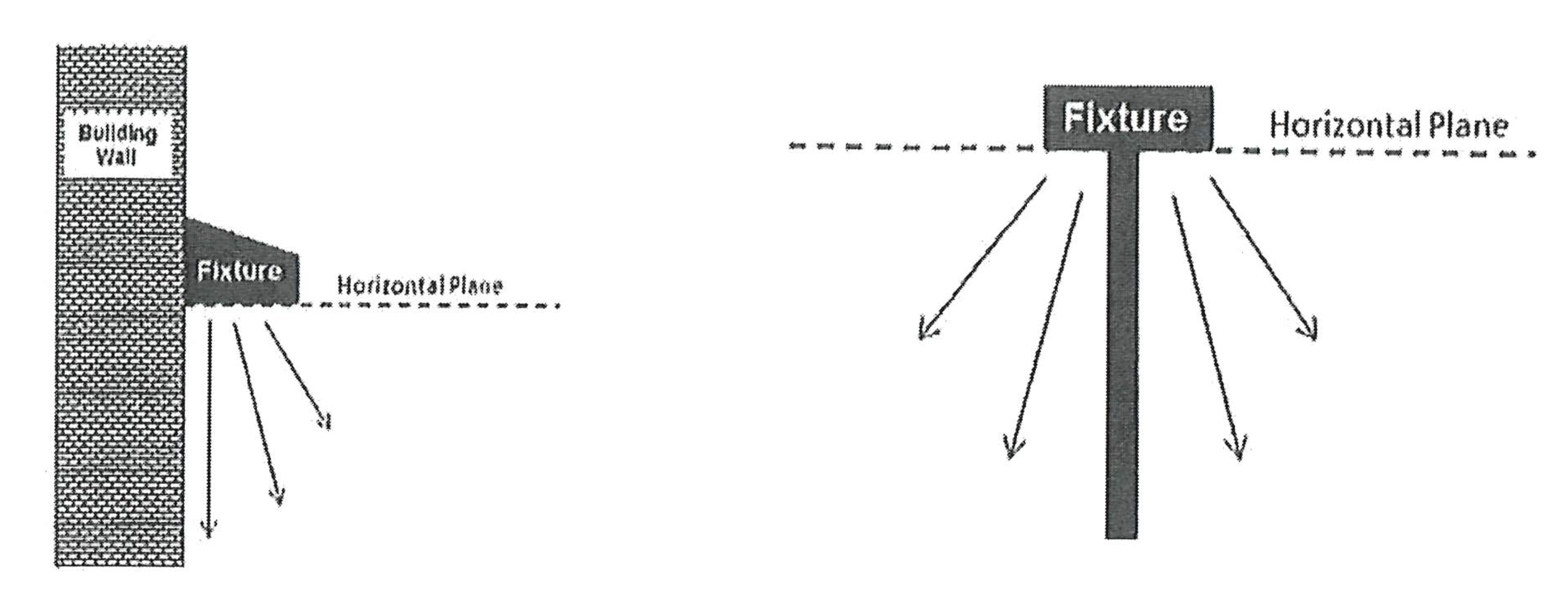
All new exterior lighting fixtures installed within the city shall utilize cutoff or full cutoff designs to ensure that no light is emitted above a horizontal plane, as depicted in the images below.
(2)
All new exterior lighting fixtures shall utilize light-emitting diode (LED) lamps or other energy efficient light.
(3)
Parking area lighting shall be required for all new parking lots and shall designed so as to achieve no light spillage at the property line. Additionally, there shall be no light spillage on property lines which abut residential districts.
(4)
No light in any district shall be directed onto any adjacent property.
(5)
Light standards utilized for parking lot lighting shall not exceed a maximum height of twenty five (25) feet from the pavement within commercial, mixed-use, and multi-family districts. Within manufacturing districts, light standards shall not exceed thirty 30 feet. Height shall be measured from the ground to the bottom of the full cutoff fixture.
(6)
Light standards shall be maintained in compliance with the initial installation. Leaning, rusting or damaged poles/fixtures shall be repaired or replaced.
(7)
Prohibited lights. The following light and lighting methods are hereby declared to be unlawful.
a.
The use of laser source light, searchlights, or any similar high-intensity light for any purpose other than temporary emergency lighting or as allowed by a special event license;
b.
Animated, flashing, flickering, blinking, or other similar lights;
c.
Quartz lamps;
d.
Mercury vapor lamps.
(Ord. No. 6751-08-2022, § 2(Exh. A), 8-16-2022)
1250.11 - Visibility on corner lots in residential, business, institutional and public service or manufacturing.
No building or structure hereinafter erected and no planting or other obstruction to the vision of drivers of motor vehicles shall be located in any residential district, exceeding a height of three feet above the street grade within 12 feet of the pavement line bordering corner lots; and in any business, institutional or manufacturing district, within eight feet of the intersecting street lines bordering a corner lot, provided that this regulation shall not apply to that part of a building above the first floor.
1250.12 - Accessibility to a public street.
Except as otherwise provided for in this code, every building shall be constructed or erected upon a lot or parcel of land which abuts and has access to a public street, unless a permanent access easement to a public street was of record prior to the effective date hereof. If access is not provided to a public street or similar easement, the property must be subdivided to ensure access.
1250.13 - Off-street parking and loading; tables.
(a)
Purpose: The purpose of this section is to alleviate or prevent congestion of the public streets, and so promote the safety and welfare of the public by establishing minimum requirements of the off-street parking and loading and unloading of merchandise and products in accordance with the use to which property is put.
(b)
Applicability of section: Off-street parking and loading shall be provided in accordance with this section and for all structures and uses erected or established after the effective date hereof.
(c)
Existing parking and loading facilities:
(1)
Existing off-street parking or loading facilities located on the same lot as the use served shall not be reduced—or if already less than, shall not be reduced—below the requirements and standards for similar new structure or uses.
(2)
When the existing uses of a structure is damaged or destroyed and subsequently repaired or rebuilt, parking and loading facilities equivalent to any maintained at the time of such damage or destruction shall be restored, but additional parking and loading facilities need not be provided. [17]
(3)
Whenever the use of any structure or premises is intensified through addition of dwelling units, increased floor area, greater seating capacity, etc. additional parking and loading facilities commensurate with such increases in use-intensity shall be provided in accordance with this code.
(4)
Whenever the existing use of a structure is changed to a different use, parking or loading facilities shall be provided as required herein for such new use.
(d)
Submission of plot plan: Any application for a building permit, or for a zoning certificate where no building permit is required, shall include a plot plan drawn to representative scale as closely as possible and fully dimensioned, showing any parking or loading facilities to be provide in compliance with the zoning code.
(e)
Use of parking facilities: Off-street parking facilities accessory to residential uses developed in any residential district in accordance with the requirements of these subsections shall be used solely for the parking of passenger vehicles owned by occupants of the dwelling structures to which such facilities are accessory, or by guests of such occupants. Under no circumstances shall required parking facilities accessory to residential structures be used for storage of commercial vehicles, motor homes, boats and other such accessory transportation vehicles, or for the parking of vehicles belonging to the employees, owners, tenants, visitors or customers of business or manufacturing establishments.
(f)
Parking area design standards: Each required space shall be required to be at least nine feet wide and 19 feet in length and shall have at least eight feet of vertical clearance. The length of parallel parking spaces shall be a minimum of 22 feet. Every space shall be situated so that no part of any parked vehicle overhangs or infringes on the public right-of-way.
Parking space markings shall be made and restored as often as necessary to clearly delineate each parking space as determined by the administrator.
(1)
Design and maintenance:
A.
Open and enclosed parking spaces: Accessory parking spaces located on the same lot as occupied by the use served may be open to the sky or enclosed in a building. Accessory parking spaces located in a residence district elsewhere than on the same lot occupied by the use served shall be open to the sky, except when otherwise allowed as a special use.
B.
Parking areas: Parking areas shall be graded and improved with:
1.
A compacted stone base a minimum of four inches thick, surfaced with a minimum of three inches of bituminous concrete surface course; or
2.
A minimum of five inches of Portland cement concrete; or
3.
A minimum of four inches bituminous concrete binder course and two inches bituminous surface course; and
4.
A minimum of six inches of continuous curbing, exclusive of ingress/egress points, around the perimeter of all parking lots. Said curbing shall be of Portland cement concrete or bituminous concrete surface course; and
Lots exceeding the size of 40 spaces have to be designed by an engineer and must meet or exceed one set of standards listed above.
5.
In addition to any landscaped front, back or side yard areas required by city ordinance, a minimum of ten square feet of interior landscaped area shall be provided within any off-street parking area, for each 350 square feet of paved area within the parking lot, including parking spaces and driving aisles. Required landscaping shall be in one or more areas to minimize and reduce the apparent size of parking areas.
6.
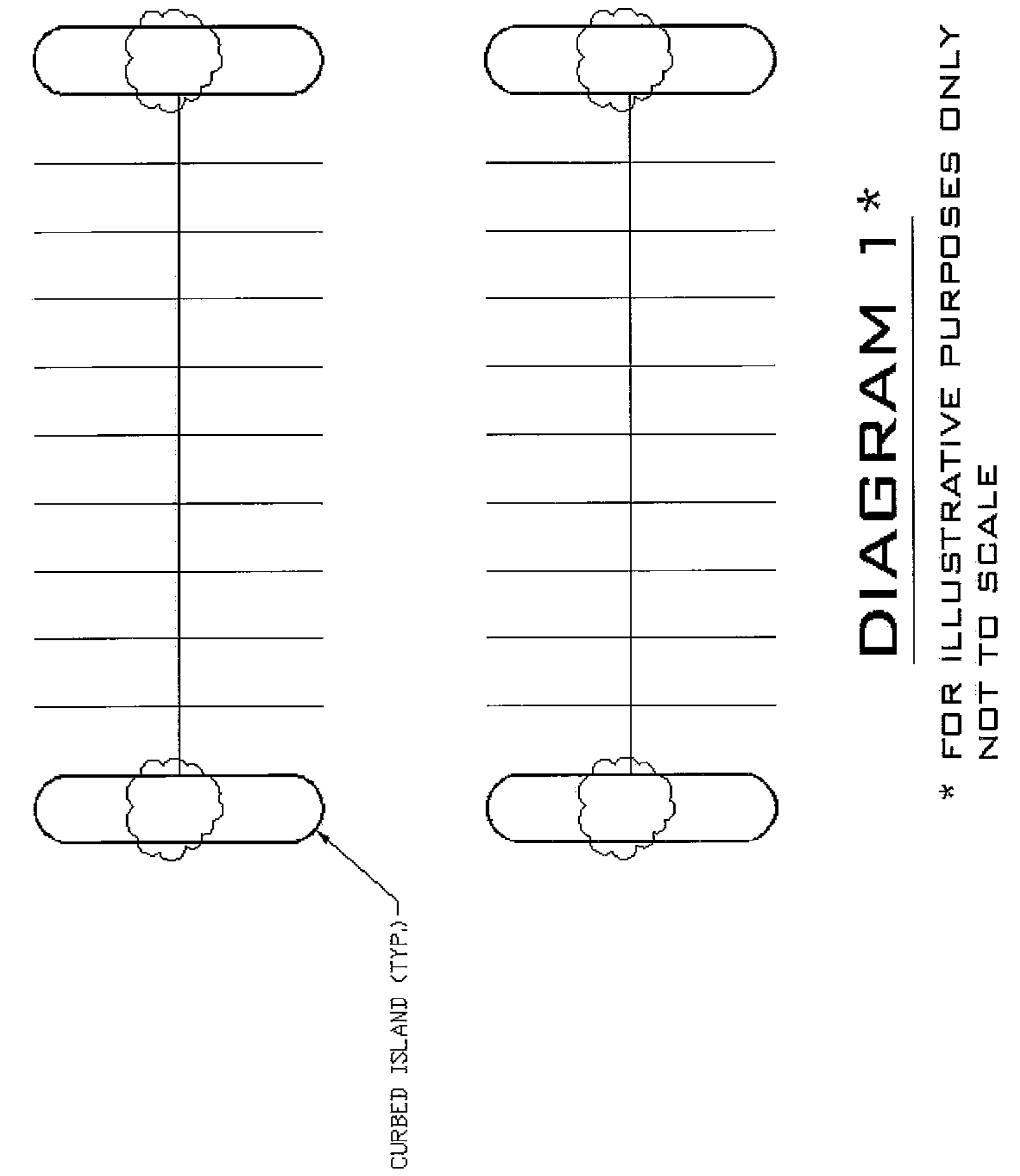
All interior landscaped areas provided within parking areas shall be raised and curbed and shall have a minimum area of 50 square feet and a minimum width of five feet measured from the back of curbs. Each separate interior landscaped area shall include at least one deciduous shade tree of not less than two and one-half inch caliper size as measured six inches above the ground and with a clear trunk of five feet to prevent obstruction of vehicular sight lines. There shall be a minimum of two trees, within and up to, every 100 linear feet of parking for each parking row. Such trees shall be spaced evenly around the perimeter. The ends of parking rows abutting a drive aisle shall be defined by landscaped curbed islands. (See Diagram 1 of this subsection.) Said landscaping, when of shrubbery types, shall neither exceed three feet in height nor less than 18 inches in diameter. The height limitation shall be maintained at all times. Evergreen trees of a minimum height of six feet are permitted for use as perimeter plantings when located outside vehicular sight lines.
7.
Interior planting bed areas, which are used for the planting of trees, or which are used for landscaping treatment generally, may be treated with grass, hardwood bark mulch, or other types of ground cover which do not exceed 30 inches of mature size.
8.
All on-site storage and loading areas shall be visually screened from adjacent properties and public rights-of-way. Such screening may consist of a wall, fence, landscaped berm, planted vegetation or existing vegetation or any combination thereof which maintains a complete visual screen.
9.
No landscaped hedge shall be less than two feet in height, and two feet in spread at time of installation; however, the combined effect of hedge, wall or berm shall not exceed three feet in height within ten feet of any driveway opening. The individual plants used in the development of a hedge required by city ordinance shall be placed so as to not be more than three feet on center to assure an adequate screening effect.
10.
All landscaping shall be maintained in good condition with at least the same quality and quality of landscaping as initially approved.
All parking areas constructed after the adoption of this title shall conform to this subsection.
(g)
Required screening: All open parking and/or loading areas shall be effectively screened on each side adjoining or fronting any property situated in a "R-1," "R-EL" or "R-2" residence district or any institutional premises by a wall, fence, landscaped topographic feature, or densely planted compact hedge, or a combination thereof, not less than six feet in height and of sufficient density to completely block the view from adjacent residential or institutional property. Such required screening shall be provided within five feet of the side property line at a minimum.
(h)
Interior aisles in parking areas: Aisles within parking lots shall be sufficiently wide to permit safe and sufficient vehicular movements in the aisles, and into and out of parking spaces. Aisles designed for two-way traffic shall be at least 22 feet wide. One-way aisles designed for 60 degree parking shall be at least 18 feet wide and 45 degree shall be at least 14 feet wide.
(i)
Accessways:
(1)
Parking and loading areas shall be designed so that ingress to or egress from a parking space is from an aisle or driveway, not directly from the public right-of-way. Such areas shall be so arranged that vehicles at no time shall be required to back into any street or roadway to gain access thereto. (See Diagram 2 of this subsection.)

(2)
No accessway to any parking area shall be located within 50 feet of any corner formed by the intersection of the rights-of-way of two or more streets. At intersections where traffic-control devices are installed, the administrator may increase this requirement as necessary to prevent traffic hazards.
(3)
Parking area accessways (including residential driveways) and public streets shall be aligned to form - as closely as feasible, right angles to the street.
(4)
The bi-directional accessway to every parking lot shall be at least 24 feet wide unless two one-way drives, each 12 feet wide at a minimum, are provided. The location and maximum width of the curb cut(s) providing ingress and egress to any public right-of-way or adjoining properties from the parking lot shall be as approved by the director of public works on the site plan.
(5)
Each required off-street parking space shall open directly upon an alley or driveway.
(j)
Residential districts and properties zoned MU-1 which are used for strictly residential uses:
(1)
Required parking spaces located in any residential zoning district shall be located on the same lot as the dwelling. These parking spaces shall not be located in any front yard. These parking spaces may be located in the side and rear yards. Each parking space accessory to a multi-family dwelling shall be unobstructed so that no vehicle need be moved in order to allow another vehicle to enter/exit the parking area.
(2)
All parking spaces accessory to permitted non-dwelling uses located in any residential district generally shall be located on the same lot as the use serviced. However, the administrator may allow such parking facilities to be located on another parcel within 200 feet of the use served if the "same lot" requirement is not feasible.
(3)
No commercial vehicle exceeding one ton cargo capacity shall be parked anywhere or in any residential district except for normal loading, unloading, and service calls, nor shall any vehicle repair work be conducted on any nonresidential parking lot located in said districts.
(k)
Business, manufacturing, and institutional districts, as well as MU-1 properties used for commercial or mixed-uses: Parking spaces accessory to any dwelling located in any commercial district shall either be located on the same lot as the dwelling or another parcel within 200 feet of the residential premises. Parking lots accessory to any commercial or industrial use located in any commercial district or in the manufacturing district shall be located within 500 feet of the use serviced; provided, that no portion of any such parking lot shall extend into any residential district except by written permission of the zoning administrator.
In any commercial district or in the manufacturing district, off-street parking facilities for different buildings or uses may be provided collectively; but only if the total number of spaces so located together is not less than the sum of the separate requirement for each use, and if all regulations governing location or parking spaces in relation to the uses served are observed.
Commercial uses in the central business district shall be exempt from the parking space requirements of this title if they are located within 300 feet of a public parking lot.
Such separated parking spaces shall be useable without causing unreasonable traffic congestion, detriment to any residential neighborhood or hazard to pedestrians or vehicular traffic.
(l)
Design and location of off-street loading facilities: All off-street loading facilities shall conform to the minimum standards indicated below:
Every required off-street loading space shall be at least 12 feet wide and 45 feet long exclusive of aisle and maneuver space, and shall have vertical clearance of at least 14 feet. In no case shall a vehicle being loaded or unloaded overhang into the public right-of-way.
(m)
Accessway: Every off-street loading space shall have vehicular access to a street or alley. Such accessway shall be at least 12 feet wide.
(n)
Surfacing: Every off-street parking and loading area shall be improved with a compacted stone base at least seven inches thick with at least two inches of asphaltic concrete. This does not mean "oil and chip".
(o)
Buffer strips: No loading space or area for vehicles over two-ton cargo capacity shall be developed closer than 50 feet to the lot line of any property located in any residential district unless said space/area is completely enclosed by walls, a solid fence, or closely planted shrubbery at least eight feet in height and of sufficient density to block view from the residential property.
(p)
Location: Every off-street loading spaces that is required or proved shall be located on the same parcel of land as the use served, and not closer than 50 feet of the intersection of the rights-of-way of two or more streets, and not on required front yards.
(q)
Computation of required parking/loading spaces: In computing the number of spaces required by this title, the zoning administrator shall apply the following rules:
(1)
In computing parking space requirements based on the number of employees, the maximum number of employees on the premises at any period of the day shall be used. "Employee parking" means one parking space shall be required per one and one-half employees, unless otherwise stated.
(2)
In computing parking or loading space requirements on the basis of building floor area, the gross floor area shall be used.
(3)
Whenever it is necessary to translate gross parking lot area into number of parking spaces, 350 square feet of gross area shall be deemed one parking space.
(4)
If computation of the number of parking or loading spaces required by this title results in a fractional space, any fraction of one-half or more shall be counted as one space.
(5)
No space or portion thereof needed to satisfy the minimum applicable requirement for number of off-street parking or loading spaces shall be counted as part of the off-street parking or loading spaces required for another structure or use.
(r)
Number of parking and loading spaces required: Off-street parking and loading spaces shall be provided as indicated in Table 1 [at the end of this section]. For any use that is not listed in Table 1, the same amount of parking and loading space shall be provided as is required for the most similar listed use. The zoning administrator shall make the determination of similarity.
(s)
Except in a "B-1" Central business district or for single-family or two-family dwellings, no unenclosed parking or loading space, or internal drive, except for ingress/egress drives, shall be closer to any street right-of-way than three feet and to the side and rear lot lines than five feet. (See Diagram 3 of this subsection) In a "B-1" Central business district, such setback shall be a minimum of five feet from the back side of curb of any street. However, in no case shall any parking or loading space, or internal drive be permitted within the street right(s)-of-way. (See Diagram 4 of this subsection) The said setback areas from the street right(s)-of-way shall be landscaped as approved by the zoning administrator or his/her authorized designee. The limitations of this subsection may be modified in a development plan when authorized under chapter 1243 "Planned unit developments" of this title.


(t)
Unenclosed parking area, ingress/egress drive, or internal drive: Except for single-family or two-family dwellings, no unenclosed parking area, ingress/egress drive, or internal drive shall be located within three feet of a building. Sidewalks shall be provided along the perimeter of the building, adjacent to the drive aisle to patron parking area and/or patron parking area. The sidewalk shall be a raised concrete having a minimum width of three feet when adjacent to a drive aisle or five feet when abutting patron parking spaces that are not parallel to the sidewalk in design and may be placed in the three feet buffer area between the parking surface and the building.
(u)
Directional signage: Safe and efficient on-site circulation and necessary directional signage must be provided as approved on the development plan by the zoning administrator or his/her authorized designee.
(v)
Light standards: No light standard shall be placed as a freestanding structure within the parking area, unless within a safety island if placed in said area or shall be placed around the perimeter of the parking area. Landscaping within ten feet of the light standard shall be of shrubs or 18 inches minimum diameter but not more than three feet in height.
(w)
Permanent access: Provide cross-access easement or other appropriate legal instrument or agreement guaranteeing permanent access between the property and the proposed development is situated on and its adjacent properties, as required by the director of public works.
(Ord. No. 5930-2-14, § 7, 2-18-2014; Ord. No. 6623-11-19, § 2(Exh. D), 11-5-2019; Ord. No. 6674-10-2020, § 4, 10-20-2020; Ord. No. 6708-09-2021, § 2(Exh. C), 9-21-2021)
Cross reference— Restoration of damaged building or structure, § 1248.03.6.

