
El Monte City Zoning Code
Division 2
Residential Zoning Districts and Overlays
17.20.010 - Summary of the zoning districts.
A.
One-family Dwelling (R-1A) Zoning District—Consistent with the general plan Land Use Designation of Low Density Residential. This zoning district primarily includes smaller lots that allows for one dwelling unit on each lot.
B.
One-family Dwelling (R-1B) Zoning District—Consistent with the general plan Land Use Designation of Low Density Residential. This zoning district primarily includes deeper lots that allows for two (2) or more detached dwelling units on each lot under limited conditions. Also includes smaller lots that allow for one dwelling unit on each lot.
C.
One-family Dwelling (R-1C) Zoning District—Consistent with the general plan Land Use Designation of Low Density Residential. This zoning district primarily includes deeper lots with one dwelling on each lot that allows for the keeping of horses and other large, domesticated animals. Many lots currently are, or previously were, developed with equestrian uses.
(Ord. No. 3053, § 3(Exh. A), 5-14-2025)
17.20.020 - Purpose.
A.
Provide a variety of single-family residential dwellings built to suburban standards characterized by single- and two-story structures separated by ample green space to suit a spectrum of individual lifestyles and needs.
B.
Maintain the existing character of the city's low-density, single-family residential neighborhoods, while providing new opportunities for unit additions and infill housing.
C.
Ensure that the scale and design of new development, alterations and additions to existing dwellings are compatible with the scale, mass and character of their neighborhoods, and protect adjacent properties from unreasonable obstruction of light and air.
D.
Provide for appropriate densities within the ranges established in the general plan.
E.
Provide opportunities for other neighborhood uses such as schools, parks, religious assembly, community centers and daycare centers that serve and are compatible with the surrounding residential neighborhood.
(Ord. No. 3053, § 3(Exh. A), 5-14-2025)
17.20.030 - Applicability.
This chapter identifies allowable land uses, permitted requirements and development standards for one-family dwelling zoning districts and applies to all areas in the city identified with an R-1A, R-1B or R-1C on the city's zoning map.
(Ord. No. 3053, § 3(Exh. A), 5-14-2025)
17.20.040 - Permitted uses.
A.
Permitted Uses. Table 17.20-1 prescribes the land use regulations for each one-family dwelling zoning district. Additional use-specific regulations are denoted in the right-hand column. These designations apply strictly to the permissibility of land uses; applications for building structures may require other discretionary review.
B.
Unlisted Uses. Any land use not listed in Table 17.20-1 shall not be permitted in the R-1A, R-1B or R-1C zoning district, except as otherwise permitted in Section 17.12.050 (Rules and Measurements—Additional Permitted Uses) of this title.
Table 17.20-1—Permitted Uses—One-family Dwelling Zoning Districts
Key:
— Use not permitted.
P Use permitted by-right.
D Use permitted after review and approval of the Community Development Director.
M Use permitted after review and approval of a Minor Use Permit (MUP).
C Use permitted after review and approval of a Conditional Use Permit (CUP).
Z Use permitted after review and approval of a Director Level Zoning Clearance (ZCD).
Notes:
1 A maximum of 1½ stories shall require Community Development Director approval for properties located in the RHOD overlay.
(Ord. No. 3053, § 3(Exh. A), 5-14-2025)
17.20.050 - Development standards.
A.
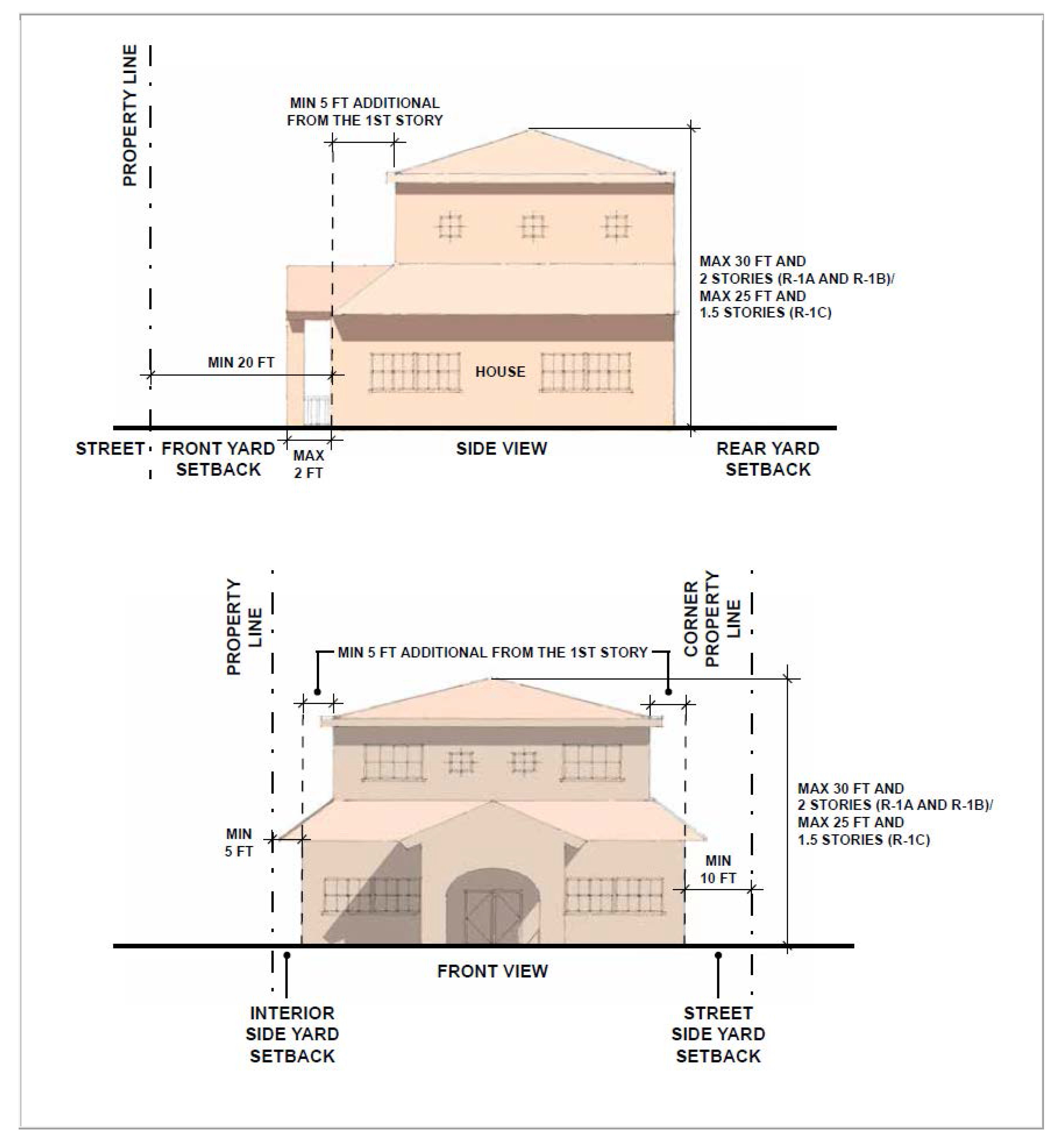
Development Standards. Table 17.20-2 prescribes the development standards for each one-family dwelling zoning district. Refer to Figure 17.20-1 for information on setbacks and height in a graphic form.
Table 17.20-2—Development Standards—One-family Dwelling Zoning Districts
Notes:
2 Refer to Chapter 17.22 for properties within the RHOD Overlay.
3 A 2 nd story shall not encroach over a patio that is open on the sides by more than 50%. Refer to Section 17.60.130 for additional yard exceptions. All street setbacks shall be fully landscaped as prescribed in Section 17.72.050.
4 For new lots. Refer to Section 16.30.040 of Title 16 (Subdivisions) for additional standards and exceptions.
5 This requirement shall not apply to ADUs and urban dwellings.
Figure 17.20-1—Height and Setbacks
B.
Undergrounding of Utilities. For all developments with five (5) or more dwelling units, all utility distribution lines including, but not limited to: electric; communication; natural gas and cable TV lines shall be placed underground.
C.
Lighting System. For all developments with three (3) or more dwelling units, an on-site lighting system shall be installed for all parking areas, vehicular access ways and along major walkways. Such lighting shall be directed onto driveways and walkways within the project and away from the dwelling units and adjacent properties.
D.
Keeping of Animals.
1.
The keeping of animals in the R-1B and R-1C zoning districts:
a.
The breeding, hatching and raising of poultry, fowl, birds, rabbits, chinchillas, earthworms, fish, frogs and bees are permitted for domestic or commercial use.
b.
The keeping of horses:
i.
In the R-1B zoning district, the lot shall have a minimum area of twenty thousand (20,000) square feet, with no more than one horse permitted per ten thousand (10,000) square feet.
ii.
In the R-1C zoning district, the lot shall have a minimum area of seven thousand five hundred (7,500) square feet, with no more than one horse permitted per seven thousand five hundred (7,500) square feet of lot area.
c.
The keeping of other animals in the R-1C zoning district:
i.
Up to three (3) goats and the offspring less than one year of age.
ii.
Up to three (3) sheep and the offspring less than one year of age.
iii.
One cow, but only for personal use of the family residing upon the premises.
iv.
Any program of animal husbandry as a member of any national or nonprofit educational or character building organization, for the family residing upon the premises.
2.
There shall be no killing or dressing of any animals or poultry for commercial purposes.
3.
Animal Enclosures and Related Activities. Refer to Section 17.22.040.F. (Rurban Homesteads Overlay District Development Standards) of this title.
4.
Shall comply with Title 6 (Animals) of the El Monte Municipal Code (EMMC) and the deletions set forth in Section 6.04.060, and Title 10 of the Los Angeles Administrative Code, including all amendments and ordinance of Los Angeles County up to and including Los Angeles County Ordinance No. 2011-0038, dated August 25, 2011, which were adopted by reference as the "City of El Monte Animal Control Ordinance."
E.
Other Development Standards. Table 17.20-3 denotes additional development standards found in other chapters or sections of this title that apply to one-family dwelling zoning districts:
Table 17.20-3—Other Development Standards
(Ord. No. 3053, § 3(Exh. A), 5-14-2025)
17.22.010 - Purpose.
The Rurban Homesteads Overlay District (RHOD) was established to preserve rural character, promote a low-density, rural residential lifestyle, and ensure continued availability of lots that allow animal keeping, agricultural cultivation and retain the area's homestead heritage. It is the intent of the RHOD to protect areas for low-density, rural development by retaining large lots in a configuration that enables animal raising and keeping and to ensure that new residential development and alterations and additions to existing residences are compatible with the scale, mass and character of the rural neighborhood.
(Ord. No. 3053, § 3(Exh. A), 5-14-2025)
17.22.020 - Applicability.
The RHOD applies to all properties in the city identified with an RHOD on the city's zoning map.
(Ord. No. 3053, § 3(Exh. A), 5-14-2025)
17.22.030 - Use regulations.
No lot, premise, building, or structure in the Rurban Homestead Overlay District shall be used for any use or purpose other than those specified below:
A.
One-family Dwelling. Not more than one one-family dwelling on any lot as defined by Chapter 17.150 (Use Definitions) of this title.
B.
Accessory Buildings. Accessory buildings necessary or incidental to each one-family dwelling, located on the same lot or parcel of land, including a private garage for each lawful dwelling. The capacity of each such garage shall not exceed three (3) automobiles. See Section 17.110.020 (Regulations for Specific Uses—Accessory Buildings) of this title for additional standards.
C.
Accessory Dwelling Units (ADUs). ADUs and Junior ADUs are regulated pursuant to Section 17.110.030 (Regulations for Specific Uses—Accessory Dwelling Units) of this title. The architectural style and materials of ADUs and Junior ADUs shall match that of the primary building on the property.
D.
Horses. The keeping of not more than one horse for each seven thousand five hundred (7,500) square feet of lot area.
E.
Other Animals. The keeping of not more than three (3) female goats and their offspring less than one year of age, and the keeping of not more than three (3) sheep and their offspring less than one year of age, and the keeping of not more than one cow, but only for the personal use of the family residing upon the premises or in the conduct by any member of the family residing upon the premises of any program of animal husbandry as a member of any national or nonprofit educational or character building organization.
(Ord. No. 3053, § 3(Exh. A), 5-14-2025)
17.22.040 - Development Standards.
The regulations applicable to lots, premises, buildings and structures in the underlying zone shall apply to and be complied with as to every lot, premises, building, and structure in the RHOD.
A.
Minimum Lot Area and Width. Each lot shall have a lot area of not less than ten thousand (10,000) square feet and a width of not less than sixty (60) feet at the mid-point measured between the front and rear lot lines; provided, however, that when a lot has less area than herein required and was recorded at the time of the effective date of the ordinance codified in this title, the lot may be occupied by not more than one dwelling unit.
B.
Street Frontage Required. Every lot shall abut a public street for a distance of at least sixty (60) feet. Flag lots and Planned Residential Developments shall be prohibited.
C.
Lot Design. Lots shall be rectangular in shape, with side parcel lines as close as practical to ninety-degree angles with front and rear parcel lines. Lot depth shall be a minimum of two (2) times the lot width. Flag lots and planned residential development shall be prohibited.
D.
First Floor Top Plate Height. First floor top plate height shall not exceed twelve (12) feet in the front one-third of the structure.
E.
Building Height. The maximum allowable height is twenty-five (25) feet and one and one-half (1½) stories. New development, additions and alterations that will result in more than one story shall be subject to the following:
1.
Configuration. Floor area above the first story shall be wholly built into the framing of the roof.
2.
Floor Area Limit. Habitable floor area above the first story shall not exceed sixty (60) percent of the first story roofed area.
3.
Dormer. Dormers shall not exceed the height of the building ridge line, shall not overhang the outer face of the wall below, or exceed sixty (60) percent of the length of the roof.
4.
Balconies or Decks. Balconies or decks above the first floor are prohibited.
5.
Design Review. All applications for new development or additions that will result in more than one story shall require design review pursuant to Chapter 17.122 (Design Review) of this title and as follows:
a.
Application Requirement. In addition to other materials required for the submittal of a design review application, supporting materials shall be submitted to describe and provide visual representation of existing conditions and the proposed project. Supporting materials may include, but are not limited to: statements; photographs; plans; drawings; renderings; models; material samples; and the erection of story poles at the site.
b.
Review Authority. Design review shall be conducted by the Community Development Director.
c.
Notice. At least ten (10) days prior to the date of action, notice of the application shall be posted on-site and mailed to all residents and property owners of record within a three-hundred-foot radius of the subject property as shown on the latest available assessment roll. The notice shall include a general description of the application, the location of the property, the date of the decision, the procedure for submitting comments, and the procedure for appealing the decision.
d.
Call-up for Planning Commission Review. The Community Development Director may refer items directly to the Planning Commission when, in his/her discretion, the public interest would be better served by having the Planning Commission conduct Design Review. In addition, the applicant or any resident or property owner within the mailing radius may submit a written request to the Community Development Director for a call-up.
e.
Appeals. Community Development Director decisions regarding this chapter are appealable to the Planning Commission and ultimately, the City Council. Refer to Section 17.10.100 (General Regulations—Ability to Appeal) of this title.
F.
Animal Enclosures and Related Activities. Animal enclosures include barns, stables, corrals, pens, coops, bins, chutes or other enclosures designed or used for the keeping or shelter of animals. These standards shall not apply to fenced pastures or other contained animal grazing or roaming areas. This subsection may also apply to properties not located within the RHOD that are zoned R-1B and have a minimum area of twenty thousand (20,000) square feet.
1.
Location. Roofed animal enclosures shall be set back a minimum of seventy-five (75) feet from the front lot line and thirty-five (35) feet from any dwelling or other building used for human habitation other than the dwelling of the owner.
2.
Size.
a.
Unroofed animal enclosure areas shall not count towards floor area calculations, accessory structure size or lot coverage. Up to eight hundred (800) square feet of roofed animal enclosures shall be exempt from floor area calculations and accessory structure size. In addition, roofed animal enclosures greater than eight hundred (800) square feet and existing prior to May 1, 2018, shall be exempt from floor area calculations and accessory structure size.
b.
Animal housing, premises and quarters must be of sufficient size, kept clean and in a sanitary condition, properly ventilated and in good repair at all times. Sufficient size is defined as a minimum of five hundred (500) square feet of interior measurement of corral space and, for horses, each individual box stall must contain a minimum dimension of eight (8) feet in width and twelve (12) feet in length.
3.
Animal enclosures shall comply with all development standards of the land use district and adopted city codes.
4.
Maintenance.
a.
Water troughs shall be cleaned out weekly. Mosquito fish or other mosquito prevention measures shall be used in water troughs or in any standing water.
b.
Vermin, flies, standing surface water, refuse, and manure must be controlled and not accumulate so as not to be a nuisance for adjacent properties. Property owner is subject to Chapter 8.12 (Property Maintenance) of Title 8 (Health and Safety) of the El Monte Municipal Code (EMMC).
c.
Site must control dust, fumes, odors, vapors and/or unsanitary conditions. Property owner is subject to Chapter 8.12 (Property Maintenance) of Title 8 (Health and Safety) of the EMMC.
d.
Plugged in amplified noise on site relative to the operation of horses or large animals shall not be allowed.
5.
Manure Storage and Disposal.
a.
All manure disposal/storage shall be covered and protected from drainage flows, rain, and wind. Area used for non-containerized manure disposal/storage must cause no nuisance and be kept a minimum distance below and located so that it drains away from the neighboring property, facilities and water supplies.
b.
Manure must be disposed off-site at a frequency that prevents overfilling of manure bin, or storage area, and which prevents strong odors, accumulation of flies, or vermin from creating a nuisance condition. Manure storage shall be located away from the street.
6.
Trailer Parking. Horse or large animal trailers shall be located outside of the required front yard setback. Trailer parking is prohibited within the public right-of-way. All parking shall comply with Chapter 17.70 (Parking Requirements) of this title.
G.
Trees. All new development and additions more than ten (10) percent of the floor area on the site shall provide a minimum of one tree within the required front setback for every thirty-five (35) feet of street frontage. If a tree already exists within the required front setback, the applicant shall not be required to plant a new tree.
H.
Other Standards. For all other standards and requirements, refer to the underlying zone.
(Ord. No. 3053, § 3(Exh. A), 5-14-2025)
17.24.010 - Summary of the zoning districts.
A.
Low-Density Multiple-family Dwelling (R-2) Zoning District—Consistent with the general plan land use designation of Medium Low Density Residential. This zoning district allows for attached and detached single-family dwellings, attached products with four (4) or fewer units.
B.
Medium-Density Multiple-Family Dwelling (R-3) Zoning District—Consistent with the general plan Land Use Designation of Medium Density Residential. This zoning district allows for apartments, townhouses and Planned Residential Developments (PRDs).
C.
High-Density Multiple-Family Dwelling (R-4) Zoning District—Consistent with the general plan Land Use Designation of High Density Residential. This zoning district allows for the highest residential densities among residential zoning districts for apartments, townhouses, condominiums and PRDs.
D.
Residential Mobilehome Park (RMP) Zoning District—Consistent with the general plan Land Use Designations of Medium Density Residential or High Density Residential. A majority of the city's one thousand three hundred (1,300) mobile home units are on land zoned specifically for mobilehome parks.
(Ord. No. 3053, § 3(Exh. A), 5-14-2025)
17.24.020 - Purpose.
A.
Provide a variety of multi-family residential dwellings ranging from suburban to more urban standards characterized by multi-story residential structures focused around common open space areas and other amenities to suit a spectrum of individual lifestyles and needs.
B.
Maintain the existing character of the city's multiple-family residential neighborhoods, while providing new opportunities for unit additions and infill housing.
C.
Ensure that the scale and design of new development and alterations and additions to existing dwellings are compatible with the scale, mass and character of their neighborhoods, and protect adjacent properties from unreasonable obstruction of light and air.
D.
Provide for appropriate densities within the ranges established in the general plan.
E.
Create opportunities to develop walkable neighborhoods in close proximity to commercial areas, recreational amenities and different modes of transit.
(Ord. No. 3053, § 3(Exh. A), 5-14-2025)
17.24.030 - Applicability.
This chapter identifies allowable land uses, permitted requirements and development standards for multiple-family residential dwelling zoning districts and applies to all areas in the city identified with an R-2, R-3 or R-4 on the city's zoning map.
(Ord. No. 3053, § 3(Exh. A), 5-14-2025)
17.24.040 - Permitted uses.
A.
Permitted Uses. Table 17.24-1 prescribes the land use regulations for each Multiple-Family Dwelling Zoning District. Additional use-specific regulations are denoted in the right-hand column. These designations apply strictly to the permissibility of land uses; applications for building structures may require other discretionary review.
B.
Unlisted Uses. Any land use not listed in Table 17.24-1 shall not be permitted in the R-2, R-3 or R-4 zoning district, except as otherwise provided in Section 17.12.050 (Rules and Measurements—Additional Permitted Uses) of this title.
Table 17.24-1—Permitted Uses—Multiple-family Dwelling Zoning Districts
Key:
— Use not permitted.
P Use permitted by-right.
M Use permitted after review and approval of a Minor Use Permit (MUP).
C Use permitted after review and approval of a Conditional Use Permit (CUP).
R Use permitted after review and approval of a Planned Residential Development (PRD) permit.
Z Use permitted after review and approval of a Director Level Zoning Clearance (ZCD).
Notes:
6 Subject to the development standards of the R-1A Zoning District.
7 Mobile home or trailer park is also permitted in the RMP Zoning District subject to the approval of a CUP.
(Ord. No. 3053, § 3(Exh. A), 5-14-2025)
17.24.050 - Development standards.
A.
Development Standards—One Dwelling. For properties developed with one dwelling, refer to the One-family Dwelling (R-1A) Zoning District.
B.
Development Standards—Two (2) or More Dwellings. Table 17.24-2 prescribes the development standards for each Multiple-family Dwelling Zoning District for properties developed with two (2) or more dwellings:
Table 17.24-2—Development Standards—Multiple-family Dwelling Zoning Districts
Notes:
8 Refer to Section 17.60.030 of this title for additional height exceptions and restrictions.
9 Refer to Section 17.60.130 of this title for additional yard exceptions. All street setbacks shall be fully landscaped as prescribed in Section 17.72.050 of this title.
10 For new lots. Refer to Section 16.30.040 of Title 16 (Subdivisions) for additional standards and exceptions.
11 Refer to Section 17.24.050.C. of this chapter for information on the city's floor area ratio (FAR) bonus.
12 The minimum open space requirement per unit shall be determined prior to any density bonus or other state provision that permits a higher density than allowed in this title. Refer to Section 17.24.050.D. of this chapter for additional information on open space standards.
13 This requirement shall not apply to ADUs or projects that are 100% affordable.
C.
Floor Area Ratio (FAR) Bonus.
1.
Eligible housing development projects must satisfy all of the following criteria:
a.
The property shall be zoned R-3, R-4, Office Commercial (C-1), Neighborhood Commercial (C-2), or General Commercial (C-3).
b.
The property shall have a minimum area of ten thousand (10,000) square feet; and
c.
The project shall have a minimum of ten (10) units.
d.
The project shall meet all parking and open space requirements.
2.
The total maximum allowable FAR bonus for eligible projects shall be 0.20.
Table 17.24-3—Floor Area Ratio (FAR) Bonus
D.
Usable Open Space.
1.
Private Open Space.
a.
Private open space shall be provided for each unit as outlined in Table 17.24-2. Such space shall be directly accessible from the unit it serves.
b.
For properties zoned R-2 and R-3, private open space shall have a minimum dimension of ten (10) linear feet horizontally in each direction with an unobstructed vertical height of seven (7) feet. In addition, it shall be enclosed by a fence or building walls on all sides.
c.
For properties zoned R-4, private open space shall have a minimum dimension of six (6) linear feet horizontally in each direction with an unobstructed vertical height of seven (7) feet. The minimum dimension may be reduced to four (4) feet for upper floor balconies. In addition, it shall be enclosed by a fence or building walls on all sides.
2.
Common Open Space.
a.
Private open space shall be provided for each unit as outlined in Table 17.24-2. Such space shall be directly accessible from the unit it serves.
b.
General common open space that is outdoors shall have a minimum dimension of fifteen (15) linear feet horizontally in each direction with an unobstructed vertical height of seven (7) feet. In addition, it shall have a minimum overall area of five hundred (500) square feet.
c.
General common open space that is indoors shall have a minimum dimension of ten (10) linear feet horizontally in each direction with an unobstructed vertical height of seven (7) feet. In addition, it shall have a minimum overall area of two hundred fifty (250) square feet. This may be further reduced by the review authority if the space is providing one or more of the recreational amenities listed below.
d.
Main common open space areas shall be outdoors and have a minimum dimension of twenty (20) linear feet horizontally in each direction with an unobstructed vertical height of seven (7) feet. In addition, it shall have a minimum overall area of one thousand (1,000) square feet.
3.
Balconies, Decks and Recreation Rooms.
a.
For properties zoned R-2 and R-3, up to twenty-five (25) percent of the overall open space may be in the form of balconies or decks. When used as private open space, the balcony or deck shall be directly accessible from the unit it serves.
b.
For properties zoned R-4, up to fifty (50) percent of the overall open space may be in the form of balconies or decks. When used as private open space, the balcony or deck shall be directly accessible from the unit it serves.
c.
For properties zoned R-3 with eleven (11) or more units, up to six hundred (600) square feet of the overall open space may be in the form of recreation rooms.
d.
For properties zoned R-4, up to eight hundred (800) square feet of the overall open space may be in the form of recreation rooms.
4.
Recreational Amenities. For projects within the R-4 zoning district and with twenty (20) or more units, one common recreational amenity shall be provided for each twenty (20) units or fraction thereof. The following listed amenities satisfy the above recreational facilities requirements. Recognizing that certain facilities serve more people than others, have a wider interest or appeal and/or occupy more area, specified items may be counted as two (2) amenities, as noted.
a.
Barbeque with seating/picnic area (one).
b.
Basketball court (one per court).
c.
Bocce ball court (one per two (2) courts).
d.
Children's playground equipment (one).
e.
Citrus or vegetable gardens (one).
f.
Clubhouse or indoor community space (two (2)).
g.
Coworking space and lounge (one).
h.
Day care facility (two (2)).
i.
Designated dog run or play area (one).
j.
Horseshoes or cornholes (one per two (2) courts).
k.
Jacuzzi (one).
l.
Pickle ball court (one per two (2) courts).
m.
Racquetball court (one per court).
n.
Sauna (one).
o.
Swimming pool (two (2)).
p.
Tennis court (one per court).
q.
Weightlifting facility (one).
r.
Other recreational amenities deemed adequate by the Community Development Director.
E.
Undergrounding of Utilities. For all developments with five (5) or more dwelling units, all utility distribution lines including, but not limited to, electric, communication, natural gas and cable TV lines shall be placed underground.
F.
Lighting System. For all developments with three (3) or more dwelling units, an on-site lighting system shall be installed for all parking areas, vehicular access ways and along major walkways. Such lighting shall be directed onto driveways and walkways within the project and away from the dwelling units and adjacent properties.
G.
RMP Zoning District. The development standards shall be established through the conditional use permit process.
H.
Other Development Standards. Table 17.24-4 denotes additional development standards found in other chapters or sections of this title that apply to multiple-family dwelling zoning districts:
Table 17.24-4—Other Development Standards
(Ord. No. 3053, § 3(Exh. A), 5-14-2025)

