
El Monte City Zoning Code
Division 8
Signage and Billboard Regulations
17.80.010 - Purpose.
The purpose of this chapter is to establish sign regulations that are intended to:
A.
Aid the public's orientation and to advertise and identify businesses and activities;
B.
Promote the appearance of the city as an attractive and harmonious community by regulating the design, materials, location, number, scale, illumination and condition of signs;
C.
Encourage creative and well-designed signs that contribute in a positive way to the city's aesthetics and restrict signs that may create visual clutter or a nuisance to nearby properties, violate privacy or create hazards or unreasonable distractions for pedestrians and drivers;
D.
Provide standards designed to safeguard the health, safety and public welfare while encouraging flexibility, variety and compatibility; and
E.
Enact and regulate signs in a manner that is content neutral and consistent with the free speech protections of the First Amendment of the United States Constitution and corollary provisions of the California Constitution.
(Ord. No. 3053, § 3(Exh. A), 5-14-2025)
17.80.020 - Applicability.
A.
New or Revised Signs. The requirements of this chapter apply to all signs on public and private property, except where expressly stated otherwise. No sign shall be erected or maintained anywhere in the city except in conformity with this chapter.
B.
Address Signs and Name Plates. Every property shall be marked with Arabic numerals with a minimum height of six (6) inches. The requirements of this chapter apply to all address signs with a height greater than one foot and name plates with a height greater than one foot and area greater than six (6) square feet.
(Ord. No. 3053, § 3(Exh. A), 5-14-2025)
17.80.030 - Exempt signs.
The provisions of this chapter shall not apply to the following type of signs:
A.
Address Signs and Name Plates. Address signs with a height less than one foot and name plates with a height less than one foot and an area less than six (6) square feet.
B.
Barber Poles. Up to two (2) feet in height.
C.
Equipment Signs.
D.
Garage or Yard Sale Signs. Subject to the requirements outlined in Chapter 5.44 (Garage Sales) of Title 5 (Business License and Regulations) of the El Monte Municipal Code (EMMC).
E.
Interior Graphics or Signs. Shall be a minimum three (3) feet from a door or window.
F.
Government and Quasi-Government Signs.
G.
Public Carrier Signs.
H.
Real Estate Signs. A maximum of two (2) signs for each property. The maximum area for each sign shall not exceed eight (8) square feet in a residential zoning district and sixteen (16) square feet in a nonresidential zoning district. Such signs shall be removed within fifteen (15) days following the close of escrow for the sale of a property or the occupancy date of the lessee or renter.
I.
Security or Privacy Signs. The area of all signs shall not exceed six (6) square feet.
J.
Temporary Signs.
1.
Non-illuminated temporary noncommercial signs shall be permitted at any time. In residential zoning districts, signs shall not exceed a combined area of six (6) square feet and a height of four (4) feet. In nonresidential zoning districts, signs shall not exceed a combined area of twelve (12) square feet and a height of five (5) feet.
2.
Notwithstanding subsection J.1. above, the amount of noncommercial temporary signs shall be unrestricted for a period beginning sixty (60) days prior to a federal, state or local election and ending fifteen (15) days following the date of the election.
K.
Window Signs. Window signs limited to the address, open/closed, hours of operation, occupancy and emergency information. The area of all signs shall not exceed four (4) square feet.
(Ord. No. 3053, § 3(Exh. A), 5-14-2025)
17.80.040 - Prohibited signs.
The following signs are prohibited in the city:
A.
Signs not expressly permitted or exempted from the regulations set forth in this chapter.
B.
Animated Signs.
C.
Can or Box Signs. With exception for a registered trademark. In addition, legal nonconforming can or box signs may be repaired and have their face(s) changed.
D.
Outdoor Advertising Signs. With exception to those permitted in Chapters 17.82 (Billboard Overlay Zone) and 17.84 (Outdoor Advertising Structures) of this title.
E.
Portable Signs. With exception to those permitted in subsection 17.80.090.A. of this chapter.
F.
Pole Signs. With exception to legal nonconforming pole signs that may be repaired and have their face(s) changed.
G.
Roof Signs. With exception to those permitted in subsection 17.80.100.G. of this chapter.
H.
Sign Illumination.
1.
Signs with exterior or exposed raceways or conduit, with exception to neon signs;
2.
Awnings which are back-lit (internally illuminated) so that the awning radiates light; and
3.
Unshielded light bulbs in excess of twenty-five (25) watts per lamp which may be seen from the public street or any property line, with exception to neon signs.
I.
Sign Material or Medium.
1.
Signs that are painted, with exception to those permitted in subsection 17.80.090.A. of this chapter;
2.
Signs using foam, plywood, Medium Density Overlay (MDO) or Medium Density Fiberboard (MDF); and
3.
Signs constructed of paper, foam or similar material which makes use of chalk, felt pen, fluorescent paint or similar medium.
J.
Signs Attached to Vehicles. With exception to those that are permanently or magnetically affixed to a vehicle that do not render the vehicle immobile.
K.
Signs That Produce Noise or Emissions. This includes signs that emit visible smoke, vapors, particles or odors and signs that produce noise or sounds that can be heard at the property line, with exception to those permitted in subsection 17.80.090.B. of this chapter.
L.
Signs in the Public Rights-of-Way. With exception to those permitted in subsection 17.80.030.F. of this chapter.
M.
Traffic and Pedestrian Safety. This includes signs that are designated, lighted, placed or displayed that would in any way simulate any type of traffic, emergency vehicle or emergency control or direction device or create a situation determined to be a traffic or pedestrian hazard by the Community Development Director or Public Works Director.
N.
Windblown Devices and Balloon Signs.
(Ord. No. 3053, § 3(Exh. A), 5-14-2025)
17.80.050 - General procedures.
A.
Application. Applications for a Sign Permit shall be made on the appropriate form. The Community Development Director shall determine the minimum filing procedures, content and form of materials which must be submitted before Planning Division can review and take action on the request. The filing procedures and applications shall be published and made available to the public. No application shall be received unless it complies with all filing requirements.
B.
Permits Required. A permit is required prior to the display and erection of a sign as follows, unless otherwise specifically exempted from requiring a permit:
1.
Sign Permit. No person shall erect, alter, repair or relocate any sign without obtaining a Sign Permit from the Planning Division. All signs shall be reviewed to determine the proposed sign is consistent with the requirements of this chapter.
2.
Building Permit. No person shall erect, alter, repair or relocate any sign without obtaining a Building Permit from the Building Division. All signs shall be reviewed to determine that such work is in accordance with the building and electrical codes of the city.
3.
Encroachment Permit. Signs that project over a public street or sidewalk shall be subject to obtaining an Encroachment Permit approval by the Public Works Department pursuant to the provisions of Chapter 12.28 (Encroachments) of Title 12 (Streets, Sidewalks and Public Places) of the EMMC.
4.
Temporary Sign Permit. No person shall erect a temporary sign under Sections 17.80.100 and 17.80.110 of this chapter without first obtaining a Temporary Sign Permit from the Planning Division. All signs shall be reviewed to determine the proposed sign is in accordance with this chapter.
5.
Master Sign Program:
a.
A Master Sign Program shall be required for the following:
i.
New or remodeled nonresidential project with three (3) or more tenants;
ii.
New nonresidential building identification or major tenant sign;
iii.
All new buildings within in the Gateway Specific Plan;
iv.
The following uses: drive-thru businesses, hotels and motels, K-12 private schools, live/work units, theatres and concert venues, vehicle sales and lease, vehicle service stations, vehicle washing facilities, mixed-use and urban housing; and
v.
As conditioned by the City Council, Planning Commission, Zoning Review Committee or Community Development Director.
b.
Minimum requirements.
i.
Colors. A maximum of four (4) colors shall be permitted, not including black or white (additional colors may be permitted for a registered trademark);
ii.
Multiple-Tenant Centers. Projects with six (6) or more tenants shall be named to assist future tenants and customers in identifying the commercial project. The project's name shall be prominently located on all freestanding signs, occupying a minimum twenty (20) percent of the sign area.
iii.
Other development standards. Shall comply with all other standards of this chapter.
6.
Special Sign District:
a.
Purpose. This subsection sets forth regulations for the establishment of Special Sign Districts in areas of the city containing multiple parcels that may be reasonably grouped, the unique characteristics of which can be enhanced by the imposition of special sign guidelines and standards designed to enhance the theme or unique qualities of a certain area, or which reinforce the identity of certain areas of the city to promote business and strengthen the city's tax base and to implement the general plan.
b.
Establishment of Special Sign Districts. The City Council, the Planning Commission or the Community Development Director may initiate consideration of a proposed ordinance to establish a Special Sign District as set forth in Section 17.128.030 (General Plan and Zoning Amendments - General Procedures) of this title. Special Sign Districts shall be considered an overlay zone to modify the underlying zoning district with regards to signage regulations, specifically with regards to freestanding signs.
c.
General Requirements. All signs displayed in a Special Sign District shall comply with the provisions of this chapter, except as set for this in this subsection.
d.
Minimum Requirements.
i.
Zoning. Shall only include parcels in multiuse, commercial and manufacturing zoning districts. Shall not include parcels in residential zoning districts.
ii.
Land Area. The minimum area shall be five (5) acres.
iii.
Land Configuration. Shall include contiguous parcels of land, which may only be separated by a railroad or public street.
iv.
Anchor Business/Tenant. The Special Sign District shall have one or more of the following uses: vehicle sales and lease (general new and used), hotels and motels (with one hundred (100) and more rooms) or a retail tenant (with a minimum area of eighty thousand (80,000) square feet).
v.
Development Standards. All development standards shall be determined at the time the Special Sign District is established and incorporated within the Special Sign District's Ordinance.
vi.
A variance shall not be permissible to deviate from requirements i. through iv. above.
C.
Records. Applications filed pursuant to this chapter shall be numbered consecutively in the order of their filing and shall be part of the permanent official records of the Planning Division.
(Ord. No. 3053, § 3(Exh. A), 5-14-2025)
17.80.060 - Permitted signs—Residential, public and quasi-public zoning districts.
A.
Multiple-family Residential Uses. A maximum two (2) identification signs shall be permitted, with a maximum area of sixteen (16) square feet for each sign. Such sign shall be placed flat against the building, mounted on a block wall or erected as a freestanding monument sign with a maximum height of six (6) feet. Any illumination shall be limited to subdued spotlighting.
B.
Nonresidential Uses.
1.
Wall Signs. One wall sign for each building façade that faces a street or an on-site parking area, provided the maximum sign area does not exceed twenty-four (24) square feet for each sign or the maximum permitted in Table 17.80-1, whichever is less. The sign shall also meet all other development standards outlined in Table 17.80-2.
2.
Freestanding Signs. One monument sign for each street frontage greater than fifty (50) linear feet, provided the maximum sign area does not exceed thirty-two (32) square feet or the maximum permitted in Table 17.80-4, whichever is less. In addition, the sign height shall not exceed six (6) feet for each sign.
3.
Signs shall meet all other development standards outlined in Tables 17.80-2 and 17.80-4.
C.
Legal Nonconforming Uses. Existing legal nonconforming signs may remain as long as the buildings and uses on the property retain their legal nonconforming status. Signs may be replaced, provided the new signs are not enlarged and conform with all other development standards outlined in Tables 17.80-2 and 17.80-4.
(Ord. No. 3053, § 3(Exh. A), 5-14-2025)
17.80.070 - Building signs—Multiuse, commercial and manufacturing zoning districts.
A.
Building signs shall include all signs placed on the exterior of a building including wall, building identification/major tenant, marquee/projecting, canopy/awning, hanging and window signs.
B.
Table 17.80-1 prescribes the total maximum square footage of all building signs along a façade:
Table 17.80-1—Maximum Area of All Building Signs 1
Notes:
1 Square footage shall not be transferred from one façade to another façade. Signs located at the corner of a building may be considered part of the primary façade to secondary façade.
C.
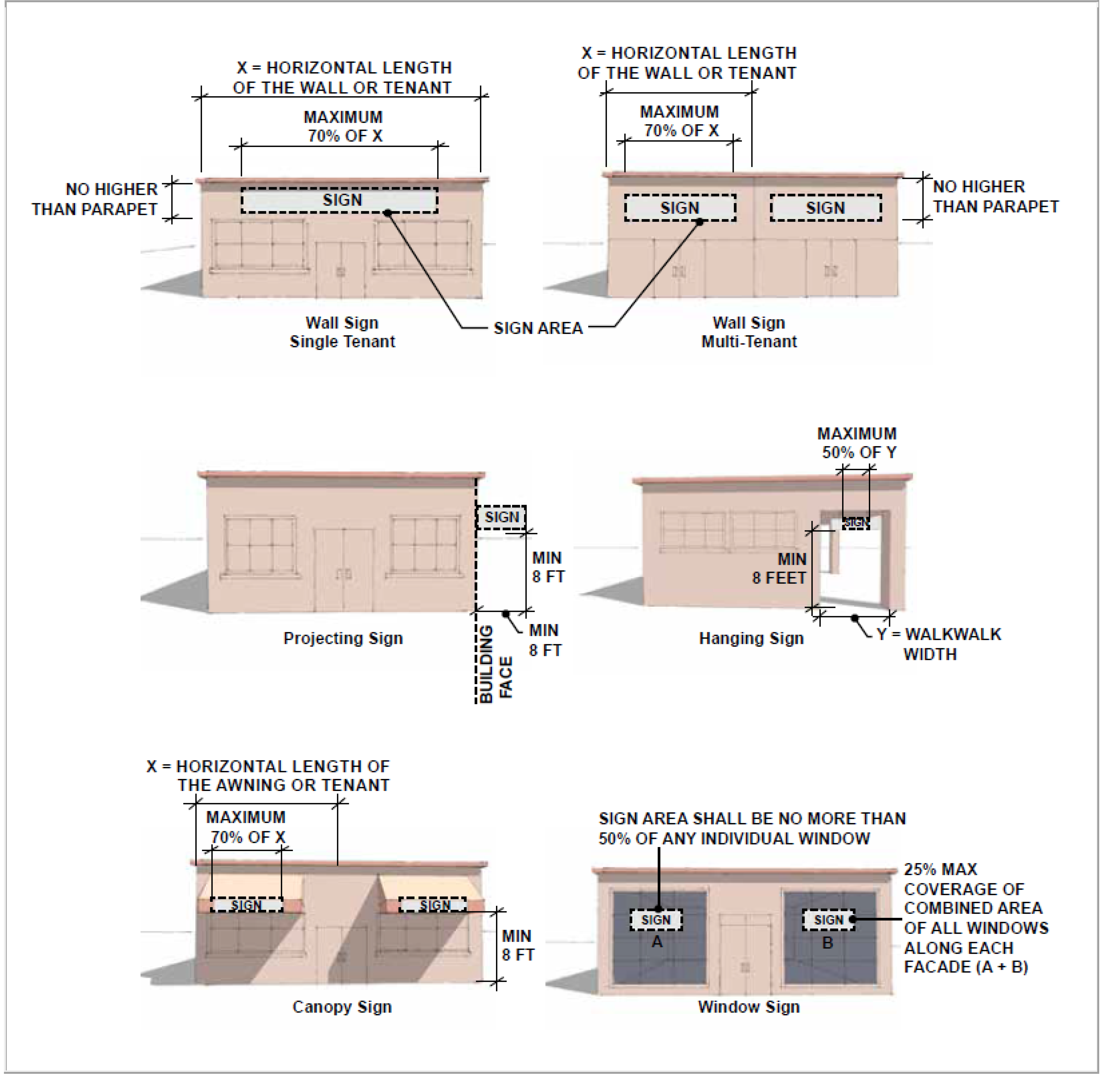
Table 17.80-2 prescribes the development standards for wall, marquee, projecting, canopy, awning and hanging building signs:
Table 17.80-2—Development Standards for Building Signs
D.
Figure 17.80-1 shows different building signs in a graphics form:
Figure 17.80-1—Building Signs
E.
Directory Wall Signs.
1.
The sign area shall count toward the total square footages permitted in Table 17.80-1.
2.
Maximum number. One directory wall sign may be placed at each ground floor entrance and staircase for a multiple-tenant building, for tenants that do not have a separate ground floor exterior entrance.
3.
Maximum area. A maximum two (2) square feet per tenant and an overall maximum size of ten (10) square feet per directional wall sign.
F.
Window Signs.
1.
The sign area shall count toward the total square footages permitted in Table 17.80-1.
2.
Maximum area. Window signs shall not occupy more than fifty (50) percent of any individual window. In addition, they shall not occupy more than twenty-five (25) percent of the combined area of all windows along each façade.
3.
Lighting. Window signs shall not be internally or externally illuminated.
G.
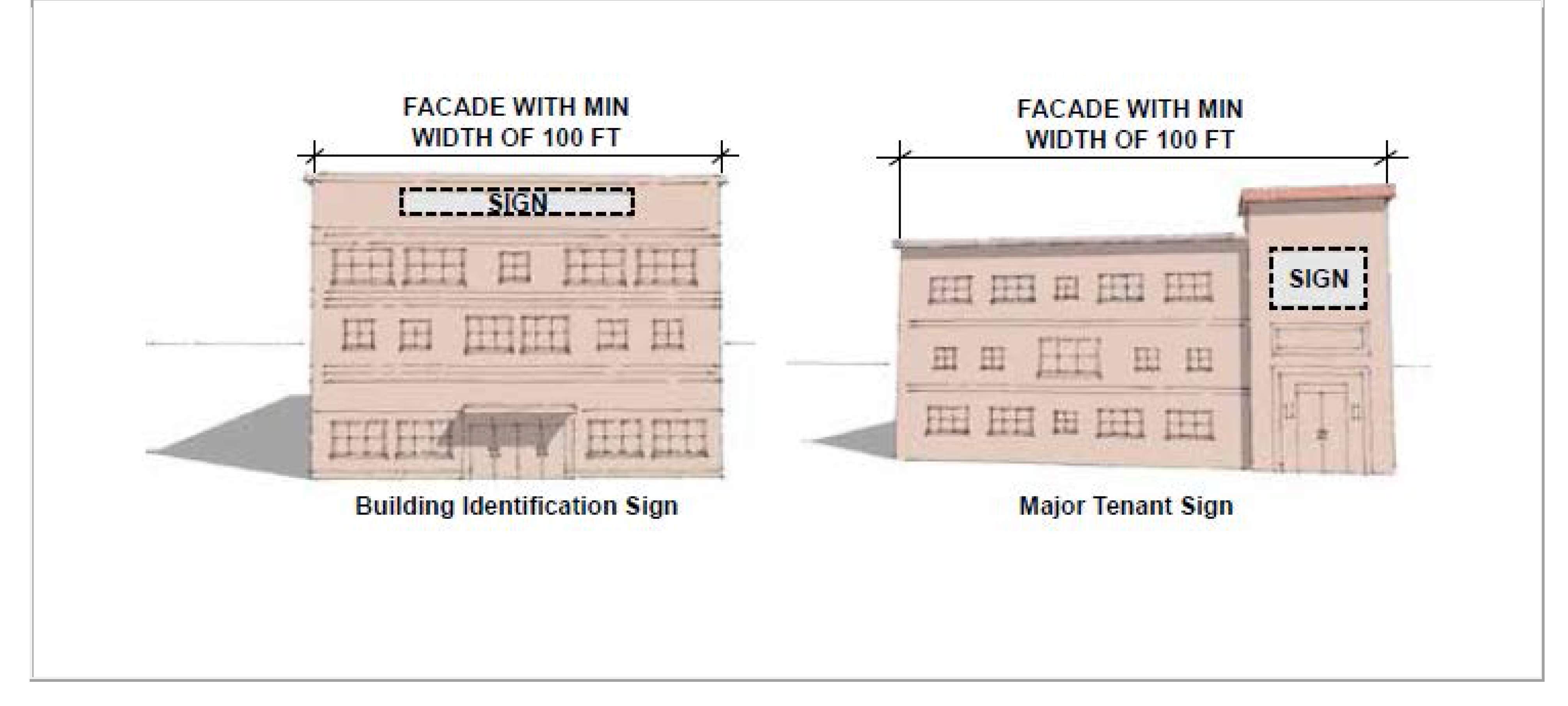
Building Identification or Major Tenant Sign:
1.
A sign shall only be permitted on a façade with a minimum width of one hundred (100) feet.
2.
The sign area shall count towards the total square footages allotted in Table 17.80-1. An additional fifty (50) square feet of overall wall sign area per eligible façade may be permitted for signs outlined in subsection G.3 below and an additional seventy-five (75) square feet for signs outlined in subsection G.4 below.
3.
A sign may be placed above a building entrance between the floor line of the second story and parapet line of a building up to three (3) stories in height. However, the sign shall be integrated as part of an architectural feature (e.g. a building tower, projection, etc.).
4.
A sign may be placed below the parapet of a building greater than three (3) stories in height. A maximum of three (3) signs shall be permitted on a building, with a maximum of one sign per façade.
5.
The signs shall comply with all other standards outlined in Tables 17.80-1 and 17.80-2.
6.
Figure 17.80-2 shows building identification and major tenant signs in a graphics form:
Figure 17.80-2—Building Identification and Major Tenant Signs
(Ord. No. 3053, § 3(Exh. A), 5-14-2025)
17.80.080 - Freestanding signs—Multiuse, commercial and manufacturing zoning districts.
A.
Table 17.80-3 prescribes the maximum number of freestanding signs allowed:
Table 17.80-3—Number of Freestanding Signs 2
Notes:
2 Signs shall meet the development standards outlined in Table 17.80-4. For corner properties, each street would be calculated separately.
B.
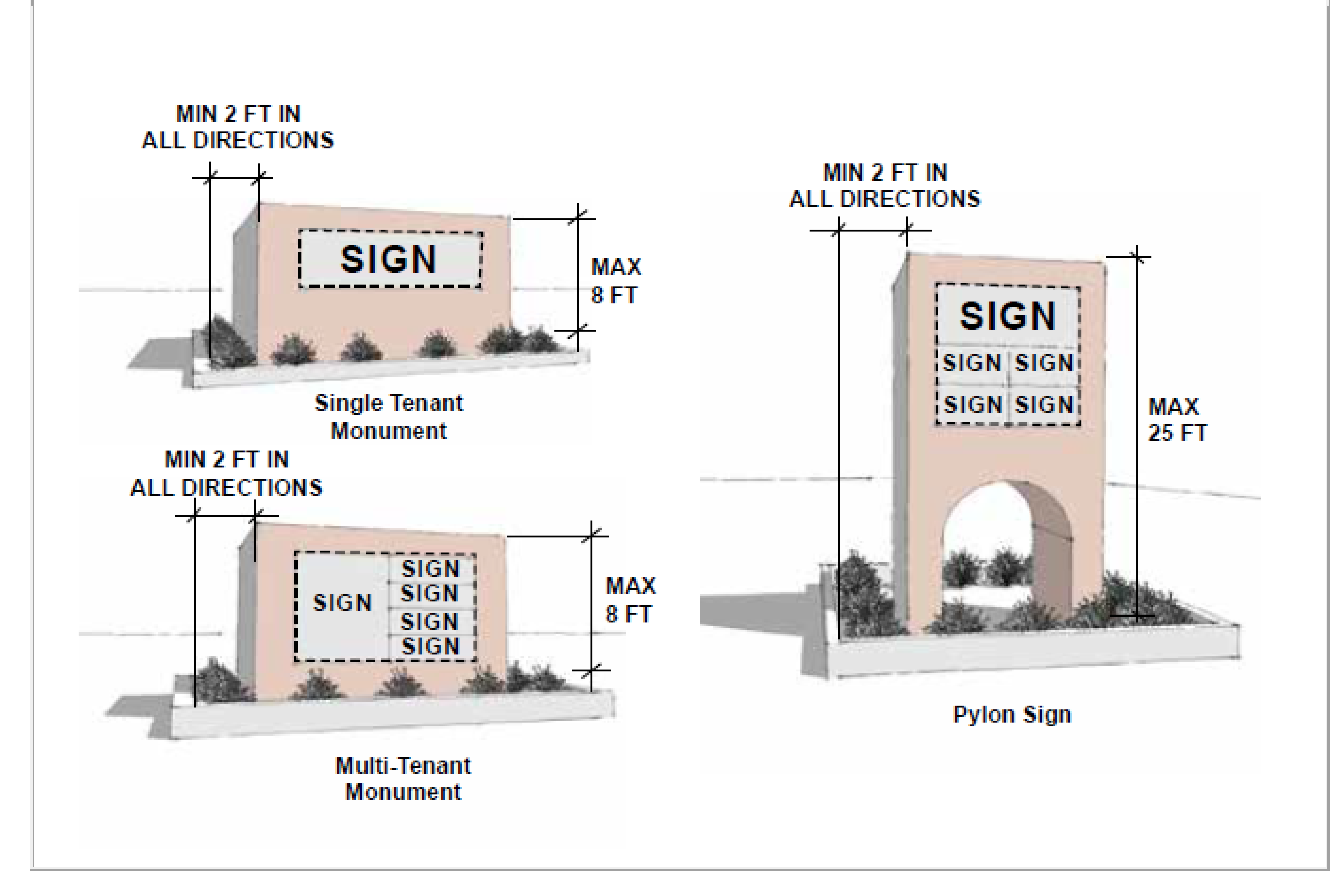
Table 17.80-4 prescribes the development standards for freestanding signs:
Table 17.80-4—Development Standards for Freestanding Signs
C.
Figure 17.80-3 shows different types of freestanding signs in a graphics form:
Figure 17.80-3—Freestanding Signs
(Ord. No. 3053, § 3(Exh. A), 5-14-2025)
17.80.090 - Permitted signs—Gateway and downtown specific plans.
A.
Applicability. This section applies to all properties within the boundaries of the Downtown Main Street specific plan and the Gateway specific plan.
B.
Building Signs, Pedestrian-oriented. All businesses with a separate street entrance in the Gateway specific plan and in the Main Street Subarea of the Downtown Specific Plan shall have a minimum of one pedestrian-oriented building sign with the business name. This may include one or more of the following:
1.
Marquee or projecting sign with vertical clearance between eight (8) and nine (9) feet and a maximum height of twelve (12) feet or the height of the parapet wall, whichever is lower;
2.
Canopy or awning sign;
3.
Hanging sign; or
4.
Permanent window sign.
C.
Painted Wall Signs.
1.
Shall be limited to the Downtown Specific Plan. If located outside the Downtown Specific Plan, shall include a registered trademark.
2.
Shall only be permitted on the rear building façade.
3.
Shall not cover more than twenty (20) percent of the surface on which the sign is painted.
D.
Outdoor A-frame Signs. Shall be permitted for a food and beverage establishment subject to the following:
1.
Number of Signs. A maximum of one sign shall be permitted at the main entrance facing the public street. A second sign may be permitted if the business has a secondary public entrance facing an alley or parking area behind the building.
2.
Maximum Size. Shall not exceed six (6) square feet in surface area per side for a single- or double-sided A-frame sign.
3.
Maximum Height. Shall not be greater than four (4) feet.
4.
Location. Signs shall not be located more than six (6) feet from the business frontage.
E.
Freestanding Signs.
1.
Pylon signs shall be prohibited.
2.
Monument signs shall be prohibited along Main Street between Santa Anita Avenue and Ramona Boulevard and along Lexington Avenue between Main Street and Ramona Boulevard.
3.
Monument signs may be permitted along all other streets subject to the provisions outlined in Tables 17.80-3 and 17.80-4.
F.
Window Signs. Permanent window signs shall not occupy more than twenty-five (25) percent of any individual window. In addition, permanent window signs shall not occupy more than fifteen (15) percent of the combined area of all windows along each façade.
G.
Freeway Oriented Signs. Freeway facing building signage in the Gateway specific plan may include building-face lit signage, multi-story blade lit signage and building-top lit signage. The goal is to maximize flexibility, diversity and exuberance so that the lit night signage of the will achieve a unique regional character.
H.
Master Sign Program. All buildings in the Gateway specific plan shall require the approval of a Master Sign Program. This includes all residential-only, nonresidential or mixed-use buildings.
(Ord. No. 3053, § 3(Exh. A), 5-14-2025)
17.80.100 - Permitted signs—Specific uses or sign types.
A.
Adult Entertainment Establishment. Signs, advertisements, displays, or other promotional materials depicting or describing "specified anatomical areas" or "specified sexual activities" or displaying instruments, devices, or paraphernalia which are designed for use in connection with "specified sexual activities" shall not be shown or exhibited so as to be discernible by the public beyond the walls of the building or portion thereof in which the adult entertainment business is conducted.
B.
Drive-thru Business.
1.
Directional Signs. Freestanding directional signs, for the sole purpose of guiding vehicle traffic on private property, may be permitted, provided each sign does not exceed an area of six (6) square feet and a height of four (4) feet.
2.
Menu Boards. Drive-thru food or beverage establishment may have a maximum of two (2) menu boards per drive-thru lane, provided each sign does not exceed an area of 20 square feet and a height of six (6) feet. All outdoor speakers shall be directed away from adjacent properties.
3.
Vehicle Clearance Signs. Each drive-thru lane that passes under an overhang may have a vehicle clearance sign.
4.
A Master Sign Program shall be required.
C.
Electronic Copy Sign (Automatic Readerboard).
1.
Permitted Uses. Electronic copy signs shall be limited to uses listed in subsections E., H., I., and J. below.
2.
Minimum Display Time. Each message on the sign shall be displayed for a minimum of eight (8) seconds. Vehicle service station signs shall only change when fuel pricing is adjusted.
3.
Sign Brightness.
a.
Each static message shall not include flashing lights or the varying of light intensity;
b.
The sign shall not operate at brightness levels of more than 0.3 foot candles (fc) above ambient light at the street, as measured using a foot candle meter; and
c.
The sign shall have a light sensing device that will adjust the brightness as ambient light conditions change.
4.
Maintenance. The sign shall be designed and required to freeze the display in one static position, display a full black screen, or turn off, in the event of a malfunction.
5.
Safety.
a.
The sign shall not be operated in such a fashion as to constitute a hazard to safe and efficient operation of vehicles on streets or freeways and shall comply with all applicable local; and
b.
The sign shall simulate or imitate any directional, warning, danger or information sign, or any display likely to be mistaken for any permitted sign intended or likely to be construed as giving warning to traffic, by, for example, the use of the words "stop" or "slow down."
6.
The sign shall not be operated or maintained so as to constitute an "improper display," as defined or described in Section 5403 of the California Business and Professions Code.
D.
Hotel and Motel.
1.
Ancillary Uses. If an ancillary use for the hotel has a separate entrance facing the street or an on-site parking area, it may have one wall sign up to twenty (20) square feet in area.
2.
Neon. Neon shall be prohibited, with exception to what is permitted in subsection D.3 below.
3.
Window signs. No window signs shall be permitted, with exception of one hotel sign with a maximum area of four (4) square feet stating "vacancy/no vacancy" and one sign for an ancillary use with a maximum area of four (4) square feet stating "open/closed." Such sign may be in neon.
4.
A Master Sign Program shall be required.
E.
K-12 School, Public and Private, Religious Facility, and Specialized Education and Training Facilities.
1.
Monument Signs. Signs shall not exceed a height of eight (8) feet in residential zones.
2.
Changeable Copy Signs (Manual). A maximum forty (40) percent of freestanding signs may include changeable copy.
3.
Electronic Copy Signs (Automatic Readerboard, Displaying Text and/or Graphics). For nonresidential zones, changeable copy may be replaced with an electronic copy, subject to the requirements of subsection C above.
4.
A Master Sign Program shall be required for all K-12 private schools.
5.
Specialized Education and Training Facilities. Changeable copy and electronic copy signs shall only be permitted if the property is greater than one acre and the sign is not located within a street setback.
F.
Live/Work Units.
1.
Quantity and Size. Each live/work use may have one sign at a maximum rate of one-half square feet for each foot of building frontage or twelve (12) square feet, whichever is less.
2.
Lighting. Signs may be back-lit or exterior illuminated. Signs shall not be internally illuminated. Neon signs shall be prohibited, with exception of permitted window signs under subsection F.3 below.
3.
Window Signs. No window signs shall be permitted, with exception of one sign with a maximum area of four (4) square feet stating "open/closed." Such sign may be in neon.
4.
A Master Sign Program shall be required.
5.
No additional signage shall be permitted.
G.
Recycling Facility.
1.
Mobile Facility. The facility may have up to two (2) identification signs (one on each side of the facility) with a maximum area of twelve (12) square feet each.
2.
Self-Service Facility. The facility may have one identification sign with a maximum area of four (4) square feet (exclusive of operating instructions).
3.
Small Collection Facility.
a.
Wall Sign. The facility may have one wall sign with a maximum area of twenty-four (24) square feet. The sign shall not be internally illuminated; and
b.
Directional Signs. Freestanding directional signs, for the sole purpose of guiding vehicle traffic on private property, may be permitted, provided each sign does not exceed an area of six (6) square feet and a height of four (4) feet. Such signing shall bear no advertising message.
4.
Large Collection Facility.
a.
Wall Sign. The facility may have one wall sign with a maximum area of thirty-six (36) square feet or one square foot per one linear foot of building frontage, whichever is greater;
b.
Directional Signs. Freestanding directional signs, for the sole purpose of guiding vehicle traffic on private property, may be permitted, provided each sign does not exceed an area of six (6) square feet and a height of four (4) feet. Such signing shall bear no advertising message; and
c.
Monument Sign. The facility may have one monument sign along each street frontage as prescribed in Section 17.80.080 of this chapter.
H.
Theatre and Concert Venue.
1.
Building Signs. Properties containing a theatre or concert venue may substitute a wall sign with a marquee sign, subject to the following:
a.
A maximum of two (2) marquee signs shall be permitted with each on a separate elevation. The elevation shall face a street or on-site parking area.
b.
The maximum area of each marquee sign shall be equal to the maximum wall sign area permitted on the applicable façade, as permitted in Tables 17.80-1 and 17.80-2, or one hundred (100) square feet, whichever is greater.
c.
The maximum overall height of each sign shall be twenty-five (25) feet.
d.
The sign may extend above the roofline, provided it is incorporated with an architectural feature of the building, compliant with Section 17.60.030 (General Development Standards—Height Exceptions and Restrictions) of this title.
e.
The sign may be internally and/or externally illuminated.
f.
A maximum sixty (60) percent of the sign may include changeable copy (manual) or electronic copy (automatic readerboard, displaying text only) to advertise movies, performances and showtimes, subject to the requirements of subsection C above.
2.
Freestanding Signs. The number of freestanding signs as prescribed in Table 17.80-3 may be increased by one monument or pylon sign, subject to the following:
a.
The maximum area of all freestanding signs as outlined in Table 17.80-4 shall be increased to one square foot per one foot of linear street frontage.
b.
The sign shall be for the exclusive use of the theatre or concert venue.
c.
A maximum forty (40) percent of the sign may include changeable copy (manual) or electronic copy (automatic readerboard, displaying text only) to advertise movies, performances and showtimes, subject to the requirements of subsection C above.
3.
Temporary Signs. Temporary banners or other types of temporary signs shall be prohibited when the theatre or concert venue is the only business on the property, except for the thirty (30) days after the issuance of a certificate of occupancy for the opening of a new or remodeled theatre or concert venue.
4.
A Master Sign Program shall be required.
I.
Vehicle Sales and Lease.
1.
This subsection applies to automobile dealerships located within the Auto District as identified in 2011 General Plan Figure LU-2 (Strategic Areas).
2.
Wall Signs.
a.
The maximum area of all wall signs on the building shall be equal to the maximum permitted in Tables 17.80-1 and 17.80-2, or one hundred fifty (150) square feet, whichever is greater. This shall only apply to one building if the dealership includes multiple buildings.
b.
For buildings with one hundred (100) feet or more of frontage, the number of supplemental signs may be increased to five (5), constituting a maximum thirty-five (35) percent of the wall sign area.
c.
Signs may extend above the roofline, provided it is incorporated with an architectural feature of the building, compliant with Section 17.60.030 (General Development Standards—Height Exceptions and Restrictions) of this title.
3.
Freestanding Freeway-Oriented Signs. One additional freestanding sign shall be permitted, as outlined in Table 17.80-3, subject to the following:
a.
The maximum area of the freestanding freeway-oriented sign shall be one square foot per one foot of linear street frontage. If the property has multiple frontages, the square footage may be based on the longer frontage.
b.
The maximum height of the sign shall not exceed one hundred (100) feet above the grade of the closest travel lane of the freeway.
c.
A maximum seventy (70) percent of the freeway-oriented sign may include changeable copy (manual) or electronic copy (automatic readerboard), subject to the requirements of subsection C above.
4.
Banner Signs.
a.
The maximum height for a banner shall be twenty (20) feet.
b.
The minimum vertical clearance for a banner shall be eight (8) feet.
c.
The minimum vertical clearance for a banner over a driveway or parking area shall be fourteen (14) feet.
d.
Banners shall be set back a minimum fifteen (15) feet from adjacent property lines.
e.
Banners shall only be mounted to freestanding vertical poles, light standards and poles or brackets attached to a building wall, so as to project outward from the wall. No banners shall be attached to vehicles, building walls, freestanding walls or fences or roofs of buildings.
f.
Banners shall project a maximum four (4) feet from the support pole.
5.
A master sign program shall be required.
J.
Vehicle Service Station.
1.
Maximum Area for Combined Signs, Including Building Signs, Freestanding Signs, Canopy Fascia Signs and Gasoline Price Signs. The maximum area shall not exceed one and one-half (1½) square feet per one foot of linear street frontage. For corner lots, the longer frontage shall be used to calculate the maximum area.
2.
Freestanding Signs.
a.
Interior Lots. One monument sign not exceeding forty (40) square feet.
b.
Corner Lots. One pylon sign not exceeding eighty (80) square feet at the street corner or two (2) monument signs not exceeding forty (40) square feet each (one along each street frontage). Monument signs shall be set back a minimum forty (40) feet from the street corner.
3.
Canopy Fascia Signs. The company name, logo and graphic (e.g., strip or band in the company's trademark colors) may be located on the canopy, provided none extend above the roofline. The combined area of the company name and/or logo on all sides shall not exceed fifty (50) square feet per canopy. The graphic (strip or band) shall not count towards the combined area of the canopy fascia signs and shall not be internally illuminated.
4.
Gasoline Price Signs. Service stations shall comply with Article 12, Sections 13530 to 13540, of the California Business and Professions Code. This includes providing minimum letter and number heights for the three (3) major grades of gasoline. The gasoline prices may be displayed as changeable copy (manual) or electronic copy (automatic readerboard, displaying text only).
5.
Temporary Signs. Temporary banners or other types of temporary signs shall be prohibited, except for the thirty (30) days after the issuance of a certificate of occupancy for the opening of a new or remodeled service station.
6.
Lighting. All signs shall be internally illuminated.
7.
A master sign program shall be required.
K.
Vehicle Washing Facility.
1.
Directional Signs. Freestanding directional signs, for the sole purpose of guiding vehicle traffic on private property, may be permitted, provided each sign does not exceed an area of six (6) square feet and a height of four (4) feet.
2.
Service Board Signs. Building mounted or freestanding service board signs identifying the type of vehicle washes and prices may be permitted. A maximum of two (2) service board signs per queuing lane may be permitted. Sign lighting shall be limited to external illumination. The maximum sign square footage shall be determined through the design review process.
3.
A master sign program shall be required.
(Ord. No. 3053, § 3(Exh. A), 5-14-2025)
17.80.110 - Temporary signs.
A.
Temporary Window Signs.
1.
Applicability. This subsection shall apply to all nonresidential uses.
2.
Time Limits. The signs may be continuously displayed, however, the sign copy must be changed or revised a minimum of every sixty (60) days.
3.
Materials. May be constructed of paper (except newsprint), provided the signs are professionally printed and lettered on heavyweight art paper or similar materials.
4.
Sign Area. The combined maximum sign area shall not exceed thirty (30) square feet or twenty-five (25) percent of all window areas, whichever is less.
B.
Temporary Banners.
1.
Applicability. This subsection shall apply to all nonresidential uses.
2.
Time Limits. The sign approval shall be limited to a maximum of three (3), thirty-day periods each calendar year. Each thirty-day period shall be separated by a thirty-day period free of any banners.
3.
Materials. Shall be limited to the following materials: canvas, vinyl, nylon or similar mesh which is tear-resistant. Banners shall not be torn and the print shall not be faded.
4.
Number of Signs. A maximum of two (2) banner signs shall be permitted for each single tenant commercial building located in a nonresidential zone. A maximum of one sign shall be permitted for each tenant within a multiple tenant commercial building or commercial complex located in a nonresidential zone.
5.
Sign Area. Each banner sign shall not exceed thirty-two (32) square feet.
C.
Temporary Project Construction Signs.
1.
Applicability. This subsection shall apply to residential projects with three (3) or more units and nonresidential projects.
2.
Required Project Approvals. The project shall have entitlement approvals or been issued a building permit.
3.
Time Limits. The temporary sign permit shall be valid for twelve (12) months. If the applicant has proceeded in good faith towards the implementation of the permit granted as determined by the Community Development Director, the applicant may request a twelve-month extension of the temporary sign permit. The extension shall be considered by the Community Development Director within thirty (30) days of the request. No additional extensions shall be permitted.
4.
Sign Content. The signs may include information on the project developer, proposed tenants, City Council or other elected official and/or estimated completion date;
5.
Location and Number of Signs.
a.
A maximum of one wall sign may be placed on each building façade facing a street, provided the area for each sign does not exceed thirty-two (32) square feet; and
b.
A maximum of one freestanding sign may be placed on each property frontage facing a street, provided the area for each sign does not exceed forty-eight (48) square feet, the height does not exceed seven (7) feet and the sign is located a minimum 20 feet from an adjacent property line.
6.
Projects Involving On-Site Earth-Moving Activities. Sign(s) shall be placed in compliance with Air Quality Management District (AQMD) Rule No. 1466. This includes displaying the following warning statement: "THIS SITE CONTAINS SOILS THAT CONTAIN THE FOLLOWING CHEMICALS: [LIST APPLICABLE TOXIC AIR CONTAMINANT(S)] TO REPORT ANY DUST LEAVING THE SITE PLEASE CALL [FACILITY CONTACT AND PHONE NUMBER] OR THE SOUTH COAST AIR QUALITY MANAGEMENT DISTRICT AT 1-800-CUT-SMOG."
7.
Sign Area. The combined area for all signs in this subsection shall not exceed eighty (80) square feet in residential zoning districts and one hundred twenty (120) square feet in nonresidential zoning district. The Planning Commission may increase the maximum square footage through the public hearing process.
D.
Lighting. Temporary signs shall not be internally or externally illuminated.
(Ord. No. 3053, § 3(Exh. A), 5-14-2025)
17.80.120 - Design requirements and guidelines.
A.
Applicability. All proposed signs shall be subject to this subsection.
B.
Design and Placement.
1.
New Buildings. The proposed design of buildings shall provide logical sign areas, allowing flexibility for new users as the building is occupied by different tenants over time.
2.
Sign Proportion.
a.
Signs should be proportionate to the dimensions of their location. Signs should not overwhelm their location on a parapet or other designed area on the building.
b.
Signs should be architecturally integrated into the overall building design and harmonious with the materials, color, texture, scale, size, shape, height, placement and design of the building, property and neighborhood of which it is a part.
3.
Design of Letters. Wall signs shall be made of individually cut letters, either internally lit channel letters, back lit letters or cut lettering on a metal or similar materials plate.
4.
Multiple-Tenant Centers. Signs should be evenly distributed throughout the tenant space and within the commercial center.
5.
Freestanding Signs.
a.
The base of the sign shall incorporate the building's architecture, materials and colors.
b.
Landscaping and irrigation shall be designed around the base of sign to integrate the sign with the rest of the property and screen out any low-level flood lights. Irrigation shall be designed so it does not damage the sign.
C.
Colors.
1.
Number of Colors. A maximum of four (4) colors shall be permitted for the copy of any single sign and for all signs within a multiple-tenant center, not including black or white. Additional colors may be permitted for a registered trademark.
2.
Sign Backgrounds.
a.
Darker colored backgrounds on signs are generally encouraged. Stark white or extremely bright background colors such as bright red, orange or yellow are discouraged.
b.
Where the design of the sign results in a large field of illuminated background, the use of white or off-white as background color shall be avoided in favor of a more suitable color.
c.
All signs within a multiple-tenant center shall have a uniform background color.
d.
For legal non-conforming can or box signs, the use of opaque backgrounds which only allow illumination on the cut-out letters or graphic area is encouraged.
3.
The color of the trim caps shall match the color of the letter face or the cabinet return.
D.
Sign Copy and Graphics.
1.
Amount and Letters.
a.
Sign copy shall not crowd the edges of the building, cornice line, architectural features or the sign canister which contains the sign copy.
b.
Repetitious signage information on the same building frontage shall be avoided, regardless of the sign area square footage allowed.
2.
Font and Color of Letters.
a.
Avoid using hard-to-read fonts.
b.
Limit the number of fonts used on a sign. For small signs, a maximum of two (2) fonts should be used. For larger signs, a maximum of three (3) fonts should be used.
c.
Use contrasting colors, so the text on the sign is more easily readable.
3.
Sign Visibility. Ensure the sign is clearly visible for vehicles and pedestrians from the public right-of-way.
4.
Graphics and Artwork. Shall be limited to registered trademarks or artwork that is consistently used by the business in online and print advertising.
E.
Materials and Installation. Signs shall be professionally lettered and installed and incorporate the following:
1.
The material shall be appropriate for outdoor use;
2.
The sign face and sides of the sign shall be smooth;
3.
The sign shall have a border attached to the sign;
4.
The sign shall be mounted a minimum one inch away from the surface the sign is attached to;
5.
All surfaces of the sign shall be finished with exterior quality finishes; and
6.
The anchor bolts shall not be visible.
F.
Lighting.
1.
Spillage and Glare. To the extent feasible, light sources shall be concealed or shielded to prevent or minimize light spillage, glare, momentary blindness or other discomfort to persons within the view of such light sources.
2.
Properties Adjacent to Residential Zoning Districts. Signs located adjacent to any residential zone should be controlled by a rheostat or other acceptable method to reduce glare that will create a nuisance.
(Ord. No. 3053, § 3(Exh. A), 5-14-2025)
17.80.130 - Maintenance and enforcement.
A.
Sign Maintenance. All signs and sign structures shall be maintained in a state of safe condition and good repair. Any sign or sign structure that is allowed to deteriorate to such a condition that the sign's paint, lettering or plastic face begins to crack, peel or weather, or the sign structure becomes bent or damaged in any way, or the sign's lighting is burned out, broken or missing, shall be repainted or repaired to its original condition when installed or be entirely replaced or completely removed.
B.
Abandoned Signs. Any legal non-conforming sign or sign structure abandoned for twelve (12) months or more shall be removed.
C.
Criminal Enforcement. It shall be illegal to install, mount, display, use, occupy or maintain signs in violation of this chapter. Any violation or failure to comply with the provisions of this chapter constitutes a misdemeanor, a separate violation for each day each sign is in violation. Such misdemeanor violations may be punished in accordance with the provisions of Chapter 1.24 (General Penalty) of the EMMC or any other remedies prescribed by law. Enforcement, whether through civil or criminal proceedings, nuisance abatement, injunction or any other means shall be cumulative.
D.
Civil and Administrative Penalties.
1.
Each separate and distinct violation of this chapter may be penalized pursuant to Chapters 1.18 (Administrative Citations) and 1.19 (Enforcement) of Title 1 (General Provisions) of the EMMC and any other civil procedure authorized under the EMMC or state law.
2.
Each separate and distinct violation of this chapter shall: (i) constitute violations as defined under Section 1.18.020 (Administrative Citations—Definitions) of Title 1 (General Provisions) of the EMMC; (ii) subject to administrative citation pursuant to Section 1.18.030 (Issuance of Administrative Citation) of Title 1 (General Provisions) of the EMMC; and (iii) not be eligible for notice of violation warnings.
3.
Notwithstanding the subsection D.2.(iii) above, the City Attorney shall have the authority to waive any first offense within any one calendar year within two (2) days of the issuance of administrative citation.
E.
Abatement.
1.
Nuisance Abatement. Signs not in compliance with this chapter are hereby declared to be a public nuisance, which may be abated in accordance with Chapter 8.44 (Property Maintenance) of Title 8 (Health and Safety) of the EMMC or by methods authorized by state law.
2.
Summary abatement/removal.
a.
In addition to any other enforcement procedures and remedies available to the city under this chapter or any other provision of the EMMC or state law, unauthorized signs which are displayed, placed or posted in the public thoroughfare or encroach upon the public thoroughfare or which are affixed to any public utilities, equipment and improvements located within the public thoroughfare may be immediately and summarily abated and removed by the city without prior notice to any person or entity.
b.
In addition to any other enforcement procedures and remedies available to the city under this chapter or any other provision of the EMMC or state law, signs (including unauthorized signs) which by virtue of their physical condition (as opposed to their graphic design or message content), pose a serious and immediate threat to public safety, may be summarily removed and retained by the city without prior notice to any person or entity. In such case, the city, after removal of the sign, shall promptly give written notice to the sign or property owner, if known, of the emergency confiscation and the cost of redemption.
c.
In the absence of substantial evidence to the contrary, a person who is featured on a sign or who otherwise benefits from its display shall be presumed to be the person who both owns the sign and was responsible for the placement of the sign. For example, nightclub promoters shall be presumed to be responsible for signs promoting his or her nightclub event.
F.
Cost for the Removal of Signs. Except as otherwise provided under subsection E. above, any person who violates any provision of this chapter shall, in addition to any fines imposed under this chapter or elsewhere under the EMMC, be liable for costs of city labor, equipment and materials used to remove signs not in compliance with this chapter. The city shall substantiate its costs in the form of an invoice detail the labor, equipment and materials used to remove signs placed by a person or otherwise belonging to the person.
(Ord. No. 3053, § 3(Exh. A), 5-14-2025)
17.80.140 - Time period.
A.
A Sign Permit shall be valid for twelve (12) months.
B.
If the applicant has proceeded in good faith toward the implementation of the permit granted as determined by the Community Development Director, the applicant may request a twelve-month extension of the sign permit. The extension shall be considered by the Community Development Director within thirty (30) days of the request. No additional extensions shall be permitted.
(Ord. No. 3053, § 3(Exh. A), 5-14-2025)
17.80.150 - Appeals.
Planning Division decisions regarding this chapter are appealable to the Planning Commission. The Planning Commission's decision shall be final. Refer to Section 17.10.100 (General Regulations—Ability to Appeal) of this title for additional information.
(Ord. No. 3053, § 3(Exh. A), 5-14-2025)
17.82.010 - Summary of Overlay Zone.
The Billboard Overlay Zone is made up of nine (9) nonresidential sub-areas along the Interstate-10 San Bernardino Freeway and one nonresidential sub-area along Rosemead Boulevard (California State Route-164).
(Ord. No. 3053, § 3(Exh. A), 5-14-2025)
17.82.020 - Purpose.
Billboards are recognized as a legitimate form of commercial advertising in the city. However, the size, number, location and illumination of billboards can have significant influence on the city's visual character, and can, without appropriate control, create or contribute to visual blight conditions. The purpose of this chapter is to establish an Overlay Zone where new billboards may be constructed and existing billboards may be removed and relocated or reconstructed subject to reasonable controls, while recognizing that community appearance is an important factor in ensuring the general community welfare.
(Ord. No. 3053, § 3(Exh. A), 5-14-2025)
17.82.030 - General requirements.
A.
The requirements of this chapter shall apply to any project involving the installation or construction of a new billboard, or billboards, or relocated billboard, or billboards, or the expansion, modification, or digitization of an existing billboard, or billboards, within the Billboard Overlay Zone, or the addition of additional face(s) to an existing billboard within the Billboard Overlay Zone. Billboards shall be permitted in the Billboard Overlay Zone only after a development agreement has been negotiated and executed between the property owner and/or billboard operator and city, and any requisite permits have been issued in accordance with the terms of this chapter. An existing billboard or digital billboard in existence on the effective date of the ordinance from which this title is derived pursuant to a prior agreement (including any amendments or extensions thereof) or other lawful permit may be relocated and rebuilt only within the Billboard Overlay Zone. All billboards constructed within the Billboard Overlay Zone shall comply with this chapter and all applicable requirements of the California Business and Professions Code and the California Outdoor Advertising Act.
B.
In accordance with Section 5440 of the California Business and Professions Code, new billboards not associated with relocation as described in subdivision (C) shall be allowed only in those portions of the Billboard Overlay Zone not designated as "landscaped freeways" pursuant to Section 5216 of the California Business and Professions Code.
C.
In accordance with Section 5443.5 of the California Business and Professions Code, relocated billboards shall be allowed only in the Billboard Overlay Zone and shall not be permitted in any location which would result in violation of any applicable federal, state or local law. Billboards to be relocated in the Billboard Overlay Zone may originate in areas outside the Billboard Overlay Zone or outside the city's boundaries, provided the agreement required by this chapter documents their location and removal, and the benefits associated with such relocation. An owner or entity proposing an agreement for relocation shall establish that the relocated billboard meets one or more of the following eligibility requirements:
1.
The billboard proposed for complete demolition and relocation is the subject of any eminent domain action or threat of eminent domain action by a legally created public entity possessing eminent domain/condemnation authority and provides public benefits for such relocation; or
2.
The applicant chooses to completely demolish and relocate an existing billboard, including a legal nonconforming billboard, to a more suitable location within the Billboard Overlay Zone so as not to conflict with the proposed development or redevelopment of the property and provides public benefits for such relocation as negotiated in the agreement; or
3.
The applicant chooses to completely demolish and relocate an existing billboard, including a legal nonconforming billboard, to a more suitable location within the Billboard Overlay Zone that lessens the overall negative aesthetic impacts on the city and its residents and provides public benefits for such relocation; or
4.
The applicant has previously removed and completely demolished one or more billboards and maintains credits for such removal by the California Department of Transportation pursuant to Section 5443.5 of the California Business and Professions Code; or
5.
The applicant proposes to enhance, improve and modify an existing billboard already established within the Billboard Overlay Zone for the purpose of modernizing and improving the aesthetic appearance of such billboard.
D.
In the event of any conflict between any provision contained in this chapter and any other provisions contained elsewhere in the EMMC, the provisions of this chapter shall govern.
E.
No billboard shall be approved and no existing billboard shall be modified without the applicant first providing proof of legal or equitable interest in the site proposed for relocation or modification, including, but not limited to, a lease, easement or other entitlement, demonstrating the right to install and operate the billboard on the subject property. Information to be provided shall include the written consent of the property owner if not readily ascertainable from the foregoing documents.
F.
No billboard shall be approved or modified, and no billboard may be maintained, unless a designated maintenance service is available "24/7," by telephone, to be contacted and to respond in the event a billboard becomes damaged or dilapidated.
G.
All billboard agreements shall include requirements that applicants obtain all additional federal and/or state permits for installation, including, but not limited to, any applicable California Department of Transportation (Caltrans) permit. Nothing contained in this chapter shall require the city to negotiate and/or approve an agreement on terms that are unacceptable to the City Council.
(Ord. No. 3053, § 3(Exh. A), 5-14-2025)
17.82.040 - Development standards.
A.
Physical Requirements.
1.
The maximum number of billboards within each sub-area shall not exceed what is prescribed in Table 17.82-1.
2.
The distance and separation between two (2) or more billboards placed within the Billboard Overlay Zone or between billboards and the freeway right-of-way shall meet the minimum requirements of the California Department of Transportation or as prescribed in Table 17.82-1, whichever is greater. All distances shall be measured from the vertical centerline of each billboard face.
Table 17.82-1 Maximum Number and Minimum Separation for Billboards
3.
Billboards in sub-areas 1 and 3 shall not be permitted on vacant properties.
4.
All utilities utilized for each billboard shall be underground.
5.
No billboard shall have more than one face (display surface) oriented in the same vertical plane.
6.
All billboards shall plainly display, and be visible from no less than one hundred (100) feet, the name of the person or company owning or maintaining such billboard, and the billboard's identification number.
7.
Billboards projecting over a driveway or driving aisle shall have a minimum clearance of sixteen (16) feet between the lowest point of the sign and the driveway grade. Billboards shall comply with any California Department of Transportation requirements for placement and operation. No part of any billboard shall cross onto an adjacent property.
8.
Billboards projecting over a pedestrian walkway shall have a minimum clearance of twelve (12) feet between the lowest point of the sign and the walkway grade.
9.
All billboards not projecting over drive areas or pedestrian walkways shall have a minimum clearance of twelve (12) feet between the lowest point of the billboard and ground level.
10.
All billboard structures shall be free of any visible bracing, angle iron, guy wires, cable, and/or similar supporting elements. All exposed portions of new billboards, including backs, sides, structural support members and support poles, shall be screened to the satisfaction of the Community Development Director.
11.
All billboards shall be placed at least two hundred fifty (250) feet from any residential zoning district, unless it can be demonstrated by the positioning of the digital panels that there is no significant additional light intrusion than if the digital panels are placed at least two hundred fifty (250) feet away. Billboard proposals requesting to be located within two hundred fifty (250) feet of any residential zoning district shall provide a site-specific light and glare study to be reviewed and approved by the Community Development Director. The measurement shall be from the closest edge of the billboard to the closest edge of the residential zoning district.
12.
No billboard, inclusive of supporting structures, shall exceed seventy-five (75) feet in height, measured from the finished grade of the freeway travel lane closest to the sign to the uppermost point of the sign, except as may be approved for good cause as demonstrated by the applicant and determined in the sole discretion of the city.
B.
Operational Requirements.
1.
No digital billboard shall display any statement or words of an "obscene, indecent, or immoral character," as that phrase is used in Section 5402 of the Business and Professions Code and judicial decisions interpreting the same.
2.
Each digital billboard shall be connected to the National Emergency Network and provide emergency information, including child abduction alerts (e.g., "Amber Alerts"), in accordance with local and regional first responder protocols.
3.
Digital Billboard Operating Criteria.
a.
Each static message shall not include flashing lights or the varying of light intensity.
b.
Minimum display time. Each message on the sign must be displayed for a minimum of four (4) seconds.
c.
Digital billboards shall not operate at brightness levels of more than 0.3 foot candles above ambient light, as measured using a foot candle meter in accordance with the pre-set distances set forth below.
d.
Pre-set distances to measure the foot candles impact vary with the expected viewing distances of each size sign and shall comply with the following ratios of face size dimensions to points of measurement distances:
•
Twelve (12) feet × twenty-five (25) feet; one hundred fifty (150) feet
•
Ten and one-half (10.5) feet × thirty-six (36) feet; two hundred (200) feet
•
Fourteen (14) feet × forty-eight (48) feet; two hundred fifty (250) feet
•
Twenty (20) feet × sixty (60) feet or twenty-five (25) feet × forty-eight (48) feet; three hundred fifty (350) feet
e.
Each digital billboard must have a light sensing device that will adjust the brightness as ambient light conditions change.
4.
Each digital billboard shall be designed and required to freeze the display in one static position, display a full black screen, or turn off, in the event of a malfunction.
5.
Walls or screens at the base of the billboard shall not create a hazard to public safety or provide an attractive nuisance and shall be continually maintained free from graffiti.
6.
Billboards shall not be operated in such a fashion as to constitute a hazard to safe and efficient operation of vehicles on streets or freeways and shall comply with all applicable federal, state and local law. Digital billboards when operated in accordance with the operating criteria in subsections B.1. through 5. above and static billboards operated pursuant to federal, state and local law shall be deemed to be in compliance with this subsection and all requirement of the California Department of Transportation.
7.
No billboard shall simulate or imitate any directional, warning, danger or information sign, or any display likely to be mistaken for any permitted sign intended or likely to be construed as giving warning to traffic, by, for example, the use of the words "stop" or "slow down."
8.
No billboard shall involve any red or blinking or intermittent light likely to be mistaken for warning or danger signals nor shall its illumination impair the vision of travelers on the adjacent freeway and for roadways. Digital billboards when operated in accordance with the operating criteria in subsection (4), above, shall be deemed to be in compliance with this subsection.
9.
No digital billboard shall be operated or maintained so as to constitute an "improper display," as defined or described in Section 5304 of the Business and Professions Code.
(Ord. No. 3053, § 3(Exh. A), 5-14-2025)
17.82.050 - Application and review process.
A.
Application Requirements. A person or entity wishing to completely demolish and relocate an existing nonconforming billboard or modify an existing billboard within the Billboard Overlay Zone shall submit an application for the approval of a design review, in accordance with Chapter 17.122 (Design and Minor Design Review) of this title, and a Development Agreement, in accordance with Chapter 17.129 (Development Agreements) of this title, that includes the following:
1.
The name, address phone number and other contact information of the person or entity proposing the development agreement;
2.
Identification of the location proposed for a new or relocated or modified billboard and the billboard(s) being permanently removed, where applicable;
3.
Information that establishes that the person or entity proposing the agreement has legal or equitable interest in the billboard being removed or modified and the site proposed for relocation or placement;
4.
Conceptual design drawings for the billboards that includes technical specifications to determine the billboard's compliance with this chapter;
5.
An explanation of the compensation to be paid or public benefits to be provided to the city; and
6.
The application must include photos of all existing signage or architectural renderings and elevations of proposed billboards as well as a scaled plot plan and elevations showing the locations of all existing structures and improvements on the property, and the proposed billboard.
B.
Review Process. All proposed agreements shall be reviewed in accordance with Chapter 17.122 (Design and Minor Design Review) and Chapter 17.129 (Development Agreements) of this title.
(Ord. No. 3053, § 3(Exh. A), 5-14-2025)
17.82.060 - Necessary findings.
In addition to the required findings set forth in Section 17.129.090 Development Agreements—Necessary Findings) of this title, the following findings shall also be made:
A.
The proposed installation site is compatible with the uses and structures on the site and in the surrounding area;
B.
The proposed billboard would not create a traffic or safety problem, including problems associated with onsite access circulation or visibility; and
C.
The proposed billboard would not interfere with onsite parking or landscaping required by this title.
(Ord. No. 3053, § 3(Exh. A), 5-14-2025)
17.82.070 - Violations.
Violations in this chapter shall be subject to all civil, criminal, and administrative remedies available to the city.
(Ord. No. 3053, § 3(Exh. A), 5-14-2025)
17.84.010 - Nonconforming use.
Every outdoor structure heretofore lawfully erected and in existence upon the effective date of City Council Ordinance No. 2522 may continue thereafter as a legal nonconforming use, however, any improvement or alteration of any part thereof other than advertising copy shall comply with the provisions of this section.
(Ord. No. 3053, § 3(Exh. A), 5-14-2025)
17.84.020 - Relocation.
Any outdoor advertising structure heretofore lawfully erected and still in existence upon the effective date of City Council Ordinance No. 2522 may be relocated in accordance with Chapter 17.82 (Billboard Overlay Zone) of this title.
(Ord. No. 3053, § 3(Exh. A), 5-14-2025)
17.84.030 - Removal of signs.
A.
Every outdoor advertising structure heretofore or hereafter unlawfully erected or maintained shall be forthwith removed by the property owner, or by direction of the City Council after a duly noticed public hearing where it is determined such outdoor advertising structure has been unlawfully erected or maintained, and the cost of such removal shall become a lien on the property where such unlawfully erected or maintained outdoor advertising structure was located.
B.
The unlawful structure so removed shall be stored by the city and released to the property owner upon tender of payment to the city of the cost of the removal plus a storage fee of two hundred fifty dollars ($250.00) per day or any fraction thereof, excluding the first day such structure is taken into storage.
C.
If such illegal structure is not claimed within ten (10) working days after storage, the city shall dispose of such structure in the best interests of the property owner seeking to set off against removal and the best interests of the property owner seeking to set off against removal and storage fees any value received for such structure.
(Ord. No. 3053, § 3(Exh. A), 5-14-2025)
17.84.040 - Maintenance.
All signs and sign structures shall be maintained in a state of safe condition and good repair. Any sign or sign structure that is allowed to deteriorate to such a condition that the paint, lettering or plastic face begins to crack, peel or weather, or sign structures which become bent or damaged in any way, shall be repainted or repaired to its original condition when installed or be entirely replaced or completely removed.
(Ord. No. 3053, § 3(Exh. A), 5-14-2025)
17.84.050 - Appendages and attachments.
Attachment of other on-premises or off-premises signs to outdoor advertising structures shall not be permitted. No part of an outdoor advertising structure shall be attached to a building in any manner.
(Ord. No. 3053, § 3(Exh. A), 5-14-2025)
17.84.060 - Zones and use restrictions.
A.
Except as expressly permitted in this chapter, Section 17.80.050.B.6. (Sign Regulations—Special Sign Districts) or Chapter 17.82 (Billboard Overlay Zone) of this title, no outdoor advertising structure may hereafter be maintained unless it complies with the following:
1.
Outdoor Advertising Structure—Two hundred (200) Square Feet or Greater in Area.
a.
The structure is located in the General Commercial (C-3) or Manufacturing (M-1 and M-2) zoning districts.
b.
The parcel of land upon which the billboard is located shall have a valid certificate of occupancy for commercial or industrial use.
c.
The parcel of land upon which the billboard is located may not contain a residential use.
2.
Outdoor Advertising Structure—Two hundred (200) Square Feet or Less in Area.
a.
The structure is located in the General Commercial (C-3) or Manufacturing (M-1 and M-2) zoning districts.
b.
The parcel of land upon which the billboard is located shall have a valid certificate of occupancy for a commercial or industrial use.
c.
The parcel of land upon which the billboard is located may not contain a residential use.
d.
The structure shall not be within one hundred fifty (150) feet of any on-premises freestanding advertising sign located on the same parcel.
3.
The provisions of this section shall only apply to outdoor advertising structures heretofore lawfully erected and still in existence upon the effective date of City Council Ordinance No. 2522.
(Ord. No. 3053, § 3(Exh. A), 5-14-2025)

