
El Monte City Zoning Code
Division 6
General Development Standards
17.60.010 - Purpose and applicability.
The purpose of this chapter is to prescribe development standards and site regulations that apply, except where specifically stated, to all zoning districts. These standards shall be used in conjunction with the standards for each zoning district established in this title (zones, allowable uses, development and design standards). In any case of conflict, the standards specific to the zoning district shall override these general standards.
(Ord. No. 3053, § 3(Exh. A), 5-14-2025)
17.60.020 - Flag lots.
A.
New Flag Lots. The creation of new flag lots shall be prohibited.
B.
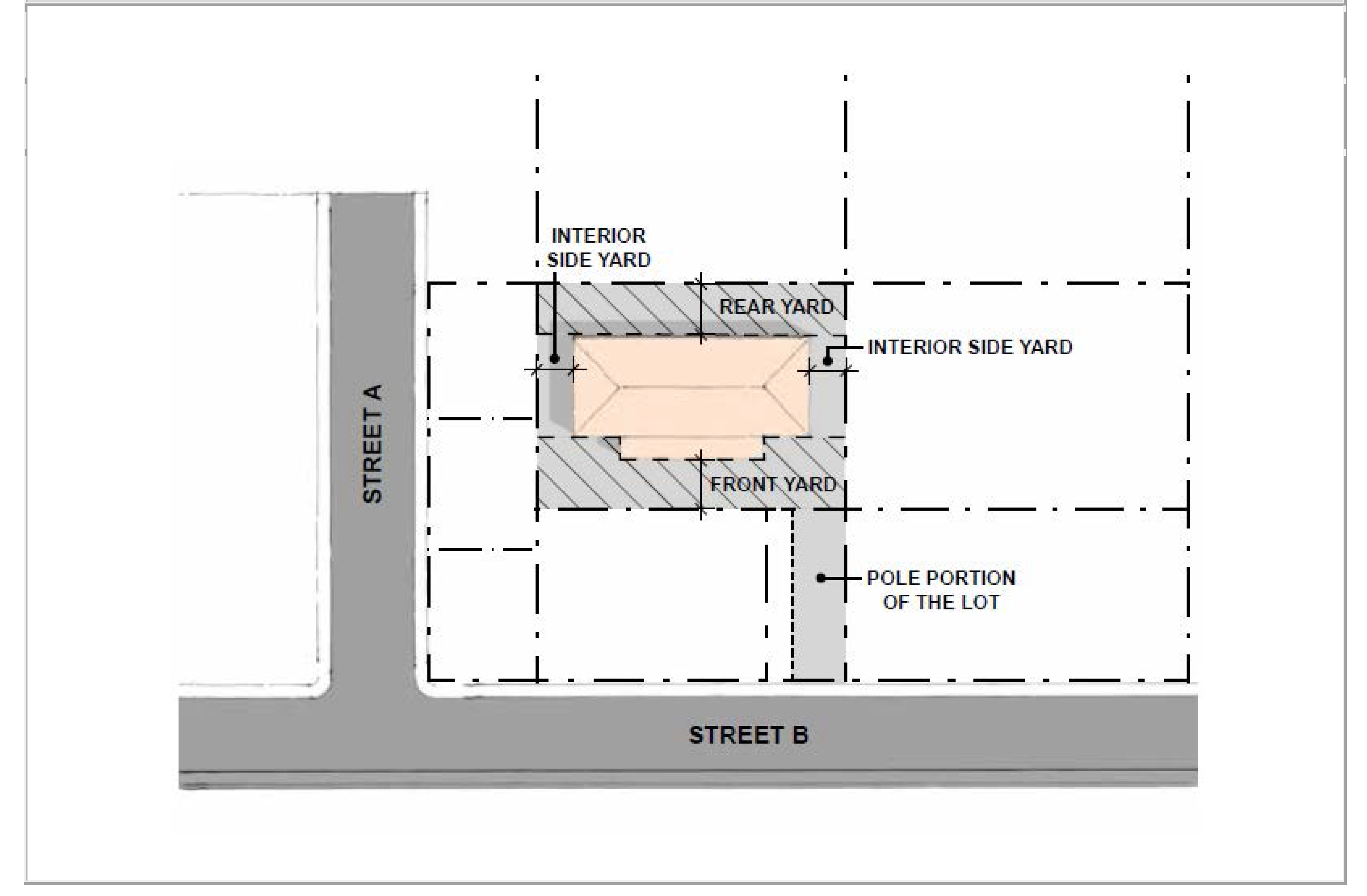
Pole Portion of Existing Flag Lots. The pole portion of the lot should function primarily as an accessway from the street to the main body of the property. The pole or post portion shall be less than forty (40) feet wide. New structures shall be limited to a garage and/or Accessory Dwelling Unit (ADU).
C.
Designation of Property Lines.
1.
Front Property Line. The front property line shall be the lot boundary that mostly nearly parallels the public or private street providing access to the lot, and which abuts the end of the pole, but does not include the pole. If the pole is not at a ninety-degree angle to the front property line, the front property line shall be calculated as if the front property line continued by drawing an imaginary line to the pole.
2.
Rear Property Line. The rear property line shall be the lot boundary opposite the front property line.
3.
Interior Side Property Line. The interior side property line shall be any lot boundary that does not abut a public or private street, and which is not a front or rear property line, exclusive of the pole portion of the lot.
D.
Lot Width and Depth. The pole portion of the lot shall not be included in determining the lot width or depth.
E.
Floor Area Ratio (FAR) and Lot Coverage. The pole portion of the lot shall not be included in determining the FAR or lot coverage.
F.
Refer to Figure 17.60-1 for information in a graphics form:
Figure 17.60-1—Flag Lot Measurements
(Ord. No. 3053, § 3(Exh. A), 5-14-2025)
17.60.030 - Height exceptions and restrictions.
A.
Ancillary Roof Mounted Items.
1.
Single-Family Zoning Districts. No roof mounted structures or equipment shall exceed the height limit provided in this title. All roof mounted equipment shall be fully screened from the public right-of-way.
2.
Multiple-Family Zoning Districts. Penthouse or roof structures for the housing of elevators and stairways may exceed the height limits provided in this title by a maximum of ten (10) feet provided: (i) it does not cover more than twenty (20) percent of the entire roofed area; and (ii) it is fully screened from the public right-of-way.
3.
Commercial and Multiuse Zoning Districts.
a.
Penthouse or roof structures for the housing of elevators, stairways, tanks, ventilation fans, or similar equipment, may exceed the height limit provided in this title by a maximum of fifteen (15) feet provided: (i) it does not cover more than twenty-five (25) percent of the entire roofed area; and (ii) it is fully screened from the public right-of-way.
b.
Architectural features such as steeples, spires, bell towers, that do not provide any floor area, may exceed the height limit provided in this title by a maximum of fifteen (15) feet through the design review process. However, it shall be purely for decorative reasons and shall not provide any additional building square footage.
4.
Manufacturing Zoning Districts.
a.
Penthouse or roof structures for the housing of elevators, stairways, tanks, ventilation fans, or similar equipment, may exceed the height limit provided in this title by a maximum of twenty (20) feet provided: (i) it does not cover more than thirty-five (35) percent of the entire roofed area; and (ii) it is fully screened from the public right-of-way.
b.
Architectural features such as steeples, spires, bell towers, that do not provide any floor area, may exceed the height limit provided in this title by a maximum of twenty (20) feet through the design review process. However, it shall be purely for decorative reasons and shall not provide any additional building square footage.
5.
All Zoning Districts. Radio and television masts, flagpoles and chimneys may extend up to ten (10) feet above the height limit provided in this title.
B.
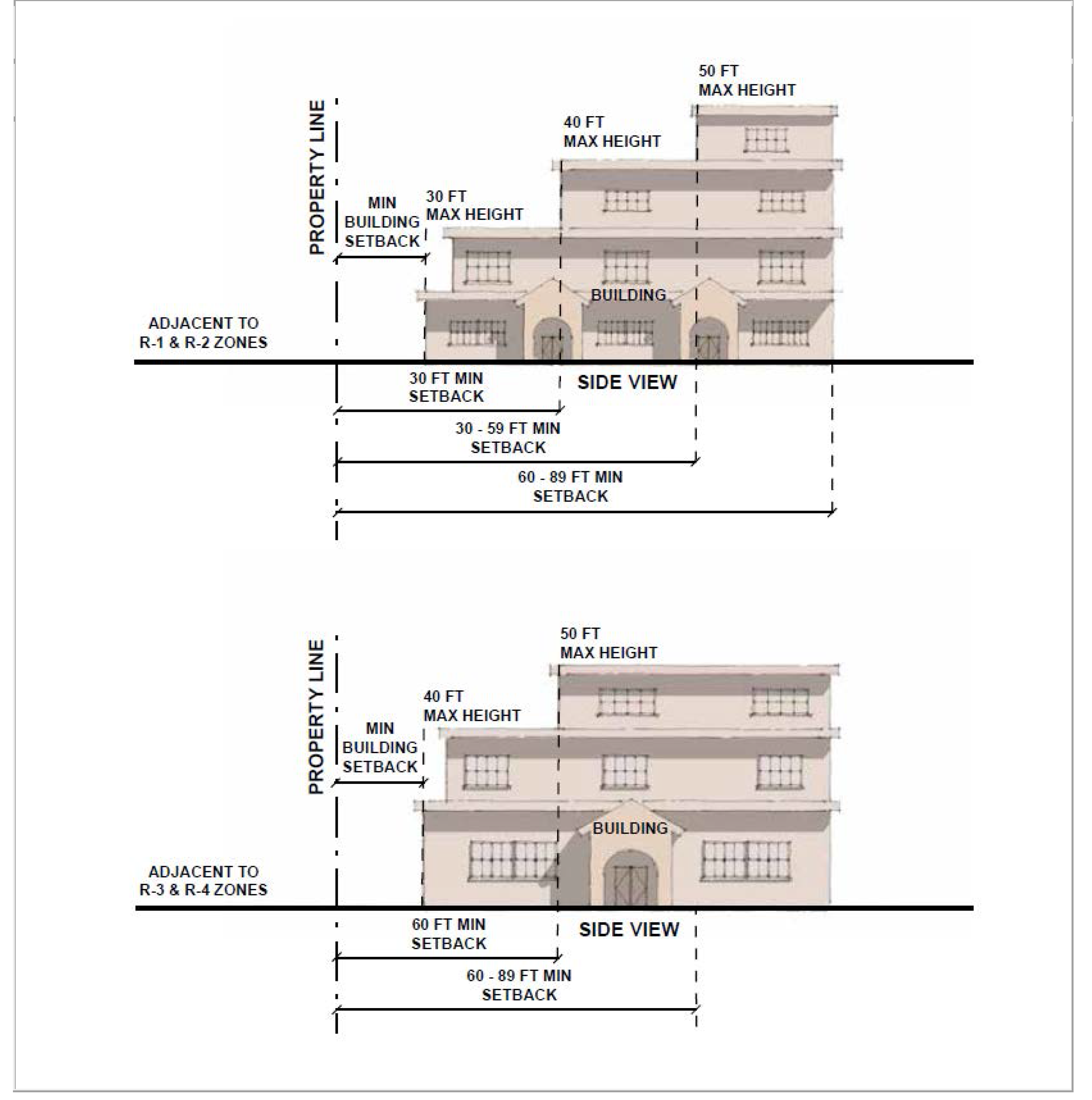
Variable Height Requirements. With the exception of what is permitted in subsection A above, Table 17.60-1 prescribed the maximum height limits when adjacent to certain zoning districts. Refer to Figure 17.60-2 for information in a graphics form.
Table 17.60-1—Variable Height
Figure 17.60-2—Variable Height
(Ord. No. 3053, § 3(Exh. A), 5-14-2025)
17.60.040 - Outdoor display and storage.
A.
Office Commercial (C-1), Mixed/Multiuse (MMU) and Urban/Multiuse (UMU) Zoning Districts. Outdoor display and/or storage shall be prohibited. Nonconforming uses in existence prior to January 1, 2022 shall follow the standards for the Neighborhood Commercial (C-2) zoning district.
B.
Neighborhood Commercial (C-2) and General Commercial (C-3) Zoning Districts:
1.
Display and/or Storage Areas.
a.
Shall be incidental to the permitted or conditionally permitted use on the property (unless the primary use is specifically related to outdoor storage or display).
b.
Shall not occupy any pedestrian walkway, vehicular driveway, parking space or loading space;
c.
Shall be located on the rear one-half of the property and shall occupy no more than twenty-five (25) percent of the entire property (unless the primary use is specifically related to outdoor storage or display) and designed to avoid noise, odor, glare, or vibration impacts to neighboring properties; and
2.
Storage Areas Only.
a.
Shall be completely enclosed by existing structures or solid masonry walls (with necessary gates constructed with approved screening material). Walls shall comply with Section 17.60.120 of this chapter; and
b.
Shall not have any equipment or materials that exceed the height of the structure or wall enclosing the storage area.
C.
Light Manufacturing (M-1) and General Manufacturing (M-2) Zoning Districts.
1.
Display and/or Storage Areas.
a.
Shall be incidental to the permitted or conditionally permitted use on the property (unless the primary use is specifically related to outdoor storage or display).
b.
Shall not occupy any pedestrian walkway, vehicular driveway, parking space or loading space;
c.
Shall be located and designed to avoid noise, odor, glare, or vibration impacts to neighboring properties; and
2.
Storage Areas Only.
a.
All storage areas shall be completely enclosed by existing structures or solid masonry walls (with necessary gates constructed with approved screening material). Walls shall comply with Section 17.60.120 of this chapter; and
b.
The storage area shall not have any equipment or materials that exceed the height of the structure or wall enclosing the storage area.
D.
Parking Requirements. Refer to Section 17.70.050 (Parking Regulations—Required On-site Parking for Nonresidential Uses) of this title.
(Ord. No. 3053, § 3(Exh. A), 5-14-2025)
17.60.050 - Outdoor lighting.
A.
Lighting Plan. The submittal of a lighting plan is required as part of an entitlement that includes new construction (except for properties developed with one single-family dwelling, including properties developed with an Accessory Dwelling Unit (ADU), Junior ADU or urban dwelling). All lighting plans shall be prepared by a qualified lighting engineer.
B.
Performance Standards.
1.
All lights shall be directed, oriented, and shielded to prevent light trespass or glare onto adjacent properties, onto the public right-of-way and/or driveway areas.
2.
Exterior lighting shall demonstrate an efficient distribution of lighting using low-glare, low-light pollution fixtures for lighting building exteriors and surrounding areas.
3.
Motion detector lighting fixtures are allowed; provided, that:
a.
There is no light trespass or spillover onto adjacent properties;
b.
The fixtures are mounted within five (5) feet of an entrance or exit door, garage door, or alcove of a structure;
c.
Installed no more than eight (8) feet above the ground; and
d.
Illuminated with a maximum of two (2) light bulbs of no more than seventy-five (75) watts each.
4.
Exterior lighting shall be turned off during daylight hours. As used herein, "daylight hours" means the hours between sunrise (dawn) and sunset (dusk).
5.
No permanently installed lighting shall blink, flash or be of unusually high intensity or brightness.
6.
Outdoor lighting shall not be directed skyward with exception to typical landscape lighting meant to accent architectural features of structures, trees and shrubs.
C.
Lighting in Residential Zoning Districts.
1.
Multiple-family Projects. Lighting for safety and/or security purposes shall be provided at entryways, along walkways, between buildings and within parking areas subject to the provisions of this chapter.
2.
Single-family and Multiple-family Projects. All outdoor lighting shall comply with the following additional requirements:
a.
Candlepower. Shall not exceed 0.3 footcandles at property lines.
b.
Height of Fixtures. Shall not exceed a maximum height of twenty (20) feet. If attached to a single-family residence, the lighting shall not exceed the height of the roof eave.
c.
Lighting Design. Lighting poles and fixtures shall complement the overall site architecture and design in terms of scale, color, and style.
D.
Lighting in Nonresidential Zoning Districts.
1.
Lighting for safety and/or security purposes shall be provided at entryways, along walkways, between buildings and within parking areas subject to the provisions of this chapter.
2.
Neon lighting for nonresidential uses are permitted under the following circumstances:
a.
As part of a sign, pursuant to Chapter 17.80 (Signage Regulations) of this title.
b.
As part of the architectural theme of a building, subject to design review approval.
3.
All outdoor lighting shall comply with the following additional requirements:
a.
Minimum Candlepower.
i.
Residential Uses. Lighting for safety and/or security purposes shall be provided within parking areas subject to the provisions of this chapter.
ii.
Nonresidential Uses. Lighting for parking lots shall be one foot candlepower across eighty-five (85) percent or more of the surface of the parking area.
b.
Maximum Candlepower. Lighting shall not exceed one foot candlepower on any adjacent residentially zoned property.
c.
Height of Fixtures/Poles. Lights mounted on poles or structures intended primarily for mounting lights shall not exceed a maximum height of thirty (30) feet in manufacturing zoning districts and twenty-five (25) feet in all other nonresidential zoning districts, except that lighting attached to a single-story building shall not exceed the height of the roof eave.
d.
Lighting Design. Parking lot lighting poles and fixtures shall complement the overall site architecture and design in terms of scale, color and style. Exterior building lights shall complement the overall building appearance.
E.
Lighting for Special Uses.
1.
Safety and/or Security Purposes. Lighting shall be provided at entryways, along walkways, between buildings and within parking areas subject to the provisions of this chapter.
2.
Vehicles Sales. Areas for the display of vehicles shall be allowed to use lighting that provides for accurate color rendition of the vehicles.
3.
Drive-thru Facilities. Drive-thru lanes shall provide adequate screening to ensure that vehicle headlights do not cause nuisance glare or disabling glare to drivers or pedestrians or otherwise result in light trespass.
4.
Outdoor Recreation Facilities and Outdoor Commercial Amusement Facilities. Lighting shall be adequately shielded to direct light rays onto the activity area of the facility only. There shall be no illumination of outdoor recreational facilities unless the facilities are being utilized.
5.
Service Stations. All light sources, including canopy, perimeter and flood, shall be stationary and shielded or recessed within the roof canopy so that the service station shall be indirectly visible and light is deflected away from adjacent properties and the public right-of-way. Lighting shall not be of such a high intensity as to cause nuisance glare or disabling glare to drivers or pedestrians, or result in light trespass to nearby properties. No luminaire shall be higher than fifteen (15) feet above finished grade.
6.
Vacant and Abandoned Properties. Exterior light fixtures shall be maintained in good working order, free of broken lamps, lenses and light bulbs.
F.
Refer to Section 17.50.130 (Performance Standards—Reflective Surfaces) of this title for additional requirements.
(Ord. No. 3053, § 3(Exh. A), 5-14-2025)
17.60.060 - Physical cart containment measures.
A.
Applicability. Any business establishment that uses carts in its operations, or that provides, or otherwise makes available shopping carts for use by its customers, shall be required to employ and/or install physical containment devices and/or equipment designed to prevent the unauthorized removal of such carts from the premises where they are located. Refer to Chapter 5.25 (Use of Shopping and Laundry Carts) of Title 5 (Business License and Regulations) for additional requirements.
B.
Containment Options. Each business establishment shall be required to employ and/or install one or more of the following physical containment measures:
1.
Equipping all carts with a wheel locking or stopping mechanism used in conjunction with an electronic or magnetic barrier running along or within the perimeter of the premises. Such wheel locking or stopping mechanism must activate when the shopping cart crosses the electronic or magnetic barrier;
2.
Equipping all carts with devices and/or equipment which physically prevents the carts from being removed from the interior of any building or structure in which they are used;
3.
Installing physical barriers within all buildings or structures which physically prevent carts from being removed from the interior of any building or structure in which they are used; and/or
4.
Installing a physical barrier system designed to reliably prevent the removal of carts from the territorial boundaries of the premises, provided, however, that such barrier system shall be designed to be architecturally and aesthetically consistent and compatible with other on-premises improvements.
C.
Routine Cart Collection.
1.
All carts located on the premises of the business establishment (other than an establishment open for business twenty-four (24) hours per day) shall be collected at the end of each business day by employees of the business establishment and shall be collectively confined in a secure manner at a designated cart confinement area until the commencement of the next business day.
2.
All carts located on the premises of any business establishment open for business twenty-four (24) hours per day, other than carts then currently in use by a customer, shall be collected by employees of the business establishment and returned to the designated cart confinement area on the premises at least twice per calendar day between the hours of 1:00 p.m. and 5:00 p.m. and the hours of 8:00 p.m. and 1:00 a.m. for each day the business establishment is open for business. The provisions of this element shall not apply to carts which are physically confined within an enclosed building.
D.
Cart Corrals and Storage Areas. All business establishments providing shopping carts for its customers that can be transported outside the business establishment's building shall provide/construct cart corrals and/or cart storage areas on the premises in which the business establishment is located as follows:
1.
For business establishments providing thirty (30) or fewer shopping carts for use by its customers. The owner shall provide a minimum of two (2) portable cart corral(s) within the parking area. Said corrals shall be secured to the pavement for stability and to avoid obstruction of parking stalls.
2.
For business establishments providing more than thirty (30) shopping carts for use by its customers. The owner shall construct permanent cart corrals and/or storage areas within the parking area and adjacent to the building utilizing materials complementary to the main building. Parking area cart corrals shall be enclosed on each side by a decorative masonry base between twelve (12) and eighteen (18) inches in height, topped with a decorative iron or tubular steel fence providing an overall corral height (masonry plus fencing) of forty-two (42) inches. An alternative design may be considered through the design review or minor design review process.
3.
For business establishments proposing an expansion. For business establishment providing shopping carts that undergo an expansion resulting in an increase in gross floor area of 35 percent or more shall be required to provide/construct cart corrals and/or cart storage areas on the premises in which the business establishment is located in a number and design consistent with the guidelines set forth in this section.
(Ord. No. 3053, § 3(Exh. A), 5-14-2025)
17.60.070 - Private streets and shared driveways.
A.
Private Streets.
1.
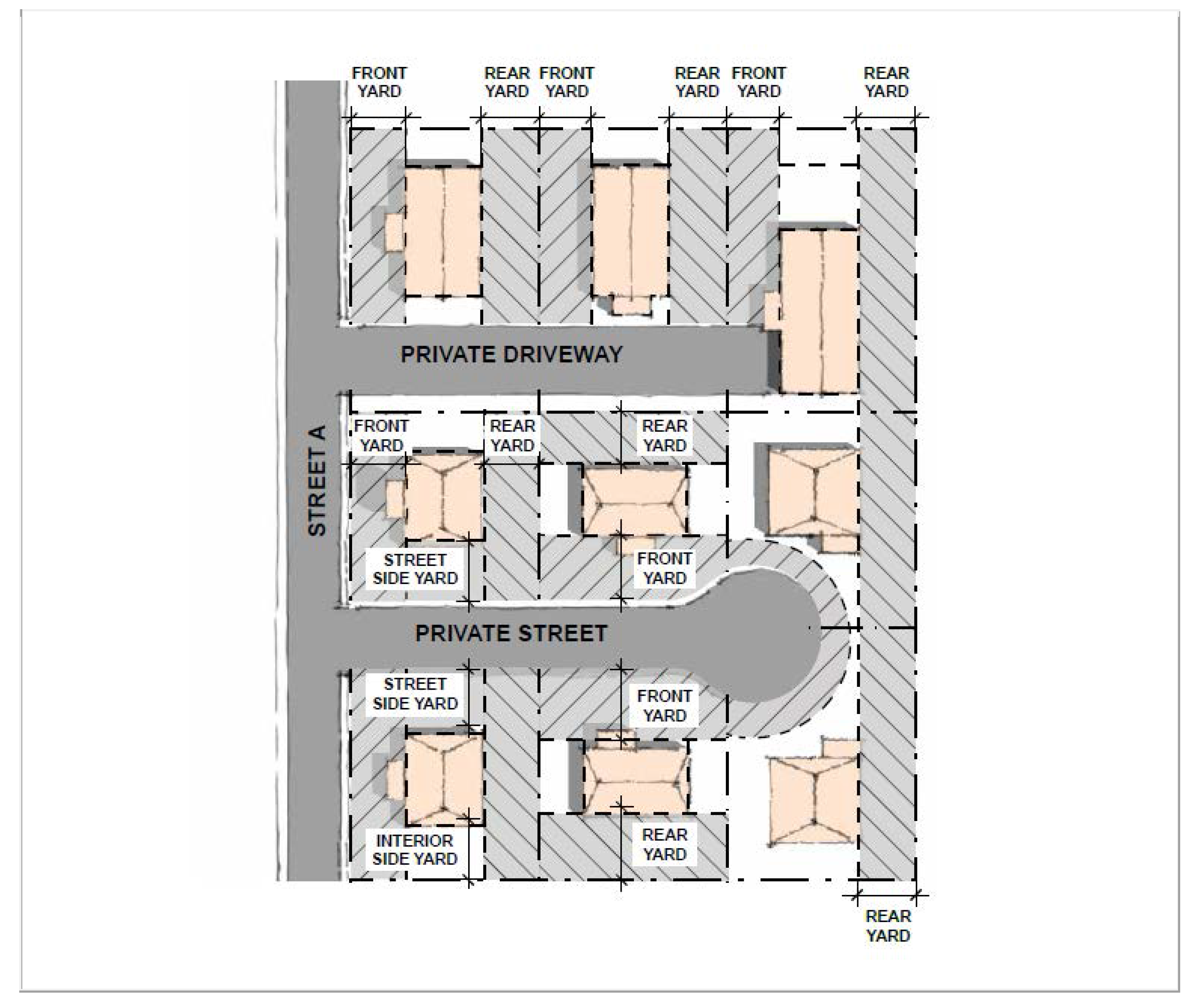
Minimum Setbacks for the Front Dwelling.
a.
Front Lot Line. The front lot line shall be the lot boundary that abuts the public street.
b.
Rear Lot Line. The rear lot line shall be the lot boundary opposite the front lot line.
c.
Side Lot Lines. The side lot line that abuts the private street shall be defined as the street side lot line. The line opposite the street side property line shall be the interior side lot line.
d.
For parcels that have identical or near identical public and private street frontages, or where both frontages are private streets, the Community Development Director may determine which is the front. The lot frontage shall mean the horizontal distance between the side lot lines measured along the front lot line.
2.
Designation of Property Lines for the Interior Dwellings.
a.
Front Lot Line. The front lot line shall be the lot boundary that directly abuts the private street line.
b.
Rear Lot Line. The rear lot line shall be the lot boundary opposite the front lot line.
c.
Interior Side Lot Lines. Lot lines that are not the front or rear lot lines.
B.
Shared Driveways with Access Easements. New private driveways using access easements to serve a landlocked parcel with an ownership unit shall be prohibited, except as outlined in Chapter 16.25 (Urban Lot Splits) of Title 16 (Subdivision Ordinance).
C.
Shared Driveways under Common Ownership and Nonconforming Driveways with Access Easements.
1.
Minimum Setbacks for the Front Dwelling.
a.
Front Property Line. The front property line shall be the lot boundary that abuts the public or private street.
b.
Rear Property Line. The rear property line shall be the lot boundary opposite the front property line.
c.
Side Property Lines. The side property line that abuts the shared driveway shall be defined as the street side property line. The line opposite the street side property line shall be defined as an interior side property line.
2.
Designation of Property Lines for the Interior Dwellings.
a.
Front Property Line. The front property line shall be the lot boundary that mostly nearly parallels the front property line of the front dwelling.
b.
Rear Property Line. The rear property line shall be the lot boundary opposite the front property line.
c.
Side Property Lines. The side property line that abuts the shared driveway shall be defined as the street side property line. The line opposite the street side property line shall be defined as an interior side property line.
3.
These standards shall not apply to multiple-family projects with three (3) or more dwellings.
D.
Floor Area Ratio (FAR), Lot Coverage and Density. The square footage for the shared driveway may count towards calculating the maximum FAR, lot coverage and density. However, a private street shall not count towards calculating the maximum FAR, lot coverage and density.
E.
Director's Determination. For existing projects constructed prior to January 1, 2022, the Community Development Director may revise how the property lines are designated, provided all interior lot lines are consistently defined, and the designation does not increase the original project's nonconformity. Such an action shall be documented as a Director's Determination and shall apply to all properties that abut the shared driveway or street.
F.
Refer to Figure 17.60-3 for information in a graphics form.
Figure 17.60-3—Private Streets and Shared Driveways
(Ord. No. 3053, § 3(Exh. A), 5-14-2025)
17.60.080 - Refuse and recycling storage facilities.
A.
Residential Projects.
1.
Projects with Less than Five (5) Dwelling Units. Individual receptacles shall not be located within the front yard or street side yard. In addition, the receptacles shall be fully screened from the public right-of-way. For projects with two (2) to four (4) dwellings, the applicant shall submit a refuse plan for review and approval by the city's Solid Waste Service Provider. The plan shall be approved prior to the approval of any entitlement or the issuance of any building permit, whichever occurs first.
2.
Projects with Five (5) or More Rental Units. Common receptacles shall be provided in sufficient quantity to accommodate all refuse and recycling generated. The applicant shall submit a refuse plan for review and approval by the city's Solid Waste Service Provider. The plan shall be approved prior to the approval of any entitlements.
3.
Projects with Five (5) or More Ownership Units. In lieu of subsection A.2. above, individual receptacles for each unit may be requested. A refuse plan shall be submitted showing where the receptacles will be stored for each unit and where the receptacles will be located for pick-up. If the receptacles will remain on-site, the plan shall also show the truck route on how the refuse will be picked-up. The receptacles shall not block access to any required parking. The applicant shall submit a refuse plan for review and approval by the city's Solid Waste Service Provider. The plan shall be approved prior to the approval of any entitlement.
4.
Individual Receptacles within Garages. The area reserved for the receptacles shall not infringe upon the minimum dimensions required for the enclosed parking spaces.
B.
Nonresidential Projects and the Commercial Portion of Multiuse Projects.
1.
New Projects. Common receptacles shall be provided in sufficient quantity to accommodate all refuse and recycling generated. The applicant shall submit a refuse plan for review and approval by the city's Solid Waste Service Provider. The plan shall be approved prior to the approval of any entitlements.
2.
For Establishments Proposing an Expansion. For establishment providing shopping carts that undergo an expansion resulting in an increase in gross floor area of thirty-five (35) percent or more shall be required to comply subsection B.1. above and subsection C. below. This requirement may also be conditioned through the entitlement process, even if no additional square footage is proposed.
C.
Refuse Enclosures Design Requirements.
1.
Common receptacles shall not be located within the front yard or street side yard. In addition, it should be located away from adjacent properties zoned residential.
2.
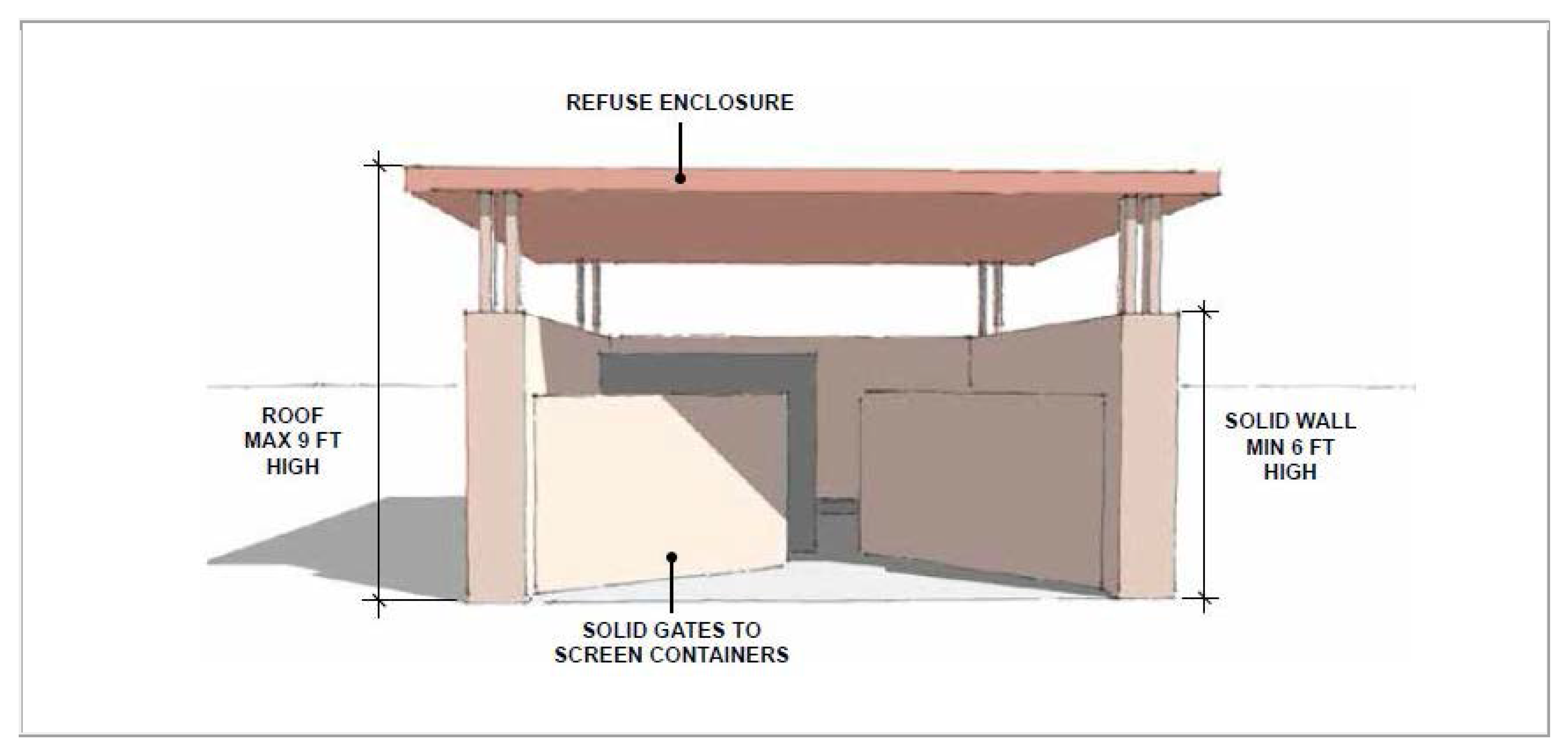
Common receptacles shall be on a paved surface and enclosed on at least three (3) vertical sides by a solid six-feet high wall and on the fourth side by a solid gate to screen the containers from view. The gate shall be hung on separate posts of two and one-half (2½) inch standard weight galvanized pipe. A roof shall also be provided for the enclosure.
3.
A five-inch by eight-inch raised curb shall be constructed along the inside base of the enclosure walls.
4.
The finish and color of the enclosure, gate and roof shall be decorative and shall incorporate primary elements from the site building style. Chain link fencing shall not be permitted; and
5.
Landscaping on and around the refuse enclosure is highly encouraged. This may include vines on the walls or trellis.
6.
Common receptacles incorporated within the design of a building or parking structure. Such receptacles do not need to meet the design requirements outlined above. However, the receptacles shall be screened from view on all sides.
D.
Refer to Figure 17.60-4 for information in a graphics form:
Figure 17.60-4—Refuse Storage Facilities
(Ord. No. 3053, § 3(Exh. A), 5-14-2025)
17.60.090 - Satellite dish antennas.
Every satellite dish antenna as defined in Chapter 17.152 (General Definitions) of this title shall comply with the following requirements:
A.
Residential Uses.
1.
Satellite dish antennas may be attached to the roof or wall of a building, provided it does not exceed a diameter greater than two (2) feet.
2.
Satellite dish antennas may be ground mounted, provided they are not located within the front or street side yard setbacks.
3.
Pole mounted antennas shall not be permitted. In addition, guy wires shall not be anchored within the front or street side yard setbacks.
4.
Dish antennas shall be fully screened from the public right-of-way with dense landscaping or other materials.
B.
Nonresidential Uses.
1.
Satellite dish antennas with bases attached on or to a building shall be located within the middle one-third (⅓) of the roof of the building and shall be fully screened from the public right-of-way.
2.
Satellite dish antennas may be ground mounted, provided they are not located within the front or street side yard setbacks.
3.
Satellite dish antennas that are pole-mounted shall not exceed a height of sixteen (16) feet.
4.
Dish antennas that are ground mounted shall be fully screened from the public right-of-way with dense landscaping or other materials.
(Ord. No. 3053, § 3(Exh. A), 5-14-2025)
17.60.100 - Screening.
A.
Roof Mounted Equipment. Roof-mounted equipment shall be fully screened from the public right-of-way in one of the following ways:
1.
By the building parapet. The equipment shall not extend above the lowest parapet line.
2.
By an architectural screening element similar in design and color of the underlying building. Wood lattice shall not be used as a screening device. The area of the screening element shall also comply with Section 17.60.030 of this chapter.
3.
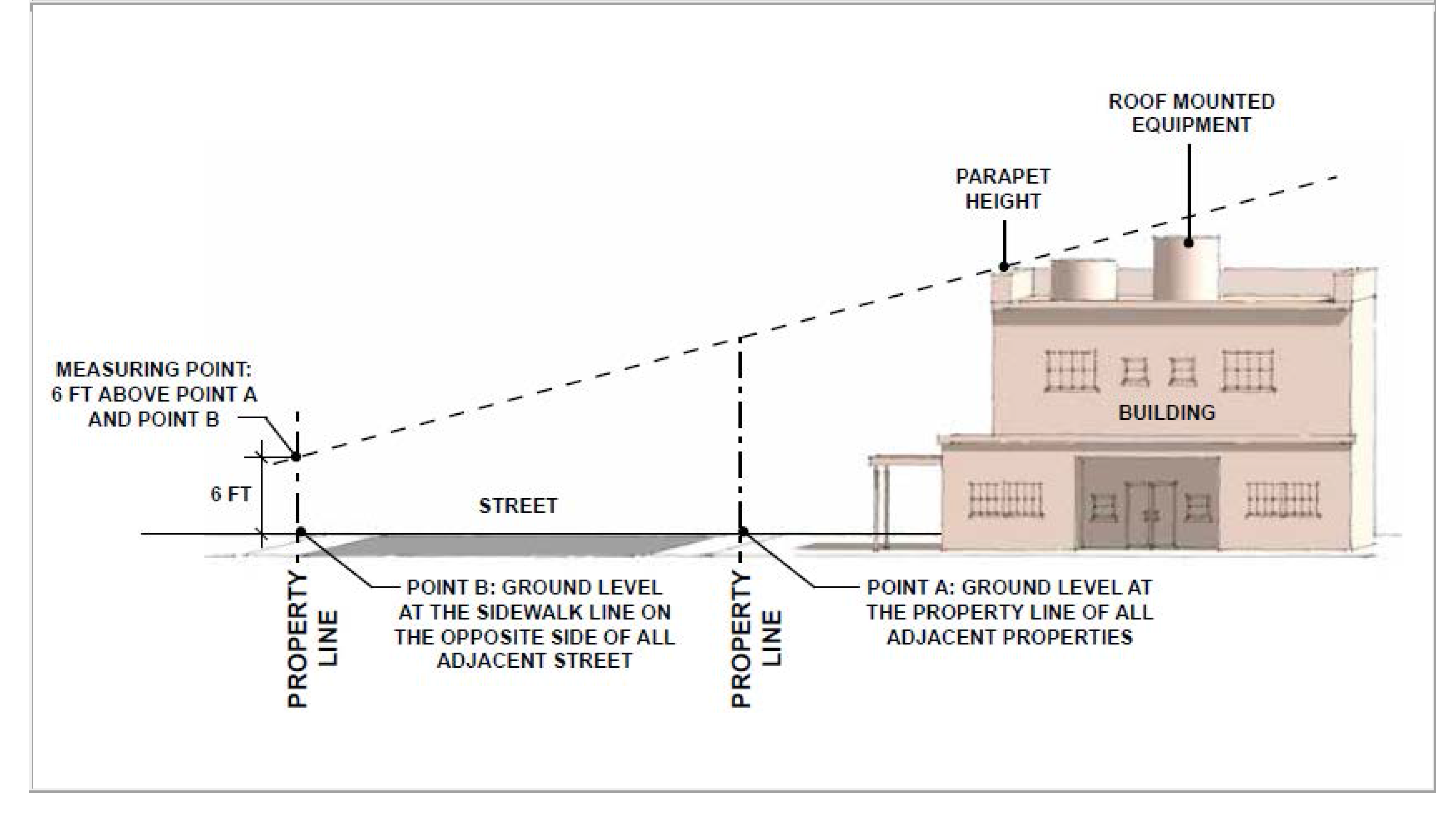
As demonstrated through line-of-sight diagrams. The measuring point shall be six (6) feet above the ground level at the property line of all adjacent properties and at the sidewalk line on the opposite side of all adjacent street.
B.
Ground Mounted Equipment. Unless otherwise noted, all ground mounted equipment shall be fully screened from the public right-of-way with a decorative fence, wall and/or landscaping, while still complying with the maximum fence or wall height in the underlying zoning district. The equipment shall not be located within the front or street side yard setbacks. This subsection shall not apply to electrical vehicle charging equipment.
C.
Refer to Figure 17.60-5 for information in a graphics form:
Figure 17.60-5—Screening of Equipment
(Ord. No. 3053, § 3(Exh. A), 5-14-2025)
17.60.110 - Security bars and gates.
A.
Residential Buildings. Security bars, gates and similar security devices shall not be located on the elevations facing the front or street side yard setbacks. When located along other elevations, they shall not be visible from the public right-of-way.
B.
Nonresidential and Mixed-use Buildings.
1.
Buildings constructed prior to January 1, 2022. Security bars, gates, and similar security devices should be in the interior of buildings whenever possible. If gates must be located on the exterior of a building, it shall be retractable during business hours and decorative in style.
2.
Buildings constructed after January 1, 2022. Security bars, gates, and similar security devices on the exterior of buildings shall be prohibited.
(Ord. No. 3053, § 3(Exh. A), 5-14-2025)
17.60.120 - Walls, fences and hedges.
A.
Residential Uses.
1.
Residential Zoning Districts.
a.
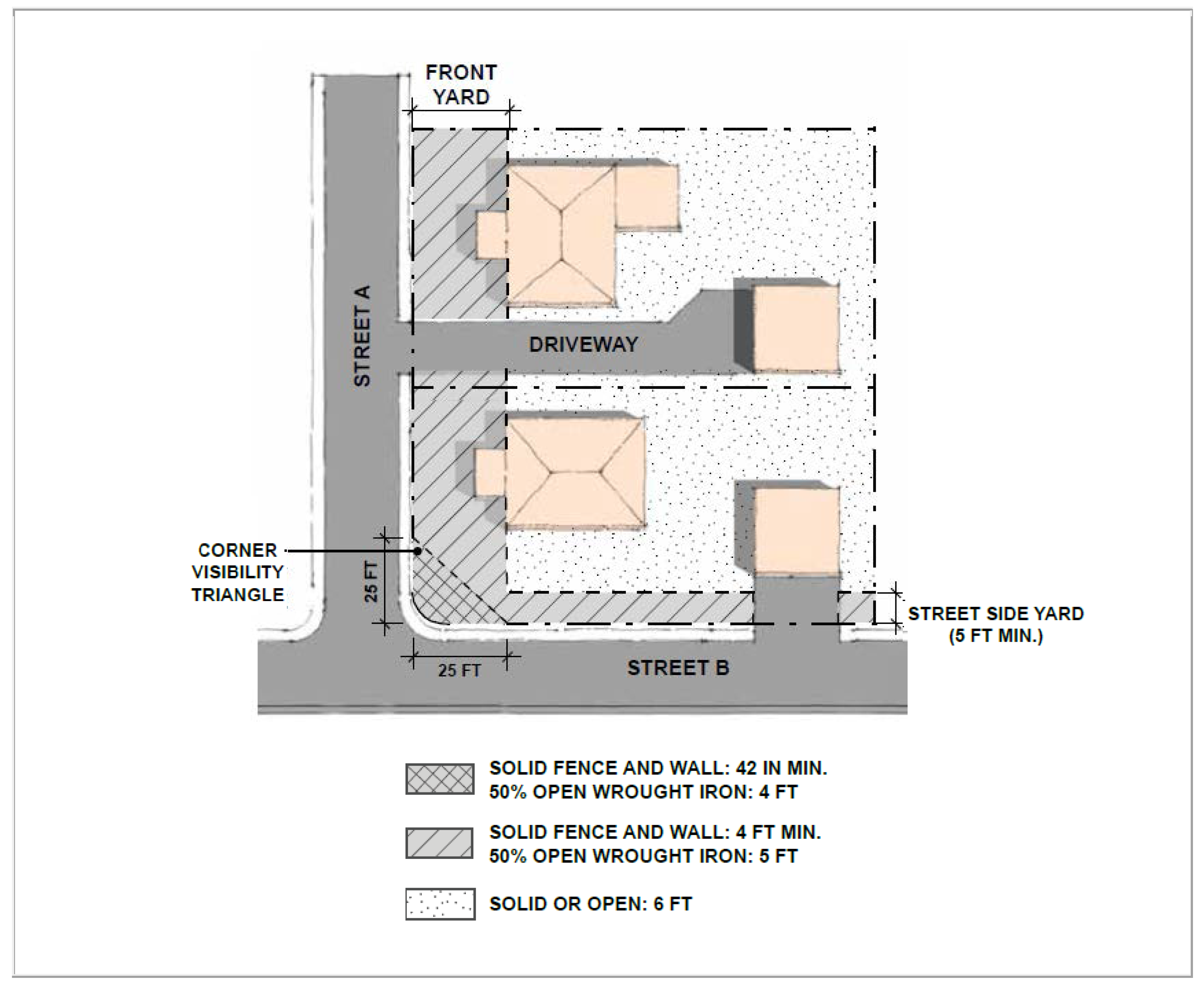
Front and Street Side Yards. Solid fences, walls and hedges located in the front yard or less than five (5) feet of a street side yard shall not exceed a height of four (4) feet. However, a maximum five (5) foot high fence may be constructed, provided it is a minimum fifty (50) percent open and made of decorative wrought iron with decorative block pilasters.
b.
Corner Yards. Solid fences, walls and hedges located in the corner visibility triangle area or a corner lot shall not exceed a height of forty-two (42) inches. However, a maximum four (4) foot high fence may be constructed, provided it is a minimum fifty (50) percent open and made of decorative wrought iron with decorative block pilasters. The corner visibility triangle area is the point measured along the property frontage at the curb line (or edge of pavement lines) for a length of twenty (20) feet along both lines from the intersection.
c.
All Other Areas on a Lot. Fences and walls shall not exceed a height of six (6) feet.
d.
Residential Developments with Three (3) or More Dwellings. A six (6) foot high masonry wall shall be installed and maintained adjacent to the rear and interior side property lines.
e.
Refer to Figure 17.60-6 for information in a graphics form.
2.
Nonresidential Zoning Districts.
a.
Street Setbacks.
i.
Area between the property line and minimum street setback. Fences and walls shall not be permitted.
ii.
Area between the minimum street setback and closest structure. Fences and walls shall not exceed a height of four (4) feet.
Figure 17.60-6—Walls and Fence Heights
b.
Rear and interior side property lines. A minimum six (6) foot high and maximum eight (8) foot high masonry wall shall be installed and maintained.
c.
All other areas of a lot. Fences and walls shall not exceed a height of six (6) feet.
B.
Nonresidential Uses.
1.
Residential Zoning Districts:
a.
Front and street side yards. Comply with subsection A.1.(a) above.
b.
Rear and interior side property lines when abutting a residential zoning district or residential use. A minimum six (6) foot high and maximum eight (8) foot high masonry wall shall be installed and maintained.
c.
All other areas of a lot. Fences and walls shall not exceed a height of eight (8) feet.
2.
Nonresidential Zoning Districts:
a.
Street Yards. Fences and walls shall not exceed a height of five (5) feet. Fences and/or walls located along the front or street side property line shall be located behind the required landscaping.
b.
Rear and interior side property lines when abutting a residential zoning district or residential use. A minimum six (6) foot high and maximum eight (8) foot high masonry wall shall be installed and maintained.
c.
Industrial Uses. Through the Design Review process, decorative masonry walls up to fourteen (14) feet high may be placed to fully screen loading or outdoor storge areas, provided the wall is set back a minimum of thirty-five (35) feet from any street property line.
d.
All Other Areas of a Lot. Fences and walls shall not exceed a height of eight (8) feet.
D.
Materials. Barbed, pointed, spiked, razor, piercing or other similar materials shall not be attached to any wall or fence. For residential uses, chain link shall not be permitted. For nonresidential uses, chain link shall not be visible from the public right-of-way. However, chain link may be used during construction to secure a site as permitted in Section 17.50.070 (Performance Standards—Construction Impacts) of this title.
E.
Grade Separating Walls.
1.
Grade separation fences and walls shall still comply with subsections A. through D. above. In the event of any conflict between the requirements of subsection E. and the rest of this section, subsection E. shall control.
2.
When the grade of a property being developed is below the grade of the adjacent property. The top of the wall shall not exceed a height of six (6) feet above the existing grade of an adjacent property.
3.
When the grade of the property being developed is above the grade of the adjacent property.
a.
When adjacent to a residential zoning district or residential use. The top of the wall shall not exceed a height of eight (8) feet above the grade of the adjacent property.
b.
In all other instances. The top of the wall shall not exceed a height of ten (10) feet above the grade of the adjacent property.
4.
If more than one grade separating wall is proposed, no individual wall shall exceed a height of six (6) feet. In addition, each wall shall be separated by a minimum landscaped area of five (5) feet.
(Ord. No. 3053, § 3(Exh. A), 5-14-2025)
17.60.130 - Yard encroachments.
When yards are required in this title, they shall be not less in depth or width than the minimum dimension specified, and they shall be at every point open and unobstructed from the ground upward, except as permitted by this section.
A.
Architectural Features. Cornices, chimney, canopies, bay windows, eaves, or other similar architectural features not providing additional floor space within the building may extend up to two (2) feet into a required front, street side, interior side or rear yard.
B.
Mechanical Equipment. Mechanical equipment may be located in the interior side or rear yard setbacks, provided a minimum setback of three (3) feet to the property line is maintained. Mechanical equipment in the front or street side yard shall comply with the setbacks for structures in the respective zoning district. All ground mounted equipment shall be fully screened from the public right-of-way.
C.
Porches. For residential uses, porches may project into a required front yard of up to two (2) feet, provided the width does not exceed forty (40) percent of the width of the dwelling or twenty (20) feet, whichever is less.
D.
Front Yards and Cul-de-sacs. For residential uses, the front yard setback may be reduced five (5) feet for properties that are at the sac portion of a cul-de-sac.
(Ord. No. 3053, § 3(Exh. A), 5-14-2025)

