
Englewood City Zoning Code
CHAPTER 8
LANDSCAPE DESIGN
16-8-1: - Intent.
The intent of the Landscape Design standards is to:
A.
Improve the image of the City and build value with a well-designed public realm.
B.
Emphasize distinct areas throughout the City with the location and design of landscape areas.
C.
Coordinate landscape and design amenities across multiple sites and leverage the impact of consistent relationships of public and private frontages.
D.
Strengthen the character, quality, and value of development with landscape design that serves multiple aesthetic, environmental, and social functions.
E.
Enhance the ecological function of unbuilt portions of sites and protect and integrate established natural amenities into development projects.
F.
Screen and mitigate the visual, noise, or other impacts of sites and buildings.
G.
Conserve water and shift to water-conscious landscape design that is regionally appropriate and specific to the arid Front Range climate.
16-8-2: - Applicability.
The standards of this Chapter shall apply to the following:
A.
A building permit for a new principal structure.
B.
A building permit for an existing principal structures that results in an increase of the gross floor area by more than 15% and more than 500 square feet.
C.
A Site Improvement Plan that increases the impervious area by more than 20%.
D.
Any addition of parking to nonresidential uses or residential uses with ten or more dwelling units.
E.
A building permit for the renovation, remodeling or expansion of an existing residential structure that includes a change to a non-residential use.
In cases where the landscape standards apply, the intent is to bring the site into full compliance with these standards. However, for infill and rehabilitation of existing sites the Director may prorate the requirements to the extent of the site work where full compliance is not possible or practical, and only apply the standards to portions of the site subject to development.
16-8-3: - Landscape Requirements.
A.
Design Objectives. Landscape plans shall meet the following design objectives:
1.
Frame streets and emphasize important gateways with street trees, landscape massing, and other vertical elements.
2.
Provide comfort, spatial definition, and visual interest to active outdoor spaces including walkways, civic spaces, parks, trails, or other similar outdoor gathering places.
3.
Improve resource and energy efficiency with landscape arrangements that consider wind blocks, heat gain, water usage, solar access, and other elements inherent to the site.
4.
Increase the tree canopy, particularly to reduce heat gain from paved surfaces and buildings and to shade active spaces of streetscapes and sites.
5.
Improve water quality, prevent erosion, and reduce runoff with natural landscape elements that intercept, infiltrate, store, or convey precipitation and runoff.
6.
Locate plants, landscape features, and site design elements sensitive to seasonal solar and shading conditions, particularly maximizing summer shade and winter sun on active portions of sites.
7.
Encourage the protection and preservation of healthy plants and landscape features that can meet current and future needs of the site through development, rather than plant and design new ones.
B.
Planting Requirements. The required landscape shall be based on different elements of the site according to Table 8-1, Plant Requirements.
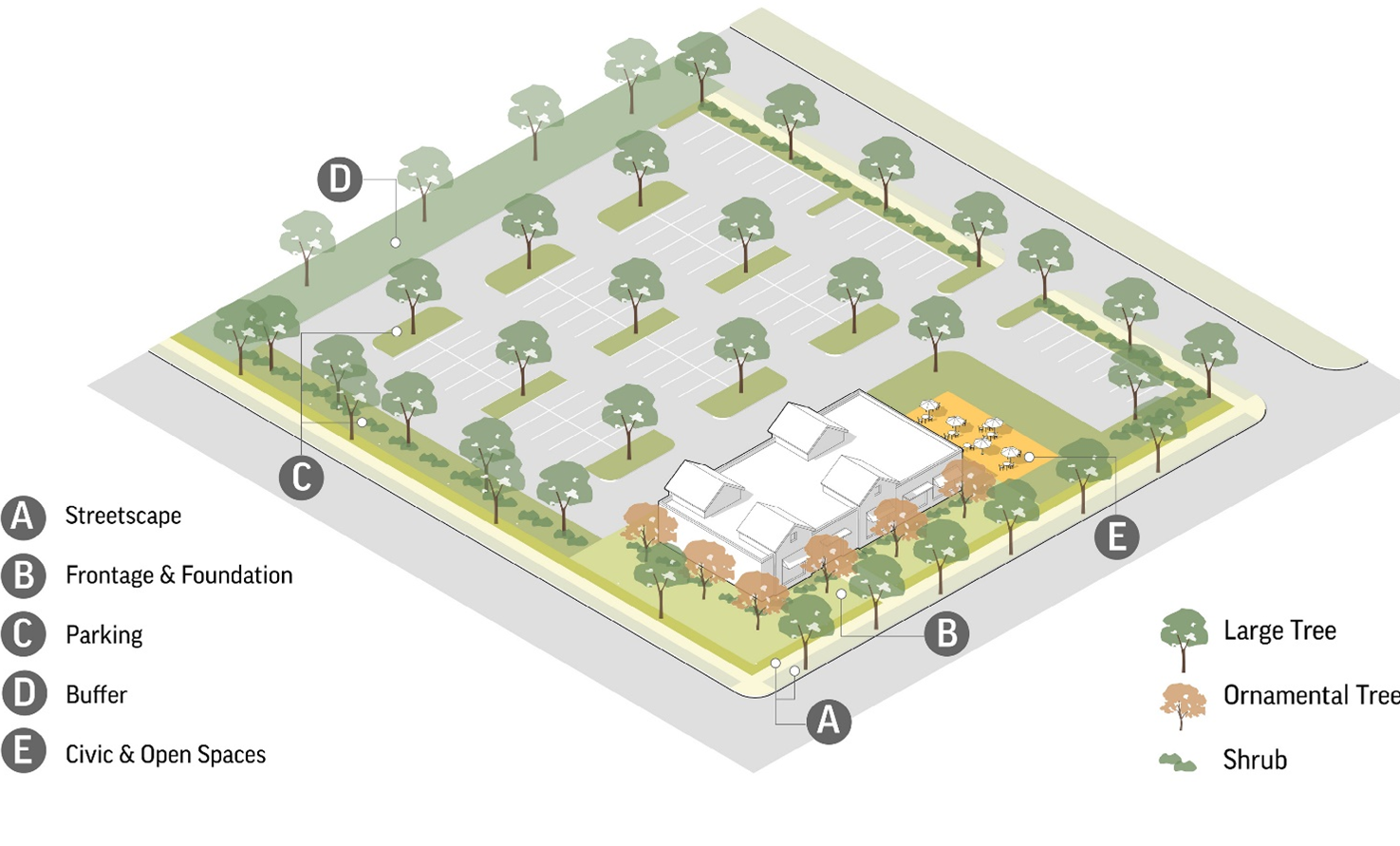
Figure 8-1. Landscape standards and plans are broken out by different components of the site—streetscape (A), foundation and frontage (B), parking (C), buffers (D), and civic and open spaces (E).
C.
Credits for Existing Vegetation. Preservation of existing landscape material that is healthy and desirable species may count for landscape requirements provided measures are taken to ensure the survival through construction and all other location and design standards are met.
1.
Landscape plans shall provide an inventory of all existing trees or significant woody vegetation including size, health, species, and any proposed for removal.
2.
Existing landscape credits shall only count toward the portion of the site where it is located, according to the site elements in Table 8-1. For example, an existing tree may only count toward the required planting for parking lot perimeters if it remains in the parking perimeter in the final design.
3.
Credits shall be as follows, provided they meet the minimum specifications for new plants:
4.
Trees or other existing landscape that contributes to the standard shall be identified on a landscape plan and the critical root zone shall be protected for the entirety of construction by a construction fence. Tree protection measures shall be based on applicable industry standards and best practices to ensure survival of the landscape.
D.
Design and Location. The landscape required by Table 8-1 shall be arranged and designed in a way that best achieves the intent of this Chapter and design objectives of this Section, considering the context and adjacencies proposed on the site. Required plantings shall be planted in the following specific locations on the lot.
1.
Streetscape Trees. Streetscape and frontage trees shall be located in line with other trees on the block to create a rhythm along the streetscape and promote enclosure of the tree canopy. In the absence of a clearly established line along the block, trees may be planted in the following locations in order of priority.
a.
Centered between the sidewalk and curb where the landscape areas is at least six feet wide.
b.
In tree wells that are at least four feet in all directions and at least 24 square feet, and located within the sidewalk (applicable on wider attached sidewalks or pedestrian-oriented commercial or mixed-use streets).
c.
Five to ten feet from the back of curb where no sidewalk exists or from the sidewalk in other situations where the sidewalk is attached.
d.
Within the first five feet of the front lot line where any constraints on the lot or in the right-of-way would prevent other preferred locations.
e.
Ornamental trees may be substituted for large street trees only in situations where no other alternative is available due to constraints of the site or right-of-way conditions. Ornamental trees should be used where trees are to be located within ten feet of any overhead wires. No evergreens shall be planted in the right of way.
f.
Shrubs or perennials planted in the streetscape (parkway, tree strip, or medians) shall not exceed 36 inches high, or 30 inches high in any area impacted by the sight distance limits of EMC § 16-3-4.D.2.
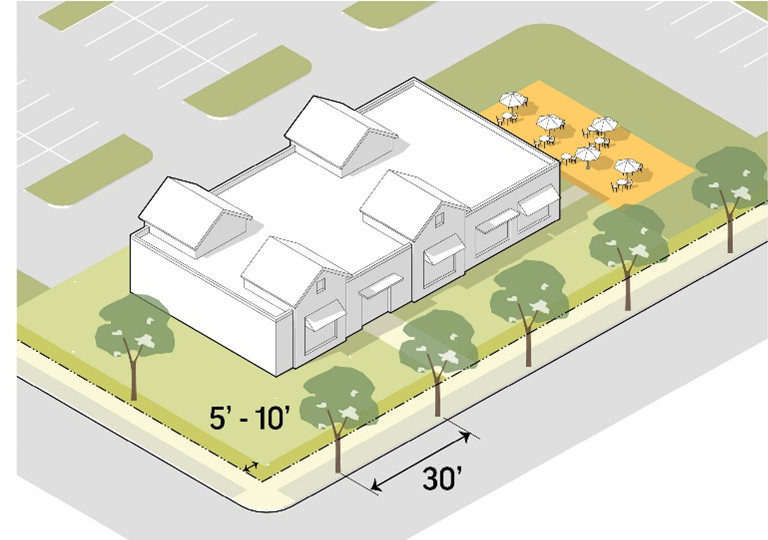
Figure 8-2. Street trees shall be located between the sidewalk and curb or within the first 5 to 10 feet of the front lot line or street if space is constrained.
2.
Frontage and Foundation Trees and Shrubs. Foundation plantings shall be located in open spaces near the building or in planting beds associated with the design of any hardscape along the building frontage.
a.
Ornamental and evergreen trees shall be located within 25 feet of the building.
b.
Shrubs and other plantings shall be located within six feet of the foundation.
c.
Where planting beds are used within hardscape around a foundation, they should be at least four feet deep, at least 60 square feet, and concentrated along at least 50% of the building frontage.
d.
Use larger and vertical landscape elements to frame entries, anchor the corners of buildings, or break up and soften larger building expanses.
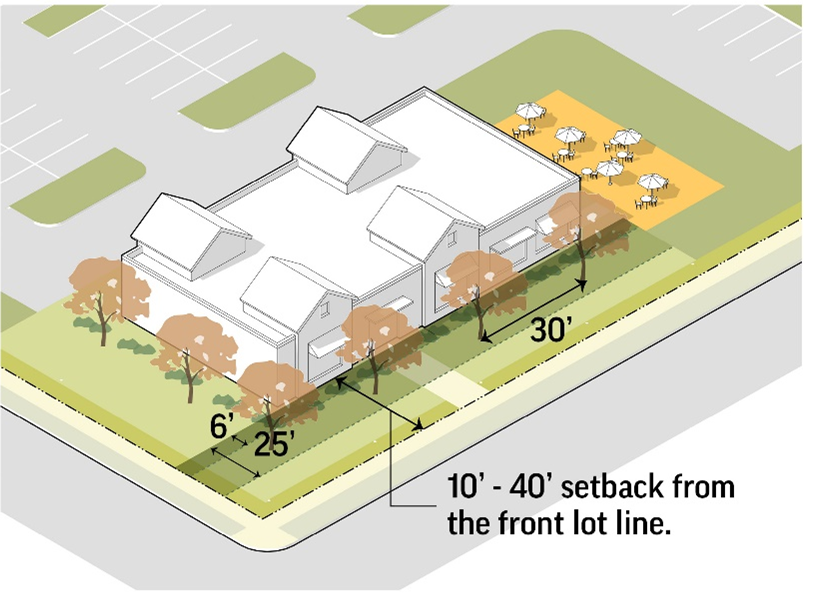
Figure 8-3. Foundation and frontage plantings provide a second layer of landscape to accent the building, particularly where buildings are setback more from the street.
3.
Parking Lot Landscape. Parking lot landscape requirements shall be planted in perimeter buffers and landscape islands planned and designed according to EMC § 16-7-5, Parking Design.
a.
There shall be at least one large tree per 30 feet of parking lot perimeter, or one ornamental or evergreen tree per 20 feet of perimeter.
b.
There shall be at least one tree per parking lot island, or one large tree or two evergreen or ornamental trees per 300 feet of other internal landscape area.
c.
Shrubs shall be located to define parking lot edges, screen parking from adjacent sites, or create low barriers along sidewalks and streetscapes.
d.
Any parking within 20 feet of the right-of-way shall have a Type I buffer per EMC § 16-8-4.
e.
Any surface on private property, permeable or non-permeable, except for grass, is an allowable surface for parking and storage of a vehicle.
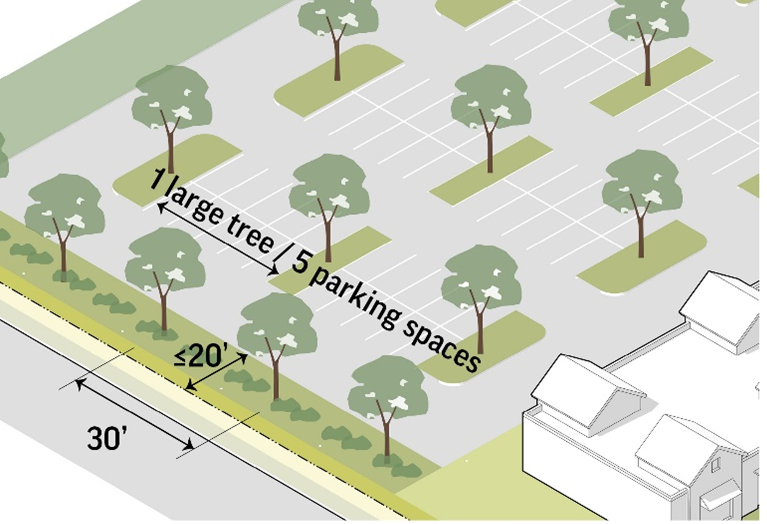
Figure 8-4. Parking lot landscape is dependent on the size, location, and relation to the streetscape as specified in section 16-7-4.
4.
Evergreens and Other Shaded Areas. Avoid locating evergreen trees, fences, and other opaque screens that cause winter shade and freezing on the south sides near sidewalks, trails, or other active outside social areas. Use deciduous ornamental or shade trees that provide summer shade and winter sun in these locations.
5.
Visibility at Intersections. Screens, buffers and landscape shall be located and designed to maintain proper lines of sight at all intersections of streets, alleys, driveways, and internal access streets as provided in EMC § 16-3-4.D.2, Sight Distances.
6.
Specific Applicability. Where landscape standards for different elements of a site overlap, effective site and landscape design may enable the space and plants to count toward more than one requirement, based on the greater plant requirement applicable to that area. For example, a buffer area required by EMC § 16-8-4 may also be along a parking area perimeter, or a parking area perimeter may also be along a streetscape, and the greater planting requirement between these areas can satisfy both requirements. Approval shall be subject to the Director determining that the intent and design objectives of this Section are achieved.
E.
Administrative Adjustments. Administrative adjustments to the landscape design standards in this Section may be authorized according to the process and criteria in EMC § 16-2-11, Administrative Adjustments, and any of the following additional applicable criteria:
1.
The alternative results in better design of common or civic space on the site;
2.
The alternative results in a better allocation of plants in relation to adjacent streetscapes or other public spaces; or
3.
The alternative is necessary to improve the longevity, survival, or environmental performance of plant materials.
16-8-4: - Buffers and Screening.
A.
Design Objectives. The buffer planting and screening standards have the following design objectives:
1.
Mitigate impacts of parking lots or vehicle circulation near streets or property lines with landscape barriers and low-level headlight screening.
2.
Use berms, vertical landscape, dense plantings, or other grade or spatial changes to alter views, subdue sound, and change the sense of proximity of incompatible uses, buildings, or site conditions.
3.
Soften transitions where changes in development patterns, intensity of land uses, or building scale occur.
4.
Screen service and utility areas of buildings and sites from adjacent property or streetscapes with architectural features, fences, or landscape that limit visibility or noise.
5.
Address three layers of landscape, including: large trees (high-level—30 feet +); evergreen or ornamental trees (mid-level—six feet to 30 feet); and shrubs, annuals, perennials, and ground cover (low-level—under six feet), to directly mitigate the potential impacts and adjacencies.
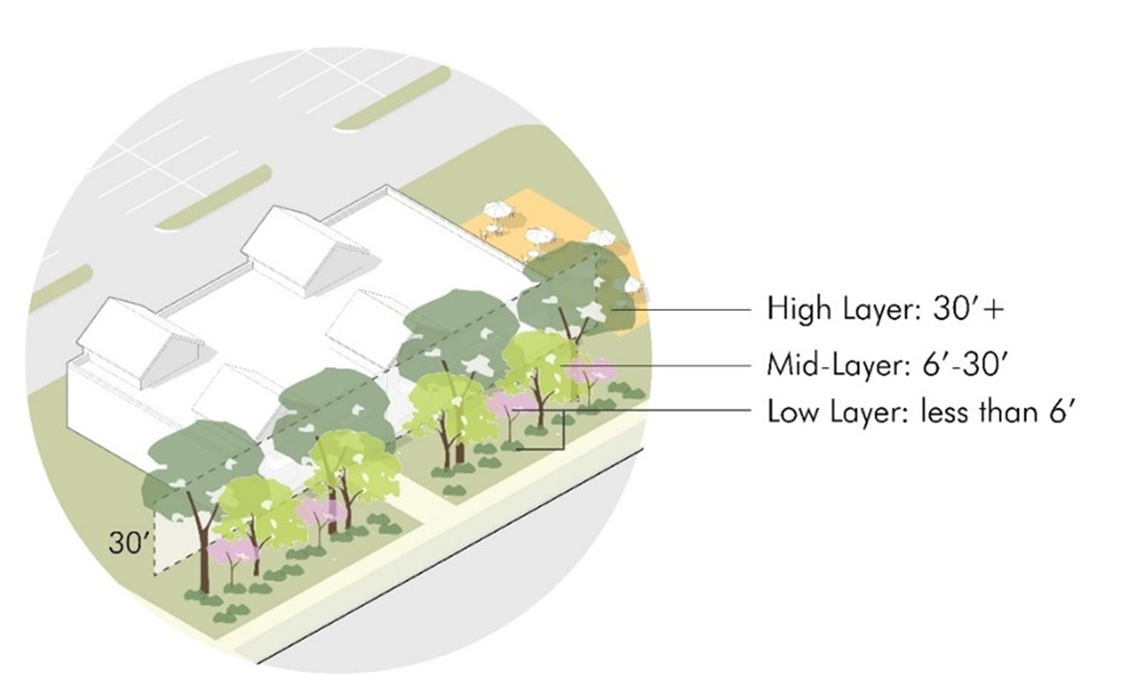
Figure 8-5. Buffers—dependent on context, should address three layers of mitigation—high layer with larger canopy trees; mid layer with small trees; and low layer with shrubs, evergreens and ground cover.
B.
Buffer Planting. The planting requirements in Table 8-3: Buffer Designs shall be used to buffer and screen more intense land uses or site elements according to the design objectives of this Section. The buffer width is independent of and may include any setback, parking perimeter buffer, or other open space requirement so that the larger requirement controls.
Buffer types in Table 8-3 shall be required in the following circumstances.
1.
Type 1 Buffers. Type 1 buffers shall be required:
a.
Anywhere parking is located within 20 feet of the public right of way.
b.
Where a parking lot abuts a public or internal sidewalk.
c.
Along alleys where there is a transition between industrial uses to residential uses across the alley.
2.
Type 2 Buffers. Type 2 buffers shall be required:
a.
At a common boundary between multi-unit projects with ten or more units and detached houses.
b.
At a common property boundary between commercial and residential uses.
c.
At a common property boundary between industrial and commercial uses.
3.
Type 3 Buffers. Type 3 buffers shall be required:
a.
Any transition between industrial and residential uses.
b.
Buffer and screening of any specific high-intensity uses or high-intensity portions of a site abutting or visible for public spaces or active portions of commercial and mixed-use property.
4.
Generally. Any buffer may be required where necessary to meet the design objectives of this Section or to achieve the general screening standards of EMC § 16-8-4.C.
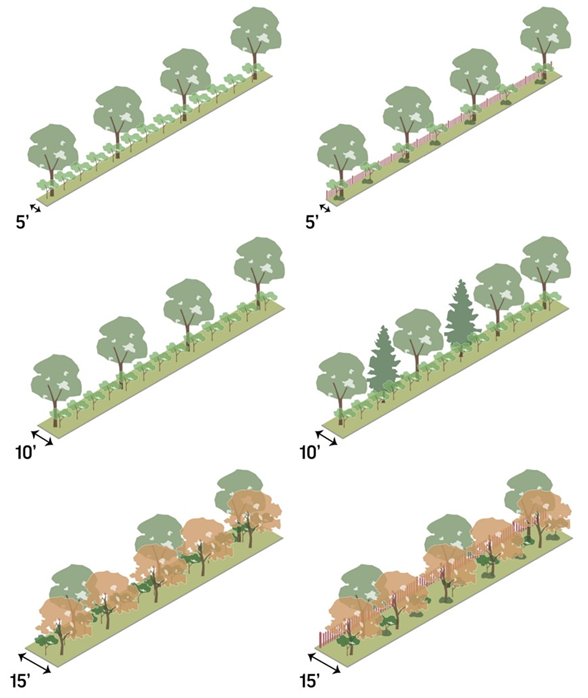
Figure 8-6. Buffers include 3 types based on the degree of intensity to be mitigated, and are based on options that combine space, landscape, and/or structural elements.
C.
General Screening. All of the following shall be screened from streets or adjacent property by placement of buildings, open space, dense evergreen vegetation, a decorative opaque fence or wall complementing the architectural details and materials of the building, or a combination of these screening strategies. Where design of the building, frontages, open space, buffers, and other site requirements do not adequately screen these elements, the Director may require additional planting to achieve the design objectives of this Section.
1.
Electrical and mechanical equipment such as transformers, air conditioners, or communication equipment and antennas whether ground-, wall-, or roof-mounted.
2.
Permanent or temporary outdoor storage areas where supplies or equipment are stored.
3.
Trash enclosures.
4.
Utility stations or fixtures.
5.
Large blank walls or the rear and sides of buildings visible from public streets, public or common areas or other sensitive boundaries.
6.
Public parking lots over ten spaces adjacent to residential lots.
D.
Administrative Adjustment. Administrative adjustments to the buffer and screening standards in this Section may be authorized according to the process and criteria in EMC § 16-2-11, Administrative Adjustments, and any of the following additional applicable criteria:
1.
The alternative promotes an appropriate exchange of buffer width and plant intensity based on the circumstances of the site.
2.
Other physical elements on the subject site or the abutting site make the applicable standard ineffective or impractical.
16-8-5: - Plant Specifications.
A.
Design Objectives. The plant specifications have the following design objectives:
1.
Ensure the longevity and survival of landscape investments with proper species, location, installation, and maintenance of plants.
2.
Promote regionally appropriate strategies, including limiting risk of disease or infestation through diversity of urban forest on an area- or City-wide basis.
3.
Establish minimum standards that balance immediate conditions with reasonable long-term growth and performance of landscape plans.
4.
Require water efficient strategies in terms of the water needs of landscape plans, and the continued operations and maintenance of sites.
B.
Species. All trees and shrubs shall be selected and planted according to the Englewood Landscape Manual In addition to any species on these lists, alternatives may be proposed and approved as part of the site improvement plan provided they:
1.
Are documented by a landscape architect or other credible information comparable in type and performance to any species on this list;
2.
Are adaptable to the climate of the Front Range region and the specific conditions in which they are proposed; and
3.
Are not invasive or otherwise problematic to the overall health of the landscape.
C.
Plant Specifications. All landscape materials shall meet the American Standards for Nursery Stock standards and be selected for its native characteristics or survival in the climate for the Front Range region. Plants shall meet the following specifications at planting:
D.
Tree Diversity. The required trees planted shall promote diversity with the following species selection criteria.
E.
Xeric Guidelines. All landscape plans shall conserve water with landscape materials and design techniques using the following xeric principles.
1.
Incorporate a "zoned planting scheme" to reduce water demand by grouping plants with similar water requirements together in the same hydrozone.
2.
Limit high-irrigation turf and plantings to appropriate high-use areas with high visibility and functional needs and use water-conserving grasses such as fescue sods.
3.
Use drought tolerant plants, suitable to the region, with low watering and pruning requirements.
4.
Incorporate soil amendments and use of organic mulches that reduce water loss and limit erosion. All plant areas should receive soil amendments of at least three cubic yards per 1,000 square feet.
5.
Install efficient automatic irrigation systems that incorporate water conservation measures, including spray heads for ground cover and drip irrigation for shrubs and trees, and high-efficiency or precision nozzles. Provide regular and attentive maintenance to ensure irrigation systems are functioning properly.
6.
Alternative sources of irrigation for all landscape areas are encouraged.
F.
Stormwater Treatment. Landscape amenities that incorporate stormwater treatment are recommended, provided they can meet both the landscape design standards and the stormwater management performance standards. Techniques such as bioswales, water quality ponds, and rain gardens should be used to improve water quality and slow and infiltrate runoff and from parking lots, streets, civic spaces, and other impervious surfaces.
G.
Planting and Maintenance. All landscape plans shall include installation specifications, method of maintenance including a watering system and statement of maintenance methods. At a minimum, the landscape plan shall demonstrate the following:
1.
No plants shall be planted over any area that has been compacted. All planting areas shall be excavated and filled with amended soils to a depth of at least 24 inches, or additional sufficient depth to reach existing soils and remove any pervious material, compacted soils, stones one inch or larger, or any other material harmful to plant growth.
2.
All plant materials and planting areas shall be prepared and planted according to American Standard for Nursery Stock (ANSI) details and ensure proper soil quality and conditions.
3.
All plantings shall be properly maintained, including pruning, mowing, weed removal, replacement of dead plants, and irrigation. Plant materials which fail to grow within a two-year period or which exhibit evidence of insect pests, disease, and/or damage shall be appropriately treated, and any plant in danger of dying may be ordered by the Director to be removed and replaced.
4.
All elements of an approved landscape plan including plant materials shall be considered elements of the project in the same manner as parking, buildings, or other details. Deficiencies of any approved landscape plan at any point may be enforced as a violation of the provisions of this Title.
H.
Administrative Adjustment. Administrative adjustments to the plant specification standards in this Section may be authorized according to the process and criteria in EMC § 16-2-11, Administrative Adjustments, and any of the following additional applicable criteria:
1.
The alternative is necessary to improve the longevity or survival of plant materials.
2.
The alternative improves the health or general species mix specific to the context and vicinity of the site.
3.
The alternative and any substituted materials are of the same general type (i.e. tree, shrub, or ground cover) and have the same or similar performance as intended by the standard.
16-8-6: - Fences and Walls.
A.
Design Objectives. Fences and wall designs shall consider the context and location on the site and meet the following design objectives:
1.
Provide safety and security, screening, and architectural enhancements to sites and buildings.
2.
Publicly visible locations require fences and walls with higher design standards, accompaniment of landscape to soften the expanse, or a combination of both.
3.
Walkable contexts or near pedestrian facilities require fences and walls with a lower profile, more open design, or both.
4.
Prominent public places require fences and walls that complement the design of the site and the architecture of the associated building.
5.
Fences and walls shall be designed and located sensitive to the relationship and impacts to adjacent property.
B.
Permit. A permit requiring conformance with these standards shall be required for:
1.
All new fences or walls.
2.
All repairs or replacement of existing fences more than 50% of the fence or 25 feet, whichever is less.
3.
Replacement of all or any portion of a retaining wall.
Permits may be incorporated into Site Improvement Plan review according to EMC § 16-2-6, Site Improvement Plan.
C.
Height and Location. Fences for individual property shall be located according to Table 8-6: Fence Height and Location.
D.
Materials. All fences and walls shall be made of the following:
1.
Masonry, including brick, stone, integrally colored concrete, textured concrete, smooth or textured concrete masonry unit (CMU), stucco, or other similar material.
2.
Decorative metal, such as cast or wrought iron or other decorative metal.
3.
Chain link—steel. aluminum, or vinyl clad except prohibited for any front fence in commercial districts or uses.
4.
Wood materials designed specifically for fencing purposes. Wood fence material shall meet EPA residential use standards.
5.
Vinyl, plastic, or composite fence products designed specifically for fencing purposes limited to 50% open design in residential districts.
6.
Steel or aluminum woven wire designed for fencing. Barbed or other sharp wire shall only be permitted to the side or rear of commercial and industrial fences and only if all portions of barbed wire are above six feet high.
7.
Decorative Architectural Materials. Decorative architectural materials, including tile or glass block, may be incorporated into the design of fences upon the approval of the Director.
E.
Prohibited Materials. The following materials are specifically prohibited:
1.
Creosote or chromated copper arsenate (CCA) treated wood products, utility poles, railroad ties, plywood, fiberboard, salvage wood, corrugated metal, sheet metal, scrap or salvage metal, PVC pipe, chicken wire, snow fences, plastic weaving, or plastic slats for use in chain link.
2.
Electrically charged fences shall be prohibited in all zone districts.
3.
Plastic construction fencing may be used only for temporary construction fencing.
F.
Retaining Walls.
1.
Required Wall Materials. All retaining wall shall be made of the following:
a.
Masonry, including brick, stone, integrally colored concrete, textured concrete, smooth or textured CMU, stucco, or other similar material.
b.
Wood or landscape timbers, provided they meet EPA residential use standards.
c.
Other materials commonly used for retaining walls in the Denver metro area and approved by the Director.
2.
Prohibited Wall Material. Utility poles, railroad ties, or any creosote or CCA treated materials are prohibited.
3.
Retaining Wall Development Standards.
a.
Retaining walls shall meet all applicable building code standards adopted by the City.
b.
All retaining walls shall be located on the applicant's property but no closer than one foot behind any public sidewalk.
G.
Administrative Adjustments. Administrative adjustments to the fence and wall standards in this Section may be authorized according to the process and criteria in EMC § 16-2-11, Administrative Adjustment.

