
Englewood City Zoning Code
CHAPTER 9
SIGNS
16-9-1: - Intent.
The intent of the sign standards is to:
A.
Create an attractive aesthetic environment in the City.
B.
Enhance the quality and civic design of the community through the visual priority of buildings, streetscapes, open spaces, landscapes, and other investments in the public realm.
C.
Ensure that signs preserve and contribute to the unique character of distinct places and districts.
D.
Promote safety of pedestrians, bicyclists, motorists, or other users of the public rights-of-way with proper location, construction, operation, and maintenance of signs.
E.
Provide effective identification and communication for businesses, institutions, and other community destinations without excessive competition for visual attention.
F.
Protect property values and investments by minimizing adverse effects of signs on adjacent property.
G.
Improve economic viability by assuring that the City is a visually pleasant place to visit, conduct business, and live.
H.
Protect from the potential health impacts, safety hazards and visual blight that result from the unrestricted display of signs.
I.
Ensure that the constitutionally guaranteed right of free speech is protected through appropriate standards for signs as a way of public communication. The City does not intend to have content-based restrictions or content-based enforcement.
16-9-2: - Applicability.
A.
General Applicability. The standards in this Chapter shall apply to all signs except:
1.
Legal nonconforming signs, subject to the provisions in EMC § 16-1-8.G.
2.
Exempt signs as specified in EMC § 16-9-3.
B.
Permit Required. All signs shall require a permit to demonstrate compliance with this Chapter, issued based on an application signed by the property owner or the owner's authorized agent, except the following signs:
1.
Signs exempt from a sign permit, as specified in EMC § 16-9-3.
2.
The change of copy or content, change of sign panels, or similar changes to an existing sign that conforms to these standards, provided there is no change in the size, sign structure, or other essential design characteristics of the sign.
3.
Ordinary maintenance or repair of existing signs provided no structural changes are made.
4.
Permits may be required for work associated with any sign that impacts other public safety codes, such as electrical, fire, or building codes.
C.
Sign Measurements. Sign dimensions shall be interpreted as follows:
1.
General Area Calculation. All applicants for a sign permit shall provide the surface area of the sign in square feet, providing methods and measurements for the calculation. Signs mounted on or displayed as a standard geometrical shape shall be measured by the standard mathematical formula for that shape. Signs mounted on or displayed as an irregular shape shall be measured by the smallest area of up to two standard geometrical shapes that can encompass the entire sign mounting.
2.
Freestanding Signs. The area of the sign shall be computed by the entire area of the face of the structure, cabinet, or module encompassing the sign. Bases or supporting structures that include no message may be excluded from the sign area calculation.
3.
Wall, Window or Other Building-mounted Signs. Any building mounted sign mounted on a background shall be measured by the area of the background. If mounted directly on the wall, the area shall be computed by means of the smallest single and continuous perimeter of up to two standard geometric shapes that enclose the outer limits of the writing, emblem, or other display. Gaps which are greater than two times the height of the sign area, when using the continuous perimeter above, may be subtracted from the calculation of the sign area, but it shall be interpreted as two signs. The area of the wall or window area for the purposes of determining the sign allowance shall be the total surface of the wall or window visible in an elevation view.
4.
Decorative Elements. Embellishments such as pole covers, framing, decorative roofing and support structures shall not be included in the area of the measurement if they contain no writing, emblem, or other display.
5.
Double-faced Signs. Where the sign faces of a double-faced sign are no more than three feet apart at any location, only one face will be measured in computing sign area. If the two faces of a double-faced sign are of unequal area, the area of the sign will be the area of the larger face. In all other cases, the areas of all faces of a multi-faced sign or the surface area of objects will be added together to compute the area of the sign.
6.
Height. Sign height is measured from the existing lowest grade directly below the sign to the highest point on the sign or sign structure. If the existing lowest grade cannot be reasonably determined, height shall be measured from the nearest crown point of a public street.
7.
Clearance. Sign clearance is measured from the highest point of the ground directly below the sign to the lowest point on the sign structure enclosing the sign face.
8.
Three-dimensional Objects. Three-dimensional sign area is measured by the profile surface area that encloses the entire object on each side. This is calculated by largest profile of the object, plus the profile at 90 degrees from the largest profile, times two.
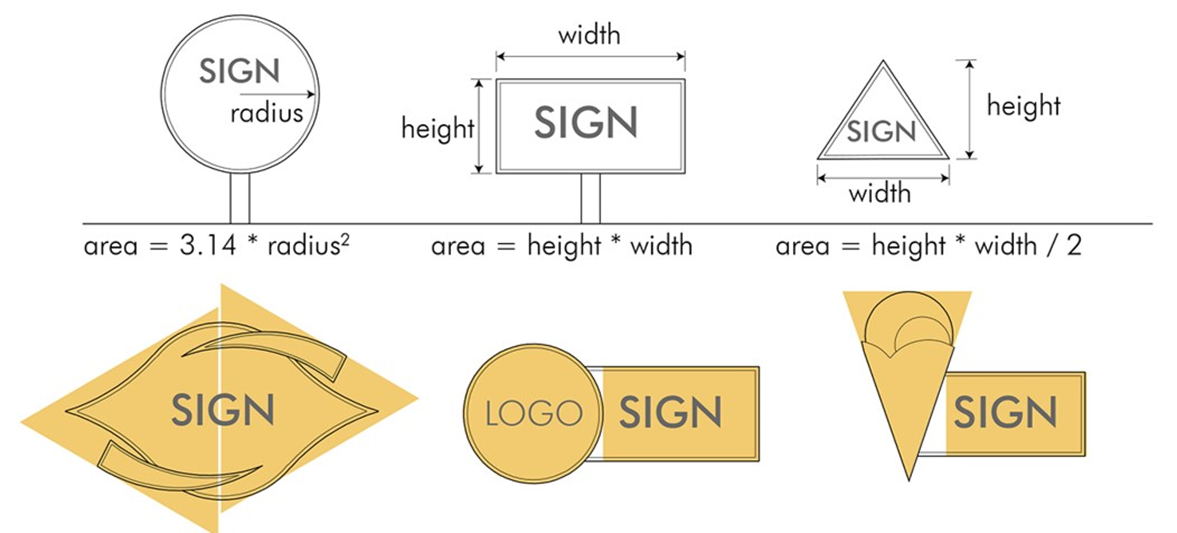
Figure 9-1. Sign measurements are determined by the measures of standard geometrical shapes that can encompass the entire sign using no more than two shapes.
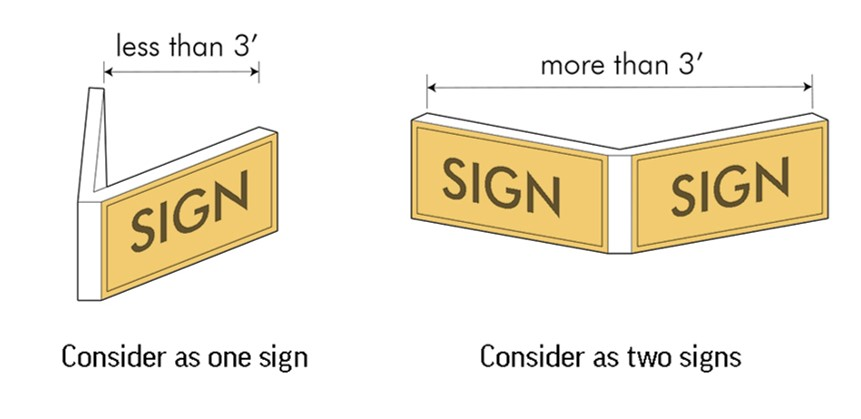
Figure 9-2. Double-faced signs count as one sign provided each face is within 3 feet of each other at all points determined by the measures of standard geometrical shapes that can encompass the entire sign using no more than two shapes.
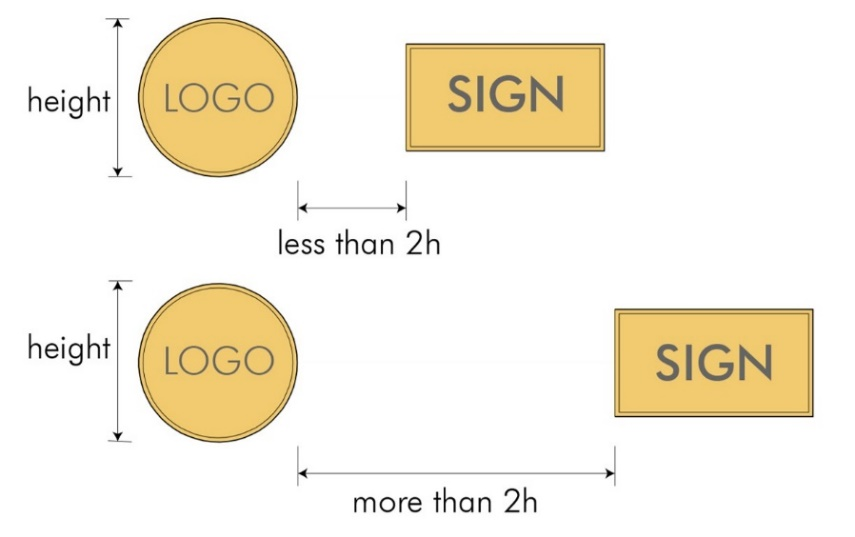
Figure 9-3. Sign elements with spacing of more than 2 times the height between elements shall be treated as two separate signs for determining sign quantity.
16-9-3: - Exempt Signs.
The following signs are exempt from a sign permit provided the sign meets all other applicable requirements of this Chapter. Unless specifically noted, exempt signs do not count towards the sign allowance specified for the applicable zone district.
A.
Property Identification Signs. Signs clearly indicating the property address or building identification are encouraged to enhance the ability of public safety, emergency services personnel, and the general public to locate the property. Property identification signs shall be visible from the right-of-way and are subject to the following limitations:
1.
Address Signs. Two per address up to two square feet each, only one of which may be ground mounted. Address signs on buildings shall be placed between four feet and 12 feet high on the building. Ground-mounted address signs shall be no more than 36 inches high.
2.
Building Name Plate. Each building or site may have one name plate sign per street front, up to 20 square feet. Building name plate signs shall be associated with the permanence or significance of the building or site, rather than a particular tenant, and include designs such as engraved stone, bronze plates or similar ornamental detail integrated with the architecture of the building or the landscape of the site.
B.
Public Safety, Traffic Control or Public Information. Signs designed and located to control traffic movement and safety of vehicles and pedestrians according to uniform traffic control device standards, signs required by the City's building or fire code, or signs otherwise required to support any official action or legal obligation of a federal, state, or local government, may be designed and located to meet the public purposes or requirements of other codes.
C.
Flags. Flags shall be mounted to the building and below the building height or mounted on a permanent pole subject to the height limit of the zoning district and setback from the property line a distance equal to the actual height of the flagpole.
1.
Residential Districts. Up to three flags may be permitted per lot. Total flag area per property shall not exceed 80 square feet and no single flag may be more than 40 square feet.
2.
Nonresidential Districts. Up to five flags may be permitted per lot. Total flag area per property shall not exceed 200 square feet and no single flag may be more 100 square feet.
3.
Permits. Any flags beyond these allowances shall only be allowed by a permit and count towards the sign allowance for the lot.
D.
Window Signs. Signs may be mounted to the interior of any first-floor windows in nonresidential districts, provided signs shall not exceed more than 25 percent of the area of all first floor windows, measured between two feet and ten feet above the first floor elevation, and provided at least 50 percent of the window the sign is mounted on remains clear of any visual obstructions including the sign area.
E.
Temporary Signs. Temporary signs are exempt from the sign permit process, provided they are within the allowances in EMC § 16-9-4 and EMC § 16-9-5.
F.
Incidental Signs. Incidental signs for nonresidential uses or multi-family complexes, which are intended to convey messages to guests, patrons, or other users of the lot, such as parking instructions, internal directions, building names or unit numbers, security warnings, or other similar minor accessory signs are limited to:
1.
No more than ten square feet total sign allowance per lot, or 40 square feet per acre, whichever is greater.
2.
No single sign may be more than six square feet, or 12 square feet for lots more than one acre.
3.
Signs shall be no more than eight feet high if ground mounted or 12 feet high if mounted on a building.
4.
Signs shall be setback at least ten feet from all property lines; and
5.
Grouping or arranging incidental signs to have the effect of a larger permitted sign or increase visibility to the public (as opposed to guests, patrons or other users of the site) makes all signs in the grouping ineligible for this exemption.
G.
Construction Signs. Signs associated with a nonresidential or multi-family construction, or any construction project over 10 acres, and under a valid permit are limited to:
1.
Up to 80 square feet total sign allowance per public street frontage;
2.
No more than three signs per street frontage;
3.
Signs shall be mounted on a trailer, building or fence, or if mounted on the ground it shall be limited to no more than ten feet high; and
4.
The signs shall only be posted for the duration of a valid permit associated with the project.
These signs are in addition to any other temporary sign allowances in EMC § 16-9-4 and EMC § 16-9-5.
H.
Interior Signs. Any sign that is not visible from the right-of-way, from any point along the perimeter of the property or from adjacent property, or from publicly accessible common spaces are exempt from permits and the standards of this Chapter, but may be subject to electrical, fire, or building codes or other construction specifications.
I.
Special Event Signs. Signs associated with a temporary special event may be approved through the permitting and approvals for the event. Signs shall generally follow the standards in this Chapter however, the event approval process may authorize deviations that generally meet the intent of this Chapter, or based on the short term and special circumstances of the event.
J.
Scoreboards. Scoreboards accessory to athletic fields are exempt from the permits and standards provided they are approved as part of a site improvement plan for the facility and are oriented to convey messages only to patrons of the facility.
K.
Works of Art. Works of art, as defined under this code, including non-commercial art, painted images, and integral decorative or architectural features are exempt from sign permits and standards, provided:
1.
Murals shall be located on building walls only and shall not contain an electronic display. Mural images may extend across doorways of buildings, but not be used to justify violating any other applicable site or building design standard.
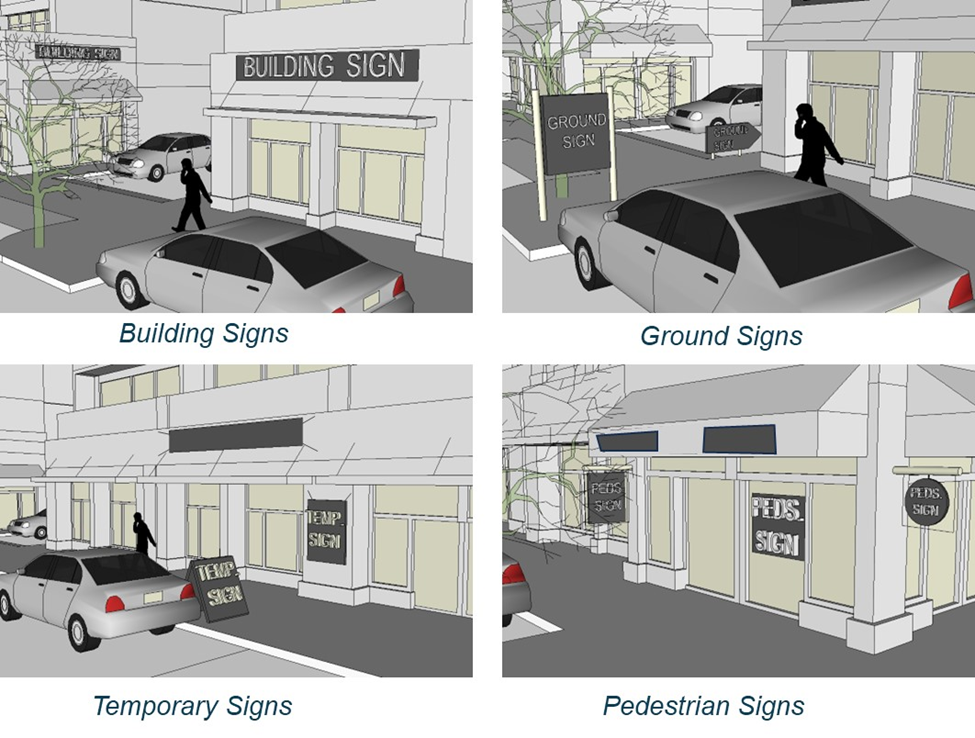
Figure 9-4. Sign allowances for residential and nonresidential districts are based on 4 different sign types—building signs, ground signs, pedestrian signs, and temporary signs
16-9-4: - Sign Types and Allowances.
A.
Residential Signs. The following signs are permitted in the residential zone districts (R-1-A, R-1-B, R-1-C, R-2-A, R-2-B, MU-R-3-A, MU-R-3-B, and MU-R-3-C), and for any residential building or use permitted in a nonresidential district. All planned unit developments and specific plans containing a residential component shall follow these standards, unless specifically amended by the PUD or regulating plan.
1.
Building and Ground Signs. The total allowable building and ground signs is based on the lot frontage, including front and street side lot lines. The total allowance may be allocated to multiple signs, subject to the limits for each sign type in Table 9-1.
2.
Pedestrian Signs. Pedestrian signs are allowed based on the public entrances of the principal building, subject to the limits in Table 9-2.
3.
Temporary Signs. The total allowable temporary signs is based on the lot frontage, including front and street side lot lines. The total allowance may be allocated to multiple signs, subject to the limits for each sign type in Table 9-3 and EMC § 16-9-5.D.
B.
Nonresidential Signs. The following signs are permitted in nonresidential zone districts (M-, MU-B-, and I-). All planned unit developments and specific plans containing a nonresidential component shall follow these standards, unless specifically amended through the PUD or regulating plan.
1.
Building or Ground Signs. The total allowable building and ground signs is based on the lot frontage, including front and street side lot lines. The total allowance may be allocated to multiple signs, subject to the limits for each sign type in Table 9-4.
2.
Pedestrian Signs. Pedestrian signs are allowed based on the extent of building frontages and primary entrances of the principal building, subject to the limits in Table 9-5
3.
Temporary Signs. The total allowable temporary signs is based on the lot frontage, including front and street side lot lines. The total allowance may be allocated to multiple signs, subject to the limits for each sign type in Table 9-6 and EMC § 16-9-5.D.
16-9-5: - Standards for Specific Signs.
The standards in this Section are supplemental standards, in addition to the general standards in Tables 9-1 through 9-6 and applicable to specific sign types.
A.
Ground Signs. Ground signs are subject to the following additional limitations:
1.
Ground signs shall be located within a landscape area at least three feet in all directions from the base of the sign.
2.
Ground signs shall be separated from any other ground sign on abutting property a by at least the height of the tallest sign.
3.
Ground signs and bases shall be constructed with durable, quality materials that complement the building or are integrated into the landscape and other site elements in terms of material, colors, and ornamentation.
4.
Ground signs shall be accompanied by a landscape plan that integrates the sign area into the overall site, softens the visibility of the structural elements, and improves the appearance of the sign and property from the streetscape.
B.
Building Signs. Buildings signs are subject to the following additional limitations:
1.
Signs attached to a building may only extend above the highest portion of the wall plane of the façade it is mounted on up to ten feet or 25% of the height of the sign area, whichever is less. No portion of a building wall may be built above the roofline, that serves no other structural or architectural purpose, other than to mount a sign or expand the sign area allowance.
2.
Signs attached to a building shall not project more than 12 inches off the surface, except projecting signs meeting the following additional limitations:
a.
Projecting wall signs may extend from and be perpendicular to the wall up to six feet, but no closer than five feet to the back of the curb.
b.
Projecting signs shall be at least eight feet above grade.
b.
Only one projecting sign is permitted per building
c.
Projecting signs shall be no larger than 50 square feet.
C.
Multi-story Building Signs. Buildings over 75 feet tall shall be permitted an additional building sign, that does not count to the total sign allowance and number, based on the following:
1.
Signs shall be permitted for each façade, but the sign allowance shall not be transferable to any other sign, any other façade, or any other location on the wall.
2.
Electronic message display signs shall not be permitted for these additional signs.
3.
Signs shall be located at the top story of the building, or on the roof but below the highest access structural element of the building. Additional structural elements shall not be constructed to expand the location or total allowance are of the sign.
4.
The permitted sign area shall be based on Table 9-7, Multi-Story Building Signs.
D.
Temporary Signs. Temporary signs are subject to the following additional limitations:
1.
The total area allowance for temporary signs in Table 9-3 or 9-6 may be allocated to multiple, signs provided:
a.
No single sign exceeds the maximum area per sign.
b.
The limitation periods for multiple signs are not exceeded.
c.
Signs shall not be grouped or arranged to have the effect of a larger permitted sign or otherwise be coordinated as a single sign.
2.
Temporary signs shall not be illuminated or painted with a light-reflecting paint.
3.
Temporary signs shall be constructed of rigid material, designed to resist quick deterioration from the elements, and securely anchored to not pose a distraction or hazard. Non-rigid materials (such as banners) shall be secured by a support or frame to avoid distraction of flapping.
4.
No temporary sign shall be displayed for more than 150 consecutive days, without 60 days intervening. Relocation of a temporary sign, or removal and replacement with a substantially similar sign does not expand the time period for the temporary sign.
5.
The Director may require the removal of any temporary sign that pertains to an expired event, or may refrain from enforcement of the duration or time limits for any temporary sign related to an event that has been extended beyond the control of the owner.
E.
Multi-tenant Buildings and Sites. Any building or site with multiple tenants shall be subject to the following:
1.
Only one ground sign shall be permitted to be shared by all tenants. Multi-tenant sites with more than 150 feet of frontage may have a second ground sign. Multi-tenant signs shall not count toward the total sign allowance, provided all other signs are building or pedestrian signs.
2.
Building signs may be apportioned to any tenant with a separate exterior entrance and apportioned to their percentage of the street-facing elevation. In the case where all tenants share a common entrance the building signs may be apportioned to no more than two signs per street-facing elevation.
3.
A sign plan shall demonstrate coordination of all signs on the building, to allow sufficient flexibility for the replacement of signs or new tenants without the need for a new sign plan, unless a completely new sign design concept is proposed for the entire building or site.
F.
Drive-Through Service Facilities. Drive through service facilities may have two signs along the drive-through lane, provided that each sign is limited to one face and shall not eight feet in height and 35 square feet in area. Signs shall be located according to the accessory use standards in EMC § 16-4-4.E.
G.
Portable Pedestrian Signs. Portable pedestrian signs ("A frame", "sandwich board" or "T-frame") may be placed in the public right-of-way, or areas of a site associated with service areas, for any permitted retail or service use provided:
1.
No more than one sign per public building entrance.
2.
The sign is limited to eight square feet, and shall be no wider than three feet and not taller than four feet.
3.
The sign is placed within 20 feet of the main entrance of the building or service area of a business, and at least two feet from any curb.
4.
The sign is placed on or near a sidewalk, and otherwise associated with pedestrian routes to and from the business.
5.
The sign shall maintain at least six feet clear passage for pedestrians on the sidewalk, and is otherwise not put in any location that creates visual obstructions or safety hazards for users of the right-of-way.
H.
Dynamic or Electronic Message Displays. Dynamic or electronic message displays may be incorporated into permitted signs and are subject to the following additional limitations:
1.
Only one display shall be permitted for each street frontage.
2.
All other signs on the property shall conform to the standards of this Chapter.
3.
Displays shall only be used for permitted non-residential uses, and shall be setback at least 100 feet from any residential use, except in the MU-B districts the display shall be setback 100 feet from any residentially zoned property. Portions of a sign use for dynamic or electronic display shall be further limited in the following districts:
a.
R-1 and R-2 districts—ten square feet maximum.
b.
MU-R-3, M-1 and M-2—20 square feet maximum.
c.
MU-B and I-districts—area of general sign allowance.
4.
Only static display is permitted with at least ten seconds between changes in display and no more than 0.3 second for transitions.
5.
Changes may occur only by solve, fade or instantaneous change. Scrolling, flashing, rolling, window shading or other similar effects, or any other flashing or appearance of movement is prohibited.
6.
Displays shall be equipped with a sensor or other device that automatically determines the ambient illumination and programmed to dim according to ambient light conditions and keep the illumination to no more than 0.3 footcandles over ambient lighting conditions.
a.
Lighting shall be measured perpendicular to the sign at a distance dependent on the overall sign area.
b.
Unless standard industry practices dictate a different measure or method, the distance shall be the square root of 100 times the sign area. (i.e. a 50 square foot sign should be measure from 70.7 feet perpendicular to the sign.).
7.
Applications for sign permits containing an electronic display shall include the manufacturer's specifications and cd/m 2 rating.
8.
Signs shall not include any business message that is not on the same lot or premises as the sign, and shall not direct attention to a business, product or service sold or offered off premises.
9.
Any sign that malfunctions causing flashing, motion, or other violations of this Chapter shall be turned off as soon as possible, but in no case longer than 24 hours. The sign shall not be turned on again until prepared to operate according to these standards.
10.
The City shall have the right to enter the property and view the programmed specifications of the sign to determine compliance with these provisions in accordance with the sign permit issued for the sign.
16-9-6: - General Standards—All Signs.
A.
Public Health, Safety and Maintenance.
1.
All signs shall be designed, constructed, located, and maintained in a manner that is compliant with all electrical, fire, and building codes, and any other industry standards for public safety of signs, so that the sign does not present any potential risk to public safety in the judgment of the Building Official or the Director.
2.
No sign shall be designed or located in a way where it can imitate or be confused with an official government sign for traffic direction or any other public safety symbol.
3.
Signs shall not obstruct visibility of pedestrians and vehicles with sight triangles. Monument signs over three feet high or pole signs with less than eight feet clearance shall not be located in the following areas:
a.
At street intersections, a triangle measured 30 feet from the point of intersection along each intersection curb line,
b.
At street and alley intersections, a triangle measured 25 feet along the curb line from the center of the alley, and 25 feet deep on the centerline of the alley.
c.
The City traffic engineer may establish any other sight distance for these locations and for signs related to access points based on the sight distance provisions of EMC § 16-3-4.D.2.
4.
Any sign projecting over a walkway, active area in front of a building, or other area where people may pass shall maintain at least 7.5 feet vertical clearance.
5.
No sign, sign structure, or associated grounds shall present any dilapidated state or condition that may impact the relationship to or appearance from the public right-of-way or adjacent property.
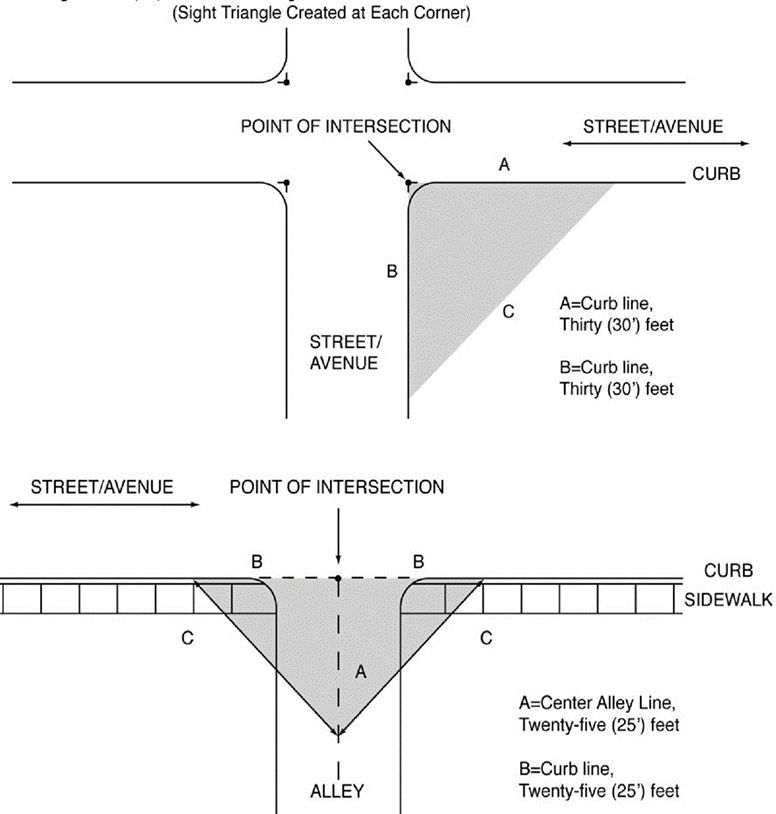
Figure 9-5. Sign sight triangles shall be based on the curb line at intersections of streets and shall be based on the curb line and centerline for the intersection of alleys and streets.
B.
General Design.
1.
Placement. The location of all permanent signs shall be incorporated into the architectural design of the building according to the following principles:
a.
Placement of signs should be considered part of the overall facade design and composition.
b.
Sign locations should align with major architectural features such as marquees, building name plates, storefront sign bands, cornices and parapets, entrance features, windows, canopies, and other similar architectural features.
c.
Signs shall not be placed where they obstruct any significant building design feature, including windows, architectural details, trim, and ornamentation.
2.
Durability and Appearance. All permanent signs shall be designed to convey durability and a quality appearance according to the following principles:
a.
Materials, particularly for the frames, casings or bases of signs, should be chosen to complement the architecture of the building, and coordinate with other accent materials or architectural details of the building
b.
Simple two- and three-color contrasting colors schemes should be used between the color of the background, letters, and accents to ensure legibility and quality appearances. Fluorescent colors should be limited to accents and typically less than 10% of the sign area.
c.
Buildings and sites that have multiple building or ground signs should coordinate all signs using one or more consistent coordinating element, such as similar fonts, colors, sign scale or shapes, backgrounds, or casing and framing material.
d.
All signs and any surrounding grounds or landscape shall be maintained in good condition, free of any debris, weeds, disrepair, or other unsightly conditions.
C.
Specific Designs Prohibited.
1.
No sign shall be placed on any vehicle or trailer visible from the right-of-way, where the sign and the vehicle or trailer is located specifically to avoid the standards or criteria of this Chapter.
2.
No sign shall be attached to any public utility pole or installed within the public right-of-way, except:
a.
Official government signs exempt from these standards according to EMC § 16-9-3.B;
b.
Signs attached to and projecting from buildings and meeting all other standards of this Chapter;
c.
Portable pedestrian signs meeting the limited license and exception in EMC § 16-9-5.G; or
d.
Signs otherwise licensed by the City through special events or management of the design and use of the right-of-way, apart from the Unified Development Code.
3.
No sign shall include balloons, streamers, pennants, or other air activated elements and animated elements, whether animated by mechanical, electrical, or environmental means.
a.
This limitation shall not apply to pedestrian signs, provided any animated element shall apply to the overall pedestrian sign allowances.
b.
This provision shall not apply to prohibit flags, temporary signs, or electronic message displays meeting the standards of this Chapter, or to signs approved in association with a special event permit.
4.
Any sign with a business message shall be located on the lot of the business activity and shall not direct attention to a business, product or service sold or offered off premises, except signs for multi-tenant premises, which must be associated with the site and located in common areas controlled by the businesses or property owners' associations.
D.
Illumination.
1.
Any illumination shall be designed to eliminate glare or any other negative impacts on surrounding rights-of-way and property. In general, any direct source of light shall not be visible from the public street or adjacent property.
2.
Light from an illuminated sign shall not spill onto adjacent properties. The light reading at any point within ten feet from and adjacent private property shall be less than one foot-candle.
3.
External light sources shall be directed and shielded to conceal the light source and illuminate only the surface of the sign.
4.
External illumination of a signs ten feet high or more shall only occur from the top down.
5.
The maximum luminance of any sign shall be 750 candelas per meter squared (cd/m2).
6.
No light source shall cause any glare, flashing, movement, or other distraction to traffic.
7.
Exposed incandescent, neon, or tube lighting, or other integral illumination where the light source is the sign, shall be limited to window signs mounted to the inside of the building, or used only as an accent of less than 10% of the sign area.

