
Ennis City Zoning Code
ARTICLE XI
Definitions
11.1 - GENERAL RULES OF INTERPRETATION
Unless the context clearly indicates otherwise, the following rules shall apply in interpreting the terms and provisions of this Ordinance.
11.1.1 - Meanings and Intent
All provisions, terms, phrases, and expressions contained in this Ordinance shall be construed according to the general purposes set forth in Article I: General Provisions, Section 1.5, Purpose and Intent, and the specific purpose statements set forth throughout this Ordinance. When, in any specific section of this Ordinance, a different meaning is given for a term defined for general purposes in this article, the specific section's meaning and application of the term shall control.
11.1.2 - Headings, Illustrations, and Text
In the event of a conflict or inconsistency between the text of this Ordinance and any heading, caption, figure, illustration, table, or map, the text shall control.
11.1.3 - Lists and Examples
Unless otherwise specifically indicated, lists of items or examples that use terms such as "for example," "including," and "such as," or similar language are intended to provide examples and are not exhaustive lists of all possibilities.
11.1.4 - Computation of Time
The time in which an act is to be done shall be computed by excluding the first day and including the last day. If a deadline or required date of action falls on a Saturday, Sunday, or holiday observed by the City, the deadline or required date of action shall be the next day that is not a Saturday, Sunday, or holiday observed by the City. References to days are calendar days unless otherwise stated.
11.1.5 - References to Other Regulations/Publications
Whenever reference is made to a resolution, ordinance, statute, regulation, or document, it shall be construed as a reference to the most recent edition, including amendments, of such regulation, resolution, ordinance, statute, regulation, or document, unless otherwise specifically stated.
11.1.6 - Delegation of Authority
Any act authorized by this Ordinance to be carried out by a specific official of the City may be carried out by a designee of such official.
11.1.7 - Technical and Non-technical Terms
Words and phrases shall be construed according to the common and approved usage of the language, but technical words and phrases that may have acquired a peculiar and appropriate meaning in law shall be construed and understood according to such meaning.
11.1.8 - Public Officials and Agencies
All public officials, bodies, and agencies to which references are made are those of the City of Ennis unless otherwise indicated.
11.1.9 - Mandatory and Discretionary Terms
The words "shall," "must," and "will" are mandatory in nature, establishing an obligation or duty to comply with the particular provision. The words "may" and "should" are permissive in nature.
11.1.10 - Synonymous Terms
Unless otherwise specified:
A.
The word "building" includes the word "structure" and the word "structure" includes the word "building";
B.
The word "lot" includes the words "building site," "parcel," "plot," or "tract"; and
C.
The phrase "used for" shall include the phrases "arranged for," "designed for," "intended for," "maintained for," and "occupied for."
11.1.11 - Conjunctions
Unless the context clearly suggests the contrary, conjunctions shall be interpreted as follows:
A.
"And" indicates that all connected items, conditions, provisions, or events apply; and
B.
"Or" indicates that one or more of the connected items, conditions, provisions, or events apply.
11.1.12 - Tenses, Plurals, and Gender
Words used in the present tense include the future tense. Words used in the singular number include the plural number and the plural number includes the singular number, unless the context of the particular usage clearly indicates otherwise. Words used in the masculine gender include the feminine gender, and vice versa.
11.1.13 - Undefined Terms
For words not defined in this article, refer to the online edition of Webster's Dictionary.
11.1.14 - Index of Terms
This Article includes an index of terms defined for easy reference.
11.2 - INTERPRETATIONS
The Administrator has final authority to determine the interpretation or usage of terms used in this Ordinance per the standards established in Article III: Procedures and Administration. Any person may request an interpretation of any term by submitting a written request to the Administrator, who shall respond in writing within 30 days. When interpreting and applying the provisions of this Ordinance, such provisions shall be held to be the minimum requirements for the promotion of the public health, safety, convenience, comfort, and general welfare. Nothing in this Ordinance shall be construed as repealing any existing ordinance regulating nuisances.
11.3 - ALPHABETICAL INDEX OF TERMS DEFINED
Access, 2541
Accessory Buildings or Use, 2538
Accessory Dwelling Unit (Garage), 2538
Accessory Dwelling Unit (Primary Structure), 2538
Accessory Structure, Detached, 2546
Accessory Use and/or Structure, 2546
Adequate Public Facilities, 2541
Administrator, 2546
Agricultural Uses, 2516
Air Traffic Control Towers. See Air Transportation Related Uses
Air Transportation Related Uses, 2535
Aircraft Hangars. See Air Transportation Related Uses
Airport Terminal. See Air Transportation Related Uses
Alternative Financial Institution, 2523
Amenities, 2546
Animal Production and Ranching, 2517
Animal Related Service With Outdoor Runs, 2518
Animal-Related Services, 2518
Annexation, 2546
Any Food and Beverage Establishment With Drive-Thru or Drive-Up Facility, 2526
Any Food and Beverage Establishment With Outdoor or Sidewalk Service, 2526
Any Industrial Use With Outdoor Storage, 2533
Any Other Temporary Use or Structure, 2540
Any Retail Sales Use With Drive-Thru Facilities, 2522
Any Retail Sales Use With Outdoor Storage, 2522
Any Retail Use With Gasoline Sales Pumps, 2520
Apartment, Large, 2546
Apartment, Small, 2547
Apiculture, 2517
Arcade, 2547
Architecturally Finished, 2547
Art Gallery, Museum or Special Purpose Recreational Institution, 2512
Arterial Roadway, 2547
Articulation, Building, 2547
Asphalt or Concrete Batch Plants, 2534
Assisted Living Facility (≤ 6 Residents), 2511
Assisted Living Facility (≥ 7 Residents), 2511
Attic, 2547
Auto Repair and Service, Major, 2519
Auto Repair and Service, Minor, 2519
Automobiles, 2547
Auto-Oriented, 2547
Auto-Related Parts and Accessory Sales, 2520
Auto-Related Sales and Service, 2518
Awning or Canopy, 2548
Bail Bond Services, 2527
Balcony, 2548
Banding, 2548
Bank, Investment, or Financial Institution (With Drive-Thru Service), 2523
Bank, Investment, or Financial Institution (Without Drive-Thru Service), 2523
Banquet or Meeting Facility, 2528
Bar or Drinking Establishment, 2525
Bed and Breakfast Establishment, 2526
Bedroom, 2548
Beer and Wine Sales, 2522
Berm, 2548
Best Management Practices, 2541
Block, 2548
Block Face, 2548
Block Perimeter, 2548
Bowling, Billiards, Pool, Bingo, Etc., 2529
Breezeway, 2548
Build, 2548
Building Materials, Home and Garden Centers, 2520
Building Official, 2549
Building or Structure, 2548
Building Permit, 2549
Building, Detached, 2549
Building, Principal or Primary, 2549
Build-To Line, 2549
Build-To Zone, 2549
Business or Professional Organizations, 2512
Business, Professional, and Technical Services, 2526
Café or Self-Service Restaurant, 2525
Caliper, 2549
Car and Truck Wash, 2520
Car Rental, 2524
Care Taker's Quarters, 2538
Carport, 2538
Catering Service, 2526
Cattle Ranches, 2517
Cemetery, 2515
Certificate of Occupancy (Co), 2550
Change In Use, 2550
Chemicals, Metals, and Heavy Manufacturing, 2532
Child Day Care, 2515
City Engineer, 2541
City Services, 2541
Civic and Cultural Facilities, 2512
Civic, Social, Philanthropic or Fraternal Organizations, 2512
Cladding, 2550
Clinics and Labs, 2514
Cold Storage Plant, 2533
Collector Street, 2550
Colleges and Universities, 2516
Co-Location, 2550
Column, 2550
Commercial and Industrial Machinery Leasing and Rental, 2524
Commercial Use or Building, 2550
Community Center, Private, 2538
Community Garden, 2513
Community, Group, or Foster Home, 2511
Comprehensive Plan, 2550
Construction Office, 2540
Construction Related Businesses, 2534
Construction Related Storage Yard, 2540
Convenience Store, 2541
Cornice, 2550
Correctional Institutions, 2515
Cosmetics and Beauty Supplies, 2522
Country Club, 2530
Courier, Messenger, and Postal Service, 2535
Courts (Local, State, and Federal), 2515
Courtyard, 2550
Crop Production, 2516
Cul-De-Sac or Dead End Street, 2541
Dedication, 2541
Deed, 2541
Department Store, Superstore, or Warehouse Club, 2521
Development Agreement, 2541
Development Approval, 2542
Development or To Develop, 2550
Display, 2551
Distribution Center or Warehouse, 2533
District, 2551, See Zoning District
Dormers or Dormer Windows, 2551
Duplex Dwelling, 2509
Durable Consumer Goods Sales, 2521
Dwelling Unit, 2551
Dwelling, Detached, 2551
Dwellings, Attached, 2551
Easement, 2542
Educational Service Establishments, 2515
Electric Utility Services (Including Generating Plants and Substations), 2536
Electric Vehicle Charging Station, 2539
Electronics and Appliances, 2521
Elementary and Middle Schools, 2516
Encroachment, 2551
Entryway, 2551
Escrow, 2542
Excavation Related Services, 2534
Exterior Insulation and Finish System (EIFS), 2551
Extra Territorial Jurisdiction (ETJ), 2552
Facade, 2552
Family, 2552
Farmers Market, 2513
Fence or Screening Wall, 2552
Fenestration, 2552
Festivals and Civic Events (Includes Carnival, Circus, or Amusement Rides), 2540
Filed of Record, 2542
Financial and Real Estate Services, 2523
Financial Guarantee, 2542
Fire Marshall or Fire Chief, 2542
Firearm Sales, 2522
Fish Hatcheries and Aquaculture, 2517
Fitness Club, Gym, or Sports Club, 2528
Floodplain, 2542
Floodway, 2542
Food and Beverage Processing, 2531
Food and Beverage Services, 2525
Forecourt, 2552
Freeway or Highway, 2552
Freeway or Highway Frontage Road, 2552
Frontage Build-Out, 2549
Full-Service Restaurant, 2525
Funeral Homes and Services (With or Without Cremation Services), 2514
Furniture and Home Furnishings, 2520
Furniture and Related Products, 2531
Gable Roof or Sloped Roof, 2552
Games Arcade, 2528
Garage Sales, 2540
General Personal Services, 2527
Golf Course, 2530
Grade, 2552
Greenhouse, Nursery, Floriculture, 2517
Grocery Store or Supermarket, 2521
Gross Floor Area (GFA), 2553
Ground Cover, 2553
Group Living, 2511
Health and Human Services, 2513
Height, Building, 2553
Heliports. See Air Transportation Related Uses
Highway Capacity Manual (HCM), 2542
Hipped Roof, 2553
Home-Occupation, 2539
Horse and Equine Farming, 2517
Hospital, 2514
Hotel, Full Service, 2526
Household Living, 2509
Independent Senior Living Facility, 2511
Indoor Amusement Establishment, 2529
Industrial Uses, 2553
Infrastructure Design Standards, 2542
Institutional Uses, 2553
Intersection Offsets, 2543
Irrigation System, 2553
iSWM Standards, 2553
ITE Manual For Designing Walkable Urban Thoroughfares, 2553
Joint, Common, or Cross Access Easements or Private Access Easements. See Private Access Easements
Kaufman Corridor District, 2554
Kennel, Commercial, 2518
Labor and Political Organizations, 2512
Landscape Architect, 2554
Landscape Area, 2554
Landscaping, 2554
Large Vehicle Sales and Service, 2519
Legislative and Executive Functions, 2515
Level of Service (LOS), Roadway, 2543
Limited Service Hotels/Motels, Including Extended Stay or Residence Hotels, 2526
Live-Work Dwelling, 2510
Lodging Facilities, 2526
Lot, 2554
Lot Area, 2554
Lot Coverage, 2554
Lot Depth, 2554
Lot Line, Front, 2555
Lot Line, Interior, 2555
Lot Line, Rear, 2555
Lot Line, Side, 2555
Lot of Record, 2555
Lot Width, 2555
Lot, Adjoining or Adjacent, 2554
Lot, Corner, 2554
Lot, Interior, 2554
Machinery Related Contractor's Yards and Storage, 2534
Machinery, Appliance, Electrical Equipment, Electronics, and Components, 2532
Maintenance Bond, 2543
Major Amendment, 2555
Manufactured Home (HUD-Code), 2510
Manufacturing, 2531
Marina or Yachting Club, 2529
Massage Therapy, 2528
Massing, Building, 2555
Meandering, 2555
Medical and Dental Offices, 2527
Metes and Bounds, 2543
Microbrewery, Micro Distillery, Winery, 2531
Miniature Golf Establishment, 2530
Minor Amendments, 2555
Miscellaneous Manufacturing, 2532
Mixed-Use Development or Building, 2555
Model Home, 2540
Monuments, 2543
Motor Vehicle Sales, New, 2518
Motor Vehicle Sales, Used, 2519
Motor Vehicle Title Loan Business, See Alternative Financial Institution
Multi-Family (4 DU/Lot or Fewer) Dwelling, 2510
Multi-Family (More Than 4 DU/Lot) Dwelling, 2510
Multi-Family Development, 2556
NACTO's Urban Street Design Guide, 2556
Natural Creek, 2543
Natural Gas, Petroleum, Fuel Related Services, 2536
Nature Preserve or Open Space, 2513
Neighborhood Conservation District, 2556
Nonconforming Building or Structure or Site, 2556
Nonconforming Lot, 2556
Nonconforming Use, 2556
Non-Residential, 2556
Nursery and Pre-School, 2516
Nursing and Other Rehabilitative Services, 2514
Nursing Home, 2512
Office, 2556
Offices For Administrative Services, 2527
Offices For Business, Professional, or Technical Services, 2527
Off-Site, 2543
On-Site, 2544
Open Space, 2556
Other Government Functions, 2515
Other Local, Regional, Intercity Transportation Uses (Public and Commercial), 2535
Outdoor Amusement Establishment, 2529
Outdoor Display and Sales, 2539
Outdoor Storage, 2539
Owner, Property or Proprietor, 2557
Paper and Printing Materials, 2531
Parapet, 2557
Park or Playground, 2513
Parking Lot, 2557
Parking Screen, 2557
Parks and Recreation Facilities, 2513
Parkway, 2557
Pawn Shop, 2522
Payday Advance/Loan Business. See Alternative Financial Institution
Pedestrian-Oriented Development Frontage, 2557
Pedestrian-Oriented Street, 2557
Pediment, 2557
Performance Bond, 2544
Person, 2557
Personal Services, 2527
Pet and Animal Related Sales and Services (Including Grooming and Care), 2518
Pharmacy or Drug Store, 2522
Pilaster, 2558
Plat, 2544
Plat, Amending, 2544
Plat, Final, 2544
Plat, Minor, 2544
Plat, Preliminary, 2544
Plat Vacation, 2544
Playground, 2558
Plaza, 2558
Pollution, 2544
Porch, 2558
Primary Entrance, 2558
Private Access Easement, 2544
Property Management Services, 2524
Public and Other Governmental Functions, 2515
Public Facilities, 2545
Public Improvements, 2545
Public Safety Facility, 2515
Public Utility or Utilities, 2545
Rail Transportation Related Uses, 2535
Real Estate Services, 2523
Recreation and Entertainment Uses, Outdoor, 2529
Recreation and Entertainment, Indoor, 2528
Recreation Center, 2513
Recreational and Consumer Goods Rental, 2524
Recycling Collection Center, 2539
Religious Assembly and Institutions, 2512
Rental and Leasing Services, 2524
Reserve Fund, 2545
Residential Garage (Detached), 2539
Residential Use, 2558
Restaurant With Take Out or Delivery Service Only, 2525
Retail Sales, 2520
Right-of-Way, 2558
Roof Line, 2558
Rough Proportionality or Roughly Proportional, 2545
Row House. See Townhouse
RV Park, 2511
RV, Trailers, and Truck Rental, 2524
Salvage, 2559
Screening or Screening Device, 2559
Seasonal Sales, 2540
Self-Storage or Mini Storage, 2533
Senior and High Schools, 2516
Services Related To Buildings (Janitorial, Landscaping, Cleaning, Etc.), 2527
Setback, 2559
Setback, Rear, 2559
Setback, Side (Interior), 2559
Setback, Street Front, 2559
Setback, Street Side, 2559
Sewer, Solid Waste, Recycling and Related Services, 2536
Sexually-Oriented Business, 2530
Shared Parking, 2559
Sheep and Goat Farming, 2517
Shooting Club, 2529
Sidewalk, 2559
Sidewalk Café, 2540
Sill, 2559
Single-Family Detached Dwelling, 2509
Site, 2560
Site Development Permit, 2545
Skating Rink (Ice, Roller Skating, Etc.), 2528
Small Cell or Network Nodes, 2537
Snack, Coffee, Juice, Ice Cream, or Specialty Food Sales, 2525
Social Assistance and Welfare Services, 2514
Specialty Retail and Paraphernalia Sales, 2522
Specialty Trade Contractors, 2534
Specialty Vehicle Sales, New, 2519
Specialty Vehicle Sales, Used, 2519
Stables, Commercial, 2518
Stoop, 2560
Storage Shed (Residential), 2539
Storm Sewer System, 2545
Story or Floor, 2560
Street, 2560
Street Frontage, 2560
Street Tree, 2560
Streetscape, 2560
Structure, 2560
Structured Parking, 2530
Stub Streets, 2545
Subdivision, 2545
Subdivision Identification Signs, 2545
Subdivision Perimeter Fence or Fencing, 2560
Substantive Impact, 2546
Support Functions For Agriculture, 2516
Surface Parking, 2539
Surface Parking Lots, 2530
Swimming Pool, Private, 2539
Swimming Pool, Spa, and Accessory Sales and Service, 2521
Tattoo Parlor or Piercing Studio, 2528
Taxi and Limousine Service, 2535
Technical, Trade, and Specialty Schools, 2516
Telecommunications, 2561
Telecommunications Equipment and Facilities (Building Mounted), 2536
Telecommunications Service, 2561
Telecommunications Towers, 2536
Temporary Real Estate Sales Office, 2540
Temporary Storage Containers or Pods, 2540
Texture, 2561
Theater (Movie, Music, Drama, or Dance), 2529
Title, 2546
Topography, 2561
Tower Height, 2561
Townhouse (Multi-Family) Dwelling or Row House, 2510
Townhouse (SF-Attached) Dwelling, 2509
Transportation Equipment and Automobiles, 2532
Transportation Related Uses, 2534
Tree, Canopy, 2561
Tree, Ornamental, 2561
Tree, Protected, 2561
Truck and Freight Transportation Services, 2535
Use, 2561
Used Goods Sales, 2522
Utilities and Utility Services, 2536
Utility Lines, Towers or Metering/Pumping Station, 2536
Variance, 2561
Veterinary Clinic, 2518
Video, Music, and Software Rental, 2525
Visibility or Sight Triangle, 2546
Warehouse and Storage, 2533
Wholesale Trade, 2532
Wholesale Trade - Nondurable Goods, 2533
Wholesale Trade - Durable Goods, 2532
Wrecking and Demolition Establishment (Including Junk or Salvage Yard), 2534
Xeriscape, 2562
Yard, 2562
Zoning District, 2562
Zoning Map, 2562
11.4 - GENERAL LAND USE CATEGORIES AND SPECIFIC USE TYPES
This section defines the general use categories and use types listed in the tables of allowed uses (Table 5.1-1) in Section 5.1, the tables of allowed accessory uses (Table 5.3-1) in Section 5.3, and the tables of allowed temporary uses (Table 5.4-1) in Section 5.4.
11.4.1 - Residential Uses
A.
HOUSEHOLD LIVING
This use category is characterized by residential occupancy of a dwelling unit by a household. Tenancy is arranged on a month-to-month or longer basis (lodging where tenancy may be arranged for a period of less than 30 days is classified under the "Lodging Facilities" category). Common accessory uses include recreational activities, raising of pets, gardens, personal storage buildings, hobbies, and parking of the occupants' vehicles. Uses types under this category include:
1.
Single-Family Detached Dwelling
A detached dwelling having accommodations for and occupied by only one Family, and that is not attached to any other dwelling by any means, and is surrounding by open space or yards. This definition does not include mobile homes or manufactured homes.
2.
Duplex Dwelling
Shall be a two-family dwelling structure with a common shared wall located on the same lot.
3.
Townhouse (SF-Attached) Dwelling
A building that has two or more single-family dwelling units erected in a row as a single building on adjoining lots, each unit being separated from the adjoining unit(s) by a fire wall along the dividing lot line, and each such building being separated from any other building by space on all sides. Each unit is intended to be occupied by only one Family. Each individual townhouse unit has individual front and rear access to the outside. Townhouse units are typically surrounded by common areas owned and maintained by a property owners' association.
4.
Townhouse (Multi-family) Dwelling or Row House
A building that has at least two but no more than four individual dwelling units on a single lot. Each unit is intended to be occupied by only one Family. Each unit may or may not be separated by a fire wall and shall meet the standards for fire separation between units applicable to a multi-family building. Each individual townhouse unit has individual front and rear access to the outside. This category is distinguished from the Dwelling, multi-family definition by allowing dwelling units to be located side by side and not one over another.
5.
Live-Work Dwelling
A structure or portion of a structure: (1) that combines a work activity with a residential living area; (2) where the work component is limited to the uses of professional offices, artists' workshops, studios, or other similar uses and is located on the street level and may be constructed either as separate units or as a single unit; and (3) where the 'live' component is intended to be occupied by the business operator and may be located on the street level behind the 'work' component or any other level of the building. Live-work is distinguished from a home occupation otherwise defined herein in that the work use is not required to be incidental to the dwelling unit and customers may be served on site.
6.
Multi-Family (4 DU/lot or fewer) Dwelling
A dwelling or group of dwellings on one lot containing separate living units for at least two and no greater than four or more Families, but which may have joint services or facilities. This category shall include duplexes, triplexes, and quad-plexes. This category is distinguished from the Dwelling, Townhouse multi-family definition by allowing dwelling units to be located on different floors of the same building.
7.
Multi-Family (More than 4 DU/lot) Dwelling
A dwelling or group of dwellings on one lot containing separate living units for more than four Families, but which may have joint services or facilities.
8.
Manufactured Home (HUD-Code)
A structure defined by and subject to the requirements of the Texas Manufactured Housing Standards Act, as amended. This definition includes the terms "manufactured home" and "manufactured housing." This definition shall not include "mobile homes" that are defined as pre-1976 units as defined by Texas Manufactured Housing Standards Act, as amended.
9.
RV Park
A recreational vehicle park (RV park) or caravan park is a place where people with recreational vehicles can stay overnight, or longer, in allotted spaces known as "sites" or "campsites". They may also be referred to as campgrounds, though a true campground also provides facilities for tent camping; many facilities calling themselves "RV parks" also offer tent camping or cabins with limited facilities.
B.
GROUP LIVING
This use category is characterized by residential occupancy of a structure by a group of people who do not meet the definition of "Household Living." Tenancy is arranged on a monthly or longer basis, and the size of the group may be larger than a family. Generally, Group Living structures have a common eating area for residents. The residents may receive care, training, or treatment, and caregivers may or may not also reside at the site. Accessory uses commonly include recreational facilities and vehicle parking for occupants and staff. Use types under this category include:
1.
Assisted Living Facility (≤ 6 residents)
An establishment, licensed by the State of Texas that furnishes, in one or more facilities, food and shelter to four or more persons but no more than 6 who are unrelated to the proprietor of the establishment, and provides personal care services as defined by the State of Texas. These establishments may be located in single-family homes and share the house with the care giver. This category includes adult foster care homes and adult care group homes.
2.
Assisted Living Facility (≥ 7 residents)
An establishment, licensed by the State of Texas, that furnishes, in one or more facilities, food and shelter to seven or more persons who are unrelated to the proprietor of the establishment, and provides personal care services as defined by the State of Texas.
3.
Community, Group, or Foster Home
A community-based residential home or facility that provides care for children 24-hours a day as defined and regulated by Chapter 42, Human Resources Code of the Texas State Statutes, or for adults 24-hours a day as defined and regulated by Chapter 123, Human Resources Code, of the Texas state statutes.
4.
Independent Senior Living Facility
A facility containing dwelling units, accessory uses, and support services specifically designed for occupancy by persons 60 years of age or older. Such facilities may include accommodations for people who are fully ambulatory or who require no medical or personal assistance or supervision, as well as accommodations for people who require only limited or intermittent medical or personal assistance.
5.
Nursing Home
Establishments in this subcategory provide inpatient nursing and rehabilitative services and can accommodate patients for extended care. These establishments have licensed health care staff serving patients and other support staff for continuous personal care services. Convalescent homes, convalescent hospitals, inpatient care hospices, nursing homes, and rest homes with nursing care are a few examples of services these establishments provide.
11.4.2 - Public and Institutional Uses
A.
CIVIC AND CULTURAL FACILITIES
Buildings, structures, or facilities owned, operated, or occupied by a governmental entity or nonprofit organization to provide a service to the public. Specific use types include:
1.
Art Gallery, Museum or Special Purpose Recreational Institution
A facility or area that is open to the public and is intended for the acquisition, preservation, study, and exhibition of works of artistic, historical, cultural, or scientific value or recreational activity.
2.
Civic, Social, Philanthropic or Fraternal Organizations
Any organization operating under a nonprofit or similar charter, the activities of which are devoted exclusively to charitable, benevolent, patriotic, employment-related, recreational, or educational purposes not currently listed elsewhere in this Ordinance. Such an establishment may include the preparation and service of food and/or drink for members and their guests only.
3.
Labor and Political Organizations
Any organization promoting the interests of organized labor, union employees, national, state, or local political parties or candidates. Included in this category are labor unions, political groups, and political fund raising groups.
4.
Business or Professional Organizations
Any organization promoting the business interests of their members, or of their profession as a whole. They may conduct research on new products and services; develop market statistics; sponsor quality and certification standards; lobby public officials; or publish newsletters, books, or other materials for distribution to their members. Included in this category are Chambers of Commerce, professional organizations, and similar uses.
5.
Religious Assembly and Institutions
A facility or area for people to gather together for public worship, religious training, or other religious activities including a church, temple, mosque, synagogue, convent, monastery, or other structure, together with its accessory structures, including a parsonage or rectory. This use does not include home meetings or other religious activities conducted in a privately occupied residence. Accessory uses may include meeting rooms and childcare provided for persons while they are attending assembly functions. Schools and other child care services are not accessory uses and shall require approval as separate principal uses.
B.
PARKS AND RECREATION FACILITIES
Parks, recreation, and open space uses or facilities focus on a range of space types including natural areas, large areas consisting mostly of vegetative landscaping, hardscaping, or outdoor recreation or a combination thereof, community gardens, public greens, public squares, sports playing fields, and public plazas. Land in this category tend to have few structures. Accessory uses may include clubhouses, playgrounds, maintenance facilities, concessions, caretaker's quarters, and parking. Specific use types include:
1.
Community Garden
A facility for cultivation of fruits, flowers, vegetables, or ornamental plants by more than one person or family.
2.
Farmers' Market
A seasonal and/periodic outdoor market open to the public, operated by a governmental agency, a non-profit, or other community organization at which regular vendors sell locally grown and made produce and products for home consumption.
3.
Park or Playground
A facility or area for recreational, cultural, or aesthetic use owned or operated by a public agency and available to the general public. This definition may include, but is not limited to, plazas, square, greens, lawns, decorative plantings, walkways, active and passive recreation areas, playgrounds, fountains, swimming pools, pavilions, wooded areas, and water courses.
4.
Nature Preserve or Open Space
A Nature Preserve includes protected natural habitats including significant environmentally sensitive areas such as wetlands, woodlands, etc. Public access may be limited to protect the nature preserve and there may be research or educational activities held on the land. Open space is land set aside in its natural or improved state for passive recreation use.
5.
Recreation Center
A facility or area for sports or recreation open to the general public for a fee where the activity takes place within an enclosed structure or outside courts and pools. Examples include but are not limited to, gymnasium or indoor arena; basketball, handball, and tennis courts; hockey rinks; swimming pools; and physical fitness centers. This category shall not include entertainment and amusement centers.
C.
HEALTH AND HUMAN SERVICES
Health Care Facilities are characterized by activities focusing on medical services, particularly licensed public or private institutions that provide primary health services and medical or surgical care to persons suffering from illness, disease, injury, or other physical or mental conditions. Accessory uses may include laboratories, outpatient, or training facilities, and parking, or other amenities primarily for the use of employees in the firm or building. Specific use types include:
1.
Clinics and Labs
An establishment primarily engaged in furnishing medical and lab services included but not limited to chiropractic, dental, medical, surgical, medical imaging, or other services to individuals on an outpatient basis. This includes the offices of chiropractors, physicians, dentists, and other health practitioners, medical and dental laboratories, outpatient care, and outpatient care facilities. Patients are not kept overnight except under emergency conditions.
2.
Nursing and Other Rehabilitative Services
This category is differentiated from Nursing Homes in that it includes mental retardation services (not licensed hospital care) to people with mental illness, substance abuse problems, psychiatric convalescent needs, etc. The focus of these services may include health care, but the primary purpose is protective supervision and counseling. Other terms used to describe these services are: alcoholism or drug addiction rehabilitation, mental health halfway houses, group homes for the emotionally disturbed, and psychiatric convalescent homes. Other rehabilitation services establishments in this category include boot or disciplinary camps (except correctional), housing services for hearing or visually impaired, disabled, etc.
3.
Hospital
A facility or area for providing human-related health services primarily for in-patient medical or surgical care for the sick or injured and including related facilities such as laboratories, out-patient departments, emergency rooms, training facilities, central services facilities, food service establishments, retail stores, and staff offices that are an integral part of the facilities.
4.
Social Assistance and Welfare Services
Social assistance and welfare services provide public or community related service or charity services directly to individuals. They do not offer residential or accommodation services.
5.
Funeral Homes and Services (with or without cremation services)
This category comprises establishments preparing the dead for burial or interment and conducting funerals (i.e., providing facilities for wakes, arranging transportation for the dead, selling caskets and related merchandise). Funeral homes combined with crematories may also be included in this category. If included, crematories are establishments that operate sites or structures reserved for the interment of human or animal remains.
6.
Cemetery
A facility or area used or intended to be used for the interment or burial of the dead, including graveyard, burial park, mausoleum, columbarium, or any other area containing one or more graves.
D.
PUBLIC AND OTHER GOVERNMENTAL FUNCTIONS
An office of a governmental agency that provides administrative and/or direct services to the public, such as, but not limited to: post offices, city halls, employment offices, libraries, museums, police and fire stations, or motor vehicle licensing and registration services. This use does not include utilities as defined elsewhere in this Ordinance.
1.
Legislative and Executive Functions
This category shall include general government administration functions such as City Hall, County or School District Administration functions.
2.
Courts (local, state, and federal)
This category shall include all judicial functions such as courts.
3.
Correctional Institutions
These government establishments manage and operate correctional institutions. Their facilities are generally designed for the confinement, correction, and rehabilitation of offenders sentenced by a court.
4.
Public Safety Facility
This category comprises government-owned or volunteer establishments providing fire and rescue, police, and emergency response services.
5.
Other Government Functions
This category shall be utilized for any other government-owned and/or operated establishments not classified elsewhere in this Ordinance.
E.
EDUCATIONAL SERVICE ESTABLISHMENTS
Public, private, and parochial institutions at the primary, elementary, middle, high school, or post-secondary level, or trade or business schools, that provide educational instruction to students. Accessory uses include play areas, cafeterias, recreational and sport facilities, auditoriums, and before- or after-school day care. Specific use types include:
1.
Child Day Care
Child day care establishments primarily care for more than six infants and preschool children and often may offer pre-kindergarten education programs. Some provide care services for older children. These facilities are licensed, certified, or registered by the State to provide their respective services.
2.
Nursery and pre-school
These facilities are appropriately licensed, certified, or registered by the State to provide daytime care, training and education for more than six children. This definition may include after-school and summer programs which coincide with the age brackets for public and private schools as provided in this Ordinance.
3.
Elementary and Middle Schools
These are public or private educational facilities that provide the appropriate grade school education that satisfies the compulsory education laws of the State of Texas.
4.
Senior and High Schools
These are public or private educational facilities that provide the appropriate higher grade school education that satisfies the compulsory education laws of the State of Texas.
5.
Colleges and Universities
This category includes public or private junior colleges, colleges, universities, and professional schools. These establishments furnish academic or technical courses and grant degrees, certificates, or diplomas at the associate, baccalaureate, or graduate levels. The requirement for admission is at least a high school diploma or equivalent general academic training. This category may include a Seminary which is an institution for the training of candidates for the priesthood, ministry, or rabbinate.
6.
Technical, trade, and specialty schools
This category includes public or private institutions offer vocational and technical training in a variety of technical subjects and trades such as auto repair, welding, bricklaying, machinery operation, cosmetology, or other similar trades or crafts. The training often leads to job-specific certification.
11.4.3 - Commercial Uses
A.
AGRICULTURAL USES
The use of land for purposes including farming, dairying, pasturage, horticulture, animal and poultry husbandry, and the necessary accessory uses for treating or storing of farm products and parking of equipment. Specific use types include:
1.
Crop Production
An area for raising or harvesting agricultural crops such as wheat, field forage, and other plant crops intended to provide food or fiber.
2.
Support functions for agriculture
This category comprises support establishments employed by the agriculture and forestry industries. They perform activities associated with production and distribution of forest and agricultural products. Many support establishments are independently run. This category may include farm and farm labor management, agricultural equipment sales and service, and similar functions.
3.
Greenhouse, nursery, floriculture
Establishments in this class grow nursery products, nursery stock, shrubbery, bulbs, fruit stock, sod, and so forth; or, grow short rotation woody trees with a growth and harvest cycle of 10 years or less for pulp or tree stock. This category shall also include floriculture establishments which grow or produce floriculture or ornamental horticulture products (e.g., cut flowers and roses, cut cultivated greens, potted flowering and foliage plants, and flower seeds).
B.
ANIMAL PRODUCTION AND RANCHING
This category is intended for facilities or areas for raising animals (including fish and birds) and the development of animal products, such as meat, fur, or eggs, on a commercial basis. Typical uses include beef, horse, or sheep ranching; other cattle for meat production; poultry; dairy; and fish farming. Establishments keep, graze, breed, or feed animals in ranches, farms, or feedlots. This use does not include raising animals to sell as pets. This category shall not include slaughter houses.
1.
Cattle Ranches
Establishments in this category raise cattle for dairy farming or feed cattle for fattening purposes.
2.
Sheep and Goat Farming
These establishments raise sheep, lambs, and goats, or feed lambs for fattening. Sheep or lambs may be raised for sale or wool production.
3.
Fish Hatcheries and Aquaculture
This class comprises establishments that farm raise finfish, shellfish, or any other kind of animal aquaculture. These establishments use some form of intervention in the rearing process to enhance production, such as holding in captivity, regular stocking, feeding, or protecting from predators.
4.
Apiculture
This class comprises establishments raising bees. These establishments collect and sell honey; and sell queen bees, packages of bees, royal jelly, bees' wax, propolis, venom, or other bee products.
5.
Horse and Equine Farming
This class comprises establishments raising horses, mules, donkeys, and other equines.
C.
ANIMAL-RELATED SERVICES
The boarding and care of animals on a commercial basis. Accessory uses may include confinement facilities for animals, parking, and storage areas. Specific use types include:
1.
Veterinary Clinic
A facility for the diagnosis, treatment, or hospitalization of animals. The incidental boarding or breeding of animals is included in this definition.
2.
Kennel, Commercial
A facility or area for keeping four or more dogs, cats, or other household pets or where grooming, breeding, boarding, training, or selling of animals is conducted as a business. This definition does not include a veterinary clinic (as defined in this Ordinance), a pet store, or an animal grooming shop.
3.
Stables, Commercial
A facility or area where horses, mules, or other domestic animals are kept, housed, boarded, lodged, fed, hired, trained, sold, or bred as a commercial activity. The definition includes accessory uses such as riding lessons, clinics, and similar activities.
4.
Pet and animal related sales and services (including grooming and care)
These establishments provide animal and pet care services (except veterinary), such as boarding, grooming, sitting, and training.
5.
Animal Related Service with outdoor runs
These establishments shall include any animal related use that has fenced outdoor areas for animals associated with the primary use.
D.
AUTO-RELATED SALES AND SERVICE
This category includes a broad range of uses for the maintenance, sale, or rental of motor vehicles and related equipment. Accessory uses may include incidental repair, storage, and offices. Specific use types include:
1.
Motor Vehicle Sales, New
A motor vehicle retail establishment or "car dealer" operated by a franchised dealer. A "franchised dealer" means a person who holds a franchised motor vehicle dealer's license issued under the Texas Transportation Code, and is engaged in the business of buying, selling, or exchanging new motor vehicles and servicing or repairing motor vehicles under a manufacturer's warranty at an established and permanent place of business under a franchise in effect with a manufacturer or distributor. For purposes of this definition, motor vehicles are not considered outside storage. Accessory uses may include the sale of used motor vehicles, auto service, and auto repair activities, as defined elsewhere in this Ordinance.
2.
Motor Vehicle Sales, Used
An establishment operated by a non-franchised or independent dealer, and is engaged in the business of selling used motor vehicles. A "used motor vehicle" is a vehicle that has been sold to a retail customer for purposes other than resale.
3.
Large vehicle sales and service
These establishments retail new or used larger vehicles (not included in car dealers' category), such as buses, recreational vehicles (RVs), motor homes, and large trucks. Often these establishments also provide repair services and sell replacement parts and accessories.
4.
Specialty Vehicle Sales, New
This class comprises establishments retailing new specialty vehicles. Specialty vehicles include motorcycles, motor scooters, motor bikes, mopeds, off-road all-terrain vehicles, boats, jet skis, and other similar vehicles and trailers. Included in this category are repair services and sales of replacement parts and accessories.
5.
Specialty Vehicle Sales, Used
This class comprises establishments retailing used specialty vehicles. Specialty vehicles include motorcycles, motor scooters, motor bikes, mopeds, off-road all-terrain vehicles, boats, jet skis, and other similar vehicles and trailers. Included in this category are repair services and sales of replacement parts and accessories.
6.
Auto Repair and Service, Minor
A facility or area for the servicing and minor repair of motor vehicles within enclosed service bays or stalls. Typical services include the retail sale and dispensing of lubricating oils, tires, filters, and other limited repair and maintenance work including the replacement of new or reconditioned parts in motorized vehicles of 10,000 pounds or less gross vehicle weight. Does not include the overnight, outdoor storage of customer vehicles. This definition includes quick-lube shops and tire shops, but does not include any operation included in the definition of "Auto Repair and Service, Major."
7.
Auto Repair and Service, Major
A facility or area that includes overnight, outdoor storage of customer vehicles but not the storage of salvage vehicles, for one or more of the following activities:
a.
Reconditioning of any type of motorized vehicle, including any repairs made to vehicles over 10,000 pounds gross vehicle weight.
b.
Collision services, including body, frame, or fender straightening or repair.
c.
Overall painting of vehicles or painting of vehicles in a paint shop or paint booth.
d.
Dismantling of motorized vehicles in an enclosed structure.
8.
Car and Truck Wash
A facility or area for the cleaning or steam cleaning, washing, polishing, or waxing of passenger vehicles by machine or hand-operated facilities. A car wash may be:
a.
A single unit type that has a single bay or a group of single bays with each bay to accommodate one vehicle only; or
b.
A tunnel type that allows washing of multiple vehicles in a tandem arrangement while moving through the structure.
9.
Auto-Related Parts and Accessory Sales
Primarily comprising of automotive supply stores, these establishments retail new, used, or rebuilt automotive parts and accessories. They may also include repair and installation services. Examples include parts and supply stores, automotive stereo stores, speed shops, truck cap stores, and tires and tube shops.
10.
Any retail use with Gasoline Sales Pumps
A facility or area for the retail sale of motor vehicle fuel dispensed from pumps which typically includes the canopy, circulation, and stacking areas.
11.
Truck Stop
An establishment engaged in the fueling, servicing, repair, and/or parking of tractor trucks and trailers, semitrailers, pole trailers, or commercial vehicles, including the sale of accessories and equipment for such vehicles.
A truck stop typically includes amenities such as laundry, overnight accommodations, shower, laundry facilities, and/or restaurant facilities primarily for the use of truck crews, and all of the typical conveniences for standard-sized automobile uses that one typically sees at a gas station.
For purposes of this definition, commercial vehicles are motor vehicles used to transport goods or passengers and have a gross combination weight rating of 26,001 pounds or more, including a towed unit exceeding 10,000 pounds.
E.
RETAIL SALES
Retail sales establishments sell merchandise directly to the general public from a fixed point-of-sale location. Retail establishments are designed to attract a high volume of walk-in customers and they often have displays of merchandise and sell to the general public for personal or household consumption. Accessory uses may include offices, parking, primarily indoor storage of goods, and assembly, repackaging, or repair of goods for on-site sale. Specific use types include:
1.
Furniture and home furnishings
These establishments sell products, such as household furniture (e.g., baby furniture box springs and mattresses) and outdoor furniture, office furniture (except those sold in combination with office supplies and equipment), floor coverings (rugs, carpets, vinyl floor coverings, and floor tile not only ceramic or wood), and window treatments (curtains, drapes, blinds, and shades). Some of these items may be sold in combination with major appliances or home electronics, or in combination with installation and repair services.
2.
Building Materials, Home and Garden Centers
These establishments include the retail sale of home building and repair, lawn, and garden supplies, and construction materials such as brick, lumber, and other similar materials. They may also sell other products, such as plumbing goods, electrical goods, tools, housewares, hardware, and home appliances.
3.
Swimming Pool, Spa, and accessory sales and service
These establishments are for the sales, general repair, and maintenance of swimming pools or spas and accessories, including but not limited to outdoor furniture, mechanical equipment, and chemicals.
4.
Department Store, Superstore, or Warehouse Club
These establishments are unique in that they have the equipment and staff capable of retailing a large variety of consumer goods from a single, and relatively large location (generally over 80,000 sq.ft.). They retail a wide range of products with no one merchandise line predominating. Products may include: apparel, furniture, appliances and home furnishings, paint, hardware, toiletries, cosmetics, photographic equipment, jewelry, toys, and sporting goods. Merchandise lines may be arranged in separate departments. Use this classification for establishments known as warehouse clubs, superstores or supercenters retailing a general line of groceries in combination with general merchandise.
5.
Electronics and Appliances
Establishments in the electronics and appliance stores class retail electronics and appliance merchandise from point-of-sale locations. Products sold at these establishments include household-type appliances, cameras, televisions, stereos, and other electronic goods. These establishments often sell computer hardware and software along with other lines of merchandise.
6.
Durable Consumer Goods Sales
Establishments in this retail sales category offer a wide range of product lines that often include: clothing, florists, sporting goods, art supplies, shoes, jewelry, toiletries, cosmetics, photographic equipment, toys, books & magazines, furniture, furnishings, appliances, electronics, automotive parts, and dry goods. Examples of such establishments are: department stores, warehouse clubs, superstores or super centers (with the exception of grocery stores).
7.
Grocery Store or Supermarket
Supermarkets and other grocery (except convenience) stores retail a general line of food, such as canned and frozen foods; fresh fruits and vegetables; and fresh and prepared meats, fish, and poultry. Included in this class are meat and seafood markets, delicatessen-type establishments, and establishments retailing baked goods (usually made off-premises). These establishments may include pharmacies, banks, or cafes.
8.
Convenience Store
Convenience stores or food marts (except those with fuel pumps) primarily retail a limited line of goods that generally includes milk, bread, soda, and snacks. In high traffic or tourism corridors, they also sell gifts, crafts, maps, and other goods normally associated with travel and tourism.
9.
Beer and Wine Sales
These include any retail sales establishment that also sells packaged alcoholic beverages, such as ale, beer, and wine for off-premise consumption only.
10.
Pharmacy or Drug store
Pharmacies and drug stores primarily retail prescription or nonprescription drugs and medicines. They may include other household convenience items and cosmetics.
11.
Cosmetics and beauty supplies
Shall be considered as Durable Consumer Goods
12.
Firearm Sales
A retail store used for the sale, vending, dealing, exchange, or transfer, of firearms, with or without the sale of ammunition and/or firearm accessories.
13.
Pawn Shop
A building or premise (other than a bank, savings and loan, or mortgage banking company) used for the business of lending money on the security of pledged goods, or for the business of the purchase of tangible personal property on condition that it may be redeemed or repurchased by the seller for a fixed price within a fixed period of time, and for the retail sale of pawned or repurchased items.
14.
Used Goods Sales
Establishment for the sale of any goods, materials, or other articles of merchandise that are not new. This definition includes items that have been used or worn previously by another, consignment stores, antique malls, and "cash for gold" businesses.
15.
Specialty Retail and Paraphernalia Sales
Establishment where the primary use of the building or lease space includes any one or any combination of the following: the sale of cigarette papers, e-cigarettes, vapors, bongs, or other smoking accessories. This definition shall include head shops and vapor shops.
16.
Any retail sales use with outdoor storage
This category shall include any use under the Retail Sales category that includes outdoor storage of merchandise and equipment (with the exception of automobiles).
17.
Any retail sales use with drive-thru facilities
This category includes any use under the Retail Sales category that includes drive-thru or drive-up facilities where customers are served without leaving their vehicles.
F.
FINANCIAL AND REAL ESTATE SERVICES
This category includes a range of uses related to retail banking and financial services to individuals and businesses. Specific use types include:
1.
Bank, Investment, or Financial Institution (without drive-thru service)
An establishment, open to the public, for the deposit, custody, loan, exchange or issue of money, the extension of credit, and/or facilitating the transmission of funds and that is licensed by the appropriate state or federal agency as a bank, savings and loan association, or credit union. Accessory uses may include automatic teller machines, offices, and parking. This category excludes bail bonds, pawnshops, payday advance/loan businesses, and motor vehicle title loan businesses. Additionally, it excludes regulated lenders licensed in accordance with Chapter 342 of the Texas Finance Code that also offer services as credit access businesses under Chapter 393 of the Texas Finance Code.
2.
Bank, investment, or Financial Institution (with drive-thru service)
An establishment, open to the public, for the deposit, custody, loan, exchange or issue of money, the extension of credit, and/or facilitating the transmission of funds and that is licensed by the appropriate state or federal agency as a bank, savings and loan association, or credit union. Accessory uses may include automatic teller machines, drive-thru service, offices, and parking. This excludes bail bonds, pawnshops, payday advance/loan businesses, and motor vehicle title loan businesses. Additionally, it excludes regulated lenders licensed in accordance with Chapter 342 of the Texas Finance Code that also offer services as credit access businesses under Chapter 393 of the Texas Finance Code.
3.
Alternative Financial Institution
A payday advance/loan business or a motor vehicle title loan business. An alternative financial institution does not include state or federally chartered banks, community development financial institutions, savings and loans, credit unions, or regulated lenders licensed in accordance with Chapter 342 of the Texas Finance Code. If a regulated lender licensed in accordance with Chapter 342 of the Texas Finance Code also offers services as a 'credit service organization' and/or a 'credit access business' under Chapter 393 of the Texas Finance Code, that business is an alternative financial establishment.
4.
Real Estate Services
Establishments in this category comprise of those that are in the business of selling or leasing real estate including residential, retail, office buildings, manufactured homes and sites, vacant lots, and acreage. It also includes real estate appraisers (which estimate the market value of real estate), and other establishments performing real estate related services while not leasing buildings.
5.
Property Management Services
This category comprises establishments that manage real property for others. Management includes performing various services associated with overall operation of property, such as collecting rents, and overseeing services such as maintenance, security, and trash removal. Included in this category are owner-leasers and establishments renting real estate and then acting as leasers in subleasing it to others. Establishments may manage the property themselves or have another establishment manage it for them.
G.
RENTAL AND LEASING SERVICES
Establishments in the rental and leasing category include establishments that provide tangible goods, such as computers, video games, consumer goods, and industrial machinery and equipment, to customers in return for a periodic rental or lease payment. This category does not include car and truck rental which are included in the Auto-related sales and service category.
1.
Car Rental
A facility for the rental of cars and passenger truck vehicles. Vehicles kept on the lot for rental purposes are not considered to be outside storage.
2.
RV, Trailers, and Truck Rental
Establishments in this classification rent or lease trucks, truck tractors or buses, semi-trailers, utility trailers, RVs (recreational vehicles), or off-highway transportation equipment.
3.
Recreational and Consumer Goods Rental
These establishments rent recreational goods, such as skis, canoes, bicycles, sailboats, etc. This category also includes establishments that rent personal and household type goods. Establishments generally provide short-term rental although in some instances, the goods may be leased for longer periods of time. These establishments often operate from a retail-like or store-front facility. Rental items include: home health equipment; consumer electronics equipment, such as televisions, stereos, and refrigerators; clothing, such as formal wear, costumes, (except laundered uniforms and work apparel); furniture; and party supplies.
4.
Commercial and Industrial Machinery Leasing and Rental
These establishments rent or lease: a) office machinery and equipment, such as computers, office furniture, duplicating machines (i.e., copiers), or facsimile machines; b) heavy equipment without operators used for construction, mining, or forestry, such as bulldozers, earthmoving equipment, well-drilling machinery and equipment, or cranes; c) other non-consumer machinery and equipment, such as manufacturing equipment; metalworking, telecommunications, motion picture, or theatrical equipment; institutional (i.e., public building) furniture; or agricultural equipment without operators.
5.
Video, Music, and Software Rental
These establishments rent video, music, software, and other intellectual property.
H.
FOOD AND BEVERAGE SERVICES
Businesses that serve prepared food or beverages for consumption on or off the premises. Accessory uses may include food preparation areas, offices, and parking. Specific use types include:
1.
Bar or Drinking Establishment
An establishment, licensed by the State for the sale of alcoholic beverages, that derives more than 75 percent of the establishment's gross revenue from the on-premise sale of alcoholic beverages for on-premise consumption.
2.
Full-service Restaurant
Full-service restaurants provide food services to patrons who order and are served while seated (i.e. waiter/waitress service) and pay after eating. They may provide this service in combination with selling alcoholic beverages, providing takeout services, or presenting live nontheatrical entertainment. If alcoholic beverages are sold for on-premise consumption, such sales may not constitute more than 75% of the gross sales of the establishment.
3.
Café or self-service Restaurant
These provide self-service food services where patrons order or select items and pay before eating. Food and drink may be consumed on premises, taken out, or delivered to customers' location. Some establishments in this category may provide food services in combination with selling alcoholic beverages as long as such sales constitute no more than 75% of the gross sales of the establishment. This category includes cafeterias, which use cafeteria-style serving equipment, a refrigerated area, and self-service beverage dispensing equipment, and which display food and drink items in a continuous cafeteria line.
4.
Restaurant with take out or delivery service only
A food establishment that is open to the public, where food and beverages are prepared primarily for carry-out by the consumer or delivery by the establishment and not for consumption on the premises. This classification may include pizza delivery, specialty food and beverage shops, or baked goods shops. This classification does not include mobile food establishments.
5.
Snack, coffee, juice, ice cream, or specialty food sales
These prepare and serve specialty snacks, such as ice cream, frozen yogurt, cookies, or popcorn, or serve nonalcoholic beverages, such as coffee, juices, or sodas for consumption on or near the premises. These establishments may carry and sell a combination of snack, nonalcoholic beverage, and other related products (e.g., coffee beans, mugs, and coffee makers) but generally promote and sell a unique food or beverage item.
6.
Catering Service
A food establishment without on-site banquet facilities that provides, prepares, and/or serves food at off-site locations for groups, where all food and service expenses are paid by the group and not for individual sale.
7.
Any food and beverage establishment with drive-thru or drive-up facility
This category shall include any food and beverage establishment with drive thru or drive-up facilities where customers are served without having to leave their vehicles.
8.
Any food and beverage establishment with outdoor or sidewalk service
Any outdoor eating and/or drinking area located on a public sidewalk or parkway and containing removable tables, chairs, planters, or related appurtenances.
I.
LODGING FACILITIES
This category includes for-profit establishments where lodging, meals, and the like are provided to transient visitors and guests for a defined period. Specific use types include:
1.
Bed and Breakfast Establishment
A bed and breakfast (B&B) establishment is defined as a private residence that offers sleeping accommodations to lodgers in 5 or fewer rooms for rent, is the innkeeper's principal residence while renting rooms, and serves breakfast at no extra cost. A lodger is a person who rents a room in a B&B establishment for less than 30 days.
2.
Limited Service Hotels/Motels, including extended stay or residence hotels
A building or group of buildings providing transient lodging accommodations to the general public for compensation, where each guest room may be accessed from an interior or exterior hallway. Accessory uses may include meeting rooms, clubhouse, and recreational facilities intended for the use of residents and their guests. This definition shall not include other dwelling units as defined by this Ordinance.
3.
Hotel, Full Service
A building or group of buildings providing transient lodging accommodations to the general public for compensation, where each guest room is accessed from an interior corridor, and that includes ancillary facilities and services such as restaurants, meeting rooms, personal services, recreational facilities, daily housekeeping service, and 24-hour front desk service.
J.
BUSINESS, PROFESSIONAL, AND TECHNICAL SERVICES
This category includes a range of office and business services and facilities that include executive, management, administrative, medical, professional and business support services not specifically listed elsewhere in this Ordinance, but not involving the sale of merchandise except as incidental to a permitted use. Accessory uses may include cafeterias, health facilities, parking, or other amenities primarily for the use of employees in the firm or building.
1.
Offices for business, professional, or technical services
This category includes offices for corporate, professional, scientific, and technical services for others. Such services require a high degree of expertise and training. This category includes call/customer service centers, offices for real estate, insurance, property management, investment, employment, travel, advertising, law, architecture, design, engineering, accounting, research and development, and similar offices.
2.
Offices for Administrative Services
Typical office establishments in any business area fall in this category. They provide a variety of standard administrative services. These establishments are typically associated with white-collar workers. These may be independent establishments or part of conglomerates that serve one or more companies.
3.
Services related to buildings (janitorial, landscaping, cleaning, etc.)
These establishments provide services, such as pest control, janitorial activities, landscaping, carpet and upholstery cleaning, and other services for buildings and dwellings.
4.
Medical and Dental Offices
These establishments include offices for medical, dental, and related professionals.
K.
PERSONAL SERVICES
This category includes establishments that provide individual services related to personal needs directly to customers at the site of the business, or that receive goods from or return goods to the customer, which have been treated or processed at that location or another location.
1.
General Personal Services
An establishment, whether for compensation or not, that provides care, advice, aid, maintenance, repair, treatment, or assistance, not including the practice of a profession and the wholesale or retail sale of goods. Typical examples include barber/beauty shop, spa/salon, shoe repair, tailor, laundry or dry cleaning services, handcrafted or instructional arts studio, photography studio, safe deposit boxes, travel bureau, house cleaning services, weight reduction centers, florist (excluding greenhouses), or pet grooming shop. Boarding is not an incidental use to pet shops or pet grooming shops. This category shall not include the specific categories defined below.
2.
Bail bond services
An establishment that solicits, negotiates, and executes bonds or other security to guarantee the appearance in court of a person accused of a crime.
3.
Massage Therapy
Any building, room, place, or establishment other than where regularly licensed non-medical or non-surgical manipulative exercises or devices are practiced upon the human body manually or otherwise by a licensed massage therapist, physician, surgeon, dentist, occupational or physical therapist, chiropractor, or osteopath, with or without the use of therapeutic, electrical, mechanical, or bathing devices.
4.
Tattoo parlor or piercing studio
An establishment whose principal business activity, either in terms of operation or as held out to the public, is the practice of one or more of the following: (1) placing of designs, letters, figures, symbols, or other marks upon or under the skin of any person, using ink or other substances that result in the permanent coloration of the skin, by means of the use of needles or other instruments designed to contact or puncture the skin; (2) creation of an opening in the body of a person for the purpose of inserting jewelry or other decoration.
L.
RECREATION AND ENTERTAINMENT, INDOOR
This category includes uses that provide recreation or entertainment activities within an enclosed environment. Accessory uses may include concessions, snack bars, parking, and maintenance facilities. Specific use types include:
1.
Banquet or Meeting Facility
An establishment that is leased on a temporary basis before the day of the event by individuals or groups who reserve the facility to accommodate private functions, including, but not limited to, banquets, weddings, anniversaries, receptions, business and organizational meetings, and other similar functions, to which the general public is not admitted and for which no admission charge is imposed. Such establishments may include kitchen facilities for the preparation of food or catering of food and areas for dancing, dining, and other entertainment activities that customarily occur in association with banquets, weddings, or receptions.
2.
Fitness Club, Gym, or Sports Club
These establishments operate fitness and recreational sports facilities, or, provide services for fitness or recreational sports teams, clubs, or individual activities within enclosed structures. The facilities-operating establishments to be classified here include, but are not limited to: fitness clubs, gyms, enclosed arenas, enclosed recreational ball parks and courts, and more.
3.
Games Arcade
A building, facility, or other place that contains one or more mechanical or electronic machines or equipment for amusement. This category shall not include gambling establishments.
4.
Skating Rink (ice, roller skating, etc.)
A facility open to the public and used primarily for the activity of ice or roller skating.
5.
Bowling, Billiards, Pool, Bingo, etc.
This category comprises establishments operating bowling alleys, billiards or pool tables, or bingo games. These establishments often provide food and beverage services.
6.
Indoor Amusement Establishment
This category shall include facilities for a wide variety of sport, entertainment, games of skill, or recreation to the general public for a fee where the activity takes place within an enclosed structure. Examples include but are not limited to bowling, billiards, darts, paintball, laser tag or similar activities; gymnasium or indoor arena; basketball, handball, soccer, and tennis courts; hockey rinks; swimming pools; physical fitness centers; and amusement devices. This category shall not include amusement devices that include gambling games.
7.
Shooting Club
This category includes indoor facilities especially designed for the safe discharge and use of handguns, rifles, or other firearms for the purpose of sport-shooting or military/law enforcement training.
8.
Theater (movie, music, drama, or dance)
A structure that is open to the public and is used for dramatic, operatic, musical, motion picture, or other performance or entertainment-related activities, where admission is charged per performance or event, and where there is no audience participation other than as spectators. Such establishments may include incidental services such as food and beverage sales and other concessions.
M.
RECREATION AND ENTERTAINMENT USES, OUTDOOR
This category includes uses that provide recreation or entertainment activities inside and/or outside of an enclosed environment. Accessory uses may include concessions, snack bars, parking, and maintenance facilities. Specific use types include:
1.
Outdoor Amusement Establishment
This category shall include uses that provide a variety of outdoor activities for entertainment and recreation including amusement rides, basketball, baseball, batting cages, go-cart tracks, tennis courts, amusement and theme parks, water parks, marinas, water sports, and other activities not specifically listed under this general category. This category may include indoor arcade facilities and food and beverage sales as well.
2.
Marina or Yachting Club
Marinas or Yachting Clubs operate docking and storage facilities for recreational/pleasure craft owners. They may retail fuel and marine supplies, and may repair, maintain, or rent pleasure boats in addition to operating facilities.
3.
Golf Course
A tract of land laid out with a course having nine or more holes for the playing of golf, including any accessory clubhouse, driving range, offices, restaurant, concession stand, picnic tables, pro shop, maintenance facilities, or similar accessory uses or structures.
4.
Country Club
A facility or area laid out for recreational, athletic, and social purposes, with limited membership, and the use of which is primarily restricted to members and their guests. A golf course may be included as an additional principal use. Accessory uses may include retail sales, a club house, and other recreational facilities.
5.
Shooting Club
A facility or area for the sport of shooting at targets to test accuracy in rifle, pistol, or archery practice, owned or operated by a corporation, association, or persons, and conducted outside of an enclosed structure. This category includes skeet shooting facilities, target ranges, archery, and similar activities.
6.
Miniature Golf Establishment
These establishments operate miniature golf courses, and typically provide the necessary equipment to patrons. These establishments are distinct from golf courses and country clubs and may be in conjunction with other outdoor or indoor recreation and entertainment uses.
N.
OTHER COMMERCIAL USES
1.
Surface Parking Lots
As a principal use, a surface parking area that is operated as a business enterprise with a service charge or fee being paid to the owner or operator for the storage or parking of privately owned vehicles, and is not reserved or required to accommodate occupants, clients, customers, or employees of a particular establishment or premises.
2.
Structured Parking
As a principal use, a structure for parking that is operated as a business enterprise with a service charge or fee being paid to the owner or operator for the storage or parking of privately owned vehicles, and is not reserved or required to accommodate occupants, clients, customers, or employees of a particular establishment or premises.
3.
Sexually-Oriented Business
This category shall include any commercial enterprise in which the primary business is the offering of a service or the selling, renting, or exhibiting of devices or any other items intended to provide sexual stimulation or sexual gratification to the customers. This category shall include, but not be limited to, adult arcades, adult bookstores or adult video stores, adult cabarets, adult motels, adult motion picture theaters, or nude model studios.
(Ord. No. 25-0603-F1, § 2, 6-3-25)
11.4.4 - Industrial Uses
A.
MANUFACTURING
This category includes establishments involved in the manufacturing, processing, fabrication, packaging, or assembly of goods. Manufacturing establishments are located in plants, factories, or mills and employ power-driven machines and materials-handling equipment. Natural, constructed, raw, secondary, or partially completed materials may be used. Products may be finished or semi-finished and are generally made for the wholesale market, for transfer to other plants, or to order for firms or consumers. Custom industry is included, such as establishments primarily engaged in the on-site production of goods by hand manufacturing involving the use of hand tools and small-scale equipment. Goods are generally not displayed or sold on site, but if so, such activity is a subordinate part of sales. Relatively few customers come to the manufacturing site. Accessory activities may include retail sales, offices, cafeterias, parking, employee recreational facilities, warehouses, storage yards, repair facilities, truck fleets, and caretaker's quarters. Specific use types include:
1.
Food and Beverage Processing
A facility or area in which food for human consumption in its final form, such as candy, baked goods, tortillas, soda, beer, and ice cream is produced, and the food is distributed to retailers or wholesalers for resale on or off the premises. Food or beverage processing using mechanized assembly line production of canned or bottled goods is excluded from this definition.
2.
Microbrewery, micro distillery, winery
A microbrewery is a small-scale brewing facility designed for the production of malt liquors such as beer and ale, using grains such as oats, hops, rice, wheat, and barley, designed and managed to brew no more than 75,000 barrels of beer per year. A micro distillery is a small-scale facility designed for the manufacture, bottling, labeling, packaging, and sale of distilled spirits and other liquors. A winery is a facility designed for the manufacture, bottling, labeling, packaging, and sale of wine containing not more than 24 percent alcohol by volume.
3.
Paper and Printing Materials
Establishments in this category primarily manufacture paper and offer printing-related products. Excluded are photosensitive papers, which are classified in chemical and plastics. Printing establishments print products (e.g. newspapers, books, periodicals, and greeting cards) and perform support activities, such as bookbinding, plate making services, and data imaging. Clothing printers are included if their primary activity is printing, not clothing manufacturing (e.g. T-shirt printing is included, but fabric printing is not).
4.
Furniture and related products
These establishments manufacture furniture and related articles, such as mattresses, window blinds, cabinets, fixtures, furniture parts, and frames. Processes include the cutting, bending, molding, laminating, and assembling of materials, such as wood, metal, glass, plastics, and rattan. Aesthetic and functional design also plays an important part in the production of furniture. Design services may be performed by the furniture establishment's work force or may be purchased from industrial designers.
5.
Machinery, Appliance, Electrical Equipment, Electronics, and components
Establishments in this subcategory include a range of manufacturing activities. It includes establishments that make machinery for particular applications, such as agriculture, construction, mining, ventilation, industrial/commercial heating and cooling, and metalworking. It also includes establishments manufacturing electrical products, including motors and generators and manufacturers of household appliances, including heaters, refrigerators, and air conditioners.
6.
Transportation Equipment and Automobiles
Establishments in this subcategory produce equipment for transporting people and goods. Although transportation equipment is a type of machinery, assembly tends to be distinct from the production processes common in the machinery manufacturing.
7.
Miscellaneous Manufacturing
This category includes all other manufacturing establishments not classified elsewhere. Some of these include jewelry, silverware, dolls, toys, games, musical instruments, office supplies, inks, and signs.
8.
Chemicals, Metals, and Heavy Manufacturing
Establishments in this category transform or refine chemicals or metals, and manufacture products from chemicals or metals. Establishments in this category include petroleum or coal products; chemical, plastics, or rubber products; or primary metal manufacturing.
B.
WHOLESALE TRADE
Wholesaling is an intermediate step in the distribution of merchandise. Wholesalers either sell or arrange the purchase of goods to other businesses and normally operate from a warehouse or office. They may be located in an office building or a warehouse. Unlike retailers, their warehouses and offices have little or no display of merchandise. Whether the establishment is in a warehouse or an office building depends on a combination of activity and structure-type dimensions. Subcategories include durable and nondurable goods.
1.
Durable Goods
Establishments in the durable goods subcategory sell or arrange the purchase or sale of capital or durable goods to other businesses. These establishments wholesale products, such as motor vehicles, furniture, construction materials, machinery and equipment (including household-type appliances), metals and minerals (except petroleum), sporting goods, toys and hobby goods, recyclable materials, and parts. Durable goods generally have life expectancy of at least three years.
2.
Nondurable Goods
Establishments in the nondurable goods subcategory sell or arrange the purchase or sale of nondurable goods to other businesses. These establishments wholesale products, such as paper products, chemicals, drugs, textiles, apparel, footwear, groceries, farm products, petroleum products, alcoholic beverages, books, magazines, newspapers, flowers, and tobacco products. Nondurable goods generally have a life expectancy of less than three years.
C.
WAREHOUSE AND STORAGE
These service establishments operate warehouse and storage facilities for wholesale trade, general merchandise, refrigerated goods, and other warehouse products. They provide the facilities to store goods but do not sell the goods they handle. They may also provide a range of services related to the distribution of goods, such as labeling, breaking bulk, inventory control and management, light assembly, order entry and fulfillment, packaging, pick and pack, price marking and ticketing, and transportation arrangement. This category also includes commercial mini-storage or self-storage facilities. There is little on-site sales activity with the customer present. Accessory uses may include offices, truck fleet parking, and maintenance areas.
1.
Cold Storage Plant
A facility or area where refrigerated or frozen materials are processed, sold, packaged, or kept in protective storage, such as food, furs, or other products.
2.
Distribution Center or Warehouse
This category includes buildings or areas for storage, wholesale, and/or distribution of manufactured products, supplies, and equipment. This definition excludes the bulk storage of materials that are flammable or explosive or that create hazardous or commonly recognized offensive conditions.
3.
Self-Storage or Mini Storage
A facility or area where enclosed storage space, divided into separate smaller compartments, is provided for use by individuals to store personal items or by businesses to store materials for operation of a business establishment at another location. Related activities, such as retail sale of packing and moving materials and the rental of moving equipment, including vans and trucks, are allowed as incidental uses.
4.
Any Industrial Use with Outdoor Storage
This category includes any use in the Industrial use category that provides outside (with or without roof) storage of equipment, inventory and materials, or finished products.
D.
CONSTRUCTION RELATED BUSINESSES
These establishments either build buildings or structures, or perform additions, alterations, reconstruction, installation, and repairs. They may also provide building demolition or wrecking services. Establishments engaged in blasting, test drilling, landfill, leveling, earthmoving, excavating, land drainage, and other land preparation are included as well. This category reflects the unique processes and site needs such as equipment and material storage, etc. of these establishments.
1.
Machinery related contractor's yards and storage
A facility or area for the outdoor storage of building materials, tools, heavy machinery, dump trucks, or commercial and heavy equipment used in relation to construction uses and related businesses.
2.
Specialty Trade Contractors
Establishments in this category specialize in construction activities, such as plumbing, painting, and electrical work. Special trade contractors usually work at the job site, although they may have shops for storage, prefabrication and other work. Specialty trade contractors include carpentry, floor, tile, roof, concrete, electrical, glass, glazing, masonry, drywall, painting, plumbing, HVAC, and similar activities.
3.
Asphalt or Concrete Batch Plants
A facility or area, which is not temporary in nature, for mixing concrete or asphalt.
4.
Excavation Related Services
These establishments provide a range of excavation related services needed for development and building construction. Activities performed include shaft drilling, foundation digging, foundation drilling, and grading.
5.
Wrecking and Demolition Establishment (including junk or salvage yard)
These establishments provide wrecking and demolition of buildings and structures; this includes underground tank removal and the dismantling of non-hazardous steel oil tanks. This category also includes establishments that provide wrecking or disassembling of automobiles, trucks, tractors, or machinery of any kind, or for the storing or leaving of worn out, wrecked, or abandoned automobiles, trucks, tractors, stoves, refrigerators, or machinery of any kind or of any of the parts thereof, or for the maintenance or operation of such place for the accumulation of rubbish of any description such as old iron, glass, paper or other waste that may be used again in some form. Some of these establishments may sell materials derived from demolishing operations.
E.
TRANSPORTATION RELATED USES
Physical facilities involved in the movement of people or goods, which may include highways, flight-related facilities, rail transit lines, and other similar facilities.
1.
Air transportation related uses
A facility or area for the landing and taking off of fixed or rotary wing aircraft. This uses shall include any airport terminal, air traffic control towers, aircraft hangars, and other related facilities. It shall also include heliports for the landing and takeoff of helicopters.
2.
Rail transportation related uses
A facility or area for the maintenance, repair, or storage of bus, rail (including freight), or other transit vehicles.
3.
Other local, regional, intercity transportation uses (public and commercial)
This category shall include all other transportation related activities and storage, including but not limited to: school bus transportation, rural and special needs transit operations, local transit, inter-city bus, charter bus, and similar establishments.
4.
Taxi and Limousine Service
These establishments provide passenger transportation by automobile or van, not over regular routes or regular schedules. Taxicab owner/operators, taxicab fleet operators, and taxicab organizations are included. Also included are limousine and luxury sedan establishments, which may provide an array of specialty and luxury passenger transportation services.
5.
Courier, Messenger, and Postal Service
Establishments in this category include courier and messenger services that provide air, surface, or combined courier delivery services of parcels and messages within or between metropolitan areas or urban centers. These establishments may form a network including local, and point-to point pick-up and delivery. This category also includes USPS establishments that perform one or more postal services, such as sorting, routing, and delivery on a contract basis. This category shall not include customer service and retail operations of such courier, messenger, or postal service. These shall be considered under the Business, Professional, and Technical Services category or Public or Governmental Functions (USPS).
6.
Truck and Freight Transportation Services
Establishments in the truck and freight transportation category provide over the-road transportation of cargo using motor vehicles, such as trucks and tractor trailers. This category includes general freight trucking and specialized freight trucking. General freight transportation establishments handle a wide variety of commodities, generally palletized, and transported in a container or van trailer. Specialized freight transportation requires specialized equipment due to the size, weight, shape, or other inherent characteristics of the cargo. These establishments may be located in conjunction with Warehouse and Storage establishments.
F.
UTILITIES AND UTILITY SERVICES
The use of land for lines and facilities related to the provision, distribution, collection, transmission, or disposal of water, storm and sanitary sewage, oil, gas, power, information, telecommunication and telephone cable, and facilities for the generation of electricity.
1.
Utility Lines, Towers or Metering/Pumping Station
Local utilities such as electrical power, telephone, gas, water, and sewer drainage lines; air pollution monitoring stations; in-line facilities such as gas regulating stations and water wells or pumping stations; sewage pumping stations; telephone exchange, switching and transmitting equipment; and electrical transmission lines operated by a municipality or a franchised utility company.
2.
Sewer, Solid Waste, Recycling and Related Services
Establishments in this subcategory collect, treat, and recycle or dispose of waste materials. Establishments locally haul waste materials; operate materials recovery facilities (i.e., sort recyclable materials from trash); provide remediation services (i.e., the cleanup of contaminated sites); operate sewer systems or sewage treatment facilities; or provide septic pumping or other miscellaneous waste management services.
3.
Natural Gas, Petroleum, Fuel Related Services
This encompasses: (1) establishments operating fuel (gas or petroleum) distribution systems (e.g., mains, meters); (2) fuel marketers that buy fuel from the well and sell it to a distribution system; (3) fuel brokers or agents that arrange the sale of fuel over fuel distribution systems operated by others; and (4) establishments that transmit and distribute fuel to final consumers.
4.
Electric Utility Services (including generating plants and substations)
A facility or area that generates electricity from mechanical power produced by solar, gas, coal, wind, hydraulic power sources, or nuclear fission franchised by the State. This category also includes electric transmission lines, substation facilities for transforming electricity for distribution to individual customers.
5.
Telecommunications Equipment and Facilities (building mounted)
This category includes any telecommunications equipment and facilities attached to an existing building or tower not built for the exclusive purpose of hosting such facilities or equipment.
6.
Telecommunications Towers
Any structure that is designed and constructed primarily for the purpose of supporting one or more antennae that transmit information (audio, video, data) in the form of electromagnetic signals to one or more receivers without the use of a physical connection between the transmitting and receiving source. The term includes but is not limited to lattice towers, guyed towers, and monopole towers. The term does not include a clock tower, bell tower, steeple, light pole, power pole, water tower, or similar structure that incidentally supports antennae. Towers may be freestanding or building-mounted, and may be concealed or unconcealed. An auxiliary structure housing electronic communications equipment is permitted as part of this use. The following definitions shall apply to terms related to telecommunications towers and equipment standards per this Ordinance:
a.
Antenna
Any structure or device used to collect, receive, transmit, or radiate electromagnetic waves. Antennae may be mounted on towers or on buildings, and may be concealed or unconcealed.
b.
Antenna Array
An arrangement of antennae and their supporting structures.
c.
Antenna, Dish
An antenna that is parabolic or bowl-shaped and that receives and/or transmits signals in a specific directional pattern.
d.
Antenna, Panel
An antenna which receives and/or transmits signals in a directional pattern.
e.
Antenna, Stealth
An antenna that is effectively camouflaged or concealed from view.
f.
Antenna, Telecommunications
An antenna used to provide a telecommunications service. This excludes lightning rods, private mobile radio systems, amateur radio antennas less than 50 feet (15 meters) in height, and whip antennas less than four inches (10 centimeters) in diameter and less than 10 feet (three meters) in height.
g.
Antenna, Whip
An omni-directional dipole antenna of cylindrical shape that is no more than six inches (15 centimeters) in diameter.
h.
Tower, Stealth
A clock tower, church steeple, bell tower, utility pole, light standard, flagpole, or similar structure, designed to support and camouflage or conceal the presence of telecommunications antennae. This definition includes a monopole tower with antennae concealed inside the tower.
7.
Small Cell or Network Nodes
This category shall include equipment at a fixed location that enables wireless communications between user equipment and a communications network as regulated and defined by Chapter 284 of the TXLGC.
8.
All other Utility related uses (Other Than Listed)
A facility or area for a utility installation not specifically listed in this Ordinance.
11.4.5 - Accessory Uses and Structures
A.
ACCESSORY BUILDINGS OR USE
A structure or use that:
1.
Is clearly incidental to and customarily found in connection with a principal building or use and is located on the same lot as the principal building or use served;
2.
Is subordinate to and serves a principal building or a principal use and is subordinate to the principal building or principal use served;
3.
Contributes to the comfort, convenience, or necessity of occupants, business, or industry in the principal building or use served; and
4.
When more than fifty percent of the wall of an accessory building is a part of the wall of the principal building.
B.
CARE TAKER'S QUARTERS
A dwelling unit intended for an employee or owner who looks after or takes charge of goods or property. The unit shall be either inside or attached to a main structure by a common wall. The unit is a complete, independent living facility with provisions for cooking, eating, sanitation, and sleeping.
C.
CARPORT
A roofed structure with two or more open sides used for vehicle shelter and parking. A carport may either be free standing or attached to the primary building.
D.
COMMUNITY CENTER, PRIVATE
A facility or area that is an integral part of a residential subdivision or planned development and that is used by the residents of the project or development for a place of meeting, recreation, or social activity, but not primarily to render a service that is customarily carried on as a business. Such facilities include but are not limited to swimming pools, saunas, hot tubs, game courts, playgrounds, community clubhouse, cabana, pavilion or roofed areas, leasing office, laundry facilities, and other similar uses. This use need not be located on the same lot as the property it serves.
E.
ACCESSORY DWELLING UNIT (GARAGE)
A separate, second dwelling unit (also known as a granny flat) from the primary residence on a lot for use as an independent residential use. Such a unit may be constructed as part of a residential garage (attached or detached) or accessory structure on the lot. The secondary living unit is only for use by family members or relatives.
F.
ACCESSORY DWELLING UNIT (PRIMARY STRUCTURE)
A separate, second dwelling unit (also known as a granny flat) from the primary residence on a lot for use as an independent residential use. Such a unit may be located in the primary structure and may have a separate outside entrance. The secondary living unit is only for use by family members or relatives.
G.
RESIDENTIAL GARAGE (DETACHED)
An enclosed and detached structure that is accessory to the primary residence and designed for the parking and storage of vehicles by the occupants of the building, and with no facilities for mechanical service or repair of a commercial or public nature.
H.
SURFACE PARKING
Shall be the provision of unenclosed off-street parking located directly on a paved surface on land. Surface parking may have overhead protection, but open on the sides.
I.
STORAGE SHED (RESIDENTIAL)
Shall be a non-habitable structure on the lot for storage of household and related items.
J.
SWIMMING POOL, PRIVATE
A swimming pool constructed for the exclusive use of the residents of a single-family or multi-family development.
K.
HOME-OCCUPATION
A business or occupation, undertaken by a resident of the property that is customarily conducted in a residential dwelling unit and that is clearly incidental and secondary to the use of the dwelling.
L.
ELECTRIC VEHICLE CHARGING STATION
A public or private surface parking space served by battery charging station equipment that has as its primary purpose the transfer of electric energy (by conductive or inductive means) to a battery in an electric vehicle.
M.
OUTDOOR STORAGE
Shall include any area (including maneuvering area) on a site used for the long term (more than twenty-four hours) retention of materials, machinery, equipment, and/or commodities, including raw, semi-finished, and finished materials, whether such materials, machinery, equipment, or commodities are to be bought, sold, repaired, stored, incinerated, or discarded. New or used motor vehicle sales and rental display and parking shall not be defined as outside storage.
N.
OUTDOOR DISPLAY AND SALES
This category shall include either temporary or permanent uses outside of a completely enclosed building or structure used to display goods for sale to the general public. The outside display and storage shall be subordinate to retail sales or similar business establishment within a building or enclosed structure. This includes but is not limited to garden supplies, building supplies, sidewalk sales, seasonal sales, and plant materials.
O.
RECYCLING COLLECTION CENTER
An enclosed trailer, storage box or facility used for the collection and temporary storage of empty beverage containers, aluminum, glass, plastic, paper, clothing, or similar materials for recycling purposes. This definition includes automated can banks that crush cans as they are deposited. This definition does not include donation boxes for clothing, toys, household goods, and similar items.
P.
SIDEWALK CAFÉ
Any outdoor eating and/or drinking area located on or adjacent to a public sidewalk or parkway and containing removable tables, chairs, planters, or related appurtenances.
11.4.6 - Temporary uses
A.
CONSTRUCTION OFFICE
A facility or area used as a temporary field construction office.
B.
CONSTRUCTION RELATED STORAGE YARD
A facility or area for the temporary outdoor storage of construction equipment and materials associated with an active permit to demolish or construct.
C.
TEMPORARY REAL ESTATE SALES OFFICE
A facility or area used as a temporary office to sell real estate within a specified area or subdivision.
D.
MODEL HOME
A house in a newly built development that is furnished and decorated to be shown to prospective buyers.
E.
FESTIVALS AND CIVIC EVENTS (INCLUDES CARNIVAL, CIRCUS, OR AMUSEMENT RIDES)
A facility or area for a temporary traveling show or exhibition that has no permanent structure or installation, including but not limited to a carnival, circus, or riding device(s) operated for a fee.
F.
GARAGE SALES
Shall mean the periodic sale of miscellaneous household goods, often held in the garage or front yard of someone's residence.
G.
TEMPORARY STORAGE CONTAINERS OR PODS
Shall mean purpose-built, box-like containers designed for temporary storage of goods and/or equipment typically used during moving or remodeling. Such containers are uniquely designed for ease of loading to and from a transport vehicle.
H.
SEASONAL SALES
Shall include temporary outside display and sales of products related to seasonal events including but not limited to fall, winter, spring, and summer events and holidays.
I.
ANY OTHER TEMPORARY USE OR STRUCTURE (OTHER THAN LISTED ABOVE)
Shall include all other temporary uses or structures not defined in this section.
11.5 - SUBDIVISION RELATED TERMS DEFINED
This section shall define all the terms related to Subdivision Regulations primarily located in Article IX.
Access
Ingress and egress between the site and a paved public street, private street, or approved access easement.
Adequate Public Facilities
The minimum level of service required for transportation, utilities, drainage, and other City services to serve the proposed development, taking into account surrounding development and as identified in the city's long-range plans.
Best Management Practices
Shall be the collection of methods or techniques developed by an industry reputable organization as found to be the most effective and practical means in achieving a public objective such as Stormwater Management, Traffic Management, Pollution or Water Quality Management, etc.
City Engineer
Is a registered professional engineer on the city staff or a consulting firm of registered professional engineers designated to represent the city.
City Services
See Public Utilities or Utilities
Cul-de-sac or Dead End Street
A street with an approved turnaround having only one common entry and exit.
Dedication
The designation of land set aside by the developer for public purposes.
Deed
Is a legal document by which an asset owner (the grantor) transfers his or her right of ownership (title) in an asset to another party (the grantee).
Development Agreement
A developer's agreement or development agreement is a legally binding contract between the City and a developer, detailing the obligations of both parties and specifying the standards and conditions that will govern development of the property, especially as it relates to public improvements that will ultimately have to be accepted by the City.
Financial Guarantee
Is the developer's financial guarantee required by the City to execute Developer's Agreements.
Development Approval
Shall include any type of permit, application, or approval from the city as required in this Ordinance.
Easement
The granting of one or more property rights by the owner to a person, property, government agency, or public utility for a specific purpose.
Escrow
Money placed in the possession of the City to accomplish a purpose set out in this Ordinance, including funds for any public improvements necessitated by the development that cannot reasonably be constructed at the time of development.
Filed of Record
Plats and other legal instruments that are filed in the Plat Records or Deed Records of Ellis County, Texas.
Financial Guarantee
Is a non-cancellable indemnity bond backed by an insurer or other instrument approved by the City to take responsibility for any financial obligation of the developer for any public improvements if the developer cannot meet his or her obligation.
Fire Marshall or Fire Chief
Is the person responsible for the administration of the City's adopted Fire Code including fire protection, prevention and investigation.
Floodplain
As defined by FEMA and shown on the current FEMA map for the property
Floodway
As defined by FEMA and shown on the current FEMA map for the property.
Highway Capacity Manual (HCM)
Is the official publication by the Transportation Research Board (TRB), current edition.
Infrastructure Design Standards
Shall be a collective reference to all of the city's technical and engineering design standards for the design, construction, and inspection of all public and private infrastructure that may be adopted as different manuals, guides, and/or codes.
Intersection Offsets
Shall be a jog in a street which creates two intersections instead of one intersection.
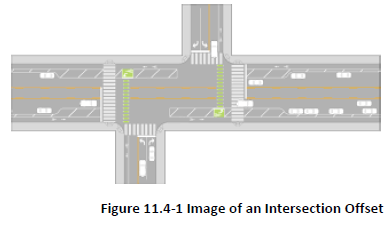
Level of Service (LOS), Roadway
As a qualitative measure used to relate the quality of traffic service. LOS is used to analyze streets by categorizing traffic flow and assigning quality levels of traffic based on performance measure like speed, density, etc.
Maintenance Bond
Shall be the legal binding agreement required by the developer after the construction of any public improvements for financial surety (bond) to cover any cost the city has to incur in maintaining any of the public improvements constructed by the developer for a period of two years after the city has accepted such improvements. AV rated carrier authorized to do business in the State of Texas and registered with the Texas Insurance Commission.
Metes and Bounds
Is the boundaries or limits of a tract of land especially as described by reference to lines and distances between points on the land.
Monuments
Is a permanent marker set by a land surveyor to mark or reference a point on a property or land line which is permanently marked or tagged with the certificate number of the land surveyor setting it.
Natural Creek
An existing drainage feature in its natural undisturbed state that has not been graded, filled, modified, cleared, or created by equipment. Natural creek also includes areas that have been naturalized or restored to mimic an undisturbed state.
Off-site
All areas that lie outside the boundary of the proposed development.
On-site
All areas that lie within the boundaries of a development, including areas proposed to be dedicated to the public.
Performance Bond
Shall be an acceptable instrument of financial guarantee provided by a developer to the city for the cost of completion of all public improvements on a development in case the developer fails to complete the project per the approved Developer's Agreement. AV rated carrier authorized to do business in the State of Texas and registered with the Texas Insurance Commission.
Plat
The plan or map for the development to be filed for record in the Plat Records or Deed Records of Ellis County, Texas.
Plat, Amending
A plat correcting errors or making minor changes to the original recorded plat, as permitted in the Texas Local Government Code.
Plat, Final
The instrument that becomes the official, accurate permanent record of the division of land.
Plat, Minor
A subdivision resulting in four or fewer lots and that does not require the creation of any new public street or the extension of municipal facilities.
Plat, Preliminary
A preliminary plan or map indicating the proposed arrangements of streets, lots, easements, public facilities, and other spaces in the development.
Plat Vacation
A plat that returns platted property to the condition of the property prior to the filing of the latest plat filed of record.
Pollution
The alteration of the physical, thermal, chemical, or biological quality of, or the contamination of, any water in the state that renders the water harmful, detrimental, or injurious to humans, animals, life, vegetation, or property, or to the public health, safety, or welfare, or impairs the usefulness or the public enjoyment of the water for any lawful or reasonable purpose.
Private Access Easement
An easement across private property that provides access to one or more lots.
Public Facilities
Transportation, utility, drainage, park, and other City services required to serve a development.
Public Improvements
Shall be the construction of any public water and sewer utility, drainage ditch, roadway, parkway, sidewalk, pedestrian way, or other facility for which the City may ultimately assume the responsibility for maintenance and operation.
Public Utility or Utilities
The City of Ennis and any corporation or authority franchised by the City of Ennis to provide water, sewer, refuse collection, natural gas, electricity, telecommunication, or similar services on a community-wide basis.
Reserve Fund
A reserve fund is a pool of money collected and created by a developer or property owners' association to take care of maintenance, repairs or unexpected expenses of amenities within common ownership of a particular development.
Rough Proportionality or Roughly Proportional
Is the legal determination of the proportional impact of a development to any required public improvement or dedication or other exaction.
Site Development Permit
Shall be an authorization given by the city prior to the beginning of any subdivision development-related construction.
Storm Sewer System
The system of conveyances owned and operated by the City and designed or used for collecting or conveying stormwater.
Stub Streets
Shall be the extension of streets or street ROWs to the edge of the property or development boundary in order to create a future street connection on adjoining land.
Subdivision
Is the legal act of dividing property or land into buildable lots with the provision of adequate city infrastructure and utilities.
Subdivision Identification Signs
Is the signage identifying a subdivision or master planned development and is usually placed at a major entrance(s) to the subdivision or development.
Substantive Impact
Shall be a significant impact that alters the cost, character, density or other element of the development.
Title
Is a bundle of rights on a piece of property or other asset in which a party has partial or full ownership interest.
Visibility or Sight Triangle
Shall be an unimpeded triangular area at all street or driveway intersections to aid in visibility for turning vehicles.
11.6 - GENERAL TERMS DEFINED
Accessory Use and/or Structure
A use or structure that is subordinate in size and purpose to the principal use or structure of the same lot or parcel of ground and serving a purpose customarily incidental to the use of the principal structure or use of land. An accessory structure may be attached or detached.
Accessory Structure, Detached
A structure that has no wall in common with the principal building or is not under an extension of the main roof of the principal building. Examples of detached accessory structure include, but are not limited to, garages, farm structures, home workshops and tool houses, barns, carports, playhouses, sheds, private greenhouses, enclosed gazebos, storage buildings, boathouses and docks, wind-generating devices, and swimming pool pumphouses. Buildings connected by roofed breezeways are separate buildings.
Administrator
Shall be the person(s) appointed by the City Manager responsible for administering the different provisions of this Ordinance. Different articles in this Ordinance may be administered by different department heads but still under the umbrella of "Administrator."
Amenities
Shall include facilities or improvements that provide benefits to users or residents of a building, trail, park, site, or other facility.
Annexation
Is the process whereby the city expands its boundaries by adding a specific geographic area into its corporate limits.
Apartment, Large
Shall be a building with at least nine (9) multiple dwelling units that are either stacked on top another on different floors or next to one another on the same floor or both.
Apartment, Small
Shall be a building with at least five (5) but no more than eight (8) multiple dwelling units that are either stacked on top another on different floors or next to one another on the same floor or both.
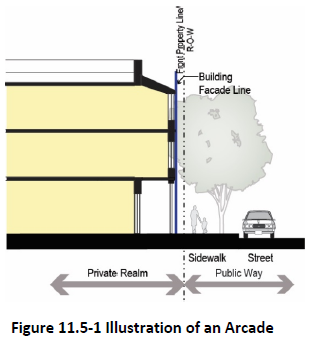
Arcade
Is a portion of the main façade of the building that is at or near the property line and a colonnade supports the upper floors of the building. Arcades are intended for buildings with ground floor commercial or retail uses and the arcade may be one or two stories. The ground floor area within the arcade may be conditioned or non-conditioned space.
Architecturally Finished
A finish characterized by a uniform appearance pertaining to materials, features, characteristics, or details most often specified for exposed surfaces used to build or ornament a structure.
Arterial Roadway
Shall be as defined by the city's adopted Master Thoroughfare Plan.
Articulation, Building
Off-sets, projections, recessed walls, windows, doors, and similar features that provide variation to a building facade and its roof line.
Attic
Shall be the part of the building under the roof structure that may or may not be habitable. Attics less than 7' in height shall not be counted towards the number of stories limitation.
Automobiles
Any vehicle propelled by mechanical power for general passenger use on the road, such as cars, vans, or passenger trucks. For purposes of this Ordinance, this definition shall not include freight trucks (18 wheelers), campers, RVs, and recreational trailers, equipment such as construction equipment, forklifts, farm implements, and neighborhood electric vehicles or golf carts.
Auto-Oriented
Shall include all uses and elements of site design that relate to the use and ease of use of automobiles including uses such as car dealers, car washes, gas stations, etc. and site elements such as parking, loading, unloading, drive thru's, etc.
Awning or Canopy
A roof-like cover, often of fabric, metal, or glass, designed and intended for protection from the weather or as a decorative embellishment, and that projects from a wall or roof of a structure over a window, walk, or door.
Balcony
Is an unsupported or cantilevered platform that projects from the façade of a building and is enclosed by a parapet or railing.
Banding
Narrow inlay of a color or grain which contrasts with the surface it decorates. Also refers to other long narrow ornamentation, such as painting or carving.
Bedroom
A habitable room that is used primarily for sleeping in any dwelling unit.
Berm
A mound of soil, either natural or man-made, used to screen and visually separate, in part or entirely, one area, site, or property from the view of another area.
Block
A tract of land bounded by streets or by a combination of streets and public parks, cemeteries, railroad right-of-way, airport boundaries, or corporate boundary lines of the city.
Block Face
Is one side of a street, from one intersection to the next.
Block Perimeter
Is the sum total of all block face dimensions circumscribed by public or private streets or pedestrian facilities with public access easements.
Breezeway
Is a roofed, often open, passage connecting two buildings (such as a house and garage) or halves of a building. A roofed breezeway is not an extension of any building that it connects, and does not combine two or more buildings into a single building.
Build
To erect, construct, convert, enlarge, reconstruct, restore, or alter a building, structure, or infrastructure.
Building or Structure
Any structure which is built for the support, shelter, or enclosure or partial enclosure of persons, animals, chattels, or movable property of any kind.
Building, Detached
A building surrounded by yards or open space on its own building lot, or buildings in a building group that are physically detached one from the other.
Build-to Line
A line established, in general, parallel to the front property line, to which the front façade of the building shall be built to.
Build-to Zone
An area between the minimum and maximum front setbacks within which the front façade of the building shall be located.
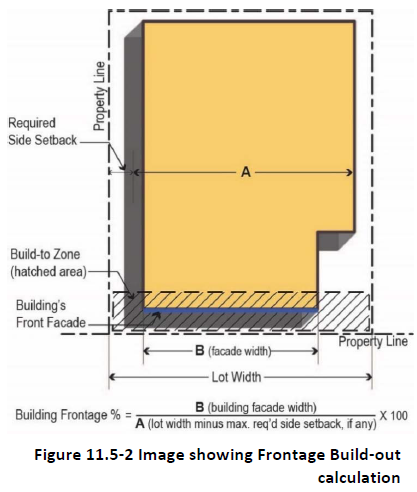
Frontage Build-out
Is the percentage of a building's front façade that is required to be located within the Build-to Zone (BTZ) as a proportion of the lot's width along the fronting public street. Required driveways, stairs to access entrances, parks, plazas, squares, improved forecourts, and pedestrian breezeway frontages shall count towards the required building frontage.
Building Official
The officer or other designated authority charged with the administration and enforcement of City ordinances related to construction, building, plumbing, electrical, or mechanical work.
Building Permit
Is an official certificate of permission issued by the City to a builder to construct, enlarge, or alter a building.
Building, Principal or Primary
The main building on a lot in which a principal use of the lot on which it is located is conducted.
Caliper
The caliper is the diameter of the trunk, measured at breast height, which is typically four and one-half feet above the ground.
Certificate of Occupancy (CO)
A certificate issued by the City prior to using or occupying a non-residential or multi-family structure or building.
Change in Use
Changing permitted uses between land use categories in the use tables in Article V: Use Standards.
Cladding
The exterior building finish or material.
Collector Street
Shall be as defined by the city's adopted Master Thoroughfare Plan.
Co-location
A single telecommunications tower and/or site used by more than one telecommunications service provider.
Column
An architectural support of definite proportions, usually cylindrical in shape, with shaft, capital, and sometimes a base. A column may be free-standing or attached to a wall.
Commercial Use or Building
Shall be the use of land or building for commercial or business purposes as listed in Article V: Use Standards.
Comprehensive Plan
The plan adopted by the City Commission as the official policy to guide development of the city and its extraterritorial jurisdiction. The Comprehensive Plan includes any applicable sub-area, neighborhood, sector, or district plans; and other supporting elements, studies, and documents as may be adopted by the City Commission.
Cornice
The uppermost horizontal molded projection or other uppermost horizontal element located at the top of a building or portion of a building.
Courtyard
A landscaped open space in the center of a block with no street frontage, and that is inwardly oriented and large enough to allow for pubic activities and sunlight during midday.
Development or to Develop
"Development" shall mean:
1.
The construction of one or more new buildings or structures on one or more building lots;
2.
The existence of a building on a building lot;
3.
The use of open land for a new use;
4.
Any manmade change to improved or unimproved real estate, including but not limited to buildings or other structures, mining, dredging, filling, grading, paving, excavation, drilling operations, or storage of equipment or materials; or,
5.
"To develop" shall mean to create a development.
Display
The exhibition of goods, wares, or merchandise for retail sale, rental, or lease.
District
See Zoning District
Dormers or Dormer Windows
A dormer is a roofed structure, often containing a window that projects vertically beyond the plane of a pitched or sloped roof. It is also known as a dormer window.
Dwelling Unit
Shall be a self-contained unit of accommodation of one or more rooms including kitchen designed as a residence for occupancy by one household for the purpose of cooking, living and sleeping. This definition shall include single-family dwellings, two-family dwellings, and multiple family dwellings, but not include hotels or motels.
Dwelling, Detached
A dwelling which is entirely surrounded by open space on its building lot.
Dwellings, Attached
A dwelling which is joined to another dwelling at one or more sides by a partial wall or walls.
Encroachment
Means any structural or non-structural element such as a sign, awning, canopy, terrace, or balcony that extends into a setback, into the public right-of-way, or above a height limit.
Entryway
The doorway into a building along with the architectural treatments that accompany it.
Exterior Insulation and Finish System (EIFS)
A multi-layered exterior wall system typically consisting of insulation board that is secured to the exterior wall surface with a specially formulated adhesive and/or mechanical attachment; a durable, water-resistant base coat, which is applied on top of the insulation and reinforced with fiber glass mesh for added strength; and a durable finish coat which is both colorfast and crack-resistant.
Extra Territorial Jurisdiction (ETJ)
Shall be the area outside the city's incorporated limits where the city can legally exercise its planning authority.
Facade
Any exterior wall or face of a building that encloses or covers usable space. Multiple buildings on the same lot will each be deemed to have separate facades. A roof shall not be included in the definition of a facade.
Family
Individuals living together as a single housekeeping unit in which not more than four individuals are unrelated to the head of the household by blood, marriage, or adoption. The term expressly excludes residents of an assisted living facility, boarding house, fraternity or sorority house, private dorm, halfway house, or nursing home, as defined by this Ordinance.
Fence or Screening Wall
A barrier composed of posts connected by boards, rails, panels, or wire for the purpose of physically enclosing an area or separating parcels of land. The term "fence" does include retaining walls if such walls provide enclosure and/or separation of parcels.
Fenestration
Window treatment in a building or building facade. Also, a general term used to denote the pattern or arrangement of openings, i.e., windows and doors, in a facade.
Forecourt
An open, unoccupied space, typically located in the front of a lot, bounded on more than one side by the walls of a building or buildings and used as a primary means of access to all or any part of said buildings.
Freeway or Highway
Shall be any regional or interstate high speed roadway with controlled access.
Freeway or Highway Frontage Road
Frontage road (also known as an access road, service road, parallel road, etc.) is a local road running parallel to a freeway or a highway. A frontage road is often used to provide access to adjoining properties and development.
Gable Roof or Sloped Roof
A gable roof consists of two roof sections sloping in opposite directions and placed such that the highest, horizontal edges meet to form the ridge of the roof.
Grade
The average of the finished ground surface elevations measured at the highest and lowest exterior corners of a structure.
Gross Floor Area (GFA)
When applied to a building, the area in square feet measured by taking outside dimensions of the building at each floor, excluding however, the floor area of basements or attics when not occupied or used.
Ground Cover
Plants and turfs that normally reach a height of less than two feet upon maturity, installed in such a manner so as to form a continuous cover over the ground.
Height, Building
Shall be the vertical distance measured from the average finished grade next to the building to (a) to the highest point of the roof surface or parapet, if a flat roof; (b) to the deck line of a mansard roof; or to the mean height level between eaves and ridge for a gable, hip or gambrel roof.
Hipped Roof
A hipped roof consists of all sides sloping downwards towards the walls of the structure it is covering.
Industrial Uses
This category of uses of sites and buildings shall include all manufacturing, assembly, warehouse, and waste management activities.
Institutional Uses
This category shall include nonprofit or service organizations such as public schools, hospitals, religious institutions, and government facilities.
Irrigation System
A method of providing the proper amount of water for the particular type of plant material used.
iSWM Standards
Integrated Stormwater Management program by the North Central Texas Council of Governments (NCTCOG).
ITE Manual for Designing Walkable Urban Thoroughfares
Designing walkable urban thoroughfares: a context sensitive approach. Washington, DC: Institute of Transportation Engineers. (most recent edition). Daisa, James, M (author).
Joint, Common, or Cross Access Easements or Private Access Easements
Shall be the coordination of shared private easements and driveway access between adjoining properties with the goal of allowing users to travel across each other's lot to reach adjoining properties or street(s).
Kaufman Corridor District
Shall be a special zoning district category which implements the vision for a more walkable and vibrant Kaufman Corridor with a mix of cottage or craft industrial, retail, and residential uses.
Landscape Architect
A person licensed to practice landscape architecture pursuant to the laws of the State of Texas.
Landscape Area
An area which is covered by grass, ground cover, or other natural plant materials, including screening.
Landscaping
Living plant material, including but not limited to grass, trees, shrubs, berms, water forms, and planters.
Lot
A platted parcel of land intended to be separately owned or developed, and that is recorded in the property records of Ellis County, Texas.
Lot, Adjoining or Adjacent
Any lot, parcel, or piece of land that shares a common lot line, alley, or any point of tangency with the lot under consideration.
Lot Area
That area of a horizontal plane bounded by the front, side, and rear lot lines, including any portion of an easement which may exist within such property lines, and exclusive of approved rights-of-way for public street, private street, alley, or rail purposes.
Lot, Corner
A lot situated at the intersection of two or more streets.
Lot Coverage
The percentage of the lot area that is covered by a building or structure.
Lot Depth
The average horizontal distance between the front and rear lot lines.
Lot, Interior
A lot other than a corner lot.
Lot Line, Front
That boundary of a lot that abuts a public street, private street, or approved access easement. On corner lots, the front lot line shall be the shorter line abutting a public street, private street, or approved access easement.
Lot Line, Interior
A lot line which is common to two lots.
Lot Line, Rear
That boundary of lot that is opposite the front lot line and that is most nearly parallel with the front lot line.
Lot Line, Side
That boundary that is not a front or rear lot line.
Lot of Record
An area of land designated as a lot on a plat of a subdivision recorded in the Plat Records of Ellis County, Texas, pursuant to statute, with the respective County Clerk.
Lot Width
The horizontal distance between side lot lines measured at the required front setback line.
Major Amendment
Means a requested amendment to an approved plan (Concept, Development, or Site Plan) that is substantially different from the originally approved plan as determined by the Administrator per this Ordinance.
Massing, Building
Is the external shape of a building and how it relates to or fits in with adjoining streets, sidewalks, and buildings.
Meandering
Taking a sinuous course with curves in alternate directions.
Minor Amendments
Means a requested amendment to an approved plan (Concept, Development, or Site Plan) that are nominal with no substantive changes to the development intensity or character.
Mixed-Use Development or Building
The development of a tract of land, building, or structure in a compact urban form with a residential use and a non-residential use as permitted by the applicable zoning district from the land use categories listed in Article V: Use Standards. The layout of a mixed-use development may be vertical or horizontal in design.
Multi-Family Development
Shall include all multi-family buildings and associated uses and site amenities that are master planned together (even if they may be built in different phases). Such development could be on one lot or multiple lots or one building or multiple buildings.
NACTO's Urban Street Design Guide
Urban Street Design Guide. New York City: National Association of City Transportation Officials. (most recent edition).
Neighborhood Conservation District
Shall be a residential zoning district category which implements the vision for the more compact, connected, and walkable neighborhood areas around Downtown Ennis that were developed on traditional neighborhood planning principles.
Nonconforming Building or Structure or Site
Any existing building, structure or site improvements that were erected according to all applicable City ordinances at the time, but which does not now comply with all the regulations applicable to the district in which the structure or site is located, and as further defined in Article X: Nonconformities.
Nonconforming Lot
A lot that does not conform to the lot area, width, or depth requirements of the zoning district in which it is located, and as further defined in Article X: Nonconformities.
Nonconforming Use
Generally, the use of an existing property or structure after the effective date of this Ordinance, which does not comply with the use regulations applicable to the district in which the property is located, and as further defined in Article X: Nonconformities.
Non-Residential
Shall be a catch-all land or building use category that includes all uses except residential (single and multi-family) uses.
Office
Shall include a range of commercial or nonprofit or governmental activities that occur within buildings where employees and visitors are the primary users of the buildings and such uses are typically not related to direct retail trade with customers.
Open Space
Is publicly accessible open land in the form of parks, courtyards, forecourts, plazas, greens, playgrounds, squares, etc. provided to meet the standards in of this Ordinance. Open space may be privately or publicly owned and/or maintained.
Owner, Property or Proprietor
Each and every person or entity who is a record owner of a fee simple interest or an undivided fee simple interest in a parcel of land per the County Tax Records. If such parcel is subject to a condominium or other multi-ownership regime, the owners' association representing such multi-ownership regime, and not individual unit owners, shall be deemed the owner thereof.
Parapet
That portion of the wall which extends above the roof line.
Parking Lot
Paved surfaces used for the storage of vehicles for limited periods of time, including but not limited to: truck parking; motor vehicle display, loading, or storage areas; and/or boat sales.
Parking Screen
Is a freestanding wall or living fence or combination fence built along any lot's street frontage in order to screen a parking lot or a loading/service area from view along the street or adjoining lot.
Parkway
The area of right-of-way between the curb and the property line normally publicly owned and consisting of a variable width and may include the sidewalk and/or landscaping.
Pedestrian-Oriented Development Frontage
Shall be the percentage of the linear street or block frontage within RMU Special Districts, and the KC Special District that is designated as a Pedestrian-Oriented Street.
Pedestrian-Oriented Street
As may be identified within RMU Special Districts, and the KC Special District shall be designated as "Pedestrian" oriented. Pedestrian-oriented streets prioritize pedestrian safety and walkability and facades along Pedestrian-oriented streets shall be designed to a higher standard that other streets in the MU District.
Pediment
On facades, it is a low gable, typically triangular with a horizontal cornice and raking cornices, surmounting a colonnade, an end wall, or a major division of a façade. It could also be any imitation of this element used to crown an opening or to form part of a decorative scheme.
Person
An individual, firm, partnership, corporation, company, association, joint stock association, or body politic, and includes a trustee, receiver, assignee, administrator, executor, guardian, or other representative.
Pilaster
Is a shallow rectangular feature projecting from a wall, having a capital and base and usually imitating the form of a column.
Playground
An outdoor area designed for unorganized recreational play. Playgrounds may consist of open space or informal play areas containing equipment such as swings, jungle gyms, seesaws, merry-go-rounds, backstops, goals, and similar equipment. Areas designed specifically for organized athletic events or containing buildings, bleachers, paved surfaces, field lights, or outdoor speakers, are not included within the definition of playground.
Plaza
A predominantly hard-surfaced space that is a portion of a block with a minimum of one side open to the street and other edges defined by buildings. Building edges should contain continuous retail, restaurant, or public uses at grade to animate and support the open space. Unlike intimate scale urban gardens, a plaza may contain a primary entrance to an adjacent building.
Porch
Is an exterior appendage to a building, forming a roofed approach or vestibule to a doorway, typically the front entryway.
Primary Entrance
Means the public entrance located along the front of a building facing a street or sidewalk and provides access from the public sidewalk to the building. It is different from a secondary entrance which may be located at the side or rear of a building providing private controlled access into the building from a sidewalk, parking or service area.
Residential Use
Shall be any use of the land or buildings for household living.
Right-of-way
A public or private area that allows for the passage of people or goods. Right-of-way includes passageways such as freeways, streets, bike paths, alleys, and walkways. A public right-of-way is a right- of-way that is dedicated or deeded to the public for public use and under control of a public agency.
Roof Line
Shall be the line along the highest points of a roof.
Row House
See Townhouse
Salvage
Any discarded, abandoned, junked, wrecked, dismantled, worn out, or ruined motor vehicles (including automobiles, trucks, tractor trailers, and buses), motor vehicle parts, boats, travel trailers, trailers, cranes, machinery or equipment, machinery or equipment parts, recreational vehicles, and/or any junk.
Screening or Screening Device
A barrier of stone, brick, pierced brick or block, uniformly colored wood, vegetation, or other permanent material of equal character, density, and design.
Setback
An open space, other than a court, on a lot unoccupied and unobstructed from the ground upward, unless specifically otherwise permitted in this Ordinance.
Setback, Rear
A yard extending across the rear of a lot and being the minimum horizontal distance between the rear lot line and the rear façade of the principal building or any projections thereof other than steps, unenclosed balconies, or unenclosed porches.
Setback, Side (Interior)
A yard extending from the side lot line that is not adjacent to a street and being the minimum horizontal distance between any side façade of the primary building or projections thereof and the side lot line.
Setback, Street Front
A yard extending along the primary street frontage of a lot and being the minimum horizontal distance between the street right-of-way line and main building façade (including any enclosed projections) with the primary building entrance.
Setback, Street Side
A yard extending from the side lot line that is adjacent to a street and being the minimum horizontal distance between any side façade of the primary building including any enclosed projections and the side lot line.
Shared Parking
One or more parking facilities shared by multiple users on separate lots.
Sidewalk
A paved walkway along the side of a street.
Sill
The horizontal member forming the bottom of a window or exterior doorframe.
Site
The total area of a lot or tract of land, from property line to property line, including any land subject to any easement or license. A site shall be a homogeneous parcel under single ownership or unified control.
Stoop
A small porch, platform, or staircase leading to the entrance of a building.
Story or Floor
That portion of a building, other than a basement, included between the surface of any floor and the surface of the next floor above it, or if there is no floor above it, then the space between the floor and the ceiling above the floor of such story. This includes any mezzanine or loft which may comprise only a portion of a full floor plate.
Street
A public way for vehicular traffic.
Street Abandonment
Shall mean the abandonment of a street, alley or other public way from public use and reversion to private ownership by action of the City Commission either through a vacating plat or by separate instrument.
Street Frontage
The length of property along a street.
Streetscape
The area between the building and edge of the vehicular or parking lanes. The principal streetscape components are curbs, sidewalks, street trees, tree planters, bicycle racks, litter containers, benches, and street lights. Treatments may also include a range of provisions such as paving materials; street, pedestrian, and wayfinding signs; parking meters; utility boxes; public art; water features; bollards; informational signage; and other elements.
Street Tree
Trees planted within the Streetscape.
Structure
An object, including a mobile object, constructed or installed by man, including, but not limited to, buildings, poles, water towers, cranes, smokestacks, earth formations, and overhead transmission lines.
Subdivision Perimeter Fence or Fencing
Is the fencing along the external boundary of a subdivision or master planned development.
Telecommunications
The transmission, between or among points specified by the user, of audio and/or visual information of the user's choosing, without change in the form or content of the information as sent and received.
Telecommunications Service
The offering of telecommunications for a fee directly to the public, or to such classes of users as to be effectively available directly to the public, regardless of the facilities used.
Texture
Is the visual and especially tactile quality of the surface of a building with respect to the size, shape, arrangement, and finish of the exterior building material.
Topography
Is the study and description of natural and man-made land and water features of an area.
Tower Height
The distance measured from grade to the highest point of any and all components of the structure, including antennae, hazard lighting, and other appurtenances, if any.
Tree, Canopy
A perennial woody plant, single or multiple trunk, with few if any branches on its lower part, which at maturity will obtain a minimum six inch caliper.
Tree, Ornamental
A perennial woody plant generally of 25 feet or less at maturity that may branch to the ground and has significant seasonal color, texture, or other ornamental characteristics
Tree, Protected
Any existing tree of at least six caliper inches that is indicated to be retained after development of the site.
Use
When applied to land or buildings, the purpose or activity for which such land or building thereon is designed, arranged, or intended, or for which it is occupied or maintained.
Variance
An adjustment in the application of the specific regulations of this Ordinance to a particular piece of property, which, because of special circumstances uniquely applicable to it, is deprived of privileges commonly enjoyed by other properties in the same vicinity and zone, and which adjustment remedies disparity in privileges. A variance may be granted solely by the Zoning Board of Adjustment in accordance with the provision of Article III: Review Procedures.
Xeriscape
A concept to conserve water through creative landscaping and use of native plants. The main principles of xeriscape are:
1.
reduction of turf area;
2.
use of drought-tolerant and native or adapted plant materials;
3.
grouping of plants with similar water requirements; and
4.
an irrigation system designed to meet plant needs.
Yard
The ground that immediately adjoins or surrounds a house, public building, or other structure. The front yard is the area between the structure and the main street that the building/s fronts on. The side yard is the area/s on the sides of the structure/s generally perpendicular to the front yard. The rear yard is the area behind the structure/s and on the opposite side of the main street.
Zoning District
An area designation for which the regulations governing the area, height, and use of buildings and land are uniform.
Zoning Map
The map or maps, either physical or electronic, incorporated into this Ordinance as a part hereof by reference thereto that identify the different zoning districts established by this Ordinance.
(Ord. No. 19-0820-10, § 1, 8-20-19)

