
Ennis City Zoning Code
ARTICLE VII
Site Design and Development Standards
7.1 - APPLICABILITY
Table 7.1-1 shall establish the applicability of the different standards in this section based on the type of development.
7.2.1 - Purpose
The regulations of this section are intended to ensure provision of off-street parking and loading facilities in rough proportion to the generalized parking, loading, and transportation demands of different land uses. By requiring such facilities, it is the intent of this section to help avoid the negative effects associated with spillover parking into adjacent neighborhoods, while at the same time avoiding the negative environmental and urban design effects that can result from large surface parking lots and other vehicular use areas. The provisions of this section are also intended to help protect the public health, safety, and general welfare by:
(1)
Helping avoid and mitigate traffic congestion;
(2)
Encouraging pedestrian safety;
(3)
Providing methods to help reduce storm water runoff and the heat island effect of large paved parking areas; and
(4)
Providing flexible methods of responding to the changing transportation and access demands of various land uses in different areas of the city.
7.2.2 - Applicability
(1)
GENERALLY: The off-street parking and loading standards of this section shall apply to all parking lots and parking structures accessory to any building constructed and to any use established in every district. Except when specifically exempted, the requirements of this section shall apply to all temporary parking lots and parking lots that are the principal use on a site.
(2)
EXPANSIONS AND ENLARGEMENTS: The off-street parking and loading standards of this section shall apply when an existing structure or use is expanded or enlarged. Additional off-street parking and loading spaces shall be required to serve the enlarged or expanded area, provided that in all cases the number of off-street parking and loading spaces provided for the expanded use shall equal 100 percent of the minimum ratio established in Tables 7.2-3a and 7.2-3b.
(3)
CHANGE IN PERMITTED USES: A permitted use that does not meet the parking requirements of this section may be converted to another permitted use without full compliance with the required number of parking spaces if the Administrator determines:
(a)
The maximum amount of parking spaces possible is provided without removing or partially removing a structure.
(b)
If a structure or a portion of a structure is voluntarily removed, the resulting area shall be used to provide the additional parking spaces necessary towards fulfilling the requirements of Tables 7.2-3a and 7.2-3b.
(c)
The amount of parking available at least 75 percent of the parking required for the new use in Tables 7.2-3a and 7.2-3b.
(4)
LOCATION: Required off-street parking, loading, and vehicle stacking spaces shall be located on the same lot as the principal use, except as otherwise provided in this section.
(5)
USE LIMITED TO PARKING: No required off-street parking facility or loading space shall be used for sales, non- vehicular or rental vehicle storage, repair, or service activities unless specifically provided for in this Ordinance.
7.2.3 - Off Street Parking Standards
(1)
OFF-STREET PARKING SCHEDULE A: The off-street parking requirements for uses allowed by this Ordinance are listed in Table 7.2-3a. The vehicle stacking requirements of Section 7.2.6, Drive-Through Vehicle Stacking, may also be applicable to certain uses.
(2)
OFF-STREET PARKING SCHEDULE B: Uses that reference Schedule B in Table 7.2-3a, Off-Street Parking Schedule A, shall provide the minimum number of spaces identified in the table below.
(3)
OFF-STREET PARKING SCHEDULE C: Uses that reference Schedule C in Table 7.2-3a, Off-Street Parking Schedule A, have widely varying parking characteristics and uses that reference Schedule B in Table 7.2-3b, Off-Street Parking Schedule B, may have widely varying parking characteristics that make it difficult to establish a single standard. Upon receiving an application for a use subject to Schedule B or Schedule C standards, the Administrator shall apply the off-street parking standard specified for the listed use that is deemed most similar to the proposed use. The Administrator may also establish off-street parking requirements based on a parking analysis prepared by the applicant. Such analysis shall include estimates of parking demand based on recommendations of the Institute of Transportation Engineers (ITE), or other acceptable estimates, and shall include other reliable data collected from uses or combinations of uses that are the same as or comparable with the proposed use. Comparability shall be determined by density, scale, bulk, area, type of activity, and location. The analysis shall document the source of data used to develop the recommendations.
(Ord. No. 22-1101-E2, § 3, 11-1-22; Ord. No. 25-0603-F1, § 5, 6-3-25)
7.2.4 - Computation of Parking and Loading Requirements
(1)
FRACTIONS
When measurements of the number of required spaces result in a fractional number, any fraction exceeding 0.5 shall be rounded up to the next higher whole number.
(2)
MULTIPLE USES
Lots containing more than one use shall provide parking and loading in an amount equal to the total of the requirements for all uses. No off-street parking space provided for one type of use or building shall be included in calculation of the off-street parking requirements for any other use or building except as prescribed in Section 7.2.7, Alternative Parking Plan, of this Ordinance. Multi-tenant buildings shall not designate parking spaces for individual tenants within a multi-tenant development. All parking spaces shall be available for all users.
(3)
AREA MEASUREMENTS
Unless otherwise specified, all square footage-based parking and loading standards shall be computed based on gross floor area of the use in question. Structured parking within a building shall not be counted as gross floor area in such measurement.
(4)
OFF-STREET LOADING AND SERVICE AREAS
Required off-street loading spaces shall not be counted as off-street parking spaces in computation of required off-street parking spaces. Parking spaces located in buildings used for repair garages or car washes, and spaces in drive-through lanes shall not be counted as meeting the required parking.
(5)
PARKING BASED ON OCCUPANTS
Except as provided for in this section, when the standards use the number of occupants as a unit of measurement, all calculations shall be based on the occupant load as determined by the city's adopted Building and Fire Codes.
(6)
PARKING BASED ON SEATING
When the standards use seating as a unit of measurement, all calculations shall be based on the occupant load of the areas used for seating as determined by the city's adopted Building and Fire Codes.
(7)
PARKING FOR UNLISTED USES
Parking requirements for uses not specifically listed in Table 7.2-3a, Off-Street Parking Schedule A, shall be determined by the Administrator based on the requirements for the closest comparable use, as well as on the particular parking demand and trip generation characteristics of the proposed use. The Administrator may alternately require the submittal of a parking demand analysis that justifies estimates of parking demand based on the recommendations of the Institute of Transportation Engineers (ITE), and includes relevant data collected from uses or combinations of uses that are the same or comparable to the proposed use in terms of density, scale, bulk, area, type of activity, and location.
(8)
SPECIAL PARKING REQUIREMENTS IN CERTAIN ZONING DISTRICTS
(a)
Regional Mixed Use Districts
i.
In any Regional Mixed Use Districts (RMU), the total requirement for off-street parking facilities shall be the sum of the requirements for the various uses computed separately.
(b)
The total number of required parking spaces in a RMU District may be reduced by the Administrator if the applicant prepares a parking demand study that demonstrates a reduction is appropriate based on the expected parking needs of the development, internal trip capture, and similar factors. The parking demand study shall be prepared in a form and manner prescribed by the Administrator.
(c)
Surface parking lots, off-street parking spaces, and associated driving aisles shall not be permitted between the building and pedestrian-oriented streets. However, the Administrator may approve an off-street area for passenger drop-off or pick-up activity such as porte-cocheres or other similar elements that still maintain a continuous pedestrian streetscape with an Administrative Modification.
(d)
Kaufman Corridor District
i.
Given the mixed use and redevelopment goals of the Kaufman Corridor District in addition to the focus on walkability, Table 7.2-3 shall establish the parking schedule for all uses in the Kaufman Corridor District
7.2.5 - Accessible Parking
In addition to the required off-street parking identified in Section 7.2.3, Off-Street Parking Standards, accessible parking shall be provided for multi-family and all non-residential uses in accordance with the Americans with Disabilities Act and the Texas Accessibility Standards.
7.2.6 - Drive-Through Vehicle Stacking
The following standards shall apply to businesses that contain a drive-through establishment, regardless if the drive-through is part of another use (e.g., restaurant or financial institution) or if it is a stand-alone use (e.g., automatic teller machine).
(1)
LOCATION OF STACKING LANES AND USE OF ORDERING DEVICES
(a)
Ordering devices or menu boards such as audible electronic devices with loudspeakers, automobile service order devices, and similar instruments shall be oriented away from any adjoining residential properties.
(b)
No service shall be rendered, deliveries made, or sales conducted within the required front yard or corner side yard; customers served in vehicles shall be parked to the sides and/or rear of the principal building.
(c)
All drive-through areas, including but not limited to menu boards, stacking lanes, trash receptacles, loudspeakers, drive up windows, and other objects associated with the drive-through area shall be located in the side or rear yard of a property to the maximum extent feasible, and shall not cross, interfere with, or impede any public right-of-way.
(2)
STACKING SPACE AND LANE REQUIREMENTS: The number of required stacking spaces shall be as provided for in Table 7.2-6, Stacking Space Requirements.
(3)
DESIGN AND DIMENSIONS: Stacking lanes shall be provided for any use having a drive-through establishment and shall comply with the following standards:
(a)
Drive-through aisles:
i.
Cannot interfere with the on-site parking and circulation for other vehicles on the site;
ii.
Cannot interfere with on-site parking; and
iii.
Cannot result in traffic queuing into a drive aisle, adjacent property or street.
(b)
Drive-through stacking lanes shall have a minimum width of ten feet.
(c)
Drive-through by-pass lane shall be provided.
7.2.7 - Alternative Parking Plan
The Administrator may approve alternatives to providing the number of off-street parking spaces required by Section 7.2.3, Off-Street Parking Standards, in accordance with the following standards.
(1)
OFF-PREMISE PARKING
The Administrator may permit an off-premise parking facility to accommodate either required or additional parking subject to the following conditions:
(a)
The off-premise parking facility shall be located within 400 feet from an entrance, as measured along the shortest practical walking route, to the structure for which it will be used.
(b)
Off-premise parking should be connected to the use by a sidewalk or paved walkway.
(c)
Residential parking or accessible parking may not be provided in off-premise facilities.
(d)
Off-premise parking shall have the same or more intensive zoning classification as the primary use served.
(e)
The owner of the property being used for off-premise parking shall have executed a parking agreement for such parking and shall notify the city in the event the parking agreement is terminated. The parking agreement shall be an encumbrance to the property and shall be recorded in the Ellis County real property records.
(2)
SHARED PARKING
The Administrator may approve shared parking facilities for developments or uses with different operating hours or different peak business periods if the shared parking complies with all of the following standards:
(a)
Location: Shared parking spaces shall be located within 400 feet of a public entrance to the uses served unless remote parking shuttle bus service is provided.
(b)
Zoning Classification: Shared parking areas for non-residential uses shall not be located on residentially zoned property including multi-family residential property.
(c)
Shared Parking Analysis: Where shared parking is contemplated, the applicant may be required to include parking accumulation analyses as a part of the request for approval. The analysis shall include the parking demand for each hour over a 12- to 24-hour period for a typical high volume day. This will determine the minimum number of spaces that shall be provided. Based on the analysis submitted, if the maximum number of vehicles accumulated during a peak hour or hours for all overlapping uses exceeds the number of spaces that are required to be provided, shared parking shall be limited. A prorated number of shared parking spaces may be permitted based on the justification information of the analysis.
(d)
Agreement for Shared Parking: A shared parking plan will be enforced through a written agreement among all owners of record. An attested copy of the agreement between the owners of record shall be submitted to the Administrator for review and approval. The applicant shall record the agreement prior to the issuance of a building permit or certificate of occupancy for any use to be served by the shared parking. A shared parking agreement may be terminated if all required off-street parking spaces are to be provided in accordance with the requirements of Section 7.2.3, Off-Street Parking Standards.
(e)
Shared parking agreements that existed prior to the adoption of this Ordinance shall continue in force.
(f)
Amendments to pre-existing agreements shall be made pursuant to the terms of this Section and shall be done by written agreement.
(3)
PUBLIC PARKING
Credit for Nearby Public Parking: Spaces available in public parking areas located within 400 feet of the subject use may be counted toward the total amount of required off-street parking if the Administrator determines that the spaces are reasonably available for the use.
7.2.8 - Parking Facility Location and Design
(1)
PARKING SPACE DIMENSIONS
(a)
No parking space shall be less than 18 feet in length and nine feet in width, except as provided below.
(b)
Parking spaces may be reduced in length when a tire-stop curb is installed 16 feet from the maneuvering lane and a clear space of two feet is provided for a vehicle to overhang. The overhang is not permitted over public property, sidewalks, a landscaped area, or a setback in which parking is not permitted. Such reduction is permitted only when the width of the maneuvering lane is maintained at 26 feet.
(c)
A maximum of 20 percent of the required parking spaces may be designed and reserved for compact cars. Compact car parking spaces will be a minimum of eight feet by 16 feet and shall be clearly identified with either a sign or pavement marking limiting the spaces to compact cars.
(d)
The minimum two-way parking aisle width is 24 feet unless designated as a fire lane in which case the standard for a fire lane shall supersede.
(2)
DESIGN OF PARKING SPACES: The following shall apply in all zoning districts:
(a)
Parking Prohibited in Rights-of-Way and Drive Lanes:
i.
No off-street parking facility shall be located, in whole or in part, in a public street or sidewalk, parkway, alley, or other public right-of-way.
ii.
No off-street parking or loading space shall be located, either in whole or in part, within any fire lane required by ordinance of the city or within aisles, driveways, or maneuvering areas necessary to provide reasonable access to any parking space.
(b)
All parking areas, drive aisles, and fire lanes shall be of concrete paving unless alternative paving materials are approved based on unique design features as part of a site plan approved by the City Commission.
(3)
PARKING AREA LOCATION AND LAYOUT IN NON-RESIDENTIAL DISTRICTS The following shall apply in the non-residential zoning districts except in the RMU and Kaufman Corridor Districts.
(a)
Parking Location: Sites shall be designed with buildings closer to the street with parking located to the side and rear of the site to avoid views of large, paved parking areas from public rights-of-way. However, the Administrator may adjust this requirement based on the prevailing development patterns or future vision for the area in order to be consistent with the established pattern of development along the street or creating a better context for the future of the area.
(b)
Parking Area Layout: Surface parking lots shall comply with the requirements for parking lot landscaping in Article VIII.
(c)
Circulation Area Design: Circulation areas shall be designed to facilitate the safe movement of vehicles without posing a danger to pedestrians or impeding the function of the parking area. Parking lots shall maintain safe circulation patterns and access to public streets.
(d)
Parking Area Location and Design in the RMU Districts: Shall not be located between the principal building and any Pedestrian Oriented Street.
(e)
Minimum driveway stacking for commercial driveways providing access to parking lots over 20 spaces shall be 50 feet.
7.2.9 - Minimum Off-Street Loading Standards
(1)
Off-street loading shall be required for all commercial and industrial uses in all zoning districts.
(2)
Off-street facilities shall be provided and maintained for receiving and loading of merchandise, supplies, and materials within a building or on the premises.
(3)
Required off-street loading facilities may be adjacent to an existing public alley or private service drive, or may consist of a berth within a structure.
(4)
No portion of a loading facility may extend into a public right-of-way or into an off-street parking facility.
(5)
The off-street loading spaces or truck berths shall provide maneuvering areas on site to prevent any blockage of public right-of-way.
(6)
Off-street loading spaces shall be screened in compliance with the provisions of Section 7.3.3 (4), Screening of Service, Loading, and Storage Areas.
(7)
Off-street loading space or truck berth may be either regular or large in size and shall be provided in accordance with the Table 7.2-9. Regular loading spaces shall be ten feet by thirty feet (10' X 30'). Large loading spaces shall be ten feet by sixty-five feet (10' X 65).
7.3.1 - Purpose
The purpose of these standards is to ensure that less intensive development is protected from negative effects that may occur when uses that are more intensive or structures are developed on adjacent sites through the use of non-vegetative screens or fences.
7.3.2 - Applicability
(1)
GENERAL: This section establishes minimum standards for screening and fencing for all new development and redevelopment in the City of Ennis as follows:
(a)
All multi-family and non-residential development per Table 7.1-1 shall meet the standards in Section 7.3.3 on Non-Residential and Multi-Family Screening and Fences.
(b)
All single-family residential development in subdivisions with Zoning Change approved or Preliminary Platted after the adoption of this Ordinance and per Table 7.1-1 shall meet Section 7.3.4 on Single Family Residential Screening and Fences.
(2)
PARCEL SPECIFIC: Screening and fence requirements in other sections or parcel-specific development approvals:
(a)
Any use that is required to provide screening pursuant to Section 5.2, Additional Use Standards, shall comply with such requirements. In the event of a conflict between the additional use standards and the requirements of this section, the additional use standards shall control.
(b)
Any use that is required to provide screening or fencing pursuant to a parcel-specific ordinance, including PD or RMU zoning and/or approval conditions, shall comply with such requirements. In the event of a conflict between the parcel-specific zoning ordinance and/or conditions and the requirements of this section, the parcel-specific standards shall control.
(3)
SCREENING PLAN: Prior to the issuance of a building or construction permit for any use other than single-family or duplex dwellings, a screening plan reflecting all requirements under this section shall be submitted in conjunction with the Landscape and Buffering Plan per Article VIII at the time of site plan approval.
(4)
In all cases, parallel fences are prohibited. A parallel fence is a fence that runs in the same general direction of and is located within 5 feet of an existing fence or screening wall. To be considered a parallel fence, the fence does not have to maintain a precise constant distance from the existing fence.
7.3.3 - Non-Residential and Multi-Family
(1)
APPLICABILITY:
Standards in this section shall apply to all development in the MF-1, MF-2, C, BP, CC, L-IM, H-IM, KC, and IC zoning districts.
(2)
SCREENING OF TRASH AND RECYCLING COLLECTION AREAS
(a)
All refuse facilities, including new refuse facilities placed on an existing development, shall be large enough to accommodate a trash dumpster that meets all City specifications, and shall be completely screened from view of public streets:
i.
Inground trash dumpsters are preferred and placement is to comply with City specifications. More placement options may be considered by staff due to the lower visual impact of inground trash dumpsters.
ii.
Above-ground trash dumpsters must have screening on three sides by a minimum eight-foot masonry fence or wall. The opening shall include an opaque gate. Chain-link and wood gates are not permitted. Gates shall have tiebacks to secure in the open position. The container shall not be visible from public streets. The container shall not be placed in front of buildings and the placement shall be designed to minimize its visual impact on the site.
(3)
SCREENING OF SERVICE, LOADING, AND OUTDOOR STORAGE AREAS
(a)
All service areas in the MF-1, MF-2, C, BP, CC, KC, and IC zoning districts must be placed at the rear or side of the buildings.
(b)
All service areas in the L-IM and H-IM zoning districts must be placed at the rear or side of the buildings and screened from:
i.
Highways and Arterial streets, as indicated on the city's thoroughfare plan
ii.
Any residential zoning district that abuts the lot
(c)
Screening shall be long enough to screen the maximum size trailer that can be accommodated on site. Sites that can accommodate a full-size tractor-trailer shall provide a 48-foot wing wall, where wing walls are used.
(d)
Screening and gates shall not be chain link (with or without slats) and wood.
(4)
The height of the device shall not be less than the height of the materials stored or eight feet (whichever is greater). All service areas including truck berths; loading docks; and areas designated for permanent parking or outdoor storage of heavy vehicles, equipment, or materials shall be screened.
(5)
SCREENING OF GROUND MOUNTED AND ROOF MOUNTED UTILITY EQUIPMENT
(a)
Applicability: The standards of this section shall apply to all of the following:
i.
Air conditioning and heating equipment
ii.
Ductwork used to heat, cool, or ventilate
iii.
Swimming pool and spa pumps and filters
iv.
Power systems, transformers, and generators for the building or site upon which the equipment is located
v.
Similar installations as identified by the Administrator
(b)
The standards of this section are not intended to impede systems that use solar or wind energy to reduce the costs of energy, if such systems are otherwise in compliance with applicable building codes, city ordinances and zoning requirements.
(c)
Roof-Mounted Mechanical Equipment: shall be screened from view along the primary street frontage by a parapet wall or similar feature that is an integral part of the building or similar feature shall be of a height equal to or greater than the height of the mechanical equipment being screened.
(d)
Ground-Mounted Mechanical Equipment: shall be screened from view along the primary street frontage by landscaping or by a decorative fence that is compatible with the architecture and landscaping of the site. The fence shall be of a height equal to or greater than the height of the mechanical equipment being screened.
(e)
Alternate Screening: Where site constraints or other design limitations are present, the Administrator may allow mechanical equipment that is not screened in full compliance with the screening standards of this section to use alternative screening methods through an Administrative Modification. Alternate screening methods may include, but shall not be limited to, increased setbacks, increased landscaping, grouping the equipment on specific portions of a site, and painting or otherwise camouflaging the equipment.
(6)
SCREENING FROM RESIDENTIAL USES
(a)
Any commercial or industrial use or parking lot that has a side or rear contiguous to any single-family residential district, shall be screened with a fence (masonry and decorative concrete block may be approved at the time of Site Plan approval), six feet in height, in addition to any landscape buffers that are required by Article VIII. As an alternative, berms in conjunction with a minimum of a six-foot wrought iron fence (if there are no residential fences along the property line) and a combination of trees and shrubs can be utilized to meet the screening requirements if the Administrator determines that the proposed alternative will provide a similar appearance, height, and quality of screening. The screen shall be located at the property line of the commercial or industrial use. Any ordinances concerning sight obstructions of intersections shall be applicable to the screen where it is intersected by a street or driveway.
(b)
Prior to construction of any required screens, complete plans showing type of material, depth of beam, and structural support shall be reviewed to determine whether or not:
i.
The screen will withstand the pressures of time and nature
ii.
The screen adequately accomplishes the purpose for which it was intended
iii.
Plans shall be sealed by a registered engineer or they shall conform to the city's standard design for screening walls including engineered footings
(c)
Such screen shall be constructed prior to the issuance of a certificate of occupancy for any building or portion thereof.
(d)
The areas adjacent to the required screening wall, or areas adjacent to a public street or right-of-way, shall be maintained by the property owner in a clean and orderly condition, free of debris and trash in accordance with the applicable codes of the city.
(Ord. No. 19-0917-07, § 7, 9-17-19)
7.3.4 - Single Family, Duplex and Townhome Residential Fencing
(1)
APPLICABILITY
(a)
These standards are applicable in the A, RE, R-10, R-5, NC, D, TH, and MH zoning districts.
(b)
These standards shall also apply to Planned Development and Regional Mixed Use zoning districts unless alternative fence design standards are established through development specific ordinances.
(c)
Standards in Section 7.3.4(2) are applicable to replacement and new residential fences.
(2)
RESIDENTIAL FENCING TYPES
Residential fencing standards are divided into two main categories: perimeter fencing and privacy fencing. Perimeter fencing is required to be completely installed by the developer for the boundary of the approved final plat in the areas as set forth below in Section 7.3.4(2)(a), prior to the issuance of a building permit. Privacy fencing is an option left up to the builder or homeowner, but if built it shall follow the standards in Section 7.3.4(2)(b) and (c).
(a)
Subdivision Perimeter Fencing: In the interest of public safety and privacy, perimeter fencing, meeting the standards in this section, shall be required on lots where the rear and/or side yards are adjacent to a highway frontage road, arterial, or collector as identified on the city's most recently adopted Thoroughfare Plan. Along all other streets, perimeter fencing shall be optional, but if provided, standards in this section shall apply.
i.
Height: Six feet minimum and eight feet maximum as measured from the highest adjacent grade within ten feet of the fence. In order to create variation in the design of the fence, at certain locations for no more than 10 percent of the total linear length of the fence, the height may be increased to 10 feet.
ii.
Approved Materials: 100 percent masonry (brick, stone, architecturally finished reinforced concrete), or any other sustainable material with more than 30-year life expectancy to give a long lasting, aesthetically pleasing appearance. Materials should preferably have a low maintenance factor and be complemented with landscaping, where appropriate.
iii.
Any fencing along parks/open space shall meet the requirements of 7.3.4(2)(d).
iv.
Structural footings of masonry fencing must be engineered.
v.
Prohibited Materials: Chain link, vinyl, and wood fencing are prohibited.
vi.
Design: Adjacent to major thoroughfares, the fence should be curved or angled at corner locations to accommodate appropriate visibility and add variety. Wall sections greater than 50 feet in length should incorporate at least one of the following design features that are proportionate to the fence length:
(i)
A minimum one foot change in a fence, the fence should be curved or angled at corner locations to accommodate appropriate visibility Use of columns at 35-foot intervals;
(ii)
Any other feature, approved by the Administrator that provides adequate relief from the monotony of a continuous fence
vii.
Construction Standard: It is intended that all fences erected pursuant to this section be constructed in such a manner to last 30 years with minimal maintenance required during said period. As such, all fences required by this section shall conform to the following minimum standards:
(i)
The Administrator and/or the Building Inspection Department shall approve plans and specifications for fences and foundations. Such plans and specifications shall be submitted at the same time as construction plans for other subdivision infrastructure improvements are required.
(ii)
Fences shall be located on or within the private property and outside of the public right-of-way. Fences may be in an offset configuration as long as there is no encroachment into the right-of-way.
(iii)
The material, color, and design of fences shall be as specified within an approved preliminary plat.
(iv)
All fences shall be placed outside any utility easements unless otherwise allowed in writing by the utility company or franchisee.
viii.
It shall be the responsibility of any person, firm, corporation or other entity who shall own or occupy any lot or lots on which a fence was constructed pursuant to the terms of this section to adequately maintain the fence and to prevent it from becoming dilapidated or unsightly, unless otherwise specified as the responsibility of a mandatory homeowners association or other entity. Failure to maintain a fence or screening wall shall be considered a violation of this Ordinance.
(b)
Privacy Fencing in A and RE zoning districts:
i.
Height: The height shall not exceed six feet measured from the highest adjacent grade within ten feet of the fence
ii.
Approved Materials
(i)
Post (metal, wood, or masonry) and rail (metal or wood) construction
(ii)
Pipe and cable construction
(iii)
Pipe rail
(iv)
Woven wire
Note: Structural footings of masonry fencing must be engineered.
iii.
Prohibited Materials
(i)
Barbed wire, except as allowed in A zoning districts
(ii)
Electric fence (may only be located interior of a fence of approved materials)
(c)
Residential Privacy Fences on Lots zoned R-10, R-5, NC, D, TH, and MH: This section applies to replacement of residential fences or construction of new fences.
i.
Height: shall not exceed eight feet as measured from the highest adjacent grade within ten feet of the fence.
ii.
Approved Materials:
(i)
Masonry (brick, stone, reinforced cement concrete) or any other sustainable material with more than a 30-year life expectancy (structural footings for masonry fences shall be engineered)
(ii)
Ornamental metal rail fencing
(iii)
Treated cedar and redwood
(iv)
Composite fencing
(v)
Other pressure/chemically treated wooden picket fences
iii.
Prohibited materials:
(i)
Vinyl
(ii)
Sheet, roll, or corrugated metal
(iii)
Cast off, secondhand, or other items not originally intended to be used for constructing or maintaining a fence
iv.
Location of Fence: Privacy fences may be located along the property line with the following exceptions:
(i)
In the interest of public safety and considering fences shall not block any sight/visibility triangles on any corner lots per standards in Section 7.4.4(4)
(ii)
Any fence that is more than two feet high shall be set back at least five feet from the side property line of a corner lot. In the case of a reverse corner lot, any fence that is more than two feet high shall be set back at least 7.5 feet from the side property line
v.
Orientation of Fence: When any fence or other screening device, whether required or not, is located on a lot adjacent to a public street, said fence or screening device shall orient the side with exposed posts or rails away from view from the adjacent public street.
(d)
Fencing Adjacent to Floodplains, Parkland or Designated Open Space: The following standards shall apply to all privacy fences where the rear and/or side yards share a common property line with a designated floodplain, open space or parkland.
i.
Height: shall not exceed eight feet as measured from the highest adjacent grade within ten feet of the fence.
ii.
Approved Materials:
(i)
Ornamental metal rail fencing with columns (brick or stone) or ornamental metal posts shall be used to provide at least 75 percent transparency.
(ii)
In the interest of privacy, homeowners may choose to plant vines or shrubs along the fence on their property.
iii.
Prohibited Materials:
(i)
Chain link;
(ii)
Wood;
(iii)
Sheet, roll or corrugated metal; and
(iv)
Cast off, secondhand or other items not originally intended to be used for constructing or maintaining a fence.
(e)
Fences in the Front Yard: Shall not be permitted unless they are:
i.
Permitted in the AG or RE zoning districts per Section 7.3.4(2)(b).
ii.
A maximum of four feet in height and materials shall be limited to open wood picket fences, vegetative, or ornamental metal fencing only in all other zoning districts. Pickets must be a minimum of 2.5 inches apart.
iii.
Located and designed to maintain adjacent intersection and driveway visibility in accordance with Section 7.4.4(4).
7.4.1 - Purpose
The purpose of this section is to support the creation of a highly connected transportation system within the city in order to provide choices for drivers, bicyclists, and pedestrians; increase effectiveness of local service delivery; promote walking and bicycling; connect neighborhoods to each other and to local destinations such as employment, schools, parks, and shopping centers; reduce vehicle miles of travel and travel times; reduce emergency response times; mitigate the traffic impacts of new development; and free up arterial capacity to better serve regional long-distance travel needs. These standards attempt to avoid the creation of large, isolated tracts without routes for pedestrian and bicycle connections and through traffic.
7.4.2 - Traffic Impacts
The City Manager or designee may require a Traffic Impact Analysis (TIA) or other type of engineering study from the developer prior to any approval for plats or construction plans pertaining to the potential traffic impact of the proposed development on the city's street system. See the city's adopted Infrastructure Design Standards for applicability and subsequent requirements for TIA.
7.4.3 - Streets
(1)
Street Improvements - In platting a new development, the property owner shall provide additional right-of-way needed for existing or future streets as required by the city's adopted Infrastructure Design Standards and as shown on the adopted Master Thoroughfare Plan. All street improvement requirements and right-of-way dedication shall be in accordance with the provisions of Section 212.904 of the Texas Local Government Code, as amended.
(2)
Improvement of Existing Substandard Streets.
(a)
If the proposed development is located along only one side of a substandard street, and if the city makes a determination that it is not feasible to improve the full width of said substandard street at that time the city may require the developer to pay into escrow, in accordance with Article IX: Subdivision Regulations of this Ordinance, funds for the future improvement of the street as a condition of final plat approval for the development.
(b)
The developer may request a waiver or may file a proportionality appeal if the requirements for improving an existing substandard street would result in unnecessary hardship or would be disproportional to the impacts generated by the development on the city's street system.
(3)
New Perimeter Streets
(a)
When a proposed residential or nonresidential development is developed abutting an existing or planned major thoroughfare, minor thoroughfare or collector street (as shown on the adopted Master Thoroughfare Plan), the developer shall construct the adjacent portion of the abutting street and its appurtenances (such as curbs and gutters, sidewalks, barrier-free ramps, street trees, etc.) to the city's adopted Infrastructure Design Standards for that type of street. If the city makes a determination that it is not feasible to construct the abutting street and its appurtenances at that time, the city may require the developer to pay into escrow, in accordance with Article IX: Subdivision Regulations of this Ordinance, funds for the future construction of the street as a condition of Final Plat approval for the development. A Plat will not be approved unless all of the proposed lots have safe and reliable street access for daily use and emergency purposes as determined by the City Engineer.
(4)
New Internal Streets
(a)
All new streets and their appurtenances internal to a proposed residential or non-residential development shall, at a minimum, be built to a width and design which will adequately serve that development, and shall conform to the city's adopted Infrastructure Design Standards. If oversizing of an internal street is deemed necessary by the city to mitigate existing deficiencies unrelated to the proposed development or to provide for future development, then the city and/or the applicable Independent School District may participate in such oversizing costs as part of a Development Agreement with the developer. Development Agreement terms shall be in compliance with criteria outlined in Article IX: Subdivision Regulations of this Ordinance.
(b)
Streets that are shown on the city's adopted Master Thoroughfare Plan as through streets, but which temporarily dead end at power lines, railroads or similar rights-of-way shall be constructed for at least one-half the distance across these rights-of-way, or provision shall be made to place the construction cost for said improvements in escrow with the city in accordance with Article IX: Subdivision Regulations of this Ordinance.
(c)
When, in the Administrator's judgment, it is not feasible to construct an internal street or appurtenances to an internal street at the time of development of the subdivision, the city may require the developer to pay into escrow, in accordance with Article IX: Subdivision Regulations of this Ordinance, funds for the future construction of the street or its appurtenances as a condition of Final Plat approval for the development.
7.4.4 - Street Connectivity
(1)
Residential Streets
(a)
New developments shall provide street connections to adjacent developments, allowing access between developments for neighborhood traffic and to enhance pedestrian and bicycle connectivity as recommended in the Comprehensive Plan.
(b)
All residential subdivisions containing greater than 30 lots shall provide two points of access to provide adequate access for public safety. Where possible, the two points of access shall be from different streets.
(c)
The use of cul-de-sac streets shall be limited within new developments to the greatest extent possible. The Administrator shall have the authority to determine whether or not the use of culs-de-sac in a development meets the intent of this Section during city review and consideration of the Preliminary Plat.
(d)
Traffic-calming techniques such as diverters, neck-downs, chicanes, raised crosswalks, and traffic circles are encouraged to reduce speeds and cut-through traffic.
(2)
Vehicular Access to Public Streets and Adjacent Land
(a)
Frontage and access standards - All nonresidential lots established following the effective date of this Ordinance shall meet the following frontage and access criteria::
i.
Frontage: All non-residential lots abutting an arterial or higher designation thoroughfare shall have a minimum 100 linear feet of street frontage. All non-residential lots abutting a collector or lower thoroughfare shall have a minimum of 50 feet of frontage. The minimum frontage requirement herein shall not apply to legally established lots of record or to lots platted before the effective date of this Ordinance.
ii.
Curb cuts: All non-residential lots shall have access to the public street system by a driveway onto a public street or, in certain instances subject to review and approval by the Administrator, by a driveway onto a dedicated mutual access easement. Curb cuts shall be located in accordance with the Master Thoroughfare Plan, city's adopted Infrastructure Design Standards and other applicable ordinances, if any.
iii.
Median openings: Median openings shall be located in accordance with the Master Thoroughfare Plan, city's adopted Infrastructure Design Standards and other applicable ordinances, if any. If direct access to a median opening is not available, lots shall have indirect access through a mutual access easement between adjacent properties. Such mutual access easement shall be indicated on the plat.
(3)
Driveways, Fire Lanes and Access Easements
(a)
Standard Requirements
All driveway approaches, curbs, gutters, pavements and appurtenances necessary to provide access to properties shall be provided by the developer and shall be designed, constructed and maintained in accordance with standards in the city's adopted Infrastructure Design Standards and development specific ordinances in the PD or RMU Districts (as applicable to the subject property).
(b)
Fire Lanes
Fire lanes are to be designed in accordance with the city's adopted Fire Code and Infrastructure Design Standards. Fire lane easements shall be shown on the Site Plan and shall be maintained to the city's standards by the property owner. For safety and emergency accessibility reasons during construction, developments other than single-family detached or two-family residential subdivisions shall not be allowed to proceed with vertical structural construction above the foundation prior to:
i.
Completion and city inspection of all fire lanes and fire hydrants on the site
ii.
Issuance of a Building Permit for the structure
(c)
Access Easements: All non-residential development along highway frontage and arterial roadways shall provide cross access easements to adjoining properties unless grade issues prevent cross access connectivity.
(4)
Visibility at Intersections
On all lots or parcels of land on which a front setback is required, no obstruction that will obscure the view of motor vehicle drivers shall be placed within the triangular area formed by the adjoining driveway or street property lines between two and one-half (2-1/2) and eight feet above grade as specified in this section, except that trees may be permitted within said triangular area provided that those trees are placed in the street planter strip and the limbs are pruned to at least six feet above the grade level of the adjacent street.
(a)
TXDOT street and driveway intersections shall meet TXDOT sight visibility standards.
(b)
All other streets and driveway intersections shall meet the standards in Figure 7.4-4.
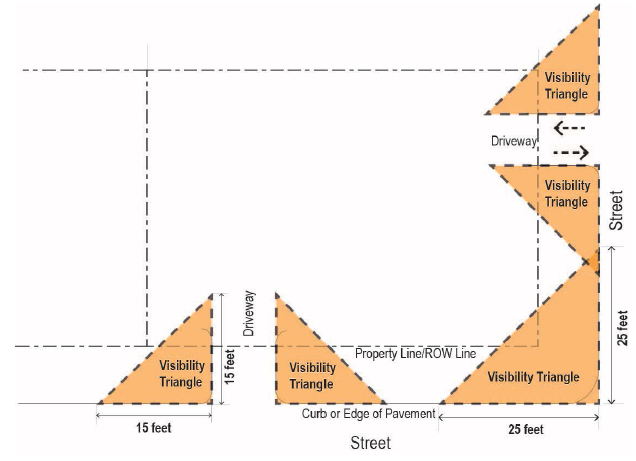
Figure 7.4-4: Visibility Triangles
7.4.5 - Sidewalks and Pedestrian Access
(1)
Standard Requirements
(a)
Sidewalks shall be required along any street upon which a lot abuts, regardless of whether such lot faces, abuts on the side, or backs up to such street, or is separated from such street by an alley. Unless designated in an adopted city plan, sidewalks shall not be required along freeways and freeway frontage, or along any street abutting residential lots in zoning categories RE and other residential districts requiring lots larger than the minimum requirements of the RE District.
(b)
Sidewalks shall be constructed by the owner along all collector and arterial thoroughfares, and along all perimeter streets abutting the subdivision, regardless of whether such collector, arterial, or perimeter thoroughfare abuts a lot, alley, or other space. Sidewalks shall be constructed along all collector and arterial thoroughfares and perimeter streets prior to the issuance of a certificate of acceptance for the subdivision by the city.
(c)
Sidewalks shall be constructed in accordance with the city's adopted Infrastructure Design Standards.
(d)
The minimum width of sidewalks shall be four feet wide.
(e)
To increase pedestrian safety and walkability, all sidewalks shall be located not less than 6-feet from the back of curb.
(f)
Meandering sidewalks may be approved by the Administrator to preserve trees and create a more informal streetscape.
(2)
Residential Subdivisions
(a)
The developer shall construct all sidewalks along the street right-of-way adjacent to parks, open space, amenity centers, drainage ways, and other public or home-owners' association land. The developer is not responsible, however, for constructing a sidewalk along the frontage of any residential lot except for model home lots. The minimum width of sidewalks shall be four feet wide.
(b)
The owner of a residential lot is responsible for the construction of all sidewalks along the frontage of the lot, including where such lot fronts on a collector thoroughfare, and along that portion of the lot that adjoins a street other than a collector or arterial. Such a sidewalk is not required on a lot until completion of the home construction. Upon completion of the home, sidewalks shall be provided in accordance with the provisions contained herein. Authorization for occupancy shall not be granted until this requirement has been met.
(c)
Exemptions. A residential lot that is platted as a single lot of record is exempt from this requirement unless:
i.
Sidewalks are existing on one side of the lot
ii.
The lot is located within 1,500 feet of a public or private school and is on the same side of the street
(d)
Exemptions: sidewalk is not required on infill lots where sidewalk does not exist on either side of the lot because the subdivision was not originally platted with sidewalks.
(3)
Non-Residential and Multi-Family
(a)
All commercial, mixed-use, and industrial development shall provide a network of on-site pedestrian walkways with a minimum width of four feet to and between the following areas:
i.
From entrances to each commercial building on the site, including pad site buildings to on-site parking areas and public sidewalks or walkways along the street
ii.
Between buildings in developments with multiple buildings
iii.
Public sidewalks or walkways on adjacent properties with boundaries shared with the subject development
(b)
On-site pedestrian walkways and crosswalks shall be identified to motorists and pedestrians using one or more of the following methods:
i.
Changing paving material, patterns, or paving color, but not including the painting of the paving material
ii.
Changing paving height
iii.
Decorative bollards
iv.
Raised median walkways with landscaped buffers
v.
Stamped or stained concrete

