
Ennis City Zoning Code
ARTICLE III
Review Procedures
3.1 - SUMMARY OF REVIEW PROCEDURES
The following table (Table 3.1-1) summarizes the major procedures for review of applications for land use and development activity. Not all procedures addressed in this chapter are summarized in this table; see the subsequent sections of this chapter for additional details on each procedure.
1 Pre-applications required for Site Plans in the PD and Regional Mixed Use districts.
3.2.1 - Applicability
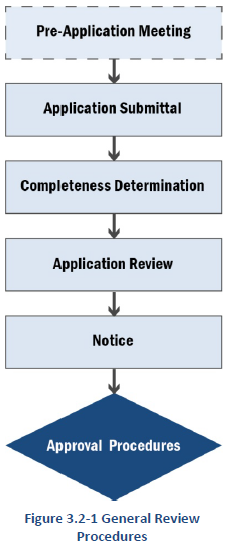
This section describes the procedural elements common to all applications (see Figure 3.2-1). Additional procedures that apply to specific applications are provided in Section 3.3, Specific Review Procedures. Generally, the procedures for all applications have eight common elements:
(1)
Pre-application meeting (as required or optional in Table 3.1-1)
(2)
Submitting all information required for a complete application, including required fee payments
(3)
Determination of completeness
(4)
Review of the application by appropriate staff, agencies, and boards
(5)
Notice
(6)
Action to approve, approve with conditions, or deny the application
(7)
Appeals, if any
(8)
Actions authorized by the permit and the time period for exercising rights under the order or permit
3.2.2 - Compliance with State and Federal Law
All procedures and requirements for approvals under this UDO shall comply with the Texas Local Government Code and other applicable state or federal laws, rules, or regulations. If these requirements conflict with the Texas Local Government Code, the Texas Local Government Code requirements control.
3.2.3 - Pre-Application Meeting
(1)
PURPOSE: The purpose of the pre-application meeting is to provide an opportunity for an informal evaluation of an applicant's proposal and for the applicant to become familiar with the City of Ennis' submittal requirements, development standards, and approval criteria. The Administrator or designee may provide recommendations and/or inform the applicant of any potential issues that might be presented to the applicable decision-making body. This provides an opportunity to address any major issues before the applicant and the city spend substantial time and expense on the application.
(2)
APPLICABILITY: A pre-application meeting is required prior to certain types of applications, as listed in Table 3.1-1 and Section 3.3, Specific Review Procedures. Applications for these types of approvals may not be accepted until a pre-application meeting is completed.
(3)
MEETING PROCESS: City staff shall coordinate with the applicant and facilitate the meeting, including scheduling the time and location of the meeting. At the meeting, city staff may:
(a)
Determine the required application(s) and the timing of multiple application submittals (i.e., whether they may be processed concurrently or must be processed sequentially)
(b)
Provide the applicant with application materials and inform the applicant of submittal requirements and procedures
(c)
Provide the applicant with an estimated time frame for the review process
(d)
Based on a conceptual plan of the proposal (if required), generally discuss compliance with the ordinance's zoning, use, density, and design and development standards, and attempt to identify any potentially significant issues regarding compliance
(e)
Refer the applicant to other departments or agencies to discuss any potential significant issues prior to application submittal
(f)
Consider or answer questions by the applicant relating to the application process, the standards established in this Ordinance, required documents, fees, and any other inquiries relating to the application
(4)
Applicants are advised that the meeting should take place prior to any substantial investment in time or resources, such as a land acquisition for a proposed development, site and engineering design, or the preparation of other data.
(5)
The informal evaluation and recommendations provided by the staff during a pre-application meeting shall not be considered binding upon the applicant or the city.
3.2.4 - Application Submittal and Completeness Determination
(1)
APPLICABILITY: This section applies to any application that is subject to this Ordinance.
(2)
APPLICATION MATERIALS: The applicant shall submit to the Administrator all of the information required in the application packet, along with any information identified in any pre-application meeting and all required information stated elsewhere in this Ordinance for the type of application.
(a)
No application is complete unless all of the information required by Section 3.3, Specific Review Procedures, and any application materials required by the Administrator are included, and all required application fees are paid. An application is not considered filed until it is complete. The Administrator may allow the applicant to submit any required information later in the review process in order to complete final action on the application.
(b)
The applicant shall file an application in advance of any required public hearing or public meeting where the application is considered. The Administrator may establish a schedule for filing and reviewing any application that requires action by the City Commission, Planning and Zoning Commission (P&Z), Historic Landmarks Commission (HLC), Zoning Board of Adjustment (ZBA), or Administrator. The schedule shall provide adequate time for review, notice and/or publication consistent with the applicable Statutes and this Ordinance. Completed applications shall be filed according to any published schedule.
(3)
COMPLETENESS DETERMINATION:
(a)
The Administrator shall make a determination of application completeness within ten (10) business days of application filing. If the application is determined to be complete, the application shall then be processed according to the procedures set forth in this Ordinance.
(b)
An application will be considered complete if it is submitted in the required form, includes all mandatory information and supporting materials specified in the application packet, this Ordinance, by the Administrator, and is accompanied by the applicable fee.
(c)
If the application is determined to be incomplete, the Administrator shall provide notice to the applicant that includes an explanation of the application deficiencies. No further processing of an incomplete application shall occur until the deficiencies are corrected in a new application.
(d)
If any false or misleading information is submitted or supplied by an applicant on an application, that application will be deemed void and a new application must be submitted together with payment of applicable development review fees.
(e)
Whenever this Ordinance establishes a time period for processing an application, the time period does not begin until the Administrator has reviewed the application for completeness and, if necessary, the applicant has corrected all deficiencies in the application.
3.2.5 - Application Review
(1)
Following a determination that an application is complete; the Administrator shall circulate the application to staff and appropriate city departments and other entities for review.
(2)
In addition to the reviews summarized in Table 3.1-1, the Administrator may also refer applications to other boards, commissions, government agencies, and non-governmental agencies not referenced in this Article.
(3)
The Administrator may request a meeting with the applicant to discuss the application and any written comments. Based on the written comments, the applicant shall have an opportunity to revise the application prior to further processing. Additional submittals and reviews may be subject to additional fees as determined by the Administrator.
(4)
If a public hearing is required for an application, the Administrator shall prepare a staff report once written comments have been adequately addressed according to the Administrator. The staff report shall be made available to the applicant and to the public prior to the scheduled public hearing on the application. The staff report shall indicate whether, in the opinion of the Administrator, the application complies with all applicable standards of this Ordinance.
(5)
Specific to all Plat Applications:
(a)
Upon receipt of an application, the Administrator will conduct a Completeness Determination as outlined in Section 3.2.4 within 10 days of the initial application and formally notify the applicant. No plat shall be considered by the decision-making authority, as applicable, until it has been determined that the submittal is complete and in conformance with the requirements of this Ordinance.
(b)
For the purpose of this Ordinance, the date on which all requirements of this Ordinance, and any associated city ordinances have been met, and all applicable fees have been paid shall constitute the official filing date of the plat from which the statutory period requiring formal approval or disapproval of the plat shall commence.
(c)
For Final Plat and Replat, action shall be taken by the Planning and Zoning Commission within thirty (30) days of the official filing date unless a waiver is signed by the applicant, as applicable.
(d)
If required, action shall be taken by the City Commission within thirty (30) days of the date action is taken by the Planning and Zoning Commission.
(e)
A plat is considered approved if the approving body fails to act on a plat within the prescribed period. Provided however, the applicant may request a deferral of action on the subdivision application, thereby waiving the thirty (30) day time period for action by the approving body, provided said request is submitted in writing.
3.2.6 - Public Notice
(1)
TYPES OF NOTICES REQUIRED: Based on and as required by Table 3.2-1, applications before the City Commission, P&Z and HLC shall be preceded by the following public notices:
(a)
Written Notice: The Administration shall send written notice by US mail, not less than 10 days prior to the hearing, to the applicant and to all property owners within 200 feet (measured from property boundaries) of the subject property in the most recently approved tax roll of the city.
(b)
Published Notice: When published notice is required, the Administrator shall prepare the content of the notice and publish the notice in an official newspaper or a newspaper of general circulation in the city, not less than 10 days prior to the hearing. The content and form of the published notice shall be consistent with Chapter 211, Texas Local Government Code (TXLGC).
(2)
CONTENT OF THE NOTICE: Notices, whether by publication or mail (written notice) shall, at minimum:
(a)
The time, date, and place of the hearing
(b)
The address or description of the property involved (if any)
(c)
The purpose of the hearing, including the nature and scope of the proposed action
(d)
The name of the board or commission to hold the hearing
(e)
Where additional information on the matter may be obtained
(Ord. No. 25-0304-F1, § 2(Exh. A), 3-4-25)
3.2.7 - Public Hearing and Approval Procedures
This section identifies public hearing and approval procedures for applications that are subject to this Ordinance. Additional procedures and criteria for specific types of applications are located in Section 3.3, Specific Review Procedures. All approval procedures shall comply with the TXLGC and this Ordinance. If these requirements conflict with the TXLGC, then the TXLGC controls.
(1)
PUBLIC HEARINGS:
(a)
Staff Report: The Administrator shall submit a written report to the recommending or decision-making authority. The Administrator's report shall include the reports and recommendations of other city departments, as applicable.
(b)
Testimony: Any person may appear at a public hearing and give testimony or submit written materials, either individually or as a representative of an organization.
(c)
Postponement: An applicant may request, but is not entitled to receive, a postponement of the scheduled public hearing. If any publication or notice is provided by the city, the applicant is responsible for any costs or fees associated with the postponement.
(d)
Continuance: The decision-making body may continue a hearing to a specified date, time, and place. Such a date shall be made part of the motion and publicly announced at the public hearing. The Administrator shall ensure that notice of the continuance is posted at least 72 hours before the continued public hearing date in the same manner as originally posted. Publication or property owner notification of the continued date is not required, unless required by state law or recommended by the decision-making body or the Administrator.
(e)
Tabling a Decision: A decision-making body may close a public hearing and table the decision. The decision to table shall appear on each subsequent agenda unless the decision is deferred to a specific date.
(f)
Discussion and Decision: After consideration of the application, the staff report, and the evidence from the public hearing (as applicable), the decision-making body shall approve, approve with conditions, or deny the application based on the applicable approval criteria.
(2)
APROVAL CRITERIA
(a)
All applications shall comply with all applicable standards in this Ordinance and other adopted city ordinances, all, as amended and conform to design requirements and construction standards as set forth in the most current version of the city's Infrastructure Design Standards.
(b)
The proposed provision and configuration of public improvements shall be adequate to serve the development and conform to the city's adopted master plans.
(c)
All applications shall comply with any applicable federal or State relevant jurisdictions' regulations. This includes, but is not limited to, Department of Transportation (DOT), US Army Corps of Engineers, wetlands, water quality, erosion control, and wastewater regulations.
(d)
All applications shall comply with any adopted or approved interlocal agreements with Ellis County or other affected public entities and Municipal Utility District (MUD) agreements.
(e)
The City Commission may impose conditions reasonably calculated to achieve or maintain compliance with all applicable criteria.
(f)
The City Commission may incorporate or require, as part of a condition of approval, a written agreement between the applicant and the city that enforces the conditions.
(g)
The application shall also be generally consistent with the Comprehensive Plan and any adopted policy document.
3.2.8 - Withdrawal and Reapplication
(1)
GENERALLY
(a)
An applicant may withdraw an application, without prejudice, at any time, before it is placed on the agenda of a public hearing or meeting. Once an item has been placed on any agenda it may be withdrawn only upon approval of the board or City Commission.
(b)
The applicant shall submit a written withdrawal request to the Administrator.
(c)
After it is withdrawn, the city shall not take further action on the application.
(d)
To re-initiate review, the applicant shall submit a new application and fee.
(2)
REAPPLICATION
(a)
When an application submitted pursuant to this Ordinance is denied, no new application for the same or substantially the same request, as determined by the Administrator, shall be submitted or accepted within one year of the date of the denial unless:
i.
The Administrator determines that the resubmitted application corrects any deficiencies identified in the original application
ii.
Resubmittal of the application complies with applicable Texas law
(b)
Resubmittals are subject to all processing fees, submittal requirements, and review standards in effect at the time the resubmittal is accepted by the Administrator.
3.2.9 - Modifications
Unless otherwise provided in this Ordinance for a particular type of application, any modifications of approved plans, permits, or conditions of approval shall require a new application that is submitted and reviewed in accordance with the full procedure and fee requirements applicable to the particular type of the original application.
3.2.10 - Expirations
(1)
Where applicable, the lapse of approval time frames established by this Ordinance, due to inactivity on the project, may, but is not required to be extended no more than twice in one-year increments by the Administrator only when all of the following conditions exist:
(a)
An extension request shall be filed prior to the applicable lapse-of-approval deadline.
(b)
The extension request must be in writing and include reasonable justification evidencing extraordinary circumstances.
(c)
No requirements or standards of this Ordinance have been significantly altered as to affect the original approval.
(2)
Any extension beyond the two increments of one-year each may only be granted by the decision-making body that granted the original approval.
3.3.1 - Zoning Map Amendment (Rezoning) and Zoning UDO Text Amendment
(1)
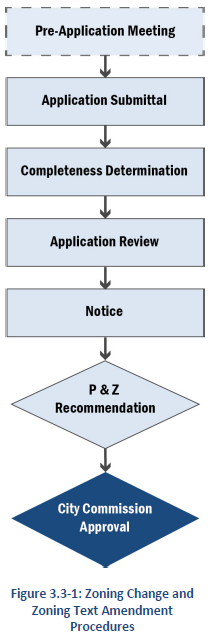
APPLICABILITY AND JURISDICTION: All zoning map amendment (rezoning) and zoning related UDO text amendments require a public review process that includes public hearings at the P&Z and City Commission. The City Commission shall be the final authority for approval of these applications after a recommendation by the P&Z. The procedures for all zoning map amendment (rezoning) and UDO text amendment applications shall be as follows (see Figure 3.3-1)
(2)
PRE-APPLICATION MEETING: per Section 3.2.3. Any of the following parties may initiate a policy related application request:
(a)
The City Commission on its own motion, or on petition of an interested property owner
(b)
The Administrator
(3)
Application Submittal per Section 3.2.4
(4)
Completeness Determination per Section 3.2.4
(5)
Application Review per Section 3.2.5
(6)
Notice procedures for the type of application per Section 3.2.6 (see Table 3.2-1)
(7)
Approval Procedure:
(a)
Planning and Zoning Commission Action: The P&Z shall hold a public hearing on any zoning change or policy related application. The Commission shall forward a report that may recommend approval, approval with conditions, or denial, of the application and forward it to the City Commission.
(b)
Action by City Commission: The City Commission has final authority to approve, approve with conditions, or deny any proposed zoning change or policy related application request.
(8)
Additional Review and Approval Criteria: Table 3.3-1 shall establish additional review and approval criteria for the Administrator, the P&Z and City Commission for different policy related applications.
3.3.2 - UDO Text Amendments (Non-Zoning Related)
(1)
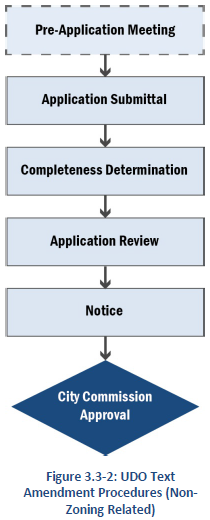
APPLICABILITY AND JURISDICTION: All non-zoning related UDO text amendments require a public review process that includes a decision by the City Commission. The City Commission shall be the final authority for approval of these applications. The procedures for all UDO text amendment applications shall be as follows (See Figure 3.3-2):
(2)
Pre-application meeting per Section 3.2.3 (optional).
(3)
Initiation: Any of the following parties may initiate a policy related application request:
(a)
The City Commission on its own motion, or on petition of an interested property owner
(b)
The Administrator
(4)
Application submittal per Section 3.2.4
(5)
Completeness Determination per Section 3.2.4
(6)
Application Review per Section 3.2.5
(7)
Notice procedures for the type of policy application per Section 3.2.6 (see Table 3.2-1)
(8)
Approval Procedure: The City Commission shall hold a public hearing on any text amendment to the UDO related to non-zoning Articles. The City Commission shall have final authority to approve, approve with conditions, or deny any proposed UDO text amendment request.
(9)
Additional Review and Approval Criteria: Table 3.3-1 shall establish additional review and approval criteria, as applicable, for the Administrator and City Commission for any UDO Text Amendments related to non-zoning elements.
3.3.3 - Special Use Permit (SUP)
(1)
PURPOSE AND INTENT: The Specific Use Permit (SUP) provides a means to develop certain uses in a manner that is compatible with adjacent property and consistent with the character of the neighborhood or district.
(2)
APPLICABILITY: The City Commission may grant, repeal, or amend Specific Use Permits (SUP's) for certain uses, but only where specified in Article V: Use Standards of this Ordinance. Approval of an SUP occurs by ordinance.
(3)
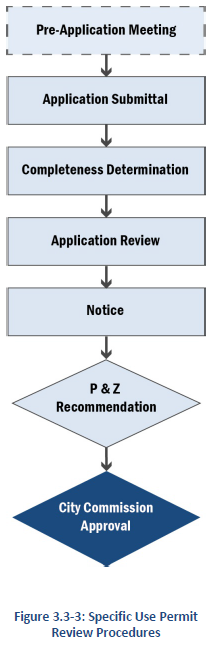
PROCEDURES: All SUP applications shall follow a public review process that includes public hearings at the P&Z and City Commission. The City Commission shall be the final authority for approval of these applications after a recommendation by the P&Z. The procedures for all SUP applications shall be as follows (see Figure 3.3-3):
(a)
Initiation: Any of the following parties can initiate an SUP request:
i.
An interested property owner
(4)
PRE-APPLICATION MEETING: In addition to the procedures established in Section 3.2.3, at a pre-application meeting with staff, the applicant shall provide a preliminary Site Plan, which shall include, at a minimum:
(a)
Details of the SUP request
(b)
Location of buildings and other site improvements that include parking, landscaping, lighting, fencing and any other elements on the site
(c)
Elevations and architectural drawings of the buildings and site improvements
(d)
Justification or narrative on how the SUP application meets the review and approval criteria for SUPs
(e)
Any other information that is relevant to the application or that may be requested by the Administrator
(5)
APPLICATION SUBMITTAL: per Section 3.2.4
(6)
COMPLETENESS DETERMINATION: per Section 3.2.4
(7)
APPLICATION REVIEW: per Section 3.2.5 and criteria in this Section
(8)
NOTICE: Published and written notice required. See Section 3.2.6 and Table 3.2-1
(9)
APPROVAL
(a)
Planning and Zoning Commission Action: The P&Z shall hold a public hearing and make a recommendation to the City Commission. The P&Z shall forward its recommendation to approve, approve with conditions, or deny the application to the City Commission. If a recommendation cannot be made, the P&Z shall submit a Report documenting their explanation.
(b)
City Commission Action:
i.
The City Commission shall hold a public hearing and approve, approve with conditions, deny, or remand the application.
ii.
The granting of an SUP has no effect on the uses permitted as of right and does not waive the regulations of the underlying zoning district.
iii.
The City Commission shall approve an SUP by ordinance. The ordinance may approve more than one specific use. The City Commission may approve or deny all or part of the uses requested in the SUP application.
(c)
Review and Approval Criteria: In addition to the general criteria in Section 3.2.7(2), the P&Z and City Commission shall base their decision on their findings of the extent to which the proposed use:
i.
Meets the purpose of the zone district in which it will be located and all of the criteria and regulations specified for such use in that zone district, including but not limited to height, setbacks and lot coverage.
ii.
Complements or is compatible with the surrounding uses, character and community facilities.
iii.
Adequately mitigates traffic impacts.
iv.
Contributes to, enhances, and promotes the welfare of the area and adjacent properties.
v.
Is in scale with the existing neighborhood or will be considered to be in the scale with the neighborhood as it develops in the immediate future.
vi.
Mitigates any adverse impacts due to access, parking, service areas, and traffic on adjoining properties and the street network in an adequate manner.
vii.
An ordinance approving an SUP may impose development standards and safeguards over and above those contained in the corresponding zoning district regulations. The City Commission may, in the interest of the public welfare and to ensure compliance with this Ordinance, establish reasonable conditions on the operation, location, arrangement, type, character, and manner of construction of any use for which an SUP is authorized. Consideration is given based on the existing and planned conditions and location with regard to the welfare and protection of adjacent property from noise, vibration, dust, dirt, smoke, fumes, gas, odor, explosion, glare, offensive view, traffic, or other undesirable or hazardous conditions.
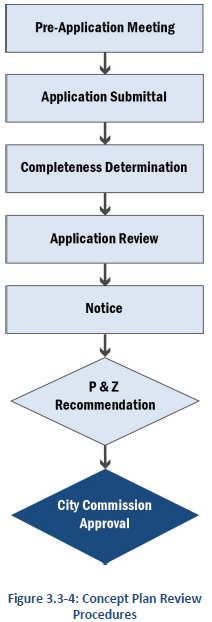
3.3.4 - Concept Plan
(1)
PURPOSE AND INTENT: The purpose of a Concept Plan is to allow opportunity for the P&Z and City Commission to preview various development-related aspects of a project, including proposed major street patterns; land use and development patterns and trends; environmental issues and constraints; development character and design standards; conformance to the Comprehensive Plan and other adopted plans, the zoning district or PD regulations, the UDO, and other applicable plans and guidelines; and the property's relationship to adjoining areas. Review of a Concept Plan also assists the city in evaluating the possible impacts of the proposed development in terms of provision of essential public facilities and services, respecting and preserving important natural features and the environment, provision of open space and recreational opportunities, and protecting the general health, safety and welfare of the community.
(2)
APPLICABILITY: Submission and approval of a Concept Plan is the first step in the approval process for all development within the RMU Regional Mixed Use and PD Planned Development Districts.
(3)
MINIMUM ACREAGE REQUIRED:
(a)
All applications for new Concept Plans shall include a minimum acreage of 20 acres for RMU Districts.
(b)
Any amendments to Concept Plans beyond administrative modifications shall be brought back through the public process for the entire acreage included in the originally approved Concept Plan.
(c)
Minimum acreage for any additions to previously approved Concept Plans shall be 5 acres within the RMU District. The additional acreage shall be contiguous with the originally approved Concept Plan.
(4)
REVIEW PROCEDURES: All Concept Plans shall follow a public review process that includes public hearings at the P&Z and City Commission. The City Commission shall be the final authority for approval of these applications after a recommendation by the P&Z. The procedures for all Concept Plan applications shall be as follows (see Figure 3.3-4):
(a)
Pre-application Meeting: In addition to the procedures established in Section 3.2.3, at a pre-application meeting with staff, the potential applicant shall provide a preliminary conceptual plan, which shall include, at minimum:
i.
Proposed uses within the district (based on the zoning district standards) and their location.
ii.
Number and type of dwelling units, as applicable.
iii.
Square footage and heights of proposed nonresidential uses, as applicable.
iv.
Proposed parking capacity and configuration.
v.
Conceptual drawings of proposed structures, internal circulation systems, street and block layout of the development, and such other site information as may be required by the city.
vi.
An assessment of the compatibility of the uses, building configuration and design of the proposed project with the surrounding neighborhood and future uses in the Comprehensive Plan. Include specific discussion on how land use transitions between existing and proposed development will be addressed (transition uses, buffers, screening, etc.) and any other information required by the Administrator.
(b)
Application Submittal: A Concept Plan application shall include the following:
i.
A statement indicating the ownership of all interest in the property included in the Concept Plan, with the written consent of all owners.
ii.
A master plan indicating the broad concept of the proposed development, its conformance to the zoning district standards, any sub-districts, the location of different land uses and the location of major streets, blocks, or other area devoted to each use. The Concept Plan may show the area proposed to be subdivided and platted as allowed for in this Ordinance. The plan shall indicate:
1.
Generally, where each type of use will be located in the development and the total acreage devoted to each use. Label proposed uses on the plan appropriately.
2.
Major internal circulation systems, locations of roadways, locations of trails, trail amenities, bicycle paths, etc.
3.
Areas designated for residential uses shall indicate the maximum number of dwelling units per gross acre to be permitted for each residential area proposed including sizes of building lots and types of dwelling units anticipated.
4.
Acreage and location of any open space, civic spaces and school sites including whether each open/civic space will be privately owned (common area for residents only) or dedicated to public use.
5.
A parking demand analysis for the mix of uses proposed to support the on-street and off-street parking proposed in the development.
6.
Illustrations depicting the general development character of the project including architectural renderings and elevations.
7.
Provision for public (water, sewer, storm water) and private utilities (telecommunications, natural gas, electric) as required by other articles in this Ordinance, adopted master plans and the most current version of the city's Infrastructure Design Standards.
iii.
In the case of Concept Plan for a PD, if the applicant is proposing to create different development standards than the ones specified in this Ordinance, in addition to the above standards, the application shall include:
1.
Development standards and other restrictions proposed by the applicant to be applied to each sub-district or proposed use or specific area similar to standards in the zoning districts contained in this Ordinance including: building setbacks, height limits, access requirements and grade or slope restrictions, special provisions addressing sensitive areas, parking requirements, landscape requirements, architectural design standards, street graphic regulations, impervious surface and floor area ratios.
2.
Demonstrate through written explanation and graphic material, how the character of the development as a result of the modified standards will be superior in terms of mixed use, walkability, and landscape quality to that produced by the existing standards. Graphic material shall include building elevations, renderings, and sketches to illustrate development character and quality.
3.
Graphic illustrations and written explanations of how the revised PD addresses the specific constraints and opportunities of the site and surrounding area in a superior manner to what might be accomplished without the PD standards.
iv.
A regional location map showing the relationship of the site to connecting roadways, public utilities and adjoining land uses.
v.
A site map illustrating site boundaries, acreage, any existing structures and existing zoning.
vi.
A site topographic map showing any steep slopes (slopes over 10 percent grade at an appropriate scale), major vegetation elements, streams, rivers, ditches, and areas subject to one-hundred-year flooding.
vii.
A non-binding development schedule indicating the improvements included in each phase and the approximate dates when construction of the various stages of the development is anticipated to begin and be completed.
viii.
Copies of any special private covenants, conditions and restrictions which will govern any use or occupancy within the development. The applicant may also impose additional covenants, conditions, and restrictions on any particular area during the subdivision process.
ix.
Evidence that the development has been designed with consideration of the site's natural environment and the surrounding area and does not unreasonably impact wildlife, natural vegetation, or unique natural or historic features.
x.
A daily and peak hour trip generation and directional distribution report (traffic impact analysis) by use unless the City Manager or his designee finds that the traffic to be generated by the proposed district does not warrant the preparation and submission of a study or agrees to an alternative methodology that is acceptable to the city and applicant.
xi.
The applicant may submit any other information or exhibits which he/she deems pertinent to the evaluation of the proposed Concept Plan.
(5)
COMPLETENESS DETERMINATION: A Concept Plan application requires the submission of a complete Concept Plan described in Section 3.3.4(4)(b) above, information outlined in Section 3.2.4, and a completed application form provided by the Zoning Administrator. The Administrator shall make a completeness determination within 14 days of the date of the Submittal.
(6)
APPLICATION REVIEW: Per Section 3.2.5, Section 3.3.4(4)(b) and based on the extent to which the application meets the recommendations in the Comprehensive Plan and the specific zoning district purpose.
(7)
NOTICE: Notice procedures for Concept Plan applications must be completed as described in Section 3.2.6 (see Table 3.2-1).
(8)
APPROVAL PROCEDURES:
(a)
Action by the Planning and Zoning Commission: The P&Z shall hold a public hearing on any Concept Plan. The Commission shall approve, approve with conditions, or deny the application and forward its report and recommendation to the City Commission. If the Concept Plan is submitted with a zoning change application, the public hearing for the Concept Plan may be combined with the public hearing for the zoning change.
(b)
Action by the City Commission: The City Commission has final authority to approve, approve with conditions, or deny any Concept Plan applications.
(c)
Review and Approval Criteria: General criteria in Section 3.2.7(2) and this Section shall establish the review and approval criteria for the Administrator, the P&Z and City Commission for Concept Plan applications.
i.
The Concept Plan addresses a unique situation, confers a substantial benefit to the city, or incorporates creative site design such that it achieves the purposes of this Ordinance and represents an improvement in quality over what could have been accomplished through strict application of the otherwise applicable district or development standards. Such improvements in quality may include but are not limited to: improvements in open space and trail provisions and access; environmental protection; tree/vegetation preservation; efficient provision of streets, roads, and other utilities and services; and/or mix of uses or innovative housing types.
ii.
The development shall have appropriate transitions to the surrounding area, with adequate standards to mitigate any potentially negative impacts.
iii.
Streets within the development shall provide adequate internal circulation for a variety of modes of transportation as well as connect to the city's overall system to provide a seamless, multi-modal network.
iv.
Streets shall be designed to create a pleasant walking and biking environment with on-street parking where appropriate and streetscape enhancements.
v.
Culs-de-sacs shall be prohibited unless natural features such as topography or stream corridors prevent a connection as determined by the Administrator.
vi.
Stub streets may be required where a street is likely to be extended into adjoining undeveloped property.
vii.
The Concept Plan shall provide common open space per the requirements of the zoning district standards and adequate in terms of location, accessibility and usability, area and type of the common open space, and in terms of the uses permitted in the development. The development shall ensure optimum preservation of the natural features of the terrain.
viii.
The Concept Plan demonstrates compliance with all of the requirements of the applicable development regulations. The Concept Plan may not authorize exceptions to the minimum requirements of any applicable development regulation unless the underlying zoning is amended through the zoning change process.
(9)
CONCEPT PLAN APPROVAL: The approved Concept Plan with all the associated exhibits shall be tied to the zoning application to the PD or Regional Mixed Use Districts. The approved PD or Regional Mixed Use zoning, the respective approved Concept Plans, all exhibits, and any associated development agreements together establish the uses permitted, character of the development, and any modifications to the zoning regulations which are applicable through the rezoning process.
(10)
AMENDMENTS TO APPROVED CONCEPT PLANS: Amendments to previously approved concepts plans may be classified as Major or Minor amendments. Table 3.3-2 classifies major and minor amendments.
(a)
Major Amendments: Major amendments to approved Concept Plans shall be reviewed, processed, and approved in the same manner as required for the originally approved Concept Plan, including all notice and citizen participation requirements and recommendation by the P&Z and consideration by City Commission.
(b)
Minor Amendments: Minor amendments to an approved Concept Plan are administrative requests and may be approved, approved with conditions, or denied by the Administrator. A minor amendment may be approved administratively so long as the amendment does not constitute, as determined by the Administrator, a substantial alteration of the fundamental nature and character of the approved Concept Plan. Minor amendments may not alter the terms of applicable development agreements or be contrary to any applicable ordinance. If the Administrator denies the amendment, the applicant may appeal the denial and the amendment shall be treated as a Major Amendment.
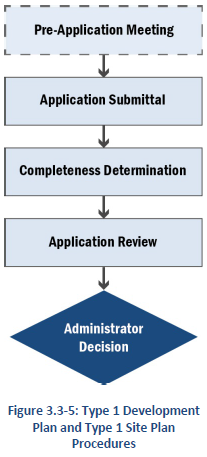
3.3.5 - Type I Development Plan and Type I Site Plan
(1)
PURPOSE AND APPLICABILITY: The purpose of the Development Plan and Site Plan is to ensure compliance with the development and design standards of this Ordinance, approved PDs, Concept Plans, and SUPs prior to the issuance of required permits, and to encourage quality development that reflects the goals and objectives of the comprehensive plan. Development Plans and Site Plans illustrate intended development at different scales and level of detail and they may be approved by the Administrator.
(a)
Development Plans: A Development Plan shall provide more detail in terms of blocks, lots, building and street layout, open and civic spaces and trails, treatment of transition areas to adjacent uses and similar information for more than one lot or building. A Development Plan shall illustrate the design direction of the site with dimensional standards that provide substantial certainty about the development outcomes, intensity, and phasing of the proposed development. Typically, Development Plans shall include less detail than Site Plans and include a larger area than one lot.
i.
For all development in the PD or Regional Mixed Use Districts, an approved Development Plan shall be required prior to a Site Plan application.
ii.
Development Plans may include a portion of a property included in an approved Concept Plan by City Commission. The minimum acreage required for a Development Plan shall be either the entire area circumscribed by existing or future streets or within one sub-district or sub-zone of the approved Concept Plan per the standards for the district in Article IV: Zoning Districts.
(b)
Site Plans: Site Plans shall be the lot and buildings level plans and shall be required for individual lots and/or buildings prior to Building Permit approval for all uses in all zoning districts except for single-family detached residential uses.
(2)
PRE-APPLICATION MEETING: Table 3.1-1 shall establish whether pre-application meetings are required or optional. Standards in Section 3.2.3 shall apply to pre-application meetings.
(3)
APPLICATION SUBMITTAL: In addition to the submittal requirements in Section 3.2.4, the following shall apply:
(a)
Development Plans: The applicant shall submit to the Administrator all of the information required in the application packet, along with any information identified in the pre-application meeting (if applicable) and all required information stated elsewhere in this Ordinance for Development Plan review. At minimum, the application shall include plans and supporting documents that include the following:
i.
A location map showing the property's relative regional location
ii.
Details of the site location and dimensions
iii.
Existing adjoining land uses, building footprints (if any) and ownership
iv.
General layout of the development including proposed street network, connectivity to the city's thoroughfare system, and general location of buildings, parking, sidewalks, trails, open/civic space, drainage facilities and other elements of the built environment
v.
Compliance with any approved Concept Plan for the property
vi.
Conceptual elevations showing intended architectural and urban character of different uses and building types
vii.
Concepts for public and private landscaping, buffering, and screening (if any)
viii.
Any other information that may be required by the Administrator to help with the decision-making process
(b)
Site Plans: The applicant shall submit to the Administrator all of the information required in the application packet, along with any information identified in the pre-application meeting (if applicable) and all required information stated elsewhere in this Ordinance for an administrative Site Plan review. At minimum, the application shall include plans and supporting documents that include the following:
i.
Location and dimensions of the site relative to adjoining properties and any approved Concept or Development Plans
ii.
Location of adjoining streets, alleys, and other public improvements
iii.
Location of all existing and proposed buildings and structures, parking areas, driveways, trails, sidewalks, and exterior signs
iv.
Location of all proposed landscaping, fencing, buffering, and walls
v.
Location of all existing and proposed drainage and other public and private utilities (water, sewer, telecommunications, etc.) including new and proposed easements
vi.
Location of service functions such as garbage collection, loading/unloading facilities, and other utility meters and equipment
vii.
Building elevations showing compliance with any building design standards (exterior materials, fenestration, entrances, architectural details, articulation, etc.) in this Ordinance or any approved concept and Development Plans
viii.
Illustrate how the proposed Site Plan meets the requirements of the approved Concept Plan or Development Plan including any administrative modifications with corresponding justifications requested
ix.
Site data summary including:
1.
Total square footage of development by proposed use or number, type, and sizes of dwelling units
2.
Lot size and dimensions
3.
Setbacks or build to zone/lines and building frontage requirements (if any)
4.
Required parking, loading/unloading, and landscaping calculations
5.
Calculations of any required open space/sidewalks/trails, lot coverage, or impervious coverage ratios
(4)
COMPLETENESS DETERMINATION: In addition to requirements in Section 3.2.4, the application for an administrative Development or Site Plan shall meet the requirements of this Ordinance or any approved Concept Plan requirements.
(5)
APPLICATION REVIEW: All complete applications for Development Plans and Site Plans shall be reviewed by the Administrator based on the requirements in this Ordinance and/or any approved Concept or Development Plans as applicable.
(6)
ADMINISTRATOR DECISION: All Development and Site Plans that meet the requirements of this Ordinance and/or any applicable Concept or Development Plans may either be approved or approved with conditions by the Administrator. Any applications for Development Plans or Site Plans that do not meet this Ordinance and/or any approved plans shall be processed as a Type II Development Plan or Type II Site Plan as appropriate.
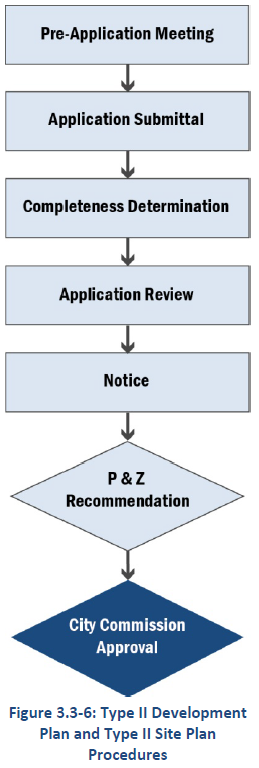
3.3.6 - Type II Development Plan and Type II Site Plan
(1)
PURPOSE AND APPLICABILITY: The purpose of the Type II Development Plan and Type II Site Plan process is to allow for applications that do not strictly comply with the development and design standards of this Ordinance, approved PDs, Concept Plans, and SUPs. These applications may have specific issues or opportunities that require an alternative set of standards and criteria that must be approved through a zoning change to the underlying district standards.
(a)
Type II Development Plan: A Type II Development Plan application shall provide the same information as a Type I Development Plan application in addition to a revised Concept Plan application that illustrates how the Type II Development Plan impacts the different elements of the approved Concept Plan including any changes to the street network, adjoining sub-districts and other elements of the approved Concept Plan.
(b)
Type II Site Plan: A Type II Site Plan application shall provide the same information as a Type I Site Plan application in addition to a revised Development Plan application that illustrates how the Type II Site Plan impacts the different elements of the approved Development Plan including any changes to the lot and block layout, street alignment, and other elements of the approved Development Plan.
(2)
PRE-APPLICATION MEETING: A pre-application meeting shall be required for Type II Development Plans and Type II Site Plans. Standards for pre-application meetings in Section 3.2.3 shall apply to pre-application meetings.
(3)
APPLICATION SUBMITTAL: In addition to submittal requirements in Section 3.2.4, the application submittal requirements for the corresponding Type I plan shall apply per Section 3.2.4(3)(b). In addition, the applicant shall also provide the detailed reason(s) for the request to modify any Concept, Development or Site Plan and how the modification impacts adjoining land uses and street network, especially if the request is for a portion of a previously approved Concept Plan or Development Plan.
(4)
COMPLETENESS DETERMINATION: Requirements in Section 3.2.4 shall apply.
(5)
APPLICATION REVIEW: All complete applications for Type II Development Plans and Type II Site Plans shall be reviewed by the Administrator based on the requirements in this Ordinance (Section 3.2.5), justification for modification of any standards, and modifications to any previously approved Concept or Development Plans as applicable.
(6)
NOTICE: Published and written notice required. See Section 3.2.6 and Table 3.2-1
(7)
APPROVAL PROCEDURES:
(a)
Action by the Planning and Zoning Commission: The P&Z shall hold a public hearing on any Type II Development Plan or Type II Site Plan. The Commission shall approve, approve with conditions, or deny the application and forward its report and recommendation to the City Commission. If the Concept Plan is submitted with a zoning change application, the public hearing for the Concept Plan may be combined with the public hearing for the zoning change.
(b)
Action by the City Commission: The City Commission has final authority to approve, approve with conditions, or deny, any Type II Development Plan or Type II Site Plan applications.
(8)
REVIEW AND APPROVAL CRITERIA: General criteria in Section 3.2.7(2) and approval criteria for Concept Plans (Section 3.3.4(8)(c)) shall establish the review and approval criteria for the Administrator, the P&Z and City Commission for Type II Development Plans and Type II Site Plans.
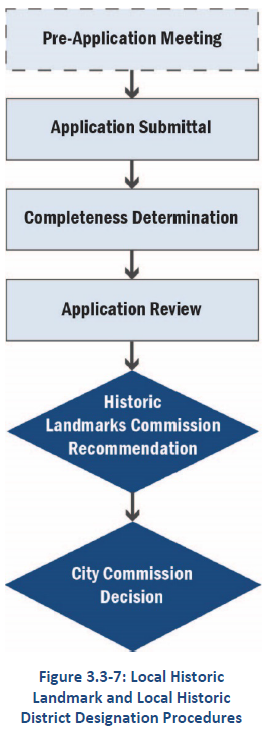
3.3.7 - Historic Overlay or Local Landmark Designation
(1)
PURPOSE: This section provides a process to designate individual historic buildings as local Landmarks and create, repeal, or amend local historic overlay designation.
(2)
APPLICABILITY:
(a)
A local historic overlay designation protects multiple sites, buildings, and areas of cultural importance and local landmark designation preserves individual buildings or sites of local historical or cultural importance.
(b)
Based on a recommendation by the HLC, the City Commission may create, amend, and repeal local historic overlay designation and/or local landmarks by ordinance.
(3)
INITIATION: The procedure for designating a historic landmark or to establish or amend a local historic overlay designation may be initiated by the city, or by the individual property owner(s), or by at least the owners of 20 percent of the property within the potential overlay designation.
(4)
PRE-APPLICATION MEETING: In addition to the procedures established in Section 3.2.3, at a pre-application meeting with staff, the potential applicant(s) shall provide the following:
(a)
Description of the historic significance and background of a landmark or overlay designation, including any studies or reports.
(b)
Current and historic photographs of the landmark or overlay designation.
(c)
Number of property owners affected and relative interests or goals of creating a landmark or overlay designation.
(d)
Any other information which the Administrator/HPO may deem necessary.
(e)
An assessment of the compatibility of the uses, building configuration and design of the proposed project with the surrounding neighborhood and future uses in the Comprehensive Plan. Include specific discussion on how land use transitions between existing and proposed development will be addressed (transition uses, buffers, screening, etc.).
(5)
APPLICATION SUBMITTAL:
(a)
An application for a local historic overlay designation or local landmark designation shall be made on forms as prescribed by the city and shall be filed with the Administrator/HPO along with fees in accordance with the adopted fee schedule.
(b)
At a minimum, the application shall include plans and supporting documents that include the following:
i.
Name, address, telephone number of applicant, physical address of the individual property, and written consent by the property owner if applicable.
a.
Written consent is required if the property is owned by an organization that qualifies as a religious organization under Section 11.20 of the Tax Code.
b.
The property owner may withdraw the owner's consent at any time in the process.
ii.
Name, address, telephone number of applicant, and signed petition by owners representing at least 20 percent of the property within the proposed area of an overlay designation.
iii.
Site plan of the individual property or map indicating the geographic boundaries of the proposed landmark or overlay designation area showing all affected buildings and/or structures.
iv.
Detailed historic description and background on the property or overlay designation area including any studies or reports.
v.
Current photographs of the overall property or area along with any historical photographs, if available.
vi.
Any other information which the Administrator/HPO or HPC may deem necessary.
(6)
COMPLETENESS DETERMINATION: Requirements in Section 3.2.4 shall apply.
(7)
APPLICATION REVIEW: All complete applications for a local historic overlay designation or a local landmark shall be reviewed by the Administrator/HPO based on the requirements in this Ordinance and any State and Federal criteria for historic designation.
(8)
HISTORIC PRESERVATION IMPACT STATEMENT: The Administrator/HPO must provide property owners the statement required by Section 211.0165 of the Texas Local Government Code not later than 15 days before applicable hearings.
(9)
APPROVAL PROCEDURES:
(a)
Action by the Historic Landmarks Commission: The HLC shall consider any application requesting the designation of a historic landmark or the establishment or amendment of a local historic overlay designation. The HLC shall approve, approve with conditions, or deny the application and forward its report and recommendation to the City Commission.
(b)
Action by the City Commission: The City Commission has final authority to approve, approve with conditions, or deny, any application requesting the designation of a historic landmark or the establishment or amendment of a local historic overlay designation.
(c)
Approval or approval with conditions only may be granted if:
i.
The owner consents to the designation or inclusion; or
ii.
Except as provided in subsection 5(b)(i), the HLC and the City Commission approve the inclusion or designation by a three-fourths vote.
(10)
REVIEW AND APPROVAL CRITERIA: In addition to the general approval criteria in Section 3.2.7, the following shall also be considered as review criteria for the Administrator, the HLC, and the City Commission:
(a)
Whether the property or several properties in an overlay designation are listed on any of the following:
i.
Recorded Texas Historical landmark.
ii.
State Archeological landmark.
iii.
National Register of Historic Places.
(b)
A local landmark may be designated if it is at least fifty (50) years old and it substantially complies with two or more of the following:
i.
Possesses significance in history, architecture, archeology, or culture.
ii.
Is associated with events that have made a significant contribution to the broad patterns of local, regional, state, or national history.
iii.
Is associated with events that have made a significant impact in Ennis' past.
iv.
Represents the work of a master designer, builder, or craftsman.
v.
Embodies the distinctive characteristics of a type, period, or method of construction.
vi.
Represents an established and familiar visual feature of the city.
(c)
A local historic overlay designation may be designated if it substantially complies with both of the following:
i.
Contains properties which meet two or more of the criteria for designation of a landmark that are located within close proximity to each other within a unified neighborhood, block, or street context.
ii.
Constitutes a distinct section or area of the city.
(11)
Upon designation of an historic overlay district, the designation shall be recorded in the Official Public Records of Real Property of Ellis County, the tax records of the City of Ennis, and the official zoning maps of the City of Ennis. All zoning maps should indicate historic landmarks and districts which shall be identified as "HPD" historic planned development overlay districts. Each "HPD" historic planned development overlay district shall meet the requirements of this article and the general zoning ordinances of the City of Ennis.
(Ord. No. 25-0304-F1, § 2(Exh. A), 3-4-25)
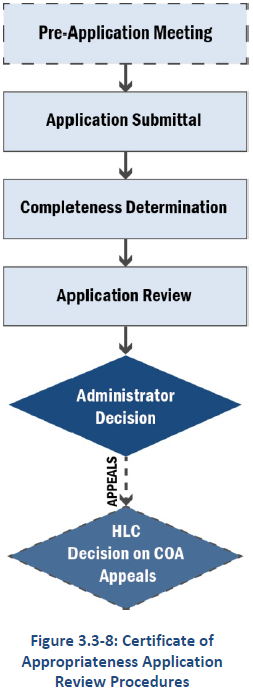
3.3.8 - Certificate of Appropriateness (COA)
(1)
PURPOSE: The purpose of the Certificate of Appropriateness procedures prior to the issuance of required permits is to ensure that all exterior alteration, reconstruction, or rehabilitation of historically designated properties are conducted per the requirements of Article VI: Building and Urban Design Standards of this Ordinance.
(2)
APPLICABILITY: A Certificate of Appropriateness shall be required prior to any exterior alteration, restoration, reconstruction, new construction, moving or demolition of a landmark, or property within a historic district. No person shall make any change in the appearance of such a property including its colors, light fixtures, signs, sidewalks, fences, steps, paving or other exterior elements visible from a public right-of-way which affect the appearance and cohesiveness of the historic landmark or district, without first applying for a Certificate of Appropriateness from the Administrator/ HPO or the Historic Landmark Commission.
(3)
EXEMPTIONS:
(a)
Ordinary repairs and maintenance that do not involve exterior changes in architectural and historical style or value, general design, structural arrangement, type of building materials, primary color, or basic texture.
(4)
APPLICATION: The applicant shall submit to the Administrator all of the information required in the application packet for Certificates of Appropriateness, along with any information identified in the pre-application meeting (if any) and all required information stated elsewhere in this Ordinance for a Certificate of Appropriateness. At minimum, the application shall include plans, elevations, and supporting documents that include the following:
(a)
Location of all existing and proposed buildings and structures, parking areas, driveways, trails, sidewalks, and other improvements on the subject property.
(b)
Existing building elevations or photographs.
(c)
Location of adjoining streets, alleys, and other public improvements.
(d)
Proposed changes to the building exteriors (elevations, sketches, or renderings) with specifications on color, materials, and related elements demonstrating compliance with the zoning district standards in Article IV: Zoning Districts and any applicable design standards established under this Ordinance or based on the Secretary of the Interior Standards for Rehabilitation.
(5)
COMPLETENESS DETERMINATION: Requirements in Section 3.2.4 shall apply.
(6)
REVIEW CRITERIA: All complete applications for Certificates of Appropriateness shall be reviewed by the Administrator/HPO based on the zoning district standards in Article IV: Zoning Districts and any applicable design standards established under this Ordinance or based on the Secretary of the Interior Standards for Rehabilitation.
(7)
APPROVAL PROCEDURES:
(a)
Jurisdiction
i.
The Administrator/HPO may approve, approve with conditions, or deny an application for Certificate of Appropriateness.
(b)
Approval of Certificate of Appropriateness.
i.
If the Administrator/HPO determines that the COA application complies with this Ordinance, the Administrator/HPO may approve the COA and notify the applicant in writing.
ii.
The Administrator/HPO reserves the right to forward any Certificate of Appropriateness application for HLC for review and approval when additional direction on design policy is needed or if unable to determine compliance with the design standards in this Ordinance or the Secretary of the Interior's Standards for Rehabilitation.
iii.
The Administrator/HPO shall report to the Historic Landmark Commission a list of properties for which a Certificate of Appropriateness has been approved administratively. Reports will be provided at each regularly scheduled Historic Landmark Commission meeting. Reports provided to HLC shall include at a minimum the property address, work permitted and date of issuance.
(c)
Denial of the Certificate of Appropriateness.
i.
If the Administrator/HPO determines that the COA application does not comply with this Ordinance, the Administrator/HPO may deny the COA and notify the applicant in writing. The notification shall include an explanation of why the COA application was denied.
(8)
APPEAL OF ADMINISTRATIVE DECISION ON COA'S: Appeals from the decision of the Administrator/HPO on COA's shall be made to the HLC. The process for such appeals shall follow the process for Zoning Appeals in Section 3.3.10 with the exception that initial appeals shall be considered by the HLC instead of the ZBA and a final appeal may be considered by the City Commission.
(9)
EXPIRATION: Work must commence on an approved Certificate of Appropriateness within 12 months of the date of approval. If the work has not commenced within 12 months, the Certificate of Appropriateness will expire and an extension request must be processed and approved by the Administrator/HPO or Historic Landmark Commission. A maximum of two six-month extensions may be requested. The total time of construction shall not exceed 24 months from the original date of approval. If the work is not completed within 24 months, the original Certificate of Appropriateness will be voided and a new Certificate of Appropriateness application must be submitted and approved to proceed with work.
(Ord. No. 25-0304-F1, § 2(Exh. A), 3-4-25)
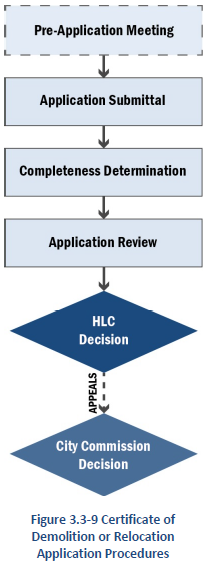
3.3.9 - Certificate of Demolition or Relocation of a Historic Building
(1)
PURPOSE: This section provides the process for the demolition of any historic landmark or buildings within a historic overlay designation.
(2)
APPLICABILITY: No person or entity shall demolish or relocate any building or structure located in a historic overlay designation district or a designated historic landmark, unless a Certificate of Demolition or Relocation has first been issued by the HLC or City Commission, as set forth in this section.
(3)
INITIATION: An interested property owner may submit an application for a Certificate of Demolition or Relocation.
(4)
PRE-APPLICATION MEETING: Shall be per procedures established in Section 3.2.3
(5)
COMPLETENESS DETERMINATION: In addition to requirements in Section 3.2.4, the Administrator may establish additional requirements for a Certificate of Demolition or Relocation application.
(6)
APPROVAL PROCEDURES
(a)
Historic Landmarks Commission Public Hearing: Within 60 days of the receipt of a completed application for a Certificate of Demolition or Relocation, the HLC shall hold a public hearing.
i.
If, based upon the criteria established in Section 3.3.9(7) below, the HLC determines that the building or structure:
1.
Should not be demolished, the HLC shall deny the Certificate for Demolition or Relocation.
2.
May be demolished, the HLC may issue the certificate.
ii.
If the HLC fails to take any action within 120 days of the receipt of a completed application, a Certificate of Demolition or Relocation is deemed issued.
iii.
If the HLC denies the application for Certificate of Demolition or Relocation, it may be appealed in writing to the City Commission within 14 days of the HLC decision.
(b)
City Commission Decision: The City Commission shall consider any appeals to the HLC's denial of an application for a Certificate of Demolition or Relocation at the applicant's request at a public hearing.
i.
Based on the criteria established in Section 3.3.9(7), below, the City Commission shall approve, approve with conditions, or deny the Certificate of Demolition or Relocation.
(c)
Conditions for Approval: In granting a Certificate of Demolition or Relocation, the HLC or the City Commission must find that the interests of preserving historical values and the purposes and intent of this Ordinance will not be adversely affected by the requested demolition or removal, or that such interests will be best served by removal or relocation to another specified location.
(7)
CRITERIA FOR APPROVAL: In evaluating a request for a Certificate of Demolition or Relocation, the HLC and/or the City Commission may consider the following:
(a)
The architectural, cultural, or historical significance of the building or structure.
(b)
The age of the building or structure.
(c)
The state of repair of the building or structure in question, and the reasonableness of the cost of restoration and repair.
(d)
Additions, alterations, changes, modifications, and updates to the exterior architectural features of the building or structure that would disqualify it from consideration for listing on the National Register of Historic Places.
(e)
The effect, if any, that delaying the demolition or relocation of the building or structure will have.
(f)
The contribution, if any, the building or structure makes to a previously designated and recognized historic overlay designation or landmark and the owner's or any predecessor owner's involvement in the formation or creation of such a designation.
(g)
The willingness of the applicant to donate or sell the building or structure to a third party.
(h)
The potential usefulness or adaptive reuse of the building or structure, including economic usefulness.
(i)
The potential market or demand for such a building or structure in its current condition and location.
(j)
The purpose that would be served in preserving the building or structure.
(k)
All other factors it finds necessary and appropriate to carry out the intent of this Ordinance.
(8)
MAINTENANCE AND REPAIRS:
(a)
Omission of Necessary Repairs: Buildings and structures located in a historic overlay designation district or designated as a landmark shall be maintained so as to ensure the exterior and interior structural soundness and integrity of the building and its exterior architectural features upon the character of the historic district as a whole or the life and character of the property itself. Examples of such deterioration shall include, but are not limited to the following:
(1)
Deterioration of exterior walls or other vertical supports.
(2)
Deterioration of roofs or other horizontal members.
(3)
Deterioration of exterior chimneys.
(4)
Deterioration or crumbling of exterior stucco or mortar.
(5)
Ineffective waterproofing of exterior walls, roofs, or foundations, including broken windows or doors.
(6)
Deterioration of any feature so as to create a hazardous condition which could lead to the claim that demolition is necessary for public safety.
(7)
Deterioration of structural elements and the enclosing envelope.
(8)
Landscape features.
(9)
Deterioration of ornamental features.
(9)
APPEALS: Appeals from a decision of the HLC shall be made to the City Commission. Appeals to the City Commission decision shall be made to court of record in Ellis County, Texas within 10 days of the decision.
(Ord. No. 25-0304-F1, § 2(Exh. A), 3-4-25)
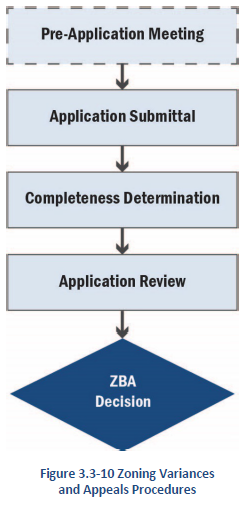
3.3.10 - Zoning Variances and Appeals
(1)
PURPOSE: This section provides a process to gain relief from the strict application of the zoning provisions of this Ordinance (specifically Article IV: Zoning Districts) where it is alleged the property cannot reasonably be developed or to appeal a decision of the Administrator.
(2)
APPLICABILITY:
(a)
The ZBA may approve a variance to any provision in this Ordinance, unless the variance is assigned to another body or the Administrator.
(b)
The ZBA may consider an appeal of any decision of the Administrator under this Ordinance unless otherwise specified in this Ordinance.
(3)
APPLICATION:
(a)
Time limit on appeals to Administrative Decisions:
i.
An appeal to an Administrative Decision shall be filed with the Board (via the City Secretary) and the official from whom the appeal is sought not later than 14 days after the decision is rendered. Failure to submit an appeal within the 14 days shall bar the ability to appeal the decision.
ii.
It shall be filed by submitting a notice of appeal that specifies the grounds for the appeal.
(4)
INITIATION: Applications for a variance or appeal shall be submitted to the Administrator by the following parties, unless otherwise indicated by this article:
i.
Any owner of the property subject to the application
ii.
An agent, representative, lessee, or contract purchaser specifically authorized by the owner to file the application
(5)
COMPLETENESS DETERMINATION: Requirements in Section 3.2.4 shall apply.
(6)
HEARING PROCEDURES
(a)
The ZBA shall review the application and the recommendation of the Administrator and shall conduct a hearing.
(b)
The hearing shall comply with Texas Local Government Code §211.008 and any rules of procedure adopted by the ZBA.
(c)
After the hearing is closed, the ZBA shall approve, approve with conditions, or deny the application.
(d)
The ZBA shall make and keep minutes of its proceedings in compliance with Texas Local Government Code Section 211.008.
(7)
REVIEW AND APPROVAL CRITERIA: The ZBA shall not approve a variance unless it finds that all of the following criteria have been met:
(a)
The variance must be necessary to permit development of a specific parcel of land which differs from other parcels of land by being of such a restrictive area, shape, or slope that it cannot be developed in a manner commensurate with the development of other parcels of land in districts with the same zoning
(b)
The need for the variance is not self-created
(c)
The need for the variance is not personal or financial hardship
(d)
The requested variances does not permit a person a privilege in developing a parcel of land not permitted by this Ordinance to other parcels of land in districts with the same zoning district or to be developed in a manner inconsistent with the rights of properties similarly zoned
(e)
The grant of the variance would not violate the intent of this UDO and would further substantiate justice
(8)
AMORTIZATION:
(a)
Initiate, on its own motion or otherwise, action to bring about the discontinuance of a nonconforming use in accordance with Article X: Nonconformities.
(b)
Require the discontinuance of a nonconforming use under any plan whereby the full value of the structure or use can be amortized within a definite period of time, taking into consideration the general character of the neighborhood and the necessity for all property to confirm to the regulations of this Ordinance.
(c)
Hear and decide appeals where it is alleged there is an error in any order, requirement, decision, or determination made by the Administrator in the enforcement of this Ordinance.
(9)
VOTING REQUIREMENTS
(a)
The grant of any variance requires the affirmative vote of at least four (4) members of the board
(b)
A vote of at least four (4) members is required to overturn or modify any decision by the Administrator
(c)
All other actions may be approved by not less than three (3) members of the Board
(10)
APPEALS FROM ZONING BOARD OF ADJUSTMENT: Any appeal to a ZBA decision must be made to a court of record in Ellis County, Texas within 10 days of the decision or as specified in the TXLGC.
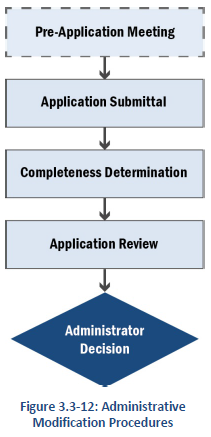
3.3.11 - Administrative Modification
(1)
PURPOSE: This section provides a process to allow for minor adjustment to the numerical zoning standards of this Ordinance based on a set of criteria by the Administrator.
(2)
APPLICABILITY: Only the standards specified in Table 3.3-3 may be adjusted based on the extent to which they meet the criteria and extent of allowed modification. All other amendments shall either be through the ZBA or City Commission through a rezoning (including in the case of special districts through a Concept Plan amendment).
(3)
APPLICATION SUBMITTAL: All applications for an administrative modification shall be submitted to the Administrator by the following parties, unless otherwise indicated by this article:
(a)
Any owner of the property subject to the application
(b)
An agent, lessee, or contract purchaser specifically authorized by the owner to file the application
(4)
COMPLETENESS DETERMINATION: Requirements in Section 3.2.4 shall apply.
(5)
APPLICATION REVIEW: All complete applications for an Administrative Modification shall be reviewed by the Administrator based on the requirements in this Ordinance or any approved Concept, Development, or Site Plans as applicable.
(6)
ADMINISTRATOR DECISION: All Administrative Modifications may either be approved or approved with conditions by the Administrator based on the criteria established in this section. Any applications that do not meet these established criteria may be referred to the ZBA.
(7)
REVIEW AND APPROVAL CRITERIA: Table 3.3-3 shall establish the criteria for permitted Administrative Modifications. In no circumstance shall the Administrator approve an administrative modification that results in:
(a)
An increase in overall project intensity or density
(b)
A change in permitted uses or mix of uses
(c)
A change in the relationship between the buildings and the street
(d)
A change in any required element of any ordinance or PD standards
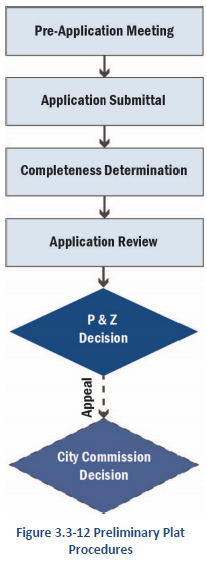
3.3.12 - Preliminary Plat
(1)
PURPOSE AND APPLICABILITY: The purpose of a Preliminary Plat shall be to determine the general layout of the subdivision, the adequacy of public facilities needed to serve the intended development, and the overall compliance of the subdivision of land with applicable requirements of this Ordinance. Preliminary plats shall be approved prior to any land division and commencement of any new development or construction project.
(2)
EXCEPTIONS:
(a)
A Preliminary Plat is not required when a Minor Plat is submitted. Refer to Section 3.3.14
(b)
A Final Plat in accordance with Section 3.3.13, along with Construction Plans, may be submitted in lieu of a Preliminary Plat if a Developer's Agreement and/or appropriate surety are submitted along with the application
(3)
PRE-APPLICATION MEETING: A pre-application meeting is required for Preliminary Plats. Standards for pre-application meetings in Section 3.2.3 shall apply.
(4)
APPLICATION SUBMITTAL: In addition to submittal requirements in Section 3.2.4, the application submittal shall include:
(a)
A Preliminary Drainage Plan, Preliminary Paving and Preliminary Utility Plan. If deemed necessary for thorough review by the Administrator, other plans may be required.
(b)
Current title commitment issued by a title insurance company authorized to do business in Texas, a title opinion letter from an attorney licensed to practice in Texas, or some other acceptable proof of ownership, identifying all persons or entities, including mortgage holders, having an ownership interest in the property subject to the Preliminary Plat.
(5)
COMPLETENESS DETERMINATION: Requirements in Section 3.2.4 shall apply.
(6)
APPLICATION REVIEW: All complete applications for Preliminary Plats shall be reviewed by the Administrator based on the requirements in this Ordinance (Section 3.2.5) and justification for modifications or variances to any standards.
(7)
NOTICE: None.
(8)
APPROVAL PROCEDURES:
(a)
Action by the Planning and Zoning Commission: The P&Z shall have final authority to approve, approve with modifications, or deny the application.
(b)
Appeal: The applicant may appeal a P&Z decision to deny or to conditionally approve a preliminary plat to the City Commission.
(9)
REVIEW AND APPROVAL CRITERIA: In addition to general criteria in Section 3.2.7(2), the following criteria shall be used by the P&Z to determine whether the application for a Preliminary Plat shall be approved, approved with conditions, or denied:
(a)
The Preliminary Plat is consistent with all zoning requirements for the property, including any applicable Planned Development or Special Zoning District standards, and with any approved conditions as applicable.
(b)
The proposed provision and configuration of public improvements including, but not limited to, roads, water, wastewater, storm drainage, park facilities, open spaces, habitat restoration, easements and rights-of-way are adequate to serve the development, meet applicable standards of this Ordinance, and conform to the city's adopted master plans for those facilities.
(c)
The Preliminary Plat is in accordance with the city's interlocal agreements with Ellis County if the proposed development is located in whole or in part in the ETJ of the city.
(d)
The Preliminary Plat has been duly reviewed by all required city staff.
(e)
The Preliminary Plat conforms to design requirements and construction standards as set forth in this Ordinance and the city's Infrastructure Design Standards.
(f)
The Preliminary Plat is consistent with the Comprehensive Plan, except where application of the Plan may conflict with State law (e.g., land use in the ETJ).
(g)
The proposed development represented on the Preliminary Plat does not endanger public health, safety or welfare.
(10)
AMENDMENTS: The following amendments can be made to a Preliminary Plat following approval:
(a)
Minor Amendments - Minor amendments to the design of the development subject to an approved Preliminary Plat may be incorporated in an application for approval of a Final Plat without the necessity of filing a new application for re-approval of a Preliminary Plat. Minor amendments may only include minor adjustments in street or alley alignments, lengths and paving details, and minor adjustments to lot lines that do not result in creation of additional lots or any non-conforming lots (such as to lot standards in the zoning district), and provided that such amendments are consistent with applicable approved prior applications.
(b)
Major Amendments - All other proposed changes to an approved Preliminary Plat shall be deemed major amendments that require submittal and approval of a new application for approval of a Preliminary Plat (including new fees, new reviews, new official filing date, etc.) before approval of Construction Plans and/or a Final Plat.
(c)
Determination - The Administrator shall make a determination of whether proposed amendments are deemed to be minor or major, thereby requiring new submittal of a Preliminary Plat.
(11)
RECORDING: A preliminary plat is not recorded. The Administrator shall maintain the approved preliminary plat in accordance with state law and city records retention policies.
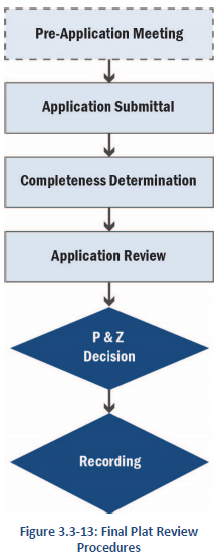
3.3.13 - Final Plat
(1)
PURPOSE AND APPLICABILITY: The purpose of a Final Plat is to ensure that the proposed development of the land is consistent with all standards of this Ordinance pertaining to the adequacy of public facilities, that public improvements to serve the development have been installed and accepted by the city or that provision for such installation has been made, that all other requirements and conditions have been satisfied or provided for to allow the Final Plat to be recorded.
(2)
EXCEPTIONS: A Final Plat is not required when a Minor Plat is submitted.
(3)
PRE-APPLICATION MEETING: A pre-application meeting is encouraged but optional for Final Plats. Standards for pre-application meetings in Section 3.2.3 shall apply to pre-application meetings.
(4)
APPLICATION SUBMITTAL: In addition to submittal requirements in Section 3.2.4, the application submittal shall include:
(a)
Proof of ownership in the form of a current title commitment issued by a title insurance company authorized to do business in Texas, a title opinion letter from an attorney licensed to practice in Texas, or some other acceptable proof of ownership, identifying all persons or entities, including mortgage holders, having an ownership interest in the property subject to the Final Plat.
(b)
The Final Plat may be accompanied by Construction Plans if also accompanied by a Developer's Agreement and appropriate surety (approval of each shall be separate). Should the property have a prior approved Preliminary Plat, the Final Plat shall conform to the Preliminary Plat as approved or approved with conditions by the P&Z or City Commission.
(c)
The Final Plat shall be signed by each owner, or by the representative of the owners authorized to sign legal documents for the owners, and all mortgage holders effectively denoting that they are consenting to the platting of the property and to the dedications and covenants that may be contained in the Final Plat. Such consent shall be subject to review and approval by the Administrator.
(5)
COMPLETENESS DETERMINATION: Requirements in Section 3.2.4 shall apply.
(6)
APPLICATION REVIEW: All complete applications for Final Plats shall be reviewed by the Administrator based on the requirements in this Ordinance (Section 3.2.5) and justification for modification of any standards.
(7)
PUBLIC NOTICE: None.
(8)
APPROVAL PROCEDURES:
(a)
Action by the Planning and Zoning Commission: The P&Z shall have the final authority to approve, approve with conditions, or deny any Final Plats.
(b)
Appeal: The applicant may appeal a P&Z decision to deny or to conditionally approve a Final Plat to the City Commission.
(9)
REVIEW AND APPROVAL CRITERIA - PRIOR APPROVED PRELIMINARY PLAT: In addition to general criteria in Section 3.2.7(2), the following criteria shall be used by the P&Z to determine whether the application for a Final Plat with a previously approved Preliminary Plat shall be approved, approved with conditions, or denied:
(a)
The Final Plat conforms to the approved Preliminary Plan except for minor amendments that are authorized under Section 3.3.13(10) and that may be approved without the necessity of revising the approved Preliminary Plat.
(b)
All conditions imposed at the time of approval of the Preliminary Plat, as applicable, have been satisfied.
(c)
The Construction Plans conform to design requirements and construction standards as set forth in this Ordinance and the Infrastructure Design Standards.
(d)
Where public improvements have been installed, the improvements conform to the approved Construction Plans and have been approved for acceptance by the Administrator.
(e)
Where the Administrator has authorized public improvements to be deferred, a Developer's Agreement has been executed and submitted by the property owner in conformity with Article IX: Subdivision Regulations.
(f)
The final layout of the subdivision or development meets all standards for adequacy of public facilities contained in this Ordinance.
(g)
The Final Plat meets all applicable county standards to be applied under an interlocal agreement between the city and the county under Texas Local Government Code Chapter 242, where the proposed development is located in whole or in part in the ETJ of the city.
(10)
REVIEW AND APPROVAL CRITERIA - NO PRIOR APPROVED PRELIMINARY PLAT: In addition to general criteria in Section 3.2.7(2), the following criteria shall be used by the P&Z to determine whether the application for a Final Plat with no prior approved Preliminary Plat shall be approved, approved with conditions, or denied:
(a)
The Final Plat conforms to all criteria for approval of a Preliminary Plat.
(b)
The Construction Plans conform to design requirements and construction standards as set forth in this Ordinance and the Infrastructure Design Standards.
(c)
A Developer's Agreement or surety for installation of public improvements has been prepared and executed by the property owner in conformity with Article IX: Subdivision Regulations.
(d)
The final layout of the subdivision or development meets all standards for adequacy of public facilities contained in this Ordinance.
(e)
The Final Plat meets all applicable county standards to be applied under an interlocal agreement between the city and the county under Texas Local Government Code Chapter 242, where the proposed development is located in whole or in part in the ETJ of the city.
(11)
RECORDING:
(a)
All plats submitted for recordation shall be sealed by a registered professional land surveyor in the state of Texas.
(b)
All plats to be recorded shall conform to all conditions of approval and shall be submitted to the Administrator.
(c)
Plats shall be recorded in the Plat Records of Ellis County by the city and a copy delivered to the applicant. They shall include:
i.
All stipulations of approval
ii.
The required public improvements have been completed and accepted by the city (or appropriate surety provided in accordance with Article IX: Subdivision Regulations)
iii.
All necessary fiscal agreements approved by the city and fully executed by all parties
iv.
Payment of all applicable fees, assessments, and both current and delinquent taxes
(d)
Effect of Approval - The approval of a Final Plat supersedes any prior approved Preliminary Plat for the same land; authorizes the applicant to install any improvements in public rights-of-way in conformance with approved Construction Plans and under any Developer's Agreement, if applicable; and authorizes the applicant to seek Construction Release and/or issuance of a Building Permit.
(e)
Revisions Following Recording/Recordation - Revisions may only be processed and approved as a Replat or Amending Plat, as applicable.
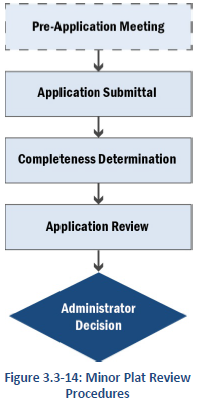
3.3.14 - Minor Plat
(1)
PURPOSE AND APPLICABILITY: The purpose of a Minor Plat is to simplify divisions of land under certain circumstances outlined in State law. An application for approval of a Minor Plat may be filed only in accordance with State law, when all of the following circumstances apply:
(a)
The proposed division results in four (4) or fewer lots.
(b)
All lots in the proposed subdivision front onto an existing public street and the construction or extension of a street or alley is not required to meet the requirements of this Ordinance.
(c)
Except for right-of-way widening and easements, the plat does not require the extension of any municipal facilities to serve any lot within the development.
(d)
If minor revisions are required for a previously platted, recorded lot, a Minor Plat may be utilized in lieu of a Replat if allowed by State Law.
(2)
PRE-APPLICATION MEETING: A pre-application meeting is encouraged but optional for Minor Plats. Standards for pre-application meetings in Section 3.2.3 shall apply to pre-application meetings.
(3)
APPLICATION SUBMITTAL: In addition to submittal requirements in Section 3.2.4, the application submittal shall follow the same requirements for a Final Plat in Section 3.3.13(4).
(4)
COMPLETENESS DETERMINATION: Requirements in Section 3.2.4 shall apply.
(5)
APPLICATION REVIEW: All complete applications for Minor Plats shall be reviewed by the Administrator based on the requirements in this Ordinance (Section 3.2.5) and justification for modification of any standards.
(6)
ADMINISTRATIVE DECISION: All Minor Plats that meet the requirements of this Ordinance may either be approved or approved with conditions by the Administrator. Any applications for Minor Plats that do not meet this Ordinance may only be approved by the P&Z.
(7)
NOTICE: None required.
(8)
APPROVAL PROCEDURES: Should the application not meet the requirements of this Ordinance, approval may only be by the P&Z which has final authority to approve, approve with conditions, or deny any Minor Plat.
(9)
REVIEW AND APPROVAL CRITERIA: Approval criteria for Minor Plats shall be in accordance with general criteria in Section 3.2.7(2) and the following criteria for Minor Plats:
(a)
All lots to be created by the plat already are adequately served by a public street and by all required utilities and services and by alleys, if applicable
(b)
The ownership, maintenance and allowed uses of all designated easements have been stated on the Minor Plat
(c)
Except for right-of-way widening and easements, the plat does not require the extension of any municipal facilities to serve any lot within the development including any dedication statements and signatures for ROW dedications.
(10)
RECORDING:
(a)
See Section 3.3.13(11).
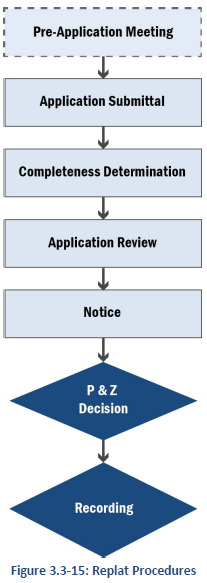
3.3.15 - Replat
(1)
PURPOSE AND APPLICABILITY: A replat of a subdivision or part of a subdivision may be recorded and is controlling over the preceding plat without vacation of that plat if the replat:
(a)
Is signed and acknowledged by the owners of the property being replatted
(b)
Is approved after a public hearing
(c)
Does not attempt to amend or remove any covenants or restrictions
(2)
PRE-APPLICATION MEETING: A pre-application meeting is encouraged and not required for Replats. Standards for pre-application meetings in Section 3.2.3 shall apply to pre-application meetings.
(3)
APPLICATION SUBMITTAL: The application submittal must be in conformance with submittal requirements in Section 3.2.4
(4)
COMPLETENESS DETERMINATION: Requirements in Section 3.2.4 shall apply.
(5)
APPLICATION REVIEW: All complete applications for Replat shall be reviewed by the Administrator based on the requirements in this Ordinance (Section 3.2.5).
(6)
NOTICE: Notice shall be provided for Replats per this Section and per TXLGC 212.015, as amended.
(7)
Types of replats requiring public notice:
(a)
Any part of the area to be replatted was limited by an interim or permanent zoning classification to single-family or duplex residential use at any time during the preceding five years
(b)
Any lot in the preceding plat was limited by deed restriction to single-family or duplex residential use
(c)
Exemption: Compliance with this Subsection is not required for approval of a replat if the area to be replatted was designated or reserved for a use other than single or duplex family residential use by notation on the plat or in the legally recorded restrictions applicable to the plat
(d)
Notice of a public hearing shall be given before the 15th day before the date of the hearing by:
i.
Publication in the official newspaper of the city
ii.
By written notice to the owners of lots that are in the original subdivision and that are within 200 feet of the lots to be replatted as indicated on the most recently certified tax roll
(e)
If the proposed Replat requires a waiver and is protested by petition in accordance with state law, the proposed Replat must receive, in order to be approved, the affirmative vote of at least three-fourths of the Planning and Zoning Commission or City Council members present.
i.
For a legal protest or petition to be valid:
1.
The petition must be signed by the owners of at least 20 percent of the area of the lots or land immediately adjoining the area covered by the proposed Replat and extending 200 feet from that area but within the original subdivision.
2.
The petition must be submitted to the Commission or Council, or both, prior to close of the public hearing.
3.
The signatures on the petition must correspond with actual names listed on the most recently approved municipal tax roll or in the case of a subdivision within the ETJ, the most recently approved county tax roll.
(8)
APPROVAL PROCEDURES:
(a)
If Texas Local Government Code §212.014 or 212.015 applies, the proposed replat is subject to the procedures established in that section.
(b)
All other replats are subject to the approval procedures established for final plats (see Section 3.3.13).
(9)
REVIEW AND APPROVAL CRITERIA: Approval criteria for Replats shall be in accordance with criteria for Final Plats in Section 3.3.13. In addition, lots must conform in width, depth, and area to the predominant pattern established by the existing lots located on the same block, having due regard to the character of the area.
(10)
RECORDING:
(a)
See Section 3.3.13(11).
(b)
The following minimum certification shall be shown on all replats: "This plat does not alter or remove existing deed restrictions or covenants, if any, on this property."
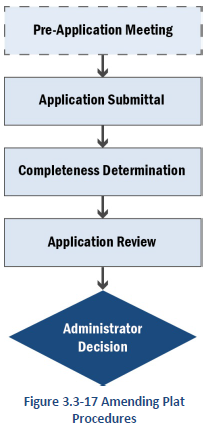
3.3.16 - Amending Plat
(1)
PURPOSE AND APPLICABILITY: The Administrator may approve an amended plat if the amended plat is signed by the owners only and is solely for one or more of the purposes prescribed in Texas Local Government Code § 212.016.
(2)
PRE-APPLICATION MEETING: A pre-application meeting is encouraged but optional for Amending Plats. Standards for pre-application meetings in Section 3.2.3 shall apply to pre-application meetings.
(3)
APPLICATION SUBMITTAL: The application submittal shall conform to submittal requirements in Section 3.2.4
(4)
COMPLETENESS DETERMINATION: Requirements in Section 3.2.4 shall apply.
(5)
APPLICATION REVIEW: All complete applications for Amending Plats shall be reviewed by the Administrator based on the requirements in this Ordinance (Section 3.2.5) and per Texas Local Government Code § 212.016
(6)
ADMINISTRATIVE DECISION: All Amending Plats that meet the requirements of this Ordinance may either be approved or conditionally approved by the Administrator. Any applications for Amending Plats that do not meet this Ordinance will be forwarded to the P&Z for a final decision.
(7)
NOTICE: Should approval by P&Z be required, notice shall be published and written. See Section 3.2.6 and Table 3.2-1
(8)
APPROVAL PROCEDURES:
(a)
If the Administrator determines that the amended plat complies with requirements of this Ordinance, then the Administrator shall approve and certify the amended plat and the plat shall be filed of record.
(b)
Referral of Amended Plats: If the Administrator determines that the amended plat does not comply with the requirements of this Ordinance. The Administrator shall:
i.
Refer the application to the P&Z within the time period required for approval of a final plat (See Section 3.3.13).
ii.
Provide the applicant written notification and an explanation of why the plat does not comply with this Ordinance.
(9)
RECORDING:
(a)
Shall meet the standards for recording of a Final Plan in Section 3.3.13
(b)
The following certification shall be shown on all amended plats: "This plat does not increase the number of lots in the previously recorded subdivision nor attempt to alter or remove existing deed restrictions or covenants, if any, on this property." Amended plats shall contain a note describing the intent of the amended plat.
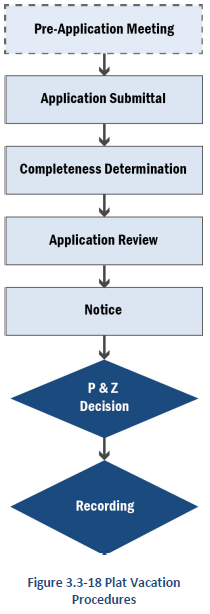
3.3.17 - Plat Vacation
(1)
PURPOSE AND APPLICABILITY: The purpose of a Plat Vacation is to provide an expeditious means of vacating a recorded plat in its entirety, consistent with provisions of the State law.
(2)
PRE-APPLICATION MEETING: A pre-application meeting is encouraged but optional for Plat Vacation. Standards for pre-application meetings in Section 3.2.3 shall apply to pre-application meetings.
(3)
APPLICATION SUBMITTAL: The application submittal must conform to submittal requirements in Section 3.2.4
(4)
COMPLETENESS DETERMINATION: Requirements in Section 3.2.4 shall apply.
(5)
APPLICATION REVIEW: All complete applications for Plat Vacations shall be reviewed by the Administrator based on the requirements in this Ordinance (Section 3.2.5) and justification for modification of any standards.
(6)
NOTICE: Published and written notice required. See Section 3.2.6 and Table 3.2-1
(7)
APPROVAL PROCEDURES:
(a)
Action by the Planning and Zoning Commission: The P&Z shall hold a public hearing on any Plat Vacation. The P&Z shall have the final authority to approve, approve with conditions, or deny any Plat Vacation.
(b)
Appeal: The applicant may appeal a P&Z decision to deny or to conditionally approve a Plat Vacation to the City Commission.
(8)
REVIEW AND APPROVAL CRITERIA: Approval criteria for Plat Vacation shall be in accordance with the criteria for a final plat per Section 3.3.13 and in accordance with TXLGC 212.013, as amended.
(9)
RECORDING:
(a)
The instrument declaring the plat vacated is approved and recorded in the manner prescribed for the original plat. Replacement right-of-way or easement may be required to be dedicated by separate instrument as condition of approval.
(b)
After the vacating instrument is approved, the applicant may seek a subdivision plat, zoning, and building permit approvals subject to this Ordinance, and any conditions of approval attached to the vacating instrument.
3.4.1 - Purpose
This article establishes procedures through which the city seeks to ensure compliance with the provisions of this Ordinance and obtains corrections for violations. It also sets forth the remedies and penalties that apply to violations of this Ordinance.
3.4.2 - Violations
Any of the following shall be a violation of this Ordinance and shall be subject to the remedies and penalties provided for in this Ordinance.
(1)
ESTABLISH ANY USE OR STRUCTURE WITHOUT PERMIT OR APPROVAL: To establish or place any use or structure upon land that is subject to this Ordinance without all of the approvals required by this Ordinance.
(2)
DEVELOPMENT OR SUBDIVISION WITHOUT PERMIT OR APPROVAL: To engage in any subdividing, development, construction, remodeling, or other activity of any nature upon land that is subject to this Ordinance without all of the approvals required by this Ordinance.
(3)
DEVELOPMENT, SUBDIVISION, OR USE INCONSISTENT WITH PERMIT: To engage in any improvements, development, use, construction, remodeling, or other activity of any nature in any way inconsistent with the terms and conditions of any permit, approval, certificate, or other form of authorization providing for such activity.
(4)
DEVELOPMENT, SUBDIVISION, OR USE INCONSISTENT WITH CONDITIONS OF APPROVAL: To violate, by act or omission, any term, condition, or qualification placed by a decision- making authority upon any permit or other form of authorization.
(5)
DEVELOPMENT OR SUBDIVISION INCONSISTENT WITH THIS ORDINANCE: To erect, construct, reconstruct, remodel, alter, maintain, move, or use any building, or structure, or to engage in development or subdivision of any land in violation of any zoning, subdivision, or other regulation within this Ordinance.
(6)
MAKING LOTS OR SETBACKS NONCONFORMING: To reduce or diminish any lot area so that the lot size, setbacks, or open spaces shall be smaller than required, unless in accordance with any exceptions provided under this Ordinance.
(7)
INCREASING INTENSITY OR DENSITY OF USE: To increase the intensity or density of use of any land or structure, except in accordance with the requirements and standards of this Ordinance.
(8)
REMOVING OR DEFACING REQUIRED NOTICE: To remove, deface, obscure, or otherwise interfere with any notice required by this Ordinance.
(9)
MODIFYING A STRUCTURE OR PROPERTY DESIGNATED AS A LANDMARK OR WITHIN:
A HISTORIC DISTRICT WITHOUT APPROVAL: To make exterior modifications to a building or property designated as a landmark and/or located in a historic overlay that is subject to this Ordinance without all of the approvals required by this Ordinance or not in compliance with a Certificate of Appropriateness or other approvals.
(Ord. No. 25-0304-F1, § 2(Exh. A), 3-4-25)
3.4.3 - Responsible Persons
A responsible person is any person who has ownership, care, custody or control of a property, building or portion of a building. A responsible person includes, but is not limited to an owner, manager, tenant or contractor. Any responsible person who violates this Ordinance shall be subject to the remedies and penalties set forth in this article.
3.4.4 - Responsibility for Enforcement
The Administrator shall have primary responsibility for enforcing all provisions of this Ordinance. Other officers of the city, as designated by the City Manager, may share responsibility for enforcing provisions of this Ordinance.
3.4.5 - Enforcement Procedures
(1)
REMEDIES AND ENFORCEMENT POWERS: The city shall have the remedies and enforcement powers in this section.
(2)
WITHHOLD PERMIT:
(a)
The city may deny or withhold all permits, certificates, or other forms of authorization on any land or structure or use or improvements upon a determination that there is an uncorrected violation of a provision of this Ordinance or of a condition or qualification of a permit, certificate, approval, or other authorization previously granted by the city. This enforcement provision shall apply regardless of whether the current or previous owner or lessee or applicant is responsible for the violation in question.
(b)
The city may deny or withhold all permits, certificates, or other forms of authorization on any land, structure, use, or improvements owned or being developed by a person who owns, developed, or otherwise caused an uncorrected violation of a provision of this Ordinance or of a condition or qualification of a permit, certificate, approval, or other authorization previously granted by the city. This provision shall apply regardless of whether the property for which the permit or other approval is sought is the property with the violation.
(3)
PERMITS APPROVED WITH CONDITIONS: Instead of withholding or denying a permit or other authorization, the city may grant such authorization subject to the condition that the violation be corrected.
(4)
REVOCATION OF PERMITS OR AUTHORIZATION:
(a)
Any permit or other form of authorization required under this Ordinance maybe revoked, after notice to the applicant, when the Administrator determines that:
i.
There is a departure from the approved plans, specifications, limitations, or conditions as required under the approved permit or authorization
ii.
The permit or authorization was procured by false representation
iii.
The permit or authorization was issued in error
iv.
There is a violation of any provision of this Ordinance or condition of approval
(b)
Written notice of revocation shall be sent to the property owner, agent, applicant, or other person to whom the permit or authorization was issued. No work or construction shall proceed after revocation notice has been sent.
(5)
STOP WORK ORDER:
(a)
With or without revoking permits, the city may stop work on any building or structure on any land on which there is an uncorrected violation of a provision of this Ordinance, an Adopted Ordinance, or of a permit or other form of authorization issued, in accordance with the city's power to stop work under its building codes.
(b)
The stop work order and any associated penalties shall be in writing and directed to the person doing the work, and shall specify the provisions of this Ordinance or permit or authorization that is in violation. After any such order has been sent, no work shall proceed on any building, structure, or land covered by such order, except to correct such violation or comply with the order.
(c)
Once the violations of the ordinance, permit, authorization or conditions have been remedied or met, the Administrator shall rescind the stop work order.
(6)
MUNICIPAL CITATION: The city, through the Administrator or other employee, may issue citations to be prosecuted in the city's municipal court.
(7)
INJUNCTIVE RELIEF: The city may seek an injunction or other equitable relief in an appropriate court in Ellis County, Texas to stop any violation of this Ordinance or of a permit, approval, or other form of authorization granted under this Ordinance.
(8)
WITHHOLD PUBLIC SERVICES: The city may withhold any public services until all violations have been remedied and all the requirements of this Ordinance have been met.
(9)
OTHER REMEDIES: The city shall have such other remedies as are and as may be from time-to- time provided by law for the violation of zoning, subdivision, sign, or related ordinance provisions.
(10)
OTHER POWERS: In addition to the enforcement powers specified in this article, the city may exercise any and all enforcement powers granted by law.
(11)
CONTINUATION: Nothing in this Ordinance shall prohibit the continuation of previous enforcement actions undertaken by the city pursuant to previous and valid ordinances and laws.
3.4.6 - Cumulative Remedies
The remedies and enforcement powers established in this article shall be cumulative and the city may exercise them in any order or combination at any time.
3.4.7 - Penalties for Violations
(1)
Any person or corporation who violates any of the provisions of this Ordinance or fails to comply with any of the requirements thereof, or who builds or alters any building, structure, sign, or use or who develops, constructs, remodels, or any other activity of any nature upon land in violation of any permit or authorization shall be guilty of a misdemeanor punishable under this section.
(2)
The owner or owners or tenant of any building or premises or part thereof, where anything in violation of this Ordinance is placed or exists, and any architect, builder, contractor, agent, person, or corporation employed by the owner or tenant who may have assisted in the commission of any such violation shall be guilty of a separate offense punishable under this section.
(3)
Any person or corporation violating any of the provisions of this Ordinance shall, upon conviction, be fined any sum not exceeding two thousand dollars ($2,000.00) and each and every day that the provisions of this Ordinance are violated shall constitute a separate and distinct offense.

