
Estero City Zoning Code
CHAPTER 10
- DEFINITIONS AND RULES FOR CONSTRUCTION, INTERPRETATION, AND MEASUREMENT
SECTION 10-1.- GENERAL RULES FOR CONSTRUCTION
The rules in this section shall apply for construing or interpreting the terms and provisions of this LDC.
SECTION 10-3. - RULES OF MEASUREMENT
Intensity and dimensional standards shall be measured in accordance with this section.
SECTION 10-4. - DEFINITIONS
The following words, terms, and phrases, when used in this LDC, shall have the meaning ascribed to them in this section.
Abandoned Nest means for the purposes of Sec. 7-201.A, Southern Bald Eagle, only, a nest that is intact or partially intact but has been inactive through five or more consecutive nesting seasons.
Abandoned Well means for the purposes of Sec. 7-202, Wellfield Protection, only, a well that does not have a properly functioning valve, the use of which has been permanently discontinued, that does not meet current well construction standards, that is discharging water containing greater than 500 milligrams per liter of chlorides into a drinking water aquifer, that is in such a state of disrepair that it cannot be used for its intended purpose without having an adverse impact upon an aquifer which serves as a source of drinking water or which is likely to be such a source in the future, or that does not have proper flow control on or below the land surface (see F.S. § 373.203(1)).
Abandonment means for the purposes of Sec. 4-243, Wireless Telecommunications, the permanent cessation of the use of a communications facility; provided that this term shall not include cessation of all use of a facility within a physical structure where the physical structure continues to be used. By way of example, and not limitation, cessation of all use of a cable within a conduit, where the conduit continues to be used, shall not be "abandonment" of a facility in public rights-of-way. It may also mean the discontinued use of obsolete technology in favor of new technology, which would require the removal of the discontinued, abandoned technology.
Abutting Property means unless specifically stated otherwise in this LDC, a property having a boundary line, or point or portion thereof, in common, with no intervening street right-of-way or easement, or any other easement over 25 feet in width.
Access Point means an accessway or driveway that provides vehicle access to a single parcel of land.
Access Road means a road that runs generally parallel to an arterial or collector road and is the primary access to properties that abut the arterial or collector road. An access road is intended only to provide access to parcels existing when it is constructed and does not provide frontage for newly created parcels as would a local road. See also Frontage Road.
Access, Vehicular means the principal means of vehicular ingress and egress to abutting property from a street right-of-way or easement.
Access Walkway means for the purposes of Section 7-4, Marine Facilities, Structures, and Equipment Standards, only, the portion of a structure that allows access to a docking facility or terminal platform.
Accessway means land that is used or intended to be used for ingress or egress to abutting parcels of land and is not dedicated to the public. Accessways include access points to commercial, industrial, and other types of developments, except a single parcel of land containing two or fewer dwelling units in a single structure.
Accessory Use or Structure means a use or structure that is:
(1)
Clearly incidental to and customarily found in connection with and located on the same parcel as is the principal use to which it is related; and or
(2)
Designed for the comfort, convenience or necessity of occupants of the principal use served.
Active Nest means for the purposes of Sec. 7-201.A, Southern Bald Eagle, only, a nest that shows or showed evidence of breeding by southern bald eagles, such as an adult attending the nest or in incubating position, a clutch of eggs, or a brood of nestlings, at any time during the current or most recent nesting season.
ADA Accessibility Guidelines means document that contains scoping and technical requirements for accessibility to site, facilities, buildings and elements by individuals with disabilities. These guidelines are intended to apply to the design, construction, expansion, and alteration of sites, facilities, buildings, and elements to the extent required under the Americans with Disabilities Act of 1990 (ADA) and subsequent amendments.
Adjacent means a parcel of land that shares all or part of a common lot line or boundary with another parcel of land, or a parcel of land that would abut another parcel of land, but for the fact a street or right-of-way divides the parcels.
Advertising Message means copy on a sign describing commodities, products or services being offered to the public.
Aggrieved Person or Party means any person who has a legally recognizable interest which is or which may be adversely affected by an action of or an action requested of the Village Council, or any other person or Board that has been delegated authority under this LDC by the Village Council.
Agriculture means farming, horticulture, pasturage, animal husbandry, citrus and other fruit groves, nurseries, dairy farms, commercial fisheries, frog or poultry hatcheries, and similar uses.
Alcoholic Beverage means distilled spirits and all beverages, other than medicine, intended for human consumption and containing one-half of one percent or more alcohol by volume.
Alter and Alteration means any change in size, shape, character or use of a building or structure.
Alternate Nest means for the purposes of Sec. 7-201.A, Southern Bald Eagle, only, a nest that is intact or partially intact and has been used by bald eagles at any time during the past five nesting seasons, but was not used during the current or most recent nesting season. An inactive nest is considered to be an alternate nest until it has been inactive for five consecutive nesting seasons, at which time it becomes an abandoned nest.
Amateur Radio Antenna means an antenna, including any mounting device, tower, or antenna-supporting structure, designed and constructed for amateur radio services.
Amateur Radio Services means a radio communication service for the purpose of self-training, intercommunication and technical investigations carried out by duly authorized persons interested in radio technique solely with a personal aim and without pecuniary interest.
Ambient Light means light not emanating from the site, such as moonlight.
Amusement Arcades means an indoor commercial establishment which provides, as the principal "use," amusement devices or games of skill or chance, such as pinball and video games. This term shall not include establishments where amusement devices and games are "accessory uses" which either do not involve more than fifteen percent of the gross floor area of the establishment or involve more than two devices or games, whichever results in the greater number of games.
Amusement Centers means a commercially operated indoor facility providing a variety of amusement devices primarily including, but not limited to, play equipment, television games, electromechanical games, small kiddie rides, and other similar devices, and which may include food service.
Ancillary Appurtenances means for the purposes of Sec. 4-243, Wireless Telecommunications, equipment associated with a wireless communications facility including, but not limited to: Antennas, antenna concealment screening, attaching devices, transmission lines, and other equipment associated with a wireless communications facility. Ancillary appurtenances do not include equipment enclosures.
Animal Clinic means an establishment providing for the diagnosis and treatment of ailments of animals other than humans, and which may include facilities for overnight care.
Animal Shelter means a facility used to house and care for stray, homeless, abandoned, or neglected household and domestic animals that is owned, operated, or maintained by a public body or an established humane society or other private or nonprofit organization.
Antenna means any device for radiating or receiving electromagnetic radiation. This definition shall specifically include, but is not limited to, all radio, television, microwave, and satellite dish antennas.
Antenna Concealment Screening means for the purposes of Sec. 4-243, Wireless Telecommunications, panels, covers, or other methods that screen the visibility of antennas.
Antenna, Dish means for the purposes of Sec. 4-243, Wireless Telecommunications, a parabolic, spherical, or elliptical antenna intended to receive wireless communications.
Antenna, Flush-Mounted means for the purposes of Sec. 4-243, Wireless Telecommunications, a dual-polarization antenna that is attached flush to an antenna-supporting structure, without the use of sidearms or other extension devices.
Antenna, Panel means for the purposes of Sec. 4-243, Wireless Telecommunications, a directional antenna, with more than one panel per sector, designed to transmit and/or receive signals in a directional pattern that is less than 360 degrees.
Antenna, Roof-Mounted means for the purposes of Sec. 4-243, Wireless Telecommunications, an antenna mounted on the roof of a building, that extends above the roofline by 20 feet or less. An antenna, mounted on the roof of a building, that extends more than 20 feet above the roofline is an antenna-supporting structure.
Antenna, Surface-Mounted means for the purposes of Sec. 4-243, Wireless Telecommunications, an antenna that is attached to the surface or façade of a building or structure other than an antenna-supporting structure including, without limitation, billboards, utility poles and water towers.
Antenna, Whip means for the purposes of Sec. 4-243, Wireless Telecommunications, a cylindrical, omni-directional antenna designed to transmit and/or receive signals in a 360-degree pattern.
Antenna-Supporting Structure means for the purposes of Sec. 4-243, Wireless Telecommunications, a vertically projecting structure, including any foundation, designed and primarily used to support one or more antennas or which constitutes an antenna itself. Antenna-supporting structures include roof-mounted antennas that extend above a roofline by more than 20 feet. For purposes of this division, a utility pole not exceeding 40 feet in height will not be construed to be an antenna-supporting structure.
Antenna-Supporting Structure, Broadcast means for the purposes of Sec. 4-243, Wireless Telecommunications, an antenna-supporting structure, including replacements, which contains antennas that transmit signals for broadcast radio and television communications.
Antenna-Supporting Structure, Guyed means for the purposes of Sec. 4-243, Wireless Telecommunications, a style of antenna-supporting structure supported by a series of guy wires that are connected to anchors placed in the ground or on a building.
Antenna-Supporting Structure, Lattice means for the purposes of Sec. 4-243, Wireless Telecommunications, a style of stand-alone antenna-supporting structure, not supported by guy wires, which consists of vertical and horizontal supports with multiple legs and cross-bracing.
Antenna-Supporting Structure, Monopole means for the purposes of Sec. 4-243, Wireless Telecommunications, a style of stand-alone antenna-supporting structure that is composed of a single shaft attached to a foundation with external antennas. This type of antenna-supporting structure is designed to support itself without the use of guy wires or other stabilization devices.
Antenna-Supporting Structure, Replacement means for the purposes of Sec. 4-243, Wireless Telecommunications, an antenna-supporting structure intended to replace an antenna-supporting structure in existence at the time of application.
Applicable Codes means for the purposes of Sec. 4-243, Wireless Telecommunications, uniform building, fire, electrical, plumbing, or mechanical codes adopted by a recognized national code organization or local amendments to those codes enacted solely to address threats of destruction or property or injury to persons, and the regulations and design standards contained Sec. 4-243, Wireless Telecommunications. For all other sections, all codes with the force of law in the Village of Estero.
Applicant means any individual, firm, association, syndicate, co-partnership, corporation, trust or other legal entity, or their duly authorized representative, conducting activities under this LDC.
Application for a Development Order means the submission of the documents as required to the Director for review.
Approved Discharge Device means a device which is currently listed by the United States Coast Guard as an approved marine sanitation device.
Approved Road means for purposes of Sec. 8-102, Road Impact Fees, only, an arterial road, collector road, freeway, or expressway, including sidewalks bordering such roads and access roads, that if constructed in whole or in part by a nongovernmental entity, or the right-of-way of which is dedicated to the Village or some other government approved by the Village, that may entitle the person constructing the road or dedicating the right-of-way to a road impact fee credit equal to all or a portion of the value of the land dedicated or the cost of construction. Approved roads do not include site-related improvements.
Aquatic Centers (Indoor) means a complex with facilities for water sports, including swimming pools.
Aquatic Centers (Outdoor) means an outdoor complex with facilities for water sports, including swimming pools, and that may include water slides.
Aquifer means a geologic formation, group of formations, or a part of a formation, containing sufficient saturated permeable material to yield useful quantities of ground water to wells, springs, or surface water. (See Rule 62-520.200(2), F.A.C.) (See Sec. 7-202, Wellfield Protection).
Architect means a professional architect duly registered and licensed by the state of Florida.
Areas of Special Concern (ASC) means for the purposes of Section 7-4, Marine Facilities, Structures, and Equipment Standards, only, those areas as identified and described in the Manatee Protection Plan.
Art Gallery means an establishment engaged in the sale, loan, or display of art books, paintings, sculpture, or other works of art.
Articulation means shapes and surfaces having joints or segments that subdivide the area or elements; the joints or members add scale and rhythm to an otherwise plain surface.
Artificial Light or Artificial Lighting means light emanating from any man-made device.
Assisted Living Facility means a use licensed under Ch. 58A-5, F.A.C, that may be a building, section or distinct part of a building, private home, boarding home, home for the aged, or other residential facility, whether operated for profit or not, that undertakes through its ownership or management to provide housing, meals, and one or more personal services for a period exceeding 24 hours to one or more adults who are not relatives of the owner or administrator. For purposes of this definition only, the term "personal services" means direct physical assistance with or supervision of the activities of daily living and the self-administration of medication and other similar services that the department may define by rule. "Personal services" shall not be construed to mean the provision of medical, nursing, dental, or mental health services.
ASTM means American Society of Testing Materials.
Athletic Field means a facility for the staging of amateur and/or professional sporting events, consisting of an open-air field and appropriate support facilities.
Automotive Service Station means an establishment primarily engaged in the retail sale of motor fuel or lubricants, but which may also include facilities for washing, polishing, waxing, greasing, tire repair (with no recapping or vulcanizing) and other minor incidental repairs, and emergency road service, including towing and emergency repairs and services; provided, however, such establishment is not primarily engaged in work or services listed as "Vehicle and boat repair and maintenance."
Available Space means for the purpose of Sec. 4-243, Wireless Telecommunications, the space on an antenna-supporting structure or other structure to which antennas are both structurally and electromagnetically able to be attached.
Average Lighting means the sum of the calculated illuminance points on the photometric plan divided by the total number of calculated illuminance points within the site boundary. Sub-area averages, such as canopies, fuel pumps, telephone, drive thru, ATM, and the like, shall only include points within that sub-area. Illuminance levels will be computed over developed portions of each site and specified adjacent land and do not include enclosed building pad areas. Time-averaged or other alternative methods of computing illuminance levels are not permitted.
Awning means a roof-like cover, made of cloth, canvas or other similar material, that projects from the wall of a building for the purpose of shielding a doorway or window from the elements. See also Canopy and Marquee.
Back-lighting means illumination of an awning, canopy, or building roof, fascia, façade or through similar area by any type of lighting source from behind the fascia, façade or roof in order to be seen through those structures.
Bait and Tackle Shop means an establishment primarily engaged in the sale of materials and equipment needed for fishing. The establishment may also sell convenience food products, drinks, sandwiches, and other packaged foods for daily use.
Balloon Test means for the purposes of Sec. 4-243, Wireless Telecommunications, an event in which the applicant arranges to fly, or raise upon a temporary mast, for four consecutive days, a brightly colored balloon not less than three feet in diameter, at the maximum height and at the location of the proposed antenna-supporting structure.
Bank or Financial Institution means an establishment that provides retail banking services, mortgage lending, or similar financial services to individuals and businesses. This use does not include check cashing services or bail bond brokers. Accessory uses may include automated teller machines (ATMs) and facilities providing drive-through service.
Banner means any sign, other than an official flag, made of cloth, paper or fabric of any kind and suspended by one or more strings or ropes, which is used to attract attention, whether or not imprinted with words or characters. See Pennant.
Bar means an establishment devoted primarily to the retailing and on-premises drinking of malt, vinous, or other alcoholic beverages.
Base Station means for the purposes of Sec. 4-243, Wireless Telecommunications, a primary sending and receiving site in a wireless communication network. A wireless communication facility may support base stations for more than one provider.
Bed and Breakfast means an owner-occupied conventional single-family residence that accommodates lodgers.
Beer means a beverage as defined in F.S. ch. 563.
Best Management Practices (BMPs) means for the purposes of Sec. 7-205, Clean Water Provision, only, methods and practices used to control and manage stormwater runoff that have been determined most appropriate by state and federal agencies such as FDEP and EPA.
Bicycle Lane or Bike Lane means the portion of a roadway designated by signing and pavement markings for the preferential or exclusive use of bicyclists.
Big Box Commercial/Large Retail/Large Footprint means a single use retailer of more than 50,000 square feet of building footprint, or a multi-use development, with more than 100,000 square feet of building area, excluding outparcel development.
Bike Share Station means a public or quasi-public bicycle system, or bike-share scheme, that is a service to people who decide to participate (typically for a fee), in which bicycles are made available for shared use to individuals on a very short term basis at a bike share station. For many bike share systems, smartphone mapping applications show nearby stations with available bikes and open bike docks.
Bikeway means various types of facilities that are designed and constructed to accommodate bicycle travel.
Billboard means outdoor advertising signs erected or maintained upon which advertising messages may be displayed and which advertise firms and organizations that, along with their goods, products or services, are not located on the same premises as the sign, and whose surface is sold, rented, owned or leased for the display of advertising material.
Billboard, Double-Tier means two billboards that are stacked one above the other so that one is higher than the other and both are visible in the same direction.
Bingo Halls means an establishment for the operation of bingo games operating in compliance with state law.
Block means a group of lots, including a tier of lots, existing within well-defined and fixed boundaries, usually being an area surrounded by streets or other physical barriers and having an assigned number, letter or other name by which it may be identified.
Boat means a vehicle or vessel designed for operation as a watercraft propelled by sail or one or more electric or internal combustion engines. For the purposes of the Manatee Protection Plan, non-mechanically powered canoes and kayaks are not covered by this definition. (See also Vessel or Watercraft.)
For the purposes of Section 7-4, Marine Facilities, Structures, and Equipment Standards, only, boat specifically includes every description of vessel, watercraft or other artificial contrivance used, or capable of use as a means of transportation, as a mode of habitation, or as a place of business or professional or social association on waters of the Village, including, but not limited to:
(1)
Foreign and domestic watercraft engaged in commerce;
(2)
Passenger or other cargo-carrying watercraft;
(3)
Privately owned recreational watercraft;
(4)
Airboats and seaplanes; and
(5)
Houseboats or other floating homes.
Boat Facility means for the purposes of Section 7-4, Marine Facilities, Structures, and Equipment Standards, only, a public or private structure or operation where boats are moored or launched, including commercial, and boat ramps.
Boathouse means a roofed structure constructed over or adjacent to water to provide a covered mooring or storage place for watercraft.
Boat Ramp means a structure, man-made or altered natural feature, or an inclined and stabilized surface extending into the water from the shore, which facilitates the launching and landing of boats into a waterbody or from which trailered watercraft can be launched and retrieved.
Bollard means a short post, often used for pedestrian-scale lighting or to control access to bicycle or pedestrian facilities.
Bonus Density means an increase in the density of development that can be carried out on a parcel of land over and above the standard density range permitted by the comprehensive plan for the land use category in which it is located.
Brackish Water means for the purposes of Sec. 7-202, Wellfield Protection, only, water with total dissolved solids greater than 1,000 parts per million.
Breakaway Walls means any type of walls, whether solid or open-lattice, and whether constructed of concrete, masonry, wood, or insect screening, which are not part of the structural support of the building and which are designed and constructed to collapse under specific lateral loading forces without causing damage to the elevated portion of the buildings or the supporting foundation system on which they are used.
Brewpubs or Micro-Brewery, -Winery, or -Distillery means an establishment which produces ales, beers, meads, wines, liquor or and similar beverages on site, and serves and sales those beverages on-site. The establishment may not brew, make, or distill more than 15,000 barrels of beverages (in total) annually.
Broadcast Facility means for the purpose of Sec. 4-243, Wireless Telecommunications, a wireless communications facility used for the transmission and reception of commercial radio or television signals.
Broadcast Studio, Commercial Radio, and Television means a building or portion of a building used as a place to record and broadcast music, videos, television, and other oral and visual related media.
Buffer means land or methods to separate properties or uses that may have potential adverse impacts upon one another or on natural areas.
Buffer Area means for the purposes of Sec. 7-201.A, Southern Bald Eagle, only, an area designated in accordance with that section that shall remain predominantly in its natural state to protect eagles, nest trees, or other critical eagle nesting habitat. Buffer areas may be irregularly shaped, and range in any distance up to 660 feet from a nest, or larger if offered voluntarily.
Build-to Zone means the maximum distance, or range of maximum distances, between a front lot line and a building or structure.
Building means a structure, either temporary or permanent, with a roof intended to be impervious to weather, and used or built for the shelter or enclosure of persons, animals, chattels or property of any kind. This definition includes tents, awnings, cabanas or vehicles situated on private property and serving the function of a building, but does not include screened enclosures not having a roof impervious to weather.
Building, Conventional means:
(1)
A building, built upon the site and upon its own permanent foundation, constructed of basic materials such as masonry or minimally prefabricated components such as roof trusses, wall panels and bathroom/kitchen modules, and conformable to the locally adopted building, electrical, plumbing and other related codes; or
(2)
A building manufactured off the site in conformance with F.S. ch. 553, (or Ch. 9B-1, F.A.C.), subsequently transported to its site complete or in modules and fixed to its own foundation with no intention to relocate.
Building, Heating/Air Conditioning, Plumbing, or Electrical Contractors Office or Storage Yard means a building, yard, or portion of a building used by a building, heating, plumbing, electrical, or other development contractor both as an office and for the storage of materials, supplies, and equipment inside the building.
Building, Principal means a building in which is conducted the main or primary use of the premises on which the building is situated.
Building, Shell means for purposes of Chapter 8, Public Facility Funding and Coordination, only, any commercial or industrial building, or portion of a building, constructed to consist exclusively of exterior walls and unfinished interior units with rough staged utilities so as to preclude occupancy. This definition does not include agricultural or residential buildings.
Building Face or Wall. See Façade.
Building Official means the Director of Community Development or a designated representative.
Building Permit means for purposes of Chapter 8, Public Facility Funding and Coordination, only, an official document or certification issued by the Building Official authorizing the construction, alteration, enlargement, conversion, reconstruction, remodeling, rehabilitation, erection, demolition, moving, or repair of a building or structure. In the case of a change in use or occupancy of an existing building or structure, the term specifically includes certificates of occupancy and occupancy permits, as those permits are defined or required by Village ordinance.
Bulb means the source of electric light. To be distinguished from the whole assembly (See luminaire).
Bulletin Board means a sign which identifies an institution or organization on the premises on which it is located and which contains the names of individuals connected with it and general announcements of events or activities occurring at the institution or similar messages. It shall not be interpreted to include movie theaters or other similar commercial activities.
Cabana means a structure that shall be used for recreational purposes only, and may not be used by unit owners, their guests, or invitees for occupancy as a rooming unit, housing unit, accessory apartment, guest unit, or dwelling unit as those terms are defined by this Code. Overnight sleeping is prohibited in a cabana. Stoves, with either a cook top range or an oven, are prohibited. Lease of the cabana structure for use by someone other than the unit owner is prohibited.
Candela or CD means fundamental photometric quantity, luminous intensity, as defined in The International System of Units (SI).
Canopy means raised, protective cover such as, but not limited to, awnings, marquees, overhangs, porte cochere, and drive-throughs.
Capillarity and Capillary Action means the action by which a fluid, such as water, is drawn up (or depressed) in small interstices or tubes as a result of surface tension.
Capital improvements means for purposes of Sec. 8-102, Road Impact Fees, only, preliminary engineering, engineering design studies, land surveys, right-of-way acquisition, engineering, permitting, and construction of all the necessary features for any non-site-related road construction project, including, but not limited to:
(1)
Constructing new through lanes;
(2)
Constructing new turn lanes;
(3)
Constructing new frontage or access roads;
(4)
Constructing new bridges;
(5)
Constructing new drainage facilities in conjunction with roadway construction;
(6)
Purchasing and installing traffic signalization (including both new installations and upgrading signalization);
(7)
Constructing curbs, medians, sidewalks, bicycle paths shoulders, or other customary or required improvements made in conjunction with roadway construction;
(8)
Relocating utilities to accommodate new roadway construction;
(9)
Constructing on-street and off-street parking when such parking is intended for and designed to protect or enhance the vehicular capacity of the existing network of approved roads; and
(10)
Alternative roadway capacity improvements that accommodate vehicle trips by providing alternative travel modes and by taking pedestrians, bicyclists, and buses out of travel lanes including, but not limited to, sidewalks and other pedestrian improvements, bikeways, and bus pull-out lanes along arterial and collector roads.
For purposes of Sec. 8-103, Park Impact Fees, only, land acquisition, site improvements, including landscape plantings and the removal of exotic vegetation, off-site improvements associated with a new or expanded community park, buildings, and equipment. Capital improvements include bikeways along the road network that are designed and used primarily for active recreation. Capital improvements do not include maintenance and operations.
Carport means a freestanding or attached structure, consisting of a roof and supporting members such as columns or beams, unenclosed from the ground to the roof on at least two sides, and designed or used for the storage of motor-driven vehicles owned and used by the occupants of the building to which it is accessory.
Catering Establishment means an establishment that specializes in the preparation of food or beverages for social occasions, such as weddings, banquets, parties, or other gatherings, with or without banquet facilities, for these private pre-arranged occasions that are not open to impromptu attendance by the general public, excluding adult entertainment.
Cemeteries and mausoleums means an area of land set apart for the sole purpose of the burial of bodies of dead persons or animals and for the erection of customary markers, monuments and mausoleums.
Certificate of Concurrency means the certification issued by the Director in accordance with Sec. 8-203, Certificate of Concurrency. This certification means that the Director has determined that there is or will be (if certain conditions are met) sufficient public facilities to serve the development for which a development permit is requested without violating the minimum concurrency standards set forth in the comprehensive plan.
Certificated Service Area means for the purposes of Section 5-10, Utilities, the geographic area within which a potable water utility and/or sanitary sewer utility has been authorized to provide service in accordance with F.S. ch. 367.
Change of Occupancy means discontinuance of an existing use and the substitution of a use of a different kind of class. Change of occupancy is not intended to include a change of tenants or proprietors unless accompanied by a change in the type of use.
Cinemas or Theaters means an enclosed facility with fixed seats for the viewing of movies or live presentations of musicians or other performing artists.
Circuit Court means circuit court of the 20th Judicial Circuit in and for Lee County.
Clerk of the Circuit Court or County Clerk means clerk of the Circuit Court of the 20th Judicial Circuit in and for Lee County.
Closure means for the purposes of Sec. 7-202, Wellfield Protection, only, the termination of any regulated or prohibited nonresidential land use or activity covered by that subsection.
Clubs, Lodges, or Community-Oriented Associations means an establishment providing facilities for social or recreational purposes including those organized chiefly to promote friendship and welfare among its members and not operated for profit, excluding adult entertainment.
Clubhouse (as accessory to a residential development, golf, or tennis facility) means a building or room used for social or recreational activities by occupants of a residential development, or members of a club (e.g., golf course clubhouse), or occupants of a residential or other development.
Coastal High Hazard Area means for the purposes of Section 7-3, Flood Hazard Reduction Standards, only, the area of the hurricane vulnerability zone defined as the land falling category 1 storm surge zone as delineated by the Southwest Florida Regional Planning Council.
Code of Ordinances means the Village of Estero, Florida, Code of Ordinances.
Colleges or Universities means an institution offering a program of post-secondary education and instruction leading to associate, baccalaureate, or higher degrees, that is accredited by a national association of colleges and universities.
Collocated or Collocation means for the purposes of Sec. 4-243, Wireless Telecommunications, the addition or replacement of an antenna on an existing structure that has been previously approved for the placement of antenna. The term collocated includes the ground, platform or roof installation of equipment enclosures and ancillary accessories associated with the location and operation of the antenna.
Colonial means an alternative architectural style that includes a symmetrical façade, but may have side porches or sunrooms on either or both sides; rectangular mass; a medium pitch, side-gable roof with narrow eaves (hipped roofs and dormers are occasionally seen); multi-pane, double-hung windows with correctly proportioned shutters, and bay windows. Brick or wood clapboard is the most common siding, but shingle can be used; and entrance centered and accented with columns, pilasters, pediment, or may be hooded to create a covered porch.
Column/Pillar means a freestanding vertical support that generates unique features through the composition of the base, shaft and capital arrangement of column parts.
Combined Antenna means for the purpose of Sec. 4-243, Wireless Telecommunications, an antenna designed and utilized to provide services by more than one provider.
Communications Facility means for the purposes of Sec. 4-243, Wireless Telecommunications, any permanent or temporary plant, equipment and property, including, but not limited to, cables, wires, conduits, ducts, fiber optics, poles, antennae, converters, splice boxes, cabinets, hand holes, manholes, vaults, drains, surface location markers, appurtenances, and other equipment or pathways placed or maintained, or to be placed or maintained, upon, under, over, or along any public rights-of-way of the county and used or capable of being used to transmit, convey, route, receive, distribute, provide or offer communications services. This includes any facility that may be used to provide communications services. Multiple cables, conduits, strands, or fibers located within the same conduit shall be considered one communications facility.
Communications Facility Provider means for the purposes of Sec. 4-243, Wireless Telecommunications, a person who is engaged, directly or indirectly, in the business of leasing, licensing, subleasing, subletting or hiring, to one or more communications service providers, all or a portion of the tangible personal property used in a communications facility, including, but not limited to, towers, poles, tower space, antennas, transmitters, and transmission lines placed or maintained upon, under, over, or along any public rights-of-way of the county. Provisions of this LDC that apply only to communications facility providers shall not apply to communications services providers, even if the communication services provider also operates, licenses, leases, subleases, or sublets communications facilities.
Communications Services. See F.S. § 202.11(1).
Communications Services Provider means for the purposes of Sec. 4-243, Wireless Telecommunications, any person, including a municipality or county, providing communications services through the placement or maintenance of a communications facility in public rights-of-way. The definition also includes any person, including a municipality or county that places or maintains a communications facility in public rights-of-way but does not provide communications services.
Community Development Department means the Community Development Department is responsible for the planning functions of the Village, and for administering this LDC.
Community Garden means a private or public facility for cultivation of fruits, flowers, vegetables, or ornamental plants by more than one person, household, family, or non-profit organization for personal or group use, consumption, or donation. Community gardens may be divided into separate plots for cultivation by one or more individuals or may be farmed collectively by members of the group and may include common areas maintained and used by group members.
Community Residential Home means a dwelling unit licensed to serve residents who are clients of the Department of Elder Affairs, the Agency for Persons with Disabilities, the Department of Juvenile Justice, or the Department of Children and Family Services or licensed by the Agency for Health Care Administration which provides a living environment for seven to 14 unrelated residents who operate as the functional equivalent of a family, including such supervision and care by supportive staff as may be necessary to meet the physical, emotional, and social needs of the residents.
Compatible means in describing the relation between two land uses, buildings or structures, or zoning districts, the state wherein those two things exhibit either a positive relationship based on fit, similarity or reciprocity of characteristics, or a neutral relationship based on a relative lack of conflict (actual or potential) or on a failure to communicate negative or harmful influences one to another.
Complete Application means an application for development approval submitted in accordance with this Ordinance that is determined complete or sufficient for review by Village staff.
Composting, Small-Scale means an enclosed area at least 100 square feet in area that contains a compost tumbler or similar apparatus designed for the purpose of converting household kitchen and yard waste into fertilizer.
Comprehensive Plan means the document, and its amendments, adopted by the Village Council in accordance with F.S. ch. 163, for the orderly and balanced future economic, social, physical, environmental and fiscal development of the Village.
Comprehensive Plan Amendment. See F.S. ch. 163.
Condominium means a form of ownership of property under which units or improvements are subject to ownership by one or more owners, and there is appurtenant to each unit or part thereof an undivided share in common elements.
Connection means driveway, street, access road, or other means of providing access to or from the public highway system. Two one-way driveways separated by no more than 50 feet shall be considered one connection.
Conservation Easement means, for the purposes of Sec. 7-201.C, Habitat Protection for Additional Listed Species, only, a right or interest in real property retaining land or water areas predominantly in their natural, scenic, open, or wooded condition; retaining such areas as suitable habitat for fish, plants, or wildlife; or maintaining existing land uses; and prohibiting or limiting the activities described in F.S. § 704.06, as such provisions now exist.
Construction Site means for the purposes of Sec. 7-205, Clean Water Provision, only, a site where the land surface has been disturbed to accommodate development or redevelopment, as defined in that section. The act of soil disturbance is considered industrial activity.
Consultant means an architect, attorney, engineer, environmentalist, landscape architect, planner, surveyor or other person engaged by the developer to prepare documents required for a development permit.
Contaminant means for the purposes of Sec. 7-202, Wellfield Protection, only, any physical, chemical, biological or radiological substance or matter in the water (see F.S. § 403.852(9)).
Contamination means for the purposes of Sec. 7-202, Wellfield Protection, only, the presence of any harmful or deleterious substances in the water supply.
Continuous Transit means for the purposes of Sec. 7-202, Wellfield Protection, only, nonstop movement of a mobile vehicle except for stops required by traffic laws.
Contiguous. See Abutting.
Continuing Care Retirement Community means an integrated development that offers senior citizens a full continuum of housing options and assistance, ranging from fully independent dwelling units, to assistance with personal care in assisted living facilities, to long-term skilled nursing care in a nursing home facility.
Contractor's Office means a building or portion of a building used by a building, heating, plumbing, electrical, or other development contractor both as an office and for the storage of a limited quantity of materials, supplies, and equipment inside the building. If outdoor storage of materials, supplies, or equipment is associated with the office, the use is considered a building, heating/air conditioning, plumbing, or electrical contractor's storage yard.
Controlled Water Depth means vertical distance measured from the waterbody control elevation to the deepest point of the proposed waterbody.
Convenience Store means a store that specializes in the sale of convenience products and other commodities intended primarily to serve the day-to-day needs of residents in the immediate neighborhood or the traveling public, and which is typically or generally open to the public beyond the normal sales hours of other retail stores. Convenience stores may allow gas sales when the use is specifically included in the use table for the relevant zoning district and on appropriate development orders.
Convention Center or Exhibit Hall means a facility designed to accommodate 2,500 or more persons and used for conferences, seminars, product displays, recreation activities, and entertainment functions, along with accessory functions including temporary outdoor displays, and food and beverage preparation and service for on-premise consumption.
Conversion means changing of use or density.
Copy (Permanent and Temporary) means the wording on a sign surface, either in permanent or removable letter form.
Copy Area means the entire area within a single continuous perimeter composed of squares or rectangles which enclose the extreme limits of the advertising message, announcement or decoration on a façade or wall sign.
Counseling, nonresidential means establishments primarily engaged in providing counseling, guidance, training, and rehabilitation services to individuals or families, but which do not provide resident facilities, such as adoption services, child guidance agencies, disaster services, family location services, family (marriage) counseling services, helping hand services (e.g., Big Brother, Big Sister, etc.), job counseling and training, offender rehabilitation agencies and counseling, public welfare centers (offices), referral services for personal and social problems, skills training centers, traveler's aid centers, and vocational rehabilitation agencies.
County means Lee County, Florida.
County Highway System means all existing roads maintained by the Lee County Department of Transportation.
Critical Nesting Habitat (or Bald Eagle Critical Nesting Habitat) means habitat which, if lost, could result in the elimination of nesting southern bald eagles from the area. Critical eagle nesting habitat typically provides functions for the southern bald eagle during the nesting portion of that species' life cycle. This area includes eagle nest trees and their immediate environs and may include other areas or features such as perch trees, flight paths, and alternate nests within the buffer area. (See Sec. 7-201.A, Southern Bald Eagle.)
Cul-de-sac means dead-end local street closed at one und by a circular turn-around.
Cultural Facilities, Noncommercial means facilities of historic, educational, or cultural interest, including animal or reptile exhibits, art galleries, aquariums, botanical or zoological gardens, historical sites, museums, planetaria, and zoos.
Current Assessed Value means value of a building as shown in the most recent property tax records of Lee County. The property owner, at cost, has the option of providing an independent appraisal to the County. The appraiser will be selected by Lee County. If this method is used, the determination will be binding on the property owner and Lee County, and at the option of the County property appraiser may be used as the official record for the valuation of the property or building.
Day Care Center means a facility or establishment that provides basic services such as, but not limited to, a protective setting, social or leisure time activities, self-care training or nutritional services to three or more adults not related by blood or marriage to the owner or operator, who require services, not including overnight care; or a facility or establishment that provides care, protection, and supervision for six or more children unrelated to the operator and that receives a payment, fee, or grant for the children receiving care, whether or not operated for profit, including preschools and nursery schools This definition does not include public or nonpublic schools that are in compliance with the Compulsory School Attendance Law, F.S. ch. 232.
De Minimis Transportation Impact means an impact created by a use that would not affect more than one percent of the maximum volume at the adopted level of service of the affected road facility as determined by the Director. No impact will be considered de minimis if the impact would exceed the adopted level of service standard of an affected designated hurricane evacuation route.
Dead-End Street means street having only one end open for vehicular access and closed at the other end.
Decorative Pavers or Pavers means pre-formed paving blocks that are installed on the ground to form patterns while at the same time facilitating pedestrian and vehicular travel.
Degradation means for the purposes of Sec. 7-201.C, Habitat Protection for Additional Listed Species, only, any adverse or negative modification (from the perspective of the subject species) of the hydrological, biological, or climatic characteristics supporting the species or of plants and animals co-occurring with and significantly affecting the ecology of the species.
DEP means Florida Department of Environmental Protection. See also FDEP.
Department Store means a general merchandising store offering a variety of unrelated goods and services that may include clothing, housewares, body products, and specialty items.
Developer means any individual, firm, association, syndicate, co-partnership, corporation, trust or other legal entity commencing development.
Development and to Develop means the construction of new buildings or other structures on a lot, the relocation of existing buildings, or the use of a tract of land for new uses. To develop means to create a development. However for the purposes of Sec. 7-204, Mangrove Protection, only, any improvement to land including, but not limited to, building construction; road and driveway construction or widening; utility installation; dock and shoreline activities; and the installation of swimming pools, irrigation systems, fences, or other accessory structures. For the purpose of Section 7-3, Flood Hazard Reduction Standards, only, any manmade change to improved or unimproved real estate, including, but not limited to, buildings or other structures, mining, dredging, filling, grading, paving, excavation or drilling operations or storage of equipment or materials. For purposes of a development order, it includes improvements to land and subdivisions.
Development Area means total horizontal area of the development property less any area within any existing public road right-of-way or easement.
Development Order means as described in F.S. § 163.3164(15), and subject to amendment, any order granting, denying, or granting with conditions an application for a development permit.
Development Perimeter means the exterior lot or property lines of the original (parent) tract of any development consisting of subdivided parcels or lots.
Development Permit means as described in F.S. § 163.3164(16), and subject to amendment, any building permit, zoning permit, subdivision approval, rezoning, certification, special exception, variance, or any other official action of local government having the effect of permitting the development of land. For the purposes of this LDC it includes but is not limited to: Developments of Regional Impact (DRIs), amendments to the Zoning District Map (Rezonings), planned developments, special exceptions, development orders/limited development orders, zoning variances, flood hazard variances, administrative deviations, any other deviations, a certificate of concurrency compliance, a certificate of concurrency exemption, right-of-way permits, driveway/right-of-way permits, sign permits, temporary use permits, and tree removal permits.
For the purposes of Section 8-2, Concurrency Management, only, a building permit, subdivision approval, development order, limited development order, or other official action of the Village having the effect of permitting the development of land. This definition conforms to that set forth in F.S. § 163.3164(16), except that it does not include amendments to the Zoning District Map, special exceptions, and variances, which, by themselves, do not permit the development of land.
Dewater means the use of pumps or other equipment to temporarily withdraw water to a lower surface water level, an aquifer water level, or a groundwater level to accommodate development activities.
Direct Light means light emitted directly from the lamp, off the reflector or reflector diffuser, or through the refractor or diffuser lens, of a luminaire.
Director means the Director and person in charge of the Village's Community Development Department.
Directory means a sign which gives the name, address, or occupation of persons or businesses located on the premises.
Discharge means for the purposes of Sec. 7-205, Clean Water Provision, only, any material, solid or liquid, that is conveyed, placed or otherwise enters the municipal separate storm sewer system. It includes, without qualification, the discharge of a pollutant.
Ditch means for the purposes of Section 7-4, Marine Facilities, Structures, and Equipment Standards, only, a manmade trench or canal that was built for a non-navigational purpose. (See 33 CFR 329.24 for definition of navigable waterways).
Docking facility means for the purposes of Section 7-4, Marine Facilities, Structures, and Equipment Standards, only, a water-oriented structure designed primarily for the launching, retrieval, storage or mooring of watercraft.
Driveway means a type of access point which provides vehicle access from a road to a single parcel of land containing two or fewer dwelling units in a single structure and from which vehicles may legally enter or leave the road in a forward or backward motion.
Drug Store means an establishment where the principal use is the dispensing of prescription and patent medicines and drugs and related products, but where nonmedical products such as greeting cards, magazines, cosmetics, and photographic supplies may also be sold.
Dry clean and Laundry Services means a facility where retail customers drop off or pick up laundry or dry cleaning and where the cleaning processes are done off-site.
Dry Retention means for the purposes of Sec. 7-202, Wellfield Protection, only, a stormwater storage area with a bottom elevation at least one foot above the control elevation of the area. For all other purposes, a stormwater storage area with a bottom elevation above control elevation.
Dwelling, Live-work means a dwelling unit comprised of a living unit and work unit. The work unit is an area that is designed or equipped exclusively or principally for the conduct of commercial activities and is to be regularly used for such commercial activities by one or more occupants of the living unit.
Dwelling, Mobile Home means a building, manufactured off the site in conformance with the Federal Mobile Home Construction and Safety Standards (24 CFR 3280 et seq.), subsequently transported to a site complete or in sections where it is emplaced and tied down in accordance with Ch. 15C-1, F.A.C., with the distinct possibility of being relocated at a later date.
Dwelling, Multiple-family means a group of three or more dwelling units within a single conventional building, attached side by side, or one above another, or both, wherein each dwelling unit may be individually owned or leased but the land on which the building is located is under common or single ownership. Dwellings, other than caretaker's quarters, which are included in a building that also contains allowed commercial uses will also be deemed to be multiple-family dwellings. A group of two or more dwelling units in a single conventional building that does not meet the definition of two-family attached dwelling is also considered a multiple-family dwelling.
Dwelling, Single-family Residence means a single, freestanding, conventional building designed for one detached dwelling unit on a single lot, which is used for occupancy by one family.
Dwelling, Townhouse means a group of three or more dwelling units attached to each other by a common wall or roof wherein each unit has direct exterior access and no unit is located above another, and each unit is completely separated from any others by a rated firewall or a fire and sound resistant enclosed separation or space, and wherein each dwelling unit is on a separate lot under separate ownership.
Dwelling, Two-family attached means a single, freestanding, conventional building on a single lot designed for two dwelling units attached by a common wall or roof.
Dwelling Unit means a room or rooms connected together, which could constitute a separate, independent housekeeping establishment for a family, for owner occupancy, or for rental or lease on a monthly or longer basis, and physically separated from any other rooms or dwelling units that may be in the same structure, and containing sleeping and sanitary facilities and one kitchen. The term "dwelling unit" does not include rooms in hotels, motels, or institutional facilities.
Easement means a grant of a right to use land for specified purposes. It is a nonpossessory interest in land granted for limited use purposes. Where the term "easement" is preceded by the term "street" or any other adjective, the preceding term describes the easement's purpose.
Egress and Ingress means for the purposes of Section 7-4, Marine Facilities, Structures, and Equipment Standards, only, interpreting the Manatee Protection Plan, a continuous pathway of deep water that vessels would most likely travel between a facility and a marked channel.
Electric Vehicle (EV) Level 1, 2, or 3 Charging Station means a vehicle parking space served by an electrical component assembly or cluster of component assemblies (battery charging station) designed and intended to transfer electric energy by conductive or inductive means from the electric grid or other off-board electrical source to a battery or other energy storage device within a vehicle that operates, partially or exclusively, on electric energy.
• A Level 1 charging station is a slow-charging station that typically operates on a 15- to 20-amp breaker on a 120-volt Alternating Current (AC) circuit.
• A Level 2 charging station is a medium-speed-charging station that typically operates on a 40- to 100-amp breaker on a 208- or 240-volt AC circuit.
• A level 3 charging station is an industrial grade charging station that operates on a high-voltage circuit to allow for fast charging.
Electronic Changing Message Center means a sign, such as an electronically or electrically controlled public service time, temperature and date sign, message center or reader board, where different copy changes of a public service or commercial nature are shown on the same lampbank.
Emergency Operations Centers means a facility used for organizing and coordinating emergency response activities in a disaster situation such as a hurricane or major flood.
EMS, Fire, or Sheriff's Stations means a facility used for medical, fire, or law enforcement equipment and personnel. This does not include a freestanding emergency room facility.
Engineer means a professional engineer duly registered and licensed by the state of Florida.
Enlargement and to Enlarge means an addition to the floor area or volume of an existing building, or an increase in that portion of a tract of land occupied by an existing use.
Entrance Gate means mechanized control device which is located near the point of access to a development which serves to regulate the ingress of vehicles to the interior of the development for the purpose of security and privacy.
Environmental Quality means the character or degree of excellence or degradation in the total essential natural resources of the area as measured by the findings and standards of the physical, natural and social sciences, the arts and technology, and the quantitative guidelines of federal, state and county governments.
Environmentally Sensitive Land means lands or waters, the development or alteration of which creates or has the potential to create a harm to the public interest due to their value as sources of biological productivity, species diversity, or lands that contributes to the hydrologic integrity of significant natural systems, or contributes substantially to recharge of the Floridan Aquifer. Environmentally sensitive lands are also lands that are indispensable components of various hydrologic regimes, and consequently irreplaceable and critical habitat for native species of flora and fauna, or as objects of scenic splendor and natural beauty. Among these types of land are those designated wetlands.
EPA means the United States Environmental Protection Agency.
Equipment Enclosure means for the purposes of Sec. 4-243, Wireless Telecommunications, an enclosed structure, cabinet, or shelter used to contain radio or other equipment necessary for the transmission or reception of wireless communications signals and support of a wireless communications facility, but not used primarily to store unrelated equipment or used as habitable space.
Equivalent Residential Connections means the total number of meter equivalents using the methodology of the state public service commission. This term is synonymous with the term "equivalent residential units" used by the state public service commission.
Erect means build, construct, attach, hang, place, suspend, or affix, and shall include the painting of wall signs.
ERP means environmental Resource Permit.
Excavation means stripping, grading, or removal by any process of natural minerals or deposits, including, but not limited to, peat, sand, rock, shell, soil, fill dirt, or other extractive materials, from their natural state and location.
Excavation, Depth means vertical distance measured from the lowest existing natural grade along the bank of the proposed excavation to the deepest point of the proposed excavation.
Excess Spoil means excavated material that will be removed from the premises including "surplus material" as well as material excavated to provide a viable agricultural or recreational amenity.
Expansion of the Capacity of a Road means for purposes of Sec. 8-102, Road Impact Fees, only, all road and intersection capacity enhancements, including, but not limited to, extensions, widening, intersection improvements, and upgrading signalization.
Exterior Lighting means temporary or permanent lighting that is installed, located or used in such a manner to cause light rays to shine outside. Fixtures that are installed indoors that are intended to light something outside or act to draw attention are considered exterior lighting.
Exterior Property Line means for the purposes of Section 7-4, Marine Facilities, Structures, and Equipment Standards, only, the side lot line or riparian property line separating two or more lots or parcels under common ownership from the adjoining lots or parcels under separate ownership.
Expressway means an arterial highway, usually divided, designed for the safe and relatively unimpeded movement of large volumes of through traffic, with full or partial control of access and grade separations at most intersections.
FAA means federal Aviation Administration.
F.A.C. means the Florida Administrative Code.
Façade means the vertical exterior surfaces of a building.
For the purposes of Chapter 6: Signage, only, the face of a building most nearly parallel with the right-of-way line under consideration. Façade includes the area of the building between principal front building corners from the ground to the roofline.
Façade, Primary means any face of a building that has frontage on a public street. Buildings on corner lots will have two or more primary façades according to the number of public streets fronted.
Face of Sign (Sign Face) means the entire area of a sign on which copy could be placed.
Family means one or more persons occupying a dwelling unit and living as a single, nonprofit housekeeping unit, provided that a group of four or more people who are not related by blood, marriage, or adoption will not be deemed to constitute a family. The term "family" does not include a fraternity, sorority, club, or institutional group.
Farmers' Market (as a temporary use) means a collection of vendors using private or publicly owned property or property owned by a nonprofit organization for the sale of agricultural and horticultural products grown by the vendor, value-added items produced by the vendor from agricultural, horticultural, or forestry products, or for the sale of foods prepared by the vendor. If the farmers' market occurs once every two weeks or more frequently for all or most of the year, it is considered a principal use. If the farmers' market occurs only occasionally or periodically for only a limited time period during the year, it is considered a temporary use.
FCC means federal Communications Commission
FDEP means alternative abbreviation for the Florida Department of Environmental Protection. See also DEP.
FDOT means Florida Department of Transportation
Feepayer means for purposes of Chapter 8, Public Facility Funding and Coordination, only, a person commencing a land development activity that will generate or attract traffic, and who is applying to the Village for the issuance of a building permit, mobile home move-on permit, or recreational vehicle development order for a type of land development activity specified in Sec. 8-102.B.1, Schedule, or Sec. 8-103.C.1, Schedule, regardless of whether the person owns the land to be developed.
FEMA means federal Emergency Management Agency
FGFWFC means the Florida Game and Fresh Water Fish Commission, which has been superseded by the FWC. References to the FGFWFC are interpreted as references to the FWC.
Finger Pier means a dock landing that branches from an access walkway or terminal platform to form a watercraft slip and provide direct access to watercraft moored in the slip. (See Section 7-4, Marine Facilities, Structures, and Equipment Standards.)
Fixture means the assembly that holds the lamp in a lighting system. It includes the elements designed to give light output control, such as a reflector (mirror) or refractor (lens), the ballast, housing, and the attachment parts.
Flash means an entry or exit mode in an Electronic Changing Message Center with any single frame that repeats two or more times consecutively without change.
F.S. means the latest edition or supplement of the Florida Statutes.
Fledgling means for the purposes of Sec. 7-201.A, Southern Bald Eagle, only, a young southern bald eagle that is capable of flight and has left the nest, usually at 10-12 weeks of age. Fledglings may return to the nest for several weeks to be fed or to roost.
Flight Path means for the purposes of Sec. 7-201.A, Southern Bald Eagle, only, the route within the buffer area most frequently traveled by eagles directly to and from their nest, perch trees, and important foraging areas.
Florida Greenbook means the Florida Department of Transportation (FDOT) Manual of Uniform Minimum Standards for Design Construction and Maintenance for Streets and Highways (commonly referred to as the Florida Greenbook).
Florida Key West or Cracker means a sub-style of Florida Vernacular architecture that is characterized by a foundation of wood posts, limestone, brick or concrete piers; horizontal weatherboard or clapboard as the primary exterior material; a low-pitched gable roof, with wood shingles or pressed metal shingles; full façade wrap around porch; louvered vents, doors, and window shutters and centrally placed main entrance with transom light above.
Florida Plantation means a sub-style of Florida Vernacular architecture that is characterized by the use of pediment and gable end for accents and columned entry.
Florida Vernacular means a primary architectural style of the Village that is characterized by wooden frame construction and finished with wood siding; however stucco and fiber cement siding are also used; porches are integral to the style and prominent on the front façades; gabled roofs with a slope between 6:12 and 12:12 with deep two and four feet overhangs; vertically proportioned and aligned openings; and simple classic detail and trim.
Florist and Gift Shop means an establishment primarily engaged in selling flower arrangements, plants, cards, small gifts, and the like.
FLUCFCS means the Florida Land Use, Cover and Forms Classification System, published by the FDOT. FLUCCS is also an appropriate shortening in official use. (See Sec. 7-201.C, Habitat Protection for Additional Listed Species)
Food or Beverage, Limited Service means the provision of food or beverages for members and guests of a private club or recreational center, but not available to the general public.
Foot-candle means illuminance produced on a surface one foot from a uniform point source of one candela. Measured by a light meter.
Franchised Service Area means for the purposes of Section 5-10, Utilities, the geographic area within which a potable water utility and/or sanitary sewer utility has been authorized to provide service in accordance with a franchise agreement with Lee County.
Frontage means the distance measured along a public road right-of-way or a private street easement between the points of intersection of the side lot lines with the right-of-way or easement line.
Frontage Road means a type of access road which runs parallel to the adjacent arterial or collector street right-of-way and which separates the abutting properties from the right-of-way.
Fuel Pump means a vehicle fuel dispensing device, other than a portable fuel container or fuel dispensing vehicle, which can be self-service or full-service. A single fuel pump is a fuel pump that can serve only one vehicle at-a-time. Vehicle fuel dispensing devices that can service more than one vehicle at-a-time consists of multiple fuel pumps. The number of pumps is determined by the maximum number of vehicles that can be serviced at the same time. For example, a fuel dispensing device that can fuel two vehicles at once is considered two fuel pumps, and a fuel dispensing device that can fuel three vehicles at once is considered three fuel pumps, and so on.
Full Cutoff means that a light fixture in its installed position does not emit any light, either directly or by reflection or diffusion, above a horizontal plane running through the lowest light-emitting part of the fixture. Additionally, the fixture in its installed position does not emit more than ten percent of its total light output in the zone between (a) the horizontal plane through the lowest light-emitting part of the fixture; and (b) ten degrees below the horizontal plane (80 degrees above the vertical plane).
Fully Shielded means that a light fixture is constructed so that in its installed position all of the light emitted by the fixture is projected below the horizontal plane passing through the lowest light-emitting part of the fixture.
Functionally Dependent Facility means for the purposes of Section 7-3, Flood Hazard Reduction Standards, only, a facility that cannot be used for its intended purpose unless it is located or carried out in close proximity to water, limited to a docking or port facility necessary for the loading and unloading of cargo or passengers, shipbuilding, or ship repair. The term does not include long-term storage, manufacture, sales, or service facilities.
Funeral Homes or Mortuaries means a building used for human funeral services. A funeral home may contain facilities for embalming and other services used in the preparation of the dead for burial, the display of the deceased, the performance of ceremonies in connection with a funeral, the performance of autopsies and similar surgical procedures, the sale and storage of caskets, funeral urns, and other related funeral supplies, and the storage of funeral vehicles. Some funeral homes include associated crematories, where permitted.
FWC means Florida Fish and Wildlife Conservation Commission or its successor.
Game Commission means an outdated term in some supporting materials originating from Lee County that may be incorporated by reference. References to the Game Commission are interpreted as references to the FWC.
Garage means a building or structure for the parking or storage of motor vehicles, including, but not limited to, a private garage provided for the parking of motor vehicles owned by the occupants of the principal building and a public garage available to the public, whether or not a fee is collected. Such garages may not involve the repair or servicing of any motor vehicles.
Garage or Carport, Personal means a structure used or designed for the parking and storage of motor vehicles or boats. A garage is an enclosed building whereas a carport is a roofed structure open on one or more sides. Garages and carports are commonly attached to and considered part of a dwelling or other principal building, but may exist as a detached accessory structure.
Garage Sale means an informal sale of used household or personal articles, such as furniture, tools, or clothing, held on the seller's own premises, or conducted by several people on one of the sellers' own premises.
Gatehouse means a structure which is located near the point of access to a development in which an individual controls access to that development for the purpose of security and privacy.
Geographic Search Area means for the purposes of Sec. 4-243, Wireless Telecommunications, the area in which an antenna is proposed to be located in order to provide the provider's designed service.
Glare means bright or brilliant light emitting from a point source of light, or reflected or refracted from a point source of light, with an intensity great enough to:
(1)
Reduce an observer's ability to see;
(2)
Cause an observer to experience momentary blindness, or a temporary loss of visual performance or ability; or
(3)
Cause an observer with normal sensory perception annoyance or discomfort to the degree which constitutes a nuisance.
Grocery Store or Food Market means a store primarily engaged in selling food for home preparation and consumption. This group shall not be interpreted to include establishments primarily engaged in selling prepared foods or drinks for consumption on the premises. This use includes: retail bakeries, confectionery stores, dairy products not including ice cream or frozen custard stands, delicatessens, enclosed fruit and vegetable markets, groceries, meat or poultry markets without on-site slaughtering; produce markets, specialty food stores (including, but not limited to, health foods, spices, herbs, coffee, tea, vitamins, dietetic foods and mineral water), meat products and food from freezer storage, and supermarkets.
Golf Course means an area of land laid out for playing golf. Accessory recreational facilities, such as driving ranges, putting greens, a country club, concessions for serving food and refreshments to members and guests, swimming pools, tennis and other racquet courts, picnic areas, and accessory facilities directly related to golf, may be included.
Golf Course, Miniature means a recreational facility for the playing of a novelty version of golf with a putter, typically with artificial playing surfaces and theme-oriented obstacles such as bridges and tunnels.
Golf Driving Range means a recreational facility for driving golf balls onto a range, sometimes accompanied by practice putting greens, but not as a part of an established golf course with one or more holes.
Government Maintenance Facility means a facility owned by the Village or another governmental entity to provide for the adequate operation and maintenance of public facilities and infrastructure.
Government Agency means any department, commission, independent agency, or instrumentality of the United States, the state, the County, or the Village, district or other governmental unit.
Greenhouse means a structure, primarily of glass, in which temperature and humidity can be controlled for the cultivation or protection of plants.
Green Roof means a roof of a structure that is partially or completely covered with vegetated landscape built up from a series of layers. Green roofs are constructed for multiple reasons ? as spaces for people to use, as architectural features, to add value to property or to achieve particular environmental benefits (for example, stormwater capture and retention, improved species diversity, insulation of a building against heat gain or loss, and energy conservation). Vegetation on green roofs is planted in a growing substrate (a specially designed soil substitution medium) that may range in depth, depending on the weight capacity of the structure's roof and the aims of the design.
Groundwater means the water that occurs below the land surface where the pore spaces in the subsurface formations are fully saturated and under atmospheric or greater pressure.
Gymnasiums and Health and Fitness Clubs means a non-medical service establishment intended to maintain or improve the physical condition of persons which contains exercise and game equipment and facilities, steam baths and saunas, or similar equipment and facilities.
Habitable floor means any floor area usable for living purposes, including working, sleeping, eating, cooking, or recreation, or any combination thereof. Bathrooms, toilet compartments, closets, halls, storage or utility space and similar areas are not considered habitable floor space.
Habitat means for the purposes of Sec. 7-201.C, Habitat Protection for Additional Listed Species, only, the place or type of site where a species naturally or normally nests, feeds, resides or migrates, including, for example, characteristic topography, soils and vegetative covering.
Habitat, Critical means for the purposes of Sec. 7-201.C, Habitat Protection for Additional Listed Species, only, habitat which, if lost, would result in elimination of listed species individuals from the area in question. Critical habitat typically provides functions for the listed species during restricted portions of that species' life cycle.
Habitat, Occupied means for the purposes of Sec. 7-201.C, Habitat Protection for Additional Listed Species, only, property that provides critical habitat and which is documented to be actively utilized by a listed species.
Habitat, Significantly Altered means for the purposes of Sec. 7-201.C, Habitat Protection for Additional Listed Species, only, critical or occupied habitat which has been altered due to natural or man-made events.
Hazardous Substance means for the purposes of Sec. 7-202, Wellfield Protection, only, a substance that has one or more of the following characteristics: ignitability, corrosivity, reactivity, EP toxicity, or toxicity.
Hazard to Navigation means for the purposes of Section 7-4, Marine Facilities, Structures, and Equipment Standards, only, a watercraft or structure erected, under construction, or moored that obstructs the navigation of watercraft proceeding along a navigable channel or obstructs reasonable riparian access to adjacent properties.
Helipad (as an accessory use) means a facility located on the roof of or on the ground beside an office or other building (like a hospital) that accommodates the landing and taking-off of helicopters.
High Pressure Sodium or HPS means a bulb that is filled with high pressure sodium vapor. HPS emits a yellow/orange light but color correct lamps are available.
Historic Koreshan means a sub-style of Florida Vernacular architecture that is characterized by simple shape massing, hip and gable roofs, covered porches, exposed members, decorative roof elements, and clap board siding.
Hobby and Craft Shop means a retail store primarily selling toys, games, crafts, and model supplies.
Home, Building, and Garden Supplies Store means an establishment primarily engaged in retailing a general line of new home repair and improvement materials and supplies, such as lumber, plumbing goods, electrical goods, tools, house wares, appliances, hardware, and lawn and garden supplies.
Home Care Facility means a conventional residence in which up to five unrelated persons are cared for, but without provision for routine nursing or medical care.
Home Occupation means an occupation customarily carried on by an occupant of a dwelling unit as an accessory use which is clearly incidental to the use of the dwelling unit for residential purposes.
Hospital means an establishment primarily engaged in providing diagnostic services, extensive medical treatment, including surgical services, and other hospital services, as well as continuous nursing services. These establishments have an organized medical staff, inpatient beds, and equipment and facilities to provide complete health care. A freestanding emergency room is considered a hospital.
Hotel or Motel means a building, or group of buildings on the same premises and under single control, consisting of ten or more sleeping rooms kept, used, maintained, or advertised as, or held out to the public to be, a place where sleeping accommodations are supplied for pay to transient guests or tenants.
Human Scale and Proportion means the adequate positioning of building details and attributes that take into consideration the approximate eye level and average human height, in order to create a sense of its presence, or simply for it to be perceived and appreciated when encountered.
Hurricane Evacuation Routes means the routes designated by the state agency that have been identified with standardized statewide directional signs, or are identified on the regional hurricane evacuation study for the movement of persons to safety in the event of a hurricane. (See Section 7-5, Hurricane Preparedness)
Hurricane Shelter Space means at minimum, an area of 20 square feet per person located within a hurricane shelter. (See Section 7-5, Hurricane Preparedness)
Hurricane Vulnerability Zone means the areas delineated by a regional hurricane evacuation study as requiring evacuation in the event of a land-falling category 3 hurricane event. (See Section 7-5, Hurricane Preparedness.)
Illicit Discharge or Illicit Stormwater Discharge means any discharge not composed entirely of stormwater into the MS4, including, but not limited to, discharge from a construction site or an industrial site that has the potential to impact the MS4. Non-stormwater discharges made in accordance with an approved development order, an independent NPDES permit, as a result of fire fighting activities, or otherwise specifically exempted will not be deemed an illicit discharge. (See Sec. 7-205, Clean Water Provision.)
Illuminance means density of luminous flux incident on a surface. Unit is foot-candle.
Illuminating Engineering Society of North America or IESNA means the professional society of lighting engineers, including those from manufacturing companies, and others professionally involved in lighting.
Impervious Coverage means the percent or ratio of land in a development covered by an impervious surface.
Impervious Surface means those surfaces which do not absorb water, and includes all water bodies, structures, driveways, streets, sidewalks, other areas of concrete, asphalt, compacted layers of limerock or shell, and certain parking areas. In the case of storage yards, areas of stored materials constitute impervious surfaces.
Impound Yard means facility used for the temporary storage of vehicles or other personal property legally removed or impounded from public or private property that is not awaiting immediate repair pursuant to an agreement by the vehicle owner or property owner.
In Public Rights-of-Way means for the purposes of Sec. 4-243, Wireless Telecommunications, in, on over, under or across the public rights-of-way.
Inactive Nest means for the purposes of Sec. 7-201.A, Southern Bald Eagle, only, a nest that was not used during the current or most recent nesting season.
Increase in Intensity means a significant or substantial increase in the intensity of the land use for a particular parcel which could reasonably be determined to adversely impact neighboring or surrounding land uses or is otherwise detrimental to public health, safety or welfare. Shifts of types of uses, or conversion of uses from one type of use to another, within the same planned development, which do not increase overall intensities of the development may be deemed an Increase in Intensity if such shifts or conversions adversely impact surrounding land uses, either within the overall planned development or external thereto, and which adverse impacts were not reviewed as a part of the existing zoning approval. For purposes hereof, an increase in the intensity of a parcel by ten percent or more in size, height, lot coverage, floor area ratio, or traffic generation with respect to a development parcel shall be deemed to be an increase in intensity. Increase in these parameters by a lesser amount may also be deemed to be an increase in intensity if it will adversely impact surrounding land uses.
Increase Nonconformity means any one of an infinite number of differing combinations of change which, in effect, would make a use of land or structures already not in conformance with this LDC, less in compliance with this LDC after the change than the use or structure was prior to the change.
Indigenous Native Vegetation means plant species that are characteristic of the major plant communities of the area. Areas where invasive exotic vegetation (see Invasive Exotic Vegetation) has exceeded 75 percent of the plant species by quantity will not be considered indigenous vegetation.
Indirect Light means direct light that has been reflected or has scattered off of other surfaces.
Individual Sewage Disposal System or Facility means sewage systems which include a septic tank, a system of piping, and a soil absorption bed or drainfield, as further defined and regulated by F.S. ch. 381 and Ch. 10D-6, F.A.C.
Industrial means for purposes of Chapter 8, Public Facility Funding and Coordination, only, the use of a building or structure primarily for the storage, packaging, or distribution of goods; the assembly, fabrication, or manufacture of goods, either from raw materials or other goods; and the basic processing of foodstuffs.
Industrial Activity means for the purposes of Sec. 7-205, Clean Water Provision, only, see: Sec. 7-205.E.1, Industrial Activity Classification.
Industrial Site means for the purposes of Sec. 7-205, Clean Water Provision, only, see: Sec. 7-205.E.1, Industrial Activity Classification.
Infill Development means development, redevelopment, or reuse of vacant and underutilized sites surrounded by existing development and where street access is available.
Intensity of Use means the extent to which nonresidential land is used as measured in terms of square footage of buildings, impervious surfaces, traffic generation, water consumption, and sewage created.
Interior Access Drive/Road means any vehicular road, excluding alleys or driveways, located within the confines of the property.
Internal Block means a block that does not front on an arterial or collector road.
Intersection means the general area where two or more roads, streets, accessways or access points join or cross.
Invasive Exotic Vegetation means for the purposes of Sec. 7-204, Mangrove Protection and Section 7-4, Marine Facilities, Structures, and Equipment Standards, only, Australian pine (Casuarina spp.), Brazilian pepper (Schinus terebinthifolius), paper or punk tree (Melaleuca quinquenervia), Earleaf Acacia (Acacis Auriculiformis), beach naupaka (Scaevola frutescens or Scaevola taccada), and primrose willow (Ludwigia peruviana).For all other purposes, non-native plants with the potential to establish themselves and cause undesirable effects, including, but not limited to, outcompeting native vegetation.
Investor-owned Utility means for the purposes of Section 5-10, Utilities, a utility that is owned by investors who may or may not be customers of the utility.
Iso-Travel Time Contour means the locus of points from which groundwater takes an equal amount of time to reach a given destination such as a well or wellfield. (See Sec. 7-202, Wellfield Protection.)
Italian Countryside means a sub-style of the Mediterranean Revival architectural style that is characterized by two or three stories, rarely one story construction; low-pitched roof, decorative parapet, widely overhanging eaves; large, decorative brackets under an ornamental cornice; tall, narrow windows commonly arched or curved above; an occasional square cupola or tower (campanile); elaborate wrap-around porch (or smaller entry porch) with decorative Italianate double columns.
Italian Renaissance Revival means a sub-style of the Mediterranean Revival architectural style that is characterized by low-pitched, hipped roofs, often with ceramic tiles; rooflines with wide, overhanging eaves with large, decorative brackets under the roofline; doors and windows are often framed with round arches, primarily on the first floor, sometimes in the form of an Italian loggia, or covered patio; the entryway will often be framed with classical columns with occasional pediments, and façade is usually symmetrical.
Kennel means a facility where domesticated animals are temporarily boarded, groomed, and sold for compensation, as a part of uses including animal day care/spa facilities or animal clinics, but not including zoos.
Lamp means the source of electric light; the component of a luminaire that produces the actual light; the bulb and its housing. This is to be distinguished from the whole assembly. (See luminaire.)
Land means has the meaning given it in F.S. ch. 163, ("the earth, water, and air, above, below, or on the surface, and includes any improvements or structures customarily regarded as land").
Land Development Activity means for purposes of Chapter 8, Public Facility Funding and Coordination, only, any change in land use, or any construction of buildings or structures, or any change in the use of any building or structure that attracts or produces vehicular trips.
Land Use means "Land use" has the meaning given it in F.S. ch. 163, ("the development that has occurred on the land, the development that is proposed by a developer on the land, or the use that is permitted or permissible on the land under an adopted comprehensive plan or element or portion thereof, land development regulations, or a land development code, as the context may indicate").
Land Development Code (LDC) means this Land Development Code.
Landowner means any owner of a legal or equitable interest in land, including the heirs, devisees, successors, assigns, and agent or personal representative of the owner. In addition, the holder of an option or a contract to purchase may be treated as a landowner for the purpose of this LDC.
Landscape Architect means a professional landscape architect duly registered and licensed by the state.
Laundry, Self-Service means a business that provides coin-operated washing, drying, and/or ironing machines for hire to be used by customers on the premises.
Lawfully means a building or use which was permitted by right, special exception, or other action approving the use or placement of a structure (such as by variance), at the time it was built or occupied, and such building or use was located in compliance with the regulations for the district in which it is located, or in accordance with the terms of the variance.
Level of Service means for purposes of Sec. 8-102, Road Impact Fees, and Sec. 8-203, Certificate of Concurrency, only, a qualitative measure that represents the collective factors of speed, travel time, traffic interruption, freedom to maneuver, driving comfort and convenience provided by a highway facility under a particular volume condition. Levels of service vary from A to F. (Level of service D, for example, represents high-density, but stable, flow. Speed and freedom to maneuver are severely restricted, and the driver or pedestrian experiences a generally poor level of comfort and convenience. Small increases in traffic flow or disruptions will generally cause substantial increases in delay and decreases in travel speed, the influence of congestion becomes more noticeable, longer delays result at traffic signals and stop signs, and crossing movements face a high probability of conflict.)
Licensed Contractor means a person holding a valid state- or local-issued contractor's license class A or B. A contractor must also have a current Certificate of Insurance for liability and workers' compensation and/or a current workers' compensation exemption status with the State of Florida.
Light, Beacon means any light with one or more beams, capable of being directed in any direction, or capable of being revolved automatically, or having any part thereof capable of being revolved automatically; or, a fixed or flashing high-intensity light.
Light Loss Factor means a percentage applied to the actual anticipated foot-candle levels of a fixture, that reduces the calculated light level output on the photometric plan to account for lower light level output from a fixture due to the age of the bulb, and dirt that occurs over time.
Light Pollution means any adverse effect of artificial light emitted into the atmosphere, either directly or indirectly by reflection, including, but not limited to, light trespass, uplighting, the uncomfortable distraction to the eye, night blindness, or any manmade light that diminishes the ability to view the night sky or interferes with the natural functioning of nocturnal native wildlife.
Light Trespass means light emitting from a point source of light that falls outside the boundaries of the property on which the point source of light is located and which constitutes a nuisance to a reasonable person of normal sensory perception.
Lighting means any or all parts of a luminaire that function to produce light.
Linear Shoreline means for the purposes of Section 7-4, Marine Facilities, Structures, and Equipment Standards, only, the mean high water line in tidally influenced areas and the ordinary high water line along waterways that are not tidally influenced. This definition does not apply to shorelines artificially created after October 24, 1989 through dredge and fill activities (such as boat basins or canals). Shorelines artificially created before October 24, 1989 must have been permitted in accordance with the regulations in effect at that time. Shoreline along man-made ditches (such as mosquito control, flood control ditches, etc.) will not qualify as linear shoreline, regardless of the date of construction unless verifiable documentation of regular navigational use prior to July 1, 2004 exists. For purposes of the Manatee Protection Plan, linear shoreline will be calculated using survey quality aerial photographs or by accurate field survey. The calculation of linear shoreline for purposes of Chapter 7: Natural Resources is based upon shoreline owned or legally controlled by the property owner.
Liner Building/Structures means additional buildings located along a big box type structure to mask blank and unadorned walls. Liner buildings may also be used to provide transitional massing to the big box. Liner buildings may either be attached to the big box or be within 15 feet of the big box. Liner buildings may either be an enclosed, partially enclosed, or a covered structure, including covered walkways.
Liquid Waste means for the purposes of Sec. 7-202, Wellfield Protection, only, sludge, septic or other liquid waste from wastewater treatment plants, septic tanks, grease traps or sediment traps.
Liquor means a beverage as defined in F.S. ch. 565.
Liquor License means a license issued by the state for the retail sale, service, and consumption of liquor.
Listed Species means for the purposes of Sec. 7-201.C, Habitat Protection for Additional Listed Species, only, any plant or animal (vertebrate) species found in the Village that are endangered, threatened, or of special concern and are manageable in the context of private land development. A list of such species is contained in Appendix G: Protected Species List, but excludes the bald eagle (Haliaeetus leucocephalus) so long as Sec. 7-201.C, Habitat Protection for Additional Listed Species, is in effect.
Littoral zone means the shallow-water region of a waterbody where sunlight penetrates to the bottom. (See Section 7-4, Marine Facilities, Structures, and Equipment Standards.)
Live-aboard means for the purposes of Section 7-4, Marine Facilities, Structures, and Equipment Standards, only, use of a boat as a living unit for temporary or permanent human habitation; or any boat or vessel represented as a place of business, a professional or other commercial enterprise, or a legal residence. To be a legal live-aboard for purposes of that section, a boat shall contain sleeping facilities, kitchen facilities and an approved discharge device. A commercial fishing boat is expressly excluded from the term "live-aboard" in accordance with F.S. ch. 327.
Living Unit means any temporary or permanent unit used for human habitation.
Loading Area means a portion of the vehicular use area of a site that is used for loading or unloading of materials by trucks or other large vehicles, including accessways for ingress and egress.
Local Planning Agency (LPA) means the Planning Zoning and Design Board performing the functions set forth in F.S. § 163.3174.
Lost Nest means for the purposes of Sec. 7-201.A, Southern Bald Eagle, only, a nest where the nest or nest tree is destroyed by natural causes (e.g., nest that fell apart or was blown out of a tree, or the tree itself was lost), and is not rebuilt in the same tree within three nesting seasons.
Low-Pressure Sodium means a bulb that is filled with low pressure sodium vapor, that has a nearly monochromatic spectrum. Low-pressure sodium bulbs emit light that is deep orange in color.
Luminaire means the complete lighting assembly including the lamp, the fixture and other parts, less the support assembly.
Lumen means a unit of light emission. For example, incandescent light bulbs with outputs of 60, 75, and 100 watts emit approximately 840, 1170, and 1690 lumens, respectively.
Mall means a structure with multiple tenants with an internal public circulation spine (roofed or not roofed) with more than 450,000 square feet of retail space.
Maintain means for the purposes of Chapter 6: Signage, only, to preserve from decline, keep in an existing state, or retain in possession or control. For all other purposes, maintenance of property, development, facilities, or improvements.
Management means for the purposes of Sec. 7-201.C, Habitat Protection for Additional Listed Species, only, a series of techniques applied to maintain the viability of species in a location. These techniques include but are not limited to controlled burning, planting or removal of vegetation, exotic species control, maintaining hydrologic regimes, and monitoring.
Management Plan means for the purposes of Sec. 7-201.C, Habitat Protection for Additional Listed Species, only, a plan prepared to address conservation and management of listed species and their habitat, which is approved by the Director.
Manatee Protection Plan means the Lee County Manatee Protection Plan, dated June 17, 2004, approved by the Lee County Board of County Commissioners on June 29, 2004, as amended.
Mangrove means any specimen of the species black mangrove (Avicennia germinans), white mangrove (Laguncularia racemosa), red mangrove (Rhizophora mangle), or any tree that otherwise satisfies a definition for mangrove in the F.A.C. For purposes of Sec. 7-204, Mangrove Protection, only, mangrove shall the same meaning as provided by the F.A.C.
Mangrove Alteration means as defined by the F.A.C. (See Sec. 7-204, Mangrove Protection)
Mangrove Stand means for the purposes of Section 7-3, Flood Hazard Reduction Standards, only, an assemblage of mangrove trees, which are mostly low trees noted for a copious development of interlacing adventitious roots above the ground, which contains one or more of the following species: black mangrove (Avicennia nitida), red mangrove (Rhizophora mangle), white mangrove (Languncularis racemosa) and buttonwood (Conocarpus erecta).
Manufactured Home means a structure, transportable in one or more sections, which is built on a permanent chassis and designed to be used when connected to the required utilities. This definition includes mobile homes, as defined in F.S. § 320.01(2), but does not include a recreational vehicle, as defined in F.S. ch. 320. However, a manufactured home is not a manufactured building as defined in F.S. ch. 553, pt. IV.
Manufacturing, Assembly, or Fabrication, Light means facilities primarily engaged in manufacturing uses that involve the mechanical transformation of predominantly previously prepared materials into new products, including assembly of component parts and the creation of products for sale to the wholesale or retail markets or directly to consumers. Such uses are wholly confined within an enclosed building, do not include processing of hazardous gases and chemicals, and do not emit noxious noise, smoke, vapors, fumes, dust, glare, odor, or vibration. Examples include, but are not limited to: computer design and development; apparel production; sign making; assembly of pre-fabricated parts, manufacture of electric, electronic, or optical instruments or devices; manufacture and assembly of artificial limbs, dentures, hearing aids, and surgical instruments; manufacture, processing, and packing of cosmetics; and manufacturing of components.
Marginal Dock means a dock that runs parallel and adjacent to the shoreline. This term includes docks with a maximum access walkway length of 25 feet, to a dock running parallel to the shoreline and adjacent to wetland vegetation. (See Section 7-4, Marine Facilities, Structures, and Equipment Standards).
Marquee means a board or other permanent roof-like structure which projects from a wall of a building, usually above an entrance. See Awning and Canopy.
Maximum Extent Practicable means a situation where no feasible or practical alternative exists, as determined by the Director, and all possible efforts to comply with the standards or regulation or minimize potential harmful or adverse impacts have been undertaken by an applicant. Economic considerations may be taken into account but shall not be the overriding factor determining "maximum extent practicable."
Mean High Water means for the purposes of Section 7-4, Marine Facilities, Structures, and Equipment Standards, only, the average height of the high waters over a 19-year period. For shorter periods of observation, "mean high water" means the average height of the high waters after corrections are applied to eliminate known variations and to reduce the result to the equivalent of a mean 19-year value.
Mean High-Water Line means for the purposes of Section 7-4, Marine Facilities, Structures, and Equipment Standards, only, the intersection of the tidal plane of mean high water with the shore.
Mean Low Water means for the purposes of Section 7-4, Marine Facilities, Structures, and Equipment Standards, only, the average height of the low waters over a 19-year period. For shorter periods of observation, "mean low water" means the average height of the low waters after corrections are applied to eliminate known variations and to reduce the result to the equivalent of a mean 19-year value.
Mean Low-Water Line means for the purposes of Section 7-4, Marine Facilities, Structures, and Equipment Standards, only, the intersection of the tidal plane of mean low water with the shore.
Medical or Dental Lab means establishments primarily engaged in providing professional analytic or diagnostic services to the medical profession, or to the patient on prescription of a physician, or in making dentures and artificial teeth for the dental profession.
Medical Marijuana Dispensary means a location that satisfies "dispensing facility" as provided at Rule 64-4.001, F.A.C., and includes any area approved by the Florida Department of Health for the dispensation of medical marijuana.
Mediterranean Revival means a primary architectural style of the Village that is highly articulated with varied massing and architectural features; towers, balconies, loggias, porticos, chimneys, trellises, and exterior staircases are assembled to form picturesque buildings with multiple building volumes and setbacks, and varied building heights; arcades and loggias are also commonly used to reinforce the base, middle, and/or top of the building; building massing tends to be irregular with a variety of shapes and heights.
Micro Wireless Facility means for the purposes of Sec. 4-243, Wireless Telecommunications, a small wireless facility having dimensions not larger than 24 inches in length, 15 inches in width, and 12 inches in height and that has an exterior antenna, if any, no longer than 11 inches.
Mission Revival means a sub-style of the Mediterranean Revival architectural style that is characterized by mission-shaped dormers and/or roof parapet; wide, overhanging eaves with exposed rafter beams, red-tiled roof, stucco walls, and arched windows or doors on the ground level.
Mitigation Park means for the purposes of Sec. 7-201.C, Habitat Protection for Additional Listed Species, only, an area acquired with the express purpose of mitigating impacts of land development on listed species.
Mixed-use Development means a development of a tract of land, building, or structure with a variety of complimentary and integrated uses, such as, but not limited to, residential, office, retail, public, or entertainment, in a compact urban form. A combination of two similar uses (for example two residential uses or two commercial uses) shall not be deemed a "mixed-use" development.
Mobile Home Move-On Permit means for purposes of Chapter 8, Public Facility Funding and Coordination, only, an official document or certification authorizing any purchaser, owner, mover, installer or dealer to move a mobile home onto a particular site. It also includes a permit authorizing the tiedown of a park trailer in a mobile home zoning district.
Mobile Home Space means plot of ground within a mobile home park designed for the accommodation of one mobile home. Related accessory buildings, patios, and cabanas may also be accommodated.
Model means for the purposes of Chapter 6: Signage, only, a residential dwelling unit which is not for sale or immediate sale but represents a particular unit design of similar units that are for sale in the same residential complex. See also Model Home/Unit.
Model Home/Unit means a dwelling, dwelling unit, or other marketable unit of a new development that is used for real estate sales or leasing activities associated with the development pending construction of the development and the initial sales of homes or units in the development, but not including the actual sales transaction itself. See also Model.
Monitor Well means for the purposes of Sec. 7-202, Wellfield Protection, only, a well used primarily to monitor hydrologic parameters such as water levels or water quality, also known as an observation well. (See Rule 40E-3.021(19), F.A.C.)
Moor means to secure a vessel with lines.
Mooring Area means for the purposes of Section 7-4, Marine Facilities, Structures, and Equipment Standards, only, the portion of a docking facility used for the mooring of watercraft.
Moving and Storage Facility means a facility primarily engaged in providing local or long-distance trucking of used household, used institutional, or used commercial furniture and equipment. Incidental packing and storage activities are often provided by these establishments.
MS4 means village of Estero Municipal Separate Storm Sewer System (See Sec. 7-205, Clean Water Provision)
Multi-Slip Docking Facility means two or more docks that provide vessel mooring slips to unrelated individuals, either for rent or for sale. A multi-slip docking facility is distinguished from a marina in that it has no commercial activity associated with it, including boat rentals. The term "multi-slip docking facility" does not include boat ramps. (See Section 7-4, Marine Facilities, Structures, and Equipment Standards.)
Multiple-Occupancy Complex means a parcel of property under one ownership or singular control, or developed as a unified or coordinated project, with a building or buildings housing at least five occupants conducting a business operation of any kind. For the purposes of Chapter 6: Signage, only, a multiple-occupancy complex shall have more than one occupant.
Nameplate, Professional means for the purposes of Chapter 6: Signage, only, an identification sign bearing only the name, address, and the occupation of the occupant.
Nameplate, Residential means for the purposes of Chapter 6: Signage, only, an identification sign bearing only property numbers, street addresses, mailbox numbers, estate names, or names of the occupants of the premises.
Nature Center means an area intended to remain in a predominantly natural or undeveloped state and buildings or facilities that educate or assist visitors in interpreting and appreciating the natural environment.
Navigable Channel means for the purposes of Section 7-4, Marine Facilities, Structures, and Equipment Standards, only, the area within a natural waterbody that has a minimum of three feet of water depth at mean low water.
Nesting Season means for the purposes of Sec. 7-201.A, Southern Bald Eagle, only the period from October 1 to May 15, unless the young fledge is born after May 15.
Nestling means for the purposes of Sec. 7-201.A, Southern Bald Eagle, only, a young eagle (eaglet) that is incapable of flight and is dependent of its parents. Once an eaglet fledges (i.e., leaves the nest), it becomes a fledgling.
Newspaper/Periodical Publishing Establishment means an establishment primarily involved in carrying out operations necessary for producing and distributing newspapers and magazines, including gathering news; writing news columns, feature stories, and editorials; selling and preparing advertisements; and publishing of newspapers in print or electronic form. Not included are establishments primarily engaged in printing publications without publishing (categorized as manufacturing and production uses) or education or membership organizations incidentally engaged in publishing magazines or newsletters for distribution to their membership.
Noise means sound or vibrations which are defined as either noise or noise disturbance in the County Noise Ordinance, Ordinance No. 82-32, as amended by Ordinance No. 83-22, and as subsequently amended.
Nonconforming Building or Structure, Lot or Use means an existing building or structure, lot or use, lawful when established, which fails to comply with any provisions of this LDC, or which fails to comply as the result of subsequent amendments. See Chapter 9: Nonconformities.
Non-Essential Lighting means lighting that is not necessary for an intended purpose after the purpose has been served. For example, lighting for a business sign, architectural accent lighting, and parking lot lighting, may be considered essential during business or activity hours, but is considered non-essential once the activity or business day has concluded.
Nonresidential Land Use or Activity means for the purposes of Sec. 7-202, Wellfield Protection, only, any applicable land use or activity which occurs in any building, structure or open area which is not used primarily as a private residence or dwelling. In addition, any land use or activity which produces, stores, uses, or handles more than 110 gallons or 1,100 pounds of a regulated substance is presumed to be a nonresidential land use or activity.
Nursing Home means establishments primarily engaged in providing nursing and health-related personal care, with at least one shift with a licensed or registered nurse to provide routine health care and observation or an organized medical staff, including physician and continuous nursing services. This includes nursing care and hospice facilities, but not hospitals.
Obstruction means an item placed on or permanently in a bikeway or pedestrian facility such as light poles, parking meters, newspaper stands, trash cans, mailboxes, and street furniture that reduce the minimum width of the facility for some distance.
Occupied Habitat Buffer Area means for the purposes of Sec. 7-201.C, Habitat Protection for Additional Listed Species, only, occupied habitat, the dimensions of which coincide with the recommended buffers in Sec. 7-201.C.
Office, Contractor's. See Contractor's Office.
Office, General Business means offices used for conducting the affairs of various businesses, general businesses, or nonprofit organizations; including administration, record keeping, clerical work, and similar business functions, as well as conducting of the affairs of professionals, such as architects, doctors, dentists, engineers, attorneys, accountants, planners and the like.
On-Road Facility, Bikeway, or Bike Lane means a paved shoulder, bike lane or undesignated bike lane that is contiguous with the automobile travel lanes. This area may be used as a bike facility, but such use is not deemed exclusive.
Open Space means for the purpose of bonus density calculations only, land owned by the Village for the use and enjoyment of the public and maintained with minimal buildings or improvements. For all other purposes, space on a lot without buildings that is kept in a natural state, landscaped, or available for outdoor activity, not including parking. Such spaces include native and indigenous preservation areas; outdoor active and passive public use areas such as plazas, atriums, courtyards, and other similar space; Buffers and vehicular use area landscaping; dry detention areas; bodies of water, including stormwater management areas and areas subject to saltwater inundation; active and passive recreation areas, such as playgrounds, golf courses, nature trails, bikeways, pedestrian ways, tennis courts, swimming pools, and other similar open spaces; and archaeological sites that are designated as significant historic resources; as limited by Sec. 5-408.D.
Open Space Square means an outdoor common space. Open space squares shall have a minimum average dimension of 30 feet and a maximum average dimension of 65 feet. Open space squares may be interconnected to form a larger square or a series of squares and shall be integrated into the pedestrian circulation pattern for the project. Open space squares shall also be located in the front or middle of the development parcel.
Operating Permit means a permit required in accordance with Sec. 7-202, Wellfield Protection.
Ordinance means a legislative enactment of the Village or adopted by another lawful government.
Outdoor Display of Merchandise (as accessory to a retail sales use) means the placement of products or materials for sale outside the entrance of a retail or wholesale sales establishment.
Outdoor Storage (as an accessory use) means outdoor storage as an accessory use is the keeping, in an area not enclosed by a building on the site of a principal use, of any goods, material, merchandise, or vehicles associated with the principal use in the same place for more than 24 hours. Delivery vehicles shall not be used to avoid outdoor storage standards. If a trailer or truck or delivery vehicle is not unloaded and remains on a site for more than 24 hours, it is deemed to be outdoor storage and shall be regulated as such. This use does not include a junkyard or salvage yard which is not allowed in the Village, or the display and storage of vehicles as part of an automobile, recreational vehicle, trailer, or truck sales or rental use.
Outpatient Care Facilities means establishments primarily engaged in outpatient care with permanent facilities and with medical staff to provide diagnosis or treatment, or both, for patients who are ambulatory and do not require inpatient care.
Overall Height means for the purposes of Sec. 4-243, Wireless Telecommunications, the height of a wireless communications facility but without any adjustment for minimum required flood elevation. Overall height includes all antennas and other ancillary appurtenances.
Owner means as applied to a building or land, includes any part owner, joint owner, tenant in common, tenant in partnership, joint tenant, or tenant by the entirety, of the whole or a part of such building or land.
Package Sales means alcoholic beverages that are sold only in containers sealed by the manufacturer and which are sold for consumption off the licensed premises of the business establishment.
Parapet means a low protective wall at the edge of a terrace, balcony or roof.
Parcel. See "lot," in Sec. 10-303, Lots and Yards.
Park means for purposes of Section 4-5, Alcoholic Beverages, only, a park facility which is owned, leased, or operated by a governmental agency. It does not include beach access strips.
Park, Community means for purposes of 8-103, Park Impact Fees, only, a tract of land used by the public primarily for active recreation but also used for educational and social purposes and passive recreation. Community parks also include bikeways along the road network that are designed and used primarily for active recreation. A community park generally serves a specific community composed of at least several neighborhoods. It specifically includes school sites and municipally owned parks where they are used as community parks.
Park, Private (as accessory use) means a tract of land designated and operated by a private entity for the private enjoyment of a development's residents, including: fishing piers; nature or wildlife preserves; neighborhood parks; and passive and active recreational and educational activities including, but not limited to, hiking, nature trails, and similar activities which require few or no on-site facilities or capital investment and which utilize the natural environment with little or no alteration of the natural landscape.
Park, Regional means for purposes of 8-103, Park Impact Fees, only, a tract of land designated and used by the public for active and passive recreation used by the public that provides especially attractive natural resources, amenities, and specialized activities. A regional park draws users from a larger area than a community park, frequently from the entire county and beyond, by providing access to especially attractive natural resources, amenities and specialized activities.
Park, Village, County, or State means a tract of land (including customarily associated buildings and structures), owned by a government entity, designated and used for recreational purposes by the public, including: fishing piers; nature or wildlife preserves; neighborhood parks; passive and active recreational and educational activities including, but not limited to, hiking, nature trails, and similar activities which require few or no on-site facilities or capital investment and which utilize the natural environment with little or no alteration of the natural landscape.
Parking Lot Access means accessway which provides vehicle access from a street to a parking lot containing five or more parking spaces, but from which vehicles are restricted to entering or leaving the street in a forward motion only.
Parking Lot Aisle means the portions (lanes) of a parking lot which provide direct access to individual parking spaces.
Parking Pods means a discrete vehicular use area (parking area) with no more than four ingress/egress points, limited to a maximum of 120 parking spaces, and surrounded by a Type "D" landscape buffer.
Parking Space, Tandem means a parking space within a group of two or more parking space arranged one behind the other.
Parking Structure means a building constructed and used for the storage of motor vehicles. It may accommodate bicycle parking as well. The building may include retail or other uses on the ground floor or may be lined or wrapped with separate buildings that include residential or commercial uses.
Pass-Through Provider means for the purposes of Sec. 4-243, Wireless Telecommunications, any person (other than a communications services provider) who places or maintains a communications facility in the road or rights-of-way of a municipality or county that levies a tax pursuant to F.S. ch. 202, and who does not remit taxes imposed by that municipality or county pursuant to F.S. ch. 202, as per F.S. § 337.401. A pass-through provider does not provide communications services to retail customers in the Village. Provisions in this LDC that apply only to pass-through providers shall not apply to communications services providers that provide the services identical or similar to those provided by pass-through providers.
Passive and Active Recreational and Educational Activities means activities including, but not limited to, hiking and nature trails, zip lining, paragliding, and similar activities.
Pattern Book means a pattern book describes the anticipated visual character and layout for a development project and can also illustrate proposed signage, Landscaping, and other features. The pattern book then guides the design and construction of buildings and site improvements. Pattern books have become an Estero tradition, beginning in 2004 with the Coconut Point design review guidelines. An effective pattern book illustrates the design and character of a development project and provides details about design solutions to conditions that are specific to the site or to the target market. Pattern books assist Village officials and the community during the rezoning process in visualizing how a development project would fit into the community, how its character would be unified internally, and to what extent it would implement policies in the Estero Comprehensive Plan and the standards and guidelines in the LDC.
The level of detail in a pattern book will vary based on the scale, scope, and timing of a development project and on the standards that apply. For developments ten acres or larger in size, and developments that will be phased over time, the pattern book identifies the placement of development features on a site, particularly those along the perimeter; defines the layout of proposed development in relationship to neighboring uses, adjacent streets, and public spaces: and depicts generalized architectural themes for buildings. For developments less than ten acres in size, single-phased developments, and higher density and intensity projects such as those subject to pattern book requirements under the EPD District, the pattern book incorporates more information such as general façade detailing, cross-sections of streets, and details on signage, landscaping, lighting, open space, and other features.
Paved Shoulder means a portion of the roadway contiguous to the roadway travel lanes that provides lateral support of base and surfaces courses. This area may be used for motor vehicle emergencies or by pedestrian and bicyclists.
Pedestrian Passageway means a pedestrian connection between buildings that allows safe access to other public spaces.
Pedestrian Way means path specifically designed for preferential or exclusive use by pedestrians.
Pennant means a flag-like piece of cloth, plastic or paper attached to any staff, cord, building, or other structure at only one or two edges, with the remainder hanging loosely.
Permanent Control Point (PCP) means a marker as defined in F.S. ch. 177.
Permanent Traffic means the traffic that a development can reasonably be expected to generate on a continuing basis upon completion of the development. It does not include temporary construction traffic.
Permit, Interior Completion means for purposes of Chapter 8, Public Facility Funding and Coordination, only, any permit issued by the Building Official that will permit completion of a shell building, or unit within a shell building, by authorizing work to finish interior units, so that the building may receive a certificate of occupancy.
Perch Tree means for the purposes of Sec. 7-201.A, Southern Bald Eagle, only, a tree used by bald eagles for resting, sleeping, foraging, hunting, feeding, lookout, display or thermal benefit.
Permitted Pumping Capacity means for the purposes of Sec. 7-202, Wellfield Protection, only, the amount of water authorized by the SFWMD to be pumped from a well, measured in gallons per day.
Person means the term "person" shall extend and be applied to any individual, child, firm, association, joint venture, partnership, estate, trust, business trust, syndicate, fiduciary, corporation, unincorporated association, and all other groups and legal entities or combinations thereof. The term shall include the Village to the extent the Village acts as a communications services provider.
Personal Services Group I means establishments primarily engaged in providing services generally involving the care of the person or the person's apparel, such as barbershops or beauty shops, clothing alterations and repair (including dressmakers, seamstresses and tailors), laundry agents wherein the establishment may do its own pressing and finish work but the laundering or dry cleaning is performed elsewhere, shoe repair services, and similar services not included in other Personal Service Uses (including Personal Services Group II).
Personal Services Group II means beauty spas, massage establishments, reducing or slenderizing salons, and similar establishments.
Personal Wireless Service means for the purposes of Sec. 4-243, Wireless Telecommunications, a commercial mobile services (which include cellular, personal communication services, specialized mobile radio, enhanced specialized mobile radio, and paging), unlicensed wireless services, and common carrier wireless exchange access services, as defined in the Telecommunications Act of 1996.
Pet Services means establishments primarily engaged in providing grooming, obedience training, and other services for pets not requiring the services of a veterinarian.
Pharmaceutical Manufacturing means facilities primarily engaged in the manufacture of medicinal drugs.
Pickleball Facilities means a facility designed with courts specifically for the recreational use of pickleball.
Place or Maintain means for the purposes of Sec. 4-243, Wireless Telecommunications, to erect, construct, install, maintain, place, repair, extend, expand, remove, occupy, locate, or relocate under, over, or along any public rights-of-way of the county. A person that owns or exercises physical control over communications facilities in public rights-of-way, such as the physical control to maintain and repair, is "placing or maintaining" the facilities. A person providing service only through resale or only through use of a third party's unbundled network elements is not "placing or maintaining" facilities in the public rights-of-way.
Place of Worship means a structure designed primarily for accommodating an assembly of people for the purpose of religious worship, including related religious instruction; church, mosque synagogue, or temple ministries involving classes for 100 or less children during the week; and other church, mosque, synagogue, or temple sponsored functions which do not exceed the occupancy limits of the building.
Plane means for the purposes of Chapter 6: Signage, only, a surface capable of carrying items of information, such as a rectangle, square, triangle, circle, or sphere; or any area enclosed by an imaginary line describing a rectangle, square, triangle, or circle, which includes freestanding letters, numbers, or symbols.
Planned Development means a development that is designed and developed as a cohesive, integrated unit under unified control that permits flexibility in building siting, mixture of housing types or land uses, clustering, common functional open space, the sharing of services, facilities, and utilities, and protection of environmental and natural resources.
Plat means as defined by F.S. ch. 177.
Point Source of Light means a manmade source emanating light, including, but not limited to, incandescent, tungsten-iodine (quartz), mercury vapor, fluorescent, metal halide, neon, halogen, high-pressure sodium and low-pressure sodium light sources, as well as torches, camp and bonfires.
Pollutant means for the purposes of Sec. 7-202, Wellfield Protection, only, presence in the outdoor atmosphere or waters of the state of any substances, contaminants, noise, or man-made or man-induced alteration of the chemical, physical, biological, or radiological integrity of air or water in quantities or levels that are or may be potentially harmful or injurious to animal or plant life, human health or welfare, or property, including outdoor recreation. (See Rule 62-520.200(13), F.A.C.)
Pollutant Travel Time means the theoretical time required by pollutants to travel from one point to another. (See Sec. 7-202, Wellfield Protection)
Pollution means for the purposes of Sec. 7-202, Wellfield Protection, only, presence of any substance (organic, inorganic, radiological or biological) or condition (temperature, pH, turbidity) in water which tends to degrade its quality so as to constitute a hazard or impair the usefulness of the water.
Polyester Film Window Graphics means for the purposes of Chapter 6: Signage, only, graphic presentations applied to windows and created by applying combinations of dyed, metalized, translucent, and near-opaque polyester films in overlapping layers, resulting in a reflective poster-like display in daylight and a back-lit display at night, when normal interior room lighting is on. Polyester film window graphics may include lettering, logos, picture images, decorative borders, and back-up films.
Post Office means a facility that provides mailing services, post office boxes, offices, vehicle storage areas, and sorting and distribution facilities for mail.
Potable Water Concurrency means the potable water facilities needed to serve new development shall be in place no later than a certificate of occupancy or its functional equivalent, as set forth in the comprehensive plan.
Potable Water Sources means sources of water that meet county, state, or federal drinking water standards and are intended for drinking, culinary and domestic purposes. (See Sec. 7-202, Wellfield Protection.)
Potable Water System means a system of pipes, pumps, water treatments plants or water sources, and all other appurtenances or equipment needed to treat, transport, and distribute potable water.
Prairie means an alternative architectural style that is characterized by low-pitched hipped or flat roof; broad overhanging eves; strong horizontal lines; clerestory windows arranged in horizontal bands; wide use of natural materials, especially stone and wood with strong horizontal lines; and restrained ornamentation such as friezes around windows and doors, or bands under the eaves.
Premises means any lot, area, or tract of land.
Premises, On the Same means being on the same lot or building parcel or on an abutting lot or adjacent building in the same ownership.
For the purposes of Chapter 6: Signage, only, a property owned, leased, or controlled by the person actively engaged in business and so connected with the business as to form a contiguous component or integral part of it; or owned, leased, or controlled by a person for living accommodations.
Primary Public Hurricane Shelter means a structure designated by Section 7-5, Hurricane Preparedness, as a place for shelter during a hurricane event. Only those structures located outside of the coastal high hazard area that have been designated by the Village, the county, or the American Red Cross as primary shelters meet this definition.
Primary Road means arterial roads and all roads within and adjacent to land designated in the Village Center and Transitional Mixed Use future land use categories on the FLUM of the comprehensive plan, and other corridors determined appropriate for urban development patterns.
Private Water System means a water system that is supplied by a well, spring or other similar source of water, that is used for human consumption by four dwelling units or less and is regulated by F.S. ch. 381 and Ch. 10D-4, F.A.C.
PRM (Permanent Reference Monument) means monument as defined in F.S. ch. 177.
Property means includes real and personal property.
Proposed Public Water Supply Well means for the purposes of Sec. 7-202, Wellfield Protection, only, a well not yet constructed but either identified in a water use permit application submitted to the SFWMD or identified in an existing water use permit granted by the SFWMD.
Protection Zone Maps means for the purposes of Sec. 7-202, Wellfield Protection, only, maps showing the location on the ground of the outer limits of protection zones for present public utility potable water supply wells and wellfields that are permitted to pump a minimum of 1,000,000 gallons of water per day.
Protection Zones means for the purposes of Sec. 7-202, Wellfield Protection, only, zones delineated by iso-travel time contours around wellfields, within which hazardous or toxic substances shall be regulated to protect the quality of the groundwater resource. These zones are calculated based on the rate of movement of groundwater in the vicinity of wells, with an allowance for the dispersion of a pollutant entering into and moving with the groundwater.
Provider means for the purposes of Sec. 4-243, Wireless Telecommunications, a business, corporation, partnership, or other entity licensed by the FCC to provide wireless services in Lee County, Florida.
Public Body means for the purposes of Chapter 6: Signage, only, a government or governmental agency of the United States, the state, Lee County, or the Village.
Public Health, Safety, and Welfare means includes, but is not limited to, comfort, good order, appearance, convenience, law enforcement and fire protection, prevention of overcrowding of land, avoidance of undue concentration of population, facilitation of the adequate and efficient provision of transportation, water, sewage, schools, parks, recreation facilities, housing and other requirements and services; and conservation development, utilization, and protection of natural resources.
Public Potable Water Supply Wellfield means a tract of land containing a well (or group of wells) that is the subject of a consumptive use permit issued by SFWMD; is in use and providing water for public consumption; and, is the subject of an agreement between the Village and the public utility operating the well (or group of wells) whereby the utility contributes its pro rata share of the administration and enforcement costs of Sec. 7-202, Wellfield Protection. For brevity, the term "wellfield" refers to a public potable water supply wellfield.
Public Sewage System means sewage system that contains a wastewater treatment plant, is not an individual sewage disposal system, and is not regulated by Ch. 10D-6, F.A.C.
Public Rights-of-Way means for the purposes of Sec. 4-243, Wireless Telecommunications, a public right-of-way, highway, street, bridge, tunnel or alley for which the Village is the authority that has jurisdiction and control and may lawfully grant access to pursuant to applicable law, and includes the surface, the air space over the surface, and the area below the surface. "Public rights-of-way" shall not include private property or easements over private property. "Public rights-of-way" shall not include any real or personal Village-owned property except as described above and shall not include Village buildings, fixtures, poles, conduits, facilities or other structures or improvements, regardless of whether they are situated in the public right-of-way.
Public Road or Street Right-of-Way means road or street that is open or available to use by the public. The road is deemed a public roadway as the result of a dedication to the public, title grant by deed to the public, or easement grant to the Village for right-of-way purposes, compliance with the Viewer's Road provisions, compliance with F.S. § 95.361, or some other means allowed by law. The public right-of-way generally includes related facilities necessary to support the road, such as drainage areas, turn lanes, sidewalks, etc. A public road may be publicly or privately maintained. Public maintenance requires formal Village Council action to accept the responsibility.
Public Transit Facilities means for the purposes of Section 8-2, Concurrency Management, only, public transit facilities include transit stations and terminals; transit station parking; park-and-ride lots; intermodal public transit connection or transfer facilities; fixed bus, guideway, and rail stations; and airport passenger terminals and concourses, air cargo facilities, and hangars for the assembly, manufacture, maintenance, or storage of aircraft. As used in this definition, the terms "terminals" and "transit facilities" do not include seaports or commercial or residential development constructed in conjunction with a public transit facility.
Public Utility means for the purposes of Sec. 7-202, Wellfield Protection, only, a privately owned, municipally owned or county-owned system providing water or wastewater service to the public which has at least 15 service connections or regularly serves an average of at least 25 individuals daily.
Public Water System means water system that is not a private water system, and includes those water systems regulated under F.S. ch. 381, and defined as public water systems, community water systems, and noncommunity water systems in Ch. 17-22, F.A.C; and those water systems defined as public water systems not covered or included in the Florida Safe Drinking Water Act in Ch. 10D-4, F.A.C.
Recessed Lamp means a lamp built into a horizontal fixture or portion of a fixture, or into an outdoor ceiling or canopy so that the lamp is fully cut-off and no part of the lamp extends or protrudes beyond the underside of a fixture or portion of a fixture or structure.
Recreation Courts, Indoor means an indoor structure used for holding court games (basketball, tennis, racquetball, squash, etc.). Accessory uses may include a concession stand, netting, exterior lighting fixtures, public bathrooms, maintenance and storage areas, and spectator seating or stands.
Recreation Facility, Indoor means a commercial establishment that provides indoor facilities for recreation or entertainment-oriented activities by patrons or members. Use types include amusement arcades, amusement centers, aquatic centers, bingo halls, bowling alleys, gymnasiums, health clubs, recreation courts, skating facilities, cinemas or theaters, and similar uses.
Recreation Facility, Outdoor means a commercial establishment that provides outdoor facilities for recreation or entertainment-oriented activities by patrons or members. Uses include: athletic fields; golf courses, miniature; golf driving ranges; passive and active recreational and educational activities including, but not limited to, hiking and nature trails, zip lining, paragliding, and similar activities; swimming pools, tennis courts and other similar outdoor activities not grouped elsewhere; and water slides, aquatic centers; and similar uses.
Recreational Vehicle means a recreational vehicle type unit as defined in F.S. § 320.01(1)(b). It is primarily designed as temporary living unit for recreational, camping or travel use, and has its own motive power or is mounted on or drawn by another vehicle.
Recreational Vehicle Development Order means for purposes of Chapter 8, Public Facility Funding and Coordination, only, a final development order permitting the placement of recreational vehicles on any area of land.
Recycling Drop-Off Center means a small collection facility where recyclable materials are purchased or accepted from the public. Typical uses associated with a drop-off center include facilities that accept donations of charitable goods.
Registered Professional Architect means an architect registered or licensed by the state to practice architecture in Florida, or who is authorized by the state to practice architecture in the state under a reciprocal registration or licensing agreement with another state.
Registered Professional Engineer means an engineer registered or licensed by the state to practice engineering in Florida, or who is authorized by the state to practice engineering in the state under a reciprocal registration or licensing agreement with another state.
Registered Professional Land Surveyor means a land surveyor registered or licensed by the state to practice land surveying in Florida, or who is authorized by the state to practice surveying in the state under a reciprocal registration or licensing agreement with another state.
Registrant means for the purposes of Sec. 4-243, Wireless Telecommunications, any person that has registered with the Village in accordance with the provisions of Sec. 4-243.K.2, Registration for Placing or Maintaining Small Wireless Facilities in Public Rights-of-Way, and holds an effective registration.
Regulated Substances means for the purposes of Sec. 7-202, Wellfield Protection, only, any hazardous or toxic substance regulated under that section as described in Sec. 7-202.E, Regulated Hazardous or Toxic Substances and Sanitary Hazards.
Regulatory Standards means the minimum acceptable level of service for a public facility subject to this section as set forth in the comprehensive plan.
Religious Facilities means religious-related facilities and activities, which may include, but are not limited to, places of worship, bus storage facilities or areas, convents, monasteries, retreats, church, mosque, synagogue, or temple ministries involving classes for more than 100 children during the week, and homes for the aged.
Repair Shop, Household means establishments primarily engaged in performing miscellaneous repair work of small household appliances and equipment including bicycles, clocks, electric razors, fountain pens, hand tools, home computers, jewelry, key duplicating, luggage, leather goods, microwave ovens, mirrors, musical instruments (including piano or organ tuning), picture framing, pocketbooks, radios, sewing machines, sharpening and repair (knives, saws or tools), stereos, televisions, typewriters, umbrellas, venetian blinds, video equipment, watches, and the like; or household appliances, furniture; laboratory, office and other precision instruments and equipment. This use does not include vehicle repair and maintenance.
Repeater means for the purposes of Sec. 4-243, Wireless Telecommunications, a small receiver or relay transmitter of low power output relative to a base station output, designed to provide service to areas that are not able to receive adequate coverage directly from a base station.
Replacing means rebuilding, enlarging, or any change in size or structure other than repainting and repair to electrical apparatus or repairing parts thereof for maintenance purposes.
Research and Development Laboratories means facilities primarily engaged in laboratory or field research, and development in the natural, physical, or social sciences; as well as engineering and development as an extension of that research.
Residential Community means for the purposes of Sec. 6-301.B, Permanent Signs in Residential Development, only, a residential subdivision, mobile home and recreational vehicle development, condominium, and multi-family building containing five or more dwelling units.
Resource Recovery means various techniques of recovering reusable or recyclable materials or energy from garbage and trash.
Restaurant, Convenience means establishments primarily located in business or recreational areas for the convenience of walk-in customers including automats (eating), bakeries; beaneries, cafes, cafeterias, commissaries, diners, food stands, grills, ice cream shops, lunch bars, lunch counters, luncheonettes, lunchrooms, oyster bars, pizzerias, sandwich bars or shops, soda fountains, tearooms, and yogurt shops.
Restaurant, Fast Casual means a sit down restaurant with no wait staff or table service. Customers typically order off a menu board, pay for food before the food is prepared, and seat themselves. The menu generally contains higher quality made to order food items with fewer frozen or processed ingredients than fast food restaurants.
Restaurant, Fast Food means an establishment whose principal business is the sale of food or beverages in a ready-to-consume state primarily for off-site consumption, and that may contain drive-through facilities.
Restaurant, Standard means an establishment whose principal business is the sale of food or beverages to customers in a ready-to-consume state, and whose principal method of operation includes customers served their foods and beverages by a restaurant employee at the same table or counter where food and beverages are consumed, or a cafeteria-type operation where food and beverages generally are consumed within the restaurant building.
Retail Sales Group I means establishments that sell consumer goods at retail, like art galleries; bicycle sales, rental services, or repair services; boat parts stores; building materials, sales; catering establishments; department stores; florist and gift shops; hobby and craft shops; monument or headstone sales establishments; and similar uses (e.g., floor covering stores, window treatment stores, camera stores, optical goods stores, shoe stores, luggage stores, jewelry stores, piece goods stores, and pet shops).
Retail Sales Group II means any establishment that sells bulk retailing; home building and garden supplies stores; or an establishment that sells consumer goods at retail listed as Retail Sales Group I with a gross area over 50,000 square feet.
Retaining Wall means vertical bulkhead located above mean high water and landward of any existing wetland vegetation or littoral zone characterized by the presence of intertidal fauna.
Reverse Frontage Road means a local road or accessway that functions as an access road but which is not located adjacent to the arterial or collector road right-of-way.
Right-of-Way means a portion of land acquired by express or implied dedication or condemnation and intended to be occupied by a street, crosswalk, railroad, electric transmission lines, water line and other similar public uses.
Right-of-Way Line. See Road right-of-way line.
Road means a thoroughfare which affords vehicle access to the principal means of ingress or egress to a lot. The term "road" is synonymous with the terms "avenue," "boulevard," "drive," "lane," "place," "street," and "way," or similar terms.
Road, Arterial means roads primarily intended to carry large volumes of through traffic connecting major activity centers to other major traffic generators. Access to abutting properties is a secondary function.
Road, Local means a road with the primary function being to serve adjacent properties. As such, a local road provides the linkage from adjacent uses to the collector street system. Through volume service is not a function of local streets.
Road, Major Collector means a road having the primary purpose of collecting traffic from intersecting local and minor collector roads and distributing this volume to the nearest arterial. A secondary purpose is to carry moderate volumes of through traffic. Access to abutting land uses is a secondary function.
Road, Minor Collector means a road having the primary purpose of collecting traffic from intersecting local roads and distributing this volume to the nearest major collector or arterial. As such, a minor collector road provides the linkage from neighborhoods (i.e., local roads) to the arterial system, and provides intra-neighborhood access. Access to abutting land uses is a secondary function.
Road (or Street) Right-of-Way means the general term denoting land, property or interest therein, usually in a strip, acquired for or devoted to transportation purposes.
Road Right-of-Way or Road Easement Line means imaginary line delineating the boundary of an existing or proposed street right-of-way or street easement.
Road Right-of-Way, Existing means a general term denoting land, property, or interest in, usually in a strip, acquired for or devoted to transportation purposes, which is dedicated to the public and accepted by the Village or County. Road right-of-way or road easement line means an imaginary line delineating the boundary of an existing or proposed street right-of-way or street easement.
Road Right-of-Way, Proposed means general term denoting land or property, usually in a strip, identified on a government plan, as land to be used in the future for transportation purposes.
Road, Substandard means a road lacking either a geometric or structural capacity for the designation assigned.
Roofline means for the purposes of Sec. 4-243, Wireless Telecommunications, the uppermost line of the roof or parapet, whichever is lower.
Sale of means for purposes of Section 4-5, Alcoholic Beverages, only, includes the term "or service."
Sanitary Hazard means for the purposes of Sec. 7-202, Wellfield Protection, only, a physical condition that involves or affects any part of a drinking water system or the raw water source, and that creates an imminent or potentially serious risk to the health of any person who consumes water from that system. (See Rule 62-550.200(75), F.A.C.)
Sanitary Sewer Concurrency means the sanitary sewer facilities needed to serve new development that shall be in place no later than a certificate of occupancy or its functional equivalent, as set forth in the comprehensive plan.
Satellite Earth Station means any device or antenna, including associated mounting devices or antenna-supporting structures, used to transmit or receive signals from an orbiting satellites, including television broadcast signals, direct broadcast satellite services, multichannel multipoint distribution services, fixed wireless communications signals, and any designated operations indicated in the FCC Table of Allocations for satellite services.
Schools, Elementary, Middle, or High means an educational institution that offers a program of high school, middle school (or junior high school), and elementary school (including kindergarten, pre-k, pre-k—8, or nursery school) instruction meeting state requirements for a school. These schools include public, charter, and private schools. Such uses include classrooms, laboratories, auditoriums, libraries, cafeterias, after school care, athletic facilities, dormitories, and other facilities that further the educational mission of the institution. This definition is inclusive of "educational facilities" as defined in F.S. ch. 1013.
School Concurrency means the public school facilities needed to serve new development that shall be in place or under actual construction within three years after the local government approves a development permit, or its functional equivalent, that results in generation of students.
School Concurrency Service Areas means one of three possible zones established by the Lee County School Board for the purpose of assigning students to schools in a geographically approximate location to where those students reside. School concurrency service areas are co-terminus with the three school choice zones for elementary, middle, and high schools. (East Zone, West Zone, or South Zone)
Seasonal Sales means a temporary business enterprise that is conducted primarily outdoors and offers for retail sale decorative items that are, by their nature, in particular demand during a relatively short peak season—including, but not limited to, Christmas trees, pumpkins, flowers, and plants.
Self Storage means a building or group of buildings divided into separate self-contained units or areas of 500 square feet or less that are offered for rent for self storage of household and personal property. The storage units or areas are designed to allow private access by the tenant for storing and removing personal property. Accessory uses may include leasing offices, outdoor storage of boats and recreational vehicles, incidental sales or rental of moving supplies and equipment, and living quarters for a resident manager or security guard. The rental of trucks or trailers is a separate principal use and not considered accessory to this use (see Vehicle and Boat Rental and Sales).
Semipublic Body means churches and civic and other organizations operating in the county as nonprofit organizations serving a public purpose or service.
Service Area means for the purposes of Section 5-10, Utilities, only, the geographic region consisting of the lots being served or proposed to be served by a public facility, including, but not limited to, public potable water or sewage systems.
Sewage System means a system of pipes, pumps, tanks, or wastewater treatment plants and all other appurtenances or equipment needed to treat, transport, and dispose of sewage.
Sexually Oriented Businesses means sexually Oriented Businesses, as defined Ch. 22, Art. XIII, the Lee County Code of Ordinances, also known as the "Lee County Sexually Oriented Businesses Regulation Ordinance."
SFWMD means south Florida Water Management District.
Shared Use Path means a facility eight to 12 feet in width, physically separated from motorized vehicular traffic that serves bicycles, pedestrians, hikers, skaters, wheel chair uses, joggers, and other non-motorized uses.
Shared Use Plan means for the purposes of Sec. 4-243, Wireless Telecommunications, a plan that includes the following:
(1)
A signed statement from the antenna-supporting structure owner agreeing to allow multiple providers to collocate on the structure, where reasonable and structurally feasible; and
(2)
A written evaluation of the feasibility of accommodating future collocations. Such evaluation shall address the following, as appropriate:
a.
Structural capacity of the proposed antenna-supporting structure;
b.
Radio frequency limitations impacting the ability to accommodate collocations;
c.
Geographical search area requirements;
d.
Mechanical or electrical compatibility;
e.
Any restrictions imposed upon the facility by the FCC that would preclude future collocations; and
f.
Additional relevant information as required by the Village.
Shield means to establish a visual and sound barrier by the use of a berm, wall, screening, or other methods that will not permit the sound or sight of the facility in question to be apparent from adjoining property.
Shopping Center. See Multiple-Occupancy Complex.
For purposes of Chapter 8, Public Facility Funding and Coordination, only, an integrated group of commercial establishments planned, developed, owned or managed as a unit. A shopping center consists primarily of retail establishments, but may also contain some other uses, such as restaurants, medical, or general offices. Shopping center outparcels are treated as separate uses.
Showroom, Wholesale means an establishment that combines office and showroom uses with warehouse uses for the primary purpose of wholesale trade, display, and distribution of products.
Sidewalk means a portion of a roadway designed and constructed for preferential use by pedestrians that is at least five feet wide. A sidewalk may be used by a cyclist consistent with F.S. § 316.2065.
Sight Lines means for the purposes of Sec. 4-243, Wireless Telecommunications, a graphic representation consisting of:
(1)
Using the U.S.G.S. Quadrangle map, at a scale of 1:25,000 as a base map, a minimum of eight view lines, shown beginning at True North and continuing clockwise at 45-degree intervals in a two-mile radius from the site; and
(2)
A plan map of a circle of two miles radius of the communication facility site on which any areas from which the proposed communication facility will be visible shall be indicated.
Sign means an object, device, display, or structure, or part thereof, consisting of letters (foreign or domestic), numbers, symbols, pictures, illustrations, announcements, cutouts, insignia, trademarks, or demonstrations, including all trim and borders, designed to advertise, inform, or identify, or to attract the attention of persons not on the premises on which the device or display is located, and visible from any public way.
Sign Area means the size of the portion of a sign as calculated using the methodology in Sec. 6-201, Measurement of Sign Area.
Sign Structure means a structure which supports, has supported, or is capable of supporting a sign, including a decorative cover.
Sign, Abandoned means a sign which no longer correctly directs or exhorts any person or advertises a bona fide business, lessor, owner, product, or activity conducted or available on the premises indicated on the sign.
Sign, Animated means a sign composed of moving parts or lights or lighting devices that change color, flash, alternate illumination, show motion, movement, or otherwise change the appearance of the sign. Animated signs do not include electronic changing message centers or revolving signs as defined in this section.
Sign, Announcement means a temporary sign announcing a project to be under construction or an intended use of the premises.
Sign, Awning means a sign placed or installed on the hanging border or other area of an awning. See Sec. 6-105.A.1, Awning Signs.
Sign, Bench means a sign attached to a bench placed on or along public rights-of-way and is an off-site advertising sign.
Sign, Bus Shelter means a sign that is attached or placed within approved bus shelters located on or along public rights-of-way. Bus shelter signs are off-site advertising signs.
Sign, Business Affiliation means a sign displayed upon the premises denoting professional and trade associations with which the occupant is affiliated, including each credit card accepted by the occupant.
Sign, Business Information means a sign providing information to customers such as the business hours and telephone number, and "open" or "closed," "shirts and shoes required," "no soliciting," or "no loitering" signs.
Sign, Canopy means a sign attached to or constructed in or on a canopy.
Sign, Changeable Copy (manual) means a sign on which copy is changed manually in the field, i.e., reader boards with changeable letters or changeable pictorial panels.
Sign, Changing (automatic). See Electronic Changing Message Center.
Sign, Commercial Advertising means any structure, poster board, bulletin board, neon sign, screen, surface, or wall with characters, letters, or illustrations affixed thereto, thereon or thereunder, by any method or means whatsoever, where the matter displayed would be used for the purpose of publicly advertising the legal or exact firm or organization name or the name of the business carried on therein or thereat, or for advertising any service or product actually and actively being offered for sale therein or thereon.
Sign, Construction means a sign erected at a building site that displays the name of the project and identifies the owner, architect, engineer, general contractor, financial institutions, and other firms involved with the design or construction of the project.
Sign, Development means a sign designed and intended to advertise and promote the sale or rental or lease of lots or homes in any residential development, and also in commercial areas for sale or rental or lease of units in the development.
Sign, Directional means a sign which serves solely to designate the location of or direction to any place or area.
Sign, Double-Faced means a single plane with items of information identical on both sides and mounted as a single structure.
Sign, Emitting means any sign designed to emit visible smoke, vapor, particles, or odor, or which produce noise or sounds capable of being heard, even though the sounds produced are not understandable sounds.
Sign, Figure-Structured means a sign sculptured, inflated, or otherwise constructed in the caricature or shape of an animal (including human beings) or vegetable, whether fictional or real, which is used to attract or draw attention to a business or commercial establishment.
Sign, Flashing means a sign or any part thereof that contains an intermittent or flashing light source, or that includes the illusion of intermittent or flashing light by means of animation or an externally mounted intermittent light source. Automatic changing signs, such as a public service time, temperature and date signs, or electronically controlled message centers are classified as changing signs, not flashing signs.
Sign, Government means any sign erected and maintained in accordance with and in discharge of any governmental function, or required by law, ordinance, or other governmental regulation.
Sign, Ground or Ground-Mounted means any sign or other street graphic which is mounted on or supported by uprights or braces in or upon the ground, with such uprights or braces being in close proximity and directly attached in or upon the ground and independent of support of any building, fence, or a wall of an accessory building or structure.
Sign, Height means the height of a sign as calculated using the methodology in Sec. 6-202, Measurement of Sign Height.
Sign, Identification means a sign where the matter displayed is used only to indicate the name, address, number of building, or character of the primary land use.
Sign, Illuminated means a sign which is illuminated by artificial light, either from an interior or exterior source, including outline, reflective, or phosphorescent light, whether or not the source of light is directly affixed as part of the sign.
Sign, Individual Letter means a sign made of self-contained letters that are mounted on the face of a building.
Sign, Instructional means a sign located entirely on the property to which it pertains and which is intended to provide direction to pedestrians or vehicular traffic or to control parking on private property. Examples include "entrance" signs, "exit" signs, "one-way" signs, "pedestrian walk" signs, "disabled parking" signs, etc.
Sign, Interstate Highway Interchange Area means a sign visible from interstate highways providing travelers with identification of the following services: fuel, food, lodging, camping, and repair.
Sign, Marquee means a sign mounted, painted, or attached to a marquee.
Sign, Monument or Monument-Style means a ground sign, the structural base of which is on the ground. The height of the base shall be at least 24 but no more than 36 inches above the adjacent ground elevation. The average width of the sign structure shall exceed the total height of the sign structure. The width of the top of the sign structure shall not exceed 120 percent of the width of the base. The sign copy area shall be measured from the outside edges of the sign or the sign frame, whichever is greater, excluding the area of the supporting structures provided that the supporting structures are not used for advertising purposes.
Sign, Motion Picture means a sign capable of displaying moving pictures or images in conjunction with an outdoor advertising structure, accessory sign, or advertising statuary visible from any public street or sidewalk.
Sign, Neon means a sign formed by luminous or gaseous tubes in any configuration.
Sign, Off-Site means a sign relating in its subject matter to commodities, products, accommodations, services, or activities on premises other than the premises on which the sign is located.
Sign, On-Site means a sign relating in its subject matter to the commodities, products, accommodations, services, or activities on the premises on which it is located.
Sign, Pole means a freestanding sign composed of a single, double, or multiple pole or support structure, that is not a solid monument-style.
Sign, Portable means a mobile or portable sign or sign structure that is not permanently attached to the ground or to any other structure. This definition includes trailer signs, A-frame signs, sandwich signs, beacon lights, balloon signs, and vehicles whose primary purpose is advertising.
Sign, Posted Property means a sign used to indicate "no trespassing," "beware of dog," "no dumping," and other similar warnings.
Sign, Projecting means a sign which is affixed to any building wall or structure and extends more than 12 inches horizontally from the plane of the building wall.
Sign, Promotional means a sign posted by civic clubs or other nonprofit organizations to advertise a special event such as a bazaar, dance, art show, craft show, etc.
Sign, Real Estate means a sign advertising that the premises on which it is located is for sale, lease, or rent.
Sign, Revolving means a sign so erected or constructed as to periodically display different copy changes through the revolving of face panels, provided that the changes shall occur not more than four times in any 60-second period of time.
Sign, Roof means a sign or other street graphic erected or constructed and maintained on the roof covering above the eaves of a building. A sign placed flat against the steep slope portion of a mansard roof will not be considered a roof sign.
Sign, Sandwich means a sandwich sign, "A" sign, or other types of portable sign, single- or double-faced, which is portable and readily movable from place to place.
Sign, Snipe means a sign of any material, including paper, cardboard, wood and metal, when tacked, nailed or attached in any way to trees, telephone poles, or other objects where such sign may or may not apply to the premises. This definition includes cardboard signs on sticks.
Sign, Under-Canopy or Under-Marquee means a sign suspended below the ceiling of a canopy or marquee.
Sign, Wall-Mounted means a sign mounted on and approximately parallel to the face of the building wall and projecting not more than 12 inches from the plane of the wall. Signs on the outside of a window are considered wall-mounted signs.
Sign, Window means a sign mounted inside of a window for display to the public passersby outside the window.
Sign Area means the size of the portion of a sign as calculated using the methodology in Sec. 6-201, Measurement of Sign Area.
Site-Related Improvements means capital improvements and right-of-way dedications for direct access improvements to the development in question. Direct access improvements include but are not limited to the following:
(1)
Site driveways, roads, and bicycle and pedestrian facilities.
(2)
Median cuts made necessary by those driveways or roads;
(3)
Right turn, left turn, and deceleration or acceleration lanes leading to or from those driveways or roads;
(4)
Traffic control measures for those driveways or roads;
(5)
Access or frontage roads that are not shown as planned Village-built or publicly owned roads on the county's access road location map, as amended; and
(6)
Roads or intersection improvements whose primary purpose at the time of construction is to provide access to or within the development.
Sign Structure means a structure which supports, has supported, or is capable of supporting a sign, including a decorative cover.
Sign, Window means a sign mounted inside of a window for display to the public passersby outside the window.
Single-Family Dock means for the purposes of Section 7-4, Marine Facilities, Structures, and Equipment Standards, only, a fixed or floating structure, including moorings, used for berthing buoyant vessels, that is an accessory use to an existing or proposed single-family residence, with no more than two boat slips per residence when located in a natural waterbody. Notwithstanding, a shared single-family dock approved in accordance with this LDC may contain up to four boat slips.
Site means for the purposes of Sec. 7-205, Clean Water Provision, only, the physical real property, with or without structures, where development or other types of activity involving the real property may result in stormwater runoff.
Skating Facilities, Indoor means an indoor facility, the use of which is primarily devoted to roller or ice skating. The facility may also be used as a site for competitive events and as a practice and training facility. Accessory uses may include meeting rooms, training rooms, videotape rooms, a restaurant, a pro shop, and a snack bar.
Skyglow means illumination of the sky from artificial sources.
Slip or Watercraft-Slip means for the purposes of Section 7-4, Marine Facilities, Structures, and Equipment Standards, only, a space designed for the mooring or storage of a single watercraft, regardless of size, which includes wet or dry slips, anchorage, beached or blocked, hoist, parked on trailers, open or covered racks, seawall or the number of parking spaces for boat ramps. Piers authorized only for fishing or observation are not considered wet slips.
Small Wireless Facility means a wireless facility that meets both the following qualifications:
(1)
Each antenna associated with the facility is located inside an enclosure of no more than six cubic feet in volume or, in the case of antennas that have exposed elements, each antenna and all of its exposed elements could fit within an enclosure of no more than six cubic feet in volume; and
(2)
All other wireless equipment associated with the facility is cumulatively no more than 28 cubic feet in volume. The following types of associated ancillary equipment are not included in the calculation of equipment volume: electric meters, concealment elements, telecommunications demarcation boxes, ground-based enclosures, grounding equipment, power transfer switches, cut-off switches, vertical cable runs for the connection of power and other services, and utility poles or other support structures.
Social Service Home means establishments primarily engaged in providing long-term living facilities for persons in which health care is incidental, or temporary living facilities for individuals with personal or social problems. Social service homes include child or wife abuse centers; homes for the aged; homes for the physically disabled; orphanages; rehabilitation centers; rest homes; juvenile correctional homes; settlement houses; and social service centers (e.g. Salvation Army).
Soil Classification means those categories and types of soils identified by the United States Department of Agriculture soil survey of Lee County.
Solar Energy Collection Facility, Small-Scale means equipment for the collection of solar energy or its conversion to electrical energy for use on the same property, or for incidental sale to a public utility, when that equipment is accessory to a principal use of the property. Components are typically mounted on the roof(s) of principal or accessory structures, but may be mounted on other parts of structures, or on the ground.
Solid Waste means for the purposes of Sec. 7-202, Wellfield Protection, only, garbage, rubbish, refuse or other discharged solid or semisolid material resulting from domestic, commercial, industrial, agricultural, or governmental land uses or activities.
Solid Waste Disposal Concurrency means the solid waste disposal facilities needed to serve new development that shall be in place no later than a certificate of occupancy or its functional equivalent, as set forth in the comprehensive plan.
Solid Waste Transfer Station means a facility designed to store or hold solid waste for transport to a processing or disposal facility. Facility operations may include separation of incidental amounts of recyclable materials or unauthorized waste.
Southern Bald Eagle (Haliaeetus Leucocephalus) means a mature eagle with white plumage on its head and tail feathers, or an immature eagle with dark plumage, which resides throughout the state around estuarine areas and along the lakes and river drainage basins within the interior of the state and Lee County. (See Sec. 7-201.A, Southern Bald Eagle)
Spanish Colonial means a sub-style of the Mediterranean Revival architectural style characterized by defined entrances; simple detailing with ornate work used for major locations; use of repetitive elements; covered walkways and high-profile roof tile.
Spanish Revival means a sub-style of the Mediterranean Revival architectural style characterized by red clay barrel tile or Spanish tile; wrought iron work, including balconies; stucco exterior finishes; paneled doors; decorative vents and rondels; arcades; and low-pitched, usually gable roofs with little or no eave overhang. Detailing includes plaster and terra cotta highlighting of arches, columns, window surrounds, cornices, and parapets, and wrought iron grilles with façades that are generally asymmetrical.
Speculative Home means a dwelling unit erected or placed on a lot for sales promotion and open to the public for inspection, which is available for sale and occupancy on the lot upon which it is located.
Stacking Space means a portion of the vehicular use area on a site that is dedicated to the temporary storage of vehicle that are queueing for purpose of access, such as a drive-through use or automobile service facility.
Standard Industrial Code (SIC) means a class of industrial activity as specified in the Standard Industrial Classification Manual, 1987 edition. (See use in Sec. 7-205, Clean Water Provision)
State means the State of Florida.
Storage, Indoor means the safekeeping of goods, wares, products, or other commodities in an indoor area for more than 48 hours for later use or disposal. The term "storage" includes the keeping of boats, cars, recreational vehicles, etc., for others, whether or not compensation is given to the property owner. The term does not include animals, nor does it apply to the outdoor display of products for sale.
Storage, Outdoor means any storage as defined in "storage, indoor," but occurring outdoors.
Storefront means the wood or metal armature of a window or door system, located within a ground-floor opening in the façade of a building.
Stormwater Management Concurrency means the stormwater management facilities needed to serve new development that shall be in place no later than a certificate of occupancy or its functional equivalent, as set forth in the comprehensive plan.
Story (Floor) means that portion of a building included between the upper surface of a floor and upper surface of the floor or roof next above.
Street. See Road.
Street Furniture means objects that are constructed or placed above ground such as outdoor seating, kiosks, bus shelters, sculptures, tree grids, trash receptacles, and fountains, which have the potential for enlivening and giving variety to streets, sidewalks, plazas, and other outdoor spaces open to, and used by, the public.
Street Stub means a street having one end open for vehicular traffic and the other terminated without a turnaround for vehicles and intended for future extension.
Street Tree means a tree planted or existing within or along either side of a road right-of-way.
Street Wash Water means for the purposes of Sec. 7-205, Clean Water Provision, only, any runoff from the washing of roads, streets, culverts, or other MS4 facilities operated and maintained by the Village.
Stormwater Discharge means the discharge from any conveyance used for collecting and conveying stormwater. (See Sec. 7-205, Clean Water Provision)
Stormwater Pollution Prevention Plan (SWP3) means a document defined in 40 CFR 122.26 prepared by a professional engineer registered in the state (construction site SWP3s shall also be prepared in accordance with DEP Document No. 62-621) outlining the means and methods of managing stormwater onsite using BMPs. (See Sec. 7-205, Clean Water Provision)
Structure means that which is built or constructed. The term "structure" shall be construed as if followed by the words "or part thereof."
Subdivider means person who creates a subdivision.
Subdivision:
(1)
A subdivision is a type of development. The term "subdivision" means the following:
a.
The division of a lot into two or more parcels; or
b.
The division of a lot that results from the extension of an existing street or the establishment of a new street; or
c.
Creation of a condominium as defined in F.S. chs. 718 and 721, except that condominium developments are exempt from the provisions of this LDC that require platting under F.S. ch. 177.
(2)
A division of land into tracts ten acres or larger, if the tracts are used for bona fide agricultural purposes, as that term is defined in this code, is not a subdivision of land.
(3)
The combination or recombination of up to three lots of record is not a subdivision provided that all resulting lots comply with the comprehensive plan and all other applicable provisions of this LDC.
(4)
Subdivision includes re-subdivision or redivision and, when appropriate to the context, also means the process of subdivision or the land subdivided.
Submerged Aquatic Vegetation (SAV) means fresh, saline (seagrass), or brackish submerged vegetation that may be used by manatees for food. (See Section 7-4, Marine Facilities, Structures, and Equipment Standards)
Super Convenience Store means a land use that includes automotive service station with convenience markets where there is significant business related to the sale of convenience items and the fueling of motor vehicles. Some commonly sold convenience items include newspapers, freshly brewed coffee, daily-made donuts, bakery items, hot and cold beverages, breakfast items, dairy items, fresh fruit, soups, light meals, ready-to-go and freshly made sandwiches and wraps, and ready-to-go salads. Stores typically also have automated teller machines and public restrooms. The sites included in this land use category have at least ten vehicle fueling positions.
Surplus Material means material that absolutely must be excavated in order to comply with permit requirements and which cannot reasonably be expected to be used on the same premises for any purpose.
Surveyor or Professional Surveyor means professional surveyor and mapper (PSM) duly registered and licensed by the state of Florida.
Swimming Pool means a man-made pool at least three feet deep at the deep end that is filled with water and used for wading or swimming, and that is operated for profit or charges users a fee.
Swimming Pools, Tennis Courts, and Similar Recreation Facilities. means a use consisting of recreation equipment or facilities such as swimming pools, tennis, shuffleboard, handball or racquetball courts (but not pickleball facilities), swings, slides and other playground equipment and an open, roofed picnic pavilion. These uses must be an accessory use on the same premises and in the same zoning district as the principal permitted use, with the exception of the picnic pavilion and designed to be used primarily by the owners, tenants, or employees of the principal use and their guests.
Tattoo or Body Piercing Establishment means an establishment wherein designs, letters, figures, body piercing, or other marks are placed upon the skin of any person, using ink or other substances that result in the permanent coloration or piercing of the skin by means of use of needles or other instruments designed to contact or puncture the skin.
Temporary Use means a use established for a temporary period of time with the intent to discontinue such use on the expiration of the time period.
Terminal platform means for the purposes of Section 7-4, Marine Facilities, Structures, and Equipment Standards, only, part of a docking facility connected to and generally wider than the access walkway that is used both for securing and loading a vessel.
Timeshare Unit means any dwelling unit for which a timesharing plan, as defined in F.S. ch. 721, has been established and documented.
Tobacco Shop means an establishment primarily engaged in selling tobacco and tobacco-related products. Sale of vape materials or paraphernalia, and hookah lounges are not included in this use.
Toxic Substance Material means for the purposes of Sec. 7-202, Wellfield Protection, only, hazardous waste as defined in 40 CFR 261.3; hazardous substances as defined in 40 CFR 302; a pollutant; a substance that is or is suspected to be carcinogenic, mutagenic, teratogenic or toxic to human beings, or to be acutely toxic as defined in Rule 62-302.200(1), F.A.C.; or a substance that poses a serious danger to the public health, safety or welfare.
Traffic Impact Study (TIS) means a study used to evaluate the potential impacts of traffic generated by a proposed development or redevelopment on surrounding roadways and neighborhoods.
Trafficway means an existing or planned public right-of-way, the primary, though not necessarily the sole, purpose or use of which is to facilitate through movement of direct access to abutting properties. A trafficway may represent a freeway, expressway, arterial, or collector road.
Travel Time Zones means for the purposes of Sec. 7-202, Wellfield Protection, only, the area bounded by iso-travel time contours.
Turn Lane means a width of pavement on a street required to protect the health, safety, and welfare of the public and reduce adverse traffic impacts from turning movements generated by a development on to and off of a street. Turn lanes may include and enhance turning, acceleration, deceleration or storage movements.
Twinkle means an entry or exit mode in an electronic changing message center with a frame that has stationary text, and where lamps or pixels appear to twinkle on and off randomly.
Undesignated Bike Lane means the configuration of a paved shoulder in typical sections that includes right turn lanes as depicted in Ch. 9, Bicycle Facilities, Figure 9-8 of the Florida Greenbook. The paved shoulder is continued to the left of the right turn lane, adjacent to the outer most travel lane. The minimum width is four feet and the lanes do not have signing or marking.
Unified Control means a single property owner or entity has been authorized by all owners of the property to represent them and to encumber the parcel with covenants and restrictions applicable to development of the property.
Uplighting means lighting that directly or indirectly projects light in such a manner as to shine light rays above the horizontal plane passing through the lowest point of a luminaire.
Usable Open Space means a passive or active area set aside for the visitor enjoyment while adding to the diversity of the activities at a center.
Use means any purpose for which a building or other structure or a tract of land may be designed, arranged, intended, maintained, or occupied; or any activity, occupation, business, or operation carried on, or intended to be carried on, in a building or other structure or on a tract of land.
Use, Accessory. See Accessory Use.
Use, Mixed. See Mixed-use Development.
Use Permitted by Right means a use or uses which, by their very nature, are allowed within the specific zoning district provided all applicable regulations of this LDC, and other applicable Village regulations are met. A permitted use includes the principal use of the land or structure as well as accessory uses, unless specifically stated to the contrary.
Use, Principal means the primary purpose for which land or a structure or building is used.
Use, Public means the use of any land, water or building by a public entity for a public service or purpose.
Use, Temporary. See Temporary Use.
USFWS means united States Fish and Wildlife Service.
Utility, Major means a structure or facility that is a relatively major component of an infrastructure system providing community- or region-wide utility services. Examples of major utility services include electricity, communications, telephone, cable television, gas, water, and sewage package plants. This use does not include telecommunications facilities or towers.
Utility, Minor means a structure or facility that by itself is a relatively minor component of an infrastructure system providing community- or region-wide utility services that needs to be in or near the neighborhood or uses where the service is provided. Examples of minor utility facilities include water and sewage pipes and pump stations, storm water pipes and retention/detention facilities, telephone lines and local exchanges, electric lines and transformers, electric transfer substations, gas transmission pipes and valves, CATV lines, and bus and transit shelters.
Utility Pole means for the purposes of Sec. 4-243, Wireless Telecommunications, a vertical structure used primarily by publicly regulated utilities or for street lighting and located within a road right-of-way, road easement, or public utility easement. The term includes the vertical support structure for traffic lights but does not include a horizontal structure to which signal lights or other traffic control devices are attached and does not include a pole or similar structure 15 feet in height or less unless the Village grants a waiver for such pole.
Utility Pole, Replacement means for the purposes of Sec. 4-243, Wireless Telecommunications, a vertical structure used primarily by publicly regulated utilities or for street lighting and located within a road right-of-way, road easement, or public utility easement limited to 40 feet in height to accommodate wireless communication facilities.
Vehicle and Boat Rental and Sales means establishments that provide for the sale or rental of new or used automobiles, small trucks or vans, trailers, motorcycles, motor homes, recreational vehicles, or boats (not including small recreation short-term rentals such as kayak rental on a waterway). Typical examples include automobile dealers, auto malls, car rental agencies, and moving equipment rental establishments (e.g., U-Haul).
Vehicle and Boat Repair and Maintenance means establishments, excluding vehicle paint finishing shops, that repair, install, or maintain the mechanical components or the bodies of autos, small trucks or vans, motorcycles, motor homes, or recreational vehicles including recreational boats or that wash, clean, or otherwise protect the exterior or interior surfaces of these vehicles. This use includes stand-alone car washes.
Vehicular Use Area means the portion of a site or development dedicated to vehicular uses, including ingress, egress, parking, parking aisles, internal travel ways, fire lanes, and other areas dedicated to vehicular use, but not including vehicular storage or display areas.
Vertical Evacuation means the preplanned use of predetermined structures located in the hurricane vulnerability zone as hurricane shelters, and the on-site or in-place sheltering of residents in single or multi-family structures that are elevated above the predicted flood levels anticipated within the hurricane vulnerability zone. (See Section 7-5, Hurricane Preparedness)
Vernacular means building structure whose design is determined by an informal local tradition. A vernacular building is one that possesses attributes common to other buildings in the region in terms of appearance, use of materials, dimensions, exterior decoration, and approximate age. While there may be differences in attributes, it should "belong" and not seem out of place.
Vessel means for the purposes of Section 7-4, Marine Facilities, Structures, and Equipment Standards, only, a motor-propelled or artificially propelled vehicle and every other description of boat, watercraft, barge, and airboat (other than a seaplane) used or capable of use as a means of transportation on the water, including jet skis. See Boat or Watercraft.
Village Center Area means the area designated Village Center on the Future Land Use Map (FLUM) of the comprehensive plan.
Village Recreational Lands means lands owned by the Village and open to public use for recreational purposes.
Vocational or Trade School means a public or private school offering vocational or trade instruction—such as teaching of trade or industrial skills, clerical or data processing, barbering or hair dressing, computer or electronic technology, or artistic skills—to students, and that operates in buildings or structures or on premises on land leased or owned by the educational institution, and that meets the state requirements for a vocational training facility. Such uses include classrooms, laboratories, auditoriums, libraries, cafeterias, and other facilities that further the educational mission of the institution.
Wall Pack Light means a type of outdoor lighting typically mounted on the exterior wall of a building.
Warehouse means a facility primarily engaged in the storage of manufactured products, supplies, and equipment; or in the distribution of manufactured products, supplies, and equipment. It includes the temporary storage of such products, supplies, and equipment pending distribution; and excludes bulk storage of materials that are flammable or explosive or that present hazards or conditions commonly recognized as offensive.
Warm Water Refuge means for the purposes of Chapter 7: Natural Resources, only, known areas of warm water discharge, deep water, or natural springs where manatees aggregate in the wintertime for thermoregulation. Known or recognized warm water refuges are listed in the Manatee Protection Plan.
Water, Body of means:
(1)
Artificial body of water means a depression or concavity in the surface of the earth, other than a swimming pool, created by human artifice, or that portion of a natural body of water extended or expanded by human artifice, and in which water stands or flows for more than three months of the year.
(2)
Natural body of water means a depression or concavity in the part of the surface of the earth lying landward of the line of mean sea level (NAVD) which was created by natural geophysical forces and in which water stands or flows for more than three months of the year.
Water-Dependent Use means uses for which water access is essential and which could not exist without water access.
Water Quality Criteria means for the purposes of Sec. 7-205, Clean Water Provision, only, minimum water quality standards as defined in the Surface Water Quality Standards of Ch. 62-302, F.A.C.
Water-Related Use means uses that might be enhanced by proximity to the water but for which water access is not essential.
Water System means system of pipes, pumps, water treatment plants or water sources, and all other appurtenances or equipment needed to treat, transport, and distribute water.
Water Table Aquifer means for the purposes of Sec. 7-202, Wellfield Protection, only, an aquifer with a phreatic surface, that is, a free surface where the fluid pressure equals atmospheric pressure or zero gauge pressure, also known as a phreatic or unconfined aquifer. It is the uppermost aquifer and can receive direct recharge from the ground surface.
Waterbody means for the purposes of Chapter 7: Natural Resources, only, all artificial and natural bodies of water, and all adjacent wetlands.
Watercraft means for the purposes of Section 7-4, Marine Facilities, Structures, and Equipment Standards, only, any vehicle designed for transporting persons or property on, in or through water. See Boat or Vessel.
Waterway means any bay, river, lake, canal, or artificial or natural body of water connected to navigable waters of the United States.
Well means for the purposes of Sec. 7-202, Wellfield Protection, only, excavation that is drilled, cored, bored, washed, driven, dug, jetted, or otherwise constructed when the intended use of the excavation is to conduct groundwater from a source bed to the surface, by pumping or natural flow, when groundwater from the excavation is used or intended for use in a public water supply system (see Rule 62-550.200(104), F.A.C.).
Wellfield means for the purposes of Sec. 7-202, Wellfield Protection, only, a public potable water supply wellfield.
Wetlands means areas that are inundated or saturated by surface water or ground water at a frequency and a duration sufficient to support, and under normal circumstances do support, a prevalence of vegetation typically adapted for life in saturated soil. Wetland boundaries shall be determined using the methodology in F.S. § 373.4211.
Wine means a beverage as defined in F.S. ch. 564.
Wireless Communications means any personal wireless service, radio and television broadcast services, and any other radio frequency signals, including amateur radio.
Wireless Communications Facility means for the purposes of Sec. 4-243, Wireless Telecommunications, any facility used for the transmission and reception of wireless communications, usually consisting of an antenna or group of antennas, base station, transmission lines, ancillary appurtenances, equipment enclosures, or repeaters, and may include an antenna-supporting structure. Any of the following shall be considered a wireless communications facility: Antennas, antenna-supporting structures (including replacement and broadcast), base stations, equipment enclosure, roof-mounted antennas, surface-mounted antennas, repeaters, and amateur radio facilities; or a property, or any part thereof, owned or leased by one or more providers and upon which one or more wireless communications facility(s) and required landscaping are located.
Wireless Facility means for the purposes of Sec. 4-243.K, Wireless Facilities in Public Rights-of-Way, equipment at a fixed location which enables wireless communications between user equipment and a communications network, including radio transceivers, antennas, wires, coaxial or fiber-optic cable or other cables, regular and backup power supplies, and comparable equipment, regardless of technological configuration, and equipment associated with wireless communications. The term includes small wireless facilities. The term does not include:
(1)
The structure or improvements on, under, within, or adjacent to the structure on which the equipment is collocated;
(2)
Wireline backhaul facilities; or
(3)
Coaxial or fiber-optic cable that is between wireless structures or utility poles or that is otherwise not immediately adjacent to or directly associated with a particular antenna.
Wireless Support Structure means a freestanding structure, such as a monopole, a guyed or self-supporting tower, or another existing or proposed structure designed to support or capable of supporting wireless facilities. The term does not include a utility pole.
Work means for the purposes of Section 7-4, Marine Facilities, Structures, and Equipment Standards, only, all dredging or disposal of dredge material, excavation, filling, construction, erection or installation, or any addition to or modification of a structure on a waterway.
Zero Lot Line means a dwelling unit with at least one wall of a building on a side or rear line of the lot on which it stands.
Zoning District means an area delineated on the Official Zoning Map within which a prescribed set of use and development standards are applied to various types of development.
Zoning District, Conventional means a zoning district within which a single set of use, intensity, dimensional, and development standards are applied.
Zoning District, Overlay means a zoning district superimposed over one or more underlying conventional zoning districts that imposes standards and requirements in addition to those required by the underlying conventional zoning districts.
Zoning Map means the Official Zoning Map of the Village of Estero, Florida, on which the boundaries of various zoning districts are drawn and which is an integral part of this LDC.
Zoom means an entry or exit mode in an electronic changing message center with a frame that starts by bringing the text on from the center in an explosion type mode.
10-101. - Meanings and Intent.
All provisions, terms, phrases, and expressions contained in this LDC shall be interpreted in accordance with the general purposes set forth in Section 1-3, General Purpose and Intent, and the specific purpose statements set forth throughout the LDC. When a specific section of the LDC gives a different meaning than the general definition provided in this chapter, the specific section's meaning and application of the term shall control.
10-102. - Headings, Illustrations, and Text.
In the event of a conflict or inconsistency between the text of this LDC and any heading, caption, figure, illustration, table, or map, the text shall control. Graphics and other illustrations are provided for informational purposes only and should not be relied upon as a complete and accurate description of all applicable regulations or requirements.
10-103. - Lists and Examples.
Unless otherwise specifically indicated, lists of items or examples that use terms like "for example," "including," and "such as," or similar language are intended to provide examples and are not exhaustive lists of all possibilities.
10-104. - Computation of Time.
In computing any period of time prescribed or allowed, the day of the act, event or default from which the designated period of time begins to run shall not be included. The last day of the period so computed shall be included, unless it is a Saturday, Sunday or legal holiday, in which event the period shall run until the end of the next day which is not a Saturday, Sunday or legal holiday. When the period of time prescribed or allowed is less than seven days, intermediate Saturdays, Sundays and legal holidays shall be excluded in the computation.
A.
The term "day" means a calendar day, unless a business day is indicated.
B.
The term "week" means seven calendar days.
C.
The term "month" means a calendar month.
D.
The term "year" means a calendar year unless otherwise indicated.
E.
Whenever a person has the right or is required to do some act within a prescribed period of time following the service of a notice or other document through mailed delivery, three days shall be added to the prescribed period.
10-105. - References to Other Regulations/Publications.
Whenever reference is made to a resolution, ordinance, statute, regulation, or document, it shall mean a reference to the most recent edition of such regulation, resolution, ordinance, statute, regulation, or document, unless otherwise specifically stated.
10-106. - Delegation of Authority.
Any act authorized by this LDC to be carried out by the Director may be delegated by the Director to a professional-level Village employee under the Director's authority or control.
10-107. - Public Officials and Agencies.
All public officials, bodies, and agencies to which references are made are those of the Village of Estero, Florida, unless otherwise indicated.
10-108. - Mandatory and Discretionary Terms.
The words "shall," "must," and "will" are mandatory, establishing an obligation or duty to comply with the particular provision. The words "may" and "should" are permissive.
10-109. - Conjunctions.
Unless the context clearly suggests the contrary, conjunctions shall be interpreted as follows:
A.
"And" indicates that all connected items, conditions, provisions or events apply; and
B.
"Or" indicates that one or more of the connected items, conditions, provisions, or events apply.
10-110. - Tenant or Occupant.
The terms "tenant" and "occupant," as applied to a building or land, include any person holding a written or oral lease of or who occupies the whole or part of such building or land, either alone or with others.
10-111. - Used For.
The term "used for" includes the term "arranged for," "designed for," "maintained for" or "occupied for."
10-112. - Tenses and Plurals.
Words used in the present tense include the future tense. Words used in the singular number include the plural number and the plural number includes the singular number, unless the context of the particular usage clearly indicates otherwise. Words used in the masculine gender include the feminine gender, and vice versa.
10-113. - Term Not Defined.
If a term used in this LDC is not defined in this LDC, the Director is authorized to interpret its meaning in accordance with Sec. 2-507, Administrative Interpretation. Such interpreted meaning shall be based upon the definitions used in accepted sources—including, but not limited to, A Planners Dictionary, A Glossary of Zoning, Development, and Planning Terms, and A Survey of Zoning Definitions (all published by the American Planning Association), as well as general dictionaries such as Merriam-Webster, American Heritage, Webster's New World, and New Oxford American dictionaries.
10-201. - Interpretation of District Boundaries.
A.
Uncertain Boundaries. When boundaries of districts of the Official Zoning Map are uncertain and require interpretation in accordance with Sec. 2-507, Administrative Interpretation, the following rules apply:
1.
Boundaries Following Centerlines. Boundaries indicated as approximately following the centerlines of roads, highways, or alleys will be construed to follow such centerlines.
2.
Boundaries Following Lot, Section or Tract Lines. Boundaries indicated as approximately following lot lines, section lines, or tract lines will be construed as following such lot lines.
3.
Boundaries Following Municipal Boundaries. Boundaries indicated as approximately following Village boundaries will be construed as following such Village boundaries.
4.
Boundaries Following Railroad Lines. Boundaries indicated as approximately following railroad lines will be construed to be the centerline of the railroad right-of-way.
5.
Boundaries Following Waterways and Shorelines. Boundaries indicated as approximately following the centerlines of streams, rivers, or canals will be construed to follow such centerlines.
6.
Parallel Lines. Boundaries that are approximately parallel to the centerlines or road lines of roads, the centerlines or alley lines of alleys, or the centerline or right-of-way lines of highways, will be construed as being parallel thereto and at such distance therefrom as indicated on the Official Zoning Map. If no distance is given, such dimension will be determined by the use of the scale shown on the Official Zoning Map.
7.
Vacated Lands. Where a public road, street, alley, or other form of right-of-way is officially vacated, the regulations applicable to the property to which the vacated lands attach will also apply to such vacated lands.
8.
Uncertainties. Where physical or cultural features existing on the ground are at variance with those shown on the Official Zoning Map, or in case any other uncertainty exists as to the proper location of district boundaries, the Director shall interpret the intent of the Official Zoning Map as to the proper location of the district boundaries.
B.
Split Lots. When a lot is split by two or more zoning districts, the property development regulations for the largest proportional district prevails. However, permitted uses and accessory uses are restricted to the uses permitted in the respective districts.
10-202. - Interpretation of Unlisted Uses.
A.
Procedure for Interpreting Unlisted Uses. The Director shall interpret in accordance with the procedures in Sec. 2-507, Administrative Interpretation, a particular principal use or accessory use or structure not expressly listed in a principal use table in the zoning districts (Chapter 3: Zoning Districts), as allowable in a particular zoning district based on the standards in Sec. 10-202.B, Standards for Interpreting Unlisted Principal Uses, or Sec. 10-202.C, Effect of Allowing Unlisted Uses as Permitted Use or Special Exception Use, as appropriate.
B.
Standards for Interpreting Unlisted Principal Uses. The Director shall interpret an unlisted principal use as a permitted use or special exception use in a particular zoning district only after finding that the nature, function, and duration of the use and the impact of allowing it in the zoning district are so similar to those of a use that is allowed in the zoning district that the unlisted use should be deemed allowed in the same manner (i.e., as a permitted use or a special exception use) as the similar use, and subject to the same use specific standards. In making such interpretation, the Director shall consider the relevant characteristics of the unlisted use relevant to those of listed and defined uses described in this section, the purpose and intent statements in this LDC concerning the zoning district (see Chapter 3: Zoning Districts), and the character of uses allowable in the zoning district. The relevant characteristics of the unlisted use that should be considered in making this interpretation include, but are not limited to, the following:
1.
Actual or projected characteristics of each activity likely to occur as part of the unlisted use;
2.
The type, size, orientation, and nature of buildings, and structures devoted to each activity;
3.
The number and density of employees and customers per unit area of site in relation to business hours and employment shifts;
4.
Vehicles used and their parking requirements, including the ratio of the number of spaces required per unit area or activity;
5.
Transportation demands, including the volume and frequency of trips generated to and from the site, the split of traffic volume among various means of transportation, and other characteristics of trips and traffic;
6.
Relative amounts of sales from each activity;
7.
The nature and location of storage and outdoor display of merchandise, whether enclosed, open, inside or outside the principal building, and the predominant types of items stored;
8.
Customer type for each activity;
9.
How the use is advertised, including signage;
10.
The amount and nature of any nuisances generated on the premises, including, but not limited to, noise, smoke, odor, glare, vibration, radiation, and fumes;
11.
Any special public utility requirements for serving the use, including, but not limited to, water supply, wastewater output, pre-treatment of wastes and emissions required or recommended, and any significant power structures and communications towers or facilities; and
12.
The impact on adjacent lands created by the use, which should not be greater than that of other uses allowed in the zoning district.
C.
Effect of Allowing Unlisted Uses as Permitted Use or Special Exception Use. On interpreting an unlisted use as allowed in a zoning district, and finding that the use or structure is likely to be common or would lead to confusion if it remains unlisted, the Director may initiate an application for a text amendment to this LDC in accordance with Sec. 2-501.B, LDC Text Amendments, to list the use or structure in the use tables in Chapter 3: Zoning Districts, as a permitted or special exception use, as appropriate. Until final action is taken on the text amendment application, the interpretation of the Director shall be binding and shall be maintained in the record of interpretations required by Sec. 2-507, Administrative Interpretation.
10-301. - Buildings.
A.
Building Footprint. The total area of land covered or occupied by an individual building, including all roofed areas and outdoor sales area. Walkways and public spaces are excluded from the calculation.
B.
Building Frontage. The length of the outside building wall facing a public right-of-way.
C.
Building Height. The vertical distance from the grade to the highest point of a flat roof or a mansard roof (see Figure 10-301.C-1: Flat and Mansard Roof Building Height Measurement) or to the mean height level between the eaves and ridge for gable, hip, and gambrel roofs (see Figure 10-301.C-2: Gable, Hip, and Gambrel Roof Building Height Measurement).
Figure 10-301.C-1: Flat and Mansard Roof Building Height Measurement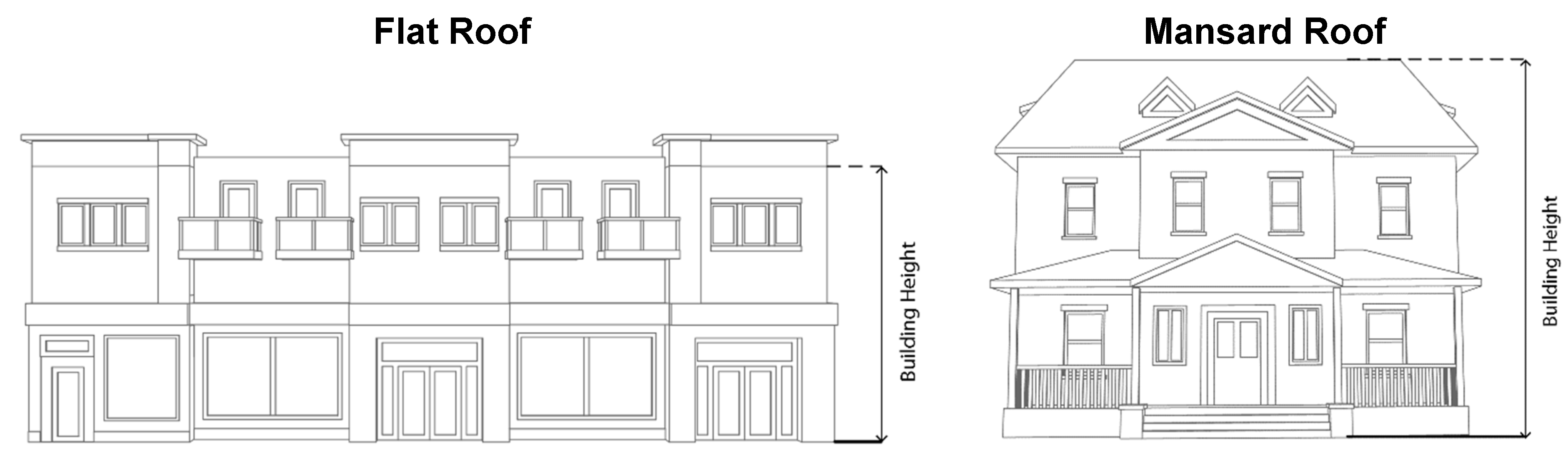
Figure 10-301.C-2: Gable, Hip, and Gambrel Roof Building Height Measurement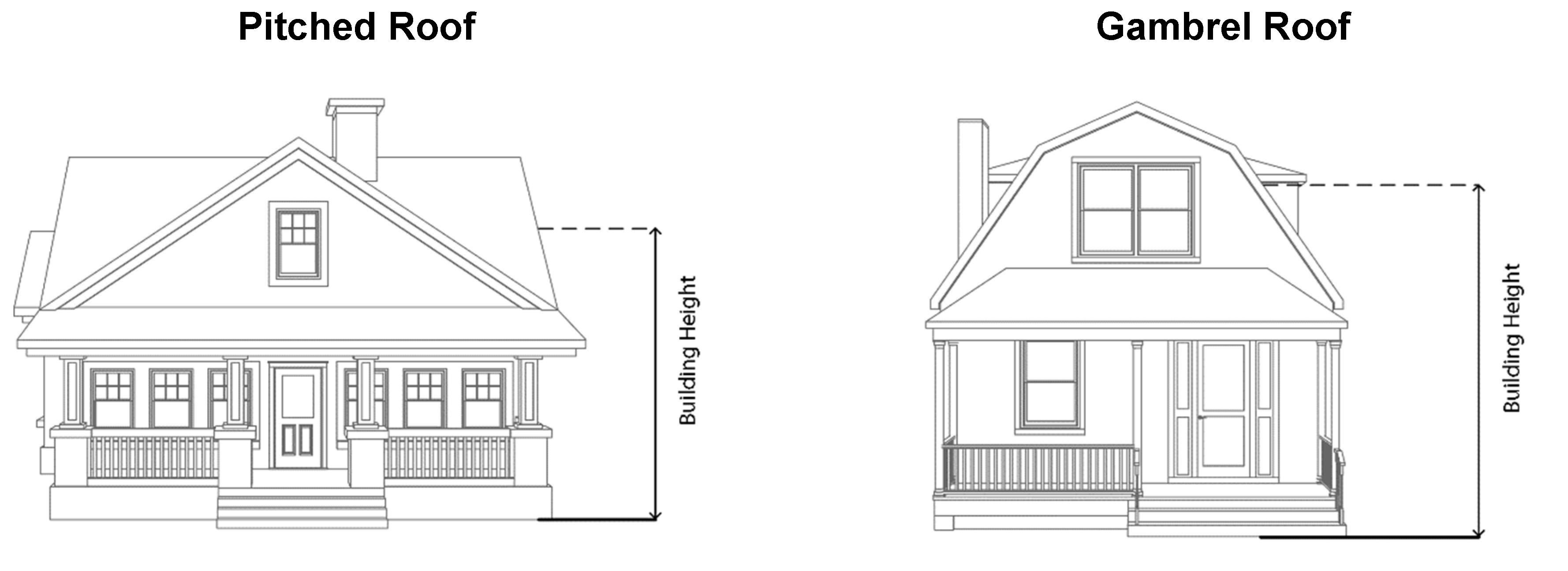
D.
Building Line. The line beyond which a building shall not extend, except as specifically provided by law, and which is determined from the extreme support of the roof of the main structure or appurtenance thereto.
E.
Highest Adjacent Grade. See Sec. 7-303, Definitions.
F.
Lowest Floor. See Sec. 7-303, Definitions.
10-302. - Density and Area.
A.
Density. The number of dwellings or housing units calculated per gross residential acreage (du/acre), except that for all vertical mixed use developments and developments in areas designated Village Center Tiers 2, 3 and 4, density shall be calculated per gross acre including non-residential land contained within the boundary of the development unless otherwise specified in this LDC.
B.
Density Equivalents.
1.
Applicability. The density equivalents set forth in this subsection will be used in situations where it is necessary to convert permissible uses to residential dwelling unit equivalents. When permitted by the use regulations in a zoning district that permits dwelling units, the permissible density equivalents may not exceed the density limitations set forth in the zoning district or land use category (whichever is less) in which the property is located.
2.
Equivalency Factors.
A.
Where health care, social service, adult living facilities (ALF), continuing care facilities, or other "group quarters" are provided in dwelling units, wherein each unit has its own cooking facilities, density equivalents will be calculated on a 1:1 ratio.
B.
Except as may be specifically set forth elsewhere in this section, where health care, social service, adult living facilities (ALF), continuing care facilities (CCF), or other "group quarters" are provided in dwelling units or other facilities wherein each unit does not have individual cooking facilities and where meals are served at a central dining facility or are brought to the occupants from a central kitchen, density equivalents will be calculated at the ratio of two beds equals one dwelling unit.
C.
A planned development, for which the Planned Development Master Concept Plan or PD adopting ordinance states the number of persons that may occupy an approved adult living facility (ALF) or continuing care facility (CCF), may request an amendment to the approved Master Concept Plan or PD adopting ordinance to reflect the increased number of occupants based upon the equivalency factor set forth in this section (if applicable). Such amendment will be considered a minor amendment that will be deemed to not increase density and may be approved pursuant to Secs. 2-501.D.2.E and F as long as existing floor space is not increased to accommodate the increased number of occupants. If increased floor space is required, then a public hearing will be required.
D.
Notwithstanding subsection B above, no density equivalency calculation is required for a bed and breakfast in an owner-occupied single-family dwelling accommodating four or less lodgers. If the bed and breakfast will accommodate more than four lodgers, then the equivalency will be calculated as four lodgers equals one dwelling unit.
E.
Notwithstanding subsection B above, no density calculation is required for a hospital, prison, jail, boot camp, detention center, or other similar type facility owned or operated by a county, state or federal agency.
F.
Where dwelling or living units have "lock-off accommodations," density will be calculated as follows:
1.
Hotels or motels: "Lock-off units" will be counted as separate rental units regardless of size.
2.
Determination of permitted density. The maximum permitted density shall be determined by multiplying the number of dwelling units permitted (see subsection 1 above) by the appropriate equivalency factor.
C.
Floor Area. The total area of each story of a building, or portion thereof, within the exterior walls of the building or structure.
D.
Floor Area Ratio. A measure of intensity expressing the maximum allowable floor area permitted on a lot. The FAR is equivalent to the total floor area of a nonresidential building divided by the total area of the lot (less wetlands), expressed in square feet. The FAR represents the relationship of the developed square footage of the lot to the square footage of the site.
E.
Gross Residential Acreage. Acreage of a development includes those lands to be used for residential uses, and includes land within the development proposed to be used for streets and street rights of way, utility rights-of-way, public and private parks, recreation and open space, schools, community centers, and facilities such as police, fire and emergency services, sewage and water, drainage, and existing man-made waterbodies contained within the residential development.
10-303. - Lots and Yards.
A.
Lot. A parcel of land considered as a unit.
1.
Example Diagram of Lot Types
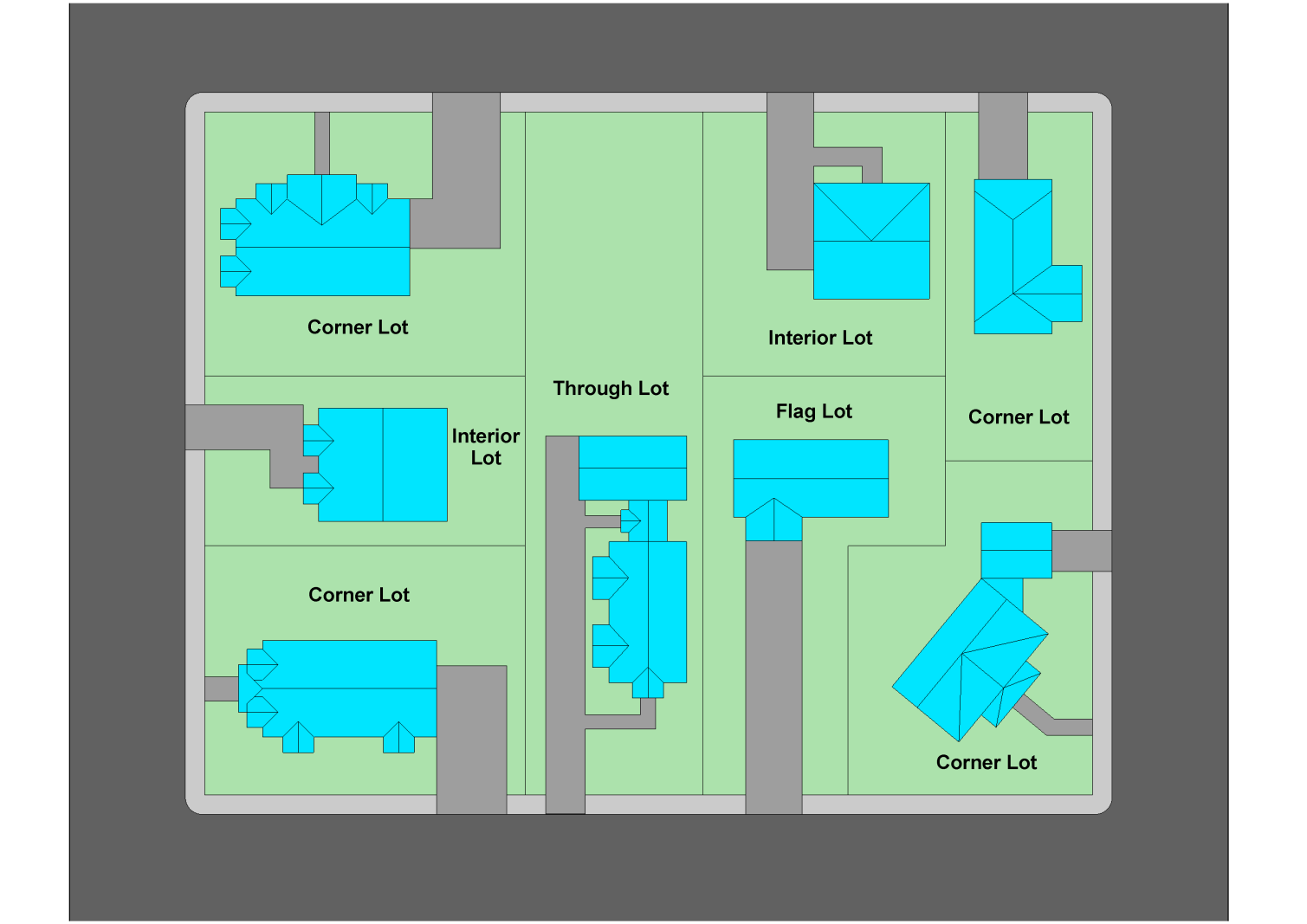
B.
Lot Area. The total horizontal area within a lot's lines.
C.
Lot, Corner.
1.
A lot located at the intersection of two or more streets where the corner interior angle formed by the intersection of the two streets is 135 degrees or less.
2.
A lot abutting a curved street if straight lines drawn between the intersections of the side lot lines and the street right-of-way or easement to the foremost point of the lot form an interior angle of less than 135 degrees.
3.
Example Diagram of Corner Lots
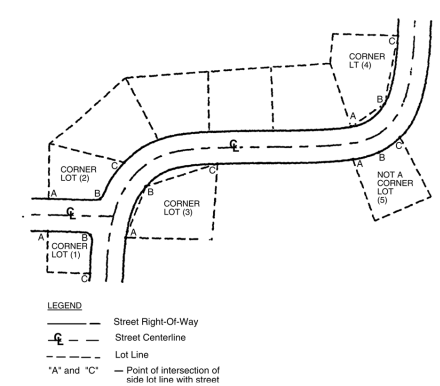
D.
Lot Coverage. That portion of a lot area, expressed as a percentage, occupied by all buildings or structures.
E.
Lot Depth. The distance between the midpoints of the front lot line and the rear lot line. The midpoint of a curved front or rear lot line shall be considered to be the midpoint of a straight line connecting the points of its intersection with the side lot lines.
1.
Example Diagram of Lot Depth.
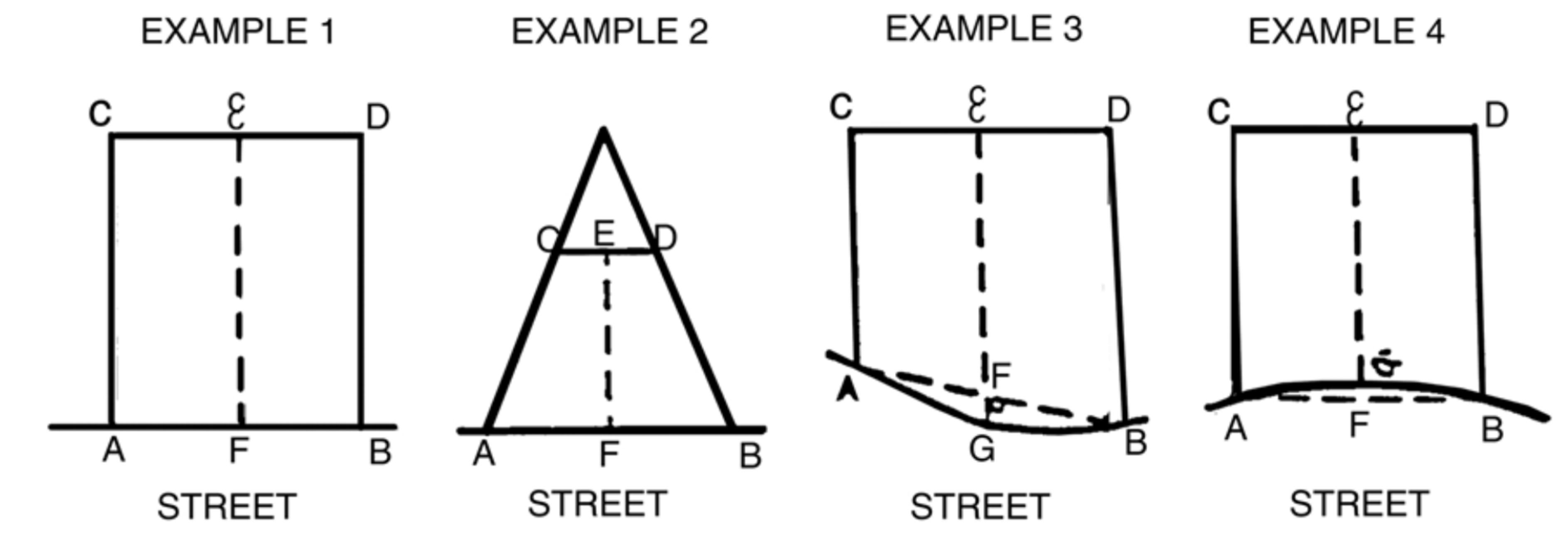
F.
Lot, Double-Frontage. Any lot, not a corner lot or through lot, having two or more property lines abutting a street right-of-way or easement.
G.
Lot, Flag. A lot not fronting on or abutting a street, and where access to the street is by a narrow private easement; or an L-shaped lot or other irregularly shaped lot which abuts and has access to a street but does not comply with the minimum frontage requirements of the LDC.
H.
Lot Frontage. The distance measured along a straight line of the street right-of-way or easement.
I.
Lot, Interior. A lot not defined as a corner, double-frontage or through lot.
J.
Lot Line. A line which delineates the boundary of a lot.
K.
Lot Line, Front. The lot line which divides the lot from a street right-of-way or easement.
L.
Lot Line, Rear. The lot line which is parallel to or concentric with and most distant from the front lot line of the lot. In the case of an irregular or triangular lot, a line 20 feet in length, entirely within the lot, parallel to or concentric with and at the maximum possible distance from the front lot line shall be considered to be the rear lot line. In the case of a through lot, there shall be no rear lot line. In the case of a through frontage lot, the line directly opposite from the front line shall be designated as either a rear line or a side line depending upon the designation of the adjacent property. In the case of corner lots, the rear lot line shall be the line most nearly parallel to or concentric with and most distant from the front line most prevalent along the block.
M.
Lot line, Side. A lot line other than a front or rear lot line.
N.
Lot, L-Shape. An irregular lot shape, such as one in the shape of an "L" or "T," which meets the minimum frontage requirements of this LDC.
O.
Lot, Through. Any lot having two opposite lot lines abutting a street right-of-way or easement.
P.
Lot Width. The distance measured along the street right of way or easement.
Q.
Setback. The minimum horizontal distance required between a specified line and the nearest point of a building or structure.
1.
Street setback. The setback extending across the front of a lot measured from the edge of an existing or proposed street right-of-way or street easement. When this LDC refers to street setback it means existing or proposed street right-of-way or street easement, whichever is greater.
2.
Side Setback. A setback that extends from the street setback to the rear setback, the required depth of which is measured from at a right angle from the side lot line.
3.
Rear Setback. A setback that extends across the full width of the rear of a lot, the required depth of which is measured from the rear lot line.
4.
Waterbody Setback. The setback measured from the mean high water line (MHWL), or the control elevation line, if applicable, of a water body.
R.
Setback Line. Line drawn parallel to or concentric with the street right-of-way or lot line at a distance from street right-of-way or lot line equal to the setback required by this LDC. If the line is curved, the setback line will be a curved line drawn an equal distance back from lot lines or street right-of-way line, as applicable, and with the required setback measured at the point or points where the development is closest to the street right-of-way or lot line.
S.
Sight Triangle. Sight triangles are used to avoid obstruction of vision at intersections. No walls, fences signs or landscaping shall be permitted on local road corner lots within a setback of 25 feet of intersecting street rights-of-way, and lots on collector and arterial roads within a setback of 50 feet of intersecting street rights-of-way if such a wall, fence, sign, or landscaping may obstruct traffic visibility. Combination of the various rights-of-way may be combined (See sample figure). The Village Engineer may review any clear site triangle for changes to the setback distances depending on sight conditions.
1.
Example Diagram of Sight Triangle.
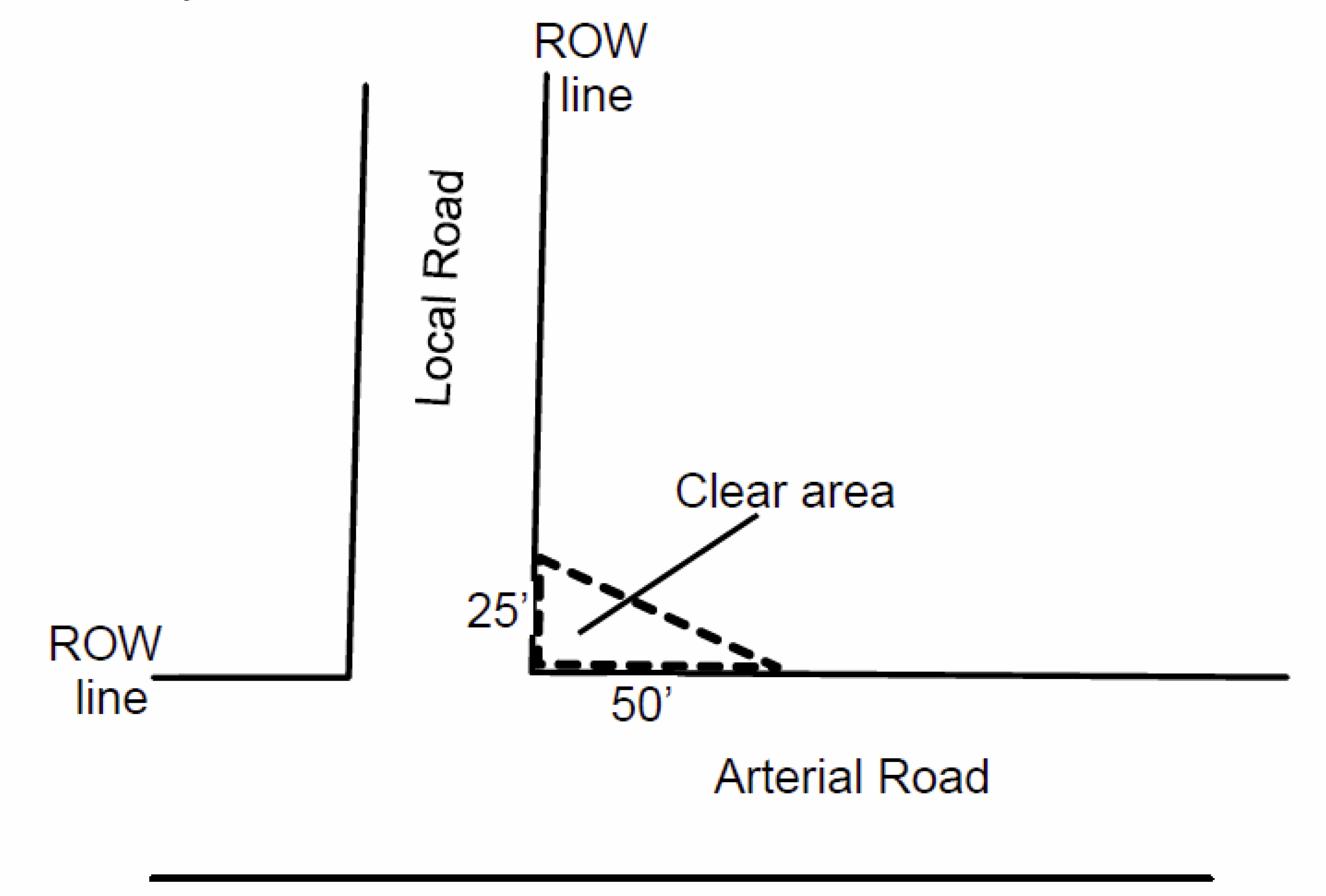
T.
Zero Lot Line. The location of a building on a lot in such a manner that one or more of the building's sides rest directly on a property line.
(Ord. No. 2022-12, § 1, 11-2-2022)
10-304. - Exceptions and Variations.
A.
Exceptions to Maximum Structure Height.
1.
The following structural appurtenances may exceed the height limitations established in the applicable zoning districts up to an additional 10 feet, without deviation or variance:
A.
Purely ornamental structural appurtenances such as church spires, belfries, cupolas, domes, ornamental towers, flagpoles, or monuments.
B.
Appurtenances necessary to mechanical and structural functions such as chimneys, water tanks, elevators and stairwell enclosures, ventilators, and bulkheads; AM and FM radio and television masts, aerials, and antennas; fire and hose towers or navigation aids, forest fire observation towers; and barns, silos, windmills, or other farm structures when located on farms.
2.
The portion of the building or structure permitted as an exception to a height limitation may not be used for human occupancy or commercial purposes.
3.
Structural exceptions to height limitations shall only be erected to the minimum height necessary to accomplish the purpose it is intended to serve, and no higher.
4.
The roof area of the structural elements permitted to exceed the height limitations shall not exceed 20 percent of the total roof area.
B.
Allowable Modifications of Required Setbacks.
1.
Every part of every required setback shall remain open and unobstructed from the ground to the sky except as otherwise allowed in Table 10-304.B: Modified Setbacks, or allowed or limited elsewhere in this LDC.
2.
No modification that would encroach on utility or drainage easements is allowed.
3.
Encroachments shall be set back a minimum of five feet from the lot line, unless a different distance is required by the building code or the table below.
C.
Additional Buffer from the Estero River.
1.
Where the full width of the regulatory floodway designated on the official flood maps adopted into Section 7-3, Flood Hazard Reduction Standards, is wider than the foregoing minimum separation area (or "buffer"), all buildings and structures proposed to be located in the area within such regulatory floodway extending from the minimum separation area to the edge of the regulatory floodway may only be located in such area, if and to the extent otherwise allowed by applicable law.
2.
Indigenous plant communities may not be cleared within the minimum separation area except for the minimal removal necessary to allow the placement of recreational structures such as docks, boat launches, benches, trails, and pedestrian bridges, or for the minimal removal necessary to construct a required connecting street.

