
Estero City Zoning Code
CHAPTER 2
- ADMINISTRATION
SECTION 2-1.- PURPOSE
This chapter sets forth the review and approval procedures and standards for all development applications under this LDC.
SECTION 2-4. - GENERAL PROCEDURES
This section sets forth the general procedures that generally apply to the review of applications for development permit under this LDC. Each subsection in Section 2-5, Application-Specific Review Procedures and Decision Standards, further identifies for each specific type of application which general procedures are required, including any additions or modifications that apply.
SECTION 2-5. - APPLICATION-SPECIFIC REVIEW PROCEDURES AND DECISION STANDARDS
This section establishes, for each type of application under the LDC, the specific review procedure and decision standards that apply, in accordance with Table 2-201: Summary Table of Development Applications. The following sections identify, for each type of development application, in what situations application approval is necessary; applicable modifications of or additions to the standard procedures in Section 2-4, General Procedures, that are required; and the standards for making a decision on the application.
2-201. - Summary Table.
Table 2-201: Summary Table of Development Applications, identifies the various development approvals authorized by this LDC and the roles the Village Council, boards, and staff have in making recommendations or decisions on applications for each type of development approval. It also identifies those applications that require a public hearing, and notes whether a public information meeting or pre-application conference is required. Where there might be a conflict between the table and the text of this LDC, the text shall control.
NOTES:
1. Public Information Meetings are conducted by the body with decision authority; however, at the discretion of the Village Manager, a Public Information Meeting for any type of development application may be required and conducted by the Planning Zoning and Design Board (PZDB).
2. This is a quasi-judicial process for a site-specific rezoning (zoning map amendment).
3. For a rezoning (zoning map amendment) of ten acres or more, initiated by the Village, the Village Council is required to conduct two public hearings.
4. A special exception as a part of a rezoning (zoning map amendment) is decided by the Village Council in conjunction with the rezoning.
5. Development orders are decided by the PZDB; limited development orders are decided by the Community Development Director. Staff review of a plat includes input from the Village Professional Surveyor and Mapper and the Village Attorney.
6. The PZDB makes a recommendation if concurrent with an application for rezoning (zoning map amendment).
7. The PZDB decides if requested by the Director.
8. The PZDB makes a recommendation if application is concurrent with a rezoning (zoning map amendment).
9. The PZDB acts as the Historic Preservation Board for purposes of certificates of appropriateness only.
10. A building permit is decided by the Building Official.
11. A variance as a part of a rezoning (zoning map amendment) is decided by the Village Council in conjunction with the rezoning.
12. Deviations as part of a rezoning (zoning map amendment) or Planned Development approval are decided by the Village Council with a recommendation by the PZDB.
13. Appellate body for appeal of an administrative decision will vary according to the decision. See Sec. 2-409.
2-301. - Village Council.
A.
Powers and Duties. In addition to other authority granted to the Village Council by the Florida Constitution and state law, the Village Council has the following powers and duties under this LDC:
1.
To review and decide the following:
A.
Comprehensive plan amendments (Sec. 2-501.A, Comprehensive Plan Amendments);
B.
LDC text amendments (Sec. 2-501.B, LDC Text Amendments);
C.
Rezonings (Zoning map amendments) (Sec. 2-501.C, Rezoning (Zoning Map Amendment));
D.
Planned developments and Amendments thereto (Sec. 2-501.D, Planned Development);
E.
Special exceptions (as part of a rezoning) (Sec. 2-501.E, Special Exception);
F.
Zoning variances (as part of a rezoning) (Sec. 2-506.A, Zoning Variance);
G.
Flood variances (Sec. 2-506.B; Flood Variance);
H.
Plats (Sec. 2-502.C, Plat Review);
I.
Vacation of easements, rights-of-way, or plats (Sec. 2-502.D, Vacation of Easement, Right-of-Way, or Plat);
J.
Vested rights (Sec. 2-506.E, Vested Rights);
K.
Final plan approvals (Sec. 2-501.F, Final Plan Approval);
L.
Development agreements; and
M.
Bar special permits (Sec. 2-501.G, Bar Special Permit).
2.
To hear and decide appeals for the following:
A.
Special exceptions (not part of a rezoning) (Sec. 2-501.E, Special Exception);
B.
Development orders (Sec. 2-502.A, Development Order);
C.
Planned development minor amendments (Sec. 2-501.D, Planned Development);
D.
Zoning variances (Sec 2-506.A, Zoning Variance);
E.
Appeals of administrative official (Sec. 2-506.D, Appeal of Administrative Official);
F.
Administrative interpretations (Sec 2-507, Administrative Interpretation);
G.
Historic preservation certificates of appropriateness (Sec. 2-504, Historic Preservation Certificate of Appropriateness); and
H.
Any Planning Zoning and Design Board (PZDB) decision on a permit to materially alter an existing commercial or multifamily building or structure exterior (Sec. 2-505.A, Material Alteration of Commercial or Multifamily Building or Structure Exterior Permit).
3.
To establish a schedule of fees for the applications for development approval reviewed under this LDC. The schedule of fees may be placed in an Administrative Manual.
4.
To appoint and remove members of the PZDB.
5.
To take any other action authorized by law.
2-302. - Planning Zoning and Design Board.
A.
Generally.
1.
The Planning Zoning and Design Board (PZDB) is hereby established.
2.
Each member of the PZDB shall be appointed by the Village Council to a 3-year term except for the initial terms of the Board upon its creation. The terms shall be staggered such that not fewer than two nor more than three terms shall expire each year. The terms of Board Members shall commence on May 1 and shall expire on April 30. Each member of the PZDB shall serve until the expiration of his or her term. Any member may be reappointed by the Village Council from term to term. The term of the PZDB School Board member shall be for the term specified by the School Board or, if no term is specified, for the duration of the tenure or employment of the member with the School Board, or until removed by the School Board.
3.
Vacancies on the PZDB shall be filled by the Village Council upon the affirmative vote of a majority of the full Village Council membership. The Village Council may remove, with or without cause, any member of the PZDB from office at a public hearing upon the affirmative vote of a majority of the full Village Council membership.
4.
The Chairperson or Co-Chairpersons, as desired by the Village Council, of the PZDB shall be appointed by the Village Council. Members of the PZDB shall annually elect during the first regularly scheduled meeting of each calendar year, a Vice-Chairperson from among its members if Co-Chairpersons were not appointed, and may create and fill other officers as the Board deems needed.
5.
The PZDB may create whatever subcommittees it deems needed to carry out the purposes of the PZDB. The Chairperson of the PZDB may appoint, as needed, the membership of each subcommittee from the members of the Board.
6.
Members of the PZDB shall not be compensated.
7.
No PZDB member shall hold any other public office, appointive or elective.
8.
The PZDB shall keep minutes of its proceedings, indicating the attendance of each member, and the decision on every question. The Village Clerk shall maintain all records of the PZDB. All meetings of the PZDB shall be open and available to the public in accordance with state law.
9.
The Director shall advise and assist the PZDB in all of its deliberations. The Village Manager shall provide such other staff and clerical assistance as the PZDB may require in the performance of its duties, subject to the availability of such staff and clerical assistance as approved by the Village Council. The Village Manager, or a designee, shall make a written recommendation to the PZDB of the action to be taken. The PZDB may call upon any department or other agency of the Village for information or advice in the performance of its work. The PZDB, upon the approval of the Village Council, may accept grants or other monetary or physical assistance to aid in its work.
10.
The PZDB may adopt rules of procedure not inconsistent with those adopted by the Village Council, for the conduct of meetings and public hearings and the review of matters before the Board.
11.
Final action taken by the PZDB on applications shall be reduced to writing, filed with the Director, and a copy thereof made available to the applicant upon request.
B.
Powers and Duties. The PZDB shall have the following powers and duties under this LDC.
1.
To make decisions on the following:
A.
Planned development minor amendments (Sec. 2-501.D, Planned Development);
B.
Special exceptions (not part of a rezoning) (Sec. 2-501.E, Special Exception);
C.
Zoning variances (not as part of a zoning map amendment) (Sec. 2-506.A, Zoning Variance);
D.
Certificates of appropriateness (Sec. 2-504, Historic Preservation Certificate of Appropriateness);
E.
Development orders and amendments (Sec. 2-502.A, Development Order);
F.
Monument sign permits (Sec. 2-505.B, Monument Sign Permit); and
G.
Permits to materially alter the exterior of commercial and multifamily buildings and structures (Sec. 2-505.A, Material Alteration of Commercial or Multifamily Building or Structure Exterior Permit).
2.
To review and make recommendations to the Village Council on the following.
A.
Comprehensive plan amendments (Sec. 2-501.A, Comprehensive Plan Amendments);
B.
LDC Text amendments (Sec. 2-501.B, LDC Text Amendments);
C.
Rezonings (zoning map amendments) (Sec. 2-501.C, Rezoning (Zoning Map Amendment));
D.
Planned developments and amendments (Sec. 2-501.D, Planned Development);
E.
Vacations of easements and right of ways when associated with a rezoning (Sec. 2-502.D, Vacation of Easement, Right-of-Way, or Plat);
F.
Deviations to be heard by the Village Council (Sec. 2-506.C.1, Deviation); and
G.
Flood variances (Sec. 2-506.B, Flood Variance).
3.
Other Powers and Duties. In addition, the PZDB shall have the following powers and duties.
A.
To act as the Local Planning Agency for the Village for the purposes of the Community Planning Act, Sec. 163.3174, Fla, Stat., et seq. All of the functions, duties, powers, and responsibilities of a local planning agency as per such statutory provisions are hereby delegated to the PZDB.
B.
In addition to any other public hearings required by law, with respect to all applications for development permits that require comprehensive plan amendments, planned development zoning actions, rezonings, variances, and special exceptions, or other development applications as determined by the Village Manager should be subject to public information meetings, the PZDB shall conduct a public information meeting as provided under Sec. 2-401, Public Information Meeting.
C.
Respond to requests from the Village Manager on matters pertaining to planning and zoning.
D.
Perform such other duties as may be assigned by the Village Council or required by ordinance.
C.
Membership.
1.
The PZDB shall have not less than seven nor more than nine members appointed by the Village Council by affirmative vote of a majority of the full Village Council membership. An additional non-voting, ex officio representative of the Lee County School Board may also serve on the PZDB in accordance with state law. The School Board shall notify the Village Clerk in writing within 10 days of the appointment or removal of any member.
2.
At least a majority of the members of the PZDB appointed by the Village Council shall be residents of the Village. All other members shall either (i) own a business in the Village, (ii) own property in the Village, or (iii) work in the Village. The members of the Board shall include at least one member ("designated member") from the following Florida state-registered professions: (i) civil engineering, (ii) architecture, and (iii) landscape architecture. Other members shall have diverse backgrounds, and, wherever possible, prior experience in land use, planning, zoning, legal matters, environmental matters or building and development. Each member shall be sympathetic to municipal development consonant with the comprehensive plan and with the health, safety, and welfare of its residents. No Board member shall hold any other public office, appointive or elective. A designated member shall be permitted to represent a client at a Public Information Meeting, but shall not represent a client before the Board, participate in discussion or vote on the client's application at any other meeting. Notwithstanding, other members of the designated member's firm may represent the firm client before the Board at any meeting.
D.
Meetings.
1.
The PZDB shall meet at least once each calendar month, unless canceled by the Board or its chairperson. Special meetings may be called by the Chairperson or by any 3 regular members of the Board. At least seven days' notice shall be provided for any meeting, and an agenda for the meeting shall be available to the public at least seven days prior to the meeting. The Board may meet more often at the call of the Chairperson or the Village Council.
2.
A majority of the full membership of the Board in attendance at a meeting shall constitute a quorum.
3.
Each decision of the PZDB shall be approved by a majority vote of the members, unless expressly stated otherwise in this LDC.
(Ord. No. 2021-04, § 1, 6-16-2021; Ord. No. 2022-09, § 2, 9-21-2022)
2-303. - Community Development Director (Director).
A.
General. The Village Council has established the Community Development Department as the Village department responsible for the planning functions of the Village, and for administering this LDC. The Community Development Director (Director) serves as the head of the Community Development Department and serves at the direction of the Village Manager.
B.
Powers and Duties Under LDC. The Community Development Department, through the Director, has the following general powers and duties under this LDC:
1.
To make decisions on the following:
A.
Limited development orders and amendments (Sec. 2-502.B, Limited Development Order);
B.
Minor changes to development orders (Sec. 2-502.A, Development Order);
C.
Certificates of concurrency (Sec. 2-503, Certificate of Concurrency);
D.
Sign permits (except for monument signs) (Sec. 2-505.B, Monument Sign Permit);
E.
Temporary use permits (Sec. 2-505.C, Temporary Use Permit);
F.
Tree removal/vegetation permits (Sec. 2-505.D, Tree Removal/Vegetation Permit);
G.
Administrative deviations (Sec. 2-506.C.2, Administrative Deviation); and
H.
Administrative interpretations (Sec. 2-507, Administrative Interpretation).
I.
Other administrative permits (Sec. 2-508, Other Administrative Permits).
2.
To compile and maintain an Administrative Manual;
3.
To conduct pre-application conferences in accordance with Sec. 2-402, Pre-application Conference.
4.
To conduct public information meetings (Sec. 2-401, Public Information Meeting);
5.
To prepare a staff report to the Village Council or PZDB, as applicable, for the following applications for development permit:
A.
Comprehensive plan amendments (Sec. 2-501.A, Comprehensive Plan Amendments);
B.
LDC Text amendments (Sec. 2-501.B, LDC Text Amendments);
C.
Rezonings (zoning map amendments) (Sec. 2-501.C, Rezoning (Zoning Map Amendment));
D.
Planned developments and amendments (Sec. 2-501.D, Planned Development;
E.
Special exceptions (as part of a map amendment) (Sec. 2-501.E, Special Exception);
F.
Plats (Sec. 2-502.C, Plat Review);
G.
Vacation of easements, rights-of-way, or plats (Sec. 2-502.D, Vacation of Easement, Right-of-Way, or Plat);
H.
Vested rights (Sec. 2-506.E, Vested Rights);
I.
Final plan approvals (Sec. 2-501.F, Final Plan Approval);
J.
Bar special permits (Sec. 2-501.G, Bar Special Permit);
K.
Development orders (Sec. 2-502.A, Development Order);
L.
Certificates of appropriateness (Sec. 2-504, Historic Preservation Certificate of Appropriateness);
M.
Floodplain variances (Sec. 2-506.B, Flood Variance);
N.
Zoning variances (Sec. 2-506.A, Zoning Variance);
O.
Deviations (Sec. 2-506.C.1, Deviation);
6.
To serve as professional staff liaison to the Village Council, the Planning Zoning and Design Board, and to provide technical assistance, as needed;
7.
To enforce this LDC in accordance with adopted code enforcement procedures (Ordinance 2015-14); and.
8.
To provide such assistance in the conduct of the Village land development regulations and planning programs as directed by the Village Manager.
2-401. - Public Information Meeting.
A.
Purpose. The purpose of a public information meeting is to educate owners and residents of nearby lands and the Village about an application that is reviewed under this LDC, and to provide the applicant an opportunity to hear comments and concerns about the proposal, and resolve conflicts and outstanding issues where possible. The public information meeting should be held as early in the process as possible, preferably before formally submitting an application. A public information meeting serves as an opportunity for informal communication between the applicant and owners and residents of nearby land, other residents affected by a development proposal, and the review board.
B.
Applicability. A public information meeting is required prior to a completeness determination for any development application under this LDC that is heard by the PZDB.
C.
Public Information Meeting Procedure. A public information meeting shall comply with the following requirements:
1.
Meeting Location and Time. The public information meeting shall be conducted at a meeting of the PZDB. The Director shall determine the date and time of the public information meeting, in coordination with the applicant.
2.
Notification.
A.
Village Notice. The Village shall post notice of the meeting on the Village website and the Village announcement board a minimum of seven days in advance of the meeting.
B.
Posted Notice.
1.
The applicant shall post notice of the public information meeting on the land subject to the proposal at least 14 days before the date of the meeting, in a form established by the Director.
2.
The notice shall state the time and place of the meeting and the purpose of the meeting; include a basic map identifying the land associated with the proposed development; and summarize the general nature of the development proposal, and the type of development permit sought.
3.
Conduct of Public Information Meeting. The public information meeting shall be open to the public. At the meeting the applicant shall explain the development proposal, including a detailed overview of the project; discuss the application review process; respond to questions and concerns from the Village staff, PZDB members, and other attendees; and discuss ways to resolve concerns. Questions or comments by PZDB members shall not bind the Board or any member of the Board to approve or disapprove the application when it is reviewed by the Board. The applicant shall make presentation materials available in a digital format that can be electronically displayed at the meeting.
4.
Written Summary of Public Information Meeting. After the conclusion of the public information meeting, the applicant shall prepare a written summary of the meeting that includes a list of meeting attendees, a summary of attendee comments and issues raised at the meeting related to the development proposal, and any other information the applicant deems appropriate. The summary shall describe how the applicant will respond to any issues that were raised at the meeting. The meeting summary shall be included with the application materials and be made available to the public for inspection.
2-402. - Pre-Application Conference.
A.
Purpose. The purpose of a pre-application conference is to provide an opportunity for:
1.
The applicant to determine the submittal requirements and the procedures and standards applicable to an anticipated application for a development permit; and
2.
The Director and Village staff to become familiar with, and offer the applicant preliminary comments about the scope, features, and impacts of the proposed development, as it relates to LDC requirements.
B.
Applicability.
1.
Required Pre-application Conference. A pre-application conference between the applicant and the Director and other relevant Village staff shall be held at a time agreed to by the applicant and Director, and before any public information meeting and before submittal of the following applications:
A.
Comprehensive plan amendments (Sec. 2-501.A, Comprehensive Plan Amendments);
B.
Rezonings (zoning map amendments) (Sec. 2-501.C, Rezoning (Zoning Map Amendment);
C.
Planned developments and major amendments (Sec. 2-501.D, Planned Development); and
D.
Development orders and amendments (Sec. 2-502.A, Development Order).
2.
Optional Pre-application Conference. A pre-application conference for any other type of application may be requested, in writing, at the option of the applicant, but shall be held before any public information meeting.
C.
Pre-application Conference Procedure.
1.
Submission of Materials Prior to Conference. At least seven business days before a pre-application conference is held, the applicant shall submit to the Director a narrative describing the general nature and scope of the development proposed, a conceptual plan of the proposed development (if appropriate), and any other information requested by the Director.
2.
Conference Proceedings. The Director and Village staff, as requested by the Director, shall review the materials submitted by the applicant and at the time of the conference, the Director and appropriate Village staff shall seek any needed clarification from the applicant regarding the proposed application, and identify any concerns, problems, or other factors the applicant should consider regarding the proposed application. Matters discussed at the pre-application conference are a courtesy, for clarification purposes and sharing information, and shall not bind the Director or Village staff to any recommendation.
3.
Effect of Conference.
A.
The pre-application conference is intended to facilitate the application review process. Discussions at the conference are not binding on the Village, and consequently no final or binding decision is made at a pre-application conference.
B.
A pre-application conference request does not constitute the filing of an application. Processing times for application review do not begin until an application is submitted and determined to be complete in accordance with Sec. 2-403.F, Completeness Determination.
4.
Pre-application Conference Waiver. The requirement for a pre-application conference may be waived by the Director if the Director determines there would be no benefits to the applicant or the staff from conducting the pre-application conference.
2-403. - Development Application Submission.
A.
Applications Submitted to Director. All development applications shall be submitted to the Community Development Department.
B.
Authority to Submit Applications.
1.
General.
A.
Except where a LDC text amendment or rezoning (zoning map amendment) is initiated by the Village, all development applications shall be submitted by all legal and equitable owner(s) of the land upon which the development is proposed, or the applicant(s)' authorized agent.
B.
All lands within a single application shall be abutting. The Director shall have discretion to allow a single application to cover non-abutting lands where it is in the public interest due to the size or scope and nature of the request, and where there is a rational continuity to the properties.
C.
All development applications for land governed by a homeowners' association or a condominium association shall demonstrate proper authorization from the association for the application.
2.
LDC Text Amendments. Amendments to the text of the LDC may only be initiated by the Village Council, PZDB; or Village Manager.
3.
Rezoning (Zoning Map Amendments). Amendments to the Zoning Map may be initiated by the Village Council, Village Manager; or owner(s) of the land upon which the development is proposed, or their authorized agent as provided in subsection 1 above.
C.
Required Application Contents and Form. The application contents and form shall be in accordance with requirements established by the Director for the specific type of application, and shall be included in the Administrative Manual. The application shall include, but not be limited to, an affidavit disclosing all equitable and beneficial interests in the property.
D.
Required Application Fees. Required application fees shall be those established for the specific development application by the Village Council. Application fees may be published in the Administrative Manual. Cost recovery fees may apply, as established by the Village Council. The notice for the required public hearing shall not be published or mailed until all fees are paid. Applications initiated by the Village are not subject to application fees.
E.
Tax and Assessment Payments. No development orders or plats shall be approved if the ad valorem taxes or assessments against the property are delinquent or if there are outstanding tax certificates issued for the property.
F.
Completeness Determination.
1.
General. Upon receipt of an application, the Director shall distribute the application to all appropriate Village staff and departments, and other review agencies for review and comment regarding completeness. The Director shall determine if the application is complete for review. The applicant shall ensure that an application is accurate and complete. Any additional expenses necessitated because of inaccurate or incomplete information shall be borne by the applicant. A complete application is one that:
A.
Contains all contents required for the particular type of application in accordance with Sec. 2-403.C, Required Application Contents and Form.
B.
Is in the form required for the particular type of application in accordance with Sec. 2-403.C, Required Application Contents and Form.
C.
Includes information in sufficient detail to allow an evaluation of the application to determine whether it complies with the appropriate review standards of this LDC.
D.
Is accompanied by the fee established for the particular type of application in accordance with Sec. 2-403.D, Required Application Fees.
2.
Application Incomplete. If the Director determines that the application is incomplete, the Director shall send written notice to the applicant of the application's deficiencies, electronically or by mail, within 30 days of receipt of the application, and review of the application shall not proceed. The applicant, within 30 days, may correct the deficiencies and resubmit the application for completeness determination. If the applicant fails to correct the deficiencies within 30 days, the application will be deemed to be withdrawn, unless prior to the 30 days the applicant requests an extension and the Director subsequently agrees to an extension.
3.
Application Complete. If the application is determined to be complete, it shall be reviewed in accordance with the applicable procedures and standards in this LDC. Any established time frame for review of the application shall start on the date the application is determined to be complete. The applicant and the Director may agree to an extension of time if requested prior to the expiration of any time frame.
G.
Simultaneous Processing of Applications. Whenever two or more forms of review and approval are required under the LDC, the applications for those development approvals or permits may, at the discretion of the Director, be processed simultaneously, so long as all applicable Village requirements are satisfied. Simultaneous processing of applications may result in additional fees to the applicant. The Director's decision regarding simultaneous processing is not appealable.
H.
Code Violation. An application for development permit for a land that is subject to a code violation notice shall not be processed until the code violation has been resolved, except for an application to resolve the code violation.
2-404. - Staff Review and Action.
A.
Applicability. This subsection applies to any review of, recommendation on, or decision on an application by the Director after the application is determined to be complete.
B.
Staff Review and Opportunity to Revise Application.
1.
Upon receipt, the Director shall distribute the application to all appropriate Village staff and departments, and other review agencies for review and comment.
2.
The Village staff authorized to decide or provide staff review on the application in accordance with Table 2-201: Summary Table of Development Applications, shall review the application, any relevant support material, and any comments or recommendations from the appropriate Village staff and departments, and other review agencies. If deficiencies in complying with the applicable standards of the LDC are identified, the authorized decision-maker shall notify the applicant of such deficiencies in accordance with Sec. 2-403, Development Application Submission.
3.
When reviewing an application for a development permit that is certified by a professional listed in F.S. § 403.0877, the Village may not request additional information from the applicant more than three times, except as in accordance with F.S. § 166.033.
C.
Application Subject to Review or Recommendation by Staff.
1.
If an application is subject to staff review or recommendation by the Director in accordance with Table 2-201: Summary Table of Development Applications, the Director shall, following completion of staff review, prepare a summary of staff review comments that addresses the application's compliance with applicable review standards and recommends action on the application, including any recommended conditions of approval.
2.
After completion of the staff review comments, the Director shall transmit the application and staff report to the appropriate advisory or decision-making body in accordance with Table 2-201: Summary Table of Development Applications, and provide the applicant a copy of the staff report.
D.
Application Subject to Decision by Staff. If an application is subject to a final decision by the Village staff, following completion of authorized staff review, the decision-maker shall provide written notice of the decision to the applicant. The decision shall be made within 120 days of the determination that the application is complete, unless the applicant and the decision-maker agree to extend the timeframe beyond 120 days. An approval, approval with conditions, or denial of the application shall include written findings supporting the decision.
2-405. - Scheduling of Public Hearing and Public Notification.
A.
Public Hearing Scheduling.
1.
Table 2-405.A: Required Public Hearings, identifies the types of applications that require public hearing(s) under the LDC, the review bodies responsible for conducting those public hearing(s), and the type of required public hearing (standard or quasi-judicial). An appeal of a decision made at a quasi-judicial hearing shall be conducted as a de novo quasi-judicial hearing. Public hearings for all amendments to approved applications, except for those reviewed and approved administratively, are conducted as the same type of hearing as for the original approved application.
2.
The Director shall ensure that the required public hearing on the application is scheduled for a regularly scheduled meeting of the body conducting the hearing or a meeting specially called for that purpose by such body.
3.
The public hearing on the application shall be scheduled so there is sufficient time for any required staff report to be prepared and distributed in accordance with Sec. 2-404.C, Application Subject to Review or Recommendation by Staff, for public notification in accordance with this subsection, and to meet statutory requirements.
B.
Public Notification. Notification of a public hearing on an application shall be as required by the Florida Statutes, and as when the Village is more restrictive, and as shown in Table 2-405.B: Summary of Public Notification Requirements, below. All applications that are subject to public hearings, whether or not listed in Table 2-405.B shall be noticed by posting the agenda of the meeting at which the public hearing will take place on the Village notice board and the Village website, noting the item to be heard. Computation of the required time periods shall be in accordance with Sec. 10-104, Computation of Time. Failure to provide the notification required below shall not affect any actions or proceedings under this LDC unless such notice is required by state statute.
C.
Public Notice Requirements.
1.
Published Notice Requirements.
A.
The applicant shall cause a required published notice of a public hearing on an application to be prepared and published in a newspaper having general circulation in the Village. In the case of Village initiated applications, the Village shall be responsible for published notice.
B.
Where a published notice is required in accordance with F.S. ch. 166, the size and format of the notice shall comply with the requirements of the statute.
C.
The applicant shall provide proof of publication prior to the public hearing. Failure to timely provide such proof of notice may, at the discretion of the Director, result in continuance of the hearing and the need to re-notice the continued hearing.
2.
Mailed Notice Requirements.
A.
The applicant shall mail required notice of a public hearing on an application by first class mail, return receipt requested, to the following:
1.
Owner(s) of land subject to the application (if other than the applicant);
2.
Owners of real property within 750 feet of the property boundary of the land subject to an application, except for Development Orders which require mailed notice to owners within 500 feet; and
3.
Organizations and persons who have registered to receive notification of development applications subject to public hearings in accordance with Sec. 2-405.C.8, Registration to Receive Notice by Mail.
B.
The owner names and addresses used to mail required notice to owners of neighboring property shall be those shown on the current ad valorem tax rolls of Lee County.
3.
Posted Notice Requirements.
A.
The applicant shall place a required posted notice on the land subject to the application, at a location adjacent to each abutting street that is clearly visible to traffic along the street. If no part of the subject land abuts a street, then the notice shall be posted in the right-of-way of the nearest street, and in a manner consistent with the intent of the provisions of the LDC.
B.
Posted notice shall be in a manner established by the Director:
1.
The applicant shall ensure that posted notice is maintained in place until after a final decision on the subject application is rendered by the decision-making body.
2.
The posted notice shall be removed by the applicant within 14 days after a final decision on the application is rendered by the decision-making body.
4.
Notice Content. Required public notice shall, at a minimum:
A.
Identify the application;
B.
Describe the nature and scope of the proposed development or action;
C.
Identify the location of land subject to the application (not applicable to notices posted on the subject property);
D.
Identify the date, time, and location of the public hearing(s) being noticed;
E.
Indicate how and where written comments on the application may be submitted before the hearing;
F.
Indicate how and where additional information about the application and review process may be obtained;
G.
If a comprehensive plan amendment or a LDC text amendment, describe the location and content of the language to be amended, without the necessity of providing the exact language of the amendment; and
H.
Comply with any other notice content requirements established by state law.
5.
Affidavit of Notice. The applicant shall sign an affidavit affirming that any required published, mailed, or posted notices of a public hearing for which they are responsible for providing were provided in accordance with the requirements of this subsection and state law. The affidavit, along with any documentation proving compliance with notice requirements, shall be submitted to the Director no later than ten days before the hearing date. The affidavit shall be in a form established by the Director and may be contained in the Administrative Manual. An application that does not comply with this subsection will not be placed on the agenda or heard at the requested hearing.
6.
Availability of Hearing Notice for Public Inspection. The Director shall keep a copy of the required published and mailed notices of a public hearing and make them available for inspection by the public during normal business hours.
7.
Responsibility for Cost of Notice. The applicant shall be responsible for all costs of providing required notices.
8.
Registration to Receive Notice by Mail. Any person in the Village may register with the Village Clerk to receive mailed written notice of all applications subject to public hearings in accordance with Sec. 2-405.C.2, Mailed Notice Requirements. To be eligible for registration, the person shall provide the Clerk information in a form established by the Clerk, along with a fee to defray registration and mailing costs. To continue to receive such notice, a person shall reregister the earlier of two years (biennially), or when the mailing address has changed.
2-406. - Deferral of Public Hearing.
A.
Before Public Hearing Notice. If an application is subject to a public hearing and required notice of the hearing has not yet been provided, the applicant may submit a written request to the Director to defer the public hearing. The Director may grant the request to defer consideration of the application, for good cause.
B.
After Public Hearing Notice. If an application is subject to a public hearing and required notice of the hearing has already been provided, the applicant may request that the hearing be deferred by submitting a written request for deferral to the Director. The body scheduled to hold the hearing may grant the request for good cause, or if finding no good cause for deferral, may proceed to hold the hearing. If the body grants the request for deferral, it shall concurrently set a new hearing date for the application. If a deferral is granted, the application may be subject to additional application fees to defray the additional costs of processing the application.
2-407. - Public Hearing Procedures.
If the application is subject to a public hearing by an advisory or decision-making body (see Table 2-405.A: Required Public Hearings), the advisory or decision-making body shall hold the public hearing in accordance with procedures established by the Village Council Rules of Procedure or the Board's Rules of Procedure. Standard public hearing procedures are those applicable in those cases that are not required by law to be held in accordance with quasi-judicial procedures.
2-408. - Decision-Making Body Review and Decision.
A.
Review and Decision. All development applications requiring public hearing shall be decided within 180 days from determination that the application is complete, unless the time is extended by agreement between the applicant and the Village. All other applications shall be decided within 120 days from determination that the application is complete, unless the time is extended by agreement between the applicant and the Village. A decision shall take the form of an approval, approval with conditions, or denial, and shall include written findings supporting the decision. Any decision of denial is with prejudice unless otherwise specified by the decision-making body.
B.
Written Notice. After a final decision on an application, the Director shall provide the applicant written notice of the decision and make a copy of the decision available to the public. If the decision is a denial, the Village shall include a citation to the applicable portions of this LDC, an ordinance, rule, statute, or other legal authority for the denial of the permit.
C.
Effect of Approval. Approval of an application in accordance with the LDC authorizes only the particular use, plan, or other specific activity approved, and not any other development requiring separate application and approval. In the event that one development approval is a prerequisite to another development approval (e.g., variance approval prior to a plan approval), development may not take place until all required approvals or permits are obtained. Approval of one development application does not guarantee approval of any subsequent development application. A development approval automatically revokes existing development approvals of the same type for the property, unless otherwise indicated in the development approval.
D.
Lapse of Development Approval.
1.
Development approval granted after the effective date of this LDC shall expire as provided in Section 2-5, Application-Specific Review Procedures and Decision Standards, for each type of application, except rezonings (zoning map amendments), variances, and comprehensive plan approvals shall not expire. If no expiration period is provided for the specific type of development approval, and if no expiration period is imposed as part of the approval by the decision-making body, the development approval shall expire if an approved permit authorizing the approved development is not obtained within two years.
2.
Unless otherwise provided by this LDC, a one-year extension of the expiration time period for a specific development approval may be granted by the decision-making body that granted the development approval upon the applicant's submission of a written request for extension to the Director before the expiration date, and a showing of good cause.
E.
Modification of Development Approval. Except as otherwise provided in Section 2-5, Application-Specific Review Procedures and Decision Standards, for the particular type of application, any modifications of a development approval shall require a new application for a modification to the development approval. Modifications shall be submitted and reviewed in accordance with the procedures for its original approval, unless otherwise allowed by this LDC. The standards for approval in the LDC at the time the modification decision is made shall apply.
2-409. - Post Decision-Making Actions.
A.
Appeal.
1.
Appeal of Planning Zoning and Design Board Decision. Any party aggrieved by a decision of the PZDB shall, prior to seeking judicial review, file with the Village Clerk within 30 days from the vote of the Board, an application for appeal to the Village Council in a form as may be provided in the Administrative Manual, and pay an appeal fee. Additionally, the Village Manager or a designee may file an application for appeal with the Village Clerk within 30 days from the Board's decision. Further, the Village Council may, within 30 days from the Board's decision, decide to take jurisdiction of the decision and rehear the application. Neither the Village Manager nor the Village Council shall be required to pay an appeal fee. Upon the filing of a notice of appeal or upon the Village Council taking jurisdiction, the Village Council shall, as soon as is reasonably practicable, hold a public hearing upon the matter and shall affirm, reverse, or affirm with modifications the decision of the Board. The hearing shall be conducted as a de novo hearing. Any person may speak at the appeal hearing, without the need of having appeared in the proceedings below.
2.
Appeal of Director Decision. Any applicant aggrieved by a decision of the Director in regard to an administrative interpretation shall, prior to seeking judicial review and within 30 days from the written decision, file an application for appeal to the Village Council in a form as may be provided in the Administrative Manual with the appeal fee. Upon the filing of an application for appeal, the Village Council shall, as soon as is reasonably practicable, hold a public hearing upon the matter and shall affirm, reverse, or affirm with modifications the decision of the staff. The hearing shall be conducted as a de novo hearing. An appeal of a decision by the Director on a limited development order, minor change to a development order, administrative amendment to a planned development, tree removal/vegetation permit or sign permit shall be made within 30 days of the written decision to the PZDB, by filing an application for appeal in a form as may be provided in the Administrative Manual and with the appeal fee. The PZDB, as soon as practicable, shall hear the appeal in a de novo hearing, and shall affirm, reverse, or affirm with modifications the Director's decision.
3.
Appeal of Village Council Decision. A party aggrieved or adversely affected by any Village Council decision for which no further administrative review procedure is provided by the LDC may seek review of the decision in the courts in accordance with applicable state law.
B.
Limit on Subsequent Similar Applications.
1.
Prior Application Denial.
A.
If an application requiring a public hearing is denied, no application proposing the same or similar development on all or part of the same land shall be submitted within one year after the date of denial unless the decision-making body waives this time limit in accordance with subsection B.1 below.
B.
The owner of land subject to the time limit provided in subsection A above, or the owner's authorized agent, may submit a written request for waiver of the time limit to the Director, who may grant a waiver if the owner or agent has demonstrated that:
1.
There is a substantial change in circumstances relevant to the issues or facts considered during review of the prior application that might reasonably affect the decision-making body's application of the relevant review standards to the development proposed in the new application; or
2.
New or additional information is available that was not available at the time of review of the prior application and that might reasonably affect the decision-making body's application of the relevant review standards to the development proposed in the new application; or
3.
The new application proposed to be submitted is materially different from the prior application; or
4.
The final decision on the prior application was based on a material mistake of fact.
2.
Prior Application Withdrawal. If an application requiring a public hearing is withdrawn after required notice of the public hearing is provided, no application proposing the same or similar development on all or part of the same land shall be submitted earlier than six months after the date of withdrawal.
2-501. - Discretionary Approvals.
A.
Comprehensive Plan Amendments. Comprehensive Plan Amendments shall follow the procedures and standards as set out in F.S. § 166.3164, et seq., the Community Planning Act.
B.
LDC Text Amendments.
1.
LDC Text Amendment Procedure. Figure 2-501.B.1 identifies key steps in the text amendment procedure. This section identifies additions or modifications to the general review procedures in Section 2-4, General Procedures, that applies to LDC text amendments.
Figure 2-501.B.1: LDC text amendment procedure flowchart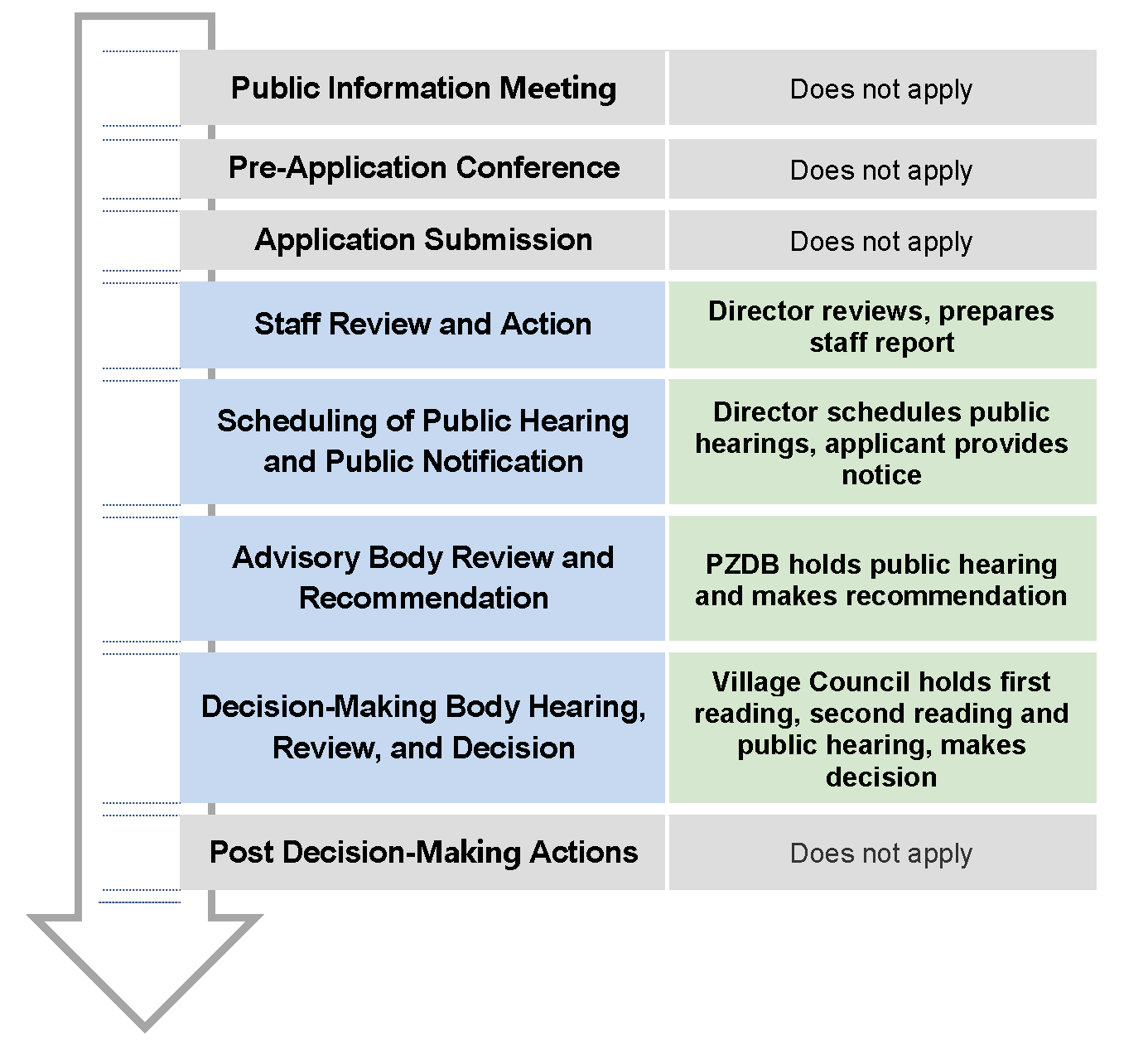
2.
LDC Text Amendment Review Standards. The advisability of amending the text of the LDC is a matter committed to the legislative discretion of the Village Council and is not controlled by any one factor. In determining whether to adopt or deny the proposed text amendment, the Village Council shall weigh the relevance of and consider whether and the extent to which the proposed amendment:
A.
Is consistent with the comprehensive plan;
B.
Is required by state or federal law;
C.
Is in conflict with any provision of this LDC and the Village's Code of Ordinances;
D.
Is required by changed conditions;
E.
Addresses a demonstrated community need;
F.
Is consistent with the purpose and intent of the zoning districts, or would improve compatibility among uses;
G.
Would result in a logical and orderly development pattern;
H.
Would result in significantly adverse impacts on the natural environment, including but not limited to water, air, noise, storm water management, wildlife, vegetation, wetlands, and the natural functioning of the environment; and
I.
Would adversely impact the availability of public facilities to accommodate new growth and development.
C.
Rezoning (Zoning Map Amendment).
1.
Rezoning (Zoning Map Amendment) Procedure. Figure 2-501.C.1 identifies key steps in the rezoning procedure for applications not initiated by the Village.
Figure 2-501.C.1: Rezoning (Zoning Map Amendment) Procedure Flowchart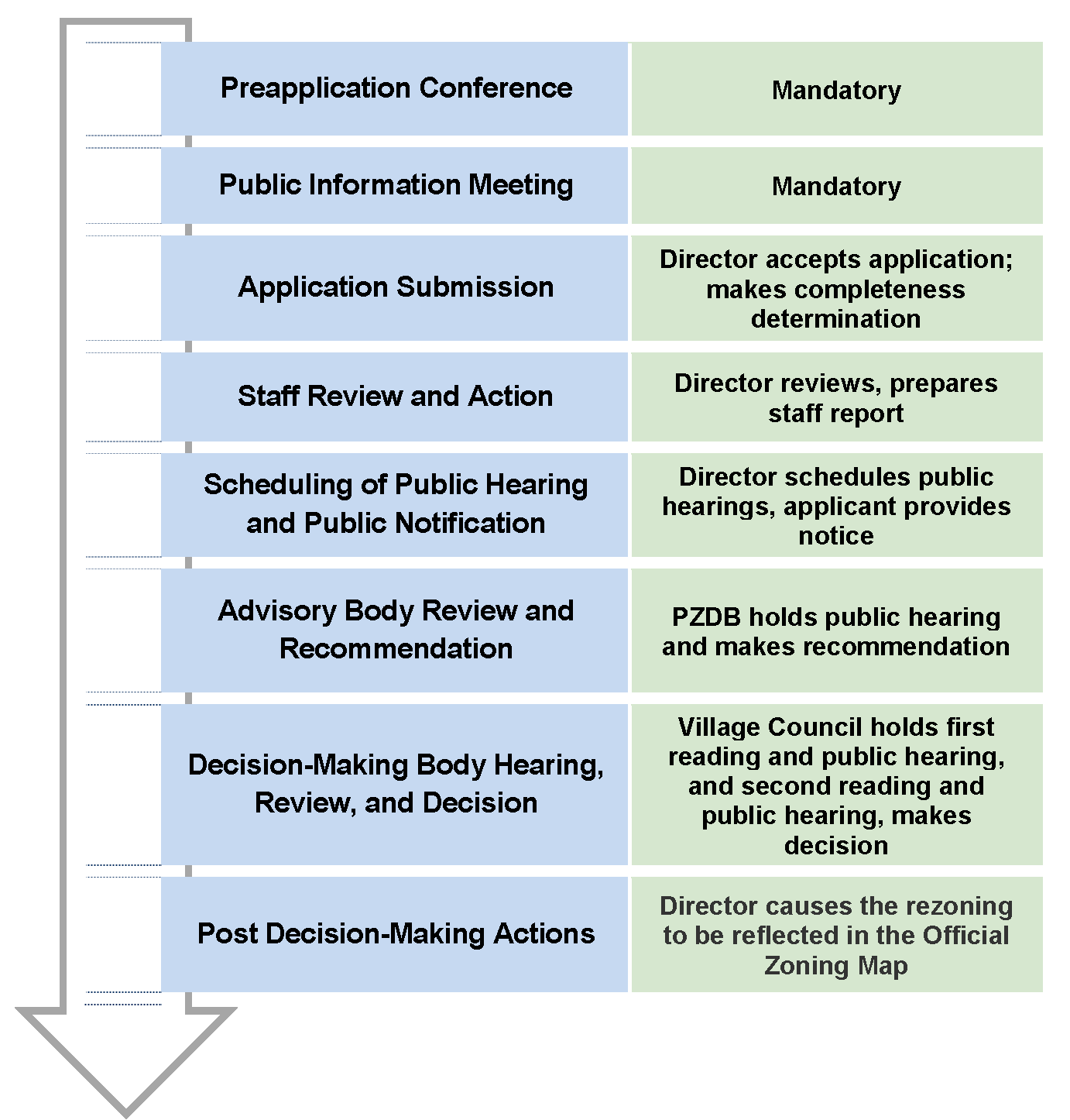
2.
Rezoning (Zoning Map Amendment) Review Standards. Amendments to the Official Zoning Map are subject to quasi-judicial review by the Village Council and constitute the implementation of the general land use policies established in this LDC and the comprehensive plan. In determining whether to adopt or deny a proposed rezoning (zoning map amendment), the Village Council shall consider:
A.
Whether the applicant has provided, as part of the record of the public hearing(s) on the application, competent substantial evidence that the proposed amendment:
1.
Is consistent with and furthers the goals, objectives, and policies of the comprehensive plan and all other applicable Village-adopted plans;
2.
Is not in conflict with any portion of the LDC;
3.
Addresses a demonstrated community need;
4.
Is compatible with existing and proposed uses surrounding the subject land, and is the appropriate zoning district for the land;
5.
Would result in a logical and orderly development pattern;
6.
Would not adversely affect the property values in the area;
7.
Would result in development that is adequately served by public facilities (roads, potable water, wastewater, solid waste, storm water, schools, parks, police, and fire and emergency medical facilities);
8.
Would not result in significantly adverse impacts on the natural environment—including, but not limited to, water, air, noise, storm water management, wildlife, vegetation, wetlands, environmentally critical areas, and the natural functioning of the environment;
9.
Is compatible with existing or planned uses in the surrounding area.
B.
If the applicant demonstrates that the proposed amendment meets the criteria in subsection A above, whether the current zoning district designation accomplishes a legitimate public purpose.
D.
Planned Development.
1.
Generally.
A.
Planned developments are amendments to the Official Zoning Map that are planned and developed under unified ownership or control and that allow for flexible standards and procedures that are conducive to creating more mixed-use, pedestrian-oriented, and otherwise higher quality development, as well as community benefits and amenities, than could be achieved through base zoning district regulations.
B.
A planned development is established by amendment of the Official Zoning Map to rezone land to a planned development zoning district that is further defined by an incorporated PD Master Concept Plan. Subsequent development within the PD district occurs through the approval of a development order, and other appropriate or necessary approvals such as a limited development order, and plat review, which shall be in compliance with the PD Master Concept Plan.
2.
Planned Development Procedure.
A.
Figure 2-501.D.2 identifies key steps in the planned development procedure. Further application requirements are detailed in the Administrative Manual.
Figure 2-501.D.2: Planned Development Rezoning Procedure Flowchart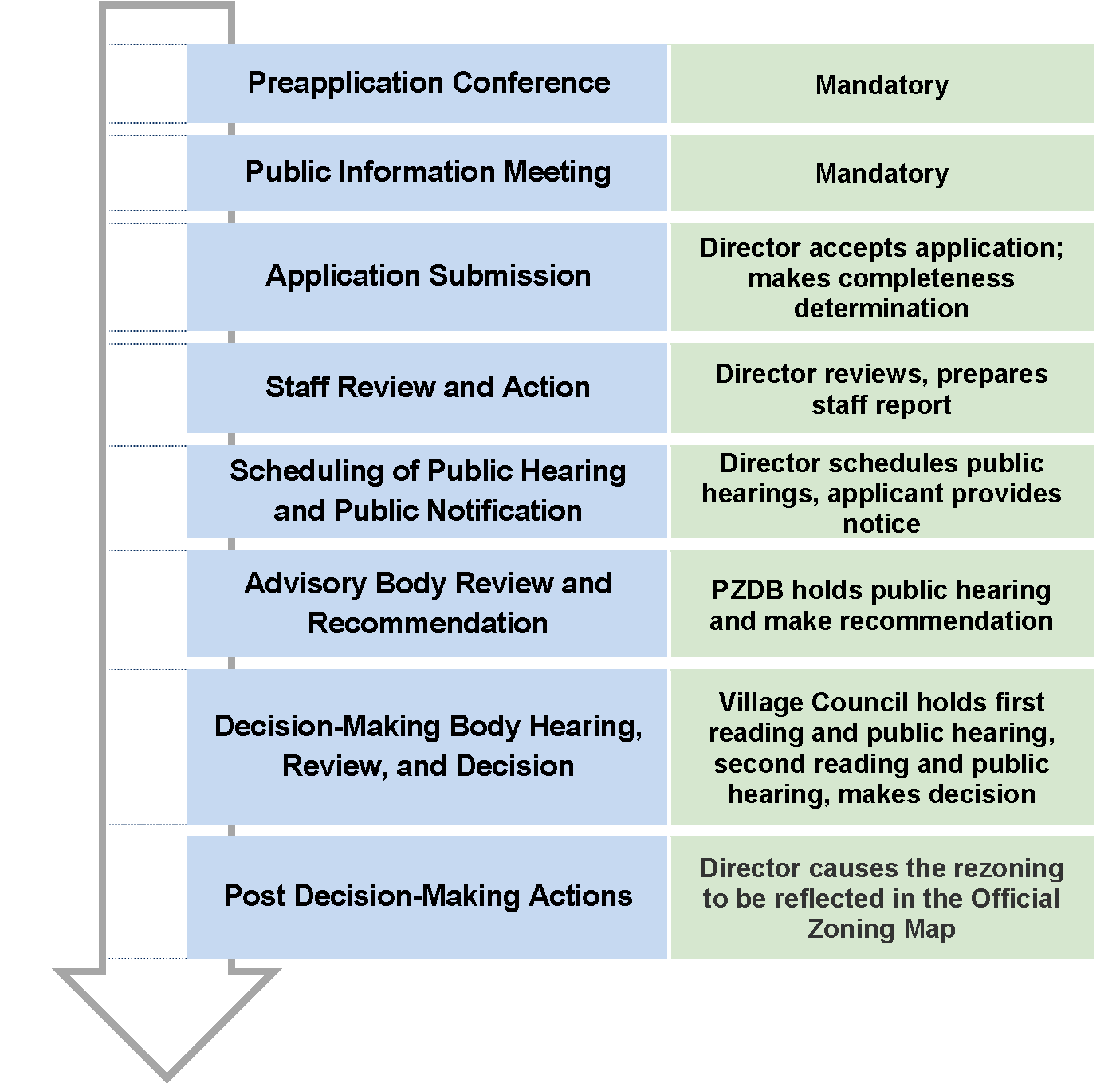
B.
After approval of a PD, the Director shall cause the rezoning to be reflected in the Official Zoning Map, and the applicant shall record a notice of the Master Concept approval in the official records of Lee County.
C.
Lands rezoned to a PD zoning district shall be subject to the approved PD Master Concept Plan and any conditions of approval. No variances may be granted in a PD. The PD Master Concept Plan is binding on the land as an amendment to the Official Zoning Map. The PD Master Concept Plan shall be binding on the landowners and their successors and assigns, and shall constitute the development regulations for the land. Development of the land shall be limited to the uses, intensity and density, configuration, and all other elements and conditions set forth in the PD Master Concept Plan, and any conditions of approval. The applicant may apply for and obtain subsequent development approvals necessary to implement the PD Master Concept Plan in accordance with the appropriate procedures and standards set forth in the LDC. Any subsequent development approvals shall be in substantial compliance with the PD Master Concept Plan.
D.
Approval of the rezoning of land to a PD zoning district does not expire, except approval of the PD Master Concept Plan shall automatically expire if no application for a development order, limited development order, or plat for at least 50 percent of the development described by the approved PD Master Concept Plan is approved within five years after approval of the PD district. If a PD Master Concept Plan lapses, the owner of the PD-zoned land may apply to the Village to reinstate the Master Concept Plan one time for no longer than two years, to approve a new PD with a new Master Concept Plan, or to reclassify the site to another base district.
E.
Subsequent applications for a development approval or permit within an approved PD district may include minor amendments to the PD Master Concept Plan without the need for Village Council review and approval. The PZDB is authorized to review and decide whether to approve, approve with conditions, or deny minor amendments. The minor amendments shall include only the changes that do not increase height or density, do not change uses, and do not change the conditions of approval.
F.
Subsequent applications for a development approval or permit within an approved PD district may include administrative amendments to the PD Master Concept Plan, without the need to amend the PD Master Concept Plan, provided such deviations do not include changes to height, density, or intensity, and are limited to changes that the Director determines:
1.
Address technical considerations that could not reasonably be anticipated during the planned development approval process; and
2.
Have no material effect on the character of the approved PD district, and the basic concept and terms of the PD Master Concept Plan. These may include, but are not limited to, the following:
(a)
Structural alterations that do not significantly affect the basic size, form, style, and appearance of principal structures;
(b)
Minor changes in the location and configuration of streets and driveways that do not adversely affect vehicular access and circulation on or off the site of the change;
(c)
Minor changes in the location or configuration of buildings, parking areas, landscaping, or other site features;
(d)
Minor changes in the location and configuration of public infrastructure facilities that do not have a significant impact on the Village's utility and storm water management systems;
(e)
Increases of five percent or less in the total number of parking spaces;
(f)
Do not reduce total open space or indigenous native vegetation required by the LDC;
(g)
Do not reduce the total area or quality of vegetative buffers or landscaping; and
(h)
Do not adversely impact surrounding land uses.
G.
If a proposed amendment is neither a minor amendment nor an administrative amendment, a development approval for a PD district and PD Master Concept Plan may be amended only in accordance with the procedures and standards for its original approval.
E.
Special Exception.
1.
Generally. A use designated as a special exception in a Principal Use Table for a particular zoning district is a use that may be appropriate in the district, but because of its nature, extent, and external effects, requires special consideration of its location, design, and methods of operation before it can be deemed appropriate in the district and compatible with its surroundings.
2.
Special Exception Procedure. Figure 2-501.E.2 identifies key steps in the special exception procedure, with noted modification from the general procedures.
Figure 2-501.E.2: Special Exception Procedure Flowchart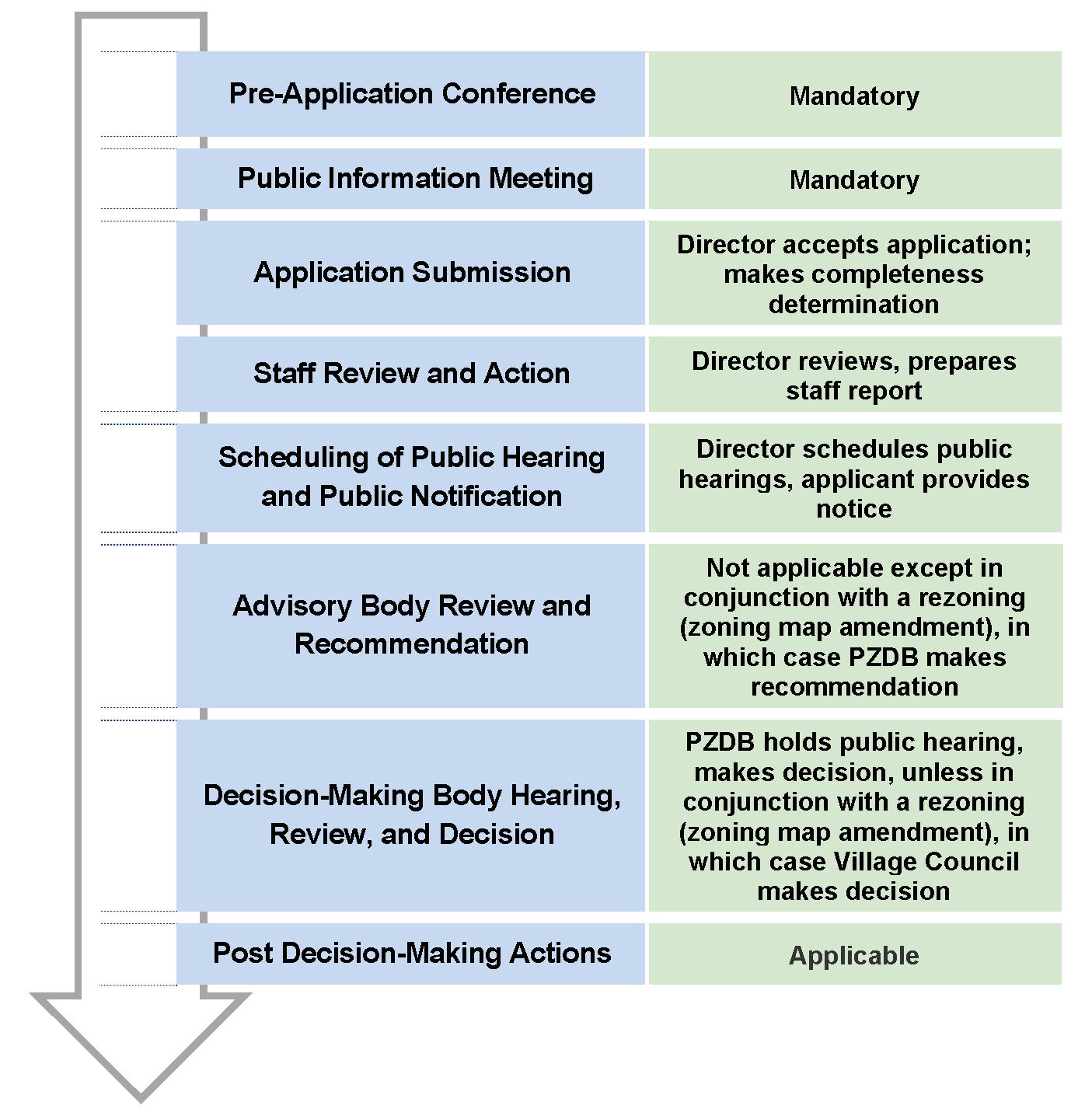
A.
Decision-Making Body Hearing, Review and Recommendation. When an application for a special exception is not being considered in conjunction with a zoning map amendment, the PZDB reviews the application at a quasi-judicial hearing and makes a decision based on the review standards in Sec. 2-501.E.3, Special Exception Review Standards. When an application for a special exception is being considered in conjunction with a zoning map amendment, the PZDB shall review and make a recommendation to the Village Council at a quasi-judicial hearing. The amendment and special exception then shall be decided by the Village Council at a quasi-judicial hearing. The decision-making body shall make a decision based on the review standards in Sec. 2-501.E.3, Special Exception Review Standards.
B.
Post Decision-Making Action.
1.
An approval of a special exception authorizes the submittal of any other applications that may be required before the development authorized by the special exception permit is constructed or established.
2.
An approval of a special exception shall automatically expire if the use authorized by the special exception is not established or substantially commenced within two years after the date of the special exception approval, unless an extension of this time period is authorized in accordance with Sec. 2-408.D, Lapse of Development Approval.
3.
A special exception approval shall automatically expire if the use is discontinued and not resumed for a period of one year.
4.
All other modifications of special exception approval may be amended only in accordance with the procedures and standards for its original approval.
3.
Special Exception Review Standards. A special exception shall be approved only on a finding there is competent substantial evidence in the record that the proposed special exception use:
A.
Will be consistent with the goals, objectives, and policies of the comprehensive plan;
B.
Will comply with all applicable zoning district standards;
C.
Will comply with all standards in Chapter 4: Use Specific Standards;
D.
Will be appropriate for its location and is compatible with the general character of surrounding lands and the uses permitted in the zoning district;
E.
Will adequately screen, buffer, or otherwise minimize adverse visual impacts on adjacent lands;
F.
Will ensure that no site lighting source shall negatively impact adjacent properties and rights-of-way;
G.
Will maintain safe and convenient ingress and egress and traffic flow onto and through the site by vehicles and pedestrians, and safe road conditions around the site;
H.
Will avoid significant adverse odor, noise, glare, and vibration impacts on surrounding lands regarding refuse collection, service delivery, parking and loading, signs, lighting, and other site elements;
I.
Will not have an adverse impact on land values and the ability of neighboring lands to develop uses permitted in the zoning district;
J.
Will avoid significant deterioration of water and air resources, scenic resources, and other natural resources;
K.
Will not overburden existing public facilities and services, including, but not limited to, streets and other transportation facilities, schools, potable water facilities, sewage disposal, storm water management, and police and fire protection facilities; and
L.
Will comply with all other relevant Village, state, and federal laws and regulations.
F.
Final Plan Approval.
1.
Generally. Final Plan Approval shall be obtained when required by a County zoning resolution.
2.
Final Plan Approval Procedure. Figure 2-501.F.2 identifies the key steps in the Final Plan Approval procedure, with noted modifications from the general procedures.
Figure 2-501.F.2: Final Plan Approval Procedure Flowchart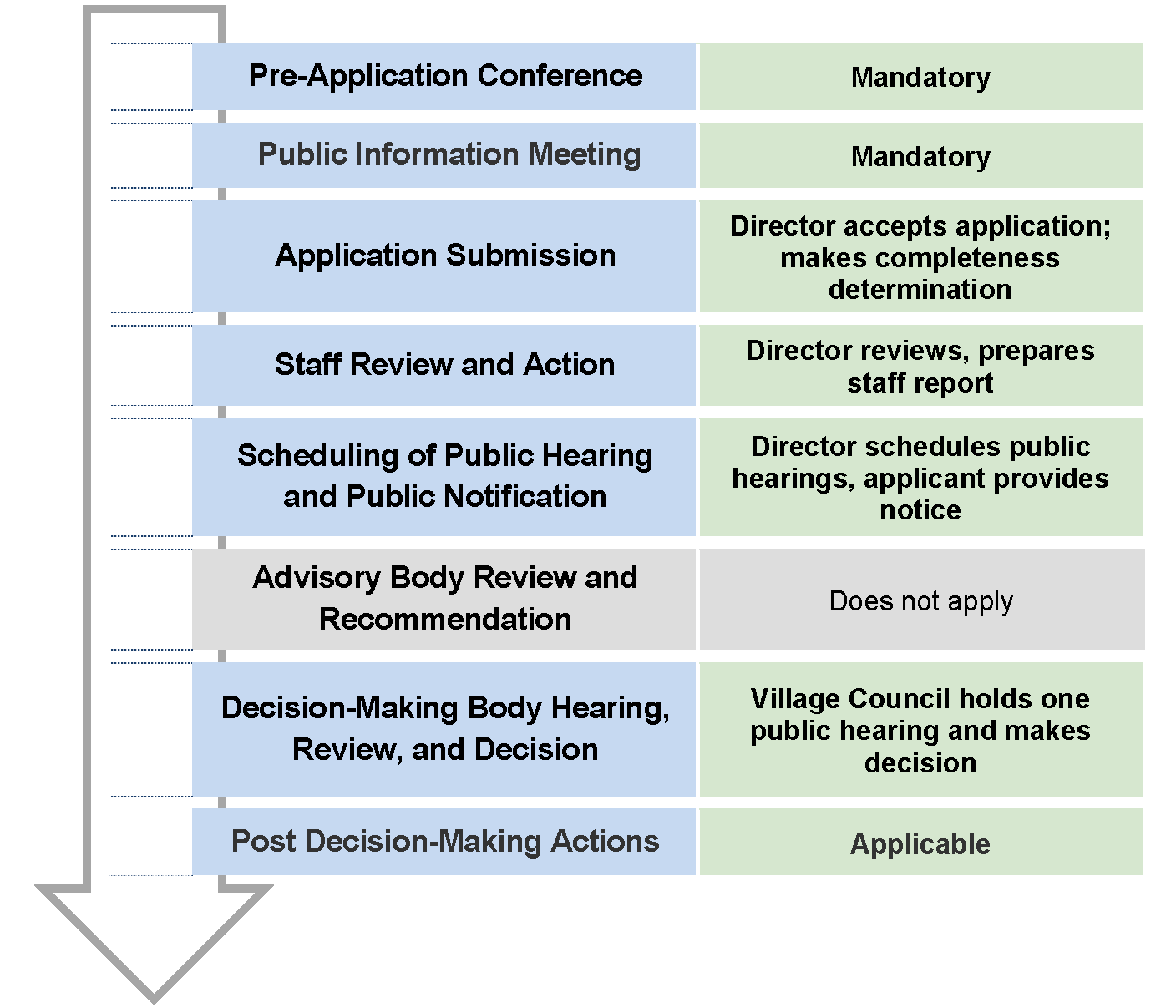
A.
Decision-Making Body Hearing, Review and Recommendation. The Final Plan Approval shall be decided by the Village Council at a quasi-judicial hearing. The decision-making body shall make a decision based on the review standards in paragraph 3 below.
B.
Post Decision-Making Action.
1.
The Final Plan Approval shall automatically expire if the use(s) authorized by the Final Plan Approval is not established or substantially commenced within two years after the date of the Final Plan Approval, unless an extension of this time period is authorized in accordance with Sec. 2-408.D, Lapse of Development Approval.
2.
All other modifications of a Final Plan Approval may be amended only in accordance with the procedures and standards for its original approval. Any property or portion thereof which has completed development according to a duly approved Final Plan Approval and development order shall be modified pursuant to the processes established for Planned Development modifications in Sec. 2-501.D Planned Development
3.
Final Plan Approval Review Standards. Final Plan Approval shall be granted only on a finding there is competent substantial evidence in the record that the proposed uses:
A.
Will be consistent with the goals, objectives, and policies of the comprehensive plan;
B.
Will comply with the zoning resolution and all applicable zoning district standards;
C.
Will comply with all standards in Chapter 4: Use Specific Standards;
D.
Will be appropriate for its location and is compatible with the general character of surrounding lands and the uses permitted in the zoning district;
E.
Will adequately screen, buffer, or otherwise minimize adverse visual impacts on adjacent lands;
F.
Will ensure that no site lighting source shall negatively impact adjacent properties and rights-of-way;
G.
Will maintain safe and convenient ingress and egress and traffic flow onto and through the site by vehicles and pedestrians, and safe road conditions around the site;
H.
Will avoid significant adverse odor, noise, glare, and vibration impacts on surrounding lands regarding refuse collection, service delivery, parking and loading, signs, lighting, and other site elements;
I.
Will not have an adverse impact on land values and the ability of neighboring lands to develop uses permitted in the zoning district;
J.
Will avoid significant deterioration of water and air resources, scenic resources, and other natural resources;
K.
Will not overburden existing public facilities and services, including but not limited to, streets and other transportation facilities, schools, potable water facilities, sewage disposal, storm water management, and police and fire protection facilities; and
L.
Will comply with all other relevant Village, state, and federal laws and regulations.
G.
Bar Special Permit.
1.
Generally. A permit to locate any establishment, including a bar, devoted primarily to the retailing and on-premises drinking of malt, vinous or other alcoholic beverages shall obtain an approval from the Village Council. A bar special permit is not required for provision of alcoholic beverages for members and guests of a private club or recreation center not available to the general public, or for hotels/motels, which approvals may be granted administratively.
2.
Bar Special Permit Procedure. Figure 2.5.1(G)2 identifies the key steps in the Bar Special Permit procedure.
Figure 2-501.E.2: Bar Special Permit Procedure Flowchart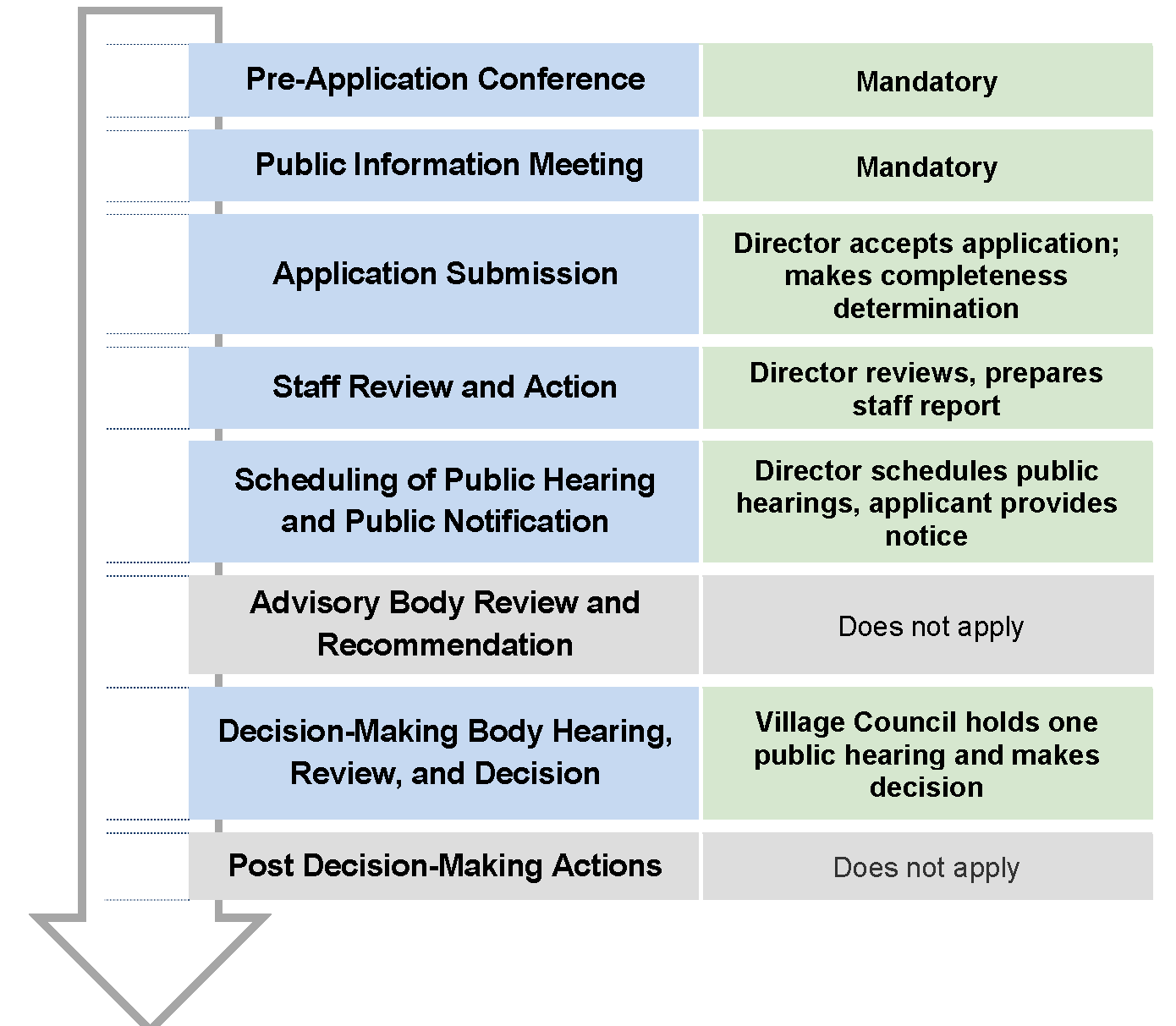
3.
Bar Special Permit Review Standards. The criteria for a special exception approval, Sec. 2-501.E, shall apply to bar special permit approval. See also Chapter 4: Use Specific Standards.
2-502. - Site Development.
A.
Development Order.
1.
Development Order. The procedures and standards in this section apply to the review of and decision on development applications for a development order. Approval of a development order is required prior to the approval of a plat, and the issuance of a building permit, unless this LDC requires only a limited development order, as provided in subsection B below. Application may be made simultaneously for plat review and development order review.
2.
Development Order Procedure.
A.
Figure 2-502.A.2 identifies key steps in the development order procedure, with noted modifications from the general procedures.
Figure 2-502.A.2: Development Order Procedure Flowchart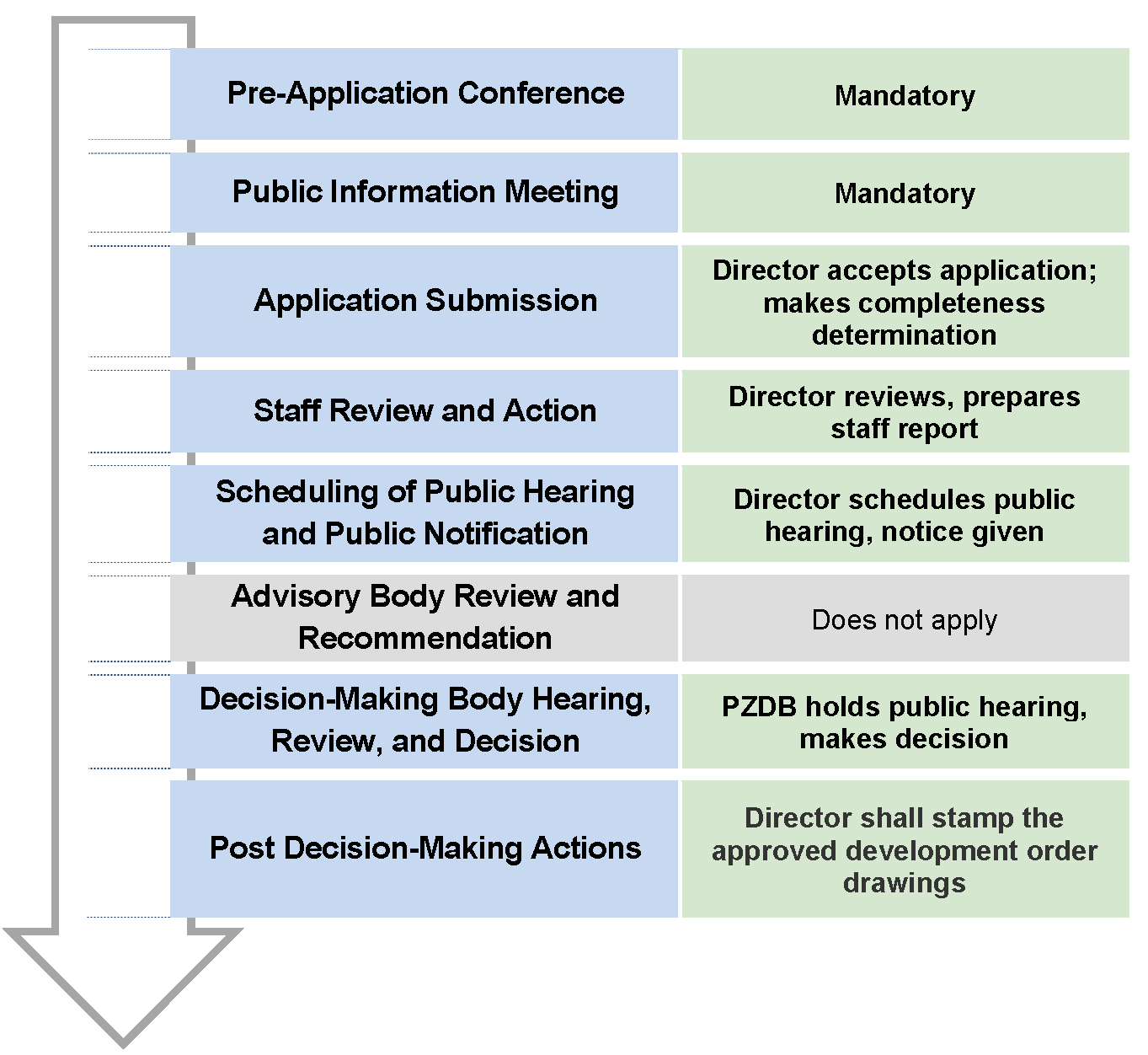
B.
For developments that require rezoning (zoning map amendment), the applicant may make application for a development order and the rezoning simultaneously. The development order will be reviewed for compliance with the requirements of the LDC for the proposed rezoning of the property. No development order application shall be determined to be complete until and unless the rezoning is approved. No approval of the development order shall be granted until the proposed rezoning is approved and an ordinance is signed by the Village Mayor.
3.
Post Decision-Making Action.
A.
The Director shall issue a development order approval letter and will stamp the approved development order drawings with an appropriate development order approval stamp.
B.
A development order shall automatically expire if the development authorized by the development order is not constructed or substantially commenced within five years after the date of the approval, or for the life of the surety or performance bond if the bond is for a period of less than five years, or unless an extension of this time period is authorized by the PZDB. Two two-year extensions may be granted provided the extension is requested prior to the expiration of the development order and complies with other application requirements in the Administrative Manual.
C.
In order for a development order to remain valid and active, significant construction activity shall commence within the duration of the development order and the construction of the project to build-out shall be actively pursued. Active pursuit of construction of a project to build-out is defined as continuous construction of the required infrastructure improvements shown and specified in the development order or buildings comprising the project. Actions to secure a permit, land clearing activity and construction of facilities deemed ancillary to the project by the Director will not be considered sufficient to satisfy the "active pursuit" criteria set forth in this section. If a project, including a phased project, is under construction and has not completed at least 50 percent of the permitted development (measured by lots, dwelling units, square feet or other applicable measurements of intensity as applicable) when the development order duration period has elapsed, the developer shall obtain a development order extension. For development order projects where there has been a foreclosure action, a deed given in-lieu of foreclosure, or title has been transferred pursuant to court ordered sale, and where there is a question of active pursuit of the construction under the development order, the new owner shall resume construction of the project within 24 months from the date when the title to the property changes pursuant to the foreclosure, deed in-lieu of foreclosure or court sale. Once restarted, construction shall continue to build-out without any periods of construction inactivity which exceed 18 months.
D.
A development order's concurrency certificate is only effective for three years from the approval.
E.
If all applicable state and federal permits and approvals have been obtained, the issuance of a development order shall be authorization for the applicant to begin those site development activities specifically approved in the development order. Site development activities shall not occur before all applicable state and federal permits have been obtained.
F.
A development order may be modified as follows:
1.
Amendments. An application for an amendment to a development order is one that does not qualify as a minor (administrative) change and that does not substantially modify the schedule of development as originally approved under an approved development order or, in the case of a planned development, is in substantial compliance with the approved Master Concept Plan. The PZDB, at a quasi-judicial public hearing, shall review and approve, deny, or approve with conditions any minor amendment.
2.
Minor (Administrative) Changes. The Director shall review and decide on minor (administrative) changes, limited to changes that the Director finds:
(a)
Address technical considerations that could not reasonably be anticipated during the development order approval process; or
(b)
Would not:
i.
Materially alter the drainage, streets, or other engineering design;
ii.
Adversely impact the management of storm water quality or storm water quantity;
iii.
Substantially affect the terms of the original approval; or
iv.
Result in significant adverse impacts on the surrounding lands or the Village at large; and
(c)
Are not the result of a violation revealed during final inspection.
G.
All other modifications of development order approval may be made only in accordance with the procedures and standards for its original approval.
H.
A development order runs with the land and is transferable to the subsequent owner of the property covered by the development order. Within 30 days after the transfer, a new owner shall submit to the Village proof of ownership of the property, a list of all owners, and a signed affidavit that the new owner has full authority to secure subsequent approvals and to impose covenants and restriction required by the development order.
4.
Development Order Review Standards. A development order shall only be approved upon a finding that the applicant demonstrates there is competent substantial evidence in the record that all of the following standards are met:
A.
The proposed development and uses in the development plan comply with Chapter 3: Zoning Districts, and Chapter 4: Use Specific Standards;
B.
The development proposed in the development plan and its general layout and design comply with all the standards in Chapter 5: Site Development Standards, Chapter 6: Signage, and Chapter 7: Natural Resources;
C.
The development proposed complies with all conditions of approval in any development approval to which the plan is subject;
D.
If any part of the development order requires a plat, the plat is approved in accordance with Sec. 2-502.C, Plat Review, and is in substantial conformance with the development order;
E.
The plan for the proposed development, structure, or project is in conformity with good taste, good design, and in general contributes to the image of the Village as a place of beauty, spaciousness, harmony, taste, fitness, and high quality;
F.
The proposed development, structure or project is not, in its exterior design and appearance, of inferior quality such as to cause the nature of the local environment or evolving environment to materially depreciate in appearance and value;
G.
The proposed structure or project is in harmony with the proposed developments in the general area;
H.
The proposed plan is fully consistent with the comprehensive plan for the Village;
I.
For legal nonconformities, any nonconforming elements of the site except for use are corrected by the proposed plan; and
J.
The development proposed complies with all other applicable standards in the LDC and all other Village ordinances and regulations.
B.
Limited Development Order.
1.
Limited Development Order. The procedures and standards in this section apply to the review of and decision on applications for a limited development order. Approval of a limited development order is required prior to the issuance of a building permit. A limited development order approval shall be required for the following.
A.
Type A. Any improvements to the land determined by the Director to have no adverse impacts on public facilities in accordance with applicable standards of measurement in this LDC (vehicular trips, amount of impervious surface, gallons per day, etc.), including up to 100 square feet of additional impervious surface and any Notice of Intent to Commence Water Retention Excavation for an agricultural use or as an amenity to a single-family residence where blasting activities will not be conducted and where no more than 1,000 cubic yards of spoil will be removed offsite.
B.
Type B. A cumulative addition or enlargement of an existing impervious area, provided that the addition or enlargement does not increase the total impervious cover area by more than 2,500 square feet and there is no increase in the rate of runoff from the project site.
C.
Type C. Any out-of-door type recreational facilities, such as swimming pools, tennis courts, tot lots, and other similar facilities, provided the total cumulative additional impervious area does not exceed 5,000 square feet, including any Village or county-initiated improvements for public water access purposes in Village or county-owned or maintained rights-of-way.
D.
Type D.
1.
Any other improvement to land determined by the Director to have insignificant impacts on public facilities in accordance with applicable standards of measurement in this LDC (vehicular trips, amount of impervious surface, gallons per day, etc.).
2.
The installation of new utility lines in existing right-of-way or easements.
3.
Improvements to a Village or county maintained road right-of-way.
E.
Type E. Any subdivision of land into two residential lots where the zoning district regulations permit such subdivision; provided, however, that:
1.
Each lot shall meet or exceed all requirements of the zoning district in which it is located, or the subdivision is approved by the Director under the provisions of this LDC, and the overall development complies with all other requirements of this LDC;
2.
No more than two lots may be created from an original parent parcel as it existed on January 28, 1983;
3.
Except single-family detached dwelling units, two-family attached dwelling units or bona fide agricultural uses, no development may occur on either of the lots without first obtaining a development order;
4.
If the parent parcel is 10 acres or greater, a protected species survey may be required as specified in this LDC;
5.
Each lot shall abut and have access to a road that meets the minimum construction standards set forth in this LDC and is consistent with the maximum density requirements of this LDC;
6.
No significant alteration of existing utility installations is involved;
7.
No change in drainage will occur that adversely impacts the surrounding properties;
8.
Creation of new road rights-of-way or road easements, and the construction of new roadways or upgrading of existing roadways to meet the minimum standards contained in this LDC will require development order approval; and
9.
Reasonable conditions may be attached to the approval so that any development on the lots will comply with all Village LDC requirements.
10.
An application for a lot split shall include all parcels under common ownership, including any abutting residual parcels, if under common ownership with the property subject to the lot split and are part of the original parent parcel as the parent parcel existed on January 28, 1983. If all lots are not under common ownership, the applicant shall provide proof that the applicant made a bona fide, good faith effort to request by certified mail, return receipt requested, all other property owners to join in the lot split application. Proof of the current property owner's refusal to consent to the lot split or the failure of the current property owner to respond to the applicant's request, after a reasonable time for a response, will obviate the need to include that parcel. Further development on any lots that do not join in the lot split application may not occur until the lot has been legally created in accordance with the provisions of this LDC. A lot split may only be approved once.
11.
All parcels, including residual parcels, shall conform to the minimum property development regulations for the zoning district in which they are located.
2.
Limited Development Order Procedure. Figure 2-502.B.2 identifies key steps in the limited development order procedure, with noted modifications from the general procedures.
Figure 2-502.B.2: Limited Development Order Procedure Flowchart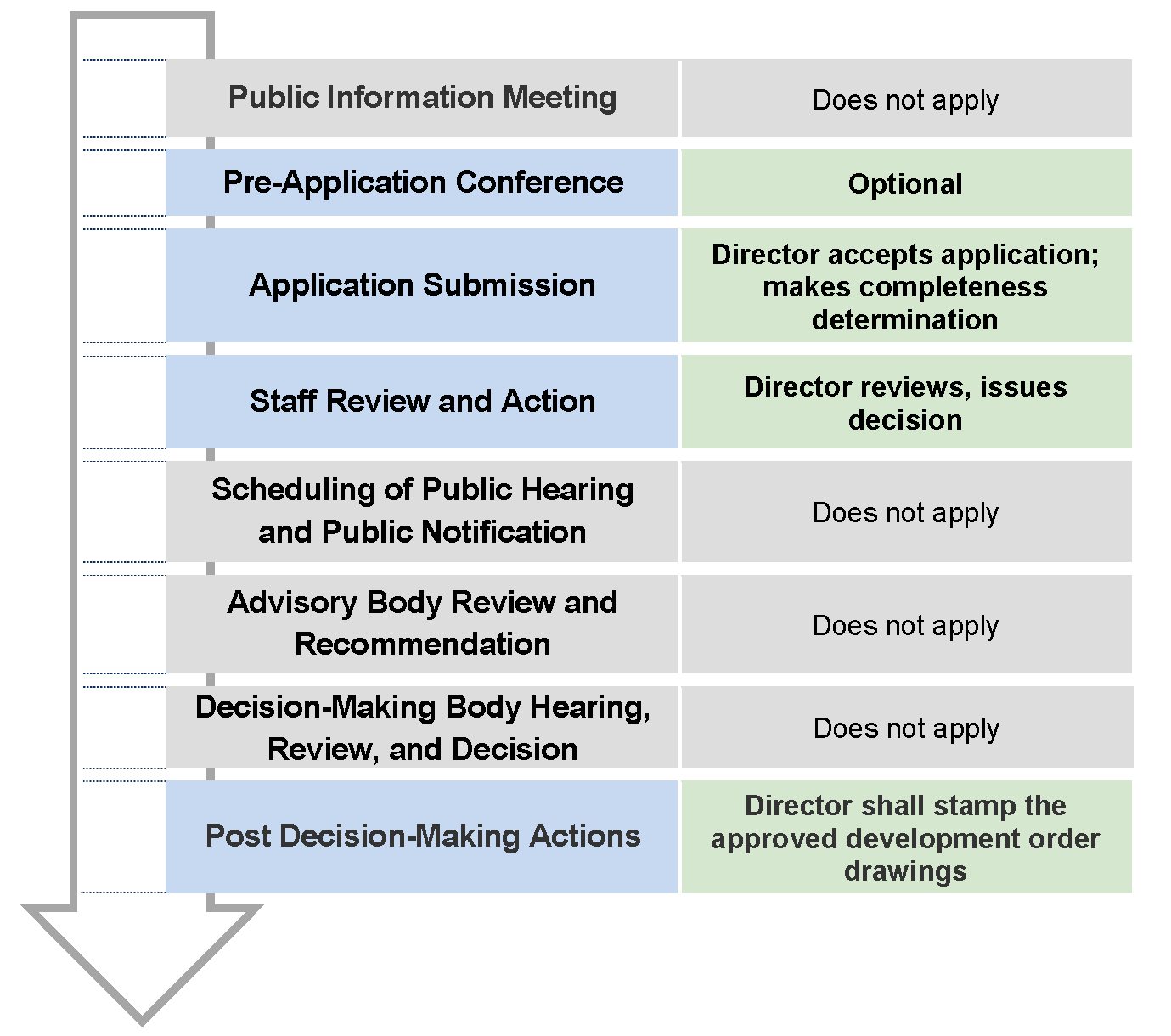
3.
Post Decision-Making Action.
A.
The Director shall issue a limited development order approval letter and will stamp the approved development order drawings with an appropriate development order approval stamp.
B.
A limited development order shall automatically expire if the development authorized by the limited development order is not constructed or substantially commenced within three years after the date of the approval.
C.
A limited development order approval shall automatically expire if the development authorized by the limited development order is discontinued and not resumed for a period of one year.
D.
A limited development order may be modified in accordance with the procedures and standards for its original approval.
4.
Limited Development Order Review Standards. A limited development order shall only be approved upon a finding that the applicant demonstrates there is competent substantial evidence in the record all of the following standards are met:
A.
The proposed development and uses in the development plan comply with all applicable requirements of the LDC and is consistent with the Village comprehensive plan;
B.
For legal nonconformities, any nonconforming elements of the site except for use are corrected by the proposed plan;
C.
The development proposed in the development plan has no significant adverse effect upon surrounding land uses;
D.
The development proposed in the development plan has no significant adverse effect upon public facilities in the area;
E.
The development proposed in the development plan does not adversely affect the environmental quality of the area;
F.
The development proposed complies with all conditions of approval in any development approval to which the plan is subject; and
G.
If any part of the limited development order requires a plat, the plat is approved in accordance with Sec. 2-502.C, Plat Review, and is in substantial conformance with the development order.
C.
Plat Review.
1.
Generally. This subsection supplements the procedural requirements of F.S. ch. 177 for review and decisions regarding plats and replats. It applies to all subdivision of land, except the following:
A.
A development platted or approved by Lee County prior to January 28, 1983, provided that all required improvements have been made or that a security for the performance of the improvements has been posted and is current.
B.
The division of land for the conveyance of land to a federal, state, County or Village entity, or a public utility.
C.
The division of land by judicial decree.
D.
A division of land of two or fewer lots out of a parent parcel approved as a limited development order (Sec. 2-502.B.2, Limited Development Order Procedure).
2.
Plat Procedure.
A.
Figure 2-502.C.2 identifies key steps in the plat and replat procedure, with noted modifications from the general procedures.
Figure 2-502.C.2: Plat Procedure Flowchart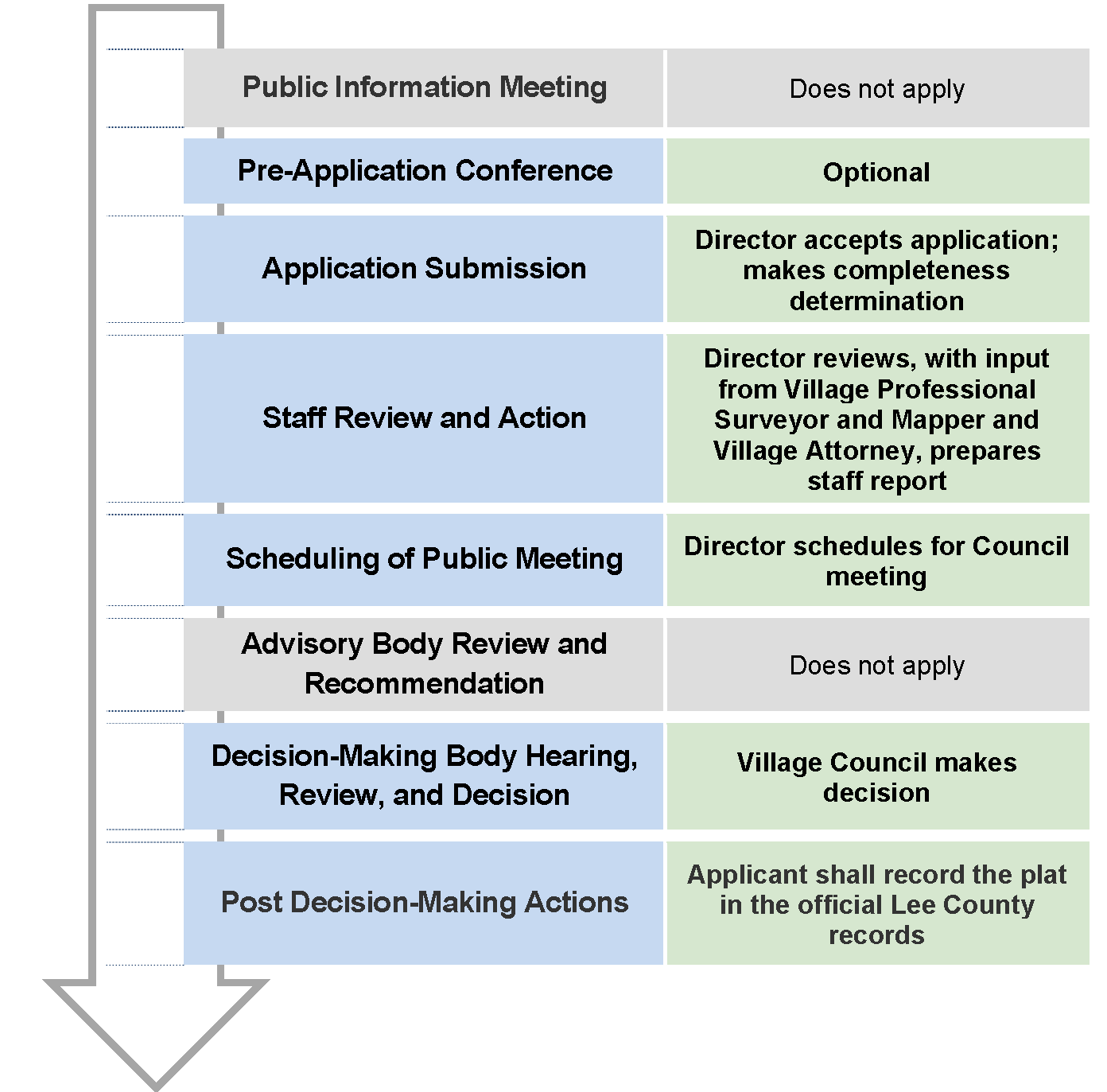
B.
Plats shall be prepared in compliance with F.S. ch. 177 and shall contain all of the elements specified in the statute, this LDC (including Section 5-9, Plat Standards), and the Administrative Manual.
C.
The Director may permit the combination or recombination of platted lots of record created through a plat recorded in the Official Records of Lee County, in accordance with Sec. 5-906, Lot Recombination, provided the density established through the original plat is not increased and the resulting lots comply with all other applicable requirements of this LDC.
D.
A development order for the subject property shall be approved prior to approval of a plat.
3.
Post Decision-Making Actions. All plats and replats shall be recorded by the applicant in the Official Records of Lee County.
4.
Plat Standards. The Village Council acts in its ministerial capacity when reviewing and deciding plats and replats. Approval shall be granted if the plat meets the platting requirements of this LDC (see, Section 5-9, Plat Standards, and any technical requirements provided in the Administrative Manual, statutory plat requirements, and other applicable LDC requirements).
D.
Vacation of Easement, Right-of-Way, or Plat.
1.
Generally. Applications for the vacation of easements, rights-of-way, or plat shall follow the standards established in Section 5-9, Plat Standards, in addition to the procedures set out herein.
2.
Vacation Procedures.
A.
Figure 2-502.D.2 identifies key steps in the vacation procedure, with noted modifications from the general procedures.
Figure 2-502.D.2: Vacation of Easement, Right-of-Way or Plat Procedure Flowchart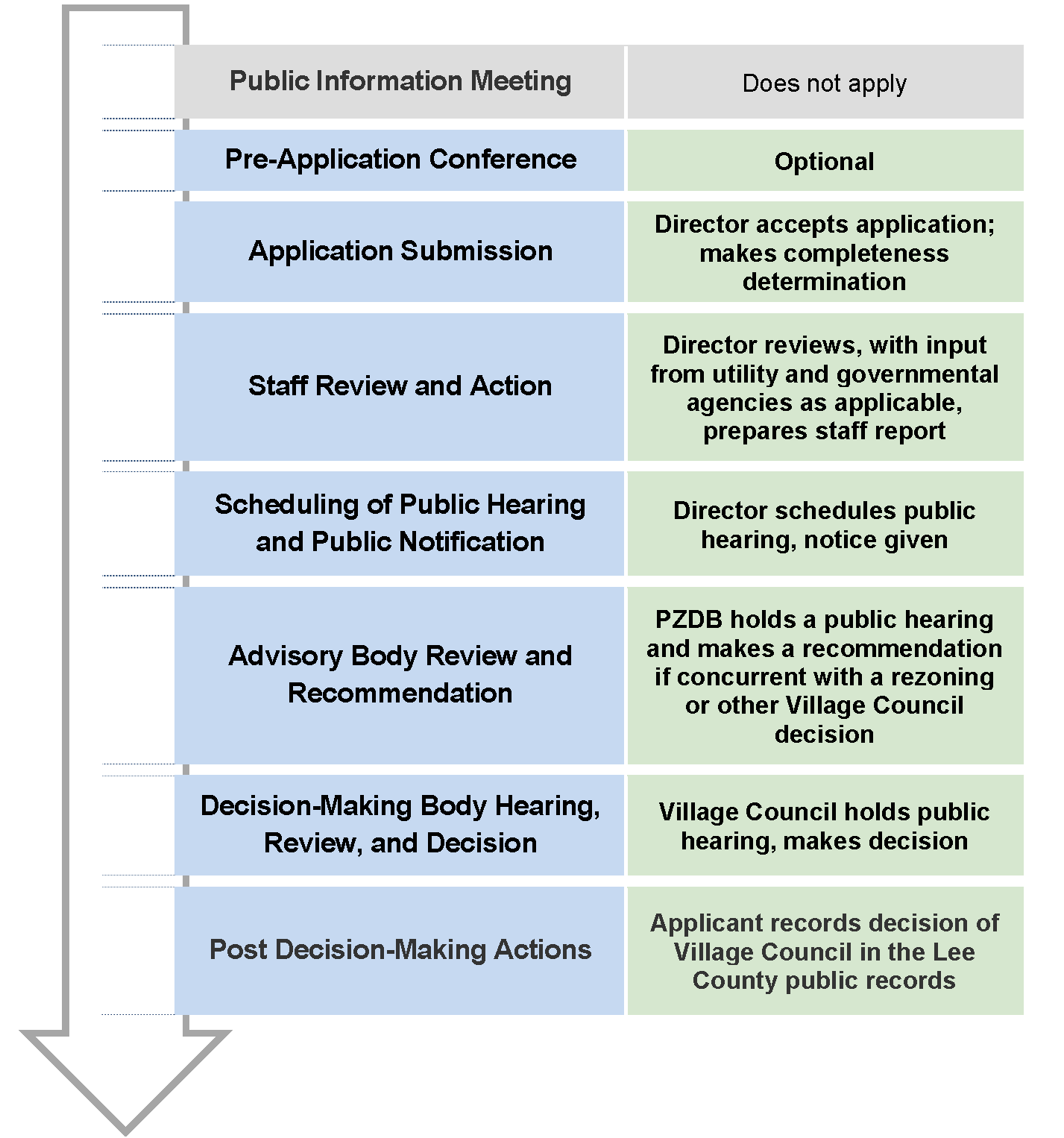
B.
If the vacation is of an easement, right-of-way, or plat required as a condition of rezoning or other Village Council decision, the PZDB shall hold a hearing and provide a recommendation to the Village Council regarding the vacation. A development order conditioned on such vacation shall not become effective unless and until the Village Council approves the vacation.
3.
Post Decision-making Actions. All vacations of easements, rights-of-way, and plats shall be recorded by the applicant in the Official Records of Lee County. The recordation shall include a survey in accordance with the standards of the FAC, this LDC, and any conditions of approval.
4.
Review Standards. The Village Council shall, after public hearing and due consideration, either grant or deny the application in accordance with the best interests of the public welfare. A vacation of an easement, right-of-way, or plat is subject to the legislative discretion of the Village Council. The Village Council may consider as applicable, whether:
A.
The easement or right-of-way is now, or in the foreseeable future, needed for a public purpose for the Village or its residents;
B.
For a plat vacation which has dedicated rights-of-way to public use or dedicated rights-of-way or easements for any public utility, storm drainage course, floodplain, public access roadway, or dedicated public facility:
1.
Consents have been provided by the public users of the easements;
2.
Each public utility, which is franchised to provide services within the area of the plat, is notified in writing of the proposed vacation, and has 30 calendar days to comment;
3.
Conditions of consent from any public agencies or utilities having rights in any land proposed to be vacated have the conditions incorporated into the vacation; and
4.
If any agency or utility having rights in any land proposed to be vacated objects, a finding is made that a specific public benefit will not be annulled if the vacation is granted.
C.
New plats assigned concurrently with a plat vacation may take into account previous dedications.
2-503. - Certificate of Concurrency.
A.
Generally. All applications for development orders and building permits shall be reviewed by the Director for compliance with the level of service requirements set forth in the comprehensive plan and this LDC, unless exempted by this LDC.
B.
Procedures.
1.
Figure 2-503.B.1 identifies key steps in the certificate of concurrency procedure, with noted modifications from the general procedures.
Figure 2-503.B.1: Certificate of Concurrency Procedure Flowchart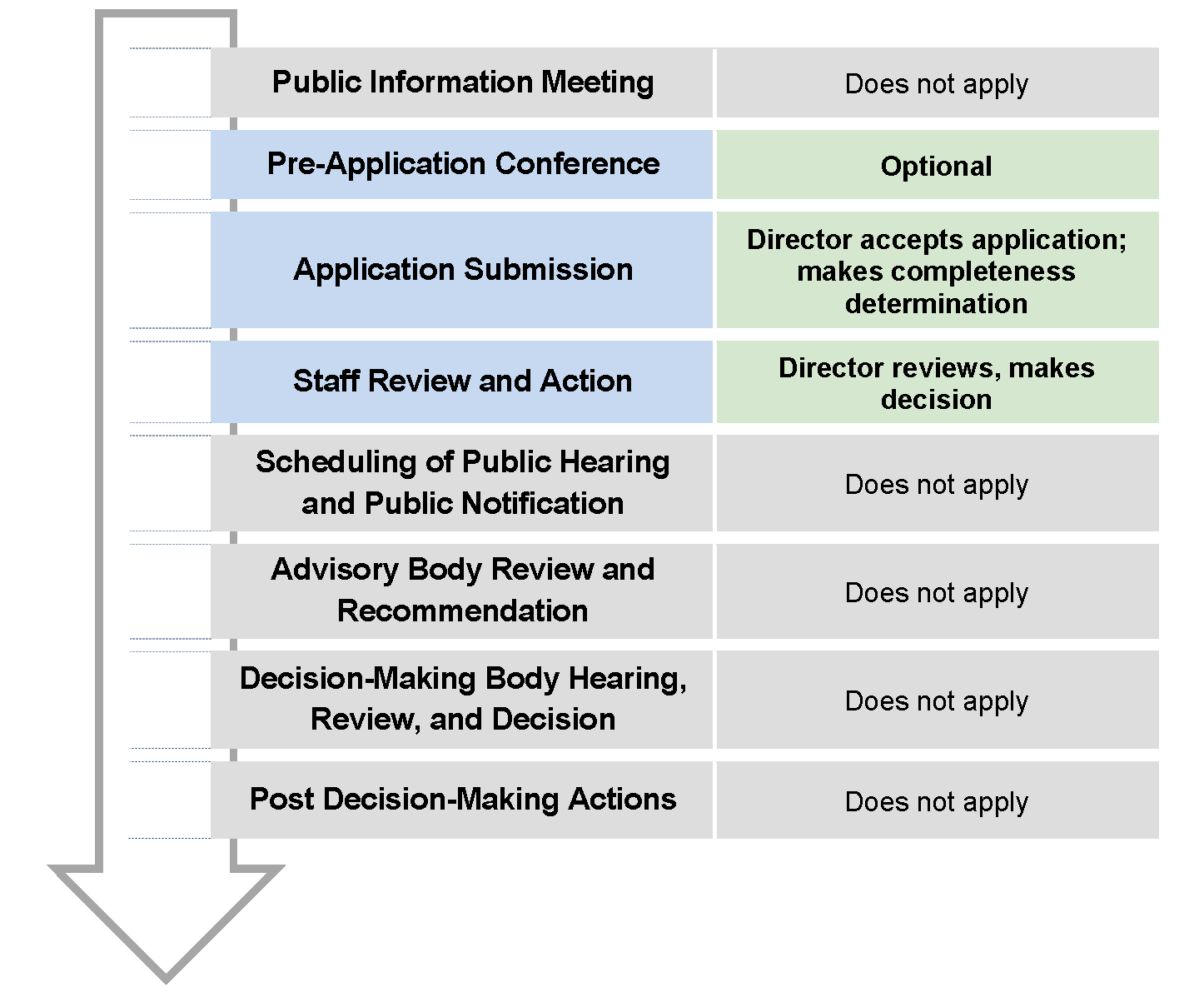
2.
As a part of its application for development approval, the applicant shall provide letters of concurrency compliance from the providers of the following services: potable water, sanitary sewer, solid waste, surface water management (drainage), and schools.
3.
In its review of the application, the Director may rely upon studies, measurements or calculations prepared by qualified professionals, or upon generally accepted guidelines, rules, formulas, studies or other theories developed by professional experts working or publishing in this field of inquiry, or upon relevant historical trends or experiences, or upon related rules and standards adopted by other governmental agencies, or upon any combination of these sources.
C.
Certificate of Concurrency Standards. A written determination of concurrency compliance ("certificate of concurrency") shall be issued in conjunction with a development order if the Director determines that there will be sufficient capacity for the enumerated facilities to serve the proposed development at the time the impacts of development will occur, without causing those facilities to function at a level of service below the minimum regulatory levels established in the comprehensive plan. The Director may condition the certificate of concurrency on mitigation to be provided by the applicant as a condition of a development approval.
2-504. - Historic Preservation Certificate of Appropriateness.
A.
Generally.
1.
The PZDB shall review and decide on modifications to structures designated by the Village, or by Lee County prior to Village incorporation, as historically significant, to assist in the continued preservation of the structure and the appropriate, compatible and sensitive development of new construction and additions to the structure. In conducting these duties, the PZDB shall seek the advice of persons knowledgeable in historic preservation.
2.
A certificate of appropriateness is a written approval issued by the PZDB allowing specified alterations to, new construction of, relocation of, or other changes to a designated historic structure.
B.
Certificate of Appropriateness Procedure. Figure 2-504.B identifies key steps in certificate of appropriateness procedure, with noted modifications from the general procedures.
Figure 2-504.B: Certificate of Appropriateness Procedure Flowchart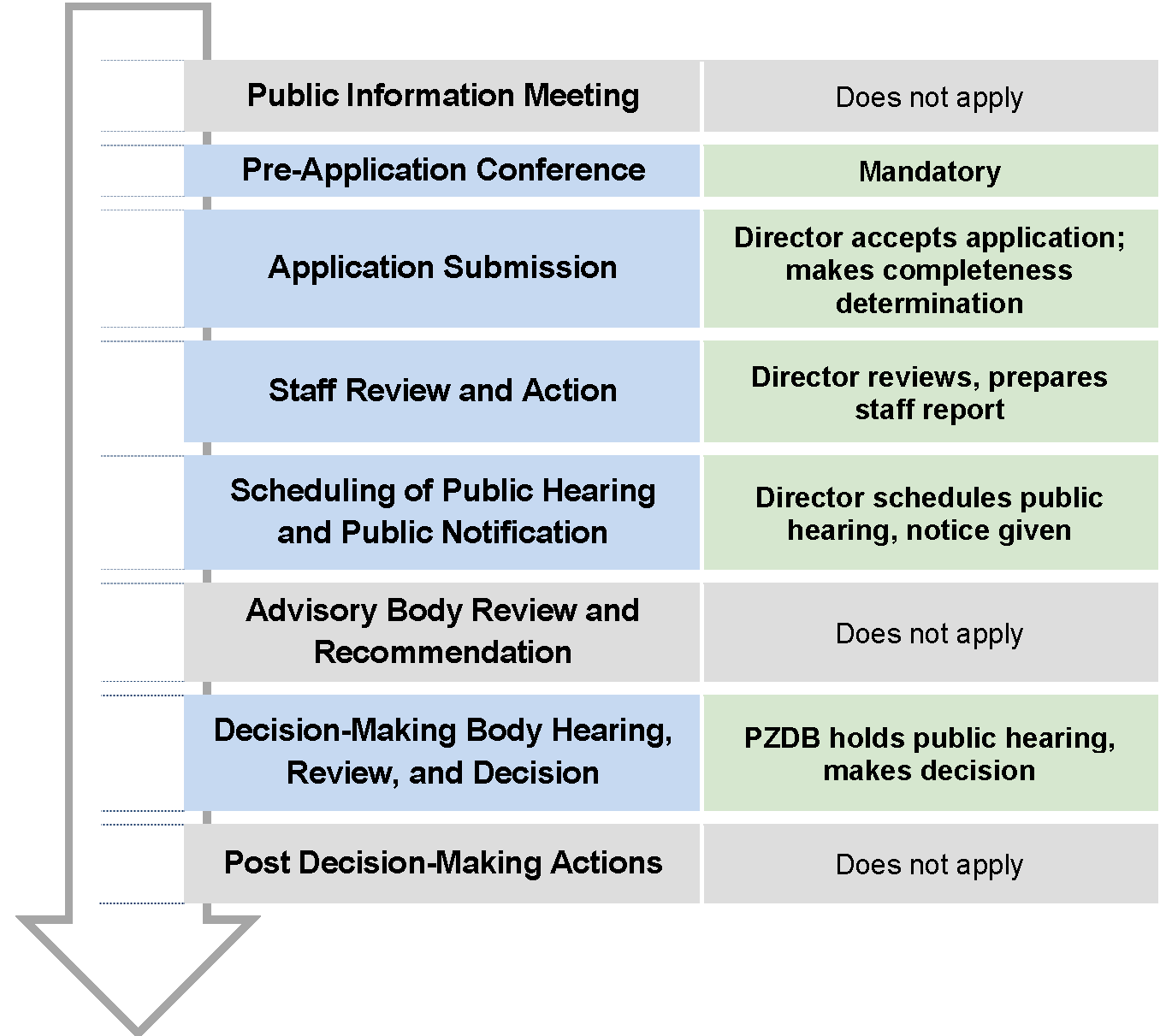
C.
Standards for Certificate of Appropriateness. A certificate of appropriateness shall be reviewed and approved or denied based upon the criteria listed in the U.S. Secretary of the Interior's Standards for Rehabilitation, 36 CFR 67 (1983), as such standards may be amended, renumbered, or replaced from time to time.
2-505. - Permits.
A.
Material Alteration of Commercial or Multifamily Building or Structure Exterior Permit. The Director shall review all applications for material alterations of building or structure exteriors for commercial buildings, places of assembly, and multifamily buildings, and make a decision, unless, in the Director's discretion, the Director requests that the PZDB makes the decision.
1.
Material Alteration of Commercial or Multifamily Building or Structure Exterior Permit Procedures. Figure 2-505.A.1 identifies key steps in the material alteration of building or structure exteriors permit procedure, with noted modifications from the general procedures.
Figure 2-505.A.1: Material Alteration of Commercial or Multifamily Building or Structure
Exterior Permit Procedure Flowchart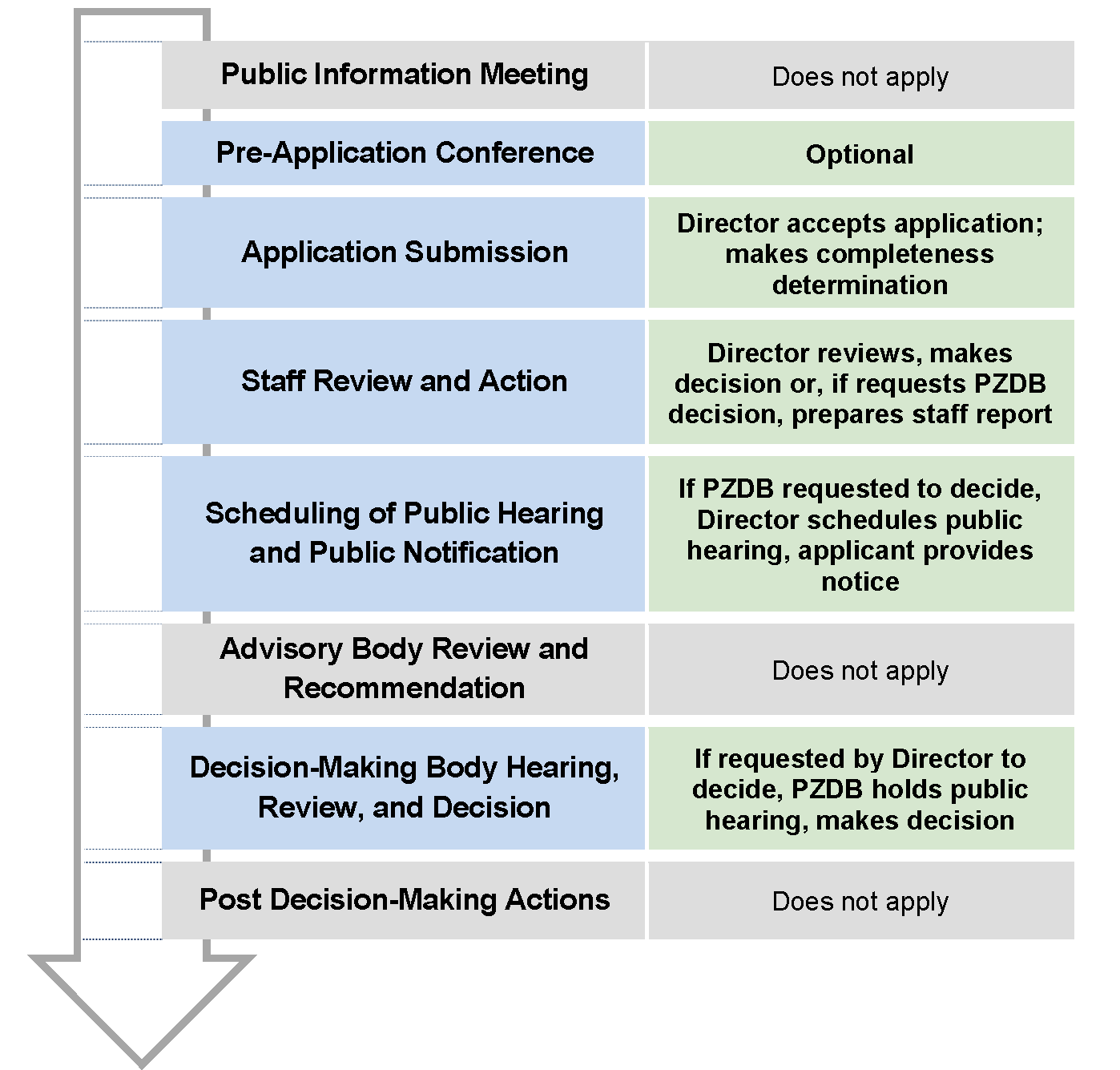
2.
Material Alteration of Building or Structure Standards. If the Director determines that the proposed material alteration conforms to an applicable pattern book, condition of approval or LDC, the Director may issue an approval. Furthermore, if the Director determines that the project does not conform, the PZDB shall review the application to determine whether the following criteria are met:
A.
The proposed alteration is in conformity with good taste, good design, and in general contributes to the image of the Village as a place of beauty, spaciousness, harmony, taste, fitness, and high quality;
B.
The proposed alteration is not, in its exterior design and appearance, of inferior quality such as to cause the nature of the local environment or evolving environment to materially depreciate in appearance and value;
C.
The proposed alteration is in conformity with the standards of this LDC and other applicable ordinances insofar as the location and appearance of the structure is involved;
D.
The proposed alteration is in harmony with the proposed developments in the general area, and fully consistent with the comprehensive plan for the Village; and
E.
If a repainting project, the proposed repainting conforms to the colors permitted in this LDC.
B.
Monument Sign Permit.
1.
Generally. The PZDB shall review all applications for monument signs; all other sign permit applications shall be reviewed and decided by the Director.
2.
Monument Sign Permit Procedure. Figure 2-505.B.2 identifies key steps in the monument sign permit procedure, with noted modifications from the general procedures.
Figure 2-505.B.2: Monument Sign Permit Procedure Flowchart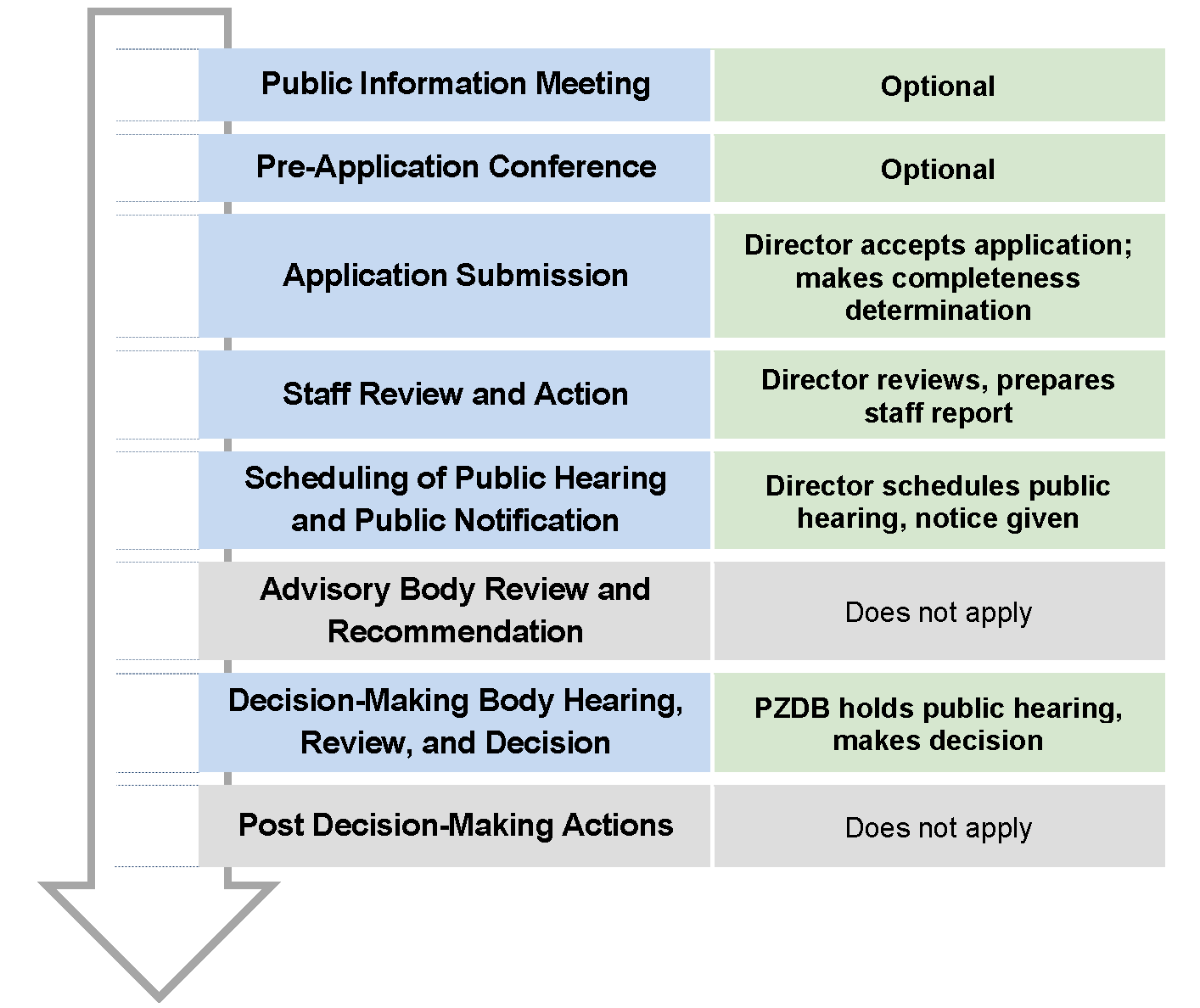
3.
Monument Sign Standards. The PZDB shall review monument sign applications to determine, based on substantial competent evidence, whether the following monument sign criteria are met. The PZDB in its sign review does not review for compliance with zoning standards.
A.
The proposed structure is in conformity with good taste, good design, and in general contributes to the image of the Village as a place of beauty, spaciousness, harmony, taste, fitness, and high quality.
B.
The proposed structure is not, in its exterior design and appearance, of inferior quality such as to cause the nature of the local environment or evolving environment to materially depreciate in appearance and value.
C.
The proposed structure is in conformity with the standards of this LDC (including but not limited to Chapter 6: Signage) and other applicable ordinances insofar as the location and appearance of the structure is involved.
D.
The proposed structure is in harmony with the proposed developments in the general area, and fully consistent with the comprehensive plan.
C.
Temporary Use Permit.
1.
Generally. Temporary use permits are available for certain uses identified in this LDC, for identified periods of time. Special event temporary uses will be approved by the Director.
2.
Temporary Use Permit Procedure. Figure 2-505.C.2 identifies key steps in the Temporary Use Permit procedure, with noted modifications from the general procedures.
Figure 2-505.C.2: Temporary Use Permit Procedure Flowchart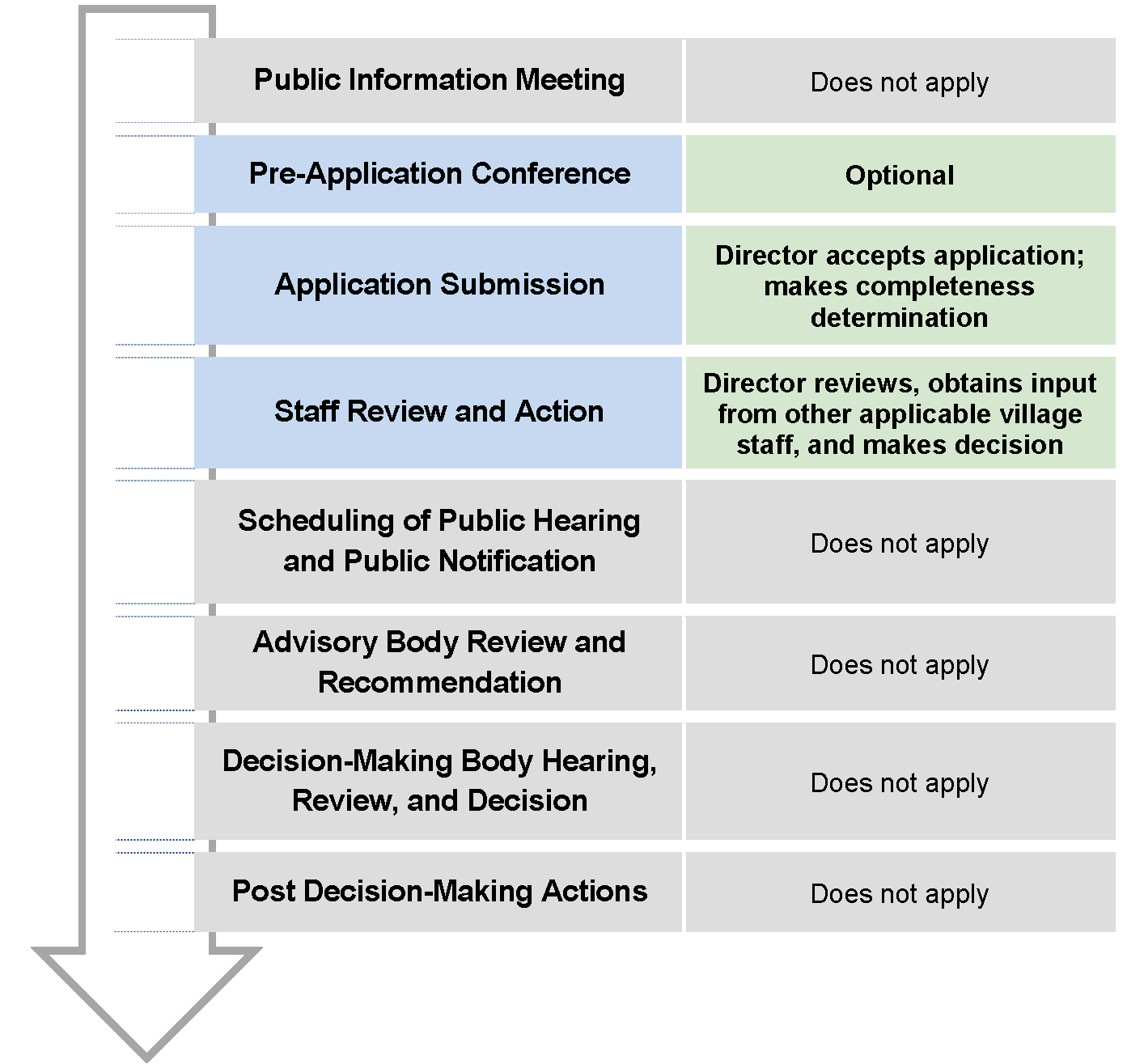
D.
Tree Removal/Vegetation Permit.
1.
Generally. No person, organization, society, association, corporation, or any agent or representative thereof, shall deliberately cut down, destroy, remove, relocate, defoliate through the use of chemicals or other methods, or otherwise damage any tree or vegetation that is protected by this LDC, without first obtaining a development approval as provided in this LDC (see Sec. 5-404, Tree Preservation). No clearcutting of vegetation is permitted until a development permit for vertical construction has been issued.
2.
Tree Removal/Vegetation Permit Procedure. Figure 2-505.D.2 identifies key steps in the Tree Removal/Vegetation Permit procedure for removal of fewer than 10 trees, with noted modifications from the general procedures. For removal of 10 or more trees, the applicant shall obtain a Limited Development Order approval.
Figure 2-505.D.2: Tree Removal/Vegetation Permit Procedure Flowchart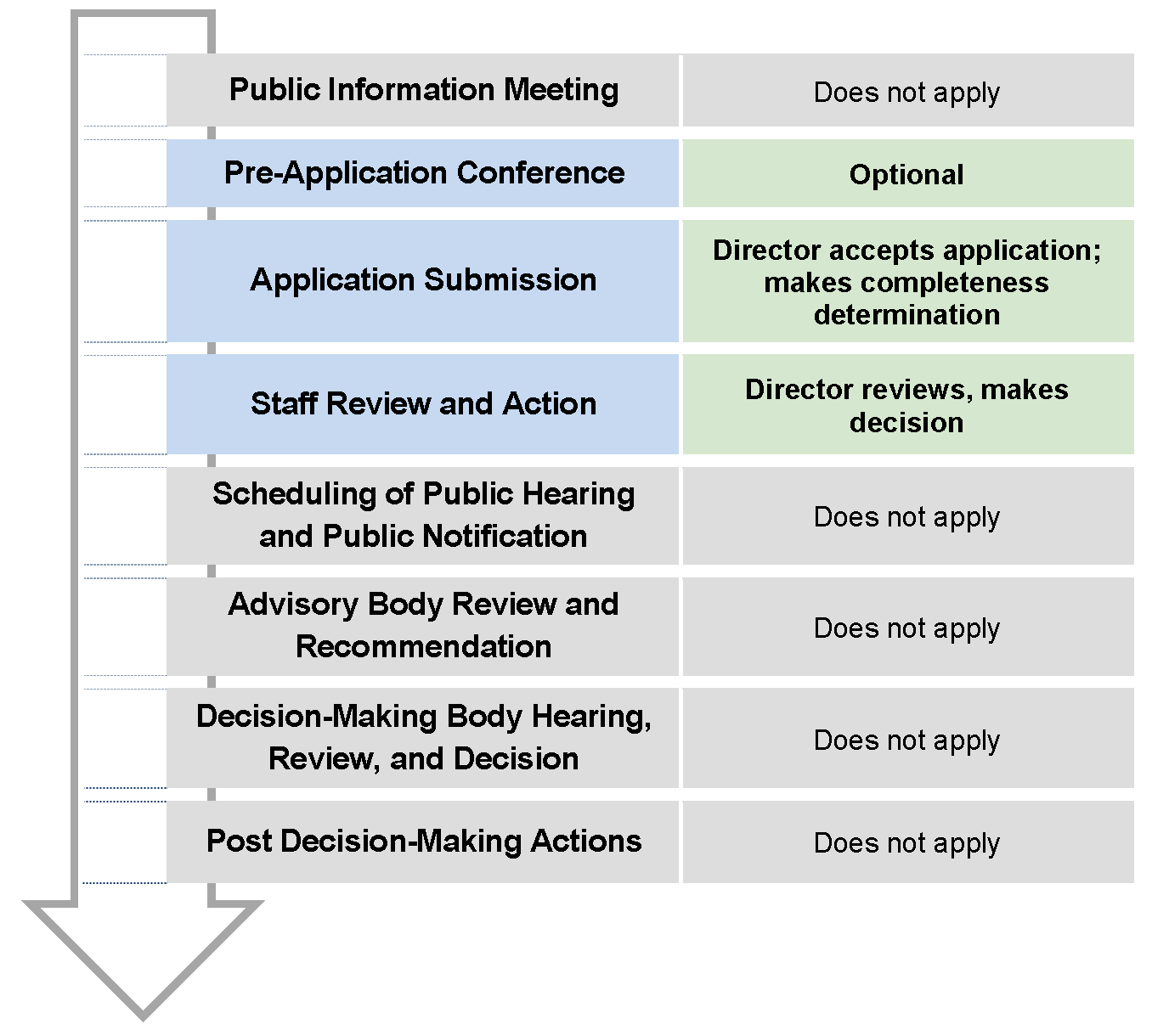
3.
Tree Removal Standards.
A.
The Director shall approve a permit for issuance for the removal of any protected tree upon a finding that one or more of the following conditions is present:
1.
Trees which pose a safety hazard to pedestrian or vehicular traffic or threaten to cause disruption to public utility services.
2.
Trees which pose a safety hazard to existing buildings or structures.
3.
Trees which prevent reasonable access to a lot or parcel so long as the proposed access point complies with all other Village regulations.
4.
Diseased trees which are a hazard to people, buildings, or other improvements on a lot or parcel or to other trees.
5.
Trees so weakened by age, storm, fire, or other injury as to, in the opinion of the Director, jeopardize the life and limb of persons or cause a hazard to property.
6.
Trees which prevent the lawful development of a lot or parcel or the physical use thereof.
7.
Any tree if properly documented to be a danger to property by an arborist certified by the International Society of Arboriculture or a Florida licensed landscape architect.
B.
The Director may require that a tree protected by this LDC be relocated on the same lot or parcel in-lieu of removal.
E.
Cultivated Tree Removal/Renovation.
1.
Cultivated Tree Removal/Renovation Procedure. Figure 2-505.E.1 identifies key steps in the Cultivated Tree Removal/Renovation procedure for properties with an approved Landscape Plan and subject to a Development Order or a Limited Development Order when proposing an amendment to remove 10 or more cultivated trees, with noted modifications from the general procedures.
Figure 2-505.E.1: Cultivated Tree Removal/Renovation Procedure Flowchart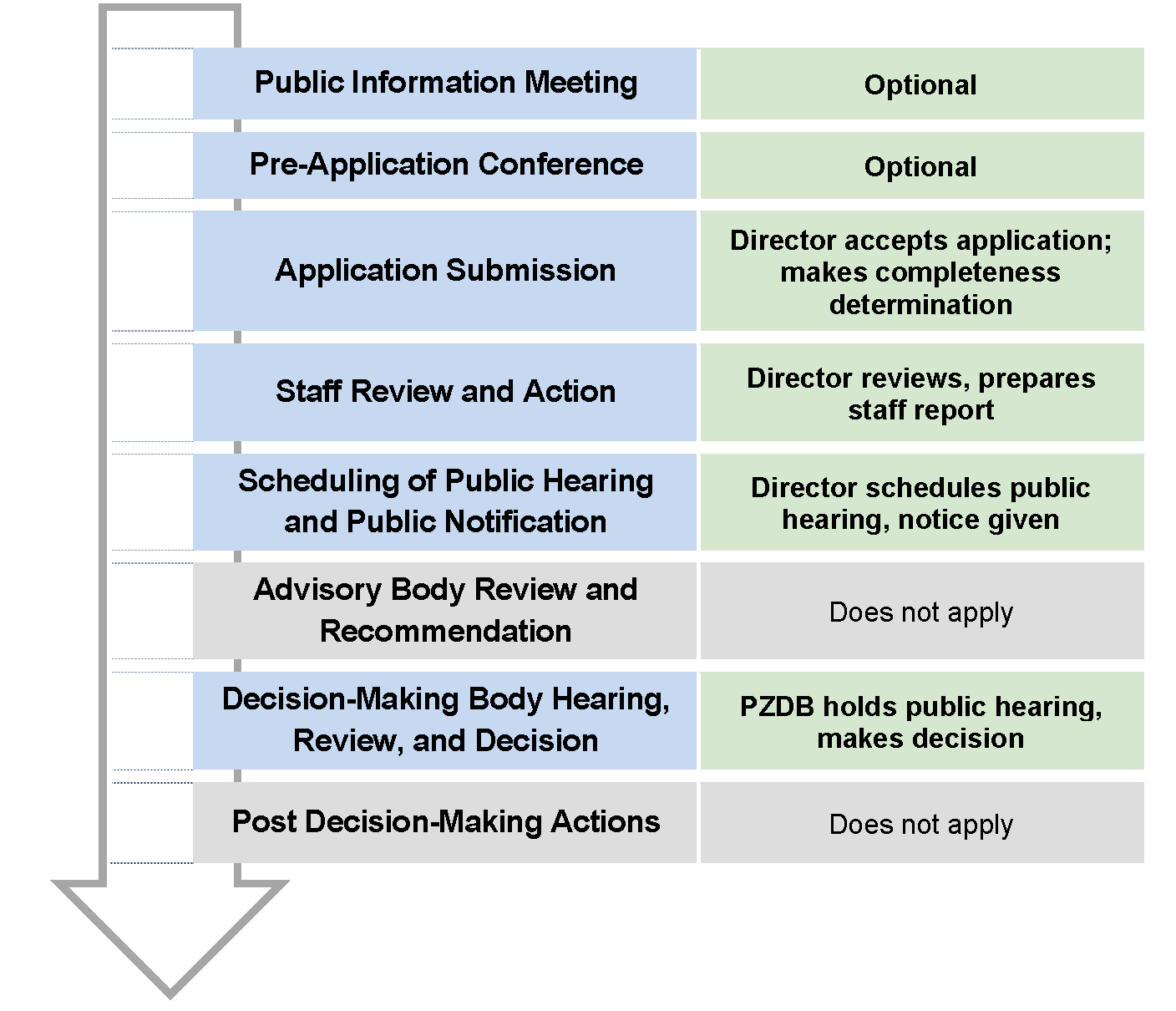
2.
Cultivated Tree Removal/Renovation Standards. The PZDB shall review requests for Cultivated Tree Removal/Renovation to determine, based on substantial competent evidence, whether the following criteria are met.
A.
Compliance with Sec. 5-411.I, Cultivated Tree Removal / Renovation of this code.
B.
The proposed amendment to the Landscape Plan is in conformity with good taste, good design, and in general contributes to the image of the Village as a place of beauty, spaciousness, harmony, taste, fitness, and high quality.
C.
The proposed amendment to the Landscape Plan is in harmony with the proposed developments in the general area.
D.
The proposed amendment to the Landscape Plan promotes water conservation.
F.
Other Administrative Permits and Approvals.
1.
Generally. This LDC includes requirements for the issuance of various permits and approvals that are issued administratively by the Director. The administrative permits and approvals shall be reviewed pursuant to the general procedures in Sec. 2-403, Development Application Submission, and Sec. 2-404, Staff Review and Action, of this LDC, unless otherwise specified elsewhere in this LDC. These administrative permits and approvals include, but are not limited to, the following.
2.
Use Permit. A use permit, authorizing a use in accordance with this LDC, is required prior to occupancy or a change of occupancy of commercial or industrial zoned property, or for the change of use from a model home that is converted to a standard residence. A use permit is a prerequisite to any county or state permitting or business license receipt. The Director shall review and issue a use permit prior to the issuance of a building permit, based on the determination that the use meets the standards in this LDC.
3.
Sign Permit. Sign permits, except for monument signs, shall be reviewed by the Director for compliance with the standards in this LDC. A building permit for a sign shall not be issued until authorized by the Director. Appeals of a sign permit decision shall be made to the PZDB in accordance with the appeal procedures of Sec. 2-404, Staff Review and Action.
4.
Dogs in Outdoor Seating Areas of Restaurants.
A.
Generally. Pursuant to F.S. § 509.233, patrons' dogs (canis lupus familiaris) may be permitted within outdoor seating areas of restaurants subject to the approval of an outdoor dog dining permit. Service animals, as defined under F.S. ch. 413, are exempt from the provisions of this section.
B.
Permit Required. A permit must be obtained from the Department prior to allowing patrons' dogs in outdoor seating areas:
1.
Application. An applicant for an outdoor dog dining permit must submit the following information on the form provided by the Village:
(a)
The name, location, and mailing address of the restaurant.
(b)
The name, mailing address, and telephone contact information of the permit applicant.
(c)
The Division of Hotels and Restaurants of the Florida Department of Business and Professional Regulation issued license number of the restaurant.
(d)
A copy of a site plan, to scale, that will be designated as available to patrons' dogs, including: dimensions of the designated area; a depiction of the number and placement of tables, chairs, and restaurant equipment, if any; the entryways and exits to the designated outdoor area; the boundaries of the designated area and of other areas of outdoor dining not available for patrons' dogs; any fences or other barriers; surrounding property lines and public rights-of-way, including sidewalks and common pathways; and such other information reasonably required by the permitting authority.
(e)
A description of the days of the week and hours of operation that dogs will be permitted in the designated outdoor area.
2.
Review and Approval.
(a)
Prior to permit approval, the Director must find that all required materials have been received and that the requested permit will not hinder the general health, safety and welfare of the public.
(b)
The Director may impose additional conditions as necessary in order to protect the health, safety, and welfare of the community.
(c)
The Director will provide the Division of Hotels and Restaurants of the Florida Department of Business and Professional Regulation with a copy of all approved applications and permits issued.
3.
Transfer. A permit issued under this section is not transferable to a subsequent owner or tenant upon the sale of a public food service establishment, but will automatically expire upon the sale of the establishment. The subsequent owner or tenant is required to reapply for a new permit pursuant to this section if the subsequent owner or tenant wishes to continue to accommodate patrons' dogs. A change in occupancy will also require the issuance of a new permit under this section.
4.
Revocation.
(a)
A permit may be revoked by the Village if, after notice and reasonable time in which the grounds for revocation may be corrected, the restaurant fails to comply with the conditions of approval, including the standards set forth in Sec. 4-232, Restaurant.
(b)
If revoked, a permit for dogs in outdoor seating areas will not be issued to the same owner or tenant for a period of 12 months from the date of revocation.
5.
Legacy Mobile Home Parks.
A.
Any mobile home park which was lawfully established prior to the effective date of the Lee County's 1962 zoning regulations will be governed by the requirements of Sec. 9-504, Placement of Mobile Home or Recreational Vehicle on Lot, as long as the park satisfies the remaining minimum documentary requirements and the Village Council approval set forth in this provision. Any park previously approved by the Lee County Board of Commissioners under Lee County Ordinance 86-36 may request to amend the approved site plan by the combination of lots creating larger lots provided the approved density is not increased. The park must obtain an administrative approval. For purposes of this subsection, the term "site plan" means any one or more of the following, whichever is applicable:
1.
A sealed and signed survey showing individual lots by both course and distance;
2.
An unrecorded subdivision plat prepared and certified by a professional engineer or surveyor;
3.
A condominium plot plan prepared and recorded pursuant to F.S. ch. 718;
4.
A park plan prepared and submitted with a prospectus pursuant to F.S. ch. 723, provided that the prospectus has been approved by the State Department of Business Regulation and is of sufficient accuracy, size, and legibility to enable the Director to administer this section;
5.
A site plan approved in accordance with Lee County Administrative Code Policy F-0015;
6.
A site plan approved pursuant to a preliminary or final development order;
7.
A rectified aerial with a minimum scale of one inch equals 100 feet and which has each site delineated and identified by its number and shows individual lot measurements with a reasonable degree of accuracy; or
8.
Any other document which shows lot lines with enough specificity to enable the Director to apply the provisions of this section with respect to minimum lot size, lot widths and setback requirements.
B.
Any of the above documents that have not been formally approved by the Village Council or the Lee County Board of County Commissioners before Village incorporation will not be sufficient to satisfy the provisions of this subsection. The burden of proof that a document has received Lee County Board of County Commissioners approval or Village Council approval is that of the owner.
G.
Zoning Verification Letter ("ZVL").
1.
Generally. A zoning verification letter may be requested from the Director by an individual who is seeking verification of the zoning status of a specific parcel of land. A zoning verification letter issued by the Director is informational only, will not be the basis for an estoppel against the Village, and does not authorize development activity.
2.
Procedures. The request must provide sufficient information to identify the property and the information the requestor seeks to verify. The request must be submitted in writing and be accompanied by the required administrative fee. If the request covers multiple parcels, the Director may treat each parcel as a separate request and may result in additional fees. The requestor is solely responsible for the accuracy of the information provided to the Village within the request. The procedures established under this paragraph will also apply to any request for zoning review or verification provided to facilitate licensure or approval through a Federal or State Agency.
3.
Duration. There is no specific expiration date for a ZVL. However, Village zoning regulations are continually under review and may change at any time, and conclusions provided in a ZVL may be superseded if not in conformance with the current regulations at the time of permit application.
4.
Content. A ZVL provided by the Village may contain the following information:
A.
The future land use designation of the property in the comprehensive plan.
B.
The zoning district of the property.
C.
Verification that a particular use is permitted within the property's zoning district.
D.
A list of permitted uses in the zoning district.
E.
Identification of current zoning resolutions, special exceptions, variances, and deviations that apply to the property.
F.
The development regulations applicable to the property.
G.
Zoning action needed to permit a particular use.
H.
Identification of any current Notice of Violations issued for code enforcement violations on the subject property.
5.
Appeal. The conclusions made within a ZVL are not subject to appeal.
2-506. - Relief.
A.
Zoning Variance.
1.
Generally. The PZDB shall hear and decide all requests for variances from the terms of the regulations or restrictions of the LDC, except in the event that the variance request is part of a rezoning (zoning map amendment) application, in which case the Village Council will decide the variance, and except for a variance request from Section 7-3, Flood Hazard Reduction Standards. No use variance may be heard or considered.
2.
Zoning Variance Procedure. Figure 2-506.A.2 identifies key steps in the zoning variance procedure, with noted modifications from the general procedures.
Figure 2-506.A.2: Zoning Variance Procedure Flowchart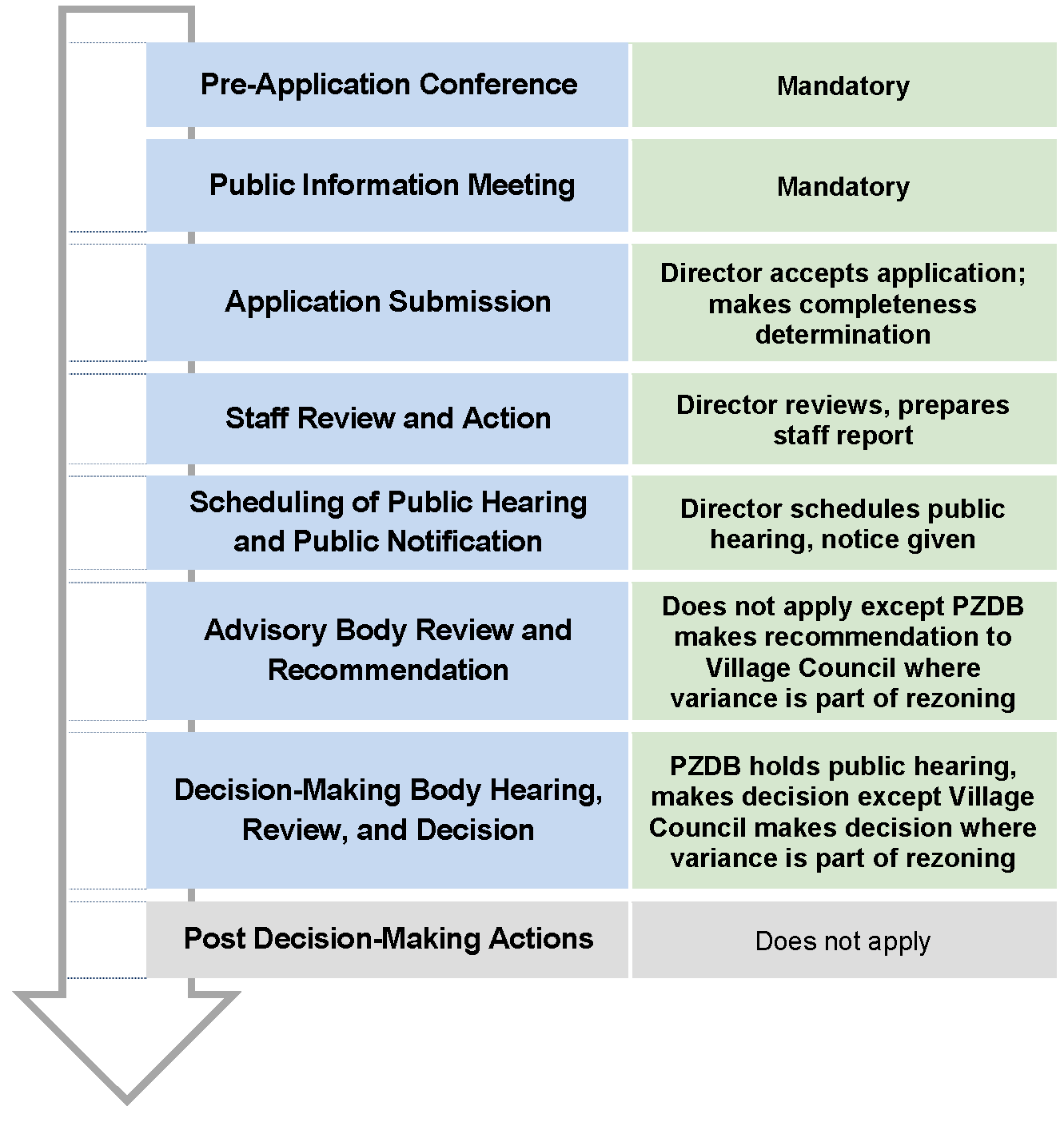
3.
Zoning Variance Standards. Before granting a zoning variance, the PZDB, or the Village Council, as applicable, shall find that all of the following are satisfied:
A.
There are exceptional or extraordinary conditions or circumstances that are inherent to the property in question and whether those exceptional or extraordinary conditions or circumstances create a hardship (as defined in this LDC) on the property owner.
B.
The exceptional or extraordinary conditions or circumstances are not the result of actions of the applicant taken subsequent to the adoption of the ordinance (any action taken by an applicant pursuant to lawfully adopted regulations preceding the adoption of the ordinance from which this LDC is derived will not be considered self-created).
C.
The variance granted is the minimum variance that will relieve the applicant of an unreasonable burden caused by the application of the regulation in question to the applicant's property.
D.
The granting of the variance will not be injurious to the neighborhood or otherwise detrimental to the public welfare.
E.
The condition or situation of the specific piece of property, or the intended use of the property, for which the variance is sought, is not of a general or recurrent nature so as to make it more reasonable and practical to amend the LDC.
B.
Flood Variance.
1.
Generally. Any applicant for development approval for any building, structure, and facility which is wholly within or partially within any flood hazard area shall first obtain the required approval pursuant to Flood Hazard Reduction requirements of this LDC (Section 7-3, Flood Hazard Reduction Standards). The Village Council shall hear and decide on requests for variances from the strict application of the Flood Hazard Reduction requirements of this LDC.
2.
Flood Variance Procedure. Figure 2-506.B.2 identifies key steps in the Flood Variance procedure, with noted modifications from the general procedures.
Figure 2-506.B.2: Flood Variance Procedure Flowchart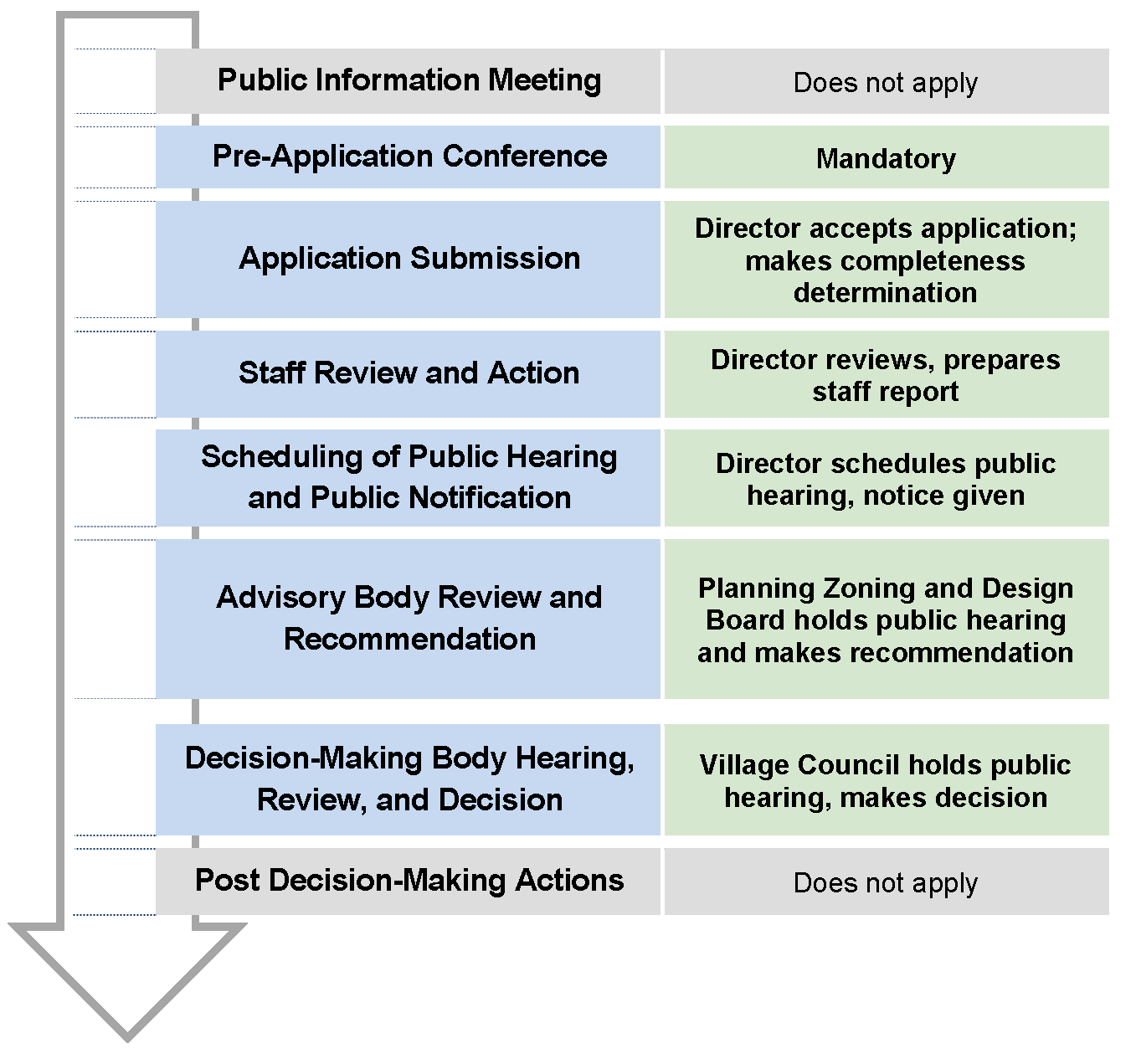
3.
Flood Hazard Reduction Variance Review Standards.
A.
In reviewing requests for a flood hazard reduction variance, the Village Council will consider all technical evaluations, all relevant factors, all other applicable provisions of the Florida Building Code, the requirements of Section 7-3, Flood Hazard Reduction Standards, the requirements of Sec. 7-301.G, Variances and Appeals, and the following:
1.
The danger that materials and debris may be swept onto other lands resulting in further injury or damage;
2.
The danger to life and property due to flooding or erosion damage;
3.
The susceptibility of the proposed development, including contents, to flood damage and the effect of such damage on current and future owners;
4.
The importance of the services provided by the proposed development to the community;
5.
The availability of alternate locations for the proposed development that are subject to lower risk of flooding or erosion;
6.
The compatibility of the proposed development with existing and anticipated development;
7.
The relationship of the proposed development to the comprehensive plan and floodplain management program for the area;
8.
The safety of access to the property in times of flooding for ordinary and emergency vehicles;
9.
The expected heights, velocity, duration, rate of rise and debris and sediment transport of the floodwaters and the effects of wave action, if applicable, expected at the site; and
10.
The costs of providing governmental services during and after flood conditions including maintenance and repair of public utilities and facilities such as sewer, gas, electrical and water systems, streets, and bridges.
B.
Variances may only be issued upon the Village Council determination that:
1.
Failure to grant the variance would result in exceptional hardship due to the physical characteristics of the land that render the lot undevelopable; increased costs to satisfy the requirements or inconvenience do not constitute hardship;
2.
The granting of a variance will not result in increased flood heights, additional threats to public safety, extraordinary public expense, nor create nuisances, cause fraud on or victimization of the public or conflict with existing local laws and articles; and
3.
The variance is the minimum necessary, considering the flood hazard, to afford relief.
C.
Deviation.
1.
Deviation.
A.
Generally. The Village Council shall approve deviations that are part of a planned development or rezoning (zoning map amendment) approval, after recommendation by the PZDB.
B.
Deviation Standards for Village Council Decision. In reaching a decision, the Village Council shall consider whether the proposed deviation will or will not:
1.
Improve the quality of the proposed development under review;
2.
Preserve and promote the general intent of the LDC to protect the public, health, safety and welfare;
3.
Be compatible with uses on surrounding property; and
4.
Create an undue burden on essential public facilities.
2.
Administrative Deviation.
A.
Generally. The Director is authorized to grant administrative deviations from the technical standards in the following sections of this LDC, subject to the review standards in subsection 3 below.
1.
Certain development standards in the EPD District.
2.
Right-of-Way width specifications for Village-maintained roads.
3.
Right-of-Way width specifications for privately-maintained roads.
4.
Intersection design.
5.
Edge of pavement radius at intersecting roads.
6.
Horizontal curves.
7.
Cul-de-sacs.
8.
Wearing surface on Village-maintained roads.
9.
Wearing surface on privately-maintained roads.
10.
Composition of the base on Village-maintained roads.
11.
Composition of the base on privately-maintained roads.
12.
Roadway swale slope and run-off requirements.
13.
Edge of pavement radius at driveways.
14.
Water main line sizing, dead end and intersecting criteria.
15.
Wellfield prohibition and monitoring requirements.
16.
Mangrove replanting ratio requirements.
17.
Surface water management roadside swale standards.
18.
Surface water management setbacks for water retention or detention activities.
19.
Setbacks required for docks and boat ramps.
20.
Public transit facilities.
21.
Piping materials in rights-of-way.
22.
Potable water systems.
23.
Sanitary sewer systems.
24.
Deviation of up to 5 percent of the standards for off-street parking, landscaping, and dimensions of this LDC, subject to the review standards in subsection 3.B below.
25.
Any other technical provision of the LDC which provides for the Director to grant administrative deviation.
B.
Administrative Deviation Prior to Development Order Consideration. The applicant may pursue approval of administrative deviations concurrently with an application for a development order. The development order will be reviewed but cannot be approved until all of the necessary deviations have also been approved. After a deviation request has been heard and has been approved or denied, the applicant may proceed with the preparation of all the documents necessary for the approval of the development order.
3.
Review Standards. Administrative deviations may be granted only where the Director, with the assistance of appropriate Village staff and affected jurisdictions, finds that the following criteria have been met:
A.
For deviations from listed technical standards:
1.
The alternative proposed to the standards of the LDC is based on sound engineering practices (not applicable to Sec. 5-307, Transit Access and Circulation; Sec. 5-1002, Potable Water Systems; or Sec. 5-1003, Sewer Systems);
2.
The alternative is no less consistent with the health, safety and welfare of abutting landowners and the general public than the standard from which the deviation is being requested;
3.
The granting of the deviation is not inconsistent with any specific policy directive of the Village Council or Village comprehensive plan;
4.
For Sec. 5-307, Transit Access and Circulation, the required facility would unnecessarily duplicate existing facilities; and
5.
For Sec. 5-1002, Potable Water Systems; or Sec. 5-1003, Sewer Systems, the utility that would otherwise serve the development cannot provide the service at the adopted level of service standard due to an inadequate central facility.
B.
For deviations from the standards for off-street parking (Sec. 5-204, Off-Street Parking Standards), landscaping (Section 5-4, Landscape Standards), and dimensional standards (see Chapter 3: Zoning Districts), whether or not the deviation will:
1.
Improve the design of the proposed development under review;
2.
Preserve and promote the general intent of the LDC to protect the public health, safety, and welfare;
3.
Threaten the health, safety, or welfare of abutting property owners; and
4.
Create an undue burden on essential public facilities.
D.
Appeal of Administrative Official Decision.
1.
Generally. An applicant may appeal the final decision of the Director for the following:
A.
A limited development order or amendment thereto;
B.
A minor change to a development order;
C.
An administrative amendment to a PD;
D.
A tree removal/vegetation permit; or
E.
An administrative deviation.
2.
Procedure for Appeal of Administrative Official. Figure 2-506.D.2 identifies key steps in the Appeal of Administrative Official procedure, with noted modifications from the general procedures.
Figure 2-506.D.2: Appeal of Administrative Official Procedure Flowchart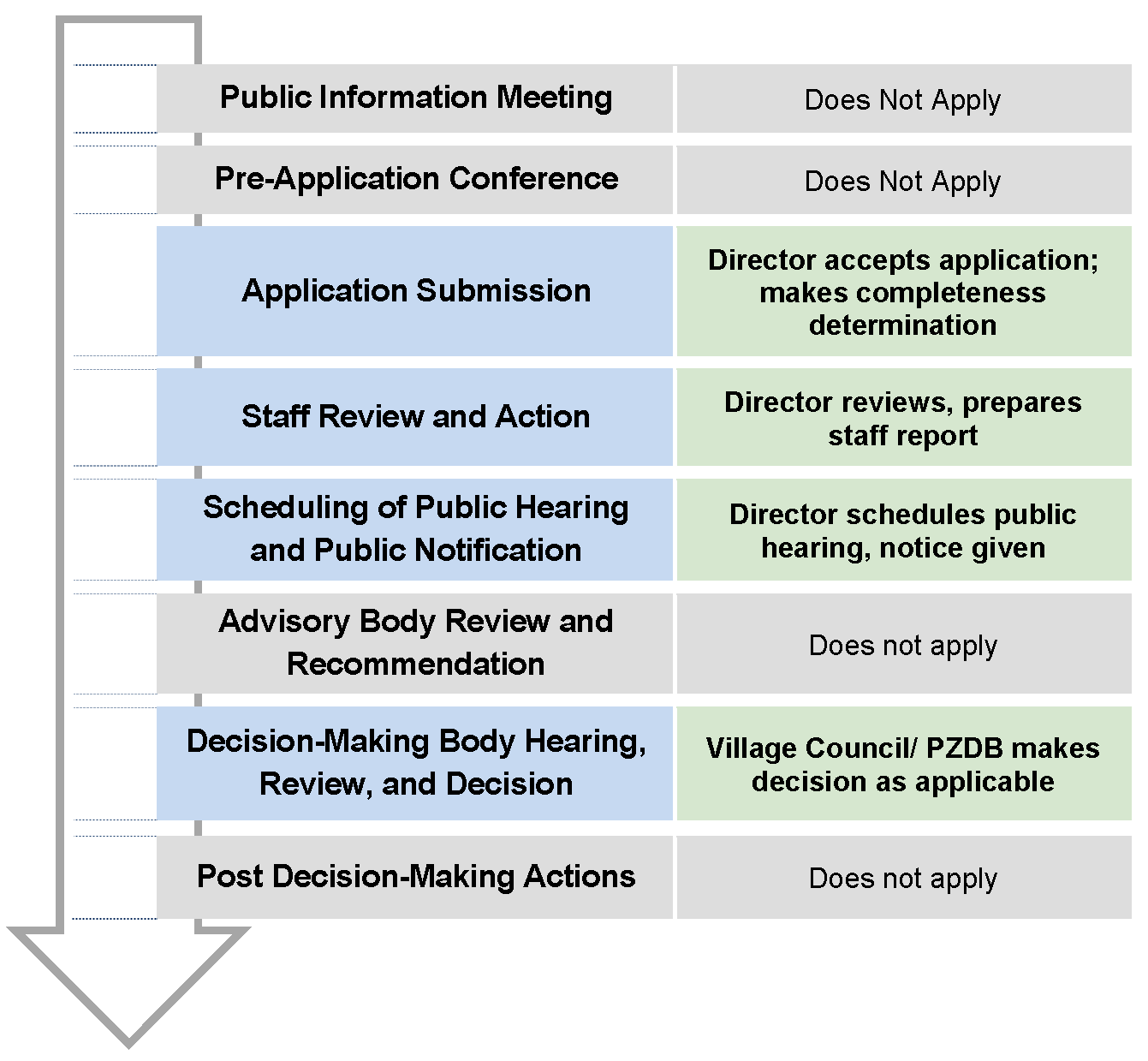
3.
Appeal Review Standards. In reaching a decision, the Village Council or the PZDB, as applicable, shall consider the competent substantial evidence presented at the hearing and the plain and ordinary meaning of all applicable LDC provisions, unless the language is ambiguous, in which case the intent of the LDC provision applied or interpreted may be considered. The Village Council or the PZDB, as applicable, may reverse, affirm, or modify the administrative decision.
E.
Vested Rights.
1.
Generally. A property owner at the property owner's option may apply for a Village determination that it has vested rights under Florida judicial standards or Florida statutes for development of its property based on a prior approval such that it is not required to comply with a particular requirement of this LDC.
2.
Vested Rights Procedure. Figure 2-506.E.2 identifies key steps in the Vested Rights procedure, with noted modifications from the general procedures.
Figure 2-506.E.2: Vested Rights Procedure Flowchart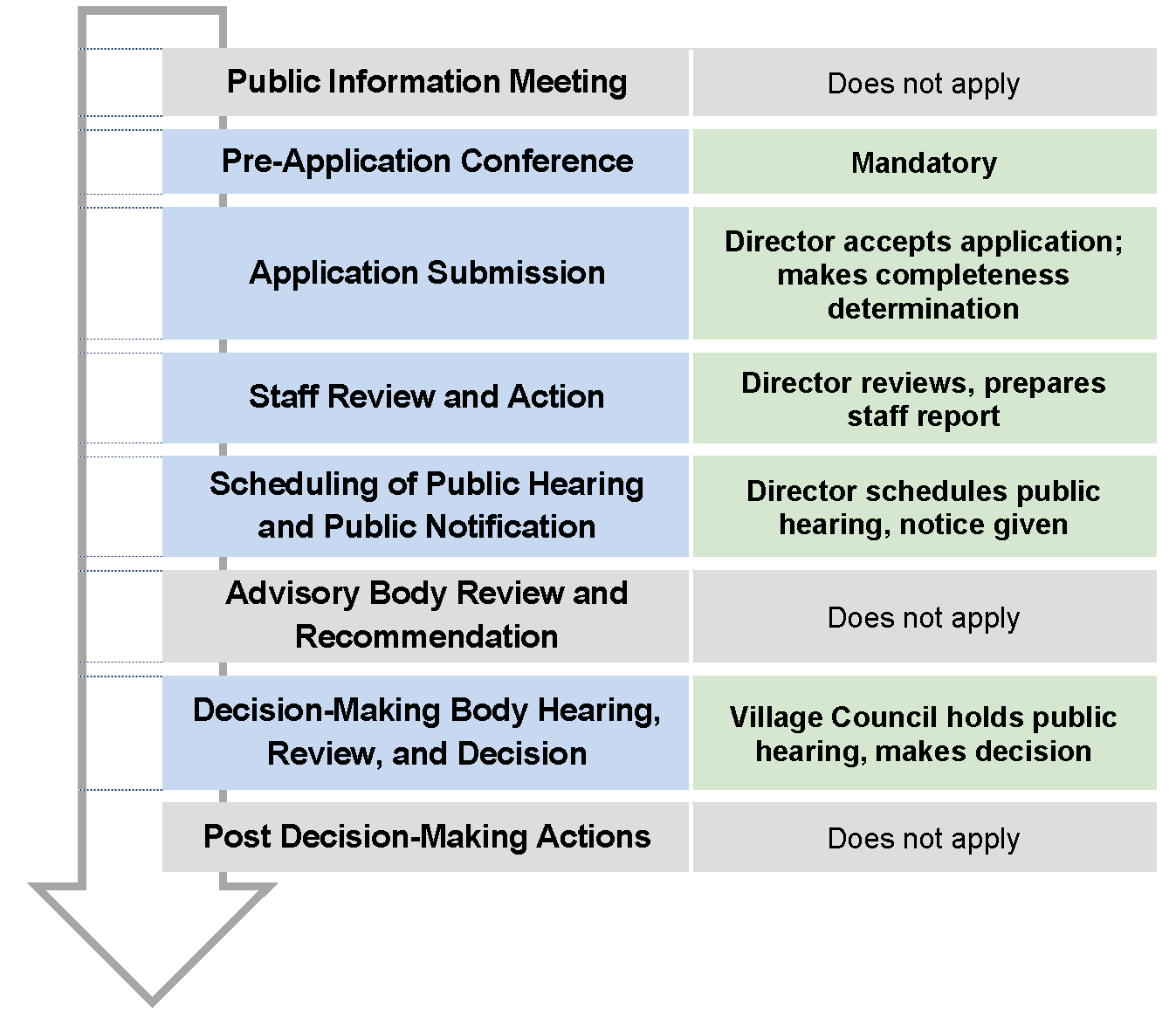
3.
Vested Rights Approval Standards. The Village Council shall apply judicially defined principles of equitable estoppel to all claims of vested rights to a particular development not otherwise made on the basis that the vested rights are granted by state statute. In the case of statutory vested rights, the Village Council shall use the statutory standards to determine if the applicant is entitled to vested rights for a particular development. Village Council approval shall be based on substantial competent evidence that all of the following criteria, as applied under Florida law, are met:
A.
The applicant in good faith has relied on an affirmative governmental act on which the applicant had a right to rely;
B.
The applicant made substantial expenditures to the applicant's detriment in reliance on the governmental approval; and
C.
Balancing the actions of the applicant and the interest of the governmental regulation, it would be inequitable to prevent the landowner from proceeding according to the governmental act on which the applicant relied.
2-507. - Administrative Interpretation.
A.
Generally. Where a question arises as to the meaning or intent of a section or subsection of this LDC, the Director may render written decisions of an administrative nature concerning items such as, but not limited to:
1.
The proper zoning classification for a use not specifically addressed;
2.
The interpretation of zoning district boundaries;
3.
The manner in which the particular LDC provision is to be applied; and
4.
The procedure to be followed in unusual circumstances.
B.
Administrative Interpretation Procedure. Figure 2-507.B identifies key steps in the Administrative Interpretation procedure, with noted modifications from the general procedures.
Figure 2-507.B: Administrative Interpretation Procedure Flowchart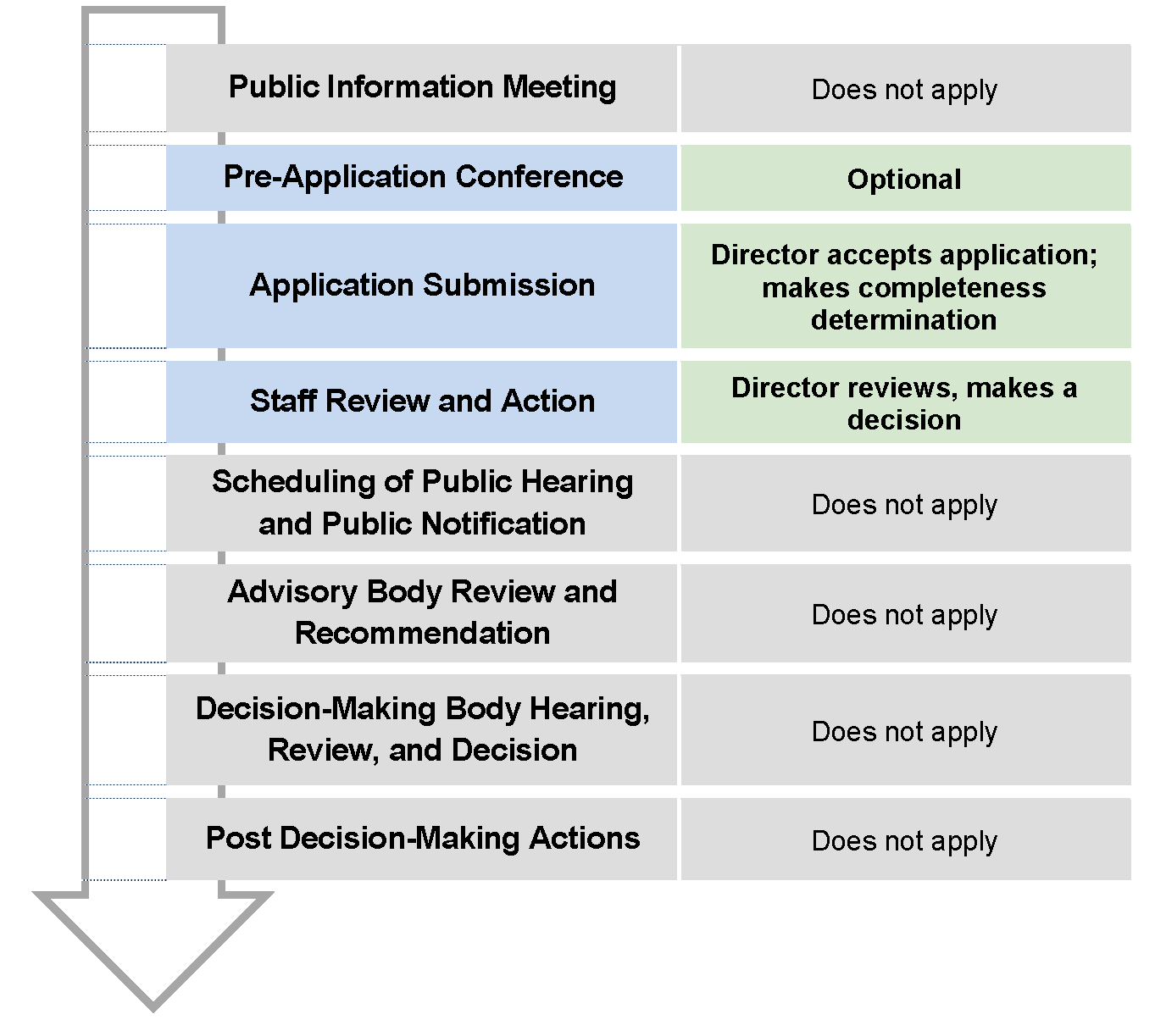
C.
Standards for Administrative Interpretation. The Director shall interpret the LDC based on its plain meaning, or if the Director determines that there is ambiguity regarding the LDC provision, then the history and intent of the Village Council in enacting the provision shall be considered. If the LDC provision refers to or is based on text that requires reference to technical standards or words of art used by a particular profession, then the Director shall consult with those knowledgeable in the applicable profession. In the interpretation of zoning district boundaries, the Director shall apply the standards established in Sec. 10-201, Interpretation of District Boundaries. In the interpretation of unlisted uses, the Director shall apply the standards established in Sec. 10-202, Interpretation of Unlisted Uses. In the interpretation of unlisted accessory uses, the Director shall apply the standards in Sec. 4-301.D, Unlisted Accessory Uses and Structures.

