
Fairplay City Zoning Code
ARTICLE XI
Landscaping
Sec. 16-11-10.- Applicability.
The landscape standards set forth in this Article of the Fairplay Municipal Code shall apply to all new subdivisions, planned unit developments, special uses and site plans for which an application is filed with the Town on or after, the effective date of this Chapter.
(Ord. 2015-3, §1, 1-4-2016)
Sec. 16-11-20. - Landscape design.
(A)
Intent. These standards are enacted to preserve Town of Fairplay's special character, and integrate and enhance new development by promoting quality landscape design that:
1.
Reinforces the identity of the community and each neighborhood;
2.
Provides tree-lined streets in urban areas;
3.
Anchors new buildings in the landscape;
4.
Provides tree canopies within paved areas; and
5.
Is environmentally sensitive by preserving existing trees, using water conservation techniques, planting native species (when appropriate), and enhances valuable habitat.
(B)
General provisions. All land development applications shall be accompanied by an appropriate landscape plan. Building permit applications for individual single-family residences will not require landscape plans. However, all landscaping within the community shall comply with the intent of these regulations.
1.
Environmental considerations.
2.
Landscapes shall use the following xeric design principles to facilitate water conservation:
a.
Well-planned planting schemes;
b.
Appropriate turf selection to minimize the use of bluegrass;
c.
Use of mulch to maintain soil moisture and reduce evaporation;
d.
Zoning of plant materials according to their microclimatic needs and water requirements;
e.
Improve the soil with organic matter if needed;
f.
Efficient irrigation systems; and
g.
Proper maintenance and irrigation schedules.
(C)
All landscapes shall strive to maximize the use of native species. Where native material is not appropriate for the intended use or appearance, plant species that are regionally adapted and noninvasive may be used.
(D)
Landscapes shall consist of a variety of species to enhance biodiversity. No one species may make up more than twenty-five percent (25%) of the total non-grass plant materials on the site.
(E)
Buildings and parking areas shall be located to preserve and promote the health of existing trees, environmental resources and natural drainage ways. No healthy tree shall be removed without good cause. This requirement is not intended to prevent the removal of unhealthy trees in conjunction with site development
(F)
Trees shall be located to provide summer shade and limit winter shade on walks and streets.
(G)
All areas disturbed by construction shall be reseeded to prevent erosion. Native, noninvasive grasses shall be used for revegetation where practical. Weed control is the responsibility of the landowner on all reseeded areas and all preservation areas.
(H)
A combination of plantings, berms, walls and fences shall be used as appropriate to buffer sensitive habitat.
(I)
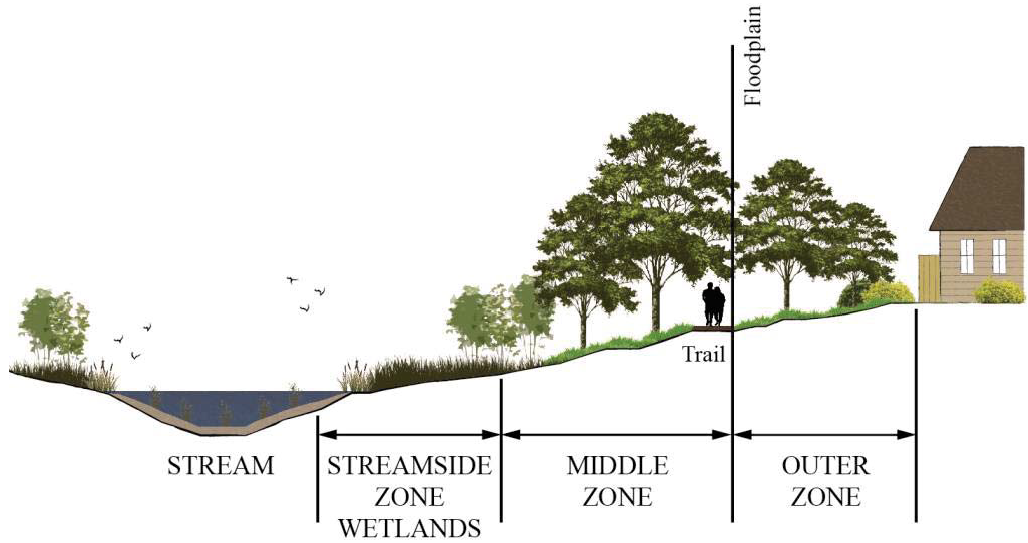
Use buffers to protect the physical integrity of riparian ecosystems. Try to preserve vegetation and trees in streamside zone and middle zone. Encourage grass and landscaping in outer zone to filter runoff from backyards, parking areas, roads, etc.
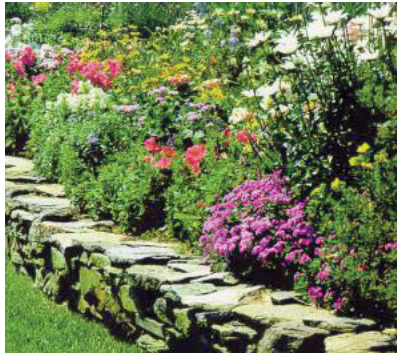
A combination of berming, planting and wall to integrate land uses.
1.
New buildings and paved areas.
a.
Anchor structures in the landscape through the use of trees, shrubs and groundcover. The size and intensity of plantings shall be appropriate to the size and context of the improvements.
b.
Integrate adjacent land uses of different intensities through a combination of berming, plantings and fencing. Use opaque screening only when necessary to mitigate the impact of noise, light, unattractive aesthetics and traffic. A fence shall not be the only screening material used.
(J)
Use landscaping to provide a transition from developed, managed landscape to more natural vegetation.
(K)
Provide a tree canopy by installing shade trees within and adjacent to paved areas.
1.
Plant Materials.
a.
The minimum planting sizes on all required landscaping shall be two (2) inch caliper deciduous trees, one and one-half (1½) inch caliper ornamental trees, six (6) foot tall evergreen trees and five (5) gallon shrubs.
b.
Required plant materials shall be grown in a recognized nursery in accordance with proper horticultural practice. Plants shall be healthy, well-branched vigorous stock with a growth habit normal to the species and variety and free of diseases, insects and injuries.
c.
All plants shall conform to standards for measurements, grading, branching, quality, ball and burlapping as stated in the American Standard for Nursery Stock, 1990 Edition, American Association of Nurserymen, Inc., (AAN-ASNS) and Colorado Nursery Act of 1965 (CNA).
2.
Irrigation.
a.
All required landscaping shall be irrigated as required for plant establishment and maintenance. Irrigation shall be appropriate to the type and scope of the improvements.
b.
Use of non-treated water for irrigation is encouraged if a permanent, suitable supply is available.
c.
Required landscaping in urban developments shall be irrigated with a permanent irrigation system.
d.
Temporary irrigation may be used to establish native grasses and vegetation.
3.
Guarantee of installation.
a.
Required landscape improvements shall be installed prior to issuance of a Certificate of Occupancy (C.O.) for all structures. If weather conditions prevent installation, the developer shall post a financial guarantee for the improvements. This guarantee shall be released upon completion of the installation of the landscaping.
4.
Maintenance.
a.
In order to provide for the ongoing health and appearance of landscape improvements, all landscaping shall be maintained and replaced by the landowner/occupant as necessary. All property owners/occupants shall be responsible for maintenance of landscaping within the portion of the public right-of-way between the back of the curb or street pavement and the adjacent property.
(Ord. 2015-3, §1, 1-4-2016)
Sec. 16-11-30. - Business/commercial and industrial development landscaping standards.
(A)
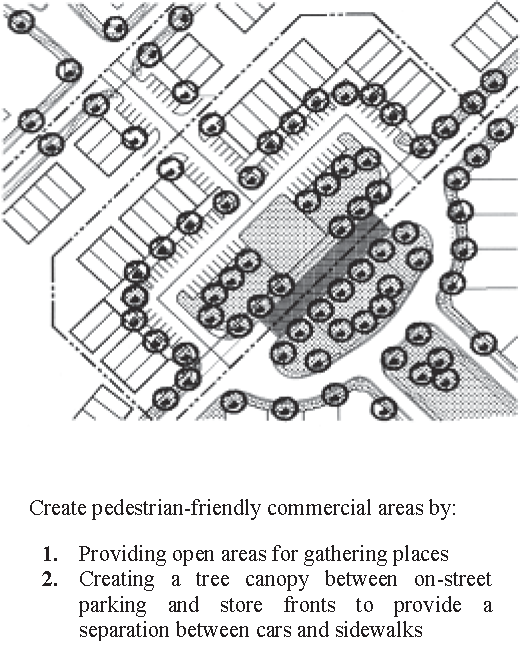
Landscape improvements shall be designed to enhance the overall appearance of the development and integrate the project with adjacent land uses and into the surrounding neighborhood. All improvements shall consider the people who will use the site, travel through or by the site and adjacent land uses. A minimum of twenty-five percent (25%) of the site (gross) shall be landscaped area, street rights-of-way, building footprints, or hard surfaced or landscaped areas of parking lots and driveways.
1.
The applicant shall provide:
a.
Site trees—Plant a minimum of one (1) tree per one thousand (1,000) square feet of landscaped area, distributed on the site.
b.
Shrubs—Plant a minimum of one (1) shrub per one hundred fifty (150) square feet of landscaped area. Group shrubs and distribute throughout the site. Trees may be substituted for up to one-half (½) of the required shrubs at the rate of one (1) tree for ten (10) shrubs.
c.
Groundcover—Establish irrigated grass turf maintained to appropriate standards for active recreation in areas that will function for active recreation. Where appropriate, use native grass for areas that will not function as active recreation areas. Native grass must be weed free and maintained at a maximum height of eight (8) inches. There shall be a minimum of seventy-five (75) percent live materials between the building and the street.
d.
Landscape setback to parking lots—Thirty (30) feet from arterials or twenty-five (25) feet from other streets. The purpose of the setback is to provide a buffer between street parking areas. This setback may be reduced to fifteen (15) feet if used in combination with a three to four (3-4) foot masonry or stone decorative wall. Signage may be included in this setback.
e.
Screen loading areas—Screen loading areas (including vehicle being loaded), service and storage areas visible from the public right-of-way or adjacent property with an opaque screen that is an integral part of the building architecture or by landscaping. Chain link fencing with slats, tires or used building materials are not acceptable screening materials.
f.
Compatibility—Integrate activities on the subject property with adjacent land uses by utilizing a combination of landscaping, building orientation and appropriate architectural elements.
(B)
The building owner or occupant shall maintain the yard and landscaping within the adjacent road right-of-way.
(Ord. 2015-3, §1, 1-4-2016)
Sec. 16-11-40. - State highway 285 corridor landscaping standards.
(A)
The applicant shall provide:
1.
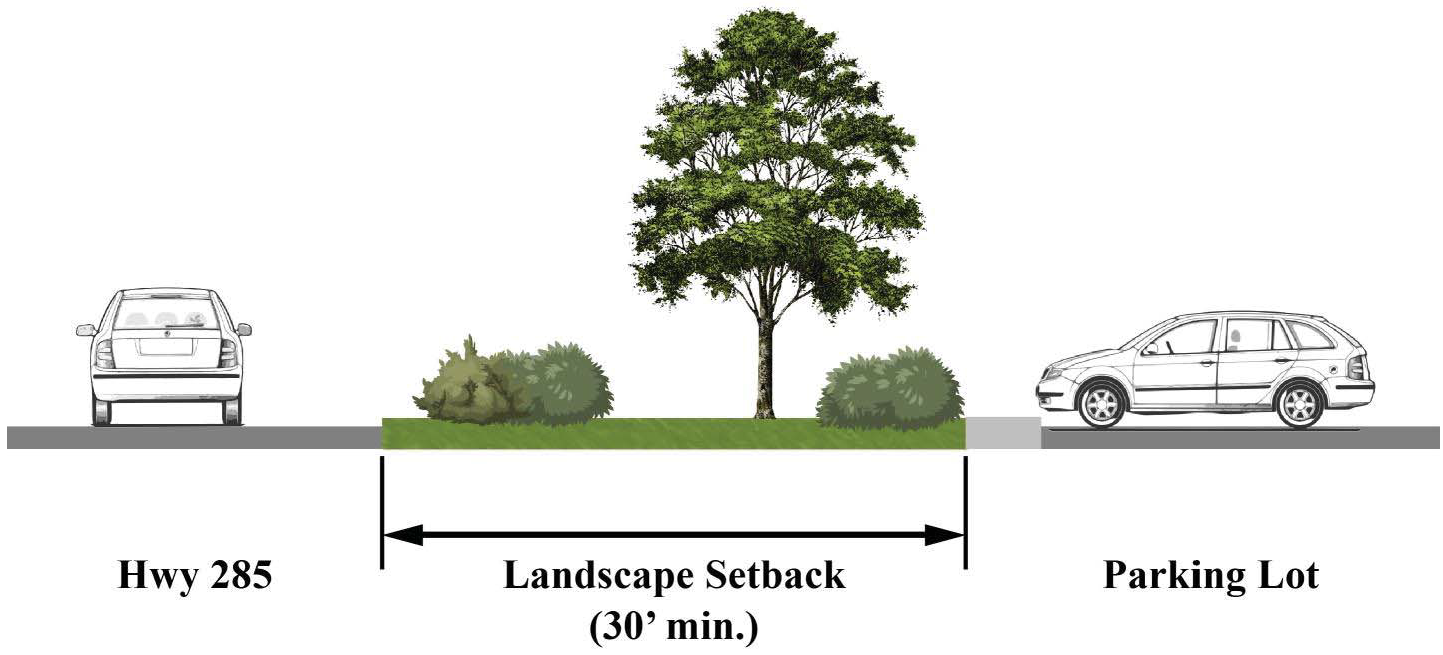
Landscape setback to parking lots—Provide a minimum thirty (30) foot landscape setback from the highway. The purpose of the setback is to provide a buffer between the street and parking areas. Signage may be included in this setback.
2.
Shrubs—A minimum of one (1) shrub per one hundred fifty (150) square feet of landscaped setback. Group shrubs and distribute throughout the landscape setback. Trees may be substituted for up to one-half (½) of the required shrubs at the rate of one (1) tree for ten (10) shrubs.
(Ord. 2015-3, §1, 1-4-2016)
Sec. 16-11-50. - Town Center landscaping standards.
(A)
Town Center landscaping is intended to provide an attractive environment for people to walk and shop. The developer or assigns shall provide:
1.
Streetscape—A combination of window boxes, planters, trees, benches, etc., as appropriate to enhance building entries and the streetscape.
(Ord. 2015-3, §1, 1-4-2016)
Sec. 16-11-60. - Parking lot landscaping standards.
(A)
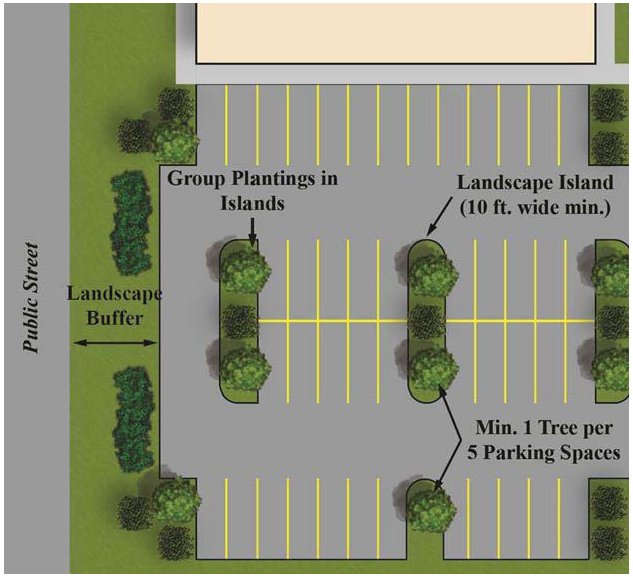
Parking lot landscaping is intended break up large expanses of pavement, create shade, buffer views of parking lots from adjacent streets and development and enhance the overall appearance of each project.
1.
Applicability—All parking lots with ten (10) spaces or more shall be subject to these requirements.
2.
The developer or assigns shall provide:
a.
Site trees—A minimum of one (1) tree per five (5) parking spaces. Group trees together in islands, which are a minimum of ten (10) feet wide. Use the landscaping to break up large expanses of pavement and to create a tree canopy for summer shade.
b.
Shrubs—A minimum of one (1) shrub per one hundred fifty (150) square feet of landscaped area. Group plantings in landscape islands.
c.
Groundcover—Limit areas of irrigated turf. Grass is discouraged in areas less than ten (10) feet wide. Install a grass buffer (native grass where possible) around the perimeter to filter runoff and improve water quality.
d.
Landscape setback to parking lots—Thirty (30) feet from arterials or twenty-five (25) feet from other streets. The purpose of the setback is to provide a buffer between the street and parking areas and to screen the parking from the street. This setback may be reduced to fifteen (15) feet if used in combination with a three to four (3—4) foot articulated masonry or stone decorative wall with trees and shrubs on both the street and parking lot sides of the wall to soften its appearance. Signage may be included in this setback.
e.
Provide a mechanism for long-term maintenance of landscaping—All landscaping within and adjacent to parking lots shall be owned and maintained by the landowner or occupant.
(Ord. 2015-3, §1, 1-4-2016)
Sec. 16-11-70. - Storm drainage facilities.
(A)
Intent. To promote innovative and effective land and water management techniques that protect and enhance water quality.
(B)
General provisions.
1.
Landscaping associated with storm drainage facilities shall be integrated into the overall design of the project.
2.
It shall enhance the overall appearance of the project, prevent erosion and improve water quality of storm water runoff whenever possible.
3.
Storm drainage facilities may function as open space for active recreation, trail corridors or habitat enhancement areas if they are designed appropriately and approved by the Board of Trustees.
4.
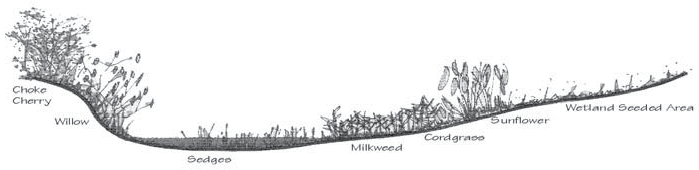
The use of planting strips and shallow landscaped depressions in parking lots and along roads is encouraged to help trap and remove pollutants from storm water runoff.
(C)
Develop storm drainage systems as landscape amenities, which can enhance the overall project.
(D)
Applicability. All storm drainage facilities shall be appropriately landscaped.
1.
Minimum requirements.
a.
All facilities shall be seeded to grass appropriate to the function of the area. Areas to be used for active recreation shall be seeded to a turf-type grass and irrigated with a permanent irrigation system. Areas to be maintained for habitat enhancement shall be seeded to native grasses and wildflowers. Developer is responsible for establishment of a complete, weed free stand of grass. Trail corridors may be seeded to native grasses if appropriately integrated with adjacent improvements.
b.
Maximum side slope on drainage facilities shall be 4:1, minimum slope of the bottom of a drainage facility shall be one-half (½) percent.
c.
Landscape improvements shall be designed to enhance the function of the facility. Areas designed for recreation shall include clusters of trees to provide shade, located so they do not impair the function of the facility.
d.
Habitat and water quality enhancement including wetland plantings in low wet areas is encouraged.
(E)
Ownership and maintenance.
1.
All drainage facilities shall be owned and maintained by the landowner or occupant unless otherwise approved by the Town of Fairplay.
(Ord. 2015-3, §1, 1-4-2016)
Sec. 16-11-80. - Fences, walls and screening devices.
(A)
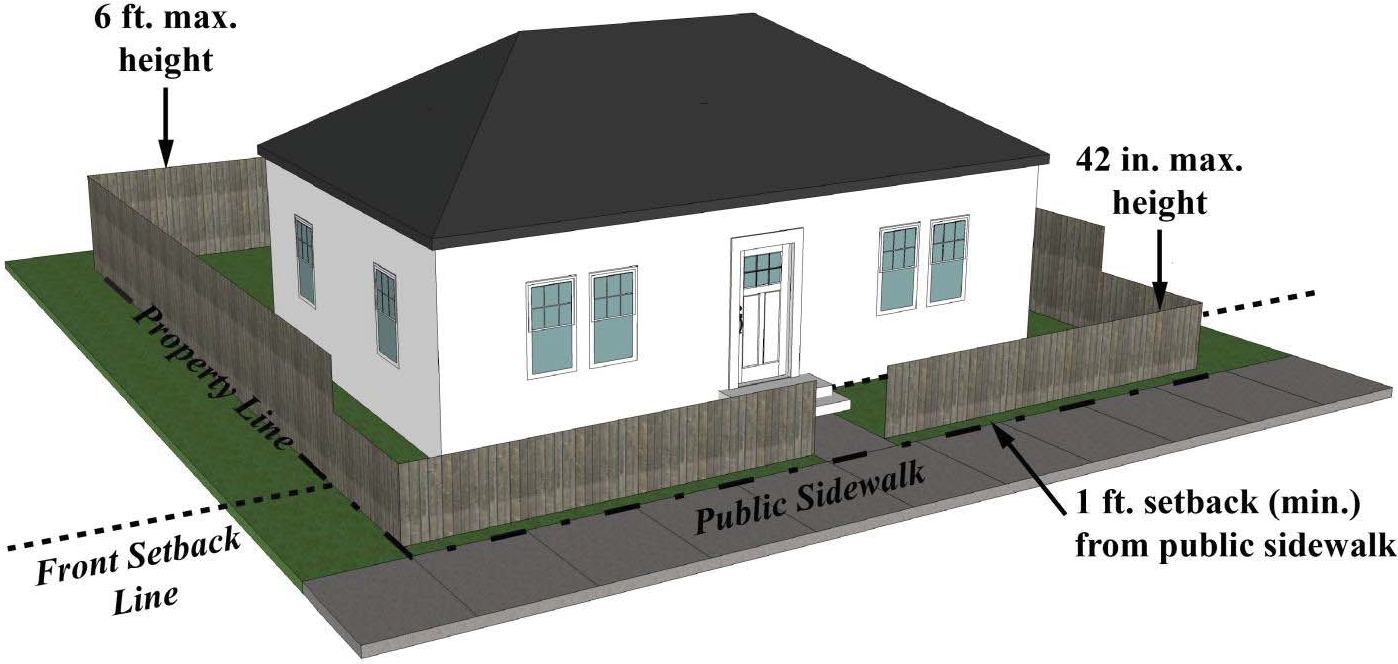
Maximum permitted height of fences, walls or screening devices in each zone district
(B)
Where the height of a front yard fence, wall or screening device is less than the height of a side yard fence, wall or screening device, the height of the side yard fence, wall or screening device shall be reduced to match the height of the front yard fence, wall or screening device at the front setback line.
(C)
When a fence, wall or screening device is located adjacent to a public sidewalk, the fence, wall or screening device shall be setback a minimum of one (1) foot from the back of the sidewalk.
(D)
Fences, walls or screening devices shall not adversely affect traffic safety or appropriate use of adjacent property.
(E)
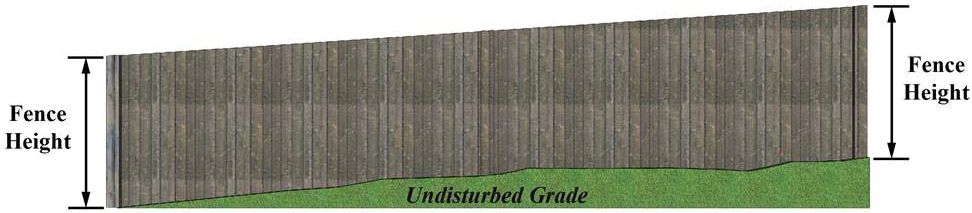
The height of a fence, wall or screening device shall be measured as the vertical distance from undisturbed grade (at the base of the fence, wall or screening device) to the top of the fence, wall or screening device.
(Ord. 2015-3, §1, 1-4-2016)
Sec. 16-11-90. - Submittal standards for landscape plans.
(A)
All land development applications will be accompanied by the appropriate landscape plan:
1.
Conceptual landscape plan. (Submit with preliminary plan) Intent: to illustrate the overall design concept for landscaping and depict how it relates to the overall development.
a.
Describe the design intention of the proposed landscape improvements.
b.
This information should be included on the preliminary plan map or combined with the conceptual open space plan if it can be clearly illustrated and the scale is not greater than one inch equals two hundred feet (1"=200').
c.
Information required on the plan is listed in the table, which follows.
2.
Final landscape plan. (Submit with final plat) Intent: to show the master landscape plan and the specific landscaping details for each phase for the development.
a.
Describe the design intention and how the proposal is consistent with the purpose and intent of these regulations.
b.
Landscaping should be included on the preliminary open space and ecological characterization plan if it can be clearly illustrated and the scale is not greater than one inch equals one hundred feet (1" = 100').
c.
Information required on the plan is listed in the table, which follows.
d.
The final landscape plan must be on a separate page from the final plat map and should be included with the final open space and ecological characterization plan if it can be clearly illustrated. The scale shall not be greater than one inch equals fifty feet (1"=50'). Information required on the plan is listed in the following table.
(Ord. 2015-3, §1, 1-4-2016)
Sec. 16-11-100. - Prohibited plant materials list.
(A)
The following trees are prohibited in the Town of Fairplay.
1.
Russian Olive (an invasive species that threatens native trees in riparian ecosystems).
2.
Lombardy Poplar (susceptible to canker-forming fungi for which there are no available controls).
3.
Siberian Elm (can dominate native vegetation, especially in disturbed areas; is weak-wooded and subject to continuous dieback when large; can be devastated by the elm leaf beetle).
4.
Boxelder Maple (primary host plant of the boxelder bug).
5.
Cotton-bearing Cottonwood. The Board of Trustees will consider Cotton-bearing Cottonwood on a case-by-case basis for restoration projects along riparian corridors.
(Ord. 2015-3, §1, 1-4-2016)
Sec. 16-11-110. - Recommended plant materials list.
(A)
Species are categorized as either Class I or Class II
1.
Class I species are those that are native to the Fairplay area and that are available and succeed in Fairplay.
2.
Class II species are those that are native to the surrounding Park County area and/or are adapted to a high alpine environment and do well in Fairplay. Species are further denoted as to whether they are drought tolerant or require moisture. These guidelines also specify those species that are firewise to assist with selecting plants appropriate for planting within defensible space zones. Firewise plants are those species that have a higher moisture content and are less likely to ignite during a fire. In general, deciduous species have a higher moisture content than evergreens. Species that require a microclimate or special conditions, such as shelter from northwest winds, or need shade predominantly are also noted.
a.
Drought tolerant after establishment = D
b.
Requires moisture after establishment = M
c.
Those species that can tolerate seasonal moisture or drought are noted as SM-SD
d.
Firewise = FW
e.
Requires a microclimate (shelter from wind, prefers shade, etc.) to survive = MC
f.
Mature size—Height/spread = H/S
High Altitude Grasses
Recommended High Altitude Seed Mixture:
Thurber Fescue—Festuca thurberi
Alpine Fescue—Festuca brachphylla
Tufted Hairgrass—Deschampsia cespitosa
Additional optional species include:
Arizona Fescue—Festuca arizonica
Alpine Bluegrass—Poa alpine
Other High Altitude Grasses:
Canby or Sandberg Bluegrass—Poa secunda
Idaho Fescue—Festuca idahoensis
Alpine Fescue—Festuca brachyphylla
Sheep Fescue—Festuca ovina
Rocky Mountain Fescue—Festuca saximontana
Bluebunch Wheatgrass—Pseudoroegneria spicata
Slender Wheatgrass—Elymus trachycaulus
Western Wheatgrass—Pascopyrum smithii
Blue Wildrye—Leymus arenarius (L. glaucus)
Indian Ricegrass Rimrock—Achnatherum hymenoides
June Grass—Koeleria cristata
Noxious Weeds
Myrtle spurge—Euphorbia myrsinintes
Orange hawkweed—Hieracium aurantiacum
Absinth wormwood—Artemisia absinthium
Black henbane—Hyoscayamus niger
Bull thistle—Cirsium vulgare
Canada thistle—Cirsium arvense
Chinese clematis—Clematis orientalis
Common tansy—Tanacetum vulgare
Dalmation toadflax—Linaria dalmatica
Dame's Rocket—Hesperis matronalis
Diffuse knapweed—Centaurea diffusa
Hoary cress—Cardaria draba
Houndstongue—Cynoglossum officinale
Leafy spurge—Euphorbia esula
Mayweed chamomile—Anthemis cotula
Musk thistle—Carduus nutans
Oxeye daisy—Chrysantheum leucanthemum
Perennial pepperweed—Lepidium latifolium
Plumeless thistle—Carduus acanthiodes
Russian knapweed—Centaurea repens
Saltceder—Taarix sp.
Scentless chamomile—Matricaria perforata
Spotted knapweed—Centaurea maculosa
Sulfur cinquefoil—Potentilla recta
Wild caraway—Carum carvi
Yellow toadflax—Linaria vulgaris
Common mullein—Verbascum Thapsus
Downy brome—Bromus tectorum
Field Bindweed—Convolvulus arvesis
Poison hemlock—Conium maculatum
(Ord. 2015-3, §1, 1-4-2016)

