
Fairplay City Zoning Code
ARTICLE IX
Planned Unit Development PUD
Sec. 16-9-10.- Planned unit development (PUD) designation, purpose and objectives.
(A)
The purpose of planned unit development (PUD) is to encourage innovation and flexibility in the development of land so as to promote variety in the type, design and layout of buildings; improve the integration, character and quality of land uses; promote the more efficient use of land and infrastructure while achieving compatibility of land uses; achieve economy in the delivery and maintenance of public services; and promote the preservation of open space and natural and scenic areas.
(B)
PUD zoning or overlay designation may be applied for with regard to any contiguous land (disregarding intervening public streets, easements or other rights-of-way) located within any zone district. The decision to approve an area for PUD zoning or treatment shall at all times rest within the discretion of the Board of Trustees, and an application for PUD designation shall be denied where the particular proposal will not adequately satisfy or implement the purposes of this Article.
(C)
This Article has been adopted to implement the authority granted to the Town pursuant to Article 67, Title 24, C.R.S.
(Ord. 2015-3, §1, 1-4-2016)
Sec. 16-9-20. - Zoning classification.
PUD constitutes a zoning classification and is established by rezoning or overlaying the designation upon land within an existing or newly created zone district. Approval of a PUD shall be illustrated and its land area defined on the Town's Zone District Map. When an area that is already zoned is approved for a PUD overlay, e.g., "SF-Res PUD," the underlying zone district's regulations shall remain intact and, in the event the PUD is not completed or is terminated, the underlying zone district regulations shall apply to and govern land uses and development in the subject area.
(Ord. 2015-3, §1, 1-4-2016)
Sec. 16-9-30. - PUD plan; conformity with comprehensive plan.
No land shall be designated PUD in the absence of a PUD plan, which plan shall set forth the written and graphic materials as described in this Article. All PUD plans must be in substantial compliance and consistent with the Town's comprehensive plan.
(Ord. 2015-3, §1, 1-4-2016)
Sec. 16-9-40. - Subdivision and zoning regulations applicable; PUD plan.
(A)
The subdivision regulations and zoning provisions of the Town shall apply to a PUD insofar as they are consistent with these PUD regulations and with any specific zoning or subdivision requirements approved by the Board of Trustees at the time of zoning or platting the PUD in question. To the extent that any zoning or subdivision regulation conflicts with the PUD regulations contained in this Article, or with such specific zoning or subdivision requirements incorporated into a PUD approval by the Board of Trustees, the former shall not be applicable and the provisions of the latter shall control.
(B)
The approval of a PUD overlay/zoning shall be inseparable from a PUD plan and a PUD shall not be established or approved without the simultaneous approval of a PUD plan. The approved PUD overlay/zoning and the approved PUD plan shall together establish and govern the land uses and development allowed within the PUD and shall supersede any other underlying zone district regulations.
(Ord. 2015-3, §1, 1-4-2016)
Sec. 16-9-50. - Subdivision provisions modification authorized.
It is recognized that the uniqueness of each proposal for a PUD requires that the specifications, standards and requirements for various facilities, including but not limited to streets, highways, alleys, utilities, curbs, gutters, sidewalks, street lights, parks, playgrounds, school grounds, storm drainage, water supply and distribution, and sewage collection and treatment, may be subject to modification from the specifications, standards and requirements established in the subdivision regulations and the zoning ordinances of the Town for like uses in other zone districts. The Board of Trustees may, therefore, either at the time of PUD zoning or upon final platting under the Town's subdivision regulations, waive or modify the subdivision specifications, standards and requirements which would otherwise apply to the proposed development.
(Ord. 2015-3, §1, 1-4-2016)
Sec. 16-9-60. - Compatibility of land use elements.
It is recognized that certain individual land uses, regardless of their adherence to all the design elements provided for in this Article, might not exist compatibly with one another. Therefore, a proposed PUD shall be considered from the point of view of the relationship and compatibility of the individual elements of the plan, and no PUD shall be approved which contains incompatible elements.
(Ord. 2015-3, §1, 1-4-2016)
Sec. 16-9-70. - Overview of PUD procedure; integration with subdivision procedures.
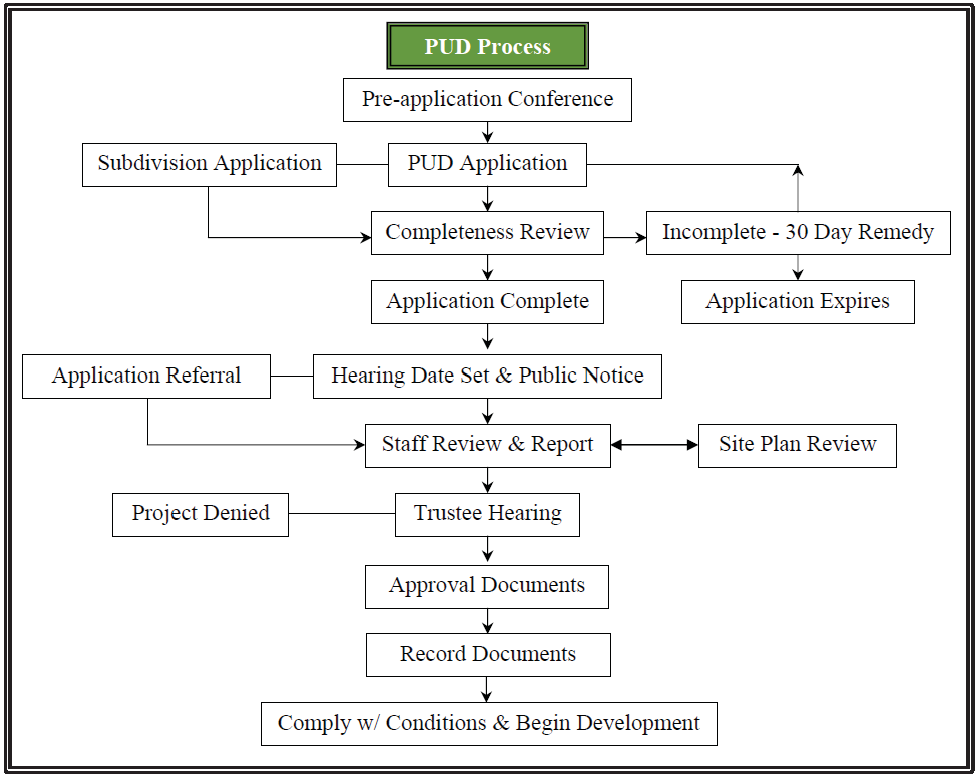
Approval of a PUD shall be subject to the submission of a full and complete application, the payment of all review and approval fees, preliminary review by the staff and final approval by written resolution by the Board of Trustees after a public hearing. All applicants for a PUD intending to subdivide or resubdivide land as part of the PUD plan shall concurrently submit and pursue a subdivision application as provided for in this Code. Review requirements for a PUD incorporating the subdivision or resubdivision of land shall be construed and applied together with subdivision requirements. PUD applications incorporating a minor or major subdivision shall be subject to the subdivision review procedural steps applicable to such subdivisions. Whenever PUD and subdivision application procedures or requirements overlap, the overlapping procedures or requirements shall be applied in a manner to avoid redundancies and process the application in an expeditious fashion.
(Ord. 2015-3, §1, 1-4-2016)
Sec. 16-9-80. - PUD approval procedure.
(A)
A pre-application conference shall be held by the applicant with the Town staff (planning, building and public works) to review the conceptual plan for the PUD and to acquaint the applicant with the PUD application procedures and review criteria.
(B)
A completed PUD application conforming to the requirements of this Article may be submitted to the Town Clerk along with the appropriate application fee only after the completion of a pre-application conference as is described in Subsection (A) above. No application shall be accepted, processed or scheduled for review unless and until it is complete and all necessary fees have been paid. The application shall be accompanied by such number of copies as the Town Clerk deems necessary to ensure the proper review of the application by the Town staff and the Board of Trustees. In the event the Town must retain outside professional services to process or evaluate the application, the applicant shall bear the costs for the same, inclusive of planning, land planning, engineering and legal fees.
(C)
After a PUD application has been determined to be complete and all fees have been paid, it shall promptly be referred to the Board of Trustees. The Board of Trustees shall consider the PUD application at a noticed public hearing conducted not later than thirty (30) days after the date upon which the Board of Trustees receives the complete application. Written notice of the subject matter and the time and place of the hearing shall be provided in accordance with the notice requirements for a Planned Unit Development contained in Article IV of this Chapter. The hearing may be continued for up to forty (40) days to allow for the gathering and submission of additional information deemed necessary to complete the Board of Trustees' review. At the conclusion of the hearing and after discussion and deliberation, the Board of Trustees shall vote to approve, approve with conditions or deny the application, and shall thereafter direct staff to prepare a written resolution with supporting findings reflecting the Board of Trustees' decision for the its review and approval at its next regularly scheduled meeting.
(D)
The time limits as set forth in this Section may be waived or extended upon the written request or consent of the applicant.
(E)
The burden to demonstrate the application's compliance with all applicable review criteria shall rest with the applicant.
(F)
No PUD designation shall be approved absent the applicant's full and timely payment of all fees assessed under this Chapter.
(Ord. 2015-3, §1, 1-4-2016)
Sec. 16-9-90. - Form of PUD approval.
All decisions of the Board of Trustees approving a PUD shall be in the form of a written resolution and contain, at a minimum, the information set forth below. No building permit may issue and no development activity may commence within the PUD area until the PUD approval and plat have been duly executed and recorded in the office of the County Clerk and Recorder, along with any necessary PUD agreement.
(A)
The density allocated to the property by type and number of units;
(B)
Approved uses on each development parcel or use areas within the PUD site;
(C)
Approved densities in total numbers of units for each development parcel identified;
(D)
Approved density transfers from one (1) parcel to another, if any;
(E)
The phasing and general timetable of development that shall ensure the logical and efficient provision of municipal services;
(F)
Specific conditions applied to the development of any parcels that, by their nature, are subject to special development constraints;
(G)
Variations in any dimensional limitations expressed as either an allowable maximum or a specific maximum; and
(H)
Such facts and information illustrating compliance of the PUD with the applicable site plan review criteria set forth in Section 16-9-100 of this Article.
(Ord. 2015-3, §1, 1-4-2016)
Sec. 16-9-100. - Site plan review criteria; general requirements.
In addition to the common submittal requirements in Article III and Sections 16-3-40 and 16-3-50, a PUD submittal shall meet the following site plan criteria unless the application can demonstrate that one (1) or more of them are not applicable to the proposed plan. Compliance with the criteria shall be illustrated on the proposed PUD plat/plan submitted by the applicant.
(A)
The PUD shall have an appropriate relationship to the surrounding area, with adverse effects on the surrounding area being minimized.
(B)
The PUD shall provide an adequate internal street circulation system designed for the type of traffic generated, safety, separation from living areas, convenience and access. Private internal streets may be permitted, provided that adequate access for police, fire and emergency protection is maintained; streets are named in a logical fashion to avoid confusion; and provisions for using and maintaining the streets are imposed upon the private users and approved by the Board of Trustees. Bicycle traffic shall be provided for if appropriate for the land use.
(C)
The PUD shall provide parking areas adequate in terms of location, area, circulation, safety, convenience, separation and screening.
(D)
The PUD shall provide common open space adequate in terms of location, area and type of space, and the uses permitted in the PUD. The PUD shall strive for optimum preservation of the natural features of the terrain.
(E)
The PUD shall provide for variety in housing types and densities, other facilities and common open space.
(F)
The PUD shall provide adequate privacy between dwelling units.
(G)
The PUD shall provide pedestrian ways adequate in terms of safety, separation, convenience, access to points of destination, and attractiveness.
(Ord. 2015-3, §1, 1-4-2016)
Sec. 16-9-110. - PUD submittal requirements.
A planned unit development submittal shall include, at a minimum, the following:
(A)
Application form, signed by the owner(s) of the property, in the format provided by the Town Clerk. If the applicant is not the owner of the property, a notarized letter of consent signed by the property owner or owners authorizing the applicant to process the specific land use application on the property owner's behalf shall be delivered with the submittal.
(B)
Proof of legal ownership and the names and addresses of the owners of the property and any lienholder(s). This can be in the form of a deed, current title policy (not older than 90 days), or a letter from the owner's attorney affirming ownership of the property.
(C)
Statement of the purpose of the application and a description of the proposal.
(D)
Vicinity map indicating the location of the property included in the land use application.
(E)
Application fee.
(F)
Proposed name of the development.
(G)
Name, business address, telephone number, seal and license number of the surveyor, engineer, architect or land planner responsible for plan preparation.
(H)
A proposed PUD/subdivision plat illustrating the following. In addition to the following requirements, the submitted map(s) and documents shall conform to Drawing and Report Requirements specified in this Article and Section 16-3-40 of this Chapter.
1.
North point, scale and date.
2.
Legal description.
3.
Natural features including, but not limited to, topography at two-foot intervals, drainageways and major foliage.
4.
Proposed PUD Zoning Plan formatted to be consistent with the layout of this Chapter and including use areas and the specifications of each use area, including, as applicable:
(a)
Dwelling unit type, total land area and maximum density of residential use areas.
(b)
Uses, total land area and maximum floor area ratios of commercial and/or industrial use areas.
(c)
Maximum land area to be covered by structures.
(d)
Building heights.
(e)
Minimum lot areas and setbacks.
(f)
Types and colors of exterior building materials for each structure or group of structures.
(g)
Minimum proportion of each site to remain in unobstructed open space including, but not limited to, general location; height, type and color of building materials; and general landscaping treatment, plant materials and other elements.
(h)
Provisions for off-street parking and loading which shall conform to the minimum requirements of Article X of this Chapter.
5.
Tentative location of collector, arterial or limited access streets, and tentative locations of access points to such streets.
6.
Tentative location of all lands proposed to be dedicated for public purpose and the proposed use of such lands.
7.
Location and outline of existing structures to be retained and the proposed general outline and location of buildings and parking areas.
8.
General information on adjacent lands adequate to show relationships between the proposed development and existing and/or proposed development of such adjacent lands, including, but not limited to, land uses, zoning, traffic circulation, public facilities and natural features.
(I)
A written statement and exhibits containing, at a minimum, the following information:
1.
An explanation of the objectives to be achieved by the PUD.
2.
A development schedule indicating the approximate date when construction of the PUD, or stages of the PUD, can be expected to begin and be completed.
3.
Copies of any special agreements, covenants or other property owners' agreements or dedications which will govern the use, maintenance and continued protection of the PUD and its common areas.
4.
Names and addresses of any property owners of adjacent property including properties across a public street, public right-of-way or alley.
5.
Overall density proposed for the land as well as the maximum density to occur in each area.
6.
Description of snow removal methods or techniques to be utilized and locations of snow storage areas.
7.
Description of the proposed method of providing permanent maintenance of all nonprivate buildings, facilities and areas, and private streets, if any.
8.
Description of water and wastewater utilities and impact to the municipal systems; including projected water/wastewater demands, demonstration of adequate and dependable capacity to service the proposed development.
9.
Soil, geological and ground water conditions of the site.
10.
Traffic capacity of existing and proposed streets and whether these are sufficient to accommodate the PUD.
11.
The manner in which storm drainage shall be handled.
12.
The limits of the one-hundred-year floodplain for the area.
13.
Adequate fire and emergency equipment access.
(Ord. 2015-3, §1, 1-4-2016)
Sec. 16-9-120. - Permitted uses.
(A)
A PUD may provide for and include any land use permitted in any zone district within the Town as long as they are internally harmonious and compatible with surrounding land uses.
(B)
The land uses which shall be actually permitted in any PUD shall be limited to those specified in the approved PUD plan.
(Ord. 2015-3, §1, 1-4-2016)
Sec. 16-9-130. - Common open space.
(A)
Every PUD shall provide for common open space to serve and benefit the residents and lands within the PUD. Areas designated as common open space shall largely remain unoccupied and unobstructed by buildings or other structures, provide visual and spatial relief from the mass of buildings or development in the vicinity and may, without limitation, include pocket or passive parks, pools and/or fountains, plazas and areas maintained in their natural and undisturbed state.
(B)
A minimum of thirty percent (30%) of the total area within the boundary of any PUD shall be devoted to usable and accessible common open space; provided, however, that the Board of Trustees may reduce such requirement if it finds that such decrease is warranted by the design of, and the amenities and features incorporated into, the PUD plan, and that the needs of the occupants of the PUD for common open space can otherwise be met.
(C)
The common open space of a PUD shall be owned and maintained by the property owners within the PUD, or by an organization chosen therefrom or thereby. In the event that any person or organization established to own and maintain the common open space, or any successor, shall at any time after establishment of the PUD fail to maintain the open space in reasonable order and condition in accordance with the PUD plan, the Town Clerk or Building Official may serve written notice thereof by regular mail or hand delivery upon such person or organization, or upon the residents of the PUD, setting forth the manner in which there has been a failure to maintain the open space in reasonable condition. The notice shall reasonably identify all deficiencies and include a demand that all deficiencies be cured within thirty (30) days thereof. In the event that the responsible person or organization wishes to contest the notice, a public hearing shall be scheduled in conformance with Article IV and the public hearing notice shall provide a date and place for a hearing thereon. At such hearing, the Board of Trustees may modify the terms of the original notice as to deficiencies, and may give an extension of time within which they shall be cured. If the deficiencies set forth in a notice are not cured within the thirty (30) days as specified in the notice, or any extension granted, the Town, in order to preserve the taxable values of the properties within the PUD and prevent the open space from becoming a public nuisance, may enter upon the open space and undertake maintenance on the same. The cost of such maintenance shall be the sole responsibility of the property owners within the PUD whose properties are benefited by the open space, and a lien for such cost shall automatically apply against such properties to secure payment, which lien may be certified to the County Treasurer by the Board of Trustees and enforced and foreclosed upon in the same manner as liens for real property taxes. The entry and maintenance work by the Town shall not vest in the public any rights to use the common open space, except when the same is voluntarily dedicated to the public by the owner.
(Ord. 2015-3, §1, 1-4-2016)
Sec. 16-9-140. - PUD and subdivision separate.
A PUD is a zoning designation and may be approved separate from submission of a PUD subdivision plat for a parcel that remains under single ownership. A PUD may include a concurrent submission of PUD/subdivision application prepared in accordance with the plat requirements contained in the Town's subdivision regulations and no development activity may occur within a PUD that also includes a subdivision prior to the proper execution and recordation of the PUD/subdivision plat in the real property records of Park County.
(Ord. 2015-3, §1, 1-4-2016)
Sec. 16-9-150. - PUD agreement.
For any PUD in which variances from underlying zoning requirements are granted, or for which public infrastructure or improvements are required, a written PUD agreement setting forth same and including all specific terms and conditions of approval shall be prepared and submitted by the applicant to the Town Clerk for approval by the Board of Trustees by written resolution. The PUD agreement shall be recorded with the County Clerk and Recorder along with the PUD plat/map, and shall run and be a burden upon all lands within the PUD. The agreement shall also specify the amount and type of financial security that must be posted by the PUD developer to ensure the timely and satisfactory installation of all public infrastructure and other improvements, inclusive of landscaping for common or public areas associated with the PUD. Financial security shall be posted prior to the issuance of any building permit or development activity within the PUD area and shall be in an amount not less than one hundred twenty-five percent (125%) of the estimated cost of the completion of all improvements; and may be provided by letter of credit, performance bond, cash escrow or other financial instrument as deemed acceptable by the Town. Upon the complete installation, inspection and acceptance of the improvements and/or infrastructure, all but twenty-five percent (25%) of the posted financial security shall be released, which twenty-five percent (25%) shall continue to remain posted as security to ensure that all improvements and infrastructure shall remain free of defects for a period of two (2) years after preliminary acceptance of same by the Town. The Town shall be entitled to draw on any posted financial security in order to complete, correct or repair any PUD infrastructure or improvement as called for in the PUD approval.
(Ord. 2015-3, §1, 1-4-2016)
Sec. 16-9-160. - PUD plan enforcement; modifications.
(A)
Development of the area within a PUD shall be limited to the uses, densities, configuration and terms, elements and conditions contained within the approved PUD plan and development agreement, and may be enforced by the Town at law or equity. The configuration and mix of the units may be modified as provided for in this Article or in the PUD agreement, but no portion of the density allocation may be transferred to land not included in the PUD plan.
(B)
In addition to any and all other remedies as available to the Town under law, the Town Clerk may serve a written notice on the PUD developer, or any landowner within the PUD, to appear before the Board of Trustees when reasonable grounds exist to believe that the PUD plan, or any part thereof, is not being adhered to. The Board of Trustees shall conduct a public hearing in conformance with Article IV to determine the existence of any alleged failure or violation of the PUD approval, and may enter orders directing the correction of same.
(C)
All provisions of an approved PUD plan shall run in favor of the residents, occupants and owners of the PUD, but only to the extent expressly provided in the plan and in accordance with the terms of the plan; and to that extent, the provisions, whether recorded by plat, covenant, easement or otherwise, may be enforced at law or in equity by such residents, occupants or owners acting individually, jointly or through an organization designated in the plan to act on their behalf.
(D)
All provisions of the PUD plan authorized to be enforced by the Town may be modified, removed or released by the Town subject to the following:
1.
No modification, removal or release of the provisions of the plan by the Town shall affect the rights of the residents, occupants and owners of the PUD to maintain and enforce those provisions in law or in equity; and
2.
No substantial modification, removal or release of the provisions of a PUD plan by the Town shall be permitted except upon a finding by the Board of Trustees, following a public hearing upon notice as required in Article IV, that the modification, removal or release is:
i.
Consistent with the efficient development and preservation of the entire PUD;
ii.
Does not affect in a substantially adverse manner either the enjoyment of land abutting upon or across a street from the PUD or the public interest;
iii.
Is not granted solely to confer a special benefit upon any person.
(E)
Residents and owners of land in the PUD may, to the extent and in the manner expressly authorized by the provisions of the plan, modify, remove or release their rights to enforce the provisions of the plan; but no such action shall affect the right of the Town to enforce the provisions of the plan.
(F)
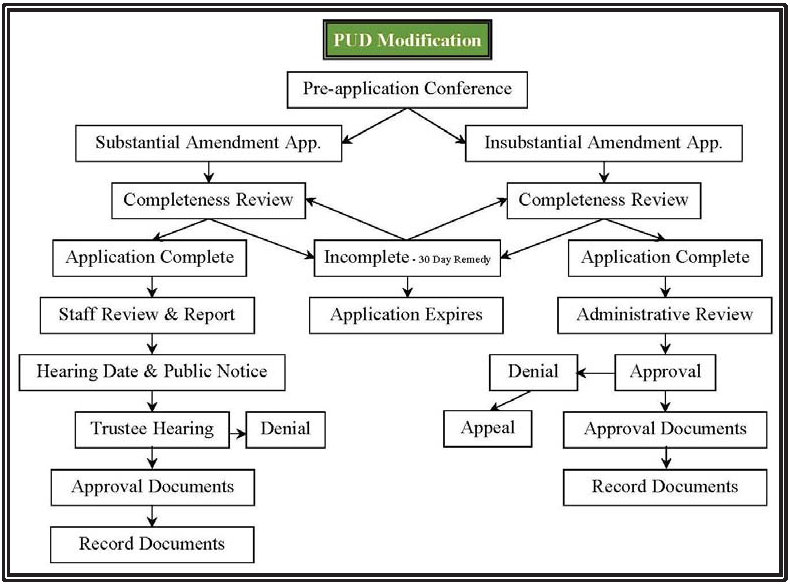
An insubstantial amendment to an approved final PUD plan may be authorized by the Town Administrator, or in the absence of a Town Administrator, the Building Official. However, insubstantial amendments may only be approved if they promote the terms, purposes and conditions of the original PUD plan and approval. The following shall not be considered an insubstantial amendment:
1.
A change in the use or character of the development.
2.
An increase or decrease by greater than three percent (3%) in the overall coverage of structures as originally approved within the PUD.
3.
Any amendment that substantially increases vehicle trip generation rates arising from the PUD, or the demand for public facilities.
4.
A reduction by greater than three percent (3%) of the originally approved common or public open space.
5.
A reduction by greater than one percent (1%) of the originally approved off-street parking or loading space.
6.
A change in the alignment, or reduction in required pavement widths or rights-of-way, for streets or easements.
7.
An increase or decrease of greater than two percent (2%) in the originally approved gross floor area of commercial buildings.
8.
An increase or decrease by greater than one percent (1%) in the originally approved residential density of the PUD.
9.
Any change which is directly contrary to a condition or representation of the PUD's original approval, or which requires granting a further variation from the PUD's approved use or dimensional requirements.
(G)
During the review of any proposed significant amendment to the PUD, the Town may require such new conditions of approval as are necessary to ensure that the development will be compatible with current community standards and regulations. This shall include, but not be limited to, applying to the portions of the PUD which have not obtained building permits, or are subject to the proposed amendment, any new community policies or regulations which have been implemented since the PUD was originally approved. An applicant may withdraw a proposed amendment at any time during the review process.
(Ord. 2015-3, §1, 1-4-2016)
Sec. 16-9-170. - PUD amendment/modification submittal requirements.
In addition to the Common Submittal Requirements in Article III Sections 16-3-40 and 16-3-50, a planned unit development amendment or modification submittal shall include, at a minimum, the following:
(A)
Application form, signed by the owner(s) of the property, in the format provided by the Town Clerk. If the applicant is not the owner of the property, a notarized letter of consent signed by the property owner or owners authorizing the applicant to process the specific land use application on the property owner's behalf shall be delivered with the submittal.
(B)
Proof of legal ownership and the names and addresses of the owners of the property and any lienholder(s). This can be in the form of a deed, current title policy (not older than ninety (90) days), or a letter from the owner's attorney affirming ownership of the property.
(C)
Statement of the purpose of the application and a description of the proposal.
(D)
Proposed name of the development.
(E)
Name, business address, telephone number, seal and license number of the surveyor, engineer, architect or land planner responsible for plan preparation.
(F)
A proposed PUD/subdivision plat illustrating the following. In addition to the following requirements, the submitted map(s) and documents shall conform to Drawing and Report Requirements specified in this Article and Sections 16-3-40 and 16-3-50 of this Chapter.
1.
North point, scale and date.
2.
Legal description.
3.
Natural features including, but not limited to, topography at two-foot (2') intervals, drainageways and major foliage.
4.
Proposed PUD Zoning Plan formatted to be consistent with the layout of this Chapter and including use areas and the specifications of each use area, including, as applicable:
(Ord. 2015-3, §1, 1-4-2016)

