
Fairplay City Zoning Code
ARTICLE VII
Supplemental Standards
Sec. 16-7-05.- [Additional standards.]
This Article sets forth additional standards for certain uses located within the various zone districts. These regulations recognize that certain use types have characteristics that require additional controls in order to protect public health, safety, and welfare. Unless otherwise expressly stated, compliance with such standards is required regardless of whether the use is a limited use, an accessory use, or requires special use approval.
The following standards shall apply to any parcel of property.
Sec. 16-7-10. - Accessory dwelling units (ADUS).
Accessory dwelling units are intended to provide increased affordable housing opportunities within the Town and to facilitate housing in close proximity to places of employment.
(A)
Variances shall not be granted for an accessory dwelling unit.
(B)
Only one (1) accessory dwelling unit shall be permitted per lot.
(C)
Detached accessory dwelling units shall not be permitted on lots smaller than three thousand five hundred (3,500) square feet.
(D)
ADUs shall not contain more than eight hundred fifty (850) square feet and not less than four hundred (400) square feet. Only one ADU shall be allowed per principal building.
(E)
ADUs shall meet all current and applicable building codes including, but not limited to, fire, electrical and plumbing.
(F)
Each ADU shall contain a kitchen equipped, at a minimum, with an oven, a stove with two (2) burners, a sink, and a refrigerator/freezer with a capacity not less than six (6) cubic feet.
(G)
Each ADU shall contain a bathroom equipped with, at a minimum, a sink, a toilet and a shower.
(H)
No ADU shall contain more than two (2) bedrooms, and one (1) off-street parking space shall be provided for each bedroom in addition to the required parking space(s) for the principal building/use.
(I)
All water service connections made to an ADU shall comply with the Town's water and wastewater service connection requirements, and each ADU sharing and/or connected to the water and wastewater service line/system serving a principal building shall be assessed water service expansion/connection based on the fee schedule in place at the time the fee is paid.
(J)
Detached ADUs in a residential zone district must be located in the rear half of the residential lot or parcel unless the ADU is to be located within or above a garage.
(K)
An ADU may not be condominiumized and/or sold separate and apart from the primary building to which it is accessory.
(L)
The design, exterior treatments and color of an ADU shall be the same as, or compatible with, the design and exterior color and treatments of the primary building to which it is accessory.
(Ord. 2015-3, §1, 1-4-2016)
Sec. 16-7-20. - Animals.
Animals are regulated in Chapter 7 of the Fairplay Municipal Code:
(Ord. 2015-3, §1, 1-4-2016)
Sec. 16-7-30. - Bed and breakfast.
Where identified as a use, a bed and breakfast shall be subject to the following:
(A)
A bed and breakfast shall be operated by an individual who occupies the dwelling unit as a primary residence.
(B)
All bed and breakfast structures shall comply with all dimensional standards of the applicable zone district.
(C)
Depending on the applicable zone district, food service may be restricted to guests of the bed and breakfast.
(D)
The exterior of a dwelling unit may be modified for a bed and breakfast. However, the exterior shall be similar in appearance to that of the surrounding residential character of the neighborhood in which it is to be located including, but not limited to, materials, color, roof pitch and detailing.
(E)
Signage shall comply with the standards set forth in this Chapter
(F)
All off-street parking required for the bed and breakfast, with the exception of the spaces required as part of the primary residence, should be located behind the primary structure.
(G)
Parking shall be provided in accordance with this Chapter.
(Ord. 2015-3, §1, 1-4-2016)
Sec. 16-7-40. - Community garden/greenhouse.
Community garden/greenhouses shall be subject to the following:
(A)
A community garden/greenhouse shall be well maintained at all times, including necessary watering, weeding, pruning, pest control, and removal of dead or diseased plant material.
(B)
Structures that are incidental to a community garden, such as storage or utility buildings, gazebos, trellises, or greenhouse structures, are allowed if they are eight hundred (800) square feet or less in size and fifteen (15) feet or less in height.
(C)
One structure shall be allowed for each community garden containing up to six thousand (6,000) square feet of garden space. One additional structure shall be allowed per each additional six thousand (6,000) square feet of community garden space.
(D)
Structures shall comply with all applicable dimensional standards.
(Ord. 2015-3, §1, 1-4-2016)
Sec. 16-7-50. - Construction trailer.
A construction trailer may be approved by the Town Administrator for a period of up to one (1) year and shall be subject to the following:
(A)
The trailer must be removed from the site prior to issuance of the final certificate of occupancy for the project.
(Ord. 2015-3, §1, 1-4-2016)
Sec. 16-7-60. - Group home.
Where identified as a use, a group home shall be subject to the following:
(A)
The group home shall be limited to those individuals protected by the Fair Housing Act.
(B)
The group home shall not be located closer than seven hundred (750) feet from any other group home of a similar type.
(C)
The proposed occupancy shall comply with the requirements of the building code.
(D)
Any alterations or additions to any structure shall maintain the residential character of the neighborhood.
(E)
The group home shall not create a fundamental alteration to Fairplay's land use and zoning scheme.
(F)
The group home shall not impose an undue financial or administrative burden to Fairplay.
(Ord. 2015-3, §1, 1-4-2016)
Sec. 16-7-70. - Day care home, adult or child.
Where identified as a use, a home day care facility shall be subject to the following:
(A)
A home day care shall comply with all applicable license requirements of the State of Colorado.
(B)
External alterations that would change the residential character of the property shall be prohibited.
(C)
Signage shall comply with the standards set forth in this Chapter.
(D)
The exterior of the building shall be similar in appearance to that of the surrounding residential character of the neighborhood in which it is located including, but not limited to, materials, color, roof pitch and detailing.
(E)
Parking shall be provided in accordance with the standards set forth in this Chapter.
(Ord. 2015-3, §1, 1-4-2016; Ord. 2, 2022 §2)
Sec. 16-7-80. - Outdoor display.
Outdoor display of merchandise shall be permitted subject to the following:
(A)
The merchandise shall be limited to merchandise sold within the business associated with the outdoor display.
(B)
Any merchandise and associated apparatus shall be kept within ten (10) linear feet parallel to the front entrance of the business which is displaying the merchandise, but in no case shall the merchandise extend beyond the business frontage.
(C)
The merchandise and associated apparatus shall be restricted to the business front and shall not block pedestrian access.
(D)
The outdoor display of merchandise shall only occur during times of business operation
(Ord. 2015-3, §1, 1-4-2016)
Sec. 16-7-90. - Roadside stand.
Where identified as a use, a roadside stand shall be subject to the following:
(A)
A stand shall not operate for more than six (6) months within any twelve (12) month period.
(B)
A stand shall be set back at least fifteen (15) feet from any edge of asphalt or back of curb of an abutting street and shall not obscure traffic line of sight or roadway visibility.
(C)
Parking shall be provided in accordance with this Chapter.
(D)
Signage shall comply with the standards set forth in this Chapter.
(E)
Roadside stand operators shall obtain and display a current business license from the Town of Fairplay.
(Ord. 2015-3, §1, 1-4-2016)
Sec. 16-7-100. - Setback from waterways.
(A)
No structure, improvement, excavation, dumping, or backfill shall be located over or within a thirty-foot (30') setback area measured horizontally from the normal high-water elevation of any lake, river, stream or similar water body.
(B)
Utilities, public park structures, bridges, paths for non-motorized use, irrigation structures, flood control and erosion protection devices are permitted within a required waterway setback.
(Ord. 2015-3, §1, 1-4-2016)
Sec. 16-7-110. - Sight triangles.
(A)
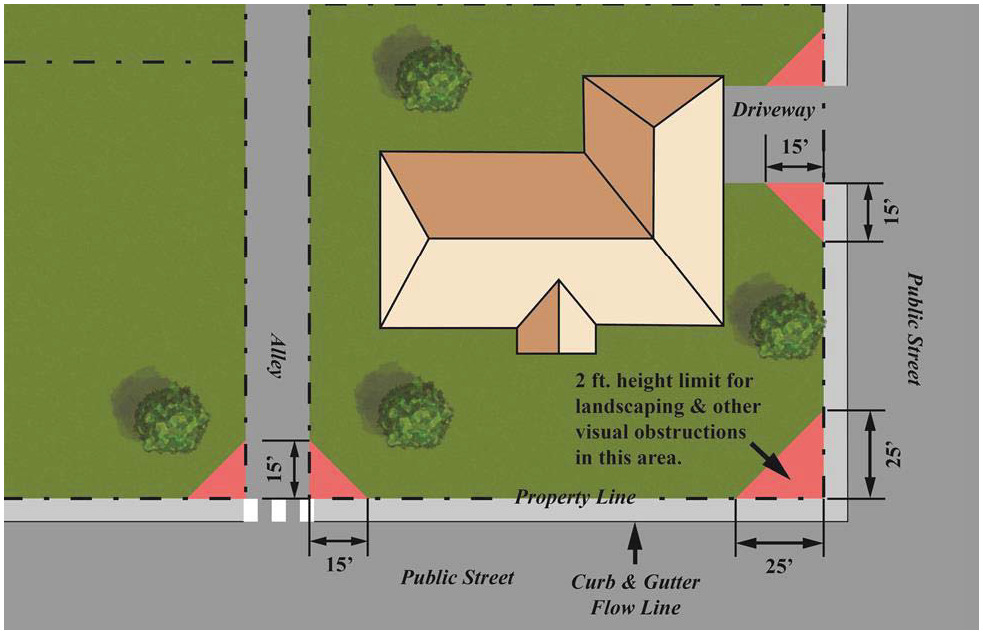
Sight triangles shall be required where a driveway or alley intersects a public street or where property abuts the intersection of two public streets. Unobstructed sight lines shall be provided at all times within the sight triangle area on the property adjacent to the intersection in order to preserve clear vehicle sight lines to oncoming vehicular and non-vehicular (i.e., pedestrians, bicyclists, etc.) traffic.
(B)
A sight triangle shall be defined as follows:
1.
Intersection of two public streets: A triangular area that is formed on the corner of a property located at the intersection of two (2) public streets. This area is formed by measuring twenty-five (25) feet along the curb and gutter flow line or edge of pavement (if no curb exists) of the two public streets and connecting the lines diagonally across the property making a ninety-degree (90°) triangle as shown in Figure below.
2.
Intersection of public street and alley or driveway: A triangular area that is formed at the corner of an intersecting alley or driveway and a public street. This area is formed by measuring fifteen (15) feet along the curb and gutter flow line or edge of pavement (if no curb exists) of the public street and the edge of the driveway or alley and connecting the lines diagonally across the property making a ninety-degree (90°) triangle as shown in figure above.
(C)
Structures, fencing, walls, landscaping and other visual obstructions shall not be located in a sight triangle except as follows:
1.
Deciduous trees may be permitted in a sight triangle provided that all branches and foliage are removed to a minimum height of eight (8) feet. Minimum height of branches and foliage shall be measured from the top of the adjacent roadway surface.
2.
Landscaping may be permitted in a sight triangle provided that the height of such landscaping does not exceed a maximum height of two (2) feet. Maximum height of landscaping shall be measured from the top of the adjacent roadway surface.
3.
Traffic safety devices, utility poles, and other government or utility installed devices are permitted in sight triangles but shall be installed to minimize any impact on visibility at the intersection.
(Ord. 2015-3, §1, 1-4-2016)
Sec. 16-7-120. - Outside storage—Screened.
Where identified as a use, outdoor storage shall be subject to the following:
(A)
Outdoor storage shall be screened when viewed by a person six (6) feet tall standing on the centerline of the adjacent street(s) and/or the adjacent setback of adjoining properties.
(B)
Outdoor storage shall not extend above the required screening.
(C)
The screening shall be architecturally compatible with the primary structure including, but not limited to, materials, color, roof pitch and detailing.
(D)
The minimum height of any screening shall be six (6) feet.
(Ord. 2015-3, §1, 1-4-2016)
Sec. 16-7-130. - Accessory uses.
(A)
Accessory uses are customarily associated with and subordinate to an allowed principal use within any zoning district.
(B)
No accessory building or structure shall be constructed and/or occupied prior to the completion of construction of the principal structure to which it is accessory.
(C)
Accessory buildings shall maintain the same front, side and rear yards as are required for the principal building on the lot or parcel, or as may be specified in any individual zoning district.
(D)
Accessory use structures shall comply with all applicable dimensional standards.
(Ord. 2015-3, §1, 1-4-2016)
Sec. 16-7-140. - Home occupations.
Where identified as a use, a home occupation shall be subject to the following:
(A)
The home occupation shall be incidental and secondary to the use of a primary dwelling for dwelling purposes.
(B)
The home occupation shall not change the essential residential character of a dwelling.
(C)
The on-site activities of the home occupation shall be carried on entirely within the primary dwelling or in an attached or a detached building on the subject premises, and that portion of the primary dwelling and/or the attached or detached building used for a home occupation and not on outdoor portions of the lot. The use shall comply with all building, fire, safety and other codes applicable to the particular use.
(D)
There shall be no storage or display of any goods, products, equipment or materials outside of the dwelling, garage or other building on the property containing the home occupation; and no hazardous or dangerous materials, or such quantities of the same, not customarily associated with a residential use shall be stored or used on the premises.
(E)
A home occupation shall not occupy more than twenty-five percent (25%) of the total gross floor area of the primary dwelling or when located in an accessory structure, the total amount of space allowed for the home occupation(s) shall not exceed twenty-five percent (25%) of the primary dwelling unit or in any case, no home occupation shall exceed five hundred (500) square feet, whichever is less.
(F)
The home occupation may be allowed no more than one (1) non-illuminated freestanding or wall sign not to exceed two (2) square feet.
(G)
The home occupation shall not cause any use or activity which is inconsistent with the residential zone in which it is located, or which disrupts the neighborhood by the creation of traffic, congestion, dust, smoke, vibration, noise from equipment, excessive lighting, offensive odor or electrical interference.
(H)
All persons engaged in a home occupation must obtain and maintain all necessary business licenses prior to and during the operation of the home occupation.
(I)
The home occupation shall not operate during such hours as to disturb neighbors or alter the residential character of the subject premises.
(J)
The home occupation shall not employ more than two (2) full-time equivalent persons on site who are not fulltime residents of the dwelling or property on which the home occupation occurs.
(K)
Vehicle traffic generated by the home occupation shall not significantly increase over the traffic level normally associated with the subject premises and shall not create or cause a need for new or additional off-site parking. No use or storage of heavy equipment or commercial or heavy trucks or trailers shall be permitted or allowed.
(L)
No sales of goods or products shall be allowed on the premises of the home occupation, except that which is incidental to any service provided by the home occupation.
(M)
Any structural addition shall comply with setbacks and dimensional standards.
(N)
Outdoor storage of inventory or supplies is prohibited.
(O)
The operation of a home occupation may be subject to review upon written complaint. In the event a complaint is received by the Town containing substantial credible information illustrating a possible violation of the terms and/or operating standards contained in this Section, the Town Administrator or his/her designee shall cause notice of such complaint to be served personally or by certified mail, return receipt requested, on the operator of the home occupation. The notice shall describe in reasonable detail the complaint concerning the home occupation and command the operator to appear before the Board of Trustees at a public hearing to show cause why the operation of the home occupation should not be suspended, modified or terminated. The public hearing notice shall be issued in conformance with Article IV of this Chapter. A copy of the notice shall also be timely provided in advance of the hearing to the person who submitted the subject complaint. The Board of Trustees may suspend, modify or terminate the operation of a home occupation upon a finding that the terms of this Section have been violated. All decisions of the Board of Trustees under this Section shall be reduced to writing and copies thereof shall be promptly mailed or personally delivered to the operator and complainant.
Examples for Maximum Allowable Space for Home Occupations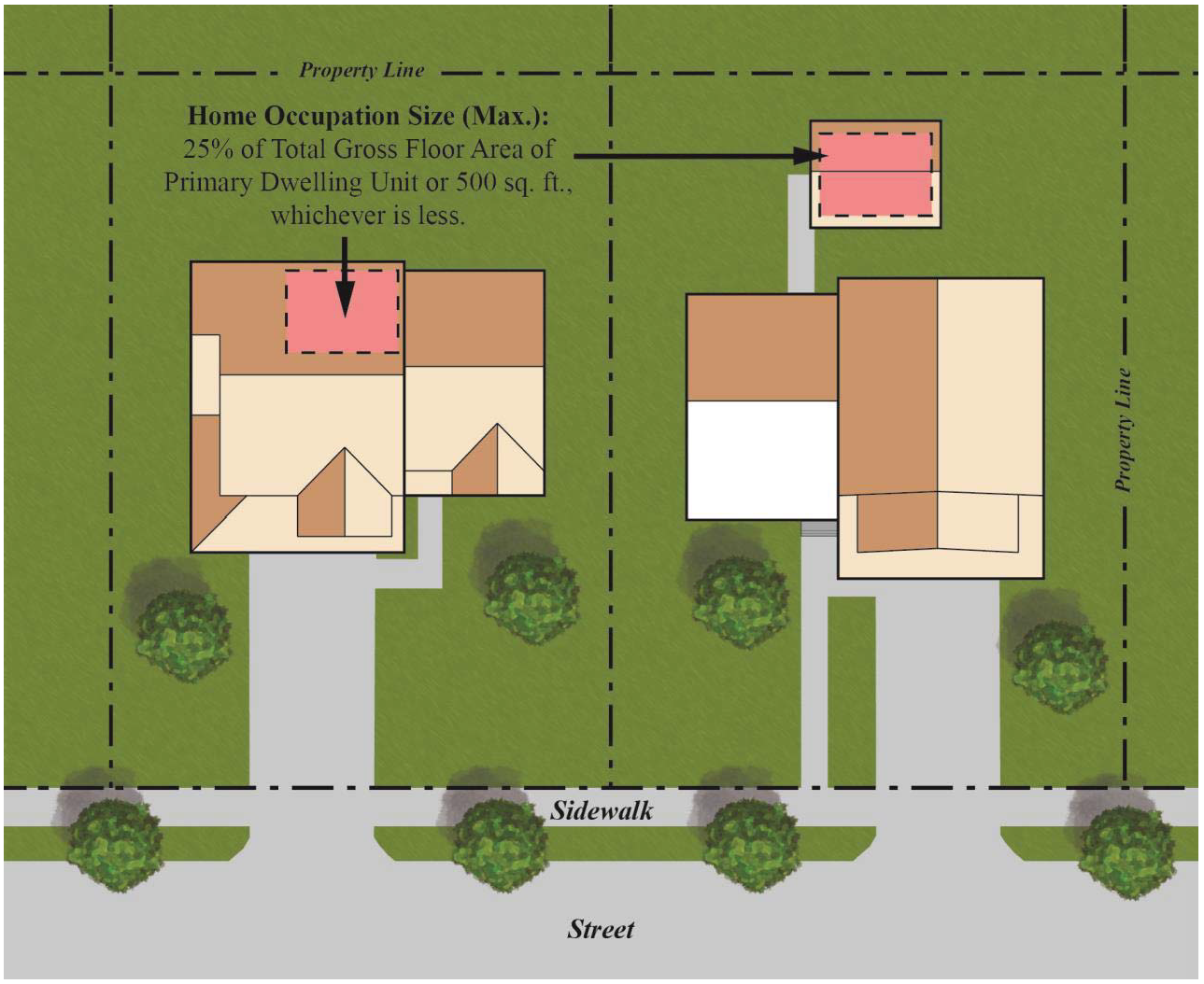
(Ord. 2015-3, §1, 1-4-2016)
Sec. 16-7-150. - Temporary housing.
(A)
An owner of a lot may live on his or her lot while an existing house is undergoing remodeling or restoration such that it is uninhabitable during the construction process, on the same lot, subject to compliance with the standards set forth herein.
(B)
Temporary housing shall be restricted to only self-contained units. No tents, teepees, or similar structures shall be allowed as temporary housing.
(C)
Prior to the occupancy of any temporary housing the owner shall submit to the Town evidence of an adequate water supply and method of sewage disposal.
1.
For self-contained recreational vehicles, the owner shall demonstrate a valid commitment for hauling water and sewage to an approved disposal site.
2.
For mobile homes, manufactured housing, or other temporary housing, the owner shall have water and sewer treatment or disposal systems approved by the Town's Public Works Department.
3.
In no case shall a source of water unapproved by the Town be used for drinking, nor shall any sewage be discharged in a manner not approved by the Town.
(D)
The Town staff shall inspect the site to determine whether it is suitable for temporary housing and may deny permission for temporary housing if the site is reasonably determined to be unsuitable for such temporary use.
(E)
If the subject lot is located in an area subject to protective or restrictive covenants, such covenants must allow temporary housing and the owner shall demonstrate to the Town that any necessary approvals from the property owners' association have been obtained.
(F)
Temporary housing shall not be allowed unless there is a current building permit for the lot in question and construction is begin actively pursued or, in any event, no longer that six (6) months.
(G)
No more than one (1) temporary housing unit shall be located on a house construction site. Occupancy of the unit shall be limited to the owners of the lot and their immediate family.
(H)
Temporary housing sites shall be maintained in a clean, sanitary and safe condition, free from hazardous or noxious materials, weeds and refuse. The property owner shall be responsible for ensuring compliance.
(I)
Adequate fire protection shall be provided.
(J)
A thirty (30) gallon (four [4] cubic foot) trash container shall be provided, or the equivalent, in a central trash collection facility. Such container shall be durable, washable, non-absorbent metal or plastic with tight-fitting, bear-resistant lids. Refuse shall be removed from the site not less than once each week.
(K)
Should any of the requirements of this Section be violated the Town may issue a stop work order for the construction project until the temporary housing site is brought into compliance. No certificate of occupancy shall issue until the temporary housing is removed and the site is restored to the reasonable satisfaction of the Town.
(Ord. 4, 2018 §1)
Sec. 16-7-160. - Short term rentals.
Short term rentals shall be subject to the following regulations:
(A)
Registration and licensing requirements
1.
All short-term rentals shall comply with Chapter 6 Article V of the Fairplay Municipal Code, which establishes conditions under which a property owner may apply for a short-term rental license.
(B)
Conditions and standards.
1.
Short-term rentals are not permitted in an apartment building at any time in any zoning district.
2.
Short-term rentals are not permitted in accessory dwelling units (ADUs), recreational vehicles (RVs) which include all vehicles that bear a vehicle identification number (VIN) and which are subject to annual registration renewal, tents, teepees, campers or other temporary structures, at any time in any zoning district.
3.
No short-term rental shall be operated in such a way as to constitute a nuisance.
4.
The maximum number of occupants permitted in a short-term rental shall be established at the time of initial licensing and based upon the Water & Sewer Equivalent Residential (EQR) use calculation for the property.
5.
Events, such as concerts, parties and weddings, are prohibited.
6.
The designated parking for vehicles of short-term rental guests shall be addressed at the short-term rental application and licensing stage, and shall meet the off-street parking standards identified in Chapter 16 Article X.
(Ord. 4, 2022 §4)
Sec. 16-17-70. - Location and extent review for public facilities projects.
(A)
Purpose. This Section implements C.R.S. § 31-23-209 and is intended to provide an opportunity for review of the location and extent of specified public facilities and uses sought to be constructed or authorized by Colorado government entities within the Town of Fairplay, especially as to whether such public use is consistent with the Town of Fairplay Comprehensive Plan and this Code provided however that Location and Extent Review shall not be required for any Town Project for which the majority of funding (including grant funding) is authorized by the Board of Trustees.
(B)
Applicability.
1.
Location and Extent Review shall apply to the construction or authorization of any public school, street, square, park or other public way, ground or open space, public building or structure constructed by a Colorado government entity, including a municipality, county, school district, or special district or agency of state government, or major facilities of a publicly or privately owned public utility.
2.
Location and Extent Review shall generally apply to the construction of new schools, streets, squares, and other facilities constructed by the entities referenced in Subsection 16-17-70(b)(1), but not to maintenance, repair, or improvement of existing facilities.
3.
Notwithstanding the foregoing, the Board of Trustees shall have the final authority to determine whether any given public project must be evaluated through the Location and Extent Review process, after consultation with the Town Planner and other Town Staff and consultants, as needed.
(C)
Procedure for Location and Extent Review.
1.
Public schools.
a.
Prior to acquiring land or contracting for the purchase of land for a school site, the Board of Education shall consult with and advise the Board of Trustees, in writing.
b.
Prior to the construction of any structure or building, the Board of Education shall submit a Location and Extent Review application plan for review and comment to the Board of Trustees. Except as otherwise set forth in this Section, the Development Review process shall be the same process described in Chapter 16 of Article 17 of this Code.
c.
The Board of Trustees may request a public hearing before the Board of Education on the proposed site location or development. If the Board of Trustees requests a hearing, the Board of Education shall promptly schedule the hearing, publish at least one (1) notice in advance of the hearing, and provide written notice of the hearing to the Board of Trustees.
d.
The Board of Trustees shall consider all information presented at the public hearing. If no hearing is requested, the Board of Trustees shall consider all information provided by the board of education and shall convey its findings and recommendations to the Board of Education.
e.
Failure of the Board of Trustees to act within sixty (60) business days after the date of official submission of the Location and Extent Review application shall be deemed an approval unless a longer period for review is granted by the board of education.
f.
The authority to make final determinations as to the location of public schools and the authority to erect buildings and structures shall remain with the board of education.
2.
All other public uses to be constructed by Colorado government entities.
a.
A Location and Extent Review application shall be submitted to the Board of Trustees for approval, pursuant to the Development Review and approval process set forth in this Code, prior to the construction or authorization of any public use that is subject to Location and Extent Review.
b.
Failure of the Board of Trustees to act within sixty (60) business days after the date of official submission of the Location and Extent Review application shall be deemed an approval, unless a longer period is granted by the submitting board, body or official.
c.
If the Board of Trustees disapproves the Location and Extent Review application, it shall communicate its reasons to the submitting board, body or official. The respective submitting board, body or official is authorized to overrule such disapproval by a recorded vote of not less than two-thirds (⅔) of its entire membership. Upon overruling, the submitting board, body or official may proceed with construction or authorization of the project, as applicable.
d.
If the project is not required to be authorized or financed by the Board of Trustees, or other Town official or board, the Board of Trustees' disapproval may be overruled by the body having jurisdiction over the authorization and financing of the project. A vote to overrule by such body shall be by a recorded vote of not less than two-thirds (⅔) of its entire membership. In the case of a utility owned by an entity other than a political subdivision, the Board of Trustees' disapproval may be overruled by the Public Utilities Commission by a recorded vote of not less than two-thirds (⅔) of its entire membership.
(D)
Standards for Review. The Board of Trustees shall review the extent and location of the proposed public use for its consistency with the goals, policies and objectives stated in the Comprehensive Plan and for its compliance with this Code.
(Ord. 3, 2023, §2)

