
Fairplay City Zoning Code
ARTICLE XII
Lighting
Sec. 16-12-10.- Purpose and intent.
(A)
The purpose of this Article is to improve the nighttime lighting environment for residents, pedestrians, drivers and visitors. This Chapter will address: increased light levels from excessive lighting, light trespass, glare from bright sources, and light shining into the night sky. Effective exterior lighting should be functional, glare-free, energy efficient, safe and ensure that outdoor lighting will:
1.
Allow outdoor lighting that does not exceed the minimum levels specified in these regulations for night-time safety, utility, security, productivity, enjoyment, and commerce;
2.
Establish ground rules for residential, commercial, and street lighting with the basic directive to use lighting levels, direct light where it is needed without shining it at the neighbor.
3.
Recognize new lighting technologies that result in higher-efficacy light sources (lumens per Watt) and to support use of high efficiency light sources in Fairplay to conserve energy and resources.
4.
Minimize adverse offsite impacts of lighting such as light trespass, and obtrusive light;
5.
Ensure aesthetically appropriate outdoor lighting in keeping with the rural and small town character of Fairplay;
6.
Curtail light pollution, reduce skyglow and improve the nighttime environment for unimpeded views of the night sky;
7.
Help protect the natural environment from the adverse effects of night lighting from human generated light sources.
(Ord. 2015-3, §1, 1-4-2016)
Sec. 16-12-20. - Applicability, nonconforming lighting and compliance.
(A)
Application for new construction. The lighting ordinance codified in this Article provides regulations for applications of exterior lighting. As of the effective date of the ordinance codified in this Article, lighting for all new residential, commercial, industrial and public facility construction must meet the requirements of the Article.
(B)
All outdoor lighting shall be installed in conformance with the provisions of this Article and applicable building codes.
(C)
All outdoor lighting installed after the date of effect of this Article shall comply with these requirements. This includes, but is not limited to, new lighting, replacement lighting, or any other lighting whether attached to structures, poles or any other location, including lighting installed by any third party.
(D)
Pre-existing nonconforming. All existing outdoor lighting that does not conform to the requirements of this Chapter shall be considered pre-existing nonconforming.
(E)
Compliance for nonconforming commercial, industrial, schools and public facilities. All pre-existing nonconforming conditions must be brought into compliance:
1.
Within five (5) years after the effective date of the ordinance codified in this Chapter; or
2.
With a building permit resulting in a twenty percent (20%) increase in floor area; or
3.
With any installation or replacement of exterior lighting fixtures valued over two thousand dollars ($2,000.00).
(F)
A property owner interested in bringing his/her lighting into compliance may request a site visit by the Fairplay Town Administrator or her/his designee to review specific concerns.
(G)
New land use applications. Compliance with this Chapter is required for land use applications including: subdivision, subdivision exemption, condominium, condominium exemption, planned unit development, site plan development review, special use or multi-family site plan review.
(H)
Compliance procedure for new commercial and industrial properties and properties listed in Section 16-12-20. Applicant shall request a lighting review by the Town at time of building permit, appropriate land use application or state electrical permit application. A full lighting plan, as specified in Section 16-12-30, shall be provided to the Town Planner.
(I)
Compliance for residential. Property owners shall consider the impacts of their lighting impacts on the neighbors' environment. Existing residential properties whose lighting impacts immediately adjoining properties (those within two hundred (200) feet) will be required to comply with the Code if a lighting complaint is registered with the Town Administrator and a violation of these regulations is determined to exist. Existing residences receiving a validated formal complaint from an immediately adjacent property owner have thirty (30) days to comply with this Chapter. All new properties will be reviewed for compliance with the provisions of this Chapter during the course of construction while a building permit is open. Building official will request specifics to document compliance, such as: providing wattage, fixture descriptions and placement details. Information may be required in a form suitable to the building department or a lighting plan, as per Section 16-12-30.
(Ord. 2015-3, §1, 1-4-2016)
Sec. 16-12-30. - General requirements and submittal standards.
(A)
Lighting plans. Lighting point-by-point calculations (photometrics) shall be submitted. These calculations shall be performed by a registered professional engineer or lighting certified designer. For town lighting reviews lighting plans shall show the following:
1.
The location and height above grade of light fixtures;
2.
The type (such as light emitting diode (LED), incandescent, fluorescent, high pressure sodium, metal halide, LED), rated lumens and wattage of each light source;
3.
The type of compliant fixture (such as full-cutoff, partial cut-off, lantern, wall pack);
4.
The backlight, uplight, glare (BUG) rating for each fixture.
5.
Calculations for site illumination resulting from the lighting, measured in foot-candles or lumens including minimum, maximum and average foot-candles (or lumens) and uniformity ratios;
6.
Other information deemed necessary to document compliance with the provisions of this Chapter.
7.
If building walls are to be illuminated, or if façade mounted fixtures are to be used, drawings of all relevant building elevations showing the fixtures and the portions of the walls to be illuminated calculated point-by-point and light levels.
(B)
Light pollution abatement-light trespass and controls.
1.
Lighting trespass. In order to minimize light trespass onto neighboring properties, the maximum light level at a property line shall not exceed two-tenths (0.2) foot-candles (fc) for residential zones and for industrial and commercial properties bordering residential zones. Properties within commercial and industrial zones shall also reduce light trespass at the property line to a maximum of three-tenths (0.3) fc. Light trespass is measured by vertical readings in foot-candles at the brightest point on the property line. Commercial and industrial properties may trespass onto public rights-of-way at main entrances or exits to a level not to exceed five-tenths (0.5) fc and to a level not to exceed four-tenths (0.4) fc at other portions of the right-of-way.
2.
Controls. To minimize the amount of excess, unnecessary lighting at night, the use of motion sensors, photocells, processor-based lighting control systems, astronomical timeclocks, and/or photocell/timers to control duration of nighttime illumination is encouraged and is required as specified in this Article.
a.
Automatic switching requirements. Controls shall be provided that automatically extinguish all outdoor lighting when sufficient daylight is available using a control device or system such as a photoelectric switch, astronomic time switch or equivalent functions from a programmable lighting controller, building automation system or lighting energy management system, all with a battery or similar backup power or device.
b.
Motion sensors. Sensors must be triggered by activity within the owner's property lines and should be used with LED, incandescent, fluorescent, or halogen lamps.
c.
Astronomical timeclock. These activate the light source at dusk and turn it off at a selected time several hours later, at of before dawn.
d.
Photocells. Use of photocells is appropriate when illumination is required all night for safety, their use is otherwise discouraged. These controls are activated by sunlight, turning lights on at dusk and off at dawn and illuminate an area for the entire night.
e.
Non-astronomical timers. These mechanisms are prohibited when used alone.
(C)
Electrical service. Electrical service shall be placed underground unless the fixtures are mounted directly on utility poles.
(Ord. 2015-3, §1, 1-4-2016)
Sec. 16-12-40. - General standards for outdoor lighting.
(A)
The following general standards shall apply to all outdoor lighting unless otherwise exempted:
1.
Background spaces, such as parking lots must be illuminated as unobtrusively as possible to meet the functional needs of safe circulation and protecting people and property. Foreground spaces, such as building entrances and plaza seating areas, must use local lighting that defines the space without glare.
2.
Light sources must direct light downward and be concealed or shielded to mask the surface of the bulb or light-emitting element from adjacent properties.
3.
The style of light standards and fixtures must be consistent with the style and character of architecture proposed on the site.
4.
Light sources must produce accurate color rendition.
(Ord. 2015-3, §1, 1-4-2016)
Sec. 16-12-50. - Residential lighting standards.
(A)
The following lighting standards shall be applicable to residential properties:
1.
General standards throughout all residential neighborhoods and zone districts and all lighting zones.
a.
Signs. In residential neighborhoods and zone districts shall conform to the requirements of this Article and Article XXV.
b.
Glare. All exterior lighting shall be designed so that the (bulb) point light source is not directly visible from adjoining properties or the adjacent public rights-of-way. Placement of a fixture shall minimize light glare and trespass to an adjoining property-maximum of two-tenths (0.2) fc at the property line.
c.
At critical entrances or common areas. Photocells may be used in these locations for multi-family properties to turn on lights at dark and to extinguish lights at dawn. Motion sensors are preferred for this use.
d.
Flood lights shall be restricted as follows:
i.
The point light source shall not be visible from adjoining lots or streets.
ii.
Lights shall be focused on the task, fully shielded, down directed and screened from adjacent properties in a manner that prevents light trespass.
ii.
Incandescent light sources above forty (40) watts are prohibited. Use of LED sources is encouraged.
iv.
Light level shall not exceed 5 (five) foot-candles at grade.
v.
Flood lights shall be controlled by a motion sensor, astronomical timeclock, or building control system for uses after 10:00 p.m.
vi.
LED floodlights shall not exceed one thousand (1,000) lumens per fixture and can be controlled by a photocell, astronomical timeclock, or building control system.
e.
General standards for new construction.
i.
Height. Outdoor lighting shall be fourteen (14) feet or less in height. Second floor balconies and outdoor stairways can be lit with downward directed fully shielded fixtures. Site, roadway, and pedestrian lighting fixtures shall comply with BUG ratings in Table C to eliminate light output behind the luminaire.
ii.
Maximum wattage. Incandescent light sources including halogen shall not exceed fifty (50) watts per fixture. LED light sources shall not exceed twenty (20) watts per fixture. Outdoor lighting with HID light sources shall be prohibited.
iii.
Fixtures. Fully shielded down directed light sources are required. Point sources (bulbs) shall not be visible from adjoining properties or adjoining public rights-of-way. Clear, wavy, or seeded glass shall not be acceptable as a shielding media. Frosted or translucent glass which does not show the light source is acceptable for retrofit applications.
f.
General standards for pre-existing dwellings.
i.
Pre-existing "unshielded" light sources can be used, in which case the fixture lens must be fit, or sprayed with a non-clear material (e.g., frosted or opaque) and the total fixture wattage must be equal to or less than forty (40) watts (incandescent) or fifteen (15) watts LED.
ii.
Landscape lighting: Landscape lighting is limited to twenty (20) watts incandescent or halogen or five hundred (500) lumens for LED per fixture per one hundred fifty (150) square feet of landscaped area. Up-lighting is only permitted if the light distribution from the fixture is effectively contained by an overhanging architectural or landscaping element. Such elements may include awnings, dense shrubs or tree canopies, which can functionally reflect illumination back to the ground. In these cases the fixture is limited total lamp wattage within a fixture of twenty (20) watts for incandescent or halogen sources, or five hundred (500) lumens for LED sources.
(Ord. 2015-3, §1, 1-4-2016)
Sec. 16-12-60. - Parking lot standards.
(A)
Parking lots: All parking lot area lighting shall be compliant with the BUG ratings as shown in Table C.
(B)
A maximum of 2 (two) luminaires shall be allowed per pole.
(C)
Standards for various districts are as shown in the following table:
Note: Schools in residential zones shall comply with MF-Res zone lighting.
1 Parking lots for any commercial use greater than 150 spaces may choose to use a mounting height up to nineteen 19 feet. Additional standards/criteria apply to these parking lot arrangements:
• Lighting fixtures shall be full cut-off, plain shoebox style.
• Maximum lumens—9,300 lumens high pressure sodium or metal halide.
• Allowable minimum horizontal illuminance—no more than 0.4 (at ground).
• Uniformity ratio—no more than 4:1 average to minimum.
• Uniformity ratio—no more than 20:1 maximum to minimum.
Lighting needs, minimum light level and uniformity ratio for individual parking lots may be lower depending on applicant's assessment of activity levels and concurrence of the Board of Trustees.
(Ord. 2015-3, §1, 1-4-2016)
Sec. 16-12-70 - Nonresidential lighting standards.
(A)
General requirements. The following lighting standards shall be applicable to all nonresidential properties including mixed uses:
1.
Lighting power densities for building exteriors shall comply with International Energy Conservation Code (IECC) requirements.
2.
Outdoor lighting used to illuminate parking spaces, driveways, maneuvering areas, or buildings shall be designed, arranged and screened so that the point light source shall not be visible from adjoining lots or streets.
3.
Lighting at Entrances and Storefront Windows. Maximum light level range including spillage from inside to outside shall be no more than 10—15 (ten to fifteen) fc. Maximum light level reading shall be no more than 15 (fifteen) fc, measured at ground, between 2'-0″ from the building façade and either the edge of the curb or 8'-0″ from the building façade, whichever is closer to the building.
4.
Maximum foot-candles for specific locations-other than parking lots. Maximum maintained illuminance shall not exceed the range specified below. Values are taken from the Illuminating Engineering Society of North America's (IESNA) recommended illuminance values (9th Edition Handbook 2000).
5.
Reduce light levels with reduced activity. Except as otherwise provided in the sign regulations Section 16-25-170, exterior lighting shall be reduced after hours (at the close of business or servicing or by 9:00 p.m., whichever is later). Light levels in the Town Center may be maintained until midnight or close of business or servicing whichever is later. See specific details in parking lot lighting Section 16-12-60 and lighting Section 16-12-80.
6.
Walkways/bikeways and pedestrian areas. Illumination is not required for these areas. If an applicant chooses to illuminate areas the following standards apply:
a.
The ground area shall be illuminated to a level no more than five (5) fc maximum, no more than five-tenths (0.5) fc average, measured at grade.
b.
The vertical illumination level at a height of five (5) feet above grade shall be no more than five-tenths (0.5) fc.
c.
Lighting shall be directed downward, pedestrian friendly and fully shielded or with full cut-off luminaires. Light sources for luminaries mounted 12'-0″ above grade or lower shall have a maximum of one thousand two hundred (1,200) lumens. Light sources for luminaries mounted 12'-0″ to 16'-0″ shall have a maximum of three thousand (3,000) lumens.
7.
Lower light levels in mixed use areas mixed use areas that include residential occupancies shall comply with the residential standards on those floors or areas that are more than fifty percent (50%) residential based on square footage of uses.
8.
Wattage specifications. Maximum bulb wattage shall be fifty watts (50W) incandescent or thirty-watts (30W) LED with maximum two (2) bulbs per fixture.
9.
Fixture types. Fixtures shall be fully shielded or full-cutoffs and in compliance with the appropriate BUG rating. In certain applications cut-off fixtures with louvers or shields may be used for aesthetic purposes.
10.
Fixture height. Outdoor lighting (except parking lot lighting) must be sixteen (16) feet or less in height unless it is:
a.
Building mounted lighting fully shielded, directed downward at a sign or building façade; or
b.
Lighting on above grade decks or balconies shall be fully shielded.
Examples of Prohibited Unshielded Fixtures.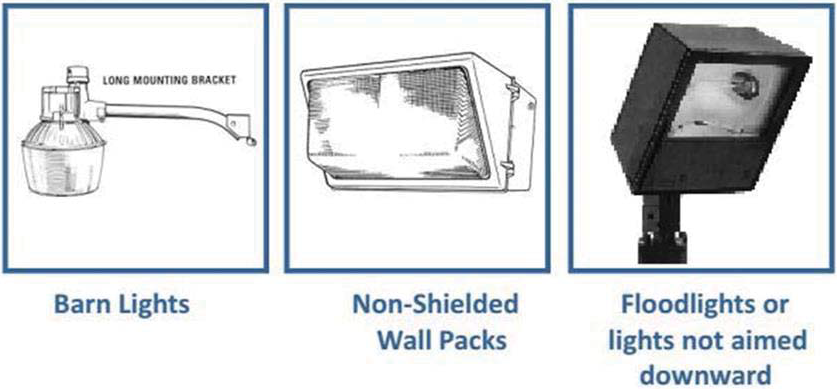
(B)
Nonresidential security lighting. Security lighting is permitted. Security lighting shall be at a reduced level as activity decreases. After midnight, security lighting shall be motion-controlled.
1.
Maximum light levels. Lighting for entrances, stairways and loading docks shall not exceed five (5) fc and for parking lots shall not exceed two (2) fc. Other areas of specific security concern can be lit at a level not to exceed one and five-tenths (1.5) fc.
2.
At critical entrances or common areas. Photocells can be used in these locations for commercial, industrial and mixed-use properties to turn on lights at dark and to extinguish lights at dawn.
3.
Light trespass. At property lines within the commercial/industrial zones, trespass shall be limited to a maximum of three-tenths (0.3) fc; properties bordering residential zones are limited to a maximum of two-tenths (0.2) fc.
4.
Security lighting.
a.
Fully-shielded wall-packs or other fixtures;
b.
Full cut-off fixtures on parking lot poles;
c.
Recessed lights under a canopy;
d.
Floodlights are prohibited.
(C)
Nonresidential-Illuminated Signs. Signs should not create glare or unduly illuminate the surrounding area.
1.
Shut-off time (except for residential districts in Section 16-25-170 Sign Illumination Matrix). Signs more than twenty-eight (28) square feet shall be extinguished one (1) hour after business is closed or completing services, or by 10:00 p.m., whichever is later.
2.
Signs. The applicant shall provide the building official with a sign permit, sufficient technical and design information to demonstrate that the following provisions are met:
a.
Externally illuminated signs—Preferred method of illumination.
i.
The average level of illumination on the vertical surface of the sign shall not exceed ten (10) fc.
ii.
Point source of light shall not be visible to a passerby.
iii.
Lighting fixtures for illuminating signs shall be carefully located, aimed and shielded so that light is directed only onto the sign façade. Down directed lighting for signs is preferred. If ground mounted lighting is used, the light source must be fully shielded by landscaping or other means.
b.
Internally lit signs.
i.
Illumination sources shall not exceed a total of nine thousand six hundred (9,600) lumens.
ii.
For boxed internally lit signs, backgrounds shall be dark with white, yellow or light lettering.
iii.
Pan channel lit signs are preferred versus internally lit signs. White lettering is not permitted.
iv.
Signs shall not be used in a manner that creates a distraction to drivers on adjacent roadways. Excessive glare, color changing light sources, and visible lamps oriented towards the roadway are prohibited.
(Ord. 2015-3, §1, 1-4-2016)
Sec. 16-12-80. - Lighting of gasoline stations.
Lighting levels on gasoline station aprons and under canopies shall provide illumination adequate to facilitate the activities taking place in such locations without excessive lighting.
(A)
Aprons and canopies.
1.
Light levels. Areas around the pump islands and under canopies shall have average illumination as follows:
a.
Areas with dark surroundings (less than one (1) fc): no more than five (5) fc average, twenty (20) maximum;
b.
Areas with light surroundings (more than two (2) fc): no more than ten (10) fc average, forty (40) maximum, uniformity ration (average: minimum) shall not exceed 4:1.
c.
Fixture and lamps. Lighting shall be provided with fully shielded fixtures. Light fixtures mounted under canopies shall be recessed with flat lenses so that the lens cover is flush with the bottom surface (ceiling) of the canopy.
2.
Lights on top or sides. Lights shall not be mounted on the top or sides of the canopy. The sides (fascias) of the canopy shall not be illuminated for any purpose with the exception of permitted signs as in Article XXV
3.
Retrofits. Existing fixtures may be retrofitted with metal side shields which extend below the bottom of the lens to fully shield fixtures and to avoid light shining from the side of the canopy. Canopies with drop sides may also be used to hide fixtures and to eliminate glare from the side of canopy.
(B)
Other areas in the gas station.
1.
Areas on the apron away from the gasoline pump islands, used for parking or vehicle storage, shall be illuminated in accordance with the requirements for parking areas.
2.
Maximum light levels range for driveways and service areas (other than pump islands) are one and five-tenths to three (1.5-3) fc. Average light levels at areas other than pump islands:
a.
Areas with dark surroundings (less than one (1) fc): not more than one and five-tenths (1.5) fc, five (5) maximum.
b.
Areas with light surroundings (more than two (2) fc): no more than two (2) fc, seven (7) maximum.
(Ord. 2015-3, §1, 1-4-2016)
Sec. 16-12-90. - Prohibited lights.
This section identifies applications of lighting which cause glare, decrease our ability to see in dark, low level ambient light environments or produce unattractive lighting environments or excessive light pollution. These types of lighting are prohibited.
(A)
Roof lights. Light sources shall not be affixed to the top of a roof, except where required by building code requirements.
(B)
Unshielded light sources. This type is prohibited except as listed in residential section.
(C)
Building illumination. Flood illumination of buildings shall be prohibited from the ground or on pole mounted lights or by lights mounted on adjoining structures. Buildings with exceptional symbolic (i.e., churches or public buildings) or historical significance may request exemptions to this prohibition.
(D)
Nuisance lights. Lights which flash, move, revolve, blink, flicker, vary in intensity, change color, or use intermittent electrical pulsation are prohibited unless specifically approved as part of the lighting code exemption. (Winter holiday lights are exempt.)
(E)
Other lamps. Mercury vapor and low-pressure sodium lighting shall be prohibited.
(F)
Architectural lighting. Linear lighting such as: fluorescent awnings, rope light or neon shall be fully shielded so that the light source is not visible.
(G)
Pre-existing, nonconforming lights must be brought into conformance when a major alteration is made to the exterior lighting or which increases the square footage of the building, Section 16-12-20.
(H)
Lighting that may be emulates or may be confused with warning, emergency or traffic signals.
(Ord. 2015-3, §1, 1-4-2016)
Sec. 16-12-100. - Street lighting.
The Town of Fairplay is committed to installing energy-efficient luminaires and to replacing legacy fixtures. The Town understands that new technology can reduce electricity use and maintenance costs, resulting in savings to the Town. Over the next ten (10) years, Fairplay will work to develop and implement a program for upgrading and improving Town-owned street lighting.
(A)
All lighting illuminating public right-of-ways and easements or private streets shall conform to the following standards:
(B)
All light fixtures shall be compliant with BUG ratings as shown in Table C.
(C)
Maximum fixture height shall be sixteen (16) feet. Exemptions up to a maximum of twenty-five (25) feet may be granted for street lights located at opposing corners of intersections.
(D)
A minimum of four (4) times the mounting height of the light source shall be maintained between street light fixtures. Exemptions to this standard may be considered when fixtures are located on opposing corners of an intersection, at a pedestrian crosswalk or where similar special or unique conditions exist. Exemptions may be considered only where fixture type, placement and light intensity are modified to conform to the intent of the minimum spacing requirement.
(E)
Fixture types shall be selected from a list of Town-approved designs. This list will be submitted to the Board of Trustees for review and approval.
(Ord. 2015-3, §1, 1-4-2016)
Sec. 16-12-110. - Outdoor recreational facilities.
If a recreational facility is requesting lighting for night time activities, the applicant must follow the exemption process and the following provisions apply:
1.
Lighting plan. Lighting for outdoor recreational facilities, a full lighting plan as per Section 16-12-30 shall be submitted.
2.
Conditions. Conditions placed on the lighting for the recreational facility may include: limited hours of operation, limits on lighting intensity, specific requirements for fixture design and others.
3.
Light trespass. Designs shall address limiting light trespass to surrounding neighborhoods. Floodlights in this application should not be aimed above sixty-two (62) degrees from vertical. In order to minimize light pollution and light spillage into the neighborhood, the lights shall have louvers and external shields.
4.
Maximum wattage. Wattage of lamps shall be two hundred fifty (250) watts HID or less.
(Ord. 2015-3, §1, 1-4-2016)
Sec. 16-12-120. - Exemptions and variances.
(A)
Permitted exemptions.
1.
Holiday lighting which is of a temporary nature and operated no longer than forty-five (45) days within a three hundred sixty-five (365) day timeframe provided that individual lamps are less than ten (10) watts and seventy (70) lumens.
2.
Municipal lighting installed for the benefit of public health, safety and welfare.
3.
Traffic control signals and devices.
4.
Street lights installed prior to the effective date of these land use regulations.
5.
Temporary emergency lighting (i.e., firefighting, police work, infrastructure repair) and any permanent emergency lighting required by building code.
6.
Lights on moving vehicles.
7.
Lighting required by federal, state or local regulations.
8.
Lighting specially approved by the Board of Trustees for temporary outdoor events.
9.
Downward aimed lighting of the United States and/or the State of Colorado flags with no more than two (2) light fixtures.
(B)
Exemption procedure. Exemption requests from the standards of this Chapter of the municipal code may be granted through the following procedure:
1.
Exemption requests shall be formalized by letter to the Town Administrator requesting an exemption and submittal of a lighting plan as set forth in Section 16-12-30.
2.
The request will be considered and may be granted by the Board of Trustees at a regularly scheduled meeting.
3.
If the request is deemed acceptable by the Board of Trustees, they can impose conditions so the purpose and intent of Section 16-12-10 is met as well as any other applicable sections of the code.
4.
Exemption procedures shall also be utilized in regard to any interpretation or clarification of the lighting code necessary or requested by an applicant.
5.
Exemptions shall be reviewed in accordance with the following standards and procedures:
a.
Compliance with the purpose and intent of this Chapter.
b.
Submittal of a full lighting plan in accordance with Section 16-12-30.
c.
The Board of Trustees may seek recommendations by a professional lighting consultant selected by the Town and paid for by the applicant.
d.
Any special conditions of the applicant, circumstances, or hardships that warrant the exemption.
(Ord. 2015-3, §1, 1-4-2016)
Sec. 16-12-130. - Enforcement.
(A)
Any person, firm or corporation violating these standards shall be subject to the enforcement and penalties specified in this Chapter the Fairplay Municipal Code.
(B)
If any part, section, subsection, sentence, clause or phrase of this Chapter is for any reason held to be invalid, such decision shall not affect the validity of the remaining portions of this Chapter and the Board of Trustees hereby declares it would have passed the ordinance codified in this Chapter and each part, section, subsection, sentence, clause or phrase thereof regardless of the fact that any one (1) or more parts, sections, subsections, sentences, clauses or phrases be declared invalid.
(C)
This Chapter shall apply to all property within the boundaries of the Town.
(Ord. 2015-3, §1, 1-4-2016)
Sec. 16-12-140. - BUG (backlight-uplight-glare) diagram.
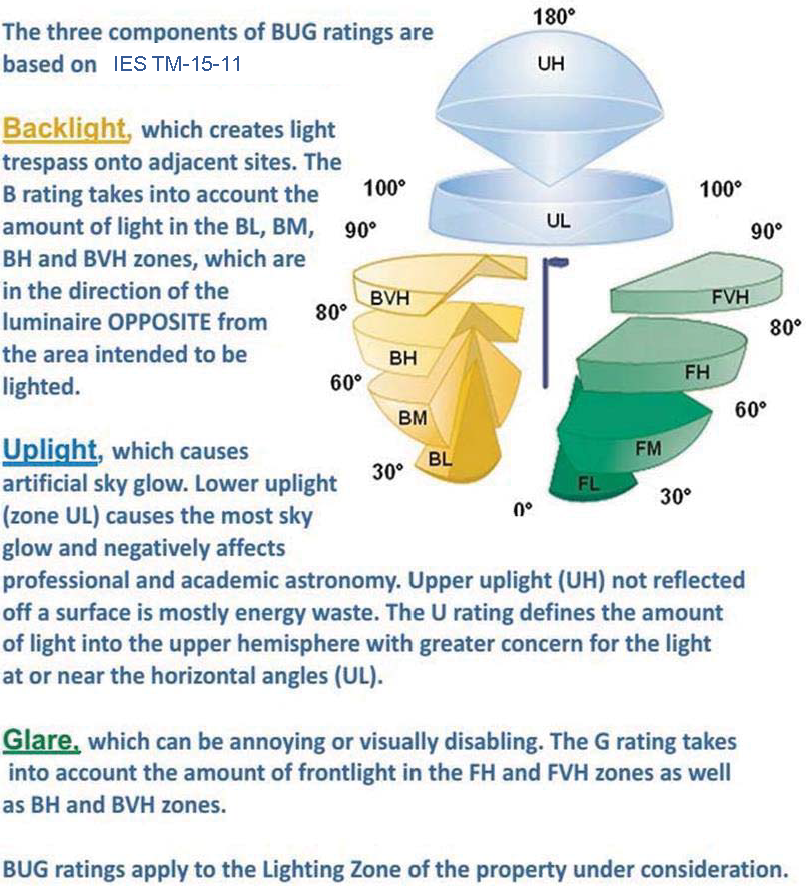
BUG Table Legend: UH=Uplight High, UL=Uplight Low, BVH=Backlight Very High, BH=Backlight High, BM=Backlight Medium, BL=Backlight Low, FVH=Forward Light Very High, H=Forward Light High, FM=Forward Light Medium, FL=Forward Light Low.
For additional information about the BUG ratings, please refer to Illuminating Engineering Society's (IES) BUG Ratings—TM-15-11.
Maximum allowable backlight, uplight, glare (BUG) ratings.
Tables: B = Backlighting, U = Up Light, G = Glare
Refer to Illuminating Engineering Society's (IES) BUG ratings—TM-15-11
* For property lines that abut public walkways, bikeways, plazas, and parking lots, the property line may be considered to be five (5) feet beyond the actual property line for purpose of determining compliance with this Section. For property lines that abut public roadways and public transit corridors, the property line may be considered to be the center-line of the public roadway or public transit corridor for the purpose of determining compliance with this Section. NOTE: This adjustment is relative to Table C-1 and C-3 only and shall not be used to increase the lighting area of the site.
** To be considered 'ideally oriented', the luminaire must be mounted with the backlight portion of the light output oriented perpendicular and towards the property line of concern.
*** Any luminaire that cannot be mounted with its backlight perpendicular to any property line within 2X the mounting heights of the luminaire location shall meet the reduced allowed glare rating in Table C-3.
(Ord. 2015-3, §1, 1-4-2016)
Sec. 16-12-150. - Definitions.
Average maintained illuminance means the average work plane illuminance in lumens or foot candles within a space with a given number of luminaries.
BUG means backlight, uplight, glare.
Color rendering index (CRI) means the quantitative measure of the ability of a light source to reproduce the colors of various objects faithfully in comparison with an ideal or natural light source.
Correlated color temperature (CCT) means the color temperature of a light source is determined by comparing its chromaticity with that of an ideal black-body radiator. The temperature (usually measured in kelvin (K)) at which the heated black-body radiator matches the color of the light source is that source's color temperature. Yellow-red colors are considered warm, and blue-green colors are considered cool.
Cut-off fixture means a fixture where a maximum of two and one-half percent (2.5%) of the light occurs above ninety degrees (90%) from the vertical.
Fixture height means the vertical distance from the ground directly below the centerline of the fixture to the lowest direct light emitting part of the fixture, such as the lens.
Fluorescent lamp or fluorescent tube means a gas-discharge lamp that uses electricity to excite mercury vapor. The excited mercury atoms produce short-wave ultraviolet light that then causes a phosphor to fluoresce, producing visible light.
Foot-candle (fc) means the illuminance on a one (1) square-foot surface of which there is a uniformly distributed flux of one (1) lumen. One (1) foot-candle equals one (1) lumen. For the purposes of these regulations, foot-candle measurements shall be made at finished grade.
Fully shielded means light fixtures shielded or constructed so that no light rays are directly emitted by the installed fixture at angles above the horizontal plane as certified by a photometric test report. The fixture must also be properly installed to effectively down direct light in order to conform to the definition.
Full-cut off fixture means a fixture where zero (0) light occurs above or at an angle of ninety (90) degrees above vertical.
Glare means excessive contrast or intense and/or blinding light which creates visual discomfort or disability.
Horizontal illuminance range at grade means the difference between high and low levels of illumination across a given space at grade level and measured in foot-candles or lumens.
High intensity discharge light source (HID) means light sources characterized by an arc tube or discharge capsule that produces light, with typical sources being metal halide, high pressure sodium and other similar types which are developed in accordance with accepted industry standards.
Incandescent and/or halogen light source means the emission of light (visible electromagnetic radiation) from a hot body due to its temperature. Incandescence occurs in incandescent light bulbs because the filament resists the flow of electrons. This resistance heats the filament to a temperature where part of the radiation falls in the visible spectrum.
Light-emitting diode (LED) means a semiconductor diode that emits light when an electric current is applied in the forward direction of the device. The effect is a form of electroluminescence where incoherent and narrow-spectrum light is emitted.
Light fixture means an electrical device used to create artificial light or illumination.
Light trespass means the shining of light produced by a light fixture beyond the boundaries of the property on which it is located in excess of two-tenths (0.2) foot-candles.
Lumen means the SI unit of luminous flux, a measure of the perceived power of light. If a light source emits one (1) candela of luminous intensity uniformly across a solid angle of one (1) steradian, its total luminous flux emitted into that angle is one (1) lumen. Alternatively, an isotropic one-candela light source emits a total luminous flux of exactly 4n lumens. The lumen can be thought of casually as a measure of the total "amount" of visible light in a defined beam or angle, or emitted from a source.
Luminaire means complete lighting unit consisting of one (1) or more electric lamps, the lamp holder(s), any reflector or lens, ballast or transformer, and any other components and accessories.
Point light source means the exact place from which illumination is produced (i.e., a light bulb filament or discharge capsule).
Uniformity ratio means the ratio of average illumination to minimum illumination.
Light pollution means the excess illumination of the nighttime environment.
Example of Full-Cutoff Fixture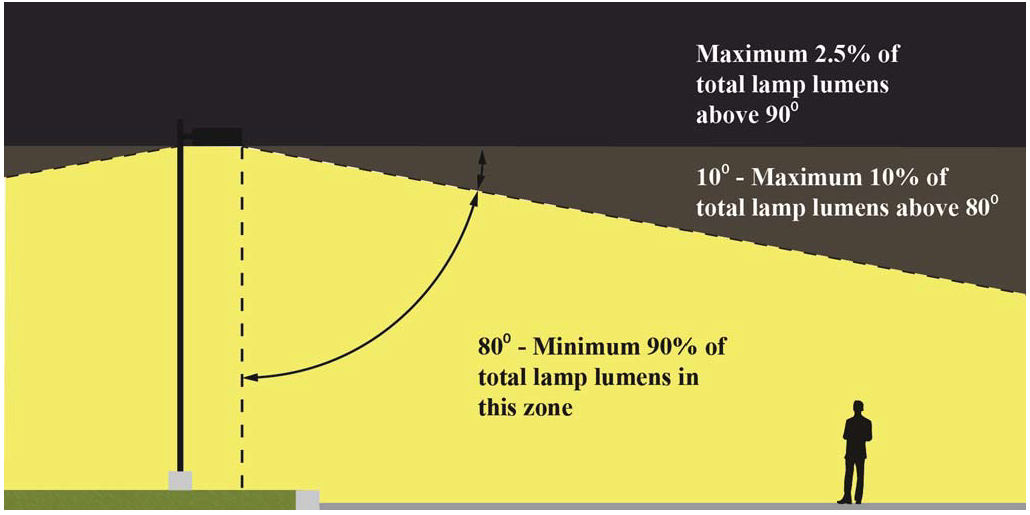
Example of Lighting Trespass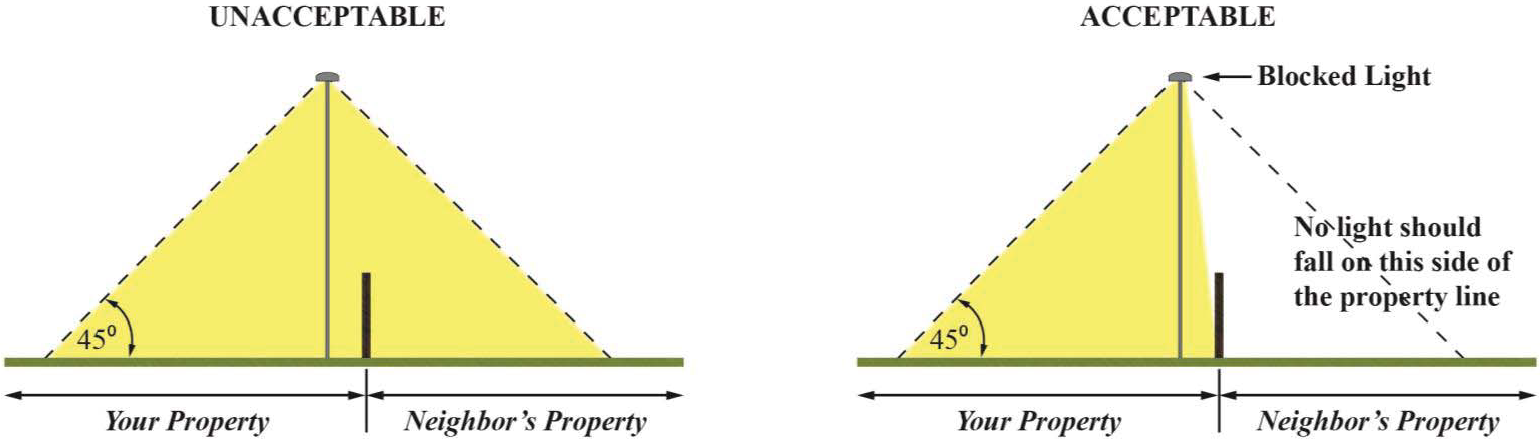
Examples of Acceptable/Unacceptable Lighting Fixtures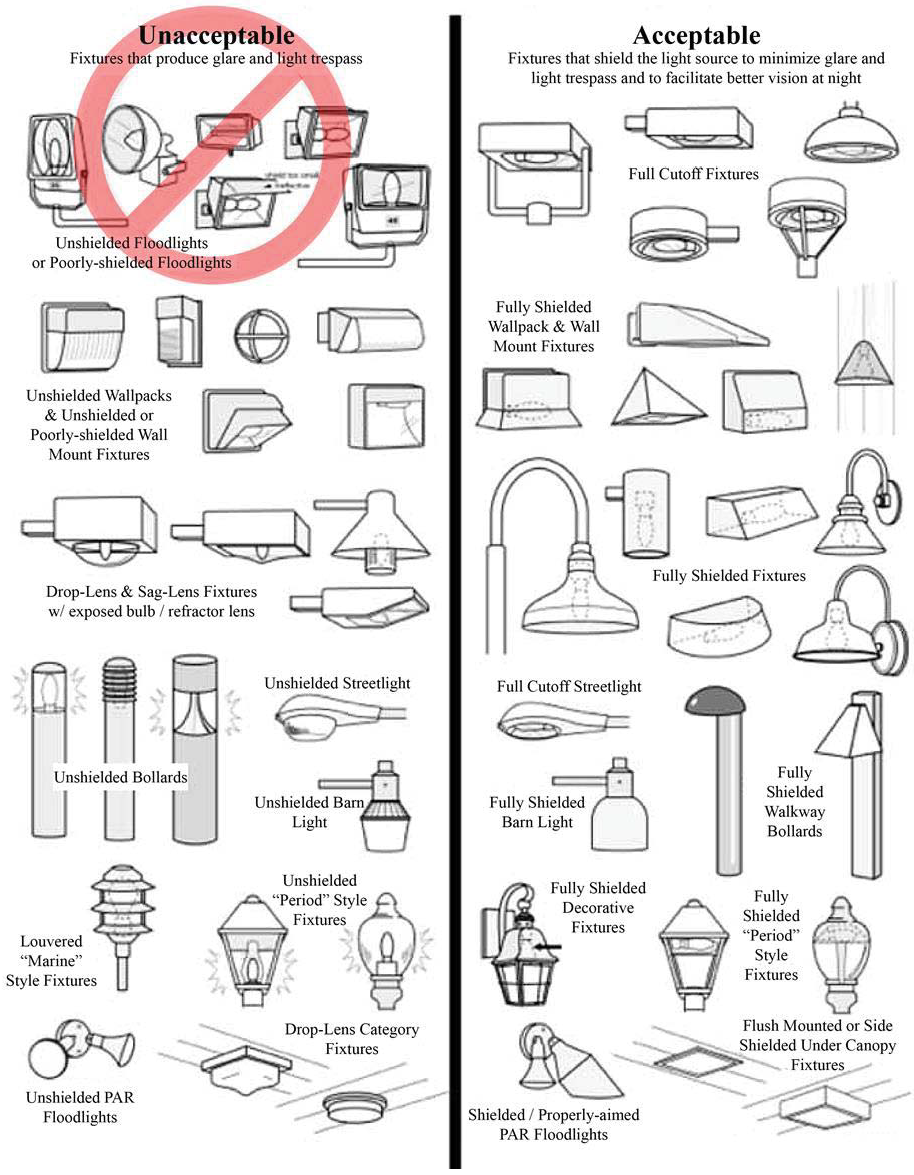
Example of Unacceptable Up-lighting and Acceptable Down-lighting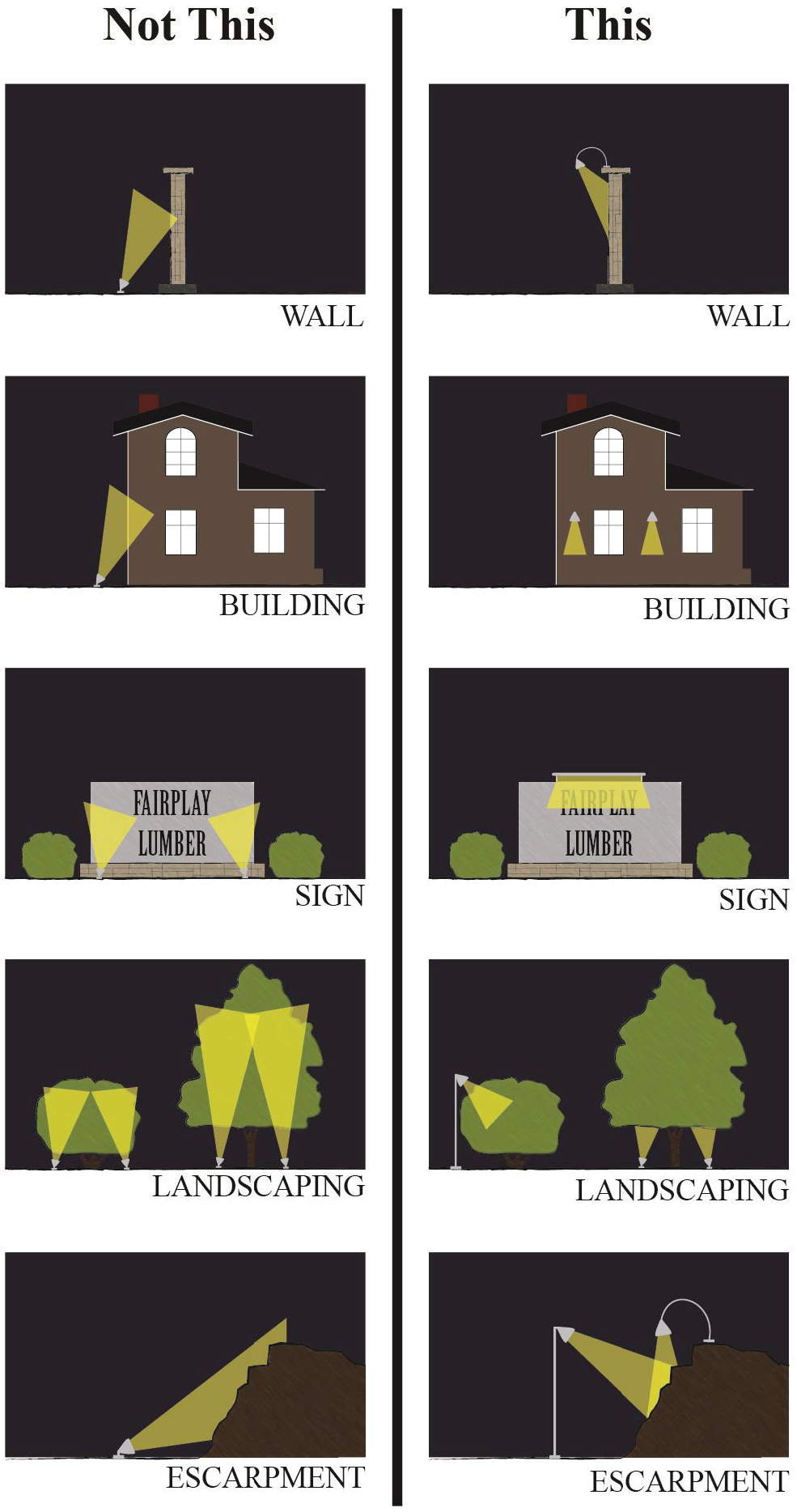
(Ord. 2015-3, §1, 1-4-2016)

