
Farmersville City Zoning Code
CHAPTER 17
80 - OFF-STREET PARKING
Sections:
17.80.010 - Purpose.
To provide reasonable requirements and standards for off-street parking in amounts related directly to the type of land use in order to provide customers and employees with adequate parking facilities.
(Ord. 319 § 1(part), 1987)
17.80.020 - Off-street parking requirements.
Off-street parking shall be provided in connection with the erection, addition, alteration, expansion or change of use of any building or structure in the following amounts:
A.
Single-Family Attached, Single-Family Detached and Duplex Dwellings. Two covered paved parking spaces for each new dwelling unit. (See subsection I of Section 17.80.040 for federally assisted housing projects.)
B.
Apartments and Multiple-Family Dwellings. One and one-half covered paved parking spaces for each apartment. Plus one paved guest parking space for each three units. Two covered paved parking spaces for each duplex unit.
C.
Boarding and Rooming Houses, Group Quarters.
One paved parking space for each two beds, but not less than two spaces.
D.
Qualified Senior Citizens Housing. One covered, paved parking space for each two dwelling units. (See subsection H of Section 17.80.040.)
E.
Emergency Shelters. One parking space for every ten beds, plus one space per employee on the maximum shift.
F.
Special housing types including "Supportive Housing", "Transitional Housing" and "Single Room Occupancy Units". One parking space per unit, plus one space per employee on the maximum shift.
G.
Bowling Alleys. Five paved parking spaces for each lane.
H.
Day Care Centers. One paved parking space for each employee.
I.
Hotels, Motels and Apartment Hotels. One paved parking space for each quest room plus two paved parking space for the manager.
J.
Medical and Dental Offices and Clinics. Five paved parking spaces for each doctor, plus one paved parking space for each three hundred square feet of lab, x-ray and similar specialty areas, plus one paved parking space for each employee.
K.
Nursing and Convalescent Homes, Hospitals and Sanitariums. One paved parking space for each four beds.
L.
Offices (Except Medical Offices and Clinics).One paved parking space for each three hundred square feet of gross floor area, but not less than five spaces.
M.
Public Assembly With Fixed Seating. One paved parking space for each four seats.
N.
Private and Parochial Schools.
1.
Elementary and Junior High Schools. One paved parking space for each employee, plus:
a.
Five visitor paved parking spaces if enrollment is one hundred students or less.
b.
Ten visitor paved parking spaces if enrollment is more than one hundred students.
2.
Senior High Schools. One paved parking space for each employee plus two paved parking spaces for each five students plus visitor paved parking spaces.
O.
Public Assembly Without Fixed Seating. One paved parking space for each fifty square feet of assembly area.
P.
Restaurants—Drive-in, Fast Food, Self-Service and Take Out. One paved parking space for each two hundred-fifty square feet of gross floor area, but not less than five spaces, plus one paved parking space per employee.
Q.
Restaurants-Cafes and Coffee Shops (Except Those Listed in "N" Above), Bars and Other On-Sale Liquor Establishments. One paved parking space for each four seats, but not less than five spaces, plus one paved parking space per employee.
R.
Auto Repair, Service Stations, Personal Service Businesses and Other Non-Retail Commercial. One paved parking space for each three hundred square feet of gross floor area, but not less than five spaces, plus one paved parking space per employee.
S.
Retail Stores, Banks and Shopping Centers. One paved parking space for each three hundred square feet of gross floor area, except storage and loading areas, but not less than five spaces plus one paved parking space per employee.
T.
Industrial, Manufacturing, General Storage, and Warehousing. One and one-half paved parking spaces for each two thousand square feet of gross floor area or one and one- half paved parking spaces for each two employees on duty at the same hours, whichever will provide the greater number of parking spaces.
U.
Mini-Storage. One paved parking space for each fifty storage units, but not less than five spaces.
V.
Tennis and Racquetball Courts. Four paved parking spaces for each court.
W.
Off street parking and loading requirements for mixed uses and uses not listed above shall be determined by the zoning administrator.
(Ord. 319 § 1(part), 1987)
(Ord. No. 451, § 4, 7-11-2011)
17.80.030 - Truck loading and unloading space.
Every building or structure used for commercial (except offices), industrial or service uses, or any other building where goods are received or shipped, shall be provided with truck loading and unloading space as follows:
A.
One permanently maintained truck loading and unloading space for buildings having a gross floor area of seven thousand square feet or more, plus one additional space for each additional twenty thousand square feet or major fraction thereof.
B.
Each loading space shall be not less than ten feet in width, twenty-five feet in length and fourteen feet in height.
C.
Loading space, exclusive of driveway and/or corridors leading thereto shall be in addition to required parking space.
D.
Industrial, commercial and office condominiums having need for only occasional receiving or shipping of goods may use a portion of the driveway or parking area for temporary loading and unloading.
(Ord. 319 § 1(part), 1987)
17.80.040 - Special provisions.
A.
Additions and Conversions. Any building or structure which is enlarged, remodeled or converted to another use shall be provided with off-street parking in the amount required for that enlarged, remodeled or converted building or use. If the addition, alteration, remodeling or conversion requires an increase in off-street parking spaces of ten percent or less, no additional off-street parking shall be required. Only one such addition, alteration, remodeling or conversion shall be exempt from the additional parking required by this section. Existing off-street parking facilities shall not be eliminated nor reduced to any amount less than that required for new buildings or structures.
B.
Bicycle Parking. Bike spaces shall be provided at locations and in amounts to be determined by the planning director. One car space may be omitted for each eight bike spaces up to five percent of the required number of parking spaces in parking lots for commercial and industrial uses only.
C.
Compact Car Parking. The percentage of compact spaces permitted, subject to the approval of the planning director, may vary from twenty percent to forty percent depending upon whether the parking is short term or long term. (See subsection B of Section 17.80.070)
D.
Day Care Center and School Passenger Loading.
1.
Less Than One Hundred Student Enrollment.
a.
Day care centers shall be provided with one off-street passenger loading and unloading space for each ten students, but not less than two spaces.
b.
Schools shall be provided with one off-street passenger loading and unloading space for each five students, but not less than two spaces.
2.
More Than One Hundred Student Enrollment. Off- street passenger loading and unloading requirements shall be determined by the planning director on a case-by-case basis.
E.
Fractional Spaces. When calculations determining the number of required parking spaces result in a fractional space, any fraction over one-half shall require one additional parking space.
F.
Handicapped Access and Parking. Access and parking for the handicapped shall conform to the requirements of Chapter 2-71, Title 24, California Administrative Code.
G.
Moved Buildings and Structures. Any building or structure which is moved from one lot to another shall be provided with off-street parking in the amount required for a new building or structure as required by this chapter.
H.
Qualified Senior Citizens Housing Parking Requirements. Required off-street parking for senior citizens housing developments may be reduced to one paved parking space for each three dwelling units if the project is owned by a public agency, a charitable organization, or is financed by one of the various programs specifically designated for senior citizens housing and committed to said program for a minimum of twenty-five years. Conversion of senior citizens housing to standard housing will not be permitted unless additional off-street parking is provided to comply with the parking requirements for standard housing in effect at the time of conversion.
I.
Federally Assisted Housing Projects. Required off- street parking for federally assisted housing projects may be reduced to one covered paved parking space, plus one uncovered paved parking space to be located off-street and outside of front and sideyard setbacks.
J.
Alterations. The zoning administrator may waive or modify parking requirements as provided in this chapter.
(Ord. 319 § 1(part), 1987)
17.80.050 - Location of off-street parking and loading facilities.
A.
Each required off-street parking facility shall be located on the same property as the land use it is intended to serve, except as otherwise permitted in the Commercial Land Use Table, Chapter 17.56.
B.
Backing onto a public street shall not be permitted except for driveways and off-street parking areas serving dwelling structures of three units or less on one parcel of land.
C.
Locations of all parking, loading and unloading facilities are subject to the approval of the planning director.
(Ord. 319 § 1(part), 1987)
17.80.060 - Development and repair of off-street parking areas.
Every off-street parking area shall be constructed as follows:
A.
Parking Area Improvements-Generally. Paving, grading and other parking area improvements shall conform to the city of public works requirements and this title.
B.
Submittal. In addition to the requirements of Section 17.76.020, plans shall show parking stalls, driveways, other paved areas and provisions for on-site drainage.
C.
On-Site Drainage. At locations where street drainage facilities are inadequate, do not exist or where unusual topographic conditions exist, the city engineer may specify such on-site drainage measures as he deems necessary to adequately dispose of the drainage water.
D.
Alternate Parking Area Surfaces. Gravel, turf blocks and other parking area surfaces which eliminate dust may be approved by the planning director and/or the city engineer.
E.
Repairs and Repaving. Compliance with the provisions set forth in this section shall not be required for the repairing or repaving of an existing parking area. A gravel surfaced parking area, unless previously approved as such, shall not be considered a paved area and does not qualify for this exemption.
F.
Reduction in Landscaping or Parking Spaces. When, in the reconstruction or repair of an existing parking area, compliance with this chapter and/or Chapter 17.76 is required and such compliance would result in a reduced number of parking spaces, the zoning administrator may grant a variance in the required number of parking spaces, required landscape area, or both.
G.
Fencing. Any portion of an off-street parking area which abuts a residential zone shall be screened by a solid wood or masonry fence or wall not less than six feet in height, except within the front setback area where the fence shall be no higher than three feet. (See subsections K, L and M of Section 17.76.020.)
H.
Other Uses. Parking areas shall be used for vehicle parking only with no sales, dead storage, repair work, dismantling or servicing of any kind permitted.
(Ord. 319 § 1(part), 1987)
17.80.065 - Compliance with Farmersville Design Guidelines.
All new parking facilities shall comply with the Farmersville Design Guidelines.
(Ord. No. 464, §§ 20, 21, 7-28-2014)
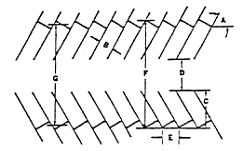
17.80.070 - Off-street parking area dimensions.
All off-street parking facilities required by this chapter shall conform with the following dimensions:
Parking Lot Dimension Table
Dimensions in Feet
(19 ft. stall depth)
* Two-way aisle.
Eight by sixteen compact space typical:
(Ord. 319 § 1(part), 1987)

