
Farmersville City Zoning Code
CHAPTER 17
84 - SIGNS
Sections:
17.84.010 - Purpose.
The purpose of this chapter is to establish procedures for regulating signs, including the type, size, location and construction standards of signs by zone district. Signs have an obvious impact on the character and quality of the city. As a prominent part of the visual environment, they attract or repel the viewing public, affect the safety of vehicular traffic and their suitability or appropriateness helps to set the tone of the neighborhood. The objectives of this chapter include the following:
A.
To reinforce that the sign should serve primarily to identify the general nature of an establishment or to direct attention to a project, activity, place, person, organization, or enterprise.
B.
As identification devices, signs must not subject the citizens of the city to excessive competition for their visual attention. As appropriate identification devices, signs must harmonize with the building, the neighborhood, and other signs in the area.
C.
The city of Farmersville intends to encourage the installation of signs that improve the appearance of the property and the neighborhood and to enhance the economic effectiveness of signs.
D.
The provisions in this section provide standards to safeguard life, health, property, and public welfare in keeping with the character of the city of Farmersville by regulating the size, height, structural design, quality of materials, construction location, electrification, illumination and maintenance of all types of signs and sign structures.
E.
The provisions in this chapter present criteria indicating whether or not signs conform to the above intentions of suitability and safety.
(Ord. 438 § 1(part), 2007)
17.84.020 - Definitions.
As used in this chapter, the following items are defined in this section. Some terms are illustrated in Exhibits 1 and 2.
"Advertising structure" means any notice or advertisement, pictorial or otherwise, and all such structures used as an outdoor display, including billboards, regardless of size and shape, for the purposes of making anything known, the origin or place of sale of which is not on the property with such advertising structure.
"A-frame sign." See "Sandwich board sign."
"Aggregate area" means the total area of all permanent signs on the premises.
"Alley-side sign" means a sign placed on the wall of a building that faces onto or abuts a public alley.
"Animated sign" means a sign with action or motion, whether by flashing lights, color changes, wind, rotation, movement of any parts of the sign or letters or parts of the sign structure, or other motion.
"Awning sign" means a sign applied to an awning or canopy that is attached to a building.
"Banner" means any cloth, bunting, plastic, paper, or similar material attached to, or appended on or from any structure, staff, pole, line, or framing upon which there is an advertising message.
"Building front" means the wall of the business with the primary public entrance.
"Canopy sign." See "Awning sign."
"Changeable copy sign" means a sign or portion thereof with characters, letters, or illustrations that can be changed or rearranged without altering the face or the surface of the sign. A sign on which the only copy that changes is an electronic or mechanical indication of time or temperature shall be considered a "time and temperature" sign and not a changeable copy sign for purposes of this chapter.
"Copy" means any graphic, letter, numeral, symbol, insignia, text, sample, model, device, or combination thereof which relates to advertising, identification, or notification.
Exhibit 1: Selected Sign Definitions
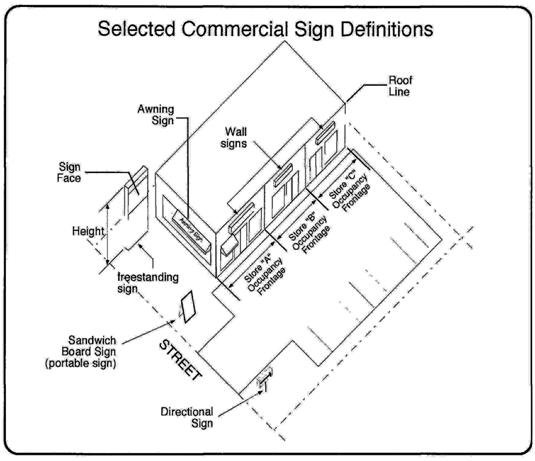
"Directional sign" means signs giving only information and direction to the viewer and containing no advertising message.
"Directory sign" means a sign typically used to list individual businesses in a multi-tenant complex or center.
"Externally illuminated sign" means a sign which has light cast on its surface from an artificial exterior source installed for the purpose of illuminating the sign.
"Freestanding sign" means a sign which is supported by one or more columns, uprights, or braces in or upon the ground.
"Freeway-oriented sign" means, for the purposes of this chapter, any sign that is designed to be visible from at least one direction of State Highway 198 Freeway. This type of sign is permitted only on commercially- or industrially-zoned properties that front directly onto the freeway right-of-way, or which front onto a frontage road that abuts the freeway right-of-way immediately adjacent to the subject site.
"Height of sign" means the vertical distance from the uppermost point used in measuring the area of a sign to ground level of the foundation of the sign.
"Internally illuminated sign" means any sign whose illumination originates from within the structure of the sign and the source of which is not visible from the exterior of the sign.
"Nonconforming sign" means any sign which was lawfully erected or maintained prior to the time of adoption of the ordinance codified in this title.
"Occupancy frontage" means a single lineal dimension measured horizontally along the front of a building which defines the limits of a particular occupancy at that location and which has direct pedestrian access through an exterior wall which is visible from the public right-of-way.
"Off-premises signs and billboards" means any sign not located on the same lot or project site as the use, product, or service it advertises.
"Open air use" means a use (such as vehicle sales) where merchandise or products are displayed or dispensed in the usual course of business from an open lot and not within an enclosed structure.
"Pedestrian access" means a doorway which has been designed for the primary use of the patrons or customers of that commercial use.
"Pedestrian-oriented sign" means a sign which is specifically located and designed to be viewed from a pedestrian right-of-way.
"Pennant" means series of lightweight plastic, fabric, or other materials, suspended from a rope, wire, or string designed to move in the wind. Pennants shall not include banners as defined in this chapter or individual flags mounted on a single pole.
"Political sign" means a sign advertising a candidate for political office, a political party or a measure scheduled for an election.
"Portable sign" means a sign which is capable of being carried or moved by manual or mechanical means from one location to another and which is not affixed to the ground, a structure, or a vehicle.
"Projecting sign" means a sign that projects from and is supported by a wall or a facade of a building and are also referred to as marquee signs.
"Reader board" means a sign indicating the name, address and type of business of the businesses within a building.
"Roof line" means the highest point of a parapet wall or the main roof structure or a highest point of a parapet wall other than such architectural features as cupolas, pylons, projections or minor raised portions of the roof.
"Roof sign" means a sign erected upon or above a roof or parapet of a building.
"Sandwich board sign" means a portable sign with advertising messages mounted on two surfaces with two edges connected and the other two edges spread so that the two faces read from different directions.
"Setback area" means the open space area defined in the Farmersville Municipal Code in Sections 17.08.416 through 17.08.428 under the term yard, and where applicable, includes the definitions of yard, rear; yard, front; and yard, side; as defined in said title.
"Shopping center" means a group of two or more commercial uses planned and designed to function as an integral unit on a single parcel of contiguous parcels and which utilize common off-street parking and access, landscaping, loading facilities and points of ingress and egress.
"Sign" means any words or symbols used for visual communication including its structure and component parts intended to be used to attract attention to an activity.
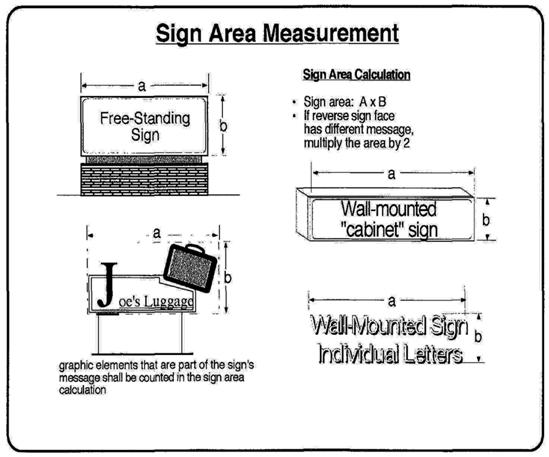
"Sign area" means the geometric area of a sign including all elements such as board or frames, perforated or a solid background, ornamental embellishments, arrows or other sign media. The area of individual signs shall be measured as follows (see also Exhibit 2):
1.
Sign Faces Counted. Where a sign has two faces containing sign copy, which are oriented back to back and separated by not more than twenty-four inches at any point, the area of the sign shall be measured using one sign face only.
2.
Wall-Mounted Letters. Where a sign is composed of letters individually mounted or painted on a building wall, without a border or decorative enclosure, the sign area is that of the smallest area of a rectangle within which all letters and words can be enclosed.
3.
Three-Dimensional Signs. Where a sign consists of one or more three-dimensional objects such as balls, cubes, clusters of objects, or sculptural or statute-type trademarks, the sign area shall be measured as the area of the smallest rectangle within which the object(s) can be enclosed, when viewed from a point where the largest area of the object(s) can be seen.
Exhibit 2: Sign Area Measurement
"Sign copy" means any words, letters, numbers, figures, designs, or other symbolic representations incorporated into a sign face and/or its structure with the purpose of attracting attention to the subject matter.
"Sign face" means the panel surface of a sign which carries the advertising or identification message.
"Sign structure" means any structure which supports or is capable of supporting any sign. A sign structure may or may not be an integral part of a building. For the purpose of a freestanding sign, the sign structure shall include the aggregate area of the sign including the sign copy and all structural elements of the sign.
"Site" means the length of a site along the street or other principal public thoroughfare, but not including such a length along an alley, watercourse, railroad or freeway.
"Special events sign" means any sign advertising specific temporary events, such as carnivals, festivals, exhibits, and parades, but not including promotional sales or grand opening signs.
"Structural alteration" means any change to the sign structure.
"Subdivision" or "multiple housing entrance sign" means a sign identifying the name of a subdivision or multiple housing projects and consisting of letters or symbols attached to a wall or a fence or freestanding sign located within the boundaries of a recorded and developed subdivision or multiple housing projects.
"Temporary sign" means a sign, other than a portable sign, which is not permanently affixed to either real property or any real property improvement.
"Temporary subdivision sign" means a sign erected and maintained within the boundaries of a recorded subdivision and indicating the name of the subdivision, the name of the contractor and/or sub-divider, the name of the owner and/or agent, and giving information regarding directions, price or terms concerning the sale or lease of parcels within the subdivision.
"Wall sign" means a sign attached to or erected against the wall or facade of a building or structure with the exposed face of the sign in a plane parallel to the plane of the wall or facade.
"Wind sign" means any display of streamers, pennants, whirligigs or similar devices made of flexible lightweight material, strung together or attached in such a manner as to move by wind pressure.
"Window sign" means a sign mounted within or on a window.
(Ord. 438 § 1(part), 2007; Ord. No. 486, § 3, 5-14-2018)
17.84.030 - Applicability.
No sign shall be erected, placed, established, painted, created, or maintained in the city which is not in conformance with the standards, procedures, and other requirements of these provisions. All signs erected within the city boundaries shall be subject to the sign application procedures within these provisions. The regulations in this chapter are in addition to those set forth in the California Building Code, the California Electrical Code and the 1997 Uniform Sign Code, as adopted, and any amendments made thereto by the city, and the nuisance provisions in the Farmersville City Code.
(Ord. 438 § 1(part), 2007)
17.84.040 - Standards by zone districts.
Signs permitted by zone district are listed as follows:
A.
Residential (R-1, R-M), U-R (Urban Reserve), O-S (Open Space) and P-QP (Public Quasi-Public) zone districts.
Unlighted signs and other commercial advertising shall be permitted in residential districts only as provided in this section.
1.
Name plates shall be permitted subject to the following conditions:
a.
Maximum Size. Two square feet.
b.
Content. Name plates may display the following information:
i.
Name of the premises upon which it is displayed;
ii.
Name of the owner or lessee of the premises;
iii.
Address of the premises;
iv.
Nature of a home occupation engaged in on the premises;
v.
Private information such as "beware of dog" or "no solicitors," that does not contain an advertising message.
c.
Placement. Name plates shall be affixed flush to the subject building.
2.
"For Rent" and "For Sale" signs shall be permitted. Not more than two such signs, not exceeding a total of six square feet (aggregate) in area, shall be permitted on any lot or parcel.
3.
For subdivisions, apartment complexes and mobile home parks, churches and other permitted institutional uses, no more than one sign shall be erected at any entrance to the development. Signs shall not exceed thirty-five square feet for all readable surfaces, nor exceed four feet in height.
B.
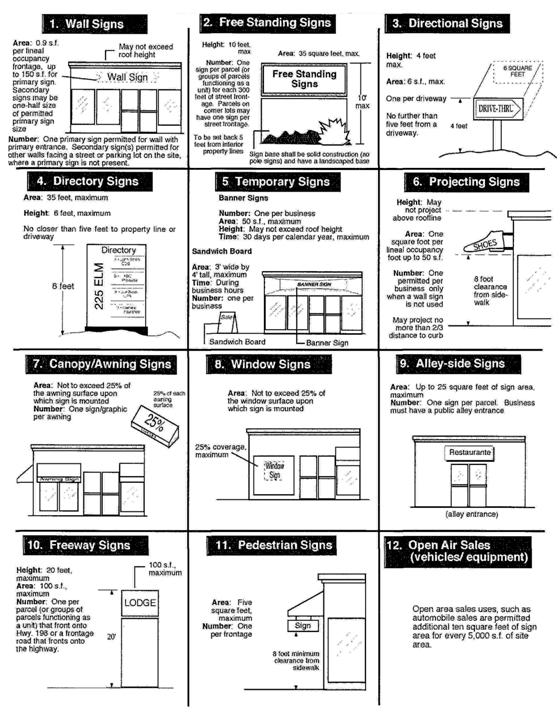
Commercial and Industrial Zone Districts (C-G, C-C, C-H, C-S, I). The following signs are permitted for each business in commercial and industrial districts (see also Exhibit 3 for graphic illustration of standards for various sign types). For multi-tenant shopping centers or office parks containing three or more individual uses, a coordinated sign program shall be submitted for review and approval by the planning director.
Exhibit 3: Selected Commercial Sign Standards
1.
Wall Signs.
a.
Number of Signs per Business. The number of wall signs permitted per business or parcel is as follows:
i.
One primary wall sign is permitted on the wall with the primary public entrance to the business. For businesses with more than one entrance, only one entrance shall be counted as the primary entrance.
ii.
Where the site abuts a public street and the primary wall sign is on a wall not facing the street, a secondary wall sign is permitted on the wall facing the street.
iii.
If the site has a parking lot and a building wall faces the parking lot and that wall does not have a wall sign permitted under subsection (B)(1)(a)(i) or (B)(1)(a)(ii) above, a secondary wall sign is permitted on the wall facing the parking lot. Not more than one such parking lot sign is permitted.
iv.
For businesses fronting onto a public alley, one alley wall sign is permitted for the wall that faces onto the alley.
b.
Calculation of Wall Sign Area.
i.
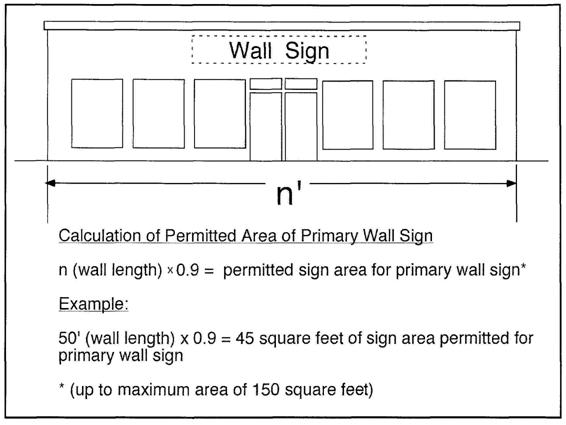
For a primary wall sign, one square foot of sign area is permitted for each foot of linear occupancy frontage, as shown in Exhibit 4, up to a maximum of one hundred fifty square feet of sign area, whichever is less. Notwithstanding this regulation, all businesses shall be permitted a minimum of twenty-five square feet of primary wall sign.
ii.
Where a secondary wall sign is permitted, the maximum sign area shall be one-half the permitted sign area of a primary sign.
iii.
For an alley wall sign, the maximum sign area shall be twenty-five square feet.
iv.
For multi-tenant buildings, each tenant shall be permitted one sign mounted on the wall with the primary entrance, except for corner units which may be permitted a primary wall sign and a secondary wall sign.
c.
Maximum Height. Not to exceed the top of the vertical wall surface on which the sign is mounted. Signs mounted on a pitched roof may not extend the peak of the ridge line of the roof. No sign is permitted on the top of a flat-roofed structure.
d.
Permit. A sign permit shall be obtained for all wall signs, consistent with the procedure outlined in Section 17.84.110 of this chapter.
Exhibit 4: Permitted Wall Sign Area
2.
Freestanding Signs.
a.
Maximum Height. Ten feet.
b.
Maximum Area. Thirty-five square feet per sign face.
c.
Sign Design. Freestanding signs shall be designed as a monument sign with a solid base extending the entire height of the sign.
d.
Number per Parcel. One freestanding sign is permitted per parcel (or collection of parcels functioning as a single integrated development) for each one thousand feet of street frontage, or fraction thereof, except that parcels with frontage on more than one public street shall be permitted one freestanding sign for each one thousand lineal feet of frontage (or fraction thereof) on each street.
e.
Setbacks. A freestanding sign shall be set back a minimum of five feet from any interior side property line. Encroachment into a setback may be permitted by the planning director where the location of existing improvements presents a functional hardship in compliance with the required setback.
f.
Landscaping. All freestanding signs shall be surrounded by landscaping of an area at least twice the size of one side of the sign structure.
g.
Permit. A sign permit shall be obtained for all freestanding signs, consistent with the procedure outlined in Section 17.84.110 of this chapter.
3.
Directional Signs.
a.
Maximum Height. Four feet.
b.
Maximum Area. Six square feet.
c.
Number per Site. One per driveway from a public street.
d.
Location. Directional signs shall be placed within five feet of a driveway that accesses the site from a public street. Placement of directional signs shall ensure the sight safety of vehicles entering/leaving a site is not compromised.
e.
Permit. A sign permit shall be obtained for all directional signs, consistent with the procedure outlined in Section 17.84.110 of this chapter.
4.
Directory Signs.
a.
Number per Site. One per public vehicle and/or pedestrian entrance to the site.
b.
Maximum Area. Thirty-five square feet.
c.
Maximum Height (if freestanding). Six feet.
d.
Location. No directory sign which is a freestanding sign may locate closer than five feet to any neighboring property line or closer than three feet to any point of ingress/egress.
e.
Permit. A sign permit shall be obtained for all directory signs, consistent with the procedure outlined in Section 17.84.110 of this chapter.
5.
Temporary/Portable Signs.
a.
Banners.
i.
Number of Signs. One banner sign is permitted per business.
ii.
Maximum Height. Not to exceed roof line of nearest building or building affixed to but in no case higher than thirty feet. Banner signs shall not be attached to existing freestanding signs.
iii.
Maximum Area. Fifty square feet.
iv.
Permitted Time. Banner signs may not be utilized for more than thirty days per calendar year. The banner shall include a date visibly noted on the sign and be removed within thirty days of the posted date.
v.
Temporary signs used to identify a business shall be removed within thirty days and replaced with a permanent sign.
vi.
Permit. A sign permit shall be obtained for all banner signs, consistent with the procedure outlined in Section 17.84.110 of this chapter.
b.
Sandwich Board Signs.
i.
Maximum Height and Width. Three feet wide and four feet tall, maximum.
ii.
Maximum Area. Twelve square feet.
iii.
Number per Business. One.
iv.
Location. May be placed on the business site as long as conflicts with vehicle safety are not caused. May also be placed on the public sidewalk adjacent to the business with approved encroachment permit, but must permit a minimum of four feet of passage area on sidewalk.
v.
Permitted Display Time. During business hours.
vi.
Permit. A sign permit shall be obtained for all sandwich board signs, consistent with the procedure outlined in Section 17.84.110 of this chapter.
c.
Changeable Message Signs. A business that enters into an agreement with the city to not use temporary signs may be permitted a changeable message sign to be incorporated into its freestanding monument sign, or as a building wall sign, provided that the overall sign area for the business is not increased (see Exhibit 3).
d.
Feather signs.
i.
Number of signs. One feather sign is allowed per business. Businesses with frontage on more than one public street are allowed one feather sign per street frontage.
ii.
Maximum height. Feather signs shall not exceed twelve feet in height.
iii.
Maximum area. Feature signs shall not exceed twenty-four square feet in area.
iv.
Permitted Time. During business hours only
v.
Location. May be located anywhere on the site as long as conflicts with vehicle safety and visibility are not caused.
6.
Projecting Signs.
a.
Maximum Height and Projection. Not to exceed roof line of wall or structure to which projecting sign is attached. (Note: Bottom of sign shall be a minimum of eight feet from ground to provide proper clearance.)
b.
Number per Business. One, but a projecting sign is permitted only where a wall sign is not used on the same wall.
c.
Calculation of Area. 0.5 square foot of sign area for each lineal foot of building frontage of the business to which sign pertains.
d.
Maximum Area. Twenty square feet.
e.
Location. Projecting signs may extend over public rights-of-way including public sidewalks not to exceed two-thirds of the distance from the building face to which the sign is attached to the curb face of said sidewalk.
f.
Permit. A sign permit shall be obtained for all projecting signs, consistent with the procedure outlined in Section 17.84.110 of this chapter.
7.
Awning/Canopy Signs.
a.
Number of Signs. Where an awning is present, a sign may be affixed to the awning.
b.
Maximum Area. The area of signage on each surface of an awning shall not exceed twenty-five percent of the area of the individual surface.
c.
Location. Awning signs shall be made of removable materials such as individual cut-out letters and/or symbols attached, stenciled or otherwise placed on the canopy surface, and may be located on exterior surfaces of a canopy. Canopy signs shall be of color, size and design to harmonize with the color, size and design of the canopy on which they are placed.
d.
Permit. A sign permit shall be obtained for all canopy/awning signs, consistent with the procedure outlined in Section 17.84.110 of this chapter.
8.
Window Signs.
a.
Maximum Area. Up to twenty-five percent of the area of each individual window may be covered with a window sign or graphic. No permit is required for window signs.
9.
Alley-Side Signs.
a.
Number of Signs/Sign Area. Any building facing a public alley shall be permitted one alley-side sign with a maximum of twenty-five square feet of sign area. An alley-side sign may be in the form of either a wall sign, awning sign, or projecting sign.
b.
Height. Alley-side signs may not project above the wall on which they are mounted.
c.
Permit. A sign permit shall be obtained for all alley-side signs, consistent with the procedure outlined in Section 17.84.110 of this chapter.
10.
Freeway-Oriented Freestanding Signs.
a.
Maximum Height. Twenty feet.
b.
Maximum Area. One hundred square feet of sign copy per sign face.
c.
Number of Signs. Commercial parcels that front onto a freeway, or onto a frontage road abutting the freeway right-of-way are permitted one freeway-oriented freestanding sign. Businesses on adjoining parcels are encouraged to cluster signs on one freeway-oriented sign. Where a site located on a frontage road adjacent to a freeway would be permitted a separate freestanding sign and a second freestanding freeway-oriented sign, only one freestanding sign shall be permitted, subject to the height and area standards for freeway-oriented freestanding signs.
d.
Location. Limited to parcels adjacent to the State Highway 198 Freeway or to a frontage road that abuts the freeway right-of-way.
e.
Permit. A sign permit shall be obtained for all freeway-oriented signs, consistent with the procedure outlined in Section 17.84.110 of this chapter.
11.
"For Sale," "For Rent," or Similar Signs.
a.
Number of Signs. One sign shall be permitted per street frontage.
b.
Size. Thirty-two square feet, per sign.
c.
Height. Maximum of six feet.
d.
Permit. None required.
12.
Pedestrian Signs.
a.
Number of Signs. One pedestrian-oriented sign that projects or hangs above a sidewalk on each side of a building with a public entrance.
b.
Size. Each sign may be a maximum of five square feet in size and may hang or be suspended no lower than eight feet above grade level.
c.
Permit. A sign permit shall be obtained for all pedestrian signs, consistent with the procedure outlined in Section 17.84.110 of this chapter.
13.
Service Station Canopy Signs.
a.
Number of Signs. One sign is permitted on each canopy face.
b.
Size. Ten square feet, maximum per canopy face.
c.
Design. Additional graphic elements, such as color stripes associated with the particular brand shall not be permitted on service station canopies.
d.
Permit. A sign permit shall be obtained for all service station canopy signs, consistent with the procedure outlined in Section 17.84.110 of this chapter.
14.
Incidental Traffic Control Signage in Parking Lots Within Private Developments.
a.
Number of Signs and Size. As determined to be necessary by the city engineer.
15.
Special Uses Standards.
a.
Open Air Sales. In addition to the sign area permitted under this section, ten square feet of additional sign area is permitted for every five thousand square feet of site area for vehicle and large equipment sales operations. The additional signage may be used to increase the allowable area for wall signs and freestanding signs, except that height shall not be increased for freestanding signs.
b.
Drive-Through Menu Boards. No more than two drive-through menu/order boards are permitted for each food and/or beverage establishment featuring a drive-through. Each sign shall not exceed forty square feet and be no taller than eight feet.
(Ord. 438 § 1(part), 2007)
(Ord. No. 447-A, § 6, 7-27-2009; Ord. No. 462, § 17, 3-10-2014)
17.84.050 - Miscellaneous signs.
A.
Construction Project Signs. Construction project signs shall not exceed thirty-two square feet in area, and eight feet in overall height, unless legally required by governmental contract to be larger. One sign is permitted for each street upon which the construction site fronts. A construction project sign shall not require a sign permit and may exist no longer than the period of construction.
B.
Subdivision Advertising Signs.
1.
Time of Placement. Subdivision signs may require a sign permit and shall be permitted as long as some portion of the property advertised for sale remains unsold or up to two years in duration, whichever is less.
2.
Location. Subdivision signs may only be located on the premises which they advertise.
3.
Size and Number of Signs. No individual sign may exceed one hundred twenty square feet of area and be no taller than ten feet. No more than four separate signs are permitted on the grounds of each subdivision.
4.
Model Home Lots. Signs are permitted on the same lot with a model home provided they do not exceed four in number and ten square feet each in area. Signs shall be removed after the developer concludes the initial sale of the lots or homes to their initial owners.
5.
Permit. A sign permit shall be obtained for all subdivision signs, consistent with the procedure outlined in Section 17.84.110 of this chapter.
(Ord. 438 § 1(part), 2007)
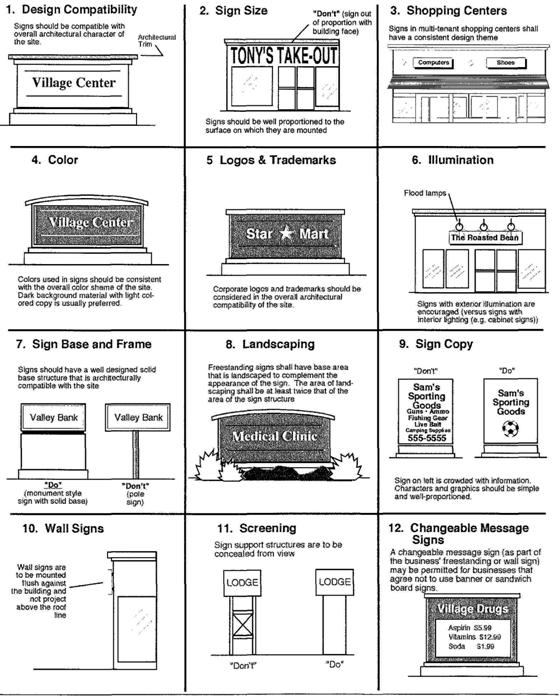
17.84.060 - Design criteria (see Exhibit 5 for illustrations of selected criteria).
A.
Design Compatibility. The design of all signs shall be compatible and harmonious with the colors, materials and architecture of the building and the immediate vicinity. Freestanding signs shall be finished with the same or compatible materials as the building on the site.
B.
Size. Notwithstanding applicable sign standards elsewhere in this chapter, sign size shall be proportionate to the size and scale of the site and building upon which the sign is proposed. Sign dimensions as specified in this chapter are maximum allowable dimensions; it may be necessary that signs be smaller than the maximum allowed in order to be proportionate in size and scale to achieve the design objectives of this section.
C.
Commercial and Industrial Center Signs. Individual tenant signs within multi-tenant centers shall be coordinated in size, location, materials and illumination.
D.
Color. Colors shall be used in coordinated groupings, and shall be compatible with those colors used in the building or project design. For cabinet-style signs, a dark sign background is preferred with light colored copy (characters/graphics).
Exhibit 5: Selected Sign Design Criteria
E.
Logos and Trademarks. The use of established corporate colors or logos shall not be prohibited by this section. When established corporate colors are incompatible with buildings colors, compatibility in design with the surrounding development should be accomplished through the use of appropriate background colors or other design features.
F.
Lighting Intensity. The light emitted or reflected by a sign, or emitted by a light source, shall be of reasonable intensity and shall be compatible with the architecture of the building and the immediate vicinity. Artificial light sources shall be shielded to prevent light spillage, glare or annoyance to persons on or inside adjoining properties or to public or private rights-of-way.
G.
Sign Bases and Frames. Freestanding signs shall be either housed in a frame, or set onto a base, presenting a solid, attractive, and well-proportioned appearance. The size and shape of the frame or base shall be proportionate to the size and mass of the sign and should be low-profile in design. Pole type signs are not permitted. Guy wires, angle irons, braces and other support or construction elements shall be screened or hidden from view.
H.
Landscaping. Freestanding signs shall be located in a landscaped area proportionate to the size of the sign, but not less than twice the size of one side of the sign face. Appropriate accent landscaping should be placed at the base of the sign.
I.
Sign Copy. Sign copy should be simple and concise without excessive description of services or products. On freestanding signs, sign copy should be designed to contribute to the design of the structure on which it is displayed. In all cases, freestanding sign design and sign copy should be coordinated to provide an attractively designed freestanding element which identifies the development or project.
J.
Wall Signs. Building signs should be mounted flush against the building, and shall not project above the roof ridge or the top of the parapet.
K.
Maintenance. All signs and their supporting members shall be kept in good repair and maintained in good structural condition at all times.
L.
Design Quality. All signs shall be professionally designed and manufactured. Signs that utilize hand-made lettering or elements should be avoided.
(Ord. 438 § 1(part), 2007)
17.84.070 - Prohibited signs and locations.
Prohibited signs are as follows:
A.
Any sign mounted or attached to a vehicle parked for the purpose of calling attention to or advertising a special business establishment;
B.
Any sign or sign structure which has become a public nuisance due to inadequate maintenance, dilapidation, or abandonment;
C.
Any sign which obstructs in any manner the ingress to, or egress from, a door, window, fire escape, or other access way required by building codes adopted by the city of Farmersville;
D.
Any sign unlawfully installed, erected, or maintained;
E.
Any sign now or hereafter existing which no longer advertises a business conducted or a product sold as prescribed in this chapter;
F.
Any sign which encroaches into any city right-of-way and/or easement, except an approved pedestrian, canopy, wall sign or projecting sign;
G.
Any sign that flashes, blinks, moves, changes color, appears to change color, changes intensity, or contains any part of attachment which does the same except that standard barber poles, time and temperature signs and approved bulletin board signs shall be permitted in commercial and industrial zones if otherwise in compliance with these provisions;
H.
Any unofficial sign, signal or device, or any sign, signal or device which purports to be or is an imitation of, or resembles an official traffic sign or signal, or which attempts to direct the movement of traffic, or which hides from view any official sign or signal;
I.
Any light of any color of such brilliance as to blind or impair the vision of drivers upon any roadway. Further, no light shall be placed in such a position as to prevent the driver of a vehicle from readily recognizing any traffic sign or signal;
J.
Any sign located so that it interferes with visibility at an intersection, public right-of-way, driveway, or other ingress/egress;
K.
Any sign located or displayed on or over public property except as expressly permitted by these provisions, unless approved by the city council;
L.
Any sign attached to a tree;
M.
Any roof-top mounted sign;
N.
Blimps, balloons or other forms of aerial advertising;
O.
Any sign erected or maintained which has less horizontal or vertical clearance from communication lines and energized electrical power lines than that prescribed by the state, or rules and regulations duly promulgated by agencies thereof;
P.
Off-site signs, advertising structures and billboards;
Q.
Portable signs, other than approved banners and sandwich board signs, except for temporary signs for community events as provided for in Section 17.84.080(G);
R.
Any sign which, in the opinion of the zoning administrator, is in conflict with the spirit or intent of this chapter.
S.
Each temporary sign within any residential zone which is in violation of federal, state or local law, which may include common law and/or any duly enacted statute, ordinance, regulation or rule of any legislative body or governmental agency with proper jurisdiction. Such temporary sign shall constitute a public nuisance which may be abated in accordance with any authority granted under the Farmersville Municipal Code or applicable state law.
(Ord. 438 § 1(part), 2007; Ord. No. 486, § 4, 5-14-2018)
17.84.080 - Exempted signs.
The following signs and devices shall not be subject to the provisions in this chapter:
A.
Signs placed by a governmental body or public utility, required to be maintained by law;
B.
Memorial tablets or plaques placed by recognized historical agencies;
C.
Flags of the national or state government;
D.
Traffic or other signs of government agencies, signs required by law or contract with a governmental agency, railroad crossing signs, legal notices, and such temporary emergency or non-advertising signs as may be authorized by the city council;
E.
Decorations or window signs to celebrate nationally recognized holidays and local celebrations;
F.
Temporary signs not utilized in connection with a commercial land-use which comply with each and all of the following requirements:
1.
The temporary sign must be located upon a lot or parcel which is privately owned, with permission of the property owner.
2.
The total combined sign face area of all temporary signs upon any one parcel must not exceed thirty-two square feet.
3.
The temporary sign must not be attached to trees, rooftops or utility poles, but in accordance with said restrictions may only be posted or displayed from the yard, window, door, balcony, fences, or outside wall of a building.
4.
Temporary signs must not include nor utilize any artificial lighting device nor be constructed with reflective materials.
5.
A temporary sign or portion thereof must not be placed in, upon or over any public right-of-way or upon any city-owned property unless a valid encroachment permit is obtained.
(Ord. 438 § 1(part), 2007; Ord. No. 486, §§ 5, 6, 5-14-2018)
17.84.090 - Murals.
It is the intent of the city council, for purposes of promoting the local economy, tourism, and for further purposes of beautifying the city, to adopt standards regarding murals, their location and design.
A.
Location. Murals may be located on the sides of buildings and walls on property in any commercial, industrial or public/quasi-public zone district within the city of Farmersville.
B.
Mural Design Approval. Prior to painting, installation and execution of a mural, an application shall be submitted to the planning department. The application shall include a detailed drawing or sketch of the mural plus other details as prescribed on the application or deemed by planning department staff to be pertinent. The planning department shall forward the application, with a recommendation, to the planning commission. The commission shall review and approve, approve with modifications, or deny the application as submitted.
C.
Criteria for Design of Murals.
1.
The subject matter of the mural shall be of historical significance or community oriented regarding the growth and development of the city of Farmersville and its surrounding environs or be of such high quality as to be appropriate for. A mural shall not contain elements that advertise an existing business or product.
2.
The paint to be used shall be appropriate for use in an outdoor locale, for an artistic rendition and shall be of a permanent, long-lasting variety.
3.
The mural shall be designed and painted by qualified mural artists with sufficient knowledge in the design and painting of such projects.
4.
To the extent feasible, the mural shall be vandal and graffiti resistant.
D.
Planning Commission Review. A mural shall be processed consistent with the public hearing requirements of a conditional use permit (Chapter 17.96 of this title), including a public hearing before the planning commission.
E.
Appeal to City Council. Within ten days of the planning commission's decision on a mural, any interested party may appeal a decision of the planning commission regarding a mural application. The appeal must be in writing and must be received by the planning and building department within ten days of the action by the planning commission. Following public notice and public hearing, the appeal shall be considered by the city council. Action of the city council shall be considered final.
F.
Mural Design Amendment. Prior to amending an approved mural design (whether painted or not painted), an application for an amendment shall be submitted to the planning department. The application shall include a detailed drawing or sketch of the mural, plus other details as prescribed on the application or deemed by staff to be pertinent. The planning department shall forward the application, with a recommendation, to the planning commission. The commission shall review and approve, approve with modifications, or deny the application as submitted.
(Ord. 438 § 1(part), 2007)
17.84.100 - Nonconforming signs.
The lawful use of a sign existing on the effective date of the ordinance codified in this chapter, although such use does not conform to the provisions of this chapter, may be thus continued; provided, however, a nonconforming sign which has been abandoned, or the use for which it is advertised has ceased to function for a period of ninety days or more, shall be brought into conformity with the provisions of this chapter.
A.
No nonconforming sign shall in any manner (except for face changes) be structurally altered, reconstructed, or moved without being made to comply with the provisions of this chapter; however, nothing herein shall prohibit the painting, maintenance, or repairing of such sign, including the face and changing of copy.
B.
If, at any time, any sign in existence or maintained on the effective date of the ordinance codified in this chapter, which does not conform to the provisions of this chapter, is destroyed by fire, accident, explosion or act of nature to the extent of more than fifty percent of the value thereof, such sign shall be subject to all the provisions of this chapter. For the purposes of this chapter, the value of any sign shall be the estimated cost of replacement of the sign in kind as determined by the chief building official.
C.
The code enforcement officer or his/her designee shall immediately cause the removal of any sign which, in the judgment of the code enforcement officer or the public works director is found to be within the public right-of-way and/or easements and are found to place citizens in immediate peril, by any or a combination of the following methods using sound judgment under the circumstances:
1.
Removal or modification of said sign by city staff with business owner (or property owner if business has ceased operations) to be billed for time and materials;
2.
Notification orally or in writing to the business owner causing the removal of said signs within a twenty-four hour period or lesser period of time, as prescribed by the code enforcement officer;
3.
Immediate citation of the business owner (or property owner if business has ceased operations) or party responsible for said sign.
D.
Any business that has ceased operations for at least thirty days shall remove all temporary signs and all window signs.
(Ord. 438 § 1(part), 2007)
17.84.110 - Administration.
Except for where otherwise stated in this title, no sign may be placed or erected without written approval issued by the zoning administrator in the form of a sign permit. In addition, building permits shall be required for the erection of signs, except painted, window, or temporary signs, following the issuance of written approval by the zoning administrator.
A.
Applications. Applications for sign approval shall be made upon forms provided by the planning department. Three sets of sign plans shall be submitted to the planning department for review. Sign plans shall include the following:
1.
Address of sign location;
2.
Name and phone number of owner and/or applicant;
3.
Name, address, and phone number of contractor or erector;
4.
A site plan showing location of proposed sign(s) on the subject site;
5.
Elevation drawing(s) showing location on building or other structure, including height of sign and any projection from building;
6.
Elevation of sign showing dimensions and materials;
7.
Construction details of typical sections for a proposed signs. In some cases, the building inspector will require that the details are accompanied by the signature of a California licensed engineer or architect;
8.
Sign valuation, and for electric signs, the number of transformers;
9.
Additional information may be required as deemed necessary by the zoning administrator, including engineered footing and foundation details for freestanding signs.
B.
Review of Sign Applications. Permission for installation of a sign shall be issued only after review by the zoning administrator, or designee, who shall approve, disapprove, or conditionally-approve the sign application on the basis that it conforms to the purpose and the standards of this chapter.
C.
Appeals. Appeals to this chapter shall processed consistent with the process for appeals established in Chapter 17.96 of this title.
D.
Violations. Violations shall be processed consistent with Chapter 1.12.
E.
Maintenance. All signs and supporting structures shall be kept in good repair and in proper state of preservation. The display surfaces of all signs shall be kept neatly painted and clean. The immediate surrounding premises shall be maintained free of weeds and rubbish. The zoning administrator is authorized to order the painting, cleaning or repair of signs which become dilapidated and the cleaning of the immediate premises. Such maintenance shall be completed within thirty days of receiving written notice.
(Ord. 438 § 1(part), 2007)
17.84.120 - Minor deviations.
A minor deviation allowing an increase of up to ten percent in permitted sign area standards may be granted by the director upon written request, subject to such conditions as it may impose without any notice, if the zoning administrator finds that to do so would not be detrimental to the public welfare or injurious to property and improvements in the area in which the property is located.
A.
Findings.
1.
Minor deviation may be granted upon making the following findings:
a.
There are exceptional or extraordinary circumstances or conditions which apply to the property involved or the existing or intended use of the property which do not apply generally to other properties in the same zoning district.
b.
Granting of a minor deviation will not negatively impact surrounding properties.
2.
Appeals. Any decision of the city planner regarding a minor deviation may be appealed to the planning commission. Any decision of the planning commission may be appealed to the city council. All appeals shall be accompanied by an appeal fee as required by the city.
(Ord. 438 § 1(part), 2007)

