
Farmington City Zoning Code
ARTICLE 14
- OFF-STREET PARKING AND LOADING STANDARDS AND ACCESS DESIGN
Sec. 35-171.- General Requirements.
A.
Residential Parking.
1.
Single-family residential off-street parking spaces shall consist of a parking strip, driveway, garage or combination thereof, and shall be located on the premises they are intended to serve.
2.
No parking shall be permitted on lawns or other unpaved areas on residential lots, with the exception of approved gravel parking areas.
3.
Parking areas in a front yard shall be limited to a drive or driveway and shall not exceed thirty-five (35) percent of the front yard area.
4.
Commercial and recreational vehicle parking in residential districts shall comply with the requirements of section 35-36, commercial vehicle parking and storage, and section 35-38, recreational vehicle and equipment parking and storage.
5.
Carports and garages shall be calculated as parking spaces on a one-to-one basis. Carports and garages shall have a maximum height of fifteen (15) feet. Carports shall be enclosed or obscured at least twenty-five (25) percent along all sides visible from public streets, residential districts or vehicular drives within the site.
B.
Location.
1.
The parking of vehicles shall not be permitted except in an area that has been designated and improved to provide for such vehicle parking in accordance with the provisions of this article.
2.
Off-street parking for nonresidential uses in the CBD and C2 districts shall be located in the side and rear yards and meet the setbacks of section 35-171.C., parking lot setbacks for nonresidential uses, unless otherwise approved by the planning commission. In making such a determination, the planning commission shall consider characteristics of the site such as lot size, configuration, site circulation, number of spaces required, topography, existing structures, parking arrangement on adjacent sites, views, uses across the street and similar features.
3.
Off-street parking for all multiple-family and nonresidential uses shall be either on the same lot or within lots under the same ownership and control as the lot or use being served, except where provided in subsection 4., below.
4.
Required parking may be provided off-site, on a lot or lots where there is a lease or shared parking agreement to accommodate parking, provided such arrangement is approved by the planning commission. Any lease or shared parking agreement shall include a provision that requires notification to the building official of any change in the terms or expiration. The building official may allow modifications to parking agreements where parking compliance is achieved in some other manner or a parking variance is granted by the board of zoning appeals.
5.
All off-street parking required to meet the standards of this article shall be provided within the same zoning district as the principal use and shall be within a convenient walking distance of the building entrances, as determined by the planning commission, except that valet parking may be provided elsewhere.
6.
Parking is prohibited in the curb-lawn or tree-lawn (between curb and sidewalk) sections along public rights-of-way, on lawn areas or outside of designated parking spaces.
C.
Parking Lot Setbacks for Nonresidential Uses. Parking lots, including drives and maneuvering aisles but excluding driveways, must be set back as described below:
1.
From Street Rights-of-Way. In accordance with section 35-171.B., location, the planning commission may permit parking lots in the front yard for uses outside of the CBD district. If such determination has been made, the parking shall be set back ten (10) feet from the street right-of-way line. The planning commission may reduce this setback in consideration of the established setbacks for adjacent sites and when landscaping or a brick street wall is provided to screen views. Required parking lot setback areas shall be landscaped according to the standards of Article 15, Landscape Standards. Where parking is located in the front or side yard in the C2 District, a continuous landscape hedgerow or brick street wall with a height of at least three (3) feet shall be provided between the parking lot and the right-of-way line.
2.
From Nonresidential Districts. Parking lots shall have a minimum setback of ten (10) feet from any nonresidential property line that is not a street right-of-way line. This requirement may be reduced or waived by the planning commission where a shared access driveway, connected parking lots, frontage road, or rear service drive is provided, or where landscaping or a wall is provided to screen views and headlight glare.
3.
From Residential Districts. Where a parking lot abuts a residential district or any lot containing a residential use, a minimum setback of twenty (20) feet shall be provided with buffering in accordance with section 35-184.C., buffer zones. This setback may be reduced or waived by the planning commission where a screening wall and landscaping is provided meeting the requirements of section 35-184.C., buffer zones. If the parking lot is separated from adjoining residential by a public alley, then the planning commission shall have the discretion to determine which side of the alley the screening shall be placed and the amount of screening necessary. The planning commission may waive the screening requirement along an alley where there is existing landscaping sufficient to obscure views or where landscaping is provided within an easement on the adjacent residential property.
D.
Access Location and Design (Access Management). The standards of this subsection are intended to preserve the capacity of the street system and to minimize potential for traffic collisions, in balance with the need to provide reasonable access to properties.
1.
Location in General. Driveways shall be located to minimize interference with the free movement of traffic, to provide adequate sight distance and to provide the most favorable driveway grade.
2.
Number. The number of commercial driveways (not including driveways for two-family dwelling units or unmanned public utility uses) shall be the minimum necessary to provide reasonable access for regular traffic and emergency vehicles, while preserving traffic operations and safety along streets.
3.
Spacing. The minimum spacing between two (2) commercial driveways or between a driveway and an intersection, measured between centerlines, shall be the maximum distance practical.
4.
Offset. To reduce left-turn conflicts, commercial driveways should be aligned with driveways or streets on the opposite side of the roadway where possible. If alignment is not possible, driveways should be offset as far as practical from other access points along major streets.
5.
Modification of Standards. Given the existing built conditions through much of the city, the standards above may be modified by the planning commission on a case-by-case basis depending upon analysis of existing and expected traffic operations, and restrictions imposed by current development or site conditions. The planning commission may require preparation by the applicant of a traffic study and/or a review by the city engineer to assist in their decision. In no case, however, shall the minimum distance between driveways be less than sixty (60) feet. The planning commission may require a shared access system as described below.
6.
Shared Access System. The planning commission may require a shared access system where it is determined to have a beneficial impact on traffic operations and safety. This determination shall be based on the expected traffic patterns, existing traffic conditions and the feasibility for shared access. This shared access system could involve a shared driveway, connections of parking lots or a drive connecting two (2) or more lots or uses, access from a side street, a shared driveway or service road connecting two (2) or more properties or uses. In such cases a shared access agreement shall be provided to the city.
7.
Changes in Use. When a use is proposed to change or expand, the planning commission may require the removal or redesign of access points to bring the site closer to conformity with this section.
E.
Storage and Repair. The use of required parking and loading areas for any other use shall be expressly prohibited.
F.
Construction Parking. During construction, gravel surfacing may be permitted for such temporary parking as determined by the building official.
(Ord. No. C-753-2011, § 1, 6-6-11)
Sec. 35-172. - Off-Street Parking Requirements by Use.
A.
Similar Uses. For uses not specifically mentioned in the following table, off-street parking requirements shall be in accordance with a similar use, as determined by the planning commission, or based on a number supported by national parking generation studies.
B.
Fractional Spaces. When the number of required parking spaces result in a fractional space, any fraction up to and including one-quarter (¼) shall be disregarded and fractions over one-quarter (¼) shall require one (1) parking space.
C.
Bench Seating. In calculating bench seating for places of assembly, each twenty-four (24) inches of benches, pews or other such seating, shall be counted as one (1) seat.
D.
Employees. Where the number of spaces required is based on the number of employees, calculations shall be based upon the maximum number of employees likely to be on the premises at any one (1) time and may include overlap of employees during shift changes.
E.
Gross Leasable Area.
1.
For the purpose of computing the number of parking spaces required, gross leasable area shall govern, based on a floor plan submitted as part of the site plan application.
2.
Gross leasable area (GLA) is defined as the total floor area designed for tenant occupancy and exclusive use, including any basements, mezzanines, or upper floors, expressed in square feet and measured from the centerline of joint partitions and from outside wall faces. For the purpose of parking calculations, the floor area of any parking garages within the building shall not be included within the GLA of the building. GLA is the area for which tenants pay rent, or the area that produces or may produce income.
F.
Change in Use or Intensity.
1.
Whenever the use of a building or lot is changed, parking facilities shall be provided as required by this article for the new use.
2.
When an existing use changes employment, operations or activities that may produce parking demand in excess of available spaces, the city shall require documentation showing adequate parking is provided or will be expanded to meet the requirements of this article.
3.
If any building, structure or lot is increased through the addition of dwelling units, increase in floor area, increase in seating capacity or through other means, additional off-street parking shall be provided to bring the site into compliance with this article.
4.
Any area once designated as required off-street parking shall not be changed to any other use unless and until equal facilities meeting the standards of this article are provided elsewhere, or the parking requirements of the site change as determined by the building official.
5.
Off-street parking, existing at the effective date of this chapter, in connection with the operation of an existing building or use, shall not be reduced to an amount less than required for a similar new building or new use.
G.
Deferred Parking Spaces. In lieu of the parking reduction standards of subsection I., below, the planning commission may defer a portion of the parking requirements as follows:
1.
The planning commission may approve a lesser amount of parking, based upon demonstration by the property owner or applicant that the required amount of parking is greater than the intended use will generate. An area, to meet the parking space requirements of this article, shall be retained as open space in the event additional parking is required.
2.
The site plan shall note the area where parking is being deferred, including dimensions and dotted parking lot layout. Any required landscaping placed within the "banked" parking area shall be replaced by the owner/applicant if the parking area is expanded. The owner shall agree to construct the additional parking, based on observed usage, within six (6) months of being informed of such request from the city. Deferred parking may not be located in required landscape areas.
3.
Design of the stormwater management facilities for the entire potential parking area (i.e., including the "banked" parking area) shall be carried out at the time of the planning commission's approval of the lesser amount of parking. The construction of all stormwater management facilities may not be required to serve the lesser amount of parking. In such cases, the property owner shall agree to construct the additional stormwater management facilities when the additional parking is constructed. The site plan shall note the area where the deferred stormwater management facilities will be constructed.
H.
Additional Parking. In order to minimize excessive areas of pavement which depreciate aesthetic standards and contribute to high rates of stormwater runoff, the number of spaces provided shall not exceed ten (10) percent beyond the number required by this article, except as approved by the planning commission. In granting additional parking spaces, the planning commission shall determine such parking will be required to accommodate the use on a typical day, based on documented evidence provided by the property owner or applicant.
I.
Reduction or Modification of Required Spaces. The required number of spaces in the tables that follow may be reduced or modified by the planning commission under the following circumstances:
1.
Shared parking by multiple uses where there will be a high proportion of multipurpose visits or uses have peak parking demands during differing times of the day or days of the week. Pedestrian connections shall be maintained between the uses. Where uses are on separate lots, the lots shall be adjacent, pedestrian, and vehicular connections shall be maintained between the lots and shared parking agreements shall be filed with the county register of deeds and the city.
2.
Convenient municipal off-street parking is available to meet peak time parking demands of the use. The city council may require payment of offset acquisition, construction and maintenance costs.
3.
The number of required spaces may be reduced in consideration of available curbside spaces within a convenient walking distance, but not those located fronting a residential use.
4.
Expectation of walk-in trade due to sidewalk connections to adjacent residential neighborhoods or employment centers. The site design shall incorporate pedestrian connections to the site and on-site pedestrian circulation providing safe and convenient access to the building entrance.
5.
Availability of other forms of travel such as transit. The planning commission may require the site design incorporate transit stops, pedestrian connections to nearby transit stops or bicycle parking facilities.
6.
Where the applicant has provided a parking study, conducted by a qualified traffic engineer, that demonstrates that another standard would be more appropriate based on actual number of employees, expected level of customer traffic or actual counts at a similar establishment. The planning commission may require a parking study to document that any one (1) of the criteria 1. through 5., above, will be met.
(Ord. No. C-753-2011, § 1, 6-6-11)
Sec. 35-173. - Off-Street Parking Space Layout, Standards, Construction and Maintenance.
Wherever a parking lot is built as required off-street parking, or wherever a parking lot is built in a R1P Single-Family Parking district, such parking lot shall be laid out, constructed and maintained in accordance with the following standards:
A.
Plan of Parking Lot. The building of the parking lot is subject to the requirements for a zoning compliance permit. The building official in reviewing the application may request the findings of the city engineer. Plans and specifications for parking areas shall be submitted to the building official prior to the issuance of a building permit. These plans shall include:
1.
Existing and proposed grades;
2.
Indication that stormwater runoff shall be accommodated on-site through approved drainage facilities, including catch basins;
3.
Runoff calculations, pipe sizes and connections to existing drainage structures; and
4.
Indication of surface and base materials to be used during construction.
B.
Completion of Parking Lot. Required parking lots shall be completed within six (6) months of receipt of a building permit and before issuance of an occupancy permit. The building official may grant a single extension for an additional six (6) months in the event of adverse weather conditions or unusual delays beyond the control of the property owner.
C.
Aisle Lane Widths, Parking Space Widths and Parking Space Lengths. Aisle lane widths, parking space widths and parking space lengths are to be provided as shown in the following table. All maneuvering aisle lane widths shall permit one-way traffic movement, except that the 75- to 90-degree pattern may permit two-way movement.
D.
Ingress and Egress.
1.
Adequate ingress and egress shall be provided to the parking lot with a minimum of twelve-foot wide one-way drives and a minimum of twenty-two-foot wide two-way lanes.
2.
Each entrance to and exit from any off-street parking lot shall be located in an area zoned for other than single-family residential use.
E.
Curbs. A raised or rolled concrete curb at least six (6) inches in height shall be installed with the construction of all driveways, parking lots, access lanes and other vehicle maneuvering areas to prevent motor vehicle conflicts with abutting landscape areas, sidewalks, streets, buildings or adjoining property.
F.
Stormwater Drainage. The parking lot shall be provided with appropriate methods of handling stormwater run-off on-site and through approved drainage facilities. Off-street parking areas shall be designed to dispose of all surface water in such a way as to preclude drainage of water onto adjacent property or toward buildings.
G.
Surface Treatment. The entire area of parking lots with five (5) or more spaces, including parking spaces and maneuvering lanes, shall be provided with asphalt or concrete surfacing, curbs and gutters.
H.
Parking Structures.
1.
A parking structure, for the purposes of this chapter shall be considered as a multiple-level parking facility, either freestanding, accessory to and structurally part of a main building, or a detached, accessory structure on the same lot with a main building.
2.
Parking structures are only permitted in the CBD District.
3.
Parking stall and driving aisles should be in accordance with the dimensional requirements of subsection C., aisle lane widths, parking space widths and parking space lengths.
4.
Internal arrangement and design:
a.
Column spacing should allow a minimum of three (3) parking spaces between columns. Columns should be set back from the aisle to allow free flow of traffic.
b.
Maximum grades for sloped floor parking structures are three (3) to five (5) percent. Steeper grades may be permitted by the building official where necessary to accommodate grade changes or other unusual site conditions.
c.
Entering traffic should circulate in a counter-clockwise direction where feasible. Opportunities for recirculation should be provided.
d.
Maximum aisle length should not exceed four hundred (400) feet without providing a cross aisle.
e.
The width of a cross aisle shall be not less than eighteen (18) feet or greater than twenty-four (24) feet.
f.
Minimum ceiling height shall be seven (7) feet, with floor-to-floor heights at a minimum of nine (9) feet. A minimum of eight and one-half (8½) feet of ceiling height, and eleven (11) feet ceiling height is desirable where handicap vans are to be accommodated.
g.
Maximum distance between parking spaces and nearest exit stairwell shall be two hundred (200) feet.
h.
Maximum distance between parking spaces and elevator should be three hundred and fifty (350) feet.
i.
Elevators: At a minimum, there shall be one (1) elevator for up to two hundred and fifty (250) parking spaces, two (2) elevators for up to five hundred (500) parking spaces, and three (3) elevators for up to one thousand (1,000) parking spaces.
5.
Access points/lanes:
a.
Storage areas for entering and exiting traffic should be sufficiently long to minimize backups of traffic onto surrounding streets or within the garage.
b.
A minimum of four (4) vehicle lengths of storage shall be provided between the street and the structure entrance.
c.
One (1) inbound lane shall be provided for structures with a capacity of up to five hundred (500) vehicles. At least two (2) inbound lanes shall be provided for structures with a capacity of more than five hundred (500) vehicles.
d.
One (1) exit lane shall be provided for each two hundred and fifty (250) vehicles of capacity.
e.
Single entrance lanes from the street shall be at least fifteen (15) feet wide, tapering down to no less than ten (10) feet at the approach to the control equipment. Double entrance lanes shall be at least twenty-four (24) feet wide.
6.
Ramps:
a.
Straight ramp grades should not exceed fifteen (15) percent.
b.
Circular ramps may have grades of not more than ten (10) percent, as applied to the inner pavement edge.
c.
The transition slope between the ramp and flat surfaces shall be equal to one-half (0.5) the ramp grade, with a minimum blending distance of twelve (12) feet. Ramp grades of less than ten (10) percent may have a shorter transition length as approved by the building official.
d.
Minimum width of one-way straight ramp shall be at least eleven (11) feet; two-way straight ramps shall be at least twenty-four (24) feet.
e.
One-way ramp width for circular ramps shall be at least fifteen (15) feet.
f.
Minimum outside wall radius of circular ramp should be at least thirty-three (33) feet.
g.
Minimum outside diameter of circular ramps shall be sixty-seven (67) feet.
h.
Garage ramp super-elevation shall be one-half (0.5) inch per foot of ramp width at the point of sharpest turning, with lesser amounts adjacent to straight sections or storage floors. Straight ramps shall be crowned or pitched for drainage.
7.
Lighting and security:
a.
Adequate lighting is necessary for the safe movement of vehicles and pedestrians and for the security of patrons and parked vehicles.
b.
Lighting shall be concentrated on aisles and ramps to allow spillover lighting adequate to illuminate parking stalls.
c.
Lighting shall not cast glare and spillover lighting outside of the parking structure.
d.
Stairways on the building's exterior shall be visible from the outside.
e.
Pedestrian movement shall be monitored through surveillance, either by a cashier at a booth or by a television camera monitored at a remote location.
f.
Active security techniques, such as security personnel, personnel who monitor television or sound equipment, are encouraged.
8.
Location and setback requirements:
a.
Freestanding parking structures may be provided on the same lot as a main building, or connected to the main building. In either situation, the structure shall be set back the same distance as required for main buildings.
b.
Structures that included as an integral part of a main building shall have the ground level floor area occupied by the main use.
9.
Other requirements:
a.
Parking structures shall be architecturally compatible with the buildings they serve. Applicable requirements of section 35-53, nonresidential design requirements, shall be met.
b.
Landscaping improvements shall be provided as determined during site plan review by the planning commission.
I.
Small Vehicles. A limited number of spaces in each parking lot may be provided for parking of smaller vehicles. The number of such spaces shall not exceed ten (10) percent of the required spaces. The spaces shall be clearly identified through the use of signs and/or pavement markings as being for small vehicles. Small vehicle parking spaces shall be a minimum of seven and one-half (7½) feet wide and a minimum of eighteen (18) feet long.
J.
Overhang of Curbs and Sidewalks. If parking spaces on the outer edge of the lot abut a curb, a credit of one and one-half (1½) feet shall be given to account for the vehicle overhang; if the spaces abut a sidewalk, the sidewalk must be a minimum of eight (8) feet wide.
K.
Stacking Spaces. Stacking spaces shall be nine (9) feet wide and twenty (20) feet long. Stacking spaces shall be illustrated on the site plan and shall not block driveways, parking aisles or circulation around a building or restrict access to waste receptacles and loading areas.
L.
Maneuvering Lanes. All spaces shall provide adequate access by means of maneuvering lanes. Backing directly onto a street or aisle where it could create interference with through or entering traffic flow shall be prohibited.
M.
Pavement Markings. All parking and loading spaces shall be delineated with pavement markings. The visibility of pavement markings delineating parking and loading spaces and directional control shall be maintained.
N.
Parking for Physically Disabled.
1.
Each parking lot that serves a building or use, with the exception of single-family and two-family dwelling units, shall provide spaces for physically disabled persons in accordance with the Michigan Department of Labor, Construction Code Commission, Barrier-Free Design Division.
2.
Number of spaces (subject to amendments by the state):
3.
Barrier-free parking spaces shall be located as close as possible on the most direct route to barrier-free building entrances. Where possible, this route should not cross parking lot maneuvering lanes. There shall be a barrier-free route of travel from the accessible parking spaces to the nearest barrier-free building entrance. Where a curb exists between a parking lot surface and a sidewalk entrance, an inclined approach or curb cut with a gradient of not more than a 1:12 slope and width of a minimum four (4) feet shall be provided for wheelchair access.
4.
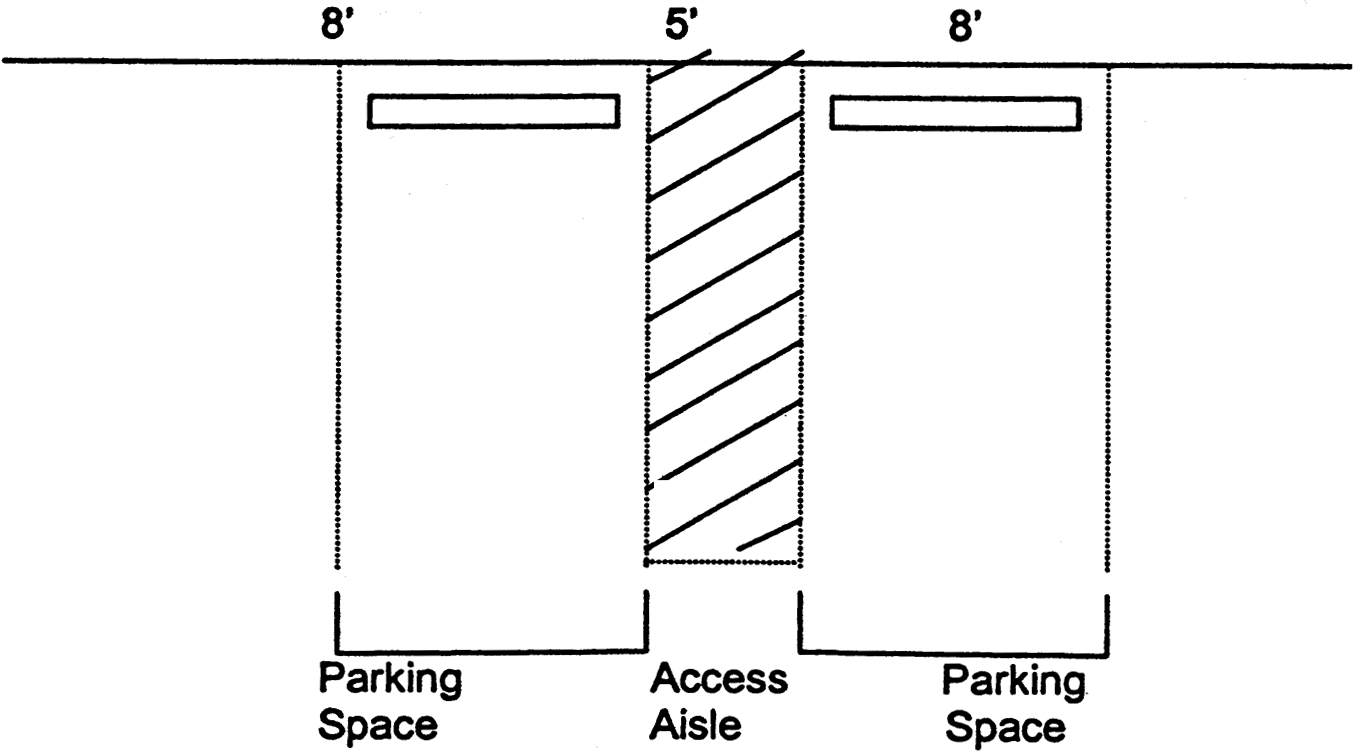
Barrier-free parking spaces shall be designated by approved signs and blue pavement markings. Parking spaces shall be at least twelve (12) feet wide or at least eight (8) feet wide and adjacent to a shared access aisle five (5) feet wide (minimum) as shown below.
(Ord. No. C-753-2011, § 1, 6-6-11)
Sec. 35-174. - Off-Street Loading and Unloading.
A.
On the same premises with every building, structure or part thereof involving the receipt or distribution of vehicles or materials or merchandise, adequate space for standing, loading and unloading shall be provided and maintained. Loading and unloading activities shall be separate from the required parking area and shall not interfere with public use of sidewalks, streets, dedicated rights-of-way or internal parking lot circulation patterns. The use of public streets for loading and unloading is prohibited.
B.
Required loading areas shall not be included in calculations for off-street parking space requirements.
C.
Number of Spaces. The minimum number of loading spaces shall be provided in accordance with the following table. The planning commission may modify these requirements upon making the determination that another standard would be more appropriate because of the number or type of deliveries experienced by a particular business or use.
D.
Size of Spaces. The size of required loading/unloading spaces shall be at least ten (10) feet by fifty (50) feet for office uses and at least ten (10) feet by seventy (70) feet for commercial and industrial uses, with a clearance of at least fourteen (14) feet in height. The planning commission may reduce the required size of loading spaces to no less than ten (10) feet by thirty (30) feet for uses that will involve smaller, single unit delivery trucks where documentation of the types of deliveries is provided by the applicant and the applicant provides a written agreement with the city to restrict the size of delivery trucks.
E.
Screening.
1.
When required off-street docks and loading areas are visible from a public right-of-way or abuts a residential district, they shall be screened from the right-of-way or residential district by a solid, ornamental masonry wall at least six (6) feet in height above the grade elevation at the right-of-way or residential district line, in addition to the landscape requirements of Article 15, Landscape Standards.
2.
Where possible, the required masonry wall should be attached to the wall of the main building and designed so the loading appears integrated into the building. In all cases, the wall shall be constructed of materials similar to those of the main building.
F.
Location. Loading spaces shall be provided off-street in the rear yard or interior side yard and in no instance shall such spaces or access to the building for loading/unloading be permitted in a front yard or in locations visible from a public right-of-way.
G.
Access and Vehicular Movement. Site plans shall illustrate expected vehicular path and turning radii of loading/unloading vehicles to demonstrate there are no conflicts with the internal circulation, parking and accessory structures. Access to the loading/unloading area shall be designed in such a manner as to allow trucks to enter and leave the loading area without having to back from or onto the public street.
H.
Surface. Loading dock approaches and loading spaces shall be surfaced with asphalt or concrete paving so as to provide a permanent, durable and dustless surface with a base sufficient to accommodate expected vehicle weight.
I.
Drainage. Loading areas shall be graded and drained so as to dispose of surface waters. Surface water shall not be permitted to drain onto adjoining property, unless in accordance with an approved drainage plan. Grading, surfacing, and drainage plans shall be subject to review and approval by the city engineer.
J.
Storage and Repair. The storage of merchandise, sale of motor vehicles, storage of inoperable vehicles or repair of vehicles is prohibited in required loading spaces.
K.
Central Loading. Central loading facilities may be substituted for individual loading spaces serving businesses on separate lots provided that all of the following conditions are fulfilled:
1.
Each business served shall have direct access to the central loading area without crossing streets.
2.
Total loading space provided shall meet the minimum requirements specified herein, in consideration of total floor area of all businesses served by the central loading space.
3.
No building served shall be more than three hundred (300) feet from the central loading area.
4.
Where screening standards in section 35-174.E. are met in the CBD and C2 District, the central loading requirements may be reduced at the discretion of the planning commission provided that the loading does not interfere with public access to businesses and circulation in parking lots.
L.
Change in Use or Intensity.
1.
Whenever the use of a building or lot is changed, loading facilities shall be provided as required by this article for the new use.
2.
If any building, structure or lot is increased in floor area or through other means, additional loading shall be provided to bring the site into compliance with this article.
3.
Any area designated for required loading shall not be changed to any other use unless and until equal facilities meeting the standards of this article are provided elsewhere, or the loading requirements of the site change as determined by the building official.
4.
Loading facilities, existing at the effective date of this chapter, in connection with the operation of an existing building or use, shall not be reduced to an amount less than required for a similar new building or new use.
5.
When changes in activity occur that may produce loading demand in excess of available loading facilities, the city shall require documentation showing adequate loading facilities are provided or will be expanded to meet anticipated needs.
(Ord. No. C-753-2011, § 1, 6-6-11)

