
Farmington City Zoning Code
ARTICLE 7
- CBD CENTRAL BUSINESS, C2 COMMUNITY COMMERCIAL, C3 GENERAL COMMERCIAL AND RO REDEVELOPMENT OVERLAY DISTRICTS
Sec. 35-101.- Intent.
A.
CBD Central Business District. The CBD Central Business district is intended to provide for a traditional mixture of office buildings, retail stores, entertainment, public spaces, residential uses and related activities that are mutually supporting and serve the needs of both the city and surrounding communities. The intent of these district regulations is to encourage a lively social environment and economically viable downtown with a wide variety of uses in a pedestrian-oriented unified setting, with shared parking.
B.
C2 Community Commercial District. The C2 Community Commercial district is intended to create mixed-use neighborhood centers with retail services that provide convenience shopping of persons residing in nearby residential areas. The intent of this district is to concentrate businesses that harmonize with the character of the surrounding uses, and to prohibit uses that might create traffic hazards, offensive noises and late hours of operation. As a mixed use neighborhood center, this district may also include multiple-family residential, such as apartments above retail uses.
C.
C3 General Business District. The C3 General Business district is intended to accommodate commercial establishments that serve community-wide shopping and service needs. This district is intended to create cohesive commercial areas that take advantage of access provided by the city's transportation system, but also provide convenient vehicular access between businesses in attractive settings, thereby ensuring safety and discouraging undesirable strip commercial development.
D.
Redevelopment Overlay District. The RO district is intended to encourage the redevelopment of commercial sites that have constraints due to small lot size, irregular configuration, lack of parking or obsolete buildings. This district is intended to facilitate redevelopment of commercial sites that are on small lots following the recommendations of the Master Plan. The RO district is not intended to facilitate the removal of historic buildings within the CBD, nor is it intended to circumvent the requirements of this ordinance on sites that could otherwise be redeveloped based upon the existing underlying zoning.
(Ord. No. C-746-2010, § 1, 4-19-10)
Sec. 35-102. - Table of Uses.
Special Provisions
(a)
All retail businesses shall be conducted within a completely enclosed building; provided, however, that a site plan may be approved by the planning commission for accessory outdoor display, sales, or storage, including garden centers and nurseries, subject to article 13, site plan approval and the following requirements:
1.
Outdoor display, sales, or storage may be considered for the following businesses:
a.
Businesses located within a shopping center as defined in this section.
b.
Businesses located within a building that exceeds 10,000 square feet in size.
c.
Businesses located within the central business district (CBD).
d.
Service stations located within a "C" commercial district.
2.
Items sold shall:
a.
Relate and be accessory to the permanent business conducted within the building in which the business is located, such as the sale of flowers at a home improvement store, or sale of ice melt at automobile service stations, and shall be owned and operated by the same merchant operating within the building.
b.
Not include items that are customarily sold inside the building. For example, furniture stores may not place furniture outside for sale.
c.
Be located on a durable and dustless surface and shall be graded and drained to dispose of all surface water.
d.
Be arranged and constructed so as not to pose a hazard to pedestrians and to minimize risk of fire hazard.
3.
Outdoor storage, sales, or display is allowed outside of the required yards and is confined to areas shown on an approved site plan. The planning commission may require that areas where outdoor display, sales, or storage are permitted be clearly marked with pavement markings or other means for purposes of enforcement and ensure maintenance of fire lanes.
4.
Outdoor vending machines and drop boxes or donation bins shall be prohibited. This provision shall not apply to ice machines and newspaper stands.
5.
Display or storage areas shall be limited to ten (10) percent of the gross floor area of the principal building, or that portion of the building occupied by the business.
6.
Display or storage areas shall also maintain adequate clear area for safe pedestrian circulation along the sidewalk in front of the building, which shall be no less than three (3) feet wide in C-2 and C-3; provided, however, that the width of the clear area shall in all events meet all applicable state and federal regulations and building codes, including all barrier-free and ADA requirements.
7.
Displays or sales shall be prohibited on municipally-owned sidewalks, public land, or public right-of-way except as may be allowed by the city council for special events.
8.
Outdoor storage of propane tanks is permitted for service station, hardware store, and convenience store uses, except in the CBD district, provided that:
a.
The tanks shall not be larger than the standard twenty (20)-pound tank size.
b.
The tanks are stored in a locked storage container.
c.
The container does not exceed fifty (50) cubic feet and six (6) feet in height.
d.
The container complies with all applicable fire and safety codes.
e.
At least three (3) feet of clearance for pedestrian traffic is provided.
f.
Advertising shall be limited to one (1) square foot.
9.
All loading and truck maneuvering shall be accommodated on-site or on a dedicated easement.
10.
Fencing and lighting for security and aesthetic purposes may be required as determined by the planning commission. Fences shall comply with all lighting shall be shielded from adjacent residential areas in accordance with section 35-48, exterior lighting.
11.
Uncovered items may be displayed or stored outside between April 15 th and October 31 st . The building official may extend this time as weather permits. All structures associated with temporary outdoor display shall be temporary and removed at the end of the season for storage indoors.
12.
Outdoor display, sales, and storage may be permitted as part of an approved site plan, under the following terms:
a.
The permit shall be valid for one (1) calendar year.
b.
Following the initial planning commission site plan approval, the permit may be renewed annually by the building official, subject to the plan originally approved by the planning commission. If the building official finds any violations of this section or the conditions of the planning commission's original approval, no renewal shall be issued, and any new outdoor display shall require a new permit from the planning commission.
c.
Approved outdoor display, sales and storage areas may continue until such time as the property ownership changes or a revised site plan is approved. Approval shall not be transferrable to new owners or users. Changes of ownership or use shall be required to return to the planning commission for a renewal of their privileges, to ensure they are aware of the limitations that exist.
13.
The planning commission may allow outdoor display, sales, and storage for businesses that do not meet the criteria listed in subsection 1., provided all other provisions of this section (a) are met and the applicant establishes that compliance with the strict requirements of subsection 1. would unreasonably prevent the use of the property for a permitted purpose; that the proposed display, sales, and/or storage would not adversely affect adjacent or nearby properties and would not adversely affect the public health, welfare, and safety.
(b)
Accessory outdoor seating areas may be permitted by annual license when accessory to a permitted or special land use in the district subject to the following:
1.
Whether the seating area is proposed as part of a site plan application or an existing business, it shall require site plan review and approval by the planning commission in accordance with Article 13 Site Plan Review. Insurance in a form and amount deemed acceptable by the city attorney's office shall be provided with the application. Once initial approval has been granted by the planning commission, an annual license shall be issued by the building official. The license may be renewed annually by the building official, provided that it complies with the original planning commission approval and the requirements of this section. The building official may, at any time, refer an outdoor seating permit to the planning commission for renewal if the building official feels additional review is necessary.
2.
Outdoor seating shall be permitted subject to an approved site plan. All tables, chairs, railings and related fixtures shall be removed when not in use.
Placement of tables and chairs outside carryout restaurants. Tables and chairs may be placed outside the business for the comfort and convenience of customers seeking carryout service subject to approve site plan. An applicant shall submit a plan with the number of chairs and tables and location to the city for planning commission approval. Tables and chairs shall be made of quality durable, weather-resistant materials
3.
Outdoor seating shall not be the primary seating of the restaurant, except for carry-out restaurants when approved by the planning commission.
4.
Outdoor seating areas shall be located in a manner to maintain a minimum pathway width of five (5) feet (clear of structures such as light poles, trees and hydrants) along the sidewalk so as not to interfere with pedestrian traffic. Outdoor seating areas may be either curbside or adjacent to the building front provided that the location change allows an appropriate walking path alignment with neighboring properties as determined by the city.
5.
Chairs and tables shall be of quality durable, weather-resistant materials.
6.
Outdoor seating areas shall be maintained in a clean and sanitary condition. Waste receptacles shall be provided in instances where wait staff does not clear all tables.
7.
Outdoor seating areas shall be well-defined, with clearly marked access points, making it obvious to patrons whether they are within or outside of the designated seating area. Except in accordance with a Resolution Designating a Social District in accordance with Public Act 124 of 2020, as set forth in MCL 436.1551, as amended, the on-premises licensee shall not sell, or allow the consumption of, alcoholic liquor outdoors, except in the defined area. Outdoor seating areas shall be delineated by outlining the periphery in some manner as to distinguish the public walkway from seating area. This may be accomplished by the use of planters, railings, or walls reviewed and approved by the planning commission.
8.
For outdoor seating areas located within the public-right-of-way, approval by the corresponding jurisdiction (i.e. Farmington DPW, MDOT, or Road Commission for Oakland County) is required. Proof of Insurance naming the city as an additional insured, in a form and amount deemed acceptable by the city attorney's office, shall be required. A license agreement in a form deemed acceptable to the city attorney's office shall also be required.
9.
If there is not adequate space to allow for outdoor seating on the sidewalk adjacent to the site, an elevated, ADA compliant, platform may be erected in a parking lot to create an outdoor seating area, but only if the city engineer determines there is sufficient space available for this purpose given parking and traffic conditions. Specially designated parking spaces (ADA accessible, loading zones etc.) shall only be considered for use if the spaces can be temporarily replaced within a close proximity. Use of a public parking lot for such purpose shall require city council approval.
10.
Additional outdoor lighting and/or amplification is prohibited without approval of the city.
11.
Applicants may be asked to demonstrate that additional parking demand can be met before approval.
12.
The city retains the right to revoke outdoor seating permits if all sections of this ordinance have not been met, or if the operation of such areas is found by the city to be dangerous or otherwise detrimental to surrounding uses or pedestrian or vehicular traffic.
13.
Applicants may seek a special land use approval for a weather-resistant enclosed accessory outdoor seating area in the side or rear of the building not adjacent to the public right-of-way.
a.
Removable architectural elements such as awnings, canopies, marquees shall be approved by the planning commission with a recommendation from the DDA design committee.
b.
Encroachments that create usable space such as cantilevered rooms, dormers, elevated walkways, balconies, bridges and similar projections may be approved by the planning commission, with recommendation from the DDA design committee when in the CBD Central Business District, provided they comply with the design review standards set forth in Section 35-152.
(c)
Drive-through uses may be allowed as an accessory to any permitted bank, pharmacy, dry cleaner, or restaurant use, provided the following are met:
1.
Drive-through uses shall be designed to minimize conflicts with pedestrian or vehicular circulation and shall meet the following standards:
2.
The number of drive-through lanes shall be limited to the following:
a.
Drive-through banks and car washes shall have a maximum of three (3) drive-through lanes, including any that are devoted to ATM(s).
b.
All other drive-through uses shall have a maximum of one (1) drive-through lane.
3.
Stacking Spaces shall be provided as required in Article 14, Off-Street Parking and Loading Standards and Access Design.
4.
Communication and speaker boxes shall meet the following requirements:
a.
Speakers shall be placed as close as safely possible from the edge of the drive-through lane; in no case may speakers be more than three (3) feet from the drive-through lane.
b.
Where feasible, speakers shall face away from residential neighborhoods.
c.
Noise from communication speakers shall not exceed fifty (50) decibels at a nonresidential property line and thirty (30) decibels at any residential property line. Where a screening wall is provided, the noise level shall be measured on the residential side of the screening wall.
5.
Site design for drive-through uses shall use the minimum number of driveways possible. Use of two (2) directional driveways may only be allowed if there are no other reasonable alternatives, such as access to a side street, rear alley, cross-access easement or shared driveway.
6.
Circulation patterns shall separate pedestrian and vehicular traffic where possible. Clear delineation of pedestrian crossings shall be provided in the form of textured concrete or asphalt, striping or other method that clearly draws attention.
(d)
No hotel or motel lodging rooms shall be permitted on the ground floor.
(e)
Outdoor recreation facilities in the CBD, C2 and C3 districts shall not include activities that include automobiles, motorcycles or other motor-driven vehicles.
(f)
All city-owned buildings and uses shall be permitted after a finding that the particular use and development would not be injurious to the surrounding neighborhoods and would not be contrary to the spirit and purpose of this chapter. In the event the planning commission does not approve the use or site plan, city council may grant such approval by an affirmative vote of no less than four (4) members.
(g)
In the C2 district, residential buildings and dwelling units in mixed-use buildings shall be permitted up to a maximum density of twenty-two (22) dwelling units per acre.
(h)
The allowed uses within the RO district shall be the same uses as permitted in the underlying zoning district, provided multiple-family dwelling units may be permitted by special land use.
(i)
Instructional entertainment uses shall meet the following requirements:
1.
Such uses may be permitted by the city manager, if determined compliant with this section.
2.
Once initial approval has been granted by the city manager, an annual license shall be issued by the building official. The license may be renewed annually by the building official, provided that it complies with the original approval and the requirements of this section. The building official may, at any time, refer any request to the city manager or planning commission for renewal if they feel additional review is necessary.
3.
Such uses may remain open until 12:00 a.m. (midnight).
4.
All activity associated with the use shall be conducted indoors. Accessory outdoor seating may be permitted by the city manager only if all of the requirements in subsection (b) above are met.
5.
Gambling, gaming, betting, sweepstakes, games of chance, adult regulated uses, or other similar activities may not be conducted in conjunction with such use.
6.
All activity associated with the use shall be conducted in accordance with all local, county, state and federal laws.
(Ord. No. C-746-2010, § 1, 4-19-10; Ord. No. C-765-2012, § 1, 8-20-12; Ord. No. C-775-2014, § 1, 3-14-14; Ord. No. C-779-2015, § 1, 9-21-15; Ord. No. C-798-2020, § 2, 3-16-20; Ord. No. C-804-2022, § 1, 7-18-22; Ord. No. C-814-2025, § 1, 4-21-25)
Sec. 35-103. - Lot and Yard Requirements for C2, C3 and RO Districts.
Special Provisions
(a)
Side Yard Setbacks. The city planning commission shall not require a side yard setback if the side walls are wholly without windows, doors, or other openings and are of fireproof construction, and where a side yard setback is not otherwise necessary to satisfy any of the foregoing considerations and where the absence of a side yard setback would not be detrimental to adjoining buildings. If a side yard setback is required by the planning commission, the basis for such determination shall be specifically set forth as a finding.
(b)
Lot Area. No minimum requirement, but must meet minimum required building setbacks, parking and landscaping requirements.
(c)
C2 District. All principal buildings shall be built to the front lot line and parking shall be located to the side or rear of the building. This may be modified by the planning commission based upon the relationship of the site to surrounding uses and the predominant setback along the block. For lots that back up to a public alley, the rear yard setback may be reduced to zero where a majority of other buildings on the block have the same setback from the alley and there is maintained a minimum twenty-five-foot separation between the building and a residentially zoned lot.
(d)
RO District. The city may rezone properties to the RO district to encourage renovation and redevelopment or an individual property owner may petition for a site to be rezoned to the RO district following the procedures of Article 20, Amendment Procedure. Site plans for renovation or redevelopment of sites in the RO district may be submitted for review and approval by the planning commission following the rezoning or may be reviewed concurrently with the RO district rezoning, with the site plan approval conditioned on the approval of the rezoning by the city council.
For sites in the RO district where site plan approval is being sought, the planning commission shall have the authority to modify the dimensional requirements of the underlying zoning district and parking requirements. Such modification shall only be granted following a public hearing conducted in accordance with the special land use requirements of Article 12, Special Land Uses and where the following standards are met:
1.
The site is occupied by a residential, commercial, office or industrial building that is proposed to be removed or rehabilitated.
2.
A use permitted within the underlying zoning district is to be established.
3.
Buildings that are considered to be historic by the planning commission are not removed and any renovation to historic buildings enhances the historic integrity of the architecture. In such instance, the planning commission shall refer the site plan to the historical commission for review and recommendation.
4.
The flexibility in dimensional standards is necessary to allow for innovative design in redeveloping the site and will result in a higher quality of development than would be possible without the modification.
5.
The new building and site are designed to be pedestrian oriented with safe and convenient access to the building from the public sidewalk and a site design that minimizes the dominance of the parking lot as viewed from the street.
6.
Adequate buffers are provided between the site and any adjoining residential district.
7.
Any site nonconformities are brought into compliance with ordinance requirements to the maximum extent deemed practical by the planning commission.
8.
The planning commission determines that the proposed redevelopment of the site will be an enhancement to the site and surrounding area following the recommendations of the Master Plan, provided the planning commission may attach reasonable conditions to ensure this standard is met.
(Ord. No. C-746-2010, § 1, 4-19-10)
Sec. 35-104. - Central Business District—Nonresidential and Mixed-Use Development Requirements.
The following regulations shall apply to all nonresidential buildings and "mixed use" buildings, which are those that contain nonresidential uses on the first floor and residential above the first floor. Any development or modification to a building in the CBD that requires planning commission approval under Article 13, Site Plan Review, shall be first reviewed by the DDA design committee prior to being placed on the agenda for final site plan approval by the planning commission. The DDA design committee shall review the site plan and building architecture for compliance with the requirements of this section and provide a recommendation to the planning commission.
A.
Area and Bulk Requirements.
1.
Lot Area and Width. There is no required minimum lot area or width.
2.
Setback Requirements. The required nonresidential and mixed-use building setbacks are intended to promote streetscapes that are consistent with the desired character of the CBD and reinforce a pedestrian orientation and built-up streetscape. The setback requirements for areas that abut residential zones are intended to promote development that will maintain light, air, and the potential for privacy for adjacent residential zones.
a.
Projections into setbacks permitted under section 35-39, projections into yards, including cornices, eaves, sills, balconies, bay windows, awnings, signs and other architectural elements, shall also be permitted to project over the public sidewalk with planning commission approval; provided, there shall be a minimum eight-foot vertical clearance between the sidewalk grade and the architectural element that is overhanging the sidewalk.
3.
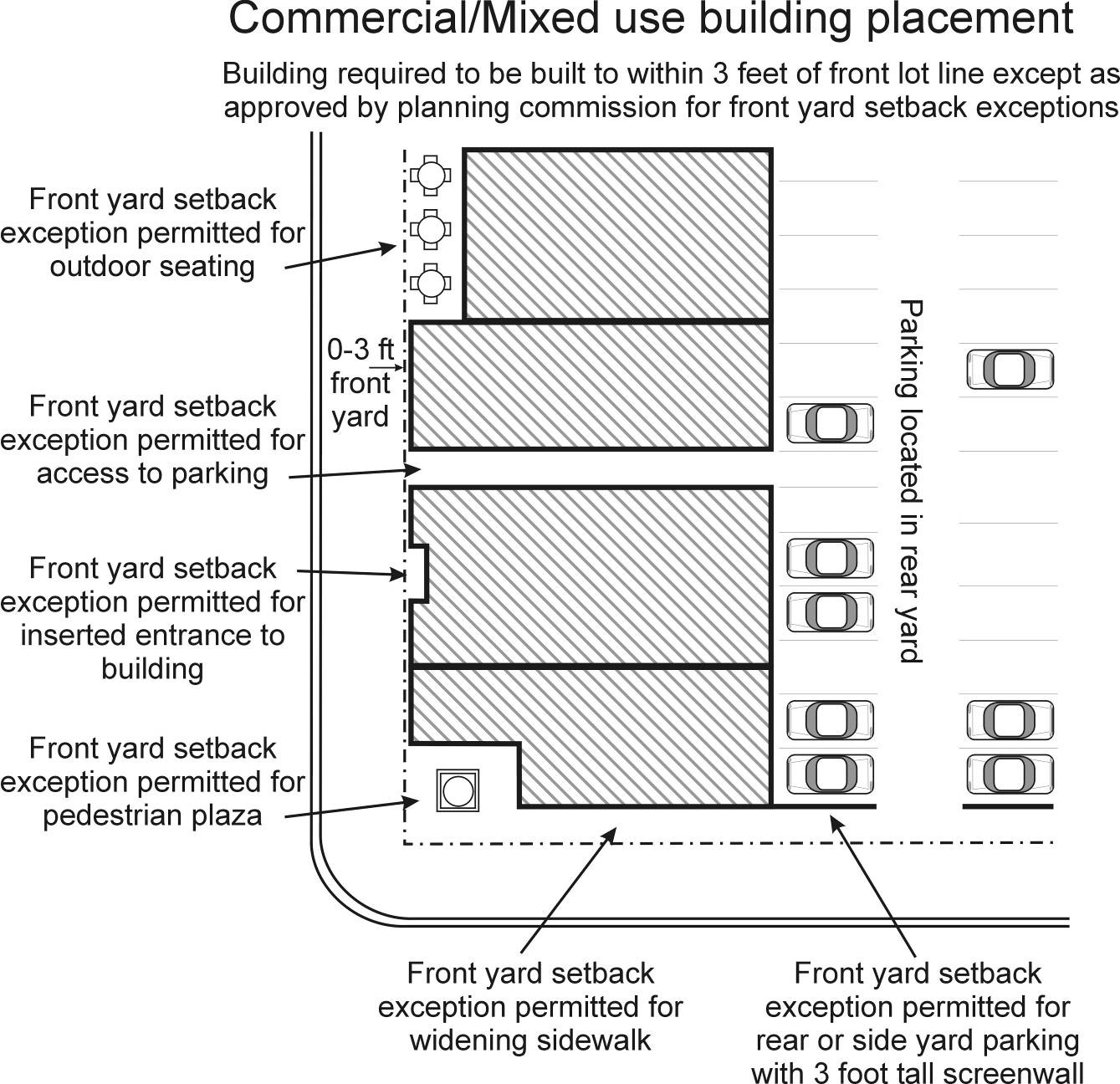
Front Yard Building Setback Exceptions. One hundred (100) percent of the length of the ground level street-facing façade of the building must be built to within three (3) feet of the front lot line. The building height along the frontage shall be a minimum of twenty-four (24) feet. Exceptions may be granted by the planning commission when the front yard area, or forecourt, is used for the following purposes listed below.
a.
Widening the sidewalk along the frontage of the building.
b.
Providing a public gathering area or plaza that offers seating, landscape enhancements, public information and displays, fountains, or other pedestrian amenities.
c.
Accommodating an inset entranceway to the building.
d.
Providing outdoor seating for the proposed use.
e.
Where necessary to avoid utilities.
f.
The building is used for public or quasi-public/institutional purposes with a plaza or open space area provided in the front yard.
g.
Driveway or pedestrian access to parking at the rear of the building.
h.
Side yard parking along no more than forty (40) percent of the frontage, with a three-foot tall screenwall between the parking and public sidewalk, set back three (3) feet from the front lot line and subject to the requirements of subsection D., below.
i.
Where older residential structures have been converted to a nonresidential or mixed-use and are to be retained.
j.
Sandwich board signs (or A-frame signs), marquee signs and wall signs as permitted in the sign ordinance are the only business signs permitted within the forecourt area.
4.
Building Height. The height limits are intended to control the overall scale of buildings and to discourage buildings that visually dominate adjacent residential areas.
a.
For buildings with more than two (2) stories adjacent to a single-family residential zone, the floors above the second story of the building shall be tiered back such that the highest point of the building is set back a distance at least equal to twice the height of the building from the adjacent single family residential lot.
b.
If a development is proposed as a planned unit development (PUD), the planning commission may approve an increase in the maximum building height and number of stories, if the proposed development is for a mixed-use building with retail, or service business on the first floor and residential, or office on the upper floors. The planning commission may require a greater setback from any adjoining single-family residential district in order to minimize the impact of building mass on views and sunlight in the residential district. In determining the amount of additional required setback, the planning commission shall take into account the area and configuration of the adjoining residential parcel or parcels, the size, height, and location of existing residential structures on the adjoining residential parcel or parcels, and any other relevant characteristics of the adjoining residential parcel or parcels.
c.
If a parking structure is proposed as part of the building the planning commission may approve additional total building height and stories to achieve additional usable building floor area equal to the area occupied by the parking deck, subject to the regulations of subsection D., below.
d.
Buildings located at the corner of two (2) intersecting streets may be increased in height to fifty (50) feet.
e.
Refer to section 35-42, exceptions to height limit, for allowable building height projections.
B.
Pedestrian-Oriented Design Requirements. All sites shall be designed to promote safe and effective pedestrian and transit-oriented circulation on-site, between sites, and between parking and streets. Sites shall comply with pedestrian-oriented design requirements of section 35-45, pedestrian walkways, and Chapter 28, Streets, Sidewalks and Other Public Places, of the City of Farmington Code.
C.
Building Design.
1.
Purpose. The following building design standards ensure that new construction in the CBD reflect a high level of building quality that will endure over time and will incorporate timeless design details. The requirements also ensure that all new construction is consistent because the character of the CBD is not reflected in just one (1) structure, but in all the buildings combined. The regulations herein are intended to ensure proper building form, relationship to the street and compatibility with other buildings. The regulations are not intended to dictate a particular style of architecture, rather to encourage innovative design that is consistent and complementary to the existing built environment.
2.
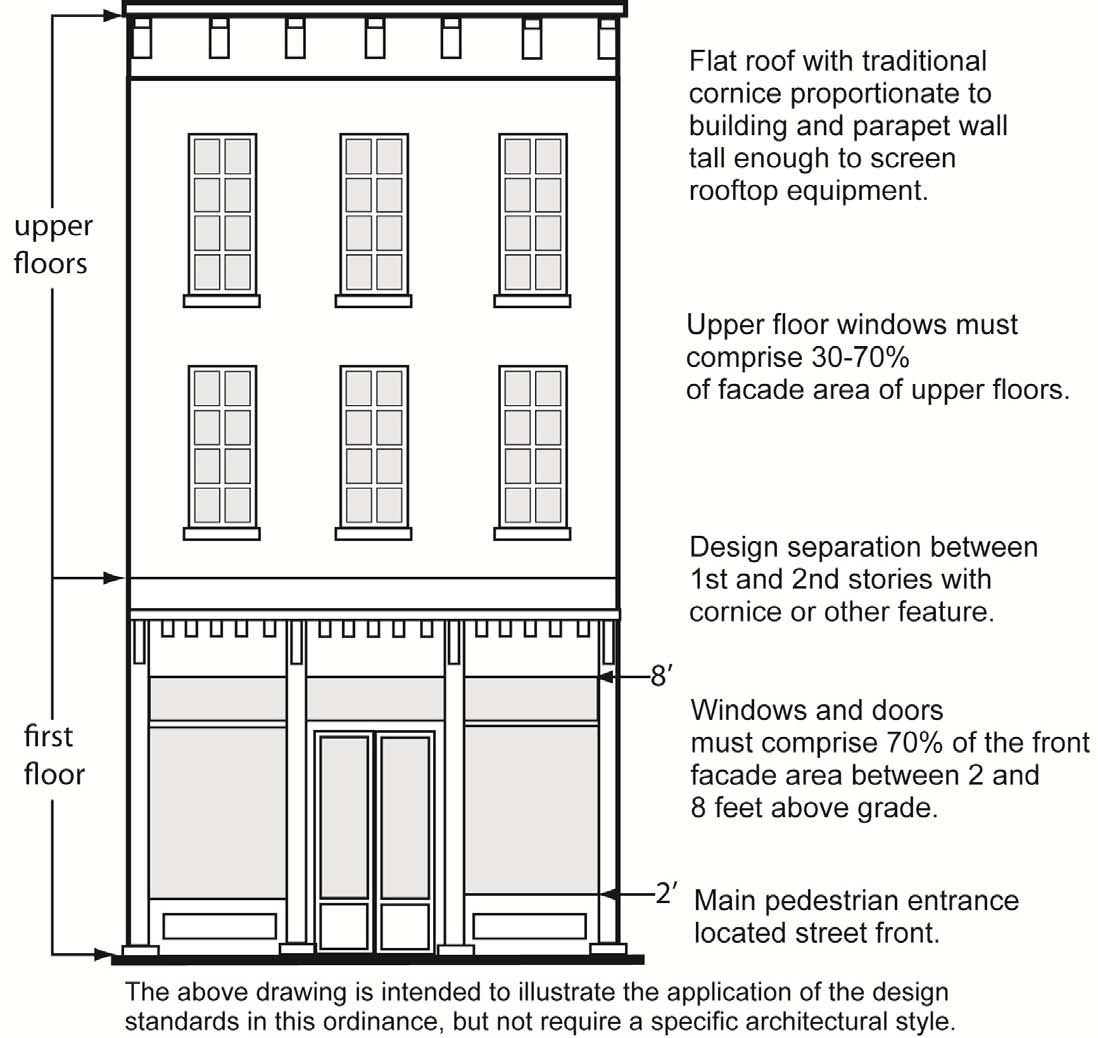
Main Entrance. All buildings shall have a main entrance that is located on at least one (1) streetfront. Main entrances shall have design details that enhance the appearance and prominence of the entrance so that it is recognizable from the street and parking areas. The front entranceway shall be inset a minimum of three (3) feet from the front building wall to minimize encroachment on the sidewalk.
3.
Roofs. Roofs shall be required to meet the following:
a.
Unless otherwise approved by the planning commission, buildings should have flat roof appearance from the street with a cornice that is designed proportionate to the size of the building and length of the wall.
b.
The planning commission may permit a pitched roof if the design of the roof and building are consistent with the character of the CBD and adjacent buildings. Pitched and mansard roofs shall not be permitted with eaves below a height of twenty-four (24) feet. All roof edges shall be accentuated in a manner proportionate to the size of the building and length of the wall.
c.
Flat roofs shall be enclosed by parapets.
d.
All rooftop-mounted equipment shall be screened from view on all sides of the building.
e.
Parapets and other screening treatment shall use high-quality building materials and shall blend with the design of the building in terms of color, materials, scale and height.
4.
Awnings. Awnings in the CBD may project over the public sidewalk; provided they shall be:
a.
Positioned immediately above the ground floor window area of the façade.
b.
Provide a minimum eight-foot clearance from the sidewalk.
c.
Constructed of a durable, weather-proof material such as canvas or steel.
d.
Have a straight shed that projects from the building at a straight angle with open sides.
e.
Signage is in conformance with the city sign code.
5.
Required Window Area and Exterior Finishes. While creativity in building design is encouraged, buildings in the CBD must adhere to the following:
a.
Windows.
(1)
Facades facing a public street or sidewalk shall include windows that equal seventy (70) percent of the wall area measured between two (2) feet and eight (8) feet above grade. The bottom of any window may not be more than four (4) feet above grade.
(2)
Required window areas shall consist of clear glass windows, clear glass doors and clear glass panels, and may not be covered or blocked with the back of shelving units.
(3)
Required window areas shall be either windows that allow views into retail space, working areas or lobbies, pedestrian entrances, or display windows set into the wall.
(4)
Windows and doors above the first floor shall comprise between thirty (30) percent and seventy (70) percent of the total wall area of all upper floors.
(5)
The number, shape, size, and spacing of the windows shall be compatible with the established rhythm of adjoining or nearby buildings in the downtown.
b.
Exterior Finish Materials. The building wall (exclusive of any windows or doors) of any façade visible from public view shall consist of the following:
(1)
The wall shall be constructed of at least seventy-five (75) percent modular brick or stone. Panel brick and tilt-up brick textured paneling shall not be permitted on the front façade.
(2)
Up to twenty-five (25) percent of the remaining wall area may include wood siding, fiber cement siding, exterior insulation finish systems (EFIS), stucco (cementious finish), precast masonry, metal or molded polyurethane trim.
(3)
Exterior walls that may be concealed by future building development on adjacent sites may be constructed of lower-cost materials that are consistent with the building façade, including modular brick or stone, panel brick, tilt-up brick textured paneling, wood siding, fiber cement siding, exterior insulation finish systems (EFIS), stucco (cementious finish), precast masonry, metal or molded polyurethane trim.
(4)
The planning commission may permit other high-quality exterior finish materials comparable to those required above. The planning commission shall consider the standards of subsection 35-104.C.10., Modifications, and a recommendation of the DDA design committee that the amount, design, and type of materials proposed are consistent with the intended character of the CBD.
(5)
Buildings that have upper stories shall be designed to create a distinct and separated ground floor area through the use of accents such as a cornice, change in material or textures, or an awning or canopy between the first and second stories.
6.
Corner Buildings. Buildings situated at a corner shall possess a level of architectural design that incorporates accents and details that accentuate its prominent location. This can be accomplished through height projections incorporated into a design feature such as additional height, a building peak, tower, or similar accent with the highest point located at the intersecting corner. Alternatively, a pedestrian plaza may be provided at the corner of the intersecting streets. A main entrance must be on a street-facing wall and either at the corner or within twenty-five (25) feet of the corner.
7.
Overhead Doors. Overhead doors are not encouraged in the CBD. When necessary for loading, unloading, and other service needs they shall be located where it will receive the least visibility to the public or neighboring residential uses, and have the least impact on traffic operations. Overhead doors for loading areas shall be closed when not in use for loading operations.
8.
Converted Dwellings. Where buildings that were originally constructed for single-family residential purposes have been converted to nonresidential uses, the building design requirements of this subsection may be modified by the city where consistent with the historic character of the building. Such modifications may include allowing the use of siding in lieu of masonry materials and residential fenestration (windows) in lieu of the requirement for storefront windows on the first floor.
9.
Modifications. The planning commission may approve deviations to the building design standards of this subsection 35-104.C., following the recommendation of the DDA design review committee, in order to achieve the objectives of this subsection through the use of creativity and flexibility in development and design. Each deviation shall require a finding that the design standard sought to be deviated from would, if no deviation was permitted, prohibit an enhancement that would be in the public interest. A front elevation drawing of the proposed building shall be provided superimposed on a color drawing or photograph of the entire block showing the relation of the proposed building design to other buildings along the block, which shall be utilized to evaluate the proposed building design based upon all of the following criteria:
a.
Innovations in architectural design may be permitted, provided the building design shall be in keeping with the desired character of the CBD, as articulated in the city Master Plan and the Downtown Plan, and the proposed building fits within the context of adjacent buildings along the block.
b.
The building shall be oriented towards the front sidewalk and maintain or enhance the continuity of the pedestrian oriented environment.
c.
The roof design shall not be out of character with other buildings along the block and shall be within the minimum and maximum height requirements of the district.
d.
The exterior finish materials shall be of equal or better quality and durability as those permitted above, with the intent to allow for new technologies in building material while maintaining the desired character of the CBD.
e.
Ground floor windows shall be provided along the front sidewalk to maintain the pedestrian orientation of the streetscape and upper story windows shall not be incompatible with the rhythm and proportions of windows on other buildings along the block.
D.
Parking. Parking lots shall meet the following requirements:
1.
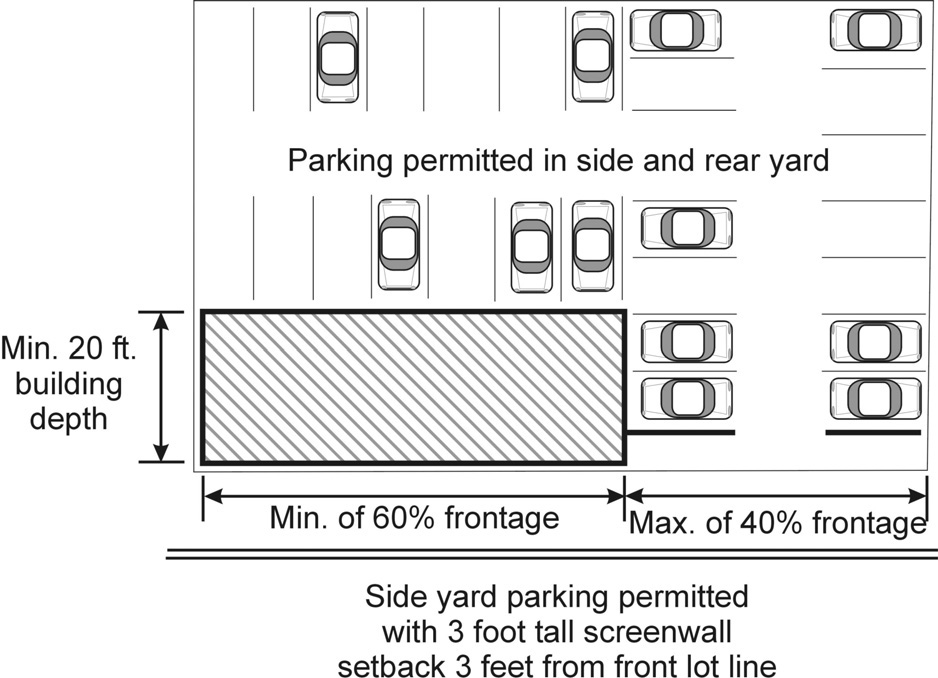
Parking is permitted only in side and rear yards. When parking is located in a side yard (behind the front building line) and has frontage on a public right-of-way, no more than forty (40) percent of the total site's frontage shall be occupied by parking. Parking in the side yard shall be screened by a three-foot tall brick screening wall between the sidewalk and the parking lot. The screening wall shall be set back a minimum of three (3) feet and designed and located to ensure a safe, clear vision zone is provided for vehicles and pedestrians.
2.
Where off-street parking is proposed, at least sixty (60) percent of the site's frontage shall be occupied by usable building space to a depth of at least twenty (20) feet. Where a parking structure is provided, usable building space shall occupy at least sixty (60) percent of the site's frontage on the first level to a depth of at least twenty (20) feet.
3.
Parking lot design shall conform to the requirements of Article 14, Off-Street Parking and Loading Standards and Access Design. Because the regulations of this section are intended to encourage pedestrian/transit friendly design and compact mixed-use development that requires less reliance on automobiles, on-site parking required under Article 14 may be waived under the following conditions:
a.
The site is located within five hundred (500) feet of other parking facilities intended for public use, such as a municipal parking lot, parking structure or on-street parking that provides adequate parking spaces to serve the proposed use.
b.
Failure to provide on-site parking shall be deemed to constitute and acknowledgement and acceptance of a benefit (i.e., the relaxation of on-site parking standards) such that, if the city establishes a special assessment district to fund the construction operation and maintenance of public parking that will serve the property, the property owner agrees to become part of such district and further agrees to payment of the assessment in lieu of providing on-site parking. The city may require a written acknowledgement with respect to the benefit provided.
E.
Landscaping. For buildings that comply with the front build-to requirements of this section, street trees located within the public sidewalk may be used to satisfy the frontage landscaping requirements of Article 15, Landscaping Standards. Where existing street trees along the frontage are in poor condition, the planning commission may require replacement of the trees. Where there are no street trees along the site frontage, or there is a gap of sixty (60) feet or more between existing trees, the planning commission may require the installation of a new tree, with a tree grate that matches the other tree grates used in the downtown.
F.
Access Management. Refer to Article 14, Off-Street Parking and Loading Standards and Access Design, for access management requirements. In addition to current access management standards, a strong emphasis shall be placed in the CBD to limit driveways on Grand River Avenue and Farmington Road. Whenever possible, existing driveways shall be removed and access provided to the site from rear access or from an intersecting side street.
G.
Lighting. Refer to section 35-48, exterior lighting, for lighting requirements.
(Ord. No. C-746-2010, § 1, 4-19-10)
Sec. 35-105. - Central Business District—Residential Design Standards.
The regulations of this section shall apply to buildings and sites that contain only residential and residential accessory uses. Mixed-use developments with residential uses above commercial uses must comply with section 35-104. Any new residential development in the CBD that requires planning commission or council approval under Article 13, Site Plan Review, shall be first reviewed by the DDA design committee prior to being placed on the agenda for review by the planning commission. The DDA design committee shall review the site plan and building architecture for compliance with the requirements of this section and provide a recommendation to the planning commission.
A.
Area, Bulk and Density Requirements.
1.
Lot Area and Width. There is no required minimum lot area or width.
2.
Density. Density permitted by right shall be thirty-four (34) dwelling units per acre, provided the planning commission may approve an increased density of up to forty-seven (47) units per acre for projects approved as a PUD under Article 10, PUD.
3.
Setback Requirements. The required residential building setbacks promote streetscapes that are consistent with the desired character of the CBD and reinforce a pedestrian orientation and built-up streetscape. The setback requirements for areas that abut single-family residential zones promote development that will maintain light, air, and the potential for privacy for adjacent residential zones.
4.
Building Height. The height limits are intended to control the overall scale of buildings and to discourage buildings that visually dominate adjacent residential areas.
a.
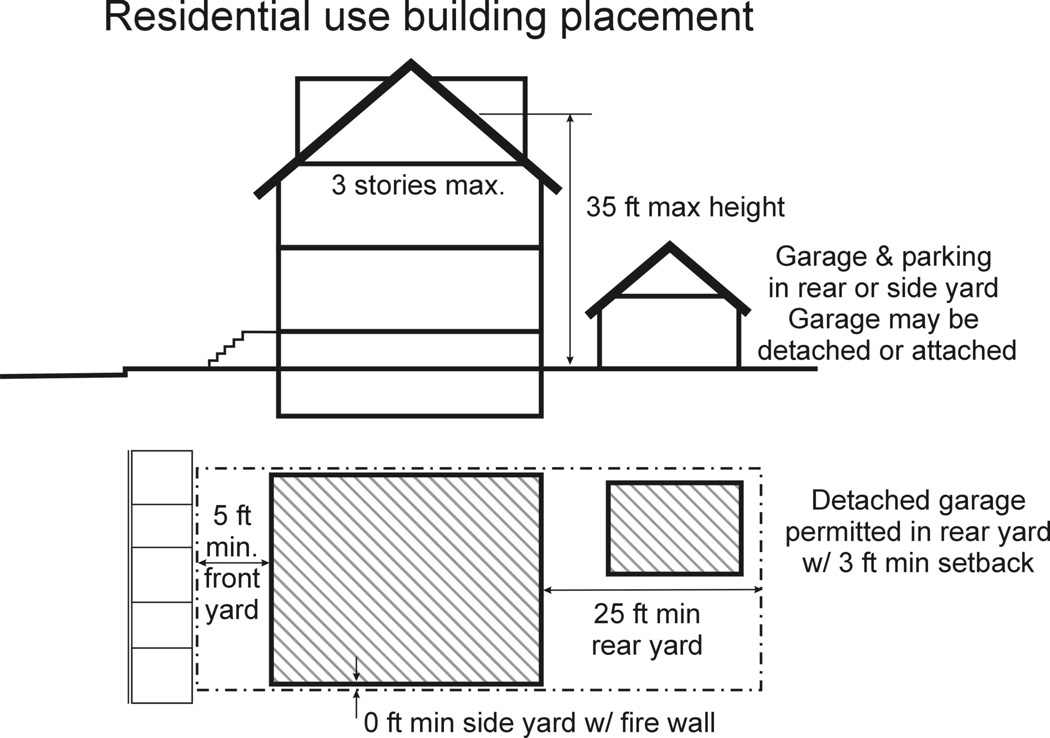
If a development is proposed as a planned unit development (PUD), the planning commission may approve an increase in the maximum building height and number of stories, if either one (1) of the following apply:
(1)
The proposed development will provide a setback equal to its height from any adjoining single-family residential zoning district;
(2)
A minimum of fifteen (15) percent of the site will be set aside as open space in the form of a pocket park, pedestrian plaza, or recreational area; or
(3)
The additional height or floors are being transferred from another building in the CBD that is below the corresponding height requirement and is being preserved with a recorded deed restriction and historic preservation easement under Michigan Public Act 451 of 1994.
b.
Refer to section 35-42, exceptions to height limit, for allowable building height projections.
c.
Basements and below-grade garages shall not be included in the calculation of height or number of stories.
B.
Pedestrian-Oriented Design Requirements.
1.
An interconnected street and sidewalk network shall be provided to unify neighborhoods and provide more convenient access to businesses and community facilities.
2.
Sidewalks shall be a minimum of five (5) feet wide, seven (7) feet wide where abutting a parking space or a road curb. The planning commission may require a wider sidewalk if needed to be consistent with the adjoining sidewalk system.
3.
Pedestrian-scale ornamental street lighting shall be provided along all sidewalks and within parking areas.
C.
Building Design.
1.
Residential buildings shall utilize high-quality traditional architecture, such as but not limited to: Arts and Crafts, Colonial, Gothic Revival, Italianate, Tudor, Victorian and other traditional styles characteristic of the Midwestern United States and with historic buildings in the city, including modern variations of traditional styles.
2.
All residential units shall provide a pedestrian door facing the front lot line.
3.
The front façade of all residential units shall be at least fifteen (15) percent windows or doors.
4.
All dwellings shall include a front porch or front stoop with steps or an accessible ramp.
5.
All buildings shall utilize high quality building materials that are in keeping with traditional architectural styles of the downtown. Permitted wall materials include, brick, stone, wood and fiber cement siding. Vinyl siding shall not be utilized, except the planning commission may permit limited use of vinyl siding on façades not visible from the street.
6.
Garage doors shall be located on the side or rear of the building. Garage doors shall not be visible from Farmington Road or Grand River Avenue. The planning commission may prohibit or limit visibility from other side streets as determined appropriate when considering visibility from the public right-of-way and orientation of the front of the proposed units.
D.
Parking.
1.
Shall meet the requirements of Article 14, Off-Street Parking and Loading Standards and Access Design. The planning commission may reduce the number of parking spaces required to one and one-half (1.5) per dwelling unit where on-street parking is provided for guest parking at the rate of one-half (0.5) spaces per dwelling unit.
2.
Parking shall not be permitted between the front of the building containing the pedestrian entrance and the front lot line. Off-street parking shall be to the side or rear of the building. Where side yard parking is visible from the street, a streetwall shall be provided consisting of a picket fence, ornamental wrought iron fence, a brick wall or a continuous evergreen hedge.
E.
Landscaping. Shall meet the requirements of Article 15, Landscaping Standards.
(Ord. No. C-746-2010, § 1, 4-19-10)
Sec. 35-106. - Site Development Requirements.
All uses permitted by right and special land uses are subject to the following site development requirements:
A.
General provisions in accordance with Article 2, General Provisions.
B.
Site plan review as may be required in accordance with Article 13, Site Plan Review.
C.
Off-street parking and loading as may be required in accordance with Article 14, Off-Street Parking and Loading Standards and Access Design.
D.
Landscaping and tree replacement as may be required in accordance with Article 15, Landscape Standards.
(Ord. No. C-746-2010, § 1, 4-19-10)

