
Farmington City Zoning Code
ARTICLE 21
- DEFINITIONS
Sec. 35-251.- Construction of Language.
The following rules of construction apply to the text of this chapter:
A.
The particular shall take priority over the general.
B.
In case of any difference of meaning or implication between the text of this chapter and any caption or illustration, the text shall control.
C.
The word "shall" is always mandatory and not discretionary. The word "may" is permissive, with the decision made by the planning commission, city council, building official, or board of zoning appeals, as indicated.
D.
The term "such as" shall be interpreted as "such as but not limited to."
E.
Words used in the present tense shall include the future; and words used in the singular number shall include the plural, and the plural the singular, unless the context clearly indicates the contrary.
F.
The words "used" or "occupied" includes the words "intended," "designed," or "arranged to be used or occupied," the word "building" includes the word "structure" and any part thereof; the word "dwelling" includes the word "residence;" the word "lot" includes the words "plot" or "parcel."
G.
The word "person" includes an individual, a corporation, a partnership, an incorporated or unincorporated association, or any other entity recognizable as a "person" under the laws of Michigan.
H.
Unless the context clearly indicates the contrary, where a regulation involves two or more items, conditions, provisions or events connected by the conjunction "and," "or," "either…or," the conjunction shall be interpreted as follows:
1.
"And" indicates that all the connected items, conditions, provisions or events shall apply.
2.
"Or" indicates that the connected items, conditions, provisions or events may apply singly or in any combination (i.e., "or" also means "and/or").
3.
"Either…or" indicates that the connected items, conditions, provisions or events shall apply singly but not in combination.
I.
The terms "abutting" or "adjacent to" includes property "across from", such as across a street or an easement. This term shall also apply to adjacent zoning districts in an adjacent community.
J.
The term "this chapter" includes the zoning ordinance and any amendments thereto.
K.
Terms not herein defined shall have the meaning customarily assigned to them.
(Ord. No. C-753-2011, § 2, 6-6-11)
Sec. 35-252. - Definitions.
Accessory building: A supplementary and/or subordinate building, whether attached or detached, or a subordinate adjunct to a principal building, the use of which is customarily incidental to the permitted use of the principal building. Where an accessory building is attached to a principal building in a substantial manner, such as a wall or roof, the accessory building shall be considered a part of the principal building.
Accessory use: A use incidental and subordinate to the principal use of the land or building and located on the same lot as the principal use.
Activity: Any use, operation or action including, but not limited to, filling, dredging, constructing or excavating of material and/or structures.
Adult care facilities: A facility for the care of adults, over eighteen (18) years of age, as licensed and regulated by the state under Michigan Public Act 218 of 1979, and rules promulgated by the State Department of Consumer and Industry Services. Such organizations shall be defined as follows:
(a)
Adult foster care facility: A governmental or nongovernmental establishment that provides foster care to adults. It includes facilities and foster care homes for adults who are aged, mentally ill, developmentally disabled or physically handicapped who require supervision on an ongoing basis but do not require continuous nursing care. An adult foster care facility does not include nursing homes, homes for the aged, hospitals, alcohol or substance abuse rehabilitation center or a residential centers for persons released from or assigned to a correctional facility.
(b)
Adult foster care small group home: A private home with the approved capacity to receive twelve (12) or fewer adults who are provided supervision, personal care, and protection in addition to room and board, for twenty-four (24) hours a day, five (5) or more days a week, and for two (2) or more consecutive weeks for compensation.
(c)
Adult foster care large group home: A private home with approved capacity to receive at least thirteen (13), but not more than twenty (20), adults to be provided supervision, personal care and protection in addition to room and board, for twenty-four (24) hours a day, five (5) or more days a week, and for two (2) or more consecutive weeks for compensation.
(d)
Adult foster care family home: A private home with the approved capacity to receive six (6) or fewer adults to be provided with foster care for five (5) or more days a week and for two (2) or more consecutive weeks. The adult foster care family home licensee must be a member of the household and an occupant of the residence.
(e)
Adult foster care congregate facility: A foster care facility with the approved capacity to receive more than twenty (20) adults to be provided with foster care.
Adult day care facility: A residence or facility, not licensed by the state, which provides care for elderly and/or functionally impaired adults in a protective setting for a portion of a twenty-four-hour day.
Adult regulated uses: For the purposes of this section, "adult regulated uses" are defined as and include the following:
(a)
Sexually oriented businesses: Defined as and including any of the following:
1.
Adult arcade: A place to which the public is permitted or invited to view motion pictures, movies, videos, pictures, or other products of image-producing devices, where the images displayed are distinguished or characterized by the depicting or describing of "specified sexual activities" or "specified anatomical areas."
2.
Adult book store, adult novelty store, or adult video store: A commercial establishment which, as one (1) of its principal purposes, offers for sale or rental for any form of consideration reading materials, photographs, films, motion pictures, movies, video cassettes or video reproductions, DVDs, other video discs, or other visual representations characterized by the depiction or description of "specified sexual activities" or "specified anatomical areas" or instruments, devices or paraphernalia which are designed for use in connection with "specified sexual activities."
3.
Adult cabaret: A night club, restaurant, or similar commercial establishment which, as one (1) of its principal purposes, features: persons who appear in a state of nudity or semi-nudity; live performances which are characterized by the exposure of "specified anatomical areas" or by "specified sexual activities"; or, films, motion pictures, videos cassettes, slides or other photographic reproductions which are characterized by the depiction or description of "specified sexual activities" or "specified anatomical areas."
4.
Adult motion picture theater: A commercial establishment where, for any form of consideration, films, motion pictures, movies, video cassettes, slides, or similar photographic reproductions are regularly and primarily shown which are characterized by the depiction or description of "specified sexual activities" or "specified anatomical areas."
5.
Adult theater: A theater, concert hall, auditorium, or similar commercial establishment which regularly and primarily features persons who appear in a state of nudity or semi-nudity, or live performances which are characterized by the exposure of "specified anatomical areas" or by "specified sexual activities."
6.
Sexual encounter center: A business or commercial enterprise that, as one (1) of its principal business purposes, offers for any form of consideration: (a) physical contact in the form of wrestling or tumbling between persons of the opposite sex; or (b) activities between male and female persons and/or persons of the same sex, when one (1) or more of the persons is in a state of nudity.
(b)
Adult motels: An establishment for temporary lodging where each individual room has a main entry door on the exterior of the building and where rooms are advertised for rent for less than a twelve (12) hour period of time or where rooms are rented at hourly rates, or both.
Alley: A public or legally established private thoroughfare other than a street which affords a secondary means of access to abutting property but not being intended for general traffic circulation.
Alterations: Any change, addition or modification in construction or type of use of occupancy; or any change in the supporting structural members of a building, such as a wall, partitions, columns, beams, girders or any change which may be referred to herein as "altered" or "reconstructed".
Animal grooming and training establishment: Any place or establishment where animals are bathed, clipped, combed or otherwise cared for with the purpose of enhancing their aesthetic value or health, or where intermittent training classes are offered for the purpose of animal obedience. Grooming and training establishments may include animal day care facilities, and are distinct from kennels and veterinary clinics since their primary purpose is not to provide medical care, treatment or twenty-four-hour care or boarding.
Animal, domesticated/pet: Any animal that is commonly considered capable of being trained or is capable of adapting to living in a human environment and being of use to human beings, and which is not likely to bite without provocation, nor cause death, maiming, or illness to human beings, including, but not limited to: dogs, cats (domesticated), birds (caged), fish, turtles, rodents (bred, such as gerbils, rabbits, hamsters or guinea pigs) and lizards (nonpoisonous). Livestock, wild, vicious, or exotic animals shall not be considered domesticated.
Architectural features: Architectural features of a building shall include cornices, eaves, gutters, belt courses, sills, lintels, bay windows, chimneys, and decorative ornaments.
Assisted living facility: A residential facility, not licensed by the state, providing housing, two (2) or more group meals a day, incidental nursing or medical services and some or all of the following services: transportation, ambulatory assistance, prescription scheduling, laundry, housekeeping and shopping.
Automobile: Any motorized vehicle intended to be driven on roads or trails, such as cars, trucks, vans and motorcycles.
Automobile gasoline station: An establishment which includes buildings and premises for the primary purpose of retail sales of gasoline. An automobile gasoline service station may also include an area devoted to sales of automotive items and convenience goods (mini-mart) primarily sold to patrons purchasing gasoline. An establishment which provides vehicle maintenance or repair is not included within this definition.
Automobile service/maintenance facilities: A building or premises used primarily to provide general maintenance on automobiles such as oil changes and lubrication; servicing and repair of spark plugs, batteries, pumps, belts, hoses, air filters, windshield wipers and distributors; replacement of mufflers and exhaust systems, brakes and shock absorbers; radiator cleaning and flushing; sale and installation of automobile accessories such as tires, radios and air conditioners; wheel alignment, balancing and undercoating; but excluding tire recapping or grooving or any major mechanical repairs, collision work or painting. An automobile maintenance/service establishment may also sell gasoline, but is distinct from an automobile gasoline station.
Automobile repair facilities: A building or premises used primarily for the following: general automobile repair, engine and transmission rebuilding, rebuilding or reconditioning of motor vehicles; collision service such as body, frame or fender straightening and repair; overall painting and undercoating of automobiles.
Automobile wash establishment: Any building or structure or portion thereof containing facilities for washing motor vehicles using production line methods with a conveyor, blower, steam cleaning device or other mechanical washing devices; and shall also include coin and attendant operated drive-through, automatic self-serve, track mounted units and similar high volume washing establishments, but shall not include hand washing operations.
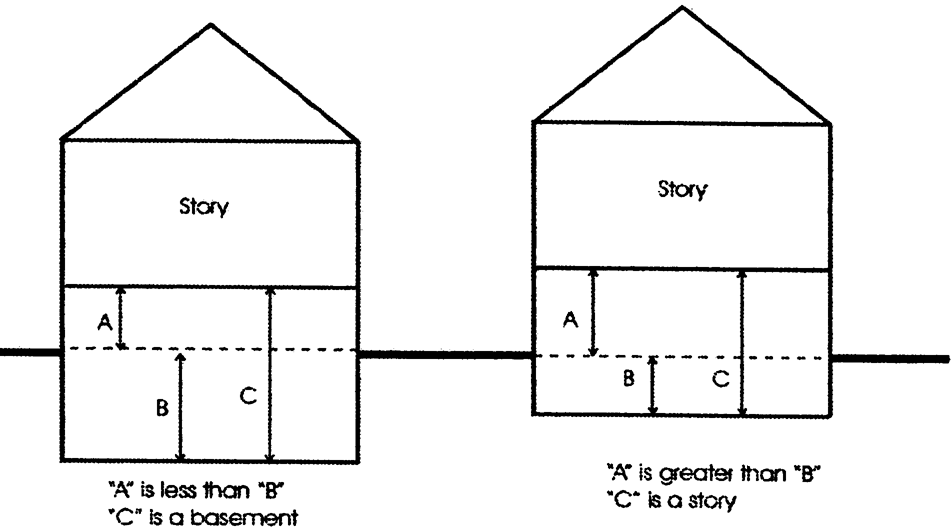
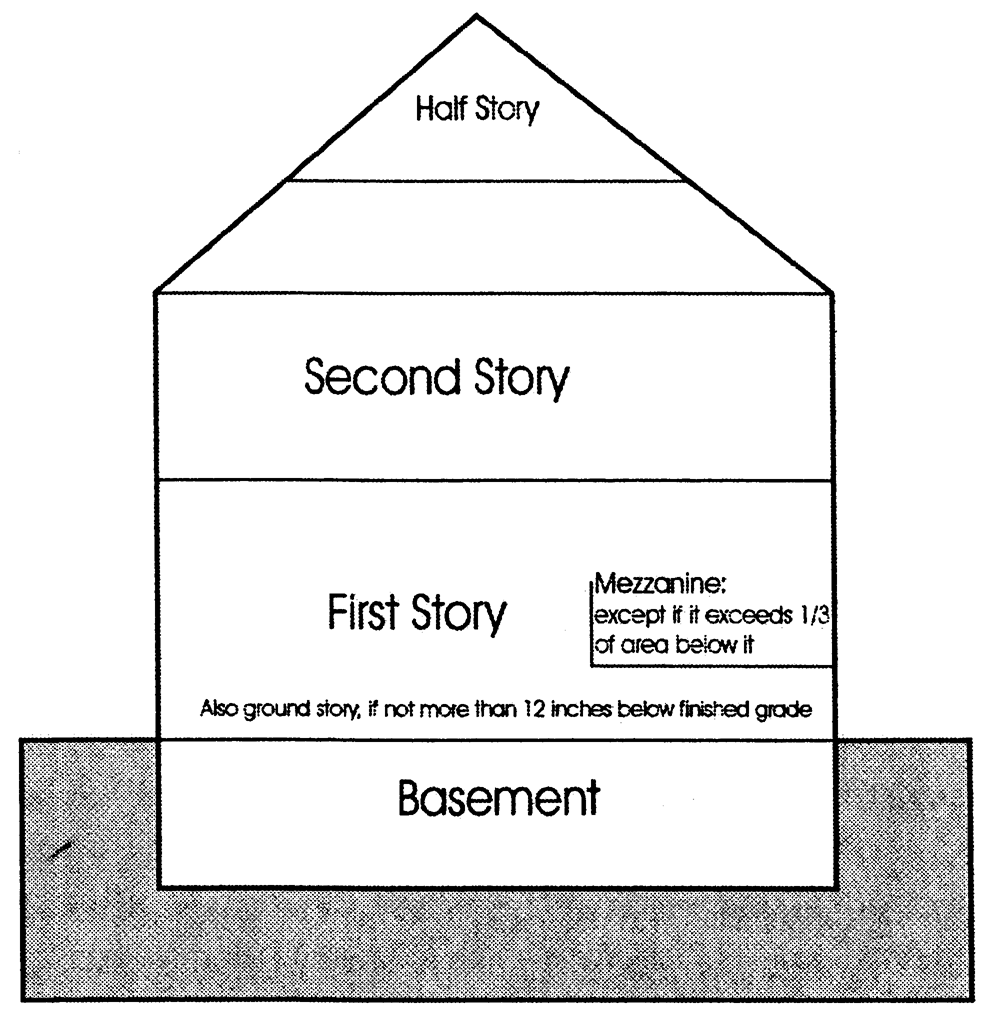
Basement: A portion of a building partly underground with more than one-half (½) of its height below grade.
Bedroom: A dwelling room used or intended to be used by human beings for sleeping purposes.
Bed and breakfast: A use which is subordinate to the principal use of a dwelling unit in which transient guests are provided a sleeping room and board in return for payment.
Block: The property abutting one (1) side of a street and lying between the two (2) nearest intersecting streets, or between one (1) intersecting street and railroad right-of-way, unsubdivided acreage, canal, levee, river or live stream; or between any of the foregoing and any other physical (natural and artificial) barrier to the continuity of development. An area bounded on all sides by streets or highways.
Boarding house, rooming house, lodging house: A building where meals, or lodging and meals, are provided for compensation to three (3) or more persons by prearrangement for definite periods of time not less than ten (10) days in duration.
Board of zoning appeals or board: As used in this chapter, this term means the City of Farmington board of zoning appeals.
Brownfield site: A site that was contaminated with hazardous materials by a previous use and has the potential to be reused once the contamination is remediated.
Buffer zone: A strip of land often required between certain zoning districts reserved for plant material, berms, walls or fencing singularly or in combination to serve as a visual and noise barrier.
Buildable area: The buildable area of a lot is the space remaining after the setback and the open space requirements of this chapter have been complied with.
Building: A structure, either temporary or permanent, having a roof supported by columns, or any other support used for the enclosures of persons, animals, or chattels, or carrying on business activities or other uses. When any portion thereof is completely separated from every other part thereof by division of walls from the ground up, and without openings, each portion of such building shall be deemed a separate building.
Building (unenclosed): A building having no enclosure, either by screening or otherwise, other than its roof and such necessary supporting structure as will present the minimum obstruction to light, air and view. The term shall include such carports, porches, soffits, cornices, awnings and similar structures.
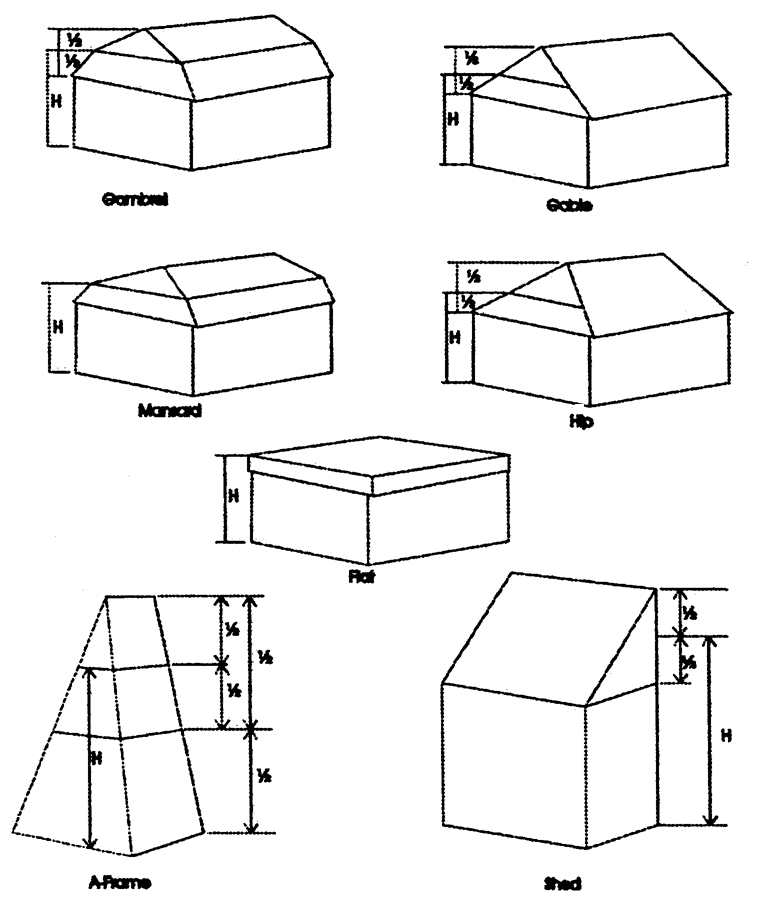
Building height: The building height is the vertical distance measured from the established grade to the highest point of the roof surface if a flat roof; to the deck of mansard roofs, and to the mean height level between eaves and ridge of gable, hip and gambrel roofs. When the terrain is sloping, the ground level is measured at the mean established grade at the building wall perimeter.
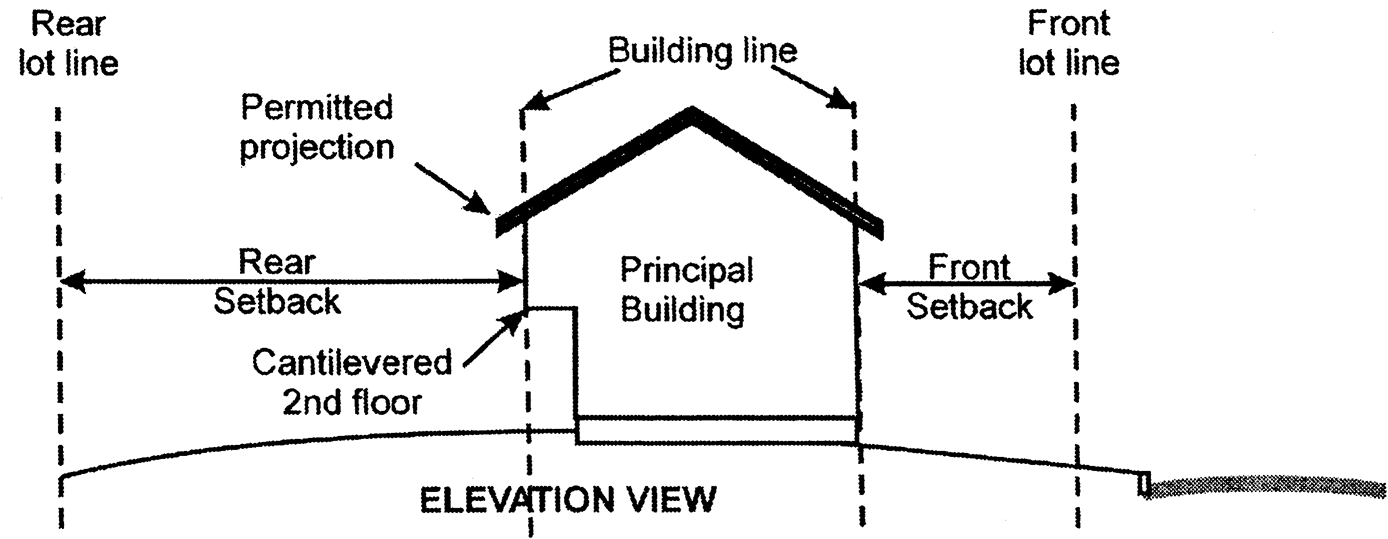
Building line: A horizontal line generally parallel to a front, rear, or side lot line which is located at the point of the foundation of a principal building nearest to the front, rear or side lot line.
Building official: An individual appointed by the city manager delegated to administer the city building code and city zoning ordinance.
Building, principal: A building in which is conducted the principal use of the lot on which it is situated.
Building permit: A building permit is the written authority as issued by the building official on behalf of the city permitting the construction, moving, alteration or use of a building in conformity with the provisions of this chapter and the city's building code.
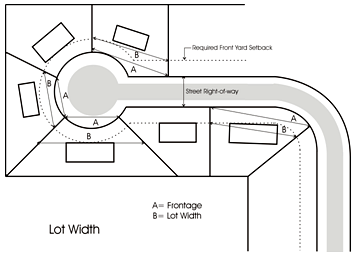
Building setback: The area pertaining to the minimum setback distance established from the front street right-of-way or property line to a building, thus defining an area of the lot adjacent to the front, side or rear lot line in which no part of a building shall project or be located, except as otherwise provided for in this chapter.
Business, trade or vocational school: A specialized instructional establishment that provides on-site training of business, commercial, and/or trade skills such as accounting, data processing, computer repair, hairdressing, or for the teaching of industrial skills.
Caliper: The diameter of a tree trunk measured six (6) inches above ground level up to and including four-inch caliper size and twelve (12) inches above ground level for larger sizes.
Canopy tree: A deciduous tree whose mature height and branch structure provide foliage primarily on the upper half of the tree. The purposes of a canopy tree are to provide shade to adjacent ground areas and to enhance aesthetics.
Cellular antennae: Antennae used to send or receive wireless, telecommunication signals.
Cellular tower: A structure used to support wireless, telecommunications antennae.
Child care organization: A governmental or nongovernmental organization having as its principal function the receiving of minor children for care, maintenance training and supervision notwithstanding that educational instructional may be given. Child care organizations are licensed and regulated under the State of Michigan Act 116 of 1973 and include the following:
(a)
Child care center (or day care center): A facility, other than a private residence, receiving one (1) or more preschool or school age children for care for periods of less than twenty-four (24) hours a day and for not less than two (2) consecutive weeks and where the parents or guardians are not immediately available to the child.
(b)
Foster family home: A private home in which one (1), but not more than four (4), minor children, who are not related to an adult member of the household by blood, marriage or who are not placed in the household pursuant to the adoption code, are given care and supervision for twenty-four (24) hours a day, for four (4) or more days a week for two (2) or more consecutive weeks, unattended by a parent or legal guardian.
(c)
Foster family group home: A private home in which more than four (4), but fewer than seven (7), minor children, who are not related to an adult member of the household by blood, marriage, or who are not placed in the household pursuant to the adoption code, are provided care for twenty-four (24) hours a day, for four (4) or more days a week for two (2) or more consecutive weeks, unattended by a parent or legal guardian.
(d)
Family day care home: A private home in which one (1), but fewer than seven (7), minor children are received for care and supervision for periods of less than twenty-four (24) hours a day, unattended by a parent or legal guardian, except children related to an adult member of the family by blood, marriage, or adoption. Family day care home includes a home that gives care to an unrelated minor child for more than four (4) weeks during a calendar year.
(e)
Group day care home: A private home in which more than six (6), but not more than twelve (12), minor children are given care and supervisions for periods of less than 24 hours a day unattended by a parent or legal guardian, except children related to the adult member of the family by blood, marriage, or adoption. Group day care home includes a home that gives care to an unrelated minor child for more than four (4) weeks during a calendar year.
(f)
Child caring institution: A child care facility which is organized for the purpose of receiving children for care, maintenance and supervision usually on a twenty-four-hour basis, in a building maintained for that purposed, and operates throughout the year. It includes a maternity home for the care of unmarried mothers and institutions for mentally, emotionally or developmentally challenged or disturbed children.
City council or council: The City of Farmington city council.
Clinic, medical or dental: An establishment where human patients who are not lodged overnight are admitted for examination and treatment by a group of physicians, dentists or similar professions.
Club: An organization of persons for special purposes or for the promulgation of sports, arts, science, literature, politics or the like but not for profit.
Commercial: This term relates to the use of property in connection with the purchase, sale, barter, display or exchange of goods, wares, merchandise or personal services or the maintenance of service offices or recreation or amusement enterprise or garage/basement sales operating more than twelve (12) days during one (1) twelve-month period.
Commercial establishment: Examples of a "commercial establishment" in various contexts would include, without limiting, the following: a business operating independent of any other business located in a freestanding building; in a strip mall, a business completely separated from other businesses by walls with a door which may regularly be used by the public for exclusive ingress and egress to that business; and, in an office building, a business holding itself out to the public as a single entity, independent of other businesses or persons.
Commercial outdoor display, sales and storage: The commercial outdoor sales, leasing, display and storage of items such as, but not limited to: building materials and lumber; modular buildings; swimming pools; playground equipment; contractor's equipment and supplies; landscape materials and equipment; automobile and recreational vehicles; agricultural implements and similar items.
Commercial vehicle: Any vehicle used for the transportation of passengers for hire, or constructed or used for transportation of goods, wares or merchandise and/or motor vehicles designed and used for drawing other vehicles.
Convalescent or nursing home: A long-term recuperative care facility providing room and board and supervised personal care by facility staff on a twenty-four-hour basis for the aged, the infirm or persons recovering from illness. An unlicensed extended care facility or chronic care facility providing twenty-four-hour nursing care shall mean the same.
Cul-de-sac: A street having one (1) terminus open for vehicular or pedestrian access and the other terminated by a vehicular turnaround.
Decibel: A unit of measurement used to express the magnitude of sound pressure and sound intensity.
Diameter breast height (DBH): The diameter of a tree measure at four (4) feet above the natural grade.
District: A portion of the incorporated part of the city within which certain regulations and requirements are applied thereto under the provisions of this chapter.
Drive-in establishment: A commercial business establishment whose principal retail and/or service character is dependent primarily on providing a driveway approach and/or parking space for motor vehicles so as to serve patrons while in or momentarily stepped away from their motor vehicles. This may include, but is not limited to, banks, restaurants, laundry pick-up, etc.
Drive-through establishment: A drive-through establishment that furnishes the patron with a product such as food in a state which may be picked up from a drive-through window or other similar arrangement to be utilized or consumed outside the building.
Dry cleaning establishments: An establishment which launders or dry cleans on-site articles dropped off on the premises directly by the customer; or an establishment where articles are dropped off, sorted, and picked up but where laundering or cleaning is done elsewhere.
Dry cleaning plants: A building, portion of a building, or premises used or intended to be used for dry cleaning materials, apparel or other textiles or fabrics which are delivered from more than one (1) dry cleaning establishment for processing. Dry cleaning plants are those establishments which do not perform pick-up and delivery service directly to customers, or those that accept materials, apparel or other textiles or fabrics from more than three (3) other dry cleaning establishments.
Dumpster (waste receptacle): A container used for the temporary storage of rubbish pending collection having the capacity of at least one (1) cubic yard.
Dwelling, unit: A dwelling unit is any building or portion thereof having cooking facilities, which is occupied wholly as the home, residence or sleeping place of one (1) family, either permanently or transiently, but in no case shall a motor home, trailer coach, automobile chassis, tent, or portable building be considered a dwelling. In case of mixed occupancy, where a building is occupied in part as a dwelling unit, the part so occupied shall be deemed a dwelling unit for the purpose of this chapter and shall comply with the provision thereof relative to dwellings.
Dwelling, multiple: A building or portion thereof, used or designated for use as a residence for more than two (2) families living independently of each other. This definition does not include manufactured homes, single-family attached dwellings or two-family dwellings.
Dwelling, single-family attached: A group of three (3) or more family dwelling units which are joined to one another by a common party wall, but not a common floor-ceiling. Each unit shall have its own outside entrance. For the purposes of this chapter, dwellings such as semi-detached, rowhouses, patio-house and townhouse shall be deemed a single-family attached dwelling.
Dwelling, single-family detached: A unit exclusively for use by one (1) family which is entirely surrounded by open space or yards on the same lot.
Dwelling, two-family: A detached building used or designed for use exclusively by two (2) families living independently of each other and each doing their own cooking in said building. It may also be termed a "duplex."
Effective date: Whenever this chapter refers to "effective date" of this chapter, it shall be deemed to include the effective date of the amendment that created, increased or a decreased a nonconforming situation.
Efficiency unit: A dwelling unit for one (1) individual or small family consisting of one (1) room, exclusive of bathroom, hallway, closets and the like.
Electrical switching station: A system of electrical equipment that interconnects several electrical transmission lines for the purpose of allowing the transmission lines to be serviced and maintained without disruption of power.
Electrical transmission lines: Electric utility wires that are generally strung on large metal or wooden towers including the towers or poles themselves whose function is the transportation of at least 69kV of electricity.
Entertainment establishments: An establishment which provides for activities such as, but not limited to: bowling alleys, billiard and pool halls, game and video arcades, and tag games. This definition does not include those uses defined in Article 12, Special Land Uses, Adult Regulated Uses.
Erected: The word "erected" includes built, constructed, reconstructed, moved upon or any other physical operation on the premises required for the building. Excavations, fill, drainage, and the like, shall be considered a part of erection.
Essential public services: The erection, construction, alteration, or maintenance by the public utilities or municipal department of underground, surface or overhead gas, electrical, cable television, steam, fuel or water transmission, or distribution systems; collection, communication, supply, or disposal systems, including poles, wires, mains, drains, sewers, pipes, conduits, transformers, splice boxes, cables, fire alarm and police call boxes, traffic signals, hydrants, and similar accessories in connection therewith; but not including, buildings, electrical substations, transmission towers, air quality monitoring stations, storage yards, school bus parking yards, sales or business offices, or commercial buildings, or activities, which are necessary for the furnishing of adequate service by such utilities or municipal departments for the general health, safety or welfare.
Essential public service building: A building or structure principal to an essential public service, such as drop-off stations for residential recyclables, vehicle garages, telephone exchange buildings, electricity transformer stations or substations and gas regulator stations.
Essential public service storage yard: An outdoor storage area used as a principal or accessory use for an essential public service.
Excavating: The removal of sand, stone, gravel, or fill dirt below the average grade of the surrounding land and/or road grade, whichever shall be highest, excepting common household gardening.
Exotic or vicious animal:
(a)
Any animal of a species not indigenous to the State of Michigan and not a domesticated animal, including any hybrid animal that is part exotic animal; or
(b)
Any animal which, irrespective of geographic origin, is of wild or predatory character, or which, because of size, aggressive, or vicious characteristics, would constitute an unreasonable danger to human life or property if not kept, maintained or confined in a safe and secure manner, including any hybrid animal that is part exotic animal; or
(c)
Any animal that attacks, bites, or injures human beings or other domesticated/pet animals without adequate provocation, or which, because of temperament, conditioning, or training, has a known propensity to attack, bite, or injure human beings or domesticated/pet animals.
(d)
Without limitation of the foregoing, the following animals shall be considered exotic or vicious:
(1)
Apes, monkeys, chimpanzees, and related forms.
(2)
Poisonous reptiles, spiders, insects, and animals.
(3)
Constrictor snakes four (4) or more feet in length. Constrictor snakes less than four (4) feet in length must be kept in cages and not allowed to roam freely.
(4)
Except as permitted by the Large Carnivore Act, MCL 287.1101, as amended, the following large carnivore:
a.
Any of the following cats of the Felidae family, whether wild or captive bred, including a hybrid cross with such a cat: a lion, a leopard (including, but not limited to, a snow leopard or clouded leopard), a jaguar, a tiger, a cougar, a panther, a cheetah, a bobcat, a lynx, a mountain lion, or a puma;
b.
A bear of a species that is native or nonnative to this state, whether captive or wild bred.
(5)
Non-domesticated carnivorous animals, including hybrid crosses of non-domesticated carnivorous, including, but not limited to, raccoons, skunks, and foxes.
(6)
Predatory reptiles, including, but not limited to, crocodiles and alligators.
(7)
Carnivorous fish, including, but not limited to, sharks.
(8)
Flightless birds, including, but not limited to, ostrich.
(9)
Large mammals that have a trunk, including, but not limited to, elephants.
(10)
Hoofed mammals with an odd number of toes, including, but not limited to, rhinoceros and tapir.
(11)
Hoofed mammals with an even number of toes, including, but not limited to, camels, sheep, and deer.
Facade: The exterior wall of a building exposed to public view.
Family:
(a)
A domestic family is one (1) or more persons living together and related by the bonds of blood, marriage or adoption, together with servants of the principal occupants and not more than one (1) additional unrelated person, with all of such individuals being domiciled together as a single, domestic, housekeeping unit in a dwelling; or
(b)
The functional equivalent of the domestic family is persons living together in a dwelling unit whose relationship is of a permanent and distinct character and is the functional equivalent of a domestic family with a demonstrable and recognizable bond which constitutes the functional equivalent of the bonds which render the domestic family a cohesive unit. All persons of the functional equivalent of the domestic family must be cooking and otherwise operating as a single housekeeping unit. This definition shall not include any society, club, fraternity, sorority, association, lodge, coterie, organization or group where the common living arrangement and/or the basis for the establishment of the functional equivalency of the domestic family is likely or contemplated to exist for a limited or temporary duration.
Farm: All of the contiguous neighboring or associated land operated as a single unit on which bona fide farming is carried on directly by the owner-operator, manager or tenant-farmer by his own labor or with the assistance of members of his household or hired employees; provided, however, that land to be considered a farm hereunder shall include a contiguous parcel of not less than ten (10) acres in area. Farms may be considered as including establishments operated as bona fide greenhouses, nurseries, orchards, livestock and poultry farms, and apiaries; but establishments for the purpose of keeping furbearing animals or game, or operating fish hatcheries, piggeries, stock yards, stone quarries, or gravel, dirt or sand pits shall not be considered farms.
Fence: A manmade, unroofed structure serving to enclose or divide all or part of a lot intended to function as a boundary or barrier between two (2) or more lots or to corral animals.
Fitness center or health club: A facility which provides indoor exercise facilities, such as exercise machines and weight-lifting equipment, usually in a structured physical activity program supervised by professional physical fitness instructors or specialists in sports medicine. As defined herein, "personal fitness center" shall not include spectator seating for sports events. A personal fitness center may or may not be enclosed within a gym.
Floodplain: The area adjoining a river, stream, watercourse, or lake subject to a 100-year recurrence-interval flood as delineated by the Flood Boundary and Floodway Map prepared by the Federal Insurance Administration of the Federal Emergency Management Agency.
Floor area, gross leasable: Gross leasable area (GLA) is defined as the total floor area designed for tenant occupancy and exclusive use, including any basements, mezzanines, or upper floors, expressed in square feet and measured from the centerline of joint partitions and from outside wall faces. For the purpose of parking calculations, the floor area of any parking garages within the building shall not be included within the GLA of the building. GLA is the area for which tenants pay rent, or the area that produces or may produce income.
Floor, first: The floor of a building most nearly on a level with the ground. A basement shall only be considered the first floor if over fifty (50) percent of its height is above the level from which the height of the building is measured and the finished surface of the floor above the basement is more than six (6) feet above grade plane, or, if it is used for a permitted business purpose.
Floor, upper: Any floor above grade that is not the first floor.
Frontage: The linear dimension measured along the public street right-of-way line or along a private road access easement.
Funeral home or mortuary establishment: An establishment where the dead are prepared for burial or cremation and where wakes or funerals may be held. A funeral home or mortuary establishment shall not include crematoria.
Garage, private or public: An accessory building or portion of a principal building designed or used solely for the storage of motor vehicles, boats, and similar vehicles owned and used by the occupants of the building to which it is accessory.
Garden center or nursery: An establishment with retail sales of trees, fruits, vegetables, shrubbery, plants, seeds, topsoil, humus, fertilizer, trellises, lawn furniture, playground equipment and other home garden supplies and equipment.
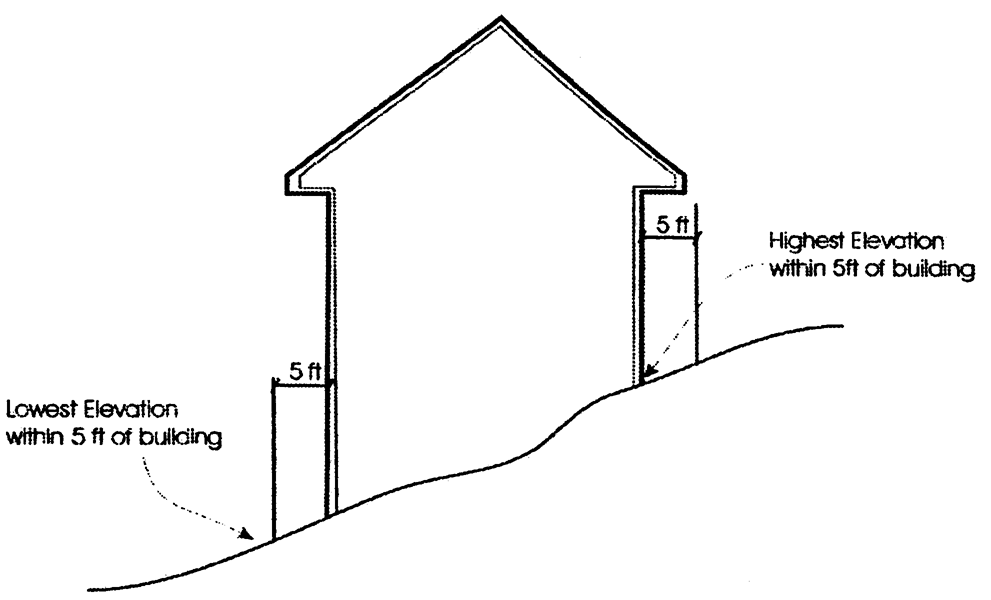
Grade, average: The arithmetic average of the lowest and highest grade elevations in an area within five (5) feet of the foundation line of a building or structure.
Grade, finished: The lowest point of elevation between the exterior wall of the structure and a line five (5) feet from the exterior wall of the structure.
Grade, natural: The elevation of the ground surface in its natural state, before construction begins.
Greyfield site: An industrial or commercial site that is economically obsolescent, underused, has outdated facilities or an oversupply of surface parking and may be redeveloped with the form of development recommended in the city's master plan. Buildings determined to be historic by the city shall not be considered greyfield sites, except where the historic structure can be retained and reused.
Greenbelt: A landscaped area along a street between the curb or road shoulder and the front yard building or parking setback line, this area is also refers to the front yard parking lot setback area.
Home occupation: An occupation that is a secondary use, which is clearly subservient or incidental to the use of a single-family dwelling unit for residential purposes.
Hotel: A building occupied or used as a predominantly temporary abiding place by individuals or groups of individuals, with or without meals, and in which building there are more than five (5) sleeping rooms and in which rooms there is no provision for cooking.
Housing for the elderly: See "Assisted Living Facility", "Convalescent Home", "Senior Housing".
Industrial, general: Activities including: the assembly, manufacture, compounding, processing, packaging or treatment from previously prepared materials, or repair, of products; the assembly, manufacture, fabrication, processing, packaging, or treatment of products indoors from previously prepared material including bone, canvas, cellophane, cloth, cork, elastomers, feathers, felt, fiber, fur, glass, hair, horn, leather, paper, rubber, precious or semiprecious metals or stones, shell, textiles, tobacco, wax, wire, wood (planing mills shall not be permitted) and yarns; breweries, distilleries, and wineries; painting and varnishing shops; printing, lithography, blueprinting, publishing and similar uses; tool, die, gauge, and machine shops; warehousing and wholesale establishments and material distribution facilities.
Industrial, heavy: Activities including: canning factories and food processing, excluding slaughtering or rendering; cogeneration plants; concrete and asphalt batch plants; extractive operations (sand, gravel mining, etc.); heating and electric power generating plants; incinerators, recycling centers, and composting facilities; lumber and planing mills; metal plating, buffing and polishing; salvage yards; water filtration and wastewater treatment plants, reservoirs, and sewage treatment facilities.
Industrial, light: Activities including: experimental, film and testing laboratories research and development facilities; research and development facilities, and corporate headquarters.
Infill housing development: The development, redevelopment or reuse of new housing on vacant sites in built-up areas.
Instructional entertainment uses: Facilities intended for commercial or recreational use that combine instructional learning with social events and gatherings, such as art classes, music lessons, professional open house receptions, etc. These uses may be permitted as a single, temporary event or as a permanent use.
Junk yard or salvage yard: An open area where waste and used or secondhand materials are bought and sold, exchanged, stored, baled, packed, disassembled or handled including, but not limited to, scrap iron and other metals, paper, rags, rubber tires and bottles. A junk yard or salvage yard also includes automobile wrecking yards and any area of more than two hundred (200) square feet for storage, keeping or abandonment of junk but does not include uses established entirely within enclosed buildings.
Kennel: Any lot or premises on which more than three (3) dogs or cats, six (6) months of age or older are either permanently or temporarily boarded.
Landscaping: The treatment of the ground surface with live plant materials such as, but not limited to, grass, ground cover, trees, shrubs, vines and other live plant material. In addition, a landscape design may include other decorative natural materials, such as wood chips, boulders or mulch. Structural features such as fountains, pools, statues and benches shall also be considered a part of landscaping if provided in combination with live plant material.
Livestock: Any domestic species of animal that is raised for use as food or in the production of food, or in the operation of a farm, and is not (a) an exotic or vicious animal as defined in this section or (b) a domesticated animal/pet as defined in this section, such as a dog, cat, or similar animal. Livestock shall include, but is not limited to, mules, donkeys, cattle, sheep, goats, buffaloes, swine, ducks, geese and turkeys.
Loading space: An off-street space on the same lot with a building or group of buildings for temporary parking for a commercial vehicle while loading or unloading merchandise or materials. Off-street loading spaces are not to be included as off-street parking spaces in computation of required off-street parking.
Lot: An individual portion of land of at least sufficient size to meet minimum zoning requirements for use, buildings, structures, lot coverage, yards and other open spaces as may be present or required under the provisions of this chapter. Such lot shall have frontage on an improved public street, or an approved private road, and may consist of either a single lot of record, a portion of a lot of record, a combination of contiguous lots of record or a parcel of land described by metes and bounds.
Lot area: The total horizontal area within the lot lines of a lot.
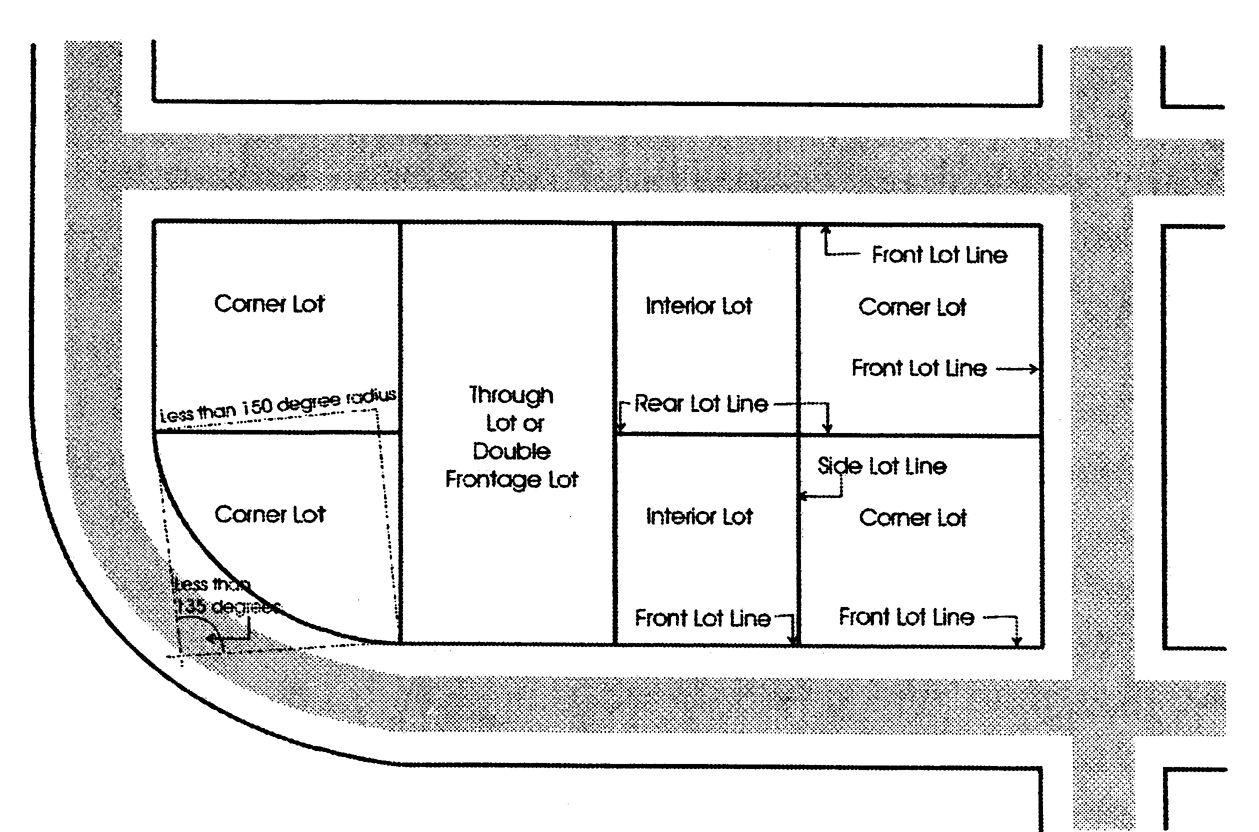
Lot, corner: A lot located at the intersection of two (2) streets or a lot bounded on two (2) sides by a curving street, any two (2) chords of which form an angle of one hundred thirty-five (135) degrees or less.
Lot coverage: The part or percent of the lot occupied by buildings or structures, including accessory buildings or structures.
Lot, depth: The mean horizontal distance from the front street line to the rear lot line, or in the case of an acreage lot, from the front right-of-way line to the rear property line.
Lot, double frontage, through: A lot other than a corner lot having frontage on two (2) more or less parallel streets. In the case of a row of double frontage lots, one (1) street will be designated as the front street for all lots. If there are existing structures in the same block fronting on one (1) or both of the streets, the required front yard setback shall be observed on those streets where such structures presently front.
Lot, interior: A lot other than a corner lot with only one (1) lot line fronting on a street.
Lot, zoning: A single tract of land, located within a single block, which at the time of filing for a building permit is designated by its owner or developer as a tract to be used, developed or built upon as a unit, under single ownership or control. A zoning lot shall satisfy this chapter with respect to area, size, dimensions and frontage as required in the district in which the zoning lot is located. A zoning lot, therefore, may not coincide with a lot of record as filed with the county register of deeds, but may include one (1) or more lots of record.
Lot lines: The property lines bounding the lot.
(a)
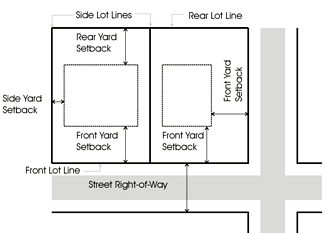
Front lot line: In the case of an interior lot, abutting upon one (1) public or private street, the front lot line shall mean the line separating such lot from such right-of-way. In the case of a corner or through lot, the front lot line shall be that line separating said lot from that street which is designated as the front street.
(b)
Rear lot line: Ordinarily, that lot line which is opposite and most distant from the front lot line of the lot. In the case of an irregular or triangular shaped lot, a line at least ten (10) feet in length entirely within the lot parallel to and at the maximum distance from the front lot line of the lot shall be considered to be the rear lot line for the purpose of determining depth of rear yard. In case where none of these definitions are applicable, the building official shall designate the rear lot line.
(c)
Side lot line: Any lot line not a front lot line or a rear lot line. A side lot line separating a lot from a street is a side street lot line or exterior side lot line. A side lot line separating a lot from another lot or lots is an interior side lot line.
(d)
Street or alley lot line: A lot line separating the lot from the right-of-way of a street or an alley.
Lots of record: A parcel of land, the dimensions of which are shown on a document or map on file with the county register of deeds or in common use by municipal or county officials, and which actually exists as so shown, or any part of such parcel held in a record ownership separate from that of the remainder thereof.
Lot width: The horizontal distance between the side lot lines, measured at the two (2) points where the building setback line intersects the side lot lines.
Manufactured home (i.e., mobile home): A structure transportable in one (1) or more sections, which is built on a chassis and designed to be used as a single dwelling unit with or without permanent foundation, when connected to required utilities, and include the plumbing, heating, air conditioning and electrical systems contained in the structure.
Manufactured housing community: A parcel or tract of land which is under the control of one (1) person, group or firm upon which three (3) or more manufactured homes have been located on a continual nonrecreational basis and which is offered to the public for that purpose regardless of whether a change is made therefore, together with any building, structure, enclosure, street, equipment or facility used or intended for use incident to the occupancy of a mobile home. Manufactured housing developments are regulated by the Michigan Manufactured Housing Commission.
Master plan: The master plan of the City of Farmington which is intended to guide the physical development of the city and all portions thereof. Such plan including maps, plats, charts, policy statements and/or descriptive material, shall be that adopted in accordance with the Municipal Planning Act, Michigan Public Act 285 of 1931, as amended.
Mechanical amusement device: Any machine which, upon the insertion of a coin, slug, token, plate, or disc or the payment of price, may be operated by the public generally for uses as a game, entertainment or amusements, whether registering a score. It shall include such devices as marble machines, pinball machines, skillball machines, mechanical grab machines, coin-operated motion picture machines, shuffleboard machines or devices, whether played with discs, weights, pucks or balls, and all games, operations or transactions similar thereto under whatever name they may be indicated, and whether operated by hand or electric power, or a combination thereof.
Motel: A group of attached, semi-attached or detached rooming units with at least eighty (80) percent of the rooming units having individual entrances leading directly to the outside of the building, with not more than two (2) dwelling units for occupancy by management staff only with all required parking provided on the premises, and with no building or part thereof exceeding two (2) stories in building height.
Motor home: A motorized vehicular unit primarily designed for temporary dwelling in connection with travel and/or recreational usage. This term does not include manufactured homes.
Nonconformities: Existing lots, buildings, structures, site plans and uses of land were lawful prior to the effective date of this chapter, but which have become nonconforming under the terms of this chapter and its amendments.
Nonconforming building: A building or portion thereof lawfully existing at the effective date of this chapter, that does not meet the current minimum size, setbacks, height or other building provisions of the chapter in the district in which it is located. (Example: A house which does not meet the required front yard setback.)
Nonconforming lot: A lot of record lawfully existing at the effective date of this chapter that does not meet the current minimum area or lot dimensional requirements for the district in which it is located. (Example: A twenty-five thousand (25,000) square foot lot of record in a district which requires a minimum thirty thousand (30,000) square foot lot.)
Nonconforming site: Development improvements on a site which met this chapter requirements for site development at the time the site was developed, such as the amount of parking, parking lot pavement, landscaping signs or tree preservation; but which do not meet the current site design standards of the city. (Example: A retail store with ten (10) parking spaces when the current chapter requires fifteen (15) parking spaces.)
Nonconforming building or structure: A building or structure or portion thereof lawfully existing at the effective date of this chapter that does not conform to the provisions of the chapter in the district in which it is located. (Example: An accessory deck which does not meet current setback standards.)
Nonconforming use: A use which lawfully occupied a building or land at the effective date of this chapter, or amendments thereto, and that does not conform to the use regulations of the district in which it is located.
Nonresidential district: A zoning district with one (1) of the following zoning designations on the City of Farmington zoning map: O, Office; OS, Office Service; CBD, Central Business District; C2, Community Business; C3, General Business; or IND, Industrial.
Nudity and a state of nudity: Knowingly or intentionally displaying human male or female genitals, pubic area, vulva, anus, anal cleft, or cleavage with less than a fully opaque covering, the showing of the female breast with less than a fully opaque covering of any part of the nipple, or a showing of the covered male genitals in a discernibly turgid state. Nudity does not include a woman's breastfeeding of a baby whether or not the nipple or areola is exposed during or incidental to feeding.
Nursing home: A state-licensed long-term facility providing room and board and supervised personal care by facility staff on a twenty-four-hour basis for seven (7) or more aged, infirm or persons recovering from illness which is regulated under Act 368 of 1978. A state-licensed sub-acute care facility, state-licensed home for the aged, a state-licensed nursing home or state-licensed hospice facility providing twenty-four-hour nursing care shall mean the same.
Office: A room, studio, suite or building occupied and for office uses only.
Off-street parking lot: A facility providing vehicular parking spaces, along with adequate drives, aisles, and maneuvering space to allow unrestricted ingress and egress to at least two (2) vehicles.
Online retail delivery storage and pickup facility: A retail storage facility for the storage of groceries, including but not limited to food and dry-goods, and/or fast-food snack items for pick-up by delivery drivers for delivery to the retail customer pursuant to online order placed by the retail customer. Online retail delivery and storage facilities shall not allow shopping within the facility by the retail customer but may permit retail customer pickup of orders placed online.
Open air business: Includes uses operated for profit substantially in the open air including:
(a)
Bicycle, utility truck or trailer, motor vehicle, boats, or home equipment sale, repair or rental services;
(b)
Outdoor display and sale of garages, motor homes, manufactured homes, snowmobiles, farm implements, swimming pools and similar activities; or
(c)
Retail sales of trees, fruits, vegetables, shrubbery, plants, seeds, topsoil, humus, fertilizer, trellises, lawn furniture, playground equipment and other home garden supplies and equipment.
Open front store: A business establishment so developed that service to the patron may be extended beyond the walls of the structure, not requiring the patron to enter the structure.
Open space, required: The open space established between the lot lines and the required setback, open, unoccupied, and unobstructed by any building or part thereof, from the ground to the sky, except as otherwise provided in this chapter.
Parking space: An off-street space exclusive of necessary driveways, aisles or maneuvering areas suitable to accommodate one (1) motor vehicle and having direct unobstructed access to a street or alley.
Pawn shop: Any business that loans money on deposit or pledge of personal property, or other valuable thing, other than securities or printed evidence of indebtedness, or who deals in the purchasing of personal property or other valuable thing on condition of selling the same back again at a stipulated price.
Personal service establishments: Uses that provide services directly to the consumer including: barber/beauty shops, cleaning services, dry cleaners, pick-up, interior decorating shops, locksmith shops, photographic studios, small appliance repair shops, shoe repair shops, tailor shops and travel agencies.
Planned unit development (PUD): A zoning district which permits integrated and coordinated residential dwellings and/or certain nonresidential uses, all to be developed according to approved area and site plans, as provided in Article 10, Planned Unit Development, of this chapter.
Planning commission: The City of Farmington planning commission created under the Municipal Planning Commission Act, being Act 285 of the Public Acts of 1931, as amended.
Porch, enclosed: A covered entrance to a building or structure which is totally enclosed, and projects out from the wall of said building or structure and has a separate roof or integral roof with the principal building or structure to which it is attached.
Porch, open: A covered entrance to a building or structure which is unenclosed except for columns supporting the porch roof, and projects out from the wall of said building or structure and has a separate roof or an integral roof with the principal building or structure to which it is attached.
Principal building: A building or, where the context so indicates, a group of buildings in which is conducted the principal use of the lot on which the building is situated.
Principal purpose, primary purpose, and primarily: Means the sale or display of regulated material that comprises thirty-five (35) percent or more of sales volume or occupies thirty-five (35) percent or more of the floor area or visible inventory within the establishment.
Principal use: The primary use to which the premises are devoted and the primary purpose for which the premises exist.
Public utility: Any person, firm, corporation, municipal department, board or commission duly authorized to furnish, under federal, state or municipal regulations, to the public, electricity, gas, steam, communications, telegraph, transportation or water services.
Quasi-public institution: An organization owned or operated by a nonprofit entity such as a religious or charitable group, that is established to serve a social, educational, religious or other public need.
Recycling facility: A facility dedicated to the collection and/or processing of recyclables for conversion into raw materials or new products. This definition does not include landfills, junk yards or incinerators.
Recreational equipment and vehicles: Portable structures, machines or devices, self-propelled or towable by another vehicle, capable of moving upon the highways without special movement permits; primarily designed, constructed or modified to provide temporary living quarters or for recreational camping, or travel use and such trailers and other devices as shall be primarily intended for such transporting of all such structures, machines or devices. Motorcycles, bicycles, minibikes, and such vehicles as jeeps, four-wheel drives, and pickup trucks with attached cabs which do not exceed the roofline of the vehicle are specifically excluded from the provisions of this chapter. This does not include a temporary building, structure or use, permitted to exist during periods of construction of the principal building, structure or use. Various types of recreational equipment and vehicles include:
(a)
Travel trailer: A portable vehicle on a chassis, which is designed to be used as a temporary dwelling during travel, recreational, and vacation uses, and which may be identified as a "travel trailer" or a "fifth wheel" by the manufacturer. Travel trailers generally include self-contained sanitary, water and electrical facilities. On an industry-wide basis, this type of recreational vehicle is classified as a nonmotorized recreational vehicle.
(b)
Pickup camper: A structure designed to be mounted on a pickup or truck chassis with sufficient equipment to render it suitable for use as a temporary dwelling during the process of travel, recreational and vacation uses. On an industry-wide basis, this type of recreational vehicle is classified as a nonmotorized recreational vehicle.
(c)
Motor home: A recreational vehicle intended for temporary human habitation, sleeping, and/or eating, mounted upon a chassis with wheels and capable of being moved from place to place under its own power. Motor homes generally contain sanitary, water and electrical facilities. On an industry-wide basis, this type of recreational vehicle is classified as either a Class A or Class B recreational vehicle. A Class A or bus type recreational vehicle has the luggage compartment below the living quarter. The Class C recreational vehicle is a van with the bed over the cab and is much larger than a passenger van due to the bed over the cab.
(d)
Van/camper: A recreational vehicle intended for temporary human habitation, sleeping and/or eating. This class of recreational vehicles includes conversion vans and camper vans which may contain refrigerator as well as water and electrical facilities. This class closely resembles passenger vans, but some models may be taller to allow for extra head room. On an industry-wide basis, this type of recreational vehicle is classified as a Class B recreational vehicle.
(e)
Folding tent trailer: A folding structure, mounted on wheels and designed for travel and vacation use.
(f)
Boats and boat trailers: Boats, floats, rafts, canoes, plus the normal equipment to transport them on the highway.
(g)
Other recreational equipment: Includes snowmobiles, jet skis, all terrain or special terrain vehicles, utility trailers, plus the normal equipment used to transport them on the highway.
Recreation facility (indoor): A public or private establishment which provides indoor exercise facilities and/or indoor court and field sports facilities, and which may include spectator seating in conjunction with the sports facilities such as skating rinks, swimming pools, indoor golf facilities and bowling alleys. Auditoriums and stadiums are not included.
Recreation facility (outdoor): A publicly or privately owned facility designed and equipped for the conduct of sports activities and other customary recreational activities outside of an enclosed building such as, but not limited to tennis courts, swimming pools, archery ranges, golf courses, miniature golf courses, golf driving ranges, skating rinks, baseball fields, batting cages, soccer fields and campgrounds.
Residential district: A zoning district with one (1) of the following zoning designations on the City of Farmington zoning map: R1, R1A, R1B, R1C, R1D, Single-Family Residential; R1P, Single-Family Parking; R2 Two-Family, R3, R5, Multiple-Family; and R6, Single-Family Cluster.
Restaurant: Any establishment whose principal business is the sale of food and beverages to the customer in a ready-to-consume state, and whose method of operation is characteristic of a carry-out, drive-in, drive-through, fast food, standard restaurant, or bar/lounge, or combination thereof, as defined below:
(a)
Restaurant, carry-out: A business establishment whose method of operation involves the sale of food, beverages, and/or frozen desserts in disposable or edible containers or wrappers in a ready-to-consume state for consumption primarily off the premises.
(b)
Delicatessen: A restaurant typically offering both carry-out and seating of sandwiches and other foods and beverages. A delicatessen also typically offers meats, cheese and prepared foods on a retail basis.
(c)
Restaurant, drive-in: A business establishment whose method of operation involves delivery of prepared food so as to allow its consumption in a motor vehicle or elsewhere on the premises, but outside of an enclosed building. A drive-in restaurant may also have interior seating.
(d)
Restaurant, drive-through: A business establishment whose method of operation involves the delivery of the prepared food to the customer in a motor vehicle, typically through a drive-through window, for consumption off the premises.
(e)
Restaurant, fast-food: A business establishment whose method of operation involves minimum waiting for delivery of ready-to-consume food to the customer at a counter or cafeteria line for consumption at the counter where it is served, or at tables, booths, or stands inside the structure or out, or for consumption off the premises, but not in a motor vehicle at the site.
(f)
Restaurant, open front window: See "Open front store or restaurant".
(g)
Restaurant, standard: A business establishment whose method of operation involves either the delivery of prepared food by waiters and waitresses to customers seated at tables within a completely enclosed building or the prepared food is acquired by customers at a cafeteria line and is subsequently consumed by the customers at tables within a completely enclosed building.
(h)
Bar/lounge/tavern: A type of restaurant which is operated primarily for the dispensing of alcoholic beverages, although the sale of prepared food or snacks may also be permitted. If a bar or lounge is part of a larger dining facility, it shall be defined as that part of the structure so designated or operated. The hours of operation may extend beyond 11:00 p.m.; thereby differentiating it from a standard restaurant. A brewpub or microbrewery that operates beyond 11:00 p.m. is considered a bar, tavern or lounge.
Retaining wall: A structure serving to prevent a mass of earth from slipping.
Room: A room or group of rooms forming a single habitable unit used or intended to be used for living and sleeping, with closet space, and with or without bathroom, but without cooking facilities.
Secondhand dealers: Any person, corporation, partnership, firm or other entity, a substantial portion of whose business is that of purchasing, storing, exchanging and receiving secondhand property of any kind or description, excepting businesses whose primary products are bona fide antiques.
Semi-nude and semi-nude condition: The showing of the female breast below a horizontal line across the top of the areola at its highest point or the showing of the male or female buttocks. This definition shall include the entire lower portion of the human female breast, but shall not include any portion of the cleavage of the human female breast exhibited by a dress, blouse, skirt, leotard, bathing suit or other wearing apparel provided the areola is not exposed in whole or in part.
Senior housing: An unlicensed multiple-family residential development for elderly persons needing little or no personal assistance, which provides independent living dwelling units for the exclusive use of the occupants, whether or not group meals or other convenience services for the elderly are provided.
Setback: The distance required to obtain minimum front, side or rear yard open space provisions of this chapter. Setbacks from a public street shall be measured from the existing or proposed right-of-way lines, whichever is greater.
Shopping center: A group (more than one (1)) of primary retail and/or service commercial establishments constructed as one (1) development.
Sign: Any object, device, display or structure, situated outdoors or indoors, which is used to advertise, identify, display, direct or attract attention to an object, person, institution, organization, business, product, service, event or location by any means, including words, letters, figures, design, symbols, fixtures, colors, illumination or projected images.
Site condominium development: A development of condominium units on an unplatted tract of land, in which each individual lot conforms with the requirements of the zoning district in which it is established.
Smoke shop: A retail establishment where fifty (50) percent or more of the retail area, defined as wall to wall, is used for the display, promotion, or sale of products listed below; or an establishment where the sale of products listed below constitutes greater than fifty (50) percent of the establishment's merchandise:
(a)
Cigarettes, e-cigarettes, vapor, nicotine/alternative nicotine products, cigars, and packaged tobacco;
(b)
Tobacco smoking and e-cigarette paraphernalia products, including, but not limited to: pipes for smoking tobacco and nicotine products, cigarette holders, pens and electronic devices used for smoking tobacco, vape, and other nicotine or alternative nicotine products, and cigarette rolling papers.
(c)
Alternative nicotine product means any noncombustible product containing nicotine that is intended for human consumption whether chewed, absorbed, dissolved, inhaled or ingested by any other means.
(d)
Nicotine product means a product that does not contain tobacco, but delivers nicotine, including vapor products, and other nicotine delivery methods and devices.
(e)
Tobacco product means a product that contains tobacco and is intended for human consumption including, but not limited to, cigarettes, cigars, non-cigarette smoking tobacco, chewing tobacco, tobacco snuff or smokeless tobacco as those terms are defined in section 2 of the Tobacco Products Tax Act, 1993 PA 327, MCL 205.422.
(f)
Vapor product means a noncombustible product containing nicotine that employs a heating element, power source, electronic circuit, or other electric, chemical, or mechanical means regardless of shape or size that can be used to produce vapor from nicotine in a solution or other form. Vapor products include, but are not limited to, an electronic cigarette (e-cigarette), electronic cigar, electronic cigarillo, electronic pipe, or similar product or device and a vapor cartridge or other container of nicotine in a solution or other form that is intended to be used with or in an electronic cigarette (e-cigarette), electronic cigar, electronic cigarillo, electronic pipe, or similar product or device.
Special event: Any meeting, festival or gathering of more than twenty-five (25) persons for a common purpose as a result of prior planning that interferes with the normal flow or regulation of pedestrian or vehicular traffic on public rights-of-way or private property generally open to the public or occupies any area in a place open to the general public.
Specified anatomical areas: The human male genitals in a discernibly turgid state, even if completely or opaquely covered; or less than completely and opaquely covered human genitals, pubic region, buttocks or a female breast below a point immediately above the top of the areola.
Specified sexual activities: Any of the following: the fondling or other erotic touching of human genitals, pubic region, buttocks, anus, or female breasts; sex acts, normal or perverted, actual or simulated, including intercourse, oral copulation, masturbation or sodomy; or excretory functions as part of or in connection with any of the activities previously mentioned in this definition.
Story (also called "floor") That portion of a building, other than a basement or mezzanine, included between the surface of any floor and the floor next above it, or if there is no floor above it, then the space between the floor and the ceiling next above it.
(a)
A "mezzanine" floor shall be deemed a full story only when it covers more than fifty (50) percent of the area of the story underneath the mezzanine, or, if the vertical distance from the floor next below it to the floor next above it is twenty-four (24) feet or more.
(b)
For the purpose of this chapter, a basement or cellar shall be counted as a story only if over fifty (50) percent of its height is above the level from which the height of the building is measured and the finished surface of the floor above the basement is more than six (6) feet above grade plane, or, if it is used for a permitted business purpose.
Story, half: The part of a building between a pitched roof and the uppermost full story having a floor area which does not exceed one-half (½) the floor area of the full story, provided the area contains at least two hundred (200) square feet with a clear height of at least seven and one-half (7½) feet.
Street: Any public or private thoroughfare or right-of-way, other than a public or private alley, dedicated to or designed for travel and access to any land, lot or parcel, whether designated as a road, avenue, highway, boulevard, drive, lane, place, court, or any similar designation. Various types of roads are defined below.
(a)
Arterial or major street: A street or roadway which carries high volumes of traffic at relatively high speeds, and serves as an avenue for circulation of traffic onto, out of, or around the Farmington area. An arterial or major street may also be defined as a major thoroughfare, major arterial or minor arterial roadway. Since the primary function of the regional arterial roadway is to provide mobility, access to adjacent land uses may be controlled to optimize capacity along the roadway.
(b)
Collector street: A street or road whose principal function is to carry traffic between minor and local roads and arterial streets but may also provide direct access to abutting properties.
(c)
Cul-de-sac: A street or road that terminates in a vehicular turnaround.
(d)
Dead end street: Street that has one (1) terminus open for vehicular or pedestrian access and the other terminated on a temporary basis without a permanent vehicular turnaround.
(e)
Local or minor street: A street or road whose principal function is to provide access to abutting properties and is designed to be used or is used to connect minor and local streets with collector or arterial roadways. Local streets are designed for low volumes and speeds of twenty-five (25) mph or less, with numerous curb cuts and on-street parking permitted.
(f)
Private road: A roadway contained within a private street easement which is privately owned and maintained and which provides the principal means of access to one (1) or more abutting lots.
1.
Private driveway: A private street that provides or is planned to provide access to more than one (1) or fewer than five (5) lots.
2.
Private street easement: An easement that is granted exclusively for private access to one (1) or more parcels of land that contains a private street.
(g)
Public street: Any road or portion of a road which has been dedicated to and accepted for maintenance by the city, Oakland County, State of Michigan or the federal government.
Structure: Anything constructed or erected, the use of which requires location on the ground or attachment to something having location on the ground.
Substation, Distribution: An electrical substation that steps voltage up or down to or from electrical lines of under 69kV.
Substation, electrical: A system of electrical equipment that facilitates the stepping up or down of electrical voltage. For the purposes of this chapter, electrical substations shall include transmission substations and distribution substations.
Substation, transmission: An electrical substation that steps voltage up or down to or from an electrical transmission line.
Therapeutic massage: The application of various techniques to the muscular structure and soft tissues of the human body performed by a massage practitioner. A massage practitioner must satisfy two (2) or more of the following requirements:
(a)
The person is a member of the current Professional Level in the American Massage Therapy Association (AMTA), Associated Bodywork and Massage Professionals (ABMP), International Myomassethics Federation (IMF) or other recognized massage association with equivalent professional membership standards consisting of at least five hundred (500) hours of training including: theory, practice and techniques of massage (minimum three hundred (300) hours); human anatomy and physiology (minimum one hundred (100) hours); and professionalism (minimum one hundred (100) hours). Instruction in this area shall include training in contraindications, benefits, ethics and legalities of massage, building and marketing a practice and other electives as appropriate.
(b)
The person is a graduate of a school of massage licensed by the State of Michigan or holder of a current license from another state which requires, at a minimum, the training set forth in (a) above.
(c)
The person has completed a massage training program at a community college, college, university or technical school located in the United States, where such program requires at a minimum, the training set forth in (a) above.
(d)
The person has passed the National Certification Exam for Massage and Bodywork Practitioners.
Use: The primary purpose for which land or premises, or a building thereon, is designed, arranged or intended, for which it is occupied or maintained, let or leased.
Veterinary clinic, office or hospital: A facility which provides diagnosis, treatment, surgery and other veterinary care for domestic animals, horses and livestock provided that all activities are conducted within a completely enclosed building.
Waste disposal facility: A facility for end-of-the-line storage or incineration of solid and/or liquid waste including, but not limited to, household garbage, yard waste and nonhazardous industrial by-products.
Wireless communication towers: A structure of lattice or monopole framework to which an antenna may be attached for the transmission and/or reception of radio, television, satellite or microwave signals that facilitates wireless communications including cellular, enhanced specialized mobile radio (ESMR), personal communication or similar services.
Wireless communication antenna: The device for transmitting and/or receiving radio, television, satellite, cellular, enhanced specialized mobile radio, personal communication, microwave or similar transmissions.
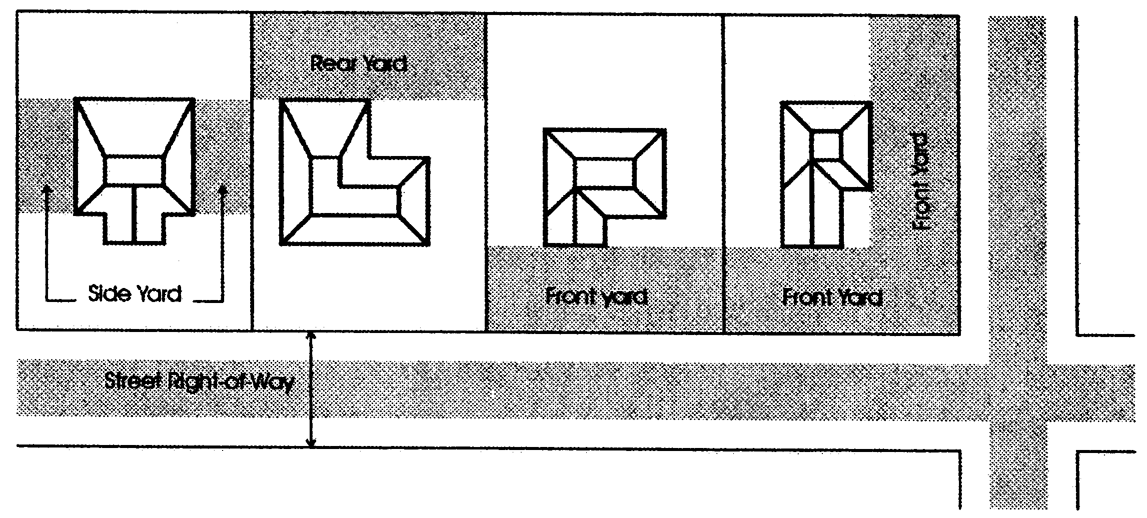
Yard: A required yard is an open space of prescribed width or depth on the same land with a building or group of buildings, which open space lies between the building or group of buildings and the nearest lot line and is unoccupied and unobstructed from the ground upward, except as otherwise provided herein.
(a)
Front yard: A required front yard is an open space extending the full width of the lot, the uniform depth of which is the minimum prescribed horizontal setback distance measured at right angles to the front lot line and is unoccupied space between the front lot line and the nearest line of the principal building, excepting steps and unenclosed porches.
(b)
Rear yard: A required rear yard is an open area extending across the full width of the lot, the uniform depth of which is the minimum prescribed horizontal setback distance measured at right angles to the rear lot line, describing an unoccupied space between the rear lot line and the nearest line of the principal building.
(c)
Side yard: A required side yard is an open unoccupied area between a principal building and the side lot lines, extending from the front yard area to the rear yard area. The width of the required side yard shall be measured from the center of the nearest wall of the building or structure to the nearest point of the side lot line.
1.
Interior side yard: A side yard located immediately adjacent to another zoning lot.
2.
Exterior side yard: A side yard abutting a street of a corner lot.
Zoning Act: The Michigan Zoning Enabling Act, Public Act 110 of 2006, as amended.
(Ord. No. C-751-2010, § 3, 1-18-11; Ord. No. C-753-2011, § 2, 6-6-11; Ord. No. C-760-2012, §§ 2—4, 3-19-12; Ord. No. C-765-2012, § 1, 8-20-12; Ord. No. C-767-2012, §§ 3, 4, 12-17-12; Ord. No. C-798-2020, § 1, 3-16-20; Ord. No. C-804-2022, § 3, 7-18-22)

