
Farmington City Zoning Code
ARTICLE 2
- GENERAL PROVISIONS2
Note— The regulations contained within this article shall apply to all parcels within the city, regardless of zoning designation, unless otherwise noted.
Sec. 35-21.- Lot Area Allocation.
No portion of a lot can be used more than once in determining compliance with the lot area and yard provisions for construction or alteration of buildings.
(Ord. No. C-746-2010, § 1, 4-19-10)
Sec. 35-22. - Municipal Buildings and Uses.
All municipal owned and operated buildings and uses shall be permitted after a finding by the planning commission that the particular use and development would not be injurious to the surrounding neighborhoods and would not be contrary to the spirit and purpose of this chapter. In the event the planning commission does not approve the use or site plan, city council may grant such approval by an affirmative vote of no less than four (4) of the five (5) members.
(Ord. No. C-746-2010, § 1, 4-19-10)
Sec. 35-23. - Principal Buildings, Structures and Uses.
No lot may contain more than one (1) principal building, structure or use, excepting groups of multiple-family dwellings or retail business buildings or other groups of buildings contained within a single, integrated complex, sharing parking, access, signs and other similar features which together provide a unified function and appearance.
(Ord. No. C-746-2010, § 1, 4-19-10)
Sec. 35-24. - Residential Development Regulations.
A.
Intent. The development standards contained herein are intended to regulate the character of new infill housing development in established single-family residential subdivisions or neighborhoods, including the Historic District. These regulations are based on a finding that the cohesiveness and character of the city's existing neighborhoods are significant factors in the city's quality of life, contribute to the distinct character in the various neighborhoods and help retain property values. The purpose of these regulations is to ensure new housing units are harmonious with the general character of the adjacent houses and the neighborhood in general in terms of building mass and height, building arrangement, location and design of garages, amount of pervious surface, architectural design and building materials. While some level of diversity is acceptable, the review procedures outlined herein are intended to ensure the design variation of new homes is similar to the level of variation in existing homes.
B.
Approval Required for Residential Construction.
1.
For any type of construction where a building permit is required, a building permit application shall be submitted to the building official for review and approval. The following types of residential construction shall also require review and approval by the Planning Commission:
a.
Construction of a new residential dwelling on an existing vacant lot of record or on a lot where the existing structure has been, or will be, removed.
b.
Construction of a new residential dwelling on a new lot created through a land division, subdivision, or condominium; provided, however, the planning commission may approve typical model home designs at the time of approval of a subdivision or condominium, and individual dwellings within the development that are substantially in conformance with these typical plans can be approved by the building official.
c.
New construction, expansion, or demolition of any residential dwelling or accessory building in the historic district.
d.
Construction or expansion of three (3) or more residential dwellings on a lot, such as condominiums or multiple-family residential.
e.
Expansion of an existing single or two-family dwelling that will result in a floor area that is more than two hundred (200) percent of the average of surrounding homes within three hundred (300) feet.
2.
Any renovation or expansion of an existing dwelling or accessory building that will result in a floor area that is no more than two hundred (200) percent of the average of surrounding homes within three hundred (300) feet, and does not otherwise require planning commission approval in subsection 1., above, may be approved administratively by the building official.
C.
Standards for Planning Commission Approval of Single-Family and Two-Family Dwellings.
1.
Where planning commission approval is required by this section, a residential site plan, including building footprint with building size, setback dimensions, and lot coverage calculations, elevations for all sides of the building, and details on building materials shall be provided for planning commission review. The planning commission may also require the applicant provide additional information to demonstrate that the requested construction meets the standards of this section. Such information may include a photographic inventory of nearby homes, cross sections or plan views that illustrate the relationship to adjacent homes or a report by an architect.
2.
The application shall be reviewed based upon the following standards:
a.
The building massing, height, and orientation shall not unreasonably impact adjacent property privacy, views, access to light, or the continuity of open yard spaces within the neighborhood.
b.
The proposed building's appearance shall be compatible with the general character of the neighborhood in terms of architectural styles, details, building materials, roof pitch, building massing, height, and garage orientation.
c.
The proposed building shall be in accordance with the area and bulk regulations of the district in which it is situated. If an addition is proposed to a nonconforming dwelling, the proposed expansion shall not increase the degree of nonconformity with regard to setback, lot coverage, or building height requirements. If variances are necessary, they shall be approved by the zoning board of appeals and shall be limited to the minimum necessary to provide reasonable development of the property similar to other residential owners in the area.
D.
Minimum Floor Area. The gross floor area of any proposed single-family or two-family dwelling unit shall be no less than ninety (90) percent of the average floor area of other single-family or two-family dwelling units within three hundred (300) feet of the subject lot.
E.
Dimensional Requirements. All residential dwellings shall be in accordance with the area and bulk regulations of the district in which they are situated, unless variances are first obtained from the board of zoning appeals.
F.
Front Yard Setbacks. In addition to the minimum setback requirements of the zoning district, the front yard setback of any proposed single family or two-family dwelling unit shall be no less than ninety (90) percent and no more one hundred thirty-five (135) percent of the average established front setback of other single-family or two-family dwelling units within three hundred (300) feet, on the same side of the street, of the subject lot.
G.
Building Appearance. Building appearance for new single-family and two-family dwelling units shall be similar and compatible with the general character of the area and reflect a continuity of design with surrounding buildings by maintaining the architectural styles, details, building materials and design themes of dwelling units within three hundred (300) feet of the subject lot.
H.
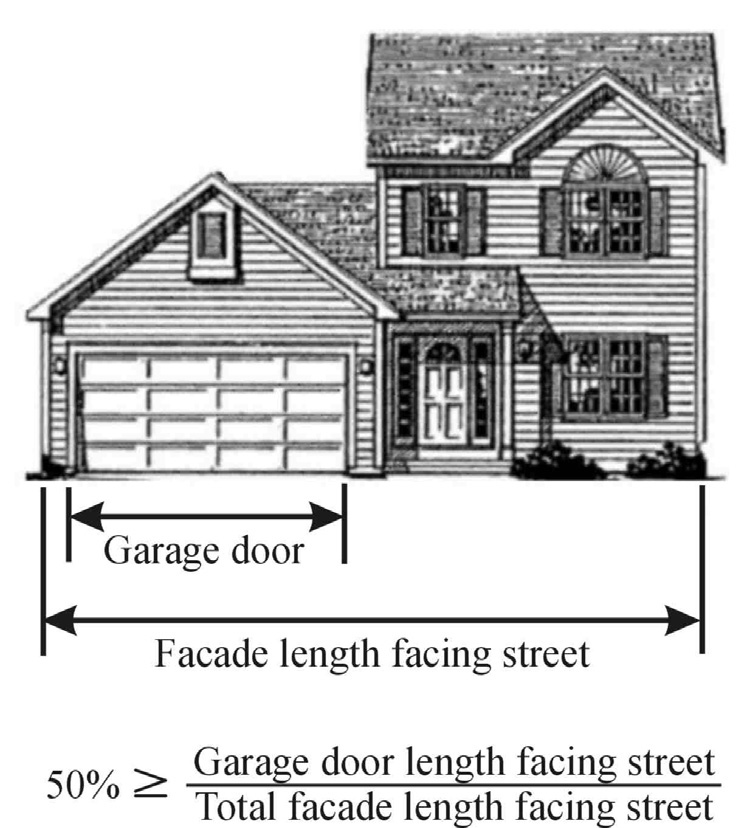
Garages. In order to protect the historic or traditional quality of the city's neighborhoods and maintain the pedestrian-oriented nature of the city, the front façade of single-family and two-family dwellings shall not be dominated by garage doors. For dwellings with a front-loaded attached garage, garage doors facing the street shall not constitute more than fifty (50) percent of the linear façade length facing the street.
(Ord. No. C-746-2010, § 1, 4-19-10)
Sec. 35-25. - Adult and Child Care Facilities.
A.
Adult and child residential care facilities, as defined in Article 21, Definitions, are allowed only as provided for in the following table and in accordance with State of Michigan licensing regulations. Applicable conditions are listed as footnotes to the table.
Footnotes:
1.
Off-street parking shall be provided for the number of employees on site at any one (1) time.
2.
The building shall have an appearance which is nonintrusive and consistent in color, materials, roof line and architecture with the single-family or multiple-family residential district in which it is located, as determined by the planning commission.
3.
An on-site drive shall be provided for drop-off/loading. This drive shall be arranged to allow maneuvers without creating a hazard to traffic flow on the public street.
4.
The facility shall operate a maximum of sixteen (16) hours per day.
5.
Re-use of existing quasi-public institutional buildings, such as schools, churches, or other civic buildings may be permitted if in compliance with the following:
a.
Adult and child care uses only shall be permitted. Re-use for social clubs, etc., shall not be considered under this section.
b.
No special medical services may be offered at the facility, except as normally associated with day care uses.
B.
A residential adult or child care facility existing prior to the effective date of this chapter, that has been operating under a valid state license following the effective date of this chapter, shall be considered an approved special land use, provided such use conforms with the conditions of this section. Any change in the class of the use to a larger care facility shall require approval in accordance with the requirements of this chapter. Any modification to the use shall require approval following the standards of Article 13, Site Plan Review, as applicable.
(Ord. No. C-746-2010, § 1, 4-19-10; Ord. No. C-751-2010, §§ 1, 2, 1-18-11)
Sec. 35-26. - Regulations Applicable to Single-Family Dwellings Outside Manufactured Housing Communities.
Any single-family dwelling, constructed and erected on a lot outside a manufactured housing community, shall be permitted only if it complies with all of the following requirements:
A.
If the dwelling unit is a manufactured home, the manufactured home must be one (1) of the following:
1.
New and certified by the manufacturer and/or appropriate inspection agency as meeting the Mobile Home Construction and Safety Standards of the U.S. Department of Housing and Urban Development, as amended, or any similar successor or replacement standard which may be promulgated; or
2.
Used and certified by the manufacturer and/or appropriate inspection agency as meeting the standards referenced in subsection 1., above, and found, on inspection by the building official, to be in excellent condition and safe and fit for residential occupancy.
B.
The dwelling unit shall comply with all applicable building, electrical, plumbing, fire, energy and other similar codes which are or may be adopted by the city, provided, however, that where a dwelling unit is required by law to comply with any federal or state standard or regulation for construction, and where such standard or regulation for construction is different than that imposed by city codes, the federal or state standard or regulation shall apply. Appropriate evidence of compliance with such standards or regulations shall be provided to the building official.
C.
The dwelling unit shall comply with all restrictions and requirements of this chapter, including, without limitation, the minimum lot area, minimum lot width, minimum residential floor area, required yard and maximum building height requirements of the zoning district in which it is located. If the dwelling unit is a mobile home, the mobile home shall be installed with the wheels removed.
D.
The dwelling unit shall have a minimum horizontal dimension across any side or rear elevation of twenty-four (24) feet and thirty-four (34) feet across any front elevation. The structure shall be placed on the lot so that the portions nearest the principal street frontage are at least thirty-four (34) feet in dimension parallel to the street.
E.
The dwelling unit shall be firmly attached to a permanent continuous foundation constructed on the building site. Such foundation shall have a wall of the same perimeter dimensions as the dwelling unit and be constructed of such materials and type as required by the building code for on-site constructed single-family dwellings. If the dwelling unit is a mobile home, its foundation and skirting shall fully enclose the chassis, undercarriage and towing mechanism.
F.
A storage area within a building with an area of no less than one hundred twenty (120) square feet shall be provided. This storage area may consist of a basement, closet area, attic or attached garage in a principal building, or in a detached accessory building that is in compliance with all other applicable provisions of this chapter pertaining to accessory buildings.
G.
Permanently attached steps or porch areas at least three (3) feet in width shall be provided in accordance with the city building code egress standards where there is an elevation difference greater than eight (8) inches between the first floor entry of the dwelling unit and the adjacent grade. Railings shall be provided in accordance with the city building code.
H.
The main roof of the dwelling unit shall have a pitch of not less than five (5) feet of rise for each twelve (12) feet of horizontal run and shall have not less than a six-inch overhang.
I.
The exterior finish of the dwelling unit shall not cause glare or reflection that is greater than that from siding coated with clean, white, gloss exterior enamel.
J.
The dwelling unit shall have no less than two (2) exterior doors, with one (1) being in either the rear or the side of the dwelling unit.
K.
The dwelling shall not contain any additions of rooms or other areas which are not constructed with similar quality workmanship and materials as the original structure, including permanent attachment to the principal structure and construction of a foundation as required herein.
L.
The above standards may be modified by the building official or the planning commission, as applicable, upon determination that the proposed design is consistent with the predominant standard in the block or neighborhood.
(Ord. No. C-746-2010, § 1, 4-19-10)
Sec. 35-27. - Home Occupations.
Home occupations are permitted in any residential district with the following conditions:
A.
There shall be no sale of products or service on the premises where the home occupation is located except those that are produced, used or incidental to the normal conduct of the home occupation. A retail showroom, sales area, outlet or similar facility is prohibited.
B.
The use of the dwelling for the home occupation shall be clearly accessory, incidental and subordinate to its use for residential purposes, and not more than twenty (20) percent of the gross floor area of the dwelling shall be used for the conduct of the home occupation.
C.
There shall be no change in the outside appearance of the dwelling or accessory building, or any other visible evidence of the conduct of the home occupation provided, however, that there may be one (1) nonilluminated sign, not exceeding two (2) square feet in area, and mounted flat against the wall of the dwelling. There shall be no other signs either on the building or in the windows of the dwelling related to the home occupation.
D.
No more than one (1) employee other than members of the family residing in the dwelling shall be permitted to be engaged in the operation of the home occupation.
E.
No outdoor display and/or storage of materials, goods, supplies, or equipment used in the home occupation shall be permitted on the premises.
F.
No equipment or process shall be used in the home occupation which creates noise, vibration, glare, fumes or odors detectable to the normal senses off the premises on which the home occupation is located. In addition, no equipment or process that causes visual or audible interference in any radio or television receivers off the premises or causes fluctuation in the line voltage off the premises shall be used in the home occupation.
G.
Traffic generated by the home occupation shall not be greater than would normally be expected in a residential neighborhood, and generally no more than ten (10) vehicular trips per day.
H.
The home occupation, including any storage of materials or goods, shall be conducted entirely within the confines of the dwelling and shall not take place in a garage or other detached accessory structure. This provision is to ensure adequate parking is provided on-site and to reduce negative impacts on the neighborhood.
I.
Any necessary parking spaces for vehicles generated by the conduct of the home occupation shall be provided on the site in a normal driveway, but not within any required yard area.
(Ord. No. C-746-2010, § 1, 4-19-10)
Sec. 35-28. - Temporary Buildings, Structures, Uses and Events.
A.
Temporary Construction Buildings and Storage Trailers. Temporary construction buildings, structures, uses and storage trailers may be permitted, after review and approval of the building official, subject to the following conditions:
1.
Temporary Construction Buildings.
a.
Temporary buildings and structures may only be used for the storage of construction materials, tools, supplies and equipment for construction management and supervision offices, and for temporary on-site sanitation, solid waste or fuel facilities, related to construction activity on the same lot.
b.
No temporary building or structure shall be used as a dwelling unit.
2.
Temporary Trailers.
a.
Enclosed trailers may be used for the temporary storage of materials only in the IND Industrial District and when such materials are in the process of being received or shipped.
b.
The trailer(s) shall not be used for permanent storage of materials.
c.
Each trailer shall be equipped with a current trailer license as issued by a state and be in proper operating condition to be used upon the streets and roadways of this state.
d.
The use of trailer(s) for temporary storage shall be limited to three (3) trailers for the permitted principal use.
B.
Temporary Outdoor Uses, Activities and Special Events.
1.
All special events, as defined in Article 21, Definitions, shall be subject to Chapter 4, Article VI, Special Events, of the Farmington City Code.
2.
Temporary outdoor uses and activities, such as but not limited to art shows, sidewalk sales, carnivals, auto shows, and boat shows, may be approved for a period not to exceed ten (10) consecutive days; provided, the proposed use or event is found to be: temporary in character; not detrimental to adjacent property; not disturbing to the public peace; and will not create undue traffic congestion or hazards. Temporary events, accessory to and on the same lot as a principal permitted use, may be approved by the building official. Any temporary event that is conducted on public right-of-way or city owned property shall require city council approval.
3.
Tent sales in a parking lot for individual businesses shall be permitted in the CBD, C2 and C3 districts as an accessory use to a permitted retail use. All merchandise sold shall be that of the regular retail use in the principal building of the site. Each business shall be limited to one (1) tent sale per calendar year for a maximum of ten (10) consecutive days. The area occupied by the tent sale shall not exceed ten (10) percent of the floor area of the permanent retail space of the business and the longest dimension of the tent shall not exceed the width of the permanent retail space of the business. Tent sales shall be located in a manner that does not conflict with site circulation for vehicles or pedestrians. A site plan shall be provided for administrative approval by the building official showing the location of the proposed tent, existing structures, sufficient off-street parking, utilities, lighting and signs prior to initiation of such activity. If the tent sale will be located on a municipally owned parking lot, then city council approval shall be required, based upon the recommendation of the planning commission.
4.
The approval shall specify such conditions and standards as are found necessary by the city to assure compliance with the above criteria.
C.
Temporary Living Quarters. The building official may permit temporary living quarters not to exceed six (6) months provided that all requirements and conditions relative to the use and timing are specified in writing.
(Ord. No. C-746-2010, § 1, 4-19-10)
Sec. 35-29. - Nonresidential and Residential Uses.
Except in the CBD District and where specifically provided for in this chapter, nonresidential and residential use on the same lot in the same building is prohibited.
(Ord. No. C-746-2010, § 1, 4-19-10)
Sec. 35-30. - Determination of Similar Use.
A.
This chapter acknowledges that all potential uses of land cannot be specifically identified in the zoning districts. All applications for a use not specifically addressed in any zoning district shall be submitted to the planning commission for review and decision, based on the following standards:
1.
The planning commission shall identify a use listed in the zoning ordinance that most closely resembles the proposed use. Such similar use shall be determined using criteria such as potential impact on property values, nature of use, traffic generated, aesthetics, noise, vibration, dust, smoke, odor, glare and other objectionable impacts on the health, safety and welfare of the city.
2.
If a similar use is determined, the proposed use shall comply with any special land use standards or other zoning ordinance requirements that apply to the similar use.
B.
The determination as to whether a proposed use is similar in nature and class to another permitted or special land use within a district shall be considered as an interpretation of the use regulations, and not as a use variance. Any use determined by the planning commission to be similar shall thereafter be deemed to be included in the enumeration of the uses.
C.
Any use not listed or found similar to another permitted or special land use is prohibited.
(Ord. No. C-746-2010, § 1, 4-19-10)
Sec. 35-31. - Essential Public Services.
The erection, construction, alteration or maintenance of essential public services, as defined in Article 21, Definitions, authorized under any franchise in effect within the city shall be permitted subject to regulation as provided in any law in the State of Michigan or in any city ordinance. It is the intention of this chapter to ensure conformity of all structures and uses to the requirements of this chapter wherever such conformity shall be practicable and not in conflict with the specific requirements of such franchise, state legislation or city ordinance. In absence of such conflict, the standards of this chapter shall prevail.
(Ord. No. C-746-2010, § 1, 4-19-10)
Sec. 35-32. - Electric Distribution and Service Lines.
The electric distribution system for new residential developments shall be placed underground in accordance with the rules of the Michigan Public Service Commission (Michigan Administrative Code Rules 460.511—460.512). Electric lines servicing new office, commercial and industrial developments shall be located underground in accordance with the rules of the Michigan Public Service Commission (Michigan Administrative Code Rule 460.513) unless the practical difficulty associated with such action shall result in an undue burden to the customer as determined by the city council.
(Ord. No. C-746-2010, § 1, 4-19-10)
Sec. 35-33. - Voting Place.
The provisions of this chapter shall not be construed to interfere with the temporary use of any property as a voting place in connection with a municipal or other public election.
(Ord. No. C-746-2010, § 1, 4-19-10)
Sec. 35-34. - River Valley Floodplain Overlay District.
A.
The floodplain of the Upper River Rouge and Tarabusi Creek, known as the "River Valley" is designated and described in the report "Flood Insurance Study" (FIS) City of Farmington Supp. No. 4. Rev. dated July 16, 1980. The floodplain constitutes all land lying within a line delineating and designated as the 100-year flood, which is all of the land contained in Zone A and B on the "Flood Insurance Rate Map" (FIRM) which is an integral part of the "Flood Insurance Study".
B.
The River Valley Floodplain District will function as an overlay district.
1.
Areas outside of the "base floodplain" or 100-year flood, as described in the FIRM and FIS, are allowed to be used for uses and accessory uses otherwise permitted by the applicable zoning district, subject to the regulations set out in the applicable district.
2.
The following other uses are permitted within this overlay district: gardening and horticulture; parks, playgrounds, and athletic fields; golf courses; and off-street parking accessory to a use which is outside the base floodplain on the same lot.
3.
The following uses are considered special land uses and are subject to the provisions in Article 12, Special Land Uses, bridges; dumping or backfilling of material in the base floodplain; and outdoor play equipment, including bleachers, in the base floodplain.
C.
In an area at or within the "base floodplain" (100-year flood), land may be used to supply open space or lot area requirements of a lot partially in the base floodplain. However, no building or structure shall be located within the base floodplain.
(Ord. No. C-746-2010, § 1, 4-19-10)
Sec. 35-35. - Illegal Dwellings.
For the express purpose of protecting the health, safety and general welfare of the inhabitants of the city and of reducing hazards to life and property, no garage, accessory building or other similar structure or building shall hereafter be occupied, erected or moved upon any premises and occupied or used for dwelling purposes unless otherwise permitted in this chapter. A basement dwelling or other habitable area may be permitted provided it complies with the building code.
(Ord. No. C-746-2010, § 1, 4-19-10)
Sec. 35-36. - Commercial Vehicle Parking and Storage.
A.
Commercial vehicles shall not be considered as an accessory use to a single-family dwelling except as permitted below:
1.
The vehicle shall be used as the principal means of transportation for a resident in the conduct of such resident's employment or profession or is the resident's sole means of motor vehicle transportation.
2.
The vehicle shall not be a utility trailer, dump truck, stake truck, flat-bed truck, wrecker or semi-tractor.
3.
No part of the vehicle may exceed seven (7) feet in overall height, measured from grade.
4.
The vehicle shall not have ladders, tools, pipes or other similar equipment attached to the exterior.
5.
The vehicle shall not have more than four (4) rear wheels.
6.
The vehicle shall not exceed eleven thousand (11,000) pounds gross weight.
7.
The vehicle shall not display markings or advertising identifying a company, firm, corporation or other place of business. Such vehicles are permitted if all advertising markings are covered while the vehicle is on the residential premises.
B.
The parking or storage of essential public service vehicles where the vehicle is operated by the homeowner or the occupant is exempt from these provisions.
C.
Commercial vehicles which are employed in conjunction with the permitted use of a lot, parcel or any premises shall be parked or stored in compliance with the following provisions:
1.
For sites with a site plan approved subsequent to the effective date of this section, such vehicles shall be parked or stored in parking or loading spaces designated for that purpose on the site plan.
2.
For situations not covered under 1., above, such vehicles shall not be parked while the commercial establishment is closed to the public or stored in any parking space adjacent to the public right-of-way except when the number of commercial vehicles under control of the owner and/or occupant exceeds the number of available parking spaces.
D.
Commercial vehicles used as signs are prohibited. No commercial vehicle may be parked on a business premises or an industrial lot for a time period exceeding forty-eight (48) hours for the intended purpose, as determined by the building official, of advertising a product or serving as a business sign.
E.
In any multiple-family residential district, the property owner or the controlling association shall provide a designated area, approved by the planning commission, to park or store commercial vehicles. Parking spaces required to meet the parking requirements of this chapter shall not be used for the parking or storage of commercial vehicles.
F.
The parking or storage of commercial vehicles for residential, office or storage purposes shall not be permitted.
(Ord. No. C-746-2010, § 1, 4-19-10)
Sec. 35-37. - Repair of Vehicles.
The carrying out of repair, restoration and maintenance procedures or projects on vehicles in any residential zoning district, when such work is not conducted entirely within the interior of the vehicle, shall be subject to the following limitations:
A.
Procedures exceeding forty-eight (48) hours in duration or which require the vehicle to be immobile or inoperable in excess of forty-eight (48) hours shall be carried out within an enclosed building.
B.
Inoperable vehicles and vehicle parts shall be stored inside an enclosed building.
(Ord. No. C-746-2010, § 1, 4-19-10)
Sec. 35-38. - Recreational Vehicle and Equipment Parking and Storage.
A.
Recreational vehicles and equipment shall include, but not be limited to: travel trailers; camp trailers; tent trailers; campers and pickup campers; folding tent trailers; utility trailers; boats and boat trailers; floats and rafts, including transportation equipment; and manufactured motor homes and motorbuses, all designed to be used as a temporary dwelling for travel, recreational and vacation use or periodical and occasional family recreational and vacation use.
B.
The following standards shall apply in all residential districts:
1.
Except as otherwise permitted in this section, recreational vehicles and equipment greater than eight (8) feet in width or thirty-two (32) feet in length shall not be parked or stored on any lot or parcel or on the street in any residential district.
2.
Recreational vehicles and equipment shall be parked and stored in the rear yard, behind the rear building line. On a corner lot, vehicles and equipment must be parked or stored behind the side yard building line of the yard adjacent to the public right-of-way.
3.
Recreational vehicles and equipment may be parked anywhere on the owner's premises for loading and unloading purposes not to exceed a period of forty-eight (48) hours.
4.
Recreational vehicles or equipment shall not be parked or stored overnight on any public right-of-way.
5.
Recreational vehicles and equipment shall not be used for living purposes nor may they be connected to water or sanitary sewer facilities.
6.
Recreational vehicles must have a current or prior year license plate and registered to an occupant of the dwelling unit.
C.
In any multiple-family residential district, the property owner or the controlling association shall provide a designated area, approved by the planning commission to park or store recreational vehicles and equipment. Parking spaces required to meet the parking requirements of this chapter shall not be used for the parking or storage of recreational vehicles or utility trailers.
D.
Recreational vehicles and equipment may not be stored or parked in residential districts for the purpose of making major repairs, refurbishing, or reconstruction of the recreational vehicle or equipment.
(Ord. No. C-746-2010, § 1, 4-19-10)
Sec. 35-39. - Projections into Yards.
A.
Architectural elements attached to the building such as sills, belt courses, cornices, eaves, gutters, chimneys, pilasters and similar features shall be permitted to encroach into the minimum setback requirements of this chapter, not more than fourteen (14) inches.
B.
Unenclosed steps, fire escapes, balconies which are open and unenclosed, and marquees, may project not more than five (5) feet into any required yard.
(Ord. No. C-746-2010, § 1, 4-19-10)
Sec. 35-40. - Awnings and Canopies.
A.
Awnings and canopies projecting from the façade of a building are permitted to occupy any required setback area provided the awning or canopy is retractable or can be readily disassembled without damage to the building.
B.
For nonresidential developments subject to site plan review, awnings and canopies shall be shown on a site plan.
C.
Permanent canopies such as those covering gasoline pump islands and other drive-through facilities may not extend into any required setback.
D.
Signs on awnings and canopies shall be subject to the requirements of Chapter 25, Signs, of the Farmington City Code.
E.
All lighting for awnings and canopies shall be shielded so that the light source does not adversely affect driver or pedestrian visibility or affect adjacent property and shall otherwise comply with section 35-48, exterior lighting, in this article.
(Ord. No. C-746-2010, § 1, 4-19-10)
Sec. 35-41. - Decks, Patios and Porches.
A.
Uncovered and unenclosed decks, patios, terraces and porches elevated six (6) inches or more above grade in any residential district shall be set back a minimum of three (3) feet from any side or rear lot line and may:
1.
Encroach into the required front yard setback not more than eight (8) feet;
2.
Encroach into the minimum rear yard setback not more than twenty (20) feet provided that such distance shall not exceed fifty (50) percent of the depth of the rear yard; and
3.
Be covered with an open-type canopy or sunscreen not to exceed fifty (50) percent of the area of the deck, patio, terrace or porch.
(Ord. No. C-746-2010, § 1, 4-19-10)
Sec. 35-42. - Exceptions to Height Limit.
No building shall be erected, converted, enlarged, reconstructed, or structurally altered to exceed the height limit hereinafter established for the district in which the building is located, except that roof structures for the housing of elevators, stairways, tanks, ventilating fans, HVAC units, or similar mechanical equipment required to operate and maintain a building and fire, or parapet walls, skylights, towers, steeples, flagpoles, chimneys, smokestacks, individual domestic television, and radio antennas, satellite dishes a meter or less in diameter or similar structures may be erected above the height limits herein prescribed. These structures may exceed the height limit of the district in which they are located by no more than twelve (12) feet; except that parapet walls may be no more than six (6) feet above the height requirement of the district. Such structure(s) shall not have a total area greater than ten (10) percent of the roof area of the building; nor shall such structure be used for a residential, commercial or industrial purpose other than a use incidental to the principal use of the building.
(Ord. No. C-746-2010, § 1, 4-19-10)
Sec. 35-43. - Accessory Buildings and Structures—In General.
A.
Accessory buildings and structures are permitted only in connection with and incidental to a principal building or structure that is permitted in the particular zoning district. No accessory building or structure may be placed on a lot without a principal building or structure.
B.
No accessory building or structure shall be occupied or utilized unless the principal structure to which it is accessory is occupied or utilized.
C.
An accessory building or structure must be in the same zoning district as the principal building or structure on a lot.
D.
Where the accessory building or structure is structurally attached to a principal building or structure, it shall be subject to all the regulations of this chapter applicable to principal buildings and structures except as otherwise noted in this article.
E.
Accessory buildings and structures shall not be occupied for dwelling purposes.
F.
Accessory buildings and structures shall not be permitted in any front yard.
G.
Accessory buildings and structures shall not be located closer than three (3) feet from any side or rear lot line. Buildings located within five (5) feet of any property line must provide proper fire-resistant exterior walls as required by the 2006 Michigan Residential Code, as amended.
H.
All accessory buildings and structures combined shall cover no more than thirty-five (35) percent of the required rear yard.
I.
The maximum cumulative square footage of all accessory buildings and structures shall be as follows unless otherwise noted:
1.
On lots up to two (2) acres in size, the cumulative square footage of all detached accessory buildings and structures shall not exceed one-half (½) the occupiable square footage of the principal building. Occupiable square footage shall be defined as all living areas excluding a basement or garage.
2.
On lots over two (2) acres in size, the cumulative square footage of the detached accessory buildings and structures shall not exceed two (2) times the occupiable square footage of the principle building.
J.
No more than two (2) detached accessory buildings shall be permitted on any lot in a residential district.
K.
The maximum building height of any detached accessory building shall be fifteen (15) feet, in accordance with Article 21, Definitions, Building Height.
L.
The design and building materials of any accessory building shall be consistent with the character of the principal building on the property as determined by the planning commission, city council or building official.
(Ord. No. C-746-2010, § 1, 4-19-10)
Sec. 35-44. - Accessory Buildings and Structures—Residential Districts.
A.
No accessory building or structure shall be erected in any yard with public street right-of-way frontage, including all such sides of a corner lot unless otherwise noted.
B.
No accessory building or structure shall be erected in any required front or side yard unless otherwise noted.
(Ord. No. C-746-2010, § 1, 4-19-10)
Sec. 35-45. - Pedestrian Walkways.
A.
Walkways from the Sidewalk to Building Entrances.
1.
A continuous pedestrian walkway shall be provided from any adjacent street sidewalk to building entrances.
2.
The walkways shall be a minimum of five (5) feet wide.
3.
The walkways shall be lighted for safe use in the evening, as applicable.
4.
The walkways shall be distinguished from the parking and driving areas. This may be accomplished with a raised speed table or with the use of any following materials: special pavers, bricks, scored/stamped concrete, landscaping, or bollards. Other materials may be used if they are appropriate to and harmonious with the overall design of the site and building as determined by the approving body (city council, planning commission, or building official, as appropriate).
5.
Internal walkways shall incorporate a mix of landscaping, benches, drop-off bays and bicycle facilities for at least fifty (50) percent of the length of the walkway.
6.
Walkways shall be connected to adjacent sites wherever practicable.
B.
Walkways from Parking Areas, or Other Public Spaces to Building Entrances.
1.
Internal pedestrian walkways shall be provided to the building(s) from internal parking areas, or other on-site or nearby public spaces such as transit stops or public gathering area.
2.
The walkways shall be a minimum of five (5) feet wide.
3.
The walkways shall be lighted for safe use in the evening, as applicable.
4.
The walkways shall be distinguished from the parking and driving areas. This may be accomplished with a raised elevation or with the use of any of the following materials: special pavers, bricks, scored/stamped concrete, landscaping, or bollards. Other materials may be used if they are appropriate to the overall design of the site and building and acceptable to the city council, planning commission or building official. Where parking is provided to the rear of the site, this standard shall apply to alleys, as well as parking and driving areas, in a manner that helps to guide pedestrians to secondary building access locations.
C.
Sidewalks. Sidewalks shall be provided in accordance with Chapter 28, Streets, Sidewalks and Other Public Places, of the City of Farmington Code.
(Ord. No. C-746-2010, § 1, 4-19-10)
Sec. 35-46. - Reception Antenna Facilities.
A.
In all single-family zoning districts, the installation and/or use of a reception antenna facility having a diameter in excess of three (3) feet shall be subject to planning commission site plan approval, and shall be permitted only as an accessory use and only as authorized in this section.
B.
A ground-mounted reception antenna facility shall be located in the rear yard only and shall be located no closer than six (6) feet from a side or rear lot line.
C.
A roof-mounted reception antenna facility shall be located on that portion of the roof adjacent to the rear yard of the property and a structure-mounted facility shall be located in the rear yard only.
D.
All reception antenna facilities shall be of mesh or rod and/or pole construction, and shall not be of solid sheet or panel construction and shall be black in color.
E.
The foregoing regulations have been determined to be the minimum necessary to achieve the health and safety objectives of:
1.
Preventing inappropriate overcrowding of residential streetscapes which obstruct clear vision of pedestrians and motorists and distracts motorists' attention from traffic conditions; and
2.
Promoting the appropriate relationship in the location of mechanical structures and devices relative to single-family residences and to avoid blighting conditions.
F.
Excluded from the regulations of this section are conventional VHF and UHF television antennae based upon the following findings:
1.
There is relatively small concern for wind and snow load issues;
2.
There has been a long-demonstrated safety record;
3.
There has been a historical acceptance of such facilities from an architectural and aesthetic standpoint; and
4.
The cost of complying with the procedure for application and review would be great in relation to the cost of purchasing and installing the facility.
(Ord. No. C-746-2010, § 1, 4-19-10)
Sec. 35-47. - Roof-Mounted Cellular Towers and Antennas.
Antennas for cellular telephone transmission and similar communication technology shall be permitted to be placed on the roofs of buildings in the O, OS, CBD, C2, C3, and IND Districts subject to the following conditions:
A.
The principal use of the site is a conforming use and the building is a conforming structure.
B.
The antenna shall not exceed the height of its supporting structure by more than twelve (12) feet.
C.
The top of the antenna's supporting structure may exceed the height requirements of the district in which it is located by not more than ten (10) feet.
D.
The antenna's supporting structure shall be set back from the outermost vertical wall or parapet of the building a distance equal to at least two (2) times the height of such structure.
(Ord. No. C-746-2010, § 1, 4-19-10)
Sec. 35-48. - Exterior Lighting.
All exterior lighting including freestanding poles and building-mounted lights, shall be fully shielded and directed downward to prevent off-site glare on streets or adjacent property. Lighting shall be so arranged that such lighting does not produce any glare which is a nuisance, or annoyance to residents or occupants of adjoining premises or to the traveling public on public highways.
A.
Intensity.
1.
With the exception of gas station canopies and automobile dealerships, the intensity of lighting on any site shall not exceed ten (10) footcandles within the site and one (1) footcandle at any property line, except where adjacent to a public right-of-way or parking lot. Where a site abuts a residentially used or zoned site, a maximum of 0.5 footcandles is permitted at the property line.
2.
For gas station canopies and automobile dealerships, a maximum of twenty-two (22) footcandles is permitted within the site but the above standards shall apply to intensity at the property line.
3.
In the CBD, a greater intensity may be approved by the planning commission when the higher intensity level will result in a safer lighting design for a public area such as a parking lot, pedestrian walkway, or public gathering area.
B.
Fixtures (for Non-Single-Family Residential Uses).
1.
Metal halide "shoe box" type fixtures shall be used and directed downward in an effort to maintain a unified lighting standard throughout the city and prevent "sky glow."
2.
In the CBD, decorative fixtures that reflect a traditional downtown character and that are consistent with other predominant decorative fixtures in the CBD are required in lieu of "shoe box" fixtures.
3.
In all other districts, the planning commission may approve decorative light fixtures as an alternative to shielded fixtures when it can be demonstrated that there will be no off-site glare, that permissible lighting levels will not be exceeded and the proposed fixtures will improve the appearance of the site.
C.
Pole Height. The maximum height of parking lot light fixtures shall be twenty (20) feet, except that the planning commission may permit a maximum height of thirty (30) feet in commercial or industrial districts for poles at least one hundred fifty (150) feet from a residential district.
D.
Location of Poles in Parking Lots. Parking lot poles shall be located in the parking lot islands or along the edge of the parking lot. Light poles shall be prohibited in parking spaces, loading spaces or maneuvering areas.
E.
Window Lighting. Any light fixtures visible through a window must be shielded to prevent glare at the property line.
F.
Luminous Tube (Neon) and Exposed Bulb Lighting (for Non-Single-Family Residential Uses).
1.
Luminous tube (neon) and exposed bulb fluorescent lighting is prohibited as an architectural detail on all buildings (e.g., along the roofline and eaves, around windows, etc.). The planning commission may approve internally illuminated architectural bands when such bands will enhance the appearance of the building.
2.
Luminous tube (neon) and exposed bulb fluorescent lighting is permitted as part of a sign meeting the requirements of Chapter 25, Signs.
G.
Other Lighting.
1.
The internal illumination of building-mounted canopies is prohibited.
2.
Indirect illumination of signs, canopies and buildings is permitted provided a maximum one hundred twenty-five (125) watt bulb is utilized and there is no glare.
3.
The use of laser light source, searchlights or any similar high intensity light for outdoor advertisement or entertainment is prohibited unless approved by the city as part of a special event.
4.
Except as may be permitted in 3., above, lighting shall not be of a flashing, moving or intermittent type.
(Ord. No. C-746-2010, § 1, 4-19-10)
Sec. 35-49. - Fences.
A.
All fences shall be erected and maintained in accordance with the provisions of this section. No fence may be erected, enlarged, extended, relocated or altered with a zoning compliance permit having been issued therefor except as provided in section 35-49.C. Decorative Fences and Landscape Features. An application for a permit shall be made upon forms provided by the building official and shall include:
1.
Plans and specifications reasonably sufficient to show the dimensions, material and details of the fence;
2.
A plot plan of the premises upon which the fence is to be located, showing the property line, the location of any building on the lot, and the positions of the fence in relation to adjoining streets, buildings, structures and driveways; and
3.
Such other information as the building official may require to determine full compliance will be made with the requirements of this chapter; permits secured after construction of the fence being commenced shall require a fee which is double the amount established for timely permit applications.
B.
Residential, Commercial and Office Districts. In residential, commercial and office districts, the following provisions apply:
1.
No fence may be located within a required front yard.
2.
No fence may be located within the required rear yard on a through lot.
3.
In no case shall the required rear yard be smaller than the minimum front yard of the zoning district.
4.
No more than one (1) fence may occupy a building line or rear or side lot line or an area ten (10) feet either side of such lot line, except for a perpendicular connection to a fence occupying a lot line.
5.
No fence may exceed six (6) feet two (2) inches in height, measured from the surface of the ground to the highest point of the fence. Supporting posts may measure six (6) feet, four (4) inches; provided, that where a fence extends in front of a rear building line, the height above ground shall not exceed four (4) feet.
C.
Decorative Fences and Landscape Features.
1.
Decorative fences and landscape features which are less than thirty (30) inches in height with supporting structural posts no greater than thirty-six (36) inches in height may be considered a landscape element and may be located within a front or side yard, without a permit, subject to the following conditions:
a.
They shall not exceed forty (40) feet in total length nor exceed twenty (20) feet in any continuous direction;
b.
They are located a minimum of two (2) feet from any public sidewalk;
c.
They are located a minimum of two (2) feet from any lot line;
d.
They are constructed of wood or material having the appearance of wood or wrought iron and they are finished in earth tone shades, black or white; and
e.
The area within the single continuous perimeter of the extreme limits of the structure is not more than twenty (20) percent obstructed.
2.
Fences which are less than thirty (30) inches in height with supporting structural posts no greater than thirty-six (36) inches in height may be located within a rear yard, without a permit, provided that they are located a minimum of five (5) feet from any lot line, except for perpendicular connection to a fence occupying a lot line.
D.
Industrial Districts. In industrial districts the following provisions apply:
1.
No fences may be located within the required front yard.
2.
On a lot occupied by a principal structure, no fence may be located within the required front yard.
3.
On a through lot, no fence may be located within an area of the rear yard equal to the minimum front yard required by this chapter.
4.
No more than one (1) fence may occupy a rear or side lot line or an area ten (10) feet either side of a rear or side lot line, except for a perpendicular connection to a fence occupying a lot line.
5.
No fence may exceed eight (8) feet in height measured from the surface of the ground to the highest point of the fence.
E.
Prohibited Fences. The following fences are prohibited:
1.
A fence consisting in whole or part of coils of barbed wire, concertina wire or razor wire.
2.
A fence with razored edges, broken glass, affixed spikes, projecting nails or other pointed instruments of any kind or description attached; fence gates shall not be constructed so as to create a hazard to the public by the projection of any pointed instrument or member when open or partially open.
3.
A fence charged or connected with an electrical current, provided however, this provision shall not be construed to apply to electrical fences installed below ground as elements of an animal control or security system.
4.
A standard barb wire fence except upon essential service sites or industrial properties which do not abut property zoned or used for residential purposes; in such locations standards barb wire may be installed on the top of a fence on arms or cradles extending inward over the owner's property provided that the fence has a minimum height of six (6) feet above the adjacent grade and the combined height of the fence and barbed wire and arms or cradles does not exceed eight (8) feet above the adjacent grade; and
5.
A fence which consists in whole or part of woven plastic or plastic panels.
F.
Construction and Maintenance.
1.
All fences shall be constructed of posts sunk in the soil at least three (3) feet. All supporting posts, cross members and protruding bolts, screws and/or hardware of all fences shall be inside the lot and faced toward the interior lot, or be centered between the two (2) vertical exterior surfaces of the fence.
2.
The fence shall be stable and properly supported, posts shall be at right angles to the horizon and not be raised above grade as a result of frost heave. All fences shall have posts made of either iron pipe, one and five-eighths (1⅝) inch outside diameter, or wood posts, four (4) inches in diameter, or concrete posts, four (4) inches across, or other suitable material of equal stability. Support posts shall not be further than ten (10) feet apart. Metal terminal posts and gate shall not be less than two (2) inches outside diameter.
3.
All supporting structural members of all fences shall be kept sound, free of deterioration and maintained in a condition capable of safely bearing the dead and live loads imposed upon them.
4.
All exterior surfaces materials including, without limitation, wood, wire or metal shall be maintained weatherproof and shall be properly surface-coated when required to prevent deterioration. Breaks, loose or rotting pieces, or other conditions of deterioration, regardless of cost, shall be repaired.
5.
A permit shall not be required to conduct the routine maintenance and repair of fences mandated by this section of this chapter.
G.
Unsafe or Dangerous Fences.
1.
All fences which have any or all of the following defects shall be deemed "unsafe fences":
a.
Those whose vertical structural members list, lean or buckle to such an extent that a plumb line passing through the center of gravity falls outside one-third (⅓) of its base;
b.
Those which show damage or deterioration of the support members or exterior surfaces to such extent as to be soon unable to bear dead or live loads imposed on them;
c.
Those which have parts thereof which are so attached that they may fall and injure persons and property; and
d.
Those which are partially completed unless such fences are in the course of construction in accordance with the valid fence permit issued by the city and unless its construction is completed within a reasonable time;
2.
An unsafe fence is deemed to be a nuisance. Upon determination by the building official that a fence is unsafe, he shall:
a.
Cause a report to be filed on a docket of unsafe fences, stating the use of the fence, the nature and estimate of the extent of damages, if any, and such other particulars as may be appropriate; and
b.
Notify, in writing, the owner of record as reflected on the city's tax rolls of his determination of the existence of an unsafe fence, and that such fence must be repaired or removed in accordance with the terms of the notice and this chapter.
3.
Notwithstanding any civil infraction proceeding commenced alleged violation of this chapter, or the lack of such a proceeding, if the owner or occupant shall fail to remove or repair the fence, the building official may notify the city manager who shall give written notice to the owner or occupant for purposes of a hearing on a specific date to show cause why the fence should not be removed or repaired.
4.
The notice of show cause referred to above shall be specific as to the cause of the unsafe fence condition and shall be served on the necessary parties personally or by registered mail, return receipt requested. In addition, a copy of the notice of hearing shall be posted on a conspicuous place on the premises where the unsafe fence is found to exist. No further notice shall be necessary.
5.
At the hearing to be conducted by the city manager, the manager or his designee shall hear such statements and consider such evidence as the building official or the owner or occupant or other witnesses shall offer relative to the existence of and removal or repair of the unsafe fence. The city manager or his designee shall make findings of fact on the statements and evidence offered as to whether or not the unsafe fence conditions exist and whether the fences shall be removed or repaired. If the city manager or his designee determines that an unsafe fence does exist and should be removed or repaired, he or she shall issue an order based upon findings of fact made pursuant herewith commencing the owner or occupant to remove or repair the unsafe fence.
6.
If an order issued by the city manager or the manager's designee has not been complied with within ten (10) days after its issuance, the city, at the direction of the city manager, may cause the removal of the unsafe fence or its repair and shall cause the cost of removal or repair to be charged as a lien against the property on which the unsafe fence exists, or cause such cost to be added to the tax roll as an assessment, or to be levied as a special tax against the property, or to be recovered in a suit at law against the owner. The manner in which the costs will be collected by the city shall be left to the discretion of the city manager or his designee. The cost to be collected by the city may include administrative costs and expenses including, but not limited to, inspections, postal charges, legal expenses and the like.
H.
Corner Lots. Notwithstanding the setback requirements of this chapter, fences may be permitted in exterior side yards of corner lots in residential districts upon approval of the building official subject to the following conditions:
1.
The corner lot shall be located in an area of the city where fences have historically been constructed and presently exist on at least two (2) of the lots situated at the intersection.
2.
No fence shall exceed four (4) feet in height.
3.
For corner lots where the rear yard abuts the side yard of an adjacent lot, a fence in the exterior side yard may not project beyond the front building line of the adjacent building.
4.
The fence shall be of a vinyl-coated or wrought iron picket style or if another style is proposed the fence shall be set back from the property line sufficient space for landscape material to be provided for screening (a minimum of three (3) feet high evergreen, spaced five (5) feet on center).
I.
Corrals for the Keeping of Horses.
1.
Fencing to contain horses shall be a minimum of five (5) feet in height.
2.
Fencing with open areas larger than twelve (12) inches by twelve (12) inches shall be installed a minimum of ten (10) feet from property lines. This setback may be reduced to five (5) feet for fences with smaller openings.
(Ord. No. C-746-2010, § 1, 4-19-10; Ord. No. C-767-2012, § 2, 12-17-12)
Sec. 35-50. - Private Roads.
A.
Construction of private roads shall be subject to planning commission approval.
B.
All private roads in the city shall be constructed to the City of Farmington standards.
C.
All private roads must be continuously accessible for emergency vehicles as determined by the City of Farmington Public Safety Department.
D.
The owners accessing private roads assume full liability and maintenance responsibilities for the private road. A copy of a private road maintenance agreement between all affected property owners shall be provided to the city in a manner acceptable to the city attorney and approved by the city council to assure property owner maintenance of the private road.
(Ord. No. C-746-2010, § 1, 4-19-10)
Sec. 35-51. - Waste Receptacles and Enclosures.
A.
A space for the location of a waste receptacle, including a dumpster or compactor, paved with a concrete pad, shall be provided for each zoning lot in all nonresidential districts, except the CBD, regardless of whether or not use of a waste receptacle is intended. The waste receptacle base shall be at least nine (9) feet by six (6) feet in area, constructed of six (6) inches of reinforced concrete. The base shall extend six (6) feet beyond the waste receptacle pad or gate to support the front axle of a refuse vehicle.
B.
In the CBD, the requirement for a waste receptacle shall be determined on a case-by-case basis. In determining whether a waste receptacle is required, the approving body shall consider whether a shared or public receptacle is available for use and conveniently located. If a receptacle is determined to be required, it shall also be determined whether it is appropriate or feasible to locate it on-site or in a common, public location such as within a public parking lot. Regardless of location, all receptacles shall meet the design requirements of this section.
C.
The waste receptacle base shall be at least nine (9) feet by six (6) feet in area, constructed of six (6) inches of reinforced concrete. The base shall extend six (6) feet beyond the waste receptacle pad or gate to support the front axle of a refuse vehicle.
D.
Waste receptacles may be permitted as accessory to any use except single-family residential.
E.
Waste receptacles are permitted provided that:
1.
The waste receptacle is located in a rear yard or interior side yard and is clearly accessible to servicing vehicles.
2.
Waste receptacles shall be screened from view on all sides. Such screening shall consist of any permanent building wall or obscuring wall constructed of brick or other masonry material that matches the building decorative concrete material colored to match the building or other material approved by the planning commission which is not less than six (6) feet in height or at least one (1) foot above the height of the enclosed waste receptacle, whichever is greater. Gates providing access shall also provide screening.
F.
Waste receptacles and their screening enclosures shall be located as far as practicable from any adjoining residential district or use.
G.
The location of waste receptacles shall be indicated on site plans and the location and screening shall be subject to the approval of the planning commission unless otherwise provided in section 35-162, uses subject to site plan review.
H.
To minimize the number of waste receptacles, the shared use of receptacles shall be allowed by adjoining businesses where sharing will not create a health or safety concern and where it does not result in the accumulation of visibly excessive quantities of waste and necessary shared use agreements are in place.
(Ord. No. C-746-2010, § 1, 4-19-10)
Sec. 35-52. - Mechanical Equipment.
Ground-mounted and building-mounted mechanical equipment including, but not limited to, heating units, cooling units, air handling units, refrigeration units, blowers, ventilating fans, water and gas meters, elevator housing and tanks are subject to the following regulations:
A.
Mechanical equipment and utilities located on or around any nonresidential or multiple-family building shall be screened from public view. Such screening shall be of a height sufficient to screen the equipment.
B.
Screening materials for ground-mounted mechanical equipment and utilities shall include a solid wall, fence, plantings, berms and/or other decorative features compatible with the materials used on the principal building. In a nonresidential district, ground-mounted mechanical equipment shall not be located within twenty (20) feet of any residential district.
C.
Roof-mounted equipment shall not exceed a height of ten (10) feet above the surrounding roof surface, and shall occupy no more than fifteen (15) percent of the total roof area.
D.
All roof-mounted equipment shall be screened by parapet walls or a pitched roof of sufficient height to screen rooftop equipment and the screening shall be integrated into the architectural design of the building meeting the standards noted in section 35-53, nonresidential design requirements. Screening is not required where such equipment is not visible from a distance of not less than two hundred (200) feet at grade level from the front entrance of the building. Where adjacent to any residential district, all roof-mounted mechanical units must be set back a minimum of twenty (20) feet from the side of the building facing the residential district and screened using solid architectural materials that meet the standards noted in section 35-53, nonresidential design requirements, and that provide sound attenuation.
(Ord. No. C-746-2010, § 1, 4-19-10)
Sec. 35-53. - Nonresidential Design Requirements.
For the review and approval of all nonresidential developments, except in the CBD, including new construction, expansions, renovations and façade changes in accordance with section [35-]162, uses subject to site plan approval [review], the planning commission, city council and building official shall consider the following standards. These exterior building design standards shall apply to all walls intended for public view from any of the following: the street, alleys used for public access to a business, pedestrian walkways, public parking located to the front side, or rear of the building and adjacent residential areas. Design requirements applicable to development in the CBD are outlined in Article 7, Commercial Districts.
A.
Building Location and Orientation. New buildings shall have at least one (1) principal building entrance oriented toward the front lot line.
B.
Exterior Building Design.
1.
Exterior building walls which can be viewed from public streets or residential uses shall be designed using architectural features with a variety of materials and landscaping (near the building) for at least thirty (30) percent of the wall length, as determined by the planning commission, city council or building official.
2.
Windows shall make up at least twenty (20) percent of the exterior wall area facing the principal street(s) from which access is gained.
C.
Architectural Features.
1.
Architectural features shall include, but are not limited to, the following: recesses, projections, wall insets, arcades, window display areas, awnings, balconies, window projections, landscape structures or other features that complement the design intent of the structure as determined by the planning commission, city council or building official.
2.
In addition, a portion of the on-site landscaping shall abut the walls so that the vegetation combined with the architectural features significantly reduce the visual impact of the building mass as viewed from the street. Additional landscaping requirements of this chapter must also be satisfied.
D.
Building Materials.
1.
The predominant building materials should be materials that are characteristic of Michigan such as brick, decorative tilt-up panels, wood, native stone and tinted/textured concrete masonry units and/or glass products. Highly reflective or metallic tinting of windows shall not be permitted.
2.
Other materials, such as smooth-faced concrete block, undecorated tilt-up concrete panels, or prefabricated steel panels should only be used as accents and not dominate the building exterior of the structure.
3.
Metal roofs may be allowed if deemed by the planning commission or city council to be compatible with the overall architectural design of the building.
E.
Signs. Signs shall be in accordance with Chapter 25, Signs, of the City of Farmington Code. All sign bases shall be constructed of materials compatible with the architecture of the building(s) located on the premises.
F.
Building and Sign Colors. Exterior colors shall be of low reflectance, subtle, neutral or earth tone colors. The use of high intensity colors such as neon, metallic or fluorescent for the façade and/or roof of the building are prohibited except as approved by the planning commission for building trim.
G.
Roof Design.
1.
Roofs should be designed to reduce the apparent exterior mass of a building, add visual interest and be appropriate to the architectural style of the building.
2.
Variations in architectural style are highly encouraged. Visible roof lines and roofs that project over the exterior wall of a building enough to cast a shadow on the ground are highly encouraged, with a minimum overhang of twelve (12) inches.
3.
Architectural methods shall be used to conceal flat rooftops and roof-mounted mechanical equipment.
4.
Overhanging eaves, sloped roofs and multiple roof elements are highly encouraged.
H.
Customer Entrances. Clearly defined, highly visible customer entrances using features such as canopies, porticos, arcades, arches, wing walls and integral planters are highly encouraged.
I.
Community Amenities. Community amenities such as patio/seating areas, water features, art work or sculpture, clock towers, pedestrian plazas with park benches or other features located adjacent to the primary entrance to the building(s) are highly encouraged.
J.
Natural Features. Buildings shall be sited to protect existing natural areas such as steep natural grades, trees, significant groupings of healthy vegetation (shrubs and trees) and rock outcroppings. These areas are encouraged to be incorporated into the overall site plan and existing vegetation may be calculated as part of the landscaping requirement if healthy and not damaged during construction.
(Ord. No. C-746-2010, § 1, 4-19-10)
Sec. 35-54. - Preservation of Historical Structures Within Nonresidential Districts.
A.
In order to preserve structures which have historic interest in the city, the city may allow a change in occupancy or use of residential buildings located with the commercial and office districts.
B.
Such buildings shall be in an area zoned for commercial and office district use. Prior to occupancy of any part thereof for commercial or office use, the owner or lessee shall receive site plan approval in accordance with Article 13, Site Plan Review. In addition to the aforementioned site plan approval, the planning commission shall give consideration and approve the appropriateness of the proposed occupancy or use by reviewing and approving the following items:
1.
Exterior architectural features, including all signs which are subject to public view from any public street, way or place; the signing may be more restrictive than permitted on other buildings or properties.
2.
The general design and arrangement of the building and grounds.
3.
Texture, materials and color of the exterior surfaces.
4.
The relationship of the factors in 1. through 3., above, to similar features of buildings and structures in the immediate surroundings.
5.
The extent to which a modification, repair or addition to a building or structure would be harmonious to the historic aspects of the surrounding buildings.
6.
The extent to which the building or structure will preserve or protect historic places of interest in the city.
7.
The extent to which the use, addition or modification would protect the general welfare by maintaining and increasing real estate values, generating new business and adding to the viability of the business district in which the building is located.
C.
Prior to occupancy, the owner or lessee shall secure a certificate of occupancy to be issued by the building official with the approval of the fire marshal. Such certification of occupancy shall be valid until a change of occupancy or failure to pass an inspection as provided for in this section. The premises may be inspected annually by the building official and the fire marshal. The owner or lessee shall pay to the city treasurer the sum as prescribed by resolution of the city council to cover the cost of such inspections for the original permit and a like sum for any renewal or extension thereof.
D.
No addition shall be made to such building which would reduce the front lawn extension other than that required by the building official to secure compliance with appropriate ordinances relative to exit requirements; to provide for adequate light, air and sanitary facilities; and to meet handicapped access requirements. Nothing in this section shall be construed to permit the owner to add an additional building to the parcel or to replace the building with one of similar size or location on the parcel in the event of its destruction. In the case in which the building is destroyed by fire or other causes, the owner shall comply with all provisions of this chapter in the construction of a new building.
E.
No portion of such building below the first floor shall be used for business or residential purposes unless such use is specifically approved by the planning commission, except that the basement area may be used to house the mechanical equipment for the building.
F.
The off-street parking required for the occupancy shall be determined by the provisions of Article 14, Off-Street Parking and Loading. If the parking lot provided for the building is located to the rear of the building, the planning commission may allow a reduction in the width of the ingress and egress lane which connects the parking lot to the public roadway. No parking shall be permitted on any egress or ingress lane which connects the parking lot to the public roadway. All other provisions of the parking regulations shall be adhered to.
G.
The building official, prior to the issuance of a certificate of occupancy under this chapter, shall determine the maximum number of persons who may occupy any portion of such building at any one (1) time, according to the code, and shall provide the occupant with a card for each room setting forth the maximum number of persons permitted in such room at any one (1) time, which card shall be conspicuously displayed at all times in the portions of such buildings to which the same applies. It shall be the duty of the occupant of such building to comply with the provisions relative to occupancy, as designated on such cards, and violations thereof shall constitute grounds for revocation of the certificate of occupancy.
H.
Where a portion of a building is to be used for a business, and a portion thereof for residential occupancy, such business occupancy shall be accessory to the residential occupancy. Residential occupancy will be permitted only if the same meets the floor area requirements for a multiple-family dwelling, and only if there is provided off-street parking facilities as required for a residential occupancy.
I.
Prior to submittal of a site plan to the planning commission, the owner or lessee shall submit the site plan to the city historical commission for its review and comment. The historical commission shall submit its recommendation to the planning commission within thirty (30) days of the receipt of the site plan documents from the owner or lessee.
(Ord. No. C-746-2010, § 1, 4-19-10)
Sec. 35-55. - Fees in Escrow for Professional Review.
A.
Any application for rezoning, site plan review, special land use, planned unit development, variance, or other use or activity requiring a permit under this chapter above the following threshold, may also require a deposit of fees to be held in escrow in the name of the applicant. An escrow fee shall be required by either the building official or the planning commission for any project that requires review by a professional.
B.
The escrow shall be used to pay professional review.
C.
No application for which an escrow fee is required will be processed until the escrow fee is deposited with the City of Farmington treasurer. The amount of the escrow fee shall be established based upon an estimate of the cost of the services to be rendered by the professionals contacted by the building official. The applicant is entitled to a refund of any unused escrow fees at the time a permit is either issued or denied in response to the applicant's request.
(Ord. No. C-746-2010, § 1, 4-19-10)
Sec. 35-56. - Intersection Visibility.
A.
No fence, wall, sign, hedge, screen or any planting shall be erected or maintained to obstruct vision between a height of three (3) feet and eight (8) feet within the triangular area formed by the intersection of the street right-of-way lines and a line connecting two (2) points which are located on those intersecting right-of-way lines twenty (20) feet from the point of intersection of the right-of-way lines.
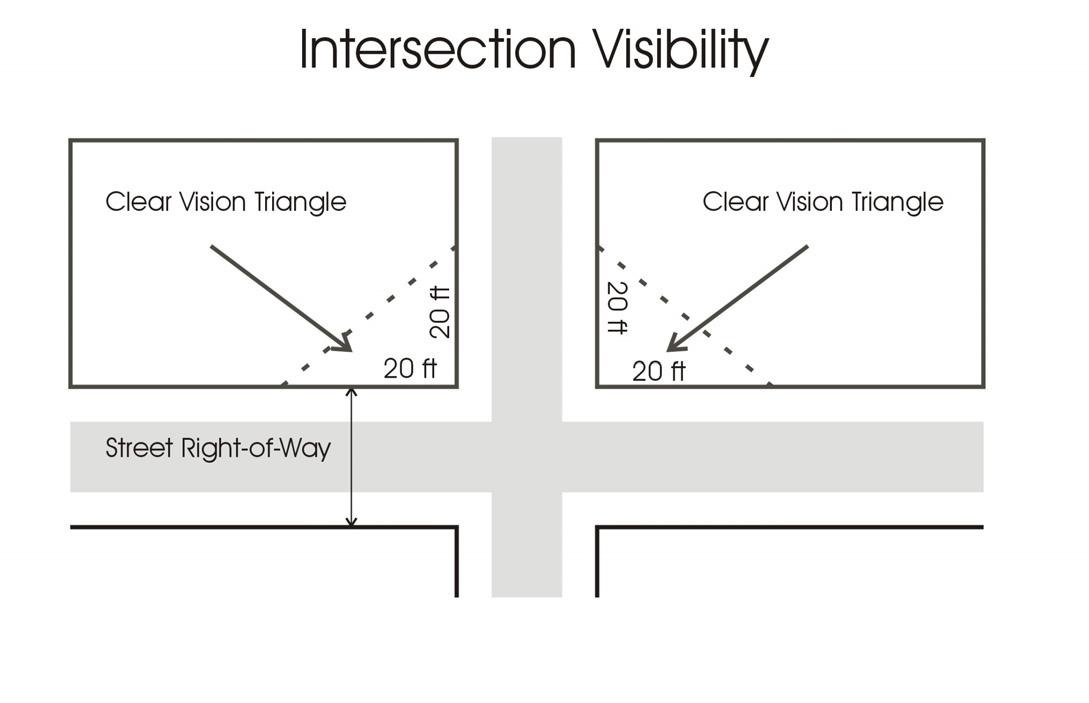
B.
The three-foot and eight-foot height limit shall be measured from the lowest elevation of the segment of the intersecting roads centerline which lays between the point of the intersection of the other centerline and the extension of the line drawn through the points twenty (20) feet from the intersection of the right-of-way lines.
(Ord. No. C-746-2010, § 1, 4-19-10)
Sec. 35-57. - Street Access and Frontage.
Any lot created after the effective date of this chapter shall have frontage upon a public street right-of-way or legally recorded access easement at least sixty (60) feet in width, unless a private road of lesser width has been approved by the city council.
(Ord. No. C-746-2010, § 1, 4-19-10)
Sec. 35-58. - Domesticated animals.
The keeping of exotic or vicious animals is prohibited. This prohibition shall not, however, preclude the keeping of a domesticated animal/pet to the extent and as otherwise regulated under this Code of Ordinances.
(Ord. No. C-760-2012, § 1, 3-19-12)
Sec. 35-60. - Keeping of horses.
(1)
Notwithstanding any other provision in this Code of Ordinances, the keeping of horses shall be permitted in a single-family residential district, subject to the requirements of this section.
(2)
Horses may be kept on lots of two (2) acres or more.
(3)
Up to two (2) horses may be kept on the first two (2) acres, plus one additional horse for each additional full acre.
(4)
Horse(s) shall be kept within a fenced area (or corral) at all times, and shall not be permitted to run at large in any street, alley, or public place, or upon the premises of another. Fences and corrals shall be installed in accordance with section 35-49, Fences.
(5)
Structures used to house the horse(s) shall be erected in accordance with section 35-43, Accessory buildings and structures—In general, and section 35-44, Accessory buildings and structures—Residential districts, in addition to following:
(a)
Structures used to house horses shall be a minimum of fifteen (15) feet from the property line.
(b)
Structures shall be located at least one hundred seventy-five (175) feet from residential dwellings located on adjacent properties.
(c)
Structures shall be properly ventilated to prevent drafts and remove odors, shall be of sufficient size to accommodate the animal, and shall be designed so as to prevent rats, mice, or other rodents from being harbored underneath, inside, or inside the walls of the enclosure.
(6)
Areas used for the keeping of horses, including structures and grazing areas, shall be kept in a clean and sanitary condition.
(7)
Removal or appropriate disposal of droppings is required. Droppings not used for composting or fertilizer shall be removed. All provisions of the Code of Ordinances relating to noise, odor, and sanitation, including the provisions of this article, shall apply to the keeping of animals under this section.
(8)
The keeping of horses shall be for private use only.
(Ord. No. C-767-2012, § 1, 12-17-12)

