
Ferndale City Zoning Code
ARTICLE 24
III GENERAL PROVISIONS
Sec 24-3.01 Vacant And Abandoned Businesses
During any period when a business is vacated, closed, or otherwise not open for more than 90 consecutive days, the owner or lessee must comply with the following:
A. Vehicular parking and outdoor storage (including: materials, equipment, recreational vehicles, vehicles, boats, or similar) are prohibited, except as necessary for construction in connection with a building permit or for maintenance of the site.
B. Within 30 additional days, all non-conforming signage (including posts, foundations, and support structures, if applicable) related to the abandoned business must be removed.
Adopted by Ord. 1291 on 12/16/2024
Amended by Ord. 1298 on 6/23/2025
Sec 24-3.02 Accessory Structures Requiring Setbacks
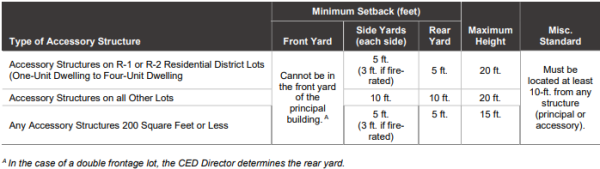
A. An accessory structure is a subordinate structure (i.e. detached garage or shed) on the same property as a principal structure. Accessory Dwelling (AD) regulations are found in Section 5.01.
B. Accessory structures can only be constructed and used when there is an approved principal building and when the following standards are met:
Adopted by Ord. 1291 on 12/16/2024
Amended by Ord. 1298 on 6/23/2025
Sec 24-3.03 Allowable Projections Into Required Yards
A. The placement of limited accessory structures and architectural features is consistent with the intent of maintaining open yards. These may project into the required yards, provided compliance with the following:
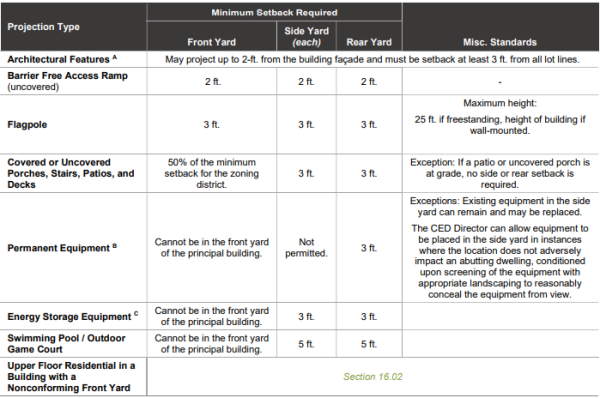
*A Architectural features include bay windows, cantilevers, chimneys, awnings, and other similar features.
*B Permanent equipment includes HVAC (Heating, Ventilation, Air-Conditioning, and Heat Pump Systems), Generators, and similar equipment.
*C Energy Storage System equipment includes Stationary Battery Banks (includes battery-buffered EV Chargers); Portable Battery swap charging stations (smallest size being motorcycle/scooter type); and Bi-Directional EV Charging Station Equipment (Vehicle-to-home, V2H; and Vehicle-to-grid, V2G).
B. The following are permitted in any required yard: arbors, trellises, landscaping, yard ornaments, statues, signs (per Article 8: Signs), fences (per Section 3.08: Fences), and mailboxes in accordance with federal law, and other similar structures, provided they comply with Clear Vision Area regulations of Section 3.06.
C. The following are permitted in any side or rear yard: laundry drying lines or devices, pole-mounted lights, barbecues, picnic tables, and playground equipment.
Adopted by Ord. 1291 on 12/16/2024
Amended by Ord. 1298 on 6/23/2025
Sec 24-3.04 Accessory Structures: Distributed Energy Systems
The following energy systems are designed to service the energy needs of the property where the structure is located and considered an accessory structure to the principal use.
A. Wind Energy Conversion Systems (WECS).

1. Standards applicable to both ground-mounted and roof-mounted WECS:
a) Must be equipped with both a manual and automatic braking device capable of stopping the WECS operation in high winds within 80% of design limits of the rotor.
b) Noise emissions cannot violate the City Noise Ordinance.
c) Any WECS not used for 1-year or longer is deemed to be abandoned unless the owner provides verifiable information regarding a contract to repair. Abandoned WECS must be promptly dismantled and removed from the property by the WECS owner.
2. Ground-mounted WECS specific standards:
a) The maximum height (with the blade in the vertical position) cannot exceed 80-feet above grade, and the tower must include an anti-climb device to prevent unauthorized climbing.
b) Towers must be setback a distance at least equal to the height WECS from all lot lines. The height is measured to the top of the blade at its highest point.
c) Blade arcs cannot interfere with any structure, utilities, or vegetation.
d) The minimum blade or rotor clearance above grade is 20-feet.
3. Roof-mounted WECS specific standards:
a) Must meet all relevant building codes. All towers used to support the wind generating equipment must be properly anchored.
b) Cannot exceed the height of the zoning district or protrude more than 12-feet above the highest point of the roof to which it is attached, with the blades or encompassing superstructure in the vertical position. If the structure is already at the maximum height limit, a height variance request to be considered by the CED Director cannot exceed the 12-feet allowance.
B. Solar Energy Conversion Systems (SES).

1. Roof-mounted SES:
a) Cannot exceed the height of the zoning district or protrude more than 6-feet above the highest point of the roof to which it is attached. If the structure is already at the height limit, a SES height variance request, to be considered by the CED Director, cannot exceed the 6-feet allowance.
b) Are exempt from rooftop screening requirements.
c) Solar panels cannot protrude beyond the edges of the roof.
2. Ground-mounted specific standards are detailed in Section 5.17: Solar Energy Systems (SES).
C. Heat Pump Systems (Air-Source and Ground-Source / Geothermal).

1. All Heat Pump Systems. Noise emissions cannot violate the City Noise Ordinance.
2. Air-Source Heat Pump Systems. Must provide the required setbacks of Section 3.03: Allowable Projections into Required Yards.
3. Ground-Source Heat Pump Systems (either vertical or horizontal loops).
a) Allowed in all yards, however, the setback for private system ground loops must be a minimum of 10-feet from all lot lines.
b) The setback for groundloops within a networked system that are adjacent to a co-participating lot (that is also served by the networked GSHP system) can be setback a maximum of 5-feet.
Adopted by Ord. 1291 on 12/16/2024
Amended by Ord. 1298 on 6/23/2025
Sec 24-3.05 Building Grades
A. All lots must be sloped to cause the flow of surface water to run away from the walls of buildings located on the site, without creating a nuisance to adjacent properties or crossing into a public right-of-way.
B. Final grades must be approved by the City.
Adopted by Ord. 1291 on 12/16/2024
Amended by Ord. 1298 on 6/23/2025
Sec 24-3.06 Clear Vision Area
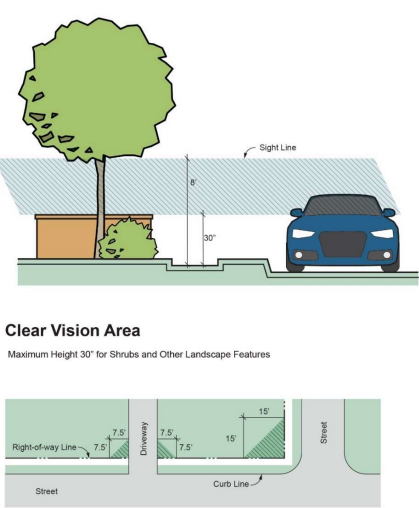
A. Intent. Within a clear vision area, there can be no fence, structure, planting, or similar, between 30-inches to 8-feet in height to enable an unobstructed view of approaching traffic. This standard does not apply to buildings that meet the setback of the zoning district they are located in. Where buildings are located within a clear vision area, the City may require the installation of a convex traffic mirror.
B. Applicability.
1. Two Streets. The area at the intersection of two streets, measured 15-feet on each street along the lot line.
2. Driveway and a Street. The area at the intersection of a driveway and the right-of-way, measured 7.5-feet on each street along the lot line.
C. Alternative Distance. An alternative distance may be approved by the CED Director in accordance with current American Association of State Highway and Transportation Officials (AASHTO) standards.
Adopted by Ord. 1291 on 12/16/2024
Amended by Ord. 1298 on 6/23/2025
Sec 24-3.07 Computing Fractions
Any fraction up to and including one-half is rounded up; any fraction lower than one-half is rounded down.
Adopted by Ord. 1291 on 12/16/2024
Amended by Ord. 1298 on 6/23/2025
Sec 24-3.08 Fences
A. Permit. Installation of a fence or gate on any lot requires a Fence Permit.
B. Location.
1. All fences must be constructed within the property's lot lines, unless written consent from adjoining property owners is secured. No fence can be installed side by side to an existing fence, unless this requirement is waived by the CED Director for good cause.
2. Fences must be setback at least 1-foot from a public sidewalk or right-of-way. Fences cannot block any public passage or sidewalk, including alleys. Fence gates cannot swing over public property.
C. Fence Materials.
1. Fences must be constructed of materials designed for a decorative effect such as vinyl, split-rail, wood, wrought iron, aluminum metal, and extruded plastic. Powder-coated chain link is encouraged if chain link fencing is proposed.
2. Wood fences must be constructed of cedar, redwood, or other decay-resistant and treated wood.
3. Razor edge or barbed wire fences, spikes, nails or any other sharp point or instrument of any kind on top or on the sides of any fence, or electrical current or charge of any fence, is prohibited.
4. No fabric, plastic slats, tarps or other similar items shall be hung from a fence.
D. Height and Opacity.

*Decorative fencing, up to 36-inches in height, is permitted in any yard without a Fence Permit. A decorative fence is a fence designed in such a manner, and of such material, that the main purpose is to decorate or enhance the appearance of the yard, typically in a residential area.
E. Finished Fence Side. The finished side of any fence must face the exterior of the lot it is built on.
F. Clear Vision Zone. Section 3.06: Clear Vision Area must be met.
G. Dumpster Fencing. For dumpsters, see Section 6.04(G): Required Landscaping, Dumpster / Refuse Containers for standards.
H. Nonconforming Fences. Nonconforming fences are subject to Article 16: Nonconformities.
Adopted by Ord. 1291 on 12/16/2024
Amended by Ord. 1298 on 6/23/2025
Sec 24-3.09 General Maintenance
A. All lots must be kept free of rubbish, pests, debris, and any other undesirable materials.
B. Buildings, structures, and fences must be structurally sound, and their materials durable, weather-resistant, rustproof, and kept in good condition.
C. All properties must be maintained to prevent blight or deterioration or substantial diminishment or impairment of property values within the immediate area. This includes all parking lots, screening, landscape areas, etc.
D. All properties must adhere to the City’s most recently adopted Property Maintenance Code and other ordinances adopted by the City.
E. All parking lots shall be in good condition, characterized by a smooth, durable, and well-maintained surface. No more than twenty percent of the parking lot area shall have potholes, or surface integrity issues. Parking lots shall have visible striping or parking stalls, pedestrian crosswalks, and similar.
Adopted by Ord. 1291 on 12/16/2024
Amended by Ord. 1298 on 6/23/2025
Sec 24-3.10 Height Exceptions
A. The height of the following may be increased by not more than 10- feet of the subject zoning district’s maximum permitted building height: roof mechanical equipment or roof structures for the housing of elevators, parapets, stairways, tanks, ventilating fans, or similar equipment required to operate and maintain the building; chimneys; fire walls; water towers and cooling towers; other similar and necessary mechanical appurtenance, and rooftop patios including covered areas, safety fencing, or similar.
B. Wireless communication towers (Section 5.22: Wireless Communication Facilities).
C. Religious institutions may be erected to a height not exceeding 75-feet when the required side and rear yards are each increased by 1-foot for each foot of additional building height above the height regulation in the subject zoning district.
Adopted by Ord. 1291 on 12/16/2024
Amended by Ord. 1298 on 6/23/2025
Sec 24-3.11 Lighting
A. Intent.
1. Permit exterior lighting for night-time safety, utility, security, productivity, and commerce.
2. Minimize adverse off-site impacts including light trespass onto adjacent properties, glare, and sky glow.
3. Prevent lighting from impairing the vision of motorists with disability glare or discomfort glare.
4. Preserve nighttime and a dark sky environment by eliminating intrusive artificial light and lighting that unnecessarily contributes to sky glow.
5. Conserve energy and resources.
B. Applicability. These standards apply to any proposed exterior light source and any light source that is visible from any lot line, or beyond, for the site from which the light is emanating.
C. Standards.
1. All interior lighting must be designed to prevent the light source or high levels of light from being visible from a lot line.
The City encourages warm lighting tones, not to exceed 3,000K.
2. All exterior lighting must be shielded and downward facing to reduce glare and to deflect light away from adjacent properties. Acceptable light fixtures that are fully shield and downward facing are pictured below:

D. Lighting Heights. Free standing light poles are measured from the grade to the top of the fixture:

Intensity. Intensity of lighting is regulated by Section 6-385, Lighting.
E. Prohibited Lighting:
1. Visible rope lighting, or other similar lighting, around windows, doors, architectural accents, and other building features. This does not apply to indirect lighting that does not expose the light source.
2. Flashing, moving, animated, or intermittent lighting, except bulbs on marquee lighting
3. String lighting when used to cover an exterior façade, or portion thereof.
4. Any lighting the CED Director determines is a nuisance or road hazard.
Editor's Note: Additional Lighting Ordinance in Chapter 6 - Buildings and Building Regulations, Article 6-XII Environmental Standards, Sec 6-385 Lighting. Any conflicting references default to more restrictive ordinance.
Adopted by Ord. 1291 on 12/16/2024
Amended by Ord. 1298 on 6/23/2025
Sec 24-3.12 Performance Standards
No building or lot can be used in any manner that creates a dangerous, injurious, noxious, or otherwise objectionable element or condition that adversely affects the surrounding area or adjoining lots. All uses must meet performance requirements:
A. Noise. Article 2-VI Noise of the General Code of Ordinances must be met.
B. Vibration. No vibration is permitted which is discernable on any adjoining lot.
C. Air Pollution / Odor. The drifting of air borne materials (including dust, particles, foul odors, or debris) beyond the lot line is prohibited.
D. Glare and Heat. Glare from any process which emits harmful ultraviolet rays must be performed in such manner as not to be seen from any point beyond the lot line, and as not to create a public nuisance or hazard. If heat is a result of an operation, it must be insulated as to not raise the temperature at any property line at any time.
E. Erosion. No erosion, by either wind or water, is permitted which will carry objectionable substances onto neighboring lots or waterbodies, unless otherwise allowed by law
F. Gases. The escape of or emission of any gas which is injurious or destructive to life or property, or which is explosive, is prohibited. Gaseous emissions are subject to regulations established in conjunction with the Air Pollution Act, Michigan PA 348 of 1965, as amended, the federal Clean Air Act of 1990, as amended, and any other applicable state or federal regulations.
G. Radioactive Materials. Radiation, including radioactive materials and electro-magnetic radiation such as that emitted by the x-ray process or diathermy, cannot be emitted to exceed quantities established as safe by the U.S. Bureau of Standards when measured at the lot line.
H. Fire and Safety Hazards. Storage and handling of flammable liquids, liquefied petroleum gases and explosives must comply with all City regulations and with all state rules and regulations.
Adopted by Ord. 1291 on 12/16/2024
Amended by Ord. 1298 on 6/23/2025
Sec 24-3.13 Separation Standards
Where a separation distance is required for a given use, it is measured from the lot line of one property to the lot line of another property, by a straight line using the shortest distance possible.
Adopted by Ord. 1291 on 12/16/2024
Amended by Ord. 1298 on 6/23/2025
Sec 24-3.14 Sidewalks
A. Sidewalks are required along both sides of any street (public and private); this may be waived in industrial districts by the Approving Body.
B. Sidewalks must provide safe, convenient, uncongested, and well-defined pedestrian circulation within and to the site. Additional landscaping to screen the sidewalk or path from adjacent uses may be required.
C. Sidewalks must be constructed in accordance with City specifications, including barrier-free requirements. Alternative, sustainable paving materials may be permitted by the Approving Body if accessibility standards are still met.
D. Sidewalks must be installed by the developer and located in public street rights-of-way, private road access easements, or in separate pedestrian easements, where easements are necessary for public use. An access easement must be a minimum of 8-feet wide (if not within a street right-of-way).
Adopted by Ord. 1291 on 12/16/2024
Amended by Ord. 1298 on 6/23/2025
Sec 24-3.15 Stormwater Management
A. Intent. Stormwater management is intended to address flooding concerns and the continued effects of climate change. The City requires a review of stormwater management for new developments, redevelopments, and additions or alterations to an existing development. The intention is to store stormwater on site to reduce peak stormwater flow into the municipal combined sewer system.
B. Commercial Requirements. All commercial projects undergoing development, redevelopment, or addition shall be reviewed for stormwater management as determined by the City Engineer and implemented as required.
C. Residential Requirements. One-unit and two-unit dwellings are exempt, but residential properties with a three-unit dwelling or greater shall be reviewed for stormwater management as determined by the City Engineer. An Accessory Dwelling Unit is considered a residential unit and requires stormwater management review if its addition creates three units on site, except if it is reusing an existing structure and there is no change in the site's permeable area.
D. Ownership. Ownership of the storm sewer and detention system shall fall to the legal owner of the property. In the case of condominiums or other developments where shared ownership of the storm sewer system is owned by multiple property owners, associations, or entities, the association or joint owners shall register the legal owners name(s), contact representative, current address and telephone number with the City Clerk.
E. Maintenance. The owner of the property will be required to submit for review and approval a Long-Term Storm Water Maintenance Agreement (LTSWMA) for the entire on-site storm sewer and detention system, including areas of green technology (rain gardens, bioswales, etc). Upon review and approval, the LTSWMA shall be recorded with the Oakland County Register of Deeds. The LTSWMA shall be executed by the Owner (but not recorded), signed by the Owner, and an original copy delivered to the City Planning Department prior to the City of Ferndale’s scheduling of a mandatory preconstruction meeting.
Adopted by Ord. 1291 on 12/16/2024
Amended by Ord. 1298 on 6/23/2025
Sec 24-3.16 Waivers/Reductions
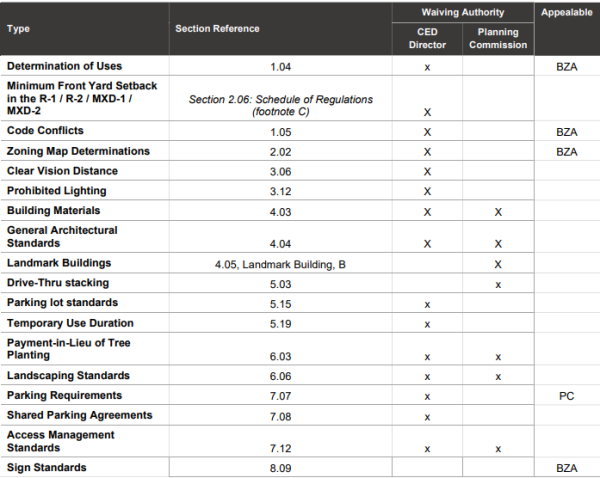
The following Articles or Sections can be waived by their respective Approving Body, depending on the scope of work and application. All other deviations from this Code require a variance from the Board of Zoning Appeals, Article 19: Board of Zoning Appeals.
Adopted by Ord. 1291 on 12/16/2024
Amended by Ord. 1298 on 6/23/2025

