
Ferndale City Zoning Code
ARTICLE 24
IV ARCHITECTURAL AND DESIGN STANDARDS
Sec 24-4.01 Intent
To provide clear and simple architecture and design regulations to promote the following objectives:
A. Stabilize and reinforce property values to protect private and public investment and improve building aesthetics and quality.
B. Promote the renovation of existing buildings, neighborhoods, and business areas to preserve and reinforce their natural, historic, cultural, social, and architectural qualities.
C. Ensure that new projects are compatible with the character of the surrounding area.
D. Promote sustainable and resilient development.
Adopted by Ord. 1291 on 12/16/2024
Sec 24-4.02 Applicability
A. All buildings (except where specifically excluded) must adhere to the following:
1. Section 4.03: Building Material Standards.
2. Section 4.04: General Architectural Standards.
3. Section 4.05: Building Type Standards.
B. Sections 4.03 , 4.04 and 4.05 may be waived by the Approving Body, in whole or in part, upon a determination that a building design is:
1. Not grossly dissimilar in exterior design and appearance to nearby buildings and it does not adversely affect property values in the surrounding area.
2. Not adversely affecting the desirability of immediate and neighboring areas.
3. Not impairing the stability of the area or preventing the most appropriate use and development of real estate.
4. Not adversely affecting the public health, safety, comfort and welfare of the citizens of the City.
Adopted by Ord. 1291 on 12/16/2024
Amended by Ord. 1298 on 6/23/2025
Sec 24-4.03 Building Material Standards
A. The following standards apply to all buildings (except for one and two-unit dwellings in the R-1 and R-2 Residential District):

* Primary materials comprise a minimum of 75% of the first-floor façade and 50% of the façade for upper floors.
** Secondary materials comprise a maximum of 25% of the first-floor façade and 50% of the façade for upper floors.
B. In addition to permitted primary and secondary materials, materials that may be used for architectural details, accent, or trim (not to exceed 10% of the façade) include: glass reinforced fiber cement; molded polyurethane; glass block; metal; and wood.
C. The following exterior finish materials are prohibited for all buildings, due to their environmental impact or lack of durability: plywood siding materials, sheet / corrugated metal.
D. The color of each façade material must be harmonious with the color of all other façade materials used on the same building and on adjacent buildings and must be in character with or improve the character of the vicinity. Colors are harmonious if they are complementary in hue, tone, and intensity.
E. Balconies, railings, and porch structures must be metal, wood, glass, cast concrete, or stone.
F. Storefronts must be primed and painted, or factory-finished (anodized, powder-coated, clear coated, plated, or polished).
G. Structural elements that support signage must be primed and painted, or factory-finished (anodized, powder-coated, clear coated, plated, or polished) and complementary to the selected storefront finish.
Adopted by Ord. 1291 on 12/16/2024
Amended by Ord. 1298 on 6/23/2025
Sec 24-4.04 General Architectural Standards
A. Articulation of Fenestration. Window glazing surfaces cannot be flush with the façade plane. Windows must be recessed a minimum of 3-inches or defined by a projecting, defined sill, lintel, and trim.
B. Utilities. HVAC, dryer ventilation areas, and utility boxes located on the building must be screened and the same color as the façade material. This includes any rooftop mechanical equipment visible from the rightof-way or a residential use/district.
C. Balconies. The balcony support structure must be integrated with the building façade; separate columns or posts supporting any balcony from the ground are prohibited.
D. Awnings.
1. Façades may be supplemented by a straight-shed or gabled awning.
2. Glass, steel, canvas, and other natural fabric awnings are permitted; slatted metal, vinyl, plastic, and other synthetic awnings are prohibited. Exception: if building integrated solar (BIPV) cells are embedded in the awning, synthetic materials may be approved.
3. The front extended edge of awnings must be compatible in height to others in the same block, but in no case lower than 8-feet, 6-inches above grade.
4. Awnings must be constructed so as to discourage harborage of birds and their structural elements must be primed and painted, anodized or powder-coated.
Adopted by Ord. 1291 on 12/16/2024
Sec 24-4.05 Building Type Standards
A. Within the R-1, R-2, MXD-1, MXD-2, CBD Districts and the WHH Overlay, all new construction and work that involves the expansion of the building (either by square footage or height) must also meet the requirements of one of the Building Types, as permitted below.
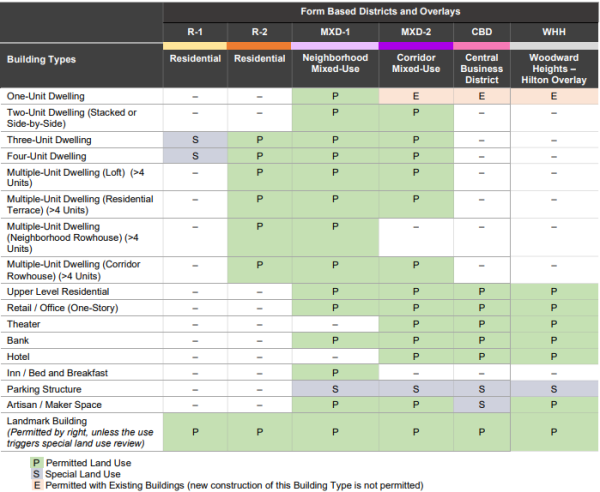
B. Waivers. The Approving Body may waive the regulations of Section 4.05: Building Type Standards, upon determining that the following criteria are met:
1. One or both of the following:
a) There are two or more Building Types that cannot be met simultaneously in the development.
b) The building or lot is subject to a unique circumstance, not caused by the owner / developer that renders compliance with a standard of the Building Type regulations impossible or not practical.
2. Both of the following:
a) The building and site design clearly still meet the intent of the Building Type form, even though all standards will not be met.
b) The waiver will not create an unsafe and/or unwelcoming pedestrian environment.
One-Unit Dwelling
 Definition and Intent: A home for one communal group of residents that lives as a one-unit that matches the historic character of the neighborhood and promotes a welcoming environment and public streetscape.
District Permitted: MXD-1.

Allowable Building Materials. The following table details encouraged allowable materials that are supplemental to permitted primary and secondary materials of Section 4.03: Building Material Standards.

*Cement siding and wood trim installed smooth side out. Visible woodgrain embossing or rough-sawn surfaces prohibited.
Architectural Design Standards:
• Front Porch: A covered front porch is required, with a minimum depth of 6-feet, at the main entrance facing the principal frontage. The porch must be surrounded by a decorative rail, 28-inches to 36-inches in height.
• Rear Detached Garage: Attached garages are prohibited. All accessory buildings, including garages, must be in the rear yard. Front yard parking areas, other than a driveway leading directly to the rear yard garage, are prohibited.
• Building Materials: Heavier or darker building materials must be placed at the bottom of the building, with lighter materials higher up.
Two-Unit Dwelling (Stacked)
 Definition and Intent: A traditional-styled dwelling containing two residential units, with one or two main entrances at the front and alternate or service entrances along the sides and/or rear elevations. Residential units exist one above the other (stacked) within building enclosure.
Districts Permitted: R-2, MXD-1, and MXD-2.
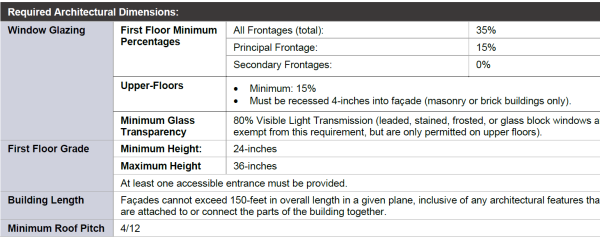
Allowable Building Materials. The following table details encouraged allowable materials that are supplemental to permitted primary and secondary materials of Section 4.03: Building Material Standards.
 *Cement siding and wood trim installed smooth side out. Visible woodgrain embossing or rough-sawn surfaces prohibited.
Architectural Design Requirements:
• Front Porch: A covered front porch is required, with a minimum depth of 6-feet, at the main entrance facing the principal frontage. The porch must be surrounded by a decorative rail, 28-inches to 36-inches in height.
• Rear Detached Garage: Attached garages are prohibited. All accessory buildings, including garages, must be in the rear yard. Front yard parking areas, other than a driveway leading directly to the rear yard garage, are prohibited.
• Building Materials: Heavier or darker building materials must be placed at the bottom of the building, with lighter materials higher up.
Two-Unit Dwelling (Side-by-Side)

Definition and Intent: A traditional-styled one-unit dwelling containing two residential units with main entrances at the front and alternate or service entrances along the sides and/or back. Residential units exist one above the other.
Districts Permitted: R-2, MXD-1, and MXD-2.

Allowable Building Materials. The following table details encouraged allowable materials that are supplemental to permitted primary and secondary materials of Section 4.03: Building Material Standards.
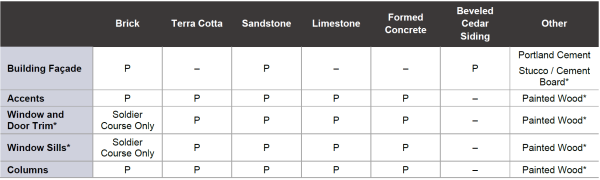 *Cement siding and wood trim installed smooth side out. Visible woodgrain embossing or rough-sawn surfaces prohibited.
Architectural Design Requirements:
• Front Porch: At least one covered front porch is required, with a minimum depth of 6-feet, at the main entrance facing the principal frontage. The porch must be surrounded by a decorative rail, 28-inches to 36- inches in height.
• Entrances: Each unit must have its own exterior front entrance, which must be accessed from the front porch.
• Rear Detached Garage: Attached garages are prohibited. All accessory buildings, including garages, must be in the rear yard. Front yard parking areas, other than a driveway leading directly to the rear yard garage, are prohibited.
• Building Materials: Heavier or darker building materials must be placed at the bottom of the building, with lighter materials higher up.
Three-Unit Dwelling

Definition and Intent: Building containing three residential flats, stacked vertically upon one another.
Districts Permitted: R-1 (with Special Land Use), R-2, MXD-1, and MXD-2.

Allowable Building Materials. The following table details encouraged allowable materials that are supplemental to permitted primary and secondary materials of Section 4.03: Building Material Standards.
 *Cement siding and wood trim installed smooth side out. Visible woodgrain embossing or rough-sawn surfaces prohibited.
Architectural Design Requirements:
• Front Porch: At least one covered front porch is required, with a minimum depth of 6-feet, at the main entrance facing the principal frontage. The porch must be surrounded by a decorative rail, 28-inches to 36- inches in height.
• Building Materials: Heavier or darker building materials must be placed at the bottom of the building, with lighter materials higher up.
Four-Unit Dwelling

Definition and Intent: A four-unit residential building configured with side-by-side residential units stacked upon one another (doubling the pair), with a shared lobby or vestibule along the principal frontage. The primary building materials of masonry and/or stucco, along with repetitive unit floor plans, evoke a small urban apartment building. No AD is permitted if the fourplex is located in the R-1 District.
Districts Permitted: R-2, MXD-1, and MXD-2.

Allowable Building Materials. The following table details encouraged allowable materials that are supplemental to permitted primary and secondary materials of Section 4.03: Building Material Standards.

*Cement siding and wood trim installed smooth side out. Visible woodgrain embossing or rough-sawn surfaces prohibited.
Architectural Design Requirements:
• Main Lobby Entrance: The first floor must have a main lobby entrance to be located along the principal frontage. The entrance must be covered by an awning or canopy. Side and rear entrances are also permitted but cannot be designed as the primary lobby entrance.
• Upper-Floor Design: Upper-floors must have opaque exterior façades with regularly spaced, consistently sized windows to convey a pattern of solids and voids. The upper-floor façade must be consistent along the entire width of the building.
• Stepback Prohibited: Upper floors must maintain the same façade plane as all other floors.
• Upper-Floor Window Design:
• Decorative sills and/or headers are required on upper-floor windows located along principal frontages and may be required along secondary frontages. They are not required on façades facing alleys or parking lots.
• The radii of arches on segmented-arch windows must equal the widths of the corresponding masonry openings.
• Building Materials: Heavier or darker building materials must be placed at the bottom of the building, with lighter materials higher up.
Multiple-Unit Dwelling (Residential Loft)

Definition and Intent: A medium-sized residential building that contains five or more dwelling units with a common, at-grade main entrance and lobby located along the principal frontage.
Districts Permitted: R-2, MXD-1, and MXD-2.
 Allowable Building Materials. The following table details encouraged allowable materials that are supplemental to permitted primary and secondary materials of Section 4.03: Building Material Standards.

Architectural Design Requirements:
• Main Lobby Entrance: The first floor must have a main lobby entrance to be located along the principal frontage. Side and rear entrances are also permitted but cannot be designed as the primary lobby entrance.
• Horizontal Architectural Dividers: Two projecting cornices or other architectural design features that extend uninterrupted for the entire width of the building. The dividers may be located between any two floors but must produce the overall feeling of a building with a “base”, a “shift”, and a “capital.”
• Upper-Floor Design: Upper floors must have opaque exterior façades with regularly spaced, consistently sized windows to convey a pattern of solids and voids. The upper-floor façade must be consistent along the entire width of the building.
• Stepback Prohibited: Upper-floors must maintain the same façade plane as all other floors.
• Upper-Floor Window Design:
• Decorative sills and/or headers are required on upper-floor windows located along principal frontages and may be required along secondary frontages. They are not required on façades facing alleys or parking lots.
• The radii of arches on segmented-arch windows must equal the widths of the corresponding masonry openings.
• Building Materials: Heavier or darker building materials must be placed at the bottom of the building, with lighter materials higher up.
• Architectural Flourishes: Towers, sculptures, masonry reliefs and/or motifs up to 4-inches in depth, and other characteristic forms and/or focal points are encouraged.
• Cornice (Rooftop): A cornice at least 15-inches tall on the roofline on Principal and Secondary Frontages is encouraged.
Multiple-Unit Dwelling (Residential Terrace)

Definition and Intent: A multi-story urban building with a terrace frontage.
Districts Permitted: R-2, MXD-1, and MXD-2.

Allowable Building Materials. The following table details encouraged allowable materials that are supplemental to permitted primary and secondary materials of Section 4.03: Building Material Standards.

Architectural Design Requirements:
• Front Terrace: An uncovered, front terrace or patio is required, between 16- and 30-feet in depth, and between at-grade and 30-inches elevation, at the main entrance facing the principal frontage. The front setback is measured to the building façade, not the terrace. The terrace may be used for outdoor dining and/or landscaped gardens. Parking, drop-off lanes, swimming pools, and storage are prohibited within the terrace. The terrace must be enclosed by an 34-inch high wall or decorative fence.
• Upper-Floor Design: Upper-floors must have opaque exterior façades with regularly spaced, consistently sized windows to convey a pattern of solids and voids. The upper-floor façade must be consistent along the entire width of the building.
• Building Materials: Heavier or darker building materials must be placed at the bottom of the building, with lighter materials higher up.
• Stepback Prohibited: Upper floors must maintain the same façade plane as lower floors.
• Architectural Flourishes: Towers, sculptures, masonry reliefs and/or motifs up to 4-inches in depth, and other characteristic forms and/or focal points are encouraged.
Multiple-Unit Dwelling (Neighborhood Rowhouse)
 Definition and Intent: A traditional-styled building, evoking a residential character, containing multiple residential units each with their main entrances at the front and alternate or service entrances along the sides and/or back. Residential units exist side-by side, with each extending front to back and foundation to roof. A neighborhood rowhouse has a front porch and residential-style architecture in order to blend in with nearby one-unit dwellings, two-unit dwellings, and smaller multiple-unit dwellings.
Districts Permitted: R-2 and MXD-1.
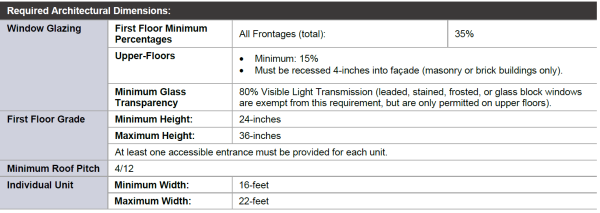
Allowable Building Materials. The following table details encouraged allowable materials that are supplemental to permitted primary and secondary materials of Section 4.03: Building Material Standards.

*Cement siding and wood trim installed smooth side out. Visible woodgrain embossing or rough-sawn surfaces prohibited.
Architectural Design Requirements:
• Front Porches: At least one covered front porch is required, with a minimum depth of 6-feet, at the main entrance facing the principal frontage. The porch must be surrounded by a decorative rail, 28-inches to 36- inches in height. Each unit may have a separate front porch.
• Entrances: Each unit must have its own exterior front entrance, which must be accessed from a front porch.
• Rear Detached Garage: Attached garages are prohibited. All accessory buildings, including garages, must be in the rear yard. Front yard parking areas, other than a driveway leading directly to the rear yard garage, are prohibited.
• Building Materials: Heavier or darker building materials must be placed at the bottom of the building, with lighter materials higher up.
• Cornice (Rooftop): A cornice at least 15-inches tall on the roofline on Principal and Secondary Frontages is encouraged.
Multiple-Unit Dwelling (Corridor Rowhouse)
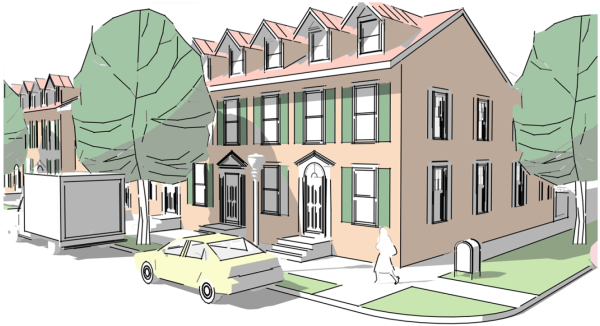
Definition and Intent: A traditional-styled building, evoking a residential character, containing multiple residential units each with their main entrances at the front and alternate or service entrances along the sides and/or back. Residential units exist side-by side, with each extending front to back and foundation to roof. The building has a front stoop, massing near the front lot line, and heavy building materials such as brick, in order to fit in along higher traffic urban corridors.
Districts Permitted: R-2, MXD-1, and MXD-2.


Allowable Building Materials. The following table details encouraged allowable materials that are supplemental to permitted primary and secondary materials of Section 4.03: Building Material Standards.

*Cement siding and wood trim installed smooth side out. Visible woodgrain embossing or rough-sawn surfaces prohibited.
Architectural Design Requirements:
• Entrances: Each unit must have its own exterior front entrance.
• Top Half-Story: The top story must be a half-story, with dormer windows and a peaked roof.
• Building Materials: Heavier or darker building materials must be placed at the bottom of the building, with lighter materials higher up.
• Cornice (Rooftop): A cornice at least 15-inches tall on the roofline on Principal and Secondary Frontages is encouraged.
Mixed-Use Dwelling

Definition and Intent: A multi-story building with storefronts along the principal frontage and a portion of secondary frontages to accommodate ground-floor retail, with office uses on floors above retail, and residential uses above office and/or retail.
Districts Permitted: MXD-1, MXD-2, CBD, and WHH.

Allowable Building Materials. The following table details encouraged allowable materials that are supplemental to permitted primary and secondary materials of Section 4.03: Building Material Standards.

Architectural Design Requirements:
• Main Business Entrance: The commercial first floor must have a main business entrance to be located either along the principal frontage. For corner lots, the entrance may face the intersection. Side and rear entrances are also permitted but are not designed as the primary business entrance.
• Sign Band: A sign band, at least 85% of the width of the building, must be included above the storefront. The sign band must be a horizontal area uninterrupted by windows or architectural features, except that the horizonal architectural divider may serve as the sign band. An awning may also serve as the sign band, provided it is at least 10-inches tall.
• Horizontal Architectural Divider: A projecting cornice or other architectural design feature that extends uninterrupted for the entire width of the building, to divide the first floor from the upper floors.
• Upper-Floor Design: Upper-floors must have opaque exterior façades with regularly spaced, consistently sized windows to convey a pattern of solids and voids. The upper-floor façade must be consistent along the entire width of the building.
• Upper-Floor Window Design:
• Decorative sills and/or headers are required on upper-floor windows located along principal frontages and may be required along secondary frontages. They are not required on façades facing alleys or parking lots.
• The radii of arches on segmented-arch windows must equal the widths of the corresponding masonry openings.
• Architectural Flourishes: Towers, sculptures, masonry reliefs and/or motifs up to 4-inches in depth, and other characteristic forms and/or focal points are encouraged.
• Cornice (Rooftop): A cornice at least 15-inches tall on the roofline on Principal and Secondary Frontages is encouraged.
Retail Sale Establishment / Office (One-Story)
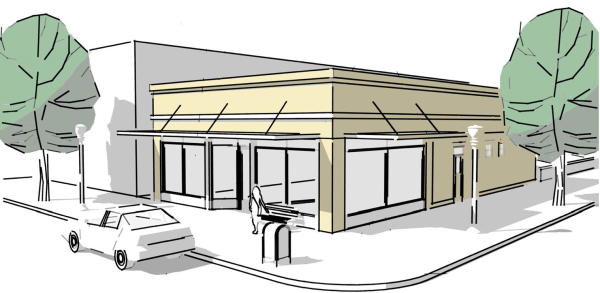
Definition and Intent: A one-story building with storefront frontage, constructed at the right-of-way lines along street frontages.
Districts Permitted: MXD-1, MXD-2, CBD, and WHH.

Allowable Building Materials. The following table details encouraged allowable materials that are supplemental to permitted primary and secondary materials of Section 4.03: Building Material Standards.

Architectural Design Requirements:
• Single-Story Limitation: Buildings are limited to one-story, or 16-feet, in height. Multi-story buildings must comply with the requirements of another Building Type allowable in the district.
• Main Business Entrance: The commercial first floor must have a main business entrance to be located either along the principal frontage. For corner lots, the entrance may face the intersection. Side and rear entrances are also permitted but cannot be designed as the primary business entrance.
• Sign Band: A sign band, at least 85% of the width of the building, must be included above the storefront. The sign band must be a horizontal area uninterrupted by windows or architectural features. An awning may also serve as the sign band, provided it is at least 10-inches tall.
• Architectural Flourishes: Towers, sculptures, masonry reliefs and/or motifs up to 4-inches in depth, and other characteristic forms and/or focal points are encouraged.
• Cornice (Rooftop): A cornice at least 15-inches tall on the roofline on Principal and Secondary Frontages is encouraged.
Theater / Entertainment Venue

Definition and Intent: High-ceilinged building with lobby frontage, façade, and marquee along principal frontage with allowable blank walls along all other frontages.
Districts Permitted: MXD-2, CBD, and WHH.

Allowable Building Materials. The following table details encouraged allowable materials that are supplemental to permitted primary and secondary materials of Section 4.03: Building Material Standards.

Architectural Design Requirements:
• Main Entrance: The building must have a main entrance to be located either along the principal frontage or facing the intersection on a corner lot. Side and rear entrances are also permitted but cannot be designed as the primary entrance.
• Upper-Floor Window Design:
• Decorative sills and/or headers are required on upper-floor windows located along principal frontages and may be required along secondary frontages. They are not required on façades facing alleys or parking lots.
• The radii of arches on segmented-arch windows must equal the widths of the corresponding masonry openings.
• Architectural Flourishes: Towers, sculptures, masonry reliefs and/or motifs up to 4-inches in depth, and other characteristic forms and/or focal points are encouraged.
• Cornice (Rooftop): A cornice at least 15-inches tall on the roofline on principal and secondary frontages is encouraged.
Financial Institution

Definition and Intent: A building without storefronts that can be appropriately located within a walkable mixed use district and provides the inherent security of a dedicated banking use (but also allows for residential and office tenants or other permitted uses).
Districts Permitted: MXD-1, MXD-2, CBD, and WHH.

Allowable Building Materials. The following table details encouraged allowable materials that are supplemental to permitted primary and secondary materials of Section 4.03: Building Material Standards.

Architectural Design Requirements:
• Main Entrance: The building must have a main entrance to be located either along the principal frontage or facing the intersection on a corner lot. Side and rear entrances are also permitted but cannot be designed as the primary entrance.
• Sign Band: A sign band, at least 85% of the width of the building, must be included above the storefront. The sign band must be a horizontal area uninterrupted by windows or architectural features, except that the horizonal architectural divider may serve as the sign band. An awning may also serve as the sign band, provided it is at least 10-inches tall.
• Horizontal Architectural Dividers: Two projecting cornices or other architectural design features that extend uninterrupted for the entire width of the building, to divide the first floor from the upper-floors, and the second floor from floors above it.
• Upper-Floor Design: Upper-floors must have opaque exterior façades with regularly spaced, consistently sized windows to convey a pattern of solids and voids. The upper-floor façade must be consistent along the entire width of the building.
• Upper-Floor Window Design:
• Decorative sills and/or headers are required on upper-floor windows located along principal frontages and secondary frontages. They are not required for exempt frontages.
• Groups of up to three windows are permitted and do not violate upper-floor design requirements.
• Building Materials: Heavier or darker building materials must be placed at the bottom of the building, with lighter materials higher up.
• Cornice (Rooftop): A cornice at least 15-inches tall on the roofline on principal and secondary frontages is encouraged.
Hotel

Definition and Intent: A multi-story building with or without storefronts, intended for a lobby and upstairs guest rooms, but re-usable for a variety of uses. A hotel may include boutique hotel.
Districts Permitted: MXD-2, CBD, and WHH.

Allowable Building Materials. The following table details encouraged allowable materials that are supplemental to permitted primary and secondary materials of Section 4.03: Building Material Standards.
 Architectural Design Requirements:
• Main Lobby Entrance: The first floor must have a main lobby entrance to be located along the principal frontage. The entrance must be covered by an awning or canopy. For corner lots, the entrance may face the intersection. Side and rear entrances are also permitted but cannot be designed as the primary lobby entrance.
• Horizontal Architectural Dividers: Two projecting cornices or other architectural design features that extend uninterrupted for the entire width of the building. The dividers may be located between any two floors but must produce the overall feeling of a building with a “base”, a “shift”, and a “capital.”
• Upper-Floor Design: Upper-floors must have opaque exterior façades with regularly spaced, consistently sized windows to convey a pattern of solids and voids. The upper-floor façade must be consistent along the entire width of the building.
• Stepback Prohibited: Upper-floors must maintain the same façade plane as all other floors.
• Upper Floor Window Design:
• Decorative sills and/or headers are required on upper-floor windows located along principal frontages and may be required by the Planning Commission along secondary frontages. They are not required on façades facing alleys or parking lots.
• The radii of arches on segmented-arch windows must equal the widths of the corresponding masonry openings.
• Building Materials: Heavier or darker building materials must be placed at the bottom of the building, with lighter materials higher up.
• Architectural Flourishes: Towers, sculptures, masonry reliefs and/or motifs up to 4-inches in depth, and other characteristic forms and/or focal points are encouraged.
• Cornice (Rooftop): A cornice at least 15-inches tall on the roofline on principal and secondary frontages is encouraged.
Inn / Bed and Breakfast

Definition and Intent: A building designed as a one-unit dwelling or mansion-style with a front porch, moderate landscaped setbacks, and low fence along the right-of-way-line but intended for temporary residential occupancy.
Districts Permitted: MXD-1 and MXD-2.

Allowable Building Materials. The following table details encouraged allowable materials that are supplemental to permitted primary and secondary materials of Section 4.03: Building Material Standards.

Architectural Design Requirements:
• Front Porch: A covered front porch is required, with a minimum depth of 6-feet, at the main entrance facing the principal frontage.
• Residential Style: The building must mimic the architectural style of residential homes in the vicinity.
• Front Setback: The front setback may be used for outdoor dining and/or landscaped gardens. Parking, drop-off lanes, swimming pools, and storage are prohibited. The front yard must be enclosed by a 36-inchhigh wall or decorative fence along the right-of-way line and side lot lines.
• Upper-Floor Design: Upper-floors must have opaque exterior façades with regularly spaced, consistently sized windows to convey a pattern of solids and voids. The upper-floor façade must be consistent along the entire width of the building.
• Building Materials: Heavier or darker building materials must be placed at the bottom of the building, with lighter materials higher up.
Parking Structure
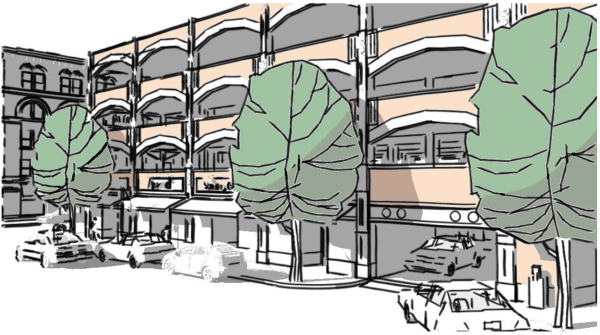 Definition and Intent: A parking deck constructed with ground-floor storefronts along street frontages.
Districts Permitted: MXD-1, MXD-2, CBD, and WHH.

Allowable Building Materials. The following table details encouraged allowable materials that are supplemental to permitted primary and secondary materials of Section 4.03: Building Material Standards.

Architectural Design Requirements:
• Masonry Openings: Parking levels must contain masonry openings designed to be filled in with windows if the building is converted into another Building Type.
• Integration into Mixed Use Building: A parking garage may be integrated into a mixed use building, provided that all visible parking levels along primary and secondary frontages meet the requirements of this section, and all requirements for a mixed use building are met.
• Main Business Entrances: A commercial first floor is required along the principal frontage, and along secondary frontages within 25-feet of any intersection. The commercial first floor must have main business entrances to be located along the principal frontage. For corner lots, the entrance may face the intersection. Side and rear entrances are also permitted but cannot be designed as the primary business entrance.
• Sign Band: A sign band, at least 85% of the width of the building, must be included above the storefront. The sign band must be a horizontal area uninterrupted by windows or architectural features, except that the horizonal architectural divider may serve as the sign band. An awning may also serve as the sign band, provided it is at least 10-inches tall.
• Horizontal Architectural Divider: A projecting cornice or other architectural design feature that extends uninterrupted for the entire width of the building, to divide the first floor from the upper-floors.
• Upper-Floor Design: Upper-floors must have opaque exterior façades with regularly spaced, consistently sized windows to convey a pattern of solids and voids. The upper-floor façade must be consistent along the entire width of the building.
• Upper-Floor Window Design:
• Decorative sills and/or headers are required on upper-floor windows located along principal frontages and may be required by the Planning Commission along secondary frontages. They are not required on façades facing alleys or parking lots.
• The radii of arches on segmented-arch windows must equal the widths of the corresponding masonry openings.
• Architectural Flourishes: Towers, sculptures, masonry reliefs and/or motifs up to 4-inches in depth, and other characteristic forms and/or focal points are encouraged.
Artisan / Maker Space

Definition and Intent: A one-story building with storefronts constructed at the right-of-way lines along street frontages in conjunction with limited allowable workshop and garage door frontages.
Districts Permitted: MXD-1, MXD-2, CBD, and WHH.
 Allowable Building Materials. The following table details encouraged allowable materials that are supplemental to permitted primary and secondary materials of Section 4.03: Building Material Standards.
Architectural Design Requirements:
• Single Story Limitation: Buildings of this type are limited to one-story, or 16-feet, in height. Multi-story buildings must comply with the requirements of another building type allowable in the district.
• Main Business Entrance: The commercial first floor must have a main business entrance to be located either along the principal frontage. For corner lots, the entrance may face the intersection. Side and rear entrances are also permitted but cannot be designed as the primary business entrance.
• Garage / Overhead Doors: Garage and overhead doors may only face secondary frontages and exempt frontages.
• Sign Band: A sign band, at least 85% of the width of the building, must be included above the storefront. The sign band must be a horizontal area uninterrupted by windows or architectural features. An awning may also serve as the sign band, provided it is at least 10-inches tall.
• Architectural Flourishes: Towers, sculptures, masonry reliefs and/or motifs up to 4-inches in depth, and other characteristic forms and/or focal points are encouraged.
• Cornice (Rooftop): A cornice at least 15-inches tall on the roofline on principal and secondary frontages is encouraged.
Landmark Buildings
A. A Landmark Building is one that has significant historical, architectural, or cultural meaning. The Planning Commission may approve a Landmark Building through the site plan review process. If the proposed use within the Landmark Building is considered a special land use in that zoning district, special land use review is also required.
B. A Landmark Building is exempt from the Building Types regulations but must meet the dimensional requirements of the underlying zoning district, except that the Planning Commission may waive architectural features such as cupolas or steeples that exceed the maximum building height.
C. To approve a Landmark Building, the Planning Commission must find that each of the following exist:
1. The building contains one or more of the following uses:
a) Religious Institution
b) Recreational or Cultural Center
c) Government / Municipal Service
d) K-12 School, Trade / Vocational School, or Institution of Higher Education
e) Library
f) Theater / Entertainment Venue or Museum
2. The building addresses all street frontages in a way that promotes a safe and attractive pedestrian environment.
3. The use of the building would be hindered if required to meet the Building Type standards.
Adopted by Ord. 1291 on 12/16/2024
Amended by Ord. 1298 on 6/23/2025

