
Ferndale City Zoning Code
ARTICLE 24
V SPECIFIC USES STANDARDS
Sec 24-5.01 Accessory Dwelling (AD)
A. Must be located on a lot with a one-unit, two-unit, or three-unit dwelling and cannot be split onto a separate lot.
B. Must be connected to a City approved water and sewer system.
C. Must meet the following dimensional standards:

Adopted by Ord. 1291 on 12/16/2024
Amended by Ord. 1298 on 6/23/2025
Sec 24-5.02 Adult Business
A. Are not permitted within a 500-foot radius of a K-12 School, Library, public park, Adult Foster Care, Child Care, or Foster Care use, , or religious institution.
B. Are not permitted within a 1,000-foot radius of an existing Adult Business.
C. Residential uses cannot be located on the same lot as an Adult Business.
Adopted by Ord. 1291 on 12/16/2024
Amended by Ord. 1298 on 6/23/2025
Sec 24-5.03 Drive-Thru Facilities
Drive-Thru Facilities must provide adequate off-street stacking spaces and drive-thru service lanes that do not conflict with pedestrian and/or bike lanes and best practices in access management. These requirements can be waived by the Approving Body, provided the applicant provides a study indicating that fewer stacking spaces are not necessary for the use and will not adversely impact the operations of the establishment or negatively impact neighboring properties and the traffic flow in the area, or that an alternative site / dimensional configuration can still provide a safe environment for all users and promote pedestrian and vehicular safety. Any waiver granted for a specific Special Land Use approval will expire once the business it was approved for ceases operations.
A. Each stacking space must be a minimum of 9-feet in width and 20-feet in length.
B. Each drive-thru service lane must be a minimum of 10-feet in width and positioned to not interfere with normal vehicular on- or off-site traffic.
C. An escape lane from the drive-thru service lane must be provided to allow other vehicles to pass those waiting to be served. A maneuvering lane can be considered as an escape lane. The Approving Body may waive this requirement for sites using an existing building.
D. Public streets, alleys and sidewalks cannot be used as stacking spaces. Where a pedestrian pathway crosses a drive-thru, a path will be designated and marked.
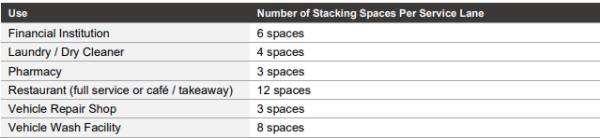
E. The minimum number of stacking spaces required per service lane is determined by use in the following table. If the site is located on a State Road (MDOT jurisdiction, ex: Woodward Avenue), MDOT’s standards may control, and may require greater stacking spaces than what is required below.
F. Outdoor Speakers / Menu Boards. Outdoor speakers cannot be located closer than 50-feet to an adjacent residential lot line and must comply with Article 2-VI Noise of the General Code of Ordinances. Menu boards (without speakers) do not apply to this setback standard, provided they comply with the requirements of Section 3.11: Lighting.
Adopted by Ord. 1291 on 12/16/2024
Amended by Ord. 1298 on 6/23/2025
Sec 24-5.04 Gas Stations
A. Must be located at least 300-feet away from the lot line of any R-1 or R-2 District.
B. Must be located at least 1,000-feet away from an existing gas station.
Adopted by Ord. 1291 on 12/16/2024
Sec 24-5.05 Garage And Yard Sales
Garage and yard sales are subject to Chapter 7 Business Regulations and Licenses Generally, Article 7 XIV Garage and Yard Sales and Article 7 IV Vending, Division 7 IV 1 Sidewalk Vending.
Adopted by Ord. 1291 on 12/16/2024
Sec 24-5.06 Home-Based Businesses
A home-based business must be clearly incidental and subordinate to the residential use of the dwelling unit; the following site and operational standards apply:

Adopted by Ord. 1291 on 12/16/2024
Sec 24-5.07 Indoor Self-Storage Facilities
A. All units must be accessed from the inside of the building.
B. Access to storage units is restricted to customers and employees with mechanical or electronic locking devices at all access points.
C. Site circulation must be designed to accommodate moving trucks that will customarily access the site.
D. No person can reside or socialize in storage areas or inside storage units.
E. The following are prohibited:
1. Commercial, wholesale, retail, industrial or other business activity with the exception of minor storage-related commercial activity, such as the sale of packing materials.
2. Storage of any toxic, explosive, corrosive, flammable, illegal, or hazardous materials.
Adopted by Ord. 1291 on 12/16/2024
Sec 24-5.08 Keeping Of Animals
The keeping of household pets (i.e., dogs, cats, rabbits, birds, hamsters, etc.) is permitted on any lot with permitted residential uses. No more than 4 of any combination of household pets, 4-months of age or older, are permitted at each dwelling unit. The keeping of exotic animals is prohibited. The keeping of chickens is regulated under Chapter 5: Animals and Fowl of the City Code.
Adopted by Ord. 1291 on 12/16/2024
Sec 24-5.09 Manufactured Housing
A. The dwelling must be firmly anchored to a permanent foundation; dwellings cannot be installed with attached wheels, or have any exposed towing mechanism, undercarriage, or chassis.
B. Additions must be constructed with similar or better quality as the original structure; all additions must be constructed on a permanent foundation.
C. Where the dwelling is required by state or federal law to comply with regulations for construction that are different than those imposed for one-unit dwelling site built housing, federal or state regulations control.
Adopted by Ord. 1291 on 12/16/2024
Amended by Ord. 1298 on 6/23/2025
Sec 24-5.10 Marihuana Facilities
A. Applicability. Pursuant to Section 205(1) of the Medical Marihuana Facilities Licensing Act, PA 281 of 2016, as amended, and pursuant to Section 6 of the Michigan Regulation and Taxation of Marihuana Act, Initiated Law 1 of 2018, as amended and the rules established by the Marihuana Regulation Agency, the City authorizes the following types of medical marihuana facilities and marihuana establishments. The City limits the number of medical marihuana facilities and marihuana establishments for each category of facilities or establishments and may revise those categories and limits, by amendment, from time to time:

1. No person or entity that was open or operating any facility purporting to grow, produce, manufacture, test, sell, transfer or transport medical marihuana or marihuana prior to the adoption of this Code is considered a lawful use or lawful nonconforming use to conduct activity as a provisioning center or safety compliance facility.
2. This Code does not apply
B. General Provisions. The following requirements apply to all facilities:
1. The facility cannot open earlier than 9:00 AM and close no later than 9:00 PM, daily.
2. The facility cannot have a drive-thru facility or curbside delivery.
3. No use of marihuana is permitted at the facility. Marihuana products cannot be smoked, ingested, or otherwise used within the facility or onsite.
4. No person, other than employees or consultants, is allowed in the facility after hours.
5. The facility must be available for inspection, during business hours, by the City code enforcement official and/or police to confirm the facility is operating in accordance with all applicable laws, including state law and City codes.
6. Upon request, the City must provide a copy of this Code (including any additional Codes that apply to medical marihuana regulations in the City) to the State’s Marihuana Regulatory Agency.
7. A security plan and floor plan must be submitted with the application; the facility must identify the chemical storage, space, and other critical aspects of the layout. The security and floor plan are confidential documents by the City, exempt from disclosure under the Freedom of Information Act.
8. A waste disposal plan must be included with the application, detailing plans for any chemical, water and/or plant waste disposal.
9. The facility must be equipped with an activated carbon filtration system for odor control to ensure that air leaving the building through an exhaust vent first passes through an activated carbon filter:
a) The filtration system must consist of one or more fans and activated carbon filters. At a minimum, the fan(s) must be sized for cubic feet per minute (CFM) equivalent to the volume of the building (length multiplied by width multiplied by height) divided by three. The filter(s) must be rated for the applicable CFM.
b) Doors and windows must remain closed, except for the minimum length of time needed to allow people to ingress and egress the facility.
c) An alternative odor control system may be proposed if the applicant submits a report certified by a mechanical engineer licensed in the State demonstrating that the alternative system will control odor as well or better than the activated carbon filtration system otherwise required. The City may allow the alternative odor control system if it determines it will control odor as well as the activated carbon filtration system.
C. Medical Marihuana Facility. The following additional requirements apply:
1. Primary caregivers and/or qualified patients must be legally registered by the Michigan Department of Community Health (MDCH) to assist qualified patients with the medical use of marihuana in accordance with the Michigan Medical Marihuana Act, as amended.
2. The facility is not allowed within 500-feet of a K-12 school, licensed child care home, child care center, or a medical marihuana facility provisioning center or safety compliance facility.
D. Provisioning Center and Safety Compliance Facility. The following additional requirements apply:
1. Prior to opening, the facility must be licensed by the State as required by the Medical Marihuana Facilities Licensing Act, Act 281 of 2016, and then must be at all times in compliance with state laws, including but not limited to the Michigan Medical Marihuana Act, and the Marihuana Tracking Act, PA 282 of 2016, and all other applicable rules promulgated by the state.
2. The facility is not allowed within 500-feet of a K-12 school, licensed child care home, child care center, or another provisioning center or medical marihuana facility or marihuana retailer. This separation does not apply to a provisioning center licensee that also has a marihuana retailer license that is colocated.
3. If only a portion of a building is used by a facility, the remainder of the building cannot be accessible or have an entrance or entry way into the facility.
4. A maximum floor area of 5,000 square feet of retail usable floor space for merchandise and service area open to the public may be used by a provisioning center. A provisioning center may have not more than an additional 5,000 square feet of space that is not open to the public, for storage and other administrative uses necessary for the provisioning center.
5. Security cameras are required for ingress/egress to the facility to record the property. Cameras showing any point of sales are also required.
6. All activities of a provisioning center, including all transfers of marihuana, must be conducted within the building and out of public view. A provisioning center cannot have a walk-up window.
7. The exterior appearance of the building must remain compatible with the exterior appearance of buildings constructed or under construction within the vicinity of the facility.
8. Licensed medical marihuana patients or caregivers authorized by the State under Initiated Law 1 of 2008 are not required to receive special use approval to conduct legal activities, within the limits established under the Michigan Medical Marihuana Act, in any zoning district, but must comply will all applicable City codes, including those governing odor, and all applicable state laws.
E. Marihuana Retailer. The following requirements apply:
1. Prior to opening, a retailer must be licensed by the State as required by the Michigan Regulation and Taxation of Marihuana Act, Initiated Law 1 of 2018, as amended, and must be at all times in compliance with the laws of the State, including but not limited to the Michigan Medical Marihuana Act, and the Marihuana Tracking Act, Act 282 of 2016, and all other applicable rules promulgated by the state.
2. The retailer is not allowed within 500-feet of a K-12 school, licensed child care home, child care center, or another provisioning center or medical marihuana facility or marihuana retailer. This distance requirement does not apply to a safety compliance facility. This distance requirement does not apply to a marihuana retailer licensee that has a provisioning center license and is trying to colocate at a single location.
3. If only a portion of a building is used by a facility, the remainder of the building cannot be accessible or have an entrance or entry way into the facility.
4. A maximum floor area of 5,000 square feet of retail usable floor space for merchandise and service area open to the public may be used by a marihuana retailer. A marihuana retailer may have not more than an additional 5,000 square feet of space that is not open to the public, for storage and other administrative uses necessary for the marihuana retailer.
5. All sales of a retailer must be conducted within the building and out of public view. A retailer cannot have a walk-up window.
6. The exterior appearance of the building must remain compatible with the exterior appearance of buildings constructed or under construction within the vicinity of the retailer.
7. If the department does not issue rules and the City issues a permit, pursuant to Section 16 of the Michigan Regulation and Taxation of Marihuana Act, Initiated Law 1 of 2018, as amended, the City must notify the department upon issuance of any City permit to a marihuana establishment.
8. Licensed medical marihuana patients or caregivers authorized by the State under Initiated Law 1 of 2008 are not required to receive special use approval to conduct legal activities, within the limits established under the Michigan Medical Marihuana Act, in any zoning district, but must comply will all applicable City codes, including those governing odor, and all applicable state laws.
Adopted by Ord. 1291 on 12/16/2024
Sec 24-5.11 Mobile Vendors
Reserved.
Adopted by Ord. 1291 on 12/16/2024
Sec 24-5.12 Novelty Stores
A. Cannot be located within a 1,000-foot radius of another novelty store.
B. Are not permitted within a 500-foot radius of a K-12 School, Library, public park, Adult Foster Care, Child Care, or Foster Care use, or religious institute.
C. Medical Marihuana Facilities, Provisioning Centers, and Marihuana Retailers authorized under this Chapter, in accordance with the Michigan Medical Marihuana Act, Medical Marihuana Facilities Licensing Act, PA 281 of 2016, as amended and Michigan Regulation and Taxation of Marihuana Act, Initiated Law 1 of 2018, as amended, does not constitute a novelty store.
Adopted by Ord. 1291 on 12/16/2024
Amended by Ord. 1298 on 6/23/2025
Sec 24-5.13 Outdoor Dining
Outdoor Dining is subject to Chapter 7 Business Regulations and Licenses Generally, Article 7 XVIII Sidewalk Cafés of the General Code of Ordinances.
Adopted by Ord. 1291 on 12/16/2024
Amended by Ord. 1298 on 6/23/2025
Sec 24-5.14 Outdoor Storage
Outdoor storage must be accessory to a principal use and is only allowed in the I-1 or I-2 Industrial Districts.
A. Location. Must be located on a paved area and not located in the right-of-way or road easement. Cannot be located within a designated loading zone.
B. Screening. All outdoor storage visible from the right-of-way must be screened from view.
Adopted by Ord. 1291 on 12/16/2024
Amended by Ord. 1298 on 6/23/2025
Sec 24-5.15 Parking Lots
A. Parking lots must be an accessory use to a principal use, unless it is a municipal parking lot. The parking of vehicles on a lot without a principal building is prohibited, unless it is a municipal parking lot.
B. Parking lots must be setback a minimum of 10-feet from any street fronting property line. The CED Director may reduce this setback to 5-feet if a 3-foot-high masonry wall is erected along the street-fronting property line.
C. Parking lots must be setback a minimum of 10-feet from side or rear property lines. This setback may be reduced by the CED Director if the topography of the site limits the installation of a 10-foot setback or if the features (i.e., sidewalk) of the site prove that a 10-foot setback is unwarranted.
D. Screening must be provided between any right-of-way and a parking lot, except for curb cuts and other similar site items. See Section 6.04: Required Landscaping for screening options.
Adopted by Ord. 1291 on 12/16/2024
Amended by Ord. 1298 on 6/23/2025
Sec 24-5.16 Pawnshops
A pawnshop cannot be located within 1,500-feet of another pawnshop.
Adopted by Ord. 1291 on 12/16/2024
Sec 24-5.17 Solar Energy Systems (SES)
Solar Energy Systems (SES) regulations provide a renewable, abundant, local, distributed, resilient, and nonpolluting energy resource; decrease the cost of energy; improve quality of life of current residents while also protecting the public health, safety, and welfare; protect property-owner rights to construct SES in all zoning districts and protect legal permission from landlords to tenants; and increase employment and business development in the region by furthering the installation of SES. This Code does not prohibit the sale of excess power (through a “net billing”, “net-metering”, or “bill credit”, or other arrangement) in accordance with Michigan’s laws overseen by the Michigan Public Service Commission (MPSC) or any other federal statute.
 A. Accessory use SES must meet the requirements of Section 3.04: Accessory Structures: Distributed Energy Systems.
B. Ground-mounted SES must comply with the following:
1. Cannot be located closer than 10-feet to any principal building. If current Electrical code requires a larger horizontal separation for any SES equipment, that distance must be met.
2. Must be setback at least 8-feet from any side or rear lot line.
3. Cannot exceed 15-feet in height at maximum tilt. Taller structures, not to exceed the maximum height of the underlying zoning district, may be considered by the Planning Commission as a Special Land Use.
4. A principal-use SES must be secured with perimeter fencing to restrict unauthorized access, subject to Section 3.08: Fences.
5. In residential and mixed-use zoning districts:
a) Accessory Use SES must be located in the rear or side yard unless they are screened per subsection (c) below, then the SES may be located in the front plane of the house. This provision is not applicable to principal use SES.
b) Principal Use SES do not have the rear and side yard requirement, but a landscaped screen may be required by the Planning Commission to screen from front lot and side rights-of-way (as applicable).
c) When located within the non-required front yards (in residential or mixed use districts), a landscaped screen may be required by the Planning Commission to screen from front lot and side public rights-of-way (as applicable).
6. A Building Permit is required, and all systems must comply with the Building Code Applications for Roof-Mounted SES must include elevation drawings that show the location, height and dimensions of the SES on the Building and dimensions of the SES. A SES used to power a single device or specific piece of equipment such as a lawn ornament, lights, weather station, thermometer, clock, well pump, or other similar singular device is exempt from SES code requirements.
7. Sealed, engineered drawings must be submitted detailing how the SES is securely anchored to the ground or a permanent roof structure, to meet the State Frost Laws (a minimum of 42-inches below grade).
8. A decommissioning plan, to outline steps for removal of the SES, is required.
9. If a SES ceases to perform its intended function for more than 12 consecutive months, the property owner must remove the collector, mount, and associated equipment and facilities no later than 60 days. The property must be restored to the condition prior to the development of the system. Exception: for inoperable BIPV (a type of building-integrated SES) materials which still perform another purpose of maintaining the building façade (this may include materials such as shingles, siding, or windows). The owner of an inoperable BIPV must obtain professional services from a Licensed Electrician to fully disconnect formerly energized wiring and request documentation from the electrician that will be submitted to the City to put on file. However, the electrician should not disconnect grounding wires or other electrical sensors or components which minimize future risks to life and property, unless doing so is required by current electrical codes.
Adopted by Ord. 1291 on 12/16/2024
Amended by Ord. 1298 on 6/23/2025
Sec 24-5.18 Stationary Battery Energy Storage Systems (BESS)
This Section applies to the siting, design, installation, and operation of chemical-based, stationary Battery Energy Storage Systems (BESS). excluding general maintenance and repair. Modifications to, retrofits, repowering, or replacements of an approved BESS that increases the total BESS designed discharge, duration, or power rating is subject to this Section.
 A. Application and Approval.
1. Any grid-tied BESS must receive the required approval from the applicable utility authorities. The City must receive a copy of the document which confirms the system has been approved by the utility.
2. A building permit submittal must include the following:
a) Location and layout diagram of the room or area in which the BESS is to be installed.
b) Details on the hourly fire-resistance ratings of assemblies enclosing the BESS.
c) The quantities and types of BESS to be installed. Manufacturer’s specifications, ratings, and listings of each BESS.
d) Description of battery management systems and their operation.
e) Details on fire suppression, smoke or fire detection, thermal management, ventilation, exhaust, and deflagration venting systems, if provided.
f) Support arrangement associated with the installation, including any required seismic restraint.
B. General Tier 1 BESS Use Standards.
1. Where feasible, BESS must be located inside of a building. BESS located outside of a building must be screened to the maximum extent possible without posing a fire risk. BESS must be placed in a secure container or enclosure meeting the requirements of the Building Code.
2. BESS must be installed, maintained, and used only in accordance with the manufacturer’s directions. A copy of such directions must be submitted to the City.
3. Ground-mounted BESS must be permanently and safely attached to the ground. Proof of the safety and reliability of the means of attachment must be submitted to the City; the City may require an additional certification by a professional engineer or other qualified person prior to installation.
4. Building-mounted BESS: proof of the safety and reliability of the means of attachment must be submitted to the City; the City may require an additional certification by a professional engineer or other qualified person prior to installation.
5. Ground-mounted BESS cannot exceed 16-feet in height.
6. The 1-hour average noise generated cannot exceed 45 dBA (measured at the lot line). Applicants may submit equipment and component manufacturers noise ratings to demonstrate compliance.
C. General Standards for Tier 2 and Tier 3 BESS.
1. Setbacks. Must be setback back at least 100-feet from rights-of-way and all property lines.
2. Height. Must comply with the building height limitations for principal structures of the zoning district.
3. Signs. Signs must be posted, in compliance with American National Standards Institute Z535 and include the type of technology associated with the BESS, any special hazards associated, the type of suppression system installed in the area of BESS, and 24-hour emergency contact information, including a reach-back phone number. As required by the National Electric Code, disconnect and other emergency shutoff information must be clearly displayed on a light reflective surface. A clearly visible warning sign concerning voltage must be placed at the base of all pad-mounted transformers and substations.
4. Fencing. The BESS, including all mechanical equipment, must be enclosed by a fence with a selflocking gate to prevent unauthorized access unless housed in a building and not interfering with ventilation or exhaust ports.
5. Containment. Must include containment systems to prevent chemicals, fire suppressant agents, or similar hazards from contaminating surface water, groundwater, and soil, and to minimize the risk of human exposure.
6. Vegetation and Tree Cutting. Areas within 20-feet on each side of a BESS must be cleared of combustible vegetation and other combustible growth. Single specimens of trees, shrubbery, or cultivated groundcover such as grass, ivy, or similar plants used as groundcover are be permitted, provided that they do not form a means of readily transmitting fire. Removal of trees should be minimized to the extent possible.
7. Screening and Noise Barriers. Must use architectural features, berms, landscaping, or other screening methods that will visually screen the BESS from adjacent properties and function as a sound barrier. These elements must be designed to harmonize the BESS installation with the surrounding area but cannot interfere with ventilation or exhaust ports.
8. A Commissioning Plan. Must document and verify that the system and its associated controls and safety systems are in proper working condition per requirements in the Fire Code, Building Code, etc.
9. Decommission Plan. A narrative description of the activities to be accomplished, including who will perform that activity and at what point in time, for complete physical removal of all BESS components, structures, equipment, security barriers, and transmission lines from the site.
10. Hazard Mitigation Analysis. An analysis that evaluates the consequences of BESS failure modes according to the procedures established in the Fire Code or other applicable standards as determined by the City Fire Department or City Engineer.
11. Sound Study. An acoustic assessment prepared by a licensed engineer from a reasonable number of sampled locations at the perimeter of the BESS.
12. Fire Safety Compliance Plan. Must document and verify that the system and its associated controls and safety systems are in compliance with the Fire Code.
13. Operation and Maintenance Manual. Must describe continuing BESS maintenance and property upkeep, as well as design, construction, installation, testing and commissioning information.
14. Emergency Operations Plan. A copy of the approved Emergency Operations Plan must be given to the system owner, the City and City Fire Chief / Fire Marshall. A permanent copy must also be placed in an approved location to be accessible to facility personnel, the City, and emergency responders.
D. Semi-Annual Report. A semi-annual report must be provided to the City Fire Department and include a copy of a recent inspection report by a licensed professional engineer including any sustained structural damage and a copy of proof of insurance in a sufficient dollar amount to cover potential personal and property damage associated with construction and operation thereof.
E. Abandonment or Decommissioning. A Tier 2 or Tier 3 BESS which has reached the end of its useful life or has been abandoned must be removed, and the owner is required to restore the site to its original condition within 150 days after the date of discontinued operations. Absent notice of a proposed date of decommissioning, a BESS is considered abandoned when it ceases to operate consistently for more than 1-year. Decommissioning includes: Removal of a BESS, structures, equipment, security barriers, and transmission lines from the site; disposal of all solid and hazardous waste in accordance with local, state, and federal regulations; and stabilization or re-vegetation of the site to minimize erosion.
Adopted by Ord. 1291 on 12/16/2024
Sec 24-5.19 Temporary Uses: Buildings, Construction Trailers And Minor Equipment / Goods
Temporary buildings and construction trailers (including residential moving pods) and minor equipment / goods require a Temporary Use Permit. Applicants must submit a Temporary Use Permit, fee, and sketch plan to the CED Department. The sketch plan must detail the location of the use and how it will meet the following:
A. Duration. Permitted for up to 6-months (with 1, 6-month extension that can be approved by the CED Director). However, residential moving pods are not allowed for more than 21-days (with 1, 3-week extension that can be approved by the CED Director).
B. Location. Must be located on a paved area and not located in the right-of-way or road easement. Cannot be located within a designated loading zone.
C. Trailer Standards. 1 construction trailer per builder or contractor is permitted; the setback requirements for the zoning district must be met. Trailers must have skirting and the storage of materials under the trailer is not permitted.
D. Cleaning of the Premises. All equipment, materials, goods, poles, wires, and other items associated with the Temporary Use Permit must be removed from the premises within 10-days of issuing a final Certificate of Occupancy for a building on the property.
Adopted by Ord. 1291 on 12/16/2024
Sec 24-5.20 Temporary Uses: Tens, Canopies, And Bounce Houses
A. A Temporary Use Permit may be required:

B. Prohibited Uses. Membrane structures used for the purpose of parking or storage of vehicles, recreation vehicles and/or equipment, maintenance equipment and utility trailers are prohibited.
Adopted by Ord. 1291 on 12/16/2024
Sec 24-5.21 Vehicle Repair Shops, Vehicle Wash Facilities, And Dealerships
A. All work, including, but not limited to: repairs, servicing, vacuuming, greasing and/or washing vehicles, or other similar activities, must be conducted within an enclosed building that is equipped with doors that are secured during non-business hours.
B. The broadcast of music or announcements over any loudspeaker or public address system, except for emergency safety announcements, is prohibited.
C. All combustible waste and rubbish must be kept in metal receptacles fitted with a tight cover until removed from the premises. No gasoline, oil, grease, or flammable liquid is allowed to flow into or be placed in the drainage system and is not allowed to accumulate on the floor / be absorbed into the ground; combustible materials (such as sawdust) cannot be used to absorb gasoline, oil, grease, or flammable liquids.
D. The outdoor storage of equipment and material, including tires, is prohibited.
E. All inoperable vehicles must be enclosed by a sight-obscuring fence or wall of a minimum height of 8-feet, screened per Section 6.04: Required Landscaping.
F. Vehicle Wash Facilities are subject to the standards of Section 5.03: Drive-Thru Facilities.
G. Must have a minimum frontage of 175-feet along a principal street and a minimum lot area of 20,000 square feet.
H. Ingress and egress driveways must be located on a principal street, a minimum of 20-feet from any corner, and cannot be more than 25-feet wide. Only one curb cut for each frontage is allowed.
I. Driveways must be designed to accommodate the type and volume of vehicular traffic using the site and located in a manner which does not create a traffic safety or congestion problem.
J. Pedestrian sidewalks must be demarcated from vehicular parking, stacking spaces and maneuvering lanes.
K. The parking of vehicles is prohibited between the hours of 10:00 PM and 6:00 AM.
L. No strings of flags, pennants, strings of lights, or wind signs are permitted.
Adopted by Ord. 1291 on 12/16/2024
Sec 24-5.22 Wireless Communication Facilities
Wireless communication facilities must comply with Article 25-III: Wireless Communication Facilities of the General Code of Ordinances.
Adopted by Ord. 1291 on 12/16/2024
Sec 24-5.23 Short Term Rental
Short Term Rentals are subject to Chapter 7-VII-3 Short Term Rental Licensing.
Amended by Ord. 1298 on 6/23/2025

