
Ferndale City Zoning Code
ARTICLE 24
IX SITE PLANS
Sec 24-9.01 Intent
A site plan is required to ensure compliance with this Code and other applicable City codes and laws, which protect the community's health, safety, and welfare. A site plan provides for orderly development, adequate landscaping and screening, and appropriate lighting. This Article establishes the procedures and standards for reviewing a site plan.
Adopted by Ord. 1291 on 12/16/2024
Sec 24-9.02 Submittal Requirements
The CED Director has final discretion over required submittals for a site plan. The site plan application details minimum submittal requirements. Submission of a site plan requires a complete application with ancillary submittals and any associated fees to be paid. Applications will not be processed unless they are determined to be complete. Any property owner aggrieved by a submittal requirement decision by the CED Director may appeal to the BZA.
Adopted by Ord. 1291 on 12/16/2024
Sec 24-9.03 Review Process
A. Process Overview. For all site plans not concurrently reviewed with a PUD or Special Land Use, there are two types of reviews: 1) administrative review; and (2) Planning Commission review. The CED Director determines the type of site plan review process for a site plan. See flow charts at the end of this Article that illustrate the process for an Administrative or Planning Commission review. Any property owner aggrieved by the CED Director's determination of the type of site plan review process may appeal to the BZA. When a site plan is proposed with a Special Land Use, it considered for final approval by the Planning Commission.
B. Pre-Application Meetings. The CED Director may require a property owner to present their site plan at one or more pre-application meetings before submitting a formal application. A property owner's requirement to present at a pre-application meeting is not appealable to any officer, board, or commission. Failure to present at a pre-application meeting will result in an incomplete application determination if submitted.
Adopted by Ord. 1291 on 12/16/2024
Sec 24-9.04 Approval Standards
The following standards must be met for site plans, as applicable:
A. Compliance with the Master Plan. The proposal furthers the goals and objectives of the Master Plan.
B. Use and Zoning District Compatibility. The proposal must be compatible with the intent statements of the zoning district and surrounding uses.
C. Housing. If housing is proposed, the development proposal must contribute to the City’s goal of providing a variety of housing types, prices, and ownership forms to satisfy the needs of various community segments.
D. Utilities, Soil Erosion, Sedimentation Control, and Drainage. Utility services, including sanitary, water, and storm runoff, must not exceed the existing or planned capacity of such services and must be developed in the best interest of the community's public health, safety, and welfare. The proposal must be designed and located so that public services, including streets and sidewalks, police and fire protection, and public schools, have sufficient capacity to serve the development properly and so that such services will not be adversely affected by the proposed development.
E. Transportation, Mobility, and Circulation. The proposal must encourage an efficient and environmentally sound transportation system, with the following standards met:
1. Ensure the safety and convenience of pedestrian and vehicular traffic.
2. Ensure efficient traffic flow and control and the proper placement of curb cuts for ingress and egress.
3. Ensure adequate turning radius for trucks and vehicles regularly servicing the site.
4. Ensure easy access in fire, catastrophe, and emergency cases.
5. Designed not to create undue traffic congestion on adjacent public streets.
6. Ensure mobility options are provided, including pedestrian, bicycle, personal vehicle, and transit, as appropriate to the scale of the development proposal and its use.
F. Landscaping and Screening. Walls, berms, and vegetative screens (or a combination) must act as buffers to provide a more compatible, safer, and visually attractive physical separation between various land use types. Landscaping and screening must create a definitive site improvement, minimizing the impact that one type of land use may have on another.
G. Green Infrastructure and Natural Resources. General site landscaping must enhance nearby property's appearance, character, and value while providing an environmental benefit. The natural assets of a lot must also be preserved and enhanced to the extent practicable.
H. Lighting. Site lighting must be harmonious with properties in the vicinity while adequately illuminating a site for safety and convenience. Excessively bright and harsh site illumination is not allowed as it creates an undesirable halo effect on the lot, diminishes the surrounding environment, and presents a potential hazard to vehicle and pedestrian traffic on adjacent streets and sidewalks.
I. Building Form and Design Standards. Building form and design must relate to and be harmonious with the surrounding area regarding texture, scale, mass, proportion, materials, and color. Structures must comply with setbacks, height, and other dimensional standards and be located to preserve environmentally sensitive areas. Entrances must be accessible and barrier-free. If applicable, the proposed site plan and building(s) must also comply with the form-based standards.
J. General Development or Use Requirements. The proposal must comply with the general site requirements of Article 3: General Provisions, Article 8: Signs, and any applicable standards of Article 5: Specific Use Standards.
Adopted by Ord. 1291 on 12/16/2024
Sec 24-9.05 Procedures After Approval
A. Final Approved Plan. The applicant must submit a final site plan with the changes required by the Approving Body and list any conditions as a note on the plan before submitting construction drawings or receiving a building permit. The CED Director reviews final plans and confirms compliance with approvals and conditions. Any property owner aggrieved by the CED Director's requirements related to a final site plan may appeal to the BZA.
B. Approval Expiration. The site plan is approved for construction for 2-years from the approval date. If a building permit has not been obtained and/or construction has not commenced within the 2-year period, th site plan is null and void.
C. Approval Extensions. The CED Director may grant an extension of up to 18-months for an approved site plan. An extension may only be granted provided the approved site plan continues to adequately represent current conditions on and surrounding the site, that the applicant has shown substantial progress, the project has suffered an unavoidable delay, and/or that the site plan conforms to the standards of the City regulations, at the time of the applicant's request for an extension.
D. By Owner’s Action. An owner of an approved site plan may petition the CED Director to rescind such approval. Upon receipt of such petition, the CED Director will terminate approval of the site plan. Only those uses permitted by right within the applicable zoning district will be allowed on the property.
E. Modifications to a Previously Approved Site Plan. An approved site plan may be subsequently modified, subject to the review and approval requirements of this Article based on the scope of the proposed modifications. The CED Director may approve minor plan modifications under administrative review or determine whether a property owner must seek Planning Commission approval.
1. Major Modification to a Site Plan. Any site plan modification that does not fall under the criteria of a Minor Modification is considered a Major Modification. A Major Modification may be approved as administrative review, or the CED Director may determine the property owner must seek Planning Commission subject to the provisions of this Article
2. Minor Modifications to a Site Plan:
a) Movement of a structure, provided all setback, parking, landscaping, and other site requirements are met.
b) Plantings in the landscape plan may be replaced by similar types and sizes of landscaping, which provide a similar screening effect on an equal or greater basis.
c) Improvements to site access or circulation, such as deceleration lanes, boulevards, curbing, pedestrian/bicycle paths, and removing a curb cut. The addition of a new curb cut is not considered a minor modification.
d) Changes of building materials or design, fencing, screening, or site amenities that will result in a higher quality development.
e) Changes in interior floor plans which do not alter the character of the use.
f) Slight modification of sign placement or reduction of size/number.
g) Changes required or requested by a City, county, state, or federal agency for safety reasons or for compliance with applicable laws that do not alter the basic design, compliance with the standards of approval, or any specified conditions of the approved site plan.
h) Situations the CED Director deems similar to the above, which do not alter the basic design, compliance with the standards of approval, nor any specified conditions of the approved site plan
F. Resubmission. No application the City has denied may be resubmitted until the expiration of 1-year from the date of such denial, except on grounds of newly discovered evidence or proof of changed conditions sufficient to justify reconsideration, in the CED Director’s sole determination. Any property owner aggrieved by this decision may appeal to the BZA.
G. Any change which the Code allows the CED Director to waive or reduce.
Adopted by Ord. 1291 on 12/16/2024
Sec 24-9.06 General Considerations
A. Site Plan Approval. Approval of a site plan requires the Approving Body to bring a property into compliance or closer into compliance with the Code.
B. Penalties and Remedies.
1. Conformity. The property owner for whom site plan approval has been granted is responsible for maintaining the property in conformity with the approval on a continuing basis unless the City approves a new or amended site plan.
2. Failure to Conform.
a) A breach of any condition and the failure to correct such breach within 30 days after the City issues an order to correct is a reason for revocation of the site plan approval. Additional time for correction of the cited violation may be allowed by the City upon submission of proof of good and sufficient cause. Conditions of an approved site plan are continuing obligations to the property owner and are binding upon their heirs and assigns and upon any persons taking title to the affected property while such site plan is in effect.
b) The first violation of non-conformity to an approved site plan is a municipal civil infraction. A first offense is subject to a minimum $100.00 fine and any other penalties authorized by law. Secon offenses within a 12-month period are punishable by a fine of up to $200.00. Third and subsequent offenses are punishable by a fine of up to $500.00 and a mandatory court appearance. Each day on which a violation shall continue shall constitute a separate offense and shall be punishable as such. These requirements are in addition to, and not in lieu of, all other City Codes, regulations, or state law.
C. Administrative Review and Planning Commission. Upon Administrative approval of a proposed site plan, a property owner aggrieved by an approval with conditions, or denial may formally appeal to the Planning Commission for a final decision by submitting a letter to the CED Director within 10 business days. The CED Director will schedule the site plan for consideration by the Planning Commission at the next available meeting, and the Planning Commission may approve, approve with conditions, or deny, based on the criteria in Section 9.04: Approval Standards.
Adopted by Ord. 1291 on 12/16/2024
Sec 24-9.07 Applicability And Types Of Reviews
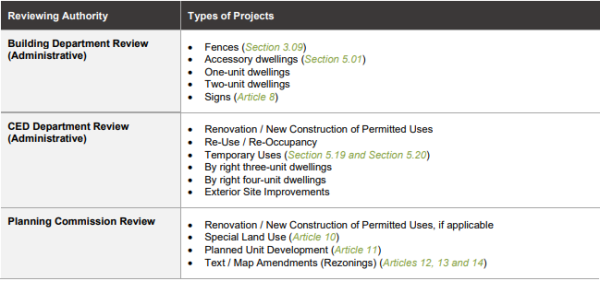
No structure may be erected, moved, relocated, or structurally altered, and there cannot be a change or addition of use, nor expansion or reduction of off-street parking. No filling, excavation, or grading may be undertaken until a required plan is submitted for review and approval, as specified in this Section. The CED Director is the final authority on the type of review required for each application and has the authority to waive and require additional review criteria.


Adopted by Ord. 1291 on 12/16/2024
Amended by Ord. 1298 on 6/23/2025

