
Ferndale City Zoning Code
ARTICLE 24
VIII SIGNS
Sec 24-8.01 Intent
To regulate signs to ensure that they are consistent with the desired characteristics detailed in the City’s Master Plan; prevent traffic hazards; provide safe conditions for pedestrians; and protect the public health, safety, and welfare. This includes:
A. Setting standards and providing uniform regulations that permit reasonable use of signs, recognizing that signs perform an important function in identifying and promoting businesses, services, neighborhoods, events, economic development, and other matters of interest to the public.
B. Preserving the various characteristics found within the zoning districts and neighborhoods throughout the City, regardless of sign content. In preserving the character of the various neighborhoods, signage must be scaled appropriately.
C. Prohibiting the erection of signs that may create a hazard to pedestrians and motorists in terms of number, size, illumination, and location.
D. Avoiding an excessive number of signs so that signs provide adequate identification and direction while minimizing clutter, unsightliness, and confusion.
E. Establishing a clear process for the permitting of signs, allowing some signs without permits, and allowing legally nonconforming signs to continue without jeopardizing the useful life of the sign.
F. Promoting sustainable practices in sign design and construction. To achieve this, signs must be constructed out of high-quality, durable materials and professionally manufactured.
Adopted by Ord. 1291 on 12/16/2024
Sec 24-8.02 General Standards
A. Measurements.
1. Measuring the Sign Area. The entire area within a rectangle or square enclosing the extreme limits of the sign structure, regardless of the shape of the structure; excluding the necessary supports or uprights on which such sign is placed. The sign display area must be expressed in square feet, computed to the nearest tenth of a square foot, and computed as follows:


2. Measuring Signs with Two or More Faces. Where a sign has two or more faces, the area of all faces is included in determining the sign area, except that where two such faces are placed back-toback and are at no point more than 2-feet from one another, the area of the sign is either:
a) The area of one face, if the two faces are of equal area, or
b) The area of the larger face, if the two faces are of unequal area.
3. Measuring Sign Height.
a) Ground Sign. The total height is measured from grade to the tallest point of a sign structure (any structure supporting a sign).
b) Sign Attached to a Building or Structure. Cannot exceed the height of the building or structure, measured from grade to the roof or parapet (except marquee signs).
B. Construction Standards.
1. Materials. Sign materials must be designed to complement the original construction materials and architectural style of the building façade to promote an overall unified and aesthetic effect.
2. Fastenings. All signs must be erected in such a manner and with such materials to remain safe and secure during the period of use and all bolts, cables, and other parts of such signs kept painted and free from corrosion by the owner.
3. Sign Safety.
a) All signs erected, constructed, reconstructed, altered, or moved must be constructed in such a manner and of such materials as to comply with all requirements of the Building and Electrical Code.
b) Any sign (including cables, guys, etc.) must have a minimum clearance of 6-feet from any electrical conductor / light pole, road lamp, traffic light, or other public utility pole or standard.
C. Illumination. Permanent signs may be internally or externally illuminated, except where prohibited in this Code, in accordance with the following standards.
1. Non-Glare, Shielded Lighting. Lights must be steady, stationary, and shaded and/or shielded downward with light directed away from adjacent properties and streets.
2. Backlighting. Signs with internal illumination must have lettering and graphics in a lighter color than the background to the maximum extent practical.
3. Illumination Levels. Illumination levels cannot exceed 0.5 foot-candles at the lot line, measured 5- feet from the ground. Where adjacent to a residential property, illumination levels cannot exceed 0.1 foot-candles at the lot line.
4. Bare Bulb Illumination. Illumination by bare bulbs or flames is prohibited, except that bare bulbs are permitted on marquee signs.
5. Wiring. Underground wiring is required for all illuminated signs not attached to a building. All wiring for signs attached to a building must be concealed (i.e., exposed conduit or wiring is prohibited).
6. Repair. If any portion of an illuminated sign fails to function, the sign must be repaired within 30 days.
D. Location.
1. Public Right-of-Way. Unless otherwise provided in these regulations, no sign, except those established or approved by the City, Oakland County, state or federal governments can be located in, project or overhang into any public right-of-way or dedicated easement.
2. Projection Maximums. Measured from the building’s façade, an awning, canopy, or sign cannot project greater than the following standards. If the building frontage is on Woodward Avenue or 8 Mile, MDOT approval must be obtained for any projection within the right-of-way.
a) Awning / canopy:
1) If retractable, a maximum of a 4-foot projection. Retractable awnings must be retracted at the end of business daily.
2) If non-retractable, a maximum of an 8-foot projection.
b) Projecting sign. Maximum projection of 2-feet for brackets and 3-feet for signs, for a total of 5- feet.
c) Wall sign. Maximum projection of 1-foot.
d) Marquee sign. Maximum projection of 8-feet.
3. Clear Vision Area. No sign can be located in the clear vision area, Section 3.06: Clear Vision Area.
4. Interior Signs. Any sign located in a building within 10-feet of a window, meant to attract pedestrian or vehicle traffic, shall adhere to Section 8.03 and 8.04.
E. Sign Category. Every Sign Type has a Sign Category designating it as a Primary or Accessory Sign.
F. Number of Signs. Each business is permitted one Primary Sign. A business may have multiple Accessory Signs subject to the maximum number provided in Section 8.03: Signs that Require a Permit and Section 8.05: Signs that do not Require a Permit.
Adopted by Ord. 1291 on 12/16/2024
Sec 24-8.03 Signs That Require A Permit
A. Sign Permit. It is unlawful for any person to construct, erect, re-erect, move, alter, enlarge, or illuminate any sign unless a sign permit is first obtained from the Building Department (except if listed in Section 8.05: Signs that do not Require a Permit).
B. Permit Application. The CED Director has final discretion over required submittals for a sign permit. The sign permit application details minimum submittal requirements. Submission of a sign permit plan requires a complete application with ancillary submittals and any associated fees to be paid. Applications will not be processed unless they are determined to be complete.
C. Sign Permit Expiration. A sign permit is null and void if the work for which the permit was issued is not completed within 180 days of the date of issue.
D. Sign Standards for Permitted Signs.


Adopted by Ord. 1291 on 12/16/2024
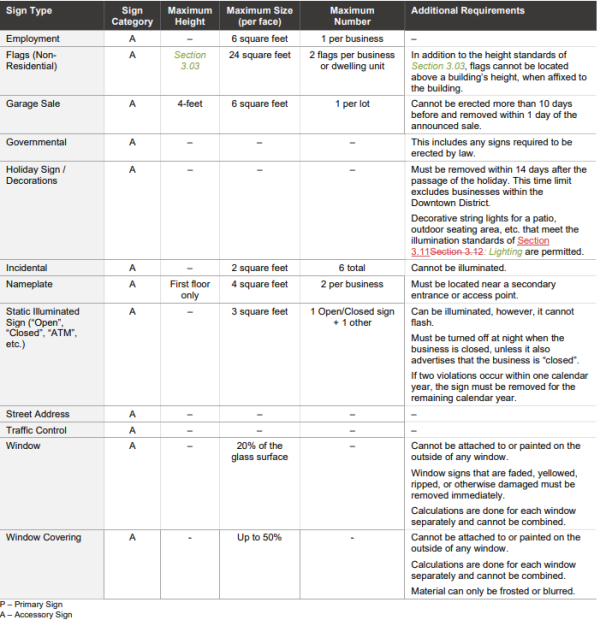
Sec 24-8.04 Signs That Do Not Require A Permit
The following signs do not require a sign permit, provided they are not located in the public right-of-way and comply with the sign requirements of Section 8.02: General Standards.
Adopted by Ord. 1291 on 12/16/2024
Amended by Ord. 1298 on 6/23/2025
Sec 24-8.05 Temporary Signs
The following apply to temporary signs, those that are installed and maintained for less than 30-days in a calendar year; a permit is not required unless otherwise specified:
A. Banners Spanning any Right-Of-Way. Cannot be greater than 300 square feet in size. Requires City Council and/or MDOT approval.
B. Grand Opening and other Temporary Signs and Banners. Cannot be greater than 16 square feet. One such sign or banner is permitted.
C. Illumination. Cannot be illuminated.
D. Maintenance and Removal. Must be removed as soon as torn or damaged.
E. Other. Businesses shall be allowed three temporary signs (banners no greater than 16 square feet) during the month of August if Dream Cruise is a City-sponsored event
Adopted by Ord. 1291 on 12/16/2024
Sec 24-8.06 Prohibited Signs
Prohibited signs include, but are not limited to:
A. Abandoned signs.
B. Any sign attached to a tree, fence, or utility pole.
C. Any sign which is not specifically permitted by or does not conform to this Article.
D. Balloons or balloon signs, except when specifically approved for a special event by the City.
E. Billboards (including any off-premises sign).
F. Electronic message signs.
G. Festoon signs and flashing, animated, or moving signs.
H. Home-based business signs (other than a nameplate sign).
I. Any sign or advertising structure containing profane, obscene, indecent, or immoral matter of the type or kind prohibited by State law.
J. Any sign that obstructs access, preventing free and unobstructed access to using a window, door, or other opening that could be used for a fire escape.
K. Inflatable signs, except when specifically approved for a special event by the City.
L. Pole and roof signs.
M. Signs that obstruct any approved traffic control device, road sign, or signal from view; interfere with site distance necessary for traffic safety; confuse traffic; or distract from visibility of existing traffic signs or devices.
N. Signs that contain visible moving, revolving or mechanical parts or movement, or other apparent visible movement achieved by electrical, electronic or mechanical means, including intermittent electrical pulsations, or by action of normal wind current.
O. Structurally unsafe signs.
P. Vehicle signs, where the vehicle is parked for longer than 12 hours in one location, unless such parking location is the least visible from the ROW.
Q. Signs that violate Section 3.06: Clear Vision Area.
R. Signs that make any noise or play music.
Adopted by Ord. 1291 on 12/16/2024
Sec 24-8.07 Nonconforming Signs
A. Definition. Any sign lawfully existing at the time of the adoption of this Code that does not fully comply with all provisions is considered a legal nonconforming sign and remain, provided that the sign is properly maintained and is not detrimental to the health, safety, and welfare of the community, unless otherwise permitted in this Code.
B. Restrictions. A nonconforming sign cannot be altered or reconstructed, unless the alteration or reconstruction is in compliance with the provisions of subsection C below. In this Section only, the term “altered” or “reconstructed” does not include any of the following:
1. Normal maintenance.
2. Changing of the surface sign space to a lesser or equal area.
3. Ornamental molding, frames, trellises, or ornamental features.
4. Changing backgrounds, letters, figures, characters, or other embellishments.
5. Diminishing the size or dimension or the copy of the sign.
C. Requirements. Nonconforming signs must comply with the following:
1. Normal maintenance is allowed, provided that any nonconforming sign that is destroyed by any means to an extent greater than 50% of the sign’s pre-existing fair market value, exclusive of the foundation, cannot be reconstructed. Normal maintenance includes painting of chipped or faded signs; replacement of faded or damaged surface panels; or repair or replacement of electrical wiring or electrical devices.
2. A nonconforming sign cannot be replaced with another nonconforming sign.
3. Any nonconforming sign must be removed when the current business, service, or activity it references is discontinued for a period of 60 days. A sign not removed within 60 consecutive days is considered an abandoned sign. When a nonconforming sign, or portion thereof, is removed, it may only be replaced with a sign that conforms to all current requirements. A nonconforming sign may be removed for maintenance or repair upon receipt of a permit from the Building Department conditional upon the sign being reinstalled within 60 days of removal, otherwise the nonconforming sign is deemed abandoned.
Adopted by Ord. 1291 on 12/16/2024
Sec 24-8.08 Inspection And Maintenance
A. Sign Inspection.
1. Responsibility for Compliance. The owner of any property on which a sign is located is declared to be responsible for the permit, erection, inspection, safety, condition, and removal of a sign and the area in the vicinity thereof.
2. Inspection of New Signs. All signs for which a permit has been issued must be inspected by the City. Approval is granted only if the sign is constructed in compliance with the approved plans and City Codes.
3. Inspection Before Enclosure. In cases where fastenings or anchorages are to be eventually bricked or otherwise enclosed, the sign erector must advise the City when such fastenings are to be installed so that an inspection may be completed before enclosure.
4. Inspection of Existing Signs. The City can inspect any sign, and if upon inspection a sign is found to be unsafe or in a condition that does not comply with this Code, the City will give notice of such condition to the owner and cause to be made the necessary repairs or alterations or remove the sign.
B. Sign Maintenance. All signs and support structures must:
1. Conform to this Code.
2. Be kept in compliance with the plans and specifications approved for issuance of the permit.
3. Be kept and maintained in a safe condition, consistent with City Codes.
4. Not have peeling paint or paper, sun fading, staining, rust, or other conditions which impair the legibility or intelligibility of the sign.
C. Correction of Defects. If the City finds that any sign is unsafe, insecure, improperly constructed, or poorly maintained, the owner of the property must make the sign safe and secure by completing any necessary reconstruction or repairs, or entirely remove the sign in accordance with the timetable established by the City. Existing signs determined to be unsafe and an immediate hazard to health or safety must be removed or repaired within 12 hours of notification.
D. Relocation. Any sign that is moved to another location either on the same lot or to another lot is considered a new sign and must comply with current Code requirements.
E. Alteration or Reconstruction. Any legally conforming sign which is altered or substantially reconstructed (to an extent greater than 50% of the sign’s pre-existing fair market value) for any reason including partial destruction by fire, wind, or accident, is also considered a new sign.
F. Removal. If the City finds that a sign is maintained in violation of the provisions of this Code and such sign is not a legally nonconforming sign, the CED Department will give written notice to the owner or occupant of the property. If such person fails to alter or remove the sign so as to comply with this Section within 10 days after such notice, the City may issue a notice of violation or a citation requiring the property owner or occupant to appear in court. If such sign is not brought into conformance or removed within 10 days of such person’s conviction for violation of this Code, the City may cause such sign to be removed at the expense of the property owner.
Adopted by Ord. 1291 on 12/16/2024
Sec 24-8.09 Appeals
Any party who has been denied a sign permit, or aggrieved by the decision of the CED Director, may file a request for a variance with the Board of Zoning Appeals, in accordance with Article 17: Board of Zoning Appeals. In determining whether a variance is appropriate, the BZA may consider any extraordinary circumstances, such as:
A. Whether the permitted signage could not easily be seen by passing customers due to the configuration of existing buildings, trees, or other obstructions, which cannot be legally and/or practically removed.
B. Whether construction of a conforming sign would require removal or severe alteration to natural features on the lot, such as but not limited to removal of trees, alteration of the natural topography, filling of wetlands, or obstruction of a natural drainage course.
C. Whether construction of a conforming sign would obstruct the vision of motorists or otherwise endanger the health or safety of passers-by.
Adopted by Ord. 1291 on 12/16/2024

