
Fort Smith City Zoning Code
APPENDIX E
MINIMUM STREET STANDARDS2
Editor's note— Printed herein is the Minimum Street Standards of the city, Ordinance No. 41-20, as adopted by the Board of Directors on May 19, 2020. Amendments to the ordinance are indicated by parenthetical history notes following amended provisions. The absence of a history note indicates that the provision remains unchanged from the original ordinance. Obvious misspellings and punctuation errors have been corrected without notation. Additions made for clarity are indicated by brackets.
1.0 - Scope, Definitions, and General Requirements
1.1
Scope. No public street shall be constructed, altered, or reconstructed within a subdivision, planned development, or within a public right-of-way or easement, or within a subdivision or planned development within the planning jurisdiction of the City of Fort Smith, without first obtaining approval of the City of Fort Smith, and all such construction shall meet the requirements of the following minimum standards.
1.2
Resource standards. The following Resource Standards (the latest editions unless otherwise stated) may be used as reference material when certain design or construction methods and materials are not specifically addressed in these Standards.
1.
City of Fort Smith Standard Drawings, Details and Specifications.
2.
Arkansas State Highway and Transportation Department, Standard Specifications for Highway Construction (Latest Edition unless otherwise specified).
3.
American Association of State Highway and Transportation Officials, A Policy on Geometric Design of Highways and Streets.
4.
Institute of Traffic Engineers (ITE), Trip Generation Volumes 1 through 3.
5.
Institute of Traffic Engineers, Highway Capacity Manual.
6.
ASTM, American Society for Testing and Materials.
7.
Federal Americans with Disabilities Act, (A.D.A.) Regulations.
8.
U.S. Department of Transportation, Manual on Uniform Traffic Control Devices (MUTCD)
9.
Standard Specifications for Transportations Materials and Methods of Sampling and Testing and AASHTO Provisional Standards.
1.3
Definitions.
AASHTO means the American Association of State Highway and Transportation Officials.
ACHM means the Asphalt Concrete Hot Mix.
Approved by the city, submitted to the city for approval or similar terms, when used herein refers solely to the action of the city in reviewing a street construction project proposed by a developer for the purpose of determining whether the proposal conforms with the minimum requirements of these standards. Such review and approval shall not be construed to indicate that the city has engineered the project, has independently examined or reviewed the engineering design of the project, that the city has thoroughly inspected construction, that purchasers from the developer should rely on the city's action as indicating the project is properly designed or constructed, nor to indicate any other level of review, inspection or supervision in excess or in addition to review of the project to determine that it meets the minimum requirements of these standards. All acts of "approval" shall be accomplished only by the employees of the city expressly authorized by the city administrator to accomplish such tasks of approval. Further, in approving the proposed project as meeting the minimum requirements of these standards, the city shall rely on the statements and representation made in the engineer's report, design, plans and specifications. In case any statement or representation in the aforementioned documents is found to be incorrect, the city's approval may be revoked.
ArDOT means the Arkansas Department of Transportation
Arterials means high capacity urban roads that serve to deliver traffic from collectors to freeways or expressways, and between urban centers at the highest level of service possible.
As-built plans means Original design drawings updated by a Professional Engineer depicting all modifications from the design that occurred during construction.
ASTM means the American Society for Testing and Materials
City means the City of Fort Smith, Arkansas and its employees expressly authorized by the City Administrator to accomplish the specified tasks discussed herein.
City attorney means an attorney hired by the City whose function is to advise and represent the City in legal matters.
Collectors means low-to-moderate capacity roads which serve to move traffic from local roads to arterials.
Contractor means the person, firm, or organization to whom a construction contract is awarded by the Developer or City. Agents, employees, workers, subcontractors, or engineers employed by the Contractor are also bound by the terms of the contract or permit.
Developer means any person, firm, partnership, corporation or other entity planning, constructing, altering or reconstructing a public street.
Engineer means a licensed professional engineer registered to practice in the State of Arkansas.
ETJ means Extra Territorial Jurisdiction
Inspector means authorized representative of the Engineer, assigned to make inspections to assure work is completed in compliance with plans, standards and specifications.
NPDES means National Pollutant Discharge Elimination System
Plans means construction plans approved by the City depicting public improvements to be constructed for the project.
Qualified laboratory means A permanent laboratory listed on the Center for Training Transportation Professionals (CTTP) website at https://cttp.uark.edu. The location shown on the CTTP list must match the actual physical location of the laboratory in order for that laboratory to be acceptable for testing. Testing performed by a qualified laboratory is only acceptable if it is done in the area of materials testing that the lab is qualified and for the specific AASHTO/ARDOT tests that it has requested qualification. All technicians performing quality control or acceptance sampling and testing for the qualified laboratory must be certified under a city approved certification program, such as the one provided by CTTP.
Residential means all street facilities that are not in one of the higher street classification systems. Their primary purpose is to provide direct access to abutting lands and connections to the higher classification streets.
Roundabout means Circular street intersection used as a traffic control device in lieu of a multi-way stop or a traffic signal.
Special conditions means project specific conditions not specifically addressed in these standards or the Standard Specifications.
Standard drawings means the City of Fort Smith Standard Drawings for Public Works Construction, latest edition, including any drawing revisions issued prior to the date of final plan approval by the City.
Standard specifications means the City of Fort Smith Standard Specifications for Public Works Construction, latest edition, including any Supplemental Specifications issued prior to the date of final plan approval by the City.
Surety means a company that agrees to be primarily liable for the conduct, obligation, or performance of another.
UDO means Uniform Development Ordinance (Fort Smith)
Variance means a grant of relief to a person from the requirements of these standards. A variance, therefore, permits construction in a manner otherwise prohibited by these standards.
Warranty period means amount of time that the Developer or Contractor is responsible for material and workmanship defects in the public improvements.
1.4
Existing Regulations. The requirements of these street standards shall supersede any conflicting City of Fort Smith street design criteria including those given in existing ordinances, subdivision regulations, and zoning requirements.
1.5
Variances. Where extraordinary hardships or practical difficulties may result from strict compliance with these street standards, the City may approve a variance to the standards provided that such variance shall not have the effect of nullifying the intent and purpose of these standards. Request for variances with regard to Section 3.1, Master Street Plan, and Section 3.2, Street Classification, of these standards shall be administered according to the procedures set forth in the current Subdivision Regulations.
Requests for all other variances shall be made in writing to the Director of Engineering. Such requests shall be accompanied by sufficient data or information to fully explain the requests. Approval of variances will be made in writing by the Director of Engineering, or other City official designated by the City Administrator.
1.6
Responsibilities of Developer. The Developer shall be responsible for installation of streets including all design and construction and for all costs associated therewith.
1.
Relationship to City. All formal agreements entered into by the City will be with the Developer only.
2.
Principals of Developer. Agreements entered into between the City and the Developer will bind each principal of the Developer regardless of the Developer's form of organization.
3.
Design and Construction. The Developer will provide all engineering services required for planning, design, investigations, inspection, testing and related activities necessary for street development.
The Developer will be responsible for construction of street improvements in accordance with the design approved by the City as satisfying the requirements of these standards. The Developer will post a letter guaranteeing that the construction will conform to the plans and specifications approved by the City. This letter must be received prior to final approval of plans and specifications and must be in the form provided in Appendix B.
4.
Assurance for Completion of Improvements. Upon final approval of construction plans for the street improvements, the Developer shall enter into an agreement with the City to ensure the completion of the improvements as outlined below. The Engineering Department will issue a letter of temporary street approval (which is one of the requirements prior to filing the subdivision plat) subject to the assurance of installation of the street improvements.
One of the following methods shall be used by the Developer to guarantee that improvements required by these standards will be installed in accordance with approved plans and specifications:
a.
Certification of Completion of Street Improvements. The Developer may submit for approval to the City a certificate stating that all street improvements in the subdivision required for its approval under the terms of these standards have been constructed in accordance with these standards and the approved plans and specifications;
b.
Performance and Payment Bond. If the Developer cannot certify that all improvements and installations in the subdivision have been completed, a performance and payment bond may be posted in favor of the City of Fort Smith. The City will also accept an assignment from the Developer of a performance and payment bond issued from the Contractor to the Developer. Said assignment must be in a form acceptable to the City Attorney. Also, the Developer must provide proof that the Contractor and Surety Company acknowledge and accept the assignment of the performance and payment bond to the City. Such performance and payment bond shall specify the time for the completion of the improvements. The bond shall be issued by a Surety Company authorized to conduct business in the State of Arkansas;
c.
Cash Deposit. The Developer may provide a cash deposit in the full amount of the anticipated development costs. Such cash deposit may be withdrawn in direct proportion to the amount of work completed as approved by the City; or
d.
Financial Commitment. The Developer may provide the City an irrevocable letter of credit or similar financial commitment from a local, or other approved, financial institution authorized to conduct business in the State of Arkansas verifying the availability of funds, and the City's access thereto without cost to the City, for the installation and completion of the improvements by the City in the event of failure, complete or partial, of the Developer to do so according to the plans approved by the City. The form of the financial commitment and the financial institution must be approved by the City.
5.
Amount of Assurance. The amount of the performance and payment bond, cash deposit or financial commitment shall be in the full amount of the improvements as determined by the Engineer and agreed to by the City as sufficient to complete the improvements in accordance with these standards and the approved plans and specifications.
6.
Coordination with City. The City shall have the right of access to sites during the planning, design and construction phases of street development. The Developer shall schedule all activities to provide the City with adequate notice and review time.
7.
Maintenance Warranty. The Developer shall provide a maintenance warranty to the City as specified in Section 10 of these standards.
1.7
Engineering Services. Engineering services including planning and design, investigations, inspection and testing shall be under the supervision of an Engineer.
1.
Design. Design data, plans, specifications and related information shall bear the name of the Engineer. The registration seal and signature of the responsible Engineer shall be placed on each sheet of the plans. The registration seal and signature of the responsible Engineer shall also be placed on the coversheet of all design data and specifications.
2.
Geotechnical Investigations/Testing. Geotechnical investigations, materials testing and quality control testing shall be performed by a qualified laboratory. All reports submitted for City approval shall bear the name of the Laboratory and the responsible Geotechnical Engineer, including seal and signature as appropriate by law.
3.
Construction Certification by the Engineer that materials and construction conform to the plans and specifications is required. Inspection and testing requirements are outlined in Section 9 of these standards.
1.8
Plan Submittal. Plans, specifications and data submitted shall constitute a complete design. Approval by the City will not be issued until all requirements have been fulfilled.
Approval of plans and specifications shall remain in effect for one year from the date of approval by the City.
1.9
Project Changes. All significant changes in the design or construction of a project or development including all significant changes in the plans or specifications shall be submitted to the City for approval. The City shall be notified immediately (by telephone or other means) of all significant field changes in order that a timely approval may be issued.
1.10
Inspection by City. Inspection of street construction by the City will be limited to general observations of the project at various stages as outlined in Section 9 of these standards. The City reserves the right to inspect the construction at all times.
1.11
Acceptance by City. Acceptance of street improvements by the City will be acknowledged in writing upon completion of all requirements.
1.12
Revisions and Updates to Street Standards. The standards may need to be revised periodically to better meet current construction and engineering practices. Any changes must be approved by the City of Fort Smith Board of Directors.
2.0 - Design Data and Plan Submission
2.1
General. The submittal shall be complete with all necessary information included for review of the project. This shall include but not be limited to the design report, the plans, and specifications. Supplemental information needed for the design process can be located in the current version of the Fort Smith Standard Drawings, Standard Specifications, Master Street Plan, and/or the Storm Drainage Standards.
2.2
Design Report. The design report shall include all information not normally shown on the plans or given in the specifications. The design report should include design calculations, test results and any other design data used in the development of the plans and specifications.
2.3
Vertical Datum. All elevations shall be based upon the North American Vertical Datum of 1988 (NAVD 88) with location of each bench mark given.
2.4
Plans. The plans submitted shall be of uniform size for each set submitted. Where it is practical, prints shall be submitted on sheets 22" × 34". Plans shall be submitted electronically in PDF format as well as directly submitting hard copies to the City's Engineering Department.
All submitted sheets shall have a title block, the Engineer's signature and stamp, and the date. Scales, legends, and north arrows shall be on all applicable sheets.
2.4.1
Plan Layout. Plans on each proposed street improvement on a scale of not less than 1" = 50' showing horizontal layout shall include:
1.
Rights-of-way
2.
Width of Pavement
3.
Curve Data
a.
P.C., P.I., P.T. Stations
b.
Degree of Curve
c.
Deflection Angles
d.
Radius
e.
Curve Length
f.
Tangent Lengths
4.
Stationing
5.
Location and size of existing and proposed utilities
6.
Location and size of existing and proposed drainage facilities
7.
Intersection Radii
8.
Soil Boring Locations
9.
California Bearing Ratio (CBR) Test Locations (results to be given in Design Report)
10.
Elevations at the beginning, mid-point, and end of the radius returns at all intersections
11.
A table of typical symbols used in the plans
12.
Lot lines shall be shown
2.4.2
Profiles. Profiles of all streets on a scale of not less than 1" = 50' horizontal and 1' = 5' vertical unless prior scale approval is obtained. Profiles shall be included on the same sheet as the corresponding plan layout. The profiles shall include but not be limited to the following:
1.
Existing ground elevation
a.
Street centerline
b.
Right of way line (LT. and RT. sides)
2.
Proposed profile grade at street centerline
3.
Vertical curve data
a.
Curve length
b.
"e" value at maximum vertical offset (middle ordinate)
c.
PVC, PVI, PVT Stations
d.
"K" value
e.
Low/high point elevations
f.
Elevations at PVC, PVI, and PVT
4.
Proposed and existing drainage and utility line crossings (size and location)
5.
Cross sections shall be provided at every 50 feet (maximum)
2.4.3
Typical Sections. A typical street section shall be included in the plans and shall show the following:
1.
Pavement type, width and thickness
2.
Cross slope crown amount (straight line only)
3.
Location of profile grade
4.
Curbs
5.
Cut and fill slopes
6.
Rights-of-way width
7.
Sidewalks and/or Multi-Use paths (Trails) if required
8.
Base course type, width and thickness
9.
Proposed subgrade information
2.5
Specifications. Plans shall comply with the City of Fort Smith Standard Specifications and Standard Drawings.
Special conditions, outside of items covered in the City of Fort Smith Standard Specifications, shall include material requirements and methods of construction. Specifications shall include quality control requirements, sampling and testing procedures and frequency as delineated in other sections of these standards.
2.6
Revisions. Revisions to drawings shall be indicated above the title block and shall show the nature of the revisions and the date made.
2.7
As-Built Plans. As-Built plans shall depict an accurate account of the construction. Construction plans which are rubber stamped and submitted for the purposes of As-Built will not be acceptable.
3.0 - Street Classification
3.1
Master Street Plan. Master Street Plan shall be the plan made and adopted by the Planning Commission and approved by the Board of Directors of the City of Fort Smith classifying certain streets within the planning area jurisdiction.
Classification of streets shall conform to the Master Street Plan with regard to location and general requirements.
3.2
Street Classification. Streets shall be classified in accordance with the categories and shall meet the criteria as shown in Table 1.
Table 1: Street Classification Criteria
1
Width of pavement, back to back of curb (except estate type streets).
2
Includes two feet of paved shoulder on each side of street.
3
Permitted in ETJ area only, subject to requirements of UDO.
4.0 - Geometric Design
4.1
General. The geometric design of streets shall conform to the requirements of these standards and to the standards referenced herein.
General criteria with regard to street classification and other characteristics shall be as shown in Table 2 and stated in other sections of these standards.
Parking, sidewalk, and driveway requirements are specified in separate ordinances and are not included in these standards.
Table 2: General Design Criteria
a
Curb and gutter not required; includes two feet paved shoulder each side.
b
32 feet with restricted parking.
c
Requires individual design.
d
For level roadways only (≤3% longitudinal grade).
e
Permitted in ETJ area only, subject to requirements of UDO.
f
Cul-de-sacs shall not be permitted for streets that will exceed 200 vehicles per day,
average daily traffic, as determined by the Institute of Transportation Engineers
Trip Generation Manual, latest edition.
4.2
Alignment.
4.2.1
Horizontal Alignment. Horizontal curves shall be circular curves with minimum centerline radii as shown in Table 3.
Two streets intersecting a common street ("T" intersection) shall have a minimum centerline offset of 150 feet.
Table 3: Horizontal Alignment Design Criteria
a
Curb and gutter not required.
b
Requires individual design; length greater than 100 feet desirable.
c
Requires individual design.
d
Based on AASHTO minimum radii for low-speed urban streets without superelevation.
e
Permitted in ETJ area only, subject to requirements of UDO.
f
Cul-de-sacs shall not be permitted for streets that will exceed 200 vehicles per day,
average daily traffic, as determined by the Institute of Transportation Engineers
Trip Generation Manual, latest edition.
g
For low speed, low volume subdivision streets with 90 degree turns, it may be appropriate
to have a centerline radius less than the minimum shown. These will be evaluated on
a case by case basis and may be approved by the City.
4.2.2
Vertical Alignment. Grades, vertical curves and related criteria shall conform to the minimum requirements provided in Table 4.
Table 4: Vertical Alignment Design Criteria
a
P.C. concrete pavement required for streets with longitudinal grades ≥10%.
b
Maximum seven (7) percent not to exceed 300 feet.
c
Requires individual design.
d
Permitted in ETJ area only, subject to requirements of UDO.
All vertical curves shall be symmetrical parabolic type curves. Minimum vertical curve lengths shall be determined by the following formula:
L = KA
Where
L = Length of vertical curve, feet
K = Coefficient from Tables 5 - 6
A = Algebraic Difference in Grades, Percent
Table 5: Design Controls for Crest Vertical Curves
Table 6: Design Controls for Sag Vertical Curves
4.3
Cross Section. Pavement cross section shall conform to the details included in these standards and as shown in the Master Street Plan.
Pavement cross slope for streets shall conform to the slope ranges provided in Table 2.
On the elevated side of tipped streets the gutter may slope toward the street centerline provided Gutter cross slope does not exceed cross slope of the adjacent lane.
Transitions from normal crown to tipped sections shall provide for minimum longitudinal grades.
4.4
Intersections. Intersections shall be graded to provide positive drainage and shall conform to the alignment and grading requirements stated above and shown in the Standard Drawings.
Intersection shall be designed in order to adhere to the intersection sight distance details shown in Figure 1.
Cul-de-sac cross slopes shall conform to the pavement cross slope requirements.
Cul-de-sacs should have a minimum radius of 50'. Larger than normal radii should be considered in industrial areas where large design vehicles (such as WB-67) frequently travel or make deliveries.
Roundabouts will be considered by the Director of Engineering for qualifying intersections on a case-by-case basis. For intersections where a roundabout will be implemented, refer to Roundabouts: An Informational Guide for design standards and minimum requirements.
4.5
Railroad Crossings. At-grade railroad crossings shall provide for the minimum stopping sight distances stated in Table 2.
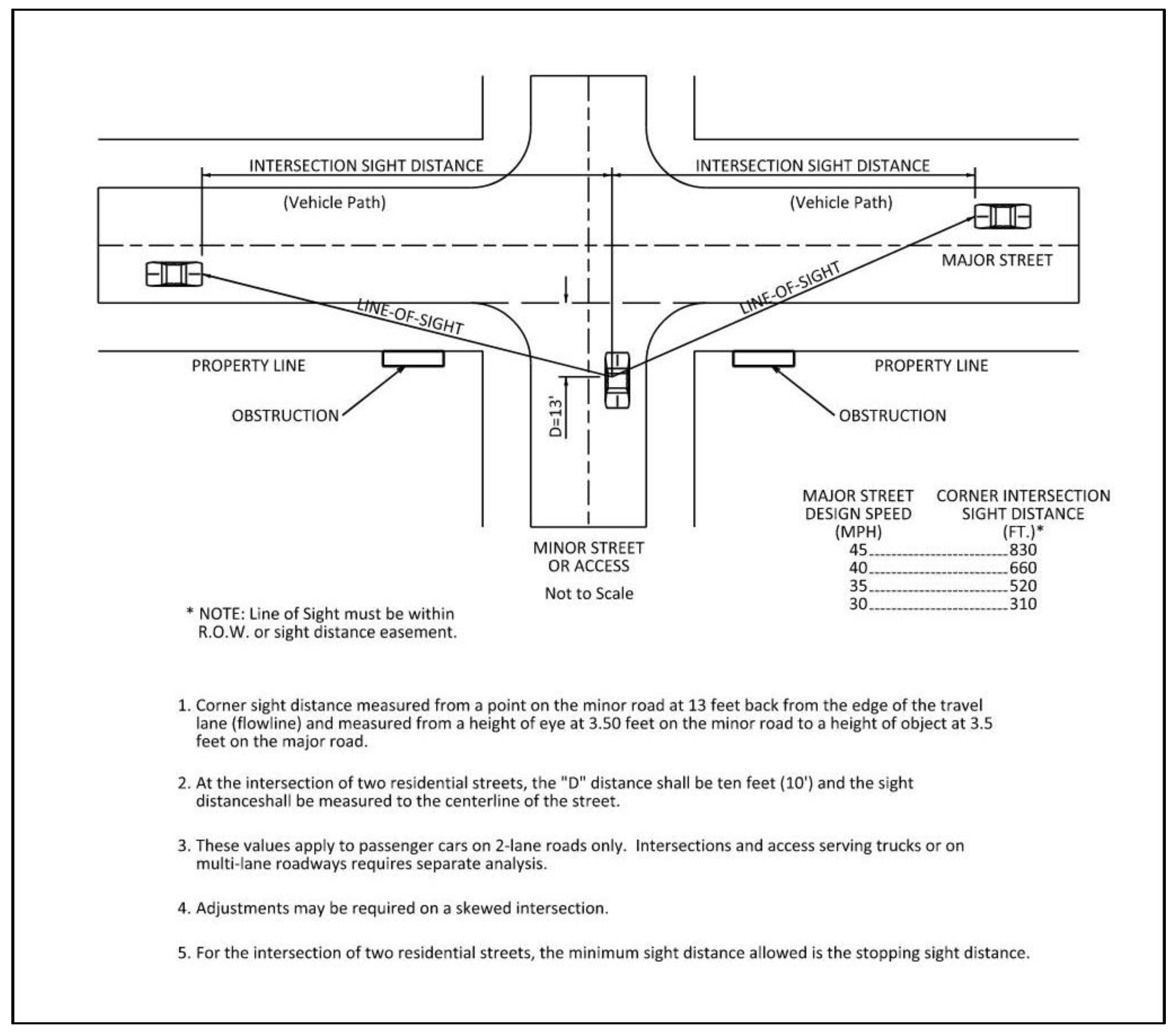
Figure 1: Intersection Sight Distance
5.0 - Pavement Materials and Design
5.1
General. Street pavement structure shall be flexible type consisting of an asphalt concrete hot mix (ACHM) pavement or rigid type consisting of a Portland cement concrete pavement. P.C. Concrete Pavement shall be required by the Director of Engineering for streets with longitudinal grades in excess of 10%.
Flexible pavements may be conventional construction composed of an aggregate base course with an ACHM binder and/or surface course or a full-depth asphalt structure utilizing an ACHM base course.
Pavement structures shall be designed in accordance with the procedures and criteria provided in Section 5.4. Typical sections for each functional classification are provided in Master Street Plan. Construction details for various street elements are provided in the City of Fort Smith Standard Drawings. Additional quality control and testing procedures are discussed in Section 9.
Materials, construction procedures, and testing shall comply with the City of Fort Smith Standard Specifications.
5.2
Pavement Materials and Construction.
5.2.1
Subgrade Stabilization. Pavement subgrade shall be stabilized by conventional mechanical compaction. Chemical stabilization shall not be used.
The adequacy of in-situ soils as a pavement subgrade shall be evaluated in accordance with Section 5.3. Soils classified A-6 and A-7 (AASHTO System), i.e. clays, and which have a liquid limit greater than 40 or a plasticity index greater than 15 shall be replaced (undercut).
Soils within the upper 24 inches of the flexible pavement structure shall not be highly susceptible to frost action (soils classified A-4 and A-5 including sandy silts, fine silty sand or lean clays are highly susceptible to frost action). Methods and procedures for establishing the depth of soil replacement or other improvements shall be specified in the design data and project specifications. Subgrade compaction shall meet the requirements of the City of Fort Smith Standard Specifications.
5.2.2
Aggregate Base Course. Materials for aggregate base courses shall meet the requirements of the City of Fort Smith Standard Specifications.
5.2.3
ACHM Courses. Materials for asphalt concrete hot mix (ACHM) base, binder, and surface courses shall meet the requirements of the City of Fort Smith Standard Specifications. Flexible pavement surfacing shall be ACHM Surface Course (Type 3). ACHM Surface Course (Type 2) shall be used only when specifically directed by the Engineer and authorized by the City.
5.2.4
P.C. Concrete Pavement. Materials for P.C. Concrete Pavement shall meet the requirements of the City of Fort Smith Standard Specifications. Rigid pavement shall be non-reinforced or reinforced and constructed on a prepared subgrade or base course.
Joint layout details shall be provided in the construction plans when P.C. Concrete Pavement is utilized as a surface course.
5.2.5
Curb and Gutter. All streets shall have concrete curb and gutter, except estate type streets, meeting the requirements of the City of Fort Smith Standard Specifications and Standard Drawings. Rigid pavements may have either integral curbs or independent curb and gutter. Estate type streets shall have paved shoulders surfaced with ACHM surface course matching the travel lane thickness.
5.2.6
Subsurface Drainage. Pipe underdrains shall be installed at all locations where subsurface moisture will affect the stability of the subgrade or result in unsatisfactory pavement performance. Longitudinal pipe underdrains shall be installed along each side of the street located in a cut condition. Pipe underdrains will not be required at locations where longitudinal storm drains are present.
The Engineer shall perform adequate subsurface investigations to properly evaluate the subsurface conditions. A report shall provide a mitigation strategy, for approval by the Director of Engineering, if groundwater is encountered within the 5 feet of the existing or proposed ground surface. This information shall be included and addressed in the geotechnical report.
5.3
Subgrade Investigation and Evaluation. The investigation and evaluation of subgrade soils shall be an integral part of the pavement design and shall include the following minimum requirements. All testing and related work shall be accomplished by a geotechnical firm approved by the City.
The subgrade, as referenced in this standard, shall represent material 24 inches below the bottom of base layer (aggregate base or ACHM base course). Subgrade limits shall extend 2' behind back of curb for asphalt streets and 4' behind back of curb for concrete streets.
Additional investigation will be required where a variation in soil types or other subsurface conditions exist.
5.3.1
Sampling and Testing. The investigation and sampling of soils shall conform to AASHTO R 13 (ASTM D 420) and test procedures referenced therein.
Sampling of subgrade soils shall be accomplished by boring or by excavation of test pits. A minimum of one boring or test pit shall be provided for any street segment. The distance between borings shall not exceed 500 linear feet and shall be evenly spaced. Depth of borings or test pits shall be a minimum of 5 feet below the proposed subgrade elevation in cut areas or 5 feet below existing grade in fill areas.
Gradation, Atterberg limits, maximum compaction, and load bearing strength testing shall be provided to determine suitability of soils for use as subgrade material within the street.
All sampling and testing of soils shall be performed under the direct supervision of an Engineer who must sign and stamp the geotechnical report.
5.3.1.1
Soils Classification. Subgrade soils shall be classified in accordance with the AASHTO System (AASHTO M 145). All tests required for classification of soils as referenced in AASHTO M 145 shall be performed and reported unless specific tests are waived by the City. Select material used in subgrade or subbase construction shall be tested and classified. Select material shall meet the requirements of the City of Fort Smith Standard Specifications.
5.3.1.2
Moisture-Density Relationship. Compaction testing of soils proposed for use as subgrade material shall be performed in accordance with AASHTO T-99 (Standard Proctor Test) methods.
5.3.1.3
Load Bearing Strength. Load bearing strength of soils shall be determined by the California Bearing Ratio Test (CBR) in accordance with AASHTO T 193 or ASTM D 1883. A minimum of one test shall be performed for each 500 linear feet of street; additional tests will be required where significant variation in soil conditions occurs. Samples for CBR tests shall be obtained within the proposed 24" subgrade elevation range.
For CBR testing, the specimen shall be molded at approximately the optimum moisture content and 95 percent of the maximum dry density as determined by the corresponding laboratory proctor tests.
CBR tests will be required for all in-situ soils, select material and on-site borrow utilized in the subgrade construction.
5.3.2
Subgrade Support Capacity. Subgrade support capacity for flexible type pavements shall be determined from the load bearing strength (CBR) of the soils based on the correlation provided in Section 5.4.
5.3.3
Subgrade Requirements. At minimum, the top 24 inches of subgrade shall meet the following specifications unless an individual design, with calculations, is provided:
Replacement of soils up to 4' in depth may be required by the City dependent upon testing results in soils report and/or field conditions.
5.4
Pavement Design Criteria.
5.4.1
Design Method. Pavement thickness shall be designed by the AASHTO Guide for Design of Pavement Structures, latest edition. Other design methods, including the Asphalt Institute method, may be approved on an individual basis. Thickness design criteria for the AASHTO method is provided in Section 5.4.
Minimum criteria for thickness design is based on street classifications as defined in Section 3 of these standards. Streets classified as boulevard, arterial, collector and industrial must be designed on an individual basis and all criteria utilized must be documented.
5.4.2
Design Period. A minimum design period (traffic analysis period) of 20 years shall be used for pavement designs.
5.4.3
Traffic Analysis. Maximum traffic characteristics, including traffic volumes and 18-kip equivalent single axle loads (ESALs), are provided in Section 5.5 for predetermined residential street pavement sections. Traffic data shall be submitted for all street classifications, including residential, where traffic data doesn't fall below the maximum criteria provided. The basis for traffic projections shall be included in data submitted.
The following equation shall be used when calculating the design traffic for 20 year projections:
5.4.4
Resilient Modulus Correlation. The correlation of California Bearing Ratio (CBR) and Resilient Modulus for pavement design input should be made using the NCHRP 1-37A equation shown below:
MR (psi) = 2555 × CBR 0.64
5.4.5
Design Reliability and Serviceability. The design reliability percentage and serviceability index inputs are shown for each functional classification in Table 7.
Table 7: Design Reliability and Serviceability Inputs
5.4.6
Pavement Material Parameters. Table 8 provides pavement material parameters including standard specification reference, structural coefficients, and thickness constraints.
Table 8: Pavement Material Parameters
1 City of Fort Smith Standard Specifications
5.5
Minimum Residential Pavement Sections. Table 9 provides minimum pavement sections, based on the AASHTO method, for residential streets to be used in lieu of an individual pavement design if the project specific subgrade and traffic data fall within the given ranges. A geotechnical investigation shall be conducted to determine subgrade parameters prior to utilizing the minimum residential pavement sections. Traffic analyses shall be conducted to determine average daily traffic and 18 kip equivalent single axle loads (ESALs). For CBR values less than 6 and ESALs exceeding the maximum shown in Table 9, an individual pavement design, including calculations, shall be provided for City's approval.
Table 9: Minimum Residential Pavement Sections
1
Number of single family home lots - For a loop or cul-de-sac, it will equal the number
of lots on that street. For a continuing (through) street, it will equal the number
of lots that will use the street when entering/exiting the subdivision.
2
Maximum values. If results of traffic analysis indicate higher values, an individual
pavement design shall be required.
3
Additional base thickness or subbase may be necessary to meet all design requirements.
4
California Bearing Ratio (CBR)
5
Type of Pavement
Flexible Pavement
F: ACHM Surface Course over Aggregate Base Course
FD: ACHM Surface Course over ACHM Base Course (Full Depth Asphalt Pavement)
Rigid Pavement
R: P.C. Concrete Pavement
5.6
Pavement Design Report. When required, an individual pavement design report shall include the following information to be considered for approval. The report shall be signed and stamped by an Engineer.
1.
Study Area
a.
Site vicinity map depicting project area
b.
Plat with street names labeled
2.
Traffic Data
a.
Existing and Future Average Daily Traffic (ADT)
b.
Heavy truck percentage
c.
18-kip Equivalent Single Axle Loads (ESAL) determination
3.
Soils Report
a.
Field Investigation
i.
Method of subsurface exploration
ii.
Boring locations on scaled drawings
iii.
Boring logs
b.
Laboratory Testing (In-situ and borrow)
i.
Load bearing strength - California Bearing Ratio (CBR)
ii.
Natural water content
iii.
Atterberg limits
iv.
Sieve analyses
v.
AASHTO soil classification
vi.
Moisture-Density relationship (Procter Test)
c.
General Conditions
i.
Site conditions
ii.
Subsurface conditions
iii.
Subgrade support
iv.
Subgrade preparation
d.
Construction considerations
4.
Pavement Design
a.
AASHTO pavement design calculations
b.
Recommended pavement sections
6.0 - Utility Crossings
6.1
General. The Developer shall be responsible for coordinating the installation of franchise utility lines and water, wastewater and storm drain lines relative to street development.
Design and installation of water, wastewater and storm drainage facilities shall conform to the current design criteria and related regulations for those facilities including the City of Fort Smith Standard Drawings and Standard Specifications.
6.2
Franchised Utility Lines. All franchised utility lines, which are underground, shall be installed in an encasement pipe under streets. The encasement pipe shall be installed by either the Developer or the utility before the subgrade is completed.
1.
Encasement Length. The encasement length shall extend a minimum of six (6) feet beyond the back of curb
2.
Encasement Depth. The minimum depth of cover for encasement pipe shall be twenty-four (24) inches measured from the top of the encasement pipe to the top of the subgrade.
6.3
Water, Wastewater and Storm Drain Lines. Water, wastewater and storm drain lines shall be installed before the subgrade is complete. Underdrains shall be required for proposed pavement structures located below the existing grade or in-situ soil where water will naturally flow toward pavement base and subgrade layers. Underdrains will not be required on the storm drain side of the proposed pavement.
6.4
Backfill of Utility Lines. Placement and stabilization of backfill for franchised utility lines and water, wastewater and storm drain lines installed by the Developer's contractor will be the responsibility of the Developer. Placement and stabilization of backfill for franchised utility lines installed by the individual utility companies will be the responsibility of each individual utility company.
Backfill compaction and testing requirements are outlined in Section 9.3. Backfill shall comply with the City of Fort Smith Standard Specifications and Standard Drawings.
7.0 - Traffic Control
7.1
General. The City will furnish and install permanent traffic control signs.
The Developer shall be responsible for all traffic control relative to construction of improvements until the beginning of the warranty period.
Traffic signal requirements will be evaluated by the City on an individual basis.
7.2
Traffic Control Devices. Traffic control devices and installation shall conform to the Manual on Uniform Traffic Control Devices (MUTCD), latest edition. Traffic signals shall conform to the standard specifications of the City.
7.3
Ornamental Signs. Ornamental and special signs shall be the responsibility of the Developer and shall conform to the sign ordinance 27-704 of the UDO.
8.0 - Erosion Control
8.1
Construction Erosion Control. Erosion control measures shall be provided during construction to minimize soil erosion and to prevent silting of utility and storm drainage structures. Compliance with applicable ADEQ General Stormwater NPDES Permits requirements shall be required. The City of Fort Smith is designated as a small regulated MS4.
1.
Access Temporary access for construction shall be provided at all points of ingress and egress to construction areas. Temporary access shall consist of a crushed stone or gravel drive extending a minimum of fifty feet from the edge of the existing street pavement.
2.
On-Site All exposed construction areas shall be protected from erosion. Adequate measures shall be employed to prevent entrance of soils or other foreign materials into storm drainage or utility structures.
3.
Compliance Erosion control measures must comply with the City's Fill and Grading Ordinance and the latest version of the ADEQ Construction General Stormwater Permit.
8.2
Permanent Erosion Control. Permanent erosion control measures including seeding, mulching, sodding etc. shall be used in all areas within rights-of-way and easements which are not covered by improvements.
9.0 - Inspection and testing.
9.1
General. Materials and construction employed in street improvements will be subject to inspection and quality control testing. All inspection and testing shall be provided by the Developer except as otherwise stated herein.
9.2
Inspection.
1.
Inspection By Developer - The Developer shall provide for inspection of the street improvements during construction. Inspection shall be accomplished under the supervision of the Engineer. The Engineer will provide certification that all materials and construction conform to the approved plans and specifications.
2.
Inspection By City - The construction of street improvements will be subject to inspections by the City at various stages including, but not limited to, subgrade, base course and surfacing. An inspection for a particular stage will not be conducted until the pertinent test data has been submitted. Scheduling of construction shall provide sufficient time for review of test data and scheduling inspections. A representative of the engineering firm responsible for the project shall be present at the inspections.
A construction inspection checklist is included in Appendix A and is required to be submitted as part of the final approval process.
9.3
Quality Control Testing. The Developer shall provide quality control testing for all materials and construction involved in the street improvements. All testing shall be accomplished by a testing firm that meets the requirements of a Qualified Laboratory and shall be performed under the supervision of an Engineer.
Minimum test requirements and minimum frequency of sampling and testing shall be as shown in Table 10. Projects will be evaluated individually, and additional testing may be required. Tolerances shall be in accordance with the City of Fort Smith Standard Specifications. In general, deficiencies in quality of materials and/or construction exceeding the tolerance limits will not be approved.
Submission of test results shall be coordinated with the various stages of construction. Sampling and testing locations will be subject to approval of the City.
Exceptions to the number of required tests for materials may be granted at the discretion of the City when current test data are available.
Table 10: Minimum Test Requirements
a Additional Tests not listed herein may be referenced within the AASHTO or ASTM procedures.
b A minimum of one test required for each individual street, cul-de-sac and intersection.
c Trench and structure backfill tests are in addition to subgrade tests.
d Not less than one test per day.
e A minimum of one test required for each type of material or mixture.
f Structures includes concrete aprons and swales, drainage structures, driveways, sidewalks, etc.
10.0 - Maintenance Warranty
10.1
Maintenance Warranty. The Developer shall provide a maintenance warranty in writing to the City upon acceptable completion of the street construction and prior to issuance of the Subdivision Approval Letter. In the event of failure due to defective design, defective materials or workmanship within a period of 24 months following the issuance of the Subdivision Approval Letter, the Developer will maintain, repair, and reconstruct the project in whole or in part. The maintenance warranty shall be in the amount of fifty percent (50%) of the total construction cost of the street improvements. One, or a combination, of the following methods shall be used by the Developer to financially assure the maintenance warranty:
1.
Maintenance Bond - A maintenance bond may be posted in favor of the City of Fort Smith to fulfill the materials and workmanship portion of the maintenance warranty. The maintenance bond shall be issued by a surety company authorized to conduct business in the State of Arkansas. The City will also accept an assignment from the Developer of a maintenance bond issued from the Contractor to the Developer provided that:
a.
Said assignment must be in a form acceptable to the City Attorney, and,
b.
The Developer must provide proof (acceptable to the City) that the Contractor and surety company acknowledge and accept the assignment of the maintenance bond to the City.
2.
Extension of the Performance and Payment Bond - The performance and payment bond or assignment thereof allowed in Section 1 of these standards may be extended through the 24 month maintenance warranty period to fulfill the materials and workmanship portion of the maintenance warranty. If the Developer selects this method of maintenance assurance, he must provide assurance to the City, acceptable to the City Attorney, that all parties acknowledge and accept the extension of the performance and payment bond or assignment thereof;
3.
Cash Deposit - The Developer may provide a cash deposit in the amount specified herein to fulfill the design and/or materials and workmanship portion(s) of the maintenance warranty. The cash deposit shall be accompanied by documentation stating the conditions of deposit and withdrawal acceptable to the City Attorney.
4.
Financial Commitment - The Developer may provide an irrevocable letter of credit or similar financial commitment from a local, or other approved, financial institution authorized to conduct business in the State of Arkansas verifying the availability of funds, and the City's access thereto without cost to the City, to make all corrections, maintenance, repairs or reconstruction as necessary to fulfill the design and/or materials and workmanship portion(s) of the maintenance warranty. The form of the financial institution must be approved by the City.
10.2
Certified Construction Amount. The Developer shall provide a certified copy of the final pay estimate which shows the total cost of the street construction. The City will retain the right to review and approve the certified construction amount.
10.3
Limitations. Provisions of this section are not intended to restrict the authority of the City as delegated by the General Assembly in the Arkansas Statutes.
APPENDIX A - CONSTRUCTION INSPECTION CHECKLIST
CONSTRUCTION INSPECTION CHECKLIST (a)
Construction Stage
Subgrade
□ Street subgrade constructed to accurate grade and within specified tolerance.
□ Moisture condition of subgrade.
□ Subgrade stable (proof rolling required in addition to density tests).
Base Course
□ Base course constructed to accurate grade and within specified tolerance.
□ Surface texture uniform (no evidence of segregation).
□ Moisture condition of base course.
□ Base course stable (proof rolling required in addition to density tests).
Curb & Gutter
□ Curb and gutter alignment and grade accurate.
□ Cross section in conformance with typical detail and uniform.
□ Concrete finish as specified and uniform.
No toppings or thin patches permitted.
No cracks or other defects.
□ Joint spacing accurate. Joint filler and sealer complete.
□ Where removal and replacement of curb and gutter is required, the replacement section shall extend from joint to joint.
Surfacing
□ Grade and cross section accurate. Surface within prescribed tolerance.
□ Texture and finish uniform.
□ Joints straight and smooth. Joint filler and sealer completed (concrete pavement). No cracks or openings at joints.
□ No cracked or otherwise defective areas.
□ Finish pavement surface shall not be lower than the toe of gutter.
(a) Quality control test data shall be submitted prior to inspection.
APPENDIX B - ACKNOWLEDGEMENT FORM LETTER
ACKNOWLEDGEMENT FORM LETTER
The review of the submitted design information for the above captioned project has been completed and the construction plans are soon to be ready for City approval. However, the City will withhold its approval until which time we have received a written acknowledgement which assigns the responsibility of the construction within the project. The responsibility assigned by this acknowledgement will be that you, as the Developer, accepts the responsibility for the construction of those improvements which the City of Fort Smith has approved or may approve, as part of the above captioned project. This responsibility acknowledges the right of the City to claim damages (costs of repair plus expenses of administration and enforcement) due to a failure to construct the improvements within the project in accordance with the design information, plans and specifications as approved by the City.
The form of this letter may serve as a written acknowledgement. If you wish to use this form, place your signature in the space provided below and return the original to me. I will then provide copies of the same to you for your files.
If you should have any questions, please advise.
Cordially,
__________________________________________
Name of Firm
__________________________________________
Signature

