
Fort Smith City Zoning Code
ARTICLE 27
400.- ZONING DISTRICTS
Sec. 27-401. - Master land use plan/zoning district conversion chart.
A.
Chart. The following chart describes the relationship between the master land use plan, zoning districts included in the unified development ordinance, and previously existing districts. This chart is included for descriptive purposes only. Specific conversions between previous and existing zoning districts are made through the planning and zoning department pursuant to section 27-336.
(Code 1992, § 27-401; Ord. No. 16-12, § 2, 2-21-2012; Ord. No. 18-20, § 2(att.), 3-3-2020)
Sec. 27-402. - Zoning map.
A.
Adoption and maintenance. The location and boundaries of the zoning districts established by the unified development ordinance are shown on the city zoning map, which is maintained by the planning and zoning department. The zoning map shall be considered a part of the unified development ordinance by reference. If there is any dispute regarding the zoning classifications of properties which are subject to the unified development ordinance regulations, the zoning map kept by the planning and zoning department shall govern.
B.
Location of district boundaries. The following rules shall apply in interpreting zoning district boundaries when the location of such boundaries are unclear:
1.
Where zoning district boundary lines are indicated as following alleys, streets, or railroads, the boundary lines are located and measured along the centerline of the street right-of-way, railroad, or alley.
2.
Where a legal description is not available, zoning district boundary lines are generally intended to coincide with property lines. Where a boundary line coincides approximately, but not exactly, with a property line, the boundary line shall be considered to be the property line.
3.
Streets or other rights-of-way that have been vacated fall into the same zoning district as the lots or parcels abutting both sides. If the lots or parcels were classified in different zoning districts before the vacation, the centerline of the vacated right-of-way shall be interpreted as the boundary line between the districts.
4.
Zoning boundaries which are indicated as approximately following the city or extraterritorial jurisdiction boundaries shall be interpreted to follow such boundaries.
5.
Reserved.
6.
Questions about the location of zoning boundaries may be subject to interpretation by the director pursuant to section 27-336.
(Code 1992, § 27-402; Ord. No. 70-11, § 2, 9-6-2011; Ord. No. 27-13, § 1, 7-9-2013)
Sec. 27-403. - Land use regulations.
A.
Types of uses. Land, buildings and structures may be used for any of the listed uses indicated in the following zone classifications as set forth by the City of Fort Smith Land Use Matrix (article 27-400, Appendix A).
B.
Classifications.
1.
Uses permitted by right. Classification "P" indicates that a land use is permitted by right in the respective district. Such uses are subject to all other applicable regulations.
2.
Uses permitted conditionally. Classification "C" indicates that a land use is permitted conditionally, subject to the issuance of a conditional use permit.
3.
Accessory uses. Classification "A" indicates that a land use is typically permitted as an accessory structure.
4.
Blank. A blank cell in the land use table indicates that a land use category is not allowed in the indicated district.
C.
Unlisted uses. When uses arise that have not been classified, the following procedure shall be used to determine the proper classification for those uses:
1.
The director of planning shall make an administrative decision as to the appropriate zones in which an unlisted use will be allowed.
2.
Should an unlisted use be proposed to be located in the H-1 historic zone, the director of planning shall refer the request to the historic district commission for a recommendation prior to making an administrative decision.
3.
The decision of the director of planning concerning the appropriate zones for an unlisted use may be appealed to the planning commission. The following procedure will be used for such appeals:
a.
Upon request of the person wishing to appeal, the director of planning will refer the question of the location of an unlisted use to the planning commission for the commission's decision.
b.
The appeal will contain a statement of facts concerning the nature of the use, including pertinent information such as types of sales anticipated, types of dwelling activities anticipated, whether enclosed or open storage accompanies the use, types of products manufactured or sold, and information about odor, noise, fumes, dust and toxic materials generated by the planned use. In addition, the appeal should contain information about the demand that will be placed on public utility services by the use.
4.
Upon receiving the appeal, the planning commission will consider the nature of the proposed use and its compatibility with uses permitted in the zones for which the use is proposed and then will make a decision upon the request.
5.
The decision of the planning commission on the appropriate zone of a new use may be appealed to the board of directors in accordance with section 27-337-8.
(Code 1992, § 27-403; Ord. No. 37-22, § 1, 5-3-2022)
Sec. 27-404. - Lot dimension standards.
A.
Standards. Table 27-404-A lists the lot dimension standards that apply within all zoning districts. These are base standards only; other provisions within the unified development ordinance may further limit development on a site. These standards apply to all uses unless expressly exempted.
Table 27-404-A. Lot Dimension Standards
(1)
Some building heights may be adjusted based on setback (see districts).
(2)
Building separation shall be determined by the current city building and fire codes.
(3)
See section 27-602-4D3a for additional setback requirements on multifamily projects.
B.
Lot area.
1.
Measurement. Lot area is measured as the amount of net land area contained within the property lines of a lot or parcel, not including right-of-way for streets.
2.
Lots with less than minimum width.
a.
A single-family or two-family house may be built on a lot that is smaller than required by the zoning district in which the lot is located, provided that the lot:
1.
Is located in a residential zone that permits the intended use;
2.
Is at least 35 feet wide and 3,500 square feet in area;
3.
Has boundaries and dimensions that were established by record on the effective date of the unified development ordinance by a recorded plat of a subdivision;
4.
Shall comply with the residential parking regulations in section 14-52.
b.
On any nonconforming lot that is less than 60 feet wide at the building line or 6,500 square feet in area, new structures must conform to the bulk and area requirements of the residential zone which most nearly corresponds to the minimum lot dimensions of the substandard lot.
3.
Utilities. Utilities using land or an unoccupied building covering less than 1,000 square feet of site area are exempt from the minimum lot area standards.
C.
Setbacks.
1.
Measurement. Setbacks are measured as the unobstructed and unoccupied open area between the minimum setback and the property lines of the lot on which the structure is located, except as modified by the standards of this section. Setbacks must be unobstructed from the ground to the sky except as specified in this section.
2.
Along a private street, setback measurement shall start at a point 25 feet from the street centerline.
3.
The following structures may encroach no more than three feet into the required setbacks if: (1) they are approved by the city building official, and (2) provided that they do not cross property lines or utility easements:
a.
Reserved;
b.
Porches, decks landings, and stairs, provided they are for single-story buildings and are not covered;
c.
Play equipment;
d.
Clothesline poles if not located in the setbacks adjacent to street right-of-way;
e.
Portable yard furniture;
f.
Reserved;
g.
Overhangs, coves, and cornices as defined in the currently adopted building code may be allowed, provided they do not exceed three feet. The definition of overhang specifically excludes any exterior wall of any structure regardless of its elevation above ground level;
h.
Mechanical units;
i.
Area and security lighting fixtures and supports (poles).
4.
Setback averaging. Regardless of the minimum front or rear setback required by the underlying zoning district, front or rear setbacks may be adjusted to the average of the existing setbacks of the lots that are on both sides of the subject lot according to the following:
a.
Only the setbacks on the lots that abut each side of the subject lot on the same side of the street as the subject lot may be used.
b.
When one abutting lot is vacant or a corner lot, then the average is of the setback of the non-vacant lot and the zoning district minimum setback.
5.
All residential lots on a cul-de-sac street that have frontage on the radius of the cul-de-sac are permitted to have a front yard setback of 20 feet.
6.
Except as otherwise provided in individual zone districts and/or overlay districts, signs are to be exempt from setbacks and minimum requirements provided they are erected in compliance with the provisions of the city's sign regulations.
7.
Gasoline sales are permitted under the following conditions:
a.
Pump islands shall be located a minimum of 20 feet from any public right-of-way.
b.
Island canopy overhangs shall be located at least ten feet from any public right-of-way and must have a height of at least 12 feet. Supportive posts of canopies shall be located at least 20 feet from any public right-of-way.
8.
The following structures are exempt from setback regulations as specified below:
a.
Patios, terraces, walks, and driveways provided they are at grade, and do not have enclosed walls or a roof;
b.
Ramps for the purpose of meeting accessibility requirements provided they do not have enclosed walls or a roof;
1.
Fences.
2.
Electric vehicle charging stations.
9.
Residential property platted prior to the effective date (August 12, 2009) of the UDO is permitted to use the 15-foot exterior side yard setback. This exemption does not include multifamily developments.
10.
When a multifamily, commercial or industrial development abuts a platted alley and an enhanced setback is required because it is next to property zoned or developed as single-family, the setback shall be measured from the centerline of the alley.
11.
When a subdivision plat identifies a setback different from the zoning district's minimum setback, the most restrictive setback dimension shall apply.
D.
Height.
1.
Measurement. Building height is the mean vertical distance from the average ground level at the minimum front setback to the highest permanent part of the building or structure.
2.
A structure may not be more than the maximum allowable feet high at the minimum setback lines, but for each additional foot of horizontal setback in excess of the minimum from all setbacks, the height may be increased by one foot. The height of a gabled end of a building shall be measured at the midpoint of the gable instead of the peak of the gable.
3.
The following structures may be exempted from the height requirements in the various districts if they are not detrimental to neighboring property and are approved by the city building official:
a.
Chimneys;
b.
Vents;
c.
Flagpoles;
d.
Antennas, including dish antennas, for reception only of radio and television signals (transmitting antennas, towers, and other structures on which receiving antennas are located are not exempt from height or other setback requirements);
e.
Rooftop HVACR units (heating and air equipment);
f.
Penthouse, as defined in the building code.
4.
The construction, maintenance, or establishment of any building, tree, smokestack, chimney, flagpole, wire, tower, parapet or other structure or appurtenance thereto, which can constitute a hazard or obstruction to safe air navigation, landing, or take off of aircraft near an airport, is prohibited. Regulations adopted by the Federal Aviation Agency (FAA) shall be minimum standards. No request shall be approved if it violates FAA standards.
(Code 1992, § 27-404; Ord. No. 47-10, § 2, 10-5-2010; Ord. No. 16-12, § 2, 2-21-2012; Ord. No. 29-14, § 1(att.), 6-3-2014; Ord. No. 14-15, § 1(att.), 2-3-2015; Ord. No. 64-15, § 1(att.), 10-6-2015; Ord. No. 77-17, § 1, 12-19-2017; Ord. No. 105-22, § 1, 11-1-2022; Ord. No. 117-22, § 1, 12-1-2022; Ord. No. 101-23, 12-19-2023)
Sec. 27-405. - Street hierarchy.
Street classification as used in the unified development ordinance is as follows, from lowest to highest:
A.
Residential.
B.
Residential collector, restricted parking.
C.
Residential collector.
D.
Major collector.
E.
Minor arterial.
F.
Major arterial.
G.
Boulevard.
H.
Industrial street.
For more information about street hierarchy, see the city's master street plan.
(Code 1992, § 27-405)
Sec. 27-406. - Residential estate, three acres (RE-3).
A.
Purpose. To provide areas for very low-density single-family uses. This district is appropriate for locations where low-density residential development is desired or where the lack of public facilities and services requires low intensity development. Development in this district shall be designed to allow for the future planned expansion of utilities and services where necessary. RE-3 zoning is generally appropriate in the rural, mixed use residential, and mixed use employment future land use classification of the master land use plan.
B.
Land uses. Permitted, conditional and accessory land uses in the RE-3 district are identified on the land use matrix in article 27-400, Appendix A. Specific uses not identified on the use matrix are subject to classification pursuant to section 27-336. No more than one principal structure may be erected on each defined lot.
C.
Area and bulk regulations.
1.
Minimum building separation shall be 15 feet.
(Code 1992, § 27-406; Ord. No. 16-12, § 2, 2-21-2012)
Sec. 27-407. - Residential estate one (RE-1).
A.
Purpose. The purpose of the residential estate one zoning district is to provide areas for low-density, large lot single-family residential development. Property zoned RE-1 should include tracts that abut or are in close proximity to existing or approved large-lot single-family development, making RE-1 an appropriate transition between rural and suburban uses.
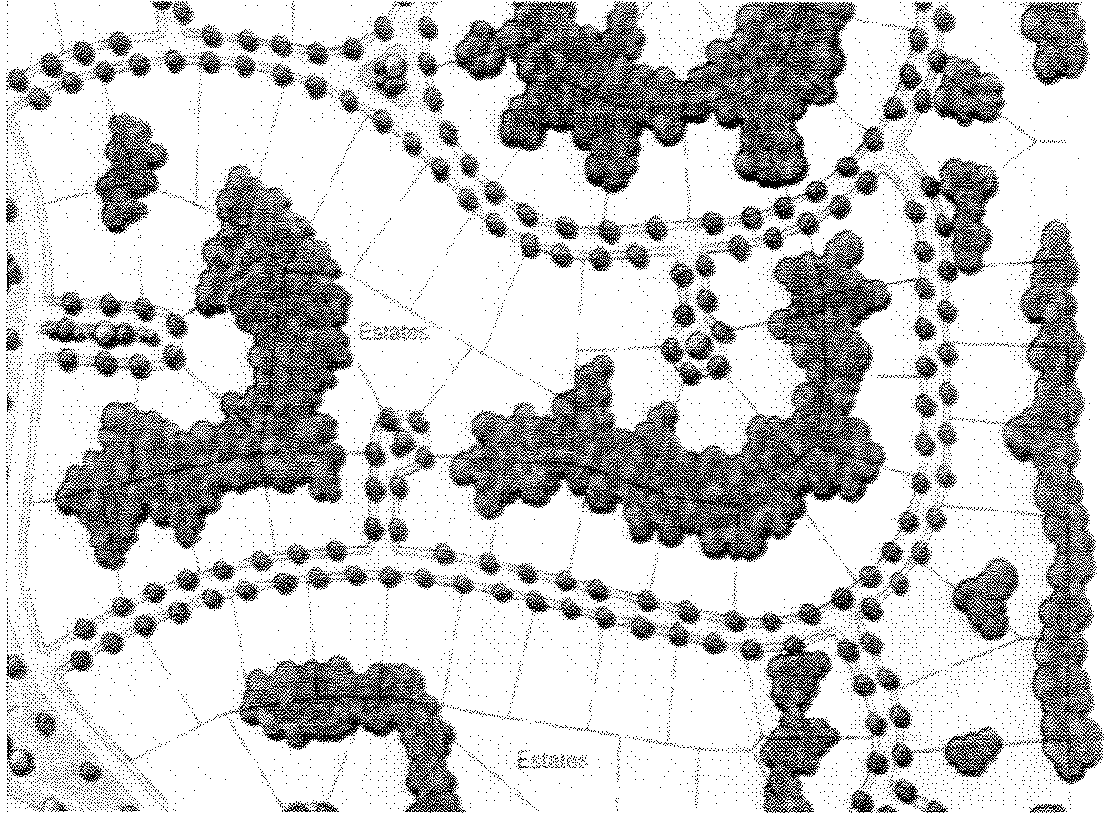
Where public facilities and services are not yet available, development in this district shall be designed to allow for the future planned expansion of utilities and services where necessary. RE-1 zoning is appropriate in the residential detached, mixed use residential, and mixed use employment future land use classification of the master land use plan.
B.
Uses. Permitted, conditional and accessory uses in the RE-1 district are identified on the land use matrix in article 27-400, Appendix A. Specific land uses not identified on the matrix are subject to classification pursuant to section 27-336. No more than one principal structure may be erected on each defined lot.
C.
Area and bulk regulations.
1.
Minimum building separation shall be 15 feet.
(Code 1992, § 27-407; Ord. No. 16-12, § 2, 2-21-2012)
Sec. 27-408. - Residential single-family low-density (RS-1).
A.
Purpose. The purpose of the single-family low-density zoning district is to maintain, protect, and provide opportunities for low-density residential development in spacious environments, along with compatible limited public and institutional uses. RS-1 zoning is appropriate in the residential detached, mixed use residential, and mixed use employment category of the master land use plan.
B.
Land uses. Permitted, conditional and accessory land uses in the RS-1 district are identified on the land use matrix in article 27-400, Appendix A. Specific land uses not identified on the matrix are subject to classification pursuant to section 27-336. No more than one principal structure may be erected on each defined lot.
C.
Area and bulk regulations.
1.
Minimum building separation shall be 15 feet.
(Code 1992, § 27-408; Ord. No. 16-12, § 2, 2-21-2012)
Sec. 27-409. - Residential single-family medium-density (RS-2).
A.
Purpose. To provide for detached homes in low-to-medium-density single-family neighborhoods where adequate public services and facilities are available. The RS-2 zoning district is appropriate in suburban areas and primarily applies to the residential detached, mixed use residential, and mixed use employment category of the master land use plan.
B.
Land uses. Permitted, conditional and accessory land uses in the RS-2 district are identified on the land use matrix in article 27-400, Appendix A. Specific land uses not identified on the matrix are subject to classification pursuant to section 27-336. No more than one principal structure may be erected on each defined lot.
C.
Area and bulk regulations.
1.
Minimum building separation shall be ten feet.
(Code 1992, § 27-409; Ord. No. 16-12, § 2, 2-21-2012)
Sec. 27-410. - Residential single-family medium/high-density (RS-3).
A.
Purpose. To provide for medium-to-high-density, compact single-family detached development on new sites or as infill construction. Adequate public services and facilities shall be available with sufficient capacity to serve the proposed development. This zoning district is intended to serve as a transition between the lower-density single-family districts and the multifamily or commercial districts. RS-3 zoning is appropriate in urban and suburban areas and primarily applies to the residential detached, mixed use residential, and mixed use employment classification of the master land use plan.
B.
Land uses. Permitted, conditional and accessory land uses in the RS-3 district are identified on the land use matrix in article 27-400, Appendix A. Specific land uses not identified on the matrix are subject to classification pursuant to section 27-336. No more than one principal structure may be erected on each defined lot.
C.
Area and bulk regulations.
1.
Minimum building separation shall be ten feet.
(Code 1992, § 27-410; Ord. No. 16-12, § 2, 2-21-2012)
Sec. 27-411. - Residential single-family high-density (RS-4).
A.
Purpose. To provide very dense single-family detached housing as either new or infill development. The RS-4 zoning district is appropriate in higher-density residential areas near the downtown, in mixed use/density areas, and as a transitional buffer zone between lower-density residential development and multifamily or commercial uses. The RS-4 zoning district corresponds to the residential detached, mixed use residential, and mixed use employment classification of the master land use plan.
B.
Land uses. Permitted, conditional and accessory land uses in the RS-4 zoning district are identified on the land use matrix in article 27-400, Appendix A. Specific land uses not identified on the matrix are subject to classification pursuant to section 27-336. No more than one principal structure may be erected on each defined lot.
C.
Area and bulk regulations.
1.
Minimum building separation shall be ten feet.
(Code 1992, § 27-411; Ord. No. 16-12, § 2, 2-21-2012)
Sec. 27-411.1. - Residential single-family row house and zero lot line district (RS-5).
A.
Purpose. The principal purpose to achieve a more efficient use of land as compared with the typical single-family development, making available needed housing at a more affordable cost. By placing the dwelling against one or more property lines, the outdoor space is essentially grouped and utilized to its maximum benefit to provide high-density attached homes, including multistory residential buildings in those areas where such building types already exist or where such buildings would be consistent with an area's established development pattern and character. The use of this district is equally appropriate in portions of the city as a transitional or buffer zone between low-density residential districts, commercial district, industrial districts, or major transportation arteries, or other uses that are not compatible with a low-density residential environment. RS-5 zoning is appropriate in urban areas in the residential attached, residential detached, mixed use residential, or mixed use employment categories of the master land use plan.
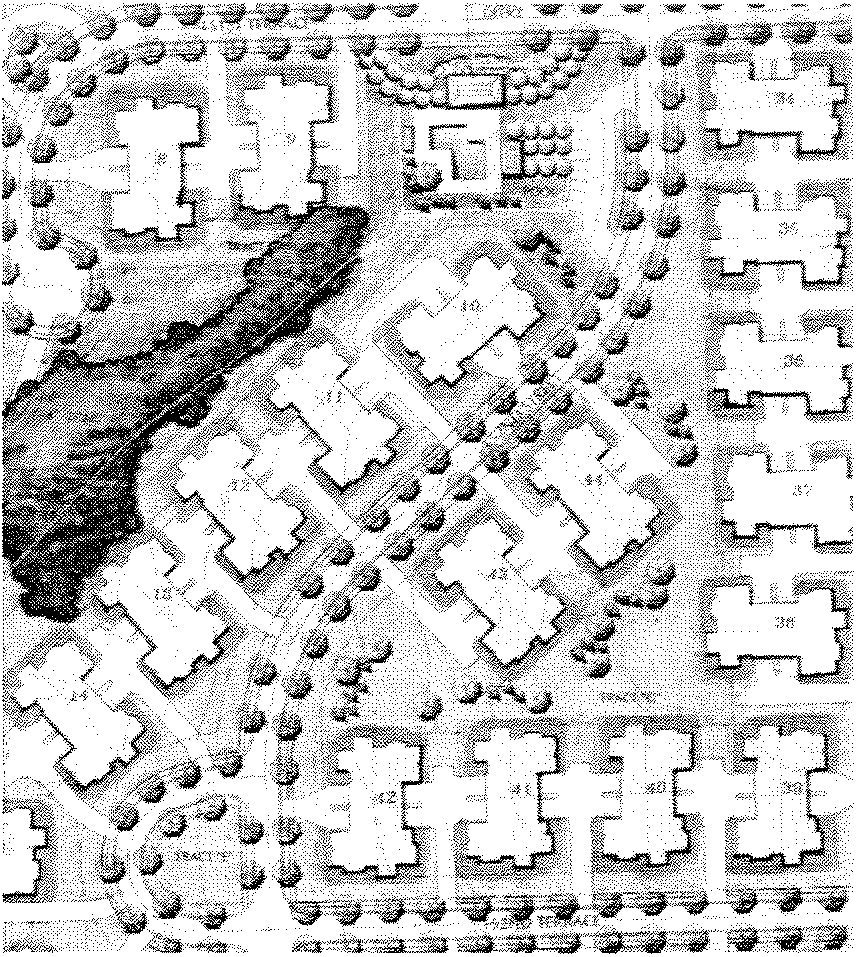
B.
Land uses. Permitted, conditional and accessory land uses in the RS-5 zoning district are identified on the land use matrix in article 27-400, Appendix A. Specific land uses not identified on the matrix are subject to classification pursuant to section 27-336. No more than one principal structure may be erected on each defined lot.
C.
Area and bulk regulations.
1.
Regulations for conventional single-family dwelling construction shall be the same as in the RS-4 residential district.
D.
Regulations for row houses and zero lot line developments.
1.
Mutual access easements and utility easements may be permitted in row house and zero lot line developments. When provided, mutual access easements shall provide automobile access to individual units and utility companies.
2.
Minimum side yard.
a.
Row houses: No internal side yard setback is required on common property lines. For exterior outside walls of the end units, side yard setback requirements apply.
b.
Zero lot line: No minimum setback on one side of the lot and ten feet on the opposite side of the lot.
3.
Zero lot line on zero setback side. When a zero lot line dwelling unit is built on the property line on one side of the lot, this side of the structure shall contain no openings, appendages, or overhangs. Atriums or courts may be permitted on the zero setback side when the court or atrium is enclosed by three walls of the dwelling unit and a wall of at least seven feet in height is provided on the zero lot line. The wall shall be constructed of the same materials as the exterior walls of the unit.
4.
No structures shall be permitted in the front yard unless as an element of permissible landscaping.
5.
Where lots have double frontage running through from one street to another, the required front yard shall be provided on both streets.
6.
A chimney of not more than ten feet in width, as well as eaves, cornices, fire separation wing walls and other architectural embellishments may extend into the required front or side yard setback a maximum of three feet.
7.
Alleys may be permitted in zero lot line developments. When provided, alleys shall provide automobile access to individual units and utility companies. Where alleys are provided, the minimum front yard setback shall be 15 feet. In all other cases, the front yard shall be 20 feet.
8.
Maintenance easement.
a.
A perpetual four-foot maintenance easement shall be provided on the lot adjacent to the zero lot line property line. This easement shall be kept clear of structures, with the exception of freestanding walls and/or fences. This easement shall be shown on the plat and incorporated into each deed transferring title to the property. The wall shall be maintained in its original color and treatment unless otherwise agreed to in writing by the two affected lot owners.
b.
Roof overhangs may encroach on the easement of the adjacent lot by a maximum of 24 inches, but the roof shall be designed so that water runoff from the dwelling's placement on the lot line is limited to the easement area.
9.
Zero lot line adjacent to single-family residential. In no case shall zero lot line dwelling units be built closer than ten feet to the lot line of a lot that is zoned in any RS or RSD classification.
10.
The minimum rear yard setback shall be 20 feet for row houses and zero lot line homes. Such space however, may be used for parking purposes and open carports.
11.
Maximum number of dwelling units. A maximum of eight dwelling units shall be permitted in each row of row houses. When an end unit does not side on a street, an open space or court of at least 20 feet in width shall be provided between any adjacent structures.
12.
Facing courtyard. Where row house lots and dwelling units are designed to face an open area or common access court rather than a street, this area shall be a minimum of 40 feet in width and shall not include vehicular drives or parking areas.
13.
Row house side lot lines. Row houses shall be constructed up to the lot lines for lots without side yards. No windows, doors, or other openings shall face a side lot line, except that the outside wall of the end units may contain such openings.
(Code 1992, § 27-411.1)
Sec. 27-411.2. - Residential single-family duplex low/medium-density (RSD-2).
A.
Purpose. To provide for attached and detached homes in low-to-medium-density neighborhoods where adequate public services and facilities are available. The RSD-2 zoning district is appropriate in suburban areas and primarily applies to the residential attached, mixed use residential, and mixed use employment category of the master land use plan.
B.
Land uses. Permitted, conditional and accessory land uses in the RSD-2 district are identified on the land use matrix in article 27-400, Appendix A. Specific land uses not identified on the matrix are subject to classification pursuant to section 27-336. No more than one principal structure may be erected on each defined lot.
C.
Area and bulk regulations.
1.
Minimum building separation shall be ten feet.
(Code 1992, § 27-411.2; Ord. No. 16-12, § 2, 2-21-2012)
Sec. 27-411.3. - Residential single-family duplex medium/high-density (RSD-3).
A.
Purpose. To provide for medium to high-density, compact single-family detached and duplex development on new sites or as infill construction. Adequate public services and facilities shall be available with sufficient capacity to serve the proposed development. This zoning district is intended to serve as a transition between the lower-density single-family duplex districts and the multifamily or commercial districts. RSD-3 zoning is appropriate in urban and suburban areas and primarily applies to the residential attached, mixed use residential, and mixed use employment classification of the master land use plan.
B.
Land uses. Permitted, conditional and accessory land uses in the RSD-3 district are identified on the land use matrix in article 27-400, Appendix A. Specific land uses not identified on the matrix are subject to classification pursuant to section 27-336. No more than one principal structure may be erected on each defined lot.
C.
Area and bulk regulations.
1.
Minimum building separation shall be ten feet.
(Code 1992, § 27-411.3; Ord. No. 16-12, § 2, 2-21-2012)
Sec. 27-411.4. - Residential single-family duplex high-density (RSD-4).
A.
Purpose. To provide very dense single-family detached and duplex housing as either new or infill development. The RSD-4 zoning district is appropriate in higher density residential areas near the downtown, in mixed use/density areas, and as a transitional buffer zone between lower-density residential development and multifamily or commercial uses. The RSD-4 zoning district corresponds to the residential attached, mixed use residential, and mixed use employment classification of the master land use plan.
B.
Land uses. Permitted, conditional and accessory land uses in the RSD-4 zoning district are identified on the land use matrix in article 27-400, Appendix A. Specific land uses not identified on the matrix are subject to classification pursuant to section 27-336. No more than one principal structure may be erected on each defined lot.
C.
Area and bulk regulations.
1.
Minimum building separation shall be ten feet.
(Code 1992, § 27-411.4; Ord. No. 16-12, § 2, 2-21-2012)
Sec. 27-412. - Residential multifamily low-density (RM-2).
A.
Purpose. To provide low-to-medium-density detached and attached single-family homes and duplexes in areas characterized by similar development. The RM-2 zone is appropriate for suburban areas within the residential attached, commercial neighborhood, general commercial, mixed use residential, and mixed use employment classification of the master land use plan, and may serve as a transition or buffer zone between single-family development and higher-density multifamily or commercial land uses.
B.
Land uses. Permitted, conditional and accessory uses in the RM-2 zoning district are identified on the land use matrix in article 27-400, Appendix A. Specific land uses not identified on the matrix are subject to classification pursuant to section 27-336. With the exception of multifamily developments, no more than one principal structure may be erected on each defined lot.
C.
Area and bulk regulations.
1.
Minimum building separation shall be ten feet.
(Code 1992, § 27-412; Ord. No. 16-12, § 2, 2-21-2012)
Sec. 27-413. - Residential multifamily medium-density (RM-3).
A.
Purpose. To provide for medium-density attached homes, including multiunit residential buildings in areas where such development already exists or is planned for the future. The RM-3 zoning district is appropriate in urban areas within the residential attached, mixed use residential, mixed use employment, commercial neighborhood, and general commercial land use categories of the master land use plan.
B.
Land uses. Permitted, conditional and accessory land uses in the RM-3 zoning district are identified on the land use matrix, article 27-400, Appendix A. Specific land uses not identified on the matrix are subject to classification pursuant to section 27-336. With the exception of multifamily developments, no more than one principal structure may be erected on each defined lot.
C.
Area and bulk regulations.
1.
Minimum building separation shall be ten feet.
D.
Multifamily development. Multifamily developments shall conform to design guidelines of article 27-600 et seq.
(Code 1992, § 27-413; Ord. No. 16-12, § 2, 2-21-2012)
Sec. 27-414. - Residential multifamily high-density (RM-4).
A.
Purpose. To provide high-density attached homes, including multistory residential buildings in those areas where such building types already exist or where such buildings would be consistent with an area's established development pattern and character. RM-4 zoning is appropriate in urban areas in the residential attached, mixed use residential, mixed use employment, commercial neighborhood, and general commercial categories of the master land use plan.
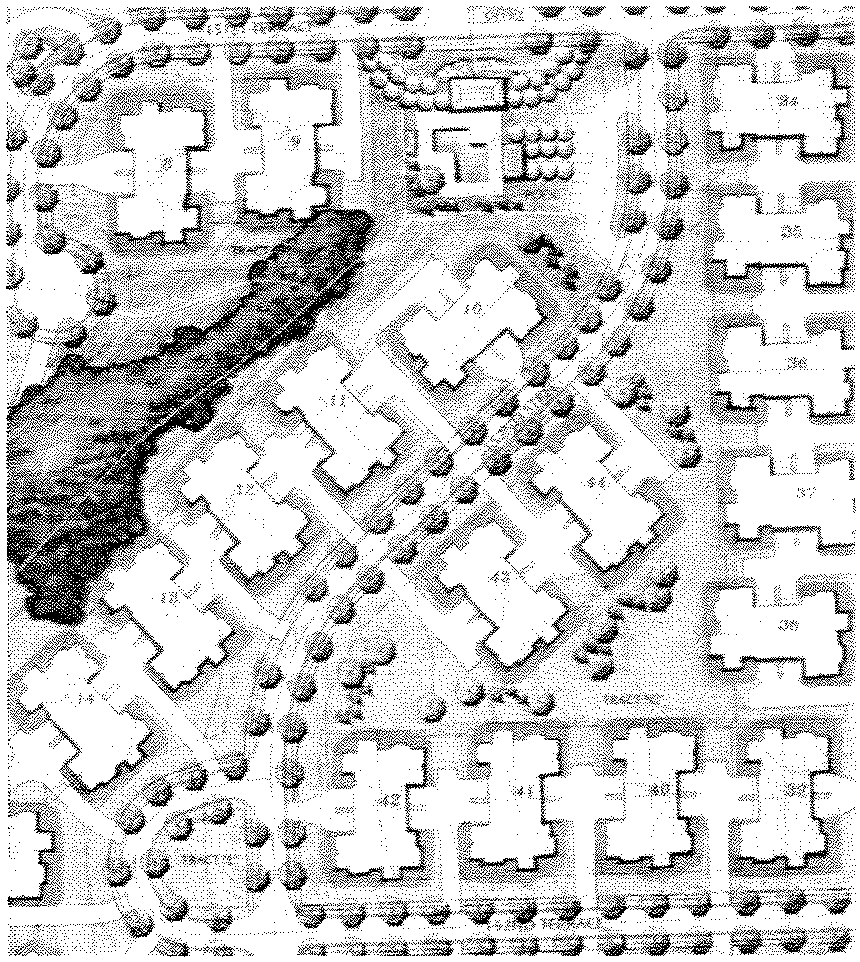
B.
Land uses. Permitted, conditional and accessory land uses in the RM-4 zoning district are identified on the land use matrix in article 27-400, Appendix A. Specific land uses not identified on the matrix are subject to classification pursuant to section 27-336. With the exception of multifamily developments, no more than one principal structure may be erected on each defined lot.
C.
Area and bulk regulations.
1.
Minimum building separation shall be ten feet.
D.
Multifamily development. Multifamily developments shall conform to design guidelines of article 27-600 et seq.
(Code 1992, § 27-414; Ord. No. 16-12, § 2, 2-21-2012)
Sec. 27-415. - Residential mixed density (RMD).
A.
Purpose. To provide a mixture of housing styles and products which are consistent with an area's established development pattern and neighborhood character. Mixed density residential land uses should also be located convenient to commercial uses and employment centers. The RMD zoning district is appropriate in urban areas within the residential attached, mixed use residential, or mixed use employment land use categories of the master land use plan.
B.
Land uses. Permitted, conditional and accessory uses in the RMD district are identified on the land use matrix in article 27-400, Appendix A. Specific land uses not identified on the matrix are subject to classification pursuant to section 27-336. With the exception of apartment complexes, no more than one principal structure may be erected on each defined lot.
C.
Area and bulk regulations.
Notes:
1.
Minimum parcel for rezoning to RMD: two acres.
2.
Maximum density for multifamily dwellings: 30 dwelling units per acre.
3.
Minimum building separation shall be ten feet.
D.
District standards.
1.
Single-family residential dwellings constructed in an RMD zone shall be subject to the following minimum requirements:
a.
The principal structure must have a minimum width of 20 feet.
b.
The principal structure must have a minimum pitched roof of three in 12 or 14 degrees.
c.
The principal structure shall be site on the lot, so that the front door or the main entry of the home is oriented to the front of the lot.
d.
The principal structure must be placed and anchored upon permanent foundations that consist of concrete footings and piers or perimeter foundations.
e.
The principal structure must be completely underpinned around the entire perimeter with masonry materials.
f.
The principal structure must have all transport elements (such as wheels, axles, trailer, or transport hitches and exterior lighting systems) which are attached for highway use removed.
g.
All exterior finish materials of the principal structure shall be compatible with the neighborhood.
E.
Regulations for row houses and zero lot line developments.
1.
Mutual access easements and utility easements may be permitted in row house and zero lot line developments. When provided, mutual access easements shall provide automobile access to individual units and utility companies.
2.
Minimum side yard.
a.
Row houses. No internal side yard setback required on common property lines. For exterior outside walls of the end units, side-yard setback requirements apply.
b.
Zero lot line. No minimum setback on one side of the lot and ten feet on the opposite side of the lot.
3.
Zero lot line on zero setback side. When a zero lot line dwelling unit is built on the property line on one side of the lot, this side of the structure shall contain no openings, appendages, or overhangs. Atriums or courts may be permitted on the zero setback side when the court or atrium is enclosed by three walls of the dwelling unit and a wall of at least seven feet in height is provided on the zero lot line. The wall shall be constructed of the same materials as the exterior walls of the unit.
4.
Maintenance easement.
a.
A perpetual four-foot maintenance easement shall be provided on the lot adjacent to the zero lot line property line. This easement shall be kept clear of structures, with the exception of freestanding walls and/or fences. This easement shall be shown on the plat and incorporated into each deed transferring title to the property. The wall shall be maintained in its original color and treatment unless otherwise agreed to in writing by the two affected lot owners.
b.
Roof overhangs may encroach on the easement of the adjacent lot by a maximum of 24 inches, but the roof shall be designed so that water runoff from the dwelling's placement on the lot line is limited to the easement area.
5.
Zero lot line adjacent to single-family residential. In no case shall zero lot line dwelling units be built closer than ten feet to the lot line of a lot that is zoned in any RS classification.
6.
The minimum rear yard setback shall be 20 feet for row houses, and zero lot line homes.
7.
Maximum number of dwelling units. A maximum of eight dwelling units shall be permitted in each row of row houses. When an end unit does not side on a street, an open space or court of at least 20 feet in width shall be provided between any adjacent structures.
8.
Facing courtyard. Where row house lots and dwelling units are designed to face an open area or common access court rather than a street, this area shall be a minimum of 40 feet in width and shall not include vehicular drives or parking areas.
9.
Row house side lot lines. Row houses shall be constructed up to the lot lines for lots without side yards. No windows, doors, or other openings shall face a side lot line, except that the outside wall of the end units may contain such openings.
F.
Multifamily development. Multifamily developments shall conform to design guidelines of article 27-600 et seq.
(Code 1992, § 27-415)
Sec. 27-416. - Residential historic (RH).
A.
Purpose. To preserve and promote the educational, cultural and general welfare of the public through the preservation, protection, and restoration of the traditional architectural character and historic significance of structures located in the RH district. The RH zoning district is appropriate in the residential attached, residential detached, general commercial, mixed use residential, and mixed use employment of the master land use plan.
1.
No property shall be zoned as residential historic before it has been recommended to be part of a historic district by the historic district commission. Before an application for rezoning can be filed, the property must be established by the governing body as a historic district.
2.
See also section 19-61 et seq. of this Code.
B.
Land uses. Permitted, conditional and accessory uses in the RH district are identified on the land use matrix in article 27-400, Appendix A. Specific land uses not identified on the list are subject to classification pursuant to section 27-336. With the exception of multifamily developments, no more than one principal structure may be erected on each defined lot.
C.
Area and bulk regulations.
1.
Minimum building separation shall be ten feet.
D.
District standards.
1.
No property shall be zoned or rezoned to this classification unless the property has been (prior to the rezoning) recommended as an historic district by the historic district commission and established as a historic district by the board of directors.
2.
All properties zoned RH shall be subject to the architectural design review requirements set forth in the ordinance creating such property as a historic district.
3.
Parking requirements.
a.
The historic district commission shall review all parking plans to consider the surface paving material, site screening, access drives, and landscape/streetscape elements of the plan.
b.
A parking lot shall only be allowed in the historic district to serve a permitted use that is located in the district.
4.
Signs. The historic district commission shall review each business sign application to determine its architectural and aesthetic compatibility with the historic district. The purpose of its review is to ensure the preservation of the authentic historic character of the district as nearly as possible. In addition to the review by the historic district commission and its determination of the appropriateness of business signs, the following criteria shall govern all business signs in the district:
a.
Permitted signs.
1.
Business signs as defined in article 27-200 shall be permitted in the historic district. A business sign shall not exceed six square feet in area.
2.
Banners, as follows:
a.
May not exceed an area of six square feet in total area;
b.
May be displayed only on the outside walls of buildings and may not obscure windows, doors or any other architectural feature;
c.
Display time is limited as determined by the historic district commission;
d.
Design elements must be approved by the historic district commission;
e.
A permit must be obtained by application to the city building department. The application must include written approval by the historic district commission.
b.
Exempted signs. The following signs may be placed by the appropriate entities without obtaining a sign installation permit or certificate of appropriateness:
1.
Any official sign installed by a federal, state or local governing entity for purposes of maintaining the public health, safety or welfare.
2.
Real estate signs (not exceeding six square feet).
c.
Prohibited signs. The following types of signs and similar devices shall be prohibited within the historic district:
1.
No signs that flash, blink, revolve, or are otherwise in motion shall be permitted. No visible bulbs, neon tubing, luminous paints, or plastics shall be permitted as part of any sign.
2.
Portable signs, internally illuminated signs, outdoor advertising signs, inflatable signs and balloons, beacons, streamers, pennants, and similar devices used to direct attention are prohibited.
d.
Historical markers. Historical markers and building markers may be permitted within the district provided the location, size and materials are approved by the historic district commission.
(Code 1992, § 27-416; Ord. No. 16-12, § 2, 2-21-2012; Ord. No. 29-14, § 1(att.), 6-3-2014)
Sec. 27-417. - Residential mixed use/commercial employment mixed use (RMU/CEMU).
A.
Purpose. To provide for residential and commercial mixed use developments to serve the community and provide flexibility and innovation in layout and development designs. The RMU zoning district is appropriate for the commercial neighborhood, general commercial, mixed use residential and residential attached classifications of the master land use plan. Where only single-family detached development is proposed, the RMU district is appropriate in a residential detached master land use plan classification. The CEMU district is appropriate in the mixed use employment, commercial neighborhood, general commercial classifications of the master land use plan.
B.
Minimum development size. Mixed use development sites shall be two acres in size unless two or more of the following conditions are met:
1.
The proposed mixed use development site is consistent with the master land use plan;
2.
The site is contiguous to or across the street from a location that has already been developed as a mixed use project pursuant to these regulations. As such, the expansion of the mixed use development would contribute to the maintenance of the amenities and land values of the neighboring properties;
3.
The site is contiguous or across the street from property that has already been developed for commercial purposes and would not create conditions leading to strip (linear) commercial uses or encroachment into an established residential area; or
4.
The land use would not impose any adverse impacts on the public facilities, utilities, transportation, or storm drainage systems of adjoining properties.
C.
Permitted uses.
1.
Permitted uses and development patterns shall be established in the development plan and approved in the ordinance governing the creation of the district. Permitted uses and development patterns shall be in compliance with the purpose statement in subsection 27-417A of this section, above.
2.
Specific uses include land uses designated as permitted, accessory, or conditional uses in any of the single-family, multifamily, or commercial districts unless otherwise limited by these regulations. The planning commission may recommend and the board of directors approve limitations, restrictions, or exclusions of any specific land use, structure, or building type that is not in conformance with the area surrounding the district or subsection 27-417A of this section, above.
3.
Residential mixed use districts shall include a minimum of 60 percent of the overall development, as measured by the gross floor area, in residential uses.
4.
Commercial/employment mixed use districts shall include a minimum of 60 percent of the overall development, as measured by gross floor area, in commercial/office uses.
5.
In the commercial/employment mixed use districts, institutional, cultural, entertainment, and recreational uses may be used on a one to one basis to reduce the commercial/office required minimum floor area by up to 25 percent.
D.
Design guidelines. All mixed use developments shall conform to the design guidelines of article 27-600 et seq.
E.
Minimum lot area, residential density, yard setback requirements, and height.
1.
Minimum lot area. Minimum lot areas shall be established within the individual mixed use districts through the approval of the development plan. Residential lots at the perimeter of the district must be within 20 percent of the size of abutting residential lots unless they are separated by an arterial or higher classification roadway.
2.
Residential densities.
a.
Residential densities shall be established within the individual mixed use districts through the approval of the development plan. Residential densities shall not exceed 30 dwelling units per acre.
b.
Perimeter residential densities shall be within ten percent of adjoining residential densities unless the adjoining lots are separated by an arterial or higher classification roadway.
3.
Yard setback requirements.
a.
Residential. All buildings and structures shall be set back from any public or private street or road right-of-way lines.
1.
Front yard setback. There shall be a minimum front yard setback of 15 feet from any public or private street or road right-of-way line.
2.
Side and rear yard setbacks. Side and rear yards for buildings or structures shall be:
a.
Ten feet where the building or structure is no more than three stories high.
b.
Ten feet plus one additional foot for each additional foot of height of a building or structure over three stories.
b.
Commercial. Commercial and office setbacks shall be established in the individual mixed use districts through the approval of the development plan.
4.
Height. The height of all buildings shall be established in the individual mixed use districts through the approval of the development plan.
F.
Parking. Parking shall be provided pursuant to the requirements of article 27-600.
1.
Parking shall not be located in landscaped areas adjacent to the sidewalk or within the front yard setbacks of any lot.
2.
Where buildings have more than one category of land use, the number of spaces required shall be 80 percent of the sum of the required spaces for each category of land use.
G.
Open space.
1.
At least 20 percent of the land included in the total project area shall be set aside as permanent and usable open space.
2.
The open space shall be maintained by a homeowners' association or under other appropriate ownership as approved by the city.
H.
Approval process. Residential mixed use and commercial/employment mixed use rezoning requests shall be processed through section 27-329, rezoning—planned development district, procedures. The following review criteria apply to the layout and design of the development and shall be considered in addition to the criteria contained in section 27-329:
1.
The proposed development allows a diversity of surrounding land uses which are in close proximity to each other within a limited area.
2.
The proposed development preserves the overall character of the area.
3.
The proposed development promotes a balance of land uses.
4.
The proposed development promotes the opportunity for people to work, meet, shop, and use services in the vicinity of their residences.
5.
The proposed development provides opportunities for the development of housing.
6.
The proposed development provides opportunities for a mixture of uses within the same building.
7.
The proposed development promotes a pedestrian friendly environment.
8.
The proposed development facilitates integrated physical designs.
9.
The proposed development promotes a high level of design quality in conformance with the city's design guidelines of section 27-602 et seq.
10.
The proposed development encourages the development of flexible space for small and emerging businesses.
11.
The proposed development is responsive to current and future market demands and conditions.
(Code 1992, § 27-417; Ord. No. 70-11, § 2, 9-6-2011; Ord. No. 16-12, § 2, 2-21-2012; Ord. No. 18-20, § 2(att.), 3-3-2020)
Sec. 27-419.6. - Transitional (T).
A.
Purpose. To provide small-scale areas for limited office, professional service, and medical services designed in scale with surrounding residential uses. The transitional zoning district applies to the residential attached, institutional, commercial neighborhood and general commercial categories of the master land use plan.
B.
Land uses. Permitted, conditional and accessory land uses in the transitional district are identified on the land use matrix in article 27-400, Appendix A. Specific land uses not identified on the matrix are subject to classification pursuant to section 27-336.
C.
Area and bulk regulations.
1.
Minimum building separation:
a.
Residential: ten feet.
b.
Nonresidential: determined by the current city building and fire code.
2.
Maximum parcel/lot size for rezoning to transitional:
a.
New district (by classification): two acres.
b.
Existing district (by extension): lot size shall not exceed two acres.
3.
No more than three dwelling units per acre of single-family homes.
4.
No more than six dwelling units per acre of two-family homes.
5.
Required street access: residential collector or higher.
(Code 1992, § 27-419.6; Ord. No. 47-10, § 2, 10-5-2010; Ord. No. 16-12, § 2, 2-21-2012)
Sec. 27-420. - General purpose.
The commercial zoning districts established by this chapter are designed to promote the following specific purposes:
A.
To protect the property values of land and buildings, to promote the most desirable use of land and building development, to promote stable commercial development, to strengthen the economic base of the metropolitan area, and to protect the character of the commercial zoning districts and their suitability for particular land uses.
B.
To provide sufficient and appropriate land areas at appropriate locations, to meet the city's current and anticipated future needs for commercial developments within central shopping districts, regional, community and neighborhood shopping centers, as well as all other types of commercial and miscellaneous service facilities.
C.
To provide off-street parking and loading facilities for commercial areas; to encourage commercial establishments to concentrate in planned developments to the mutual advantage of both consumers and merchants, to encourage or require common entrances and exits to businesses thereby limiting the number of curb cuts and promoting shared parking facilities.
D.
To protect both commercial developments and nearby residences against congestion by regulating the intensity of commercial developments by restricting those types of establishments which generate heavy traffic.
E.
Commercial developments shall conform to design guidelines of article 27-600 et seq.
(Code 1992, § 27-420)
Sec. 27-421. - Commercial zones established.
Seven commercial zones are established by this chapter. Their designations are as follows:
A.
Neighborhood compatible (C-1);
B.
Commercial light (C-2);
C.
Commercial moderate (C-3);
D.
Commercial regional (C-4);
E.
Commercial/employment mixed use (CEMU);
F.
Commercial regional (C-5); and
G.
Commercial downtown (C-6).
(Code 1992, § 27-421; Ord. No. 16-12, § 2, 2-21-2012)
Sec. 27-422. - Commercial neighborhood compatible (C-1).
A.
Purpose. To provide small-scale areas for limited office, professional service, and local retail businesses designed in scale with surrounding residential land uses. The C-1 zoning district encourages the incorporation of compatible neighborhood commercial uses in close proximity to residential uses for easy and convenient accessibility and the promotion of pedestrian-oriented development. C-1 zoning is appropriate in the commercial neighborhood, general commercial, mixed use residential, and mixed use employment classification of the master land use plan.
B.
Land uses. Permitted, conditional and accessory land uses in the neighborhood compatible (C-1) zoning district are identified on the land use matrix in article 27-400, Appendix A. Specific land uses not identified on the list are subject to classification pursuant to section 27-336.
C.
Area and bulk regulations.
1.
Building separation shall be determined by the current city building and fire code.
2.
Minimum parcel/lot size for rezoning to C-1.
a.
New district (by classification): minimum 7,000 square feet to a maximum of two acres.
b.
Existing district (by extension): minimum 7,000 square feet to a maximum of 21,000 square feet.
3.
Maximum building total for development: 30,000 square feet; Maximum individual building or unit in multi-unit structure: 5,000 square feet.
4.
Required street access: residential collector or higher.
D.
District standards.
1.
All areas unoccupied by buildings, parking lots or used as traffic ways shall be maintained in a safe and orderly condition.
2.
No display of merchandise shall be permitted on public sidewalks or rights-of-way.
3.
Special sales merchandise may be temporarily displayed outdoors, but not to exceed a period for more than 14 days or no more than two occasions per year (total of 28 days per year) provided:
a.
The display shall be limited to the private walk in front of the store.
b.
No required parking area shall be used as a display or sales area.
(Code 1992, § 27-422; Ord. No. 47-10, § 2, 10-5-2010; Ord. No. 16-12, § 2, 2-21-2012; Ord. No. 117-22, § 1, 12-1-2022)
Sec. 27-423. - Commercial light (C-2).
A.
Purpose. To provide office, service, and retail activities that are located within buffer areas near the edge of residential areas but which serve an area larger than adjacent neighborhoods. The C-2 zoning district is intended to accommodate well designed development sites and shall provide excellent transportation access, make the most efficient use of existing infrastructure, and provide for orderly buffers and transitions between commercial and residential land uses. C-2 zoning is appropriate in the commercial neighborhood, general commercial, mixed use residential, and mixed use employment classification of the master land use plan.
B.
Land uses. Permitted, conditional and accessory land uses in the C-2 zoning district are identified on the land use matrix in article 27-400, Appendix A. Specific land uses not identified on the list are subject to classification pursuant to section 27-336.
C.
Area and bulk regulations.
1.
Building separation shall be determined by the current city building and fire code.
2.
Minimum parcel/lot size for rezoning to C-2.
a.
New district (by classification): 42,000 square feet.
b.
Existing district (by extension): 7,000 square feet (one lot).
3.
Maximum individual building square footage on a single lot: 30,000 square feet.
4.
Required street access: major collector or higher.
D.
Reserved.
E.
District standards.
1.
All areas unoccupied by buildings, parking lots or used as traffic ways shall be maintained in a safe and orderly condition.
2.
No display of merchandise shall be permitted on public sidewalks or rights-of-way.
3.
Special sales merchandise may be temporarily displayed outdoors, but not to exceed a period for more than 14 days or no more than two occasions per year (total of 28 days per year) provided:
a.
The display shall be limited to the private walk in front of the store.
b.
No required parking area shall be used as a display or sales area.
(Code 1992, § 27-423; Ord. No. 47-10, § 2, 10-5-2010; Ord. No. 16-12, § 2, 2-21-2012; Ord. No. 3-14, § 1(att.), 1-7-2014; altered in 2019 recodification; Ord. No. 117-22, § 1, 12-1-2022)
Sec. 27-424. - Commercial moderate (C-3).
A.
Purpose. To provide for general commercial activities, offices, and services for the community. The C-3 zoning district promotes a broad range of commercial activities, operations, and services that are dispersed throughout the city and designed at a smaller scale than a regional center. The C-3 zoning district is appropriate in the general commercial, mixed use residential, and mixed use employment classification of the master land use plan.
B.
Land uses. Permitted, conditional and accessory land uses in the C-3 zoning district are identified on the land use matrix in article 27-400, Appendix A. Specific land uses not identified on the list are subject to classification pursuant to section 27-336.
C.
Area and bulk regulations.
1.
Building separation shall be determined by the current city building and fire code.
2.
Minimum parcel/lot size for rezoning to C-3: two acres.
3.
Maximum individual building square footage on a single lot: 60,000 square feet.
4.
Required street access: major collector or higher.
D.
District standards.
1.
Vehicle servicing and equipment assembly as part of a sales operation shall be conducted within an enclosed building unless adequate visual screening from the public and adjoining properties is provided.
2.
All areas unoccupied by buildings, parking lots or used as traffic ways shall be maintained in a safe and orderly condition.
3.
No display of merchandise shall be permitted on public sidewalks or rights-of-way.
4.
Special sales merchandise may be temporarily displayed outdoor, but not to exceed a period for more than 14 days or no more than two occasions per year (total of 28 days per year) provided:
a.
The display shall be limited to the private walk in front of the store.
b.
No required parking area shall be used as a display or sales area.
5.
There shall be no open display in the first 20 feet of the required front yard setback.
(Code 1992, § 27-424; Ord. No. 16-12, § 2, 2-21-2012)
Sec. 27-425. - Commercial regional (C-4).
A.
Purpose. To provide for the development of large shopping centers, mixed use developments, entertainment venues, and other appropriate land uses that serve the broad retail, commercial, and entertainment needs of the metropolitan area. The C-4 zoning district is appropriate in the regional center, general commercial, mixed use residential, and mixed use employment classification of the master land use plan.
B.
Land uses. Permitted, conditional and accessory uses in the C-4 zoning district are identified on the land use matrix in article 27-400, Appendix A. Specific land uses not identified on the list are subject to classification pursuant to section 27-336.
C.
Area and bulk regulations.
1.
Building separation shall be determined by the current city building and fire code.
2.
Minimum parcel/lot size for rezoning to C-4:
a.
New district (by classification): ten acres.
b.
Existing district (by extension): three acres.
3.
Maximum individual building square footage: N/A.
4.
Required street access: major arterial or higher.
D.
District standards.
1.
Vehicle servicing and equipment assembly as part of a sales operation shall be conducted within an enclosed building unless adequate visual screening from the public and adjoining properties is provided.
2.
All areas unoccupied by buildings, parking lots or used as traffic ways shall be maintained in a safe and orderly condition.
3.
No display of merchandise shall be permitted on public sidewalks or rights-of-way.
4.
Special sales merchandise may be temporarily displayed outdoor, but not to exceed a period for more than 14 days or no more than two occasions per year (total of 28 days per year) provided:
a.
The display shall be limited to the private walk in front of the store.
b.
No required parking area shall be used as a display or sales area.
5.
There shall be no open display in the first 20 feet of the required front yard setback.
(Code 1992, § 27-425; Ord. No. 16-12, § 2, 2-21-2012)
Sec. 27-426. - Commercial heavy (C-5).
A.
Purpose. To provide adequate locations for retail uses and services that generate moderate to heavy automobile traffic. The C-5 zoning district is designed to facilitate convenient access, minimize traffic congestion, and reduce visual clutter. The C-5 zoning district is appropriate in the general commercial, office, research, and light industrial, mixed use residential, and mixed use employment classification of the master land use plan.
B.
Land uses. Permitted, conditional and accessory uses in the C-5 zoning district are identified on the land use matrix in article 27-400, Appendix A. Specific land uses not identified on the list are subject to classification pursuant to section 27-336.
C.
Area and bulk regulations.
1.
Building separation shall be determined by the current city building and fire code.
2.
Minimum parcel/lot size for rezoning to C-5:
a.
New district (by classification): two acres.
b.
Existing district (by extension): 14,000 square feet (one lot).
3.
Maximum individual building square footage: N/A.
4.
Required street access: minor arterial or higher.
D.
District standards.
1.
Vehicle servicing and equipment assembly as part of a sales operation shall be conducted within an enclosed building unless adequate visual screening from the public and adjoining properties.
2.
All areas unoccupied by buildings, parking lots or used as traffic ways shall be maintained in a safe and orderly condition.
3.
No display of merchandise shall be permitted on public sidewalks or rights-of-way.
4.
Special sales merchandise may be temporarily displayed outdoor, but not to exceed a period for more than 14 days or no more than two occasions per year (total of 28 days per year) provided:
a.
The display shall be limited to the private walk in front of the store.
b.
No required parking area shall be used as a display or sales area.
5.
There shall be no open display in the first 20 feet of the required front yard setback.
(Code 1992, § 27-426; Ord. No. 16-12, § 2, 2-21-2012)
Sec. 27-427. - Commercial downtown (C-6).
A.
Purpose. To provide for the orderly development of the original downtown area of the city and the areas immediately adjacent to it. The commercial downtown (C-6) zoning district establishes guidelines and controls that allow for retail and residential development which is compatible with existing and expanding governmental, financial, professional, cultural, historic, and entertainment facilities. Commercial, governmental, and professional uses that serve the metropolitan area are allowed in this zone.
B.
Land uses. Permitted, conditional and accessory land uses in the C-6 district are identified on the land use matrix in article 27-400, Appendix A. Specific land uses not identified on the list are subject to classification pursuant to section 27-336.
C.
Area and bulk regulations.
1.
Multifamily density: N/A.
2.
Minimum parcel/lot size for rezoning to C-6:
a.
There shall be no new C-6 zones created by classification.
b.
Existing district (by extension): 42,000 square feet (one lot).
D.
District standards.
1.
New billboards are not permitted in the C-6 zoning district.
2.
Development in the C-6 zoning district may also be governed by the CBID design guidelines, which is a separate process from the planning and zoning department's approval.
3.
No minimum parking is required in this zone. If off-street parking is provided, such parking shall conform to section 27-601-12.
(Code 1992, § 27-427; Ord. No. 47-10, § 2, 10-5-2010; Ord. No. 50-14, § 1(att.), 9-2-2014)
Sec. 27-430. - Industrial light (I-1).
A.
Purpose. To provide for a mixture of light manufacturing, office park, research and development, and limited retail/service retail land uses in an attractive, business park setting. The industrial light district may be used as a zoning buffer between mixed uses, commercial uses and heavier industrial uses. The I-1 zoning district is appropriate with the office, research, and light industrial (ORLI) and industry classifications of the master land use plan.
B.
Land uses. Permitted, conditional and accessory land uses in the industrial light zoning district are identified on the land use matrix in article 27-400, Appendix A. Specific land uses not identified on the list are subject to classification pursuant to section 27-336.
C.
Area and bulk regulations.
1.
Building separation shall be determined by the current city building and fire code.
2.
Minimum parcel/lot size for rezoning to I-1:
a.
New district (by classification): two acres.
b.
Existing district (by extension): 20,000 square feet unless extension of existing development.
3.
Required street access: major arterial or higher.
4.
Side/rear setback abutting residential may be reduced to 60 feet with planning commission approval of screening and/or landscaping through the development plan approval process.
D.
District standards.
1.
All areas unoccupied by buildings, parking lots or used as traffic ways shall be maintained in a safe and orderly condition.
2.
Areas which are allowed to have outdoor storage and display of merchandise shall be maintained in a manner that does not collect trash, debris, and/or vermin.
a.
No required parking lot area shall be used as a display or sales area.
b.
No public sidewalk or street right-of-way shall be used for display.
3.
There shall be no open display of merchandise or inventory.
4.
Vehicle servicing and equipment assembly as part of a sales operation shall be conducted within an enclosed building unless adequate sight-proof visual screening from the public and adjacent residences is provided.
5.
No manufacturing, assembly, or repair work shall take place outside the confines of an enclosed building.
6.
Auto impoundment or holding yards shall be screened with a minimum six- to eight-foot opaque fence constructed of wood or masonry.
E.
Industrial development. Industrial developments shall conform to design guidelines of article 27-600 et seq.
(Code 1992, § 27-430; Ord. No. 16-12, § 2, 2-21-2012; Ord. No. 104-22, § 1, 11-1-2022)
Sec. 27-431. - Industrial moderate (I-2).
A.
Purpose. To provide for industrial land uses which can be operated in a clean and quiet manner that shall not be obnoxious to adjacent land uses, and shall have relatively limited environmental impacts. The land uses within an industrial moderate (I-2) zoning district are primarily contained indoors and have heavier traffic generation than the I-1 uses. I-2 zoning is appropriate within the industry classification of the master land use plan.
B.
Land uses. Permitted, conditional and accessory land uses in the I-2 zoning district are identified on the land use matrix in article 27-400, Appendix A. Specific land uses not identified on the list are subject to classification pursuant to section 27-336.
C.
Area and bulk regulations.
1.
Building separation shall be determined by the current city building and fire code.
2.
Minimum parcel/lot size for rezoning to I-2:
a.
New district (by classification): ten acres.
b.
Existing district (by extension): 20,000 square feet unless extension of existing development.
3.
For buildings and structures located between 100 and 150 feet from residentially zoned property, each additional foot of setback in excess of the minimum required setback may allow the building height to be increased by one foot. Buildings or structures which are located more than 150 feet from residentially zoned property shall have no specific height requirements.
4.
Side/rear setbacks abutting residential areas may be reduced to 60 feet with planning commission approval of screening/landscaping through the development plan approval process. Additional building height may not be calculated in this space.
5.
Required street access: major arterial or higher.
D.
District standards.
1.
All areas unoccupied by buildings, parking lots or used as traffic ways shall be maintained in a safe and orderly condition.
2.
Outdoor storage and display of merchandise shall be maintained in a manner that does not collect trash, debris, and vermin and comply with the following:
a.
No required parking lot area shall be used as a display or sales area.
b.
No public sidewalk or street right-of-way shall be used for display.
3.
Vehicle servicing and equipment assembly as part of a sales operation shall be conducted within an enclosed building unless adequate sight-proof visual screening from the public and adjacent residences is provided.
4.
No manufacturing, assembly, or repair work shall take place outside the confines of an enclosed building.
5.
Auto impoundment or holding yards shall be screened with a minimum six- to eight-foot opaque fence constructed of wood or masonry.
E.
Industrial development. Industrial developments shall conform to design guidelines of article 27-600 et seq.
(Code 1992, § 27-431; Ord. No. 16-12, § 2, 2-21-2012; Ord. No. 104-22, § 1, 11-1-2022)
Sec. 27-432. - Industrial heavy (I-3).
A.
Purpose. To accommodate a wide variety and intensity of industrial uses, some of which may have significant external impacts. This may include areas of heavy and concentrated fabrication, manufacturing, and industry. The industrial heavy (I-3) zoning district requires readily available and adequate public facilities and services, including access to major transportation hubs (rail, river, or highway-interstate). The I-3 zone must be located so as to minimize conflicts with other land uses. Industrial heavy zoning is appropriate in the industry classification of the master land use plan.
B.
Land uses. Permitted, conditional and accessory land uses in the I-3 zoning district are identified on the land use matrix in article 27-400, Appendix A. Specific land uses not identified on the list are subject to classification pursuant to section 27-336.
C.
Area and bulk regulations.
1.
Building separation shall be determined by the current city building and fire code.
2.
Minimum parcel/lot size for rezoning to I-3.
a.
New district (by classification): 20 acres.
b.
Existing district (by extension): 20,000 square feet unless extension of existing development.
3.
For buildings and structures located between 100 and 150 feet of residentially zoned property, for each additional foot of setback in excess of the minimum required setback, building height may be increased by one foot. Buildings or structures located more than 150 feet from residentially zoned property shall have no specific height requirement.
4.
Side/rear setbacks abutting residential areas may be reduced to 60 feet with planning commission approval of screening/landscaping through development plan approval process. Additional building height may not be calculated in this space.
5.
Required street access: major arterial or higher.
D.
District standards.
1.
All areas unoccupied by buildings, parking lots or used as traffic ways shall be maintained in a safe and orderly condition.
2.
Outdoor storage and display of merchandise shall be maintained in a manner that does not collect trash, debris, and/or vermin and comply with the following:
a.
No required parking lot area shall be used as a display or sales area.
b.
No public sidewalk or street right-of-way shall be used for display.
3.
Vehicle servicing and equipment assembly as part of a sales operation shall be conducted within an enclosed building unless adequate sight-proof visual screening from the public and adjacent residences is provided.
4.
No manufacturing, assembly or repair work activity other than permitted storage shall take place outside the confines of an enclosed building.
5.
Auto impoundment or holding yards shall be screened with a minimum six- to eight-foot opaque fence constructed of wood or masonry.
E.
Industrial development. Industrial developments shall conform to design guidelines of article 27-600 et seq.
(Code 1992, § 27-432; Ord. No. 16-12, § 2, 2-21-2012; Ord. No. 104-22, § 1, 11-1-2022)
Sec. 27-440. - Phoenix Avenue overlay.
A.
Area of applicability. The signage and landscaping regulations adopted by these 1998 amendments to the zoning code shall apply to all real properties zoned with designations other than residential and physically contiguous to the right-of-way lines (both sides of the street) of the hereinafter designated sections of Phoenix Avenue. The regulations shall be applicable to all portions of said tracts of real property which are located within 400 feet of the right-of-way line. The regulations apply to those sections of Phoenix Avenue commencing, on the west, at the point where the I-540 overpass crosses the Phoenix Avenue right-of-way and continuing, to the east, to the intersection with Massard Road.
B.
Signage regulations.
1.
Monument sign defined. When used herein, the term "monument sign" shall refer to a ground-mounted sign having no more than two faces and being constructed of materials of the same type and in design similar to the principal structure located on the lot on which the sign is located.
2.
Signage per lot. Each separately owned lot is allowed no more than one monument sign; provided, any such lot having frontage on two public streets, is allowed no more than two monument signs. In addition to the allowed monument signs, each such lot is allowed signs of a maximum total of six square feet to provide traffic directions.
3.
Sign size. Each monument sign shall be a maximum of six feet high (inclusive of the base and the display area) and shall not be more than one square foot in area per linear foot of lot frontage, with a maximum area of 75 square feet in area per sign. As to the monument sign for a retail center or business park, as defined in zoning code article 27-200, the sign area and height may be increased by an additional 20 percent.
4.
Wall sign allowance. The wall sign area for the principal structure shall not exceed 20 percent of the wall area. Permanently affixed, non-changeable, product or service advertising may be permitted up to five percent of a principal structure if name and logo is reduced to no more than 15 percent of wall area. The wall sign area for each accessory structure shall not exceed five percent of the wall area on which the sign is located.
5.
Banners are permitted as follows:
a.
Special event banners shall be limited to 32 square feet and shall be permitted no more than twice in each calendar year for a maximum of 30 continuous days at a time.
b.
New business banners shall be limited to 64 square feet and shall be permitted one time with a new business that has obtained a certificate of occupancy for no more than 45 continuous days.
6.
Outdoor advertising (off-site) signs. Outdoor advertising (off-site) signs are prohibited in that portion of the area described in subsection A of this section above located between Leigh Avenue and 400 feet west of the Massard Road right-of-way.
7.
Signs prohibited. Marquees and changeable letter reader boards and portable signs are expressly prohibited. Changeable letters and/or numbers are permitted in the advertising portion of monument signs. Except as allowed by this section, no signs shall be installed in the area described in subsection A of this section above.
8.
Other sign ordinances. All signs allowed by these regulations shall comply with further sign regulations of the zoning code and this Code. In the event of a conflict of these regulations and the further sign regulations of the zoning code and this Code, these regulations will control.
9.
Variance procedures. Administrative decisions applying the provisions of this section may be appealed to the board of zoning adjustment according to the procedure provided for in section 27-337.
C.
Landscaping regulations. Each separately owned lot zoned with a designation other than residential within the area described in subsection A of this section above shall comply with the following landscaping requirements at the time of developing each lot:
1.
Perimeter landscaping requirements along public rights-of-way. A ten-foot-wide landscaping area is required and shall be located on the property parallel and adjacent to the public right-of-way line. At a minimum, the planting strip shall be planted with one tree and ten shrubs for every 50 linear feet of right-of-way frontage. To ensure that landscape materials do not constitute a sight hazard, a clear sight triangle shall be observed at all street intersections or intersections of driveways with streets. Within the designated sight triangle, no landscape material exceeding 24 inches in height shall be permitted; provided, trees shall be permitted as long as only the tree trunk is visible between the ground and eight feet above the ground and the tree does not otherwise present a traffic visibility hazard. The dimensions of the sight triangle are as indicated in the attached diagram for driveways and diagram for street intersections.
2.
Interior landscaping for vehicular use areas.
a.
Requirement. For any open vehicular use area, excluding loading and unloading areas, containing more than 6,000 square feet of area, or 20 or more vehicular parking spaces, the owner shall provide interior landscaping in addition to the previously required landscaping along the public right-of-way. Interior landscaping may be peninsular or island types.
b.
Landscape area. For each 100 square feet or fraction thereof of vehicular use area, a minimum total of five square feet of landscaped area shall be constructed and maintained. Additionally, the minimum size for the landscaped area shall be 64 square feet. In order to encourage the required landscape areas to be dispersed, no individual landscape area may be larger than 350 square feet in size, unless the vehicular use area is over 30,000 square feet. If the vehicular use area is in excess of 30,000 square feet, no individual landscape area may be larger than 1,500 square feet.
c.
Setbacks. In all required interior landscape areas, trees are required to be set back a distance of four feet from the edge of pavement.
d.
Vehicle overhang. Parked vehicles may overhang the interior landscaped area no more than two and one-half feet, provided concrete or other wheel stops are installed to ensure no greater overhang of the landscaped area.
3.
Landscape materials.
a.
Materials. Required landscape areas shall be planted using, at the option of the owner, tree, shrub, grass or groundcover plants identified in subsections D, E, F, and G of this section. Any owner desiring to plant unlisted plants may make written application to the administrative officials of the city. Any decision of the administrative officials is subject to appeal to the board of zoning adjustment according to the provisions of section 27-337.
b.
Plants. Artificial plants are prohibited. All plant materials shall be living plants and shall meet the following requirements:
1.
Quality. Plant materials must conform to the standards of the American Association of Nurserymen and shall have passed any inspections required by state regulations.
2.
Deciduous trees. All planted deciduous trees shall have a minimum thickness of two inches at the aboveground trunk at time of planting.
3.
Evergreen trees. Evergreen trees shall be a minimum of five feet height at the time of planting.
4.
Grass or groundcover. Grass may be sodded or seeded, provided, in drainage swales or other areas subject to erosion, solid sod, erosion-reducing net, or suitable mulch must be used and nurse grass seed shall be sown for immediate protection until complete coverage otherwise is achieved. Grass sod shall be clean and free of weeds and noxious pests or diseases. In areas where groundcover rather than grass is used, the groundcover shall be planted in such a manner as to present a finished appearance and 75 percent complete coverage after one complete growing season.
c.
Maintenance. The initial developer and the owner of the property, and their successors in interest, shall be responsible for the continued maintenance of all landscaping areas so as to keep them (a) in a proper, neat and orderly appearance, (b) free from refuse and debris, (c) with dead plant material replaced within one year of the death of the plant material or by the next planting period, whichever comes first, and (d) with other defective landscape materials replaced or repaired within three months of defect. The maintenance obligation of the developer, and the developer's successor in interest other than the owner, shall terminate two years following the developer's sale of the subject property.
d.
Enforcement. Violation of the regulations adopted by this section may be enforced in any lawful manner including, without limitation, the refusal by the city to issue a building occupancy permit.
D.
Tree species.
1.
Primary list. The following list of trees are those which have been found to be best suited to this area and yet requiring the least amount of maintenance. This list, along with the secondary list, are those trees which may be planted in the required landscaping area. Additional selective trees may be substituted when proven to be hardy to this region:
2.
Secondary list. The following list of trees are those which have been found to be the next best suited to this area but require increased maintenance:
E.
Shrub species.
1.
Primary list. The following list of shrubs are those which have been found to be best suited to this area and yet requiring the least amount of maintenance. This list, along with the secondary list, are those shrubs which may be planted in the required landscaping area. Additional selective shrubs may be substituted when proven to be hardy to this region:
2.
Secondary list. The following list of shrubs are those which have been found to be the next best suited to this area but require increased maintenance:
3.
Evergreen species suitable for screening buffers.
F.
Grasses. The following grasses may be used:
1.
Lawn covers:
Mayer Z-52 Zoysia.
Emerald Zoysia.
Bermuda grass.
Bermuda grass hybrids.
Centipede.
St. Augustine.
2.
The grasses listed in subsection F1 of this section are the more commonly used grasses adjacent to vehicular use areas.
3.
Ornamental Grasses:
G.
Groundcovers.
1.
Primary list. The following list of groundcovers are those which have been found to be best suited to this area and yet requiring the least amount of maintenance. This list, along with the secondary list, are those groundcovers which may be planted in the required landscaping area. Additional selective groundcovers may be substituted when proven to be hardy to this region.
2.
Secondary list. The following list of groundcovers are those which have been found to be the next best suited to this area but require increased maintenance:
H.
Commercial design requirements. Design requirements for new commercial buildings and additions to existing commercial buildings.
1.
Purposes.
a.
To protect and enhance the overlay zone for the Phoenix Avenue extension.
b.
To provide good civic design and arrangement.
c.
To preserve property values of surrounding property.
2.
Commercial building design standards.
a.
Any development that contains more than one building shall incorporate a recurring, unifying and identifiable theme for the entire development.
b.
The predominant (51 percent of the gross wall area or greater) exterior building façade of all commercial buildings must be of high quality materials such as brick, wood, native stone, tinted glass, cementious siding, stucco, exterior insulated finished systems (EIFS) or tinted/textured concrete masonry units. Smooth-faced concrete block, plain or untextured tilt-up panels and prefabricated steel panels are prohibited as the predominant façade.
c.
All façades of a building that are visible from the finish grades of adjoining properties or public streets shall have design characteristics similar to the buildings front façade. This shall be implemented by requiring the same treatment as discussed in subsection H.2.b of this section, above.
d.
Mechanical equipment, including, but not limited to, heating/cooling systems, trash receptacles and utility boxes shall be completely screened from adjoining properties and street right-of-way. For ground-mounted or located equipment the screening shall be a wall or fence or the equipment shall be enclosed within a building. For roof-mounted equipment, the screening shall be architecturally incorporated into the roof and shall consist of materials compatible with the supporting building.
e.
Chainlink, barbed wire or sheet metal fencing material is prohibited.
I.
Design review.
1.
All landscaping, new commercial building developments and additions to existing commercial buildings shall be subject to design review and approval by the planning and zoning department. The following drawings, information and plans shall be submitted to the planning and zoning department for design review and approval with site plan or development plan applications:
a.
Rendered elevation drawings of front, rear and one side of the proposed structure at a one-eighth inch to one foot (minimum) scale showing the design of the structure and the materials of the building's external finishes being proposed.
b.
The site plan shall include the location and proposed screening of all mechanical equipment.
c.
The city administrator or his designated agent, at his discretion, may refer any design review and approval to the board of zoning adjustment for its review and approval. Any administrative decision applying the provisions of this section may be appealed to the board of zoning adjustment according to the procedure provided for in section 27-337.
2.
Effects of approval.
a.
An approved design shall be binding on the applicants and their successors and assignees. No building permit shall be issued for any building or structure not in conformance with the approved design. No element of an approved design shall be eliminated, altered or provided in another manner unless an amendment is approved in accordance with this section, provided, however, that the city administrator, or his designated agent, may approve such minor changes in the design as will not cause any of the following circumstances to occur.
b.
Any change to the recurring, unifying and identifiable theme from one building to the next in a single development.
c.
Any change that reduces the percentage of the predominate façade to a percentage less than 51 percent of the gross wall area.
d.
Any modification having an adverse impact on adjacent property.
e.
Any modification that lessens the requirements for screening of the mechanical equipment.
f.
Any modification that lessens the requirements for all façades of a building, visible from adjoining properties or public streets, having similar design characteristics to the building's front façade.
(Code 1992, § 27-440; Ord. No. 1-21, § 2(att.), 1-5-2021; Ord. No. 79-24, § 1, 9-3-2024; Ord. No. 87-24, § 1, 10-8-2024)
Sec. 27-441. - Overlay zone for the Massard/Zero Street Corridor.
(a)
Area of applicability. The regulations adopted by these 2019 amendments to the Unified Development Ordinance shall apply to all real properties zoned with designations other than residential and physically contiguous to the right-of-way lines (both sides of the street) of the hereinafter designated sections of Massard Road. The regulations shall be applicable to all portions of said tracts of real property which are located within 300 feet of the right-of-way line. The regulations apply on Massard between Zero Street/Highway 255 and Little Massard Creek north of Phoenix Avenue.
(b)
Signage regulations.
(1)
Monument sign defined. When used herein, "monument sign" shall refer to a ground mounted sign having no more than two faces and being constructed of materials of the same type and in design similar to the principal structure located on the lot on which the sign is located.
(2)
Signage per lot. Each separately owned lot is allowed no more than one monument sign; provided, any such lot having frontage on two public streets, is allowed no more than two monument signs. In addition to the allowed monument sign(s), each such lot is allowed signs of a maximum total of six square feet to provide traffic directions.
(3)
Sign size. Each monument sign shall be a maximum of six feet high (inclusive of the base and the display area) and shall not be more than one square foot in area per linear foot of lot frontage with a maximum area of 75 square feet in area per sign. As to the monument sign for a retail center or business park, as defined in zoning code section 27-200, the sign area and height may be increased by an additional 20 percent.
(4)
Wall sign allowance. The wall sign area for the principal structure shall not exceed 20 percent of the wall area on which the sign is located. Permanently affixed, non-changeable, product or service advertising may be permitted up to five percent of wall area of a principal structure if name and logo is reduced to no more than 15 percent of wall area. The wall sign area for each accessory structure shall not exceed five percent of the wall area on which the sign is located.
(5)
Banners are permitted as follows:
a.
Special event banners shall be limited to 32 square feet and shall be permitted no more than twice in each calendar year for a maximum of 30 continuous days at a time.
b.
New business banners shall be limited to 64 square feet and shall be permitted one time with a new business that has obtained a certificate of occupancy for no more than 45 continuous days.
(6)
Outdoor advertising (offsite) signs. Outdoor advertising (offsite) signs are prohibited in that portion of the area described in (a) above.
(7)
Signs prohibited. Marquees and changeable letter reader boards and portable signs are expressly prohibited. Changeable letters and/or numbers are permitted in the advertising portion of monument signs. Except as allowed by this section, no signs shall be installed in the area described in (a) above.
(8)
Other sign ordinances. All signs allowed by these regulations shall comply with further sign regulations of the zoning code and the Code of Ordinances. In the event of a conflict of these regulations and the further sign regulations of the zoning code and the Code of Ordinances, these regulations will control.
(9)
Variance procedures. Administrative decisions applying the provisions of this section may be appealed to the board of zoning adjustment according to the procedure provided for in section 27-337 of the Code of Ordinances.
(c)
Architectural design requirements for new commercial buildings and additions to existing commercial buildings.
(1)
Purposes.
a.
To protect and enhance the Massard Corridor.
b.
To provide good civic design and arrangement.
c.
To preserve property values of surrounding properties.
(2)
Commercial building design standards. The exterior building façade of all commercial buildings must be constructed with 100 percent high quality materials on any façade facing the street right-of-way and 51 percent high quality materials on the side and rear façades. If the building is constructed next to property zoned or developed residential all façades shall be 100 percent high quality materials. High quality materials include brick, wood, native stone, tinted glass, stucco, exterior insulated finished systems (EIFS) or tinted/textured concrete masonry units. Smooth-faced concrete block, plain or untextured tilt-up panels and prefabricated steel panels are prohibited as the predominant façade.
(3)
Effects of approval.
a.
An approved design shall be binding on the applicants and their successors and assignees. No building permit shall be issued for any building or structure not in conformance with the approved design. No element of an approved design shall be eliminated, altered or provided in another manner unless an amendment is approved in accordance with this section, provided, however, that the director may approve such minor changes in the design as will not cause any of the following circumstances to occur:
1.
Any change to the recurring, unifying and identifiable theme from one building to the next in a single development.
2.
Any modification having an adverse impact on adjacent property.
3.
Any modification that lessens the requirements for screening of the mechanical equipment.
4.
Any modification that lessens the requirements for all façades of a building, visible from adjoining properties or public streets, having similar design characteristics to the building's front façade.
5.
No change permitted facing residentially zoned or developed properties.
(d)
Any standard not specifically covered by this section shall be subject to the general requirements of the Unified Development Ordinance.
(Ord. No. 37-19, § 1(att.), 6-4-2019; Ord. No. 87-24, § 1, 10-8-2024)
Sec. 27-442. - Overlay zone for the Massard Street Corridor.
(a)
Area of applicability. The regulations adopted by these 2019 amendments to the Unified Development Ordinance shall apply to all real properties zoned with designations other than residential and physically contiguous to the right-of-way lines (both sides of the street) of the hereinafter designated sections of Massard Road. The regulations shall be applicable to all portions of said tracts of real property which are located within 300 feet of the right-of-way line. The regulations apply on Massard between Zero Street/Highway 255 and Little Massard Creek north of Phoenix Avenue.
(b)
Signage regulations.
(1)
Monument sign defined. When used herein, "monument sign" shall refer to a ground mounted sign having no more than two faces and being constructed of materials of the same type and in design similar to the principal structure located on the lot on which the sign is located.
(2)
Signage per lot. Each separately owned lot is allowed no more than one monument sign; provided, any such lot having frontage on two public streets, is allowed no more than two monument signs. In addition to the allowed monument sign(s), each such lot is allowed signs of a maximum total of six square feet to provide traffic directions.
(3)
Sign size. Each monument sign shall be a maximum of six feet high (inclusive of the base and the display area) and shall not be more than one square foot in area per linear foot of lot frontage with a maximum area of 75 square feet in area per sign. As to the monument sign for a retail center or business park, as defined in zoning code section 27-200, the sign area and height may be increased by an additional 20 percent.
(4)
Wall sign allowance. The wall sign area for the principal structure shall not exceed 20 percent of the wall area on which the sign is located. Permanently affixed, non-changeable, product or service advertising may be permitted up to five percent of wall area of a principal structure if name and logo is reduced to no more than 15 percent of wall area. The wall sign area for each accessory structure shall not exceed five percent of the wall area on which the sign is located.
(5)
Banners are permitted as follows:
a.
Special event banners shall be limited to 32 square feet and shall be permitted no more than twice in each calendar year for a maximum of 30 continuous days at a time.
b.
New business banners shall be limited to 64 square feet and shall be permitted one time with a new business that has obtained a certificate of occupancy for no more than 45 continuous days.
(6)
Outdoor advertising (offsite) signs. Outdoor advertising (offsite) signs are prohibited in that portion of the area described in (a) above.
(7)
Signs prohibited. Marquees and changeable letter reader boards and portable signs are expressly prohibited. Changeable letters and/or numbers are permitted in the advertising portion of monument signs. Except as allowed by this section, no signs shall be installed in the area described in (a) above.
(8)
Other sign ordinances. All signs allowed by these regulations shall comply with further sign regulations of the zoning code and the Code of Ordinances. In the event of a conflict of these regulations and the further sign regulations of the zoning code and the Code of Ordinances, these regulations will control.
(9)
Variance procedures. Administrative decisions applying the provisions of this section may be appealed to the board of zoning adjustment according to the procedure provided for in section 27-337 of the Code of Ordinances.
(c)
Architectural design requirements for new commercial buildings and additions to existing commercial buildings.
(1)
Purposes.
a.
To protect and enhance the Massard Corridor.
b.
To provide good civic design and arrangement.
c.
To preserve property values of surrounding properties.
(2)
Commercial building design standards. The exterior building façade of all commercial buildings must be constructed with 100 percent high quality materials on any façade facing the street right-of-way and 51 percent high quality materials on the side and rear façades. If the building is constructed next to property zoned or developed residential all façades shall be 100 percent high quality materials. High quality materials include brick, wood, native stone, tinted glass, stucco, exterior insulated finished systems (EIFS) or tinted/textured concrete masonry units. Smooth-faced concrete block, plain or untextured tilt-up panels and prefabricated steel panels are prohibited as the predominant façade.
(3)
Effects of approval.
a.
An approved design shall be binding on the applicants and their successors and assignees. No building permit shall be issued for any building or structure not in conformance with the approved design. No element of an approved design shall be eliminated, altered or provided in another manner unless an amendment is approved in accordance with this section, provided, however, that the director may approve such minor changes in the design as will not cause any of the following circumstances to occur:
1.
Any change to the recurring, unifying and identifiable theme from one building to the next in a single development.
2.
Any modification having an adverse impact on adjacent property.
3.
Any modification that lessens the requirements for screening of the mechanical equipment.
4.
Any modification that lessens the requirements for all façades of a building, visible from adjoining properties or public streets, having similar design characteristics to the building's front façade.
5.
No change permitted facing residentially zoned or developed properties.
(d)
Any standard not specifically covered by this section shall be subject to the general requirements of the Unified Development Ordinance.
(Ord. No. 87-24, § 1, 10-8-2024)
Editor's note— Ord. No. 87-24, § 1, adopted October 8, 2024, renumbered § 27-442 as § 27-443.
27-443. - Overlay zone for the Old Greenwood Road Corridor.
(a)
Area of applicability. The regulations adopted by these 2019 amendments to the Unified Development Ordinance shall apply to all real properties zoned with designations other than residential and are physically contiguous to the right-of-way lines (both sides of the street) of the hereinafter designated sections of Old Greenwood Road. The regulations shall be applicable to all portions of said tracts of real property which are located within 300 feet of the right-of-way line. The regulations apply on Old Greenwood Road between South M Street/Dodson Avenue and Phoenix Avenue.
(b)
Signage regulations.
1.
Monument sign defined. When used herein, "monument sign" shall refer to a ground mounted sign having no more than two faces and being constructed of materials of the same type and in design similar to the principal structure located on the lot on which the sign is located.
2.
Signage per lot. Each separately owned lot is allowed no more than one monument sign; provided, any such lot having frontage on two public streets, is allowed no more than two monument signs. In addition to the allowed monument sign(s), each such lot is allowed signs of a maximum total of six square feet to provide traffic directions.
3.
Sign size. Each monument sign shall be a maximum of six feet high (inclusive of the base and the display area) and shall not be more than one square foot in area per linear foot of lot frontage with a maximum area of 75 square feet in area per sign. As to the monument sign for a retail center or business park, as defined in zoning code section 27-200, the sign area and height may be increased by an additional 20 percent.
4.
Wall sign allowance. The wall sign area for the principal structure shall not exceed 20 percent of the wall area. Permanently affixed, non-changeable, product or service advertising may be permitted up to five percent of wall area of a principal structure if name and logo is reduced to no more than 15 percent of wall area. The wall sign area for each accessory structure shall not exceed five percent of the wall area on which the sign is located.
5.
Banners are permitted as follows:
a.
Special event banners shall be limited to 32 square feet and shall be permitted no more than twice in each calendar year for a maximum of 30 continuous days at a time.
b.
New business banners shall be limited to 64 square feet and shall be permitted one time with a new business that has obtained a certificate of occupancy for no more than 45 continuous days.
6.
Outdoor advertising (offsite) signs. Outdoor advertising (offsite) signs are prohibited in that portion of the area described in (a) above.
7.
Signs prohibited. Marquees and changeable letter reader boards and portable signs are expressly prohibited. Changeable letters and/or numbers are permitted in the monument signs. Except as allowed by this section, no signs shall be installed in the area described in (a) above.
8.
Other sign ordinances. All signs allowed by these regulations shall comply with further sign regulations of the zoning code and the Code of Ordinances. In the event of a conflict of these regulations and the further sign regulations of the zoning code and the Code of Ordinances, these regulations will control.
9.
Variance procedures. Administrative decisions applying the provisions of this section may be appealed to the board of zoning adjustment according to the procedure provided for in section 27-337 of the Code of Ordinances.
(c)
Architectural design requirements for new commercial and industrial buildings and additions to existing commercial and industrial buildings.
(1)
Purposes.
a.
To protect and enhance the Old Greenwood Road Corridor.
b.
To provide good civic design and arrangement.
c.
To preserve property values of surrounding properties.
(2)
Commercial building design standards.
a.
The exterior building façade of all commercial buildings must be constructed with 100 percent high quality materials on any façade facing the street right-of-way and 51 percent high quality materials on the side and rear façades. If the building is constructed next to property zoned or developed residential all façades shall be 100 percent high quality materials. High quality materials include brick, wood, native stone, tinted glass, stucco, exterior insulated finished systems (EIFS), cementious siding (e.g., Hardie Board), or tinted/textured concrete masonry units. Smooth-faced concrete block, plain or untextured tilt-up panels and prefabricated steel panels are prohibited as the predominant façade.
b.
Outdoor storage shall be located to the rear of the building and not exceed 1,000 square feet or ten percent of the total site (whichever is greater) and be screened from view from adjacent properties and street rights-of-ways by a solid opaque wall or fence at least six feet in height.
c.
All motor vehicle, boat, trailer, or recreational vehicle related uses, including sales, service, and storage shall be conducted in an enclosed building with the exception of the property located within 300 feet of the northwest corner of the Old Greenwood Road and Phoenix Avenue intersection. The property located within 300 feet of the northwest corner of the Old Greenwood Road and Phoenix Avenue intersection shall require site plan approval though the Planning Commission for any outdoor motor vehicle, boat, trailer, or recreational vehicle related uses.
(3)
Industrial building design standards.
a.
The exterior building façade of all industrial buildings must be constructed with 100 percent high quality materials on any façade facing the street right-of-way and 51 percent high quality materials on the side and rear façades. If the building is constructed next to property zoned or developed residential all façades shall be 100 percent high quality materials. High quality materials include brick, wood, native stone, tinted glass, stucco, exterior insulated finished systems (EIFS), cementious siding (e.g., Hardie Board), or tinted/textured concrete masonry units. Smooth-faced concrete block, plain or untextured tilt-up panels and prefabricated steel panels are prohibited as the predominant façade.
b.
All industrial activities shall be conducted in enclosed buildings.
c.
Outdoor storage shall be located to the rear of the building and not exceed 1,000 square feet or ten percent of the total site (whichever is greater) and be screened from view from adjacent properties and street rights-of-ways by a solid opaque wall or fence at least six feet in height.
d.
All motor vehicle, boat, trailer, or recreational vehicle related uses, including sales, service, and storage shall be conducted in an enclosed building.
(4)
Industrial screening and landscape buffer design standards. In addition to the landscaping and screening requirements of the Unified Development Ordinance, the following shall be applicable:
a.
A landscape buffer with a minimum width of 20 feet, along with a solid opaque wall, fence or berm at least six feet in height, shall be installed adjacent to all properties zoned or developed residential. The buffer shall consist of two staggered rows of trees spaced no more than 30 feet on center.
b.
Fifty percent of all trees shall be evergreen with a minimum installation height of eight feet tall and a maturity height of 40 feet.
(5)
Effects of approval.
a.
An approved design shall be binding on the applicants and their successors and assignees. No building permit shall be issued for any building or structure not in conformance with the approved design. No element of an approved design shall be eliminated, altered or provided in another manner unless an amendment is approved in accordance with this section, provided, however, that the director may approve such minor changes in the design as will not cause any of the following circumstances to occur:
1.
Any change to the recurring, unifying and identifiable theme from one building to the next in a single development.
2.
Any modification having an adverse impact on adjacent property.
3.
Any modification that lessens the requirements for screening of the mechanical equipment.
4.
Any modification that lessens the requirements for all façades of a building, visible from adjoining properties or public streets, having similar design characteristics to the building's front façade.
5.
No change permitted facing residentially zoned or developed properties.
(d)
Any standard not specifically covered by this section shall be subject to the general requirements of the Unified Development Ordinance.
(Ord. No. 17-20, § 2(att.), 3-3-2020; Ord. No. 87-24, § 1, 10-8-2024)
Editor's note— Ord. No. 87-24, § 1, adopted October 8, 2024, renumbered § 27-442 as § 27-443.
Sec. 27-444 - Military Compatibility Area Overlay District (MCAOD)
1.01
Purpose and intent. The Military Compatibility Area Overlay District (MCAOD) implements compatibility policies and codifies regulations to protect the public health, safety, and welfare of the community and preserve and maintain existing and future operational capabilities of the Fort Smith Regional Airport/Ebbing Air National Guard Base (ANGB).
1.02
Applicability. This section establishes regulations applicable to all land within the Military Compatibility Overlay District (MCAOD) boundary, as adopted and depicted on the official Zoning Map for the City of Fort Smith. For any parcel that is partially within a Military Compatibility Area (MCA) of the MCAOD, the requirements of the MCA shall apply to the entire parcel. For any parcel that is within more than one subarea within an MCA, the entire parcel shall adhere to the requirements of the most restrictive subarea of that MCA.
1.03
Exemptions. The following uses are exempt from the MCAOD regulations of this section:
A.
Agricultural use. The regulations of this section shall not regulate any operational aspect of an existing or future agricultural use, including without limitation the cultivation and harvesting of crops, land management activities (clearing, spraying, and trimming), livestock management, or use and application of water. Expansion of existing structures and construction of new structures that are accessory to agricultural uses are subject to the regulations of this section.
B.
Existing structures. The regulations of this section shall not restrict or limit the use of legally established, existing land uses and structures as of the effective date of this section.
1.04
Relationship of MCAOD to underlying zoning. The MCAOD is a zoning overlay with underlying zoning restrictions in place and in effect. The MCAOD permits only land uses authorized by the underlying zoning. The MCAOD does not, in any case, authorize land use of a greater density and/or intensity than authorized by the underlying zoning. The MCAOD regulations established herein supplement, modify, and, where indicated, supersede the regulations of the underlying zoning. All definitions, references, requirements, and other land use controls not specifically defined or modified by the regulations of this section shall conform to provisions of the Unified Development Ordinance (UDO) applicable to the underlying zoning.
1.05
Conflicting provisions. The general provisions, zoning regulations, and all other development standards established within all other sections of the UDO are applicable within the MCAOD to the extent the regulations of this section establish less restrictive standards covering the same subject matter. Whenever a provision of the UDO contains a specific standard(s) covering the same subject matter as this section, the more restrictive standards(s) of the two shall control.
1.06
Establishment—MCAOD and MCA boundaries. The boundary of the MCAOD is the combined geospatial areas of the three Military Compatibility Areas (MCA) identified below. The MCAOD and the three MCAs are hereby established as depicted on Figures 1, 2, 3, and 4.
Lighting MCA
The lighting MCA addresses nighttime lighting within the runway buffer. The boundary of the lighting MCA is depicted on Figure 2.
Noise MCA
The noise MCA addresses the noise impact issues within the 65 dB DNL, 70 dB DNL, 75 dB DNL, and 80 dB DNL noise contours depicted on Figure 3. The noise MCA includes a 1.5-mile noise awareness area extending from the 65 dB DNL noise contour to raise awareness about potential noise levels.
Security MCA
The security MCA addresses the development and sale of property physically contiguous to property owned by the Fort Smith Regional Airport. The boundary of the security MCA is depicted on Figure 4.
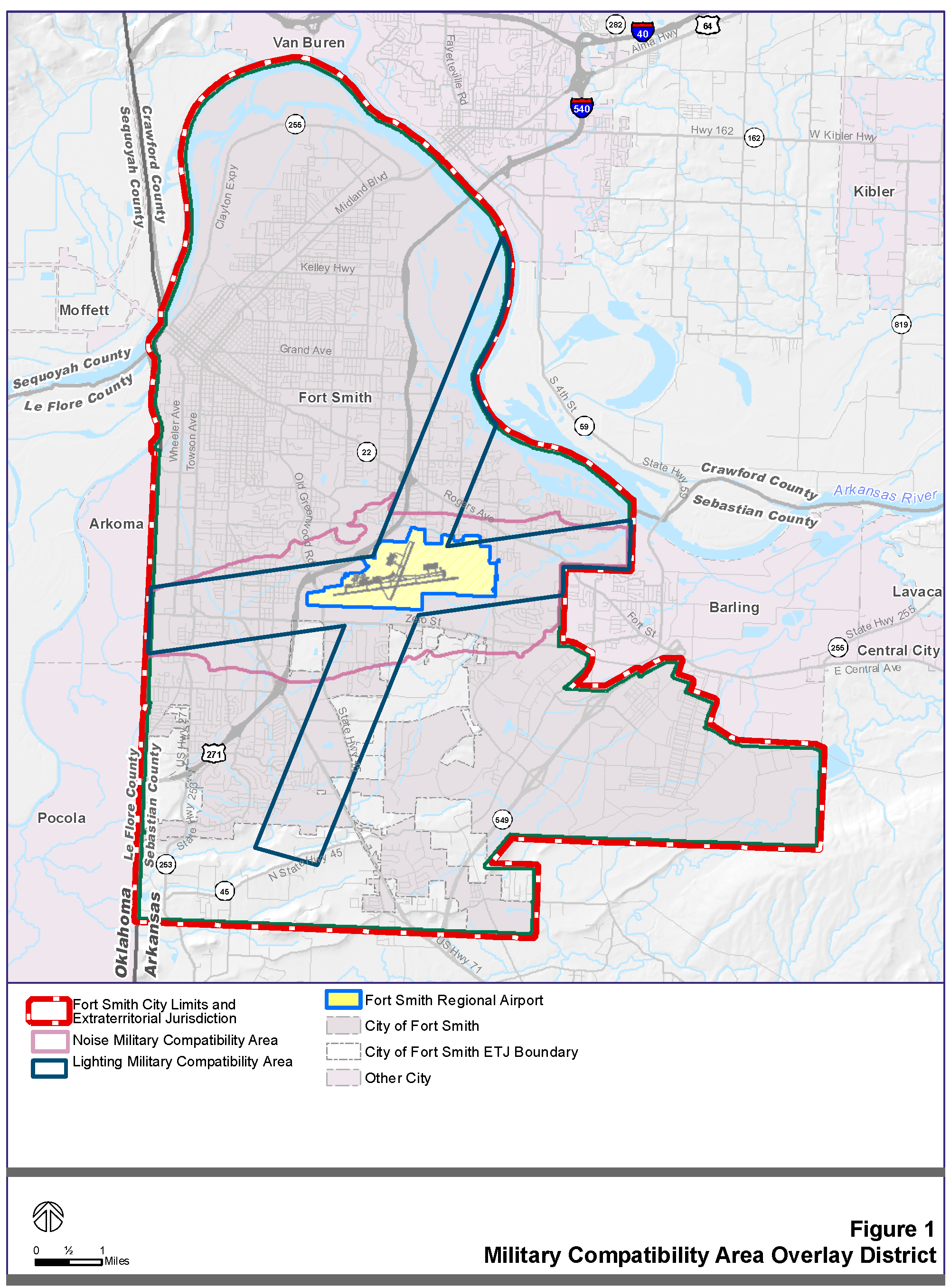
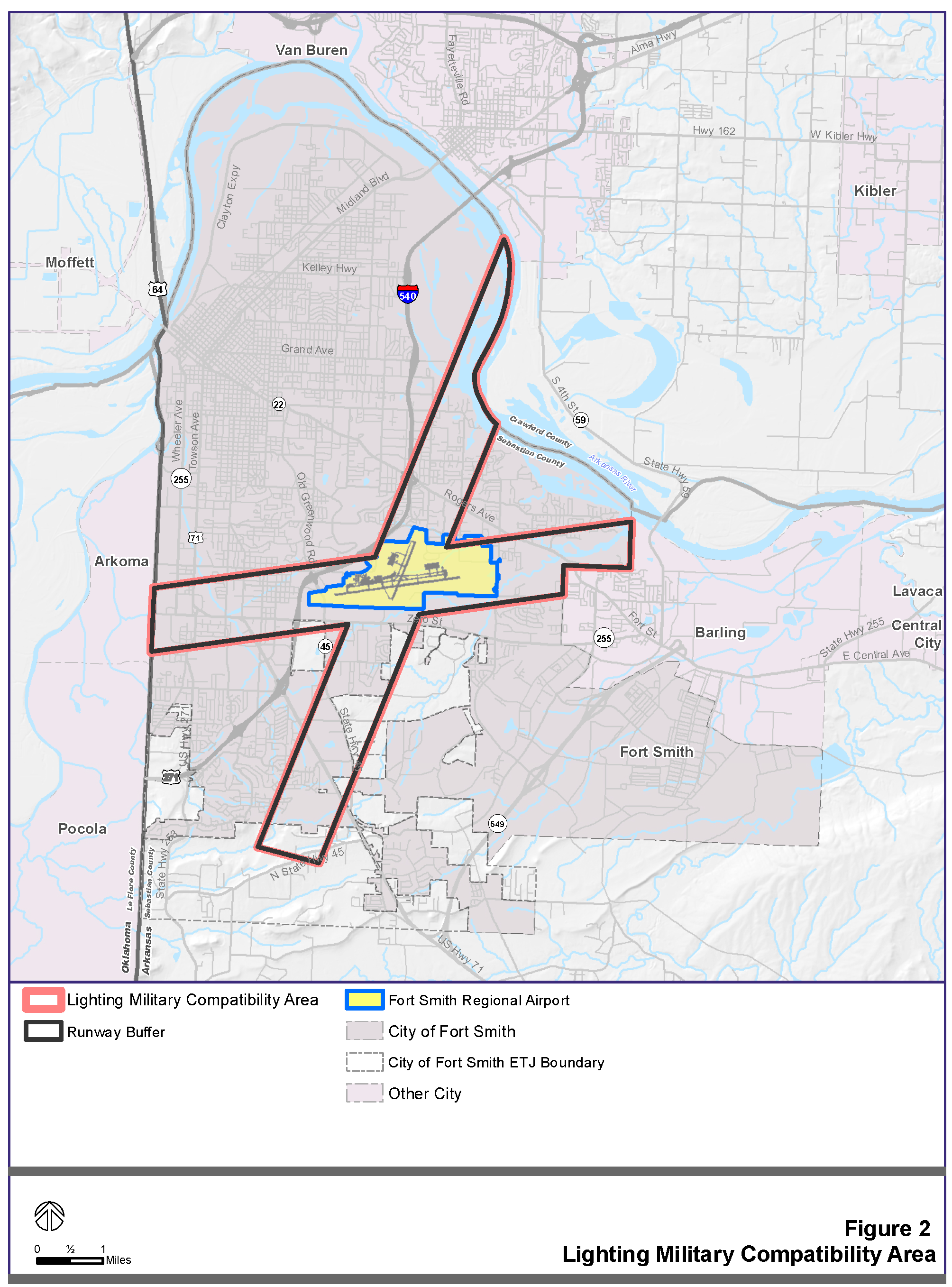 ;
;
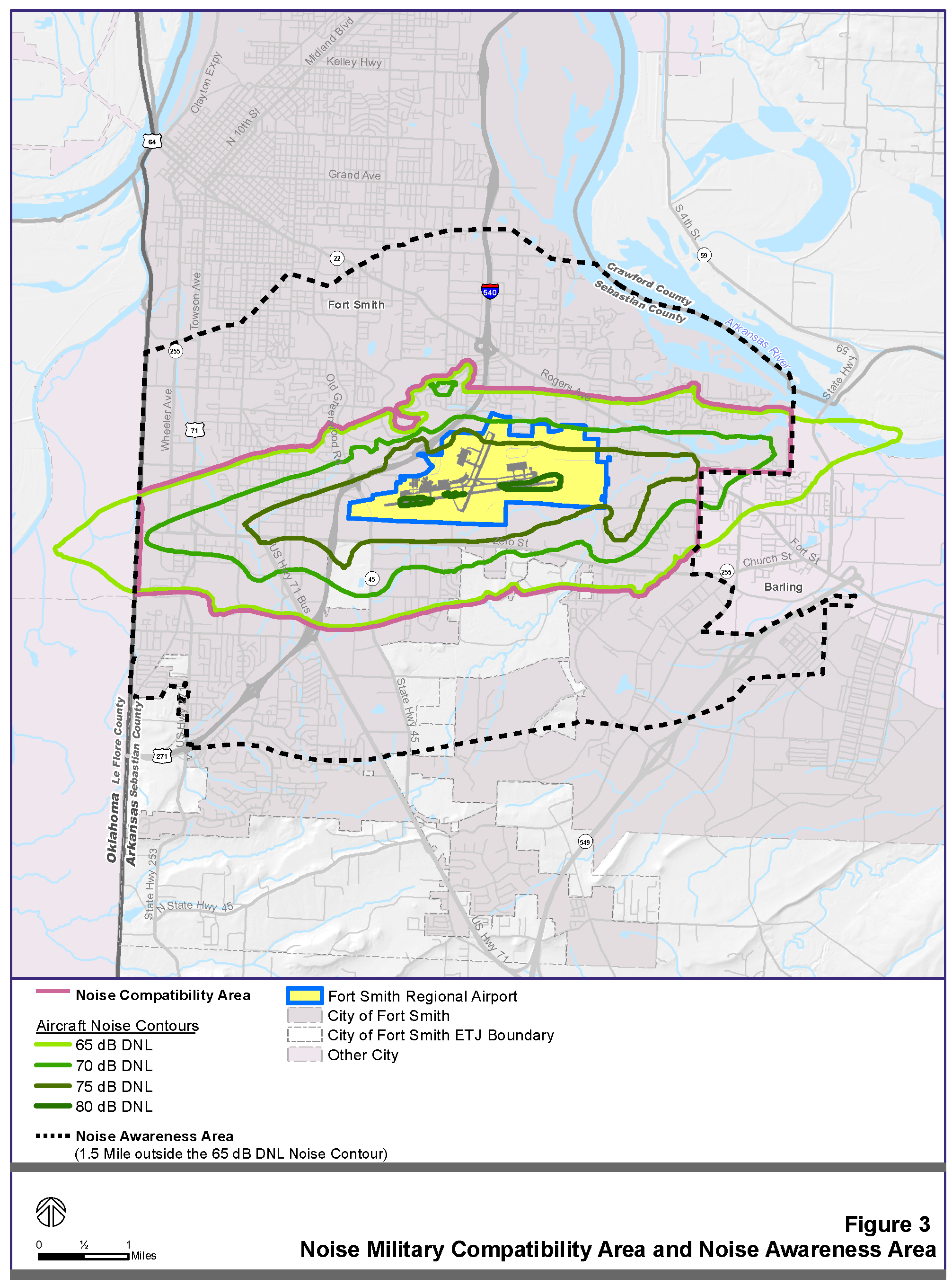
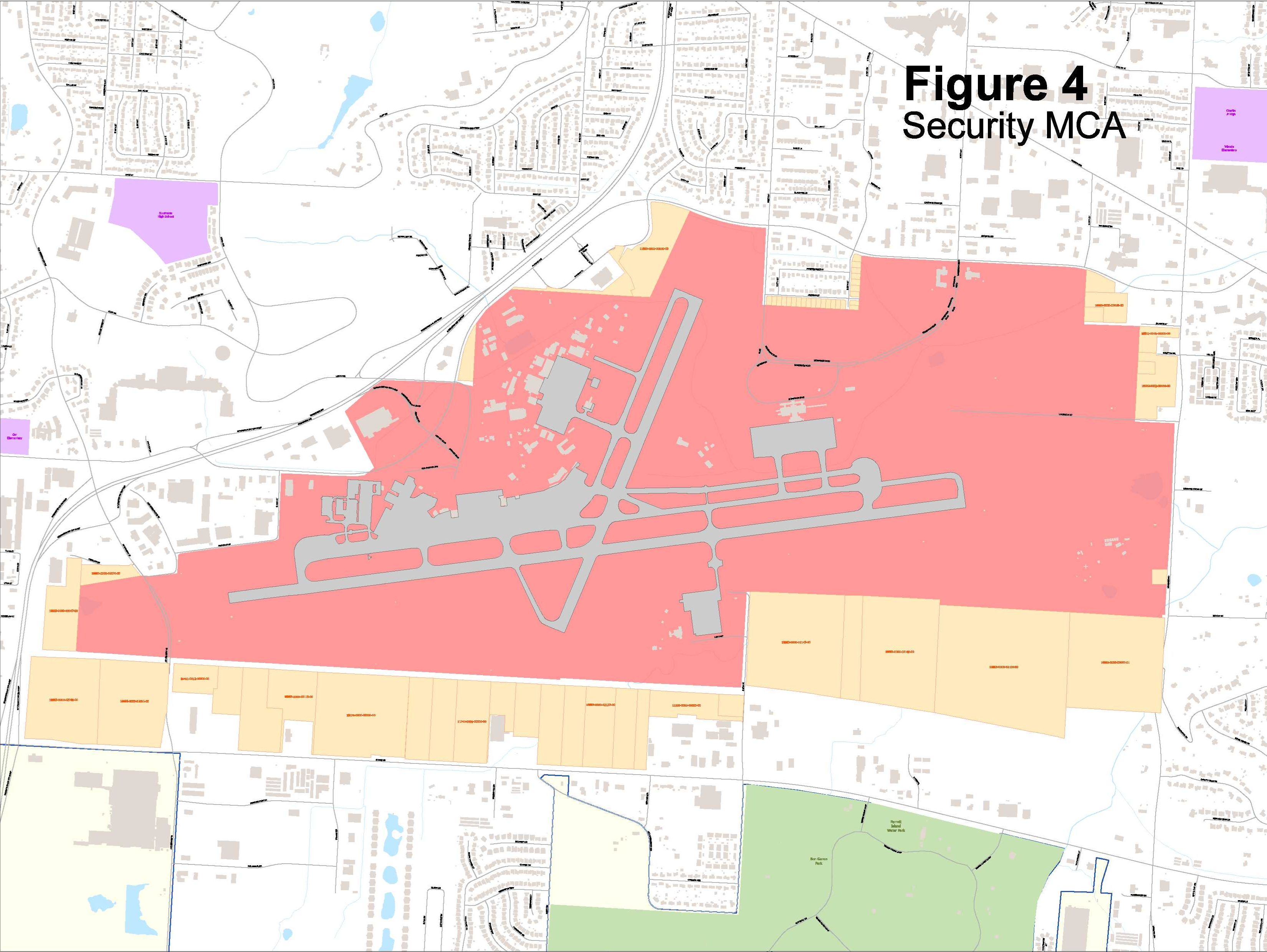
1.07
Lighting military compatibility area (Figure 2). This subsection 1.07 establishes regulations applicable to lighting within the boundary of the lighting MCA (Figure 2). The term runway buffer as used in Figure 2 is that area more specifically identified in Fort Smith Geographic Information System (GIS) as of the date of adoption of this section, a print of which is identified as Figure 2, Exhibit 1, three copies of which are on file with the city clerk.
1.
Purpose. This subsection establishes limitations on outdoor lighting to reduce visibility impacts and promote a safe low-level flight environment.
2.
Applicability. The requirements of this subsection shall apply to any new development or any addition to existing development which is more than 50 percent of the building square footage.
3.
General lighting requirements.
a.
All lighting shall be fully shielded and full cutoff, except as provided in b.
b.
Lighting that is aimed, directed, or focused to cause upward-directed lighting shall be directed only on the subject sign face or feature intended for illumination.
4.
Prohibited lighting. The following lighting is prohibited:
a.
The operation of searchlights for advertising purposes; and,
b.
The use of laser source light or any similar high-intensity light, such as used for outdoor advertising or entertainment, when projected above the horizontal plane.
1.08
Noise military compatibility area (Figure 3). This subsection 1.08 establishes regulations applicable to sound attenuation building standards for new construction of noise sensitive land uses.
1.
Noise sensitive land uses. This subsection is applicable solely to noise sensitive land uses located within the 65 dB DNL or greater noise contours shown on Figure 3. The noise contours designated on Figure 3 are more specifically identified in Fort Smith Geographic Information System (GIS) as of the date of adoption of this section, a print of which is attached as Figure 3, Exhibit 1, three copies of which are on file with the city clerk.
2.
Minimum required sound attenuation measures for new construction.
a.
The minimum sound transmission class (STC) rating of structure components shall be in compliance with the following table:
b.
Alternative compliance. As an alternative to the requirements in the table in subsection a. above, structures may be designed and constructed to limit the interior noise level to no greater than 45 dB. Exterior structures, terrain, and permanent plantings may be included as part of an alternative design. The alternative design shall be certified by an acoustical engineer at the expense of the applicant.
1.09
Security military compatibility area (Figure 4). This subsection 1.09 establishes regulations applicable to the development and sale of: property owned by the Fort Smith Regional Airport ("airport property"); property physically contiguous to airport property; and property physically contiguous to a railroad right-of-way that is physically contiguous to airport property. The security MCA designated on Figure 4 is more specifically identified in Fort Smith Geographic Information System (GIS) as of the date of adoption of this section, a print of which is identified as Figure 4, Exhibit 1, three copies of which are on file with the city clerk. The following regulations are applicable to property within the security MCA:
1.
Airport buffer. Except as noted below, no construction, including any surface improvements, shall be permitted within 30 feet of the boundary line of airport property ("airport buffer"); however, such airport buffer shall not apply to property that is physically contiguous to airport property located on the west side of Old Greenwood Road or the north side of Phoenix Avenue. Drainage channels and detention ponds, at or below grade, are permitted within the airport buffer. Delineated surface parking or maneuvering areas are permitted within the area of the airport buffer starting at 15 feet from the boundary line of airport property.
2.
Height buffer. For any property within the security MCA whose elevation is equal to or greater than the established airfield elevation of the Fort Smith Regional Airport (469 feet above mean sea level), no structures with a height more than 35 feet may be constructed thereon. For any property within the security MCA whose elevation is less than the established airfield elevation of the Fort Smith Regional Airport, no structures with a height more than 35 feet above the established airfield elevation of the Fort Smith Regional Airport may be constructed thereon. The height buffer restriction shall not be applicable to the development of airport property for purposes related to civilian aviation or military operations.
3.
Development approval. No property within the security MCA shall be sold or otherwise transferred to or developed by a foreign (non-U.S.) entity or its agent unless such sale, transfer or development has been reviewed and approved by the Fort Smith Board of Directors. Such review and approval shall be based on the standards set forth in the UDO and pursuant to police powers of the City of Fort Smith. Any denial of a sale or development of property within the security MCA by the Fort Smith Board of Directors shall be in writing and shall state the reasons for such denial.
1.10
Definitions. The following words and phrases applicable to the MCAOD, unless the context clearly indicates a different meaning or construction, shall mean:
A.
Ambient noise. The total noise associated with an existing environment (built or natural) usually comprising sounds from many sources, both near and far.
B.
Attenuation. Attenuation is a reduction in the level of sound resulting from an object's distance from the noise source or absorption by the surrounding topography, the atmosphere, barriers, construction techniques and materials, and other factors. Sound attenuation in buildings can be achieved using special construction practices that reduce the noise from the exterior structure environment that penetrates the windows, doors, and walls. Sound attenuation measures may be incorporated during the initial construction of new buildings or as renovations for existing buildings.
C.
Decibels (dB). A unit of measure based on a logarithmic scale.
D.
Day-night level (DNL). The day-night level (DNL), measured in decibels (dB), is an average measure of sound over a 24-hour period, adjusted to account for the increased sensitivity to noise during the night. In simpler terms, it's a way to represent the overall level of sound in an area, taking into consideration that noise at night is often more disturbing than the same level of noise during the day. This measurement helps to ensure that noise levels in different areas of the city, especially near homes and residential areas, are kept at acceptable levels for comfort and health.
E.
Established airfield elevation. The highest point of an airport's usable runway measured in feet above sea level.
F.
Full cutoff lighting. A lighting fixture that projects all of its light in a downward direction, as shown in the image below.
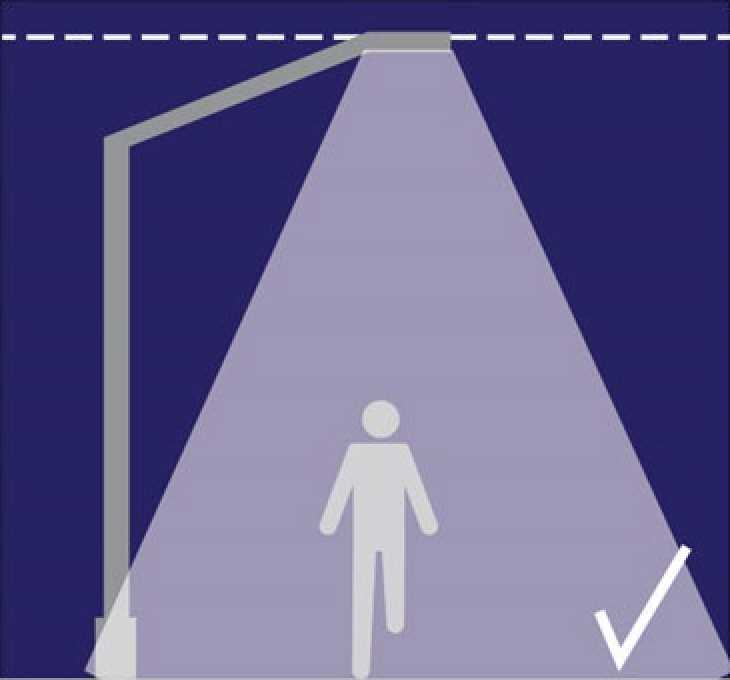
G.
Fully shielded lighting. A light fixture with a solid barrier (cap) at the top of the fixture where the bulb is located so the lamp is not visible below the cap and no light is visible above the horizontal plane, as shown in the image below.
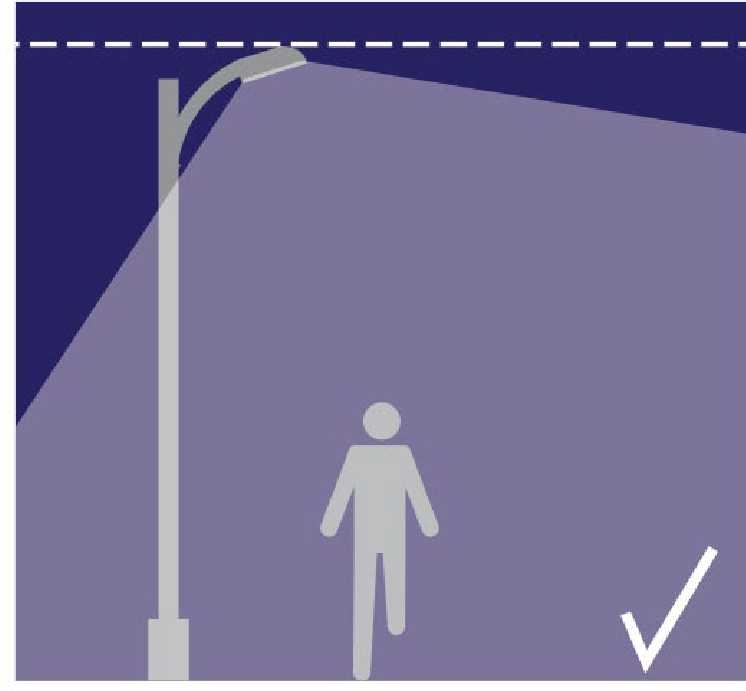
H.
Military compatibility area overlay district (MCAOD). The MCAOD is a comprehensive zoning overlay district combining the three MCAs, reflected on the official City of Fort Smith Zoning Map and Figures 1, 2, 3, and 4.
I.
Military compatibility area (MCA). In compatibility planning, the term "Military Compatibility Area" (MCA) is used to formally designate a geographic area where military operations may impact local communities and, conversely, where local activities may affect the military's ability to conduct its mission. The three MCAs within the city are:
1.
Lighting MCA. The lighting MCA addresses nighttime lighting within the runway buffer at the ends of the runways.
2.
Noise MCA. The noise MCA includes all land within the City of Fort Smith within the 65 dB DNL and higher noise contours produced from air operations at the Fort Smith Regional Airport/Ebbing ANGB.
3.
Security MCA. The Security MCA establishes regulations applicable to the sale and development of property owned by the Fort Smith Regional Airport ("airport property"); property physically contiguous to airport property; and property physically contiguous to a railroad right-of-way that is physically contiguous to airport property.
J.
Noise. From a technical perspective, sound is mechanical energy transmitted by pressure waves in a compressible medium such as air. More simply stated, sound is what we hear.
K.
Noise contour. Noise contours consist of noise impact lines constructed by connecting points of equal noise level measured in dB DNL and identifying areas on a map that fall within that particular dB DNL noise contour.
L.
Noise level reduction (NLR). Building construction measures that reduce noise to mitigate noise exposure.
M.
Noise sensitive land uses. Land uses, including any residential, medical, elderly care facilities, schools, places of public assembly and religious institutions, or other uses substantially similar in character and located within the 65 dB DNL or greater noise contours within the noise MCA.
N.
Runway. A defined area of an airport prepared for landing and takeoff of aircraft along its length.
O.
Sound transmission class (STC). A rating to measure how well a wall, floor, ceiling, or other building partition blocks sound. In simple terms, it tells us how much sound can pass through these barriers. A higher STC rating means better sound-blocking performance, reducing the amount of noise that travels between spaces. This rating is important for ensuring privacy and reducing noise disturbances, especially for residential areas and spaces requiring quiet environments like schools and hospitals.
(Ord. No. 56-24, § 1, 6-18-2024)
Sec. 27-445. - Extraterritorial jurisdiction.
A.
Title. These regulations shall be known as the "Extraterritorial Zoning Ordinance for the City of Fort Smith, Arkansas."
27-445-1
Authority and purpose. These zoning regulations are adopted pursuant to the authority granted the city by A.C.A. § 14-56-413 in order to carry out the purposes listed below:
1.
These zoning regulations have designed to promote the health, safety, and general welfare, to prevent the overcrowding of land, and to facilitate the adequate and economic provision of transportation, utilities and other public facilities.
2.
These regulations and associated districts have been designed to protect private property values, to protect both private and public investments in infrastructure and improvements, and to protect the existing and future environments in neighborhoods and developments.
3.
The zoning districts and land use maps have been determined with due consideration of future growth, development, and change in land development according to the goals and objectives expressed in the city comprehensive plan.
4.
These regulations have been designed to provide locations for each land use which are properly related to traffic, utilities, and other land uses.
5.
These regulations have been designed to eliminate congestion and to improve the living conditions and fire protection by provisions of adequate light, air, and open space.
27-445-2
Jurisdiction. These regulations govern the development and use of that real property located outside the city and which real property is described by the following legal description and is illustrated on the extraterritorial zoning map (May 6, 2003) adopted hereby:
Property description: Parts of sections 1, 2, 3, 8, 11, 12, 13, 14, 16, 17, 20, 21, 22, 23, 24, 25, 26, 27, 28, and 29, township 7 north, range 32 west, Sebastian County, Arkansas, being more particularly described as follows:
All of section 1, less and except those parcels previously annexed by the city; all of section 2, less and except those parcels previously annexed by the city; all of section 3, less and except those parcels previously annexed by the city; the south half and the south half of the north half of section 8, less and except those parcels previously annexed by city Ordinance No. 2602, as filed April 17, 1967, and city Ordinance No. 87-85, as filed August 29, 1985; all of section 11 less and except those parcels previously annexed by the city; all of section 12, less and except those parcels previously annexed by the city; all of section 13, less and except those parcels previously annexed by the city; all of section 14, less and except those parcels previously annexed by the city; the southwest quarter of the northwest quarter and the west half of the southwest quarter of section 16, less and except that portion of the platted subdivision called Fianna Estates, phase IV, as filed for record November 7, 1994, that lies within section 16; all of section 17; all of section 20, less and except that portion of the platted subdivision called Beverly Corporate Plaza, lots 1 and 2, as filed for record October 15, 1998, that lies within section 20, and the platted subdivision called Belle Chase, lots 1 thru 75, as filed for record June 22, 2000; all of section 21, less and except those parcels previously annexed by the city; all of section 22, less and except those parcels previously annexed by the city; all of section 23, less and except those parcels previously annexed by the city; all of section 24, less and except those parcels previously annexed by the city; the north half of section 25; the north half of section 26; the north half of section 27; the north half of section 28; and the north half of section 29.
Also, parts of sections 6, 7, 18, 19, 20, and 30, township 7 north, range 31 west, Sebastian County, Arkansas, being more particularly described as follows:
All of section 6, less and except those parcels previously annexed by the city and the following described parcel of land also known as the Arkansas National Guard Armory site being more particularly described as follows:
Beginning at the intersection of the west line of the fractional NE¼ of fractional section 6 with the south right-of-way line of Arkansas State Highway No. 22; thence southeasterly along said south right-of-way 379.77 feet to a point; thence south 560 feet to a point; thence west 375 feet to a point on the said west line of said fractional NE 1/4; thence north along said west line 600 feet to the point of beginning and containing 5.0 acres, more or less.
All of section 7, less and except those parcels previously annexed by the city; all of section 18, less and except those parcels previously annexed by the city; the west half and the south half of the east half of section 19; the west half of the southwest quarter of section 20; the north half of section 30.
27-445-3
Interpretations. When referring to this article, the following rules of interpretation shall be applied, except when the context clearly requires otherwise:
1.
The particular shall control the general.
2.
In the case of any difference of meaning or implication between the text of this article and any chart, graph, illustration or table, the text shall control.
3.
The terms "shall" and "will" are always mandatory and are not discretionary. The word "may" is permissive and discretionary.
4.
Words used on the present tense include the future tense; words in the future tense include the present tense; words in the singular number include the plural, and words in the plural number include the singular number.
5.
The terms "building" and "structure" shall be construed as though followed by the words, "or a portion thereof."
6.
The term "lot" includes the terms "parcel," "plot," or "tract," but does not include leased lands.
7.
The term "occupied" shall be construed as though followed by the words, "or intended, arranged, or designed to be occupied."
8.
The term "city" means the area of jurisdiction of the City of Fort Smith, Arkansas.
9.
All public officials, bodies and agencies to which reference is made are those of the city.
27-445-4
Relation to other ordinances. It is not intended that this section will in any way repeal, annul or interfere with any rules, regulations or permits that were legally adopted or issued under previous ordinances for the use of land or structures. It is not intended that this section will interfere with any easements, covenants, or other agreements between parties. However, if the provisions of this section impose greater restrictions or higher standards for the use of a lot, parcel, or tract of land than is called for by other ordinances, permits, easements or agreements, then the provisions of this section will take precedence over the others and will control the use or development of land within its jurisdiction.
27-445-5
Severability. If any specific provision or standard of these regulations or any zoning district boundary that now exists or may exist in the future is found by a court to be invalid for any reason, the decision of the court shall not affect the validity of any other section, provision, standard, or district boundary of these regulations except the provision in question. The other provision of these regulations not affected by the decision of the court shall remain in full force and effect.
27-445-6
Effective date. The extra-territorial jurisdiction regulations became effective August 6, 2002.
27-445-7
Enforcement.
1.
The provisions of this section shall be enforced by the city administrator, or designated agents, of the city.
2.
It shall be the duty of the city administrator, or designated agents, of the city to initiate proceedings for the enforcement of these regulations.
3.
If the city administrator, or designated agents, of the city finds a violation of these regulations, the director of planning shall notify the violator and give the violator a specified time to correct the violation. If the violation continues or is not corrected, the director of planning shall initiate proceedings for enforcement as described in this section.
4.
The provisions of this section may be enforced by any one, all, or combinations of remedies authorized and prescribed by this section. If a person continues to fail to comply with a particular provision of these regulations after the imposition of any type of penalty, the person shall continue to remain subject to the remedies prescribed by this section for the continued violation of the particular provisions of these regulations. The city administrator, or a designated agent, shall have the authority to prosecute actions seeking the imposition of fines and penalties for violation of the ordinance as provided herein and, after obtaining approval from the governing body of the city, may initiate judicial actions to secure injunctions and abatement orders to further ensure compliance with the ordinance. Each day's continuing violation shall be a separate and distinct offence and may be subject to any one, all, or a combination of remedies authorized and prescribed by this section.
5.
Any person or entity who violates the provisions of these regulations shall be deemed guilty of committing a misdemeanor and, upon conviction thereof, shall be subject to a penalty as set forth in section 1-9.
6.
The city administrator, or designated agents, of the city is empowered to issue citations to any person if there is a reasonable cause to believe that the person has violated any provision of these regulations. A violator shall be deemed to be the owner of the property, the agent of the owner authorized to be responsible for the property, or the occupant of the property. Citations may be directly issued to the occupant, lessee, or person having immediate beneficial use of the property. The non-occupant owner or agent responsible for the property each has the duty to maintain the property in compliance with these regulations. Written notice shall be given to the non-occupant owner, agent, or occupant prior to the issuance of any citation.
27-445-8
Definitions.
The following words, terms and phrases, when used in this section, shall have the meanings ascribed to them in this section, except where the context clearly indicates a different meaning:
Accessory building or use means a building or use which is incidental and subordinate to and serves the principal building or principal use.
Apartment house means any building or portion thereof which is designed, built, rented, leased or let to be occupied as three or more dwelling units or apartments or which is occupied as a home or place of residence by three or more families living in independent dwelling units.
Authorized agent means an architect, attorney, builder, developer or other person or persons legally empowered to act on behalf of other persons.
Board of adjustment means the board of zoning adjustment of the city.
Certificate of land use compliance means official certification that the property usage conforms to the provisions of these regulations and may be used or occupied. Unless a certificate is issued by the city administrator, or designated agents, of the city, the property cannot be used or occupied.
Church means a place of worship and religious training, including accessory housing facilities such as a rectory.
City means the City of Fort Smith, Arkansas.
City administrator means the administrator of the city.
Commission means the city planning commission.
Comprehensive plan shall mean the plan developed by the city for the purpose of bringing about an orderly, coordinated, and physical development of the city. Any reference to the comprehensive plan in the UDO shall be by express reference only. Terms or phrases in the UDO which do not expressly reference the comprehensive plan, including, but not limited to, "adopted plans," "adopted policies," "area plans," "functional plans," "planning policies," or "policies," shall not be intended to refer to the comprehensive plan.
Conditional use means uses that can be approved in a zone where they are specifically listed as conditional uses and are subject to special conditions as determined by the planning commission.
Country club (private) means an area containing a clubhouse and recreation facilities restricted to the use of specific membership and which may contain a golf course, tennis court, swimming pool, dining room, social facilities and similar recreation and service facilities, with a minimum of ten acres.
Duplex shall mean a building on a single lot that has two attached independent dwelling units.
Dwelling shall mean a building that contains one or more dwelling units used, intended, or designed to be rented, leased, let or hired out to be occupied for living purposes.
Dwelling unit shall mean a single unit providing complete, independent living facilities for one family, including permanent provisions for living, sleeping, eating, cooking, and sanitation.
Dwelling, mobile home, means a single detached single-family dwelling unit with all of the following characteristics:
1.
Designed for full-time occupancy and containing sleeping accommodations, flush toilet, tub or shower bath, and kitchen facilities, with plumbing and electrical connections provided for attachment to outside systems.
2.
Designed to be transported after fabrication on its own wheels or on a flatbed or other trailers of detachable wheels, or by other means.
3.
Designed to arrive at the site where it is to be occupied, complete and ready for occupancy except for minor and incidental unpacking and assembly operations, location on and connection to foundation supports, and connection to utilities.
Easement means a right-of-way or parcel of land specified or set aside for a specific use, normally used for access, utilities, and other public or private usage, given by the owner of land to another party, and kept free from buildings or structures.
Family, for purposes of this chapter, shall mean either:
(1)
One or more persons occupying a single dwelling unit provided that all members are related by blood, marriage or adoption and may include domestic employees housed on the premises; or
(2)
A group of not more than four persons who are not related by blood, marriage or adoption, living together as a common household in a dwelling unit.
This definition of family is established for the purpose of preserving the character of residential neighborhoods by controlling population density, noise disturbance, and traffic congestion, and shall not be applied so as to prevent the city from making reasonable accommodation where the city determines it necessary to afford handicapped persons living together in a household equal access to housing pursuant to the federal Fair Housing Amendments Act of 1988.
Flood means a temporary rise in stream level that results in water covering areas not ordinarily covered by water.
Flood hazard boundary map (FHBM) means an official map of the city or of the county issued by the Federal Insurance Administration, designating the boundaries of special flood hazards.
Floodway means the channel of a river or other water course and the adjacent land areas that must be reserved in order to discharge the base flood without cumulatively increasing the water surface elevation more than one foot.
Golf course (commercial) means a golf course, privately- or publicly-owned but opened to the public for a fee and operated as a commercial venture.
Greenhouse or plant nursery means an area or structure for the growing, display and sale, at retail, of plants, flowers, trees and other plant materials and the supplies for maintaining plant material.
Heavy industrial district means an industrial zone that is primarily for the manufacturing, assembly, and fabrication activities resulting from the processing of raw materials. Industrial uses which generate relatively high levels of noise, vibrations, smoke, dust, odor or an objectionable site condition are limited to this zone. The industrial uses permitted in this zone are generally incompatible with residential uses and therefore they should be located as far away as possible from residential and most commercial uses.
High-density residential district means a residential use zone primarily for medium to high population densities. The principal uses of land may range from two-family residential to high-density multifamily apartment residential use where the multifamily apartments do not exceed 24 units per acre.
Home occupation means an occupation carried on in a residential dwelling and/or related accessory building as an incidental, subordinate and accessory activity to the primary use of the premises.
Light commercial/office means a zone that is established to provide locations beyond the central area of the city, primarily along arterial or major collector streets which will accommodate offices or laboratories for professional persons and other related uses. This zone should not be established in a strip zoning manner along major streets but should be concentrated to provide easy accessibility to the public. The zone is intended to provide availability of professional services conveniently to all neighborhoods in the community. Uses permitted in the LCO zone would typically include offices for doctors, dentists, accountants and other similar professions, medical and dental laboratories and pharmacies. Each single LCO zone shall contain a minimum of one acre and a maximum of 20 acres.
Light industry means a district that is intended for light manufacturing, processing, storage, wholesaling and distribution. Commercial and service uses in support of industrial uses are also permitted. Examples of permitted uses are listed below:
1.
Establishments for the manufacture, processing and assembly of goods and uses. Examples of such establishments include:
a.
Clothing manufacturers.
b.
Metal fabricators.
c.
Industrial laundries.
d.
Furniture and wooden products manufacturers.
2.
General contractors and specialty contractors.
3.
Building materials and supplies.
4.
Retail, service and other commercial establishments intended to serve the needs of the industrial community. Examples of such establishments include:
a.
Industrial machinery dealers.
b.
Packaging materials.
c.
Gasoline service stations.
d.
Petroleum products dealers and wholesalers.
e.
Machine shops.
f.
Warehousing.
g.
Truck terminals.
h.
Self-service storage (mini-warehouses).
Light residential means single-family detached.
Lot means a parcel of land intended to be occupied by principal buildings or uses and accessory buildings or uses customarily intended to go with them and having frontage on a dedicated public street. A lot, as defined herein, may consist of one or more platted lots, or tract or tract conveyed or parts thereof.
Medium industrial district means an industrial use zone that is intended to primarily accommodate wholesale activities, processing, distribution, storage, and warehouse and industrial operations which may generate relatively low levels of noise, odor, smoke, dust or intense light. Residential development is excluded from this zone, both to protect residents from an undesirable environment and to facilitate maximum efficiency of industrial activity.
Medium residential means single-family and two-family, but no more than six units per acre. Lots not served by sanitary sewer must have a soil test and site evaluation. The results of the test and evaluation will determine the possibility for the maximum density of six units per acre.
Neighborhood commercial means a zone that is established to provide an area in which the primary use of the land is for commercial and service uses to serve the daily convenience needs of the surrounding residential neighborhood. The zone is intended to be located within neighborhood areas and to be integrated into the residential structure of a neighborhood in a manner that will create a minimum of detriment, hazard, or inconvenience to surrounding residential development. Each neighborhood commercial zone will be small (containing from one to five acres) and will be located within convenient walking distance from the edge of the surrounding residential area it is designed to serve. In general, the NC zones will be located from one-half to one mile from each other, or from another zone in which the daily commercial needs of a neighborhood or residential area will be served.
Nonconforming use means a use of land lawfully occupied at the time of the effective date of these regulations or amendment thereto, or which was subsequently included in the extraterritorial zoning jurisdiction of the city which does not conform to the use regulations for the zone in which it is situated.
Nursing home means a building used for lodging, boarding and nursing care, on a 24-hour basis, of four or more persons who, because of mental or physical incapacity, may be unable to provide for their own needs and safety without the assistance of another person.
Occupancy means the use or intended use of land.
Orphanage means an institution for the care of orphans or homeless children.
Park or playground (nonpublic) means a park or playground developed and sponsored by a quasi-public group or private agency for the benefit of specific groups, such as little league baseball, or the public in general.
Park or playground (public) means an open recreational facility or park owned and operated by a public agency such as the city, the county or the city school board and available to the general public.
Planning commission means the planning commission of the city.
Portable building means a temporary building that does not have a foundation and is transportable and is not used as a residential structure.
Principal use means the use which fulfills the primary function of an establishment, institution, household and other entity.
Public building means any building held, used or controlled exclusively for public purposes by any department or branch of government, state, county, or municipal, without reference to the ownership of the building or of the realty upon which it is situated. A building belonging to or used by the public for the transaction of public or quasi-public business.
School, business professional, means a business organized to operate for a profit and offering instruction and training in a service or art such as secretarial school, barber college, beauty school or commercial art school, but not including trade schools.
School, public or private, means a school under the sponsorship of a public or religious agency having a curriculum generally equivalent to a public elementary or secondary school, but not including trade or commercial schools.
School, trade or technical, means a business organized to operate for a profit and offering instruction and training in a trade such as welding, bricklaying, machinery operation and similar trades.
Single-family means a building containing one dwelling unit designed for occupancy by not more than one family.
Site means a single holding which consists of a lot, tract, parcel or acreage, or a combination thereof, not divided in any manner by a public right-of-way including a street or alley but not including easements.
Street means a public maintained right-of-way, other than an alley, which affords a primary means of access to property.
Telecommunication tower means a structure designed and constructed to support one or more antennas used by commercial wireless telecommunication facilities and including all appurtenant devices attached to it. A tower can be freestanding (solely self-supported by attachment to the ground) or supported (attached directly to the ground and with guy wires), of either lattice or monopole construction.
Truck farm means a farm devoted to the production of vegetables for the market.
Use means a purpose to which land, structures or buildings are committed.
Utility substation means a station which is subsidiary to a central station and at which a utility from the central station is converted or passed on to another area.
Zone means a section of the lands within the extraterritorial jurisdiction designated in these regulations in which requirements for the use of land and development standards are prescribed.
Zone boundaries means that boundary line which separates unlike zoning districts.
(Ord. No. 18-20, § 2(att.), 3-3-2020; Ord. No. 36-20, § 1(att,), 5-5-2020)
27-445-9
Nonconforming uses.
1.
The term "nonconforming" shall mean that which does not meet the requirements of these regulations but which was in existence on the date of adoption of this Code or, if not in existence on the date of adoption of this Code, has been in continuous existence for at least seven years.
2.
A nonconforming use of land is a use of real property which does not conform to the permitted uses in the zoning district within which the real property is located and which does not involve utilization of a structure or as to which the utilization of a structure is incidental.
3.
The term "abandonment" shall mean the cessation of a nonconforming use of land. The ceasing shall be deemed to be established by the failure to obtain or renew a privilege license for a period of at least one calendar year, the termination of utility services for at least one year or the ceasing of a nonconforming use due to a felony conviction of the owner or the authorized representative of the owner and which felony conviction is related to the subject use. Ceasing may also be established by a written statement of the intention to abandon the use by the owner or the owner's representative.
4.
A nonconforming use of land may be continued unless such use is abandoned, provided that this provision shall not be construed to approve continuation of an activity constituting a nuisance or any activity prohibited by statute or ordinance applicable to the use.
5.
A nonconforming use of land shall not be enlarged or extended, either by the addition of other real property to the use area or by the intensification of the use on the utilized real property.
6.
A nonconforming use of land may be changed to a use permitted in the same classification in which the original use is listed. However, if the original use is listed in multiple zoning district classifications, then the nonconforming use of land may only be changed to a use permitted in the most restrictive zoning district classification in which the original use is listed.
7.
A nonconforming use of land which has ceased for a continuous period of more than one year shall be deemed abandoned.
8.
A structure housing a nonconforming use that is destroyed or damaged to the extent that the cost of repair is more than 50 percent of the value of the structure after repair shall not be replaced unless all of the following conditions are met:
a.
A conditional use application is presented to the planning commission in accordance with subsection 27-445-12 of this section;
b.
The conditional use is approved by the planning commission;
c.
Construction is completed within one year from the date of the loss; the determination of cost of repair shall be based on the anticipated cost of a repair performed by a contractor in the ordinary course of the construction industry, and the determination of the value of the structure after repair shall not include real property value. Both determinations shall be made by the director of planning;
d.
The structure shall be adapted for the same use as the previous structure;
e.
The structure as built shall not exceed the bulk and area characteristics of the previous structure; and
f.
Provided a maximum time extension not to exceed 60 calendar days may be granted upon written application of the owner to the director of planning, provided substantial progress has been made to repair the structure.
27-445-10
Home occupation.
1.
The planning commission, in reviewing application for home occupations may consider the performing of a skill, talent, service or profession on a limited basis as a home occupation only if it complies with Section 27-338-4(F).
2.
The planning commission shall review home occupations at its regularly scheduled monthly meeting at which time one of the following actions may be taken:
a.
Approve as submitted.
b.
Approve with modification.
c.
Defer.
d.
Table.
e.
Deny.
3.
The planning commission may impose conditions and restriction upon the premises benefitted by the home occupation use as may be necessary to reduce or minimize the injurious effects of the home occupation.
4.
The planning commission is not required to approve any application for the operation of any home occupation which, in its opinion, is not compatible with the integrity of the neighborhood.
5.
No license for the conduct of any business will be issued until city inspections show compliance with all conditions set by the planning commission.
27-445-11
Accessory residential use.
A.
Purpose. To grant the planning and zoning department the authority to permit citizens in all residential zones to operate an accessory residential use in accordance with the criteria set forth in this section. It is further the intent of this section to regulate the operation of the accessory residential use so that the neighborhood shall be unaware of its existence.
B.
Business license. An individual with an approved business license from the city shall not be required to obtain an accessory residential use permit in order to conduct the business from his residence as long as the practice is within the criteria of section 27-324-6.
C.
Applicant. An accessory residential use permit may be sought only by the homeowner or tenant of the address for which the permit is sought.
D.
Pre-application conference. A pre-application conference pursuant to section 27-302 is recommended.
E.
Submission requirements. The director shall prepare an application form specifying the information to be submitted in support of an accessory residential use permit application. This shall include, at a minimum:
1.
Request. Request for a written description of the use.
2.
Space. Requirement of a calculation of the amount of space to be occupied by the use.
3.
Fee. Application fee established by the board of directors.
4.
Affidavit. Affidavit from the applicant that the proposed use meets each of the approval criteria established in subsection 27-324-6 and that the applicant gives the city permission to withdraw the permit should a valid neighborhood complaint be received which identifies actions that violate the terms of the accessory residential use approval. Withdrawal shall take place pursuant to section 27-314.
5.
License. Copy of a valid business license issued by the city.
F.
Application and review procedure.
1.
Determination of completeness. Applications shall be submitted to the director for a determination of completeness pursuant to section 27-303.
2.
Review. Complete applications shall be reviewed by the director. If the director determines that the application meets the requirements of the UDO (including the provisions of subsection 27-324-6C) the application shall be approved.
3.
Criteria. Applicants for an accessory residential use shall meet all of the following requirements:
a.
The activity shall be contained in an area no greater than 30 percent of the total heated living space of the residential structure, and there shall be no alteration to the residential structure and no separate outside entrance for the business area of the residential structure.
b.
Only resident members of the household shall operate the activity.
c.
No inventory of materials or supplies other than normal office, art, craft or photography supplies shall be stored at this location.
d.
No customers shall be served in person at this location.
e.
The address shall not be used for any advertising.
f.
No signs shall be used.
g.
No business vehicle larger than a pick-up truck shall be housed at the residence.
4.
Appeal. If the director denies an application for an accessory residential use, the denial may be appealed to the planning commission. No further action shall be taken on the application pending the decision of the planning commission.
G.
Conditions for approval. When an accessory residential use application is approved, the planning and zoning department is allowing the applicant the privilege of engaging in a specific designated activity at a specific residential address. An approved accessory residential use cannot be moved, transferred, or relocated to another address, or remain at the address where it was approved if a new owner occupies the property. If the owner to which the permit was issued moved, the approval does not transfer nor remain at the residence with the new owner, the approval is considered void. The applicant is required to give the planning and zoning department permission to withdraw the accessory residential use permit should a reasonable complaint be received.
H.
Withdrawal of permit. When one verifiable complaint is received on the applicant or location for which the permit approval was issued, or when a violation of any of the criteria set forth in this subsection is confirmed, the accessory residential use may be withdrawn pursuant to section 27-314.
27-445-12
Conditional uses. The conditional use permit process allows for special conditions to be attached to a development where the proposed use in not totally inconsistent with the other permitted uses but it may have a significant impact on the surrounding area. The planning commission's intent is to provide flexibility for the petitioner by identifying those special conditions for specific uses without making the ordinance unreasonably strict.
Those uses which are deemed as conditional uses are listed under the extraterritorial open-1 zone (ETJ O-1) in subsection 27-445-19 of this section.
Conditions:
1.
All conditions required for a conditional use permit must be met before any part of the use can be utilized. If any condition is not met, the conditional use authorization may be revoked by the city.
2.
All conditions required for a conditional use permit must begin to be met within one year of the authorization unless a special time limit has been imposed by the planning commission. An extension of time beyond one year or that imposed by the planning commission may be granted by the director of planning one time for up to 90 days.
3.
The planning commission will review the conditional use permit based on adopted development criteria and if it determines that the criteria have been met it may approve the application unless it determines that if the development is completed as proposed, there is a probability that the development will:
a.
Not adequately safeguard the health, safety, and general welfare of the persons residing or working in adjoining or surrounding properties;
b.
Impair an adequate supply of light and air to the surrounding property;
c.
Unduly increase congestion on the roads, or the hazard from fire, flood or similar dangers;
d.
Diminish or impair established property values on adjoining or surrounding properties; or
e.
Not be in accord with the intent, purpose, and spirit of the extraterritorial zoning ordinance and land use policies.
4.
A conditional use permit authorizes the permit holder the use of land in a particular way and subject to certain conditions. As such it is transferable to an owner of the same property. However, no person may make use of the land covered under such permit except in accordance with all terms and requirements of the permit, so long as the permit remains in effect.
5.
The decision of the planning commission concerning a conditional use request may be appealed to the board of directors in accordance with section 27-337-8.
(Ord. No. 37-12, § 1(amd. 2), 5-1-2012; Ord. No. 37-22, § 1, 5-3-2022)
27-445-13
Temporary use permits. The director of planning may grant a temporary use special permit for religious revivals, temporary recreational facilities, temporary medical facilities, temporary classroom facilities for public and private institutions and similar uses that do not involve retail or food or beverage sales activities, provided that the use complies with regulations governing area, parking, signs, sanitation requirements etc., for the area and does not constitute a nuisance for adjacent properties. Temporary use special permits when granted will be for a specified duration of time, not to exceed 60 days, and are renewable for 60-day periods thereafter. Permits for periods in excess of 120 days (one initial period plus one renewable permit) must be reviewed and approved by the planning commission.
Construction offices that are necessary for the sole purpose of providing a temporary office for a particular construction project will not be required to obtain a temporary use special permit when a land use permit has been issued. The construction office may be allowed to remain on the site for the duration of the project. The construction office must be located on the project site and must not constitute a nuisance for adjacent properties. The director of planning may establish special criteria for the location and set-up of a construction office.
Any mobile (retail) structure (trailer) existing at the time of this provision may continue to operate provided that this provision shall not be construed to approve continuation of an activity constituting a nuisance or an activity prohibited by statute or ordinance applicable to the use and that the structure has a valid temporary use special retail permit and/or a valid business license for the special site on which it is located. However, should the mobile retail structure be removed from the site for 30 consecutive calendar days, it shall be considered a nonconforming mobile retail structure and shall not operate at that location.
27-445-14
Classification of unlisted uses. When uses arise that have not been classified, the following procedure shall be used to determine the proper classification for those uses:
1.
The director of planning shall make an administrative decision as to the appropriate zones in which an unlisted use will be allowed.
2.
The decision of the director of planning concerning the appropriate zones for an unlisted use may be appealed to the planning commission. The following procedure shall be used for such appeals:
a.
Upon request of the person wishing to appeal, the director of planning will refer the question of the location of an unlisted use to the planning commission for the commission's decision.
b.
The appeal will contain a statement of facts concerning the nature of the use, including pertinent information such as the types of sales anticipated, types of dwelling activities anticipated, whether enclosed or open storage accompanies the use, types of products manufactured or sold, and information about odor, noise, fumes, dust and toxic materials generated by the planned use. In addition, the appeal should contain information about the demand that will be placed on public utility services by the use.
3.
Upon receiving the appeal, the planning commission will consider the nature of the proposed use and its compatibility with uses permitted in the zones for which the use is proposed and then make a decision upon the request.
4.
The decision of the planning commission on the appropriate zone of a new use may be appealed to the board of directors in accordance with section 27-337-8.
(Ord. No. 37-22, § 1, 5-3-2022)
27-445-15
Amendments.
A.
The board of directors may supplement, change or amend the zoning map and the zoning regulations in the manner prescribed by A.C.A. § 14-56-421.
B.
A change in the zoning map or the zoning regulations may be proposed by the city planning commission either on its own initiative or upon the application of any interested property owner within the area proposed for a change.
1.
Before the planning commission shall recommend any alteration or change in the zoning map or regulations to the board of directors, the planning commission shall hold a public hearing and the proponent of such alteration or change will cause notice of said hearing is made in a newspaper or general circulation in the city at least one time 15 days prior to that hearing. In connection with this public notice and in addition thereto, any proponent for a zoning map change, other than the planning commission, shall deliver to the director of planning the following information: the legal description of the property proposed to be rezoned; the street address of the entire petitioned area; the present zone and the proposed zone, and the names and addresses of all persons listed on the current tax records as the owners of all property within 300 feet of the petitioned property, including property across any street and intersection and all owners of property within the petitioned area, and finally, the date that the petition will be heard by the planning commission. This information will be utilized by the director of planning by mailing notices to all persons listed therein, notifying them of the public hearing on such proposed change and listing the street addresses of the property and the proposed change. In addition, for applications to change the zoning map, other than those made by the planning commission, the director of planning will, no later than ten days prior to the date of the public hearing, cause adequate signs to be posted on the petitioned premises so that the information thereon will be visible to the general public and the signs shall contain the information that the planning commission has been petitioned to change the zoning and that the current zoning and proposed zoning will be listed on the sign as well as the date on which the public hearing is to be held. It shall be a misdemeanor to remove or tamper with this sign, punishable by a fine of not less than $10.00, nor more than $100.00 and a statement to this effect shall be on the sign. The information required in this section for an alteration in the zoning map or regulations shall be submitted to the director of planning at least 20 days prior to the date of the public hearing, scheduled before the planning commission. Following the public hearing, the planning commission may adopt any proposed alterations or changes in the zoning map or regulations as present or in a modified form by a majority vote of the entire planning commission, and shall certify such recommendations to the board of directors for further procedure in conformity with A.C.A. § 14-56-401 et seq. Such certified recommendations shall be automatically placed on the agenda of the board of directors at the second regularly scheduled meeting following action by the planning commission. Subsequent to the filing of an application for a change in the zoning map and the publication of the notices provided for in this subsection, the application may not be withdrawn or the date set for the hearing of the application postponed without the approval of the planning commission.
2.
Where changes or alterations in the zoning map or regulations are proposed by a property owner, then such property owner shall bear the expense of publication of notice given by the planning commission, in addition to the expense of publication of the ordinance after adoption by the board of directors, and in addition thereto, shall deposit with the planning department the sum established by the board of directors.
3.
Appeals from decisions of the planning commission shall be in accordance with section 27-337-8.
(Ord. No. 37-22, § 1, 5-3-2022)
27-445-16
Use regulation types of uses. The ETJ use matrix, section 27-445-28, is based on the American Planning Association's land-based classification system (LBCS), as interpreted by these regulations and the city planning department. All of the use categories listed in the use table are defined in subsection 27-445-8, definition of uses or the land-based classification system of the American Planning Association.
1.
Classifications.
a.
Uses permitted by right. A "P" indicates that a use is allowed by right in the respective district. Such uses are subject to all other applicable regulations.
b.
Uses permitted conditionally. A "C" indicates that a use is allowed conditionally, subject to the issuance of a conditional use permit.
c.
Accessory uses. An "A" indicates that a use is typically permitted as an accessory use.
d.
Blank. A blank cell in the use table indicates that a use category is not allowed in the indicated district.
2.
Unlisted uses. The director shall determine whether or not an unlisted use is part of an existing use category. Any interpretation made by the planning department or planning commission shall be deemed final regardless of the contents of the LBCS.
27-445-17
Dimensional standards.
1.
Lot area.
a.
Measurement. Lot area is measured as the amount of net land area contained within the property lines of a lot or parcel, not including right-of-way for streets.
b.
Utilities. Utilities using land or an unoccupied building covering less than 1,000 square feet of site area are exempt from minimum lot area standards.
2.
Lot width. Lot width is the width of the lot as measured at the front setback line.
3.
Street frontage. Street frontage (or frontage) is the distance along a property line that is also the right-of-way line of a public street. It is measured between side lot lines along the front lot line.
4.
Setbacks.
a.
Measurement. Setbacks are the minimum horizontal distance between the front or side of a building and the front lot line or side lot line of the lot on which the building is located, disregarding any exceptions or projections allowed by these regulations. The setback line is a line which is the specified distance from and parallel to any lot line.
b.
Along a private street, setback measurement shall start at a point 25 feet from the street centerline.
c.
The following structures may encroach no more than three feet into required setbacks if they are approved by the city building official and provided that they do not cross property lines or utility easements:
1.
Patios, terraces, walks, and driveways, provided they are at grade and not covered;
2.
Porches, decks landings, and stairs, provided they are for single-story buildings and are not covered;
3.
Play equipment;
4.
Clothesline poles;
5.
Portable yard furniture;
6.
Fences;
7.
Flagpoles;
8.
Overhangs, coves, and cornices as defined in the currently adopted building code may be allowed, provided they do not exceed three feet. The definition of overhang specifically excludes any exterior wall of any structure regardless of its elevation above ground level.
d.
Setback averaging. Regardless of the minimum front or rear setback required by the underlying zoning district, front or rear setbacks may be adjusted to the average of the existing setbacks of the lots with structures that are on both sides of the subject lot. All residential lots on a cul-de-sac street that have frontage on the radius of the cul-de-sac are permitted to have a front yard setback of 20 feet.
e.
Except as otherwise provided in individual zone districts and/or overlay districts, signs are exempt from setbacks and other requirements provided they are erected in compliance with the provisions of all applicable ordinances.
5.
Lot coverage. Lot coverage is the maximum percentage of the lot that may be covered by structures and other impervious surfaces. It is calculated by dividing the square footage of impervious cover by the square footage of the lot.
6.
Floor area ratio (FAR). Floor area ratio is measured as the gross floor area of all buildings on a lot or parcel divided by the lot area.
7.
Height.
a.
Measurement. Building height is the mean vertical distance from the average ground level abutting a building or structure to the highest permanent part of the building or structure.
b.
A structure may not be more than the maximum allowable feet high at the minimum side setback line, but for each addition foot of horizontal setback in excess of the minimum, the height may be increased by one foot. The height of a gabled end of a building shall be measured at the midpoint of the gable instead of the peak of the gable.
c.
The following structures may be exempted from the height requirements in the various districts if they are not detrimental to neighboring property and are approved by the city building official:
1.
Chimneys;
2.
Vents;
3.
Flagpoles;
4.
Antennas for reception only of radio and television signals (transmitting antennas, towers, and other structures on which receiving antennas are located are not exempt from height or other setback requirements).
d.
The construction, maintenance, or establishment of any building, tree, smokestack, chimney, flagpole, wire, tower, or other structure or appurtenance thereto, which may constitute a hazard or obstruction to safe air navigation, landing, or take off of aircraft near an airport, is prohibited. Regulations adopted by the Federal Aviation Agency (FAA) shall be minimum standards. No request shall be approved if it violates FAA standards.
8.
Building separation. Required building separation shall be determined by the Arkansas Fire Prevention Code.
9.
Density. Density is measured by net lot area, not including streets or other dedicated rights-of-way.
27-445-18
Street hierarchy. Street classification as used in these regulations is as follows, from lowest to highest:
1.
Residential;
2.
Residential collector, restricted parking;
3.
Residential collector;
4.
Major collector;
5.
Minor arterial;
6.
Major arterial;
7.
Boulevard;
8.
Industrial.
27-445-19
Extraterritorial open zone (ETJ open-1) created. All real property identified in the extraterritorial zoning jurisdiction as defined in section 27-445-2 is hereby zoned extraterritorial open zone (ETJ open-1). The following zoning district regulations shall apply to all properties zoned as ETJ open-1:
1.
Characteristics. A zone to protect the undeveloped areas within the city's extraterritorial zoning jurisdiction from incompatible land use or other specific uses that may constitute a nuisance to the residents therein or uses that may create an endangerment to the health, safety, or general welfare of the jurisdiction's population. The ETJ open-1 zone designation may be utilized as a zoning classification for properties until a distinct land utilization pattern is developed in keeping with the city's ETJ master land use plan and other land use policies.
2.
Permitted uses.
a.
General uses:
1.
Single-family homes;
2.
Two-family homes (duplexes);
3.
Nurseries and greenhouses, private and commercial;
4.
Truck farms;
5.
Private or public golf courses;
6.
Fire and police stations;
7.
Utility substations;
8.
Parks, playgrounds and other open spaces.
b.
Conditional uses:
1.
Agricultural (not including commercial/industrial operations, e.g., commercial food lots, processing plants, and sales yards);
2.
Churches;
3.
Country clubs of more than ten acres;
4.
Boarding schools;
5.
Nursing homes;
6.
Orphanages;
7.
Public, private or parochial schools and colleges (not including industrial trade schools);
8.
Public buildings.
c.
Accessory uses.
1.
Guest houses, not including mobile homes and employees' quarters, not including mobile homes.
2.
Accessory farm buildings (requires conditional use permit) including barns, cribs, sheds, tool rooms, shops, bins, tanks, and silos. All structures for the housing of large and small domestic farm animals shall be located no closer than 100 feet from any property line.
3.
Accessory open or closed storage of farm materials, products, equipment and vehicles.
4.
Accessory farm dwellings, not to include mobile homes, two on farms with a minimum of 50 tillable acres. These dwellings shall share a common entrance from a public or private road or highway and shall be occupied by permanent employees of the farm or immediate members of the family owning or operating the farm. All accessory farm dwellings shall be landscaped and screened from adjacent properties.
5.
Other accessory uses, as determined by the planning commission, that are incidental to the permitted uses and not detrimental to the adjacent properties or the character of the ETJ open-1 zone.
(Ord. No. 19-12, § 1, 3-6-2012; Ord. No. 18-20, § 2(att.), 3-3-2020)
27-445-20
Rural residential (RR).
1.
Purpose. To provide areas for low intensity agricultural operations and very low-density single-family uses rural areas. This district is appropriate where low-density development is desired or where lack of public facilities and services requires low-intensity development. Development in this district shall be designed to allow for the future planned expansion of utilities and services where necessary. RR zoning is appropriate in the low-density residential future land use classification of the city ETJ land use map.
2.
Uses. Permitted, conditional and accessory uses in the RR district are identified in subsection 27-445-28, ETJ use matrix. Specific uses not identified on the use list are subject to classification by the director. No more than one principal structure may be erected on each defined lot.
3.
Area and bulk regulations.
4.
References to other standards. Development in the city extra-territorial jurisdiction area shall conform to the following standards of the city zoning ordinance:
27-445-21
Residential estate (RE).
A.
Purpose. The purpose of the residential estate district is to provide areas for low-density, large lot single-family residential development. Property zoned RE should include tracts that abut or are in close proximity to existing or approved large-lot single-family development, making RE an appropriate transition between rural and suburban uses. Where public facilities and services are not yet available, development in this district shall be designed to allow for the future planned expansion of utilities and services where necessary. RE zoning is appropriate in the low-density residential future land use classification of the city ETJ land use map.
B.
Uses. Permitted, conditional and accessory uses in the RE district are identified in subsection 27-445-28, ETJ use matrix. Specific uses not identified on the use list are subject to classification by the director. No more than one principal structure may be erected on each defined lot.
C.
Area and bulk regulations.
D.
References to other standards.
27-445-22
Residential single-family low-density (RS-1).
A.
Purpose. The purpose of the single-family low-density district is to maintain, protect, and provide opportunities for low-density residential development in spacious environments, along with compatible limited public and institutional uses. RS-1 zoning is appropriate in the low-density residential category of the city ETJ land use map.
B.
Uses. Permitted, conditional and accessory uses in the RS-1 district are identified in subsection 27-445-28, ETJ use matrix. Specific uses not identified on the use list are subject to classification by the director. No more than one principal structure may be erected on each defined lot.
C.
Area and bulk regulations.
D.
References to other standards.
27-445-22.1
Residential single-family medium-density (RS-2).
A.
Purpose. A low to medium-density district allowing residential uses for single-family homes, duplexes and manufactured homes in areas where adequate public services and facilities are available. RS-2 zoning is appropriate in suburban areas in the low-density residential category of the city ETJ land use map.
B.
Uses. Permitted, conditional and accessory uses in the RS-2 district are identified in subsection 27-445-28, ETJ use matrix. Specific uses not identified on the use list are subject to classification by the director. No more than one principal structure may be erected on each defined lot.
C.
Area and bulk regulations.
1.
Minimum parcel/lot size for rezoning to MUR.
a.
New district: two acres.
b.
Extending existing district: one acre.
D.
References to other standards.
E.
Additional requirements. Single-family dwellings constructed or installed in a single-family medium-density (RS-2) zone shall be subject to the following additional requirements:
1.
The principal structure must be wider than 22 feet.
2.
The principal structure must have a minimum pitched roof of three in 12 or 14 degrees or greater.
3.
The principal structure shall be appropriately sited on the lot, with the front door or main entry of the home oriented to the front of the lot.
4.
The principal structure must be placed upon permanent foundations that consist of concrete footings and piers or perimeter foundations.
5.
The principal structure must be completely underpinned around the entire perimeter with masonry materials.
6.
The principal structure must have all transport elements such as wheels, axles, trailer or transport hitched and exterior lighting systems attached for highway use removed.
7.
The exterior siding consists of vinyl or aluminum lap siding, wood, Masonite, or other materials similar to the exterior siding commonly used in standard residential construction. All exterior finish materials of the principal structure shall be compatible with the neighborhood.
F.
Mobile home park requirements.
1.
Location.
a.
Mobile home parks may be located in any area zoned residential single-family medium-density (RS-2), provided a conditional use has been approved by the planning commission in accordance with this section 27-445.
b.
It shall be unlawful to park any mobile home to be occupied for dwelling or sleeping purposes within the extraterritorial jurisdiction (ETJ) of the city, as the same now exists or may be hereafter designated, outside a licensed mobile home park or an approved mobile home subdivision.
2.
Site plan. Prior to the issuance of a development permit, a detailed site plan showing all requirements shall be submitted to the director of planning for approval.
3.
Supervision. The licensee or permittee, or a duly authorized attendant or caretaker, shall be in charge at all times to keep the mobile home park, its facilities and equipment in a clean, orderly and sanitary condition. The attendant or caretaker shall be answerable, with the licensee or permittee, for the violation of any provision of this division to which the licensee or permittee is subject.
4.
Wall. Where any boundary of a mobile home park directly abuts property which is improved with a permanent residential building or directly abuts unimproved property which may, under existing laws and regulations, be used for permanent residential building construction, a wall, solid fence, or hedge screen with a minimum height above finish grade of six feet shall be provided along such boundary.
5.
Drainage. The mobile home park shall be located on a well-drained site, properly graded to ensure rapid drainage and free from stagnant pools of water.
6.
Size of spaces. Each mobile home park shall provide mobile home spaces, and each such space shall be clearly defined or delineated. Each space shall have a minimum depth of 60 feet and width of not less than 40 feet.
7.
Placement of homes. Mobile homes shall be so located on each space that there shall be at least a 20-foot clearance in all directions between mobile homes or buildings within the mobile home park. No mobile home shall be located closer than ten feet to any property line of the park which does not abut upon a public street or highway. No mobile home park shall be located closer to any property line of the park abutting upon a public street or highway within 25 feet or such other distance as may be established by ordinance or regulations as a front yard or setback requirement, with respect to conventional buildings in the zone in which the mobile home park is located.
8.
Curb and gutter roadway required. All mobile home park spaces shall abut upon a curb and gutter roadway of not less than 22 feet in width, which shall have unobstructed access to a public street or highway.
9.
Illumination of driveways, walks. All roadways and walkways within the park shall be hard-surfaced and area lighting shall be required at all roadway intersections and at 300 feet intervals along all roadways and walkways. The minimum size for lamps shall be 175 watts mercury vapor or equivalent.
10.
Electrical services. Electrical services shall be constructed in accordance with the current adopted city electrical code.
11.
Water supply. An adequate supply of pure water for drinking and domestic purposes shall be supplied by pipes to all buildings and mobile home spaces within the park to meet the requirements of the park. Each mobile home space shall be provided with a cold-water tap at least four inches above the ground. An adequate supply of hot water shall be provided at all times in the service buildings for all bathing, washing and cleansing facilities.
12.
Sanitation facilities. Each mobile home park shall provide sanitation facilities in compliance with the rules and regulations pertaining to mobile home and travel trailer parks as adopted by the state board of health.
13.
Specifications of service buildings.
a.
Service buildings housing sanitation facilities shall be permanent structures complying with all applicable ordinances and statutes regulating buildings, electrical installations and plumbing and sanitation systems.
b.
The service buildings shall be well lighted at all times of the day and night, shall be well ventilated with screened openings, shall be constructed of such moisture-proof material, which may be painted woodwork, as shall permit repeated cleaning and washing and shall be maintained at a temperature of at least 68 degrees Fahrenheit during the period from October 1 to May 1. The floors of the service buildings shall be of water-impervious material.
c.
All service buildings and the grounds of the park shall be maintained in a clean, sightly condition and kept free of any condition that will menace the health of any occupant or the public or constitute a nuisance.
14.
Sewage and refuse disposal.
a.
Water from showers, bathtubs, flush toilets, urinals, lavatories and slop sinks in service and other buildings within the park shall be discharged into a public sewer system in compliance with applicable provisions of this Code and city ordinances or into a private sewer and disposal plant system of such construction and in such manner as will present no health hazard.
b.
Each mobile home space shall be provided with a sewer at least four inches in diameter, which shall be connected to receive the waste from the shower, bathtub, flush toilet, lavatory and kitchen sink of the mobile home harbored in such space and having any or all of such facilities. The sewer in each space shall be connected to discharge the mobile home waste into a public sewer system in compliance with applicable ordinances or into a private sewer and disposal plant system of such construction and in such manner as will present no health hazard. Plans for construction of sewage disposal and/or treatment facilities shall be approved by the state board of health and the city.
15.
Fire protection. Every mobile home park shall be equipped at all times with fire extinguishing equipment and hydrants in good working order of such type, size and number and so located within the park as to satisfy applicable regulations of the fire department. No open fires shall be permitted at any place which may endanger life or property. No fires shall be left unattended at any time.
16.
Animals and pets. No owner or person in charge of any dog, cat or other pet animal shall permit it to run at large or commit any nuisance within the limits of any mobile home park.
17.
Parking space. Each mobile home space shall have a minimum of two off-roadway, ten feet by 20 feet, all-weather parking spaces.
18.
Open or recreational area. Not less than five percent of the gross site area of the mobile home or recreational vehicle park, shall be devoted to recreational facilities, generally provided in a central location. In large parks this may be decentralized. Recreational areas may include space for community buildings and community use facilities such as adult recreations, child play areas, and swimming pools, but not include vehicle parking areas. When playground space is provided, it shall be so designated and protected from traffic, thoroughfares, and parking areas. Such space shall be maintained in a sanitary condition and free of safety hazards.
27-445-23
Neighborhood compatible (C-1).
A.
Purpose. To provide small areas for limited office, professional service, and local retail designed in scale with surrounding residential uses. This district encourages the incorporation of neighborhood-scale commercial uses in proximity to residential uses for each of accessibility and promotion of pedestrian-oriented development. C-1 zoning is appropriate in the neighborhood commercial classification of the ETJ land use map.
B.
Uses. Permitted, conditional and accessory uses in the C-1 district are identified in subsection 27-445-28, ETJ use matrix. Specific uses not identified on the use list are subject to classification by the director. No more than one principal structure may be erected on each defined lot; however, second-story residential is permitted as a second use in all commercial structures.
C.
Area and bulk regulations.
1.
Minimum parcel/lot size for rezoning to C-1:
a.
New district: minimum 7,000 square feet, maximum two acres.
b.
Extending existing district: minimum 7,000 square feet, maximum 21,000 square feet.
2.
Maximum building total for development: 30,000 square feet; maximum individual building or unit in multi-unit structure: 5,000 square feet.
3.
Required street access: residential collector or higher.
D.
References to other standards.
27-445-24
Commercial light (C-2).
A.
Purpose. To provide office, service, and retail activities that are located at the edge of residential areas but which serve an area larger than adjacent neighborhoods. The C-2 district is intended to accommodate well designed development sites that provide excellent transportation access, make the most efficient use of existing infrastructure, and provide for orderly buffers and transitions between uses. C-2 zoning is appropriate in the commercial neighborhood classification of the ETJ land use map.
B.
Uses. Permitted, conditional and accessory uses in the C-2 district are identified in subsection 27-445-28, ETJ use matrix. Specific uses not identified on the use list are subject to classification by the director. No more than one principal structure may be erected on each defined lot; however, second-story residential is permitted as a second use in all commercial structures.
C.
Area and bulk regulations.
1.
Minimum parcel/lot size for rezoning to C-2:
a.
New district: 42,000 square feet.
b.
Extension of existing district: 7,000 square feet (one lot).
2.
Maximum individual building square footage on a single lot: 30,000 square feet.
3.
Required street access: major collector or higher.
D.
References to other standards.
27-445-25
Commercial moderate (C-3).
A.
Purpose. To provide for general commercial activities, offices, and services to serve the community. This district promotes a broad range of activities, commercial operations, and services that are dispersed throughout the city and designed at a smaller scale than a regional center. C-3 zoning is appropriate in the light commercial office classification of the ETJ land use map.
B.
Uses. Permitted, conditional and accessory uses in the C-3 district are identified in subsection 27-445-28, ETJ use matrix. Specific uses not identified on the use list are subject to classification by the director of planning and zoning. No more than one principal structure may be erected on each defined lot; however, second-story residential is permitted as a second use in all commercial structures.
C.
Area and bulk regulations.
1.
Minimum parcel/lot size for rezoning to C-3: two acres.
2.
Maximum individual building square footage on a single lot: 60,000 square feet.
3.
Required street access: major collector or higher.
D.
References to other standards.
27-445-26
Industrial light (I-1).
A.
Purpose. To provide for a mix of light manufacturing uses, office park, research and development, and limited retail/service uses in an attractive, business park setting. Industrial light may be used as a transition between mixed use or commercial uses and heavier industrial uses. I-1 zoning is appropriate in the light industrial classification of the ETJ land use map.
B.
Uses. Permitted, conditional and accessory uses in the industrial-1 district are identified in subsection 27-445-28, ETJ use matrix. Specific uses not identified on the use list are subject to classification by the director.
C.
Area and bulk regulations.
1.
Minimum parcel/lot size for rezoning to I-1:
a.
New district: two acres.
b.
Extension of existing district: 20,000 square feet unless extension of existing development.
2.
Required street access: major arterial or higher.
3.
Side/rear setback abutting residential may be reduced to 60 feet with planning commission approval of screening/landscaping through development plan approval process.
D.
References to other standards.
27-445-27
Industrial moderate (I-2).
A.
Purpose. To provide for industrial uses that can be operated in a clean and quiet manner that will not be obnoxious to adjacent uses and have relatively limited environmental impacts. I-2 uses are primarily contained indoors and have heavier traffic generation than I-1 uses. I-2 zoning is appropriate in the industrial classification of the ETJ land use map.
B.
Uses. Permitted, conditional and accessory uses in the industrial-2 district are identified in subsection 27-445-28, ETJ use matrix. Specific uses not identified on the use list are subject to classification by the director.
C.
Area and bulk regulations.
1.
Minimum parcel/lot size for rezoning to I-2:
a.
New district: ten acres.
b.
Extension of existing district: 20,000 square feet unless extension of existing development.
2.
For buildings and structures located between 100 and 150 feet of residentially zoned property, for each additional foot of setback in excess of the minimum required setback, building height may be increased by one foot. Buildings or structures located more than 150 feet from residentially zoned property shall have no specific height requirement.
3.
Side/rear setback abutting residential may be reduced to 60 feet with planning commission approval of screening/landscaping through development plan approval process. Additional building height may not be calculated in this space.
4.
Required street access: major arterial or higher.
D.
References to other standards.
27-445-28
ETJ use matrix.
(Ord. No. 24-11, § 1, 4-5-2011; Ord. No. 37-12, § 1(amd. 3), 5-1-2012; Ord. No. 64-12, § 1, 9-4-2012; Ord. No. 76-15, § 1(att.), 11-3-2015; Ord. No. 36-20, § 1(att,), 5-5-2020; Ord. No. 86-20, § 2(att.), 10-6-2020; Ord. No. 11-23, § 1, 2-7-2023; Ord. No. 79-23, § 1, 10-10-2023; Ord. No. 92-23, § 1, 11-7-2023)
27-445-29
Commercial communication towers.
A.
Purpose. The purpose of these regulations is described as follows:
1.
Minimize the adverse effects and impact of towers through careful design, siting and screening;
2.
Conserve the value of adjacent land and buildings;
3.
Avoid potential damage to adjacent properties through engineering and careful siting of tower structures; and
4.
Maximize use of existing towers in order to reduce and minimize the number of towers needed.
B.
Approved tower locations (zoning districts). As defined herein, commercial communication towers are prohibited within any public right-of-way, utility easement or residential zoning districts unless granted by conditional use permit. Such uses are allowed by right within C-3, I-1 and I-2 zoning districts subject to applicable zoning restrictions, as well as the following restrictions set forth herein.
C.
Ownership. The proposed location for the tower must be large enough to accommodate the communications tower and support facilities, and must include access to a public right-of-way or accessible parking area. Purchase or ownership of a separate parcel may require platting and improvements before construction permits can be issued.
D.
Construction. In order to minimize visual impacts and possible damage that can result from the presence of such facilities, towers (including attached antennas) are limited to monopole construction and shall not exceed 200 feet in height. Compliance with all requirements of the city building code, including a licensed engineer's structural certification of the tower structure and foundation, must be demonstrated before a building permit will be issued.
E.
Setback. All commercial towers must meet the minimum setbacks for the zoning districts in which they are located. Additionally, commercial towers must be set back from any residential structure a number of feet equal to that distance stated by the tower manufacturer's registered structural engineer's determination of the maximum possible fall zone for the tower. The structural engineer shall be licensed in the state.
F.
Appearance. No lights, signals or illumination shall be permitted on any tower unless required by the Federal Communication Commission (FCC), Federal Aviation Administration (FAA), or other federal, state or city agency. No commercial advertising, signage or flags shall be allowed on any tower. This shall not prevent the joint use of a legal existing sign structure as a support mechanism for antennas or microwave dishes. Towers and accessory facilities must be colored or painted in muted tones that minimize their visibility, unless otherwise required by the FCC, FAA, or other federal, state or city agency.
G.
Site design. The area containing the monopole, accessory and support structures, and the immediate surrounding area utilized for servicing of the communication tower shall be secured by a minimum eight-foot chainlink fence. The area within the fence must be either paved or graveled and kept weed-free. Other than the street side of the site, any side that faces any residential use shall include opaque fencing or sufficient shrubs to screen the site. Any shrubbery provided will be planted and maintained within the next appropriate growing season. If security lighting is installed, such light should be directed into the site and only triggered by motion detectors.
H.
Co-location. To minimize tower proliferation, each applicant proposing to construct a commercial communication tower shall with the building permit or conditional use permit application submit a statement of the following in writing:
1.
Whether any tower or suitable structure exists, within the geographic area to be served by the proposed new tower, which meets the applicant's engineering requirements.
2.
Whether existing towers or suitable structures are of sufficient height to meet the applicant's engineering requirements;
3.
Whether existing towers or suitable structures have sufficient structural strength to support applicant's proposed antenna and related equipment;
4.
Whether the fees, cost, and/or contractual provisions required by the owner of an existing suitable site for co-location of the applicant's antenna are commercially reasonable; and
5.
Other significant limiting factors make existing towers or structures unsuitable for co-location of the proposed antenna.
The permit issuing agent of the city shall utilize the submitted information, together with other available information, to determine whether co-location may be waived and a new commercial communication tower be authorized for construction.
The decision of the agent of the city concerning co-location may be appealed to the planning commission. Any interested party may file an appeal provided that the appeal is filed with the planning commission by 5:00 p.m. on the tenth calendar day following the date of the decision by the agent. A fee in the amount established by the board of directors is required for filing an appeal.
Antennas may be placed wholly within or upon any building located within a commercial or industrial zoning district as permitted in subsection 27-445-29B of this section or any publicly-owned building, provided any supporting equipment is screened from nearby residential districts. A commercial antenna may be mounted to the exterior of such buildings if integrated into the overall architectural design of the building. Roof-mounted antennas may not extend more than 20 feet above the highest point of the roof structure, provided any supporting equipment is screened from nearby residential districts. A commercial antenna may be attached to any utility structure (such as a water tower or electrical transmission tower) or to a public building not located in a street right-of-way and owned by a government or public agency, provided that the antenna does not extend more than 20 feet above the height of the structure, provided any supporting equipment is screened from nearby residential districts. At the time a building permit is issued, the planning department may notify all existing telecommunication providers of the opportunity for co-location. Notice of a desire to co-locate shall be given within 60 days of the receipt of said notice.
27-445-30 Permits.
Any owner or authorized agent who intends to use, convert, change or alter the use of land, buildings or structures shall first make application to the city administrator, or designated agents, of the city and obtain the required certificate of land use. The certificate of land use must first be obtained before the use, expansion, conversion, change or alteration can be used or occupied.
27-445-31 Adoption of land use plan.
The land use map (May 6, 2003) for the extraterritorial jurisdiction area is hereby adopted by the board of directors. Three copies have been and now are filed in the office of the clerk of the city.
27-445-32
ETJ land use/zoning district conversion chart.
(Ord. No. 18-20, § 2(att.), 3-3-2020)
27-445-33 Signs.
1.
Permitted signs in ETJ open, ETJ commercial, and ETJ industrial. The following types of signs are permitted for all permitted uses, conditional uses and nonresidential nonconforming uses in ETJ open, ETJ commercial or ETJ industrial zones:
a.
All freestanding signs shall not exceed one square foot in area per linear foot of frontage with a maximum area not to exceed 300 square feet.
b.
All single face, façade (wall) signs are unlimited in size if placed directly on and are contained totally within the dimensions of the outside wall.
2.
General ETJ sign regulations.
a.
Signs shall not be erected or illuminated in such a manner as to obscure or otherwise interfere with an official traffic sign, signal or device, or to obstruct or otherwise interfere with a driver's view of approaching, merging or intersecting traffic.
b.
Signs shall not be erected which imitate or resemble any traffic sign, signal or device, or which are erected or maintained upon trees or painted or drawn upon rocks or natural features, or which are structurally unsafe or in disrepair.
c.
All signs occurring in the sight triangle: The sight triangle is described as the area delineated by a distance of 25 feet along the intersecting property lines, beginning at the property corner point and extending said 25 feet in both directions away from the corner point of intersection and then connecting the terminus points by a line to form the triangular area. A clearance of at least 12 feet to the bottom of the sign shall be maintained, except for not more than two supportive posts which are not more than 16 inches in width or diameter. To determine if there is a clearance of at least 12 feet, the measurement shall be from the elevation of the center of the lower street to the bottom of the sign.
d.
No flashing signs shall occur in or over any building setbacks or public rights-of-way.
e.
No sign base or support shall be erected in a public right-of-way.
f.
It shall be a violation of this division for any person to place or cause or be placed any sign on any property within the ETJ without first obtaining a certificate of land use from the planning and zoning department.
27-445-34
Planned zoning district.
A.
Purpose.
1.
The process is deemed necessary to assure control of certain development while providing the applicant a means of gaining commitment without undue financial risk. Specifically, the purposes of this article are to encourage:
a.
Comprehensive and innovative planning and design of diversified yet harmonious development consistent with the comprehensive plan;
b.
Better utilization of sites characterized by special features of geographic location, topography, size, or shape;
c.
Flexible administration of general performance standards and development guidelines;
d.
Primary emphasis shall be placed upon achieving compatibility between the proposed development and surrounding areas to preserve and enhance the neighborhood through the use of enhanced site design, architecture, landscaping, and signage.
e.
Developments that utilize design standards greater than the minimum required by the UDO.
B.
Submission requirements. The director shall prepare an application form which specifies the information to be submitted in support of a planned zoning district. This shall include at a minimum:
1.
A pre-application conference with the planning and zoning department is required. The pre-application conference shall be held at least ten days before the submission date unless otherwise specified by the director.
2.
Application fee.
3.
A project booklet, submitted graphically and in narrative form, addressing as many items as applicable. In no instance shall the design requirements and development standards be less than those found in chapter 27-445.
a.
Reason (need) for requesting the zoning change and response to how the proposal fulfills the intent/purpose of the planned zoning district.
b.
Current ownership information (landowner/applicant and representative of applicable) and any proposed or pending property sales.
c.
Comprehensive description of the scope, nature, and intent of the proposal.
d.
General project concept:
i.
Street and lot layout.
ii.
Site plan showing proposed improvements.
iii.
Buffer areas, screening, and landscaping.
iv.
Storm water detention areas and drainage.
v.
Undisturbed natural areas.
vi.
Existing and proposed utility connections and extensions.
vii.
Development and architectural design standards.
viii.
Building elevations.
ix.
Proposed signage (type and size).
e.
Proposed development phasing and time frame.
f.
Identify land use designations.
g.
Identify area and bulk regulations.
h.
A chart comparing the proposed planned zoning district to the current zoning district requirements (land uses, setbacks, density, height, intensity, bulk and area regulations, etc.).
i.
A chart comparing the proposed land uses and the zoning district(s) where such land uses are permitted.
j.
A chart articulating how the project exceeds the UDO requirements (ex. increased landscaping, increased high quality materials on the façade, etc.).
k.
Statement of how the development will relate to existing and surrounding properties in terms of land use, traffic, appearance, height, and signage.
l.
A traffic study when required by the engineering department (consult with staff prior to submittal).
m.
Statement of availability of water and sewer (state size of lines).
C.
Application and review procedures.
1.
Determination of completeness. Applications shall be submitted to the director for a determination of completeness. An application is complete when all of the items required by the Unified Development Ordinance and on the application form are prepared and/or answered, and any required supplemental or additional applications are submitted with the appropriate fee to the planning and zoning department.
2.
Neighborhood meeting. A neighborhood meeting is encouraged.
3.
Staff review. Following a determination of completeness, the staff shall review the application.
4.
Notice and public hearing. Following completion of staff review and any neighborhood meetings, the application shall be scheduled for a public hearing before the planning commission.
a.
Notice shall be provided, published, mailed and posted pursuant to section 27-445.
b.
The planning commission may recommend a change in a zoning district category which constitutes a more restrictive change than requested by the applicant.
5.
Factors to be considered.
a.
Rezoning application. Approval, approval as amended, or denial of the rezoning application shall be based upon consideration of the following factors:
i.
Compatibility with the master land use plan, master street plan, and applicable area plans (e.g., corridor, neighborhood).
ii.
Compatibility of the proposed development with the character of the neighborhood.
iii.
The zoning and uses of adjacent and nearby properties, and the compatibility of the proposed future uses with those existing uses.
iv.
The extent to which the proposed land use would increase or change traffic volume or parking demand in documented evidence or engineering data, road conditions, road safety, or create parking problems in combination with any improvements that would mitigate these adverse impacts.
v.
The current availability of public utilities and services and the future capacity needed to adequately serve the proposed land use in combination with any improvements that would mitigate these adverse impacts.
vi.
That the application complies with all relevant ordinance requirements (for example, section 27-445).
b.
Project booklet. The following criteria shall be considered when reviewing the project booklet:
i.
Is the site capable of accommodating the building(s), parking areas and drives with the appropriate open space provided?
ii.
Does the plan provide for safe and easy ingress, egress and internal traffic circulation?
iii.
Is the plan consistent with good land use planning and site engineering design principles, particularly with respect to safety;
iv.
Are the architectural designs consistent with the City of Fort Smith policies and regulations and compatible with surrounding land use features;
v.
Does the plan represent an overall development pattern that is consistent with the master street plan, master land use plan, and other adopted planning policies;
vi.
The required right-of-way dedication has been identified by the city engineering department.
vii.
All easements and utilities shall meet the requirements of the approving departments and agencies.
viii.
Articulate how the plan minimizes or mitigates the impact of increased traffic both in volume and vehicle size.
ix.
Articulate how the plan exceeds the UDO requirements. (ex. landscaping, high quality materials, signage, screening, and lighting etc.)
6.
Planning commission action. Following the public hearing, the planning commission may recommend approval, approval as amended, or denial. The planning commission may also continue the application to a date certain.
a.
The planning commission shall certify recommendations of approval or approval as amended to the board of directors for further procedure in conformity with A.C.A. tit. 14, ch. 56, subch. 4[§ 14-56-401 et. seq.]
The planning commission may impose a time limit for the development as described in the project booklet.
b.
The planning commission's certified recommendations shall be automatically placed on the agenda of the board of director's second regularly scheduled meeting of the month following action by the planning commission.
7.
Appeal. Appeals from the decisions of the planning commission shall be as follows:
a.
If the planning commission denies a rezoning request or project booklet so that no recommended action has been certified to the board of directors, the applicant shall have the right to file a request for review of the planning commission's decision with the board of directors.
b.
The request for review shall be initiated in the following manner or be considered waived:
i.
Filing a written notice of such appeal with the office of the city clerk, or the clerk's designated agent, during normal business hours.
ii.
Filed on or before the tenth calendar day following the planning commission meeting at which the proposed rezoning and/or preliminary plan hearing was held, or following the date on which the planning commission handed down its decision of non-recommendation, if the date of decision differs from the date of hearing. Notice of review of such decisions to the board of directors shall be provided to those persons who were provided postal notice of the original application. When filing the notice of appeal, the applicant shall pay the sum established by the board of directors to cover the cost of providing such legal notice.
c.
The review shall take place at the second regularly scheduled meeting of the board of directors, following the request for review deadline. After the filing of a notice of review, the request may not be withdrawn or the hearing date postponed without the approval of the board of directors.
d.
If the board of directors denies the application the applicant shall not be permitted to reapply for the same or substantially same request for a period of one calendar year from the date of action by the board.
8.
Action by the board of directors. When the planning commission certifies a proposed rezoning to the board of directors, the board shall consider the criteria established in section 27-445-34.C.5. and may take any action including:
a.
Approve the application and preliminary plan;
b.
Approve as amended the application and/or preliminary plan. The board of directors may impose a time limit for the development as described in the project booklet; or
c.
Deny the application and preliminary plan.
d.
Where there is new, material evidence presented at the board of directors meeting that was not available to the planning commission, the board shall return the application and preliminary plan to the planning commission for reconsideration based on the new evidence.
9.
Appeal. Appeal of the board of director's determination may be made to a court of record having jurisdiction.
10.
Re-application. If the board of directors denies a proposed preliminary development plan or rezoning application certified to it with the planning commission's approval, the applicant shall not be permitted to re-apply for the same or substantially similar request for a period of six months from the date of the action. No such rejected proposal shall be re-submitted, even after the expiration of six months for the consideration of the board of directors until it has been resubmitted first to the planning commission for consideration.
11.
Determination of re-application. The director shall determine whether a re-filed application for rezoning meets the requirements of these provisions and whether the new application is the same or substantially similar to the previous application. the director may consult with other departments, the planning commission, or the board of directors in making this determination. Appeals of the director's determination decision may be made to the planning commission.
D.
Amendments to the planned zoning district plans. Once a PZD has been approved, significant changes may be made only after approval of a revised PZD. This requires re-submittal of the application through the same procedural requirements of the original application. Changes that are not considered significant pursuant to section 27-445-34.D.1. may be approved at the director's discretion. Disapproval of the changes may be appealed to the planning commission.
1.
Criteria. For the purposes of this section, significant changes shall be determined by the director. Significant changes shall mean any of the following, provided they are still within the approved standards of the applicable zoning district.
a.
Increases in density or intensity of residential uses by more than five percent;
b.
Increases in total floor area (entire plan) of all non-residential buildings by more than five percent or 5,000 square feet, whichever is less;
c.
Increases of lot coverage by more than five percent;
d.
Changes to the architectural style that shall make the project inconsistent with previous approvals;
e.
Changes in ownership patterns or stages of construction that shall lead to a different development concept;
f.
Changes in ownership patterns or stages of construction that shall impose substantially greater volumes on streets and load capacities on public facilities;
g.
Decrease of more than five percent in areas devoted to open space or the substantial relocation of such areas;
h.
Changes in traffic circulation patterns that will affect traffic outside of the project boundaries;
i.
Modification or removal of conditions and stipulations to the planned zoning district approval; or
j.
Modifications that change, amend, or violate the terms of the applicable planning policies.
2.
Approval. Any changes that seek to vary the standards of the applicable district and cannot be approved through paragraph (A) above must either be approved by the planning commission through a planned zoning district rezoning application or through a variance request to the board of zoning adjustment.
3.
Appeal. Appeal of the director's determination of whether changes are significant may be taken to the planning commission, whose decision shall be final. No further action shall be taken to process the application pending the planning commission's determination.
(Code 1992, § 27-445; Ord. No. 19-12, § 2, 3-6-2012; Ord. No. 38-19, § 1(att.), 6-4-2019; Ord. No. 18-20, § 2(att.), 3-3-2020)
27-445-35.
Outdoor mobile food vending in the ETJ. The purpose of section 27-445-35 is to promote and encourage open-air retail environments, while preserving and protecting the health, safety and welfare of citizens through regulations that promote opportunities and management of such enterprises in the ETJ.
A.
Definitions.
Edible goods shall include, but are not limited to prepackaged and prepared foods, excluding the sales of alcoholic beverages.
Food service establishment shall mean businesses that sell edible goods and have been inspected and approved by the Sebastian County Health Department and the City of Fort Smith.
Mobile shall mean the state of being active, but not necessarily continuous, movement.
Mobile food court shall mean a site that contains more than one mobile food vendor on a regular basis as the principal use of the land.
Mobile food vendor shall mean any person(s) who owns or operates a mobile food vehicle for the purpose of mobile food vending.
Mobile food vendor, private property shall mean any person(s) who exhibits, displays, or sells any food or beverage from a mobile food vehicle at a designated location on private property.
Mobile food vehicle shall include, but not be limited to:
(a)
Mobile food truck: A motorized unit selling edible goods.
(b)
Mobile food truck or concession trailer (self-contained): A motorized unit selling edible goods. The unit shall be self-contained meaning all items such as water tanks, generators, etc. are affixed or contained within the mobile food truck.
(c)
Concession trailers: A vending unit which is pulled by a motorized unit and has no power to move on its own.
Parallel parking space shall mean a parking space that is adjacent to the curb the full length of the parking space.
Sell shall mean the act of exchanging a food for a profit or in return for a donation.
Stationary location shall mean the position of the mobile food vendor when not in motion and addressing the public for the purpose of sales.
Temporary building shall mean a structure not exceeding 160 s.f. used to vend edible foods and that is not permanently affixed to the ground, or on blocks, etc.
Tow vehicle A motorized land vehicle.
B.
Exemptions.
1.
An approved farmers market;
2.
Temporary sales for non-profit entities that operate for less than five consecutive days as part of a festival or special event shall be exempt from this section;
3.
Children's lemonade stands.
C.
Outdoor mobile food vendors located on private property. The purpose of this section is to facilitate and control the ability of mobile food vendors and mobile food courts to operate on private property while ensuring such uses are compatible with nearby properties, fosters an aesthetically appealing streetscape, and does not create a dangerous traffic condition.
1.
Single vendor.
a.
Zoning districts. Outdoor mobile food vendors shall be permitted on private property in ETJ C-1, ETJ C-2, ETJ C-3, and ETJ I-1 zoning districts. Outdoor mobile food vendors shall be permitted on private property in ETJ O-1 zoning district provided the location is not on or adjacent to property developed residential and it is located on a street classified as major arterial or higher.
b.
Number of vendors. Only one mobile food vendor shall be permitted per lot. However, if a lot has multiple street frontages, vendors may operate on the lot provided there is only one mobile food vendor proposed per street frontage. Otherwise, all proposed multiple mobile food vendors on a single lot shall be considered a mobile food court and shall comply with the requirements for mobile food courts below.
c.
Permission required. Outdoor mobile food vendors shall first obtain written permission from the property owner prior to submitting an application.
2.
Mobile food courts
a.
Zoning districts. Mobile food courts shall be permitted as a conditional use in ETJ C-1, ETJ C-2, ETJ C-3, and ETJ I-1 zoning districts. Mobile food courts shall be permitted as a conditional use in ETJ O-1 zoning district as long as the location is not adjacent to property developed residential and it is located on a classified street.
b.
Review criteria. A property owner, or agent, proposing a mobile food court shall submit an application for a conditional use permit to the planning department. The planning commission will review the overall compatibility of the planned semi-permanent use with the surrounding property as well as such specific items as screening, parking and landscaping to make sure that no harmful effects occur to nearby property. The property owner, or agent, proposing a mobile food court may also be required to provide any of the following improvements to the property:
i.
Improvements necessary to provide permanent utility connections for each mobile vending unit location in the mobile food court. This may include permanent water, sanitary sewer and electricity connections.
ii.
Improvements necessary to ensure safe pedestrian and vehicular access to the site.
iii.
A minimum of 1 ½ spaces off-street parking spaces provided for each vending unit in the mobile food court. The number of parking spaces shall be rounded to the next higher whole number when the fraction is 0.5 or higher.
iv.
Provide adequate restrooms facilities on site or through the provision of a shared use agreement with a neighboring business for access to restroom facilities.
c.
Permit requirements. Individual mobile food vendors within a mobile food court shall comply with the permitting requirements in section E - Mobile food vendor permit requirements - private property. The mobile food court owner/operator shall not pay an annual permit fee, but shall maintain a current business license. The owner/operator shall also provide the following information:
i.
Name, address, and contact information of the individual mobile food vendors operating in the mobile food court.
ii.
Name, address, and contact information of the mobile food court operator and/or owner.
D.
Mobile food permit and permit requirements—Private Property
1.
Mobile food vendor annual permit. Mobile food vendors are allowed to operate on a temporary basis for one year in one location with administrative approval of the planning department. After the one-year period has expired, the mobile food vendor shall move to another location or may request a one-year renewal from the planning department. Mobile food vendor permits shall be issued to the owner of the mobile food vendor vehicle. All permits shall expire December 31.
2.
Mobile food vendor permit requirements. Each application for a permit to conduct a mobile food vendor business on a private property shall contain the following:
a.
A permit and processing fee of $150.00. For permits issued after June 30, the permit and processing fee shall be $75.00.
b.
The name, address, contact information and signature of both the property owner and the mobile food vendor requesting to locate on private property.
c.
Written permission, signed by the property owner or legal representative of record, stating that the mobile food vendor is permitted to operate on the subject property for a specified period of time.
d.
Written verification that the applicant is registered with the Arkansas Department of Finance and Administration.
e.
A statement on how and where solid and liquid wastes will be disposed, if applicable.
3.
Permit transfer. The permit issued to a mobile food vendor shall not be transferrable to another owner or operator without a new application submitted and approved by the city.
4.
Permit displayed. The mobile food vendor permit issued shall be conspicuously displayed at all times during the operation of the mobile vending business.
5.
Waste disposal. The mobile food vendor has the responsibility to dispose of all wastes in accordance with all applicable laws. Mobile food vendors are not permitted to dispose of their trash in public trash receptacles.
6.
Parking space requirements. Mobile food vendors shall maintain parking for the existing businesses. The use of parking for a mobile food vendor may not reduce the number of spaces below the minimum required for other uses occurring on the property.
7.
Temporary buildings—Private property. A temporary building can be used on private property to vend edible foods. Permits for temporary buildings are limited to 180 days unless a time extension is granted by the city building official. A temporary building must also comply with the requirements of this chapter.
8.
Mobile food vendor transfer option—Private property. Within the permit period, mobile food vendors on private property may transfer to another location that allows mobile food vending. Each transfer request shall be accompanied with an application to the planning department and a permit and processing fee of $40.00.
9.
Mobile food vendor on multiple Locations—Private Property. Mobile food vendors are allowed to operate on a temporary basis on multiple locations after meeting the following conditions:
a.
The applicant has submitted an application to the planning department accompanied with permit and processing fee of $200.00.
b.
The property owner for each location must provide a written statement giving the mobile food vendor permission to operate on the property.
c.
The mobile food vendor has the responsibility to dispose of all wastes in accordance with all applicable laws. Mobile food vendors are not permitted to dispose of their trash in public trash receptacles.
10.
Renewal requirements—Private property. Mobile vendors requesting a one-year renewal to stay in the same location shall comply with the following:
a.
Applicant shall submit a renewal request on a form provided by the planning department.
b.
Applicant shall provide verification that the mobile food vendor has a valid sales tax permit registered with the Arkansas Department of Finance and Administration.
c.
The director or his designee shall review each application for renewal, and upon determining that the applicant is in full compliance with the provisions of these regulations, shall issue a new permit.
d.
Planning commission approval shall be required for all mobile food vendors who have received formal enforcement actions from the city.
e.
Payment of a $150.00 permit fee.
E.
Littering and trash removal.
1.
Mobile food vendors shall keep the sidewalks, roadways, property where the vendor is located and other locations adjacent to their vending site clean and free of debris and refuse generated from the operation of their business.
2.
Mobile food vendors shall provide a receptacle for litter that shall be maintained and emptied regularly.
F.
Prohibited conduct. No person authorized to engage in the business of mobile food vending under these regulations shall do any of the following:
1.
Locate within a site triangle described as the area delineated by a distance of 25 feet along the intersecting property lines, beginning at a property corner point and extending 25 feet in both directions away from the corner point of an intersection and then connecting the terminus points by a line to form the triangular area.
2.
No mobile food vendor shall sell or vend from his/her vehicle within 300 feet of a public or private school property while school is in session and one hour before and after school is in session; classes or school related events, except when authorized in writing by the school.
3.
Unduly obstruct pedestrian or motor vehicle traffic flow, except a reasonable time to load and unload the mobile food vendor vehicle.
4.
Obstruct traffic signals or regulatory signs.
5.
Stop, stand or park any mobile food vendor upon any street for the purpose of selling during the hours when parking, stopping and standing have been prohibited by signs or curb markings.
6.
Leave any mobile food vehicle in a public street right-of-way overnight.
7.
Sounds projecting from the mobile food vendor that violate Article II, Noise regulations of the Fort Smith Code of Ordinances.
8.
Conducting the business in such a way that would restrict or interfere with the ingress or egress of the abutting property owner or tenant, create traffic congestion or delay, constitute a hazard to traffic, life or property, or obstruct adequate access to emergency and sanitation vehicles.
9.
Use or install any lighting that does not comply with section 27-602-5 commercial and outdoor lighting requirements of the Unified Development Ordinance.
10.
Run hoses, cords, or other apparatus across a pedestrian pathway or sidewalk.
11.
Utilize any portion of a public sidewalk or public right-of-way where mobile food vending is not allowed or authorized.
12.
Remove the wheels from a mobile food vehicle. The mobile food vehicle shall not otherwise be rendered immobile such as being placed on blocks, railroad, ties, etc.
G.
Revocation of permit. A license issued pursuant to section 27-445-35 may be revoked, in writing, by the director or his designee for any of the following reasons:
1.
Any fraud, misrepresentation or false statement contained in the application for license;
2.
Any fraud, misrepresentation or false statement made in connection with selling of products;
3.
Any violation of this section.
4.
Conducting the business license under this section in an unlawful manner or in such a manner as to constitute a breach of the peace or to constitute a menace to the health, safety or general welfare of the public.
H.
Appeal. Appeals to the director's decision relating to this section shall be made to the planning commission concerning the issuance of a license or revocation of a license pertaining to this section.
I.
Appeals of administrative determinations. The planning commission shall hear appeals from the director's decision in respect to the enforcement and application of this section, and may affirm or reserve in whole or in part the decision of the director.
1.
Process. Any person, officer of the City, or other governmental agency not in agreement with a decision made by the director may appeal the decision within ten days of the decision by filing with the director a notice of appeal along with payment of the required appeal fee. The filing shall specify the reason for the appeal. The Director shall then transmit to the planning commission all the information on the details of the decision and reason for the appeal. This shall be done in advance of the next regularly scheduled meeting.
2.
Stay. An appeal puts all processing of applications on hold until the appeal process is completed.
3.
Hearing. The planning commission shall schedule a reasonable time for the hearing of the appeal or any other matter referred to it. Notice shall be published one time in a local newspaper 15 days before the public hearing.
4.
Action. In exercising its powers, the planning commission, in conformity with the provisions of law, may reserve or affirm, wholly or in part, or may modify the order, requirement, decision, or determination.
5.
Appeals. Appeals from the decision of the planning commission shall be made to the board of directors in accordance with section 27-337-8.
J.
Forfeiture of fee. If the city revokes a mobile vending permit, the fee already paid for the permit shall be forfeited.
(Ord. No. 92-19, § 2(att.), 11-5-2019; Ord. No. 37-22, § 1, 5-3-2022)
Sec. 27-461. - Medical education, office, and scientific (MEOS).
A.
Purpose. To provide a healthy living environment exclusively for the location and operation of larger administrative, research facilities, medical education and associated facilities in a healthy living setting in medium to high density urbanized areas.
B.
Land uses. Permitted, conditional and accessory land uses in the MEOS District are identified on the Land Use Matrix, section27-400, Appendix A. Specific land uses not identified on the list are subject to classification pursuant to section 27-336.
C.
Area and bulk regulations.
1.
Multifamily density: n/a
2.
Minimum parcel/lot size for rezoning to MEOS:
a.
There shall be no new MEOS zones created by classification unless a subsequently acquired property of Arkansas Colleges of Health Education (ACHE) is developed.
b.
Existing district (by extension): 7,000 s.f. (one lot)
D.
District standards.
1.
New billboards are not permitted in the MEOS Zoning District.
2.
Development in the MEOS Zoning District shall not be governed by Sections 27-500, 27-600, or 27-700. MEOS zoning districts shall be governed by the ACHE Design Guidelines, which is a separate process from the Planning and Zoning Department's approval.
3.
No minimum parking is required in this zone.
(Ord. No. 100-22, § 1, 11-1-2022)

