
Fort Smith City Zoning Code
ARTICLE 27
500.- SUBDIVISION DESIGN AND IMPROVEMENT STANDARDS
Sec. 27-501.- Purpose and findings.
27-501-1
Findings. The city finds and determines that:
A.
This article regulates land subdivision for residential, commercial, mixed, and industrial uses in a manner that ensures sound community growth while safeguarding the interests of the property owners, residents, developers surrounding neighborhoods, and the city.
B.
This article prevents excessive governmental costs and provides consistency for the owner involved in subdividing or developing land.
C.
The development of property impacts public facilities adjacent to or in reasonable proximity to the proposed development, and compliance with these regulations mitigates the impact on the public services based upon the development to be regulated.
D.
These regulations provide flexible rules with positive values that are a guide to development and serve to protect all parties affected by land development.
27-501-2
Purpose. The purpose of this chapter is:
A.
The subdivision regulations apply to all divisions and development (as defined in A.C.A. § 14-56-417(a)(2)) of real property lying within the corporate limits of the city, as now or hereafter established, and the planning area;
B.
To provide for adequate light, air and privacy, to ensure safety from fire, flood, and other physical dangers, as well as to prevent overcrowding of the land;
C.
To implement the master street plan, bikeway and trails plan;
D.
To ensure proper legal descriptions, monumenting of land, and adequate and accurate platting and recording of land subdivisions;
E.
To ensure that public improvements are available with sufficient capacity to serve the proposed subdivision, property development, and the general community.
F.
The subdivision regulations are adopted under the authority granted by A.C.A. title 14, ch. 56, subch. 4 (A.C.A. § 14-56-401 et seq.) and amendments thereto, and all other delegation of authority to the city by the Arkansas General Assembly.
(Code 1992, § 27-501; Ord. No. 18-20, § 2(att.), 3-3-2020)
Sec. 27-502. - General provisions.
27-502-1
Applicability.
A.
The subdivision regulations apply to all divisions and development (as defined in A.C.A. § 14-56-417(a)(2)) of real property lying within the corporate limits of the city, as now or hereafter established, and the planning area.
B.
All improvements shall comply with the standard specifications for public works construction and standard construction drawings published by the city engineering department. To the extent that there is any inconsistency between the standard specifications and this chapter, the city engineering department shall provide an interpretation and instructions regarding resolution.
27-502-2
Required improvements.
A.
Generally. Subdivisions shall include all improvements required by this chapter. All improvements shall include construction and engineering services required for planning, design, investigations, inspection, testing and related activities necessary for development of the improvements.
B.
Inside city limits. All improvements in developments inside the city limits shall comply with the standards established in this chapter.
C.
Outside city limits. All improvements in developments outside the city limits and within the city's planning area boundary shall comply with the standards established in this chapter. For single-family residential subdivisions where the minimum lot width is 125 feet and the minimum lot size is 14,000 square feet and the subdivision density is no more than three dwelling units per acre the following standards shall apply:
1.
In lieu of curb and gutter, streets may have two-foot-wide asphalt paved shoulders and roadside ditches subject to the following:
(a)
Pavement width shall be 22 feet plus shoulders.
(b)
All driveway culverts shall be reinforced concrete pipe (ASTM C-76) no less than 15 inches in diameter.
(c)
Roadway ditch slopes shall be no steeper than four parts horizontal to one part vertical for both the front slope and back slope.
(d)
The roadway ditch invert shall be no less than 1½ feet below the shoulder of the road and no more than 2½ feet below the shoulder of the road.
(e)
Grass-lined road ditches shall be designed to carry no more than eight cubic feet per second during a ten-year event, and velocities shall not exceed five feet per second. Flows up to 15 CFS (ten-year) or velocities greater than five FPS may be carried in concrete lined, flat bottom roadside ditches; the minimum bottom width is 12 inches. The lowest six inches (measured vertically) of the concrete lined ditch shall have side slope no steeper than two parts horizontal to one part vertical for both front and back slopes. Ditch slopes above this lower six-inch bottom depth shall be no steeper than four parts horizontal to one part vertical for both the front slope and back slope. Flows with other rates or velocities shall be directed to other drainageways, or enclosed in pipe.
(f)
Rights-of-way for streets with open ditches shall be 60 feet.
(g)
Drainage within 100 feet of the right-of-way and perpendicular to the streets may be open channel.
2.
Diversion berms to direct and contain drainage are permitted.
3.
No sidewalks are required.
The structural standards for pavement thickness design for streets are not changed, and shall be in accordance with the city street standards. A typical cross-section for this street is shown in Appendix D of this chapter.
27-502-3
Permanent markers and monuments. The developer shall install monuments and permanent markers in accordance with the standards established by the city engineering department. The location of all permanent markers shall be noted on the final plat.
27-502-4
Violation and penalty.
A.
No building permit shall be issued for any building or structure located on any tract of property that does not conform to the requirements of this chapter.
B.
Any person, firm or corporation creating or conveying title to a tract of property that does not comply with the provisions of this chapter is guilty of a misdemeanor and shall be subject to the penalties set forth in section 1-9.
C.
Application of the criminal provisions in subsection 27-502-4B of this section shall not limit the rights of the city to petition a court of competent jurisdiction to enjoin violations of these regulations nor limit the pursuit of any other legal remedy.
(Code 1992, § 27-502)
Sec. 27-503. - Site layout and design.
27-503-1
Blocks.
A.
Generally. The length, width and shape of blocks shall be designed consistent with the following criteria:
1.
Provisions shall be made for adequate building sites suitable to the special needs of the type of uses contemplated.
2.
Lot sizes and setbacks shall conform to the zoning district regulations (article 27-400).
3.
Blocks shall provide sufficient width for two tiers of lots of appropriate depth.
B.
Block length—Generally. Blocks shall not exceed the length established in table 27-503-1A for each land use category established in the master land use plan. Block length is measured in feet from the edge of each intersection.
C.
Block length—Traditional neighborhood development. Maximum block lengths for a traditional neighborhood development (TND) option is 300 feet. Block length is measured from the edge of each intersection, in feet.
(Ord. No. 18-20, § 2(att.), 3-3-2020)
27-503-2
Lots.
A.
Generally. All lots shall conform to the lot size, lot frontage, and setback requirements of the zoning district in which the development is located. Each lot shall have approved access onto a public street.
B.
Side lot lines. Side lot lines should be approximately at right angles or radial to street lines.
C.
Lot size. The minimum lot size and setback requirements shall be determined by the zoning district in which the development is located.
D.
Lot size for septic tanks. In developments and subdivisions where septic tanks or individual disposal devices are approved by the state department of health, the minimum lot area shall be determined by the space required for the installation of the sanitary disposal field.
E.
Collector or arterial streets.
1.
Any lot that includes a row house or duplex shall not have access along any street designated as follows in the master street plan:
• Boulevard or future boulevard;
• Major arterial or future major
arterial;
• Minor arterial or future minor
arterial;
• Major collector or future major
collector;
• Residential collector or future residential collector;
• Freeway or future freeway.
2.
A single-family dwelling may have access to residential collector or future collector; major collector or future collector; major arterial or future major collector if the following conditions exist:
• The existing zoning permits single-family.
• The zoning on the adjacent lots permit single-family.
• The proposed driveway complies with the minimum separation requirements between existing driveways in Table 27-603-1B.
• The driveway must be designed to allow sufficient room to maneuver forward onto the street and approved by the planning department. Backing out of the driveway directly onto the street is prohibited.
• A shared driveway consistent with UDO Section 27-503-14 may also be considered by the planning department.
F.
Corner lots.
1.
Unless otherwise specified in the zoning district, the front yard setback for corner lots applies to all street sides of the lot.
2.
Residential dwelling units shall have access to the lowest classification street. If the streets have the same classification, the dwelling unit may have access to either of the streets.
G.
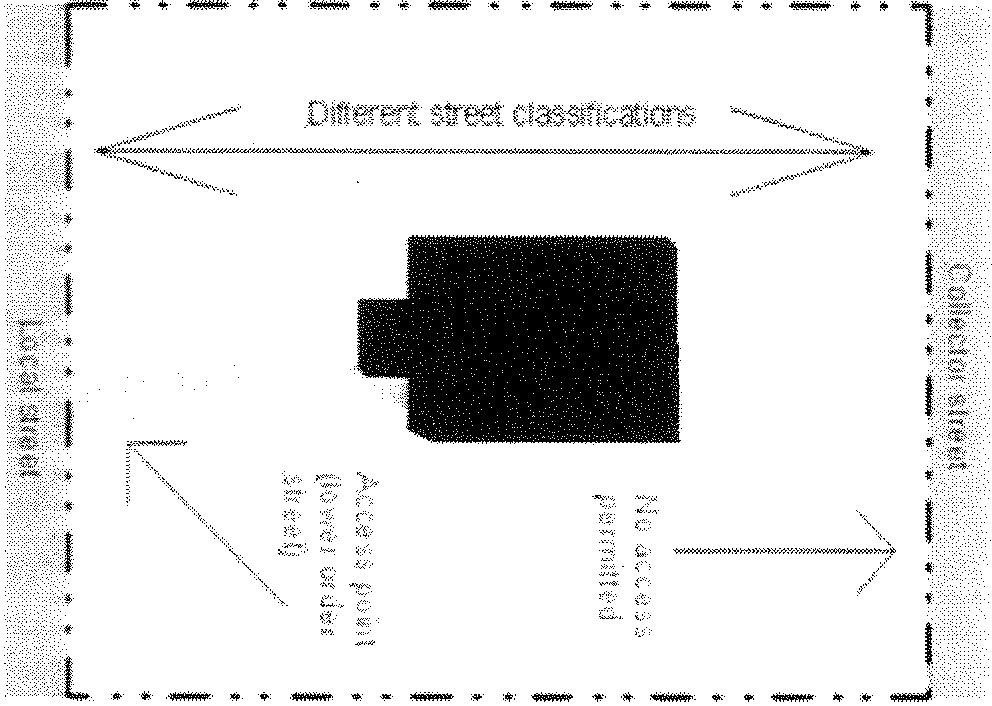
Double frontage lots. Double frontage lots are permitted where they separate streets of different classifications. Access is permitted on only one street for a double frontage lot. Residential lots shall take access from the lower classification street.
(Ord. No. 42-22, § 1, 6-7-2022)
27-503-3
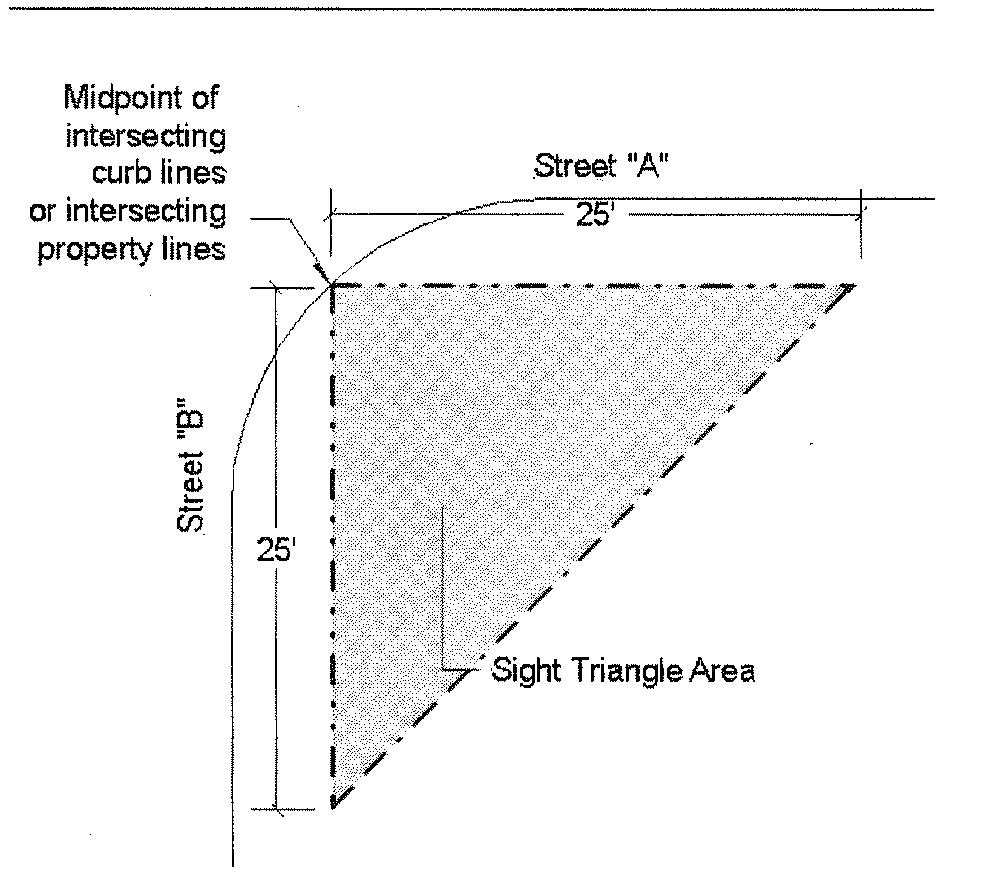
Sight visibility triangle. The sight visibility triangle is the area delineated by the midpoint of the radius intersection of the edge of the pavement, back of street curb, or back of shoulder, and extending 25 feet in length parallel to the edge of each driveway, street curb or shoulder, with the third side connecting the other two sides. Within each sight visibility triangle, no landscape materials, trees, shrubs, buildings, structures, or other obstructions shall be erected, planted, or maintained that exceed 24 inches in height. For signs, up to two supportive posts that are not more than 16 inches in width or diameter are permitted within the sight visibility triangle. For landscaping, the term "height" refers to the height at plant maturity. For purposes of this section, height shall be measured from the street elevation at the edge of the curb or shoulder.
27-503-4
Streets, alleys and easements.
A.
Compliance. The location, designation, width, grade, and design of all streets shall conform to this subsection or the county rural road standards, whichever is the appropriate jurisdiction for the development.
B.
Street classification. All streets shall conform to the city's master street plan and bikeway plan (including the bikeway plan map).
C.
Street layout.
1.
Generally. The arrangement of streets shall be such as to cause no undue hardship in the subdividing of adjacent properties.
2.
Street jogs. Street jogs at intersections with centerline offsets (where at least one of the streets is an arterial street) shall have an offset distance of at least 250 feet between centerlines. Collector and local street jogs shall have centerline offsets of not less than 125 feet.
3.
Coordination with master street plan. In order to preserve the integrity of the master street plan adopted pursuant to A.C.A. § 14-56-414, the following shall apply:
a.
No lot shall be approved for any subdivision in the designated right-of-way shown on such map or plan. This does not require additional right-of-way for streets that have already been constructed to the full width designated in the master street plan or a previous master street plan.
b.
If the land within such mapped street or highway is not yielding a fair return on its value to the owner, the planning commission may grant a conditional use permit for a building in such street or highway which will as little as practicable increase the cost of opening such street or highway, or tend to cause a change of such official map or plan. The planning commission may impose reasonable requirements as a condition of granting such permit.
c.
Where a proposed street widening or extension has been shown on the master street plan for ten years or more and the city has not acquired title thereto, the city may, after a hearing as hereinabove provided, grant a permit for a building and/or structure in such street or highway. The city may impose such reasonable requirements as are necessary to protect the public interest as a condition of granting such permit.
27-503-5
Connectivity.
A.
Projecting streets. Where adjoining areas are not subdivided, the arrangement of streets in the subdivision shall provide through dedication for the projection of streets into unsubdivided areas. Parcels shall be arranged to allow the opening of future streets and logical further subdivision. Existing streets in adjoining areas shall be extended. The centerlines of streets in the proposed subdivision shall align with the existing streets. Continuation of an existing street is not required where it would cause a street to project into a floodplain, bluff, or other natural feature that is subject to section 27-511.
B.
Secondary access. At least one access point into a single-family residential subdivision shall be provided for every 1,000 feet of street. Where a single-family residential subdivision exceeds 30 total units, a secondary ingress-egress access road is required.
C.
Reserve strips. Reserve strips of land for the sole purpose of controlling access to streets or circumventing right-of-way dedication are prohibited.
D.
Half streets. Half streets are prohibited, except where the planning commission determines that it will be practical to obtain the dedication of the other half of the street right-of-way when the adjoining property is developed.
27-503-6
Private and/or gated streets. The planning commission may approve private and/or gated streets subject to the following standards:
A.
Private streets.
1.
A private street is permitted only in a residential development.
2.
Private streets and utilities shall comply with all the standards for public streets and utilities as provided in this section. This includes the design standards in this section and guarantees and warranties required by sections 27-513 and 27-514.
3.
The private street shall be maintained by a homeowners' association. The applicant shall provide the declarations and restrictions, which shall provide an annual assessment of property owners that is sufficient to maintain the private street.
4.
Publicly- or privately-owned utility easements for subdivisions with private streets shall comply with section 27-504.
5.
The applicant shall comply with section 27-515 (private infrastructure maintenance). The applicant shall include with the homeowners or property owners' association (HOA or POA) documents a forecast and schedule of street maintenance costs prepared by a licensed professional engineer. The maintenance costs must be consistent with the schedule of street maintenance costs. A maintenance account with seed money shall be established by the developer to enable the HOA to meet the maintenance schedule until the HOA is self-sufficient. Any HOA requesting that the city acquire its private streets shall produce documentation that the maintenance schedule set forth in the HOA's original pavement management plan as part of the HOA documents has been followed.
6.
The HOA/POA documents shall require the HOAs/POAs to identify and enforce a no parking restriction in fire lanes throughout the community.
B.
Gated streets. Streets with a private, gated entry shall conform to the following standards:
1.
Master key security system. A master key security system shall be provided on all gates. The security system shall include the following:
a.
A gate override in case of power failure; and
b.
A master key shall be provided for emergency access and public service providers.
2.
Queuing. At gated entrances where traffic can queue into public streets, the gates and entrances design must provide for sufficient storage capacity such that no queuing vehicles will queue into the public street.
27-503-7
Traffic impact analysis.
A.
Purpose. A traffic impact analysis and a traffic statement (TIA/TS) are tools to evaluate the interaction between the study of transportation infrastructure and proposed land use development projects. TIAs/TSs provide a large amount of information that can be used for a number of purposes, including documentation of the growth of an area, assisting with planning activities, and assessing immediate and long-term needs relative to infrastructure improvements. Historically, these documents have been applied in a variety of ways in order to maximize the efficiency and safety associated with the ingress and egress of traffic to properties. This subsection establishes a process through which a TIA or TS is developed and submitted to the city, and the technical requirements of the deliverables to provide. The goals of a TIA or TS are:
1.
To identify potentially adverse impacts to the existing transportation system and to proposed developments;
2.
To assist public and private sector entities in identifying and resolving issues related to the location of driveways, traffic signals, and other transportation facilities that are requested but do not conform to this subsection; and
3.
To assist public and private sector entities with long-term planning such that the extension and growth of the transportation infrastructure may occur in a manner that is comprehensive in nature and supportive of the public good.
The city engineer may waive or modify the requirements of either a TIA or TS based on conditions at the time of application submittal and existing traffic at the proposed site.
B.
Traffic impact analysis applicability. A traffic impact analysis shall be required when the projected peak hour traffic is 100 trips or greater (200 trips or greater for single-family residential development) as determined by the latest trip generation manual published by the Institute of Transportation Engineers. A TIA shall also be required for any of the following:
1.
Any requests for a variance from the access management (see article 27-600) or streets, alleys and easements standards in this chapter;
2.
All developments entry roads located completely or partially within 500 feet of the intersection of two or more boulevards, freeway frontage road, arterials, or major collectors with an overall developable land area in excess of five acres;
3.
New school construction;
4.
Any preliminary plat meeting the above criteria if the property has already been rezoned for the proposed use and no traffic impact study has been conducted in the past two years; or
5.
Any request by the applicant to quantify off-site impacts pursuant to section 27-511.
A TIA shall be required for a single-family residential development when the projected peak hour trips are expected to be 200 trips or greater. When considering a residential development, the entire development should be considered and projected improvements can be phased in by final plat submission. Following is a table of types of land uses and the projected trips for informational purposes:
C.
Traffic information statement (TS) applicability. If the projected traffic is fewer than 100 peak hour trips (200 trips for a single-family residential development), and greater than 30 trips (60 trips for a single-family residential development), the application shall be accompanied by a traffic statement, the requirements of which are as follows:
1.
Show type of use and intensity;
2.
Show the site plan as proposed including a location map, and the square footage and type of use for all buildings;
3.
Show all proposed ingress and egress points (driveways);
4.
A projected trip table which includes categorization of each use by the ITE Trip Generation Manual and calculations used for establishing ADT trip projections, a.m. peak hour trip projections, and p.m. peak hour trip projections;
5.
If pass-by trip or multi-use trip reductions are used, show amount and the justification;
6.
Show net trip projections for ADT, a.m. peak hour, and p.m. peak hour;
7.
Show driveway trip projections for the a.m. and p.m. peak hours for all entering and existing movements; and
8.
Show current (latest) ADT traffic volumes on the adjacent streets at all proposed access points.
D.
Preliminary information meeting. The purpose of this meeting is to provide an opportunity for coordination between the applicant and city engineer, to streamline the permitting process, avoid misunderstandings, and to ensure that the documents are sufficiently comprehensive.
1.
The applicant shall schedule a preliminary information meeting with the city engineer. The study area, scope of the TIA/TS, the trip generation rates to be utilized for the study, and all requirements shall be verified at the preliminary information meeting. The city engineer may approve any modification from the requirements of this section in writing prior to preparation of the study, if the city engineer finds that the modifications are consistent with the purpose and intent of this section.
2.
During the preliminary information meeting, the applicant and city engineer will determine the scope of the TIA/TS, and establish the content, exhibits, magnitude of details and format requirements for the TIA/TS.
E.
Study area.
1.
This area shall be determined by the consultant conducting the study (hereafter referred to as the traffic consultant) and approved by the city engineer prior to the start of the study. The study boundary will be established based on the size of the proposed development, the projected peak hour trips, and the application of sound engineering judgment.
2.
If the city engineer and the applicant disagree on the study area boundary, the boundary shall extend one mile from the boundary of the proposed development or the next major intersection impacted by the site traffic, whichever is less.
F.
Phased development projects. Phased residential projects shall comply with this section, and shall require no special treatment.
G.
Referral. The city engineer may refer the draft TIA/TS to the following agencies for their review and recommendations:
1.
City planning and zoning department;
2.
Western Arkansas Planning and Development District (WAPDD);
3.
State highway and transportation department.
H.
Technical criteria and requirements.
1.
Generally. General items that shall be addressed in all TIAs include:
a.
Identification of the scope of the TIA;
b.
Identification of existing geometric conditions and traffic control devices that are impacted by development;
c.
Collection of existing traffic data;
d.
Estimates and distribution of site-generated traffic. Trip generation rates must be based upon the trip generation manual. The city engineer may approve an alternative source if he finds that the source is based on upon reliable data consistent with generally accepted engineering principles;
e.
Forecast of future non-site related traffic;
f.
Capacity analyses and projected operational levels of service for boundary roadways and study intersections for each of the following conditions: existing traffic, existing plus development traffic, future traffic, future traffic plus development traffic;
g.
Analysis and justification of site improvements that will require deviation from the street design (generally, section 27-503) or access management (see 27-603) standards of these regulations. Where site improvements deviate from these guidelines, supporting documentation shall be provided that detail why these variances are justified. Furthermore, the applicant must demonstrate that not only will these variances and/or deviations not have an adverse impact on the adjacent transportation facilities, but that they will actually augment the operation of the existing infrastructure;
h.
Identification of any roadways and/or intersections within the study area that are expected to operate at level of service (LOS) D, E, or F under existing and/or projected traffic conditions;
i.
Identification of improvements necessary to improve the level-of-service to LOS C, including the geometrics and traffic control estimated costs, and determine an appropriate method for allocating responsibility for those costs;
j.
Determination of appropriate transit stops based on the city's transit plan.
2.
TIA format. All TIAs shall be consistent with the format established in Appendix C. The TIA shall be submitted to the city as a stand-alone document, accompanying appendices shall be provided at the time the TIA is submitted. The number of appendix documents to be submitted shall be identified at the time of the preliminary identification meeting. The items identified in Appendix C establish the general outline of the report, the required maps and diagrams, all required tables, and minimum submittal requirements for any appendices.
I.
Review and submittal requirements.
1.
Upon completion of the TIA/TS, three copies must be submitted to the city engineer. Up to ten additional copies may be required if deemed necessary by the city for review and referral. An initial review of the study will be made to determine if the TIA/TS was developed in accordance with the technical requirements and within the scope of the study as outlined in the preliminary information meeting. If deviations from the technical requirements and/or the scope of study, as established during the preliminary information meeting are identified, the initial review will be terminated until the deviations are addressed. A notice of technical deficiencies will be developed by the city and submitted to appropriate city personnel and to the traffic consultant at such time as deficiencies are identified. All copies will be returned to the traffic consultant at that time as well.
2.
Upon submittal of a TIA/TS meeting the technical and scoping requirements established in the preliminary information meeting, final review of the TIA/TS will be conducted. If during the final review it is determined that additional information is needed, a written request for addendum will be provided to the traffic consultant. No more than one request for addendum will be requested and/or required for a given TIA/TS.
3.
Following completion of the final review, written recommendations regarding any requested variances, observations, objections to and/or concurrence with the findings of the study will be provided to appropriate city personnel and to the traffic consultant. A final meeting may be requested by the applicant to review the findings and negotiate the mitigating improvements required as a condition of approval of the application.
J.
Standards.
1.
Acceptable levels of service shall be in accordance with table 27-503-7-1, level of service without development. To summarize, table 27-503-7-1 indicates that:
a.
When the LOS without development is LOS A, B, or C, the minimum acceptable projected LOS shall be LOS C.
b.
When the LOS without development is LOS D, E, or F, the minimum acceptable projected LOS shall be equal to the LOS without development.
Table 27-503-7-1. Adopted Level of Service
2.
The applicant must identify all improvements necessary to achieve the adopted level of service. On-site improvement (improvements necessary other than improvements on the existing street system) must be provided and paid for by the applicant. Necessary improvements to the public street system at proposed driveways or development streets are also the sole responsibility of the applicant. Funding of other improvements identified in the TIA/TS that are necessary along existing streets or at existing intersections will be negotiated between the city engineer and the applicant with the applicant funding a fair proportionate to the impacts based on the new traffic of the proposed development compared to existing or projected traffic on the street system. In instances where complete funding of the improvements is not available and the applicant is only responsible for a portion of the cost, the applicant shall place in escrow his negotiated share. The escrow account will be specific to the location of the required improvements to ensure the money is not spent at other locations. A projected year of beginning of construction will be included in the escrow agreement. If the improvements are not under construction by the projected date, the escrow money will be refunded to the applicant.
3.
Required improvements may be phased in based on the TIA/TS findings and the projected impacts of each phase of the project.
4.
The city engineer may deny the application, or condition the proposed development on a phasing schedule, pending the correction of deficiencies in the existing level of service from improvements that are identified in the city's five-year capital improvement program for streets, bridges, and drainage (CIP) or other applicable improvements priority listing. However, nothing in this subsection requires the applicant to correct existing level of service deficiencies, and the applicant is responsible only for its pro rata share of improvements needed to maintain the current level of service or to avoid a reduction in the level of service below LOS C.
(Ord. No. 47-10, § 2, 10-5-10; Ord. No. 70-11, § 2, 9-6-11)
27-503-8
Engineering design standards. Street design shall conform to the criteria established in the standard specifications, master street plan, bikeway plan, trails and greenways plan, and street standards.
(Ord. No. 70-11, § 2, 9-6-2011)
27-503-9
Bicycle facilities. Bikeways shall be consistent with the bikeway plan.
(Ord. No. 70-11, § 2, 9-6-2011)
27-503-10
Cul-de-sac and dead-end streets.
A.
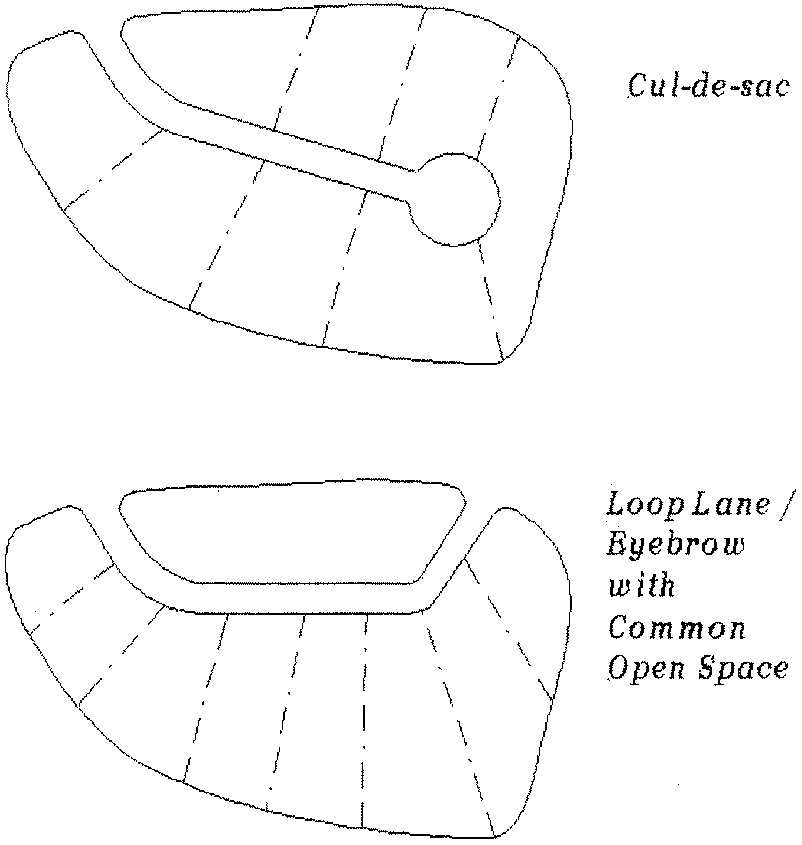
Cul-de-sac alternative. As an alternative to cul-de-sac, applicants are encouraged to use eyebrow or loop lane street configurations that have two points of access to a public street.
B.
Maximum development. The land uses on lots that access a cul-de-sac shall not generate more than 200 average daily trips (ADT) per day, as determined by the trip generation manual.
C.
Turnarounds. A cul-de-sac shall be provided with a turnaround having a radius of not less than 50 feet at the property line and not less than 40 feet at the curbline or edge of pavement.
D.
Pedestrian connection.
1.
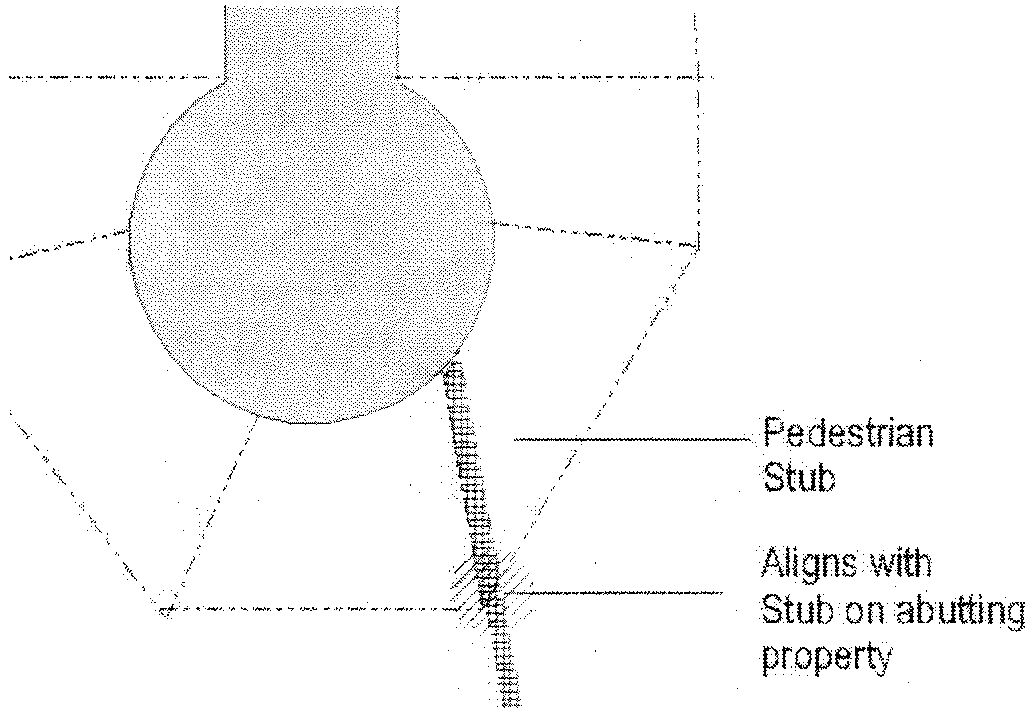
The planning commission may require a cul-de-sac design that includes a stub connecting the cul-de-sac to sidewalks, parks or open space on abutting parcels where:
a.
By reason of topography, grade, and distance, the stub would provide reasonable pedestrian access to the surrounding neighborhood;
b.
The improvement is compatible with and will not adversely affect other property in the area where it is proposed to be located; and
c.
The distance to an abutting sidewalk, park or open space is not excessive when compared to the cost of providing the pedestrian connection.
2.
A cul-de-sac stub is required where the lots abut a public trail system, bike path, park, or greenway.
3.
The stub shall be improved as a pedestrian walkway, trail, or bikeway in accordance with the city's design standards. The stub shall align with any existing pedestrian walkway, trail, or bikeway on an abutting property.
E.
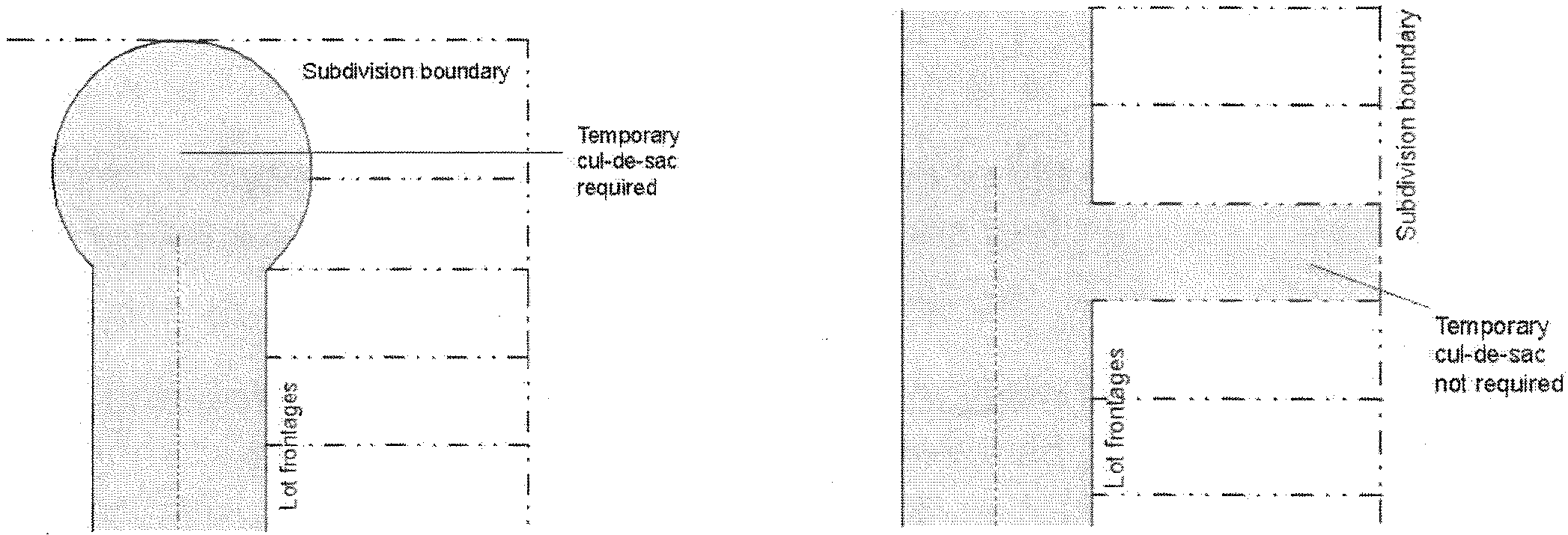
Dead-end streets. Dead-end streets are not permitted except on a temporary basis where they relate to the extension of the street in the development of adjoining land. A paved cul-de-sac shall be provided at the end of the dead-end street. A cul-de-sac is not required where no lots front on the street.
1.
Dead-end streets may not be used as or for driveways.
2.
Lots may not front the right-of-way of a dead-end street.
3.
Dead-end streets shall be designed according to the city's street standards.
(Ord. No. 70-11, § 2, 9-6-2011)
27-503-11
Landscaping.
A.
Applicability. Residential subdivisions shall include landscaping on the perimeter streets and subdivision entry landscaping as provided below. Replats of existing residential lots and residential subdivisions with no more than five lots are exempt from perimeter frontage landscaping and subdivision entry landscaping. Lots platted with frontage only on the perimeter street are exempt from the perimeter landscaping requirement. Landscaping for multifamily developments must comply with the requirements of section 27-602-3 and can be deferred until the building permit is issued for the multifamily development.
B.
Perimeter frontage landscaping. Perimeter frontage landscaping shall comply with the following:
1.
Perimeter landscaping shall be located along the entire perimeter of the subdivision that fronts the right-of-way of a public street. The perimeter landscaping shall be located on the subdivision property. The landscaping shall be parallel and adjacent to the public right-of-way line. Provided public utilities are immediately adjacent to the right-of-way line, the ten-foot landscape buffer may commence adjacent to the utility easement.
2.
The perimeter landscaping area shall have a minimum width of ten feet.
3.
At a minimum, the perimeter landscaping planting strip shall be planted with one tree and ten shrubs for every 50 linear feet of right-of-way frontage.
C.
Subdivision entry landscaping.
1.
Applicability. Proposed developments subject to this requirement shall provide subdivision entry landscaping. Subdivision entry landscaping must conform to the standards in subsection C.2.b., below.
2.
Standards.
a.
Streets or driveways with only two lanes shall provide landscaping at the intersection of the external access street and the internal street or driveway leading into the proposed development.
b.
Streets or driveways exceeding two lanes or 38 feet shall provide a landscaped median with a minimum width of eight feet.
c.
The median shall be planted with one tree and ten shrubs for every 50 linear feet of median length.
d.
Subdivision entrance signs must conform to the requirements applicable sign regulations.
(Ord. No. 50-14, § 1(att.), 9-2-2014; Ord. No. 4-24, § 1, 1-2-2024)
27-503-12
Maintenance. The applicant shall comply with section 27-515 (private infrastructure maintenance).
27-503-13
Pedestrian easements. A cross-block easement shall be provided for any street exceeding 600 feet between intersections with other streets, as follows:
A.
An easement for utilities and pedestrians with a minimum width of 20 feet; or
B.
An easement reserved for pedestrian passage with a minimum width of ten feet.
27-503-14
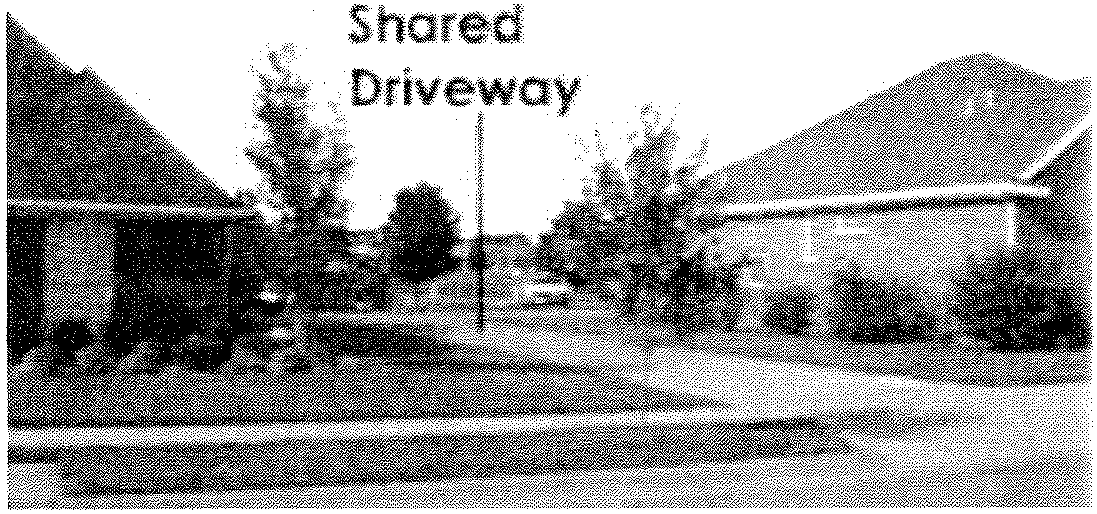
Shared driveways. Driveways may be used and shared for ingress and egress between adjoining residential or nonresidential lots so that there is a single curb cut, subject to the following standards:
A.
All lots require approved maintenance provisions for the shared driveway.
B.
Residential lots.
1.
This section applies to lots that are used for residential, single-family detached dwelling units.
2.
The minimum width and maximum number and type of lots that may be served by a shared driveway are as follows:
3.
Up to two additional lots are permitted along a shared driveway if it has more than one connection to a public street.
4.
There must be at least 18 feet between shared driveways measured along the front property line.
5.
All lots that access a shared driveway must have frontage on a developed public street or private street.
C.
Nonresidential and multifamily lots.
1.
This section applies to lots that are used for duplex, multifamily, commercial or industrial uses.
2.
The minimum width required for shared driveways serving nonresidential lots is 22 feet.
3.
The maximum trip generation for lots that access a share driveway is 60 average daily trips (ADT). The maximum trip generation may increase to 200 if there is rear access for each lot.
27-503-15
Street names and numbers.
A.
Avoiding confusion.
1.
Street names and numbers shall not duplicate the spelling of existing streets in the city or within the jurisdiction of the planning commission.
2.
Street names should not be difficult to pronounce or spell. The following guidelines should be considered when assigning street names:
a.
The words "old" or "new" must not be used with a base name.
b.
Abbreviations or single letters of the alphabet must not be used for the base name.
c.
Homonyms or names that sound like other names that are already in the system should be changed (e.g., Ray/Wray/Reigh, Steven Lane/Stephen Lane; Disk Drive/Disc Lane).
d.
Names that tend to be mispronounced or misspelled or are difficult to pronounce or spell should not be used (e.g., Javelina, Peony, Weimaraner).
e.
Two-word names or one-word names that can be confused as two-word names should not be used. This avoids the problem of two words being combined into one word, or vice versa, when entered (e.g., Clearlake, Clear Lake, Brookhaven, Baytree).
f.
A street name should not contain directional words such as north, south, east, or west. If they are used, it is difficult if not impossible to distinguish the pre-direction portion of a full street name from the street name itself. Northridge is an example of a street name that breaks this rule as well as the two-word rule above.
g.
Street names containing punctuation or special characters (e.g., Fishermen's, J.F.K., Holman-Fuller) should be avoided, as punctuation makes street names unnecessarily complicated, and some database programs do not gracefully handle punctuation. Furthermore, words that normally require punctuation should not be used with the punctuation omitted (e.g., Fishermens Landing). Apostrophes, hyphens, or dots may be included when necessary (to avoid confusion, for example), but it is especially important that special characters such as commas, quotation marks, and asterisks not be used. In the case of numbered streets, such as First Street or Tenth Avenue, it is recommended that the names be spelled out as opposed to using numbers with suffixes. This practice allows for the creation of a complete yet strictly alphabetical index.
h.
Streets of the same name should not intersect at more than one location. Street names shall change at each 90-degree angle, unless the city engineering department determines that continuing the street name will not impair traffic safety.
i.
Street names that will be placed on street identification signs shall be limited to 15 characters and spaces. Typical street designations such as highway, boulevard, circle, court, road, street, and avenue will be abbreviated when calculating the number of characters and spaces. Abbreviations are not permitted on the plat.
B.
Assigning street names.
1.
Easements or private streets that have traffic volumes of at least 50 trips per day must have a street name.
2.
A street name may contain up to three parts:
C.
Addresses.
1.
The city engineering department shall assign addresses to the streets. These street names and addresses shall not be altered without authorization from the city.
2.
Addresses must correspond to the address grid established by the city and the county 9-1-1 emergency system street name signs.
27-503-16
Traffic control.
A.
General. The developer shall provide all temporary traffic control devices relative to construction of improvements until the beginning of the warranty period. Temporary traffic controls shall comply with section 120 of the standard specifications. The city will furnish and install permanent traffic control signs.
B.
Traffic control devices. Traffic control devices and their installation shall conform to the Manual on Uniform Traffic Control Devices, latest edition. Traffic signals shall conform to the standard specifications of the city.
C.
Ornamental signs. Decorative, ornamental and specific signs shall be the responsibility of the developer and shall conform to the sign ordinance, and must first be approved by the city streets and traffic control department.
27-503-17
Traffic calming. Traffic calming devices shall conform to the master street plan.
27-503-18
Fire protection.
A.
Water mains shall be constructed of a size and material sufficient to provide and maintain pressures and flows adequate for fire protection, as provided in the Arkansas Fire Prevention Code and section 27-507-2 of this article (minimum water design standards).
B.
Fire hydrants will be located on water mains in accordance with standards published in the Arkansas Fire Prevention Code and section 27-507-2 of this article (minimum water design standards).
(Ord. No. 70-11, § 2, 9-6-2011)
27-503-19
Sidewalks.
A.
Applicability.
1.
Sidewalks are required on both sides of all arterial, collector, and commercial streets except as specified in subsection 27-503-19F of this section.
2.
Sidewalks are required on one side of an internal residential street except as specified in subsection 27-503-19F of this section.
3.
Sidewalks are required on the subdivision side of all adjacent or perimeter streets.
4.
Double frontage lots shall have sidewalks on both street frontages.
5.
Sidewalks are required only on one side of subdivision entry streets unless residential lots are platted or planned to be platted on both sides of the street.
6.
Applicants may contribute to the sidewalk construction fund in lieu of sidewalk construction. The amount of contribution will be determined as the actual dollar value of sidewalk construction for sidewalks that are required. The dollar value of the sidewalk improvements will be determined by the project engineer and approved by the city engineer. Donations to the sidewalk construction fund may be accepted where:
a.
The required sidewalks are along an existing street that has no existing sidewalk network; or
b.
The city engineering department determines the construction of a sidewalk is not feasible.
When a contribution to the sidewalk fund is accepted, the sidewalk assessment portion of the building permit fee required by subsection 6-30(16) will not be required for the initial permit on any of the individual lots within the subdivision. All subsequent permits for improvements on the individual lots will include the sidewalk assessment portion of the building permit fee.
B.
Time of construction.
1.
Sidewalks for streets interior to a subdivision must be completed:
a.
Before the issuance of building permits for 80 percent of the lots on the block; or
b.
Five years after the construction plans are approved.
2.
If sidewalks are not constructed for any block within the time periods prescribed in this subsection, the city may:
a.
Call the performance bond and complete construction of the sidewalks; and/or
b.
Withhold building permits pending the completion of sidewalks within the time limits set out above.
3.
Sidewalks along perimeter collector or arterial streets must be:
a.
Completed before the issuance of any building permit in the proposed subdivision; or
b.
Guaranteed pursuant to a subdivision improvement agreement between the city and the applicant.
C.
Width. Except as otherwise specified in the Americans with Disabilities Act (ADA), sidewalks shall have a minimum unobstructed width of five feet.
D.
Continuity. Sidewalks shall not be installed in such a manner that they conflict with or are obstructed by power lines, telephone poles, fire hydrants, traffic/street signs, mailboxes, trees, buildings, barriers, light poles, or any other structure. Where encroachment is necessary, the minimum unobstructed width of the sidewalk shall be at least four feet. The grades of sidewalks shall be such that abrupt changes of grades greater than eight percent are not encountered. When there is an existing or anticipated obstruction, the sidewalk shall be installed around the object and shall provide the required sidewalk width.
E.
Grade. Sidewalks shall be constructed so as to align vertically and horizontally with adjoining sidewalks.
F.
Internal walkways in lieu of sidewalks. The planning commission may waive or reduce the sidewalk requirements and allow the applicant to construct an internal walkway, trail or greenway system (an alternative system) as a substitute for a sidewalk section if it finds that:
1.
The alternative system complies with the standards in section 27-509; and
2.
The alternative system substantially serves the same purpose as the sidewalk section that it replaces; and
3.
The alternative system connects to the public sidewalk system.
(Ord. No. 56-09, § 1, 7-21-2009)
27-503-20
Streetlights.
A.
Streetlights shall conform to section 22-4 (installation of streetlights on public streets and in residential subdivisions) and the design criteria established in any adopted neighborhood street lighting program. In the event of a conflict between section 22-4 and a neighborhood street lighting program, section 22-4 shall control.
B.
The city will not furnish decorative streetlight poles and fixtures. The developer must coordinate the purchase, installation, and replacement of any decorative streetlight poles and lights with the utility company. After the subdivision is complete and the lots are sold, any replacement poles and/or lighting must conform to section 22-4, unless the lights are purchased, installed and maintained by a property owners' association (POA/HOA) or individual homeowners.
(Code 1992, § 27-503; Ord. No. 56-09, § 1, 7-21-2009; Ord. No. 64-15, § 1(att.), 10-6-2015)
Sec. 27-504. - Easements.
27-504-1
Utility easements.
A.
Easements shall be provided for and maintained in accordance with the standards and specifications required by the city engineering department and any franchise utility standards. Where alleys are not provided, adequate easements shall be provided where necessary for use by utilities. Utility easements shall be separated from drainage easements except for necessary cross lines.
B.
All water and sewer easements shall be of such dimensions as to provide access for the construction, and maintenance of the facilities within the easements and according to the applicable design standard.
27-504-2
Drainage easements. All drainage easements shall be of the dimensions necessary to provide access for equipment appropriate for construction, cleaning, and maintaining of the drainageway, consistent with section 27-506.
27-504-3
Private access easements. Private vehicular access easements as ingress and egress, for lots are permitted provided all of the following conditions are met:
A.
Multifamily, commercial and industrial subdivisions or developments.
(1)
The easement shall be at least 24 feet wide and not more than 500 feet in length. The easement shall comply with all the standards for public streets and utilities as provided in this section. This includes the design standards in this section and guarantees and warrantees required by sections 27-513 and 27-514.
(2)
The easement shall be covered with an approved all-weather surface such as concrete, asphalt, brick, graded and compacted gravel, or similar comparable materials treated to prevent dust and overgrowth.
(3)
The private vehicular access easement may be used for emergency vehicle access and public service vehicle access. The proposed provision of access by an easement shall be reviewed by all utility companies and public service departments including fire, sanitation and police.
(4)
The easement shall not be maintained by the city. It is the applicant's responsibility to provide a maintenance plan that identifies the entities or parties who are responsible for maintaining the easement and that complies with section 27-515.
B.
Residential single family and duplex subdivisions or developments:
1.
The lot shall have public or private street frontage on one side.
2.
The easement shall be from a public or private street and a minimum of 16 feet wide.
3.
The easement shall be paved and maintained by the property owner or homeowners association.
4.
If applicable, the easement shall comply with all standards for public streets and utilities as provided in this chapter. This includes the design standards in this Section and guarantees and warrantees required by Sections 27-513 and 27-514.
C.
If the private easement is gated:
1.
Master key security system. A master key security system shall be provided on all gates. The security system shall include the following:
a.
A gate override in case of power failure; and
b.
A master key shall be provided for emergency access and public service providers.
2.
Queuing. At gated entrances where traffic can queue into public streets, the gates and entrances design must provide for sufficient storage capacity so that no queuing vehicles will queue into the public street.
(Code 1992, § 27-504; Ord. No. 31-21, § 2(att.), 4-6-2021)
Sec. 27-505. - Sanitary sewer.
27-505-1
Applicability. No sanitary sewer facility shall be constructed, altered, extended, or reconstructed within a subdivision, planned development, or a developed area within the planning jurisdiction of the city without first having the approval of the city utility department and any required state agencies. All such construction shall meet the requirements included herein.
27-505-2
General requirements and design criteria. Sewer systems shall comply with the city sanitary sewer standards, which document is included herein by reference.
(Code 1992, § 27-505)
Sec. 27-506. - Stormwater management.
Purpose. The purpose of this section is to establish stormwater management level of service standards and criteria for conventional and engineered stormwater management systems.
27-506-1
Applicability. No storm drainage facility, whether an enclosed structure, pipe, or an open channel, ditch or stream, shall be constructed, altered, or reconstructed within a subdivision, planned development, or a developed area, within a public right-of-way or easement, or discharge into, upon, or under a public right-of-way or easement, or a subdivision or planned development or developed area within the planning jurisdiction of the city, without first obtaining written approval from the department of engineering.
27-506-2
General design requirements. Stormwater management systems shall comply with the city storm drainage standards.
(Ord. No. 70-11, § 2, 9-6-2011)
27-506-3
Erosion control. Erosion control measures shall be provided which are consistent with the requirements of the state department of environmental quality (ADEQ).
(Code 1992, § 27-506)
Sec. 27-507. - Water.
27-507-1
Applicability. No water improvement facilities shall be constructed, altered, extended or reconstructed within the city or the planning jurisdiction of the city without first having the approval of the city utility department and any required state agencies. All such construction shall meet the requirements included herein.
27-507-2
General requirements and design criteria. Potable water systems shall comply with the city's minimum water design standards, which document is hereby incorporated by reference and made a part of this chapter.
(Code 1992, § 27-507)
Sec. 27-509. - Trails and greenways.
27-509-1
Applicability. Subdivisions that include at least 100 lots shall include trails and/or bikeways that conform to the requirements of this section.
27-509-2
Trails. Trails may be included as part of the required parks and open space. Trail easements shall be a minimum of 20 feet in width. The construction and maintenance of trails shall conform to the city's trails and greenways master plan.
27-509-3
Bikeways. Bikeways shall be provided consistent with the bikeway plan.
(Code 1992, § 27-509; Ord. No. 70-11, § 2, 9-6-2011)
Sec. 27-510. - Resource conservation.
Purpose: This section encourages the preservation of existing features that add value to development or to the local government as a whole, such as trees, historic spots, viewsheds, natural areas, riparian corridors, hillsides, and similar irreplaceable assets, to be preserved in the design of a subdivision or development. This section implements the following policies:
•
Minimize impermeable surfaces of all developments to help retain and drain water on-site. All development needs to address stormwater event loading on-site and downstream. This is called total maximum daily loading or TMDL.
•
Incorporate the protection or replacement of wetland or vegetation habitats in development guidelines.
•
Protect riparian corridors through erosion control and drainage management. In many cases, this means unchanneling concrete stream beds, replanting wetlands for water absorption, and allowing natural drainage. These stream valley and drainage areas can be park and pedestrian friendly trail systems, or primary habitat and aesthetic community amenities.
(Ord. No. 18-20, § 2(att.), 3-3-2020)
27-510-1
Generally.
A.
Applicability.
1.
This section applies to any application for subdivision or site plan approval except as provided below.
2.
This section does not apply to any such application within the commercial downtown zoning district.
B.
Application. Applications for subdivision or development plan approval subject to this section shall indicate all of the following:
1.
Aquifers and aquifer recharge areas;
2.
Soils poorly suited to development as set forth in the USGS Soil Survey;
3.
Floodplains;
4.
Wetlands;
5.
Prime agricultural and forestlands; and
6.
Natural habitat of rare or endangered species.
(Code 1992, § 27-510)
Sec. 27-511. - Wetlands protection.
Purpose: The purpose of this section is to provide flexible regulations that encourage the preservation of wetland areas. The city finds and determines that wetlands provide the following public benefits, as designated in the Arkansas Wetlands Mitigation Bank Act (A.C.A. §§ 15-22-1001 through 15-22-1012), the Arkansas Private Wetland and Riparian Zone Creation and Restoration Incentives Act (A.C.A. §§ 26-51-1501 through 26-51-1510), and numerous scientific and technical documents:
•
Wildlife, migratory birds, and resident species;
•
Commercial and sport fisheries;
•
Scientific and research values;
•
Flood moderation and flood impact mitigation by slowing stormwater runoff;
•
Surface and groundwater quality and quantity enhancement by removing sediment, nitrogen, phosphorus, and other pollutants from surface water;
•
Habitats for fish and wildlife, including waterfowl and rare or endangered species, thereby promoting habitat and species diversity;
•
Groundwater recharge can occur in wetlands that will assist in ensuring that groundwater is available for the future;
•
Outdoor recreation, including enhancement of scenic waterways and recreational uses for hunting, fishing, hiking, etc., that not only add to the quality of life, but also have a significant economic impact on the city, county, region and state; and
•
Timber and food production in properly managed wetlands can provide wood products, plants, and animals for human and livestock consumption.
A.
Applications for subdivision or development plan approval shall include a true copy of any dredge or fill permit requested or issued pursuant to section 404 of the Federal Water Pollution Control Act, 33 USC 1344, or any other action requiring wetland mitigation.
B.
The applicant shall notify the engineering department of any changes or conditions to the application that are issued prior to final plat approval.
(Code 1992, § 27-511)
Sec. 27-512. - Land dedication and reservation.
27-512-1
Dedication of on-site facilities.
A.
The city shall not have any responsibility with respect to any street, or other improvements, notwithstanding the use of the same by the public, unless the street or other improvements are accepted by the city.
B.
Prior to requesting final acceptance of streets, sanitary sewers, and storm sewers, the applicant shall furnish record drawings in reproducible form.
C.
After the public improvements have been offered for dedication to the city, the city shall accept the improvements when it determines that they are constructed in accordance with the requirements and conditions of this chapter and when all documentation required by this chapter is furnished. The applicant shall furnish proof that all improvements are free of liens and debts.
27-512-2
Dedication of off-site facilities.
A.
The applicant and the city may agree to the off-site facilities that will be provided by the applicant. The agreement must be included in the subdivision improvement agreement, and shall constitute a waiver of any constitutional claims that may be raised against the city for improvement requirements.
B.
If the applicant does not consent to the off-site improvements requested by the city, the applicant shall submit:
1.
A traffic impact analysis, for off-street improvements, regardless of whether a TIA would be otherwise required; and/or
2.
An analysis of the impacts of the proposed development on the specific improvements based on generally accepted engineering principles.
C.
The city engineer shall review the impact analyses provided pursuant to subsection (b), and submit a recommendation to the director and the planning commission. Based upon this analysis and any additional evidence presented in the record, the city may require the applicant to provide any off-site improvements that are roughly proportionate to the impacts of the proposed development.
27-512-3
Reservation of public facilities. Where proposed public facilities are designated for location in whole or in part in a proposed subdivision, the planning commission, board of directors or other public body may require that land for those public facilities be reserved as a condition of preliminary plat approval for a period of four months following the date of notification of the developer's intent to develop as evidenced by submission of the preliminary plat or sketch plat. The body having jurisdiction or financial responsibility for the acquisition of the reserved facility or facilities shall be given an opportunity to execute a written contract to acquire by purchase or file suit for condemnation of the area reserved for such facility or facilities; provided further, however, said contract to acquire must be closed within 12 months following the date of the approval of the preliminary plat.
(Code 1992, § 27-512)
Sec. 27-513. - Performance guarantees.
27-513-1
Development with city improvement guarantee. The developer may enter into an agreement with the city to ensure the completion of the improvements as outlined below:
A.
The city may enter into an agreement with the developer for the applicant to provide the required improvements. All formal agreements entered into by the city will be with the developer only. Agreements entered into between the city and the developer will bind each principal of the developer regardless of the developer's form of organization.
B.
Upon final approval of construction plans, the developer shall enter into an agreement with the city to ensure the completion of the improvements as outlined below. The engineering department will issue a letter of temporary approval (which is one of the requirements prior to filing the subdivision plat) subject to the assurance of installation of the improvements.
C.
The improvements required by the UDO shall either be completed and accepted by the city or shall have a guarantee posted with the city assuring their completion in accordance with these regulations, before the final plat may be filed for record.
D.
One of the following methods shall be used by the developer to guarantee that improvements required by the UDO shall be installed:
1.
Certificate of completion of improvements. The developer may submit for approval to the engineering department record drawings showing that all improvements and installations have been installed in accordance with the appropriate city standards.
2.
Performance bond. If the developer cannot certify that all improvements and installations have been completed, a performance bond may be posted in favor of the city. Such performance bond shall specify the time for the completion of the improvements and installations and shall be in an amount and within a time approved by the engineering department. The city will also accept an assignment from the developer of a performance and payment bond issued from the contractor to the developer. The assignment shall not be approved unless the city attorney certifies that it is enforceable under state law. Also, the developer must provide proof that the contractor and surety company acknowledge and accept the assignment of the performance and payment bond to the city. Such performance and payment bond shall specify the time for the completion of the improvements.
3.
Cash deposit. The developer may provide a cash deposit in the full amount of the anticipated development costs for the remaining incomplete improvements. Such cash deposit may be withdrawn in direct proportion to the amount of work completed as approved by the city.
4.
Financial guarantee. The developer may provide an irrevocable letter of credit or similar financial commitment from a local or other approved financial institution authorized to conduct business in the state verifying the availability of funds, and the city's access thereto, without cost to the city for the installation and completion of the improvements by the city in the event of failure, complete or partial, of the developer to do so according to the plans approved by the city. The form of the financial commitment and the financial institution must be approved by the city.
27-513-2
Amount of assurance. The amount of the performance and payment bond, cash deposit or financial commitment shall be in the full amount of the improvements not yet completed as determined by the engineer and agreed to by the city as sufficient to complete the improvements in accordance with these standards and the approved plans and specifications. The city shall also require that the performance and payment bond, cash deposit or financial commitment shall include provisions for, or amount sufficient to reimburse, the city's expenses related to its administrative costs or professional consultant services which are determined by the city as necessary to cause the completion of the improvements, which amount shall include, without limitation, an amount sufficient to reimburse the city for the reasonably anticipated administrative costs and professional services expenses to be incurred by the city.
27-513-3
Coordination with city. The city shall have the right of access to sites during the planning, design and construction phases of development. The developer shall schedule all activities to provide the city with adequate notice and review time.
(Code 1992, § 27-513)
Sec. 27-514. - Maintenance warranty.
27-514-1
Generally. Upon acceptable completion of the required improvements and prior to the commencement of the temporary acceptance period, the developer shall provide, in writing, a maintenance warranty to the city that the developer will maintain, repair and reconstruct the project, in whole or in part, for a period of 24 months after the temporary acceptance date of the project by the city in the event of failure due to defective design, defective materials or workmanship. The maintenance warranty shall be in the amount of 50 percent of the total construction cost of the street improvements.
27-514-2
Acceptable warranty methods. One, or a combination, of the following methods shall be used by the developer to financially insure the maintenance warranty:
A.
Maintenance bond. A maintenance bond may be posted in favor of the city to fulfill the materials and workmanship portion of the maintenance warranty. The maintenance bond shall be issued by a surety company authorized to conduct business in the state. The city will also accept an assignment from the developer of a maintenance bond issued from the contractor to the developer provided that:
1.
Said assignment must be in a form acceptable to the city attorney; and
2.
The developer must provide proof (acceptable to the city) that the contractor and surety company acknowledge and accept the assignment of the maintenance bond to the city.
B.
Extension of the performance and payment bond. The performance and payment bond or assignment thereof allowed above may be extended through the 24-month maintenance warranty period to fulfill the materials and workmanship portion of the maintenance warranty. If the developer selects this method of maintenance assurance, he must provide assurance to the city, acceptable to the city attorney, that all parties acknowledge and accept the extension of the performance and payment bond or assignment thereof.
C.
Cash deposit. The developer may provide a cash deposit in the amount specified herein to fulfill the design and/or materials and workmanship portions of the maintenance warranty. The cash deposit shall be accompanied by documentation stating the conditions of deposit and withdrawal acceptable to the city attorney.
D.
Financial commitment. The developer may provide an irrevocable letter of credit or similar financial commitment from a local, or other approved financial institution authorized to conduct business in the state, verifying the availability of funds, and the city's access thereto without cost to the city to make all corrections, maintenance, repairs or reconstruction as necessary to fulfill the design and/or materials and workmanship portions of the maintenance warranty. The form of the financial commitment and the financial institution must be approved by the city.
(Code 1992, § 27-514)
Sec. 27-515. - Private infrastructure maintenance.
27-515-1
Applicability.
A.
This section applies to any improvement required by this chapter, where this chapter allows the improvement to be privately maintained.
B.
Failure to adequately maintain the improvements in reasonable order and condition constitutes a violation of this chapter. The city is hereby authorized to enforce or to correct the violation by any means authorized by law.
27-515-2
Residential developments.
A.
Generally.
1.
For residential developments, the improvements shall be maintained by a permanent homeowners' association, permanent condominium association, permanent improvement district or similar permanent entity (hereinafter the maintenance entity).
2.
The instruments creating the maintenance entity shall be provided with the application for subdivision plat approval.
B.
Homeowners' association.
1.
If the maintenance entity is a homeowners' association, the homeowners' association shall assume full responsibility for maintenance of the improvements.
2.
The applicant shall provide a description of the association, including its bylaws and methods for maintaining the landscaping.
3.
The association shall be organized by the developer and shall be operated with a financial subsidy from the developer, before the sale of any lots within the development.
4.
Membership in the association must be automatic (mandatory) for all purchasers of homes therein and their successors.
5.
The conditions and timing of transferring control of the association from developer to homeowners shall be identified.
6.
The homeowners' association shall be authorized under its bylaws to place liens on the property of residents who fall delinquent in payment of such dues or assessments.
7.
A proposed operations budget and plan for long-term capital repair and replacement of improvements in or to the parks or open space shall be submitted with the final plat. The members of the association shall share the costs of maintaining and developing the landscaping. Shares shall be defined within the association bylaws.
8.
In the event of a proposed transfer, within the methods here permitted, of landscaping by the homeowners' association, notice of such action shall be given to all property owners within the development.
C.
Condominium. If a permanent condominium association is used to maintain the improvements, the improvements shall be controlled through the use of a permanent master deed that conforms to the Horizontal Property Act, A.C.A. title 18, subtitle 2, ch. 13 (A.C.A. § 18-13-101 et seq.). All undivided landscaping land shall be held as a common element. A proposed operations budget and plan for long-term capital repair and replacement shall be submitted with the application for preliminary plat approval.
D.
Improvement districts. An improvement district may be established pursuant to A.C.A. title 14, subtitle 5 (A.C.A. § 14-86-101 et seq.) that:
1.
Has the authority to maintain the improvements; and
2.
Has established assessment or other financial mechanisms in an amount sufficient to maintain the improvements in good order.
(Code 1992, § 27-515)
Sec. 27-516. - Appeals and variances.
27-516-1
Appeals of administrative determinations. The planning commission shall hear appeals from the decision of the administrative officers in respect to the enforcement and application of this article, and may affirm or reserve in whole or in part the decision of the administrative officer.
A.
Process. Any person, officer of the city, or other governmental agency not in agreement with a decision made by the director may appeal the decision within 30 days of the decision by filing with the director a notice of appeal along with a payment of the required appeal fee. The filing shall specify the reason for the appeal. The director shall then transmit to the planning commission all the information on the details of the decision and the reason for the appeal. This shall be done in advance of the next regularly scheduled meeting that is more than 30 days from the date of the appeal.
B.
Stay. An appeal puts all processing of applications on hold until the appeal process is completed.
C.
Hearing. The planning commission shall schedule a reasonable time for the hearing of the appeal or any other matter referred to it. Notice shall be provided, published, mailed and posted pursuant to section 27-308.
D.
Action. In exercising its powers, the planning commission, in conformity with the provisions of law, may reverse or affirm, wholly or in part, or may modify the order, requirement, decision, or determination.
E.
Appeal. Appeal to the board of directors.
27-516-2
Variances. The planning commission shall hear requests for variances from the literal provisions of this article in instances where strict enforcement of the regulations would cause undue hardship due to circumstances unique to the individual property under consideration, and shall grant such variances only when it is demonstrated that such action shall be in keeping with the spirit and intent of the provisions of the subdivision design and improvement standards chapter. The planning commission may impose conditions in the granting of a variance to ensure compliance and to protect adjacent property.
27-516-3
Planning commission procedures. The planning commission shall establish regular meeting dates, adopt rules for the conduct of its business, establish a quorum in procedure, and keep a public record of all findings and decisions. The public meeting requires a notice of the meeting date and agenda to be published in a newspaper of general circulation in the city at least one time 15 days prior to the meeting.
27-516-4
Submission requirements. The director shall prepare an application form specifying the information to be submitted.
A.
Application. The applications shall contain at least the following information:
1.
The legal description of the subject property;
2.
The street address of the subject property;
3.
A subdivision plat drawn to scale (one inch equals 20 feet, unless otherwise approved) showing proposed variance;
4.
The literal provision from which a variance is requested and the provision desired in lieu of the literal provision;
5.
The names and addresses of all property persons listed on the current tax assessment rolls who are landowners within 300 feet of the petitioned property. This information shall be provided either electronically or typed on mailing labels;
6.
The names and addresses of all owners of the subject property and/or their agent; and the date that this petition shall be considered by the planning commission; and
7.
Application fee.
B.
Notice. This information shall be used by the director to mail notice to all persons listed in the application to inform them of the public hearing on the variance request, the street address of the property and the reason for the variance request.
27-516-5
Application and review procedures.
A.
Determination of completeness. Applications shall be submitted to the director for a determination of completeness pursuant to section 27-303.
B.
Neighborhood meeting. The applicant shall comply with the requirements for a neighborhood meeting pursuant to section 27-304. The director may waive the requirement for a neighborhood meeting where:
There are few or no neighbors within 300 feet of the proposed variance. The director may also request that the applicant meet individually with the few property owners.
1.
The proposed variance shall allow development in compliance with surrounding land uses.
2.
The variance request represents a minor change to the development requirements that shall have little or no effect on surrounding properties.
C.
Staff review. Following a determination of completeness, the staff shall review the application pursuant to section 27-305.
D.
Notice and public hearing. Following the completion of staff review and required neighborhood meetings, the application shall be scheduled for a public hearing before the planning commission.
1.
Notice shall be provided pursuant to section 27-308.
27-516-6
Action.
A.
Action. Following the public hearing, the planning commission may approve, approve as amended, or deny the application for variance.
B.
Conditions. The planning commission may impose conditions on the granting of a variance to ensure compliance and to protect adjacent properties.
27-516-7
Appeal of planning commission decisions. Decisions of the planning commission in respect to the above shall be subject to appeal by the board of directors.
(Code 1992, § 27-516)

