
Fort Smith City Zoning Code
APPENDIX F
DOWNTOWN FORT SMITH FORM-BASED CODE3
Editor's note— Printed herein is the Downtown Ft. Smith Form-based Code of the city, Ordinance No. 16-21, as adopted by the Board of Directors on February 2, 2021. Amendments to the ordinance are indicated by parenthetical history notes following amended provisions. The absence of a history note indicates that the provision remains unchanged from the original ordinance. Obvious misspellings and punctuation errors have been corrected without notation. Additions made for clarity are indicated by brackets.
Section 1. - Purpose and Intent
1.1
The primary purpose of the Fort Smith Downtown Form-Based Code, hereafter known as the DT FBC, is to facilitate the development and redevelopment of Downtown FBC District into a walkable, mixed-use environment with shopping, employment, housing and civic use. The DT FBC will facilitate the appropriate reuse and rehabilitation of buildings and enable new infill development. Development within this District shall implement the vision adopted in the Future Fort Smith Comprehensive Plan, in 2014 and the Propelling Downtown Forward Plan, adopted in 2017. Another purpose of the DT FBC is to advance development; promote sustainable land use patterns; protect Fort Smith's long-range tax base; encourage pedestrian activity; and support an attractive community.
1.2
Establish Specific Development Standards. The DT FBC Boundary Map (Appendix A), hereafter known as the FBC Map, establishes different Character Areas. The prescribed Character Areas facilitate a variety of development types to meet the preferences of the market and to be responsive to development innovations. The different Character Areas within the DT FBC District enable specific site and locational standards to be applied. Graphic standards are provided in Appendix C for building and parking location, height and building elements.
1.3
Definitions. Unless defined in Appendix B, the terms shall be interpreted as defined in Section 27-200. When in conflict, the definitions in Appendix B shall be applicable in the DT FBC.
Section 2. - Components of the DT FBC
2.1
DT FBC Boundary Map. The DT FBC Boundary Map (Appendix A/Exhibit A) is hereby adopted and shall be an amendment to the Official Zoning Map. The FBC Map identifies applicable Character Areas within the DT FBC District including:
2.1.1
Character Areas. The DT FBC District is divided into six (6) Character Areas. Each Character Area creates a distinct urban form, which is different from urban forms in other Character Areas. Each Character Area establishes use and development standards including height, bulk, building and parking location, and functional design. The FBC Map classifies all lots within the DT FBC District into one of the Character Areas.
a.
Garrison. The Garrison Character Area is Fort Smith's original main street that encompasses the historic building fabric and infrastructure in the core of the community. In addition, the Garrison Character Area includes the northern Towson corridor from Garrison to D Street that includes many of the same building types and character as those on Garrison Avenue. The Garrison Character area includes the Garrison Avenue Historic District.
b.
Cisterna. The Cisterna Character Area is a commercial and transition area that acts as a gateway into Downtown from Grand Avenue and along North A and B Streets. Integrated residential options, small mixed use and multifamily developments continue the urban fabric transitioning into the Neighborhood, Industrial and Riverfront Areas.
c.
Civic/Medical. The Civic/Medical Character Area is anchored by larger building formats that include civic and medical buildings. The civic building cluster is located south of Rogers Avenue that includes government offices, courthouses, the convention center and hotels. The medical district is located south along Towson Avenue and includes the hospital and associated medical office buildings.
d.
Warehouse and Industrial. The Warehouse and Industrial Character Area is located in three different areas of Downtown Fort Smith. The first area is a predominantly warehouse and industrial area that is bisected by the Wheeler Avenue corridor and holds a majority of the industrial uses in Downtown. The preservation and identification of this key corridor is important for business and traffic into the community. The second area is the area between the Riverfront and the neighborhood north of North B Street which contains several older industrial uses. The third area includes the block south of Garland Ave, east of 3 rd Street. This FB Code will facilitate the redevelopment of this area to accommodate innovative cottage industrial uses and entrepreneurial office spaces, loft apartments, and other high-density mixed uses together with destination restaurants along an expanded trolley route.
e.
Riverfront. The Riverfront Character Area is generally located along Riverfront Drive with some views of the Arkansas River. High-quality development complementary to the adjoining U.S. Marshals Museum and an improved Riverfront Drive can enhance walkability, connectivity and open space integration for the neighborhoods.
f.
Neighborhood. The Neighborhood Character Area is primarily a residential area. This area supports the largely residential fabric north of Garrison Avenue and east of the Arkansas River. Attributes include a preserved street grid network, historic homes, parks and residential infill opportunities.
2.1.2
Frontage Designations. The Frontage Designations illustrate the building development context based on the type of existing or planned streets within the DT FBC District. The Frontage Designation is denoted on the FBC Map as Type A, Type B frontage, or General Frontage.
a.
Type A Frontage. Type A Frontage is intended to be the primary pedestrian streets and provide walkable relationships to the buildings and public spaces with pedestrian-oriented design.
b.
Type B Frontage. Type B Frontage is intended to balance pedestrian orientation with automobile orientation. Buildings along Type B frontage may be permitted to accommodate service and parking functions.
c.
General Frontage. General Frontage is any frontage that is not designated A or B on the FBC Map. General Frontage is designed to accommodate primarily automobile-oriented access and service needs. Alleys, parking lot access and secondary side streets are often General Frontage.
2.2
Development Standards. The Code enumerates the development standards with text and graphics for Character Areas, building form, civic open space, landscape, building design, signage, lighting and all related standards for streets, public and private development.
Section 3. - Administration
This section sets forth the provisions for reviewing and approving development applications within the DT FBC District. The intent is to ensure that all new development is consistent with the provisions of this Code. All sections of this Code shall be applied during the review process.
3.1
Authority. This Code and the regulations herein set forth are adopted under the authority of A.C.A. tit. 14, ch. 56, subch. 4 [§ 14-56-401 et seq.].
3.2
Applicability of Other City Ordinances. This DT FBC shall govern all development standards within DT FBC District unless otherwise specified. The following sections of the city's Unified Development Ordinance (UDO) shall apply to development within Downtown Fort Smith in as much as there are no conflicts between the standards in the UDO and the DT FBC:
3.2.1
Subdivision Design and Improvement Standards UDO Section 27-500.
3.2.2
Interior Parking lot Landscaping for parking lots over 20 parking spaces (or 6500 sq.ft. of parking lot area) shall meet Section 27-602-3 of the UDO.
3.3
Applicability of DT FBC Code. The following Table 3.1 indicates the extent to which different sections of this Code apply to proposed new development or redevelopment.
TABLE 3.1 APPLICABILITY OF THE DT FBC SECTIONS
3.4
Development Process. Development within the DT FBC District that complies with the provisions of this Code shall follow the City's Development Review and Approval Processes as outlined in the City of Fort Smith's Code of Ordinances 27-300 and Chapter 6, Buildings and Building Regulations of the Fort Smith Municipal Code. In addition to complying with applicable City regulations that are not in conflict with this Code, the applicant shall provide the information required to adequately show compliance with these regulations.
3.5
Development Plan Approval Standards. If a development plan conforms to the standards set forth in this Code, FBC Boundary Map and other applicable City regulations not in conflict with this Code, the development plan shall be approved. If denied, the authority charged with approving the development plan shall specify the reason(s) for denial.
3.6
Appeals and Variances.
3.6.1
Appeals of Administrative Determinations: Refer to UDO Section 27-337 for the appeal process for administrative determinations.
3.6.2
Variances:
a.
Refer to UDO Section 27-337-2 for the variance process; and
b.
Refer to UDO Section 27-308 for public notification requirements for Variances
3.7
Director. Shall be the City Administrator or designee responsible for the following:
3.7.1
Reviewing development plan applications for compliance and making determinations on applications within the DT FBC District and interpreting the standards of these regulations.
3.7.2
Approving minor revisions to previously approved development plans that comply with this Code and all applicable City ordinances. (Refer to Section 27-330-7 Amendments to Preliminary Development Plans)
3.7.3
Reconciling any potential ambiguities or conflicts between other City codes and this Code in accordance with Section 27-108.
3.7.4
Approving any Allowable Adjustments to a development plan per Section 3.8.
3.7.5
Determining if a proposed use is within the intent of permitted uses in the Code so that it may also be deemed permitted per the process described in 27-403 C. Unlisted Uses.
3.8
Allowable Adjustments.
3.8.1
The Director shall have the authority to approve a request for Allowable Adjustments to the Code that:
(i)
Conforms with the thresholds of Allowable Adjustments provided in Table 3.2 and shall be to address a site-specific condition that is unique to the building or site such as existing utilities, easements, ADA requirements, or similar conditions; or
(ii)
Allows a use that is substantially similar to a use already allowed.
3.8.2
Appeal. Any appeals to the Director's determination shall be made per the process as provided for in Section 3.6 above.
TABLE 3.2 ALLOWABLE ADJUSTMENTS
3.9
Parking.
3.9.1
The number of off-street parking spaces shall meet the standards in Table 5.1.
3.9.2
The location of off-street parking on a lot shall meet the standards in Table 5.1
3.9.3
The design of surface parking lots such as parking space dimensions and aisle widths shall meet Section 27-601, Off Street Parking and Loading of the UDO.
3.9.4
Parking lots over 20 parking spaces (or 6500 sq.ft. of parking lot area) shall meet the interior parking lot landscaping in Section 27-602-3 of the UDO.
3.9.5
Any of these off-street parking requirements may be modified through alternative parking plans, shared parking agreements or other similar mechanisms to advance the goals of walkability and connectivity if approved by the Director.
3.10
Non-Conforming Uses and Buildings. All non-conforming uses and buildings shall be governed by Section 27-118.
Section 4. - Uses Permitted
Land, buildings and structures may be used for any of the listed uses indicated in the following Character Area classification as set forth in Table 4.1 Schedule of Uses.
4.1
Schedule of Uses. Uses not listed on the following schedule, but are substantially similar, may be permitted upon approval by the Director or designee per the standards in 27-403 C. Unlisted Uses.
TABLE 4.1 SCHEDULE OF USES
P = Permitted
NP = Not Permitted
P/C = Permitted with Design Criteria per Table 4.2
A = Permitted as an Accessory Use
CU = Conditional Use per Section 27-332 of the UDO
CU/C = Conditional Use with Design Criteria
4.2
Use Criteria. All uses listed as P/C in Table 4.1 shall also meet the following standards.
TABLE 4.2 USE CRITERIA
(Ord. No. 121-21, § 2(att.), 12-2-2021; Ord. No. 53-22, § 1, 7-12-2022)
Section 5. - Development Standards
The following Table 5.1 establishes the Development Standards for all Character Areas within the DT FBC Zoning District.
TABLE 5.1 MASTER DEVELOPMENT STANDARDS TABLE
*
Primary Street shall be the street towards which the building is oriented and has
its front door towards a public sidewalk. The Primary Street shall be the highest
designation street the lot has frontage along (Type A > Type B > General Frontage).
If a corner lot has frontage along two identically classified streets (two Type A
or two Type B or General Streets) then the primary frontage shall be determined by
the standards in Section 6.3.
**
Fire separation standards shall apply
β
Shall not apply to single-family residential uses
(Ord. No. 121-21, § 2(att.), 12-2-2021; Ord. No. 53-22, § 1, 7-12-2022)
Section 6. - Design Standards for New Construction and Alterations to Non-Historic Structures
6.1
Applicability. The Design Standards for the DT FBC District shall establish a coherent urban environment, protect the historic character and encourage enduring, attractive and sustainable development. Development plans shall be reviewed by the Director or designee for compliance with the standards below.
6.2
Intent. The key design principles establish essential goals for development in the DT FBC Area to ensure the preservation, sustainability and visual quality of this unique environment. Buildings shall be located and designed so that they provide visual interest and create enjoyable, human-scaled spaces. The key design principles are:
6.2.1
New buildings shall utilize building elements and details to achieve a pedestrian-oriented public realm with transitions into human-scale private places, and connectivity to adjacent neighborhoods;
6.2.2
Compatibility is not meant to be achieved through uniformity, but through the use of variations in building elements to achieve individual building identity;
6.2.3
Building façades shall include appropriate architectural details and be ornamental in such a way that creates variety and interest; and
6.2.4
Open space(s) shall be incorporated to provide public areas integral to the urban environment.
6.3
Building Orientation
6.3.1
Buildings shall be oriented towards the highest priority classified street.
6.3.2
When a property has frontage along two identically classified streets (two Type A, two Type B, or two General Street classification), the primary frontage shall be the street that has the highest calculated existing façade buildout and/or the least percentage of surface parking along the street frontage of all the adjoining blocks of the subject property. When a clear primary frontage cannot be determined by evaluating the adjacent block façade buildout, then the applicant can choose either street as the primary street.
6.3.3
The primary entrance to buildings shall be located on the street along which the building is oriented. At intersections, corner buildings may have their primary entrances oriented at an angle to the intersection.
6.3.4
All primary entrances shall be oriented to the public sidewalk or within a forecourt adjacent to a public sidewalk for ease of pedestrian access. Secondary and service entrances may be located from internal parking areas or alleys.
6.3.5
Where a building is set back at the ground floor along a Type A Frontage, the setback area shall be paved flush with the sidewalk up to the front entrance.
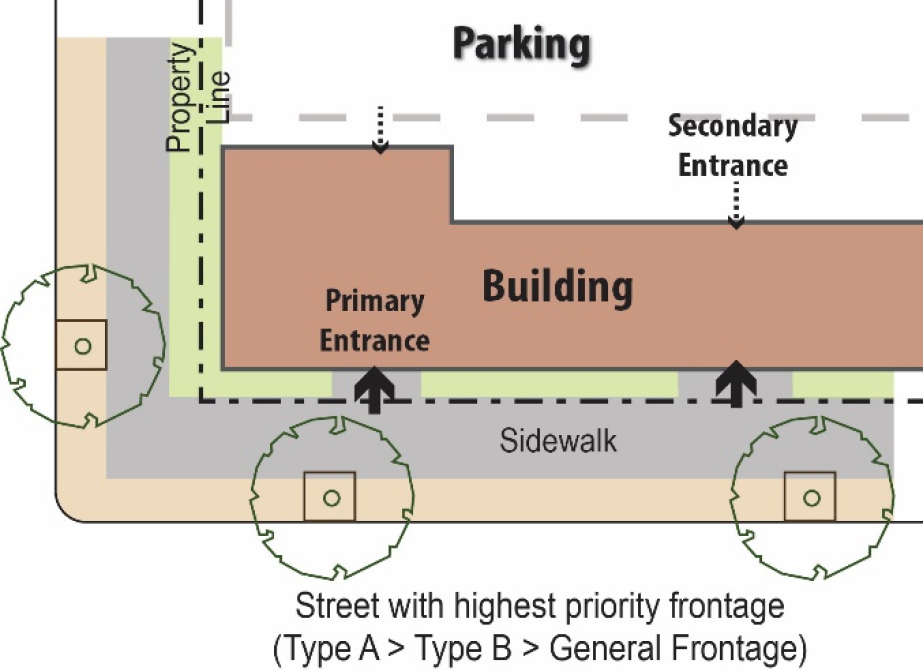
Illustration Depicting the Required Building Orientation and Primary Entrance
6.4
Design of Parking and Service Areas
6.4.1
Any surface parking in the setback area with frontage along all streets (except alleys) shall be defined by a minimum 3-foot high Street Screen. Required Street Screens shall be of one of the following:
a.
The same building material as the principal structure on the lot or
b.
A vegetative screen composed of shrubs planted to be opaque at maturity, or
c.
A combination of the two.
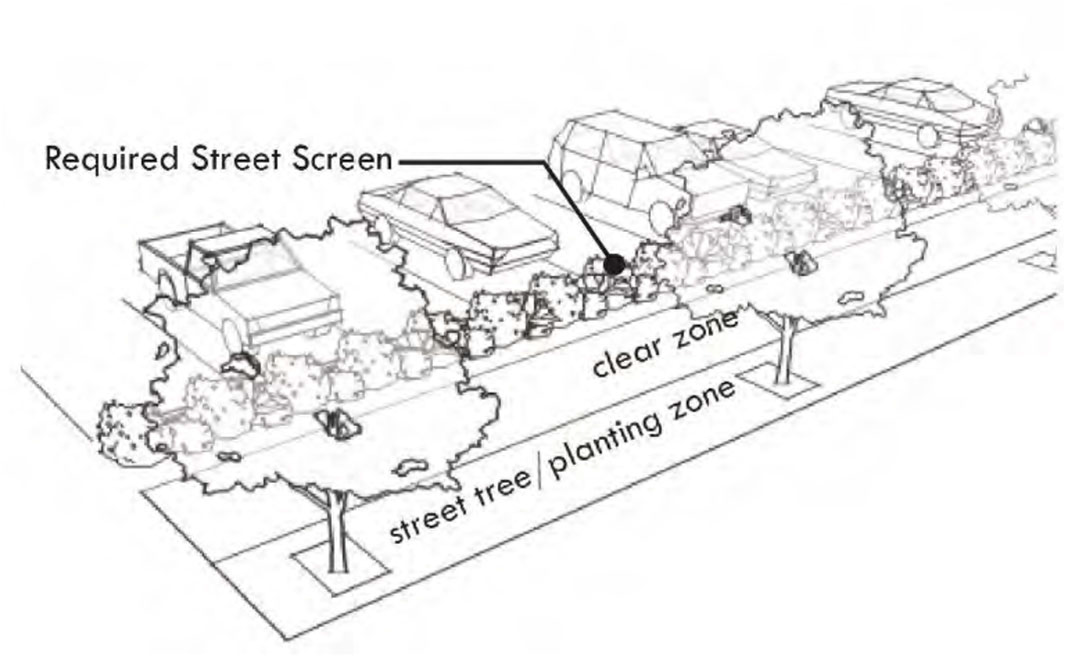
Illustration of Required Street Screen
6.4.2
Species shall be planted per best practices and based on urban tree species or applicable planting species from the list in Section 27-602-3 of the UDO.
6.4.3
The required Street Screen shall be located between the ROW and the minimum setback frontage.
6.4.4
Street Screens cannot block any required sight triangles along a cross street or driveway.
6.4.5
Street Screens may include breaks to provide pedestrian access from any surface parking or service area to the public sidewalk.
6.5
Design of Parking Structures.
6.5.1
All frontages of parking structures located on Type A frontage shall not have parking uses on the ground floor to a minimum depth of 30 feet along that frontage.
6.5.2
The amount of Type A frontage devoted to a parking structure shall be minimized by placing the shortest dimension(s) along the Type A frontage.
6.5.3
Parking structure façades on all Type A Frontage shall be designed with both vertical and horizontal articulation.
6.5.4
Where above ground structured parking is located at the perimeter of a building with frontage along a Type A Frontage, it shall be screened in such a way that cars on all parking levels are screened from view of the Type A Frontage. Architectural screens shall be used to articulate the façade, hide vehicles and shield lighting.
6.5.5
Parking structures and adjacent sidewalks shall be designed so pedestrians are clearly visible to entering and exiting automobiles.
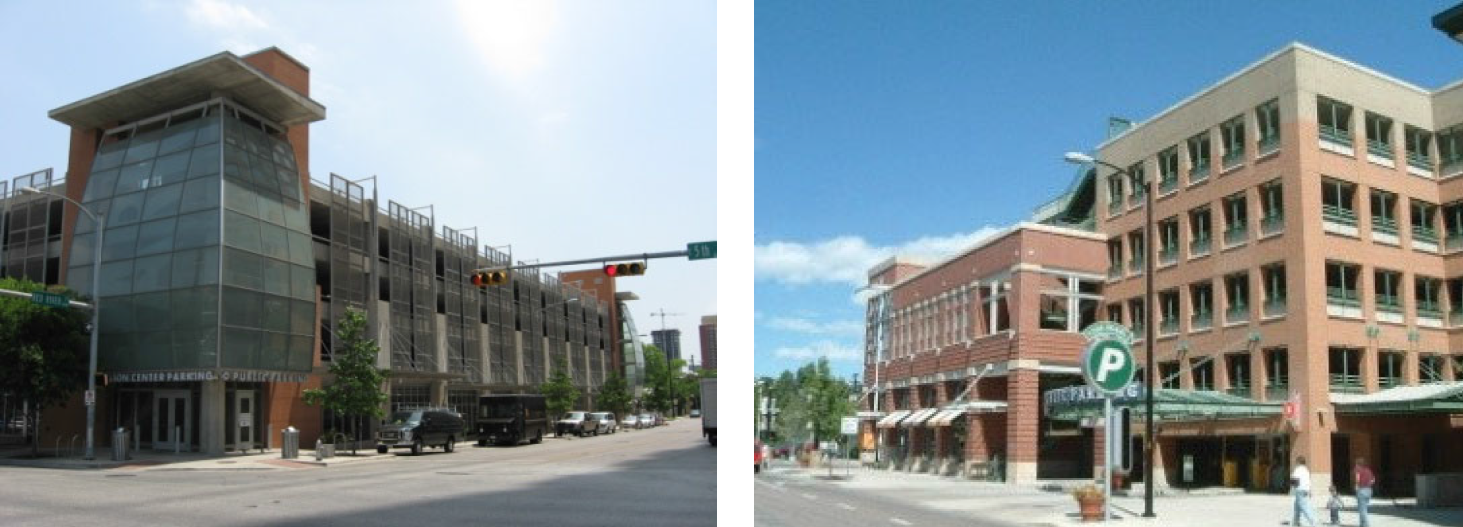
Images showing Parking Garage Design Examples
6.6
Driveways, Alleys and Service Access.
6.6.1
Unless otherwise specified in the Character Area standards, driveways and off-street loading and unloading may be located along the lowest classified street or mutual access easement to an adjoining property with direct driveway access to any other street. Porte-cocheres entrances may be allowed for hospitality and entertainment uses along all streets as long as they are designed to ensure pedestrian safety and walkability.
6.6.2
Shared driveways, mutual access easements shall be required for adjoining properties when driveway and service access is off a Type A Frontage.
6.6.3
Service and loading/unloading areas shall be screened per standards in Section 6.7.
6.6.4
Unless required to meet minimum fire access or service access standards all commercial and mixed-use driveways/alleys shall be a minimum of 20 feet in width. Service driveways/alleys shall be a maximum of 32 feet in width garage to garage. Driveways wider than 24 feet in width shall only be located off Type B Frontages. Driveways/alleys along state roadways shall meet state standards or the City's adopted ordinances or design specifications.
6.7
Design of Automobile-Related Building Site Elements.
6.7.1
Drive-through lanes for commercial uses shall not be located on any Type A or primary street Frontage. Drive-through lanes shall be hidden behind a street screen along any non-primary street.
6.7.2
All off-street loading, unloading and trash pick-up areas shall be located along the lowest priority classified street or alleys unless permitted in the specific building form and development standards in Section 6. Any off-street loading, unloading or trash pick-up areas shall be screened using a street screen that is at least as tall as the trash containers and/or service equipment it is screening. The street screen shall be made up of:
a.
The same material as the principal building or;
b.
A living screen or;
c.
A combination of the two.
6.7.3
Design of Auto Service Bays:
a.
If permitted under Table 4.2 auto service bays for commercial uses shall not be located with frontage along any Type A Street. All views of auto service bays shall be hidden behind a three foot high street screen along both Type A and Type B frontages (see illustrations below). The street screen shall be made up of (i) the same material as the principal building or (ii) a living screen of (ii) a combination of the two;
b.
Any automobile service use of a site or property with Type A or B Frontage shall have a primary building entrance from a public sidewalk along its highest designated street frontage.
6.8
Mechanical and Service Screening.
6.8.1
All buildings shall be designed such that no mechanical equipment (HVAC, etc.) is visible from the public right-of-way or open space, whether the equipment is located on the ground, exterior walls or roof.
6.8.2
The screening material used shall be the same as the primary exterior building material used and raised at least one (1) foot above the top of the mechanical equipment.
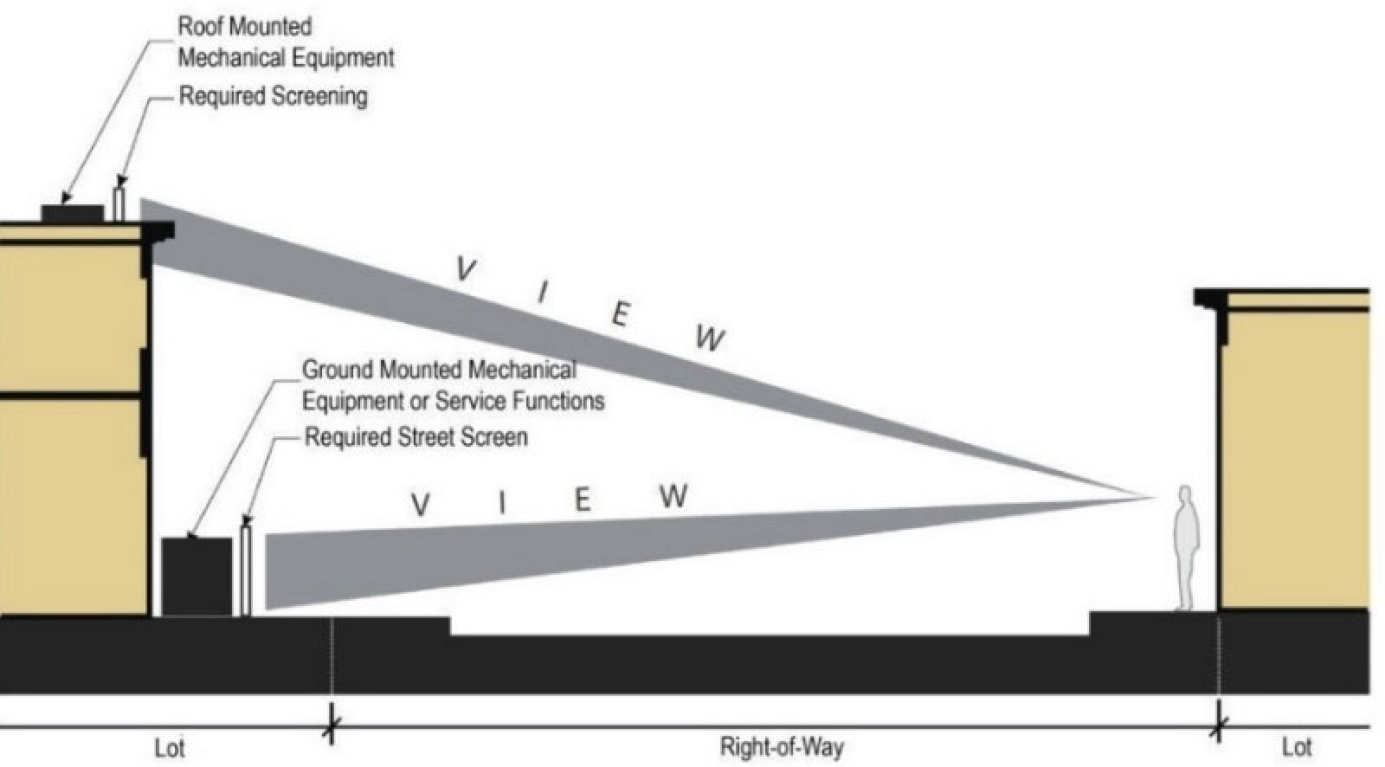
Illustration of Mechanical Equipment Screening
6.9
Façade Composition.
6.9.1
Buildings shall maintain a façade rhythm of 20 feet to 30 feet along all Type A Frontages.
6.9.2
This rhythm shall be expressed by changing materials, or color, or by using design elements such as fenestration, columns and pilasters, integrated colors, or by varying the setback of portions of the façade.
6.9.3
Storefronts on façades that span multiple tenants shall use architecturally compatible materials, colors, details, awnings, signage and lighting fixtures.
6.9.4
Building entrances shall be defined and articulated by architectural elements such as lintels, pediments pilasters, columns, porticos, overhangs, railings, balustrades and others, as appropriate. All building elements shall be compatible with the architectural style, materials, colors and details of the building as a whole. Entrances to upper level uses shall be defined and integrated into the design.
6.9.5
Specific to Civic/Medical Area:
a.
Buildings under 10,000 sq.ft. shall meet the design standards in this section of the DT-FBC.
b.
Buildings over 10,000 sq.ft. shall either meet the design standards in this Section of the DT-FBC or UDO Section 27-602-Architectural Design of Structures.
6.9.6
Multi-Family buildings shall incorporate a minimum of four (4) of the following elements on each Type A or Type B façade:
a.
Balconies, a minimum of 25 square feet in area;
b.
Bay or box windows;
c.
Porches or covered entries;
d.
Dormers;
e.
Awnings or canopies;
f.
Structural offsets a minimum of four feet from the principal plane of the façade;
g.
Accent materials such as brick, stone, or stucco with banding highlights;
h.
Ornamental or decorative window grills and shutters;
i.
Vertical elements such as towers or building end-caps that demarcate building modules;
j.
Other comparable feature as approved by the Director.
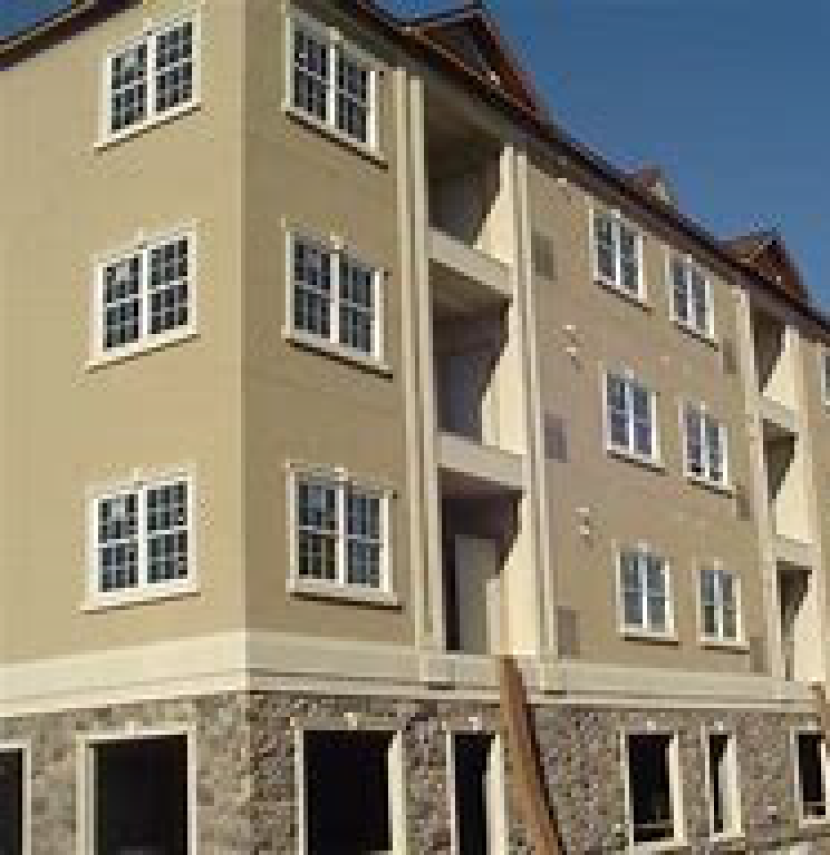
Image showing a building with accent materials (stone and stucco with banding highlights)
6.10
Windows and Doors.
6.10.1
Windows and doors on street (except alleys) fronting façades shall be designed to be proportional and appropriate to the specific architectural style of the building. First floor windows shall not be opaque or mirrored glass. Tinted windows shall have a minimum visual transmittance of 0.6.
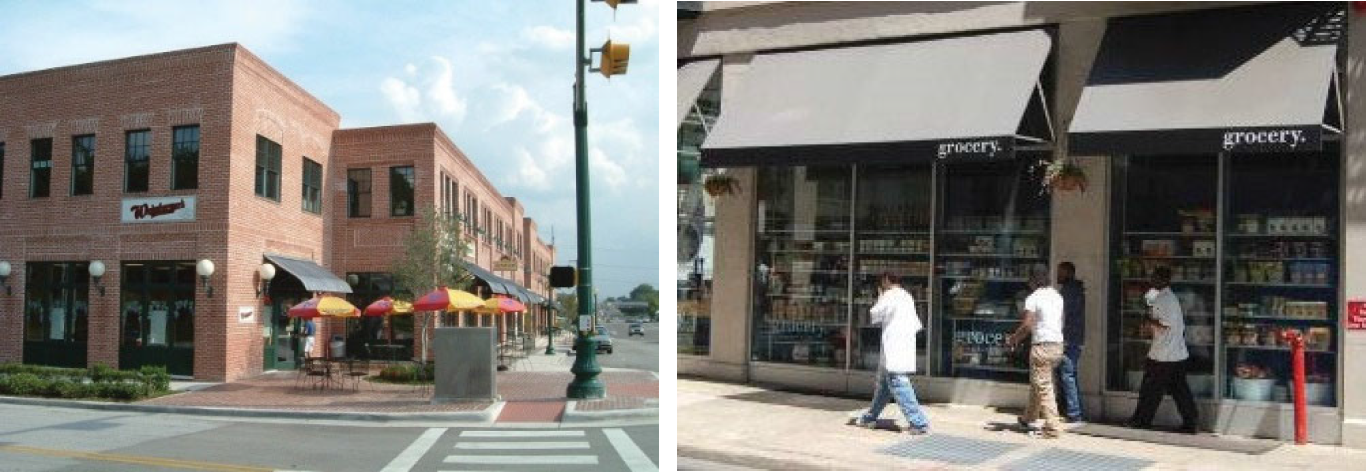
Images Showing Storefront Window Transparency
6.10.2
All ground floor front façades along Type A Frontages or Civic/Open Spaces shall have transparent storefront windows covering no less than 40% of the ground floor façade area. Each upper floor of the same building façades facing a Type A Frontage or Civic/Open Space shall contain windows covering at least 25% of the façade area. All other street facing façades (except alleys) shall have windows covering at least 15% of the façade area for all floors.
6.11
Building Materials.
6.11.1
Table 5.1 Development Standards shall establish the required minimum percentages of building materials permitted for each building façade based on the Character Area.
6.11.2
Table 6.1 shall establish the three categories of building materials with Primary and Accent materials permitted in each of the categories. These standards shall apply to all external building material with the exclusion of doors and windows.
TABLE 6.1 BUILDING MATERIAL CATEGORIES
6.12
Additions to Existing Buildings.
6.12.1
Relationship to Main Building. Additions to existing buildings should be compatible in size, scale, color, materials and character of the main building and its environment.
6.12.2
Original Design Character. Wherever possible, new additions or alterations to buildings should not obscure or confuse the essential form and character of the original building. Avoid new additions or alterations that would hinder the ability to interpret the design character of the historic period of the district. Alterations that seek to imply an earlier period than that of the building are inappropriate. Alterations that seek to imply an inaccurate variation on the historic style are also inappropriate.
6.12.3
Materials. Unless the original building façade materials are used for the building addition, standards in Section 6.11 shall apply.
(Ord. No. 121-21, § 2(att.), 12-2-2021; Ord. No. 53-22, § 1, 7-12-2022)
Section 7. - Garrison Avenue Historic District Architectural and Design Standards
7.1
Applicability. This section applies to all contributing buildings and individually listed buildings in any local, state, or National Register in the Garrison Avenue Historic District (GAHD) boundary and also located in the Garrison Area, Cisterna Area, Civic/Medical Area or the Riverfront Area as identified in the FBC Boundary Map (Appendix A). Other buildings shall be regulated by the standards in Section 6 of this Code. Streetscape, parking design standards and any other urban design standard not covered in this section shall be regulated by Section 8 and Section 6 of this Code. All renovation and restoration projects shall be approved by the Director. Any projects that seek a variance to these design standards shall first consult the Director and if necessary, follow the variance process as described in the UDO 27-337. For reference, information on historic building design and style has been included in Appendix D.
7.2
Intent. The Architectural and Design Standards for the GAHD shall establish a coherent urban character, protect the historic character and encourage enduring, attractive and sustainable development.
7.3
It is the intent of this subsection to provide design standards that achieve the following:
7.3.1
To accommodate change in a manner that is compatible with the historic character of Garrison Avenue without imitating it.
7.3.2
To preserve and enhance the historic, architectural and cultural features of the GAHD area.
7.3.3
To protect the integrity of the historic district.
7.3.4
To protect the sense of time and place conveyed by the historic buildings as a collection.
7.3.5
To promote a sense of identity and consistency for the district.
7.3.6
To minimize negative impact on adjacent properties by inappropriate developments.
7.3.7
To preserve the integrity of each individual historic structure.
7.3.8
To preserve character-defining features.
7.3.9
To avoid alterations that would remove or obscure historic character.
7.3.10
To enhance the perception of the historic character of the historic structure.
7.3.11
To restore damaged historic features and reconstruct missing ones (where adequate documentation exists of what was there historically) and to remove non-contributing alterations.
7.3.12
To preserve and enhance the sense of time and place in the historic Garrison Avenue Commercial District.
7.4
Interpretation. The most significant elements taken into the design of new buildings will be the basic building volume, street alignment, and material uniformity. The importance of context, including the relationship of a proposed project to abutting buildings and side streets should be part of the design decisions for new buildings. The Garrison Avenue commercial district contains buildings that have evolved since the 1870s. Since characteristics differ within the district itself, particular attention to each block should be given in planning new structures. Emphasizing context and design elements, rather than styles, the broadest and most flexible interpretation for new construction is encouraged.
7.5
Design and Architectural Standards:
7.5.1
Accessibility. The Americans with Disabilities Act (ADA) mandates that places of public accommodation be accessible to all users. These standards should not prevent or inhibit compliance with accessibility laws. All new construction shall comply completely with ADA. Owners of historic properties also should comply to the fullest extent possible, while also preserving the integrity of the character-defining features of their buildings. For example, historic door thresholds often made of stone or cast metal should be preserved when feasible. Original archway widths should be preserved as well, where feasible. Special provisions for historical buildings exist in the laws that allow some alternative solutions in meeting the ADA standards.
7.5.2
Additions. Because most lots already have structures on them, any additions are likely to occur as roof-top, side, or rear additions. An addition shall be compatible in scale, materials, and character with the main building. Using similar material is appropriate. In some cases, a simpler, less noticeable material also may be appropriate. The materials shall be in proportion to the historic building. Materials, finish and details on any addition shall not call attention to the new space. See section on Additions to Existing Buildings, Section 7.6.
7.5.3
Traditional Façade & Storefront Design.
a.
The basic traditional commercial façade consists of three parts: the storefront with an entrance and large display windows, an upper masonry façade and a decorative cornice. The basic storefront design includes large windows with thin framing members, a storefront cornice, transom, bulkheads and often a recessed entrance.
b.
If planning improvements to a storefront, the original proportions shall be carefully considered and respected. On occasion, one business utilizes more than one historic storefront. The individual identities of the original buildings should be retained, and the use of awnings, colors and signage should be used to unify the storefronts, rather than removing original materials and creating one new, modern storefront out of several buildings.
7.5.4
Storefront Features. Existing historic storefronts date from the late 19th and early 20th centuries and are designs typical of commercial architecture of the period. Storefronts had five main characteristics:
a.
Lower panels or bulkhead: The large plate glass windows for the display of goods rested on lower panels called bulkheads. These were primarily rectangular in design, of frame or brick construction and often had raised patterns.
b.
Display windows: Merchants in the early 20th century relied on extensive window displays to advertise their goods. High visibility was a priority for these merchants and the installation of large sheets of plate glass provided maximum exposure of wares.
c.
Cast iron pilasters: To support the weight of the brick masonry above the storefront, cast iron columns or brick piers were often added. The cast iron was shaped into decorative forms that supported the load of the brick upper façade allowing large display areas. Brick piers were also used to support the weight of the upper façade brick.
d.
Large central or corner entrances: Many commercial buildings originally had large central or corner entrances of single or double doors.
e.
Transoms: Over the display windows and entrances were usually transom bars and transoms. Transoms allowed light into the building and were used for additional areas of signage and display. Transoms utilized clear, textured, leaded or stained glass.
7.5.5
Storefront Guidelines.
a.
Original storefronts or historic storefronts that date from the late 19 th and early 20 th centuries should not be altered but repaired and retained.
b.
Future storefront remodeling or renovation shall follow historic guidelines such as retaining historic features, reconstruction based on historic photos or illustrations, or renovation based on typical storefront designs of the period.
c.
All decorative metals or glass on historic storefronts shall be retained and maintained.
d.
If an original storefront has been removed, a new storefront design shall take the original proportions and materials into account. Modern materials are acceptable so long as they are in proportion to traditional design. Shiny, brushed aluminum is not appropriate. Original materials or aluminum with a baked enamel finish are more appropriate.
e.
A storefront should be composed almost entirely of clear glass. Tinted or reflective glass is in-appropriate. Should privacy be desired, interior window treatments or movable barriers should be considered.
f.
Transoms over doors or display areas should not be enclosed or painted out.
g.
Designs and materials such as sloping mansard roofs, metal siding, vertical siding, EIFS, wood shingles, imitation brick, imitation stone, vinyl and aluminum siding are not appropriate and should not be added to storefronts or upper stories. Stucco shall not be used over other masonry materials.
h.
Avoid concealing original façade materials. If original material is to be replaced, duplicate the element utilizing a material similar to the original material. Avoid the use of shiny, reflective materials such as mirror, glass and plastic panels as façade materials. New materials should be similar in texture and pattern to those found historically.
i.
Cast iron should be painted to prevent rust and corrosion. Rust or paint build-up may be re-moved by chemical treatment or low-pressure dry grit blasting (80-100 psi), taking care to protect any adjacent building materials that might be damaged.
7.5.6
Storefront Entries. Traditionally, entrance doors were made of wood with a large pane of glass. Standard aluminum and glass commercial doors have replaced many original doors. Aluminum can be made more compatible by being finished in or made of a dark color and by selecting a design in the proportions of the original. The rhythm of entries is important in the downtown area. Historic entry systems, whether recessed or flush with the public walk, shall be retained.
7.5.7
Storefront Entry Guidelines.
a.
Original entry doors should be retained and restored in their original location and configuration when appropriate. If modifications have been made, a new entry should be designed based upon the traditional design elements.
b.
Use doors with large areas of glass and a painted or baked enamel frame.
c.
Avoid unfinished bright aluminum or stainless-steel frames.
d.
Avoid residential style doors, including those from historic residences.
e.
Finished frames may be varnished or painted wood or metal with anodized or painted finish. Wider metal frames are generally encouraged over narrow frames.
7.5.8
Storefront Windows. For most downtown buildings, large windowpanes at the first-floor level are advisable for both retail and office use. Avoid multi-pane designs that divide the storefront window into small components. This look is not typical of most downtown buildings, and is therefore inappropriate. Tinted glass shall have a minimum visible transmittance of 0.6 and is generally accepted in decorative transoms. Awnings and interior window treatments can protect from the sun, but allow its warmth to enter in colder seasons while retaining the traditional appearance.
7.5.9
Storefront Window Guidelines
a.
Original storefront window configuration should be maintained.
b.
Tinted and/or reflective glass is inappropriate.
c.
Avoid multi-pane designs.
d.
Preserve existing transoms. Leaded and prismatic decorative transoms should be preserved in place. For other transoms, clear glass is generally preferable.
e.
Use the transom as a place for a sign or decorative plane if the use of glass is not feasible, but retain the original proportions of the opening.
7.5.10
Bulkhead Guidelines
a.
Existing storefront bulkheads should be retained and repaired as needed. If bulkheads have been removed, appropriate bulkheads should be installed, based upon the historic elements.
b.
If the original design is missing, use historic documentation to duplicate an appropriate design. If original information is not available, develop a new simplified design that retains the original character.
c.
For renovations where there is no physical or documentary evidence, appropriate bulkhead materials are painted wood, brick, stone or painted metal. Plywood may also be acceptable when no original material exists. Artificial siding, plywood and EIFS shall not be appropriate if replacing original material.
7.5.11
Awnings & Canopies
a.
The canvas awning or horizontal, fixed canopy was an important design element in the traditional storefront. It provided cover, added color and served as a transition between the storefront and the upper façade. Most buildings that face the sun had awnings. Look at old pictures of your building to see how awnings were used.
b.
For canopies, appropriate supporting mechanisms shall be wall-mounted brackets, chains and posts. Wall-supported canopies also may be considered for new construction.
c.
Fabric awnings are appropriate and encouraged for historic buildings and new construction.
d.
Operable awnings also may be considered.
e.
Rigid frame awnings also may be considered.
f.
Rigid canopies are encouraged to provide recessed lights and illuminate the sidewalk.
g.
Use colors that are compatible with the overall color scheme of the façade. Solid colors or simple muted striped patterns are appropriate.
h.
Simple shed shapes are appropriate for rectangular openings. Semi-circle shapes are appropriate for arches. Odd shaped awnings are inappropriate.
i.
Awnings and canopies should be mounted to accentuate character-defining features. They should be mounted to highlight moldings that may be found above the storefront. Their mounting should not damage significant features and historic details. An awning can be attached above the display windows and below the cornice sign panel. Sometimes it is mounted between the transom and the display windows, allowing light into the store while shading the merchandise and pedestrians from the sun.
j.
When awnings are used on buildings, canopies shall be in good condition and comply with the City of Fort Smith's Property Maintenance Code. Colors of canopies shall be approved by the Director or designee. If a change of ownership occurs with the business occupying the space and a canopy is used for identification of the business the current business shall be identified on the canopy or modified to remove the old business name and left blank.
k.
A standard street-level awning should be mounted so that the valance is about 7 feet above the sidewalk and projects out between 4 and 7 feet from the building. A 12-inch valance flap is usually attached at the awning bar and can serve as a sign panel.
l.
An awning should reinforce the frame of the storefront and should not cover the piers or the space between the second-story window sills and the storefront cornice.
m.
Inappropriate storefront alterations can be effectively disguised by mounting an awning over the alterations while maintaining the proportions of a traditional storefront.
n.
Aluminum awnings or canopies generally detract from the historic character and should not be erected. If a flat canopy exists, it can be dressed up with a 12-to 24-inch awning valance.
o.
Various awning materials offer different colors and patterns. There are several to choose from: canvas, vinyl coated canvas and acrilan, a synthetic material. Each varies in cost and relative durability.
7.5.12
Brick and Masonry
a.
Materials original to the building shall be preserved.
b.
Brick and masonry shall never be sandblasted or subjected to any kind of abrasive cleaning. Do not clean with high pressure water which exceeds 450 pounds per square inch. These processes damage brick surfaces and erode mortar joints.
c.
To avoid needlessly introducing moisture or chemicals into the building, brick and masonry should be cleaned only when necessary to remove heavy soiling and to stop deterioration.
d.
Paint removal should not be done if the paint is firmly adhered to and therefore protecting the masonry surface.
e.
Water-repellent coating should not be added unless masonry repairs have failed to stop water penetration problems.
f.
As a general rule, brick and masonry shall not be painted unless in the case of brick, if the brick is extremely mismatched from earlier alterations or cannot withstand weather.
g.
Brick and masonry shall not be covered with Exterior Insulation Finish System (EIFS), stucco or any similar material.
h.
Repointing shall match original width, depth, color, raking profile, composition and texture.
i.
Repoint should never be done with Portland cement or other hard mortar but with original compounds, if it can be determined, or with a historic compound such as one-part lime and two parts sand. Original type mortar compounds allows for expansion and contraction while hard mortar or cement prevents the expansion and contraction process.
7.5.13
Codes. All standard construction projects shall comply with the City of Fort Smith, Arkansas building, fire, plumbing, mechanical, property maintenance, and electrical codes in the most recent adopted edition.
7.5.14
Color. Use colors to create a coordinated color scheme for the building. The façade should "read" as a single composition.
a.
Base or background colors should be muted. Use the natural colors of the building materials, such as the buff color of limestone, as the base for developing the overall color scheme.
b.
Matte finishes are preferred to high glossy ones.
c.
Reserve the use of bright colors for accents only. Bright colors may highlight entries, for instance.
d.
Using the historic color scheme of the building is preferred. When historic colors are to be used, provide evidence of their historic application. Brickwork was usually unpainted.
7.5.15
Cornices
a.
Most historic commercial buildings have cornices to cap their façades. Their repetition along the street continues to the visual continuity on the block. They may be a straight or stepped parapet.
b.
Cornice that is intact shall be preserved. Reconstruct a missing cornice when historic evidence of its character is available. Use historic photographs, if available, to determine design details of the original cornice.
c.
Substitution of another old cornice for the original may be considered, provided that the substitute is similar to the original.
d.
If it is not possible to find photographs or evidence of the original cornice, a simplified interpretation is appropriate. Materials for reconstructed cornices include stone, brick and stamped metal.
7.5.16
Fences and Walls. Fences and/or walls are not likely to have existed historically in the Garrison Avenue commercial district. If historic documentation of fences or walls exist, it may be appropriate to reconstruct a similar type fence or wall. All fencing shall be approved by the Director.
7.5.17
Entries
a.
Maintain existing recessed entries. The repetition of recessed entries provides a rhythm of shadows along the street, which helps establish a sense of scale. These recessed entries were designed to provide protection from the weather, and the repeated rhythm of these shaded areas along the street helps to identify business entrances.
b.
The original doorway should be preserved on all historic buildings. Some may be double-leaf, panel doors with glass in the upper one-half. Doors with metal frames and large areas of glass are appropriate on Art Deco and Art Modern style buildings.
c.
If the original door design is unknown, replace with a single light (glass area) door design, not solid paneled door, decorative doors, or any kind of door based upon a different historical period or style.
d.
Preserve, maintain, or repair original display windows. If a storefront is missing display windows, new windows should match the original in location, design, size, and materials. Glass used in windows shall appear similar to that used historically. Transparent, clear glass is appropriate. Opaque and mirrored glass shall be prohibited and tinted glass shall have visual transmittance 0.6 or higher. Retaining extant historic glass is important and should be encouraged in all cases except where safety glass or wire glass is required by code.
7.5.18
Kickplates
a.
The kickplate, or bulkhead, located below the display window, adds interesting detail to the streetscape and should be preserved.
b.
If the original kick plate is missing, develop a compatible replacement design. Wood and masonry are appropriate materials for replacements.
c.
Coordinate the color of the kickplate with other trim elements on the buildings.
7.5.19
Entry Way Name Plates. Some of the buildings within the GAHD have name plates generally made out of tile or granite that give recognition to the original or previous owner. These shall be preserved when possible.
7.5.20
Landscaping. Shall meet the standards in Section 6.5.
7.5.21
Building Lighting
a.
Lighting designs should enhance the ability to interpret the historic character of the street, as seen at night, and should not overwhelm it.
b.
Use lighting to:
i.
Accent architectural details
ii.
Accent building entries
iii.
Accent signs
iv.
Illuminate sidewalks
c.
All light sources shall be shielded. Lighting should not dominate a façade or the street. Washing the entire façade of a building with light is inappropriate. Lights focused upward to light the façade also are inappropriate.
d.
Permanent animated lighting (such as chase lights) is prohibited.
7.5.22
Mechanical Equipment & Utilities. Shall meet the standards in Section 6.
7.5.23
Parking. Shall meet the standards for parking setbacks in Section 5, parking lot screening in Section 6 and Section 8.
7.5.24
Roofs
a.
Preserve the historic character of the building's roof line.
b.
Altering an existing historic parapet line is inappropriate.
c.
Set any new roof terraces back from the building front.
7.5.25
Walls
a.
Preserve original façade materials. Historically, brick and limestone have been the dominant building materials in the Garrison Avenue historic district. Historic building materials and the craftsmanship they exhibit add textural qualities, as well as visual continuity and character to the streetscape.
b.
When replacement of façade wall materials is necessary, the new materials should match the original in scale, color, texture and finish.
c.
Do not cover or obscure original façade materials. Covering of an original façade not only conceals interesting details, but also interrupts the visual continuity along the street. If the original material has been covered, uncover it, if feasible.
d.
Do not use harsh cleaning methods that could damage the finish of historic materials. Sandblasting, for example, is prohibited.
e.
Saving deteriorated parts which shall be replaced may later assist in matching reconstructed features. Wood sash windows, cornices and doors can often be restored or duplicated.
7.5.26
Windows & Doors
a.
Maintain historically significant storefront openings. The size and shape of original doors and windows are important characteristics that contribute to the integrity of historic commercial buildings. Avoid altering the shape of these features.
b.
Retain the original shape of the transom glass in historic storefronts. The upper glass band of traditional storefronts introduced light into the depths of the building, saving on lighting costs. These bands are found on many historic storefronts, and they often align at the same height. The shape of the transom is important to the proportion of the store front, and it should be preserved in its historic configuration. If the original glass is missing, installing new glass is preferred. How-ever, if the transom shall be blocked out, use it as a sign panel or a decorative band, but retain the original proportions.
c.
Preserve historic upper story windows. Historically, upper story windows had a vertical emphasis. The proportions of these windows contribute to the character of each commercial storefront. Do not block windows or alter their size. Consider re-opening windows that are currently blocked. Replace missing glass. Maintain the historic window sash when possible.
7.5.27
Rehabilitation to Existing Historic Building Standards. The standards that follow were originally published in 1977 and revised in 1990 as part of Department of the Interior regulations (36CFR Part 67, Historic Preservation Certifications). They pertain to historic buildings of all materials, construction types, sizes and occupancy and encompass the exterior and the interior of historic buildings. The Standards are to be applied to specific rehabilitation projects in a reasonable manner, taking into consideration economic and technical feasibility.
a.
A property shall be used for its historic purpose or be placed in a new use that requires minimal change to the defining characteristics of the building and its site and environment.
b.
The historic character of a property shall be retained and preserved. The removal of historic materials or alteration of features and spaces that characterize a property shall be avoided.
c.
Each property shall be recognized as a physical record of its time, place and use. Changes that create a false sense of historical development, such as adding conjectural features or architectural elements from another building, shall not be undertaken.
d.
Most properties change over time; those changes that have acquired historic significance in their own right shall be retained and preserved.
e.
Distinctive features, finishes, and construction techniques or examples of craftsmanship that characterize a property shall be preserved.
f.
Deteriorated historic features shall be repaired rather than replaced. Where the severity of deterioration requires replacement of a distinctive feature, the new feature shall match the old in design, color texture, and other visual qualities and, where possible, materials. Replacement of missing features shall be substantiated by documentary, physical, or pictorial evidence.
g.
Chemical or physical treatments, such as sandblasting, that cause damage to historic materials shall not be used. The surface cleaning of structures, if appropriate, shall be undertaken in the gentlest means possible.
h.
Significant archaeological resources affected by a project shall be protected and preserved. If such resources shall be disturbed, mitigation measures shall be undertaken.
i.
New additions, exterior alterations, or related new construction shall not destroy historic materials that characterize the property. The new work shall be differentiated from the old and shall be compatible with the massing, size, and architectural features to protect the historic integrity of the property and its environment.
j.
New additions and adjacent or related new construction shall be undertaken in such a manner that if removed in the future, the essential form and integrity of the historic property and its environment would be unimpaired.
7.6
Additions to Existing Historic Buildings.
7.6.1
Relationship to Main Building. Additions to existing buildings should be compatible in size, scale, color, materials and character of the main building and its environment.
7.6.2
Original Design Character. Wherever possible, new additions or alterations to buildings should not obscure or confuse the essential form and character of the original building. Avoid new additions or alterations that would hinder the ability to interpret the design character of the historic period of the district. Alterations that seek to imply an earlier period than that of the building are inappropriate. Alterations that seek to imply an inaccurate variation on the historic style are also inappropriate.
7.6.3
Location. When locating additions to historic buildings, maintain the pattern created by the repetition of building fronts in the area. Avoid impacts to special moldings, or decorative windows.
7.6.4
Materials. Shall meet standards in Section 6.
7.6.5
All other standards shall meet Section 5, 6, and 9 of this Code.
7.7
Demolition.
7.7.1
The demolition of an original feature or part of a historic building should be avoided whenever possible.
7.7.2
Any demolition request for a Contributing Structure to the Garrison Avenue Historic District shall be approved by both the CBID Commission and the Director after consideration of the provisions of this section.
7.7.3
Demolition of a building which contributes to the historic or architectural integrity of the historic district shall not occur, unless one or more of the following conditions are met:
a.
Public safety and welfare requires the removal of a building or structure as determined by the building or code inspector along with concurring reports commissioned by and acceptable to the Fort Smith Planning Department from a structural engineer or architect.
b.
Where economic hardship (the fact that no reasonable return on or use of the building exists) has been demonstrated and proven.
c.
Where rehabilitation is undesirable due to severe structural instability or deterioration of a building.
d.
The building has lost its original architectural integrity and no longer contributes to the district.
e.
No other reasonable alternative is feasible, including relocation of the building.
Section 8. - Open Space
8.1
Generally. The design of Open Space shall create a network of open spaces that recognizes the natural qualities of the area while providing a range of both passive and active recreational opportunities. These opportunities may be accommodated in a variety of spaces ranging from parks to neighborhood-scaled greens to urban squares and plazas.
8.2
Required Open Space.
8.2.1
Non-Residential Uses. All developments of non-residential uses over 2 acres shall include at least five (5) percent of civic/open space.
8.2.2
Multifamily Residential.
a.
All developments of multifamily uses over 2 acres shall include at least five (5) percent of the gross site area as civic/open space.
b.
Multi-family residential structures shall provide at least fifty (50) percent of the total dwelling units within the development with a minimum of one private outdoor yard, patio or balcony that consists of minimum of thirty-six (36) square feet.
Section 9. - Sign Standards
9.1
Applicability. Except for sign types, sign dimensional standards, and as specifically listed below, all other signage and sign standards shall comply with the UDO Section 27-704.
9.2
Prohibited Signs. The following types of Signs shall be prohibited in the DT FBC District:
a.
Any sign that flashes, blinks, revolves, or is put into motion
b.
Streamers and inflatable mascots
c.
Portable or wheeled signs and advertising devices on the site other than sandwich board signs permitted in Table 9-1.
9.3
Sign Types and Standards. Table 9-1 below shall establish the different sign types permitted and the standards for the different sign types.
Table 9-1: Sign Standards by Sign Types
(Ord. No. 81-21, § 2(att.), 9-7-2021)
APPENDIX B: - DEFINITIONS
In addition to Definitions in 27-201 of Fort Smith UDO, the following terms shall have the corresponding interpretations. Where in conflict definitions in this section shall prevail for the DT FBC area.
Accessory Structure or Use: A structure or use that:
• Is clearly incidental to and customarily found in connection with a principal building or use and is located on the same lot as the principal building or use served; and
• Is subordinate to and serves a principal building or a principal use and is subordinate to the principal building or principal use served.
Adaptive Use: Rehabilitation of a historic structure for use other than its original use such as a residence converted into offices.
Addition: New construction added to an existing building or structure.
Allowable Adjustment means any changes to the DT FBC Area Code that meet the threshold criteria established in Section 3.8 and Table 3.2.
Alteration: Work which impacts any exterior architectural feature including construction, reconstruction, repair, or removal of any building element.
Appropriate: Especially suitable or compatible.
Arcade means a portion of the main façade of a building that is at or near the setback range and a colonnade supports the upper floors of the building. Arcades are intended for buildings with ground floor commercial or retail uses and the arcade may be one (1) or two (2) stories.
Bay or Box Window: A projecting window (at an angle or perpendicular to the external wall) that forms an extension to the floor space of the internal rooms; usually extends to the ground level.
Block Face means the linear dimension of a block along one (1) of its street frontages.
Block means the aggregate of lots, pedestrian passages and rear alleys, circumscribed on all sides by streets.
Board and Batten: Siding fashioned of boards set vertically and covered where their edges join by narrow strips called battens.
Bracket: A projecting element of wood, stone or metal which spans between horizontal and vertical surfaces (eaves, shelves, overhangs) as decorative support.
Bulkhead: The structural panels just below display windows on storefronts. Bulkheads can be both supportive and decorative in design. Nineteenth century bulkheads are often of wood construction with rectangular raised panels. Twentieth century bulkheads may be of wood, brick, tile, or marble construction. Bulkheads are also referred to as kickplates.
Building: A structure used to house human activity such as a commercial use, civic use, a dwelling or garage.
Build-to Range: Shall be the difference between the maximum and minimum building setback amounts. For example, if the minimum setback is 5 feet and the maximum setback is 15 feet, the Build-to Range is 10 feet. Illustration of the build-to-range is provided in the Building Placement figures in Appendix C.
Character: The qualities and attributes of any structure, site, street or district.
Certificate of Appropriateness: A document awarded by a preservation commission allowing an applicant to proceed with a proposed alteration, demolition, or new construction in a designated area or site, following a determination of the proposal's suitability according to applicable criteria.
Character Area means an area within the DT FBC Area that creates a distinct urban form different from other areas within the DT FBC Area. Character Areas are identified in the FBC Boundary Map.
Civic Buildings and Uses means a building or use operated by not-for-profit organizations or governmental entity dedicated to arts, culture, education, recreation, government, transit, and municipal parking, or for similar public use.
Civic/Open Space means the publicly accessible open space in the form of parks, courtyards, forecourts, plazas, greens, pocket parks, playgrounds, etc. They may be privately or publicly owned. For all residential uses, privately accessible open spaces, such as courtyards, porches and balconies may also be considered as Civic/Open Space for the purposes of this Code. Building façades facing a Civic/Open Space shall be treated as a Type A Frontage.
Column: A circular or square vertical structural member.
Configuration: The arrangement of elements and details on a building or structure which help to define its character.
Context: The setting in which a historic element, site, structure, street, or district exists.
Contributing Structure: Shall be a building or structure that has been designated by the Arkansas State Historic Preservation Office (ASHPO) to be a historic building that at least 50 years old or older that retains a significant amount of its physical integrity and character defining features including location, setting, design, construction, workmanship, and/or association with historical persons or events.
Cornice: The uppermost, projecting part of an entablature, or feature resembling it. Any projecting ornamental molding along the top of a wall, building, etc.
Cresting: A decorated ornamental finish along the top of a wall or roof often made of ornamental metal.
Custom Auto-Service (used and new)(indoor only): Shall be any auto-service facility that offers modifications and customization of new or used vehicles that are in working condition.
Demolition: Any act which destroys in whole or in part a building or structure.
Dormers: A window that projects from a roof.
DT FBC Boundary Map means the Zoning Map (Appendix A) attached herein that shows the Character Areas, Civic/Open Spaces, and Street Designations and other requirements applicable to the DT FBC Area subject to the standards in this Code.
Eave: The edge of a roof that projects beyond the face of a wall.
Element: A material part or detail of a site, structure, street, or district.
Elevation: Any one of the external faces or façades of a building.
Encroachment means any structural or non-structural element such as a sign, awning, canopy, terrace, or balcony that breaks the plane of a vertical or horizontal regulatory limit, extending into a setback or public ROW, or above a height limit.
Façade, Building: Shall be an exterior wall of a building composed of typical architectural elements such as doors and windows and building materials.
Fenestration: The arrangement of windows on a building.
Food and Beverage Service Establishments: shall include businesses that serve prepared food or beverages for consumption on or off the premises. Accessory uses may include food preparation areas, offices, and parking. It shall include full-service (sit-down) restaurants, cafeterias (self-service), bakeries, snack bars, quick service restaurants, and bars or drinking establishments. It may also include cafe seating within a public or private sidewalk area with no obstruction of the pedestrian realm.
Heavy Manufacturing means the manufacture or compounding process of raw materials. These activities or processes would necessitate the storage of large volumes of highly flammable, toxic matter or explosive materials needed for the manufacturing process. These activities may involve outdoor operations as part of their manufacturing process.
Home Occupation means a non-residential use conducted within a residential dwelling or permitted accessory building by a permanent resident of the building.
Height: Shall be the vertical distance measured from the average finished grade next to the building to (a) to the highest point of the roof surface or parapet, if a flat roof; (b) to the deck line of a mansard roof; or to the mean height level between eaves and ridge for a gable, hip or gambrel roof.
Historic District: A geographically definable area with a significant concentration of buildings, structures, sites, spaces, or objects unified by past events, physical development, design, setting, materials, workmanship, sense of cohesiveness or related historical and aesthetic associations. The significance of a district may be recognized through listing in a local, state, or national landmarks register and may be protected legally through enactment of a local historic district ordinance administered by a historic district board of commission.
Historic Guidelines: Criteria developed to identify design concerns in an area and to help property owners ensure that rehabilitation and new construction respect the character of historically designated buildings and districts.
Infill: New construction where there had been an opening before, such as a new building between two older structures; or block infill in an original door or window opening.
Landscape: The totality of the built or human-influenced habitat experienced at any one place. Dominant features are topography, plant cover, buildings, or other structures and their patterns.
Loft Apartment means a residential unit that is built to retail ready standards and adapted for residential uses.
Light Manufacturing means the processing or fabrication of certain materials or products where no process involved will produce noise, vibration, air pollution, fire hazard, or noxious emission which will disturb or endanger neighboring properties.
Lintel: The horizontal top member of a window, door, or other opening.
Living Screen means a street screen composed of landscaping in the form of vegetation.
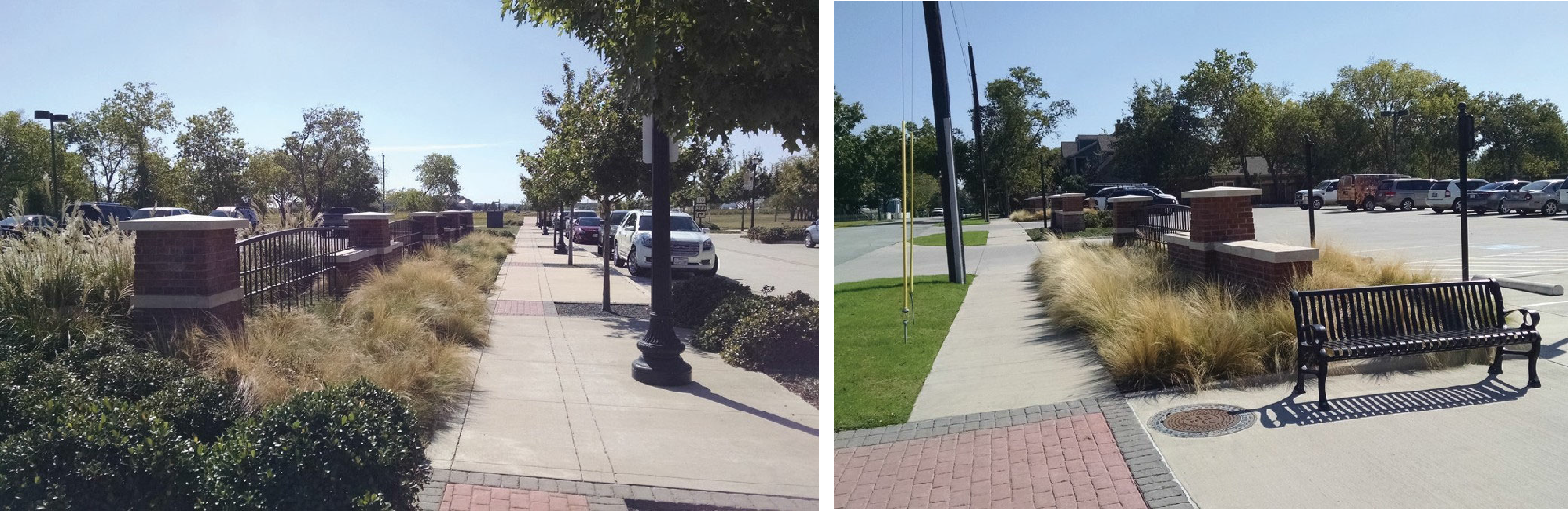
Figure: Living Street Screen Examples
Live/Work Unit means a dwelling unit that is also used for work purposes, provided that the work component is restricted to the uses of professional office, artist's workshop, studio or other similar uses and is located on the street level and constructed as separate units under a condominium regime or as a single unit. The "live" component may be located on the street level (behind the work component) or any other level of the building. Live/Work Unit is distinguished from a home occupation otherwise defined by this Code in that the work use is not required to be incidental to the dwelling unit, non-resident employees may be present on the premises and customers may be served on site.
Maintain: To keep in an existing state of preservation or repair.
Mansard Roof: A roof with a double slope on all four sides, with the lower slope being almost vertical and the upper almost horizontal.
Masonry: Exterior wall construction of brick, stone, or stucco laid up in small units.
Massing: The three-dimensional form of a building.
Medium Manufacturing: shall mean the manufacturing of products from processed or unprocessed raw materials, where the finished product is noncombustible and nonexplosive. This manufacturing may produce noise, vibrations, illumination, or particulate that is perceptible to adjacent land users, but is not offensive or obnoxious. Odors produced on-site shall not have a negative effect on other businesses or properties in the area. This use shall include any packaging of the product being manufactured on-site. Examples include but are not limited to the production of the following: glass products made from manufactured glass; clay and pottery products; food and beverages; candy and other confectionery products; computer hardware; products made from rubber, plastic, or resin; converted paper and cardboard products; fabricated metal products made from semifinished metals.
Monument Sign: shall refer to a ground mounted sign having no more than two (2) faces and being constructed of materials of the same type and in design similar to the principal structure located on the lot on which the sign is located.
Multifamily Residential means multiple separate housing units for residential inhabitants are contained within one building or several buildings within one complex.
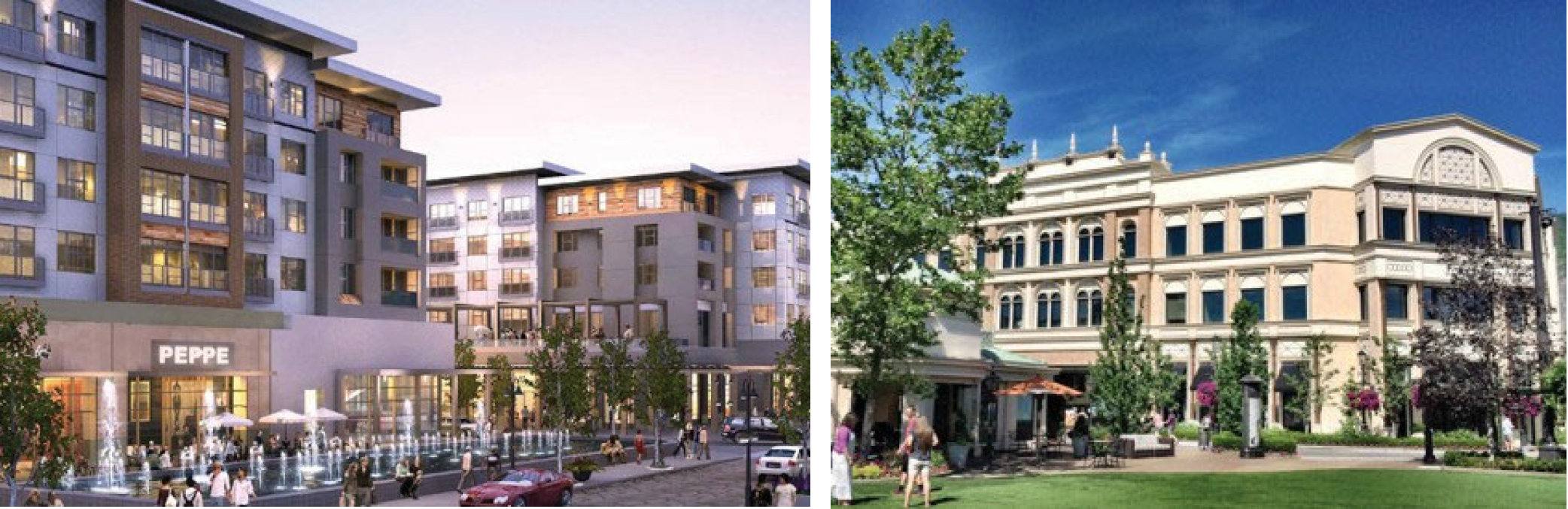
Figure: Multifamily Residential Units in Mixed-Use Environments
New Construction: Construction which is characterized by the introduction of new elements, sites, buildings, or structures or additions to existing buildings and structures in Downtown Fort Smith.
Outdoor Entertainment Venue shall include uses that provide a variety of outdoor activities for entertainment and recreation including amusement rides, basketball, baseball, batting cages, go-cart tracks, tennis courts, amusement and theme parks, water parks, marinas, water sports, and other activities not specifically listed under this category. This category may include indoor arcade facilities and food and beverage sales in conjunction with the outdoor entertainment as well.
Paneled Door: A door composed of solid panels (either raised or recessed) held within a framework of rails and stiles.
Parapet: A low horizontal wall at the edge of a roof.
Pediment: A triangular crowning element forming the gable of a roof; any similar triangular element used over windows, doors, etc.
Pier: A vertical structural element, square or rectangular in cross-section.
Pilaster: A square pillar attached, but projecting from a wall, resembling a classical column.
Plaza means a formal space created within more urban areas for civic purposes and commercial activity. Building frontages typically define these spaces and landscaping is primarily hardscape. Casual seating, along with tables and chairs, is typically provided.
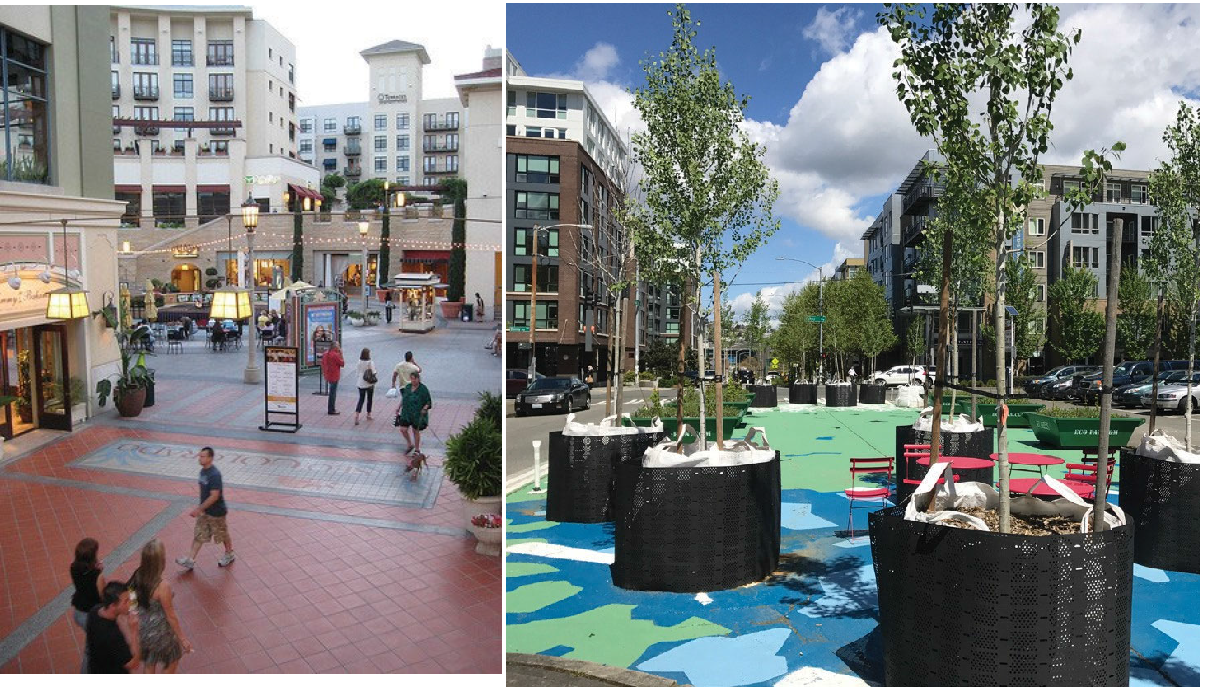
Figure: Images of Plazas
Portico: A roofed space, open or partly enclosed, forming the entrance and centerpiece of the façade of a building, often with columns and a pediment.
Portland Cement: A strong, inflexible hydraulic cement used to bind mortar. Mortar or patching materials with a high Portland cement content should not be used on old buildings. The Portland cement is harder than the masonry thereby causing serious damage over annual freeze-thaw cycles.
Preservation: Generally, saving from destruction or deterioration historic buildings, sites, structures, and objects and providing for their continued use by means of restoration, rehabilitation, or adaptive use. Preservation stops deterioration and stabilizes the structure.
Proportion or Proportional: Harmonious relation of parts to one another or to the whole.
Professional Office includes a range of office and business services and facilities that include executive, management, administrative, medical, professional and business support services not specifically listed elsewhere in this Code, but not involving the sale of merchandise except as incidental to a permitted use. Accessory uses may include cafeterias, health facilities, parking, or other amenities primarily for the use of employees in the firm or building.
Reconstruction: The act or process of reproducing by new construction the exact form and detail of a vanished building, structure, or object, or a part thereof, as it appeared at a specific period of time.
Rehabilitation: The act or process of returning a property or building to usable condition through repair, alteration, and/or preservation of its features which are significant to its historical, architectural, and cultural values.
Restoration: The act or process of accurately taking a building's appearance back to a specific period of time by removing later work and by replacing missing earlier features to match the original.
Retain: To keep secure and intact. In the guidelines, "retain" and "maintain" describe the act of keeping an element, detail, or structure and continuing the same level of repair to aid I the preservation of elements, sites and structures.
Retail Sales or Service includes establishments that sell merchandise directly to the general public from a fixed point-of-sale location. Retail establishments are designed to attract a high volume of walk-in customers and they often have displays of merchandise and sell to the general public for personal or household consumption. Included in, but not limited to this category, are durable consumer goods sales and service, consumer goods, other grocery, food, specialty food, beverage, dairy, etc. This category includes limited personal service establishments which offer a range of personal services that include (but not limited to) clothing alterations, shoe repair, dry cleaners, laundry, health and beauty spas, tanning and nail salons, hair care, etc.
Reuse: To use again. An element, detail, or structure might be reused in historic districts.
Rhythm: Movement or fluctuation marked by the regular occurrence or natural flow of related elements.
RV Park means a recreational vehicle park (RV park) or caravan park is a place where people with recreational vehicles can stay overnight, or longer, in allotted spaces known as "sites" or "campsites." They may also be referred to as campgrounds, though a true campground also provides facilities for tent camping; many facilities calling themselves "RV parks" also offer tent camping or cabins with limited facilities.
Sash: The moveable framework containing the glass in a window.
Scale: Proportional elements that demonstrate the size, materials, and style of buildings.
Significant: Having particularly important associations within the contexts of architecture, history, and culture.
Siding: The exterior wall covering or sheathing of a structure.
Sill: The bottom crosspiece of a window frame.
Single Family Residential Use means single family dwellings located on individual lots in a variety of attached or detached configurations. Types can include patio homes, cottage courts, etc.
Specialty Manufacturing means small scale assembly and light manufacturing of commodities (incl. electronics) fully enclosed within the building without producing any noise, noxious odors, gas, or other pollutants. This category shall include workshops and studios for cottage industries such as toys, ceramics, pottery, glass-blowing, metal working, screen printing, weaving, etc.
Street Façade Build-out means the percentage of a building's front façade that is required to be located within the front setback range as a proportion of that lot's width along the public street. Parks, plazas, squares and pedestrian passages shall be considered as buildings for the calculation of the Street Façade Build-out. Parking areas shall not be included in the Street Façade Build-out calculation.
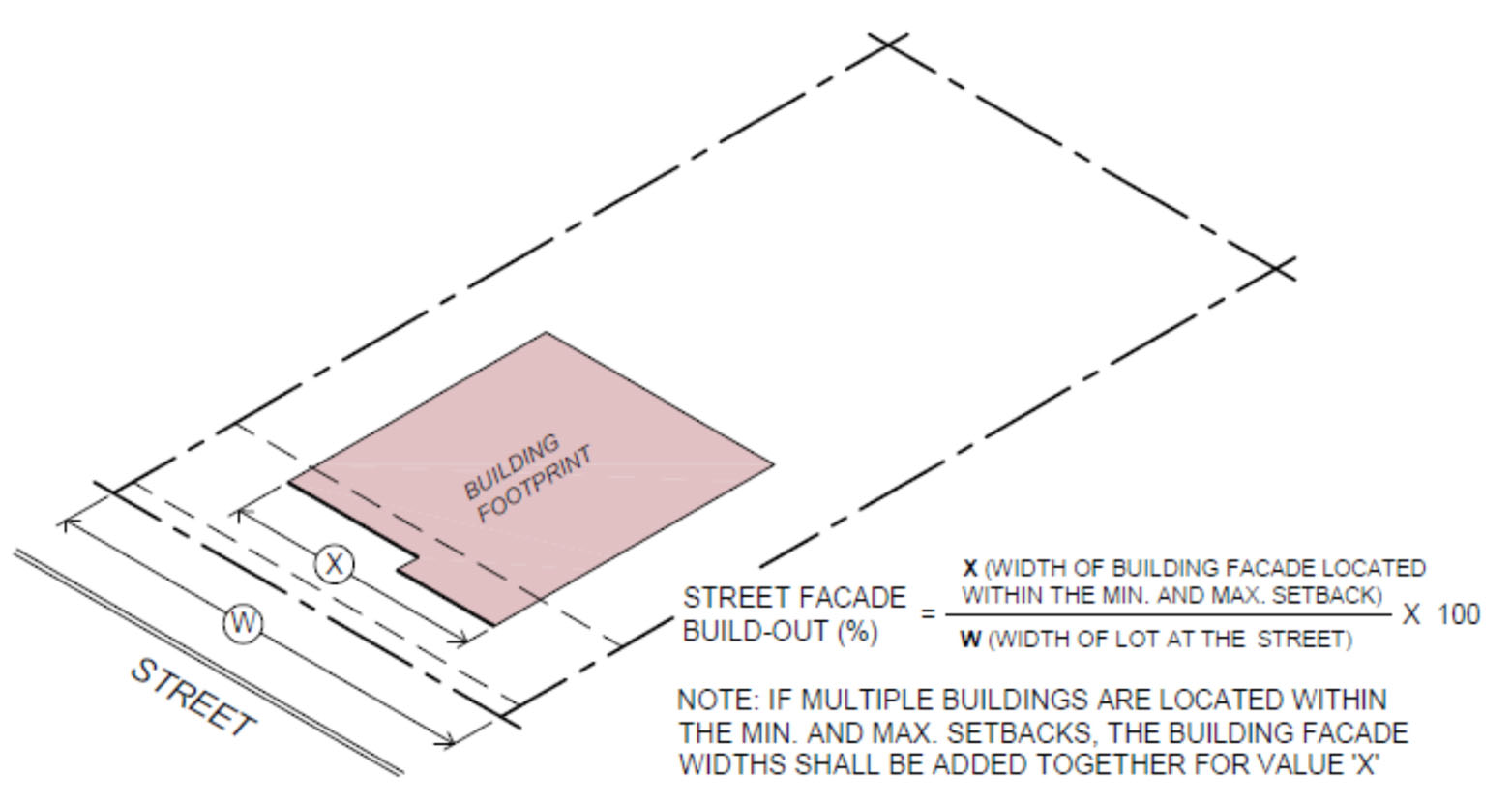
Figure: Illustration of how Street Façade Build-out is calculated
Streetscape: The distinguishing character of a particular street as created by its width, degree of curvature, paving materials, design of the street furniture, and forms of surrounding buildings.
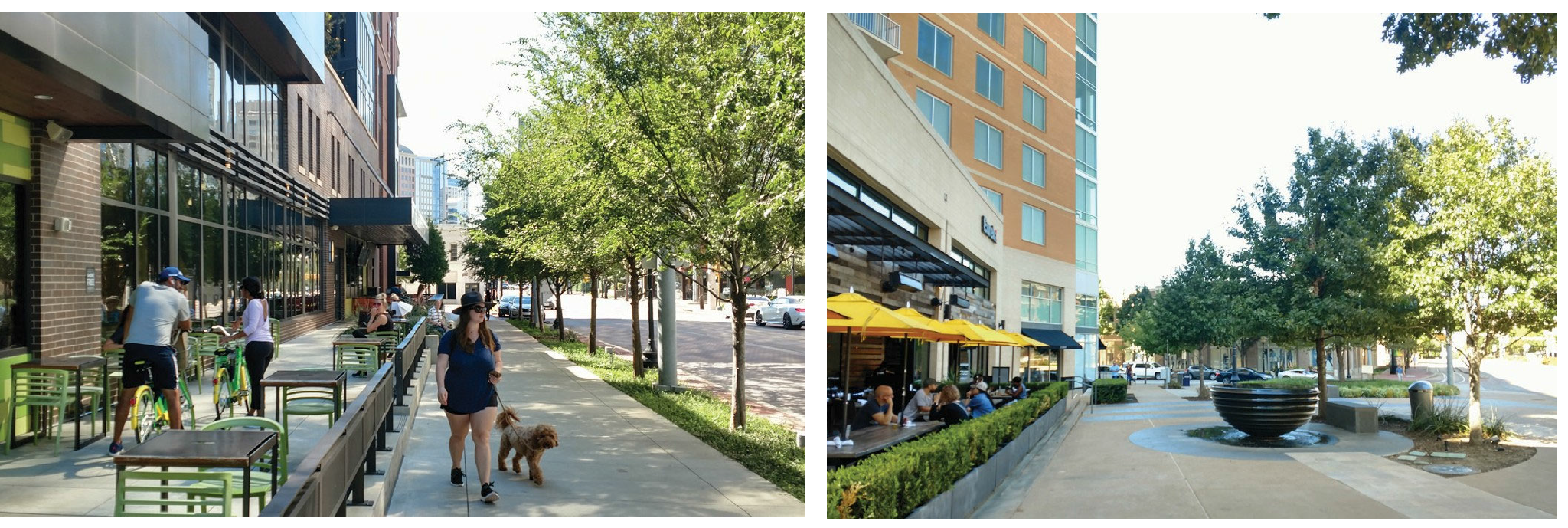
Figure: Activated Streetscape along the Sidewalk
Style: A type of architecture distinguished by special characteristics of structure and ornament and often related in time; also a general quality of a distinctive character.
Street Screen means a freestanding wall or living screen built along the BTZ or in line with the building façade line along the street. It may mask a parking lot or a loading/service area from view or provide privacy to a side yard and/or strengthen the spatial definition of the public realm.
Street Frontage means a specific frontage designation for lots in the DT FBC Area that establishes certain character and development context to improve walkability within the DT FBC Area.
Townhome means a small- to medium-sized attached structure that consists of two (2) to eight (8) houses placed side-by-side. This type of residential building is typically located in a location that transitions from a primarily single family neighborhood into a commercial corridor. This building type enables appropriately-scaled, well-designed residential infill and is important for providing a broad choice of housing types and walkability.
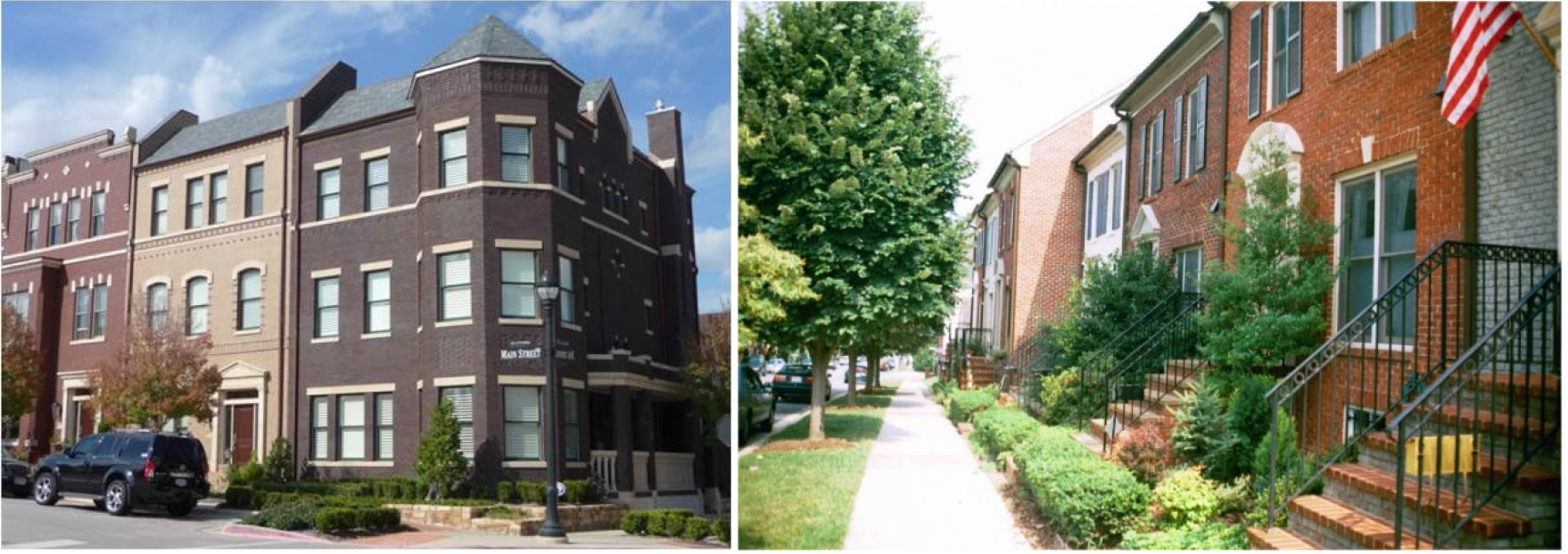
Figure: Townhouses or Townhomes
Theater (cinema, dance, music or other entertainment establishment) means a structure that is open to the public and is used for dramatic, operatic, musical, motion picture, or other performance or entertainment-related activities, where admission is charged per performance or event, and where there is no audience participation other than as spectators. Such establishments may include incidental services such as food and beverage sales and other concessions.
Transom: A horizontal opening (or bar) over a door or window.
Trim: The decorative framing of openings and other features on a façade.
Type A Frontage means the streets identified as such on the FBC Boundary Map. Type A Frontages are the primary pedestrian streets and buildings along Type A Frontages shall be held to the highest standard of pedestrian-oriented design.
Type B Frontage means the streets identified as such on the FBC Boundary Map. Type B Frontages are intended to primarily accommodate access to parking, service and other auto-related functions.
Urban Tree Species means a tree specifically selected for its ability to withstand harsh urban conditions, its upright branching habit and its non-invasive root system.
(Ord. No. 121-21, § 2(att.), 12-2-2021)
APPENDIX C: - ILLUSTRATIONS OF FORM STANDARDS
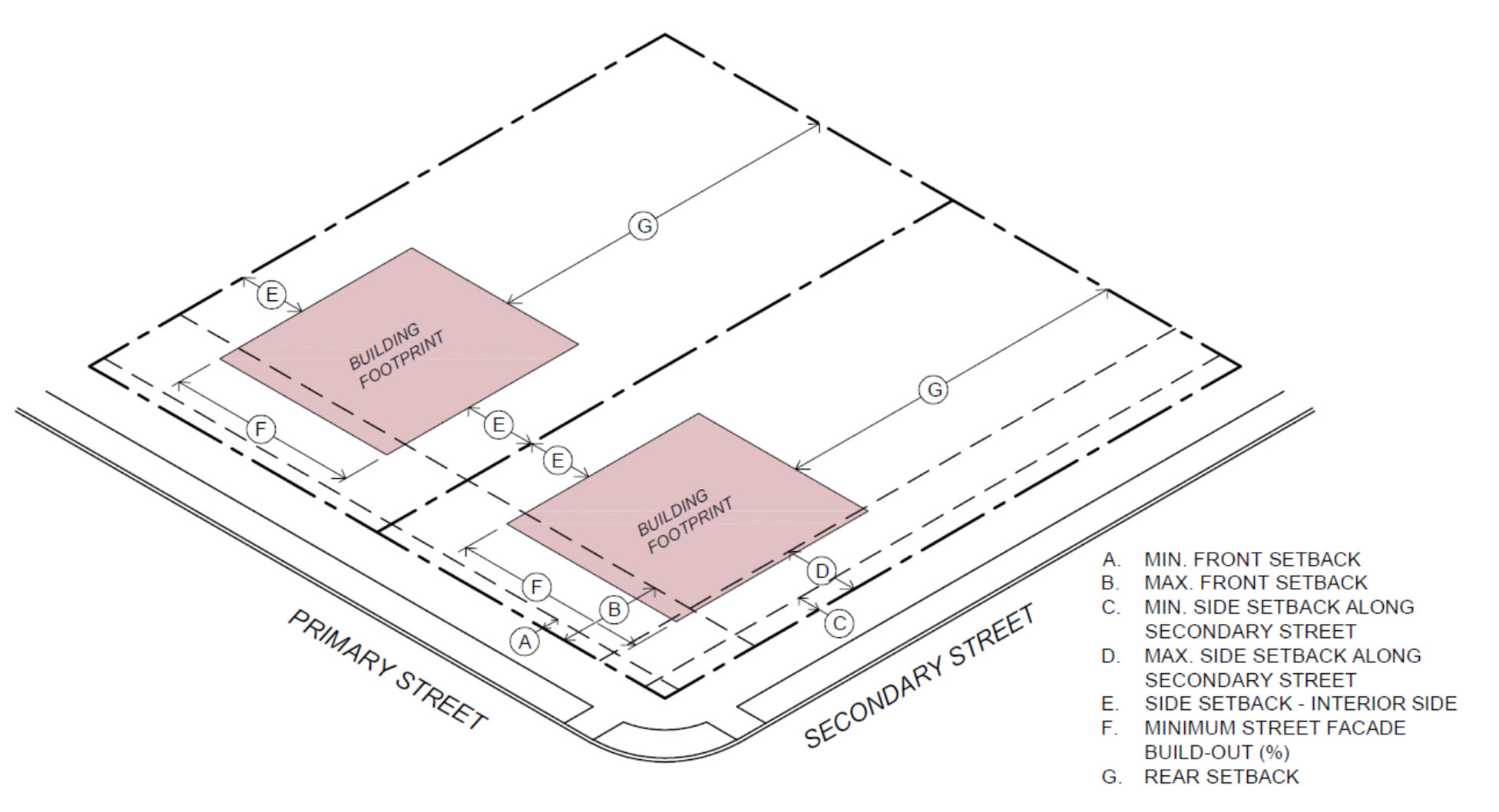
Building Placement Illustrations
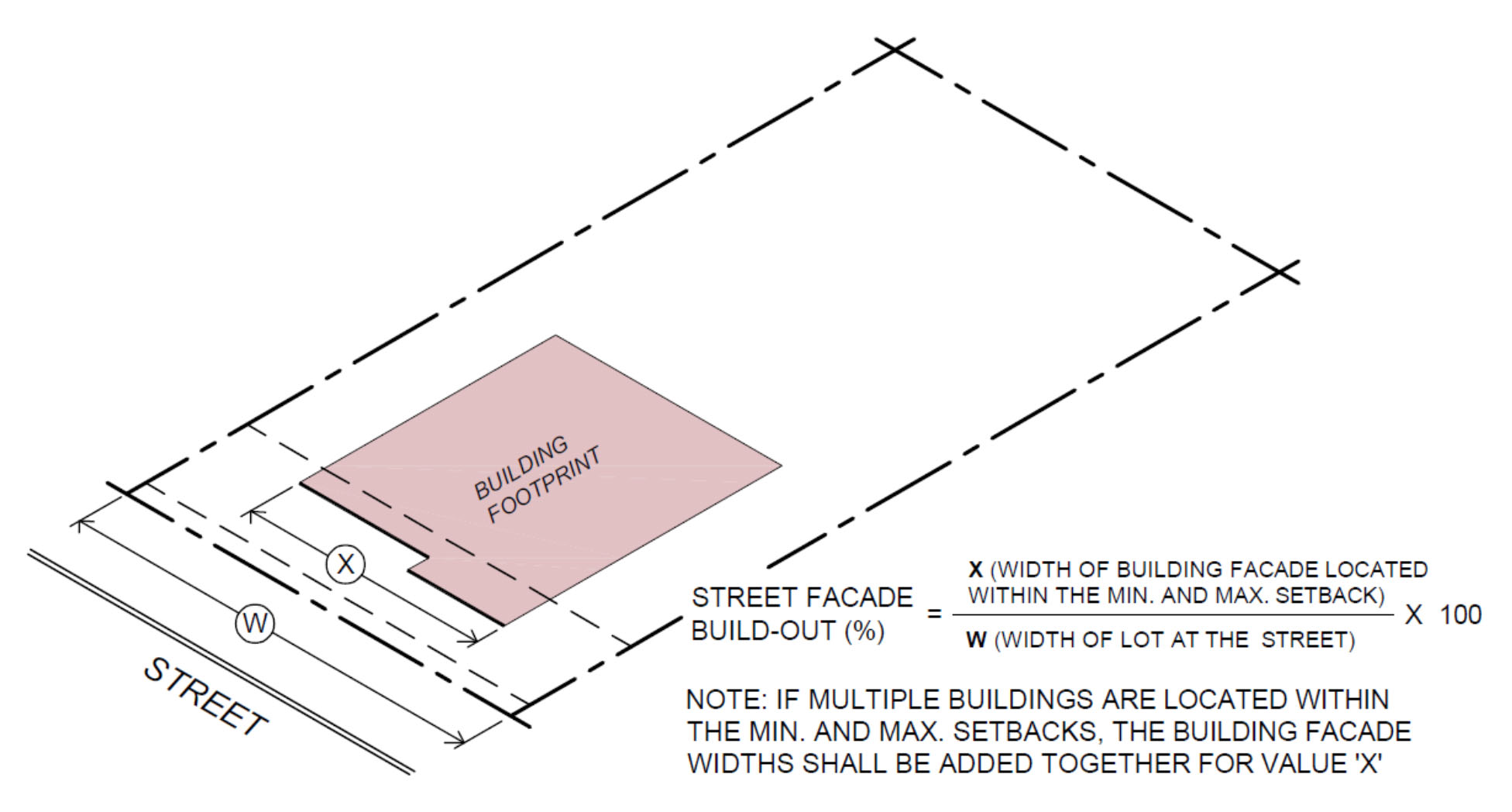
Building Façade Build-Out
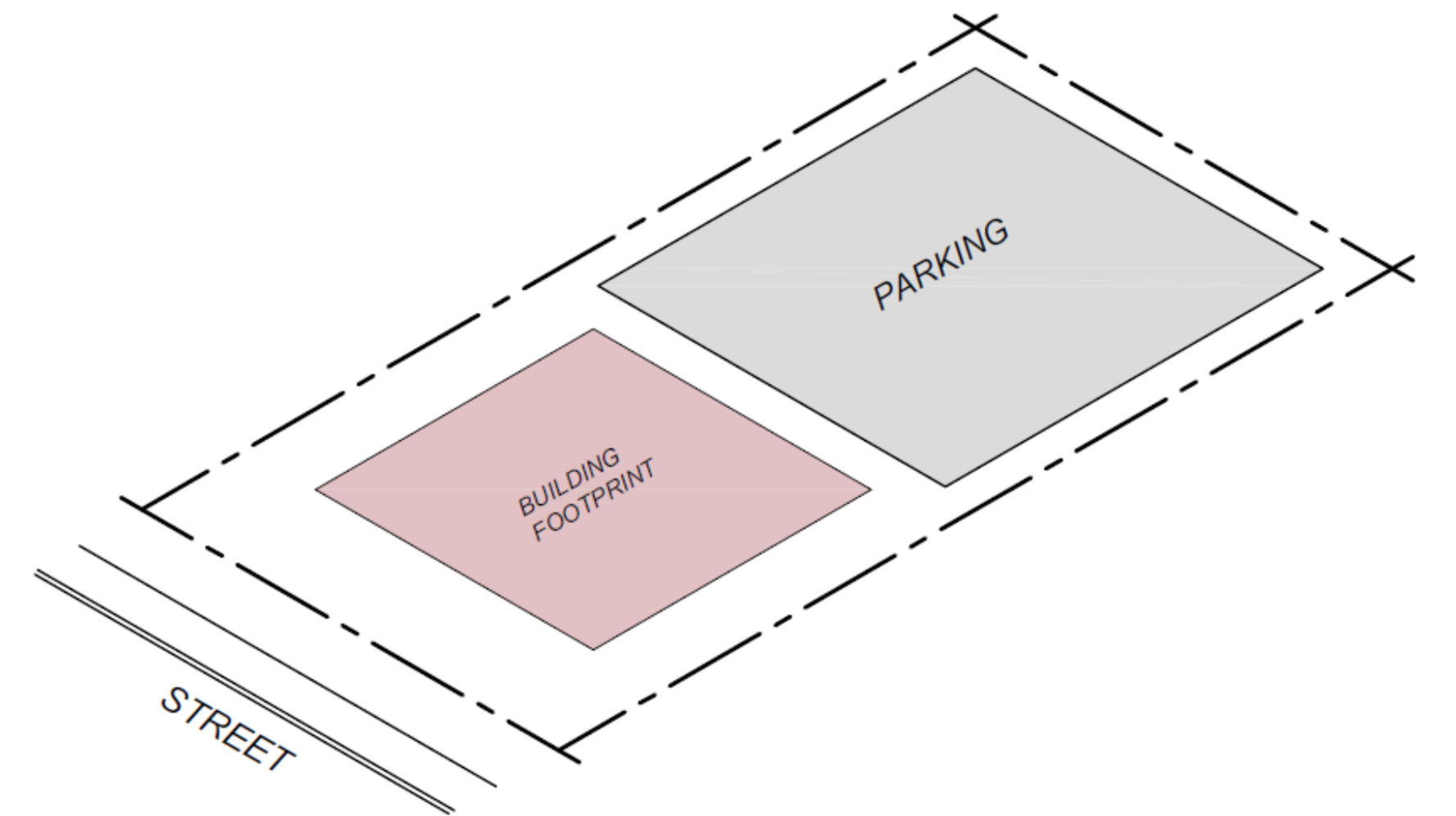
PARKING SCENARIO 1
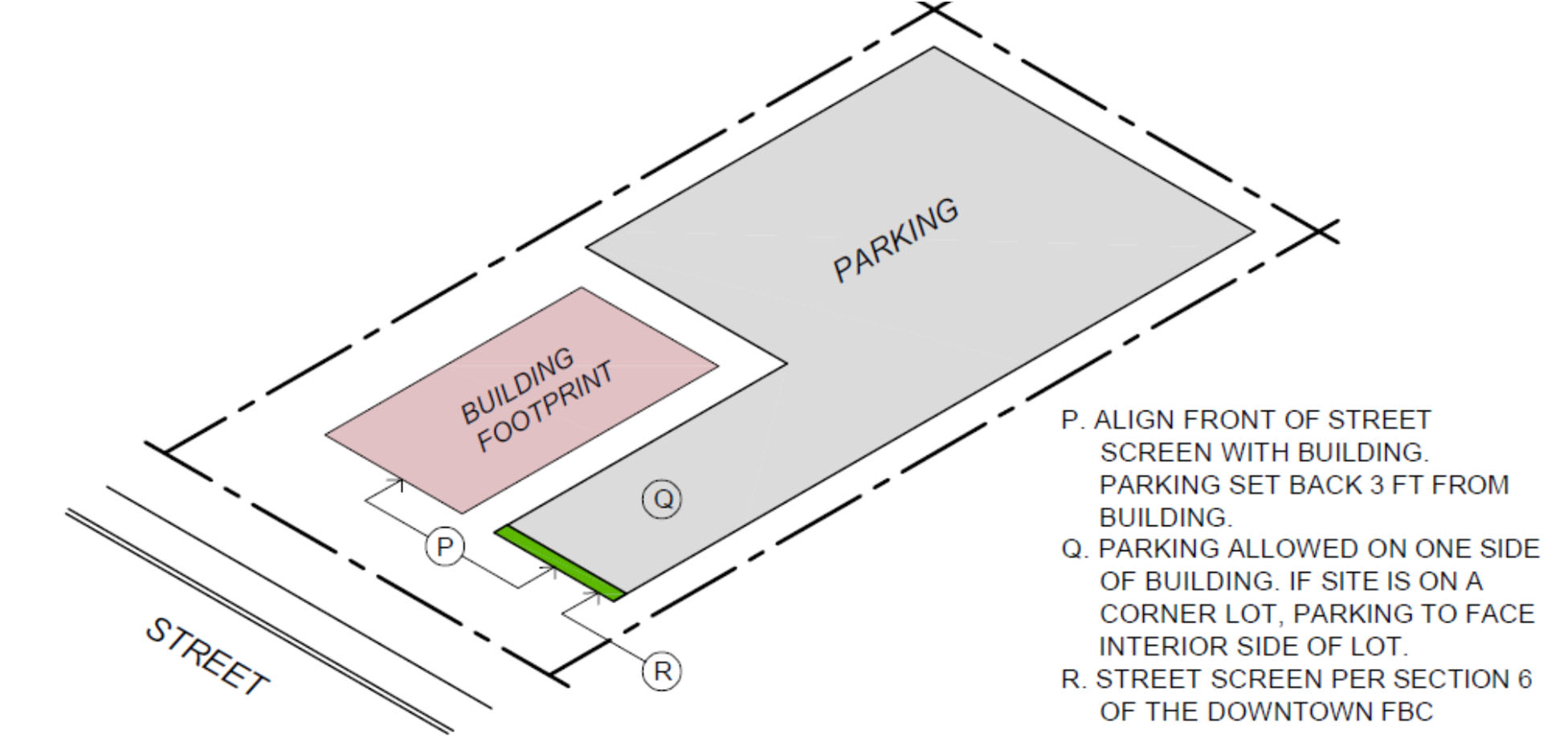
PARKING SCENARIO 2
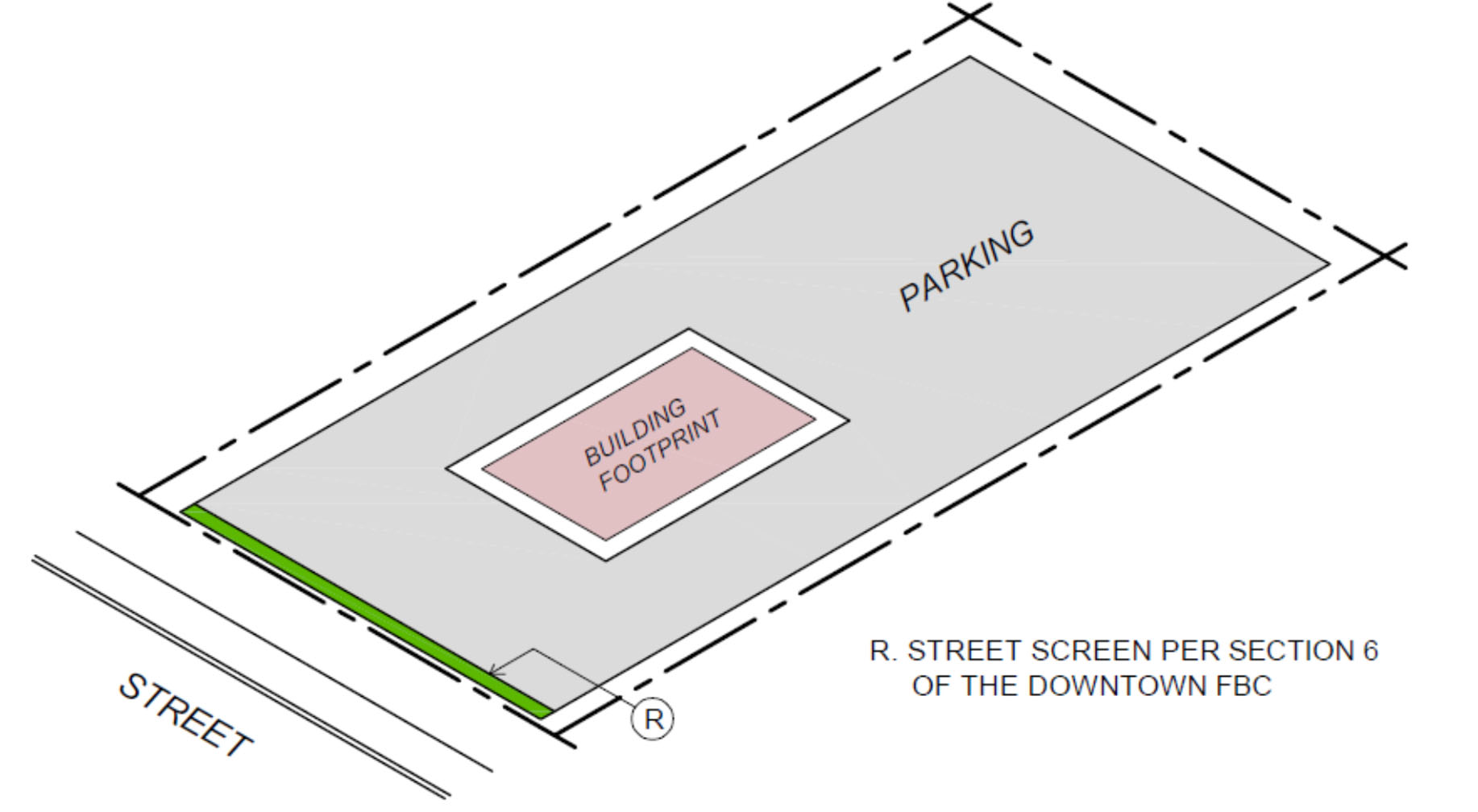
PARKING SCENARIO 3
APPENDIX D: - HISTORIC STYLE GUIDE
Architectural Overview. There are common architectural elements and styles in the Garrison Avenue Historic District. Below are illustrations and descriptions of those common architectural elements and styles to serve as a reference for historic buildings.
1.
The Historic Commercial Building. The traditional commercial storefronts found on Garrison Avenue date from the late nineteenth through the early twentieth centuries. The front façade of a building was constructed with the most expensive materials and construction techniques, and it is the front façade which projects the image and character of the downtown. Although styles and appearance evolved over the years, the traditional façades remain unchanged in their basic form and proportions. This similarity and consistency of form creates a strong, coordinate, visual image.
The storefront is the most important architectural feature of many historic commercial buildings. It also plays a crucial role in a business' advertising and merchandising strategy. The storefront has become the feature most commonly altered in a historic commercial building. As more people come to recognized and appreciate the architectural heritage of America's downtowns, a growing interest can be seen in preserving the historic character of commercial buildings. The basic commercial façade consists of three parts: the storefront, with an entrance and display windows; the upper façade, usually with regularly spaced windows; and the cornice, which caps the building. Although these components appear in many shapes and styles, the result is essentially the same traditional façade.
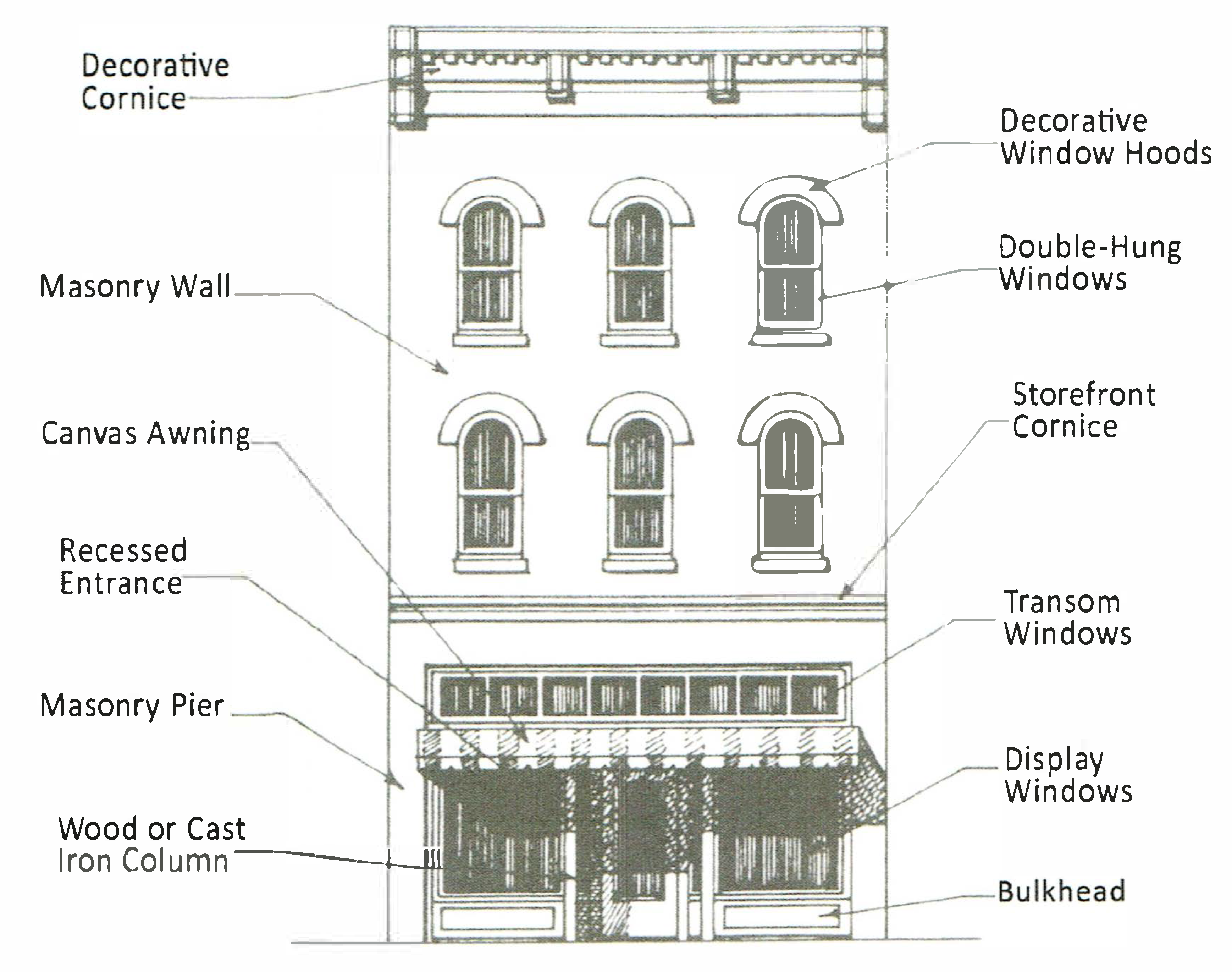
The general principle in rehabilitating a front façade is to be as respectful to the original elements, materials and construction techniques as is practical. During the rehabilitation it will almost always be necessary to remove recent building "improvement." Metal panel façades, screen walls, stucco, vinyl and aluminum siding, and other contemporary wall coverings should be removed. The original building material should be cleaned and repaired.
The original scaled, proportion and character of the building should be retained. The building should not be increased or decreased in overall height; stories should not be added or removed from the building. It is also important to retain or restore all original window, doorway and alleyway openings in the front façade. In many cases it will be necessary to remove brick and other types of infill in existing openings. The openings should be restored to their original size, shape and proportions. New openings should not be created in the front façade. The locations of window, storefront and doorway openings are the most visually important design elements on the front façade. It is of paramount importance to respect the nature and character of these openings in order to maintain the original scale of the building. Buildings with multiple storefronts should also be restored to the original design treatments.
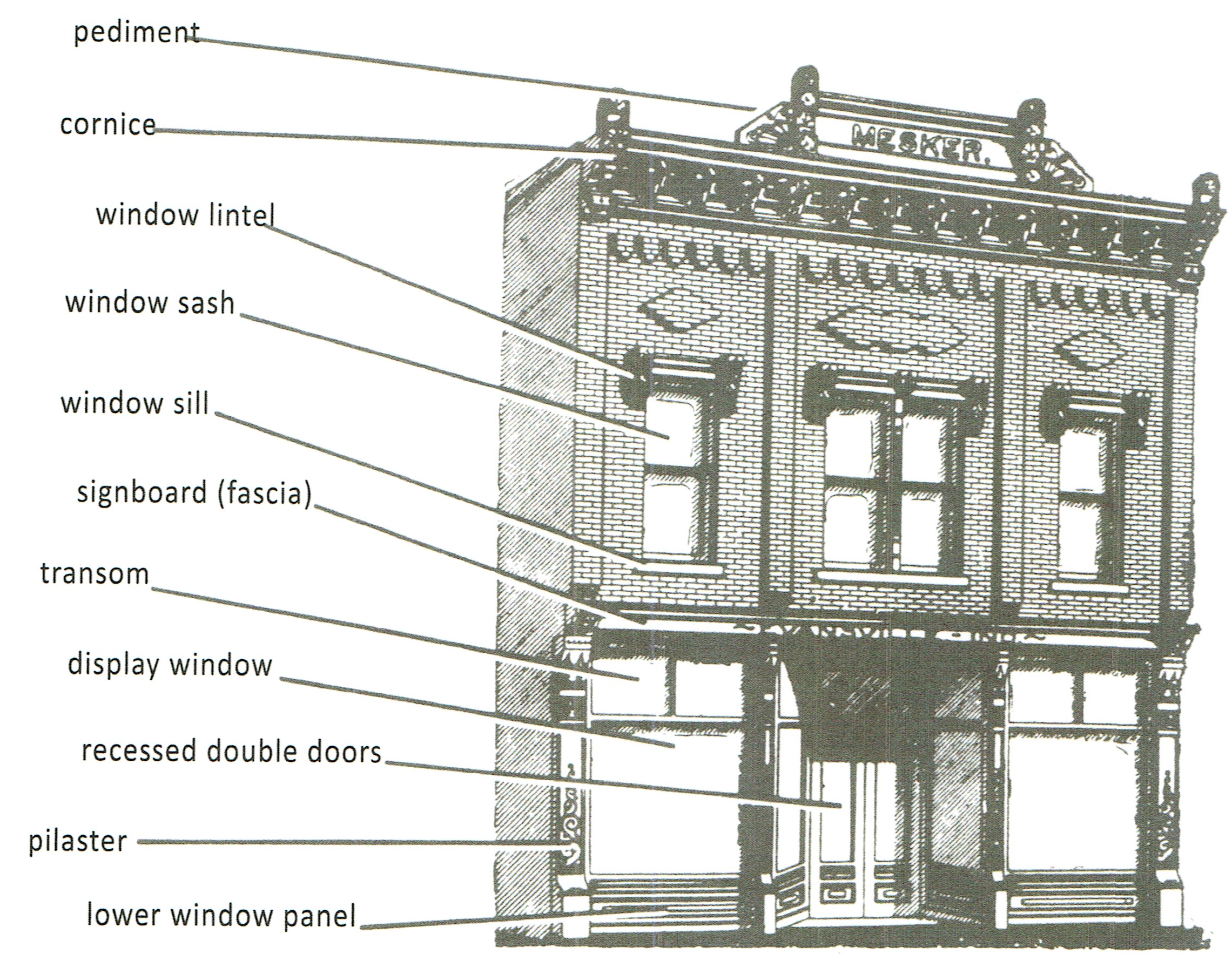
2.
Italianate Style (1840—1880).
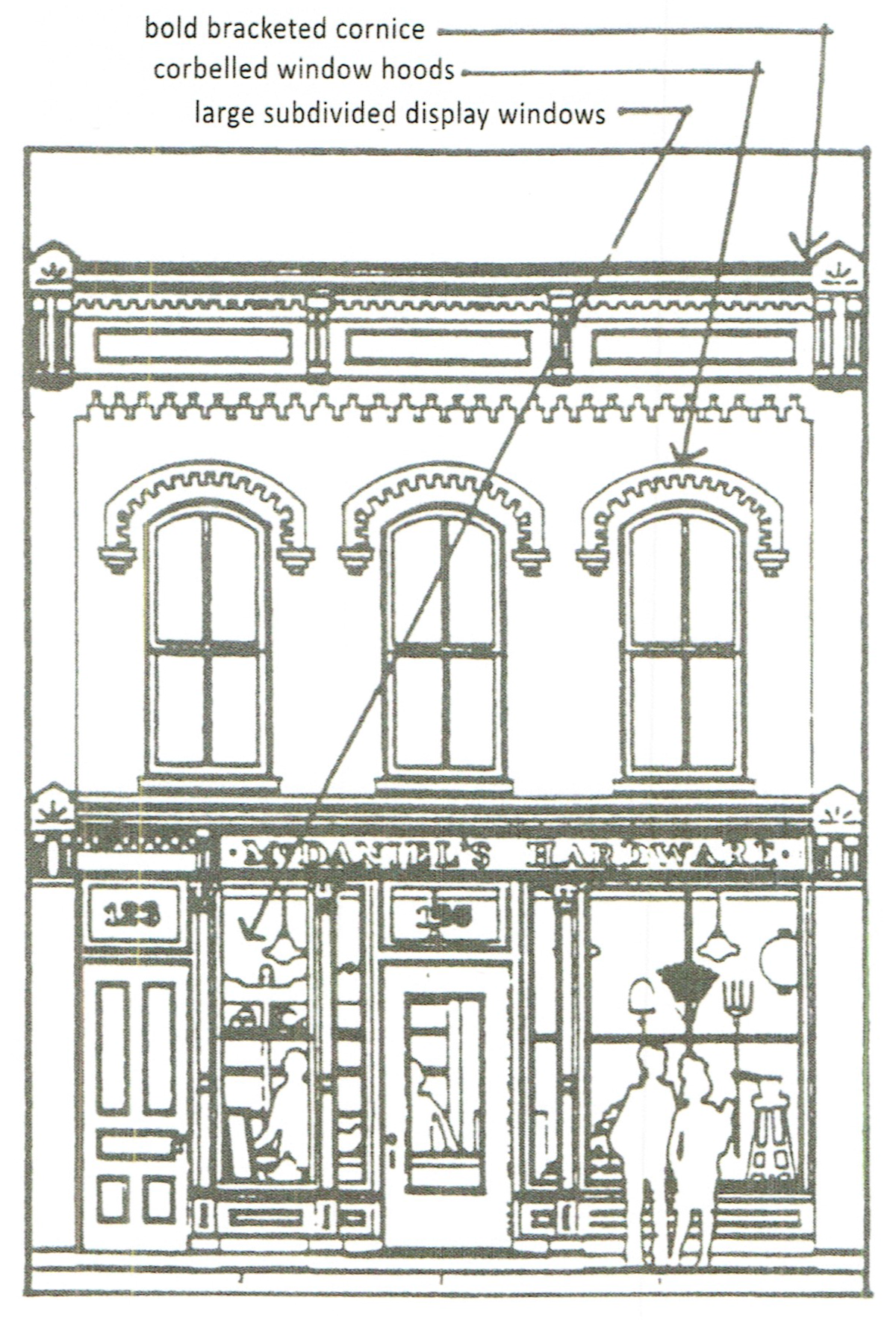
This style was popular for commercial buildings and for private homes during the time when many towns and cities were buildings and growing. Many main streets consist of one Italianate façade after another, side by side, lining the street. The decorated upper stories of these buildings can be seen standing with dignity over the storefronts. They are usually made of simple red brick with a wood or metal bracketed cornice projecting out over the street at the top. Just under the cornice there is often a decoration of corbelled brick. ("Corbelled" means a design laid in a stair step fashion out from the building.) Corbelled brick was also used extensively in the decorative hoods over the windows as was cast iron and sometimes wood. In its original form, a second, smaller cornice capped the tall storefront, which also featured decorative columns, perhaps of cast iron, and large subdivided windows.
3.
Queen Anne Style (1876-1900).
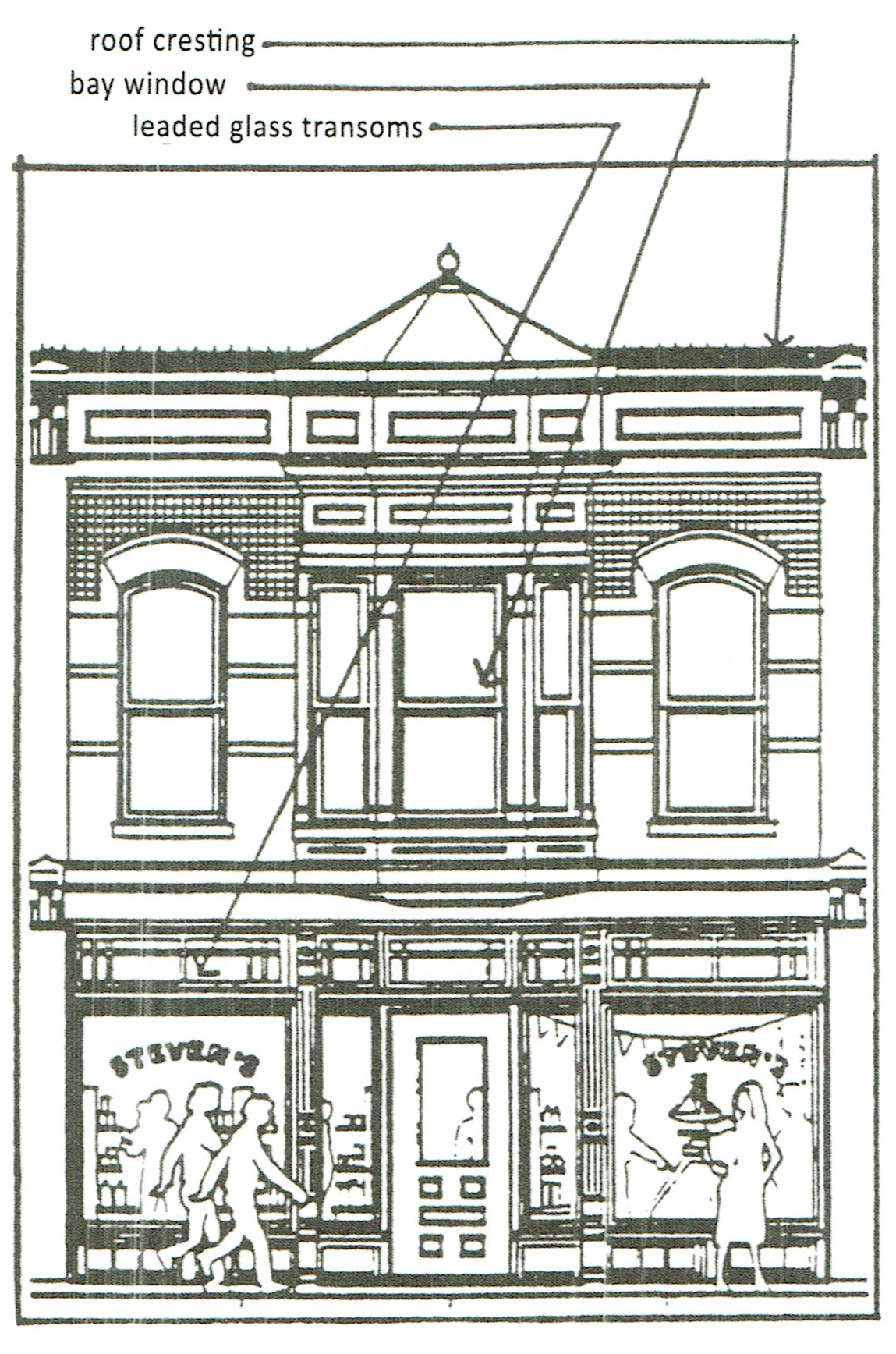
The most exuberant of the Victorian styles, the Queen Anne, is distinguished by the variety of decorative elements and treatments. It is not unusual to see stone, metal, brick, terra cotta, and tile on the same building. Both the façade and the storefront are topped by simplified bracketed cornices, while the street level displays refined wood or metal detailing and leaded glass transom. A high level of technical craftsmanship was reached in the mass production of building elements like cast iron columns, decorative sheet metal and large plates of glass, and these were extensively used in Queen Anne buildings. Also common were decorative turrets, especially at corner locations, and bay windows attached to the masonry façade. Some Queen Anne style commercial buildings also have cast iron roof cresting, which was popular in other Victorian styles as well. All these features combined to create a picturesque and richly textured façade character.
4.
Romanesque Style (1880-1900)
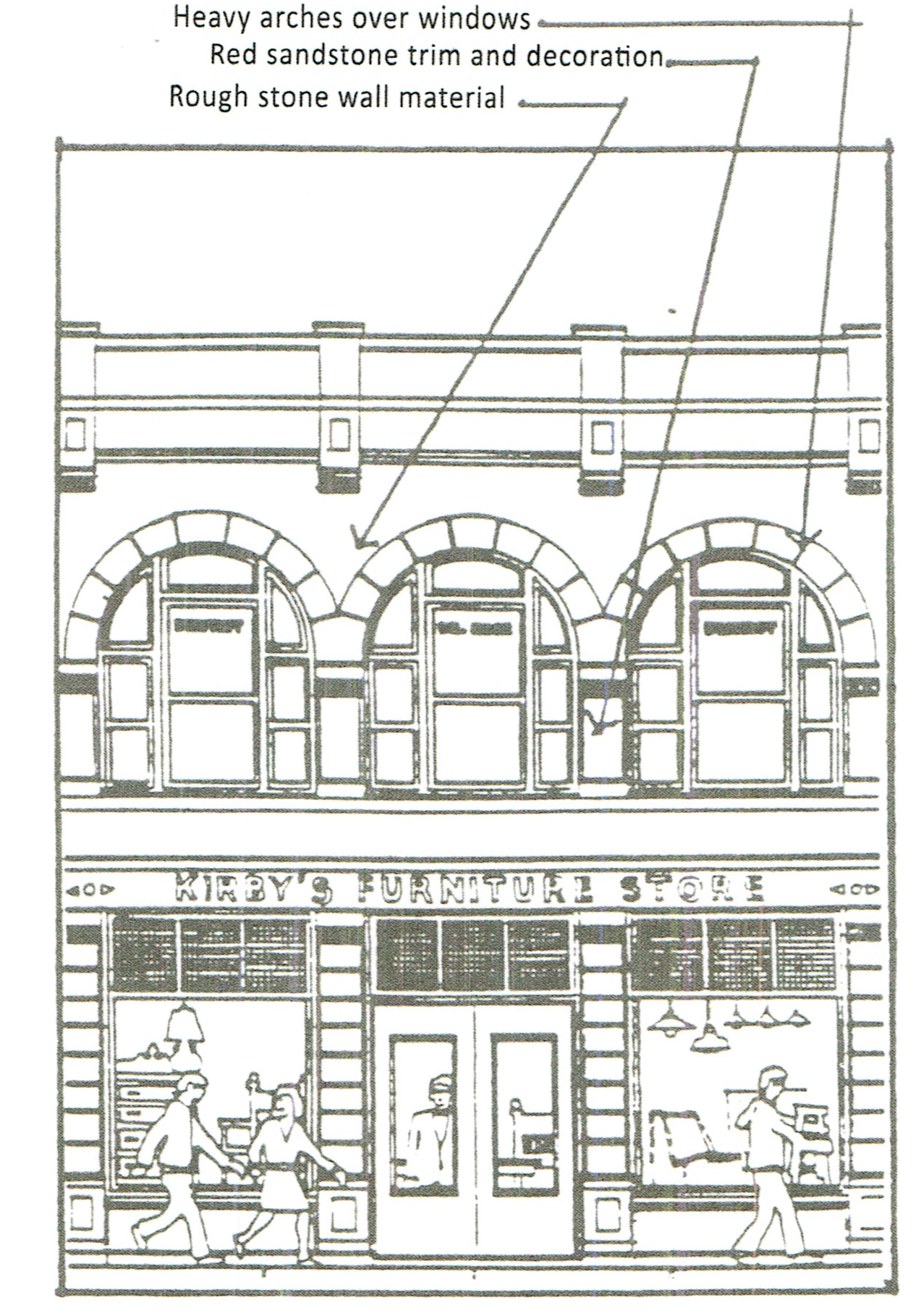
This style, representing a return to the architecture of early medieval Europe for inspiration, enjoyed a brief but widespread popularity in the late nineteenth century. Its sudden impact was due in large part to the influence of this period's greatest architect, Henry Hobson Richardson. His Trinity Church in Boston redefined Romanesque architecture into a powerful hybrid often known as Richardsonian.
The distinctive trait of a Romanesque façade is the use of the semi-circular arch, used singularly or in a series. Invariably it was a masonry building that was roughhewn and massive, a red brick or stone façade with rusticated red sandstone trim. Granite, terra cotta, and pressed brick were also common. Massive arches over window and door openings dominated the design, and widows set back into the wall created a sense of great thickness and weight. This style marked the earliest movement away from the exuberant Victorian era toward increased simplicity which eventually led to today's modern commercial architecture.
5.
Classical Revival (1890-1930)
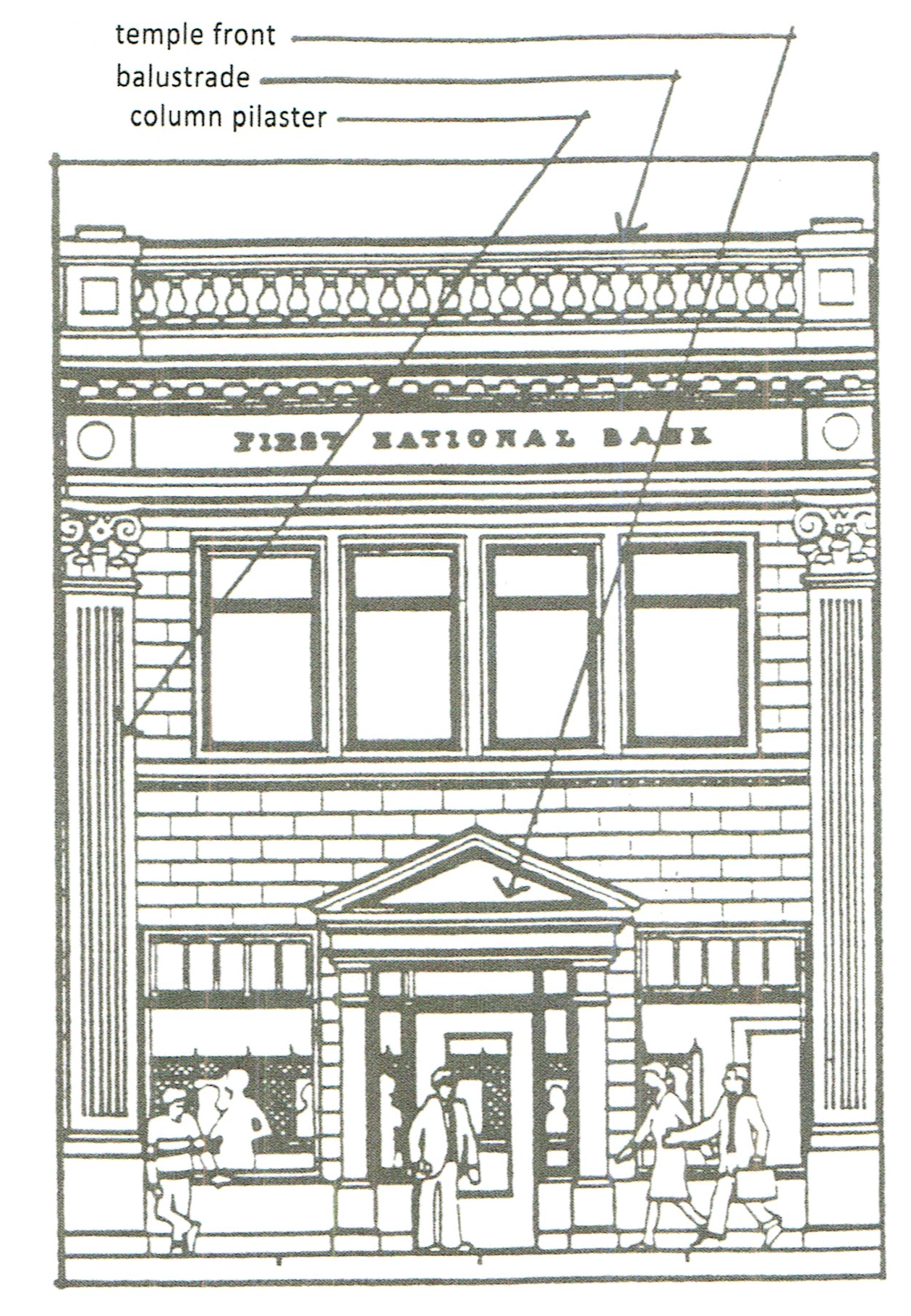
Reacting against the excess of the Victorian styles, architects again turned to ancient Greek and Roman models for inspiration and created the Classic Revival style. Because it suggested the timeless ideal of strength and stability, this style was popular for government, civic and mercantile structures and became almost a national symbol.
These façades were very formal in character and usually symmetrical in composition. The whole range of classical design motifs was used; the temple front composition (pediment, entablature and columns), columns and rows of dentils (trim under the cornice that looks like rows of teeth), moldings, balustrades. The overall character of the façade was of great refinement.
To emulate the bleached ruins of ancient classic architecture, the Classic Revival façade was always white or off-white in color. Brick, terra cotta and stone were all used with dark trim. The use of bronze for decorative detailing was also common.
6.
Tapestry Brick (1900-1930)
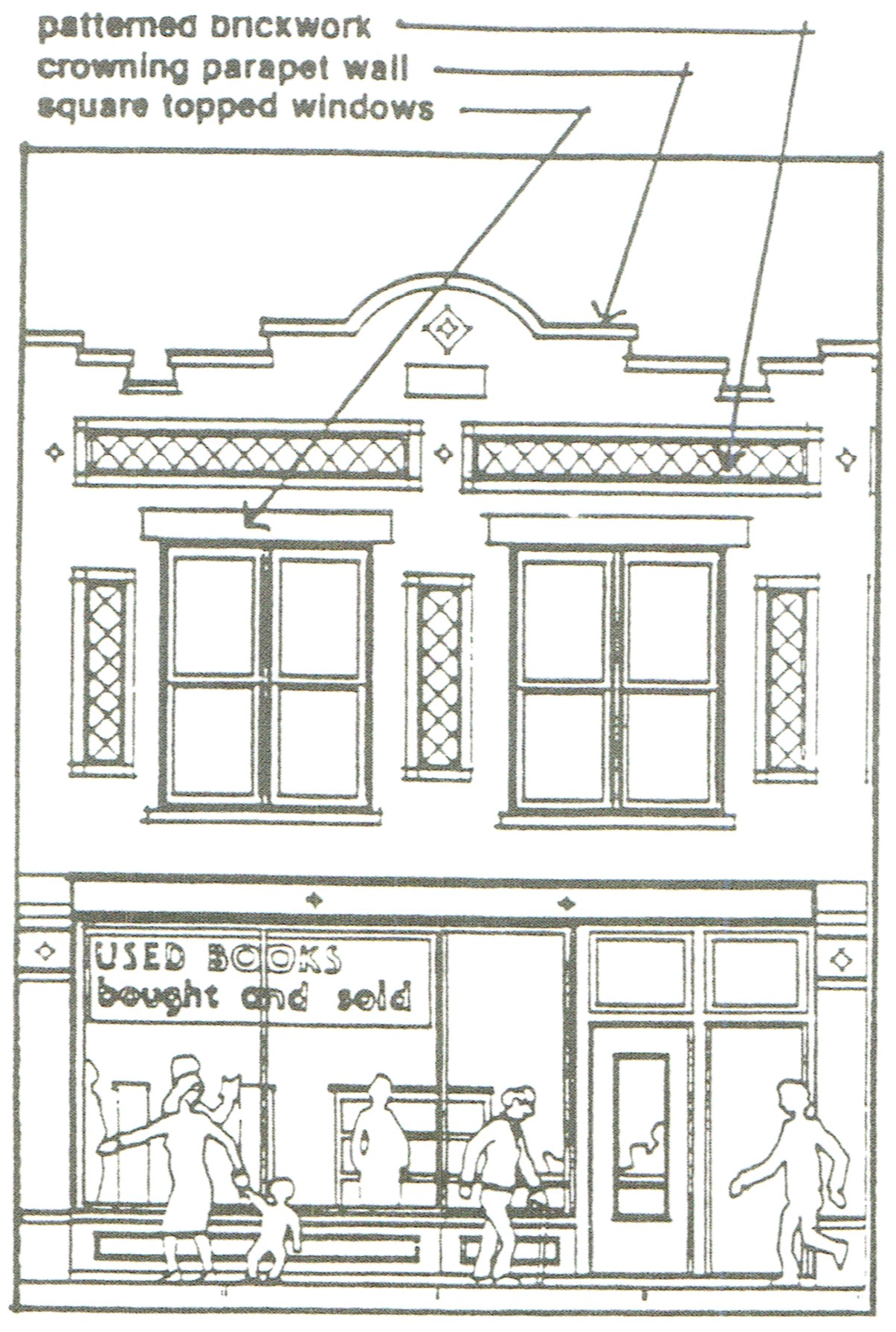
Tapestry Brick is one of the most commonly used vernacular commercial styles of the early decades of the twentieth century. As a vernacular style it can be seen as a folk art. Because of its relative economy, simple brickwork was used by the builders of the day to decorate the office buildings, apartments, stores and garages of the expanding cities.
Bricks were used in a great variety of colors, types, and configurations to create many varied patterns. Because of the regularity of brickwork, these patterns were strongly geometrical. Natural stone, concrete, and terra cotta were all occasionally used for time and accent details. The façades were generally simple in composition where square-topped windows and decorative brickwork concentrated into panel-like design (tapestries). Often the façade was crowned with a distinctly profiled parapet wall.
7.
Art Deco/Moderne (1925-1945)
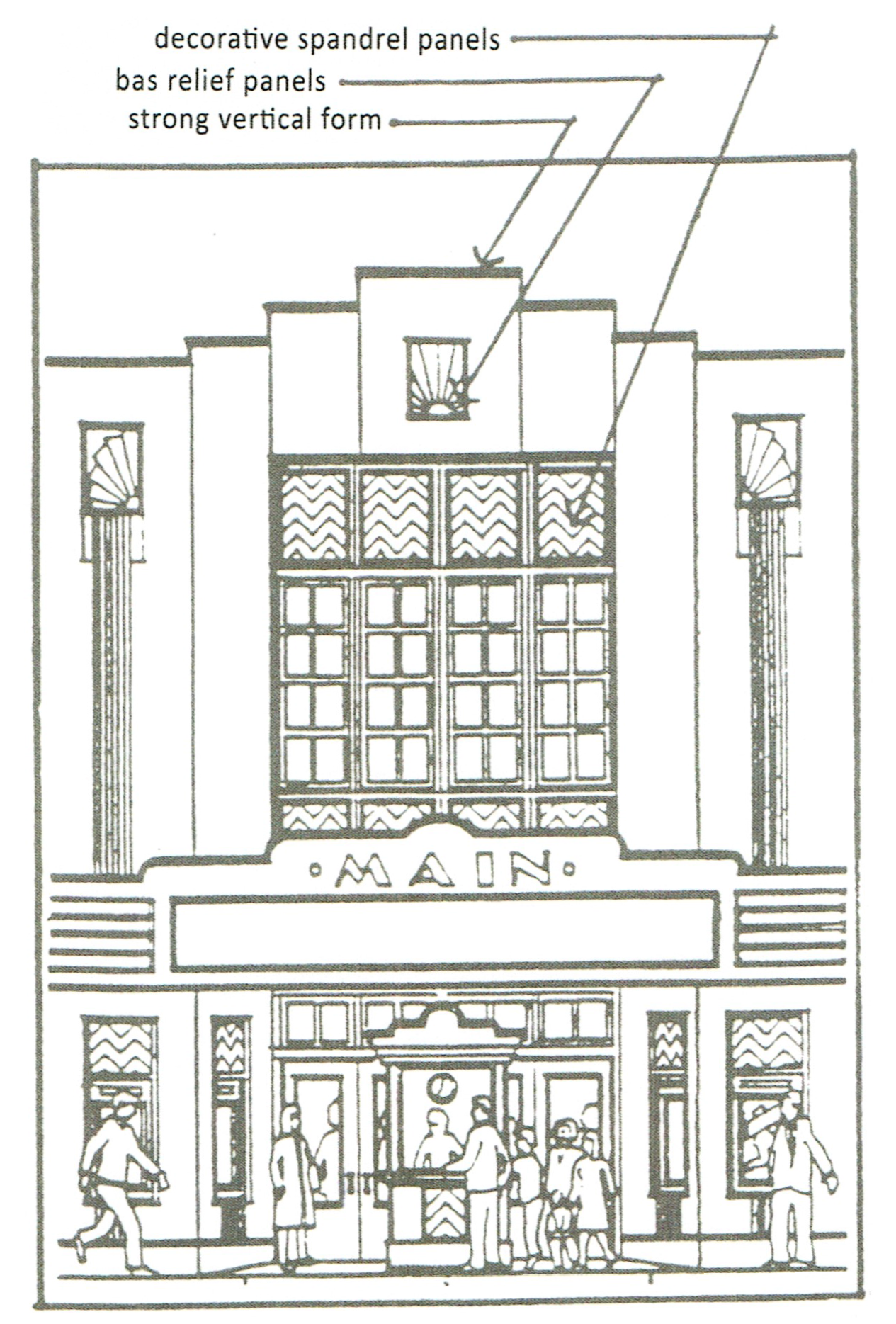
These styles, stimulated by the Exposition des Arts Decoratifs held in Paris in 1925, reflected the growing fascination for the glamorous "modern" life style. This type of commercial façade represents quite a break for the earlier styles.
New materials and decorative motifs expressed the culture's changing mood. Metal, opaque, glass, stone and terra cotta were all used in creating the streamlined surfaces. Geometric patterns like chevrons and fluting were played against blank wall areas for dramatic effect. Often stylized bas relief panels were used. Also metal casement windows in groups, often accented by decorative spandrel panels, created powerful visual compositions.
The strong shapes, vertical emphasis and monolithic quality of these façades set them apart from previous styles. Use of strong rich colors, lights, and unpainted shiny metal (stainless steel) combine to create a "jazzy" appearance.

