
Fort Smith City Zoning Code
ARTICLE 27
300.- DEVELOPMENT REVIEW AND APPROVAL PROCESSES
Sec. 27-301. - General requirements.
27-301-1
Applicability. These policies and regulations apply to land use and development. Any person proposing a land use change or new development shall comply with the procedures of this chapter. Table 27-301.1 (application procedures) summarizes the application types, required meetings, acting bodies and public notices involved in the development review process between the applicants and the city. The application procedure is covered in more detail in later sections of this chapter. For procedures regarding neighborhood meeting waivers, refer to section 27-304 and subsection 27-337-5 (zoning variance).
TABLE 27-301.1. APPLICATION PROCEDURES
Actions:
R = Review/recommendation D = Decision A = Appeal • = Required
♦ = At the discretion of the director ■ = As described in section
Acting bodies:
Staff = Planning and zoning department.
PC = Planning commission.
BD = Board of directors.
BZA = Board of zoning adjustment. ;hn; (Ord. No. 18-20, § 2(att.), 3-3-2020)
27-301-2
The board of directors may supplement, change, or amend the zoning map and the zoning regulations in the manner prescribed by A.C.A. § 14-56-423.
(Code 1992, § 27-301; Ord. No. 26-13, § 1(att.), 6-4-2013; Ord. No. 11-16, § 1(att.), 2-2-2016; Ord. No. 79-24, § 1, 9-3-2024)
Sec. 27-302. - Pre-application conference.
27-302-1
When required. A pre-application conference with the planning and zoning department is required for certain development applications, as identified in Table 27-301.1 (application procedures) and indicated by the individual application type sections below. The purpose of the meeting is to:
A.
Review the requirements of the unified development ordinance;
B.
Discuss the nature and design of the proposed development; and
C.
Discuss the development application review and approval process.
27-302-2
Timing. The pre-application conference shall be held at least ten days before the submission date unless otherwise specified by the director. Applications must be submitted within six months of the conference date or a new conference shall be required.
27-302-3
Additional parties. As necessary, the planning and zoning department may include representatives of other departments or agencies at the pre-application conference.
(Code 1992, § 27-302; Ord. No. 18-20, § 2(att.), 3-3-2020)
Sec. 27-303. - Application requirements.
27-303-1
Materials. Current development application with submittal requirement instructions is available from the planning and zoning department. Most applications are also available on the city website. All materials submitted in support of a development application become part of the public record and are generally not returned to the applicant.
27-303-2
Technical studies. The director may require applicants to prepare additional technical studies in support of their applications for rezoning, planned rezoning or special use permits. The cost of the study shall be the applicant's responsibility. If the applicant disagrees with the director's decision to provide additional technical studies, it may be appealed to the planning commission for a final decision. No further action shall be taken to process the development application until the planning commission makes a final determination on the appeal.
27-303-3
Deadlines. The planning and zoning department has a list of submission and revision deadlines for the various development applications available at its office. This list is also available online at the city's website. Failure to submit a complete or revised application on or before the deadline shall result in the city not placing the application on the scheduled planning commission agenda.
27-303-4
Completeness. Within three business days of submittal by the applicant, a member of the planning staff shall review the development application to ensure that it is complete.
A.
When complete. An application is complete when all of the items required by the UDO and on the application form are prepared and/or answered, and any required supplemental or additional applications are submitted with the appropriate fees to the planning and zoning department.
B.
Return of incomplete applications. Incomplete applications shall be returned to the applicant with a written description of the missing information, defects, or other problems. The director shall take no further action on incomplete applications. Appeals of this determination are made to the planning commission, which is the final decision-making body. No further action shall be taken to process the application until after the planning commission's determination. Applications that have been returned to an applicant for revisions shall not be processed until such revisions have been determined to be complete by the director.
C.
Processing complete applications. The applicant will be notified that the application is complete and processed in accordance with this chapter.
D.
Failure to act. If the director fails to act within three business days, the application shall be deemed complete.
E.
Revisions following determination. Following a determination of completeness, any further revisions to the application by the applicant without the approval of the director, or modifications which are contrary to the directions of the planning commission or board of directors shall void the determination of completeness and trigger a new three-day review period. All processing of the application shall stop until a new, complete application has been filed.
F.
Determination not substantive. A determination of completeness shall not constitute a determination of compliance with the substantive provisions of the UDO.
27-303-5
Fee schedule. Application fees shall be set in an amount to recover the costs of processing, publicizing, and reviewing development applications. The board of directors shall set the fee schedule, which shall be included as an appendix to this Code. The board may periodically review and modify the fee schedule based on the cost changes associated with the development application.
(Code 1992, § 27-303; Ord. No. 18-20, § 2(att.), 3-3-2020)
Sec. 27-304. - Neighborhood meeting.
27-304-1
When required. A neighborhood meeting is required for certain development applications, as identified in Table 27-301.1 (application procedures) and indicated in the individual application type sections below. When not required, applicants are encouraged by the board of directors, planning commission and planning staff to meet with property owners who may be affected by the proposed development.
The director may waive the requirement for a neighborhood meeting for rezoning, master land use plan amendments, and conditional use applications based on the following criteria:
1.
The project will have minimal impact on surrounding properties.
2.
The project will have minimal impact on the neighborhood.
When a neighborhood meeting is waived by the director, the applicant shall mail letters to property owners within 300 feet of the petitioned property in lieu of a neighborhood meeting. At a minimum, the letter shall include the project description, a drawing or map of the project, and contact information. A copy of the letter shall be submitted to the planning department and a written summary of any responses from property owners.
The requirement for the neighborhood meeting will not be waived for a nonresidential or multifamily project that is proposed next to single-family zoned or developed property.
(Ord. No. 18-20, § 2(att.), 3-3-2020)
27-304-2
Neighborhood identification. Generally, the neighborhood shall include all parcels located within 300 feet of the boundaries of the petitioned property, and any homeowners' association, neighborhood association or merchants' association registered with the planning and zoning department and located within 300 feet of the parcel.
(Ord. No. 18-20, § 2(att.), 3-3-2020)
27-304-3
Meeting arrangements. The applicant shall be responsible for providing a meeting location and conducting the meeting at a time and place reasonable to the residents of the neighborhood. Written notice of the location and time of the meeting shall be provided by the applicant to the planning and zoning department and residents of the area defined as the neighborhood at least seven days prior to the meeting. The neighborhood meeting should be held at least six days prior to the planning commission voting meeting.
27-304-4
Meeting content. At the meeting, the applicant shall present a full and accurate description of the proposed development plans, describe projected impacts of development, describe plans to mitigate or offset impacts, and facilitate a discussion of neighborhood questions and comments. The planning staff shall attend the meeting, but shall not be responsible for organizing the meeting or presenting information about the project.
27-304-5
Meeting report. Following the neighborhood meeting, the applicant shall provide the planning and zoning department with a mailing list of the people who attended the meeting and a written summary of the discussion and comments. All documents and materials which detail the proceedings of the neighborhood meeting shall become part of the public record for the development application and should be submitted to the planning and zoning department.
(Code 1992, § 27-304; Ord. No. 11-16, § 1(att.), 2-2-2016)
Sec. 27-305. - Planning staff review.
27-305-1
Review by other department and agencies. The planning staff may forward copies of the application to various local, state and/or federal departments or agencies and public or private utilities or franchises for their review and comment. The director may ask the reviewers to respond in writing or attend a technical review meeting for the application with the planning staff.
27-305-2
Planning staff review. The planning staff shall review the application and any supporting documentation/information, to prepare for a meeting with the applicant and representatives of other agencies or departments, as described above. After reviewing the information, planning staff shall prepare a report summarizing the information for the reviewing bodies and provide a recommendation for action and any proposed conditions. The applicant or other interested parties may obtain a copy of the planning staff report from the planning and zoning department at least two days prior to the public hearing date.
27-305-3
Development review committee. The director may convene a development review committee meeting to review development applications at any time during the processing of an application. The development review committee may include representatives of the various city departments and agencies, committees or boards, or public or private utilities or franchises.
(Code 1992, § 27-305)
Sec. 27-306. - Withdrawal of application.
27-306-1
Withdrawal after determination of completion. An application may be withdrawn at any time prior to the publication or distribution of a public notice. However, the withdrawal of an application after the determination of completeness has been finished shall result in the forfeiture of the application fees.
27-306-2
Withdrawal when no notice is required. If no notice for a public hearing is required, the applicant should give notice of the withdrawal to the director at the earliest possible time. This allows the director to notify other applicants of an agenda change.
27-306-3
Withdrawal when notice is required. If notice has been provided and a public hearing is required, the body conducting the hearing shall decide whether or not to approve the withdrawal request and may still decide to act on the application.
(Code 1992, § 27-306)
Sec. 27-307. - Continuation of application.
27-307-1
Applicant request. An applicant may request up to one continuation of action on any application before the publication of notice date for the application. Further requests for continuation may result in the application being removed from future agendas subject to public re-notification at the applicant's expense.
27-307-2
Following notice. If public notice has been provided and a public hearing is required, the body conducting the public hearing shall decide whether or not to approve the request for continuation and may instead act on the application.
27-307-3
Director request. If the planning and zoning department or other departments/agencies, upon review, have determined the application to be incomplete or to contain insufficient information the application shall be continued for further review and consideration by the director. The director shall provide notice of this determination to the applicant before the publication of notice for the application.
27-307-4
Fees. Continuation of an application following a determination of completeness shall result in the forfeiture of the application fees.
(Code 1992, § 27-307)
Sec. 27-308. - Public notification.
27-308-1
Purpose. Public hearings and notices provide the opportunity for citizen input into decisions that may affect the community. Public participation helps to ensure that the decisions made reflect the considerations of the community interest at large and allow the applicant and other interested parties the opportunity to be heard.
27-308-2
Published notice. Unless otherwise specified, all publication notices for public hearings required by this chapter shall be published one time in a newspaper of general circulation in the city.
A.
Contents. All notices for items to be heard by the planning commission or board of directors shall provide the date, time and place of the hearing, the purpose of the hearing, the name of the applicant and identification of the subject property. If the hearing is for a rezoning application, the notice shall provide a general statement regarding the purpose of the application.
B.
Timing. All notice for items to be heard by the planning commission or board of directors shall be published at least 15 days prior to the date of the hearing.
C.
Information. The director may request the applicant to provide information as necessary for the notices.
27-308-3
Mailed notice. When notices to surrounding property owners are required for consideration of an application, they shall be prepared as follows to provide an opportunity to all interested parties, including all registered neighborhood or homeowners' associations, to be heard.
A.
Mailing area. The planning and zoning department shall be responsible for mailing notices to all affected property owners as follows:
1.
For applications that are to be reviewed by the planning commission and board of directors, the applicant shall provide the names and addresses of all persons listed on the current tax assessment rolls who are landowners within 300 feet of the petitioned property. This information shall be provided either electronically or typed on mailing labels.
2.
For all the applications which are to be reviewed by the board of zoning adjustment, the applicant shall provide the names and addresses of all adjacent or contiguous property owners to the petitioned property, including property across streets and intersections. This information shall be provided either electronically or typed on mailing labels.
B.
Timing. The mailed notices for the public hearings before the planning commission and/or board of directors shall be postmarked at least seven days prior to the hearing date. The mailed notices for the public hearings or other reviews before the board of zoning adjustment shall be postmarked at least seven days prior to the date of the hearing.
C.
Content. Mailed notices shall specify the date, time and place of the hearing and include a general description and sketch map of the proposal. It shall also include a location map of the subject property and a statement explaining that the public may be heard at the public hearing.
D.
Newspaper clippings. Newspaper clippings of the publication notices shall not be used for the mailing notice requirements.
E.
Invalidation. When the notice has been properly addressed and deposited in the mail, failure to receive it shall not invalidate after action.
27-308-4
Posted notice. When required by this chapter, the planning and zoning department shall post the appropriate signs on the subject property giving notice of the pending application.
A.
The sign shall be shall be posted at least ten days prior to the public hearing.
B.
The sign shall inform the public of the date and place of the hearing. When the application is for a rezoning case, the sign shall identify the current and proposed zoning classification.
C.
Any person removing or tampering with the signs posted pursuant to the provisions of this section shall be deemed guilty of a misdemeanor and shall be subject to the penalties set forth in section 1-9. A statement to this effect shall be displayed on the required signs.
27-308-5
Substantial compliance. Public notification shall be determined to be complete when there is substantial compliance with the requirements of this section. Minor technical deviations in the language of the published, mailed or posted sign notices should not invalidate the notice when notice has been given. When there is a question that is raised at a public hearing regarding the adequacy of the posted notice, the body conducting the hearing shall make a formal finding as to whether there was substantial compliance with the length of the notice requirement and for specifying the time, date and place of a hearing and the general location of the property.
27-308-6
Notification of appeal or withdrawal. Whenever an appeal is made from a final decision, or whenever the board of directors determines to withdraw a development permit which was obtained following a public hearing, a mailed notice of the appeal or withdrawal shall be prepared and made in the same manner as the original mailing. If no public hearing was held prior to obtaining the development permit, the mailed notice of the withdrawal shall be given to the holder of the permit only.
27-308-7
Costs of notice. All actual costs incurred by the city in preparing and publishing the notice required by the UDO shall be paid by the applicant as part of the application fee established by the board of directors.
(Code 1992, § 27-308)
Sec. 27-309. - Public hearing procedures.
27-309-1
Purpose. The purpose of a public hearing is to allow the applicant and all other interested parties a reasonable and fair opportunity to express their views and opinions, present evidence relevant to the application, and to rebut evidence presented by others.
27-309-2
Rules of procedure. The board of directors and planning commission may adopt rules of procedure for public hearings.
(Code 1992, § 27-309)
Sec. 27-310. - Decision-making.
27-310-1
Action. Acting bodies shall hold regularly scheduled public hearings to receive and review public input on those items required by this Code. Decisions and/or recommendations should be rendered in a timely manner, based upon the specific requirements of the UDO and the following considerations:
A.
How well the development application/proposal conforms to the unified development ordinance, other adopted plans, design guidelines and adopted policies;
B.
The recommendations of planning staff and other recommending bodies;
C.
The input of reviewing agencies and departments;
D.
Public comment and testimony received at the hearing; and
E.
The effects of the proposal on the neighborhood, area, and community at large.
(Ord. No. 18-20, § 2(att.), 3-3-2020)
27-310-2
Authority to amend development approvals. After review of the application, pertinent information or documents, and information made part of the public record, the recommending and decision-making bodies may make changes or amendments to the applications which are deemed necessary to ensure compliance with the general or specific standards expressed in these or other applicable regulations. The director shall include a copy of the amendments with the records of decision.
27-310-3
Authority to continue an application. A reviewing body may continue/table an application as necessary. The continuation must provide instructions as to what information is necessary to complete the review and when the application shall be rescheduled on the reviewing body's agenda for reconsideration.
A.
Continued applications must include an information request and timeframe.
B.
Once the requested information is provided, the application is placed on next agenda.
C.
An applicant may request one extension for the same period of time as the initial continuation.
D.
If the applicant does not provide the requested information in the specified timeframe, the application shall be considered withdrawn.
(Code 1992, § 27-310)
Sec. 27-311. - Scope of action.
27-311-1
Scope. The reviewing body may take action on the applications, as long as it is consistent with the notice given. Actions taken may include the approval of the application, amendment to the application, or denial of the application. In addition to other relevant amendments, the reviewing body may consider amendments that reduce the density or intensity of the original application, reduce the impact of the development, or reduce the amount of land involved from that indicated in the notices of the hearing. The reviewing body may not permit a greater amount of development, a more intensive land use, a larger area of land than what was indicated in the original application, or allow a greater variance than what was indicated in the notice.
(Code 1992, § 27-311)
Sec. 27-312. - Post-decision proceedings.
27-312-1
Appeal. Any person acting on behalf of the city (including any officer, agency or department of the city) or any private interest which disagrees with a final decision on a development case may request an appeal in accordance with the UDO.
27-312-2
Amendments and revisions to the development approval.
A.
Minor revisions. The director may approve minor revisions to the conditions of approval for:
(1)
Development plans;
(2)
Site plans;
(3)
Subdivision plats;
(4)
Conditional use permits;
(5)
Sign permits and plans; and
(6)
Landscape plans.
Minor revisions must be authorized in writing by the director and may be appealed by the applicant to the planning commission. Minor revisions that may be authorized are limited to those that are necessary in light of technical considerations discovered after the decision on the development application has been made, and which do not substantively change the character of the development approval. In the case of appeals there shall be no further actions taken to process the application. Permits which were issued shall be held pending the planning commission's determination of the appeal.
B.
Original decision-maker. If the director determines that a requested revision is not minor, or for revisions to rezoning applications, master land use plan changes, or variances, approval of the revision by the original final decision-maker is required in accordance with the procedures established for the original consideration of the application.
C.
Recommendation. In making a determination about whether to undertake a minor revision, the director may seek a recommendation from any board/commission involved in the application process.
(Code 1992, § 27-312)
Sec. 27-313. - Validity.
27-313-1
Time of expiration. Unless otherwise specifically provided for in the unified development ordinance all development applications (except rezoning), plans, and permits found in violation of the UDO requirements shall automatically expire. All activities related to the application, plan, or permit shall immediately cease operations. Such development applications, plans, and permits shall be deemed in violation of the UDO when:
A.
Failure to satisfy requirement of approval. The applicant fails to satisfy any requirement or amendment that was imposed as part of the original or revised approval of the development application, or that was made pursuant to the terms of any development agreement application, within the time limits established by the approval; or
B.
Failure to diligently pursue. The applicant fails to diligently pursue the project by not seeking further development applications, permits or approvals as permitted by this chapter or other applicable codes and/or ordinances, or by not commencing construction if that is the next step in the project. If no time limit for the satisfaction of conditions is specified in the original or revised approval, the expiration date shall be set at one year from the date of approval.
27-313-2
Extension procedures. Unless otherwise limited or prohibited by state law or the UDO, the director may extend the expiration date of a development permit approval one time for a period not to exceed one year from the date of the original decision granting the approval, provided the application for extension is made in writing during the original period of validity. If the director denies the extension request, it may be appealed by the applicant to the planning commission. Additional extensions may be made by the final approving body if they find that the requirements imposed at the time of the approval have not changed.
27-313-3
Expired development plan. Where a development plan submitted in conjunction with a rezoning or other application request has expired, the zoning classification shall remain as is unless changed through a public hearing process by the city. A new development plan must be approved pursuant to section 27-331 before processing any further permits or approvals for the site.
(Code 1992, § 27-313)
Sec. 27-314. - Revocation of development permit approval.
27-314-1
Duties of the director. If the director determines that there are grounds for revocation of the development permit approval (as identified in subsection 27-314-2), the director shall notify the applicant and/or permit holder and set a hearing date before the board of directors or the planning commission who made the final decision on the application. If the decision was made by the director, the hearing shall be conducted by the planning commission. If the board of directors was the original decision-maker, it may refer the matter to the planning commission for a recommendation prior to the hearing.
27-314-2
Reasonable grounds. The following may be considered reasonable grounds for permit revocation:
A.
The applicant fails to meet the required conditions of approval.
B.
The land use associated with the development has caused unforeseen negative or adverse impacts on adjacent or surrounding land uses and property owners.
C.
The use has placed an unreasonable burden on public facilities and services.
D.
Unusual conditions, trends, or needs have arisen since the permit was issued.
27-314-3
Notice and public hearing. Notice of the revocation hearing shall be given in the same manner as required for the original application. A public hearing shall be conducted in accordance with the procedures of this chapter.
27-314-4
Decision and notice. Within 14 calendar days after the conclusion of the hearing, the decision-maker shall render a decision to either revoke, allow the applicant to retain, or reconsider the development permit approval. The city shall notify the permit/approval holder and any other person who has filed a written request for such notice of the decision.
27-314-5
Effect and appeals. A decision to revoke a development permit approval shall be final when the decision is rendered, unless it is appealed. After the effective date of the withdrawal, any activities continuing pursuant to such development permit approval shall be deemed to be in violation of the UDO.
(Code 1992, § 27-314)
Sec. 27-324. - Accessory residential uses.
27-324-1
Purpose.
A.
Purpose. To grant the planning and zoning department the authority to permit citizens in all residential zones to operate an accessory residential use in accordance with the criteria set forth in this section. It is further the intent of this section to regulate the operation of the accessory residential use so that the neighborhood shall be unaware of its existence.
27-324-2
Business license. An individual with an approved business license from the city shall not be required to obtain an accessory residential use permit in order to conduct the business from his residence as long as the practice is within the criteria of subsection 27-324-6.
27-324-3
Applicant. An accessory residential use permit may be sought only by the homeowner or tenant of the address for which the permit is sought.
27-324-4
Pre-application conference. A pre-application conference pursuant to section 27-302 is recommended.
27-324-5
Submission requirements. The director shall prepare an application form specifying the information to be submitted in support of an accessory residential use permit application. This shall include, at a minimum:
A.
Request. Request for a written description of the use.
B.
Space. Requirement of a calculation of the amount of space to be occupied by the use.
C.
Fee. Application fee established by the board of directors.
D.
Affidavit. Affidavit from the applicant that the proposed use meets each of the approval criteria established in subsection 27-324-6 and that the applicant gives the city permission to withdraw the permit should a valid neighborhood complaint be received which identifies actions that violate the terms of the accessory residential use approval. Withdrawal shall take place pursuant to section 27-314.
27-324-6
Application and review procedure.
A.
Determination of completeness. Applications shall be submitted to the director for a determination of completeness pursuant to section 27-303.
B.
Review. Complete applications shall be reviewed by the director. If the director determines that the application meets the requirements of this UDO (including the provisions of subsection 27-324-6(C) of this section, below), the application shall be approved.
C.
Criteria. Applicants for an accessory residential use shall meet all of the following requirements:
1.
The activity shall be contained in an area no greater than 30 percent of the total heated living space of the residential structure, and there shall be no alteration to the residential structure and no separate outside entrance for the business area of the residential structure.
2.
Only resident members of the household shall operate the activity.
3.
No inventory of materials or supplies other than normal office, art, craft or photography supplies shall be stored at this location. Storage shall be limited to that which can be kept in the heated living space.
4.
No customers shall be served in person at this location.
5.
The address shall not be used for any advertising.
6.
No signs shall be used.
7.
No business vehicle larger than a pick-up truck shall be housed at the residence. All exterior storage of cargo, equipment or other material shall be shielded from view at all times when such vehicle is located on a residential lot. No trailer shall be permitted.
D.
Appeal. If the director denies an application for an accessory residential use, the denial may be appealed to the planning commission. The appeal procedures in section 27-337-8 shall be followed.
(Ord. No. 37-22, § 1, 5-3-2022)
27-324-7
Conditions for approval. When an accessory residential use application is approved, the planning and zoning department is allowing the applicant the privilege of engaging in a specific designated activity at a specific residential address. An approved accessory residential use cannot be moved, transferred, or relocated to another address, or remain at the address where it was approved if a new owner occupies the property. If the owner to which the permit was issued moved, the approval does not transfer nor remain at the residence with the new owner, the approval is considered void. The applicant acknowledges the planning and zoning department will revoke the accessory residential use permit should a reasonable complaint be received.
27-324-8
Revoking of permit. When one verifiable complaint is received on the applicant or location for which the permit approval was issued, or when a violation of any of the criteria set forth in subsection 27-324-6(C) of this section is confirmed, the accessory residential use may be revoked pursuant to section 27-314.
(Code 1992, § 27-324)
Sec. 27-325. - Permits for new construction and major alterations.
27-325-1
When building permits are issued. Building permits for new construction and major alterations, redevelopments, and renovations of existing structures shall be issued only after the application has been approved by meeting the requirements of this chapter.
27-325-2
Development plan. If the proposed structure is new, involves a change in the outside dimensions of the existing structures, or requires additional coverage of the lot, then an approved development plan shall be submitted with the building permit application.
(Code 1992, § 27-325)
Sec. 27-326. - Certificate of occupancy.
27-326-1
New or modified structure. When a building permit has been issued in connection with the construction, alteration, or improvement of a structure, the building official, during final inspection shall determine whether the structure complies with the provisions of the UDO and chapter 6 of this Code. If the building inspector determines that the structure is in compliance, a building certificate of occupancy shall be issued to the owner.
27-326-2
Existing structure. In the case of existing structures, a certificate of compliance shall be requested by the builder, developer or other company representative. If the inspection reveals that the land use and structure complies with the requirements of this chapter, a certificate shall be issued identifying the structure and the land use. The certificate shall be evidence of compliance with this chapter as long as the structure remains unaltered and its use remains unchanged. A fee shall be charged for the certificate of occupancy to cover the expense of investigation. The fee amount shall be established by the board of directors.
(Code 1992, § 27-326)
Sec. 27-327. - Temporary use permits.
27-327-1
Special temporary use permits (non-retail). The director may grant a special temporary use permit (non-retail) for religious revivals, temporary recreational facilities, temporary medical facilities, temporary classroom facilities (for public or private institutions) and similar uses that do not involve retail, food or beverage sales activities. This is provided that the uses shall comply with parking, signs, sanitation requirements, etc., for the area and shall not constitute a nuisance for adjacent neighboring or nearby properties. Temporary use permits shall be granted for a period not to exceed 60 days, and are renewable for 60-day periods thereafter. Permits for periods in excess of 120 days, (one initial period plus one renewal permit), must be reviewed and approved by the planning commission.
27-327-2
Temporary offices.
A.
Temporary construction office. Buildings that are used as temporary office space for construction projects shall not be required to obtain a special temporary use permit when a building permit has already been issued for the overall project. The temporary construction office shall be allowed to remain on the site for the duration of the project. Such office shall be located on the project site and must not constitute a nuisance for adjacent property owners. The city building official shall establish special criteria for the location and set-up of these temporary construction offices.
B.
Temporary real estate office. A temporary real estate office for use in the development of a new residential subdivision may be established in a house and operated within the subdivision from the date of the first construction permit issued in the subdivision and until 95 percent of the lots are sold. The temporary real estate office shall not be utilized for any construction activities, the storage of construction equipment or materials, and all vehicle parking shall be limited to the driveway constructed for the house. A time extension may be granted by the board of zoning adjustment.
(Ord. No. 70-11, § 2, 9-6-2011)
27-327-3
Special temporary use permits (retail). The director may grant a special temporary use permit (retail) for requests to utilize a trailer or other mobile structures for the preparation and sale of merchandise under the following criteria:
A.
Short-term subject to the following:
1.
The director may grant a special temporary use retail permit not to exceed 30 days to those who want to use trailers for the preparation and sale of food, beverages and/or merchandise. The permit is renewable for one additional 30-day period upon review and approval by the city planning commission.
2.
The special temporary permit may be issued in any commercial-2, commercial-3, commercial-4, commercial-5 or industrial-1 zones. The permitted uses must conform to the setback and signage requirements of the districts in which they are located.
3.
Such permits are subject to a fee established by the board of directors.
4.
Permit requests for the same facilities on the same site or within 500 feet of the same site shall not be considered by the director for at least 90 days from the expiration of the original permit.
B.
Seasonal (120-day permit) subject to the following:
1.
The director may grant a special temporary use permit (retail) to utilize a trailer or other mobile structures for sale of merchandise on a seasonal basis.
2.
The period of use may not exceed 120 days. Seasonal shall mean and refer to merchandise which are customarily sold during a specific season of the year and not sold on general, customary basis during the remainder of the year. An example of seasonal merchandise would include fire wood or Christmas trees sold during the winter season.
3.
The special temporary uses may be located in commercial-2, commercial-3, commercial-4, commercial-5 or industrial-1 zones. The permitted uses must conform to the setback and signage requirements of the districts in which they are located.
4.
Such permits are subject to a fee established by the board of directors and may not be renewed or extended beyond a 120-day period.
5.
Permit requests for the same facilities on the same site or within 500 feet of the same site shall not be considered by the director for at least 90 days from the expiration of the original permit.
(Ord. No. 34-15, §§ 4, 5, 5-19-2015)
27-327-4
Nonconforming retail trailers and mobile structures. Any temporary or seasonal retail trailers or other mobile retail structures that have been in existence and which have been legally operating at the time of this requirement can continue to operate for the previously approved timeframe as long as this regulation is not misconstrued as the approval to continue an activity which operates illegally, constitutes a nuisance, or involves a land use or activity which is prohibited by statute or ordinance. The structure must have a valid special temporary use permit and/or a valid retail business license for the specific site on which it is located. Should the retail trailer or mobile structure be removed from the site for 30 or more consecutive calendar days, it shall be considered a nonconforming mobile retail structure shall not be allowed to operate at that location again.
27-327-5
Sidewalk vending.
A.
Definitions. For purposes of this article, the following definitions shall apply:
Central business district means the following:
Parts of sections 4, 5, 8, 9, 16, and 17, township 8 north, range 32 west, Sebastian County, Arkansas, being more particularly described as follows:
All of the following parts of the Fitzgerald addition to the city: blocks A, B, K, 1, 2, 3, 7, 8, 9, 10, 58A, 62, and 65; and the east half of blocks 66, 67, and 68; and the west half of blocks C, D, E, F, 50, 61 and 94;
All of the following parts to the original city: blocks A, 1, 2, 3, 4, 7, 8, 9, 10, 15, 16, 17, 18, 23, 24, 25, 26, 29, 30, 48, 49, 50 and 51;
All of the following parts to the reserve addition of the city: blocks 500, 501, 502, 503, 504, 505, 506, 507, 508, 509, 512, 513, 514, 515, 516, 517, 518A, 519, 521, 522, 523, 524, 525, 526, 529, 530, 531, 532, 533, 536, 541, 542, 543, 544, 545, 546, 547, 548, 561, 562, 563, 564, 565 and 566; and the east half of blocks 549, 560, and 567;
All of the following additions to the city: Sparks Regional Medical Center lots 1 and 2, Southside Garrison Avenue addition, corrected Stuart Daniels addition, Shipley addition 1, Kremer's addition and ARS addition lots 2 and 3;
All properties contiguous (to the extent of the initial platted lot or, if not platted, legal ownership contiguous to the street right-of-way) to the west side of Towson Avenue between Dodson Avenue and South D Street;
All properties contiguous (to the extent of the initial platted lot or, if not platted, legal ownership contiguous to the street right-of-way) to the south side of South D Street between Wheeler Avenue and Towson Avenue;
All properties contiguous (to the extent of the initial platted lot or, if not platted, legal ownership contiguous to the street right-of-way) to the north side of North B Street between Clayton Expressway and North 11th Street; and
A tract of land between the eastern bank of maximum recession of the Arkansas River and the east right-of-way line of Clayton Expressway running from the south right-of-way line of Garrison Avenue northeasterly to a line 1,950 feet, more or less, south of and parallel to the north line of section 5, township 8 north, range 32 west, in the county.
Stand means any table, showcase, rack, pushcart, wagon or other wheeled vehicle or device which is hand-pushed or hand-pulled, without the assistance of a motor vehicle or other source of power, used for the displaying, storing or transporting of products offered for sale by a vendor.
Vendor means any person engaged in the selling or offering for sale of food or beverages or art or crafts or other products on the public sidewalks from a stand.
B.
Exemptions. Temporary sales by nonprofit entities that operate for less than five consecutive days as part of a festival or special event shall be exempt from sidewalk vending regulations.
C.
Findings and purpose. It is found and declared that:
1.
The primary purpose of public sidewalks is for use by pedestrian traffic.
2.
Vending on the downtown public sidewalks promotes the public interest by contributing to an active and attractive pedestrian environment.
3.
Reasonable regulation of sidewalk vending is necessary to protect the public health, safety and welfare.
D.
Prohibited conduct. No vendor shall:
1.
Vend within 100 feet of any church assembly place while an assembly of the church is in session.
2.
Vend on any sidewalks where vending is otherwise prohibited.
3.
Leave any stand unattended.
4.
Store, park or leave any stand overnight on any street or sidewalk.
5.
Sell food or beverages for immediate consumption, unless there is a litter receptacle available within 20 feet of the vending stand for public use.
6.
Leave any location without first picking up, removing and disposing of all trash or refuse remaining from sales.
7.
Place any items relating to the operation of the vending business anywhere other than in, on or under the stand.
8.
Set up, maintain or permit the use of any table, crate, carton, rack or any other device to increase the selling or display capacity of his stand.
9.
Solicit or conduct business with persons in motor vehicles.
10.
Sell anything other than that which such vendor is licensed to vend.
11.
Vend at any location where the sidewalk is not over five feet in width.
12.
Vend within 15 feet of an entrance way to any building unless written permission is provided by the property owner.
13.
Vend within 25 feet of any driveway entrance.
14.
Vend within ten feet of the crosswalk at the intersection.
E.
Vendor stand specifications.
1.
No stand shall exceed eight feet in length, and all stands shall have a width compatible with that of a standard cart design.
2.
The height of each stand may be determined by the design needs of the vendor's product, but in no case shall it be greater than six feet.
3.
All lettering shall be of constant height with smooth-painted edges having not more than a one-eighth-inch variation.
4.
No advertising shall be permitted on any stand, except to identify the name of the product and the name of the vendor and a posting of prices.
F.
Permit required; display; fee; renewal.
1.
Required. It shall be unlawful to sell or offer for sale any food or beverage or art or craft or any other product on any public sidewalk within the city without first obtaining a permit from the city.
2.
Display. All city-required permits shall be displayed on the cart at all times.
3.
Fee. A permit fee shall be required for a one-year permit in the amount of $150.00.
4.
Renewal. All permits are valid for the entire approved one-year period, unless revoked or suspended by the city prior to expiration. An application to renew a permit shall be made no later than 30 days before the expiration of the current permit.
G.
Applications.
1.
Applications shall contain the following information:
(a)
The name, home and business address of the applicant and the name and address of the owner, if other than the applicant of the vending business.
(b)
A description of the type of food or beverage or art or craft or of any other product proposed for vending.
(c)
A description of the proposed location and hours of operation.
(d)
A description and photograph of the stand to be used.
(e)
Certification by the city/county health department for food and/or beverage sales.
(f)
Proof of an insurance policy, issued by an insurance company licensed to do business in the state, protecting the licensee and the city from all claims for damages to property and bodily injury including death, which may arise from operations under or in connection with the license to operate the business in the public right-of-way. Such insurance shall provide that the policy shall not terminate or be cancelled prior to the expiration date without 30 days' advance written notice to the city administrator. The vendor shall obtain commercial general liability insurance on an occurrence basis with limits of not less than $1,000,000.00 each occurrence, $1,000,000.00 personal and advertising injury, $2,000,000.00 products and completed operations aggregate, $2,000,000.00 general aggregate and $5,000.00 medical expense (any one person). The policy shall name the city as primary additional insured and include ISO forms CG2010 and CG2037 (or equivalent endorsements).
The vendor shall also provide evidence that ISO endorsement products/completed operations hazard redefined changes (CG2407) has been added to the policy. Waiver of subrogation shall apply in favor of the city.
(g)
A statement that the vendor/insured shall hold the city harmless from and indemnify the city for all expenses, losses, cost, causes of action and judgments, including legal expense, arising from the vendor's/insured's operations.
2.
Applications shall be filed with the planning department of the city.
H.
Issuance; denial, suspension and revocation; appeal.
1.
Issuance of permit. No later than 15 days after the filing of a completed application for a vendor's permit the applicant shall be notified by the planning department of the decision on the issuance or denial of the license.
2.
Denial, suspension and revocation. Any permit may be denied, suspended or revoked by the city for any of the following causes:
(a)
Fraud or misrepresentation contained in the application for the permit.
(b)
Fraud or misrepresentation made in the course of carrying on the business of vending.
(c)
Conduct of the permitted business in such manner as to create a public nuisance or constitute a danger to the public health, safety, welfare or morals.
(d)
Conduct of the vendor which is contrary to the provisions of this section.
(e)
The proposed sale of food or beverages or art or crafts or other products inappropriate or incompatible with standards promulgated by the central business improvement district commission.
I.
Appeals of administrative determinations. The planning commission shall hear appeals from the director's decision in respect to the enforcement and application of this section, and may affirm or reserve in whole or in part the decision of the director in accordance with subsection 27-327-6J, appeals of administrative determinations.
J.
Forfeiture of fee. If the city revokes a vendor permit, the fee already paid for the permit shall be forfeited.
(Ord. No. 34-15, § 2(att.), 5-19-2015)
27-327-6
Outdoor mobile food vending. The purpose of this subsection is to promote and encourage open-air retail environments, while preserving and protecting the health, safety and welfare of citizens through regulations that promote opportunities and management of such enterprises.
A.
Definitions. The following words, terms and phrases, when used in this division, shall have the meanings ascribed to them in this section, except where the context clearly indicates a different meaning:
Angled parking space means a parking space that is on a geometric angle to the street curb.
Edible goods means and includes, but is not limited to, prepackaged and prepared foods, excluding the sales of alcoholic beverages.
Food service establishment means businesses that sell edible goods and have been inspected and approved by the county health department and the city.
Mobile means the state of being active, but not necessarily continuous, movement.
Mobile food court means a site that contains more than one mobile food vendor on a regular basis as the principal use of the land.
Mobile food vendor means any person who owns or operates a mobile food vehicle for the purpose of mobile food vending.
Mobile food vendor, private property, means any person who exhibits, displays, or sells any food or beverage from a mobile food vehicle at a designated location on private property.
Mobile food vendor, public street right-of-way, means any person who exhibits, displays, or sells any food or beverage from a mobile food vehicle at a designated location on the public street right-of-way.
Mobile food vehicle means and includes, but shall not be limited to:
1.
Mobile food truck: A motorized unit selling edible goods.
2.
Mobile food truck or concession trailer (self-contained): A vehicle selling edible goods. The unit shall be self-contained meaning all appurtenant facilities, including, but not limited to, water tanks and generators, are affixed to or contained within the vending vehicle.
3.
Concession trailers: A vending unit which is pulled by a motorized unit and has no power to move on its own.
Parallel parking space means a parking space that is adjacent to the curb the full length of the parking space.
Sell means the act of exchanging a food for a profit or in return for a donation.
Stationary location means the position of the mobile food vendor when not in motion and addressing the public for the purpose of sales.
Temporary building means a structure not exceeding 160 square feet used to vend edible foods and that is not permanently affixed to the ground, or on blocks, etc.
Tow vehicle means a motorized land vehicle.
B.
Exemptions.
1.
An approved farmers market.
2.
Temporary sales for nonprofit entities that operate for less than five consecutive days as part of a festival or special event shall be exempt from this section.
3.
Children's lemonade stands.
C.
Outdoor mobile food vendors located on private property. The purpose of this section is to facilitate and control the ability of mobile food vendors and mobile food courts to operate on private property while ensuring such uses are compatible with nearby properties, fosters an aesthetically appealing streetscape, and does not create a dangerous traffic condition.
1.
Single vendor.
a.
Zoning districts. Outdoor mobile food vendors shall be permitted on private property in C-2 through C-6 commercial zoning districts, I-1, I-2 industrial zoning districts and the form based code zoning districts. Outdoor mobile food vendors are prohibited in residential zoning districts.
b.
Number of vendors. Only one mobile food vendor shall be permitted per lot. However, if a lot has multiple street frontages, vendors may operate on the lot provided there is only one mobile food vendor proposed per street frontage. Otherwise, all proposed multiple mobile food vendors on a single lot shall be considered a mobile food court and shall comply with the requirements for mobile food courts below.
c.
Permission required. Outdoor mobile food vendors shall first obtain written permission from the property owner prior to submitting an application.
2.
Mobile food courts.
a.
Zoning districts. Mobile food courts shall be permitted as a conditional use in C-2 through C-4 and permitted by right in the C-5, C-6, I-1, and I-2 zoning districts. Outdoor mobile food courts are prohibited in residential zoning districts.
b.
Review criteria. A property owner, or agent, proposing a mobile food court shall submit an application or a conditional use permit to the planning department. The planning department or planning commission will review the overall compatibility of the planned semi-permanent use with the surrounding property as well as such specific items as screening, parking and landscaping to make sure that no harmful effects occur to nearby property. The property owner, or agent, proposing a mobile food court may also be required to provide any of the following improvements to the property:
i.
Improvements necessary to provide permanent utility connections for each mobile vending unit location in the mobile food court. This may include permanent water, sanitary sewer and electricity connections.
ii.
Improvements necessary to ensure safe pedestrian and vehicular access to the site.
iii.
Off-street parking improvements in compliance with section 27-601.
iv.
A minimum of one and one-half spaces off-street parking spaces provided for each vending unit in the mobile food court. The number of parking spaces shall be rounded to the next higher whole number when the fraction is one-half or higher. Mobile food courts in the C-6 commercial zoning district are exempt from the off-street parking requirements.
v.
Provide adequate restrooms facilities on-site or through the provision of a shared use agreement with a neighboring business for access to restroom facilities.
c.
Permit requirements. Individual mobile food vendors within a mobile food court shall comply with the permitting requirements in subsection 27-327-6E of this section, mobile food vendor permit requirements—private property. The mobile food court owner/operator shall not pay an annual permit fee, but shall maintain a current business license. The owner/operator shall also provide the following information:
i.
Name, address, and contact information of the individual mobile food vendors operating in the mobile food court.
ii.
Name, address, and contact information of the mobile food court operator and/or owner.
D.
Public street right-of-way. Outdoor mobile food vending on public street right-of-way shall be permitted only within the commercial downtown (C-6) and form based code zoning districts. Mobile food vendor permits shall be issued to the owner of the mobile food vendor vehicle. All permits shall expire December 31.
1.
Permit requirements. Each application for a permit to conduct a mobile food vendor business on a public street right-of-way shall contain the following:
a.
A permit and processing fee of $150.00. For permits issued after June 30, the permit and processing fee shall be $75.00.
b.
The name, address, contact information and signature of the mobile food vendor requesting to locate within a public street right-of-way.
c.
A scaled drawing, photo, or written documentation verifying the dimensions of the mobile food vehicle and/or trailer.
d.
A statement of how and where solid and liquid wastes will be disposed, if applicable.
e.
Proof of an insurance policy, issued by an insurance company licensed to do business in the state, protecting the licensee and the city from all claims for damages to property and bodily injury including death, which may arise from operations under or in connection with the license to operate the business in the public right-of-way. Such insurance shall provide that the policy shall not terminate or be cancelled prior to the expiration date without 30 days' advance notice to the city administrator.
The vendor shall obtain commercial general liability insurance on an occurrence basis with limits of not less than $1,000,000.00 each occurrence, $1,000,000.00 personal and advertising injury, $2,000,000.00 products and completed operations aggregate, $2,000,000.00 general aggregate and $5,000.00 medical expense (any one person). The policy shall name the city as primary additional insured and include ISO forms CG2010 and CG2037 (or equivalent endorsements).
The vendor shall also provide evidence that ISO endorsement products/completed operations hazard redefined-changes (CG2407) has been added to the policy. Waiver of subrogation shall apply in favor of the city.
f.
A statement that the vendor/insured shall hold the city harmless from and indemnify the city for all expenses, losses, cost, causes of action and judgments, including legal expense, arising from the vendor's/insured's operations.
g.
Written verification that the applicant is registered with the state department of finance and administration.
2.
Mobile food vendor. The mobile food vendor shall occupy only one parallel parking space. If the mobile food vendor is utilizing a concession trailer, two parallel parking spaces can be utilized provided the mobile food vehicle is connected to a tow vehicle at all times.
3.
Location restrictions. No vendor within the commercial downtown (C-6) zoning district on public rights-of-way shall be permitted to operate in the following areas:
a.
Within ten feet of any street intersection or pedestrian crosswalk.
b.
Within ten feet of any driveway, loading zone or bus stop.
c.
Within ten feet of any fire hydrant or fire escape.
d.
Within ten feet of any parking space or access ramp designated for persons with disabilities.
e.
Angled on-street parking spaces.
f.
Within 50 feet of a driveway to police or fire station.
g.
Within 50 feet of the principal public entrance to a food service establishment not owned by mobile food vendor, unless written permission has been given by the food service establishment, or the food service establishment is closed for business.
h.
Any area that obstructs pedestrian traffic.
i.
No customer shall be served on the street side of the mobile unit. All service must occur on the curbside when the mobile unit is abutting a public street.
j.
No drive-through or drive-by customer service shall be provided or permitted as part of a mobile food vendor business.
k.
No mobile food vendor shall conduct business so as to violate any ordinances of the city regulating traffic and rights-of-way now in effect or hereafter amended.
l.
No seating or signage shall be provided or permitted in a street right-of-way or public sidewalk as part of a mobile food vendor business.
m.
No mobile food vendor shall sell or vend from his vehicle within 300 feet of a public or private school property while school is in session and one hour before and after school is in session; classes or school related events, except when authorized in writing by the school.
n.
In the public street right-of-way on the designated truck route.
o.
In the public street right-of-way of a state highway (Garrison Avenue, Towson Avenue, Rogers Avenue east of Towson Avenue, North 10th Street, and North 11th Street).
p.
In any parallel parking space that is designated as reserved.
4.
Hours of operation. Outdoor mobile food vending on public street rights-of-way within the commercial downtown (C-6) zoning district shall be allowed to engage in the business of mobile food vending only between the hours of 9:00 p.m. and 2:00 a.m. Mobile food vending vehicles shall be removed from the public street right-of-way when not in use.
5.
Waste disposal. The mobile food vendor has the responsibility to dispose of all solid and liquid wastes in accordance with all applicable laws. Mobile food vendors are not permitted to dispose of their trash in public trash receptacles.
6.
Extended hours vending at limited locations marked by city. Outdoor mobile food vending on public street right-of-way between the hours of 7:00 a.m. and 9:00 p.m. is permitted in limited locations marked by the city within the commercial downtown (C-6) zoning district. The following criteria shall apply:
a.
Each vending location shall be limited to a designated and marked parallel parking space in public right-of-way adjacent to a public park.
b.
Applicants shall be governed by all permit requirements required for vending in a public street right-of-way with the following exceptions:
i.
The mobile food truck or concession trailer (self-contained) shall occupy only one parallel parking space.
ii.
Permitted and required additional hours of operation are as provided in subsection 27-327-6D6 of this section.
iii.
The requirements of subsection 27-327-6D3 of this section are not applicable to the limited locations designated by the city.
iv.
The mobile food truck or concession trailer (self-contained) shall be attended at all times.
Otherwise, vending shall comply with all applicable requirements of this chapter.
c.
The mobile food truck or concession trailer (self-contained) shall be constructed of quality materials with an attractive, inviting appearance and kept clean and in good repair.
d.
Lottery. Persons who hold a permit for outdoor mobile food vending on public street right-of-way (a "section 27-327-6D permit") or who have completed the application for a section 27-327-6D permit other than paying the permit and processing fee are eligible lottery participants. At any time two or more eligible lottery participants make application to use a city marked location for vending between the hours of 7:00 a.m. and 9:00 p.m., each lottery participant's right to select a marked parallel parking space reserved for use by that lottery participant shall be determined by publicly conducted lottery. The initial lottery shall be conducted on June 21, 2016, at 12:00 noon (for vending in July and August, 2016) in the planning conference room, Room 326 of the offices of the city, and shall be officiated by the mayor or his designee. Thereafter, lotteries (if needed) shall be conducted by the planning commission at the planning commission's first regular meeting in the month of August (for vending in September and October), 2016, and every second month thereafter, and each subsequent lottery shall be officiated by the chairperson of the planning commission or his designee. The lottery will determine the order of right to select a marked location for all lottery participants. Subsequent to the initial lottery, at any time not all city marked locations are selected for use by lottery participants, the city administrator may issue to eligible persons a vending permit for any unused, marked location for the remaining portion of an applicable two-month period. In the event there is only one eligible lottery participant making application to utilize a city marked location in any two-month period, the lottery need not be held and the eligible lottery participant may vend from a selected city marked location upon payment of the fees provided for in subsection 27-327-6D6e of this section below for the applicable two-month period.
e.
Fee. In addition to the annual $150.00 permit and process fee for the section 27-327-6D permit, vendors selected in the lottery or pursuant to the last two sentences of subsection D.6.d of this section above shall pay a nonrefundable permit fee of $100.00 for vending rights in the selected marked location for the applicable two-month period. The permit is non-transferrable.
E.
Mobile food vendor permit and permit requirements—Private property.
1.
Mobile food vendor annual permit. Mobile food vendors are allowed to operate on a temporary basis for one year in one location with administrative approval of the planning department. After the one-year period has expired, the mobile food vendor shall move to another location or may request a one-year renewal from the planning department. Mobile food vendor permits shall be issued to the owner of the mobile food vendor vehicle. All permits shall expire December 31.
2.
Mobile food vendor permit requirements. Each application for a permit to conduct a mobile food vendor business on a private property shall contain the following:
a.
A permit and processing fee of $150.00. For permits issued after June 30, the permit and processing fee shall be $75.00.
b.
The name, address, contact information and signature of both the property owner and the mobile food vendor requesting to locate on private property.
c.
Written permission, signed by the property owner or legal representative of record, stating that the mobile food vendor is permitted to operate on the subject property for a specified period of time.
d.
Written verification that the applicant is registered with the state department of finance and administration.
e.
A statement on how and where solid and liquid wastes will be disposed, if applicable.
3.
Permit transfer. The permit issued to a mobile food vendor shall not be transferrable to another owner or operator without a new application submitted and approved by the city.
4.
Permit displayed. The mobile food vendor permit issued shall be conspicuously displayed at all times during the operation of the mobile vending business.
5.
Waste disposal. The mobile food vendor has the responsibility to dispose of all wastes in accordance with all applicable laws. Mobile food vendors are not permitted to dispose of their trash in public trash receptacles.
6.
Parking space requirements. Mobile food vendors shall maintain compliance with parking lot requirements for the existing businesses. The use of parking for a mobile food vendor may not reduce the number of spaces below the minimum required for other uses occurring on the property.
7.
Temporary buildings—Private property. A temporary building can be used on private property to vend edible foods. A permit from the city building official is required for all temporary buildings. All temporary buildings must comply with the state fire prevention code. Permits for temporary buildings are limited to 180 days unless a time extension is granted by the city building official. A temporary building must also comply with the requirements of this chapter.
8.
Mobile food vendor transfer option—Private property. Within the permit period, mobile food vendors on private property may transfer to another location that allows mobile food vending. Each transfer request shall be accompanied with an application to the planning department and a permit and processing fee $40.00.
9.
Mobile food vendor on multiple locations—Private property. Mobile food vendors are allowed to operate on a temporary basis on multiple locations after meeting the following conditions:
a.
The applicant has submitted an application to the planning department accompanied with permit and processing fee of $200.00.
b.
The property owner for each location must provide a written statement giving the mobile food vendor permission to operate on the property.
c.
The mobile food vendor has the responsibility to dispose of all wastes in accordance with all applicable laws. Mobile food vendors are not permitted to dispose of their trash in public trash receptacles.
10.
Renewal requirements—Private property. Mobile vendors requesting a one-year renewal to stay in the same location shall comply with the following:
a.
Applicant shall submit a renewal request on a form provided by the planning department.
b.
Applicant shall provide verification that the mobile food vendor has a valid sales tax permit registered with the state department of finance and administration.
c.
The director or his designee shall review each application for renewal, and upon determining that the applicant is in full compliance with the provisions of these regulations, shall issue a new permit.
d.
Planning commission approval shall be required for all mobile food who have received formal enforcement actions from the city.
e.
Payment of a $150.00 permit fee.
F.
Littering and trash removal.
1.
Mobile food vendors shall keep the sidewalks, roadways, and the property where the vendors are located and other locations adjacent to their vending sites clean and free of debris and refuse generated from the operation of their businesses.
2.
Mobile food vendors shall provide a receptacle for litter that shall be maintained and emptied regularly.
G.
Prohibited conduct. No person authorized to engage in the business of mobile food vending under these regulations shall do any of the following:
1.
Locate in any residential zoning district.
2.
Locate within a site triangle described as the area delineated by a distance of 25 feet along the intersecting property lines, beginning at a property corner point and extending 25 feet in both directions away from the corner point of an intersection and then connecting the terminus points by a line to form the triangular area.
3.
No mobile food vendor shall sell or vend from his vehicle within 300 feet of a public or private school property while school is in session and one hour before and after school is in session; classes or school related events, except when authorized in writing by the school.
4.
Unduly obstruct pedestrian or motor vehicle traffic flow, except a reasonable time to load and unload the mobile food vendor vehicle.
5.
Obstruct traffic signals or regulatory signs.
6.
Stop, stand or park any mobile food vendor upon any street for the purpose of selling during the hours when parking, stopping and standing have been prohibited by signs or curb markings.
7.
Leave any mobile food vehicle in a public street right-of-way overnight.
8.
Sounds projecting from the mobile food vendor that violate chapter 16, article II, noise regulations, of this Code.
9.
Conducting the business in such a way that would restrict or interfere with the ingress or egress of the abutting property owner or tenant, create traffic congestion or delay, constitute a hazard to traffic, life or property, or obstruct adequate access to emergency and sanitation vehicles.
10.
Use or install any lighting that does not comply with subsection 27-602-5, commercial and outdoor lighting requirements, of this UDO.
11.
Run hoses, cords, or other apparatus across a pedestrian pathway or sidewalk.
12.
Utilize any portion of a public sidewalk or public right-of-way where mobile food vending is not allowed or authorized.
13.
Remove the wheels from a mobile food vehicle. The mobile food vehicle shall not otherwise be rendered immobile such as being placed on blocks, railroad, ties, etc.
H.
Revocation of permit. A license issued pursuant to subsection 27-327-6 may be revoked, in writing, by the director or his designee for any of the following reasons:
1.
Any fraud, misrepresentation or false statement contained in the application for license.
2.
Any fraud, misrepresentation or false statement made in connection with selling of products.
3.
Any violation of this section.
4.
Conducting the business license under this section in an unlawful manner or in such a manner as to constitute a breach of the peace or to constitute a menace to the health, safety or general welfare of the public.
I.
Appeal. Appeals to the director's decision relating to this section shall be made to the planning commission concerning the issuance of a license or revocation of a license pertaining to this section.
J.
Appeals of administrative determinations. The planning commission shall hear appeals from the director's decision in respect to the enforcement and application of this section, and may affirm or reserve in whole or in part the decision of the director.
1.
Process. Any person, officer of the city, or other governmental agency not in agreement with a decision made by the director may appeal the decision within ten days of the decision by filing with the director a notice of appeal along with payment of the required appeal fee. The filing shall specify the reason for the appeal. The director shall then transmit to the planning commission all the information on the details of the decision and reason for the appeal. This shall be done in advance of the next regularly scheduled meeting.
2.
Stay. An appeal puts all processing of applications on hold until the appeal process is completed.
3.
Hearing. The planning commission shall schedule a reasonable time for the hearing of the appeal or any other matter referred to it. Notice shall be published one time in a local newspaper 15 days before the public hearing.
4.
Action. In exercising its powers, the planning commission, in conformity with the provisions of law, may reserve or affirm, wholly or in part, or may modify the order, requirement, decision, or determination.
5.
Appeals. Appeals from the decision of the planning commission shall be made to the board of directors and follow section 27-337-8.
K.
Forfeiture of fee. If the city revokes a mobile vending permit, the fee already paid for the permit shall be forfeited.
(Code 1992, § 27-327; Ord. No. 34-15, § 2(att.), 5-19-2015; Ord. No. 35-16, §§ 1, 2, 6-17-2016; Ord. No. 37-16, §§ 1—4, 6-21-2016; altered in 2019 recodification; Ord. No. 78-20, § 1, 9-1-2020; Ord. No. 31-21, § 2(att.), 4-6-2021; Ord. No. 37-22, § 1, 5-3-2022)
Sec. 27-328. - Master land use plan amendment.
27-328-1
Purpose. The master land use plan and associated neighborhood, corridor, area, and other functional plans may be revised or updated to reflect changes in the city's growth, development, and planning policies.
27-328-2
Applicant. Proposed changes to the master land use plan may be initiated by the board of directors, planning commission, director, a property owner or his agent, and any other interested property owner within the area proposed for a change.
27-328-3
Applicability. Amendments to the master land use plan shall be required in circumstances where the proposed rezoning does not conform to the master land use plan classification or in circumstances where the planning commission or board of directors has determined that the change is appropriate for planning purposes.
27-328-4
Pre-application conference. A pre-application conference is required pursuant to section 27-302.
27-328-5
Determination of type.
A.
Determination. The director shall determine whether the application is for a minor, standard, or major amendment.
B.
Major amendments. Major amendments shall be submitted with a complete area plan for the subject property. At the discretion of the director, standard amendments shall require a neighborhood, area, corridor, or other plan as appropriate.
C.
Criteria. The director shall use the following criteria as guidelines for the classification of amendments:
27-328-6
Submission requirements. The planning department shall provide an application form which specifies the information to be submitted. The application shall include the following:
A.
Master land use plan map amendment.
1.
All applications.
a.
A legal description of the subject property for which the amendment is requested.
b.
A map of the property which includes the scaled distance, legal description, and general vicinity map inset showing the property's location.
c.
The area dimensions of the property in square feet or acres.
d.
The name, address, and telephone number of the applicant and property owner.
e.
A description of the present use of the property, existing master land use plan classification, and the existing zoning classification, along with the same information for surrounding properties.
f.
Identification of the new master land use plan classification.
g.
A description of the existing road conditions and new roads to be included in the development and the effect of the proposed development on existing road and traffic conditions.
h.
The source or method for providing utility/infrastructure services to the property.
i.
A statement of the proposed density and maximum potential density (units per acre) permitted by the land use classification.
j.
Identification of any known or anticipated environmental concerns.
k.
A written description of the differences between the current and proposed classifications.
2.
Standard and major land use amendments.
a.
All items required in subsection 27-328-6B1 of this section, above.
b.
An analysis of the impact of the amendment on surrounding properties and plans in terms of:
(1)
Potential changes to development patterns in terms of local and regional impact;
(2)
Consistency of zoning between existing and planned uses; and
(3)
Understanding of the need and demand for the proposed uses.
c.
An analysis of the long-term development plan for the area (ten—20 years) which incorporates a review of the land use, transportation, and infrastructure impact to both the city and the property owner.
27-328-7
Application and review procedures; master land use plan amendment.
A.
Determination of completeness. Applications shall be submitted to the director for a determination of completeness pursuant to section 27-303.
B.
Neighborhood meeting.
1.
Minor amendment(subsection 27-328-5 of this section, determination of type). The applicant shall comply with the requirements for a neighborhood meeting pursuant to section 27-304.
2.
Standard and major amendments(subsection 27-328-5 of this section, determination of type). In lieu of a neighborhood meeting, the applicant shall hold at least two public meetings within or near the subject area.
3.
The director shall establish general meeting requirements, including number, timing, and notice.
C.
Planning staff review. Following a determination of completeness, the planning staff shall review the application pursuant to section 27-305.
D.
Notice and public hearing. After completion of the planning staff review and required neighborhood meetings, the applicant shall be scheduled for a public hearing before the planning commission.
1.
Public notice shall be provided pursuant to section 27-308.
a.
Master land use plan for individual property requires the following:
(1)
Published notice.
(2)
Mailed notice.
(3)
Posted notice.
This may also require a meeting notice as described above.
b.
Master land use plan for multiple properties requires the following:
(1)
Published notice.
(2)
Posted notice.
This may also require a meeting notice as described above.
2.
The planning commission shall consider the criteria listed in subsection 27-328-7E of this section, below, in making a recommendation.
3.
Following the final hearing on an application to amend the master land use plan, the planning commission may recommend approval, approval as amended, or denial of the requests and shall prepare an accurate written summary of the proceedings for the board of directors. The planning commission may also table the application to a later date.
4.
If the planning commission fails to make a recommendation on a master land use plan amendment request, the request shall default to a recommendation of denial.
E.
Factors to be considered. Approval or denial of the master land use plan amendment shall be based upon consideration of the following factors:
1.
Whether events after the master land use plan adoptions have changed the character and conditions of the area so as to make the application acceptable;
2.
Whether the change is consistent with the corridor, neighborhood, or area plans;
3.
Whether the city utilities and facilities infrastructure, (such as sanitary storm sewers, water lines, police/fire protection, parks and recreation, and roads) are adequate given the type, scope, and degree of development suggested by the proposed land use plan. If utilities are not available, a determination needs to be made whether they can be reasonably extended; and
4.
Whether the proposed amendment would allow for a change in development of the subject property without creating adverse impacts on existing or planned surrounding uses, or would create inconsistencies with planned future land use map patterns.
F.
Action by board of directors. When the planning commission submits a recommendation to the board of directors and provides the reasons for such, the board shall consider the criteria established in section 27-310-1 and section 27-328E, and may take any action consistent with sections 27-310 and 27-311 including:
1.
Approve the application;
2.
Approve the application as amended;
3.
Deny the application;
4.
Where there is new material evidence received at the board of directors meeting that was not available to the planning commission, return the application to the planning commission for reconsideration based upon the new evidence; or
5.
Where the planning commission has recommended denial of the application, the applicant may appeal the recommendation to the board of directors in accordance with section 27-337-8.
G.
Appeal. An appeal of the board of directors decision shall be made to a court of record having jurisdiction.
27-328-8
Incorporation. Changes to the master land use plans shall be incorporated into the official version of the documents as maintained by the planning and zoning department. Amendments shall be identified by date and ordinance number for the purpose of later reference.
(Code 1992, § 27-328; Ord. No. 18-20, § 2(att.), 3-3-2020; Ord. No. 37-22, § 1, 5-3-2022)
Sec. 27-329. - Rezoning—Planned development district.
27-329-1
Purpose. Planned development district (PD) rezoning is appropriate for the purpose of providing design flexibility not normally available through standard zoning procedures. Planned development district rezoning is available in any zoning district classification except mixed use and residential historic. For example, an applicant seeking to rezone from a low-density residential district to a high-density residential district may apply for a RS-4 planned development that will allow all of the uses of the RS-4 with the flexibility of the planned development site planning as described below. Planned development rezoning is intended to encourage high quality smart growth development that provides:
A.
More efficient infrastructure;
B.
Reduced traffic demands;
C.
More usable public or private open space and pedestrian connectivity;
D.
Needed housing choices and affordability;
E.
Assurance of new quality development; and
F.
Protection of the quality and integrity of existing neighborhoods.
Planned development approval is a two-step process: approval of a preliminary development plan, followed by approval of a final development plan. Preliminary plan approval may take place at the same time as rezoning if both applications are submitted together. The approved final development plan shall serve as a basis for use (permitted within the district), density, and design criteria.
The sale, subdivision or replatting of the lot after zoning approval does not exempt the project from complying with applicable development standards, architectural quality, sign concepts, or other conditions that were committed to at the time of rezoning.
27-329-2
Applicant. A proposal for zoning change may be initiated by the board of directors, planning commission, or upon application or petition of the property owner or the owner's agents.
27-329-3
Applicability. Planned development zoning should be used when the applicant is seeking to vary the requirements and lot sizes of the basic zone district classification.
27-329-4
Pre-application conference. A pre-application conference is required pursuant to section 27-302.
27-329-5
Submission requirements. The director shall prepare an application form which specifies the information to be submitted in support of a planned development rezoning application. This shall include, at a minimum:
A.
Plan. Preliminary development plan pursuant to section 27-331.
B.
Application fee.
C.
Traffic study for rezoning. When the proposed land use associated with a rezoning application has the potential to change traffic patterns or create congestion, the director may require that the applicant provide a traffic impact analysis or traffic statement as described in section 27-503-7.
D.
Application information. Other information as specified by the application form.
E.
Additional information. Any additional information as requested by the director, city engineer, other city departments/agencies, planning commission, or board of directors.
27-329-6
Development standards.
A.
Revisions to site standards. All applications for planned developments (PDs) may propose to revise site standards such as setbacks or lot sizes provided that they are reduced to not less than 25 percent of the underlying district standard and provided the revisions are appropriate to the location and design of the development.
B.
Density bonus. A density bonus of up to 15 percent over what is allowed by the underlying zoning district may be granted to projects that offer higher development standards and enhanced site amenities such as:
1.
Provide additional landscaping and buffering beyond the minimum amounts required under the UDO design guidelines;
2.
Provide quality enhancements to the overall architectural design for the site;
3.
Utilize a unified signage design theme;
4.
Dedication of park land and open space, including recreation facilities;
5.
Maximizing traffic efficiency and connectivity while minimizing congestion by providing shared access to existing businesses and proposed land uses;
27-329-7
Application and review procedures for the rezoning application and preliminary development plan.
A.
Determination of completeness. Applications shall be submitted to the director for a determination of completeness pursuant to section 27-303. An application is complete when all of the items required by the UDO and on the application form are prepared and answered, and when any required supplemental or additional applications are submitted with the appropriate fee to the planning and zoning department.
B.
Neighborhood meeting. The applicant shall comply with the requirements for a neighborhood meeting pursuant to section 27-304.
C.
Planning staff review. Following a determination of completeness, the planning staff shall review the application pursuant to section 27-305.
D.
Notice and public hearing. Following the completion of the planning staff review and required neighborhood meetings, the applicant shall be scheduled for a public hearing before the planning commission. Notice shall be provided, published, mailed and posted pursuant to section 27-308.
E.
Factors to be considered.
1.
Rezoning application. Approval, approval as amended, or denial of the planned development rezoning application shall be based on consideration of the following factors:
a.
Compatibility with the master land use plan, master street plan, and appropriate area plans (such as corridor or neighborhood plans).
b.
The character of the neighborhood.
c.
The zoning and land use of adjacent and nearby properties and their compatibility with the request.
d.
The extent to which the proposed land use is necessary for the convenience and welfare of the public and a determination that the rezoning request shall not detract from the appropriate land use, visual quality or marketability of nearby properties.
e.
The extent to which the proposed land use would increase traffic or parking demand volumes in a negative way that could adversely affect road capacities, conditions, and safety; or create parking problems.
f.
The extent/degree in which the proposed land use could either cause negative environmental consequences or conversely positively enhance the aesthetic environment of the surrounding properties and neighborhoods.
g.
The extent to which public utilities and services are readily available to serve the proposed land use.
h.
That the application shall comply with all relevant ordinance requirements.
i.
The relative gain to the public health, safety, and welfare as compared to the hardship imposed upon the individual landowner or landowners.
2.
Preliminary development plan. The following criteria shall be considered when reviewing the preliminary development plan:
a.
The development meets the terms of the underlying zoning district and planned development district standards established by the provisions of subsection 27-329-6 of this section;
b.
The site is capable of providing the required amount of open space (greenspace) for the buildings, parking and drive areas;
c.
The site plan provides for safe and easy ingress, egress and internal traffic circulation;
d.
All easements and utilities shall be at or above the engineering standards/service capacities of the approving departments and agencies;
e.
The plan is consistent with good land use planning and site engineering design principles, particularly with respect to safety and aesthetics;
f.
The architectural designs are consistent with city policies and regulations and compatible with surrounding features;
g.
The plan represents an overall development pattern that is consistent with the master street plan, master land use plan, and other adopted planning policies;
h.
Right-of-way, as determined by the city's engineering department, has been identified for dedication; and
i.
Recreational and aesthetic amenities associated with the planned developments shall be of an equal or higher quality to what is required of normal (non-planned) developments.
F.
Planning commission action. Following the public hearing, the planning commission may recommend approval, approval as amended, or denial by a majority vote of the entire planning commission. The planning commission may also table/continue the application to a later date.
1.
The planning commission shall certify recommendations of approval or approval as amended to the board of directors for further procedure in conformity with A.C.A. title 14, ch. 56, subch. 4 (A.C.A. § 14-56-401 et seq.).
2.
The planning commission's certified recommendations shall be automatically placed on the agenda of the board of directors at the second regularly scheduled meeting following action by the planning commission.
G.
Appeal. Applicants may appeal the decision of the planning commission in accordance with section 27-337-8.
H.
Reserved.
I.
Appeal. Appeal of the final decision of the board of directors may be made to a court of record having proper jurisdiction.
(Ord. No. 18-20, § 2(att.), 3-3-2020; Ord. No. 37-22, § 1, 5-3-2022)
27-329-8
Amendments to preliminary development plans. Once property has been rezoned to a planned development district, changes to the preliminary development plan may be made only after approval of a revised preliminary development plan. Minor revisions or changes that are not considered significant (pursuant to subsection 27-329-8A of this section) may be approved by the director without a public hearing. If these revisions or changes are not approved they may be appealed to the planning commission. Significant changes may only be approved after a rehearing by the planning commission, which shall be subject to the same procedural requirements of the original application.
A.
Criteria. For the purposes of this section, significant changes shall be determined by the director and shall mean any of the following as compared to the approved preliminary development plan:
1.
Any changes that exceed the provisions of subsection 27-329-6 of this section or other terms specified by the planning commission and/or board of directors;
2.
Increases in density or intensity of residential uses by more than five percent;
3.
Increases in total floor area (entire plan) of all nonresidential buildings by more than 5,000 square feet, whichever is less;
4.
Increases of lot coverage by more than five percent;
5.
Changes in architectural style that shall make the project less compatible with surrounding land uses;
6.
Changes in ownership patterns or stages of construction that shall lead to a different development concept;
7.
Changes in ownership patterns or stages of construction that shall impose substantially greater traffic volumes on streets and load capacities on other public facilities;
8.
Decreases in any peripheral setback of more than five percent;
9.
Decreases in areas devoted to open space of more than five percent or the substantial relocation of such areas;
10.
Changes to the traffic circulation patterns that shall affect traffic outside of the project boundaries;
11.
Modification or removal of conditions and stipulations to the preliminary development plan approval;
12.
Modifications that change, amend, or violate the terms of applicable planning policies.
B.
Appeal. Appeal of the director's determination of significance may be made to the planning commission, whose decision shall be final. No further action shall be taken to process the application pending the planning commission's determination.
(Ord. No. 18-20, § 2(att.), 3-3-2020)
27-329-9
Review and approval—Final development plans.
A.
Contents. As specified in section 27-331-8.
B.
Submitting preliminary and final plans. The developer may submit preliminary and final development plans simultaneously at such person's own risk.
C.
Grading and construction. Permits for grading or construction shall be issued only after final plans have been approved by the planning commission.
D.
Conditions for approval. Final plans shall be approved only after the following conditions have been met:
1.
Final plans conform to the approved preliminary development plan and meet any special amendments or requirements imposed at the time of rezoning. Significant changes, as defined in subsection 27-329-8A of this section and determined by the director, between the preliminary plan and the final plan shall be sufficient reason to require the resubmission of a preliminary plan.
2.
If the project is being constructed in phases, each phase shall be functional and shall be adequately served by access drives, parking and utilities as a freestanding project and shall not have adverse effects on the neighborhood if the later phases of development are not carried out.
E.
Director action.
1.
A final development plan (that contains no modifications or additions from the approved preliminary plan) shall be approved by the director if it is determined that all of the submission requirements have been satisfied.
2.
A final development plan (that contains modifications from the approved preliminary development plan but which changes are not significant pursuant to subsection 27-329-8 of this section as measured against the original approved preliminary development plan), may be approved by the director if it is determined that all of the submission requirements have been satisfied.
3.
If the final development plan has significant changes from the preliminary plan (pursuant to subsection 27-329-8 of this section), it shall not be considered by the director and shall be returned to the applicant.
4.
Appeal of the director's determination may be made to the planning commission, whose determination shall be final. No further action shall be taken to process the application pending the planning commission's determination.
27-329-10
Abandonment of final development plan.
A.
Termination. If a plan or section of a plan is given final approval, but the landowner/applicant abandons the plan, then the final approval shall be considered terminated and void.
B.
Process. Abandonment may proceed as such:
1.
Notification to the city in writing by the landowner/applicant that the approval has been abandoned; or
2.
Failure to commence construction or obtain a building permit within 18 months of approval.
C.
Extension. Prior to a determination of abandonment, an applicant may make a written request to the planning commission for a one-time, six-month extension of the final approval provided there is a valid reason for the extension. Any further requests for a time extension must be made to the board of directors.
D.
New plan. Whenever a final plan or section thereof has been abandoned by the landowner/applicant, no development shall take place on the property until a new final development plan has been approved.
(Code 1992, § 27-329)
Sec. 27-330. - Rezoning—Conventional districts.
27-330-1
Purpose.
A.
Purpose. Rezoning to conventional (non-planned) zoning districts is appropriate for the development of single lots provided the land uses are compatible with existing or planned surrounding development as identified on the master land use plan. The development of multiple lots, subdivisions where changes of development standards are requested, and most nonresidential uses should be accomplished, when feasible, through a planned development (PD) district rezoning pursuant to section 27-329.
B.
Development plan. A development plan will not be required for a residential neighborhood rezoning or a corrective rezoning. The planning commission may waive or defer the requirement for a development plan for other developments upon the applicant making the request to waive or defer the requirement and a public hearing.
(Ord. No. 70-11, § 2, 9-6-2011)
27-330-2
Applicant. An application for a conventional rezoning request may be initiated by the board of directors, planning commission, property owner or the owner's agent, or upon application of any interested property owner within the area proposed to be rezoned.
27-330-3
Applicability. A conventional zoning request should be used when the applicant is seeking a zone change that meets one of the basic zone district classifications.
27-330-4
Pre-application conference. A pre-application conference is required pursuant to section 27-302.
27-330-5
Submission requirements. The director shall prepare an application form which specifies the information to be submitted in support of a conventional rezoning application. This shall include, at a minimum:
A.
Preliminary development plan (section 27-331).
B.
Application fee.
C.
Technical studies pursuant to section 27-303-2.
D.
Other information as specified on the application form or as requested by the director, other departments or agencies, the planning commission, or the board of directors.
27-330-6
Application and review procedures.
A.
Determination of completeness. Applications shall be submitted to the director for a determination of completeness pursuant to section 27-303. An application is complete when all of the items required by the UDO and on the application form are prepared and/or answered, and any required supplemental or additional applications are submitted with the appropriate fee to the planning and zoning department.
B.
Neighborhood meeting. The applicant shall comply with the requirements for a neighborhood meeting pursuant to section 27-304.
C.
Staff review. Following a determination of completeness, the staff shall review the application pursuant to section 27-305.
D.
Notice and public hearing. Following completion of staff review and such neighborhood meetings as are required, the application shall be scheduled for a public hearing before the planning commission.
1.
Notice shall be provided, published, mailed and posted pursuant to section 27-308.
2.
The planning commission may recommend a change in a zoning district category which constitutes a more restrictive change than requested by the applicant.
E.
Factors to be considered.
1.
Rezoning application. Approval, approval as amended, or denial of the rezoning application shall be based upon consideration of the following factors:
a.
Compatibility with the master land use plan, master street plan, and applicable area plans (e.g., corridor, neighborhood).
b.
Compatibility of the proposed development with the character of the neighborhood.
c.
The zoning and uses of adjacent and nearby properties, and the compatibility of the proposed future uses with those existing uses.
d.
The extent to which the proposed land use is reasonably necessary for the convenience and welfare of the public and shall not substantially or permanently alter the appropriate use, visual quality or marketability of nearby properties.
e.
The extent to which the proposed land use would increase or change traffic volume or parking demand in any ways that would adversely affect road capacity, road conditions, road safety, or create parking problems.
f.
The extent to which the proposed land use could either negatively detract from or positively enhance the environment of the surrounding neighborhoods.
g.
The current availability of public utilities and services and the future capacity needed to adequately serve the proposed land use.
h.
That the application complies with all relevant ordinance requirements.
i.
Reserved.
j.
The relative gain to the public health, safety, and welfare as compared to the hardship imposed upon the individual landowner or landowners.
2.
Development plan. The following criteria shall be considered when reviewing the preliminary development plan:
a.
Is the site capable of accommodating the buildings, parking areas and drives with the appropriate open space provided?
b.
Does the plan provide for safe and easy ingress, egress and internal traffic circulation?
c.
Is the plan consistent with good land use planning and site engineering design principles, particularly with respect to safety?
d.
Are the architectural designs consistent with city policies and regulations and compatible with surrounding land use features?
e.
Does the plan represent an overall development pattern that is consistent with the master street plan, master land use plan, and other adopted planning policies?
f.
The required right-of-way dedication has been identified by the city engineering department.
F.
Planning commission action. Following the public hearing, the planning commission may recommend approval, approval as amended, or denial by a majority vote. The planning commission may also continue the application to a date certain.
1.
The planning commission shall certify recommendations of approval or approval as amended to the board of directors for further procedure in conformity with A.C.A. title 14, ch. 56, subch. 4 (A.C.A. § 14-56-401 et seq.).
2.
The planning commission's certified recommendations shall be automatically placed on the agenda of the board of directors' second regularly scheduled meeting of the month following action by the planning commission.
G.
Appeal. Appeals from the decisions of the planning commission shall be in accordance with section 27-337-8.
(Ord. No. 18-20, § 2(att.), 3-3-2020; Ord. No. 37-22, § 1, 5-3-2022))
27-330-7
Amendments to preliminary development plans.
A.
Generally. Once a preliminary plan has been approved, significant changes may be made only after approval of a revised preliminary development plan. This requires resubmittal of the application through the same procedural requirements of the original application. Changes that are not considered significant pursuant to this subsection may be approved at the director's discretion. Disapproval of the changes may be appealed to the planning commission.
B.
Criteria. For the purposes of this section, significant changes shall be determined by the director. Significant changes shall mean any of the following, provided they are still within the approved standards of the applicable zoning district:
1.
Increases in density or intensity of residential uses by more than five percent;
2.
Increases in total floor area (entire plan) of all nonresidential buildings by more than five percent or 5,000 square feet, whichever is less;
3.
Increases of lot coverage by more than five percent;
4.
Changes to the architectural style that shall make the project inconsistent with previous approvals;
5.
Changes in ownership patterns or stages of construction that shall lead to a different development concept;
6.
Changes in ownership patterns or stages of construction that shall impose substantially greater volumes on streets and load capacities on public facilities;
7.
Decrease of more than five percent to any perimeter setbacks;
8.
Decrease of more than five percent in areas devoted to open space or the substantial relocation of such areas;
9.
Changes in traffic circulation patterns that will affect traffic outside of the project boundaries;
10.
Modification or removal of conditions and stipulations to the preliminary development plan approval; or
11.
Modifications that change, amend, or violate the terms of the applicable planning policies.
C.
Approval. Any changes that seek to vary the standards of the applicable district must either be approved by the planning commission through a planned development district rezoning application or through a variance request to the board of zoning adjustment.
D.
Appeal. Appeal of the director's determination of whether changes are significant may be taken to the planning commission, whose decision shall be final. No further action shall be taken to process the application pending the planning commission's determination.
(Ord. No. 18-20, § 2(att.), 3-3-2020)
27-330-8
Review and approval—Final development plans.
A.
Contents. Contents of a final development plan as specified in section 27-331-5.
B.
Final applications. Permits for grading or construction shall be issued only after final plans have been approved by the planning commission. The developer may submit preliminary and final development plans simultaneously at developer's own risk.
C.
Conditions for approval. Final plans shall be approved only after the following conditions have been met:
1.
Final plans must conform to the approved preliminary plans and meet any special conditions imposed at the time of rezoning. Significant changes (as defined in subsection 27-330-7 of this section and determined by the director) between the preliminary plan and the final plan shall be a sufficient reason to require the resubmission of a preliminary plan.
2.
If the project is being constructed in phases over time, each phase shall need to be a functionally operational freestanding project that is serviced by access drives, parking facilities, and on-line utilities. It must also be demonstrated that each phase shall not have adverse effects on the neighborhood if subsequent phases are not carried out.
D.
Director action.
1.
A final development plan that contains no modifications or additions from the approved preliminary plan shall be approved by the director if it is determined that all of the submission requirements have been satisfied.
2.
A final development plan that contains modifications from the approved preliminary development plan but for which changes are not significant (pursuant to subsection 27-330-7 as measured against the original approved preliminary development plan), may be approved by the director if it is determined that all of the submission requirements have been satisfied.
3.
If the final development plan has significant changes from the preliminary plan (pursuant to subsection 27-330-7), it shall not be considered by the director but returned to the applicant.
4.
An appeal to the director's decision may be made to the planning commission, whose decision shall be final. No further action shall be taken to process the application until the planning commission has made a final determination.
27-330-9
Abandonment of final development plan.
A.
Abandonment. If a plan or section of a plan is given final approval, but the landowner/applicant abandons the plan, then the final approval shall be considered terminated and void.
B.
Determination. Abandonment may occur as follows:
1.
Notification to the city in writing by the landowner/applicant that the approval has been abandoned; or
2.
Failure to commence construction or obtain a building permit within the 18 months approval period.
C.
Request for extension. Prior to a determination of abandonment, an applicant may make a written request to the planning commission for a one-time, six-month extension of the final approval provided a valid reason for the delay exists. Any further requests for extension after the six-month period must be made to the board of directors.
D.
New plan required. Whenever a final plan has been abandoned as provided in this section, no development shall take place on the property until a new final development plan has been approved.
(Code 1992, § 27-330)
Sec. 27-331. - Development plan.
27-331-1
Purpose. A development plan may be submitted as a single approval project or concurrently as part of another application or approval process. The approval process is necessary to ensure that the proposed development shall conform to the unified development ordinance and shall incorporate a compatible arrangement of buildings, parking, lighting, signage, landscaping, circulation, drainage, and open spaces.
27-331-2
Applicant. When no rezoning request is required, a development plan is submitted by the applicant to the director. When other applications or permits are sought, a development plan is submitted concurrently with other development applications (e.g., variances, conditional uses).
27-331-3
Applicability.
A.
Approval procedures. When no other development approvals are required before submitting for a building permit, a development plan shall be required for all new nonresidential construction of 5,000 square feet or more, or multifamily construction of eight units or more.
B.
Use as preliminary plat. A development plan is first submitted as a preliminary plan and later revised and refined before the submittal of the final plan. A preliminary development plan may be used as a preliminary plat where all of the information required on the preliminary plat has been included on the preliminary development plan.
27-331-4
Development plan—Preliminary. The size, scale and number of copies (paper and digital) required to be submitted shall be established by the planning and zoning department. The department shall establish a checklist of preliminary development plan requirements that includes the following:
A.
The development plan shall be submitted electronically as a PDF file and on paper no larger than 24 inches by 36 inches, with at least one copy of each page provided on an 11-inch by 17-inch paper. The development plan shall be drawn to a scale of no less than one inch equals 20 feet unless the director approves a different scale;
B.
The name, address, telephone number, and e-mail address of the landowner and architect/engineer/surveyor/planner/contractor shall be provided. An authorization of agent from the property owner shall also be provided, which acknowledges and approves the application submitted on the owner's behalf;
C.
The date, north arrow, scale, existing zoning classification and proposed zoning classification;
D.
Vicinity map at a scale of not less than one inch equals 500 feet;
E.
Location and size of existing and proposed rights-of-way, easements, public improvements, infrastructure, overhead transmission lines, sewer lines, water mains, gas mains, culverts, and other underground installations;
F.
Size dimensions, use and location of, and entrances to existing and proposed structures and drives on the subject property. This includes the dimensioned distances between buildings (existing that shall remain and proposed) and the distances from the structures (existing that shall remain and proposed) to the property lines;
G.
Identification of existing zoning, structures, and driveways on the properties within 300 feet of the subject property;
H.
The street address or address of entire property and a legal description of the property, showing the location and type of boundary and including a statement of the total area of the property;
I.
Existing topography with a maximum contour interval of five feet, except where existing ground is on a slope of less than two percent, then either two-foot contours or spot elevations shall be provided;
J.
Proposed finished grades may be shown either as percentages or with finished contours;
K.
Location of floodplains and areas subject to flooding, centerlines of drainage courses, and finished floor elevations of proposed buildings;
L.
The height, number of floors, proposed square footage of buildings, both above and below or partially below the finished grade;
M.
The setback dimensions from the development boundaries and adjacent streets and alleys;
N.
Existing and proposed traffic and pedestrian circulations system, including the location and width of all streets, driveways, entrances to parking areas and parking structures, walkways and bicycle paths;
O.
Off-street parking and loading areas, including dimensions or proposed drives and parking spaces, and structures and landscaping for parking areas;
P.
Description of outdoor surfacing and/or paving for all parking and loading areas;
Q.
Green belt and other active recreation and greenspace areas, together with proposed private recreation areas, specifying the proposed improvement of all such areas, and delineating those areas proposed for specific types of recreation facilities;
R.
The proposed location, description, and screening plan for dumpster facilities for garbage drop-off, storage, disposal, and pick-up;
S.
When the development is to be constructed in phases provide a development schedule showing the order of construction and approximate completion date for each phase;
T.
Preliminary architectural building elevations, listing of proposed building materials, a material and color palette (where required by specific zoning district), and proposed written design guidelines (for nonresidential development that supplements the city's existing regulations);
U.
A master sign plan which details the proposed signage for the site (including flat signs on building façades);
V.
A landscape buffer concept plan that details the basic size, quantity, and type of screening material (fences, walls, and plants) to be used for the perimeter treatment of the property. The concept plan should also have a description of land uses, setbacks, and the relationship of the subject property to the surrounding areas;
W.
Preliminary drainage and erosion control information which meets city, state and federal requirements; and
X.
A chart displaying the following information as applicable:
1.
Total number of dwelling units;
2.
Residential density and units per acre;
3.
Gross floor area per floor (in square feet), number of floors, height of building, total floor area, and floor area ratio for each structure;
4.
Total acres in open space;
5.
Total number of off-street parking spaces required, method of calculation and the number of spaces provided;
6.
Seating capacity (where appropriate);
7.
Uses by floor.
27-331-5
Application and review procedures.
A.
Determination of completeness. Applications shall be submitted to the director for a determination of completeness pursuant to section 27-303.
B.
Neighborhood meeting. When a development plan is submitted concurrently with another application (e.g., rezoning, conditional use) the neighborhood meeting requirements of that application shall apply. When no other application is submitted, the director shall determine if a neighborhood meeting is necessary based upon the following:
1.
The impact of the project on surrounding properties.
2.
The impact of the project on the neighborhood as a whole.
3.
The interest expressed by the neighborhood to have a public meeting regarding the project.
C.
Notice.
1.
When a development plan is submitted concurrently with another application, public notice shall be provided according to the requirements for that application (e.g., published, mailed and/or posted).
2.
Review by the director does not require public notice.
27-331-6
Preliminary development plan review.
A.
Director review. If the preliminary development plan is submitted as a single application in a conventional district (non-planned development district), the director shall review the application. If it is determined that the application shall meet the terms of the unified development ordinance, the application shall be approved.
B.
Additional applications. If the preliminary development plan is submitted concurrently with any supplemental or additional applications (e.g., rezoning) or as a requirement of a planned development district, it shall be reviewed by the planning commission.
C.
Appeal. Decisions made by the director may be appealed to the planning commission. No further action shall be taken to process the application pending the planning commission's final determination.
27-331-7
Submission requirements—Final development plan. The final development plan shall include the following information, with separate sheets for each category below:
A.
Landscape. A landscape plan showing the following:
1.
Turf areas with approximate dimensions.
2.
Shrubs, ornamental trees and shade trees.
3.
Botanical names, sizes when planted, quantities.
4.
Trash/dumpster bin enclosures.
5.
Details of the screening method to be employed.
6.
Photometric site lighting plan, sign locations, elevations, dimensions and descriptions.
7.
Irrigation plans to be submitted by the contractor at the time of installation unless the landscape is xeriscape.
B.
Architecture. Architectural plans which show the following:
1.
Floor plans with gross square footage and total number of floors.
2.
All four building elevations with dimensions.
3.
Location of mechanical equipment, screening details if on roof, building materials, colors, signs and other details.
4.
Trash/dumpster enclosures and grease traps.
C.
Final engineering plans. Final engineering plans which show the following:
1.
Sanitary sewer improvements;
2.
Street improvements;
3.
Stormwater control;
4.
Any necessary revisions to a previously submitted traffic study;
5.
Water improvements;
6.
Parking area, if applicable, including handicap/accessible parking; and
7.
Grading and drainage improvements.
27-331-8
Final development plan review.
A.
Director review. If the final development plan is submitted as a single application in a conventional (non-planned development district), the director shall review the application. If it is determined that the application meets the terms of unified development ordinance and conforms to the approved preliminary development plan, the director shall approve the application.
B.
Additional applications. If the final development plan is submitted concurrently with any supplemental or additional applications (e.g., rezoning) or as a requirement of a planned development district, the final development plan shall be reviewed pursuant to the provisions of that application.
C.
Appeal. Decisions made by the director may be appealed to the planning commission. No further action shall be taken to process the application pending the planning commission's final determination.
(Code 1992, § 27-331)
Sec. 27-332. - Conditional use permit.
27-332-1
Purpose. This division is established to set standards used in approving conditional uses and procedures for processing them. Certain uses are defined as conditional because of the potential harmful effects the use can cause to nearby property and because the requirements needed to eliminate those harmful effects vary from site to site. The planning commission will review the overall compatibility of the planned use with surrounding property as well as such specific items as screening, parking and landscaping to make sure that no harmful effects occur to nearby property.
27-332-2
Applicant. An application for a conditional use permit may be submitted by the owner of the property or the property owner's authorized agent.
27-332-3
Pre-application conference. A pre-application conference is required pursuant to section 27-302.
27-332-4
Submission requirements. The planning and zoning department shall provide an application form specifying the information to be submitted in support of a conditional use permit application. This shall include, at a minimum:
A.
A preliminary development plan must be submitted and include the information as specified in section 27-331-4. The conditional use permit satisfies the requirement for a development plan review.
B.
A survey prepared by a licensed professional surveyor and a certified site plan of the property prepared by a registered architect or licensed professional engineer. At the discretion of the director, a survey and/or site plan may not be required for some applications (e.g., existing developments in C-6/downtown zoning districts).
C.
A description of the proposed conditional use, including the description of any construction proposed on the property.
D.
The names and address of all owners of property included in the conditional use application.
E.
Application fee.
F.
Any information on restrictive covenants that apply to the property that appears to restrict or prohibit the conditional use requested. (Note: The city does not enforce restrictive covenants.)
G.
Where the proposed land use has the potential for significant traffic generation or may change traffic patterns, the director may request a traffic study with the application. See section 27-303-2.
H.
In addition to the above information, the applicant shall submit supportive information that shall include, but not be limited to, the information required in this section.
I.
Other information as specified on the application form and as requested by the director, other departments or agencies, planning commission, or the board of directors.
(Ord. No. 70-11, § 2, 9-6-2011)
27-332-5
Planning commission application and review procedures.
A.
Determination of completeness. Applications shall be submitted to the director for a determination of completeness pursuant to section 27-303. An application is complete when all of the items required by the unified development ordinance and on the application form are prepared and/or answered, and any required supplemental or additional applications (e.g., comprehensive plan amendment) are submitted with the appropriate fees to the planning and zoning department.
B.
Neighborhood meeting. The applicant shall comply with the requirements for a neighborhood meeting pursuant to section 27-304.
C.
Staff review. Following a determination of completeness, the planning and zoning staff shall review the application pursuant to section 27-305.
D.
Notice and public hearing. Following completion of the planning and zoning department review and the required neighborhood meetings held by the applicant, the application shall be scheduled for a public hearing before the planning commission.
1.
Public notice shall be provided pursuant to section 27-308. The notice shall be published in a newspaper of general circulation in the city, mailed and posted.
2.
The planning commission shall consider the criteria listed in subsection 27-332-5E of this section, below, in making a recommendation.
3.
The planning commission shall consider conditional use applications at its regular monthly meeting by holding the required scheduled public hearing on a conditional use application at that time.
E.
Factors to be considered.
1.
Compliance with the following development standards and design specifications shall be the basis for the approval of conditional uses:
a.
The design, location and operating plans for the use shall ensure that the safety of the public is protected.
b.
The proposed land use shall not adversely affect nearby properties.
c.
The size and shape of the site in relation to the size, shape and arrangement of structures (maximum lot coverage and applicable setbacks) meets the minimum requirements of this chapter.
d.
The entrances and exits, internal street systems, off-street parking and loading facilities and pedestrian walkways are adequate for the proposed purpose.
e.
Nearby properties shall be protected from fumes, lighting, noise, glare, dust and odor.
f.
The landscaping and screening required to meet the intent of this section shall be provided.
g.
Open space shall be maintained by the property owner.
h.
Signage shall conform to the requirements of this chapter.
2.
Development plan.
a.
The site is capable of accommodating the buildings, parking areas and driveways while retaining the required amount of open space;
b.
The plan provides for safe and efficient ingress, egress and internal traffic circulation;
c.
All easements and utilities shall meet the requirements of the approving departments and agencies;
d.
The plan is consistent with good land use planning and site engineering design principles, particularly with respect to safety and aesthetics;
e.
The architectural designs are consistent with the city's policies and regulations and compatible with surrounding land use features;
f.
The plan represents an overall development pattern that is consistent with the master land use, and master street plan, and any other adopted planning policies;
g.
The amount of right-of-way dedication needed for a roadway shall be determined by the city engineering department.
F.
Planning commission action. After the public hearing, the commission shall take one of the following actions:
1.
Approve the application as submitted.
2.
Approve as amended.
3.
Continue the application to a date certain.
4.
Deny the application.
G.
Conditions. The planning commission may impose conditions and restrictions upon the property under consideration with the intent of minimizing the impact of the conditional use upon nearby properties.
H.
Minimum requirements. The planning commission shall not reduce requirements associated with a conditional use request concerning the minimum requirements of this chapter unless unusual circumstances or hardships exist.
(Ord. No. 18-20, § 2(att.), 3-3-2020)
27-332-6
Conditions.
A.
Conditions must be met. All requirements for a conditional use must be met before any part of the use may be utilized. If any specific condition is not met, the conditional use authorization may be revoked by the city pursuant to section 27-314.
B.
Timing. Requirements for a conditional use must begin to be met within one year of the authorization unless a special time limit has been imposed by the planning commission. An extension of time beyond one year or that imposed by the planning commission may be granted by the director one time for up to 90 days.
C.
Variances. No variances may be granted to a conditional use authorization except that the director may grant minor changes to the conditions imposed as long as they conform to the intent of the planning commission. No building permit shall be issued for a conditional use until the provisions of this section have been met.
27-332-7
Appeals. The decision of the planning commission concerning a conditional use request may be appealed in accordance with section 27-337-8.
(Code 1992, § 27-332; Ord. No. 64-15, § 1(att.), 10-6-2015; Ord. No. 37-22, § 1, 5-3-2022)
Sec. 27-333. - Subdivision—Major.
27-333-1
Applicability. This section applies to:
A.
New subdivisions with six or more lots;
B.
New subdivisions with fewer than six lots that are not a minor subdivision;
C.
Any commercial subdivision with limited frontage as provided in section 27-335;
D.
Any proposed development that will generate at least 51 trips per day, as determined by the trip generation manual); or
E.
Any plat that involves an extension of streets or utilities. A plat with minor utility extensions may be processed as a minor plat.
27-333-2
Replatting of existing easements. The planning commission may vacate, abandon and relocate any existing platted easements for the benefit of the city or its own utility functions (but not public utility easements) through the subdivision platting process. Prior to exercising such authority, the planning commission will request the recommendation of appropriate city departments and all franchised public utilities. Any developer desiring to replat an existing easement pursuant to this section must accurately identify, by legal description, dimensions and allowed usages, and the easement to be vacated, abandoned or relocated, in the proposed plat. Any error in the identification shall negate the replatting effect on the existing easement.
27-333-3
Concept plan.
A.
Applicability. At the applicant's discretion, the planning commission may review and approve a concept plan for major subdivisions that will be built in phases.
B.
Initiation. The applicant shall file the concept plan with the director. The concept plan shall include the following elements:
1.
Lot configuration;
2.
Street layout;
3.
Location and size of parks and open space;
4.
The location of any resource conservation areas subject to section 27-510;
5.
Location and anticipated demands for utilities and improvements such as streets, stormwater management, water, wastewater, fire protection, parks and recreation, and schools; and
6.
The proposed uses for the ultimate development of the entire property under common ownership.
C.
Review.
1.
The director shall review the concept plan and submit any comments verbally or in writing. The director shall then forward the concept plan to the planning commission.
2.
The planning commission shall review the concept plan and submit its comments to the applicant verbally or in writing. The concept plan shall not be formally approved or denied. The concept plan is not binding on the preliminary or final plat application, and serves only to provide information to the planning commission about the general development concepts included in subsequent plat applications.
27-333-4
Preliminary plat.
A.
Applicability. A preliminary plat shall be approved for all major subdivisions prior to review of a final plat and the submission of construction drawings.
B.
Applicant. An application for a major subdivision may be initiated by the board of directors, planning commission, property owner, or the owner's agent.
C.
Pre-application conference. A pre-application conference is required pursuant to section 27-302.
D.
Submission requirements. The director shall prepare an application form which specifies the information to be submitted in support of a major subdivision application. This shall include, at a minimum:
1.
A preliminary development plan if subdivision request is submitted with another development application.
2.
Preliminary plat, if there is no preliminary development plan, shall include:
a.
The development plat shall be submitted electronically as a PDF file and on paper no larger than 24 inches by 36 inches, with at least one copy of each page provided on an 11-inch by 17-inch paper. The development plat shall be drawn to a scale of no less than one inch equals 20 feet unless the director approves a different scale;
b.
The name, address, telephone number, and e-mail address of the landowner and architect/engineer/surveyor/planner/contractor shall be provided. An authorization of agent from the property owner shall also be provided, which acknowledges and approves the application submitted on the owner's behalf;
c.
The date, north arrow, scale, existing zoning classification and proposed zoning classification;
d.
Vicinity map at a scale of not less than one inch equals 500 feet;
e.
Legal description of property (preliminary plats shall include all contiguous, adjacent, and/or nearby land under the ownership and/or control of the developer) including boundary dimensions sufficient to accurately locate the property;
f.
Adjoining subdivisions/lots/streets/alleys/easements;
g.
Subdivision acreage;
h.
Original lot configuration shown with dashed lines when replatting existing lots;
i.
Topographic information at two-foot intervals, including physical features, buildings, streams, drainage facilities, etc.;
j.
Flood boundaries as identified on the official flood insurance rate map (FIRM);
k.
Location and dimensions of proposed streets, alleys, easements, and lot lines;
l.
Street names, lots, and block numbers;
m.
Preliminary street centerline curve radii and right-of-way widths;
n.
Proposed drainage facilities, including approximate structure sizes and types;
o.
Location and purpose of easements, including existing and proposed public and private water supply and sanitary sewer lines. Show existing franchise utilities. Identify book and page where applicable;
p.
Proposed buildings and other development features where applicable on commercial, industrial, and multifamily developments.
3.
Application fee.
4.
Technical studies pursuant to section 27-303-2.
5.
Other information as specified on the application form or as requested by the director, other departments or agencies, the planning commission, or the board of directors.
E.
Application and review procedures.
1.
Determination of completeness. Applications shall be submitted to the director for a determination of completeness pursuant to section 27-303. An application is complete when all of the items required by the unified development ordinance and on the application form are prepared and/or answered, and any required supplemental or additional applications are submitted with the appropriate fee to the planning and zoning department.
2.
Staff review. Following a determination of completeness, the staff shall review the application pursuant to section 27-305.
3.
Public hearing. Following completion of staff review, the application shall be scheduled for a public hearing before the planning commission.
F.
Planning commission action. Following the public hearing, the planning commission may approve, approve as amended, or deny the application. The planning commission may also continue the application to a date certain.
1.
Approve. Approval of the preliminary plat shall be granted by the planning commission when all applicable conditions of this chapter are met.
2.
Approve as amended. The planning commission may require amendments to a preliminary plat prior to approval. This may include approval of completed engineering documents following plat approval provided stipulations for approval are provided. Upon approval with amendments, the planning commission shall state the amendments required and transmit them in writing to the applicant.
3.
Denial. The planning commission may deny the preliminary plat. The reasons for the denial shall be clearly stated in writing and transmitted to the applicant.
G.
Standards. The preliminary plat shall be approved if it complies with all applicable standards of this chapter.
H.
Effective period of approval. The approval or conditional approval of a preliminary plat shall be effective for a period of two years. Any preliminary plat which has been approved or conditionally approved by the planning commission shall be null and void if a final plat for the subdivision has not been submitted to the planning commission within two years of the approval date of the preliminary plat. The director may extend this time period at the applicant's request if he determines that no material changes to the standards in this chapter have occurred since the original approval. In reviewing a preliminary plat that has been voided by the passage of time and resubmitted, the planning commission is not bound by a previous approval.
I.
Existing regulations compliance. The preliminary plat shall conform to all city regulations in effect at the time of planning commission action. However, any preliminary plat that has been approved or conditionally approved shall be exempt from any subsequent amendments to the zoning regulations or improvement requirements that would otherwise render that plat nonconforming. However, the effective period of the planning commissions' approval must still be in effect.
(Ord. No. 18-20, § 2(att.), 3-3-2020)
27-333-5
Final plat—Purpose. The purpose of the final plat is to create a document for recording which is substantially the same in terms of lot configuration and overall design as the preliminary plat and accurately describes the developed land and other legal provisions which are pertinent and relate to the development.
A.
Applicability. No subdivision plat shall be recorded until a final plat is approved by the planning department and signed as provided below.
B.
Submission requirements. The director shall prepare an application form which specifies the information to be submitted in support of a final plat application.
C.
Initiation. A final plat may consist of all of the area or part of the area outlined in the preliminary plat. The director shall forward the final plat to all appropriate city departments and public utilities for their review and comment. After receipt of a complete application for final plat approval, the director shall recommend approval or denial of the final plat.
D.
Review and decision. Action must be taken on all final plats submitted to the planning commission within 35 days of the date of the official meeting of the commission where the initial review occurred. If no action is taken by the planning commission within 35 days, the final plat is deemed approved. The planning commission shall not attach any conditions to the final plat for a major subdivision unless agreed to by the applicant.
E.
Standards. The planning commission shall approve the final plat if it complies with the following:
1.
All applicable standards of this chapter; and
2.
All conditions attached to the preliminary plat.
F.
Effective period of approval. An application for final plat approval expires if a final plat is not approved within two years from the date that the final plat application was formally submitted.
G.
Plat recording procedure. After all required approvals of the plat and the affixing of all required signatures on the original tracing and other copies and associated documents, the final plat will be filed with the county recorder.
27-333-6
Infrastructure improvements.
A.
Applicability. The developer is responsible for construction of subdivision improvements, including engineering design and construction administration, in accordance with the design approved by the city. The developer will execute an agreement (acknowledgment form letter) guaranteeing that the construction will conform to the plans and design documents approved by the city. This acknowledgment form letter must be posted prior to final approval of construction plans and design documents. The developer shall provide all required plans and design documentation for review by the appropriate city departments, franchise utility companies and governmental agencies. Construction plans shall be approved and all improvements shall either be completed and accepted by the city or a performance guarantee shall be posted with the city in accordance with section 27-513 to ensure the completion of the improvements before approval of a final plat.
B.
Initiation.
1.
Construction plans and documentation. Plans and documentation for improvements shall be prepared, sealed and signed by a professional engineer registered in the state. Plans and design documentation shall conform to the city engineering design standards.
2.
Project changes. Changes in the design or construction of a project or development, including changes in the plans or specifications, shall be submitted to the city for approval. The city shall be notified immediately (by telephone or other means) of field changes in order that a timely approval may be issued.
3.
Project coordination and scheduling. No construction of improvements shall begin until a pre-work meeting with the consulting engineer, contractor and city personnel has been conducted and a construction schedule established. The city shall be notified of all interruptions in the work and changes to the schedule.
C.
Construction administration.
1.
Generally. The developer shall provide for construction administration, including inspection, testing and final documentation, throughout the construction of the subdivision improvements. The city reserves the right to inspect the construction at all times.
2.
Inspection and testing. The city engineer or service provider shall approve all materials, construction, and quality control testing employed in improvements. The developer shall provide all inspection and testing except as otherwise stated herein.
3.
Inspection by developer. The developer shall provide for inspection of improvements during construction. Inspection shall be accomplished under the supervision of the design engineer. The engineer will provide certification that all materials and construction conform to the approved plans and specifications.
4.
Inspection by city. The construction of improvements is subject to inspections by the city at various stages including, but not limited to, connection to existing water and sanitary sewer systems, street subgrade, base course, surfacing and any other stage identified at the pre-work meeting. An inspection for a particular stage will not be conducted until the pertinent test data have been submitted. Scheduling of construction shall provide sufficient time for review of test data and scheduling inspections. A representative of the engineering firm responsible for the project shall be present at the inspections.
D.
Record documents. Record drawings (as-built plans), test reports, catalogue data, shop drawings and related information shall be provided by the developer's consulting engineer. Record drawings shall depict an accurate account of the constructed improvements. The consulting engineer shall provide written certification that constructed improvements conform to the approved plans and to the city's standard specifications and detail drawings. Where applicable, maintenance bonds shall be delivered with the record documents.
E.
Acceptance by city. Acceptance of improvements by the city will be acknowledged in writing upon completion of all requirements. Initial acceptance will be for a temporary warranty period as specified in the city's design standards.
F.
Effective period of approval. Approval of construction plans shall remain in effect for one year from the date of approval by the city. The director of engineering may extend this time for a period not to exceed one year upon request from the applicant. A request for extension must be made at least 30 days prior to the original expiration date.
27-333-7
Subdivision improvement agreements. The city may enter into an agreement with the applicant to provide the required improvements. All formal agreements entered into by the city will be with the developer only.
(Code 1992, § 27-333; Ord. No. 64-15, § 1(att.), 10-6-2015)
Sec. 27-334. - Subdivision—Minor.
27-334-1
Applicability.
A.
Applicability. This section applies to any of the following, unless subsection 27-334-1B of this section applies:
1.
Replat of an existing subdivision.
2.
Any single tract development. The term "single tract development" means an application for approval of a building permit on one parcel of land that is made of up one or more platted or unplatted parcels and when right-of-way dedication, utility improvements, or drainage improvements are required to meet the master street plan requirements and city design standards and construction specifications.
3.
Any subdivision with no more than five lots (excluding a commercial subdivision as described below) when the plat complies with all provisions of these regulations.
4.
Any plat involving only the adjustment of the boundary between two or more lots, and not involving a change in the number or average size of the lots.
B.
Major subdivision. The following require major subdivision plat review even if they fall within the thresholds established in subsection 27-334-1A of this section, above:
1.
Any proposed development that will generate at least 51 trips per day, as determined by the trip generation manual; or
2.
Any plat that involves an extension of streets or significant utility extensions.
27-334-2
Initiation. An application for approval of a minor plat shall be filed with the director. The minor subdivision shall be submitted for processing as a final plat. If there are buildings or structures on the lot at the time of final plat approval, the applicant shall provide a survey that shows the location of all buildings, structures, and parking areas along with the application for plat approval.
27-334-3
Review and decision. Within ten days of the director's action on the minor plat, the applicant or an aggrieved party may appeal decision to the planning commission. If an appeal is filed, the planning commission shall process the appeal using the procedures established in section 27-312, and shall approve, approve with conditions, or deny the minor plat application.
27-334-4
Standards. The minor plat shall be approved if it complies with all applicable standards of this chapter.
27-334-5
Effective period of approval. An application for final plat approval expires if a final plat is not approved within two years from the date that the final plat application was formally submitted.
27-334-6
Existing regulations compliance. The minor plat shall conform to all city regulations in effect at the time of the director's or planning commission's action. However, any minor plat that has been approved or conditionally approved is exempt from any subsequent amendments to the zoning regulations or improvement requirements that would otherwise render that plat nonconforming if the effective period of approval is still in effect.
27-334-7
Replatting of existing easements. The board of directors, planning commission, property owner(s) or the owner's agent may initiate the process to vacate, abandon and relocate any existing platted easements for the benefit of the city or its owned utility functions (but not public utility easements) through the subdivision platting process. Prior to exercising such authority, the planning department will request the recommendation of appropriate city departments and all franchised public utilities. Any developer desiring to replat an existing easement pursuant to this section must accurately identify, by legal description, dimensions and allowed usages, and the easement to be vacated, abandoned or relocated, in the proposed plat. Any error in the identification shall negate the replatting effect on the existing easement.
(Code 1992, § 27-334; Ord. No. 64-15, § 1(att.), 10-6-2015; Ord. No. 99-20, § 2(att.), 11-10-2020)
Sec. 27-335. - Commercial subdivision—Limited frontage.
A.
Purpose. This section permits the division of land into commercial lots, without the frontage normally required in the applicable zoning district and subject to adequate internal circulation, access, and parking. This allows flexibility in the subdivision and development of commercial parcels, while ensuring that adequate on-site and off-site infrastructure is provided. Commercial subdivision limited frontage applications shall be filed as either major subdivisions (section 27-333) or minor subdivisions (section 27-334) based upon which qualifications the subdivision design triggers.
B.
The parent parcel may be subdivided with individual buildings or structures internal to the parent parcel and that have frontage abutting a private street, if the subdivision plat conforms to the criteria established in subsections C through E of this section below. For purposes of this subsection, the term "parent parcel" means the original lot or parcel from which smaller lots or parcels are subdivided.
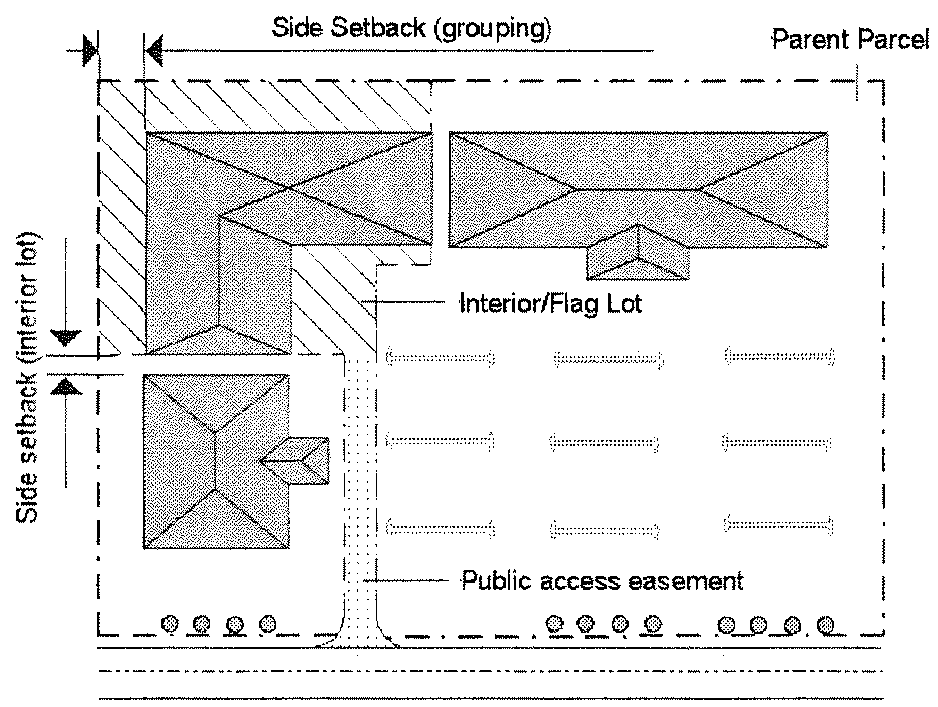
C.
The parcels must be part of a common scheme of development.
D.
Access must be internalized using the shared circulation system of the principal use or structures (such as a shopping center).
E.
The subdivided lot must abut a private street, drive, or an easement that complies with the following standards:
1.
The private street, drive, or an easement must provide direct, unobstructed access to a dedicated public street;
2.
The subdivided lot must be named as a beneficiary of the private street, drive, or an easement for purposes of public access;
3.
The private street, drive, or an easement must be recorded and submitted with the subdivision plat approval; and
4.
In order to provide access for vehicles, utilities and emergency vehicles, the private street, drive, or easement shall have a minimum paved surface width equal to the required width of a shared driveway (see section 27-503-14, shared driveways).
(Code 1992, § 27-335)
Sec. 27-336. - Written interpretations.
27-336-1
Authority. The director shall have authority to make all written interpretations concerning the provisions of the unified development ordinance, the official zoning map, and master land use plan.
27-336-2
Request for interpretation. A form to make a request for interpretation shall be made available to the public. Completed forms shall be submitted to the director.
27-336-3
Interpretation by director. The director shall:
A.
Review and evaluate the request in light of the unified development ordinance, zoning map, and any other relevant information;
B.
Consult with other staff as necessary and render an opinion;
C.
Provide the interpretation to the applicant in writing.
(Ord. No. 18-20, § 2(att.), 3-3-2020)
27-336-4
Official record. The director shall maintain an official record of interpretations which shall be available for public inspection during normal business hours.
27-336-5
Appeals. Appeals to the director's interpretation shall follow the guidelines in section 27-337.
(Code 1992, § 27-336)
Sec. 27-337. - Appeals and variances.
27-337-1
Appeals of administrative determinations. The planning commission shall hear appeals from the decision of the administrative officers in respect to the enforcement and application of this chapter, and may affirm or reserve in whole or in part the decision of the administrative officer.
A.
Process. Any person, officer of the city, or other governmental agency not in agreement with a decision made by the director may appeal the decision within 30 days of the decision by filing with the director a notice of appeal along with a payment of the required appeal fee. The filing shall specify the reason for the appeal. The director shall then transmit to the planning commission all the information on the details of the decision and the reason for the appeal. This shall be done in advance of the next regularly scheduled meeting that is more than 30 days from the date of the appeal.
B.
Stay. An appeal puts all processing of applications on hold until the appeal process is completed.
C.
Hearing. The planning commission shall schedule a reasonable time for the hearing of the appeal or any other matter referred to it. Notice shall be provided, published, mailed and posted pursuant to section 27-308.
D.
Action. In exercising its powers, the planning commission, in conformity with the provisions of law, may reverse or affirm, wholly or in part, or may modify the order, requirement, decision, or determination.
E.
Appeal. Appeal to the board of directors in accordance with section 27-337-8.
(Ord. No. 26-13, § 1(att.), 6-4-2013; Ord. No. 37-22, § 1, 5-3-2022)
27-337-2
Variances. The board of zoning adjustment shall hear requests for variances from the literal provisions of the zoning chapter in instances where strict enforcement of the zoning chapter would cause undue hardship due to circumstances unique to the individual property under consideration, and shall grant such variances only when it is demonstrated that such action shall be in keeping with the spirit and intent of the provisions of the zoning chapter. The board of zoning adjustment shall not permit, as a variance, any use in a zone that is not permitted under the chapter. The board of zoning adjustment may impose conditions in the granting of a variance to ensure compliance and to protect adjacent property.
27-337-3
Board of zoning adjustment procedures. The board of zoning adjustment shall establish regular meeting dates, adopt rules for the conduct of its business, establish a quorum in procedure, and keep a public record of all findings and decisions. The public meeting requires a notice of the meeting date and agenda to be published in a newspaper of general circulation in the city at least one time seven days prior to the meeting.
27-337-4
Submission requirements. The director shall prepare an application form specifying the information to be submitted.
A.
Application. The applications shall contain at least the following information:
1.
The legal description of the subject property;
2.
The street address of the subject property;
3.
A certified site plan drawn to scale (one inch equals 20 feet, unless otherwise approved) showing existing and proposed structures;
4.
A copy of the proposed or approved development plan if one has been prepared;
5.
The literal provision from which a variance is requested and the provision desired in lieu of the literal provision;
6.
The names and addresses of all property adjacent or contiguous to the petitioned property, including property across streets and intersections;
7.
The names and addresses of all owners of the subject property and/or their agents; and the date that this petition shall be considered by the board of zoning adjustment;
8.
Application fee.
B.
Notice. This information shall be used by the director to mail notice to all persons listed in the application to inform them of the public hearing on the variance request, the street address of the property and the reason for the variance request.
27-337-5
Application and review procedures.
A.
Determination of completeness. Applications shall be submitted to the director for a determination of completeness pursuant to section 27-303.
B.
Neighborhood meeting. The applicant shall comply with the requirements for a neighborhood meeting pursuant to section 27-304, except the applicant shall notify adjacent and contiguous property owners. The applicant also shall notify any homeowners' association, neighborhood association, or merchants association registered with the planning and zoning department and located within 300 feet of the parcel. The director may waive the requirement for a neighborhood meeting where:
1.
The proposed variance shall allow development in compliance with surrounding land uses.
2.
The variance request represents a minor change to the development requirements that shall have little or no effect on surrounding properties.
C.
Staff review. Following a determination of completeness, the staff shall review the application pursuant to section 27-305.
D.
Notice and public hearing. Following the completion of staff review and required neighborhood meetings, the application shall be scheduled for a public hearing before the board of zoning adjustment.
1.
Notice shall be provided pursuant to section 27-308.
(Ord. No. 47-10, § 2, 10-5-2010)
27-337-6
Action.
A.
Action. Following the public hearing, the board of zoning adjustment may approve, approve as amended, or deny the application for variance.
B.
Conditions. The board of zoning adjustment may impose conditions on the granting of a variance to ensure compliance and to protect adjacent properties.
27-337-7
Appeal of board of zoning adjustment decisions. Decisions of the board of zoning adjustment in respect to the above shall be subject to appeal only to a court of record having jurisdiction.
(Code 1992, § 27-337)
27-337-8
Appeal of planning commission decisions.
A.
The following shall apply to appeals of zoning applications:
1.
If the planning commission denies a zoning request so that no recommended action has been certified to the board of directors, the applicant shall have the right to file a request for review of the planning commission's decision with the board of directors.
2.
The request for review shall be initiated in the following manner or be considered waived:
a.
Filing a written notice of such appeal with the office of the city clerk during normal business hours.
b.
Filed on or before the tenth calendar day following the planning commission meeting at which the proposed zoning and/or preliminary plan hearing was held, or following the date on which the planning commission handed down its decision of non-recommendation, if the date of decision differs from the date of hearing. Notice of review of any such decision to the board of directors shall be provided to those persons who were provided postal notice of the original application. An application fee in the amount established by board of directors is required to be paid at the time any appeal is filed.
3.
The board of directors shall review the planning commission action at a study session. Following the study session of the board of directors, the request shall be placed on the agenda of the next board of directors meeting
4.
Only the board of directors may permit withdrawal or postponement of the reviewed item.
5.
If the board of directors denies the application the applicant shall not be permitted to reapply for the same or substantially same request for a period of one calendar year from the date of action by the board.
B.
Action by the board of directors. When the planning commission certifies a zoning to the board of directors, the board shall consider the criteria established in section 27-330-6(E) and may take any action consistent with sections 27-310 and 27-311, including:
1.
Approve the application and preliminary plan;
2.
Approve as amended the application and/or preliminary plan; or
3.
Deny the application and preliminary plan.
4.
Where there is new, material evidence presented at the board of directors meeting that was not available to the planning commission, the board may return the application to the planning commission for reconsideration based on the new evidence.
C.
Re-application. If the board of directors denies a proposed zoning application certified to it with the planning commission's approval, the applicant shall not be permitted to re-apply for the same or substantially similar request for a period of six months from the date of the action.
D.
Determination of Re-application. The director shall determine whether a re-filed application for zoning meets the requirements of these provisions and whether the new application is the same or substantially similar to the previous application. The director may consult with other departments, the planning commission, or the board of directors in making this determination. Appeals of the director's determination decision may be made to the planning commission.
E.
All decisions of the planning commission not provided for in subsection A. shall be appealable to the board of directors according to this subsection E. Any such decision may be appealed by any person having an interest therein by the filing of a written notice of appeal with the city clerk before 5:00 p.m. on the tenth calendar day following the date of the decision of the planning commission. An application fee in the amount established by board of directors is required to be paid at the time any appeal is filed. The appeal shall be placed on the agenda of a study session of the board of directors prior to decision on the appealed item.
(Ord. No. 37-22, § 1, 5-3-2022)
Sec. 27-338. - Home occupations.
27-338-1
Purpose.
A.
Purpose. The purpose of this section is to allow residents the privilege of engaging in the limited pursuit of a home occupation. This section is intended to comply with the provisions of Act 659 of 2021 as codified in A.C.A. § 14-1-104, and the required license and following regulations for a home occupation are deemed consistent with the regulation of home occupation as permitted by A.C.A. § 14-1-104(d). A licensed home occupation allows the resident to operate minimal business activities or offer limited professional services from the resident's home. In granting a request for home occupation license, the planning commission may condition and limit the license as necessary to preserve the spirit and intent of this section and controlling law.
B.
Intent. Home occupations, as allowed by this section, are intended to be clean, quiet, nonobtrusive activities operated on a limited basis with the business use incidental to the residential character of those areas.
(Ord. No. 18-20, § 2(att.), 3-3-2020; Ord. No. 69-21, § 1(att.), 7-6-2021)
27-338-2
Applicants. Applications for home occupations may be filed by the resident or an authorized agent for the resident. All applications shall be submitted to the planning and zoning department for review by the director and staff. The application shall be accompanied by a processing fee in an amount to be established by the board of directors.
27-338-3
Submission requirements. The planning and zoning department shall prepare an application form specifying the information to be submitted with the application. An application for home occupation shall include at least the following information:
A.
Identification of applicant as owner or tenant of the property. Where the applicant is not the owner, copy of a letter or other notice provided to the property owner describing the application for home occupation.
B.
The legal description of the property.
C.
The street address of the property.
D.
The present zoning classification of the property.
E.
The description of the proposed home occupation.
F.
The names and the addresses of all persons listed on the current tax records as the owners of all property located within 300 feet of the site, including property across streets, alleys and intersections.
G.
Any part of a restrictive covenant applicable to the property that appears to prohibit this home occupation request.
H.
A questionnaire or series of questions about the nature and impact of the use.
I.
Application fee.
J.
Other information as identified on the application.
K.
Other information as requested by the director, other departments or agencies, the planning commission, or the board of directors.
27-338-4
Application and review procedures.
A.
Determination of completeness. Applications shall be submitted to the director for a determination of completeness pursuant to section 27-303. An application is complete when all of the items required by unified development ordinance and on the application form are prepared and/or answered, and any required supplemental or additional applications are submitted with the appropriate fee to the planning and zoning department.
B.
Neighborhood meeting. Even though a neighborhood meeting is not required, pursuant to section 27-304, the planning commission and planning and zoning staff would encourage the applicant to meet with property owners who may be affected by the proposed application.
C.
Staff review. Following a determination of completeness, the staff shall review the application pursuant to section 27-305.
D.
Notice and public hearing. Following completion of staff review, the application shall be scheduled for a public hearing before the planning commission.
1.
Notice shall be provided pursuant to section 27-308. Notice shall be posted and mailed.
2.
The planning commission shall consider the criteria listed in subsection 27-338-4F of this section, below, in making a recommendation.
E.
Planning commission consideration. The planning commission shall review home occupation applications at its regularly scheduled monthly meeting, at which time interested persons may appear and offer information in support of or in opposition to the proposed home occupation.
F.
Minimum requirements for consideration. The planning commission, in reviewing applications under this section, may consider the performing of a skill, talent, service or profession on a limited basis as a home occupation only if it complies with all of the following:
1.
Reserved.
2.
There shall be no occupational activity on the premises outside of the residence and the occupational activity shall be incidental and subordinate to the primary use of the premises.
3.
No sign may be used in the operation of the business.
4.
No outdoor display of any goods or services and no outdoor storage of materials or equipment are allowed.
5.
The home occupation is required to be run only by the resident members of the household and shall not have any other employees, concessionaires or other operators or helpers whether such business is conducted on the premises or off the premises.
6.
Reserved.
7.
Any business conducted on the premises shall be by appointment only, such that no more than two patrons shall be at the business at any one time.
8.
The planning commission shall have the authority to limit the operating hours of a business where it deems it necessary in order to ensure compatibility with the residential neighborhood.
G.
Determination. The planning commission shall then make one of the following determinations on the application:
1.
Approve the application as submitted.
2.
Approve the application as amended with modifications.
3.
Continue the application to a date certain.
4.
Deny the application.
H.
Conditions. The planning commission may impose conditions and restrictions on the property benefited by the home occupation use to reduce or minimize the injurious effects of the home occupation.
I.
Compatibility. The planning commission is not required to approve any application for the operation of any home occupation which, in its opinion, is not compatible with the integrity of the neighborhood.
J.
Verification. No license for the conduct of any business shall be issued until city inspections verify compliance with all conditions set by the planning commission.
(Ord. No. 18-20, § 2(att.), 3-3-2020; Ord. No. 69-21, § 1(att.), 7-6-2021)
27-338-5
Reserved.
27-338-6
Conditions. In approving a home occupation application, the planning commission has granted an applicant the privilege of engaging in a designated business at the designated address. An approved home occupation and the license thereof cannot be transferred or relocated to another address. Approved home occupations and the license thereof cannot be transferred to any other person. Any approved home occupation which is discontinued for a period of 12 months or more shall be deemed abandoned and the reestablishment of such business shall require the re-application and approval of the planning commission as required by this section.
27-338-7
Established home occupations. Legally established businesses, occupations or professions conducted at the time of the effective date of unified development ordinance in a residential structure, or accessory building in a residential use area may be continued until that particular business is abandoned for a period of 12 months, provided that this shall not be construed to approve continuation of any activity constituting a common law nuisance, or activity prohibited by the statutes, ordinance or restricted covenants applicable to the area.
27-338-8
Appeals. The board of directors shall hear appeals from the decision of the planning commission in respect to the approval of applications as defined in this section. Any such decision may be appealed by any person having an interest therein by the filing of a written notice of appeal with the city clerk before 5:00 p.m. on the tenth calendar day following the date of the decision of the planning commission. A fee in the amount established by board of directors shall be required at the time any appeal is filed in respect to a home occupation application ruling of the planning commission.
27-338-8
Appeals. The board of directors shall hear appeals from the decision of the planning commission in accordance with section 27-337-8.
(Ord. No. 37-22, § 1, 5-3-2022)
27-338-9
Enforcement.
A.
This section shall be enforced by the city administrator, or designated agent, who shall investigate complaints and routinely conduct inspections of occupations operating hereunder.
B.
When any substantial violation is detected, the operator shall be notified in writing that the home occupation privilege and the privilege license are revoked and terminated effective 15 days from date of notice.
C.
The operator may, within 15 days of the date of the notice, file a notice of appeal to the planning commission, which shall hear such appeal in a regularly scheduled meeting.
D.
In the event of such appeal, revocation and termination, where no violation of other ordinances is involved, enforcement action shall be delayed until ten days following the decision of the planning commission.
E.
Where such appeal is requested, the planning commission shall hear the facts and determine whether or not the privilege and license shall be terminated for failure to comply with the requirements of this section or other conditions set at the time of approval; or the planning commission may issue whatever other direction it may deem appropriate and consistent with the purposes of this section.
F.
If all such operations have not ceased upon termination of the privilege, the owner of the home occupation shall be guilty of a misdemeanor and shall be subject to the penalties as delineated in section 1-9 of this Code.
G.
Any appeal to the decision of the planning commission pertaining to such revocation or termination shall be to a court of appropriate jurisdiction.
(Code 1992, § 27-338; Ord. No. 49-16, § 1(att.), 9-6-2016)
Sec. 27-339. - Vested rights determination.
27-339-1
Purpose. The purpose of this section is to establish regulations, procedures and standards to be used in the determination of vested land use rights. Where a land use right has been found to be vested, the property owner has permission to proceed with a properly approved and permitted project despite changes made to the city zoning and subdivision regulations through the adoption of the UDO, or changes which may be made to these regulations in the future. Vested rights may be affected by changes in life, health or safety codes or other regulations.
A.
This section is not intended to make a change in common law vested rights standards as established by state law.
B.
This section is not intended to address legal nonconforming uses or structures, questions regarding permit enforcement, or development or uses in accordance with binding development agreements.
27-339-2
Applicability. The provisions of this section are applicable in all zoning districts.
27-339-3
Regulations.
A.
No person who has obtained a vested right in a development prior to the effective date of this unified development ordinance shall be required to re-apply or obtain additional approvals that were not contemplated at the time of the initial approval; provided, however, that no significant or substantial change may be made in any such development without prior approval from the city pursuant to the terms of the unified development ordinance.
B.
Any person claiming a vested right that is disputed by the planning and zoning department shall substantiate the claim according to this section. The claimant has the burden of proof as to each finding necessary to establish a vested right.
C.
Exceptions to vested rights determination for new or amended regulations related to issues of health and safety shall also be determined through this process.
27-339-4
Submission requirements. The director shall prepare an application form specifying the information to be submitted. This shall include, at a minimum:
A.
Claimant's and claimant's agent/attorney's name, address, telephone number, e-mail address and fax number.
B.
Description of the development claimed to be vested, including location, parcel id or tax number, existing and proposed structures, uses, and all incidental improvements such as utilities, road and other infrastructure.
C.
A list of all governmental approvals that have been obtained and/or approved, including those from state or federal agencies, and the date of each final approval. Copies of the approvals shall be attached to the application. If amendments or conditions were included with any approval, date on which the conditions were satisfied or are expected to be satisfied.
D.
A list of any anticipated approvals and their anticipated dates of approval.
E.
Specification of the nature and extent of the work or use in progress or completed, including date of commencement for each portion (e.g., grading, foundation, structural work, etc.); portions completed and date completed; status of each portion on date of claim; and amount of money expended on each portion whether completed or in progress.
F.
A list of the amount and nature of any liabilities or expenditures incurred that are not described above, the dates incurred, and a list of any remaining liabilities to be incurred with the expected date.
G.
A statement of the total expected cost of the development or use.
H.
A statement of the anticipated completion date for the total development.
I.
Other information as requested by the director, other agencies or departments, the planning commission, or the board of directors.
J.
Appropriate filing fee.
27-339-5
Application and review procedures.
A.
Determination of completeness. Applications shall be submitted to the director for a determination of completeness pursuant to section 27-303. An application is complete when all of the items required by the unified development ordinance and on the application form are prepared and/or answered, and any required supplemental or additional applications are submitted with the appropriate fee to the planning and zoning department.
B.
Staff review. Following a determination of completeness, the staff shall review the application pursuant to section 27-305.
C.
Notice and public hearing. Following completion of staff review, the application shall be scheduled for a public hearing before the planning commission.
1.
Notice shall be provided pursuant to section 27-308. Notice shall be published in a newspaper of general circulation in the city, mailed and posted.
2.
The planning commission shall consider the criteria listed in subsection 27-339-5D of this section, in making a recommendation.
D.
Factors to be considered.
1.
Whether the claimant's actions were taken based on a validly issued city permit or were undertaken prior to the enactment or applicability of city regulations requiring a permit;
2.
Whether the claimant performed substantial work and incurred substantial financial liabilities in good faith reliance on a building permit issued by the city, or did so prior to the enactment or applicability of city regulations requiring a permit;
3.
That the development for which the vested right is sought has not been abandoned; and
4.
That the development or use for which the vested right is sought does not exceed the scope authorized by the terms and conditions of the city-issued permit relied upon (if any).
E.
Planning commission action.
1.
If the claim of vested rights is shown pursuant to the criteria in subsection 27-339-5D of this section above, the planning commission shall grant a vested rights determination to the extent the claim has been substantiated.
2.
If additional information is necessary, the planning commission may continue the hearing to a date certain and instruct the applicant to provide the necessary information.
3.
If the claim of vested rights cannot be substantiated, the planning commission shall deny the vested rights determination.
(Ord. No. 18-20, § 2(att.), 3-3-2020)
27-339-6
Effect. A final determination by the planning commission recognizing a claim of vested rights shall constitute acknowledgement that the development does not require any additional permit pursuant to city regulations, unless additional permits were specified by the vested approval.
A.
No substantial change may be made in the development except in accordance with the city's approval and/or permit requirements.
B.
If any approval upon which the vested rights determination was based lapses or is voided, either by its own terms or any provision of law, the acknowledgement made under this section shall automatically and without further action be null and void and the development or use shall become subject to the permit requirements of the city.
27-339-7
Appeals. Appeal of the planning commission's determination may be made to the board of directors. A fee in the amount established by board of directors shall be required at the time any appeal is filed in respect to a vested rights determination of the planning commission.
(Code 1992, § 27-339)
Sec. 27-340. - Amendment to the text of the unified development ordinance.
27-340-1
Purpose. It may be necessary to periodically amend the provisions of the unified development ordinance regulations. This section provides the method of amending the regulations.
27-340-2
Applicant. Any proposed text amendment may be initiated by the board of directors, planning commission, or director. Any citizen of the city may request in writing to the planning commission that a proposed text amendment be considered. After review of such request from a citizen, the planning commission may initiate the proposed text amendment.
27-340-3
Review procedures.
A.
Staff report. The director or planning staff shall prepare a staff report that reviews the proposed amendment in light of the master land use plan, master street plan, other adopted plans, and the terms of the unified development ordinance.
B.
Planning commission review. The director shall provide a copy of the report to the planning commission prior to the scheduled public hearing.
C.
Notice. Notice of the proposed amendment shall be provided pursuant to section 27-308. Notice shall be published in a newspaper of general circulation in the city.
D.
Consideration. The planning commission shall take into account all factors that it deems relevant, including consistency of the proposed amendment with the master land use plan, master street plan, and other adopted plans, as well as whether the proposed amendment serves to carry out the purposes of the unified development ordinance, and the factors established in section 27-310.
E.
Planning commission action. Following the public hearing, the planning commission may recommend approval, approval as amended, or denial of the proposed amendment.
1.
The planning commission's recommendation shall be certified to the board of directors.
2.
The board of directors shall consider the planning commission's recommendation at the second regularly scheduled meeting following action by the planning commission.
3.
If the planning commission fails to make a recommendation on the amendment, it shall be deemed to have made a recommendation of denial. At that point, the amendment shall be forwarded to the board of directors with no recommendation having been made.
F.
Action by the board of directors. When the planning commission certifies a recommendation to the board of directors, the board shall consider the criteria established in subsection 27-340-3E of this section and take any action consistent with its authority, including:
1.
Approving the amendment;
2.
Approving the amendment as amended;
3.
Denying the amendment;
4.
Returning the application to the planning commission with specific questions or issues; or
5.
Continue the application to a date certain.
(Ord. No. 18-20, § 2(att.), 3-3-2020)
27-340-4
Official copy. If amendments to the unified development ordinance regulations are approved, the director shall have appropriate changes made to the official copy of the regulations and make the updated information available.
27-340-5
Application appeals chart.
Application Appeals Chart
(Code 1992, § 27-340; Ord. No. 26-13, § 1(att.), 6-4-2013; Ord. No. 18-20, § 2(att.), 3-3-2020; Ord. No. 1-21, § 2(att.), 1-5-2021)
Sec. 27-341. - Planned zoning district.
27-341-1
Purpose.
A.
The process is deemed necessary to ensure control of certain development while providing the applicant a means of gaining commitment without undue financial risk. Specifically, the purposes of this article are to encourage:
1.
Comprehensive and innovative planning and design of diversified yet harmonious development.
2.
Better utilization of sites characterized by special features of geographic location, topography, size, or shape.
3.
Flexible administration of general performance standards and development guidelines.
4.
Primary emphasis shall be placed upon achieving compatibility between the proposed development and surrounding areas to preserve and enhance the neighborhood through the use of enhanced site design, architecture, landscaping, and signage.
5.
Developments that utilize design standards greater than the minimum required by the UDO.
(Ord. No. 18-20, § 2(att.), 3-3-2020)
27-341-2
Submission requirements. The director shall prepare an application form which specifies the information to be submitted in support of a planned zoning district. This shall include at a minimum:
1.
Pre-application conference is required pursuant to section 27-302.
2.
Application fee.
3.
A project booklet, submitted graphically and in narrative form, addressing as many items as applicable. In no instance shall the design requirements and development standards be less than those found in articles 27-200, 27-500, 27-600, and 27-700.
a.
Reason (need) for requesting the zoning change and response to how the proposal fulfills the intent/purpose of the planned zoning district.
b.
Current ownership information (landowner/applicant and representative of applicable) and any proposed or pending property sales.
c.
Comprehensive description of the scope, nature, and intent of the proposal.
d.
General project concept:
i.
Street and lot layout.
ii.
Site plan showing proposed improvements.
iii.
Buffer areas, screening, and landscaping.
iv.
Stormwater detention areas and drainage.
v.
Undisturbed natural areas.
vi.
Existing and proposed utility connections and extensions.
vii.
Development and architectural design standards.
viii.
Building elevations.
ix.
Proposed signage (type and size).
e.
Proposed development phasing and timeframe.
f.
Identify land use designations.
g.
Identify area and bulk regulations.
h.
A chart comparing the proposed planned zoning district to the current zoning district requirements (land uses, setbacks, density, height, intensity, bulk and area regulations, etc.).
i.
A chart comparing the proposed land uses and the zoning district where such land uses are permitted.
j.
A chart articulating how the project exceeds the UDO requirements (e.g., increased landscaping, increased high quality materials on the façade, etc.).
k.
Statement of how the development will relate to existing and surrounding properties in terms of land use, traffic, appearance, height, and signage.
l.
A traffic study when required by the engineering department (consult with staff prior to submittal).
m.
Statement of availability of water and sewer (state size of lines).
27-341-3
Application and review procedures.
A.
Determination of completeness. Applications shall be submitted to the director for a determination of completeness pursuant to section 27-303. An application is complete when all of the items required by the unified development ordinance and on the application form are prepared and/or answered, and any required supplemental or additional applications are submitted with the appropriate fee to the planning and zoning department.
B.
Neighborhood meeting. The applicant shall comply with the requirements for a neighborhood meeting pursuant to section 27-304.
C.
Staff review. Following a determination of completeness, the staff shall review the application pursuant to section 27-305.
D.
Notice and public hearing. Following completion of staff review and such neighborhood meetings as are required, the application shall be scheduled for a public hearing before the planning commission.
1.
Notice shall be provided, published, mailed and posted pursuant to section 27-308.
2.
The planning commission may recommend a change in a zoning district category which constitutes a more restrictive change than requested by the applicant.
E.
Factors to be considered.
1.
Rezoning application. Approval, approval as amended, or denial of the rezoning application shall be based upon consideration of the following factors:
a.
Compatibility with the master land use plan, master street plan, and applicable area plans.
b.
Compatibility of the proposed development with the character of the neighborhood.
c.
The zoning and uses of adjacent and nearby properties, and the compatibility of the proposed future uses with those existing uses.
d.
The extent to which the proposed land use would increase or change traffic volume or parking demand in documented evidence or engineering data, road conditions, road safety, or create parking problems in combination with any improvements that would mitigate these adverse impacts.
e.
The current availability of public utilities and services and the future capacity needed to adequately serve the proposed land use in combination with any improvements that would mitigate these adverse impacts.
f.
That the application complies with all relevant UDO requirements (e.g., articles 27-200, 27-500, 27-600, and 27-700).
2.
Project booklet. The following criteria shall be considered when reviewing the project booklet:
a.
Is the site capable of accommodating the buildings, parking areas and drives with the appropriate open space provided?
b.
Does the plan provide for safe and easy ingress, egress and internal traffic circulation?
c.
Is the plan consistent with good land use planning and site engineering design principles, particularly with respect to safety?
d.
Are the architectural designs consistent with the city policies and regulations and compatible with surrounding land use features?
e.
Does the plan represent an overall development pattern that is consistent with the master street plan, master land use plan, and other adopted planning policies?
f.
The required right-of-way dedication has been identified by the City Engineering Department.
g.
All easements and utilities shall meet the requirements of the approving departments and agencies.
h.
Articulate how the plan minimizes or mitigates the impact of increased traffic both in volume and vehicle size.
i.
Articulate how the plan exceeds the UDO requirements. (ex. increased landscaping, increased high quality materials, etc.)
F.
Planning commission action. Following the public hearing, the planning commission may recommend approval, approval as amended, or denial. The planning commission may also continue the application to a date certain.
1.
The planning commission shall certify recommendations of approval or approval as amended to the board of directors for further procedure in conformity with A.C.A. title 14, ch. 56, subch. 4 (A.C.A. § 14-56-401 et seq.).
The planning commission or board of directors may impose a time limit for the development as described in the project booklet.
2.
The planning commission's certified recommendations shall be automatically placed on the agenda of the board of directors' second regularly scheduled meeting of the month following action by the planning commission.
G.
Appeal. Appeals from the decisions of the planning commission shall be in accordance with section 27-337-8.
(Ord. No. 18-20, § 2(att.), 3-3-2020; Ord. No. 32-20, § 2(att,), 4-7-2020; Ord. No. 37-22, § 1, 5-3-2022; Ord. No. 104-22, § 1, 11-1-2022)
27-341-4
Amendments to the planned zoning district plans. Once a PZD has been approved, significant changes may be made only after approval of a revised PZD. This requires resubmittal of the application through the same procedural requirements of the original application. Changes that are not considered significant pursuant to subsection 27-341-4A of this section may be approved at the director's discretion. Disapproval of the changes may be appealed to the planning commission.
A.
Criteria. For the purposes of this section, significant changes shall be determined by the director. The term "significant changes" means any of the following, provided they are still within the approved standards of the applicable zoning district:
1.
Increases in density or intensity of residential uses by more than five percent;
2.
Increases in total floor area (entire plan) of all nonresidential buildings by more than five percent or 5,000 square feet, whichever is less;
3.
Increases of lot coverage by more than five percent;
4.
Changes to the architectural style that shall make the project inconsistent with previous approvals;
5.
Changes in ownership patterns or stages of construction that shall lead to a different development concept;
6.
Changes in ownership patterns or stages of construction that shall impose substantially greater volumes on streets and load capacities on public facilities;
7.
Decrease of more than five percent in areas devoted to open space or the substantial relocation of such areas;
8.
Changes in traffic circulation patterns that will affect traffic outside of the project boundaries;
9.
Modification or removal of conditions and stipulations to the planned zoning district approval; or
10.
Modifications that change, amend, or violate the terms of the applicable planning policies.
B.
Approval. Any changes that seek to vary the standards of the applicable district and cannot be approved through subsection 27-341-4A of this section, above, must either be approved by the planning commission through a planned zoning district rezoning application or through a variance request to the board of zoning adjustment.
C.
Appeal. Appeal of the director's determination of whether changes are significant may be taken to the planning commission, whose decision shall be final. No further action shall be taken to process the application pending the planning commission's determination.
(Code 1992, § 27-341; Ord. No. 20-13, § 1(att.), 5-7-2013; Ord. No. 64-15, § 1(att.), 10-6-2015; Ord. No. 18-20, § 2(att.), 3-3-2020)
Secs. 27-342—27-399. - Reserved.
(Ord. No. 20-13, § 1(att.), 5-7-2013)

