
Franklin City Zoning Code
CHAPTER 17
17 - BUFFERING AND SCREENING STANDARDS
17.17.010 - Intent.
The purpose of these buffering and screening standards is to lessen the potential conflicts between the possible uses in one zoning district and those use in adjacent districts through the use of setbacks and landscaping. The potential degree of conflict between the zoning districts determines the extent of the buffer required.
(Ord. 05-21 § 1 (part))
17.17.020 - General buffering and screening standards.
The following general buffering standards apply to all zoning districts:
A.
Buffer Yard Requirements. The buffer yard requirements table describes the type of buffer yard that shall be installed. The required buffer yards shall meet the following minimum standards:
1.
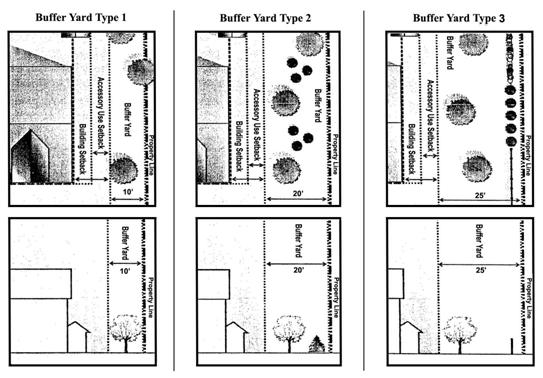
Buffer Yard Type 1. Buffer yard type 1 shall include a minimum setback of ten (10) feet in addition to the yard setback otherwise required by this chapter. In addition, one broad-leaf deciduous canopy tree must be planted in the buffer yard for every thirty (30) feet of boundary between the subject and adjoining properties.
2.
Buffer Yard Type 2. Buffer yard type 2 shall include a minimum setback of twenty (20) feet in addition to the yard setback otherwise required by this chapter. In addition, one broad-leaf deciduous canopy tree or two evergreen conifers shall be planted in the buffer yard for every twenty-five (25) feet of boundary between the properties.
3.
Buffer Yard Type 3. Buffer yard type 3 shall include a minimum setback of twenty-five (25) feet in addition to the yard setback otherwise required by this chapter. In addition, a row of broad-leaf deciduous canopy trees shall be planted parallel to the property line within the buffer yard with one tree placed every twenty (20) feet along the boundary between the subject and adjoining properties. Also, a six foot tall opaque wooden fence or brick/stone wall, a five foot tall undulating mound planted with shrubs, or a row of evergreen conifers shall be provided.
a.
If an undulating mound is used the slope shall be a maximum of three is to one (rise:run), one shrub for every ten (10) feet of continuous boundary shall be planted on the mound. All required shrubs shall be eighteen (18) inches tall, measured from grade, at planting.
b.
If a row of evergreen trees is used, one tree shall be placed every ten (10) feet along the property boundary. All evergreen trees shall be five feet in height, measured from the top of the rootball, at the time of planting.
Buffer Yard Requirements
B.
Buffer Yard Standards. The buffer yard standards only apply along the property lines where the two conflicting zoning districts meet as specified in the buffer yard requirements table. The required buffer yards shall be installed despite the presence of streets, alleys, streams and other features separating property lines in conflicting zoning districts.
1.
Responsibility. The developer or owner of the property being developed or otherwise changed in use is responsible for installing the buffer yard at the time of that development or change. The adjacent property owner shall not have to participate in installing the buffer yard.
2.
Buffer Yard Location. All required buffer yard areas shall be provided entirely on the subject property and shall be in addition to setbacks required by this chapter.
3.
Planting Location. Required buffer yard trees may be placed either at regular intervals or in irregular patterns representing a natural landscape. However, no two buffer yard trees (excluding evergreen trees) shall be placed within ten (10) feet of one another. No buffer yard or required landscape materials shall be placed within any easement, right-of-way, or septic field.
4.
Tree Size. All broad leaf/deciduous trees must have at least a two and one-half inch caliper measured at six inches above the top of the rootball, and all evergreen conifers must be a minimum of five feet in height measured from the top of the rootball when planted.
5.
Ground Cover. All portions of the buffer yard not planted with trees, shrubs or other landscaped materials shall be covered with grass or other ground covering vegetation. Landscaping stone or other nonvegetative surfaces may not be substituted for ground covering vegetation.
6.
Application. No landscaping required by this chapter may be used to satisfy the minimum requirements of any other provisions of this chapter.
7.
Maintenance. All landscape materials must be properly maintained, and kept in a neat and orderly appearance, free from all debris and refuse.
a.
All plant material which is unhealthy or dead, in the opinion of the planning director, shall be replaced by the end of the next spring or fall planting season.
b.
Landscape materials are intended to grow, spread and mature over time. Pruning, limbing-up, topping and other growth inhibiting measures may only be used to ensure the public safety.
(Ord. 05-21 § 1 (part))
Note: All buffer yard plant materials shall comply with Sections 17.32.160(A)(5) and (A)(6) of this title. Please refer to the Qualifying Broad Leaf/Deciduous Tree table and the Nonqualifying Tree table of Section 17.32.160 of this title.
17.17.030 - Materials and equipment buffering and screening standards.
The following materials and equipment buffering standards apply to the multifamily residential, mixed-use, institutional and industrial zoning districts as follows:
A.
Ground Level Requirements. All outdoor storage areas for completed products manufactured on-site, production materials, and equipment; dumpsters and waste containers; and mechanical equipment located on the ground shall be screened consistent with the following requirements. In no instance shall this be interpreted as applying to merchandise for sale that is temporarily or seasonally placed outdoors.
1.
Fencing. A minimum six foot tall, one hundred (100) percent opaque fence of wood, brick, or stone construction shall completely screen the area from the view of public streets and adjacent properties. Opaque, six-foot tall wooden gates shall be provided to access the facility. The gates shall generally remain closed, except when immediate access to the area is required.
2.
Landscape Screening. Evergreen planting shall be provided around the exterior perimeter of the required fencing.
a.
If evergreen shrubs are used they shall be a minimum of three feet tall at the time of planting, and planted at a maximum of five feet on center.
b.
If evergreen trees are used they shall be conifers, a minimum of five feet tall at the time of planting, and shall be planted a maximum of twenty (20) feet on center.
B.
Roof-top Requirements. All roof-top equipment, such as HVAC units, shall be screened from the view of all public streets by parapets, dormers, or other screens. The material of all such screens shall be consistent with the exterior materials used on the facade of the structure.
(Ord. 05-21 § 1 (part))

