
Franklin City Zoning Code
CHAPTER 17
32 - DEVELOPMENT STANDARDS
17.32.010 - Introduction and application.
A.
Introduction. All structures, land uses, land use changes, structural alterations, structural relocations, structural additions, and structural enlargements that are constructed, created, established, or occur after the effective date of the ordinance codified in this title (except as may otherwise be provided within this title) shall be subject to all development standards and regulations applicable to the zoning district in which they are located.
B.
Expansion or Modification of Existing Uses and Structures. No structure, parking area, or other site feature regulated by this title shall be enlarged, altered, or expanded unless the minimum improvements required by this chapter are provided on the property in a manner equal to the extent of its alteration or expansion.
C.
Requirements for Nonconforming Uses and Uses Permitted by Special Exception or Variance. Any use which is nonconforming in the zoning district in which it is located or is permitted by special exception or variance shall be consistent with the standards for the zoning district in which the use is permitted by this title. The board of zoning appeals may specify the appropriate standards for all uses permitted by special exception or variance.
(Ord. 04-09 § 7.1)
17.32.020 - Height standards.*
These general height standards apply to all zoning districts:
A.
Height Requirements. The maximum height permitted shall be as described below and noted in the maximum structure height table, subject to the exceptions listed in subsection B of this section.
1.
Measuring Height. In all instances, the height of a structure shall be measured from grade level at the lowest point of the base of the structure to the highest point of the of the structure, excluding the necessary appurtenances listed in subsection (B)(4) of this section
2.
Additional Residential Limitations. No accessory structure located in a single-family residential zoning district may exceed the height of the primary structure on the property.
3.
Fire Department Limitations. The height of no structure shall exceed the firefighting ability of the Franklin fire department.
Maximum Structure Height
B.
Exceptions. No structure may be erected or changed so as to make its height greater than specified in the applicable zoning district, except as noted below. For the purposes of this section, the height of church steeples, chimneys, and other structures which are attached or otherwise a part of another structure shall be measured from grade level.
1.
General Exceptions. The following structures may exceed the permitted height regulations by twofold (x2):
a.
Church steeples;
b.
Spires, belfries, and cupolas; and
c.
Industrial related storage tanks, mechanical equipment, and smokestacks.
2.
Telecommunications Towers and Antenna. The height of telecommunication towers and antenna shall meet the requirements of Section 17.32.140, Telecommunications Facility Standards.
3.
Amateur Radio Towers. Amateur radio towers shall meet the requirements of the accessory use and structure standards of Section 17.32.030.
4.
Necessary Appurtenances. The following structural elements may exceed the permitted height standards for the zoning district in which they are located by up to ten (10) feet:
a.
Necessary mechanical appurtenances;
b.
Utility substations and related essential facilities;
c.
Water tanks;
d.
Chimneys;
e.
Fire towers;
f.
Stair towers;
g.
Stage bulkheads; and
h.
Elevator bulkheads.
5.
Agricultural Structures. All structures in a zoning district where agriculture is permitted that are used in agricultural products storage and/or processing may exceed the permitted height standards for the district in which they are located and be erected to any height that is necessary for their operation. This exemption shall not be interpreted as applying to commercial agricultural structures, such as commercial grain terminals and similar uses.
6.
Watertowers. Watertowers may exceed the permitted height standards for the zoning district in which they are located and be a erected to a maximum height of two hundred (200) feet.
C.
FAA Requirements. Nothing in this title, including the exceptions listed above shall be interpreted as waiving any height regulations related to air travel. All applicable Federal Aviation Administration (FAA) restrictions and regulations shall apply to all structures.
(Ord. 04-09 § 7.2)
* Intent: The intent of these height standards is to protect the public health, safety, and general welfare by providing for adequate light and air, and by ensuring adequate fire protection service.
17.32.030 - Accessory use and structure standards.*
These general accessory use and structure standards apply to all zoning districts.
A.
Order of Establishment. No accessory use or structure shall be permitted to be located, placed, or established on any lot prior to the establishment of a primary use or structure. All accessory uses and structures shall be permitted only in association with, and on the same lot as, the primary use or structure. Properties located in the RR residential rural and A agriculture zoning district shall be exempt from these requirements.
B.
Incidental Uses and Structures. The following shall be considered incidental uses and structures and shall meet the requirements specified.
1.
Satellite Dish. All satellite dishes located in a single-family residential zoning district that exceed one meter (approximately 3.3 feet) in diameter and those located in all other zoning districts that exceed two meters (approximately 6.6 feet) in diameter shall comply with the following requirements. All smaller satellite dish shall be exempt from the requirements of this title.
a.
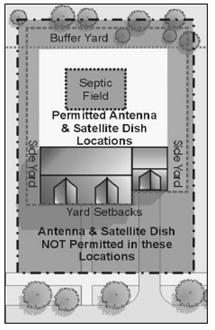
Location. In addition to the location requirements specified by subsection E of this section, no satellite dish (including anchors or supports) shall be located in any side yard.
b.
Height. No satellite dish shall exceed ten (10) feet in height from ground level (if mounted on the ground) or five feet in height above the highest point of the roof of the primary structure (if mounted on the roof). A satellite dish shall be permitted to exceed these height requirements if a determination is made by the board of zoning appeals, through the development standard variance process, that the increased height is technically necessary to successfully receive satellite signals.
2.
Other Incidentals. Bird baths and houses, swing sets, mailboxes, lamp posts, doghouses, attached and detached decks that are less than thirty (30) inches above finished grade, patios, fences, yard ornaments, athletic courts, and similar items, except as otherwise stated in this title, shall be exempt from the requirements of this section.
C.
Vehicle Use. In no instance shall a vehicle be used as an accessory structure in any district (such as for storage, etc.).
D.
Permitted Accessory Uses. Accessory uses shall be permitted in each zoning district as either permitted uses or special exceptions consistent with the Permitted Accessory Uses Table. All accessory uses shall be subject to the standards provided by this chapter. The planning director shall determine whether or not uses not specifically listed are permitted based on the consistency of each use with the intent of the district in which it is located.
1.
Accessory Dwelling Standards. Single-family dwellings constructed and used as accessories to the primary dwelling on the property (otherwise commonly know as "mother-in-laws quarters" and "granny flats") shall be either: (a) attached to, and designed and constructed as part of the primary structure; or (b) located above a detached garage or workshop. In no case may any accessory dwelling exceed one thousand (1,000) square feet in living area.
2.
Day Care Home Standards. Child day care homes shall meet the definition established by IC 12-7-2-28-6 and shall be consistent with all applicable regulations of the state of Indiana.
3.
Home Occupation Standards. Home occupations shall comply with all applicable provisions of the home occupation standards of Section 17.32.070.
Permitted Accessory Uses
E.
Accessory Structure Location. Accessory structures shall comply with the following location requirements:
1.
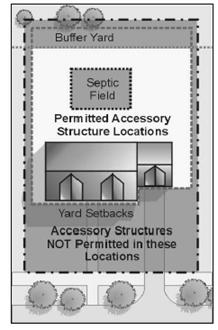
Septic Fields. No accessory structures shall be placed in any operable septic fields.
2.
Landscaping and Buffer Areas. No accessory structure shall encroach into any required landscaped area or buffer yard.
3.
Yard Location. No accessory structure shall be permitted in any front yard, or within the required side and rear yard setbacks specified by the Permitted Accessory Structures Table (set out at the end of subsection F of this section).
Permitted Accessory Structure Locations
F.
Permitted Accessory Structures. The type of accessory structures, setbacks for accessory structures, and maximum number of accessory structures in each zoning district shall be consistent with the Permitted Accessory Structures Table.
1.
Interpretation. The planning director shall determine whether or not accessory structures not specifically listed are permitted based on the consistency of each structure with the intent of the district in which it is located.
2.
Amateur Radio and Television and Radio Receiver Antennas. All amateur radio antenna, CB radio antenna, antenna for receiving television signals, antenna for receiving radio signals, and all other personal broadcasting equipment shall meet the following requirements:
a.
Location. In addition to the location requirements specified by subsection E of this section, no antenna (including anchors or supports) shall be located in any side yard.
b.
Height. No amateur radio tower shall exceed forty-eight (48) feet in height from ground level or five feet in height above the highest point of the roof of the primary structure, whichever is greater. Amateur radio towers shall be permitted to exceed these height requirements if a determination is made by the board of zoning appeals, through the development standard variance process, that the increased tower height is technically necessary to successfully engage in amateur radio communications.
c.
Electrical Interference. No amateur radio tower or equipment shall be permitted that results in interference with other electrical transmissions or devices.
Permitted Accessory Structures
NA Not applicable
(1) Carports not on a permanent foundation and less than 200 square feet shall not be counted as an accessory structure and shall be exempt from this chapter
(2) Permitted per residence or business use (no more than 2 of any one type of accessory structure is permitted)
(3) Indicates the required setback for each dwelling site
(4) No garage vehicle entrance from a street or alley shall have a setback of less than 20 feet (to allow for off-street parking)
G.
Park and Recreation Facility Accessory Uses and Structures. Where park and recreation facilities are permitted, customary accessory uses and structures such as restrooms, groceries, refreshment stands, restaurants, laundries, and sporting goods sales are also permitted, subject to the following standards:
1.
Area. The maximum cumulative area occupied by accessory uses and structures, including any associated parking shall not exceed ten (10) percent of the park and recreation site;
2.
Subordinate Role. The accessory uses and structures shall be subordinate to the recreational character of the development;
3.
Design Focus. The accessory uses and structures shall be located, designed and intended to serve only the needs of the park and recreation facility;
4.
Visibility. The accessory uses and structures shall present no visible evidence of their business nature to areas outside the park or recreation park facility;
5.
Parking. Parking for accessory uses and structures shall be consistent with the Parking Standards of Section 17.32.100; and
6.
Waste Containers. All dumpsters and other waste containers shall be screened consistent with Section 17.32.170(Part 2)(A) of the buffering and screening standards.
H.
Multifamily Dwelling/Manufactured Home Park Accessory Uses and Structures. Where multifamily dwellings or manufactured home parks are permitted, customary incidental uses and accessory structures such as management offices, sales offices, storage facilities, day-care centers, self-service laundries, fitness centers, community centers, and recreation centers, shall also be permitted, subject to the following standards:
1.
Area. The maximum cumulative area occupied by accessory uses and structures, including any associated parking shall not exceed ten (10) percent of the park and development site;
2.
Subordinate Role. The accessory uses and structures shall be subordinate to the recreational character of the development;
3.
Design Focus. The accessory uses and structures shall be located, designed and intended to serve only the needs of the development;
4.
Visibility. The accessory uses and structures shall present no visible evidence of their business nature to areas outside the multifamily or manufactured home park facility;
5.
Parking. Parking for accessory uses and structures shall be consistent with the Parking Standards of Section 17.32.100; and
6.
Waste Containers. All dumpsters and other waste containers shall be screened consistent with Section 17.32.170(Part 2)(A) of the buffering and screening standards.
(Ord. 04-09 § 7.3)
* Intent: The intent of these accessory use and structure standards is to address the unique features of these types of structures and uses; allow the reasonable utilization of property; and to ensure the provision of adequate light, air, and circulation on each property.
17.32.040 - Temporary use and structure standards.*
Part 1: These general temporary use and structure standards apply to all zoning districts:
A.
Temporary Structure Standards. All temporary structures shall conform to the following requirements:
1.
Applicable Development Standards. Temporary structures must meet all development standards for a permanent accessory structure unless otherwise specified in this section.
2.
Temporary Structure Time Limits. Any temporary structure used for a permitted primary use may be permitted for up to two years, unless otherwise specified by this title.
B.
Temporary Use and Structure Standards. Temporary uses and structures are permitted in any zoning district provided that the use is a permitted use in that zoning district. Example: The seasonal sale of Christmas trees, fireworks, etc. is permitted in zoning districts where similar retail sales are permitted uses. All temporary uses and structures shall conform to the following requirements:
1.
Permit Requirements. All temporary uses and structures shall require an improvement location permit unless otherwise specified in this section. No temporary use or structure, or the related signs, lighting, parking, etc. shall be constructed or placed upon a site prior to all necessary permits being obtained.
2.
Time Limits. Temporary uses and/or structures that seek extensions of the initial time limits established in this section shall be subject to the approval of the board of zoning appeals.
a.
An unlimited number of one-year extensions may be granted by the board of zoning appeals. The board may impose reasonable conditions as part of its approval.
b.
No extensions of the time limits described in this section shall be considered for any temporary use or structure that violates any requirements of this title.
3.
Removal. All temporary uses and/or structures must be removed and the site reverted to its original condition within the duration of the permit.
Part 2: These residential temporary use and structure standards apply to the single-family residential zoning districts:
The following temporary uses and structures are permitted as described below, no permit shall be required unless otherwise specified.
A.
Garage/Yard Sales. Garage/yard sales are permitted to occur two times per calendar year, for no more than three consecutive days for each occurrence. Garage/yard sales shall be distinguished from flea markets in that garage/yards sales are clearly incidental to residential uses, while flea markets are commercial businesses and primary uses. In no instance shall this provision be interpreted as permitting the operation of a flea market.
B.
Children's Roadside Stands. Children's roadside stands shall be permitted, but shall not be located in any public right-of-way.
C.
Construction Trailers. Construction trailers are permitted as temporary structures during times of construction activity. Construction trailers shall not be located in any required setback or buffer yard.
D.
Construction Dumpsters. Dumpsters for construction-related debris shall be permitted as temporary structures during times of construction activity. Dumpsters shall not be located in any required setback or buffer yard.
E.
Temporary Home Sales Facilities. Temporary model homes and temporary sales trailers shall be permitted in each development until either: (1) building permits have been obtained for greater than ninety (90) percent of the lots included in the preliminary plat for the development; or (2) five years from the date of approval of the final plat for the most recent section of the development, whichever is less. An improvement location permit shall be required.
1.
Location. Temporary home sales facilities shall be located on a lot in the development in which the homes are for sale. No other structures shall be permitted on any lot occupied by a model home or temporary sales trailer.
2.
Design Requirements. The placement of temporary home sales facilities shall be consistent with the following requirements.
a.
Uses. The use of the facility shall be limited to open house purposes for prospective buyers. Temporary home sales facilities may not be directly used for the purpose of selling homes in other developments or in other communities.
b.
Signs. Signs shall be limited to one ground sign not to exceed six feet in height and twenty-four (24) square feet in area. Such signs shall be placed a minimum of ten (10) feet from the right-of-way, ten (10) feet from adjacent property lines, and in a manner consistent with the intersection sight visibility standards (Section 17.32.130) of this title.
c.
Lighting. All exterior lighting shall be limited to typical household exterior lighting. The use of all other types of lighting, including floodlighting and search lights shall be prohibited.
d.
Parking. Temporary home sales facilities shall conform with the following parking requirements:
i.
Model homes shall provide a minimum of two off-street parking spaces for the use of salespersons and potential buyers. The parking spaces shall conform to the size requirements of this title. Off-street parking for the facility shall be located in, and not extend beyond, the driveway. The driveway area shall be consistent in size and paving with those of the homes to be constructed in the development.
ii.
Temporary sales trailers shall provide two off-street parking spaces. The spaces shall be surfaced with stone meeting the requirements of the city engineer.
e.
Landscaping. Temporary home sales facilities shall conform with the following landscaping requirements:
i.
Model homes shall provide landscaping consistent with that which will be provided for homes to be constructed in the development.
ii.
Temporary sales trailers shall provide a landscape area extending from the trailer for five feet in each direction. The landscaping shall include a variety of shrubs and other materials consistent with the landscaping design of the development. The trailer site shall be graded to ensure proper drainage and treated with a combination of grass seed and sod appropriate to prevent erosion and provide a lawn consistent with that of the homes to be built in the development.
3.
Model Home Conversion. Prior to the sale of a model home for use as a residence, all signage shall be removed and the garage area restored.
4.
Sales Trailer Conversion. Any builder using a temporary home sales trailer and either constructing an approved model home, or removing the trailer, shall restore the trailer site to pre-installation conditions, removing the trailer and any associated signage and lighting. If the trailer is to be replaced by a model home, the trailer and all associated site features shall be removed prior to the issuance of a permanent certificate of occupancy for the model home.
(Ord. 04-09 § 7.4)
* Intent: The purpose of these temporary use and structure standards is to establish minimum standards for the temporary use of property and the placement of temporary structures in order to: (1) accommodate the temporary needs or properties and land uses; (2) ensure that temporary uses do not become permanent without proper scrutiny; and (3) protect the public welfare from the unique hazards that can be created by temporary uses and structures.
17.32.050 - Industrial standards.*
These general industrial standards apply to the industrial zoning districts:
A.
General Standards. All uses placed into operation after the effective date of the ordinance codified in this title shall comply with the following general standards in the interests of protecting public health, safety, and general welfare and lessening potential damage to property. No use in existence on the effective date of this title shall be altered or modified in a manner that conflicts with these standards.
1.
Smoke and Particulate Matter. No use on a property shall release fly ash, dust, smoke, or any other type of particulate matter that violates the air quality standards established by the Indiana Department of Environmental Management.
2.
Electrical Disturbance. No use on a property shall cause electrical disturbance adversely affecting the operation of radios, televisions or any other equipment on any other lot in the vicinity. All applicable regulations of the federal Aviation Administration shall apply to all operations that may adversely affect the navigation or control of aircraft.
3.
Fire and Explosive Hazards. The storage, utilization, and/or manufacture of all flammable and/or explosive materials shall conform to the applicable requirements of the Indiana Department of Fire and Building Services and the prescribed standards of the National Fire Protection Association. Fire fighting equipment and prevention measures shall be subject to the approval of the Franklin fire department and shall be readily available and apparent when any activity involving the handling and storage of flammable or explosive materials is conducted.
4.
Noise. No use on a property shall create a production or operational noise, or combination of noises, that violate the noise ordinance (Ord. No. 00-33) of the city of Franklin, or any subsequent amendments.
5.
Odor. No use on a property shall emit any objectionable odor, or combination of odors, that is detectable without the aid of instruments at the boundary line of any residential or commercial zoning district.
6.
Vibration. No use on a property shall cause any objectionable vibrations or concussions that are detectable without the aid of instruments at the property lines of the lot on which the use is located.
7.
Glare and Heat. No use on a property shall produce any glare or heat that is detectable without the aid of instruments at the property lines of the lot on which the use is located. All outdoor lighting shall be exempt from these industrial standards, but shall comply with the outdoor lighting standards of Section 17.32.180.
8.
Noxious or Toxic Materials. No use on a property shall accumulate or discharge outside of any building materials generally known to be toxic or noxious. Such uses shall also comply with all applicable regulations of the Johnson County board of health, the Indiana State Board of Health, and the Indiana Department of Environmental Management.
9.
Waste Materials. No use on a property shall accumulate on the lot, or discharge beyond the lot lines any waste matter in violation of the applicable standards and regulations of the Johnson County board of health, the Indiana State Board of Health, and the Indiana Department of Environmental Management.
10.
Water Pollutants. No use on a property shall discharge any material, whether liquid or solid, into public waters without any required approvals of the Johnson County board of health, Indiana State Board of Health, Indiana Department of Environmental Management, Indiana Department of Natural Resources, and/or the Indiana Stream Pollution Control Board.
B.
Exemptions. The industrial standards provided by this section shall be subject to the following exemptions:
1.
Farming Operations. Any applicable right-to-farm laws may supersede these standards as they pertain to farming and agricultural uses.
2.
Exemptions. The following uses, activities, and circumstances shall be exempt from the standards established by this section:
a.
Construction and maintenance: site preparation or the construction, maintenance, repair, alteration, or improvement of structures, equipment or other improvements on or within the lot lines of the subject property;
b.
Motor vehicles: the operation of motor vehicles for the transportation of personnel, material, or products; and
c.
Public safety alerts: public safety sirens and related apparatus used solely for public purposes and/or necessary for the protection of life, limb, or property.
C.
Applicability. All uses shall conform with any and all applicable requirements of the state and federal governments (including the standards of the Occupational Safety and Health Administration - OSHA). No use on a property shall exhibit obnoxious characteristics to the extent that it constitutes a public nuisance defined by and subject to the City of Franklin Municipal Code. In cases where the requirements of this title are in conflict with other applicable requirements, the most restrictive shall apply.
D.
Interpretation. The industrial standards established by this section provide general guidelines for use by the city of Franklin in discussing expectations with new and expanding industrial operations. They also provided references to applicable state and federal regulations. Where applicable the determination of conformance of industrial operations with the requirements of this section shall be determined by the plan commission when consistent with the petition review processes established by this title, and otherwise by the planning director.
(Ord. 04-09 § 7.5)
* Intent: The purpose of these industrial standards is to minimize the conflicts between industrial and other land uses and to protect persons and property from the possible by-products of industrial operations.
17.32.060 - Residential standards.*
Part 1: These residential facility standards apply to the single-family residential, multifamily residential, mixed-use, and institutional zoning districts:
A.
Residential Facilities for the Mentally Ill. Residential facilities for the mentally ill shall be permitted consistent with Chapter 17.16. All such facilities shall be required to comply with all licensing and operational standards of the state of Indiana.
1.
Exclusion Prohibited. In no instances shall a residential facility for the mentally ill be prohibited from locating, expanding, or operating in a residential area solely because the facility is a business or because the individuals residing in the facility are not related.
2.
Separation. In no case may a residential facility for the mentally ill be located within three thousand (3,000) feet of any other residential facility for the mentally ill, as measured between the property lines of the lots or parcels on which the uses are (or are proposed to be) located.
B.
Residential Facilities for the Developmentally Disabled. Residential facilities for the developmentally disabled type I shall be permitted consistent with Chapter 17.16. Residential facilities for the developmentally disabled type I are defined as those that are not designed for, nor accommodate more than eight developmentally disabled individuals. Type II facilities accommodate more than eight developmentally disabled individuals (consistent with IC 12-28-4-7).
Part 2: These traditional residential standards apply to the residential traditional neighborhood and residential traditional zoning districts:
A.
Entrances. The main entrance (front door) of all residential structures shall face a public street on which the lot has frontage.
B.
Garage Setbacks. All attached and detached garages with vehicle entrances (garage doors) that face a public street on which the lot has frontage shall be located a minimum of ten (10) feet behind the setback provided by the living area of the residence. In no instance shall any open porch, bay window, eave, fireplace, exterior stair, or other similar feature be considered part of the living area of the residence.
C.
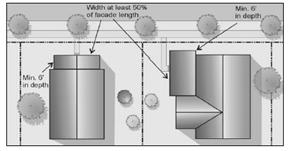
Entry Porches. The design and construction of all dwelling units shall include an entry porch used to access the main entrance.
1.
Location. The porch shall be located either along the front facade or side facade, whichever is consistent with the main entrance location.
2.
Dimensions. The length of the porch shall, at a minimum, equal fifty (50) percent of the length of the facade on which it is located. The measurement of the facade length shall exclude any portion occupied by a garage. Each porch shall be a minimum of six feet in depth.
3.
Enclosure. In no instance shall any required porch be enclosed by walls or screens. Each porch shall be covered by a roof that is integrated into the design of the structure.
Entry Porch Example
Sample Traditional Residential Layouts*
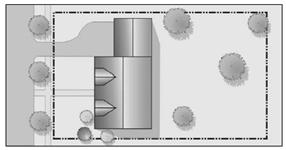
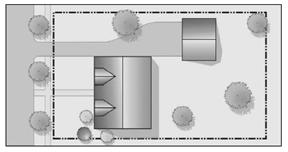
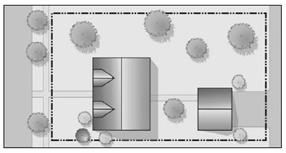
* Lot Layout Note: Each lot should generally be designed consistent with the characteristics of the lots in Franklin's existing historic neighborhoods. Garages may be attached or detached but should either: (1) be located to the side or rear of the living area of the structure; and (2) be accessed either by an alley or a driveway from the street that extends along the side of the living area.
(Ord. 04-09 § 7.6)
* Intent: The purpose of these residential standards is to: (1) provide minimum requirements for residential facilities; and (2) establish the unique standards for new residential developments with the character of traditional residential areas. This section establishes requirements for residential facilities for the developmentally disabled and mentally ill that both minimize conflicts with other uses and permits the establishment of such facilities consistent with IC 12-28-4-7.
17.32.070 - Home occupation standards.*
These general home occupation standards apply to the agricultural, single-family residential, multifamily residential and mixed-use zoning districts:
A home occupation shall be permitted as an accessory use to any dwelling unit. In order to be considered a permitted home occupation, the use shall comply with the following requirements:
A.
Activities. The face-to-face wholesale/retail sale of stocked inventories is not permitted, except for incidental sales that do not exceed twenty-five (25) percent of total home occupation sales. Mail-order/telephone/internet sales, as well as distribution of sold merchandise is permitted. Manufacturing activities are not permitted.
B.
Effects of Operation. There shall be no equipment or process used in the home occupation that creates noise, vibration, glare, smoke, fumes, odors, or electrical interference that is detectable, without the aid of instruments, off the premises (as determined by the planning director). There shall be no electrical or mechanical equipment utilized in the home occupation that will create any visual or audible interference with radio or television reception.
C.
Owner/Operator. At least one person residing within the dwelling must be the primary operator of the home occupation.
D.
Employees. The home occupation may not involve the on-site employment or regular on-site gathering of any more than one person, other than those residing at the location of the home occupation.
E.
Outdoor Storage/Display. Their shall be no exterior storage of products, equipment, employee vehicles, or materials that are related to the home occupation.
F.
Business Area. The home occupation may be located within the dwelling and/or an accessory building, but shall not exceed a total area of five hundred (500) square feet. The home occupation must utilize no more than twenty-five (25) percent of the total floor area of the dwelling.
G.
Structural Alterations. The home occupation must not require any structural or aesthetic alterations to the dwelling that change its residential character as described below:
1.
Dwelling Appearance. The dwelling shall not be altered in its appearance, and the home occupation shall not be conducted in such a manner as to differentiate the dwelling from the residential character of the area by the use of colors, materials, construction, or lighting.
2.
Entrances. The home occupation shall not require any additional entrances to the structure.
3.
Utility Service. The home occupation shall not require increasing or enhancing the size, capacity, or flow of the water, gas, waste treatment, or electrical systems beyond what is standard for a residence.
4.
Interior Alterations. There shall be no alterations to the interior of the dwelling to accommodate the home occupation that would render the structure undesirable for residential use.
H.
Parking and Business Vehicles. The home occupation shall not involve on-site customers, employees, meetings, or other events that necessitate the installation of any off-street parking spaces in addition to those required by this title for the dwelling unit. The onsite storage of business vehicles shall meet the requirements of Section 7.32.100(E)(4).
I.
Deliveries. The home occupation must not require the regular use of commercial vehicles for pickup and deliveries, other than those from the U.S. Postal Service or other small package carriers. J. Signs. No signs of any type shall be used, other than those permitted in the zoning district by Chapter 17.36, Signs.
(Ord. 04-09 § 7.7)
17.32.080 - Mobile/manufactured home standards.*
Part 1: These general mobile/manufactured home standards apply to the agricultural, single-family residential and multifamily residential zoning districts:
A.
Schedule of Mobile/Manufactured Home Use. Mobile and manufactured homes shall be permitted as described by the following table, consistent with Chapter 17.16:
Permitted Mobile/Manufactured Homes
B.
Placement Requirements. The establishment, location, and use of all mobile and manufactured homes shall meet the installation instructions of the manufacturer; all requirements for single family dwellings in the zoning district in which they are located including, but not limited to, setbacks, lot sizes and dimensions, parking requirements; minimum living area (per IC 26-7-4-1106(b)); and the following standards:
1.
Type I and Type II Manufactured Homes. Type I and Type II manufactured homes shall:
a.
Living area: have, in a double section or larger multi-section unit, living area no less than the minimum required for the district in which it is to be located;
b.
Foundation: be placed on a permanent underfloor foundation and an exterior perimeter retaining wall that are consistent with those for, or planned for, other homes in the area, the manufacturer's installation instructions, and all applicable provisions of the Franklin building code;
c.
Anchoring: be anchored to the ground in accordance with the manufactured home's installation standards and the Franklin building code;
d.
Travel equipment: have wheels, axles, and hitch mechanisms removed;
e.
Utilities: meet utility connection standards in accordance with the manufactured home's installation standards and the Franklin building code;
f.
Siding material: have siding material of a type like, similar to, or otherwise compatible with that found on other dwellings in, or planned for, the area;
g.
Roofing material: have roofing material and pitch of a type like, similar to, or otherwise compatible with that found on other dwellings in, or planned for, the area;
2.
Type III Manufactured Homes and Mobile Homes: Type III manufactured homes and mobile homes shall:
a.
Living area: have more than seven hundred twenty (720) square feet of living area in a single, double or multi-section unit (including those with pullout or tag-along units);
b.
Foundation: be placed on a permanent underfloor foundation with exterior foundation siding consistent with the manufacturer's installation instructions, and all applicable provisions of the Franklin building code;
c.
Anchoring: be anchored to the ground in accordance with the manufacturer's installation standards and the Franklin building code;
d.
Travel equipment: have wheels, axles, and hitch mechanisms removed; and
e.
Utilities: meet utility connection standards in accordance with the manufactured home's installation standards and the Franklin building code.
Part 2: These mobile/manufactured home park standards apply to the residential, manufactured home park zoning district: All mobile/manufactured home parks shall comply with the following standards:
A.
Storage Space. Each home shall be provided with an enclosed, waterproof storage space either as an accessory structure on each home site, behind the skirting, or at a central storage facility.
B.
Emergency Shelter. Each development, or manufactured home park, shall be equipped with a structure of adequate construction to provide shelter for residents from tornados and other severe weather events. The shelter shall be of sufficient size to accommodate a population equal to 2.5 persons per home site present in the development.
C.
Entrances and Interior Roads. All interior mobile home development streets shall either be dedicated to the public or be private interior drives. All interior streets, whether dedicated to the public or private drives shall meet the design and construction standards for public streets, including intersections, sidewalks, street trees, etc.) provided by the Franklin subdivision control ordinance. If private streets are used, a street easements shall be substituted for the interior street right-of-way.
D.
Compliance Verification. Prior to the release of an improvement location permit for construction of the park, the following shall be provided to the planning director:
1.
Access: a letter from the city engineer, verifying the approval of the design of access points to public streets;
2.
Sanitary sewer service: a letter from the public works superintendent, verifying that adequate sanitary sewer service shall be available to the homes;
3.
Board of Health: A letter from the Indiana State Board of Health, verifying that all applicable requirements have been met.
(Ord. 04-09 § 7.8)
* Intent: The purpose of these mobile/manufactured home standards is to identify the minimum requirements for the installation and use of mobile and manufactured homes consistent with the requirements of IC 36-7-4-1106 and the intent of this title.
17.32.090 - Environmental standards.*
These general environmental standards apply to all zoning districts:
A.
Land Suitability. No land should be used, or structure erected where the land is unsuitable for such use or structure due to slopes, adverse soil or rock formations, erosion susceptibility, or any other feature determined by the planning director, city engineer, or plan commission as likely to be harmful to the health, safety, and general welfare of the community.
B.
Preservation of Natural Features. Existing natural features that would add value to the development of the city, such as mature trees, streams, lakes, wetlands, stream-side forests (riparian areas), floodplains, and similar irreplaceable assets should be preserved through harmonious and careful design. Land to be developed shall be designed and improved as far as practical in conformity to existing topography in order to minimize storm water runoff, and conserve the natural cover and soil.
1.
Wetlands. Wetland areas shall be managed consistent with all applicable standards of the U.S. Army Corps of Engineers, the Indiana Department of Environmental Management, and other appropriate agencies.
2.
Stream-Side Forests (Riparian Areas). All structures shall be set back a minimum of twenty-five (25) feet from the top-of-bank, as determined by the city engineer, of all streams. Within this required setback, all native vegetation shall be preserved and all construction activity, other than that related to stream-side forest restoration or erosion control, shall be prohibited. Stream-side forests should be managed consistent with standards adopted by the National Resource Conservation service as expressed in the Conservation Practice Standard for Riparian Forest Buffer (Code 391) and all subsequent amendments and revisions.
3.
Floodplains. Floodplains shall be managed consistent with the flood hazard area overlay zone established by Section 17.24.020.
4.
Trees. When the preservation of existing trees is specified by the requirements of this title and/or by conditions placed on the approval of an application the following standards shall be met:
a.
Construction Activity. No construction activity of any kind, including the driving of construction vehicles and storage of construction materials, shall occur within the drip-line of any tree to be preserved.
b.
Tree Maintenance. All trees to be preserved shall be included in a tree preservation easement recorded with the Johnson County recorder. The easement shall include language that, subject to the approval of the planning director, requires the continued maintenance of the trees and prohibits the remove of the trees as long as they remain healthy. Trees that are removed due to poor health, disease, or act of nature shall be replaced by the property owner prior to the conclusion of the next planting season (spring or fall, whichever is sooner). Replacement trees shall have a minimum trunk diameter of two inches, measured at six inches above the root ball.
C.
Conservation of Historic Features. Existing historic features (such as those listed as outstanding, notable, or contributing in the Indiana Department of Natural Resources Indiana Historic Sites and Structures Inventory - Johnson County Interim Report, listed in the National Register of Historic Places, or listed in the Indiana Register of Historic Sites and Structures), and similar irreplaceable assets should be preserved through harmonious and careful design.
D.
Ground Cover. Any part or portion of a non-farm parcel that is not used for structures, loading or parking spaces, sidewalks, etc. shall be landscaped or left in a natural state that complies with the applicable weed and nuisance ordinances of the city of Franklin. If landscaped, it shall be planted with an all season ground cover and with trees and shrubs in accordance with the requirements of this title and in keeping with the natural surroundings.
E.
Cut/Fill Grade. No cut or fill grade should exceed a slope of 3:1 or thirty-three and one-third (33 1/3) percent. This provision shall apply to all cuts and fills exceeding one hundred (100) square feet in exposed surface area, including cuts or fills on land naturally exceeding 3:1 (rise:run) in slope. Cut and fill grade exceeding 3:1 (rise:run) in slope may be permitted using retaining walls and/or terraces subject to the approval of the city engineer. Cut and fill practices that remove natural topography and/or alter natural drainage shall be minimized.
F.
Erosion Prevention. All land, regardless of slope, from which structures or natural cover has been removed or otherwise destroyed, shall be appropriately graded and seeded within thirty (30) days after the removal or destruction of the natural cover, shall meet all Indiana Department of Environmental Management Standards for erosion control, and shall meet any additional requirements of the city engineer. Generally all erosion control measures should make use of best management practices that ensure the long-term operation and maintenance of the control features.
G.
Surface Water. It shall be the responsibility of the owner of any property developed for any use other than for agriculture to provide for adequate surface water drainage.
1.
Use of Surface Drainage. Existing natural surface drainage should be utilized where practical.
2.
Adequate Drainage System. Whenever the evidence available indicates that the natural surface drainage is inadequate, the owner shall provide the parcel with an adequate surface water drainage system that is integrated into the drainage patterns of surrounding properties.
3.
Drainage Easements. Swales that provide drainage to a property or properties other than that upon which they are located are required to be placed in an easement meeting the specifications of the city engineer to prohibit future filling or constructing.
4.
On-Site Detention. On-site detention for a one hundred (100)-year storm event shall be required unless a written statement by the city engineer indicates that it is not necessary to prevent harm to adjoining properties.
5.
City Engineer Approval. All drainage plans are subject to review and approval by the city engineer, and shall meet all applicable standards of the city engineer.
H.
Drainage Swales. Drainage swales along dedicated streets and within the right-of-way, or within dedicated drainage easements are not to be altered, except for maintenance as originally constructed and approved by the city engineer. Driveways may be constructed over these swales subject to the approval of the city engineer, Johnson County highway department, and/or Indiana Department of Transportation (INDOT approval is required for driveways accessing state highways; Johnson County approval is required for driveways accessing county roads).
I.
Regulated Drains. All development in regulated drain areas shall be subject to the review and approval of the Johnson County drainage board per the requirements of IC 36-9-27-13. No permanent structures, other than fences, shall be erected within seventy-five (75) feet of the center line of any regulated tile ditch, or within seventy-five (75) feet of the existing top of bank of any regulated open ditch or tile unless approved by the city engineer and the Johnson County drainage board.
J.
Alterations to Bodies of Water. No alteration of the shoreline or bed of a river, wetland, or public lake shall be made until appropriate written approval is obtained from the Indiana Department of Environmental Management, Indiana Department of Natural Resources and/or the U.S. Army Corps of Engineers. Alterations include, among other things, filling of a pond, river or wetland.
K.
Retention, Detention and Pond Edges. All retention, detention, and pond edges must be maintained with a buffer of natural plantings within twenty-five (25) feet of the point of peak elevation and shall be consistent with the following:
1.
The top of bank shall provide two feet of free-board protection above the one hundred (100)-year flood elevation for the area in which any pond is located;
2.
Safety shelves shall be included in the design and construction of all ponds; and
3.
All applicable standards of the city engineer shall be met.
L.
Waste/Debris. All properties shall at all times be maintained and used only in clean, neat and well-groomed conditions, free from all natural and man-made debris, junk, rubbish, trash, weeds, and similar items.
1.
Waste Stored Outdoors. No waste materials such as, but not limited to, garbage, rubbish, household appliances, inoperable vehicles, furniture designed for interior use, gasoline, oil, flammables, soils, tars, chemicals, greases, dead plant material, noxious weeds, industrial or agricultural waste, or any other material of such nature, quantity, obnoxiousness, toxicity, or temperature so as to contaminate, pollute, or harm water bodies or ground water, provide a habitat for disease carrying animals and insects, or represent a public safety hazard shall be deposited, located, stored, or discharged outside on any lot.
2.
Waste Stored in Structures. Waste shall not be allowed to accumulate within structures in a manner that is inconsistent with applicable regulations for the storage of such materials.
(Ord. 04-09 § 7.9)
* Intent: The purpose of these environmental standards is to: (1) encourage the protection of unique environmental features; and (2) protect persons and property from the dangers presented by both the natural and built environments. Some of the following standards refer to complimentary state or federal regulations, that are not enforced by the city, in order to increase awareness of these regulations.
17.32.100 - Parking standards.[7]
Part 1: These general parking standards apply to all zoning districts.
A.
General Requirements. All parking spaces shall meet the following general requirements:
1.
Location. No off-street parking spaces may be fully or partially located in a public right-of-way, septic field, required landscape area, or buffer yard.
2.
Access. All required parking spaces must be designed to provide direct access for vehicles. In no case may areas which do not have direct access be considered a parking space meeting the requirements of this title (example: a residential driveway shall not be considered a parking space meeting the requirements of this section if a parked vehicle in the driveway prevents direct access to a required parking space in a garage or carport).
3.
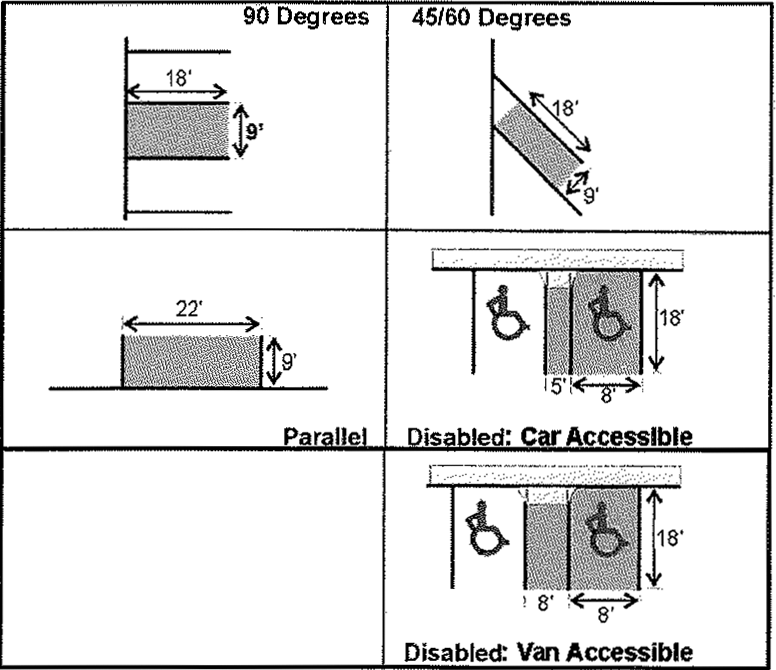
Parking Space Dimensions. Parking space size shall conform with the Parking Space Requirements table. In no instance shall the overhang of a vehicle be considered as part of the required parking space area.
4.
Interior Drive Dimensions. Interior drive dimensions shall conform with Section 17.32.120, Entrance/Drive Standards.
Parking Space Requirements
B.
Requirements for Nonconforming Uses and Uses Permitted by Special Exception or Variance. Any use which is nonconforming in the zoning district in which it is located or is permitted by special exception or variance shall provide parking which is consistent with the use and the standards for the zoning district in which the use is permitted by this title. In no case shall the number of parking spaces required for nonconforming uses or those permitted by special exception or variance be solely based on the standards for the district in which they are located. The board of zoning appeals shall specify the number of parking spaces for all uses permitted by special exception or variance consistent with the intent of this section.
C.
Requirements for Uses Not Specifically Listed. The number of parking spaces required for uses that are not listed specifically shall be determined by the planning director based on the consistency of the use with those that are specified.
D.
Park Use Requirements. Off-street parking spaces for park and recreation uses located in any zoning district shall be provided consistent with the requirements for business uses provided by Part 3 of this section.
E.
Vehicle Storage Requirements. The storage of all motor vehicles shall be consistent with the following requirements:
1.
Vehicle Storage. No vehicle, including recreational and commercial vehicles, shall be parked, stored, or allowed to remain on a lot or parcel of land that does not contain a primary structure.
2.
Stored Vehicles to be Salvaged/Repaired. [8] The outdoor storage of such vehicles associated with permitted auto repair or salvage facilities shall be consistent with the following requirements:
a.
All such vehicles, including antique vehicles, shall be stored within the rear or side yard. In no case shall such vehicles be stored in any front yard, buffer yard, required landscape area, or required setback area.
b.
All storage areas for such vehicles shall be completely enclosed with a six-foot tall, one hundred (100) percent opaque wood, stone, or masonry fence. Gates allowing access to the storage areas are permitted, shall be closed when not in use, and shall consist of six-foot tall, one hundred (100) percent opaque wooden doors.
3.
Recreational Vehicle Storage. The storage or parking of recreational vehicles (including travel-trailers, boats, snowmobile or motorcycle trailers, etc.) in residential zoning districts and associated with residential uses is subject to the following requirements:
a.
A recreational vehicle may be stored on a residential property provided it is fully enclosed by a structure or located in the rear or side yard. A recreational vehicle may be parked in the front yard on a residential lot, outside of an enclosed structure, for a period not to exceed a total of forty-eight (48) hours in any one-week period.
b.
No more than two recreational vehicles may be parked outdoors on a residential parcel at any one time.
c.
In no case shall any recreational vehicle parked on a residential parcel be used for overnight sleeping or living.
4.
Commercial Vehicle Storage. The storage or parking of commercial vehicles in residential zoning districts and primarily residential planned unit developments is subject to the following requirements:
a.
The parking of a commercial vehicle shall be limited to one standard sized vehicle, except that any commercial vehicle may be stored within an enclosed structure. In no instance shall any portion of a semi-tractor/trailer be stored on a residentially zoned or used property.
b.
This regulation shall not be interpreted to apply to commercial vehicles used for conveying the necessary tools and materials to premises where labor, using such tools and materials, is to be performed during the time of parking such vehicles, or to commercial vehicles in the process of temporarily loading or unloading deliverable goods.
Part 2: These residential parking standards apply to the agricultural, single-family residential, multifamily residential and institutional zoning districts:
A.
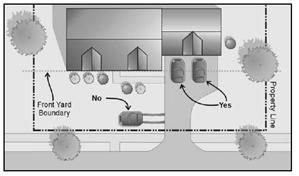
General Standards. In no instance shall any unpaved off-street parking spaces be permitted. In no instance shall any vehicles be stored or parked in any front yard. Temporary parking of vehicles in driveways accessed from the street and passing through the front yard are exempt from this requirement.
B.
Residential, Rural and Agricultural Dwellings. Parking spaces for dwellings in the residential, rural (RR) and agricultural (A) zoning districts shall be provided on the same lot as the dwelling unit for which they are required and shall meet the following standards:
1.
Spaces Requirements. A minimum of two off-street parking spaces, either paved or of crushed stone, are required for each dwelling unit.
2.
Access/Location Requirements. Parking areas must be designed to prevent vehicles from having to back into or maneuver in any arterial or collector street.
C.
Suburban, Suburban Neighborhood and Traditional Dwellings. Parking spaces for dwellings in the residential suburban neighborhood (RSN); residential suburban (RS); and residential traditional (RT) zoning districts shall be provided on the same lot as the dwelling unit for which they are required and shall meet the following standards:
1.
Space Requirements. A minimum of two off-street, paved parking spaces are required for each dwelling unit.
2.
Access/Location Requirements. Parking areas must be designed to prevent vehicles from having to back into or maneuver in any major collector or arterial street.
D.
Traditional Neighborhood Dwellings. Parking spaces for dwellings in the residential traditional neighborhood (RTN) zoning district shall be provided on the same lot as the dwelling unit for which they are required and shall meet the following standards:
1.
Space Requirements. Off-street, paved parking spaces are required for each dwelling unit consistent with the average number of off-street spaces provided per dwelling unit on other RTN zoned lots within five hundred (500) feet of the subject lot. A maximum of two off-street parking spaces per dwelling unit shall be required.
2.
Access/Location Requirements. Parking areas must be designed to prevent vehicles from having to back into or maneuver in any arterial street.
E.
Sorority/Fraternity/Student Co-op Facilities. Parking spaces for sorority and fraternity houses and student co-ops located in any zoning district shall be provided and shall meet the following standards:
1.
Space Requirements. Off-street, paved parking spaces shall be provided at a ratio of one parking space for every two residents for which the maximum capacity of the facility is designed, at a minimum.
2.
Access/Location Requirements. Off-street parking spaces may be provided either on-site or off-site within one thousand (1,000) feet of the lot occupied by the facility. Parking areas must be designed to prevent vehicles from having to back into or maneuver in any arterial street.
F.
Manufactured Home Park Dwellings. Parking spaces for dwellings in the residential manufactured home park (RMH) zoning district shall be provided on the same site as the dwelling unit for which they are required and shall meet the following standards:
1.
Space Requirements. A minimum of two off-street parking spaces are required for each dwelling unit. In addition, parking spaces for management offices, sales facilities, self-service laundries, and other accessory uses shall be equal to one-half of the requirements for those uses established by Part 3 of this section.
2.
Access/Location Standards. Parking areas must be designed to prevent vehicles from having to back into or maneuver in public streets (excluding all alleys and any streets that are internal to the development).
G.
Multifamily Dwellings. Parking spaces for dwellings in the residential multifamily (RM) zoning district shall be provided on the same lot as the dwelling unit for which they are required and shall meet the following standards:
1.
Space Requirements. A minimum of two (2) off-street parking spaces are required for each dwelling unit (rounded to the nearest complete space). Where individual enclosed garage units are used, a minimum of 0.5 additional off-street parking spaces are required for each individual garage unit provided (rounded to the nearest complete space). [Example: Fifty (50) dwelling units and five (5) individual garage units = one hundred three (103) parking spaces.] In addition, parking spaces for management offices, sales facilities, self-service laundries, and other accessory uses shall be equal to one-half (½) of the requirements for those uses established by Part 3 of this section.
a.
Parking of the Disabled. The required spaces shall include parking for the disabled meeting the requirements of Part 3(A)(5) of this section. The minimum number of disabled spaces provided shall either be as specified in the Disabled Space Standards Table or equal one space for every handicap-accessible dwelling unit, whichever is greater.
b.
Driving Surfaces. All parking areas, including parking spaces, interior drives, and ingress/egress into parking areas must be paved with asphalt or concrete. All parking areas shall be clearly painted to show each parking space.
c.
Drainage. Parking areas must be constructed to allow proper drainage, which shall be subject to the review and approval of the city engineer.
d.
Curbs. All parking areas shall generally be completely curbed. Curbing shall not be required if, in the opinion of the city engineer, the drainage system for the property shall be best served if curbs were not present.
e.
Lighting. Lighting for parking areas shall conform with the applicable requirements of Section 17.32.180, Outdoor Lighting Standards.
f.
Landscaping. Landscaping for parking areas shall conform with the applicable requirements of Section 17.32.160, Landscaping Standards.
2.
Access/Location Standards. Parking areas must be designed to prevent vehicles from having to back into or maneuver in public streets (excluding all alleys and any streets that are internal to the development).
3.
Bicycle Parking. One bicycle parking space shall be provided for every ten (10) dwelling units, with a minimum of two bicycle spaces. Each bicycle space shall provide adequate facilities for securing the parked bicycle.
Part 3: These nonresidential parking standards apply to the mixed-use, institutional and industrial zoning districts: [9]
A.
Space Requirements. All parking spaces and interior drives shall meet the following requirements.
1.
Driving Surfaces. All parking areas, including parking spaces, interior drives, and ingress/egress into parking areas must be paved with asphalt or concrete to the nearest paved street. All parking areas shall be clearly painted to show each parking space.
2.
Drainage. Parking areas must allow proper drainage, and shall be subject to the review and approval of the city engineer.
3.
Curbs. All parking areas for non-industrial uses shall generally be completely curbed. Curbing shall not be required if, in the opinion of the city engineer, the drainage system for the property shall be best served if curbs were not present.
4.
Minimum Number of Spaces. The minimum number of parking spaces required per property shall be determined by adding up the spaces required for each applicable use in the Nonresidential Required Parking Space Table following this subsection. Properties located in the MXD mixed-use downtown center zoning district shall be exempt from this requirement.
5.
Parking for the Disabled. Parking spaces reserved for disabled persons shall be provided in all parking areas consistent with the requirements of the Americans with Disabilities Act Accessibility Guidelines for Buildings and Facilities, Chapter 4.1.2(5)(a) and all applicable revisions.
a.
The number of reserved spaces shall be based on the total number of spaces provided and shall be consistent with the Disabled Space Standards Table.
Disabled Space Standards
b.
All required parking spaces for the disabled shall be those that are the closest to the main entrance of the primary structure.
c.
Parking spaces for the disabled shall count toward the total number of spaces required by this title.
Nonresidential Off-Street Parking Space Requirements
Total off-street spaces required for each lot shall be calculated by adding the applicable requirements
B.
Access/Location Requirements. All parking spaces shall be accessed and located consistent with the following standards:
1.
Access to Public Streets. Parking areas must be designed to prevent vehicles from having to back into, or maneuver in public streets (access to alleys shall be exempt from this requirement).
2.
Maneuvering Space. All parking spaces shall be provided with adequate maneuvering space into which vehicles can back for the purpose of exiting the parking space.
C.
Off-Site and Shared Parking Requirements. Parking spaces may either be located on the lot with the use(s) for which they are required, or on another lot that is within five hundred (500) feet of the lot occupied by the use(s) for which they are required.
1.
Off-Site Parking. Two or more uses may provide off-site parking collectively on one lot, however the total number of spaces shall not be less than the sum of the spaces required for each use (example: a group of business, industries, and/or apartments located on upper-floors over businesses may provide a common parking area).
2.
Shared Parking. Two or more uses for which the normal hours of operation do not substantially overlap may share parking either on or off-site (example: a church may share its parking lot with a business, or with apartments located on upper-floors of adjacent businesses).
3.
Approval Requirements. All off-site and shared parking space arrangements are subject to the approval of the planning director. Approvals shall be based on the determination that the use of off-site and/or shared parking will not provide hardships for pedestrians, will not result in potentiality hazardous traffic conditions, and will provide an adequate number of parking spaces for the uses involved. The parking needs of possible future uses of the property shall also be considered by the planning director.
4.
Required Documentation. A permanent documentation of any off-site and/or shared parking agreement must be signed by all involved property owners. The permanent written agreement shall include, but is not limited to the following items: maintenance, snow removal, ownership, and liability. The agreement shall be reviewed and approved by the planning director and the city attorney. A copy of the agreement shall be retained for the files of the plan commission.
D.
Bicycle Parking. All nonresidential uses shall provide one bicycle parking space for every thirty (30) vehicle parking spaces required by this title, with a minimum of two bicycle spaces. Each bicycle space shall provide adequate facilities for securing the parked bicycle.
(Ord. 04-09 § 7.10; Ord. No. 2014-10, § 1(Exh. A), 7-7-2014)
(Ord. No. 2021-12, § 1(Exhs. C, D), 6-7-2021)
Intent: The purpose of these parking standards is to reduce street congestion, ensure proper vehicular and pedestrian circulation, and therefore improve public safety by identifying the appropriate number and location of off-street parking spaces for each zoning district.
--- (8) ---
Stored Vehicles Note: In no instance should the provisions for stored vehicles be interpreted as enforcement of traffic code provisions for inoperable vehicles. These provisions are intended to ensure that auto repair and salvage facilities are operated consistent with the general welfare of the community.
--- (9) ---
See Also: Section 17.32.160, Landscaping Standards; Section 17.32.180, Outdoor Lighting Standards; Section 17.32.190, Large Scale Retail Facility Standards.
17.32.110 - Loading standards.[10]
These general loading standards apply to mixed-use, institutional, and industrial zoning districts:
A.
Loading Berths Required. Adequate off-street loading berths and areas shall be provided for any building or structure which requires the receipt or distribution of materials or merchandise by trucks or similar vehicles. Off-street loading berths may be provided either within or outside of structures on the property.
B.
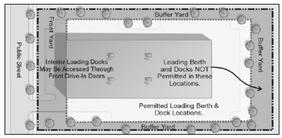
Location. All required off-street loading berths shall be located on the same lot as the use to be served. They shall be designed so that no portion of a loading/unloading vehicle projects into a street, alley, or other public right-of-way. Shared truck courts between adjacent properties shall be permitted.
1.
All exterior loading berths for commercial and institutional uses shall be oriented to face the side or rear yards of the lot on which they are located.
2.
No loading space may be located in any front yard for commercial and institutional uses, or any required buffer yard.
Loading Dock Graphic
C.
Design and Construction. All off-street loading berths shall be meet the following design and construction requirements:
1.
Size Requirements. All interior and exterior off-street loading berths for over-the-road tractor-trailers shall be a minimum of thirteen (13) feet in width and one hundred forty (140) feet in length including the apron. For local pick-up and delivery trucks, off-street loading berths shall be at least twelve (12) feet in width and sixty (60) feet in length including the apron.
2.
Vertical Clearance. All loading spaces shall be provided with a vertical clearance of not less than fifteen (15) feet.
3.
Driving Aisle Requirements. All loading berths shall be accessed by a driving aisle that is a minimum of twenty-four (24) feet in width for two-way traffic or thirteen (13) feet in width for one-way traffic at all points between the accessed public street and the loading berth.
4.
Surfacing Requirements. All off-street loading berths shall be paved with concrete or other appropriate material meeting the durability requirements of the city engineer.
D.
Access. Each required off-street loading berth shall be designed with appropriate means of vehicular access to a street or alley in a manner that will not interfere with traffic movements. There shall be no maneuvering within any street right-of-way. In no case shall a loading berth be located in such a manner as to require loading/ unloading vehicles to back into a public right-of-way or overhang adjacent property.
E.
Space Allowed. Space provided for use as any off-street loading berth shall not be used to satisfy any off-street parking space requirements of Section 17.32.100.
(Ord. 04-09 § 7.11)
(Ord. No. 2021-12, § 1(Exh. E), 6-7-2021)
Intent: The purpose of these loading requirements is to provide minimum standards for the loading and unloading of materials at commercial, industrial, and institutional facilities. These requirements are intended to prevent loading and unloading from occurring on a public street or in other locations that would present a danger to persons or property.
17.32.120 - Entrance-drive standards.[11]
These general entrance drive standards apply to all zoning districts:
A.
General Requirements. [12] All entrances and interior drives shall meet the following general requirements:
1.
Driving Surfaces. All entrances and interior drives shall be paved. All farm and farm dwellings in any zoning district and all dwellings in the A, agricultural and RR, residential, rural zoning districts shall be exempt from this requirement and may use crushed stone driving surfaces.
2.
Drainage. Entrances and interior drives must be constructed to allow proper drainage, which shall be subject to the review and approval of the city engineer.
3.
Vehicle Storage and Parking. No vehicles shall be parked or stored in any entrance or interior drive other than in designated parking spaces meeting the requirements of Section 17.32.100. In no instance shall this be interpreted as prohibiting the parking of vehicles in residential driveways.
B.
Location Requirements. All entrances and interior drives shall conform with the following location standards:
1.
Rights-of-Way. No driveway or interior drive shall be fully or partially located in a public right-of-way. With the exception of the entrance, all driveways and interior drives shall be separated from the right-of-way of all streets by a landscape area being a minimum of ten (10) feet in width and meeting the requirements of Section 17.32.160, Landscaping Standards.
2.
Septic Fields and Buffer Yards. No driveway or interior drive shall be fully or partially located in a septic field or required buffer yard.
3.
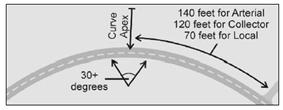
Curves. The location of an entrance on or near curves shall be investigated individually by the city engineer and evaluated based on available sight distance and the design speed of the roadway or the posted speed limit (whichever is greater). The city engineer may establish specific requirements in addition to the following general standards. No entrance should generally be permitted within:
a.
One hundred forty (140) feet of the apex of a curve (thirty (30) degrees or greater) where the street is an arterial;
b.
One hundred twenty (120) feet of the apex of a curve (thirty (30) degrees or greater) where the street is a collector; or
c.
Seventy (70) feet of the apex of a curve (thirty (30) degrees or greater) where the street is a local.
4.
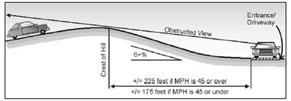
Grade Changes. The location of an entrance on or near grade changes shall be investigated individually by the city engineer and evaluated based on available sight distance and the design speed of the roadway or the posted speed limit (whichever is greater). The city engineer may establish specific requirements in addition to the following general standards. Entrances and driveways should be permitted within thirty (30) feet of the crest of a hill unless the city engineer determines the visibility to be impaired. However, no entrance or driveway should generally be permitted:
a.
Within a minimum of two hundred twenty-five (225) feet from the crest of a hill where the slope on either side of the crest is six percent or greater, and the speed limit is forty-five (45) MPH or greater;
Curve Graphic
Grade Change Graphic
b.
Within a minimum of one hundred seventy-five (175) feet from the crest of a hill where the slope on either side of the crest is six percent or greater, and the speed limit is forty-five (45) MPH or less; or
c.
Where the visibility to or from the desired location is determined to be otherwise impaired in the judgment of the city engineer.
5.
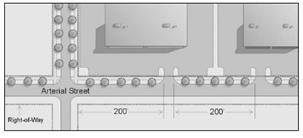
Separation Requirements. No entrance from a public street to a property used for purposes other than agriculture, single-family residential, or two-family residential shall be permitted within the distances specified in the Entrance Separation Requirements Table. These distances may be increased to address traffic safety at the discretion of the city engineer.
a.
Measurement Standard. The distances shall be determined by measuring from the right-of-way line of any road and the curb or edge of pavement (if no curbs are present) of any entrances.
b.
Aligned Entrances. This shall not be interpreted as prohibiting an entrance that will directly align with a street or another entrance on the opposite side of the street.
Entrance Separation Requirements
Entrance Separation Graphic
C.
Design Requirements. All driveways and interior drives shall conform to the following design requirements:
1.
Entrance Widths. No entrance shall exceed the following pavement widths at the point which they intersect the public right-of-way. The distances for these standards shall be determined by measuring from the outside edges of the curb or pavement (whichever is more) of the entrance or drive at the public right-of-way which it accesses, and shall not include any acceleration or deceleration lanes or turning radii:
a.
Fourteen (14) feet per lane (exclusive of any medians) if from a nonresidential or multi-family residential use onto any type of street, and b. Twenty-two (22) feet total if from a single-family or two-family use onto any type of street.
b.
If from a single-family or two-family use onto any type of street:
i.
Maximum of forty (40) percent of lot width, not to exceed thirty-two (32) feet total.
ii.
Over-riding limitation: in not instance shall any legally established parcel be limited to less than sixteen (16) feet total.
2.
Interior Drive Widths. The minimum pavement widths for driveways and interior drives shall meet the following requirements, exclusive of any parking spaces:
a.
For single and two-family residential uses the minimum driveway width shall be eleven (11) feet.
b.
For all multifamily and nonresidential uses the following interior drive minimums shall be required:
i.
Eleven (11) feet for drive-thrus;
ii.
Thirteen (13)feet if one-way traffic and no parking or forty-five (45) degree parking;
iii.
Eighteen (18) feet if one way traffic and sixty (60) or ninety (90) degree parking;
iv.
Twenty-two (22) feet if one-way traffic and ninety (90) degree parking;
v.
Twenty-four (24) feet if two-way traffic or accessing a loading berth.
3.
Travel Direction. The direction of travel for vehicles using entrances shall be as follows:
a.
All entrances providing access to a public right-of-way from all lots used for purposes other than single or two-family residences shall be designed so that vehicles are traveling in a forward direction when entering and leaving.
b.
In no case may any entrance for any use be designed to require a vehicle to back onto any arterial street.
4.
Shared Entrances and Drives. Shared entrances and drives are encouraged for all uses in all zoning districts, specifically for any multifamily residential or nonresidential uses accessing a major collector or arterial street.
a.
Access Easements. All shared entrances and drives shall be included in appropriate access easements.
b.
Required Documentation. A permanent documentation of any shared entrance and drive agreement must be signed by all involved property owners. The permanent written agreement shall include, but is not limited to the following items: maintenance, snow removal, ownership, and liability. The agreement shall be reviewed and approved by the planning director and the city attorney. A copy of the agreement shall be retained for the files of the plan commission.
5.
Curbs. All entrances and interior drives for property used for purposes other than agriculture, single-family residential, or two-family residential shall generally be completely curbed. Curbing shall not be required if, in the opinion of the city engineer, the drainage system for the property shall be best served if curbs were not present.
6.
Commercial Area Internal Linkages. All uses located in a mixed-use (MX) zoning district shall provide interior drives that allow access between existing and proposed commercial uses on adjacent properties.
a.
Cross-Access Required. The drives must be designed as a single two-way drive or a pair of one-way drives that provide access each direction between the parking lots and interior drives of all adjoining commercial uses.
b.
Separation. Interior drives providing cross-access between adjacent parcels that serve to create a frontage drive parallel to the public street from which access to the properties is provided shall be separated from the right-of-way of any such street by a minimum distance specified by the city engineer (based on the vehicle stacking requirements of the entrance(s) to the property from the public street).
Cross-Access Graphic
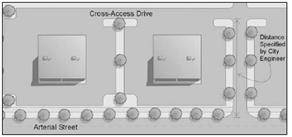
(Ord. 04-09 § 7.12; Ord. No. 2021-12, § 1(Exh. F), 6-7-2021)
Intent: The purpose of these entrance and drive standards is to provide for a safe and efficient vehicular and pedestrian transportation system by establishing minimum standards for site entrances, driveways, and interior drives.
--- (12) ---
See Also: Section 17.32.160, Landscaping Standards.
17.32.130 - Sight visibility standards.[13]
These general sight visibility standards apply to all zoning districts:
A.
Sight Visibility Triangle Required. All properties shall maintain an area (the "sight visibility triangle") at every intersection of an adjoining street with other streets and entrance drives. The sight visibility triangle shall be free of structures, vegetation, signs (other than street signs), and other opaque or partially opaque objects between a height of two and one-half and twelve (12) feet measured from the nearest top-of-curb (or edge of pavement where curbs are not present).
B.
Sight Visibility Triangle Dimensions. The sight visibility triangle shall be established by connecting points located along the intersecting rights-of-way (or edge of pavement in the case of entrances) at the distances from the point of intersection required by the Sight Visibility Requirements Table.
Sight Visibility Requirements
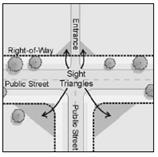
(Ord. 04-09 § 7.13)
Intent: The purpose of these sight visibility standards is to contribute to a safe vehicular and pedestrian transportation system by ensuring clear visibilities at street intersections and the vehicle entrances to properties.
17.32.140 - Telecommunication facility standards.[14]
These general telecommunication facility standards apply to the agricultural, mixed-use, institutional, and industrial zoning districts:
A.
Required Approvals. The placement of telecommunications facilities shall meet the following approval requirements:
1.
Installation of New Antenna. The installation of new antenna(s) on existing towers, including legal nonconforming towers, and existing alternative structures (such as water towers, buildings, or church steeples) may be approved by the planning director subject to conformance with all applicable requirements of this title. New antenna that will add any height to an existing tower, or extend over ten (10) feet above the highest point of any alternative structure shall be subject to the provisions of this section for the installation of new towers as described by Part 1(A)(3) of this section.
2.
Installation of New Accessory Structures. The installation of new accessory structure(s), such as equipment buildings, to support the installation of antenna on existing towers or alternative structures may be approved by the planning director subject to conformance with the applicable requirements of this title.
3.
Installation of New Tower. The installation of any new tower(s) shall be reviewed either by the planning director in the case of a permitted use or by the board of zoning appeals as a special exception use consistent with the provisions of this section and Chapter 17.16, Zoning Districts.
B.
Removal. Any tower unused or left abandoned for twelve (12) consecutive months shall be removed by the property owner at their expense. Regardless of the tower ownership, the property owner shall be responsible for removal.
C.
Required Documentation. In addition to the requirements provided elsewhere in this title for the receipt of a special exception approval and an improvement location permit, applications for new towers shall include the following:
1.
Engineer's Report. A report from a professional engineer licensed in the state of Indiana that:
a.
Describes the tower height and design including a cross-section, latitude, longitude, and elevation;
b.
Documents the height above grade for all potential mounting positions for co-located antenna and the minimum separation distance between antenna;
c.
Describes the tower's capacity, including the type and number of antenna it can accommodate;
d.
Documents what steps the tower owner will take to avoid interference with established public safety telecommunication facilities; and
e.
Includes an engineer's stamp and registration number.
2.
Letter of Intent. A letter of intent committing the tower owner, property owner, and their successors to allow the shared use of the tower if an additional user agrees in writing to meet reasonable terms and conditions for shared use.
3.
Proof of Compliance. Proof of compliance with all applicable Federal Communications Commission (FCC), Federal Aviation Administration (FAA) and Indiana Department of Transportation (INDOT) regulations, provided by those agencies.
4.
Removal Affidavit. A letter committing the property owner and their successors to remove the tower and all related accessory structures, fences, landscaping, and equipment if the tower is abandoned (unused for a period of one year).
5.
Determination of New Tower Need. Any proposal for a new telecommunications tower shall only be approved if the applicant submits verification from a professional engineer licensed in the state of Indiana that the antennas planned for the proposed tower cannot be accommodated on any existing or approved towers or other structures within a two-mile radius of the proposed tower location due to one or more of the following reasons:
a.
Inadequate Structural Capacity. The antennas would exceed the structural capacity of the existing or approved tower or other structure, and the existing or approved tower, building or other structure cannot be reinforced, modified, or replaced to accommodate the antennas at a reasonable cost.
b.
Interference. The antennas would cause interference impacting the usability of other existing or planned equipment at the tower site and the interference cannot be prevented at a reasonable cost.
c.
Inadequate Height. The existing or approved towers or structures within the search radius cannot accommodate the planned equipment at a height necessary to function reasonably.
d.
Unforeseen Circumstances. Other unforeseen reasons that make it unfeasible or impossible to locate the planned telecommunications equipment upon an existing or approved tower or structure.
e.
Commonly Reasonable Lease Agreement. The proposed tower owner is unable to enter a commonly reasonable lease term with the existing tower owner or land owner.
f.
Land Availability. Additional land area is not available (when necessary).
D.
Design Requirements. All telecommunications facilities shall meet the following design requirements:
1.
Contextual Design. Towers and antennas should generally be designed to blend into the surrounding environment through the use of color, camouflaging and architectural treatment, except in an instance where the color is dictated by federal or state authorities such as the Federal Aviation Administration.
a.
Wireless telecommunication towers should generally be of a monopole design and, when located within or adjacent to an environmentally or aesthetically sensitive area, or a residential district, be designed to architecturally camouflage the wireless telecommunication tower as much as reasonably practical to blend into the surroundings.
b.
The use of residentially compatible materials such as wood, brick, or stone is required for associated accessory structures, which shall be designed to architecturally match the exterior of any adjacent residential or commercial structures within the neighborhood or area.
2.
Lighting. Only when lighting is for safety or security reasons or required by the FAA or other federal or state authority will it be permitted. All ground level security lighting shall be oriented inward so as not to project onto surrounding properties, and shall have ninety (90) degree cut-off luminaries (shielded downlighting).
3.
Co-location. All telecommunication towers shall be designed, and engineered structurally, electrically and in all other respects to accommodate both the applicant's equipment and at least one additional user for every fifty (50) feet in total tower height in excess of seventy-five (75) feet.
a.
Each additional user shall be assumed to have an antenna loading equal to that of the initial user.
b.
Towers must be designed to allow for rearrangement of antennas and to accept antennas mounted at varying heights.
4.
Tower Height. All towers and antenna shall conform with all FAA tall structure requirements. Tower height shall be expressed as, and measured from, ground level in all instances.
a.
In the mixed-use (MX) zoning districts and Institutional zoning districts the maximum height of the tower shall be one hundred fifty (150) feet. The maximum height of any accessory structure shall be fifteen (15) feet.
b.
In the industrial (I) and agriculture zoning districts the maximum height of the tower shall be two hundred (200) feet. The maximum height of any accessory structure shall be fifteen (15) feet.
5.
Interference with Public Safety Facilities. No new telecommunications facility shall result in any interference with public safety telecommunications.
6.
Signs. Signs for all telecommunications facilities shall be limited to two square feet per user.
E.
Site Requirements. All telecommunications facilities shall meet the following site requirements:
1.
Residential Areas. No tower shall be placed closer than five hundred (500) feet to any property included in a residential zoning district.
2.
On-Site Staff. All telecommunications facilities shall be fully automated and unattended on a daily basis, and shall be visited only for periodic maintenance and emergencies.
3.
Vehicular Access. Vehicular access to the tower and equipment building shall, whenever feasible, be provided along existing driveways. Vehicle access drives shall be gravel in the residential rural (RR) and agriculture (A) zoning districts, and paved in all other zoning districts. Any portion of the entrance located in a public right-of-way shall meet the applicable public street design, construction, and pavement requirements.
4.
Site Area. The lot where the tower is located (or lease area) shall be large enough to accommodate all future anticipated accessory structures needed by future antenna users. The size of the site shall also be of sufficient area to allow the location of one additional tower and associated support facilities. At a minimum, the width and depth of the tower site shall be a distance equal to one-half the tower height.
5.
Setback. The minimum front, side, and rear yard setback for all towers shall be fifty (50) feet from all property lines. No part of a wireless telecommunications facility, including the security fence, any required guide wires or bracing, and required landscape screening shall be permitted in any required front yard setback. Landscape screening in addition to the requirements of this section may be provided in the setback area.
6.
Encroachment. No part of any wireless telecommunications facility nor associated lines, cables, equipment, wires or braces shall at any time extend across or over any part of a public right-of-way, street, highway, sidewalk, or property line.
7.
Fencing. An eight-foot high security fence shall completely surround the tower and accessory equipment building site.
a.
An area ten (10) feet in width shall remain outside of the fence for the purpose of providing the landscape screening described in Section 17.28.140(D)(8).
b.
In the mixed-use (MX) and institutional zoning districts the required security fence enclosing the facility shall be one hundred (100) percent opaque and of wood, brick, or stone construction. Opaque, eight-foot tall wooden gates shall be provided to access the facility.
8.
Landscape Screening. Evergreen buffer plantings shall be located around the outermost perimeter of the security fence of all wireless telecommunications facilities, including any wires and anchors.
a.
If evergreen hedges are used they shall be a minimum of two feet tall at the time of planting (measured from ground level) and shall be planted a maximum of three feet on center.
b.
If evergreen trees are used they shall be a minimum of five feet tall at the time of planting (measured from the top of the rootball), and shall be planted a maximum of ten (10) feet on center.
c.
Existing vegetation (trees and shrubs) shall be preserved to the maximum extent possible.
Site Design Requirements Example
Note: All telecommunications facilities shall be considered accessory uses for the purposes of this title.
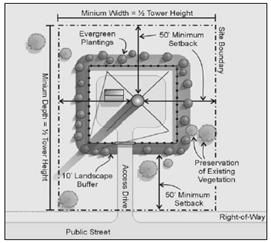
F.
Construction Requirements. All antennas, towers and accessory structures shall comply with the following construction requirements:
1.
General State/Federal Requirements. All facilities shall meet the applicable provisions of the Building Code of the state of Indiana and the Federal Communications Commission.
2.
Wind Loading/Building Code Requirements. All facilities shall meet the structural standards and wind loading requirements of the applicable building code.
3.
Electrical Requirements. All facilities shall meet the accepted electrical engineering methods and practices and comply with the provisions of the National Electrical Code.
4.
OSHA Requirements. All facilities shall meet the requirements of Occupational Safety and Health Administration.
5.
Engineer's Certification. An engineer's certification shall be submitted to document and verify the design specifications including but not limited to, the foundation for the tower, anchors for the guy wires if used, co-location, and strength requirements for natural forces; ice, wind, earth movements, etc.
6.
FAA Requirements. All facilities shall conform with all lighting and marking requirements of the Federal Aviation Administration.
G.
Existing Facilities. The following shall apply to existing antennas and towers:
1.
Replacement of Existing Towers. Existing legal nonconforming towers may continue in use for their current purpose but may not be replaced unless either the replacement tower is an exact match to the height, setback and other features of the removed tower, or the replacement tower complies in all respects to the requirements in this title. If such towers are hereafter damaged or destroyed due to any reason or cause whatsoever, the tower may be repaired and restored to its former location and physical dimensions upon obtaining an improvement location permit.
2.
Expansion of Existing Facilities. Any expansion resulting from a specific co-location shall be exempt from the provisions of Section 17.32.010 that requires conformance with this title is the case of substantial expansions.
3.
Installation of Additional Antennas. Any request submitted to the Franklin plan commission to install an antenna to be located on an existing approved or "grandfathered" tower will only require an improvement location permit and a copy of the contract between the applicant company and the owner of the tower. If the antenna will add height to an existing tower or exceed the height of any alternative structure by more than ten (10) feet it shall be considered a new tower for the purposes of this section.
(Ord. 04-09 § 7.14)
* Intent: The purpose of these telecommunication facility standards is to provide for adequate, reliable public and private telecommunications service while maximizing the use of transmission towers and tower sites. These requirements also seek to minimize the adverse, undesirable visual impact of towers through minimizing needed towers and tower sites, careful design and siting, and screening.
17.32.150 - Fence, hedge and wall standards.[15]
Part 1: These general fence, hedge and wall standards apply to all zoning districts:
A.
General Requirements. Fences, hedges and walls shall be permitted in all zoning districts without a permit subject to conformance with the following requirements:
1.
Structural Face. All fences and walls shall present the nonstructural face outward.
2.
Drainage. No fence, hedge, or wall shall disrupt the flow of water in any drainage easement, or otherwise result in impediments for storm-water run-off. Any fence, hedge, or wall located in an easement may be removed by the easement holder when accessing the easement.
3.
Setbacks. All fences, hedges and walls may be permitted up to any property line. No fence, hedge, or wall may be placed in any right-of-way or required sight visibility triangle (see Section 17.32.130, Sight Visibility Standards).
4.
Buffer Yards. No fence or wall may be placed in any required buffer yard that does not specifically provide for the inclusion of fences.
B.
Height Exceptions. Fences specifically required by this title for screening, telecommunications facilities, or other purposes may exceed the maximum heights established by this section consistent with the appropriate specific requirements of this title.
C.
Height Measurement. The height of a fence shall be determined by measuring from the grade to the highest point of the fence, excluding fence posts. Fence posts may exceed the maximum height of the fence by up to one foot.
Fence Height Measurement Example
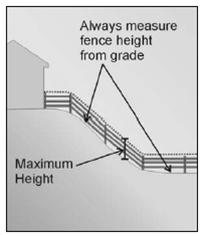
Part 2: These residential fence, hedge and wall standards apply to the agricultural, single-family residential and multifamily residential zoning districts:
A.
Height Requirements. Fences, hedges and walls shall not exceed six feet in height in any side or rear yard or three feet in height in any front yard. For the purposes of this requirement, the front yard shall be defined as the area located between an adjacent street and the wall of the primary structure that faces it.
B.
Prohibited Fences. All electrified, barbed wire, razor wire and stockade fences are prohibited on all non-farm property. In no instance shall this be interpreted as prohibiting the use of invisible fences.
Front Yard Fence Height Example
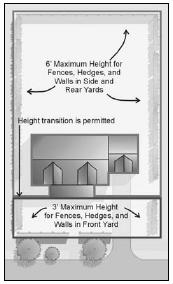
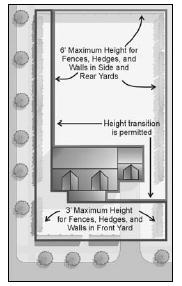
Part 3: These nonresidential fence, hedge and wall standards apply to the mixed-use, institutional, and industrial zoning districts as follows:
A.
Height Requirements. Fences, hedges, and walls shall not exceed eight feet in height and shall be prohibited in any required front yard setback.
B.
Prohibited Fences. All electrified, barbed wire, razor wire, and stockade fences are prohibited on all non-farm property. Industrial uses and penal and correctional facilities shall also be exempt from this standard.
(Ord. 04-09 § 7.15)
Intent: The purpose of these fence, hedge, and wall standards is to provide minimum requirements in order to provide adequate light, air circulation, and privacy; and to protect the public welfare by preventing visual obstructions along public ways.
17.32.160 - Landscaping standards.[16]
These general landscaping standards apply to the multifamily residential, mixed-use, institutional and industrial zoning districts as follows:
A.
Planting Standards. Under no circumstances shall any artificial plant be installed and/or counted as part of the required plantings. All plant materials shall be living and shall meet the following requirements:
1.
Applicable Requirements. In no instance shall any landscaping required by this chapter, or by any other chapter of the ordinance codified in this title be used to meet the requirements of a different ordinance chapter. In all cases the landscaping required by any chapter of the ordinance codified in this title shall be considered as being in addition to any other requirements.
2.
General Requirements. All plant materials required by this chapter shall be free of disease, insects and/or damage.
3.
Measurement Standards. All new trees required to be planted by this chapter shall be measured as follows:
a.
All broad leaf/deciduous trees shall be two and one-half inches in diameter at the time of planting, measured at six inches above the rootball.
b.
All evergreen conifers shall be five feet in height at the time of planting, measured from the top of the rootball.
c.
All shrubs shall be eighteen (18) inches in height at the time of planting, measured from ground level.
4.
Earth Mounds. Earth mounds and berms shall be physical barriers that block or screen the view similar to a hedge, fence or wall. Mounds shall be constructed with proper and adequate plant material to prevent erosion. A difference in elevation between areas requiring screening does not constitute an existing earth mound and shall not be considered as fulfilling any screening requirement. Where mounds are to be mowed, the maximum permitted slope is three is to one (run:rise).
5.
Qualifying Plant Material. Plant material meeting the landscaping requirements of this chapter shall be as follows: unlisted plant materials shall not be prohibited, unless specified, but shall not count as meeting the requirements of this chapter.
a.
Broad Leaf/Deciduous Trees. Broad leaf, deciduous trees shall qualify as meeting the requirements of this chapter if listed in the Qualifying Broad Leaf, Deciduous Tree Table set out at the end of this section.
b.
Evergreen Conifers. Evergreen trees species commonly planted in Central Indiana shall be permitted.
c.
Shrubs. Shrub species commonly planted in Central Indiana shall be permitted.
d.
Grass. Grass shall be planted in species normally grown as permanent lawns in Central Indiana. In swales or other areas subject to erosion solid sod, erosion reducing net or suitable mulch shall be used.
* Note: Please refer to the Qualifying Broad Leaf/Deciduous Tree Table and the Nonqualifying Tree Table set out at the end of this section.
6.
Nonqualifying Plant Material. In no instance shall any tree listed on the Nonqualifying Trees Table set out at the end of this section be used to meet any landscaping requirements of this chapter.
7.
Existing Vegetation. Any existing vegetation that is retained, and that meets the species and location requirements of this chapter, may be counted towards fulfilling the minimum landscaping requirements, subject to the approval of the planning director. No construction activity of any kind shall take place within the area defined by the drip-line of any vegetation that is to be retained and counted as fulfilling these requirements.
B.
Design Standards. All proposed landscape materials should complement the form of the existing trees and plantings. Light, water, soil conditions, and on-going maintenance requirements should be considered in selecting plant materials.
1.
Vehicle Overhang. Parked vehicles may hang over the landscaped area up to two and one-half feet. In no instance shall this overhang be counted as part of the required parking space area.
2.
Groundcover. All areas not landscaped with hedges, walls, or trees shall be provided with grass or other ground cover.
C.
Maintenance Requirements. Trees, vegetation, irrigation systems, fences, walls and other landscape elements are considered elements of a project in the same manner as parking and other site details. The owner of the property shall be responsible for the continuous proper maintenance of all landscaping materials, and shall keep them free from refuse and debris and in good repair at all times.
1.
Replacing Landscaping Materials. All unhealthy or dead plant material shall be replaced by the end of the next planting season. Other required landscape material that becomes defective shall be replaced or repaired within three months of the occurrence of the defect.
2.
Trimming Plant Material. Landscape materials are intended to grow, spread and mature over time. Landscaping materials used to fulfill requirements of this chapter may not be pruned or otherwise treated so as to reduce overall height or level of opacity. Pruning, limbing-up, topping, and other inhibiting measures, including removal may only be practiced to insure the public safety or to preserve the relative health of the material involved.
Plant Material Maintenance Example
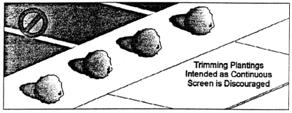
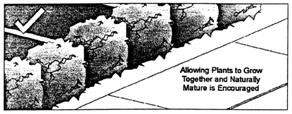
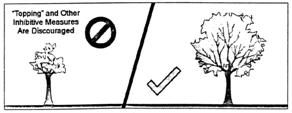
D.
Property Interior Requirements. Landscaping shall be required on each lot based on the use of that lot as defined in the Site Interior Planting Requirements Table.
1.
Mixed-Use Properties. Where a lot is occupied by a combination of the land uses listed in this section, only plantings consistent with the requirements for the land use that would result in the most landscaping is required.
2.
Tree Locations. All required trees may be located in clusters or dispersed throughout the yard.
3.
Yard Calculation. For the purposes of this section, the "yard" means the percentage of the site required as open area dependent upon the property's zoning classification. Other landscape areas required by this chapter and required buffer yards shall not be included in the calculation of yard area.
Site Interior Planting Requirements
E.
Parking Lot Perimeter Requirements. All parking lots, including parking spaces, interior drives, and loading/unloading areas, shall be separated from all thoroughfare plan recommended street rights-of-way by a landscaping area that is a minimum of ten (10) feet in width. Within all multiple family and commercial developments, the landscape area shall be planted with either of the following options or a combination of both:
1.
Trees and Shrubs. A minimum of one tree shall be provided for every eighty (80) linear feet of landscaped area. The trees may be a combination of broad leaf/deciduous and evergreen conifers. In addition, a minimum of one shrub shall be provided for every one tree required.
2.
Landscape Berm. A landscaped berm that is a minimum of three feet in height shall be provided along the length of the landscaped area. A minimum of one shrub shall be provided for every ten (10) linear feet of berm.
F.
Parking Lot Interior Requirements. To help reduce excessive heat build-up and emissions from large areas of hard surfacing, landscape areas must be provided within parking lots.
1.
Landscaped Areas Required. Landscape islands with a surface area equal to five percent of the area of the paved surface (including all parking spaces, interior drives, loading docks, drop-off/pick-up lanes, and access drives beyond the right-of-way) shall be provided in all parking lots.
2.
Landscaped Area Standards. The required landscape areas shall meet the following requirements:
a.
All required landscaped areas shall consist of curbed islands or peninsulas that are surrounded on at least two sides by pavement. Landscaping on the perimeter of the parking lot shall not be counted toward meeting this requirement.
b.
All landscape islands must be a minimum of three hundred (300) square feet in area.
c.
A minimum of one broad leaf/deciduous tree shall be provided for every three hundred (300) square feet of landscaped area required.
Required Landscaping Example
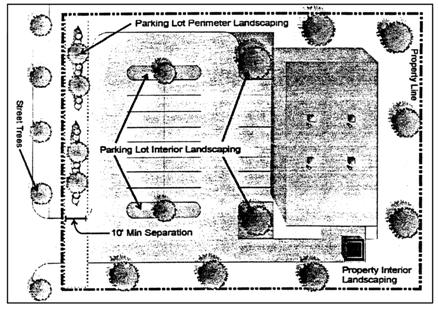
Qualifying Broad Leaf/Deciduous Trees
Nonqualifying Trees
* Note that suitable disease-resistant cultivars and hybrids exist as substitutes for this species.
(Ord. 05-20 § 1: Ord. 04-09 § 7.16)
Intent: The purpose of these landscaping standards is to reflect the essential role that landscape materials play in the development of every property. These minimum requirements for plantings are intended to benefit the public welfare through improved aesthetics and the reduction of storm water run-off, glare, and heat buildup.
17.32.170 - Buffering and screening standards.[17]
Part 1: these general buffering standards apply to all zoning districts.
A.
Buffer Yard Requirements.* The Buffer Yard Requirements Table describes the type of buffer yard that shall be installed. The required buffer yards shall meet the following minimum standards:
1.
Buffer Yard Type 1. Buffer yard type 1 shall include a minimum setback of ten (10) feet in addition to the yard setback otherwise required by this title. In addition, one broad-leaf deciduous canopy tree must be planted in the buffer yard for every thirty (30) feet of boundary between the subject and adjoining properties.
2.
Buffer Yard Type 2. Buffer yard type 2 shall include a minimum setback of twenty (20) feet in addition to the yard setback otherwise required by this title. In addition, one broad-leaf deciduous canopy tree and two evergreen conifers shall be planted in the buffer yard for every twenty-five (25) feet of boundary between the properties.
3.
Buffer Yard Type 3. Buffer yard type 3 shall include a minimum setback of twenty-five (25) feet in addition to the yard setback otherwise required by this title. In addition, a row of broad-leaf deciduous canopy trees shall be planted parallel to the property line within the buffer yard with one tree placed every twenty (20) feet along the boundary between the subject and adjoining properties. Also, a six-foot tall opaque wooden fence or brick/stone wall, a five-foot tall undulating mound planted with shrubs, or a row of evergreen conifers shall be provided.
a.
If an undulating mound is used the slope shall be a maximum of three is to one (rise:run), one shrub for every ten (10) feet of continuous boundary shall be planted on the mound. All required shrubs shall be eighteen (18) inches tall, measured from grade, at planting.
b.
If a row of evergreen trees is used, one tree shall be placed every ten (10) feet along the property boundary. All evergreen trees shall be five feet in height, measured from the top of the rootball, at the time of planting.
* Note: All buffer yard plant materials shall comply with Sections 17.32.160(A)(5) and (6). Please refer to the Qualifying Broad Leaf/Deciduous Tree Table and the Nonqualifying Tree Table at the end of Section 17.32.160.
Buffer Yard Requirements
The Buffer Yard type indicated on the table below shall be provided on the subject property when
Buffer Yard Type 1
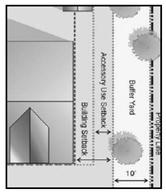
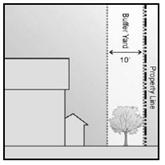
Buffer Yard Type 2
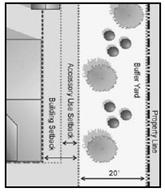
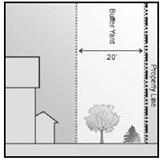
Buffer Yard Type 3
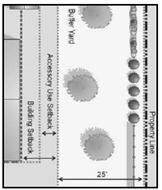
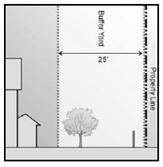
B.
Buffer Yard Standards. The buffer yard standards only apply along the property lines where the two conflicting zoning districts meet as specified in the Buffer Yard Requirements Table. The required buffer yards shall be installed despite the presence of streets, alleys, streams and other features separating property lines in conflicting zoning districts.
1.
Responsibility. The developer or owner of the property being developed or otherwise changed in use is responsible for installing the buffer yard at the time of that development or change. The adjacent property owner shall not have to participate in installing the buffer yard.
2.
Buffer Yard Location. All required buffer yard areas shall be provided entirely on the subject property and shall be in addition to setbacks required by this title.
3.
Planting Location. Required buffer yard trees may be placed either at regular intervals or in irregular patterns representing a natural landscape. However, no two buffer yard trees (excluding evergreen trees) shall be placed within ten (10) feet of one another. No buffer yard or required landscape materials shall be placed within any easement, right-of-way, or septic field.
4.
Tree Size. All broad leaf/deciduous trees must have at least a two and one-half inch caliper measured at six inches above the top of the rootball, and all evergreen conifers must be a minimum of five feet in height measured from the top of the rootball when planted.
5.
Ground Cover. All portions of the buffer yard not planted with trees, shrubs or other landscaped materials shall be covered with grass or other ground covering vegetation. Landscaping stone or other non-vegetative surfaces may not be substituted for ground covering vegetation.
6.
Application. No landscaping required by this section may be used to satisfy the minimum requirements of any other provisions of this title.
7.
Maintenance. All landscape materials must be properly maintained, and kept in a neat and orderly appearance, free from all debris and refuse.
a.
All plant material which is unhealthy or dead, in the opinion of the planning director, shall be replaced by the end of the next spring or fall planting season.
b.
Landscape materials are intended to grow, spread and mature over time. Pruning, limbing-up, topping and other growth inhibiting measures may only be used to ensure the public safety.
Part 2: These materials and equipment buffering standards apply to the multifamily residential, mixed-use, institutional and industrial zoning districts as follows:
A.
Ground Level Requirements. All outdoor storage areas for completed products manufactured on-site, production materials, and equipment; dumpsters and waste containers; and mechanical equipment located on the ground shall be screened consistent with the following requirements. In no instance shall this be interpreted as applying to merchandise for sale that is temporarily or seasonally placed outdoors.
1.
Fencing. A minimum six-foot tall, one hundred (100) percent opaque fence of wood, brick, or stone construction shall completely screen the area from the view of public streets and adjacent properties. Opaque, six-foot tall wooden gates shall be provided to access the facility. The gates shall generally remain closed, except when immediate access to the area is required.
2.
Landscape Screening. Evergreen planting shall be provided around the exterior perimeter of the required fencing.
a.
If evergreen shrubs are used they shall be a minimum of three feet tall at the time of planting, and planted at a maximum of three feet on center.
b.
If evergreen trees are used they shall be conifers, a minimum of five feet tall at the time of planting, and shall be planted a maximum of six feet on center.
B.
Roof-Top Requirements. All roof-top equipment, such as HVAC units, shall be screened from the view of all public streets by parapets, dormers, or other screens. The material of all such screens shall be consistent with the exterior materials used on the facade of the structure.
(Ord. 04-09 § 7.17)
* Intent: The purpose of these buffering and screening standards is to lessen the potential conflicts between the possible uses in one zoning district and those use in adjacent districts through the use of setbacks and landscaping. The potential degree of conflict between the zoning districts determines the extent of the buffer required.
* Intent: The purpose of these exterior lighting standards is to provide minimum outdoor lighting standards that protect the public safety and the general welfare of the community by reducing unsafe and unpleasant lighting conditions, such as light trespass and light pollution, while also promoting the safe and efficient movement of vehicles and pedestrians and the security of local properties.
17.32.180 - Exterior lighting standards.*
These general exterior lighting standards apply to all zoning districts:
A.
General Requirements. All exterior lighting shall conform with the following general requirements:
1.
Mounting Height Measurement. For the purposes of this section, the mounting height of all light fixtures shall be defined as the vertical distance between the grade level of the surface being illuminated and the bottom of the lighting fixture (luminaire).
3.
Use of Timers/Dimmers. Wherever practicable, exterior lighting shall include timers, dimmers, and/or sensors to reduce overall energy consumption and eliminate unneeded lighting.
4.
Electrical Service. The electrical service to all outdoor lighting fixtures shall be underground, unless the fixtures are mounted directly on buildings or utility poles.
5.
Holiday Lighting. Holiday lighting shall be exempt from the provisions of this section.
6.
Prohibited Lighting. The permanent or temporary use of spot lights, floodlights, and searchlights shall be prohibited unless otherwise specified in this section.
B.
Parking Lot Lighting Requirements. Parking lot lighting shall be designed to provide the minimum lighting necessary to ensure adequate vision, comfort, and safety in parking areas while avoiding glare and direct illumination of adjacent properties or streets. All parking lot lighting requirements shall also apply to interior drives and other areas on the property used by vehicles.
1.
Lighting Fixtures. All lighting fixtures providing illumination for parking lots shall be ninety (90) degree cut-off fixtures directed downward at the parking lot surface.
2.
Maximum Mounting Height. The maximum mounting height for all parking lot illuminating light fixtures shall be as follows: twenty (20) feet in all agricultural, single-family residential, and multifamily residential zoning districts; twenty-five (25) feet in all mixed-use and institutional zoning districts; and thirty (30) feet in all industrial zoning districts.
C.
Illuminated Canopy Requirements. Lighting levels under canopies for gas stations, convenience stores, drive-up banking centers, and similar locations shall be adequate to facilitate the activities taking place on the property, and shall not be used for the purpose of illuminating signs. Such lighting shall conform with the following requirements:
1.
Lighting Fixtures. Lighting fixtures on canopies shall conform to either of the following requirements:
a.
All light fixtures mounted on the canopies shall be recessed so that the lens cover is recessed or flush with the bottom surface (ceiling) of the canopy; or
b.
The lighting of the canopy shall use indirect lighting through which light is beamed upward and then reflected down from the underside of the canopy by light fixtures that are shielded so that illumination is focused exclusively on the underside of the canopy.
2.
Fixture Location. Lights shall not be mounted on the top or sides of any canopy and the sides of the canopy shall not be illuminated. In no instances shall this be interpreted as prohibiting the placement of signs on the canopy which are illuminated consistent with the standards for sign illumination in this section.
D.
Lighting of Exterior Display/Sales Areas. Lighting levels on exterior display/sales areas shall be adequate to facilitate the activities taking place in such locations. Such lighting shall conform with the following requirements:
1.
Lighting Fixtures. All lighting fixtures used to illuminate exterior display/sales areas shall be ninety (90) degree cut-off fixtures (luminaires) focused directly downward onto the display/sales area. Such light fixtures shall be located, mounted, aimed, and shielded so that direct light is not cast onto adjacent streets or properties.
2.
Fixture Height. In no case shall fixtures be mounted at a height greater than twenty-five (25) feet above grade.
3.
Fixture Location. All lighting fixtures and mounting poles shall be located within the areas being illuminated.
E.
Lighting of Outdoor Athletic/Performance Facilities. Lighting for all outdoor athletic and performance facilities and events shall provide adequate light for the event or facility while minimizing light pollution and the illumination of adjacent streets and properties.
1.
Play/Performance Area Lighting. Lighting fixtures for the playing fields and/or performance areas shall be specifically mounted and aimed so that their beams fall directly within the play/ performance area and its immediate surroundings and does not spill onto adjacent streets or properties.
2.
Dual Lighting System. The use of spotlights and/or floodlights to illuminate the play/performance area shall be permitted. However, each facility shall be designed and constructed with a dual lighting system which permits the main lighting for the event (spotlighting, floodlighting, etc.) to be turned off, with an alternate low level lighting system used for clean-up, night maintenance and other activities.
3.
Exemptions. Outdoor athletic fields and courts established as accessory uses to single and two-family residences shall be exempt from these requirements.
F.
Security Lighting. Security lighting shall be coordinated with other lighting on the property to the extent possible and shall otherwise conform with the following requirements:
1.
Nonresidential Lighting Fixtures. All security lighting in nonresidential areas shall be shielded and specifically aimed so that illumination is directed only to the intended area. The light source for any security lighting shall include shields that prevent their light source or lens from being visible from adjacent properties and/or streets. The use of general floodlighting fixtures shall be prohibited. Security lighting fixtures may be mounted on poles located no further than ten (10) feet from the perimeter of the area intended to be illuminated.
2.
Residential Lighting Fixtures. Security lighting fixtures in residential areas shall make use of indirect and reflected lighting techniques to provide soft lighting under canopies, entry porches, or soffits.
G.
Lighting of Building Facades. Building facades may be illuminated, subject to the following requirements:
1.
Lighting Fixtures. Lighting fixtures shall be located, aimed, and shielded so that light is directed only onto the building facade. Lighting fixtures shall not be directed toward adjacent streets or roads.
2.
Lighting Direction. Lighting fixtures shall be designed to wash the facade of the building with light (rather than providing a spot or floodlight affect) and may be directed upward or downward onto the facade. Exterior facade lighting shall be contained on the building facade and shall focus on entries and architectural features.
H.
Illuminated Signs. Lighting fixtures illuminating signs shall be located, aimed, and shielded so that light is directed onto only the sign face, with minimal light spillage. Lighting fixtures shall not be aimed toward adjacent streets, roads, or properties. In no instance shall this subsection be interpreted as prohibiting the use of neon signs.
(Ord. 04-09 § 7.18)
17.32.190 - Large scale retail standards.[18]
These general large scale retail standards apply to the mixed-use and industrial zoning districts:
A.
Applicability. All large scale retail facilities of one or more users that occupy twenty-five thousand (25,000) square feet of gross floor area (building footprint) shall meet or exceed the requirements of this section, in addition to all other applicable development standards established by this title. Also, all development associated with the construction and location of a large scale retail use and developed as a unified retail center, must comply with the provisions of this section and present features that are substantially similar to the large scale retail structure. These large scale retail standards shall apply to the following:
1.
New retail structures built on or after the effective date of the ordinance codified in this title;
2.
Expansions of pre-existing large scale retail facilities; and
3.
Expansions to other retail structures that result in a structure greater than twenty-five thousand (25,000) square feet in gross floor area.
B.
Architectural Standards. The following architectural standards shall apply to large scale retail facilities:
1.
Facade Walls. A "facade wall" is any exterior wall visible from a street or nonindustrial property. All facade walls shall meet the following requirements:
a.
Display Windows. All facade walls shall have display windows, faux windows, or decorative windows for no less than sixty (60) percent of the facade wall's horizontal length along all pedestrian walkways.
b.
Entrances. All facade walls that abut a street, public or private, shall feature as least one customer entrance.
c.
Detail Features. Building facade walls shall include a repeating pattern that incorporates no less than three of the elements listed below. At least one of these elements shall repeat horizontally. All elements shall repeat at intervals of no more than one hundred (100) feet, either horizontally or vertically.
i.
Color change;
ii.
Texture change;
iii.
Material module change;
iv.
Architectural change: in the form of structural bays created through a change in plane no less than twenty-four (24) inches wide such as an off-set, reveal, or projecting rib;
v.
Story change: a clear delineation between each story of the structure provided by a consistent cornice line of varying appearance.
d.
Exterior Materials. The use of smooth-faced concrete block, untextured smooth-faced tilt-up panels, and standing seam metal panels shall be prohibited. The planning director shall approve or deny the use of all composite and alternative materials that replicate the appearance and durability of those listed below. All facade wall exterior building materials shall be high quality, and shall be limited to any combination of the following:
i.
Brick or face tile;
ii.
Wood;
iii.
Native stone;
iv.
Glass (reflective glass shall be limited to a maximum of fifty (50) percent of the area of any facade wall on which glass is used);
v.
Tinted and/or textured concrete masonry units (such as split face block and burnished block); vi. Tilt-up concrete panels that are adorned or textured as to conform to subsection (B)(1)(d)(iv) of this section;
vii.
Architectural pre-cast concrete; and
viii.
Architectural metal.
e.
Exterior Colors. Exterior facade wall colors shall be low reflectance, subtle, neutral, or earth tones. The use of high intensity, primary, metallic, black or fluorescent colors shall be prohibited. Building trim and accent areas may feature brighter colors or primary colors. Such building trim and accent areas shall not exceed ten (10) percent of any single exterior wall area excluding all windows, doors, and glass construction materials.
f.
Roofs. All roofs or parapets must vary three-dimensionally to add visual interest to the building and shall include architectural detailing, cornices, moldings, trims, variations in brick coursing and other similar detailing.
2.
Front Facade Walls. The facade wall that fronts on a public street shall be considered the "front facade wall." If the structure fronts onto more than two public streets, the two facade walls that face the streets with the highest thoroughfare plan classification, shall be treated as front facades. All front facade walls shall incorporate the three following elements in addition to those required by Section 17.32.200(B)(1).
a.
Recesses/Projections. Wall recesses/ projections that are at least twenty (20) feet long, but no more than seventy (70) feet long and that have a relief of at least eight inches.
b.
Entry Features. Entryway features are only required at the primary entrance to the structure and shall include at least three of the following design elements:
i.
Raised corniced parapets over the door, peaked roof forms having an average slope greater than or equal to a minimum 5/12 pitch, arches, or architectural details such as tile work and moldings that are integrated into the building structure and design;
ii.
Integral planters or wing walls that incorporate landscaped areas and/or places for sitting;
iii.
Enhanced exterior lighting such as wall sconces, building mounted accent lights, or decorative pedestal lights;
iv.
Prominent three-dimensional entryway feature, such as a clock tower or other similar architectural design element, projecting from the plane of the main exterior walls by a minimum of eight feet and raised above the adjoining parapet wall/roof by a minimum of three feet; and
v.
Pilasters projecting from the plane of the wall by a minimum of eight inches and/or architectural or decorative columns to create visual breaks and interest in the facade walls.
c.
Canopies. Arcades, covered walkways, architectural awnings, canopies, or porticoes.
C.
Parking Lot Design, Vehicle Access and Pedestrian Safety. The following provisions are intended to maximize the safety of the site for vehicles and pedestrians and shall apply to all large scale retail facilities:
1.
Pedestrian Facilities. A continuous, delineated pedestrian pathway network no less than six feet wide, that continues from the perimeter public sidewalk to the principal customer entrance of all principal buildings on the site shall be provided.
a.
Sidewalks, no less than eight feet wide, must be provided along the full length of the building along any facade that features a customer entrance.
b.
All internal pedestrian walkways shall be distinguished from driving surfaces through the use of special pavers, bricks, or scored concrete. The design characteristics of the internal pedestrian walkways must continue when the walkway crosses driving surfaces.
c.
All internal walkways must feature landscaping, benches, and other such materials/facilities for no less than fifty (50) percent of their length. Internal walkway features can be composed of any combination of the following: benches, tree plantings decorative lighting (no more than ten (10) feet in height), decorative bollards, kiosks, shrubs, or hedges.
2.
Public Spaces. Each establishment must contribute to the enhancement of the community and its public spaces by providing at least two of the following amenities:
a.
A landscaped patio/outdoor seating area that is a minimum of two thousand (2,000) square feet in area;
b.
A water feature (excluding any required detention/retention ponds);
c.
A clock tower (either as a free-standing structure or in conjunction with the primary entrance features);
d.
Bus/public transportation shelters and turn off lanes;
e.
Public art.
D.
Outdoor Storage, Service and Loading Areas. Areas for outdoor storage, truck parking, trash collection/compaction, loading and unloading, or other such uses shall not be visible from abutting streets (public or private), or adjacent nonindustrial properties.
1.
Delivery and Auto Service Areas. Service areas including, but not limited to, loading docks, truck courts, and automobile service bays shall be oriented away from the view of any public street or adjacent residential zoning district or use unless screened by an eight-foot masonry wall extending the entire length of the service area.
a.
The service areas shall have additional screening along the exterior side of the masonry wall in the form of landscaping buffer, designed by a landscape professional, to be one hundred (100) percent opaque and four feet in height at the time of planting.
b.
No property owner shall be permitted to inhibit the growth of any required landscaping outlined in this section.
2.
Permanent Outdoor Display, Sales and Storage. Merchandise may be stored or displayed for sale to customers only in areas immediately adjacent to the primary structure on each property. The storage of outdoor merchandise for sale elsewhere on the property shall be prohibited. This area shall be: (a) enclosed by a minimum eight-foot tall wall; or (b) composed of a three-foot tall base wall topped by wrought iron or tubular steel fencing. No merchandise other than trees shall be visible above the wall or fencing. Each wall shall comply with the building materials requirements of subsection (B)(1)(d) and (e) of this section and shall be consistent in appearance and material as the primary structure on the property.
4.
Shopping Cart Storage. Shopping carts may be stored outside each entrance to the building provided that there are no more than two cart storage areas (on each side of the entryway) and that no single cart storage area exceeds twenty (20) feet in length. The cart storage areas shall be screened with building materials substantially similar to the building facade.
(Ord. 04-09 § 7.19)
* Intent: The purpose of these large scale retail standards is to establish additional requirements for these types of facilities in order to ensure that the unique hazards they present for pedestrian and vehicular circulation, as well as land use conflicts, are addressed and the general welfare of the community as a whole is protected.
17.32.200 - Adult use standards.[19]
These general adult use standards apply to the industrial zoning district(s):
The city of Franklin is aware of, and is relying on information gathered by other communities such as Indianapolis, Indiana; New York, New York; Tucson, Arizona, Seattle, Washington; Austin, Texas; Oklahoma City, Oklahoma; Houston, Texas; Minneapolis, Minnesota; and Phoenix, Arizona that demonstrates that adult uses are distinguishable from other business uses due to their negative impacts on the general welfare of neighboring portions of the community. Those negative impacts include increased crime, blight, and deprivation of property values. It has been recognized that local governments have a special concern in regulating adult uses to ensure that the adverse effects will minimized and not contribute to land use conflicts and the blighting of adjacent areas. It has been determined by the United States Supreme Court that local communities may demonstrate this concern by, after careful review of factual information, regulating the time, place, and manner in which adult uses occur. The intent of this section is to preserve the character and integrity of residential neighborhoods, to deter the spread of blight, and to protect minors from the objectionable characteristics of adult uses. Further, it is the intent of this section to minimize the level to which any particular commercial area is exposed to the secondary affects of adult businesses by discouraging the development of districts of such uses.
A.
Permitted Use. Adult uses shall be permitted only in the IG industrial, general zoning district.
B.
Separation Requirements. Adult uses shall be located a minimum of one thousand (1,000) feet from any church, school, park, day care facility, residentially zoned area, public or cultural facility (such as city hall, libraries, etc.), or any other adult use. The distance shall be measured in a straight line, without regard to intervening structures or objects, from the closest property lines of the lot on which each use is located.
(Ord. 04-09 § 7.20)
Intent: The purpose of these adult use standards is to establish specific requirements for adult uses that both ensure the viability of speech activities protected by the U.S. Constitution and prevent the land use conflicts that result from the secondary effects of the presence of such uses.

