
Franklin City Zoning Code
CHAPTER 17
24 - OVERLAY DISTRICTS
17.24.010 - Establishment and general standards. *
A.
Establishment of Overlay Districts. The overlay districts noted below have been established to provide additional development standards that respond to unique characteristics of the properties to which they apply. The overlay districts will assist Franklin in providing for the public welfare and accomplishing the goals of the comprehensive plan. The development of properties which are located in one or more overlay districts shall be subject to the requirements of both the overlay district(s) and the underlying district in which they are located. The following overlay zoning districts shall apply to properties in the jurisdiction of the Franklin plan commission as specified in the description of each district in this chapter:
FH-OL - Flood hazard area
WP-OL - Wellfield protection
GW-OL - Gateway
B.
Effect of Planned Unit Development District. All planned unit developments shall be consistent with the requirements of this chapter. Planned unit developments shall not be subject to the requirements of any overlay district, unless otherwise specified as an element of the planned unit development detailed plan.
C.
Land Uses. All land uses which are permitted, nonpermitted or a special exception use in any underlying zoning district to which an overlay district is applied shall remain permitted, non-permitted, or special exception uses unless otherwise specified by the applicable overlay district(s).
D.
Lot, Yard, and Development Standards. Any lot, yard, and development standards established by an overlay district shall apply as follows:
1.
Replacement of Underlying District Standards. All lot, yard, and development standards established by an underlying zoning district shall apply unless alternate standards are provided by the overlay district(s).
2.
Additional Overlay District Standards. Properties located in any overlay district(s) shall also be subject to any additional lot, yard, and development standards established by the overlay district(s).
E.
Performance Standards. In no instance shall any overlay district be interpreted as modifying any performance standards established for the RS and RT zoning districts by Chapter 17.24.
(Ord. 04-09 § 5.1)
* See Also: Chapter 17.16, Zoning Districts; Chapter 17.28, Planned Unit Development.
17.24.020 - Flood hazard area (FH-OL).
A.
Definitions. Words used in a special sense exclusive to the application of this chapter are defined as follows. These definitions do not define terms used in any other chapter of this title. However, additional terms may be found in Section 17.08.020, Definitions, that are relevant to this chapter.
"A zone" means portions of the SFHA in which the principal source of flooding is runoff from rainfall, snowmelt, or a combination of both. In A zones, floodwaters may move slowly or rapidly, but waves are usually not a significant threat to buildings. These areas are labeled as Zone A, Zone AE, Zones A1-A30, Zone AO, Zone AH, Zone AR and Zone A99 on a FIRM or FHBM. The definitions are presented below:
1.
Zone A. Areas subject to inundation by the one-percent annual chance flood event. Because detailed hydraulic analyses have not been performed, no base flood elevation or depths are shown. Mandatory flood insurance purchase requirements apply.
2.
Zone AE and A1-A30. Areas subject to inundation by the one-percent annual chance flood event determined by detailed methods. Base flood elevations are shown within these zones. Mandatory flood insurance purchase requirements apply. (Zone AE is on new and revised maps in place of Zones A1-A30.)
3.
Zone AO. Areas subject to inundation by one-percent annual chance shallow flooding (usually sheet flow on sloping terrain) where average depths are between one and three feet. Average flood depths derived from detailed hydraulic analyses are shown within this zone. Mandatory flood insurance purchase requirements apply.
4.
Zone AH. Areas subject to inundation by one-percent annual chance shallow flooding (usually areas of ponding) where average depths are one to three feet. Average flood depths derived from detailed hydraulic analyses are shown within this zone. Mandatory flood insurance purchase requirements apply.
5.
Zone AR. Areas that result from the decertification of a previously accredited flood protection system that is determined to be in the process of being restored to provide base flood protection. Mandatory flood insurance purchase requirements apply.
6.
Zone A99. Areas subject to inundation by the one-percent annual chance flood event, but which will ultimately be protected upon completion of an under-construction federal flood protection system. These are areas of special flood hazard where enough progress has been made on the construction of a protection system, such as dikes, dams, and levees, to consider it complete for insurance rating purposes. Zone A99 may only be used when the flood protection system has reached specified statutory progress toward completion. No base flood elevations or depths are shown. Mandatory flood insurance purchase requirements apply.
"Appeal" means a request for a review of the floodplain administrator's interpretation of any provision of this chapter or a request for a variance.
"Area of shallow flooding" means a designated AO or AH Zone on the community's Flood Insurance Rate Map (FIRM) with base flood depths from one to three feet where a clearly defined channel does not exist, where the path of flooding is unpredictable and indeterminate, and where velocity flow may be evident. Such flooding is characterized by ponding or sheet flow.
"Community" means a political entity that has the authority to adopt and enforce floodplain ordinances for the area under its jurisdiction.
"Community rating system (CRS)" means a program developed by the Federal Insurance Administration to provide incentives for those communities in the regular program that have gone beyond the minimum floodplain management requirements to develop extra measures to provide protection from flooding.
"Critical facility" means a facility for which even a slight chance of flooding might be too great. Critical facilities include, but are not limited to, schools, nursing homes, hospitals, police, fire, and emergency response installations, installations which produce, use or store hazardous materials or hazardous waste.
"Elevated structure" means a nonbasement structure built to have the lowest floor elevated above the ground level by means of fill, solid foundation perimeter walls, pilings, or columns (posts and piers).
"Elevation certificate" means a certified statement that verifies a structure's elevation information.
"Emergency program" means the first phase under which a community participates in the NFIP. It is intended to provide a first layer amount of insurance at subsidized rates on all insurable structures in that community before the effective date of the initial FIRM.
"Encroachment" means the advance or infringement of uses, fill, excavation, buildings, permanent structures or development into a floodplain, which may impede or alter the flow capacity of a floodplain.
"Existing construction" means any structure for which the "start of construction" commenced before the effective date of the community's first floodplain ordinance.
"Five-hundred year flood (500-year flood)" means the flood that has a 0.2 percent chance of being equaled or exceeded in any year.
"Floodplain management" means the operation of an overall program of corrective and preventive measures for reducing flood damage and preserving and enhancing, where possible, natural resources in the floodplain, including but not limited to emergency preparedness plans, flood control works, floodplain management regulations, and open space plans.
"Floodplain management regulations" means this chapter and other zoning ordinances, subdivision regulations, building codes, health regulations, special purpose ordinances, and other applications of police power which control development in flood-prone areas. This term describes federal, state, or local regulations in any combination thereof, which provide standards for preventing and reducing flood loss and damage. Floodplain management regulations are also referred to as floodplain regulations, floodplain ordinance, flood damage prevention ordinance, and floodplain management requirements.
"Floodproofing (dry floodproofing)" means a method of protecting a structure that ensures that the structure, together with attendant utilities and sanitary facilities, is watertight to the floodproofed design elevation with walls that are substantially impermeable to the passage of water. All structural components of these walls are capable of resisting hydrostatic and hydrodynamic flood forces, including the effects of buoyancy, and anticipated debris impact forces.
"Floodproofing certificate" means a form used to certify compliance for nonresidential structures as an alternative to elevating structures to or above the FPG. This certification must be by a registered professional engineer or architect.
"Functionally dependent facility" means a facility which cannot be used for its intended purpose unless it is located or carried out in close proximity to water, such as a docking or port facility necessary for the loading and unloading of cargo or passengers, shipbuilding, ship repair, or seafood processing facilities. The term does not include long-term storage, manufacture, sales, or service facilities.
"Highest adjacent grade" means the highest natural elevation of the ground surface, prior to the start of construction, next to the proposed walls of a structure.
"Increased cost of compliance (ICC)" means the cost to repair a substantially damaged structure that exceeds the minimal repair cost and that is required to bring a substantially damaged structure into compliance with the local flood damage prevention ordinance. Acceptable mitigation measures are elevation, relocation, demolition, or any combination thereof. All renewal and new business flood insurance policies with effective dates on or after June 1, 1997, will include ICC coverage.
"Lowest adjacent grade" means the lowest elevation, after completion of construction, of the ground, sidewalk, patio, deck support, or basement entryway immediately next to the structure.
"Map amendment" means a change to an effective NFIP map that results in the exclusion from the SFHA of an individual structure or a legally described parcel of land that has been inadvertently included in the SFHA (i.e., no alterations of topography have occurred since the date of the first NFIP map that showed the structure or parcel to be within the SFHA).
"Map panel number" means the four-digit number followed by a letter suffix assigned by FEMA on a flood map. The first four digits represent the map panel, and the letter suffix represents the number of times the map panel has been revised. (The letter "A" is not used by FEMA, the letter "B" is the first revision.)
"Market value" means the building value, excluding the land (as agreed to between a willing buyer and seller), as established by what the local real estate market will bear. Market value can be established by independent certified appraisal, replacement cost depreciated by age of building (actual cash value), or adjusted assessed values.
"Mitigation" means sustained actions taken to reduce or eliminate long-term risk to people and property from hazards and their effects. The purpose of mitigation is two fold: to protect people and structures, and to minimize the cost of disaster response and recovery.
"National Flood Insurance Program (NFIP)" means the federal program that makes flood insurance available to owners of property in participating communities nationwide through the cooperative efforts of the federal government and the private insurance industry.
"National Geodetic Vertical Datum of 1929 (NGVD)," as corrected in 1929, is a vertical control used as a reference for establishing varying elevations within the floodplain.
"New construction" means any structure for which the "start of construction" commenced after the effective date of the community's first floodplain ordinance.
"New manufactured home park or subdivision" means a manufactured home park or subdivision for which the construction of facilities for servicing the lots on which the manufactured homes are to be affixed (including at a minimum, the installation of utilities, the construction of streets, and either final site grading or the pouring of concrete pads) is completed on or after the effective date of the community's first floodplain ordinance.
"North American Vertical Datum of 1988 (NAVD 88)," as adopted in 1993, is a vertical control datum used as a reference for establishing varying elevations within the floodplain.
"Obstruction" means and includes, but is not limited to any dam, wall, wharf, embankment, levee, dike, pile, abutment, protection, excavation, canalization, bridge, conduit, culvert, building, wire, fence, rock, gravel, refuse, fill, structure, vegetation, or other material in, along, across or projecting into any watercourse which may alter, impede, retard or change the direction and/or velocity of the flow of water; or due to its location, its propensity to snare or collect debris carried by the flow of water, or its likelihood of being carried downstream.
"One-hundred year flood (100-year flood)" means the flood that has a one percent chance of being equaled or exceeded in any given year. Any flood zone that begins with the letter A is subject to the one-percent annual chance flood. See "Regulatory flood."
"One-percent annual chance flood" means the flood that has a one percent chance of being equaled or exceeded in any given year. Any flood zone that begins with the letter A is subject to the one-percent annual chance flood. See "Regulatory flood."
"Participating community" means any community that voluntarily elects to participate in the NFIP by adopting and enforcing floodplain management regulations that are consistent with the standards of the NFIP.
"Physical map revision (PMR)" means an official republication of a community's FEMA map to effect changes to base (one-percent annual chance) flood elevations, floodplain boundary delineations, regulatory floodways, and planimetric features. These changes typically occur as a result of structural works or improvements, annexations resulting in additional flood hazard areas, or correction to base flood elevations or SFHAs.
"Post-FIRM construction" means construction or substantial improvement that started on or after the effective date of the initial FIRM of the community or after December 31, 1974, whichever is later.
"Pre-FIRM construction" means construction or substantial improvement, which started on or before December 31, 1974, or before the effective date of the initial FIRM of the community, whichever is later.
"Probation" means of formally notifying participating communities of violations and deficiencies in the administration and enforcement of the local floodplain management regulations.
"Public safety and nuisance" means anything which is injurious to the safety or health of an entire community, neighborhood or any considerable number of persons, or unlawfully obstructs the free passage or use, in the customary manner, of any navigable lake, or river, bay, stream, canal, or basin.
"Regular program" means the phase of the community's participation in the NFIP where more comprehensive floodplain management requirements are imposed and higher amounts of insurance are available based upon risk zones and elevations determined in a FIS.
"Repetitive loss" means flood-related damages sustained by a structure on two separate occasions during a ten (10) year period ending on the date of the event for which the second claim is made, in which the cost of repairing the flood damage, on the average, equaled or exceeded twenty-five (25) percent of the market value of the structure at the time of each such flood event.
"Section 1316" means that section of the National Flood Insurance Act of 1968, as amended, which states that no new flood insurance coverage shall be provided for any property that the administrator finds has been declared by a duly constituted state or local zoning authority or other authorized public body to be in violation of state or local laws, regulations, or ordinances that intended to discourage or otherwise restrict land development or occupancy in flood-prone areas.
"Start of construction" means and includes substantial improvement, and means the date the building permit was issued, provided the actual start of construction, repair, reconstruction, or improvement was within one hundred eighty (180) days of the permit date. The actual start means the first placement or permanent construction of a structure (including a manufactured home) on a site, such as the pouring of slabs or footing, installation of piles, construction of columns, or any work beyond the stage of excavation for placement of a manufactured home on a foundation. Permanent construction does not include land preparation, such as clearing, grading and filling; nor does it include the installation of streets and/or walkways; nor does it include excavation for a basement, footings, piers, foundations, or the erection of temporary forms; nor does it include the installation on the property of accessory buildings, such as garages or sheds not occupied as dwelling units or not part of the main structure. For substantial improvement, the actual start of construction means the first alteration of any wall, ceiling, floor, or other structural part of a building, whether or not that alteration affects the external dimensions of the building.
"Substantial damage" means damage of any origin sustained by a structure whereby the cost of restoring the structure to its before damaged condition would equal or exceed fifty (50) percent of the market value of the structure before the damage occurred.
"Suspension" means the removal of a participating community from the NFIP because the community has not enacted and/or enforced the proper floodplain management regulations required for participation in the NFIP.
"Violation" means the failure of a structure or other development to be fully compliant with this chapter. A structure or other development without the elevation, other certification, or other evidence of compliance required in this chapter is presumed to be in violation until such time as that documentation is provided.
"Water surface elevation" means the height, in relation to the National Geodetic Vertical Datum (NGVD) of 1929, (or other datum where specified) of floods of various magnitudes and frequencies in the floodplains of riverine areas.
"Watercourse" means a lake, river, creek, stream, wash, channel or other topographic feature on or over which waters flow at least periodically. Watercourse includes specifically designated areas in which substantial flood damage may occur.
"X zone" means the area where the flood hazard is less than that in the SFHA. Shaded X zones shown on recent FIRMs (B zones on older FIRMs) designate areas subject to inundation by the flood with a 0.2 percent chance of being equaled or exceeded (the five-hundred (500) year flood). Unshaded X zones (C zones on older FIRMs) designate areas where the annual exceedance probability of flooding is less than 0.2 percent.
"Zone" means a geographical area shown on a FHBM or FIRM that reflects the severity or type of flooding in the area.
Zone A. See definition for A zone.
"Zone B, C, and X" means areas identified in the community as areas of moderate or minimal hazard from the principal source of flood in the area. However, buildings in these zones could be flooded by severe, concentrated rainfall coupled with inadequate local drainage systems. Flood insurance is available in participating communities but is not required by regulation in these zones. (Zone X is used on new and revised maps in place of Zones B and C.)
B.
Statutory Authorization. The Indiana Legislature has in IC 36-7-4 and IC 14-28-4 granted the power to local government units to control land use within their jurisdictions. Therefore, the common council of the city of Franklin does adopt the following floodplain management regulations.
C.
Findings of Fact.
1.
The flood hazard areas of Franklin are subject to periodic inundation which results in loss of life and property, health and safety hazards, disruption of commerce and governmental services, extraordinary public expenditures for flood protection and relief, and impairment of the tax base, all of which adversely affect the public health, safety, and general welfare.
2.
These flood losses are caused by the cumulative effect of obstructions in floodplains causing increases in flood heights and velocities, and by the occupancy in flood hazard areas by uses vulnerable to floods or hazardous to other lands which are inadequately elevated, flood-proofed, or otherwise unprotected from flood damages.
D.
Statement of Purpose. It is the purpose of this chapter to promote the public health, safety, and general welfare and to minimize public and private losses due to flood conditions in specific areas by provisions designed to:
1.
Restrict or prohibit uses which are dangerous to health, safety, and property due to water or erosion hazards, which result in damaging increases in erosion or in flood heights or velocities.
2.
Require that uses vulnerable to floods, including facilities which serve such uses, be protected against flood damage at the time of initial construction.
3.
Control the alteration of natural floodplains, stream channels, and natural protective barriers which are involved in the accommodation of flood waters.
4.
Control filling, grading, dredging, and other development which may increase erosion or flood damage.
5.
Prevent or regulate the construction of flood barriers which will unnaturally divert floodwaters or which may increase flood hazards to other lands.
6.
Make federally subsidized flood insurance available for structures and their contents in the city by fulfilling the requirement.
E.
Objectives.
1.
To protect human life and health;
2.
To minimize expenditure of public money for costly flood control projects;
3.
To minimize the need for rescue and relief efforts associated with flooding and generally undertaken at the expense of the general public;
4.
To minimize prolonged business interruptions;
5.
To minimize damage to public facilities and utilities such as water and gas mains, electric, telephone, and sewer lines, streets, and bridges located in floodplains;
6.
To help maintain a stable tax base by providing for the sound use and development of flood prone areas in such a manner as to minimize flood blight areas;
7.
To ensure that potential homebuyers are notified that property is in a flood area.
F.
District Boundaries (Regulatory Flood Elevation). This chapter's protection standard is the regulatory flood. The best available regulatory flood data is listed below. Whenever a party disagrees with the best available data, the party submitting the detailed engineering study needs to replace existing data with better data and submit it to the Indiana Department of Natural Resources for review and approval.
1.
The regulatory flood elevation, floodway, and fringe limits for the studied SFHAs of city shall be as delineated on the one hundred (100) year flood profiles in the Flood Insurance Study of Johnson County and Incorporated Areas, dated August 2, 2007 and the corresponding FIRM dated August 2, 2007, as well as any future updates, amendments, or revisions, prepared by the Federal Emergency Management Agency with the most recent date.
2.
The regulatory flood elevation, floodway, and fringe limits for each of the unstudied SFHAs of city delineated as an "A Zone" on the FIRM of Johnson County and Incorporated Areas shall be according to the best data available as provided by the Indiana Department of Natural Resources.
G.
Discrepancy between Mapped Floodplain and Actual Ground Elevations.
1.
In cases where there is a discrepancy between the mapped floodplain (SFHA) on the FIRM and the actual ground elevations, the elevation provided on the profiles shall govern.
2.
If the elevation of a site in question (near a delineated SFHA) is below the base flood elevation and is not protected by existing means, that site shall be included in the SFHA and regulated accordingly.
3.
If the elevation (natural grade) of a site in question is above the base flood elevation, that site shall be included in the SFHA and the floodplain regulations will be applied unless the property owner receives a letter of map amendment (LOMA) removing the area from the SFHA.
H.
Interpretation. In the interpretation and application of this chapter all provisions shall:
1.
Considered as minimum requirements;
2.
Liberally construed in favor of the governing body; and
3.
Deemed neither to limit nor repeal any other powers granted under state statutes.
I.
Duties of the Administrator. The planning director shall implement this chapter and be referred to as the floodplain administrator. The floodplain administrator and his/her designees is appointed to review all development and subdivision proposals to ensure compliance with this chapter, including but not limited to the following duties:
1.
Ensure Compliance. Ensure that all development activities within the statistical flood hazard areas (SFHAs) of the jurisdiction of the city of Franklin meet the requirements of this chapter.
2.
Provide Information. Provide information and assistance to citizens upon request about permit procedures and floodplain construction techniques.
3.
Ensure Proper Authorization. Ensure that construction authorization has been granted by the Indiana Department of Natural Resources for all development projects subject to subsections (J)(2)(a) and (J)(2)(c) of this section, and maintain a record of such authorization (either copy of actual permit, letter of recommendation, or floodplain analysis and regulatory assessment). Ensure that all necessary federal or state permits have been received prior to issuance of the local floodplain development permit. Copies of such permits are to be maintained on file with the floodplain development permit.
4.
Maintain Construction Records. Maintain a record of the "as built" elevation of the top of the lowest floor (including basement) of new and/or substantially improved buildings constructed in the SFHA. Inspect before, during and after construction.
5.
Maintain Engineering Records. Maintain a record of the engineer's certificate and the "as-built" floodproofed elevation of all buildings subject to subsection M of this section.
6.
Improve Data. Cooperate with state and federal floodplain management agencies to improve base flood and floodway data and to improve the administration of this chapter. Submit reports as required for the National Flood Insurance Program.
7.
Provide Data. Maintain for public inspection and furnish upon request regulatory flood data, SFHA maps, letters of map amendment (LOMA), letters of map revision (LOMR), copies of DNR permits and floodplain analysis and regulatory assessment, federal permit documents, and "as-built" elevation and floodproofing data for all building constructed subject to this chapter.
8.
Enforcement. Utilize and enforce all letters of map revision (LOMR) or physical map revisions (PMR) issued by FEMA for the currently effective SFHA maps of the community.
9.
Maintenance. Assure that maintenance is provided within the altered or relocated portion of said watercourse so that the flood-carrying capacity is not diminished.
10.
Assist with Notification. Notify adjacent communities and the state coordinating office prior to any alteration or relocation of a watercourse, and submit copies of such notifications to FEMA.
11.
Inspect Damages. Inspect and inventory damaged structure in SFHA and complete substantial damage determinations.
J.
Improvement Location Permit. No person, firm, corporation, or governmental body not exempted by state law shall commence any "development" in the SFHA without first obtaining an improvement location permit from the floodplain administrator. The floodplain administrator shall not issue an improvement location permit if the proposed "development" does not meet the requirements of this chapter.
1.
Application Materials. The application for an improvement location permit shall be accompanied by the following:
a.
Development Description. A description of the proposed development.
b.
Location Description. Location of the proposed development sufficient to accurately locate property and structure in relation to existing roads and streams.
c.
Legal Description. A legal description of the property site.
d.
Site Plan. A site plan showing existing and proposed development locations and existing and proposed land grades.
e.
Elevations. Elevation of the top of the lowest floor (including basement) of all proposed development or elevation to which any nonresidential structure will be floodproofed. Elevation should be in North American Vertical Datum of 1988 (NAVD 88) or National Geodetic Vertical Datum of 1929 (NGVD 29). If NGVD 29 is used, the conversion formula should be included.
g.
Watercourse Alterations (If Required). Description of the extent to which any watercourse will be altered or related as a result of proposed development.
2.
Review Procedure. Upon receipt of an application for an improvement location permit, the floodplain administrator shall determine if the site is located within: (1) an identified floodway, (2) an identified floodway fringe, or (3) the floodplain where the limits of the floodway have not yet been determined.
a.
Identified Floodway Sites. If the site is in an identified floodway the floodplain administrator shall require the applicant to forward the application, along with all pertinent plans and specifications, to the Indiana Department of Natural Resources and apply for a permit for construction in a floodway.
i.
Under the provisions of IC 14-28-1 a permit from the Indiana Department of Natural Resources is required prior to the issuance of an improvement location permit for any excavation, deposit, construction or obstruction activity located in the floodway. This includes land preparation activities such as filling, grading, clearing and paving etc., undertaken before the actual start of construction of the building. However, it does exclude nonsubstantial additions/improvement to existing (lawful) residences in a nonboundary river floodway. (IC 14-28-1-26 allows construction of nonsubstantial additions/improvements to residences in a nonboundary river floodway without obtaining a permit for construction in a floodway from the Indiana Department of Natural Resources). Please note that if fill is needed to elevate an addition above the existing grade, prior approval (construction in a floodway permit) for the fill is required from the Indiana Department of Natural Resources.
ii.
No action shall be taken by the floodplain administrator until a permit has been issued by the Indiana Department of Natural Resources granting approval for construction in the floodway. Once a permit has been issued by the Indiana Department of Natural Resources, the Floodplain Administrator may issue the local improvement location permit, provided the provisions contained in subsections K, L, M, N, and O of this section have been met. The improvement location permit cannot be less restrictive than the permit issued by the Indiana Department of Natural Resources.
iii.
No development shall be allowed which acting alone or in combination with existing or future development, will increase the regulatory flood more than 0.14 of one foot.
iv.
For all projects involving channel modifications or fill (including levees) the city of Franklin shall submit the data and request that the Federal Emergency Management Agency revised the regulatory flood data.
b.
Identified Floodway Fringe Sites. If the site is located in an identified floodway fringe, then the floodplain administrator may issue the local improvement location permit provided the provisions contained in subsections L, M, N, and O of this section have been met. The key provision is that the top of the lowest floor of any new or substantially improved structure shall be at or above the Flood Protection Grade (FPG).
c.
Undefined Floodplain Sites with Significant Upstream Drainage. If the site is in an identified floodplain where the limits of the floodway and floodway fringe have not yet been determined, and the drainage area upstream of the site is greater than one square mile, the floodplain administrator shall require the applicant to forward the application, along with all pertinent plans and specifications, to the Indiana Department of Natural Resources for review and comment.
i.
No action shall be taken by the floodplain administrator until either a permit for construction in the floodway or a floodplain analysis and regulatory assessment citing the one hundred (100) year flood elevation and the recommended Flood Protection Grade has been received from the Indiana Department of Natural Resources.
ii.
Once the floodplain administrator has received the proper permit or floodplain analysis and regulatory assessment approving the proposed development, an improvement location permit may be issued provided the conditions of the improvement location permit are not less restrictive than the conditions received from the Indiana Department of Natural Resources and the provisions contained in subsections K, L, M, N, and O of this section have been met.
d.
Undefined Floodplain Sites with Insignificant Upstream Drainage. If the site is in an identified floodplain where the limits of the floodway and floodway fringe have not yet been determined and the drainage area upstream of the site is less than one square mile, the floodplain administrator shall require the applicant to provide an engineering analysis showing the limits of the floodway, floodway fringe and one hundred (100) year elevation for the site. Upon receipt, the floodplain administrator may issue the local improvement location permit, provided the provisions contained in subsections K, L, M, N, and O of this section have been met.
i.
The total cumulative effect of the proposed development, when combined with all other existing and anticipated development, will not increase the regulatory flood more than 0.14 of one foot and will not increase flood damages or potential flood damages.
3.
Construction Stage. Upon placement of the lowest floor; or floodproofing, it shall be the duty of the permit holder to submit to the floodplain administrator a certification of the NAVD 88 or NGVD 29 elevation of the lowest floor or floodproofed elevation, as built. Said certification shall be prepared by or under the direct supervision of a registered land surveyor or professional engineer and certified by the same. When floodproofing is utilized for a particular structure said certification shall be prepared by or under the direct supervision of a professional engineer or architect and certified by same. Any work undertaken prior to submission of the certification shall be at the permit holders' risk. (The floodplain administrator shall review the lowest floor and floodproofing elevation survey data submitted.) The permit holder shall correct deficiencies detected by such review before any further work is allowed to proceed. Failure to submit the survey or failure to make said corrections required hereby, shall be cause to issue a stop-work order for the project.
K.
Uses. All land uses shall be prohibited in the floodway unless otherwise specified below:
1.
Permitted Uses. The following uses shall be permitted, provided that they are also permitted by the underlying zoning district:
a.
Agricultural uses such as crop production, pastures, orchards, tree farms, plant nurseries, and vineyards;
b.
Forestry, wildlife areas, and nature preserves; and
c.
Parks and recreational uses (excluding golf courses and driving ranges).
2.
Special Exception Uses. The following uses shall be special exceptions, provided that they are also permitted or special exceptions in the underlying zoning district:
a.
Riding stables;
b.
Public wellfields;
c.
Sewage treatment facilities (excluding septic fields);
d.
Parking lots (as primary uses); and
e.
Golf courses and/or driving ranges.
L.
Development Standards.
1.
New construction and substantial improvements shall be anchored to prevent flotation, collapse or lateral movement of the structure.
2.
Manufactured homes shall be anchored to prevent flotation, collapse, or lateral movement. Methods of anchoring may include, but are not limited to, use of over-the-top or frame ties to ground anchors. This standard shall be in addition to and consistent with applicable state requirements for resisting wind forces.
3.
New construction and substantial improvements shall be constructed with materials and utility equipment resistant to flood damage below the FPG.
4.
New construction and substantial improvements shall be constructed by methods and practices that minimize flood damage.
5.
Electrical, heating, ventilation, plumbing, air conditioning equipment and other service facilities shall be designed and/or located so as to prevent water from entering or accumulating within the components during conditions of flooding.
6.
New and replacement water supply systems shall be designed to minimize or eliminate infiltration of flood waters into the system.
7.
New and replacement sanitary sewage systems shall be designed to minimize or eliminate infiltration of flood waters into the system.
8.
On-site waste disposal systems shall be located and constructed to avoid impairment to them or contamination from them during flooding.
9.
Any alteration, repair, reconstruction or improvements to a structure that is in compliance with the provisions of this chapter shall meet the requirements of "new construction" as contained in this chapter.
10.
Any alteration, repair, reconstruction or improvement to a structure that is not in compliance with the provisions of this chapter, shall be undertaken only if said nonconformity is not further, extended, or replaced.
M.
Development Standards—Protecting Buildings. In addition to the damage prevention requirements of subsection L of this section, all buildings to be located in the SFHA shall be protected from flood damage below the FPG.
1.
Protection Situations. This building protection requirement applies to the following situations:
a.
Construction or placement of any new structure having a floor area greater than four hundred (400) square feet;
b.
Structural alterations made to:
i.
An existing (previously unaltered) structure, the cost of which equals or exceeds fifty (50) percent of the value of the pre-altered structure (excluding the value of the land),
ii.
Any previously altered structure;
c.
Reconstruction or repairs made to a damaged structure that are valued at or more than fifty (50) percent of the market value of the structure (excluding the value of the land) before damage occurred;
d.
Installing a manufactured home on a new site or a new manufactured home on an existing site. This chapter does not apply to returning the existing manufactured home to the same site it lawfully occupied before it was removed to avoid flood damage; and
e.
Installing a travel trailer or recreational vehicle on a site for more than one hundred eighty (180) days.
2.
Protection Methods. This building protection requirement may be met by one of the following methods. The floodplain administrator shall maintain a record of compliance with these building protection standards as required in subsection I of this section.
a.
Residential Construction. New construction or substantial improvement of any residential structure (or manufactured home) shall have the lowest floor; including basement, at or above the FPG (two feet above the base flood elevation). Should solid foundation walls be used to elevate a structure, openings sufficient to facilitate the unimpeded movements of floodwaters shall be provided in accordance with the standards of subsection (M)(2)(d) of this section.
b.
Nonresidential Construction. New construction or substantial improvement of any commercial, industrial, or nonresidential structure (or manufactured home) shall have the lowest floor, including basement, elevated to or above the FPG (two feet above the base flood elevation). Structures located in all "A Zones" may be floodproofed in lieu of being elevated if done in accordance of subsection (M)(2)(h) of this section.
c.
Structures on Fill. A residential or nonresidential building may be constructed on a permanent land fill in accordance with the following:
i.
The fill shall be placed in layers no greater than six inches deep before compacting to ninety-five (95) percent of the maximum density obtainable with the standard proctor test method.
ii.
The fill should extend at least ten feet beyond the foundation of the building before sloping below the FPG.
iii.
The fill shall be protected against erosion and scour during flooding by vegetative cover, riprap, or bulkheading. If vegetative cover is used, the slopes shall be no steeper than three horizontal to one vertical.
iv.
The fill shall not adversely affect the flow of surface drainage from or onto neighboring properties.
v.
The top of the lowest floor including basements, (see definition of lowest floor) shall be at or above the FPG.
d.
Elevated Structures. New construction or substantial improvements of elevated structures that include fully enclosed areas formed by foundation and other exterior walls below the FPG shall be designed to preclude finished living space and designed to allow for the entry and exit of floodwaters to automatically equalize hydrostatic flood forces on exterior walls.
i.
Designs for complying with this requirement must either be certified by a professional engineer or architect or meet the following minimum criteria:
(A)
Provide a minimum of two openings having a total net area of not less than one square inch for every one square foot of enclosed area;
(B)
The bottom of all openings shall be no higher than one foot above foundation interior grade (which must be equal to in elevation or higher than the exterior foundation grade);
(C)
Openings may be equipped with screens, louvers, valves or other coverings or devices provided they permit the automatic flow of floodwaters in both directions;
(D)
Access to the enclosed area shall be the minimum necessary to allow for parking for vehicles (garage door) or limited storage of maintenance equipment used in connection with the premises (standard exterior door) or entry to the living area (stairway or elevator);
(E)
The interior portion of such enclosed area shall not be partitioned or finished into separate rooms; and
(F)
Portions of the building below the FPG must be constructed with materials resistant to flood damage.
e.
Structures Constructed with a Crawlspace. A residential or nonresidential structure may be constructed with a crawlspace located below the FPG provided that the following conditions are met:
i.
The building must be designed and adequately anchored to resist flotation, collapse, and lateral movement of the structure resulting from hydrodynamic and hydrostatic loads, including the effects of buoyancy;
ii.
Any enclosed area below the FPG shall have openings that equalize hydrostatic pressures by allowing for the automatic entry and exit of floodwaters. Provide a minimum of two openings having a total net area of not less than one square inch for every one square foot of enclosed area. The bottom of the openings shall be no more than one foot above grade;
iii.
The interior height of the crawlspace measured from the interior grade of the crawlspace to the top of the foundation wall must not exceed four feet at any point;
iv.
Utility systems within the crawlspace must be elevated above the FPG;
v.
An adequate drainage system must be installed to remove floodwaters from the interior area of the crawlspace within a reasonable period of time after a flood event;
vi.
Portions of the building below the FPG must be constructed with materials resistant to flood damage; and
vii.
The interior grade of the crawlspace must be at or above the base flood elevation.
f.
Permanent Manufactured Homes and Recreational Vehicles. Manufactured homes and recreational vehicles to be installed or substantially improved on a site for more than one hundred eighty (180) days must meet one of the following anchoring requirements:
i.
The manufactured home shall be elevated on a permanent foundation such that the lowest floor shall be at or above the FPG and securely anchored to an adequately anchored foundation system to resist flotation, collapse, and lateral movement. This requirement applies to all manufactured homes to be placed on a site:
(A)
Outside a manufactured home park or subdivision;
(B)
In a new manufactured home park or subdivision;
(C)
In an expansion to an existing manufactured home park or subdivision; or
(D)
In an existing manufactured home park or subdivision on which a manufactured home has incurred "substantial damage" as a result of a flood.
ii.
This requirement applies to all manufactured homes to be placed on a site in an existing manufactured home park or subdivision that has not been substantially damaged by a flood. The manufactured home shall be elevated so that the lowest floor of the manufactured home chassis is supported by reinforced piers or other foundation elements that are no less than thirty-six (36) inches in height above grade and be securely anchored to an adequately anchored foundation system to resist flotation, collapse, and lateral movement.
g.
Temporary Recreational Vehicles. Recreational vehicles placed on a site shall either:
i.
Be on the site for less than one hundred eighty (180) consecutive days;
ii.
Be fully licensed and ready for highway use (defined as being on its wheels or jacking system, is attached to the site only by quick disconnect type utilities and security devices, and has no permanently attached additions); or
iii.
Meet the requirements for "manufactured homes" in subsection (M)(2)(f) of this section.
h.
Floodproofing. A nonresidential building may be floodproofed to the FPG (in lieu of elevating) if done in accordance with the following:
i.
A registered professional engineer shall certify that the building has been designed so that below the FPG, the structure and attendant utility facilities are watertight and capable of resisting the effects of the regulatory flood. The building design shall take into account flood velocities, duration, rate of rise, hydrostatic pressures, and impacts from debris or ice. Such certification shall be provided to the floodplain administrator as set forth in subsection (I)(5) of this section.
ii.
Floodproofing measures shall be operable without human intervention and without an outside source of electricity.
N.
Other Development Standards. The floodplain administrator shall review all proposed subdivisions to determine whether the subdivision lies in a SFHA.
1.
Flood Hazard Area Subdivisions. If the floodplain administrator finds the subdivision to be so located and areas are to be developed within the floodway, the floodplain administrator shall require the petitioner to forward plans and materials to the Indiana Department of Natural Resources for review and comment. The floodplain administrator shall require appropriate changes and modifications in order to assure that:
a.
It is consistent with the need to minimize flood damages;
b.
All public utilities and facilities, such as sewer, gas, electrical, and water systems are located and constructed to minimize or eliminate flood damage;
c.
Adequate drainage is provided so as to reduce exposure to flood hazards;
d.
On-site waste disposal systems, if provided, will be so located and designed to avoid impairment of them or contamination from them during the occurrence of the regulatory flood;
e.
Base flood elevation data shall be provided for subdivision proposals.
2.
Flood Elevation Recording. Developers shall provide the one hundred (100) year flood elevation on all subdivision plats containing lands (identified elsewhere by this chapter) within a flood hazard area prior to submitting the plats for approval by the plan commission.
O.
Critical Facility. Construction of new critical facilities shall be, to the extent possible, located outside the limits of the SFHA. Construction of new critical facilities shall be permissible within the SFHA if no feasible alternative site is available. Critical facilities constructed within the SFHA shall have the lowest floor elevated at or above the FPG at the site. Floodproofing and sealing measures must be taken to ensure that toxic substances will not be displaced by or released into floodwaters. Access routes elevated to or above the FPG shall be provided to all critical facilities to the extent possible.
P.
Variances. The board of zoning appeals as established by the common council of the city of Franklin shall hear and decide appeals and requests for variances from requirements of this chapter. The board shall hear and decide appeals when it is alleged an error in any requirement, decision, or determination is made by the floodplain administrator in the enforcement or administration of this chapter. Any person aggrieved by the decision of the board may appeal such decision to a court of jurisdiction. Variances to the regulation of this chapter shall be consistent with the following provisions:
1.
Procedures. In passing upon such application, the board of zoning appeals shall consider all technical evaluations, all relevant factors, all standards specified in other sections of this title, and:
a.
The danger of life and property due to flooding or erosion damage.
b.
The susceptibility of the proposed facility and its contents to flood damage and the effect of such damage on the individual owner.
c.
The importance of the services provided by the proposed facility to the community.
d.
The necessity to the facility of a waterfront location, where applicable.
e.
The availability of alternative locations for the proposed use which are not subject to flooding or erosion damage.
f.
The compatibility of the proposed use with existing and anticipated development.
g.
The relationship of the proposed use to the comprehensive plan and floodplain management program for that area.
h.
The safety of access to the property in times of flood for ordinary and emergency vehicles.
i.
The expected height, velocity, duration, rate of rise, and sediment of transport of the floodwaters at the site.
j.
The costs of providing governmental services during and after flood conditions, including maintenance and repair of public utilities and facilities such as sewer, gas, electrical, and water systems, and streets and bridges.
2.
Standards and Conditions. The board of zoning appeals may issue a variance of exception to the terms and provisions of this chapter subject to the following standards and conditions:
a.
Variances shall only be issued when there is:
i.
A showing of good and sufficient cause.
ii.
A determination that failure to grant the variance would result in exceptional hardship.
iii.
A determination that the granting of a variance will not result in increased flood heights, additional threats to public safety, extraordinary public expense, create nuisances, cause fraud or victimization of the public, or conflict with existing laws or ordinances;
b.
No variance or exception for a residential use within a floodway subject to subsection (J)(2)(a) or (J)(2)(c) of this section may be granted;
c.
Any variance or exception granted in a floodway subject to subsection (J)(2)(a) or (J)(2)(c) of this section will require a permit from the Indiana Department of Natural Resources;
d.
Variances or exceptions to the Building Protection Standards of subsection M of this section may be granted only when a new structure is to be located on a lot of one-half acre or less in size, contiguous to and surrounded by lots with existing structures constructed below the FPG;
e.
Variance or exception may be granted for the reconstruction or restoration of any structure individually listed on the National Register of Historic Places or the Indiana State Register of Historic Sites and Structures upon a determination that the proposed repair or rehabilitation will not preclude the structure's continued designation as an "historic structure" and the variance is the minimum to preserve the historic character and design of the structure;
f.
Variances shall only be issued upon a determination that the variance is the minimum necessary, considering the flood hazard, to afford relief;
g.
Any application to whom a variance is granted shall be given written notice specifying the difference between the base flood elevation and the elevation to which the lowest floor is to be built and stating that the cost of the flood insurance will be commensurate with the increased risk resulting from the reduced lowest floor elevation; and
h.
The floodplain administrator shall maintain the records of appeal actions and report any variances to the Federal Emergency Management Agency or the Indiana Department of Natural Resources upon request.
3.
Variance Notification. Any applicant to whom a variance is granted shall be given written notice over the signature of a community official that:
a.
The issuance of a variance to construct a structure below the base flood elevation will result in increased premium rates for flood insurance up to amounts as high as twenty-five dollars ($25.00) for one hundred dollars ($100.00) of insurance coverage.
b.
Such construction below the base flood level increases risks to life and property.
The floodplain administrator will maintain a record of all variance actions, including justification for their issuance, and report such variances issued in the community's biennial report submission to the Federal Emergency Management Agency.
4.
Historic Structure. Variances may be issued for the repair or rehabilitation of "historic structures" upon a determination that the proposed repair or rehabilitation will not preclude the structure's continued designation as an "historic structure" and the variance is the minimum to preserve the historic character and design of the structure.
5.
Special Conditions. Upon the consideration of the factors listed in subsection P of this section, and the purposes of this chapter, the board of zoning appeals may attach such conditions to the granting of variances as it deems necessary to further the purposes of this chapter.
Q.
Disclaimer of Liability. The degree of flood protection required by this chapter is considered reasonable for regulatory purposes and is based on available information derived from engineering and scientific methods of study. Larger floods can and will occur on rare occasions. Therefore, this chapter does not create any liability on the part of the city of Franklin, the Indiana Department of Natural Resources, or the state of Indiana, for any flood damage that results from reliance on this chapter or any administrative decision made lawfully thereunder.
R.
Violations. Failure to obtain an improvement location permit in the SFHA or failure to comply with the requirements of a permit or conditions of a variance shall be deemed to be a violation of this chapter. All violations shall be considered a common nuisance and be treated in accordance with the provisions of Chapter 17.52, Enforcement and Penalties.
1.
A separate offense shall be deemed to occur for each day the violation continues to exist.
2.
The planning director shall inform the owner that any such violation is considered a willful act to increase flood damages and therefore may cause coverage by a Standard Flood Insurance Policy to be suspended.
3.
Nothing herein shall prevent the city of Franklin from taking such other lawful action to prevent or remedy any violations. All costs connected therewith shall accrue to the person or persons responsible.
S.
Abrogation and Greater Restrictions. This chapter repeals and replaces other ordinances adopted by the city of Franklin to fulfill the requirements of the National Flood Insurance Program. However, this chapter does not repeal the original resolution or ordinance adopted to achieve eligibility in the program. Nor does this chapter repeal, abrogate, or impair any existing easements, covenants, or deed restrictions. Where this chapter and other easements, covenants, or deed restrictions conflict or overlap, whichever imposes the more stringent restrictions shall take precedence. In addition, the city of Franklin shall assure that all National Flood Insurance Program regulations (44 CFR Section 60) as well as Indiana laws and regulations regarding floodplain issues (312 IAC 10, IC 14-28-1 and IC-14-28-3) are met.
T.
Nonconforming Structures and/or Uses in Flood Hazard Areas. Any structure, use, or structure and use in combination that is legal nonconforming due to its presence in a flood hazard area may be altered, enlarged, or extended on a one-time only basis provided that the new construction conforms with the standards included in this chapter and does not increase the value of the structure or use (excluding the value of the land) by more than fifty (50) percent of its pre-improvement market value. Such structures that are legal nonconforming as the result of other, non-flood related conditions shall be subject to the provisions of Chapter 17.44, Nonconformities that address those conditions (such as legal nonconforming uses, structures, etc.).
(Ord. 07-09 § 1 Exh. A: Ord. 04-09 § 5.2)
17.24.030 - Wellfield protection (WP-OL).[5]
A.
Boundaries and Exemptions. The wellfield protection overlay district (WP-OL) shall apply to all proprieties as indicated on the official zoning map of the city of Franklin, but shall generally conform to the boundaries of the five-year wellfield capture areas within the city's jurisdiction (as updated periodically).
B.
Uses. All uses permitted in the underlying district(s) are permitted in the wellfield protection overlay district; and all uses that are special exceptions in the underlying district(s) are special exceptions in the wellfield protection overlay district unless specifically noted otherwise below.
1.
Prohibited Uses. The following uses shall be prohibited in the wellfield protection overlay district (see the use matrix set out in Section 17.16.020 for detailed use listings):
a.
Agriculture uses: agricultural products sales, distribution, and storage facility; farm (confined feeding); farm equipment sales and service; greenhouse (commercial); and livestock auction/sales facility.
b.
Communications/utility uses: sewage treatment plant.
c.
Park uses: campground/RV park; driving range (as a primary use); golf course and/or country club (including driving range).
d.
Institutional/public uses: airport; animal shelter; fairgrounds; government facility (non-office); heliport; hospital/medical center; and medical clinic.
e.
Commercial uses: auto-oriented uses (small scale); auto-oriented uses (medium scale); auto-oriented uses (large scale); mass transit terminal/station (excluding a public bus stop); kennel; fireworks sales (permanent); and truck stop/travel center.
f.
Industrial uses: animal and animal products processing; boat/RV storage facility (outdoor); concrete/asphalt production facility; contractor's warehouse/storage facility; food and beverage production; general industrial production; hazardous materials production; light industrial assembly and distribution; light industrial processing and distribution; mineral extraction and processing; research and development facility; truck freight terminal; truck sales and service center; and waste disposal facility.
2.
Uses Not Specified. The plan commission, through the site development plan review process, may also prohibit or impose conditions on other uses not listed in subsection (B)(1) of this section that are specifically demonstrated to pose a hazard to the drinking water supply due to chemicals used on-site or by-products of onsite activities. Some examples of this type of use may include building cleaning or maintenance service companies, engineering or vocational shops or laboratories, landscape or lawn installation or maintenance services, and mortuaries.
C.
Development Standards. All development within the boundaries of the wellfield protection overlay district shall comply with all applicable state, federal, and local regulations, in addition to the following development standards.
1.
Abandoned Wells. All known abandoned wells shall be identified and sealed consistent with any applicable requirements of the city engineer.
2.
Surface Water Impoundments. No surface impoundments, ponds, or lagoons shall be established except for the purpose of: (a) storm water retention and detention ponds; or (b) recreation and landscaping purposes. All detention and retention ponds shall be constructed in a manner that provides an effective barrier to the migration of potential containments into the ground water.
3.
Public Sewer Service. All development, with the exception of a single-family residence located on a lot of at least two acres, shall be connected to a public sewer. All floor drains must be connected to the sanitary sewer or routed to a temporary holding area for future removal.
4.
Trash and Recycling Containers. All nonresidential trash and recycling containers shall be located on hard-surfaced areas that drain to a public storm sewer.
5.
Storage and Transfer of Potential Contaminants. All areas that may be used for the storage and/or transfer of potential ground water contaminants shall be constructed in a manner to prevent any release from the area from reaching the ground water. The containment area shall be capable of, at a minimum, containing one hundred ten (110) percent of the potentially hazardous material for which the area has storage and transfer capacity.
6.
Auto Repair Facilities. All vehicle and auto repair facilities shall be located within an enclosed building that includes a floor constructed of material that forms an effective barrier to prevent the migration of fluids or other materials into the ground water.
7.
De-watering. The de-watering of sites shall be permitted only for the purposes of: (a) preventing water damage to structures; (b) protecting ground water quality; and (c) temporarily de-watering for the construction of sewers and other underground facilities (including foundations).
(Ord. 04-09 § 5.3)
Intent: This section is intended to safeguard the public health, safety, and general welfare of those persons within and around the city of Franklin who rely on public and/or utility-operated wellfields for clean, safe drinking water. These regulations are intended to prevent land uses and certain development practices that commonly have the potential to degrade water quality by introducing chemicals, organic hazards, and other potentially harmful elements into the ground water system within the five-year capture area of the wellfields. This includes the introduction of hazardous materials into the area, the creation of hazardous byproducts from on-site activities, and the alteration of the land in a manner that increases the exposure of the ground water system to potential contaminants.
17.24.040 - Gateway (GW-OL).[6]
A.
Boundaries and Exemptions. The gateway overlay district (GWOL) shall apply to all proprieties as indicated on the official zoning map of the city of Franklin. All agricultural and single and two-family residential uses shall be exempt from the requirements of this overlay district.
B.
Uses. All uses permitted in the underlying district(s) are permitted in the gateway overlay district. All uses that are special exceptions in the underlying district(s) are special exceptions in the gateway overlay district.
C.
Development Standards. All development within the boundaries of the gateway overlay district shall comply with the following development standards.
1.
Architectural Standards (Facade Walls). A "facade wall" shall be defined as any exterior wall visible from a street (public or private) or other GW-OL zoned property. All facade walls shall meet the following requirements:
a.
Exterior Materials. The use of smooth-faced concrete block, untextured smooth-faced tilt-up panels, and standing seam metal panels shall be prohibited. The planning director shall approve or deny the use of all composite and alternative materials that replicate the appearance and durability of those listed below. All facade wall exterior building materials shall be high quality materials, and shall be limited to any combination of the following:
i.
Brick or face tile;
ii.
Wood;
iii.
Native stone;
iv.
Glass (reflective glass shall be limited to a maximum of fifty (50) percent of the area of any facade wall on which glass is used);
v.
Tinted and/or textured concrete masonry units (such as fiber cement panels, split-face block and burnished block);
vi.
Tilt-up concrete panels that are adorned or textured as to conform to subsection 5.4(C)(1)(a)(v) of this section;
vii
Architectural pre-cast concrete;
viii.
Architectural metal (accents and trim only); standing seam metal is prohibited; and
ix.
Exterior insulation and finish system, EIFS, (shall be limited to a maximum of thirty (30) percent of any single facade wall area excluding all windows, doors, and glass construction materials).
b.
Exterior Colors. Exterior facade wall colors shall be low reflectance, subtle, neutral, or earth tones. The use of high intensity, primary, metallic, black or fluorescent colors shall be prohibited. Building trim and accent areas may feature brighter colors or primary colors. Such building trim and accent areas shall not exceed thirty (30) percent of any single exterior wall area excluding all windows, doors, and glass construction materials.
c.
Roof Design. All roofs or parapets should vary three-dimensionally to add visual interest to the building and shall include architectural detailing, cornices, moldings, trims, variations in brick coursing, and other similar detailing. All roofs shall comply with the following:
i.
All roof-top mechanical equipment, such as HVAC units, shall be screened from the view of all streets (public and private) and all GW-OL zoned properties by parapets, dormers, or other screens. The material of all such screens shall be consistent with the exterior materials used on the facade of the structure.
ii.
Sloped roofs shall not exceed an average height equal to that of the supporting walls.
iii.
Sloped roofs shall have overhanging eaves that extend past the supporting walls. iv. Sloped roofs shall either be of architectural standing seam metal, tile, slate, or dimensional shingles.
d.
Main Entrance. The main entrance to the primary structure shall be located on the facade wall that fronts on a public street. If the structure fronts on two or more public streets, the main entrance shall be located on the facade wall that fronts on the street with the highest thoroughfare plan classification.
e.
Entry Features. Entry features shall be provided at the main entrance to each primary structure and shall include at least three of the following design elements:
i.
Raised corniced parapets over the door, peaked roof forms having an average slope greater than or equal to a minimum 5/12 pitch, arches, or architectural details such as tile work and moldings that are integrated into the building structure and design;
ii.
Integral planters or wing walls that incorporate landscaped areas and/or places for sitting;
iii.
Enhanced exterior lighting such as wall sconces, building mounted accent lights, or decorative pedestal lights;
iv.
A prominent three-dimensional entryway feature, such as a clock tower or other similar architectural design element, projecting from the vertical plane of the main exterior wall by a minimum of four feet and raised above the adjoining parapet wall/roof by a minimum of three feet; or
v.
Pilasters projecting from the plane of the wall by a minimum of eight inches and/or architectural or decorative columns that create visual breaks and interest in the facade walls.
f.
Display Windows. All commercial building facade walls shall have display windows, faux windows, or decorative windows for no less than sixty (60) percent of the facade wall's horizontal length along all pedestrian walkways.
2.
Sidewalks and Pedestrian Walkways. Pedestrian walkways and sidewalks shall be provided on each lot in order to promote pedestrian access and reduce vehicle traffic impacts. Sidewalks and pedestrian walkways shall meet the following requirements.
a.
Sidewalks. Sidewalks shall be provided along all sides of the lot consistent with the design and construction requirements of the Franklin subdivision control ordinance.
b.
Pedestrian Walkways. Pedestrian walkways shall be provided from the sidewalks to the main customer entrance of the structures on each lot and along the full length of any facade of a building that includes a customer entrance or abuts a parking area.
i.
Walkways connecting the structure entries with the sidewalks shall be concrete, and a minimum of five feet in width. They shall be bordered on each side by a planting area that is a minimum two feet in width. The planting areas on each side of the sidewalk shall each include flowers, shrubs, and trees for a minimum of fifty (50) percent of their length. The remainder shall be planted with grass.
ii.
Where walkways are parallel to parking lots and/or interior drives the bordering landscape area shall be a minimum of five feet in width, and shall be curbed on the side adjoining the vehicle area.
iii.
Where walkways pass through vehicle use areas they shall be of a paving material different from that of the vehicle use area, such as unique pavers, bricks, or scored concrete, to distinguish them as a pedestrian route.
iv.
Walkways along the facades of the building shall be concrete, shall be a minimum of five feet in width, and shall be separated from the building by a landscape area that is a minimum of five feet in width. The landscape area shall include benches and seating areas, and be planted with flowers, trees, and shrubs for a minimum of fifty (50) percent of its length.
v.
Weather protection features, such as awnings or arcades shall be provided over all sidewalks within ten (10) feet of all customer entrances.
3.
Outdoor Merchandise Storage Areas. Merchandise may be stored or displayed for sale to customers only in areas immediately adjacent to the primary structure on each property. The storage of outdoor merchandise for sale elsewhere on the property shall be prohibited. This area shall be: (a) enclosed by a minimum eight-foot tall wall, or (b) composed of a three-foot tall base wall topped by wrought iron or tubular steel fencing. No merchandise other than trees shall be visible above the wall or fencing. Each wall shall comply with the building materials requirements of subsection (C)(1)(a) and (b) of this section and shall be consistent in appearance and material as the primary structure on the property.
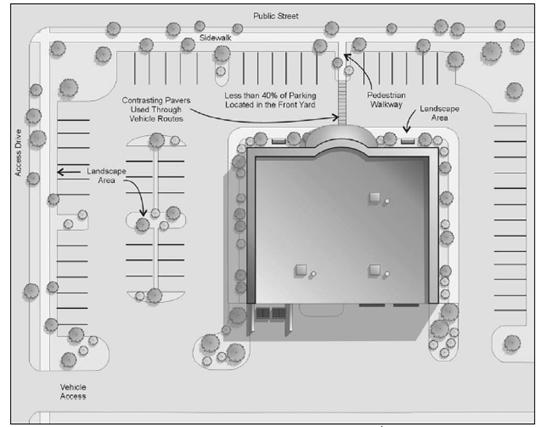
Illustrative Layout (Does not reflect all requirements established by this title).
(Ord. 04-09 § 5.4)
(Ord. No. 2021-12, § 1(Exh. B), 6-7-2021)
Intent: The purpose of this section is to establish an overlay district to address the unique characteristics of the properties adjacent to Franklin's gateway transportation routes. These gateways have unique traffic management needs, development pressures, and aesthetic characteristics that require the establishment of additional development standards to meet the goals of the comprehensive plan and fulfill the purpose of this title. The intent of the gateway overlay district is to require development at the city's entrances that is aesthetically consistent, responsive to development pressures, and proportional to the area's traffic management issues.
17.24.050 - Downtown Overlay (DT-OL).
Introduction. The purpose of this chapter [section] is to establish an overlay district to address the unique characteristics of the properties in Franklin's historic downtown. The character of historic towns and the sense of place that it creates are defined by its history, and unique architecture and streetscape. Preservation of this indigenous design not only creates a visually inviting environment, but drives economic development. People are pulled to the human-scaled, pedestrian-oriented environments with an architecture that provides the scale and detail that people innately seek. The general principles behind the following standards are:
• Retain and restore what you have when practical;
• Harmonize new structures with the old;
• Provide for the automobile but design for the pedestrian.
These design standards will provide the criteria by which the city council, plan commission, and planning department staff will evaluate development plans for consistency with the implementation policies of the city's downtown plan and the purposes of the Downtown Overlay District. The design standards are required to be met in the Downtown Overlay (DT-OL) Zoning District. Figure 1 outlines the boundaries of the Downtown Overlay Zoning District where the design standards are required to be met. Figure 1 also outlines the boundaries of the integrated economic development area. In this area the design standards should be referenced as guidelines, but are not required. The Franklin Development Corporation offers incentive financing and grants for projects that meet the design standards in the Downtown Overlay Zoning District and for projects that opt to meet the design standards in the integrated economic development area, where the design standards are not required.
A.
Boundary. The Downtown Overlay (DT-OL) Zoning District shall apply to all properties as indicated on the Official Zoning Map of the City of Franklin (see Figure 1).

B.
Appeals. Any applicant or interested party may appeal the decision of the planning director (or his or her designee) or the requirements of applicable ordinances to the board of zoning appeals.
a.
Relief from Specific Requirements. Applicants seeking relief from specific development standards or other requirements of the zoning ordinance that are unrelated to the planning director's interpretation of the applicable requirements shall be required to obtain variance approval from the board of zoning appeals.
b.
Appeal of Ordinance Interpretation. Applicants seeking an appeal of a decision or interpretation of the planning director may appeal to the board of zoning appeals.
c.
Appeal Procedure. All appeals of determinations of the planning director shall meet the following requirements:
i.
The appealing party is required to provide the planning director with written notice of the appeal within thirty (30) days of the date of the planning director's decision.
ii.
The planning director will place the appeal on the agenda for the next scheduled board of zoning appeals meeting consistent with the adopted calendar of meeting and filing dates.
iii.
The appealing party is required to provide public notice for the meeting, consistent with the provisions of section 17.48.020.
iv.
The board of zoning appeals shall consider the provisions of section 17.48.030 and all other documented, applicable standards in deciding the appeal.
C.
Uses. All uses permitted in the underlying district(s) are permitted in the Downtown Overlay Zoning District. All uses that are special exceptions in the underlying district(s) are special exceptions in the Downtown Overlay Zoning District.
D.
Background. The downtown core of Franklin is characterized by historic structures that are predominately late Victorian Italianate and Beaux Arts style of the late 19th and 20th centuries circa 1880 to 1930. This is exemplified by the structures along Jefferson Street running from Walnut east to Home Street on the north side of the street. These structures are typically two to three stories in height and consist of a lower storefront predominately of clear glass and columns or large windows, an upper floor with punched masonry windows and an ornamental cornice at the top of the building. The proportions of the façades are based largely on an eighteen- to twenty-foot-wide storefront bay repeated multiple times where the buildings are larger and repeated only once where they are of a single bay width. The façades are primarily constructed of glass, cast iron, brick masonry, brick and stone masonry, ornamental metal, and in some cases wood trim. The historic windows in the upper façades are largely double hung windows with either one over one or two over two panes. An eighteen- to twenty-foot width is established on the façades that run vertically through the building. The buildings are organized by six to eight foot bay lines running vertically through the building consisting of columns, windows and pilaster elements creating the vertical width and ordering of the façade.
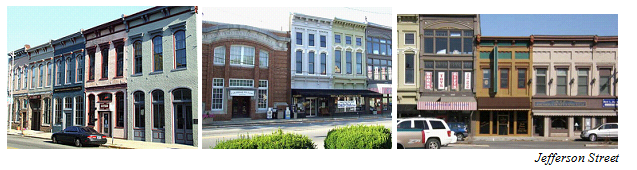
General Requirements
1.
Façade Retention and Restoration. The building façades on a street provide the visual image of the downtown. Because they are composed of similar parts, their appearance should be organized and coordinated. Over the years, however, maintaining this appearance has been a challenge. Due to technological developments, changing tenants, and different merchandising trends, a storefront will go through multiple design changes over time. The upper façade, often viewed as less important, tends to have been ignored or even covered over. Because building appearance is an essential ingredient of a successful downtown, owners are encouraged to restore and maintain their building facades in the original, intended manner.
The primary façades of all historic structures (Outstanding, Notable or Contributing by the Johnson County Interim Inventory Report, published by Historic Landmarks Foundation of Indiana, 1985) should have all defining features of the overall historical character retained. In the case where these defining features no longer exist, have been torn down, or covered up, these features should be restored if and when restoration or remodeling takes place in the particular area of the feature. Where documentation of the original is not accessible, all work on a façade should comply with the standards for new development in subsection 12. Changes that have no historical basis or seek to create an earlier appearance should be avoided.
The façade of the typical downtown building is made up of three parts: the storefront with entrance and display windows, the upper façade, and the cornice that caps the building. Within these three parts are the details that give a façade its character, including the bulkheads, transom, storefront cornice, windows, and window hoods (see Figure 2).
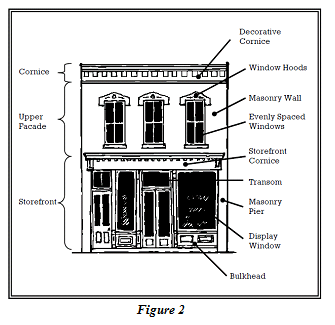
When planning a façade renovation, consult the following standards, as well as the standards relating to specific elements found later in these standards.
A.
Façade Retention. All historic buildings should be preserved. In the case of commercial buildings where the area of the building behind the façade is in severely deteriorated condition, all primary façades should be retained and new construction may be infilled behind the façade.
a.
Original features, historic elements, and examples of craftsmanship should be retained wherever possible. The removal of distinguishing features or significant architectural details should be avoided. Previously made changes that have achieved architectural or design significance should be retained.
b.
Exception. In the case where an accessory structure is so severely deteriorated that it is an unsafe structure, the accessory structure may be razed. This exception should not be construed as permitting the demolition of an accessory structure by means of purposely causing or allowing it to fall into disrepair.
B.
Façade Restoration. The following standards apply to the repair or restoration of any façade or façade feature.
a.
Historic buildings should retain all architectural elements such as windows, cornices, porches, roof lines, eaves, entry ways, and façade materials. Deteriorated architectural elements on any historic building should be repaired or replaced. Where an architectural element has been previously removed or the severity of deterioration requires replacement of a feature, the new feature should match the original in size, scale, and architectural style, and where possible, materials. Synthetic materials may be used in the case where original materials are not available.
b.
Nonhistoric buildings which contain architectural elements similar to those on surrounding historic buildings should retain those elements by repairing or replacing those elements. It is recommended that those elements be repaired rather than replaced. If those elements are being replaced, they should match the original in size, scale, and architectural style. Those elements should not be removed without being replaced.
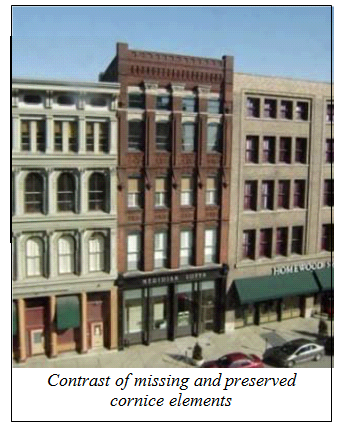
c.
Where any architectural element on a primary façade or other highly visible location is being replaced, the replacement feature should match identically any parts, portions, or pieces of remaining similar architectural elements in size, scale, style, design, color, and where possible, materials.
d.
Where the replacement of an architectural element is limited to the secondary façade and is not highly visible, the replacement feature shall be consistent with architectural style of the building and should not clash with the overall architecture of the building or any individual architectural details.
e.
Chemical or physical treatments that cause damage to historic building materials should not be used. The surface cleaning of structures should be undertaken using the gentlest means possible in order to preserve the building materials.
f.
Infilling, enclosing, covering, or removing of any original windows, doors, storefronts, porches, display windows or other architectural details is prohibited.
g.
Shutters, if utilized, should be sized to appear as though they could work. However, shutters were seldom used on 19th and 20th century buildings.
h.
Awnings should be of a proportion and color to complement the existing colors of the building.
i.
Accessibility modifications should be made at side or rear entrances to maintain façade integrity.
The following are the defining primary façade features which should be retained or restored. This should not be construed as preventing the ordinary maintenance and repair of a façade.
a.
Kick plates at the base of storefront display windows;
b.
Clear glass, which does not produce excess amounts of glare for all first story windows and glazing;
c.
Original recessed entrance areas, angled vestibules, spaces, or corners;
d.
Transoms above doors and windows;
e.
Clearstory portions of the façade;
f.
Signage bands including relevant ornamentation;
g.
Original window styles including opening size and location, sashes, mullions, muntins, sills, and heads;
h.
Decorative columns, pilasters of cast iron, brick or stone;
i.
Cornices;
j.
Parapet walls.
The following additional requirements also apply to all facades:
a.
In the case where a building was originally built in such a way that it would not meet the standards of this chapter and the façade does not contribute to the overall character of the Downtown Overlay District, any remodeling of such building's facades should follow the standards for new development. This should not be interpreted as being required during ordinary maintenance and repair.
b.
No HVAC, mechanical or other equipment should be placed on or attached to the primary façade. Additionally, equipment should be concealed from view from any public street.
c.
First floor display windows should allow visibility from any pedestrian walkway into the business or contain a display of products, art, or other creative display, which is oriented towards and facing the sidewalk and is a minimum of eighteen (18) inches deep. No obstruction of view such as paper or plywood coverings or interior facing display case is permitted within eighteen (18) inches of the interior of the glazing except during active construction for which all required certificates, permits, and approvals have been obtained.
d.
Windows on secondary façade or upper stories should not be covered from the inside with coverings such as paper or plywood. If the space behind the window is vacant, it is recommended that the window contain blinds or curtains if blocking of the window is so desired.
e.
The use of the following inappropriate materials should not be used:
i.
Coarsely finished rustic material such as wood shake shingles, barn boards, plywood and wood siding.
ii.
Carpeting.
iii.
Expanded or perforated metals, industrial metal siding, wire mesh, or corrugated metal or fiberglass.
iv.
Inappropriate ornate ironwork such as New Orleans style grills and rail work.
v.
Stucco surfaces with rustic or highly textured surfaces characteristic of Mediterranean or Southwestern styles.
vi.
Antique appearing, synthetic, oversized, or variegated brick.
vii.
Silver, gold or clear anodized bright metal including aluminum or stainless steel trim for windows and doors.
viii.
Residential type materials such as embossed entry doors, sliding patio doors and residential beveled and leaded stained glass doors.
ix.
Flat or molded plastic sheeting used to simulate historic materials, stone, or masonry veneers.
x.
Rustic field stone or rustic rock masonry work
xi.
Flush glazing treatments, glass block windows, or mirrored, highly tinted, colored, metalized, or reflective glass.
2.
Window Restoration and Replacement. Windows play an important visual role in the downtown. Display windows provide merchants with an area to display their wares. The upper story windows establish the pattern that helps tie together the façades of a block. Transom windows provide light and ventilation to the inside of the building. Window style and decoration has changed through the years (see Figure 3). However, proper care and maintenance of all storefront windows remain key to an attractive building.
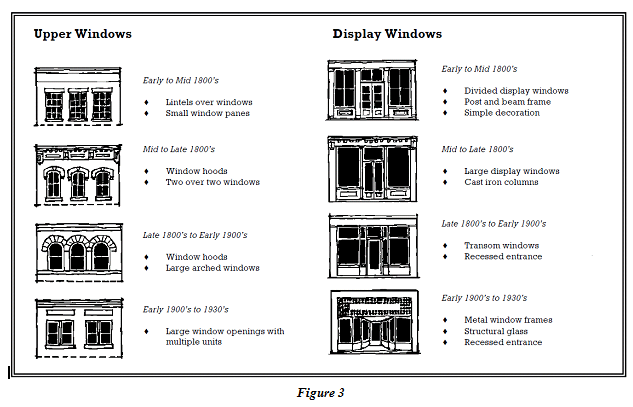
Display Windows. The display window is a crucial element in the success of a downtown business. An attractive, well-planned display can be the difference between someone merely walking by or actually coming in to shop. After setting up your window display, be sure to view the display from outside, to gain the same perspective as customers and passers-by. Also, be careful with all window signage. While a display window can provide space for an attractive painted sign, you should not cover excessive amounts of any window with signage.
Upper Story Windows. Upper story windows are often neglected, inappropriately replaced, or even boarded up. Not only does this impact the appearance of the building, it can change the character of a block. If your building has upper story windows, be sure to set up a regular maintenance schedule. This will help prevent further deterioration.
Transom Windows. Transom windows, located at the top of the storefront opening, are a source of natural light and ventilation. For energy conservation, these windows were often covered or removed. Covering or painting over transom windows upsets the design relationship of the façade and destroys the rhythm of repeating patterns on the street. Uncovering and restoring transom windows is encouraged.
Windows on historic buildings are the most important elements in defining its architectural character and significance. Their original materials and features should be respected and retained. Repairing historic windows has become easier with the introduction of new materials and techniques. The following standards apply to the restoration or replacement of windows.
A.
Window Repair. The most common window problems involve damaged or deteriorated wood, faulty window operation, and broken glass panes. Many problems can be easily repaired at a minimum cost.
a.
Deteriorated wood is often found on the sill or bottom of the sash. These parts can be replaced without replacing the whole window. Local building supply stores may have pieces that match the original window. Minor repairs can be made by scraping off old paint, filling in cracks with putty or caulk, sanding, priming and applying a fresh coat of paint.
b.
A window that isn't operating like it used to should be addressed. It could be that the window is painted shut. This can be corrected by tapping the sash with a hammer wrapped in cloth. Another problem could be with the window mechanism (sash locks, cords, and weights). If this is the case, contact a window dealer who can offer assistance without changing the window. Franklin Heritage can recommend contractors who have experience with this type of work.
c.
Broken glass panes can be easily fixed by removing all old glass and glazing putty, and installing a new pane using the appropriate glazier's points and putty.
d.
Be sure to check all joints between a window and its masonry opening. If loose or open joints exist, caulk to prevent air and water filtration.
e.
Window trim, cornices, sills, and decorative window caps or other details should be replaced and installed on historic buildings only if they originally existed. In the case of nonhistoric buildings, these window elements may be added only where they fit the architectural style of the building. Enhancing windows with superfluous nonhistoric or architecturally inaccurate details is not permitted.
f.
Creating new window openings or eliminating original window openings that significantly alter the character of the elevations is prohibited.
g.
Reestablishing original window openings that have been reduced or completely closed is encouraged. New windows used to reestablish the original openings need to follow the standards for window replacement.
B.
Window Replacement. Sometimes repairs may be impractical and the only option available is replacement. If you're replacing only one window, find a replacement that matches the existing units. If you cannot find a suitable replacement, consider having one custom made. Wood is the preferred choice, however if you must use aluminum or vinyl, a darker color is preferred. Do not alter the existing window opening to fit new windows and do not install windows that are not in keeping with the style of your building (See Figure 4).
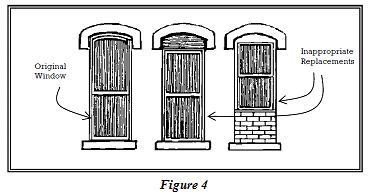
C.
Storm Windows. Installing storm windows is a great way to cut down on your energy costs. The downside is that they often look inappropriate on an older building façade. If possible, consider installing storm windows on the inside so they will not be seen. If they must be installed on the outside, make sure they are the same shape and have the same overall design features as other outside windows. An anodized or baked-on finish is more desirable than plain aluminum.
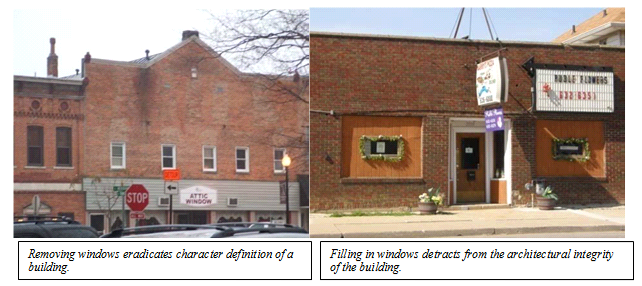
3.
Masonry Repair and Restoration. Regular maintenance is the most efficient and economical way to keep your building looking its best. As a general rule, you should treat any historic detail with care. First and foremost, maintain what you have. If necessary, repair or replace the detail, duplicating or complimenting the original. The following tips will assist you in identifying and addressing potential problems.
Every effort should be made to retain the historic masonry façades in their original design, shape and architectural appearance including all relevant detailing, and ornamentation. For the purposes of this section, masonry includes stone, brick, architectural terra cotta, cast stone, concrete, and concrete block. Typically masonry deterioration and damage has been caused by neglect or deferred maintenance due to water infiltration, horizontal and vertical movement of the masonry due to disengagement from the structural frame, vertical settlement, or horizontal movement due to expansion and contraction. Extreme care is required for any masonry repair to prevent an obvious unsightly patch.
Moisture. Brick and stone are durable but they can deteriorate over time. Most often, water infiltration is responsible. Moisture can enter through the top of a wall or where the wall meets the roof. Check your roof, flashing, and wall copings periodically for soundness. Gutters and downspouts should also be inspected periodically for leakage.
A.
Tuckpointing. The mortar used in older masonry buildings gradually erodes as water runs over the wall surface and with freeze/thaw cycles. Joints should be inspected periodically for crumbling or missing mortar. If mortar joints have recessed more than two inches, they should be repointed with new mortar to prevent water infiltration and ensure the integrity of the wall. New mortar joints should match the original in style, size, composition, and color. It is especially important to repoint with mortar of the same hardness as the original. The softer historic mortar compresses as the bricks expand in warm weather and flexes as they contract in cold weather. It is by design, the sacrificial element of the wall and gradual erosion is to be expected. Harder modern mortars with a high content of Portland cement will resist the warm weather expansion of the brick, which can cause cracks in the brick surface. In the cold weather, this same inflexibility may cause cracks to open up as the historic bricks contract.
B.
Cleaning. Masonry cleaning can have a huge impact on the appearance of a building. Most historic masonry buildings have never been cleaned, and accumulated dirt can obscure the original masonry color. Masonry should always be cleaned by the gentlest method possible. In many cases low pressure water washing (no more than two hundred fifty (250) psi), together with scrubbing with a natural bristle brush may be sufficient. If paint or heavy grime must be removed, a chemical cleaner may be required. There are a variety of chemical cleaners available and a qualified cleaning contractor should be consulted to evaluate your building and recommend a treatment. Whatever treatment is selected, a test patch should first be tried in an inconspicuous area and allowed to weather for a few weeks or months. If the results of the test are satisfactory and no damage is observed, it should be safe to proceed. Remember to protect nearby trees, shrubs, and groundcover when cleaning your building. Chemical cleaners may be hazardous to vegetation. The following treatments are appropriate and should be used during all cleaning, repairing, and restoring of masonry:
a.
Cleaning masonry with the least abrasive method possible.
b.
Using test patches in inconspicuous areas on secondary elevations to determine the appropriate means of cleaning.
c.
Addressing and correcting the underlying cause of damage to masonry before any repair or repointing is undertaken.
d.
Mortar joints should be cleaned out and loose mortar removed to appropriate depth, usually one to one, replacing typically all mortar on historic buildings with a high lime content.
e.
All mortar should be carefully removed so as to not damage any of the edges of masonry surfaces.
f.
All replacement masonry should match the existing whether it is salvaged or new material and reused material should be closely matched in terms of size, color and texture.
g.
Painted masonry structures should be permitted to retain painted surfaces after appropriate cleaning and removing of loose paint and debris.
C.
Inappropriate Masonry Treatments. The following treatments are discouraged for all cleaning, repairing, and restoring of masonry:
a.
You should not use abrasive treatments (sand blasting or high pressure washing) to clean masonry surfaces.
b.
Replacing bricks and brick masonry unless it is excessively spalled or cracked. Instead the same bricks should be reused if possible by cleaning and reversing their faces. Use of contemporary new brick that is "antique in appearance" with a wide range of color is discouraged. Brickwork, particularly on historic buildings, is usually uniform in character.
c.
Covering of historic masonry surfaces with any type of siding, metal or synthetic sidings, stucco, exterior insulation finishing systems (EIFS) or ceramic or fiberglass veneers.
d.
Using any kind of power grinding to remove masonry or to remove mortar or to alter masonry.
e.
Sandblasting should not be done on historic structures unless where otherwise specifically allowed. Sandblasting is especially harmful to brick surfaces, eroding the hard outer layer to expose a softer, more porous surface that will weather rapidly. You should be aware that sandblasting will disqualify a project from consideration when applying for state and federal tax credits.
f.
Exposed masonry should never be painted. A previously painted surface can be restored by a chemical paint remover. Previously painted structures should, in all probability, be retained as such because removing paint can result in detrimental effects to the underlying masonry surfaces.
g.
Waterproofing, repellants or sealers used on any masonry surface. These materials can potentially cause serious damage by trapping moisture in masonry, which would cause deterioration in the future. If used, it is essential to allow breathing of the surfaces on which they are applied
h.
Abrasive methods for paint removal to expose original brick.
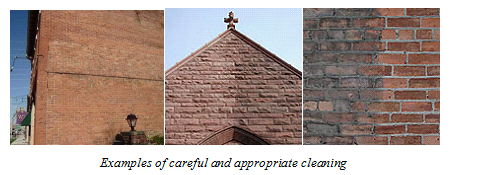
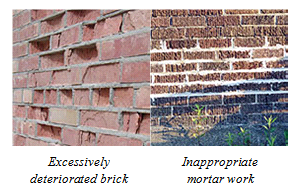
4.
Wood Maintenance. Storefronts, cornice brackets and other decorative façade elements were often made of wood. These original exterior woodwork elements should be retained wherever possible. Regular maintenance will prevent deterioration. Check periodically for soft, rotted areas, splits, and dampness. Damage or decayed sections can usually be repaired by re-nailing, caulking, and filling. Epoxy pastes and epoxy consolidants can also be very effective in repairing even seriously rotted wood. When painting, use an oil-based primer followed by two coats of oil-based paints.
Severely rotted or missing pieces may be reproduced by a good carpenter or millwork shop. Try to match or at least complement the existing details when replacing woodwork.
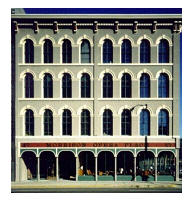
5.
Metal Maintenance. Many of the buildings in the historic core of Franklin are defined by the cast iron and ornamental metal elements that form the storefronts at the pedestrian level. These elements are principal defining features of the façades and should be retained and restored through every possible effort. The lower display window kick fronts support columns, window mullions, and decorative elements of the transom and sign bands are typically made of these materials. Stamped or pressed metal was most often used to create decorative metal cornices. This kind of architectural ornamentation became quite popular because intricate detail could be reproduced at a reasonable cost.
The signs of metal deterioration are obvious: corrosion, tears, holes and missing pieces. Pressed or stamped metal may be of copper, which requires no surface protection, or of sheet iron, usually coated with zinc or lead to retard rusting. A proper coat of paint is essential to prevent rust and corrosion on such metals. Missing parts can be reproduced in fiberglass or aluminum using existing pieces to make a mold. Be sure to communicate to the person fabricating the replacement part the importance of maintaining the intricate decoration of such pieces.
Appropriate Cleaning and Repair. Strip and clean off old paint and rust using appropriate chemical strippers and non-abrasive power washing and light sandblasting. Extreme caution should be taken with rolled sheet metal surfaces so as to not damage them if any of the power washing or light nonabrasive power blasting methods are used.
6.
Decorative Glass Maintenance. Beveled, stained, leaded and etched glass are all forms of decorative glass. Glass decoration is often covered up. Look for it in transoms or behind plywood window covers. Sagging means that the glass and frame will need to be reinforced with a brace. Leaded or stained glass can have problems. The metal between the glass pieces, called the "came," could either be zinc or lead. You should always use the same metal when making repairs.
7.
Color Guidelines and Recommendations. Choosing the right color combination for a building can unify the elements of the façade and relate the building to others on the block. Again, step outside and look at your building as it relates to others. Make sure the colors you use are in character with the rest of the buildings on the block. Generally, no more than three colors are sufficient for a building façade. Paint manufacturers have a large selection of historic colors available and can assist with an appropriate color scheme. Stay away from bold colors that attract undo attention to the property. The use of fluorescent, metallic, reflective, or glittery colors for exterior walls, trim or other architectural features is prohibited.
Background. Muted or natural tones are appropriate for the background of the building. The background consists of the upper wall and the piers on either side of the storefront. This color is often natural brick and requires no painting. In fact, painting of brick surfaces is strongly discouraged and discussed in subsection 3. Masonry Repair and Restoration.
Major Trim. The color of major trim elements such as cornices, window frames, sills and hoods, and the storefront frame, bulkhead and columns should complement the background color.
Secondary Trim. Secondary trim such as the window sashes, doors, and certain cornice and bulkhead details should enhance the color scheme established by the background and major trim. A darker shade of the major trim is often used to highlight these features. Caution should be exercised to ensure that the façade is not over-decorated.
In general, color schemes should be selected that are appropriate to the building's style and period. Using a 1950s color scheme on a Victorian building is inappropriate. The color schemes should be developed to enhance the character-defining elements of the architecture and to complement and relate to its neighbors in the downtown core. Different color schemes were popular at various times. In the mid 1800s, soft, neutral tints were common. Toward the end of the 19th century, darker, richer shades were used. Tastes changed again at the beginning of the 1900s to lighter, calmer colors. If you are thinking about returning your building to its original colors, carefully scrape the paint from a small area. There may be several layers of paint over the original color. It's possible that the original color may have changed over time. For a better idea of the true color, wet the original surface. The base color will appear more accurately when wet. It is not necessary that colors be researched and analyzed to document original authenticity. As noted in the masonry repair section, previously painted structures should, in all probability, be retained as such because removing paint can result in detrimental effects to the underlying masonry surfaces.
The sun will play an important role in the colors you select. Before deciding on a color, take a paint chip outside to see how it looks. Do this at various times throughout the day, and also on both sunny and cloudy days. Sometimes a small paint chip is not enough to get a good idea of how a color will look. In that case, invest in a quart of the color you choose and apply it to a small area on your building. The effect may be surprising.
Next Steps. Painting your building can provide a dramatic improvement in your building's appearance for a relatively low cost. After deciding on the appropriate colors, however, your work has just begun. There are several steps you should follow to ensure your new paint job will be long lasting and successful.
1.
Type of Paint. Should you use oil-based or latex paint? Both have their advantages and disadvantages. Oil-based paints are generally more durable, and may provide better adherence. Cleanup is more difficult. Latex paints are easier to apply and cleanup is simple. However, latex paint can be less durable than oil-based. Whichever you choose, select a quality paint. Although you'll pay more, a quality paint will last longer than a cheaper paint, will not fade or peel as quickly, and gives better coverage. It is important to note that once you use a certain type of paint for your building, you should continue to use the same type of paint. Switching back and forth between oil and latex is difficult.
2.
General Preparation. There are many things you can do to prep your building for painting. Check the condition of any wood and replace any boards that are rotted. If you are painting a masonry building, check the condition of the mortar and tuck-point where necessary. Review the condition of your windows. Install new glass in all broken windows. Replace damaged putty with a glazing compound and make sure it goes all around the windows. You'll need to wait two to three days for the compound to dry before you can paint.
3.
Surface Preparation. Prior to painting, all surfaces should be adequately prepared. All loose or peeling paint must be removed. Wire brushes and scrapers are the best tools to use. If these do not work, consider a blow torch or electric heat gun. Use caution with these last two devices, with only enough heat to soften the paint so it can be easily pushed away. Consider using a primer for the first coat, especially on older buildings. It will help the final coat adhere better.
Other Considerations.
1.
Colored mortars should not be employed to alter the coloration of historic structures.
2.
Natural colors of brick, terra cotta, fired clay stones, masonry, limestone, granite, sandstone or other natural materials should be retained and should not be painted over unless it is consistent with the historic precedent.
3.
Architectural metals such as copper, bronze and brass should not be painted.
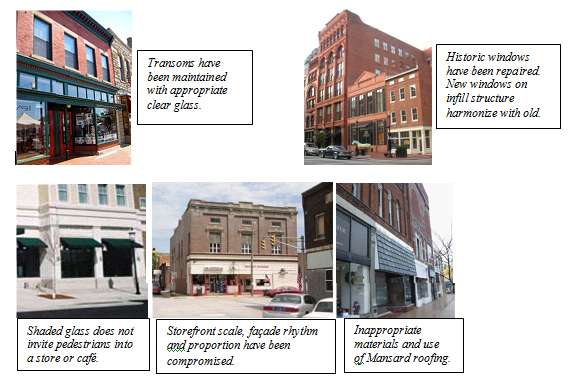
8.
Doors. Traditionally, downtown buildings had three doors. On the building front, there was storefront door, providing access to the business, and a secondary door, providing access to the upper floors (see Figure 5). The rear door was primarily used as a service door.
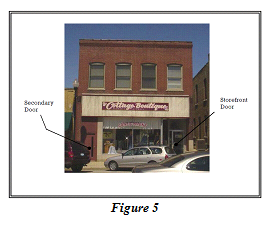
Storefront Door. Historically the entry to a store was more than just a door. The design and appearance reflected its commercial importance. The traditional storefront door was substantial, built of wood with a large glass panel. Despite its stately proportion, the door was inviting to a customer. Although traditional storefront doors are rarely found these days, there are several things that can be done to make a front door the special, inviting element it should be.
1.
A front door should be compatible with the rest of the storefront and make a significant statement.
2.
To retain a traditional appearance, a wood door with a tall glass panel is most appropriate to maintain the original character. Try to locate a salvaged older door to repair or use a new door of similar design.
3.
If a traditional appearance is not desired, the design choice should be based on the overall design of the storefront. Many different wood and metal styles are available. If a glass and aluminum door is chosen, consider using a dark, anodized finish rather than a metallic color.
4.
Avoid over-decorating the door. The design should reinforce the character of the building and be inviting for shoppers.
Secondary Door. A secondary door on the front façade provides access to the upper floors and is usually less elaborate in design. When choosing a secondary door, keep in mind that it should be visually understated, fitting in with the overall façade, but not drawing attention to itself. To maintain a traditional appearance, an old wood panel door is most appropriate.
Rear Door. A practical style is recommended for a rear door to reflect the unadorned character of the rear façade. If the back door will be used as a customer entrance, consider the addition of glass to the door to make it more inviting to shoppers and passers-by.
9.
Awnings. Awnings can be both a decorative and functional addition to a storefront. Visually, an awning can add character and interest to a storefront. Practically, an awning provides a sheltered space for customers to view store window displays, and can provide energy saving benefits, especially when used on southern facing windows. When planning an awning for your building, the following should be considered:
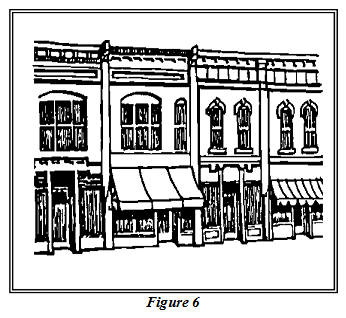
Design. The design of an awning determines how energy efficient it will be. There are two types of awnings available, fixed and operable. An operable awning can be opened and closed, allowing sun to shine in on cold days and providing shade on warm sunny days. A fixed awning is primarily decorative.
Style. Awnings should be integrated into the design of the building façade, with simple pitch and profile that matches the building bay structure. Awnings along a street should have a consistent pattern in size and shape, and not conflict with others. Look at your neighbors' buildings and visualize how adding an awning will affect the character of the streetscape (see Figure 6).
Material. Awnings can be constructed from several different materials, including canvas, vinyl, and aluminum. Whichever material is chosen, make sure it is guaranteed weather-resistant. Fading or bleaching from the sun is also an important consideration.
A.
Canvas awnings are traditionally popular, but must be weather-treated before installation. Canvas has a lower initial cost, but may require more maintenance than plastic or aluminum.
B.
Vinyl (plastic) has a more contemporary effect, but can be attractive if done correctly. Vinyl is more flexible and usually requires less maintenance than fabric.
C.
Aluminum is another choice but is more residential in character and not generally appropriate in the downtown area.
Mounting. Awnings should be mounted so that the valence is approximately eight feet above the sidewalk. A twelve-inch valence flap is usually attached at the awning bar and can serve as a sign panel. Typically, an awning will project between four and seven feet from the building. An awning can be attached above the display windows and below the sign panel or cornice. It can also be mounted between the transom and the display window, which allows light into the store while shading the merchandise for customers. An awning over upper-story windows should not cover the piers or the space between the window sills and the storefront cornice. If an awning has support posts that are permanently affixed to the sidewalk, approval from the board of works is required before installation. Contact the mayor's office to make the request.
Color. Look at the entire building before deciding on a color for your awning. You'll want a color that enhances the existing features without overwhelming them. For buildings with more detail, a subtle shade should be used. For buildings with minimal architectural detailing, a bright accent color may enhance the façade. Pattern is important too, depending on the image you would like to project.
Signs. The valence of an awning has traditionally been used for advertising. If you choose to incorporate a sign on an awning, keep the message simple and for identification purposes only (see Figure 7).
Illumination: Internally illuminated or back-lit awnings are highly discouraged and not recommended.
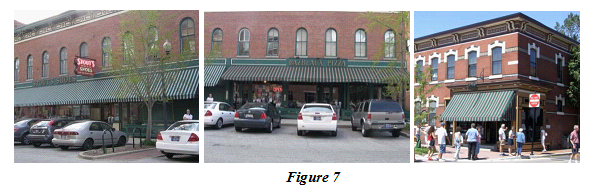
10.
Signage Treatments. All signs must conform to article 8 [chapter 17.36] Sign Standards. In addition the following standards apply to all signs in the Downtown Overlay Zoning District.
Signs are a vital part of any downtown. They call attention to your business and help attract customers. Additionally, signs help shape the image of downtown. The following questions are provided to help you determine the right signage for your business and the downtown:
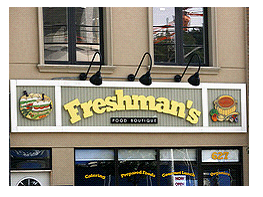
What is the Purpose of My Sign? Do you merely want to identify the name of your business? Or should you provide information on the products you sell or services you offer? Who are you trying to attract? Take some time to consider what you want your sign to do.
What Type of Message Should I Use? Can you convey your message with words? Or will a logo or symbol be more recognizable to potential customers? Possibly, a combination of words and symbols is appropriate. Sign lettering should have a high contrast ratio in order to be clearly legible for vehicular traffic. Sign lettering on wall signs, awning signs, or projecting signs needs to be a minimum of four inches in height so as to be clearly legible for vehicular traffic.
What Style Sign Should I Use? For most downtown businesses, wall, window, projecting, or canopy signs are the only types of signs that can be used. For new development or redeveloped sites, a freestanding sign is a possibility with special approval from the board of zoning appeals. If you want to use a freestanding sign, consider a monument style sign to maintain the pedestrian scale of the downtown. Taller pole signs are inappropriate and should be avoided.
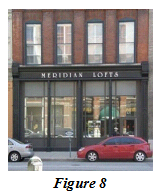
Where Should I Put My Sign? When considering sign placement, you need to visualize how your sign will appear in relation to the entire façade. A sign should not dominate the façade. Its shape and proportions should fit the building just as a door or window fits. The most common location for a wall sign is just below the lower cornice. This location compliments the architecture of the building and presents a strong image. Other common locations include on the glass display window and on the awning flap (see Figure 8). A good resource to consult is a picture of how your building looked in the past. This may give you ideas about how signs were related to the details of your building. Signs should never project above the upper cornice line or be mounted on the roof of a building. Never cover up architectural details. Horizontal projecting signs have a width which is longer than the height of the sign. Horizontal projecting signs should project no more than four feet from the building and be no more than twelve (12) square feet in sign area. In addition, horizontal projecting signs should generally be located between the transom line of the first floor and the lower half of the windows of the second floor. Vertical projecting signs have a height which is longer than the width of the sign. Vertical projecting signs project no more than three feet from the building and do not exceed thirty (30) square feet in sign area. In addition, vertical projecting signs should be located above the first floor or sign band whichever is higher.
Should I Illuminate My Sign? Illuminating a sign may be desirable. Individual back-lit letters and signs illuminated by wall-mounted fixtures are appropriate. Illuminated box signs, flashing signs, moving signs, and electronic or fixed letter reader boards are not permitted.
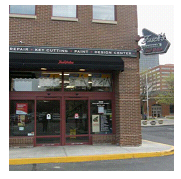
Materials. Appropriate sign materials include painted or carved wood, galvanized sheet metal or aluminum, stone materials consisting of marble, slate or sandstone veneer, granite or granite veneer, gold leaf, gilt, painted accents, sandblasted glass or metal, stained glass, clear or acrylic neon. While the use of neon can create an attractive sign, neon should not be used to outline or trim a building or the architectural elements.
11.
Lighting. Lighting is an important element when considering visibility in the evening hours. Generally, street lighting installed by the city will provide adequate lighting of the overall building and sidewalk. However, there are times when you may want to provide additional illumination to your building.
Lighting should only be used to illuminate entries, signage, displays, adjacent pedestrian and parking areas, or to highlight significant architectural elements. Use fixtures with a traditional style, or contemporary fixtures that are appropriately scaled. Building mounted fixtures should be used to illuminate entries, wall mounted signs, and walkways adjacent to buildings. Fixture color should be muted and coordinate with the overall color scheme of the building. Exposed or painted metal finishes are recommended.
To attract attention to your storefront area, there are some traditional methods of lighting you can use:
• Well-lit display windows attract attention to items in your window.
• Residual light washed the sidewalk and attracts pedestrians.
• Light over recessed entry doors can highlight your entrance.
• Lighted signs in the window (neon is acceptable) can highlight products and services.
12.
New Development. Construction of new buildings on vacant lots in the downtown is encouraged. The design and location of such buildings, however, requires special care. Two types of new construction are discussed: Infill development, where new construction fills in gaps in the existing street façade, and standard development, where new construction is on parcels located in lesser dense areas of the downtown. In order to retain the historic context and character, new buildings should reflect the character of existing historic buildings by relating to the massing, scale, articulation, and rhythm of Franklin's historic architecture.
Infill Development. The design of new infill development, especially the front façade, is critical. The new façade must look appropriate in relation to the surrounding buildings, without replicating them. When designing a new infill building, particular attention should be paid to the following:
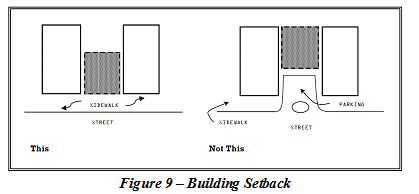
A.
Building Design. The design of new infill buildings should be harmonious with its surroundings. Architectural style is not restricted, however, extremes of styles, or attempts to recreation a style indigenous to the downtown are discouraged.
B.
Building Setback. A new infill building should maintain the line of existing storefronts at the sidewalk edge. Creating gaps in the streetscape by setting the building too far back from its neighbors or by placing off-street parking in front of a building is not permitted (see Figure 9).
C.
Building Scaling and Massing. When designing a new infill building, the scale (height and width) and mass of existing buildings along the street should be respected. The average height and width of nearby buildings can be used to determine a general set of proportions for an infill structure or the bays of a larger structure. The infill building should fill the entire void, or, if the site is large, the mass of the façade can be divided into two or more smaller bays to maintain the established rhythm of the block (see Figure 10). Primary facades should have vertical articulation a minimum of every twenty (20) feet. There should be a minimum of two windows per upper story between required vertical articulations. A vertical articulation may be implemented by using one or more of the following techniques: a structural or expressed column, a distinctive change in coloration, a slightly varied façade position, or distinctive change in overall style of architectural elements.
D.
Buildings should meet the ground with a solid base treatment to create a visual transition from the sidewalk to the building wall. Glass treatments that extend to the ground are not recommended. Upper stories should not be set back from the first story primary façade.
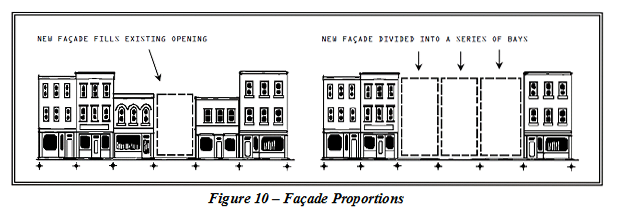
E.
Roof Forms. The type of roof used for an infill building should be similar to those found on adjacent buildings. In general, flat roofs are preferred over gable, gambrel, hop, or mansard roofs. A parapet should be used to conceal a flat roof and any roof protrusions other than the chimney.
F.
Openings. Doors and windows on an infill building should be similar in size, proportion, and alignment based on the architectural style of the building, and to those on adjacent facades. The rhythm of structural mass to voids (doors, windows, etc.) should relate to rhythms established on adjacent buildings (see Figure 11).
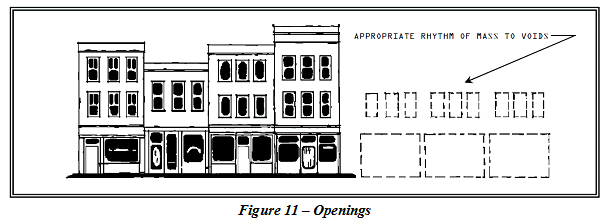
G.
Detailing. Details from adjacent buildings, such as the masonry work, cornice lines, window shapes and bulkheads, should be reflected in the architecture of infill buildings.
H.
Building Materials. Materials used in the construction of infill buildings should be similar to that used on adjacent buildings. A new building should not stand out from other buildings on the block. Brick and wood are preferred materials. The following is a list of materials that are not considered appropriate:
a.
Aluminum siding.
b.
Aluminum panels.
c.
Coarsely finished rustic material such as wood shake shingles, barn boards, and plywood.
d.
Mirrors or reflective glass.
e.
Carpeting.
f.
Stucco surfaces with rustic or highly textured surfaces characteristic of Mediterranean or Southwestern styles.
g.
Antique appearing, synthetic, oversized, or variegated brick.
h.
Corrugated fiberglass and metal.
i.
Residential type materials such as embossed entry doors, sliding patio doors and residential beveled and leaded stained glass doors.
j.
Flat or molded plastic sheeting used to simulate historic materials, stone, or masonry veneers.
k.
Rustic field stone or rustic rock masonry work.
l.
Flush glazing treatments, glass block windows, or mirrored, highly tinted, colored, metalized, or reflective glass.
Aluminum, steel, or vinyl cased wood windows may be used, but should have an appropriate finish and color consistent with the overall color scheme.
I.
Details from adjacent buildings, such as the masonry work, cornice lines, window shapes and bulkheads should be reflected in the architecture of infill buildings.
J.
On-Site Parking: On-site parking should be confined to the rear of structures and should be screened from public view per the Landscape Standards in Article 7.
K.
Height Requirements. Buildings should be a minimum of two stories of habitable floor space. Any building facing the courthouse square should be no more than three stories and should be no taller than the height of the upper cornice line of the courthouse. Any building not facing the courthouse square should follow the maximum height as specified in the base zoning district.
a.
Exception. In the case of freestanding institutional buildings such as churches, schools, or government buildings which do not face the immediate courthouse square, the planning director may exempt the development from certain requirements of this section where those requirements specifically contradict the traditional architectural style for that type of institutional building; e.g. a church would not be required to have first floor display windows, but vertical articulation and vertically oriented windows would still be appropriate.
b.
Exception. In detached buildings away from the courthouse square, the building may have only one habitable story as long as the minimum height of façade walls is twenty (20) feet.
L.
Miscellaneous:
a.
Floor Level. The floor level of an infill building should relate to and be consistent with the floor levels of adjacent buildings.
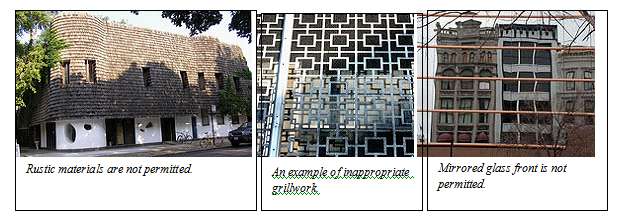
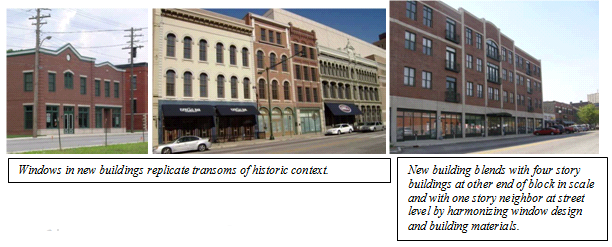
13.
Residential Type Structures. The following applies to all residentially designed structures in addition to the general requirements of this chapter. Any one- or two-dwelling-unit structures as a primary use located in the Downtown Overlay Design Standards Zoning District shall be exempt from these design standards.
1.
Residential Façade Design Standards. The following applies to the restoration of residential primary and accessory structures in addition to the general requirement for facades.
a.
General. All work shall follow the general requirements of subsection 1. for façade retention and restoration.
b.
Windows. All work on windows shall follow the general requirements of subsection 2. for window restoration and replacement.
c.
Masonry. All masonry work shall follow the general requirements of subsection 3. for masonry repair and restoration.
d.
Retention of Entrances. Primary building entrances should maintain historic stoops, terraces and relationship to grade so as to maintain the character of the historic façades. Handicap-accessible entries may be located on a secondary façade so as to not obstruct the primary front yard elements.
e.
Alterations. Any exterior alterations or remodeling shall follow the standards for new residential development under subsection 10.3 New Residential.
2.
Additions. The following shall apply to additions of residential buildings.
a.
They should be substantially similar to the primary structure in terms of building materials, trim detail, roof lines, window and door styles, and other prominent details.
b.
They should match the primary structure in terms of coloration of siding, trim, and other details.
c.
They should not include architectural styles and details from a period different than the existing primary structure.
d.
They should be no taller than the existing primary structure.
3.
New Residential. The following applies to all new residential buildings including accessory structures. New infill structures should visually relate to the character and scale of the adjacent structures in the immediate block in which they are located.
a.
ROOFS.
i.
Roof pitch should reflect the architectural character of the home, and may be either gable, hipped, or a combination.
ii.
Eave lines should align wherever possible. Eaves and rakes should be articulated by multiple fascia boards, cove and crown molds, or gutters.
iii.
Eave overhang should be minimum sixteen inches (16") from exterior face of structural framing.
iv.
Overhang of gable should be a minimum of twelve inches (12").
v.
The following roofing materials are permitted: wood shingle, slate, tile and asphalt shingle.
vi.
Boxed in eave lines are not permitted.
b.
WINDOWS. The following applies to all windows on primary façades and windows which are highly visible from a public street.
i.
All windows should be double-hung in appearance (except transoms). Single-hung windows with a lower operable sash and fixed, nonoperable windows are acceptable provided they have a double hung appearance.
ii.
Casement windows may be used where the paneling adds to and is consistent with the architectural style of the house.
iii.
Preferred window types include all wood, vinyl-clad wood, or aluminum-clad wood. All-vinyl windows may be utilized, provided they have an acceptable profile. Window types should be called out on plans.
iv.
If all-vinyl windows are used, windows should have painted wood trim consistent with item v. below, consistent with the architectural style of the home.
c.
SHUTTERS.
i.
Shutters will be permitted on homes only if they are appropriate to the architectural style of the home.
ii.
Shutters should function or appear to be functional by matching the size and shape of the shutters to the window. They should include decorative hinges or be placed such that the shutters could pivot so as to be functional.
d.
EXTERIOR DOORS AND TRIM.
i.
Door trim should match exterior window trim treatment. Wood trim around doors is required when wood trim is used on windows.
ii.
Storm doors are acceptable provided that they are full-light doors with clear glass so the primary door is visible and all trim on the storm door is painted to match the home colors.
iii.
Sliding glass doors are not acceptable along a primary façade of the home.
e.
SIDING AND DECORATIVE TRIM.
i.
Brick, wood, or cement-fiber are preferred exterior materials.
ii.
Natural stone may also be permitted.
iii.
Vinyl siding may be utilized and should be a flat color, not shiny.
iv.
No Dutch lap vinyl siding will be permitted, as all vinyl siding should be either double-four or triple-three type. Vinyl siding with a brush-stroke finish in lieu of a wood-grained texture is acceptable.
v.
Horizontal siding should have a maximum six-inch reveal.
vi.
Mixing of material types is restricted to fishscale or shake decorative siding at second floor transition and in gables in conjunction with horizontal siding.
vii.
Trim boards, corner and frieze boards should be built out with filler boards to allow siding to be tucked behind trim board. Corner trim boards should be a minimum of three and one-half inches in width.
viii.
All trim must be smooth surface trim. No rough-saw trim will be accepted.
ix.
Siding latticework, spindles, brackets and other decorative trim is encouraged.
x.
T-1-11, ODB, plywood, aluminum or similar product styles and types are prohibited.
xi.
Recreating historic details or features contrary to the original architectural style of the subject structure should not be done.
f.
BRICK.
i.
The use of brick is encouraged, but if used should be provided consistently on all four sides of the home.
ii.
Brick front porches are desirable and encouraged.
g.
GARAGES and ACCESSORY STRUCTURES.
i.
Accessory structures should not exceed seventy-five (75) percent of primary structure footprint in ground floor area.
ii.
Roof slope must be minimum 4:12 roof slope. Roof slope is preferred to match primary dwelling.
iii.
Roofs should be gable or hip roofs.
iv.
Roof shingles should match those on primary dwelling.
v.
Aluminum gutters and downspouts must match those on primary dwelling.
vi.
Garages should have minimum eave overhang as required for roof venting. It is preferred that overhang depth and finish should be consistent with the primary dwelling.
vii.
Accessory structures should be wood framed wall and roof construction.
viii.
Horizontal siding and trim should match those on primary dwelling in terms of design and coloration. The materials used for siding may differ from the primary structure.
ix.
Decorative siding in gables is preferred, but not required.
x.
Overhead and passage doors and windows should be finished to match house.
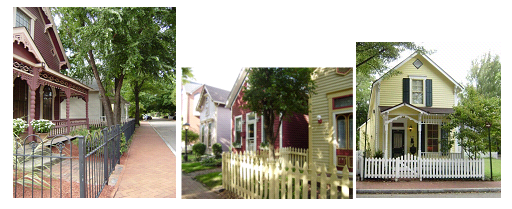
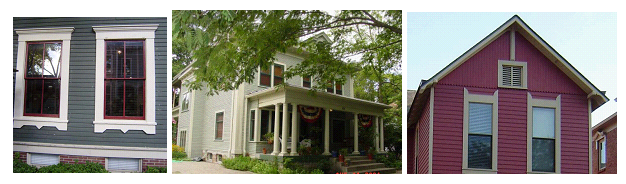
(Ord. No. 2010-04, § 2(Exh. A), 7-19-2010)

