
Franklin City Zoning Code
CHAPTER 17
28 - PLANNED UNIT DEVELOPMENT
17.28.010 - PUD intent, uses and standards. *
A.
Uses. All uses are subject to the discretion and approval of the plan commission. No uses are granted by right, and no uses are considered special exceptions. All land uses proposed in a planned unit development must be compatible with the intent of the comprehensive plan and the characteristics of surrounding land uses and zoning districts.
B.
Development Requirements. Development requirements for all proposed planned unit developments shall be created by the applicant as part of the detailed plan submittal. All proposed development requirements are subject to the review and approval of the plan commission and common council. Generally, the planned unit development shall provide standards for the development that replace: (1) the lot standards established by Chapter 17.16, Zoning Districts; (2) each topic area regulated by Chapter 17.32, Development Standards; and (3) any standards replacing those established by the subdivision control ordinance.
C.
Rules and Procedures. All proceedings brought under this chapter are subject to the rules and procedures of the plan commission.
D.
Limitation of Ordinance Amendments. Any initiative of the plan commission to amend the zoning ordinance that would affect an approved planned unit development before its completion, shall not be enforced on the planned unit development. New amendments to the zoning ordinance shall only apply to planned unit developments that have been declared abandoned, or for which an approval has expired.
E.
Origination of Proposals. Any applicant may propose a planned unit development district in accordance with the procedures established in this chapter. The applicant making the proposal must intend to act as developer or sponsor of the development. A parcel or site proposed for a planned unit development may or may not be under single ownership. However, if not under single ownership, the multiple owners must have a contractual agreement: (1) not to develop the parcels separately, but in accordance with a single, unified plan; and (2) in which the separate owners have given their express intentions to enter into such private agreements and to assure its completion as planned and to the satisfaction of the plan commission.
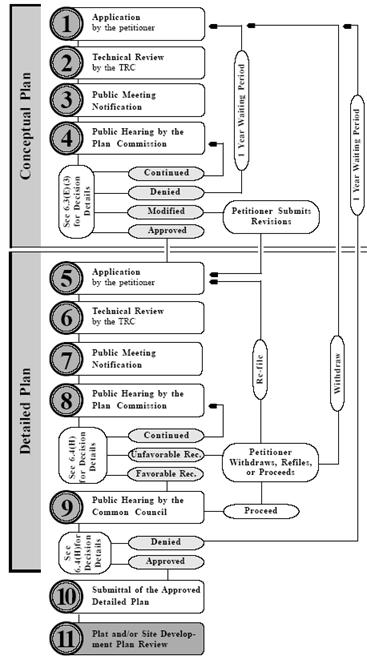
* Editor's Note: The references in this diagram to Sections 6.3 and 6.4 are Sections 17.28.030 and 17.28.040 of this code.
(Ord. 04-09 § 6.1)
* Intent: The purpose of these regulations is to provide greater design flexibility
in the development of land when consistent with the comprehensive plan and intent
of the zoning and subdivision control ordinances.
Planned unit development regulations are intended to encourage innovations in land
development techniques so that unique opportunities and circumstances may be met with
greater flexibility. Planned unit developments should be used to address unique environmental
concerns, provide a unique mix of land uses, and implement the comprehensive plan
in ways not considered by the established zoning districts. A planned unit development
should not be used if the proposed development can be created using established zoning
districts.
See Also: IC 36-7-4-1500 series, Planned Unit Development; Chapter 17.32, Development Standards; Franklin plan commission rules and procedures.
17.28.020 - General application requirements.*
A.
General Application Requirements. All applications may be obtained through the planning director's office. Fees shall be paid at the planning director's office at the time the applications are submitted.
1.
Application Forms. All applications shall be made on forms provided by the planning director. All applicants shall submit original applications which are completed in their entirely in ink or typed.
2.
Copies Required. All applicants shall submit copies of applications and necessary attachments as required by the adopted policies of the planning director and the applicable rules and procedures of the plan commission.
B.
Review Schedule. All applications shall be assigned reference and/or docket numbers by the planning director. Applications shall be scheduled by the planning director for the appropriate public hearings based on the completeness of the application consistent with the requirements of this chapter and the adopted calendar of filing and meeting dates for the plan commission.
(Ord. 04-09 § 6.2)
* See Also: Franklin plan commission rules and procedures; Franklin PUD application packet; Franklin plan commission calendar of filing and meeting dates.
17.28.030 - Conceptual plan.
A.
Application. The petitioner shall submit a conceptual plan review application, affidavit and consent of property owner (if the owner is someone other than the petitioner), a copy of the deed(s) for the property involved, the required filing fee, the conceptual plan, and any other supporting information.
B.
Conceptual Plan Data. The conceptual plan may take the form of a booklet of letter and/or tabloid sized paper, a set of twenty-four (24) inch by thirty-six (36) inch sheets, or a combination of these formats. The conceptual plan may include any graphics that will explain the features of the development. The following shall be included in the conceptual plan submission.
1.
Cover Page and Index. The cover sheet shall indicate that it is the conceptual plan for that particular development and include the date of submittal, an index identifying all sections included in the conceptual plan document, and references to any separate sheets of information.
2.
Site Description. A description of the property and petitioners involved, including:
a.
The name, mailing address, e-mail address, and telephone number of the applicant;
b.
The name, mailing address, e-mail address, and telephone number of any land surveyors, engineers, or other professionals responsible for the conceptual plan design;
c.
The legal description of the subject property and common address of the site; and
d.
The proposed name of the development (if applicable).
3.
Vicinity Map: A vicinity map showing the use and zoning of all properties within one thousand three hundred twenty (1,320) feet (one-fourth mile) of the property subject to the conceptual plan.
4.
Common Holdings Map. A map of any property adjacent to the property subject to the conceptual plan that is owned or otherwise controlled by any or all of the applicants. The common holdings map shall be accompanied by a general description of the future development of that property and its relationship to the area included in the conceptual plan. The general description may be in either text or map form and shall include, at a minimum, general land uses, general street patterns and access points, and general drainage designs.
5.
Existing Site Conditions. A site survey of all existing conditions on the subject property, including:
a.
Built features: all existing streets (including travel lanes, sidewalks, street trees, rights-of-way, etc.), established open spaces, structures, wells, utility lines and facilities, fire hydrants, and street lights;
b.
Easements: all existing easements and an indication of their purpose;
c.
Topography: a topographic survey extrapolated from USGS data or otherwise meeting the requirements of the city engineer;
d.
Natural features: the location of natural streams, regulated drains, one hundred (100)-year floodplains and floodways (extrapolated from FEMA maps), water courses, wetlands (general locations as indicated by the National Wetlands Inventory), and wooded areas;
e.
Utilities: the general location of utilities serving the site (including sanitary sewer, water, electricity, natural gas, and data transmission);
f.
Historic features: an identification of any historic features, specifically those listed as Outstanding, Notable, or Contributing on the Indiana Historic Sites and Structures Inventory - Johnson County Interim Report or listed in the National Register of Historic Places and/or Indiana Register of Historic Sites and Structures; and
g.
Other features: any other significant feature(s) that may influence the conceptual design of the development.
6.
Proposed Development. A description of the proposed development of the property, including:
a.
Street systems: the general layout and description of proposed street systems (that identifies proposed arterial and collector streets);
b.
Land uses: the general land use areas within the development (including proposed densities of residential uses);
c.
Open space: the general location of open space;
d.
Landscaping: the general description of any areas of landscaping, buffering, and/or screening proposed for the development;
e.
Natural features: a description of the general accommodation of natural streams, regulated drains, one hundred (100)-year floodplains and floodways, water courses, wetlands, and wooded areas identified in subsection 6.3(B)(5)(d) of this section;
f.
Historic features: a description of the general accommodation of historic features, specifically those listed as Outstanding, Notable, or Contributing on the Indiana Historic Sites and Structures Inventory - Johnson County Interim Report or listed in the National Register of Historic Places and/or Indiana Register of Historic Sites and Structures;
g.
Written commitments: a description of any written commitments that are being proposed as part of the development;
h.
Covenants: a general description of any private covenants and restrictions that may be established for the development; and
i.
Drainage: a general drainage concept meeting the requirements of the city engineer.
7.
Supplemental Information. Any other information requested by the planning director, technical review committee, or plan commission to aid in the review of the conceptual plan. This may included, but not be limited to, topic areas such as traffic, utilities, tree preservation, flood hazards, and architectural design standards.
C.
Technical Review. The application materials shall be reviewed by the technical review committee, consistent with the provisions of Section 17.12.040, in a meeting scheduled based on the adopted calendar of meeting and filing dates.
1.
Representation. Either the applicant(s) or a representative of the applicant(s) shall be present during the review to answer questions regarding the petition. If neither is present no action or discussion shall be taken on the petition and it shall be rescheduled for the next meeting of the technical review committee.
2.
Revisions. Any revisions to the application materials or the proposal requested by the committee shall either be addressed during the review meeting or through revised application materials submitted prior to the plan commission hearing.
D.
Public Hearing Notification. Notification for the scheduled public hearing regarding the conceptual plan shall be completed consistent with the requirements of Section 17.48.020 and the rules and procedures of the plan commission.
E.
Plan Commission Public Hearing. The plan commission will, in a public hearing scheduled consistent with the adopted calendar of filing and meeting dates (but no later than sixty (60) days following the receipt of the application), review the application and required supporting information.
1.
Representation. Either the applicant or a representative of the applicant must be present at the public hearing to present the petition and address any questions the commission may have.
2.
Presentations. The commission shall consider a report from the planning director, describing the findings of the technical review committee, and testimony from the applicant, remonstrators, and interested parties at the hearing. The presentation of reports and testimony and all other aspects at the public hearing shall be consistent with the rules and procedures of the commission.
3.
Possible Action. Upon review, the plan commission shall approve, approve with modifications, deny, or continue the conceptual plan application.
a.
Approve. The application may be approved if it is found to be consistent with all applicable requirements and the intent of this title and the Franklin comprehensive plan. The plan commission may accept or require written commitments from the petitioner as part of the approval.
b.
Approve with Modifications. The application may be approved with modifications if it is generally consistent with all applicable requirements of this title. The plan commission may impose conditions on the approval of the conceptual plan, which shall become written commitments of the applicant.
c.
Deny. The application may be denied if it is found to be inconsistent with any applicable requirements and/or the intent of this title and/or the comprehensive plan.
d.
Continue. The application may be continued based on a request by the planning director, the petitioner, a remonstrator, or an interested party. The application shall be continued in the case of an indecisive vote, a determination by the commission that additional information is required prior to action being taken on the request, or if an appropriate representative of the application fails to appear at the public hearing.
i.
Additional legal notice shall not be required unless specified by the plan commission.
ii.
The continuing of all petitions shall be consistent with the adopted rules and procedures of the commission.
4.
Re-Filing Following Denial. If the plan commission denies the application, the applicant may re-file a revised conceptual plan within ninety (90) days of the date of denial. The revised conceptual plan shall be reviewed by the technical review committee and the plan commission as if it were a new application.
a.
The applicant shall provide notice within thirty (30) days of the plan commission decision of their intentions to re-file.
b.
Conceptual plan applications that have been denied and not re-filed within the specified deadline shall not be re-filed for a period of one year from the date of the denial.
F.
Findings of Fact. The planning director shall prepare and sign written findings of fact documenting the comments of the technical review committee and the action taken by the plan commission. The planning director shall make copies of the written findings of fact available to the applicant within five business days of the date of each review of the application.
(Ord. 04-09 § 6.3)
* Intent: The purpose of the conceptual plan is to provide a formal opportunity for
the applicant and the plan commission to discuss the general elements of the proposed
PUD. The conceptual plan prepares the plan commission for a future discussion of details
and minimizes the risk incurred by the applicant in creating the detailed plan.
See Also: Section 17.12.040, Technical Review Committee; Franklin plan commission calendar of filing and meeting
dates; Section 17.48.020, Notice of Public Hearing; Franklin plan commission rules and procedures; Franklin
comprehensive plan; Indiana Historic Sites and Structures Inventory - Johnson County
Interim Report; National Register of Historic Places; Indiana Register of Historic
Sites and Structures.
17.28.040 - Detailed plan and rezoning.*
A.
Application. The applicant shall submit a planned unit development detailed plan review application, an affidavit and consent of property owner (if the owner is someone other than the petitioner), a copy of the deed(s) for the property involved, the required filing fee, the detailed plan, and any other supporting information. The detailed plan filing shall occur within one year of the date of conceptual plan approval. If no detailed plan filing has occurred within that year, the conceptual plan approval shall expire.
B.
Detailed Plan Data. The detailed plan may take the form of a booklet of letter or legal sized paper, a set of twenty-four (24) inch by thirty-six (36) inch sheets, or a combination of these formats. The following shall be included in the detailed plan submission:
1.
Cover Page and Index. The cover sheet shall indicate that it is the detailed plan for that particular development and include the date of submittal, and an index identifying all sections included in the detailed plan document, and references to any separate sheets of information.
2.
Site Description. A description of the property and petitioners involved, including:
a.
The name, mailing address, e-mail address, and telephone number of the applicant;
b.
The name, mailing address, e-mail address, and telephone number of any land surveyors, engineers, or other professionals responsible for the detailed plan design;
c.
The legal description of the subject property and common address of the site; and
d.
The proposed name of the development (if applicable).
3.
Common Holdings Map. A map of any property adjacent to the property subject to the detailed plan owned or otherwise controlled by any or all of the petitioners. The common holdings map shall be accompanied by a general description of the future development of that property and its relationship to the area included in the detailed plan. The general description shall be in map form and shall include, at a minimum, general land uses, general street patterns and access points, and general drainage designs.
4.
Sewerage Verification. A letter verifying that proper waste disposal will be available to the property.
a.
For proposals using septic systems (or other alternatives to public sewer service), a letter from the Johnson County health department shall be provided verifying that the development shall be adequately served.
b.
For proposals using public sewers, a letter from the city engineer and/or public works superintendent shall be included verifying that the proposed development shall be served.
5.
Existing Site Conditions. A description of all existing conditions on the subject property, including:
a.
Built features: all existing streets (including travel lanes, sidewalks, street trees, rights-of-way, etc.), established open spaces, structures, wells, utility lines and facilities, fire hydrants, and street lights;
b.
Easements: all existing easements and an indication of their purpose;
c.
Topography: a topographic survey of the area with contour lines a maximum of two feet apart;
d.
Natural features: the location of natural streams, regulated drains, one hundred (100)-year floodplains and floodways, water courses, wetlands (as identified by IDNR, IDEM, or an individual with a US Army Corps of Engineers Regulation 4 Jurisdictional Wetland Certification), wooded areas, and isolated preservable trees (with greater than an eight-inch DCH);
e.
Historic features: an identification of any historic features, specifically those listed as Outstanding, Notable, or Contributing on the Indiana Historic Sites and Structures Inventory - Johnson County Interim Report or listed in the National Register of Historic Places and/or Indiana Register of Historic Sites and Structures; and
f.
Other features: any other significant feature(s) that may influence the design of the development.
6.
Proposed Development. A description of the proposed development of the property, including:
a.
Street systems: the layout and design of proposed street systems (including on-street parking, sidewalks, and street trees);
b.
Land uses: the land use areas within the development (including a specific list of the individual land uses permitted in each area and densities of any proposed residential uses);
c.
Open space: the location, improvement, design, and use of open space (including park facilities, natural areas, trail systems, and other common areas);
d.
Landscaping: the design of any landscaping, buffering, and/ or screening proposed for the development;
e.
Natural features: a description of the accommodation of natural streams, regulated drains, one hundred (100)-year floodplains and floodways, water courses, wetlands (as identified by IDNR, IDEM, or an individual with a US Army Corps of Engineers Regulation 4 Jurisdictional Wetland Certification), wooded areas, and isolated preservable trees (with greater than an eight-inch DCH);
f.
Historic features: a description of the accommodation of historic features, specifically those listed as Outstanding, Notable, or Contributing on the Indiana Historic Sites and Structures Inventory - Johnson County Interim Report or listed in the National Register of Historic Places and/or Indiana Register of Historic Sites and Structures;
g.
Development requirements: detailed text documenting the development requirements that will apply to development (including general lot size and dimensions, building setbacks, off-street parking requirements, lighting standards, sign standards, landscaping requirements, etc.);
h.
Written commitments: a description of any written commitments that are being proposed as part of the development;
i.
Covenants: a description of any private covenants and restrictions that will be established for the development;
j.
Drainage: a detailed drainage concept meeting the requirements of the city engineer; and
k.
Project phasing: a statement of the proposed order of development of the major elements of the project, including phasing, if applicable, and the order and content of each phase.
7.
Supplemental Information. Any other information requested by the planning director, technical review committee, or plan commission to aid in the review of the detailed plan. This may included, but not be limited to, topic areas such as traffic, utilities, tree preservation, flood hazards, and architectural design standards.
C.
Plat/Site Development Plan Requirement. Planned unit developments shall be required to comply with the city of Franklin subdivision control ordinance (per IC 36-7-4-1513) and the provisions of Chapter 17.40 for site development plan review. In no instance shall the approval of a PUD be interpreted as waiving or modifying any subdivision control ordinance or site development plan processes. If a subdivision of land and/or site development plan review is required for the development, the preliminary plat and/or site development plan may be filed simultaneously as the detailed plan for review by the plan commission.
D.
Technical Review. The application materials shall be reviewed by the technical review committee, consistent with the provisions of Section 17.12.040, in a meeting scheduled based on the adopted calendar of meeting and filing dates.
1.
Representation. Either the applicant(s) or a representative of the applicant(s) shall be present during the review to answer questions regarding the petition.
2.
Revisions. Any revisions to the application materials or the proposal requested by the committee shall either be addressed during the review meeting or through revised application materials submitted prior to the plan commission hearing.
E.
Public Hearing Notification. Notification for the scheduled public hearing regarding the detailed plan shall be completed consistent with the requirements of Section 17.48.020 and the rules and procedures of the plan commission.
F.
Plan Commission Public Hearing. The plan commission will, in a public hearing scheduled consistent with the adopted calendar of filing and meeting dates (but no later than sixty (60) days following the receipt of the detailed plan application), review the application and required supporting information.
1.
Representation. Either the applicant or a representative of the applicant must be present at the public hearing to present the application and address any questions the commission may have.
2.
Presentations. The commission shall consider a report from the planning director and testimony from the petitioner, remonstrators, and other interested parties at the hearing. The presentation of reports and testimony and all other aspects of the public hearing shall be consistent with the rules and procedures of the commission.
3.
Possible Action. The detailed plan shall be forwarded to the common council with a favorable recommendation, forwarded with an unfavorable recommendation, or continued by the commission. Per IC 36-7-4-1512 the plan commission may impose conditions or require written commitments from the applicant.
a.
Favorable Recommendation. The detailed plan application shall be forwarded with a favorable recommendation if it is found to be consistent with the decision criteria listed in subsection J of this section.
b.
Unfavorable Recommendation. The application shall be forwarded with an unfavorable recommendation if it is found to be inconsistent with the decision criteria listed in subsection J of this section.
c.
Continued. The application may be continued based on a request by the planning director, the petitioner, a remonstrator, or an interested party. The application shall be continued in the case of an indecisive vote, a determination by the commission that additional information is required prior to action being taken on the request, or if an appropriate representative of the application fails to appear at the public hearing.
i.
Additional legal notice shall not be required unless specified by the plan commission.
ii.
The continuing of all applications shall be consistent with the adopted rules and procedures of the commission.
4.
Re-Filing Following an Unfavorable Recommendation. If the plan commission gives an unfavorable recommendation, the applicant may re-file a revised detailed plan within ninety (90) days to be reviewed and reconsidered by the technical review committee and the plan commission following the process specified beginning with subsection A of this section.
a.
The petitioner shall provide written notice within fifteen (15) business days of the plan commission decision of their intentions to re-file, withdraw, or proceed with the hearing by the common council.
b.
If a PUD detailed plan has been withdrawn, there shall be no waiting period before which a new conceptual plan petition may be filed.
5.
Certification of Recommendation. The plan commission shall certify its recommendation by resolution to the common council within five business days of its decision. The planning director shall forward to the council appropriate copies of the plan commission resolution, the original application and all supporting information, any staff reports regarding the petition, and a PUD district ordinance (rezoning) meeting the requirements of IC 36-7-4-1503 for the council's consideration.
G.
Common Council Meeting. The common council shall hold a meeting and vote on the proposed planned unit development district ordinance (rezoning) within ninety (90) days of its certification by the plan commission.
1.
Legal Notice. Legal notice of action on the ordinance shall be provided consistent with Indiana law.
2.
Possible Action. The council may either approve or deny the PUD district ordinance (rezoning) consistent with the decision criteria provided by subsection J of this section. Per IC 36-7-4-1512 the common council may impose conditions, require written commitments from the applicant, and/or condition the release of improvement location permits on the provision of adequate surety for any public improvements.
a.
Failure to Act. If the council fails to act within the ninety (90) day time frame the ordinance shall become effective or be defeated consistent with the recommendation of the plan commission and the provisions for rezoning petitions of IC 36-7-4-608.
b.
Denial. If a PUD district ordinance (rezoning) is denied by the common council a one-year waiting period shall be imposed prior to the filing of a new conceptual plan for the same development.
c.
Approval. If the council approves the rezoning, the land is officially rezoned. The official zoning map must be amended to reflect the zoning change, the date of approval by the council, and the ordinance number.
H.
Detailed Plan Decision Criteria. In reviewing the planned unit development detailed plan, the plan commission and common council shall pay reasonable regard to the following, consistent with IC 36-7-4-603:
1.
Requirements and intent: the extent to which the proposal fulfills the requirements and intent of this chapter;
2.
Planning documents: the comprehensive plan and any other applicable, adopted planning studies or reports;
3.
Characteristics: the current conditions and the character of current structures and uses in each zoning district;
4.
Desired use: the most desirable use of which the land in each district is adapted;
5.
Property values: the conservation of collective property values throughout the city of Franklin's jurisdiction as a whole; and
6.
Growth management: responsible growth and development.
I.
Detailed Plan Signatures and Filing. The implementation of an approved detailed plan must be consistent with the following provisions:
1.
Detailed Plan Signatures. When approved, the detailed plan shall be signed by the plan commission president and secretary.
2.
Detailed Plan Filing. The approved detailed plan, including all development requirements serving as the zoning requirements on the subject property shall be filed with the planning director by the applicant. The documents must clearly state that the development requirements and any written commitments are enforceable by the plan commission.
3.
Covenant Recording. Any covenants for the development shall be recorded with the Johnson County recorder. The documents must: (a) clearly distinguish covenants for development requirements and written commitments; and (b) indicate that covenants are private agreements that are not enforceable by the plan commission. The petitioner shall provide one copy of the recorded documents to the planning director for the records of the commission.
(Ord. 04-09 § 6.4)
* Intent: The purpose of the detailed plan and rezoning application is to finalize
the details of the proposed PUD, document those details, and obtain final PUD approval
from the plan commission and common council.
See Also: Franklin subdivision control ordinance; Section 17.12.040, Technical Review Committee; Franklin plan commission calendar of filing and meeting
dates; Section 17.48.020, Notice of Public Hearing Franklin plan commission rules and procedures; IC 36-7-4-1512,
Conditions of Approval; IC 36-7-4-1503, PUD District Ordinances; IC 36-7-4-608, Rezoning
Procedures; Section 17.48.080, Improvement Location Permits; IC 36-7-4-603, Rezoning
Criteria.
17.28.050 - Written commitments.*
The applicant in any planned unit development may make written commitments regarding the characteristics of the proposed future use of, or the resolution of outstanding issues in existence on, the subject property consistent with IC 36-7-4-615. Commitments made by the applicant and conditions of approval established by the plan commission or common council shall be considered written commitments for the purpose of this section.
A.
Commitment Proposals. Written commitments may be proposed by the applicant as an element of the initial submittal of application materials, as a response to comments made by the technical review committee, or in response to any modifications requested by the plan commission or common council.
B.
Consideration of Commitments. Any commitments shall be considered by the technical review committee, plan commission, and common council if they have been established at the time of the review. Written commitments shall be included as an element of the PUD district ordinance (re-zoning) establishing the PUD zoning.
C.
Enforcement of Commitments. The written commitments shall be considered part of this title binding on the subject property.
1.
Applicability. The written commitments shall be binding on the owner of the subject property, any subsequent owners of the subject property, and any person or entity that acquires an interest in any portion of the subject property.
2.
Enforcement. The written commitments shall be enforceable by the Franklin plan commission consistent with the adopted provisions for the enforcement of this title.
3.
Modification. The recorded written commitments may be modified only through the planned unit development process described by this chapter.
(Ord. 04-09 § 6.5)
* Note: Covenants shall be distinguished from written commitments and development
requirements. Written commitments and development requirements are elements of the
PUD approval and are enforceable by the plan commission. Covenants are private agreements
which are not enforceable by the plan commission.
See Also: IC 36-7-4-615, Written Commitments.
17.28.060 - Covenants.*
Covenants shall be set forth in detail. The plan commission may review covenants that pertain to any written commitments, development requirements and/or common areas, swales, or drainage systems. A copy of the recorded covenants shall be provided to the planning director by the petitioner for the records of the commission.
A.
Lot Owners' Association. Adequate provision shall be made for a private organization (i.e., Lot Owners' Association) with direct responsibility to, and control of, the lot owners involved. The lot owner's association shall provide for the operation and maintenance of all common facilities, such as any common areas and ponds, in the best possible manner. Legal assurances shall be provided which show that the private organization is self-perpetuating.
B.
Service Access to Common Areas. The covenants shall state that all common facilities and drainage systems not dedicated to the public shall be maintained by the private lot owner's organization in such a manner that adequate access is provided for fire, police, health, sanitation, and public utility vehicles to service them.
(Ord. 04-09 § 6.6)
* Note: Covenants shall be distinguished from written commitments and development requirements. Written commitments and development requirements are elements of the PUD approval and are enforceable by the plan commission. Covenants are private agreements that are not enforceable by the plan commission.
17.28.070 - Minor modifications.*
A.
Administration. The planning director may from time to time approve minor modifications of the detailed plan without a public hearing consistent with IC 36-7-4-1511(i). The modifications shall be consistent with the purpose and intent of the overall development. Such modifications shall not include any change in type of use or any alteration of the development requirements.
1.
Procedure. To request a minor modification, the property owner, developer, or applicant shall provide the planning director with a letter that identifies the PUD and the requested minor modification. The letter shall be accompanied by any necessary supporting drawings or other materials. The planning director shall provide a written response within fifteen (15) business days informing the applicant if the minor modification has been approved. All materials relating to the minor modification shall be kept on file with the other PUD materials in the office of the plan commission.
2.
Public Notice. No notice, in addition to that which may be required by the rules and procedures of the plan commission, shall be required for the review or approval of minor modifications.
B.
Appeal. Any affected party may appeal any minor modification decision by the planning director to the plan commission within thirty (30) days of the determination.
C.
Rules and Procedures. The plan commission may, through its rules and procedures, establish rules governing the nature of proceedings and notice required to make a minor modification under this section per IC 36-7-4-1511(j).
(Ord. 04-09 § 6.7)
* See Also: Franklin plan commission rules and procedures; IC 36-7-4-1511(j), Minor Modifications.
17.28.080 - Expiration, abandonment and extensions.*
A.
Expiration. Detailed plans shall expire two years from the date of adoption of the PUD district ordinance (rezoning) by the common council if, in the opinion of the planning director, no construction activity has begun. Any corresponding preliminary plat approval shall also expire at the time of detailed plan expiration.
B.
Abandonment. The planned unit development may be considered officially abandoned if, in the opinion of the planning director, the development is incomplete and no, or minimal, construction activity has occurred for a period of five consecutive years. Any outstanding surety for the project may be used by the city of Franklin consistent with the Franklin subdivision control ordinance provisions for subdivision surety.
C.
Extensions. An extension, not to exceed six months, for accomplishing any processes required by this chapter, or for resuming construction activity in an abandoned development may be granted by the plan commission upon a written request from the petitioner. All requests for extensions must occur a minimum of thirty (30) days prior to the applicable deadline.
D.
Plan Commission Rezoning. The plan commission may initiate a rezoning for any property included in a planned unit development that has been abandoned or for which the detailed plan approval has expired. Any rezoning by the plan commission shall meet all applicable requirements for the rezoning process provided by Section 17.48.060.
(Ord. 04-09 § 6.8)
* See Also: Franklin subdivision control ordinance; Section 17.48.060, Zoning Map Amendments.

