
Gainesville City Zoning Code
ARTICLE 9
16 - BUFFERS, LANDSCAPING AND TREE PROTECTION
Sec. 9-16-1-1. - Definitions.
The following words, terms and phrases, when used in this article, shall have the meanings ascribed to them in this section, except where the context clearly indicates a different meaning:
Berm means an earthen mound or embankment, usually less than three feet if designed to provide visual interest only, and usually six feet or more in height if intended to screen views or reduce noise.
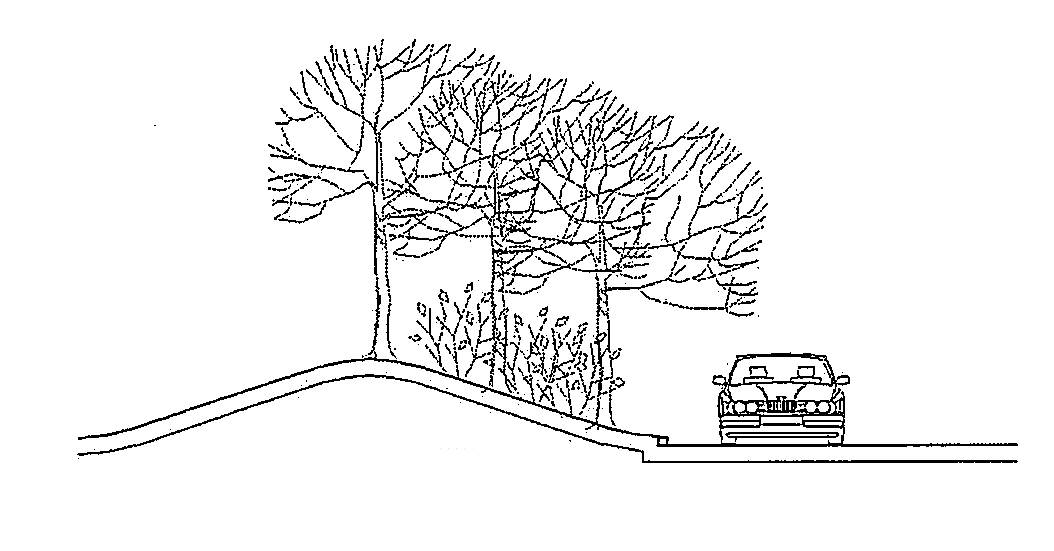
Planted Berm
Bioretention area means a shallow stormwater basin or landscaped area that utilizes engineered soils or native, well-draining soil and vegetation to capture and treat stormwater runoff.
Buffer means a strip of land located between a side or rear property line and a building, structure, or use; or a strip of land lying adjacent to a stream. A buffer is intended to separate and provide screening of the view of the site on which the buffer is located from an abutting property, and/or to provide stream protection, as defined and as may be required by this article. The following buffer types are recognized in this article:
Buffer, natural undisturbed, means a buffer that contains a natural area consisting of trees and/or other vegetation, undisturbed except for approved access and utility crossings, and replanted where sparsely vegetated.
Buffer, planted, means a buffer consisting of newly planted evergreen and deciduous trees and shrubs native to the region. Deciduous trees shall be a minimum of two-inch caliper and evergreen trees a minimum of six feet in height at time of planting. Required deciduous and evergreen shrubs shall be a minimum of three feet at time of planting.
Buffer, stream, means a natural undisturbed or enhanced vegetated area lying adjacent to a stream. as measured horizontally from the top of the stream bank, on both banks (as applicable) of the stream.
Buffer, structural, means a visual screen created through construction of a solid wooden fence, decorative masonry wall, earthen berm, or combination of fence or wall with an earthen berm, which may be supplemented with vegetation, so as to present an opaque visual separation when viewed from one side to the other throughout the year.
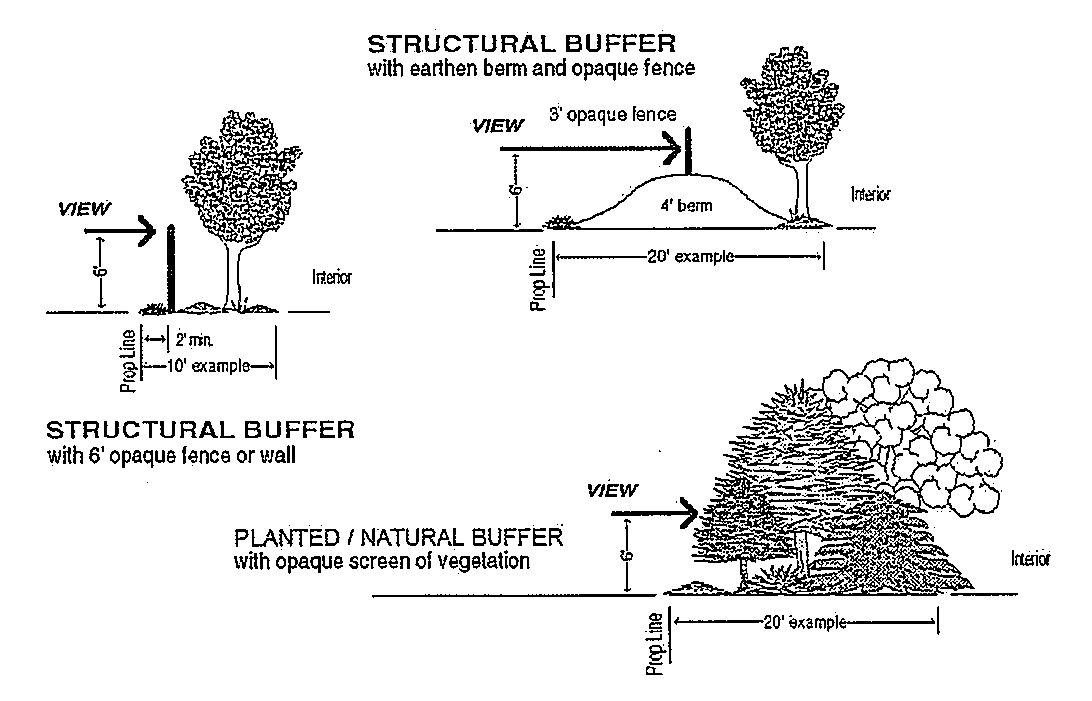
Structural Buffer
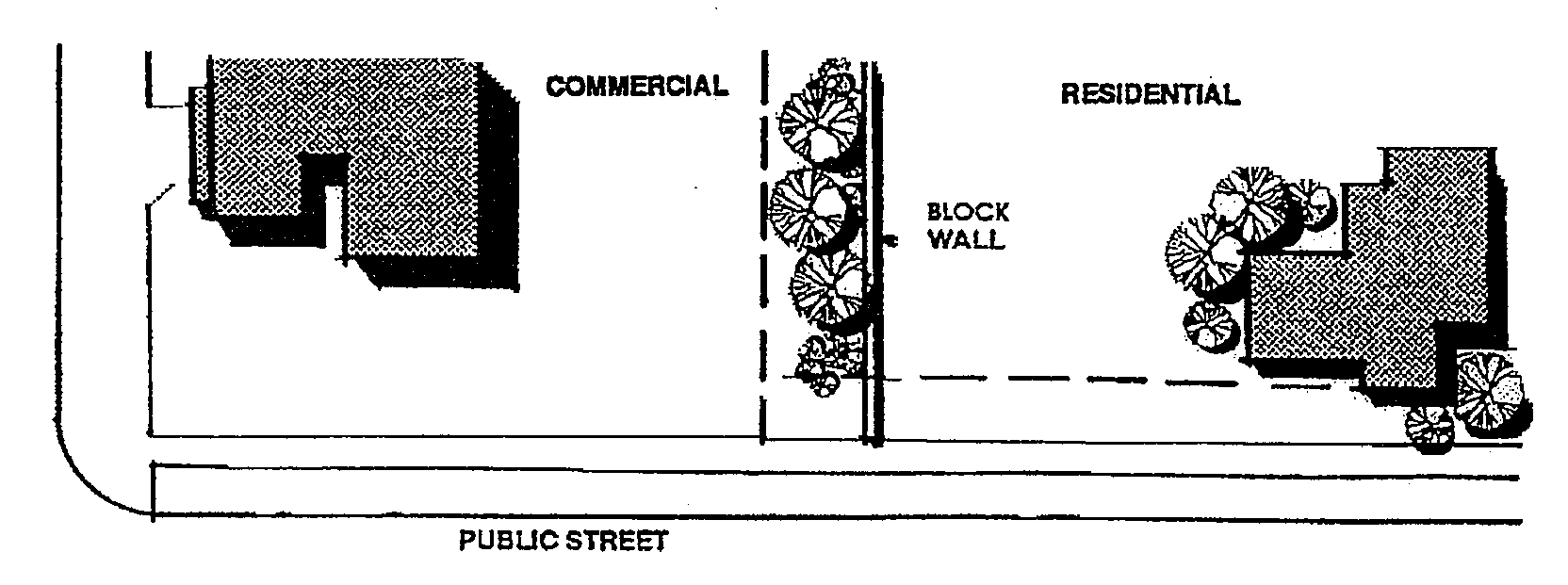
Block Wall Buffer
Caliper means the diameter of a tree (usually nursery stock) measured at a point six inches above the ground or top of root ball for up to, and including, four-inch caliper trees, and at a point 12 inches above the ground or top of root ball for larger sizes.
Canopy tree means a species of tree that normally reaches a height at maturity in excess of 50 feet and is used primarily for shade, such as red oak, shumark oak, Chinese elm, white oak, pin oak, and American beech. See "Parking Lot Trees" in table 9-16-5-4 for additional examples of generally appropriate canopy trees.
Construction area means any and all areas within which development takes place.
Critical root zone means the land area circular in shape and centered on the trunk of a tree; the radius of which circle is determined by the farthest extent of the drip line from the trunk.
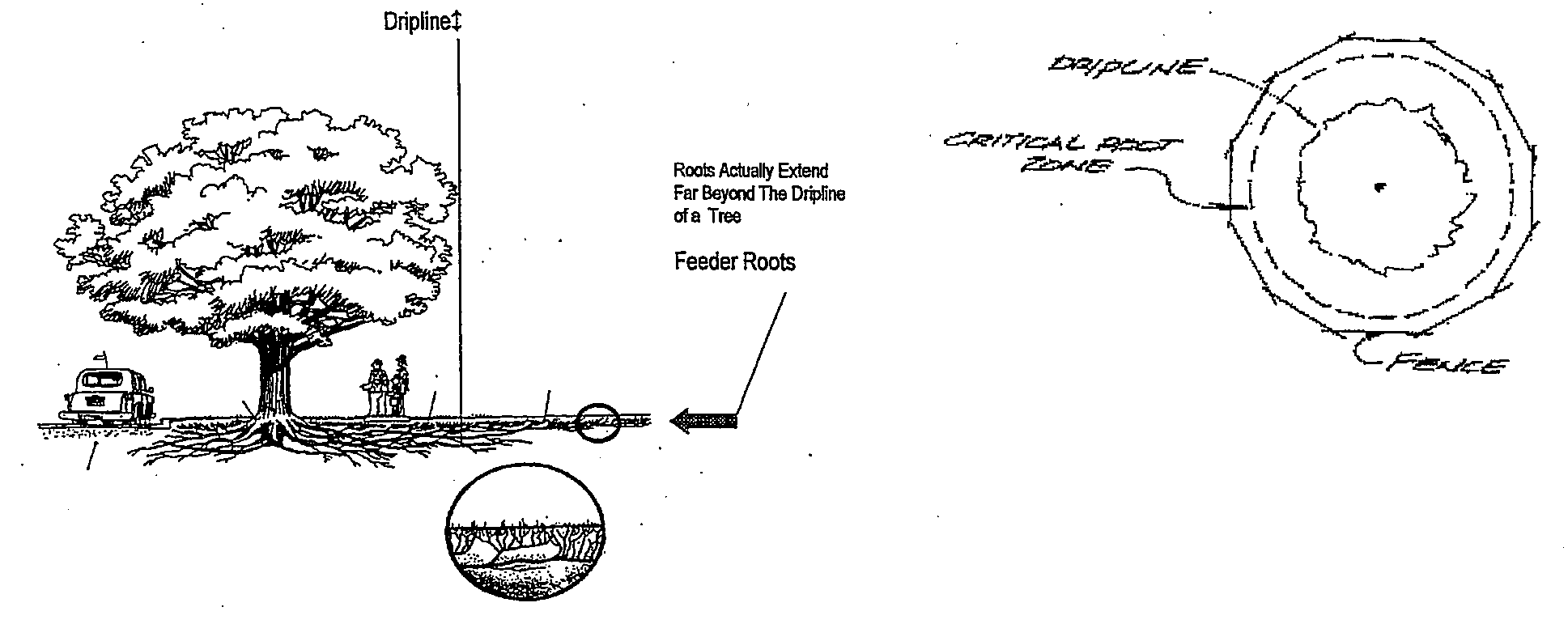
Critical Root Zone
Deciduous means a plant with foliage that is shed annually (e.g., weeping willow; maple).
Development means:
(1)
A land development project involving the construction of streets, utilities, buildings, or other improvements required for the habitation or use of property, such as a residential neighborhood, an apartment complex, a store, or a shopping center;
(2)
Any manmade change to improved or unimproved real estate, including, but not limited to, buildings or other structures, mining, dredging, filling, grading, paving, excavating, drilling operations, or permanent storage of materials;
(3)
The act of constructing or carrying out a land development project, including the alteration of land or vegetation in preparation for construction activity.
Development site means any and all areas within which development takes place.
Diameter breast height (DBH) means the diameter of a tree trunk (usually a mature tree) measured at a height of 4½ feet above the ground. If a tree splits into multiple trunks below 4½ feet, the trunk is measured at its most narrow point beneath the split.
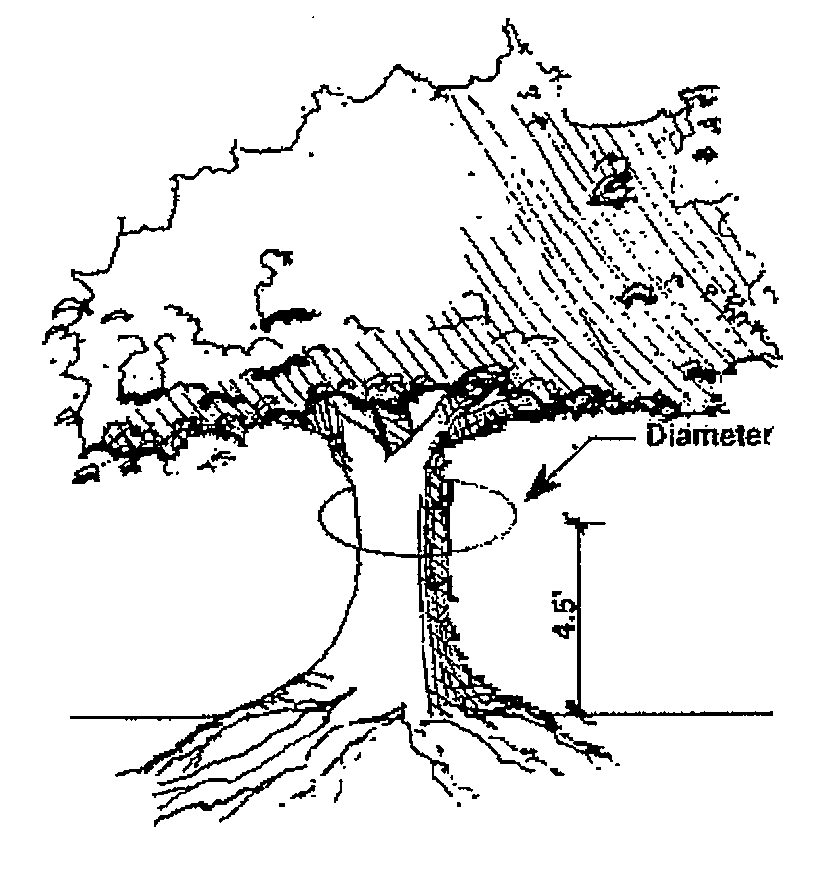
Diameter at
Tree Breast Height
Drip line means a perimeter formed by the points farthest away from the trunk of a tree where precipitation falling from the branches of that tree lands on the ground.
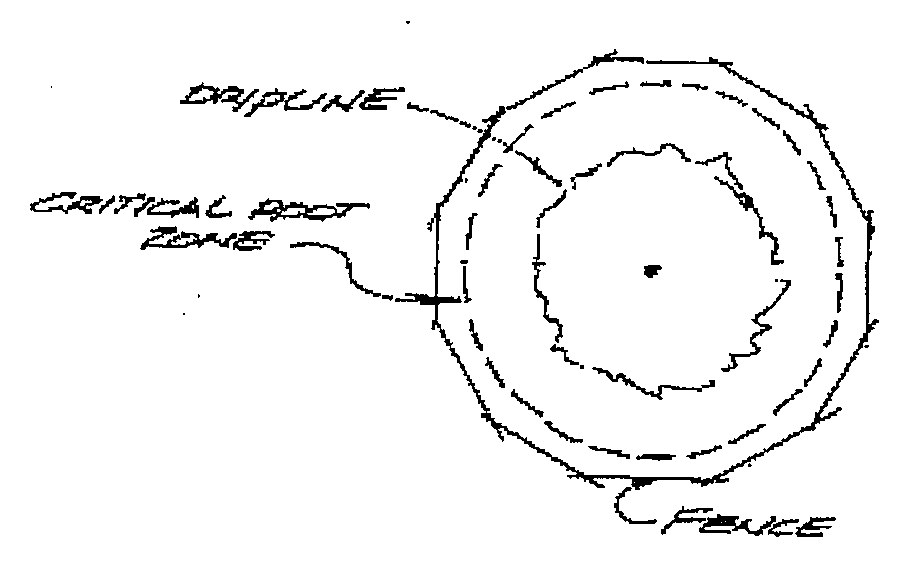
Drip Line
Evergreen means a plant or tree with foliage that persists and remains green year-round (e.g., pine; magnolia).
Floodplain means any land area susceptible to flooding, which would have at least a one-percent probability of flooding occurrence in any calendar year based on the basin being fully developed as shown on the current land use plan; i.e., the regulatory flood.
Flowering ornamental tree means a tree, other than a canopy tree, that produces seasonal flowers and blossoms and is used primarily for aesthetic or ornamental purposes (e.g., flowering dogwood; eastern redbud).
Historic and landmark trees means any tree or group of trees which the state urban forest council has included on the state landmark and historic tree register.
Impervious cover means a surface composed of any material that significantly impedes or prevents the natural infiltration of water into soil. The term "impervious cover" includes, but is not limited to, rooftops, buildings, streets and roads, and any concrete or asphalt surface.
Land development means any land change, including, but not limited to, clearing, digging, grubbing, stripping, removal of vegetation, dredging, grading, excavating, transporting and filling of land, construction, paving and any other installation of impervious cover.
Land development or disturbance activity means those actions or activities which comprise, facilitate or result in land development or disturbance.
Land disturbance means any land or vegetation change, including, but not limited to, clearing, grubbing, stripping, removal of vegetation, dredging, grading, excavating, transporting and filling of land, that do not involve construction, paving or any other installation of impervious cover.
Land-disturbing-activity means any activity that may result in soil erosion from water or wind and the movement of sediments into state waters or onto lands within the state, including, but not limited to, clearing, dredging, grading, excavating, and filling of land but not including, agricultural operations as described in O.C.G.A. § 12-7-17(5) or forestry land management activities as described in O.C.G.A. § 12-7-17(6) within areas zoned for such activities.
Landscape strip means an area of landscaping of specified width.
Landscaped open space means that portion of a given lot, not covered by buildings, parking, access and service areas, that is designed to enhance privacy and the amenity of the development by providing landscaping features, screening, and buffering for the benefit of the occupants or those in neighboring areas, or a general appearance of openness. Landscaped open space may include, but need not be limited to, grass lawns, decorative planting, berms, walls and fences, sidewalks/walkways, ornamental objects such as fountains, statutes and other similar natural and manmade objects, wooded areas, and water features, any or all of which are designed and arranged to produce an aesthetically pleasing effect within and exterior to the development.
Landscaping means the modification of the landscape for an aesthetic or functional purpose. The area within the boundaries of an individual lot that includes the preservation of existing vegetation and the continued maintenance thereof, as well as, the installation of trees, shrubs, ground covers, grass, and flowers. Landscaping areas may also include decorative rock, bark, mulch and other similar materials in addition to vegetation and live plant material.
Opaque means impenetrable to view, or so obscuring to view that features, buildings, structures, and uses become visually indistinguishable.
Overstory tree means those trees that compose the top layer or canopy of vegetation and will generally reach a mature height of 40 feet or more.
Parcel means any plot, lot or acreage shown as a unit on the latest county tax assessment records.
Permit means the land development permit issued by the city required for undertaking any land development activity.
Person means any individual, partnership, firm, association, joint venture, public or private corporation, trust, estate, commission, board, public or private institution, utility, cooperative, city, county or other political subdivision of the state, any interstate body or any other legal entity.
Riparian means any area belonging or related to the bank of a river, stream, lake, pond or impoundment.
Shade tree means a broadleaf tree having an average height at maturity of at least 20 feet and having a broad spread relative to its height (excluding trees with pyramidal, conical, or columnar crowns) and a dense canopy, so as to provide shade to structures or parking areas in the summer months.
Shrub means a woody plant, smaller than a tree, consisting of several small stems from the ground or small branches near the ground, and generally obtaining a height less than eight feet; a shrub may be deciduous or evergreen.
Significant tree means a tree in fair or better condition which has been determined to be of a high value by an arborist, forester, or other qualified professional because of its species, size, age or other professional criteria. A tree is considered in fair or better condition if:
(1)
Its life expectancy is greater than 15 years;
(2)
It has a relatively sound and solid trunk with no extensive decay or hollow with less than 29 percent radial tip die-back; and
(3)
It has no major insect or pathological problems.
Hardwood trees such as oaks and hickories and softwood trees such as pines and cedars whose diameters are 18 inches DBH or more and small hardwoods such as dogwoods, redbuds or sourwoods whose diameters are eight inches DBH or more shall be considered significant trees due to size. A tree of lesser size than the preceding shall be significant if it is a rare or unusual species or is of historical significance.
Site density factor means the minimum number of tree density units per acre, including recompense for significant and historic/landmark trees, that must be achieved on a property after development.
Specimen tree means any tree or grouping of trees which has been determined, by the director of community and economic development, to be of high value because of its species, size, age, or other professional criteria.
Stream is defined as beginning at:
(1)
The location of a spring, seep, or groundwater outflow that sustains streamflow;
(2)
A point in the stream channel with a drainage area of 25 acres or more; or
(3)
Where evidence indicates the presence of a stream in a drainage area of other than 25 acres, the director of water resources may require field studies to verify the existence of a stream.
Stream bank means the sloping land that contains the stream channel and the normal flows of the stream.
Stream buffer setback means an additional setback, measured horizontally, extending beyond the undisturbed stream buffer, in which all impervious cover shall be prohibited and grading, filling and earthmoving shall be minimized.
Stream channel means stream channel refers to the portion of a watercourse that contains the base flow of the stream.
Stream protection area means the combined areas of all required stream protection buffers and setbacks applicable to a stream.
Tree density unit means a credit assigned to a tree, based on the diameter of the tree, in accordance with tables contained in this article.
Tree protection and/or replacement plan means a plan that identifies tree protection areas, existing trees to be retained and proposed trees to be planted on a site to meet minimum requirements, as well as methods of tree protection to be undertaken on the site and other pertinent information.
Tree protection area means any portion of a site wherein are located existing trees that are proposed to be retained in order to comply with the requirements of this article or any other existing trees proposed to be retained due to zoning conditions or requirements from other ordinances.
Tree save area means any portion of a site wherein are located existing trees that are proposed to be retained in order to comply with the requirements of this article. The TERM "tree save area" shall include no less than the total area defined by the critical root zone (CRZ) of a tree or a group of trees, collectively.
Understory tree means those trees that grow beneath the overstory, and will generally reach a mature height of under 40 feet.
Utilities means all public, private, and municipal, above or below ground, infrastructure systems providing water, stormwater, sanitary sewer, natural gas, electricity, telecommunications, cable television or Internet services; or any other service controlled by the state public services commission.
Watershed refers to the land area that drains into a particular stream.
(ULDC 2005, § 9-16-1; Ord. No. 2009-05, § II, 1-20-2009; Ord. No. 2020-42, § XXXIII, 11-3-2020)
Sec. 9-16-2-1. - Buffer required.
Buffers, as defined and illustrated in chapter 9-16-1, shall be required as specified in table 9-6-2. Buffers shall also be required for particular uses when specified in article 9-10. Trees retained or replanted within buffers required by this chapter shall not be included in calculations of compliance with minimum tree unit requirements established in chapter 9-16-5.
(ULDC 2005, § 9-16-2-1; Ord. No. 2009-05, § III, 1-20-2009; Ord. No. 2020-42, § XXXIV, 11-3-2020)
Sec. 9-16-2-2. - Screening.
(a)
All buffers shall provide screening as defined by this article. Where another provision of this Code requires screening, such screening shall require compliance with this section, unless more restrictive provisions are required by regulations of an overlay zone or other provision of this Code.
(b)
Minimum required screening shall consist of a natural buffer utilizing existing vegetation or a structural buffer, whichever provides an opaque visual screen to a height of six feet, or any combination of existing and replanted vegetation which can reasonably be expected by the director of community and economic development to create an opaque visual screen six feet high within two growing seasons. Where another provision of this Code has different specifications for screening, the more restrictive requirements shall apply.
(ULDC 2005, § 9-16-2-2; Ord. No. 2009-05, § III, 1-20-2009; Ord. No. 2020-42, § XXXIV, 11-3-2020)
Sec. 9-16-2-3. - Buffer materials.
(a)
It is the intent of this Code that, when a buffer is required, the buffer shall consist of natural, undisturbed vegetation. However, replanting of a buffer shall be required where sparsely vegetated or where screening, as required by this article cannot be provided with existing natural vegetation. This is the intent whether or not the term "natural" buffer or "natural, undisturbed," buffer is used.
(b)
Where disturbance of a required buffer is permitted by this chapter, it must be replanted to a standard acceptable to provide screening as defined by this article and as determined appropriate by the director of community and economic development. Natural buffers may contain deciduous or perennial vegetation, but they shall contain evergreen shrubs and trees suitable to local growing conditions that will provide a six-foot-high opaque visual screen during all seasons of the year.
(ULDC 2005, § 9-16-2-3; Ord. No. 2009-05, § III, 1-20-2009; Ord. No. 2020-42, § XXXIV, 11-3-2020)
Sec. 9-16-2-4. - Planted buffer specifications.
Re-planted buffers, when installed, shall meet the following criteria, which shall be shown and compliance demonstrated on plans submitted for a land disturbance permit as required by chapter 9-13-7:
(1)
Plantings shall consist of a combination of evergreen and deciduous trees and shrubs native to the region. Required deciduous trees shall be a minimum of two-inch caliper and evergreen trees shall be at least six feet in height at time of planting and achieve a height of 20 feet at maturity. All shrubs planted shall be a minimum of three feet in height at time of planting and achieve an overall height of ten feet at maturity.
(2)
Plantings in buffers shall be limited to 33 percent of one tree species. Calculations are required on the tree protection plan.
(ULDC 2005, § 9-16-2-4; Ord. No. 2009-05, § III, 1-20-2009; Ord. No. 2020-42, § XXXIV, 11-3-2020)
Sec. 9-16-2-5. - Buffer encroachments.
(a)
Buffers shall contain no driveways, parking areas, patios, stormwater detention facilities, or any other structures or accessory uses except in the case of structural buffers, within which a fence, wall or earthen berm is constructed to provide the visual screening required to meet the standards of this article.
(b)
Underground utilities may be permitted to cross a buffer if the screening standards of this article will be subsequently achieved to the satisfaction of the director of community and economic development and as permitted by the director of water resources.
(c)
Required vehicular access may be allowed through a buffer as a condition of a zoning, special use or planned unit development approval by the governing body; or through an administrative variance, if provided for in chapter 9-24-3.
(ULDC 2005, § 9-16-2-5; Ord. No. 2009-05, § III, 1-20-2009; Ord. No. 2020-42, § XXXIV, 11-3-2020)
Sec. 9-16-2-6. - Waiver of required buffer.
The planning and appeals board may, at the time of application for rezoning or special use, waive a buffer requirement of this Code if the comprehensive plan anticipates future development on the adjoining property in a land use category (shown on the future land use map) such that a buffer would not be required by this Code. When such a request is not accomplished simultaneously with a rezoning or special use application, it shall be processed and considered as a zoning variance.
(ULDC 2005, § 9-16-2-6; Ord. No. 2009-05, § III, 1-20-2009; Ord. No. 2020-42, § XXXIV, 11-3-2020)
Sec. 9-16-2-7. - Reduction of natural buffer by installing structural buffer.
If a structural buffer is provided that creates an opaque screen to a height of no less than eight feet, the minimum required buffer width may be reduced by up to 50 percent.
(ULDC 2005, § 9-16-2-7; Ord. No. 2009-05, § III, 1-20-2009; Ord. No. 2020-42, § XXXIV, 11-3-2020)
Sec. 9-16-2-8. - Specifications for structural buffers.
Structural buffers, when installed as an alternative to a natural buffer, shall meet the following criteria, which shall be shown and compliance demonstrated on plans submitted for a land development permit as required by chapter 9-13-7:
(1)
Structural buffers shall be vegetated throughout the minimum area required for the buffer on both sides of any fences or walls and upon any earthen berms, which may include grass, ground covers, shrubs, and trees.
(2)
All earthen berms shall have a maximum side slope of two horizontal to one vertical. Earthen berms shall not be constructed within the drip line of any existing trees that will remain on the property.
(3)
Trees shall be located or planted within any structural buffer at a density of no less than one tree for each 20 feet of buffer length or portion thereof. New trees shall have a caliper of no less than two inches upon planting and may be clustered for decorative effect following professional landscaping standards for spacing, location, and design (see illustration under the definition of the term "structural buffer" in section 9-16-1-1).
(4)
Fences and freestanding walls shall present a finished and decorative appearance to the abutting property, and shall be located no closer to the property line than three feet. Shrubs, ground covers, or other vegetation shall be provided between the fence or wall and the property line so as to provide a decorative effect, as proposed by a registered landscaped architect or as approved by the planning development.
(5)
Fences used in buffers must be made of rot-resistant material or protected from deterioration with waterproofing material.
(ULDC 2005, § 9-16-2-8; Ord. No. 2009-05, § III, 1-20-2009; Ord. No. 2020-42, § XXXIV, 11-3-2020)
Sec. 9-16-2-9. - Maintenance of buffers and structural buffers.
(a)
Every buffer required by this Code shall be maintained by the owner of the property where the buffer is located, so as to provide an opaque visual screen to a height of six feet on a continuous, year-round basis, or eight feet in height in the case of a structural buffer.
(b)
Dying, diseased or dead vegetation, shall be removed, provided minimal disturbance occurs. Subsequently, vegetation removed must be replaced where necessary to fulfill buffer requirements.
(ULDC 2005, § 9-16-2-9; Ord. No. 2009-05, § III, 1-20-2009; Ord. No. 2020-42, § XXXIV, 11-3-2020)
Sec. 9-16-2-10. - Stream protection buffers.
In addition to the buffers specified in tables 9-5-2 and 9-6-2 and this chapter, properties shall comply, as applicable with the stream protection buffer requirements specified in chapter 9-16-3.
(ULDC 2005, § 9-16-2-10; Ord. No. 2009-05, § III, 1-20-2009; Ord. No. 2020-42, § XXXIV, 11-3-2020)
Sec. 9-16-3-1. - Findings.
The city finds that buffers adjacent to streams provide numerous benefits including:
(1)
Protecting, restoring and maintaining the chemical, physical and biological integrity of streams and their water resources.
(2)
Removing pollutants delivered in urban stormwater.
(3)
Reducing erosion and controlling sedimentation.
(4)
Protecting and stabilizing stream banks.
(5)
Providing for infiltration of stormwater runoff.
(6)
Maintaining base flow of streams.
(7)
Contributing organic matter that is a source of food and energy for the aquatic ecosystem.
(8)
Providing tree canopy to shade streams and promote desirable aquatic habitat.
(9)
Providing riparian wildlife habitat.
(10)
Furnishing scenic value and recreational opportunity.
(11)
Providing opportunities for the protection and restoration of greenspace.
(ULDC 2005, § 9-16-3-1; Ord. No. 2020-42, § XXXV, 11-3-2020)
Sec. 9-16-3-2. - Purposes.
This chapter sets standards for stream buffers to:
(1)
Protect the public health, safety, environment and general welfare;
(2)
Minimize public and private losses due to erosion, siltation and water pollution;
(3)
Maintain stream water quality by creating and maintaining buffer zones along the streams of the city for the protection of water resources; and
(4)
Minimize land development within such buffers by establishing buffer zone requirements and by requiring authorization for any such activities.
(ULDC 2005, § 9-16-3-2; Ord. No. 2020-42, § XXXV, 11-3-2020)
Sec. 9-16-3-3. - Applicability.
This chapter shall apply to all land development activity on property containing a stream protection area as defined in this article. After the effective date of these provisions as originally adopted, it shall apply to new subdividing and platting activities. Any land development activity within a stream protection buffer established hereunder or any impervious cover within a stream buffer setback established hereunder is prohibited unless a variance is granted. These requirements are in addition to, and do not replace or supersede, any other applicable buffer requirements established under state law and approval or exemption from these requirements do not constitute approval or exemption from buffer requirements established under state law or from other applicable local, state or federal regulations.
(ULDC 2005, § 9-16-3-3; Ord. No. 2020-42, § XXXV, 11-3-2020)
Sec. 9-16-3-4. - Compatibility with other buffer regulations and requirements.
This chapter is not intended to interfere with, abrogate or annul any other ordinance, rule or regulation, statute or other provision of law. The requirements of this article should be considered minimum requirements, and where any provision of this article imposes restrictions different from those imposed by any other ordinance, rule, regulation or other provision of law, whichever provisions are more restrictive or impose higher protective standards for human health or the environment shall be considered to take precedence.
(ULDC 2005, § 9-16-3-4; Ord. No. 2020-42, § XXXV, 11-3-2020)
Sec. 9-16-3-5. - Grandfather provisions.
This chapter shall not apply to the following activities:
(1)
Work consisting of the repair or maintenance of any lawful use of land that is zoned and approved for such use on or before the effective date of the ordinance from which this chapter is derived, as originally adopted.
(2)
Existing development and ongoing land-disturbance activities including, but not limited to, existing agriculture, silviculture, landscaping, gardening and lawn maintenance, except that new development or land-disturbance activities on such properties will be subject to all applicable buffer requirements.
(3)
Any land development activity that is under construction, fully approved for development, scheduled for permit approval or has been submitted for approval as of the effective date of the ordinance from which this chapter is derived, as originally adopted.
(4)
Land development activity that has not been submitted for approval, but that is part of a larger master development plan, such as for an office park or other phased development that has been previously approved within two years of the effective date of the ordinance from which this chapter is derived, as originally adopted.
(ULDC 2005, § 9-16-3-5; Ord. No. 2020-42, § XXXV, 11-3-2020)
Sec. 9-16-3-6. - Exemptions.
The following specific activities are exempt from this chapter. Exemption of these activities does not constitute an exemption for any other activity proposed on a property.
(1)
Activities for the purpose of building one of the following:
a.
A stream crossing by a driveway, transportation route or utility line;
b.
Public water supply intake or public wastewater outfall structures;
c.
Intrusions necessary to provide access to a property;
d.
Public access facilities that must be on the water, including boat ramps, docks, foot trails leading directly to the river, fishing platforms and overlooks;
e.
Unpaved foot trails and paths;
f.
Activities to restore and enhance stream bank stability, vegetation, water quality and/or aquatic habitat, so long as native vegetation and bioengineering techniques are used.
(2)
Public sewer line easements paralleling the creek, except that all easements (permanent and construction) and land disturbance should be at least 25 feet from the top of the bank. This includes such impervious cover as is necessary for the operation and maintenance of the utility, including, but not limited to, manholes, vents and valve structures. This exemption shall not be construed as allowing the construction of roads, bike paths or other transportation routes in such easements, regardless of paving material, except for access for the uses specifically cited above.
(3)
Land development activities within a right-of-way existing at the time this Code takes effect or approved under the terms of this chapter.
(4)
Within an easement of any utility existing at the time this chapter as originally adopted takes effect or approved under the terms of this Code, land-disturbance activities and such impervious cover as is necessary for the operation and maintenance of the utility, including, but not limited to, manholes, vents and valve structures.
(5)
Emergency work necessary to preserve life or property. However, when emergency work is performed under this chapter, the person performing it shall report such work to the director of water resources on the next business day after commencement of the work. Within ten days thereafter, the person shall apply for a permit and perform such work within such time period as may be determined by the director of water resources to be reasonably necessary to correct any impairment such emergency work may have caused to the water conveyance capacity, stability or water quality of the protection area.
(6)
Forestry and silviculture activities on land that is zoned for forestry, silvicultural or agricultural uses and are not incidental to other land development activity. If such activity results in land disturbance in the buffer that would otherwise be prohibited, then no other land-disturbing activity other than normal forest management practices will be allowed on the entire property for three years after the end of the activities that intruded on the buffer.
(ULDC 2005, § 9-16-3-6; Ord. No. 2020-42, § XXXV, 11-3-2020)
Sec. 9-16-3-7. - Stream protection buffer and stream buffer setback requirements.
All land development activity subject to this chapter shall meet the following requirements:
(1)
An undisturbed natural vegetative stream protection buffer shall be maintained for 50 feet, measured horizontally, on both banks (as applicable) of the stream as measured from the top of the stream bank. The land forming the bank is also considered part of the buffer for purposes of this chapter.
(2)
An additional stream buffer setback shall be maintained for 25 feet, measured horizontally, beyond the undisturbed natural vegetative stream protection buffer, in which all impervious cover shall be prohibited. Grading, filling and earthmoving shall be minimized within this setback.
(3)
No septic tanks or septic tank drainfields shall be permitted within the buffer or the setback.
(ULDC 2005, § 9-16-3-7; Ord. No. 2020-42, § XXXV, 11-3-2020)
Sec. 9-16-3-8. - Stream protection buffer variances.
Variances from the buffer and setback requirements set forth in section 9-16-3-7 may be granted in accordance with the following provisions:
(1)
Where a parcel was platted prior to the effective date of the ordinance from which this chapter is derived, as originally adopted, and its shape, topography or other existing physical condition prevents land development consistent with this chapter, and the director of water resources finds and determines that the requirements of this Code prohibit the otherwise lawful use of the property by the owner, the board of planning and appeals of the city may grant a variance from the buffer and setback requirements hereunder, provided such variance require mitigation measures to offset the effects of any proposed land development on the parcel.
(2)
Except as provided in subsection (1) of this section, the board of planning and appeals of the city shall grant no variance from any provision of this chapter without first conducting a public hearing on the application for variance and authorizing the granting of the variance by an affirmative vote of the board of planning and appeals. The city shall give public notice of each such public hearing in a local newspaper of general circulation and shall require that the applicant post a sign giving notice of the proposed variance and the public hearing. The sign shall be of a size and posted in such a location on the property as to be clearly visible from the primary adjacent road right-of-way.
(ULDC 2005, § 9-16-3-8; Ord. No. 2020-42, § XXXV, 11-3-2020)
Sec. 9-16-3-9. - Stream protection variance buffer criteria.
(a)
Variances will be considered only in the following cases:
(1)
When a property's shape, topography, or other physical conditions existing at the time of the adoption of the ordinance from which this chapter is derived prevents land development unless a stream buffer protection variance is granted; or
(2)
Unusual circumstances when strict adherence to the minimal buffer requirements in this chapter would create an extreme hardship.
(b)
Variances will not be considered when, following original adoption of the ordinance from which this chapter is derived, actions of any property owner of a given property have created conditions of a hardship on that property. The following factors will be considered in determining whether to issue a stream protection buffer variance:
(1)
The shape, size, topography, slope, soils, vegetation and other physical characteristics of the property;
(2)
The locations of all streams on the property, including along property boundaries;
(3)
The location and extent of the proposed buffer or setback intrusion;
(4)
Whether alternative designs are possible which require less intrusion or no intrusion;
(5)
The long-term and construction water-quality impacts of the proposed variance; and
(6)
Whether issuance of the variance is at least as protective of natural resources and the environment.
(ULDC 2005, § 9-16-3-9; Ord. No. 2020-42, § XXXV, 11-3-2020)
Sec. 9-16-3-10. - Variance application requirements.
In addition to the requirements for variance applications specified generally by this Code, a request to vary the provisions of this chapter shall, at a minimum, include the following information:
(1)
A site map that includes locations of all streams, wetlands, floodplain boundaries and other natural features, as determined by field survey;
(2)
A description of the shape, size, topography, slope, soils, vegetation and other physical characteristics of the property;
(3)
A detailed site plan that shows the locations of all existing and proposed structures and other impervious cover, the limits of all existing and proposed land disturbance, both inside and outside the buffer and setback. The exact area of the buffer to be affected shall be accurately and clearly indicated;
(4)
Documentation of unusual hardship should the buffer be maintained;
(5)
At least one alternative plan, which does not include a buffer or setback intrusion, or an explanation of why such a site plan is not possible;
(6)
A calculation of the total area and length of the proposed intrusion;
(7)
A stormwater management site plan, if applicable; and
(8)
Proposed mitigation, if any, for the intrusion. If no mitigation is proposed, the request must include an explanation of why none is being proposed.
(ULDC 2005, § 9-16-3-10; Ord. No. 2020-42, § XXXV, 11-3-2020)
Sec. 9-16-3-11. - Stream protection buffer zone development review requirements.
(a)
Any permit applications for property requiring stream protection buffers and setbacks must include the following:
(1)
A site plan showing:
a.
The location of all streams on the property;
b.
Limits of required stream buffers and setbacks on the property;
c.
Buffer zone topography with contour lines at no greater than five-foot contour intervals;
d.
Delineation of forested and open areas in the buffer zone; and
e.
Detailed plans of all proposed land development in the buffer and of all proposed impervious cover within the setback;
(2)
A description of all proposed land development within the buffer and setback; and
(3)
Any other documentation that the director of water resources may reasonably deem necessary for review of the application and to ensure that the stream protection buffer zone is addressed in the approval process.
(b)
All buffer and setback areas must be recorded on the final plat of the property following plan approval.
(ULDC 2005, § 9-16-3-11; Ord. No. 2020-42, § XXXV, 11-3-2020)
Sec. 9-16-3-12. - Responsibility.
Neither the issuance of a development permit nor compliance with the conditions thereof, nor compliance with the provisions of this article shall relieve any person from any responsibility otherwise imposed by law for damage to persons or property; nor shall the issuance of any permit hereunder serve to impose any liability upon the city, its officers or employees, for injury or damage to persons or property.
(Ord. No. 2020-42, § XXXV, 11-3-2020)
Sec. 9-16-3-13. - Inspection of stream protection buffer zone.
(a)
The director of water resources, or his designee, may cause inspections of the work in the stream protection buffer or setback to be made periodically during the course thereof and shall make a final inspection following completion of the work. The permittee shall assist the director, or his representative, in making such inspections. The city shall have the authority to conduct such investigations as it may reasonably deem necessary to carry out its duties, as prescribed in this section, and for this purpose to enter at reasonable time upon any property, public or private, for the purpose of investigating and inspecting the sites of any land development activities within the stream protection buffer zone.
(b)
No person shall refuse entry or access to any authorized representative or agent who requests entry for purposes of inspection, and who presents appropriate credentials, nor shall any person obstruct, hamper or interfere with any such representative while in the process of carrying out official duties.
(Ord. No. 2020-42, § XXXV, 11-3-2020)
Sec. 9-16-3-14. - Violations; enforcement action and inaction.
Any action or inaction which violates the provisions of this chapter or the requirements of an approved site plan or permit may be subject to the enforcement actions outlined in this article or in chapter 9-24-2. Any such action or inaction which is continuous with respect to time is deemed to be a public nuisance and may be abated by injunctive or other equitable relief. The imposition of any of the penalties shall not prevent such equitable relief.
(Ord. No. 2020-42, § XXXV, 11-3-2020)
Sec. 9-16-3-15. - Notice of violation.
If the director of water resources determines that an applicant or other responsible person has failed to comply with the terms and conditions of a permit, an approved site plan or the provisions of this article, the director shall issue a written notice of violation to such applicant or other responsible person. Where a person is engaged in activity covered by this article without having first secured the appropriate permit therefor, the notice of violation shall be served on the owner or the responsible person in charge of the activity being conducted on the site. The notice of violation shall contain:
(1)
The name and address of the owner or the applicant or the responsible person;
(2)
The address or other description of the site upon which the violation is occurring;
(3)
A statement specifying the nature of the violation;
(4)
A description of the remedial measures necessary to bring the action or inaction into compliance with the permit, the approved site plan or this article and the date for the completion of such remedial action;
(5)
A statement of the penalty or penalties that may be assessed against the person to whom the notice of violation is directed; and
(6)
A statement that the determination of violation may be appealed to the director of water resources by filing a written notice of appeal within 30 days after the notice of violation (except that, in the event the violation constitutes an immediate danger to public health or public safety, 24-hours' notice shall be sufficient).
(Ord. No. 2020-42, § XXXV, 11-3-2020)
Sec. 9-16-3-16. - Penalties.
In the event the remedial measures described in the notice of violation have not been completed by the date set forth for such completion in the notice of violation, any one or more of the following actions or penalties may be taken or assessed against the person to whom the notice of violation was directed. Before taking any of the following actions or imposing any of the following penalties, the director of water resources shall first notify the applicant or other responsible person in writing of the director's intended action, and shall provide a reasonable opportunity, of not less than ten days (except that in the event the violation constitutes an immediate danger to public health or public safety, 24-hours' notice shall be sufficient) to cure such violation. In the event the applicant or other responsible person fails to cure such violation after such notice and cure period, the director of water resources may take any one or more of the following actions or impose any one or more of the following penalties:
(1)
Stop-work order. The director of water resources may issue a stop-work order, which shall be served on the applicant or other responsible person. The stop-work order shall remain in effect until the applicant or other responsible person has taken the remedial measures set forth in the notice of violation or has otherwise cured the violation described therein, provided the stop-work order may be withdrawn or modified to enable the applicant or other responsible person to take necessary remedial measures to cure such violation.
(2)
Withhold certificate of occupancy. The director of water resources may refuse to issue a certificate of occupancy for the building or other improvements constructed or being constructed on the site until the applicant or other responsible person has taken the remedial measures set forth in the notice of violation or has otherwise cured the violations described therein.
(3)
Suspension, revocation or modification of permit. The director of water resources may suspend, revoke or modify the permit authorizing the land development project. A suspended, revoked or modified permit may be reinstated after the applicant or other responsible person has taken the remedial measures set forth in the notice of violation or has otherwise cured the violations described therein, provided such permit may be reinstated (upon such conditions as the director of water resources may deem necessary) to enable the applicant or other responsible person to take the necessary remedial measures to cure such violations.
(4)
Civil penalties. In the event the applicant or other responsible person fails to take the remedial measures set forth in the notice of violation or otherwise fails to cure the violations described therein within ten days (or such greater period as the director of water resources shall deem appropriate) (except that in the event the violation constitutes an immediate danger to public health or public safety, 24-hours' notice shall be sufficient) after the director of water resources has taken one or more of the actions described above, the director may impose a penalty not to exceed $1,000.00 (depending on the severity of the violation) for each day the violation remains unremedied after receipt of the notice of violation.
(5)
Criminal penalties. For intentional and flagrant violations of this article, the director of water resources may issue a citation to the applicant or other responsible person, requiring such person to appear in the municipal court of the city to answer charges for such violation. Upon conviction, such person shall be punished by a fine not to exceed $1,000.00 or imprisonment for 60 days or both. Each act of violation and each day upon which any violation shall occur shall constitute a separate offense.
(Ord. No. 2020-42, § XXXV, 11-3-2020)
Sec. 9-16-3-17. - Administrative appeal and judicial review.
(a)
Administrative appeal. Any person aggrieved by a decision or order of the director of water resources, may appeal in writing within 30 days after the issuance of such decision or order to the city clerk's office and shall be entitled to a hearing before the designated administrative hearing officer of the city within 30 days of receipt of the written appeal.
(b)
Judicial review. Any person aggrieved by a decision or order of the director of water resources, after exhausting all administrative remedies, shall have the right to appeal de novo to the superior court of the county.
(Ord. No. 2020-42, § XXXV, 11-3-2020)
Sec. 9-16-3-18. - Severability.
If any section, subsection, paragraph, clause, phrase or provision of this article shall be adjudged invalid or held unconstitutional, such decision shall not affect or invalidate the remaining portions of this article.
(Ord. No. 2020-42, § XXXV, 11-3-2020)
Sec. 9-16-4-1. - Landscape strips required.
Landscape strips, as defined in chapter 9-16-1, shall be required along rights-of-way for non-single-family uses according to the zoning district in which it is located as specified in tables 9-5-2 and 9-6-2. Landscape strips shall be required along side lot lines for non-single-family uses as specified in tables 9-5-2 and 9-6-2. Landscape strips shall also be provided if required for particular uses specified in article 9-10.
(ULDC 2005, § 9-16-4-1; Ord. No. 2009-05, § VI, 1-20-2009; Ord. No. 2020-42, § XXXVI, 11-3-2020)
Sec. 9-16-4-2. - Minimum landscaped open space required.
Non-single-family uses shall provide minimum landscaped open space on the lot according to the zoning district in which it is located, as specified in tables 9-5-2 and 9-6-2.
(ULDC 2005, § 9-16-4-2; Ord. No. 2009-05, § VI, 1-20-2009; Ord. No. 2020-42, § XXXVI, 11-3-2020)
Sec. 9-16-4-3. - Landscaping encroachments.
Landscape strips and areas devoted to meeting minimum landscaped open space requirements shall contain no structures, parking areas, patios, stormwater detention facilities, or any other accessory uses except for retaining walls or earthen berms constructed as part of an overall landscape design, pedestrian-oriented facilities such as sidewalks and bus stops, underground utilities, driveways required to access the property, and signs otherwise permitted by article 9-18.
(ULDC 2005, § 9-16-4-3; Ord. No. 2009-05, § VI, 1-20-2009; Ord. No. 2020-42, § XXXVI, 11-3-2020)
Sec. 9-16-4-4. - Landscape strip planting specifications.
(a)
One tree shall be provided within the landscape strip for every 30 feet of length of street frontage, or portion thereof. Such trees may be deciduous or evergreen, but must be of a type that is suitable to local growing conditions. Deciduous trees shall be a minimum of two-inch caliper at time of planting and achieve a diameter breast (DBH) of at least 12 inches at maturity. Trees required by this section within landscape strips may be included in calculations of compliance with minimum tree unit requirements established in chapter 9-16-5.
(b)
One shrub shall be provided within the landscape strip for every 30 linear feet of street frontage, or portion thereof. Shrubs shall be of a type that is suitable to local growing conditions.
(c)
All portions of required landscape strips shall be planted in trees, shrubs, grass or ground cover, except for those ground areas that are mulched.
(d)
Upon planting, new trees and shrubs may be planted at regular intervals or clustered for decorative effect following professional landscaping standards for spacing, location, and design and as approved by the department of community and economic development.
(e)
Plant materials in the landscape strip shall not extend into the street right-of-way unless specifically allowed by the public works department.
(f)
Tree planting recommendations. The following recommendations are provided regarding tree selection, planting, and maintenance:
(1)
Tree selection should be suited to locations, climate and other factors of the site (e.g., utility lines).
(2)
Tree species selected should be relatively maintenance free.
(3)
The ideal urban tree is attractive and should: have a deep-growing, well-behaved root system; have a fast reaction time to environmental changes; be insect and disease resistant; have sturdy limbs and long life expectancy; have the ability to be self-pruning; be resistant to drought or other extreme weather conditions; and have features that reduce clean-up problems because of shedding of limbs, fruit, leaves, etc.
(4)
Have a training program for new trees in which branches are properly pruned and the tree is trained to minimize storm damage and decay problems.
(5)
Select trees that have an expected mature height and/or spread which will meet criteria of the Code and site.
(6)
Try to avoid co-dominant branches (forks), and do not use trees with flat tops.
(ULDC 2005, § 9-16-4-4; Ord. No. 2009-05, § VI, 1-20-2009; Ord. No. 2020-42, § XXXVI, 11-3-2020)
Sec. 9-16-4-5. - Parking lot landscaping.
(a)
Deciduous shade trees shall be provided within any parking lot designed or intended to accommodate five cars or more, in accordance with the requirements of this section.
(1)
One landscaping island with a deciduous shade tree shall be provided within the parking lot for every 20 parking spaces, or portion thereof. Additionally, every parking space shall be located within 70 feet of the landscape island. Trees required within parking lots by this section may be included in determinations of compliance with minimum tree unit requirements established in chapter 9-16-5.
(2)
A landscaping island shall be located at the end of every parking aisle between the last parking space and an adjacent travel aisle or driveway. The landscaping island shall be no less than nine feet wide for the length of the adjacent parking space. In addition to providing a deciduous shade tree, the landscaping island shall be planted in ground cover or low-lying shrubs, except for mulch within the drip line or critical root zone of the shade tree. Landscaping materials must not encroach on site visibility at the end of parking aisles.
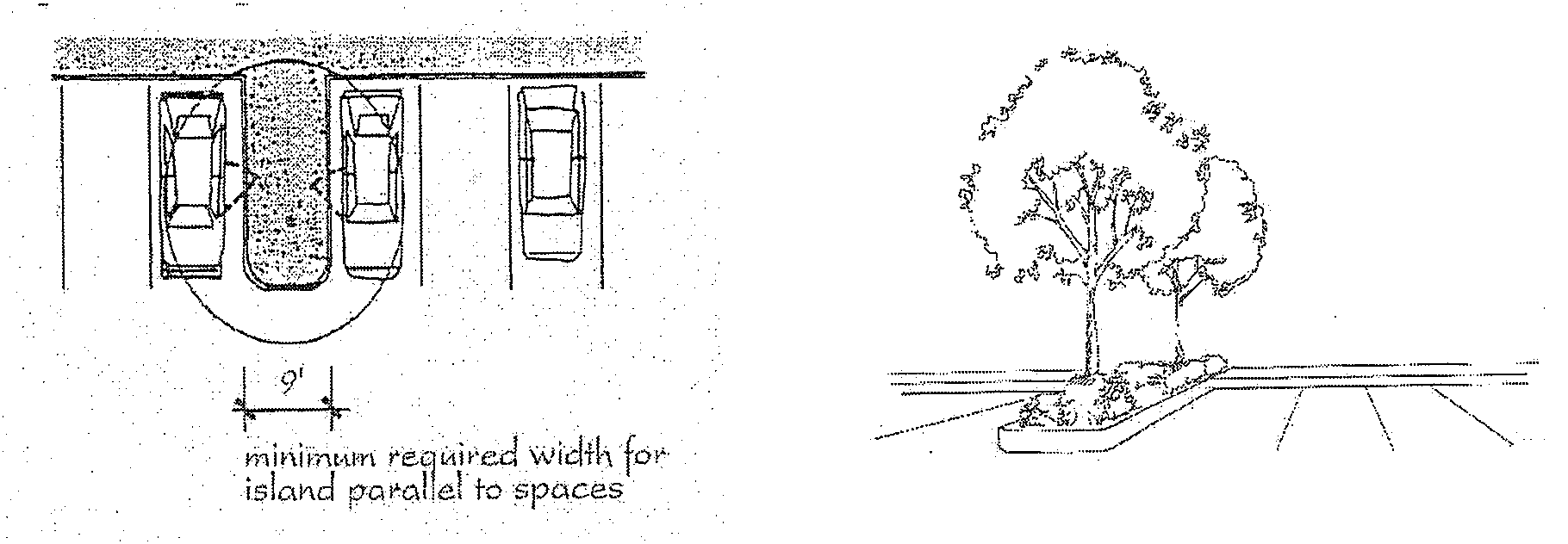
Tree Island
in Parking Lot
(3)
Tree planting areas for shade trees and understory trees shall be no less than nine feet in width and shall provide at least 150 square feet of planting space. If shared with other trees an additional 50 square feet of planting space shall be provided. No tree shall be located less than 2½ feet from the back of curb.
(4)
All parking lot landscape islands shall be curbed with minimum six-inch-high header curbs, except, where possible, a curb cut may be used to direct runoff to swales or bioretention areas.
(5)
Landscaping islands and tree planting areas shall be well drained and contain suitable soil and natural irrigation characteristics for the planting materials they contain.
(b)
Grassy swales and bioretention areas are acceptable and encouraged alternatives to curbing, piping, and detention of water in parking lots. Rain gardens and constructed wetlands are also encouraged to handle surface drainage of parking lots providing ten or more parking spaces. These and other parking lot stormwater facilities shall be designed in accordance with article 9-9, chapter 9-13-12, chapter 9-17-1, and the latest revision of the GSMM.
(ULDC 2005, § 9-16-4-5; Ord. No. 2009-05, § VI, 1-20-2009; Ord. No. 2020-42, § XXXVI, 11-3-2020)
Sec. 9-16-4-6. - Landscaping plans incorporated into tree plans.
(a)
The landscaping requirements of this article and this Code shall be incorporated into tree plans as required by section 9-13-7-9 (submitted as part of a land development permit) and as specified in chapter 9-16-5.
(b)
If no tree plan is required to be submitted, or if no land development permit is required, the community and economic development department may require a separate landscaping plan to demonstrate compliance with the requirements of this chapter, which may include any of the following as appropriate to determine compliance:
(1)
Location and general type of existing trees;
(2)
Existing trees to be saved;
(3)
Methods and details for protecting existing trees during construction;
(4)
Locations and labels for all proposed plants and a plant list or schedule showing the existing and proposed quantities in relation to any required quantities;
(5)
Location and description of other landscape improvements, such as earth berms, walls, fences, screens, sculptures, fountains, street furniture, signs and light fixtures.
(ULDC 2005, § 9-16-4-6; Ord. No. 2009-05, § VI, 1-20-2009; Ord. No. 2020-42, § XXXVI, 11-3-2020)
Sec. 9-16-4-7. - Additional landscaping specifications.
Approval of all landscaping and other materials by the community and economic development department shall be required. The following specifications are required:
(1)
Invasive or potentially invasive plants are not permitted. However, well-mannered, non-native plants are acceptable if they are not considered invasive.
(2)
Existing tree cover and natural vegetation shall be preserved, whenever possible, or replaced with suitable vegetation.
(3)
Ground cover should be used to supplement landscaping in appropriate areas to reduce the need for extensive grass lawns, which would require regular watering in drought conditions.
(4)
No artificial plants, trees, or other vegetation shall be installed.
(5)
Where existing utilities are present within a landscape strip, appropriate plant material should be used that does not grow to a height or have a root system that will interfere with aboveground or underground utilities.
(6)
Do not plant materials in parking lot landscaping islands that will grow to a maturity of more than 2½ feet, except for the required shade tree, unless regular pruning is provided, so as to avoid site visibility problems.
(7)
All plant material shall conform to the current version of the American Standard for Nursery Stock published by the American Nursery and Landscape Association. A copy of this manual can be downloaded at www.anla.org.
(ULDC 2005, § 9-16-4-7; Ord. No. 2009-05, § VI, 1-20-2009; Ord. No. 2020-42, § XXXVI, 11-3-2020)
Sec. 9-16-5-1. - Establishment of tree protection zone.
Except as exempted by this chapter, a tree protection zone is hereby established and which applies to the entirety of a tract of land for which no tree protection plan has been approved. After such approval, the tree protection zone shall correspond to that part of a tract of land designated as such on said plan. Tree protection zones shall be shown on land development plans and preliminary subdivision plats, as applicable, or a separate tree plan shall be submitted to demonstrate compliance with this chapter.
(ULDC 2005, § 9-16-5-1; Ord. No. 2009-05, § VII, 1-20-2009)
Sec. 9-16-5-2. - Exemptions from tree protection zone.
The tree protection zone shall not apply to the following, except that any construction, paving, or other activity on a property that will damage trees on the public right-of-way is subject to the restrictions of this chapter for the protection of existing trees:
(1)
Tracts of land for which this Code imposes no yard requirements and permits 100 percent coverage of the lot by buildings. This specifically includes the C-B, central business zoning district.
(2)
Property on which a single-family dwelling is being constructed under contract to the person who will occupy the structure.
(3)
Property already occupied by an owner-occupied, single-family dwelling unless nonresidential uses or additional dwelling units are proposed for such property.
(4)
Public utility companies conducting operations on public and utility rights-of-way and easements or on sites for electric power substations and similar facilities, which operations are for the purpose of ensuring uninterrupted utility services.
(5)
Property in use for the following:
a.
Tree farming. The planting, cultivating, and harvesting of trees in a continuous cycle as a regular practice on a tract of land; not including the removal of trees for purposes of development or the removal of trees without replanting.
b.
Agricultural activities.
1.
Bona fide commercial production from the land or on the land of agricultural products, including horticultural, floricultural, dairy, livestock, poultry, and apiarian products, but not including forestry products (see "tree farming" in subsection (5)a of this section); and
2.
Clearing trees for the purpose of planting crops, providing pasture for livestock, or constructing buildings accessory to production of agricultural products.
(ULDC 2005, § 9-16-5-2; Ord. No. 2009-05, § VII, 1-20-2009)
Sec. 9-16-5-3. - Tree damage prohibited.
It shall be unlawful for any person to:
(1)
Cut, carve or otherwise damage or remove any tree except in accordance with the provisions of this chapter.
(2)
Attach any wire, nails, advertising posters or other contrivance harmful to any tree.
(3)
Allow any gaseous, liquid or solid substance which is harmful to trees (such as concrete washout, fuel, lubricants, herbicides or paint) to come in contact with them.
(4)
Set a fire or permit any fire to burn when such fire or the heat thereof will injure any portion of any tree.
(ULDC 2005, § 9-16-5-3; Ord. No. 2009-05, § VII, 1-20-2009)
Sec. 9-16-5-4. - Limitations on tree removal.
(a)
Existing significant trees or any other trees ten inches DBH or larger that are in excess of the minimum required tree units per acre of development site (not including land area covered by buildings) but outside the construction area (buildings, accessory uses, parking area) shall not be removed unless adjacent development would cause irreparable damage to the critical root zones.
(b)
No person shall remove more than 90 percent of the existing trees on a lot that is subject to the requirements of this chapter.
(c)
An existing tree survey identifying all significant trees ten inches DBH or larger shall be required as part of the approved tree plan.
(ULDC 2005, § 9-16-5-4; Ord. No. 2009-05, § VII, 1-20-2009)
Sec. 9-16-5-5. - Tree retention priorities.
The retention of trees is the highest priority and shall take precedence over the removal of trees and replacement with smaller trees. Tree protection and landscaping plans shall be reviewed for compliance with the following provisions, and noncompliance with this section may be grounds for disapproval of tree protection and landscaping plans required by this article:
(1)
Existing trees in required landscape strips shall be retained to the maximum extent possible.
(2)
Existing trees between the building line and the street shall be retained to the maximum extent possible.
(3)
Where existing trees exist where parking lots are proposed, such trees shall be integrated into the design of the parking lot so that they may be retained in tree planting islands, to the maximum extent possible.
(4)
Any other existing trees in parking areas to the rear of the building line or elsewhere on the site shall be retained to the maximum extent possible.
(5)
Trees categorized as significant trees, historical or landmark trees located, shall be integrated into the design of the development to the maximum extent possible.
(ULDC 2005, § 9-16-5-5; Ord. No. 2009-05, §§ VII, VIII, 1-20-2009)
Sec. 9-16-5-6. - Significant trees.
(a)
Significant trees are composed of specimen, historic and landmark trees. In order to obtain credit for a significant tree, the tree shall be protected in their natural state, free from damage.
(b)
To encourage the protection of a significant hardwood tree additional density credits will be given for significant trees saved. Credit for any significant hardwood tree saved will be four times the assigned unit value shown in table 9-16-5-2.
(c)
If a significant tree is damaged or removed without prior approval by the community and economic development department director, recompense or penalty will be required or imposed as follows:
(1)
Any specimen tree that is removed without prior approval must be replaced by trees with a total density equal to twice the unit value of the tree removed. Additionally, replacement trees shall be a minimum of two-inch caliper.
(2)
If an historic or landmark tree is damaged or removed without prior approval, the department of planning and development will require replacement by trees with a total density equal to four times the unit of the tree removed.
(ULDC 2005, § 9-16-5-6; Ord. No. 2009-05, §§ VII, VIII, 1-20-2009)
Sec. 9-16-5-7. - Preliminary tree plan for multiple sites in industrial park.
A preliminary tree plan may be submitted for development of an industrial park where multiple sites will be cleared and graded for purposes of marketing vacant sites to industrial prospects. Planting of new trees will not be required on a lot until a use is developed on that lot, and locations of new trees need not be shown on the preliminary plan. Removal of significant trees and other trees ten inches DBH or larger shall be permitted only in conjunction with an approved preliminary tree protection plan, an approved grading plan, and actual grading of building pads (i.e., not simply to clear the lot). The preliminary tree protection plan shall show the following:
(1)
The extent of the development site.
(2)
Limits of land disturbance, clearing, grading and trenching.
(3)
Grade changes or other work adjacent to a significant tree or any other tree ten inches DBH or larger which would affect it adversely, with drawings or descriptions as to how the grade, drainage, and aeration will be maintained around the tree.
(4)
Units of trees that will be required on the lot when it is developed, calculated both:
a.
Without subtracting any building footprint area from the acreage; and
b.
By subtracting one-third of the lot area as assumed building area.
(5)
Location of any significant, historical and landmark trees to be removed.
(ULDC 2005, § 9-16-5-7; Ord. No. 2009-05, §§ VII, IX, 1-20-2009)
Sec. 9-16-5-8. - Permit required for removal of certain trees.
(a)
On properties which are not specifically exempted by this chapter, a permit shall be required to be issued by the community and economic development department director to remove or cause the death of existing significant trees and any other trees ten inches DBH or larger located within the tree protection zone or for grading or other work adjacent to a tree which would affect it adversely. An approved tree protection plan is required for issuance of a permit.
(b)
Permit requirements of this section shall be waived if the applicant submits information from a certified arborist, registered forester, registered landscape architect, or other qualified professional who demonstrates in writing that trees to be removed are dead, are diseased or infested to the extent that removal is necessary, or have been damaged by lightning, wind, ice, or other disasters to the extent that public safety is endangered. When a tree that has died or has been irreparably damaged is counted toward meeting the minimum tree density requirements of this article, said tree shall be replaced with an equal number of tree units on the site.
(ULDC 2005, § 9-16-5-8; Ord. No. 2009-05, §§ VII, IX, 1-20-2009)
Sec. 9-16-5-9. - Criteria for the protection of existing trees.
When a choice is available as to which existing trees to save, emphasis shall be given to the preservation of significant trees, as defined in this article, even isolated significant trees, over retention of other trees. Non-significant trees, however, should be saved in stands rather than as individual trees scattered over a site.
(ULDC 2005, § 9-16-5-9; Ord. No. 2009-05, §§ VII, IX, 1-20-2009)
Sec. 9-16-5-10. - Tree protection fencing.
(a)
During excavation, filling, construction or demolition operations, each tree or stand of trees within tree protection zones or otherwise designated to remain on the property shall be protected against damage to bark, roots and low-hanging branches with an orange barricade fence enclosing the critical root zone of said trees to be retained.
(b)
Fencing shall be either plastic construction area fencing, silt fencing, 12-gauge two- by four-inch wire mesh, double one- by four-inch rails on two- by four-inch posts, or high-visibility surveyors' tape on one- by two-inch posts. Height of the latter three fence types shall be four feet.
(c)
Tree save area signage, with the language, "Tree Protection Area—Do Not Disturb," shall be required every 20 feet of fencing.
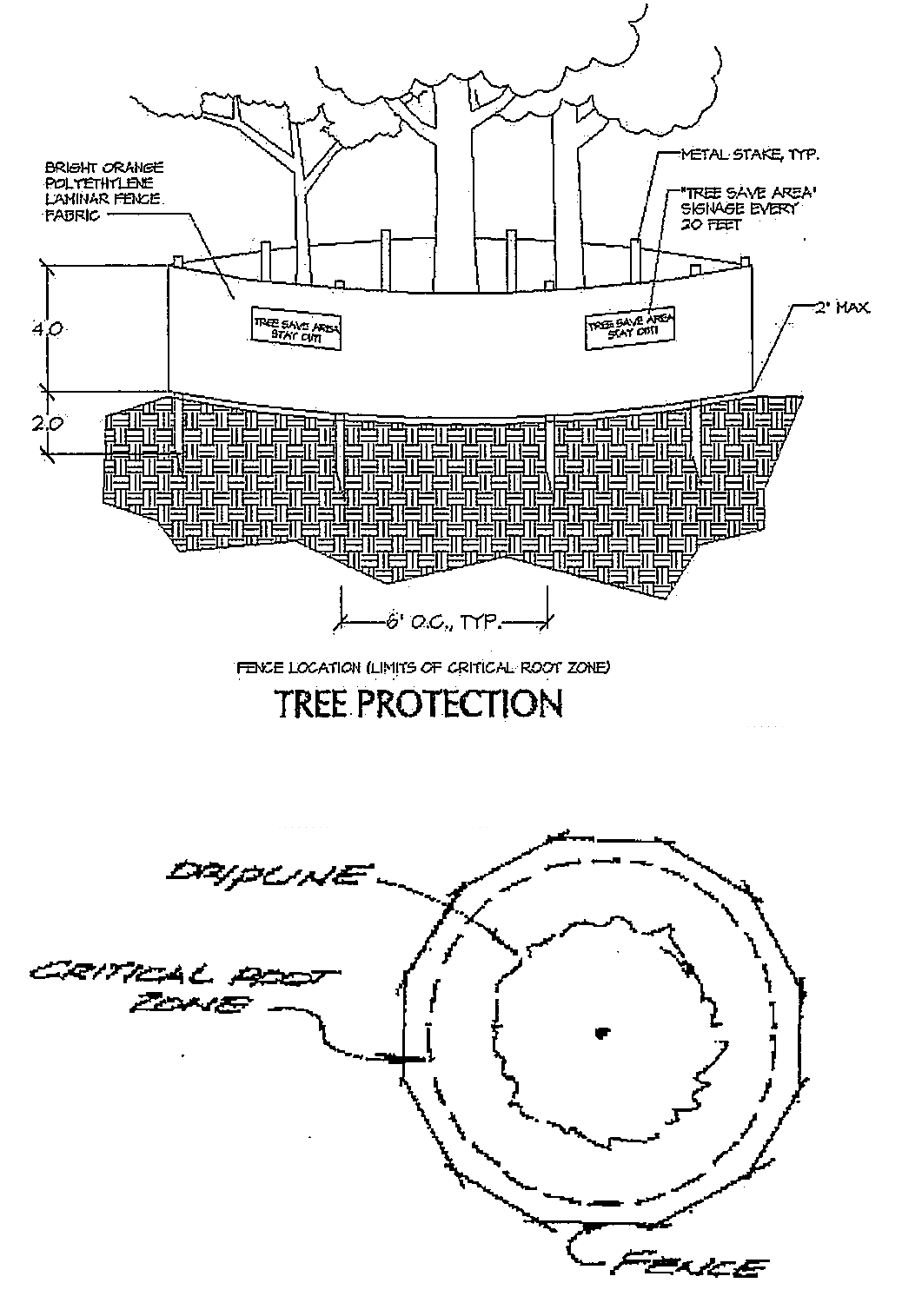
Illustrative Tree
Protection Fencing
(ULDC 2005, § 9-16-5-10; Ord. No. 2009-05, §§ VII, IX, 1-20-2009)
Sec. 9-16-5-11. - Additional tree protection requirements.
(a)
Compaction prohibited. All building materials, vehicles, construction equipment, dirt, debris, or other objects likely to cause soil compaction or aboveground damage shall be kept outside the critical root zone of trees within tree protection zones or other trees to be protected. Where a limited amount of encroachment is unavoidable and is approved by the city, the critical root zone shall first be mulched with a four-inch layer of processed pine bark or wood chips or a six-inch layer of pine straw.
(b)
Grade change prohibited. There shall be no raising or lowering of the ground level within the critical root zone of trees within tree protection zones or other trees to be protected. Stripping of topsoil in such critical root zones shall not be permitted. Where necessary, the use of moderate fill is permitted only with prior installation of an aeration system approved by the city. Deposition of sediment in such critical root zones shall be prevented by placement of sediment barriers, which shall be backed by two- by four-inch wire mesh in areas of steep slope.
(c)
Ditches prohibited. No person shall excavate any ditch or trench within the critical root zone of trees within tree protection zones or other trees to be protected. Where such encroachment is unavoidable and is approved by the city, ditches or trenches shall be so located as to minimize root damage. If roots must be cut, root pruning procedures approved by the city must be employed.
(d)
Paving prohibited. No person shall pave with concrete, asphalt, or other impervious material within the critical root zone within tree protection zones or other trees to be protected.
(e)
Encroachment in critical root zones. Encroachment on the critical root zone of a tree is permitted where necessary to the development (e.g., construction of a driveway), provided the tree is not counted toward the required minimum tree units per acre of development site (not including land area covered by buildings).
(ULDC 2005, § 9-16-5-11; Ord. No. 2009-05, §§ VII, IX, 1-20-2009)
Sec. 9-16-5-12. - Minimum tree units required.
(a)
Upon completion of development, all properties shall have the minimum tree units per acre of the development site (not including land area covered by buildings). Within the development site of any property subject to the requirements of this chapter, and unless otherwise specifically exempted from the provisions of this chapter, there shall be a number of trees so as to produce a total tree density unit of no less than:
(1)
18 units per acre for property in commercial and industrial zoning districts.
(2)
20 units per acre for property in residential zoning districts.
(b)
For purposes of this chapter, the term "development site" excludes undeveloped portions of a lot.
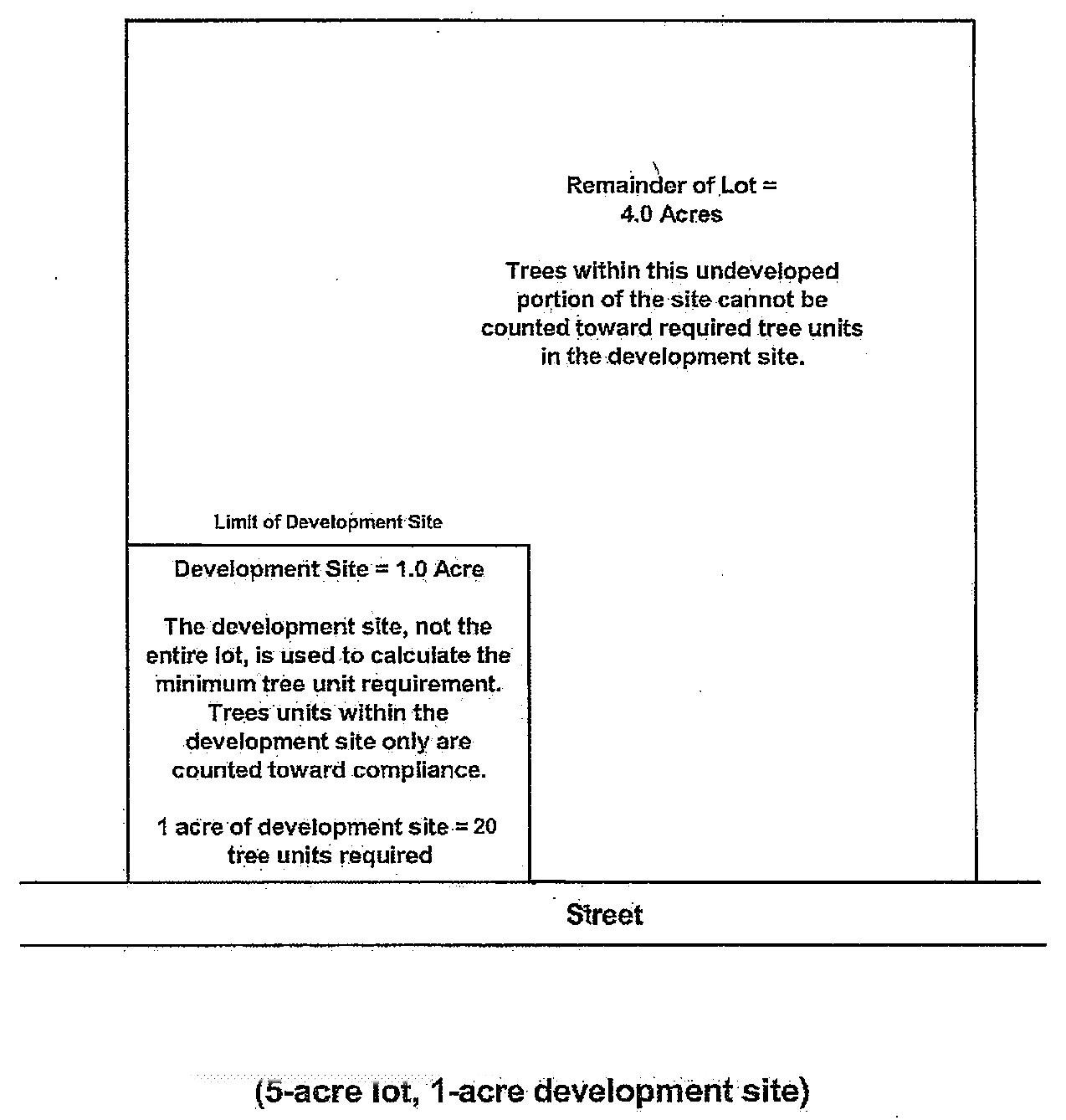
Example Minimum
Tree Unit Calculation
(c)
Trees on the same lot but within required buffers or undeveloped portions of the site shall not be counted toward meeting this requirement for any given development site. A development site may be proposed larger than the limits of clearing, to retain trees on a forested portion of the site that will help meet the requirement of this section, provided that the area containing trees is set aside as a tree protection area and is made a part of the boundary of the development site, through boundary line adjustment if the development site is a separate lot.
(ULDC 2005, § 9-16-5-12; Ord. No. 2009-05, §§ VII, X, 1-20-2009)
Sec. 9-16-5-13. - Calculation of tree units generally.
One tree unit is not the same as one tree. For existing trees, the tree units assigned are the cross-sectional areas of the trunks at DBH in square feet. For new trees, credits given reflect a size that will be achieved after several years of growth. When the calculation of tree units required results in a fraction, the number of tree units shall be rounded upward to the next highest whole number.
(ULDC 2005, § 9-16-5-13; Ord. No. 2009-05, §§ VII, X, 1-20-2009)
Sec. 9-16-5-14. - Measurement of tree units of existing trees.
The diameter of an existing tree's trunk will be measured and a value assigned in tree units, in accordance with table 9-16-5-2. When an existing tree meets the definition of the term "significant hardwood tree," as provided in this article, the value assigned is four times the value shown in table 9-16-5-2.
Table 9-16-5-2. Tree Unit Values for Existing Trees
(ULDC 2005, § 9-16-5-14; Ord. No. 2009-05, §§ VII, XI, XII, 1-20-2009)
Sec. 9-16-5-15. - Measurement of tree units of replacement trees.
The diameter of a replacement tree's trunk will be measured and a value assigned in tree units, in accordance with table 9-16-5-3. For purposes of this section, the term "large species" means one that will have a height at maturity of 40 feet or more. All fractions of tree requirements shall be rounded up to the nearest whole number.
Table 9-16-5-3. Tree Unit Values For Replacement Trees
(ULDC 2005, § 9-16-5-15; Ord. No. 2009-05, §§ VII, XII, XIII, 1-20-2009)
Sec. 9-16-5-16. - Criteria for replacement trees.
(a)
Spacing and the potential size of species chosen shall be compatible with spatial limitations of the site.
(b)
The species must be ecologically compatible with the specifically intended growing site. Publications of the state forestry commission, the Cooperative Extension Service of the University of Georgia College of Agriculture, or other sources acceptable to the city may be consulted regarding questions of tree characteristics.
(c)
The trees must have the potential for size and quality comparable to those removed (e.g., an existing oak tree should not be replaced with a pine or dogwood tree).
(d)
The trees must have crowns and root systems at maturity that will not disrupt nearby utilities, sidewalks, or public right-of-way infrastructure.
(e)
Where trees must be added to achieve the minimum required tree units per acre of development site (not including land area covered by buildings), the following shall apply:
(1)
Pines may not comprise more than ten percent of the required tree units. Where existing pines already comprise ten percent or more of the required units, no more pines may be credited toward the required tree units.
(2)
No more than 30 percent of the required tree units can consist of a single tree species.
(3)
At least 25 percent of the replacement tree units must be canopy trees.
(4)
Flowering ornamental trees shall not be counted in terms of compliance with minimum tree unit requirements, unless listed in the tree list provided in table 9-16-5-4.
(f)
Where trees must be added to achieve the required minimum tree units per acre of development site (not including land area covered by buildings), such additions shall be made between the street right-of-way and the front building line to the extent that physical space is available.
(ULDC 2005, § 9-16-5-16; Ord. No. 2009-05, §§ VII, XIV, 1-20-2009)
Sec. 9-16-5-17. - Physical site limitations.
Where the proposed development area (i.e., the buildings, accessory uses, and parking area), for whatever reason, does not permit the retention or planting of a number of trees equivalent to the minimum tree units per acre of the development site, the following regulations shall apply:
(1)
The development site shall be enlarged, in cases where it does not comprise the entire lot.
(2)
The tree protection zone shall to the extent possible be enlarged by removing parking spaces in excess of the minimum number required, by placing additional planting islands within the development area, or by reducing the area to be occupied by buildings.
(3)
Alternative compliance. Where such changes to development site or plans are not feasible, as determined by the director of community development, the development applicant may propose and the department may approve one of the two following alternatives:
a.
Off-site location. An alternative, off-site location for the planting of required trees to meet the minimum required tree units may be approved by the department. Public street rights-of-way and public properties in the city, or private property in the city that has a valid conservation easement granted in favor of tree protection, shall be acceptable alternative sites for tree planting. If this is allowed, an escrow account or bond shall be required and established to cover the costs of trees and installation. Approval for off-site planting of required trees shall not exceed 50 percent of total trees required for replanting.
b.
Tree replacement fund. In lieu of planting trees on an approved off-site location, the development applicant may contribute to the city tree replacement fund. Contributions shall be calculated based on two-inch caliper trees and shall be based upon the number, size and type of trees that cannot be planted on the development site. The amount of the donation shall be 100 percent of the estimated costs derived from the average of two written estimates provided by the applicant from nurseries, including the plant materials, labor and any other costs associated with the plantings. Approval for tree replacement fund contribution in lieu of on-site replanting shall not exceed 50 percent of the total trees required for replanting.
(ULDC 2005, § 9-16-5-17; Ord. No. 2009-05, §§ VII, XV, 1-20-2009; Ord. No. 2011-02, § V, 1-18-2011)
Sec. 9-16-5-18. - List of generally appropriate trees.
Table 9-16-5-4 provides a list of trees generally appropriate for planting within the city.
Table 9-16-5-4. List of Generally Appropriate Trees
(*) Indicates native species.
(^) Indicates species used as either frontage/street tree or parking lot tree.
( # ) Indicates flowering tree species that may be counted toward site density factor.
(ULDC 2005, § 9-16-5-18; Ord. No. 2009-05, §§ VII, XVI, 1-20-2009)
Sec. 9-16-5-19. - Maintenance and inspection requirements.
(a)
Trees, which are planted to meet the density requirements, shall be maintained for one growing season after the date of final inspection and a certificate of occupancy is issued. After one growing season a maintenance inspection shall be performed by the planning and development staff to determine if the project is still in compliance as required by this chapter. Any trees planted to meet the required density requirements which are dead, dying or diseased must be replaced. Additionally, trees protected to meet the density requirements which are dead, dying, diseased or have been removed at the time of inspection must be replaced if there is evidence that the demise of such trees was due to an act or omission that caused the tree to deteriorate.
(b)
Trees required to be replaced shall be a minimum of two-inch caliper at time of planting and shall be planted within 30 days of receipt of notification by the city. Additionally, unless exempt from this chapter, the subject property shall continually meet the buffers, landscaping and tree protection standards set forth in article 9-16.
(ULDC 2005, § 9-16-5-19; Ord. No. 2009-05, §§ VII, XVI, 1-20-2009)

