
Gainesville City Zoning Code
ARTICLE 9
17 - ACCESS, PARKING AND LOADING REQUIREMENTS
Sec. 9-17-1-1. - Findings.
(a)
Need for parking. Space for the parking of motor vehicles is needed to serve every property that contains a principal use, for the safety and convenience of the people who live or work on the property, shop or do business on the property, or otherwise visit the property in the normal course of activity of the principal use.
(b)
Need for loading and unloading spaces. Space for the loading and unloading of equipment, supplies, and products is needed to serve properties engaging in such loading and unloading operations. If not required, adequate and proper loading spaces in acceptable locations tend not to be provided.
(c)
Environment. Poor design of parking lots can lead to damage to the environment and may require the community to subsidize the interests of a private property owner at the expense of the community's environment. It is reasonable to ensure the good design of parking lots. Possible negative effects of parking and loading areas include changes to microclimate, isolation of pedestrians, and lack of visual appeal. Large parking lots can create heat islands where pavement absorbs solar radiation during the day and remains warm well into the night. When heat islands exist, cooling costs are higher than normal.
(d)
Stormwater management. Parking lot impervious surfaces such as asphalt contribute to increased stormwater runoff, and reduced stormwater infiltration into the ground, as well as degradation of local water quality from contaminated runoff. Parking lots can be more compatible environmentally if protection measures are incorporated into design standards and regulations. Porous pavement and grass pavers reduce runoff by allowing it to pass through the paved surface and infiltrate back into the soil and groundwater. Porous pavement designs and grass pavers are appropriate in some instances. Other types of stormwater management facilities, such as vegetative swales and bioretention areas, can be designed and integrated into the parking lot layout and landscaping.
(e)
Pedestrian mobility. Areas of paving are necessary to accommodate automobiles, but they can be unfriendly to pedestrians without specific regulations requiring that designers accommodate pedestrians. Large, open parking areas are conducive to high speeds and random maneuvers which can endanger pedestrians. Wide driveway aisles and access roads also increase speeds and discourage pedestrian travel. Street and parking lot design can balance the needs to accommodate automobile-centered standards with approaches that take into account the needs of pedestrians.
(f)
Overbuilding of parking lots. Off-street parking requirements, as conventionally implemented, have resulted in excess, unnecessary parking around shopping centers and malls because it remains unused for most of the year. Parking lot construction is a considerable factor in the cost of development. Reducing parking areas reduces development costs. Therefore, reductions in the size of paved parking and flexibility in the types of pavement and parking designs are beneficial to all concerned.
(g)
Connectivity. Abutting properties which do not provide interconnecting access to one another make it difficult, dangerous, and inefficient if not impossible, for motorists to travel between those properties. Between compatible uses, provisions requiring inter-parcel access meet substantial public purposes of convenience and safety.
(ULDC 2005, § 9-17-1-1; Ord. No. 2016-09, § XI(exh. B), 6-21-2016; Ord. No. 2020-42, § XXXVII, 11-3-2020)
Sec. 9-17-1-2. - Purposes.
The multiple purposes of this article include, but are not limited to, the following:
(1)
Establish requirements for multi-modal access to development sites, including vehicular, truck service, and pedestrian, as appropriate;
(2)
Establish on-site circulation patterns conducive to safe pedestrian as well as vehicular and truck access;
(3)
Reduce congestion in the streets and ensure that uses and functions of street rights-of-way are not interrupted;
(4)
Establish certain maximum as well as minimum requirements for parking spaces to reduce development costs and ensure that excess impervious surfaces are not constructed, while providing for exceeding maximums when a demonstrated need exists. Parking requirements should be based on actual average parking demands, rather than to accommodate the highest hourly parking at a site as in conventional parking requirements;
(5)
Provide in certain conditions for the use of alternative pavement materials in parking lots, such as porous and pervious materials which have higher degrees of water quality effectiveness than conventional asphalt;
(6)
Promote flexible approaches to the provision of off-street parking, including in some cases, as appropriate, use of on-street parking and shared parking arrangements; and
(7)
Establish design and improvement specifications for the development of parking lots, loading areas, access aisles, and connections of parking lots to streets.
(ULDC 2005, § 9-17-1-2; Ord. No. 2016-09, § XI(exh. B), 6-21-2016; Ord. No. 2020-42, § XXXVII, 11-3-2020)
Sec. 9-17-1-3. - Definitions.
The following words, terms and phrases, when used in this article, shall have the meanings ascribed to them in this section, except where the context clearly indicates a different meaning:
Access means a way or means of approach to provide physical entrance to a property.
BMP or best management practice means both structural devices to store or treat stormwater runoff and nonstructural programs or practices which are designed to prevent or reduce the pollution of the waters of the state.
Curb break or curb cut means any interruption or break in the line of a street curb for the purpose of connecting a driveway to a street, or otherwise to provide vehicular access to abutting property. The term "curb break" or "curb cut" may also refer to an opening in the curb that allows stormwater to flow into a landscaped area or best management practice.
Deceleration lane means an added roadway lane, of a specified distance and width and which may include a taper, which permits vehicles to slow down and leave the main vehicle stream.
Driveway means a constructed vehicular access serving one or more properties and connecting to a public or private street.
Floor area means the sum of all square footages (areas) of each floor of a building, measured from the interior faces of the exterior walls or from the centerline of walls separating two buildings. The following areas are excluded from the measurement of floor area: unfinished attics, attached garages or spaces used for off-street parking and loading, breezeways, and enclosed or unenclosed decks and porches.
Frontage or street frontage means the width in linear feet of a lot where its front lot line abuts the right-of-way of any street from which access may be directly gained.
Handicapped parking space means a space laid out and designated by signage in accordance with the requirements of the Federal Americans with Disabilities Act.
Impervious surface means a surface composed of any material that significantly impedes or prevents the natural infiltration of water into soil. Impervious surfaces include, but are not limited to, rooftops, buildings, streets and roads, sidewalks, driveways, parking lots, and any other concrete or asphalt surface. The term "impervious surface" is also called impervious cover.
Land development means any land change, including, but not limited to, clearing, digging, grubbing, stripping, removal of vegetation, dredging, grading, excavating, transporting and filling of land, construction, paving, and any other installation of impervious cover.
Land development activities means those actions or activities which comprise, facilitate or result in land development or disturbance.
Land disturbance means any land or vegetation change, including, but not limited to, clearing, digging, grubbing, stripping, removal of vegetation, dredging, grading, excavating, transporting and filling of land, that do not involve construction, paving or any other installation of impervious cover.
Land-disturbing activity means any activity that may result in soil erosion from water or wind and the movement of sediments into state waters or onto lands within the state, including, but not limited to, clearing, dredging, grading, excavating, and filling of land, but not including agricultural operations as described in O.C.G.A. § 12-7-17(5) or forestry land management or forestry land management activities as described in O.C.G.A. § 12-7-17(6) within areas zoned for such activities.
LID or low impact development means an approach to land development or redevelopment that seeks to emulate the natural water cycle as much as possible and reduce the negative impacts of development and impervious cover by using stormwater better site design techniques and BMPs that encourage infiltration, evapotranspiration, and or harvest and use of stormwater runoff on-site.
New development means land development activities, structural development (construction, installation or expansion of a building or other structure), and/or creation of impervious surfaces on a previously undeveloped site.
Parking aisle means the traveled way, which is not the public right-of-way, by which cars enter and depart parking spaces and maneuver within a designated parking lot.
Parking bay means three or more parking spaces adjacent to one another and aligned side-by-side.
Parking lot means any public or private area at grade used for the express purpose of temporarily parking automobiles and other vehicles otherwise in operation for personal or business use.
Parking space means a space meeting required dimensions for width and length and identified and set aside for the temporary parking of an automobile or other motor vehicle.
Porous materials means porous asphalt, porous concrete, permeable pavers, or turf block or other porous materials approved by the department of water resources director or designee. Turf block consists of interlocking concrete or plastic cells filled with soil and planted with turf grass or a low-maintenance groundcover.
Redevelopment means the structural development (construction, installation or expansion of a building or other structure), creation or addition of impervious surfaces, replacement of impervious surface not part of routine maintenance, and land-disturbing activities associated with structural or impervious development. Redevelopment does not include such activities as exterior remodeling.
Right-of-way means land reserved for and immediately available for public use as a street or other purpose.
Sidewalk means a hard-surfaced pedestrian access area adjacent to or within the right-of-way of a street.
Sight visibility triangle easement means the areas at the corners of an intersection, or at the intersection of a street and driveway, which may vary based on type of street, that are to be kept free of shrubs, ground covers, berms, fences, structures, or other materials or items over 2½ and 12 feet in height as measured from the ground.
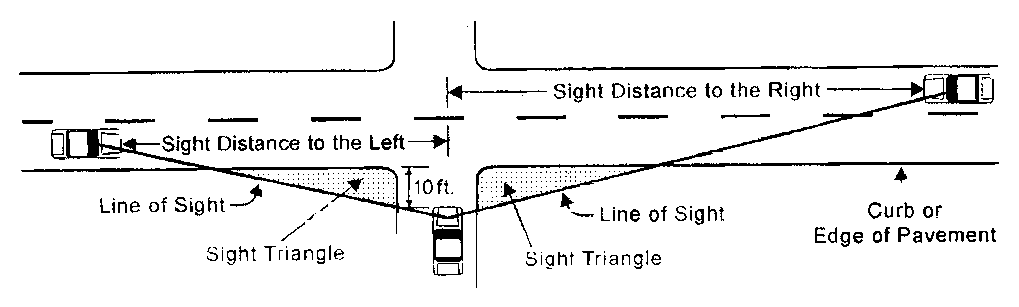
Sight Visibility
Triangle Easement
Stormwater better site design means nonstructural site design approaches and techniques that can reduce a site's impact on the watershed and can provide for nonstructural stormwater management. Stormwater better site design includes conserving and protecting natural areas and greenspace, reducing impervious cover, implementing lower impact site design techniques, and using natural features for stormwater management.
Street means an improved way for the conveyance of motor driven, rubber-tired vehicles, such as automobiles and trucks.
Utilities means all public, private, and municipal, above or below ground, infrastructure systems providing water, stormwater, sanitary sewer, natural gas, electricity, telecommunications, cable television or Internet, or any other service controlled by the state public services commission.
(ULDC 2005, § 9-17-1-3; Ord. No. 2016-09, § XI(exh. B), 6-21-2016; Ord. No. 2020-42, § XXXVII, 11-3-2020)
Sec. 9-17-1-4. - Applicability.
(a)
This article shall apply to all new development and redevelopment; provided, however, that within this article certain exceptions are made to specific sections or subsections.
(b)
Before any development permit or building permit is issued for a given development or building, the parking lot layout and area must be found by the community and economic development director to be in compliance with all applicable requirements of this article and site design review, as required by article 9-9, is accomplished. The community and economic development director may exempt from the permit and site design review requirements of this Code any improvement project resulting in four or less parking spaces, or the addition of four or less parking spaces to an existing parking lot. Such exemption shall not relieve the developer of compliance with other applicable provisions of this Code.
(c)
The building official shall not authorize occupancy or use of a building until advised by the community and economic development director or designee that parking facilities meet the applicable requirements of this article.
(d)
Prior to the city's issuance of a business registration, compliance with the requirements of this article shall be demonstrated.
(e)
This article shall not be construed as requiring compliance of parking lots which lawfully existed on the effective date of the ordinance from which this article is derived; provided, however, that the community and economic development director shall ensure parking lots that do not comply with this article meet the requirements of this article or substantially comply when there is a change in use, and when an existing developed site is planned for redevelopment, or a building permit is required to add additional building space on the site. If substantial redesign of the parking lot is required to comply with this article in such cases of redevelopment or building additions, the community and economic development director may accept substantial rather than complete compliance when the strict application of a requirement of this article would pose substantial practical difficulty.
(ULDC 2005, § 9-17-1-4; Ord. No. 2016-09, § XI(exh. B), 6-21-2016; Ord. No. 2020-42, § XXXVII, 11-3-2020)
Sec. 9-17-2-1. - Authorized access generally.
(a)
Every development and every lot shall have access via an approved roadway or driveway to a public street or private street (if approved) which connects to the public street system.
(b)
Ingress and egress to parking areas shall be by means of a driveway from the abutting street meeting the minimum requirements of this article.
(c)
The community and economic development director shall not authorize access of development in a nonresidential zoning district through any residential zoning district; exceptions may be made for mixed-use developments.
(ULDC 2005, § 9-17-2-1; Ord. No. 2016-09, § XI(exh. B), 6-21-2016)
Sec. 9-17-2-2. - Access control on state routes.
(a)
Access onto a U.S. or state highway shall meet state department of transportation requirements. Specifically, for subdivisions or land developments accessing state routes, the state department of transportation requires a driveway permit and may require the installation of deceleration lanes and/or other improvements per its Regulations for Driveways and Encroachment Control, as most recently revised. Such state approval and driveway permit shall be a precondition of development permit approval. A copy of the state department of transportation permit, if required, shall be submitted to the community and economic development director before plans can be approved.
(b)
For driveways accessing U.S. or state highways, the requirements of the state department of transportation shall apply whenever more restrictive than the standards in this article.
(ULDC 2005, § 9-17-2-2; Ord. No. 2016-09, § XI(exh. B), 6-21-2016)
Sec. 9-17-2-3. - Safe maneuvering and prevention of obstructions.
(a)
Except for single-family dwellings, duplexes, residential condominiums, and townhouses, off-street parking spaces shall have access so that their use will not require backing movements or other maneuvering within a street right-of-way.
(b)
There shall be no obstruction of a public sidewalk, including that portion of the sidewalk within a driveway apron, due to parking, loading, or other activity. The director of public works may require that construction contractors make special provisions for maintaining safe passage along public sidewalks during construction.
(ULDC 2005, § 9-17-2-3; Ord. No. 2016-09, § XI(exh. B), 6-21-2016)
Sec. 9-17-2-4. - Stacking spaces for drive-through facilities or service windows.
Stacking spaces shall be provided for any use having a drive-through facility or areas having drop-off and pick-up areas in accordance with this section.
(1)
Stacking spaces shall begin at the window or communication/mechanical device (e.g., order board) first encountered by the vehicle user. Financial institutions with drive-through windows, car washes (automated or staffed facilities), drive-through coffee sales facilities, and any other uses with drive-through facilities shall provide three stacking spaces for each window or drive-through service facility. Restaurants with drive-through facilities shall at least provide five stacking spaces for each window or drive-through service facility.
(2)
Stacking spaces and lanes for drive-through stations shall not impede on- and off-site traffic movements and shall not create a potentially unsafe condition where crossed by pedestrian access to a public entrance of a building.
(3)
Drive-through lanes shall be separated by striping or curbing from off-street parking areas. Individual lanes shall be striped, marked, or otherwise distinctly delineated.
(4)
All drive-through facilities shall be provided with a bypass lane with a minimum width of nine feet, aside the drive-through lane.
(ULDC 2005, § 9-17-2-4; Ord. No. 2016-09, § XI(exh. B), 6-21-2016)
Sec. 9-17-3-1. - Permit required.
(a)
A permit shall be required for construction, including driveways and utilities, in any public right-of-way. Permits will not be issued until such time that plans have been submitted and approved by the public works director or designee and, if a surfacing other than asphalt or concrete is used, the department of water resources director or designee.
(b)
No curbs or medians on public streets or rights-of-way shall be cut or altered for access, and no driveway connection to a public or private street shall be made or altered, without a permit issued by the public works department and/or other applicable jurisdictions (e.g., GDOT, the county).
(c)
Deceleration lanes may be required at all entrances to subdivisions and industrial and commercial developments that front on arterial and collector streets. Deceleration lanes shall be 12 feet in width, plus curb and gutter for a minimum distance of 200 feet measured from the intersection of the right-of-way lines, or as may be otherwise required by the state department of transportation (on state routes) or the public works director for a local street.
(ULDC 2005, § 9-17-3-1; Ord. No. 2016-09, § XI(exh. B), 6-21-2016)
Sec. 9-17-3-2. - Driveway width requirements.
(a)
Vehicular access from properties to streets shall comply with the following minimum dimensional requirements, measured at the right-of-way line.
Table 9-17-3-1. Driveway Width Requirements
(b)
When a property containing a single-family residence is converted to a use that requires a wider driveway, the public works director may reduce the driveway width required by this section if access via a narrower driveway will not be impeded.
(ULDC 2005, § 9-17-3-2; Ord. No. 2016-09, § XI(exh. B), 6-21-2016)
Sec. 9-17-3-3. - Number of driveways limited.
(a)
Along state or U.S. highways, no more than one driveway access from a property shall be permitted for each 300 feet of lot frontage, or fraction thereof.
(b)
Along all streets other than state or U.S. highways, one driveway that meets the driveway width requirements described within table 9-17-3-1 shall be permitted for every 200 feet of road frontage not to exceed a total of three driveways within residential zoned districts and not to exceed a total of five driveways within commercial or industrial zoned districts as described in table 9-17-3-2. The public works director shall have the ability to administratively vary this requirement for good cause. Written application must be made to the public works director stating the reason for the administrative variance, and identifying the reason for such request.
Table 9-17-3-2. Number of Driveways Permitted
(c)
The public works director shall determine whether the driveways may be unrestricted or will have to be designed for right-in, right-out traffic flow.
(ULDC 2005, § 9-17-3-3; Ord. No. 2016-09, § XI(exh. B), 6-21-2016)
Sec. 9-17-3-4. - Location limitations.
(a)
No driveway shall be allowed within 35 feet of the right-of-way line of any street intersections for single- and two-family residential lots and within 50 feet for multifamily and nonresidential properties. The public works director shall have the ability to administratively vary this requirement for good cause. Written application must be made to the public works director stating the reason for the administrative variance, and identifying the reason for such request.
(b)
Corner lot access shall be located at the points farthest from the intersection to eliminate turning movement accidents and to promote proper storage of through traffic.
(ULDC 2005, § 9-17-3-4; Ord. No. 2016-09, § XI(exh. B), 6-21-2016)
Sec. 9-17-3-5. - Minimum driveway construction specifications.
Driveway connections shall be provided between the edge of pavement or back of curb to the right-of-way line. No property may be afforded access from a public street except as follows:
(1)
Curb and gutter streets shall be provided with a driveway apron constructed of 3,000 psi concrete at least six inches thick. Sidewalks, where provided, shall be warped to the driveway apron and are to be identified across the driveway apron by construction joints or control joints.
(2)
Swale ditch section streets shall be provided with a driveway apron constructed of 3,000 psi concrete at least six inches thick, or asphaltic concrete of the same thickness and type as the paving course for the street.
(3)
For streets that have been overlaid, driveway aprons shall tie into the existing curb and gutter. Asphalt may be added to the apron for smoother access.
(4)
All driveway aprons shall have a radius connecting the driveway to the curbline or pavement edge as follows:
Table 9-17-3-3. Driveway Apron Radii
| Use | Minimum Driveway Radius | |
|---|---|---|
| Single-Family Residential | 5 feet | 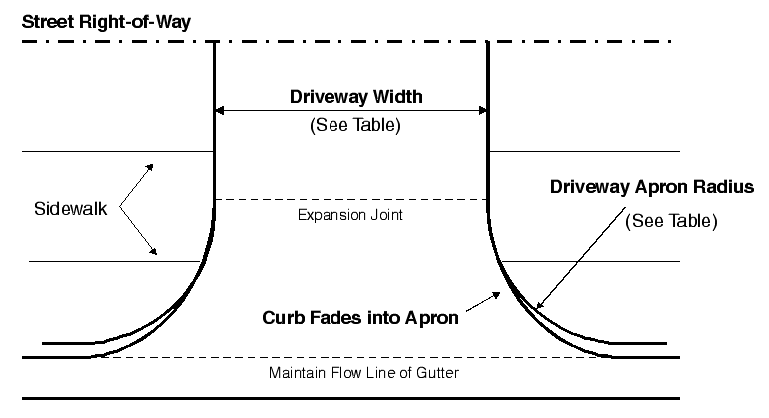 |
| Commercial or Multifamily Residential | 15 feet | |
| Industrial | 25 feet |
(ULDC 2005, § 9-17-3-5; Ord. No. 2016-09, § XI(exh. B), 6-21-2016)
Sec. 9-17-3-6. - Driveway surfacing.
(a)
Driveways shall be paved with asphalt or concrete unless the department of water resources director or designee permits porous materials due to environmental impacts or to meet the stormwater management and water quality objectives of this Code. Porous materials shall not be installed at commercial/industrial sites where, in the opinion of the water resources director or designee, the potential for spills and groundwater contamination exists.
(b)
In the case of land development within the Historic Preservation Overlay Zone, the community and economic development director or designee may recommend and the historic preservation commission shall be authorized to review and approve the use of alternative pavement surfaces or permit driveways to be unpaved if appropriate to the character of the historic district or landmark.
(ULDC 2005, § 9-17-3-6; Ord. No. 2016-09, § XI(exh. B), 6-21-2016; Ord. No. 2020-42, § XXXVIII, 11-3-2020)
Sec. 9-17-3-7. - Common access easements for shared driveways.
Shared driveways between two parcels along the common property line may be required by the public works director. In such cases, each property owner shall grant an access easement to facilitate the movement of motor vehicles across the site.
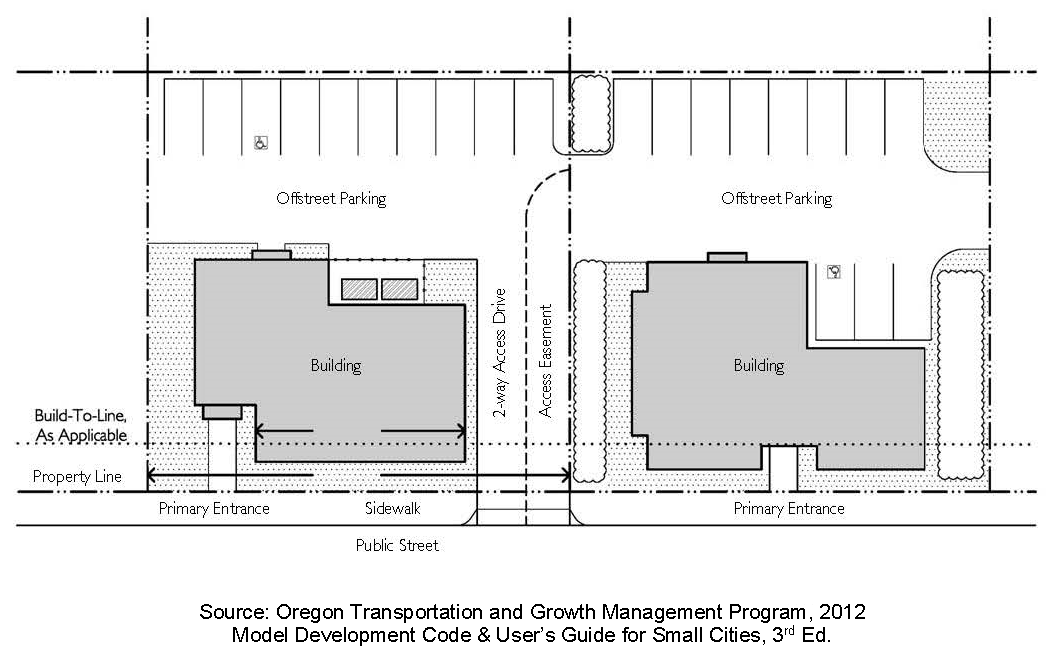
Illustrative Shared Driveway
and Access Easement
(ULDC 2005, § 9-17-3-7; Ord. No. 2016-09, § XI(exh. B), 6-21-2016)
Sec. 9-17-4-1. - Site visibility triangle easement established.
A sight visibility triangle easement, as defined in this article, is hereby established at every public or private street intersection with another street or a private driveway, which shall meet the dimensions specified in table 9-17-4-1. Required sight visibility triangle easements shall be required to be delineated on all plans and plats.
Table 9-17-4-1. Site Visibility Triangle Easement Requirements
| "A" Distance in Feet | |||||
|---|---|---|---|---|---|
| "B" Distance in Feet | Local Street | Collector Street | Arterial Street | ||
| 25 | Private Drive | 25 | 25 | 25 | 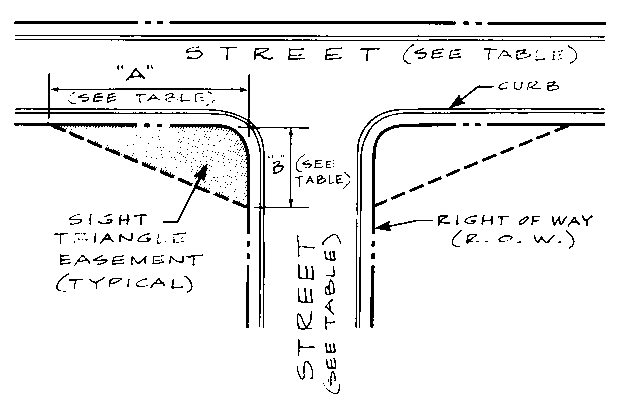 |
| 30 | Local Street | 30 | 100 | 150 | |
| 100 | Collector Street | 30 | 100 | 150 | |
| 150 | Arterial Street | 30 | 100 | 150 | |
(ULDC 2005, § 9-17-4-1; Ord. No. 2016-09, § XI(exh. B), 6-21-2016)
Sec. 9-17-4-2. - Delineation at street intersections.
At public street intersections, the sight visibility triangle easement is delineated by the two intersecting street right-of-way lines and a line connecting the right-of-way lines at the points indicated in table 9-17-4-1. The connecting points shall be measured from the right-of-way lines extended to their point of intersection.
(ULDC 2005, § 9-17-4-2; Ord. No. 2016-09, § XI(exh. B), 6-21-2016)
Sec. 9-17-4-3. - Delineation at driveway intersections.
At driveway intersections with public streets, the edge of the driveway's pavement or back of curb will be used for the sight visibility triangle easement measurements along the driveway.
(ULDC 2005, § 9-17-4-3; Ord. No. 2016-09, § XI(exh. B), 6-21-2016)
Sec. 9-17-4-4. - Restrictions within sight visibility easements.
Within the sight visibility triangle easement, the planting of trees or other vegetation or the location of structures over 2½ feet in height that would obstruct the clear sight across the area of the easement shall be prohibited. The easement shall provide right of entry to the city for the purpose of removing any object or vegetation that obstructs the clear sight. The public works director may authorize structures or vegetation at a greater height within a sight visibility triangle easement if it is determined that sight visibility will not be compromised. Any proposed structures or vegetation exceeding this height shall be indicated on plans.
(ULDC 2005, § 9-17-4-4; Ord. No. 2016-09, § XI(exh. B), 6-21-2016)
Sec. 9-17-5-1. - Off-street parking required.
(a)
Unless specifically provided otherwise in this chapter, at the time of the establishment of any use, or erection of any building, or at the time any principal building is enlarged or increased in capacity by adding dwelling units, guestrooms, seats or floor area, there shall be provided permanent off-street parking spaces in a number and in accordance with the design specifications required by this chapter.
(b)
No existing or future off-street parking area shall be reduced in capacity to less than the minimum required number of spaces, or increased to more than the maximum permitted number of spaces, or altered in design or function to less than the minimum standards, unless specifically provided for in this article.
(ULDC 2005, § 9-17-5-1; Ord. No. 2016-09, § XI(exh. B), 6-21-2016; Ord. No. 2020-42, § XXXIX, 11-3-2020)
Sec. 9-17-5-2. - Parking requirements in the C-B, Central Business Zoning District.
Notwithstanding other provisions of this chapter, off-street parking shall not be required for any use within the C-B, Central Business Zoning District.
(ULDC 2005, § 9-17-5-2; Ord. No. 2016-09, § XI(exh. B), 6-21-2016; Ord. No. 2020-42, § XXXIX, 11-3-2020)
Sec. 9-17-5-3. - Surfacing and curbing of parking lots.
Parking lots shall be improved with an asphalt or concrete surface and curb and gutter as approved by the public works director; provided, however, that:
(1)
Parking lots shall be paved with asphalt or concrete, unless the department of water resources director or designee permits porous materials due to environmental impacts or to meet the stormwater management and water quality objectives of this Code. Porous materials shall not be installed at commercial/industrial sites where, in the opinion of the water resources director or designee, the potential for spills and groundwater contamination exists.
(2)
Curbing shall be installed as required by the department of water resources director when considered necessary for drainage, although water quality effectiveness and character of the zoning district shall be considerations in determining curbing requirements. To maximize infiltration and promote the water quality effectiveness of low impact development techniques, the department of water resources director is authorized to vary curb requirements for parking lots.
(3)
In the case of land development within the Historic Preservation Overlay Zone, the community and economic development department may recommend and the historic preservation commission shall be authorized to review and approve the use of alternative pavement surfaces or permit parking lots to be unpaved if appropriate to the character of the historic district or landmark.
(4)
See also section 9-17-5-15 for by-right permissions to use alternative paving surfaces for large parking lots.
(ULDC 2005, § 9-17-5-3; Ord. No. 2016-09, § XI(exh. B), 6-21-2016; Ord. No. 2020-42, § XXXIX, 11-3-2020)
Sec. 9-17-5-4. - Parking area use limitations.
(a)
Areas provided to meet the minimum requirements of this article as to handicapped and other parking spaces, along with the aisles and driveways necessary to provide access to those spaces, shall not be used for any purpose other than the temporary parking of vehicles for the present on-site use. Specifically, no such parking area may be used for the sale, repair, dismantling or servicing of any vehicles, equipment, materials or supplies.
(b)
Upon application, the community and economic development director may approve temporary structures and uses such as tent sales within required parking spaces that are not used on a continuous basis, provided that such uses are moveable from the site upon order by the community and economic development department, subject to the requirements of section 9-10-8-2.
(c)
This section shall not preclude the uses of parking lots as authorized in section 9-10-1-4.
(ULDC 2005, § 9-17-5-4; Ord. No. 2016-09, § XI(exh. B), 6-21-2016; Ord. No. 2020-42, § XXXIX, 11-3-2020)
Sec. 9-17-5-5. - Parking for company-owned vehicles.
Every business that stores vehicles owned by the business on-site overnight (such as a company fleet), or maintains a stock of vehicles as part of its business activities (such as a car sales lot, a salvage and wrecking yard, auto repair, car rental agency, etc.), shall provide for adequate parking or storage for the vehicles such that:
(1)
No parking occurs in a public right-of-way;
(2)
Parking does not encroach on off-street parking spaces required by this chapter and may not be parked within the front yard or otherwise positioned for advertising purposes;
(3)
Any other area that has not been improved as a parking lot or storage yard. Such parking spaces shall be in addition to those required by this chapter.
(ULDC 2005, § 9-17-5-5; Ord. No. 2016-09, § XI(exh. B), 6-21-2016; Ord. No. 2020-42, § XXXIX, 11-3-2020)
Sec. 9-17-5-6. - Interpretations.
(a)
Fractions. Where a fractional space results during the calculation of required parking, the required number of parking spaces shall be rounded downward to the next whole number.
(b)
Parking space requirement not specified. Where the parking requirement for a particular use is not described in this chapter, and where no similar use is listed, the community and economic development director shall determine the number of spaces to be provided based on requirements for similar uses, location of the proposed use, the number of employees on the largest shift, total square footage, potential customer use, and other expected demand and traffic generated by the proposed use. At the discretion of a development applicant, a parking generation study prepared by a qualified professional may be submitted to aid the community and economic development director in making such a determination; if submitted, it shall be considered by the community and economic development director prior to making a determination.
(c)
Computations for multiple-floor uses within a building. In cases where a building contains some combination of office space, retail or wholesale sales area, and/or bulk storage area, the community and economic development director may authorize that combinations of the parking requirements established in this chapter be used which are proportional to the use of floor areas (e.g., warehousing, retail, and/or office) in determining the minimum required off-street parking space requirements of this chapter.
(d)
Related facility parking. The community and economic development director may through the administrative variance process specified in chapter 9-24-3, authorize a reduction of the number of required parking spaces when it can be demonstrated to his satisfaction that the use provides other areas on the site that are not marked as parking spaces but which serve some of the demand for on-site parking. Such areas may include, but are not limited to, drive-through stacking lanes, drive-through bays, and gas pump canopy areas, and excess loading zones.
(ULDC 2005, § 9-17-5-6; Ord. No. 2016-09, § XI(exh. B), 6-21-2016; Ord. No. 2020-42, § XXXIX, 11-3-2020)
Sec. 9-17-5-7. - Off-street parking spaces on same site as use they serve.
All parking spaces required by this chapter for all uses shall be located on the same lot as the use for which such parking is intended, except as specifically provided otherwise by this chapter.
(ULDC 2005, § 9-17-5-7; Ord. No. 2016-09, § XI(exh. B), 6-21-2016; Ord. No. 2020-42, § XXXIX, 11-3-2020)
Sec. 9-17-5-8. - Off-site parking spaces permitted.
In lieu of parking on the same lot as the use for which such parking is intended, parking spaces required by this chapter for all uses may be provided off-site, provided the following requirements are met:
(1)
The spaces are within a walking distance of 400 feet of the main entrance to the building or use they are intended to serve; provided, however, that no required parking spaces may be located across any state or U.S. highway from the use they are intended to serve. In townhouse subdivision developments, each parking space shall be within 100 feet of the entrance to the dwelling unit that it serves, as measured along the most direct pedestrian route.
(2)
The property containing the parking spaces not serving a use on-site must be either under the same ownership as the property containing the use to which the parking will serve, or a valid lease agreement must exist between the two property owners for use of the parking area. Lease agreements, as applicable, must be of sufficient duration to serve the use proposed to be partially served by the off-site leased parking, as approved by the public works director.
(3)
Off-site parking shall not exceed 30 percent of the required parking for a building or buildings, except in the C-B zoning district, where 100 percent is permitted.
(4)
Safe and convenient pedestrian access, such as a sidewalk or path, must exist or be provided at the expense of the property owner from the structure or use to the off-site parking lot.
(5)
The community and economic development director may in individual cases administratively authorize a reduction, not to exceed 20 percent of the minimum required number of parking spaces for projects that are directly served by on-street parking approved by the public works director.
(6)
The number of parking spaces required by this chapter for any number of separate uses may be combined and provided in one lot (i.e., off the site of one or more uses), provided that the spaces are within a walking distance of 400 feet of the main entrance to the building or use they are intended to serve; provided, further, that the required spaces assigned to each use may not be assigned to another use, except as follows:
a.
One-half of the parking spaces required for a church, theater or assembly hall whose peak attendance will be on weekends and nights that services or activities are held may be assigned to a use that will be closed during those time periods.
b.
Parking spaces may be shared by more than one use if the community and economic development director finds that the total number of spaces will be adequate at the peak hours of the uses they serve.
(ULDC 2005, § 9-17-5-8; Ord. No. 2016-09, § XI(exh. B), 6-21-2016; Ord. No. 2020-42, § XXXIX, 11-3-2020)
Sec. 9-17-5-9. - Requirements for design of parking lots.
(a)
Site design review. The design of parking lots is of critical importance with regard to functionality, pedestrian access, stormwater management, and aesthetics. Therefore, all parking lots or additions to parking lots consisting of more than four spaces require site design review in accordance with article 9-9. Locations of parking spaces and their design may vary based on character area and use, after considering the stormwater management objectives of this Code.
(b)
Drainage. For any use that will require a parking area of five spaces or more, or a loading area, to be newly constructed, added to, or altered in such a way as to affect drainage either on or off the site, stormwater drainage plans, including grading and paving plans, shall be submitted to and approved by the community and economic development director and the department of water resources director, prior to the issuance of a land development permit.
(c)
Location of spaces in relation to rights-of-way. No parking space shall be provided along an access driveway within the first 25 feet of the driveway from any local street. The public works director may require that the parking spaces be located at least 50 feet from the right-of-way of a collector street and 100 feet from the right-of-way of an arterial street.
(d)
Minimum dimensions of spaces. Every parking space shall provide a useable rectangular area at least nine feet wide by 18 feet long, excluding any access aisles; provided, however, that the minimum width of parking spaces may be reduced in accordance sections 9-17-5-14 and 9-17-5-15.
(e)
Minimum dimensions of access aisles. Access aisles in parking lots with parking at 90-degree angles must be at least 26 feet wide for double-loaded parking space designs with two-way traffic, and 24 feet wide for single-loaded parking space designs with one-way or two-way traffic (see figures). One-way traffic aisles must be clearly marked with directional arrows on the pavement at each intersection with another aisle. The public works director may authorize a minor reduction in the required minimum width of access aisles for redeveloped areas if sufficient access is provided and the fire marshal agrees that access for fire apparatus is maintained.
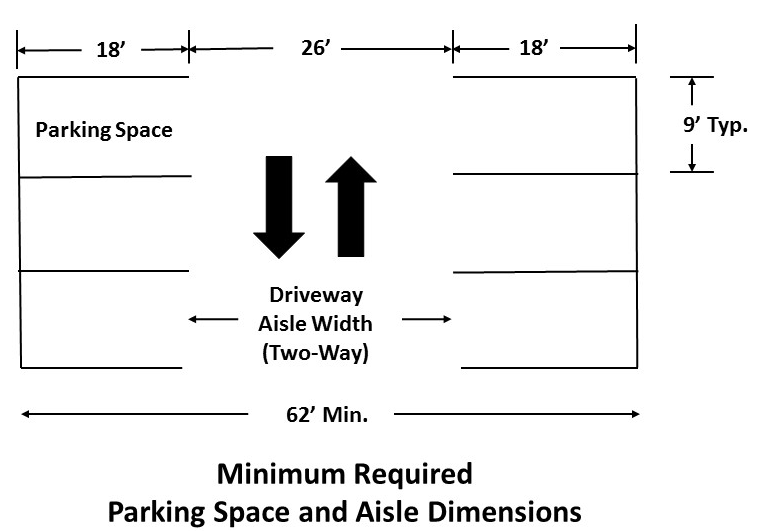
Double Loaded, Two-Way Traffic
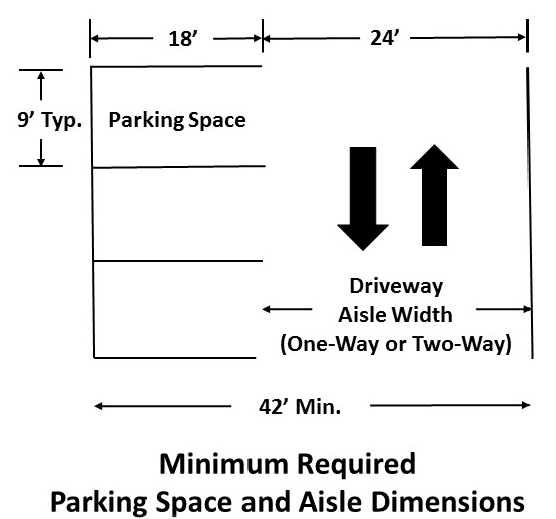
Single Loaded,
One- or Two-Way Traffic
(f)
Demarcation. Every parking space shall be clearly demarcated by lines painted on or otherwise applied to the parking lot surface. One-way traffic aisles must be clearly marked with directional arrows on the pavement at each intersection with another aisle, driveway, or street entrance. The public works director may grant exceptions to the requirement of this subsection to mark common boundaries between parking spaces in the case of gravel parking lots, if and where permitted, or to authorize traffic directional signs in lieu of one-way pavement markings.
(g)
Maximum aisle length. Parking aisle lengths shall not exceed 300 feet without a break for circulation (see figure).
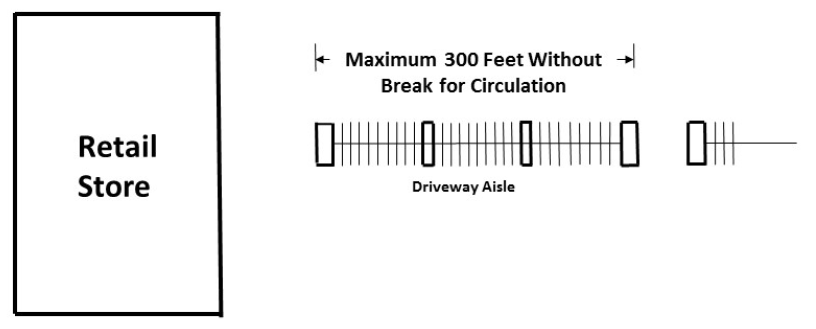
Parking Aisle Length
(h)
Angled parking. Parking spaces with 90-degree designs shall be required, unless 60 degree, or 45-degree angles to the access aisle are authorized by the community and economic development director, in which case required aisle widths for 90-degree parking may be reduced per standards approved by the director. Parking lots with parking space angles less than 45 degrees to the access aisle shall not be allowed, except for parking spaces that are parallel to the access aisle.
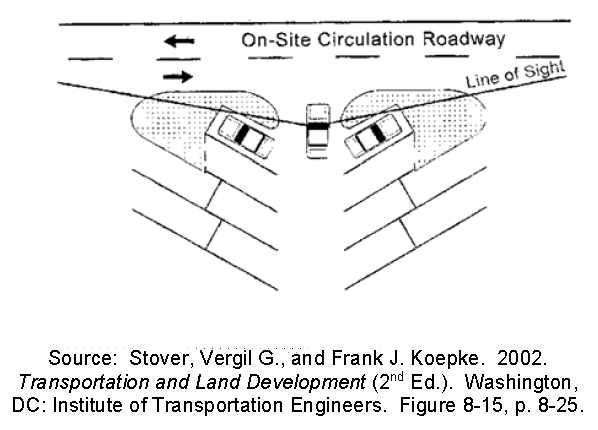
End Islands
Preserve Sight Distance
(i)
Sight distance at end aisles. The intersection of parking aisles with a ring road or other on-site roadways or driveways shall provide adequate intersection sight distance. Parking aisle end islands shall be curbed unless that requirement is waived for water quality purposes or in a rural/exurban area; painted end islands are ineffective and are generally not permitted.
(j)
Light pole locations and specifications. Light poles should be located in landscaped planter strips. Where this cannot be accomplished, light poles must be placed on a reinforced concrete pedestal to protect them from damage or being knocked over.
(ULDC 2005, § 9-17-5-9; Ord. No. 2016-09, § XI(exh. B), 6-21-2016; Ord. No. 2020-42, § XXXIX, 11-3-2020)
Sec. 9-17-5-10. - Minimum number of parking spaces for persons with disabilities.
Spaces for persons with disabilities shall be provided in each parking lot according to the requirements of table 9-17-5-1. Such spaces shall be counted in meeting the off-street parking requirements of this chapter, as specified in table 9-17-5-2.
Table 9-17-5-1. Minimum Number of Spaces For Persons With Disabilities Required
(ULDC 2005, § 9-17-5-10; Ord. No. 2016-09, § XI(exh. B), 6-21-2016; Ord. No. 2020-42, § XXXIX, 11-3-2020)
Sec. 9-17-5-11. - Specifications for parking spaces for persons with disabilities.
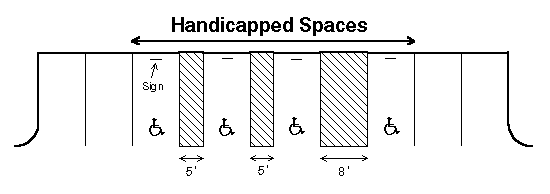
Spaces for Persons
with Disabilities
(a)
Parking spaces for persons with disabilities shall have an adjacent aisle five feet wide, and one in every eight handicapped spaces (but not less than one) shall be adjacent to an aisle eight feet wide and the space shall be signed "van accessible." Parking space aisles for persons with disabilities shall be clearly demarcated.
(b)
All parking for persons with disabilities shall comply with the requirements of the federal Americans with Disabilities Act. Accessible parking spaces shall be designated as reserved by a sign showing the symbol of accessibility, per applicable state law requirements. Such signs shall be located so that they cannot be obscured by a vehicle parked in that space.
(ULDC 2005, § 9-17-5-11; Ord. No. 2016-09, § XI(exh. B), 6-21-2016; Ord. No. 2020-42, § XXXIX, 11-3-2020)
Sec. 9-17-5-12. - Off-street parking requirements by use.
Unless specifically provided otherwise in this chapter, on each lot where a building, structure, or use exists, each site shall be designed to provide and shall provide for off-street parking in the minimum amounts and not to exceed the maximum amounts specified in table 9-17-5-2 (including handicapped parking spaces). Requirements refer to one space per unit of measurement unless otherwise specifically provided. Square footages are measured on the basis of gross square footage unless otherwise specifically provided.
Table 9-17-5-2. Minimum and Maximum Number of Off-Street Parking Spaces Required
(ULDC 2005, § 9-17-5-12; Ord. No. 2016-09, § XI(exh. B), 6-21-2016; Ord. No. 2020-42, § XXXIX, 11-3-2020)
Sec. 9-17-5-13. - Administrative variances.
(a)
The community and economic development director may via administrative variance allow parking at a rate of up to 20 percent above the maximum or 20 percent below the minimum required as specified in table 9-17-5-2, on a case-by-case basis based upon the scale and impacts of the request, for good cause shown, in accordance with chapter 9-24-3.
(b)
The applicant shall make said request in writing which shall include documentation from an acceptable industry publication (e.g., Institute of Transportation Engineers, Urban Land Institute, American Planning Association, etc.) or by a study prepared by a qualified professional that documents parking requirements.
(c)
In approving administrative variances that reduce the minimum parking requirements established in this chapter, the community and economic development director may as a condition of approval, if applicable, require an area to be reserved or set aside for additional parking area for future use if needed.
(ULDC 2005, § 9-17-5-13; Ord. No. 2016-09, § XI(exh. B), 6-21-2016; Ord. No. 2020-42, § XXXIX, 11-3-2020)
Sec. 9-17-5-14. - Compact parking spaces.
Compact parking spaces may be used in parking areas when more than 20 parking spaces are required, provided that the areas for compact parking are clearly marked and not more than 20 percent of the number of parking spaces provided in the entire parking area is designated compact auto parking.
(ULDC 2005, § 9-17-5-14; Ord. No. 2016-09, § XI(exh. B), 6-21-2016; Ord. No. 2020-42, § XXXIX, 11-3-2020)
Sec. 9-17-5-15. - Reduction of parking stall width and use of porous materials.
When a parking lot of 75 spaces or an area of one acre or more of parking is proposed, the applicant may divide the parking lot into distinct use areas as provided in table 9-17-5-3 and reduce impervious surfaces via reduction of parking stall width and the use of porous materials for improved water quality infiltration techniques.
Table 9-17-5-3. Division of Large Parking Lots for Minimum Parking Space Width Reduction and Authorization of Porous Materials
(ULDC 2005, § 9-17-5-15; Ord. No. 2016-09, § XI(exh. B), 6-21-2016; Ord. No. 2020-42, § XXXIX, 11-3-2020)
Sec. 9-17-5-16. - Cross-referenced provisions.
(a)
Accessory uses. Accessory uses of parking lots and loading areas shall be limited as specified in section 9-10-1-4.
(b)
Street frontage. Parking lots shall meet minimum street frontage requirements as specified in section 9-3-2-5.
(c)
Landscaping. Parking lots shall be landscaped according to the requirements of chapter 9-16-4. Also see chapter 9-16-5 for tree plan requirements.
(d)
Residential zoning districts. Vehicle parking in residential zoning district shall meet the requirements of section 9-10-3-7.
(e)
Home occupations. Home occupations shall meet the parking requirements of section 9-10-4-4.
(f)
Special temporary outdoor events. Parking for special temporary outdoor events shall meet the requirements of section 9-10-8-2.
(g)
Site design. Site design and design review shall be in accordance with article 9-9.
(h)
Stormwater management. Parking lot stormwater facilities shall be designed in accordance with chapter 9-13-12.
(ULDC 2005, § 9-17-5-16; Ord. No. 2016-09, § XI(exh. B), 6-21-2016; Ord. No. 2020-42, § XXXIX, 11-3-2020)
Sec. 9-17-6-1. - Off-street loading required.
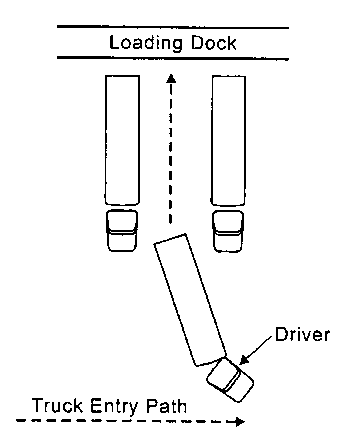
Off-Street Loading
On the same lot with every building, structure or part thereof, erected or occupied for manufacturing, storage, warehouse, truck freight terminal, department store, wholesale store, grocery supermarket, hotel, hospital, mortuary, dry cleaning plant, retail business, or other uses similarly involving the receipt or distribution of vehicles, materials or merchandise, there shall be provided and maintained adequate space for the standing, loading, and unloading of such materials to avoid undue interference with public use of streets, alleys, and private or public parking areas.
(ULDC 2005, § 9-17-6-1; Ord. No. 2016-09, § XI(exh. B), 6-21-2016)
Sec. 9-17-6-2. - Loading area specifications.
Unless otherwise approved by the community and economic development director, loading spaces shall be a minimum of 14 feet wide, 40 feet long, with 14 feet of height clearance. When the development requires loading and unloading by full-size tractor-trailers, loading spaces shall be at least 60 feet long with a total approach zone of at least 90 feet.
(ULDC 2005, § 9-17-6-2; Ord. No. 2016-09, § XI(exh. B), 6-21-2016)
Sec. 9-17-6-3. - Minimum number of off-street loading spaces required.
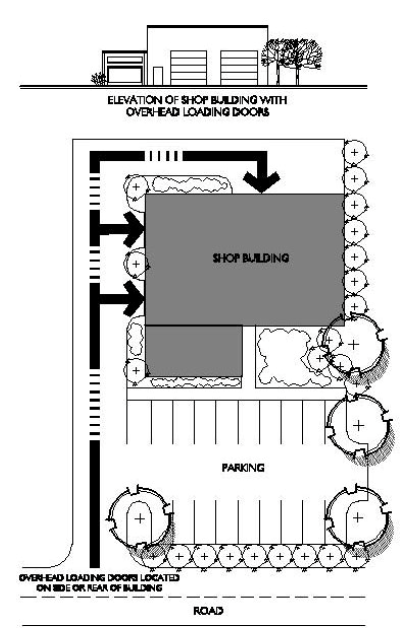
Location of
Loading Zones
(a)
One off-street loading space shall be provided for the first 10,000 square feet of gross floor area or fractional part thereof for light industrial use and one off-street loading space for the first 5,000 square feet of gross floor area or fractional part thereof for retail or other nonindustrial use for which a loading space is required. One additional space shall be required for each additional 25,000 square feet of gross floor area or fractional part thereof for light industrial use and for each additional 10,000 square feet for retail or other nonindustrial use.
(b)
For example, a 100,000 square foot building consisting of 5,000 square feet of office/sales area and 95,000 square feet of warehouse would require a total of six off-street loading spaces: one for the first 10,000 square feet of warehouse space; one for the 5,000 square feet of office/sales area; and four for the remaining 85,000 square feet of warehouse space (85,000 divided by 25,000 equals three and four-tenths (3.4) spaces, which is rounded upward to four spaces).
(c)
The community and economic development director is authorized to modify the loading area specifications of this chapter and/or reduce or waive off-street loading space requirements for good cause shown, after application for administrative variance as specified in chapter 9-24-3.
(ULDC 2005, § 9-17-6-3; Ord. No. 2016-09, § XI(exh. B), 6-21-2016)
Sec. 9-17-6-4. - Administrative variance.
The community and economic development director is authorized to modify the loading area specifications of this chapter and reduce or waive off-street loading space requirements for good cause shown, after application for administrative variance, in accordance with chapter 9-24-3.
(ULDC 2005, § 9-17-6-4; Ord. No. 2016-09, § XI(exh. B), 6-21-2016)

