
Gainesville City Zoning Code
ARTICLE 9
2 - INTERPRETATIONS AND DEFINITIONS
Sec. 9-2-1-1. - Responsibility for interpretation.
The director of community and economic development shall be responsible for the interpretation of the requirements, standards, definitions, or any other provision of this Code, unless that authority is provided to another administrative official within a specific article. Interpretations of the director or other administrative official may be appealed under the provisions of chapter 9-22-7. The director shall have administrative authority of this Code.
(ULDC 2005, § 9-2-1-1; Ord. No. 2020-42, § III, 11-3-2020)
Sec. 9-2-1-2. - Purpose and intent of interpretations.
In the interpretation and application of this Code, all provisions shall be considered as minimum requirements. Where the literal interpretation is clear to the director, it shall be construed literally. Where the article, chapter, section, or subsection has a statement of purpose and intent, the director shall consider said purpose and intent in making the interpretation. The director shall make interpretations in a way that are liberally construed in favor of the governing body; provided, however, that where ambiguity exists, the director shall interpret this article in favor of the free use of property.
(ULDC 2005, § 9-2-1-2)
Sec. 9-2-1-3. - Use of figures.
Figures associated with defined terms or regulatory paragraphs in this Code are provided for illustration only and do not limit or change the meaning of the term, as defined, or the requirements of the regulation as written.
(ULDC 2005, § 9-2-1-3)
Sec. 9-2-1-4. - Use of words and phrases.
For the purpose of this Code, the following shall apply to the use of words and phrases:
(1)
Words used in the present tense include the future tense. Words used in the singular tense include the plural tense, and words used in the plural tense include the singular tense.
(2)
The masculine person "he" or "his" also means the feminine person "she" or "hers."
(3)
The term "person" is intended to include any individual, partnership, firm, association, joint venture, public or private corporation, trust, estate, commission, board, public or private institution, utility, cooperative, state agency, municipality or other political subdivision of this state, any interstate body or any other legal entity.
(4)
The terms "shall" and "must" are always mandatory and not discretionary, while the term "may" is permissive.
(5)
The term "and" indicates that all of the conditions, requirements or factors so connected must be met or fulfilled, while the term "or" indicates that at least one condition, requirement or factor so connected must be met.
(6)
The term "such as" is intended to introduce one or more examples in illustration of a requirement or point, and is intended to mean "including, but not limited to, the following."
(7)
The term "day" means a calendar day unless otherwise specified.
(8)
Where a term is defined in this article, it shall be construed to have meaning and application throughout this Code, unless the context clearly indicates otherwise.
(9)
Where a term is defined in any article other than this article, it is generally the intent that such definition applies only within the article it appears, since it is positioned in the article to which it most readily refers; provided, however, that this provision shall not prevent the director from interpreting that defined term as applying outside the strict context of the article in which it appears, and to that end, all definitions, regardless of location within this Code, apply equally to the use of such terms throughout the Code.
(ULDC 2005, § 9-2-1-4)
Sec. 9-2-2-1. - Definitions.
The following words, terms and phrases, when used in this article, shall have the meanings ascribed to them in this section, except where the context clearly indicates a different meaning:
Abutting means having property lines in common, or having property separated by only an alley. Separation by a street right-of-way is not considered abutting.
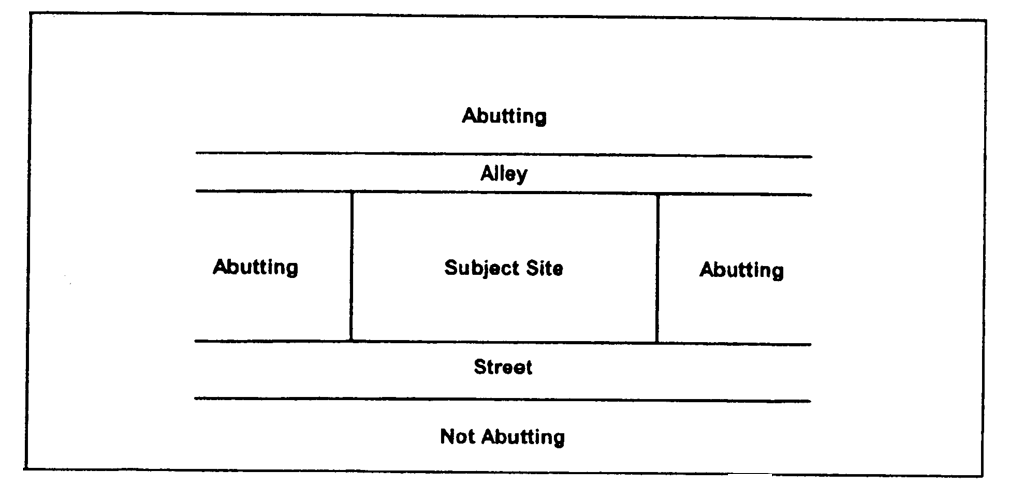
Abutting Definition
Alteration means any change in the supporting members of a building or structure such as bearing walls columns, and girders, except such emergency change as may be required for safety purposes; any addition to a building; any change in use; or any movement of a building from one location to another.
Annexation means the process by which a parcel of land is transferred from the jurisdiction of the unincorporated county to the jurisdiction of the city.
Appeal means a request for a review of an administrative official's interpretation of any provision of this Code, or a request for a review of an action taken by an administrative official in the application or enforcement of this Code.
As-built survey drawings means drawings specifying the dimensions, location, capacities, and operational capabilities of structures and facilities as they have been constructed.
Buffer means a strip of land located between a side or rear property line and a building, structure, or use; or a strip of land lying adjacent to a stream. A buffer is intended to separate and provide screening of the view of the site on which the buffer is located from an abutting property, and/or to provide stream protection, as defined and as may be required by this article. The following buffer types are recognized in this article:
Buffer, natural undisturbed, means a buffer that contains a natural area consisting of trees and/or other vegetation, undisturbed except for approved access and utility crossings, and replanted where sparsely vegetated.
Buffer, planted, means a buffer consisting of newly planted evergreen and deciduous trees and shrubs native to the region. Deciduous trees shall be a minimum of two-inch caliper and evergreen trees a minimum of six feet in height at time of planting. Required deciduous and evergreen shrubs shall be a minimum of three feet at time of planting.
Buffer, stream, means a natural undisturbed or enhanced vegetated area lying adjacent to a stream. as measured horizontally from the top of the stream bank, on both banks (as applicable) of the stream.
Buffer, structural, means a visual screen created through construction of a solid wooden fence, decorative masonry wall, earthen berm, or combination of fence or wall with an earthen berm, which may be supplemented with vegetation, so as to present an opaque visual separation when viewed from one side to the other throughout the year.
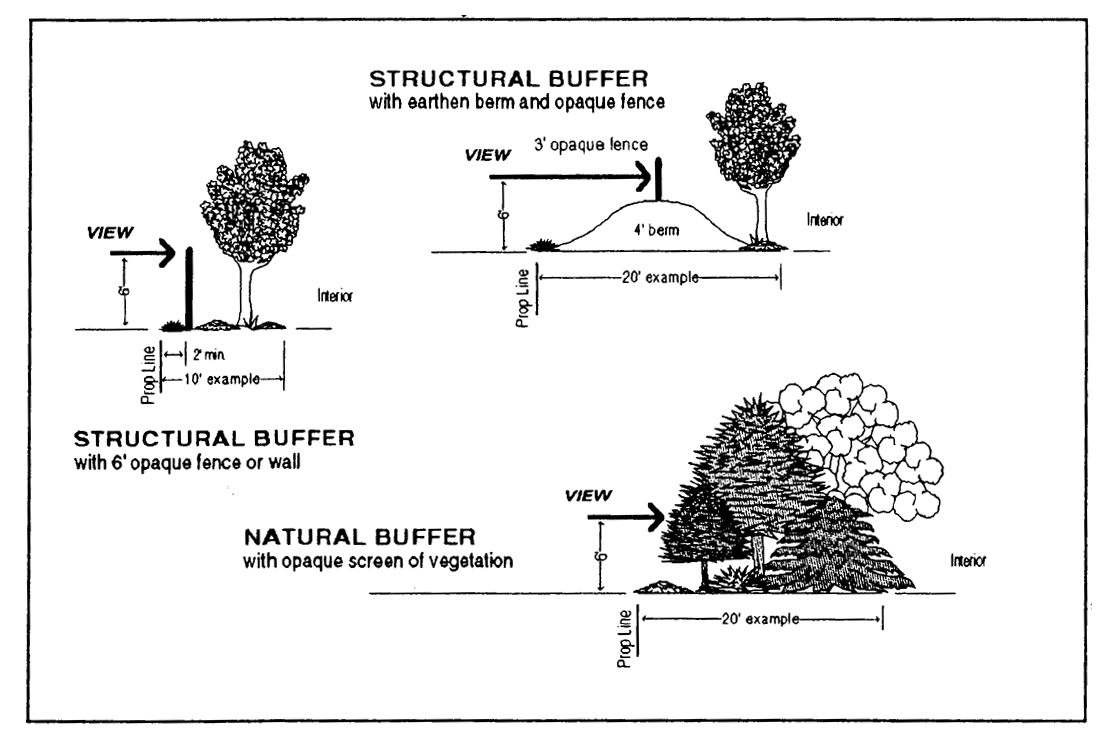
Buffer Types
Buildable area means the portion of a lot which is not located within any minimum required yard, landscape strip, landscaped area, or buffer; that portion of a lot wherein a building or structure may be located.
Building means any structure having a roof supported by columns or walls and intended for the shelter, housing, or enclosure of any individual, animal, process, equipment, goods, or materials of any kind.
Building, accessory, means a building subordinate to the main building on a lot and used for purposes incidental to the main or principal building and located on the same lot therewith.
Building, principal, means a building in which is conducted the principal use of the lot on which said building is situated. In any residential zoning district, any structure containing a dwelling unit shall be defined to be the principal building on the lot on which the same is situated, except for detached accessory apartments.
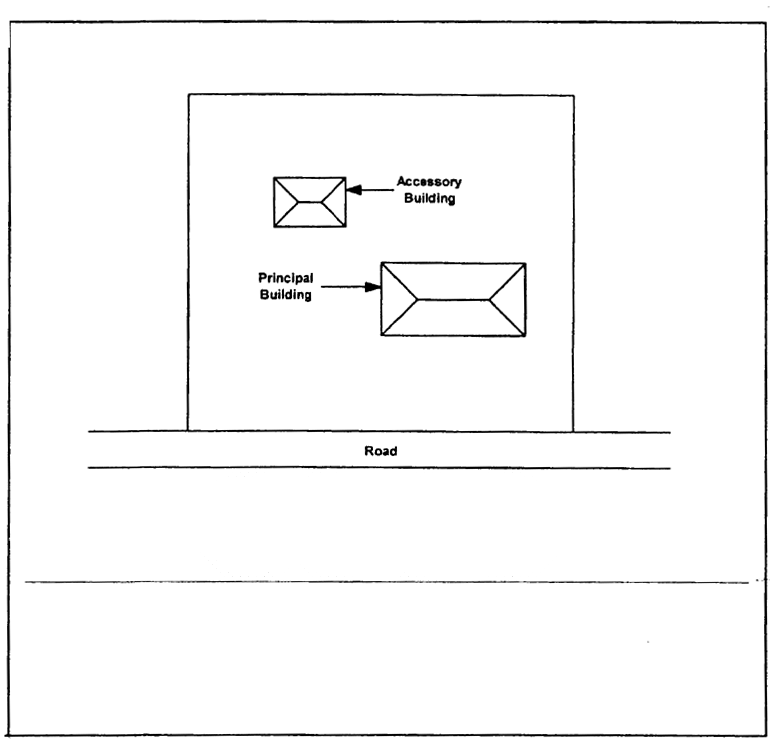
Building, Accessory and Principal
Building frontage means the width in linear feet of the front exterior wall of a particular building, as measured more or less parallel to the front property line.
Build-to-line means a front building setback line required for a principal building on a particular property so that a continuous and consistent building setback will be achieved considering the front building setbacks of buildings on abutting and/or adjacent lots on the same side of the street or right-of-way.
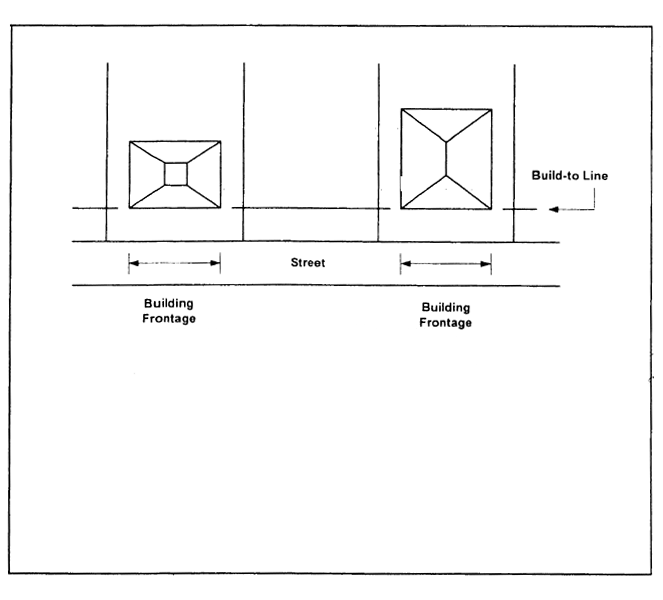
Building Frontage and Build-To Line
Building coverage means the horizontal area measured within the outside of the exterior walls of the ground-floor (i.e., "footprint") of all principal buildings, accessory buildings, and accessory structures on the lot, not including steps, terraces, and uncovered porches.
Building coverage, maximum, means the percentage of a given lot that may be occupied by all principal and accessory buildings and structures on said lot, measured within the outside of the exterior walls of the ground-floor (i.e., "footprint") of all principal and accessory buildings and structures on the lot, not including steps, terraces, and uncovered porches.
Building height means the vertical distance measured to the highest point of a building from the average finished grade across those sides of a building that face a street.
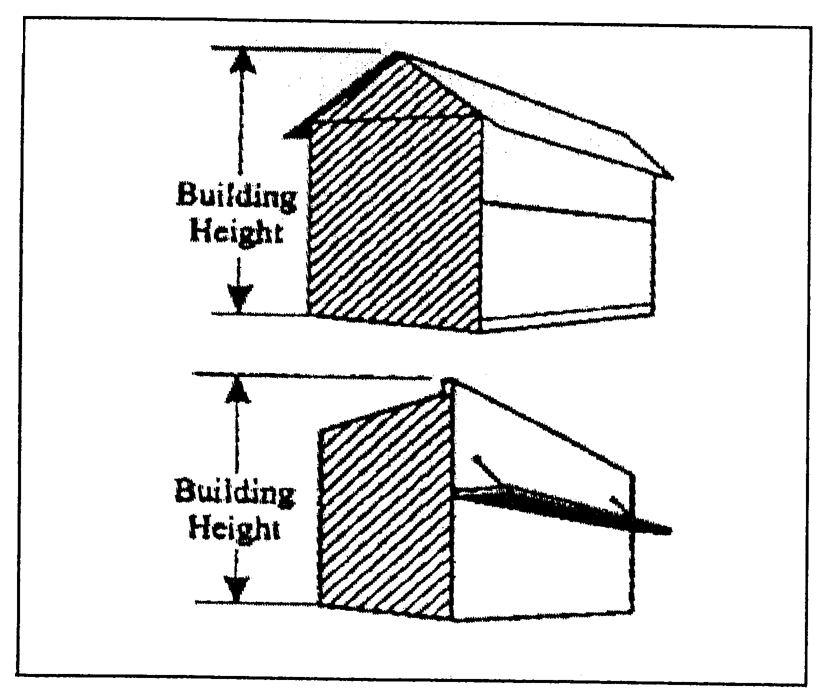
Building Height
Building official means the city's official responsible for implementing and enforcing the applicable building codes of the city.
Building setback line means a line establishing the minimum allowable distance between the front wall of a principal building (excluding roof overhangs of 36 inches or less) and the street right-of-way line or a side or rear building wall and a side or rear property line when measured perpendicularly thereto. For purposes of this Code, a minimum required building setback line and minimum required yard shall be considered the same.
Certificate of occupancy means an approval issued by the building official, indicating that the building and use or reuse of a particular building or land is in conformity with all applicable codes and regulations, and that such building or land may be occupied for the purpose stated therein.
City means the City of Gainesville, Georgia.
City engineer means the director of the public works department, or the director of the department of water resources, and means the staff professional engineer responsible for implementing and enforcing the applicable engineering requirements of this Code and those other engineering requirements of the city.
Compatibility means the characteristics of different uses or activities that permit such uses or activities to be located near each other in harmony and without conflict. Some elements affecting compatibility include: intensity of occupancy as measured by dwelling units per acre or gross square footage per acre; pedestrian or vehicular traffic generated; volume of goods handled, and such environmental affects as noise, vibration, odor, glare, air pollution or radiation.
Comprehensive plan means any plan adopted by the governing body, or any plan adopted by a regional development center covering the local jurisdiction, or portion of such plan. The term "comprehensive plan" shall be construed liberally to include the major thoroughfare plan, master parks and recreation plan, or any other study, document, or written recommendation pertaining to subjects normally within the subject matter of a comprehensive plan as provided by the Georgia Planning Act of 1989, if formally adopted by the governing body of a participating municipality.
Concept plan means a document submitted with an application for a rezoning, zoning amendment, annexation, or other type of application upon which the applicant has shown the intended development and its design. Approval of the application request shall not constitute approval of the concept plan; said plan must be adjusted according to the requirements listed for submittal of civil plans or building plans and reviewed by the appropriate departments for permitting.
Condition of zoning approval means a requirement adopted by the city council at the time of approval of a rezoning, zoning amendment, special use or annexation; placing greater or additional requirements or restrictions on the property than provided in this Code in order to reduce an adverse impact of the request and to further protect the public health, safety, or general welfare.
Consumer fireworks means any small fireworks devices containing restricted amounts of pyrotechnic composition, designed primarily to produce visible or audible effects by combustion, that comply with the construction, chemical composition, and labeling regulations of the United States Consumer Product Safety Commission, as provided for in 16 CFR parts 1500 and 1507, the United States Department of Transportation, as provided for in of 49 CFR part 172, and the American Pyrotechnics Association, as provided for in the 2001 American Pyrotechnics Association Standard 87-1, and additionally shall mean Roman candles. The term "consumer fireworks" shall not include:
(1)
Model rockets and model rocket engines designed, sold, and used for the purpose of propelling recoverable aero models, toy pistol paper caps in which the explosive content averages 0.25 grains or less of explosive mixture per paper cap or toy pistols, toy cannons, toy canes, toy guns, or other devices using such paper caps; nor shall the term "consumer fireworks" include ammunition consumed by weapons used for sporting and hunting purposes; and
(2)
Wire or wood sparklers of 100 grams or less of mixture per item; other sparkling items which are nonexplosive and nonaerial and contain 75 grams or less of chemical compound per tube or a total of 500 grams or less for multiple tubes; snake and glow worms; smoke devices; or trick noise makers which include paper streamers, party peppers, string peppers, snappers, and drop pops each consisting of 0.25 grains or less of explosive mixture.
Consumer fireworks retail sales facility shall have the same meaning as provided for by the National Fire Protection Association Standard 1124, Code for the Manufacture, Transportation, Storage, and Retail Sales of Fireworks and Pyrotechnic Articles, 2006 edition (NFPA 1124); provided, however, that the term "consumer fireworks retail sales facility" shall not include a tent, canopy, or membrane structure.
Density means the quantity of building per unit of lot area; for example, the number of dwellings per lot area (gross square foot or per acre).
Designation means a decision by the governing body to designate a district or property as historic and thereafter prohibit all material changes in appearance prior to the issuance of a certificate of appropriateness pursuant to this Code.
Development means any manmade change to improved or unimproved real estate, including, but not limited to, buildings or other structures, mining, dredging, filling, grading, paving, excavating, drilling operations, or permanent storage of materials; any activity which alters the elevation of the land, removes or destroys plant life, or causes structures of any kind to be erected or removed.
Development permit means an official authorization issued by the director in accordance with this Code to proceed with land disturbance and grading, as set forth in this Code.
Director means the director of the department of community and economic development of the city, or his authorized designee of the community and economic development department. The term "director" shall be the same as the director of the community and economic development department or his authorized designee of the community and economic development department.
Dwelling means any building or portion thereof which is arranged, designed or used for living quarters for one or more families on a permanent or long-term basis.
EPD (environmental protection division) director means the director of the environmental protection division of the state department of natural resources.
Environmental health department means the county environmental health department.
Family means an individual, or two or more persons related by blood, marriage, adoption or guardianship, or a group of not more than three unrelated persons, occupying a single dwelling unit; provided, however, that domestic servants employed on the premises may be housed on the premises without being counted as a separate family or families.
Fireworks means any combustible or explosive composition or any substance or combination of substances or article prepared for the purpose of producing a visible or audible effect by combustion, explosion, deflagration, or detonation, including blank cartridges, balloons requiring fire underneath to propel them, firecrackers, torpedoes, skyrockets, Roman candles, bombs, sparklers, and other combustibles and explosives of like construction, as well as articles containing any explosive or flammable compound and tablets and other devices containing an explosive substance. The term "fireworks" shall not include:
(1)
Model rockets and model rocket engines designed, sold, and used for the purpose of propelling recoverable aero models, toy pistol paper caps in which the explosive content averages 0.25 grains or less of explosive mixture per paper cap or toy pistols, toy cannons, toy canes, toy guns, or other devices using such paper caps; nor shall the term "fireworks" include ammunition consumed by weapons used for sporting and hunting purposes; and
(2)
Wire or wood sparklers of 100 grams or less of mixture per item; other sparkling items which are nonexplosive and nonaerial and contain 75 grams or less of chemical compound per tube or a total of 500 grams or less for multiple tubes; snake and glow worms; smoke devices; or trick noise makers which include paper streamers, party peppers, string peppers, snappers, and drop pops, each consisting of 0.25 grains or less of explosive mixture.
Floor area means the sum of all square footages (areas) of each floor of a building, measured from the interior faces of the exterior walls or from the centerline of walls separating two buildings. The following areas are excluded from the measurement of floor area: unfinished attics, attached garages or spaces used for off-street parking and loading, breezeways, and enclosed or unenclosed decks and porches.
Floor area ratio (FAR) means the ratio of the floor area of a building to the area of the lot in which the building is located. For example, a 10,000 square foot lot with a maximum FAR of 0.5 cannot exceed a total building floor area of 5,000 square feet.
Governing body means the mayor and city council of the City of Gainesville, Georgia.
Grading means altering the shape or topography of ground surfaces to a predetermined condition; this includes stripping, cutting, filling, stockpiling and shaping, or any combination thereof, and shall include the land in its cut or filled condition.
Impervious surface means a manmade structure or surface which prevents the infiltration of water into the ground below the structure or surface. Examples are buildings, structures, roads, driveways, parking lots, decks, swimming pools, or patios.
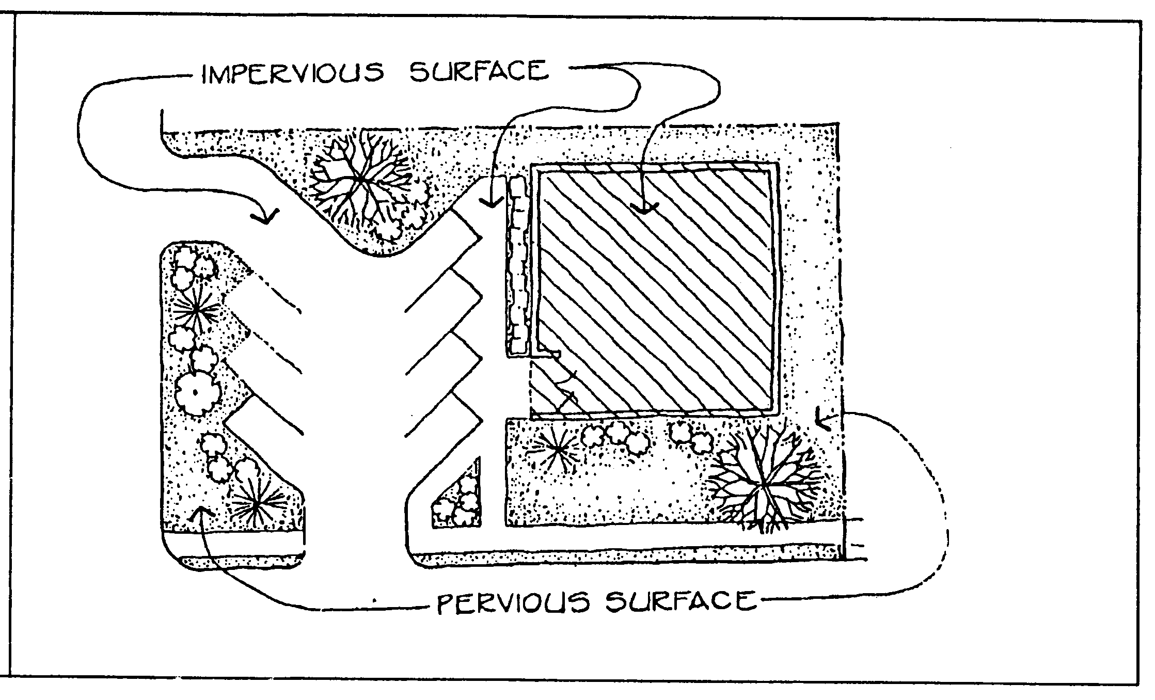
Impervious Surface
Improvements means the physical addition and changes to land that may be necessary to produce usable, desirable and acceptable lots or building sites.
Industrialized building means any structure or component thereof which is designed and constructed in compliance with the state minimum standards codes and is wholly or in substantial part made, fabricated, formed, or assembled in manufacturing facilities for installation or assembly and installation on a building site and has been manufactured in such a manner that all parts or processes cannot be inspected at the installation site without disassembly, damage to, or destruction thereof.
Land-disturbing activity means any activity that may result in soil erosion from water or wind and the movement of sediments into state waters or onto lands within the state, including, but not limited to, clearing, dredging, grading, excavating, transporting and filling of land, but not including plowing and tilling for agricultural practices.
Lot means a parcel or tract of land held in single ownership.
Corner lot means any lot bounded by two streets at their intersection.
Double-frontage lot means a lot bounding on two or more streets, but not at their intersection, so that it is not a corner lot.
Interior lot means a lot having frontage on only one street.
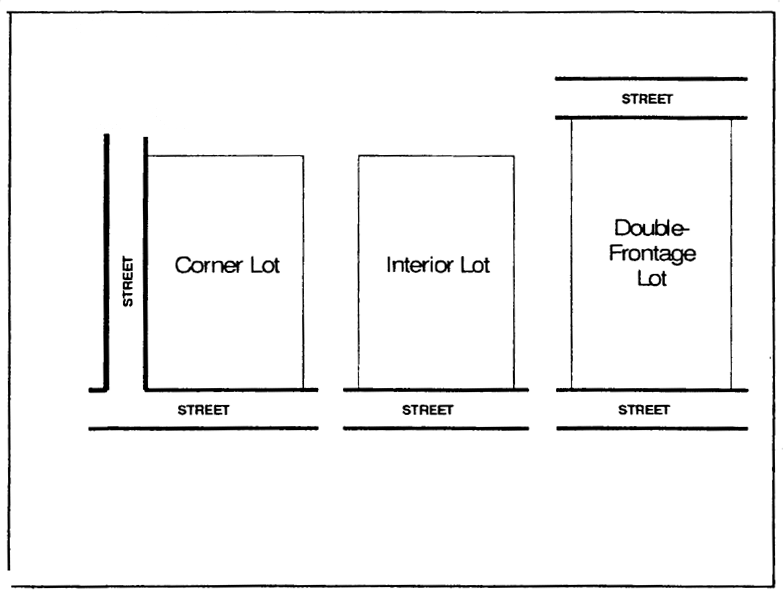
Types of Lots
Lot lines means the boundary dividing a given lot from the street, an alley, or adjacent lots.
Front lot line means any boundary line of a lot that abuts a street right-of-way line. A lot adjacent to more than one street will have more than one front lot line.
Rear lot line means any boundary line of a lot that does not intersect with a street right-of-way line and is not a front lot line.
Side lot line means any boundary line of a lot that intersects with a street right-of-way line and is not a front lot line.
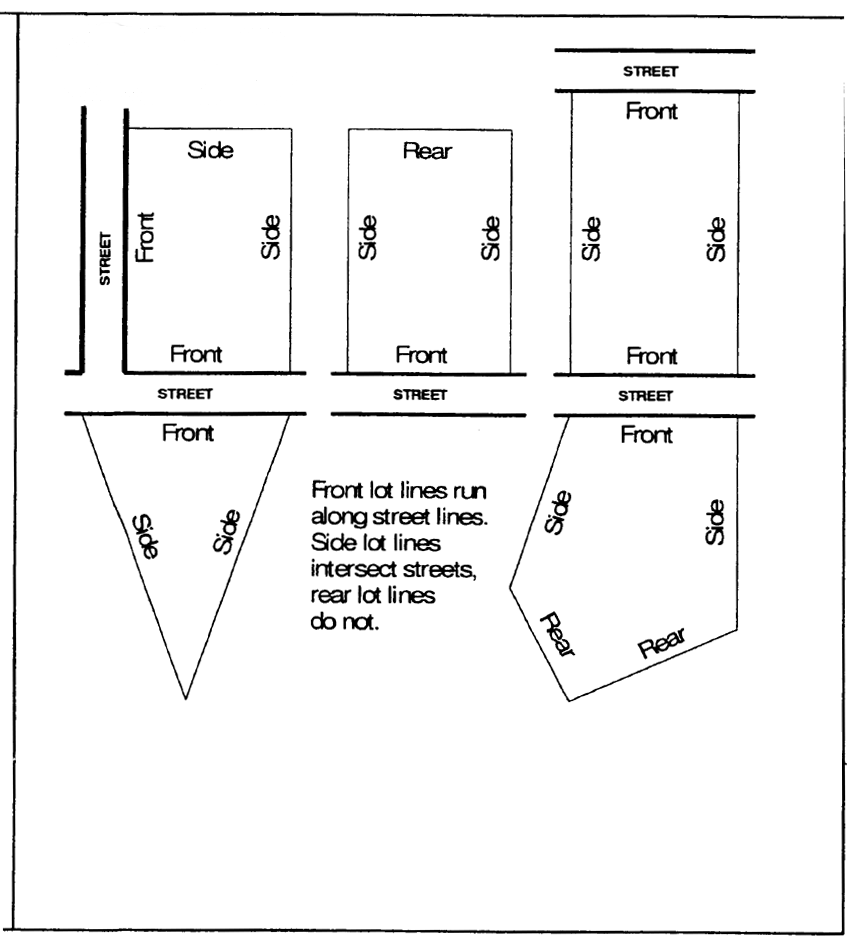
Types of Lot Lines
Manufactured home means a dwelling fabricated in an off-site facility for installation or assembly at the building site, bearing a label certifying that it is constructed in compliance with the National Manufactured Housing Construction and Safety Standards Act of 1974, 42 USC 5401 et seq., which first became effective on June 15, 1976. The term "manufactured home" includes a structure, transportable in one or more sections, which, in the traveling mode, is eight body feet or more in width or 40 body feet or more in length or, when erected on-site, is 320 or more square feet in floor area, and which is built on a permanent chassis and designed to be used as a dwelling with or without a permanent foundation when connected to the required utilities and includes the plumbing, heating, air-conditioning, and electrical systems contained therein; except that the term "manufactured home" includes any structure which meets all the requirements of this definition except the size requirement and with respect to which the manufacturer voluntarily files a certification required by the Secretary of Housing and Urban Development and complies with the standards established under the National Manufactured Housing Construction and Safety Standards Act of 1974, 42 USC 5401 et seq.
Manufactured home park means any lot or parcel under single ownership on which two or more manufactured homes are to be located or intended to be located for purposes of residential occupancy.
Mobile home means a dwelling manufactured prior to June 15, 1976, transportable in one or more sections, which, in the traveling mode, is eight body feet or more in width or 40 body feet or more in length or, when erected on-site, is 320 or more square feet in floor area, and which is built on a permanent chassis and designed to be used as a dwelling with or without a permanent foundation when connected to the required utilities and includes the plumbing, heating, air-conditioning, and electrical systems contained therein.
Occupied, as applied to any land or building, shall be construed to include the words "intended, arranged or designed to be used or occupied."
Open space, landscaped, means that portion of a given lot, not covered by buildings, parking, access and service areas, that is designed to enhance privacy and the amenity of the development by providing landscaping features, screening and buffering for the benefit of the occupants or those in neighboring areas, or a general appearance of openness. Landscaped open space may include, but need not be limited to, grass lawns, decorative planting, berms, walls and fences, sidewalks/walkways, ornamental objects such as fountains, statutes and other similar natural and manmade objects, wooded areas, and watercourses, any or all of which are designed and arranged to produce an aesthetically pleasing effect within and exterior to the development.
Overlay zone means a defined geographic area that encompasses one or more underlying zoning districts and that imposes additional requirements above those required by the underlying zoning district. An overlay zone can be coterminous with existing zoning districts or contain only parts of one or more such districts.
Permitted use means a use by right which is specifically authorized in a particular zoning district, or permitted by right in a particular overlay zone.
Planning and appeals board means the planning and appeals board of the city. The term "planning and appeals board" is also known or referred to as the planning commission.
Premises means an area of land with its appurtenances and buildings which is one unit of real estate because of its unity of use.
Principal building setback line means a line delineating the minimum allowable distance between a property line or the right-of-way line of an abutting street and a principal building on a lot.
Front building setback means the minimum allowable distance between the right-of-way line of any abutting street and any part of a principal building on a lot. The front setback distance is applied along the full length of the right-of-way line and is parallel to it.
Rear building setback means the minimum allowable distance between a rear lot line and any part of a principal building on a lot. The rear building setback extends along the full length of the rear lot line.
Side building setback means the minimum allowable distance between a side lot line and any part of a principal building on a lot. The side building setback extends along the side lot line between the front building setback and a rear building setback (if any).
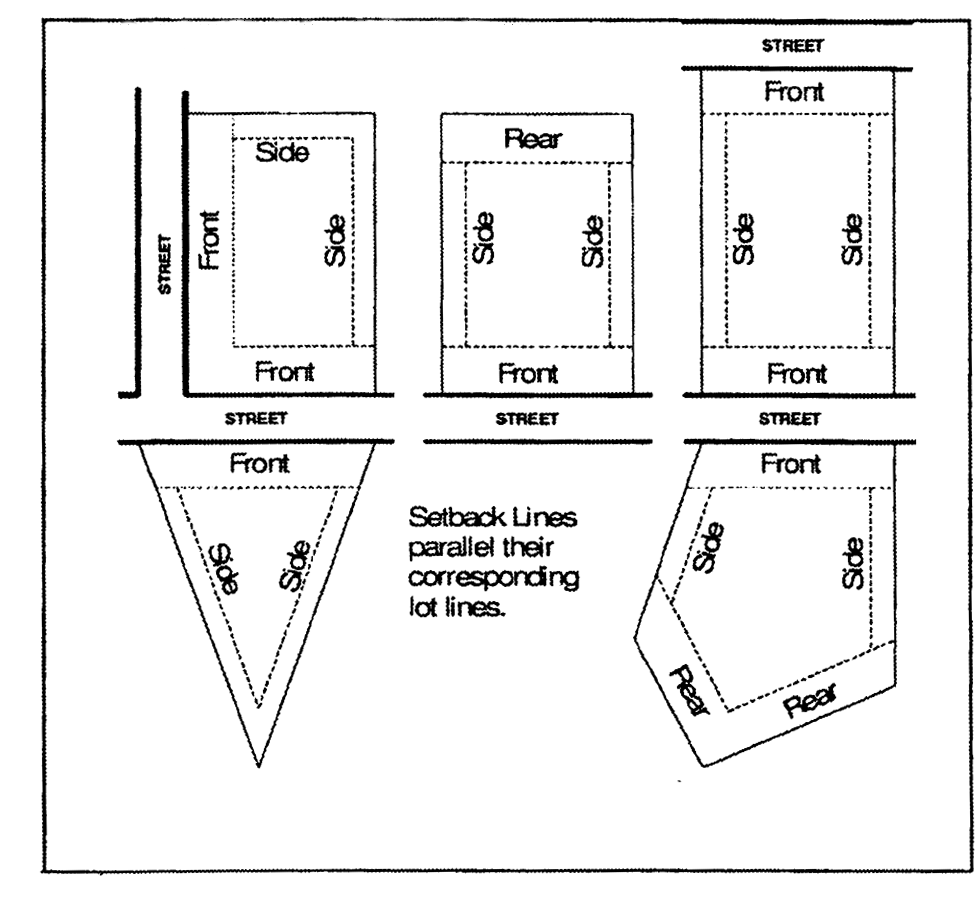
Principal Building Setback Lines
Professional engineer means an engineer licensed and registered to perform the duties of a professional engineer (PE) by the state.
Property or parcel of land. See Lot.
Public works director means the director of the department of public works of the city, or his designee, whose duties include the review and approval of construction plans for public streets for the city.
Registered land surveyor means a land surveyor licensed and registered to perform the duties of a registered land surveyor (RLS) by the state.
Residential industrialized building means any dwelling unit designed and constructed in compliance with the state minimum standard one- and two-family dwelling code which is wholly or in substantial part made, fabricated, formed, or assembled in a manufacturing facility and cannot be inspected at the installation site without disassembly, damage to, or destruction thereof. Any such structure shall not contain a permanent metal chassis and shall be affixed to a permanent load-bearing foundation. The term "residential industrialized building" shall not include manufactured homes, as defined by the National Manufactured Housing Construction and Safety Standards Act of 1974, 42 USC 5401 et seq.
Rezoning means an amendment to the official zoning map, or an amendment to an overlay zone boundary, that changes the zoning district or overlay zone of one or more properties specified in an application; provided, however, that changes to the Historic Preservation Overlay Zone are not considered rezoning for purposes of this Code and are instead regulated by the provisions of chapter 9-23-3. The term "rezoning" also includes applications to change conditions of zoning approval.
Setback means the shortest straight line distance between a street right-of-way or lot line and the nearest point of a structure or building or projection therefrom (excluding roof overhangs of 30 inches or less).
Setback, minimum, means the shortest distance allowed between a street right-of-way line or any other lot line and any principal or accessory building on a lot. Minimum setback requirements for buildings are associated with the type of lot line from which the setback is taken; for instance, a side yard setback is measured from a side lot line.
Special use means a use that would not be appropriate generally or without restriction throughout a particular zoning district and is not automatically permitted by right within said zoning district, but which, if controlled as to number, area, location, relation to the neighborhood or other pertinent considerations, may be found to be compatible and approved by the governing body within that particular zoning district as provided in certain instances by this Code. An approved special use runs with the property.
Story means that portion of a building compromised between a floor and the floor or roof next above. The first floor of a two-story or multistory building shall be deemed the story that has no floor immediately below it and that is designed for living quarters or for human occupancy. Those stories above the first floor shall be numbered consecutively.
Structure means anything built, constructed or erected, or established or composed of parts joined together in some definite manner, the use of which requires location on the ground or which is attached to something having permanent location on the ground. For purposes of this Code, parking decks, swimming pools, tennis courts, signs, dog houses, and outdoor fenced animal runs are considered structures. Tents, vehicles, trailers, and play equipment attached to the ground in some permanent or temporary way shall be considered structures. A structure may or may not be easily moved from a given location on the ground. Walls and fences are considered structures but are subject to setback regulations for walls and fences rather than principal or accessory building setback regulations. Driveways and parking lots are not considered structures.
Used, as applied to any land or building, shall be construed to include the words "intended, arranged, or designed to be used or occupied."
Variance means a grant of relief from the requirements of this Code which permits construction or use in a matter otherwise prohibited by this Code, which may be approved in individual cases upon application and applied to specific property where compliance would result in a particular hardship upon the owner, as distinguished from a mere inconvenience or a desire to make a profit.
Variance, administrative, means a variance which is authorized to be approved by an administrative official under the terms of this Code.
Variance, improvement standards, means a variance which relieves or modifies an applicant or subdivider of certain subdivision or land development specifications or standards under the terms of this Code.
Variance, zoning, means a minimal relaxation or modification of the strict terms of the height, area, placement, setback, yard, buffer, landscape strip, parking and loading, or other regulations which are dimensional in nature as applied to specific property when, because of particular physical surroundings, shape, or topographical condition of the property, compliance would result in a particular hardship upon the owner, as distinguished from a mere inconvenience or a desire to make a profit.
Water resources director means the director of the department of water resources of the city, or his designee, whose duties include the review and approval of construction plans for drinking water, sanitary sewer and stormwater for the city.
Yard means a space on the same lot with a principal building, open unoccupied and unobstructed by buildings or structures from ground to sky except where encroachments and accessory buildings are expressly permitted.
Yard, front, means an open, unoccupied space on the same lot with a principal building, extending the full width of the lot, and situated between the street right-of-way and the front line of the building projected to the side lines of the lot. For corner and double frontage lots, front yard requirements apply to all road frontages.
Yard, rear, means an open, unoccupied space on the same lot with a principal building, extending the full width of the lot and situated between the rear line of the lot and the rear line of the building projected to the side lines of the lot.
Yard, side, means an open, unoccupied space on the same lot with the principal building, situated between the building and the side line of the lot and extending from the rear line of the front yard to the front line of the rear yard.
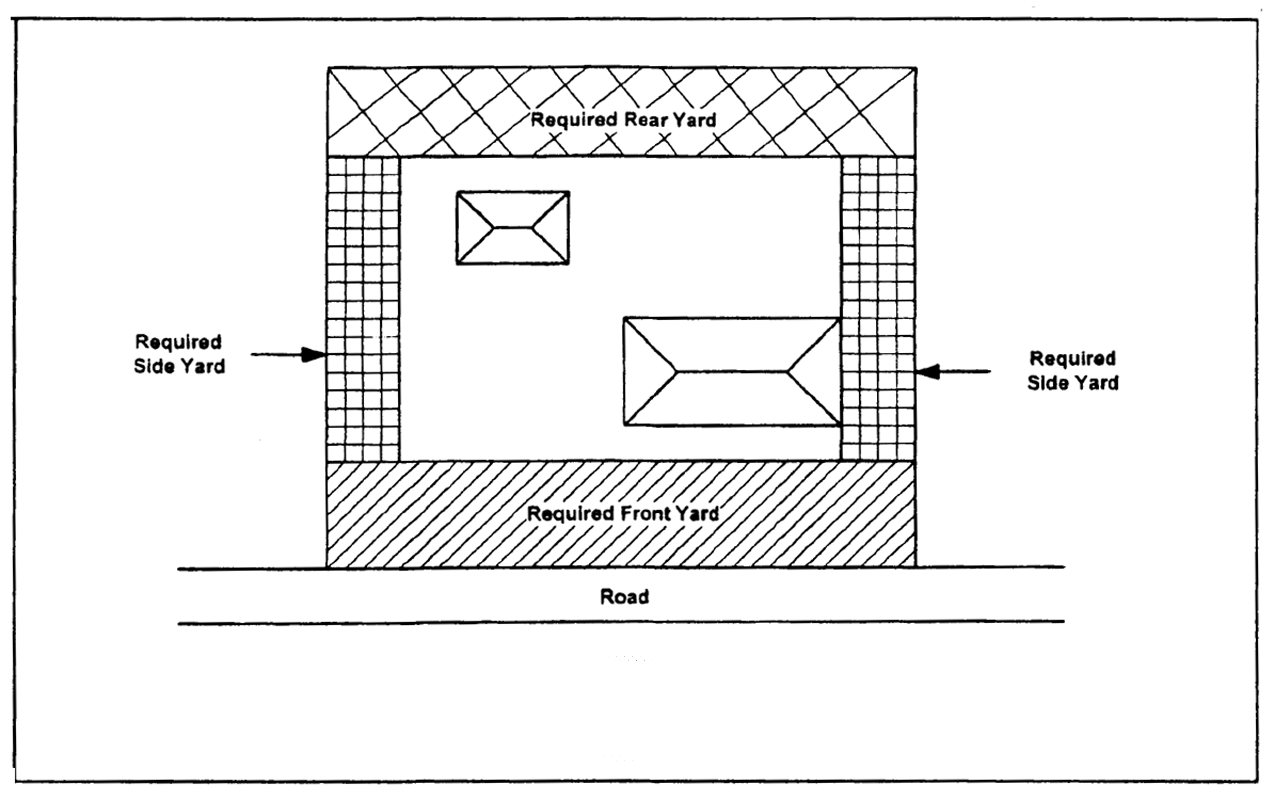
Yards
Zoning map means the official zoning map of the city.
(ULDC 2005, ch. 9-2-2; Ord. No. 2007-17, § I, 5-15-2007; Ord. No. 2009-47, § I, 12-15-2009; Ord. No. 2011-02, § I, 1-18-2011; Ord. No. 2015-29, § I, 9-15-2015; Ord. No. 2020-42, § IV, 11-3-2020)

