
Gainesville City Zoning Code
ARTICLE 9
7 - FLEXIBLE ZONING DISTRICTS
Sec. 9-7-1-1. - Purpose and intent generally.
(a)
This zoning district is intended to provide for maximum flexibility in the mixture and arrangement of land uses. The PUD zoning district provides for planned unit developments and mixed-use developments but provides separate design specifications for both. This district provides for unique and innovative land developments that will meet the objectives of the city's comprehensive plan. Development in this zoning district is characterized by a unified site design for the entire development.
(b)
This district is a "floating" (initially unmapped) zone, to be established upon successful application by the property owner/applicant and approval by the governing body; provided, however, that certain properties that were zoned P-R-D, P-O-D, P-C-D, or P-I-D districts on the effective date of this Code may be designated on the official zoning map as PUD, in which case they shall be subject to all regulations established for the district, development, or site at the time the property received rezoning or development approval. Any changes to such development approvals shall be subject to consideration under the terms of this chapter.
(c)
This zoning district is also established to meet the following objectives:
(1)
Encourage and allow the development of tracts of land as planned neighborhoods or communities according to designs that coordinate building forms that are interrelated and architecturally harmonious.
(2)
Encourage and allow more unique, flexible, creative, imaginative arrangements and mixes of land use in site planning and development than are permitted through zoning district requirements established in this Code, but not in conflict with the comprehensive plan of the city.
(3)
Encourage a broader mix of residential housing types, including detached and attached dwellings, than would normally be constructed in conventional subdivisions, and provide for unique dwelling arrangements not typically provided in conventional subdivisions.
(4)
Preserve the natural amenities of the land through maintenance of conservation areas and open spaces within developments, provide amenities, and provide where needed the civic and semi-public uses (e.g., schools, playgrounds, meeting halls, etc.) that help to make up a community.
(6)
Provide for the efficient use of land by encouraging smaller networks of utilities and streets which may lower development and housing costs.
(7)
Provide an environment of stable character compatible with surrounding residential areas.
(8)
Ensure that applications for PUD zoning have enough information to thoroughly analyze the merits of the proposal.
(d)
This zoning district is not intended to be used as an alternative to obtaining variances for developments unable to comply with other zoning district provisions. Rezoning to this district is not intended to be a process of relief to applicants that merely seek one or more variances. Applications for rezoning to the PUD district shall be rejected by the director if the development proposal does not match, clearly, the purposes and intentions of this chapter, or if another remedy is available and would be more appropriate, such as an application for variance. For instance, an application for rezoning to this zoning district which consists of a single use which cannot meet a particular dimensional requirement of the zoning district in which it is located, such as minimum lot frontage or building setback, shall be summarily rejected by the director because a variance is the more appropriate remedy. The PUD zoning district is not intended to allow for the intrusion of incompatible land uses into single-family neighborhoods that create negative land use impacts.
(e)
Because the PUD zoning district promotes maximum flexibility, the type, mix, and placement of development are virtually unlimited, and examples can help illustrate what is intended by the city in establishing this district. Generally, this district characterizes developments as two types: planned unit development and mixed-use development.
(ULDC 2005, § 9-7-1-1)
Sec. 9-7-1-2. - Intentions for planned unit developments.
(a)
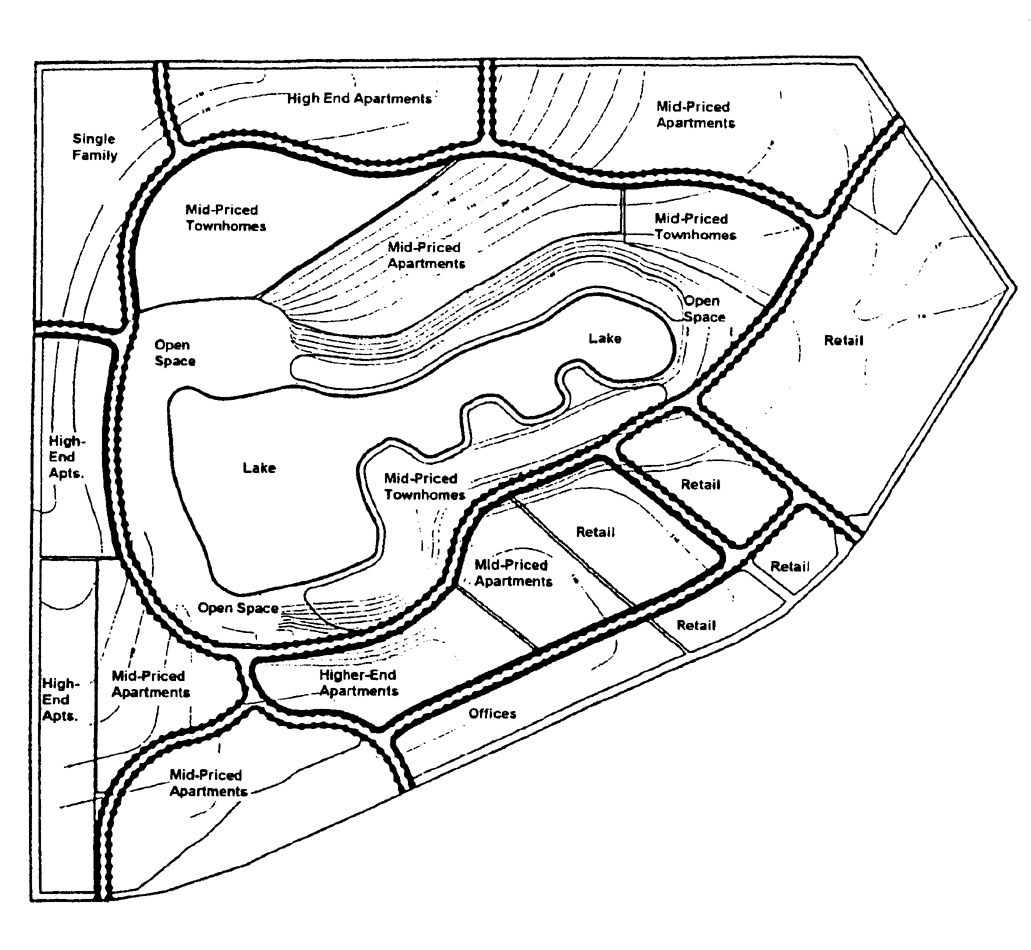
Planned unit developments are intended to provide a variety of dwelling types, including some combination of detached, single-family (fee-simple or condominium), duplex, townhouse, and multifamily dwellings. Planned unit developments are predominantly residential but not necessarily exclusively residential. Planned unit developments feature clustered buildings, common open space, and unconventional or unique site designs. Planned unit developments may contain a mix of building types and land uses.
Planned Unit Developments
(b)
Depending on size, a planned unit development may include offices, retail trade and service establishments, and civic and institutional uses (but see the recommendations for land use mixing provided in this chapter). When such other uses are part of a planned unit development, they often constitute multi-use (i.e., different land uses situated next to each other) but are not necessarily mixed-use (i.e., the different uses do not exist in the same building, but they are designed to be interrelated and interconnected).
(ULDC 2005, § 9-7-1-2)
Sec. 9-7-1-3. - Intentions for mixed-use developments.
(a)
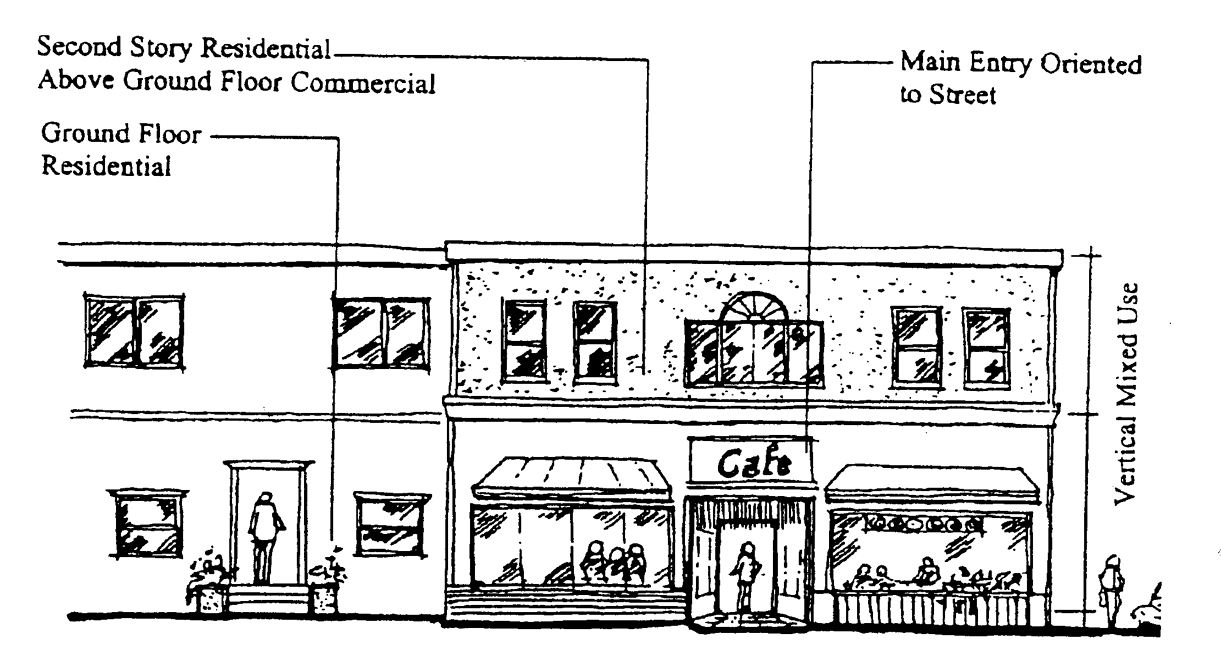
Mixed-use development includes development of a single building or single parcel to contain two or more of the following types of uses: residential, office, institutional, or retail or service commercial. Mixed-uses may be combined vertically within the same building or placed side by side on the same parcel, provided that they are in close proximity, planned as a unified and complementary whole, and functionally integrated to make use of shared vehicular and pedestrian access and parking areas.
Mixed-Use Developments
(b)
Mixed-use developments typically consist of two or more different land uses in the same building. The term "mixed-use development" specifically includes live-work units and other mixtures of residential use with office, retail, service, or institutional uses. Mixed-use developments have a pedestrian friendly character (e.g., with a storefront or village design).
(ULDC 2005, § 9-7-1-3)
Sec. 9-7-1-4. - Permitted uses.
(a)
There are no pre-specified permitted or special uses for the PUD district. Within this district, a variety of land uses, and any land use, may be permitted if such use can be shown to provide an orderly relation and function to other uses in the development and to existing land uses on- and off-site, with due regard to the city's comprehensive plan.
(b)
The permitted use of property located in this zoning district shall be determined at the time the development is approved via the rezoning process. Unless otherwise specifically noted in the governing body's approval of the zoning district and the plan for development, the property within the zoning district shall be limited to those uses requested as part of the application and which are approved by the governing body.
(ULDC 2005, § 9-7-1-4)
Sec. 9-7-1-5. - Relationship to specific use regulations.
An application for rezoning and development plan approval that includes a use for which this Code specifies certain regulations (see article 9-10), shall not be required to demonstrate conformance with the specific use regulations of article 9-10 applicable to such use; provided, however, the governing body may condition uses in a manner consistent with the provisions of article 9-10 as it may determine appropriate. Therefore, applications which include uses governed by article 9-10 should address the consistency of the development proposal with applicable specific use provisions of article 9-10. To that end, the director may require the applicant to address the proposed development's consistency with development specifications for specific uses described in article 9-10.
(ULDC 2005, § 9-7-1-5)
Sec. 9-7-1-6. - Guidelines for land use mixing.
Without limiting the flexibility provided by this chapter for mixing land uses, some guidance on the desired range of mixing of land uses is necessary. This section provides guidelines and recommendations which shall guide applicants, staff, the planning and appeals board, and the governing body in proposing, considering, and acting upon the merits of development proposals. This section shall not be construed to prevent an applicant from proposing a development inconsistent with the provisions of this section, although due adherence to these guidelines and recommendations may in the discretion of the governing body be imposed through conditions of zoning and development plan approval.
(1)
Residential developments. Where predominantly single-family residential uses are proposed, the gross density should not exceed the recommendations of the comprehensive plan, as described for the land use classification in which the property is located, as shown on the city's future land use plan map.
(2)
Different dwelling types. Developments that include residential uses should provide for more than just one type of dwelling unit, such as detached, single-family dwellings (fee-simple or condominium ownership), townhouses, duplexes, or multifamily (including condominium ownership) dwellings. This does not mean there should be an even or proportional distribution among more than one dwelling type. Where detached, single-family dwellings are included, the total number of multifamily dwelling units and the total acreage of development devoted to multifamily dwellings should not typically exceed 25 percent.
(3)
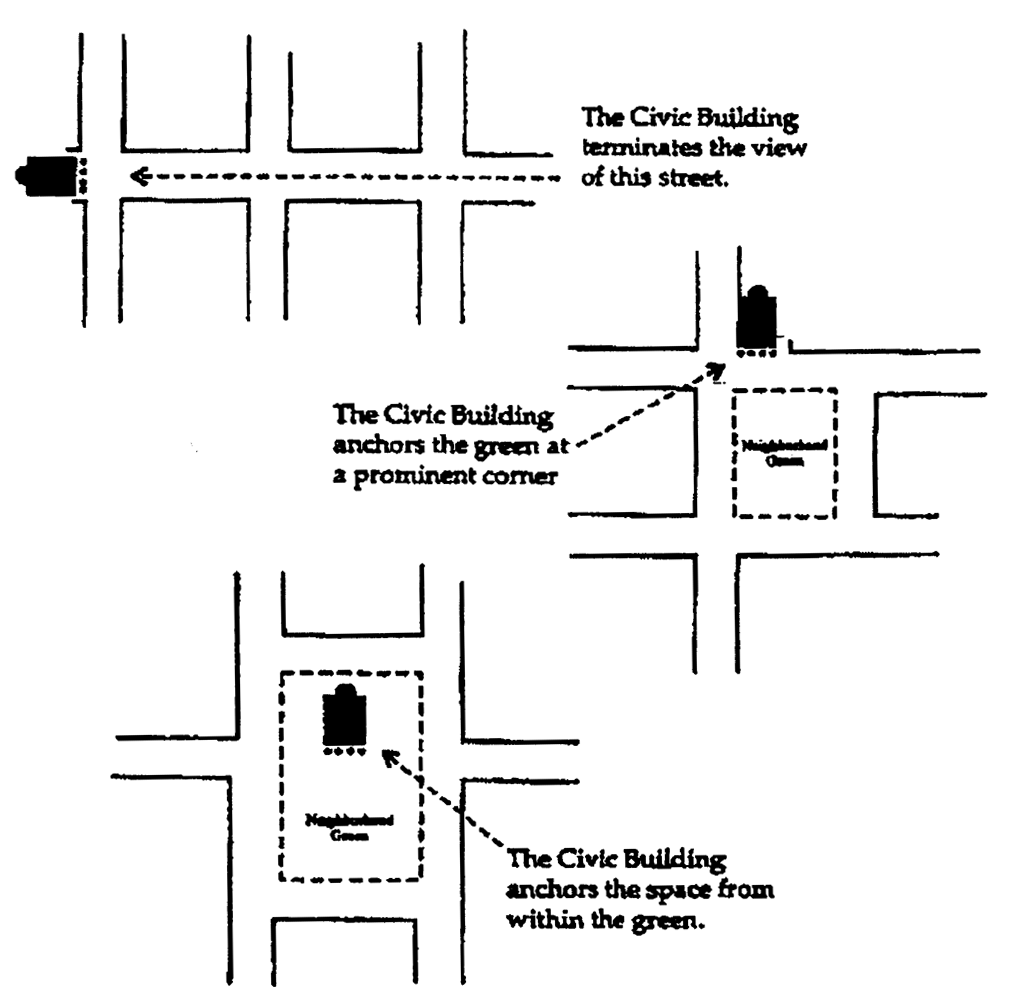
Civic and institutional uses. Sites for churches, schools, community or club buildings, and similar public or semi-public facilities are encouraged to be provided, where appropriate. Uses such as schools, churches, and other institutions where provided should be part of an integrated site design and located and designed to minimize negative impacts.
Civic and Institutional Uses
(4)
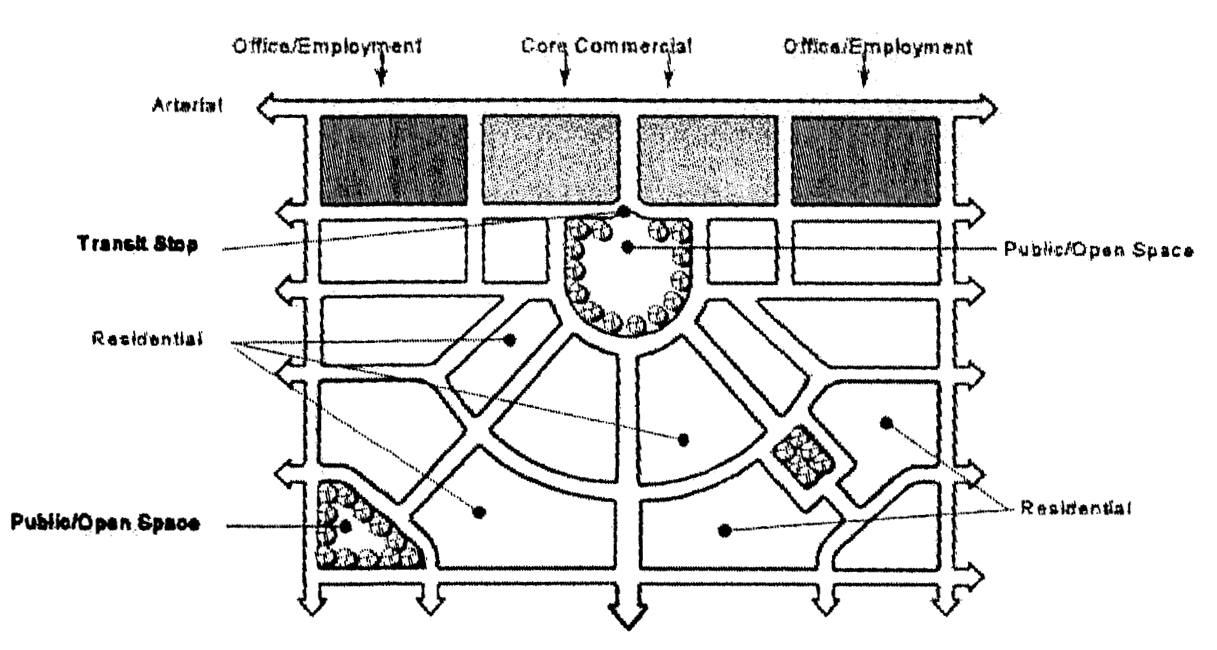
Office and commercial uses in predominantly residential developments. Within planned unit developments (i.e., predominantly residential), commercial and offices uses, if proposed, should be located in careful relation to other land uses within and outside of the development, and they should be scaled and oriented so that they primarily serve the occupants of the planned unit development. Neighborhood business uses may be appropriate in areas not designated on the future land use plan map but only when such uses are consistent with the applicable development policies contained in the comprehensive plan. Such uses, where provided, should be part of an integrated site design and located and designed to minimize negative impacts. In predominantly residential developments, the amount of land in the development devoted to commercial and office uses should not exceed 15 percent of the total land area, unless it can be shown that a greater percentage of land devoted to such uses is more conducive to the mix of uses.
(5)
Commercial uses. PUD districts permit commercial uses that are compatible with pedestrian-scale development, but they are not envisioned to include automobile sales or service establishments, outdoor storage, or other auto-oriented commercial uses, including drive-through facilities that conflict with a pedestrian-friendly development pattern.
Commercial Uses
(6)
Industrial uses. Industrial uses are not typically considered to be appropriate for inclusion within planned unit developments or mixed-use developments; however, such uses are not prohibited and may be considered appropriate in larger (e.g., 20 acres or more) developments where living and working areas need to be close to one another. If industrial uses are proposed, they should avoid nuisances on residential development within or adjacent to the PUD, through buffers. The buffer requirements for light industrial districts as specified in table 9-6-2 may be required as conditions of approval to avoid nuisances.
(7)
Open space, passive or active recreation, landscaped open space, and natural/conservation areas. Planned unit developments should be designed around and connected to any open space corridors or networks that exist or are planned. Developments are expected to devote at least 20 percent of the total land area to natural areas, conservation areas, open spaces, and active or passive recreational areas, or some combination thereof.
(8)
Areas designated for mixed-use. Developments which take place on property designed for mixed-use on the future land use plan map should consider the following recommended mix of residential, office/institutional, and neighborhood retail, measured in terms of land area devoted to each use:
a.
Office/institutional: 40 percent.
b.
Neighborhood retail: 30 percent.
c.
Residential: 30 percent.
In such areas, predominantly residential development or other developments inconsistent with this recommended land use mix may be considered inappropriate and inconsistent with the future land use plan map.
(9)
Neighborhood plans. Neighborhood planning units provide for more detailed planning than shown on the future land use plan map and may include parcel-specific recommendations for land uses and guidelines for design. Any development within an area designated as a neighborhood planning unit and which has a neighborhood plan adopted by the governing body should be substantially in accordance with the recommendations of such adopted neighborhood plan. No rezoning to this district should be permitted that fails to maintain existing neighborhoods as stable and desirable places to live and raise families.
(ULDC 2005, § 9-7-1-6)
Sec. 9-7-1-7. - Minimum acreage or development size.
When a planned unit development is proposed to include residential uses only, the minimum acreage to rezone or develop shall be 1.5 acres to ensure prospects for mixture of different types of dwellings; otherwise, there is no established minimum acreage to rezone to this district or to develop within this zoning district.
(ULDC 2005, § 9-7-1-7)
Sec. 9-7-1-8. - Dimensional requirements.
(a)
To ensure maximum flexibility, there are no pre-specified requirements for minimum lot size, minimum lot width, lot coverage, yards and building setbacks, or height. Proposals for development must be reasonable, however, and shall not deviate to any significant degree from the goals, policies, objectives, and techniques specified in the city's adopted comprehensive plan.
(b)
A detailed development plan shall be submitted by the applicant for rezoning to this district. Minimum dimensional requirements for PUD zoning districts are established on the basis of the development, and such requirements are intended to allow for multiple (different) uses within the development. Standards proposed by the developer are legally binding on the development if approved, unless otherwise specified by the governing body.
(ULDC 2005, § 9-7-1-8)
Sec. 9-7-1-9. - Additional application requirements.
The requirements for rezoning applications are specified in chapter 9-22-2, which includes additional application requirements for PUD rezoning/development approval.
(ULDC 2005, § 9-7-1-9)
Sec. 9-7-1-10. - Approval procedures.
The process and criteria for considering rezoning applications are specified in chapter 9-22-2. That chapter includes additional procedural requirements for PUD rezoning/development approval and criteria for acting upon them.
(ULDC 2005, § 9-7-1-10)

