
Gaithersburg City Zoning Code
ARTICLE 16
- DEFINITIONS
Sec. 24-16.1.- "A" terms.
Abutting (adjoining, adjacent). Two properties are abutting if they share a property line.
Accessory dwelling unit. An accessory dwelling unit (ADU) is a smaller, secondary residential dwelling unit located on the same lot as a primary dwelling unit. ADUs are independently habitable and provide the basic requirements of shelter, heating, cooking, and sanitation. ADUs may be detached from, attached to, or located within the primary dwelling.
Accessory structure. A structure which is customarily subordinate and incidental to a principal structure or use in area, extent, or purpose and which contributes to the comfort, convenience or necessity of occupants, business or industry in the principal use or structure served. An accessory structure shall be located on the same lot as the principal structure.
Accessory use. A use which is customarily subordinate and incidental to a principal use or structure in area, extent, or purpose and which contributes to the comfort, convenience, or necessity of occupants, business, or industry in the principal use served. An accessory use shall be located on the same lot as the principal use.
Actual construction. The placing of construction material in permanent position and fastened in a permanent manner; except, that where demolition or removal of an existing building has been substantially begun prior to rebuilding, such demolition or removal shall be deemed to be actual construction; provided, that work shall be diligently carried on until completion of the building involved.
Address. The number or other designation assigned to a housing unit, business establishment, or other structure for purposes of mail delivery, emergency services, and similar functions. An address is not considered a sign.
Adult-oriented establishment. An establishment which, for money or any other form of consideration devotes more than ten (10) percent of the total floor area to the sale, exhibition, display, exchange, rental, loan, trade, transfer of one or more of the following:
(1)
Books, magazines, periodicals or other printed matter, or photographs, films, motion pictures, video cassettes, slides or other visual representations or sexually-oriented paraphernalia or novelty items which are characterized by an emphasis upon the depiction, description or reproduction of sexual activities or anatomical areas depicting sexual organs; or
(2)
Instruments, devices or paraphernalia that are designed for use in connection with sexual activities involving sexual organs; or
(3)
Features nude adult entertainment performances.
Affordable. As defined in article 13, Affordable Housing Requirements.
Affordable housing fund. Specifically, the housing initiative fund that is a fund established to support the creation and maintenance of affordable housing in the city and to which payments will be made by developers.
Alley. A public roadway less than thirty (30) feet in width as defined in chapter 19 of Gaithersburg City Code.
Amend or amendment. Any repeal, modification or addition to a regulation, ordinance, or plan; any new regulation; any change in the number, shape, boundary or area of a zone or any repeal or abolition of the zoning map or any part thereof or addition thereto.
Amusement and recreational facility (indoor and outdoor). A commercially operated facility at which recreation activities are offered or amusement devices provided to the public as the principal commercial activity of such establishment. This may include, but not be limited to, bingo parlors, dance halls, bowling alleys, skating rinks, billiard or pool halls, miniature golf courses and amusement device arcades. Theaters and commercial fitness centers are not included.
Animal boarding and grooming establishments. The provision of housing and care of an animal in the absence of the owner with the exception of state-inspected veterinary hospitals so long as the boarding area is inspected by the state. This also includes services related to bathing, clipping or combing of animals for which a fee is charged.
Annexation. The incorporation of contiguous land area into an existing municipality with a resulting change in the corporate boundaries.
Appurtenances and environmental setting. These terms are defined as something subordinate to or belonging to another larger, principal entity, that is, an adjunct, satellite, or accessory that generally accompanies something else. Includes, but not be limited to, walkways and driveways (whether paved or not), vegetation (including trees, gardens, and lawns), rocks, pasture, cropland, and waterways.
Area median income (AMI). The median income for the Washington Metropolitan Area, adjusted for household size, as determined by the U.S. Department of Housing and Urban Development (HUD).
Art and cultural center. Establishments such as museums, art galleries, botanical gardens, and other exhibition and gathering spaces of an historic, educational or cultural interest, along with commonly associated accessory uses.
Artisan manufacturing. Uses that include the application, teaching, making, or fabrication of crafts, art, or products by an artist, artisan or craftsperson either by hand or with minimal automation and may include direct sales to consumers. May include makerspaces.
Automobile filling station. A building or lot having pumps and storage tanks or electrical charging stations at which fuel, oil, electrical charge, or accessories for the use of motor vehicles are dispensed, sold or offered for sale with accessory and incidental uses limited to convenience store sales areas of up to one thousand (1,000) square feet, automobile repair and service, and carwash. May not include food trucks, car/truck rental, overnight storage of vehicles, or vehicle sales.
Automobile parking garage (structured parking). A building or portion thereof, other than an automobile salesroom, held out or used for housing of six (6) or more vehicles in connection with multifamily communities, commercial development, and public uses. Such garage shall not be considered an accessory use, nor shall it be used for the storage of dismantled or wrecked motor vehicles, parts hereof or junk.
Automobile repair and service establishments. Any building, structure, or area whose principal use is for major automobile repair, body work and painting, detailing, tinting, stereo/audio system services, glass repair, or servicing including the accessory sale of oils, grease and coolants, or parts, but not including fuel. Establishments whose principal use is to sell goods such as tires or automotive batteries directly to individual consumers who may offer installation or maintenance services related to those products are considered retail uses and not automobile repair and service establishments.
Automobile sales establishment. A principal use consisting of the selling or leasing of personal vehicles, including cars, light trucks and SUVs, motorcycles, RVs, ATVs, motorized recreational equipment, and motorized watercraft, which may also include incidental automobile repair.
Awning. A shelter supported entirely from the exterior wall or window frame of a building.
(Ord. No. O-5-24, 7-15-24; Ord. No. O-06-26, 5-4-26)
Sec. 24-16.2. - "B" terms.
Banks. An establishment that provides retail banking services, mortgage lending, or similar financial services such as credit unions and savings and loans, to individuals and businesses. This use type does not include check cashing services, bail bond brokers, investment or brokerage firms, or insurance services.
Basement. The portion of a building below the level of the first-floor joists where more than half the story is above grade. A basement does not count towards total stories of a building when calculating building height.
Bed and breakfast. Overnight accommodations in which eight or fewer rooms are set aside within a residential structure for transient guests. Such rooms shall not have separate utilities, provisions for cooking or dormitories for sleeping, and must be located within the principal structure.
Block. That property abutting one side of a street and lying between the two (2) nearest intersecting or intercepting streets or the nearest such street and railroad right-of-way, unsubdivided acreage, river or live stream or between any of the foregoing and any other barrier to the continuity of development.
Boardinghouse. A dwelling in which, for compensation, lodging and meals are furnished to at least three (3) but not more than five (5) guests. A boardinghouse shall not be deemed a home occupation. Any boardinghouse lawfully established on October 1, 1985, under regulations previously in effect as to the permissible number of guests, may continue to operate under the requirements in force prior to October 1, 1985, and shall not be considered a nonconforming use.
Body modification. Any entity that provides body art services such as but not limited to tattooing, body piercing, microblading, and/or permanent makeup for compensation, whether temporary or permanent.
Broadcasting stations and towers. Broadcasting facility built primarily for the purpose of broadcasting radio, television, and radar signals.
Building. A structure having one or more walled stories and a roof, designed primarily for the shelter, support or enclosure of persons, animals or property of any kind.
Building permit. A building permit is an official permission that is granted by a competent administrative organization or office, which grants authority to demolish or erect a structure, or to make alterations or renovations to existing structures. It is also sometimes referred to as a construction permit.
Building, principal (main). A building(s) in which is conducted the principal use(s) of the lot on which it is situated. In any residential zone, any dwelling shall, with the exception of accessory dwelling units, be deemed to be a main building on the lot on which the same is located if the lot is used primarily for residential purposes.
Building restriction line. A line beyond which the foundation wall of the main building or any enclosed porch, vestibule or other enclosed portion of a building shall not project, unless otherwise permitted in this chapter.
(Ord. No. O-5-24, 7-15-24)
Sec. 24-16.3. - "C" terms.
Canopy. A roof structure extending from a building wall over a sidewalk or walkway, which may be wholly or partially supported by columns, poles, or braces extending from the ground.
Canopy, tree. The total area of the tree or trees where the leaves and outermost branches extend, as defined and measured in the city tree manual.
Car wash. An establishment where the principal use is the commercial washing of vehicles either by hand or by automated/semi-automated methods. Interior detailing may be accessory.
Care home. A residential facility established to render domiciliary care for more than five (5) chronic or convalescent patients, which may include transitional housing, psychiatric care, substance abuse care, memory care, care for handicapped persons, or hospice, but excluding housing for the elderly. Care must be provided in accordance with applicable state and county laws, rules and regulations, including, but not limited to, licensing.
Cellar. The portion of a building below the level of the first-floor joists where less than half of the story is above grade. A cellar shall not be used for habitation and does not count towards total stories of a building when calculating building height.
Cemeteries. Land used or intended to be used for the burial of the dead and dedicated for cemetery purposes including mausoleums, but excluding crematoriums and funeral establishments.
Certificate of occupancy. No building or portion of a building may be occupied until a certificate of occupancy has been issued and obtained. A certificate of occupancy is issued when construction is completed in conformance with all applicable codes, and all required inspections have been passed successfully.
Channel letters. Individual letters, symbols, or characters attached to a building separately, which may be individually lighted from an interior light source.
Check cashing and payday loan facility. An establishment that accepts or cashes, for compensation, a payment instrument (check or a draft ordering a person to pay money) regardless of the date of the payment instrument; and/or offers short-maturity, high-interest loans, regardless of whether the payment of the loan is linked to a borrower's payday. This use does not include banks, trust companies, savings and loan establishments, credit unions, money transfer services, or foreign currency exchange services.
City forest conservation technical manual. A document, reviewed and approved by resolution of the city council, having detailed instructions for preparing and evaluating forest stand delineations and forest conservation plans, planting and protection of forest cover and trees.
City manager. The city manager or designee.
Civic use. A publicly or privately owned and operated destination generally open to the public that positively contributes to the greater community and serves as an attractor or draw to the area. Such uses typically include uses that facilitate governmental operations such as courthouses, police stations, and departmental offices; or uses that provide recreational, educational, social, or cultural activities, support, and programming.
Clinic, medical. A building or portion of a building containing the offices and associated facilities of one or more practitioners providing medical, dental, psychiatric, osteopathic, chiropractic, physical therapy or similar services for outpatients only, with or without shared or common spaces and equipment, where appointments are not required.
Club (lodge). Private buildings and facilities owned or operated by a corporation, association, person, or persons for social, educational, or recreational purpose, but not primarily to render service which is normally carried on as a business.
Commercial use. A term that broadly encompasses office, retail, research and development, laboratory, amusement, restaurant, integrated light manufacturing, and similar uses.
Commercial vehicle, heavy. A gross vehicle weight of more than ten thousand (10,000) pounds; a manufacturer's rated capacity of more than one ton; more than twenty-one (21) feet long (including any object loaded onto the vehicle); or are more than eight feet high (including racks, but not antennas).
Commercial vehicle, light. Any motor vehicle or trailer used for carrying freight or merchandise, or used in the promotion of any commercial enterprise that is not a heavy commercial vehicle and not used as an office or containing an entry for transactions. A light commercial vehicle is not a recreational vehicle, a motor vehicle owned or operated by the county or other government agency, or a machine or vehicle for agricultural use.
Comprehensive plan. The master plan of the city and any amendments or additions thereto, part or portion thereof adopted by the city council upon recommendation of the city planning commission, pursuant to the land use article of the Annotated Code of Maryland, as amended.
Conditional use. A use that would not be appropriate generally, but that may be permitted if approved by the city council, and which may be subject to certain conditions.
Confronting. Properties that are across a right-of-way from each other.
Copy. The message, words, characters, letters, illustrations, symbols, and other graphics displayed on a sign.
Cremation services. Services provided as a method of final disposition of a human or domestic animal dead body through combustion or dissolution, in which a dead body is reduced to ashes by fire or chemicals. Such services shall be prohibited on property within five hundred (500) feet of any residential use.
(Ord. No. O-5-24, 7-15-24)
Sec. 24-16.4. - "D" terms.
Data center or data/cryptocurrency mining. A physical location that stores computing machines and their related hardware equipment. It contains the computing infrastructure that IT systems require, such as servers, data storage drives, and network equipment. It is the physical facility that stores any company's digital data or provides the "mining" function and executes the associated administrative/accounting tasks for cryptocurrency mining.
Day care center. An independent facility, excluding large and small family day care, where care, services and social activities are provided for children, elderly persons and/or handicapped persons for less than twenty-four (24) hours a day in compliance with applicable state and county laws, rules and regulations, including, but not limited to, licensing.
Demolition by neglect. The willful failure to provide ordinary and necessary maintenance and repair to a designated historic site or a historic resource, not including appurtenances and environmental settings within the city, whether by willful neglect, purpose, or design, by the owner, agent or contractor thereof, or any party in possession of such a site, not caused by financial inability, which results in any of the following conditions:
(1)
The deterioration of exterior features to create or permit a hazardous or unsafe condition to exist.
(2)
The deterioration of exterior walls, roofs, chimneys or windows, the lack of adequate waterproofing or deterioration of interior features or foundations which will or could result in permanent damage, injury, or loss of or to the exterior features.
Designated historic resource or site. Any designated historic resource outside the boundaries of a historic district of historic, archaeological, architectural, or cultural significance and which has been so designated by resolution of the mayor and city council.
Donation drop boxes. Any enclosed container or receptacle made of metal, steel or a similar durable material and designed or intended for the donation and the temporary storage of clothing or other materials. Donation drop boxes may not be constructed of fiberglass, plastic, cardboard, or any other non-durable material.
Dwelling unit. A building or portion thereof providing complete living facilities for not more than one household (family), including, at a minimum, a kitchen, and facilities for sanitation and sleeping.
Dwelling unit, courtyard building. A detached structure consisting of multiple side-by-side connected dwelling units oriented around a courtyard. The courtyard replaces the function of a rear yard and is more open to the street in low intensity neighborhoods and less open to the street in more urban settings. Each unit is accessed from the courtyard. Triplexes and quadplexes can be arranged in this configuration.
Dwelling unit, single-family. For the purposes of application of various chapters of the city Code, the following dwelling types are considered single-family:
•
Dwelling, bungalow/cottage court
•
Dwelling, duplex
•
Dwelling, single-family detached
•
Dwelling, townhouse
•
Dwelling, stacked townhome
•
Dwelling, triplex. Arranged horizontally (courtyard building)
•
Dwelling, quadplex. Arranged horizontally (courtyard building)
Dwelling unit, multifamily. For the purposes of application of various chapters of the city Code, the following dwelling types are considered multifamily:
•
Dwelling, multifamily attached
•
Dwelling, triplex. Arranged vertically
•
Dwelling, quadplex. Arranged vertically
Dwelling, bungalow/cottage court. Multiple small detached dwellings no greater than one thousand two hundred (1,200) square feet in size each, located in close proximity to each other in a condominium regime and arranged around a central green or open area. Bungalow courts have shared amenity spaces and parking with no private yards or garages.
Dwelling, duplex. Two (2) dwelling units solely arranged horizontally or vertically located on abutting walls or ceilings without openings. Duplexes are considered gap housing.
Dwelling, live/work. A designation applicable to a dwelling that permits the dwelling unit to have a separate commercial use that is permitted in the zoning district.
Dwelling, multifamily attached. Five (5) or more dwelling units located on abutting walls or ceilings without openings and contained within a single building, which have common shared parking areas and which may or may not share a common entry. This term includes apartment buildings, condominiums and cooperatives.
Dwelling, quadplex. Four (4) dwelling units, arranged vertically or horizontally, located on abutting walls or ceilings without openings. Quadplexes are considered gap housing.
Dwelling, single-family detached. A single dwelling unit not structurally connected or attached to any other dwelling and with each building having a separate lot.
Dwelling, stacked. A vertical and horizontal grouping of dwelling units, where at least one dwelling unit within the grouping is situated over or under another dwelling unit. Each unit has its own ground floor external entrance or shares its entrance with only an adjacent unit. Stacked dwelling units are commonly referred to as stacked townhomes, for example "one over twos", and "two over twos". Stacked dwellings are considered gap housing. Stacked Dwellings which include only four (4) units are considered a quadplex and stacked dwellings which include only two (2) units are considered a duplex.
Dwelling, townhouse. A type of single-family attached dwelling that is a group of three (3) or more single-family attached dwelling units, each of which is attached to at least one other townhouse dwelling unit by a party wall that serves as a vertical boundary for both units, with each such unit extending from ground to roof, with no dwelling unit directly above another dwelling unit. Each townhouse dwelling unit consists of multiple floors or levels, with each unit having its own ground floor external entrance or sharing its entrance with only an adjacent unit.
Dwelling, triplex. One of a group of three (3) dwelling units, arranged vertically or horizontally, located on abutting walls or ceilings without openings. Three (3) unit townhouse sticks are not considered triplexes. Triplexes are considered gap housing.
(Ord. No. O-5-24, 7-15-24)
Sec. 24-16.5. - "E" terms.
Educational institution. A private school, including a post-secondary institution, trade school, private nursery school/preschool having regular sessions, with regularly employed instructors and administrators under the supervision of the state or a lawfully constituted ecclesiastical governing body, or a corporation meeting the requirements of the state. The curriculum must lead to a degree or professional certification.
Employee. A person who is employed to work for a wage or salary.
Employment uses. Land or buildings designated for activities related to economic and employment generation. These areas are often intended for businesses, offices, industrial facilities, and other enterprises that contribute to job creation and economic development.
Enclosed portion (of building). Any part of a building which is enclosed by a roof and by solid walls for at least fifty (50) percent of its perimeter. Mesh screening shall not constitute a solid wall. A porch or deck with a roof and no walls shall not be considered enclosed.
Equipment and machinery sales and rental establishment. A principal use consisting of the selling or leasing of construction, excavation, agricultural, landscaping, or similar equipment and machinery.
Experiential use. A use that offers an interactive, participatory, or immersive experience. Experiential uses transform products and services into total consumption experiences for the consumer, appealing to emotional and creative needs in addition to utilitarian necessities. Examples include restaurants, maker spaces, entertainment and themed retailing. A use whose function is solely a point of sale for a product is not experiential. Traditional retail uses may incorporate experiential elements, while still not being considered experiential uses, such as:
(1)
Home improvement stores that offer "do-it-yourself" classes.
(2)
Appliance stores that offer cooking classes or simply allow shoppers to try out a cooktop, dishwasher or washing machine before they purchase it.
(3)
Sporting goods stores that incorporate climbing walls, golf and tennis simulators, etc. that enable shoppers to "test drive" equipment.
(4)
Outdoor outfitters that offer lectures, classes and even travel adventures to deepen customer relationships.
Exterior features. The architectural style, design, and general arrangement of the exterior of a historic resource, including the nature and texture of building materials and the type of style of all windows, doors, light fixtures, signs or other similar items found on or related to the exterior of a historic resource.
(Ord. No. O-5-24, 7-15-24)
Sec. 24-16.6. - "F" terms.
Façade. An outside exterior face of a building inclusive of the surfaces extending from the ground to the roofline.
Family. See "household."
Family day care, large. A facility where care is provided for nine (9) to twelve (12) children, elderly persons and/or handicapped persons in a dwelling unit for less than twenty-four (24) hours a day, in accordance with applicable state and county laws, rules and regulations, including, but not limited to, licensing. The provider must be a resident of the facility, and the provider's own family members, including children under age thirteen (13), elderly persons and/or disabled persons requiring care, if any, must be counted towards the total number of individuals receiving care.
Family day care, small. A facility where care is provided for no more than eight (8) children, elderly persons and/or handicapped persons in a dwelling unit for less than twenty-four (24) hours a day, in accordance with applicable state and county laws, rules and regulations, including, but not limited to, licensing. The provider must be a resident of the facility, and the provider's own family members, including children under age thirteen (13), elderly persons and/or disabled persons requiring care, if any, must be counted towards the total number of individuals receiving care.
Farm. A tract of land comprising an area which is solely devoted to commercial agricultural operations, such as crop cultivation; nurseries; vineyards and other recognized agricultural pursuits, and including accessory buildings.
Fence. A barrier, railing, or other upright physical tool for enclosing an area of ground for the purpose of separating properties, control access to, screening, enclosing, and/or protecting the property within its perimeter.
Firearm sales. A property used or designated by a licensed firearms dealer exclusively for the sale, swapping, bartering or exchange of firearms.
Flag. The symbol or emblem of a national, state, county, municipal, or other government. A flag is not a type of sign.
Floor area, gross. The sum of the gross horizontal areas of the several floors of all buildings, including accessory buildings and detached garages, on the lot, measured from the exterior faces of exterior walls and from the centerline of walls separating two (2) buildings. The term "gross floor area" shall include basements, elevator shafts and stairwells at each story, floor space used for mechanical equipment (with structural headroom of six (6) feet, six (6) inches or more), penthouses, attic space (whether or not a floor has actually been laid, providing structural headroom of six (6) feet, six (6) inches or more), interior balconies and mezzanines. The term "gross floor area" shall not include cellars, outside balconies, structured or covered parking, or rooftop mechanical structures.
Floor area, leasable gross. The total floor area of buildings designed for exclusive tenant occupancy and use, including basements, mezzanines and all other floors measured between interior lines of outside walls and center lines of interior partitions.
Floor area, net. Net floor area is the total of all floor area of a building, including all enclosed spaces otherwise excluded by the definition of gross floor area.
Floor area ratio (FAR). A figure expressing the total gross floor area as a multiple of the area of a lot or parcel. Floor area ratio (FAR) is determined by summing the gross floor area (in square feet) on all floors of all buildings located or proposed on a lot and dividing that sum by the lot area (in square feet). For purposes of determining floor area ratio, any part of the lot area dedicated as right-of-way required for and associated with a development application under consideration and for which no more than nominal consideration was received shall continue to be considered part of the lot area for FAR calculations.
Footer (footing). The footing is the part of the structure or built element foundation that transfers the load to a larger soil area. It's the part of the foundation that is in actual contact with the soil.
Footprint. A designated area covered by the foundation wall of a structure or area of the base on which a structure stands or is supported.
Formal city acceptance. Formal city acceptance of any public project, including sidewalks or streets, shall as specified in chapter 1, include formal acceptance by the city manager or designee.
Fortunetelling business. Any attempt to tell fortunes or predict the future (for pay or voluntary contributions) by means of occult or psychic powers, faculties, or forces; necromancy, palmistry, psychic psychometry, spirits, mediumship, seership, prophesy, cards, crystals, talismans, sorcery, charms, potions, magnetism, tea leaves, magic, numerology, mechanical devices, handwriting analyses, phrenology, character readings, or any other similar means. A fortunetelling business shall not be considered allowed as a home based business, or classified as a church, or other place of worship. This definition shall not apply to fortunetelling at street festivals, carnivals, comedic routines, fundraisers, or other similar entertainment purposes operated on a limited basis and not requiring the issuance of a use an occupancy permit. The term "limited basis" shall mean operation of the use not more than four (4) times per year and not to exceed twelve (12) days in any year.
Frontage. See "lot frontage."
Funeral home or funeral parlor. Any building in which one or more parlors or rooms are maintained for funeral services and the temporary resting place of dead human bodies pending final disposition thereof. Emergency ambulance service must not be provided to or from the building. Such building may also include space and facilities for the following:
(1)
Embalming and other services used in the preparation of such bodies for burial or other final disposition;
(2)
The display of the deceased;
(3)
Conducting religious or memorial services or ceremonies (and in which no emergency ambulance service is provided);
(4)
The sale and storage of caskets, funeral urns and related funeral supplies;
(5)
Administrative offices for conducting the business of the home;
(6)
The housing of equipment, including motor vehicles;
(7)
The performance of autopsies and similar surgical procedures;
(8)
Providing cremation services as part of a funeral rite, subject to a conditional use permit where otherwise not prohibited by code; and
(9)
Living quarters for not more than one family unit who are employees or owners of such funeral home or dependents of such employees or owners.
(Ord. No. O-5-24, 7-15-24)
Sec. 24-16.7. - "G" terms.
Gambling establishments. A principal use where legal licensed video lottery operators, playing any game of chance for money or other things of value, qualified horse-racing, simulcast betting, sports wagering, and commercial bingo entities operate.
Gap housing. Residential units that are intended to bridge the architectural and price point gap between higher-priced single family (detached and townhouse) units and rental-focused multifamily units. Typologies include but are not limited to stacked townhouses, quadplexes, and triplexes, as well as duplexes and bungalow courts under a certain size. Typically, gap housing has the following characteristics:
(1)
Generally two (2) to four (4) units per building;
(2)
Individual unit sizes between a typical multifamily unit and a typical townhouse;
(3)
Overall massing similar to and compatible with townhouses and detached homes, with various typologies included within the same block to enhance the streetscape and walkability;
(4)
Parking that is either shared or dedicated to each unit.
Garage. A structure, or portion thereof, used for the storage of motor vehicles.
General merchandise, apparel, furnishings, and other (GAFO). A retail sector that includes establishments such as clothing stores, furniture stores, bookstores, jewelry stores, pet stores, sporting goods stores, home goods stores, craft stores, antique shops, electronics stores, etc.
Grade: Adjacent ground elevation. The lowest point of elevation of the finished surface of the ground, paving or sidewalk, that is within one foot of the object whose height is being measured.
Grocery store. A retail operation focused on the sale of food and minor household goods and other accessory uses.
(Ord. No. O-5-24, 7-15-24)
Sec. 24-16.8. - "H" terms.
Hardscape. The portions of a site consisting of walkways, retaining walls, patios, or other features made with hard materials or paving. Hardscaping often accompanies landscaping.
Hazardous material(s). Any material, including any substance, waste, or combination thereof, which because of its quantity, concentration, or physical, chemical, or infectious characteristics may cause, or significantly contribute to, a substantial present or potential hazard to human health, safety, property, or the environment when improperly treated, stored, transported, disposed of, or otherwise managed.
Health club. A facility which promotes physical fitness, weight control, and exercise.
Historic district. A significant concentration, linkage or continuity of sites, structures or objects which contributes to the historical, architectural, archaeological, or cultural values within the city, and which have been so designated by resolution of the mayor and city council.
Historic district commission. The historic district commission of the city.
Historic resource. A site or group of sites, buildings, structures, or objects, including appurtenances and environmental setting, which is significant in national, state, or local history, architecture, archaeology or culture.
Historic site. The location of an event of historic significance or a structure, whether standing or ruined, which possesses historic, archaeological, or cultural significance.
Home based business. A use subject to the provisions of section 24-5.5 of this chapter conducted within a residential dwelling, dwelling unit or accessory building or structure for profit, charitable or philanthropic purpose by a resident or residents of the dwelling where such use is clearly incidental and subordinate to the primary use of the dwelling or dwelling unit for residential purposes. A home based business does not include a bed and breakfast establishment, a boardinghouse, a short-term rental, a private educational institution for more than eight (8) pupils, or the repair or maintenance of motor vehicles or gasoline powered equipment, a family daycare, telecommuting, or other uses specifically defined and regulated elsewhere in this zoning ordinance.
Hospital. A public or private facility, including in- and out-patient care, medical/dental services, wards, surgery services, laboratories, physical therapy services, diagnostic services, radiology services, emergency medical services, pharmacy services, administration offices, gift shops, waiting rooms, kitchens (to service hospital patients, staff and visitors), and similar uses; health service and prepaid health maintenance offices; ambulance garages; heliports; and associated parking lots.
Hotel, motel. A building used for the purpose of furnishing for compensation more or less temporary lodging to the public, with or without meals, and having lodging accommodations. Hotel/motel are not considered residential uses.
Hotel, apartment. A building designed for or containing both guest units for transient guests and multiple family dwelling units and that maintains an inner lobby through which all guests and tenants must pass to gain access to dwelling or guest units.
Hotel, extended stay. A building or group of buildings containing ten (10) or more guests units where for compensation a majority of the guest units are intended to be used or hired for use by long term transient guests wherein the units contain sleeping and living accommodations including an equipped kitchen or kitchenette. Extended stay hotels may provide a public dining room or common breakfast room area or other public areas which are open and available to persons who are not guests of the establishment. Long-term transient guests are defined as guests whose stays are for a period of one continuous week or longer. An extended stay hotel is not a full service hotel, motel, inn or bed and breakfast, dormitory or rooming house or boarding house, and are not considered a residential use
Household. Formerly "family," a person living alone, or any one of the following groups living together as a single housekeeping unit and sharing common living, sleeping, cooking, and eating facilities:
(1)
Any number of people related by blood, marriage, adoption, or guardianship;
(2)
Up to five (5) unrelated people; or
(3)
Two (2) unrelated people and any children, parents, siblings, or other persons related to either of them by blood, adoption, or guardianship.
(4)
A group home with up to five (5) people.
Housing for the elderly. A residential facility established to house more than five (5) residents and related accessory facilities, such as dining, recreational services or therapy areas, where the occupancy of the dwellings is restricted to elderly persons aged sixty-two (62) and above. Such facilities may include independent living, assisted living, day care, skilled nursing facilities, memory care, or other services to the elderly persons of the community. Any combination of the foregoing uses may be allowed and still be considered as qualifying under this definition.
(Ord. No. O-5-24, 7-15-24)
Sec. 24-16.9. - "I" terms.
Indoor agriculture, large-scale indoor. An agriculture business area larger than ten thousand (10,000) square feet which houses agricultural production limited to growing plants and fungus, licensed marijuana, or crops and supportive uses on a large scale entirely indoors in a controlled environment.
Indoor agriculture, small-scale indoor. An agriculture business area ten thousand (10,000) square feet or smaller which houses agricultural production limited to growing plants and fungus, licensed marijuana, or crops and supportive uses on a large scale entirely indoors in a controlled environment.
Industrial, heavy. Includes uses primarily for heavy manufacturing and closely related uses, which have the greatest potential for producing undesirable or adverse by-products. These uses have greater amounts of noise, odor, vibration, glare or other objectionable influences than light and medium industrial uses.
Industrial, light. Includes the commercial storage and warehousing of non-hazardous materials, distribution facilities, processing, fabrication, and assembly of materials, and integrated light manufacturing. All activities must be conducted within a building that does not emit fumes, odor, dust, smoke or gas beyond the confines of the building within which the activities occur or produce significant levels of noise or vibration.
Industrial, medium. Includes the commercial storage and warehousing of both non-hazardous and hazardous materials, processing, fabrication, and assembly of materials with greater amounts of noise, odor, vibration, glare or other objectionable influences than light industrial uses. All activities must be conducted within the confines of the parcel and must not emit fumes, odor, noise, vibration dust, smoke or gas beyond the parcel limits.
Instructional facilities. Educational services rendered within individual classrooms or studios that provide instruction to clients to learn or practice activities or skills like yoga, art, music, learning/tutoring, or dance.
Integrated light manufacturing. The manufacturing, compounding, assembly, and/or processing of articles in a building, unit or floor thereof where the operations, emission, and by-products, such as external excessive noise, particulate matter, vibration, smoke, dust, gas, fumes, odors, radiation and/or other adverse effects or nuisances are neither created nor present outside the enclosed building, unit or floor thereof. Integrated light manufacturing uses must be low impact. Integrated light manufacturing should be located within a business park/campus, commercial center or transit-oriented development with additional residential, retail, office, or research and development uses, but should be compatible with and may be included in predominantly residential developments, should the zoning allow. Uses defined as integrated light manufacturing include, but are not limited to:
(1)
Chocolatier/specialty gourmet.
(2)
Craft brewery/small batch distillery.
(3)
Pottery/artisanal.
(4)
Electronics.
(5)
Precision instruments.
(6)
Additive manufacturing (3D printing).
(7)
Medical supplies and devices.
(8)
Molecular engineering/nanotechnology.
(9)
Mechanical equipment and micro-manufacturing.
(10)
Cyber security technologies.
(Ord. No. O-5-24, 7-15-24)
Sec. 24-16.10. - "J" terms.
[Reserved]
(Ord. No. O-5-24, 7-15-24)
Sec. 24-16.11. - "K" terms.
[Reserved]
(Ord. No. O-5-24, 7-15-24)
Sec. 24-16.12. - "L" terms.
Large format retail. Any single retail use and its accessory uses, including, but not limited to, home improvement stores, department stores, home furnishing stores, home decorating stores, retail warehouses and specific category retail, greater than twenty thousand (20,000) square feet in gross floor area. May be referred to as "big box." Grocery stores are not considered large format retail.
Lot. For zoning purposes, as covered by this chapter, a lot is a parcel of land of at least sufficient size to meet minimum zoning requirements for use, coverage, and area, and to provide such yards and other open spaces as are herein required. The word "lot" includes the words "plot" and "parcel." Such a lot may consist of:
(1)
A single lot of record.
(2)
A portion of a lot of record.
(3)
A combination of complete lots of record, or complete lots of record and portions of lots of record.
(4)
A parcel of land described by metes and bounds; provided that in no case of division or combination shall any residual lot or parcel be created which does not meet the requirements of this chapter.
Lot, area. Lot area is the total surface area of the land included within a single lot, parcel, outlot, outparcel, lot of record, or other land conveyance that has been recorded among the land records of the county.
Lot, corner. A lot located at the intersection of two (2) or more streets. A lot abutting on a curved street or streets shall be considered a corner lot if straight lines drawn from the foremost points of the side lot lines of to the foremost point of the lot meet at an interior angle of less than one hundred thirty-five (135) degrees.
Lot coverage, building. Expressed as a percentage, the area(s) of the lot that is covered by any structure with a roof, divided by the lot area, multiplied by one hundred (100), in order to express as a percentage. For purposes of determining building lot coverage any part of the lot area dedicated as right-of-way required for and associated with a development application under consideration and for which no more than nominal consideration was received shall continue to be considered part of the lot area for building lot coverage calculations.
Lot coverage, impervious. The net lot area occupied by all buildings, structures, and surfaces which water cannot penetrate. Impervious lot coverage is calculated pursuant to article 2 and shall include the building lot coverage.
Lot frontage. The front of a lot shall be construed to be the portion nearest the street line. For the purpose of determining yard requirements of corner lots and through lots, all sides of a lot adjacent to streets shall be considered frontage, and yards shall be provided as indicated in article 2.
Lot, interior. A lot with only one frontage on a street other than an alley.
Lot line. The boundary of a lot separating it from an abutting lot, right-of-way, or other tract of land.
Lot line, rear. The lot line or lines generally opposite or parallel to the front lot line, except in a through lot.
Lot, net area. The total area included within lot lines, excluding publicly dedicated land and rights-of-way.
Lot of record. A lot which is part of a subdivision recorded in the office of the clerk of the circuit court, or a lot or parcel described by metes and bounds, the description of which has been so recorded.
Lot, through. A lot other than a corner lot with frontage on more than one street other than an alley.
(Ord. No. O-5-24, 7-15-24)
Sec. 24-16.13. - "M" terms.
Major highway. A road that is designated as a commercial throughway in the city's road code or that has been identified as having a functional class of major arterial or expressway in the master plan.
Makerspace. A place where people can gather to collaborate, invent, create, explore, mentor, build, share, learn, and discover by using a variety of tools and materials. Examples of components found in makerspaces include woodworking shops, robotics labs, quilting and sewing rooms, machining spaces, electronics tables, digital fabrication carts, and computer labs. Makerspaces are typically subsets of retail, civic, or integrated light manufacturing uses with an experiential component.
Marquee. A projecting canopy, shelter, or covering structure above the entrance to a building that is used as an entertainment, social, civic, or community space.
Masonry. Units of blocks of stone, brick, or clay used for construction often bound by mortar.
Master plan. The city shall enact, adopt, amend, and execute a master plan comprised of various elements in accordance with the requirements of the land use article of the Annotated Code of Maryland. The master plan may also be referred to as the comprehensive plan.
Mechanical penthouse. An enclosed structure and/or area located on the roof surface of the building that may include mechanical equipment such as generators, cooling towers, chillers, electrical equipment, and elevator shafts.
Medical clinic. See "clinic, medical."
Medical office. See "office, medical."
Meeting and banquet halls. A building, room, or portions thereof, that are used to provide space, whether rented, leased or otherwise made available, to any person, group, or entity for an event or function, that may or may not have food and beverage service, such as a conference or meeting, party, wedding, reception, fundraiser, or other similar occasion.
Mixed-use. A holistic development where a combination whole or in part of residential, commercial, industrial, employment, civic uses, and amenities are integrated through an interconnected transportation network that creates synergy and vibrancy amongst the uses.
Mixed-use, vertical. A vertically integrated mixed-use building of at least two (2) stories combining a minimum of two (2) different land uses, where each constructed stacked story must cover a minimum of forty (40) percent of the story below. Parking is not considered a "use" in considering mixed-use, nor are customary accessory uses to a primary use.
Mobile commercial uses. A vendor that sells any commodity or provides a service from a vehicle, push cart, wheeled cart, or other mobile equipment on a transient basis at one or more locations within the city. Delivery vehicles for commercial or residential uses are not considered mobile commercial uses.
Mobile (manufactured) home. A movable or portable dwelling built on a chassis connected to utilities and designed without a permanent foundation for year-round living.
Moderately priced dwelling unit (MPDU). MPDU that is offered to eligible participants under the terms of the city affordable housing program.
Monopole. A single, freestanding pole-type structure, tapering from base to top and built for the sole or primary purpose of supporting any FCC-licensed or authorized antennas and their associated facilities. For purposes of this chapter, a monopole is not a tower, a utility pole, street light pole, traffic signal support structure or similar structure.
Mural. A design, representation, or graphic illustration that is painted, drawn, or similarly applied to an exterior surface of a structure and/or ground covering, and that does not meet the definition of a sign; typically established for the purposes of decoration, cultural representation, storytelling, beautification of public spaces, and artistic expression.
(Ord. No. O-5-24, 7-15-24)
Sec. 24-16.14. - "N" terms.
Neighborhood goods and services. A retail sector that includes grocery stores, drugstores, florists, bakeries, specialty food stores, delicatessens, dry cleaners, laundromats, hair and nail salons, etc.
Nonconforming use. A use of a building or of land lawfully existing at the time of enactment of this zoning ordinance code and which does not conform with the use regulations of the zone in which it is located.
Nonconformities. A building, structure, site feature, or use of land existing at the time of enactment of this zoning ordinance that does not conform to the regulations of the district or zone in which it is situated.
Nonresidential use. Any use that does not conform to the definition of a residential use.
(Ord. No. O-5-24, 7-15-24)
Sec. 24-16.15. - "O" terms.
Office, general. Any business whereby services are rendered from offices, including, but not limited to, professional services and business-to-business services.
Office, medical. A building used exclusively by physicians, dentists, optometrists, and similar personnel for the treatment and examination of patients solely on an outpatient basis, provided that no overnight patients shall be kept on the premises.
Open area. An area of land associated with and located on the same tract of land as a major building or group of buildings in relation to which it serves to provide light and air, or scenic, recreational or similar purposes. Such space shall, in general, be available for entry and use by the occupants of the building involved, but may include a limited proportion of space so located and treated as to enhance the amenity of the development by providing landscaping features, screening for the benefit of the occupants or those in neighboring areas or a general appearance of openness. "Open area" may include, but not be limited to, lawns, decorative plantings, sidewalks and walkways, and active and passive recreational areas, including children's playgrounds, fountains, swimming pools, wooded areas and watercourses; but shall not include parking lots or vehicular surfaces, accessory buildings other than swimming pools nor areas of open space so located or so small or so circumscribed by buildings, parking or drainage areas as to have no substantial value for the purposes stated in this paragraph.
Outlot. A parcel of land shown on a record plat but inadequate as a buildable lot due to insufficient size or frontage. Adjoining outlots in adjacent subdivisions may be used as a lot if combined they meet the minimum requirements for area and frontage imposed by this chapter in the zone in which they are situated.
(Ord. No. O-5-24, 7-15-24)
Sec. 24-16.16. - "P" terms.
Parapet. A false front or wall extension above the roof of a building.
Parking lot, off-street. A privately-owned surface parking lot or structured parking deck that is a standalone, primary use of a property and is not associated with nor required by any buildings located on the property.
Parking, structured or covered. A separate structure in which vehicle parking is accommodated on multiple stories; a vehicle parking area that is underneath all or part of any story of a structure; or a vehicle parking area that is not underneath a structure, but is entirely covered. Structured parking does not include surface parking or single-family residential integrated garages.
Pawn shop. A use engaged in the loaning of money on the security of property pledged in the keeping of the pawnbroker, and the incidental sale of such property.
Personal services. An establishment offering specialized skilled-services for personal improvement or maintenance and repair of small personal goods, including, but not limited to, barbershops and salons, spas, merchandise repair, dry cleaning, and tailoring and alterations.
Persons, elderly. Persons who are sixty-two (62) years of age or over, or families where either the head of household, his or her spouse or his or her partner is sixty-two (62) years of age or older.
Persons, handicapped. Persons determined to have physical impairments or intellectual disabilities which:
(1)
Are expected to be of long, continued and indefinite duration; and/or
(2)
Substantially impede the ability to live independently; and/or
(3)
Are of such a nature that the ability to live independently could be improved by more suitable housing conditions.
Pilot manufacturing. Low volume production used to test new processes and systems.
Principal structure. A building or structure on a lot containing the principal use.
Private. Any use or structure which is operated for the exclusive use and benefit of a selected membership.
Professional contracting services. Businesses providing services such as, but not limited to, building construction, maintenance, moving, landscaping, plumbing and other trades that are completed off-site on a fee or contract basis. Such uses may include outdoor storage of heavy commercial vehicles, equipment, and/or materials, or overnight storage of light commercial vehicles, and may include office and workshop space.
Professional services. Businesses such as, but not limited to, law firms, architecture firms, brokerage firms, insurance companies, accounting firms, and tech support companies where services are typically provided on site for a client. Professional services does not include professional contracting services.
Public entrance. An exterior entrance that allows public pedestrian access into or out of a building or tenant space within a building. Public entrances into the same tenant space that are within twenty-five (25) feet of each other (as measured in a straight line from the leading edges of the framework surrounding such doorways) shall not be considered separate entrances for the purposes of article 8, Signage Standards. This definition does not include emergency-only exterior doorways, employee-only doorways, entrances into dwelling units, or garage doors.
Public improvement easement. A recorded right of use over private or public property which shall include right-of-way and other uses to which the city is a party.
Public property. Any property owned by a government or its agency for common benefit, not including a public right-of-way.
Public use. Any use or structure which is open for the use and benefit of the general public, and is operated by a city or county government, the state, or the federal government, or an agent designated by such government, to operate such public use or structure. Uses include but are not limited to public schools, emergency services, government offices, libraries, public utilities, and parks and other recreational facilities.
Public utility easements. A recorded right of use over private or public property for telecom, electric and/or gas infrastructure.
(Ord. No. O-5-24, 7-15-24)
Sec. 24-16.17. - "Q" terms.
[Reserved]
(Ord. No. O-5-24, 7-15-24)
Sec. 24-16.18. - "R" terms.
Reception antenna. A device designed for end-user over-the-air reception, not transmission of multi-channel multi-point distribution service, or direct broadcast satellite service; or for end user reception of signals from an internet service provider and end user transmission of signals to an internet service provider; and antennas permitted by right under Federal Communications Commission regulations, including 47 C.F.R. § 1.4000.
Recreational vehicle. A licensed and registered vehicle that is used for the leisure of the operator and guests and not used as an office or contain an entry for transactions. Recreation vehicle includes:
(1)
Motor homes;
(2)
Travel trailers;
(3)
Campers or camping trailers including truck inserts and collapsible units; or
(4)
Non-freight trailers as defined by the Maryland Motor Vehicle Administration, used to transport other leisure equipment such as a boat, horse, motorcycle, show car, race car, snowmobile, or bicycle.
Recycling, small-scale. A collection and transportation facility, up to four thousand (4,000) square feet in size within an enclosed structure, used by persons and route collection vehicles to deposit collected paper, glass, plastic, aluminum and other nonferrous metals from off-site into a larger transfer vehicle for transport to a solid waste handling facility.
Religious uses. Religious activities and events which constitute the principal use of a building that is maintained and controlled by a religious body whose sole purpose is to sustain religious worship. Accessory uses include but are not limited to education, excluding parochial schools; child care; food kitchens; and housing for members of a religious order.
Research, sciences, and biomedical industries. Biotechnical and biogenetic research; research and development laboratories; vivariums; storage of biological materials; medical laboratories; testing of biomedical products or equipment on organic or fabricated biological subjects; pilot manufacturing; and the storage of products unique to the life sciences sector and ancillary offices and storage.
Residential use. A residential use is any use comprised of dwelling units or rooming units intended to provide habitation to residents.
Restaurant. Any establishment that provides as a principal use the preparation and sale of food and/or beverages in a state ready for consumption within the establishment or off-premises.
Retail, general. An establishment serving as a point of sale of merchandise to the general public.
Retail store with gas. A retail establishment where gasoline is offered for sale as an accessory use not to exceed four (4) stations and/or eight (8) pumps. Greater than eight (8) pumps is considered an automobile filling station and not an accessory use. EV charging is permitted as an accessory use. Carwash and auto repair/service are prohibited.
Right-of-way. As defined in section 20-4, a strip of land intended to be occupied by a street, alley, sidewalk, pedestrian and bicycle path, crosswalk, railroad, road, electric transmission line, oil or gas pipeline, water main, sanitary or storm sewer herein. The usage of the term "right-of-way" for land platting purposes shall mean that every right-of-way hereafter established and shown on a final plat is to be separate and distinct from the lots or parcel adjoining such right-of-way and not included in the area within the dimensions or areas of such lots or parcels. Rights-of-way intended for streets, crosswalks, sidewalks, pedestrian and bicycle paths, water mains, sanitary sewers, storm drains, or any other use involving maintenance by a public agency shall be dedicated to public use by the maker of the plat on which such right-of-way is established. A right-of-way as defined by the Washington Suburban and Sanitary Commission may be included in this definition as a part of a lot or parcel.
Road. Includes street, highway, avenue, lane, marginal access street, service drive, alley, bridge, viaduct, and all other streets as classified in the City of Gaithersburg Street Design Standards and Traffic Calming Best Practices, or any portion thereof.
Roof. The covering for a building which is an integral part of the structure for the purpose primarily of protecting the interior of the building or covering a porch or other similar permanent portion thereof, excluding awnings, stoop coverings or similar additions which are removable without circumstantially impairing the original structure.
Roofline. The apparent uppermost edge of the roof or the top of a Parapet; whichever forms the top line of the building silhouette or façade.
Roominghouse. A dwelling in which lodging is furnished for compensation to at least three (3) but not more than five (5) guests. Any roominghouse lawfully established on October 1, 1985, under regulations previously in effect as to the permissible number of guests, may continue to operate under the requirements in force prior to October 1, 1985, and shall not be considered a nonconforming use.
Routine maintenance. Work that does not alter the exterior material or features of a site or structure and has no material effect on the historical, archaeological, or architectural significance of the historical site or structure, including, but not limited to, replacement of in-kind materials and tree trimming on private property.
(Ord. No. O-5-24, 7-15-24)
Sec. 24-16.19. - "S" terms.
Satellite dish antenna. Any device used or designed for receiving radio or electromagnetic signals from one or more orbitally based satellites and are external to or are attached to the exterior of any building.
Satellite television antenna. Any device used or designated for receiving radio or electromagnetic signals from one or more orbitally based satellites and are external to or are attached to the exterior of any building.
Schematic development plan. The schematic design review phase addresses a variety of technical and design issues at a preliminary level, such as site layout, transportation or mobility infrastructure, design standards, and geotechnical or environmental considerations. A schematic development plan is required as part of several administrative processes within the city and the plan requirements are kept on file with planning services.
Screen wall. A screen wall is any freestanding wall which does not provide structural support for a building, earth, or other structure, and is intended to serve primarily as a method to visually obscure or enclose an object, use, or other feature.
Self-storage. An establishment offering separate storage areas for rent for personal or business use, designed to allow private access by the tenant.
Seasonal event. A natural, cultural, religious, or social event that occurs only once or a few times each calendar year. Examples of seasonal events include, but are not limited to, the changing of the seasons, sporting events, history and heritage months, and recognized government or religious holidays. Real estate sales, grand openings, sales during a seasonal event, and similar commercial events are not seasonal events.
Senior housing. Residential facility established to house and related accessory facilities, such as dining, recreational services or therapy areas, where the occupancy of the dwellings is restricted to elderly persons aged fifty-five (55) and above.
Setback. The required minimum linear distance between a building or structure line and the related front, side or rear property line.
Short-term rental. The offering of lodging accommodations in a residential dwelling unit or accessory building for periods of less than thirty (30) consecutive days to transient guests. A short-term rental must be accessory and secondary to the primary use of a dwelling unit for residential household living purposes and shall conform to all applicable requirements set forth in the short-term rental regulations adopted pursuant to section 2-10 of this Code.
Sign. Any device, object, or thing that is in the shape of or contains letters, characters, graphics, or symbols and is used or intended to direct, identify, or inform the public and can be viewed by the public while outdoors. This definition does not include flags; audible sounds; addresses; any device, object, or thing that is in the shape of or contains only graphics or symbols, and said graphics and symbols are not used as an identifying mark, trade mark, or corporate logo; murals and other works of art; architectural features, lighting, and ornamentation; and wind chimes, bird feeders, pet dishes, welcome mats, mailboxes, door knockers, and similar items. This definition includes the following:
(1)
Sign: A-frame sign. A portable sign used on a sidewalk, or similar location, consisting of one or two (2) sign faces attached at the top with hinges or similar device allowing for east transport. Also referred to as sidewalk signs or sandwich boards.
(2)
Sign: Balloon sign. A sign made of fabric or other material that is inflated by air or gas to a point of semi-rigidity for the purpose of floating above the ground or a building.
(3)
Sign: Banner sign. A sign made of lightweight fabric, cloth, flexible plastic, or other durable flexible material, which is mounted with no enclosing framework to a wall, the ground, or a pole. A banner may be any shape, though the total sign face calculation must use the maximum width and height dimensions. This definition does not include flags.
(4)
Sign: Billboard sign. Any sign larger than one hundred (100) square feet that:
(a)
Has space available or is in use by an entity that does not conduct any activity other than providing the sign on the land where the sign is located; or
(b)
Focuses on a business, entity, product, service, or activity that is not located, available, or conducted on the land where the sign is located.
(5)
Sign: Blade sign. A single-faced or double-faced building sign attached to and projecting from the façade of a building or a supporting column, generally at a right angle to the building wall or column.
(6)
Sign: Box sign. A sign in the form of an enclosed box or cabinet where the face of the sign is illuminated from fixtures located within the structure. A box sign can be any shape and does not have to have a rectilinear or square cabinet frame. This definition does not include channel letters.
(7)
Sign: Building sign. Any sign that is affixed directly to or suspended from a building wall, marquee, mansard roof, or parapet, with the exposed face of the sign in a plan approximately parallel to and projecting no more than eighteen (18) inches from the face of the building wall. A building sign may be a painted wall sign.
(8)
Sign: Changeable copy sign. A sign whose copy can be changed by mechanical or manual means without altering the face or surface of the sign. A changeable copy sign is counted as a sign face and must be included in the calculation for total allowable signage.
(9)
Sign: Channel letters sign. Individual letters, symbols, or characters attached to a building separately, which may be individually lighted from an interior light source. This configuration of a sign is defined separately from box signs.
(10)
Sign: Commercial sign. A sign that directly or indirectly identifies a business; advertises or promotes a product, service, or thing available for sale, lease, or exchange; or calls attention to commercial activity or commercial messages.
(11)
Sign: Decorative pole banner. A changeable sign in the form of a decorative or ornamental banner attached to a utility or light pole fixture or attached to a building façade and supported by rods inserted at the top and bottom of the banner, which always keeps the banner semi-rigid. This definition does not include flags.
(12)
Sign: Directional sign. Any on-site or off-site wayfinding sign that includes information assisting in the flow of pedestrian, bicycle, or vehicular traffic.
(13)
Sign: Directory sign. A wayfinding sign that includes a listing of names, uses, and/or locations of more than one person, business, activity, or amenity within a building, group of buildings, shopping center, mixed-use center, or similar area.
(14)
Sign: Electronic message display. A sign that uses direct illumination for the message display area of the sign face. An electronic message display consists of a fixed electronic display screen, in which alphabetic pictographic, or symbolic informational content can be periodically, continuously, or rapidly changed or altered by electronic or computerized processes. An electronic message display is counted as a sign face and must be included in the calculation for total allowable signage.
(15)
Sign: Sign face. The part of the sign that is or can be used to identify, advertise, or communicate information or can be used for visual representation, which attracts the attention of the public for any purpose. The frame or structural members may be considered as part of the sign face if they are so designed with lighting or other ornamentation that they are incorporated into the overall sign design.
(16)
Sign: Flashing sign. An illuminated sign that is not kept constant in intensity or display of light or color when the sign is illuminated, unless the variation is in response to the ambient light level at different times of the day. This definition does not include changeable copy signs or electronic message displays.
(17)
Sign: Freestanding sign. Any sign that is not attached to or painted on a building, but is affixed to a supporting structure that is attached to the ground. Such signs include monument signs, pole signs, pylon signs, wood post signs, lawn signs, bandit signs, and yard signs.
(18)
Sign: Freestanding temporary sign. Any freestanding sign that is intended to be displayed for a limited period of time. Freestanding temporary signs do not include signs and/or associated supporting structures that are anchored in concrete, constructed of masonry, or signs that require heavy equipment to move within a property or removed from a property.
(19)
Sign: Geographic area sign. A wayfinding sign used to identify or delineate a geographic area such as a subdivision, neighborhood, commercial center, industrial park, regional attraction, or campus.
(20)
Sign: Hanging sign. A single-faced or double-faced building sign that hangs below a supporting structure, which is attached to the façade of a building, a supporting column, or an awning, canopy, roof structure, or beam.
(21)
Sign: Incidental sign. A sign within a vehicular use area or a pedestrian use area that:
(a)
Does not qualify as an otherwise defined sign, or
(b)
Does not exceed maximum dimensional standards applicable to incidental signs.
Such signage typically facilitates the orderly movement of automobiles, bicyclists, and people into, out of, or within a property. This definition may include signs affixed directly onto pathways such as "EXIT ONLY" onto a driveway, or that are affixed above pathways such as "ENTRANCE" above a driveway, among other configurations of signage.
(22)
Sign: Inflatable sign. Any sign made of fabric or other material, inflated by air or gas to a point of semi-rigidity and placed on the ground.
(23)
Sign: Marquee sign. A building sign designed to have changeable copy and placed on a marquee.
(24)
Sign: Monument sign. Any freestanding sign in which the entire bottom of the sign touches the ground and is constructed by affixing wood, stone, masonry, concrete, metal, stucco, or similar veneer to a freestanding solid structure that is either supported by its own ground-mounted base or supported by two (2) column-like supports.
(25)
Sign: Off-premises sign. A sign focused on a business, person, activity, goods, products, or services not located on the site where the sign is installed, or that directs persons to any location not on that site. A geographic area sign is not an off-premises sign.
(26)
Sign: On-premises sign. A sign that does not meet the definition of an off-premises sign.
(27)
Sign: Painted wall sign. A sign applied to a building wall or freestanding wall with paint, dye, or other similar materials, and which has no sign structure. A mural is not a painted wall sign.
(28)
Sign: Permanent sign. Any sign that does not meet the definition of a temporary sign, provided such sign is constructed of durable materials and intended to remain indefinitely.
(29)
Sign: Projected image (permanent) sign. A type of permanent sign whose image is displayed on a building wall, freestanding wall, sidewalk, or other solid structure by means of light projection from a remote electronic device.
(30)
Sign: Projected image (temporary) sign. A type of temporary sign whose image is displayed on a building wall, freestanding wall, sidewalk, or other solid structure by means of light projection from a remote electronic device.
(31)
Sign: Roof sign. A sign that is attached to or supported by the roof of a building; or a sign that extends above the roofline of the building to which it is attached.
(32)
Sign: Sign sponsor. The owner, lessor, or lessee of a sign, or their authorized agent.
(33)
Sign: Shelter sign. Any building sign that is part of or attached to an awning, a canopy, or other structural protective cover over a door, entrance, window, wall, sidewalk, or outdoor service area.
(34)
Sign: Temporary sign. Any sign intended to be displayed for a limited period of time. A sign that is intended to be installed indefinitely or for an unknown or undetermined period of time shall be considered a permanent sign instead of a temporary sign.
(35)
Sign: Vehicle sign. A sign placed on any vehicle, trailer, or other movable device which is larger than twenty-five (25) percent of the total surface area of the vehicle elevation to which it is applied.
(36)
Sign: Wall sign. Any sign, including a painted wall sign, that is attached to a freestanding wall that is not part of a building. For the purposes of this definition, such a freestanding wall must be at least twenty (20) feet long for a sign placed upon it to qualify as a wall sign, as shown in figure 24-62, Example Wall Sign. A sign attached to a wall that is less than twenty (20) feet in length shall be defined as a monument sign if the wall base touches the ground, or as a freestanding sign if the wall base does not touch the ground.
Figure 24-62. Example Wall Sign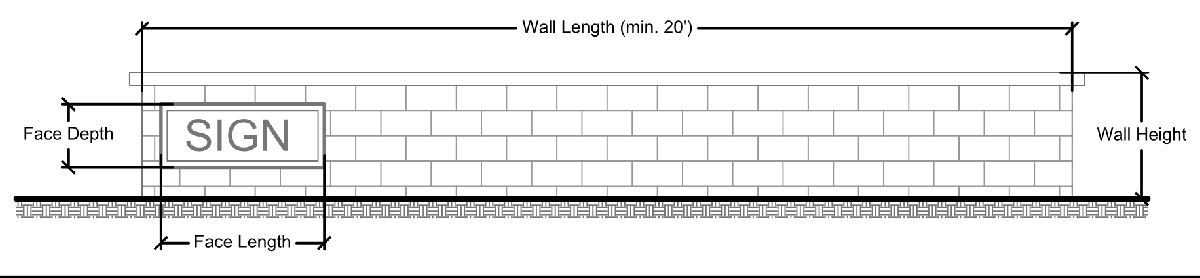
(37)
Sign: Window sign. Any permanent or temporary sign displayed on or within one foot of the inside or outside surface of a window located in the façade of a building. Window signs include those signs that are attached to or painted on the surface of a window.
Sign, ancillary building sign. A sign on the building that is subordinate to a principal building sign used for a tenant, business, or occupant. An ancillary building sign must be smaller in size than the principal building sign.
Sign, principal building sign. A type of building sign intended to have more significance or prominence than other signs on the same building, usually due to its size, lighting, detail, materials, or other unique design features; and typically located over or near a public entrance.
Sign band. A linear horizontal area of a building façade, usually located between the first and second floors of a building and integrated into the architectural elevation, that has been designated on an approved plan to contain signage.
Site plan. A graphic representation of all existing and/or proposed improvements to a site. Term may be used synonymously with various specific plan types defined in article 12 throughout the chapter.
Solar facility. Large-scale solar projects located on a one-acre or larger parcel generating electricity in an amount that exceeds two hundred (200) percent of the consumption of the uses on the parcel upon which they are constructed and whose excess electricity is fed into the electric grid.
Special exception. A special exception is a grant of a specific use that would not be appropriate generally or without restriction and shall be based on a finding that the requirements of the zoning law governing the special exception on the subject property are satisfied and the use on the subject property is consistent with the plan and is compatible with the existing neighborhood.
Story. The height from the top of the finished floor of one level of a building to the next level. Where there is no finished floor on the above level, the story is measured as the top of the finished floor to the ceiling. A basement shall not be considered a story of a building. A mezzanine floor shall be counted as a story, if it covers more than one-third (⅓) of the area of the floor next below it or if the vertical distance between the floor next below it and the floor next above it is twenty (20) feet or more.
Story, half. The portion of a building immediately under a gable, hip, gambrel, or other sloping roof which has the point of intersection of the top line of the rafters and the face of the walls not to exceed three (3) feet above the top floor level.
Street line. A line defining the edge of a street right-of-way and separating the street from abutting property or lots.
Structurally altered sign. A sign that is substantially altered, reconstructed, replaced, or relocated in a manner that involves fifty (50) percent or more of the sign face or sign structure. This definition does not include the relocation of portable signs.
Structure. Anything constructed or erected with a fixed location on the ground or attached to something having a fixed location on the ground. Among other things, structures include buildings, mobile homes, walls, and structured parking.
Subdivision of land. The division or assemblage of a lot, tract, or a parcel of land into one or more lots, plots, sites, tracts, parcels, or other divisions for the purpose, whether immediate or future, of sales or building development and, when appropriate to the context, relating to the process of subdividing or to the land or area subdivided; provided, that the definition of subdivision shall not include a bona fide division or partition of exclusively agricultural land not for development purposes or the division or partition of land pursuant to chapter 20 of the Gaithersburg Code of Ordinances. A resubdivision is also a subdivision.
(Ord. No. O-5-24, 7-15-24)
Sec. 24-16.20. - "T" terms.
Telecommunications facilities. A telecommunications facility consists of one or more antennas at a fixed location attached to a support structure and related equipment at that location, including, but not limited to, radio units, cabling, and power supplies. A telecommunications facility, once installed, includes the telecommunications facility support structure to which it is attached; in the case of a building, the telecommunications facility support structure includes only that portion of the building to which attachment is permitted. Equipment may be located on the ground, within a building or an exterior equipment cabinet. The term personal wireless service shall have the same meaning as under federal law. A telecommunications facility must not be staffed.
Telecommunications facility, co-location. Siting additional telecommunications facilities on an exterior structure or pole with an existing telecommunications facility, using the same base or support structure, without the need to construct a new base structure. Co-location may include siting multiple facilities from the same provider or from more than one provider in the same location.
Telecommunications facility, major modification. An alteration of an existing telecommunications facility for any purpose which substantially changes the physical dimensions of the facility, where (i) the height of the existing facility is increased by more than ten (10) percent from the current height, or twenty (20) feet, whichever is greater; (ii) the modification will require an additional protrusion of more than twenty (20) feet or width of the existing tower, whichever is greater; (iii) the modification would require the installation of more than the standard number of equipment boxes for the technology involved, not to exceed four (4) cabinets overall; (iv) the modification would entail any excavation or installation outside existing leased or owned property and current easements or outside the current site of the facility; or (v) the modification would defeat or detract from the existing concealment or stealth elements of the facility. The calculation for such modifications shall be cumulative over time following the initial approval of the telecommunications facility.
Telecommunications facility, minor modification. An alteration of an existing exterior telecommunications facility or co-location of a telecommunications facility in any zone that does not meet or exceed the thresholds for a major modification, the calculation for which shall be cumulative over time, following the initial approval of the telecommunications facility.
Telecommunications facility, new. The establishment of a telecommunications facility on a base structure where no such facility presently exists; or the construction of a monopole, tower or the replacement of an telecommunications facility support structure that supports an existing telecommunications facility.
Telecommunications facility, small cell. A compact infrastructure installation mounted on structures fifty (50) feet or less in height, including their antennas; Each antenna is no more than three (3) cubic feet in volume; All other associated wireless equipment is no more than twenty-eight (28) cubic feet in volume.
Telecommunications facility, stealth. Any telecommunications facility that is integrated into an architectural feature of a structure or the landscape so that the facility and its purpose to provide wireless services is not visually apparent or prominent.
Telecommunications facility, support structure. A monopole, tower, utility pole, existing light pole, building or any other freestanding self-supporting structure which can safely support the installation of a telecommunications facility.
Telecommunications facility, new support structure. A monopole, tower, utility pole, existing light pole, or any other freestanding self-supporting structure which can safely support and is intended to be installed in connection with the installation of a telecommunications facility. The term includes replacement of an existing telecommunications facility support structure.
Temporary holiday lighting. Outdoor lighting placed on structures and/or landscaping in commemoration of a widely recognized holiday or special event which is not lighted or in place permanently.
Theater. A facility for audio and visual productions (movies) and performing arts (stage productions), excluding adult motion picture theaters and adult entertainment businesses.
Tower. A tower has the same meaning as the term as used in Federal Communications Commission regulations, including 47 C.F.R. § 1.40001, and consists of any structure built for the sole or primary purpose of supporting any FCC-licensed or authorized antennas and their associated facilities, including structures that are constructed for wireless communications services including, but not limited to, private, broadcast, and public safety services, as well as unlicensed wireless services and fixed wireless services such as microwave backhaul, and the associated site, except that it does not include monopoles.
Trailer (including automobile trailer and trailer coach). Any vehicle or structure (except a device exclusively used upon stationary rails or tracks) mounted on wheels for use on highways and streets, propelled or drawn by its own or other motive power and designed and constructed to provide living or sleeping quarters for one or more persons or for the conduct of a business, profession, trade or occupation or for use as a selling or advertising device. If the wheels of a trailer are removed except for repairs, it is deemed a building subject to all the regulations thereof. A trailer shall not be considered an accessory building.
Transcript, official. A verbatim written account of a hearing, meeting, or proceeding, which is certified to be an accurate record of the hearing, meeting, or proceeding and is prepared by or under the direction of the city.
(Ord. No. O-5-24, 7-15-24)
Sec. 24-16.21. - "U" terms.
Undue economic hardship. The deprivation of all viable economic use of land.
Use. The principal purpose for which a lot or main building thereon is designed, arranged or intended and for which it is or may be used, occupied or maintained.
Utility pole. A free-standing mast or pole that supports or is designed to support the wire lines of public service corporations; that is not built for the sole or primary purpose of supporting FCC licensed or authorized antennas and their associated facilities; and that is subject to regulation under 47 U.S.C. § 224, or Maryland laws that may regulate utility poles in lieu of 47 U.S.C. § 224.
(Ord. No. O-5-24, 7-15-24)
Sec. 24-16.22. - "V" terms.
Variance. A modification only of the density, bulk, dimensional, or area requirements in the zoning law that is not contrary to the public interest, and where, owing to conditions peculiar to the property and not because of any action taken by the applicant, a literal enforcement of the zoning law would result in unnecessary hardship or practical difficulty, as specified in the zoning law.
Vehicle. Any device used to transport persons or goods, including, but not limited to, motor vehicles, motorcycles, trailers, scooters, wagons, tricycles, and bicycles.
Vehicle rental establishments. An establishment that rents recreational, personal, or commercial vehicles, excluding machinery and equipment, which may include accessory storage of rental vehicles on-site.
Veterinary hospital and clinic. A facility for the medical and surgical treatment of animals that may include boarding facilities for patients undergoing treatment and emergency services.
(Ord. No. O-5-24, 7-15-24)
Sec. 24-16.23. - "W" terms.
Waiver. Where allowed by other provisions of chapter 24, the approving body may grant relief from the zoning code to approve something that deviates from the regulatory requirements applicable to the property. This may take the form of a minor or major waiver.
Warehousing. Facilities used primarily for the storage and distribution of materials and goods.
Waste processing—Private. A privately owned facility that receives, stores and/or processes waste or recycling materials.
Wayside stand. A temporary structure designed, arranged or used for the display or sale of agricultural or other products grown or produced on the premises upon which such stand is located.
Work force housing unit (WFHU). WFHU that is offered to eligible participants under the terms of the city affordable housing program.
Wholesale sales. Any establishment that sells goods to other businesses, retailers, or resellers, rather than selling directly to consumers.
(Ord. No. O-5-24, 7-15-24)
Sec. 24-16.24. - "X" terms.
[Reserved]
(Ord. No. O-5-24, 7-15-24)
Sec. 24-16.25. - "Y" terms.
Yard, front. A front yard is the area of a lot located between the entirety of the front lot line and a line drawn at the principal building foundation wall as it extends to the adjacent side lot line.
Yard, rear. A rear yard is the area of a lot located between the entirety of the rear lot line and a line drawn at the rear principal building foundation wall as it extends to the adjacent side lot line.
If the rear lot line is less than ten (10) feet long or the lot comes to a point at the rear, such rear lot line is assumed to be a line not less than ten (10) feet long, lying wholly within the lot, parallel to the a line drawn at the rear principal building foundation wall as it extends to the adjacent side lot line.
Yard, side. A side yard is the entire area located between a side lot line and the adjacent principal building foundation wall, not including the front or rear yard as defined, except for corner lots where the side yard extends the length of the road frontage from the front yard to rear lot line.
(Ord. No. O-5-24, 7-15-24)
Sec. 24-16.26. - "Z" terms.
Zone. An area within which certain uses of land and buildings are permitted and certain others are prohibited, and yards and other open spaces are required; all of the foregoing being identical for the zone in which they apply. This definition includes the following categories of zones:
(1)
Zones: Standard residential zones. A collective reference to the R-A, R-90, R-6, RB, RP-T, R-20, R-18, and R-H zones.
(2)
Zones: Standard non-residential zones. A collective reference to the CB, C-1, C-2, I-1, I-3, E-1, and E-2 zones.
(3)
Zones: Floating zones. A collective reference to the MXD, CD, MCD, and CBD zones
(Ord. No. O-5-24, 7-15-24)

