
Gaithersburg City Zoning Code
ARTICLE 8
- SIGNAGE STANDARDS
Sec. 24-8.1.- Purpose and minimum requirements.
(A)
Purpose. This article is intended to provide uniform sign regulations for areas under the jurisdiction of the city while respecting the rights guaranteed by the state and federal constitutions. This article further intends to promote and protect the public health, safety, and general welfare by regulating existing and proposed signs within the city to ensure that signs:
(1)
Promote pedestrian and vehicular safety by allowing people to locate goods, services, facilities, and geographic areas without difficulty, danger, or confusion;
(2)
Enhance the unique character of the city by maintaining and complementing the aesthetic, built, and natural environments;
(3)
Protect property values by preventing damage from signs, avoiding visual clutter, and ensuring compatibility with the surrounding land uses;
(4)
Prevent signage from becoming a public nuisance, creating blight, or posing hazards through unregulated construction, placement, and display;
(5)
Create an attractive business climate that fosters economic vitality and sustainability;
(6)
Appear and act as an accessory and incidental use to the primary use on the property;
(7)
Communicate legibly and effectively under the circumstances in which they are seen;
(8)
Preserve public property and rights-of-way and its authorized users and franchisees; and
(9)
Minimize the possible adverse effect of signs on nearby public and private property.
(B)
Minimum requirements. The provisions of this article 8, Signage Standards are the minimum requirements for the installation, erection, location, alteration, replacement, improvement, and maintenance of all signs as defined herein.
(Ord. No. O-5-24, 7-15-24)
Sec. 24-8.2. - Applicability and permit requirements.
(A)
Items, objects, and elements subject to this article.
(1)
Only those items, objects, and elements that conform to the definition of a sign per this chapter are subject to the provisions of this article.
(2)
Items, objects, and elements that do not conform to the definition of a sign per this chapter are not subject to the provisions of this article.
(3)
Unless otherwise provided for by this article or the Gaithersburg City Code, all new sign installations must comply with this article and the city Code at the time of installation.
(B)
Comprehensive sign packages.
(1)
Comprehensive sign packages approved by the planning commission or mayor and city council prior to the effective date of this article remain valid and in full force and effect.
(2)
Any sign that does not comply with this article, which is located on a property or development that is the subject of a comprehensive sign package approved by the planning commission or mayor and city council prior to the effective date of this article, is a legal nonconforming sign and is allowed to be replaced with a new sign that conforms to the previously-approved sign package, even if such a replacement sign violates this article.
(3)
Following the effective date of this article, the planning commission or mayor and city council may approve a comprehensive sign package for a property or development that includes provisions that deviate from the standards of this article.
(4)
Where a conflict exists between an adopted comprehensive sign package for a specific development and the provisions of this article, the comprehensive sign package controls.
(C)
Design guidelines.
(1)
Design guidelines adopted for the CD, CBD, MCD, and MXD zones, and approved by the planning commission or by resolution of the mayor and city council prior to the effective date of this article are hereby incorporated into this article, remain valid and in full force and effect, and are binding pursuant to chapter 24 of the city Code.
(2)
Following the effective date of this article, the planning commission or mayor and city council may approve design guidelines for a property or development that include provisions that deviate from the standards of this article.
(3)
Where a conflict exists between adopted design guidelines for a specific development and the provisions of chapter 24, the guidelines control.
(D)
Use-specific sign standards. Additional sign requirements contingent upon certain uses can be found in article 5, Use-Specific Standards.
(E)
Sign permits required. Unless otherwise expressly provided within this article, it is unlawful for any person to post, display, structurally alter, install, or erect a sign in the city without first having obtained a sign permit pursuant to section 24-8.6, Sign permits.
(Ord. No. O-5-24, 7-15-24)
Sec. 24-8.3. - Prohibited sign types and elements.
(A)
Prohibited signs and elements. Unless otherwise provided for in this section 24-8.3, the signs and sign-related elements identified within this section 24-8.3 are prohibited.
(B)
Abandoned signs. Abandoned signs, as identified pursuant to section 24-8.8(K), are prohibited.
(C)
Attaching signs to other objects. Signs installed by nailing, fastening, adhering, or affixing the sign in any manner to any tree, rock, post, curb, utility pole, community mailbox, natural feature, official street sign or marker, traffic control sign or device, or similar object, are prohibited.
(D)
Balloon signs. Balloon signs are prohibited.
(E)
Billboard signs. Billboard signs are prohibited.
(F)
Fence signs. Signs on fences are prohibited, except where otherwise explicitly allowed or exempted pursuant to this article, such as signs exempt from regulation, permits, or both under section 24-8.4.
(G)
Flashing signs. Flashing signs are prohibited, whether the elements that are flashing or blinking are deliberate or if they are the result of a defect in the sign or the source of illumination. This prohibition does not apply to approved electronic message displays.
(H)
Freestanding permanent signs. Permanent freestanding signs, other than incidental and directional signs, are prohibited, except where otherwise explicitly allowed or exempted pursuant to this article, such as signs exempt from regulation, permits, or both under section 24-8.4.
(I)
Inflatable signs. Inflatable signs, when used as a commercial sign, are prohibited.
(J)
Moving signs and devices. Signs that move or that incorporate moving parts are prohibited. This prohibition includes pennants, flashing or twinkling lights, streamers, and similar air-propelled devices and pinwheels. This prohibition does not apply to banners that are allowed by this article.
(K)
Obscene signs. A sign must not contain statements, words, nor pictures of an obscene, indecent, or immoral character, such as those that offend community standards of public morals or decency.
(L)
Off-premises signs. Off-premises signs are prohibited, except as provided in section 24-8.24.
(M)
Paper signs. Paper signs that cover the front of a building are prohibited.
(N)
Portable, moveable, and relocatable signs. Portable, moveable, and relocatable signs are prohibited, except for A-frame signs subject to the regulations of section 24-8.9, building-mounted temporary banners subject to the regulations of section 24-8.10, freestanding temporary banners subject to the regulations of section 24-8.11, decorative pole banner signs subject to the regulations of section 24-8.15, freestanding temporary signs subject to the regulations of section 24-8.18, and signs exempt from regulation, permits, or both under section 24-8.4.
(O)
Roof signs. Signs must not be installed nor constructed on the roof of any building.
(P)
Traffic hazards. A sign or object is not allowed if, by reason of its shape, color, lighting, or placement, results in one or more of the following conditions:
(1)
May be confused with an official traffic sign, signal, or device;
(2)
May be confused with a public safety device, such as fire hydrants, speed cameras, street lights, utility boxes, and similar devices;
(3)
May mislead or confuse pedestrians or vehicle operators;
(4)
May obscure from view any traffic or street sign or signal;
(5)
May obstruct the view in any direction at the intersection of a street with another street or with a driveway;
(6)
May impair the vision of pedestrians or vehicle operators due to its light intensity or direction of light emission, or both.
(Q)
Vehicular signs.
(1)
A vehicle sign, as defined herein, is prohibited, unless allowed by section 24-8.4(A)(9).
(2)
Subject to the exceptions under section 24-8.4(A)(9), a sign that is located on a vehicle parked in a place other than a private parking lot, private parking space, private driveway, private alley, or private garage is prohibited.
(3)
The prohibitions of this subsection do not apply to mobile vendors that have an active, approved license from the city.
(R)
Unauthorized signs. Signs that are not specifically allowed by this article are prohibited.
(Ord. No. O-5-24, 7-15-24)
Sec. 24-8.4. - Signs exempt from regulation and/or permits.
(A)
Signs exempt from regulation and permits. Unless otherwise provided for by this article or the city Code, the signs identified within this section 24-8.4(A) are not subject to the regulatory and permitting provisions of this article or as referenced in this article.
(1)
Regulation- and permit-exempted signs, generally. Signs that are exempt from regulatory and permitting provisions:
(a)
Are not included in total allowable signage calculations;
(b)
Are not allowed in a public right-of-way, subject to the exceptions of section 24-8.8(C) and section 24-8.8(D);
(c)
May be subject to other regulatory and permit provisions of the city Code, such as the requirement to obtain building permits, electrical permits, site development permits, floodplain permits, or stormwater management approvals; and
(d)
May also be subject to other federal, state, or county regulations and permits.
(2)
Signs that are accessory to non-residential use. The following signs are not subject to the regulatory and permitting provisions of this article, when accessory to a non-residential use:
(a)
Signs that are six square feet or smaller in size and that are associated with an outdoor display of products.
(b)
Signs that are six square feet or smaller in size and located outdoors that are associated with a vending machine, video rental machine, lottery games dispenser, ice machine, coin exchanger, amusement ride, news rack, shopping cart, or similar device.
(c)
Signs that are six square feet or smaller in size and located on tables, chairs, umbrellas, napkins, tableware, and similar items that are within an approved outdoor seating area.
(d)
Signs that are six square feet or smaller in size and located on recycling bins, trash cans, composting bins, tobacco waste fixtures, and similar containers.
(e)
Signs that are six square feet or smaller in size and located within or attached to fuel pumps and fuel pump islands, provided that an electronic message display may only be used if the fuel pump is in working order.
(f)
Signs that are nine square feet or smaller in size and located within or attached to electric vehicle (EV) charging stations and EV parking spaces, provided that an electronic message display may only be used if the EV charger is in working order.
(g)
Any menu board, shelter sign, overhead safety bar warning, or similar sign located within a drive-thru area.
(3)
Signs that are an integral part of a structure. Signs that are carved into stone, concrete, or similar material, or that are made of bronze, aluminum, or other permanent material, where such material is made an integral part of the structure (e.g., the block of stone or piece of metal is a load-bearing element of a wall) are not subject to the regulatory and permitting provisions of this article.
(4)
Interior signs. Signs that are located within a building and placed more than one foot from the interior side of a façade window are not subject to the regulatory and permitting provisions of this article.
(5)
Certain art and landscaping. Murals, works of visual art, and landscaping containing letters or words that have been approved for display by the mayor and city council or a city commission, board, or committee are not subject to the regulatory and permitting provisions of this article.
(6)
Public interest signs. Signs that are sponsored by a government entity, agent, franchisee, or instrumentality are not subject to the regulatory and permitting provisions of this article. This exemption includes notification signs required by this city Code.
(7)
Seasonal event signs. Temporary signs twenty (20) square feet in size or smaller and eight (8) feet or shorter in height with no foundation, and displayed within twenty (20) days of a seasonal event or officially recognized federal, state, or local holiday are not subject to the regulatory and permitting provisions of this article. Such signs may be illuminated.
(8)
Signs on single-family residential properties. When located on a property used for a single-family use, the following signs, in addition to other signs exempted by this section, are not subject to the regulatory and permitting provisions of this article:
(a)
Signs twelve (12) square feet in size or smaller that are placed in a rear yard or side yard and are not visible from the nearest street or road.
(b)
Temporary signs, other than seasonal event signs, six (6) square feet in size or smaller that are placed in a front yard.
(c)
Incidental signs six (6) square feet in size or smaller that are placed in a front yard.
(9)
Vehicle signs. The following signs are not subject to the regulatory and permitting provisions of this article:
(a)
Signs located on a continuously moving vehicle that are accessory and incidental to the primary use as a vehicle.
(b)
Signs that are located on a vehicle parked in a private parking lot, private parking space, private driveway, private alley, or private garage.
(c)
Signs that are located on a vehicle that is stored or placed on a porch, in a yard, or on other private property.
(10)
Additional signs. The following signs are not subject to the regulatory and permitting provisions of this article:
(a)
Signs smaller than one square foot that are attached to a vehicle, building, deck, stairs, refuse or recycling receptable, fence, utility box, or item of clothing.
(b)
Signs placed on gravestones, tombs, and other types of internments.
(B)
Signs exempt from permits. Unless otherwise provided for by this article or the city Code, the signs included within this section 24-8.4(B) are not subject to the permitting provisions of this article, but are still subject to the regulatory provisions of this article and must be included in the calculation for the total allowable signage on a given property.
(1)
Permit-exempted signs, generally. Signs that are exempt from permitting provisions:
(a)
Are not allowed in a public right-of-way, subject to the exceptions of section 24-8.8(C) and section 24-8.8(D);
(b)
May be subject to other regulatory and permit provisions of the city Code; and
(c)
May also be subject to other federal, state, or county regulations and permits.
(2)
Signs one square foot or smaller in area that are not illuminated.
(3)
Freestanding signs six square feet or smaller in area that are not illuminated and that do not have a foundation or footing.
(4)
Window signs.
(5)
Projected image signs.
(6)
Building signs two (2) square feet or smaller in area that are not illuminated.
(7)
Temporary signs that are held or worn by a person, when located on a nonresidential property.
(8)
Incidental signs that are not otherwise exempted from regulations and permits pursuant to section 24-8.4(A).
(C)
Signs exempt from regulation. Unless otherwise provided for by this article or city Code, the signs included within this section 24-8.4(C) are not subject to the regulatory provisions of this article but are still subject to the permitting provisions of this article.
(1)
Regulation-exempted signs, generally. Signs that are exempt from regulatory provisions:
(a)
Are not included in total allowable signage calculations;
(b)
Are not allowed in a public right-of-way, subject to the exceptions of section 24-8.8(C) and section 24-8.8(D);
(c)
May be subject to other regulatory and permit provisions of the city Code; and
(d)
May also be subject to other federal, state, or county regulations and permits.
(2)
Temporary signs larger than twelve (12) square feet in surface area or taller than six (6) feet in height that are located on a property used for a multifamily use, and that are displayed within twenty (20) days of a seasonal event or officially recognized federal, state, or local holiday.
(3)
Temporary signs larger than twenty (20) square feet in surface area or taller than eight (8) feet in height that are located on a non-residential property, and that are displayed within twenty (20) days of a seasonal event or officially recognized federal, state, or local holiday.
(Ord. No. O-5-24, 7-15-24)
Sec. 24-8.5. - Signage measurement standards.
(A)
Façade area calculation, single-tenant building. The area of each façade of the building is calculated by multiplying the façade height by the façade width, as shown in figure 24-28, Façade Area Measurement Example. A single-tenant building will usually have a minimum of four (4) façades, with each façade having a separate area calculation. In a situation where residential or nonresidential units are located in the same building above a single tenant, each tenant's façade area is only the area directly associated with that tenant.
Figure 24-28. Façade Area Measurement Example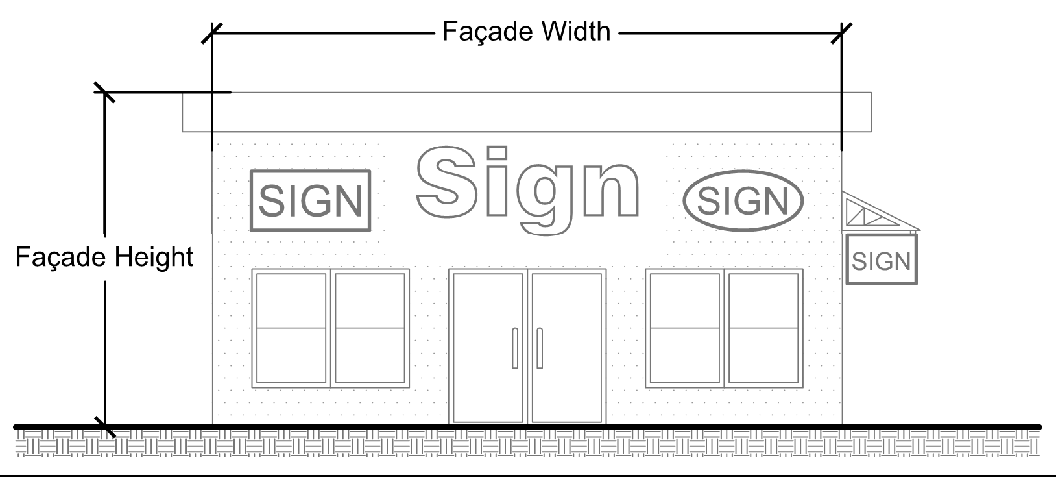
(B)
Façade area calculation, multiple-tenant building. The area of each façade for a tenant located within a multiple-tenant building is calculated by multiplying the façade height of the tenant's leased area by the façade width of the tenant's leased area, as shown in figure 24-29, Façade Area Calculation for Multiple-Tenant Building. An individual tenant located within a multiple-tenant building may have more than one façade that is subject to the area calculation. In a situation where residential or nonresidential units are located in the same building above multiple tenants, each tenant's façade area is only the area directly associated with that tenant.
Figure 24-29. Façade Area Calculation for Multiple-Tenant Building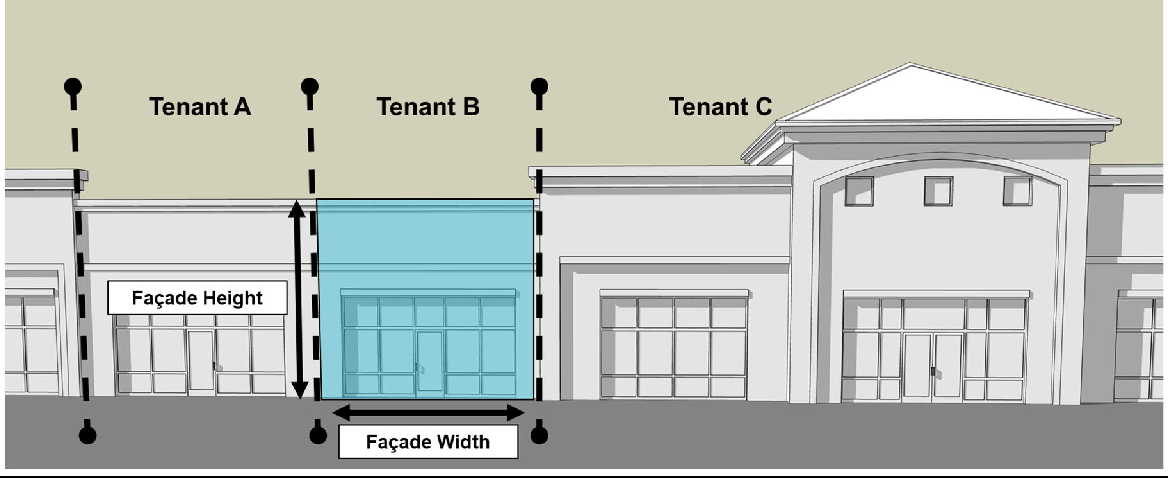
(C)
Signs: lot area requirement calculation.
(1)
Where a regulation includes a lot area requirement, the entire area specified is required, unless the phrase "or portion thereof" follows the requirement. For example, if the regulation requires three (3) acres of lot area per sign, and the subject lot is only two (2) acres, no such sign is allowed.
(2)
Where a regulation includes a lot area requirement and includes the phrase "or portion thereof," any fraction of the lot area satisfies the requirement. For example, if the regulation requires three (3) acres or portion thereof per sign, and the subject lot is four (4) acres in size, then two (2) such signs are allowed; one for the three (3) full acres and one for the remaining partial area (one acre) of the next three (3) full acres.
(D)
Signs: face length, face depth, and sign surface area calculation.
(1)
The surface area of a sign includes the entire face of the sign, plus any supporting backboard or raceway, plus any wall work incidental to its decoration, and includes the space between letters, figures, and designs.
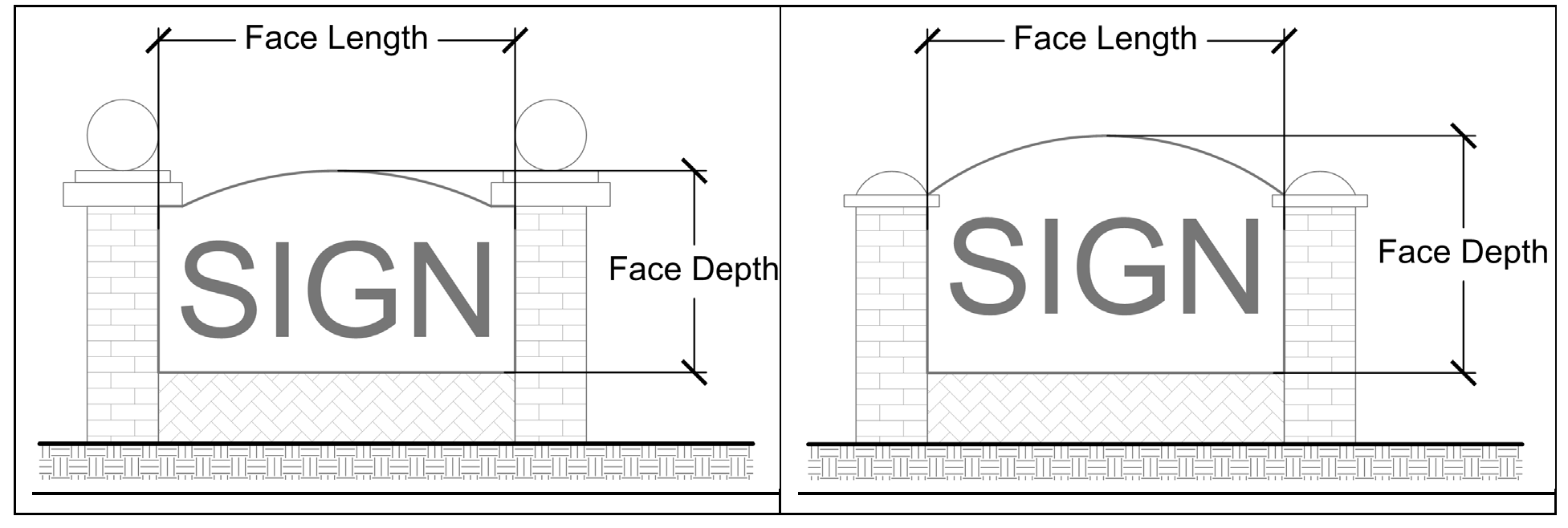
(2)
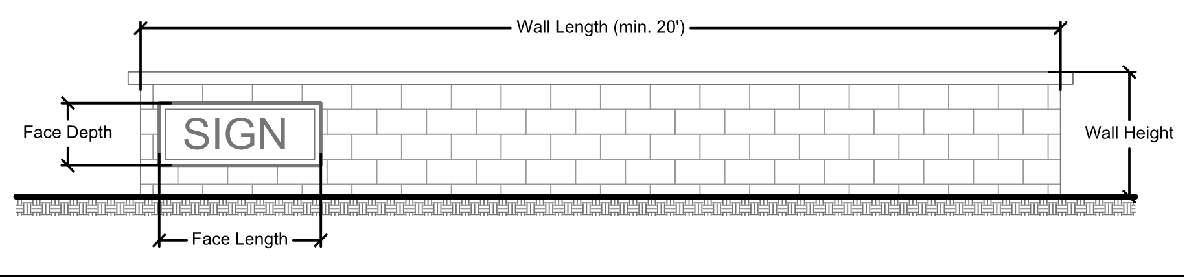
The surface area of a sign is calculated by multiplying the sign face length by the sign face depth, as shown in the following figures.
Figure 24-30. Sign Surface Area Measurement Example 1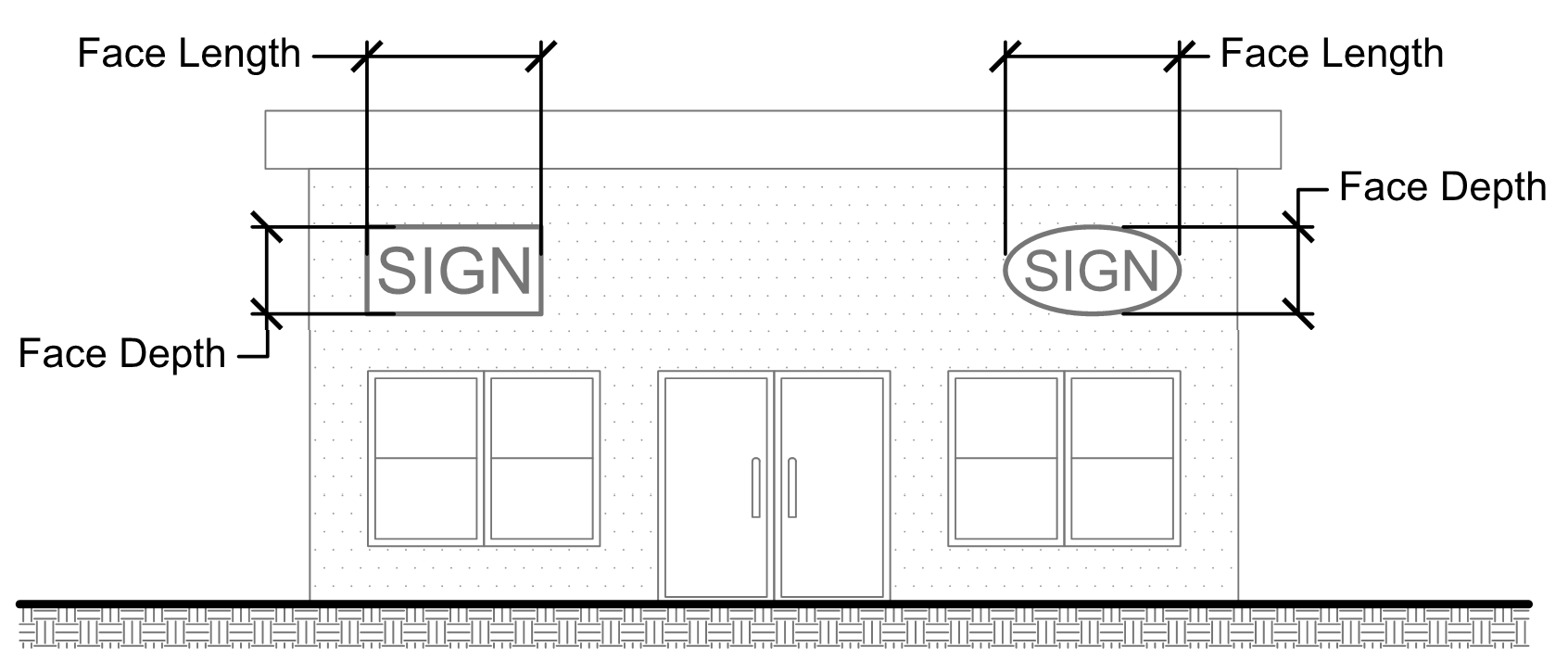
Figure 24-31. Sign Surface Area Measurement Example 2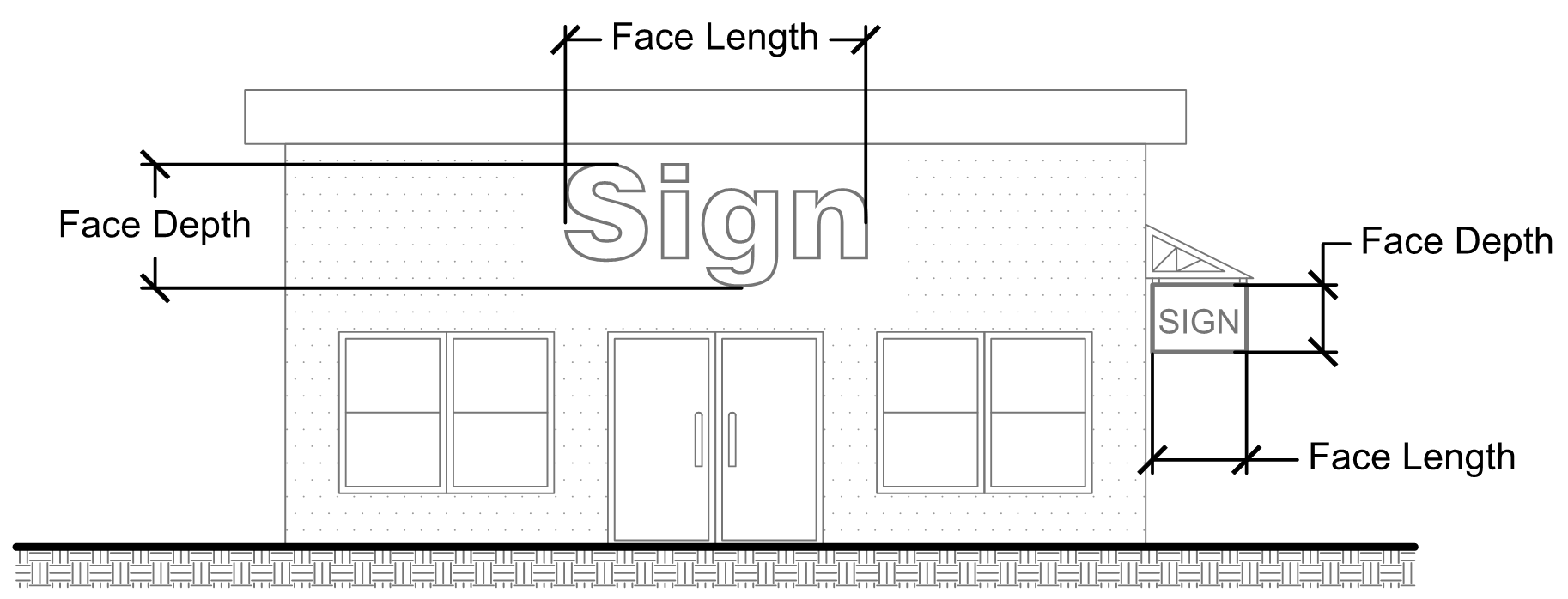
Figure 24-32. Sign Surface Area Measurement Example 3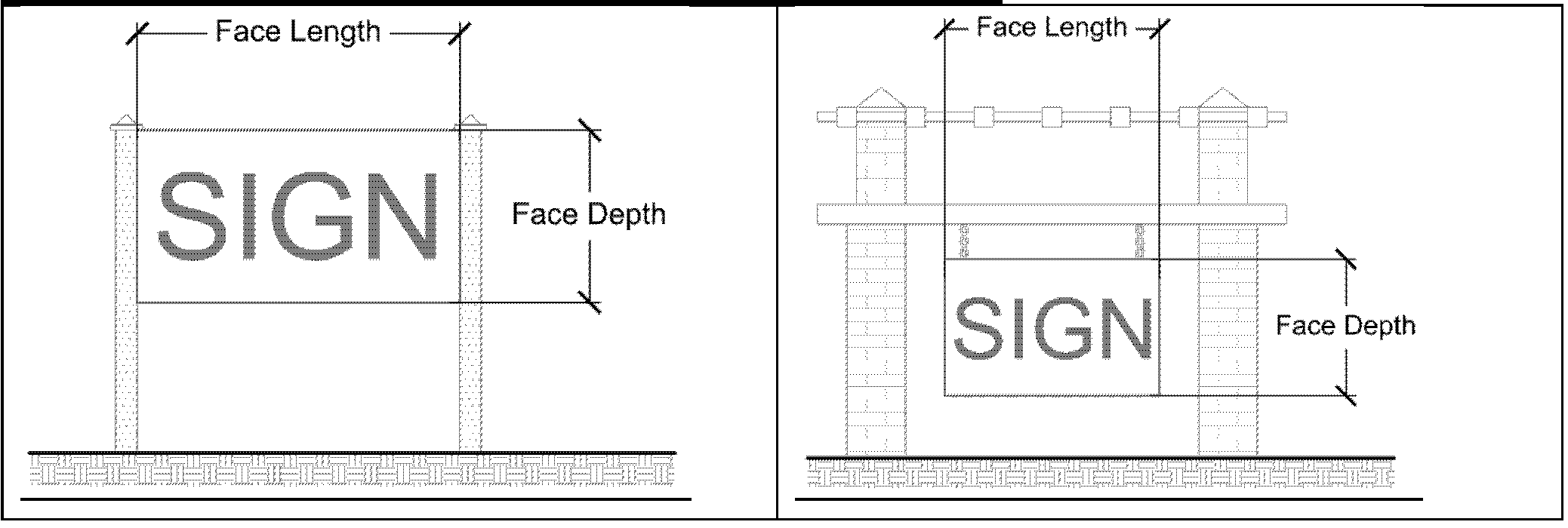
(3)
All sides of a sign that are visible from any one vantage point must be measured in determining the total surface area of a sign.
(a)
If the two (2) sides of the sign are back-to-back or separated by an angle of forty-five (45) degrees or less, as shown in figure 24-33, Example Double-Faced Sign (Under 45 Degrees), only one side of the sign is used for the surface area calculation. Where the two (2) sides of such a sign are not equal in size, the larger side must be used for the total surface area calculation.
Figure 24-33. Example Double-Faced Sign (Under 45 Degrees)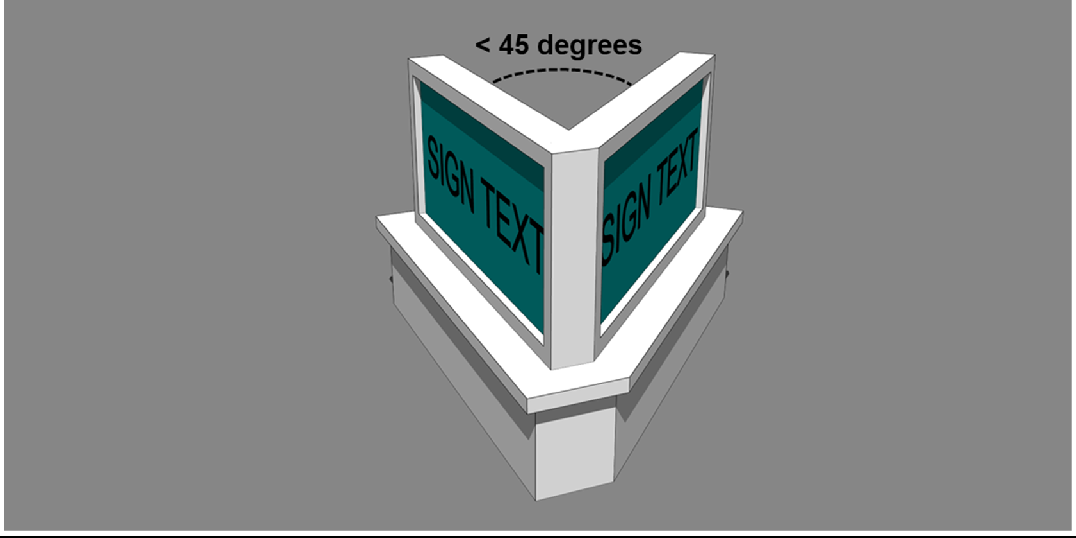
(b)
If the two (2) sides of the sign are separated by an angle greater than forty-five (45) degrees, both sides of the sign are used for the surface area calculation and each side is calculated separately. See figure 24-34, Example Double-Faced Sign (Over 45 Degrees).
Figure 24-34. Example Double-Faced Sign (Over 45 Degrees)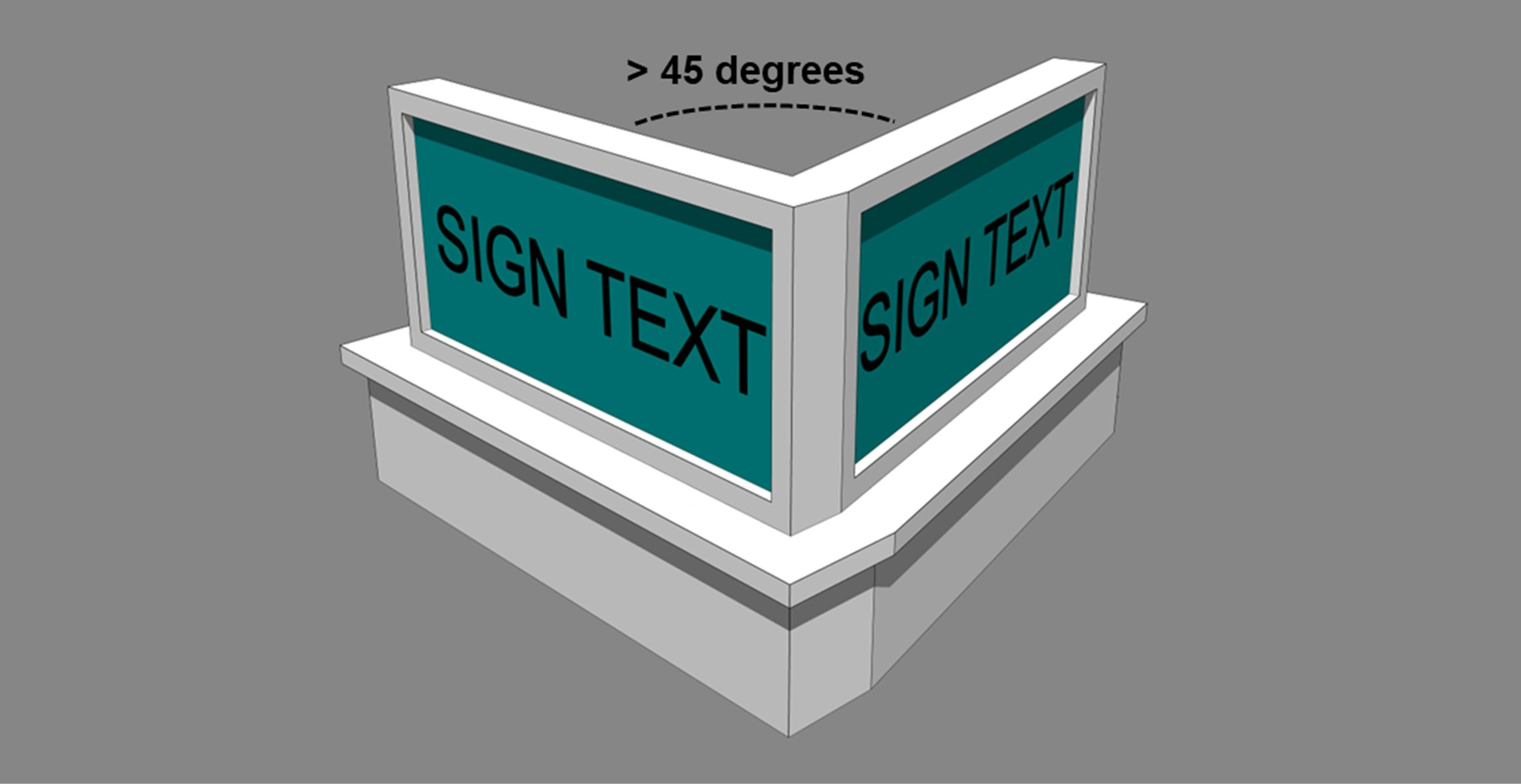
(E)
Signs: freestanding and monument sign width calculation. For a freestanding sign or a monument sign not attached to a building or wall, the width is measured from the left outermost surface of the supporting structure surrounding the sign face to the right outermost surface of the supporting structure surrounding the sign face. Where decorative columns wider than six (6) inches are used on both sides of the sign face, the columns are excluded from the freestanding sign or monument sign width measurement, as shown in the following figures. Where decorative architectural framing or elements are used to surround the sign face, the architectural framing and elements are excluded from the width measurement, as shown in the following figures. In the following figures, the dimension line indicates the distance measurement used to calculate the width of the freestanding sign or monument sign and the extending lines indicate the limits of each sign of the sign.
Figure 24-35. Temporary Freestanding Sign Width Measurement Example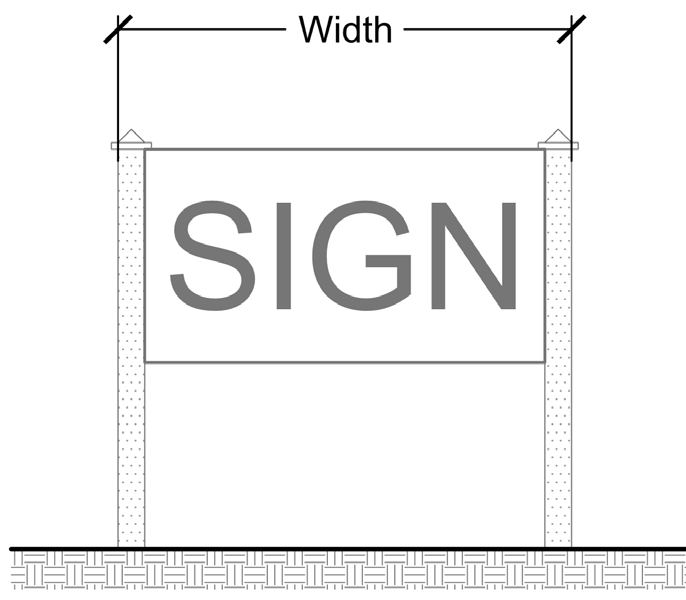
Figure 24-36. Permanent Monument Sign Width Measurement Examples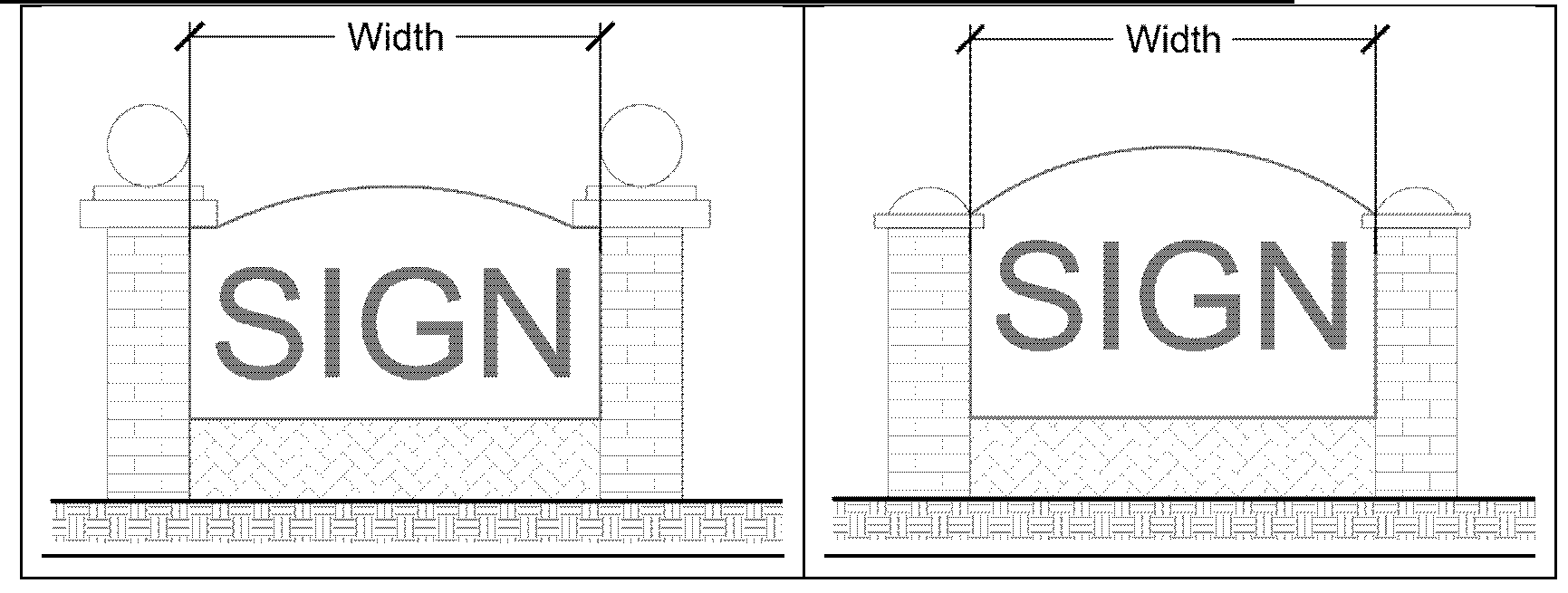
(F)
Signs: freestanding and monument sign height calculation. For a freestanding sign or a monument sign not attached to a building or wall, the height is measured from the average finished grade of the property at the base of the sign to the outermost top edge of the structure surrounding the sign face or the top of the sign face, whichever is higher. Where decorative columns wider than six (6) inches are used on both sides of the sign face, the columns are excluded from the height measurement, as shown in the following figures. Where decorative architectural framing or elements are used to surround the sign face or top the column supports, the architectural framing and elements are excluded from the height measurement, as shown in the following figures. In the following figures, the dimension line indicates the distance measurement used to calculate the height of the freestanding sign or monument sign and the extending lines indicate the limits of the bottom and top of the sign.
Figure 24-37. Temporary Freestanding Sign Height Measurement Example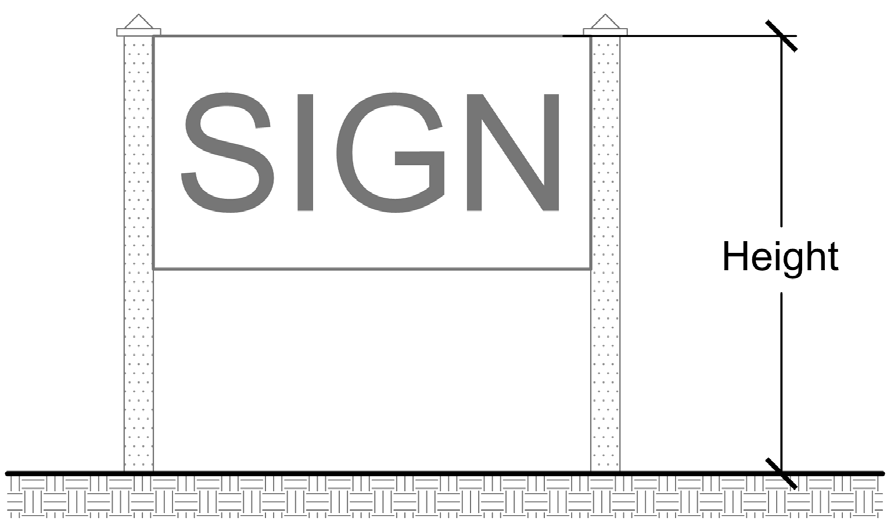
Figure 24-38. Permanent Monument Sign Height Measurement Examples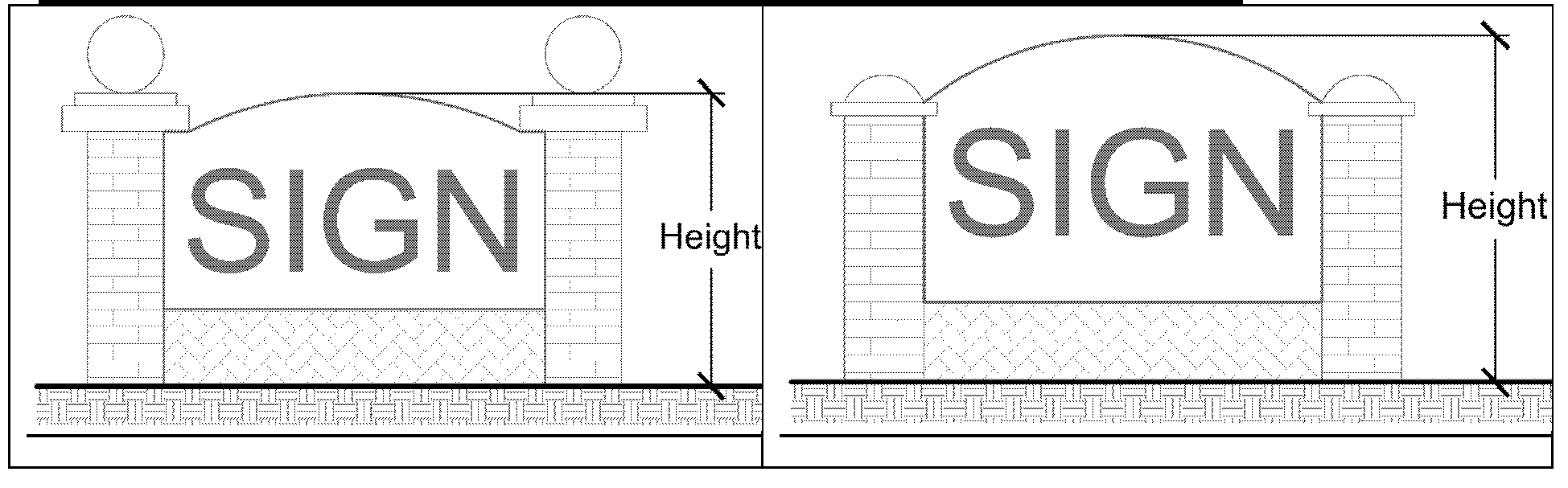
(Ord. No. O-5-24, 7-15-24)
Sec. 24-8.6. - Sign permits.
(A)
Applicability. Unless otherwise expressly provided in article 8, Signage Standards, it is unlawful for any person to post, display, structurally alter, install, or erect a sign in the city without first having obtained a sign permit pursuant to this section.
(B)
Decision making authority.
(1)
The city manager or designee is hereby authorized to review and decide if an application for a sign permit is complete and if the contents meet all required criteria for approval. Upon completion of the review, the city manager or designee shall issue in writing an approval or denial of the application.
(2)
The city manager or designee may seek the advice of the planning commission in connection with any application for a sign permit.
(C)
Decision criteria.
(1)
A sign permit application must only be approved if all applicable standards of this article 8 are met.
(2)
Where a sign also requires a building, electrical, or other related permit under any provision of the city Code, such other permit must be issued or approved prior to or concurrently with the issuance of the sign permit.
(3)
All signs must comply with applicable requirements of the city building code and the Maryland High Voltage Line Act.
(4)
All signs that contain electrical components must comply with the requirements of the city electrical code.
(5)
Any sign subject to an approved final site plan, comprehensive sign package, or design guidelines must be in conformance with that approval.
(D)
Authority to impose conditions. The city manager or designee is hereby authorized to:
(1)
Set or not set a maximum duration for the display of a proposed sign based on the applicable provisions of this article 8; and
(2)
Set forth other conditions for approval of a sign permit application that are necessary to achieve the purposes and meet the applicable standards of this article 8 and the city Code.
(E)
Application requirements.
(1)
Applications for sign permits must be filed with the city by the sign owner or authorized agent upon forms furnished by the city.
(2)
The application form, which may be modified from time to time, sets forth the information needed to fulfill the requirements of this article 8. Such information generally includes the type, size, location, and materials of the proposed sign and its supporting structure; the names and addresses of the owners of the real property upon which the proposed sign is to be located; and written consent of the owner or authorized agent granting permission for the placement or maintenance of the proposed sign.
(F)
Denial or revocation of sign permits.
(1)
When the city manager or designee denies any application for a sign permit, or revokes or suspends a previously issued sign permit, the applicant may seek administrative review of such denial, revocation, or suspension pursuant to section 24-12.9, Administrative review.
(2)
The board of appeals, as part of its final decision pursuant to section 24-12.9, Administrative review, is hereby authorized to order the issuance of a sign permit or to sustain the denial, revocation, or suspension by the city manager or designee.
(G)
Security for revocable and temporary sign permits.
(1)
The city manager or designee may require revocable permits issued for the installation and placement of signs to be secured by cash deposit, letter of credit, bond, or other security. Such security will reimburse the city for the cost of removal of such signs where said signs are removed pursuant to a lawful directive (pursuant to article 15, Enforcement) from the city manager or designee.
(2)
Temporary sign permits issued for the installation and placement of signs may, by resolution of the city council, be required to be secured by cash deposit, letter of credit, bond, or other security. Such security will reimburse the city for the cost of removal of such signs where said signs are removed pursuant to a lawful directive (pursuant to article 15, Enforcement) from the city manager or designee.
(3)
The city manager or designee is hereby authorized to forfeit any deposit, letter of credit, bond, or other security upon written notice to the permittee or owner of the sign.
(H)
Decision appeal procedures. An appeal of a decision by the city manager or designee may be filed pursuant to section 24-12.9, Administrative review.
(Ord. No. O-5-24, 7-15-24)
Sec. 24-8.7. - Waiver of signage standards.
(A)
Minor waivers of signage standards.
(1)
Required findings. Where allowed by other provisions of this chapter, the planning commission may grant a minor waiver to approve a sign that deviates from the regulatory requirements of article 8, Signage Standards, upon finding that:
(a)
Such deviation will not have an adverse impact on the health, safety, and general welfare of the city, its residents and businesses, the public, and the surrounding properties; and
(b)
Such deviation will not be a hazard to traffic, vehicles, or pedestrians; and
(c)
Such deviation is necessary due to location, obstructions, or other factors that adversely impact the visibility of the sign; and
(d)
Such deviation is in conformance with the purposes of article 8, Signage Standards.
(2)
Notifications. Requests for a minor waiver from article 8, Signage Standards must comply with the notification requirements of section 24-12.6(K).
(3)
Appeals. Appeals of a minor waiver request from article 8, Signage Standards, may be filed pursuant to section 24-11.4(F).
(B)
Major waivers of signage standards.
(1)
Required findings. Where a literal application of this chapter, due to special circumstances, would result in an unusual hardship in an individual case, the planning commission may grant a major waiver to approve a sign that deviates from the regulatory requirements of this article, upon finding that:
(a)
The granting of such a major waiver satisfies the required finding for a minor waiver pursuant to section 24-8.7(A), above; and
(b)
There exist exceptional conditions pertaining to the property where the sign is to be located as a result of its size, shape, visibility, or topography, which are not applicable to other lands or structures in the area; and
(c)
The applicant would be deprived of rights that are commonly enjoyed by others similarly situated; and
(d)
Granting the major waiver would not confer on the applicant any significant privileges that are denied to others similarly situated; and
(e)
Neither the special circumstances nor unusual hardship is the result of action by the applicant; and
(f)
The requested major waiver is the minimum deviation necessary to allow the applicant to enjoy the rights commonly enjoyed by others similarly situated; and
(g)
Granting the major waiver would not result in allowing a sign that interferes with road or highway visibility, nor obstruct or otherwise interfere with the safe and orderly movement of traffic.
(2)
Notifications. Requests for a major waiver from article 8, Signage Standards must comply with the notification requirements of section 24-12.6(K).
(3)
Appeals. Appeals of a major waiver request from article 8, Signage Standards may be filed pursuant to section 24-11.4(F).
(Ord. No. O-5-24, 7-15-24)
Sec. 24-8.8. - General sign standards.
(A)
Applicability. Except as otherwise specifically provided in this article, the provisions within this section apply in all zones and rights-of-way.
(B)
Illumination.
(1)
Light sources. Light sources that are intended to illuminate a sign must be shaded, shielded, or directed so that:
(a)
The light intensity or brightness does not adversely affect vision on surrounding or facing premises; and
(b)
The light intensity or brightness does not adversely affect safe vision of pedestrians or operators of vehicles moving on public or private streets, driveways, or parking areas.
(2)
External illumination. Externally illuminated signs are allowed subject to the following restrictions:
(a)
Internal illumination must not be used; and
(b)
Direct illumination must not be used; and
(c)
Related sign permits must include an approved lighting plan; and
(d)
All light sources must comply with section 24-8.8(B)(1), above; and
(e)
All lighting components must be installed outside of a public right-of-way, unless otherwise provided for by this article.
(3)
Internal illumination. Internally illuminated signs are allowed subject to the following restrictions:
(a)
Unless otherwise provided by this article, only the letters, logos, symbols, graphics, and characters on the sign may be illuminated (typically in the form of cutouts);
(b)
Direct illumination may be used in combination with internal illumination;
(c)
Unless otherwise provided by this article, the remainder of the sign face is opaque;
(d)
External illumination must not be used; and
(e)
All light sources must comply with section 24-8.8(B)(1), above.
(4)
Internally illuminated box signs. In addition to other applicable standards provided above in section 24-8.8(B)(3), above, internally illuminated box signs are subject to the following additional regulations:
(a)
The sign face of an internally illuminated box sign must not exceed four (4) square feet in size. The entire face of a box sign that is four (4) square feet in size or smaller may be internally illuminated.
(b)
Internally illuminated box signs with sign faces larger than four (4) square feet in size are prohibited, unless the background is opaque so that only the letters, characters, logos, symbols, or graphics are illuminated.
(c)
Any existing internally illuminated box sign installed before the effective date of this article that has a sign face larger than four square feet and has an illuminated background may remain until it is structurally altered; at which time it must conform to this article.
(5)
Direct illumination. Directly illuminated signs are allowed subject to the following restrictions:
(a)
Illuminated channel letters, halo-style letters, photoluminescent coatings, and luminous tubing may be used for direct illumination in all signs other than electronic message displays;
(b)
An electronic message display may use light emitting diodes (LEDs), liquid crystal displays (LCDs), electronic paper (E-paper), or a similar direct illumination technology;
(c)
Internal illumination may be used in combination with direct illumination;
(d)
The remainder of the sign face must be opaque;
(e)
External illumination must not be used; and
(f)
All light sources must comply with section 24-8.8(B)(1), above.
(6)
Illumination of temporary signs. Temporary signs, as classified pursuant to table 24-8.8-1, Permanent and Temporary Sign Classifications, are prohibited from being illuminated, other than projected image temporary signs.
(C)
Placement and location standards. The following standards apply to the placement and location of signs within the city:
(1)
A sign must not be placed in a location that impedes safe sight distance for vehicles, bicycles, and pedestrians, or that otherwise creates a hazard for public safety.
(2)
A sign must not overlap, block, nor interfere with the ability to see any other sign.
(3)
A sign must not interfere with the operation of any door, fire escape, stairway, nor any opening intended to provide ingress or egress to or from any building or structure.
(4)
Signs placed within a sign band:
(a)
Where an approved final site plan, design guidelines, or sign package has designated a sign band for a building façade, signs may only be placed within the sign band.
(b)
A sign may not extend beyond the boundaries of the sign band.
(5)
If a sign will be located within an easement area, the beneficiary of the easement must provide written approval of the sign to the city prior to its installation.
(6)
Unless otherwise indicated in this article, signs are allowed within any yard or building restriction line setback area.
(7)
A sign must not be installed on private property unless the property owner has given permission to install the sign.
(8)
To avoid overuse of a limited public resource and minimize visual competition between public signs and private signs, unless otherwise provided in this article, a sign must not be placed in any city, county, state, or federal right-of-way, except:
(a)
Signs installed by a public agency.
(b)
Signs located on a continuously moving vehicle that are accessory to and incidental to the primary use as a vehicle.
(c)
Signs that are held or worn by a person, but such signs must not be larger than six (6) square feet in size.
(d)
Geographic area signs and monument signs that comply with all applicable standards, including the standards of section 24-8.19 and section 24-8.23, respectively.
(e)
Temporary signs that comply with the standards of section 24-8.8(D).
(9)
Unless allowed pursuant to section 24-8.8(C)(8), signs must not be placed in any area designated as a proposed right-of-way on the most recently approved and adopted master plan of the city, except signs allowed pursuant to an issued revocable sign permit:
(a)
Such a revocable sign permit, whether for a permanent or temporary sign, will automatically expire sixty (60) days prior to the initiation of construction within said right-of-way.
(b)
In the case of permanent signs, the city manager or designee must first review said sign as to its compatibility and traffic safety prior to a revocable sign permit being issued by the city manager or designee.
(c)
The issuance of a revocable sign permit is conditioned upon removal of the sign at no cost to the city and right-of-way owner at such time as the city manager or designee may direct.
(D)
Temporary signs in a right-of-way. As classified pursuant to table 24-8.8-1, Permanent and Temporary Sign Classifications, temporary signs in a right-of-way:
(1)
Must not cause damage to the right-of-way; and
(2)
Must not be attached to utility poles, utility cabinets, fire hydrants, trees, traffic enforcement devices, nor traffic control devices; and
(3)
Must not be illuminated; and
(4)
Must not exceed three (3) feet in height nor three (3) feet in width, including any supporting structure; and
(5)
Must have a sign face that is three (3) square feet in area or smaller, including any surrounding frame; and
(6)
Must be placed a minimum of six (6) feet from any other sign, as measured from any part of the sign's face and supporting structure to any part of the other sign's face and supporting structure; and
(7)
Must be placed so that its sign face is a minimum of six (6) inches from the vertical plane of any curb face, sidewalk, or pavement edge of a street; and
(8)
May only be a freestanding temporary sign, as defined herein; and
(9)
Must not be a banner sign, as defined herein; and
(10)
May be placed in the public right-of-way only on weekends between the hours of noon on Friday and sundown on the following Monday; and
(11)
Must be safely and securely installed and removed by the sponsor of such a sign; and
(12)
May be removed by the city when in violation of the provisions of this article at the sign sponsor's cost, including reasonable costs for such removal of the sign and repair to any damage to the right-of-way caused by such sign.
(E)
Waiver to exceed maximum allowed size. The planning commission may grant a minor waiver to allow an on-site permanent sign to exceed the maximum allowable size pursuant to the provisions of section 24-8.7, Waiver of signage standards.
(F)
Limitation of sign height. Unless otherwise specified by a section of this article, signs that are not attached to a building must not exceed ten (10) feet in height. The planning commission may grant a minor waiver to allow a permanent on-site sign that is not attached to a building to exceed the maximum allowable height, pursuant to the provisions of section 24-8.7, Waiver of signage standards.
(G)
Signage on lots without buildings. Signs for uses and activities conducted on a lot or lots unimproved by a building are allowed, subject to the following regulations:
(1)
Sign type permissions. The following sign types are the only signs allowed on unimproved lots without buildings:
(a)
Directional signs, subject to section 24-8.16, Directional permanent sign standards.
(b)
Freestanding temporary signs, subject to section 24-8.18, Freestanding temporary sign standards.
(c)
Geographic area signs, subject to section 24-8.19, Geographic area permanent sign standards, and that do not include a changeable copy sign and that do not include an electronic message display.
(d)
Incidental signs, subject to section 24-8.21, Incidental permanent sign standards.
(e)
Monument signs, subject to section 24-8.23, Monument permanent sign standards, and that do not include a changeable copy sign and that do not include an electronic message display.
(2)
Maximum signage surface area. The total cumulative area for all signs on a lot unimproved with a building must not exceed the lesser of:
(a)
One square foot per one hundred (100) square feet of lot area; or
(b)
One hundred (100) square feet of signage surface area.
(H)
Signage in the residential buffer (RB) zone. Signs in the residential buffer (RB) Zone are only allowed on or adjacent to those building façades that face a street or that have a public entrance.
(I)
Sign maintenance. All signs and components thereof must be maintained in good appearance, repair, and condition by the owner or permittee of the sign against breakage, material discoloration, and defects in, or omission of, material components.
(J)
Responsibility for compliance. Responsibility for compliance with the terms and provisions of this article rests with the following identified parties. Pursuant to article 15, Enforcement, enforcement proceedings may be directed against such persons for noncompliance with the terms and provisions of this article or for noncompliance with orders issued by the city manager or designee that pertain to this article.
(1)
The sign permittee, the sign owner, the lessee, the legal custodian, or the agents of either the sign owner or owner or lessee of any premises, structure, or building containing a sign covered by the provisions of this article; or
(2)
The person, company, or entity that installs or erects a sign covered by the provisions of this article.
(K)
Sign abandonment. Signs are deemed abandoned and are subject to an order from the city manager or designee for removal of the sign if a sign is:
(1)
Maintained on the property in excess of thirty (30) days after expiration or revocation of the sign permit for such sign; or
(2)
In an unmaintained condition evidenced by broken elements, discoloration, and/or missing components, or similar defects for more than thirty (30) days.
(L)
Classification of permanent and temporary signs. Table 24-8.8-1, Permanent and Temporary Sign Classifications, provides the classification of each sign type that is subject to dimensional standards per this chapter.
Table 24-8.8-1. Permanent and Temporary Sign Classifications
(Ord. No. O-5-24, 7-15-24)
Sec. 24-8.9. - A-frame sign standards.
(A)
A-frame signs. A-frame signs (such as figure 24-39, Example A-Frame Sign) are a type of permanent sign and are subject to the standards of table 24-8.9-1, A-Frame Sign Standards, and the following:
(1)
A-frame signs are only allowed for the following entities:
(a)
A private business, other than a home-based business, located within a permanent building; or
(b)
A non-profit organization or religious institution located in a permanent building.
(2)
Only one A-frame sign is allowed per eligible entity.
(3)
A-frame signs must not impede the flow of pedestrians or vehicles, nor cause any safety problem related thereto.
(4)
Permits for A-frame signs may be revoked at any time for violations of this article.
(5)
A-frame signs must be constructed of a sturdy, durable, heavy-duty material.
(6)
Unless specifically allowed in writing by the city manager or designee, an A-frame sign must not be placed in the public right-of-way.
Figure 24-39. Example A-Frame Sign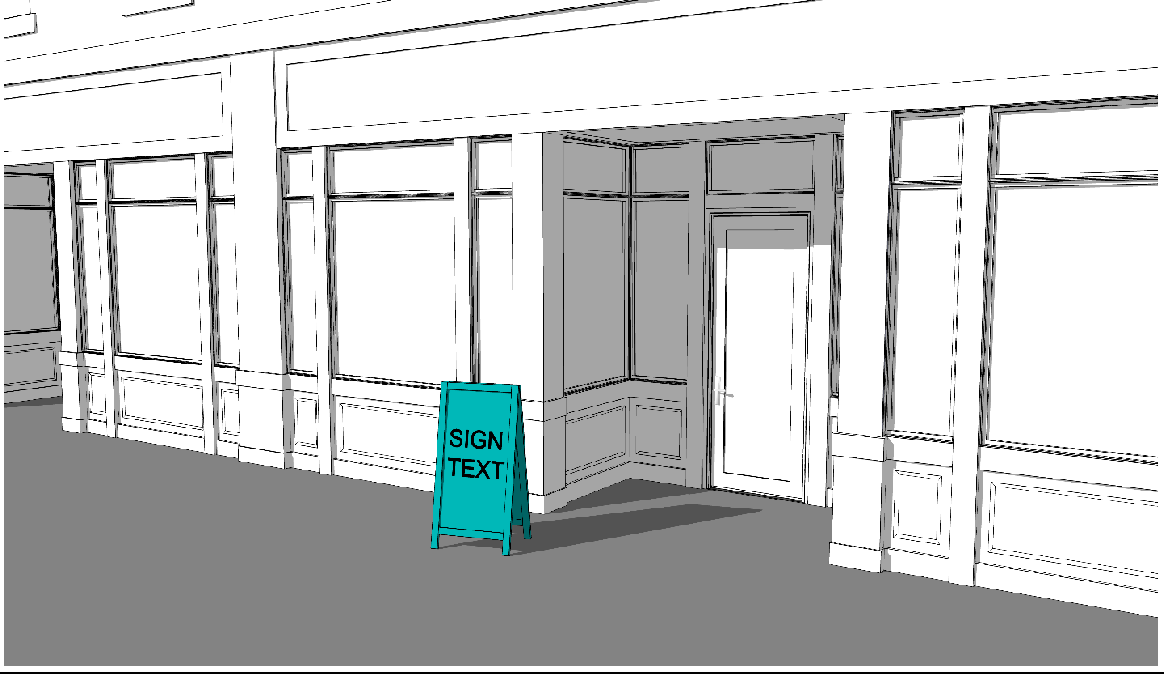
(B)
A-frame sign standards table.
Table 24-8.9-1. A-Frame Sign Standards
(Ord. No. O-5-24, 7-15-24)
Sec. 24-8.10. - Banner (building-mounted) temporary sign standards.
(A)
Banner (building-mounted) signs. Banner (building-mounted) signs (such as figure 24-40, Example Banner (Building-Mounted) Temporary Sign) are a type of temporary sign and are subject to the standards of table 24-8.10-1, Banner (Building-Mounted) Temporary Sign Standards, and the following:
(1)
The planning commission may approve a final site plan, sign package, or design guidelines that allow a temporary banner attached to a building to remain longer than the time period allowed in of table 24-8.10-1, Banner (Building-Mounted) Temporary Sign Standards.
(2)
Banners must not be constructed of cardboard, foam board, poster board, paper, or similar non-durable or non-flexible materials.
Figure 24-40. Example Banner (Building-Mounted) Temporary Sign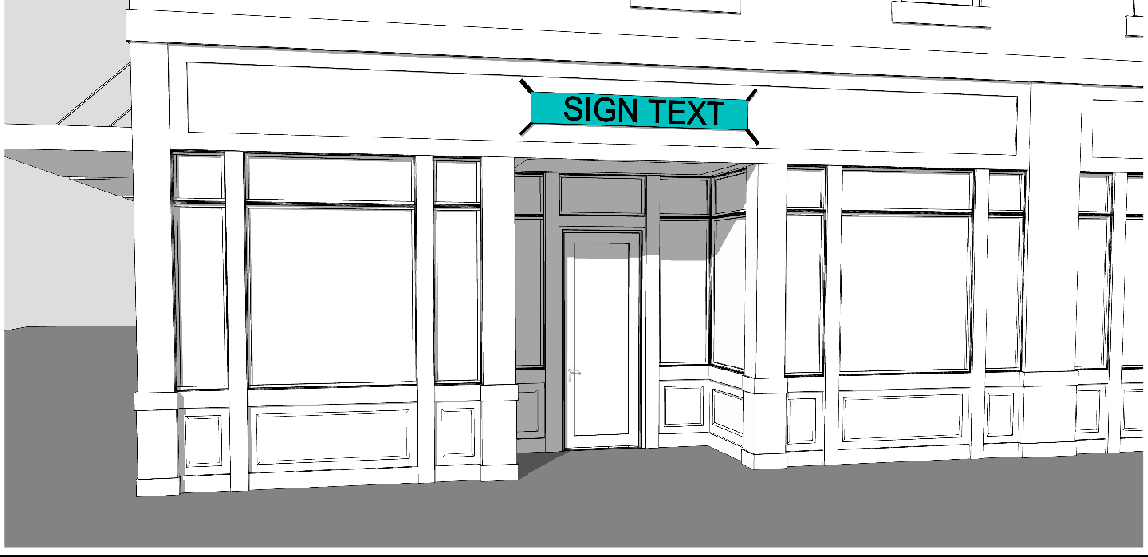
(B)
Banner (building mounted) temporary sign standards table.
Table 24-8.10-1. Banner (Building-Mounted) Temporary Sign Standards
(Ord. No. O-5-24, 7-15-24)
Sec. 24-8.11. - Banner (freestanding) temporary sign standards.
(A)
Banner (freestanding) signs. Banner (freestanding) signs (such as figure 24-41, Example Banner (Freestanding) Temporary Sign) are a type of temporary sign and are subject to the standards of table 24-8.11-1, Banner (Freestanding) Temporary Sign Standards, and the following:
(1)
Banner (freestanding) signs must not impede the flow of pedestrians or vehicles, nor cause any safety problem related thereto.
(2)
Banner (freestanding) signs must be installed in the ground or attached to a sturdy base that resists displacement and overturning due to wind.
(3)
Banner (freestanding) signs must be removed during periods of inclement weather.
(4)
Unless otherwise allowed by this article, or specifically allowed in writing by the city manager or designee, banner (freestanding) signs must not be placed in the public right-of-way.
(5)
The planning commission may approve a final site plan, sign package, or design guidelines that allow a temporary freestanding banner to remain in place for a specified period longer than allowed in table 24-8.11-1, Banner (Freestanding) Temporary Sign Standards.
(6)
Banner (freestanding) signs must not be constructed of cardboard, foam board, poster board, paper, or similar non-durable or non-flexible materials.
Figure 24-41. Example Banner (Freestanding) Temporary Sign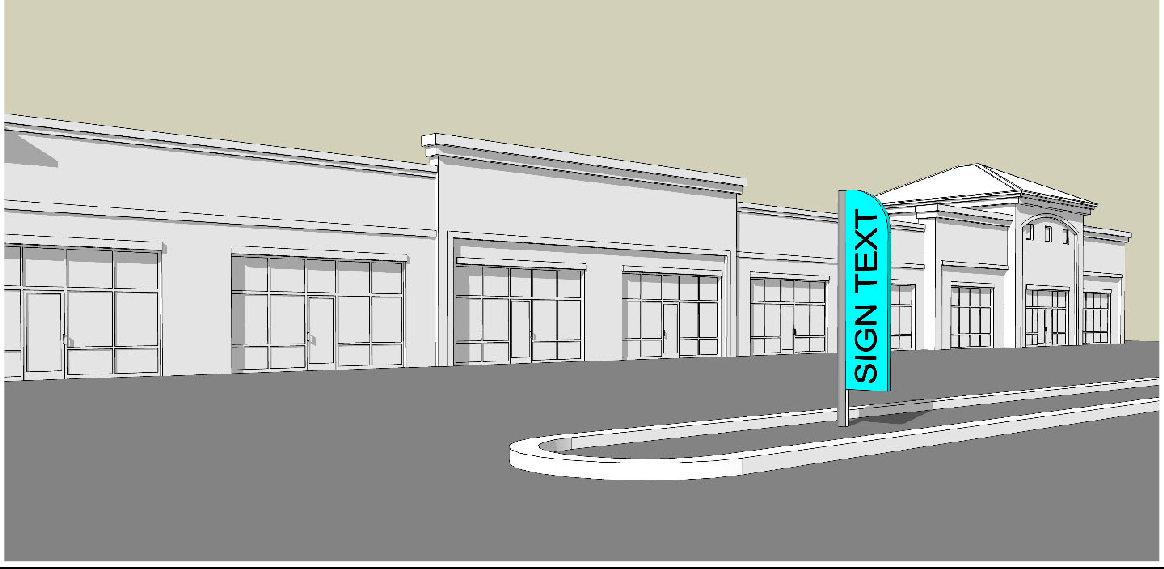
(B)
Banner (freestanding) temporary sign standards table.
Table 24-8.11-1. Banner (Freestanding) Temporary Sign Standards
(Ord. No. O-5-24, 7-15-24)
Sec. 24-8.12. - Blade permanent sign standards.
(A)
Blade signs. Blade signs (such as figure 24-42, Example Blade Permanent Sign) are a type of permanent building sign and are subject to the standards of table 24-8.12-1, Blade Permanent Sign Standards, and the following:
(1)
Blade signs and their supporting structures must not extend above the roofline of the building to which they are attached.
(2)
Blade signs and their supporting structures must not cover any part of a window nor obstruct the light and vision of a window.
(3)
Blade signs and their supporting structures must not impede the flow of pedestrians or vehicles, nor cause any safety problem related thereto.
(4)
Blade signs must not wholly or partially extend into a public right-of-way unless a minor waiver is granted by the planning commission pursuant to section 24-8.7, Waiver of signage standards, and the following:
(a)
The planning commission finds that the sign does not project more than thirty-six (36) inches into the public right-of-way; and
(b)
The planning commission finds that the sign conforms to all other applicable requirements of this section.
Figure 24-42. Example Blade Permanent Sign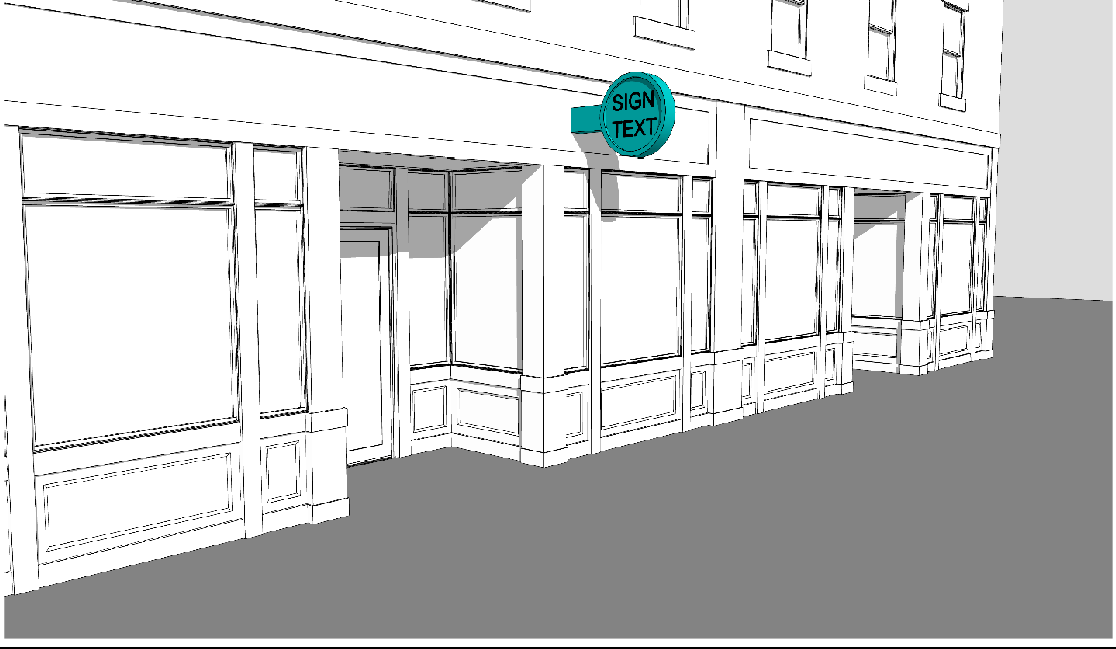
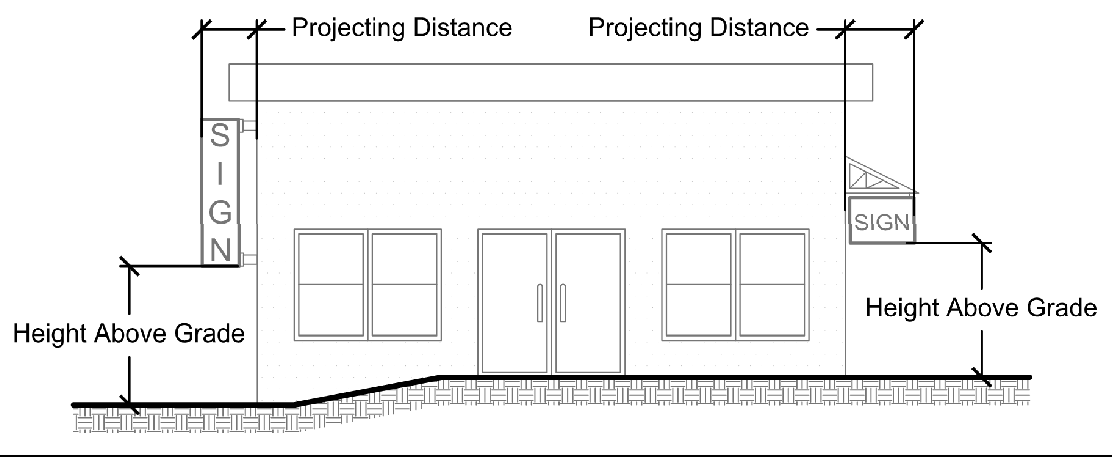
(B)
Blade permanent sign standards table.
Table 24-8.12-1. Blade Permanent Sign Standards
(Ord. No. O-5-24, 7-15-24)
Sec. 24-8.13. - Building permanent sign standards.
(A)
Building signs. Building signs (such as figure 24-43, Example Building Permanent Sign 1, and figure 24-44, Example Building Permanent Signs 2) are a type of permanent sign and are subject to the standards of table 24-8.13-1, Building Permanent Sign Standards, and the following:
(1)
Building signs and their supporting structures must not extend above the roofline or parapet wall of the building to which they are attached.
(2)
Building signs and their supporting structures must not cover any part of a window nor obstruct the light and vision of a window.
(3)
Unless otherwise prohibited in this article, a building sign may be installed on any façade of a building, except that a building sign must not be located on that portion of a commercial or industrial building or structure facing abutting residentially improved property. The planning commission may grant a minor waiver to allow a non-illuminated building sign on a commercial or industrial building or structure that faces abutting residentially improved property pursuant to section 24-8.7, Waiver of signage standards, and the following:
(a)
The planning commission finds that an unlighted sign is compatible with the overall design of the building and the abutting residential area.
(4)
Building signs, where allowed, may be externally illuminated in conformance with the provisions of section 24-8.8(B), and may be located anywhere on a property.
(5)
Building signs, where allowed, may be internally illuminated in conformance with the provisions of section 24-8.8(B).
(6)
Ancillary building signs are allowed in addition to principal building signs on the same façade, subject to the following regulations:
(a)
Ancillary building signs must have a letter height that is shorter than and subordinate to that used on the principal sign for the owner, tenant, or business;
(b)
The sign faces of ancillary building signs must be sized smaller than and subordinate to the size of the principal sign for the owner, tenant, or business; and
(c)
Ancillary building signs must be counted towards calculations of the maximum total signage coverage of the building façade.
(7)
Signs for individual tenants within a shopping center or other multiple-tenant nonresidential building are subject to the following regulations:
(a)
Such building signs must have letters that are proportional to the area or background on which the letters are placed;
(b)
Each tenant in a multiple-tenant building is allowed one principal building sign on each façade that is allowed to have signage, and are allowed ancillary building signs in conformance with subsection (6), above; and
(c)
The amount of building signage allowed for an individual tenant is limited to the façade of the tenant space.
(8)
Single-tenant buildings are allowed only one principal building sign on each façade of the building allowed to have signage, and are allowed ancillary building signs in conformance with subsection (6), above.
(9)
Building signs placed within a sign band must conform to the standards of section 24-8.8(C)(4).
Figure 24-43. Example Building Permanent Sign 1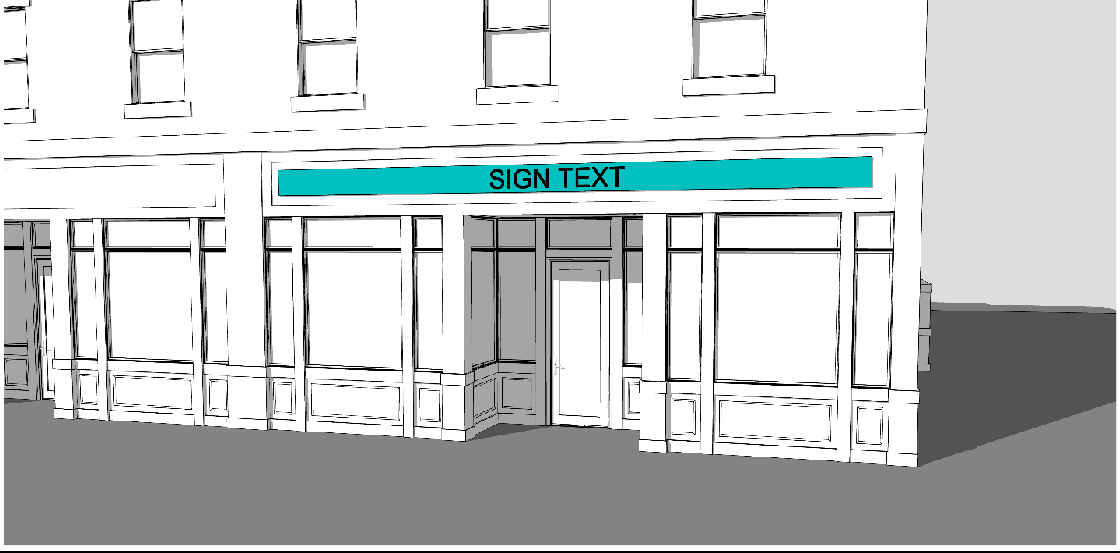
Figure 24-44. Example Building Permanent Signs 2
(B)
Building permanent sign standards table.
Table 24-8.13-1. Building Permanent Sign Standards
(Ord. No. O-5-24, 7-15-24)
Sec. 24-8.14. - Changeable copy permanent sign standards.
(A)
Changeable copy signs. Changeable copy signs (such as figure 24-45, Example changeable copy permanent sign) are a type of permanent sign and are subject to the standards of table 24-8.14-1, Changeable Copy Permanent Sign Standards, and the following:
(1)
Changeable copy signs are only allowed on buildings or properties that contain one or more of the following uses:
(a)
Civic, religious, community, or quasi-public purposes; or
(b)
Theaters; or
(c)
Automobile filling stations; or
(d)
A use that includes vehicle fuel pumps.
(2)
Changeable copy signs that are used as part of a building sign must conform to the standards of table 24-8.13-1, Building Permanent Sign Standards.
(3)
Changeable copy signs that are used as part of a monument sign must conform to the standards of table 24-8.23-1, Monument Permanent Sign Standards.
(4)
Changeable copy signs that are used as part of a geographic area sign must conform to the standards of table 24-8.19-1, Geographic Area Permanent Sign Standards.
Figure 24-45. Example Changeable Copy Permanent Sign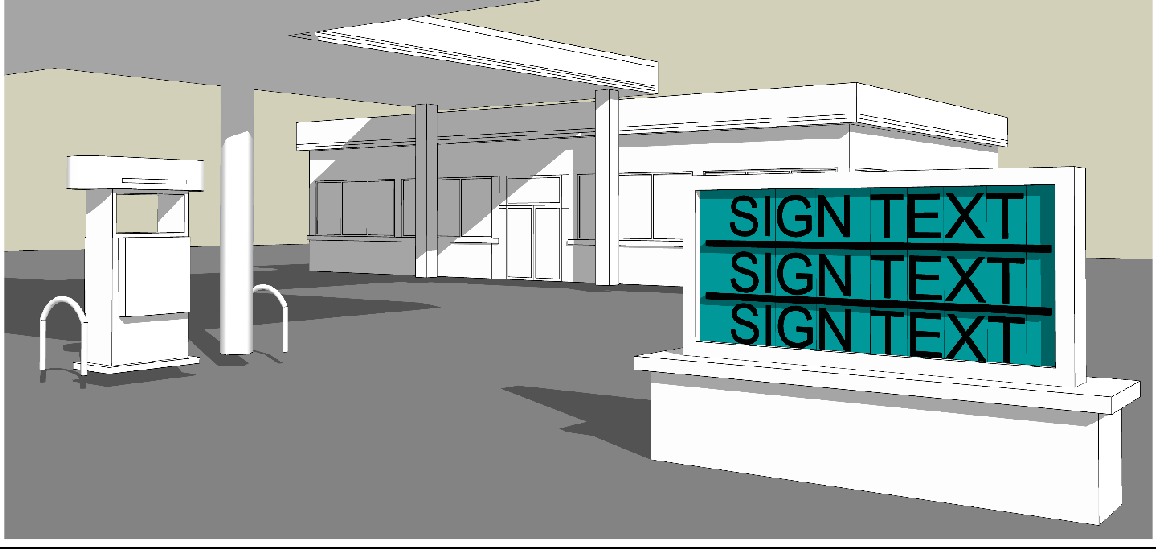
(B)
Changeable copy permanent sign standards table.
Table 24-8.14-1. Changeable Copy Permanent Sign Standards
(Ord. No. O-5-24, 7-15-24)
Sec. 24-8.15. - Decorative pole banner permanent sign standards.
(A)
Decorative pole banner signs. Decorative pole banner signs (such as figure 24-46, Example Decorative Pole Permanent Sign) are a type of permanent sign and are subject to the standards of table 24-8.15-1, Decorative Pole Banner Permanent Sign Standards, and the following:
(1)
Banner signs must not impede the flow of pedestrians or vehicles, nor cause any safety problem related thereto.
(2)
The outermost sign face edge of a decorative pole banner sign must not project more than four (4) feet from the supporting pole or wall.
(3)
Decorative pole banner signs must not be constructed of cardboard, foam board, poster board, paper, or similar non-durable or non-flexible materials.
Figure 24-46. Example Decorative Pole Permanent Sign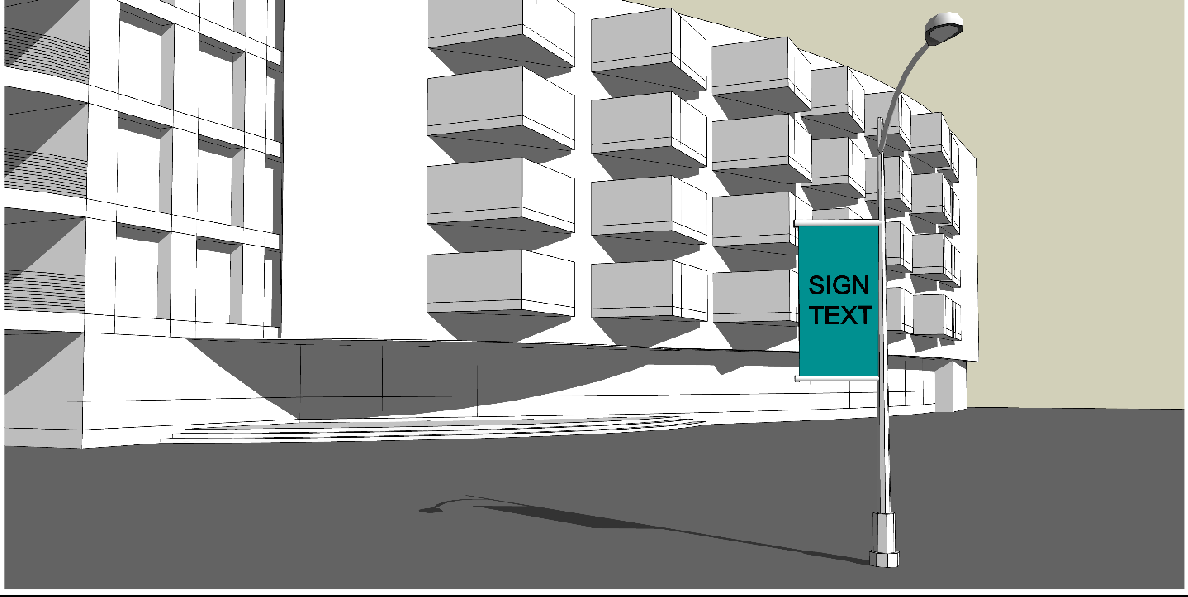
(B)
Decorative pole banner permanent sign standards table.
Table 24-8.15-1. Decorative Pole Banner Permanent Sign Standards
(Ord. No. O-5-24, 7-15-24)
Sec. 24-8.16. - Directional permanent sign standards.
(A)
Directional signs. Directional signs (such as figure 24-47, Example Directional Permanent Sign) are a type of permanent sign and are subject to the standards of table 24-8.16-1, Directional Permanent Sign Standards, and the following:
(1)
Directional signs, as defined herein, are only allowed when shown to be necessary due to confusion, remoteness, topography, visibility, or other factors.
(2)
The planning commission may approve a directional sign shown on a final site development plan that does not conform to subsection (1), above, but may limit the total number of such signs.
(3)
The planning commission may grant a minor waiver to allow a directional sign not shown on a site development plan that does not conform to subsection (1), above, pursuant section 24-8.7, Waiver of signage standards.
(4)
The planning commission may grant a minor waiver pursuant section 24-8.7, Waiver of signage standards, to allow one or more of the following:
(a)
A directional sign with a sign face that exceeds six (6) square feet in size;
(b)
A freestanding directional sign that exceeds six (6) feet in height;
(c)
A directional sign that is illuminated.
(5)
Directional signs must not impede the flow of pedestrians or vehicles, nor cause any safety problem related thereto.
(6)
The sign face of a directional sign must be constructed of one or more of the following durable, water-resistant, non-flexible materials: wood, plywood, particleboard, rigid plastic, corrugated plastic board, concrete, stone, glass, acrylic, or metal.
(7)
A freestanding directional sign may use a maximum of two (2) columns for support and each column must be constructed of a durable, non-flexible material such as wood, plywood, rigid plastic, stone, concrete, or metal.
Figure 24-47. Example Directional Permanent Sign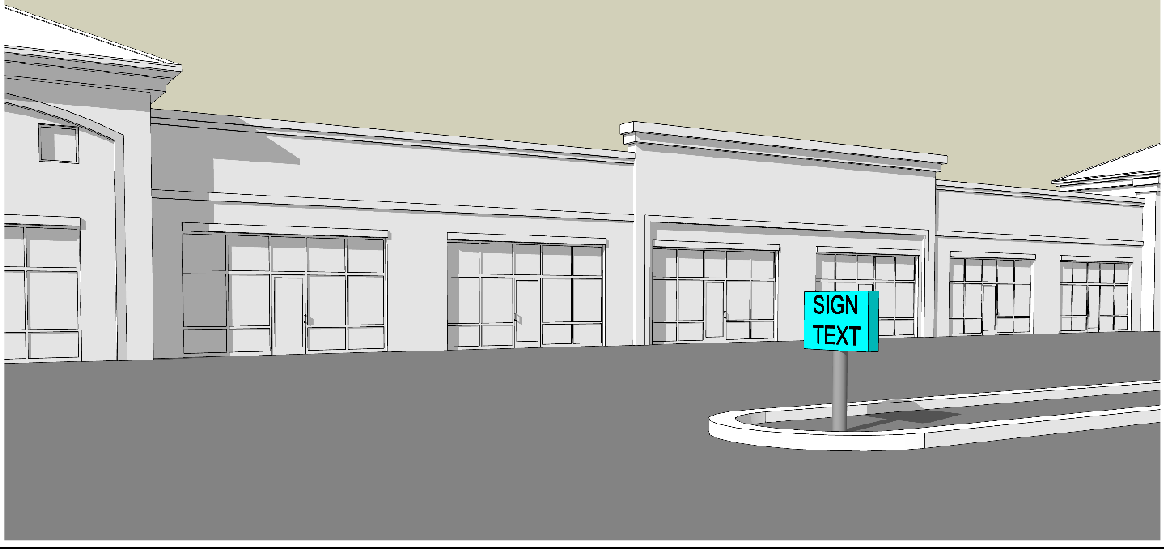
(B)
Directional permanent sign standards table.
Table 24-8.16-1. Directional Permanent Sign Standards
(Ord. No. O-5-24, 7-15-24)
Sec. 24-8.17. - Electronic message display permanent sign standards.
(A)
Electronic message display signs. Electronic message display signs (such as figure 24-48, Example Electronic Message Permanent Display Sign) are a type of permanent sign and are subject to the standards of table 24-8.17-1, Electronic Message Display Permanent Sign Standards, and the following:
(1)
An electronic message display sign may be used as or integrated into a permanent building sign or a permanent monument sign or a permanent geographic area sign but must not be used as nor integrated into any other sign type.
(2)
An electronic message display sign must not be used as part of a temporary sign.
(3)
An electronic message display sign must not have any distracting appearance of motion, flashing, blinking, or shimmering, and must not constitute a safety hazard by distraction of motor vehicle operators. The display must remain static for a minimum of six (6) seconds with instantaneous change of the display; i.e., no "fading" in/out between messages.
(4)
An electronic message display sign must be located so that it is a minimum of three hundred (300) feet from the right-of-way used for any controlled-access highway or interchange ramp.
(5)
Individual letter height must be a minimum of five (5) inches.
(6)
An electronic message display sign must go dark in the event of a malfunction.
(7)
When located within one hundred (100) feet of any single-family use, the electronic message display sign must be oriented so that no portion of the message display face is visible from an existing or permitted residential structure on that lot. Landscape screening or fencing may be used to block the view of the electronic message display from the residential structure.
(8)
An electronic message display sign used as a building sign must conform to the standards of section 24-8.13, Building permanent sign standards.
(9)
An electronic message display sign used as a geographic area sign must conform to the standards of section 24-8.19, Geographic area permanent sign standards.
(10)
An electronic message display sign used as a monument sign must conform to the standards of section 24-8.23, Monument permanent sign standards.
Figure 24-48. Example Electronic Message Permanent Display Sign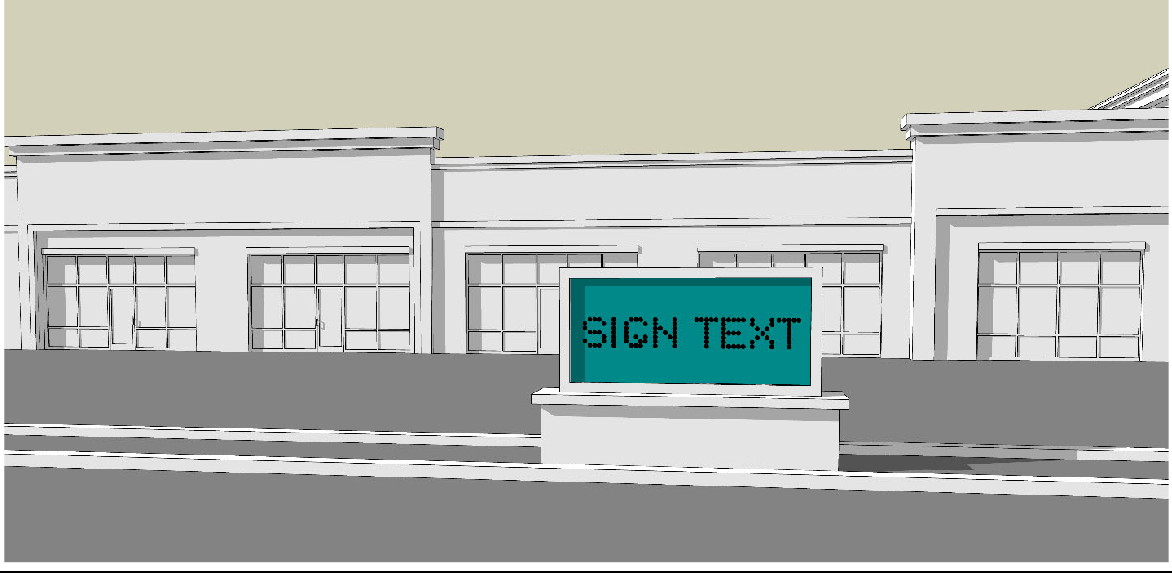
(B)
Electronic message display permanent sign standards table.
Table 24-8.17-1. Electronic Message Display Permanent Sign Standards
(Ord. No. O-5-24, 7-15-24)
Sec. 24-8.18. - Freestanding temporary sign standards.
(A)
Freestanding temporary signs. Freestanding temporary signs (such as figure 24-49, Example Freestanding Temporary Sign) are a type of temporary sign and, other than banner (freestanding) signs, are subject to the standards of table 24-8.18-1, Freestanding Temporary Sign Standards, and the following:
(1)
Freestanding temporary signs must not impede the flow of pedestrians or vehicles, nor cause any safety problem related thereto.
(2)
Freestanding temporary signs must be constructed of one or more of the following durable, water-resistant, non-flexible materials: wood, plywood, particleboard, rigid plastic, corrugated plastic board, or metal.
(3)
Freestanding temporary signs must be installed in the ground or attached to a sturdy base that resists displacement and overturning due to wind.
(4)
Freestanding temporary signs may use a maximum of two (2) columns for support. Each column must be constructed of a durable, non-flexible material such as wood, plywood, rigid plastic, or metal.
(5)
A freestanding temporary sign must be placed at least two (2) feet from any other freestanding sign, incidental sign, and/or monument sign located on the same property.
(6)
Unless otherwise allowed by this article or specifically allowed in writing by the city manager or designee, a freestanding temporary sign must not be placed in the public right-of-way.
(7)
The planning commission may approve a final site plan, sign package, or design guidelines that allow a freestanding temporary sign to remain in place for a specified period longer than ninety (90) days.
Figure 24-49. Example Freestanding Temporary Sign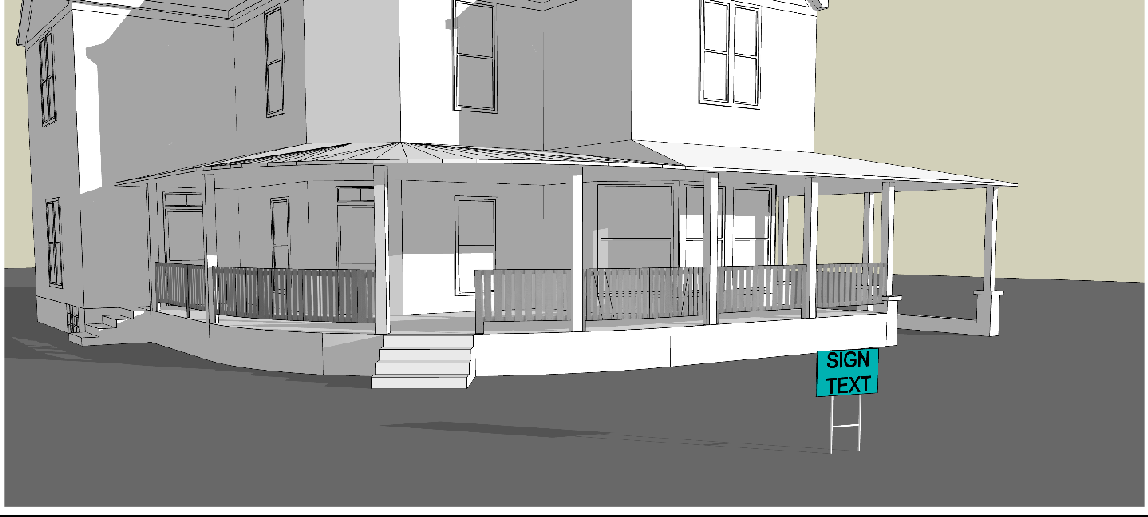
(B)
Freestanding temporary sign standards table.
Table 24-8.18-1. Freestanding Temporary Sign Standards
(Ord. No. O-5-24, 7-15-24)
Sec. 24-8.19. - Geographic area permanent sign standards.
(A)
Geographic area signs. Geographic area signs (such as figure 24-50, Example Geographic Area Permanent Sign) are a type of permanent sign and are subject to the standards of table 24-8.19-1, Geographic Area Permanent Sign Standards, and the following:
(1)
Geographic area signs, as defined herein, may only be one of the following sign types: building sign, monument sign, or wall sign.
(2)
When a geographic area sign is used as or integrated into a building sign, the planning commission must approve a minor waiver to allow such a sign, pursuant to section 24-8.7, Waiver of signage standards, and subject to the provisions of section 24-8.13, Building permanent sign standards.
(3)
A geographic area sign used as a monument sign must conform to the standards of section 24-8.23, Monument permanent sign standards.
(4)
A geographic area sign may only be used in a subdivision that meets one or more of the following criteria:
(a)
Is two (2) acres or larger in size; or
(b)
Contains ten (10) or more buildable lots; or
(c)
Includes two hundred thousand (200,000) square feet or more of nonresidential gross floor area; or
(d)
Has at least one building that is ten (10) stories in height or taller.
(5)
Any such geographic area sign must not impair site distance to safe egress from the property.
(6)
All geographic area signs must be compatible in appearance and design with the surrounding landscape or buildings to which they are affixed.
(7)
If the geographic area sign is located within a subdivision that has a common ownership association, the sign must be placed in one of the following areas:
(a)
Commonly owned property; or
(b)
Property owned by the developer; or
(c)
Some other property identified on an approved final site plan.
(8)
If the geographic area sign is located within a subdivision that does not have a common ownership association, the sign must only be placed in an area that conforms to the following standards:
(a)
It is a property that is located within the overall subdivision; and
(b)
The sign is located at the edge of or entrance to the overall subdivision; and
(c)
The sign is sited within an easement area or is subject to a covenant or similar agreement and said easement or covenant has been approved by the city and property owner and assigns the responsibility for maintenance, liability, enforcement, and similar issues.
(9)
If the geographic area sign is located within a public right-of-way, it must comply with the following standards:
(a)
The sign and any external lighting must be located so that it does not constitute a hazard to the safety of motorists and pedestrians; and
(b)
The sign is located at the edge of or entrance to the overall subdivision; and
(c)
The sign must receive any necessary approvals and permits from the right-of-way owner prior to the city issuing a sign permit; and
(d)
The sign and its location are subject to the discretionary approval of the city manager or designee; and
(e)
The sign is installed pursuant to a revocable sign permit, the issuance of which is conditioned upon removal of the sign at no cost to the city or other right-of-way owner at such time as the city manager or designee may direct.
(10)
The planning commission may grant a minor waiver to allow a changeable copy sign or electronic message display to be used as or integrated into a geographic area sign, pursuant to section 24-8.7, Waiver of signage standards.
Figure 24-50. Example Geographic Area Permanent Sign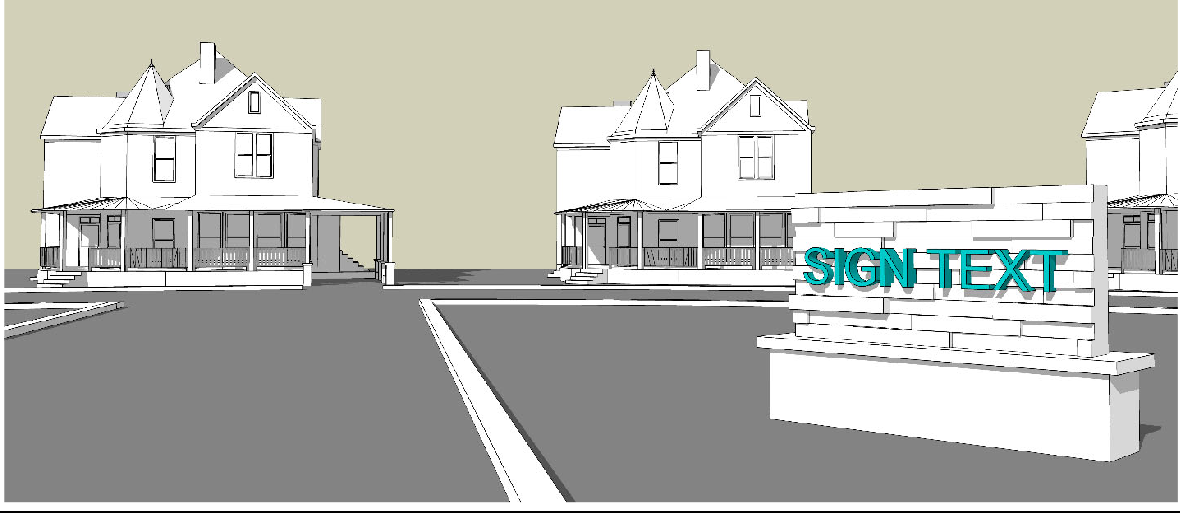
(B)
Geographic area sign standards table.
Table 24-8.19-1. Geographic Area Permanent Sign Standards
(Ord. No. O-5-24, 7-15-24)
Sec. 24-8.20. - Hanging permanent sign standards.
(A)
Hanging signs. Hanging signs (such as figure 24-51, Example Hanging Permanent Sign) are a type of permanent building sign and are subject to the standards of table 24-8.20-1, Hanging Permanent Sign Standards, and the following:
(1)
Hanging signs may only be placed on building façades that are allowed to have signage, or attached to a shelter structure that is attached to the façade allowed to have signage.
(2)
A hanging sign must only be located on a building floor that is accessible at ground level, unless otherwise approved by the planning commission as part of a final site plan, sign package, or design guidelines.
Figure 24-51. Example Hanging Permanent Sign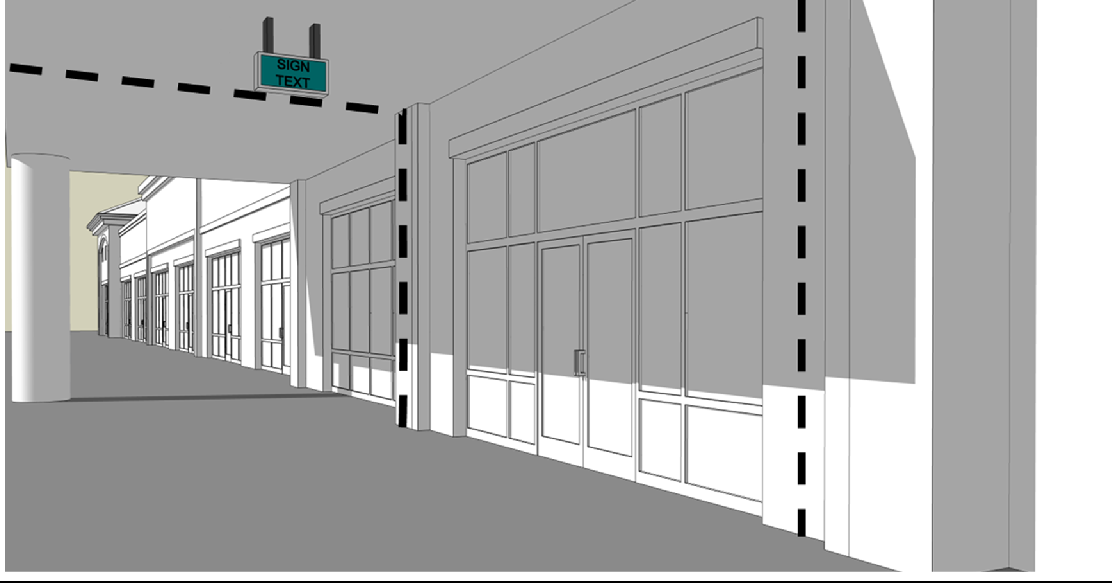
(B)
Hanging permanent sign standards table.
Table 24-8.20-1. Hanging Permanent Sign Standards
(Ord. No. O-5-24, 7-15-24)
Sec. 24-8.21. - Incidental permanent sign standards.
(A)
Incidental signs. Incidental signs (such as figure 24-52, Example Incidental) are a type of permanent sign and are subject to the standards of table 24-8.21-1, Incidental Permanent Sign Standards, and the following:
(1)
The planning commission may grant a minor waiver to allow an incidental sign not shown on a site development plan pursuant to section 24-8.7, Waiver of signage standards, and the following:
(a)
The planning commission finds that the sign avoids issues with topography or visibility that adversely impact previously approved signs.
(2)
The planning commission may grant a minor waiver pursuant to section 24-8.7, Waiver of signage standards, to allow one or more of the following:
(a)
An incidental sign with a sign face that exceeds six (6) square feet in size;
(b)
A freestanding incidental sign that exceeds six (6) feet in height;
(c)
An incidental sign that is illuminated.
(3)
Incidental signs must not impede the flow of pedestrians or vehicles, nor cause any safety problem related thereto.
(4)
The sign face of an incidental sign must be constructed of one or more of the following durable, water-resistant, non-flexible materials: wood, plywood, particleboard, rigid plastic, corrugated plastic board, concrete, stone, glass, acrylic, or metal.
(5)
A freestanding incidental sign may use a maximum of two columns for support and each column must be constructed of a durable, non-flexible material such as wood, plywood, rigid plastic, stone, concrete, or metal.
Figure 24-52. Example Incidental Permanent Sign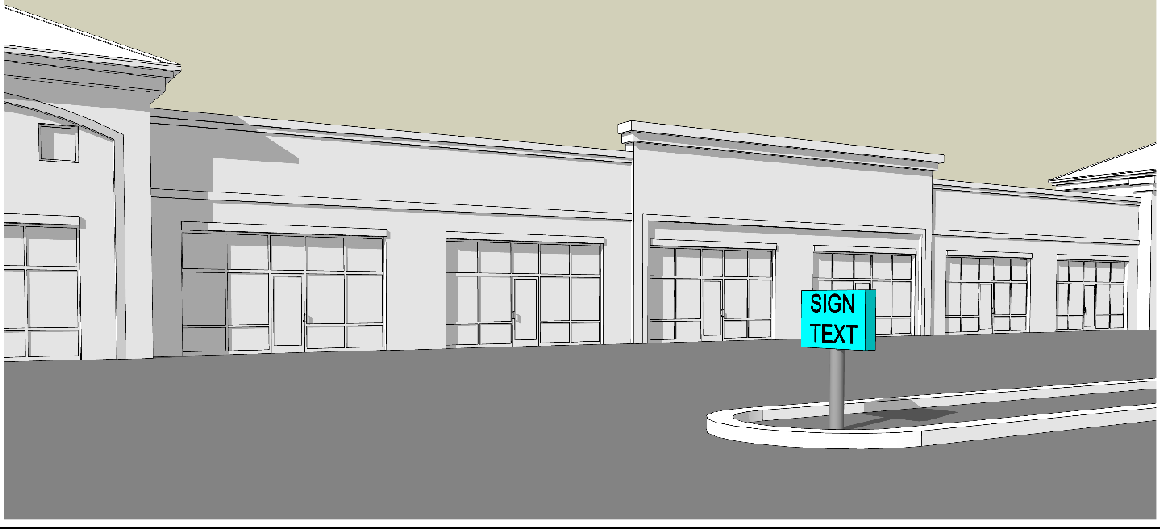
(B)
Incidental permanent sign standards table.
Table 24-8.21-1. Incidental Permanent Sign Standards
(Ord. No. O-5-24, 7-15-24)
Sec. 24-8.22. - Marquee permanent sign standards.
(A)
Marquee signs. Marquee signs (such as figure 24-53, Example Marquee) are a type of permanent building sign and are subject to the standards of table 24-8.22-1, Marquee Permanent Sign Standards and the following:
(1)
Marquee signs shall not project above the top of the vertical faces of the marquee to which they are attached.
(2)
Marquee signs are prohibited from being located on marquees that project over a public right-of-way.
Figure 24-53. Example Marquee Permanent Sign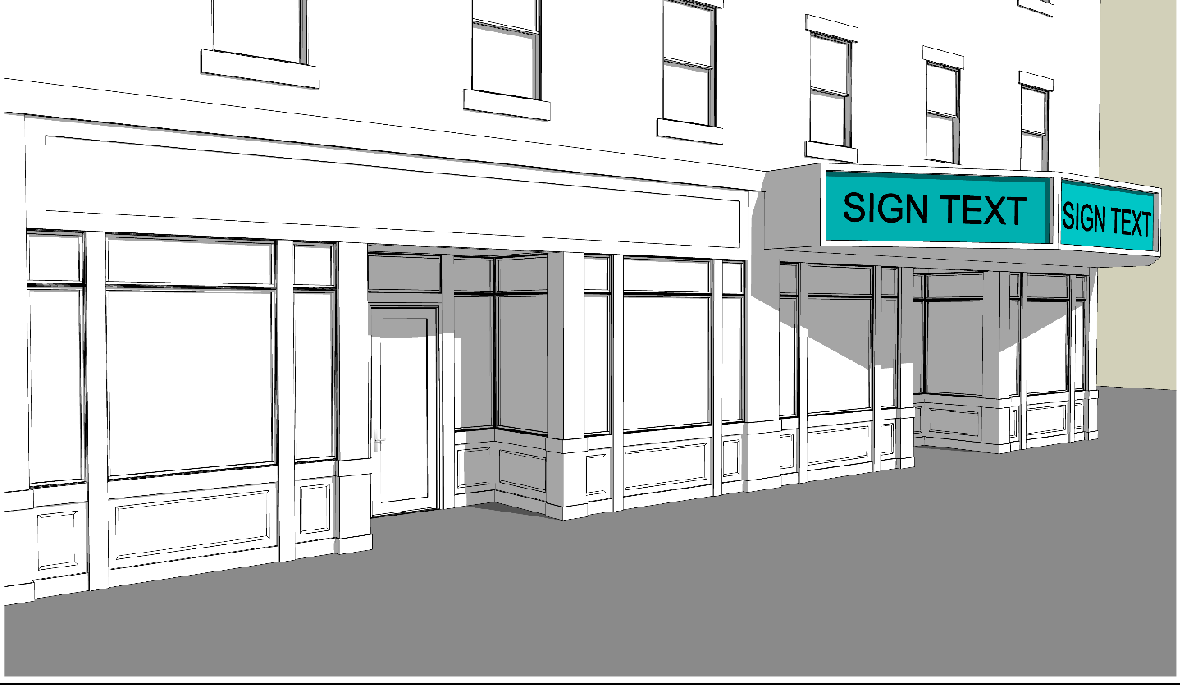
(B)
Marquee permanent sign standards table.
Table 24-8.22-1. Marquee Permanent Sign Standards
(Ord. No. O-5-24, 7-15-24)
Sec. 24-8.23. - Monument permanent sign standards.
(A)
Monument signs. Monument signs (such as figure 24-54, Example Monument) are a type of permanent sign and are subject to the standards of table 24-8.23-1, Monument Permanent Sign Standards, and the following:
(1)
At least one of any allowed monument signs on a property must be placed along a public or private right-of-way adjoining the property. If a public right-of-way does not adjoin the property, then such a monument sign must be placed along the private right-of-way nearest to the public entrance of the principal building.
(2)
The planning commission may grant a major waiver to allow a monument sign that is larger than otherwise permitted in this section, pursuant to section 24-8.7, Waiver of signage standards.
(3)
When multiple monument signs are installed, they must be located and oriented so that either:
(a)
Only one monument sign is visible in any one view shed; or
(b)
The distance between monument signs in the same view shed is at least five hundred (500) feet.
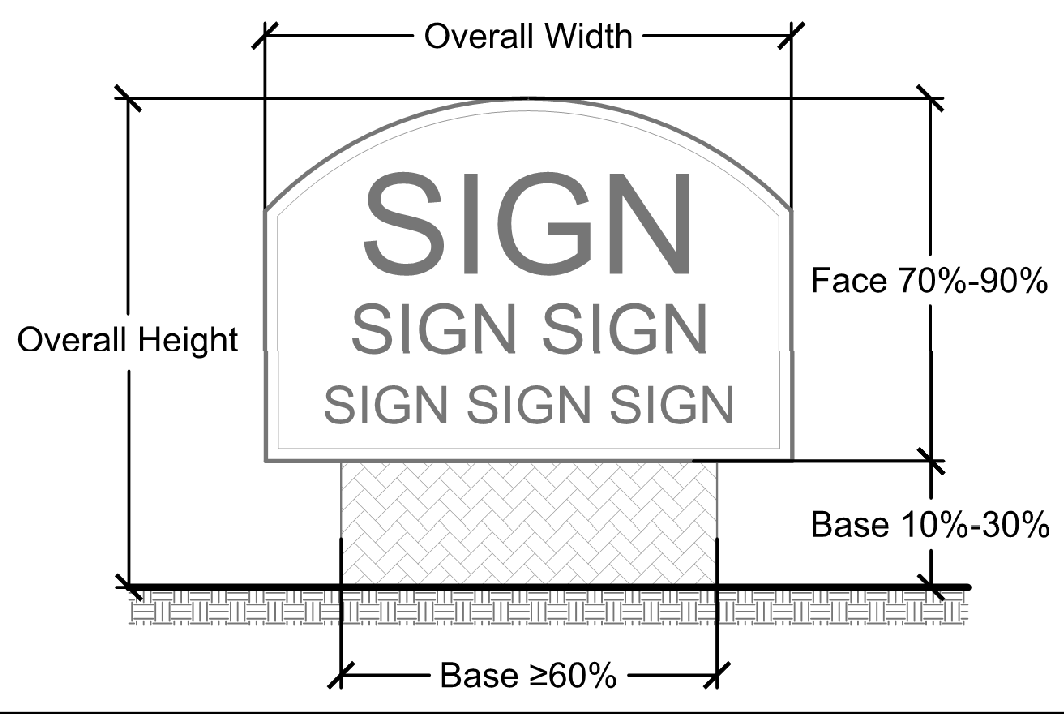
(4)
Unless the planning commission grants a minor waiver pursuant to section 24-8.7, Waiver of signage standards, a monument sign must include a base that:
(a)
Touches the ground along its entire length; and
(b)
Is at least sixty (60) percent as wide as the sign face above; and
(c)
Has a minimum height of ten (10) percent of the overall sign height (including the base portion); and
(d)
Has a maximum height of thirty (30) percent of the overall sign height (including the base portion); and
(e)
Includes landscaping for the base of the monument sign, which must be shown on a landscape plan as part of the associated sign permit.
(5)
Individual letter height on a monument sign must not be less than seven inches tall, unless approved as a minor waiver granted by the planning commission pursuant to section 24-8.7, Waiver of signage standards.
(6)
To improve wayfinding and public safety response, monument signs are encouraged to include the main address or range of addresses for the associated property and, where applicable, the name of the associated subdivision or commercial center.
(7)
Within the same lot, a monument sign must be placed at least ten (10) feet from any other monument sign. For the purposes of this regulation, the distance must be measured from the outermost edge of each sign face or surrounding frame (even if decorative), whichever results in the shortest measured distance between the signs.
(8)
The planning commission may grant a minor waiver to allow additional monument signs above the limit otherwise allowed for properties that have frontage on more than one public street pursuant to section 24-8.7, Waiver of signage standards.
Figure 24-54. Example Monument Permanent Sign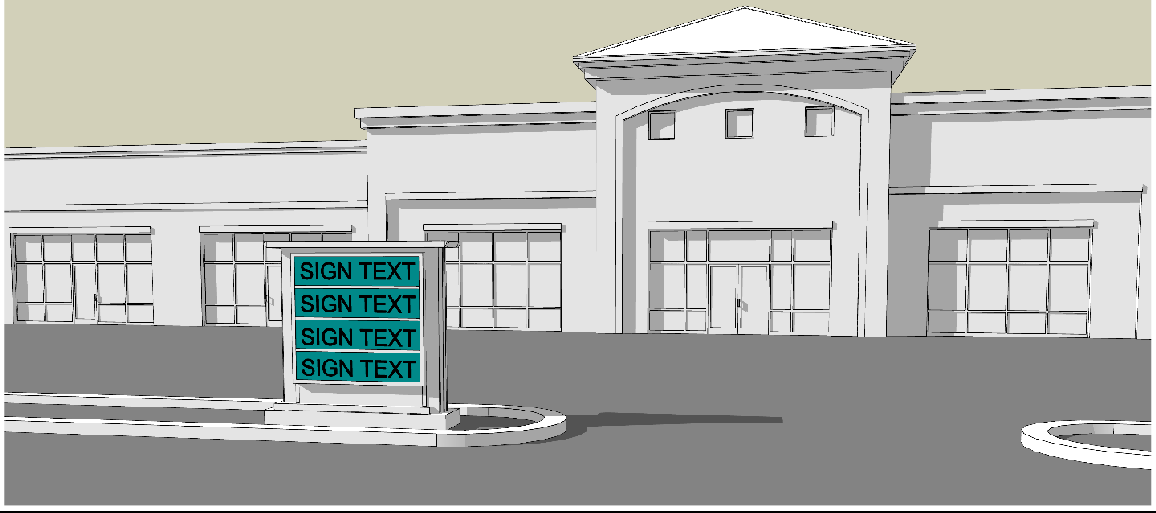
(B)
Monument permanent sign standards table.
Table 24-8.23-1. Monument Permanent Sign Standards
(Ord. No. O-5-24, 7-15-24)
Sec. 24-8.24. - Off-premises permanent sign standards.
(A)
Off-premises signs. Off-premises signs (such as figure 24-55, Example Off-Premises Permanent Sign) are a type of permanent sign and are subject to the standards of table 24-8.24-1, Off-Premises Permanent Sign Standards, and the following:
(1)
Off-premises signs must be single-faced.
Figure 24-55. Example Off-Premises Permanent Sign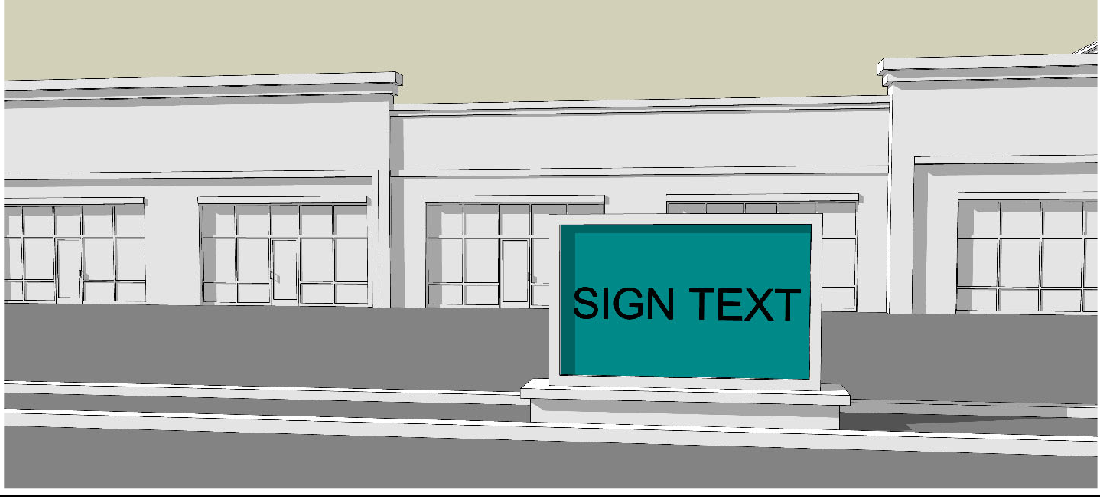
(B)
Off-premises permanent sign standards table.
Table 24-8.24-1. Off-Premises Permanent Sign Standards
(Ord. No. O-5-24, 7-15-24)
Sec. 24-8.25. - Projected image permanent sign standards.
(A)
Projected image permanent signs. Projected image permanent signs (such as figure 24-56, Example Projected Image) are a type of permanent sign and are subject to the standards of table 24-8.25-1, Projected Image Permanent Sign Standards, and the following:
(1)
The area of the projected image sign must be calculated by measuring the size of the projected image. The size of the device producing the image is not used.
(2)
The brightness of the projected image must be keyed to ambient light levels so that at no time the image exceeds a brightness level of three-tenths (0.3) foot candles above ambient light, as measured using a foot candle (lux) meter.
(3)
The projected image sign must remain static and must not change.
Figure 24-56. Example Projected Image Permanent Sign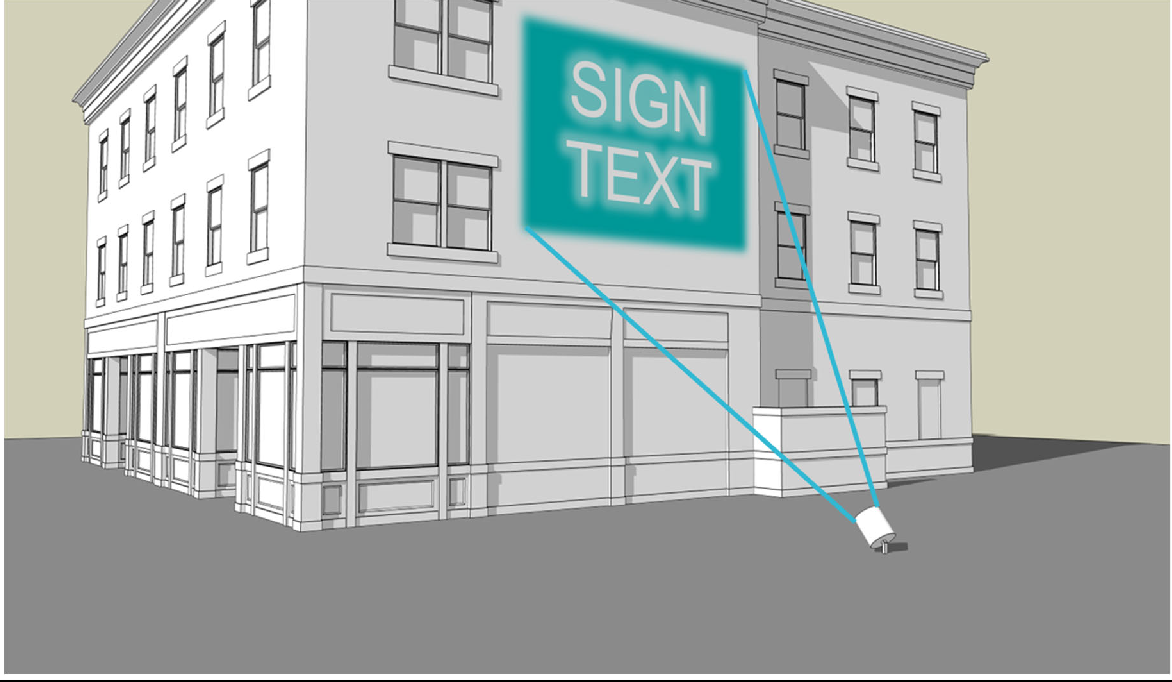
(B)
Projected image permanent sign standards table.
Table 24-8.25-1. Projected Image Permanent Sign Standards
(Ord. No. O-5-24, 7-15-24)
Sec. 24-8.26. - Projected image temporary sign standards.
(A)
Projected image temporary signs. Projected image temporary signs (such as figure 24-57, Example Projected Image) are a type of temporary sign and are subject to the standards of table 24-8.26-1, Projected Image Temporary Sign Standards, and the following:
(1)
The area of the projected image sign must be calculated by measuring the size of the projected image. The size of the device producing the image is not used.
(2)
The brightness of the projected image must be keyed to ambient light levels so that at no time the image exceeds a brightness level of three-tenths (0.3) foot candles above ambient light, as measured using a foot candle (lux) meter.
(3)
The projected image sign must remain static and must not change.
Figure 24-57. Example Projected Image Temporary Sign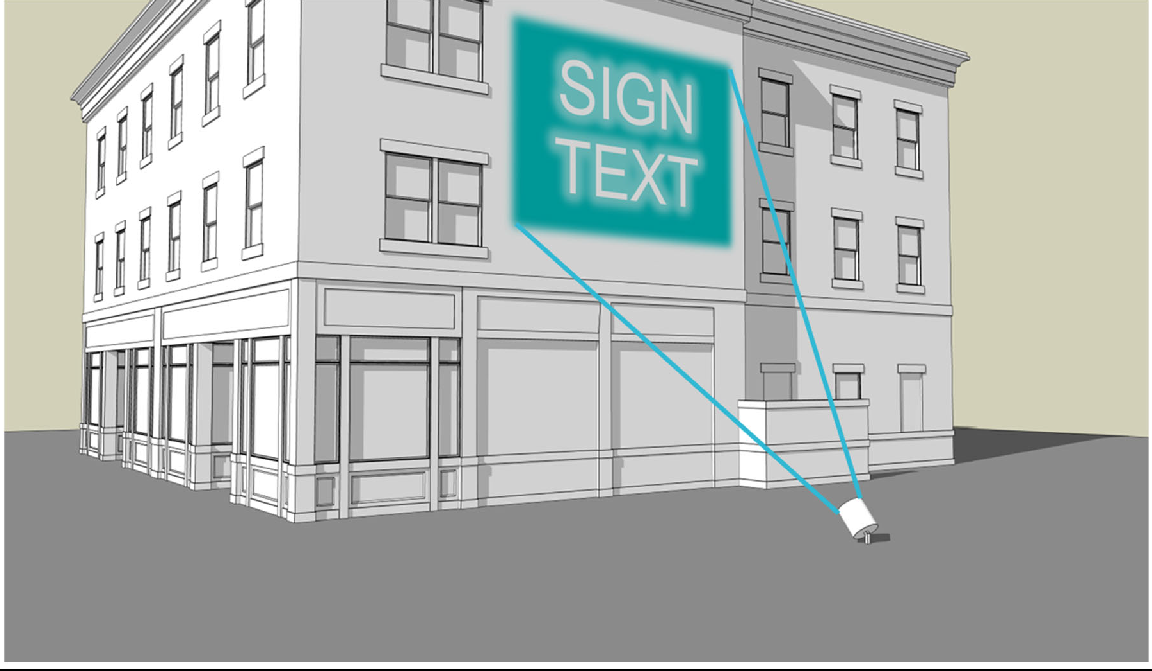
(B)
Projected image temporary sign standards table.
Table 24-8.26-1. Projected Image Temporary Sign Standards
(Ord. No. O-5-24, 7-15-24)
Sec. 24-8.27. - Shelter permanent sign standards.
(A)
Shelter signs. Shelter signs (such as figure 24-58, Example Shelter Permanent Sign) are a type of permanent building sign and are subject to the standards of table 24-8.13-1, Building Permanent Sign Standards, and the following:
(1)
Copy within shelter signs must not exceed eighteen (18) inches in letter height.
(2)
Shelter signs must be included in the total allowable building façade signage.
(3)
Lighting fixtures mounted under canopies are prohibited, except where required for public safety.
(4)
Hanging signs that are attached to shelter signs must conform to the standards of section 24-8.20, Hanging permanent sign standards.
Figure 24-58. Example Shelter Permanent Sign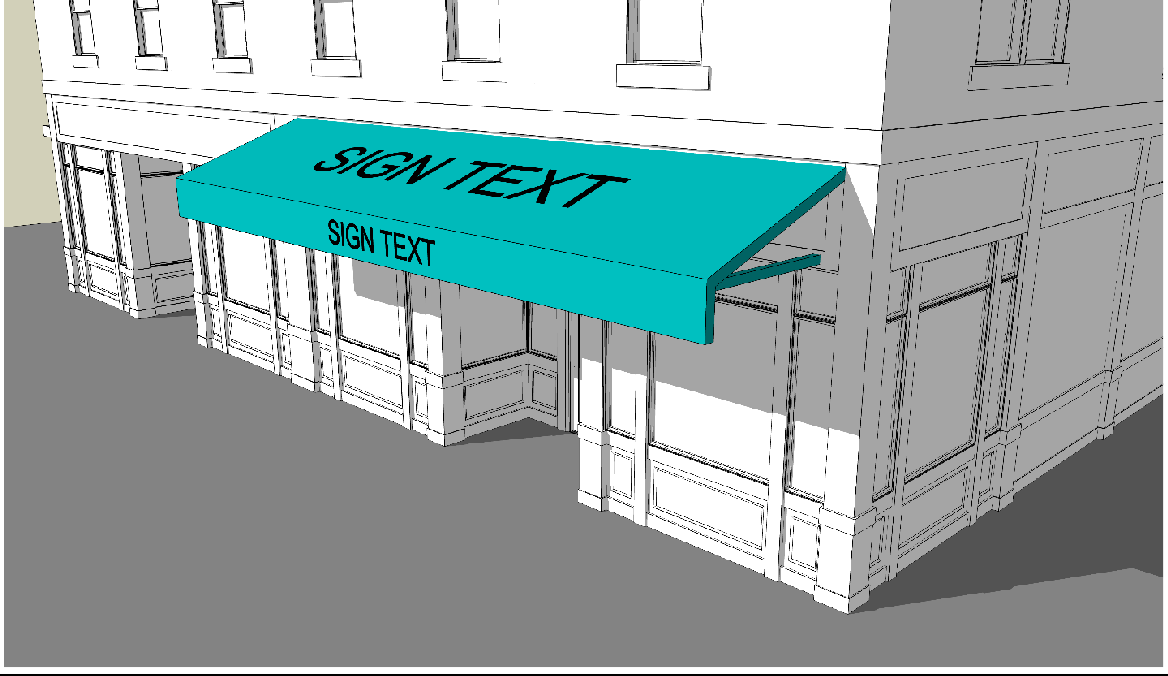
(Ord. No. O-5-24, 7-15-24)
Sec. 24-8.28. - Wall permanent sign standards.
(A)
Wall signs. Wall signs (such as figure 24-59, Example Wall) are a type of permanent sign and are subject to the standards of table 24-8.28-1, Wall Permanent Sign Standards, and the following:
(1)
A wall sign may only be placed on a wall that is at least twenty (20) feet in length.
Figure 24-59. Example Wall Permanent Sign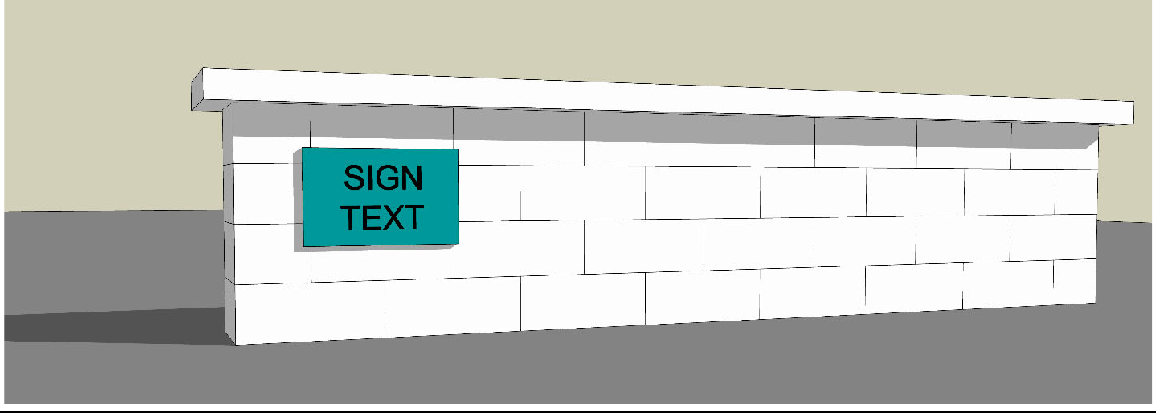
(B)
Wall permanent sign standards table.
Table 24-8.28-1. Wall Permanent Sign Standards
(Ord. No. O-5-24, 7-15-24)
Sec. 24-8.29. - Window permanent sign standards.
(A)
Window permanent signs. Window permanent signs (such as figure 24-60, Example Window Permanent Sign) are a type of permanent sign and are subject to the following standards:
(1)
Permanent window signs must not cover more than twenty-five (25) percent of the total window surface.
(2)
Permanent window signs must not be placed within four (4) inches of a window frame.
(3)
Permanent window signs that are attached to a window must only be attached to the interior side of the window and must not be attached to the exterior side of the window.
(4)
Permanent window signs may be placed only in windows that are part of a façade that is allowed to have signage.
Figure 24-60. Example Window Permanent Sign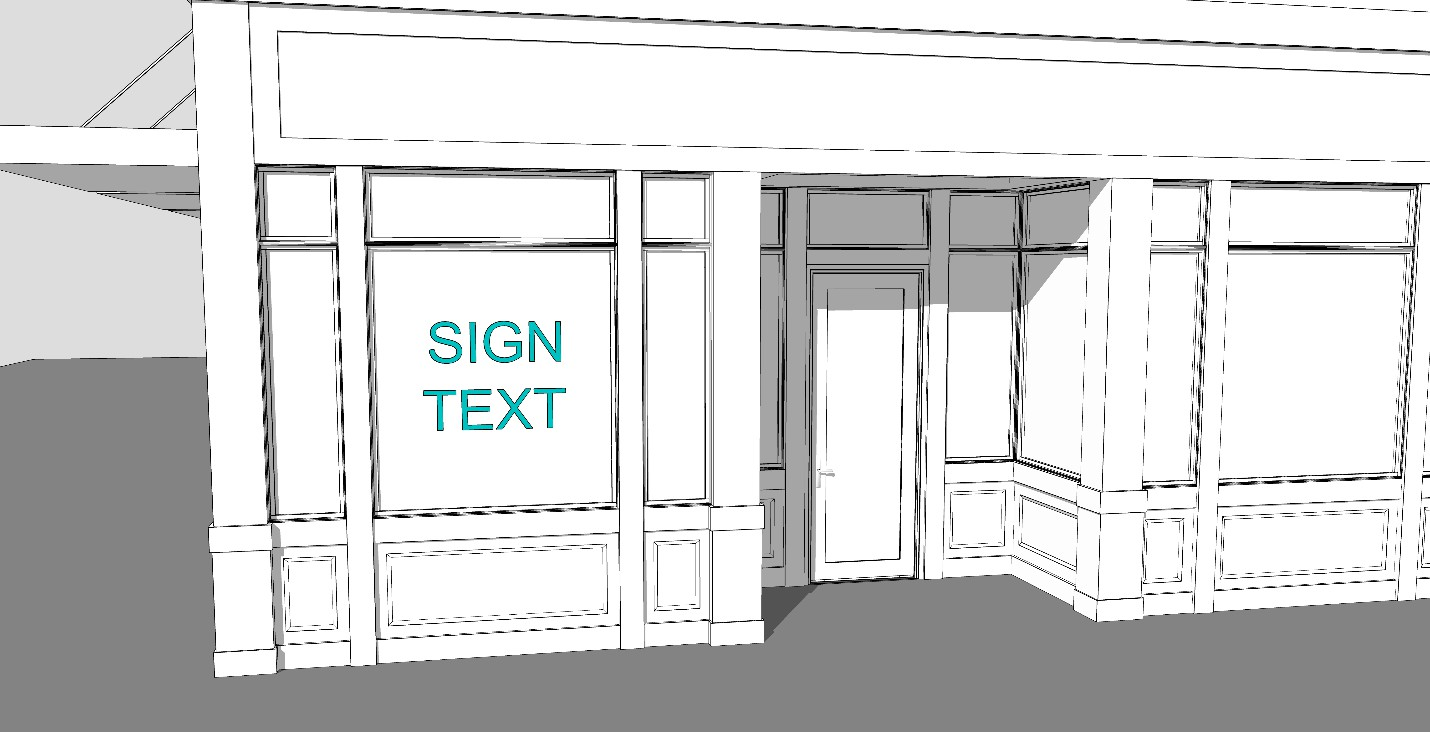
(Ord. No. O-5-24, 7-15-24)
Sec. 24-8.30. - Window temporary sign standards.
(A)
Window temporary signs. Window temporary signs (such as figure 24-61, Example Window Temporary Sign) are a type of temporary sign and are subject to the following standards:
(1)
Temporary window signs must not cover more than twenty-five (25) percent of the total window survey unless section 24-8.30(A)(2), below applies.
(2)
Temporary window signs on vacant non-residential tenant spaces may occupy up to ninety-five (95) percent of the total window surface for no longer than nine (9) months in any calendar year.
(3)
Temporary window signs must not be placed within four (4) inches of a window frame.
(4)
Temporary window signs may be attached to the interior or exterior sides of the window but must be removed when no longer in use.
(5)
Temporary window signs may be placed only in windows that are part of a façade that is allowed to have signage.
(6)
Temporary window signs must not be displayed for more than three (3) months in any calendar year, unless otherwise provided for in this article.
Figure 24-61. Example Window Temporary Sign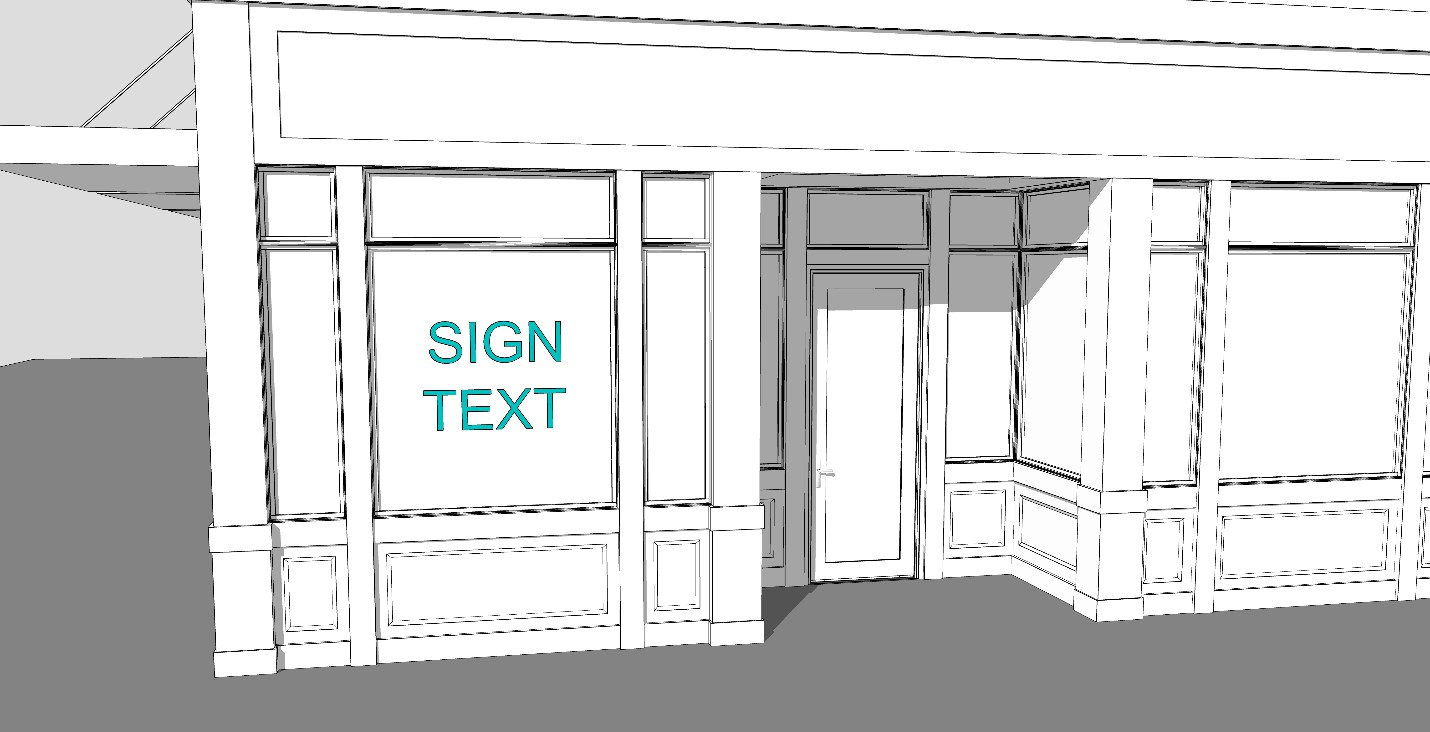
(Ord. No. O-5-24, 7-15-24)

