
Geneva City Zoning Code
CHAPTER 12
SIGNS
SECTION:
11-12-1: - PURPOSE:
The purpose of this title is as follows:
A.
To provide uniform and content-neutral sign standards and regulations in an effort to ensure public safety and to promote a positive city image reflecting order, harmony and pride, and thereby strengthening the economic stability of Geneva's business, cultural, historical, and residential areas. The sign regulations shall control the design, illumination, location, maintenance, and construction of all signs while at the same time respecting the first amendment rights of all citizens, merchants, and property owners.
B.
To encourage signs which are of high quality design, pleasing in appearance, and compatible with the architectural style and scale of the buildings in the city.
C.
To enhance the overall property values and the visual environment of the city by discouraging signs that compete for attention, create visual clutter or create excessive temporary signage.
D.
To protect pedestrians and motorists from any damage or injury that might result from the improper construction, placement, or use of signs.
(Ord. No. 2011-47, § 1(Exh. A), 10-17-2011)
11-12-2: - PERMITS FOR SIGNS:
A.
Permits Required: It shall be unlawful for any person to erect, repair, alter, relocate or maintain within the city any sign, as defined in section 11-2-2 of this title, without first obtaining a permit from the building commissioner.
B.
Application For Permits On Non-Historic Properties: Permit applications for signs shall be made upon forms provided by the building commissioner and shall contain or have attached thereto the following information:
1.
Name, address, telephone number and email address of the applicant.
2.
Name and address of the owner of the property of the premises on which the sign is to be erected if different from the applicant.
3.
Name and address of the person, firm, corporation or association erecting the sign.
4.
Two (2) hard copy drawings and one (1) electronic copy drawing of the plans specifying the location of the building, structure or lot where the proposed sign(s) is located, dimensions, area, overall height, method of illumination (if any) and lighting fixture detail, and method of support/attachment.
5.
At the discretion of the building commissioner, copy of stress sheets and calculations showing that the structure is designed for dead load and wind pressure in any direction in the amount required by this and all other ordinances of the city.
6.
Such other information as the building commissioner shall require to show full compliance with this and all other codes and ordinances of the city.
C.
Application For Permits On Historic Properties—Signs On Landmark Properties And properties Within Historic Districts: As set forth in subsection 3-3-4 D. of the City Code, any permit application for a permanent sign located on a landmark property or property within a historic district shall be reviewed by the city historic preservation commission. The procedure for review shall consist of the following:
1.
The applicant shall complete and submit a permit application, as set forth in subsection B. of this section, and an application for historic preservation commission review.
2.
The building commissioner shall review the permit application for compliance with the sign regulations set forth in this chapter and forward the application to the historic preservation commission for its review and action.
3.
The historic preservation commission shall review the application for compliance with (1) the sign regulations, (2) the commission's adopted design guidelines, and (3) the following standards established by the U.S. Secretary of the Interior:
a.
A property shall be used for its historic purpose or be placed in a new use that requires minimal change to the defining characteristics of the building and its site and environment.
b.
The historic character of a property shall be retained and preserved. The removal of historic materials or alteration of features and spaces that characterize a property shall be avoided.
c.
Each property shall be recognized as a physical record of its time, place, and use. Changes that create a false sense of historical development, such as adding conjectural features or architectural elements from other buildings, shall not be undertaken.
d.
Most properties change over time; those changes that have acquired historic significance in their own right shall be retained and preserved.
e.
Distinctive features, finishes, and construction techniques or examples of craftsmanship that characterize a property shall be preserved.
f.
Deteriorated historic features shall be repaired rather than replaced. Where the severity of deterioration requires replacement of a distinctive feature, the new feature shall match the old in design, color, texture, and other visual qualities and, where possible, materials. Replacement of missing features shall be substantiated by documentary, physical, or pictorial evidence.
g.
Chemical or physical treatments, such as sandblasting, that cause damage to historic materials shall not be used. The surface cleaning of structures, if appropriate, shall be undertaken using the gentlest means possible.
h.
Significant archeological resources affected by a project shall be protected and preserved. If such resources must be disturbed, mitigation measures shall be undertaken.
i.
New additions, exterior alterations, or related new construction shall not destroy historic materials that characterize the property. The new work shall be differentiated from the old and shall be compatible with the massing, size, scale, and architectural features to protect the historic integrity of the property and its environment.
j.
New additions and adjacent or related new construction shall be undertaken in such a manner that if removed in the future, the essential form and integrity of the historic property and its environment would be unimpaired.
4.
In conducting its review, the commission shall also consider the following criteria:
a.
Design: The material, size, color, scale and design of signs and awnings should be compatible with the architecture of the building. Signs should be subordinate and sympathetic to the overall design of the building(s) on the property.
b.
Multiple-Tenant/User Buildings: Where buildings have multiple storefronts and multiple tenants, signs and awnings should be coordinated with one another in terms of size, placement, lettering, color and design.
c.
Mounting: Mounting of signs and awnings should occur without damaging building materials or obscuring architectural features.
d.
Historic Signs: Existing historic signs that contribute to the overall character of the building or district should be preserved.
e.
Lighting: Signs and awnings may be illuminated from external lighting sources, such as gooseneck lighting for wall signs or spot lighting for freestanding signs.
5.
The commission shall make a finding of fact and take action on the application (approval, approval with conditions, or denial), and shall forward its findings and action to the building commissioner.
6.
If the application is in full compliance with the regulations set forth in this chapter, and all other applicable codes, and the historic preservation commission has approved the application, the building commissioner shall issue a permit.
7.
If the historic preservation commission has denied the application, the building commissioner shall not issue a permit. The applicant may revise the permit application and resubmit for further review or appeal the decision to the city council, as set forth in section 10-6-6 of the City Code.
D.
Permit Fees: Prior to issuance of a permit for a sign, the applicant shall pay to the building commissioner a nonrefundable fee established from time to time by the city council.
E.
Relief From Requirements: Applications for relief from the regulations set forth in this chapter shall be made in accordance with section 11-14-5A of this title.
F.
Issuance Of Permit: A permit for any sign subject to the review of the planning and zoning commission, historic preservation commission, or city council shall not be issued until approval from the reviewing body is forwarded to the building commissioner. A permit shall be issued by the building commissioner if the proposed sign conforms to the provisions of this chapter and the required permit fee has been paid.
G.
Permit Expiration: If the work authorized under a permit has not been completed within one hundred eighty (180) days after the date of issuance, the permit shall become null and void.
H.
Failure To Secure A Permit: Any sign erected, repaired, altered, or relocated without having first been issued a permit shall be subject to the penalty provisions set forth in section 11-12-13 of this chapter and will be required to complete a permit application as set forth in this section. The permit fee shall be doubled for a sign that is installed without a permit. The permit application shall be reviewed by the building commissioner, planning and zoning commission, historic preservation commission, and/or the city council, as required by the City Code. Any sign that does not comply with the provisions of this chapter shall be brought into compliance with the provisions of this chapter.
(Ord. No. 2011-47, § 1(Exh. A), 10-17-2011; Ord. No. 2019-17, §§ 57, 58, 8-5-2019)
11-12-3: - GENERAL REGULATIONS:
A.
Illumination: The illumination of signs is permitted, subject to the following requirements:
1.
No sign shall have blinking, flashing, or fluttering lights or other illuminating devices which have a changing light intensity, brightness, or color. Beacon lights and illumination by flame are prohibited.
2.
Lights shall not revolve, rotate, or mechanically move in any manner.
3.
No red, yellow, green or other colored light shall be used at any location in such a manner as to confuse or interfere with vehicular traffic.
4.
The light from any illuminated sign shall be shaded, shielded or directed so as to avoid the creation or continuation of any nuisance or traffic hazard.
5.
Any spotlight or floodlight that is not mounted to a building shall be securely anchored to the ground and protected in a manner which prevents the fixture from becoming dislodged.
6.
Any spotlight or floodlight mounted on a building and used to illuminate a sign shall not project more than twenty-four (24) inches from the face of the building.
7.
A minimum of seven feet six inches (7'6") shall be maintained from the ground to the bottom of any lighting fixture that projects over a walkway.
8.
Signs located on properties with a transitional setback shall not be illuminated in any manner between the hours of midnight (12:00 a.m.) and 8:00 a.m.
9.
Internally illuminated signs are prohibited in the historic district, on landmark properties, and in all residential zoning districts. Exception: Electronic message board signs are permitted for nonresidential uses in residential zoning districts, but are not permitted within the H1 Historic District.
B.
Intersection Visibility: Signs located within a visibility triangle, as defined in section 11-2-2 of this title, shall not exceed three (3) feet in height.
C.
Landscaping: All freestanding signs shall minimize the impact on surrounding properties and rights-of-way by providing landscaping around the base of the sign, a minimum horizontal distance of two (2) feet from any portion of the base of the sign. Landscaping shall include shrubbery or annual flowering plant material or other plant material, subject to the approval of the director of community development.
D.
Structural And Maintenance Requirements: All signs shall comply with the following structural and maintenance requirements:
1.
Every sign shall be designed and constructed in conformity with the applicable provisions of the city's building code.
2.
The electrical component of any illuminated sign shall conform to the applicable requirements of the city's electrical code.
3.
Every sign shall be maintained in a neat and attractive condition by its owner. The sign supports shall be kept painted/treated to prevent rust or deterioration.
4.
If the building commissioner deems a sign unsafe or unlawful, the owner of the property upon which the sign is located will be given notice to remove the unlawful sign or repair or remove the unsafe sign within ten (10) days notice of the violation. If remediation is not taken within said ten-day notice, the city shall cause the removal or repair and charge the owner for any costs incurred in abating the violation or safety hazard.
(Ord. No. 2011-47, § 1(Exh. A), 10-17-2011; Ord. No. 2013-01, § 1, 1-22-2013)
11-12-4: - PERMITTED SIGNS IN ZONING DISTRICTS:
A.
Residential Districts: Permitted signs in the RR, RE, R1 through R7, D-SFMR, D-SFHR, D-MHR, D-MFR, and R-PS Districts shall include: (1) all exempt signs listed in section 11-12-8, (2) signs approved as part of a planned unit development, (3) wall signs, (4) awning signs, (5) canopy signs, (6) freestanding signs, and (7) temporary signs. Additionally, electronic message board signs are permitted for nonresidential uses, but are not permitted within the H1 Historic District.
B.
Business, Office And Industrial Districts: Permitted signs in the D-CM, D-IM, D-RSCM, GO, B1 through B6, OR, and Districts shall include (1) all exempt signs listed in section 11-12-8, (2) wall signs, (3) awning signs, (4) canopy signs, (5) freestanding signs, (6) temporary signs, and (7) signs approved as part of planned unit developments. Additionally, projecting signs are permitted in the D-CM District; downtown directional signs and A-frame (sandwich board) signs are permitted in the D-CM and D-RSCM Districts; and electronic message board signs are permitted in the B1, D-CM (time and temperature signs only), B4, B5 and OR Districts.
(Ord. No. 2011-47, § 1(Exh. A), 10-17-2011; Ord. No. 2013-01, § 2, 1-22-2013; Ord. No. 2019-17, § 59, 8-5-2019)
11-12-5: - SIGN AREA CALCULATION:
A.
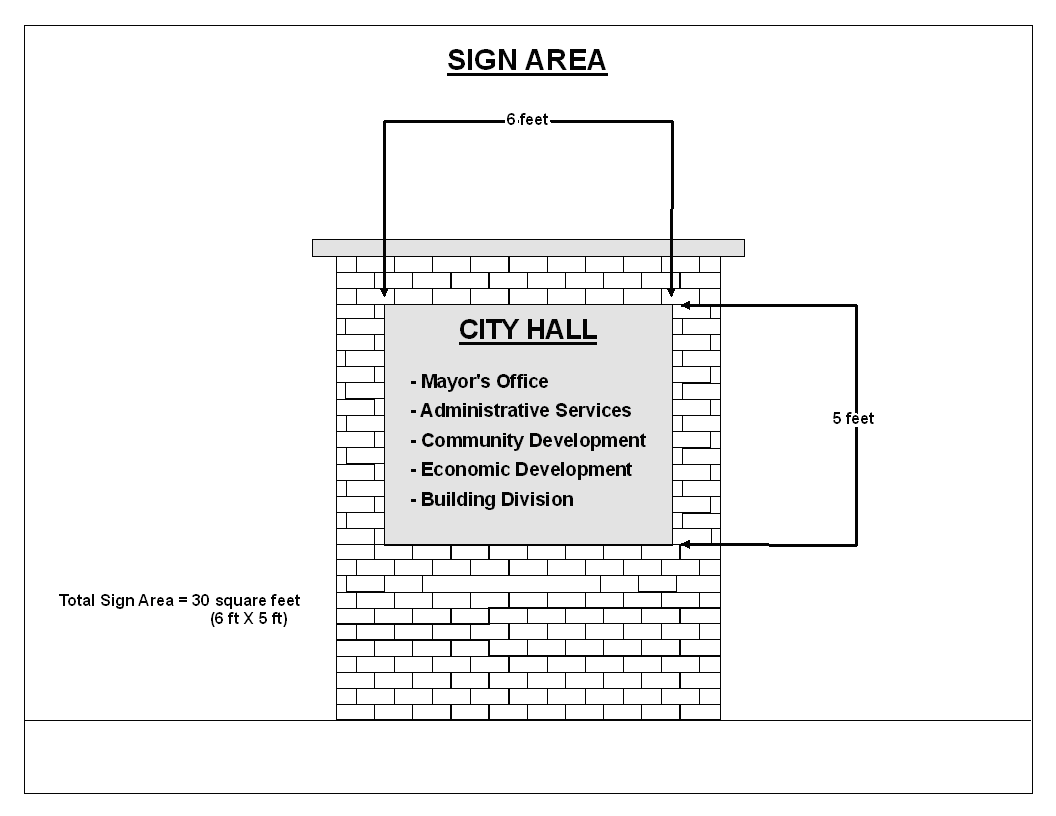
If the area of a sign is enclosed by a frame, cabinet, panel, box or outline, the total area so enclosed shall be deemed the sign area.
B.
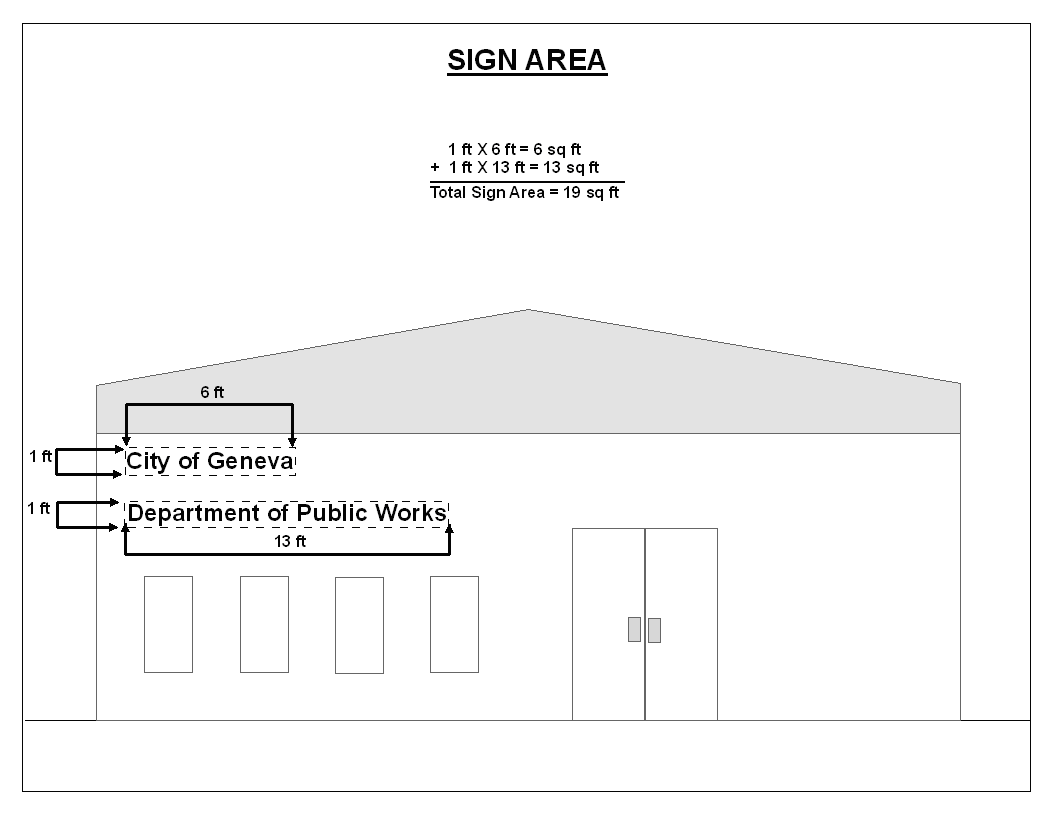
If the area of a sign is comprised of individual letters or other elements attached directly to a building wall or freestanding wall, the area of no more than two (2) imaginary squares or rectangles that can be drawn to completely encompass all of the letters and/or elements shall be deemed the sign area.
C.
In calculating sign area, only one (1) side of any double-faced sign shall be counted.
D.
In calculating sign area, the following shall not be counted:
1.
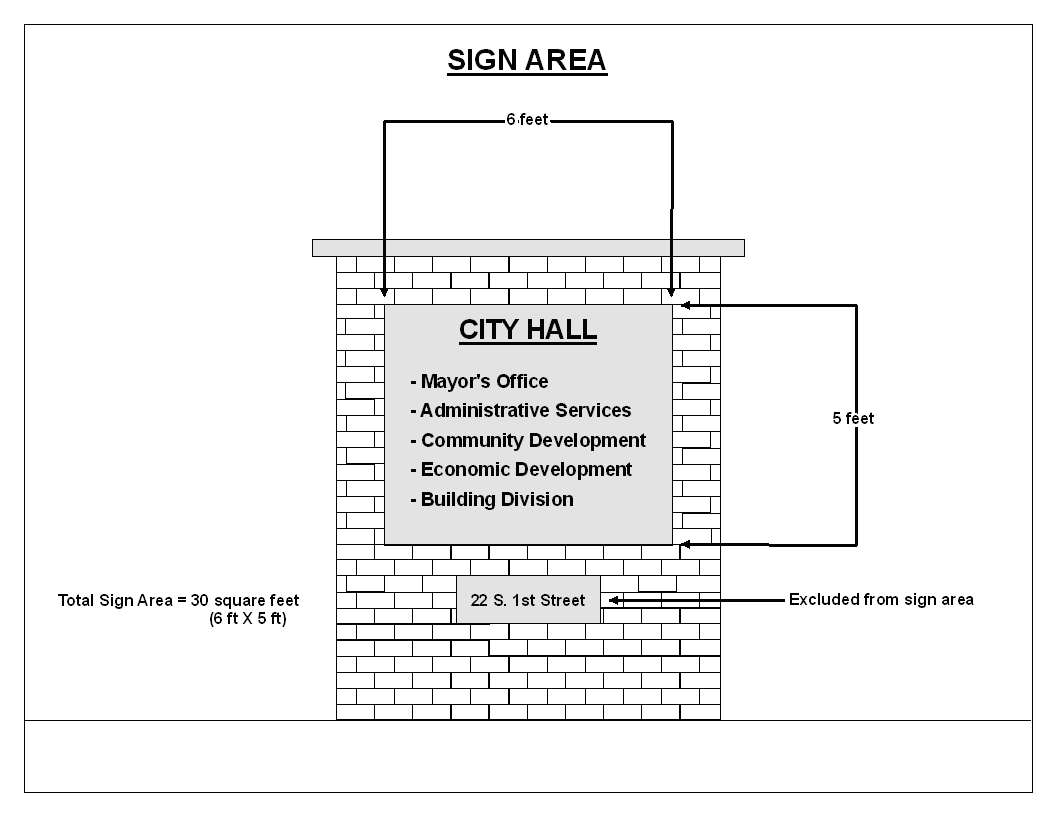
For freestanding signs, the area displaying the property's address or range of addresses shall not be counted.
2.
The area of any sign base or support structure, unless it is used to display signage.
(Ord. No. 2011-47, § 1(Exh. A), 10-17-2011)
11-12-6: - REGULATIONS BY SIGN TYPE:
A.
Freestanding Signs:
1.
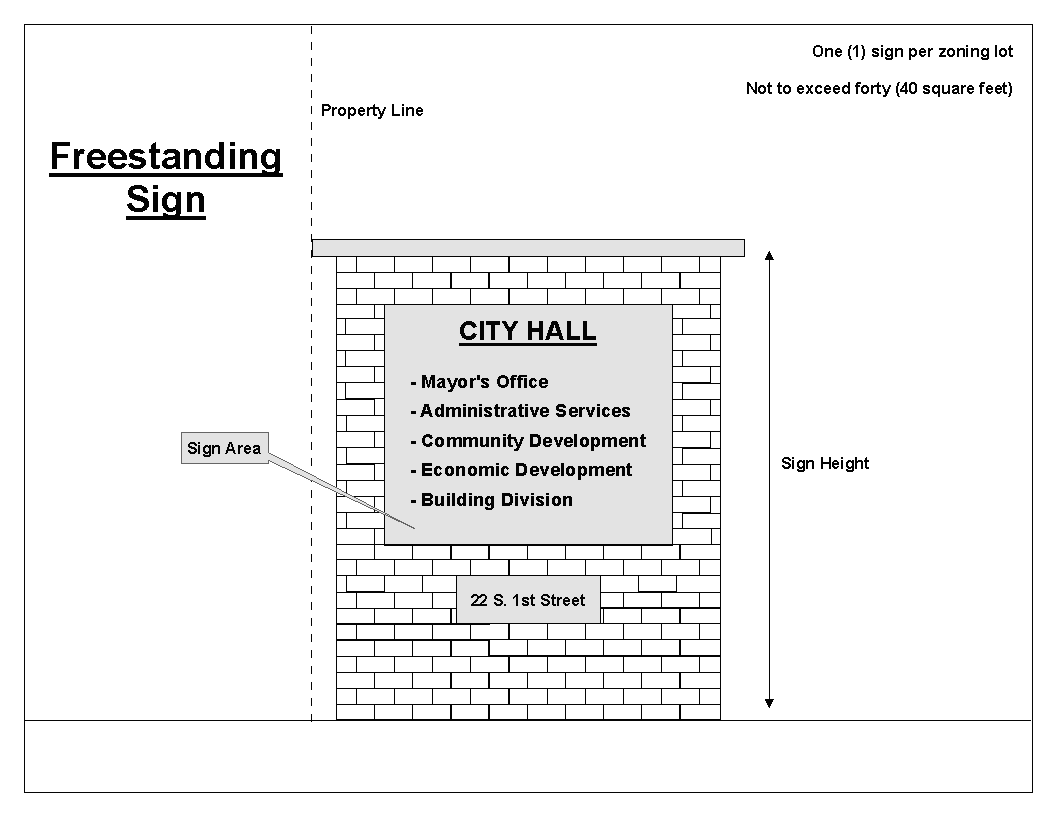
Not more than one (1) freestanding sign shall be displayed on a zoning lot.
2.
A freestanding sign may be used to identify multiple businesses or activities within a building or shopping center.
3.
Shall not intrude into any public right-of-way.
4.
Shall not exceed forty (40) square feet in area.
5.
Shall not exceed sixteen (16) feet in height, except in the D-RSCM and B3(E) Business Districts and on any property with a transitional setback, where freestanding signs shall not exceed ten (10) feet in height.
6.
All new signs permitted shall display the address numbers or range of address numbers for the property upon which they are located. Said numbers shall be Arabic numbers which shall be a minimum of five (5) inches in height and of proportionate width, of contrasting color to the mounting surface, and be affixed in such a place as to be easily and distinctly read in plain view from the street, alley or public way.
B.
Wall Signs, Awning Signs, And Canopy Signs:
1.
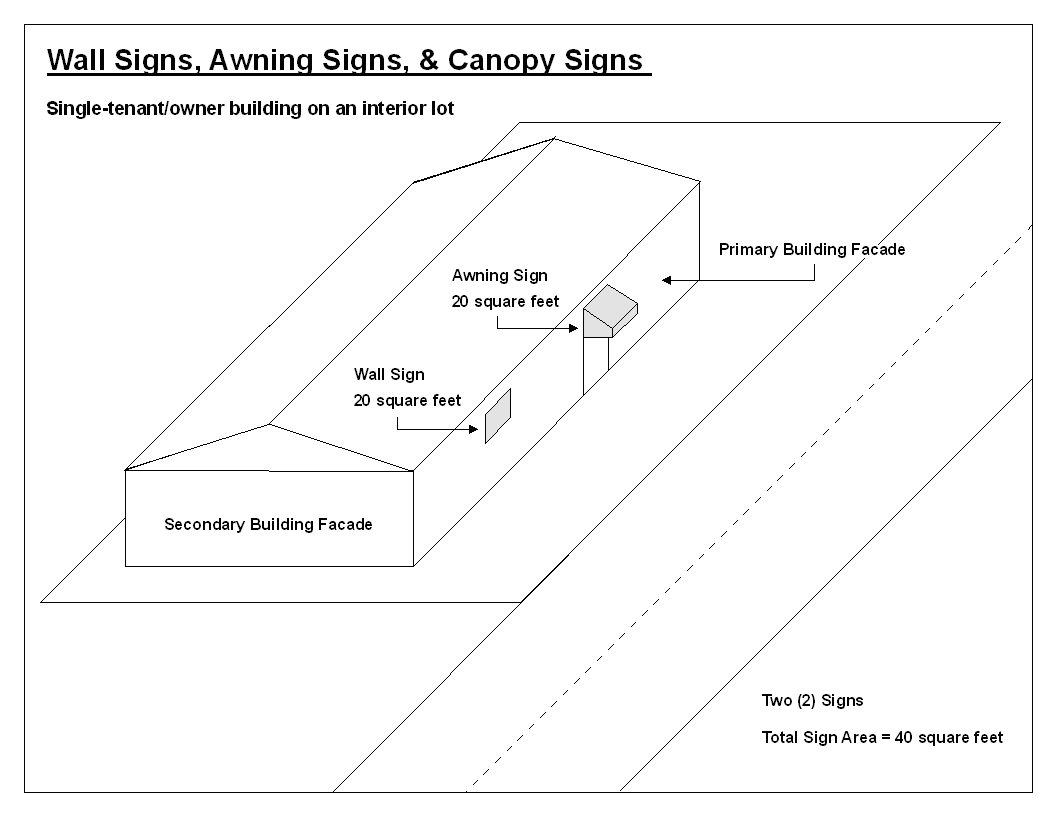
In a single-tenant/owner building located on an interior lot, an establishment shall be permitted to have two (2) signs, which may be any combination of wall signs, awning signs, or canopy signs, and shall comply with the following:
a.
Shall only be permitted on an establishment's primary building facade.
b.
Shall not exceed a combined area of greater than forty (40) square feet.
2.
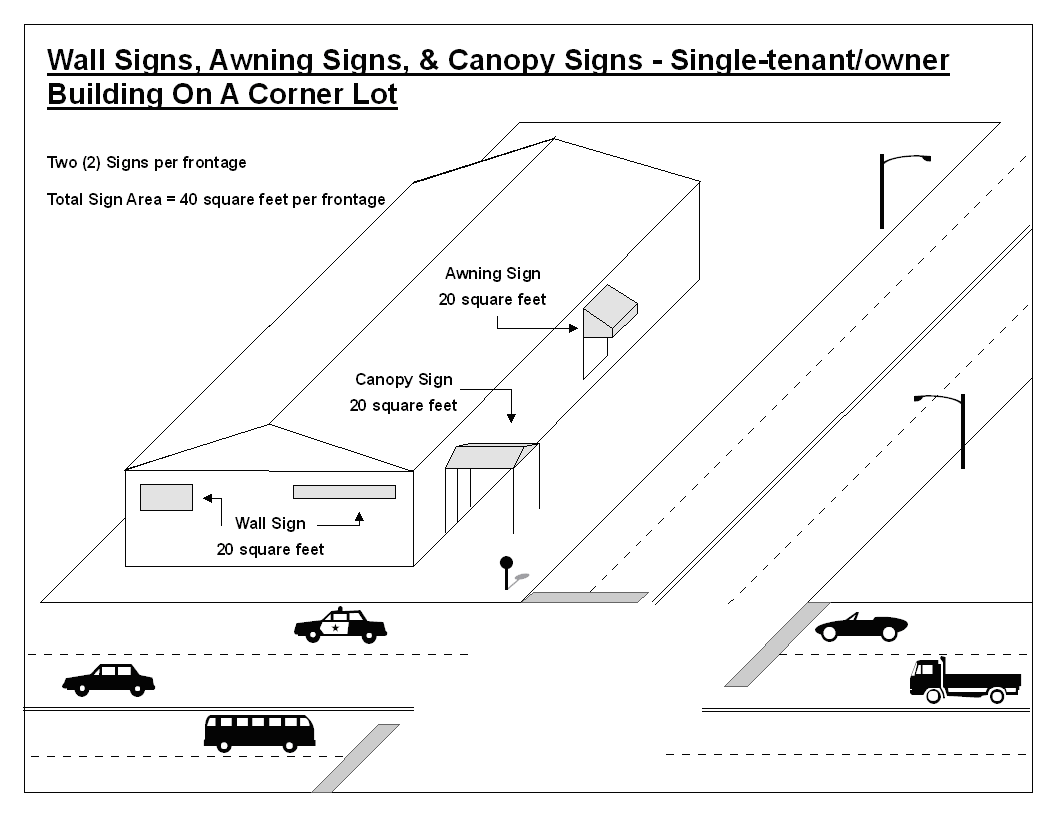
In a single-tenant/owner building located on a corner lot, an establishment shall be permitted to have two (2) signs per facade with frontage, which may be any combination of wall signs, or canopy signs, and shall comply with the following:
a.
No more than two (2) signs shall be permitted on any one (1) facade.
b.
Shall not exceed a combined area of greater than forty (40) square feet on any one (1) facade.
3.
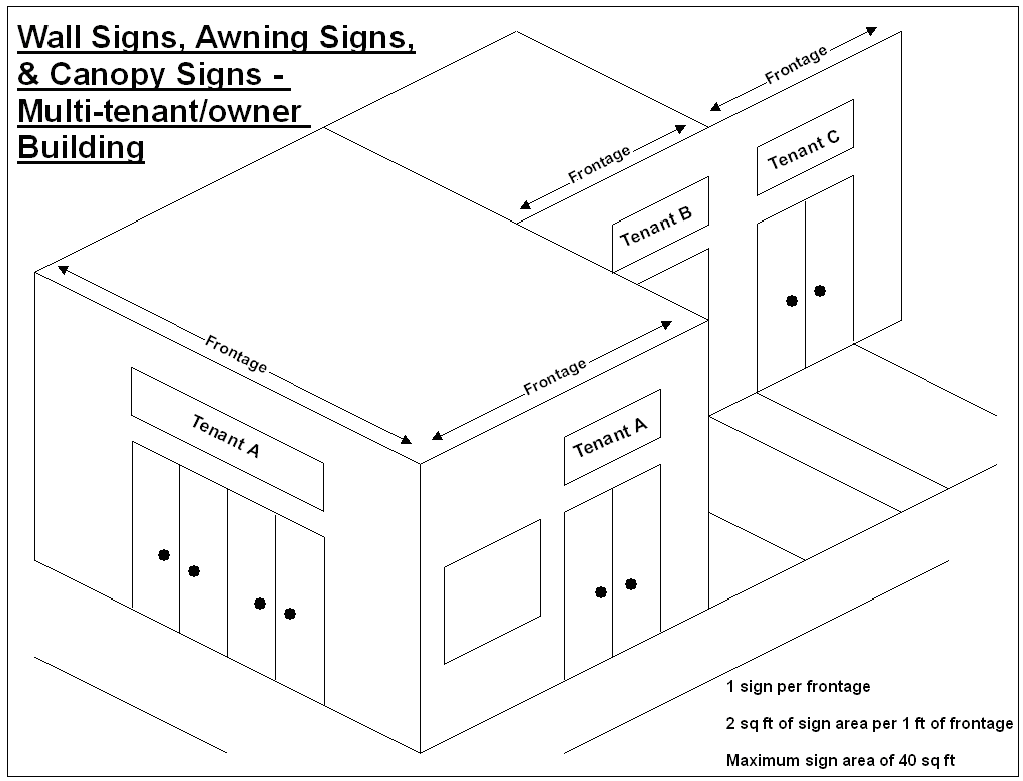
In a multiple-tenant/owner building each establishment shall be permitted to have one (1) sign per facade with street frontage, which may be a wall sign, awning sign, or canopy sign, and shall not exceed the area permitted by the following formula, or forty (40) square feet, whichever is less:
Two (2) square feet of sign per every one (1) foot of linear street frontage.
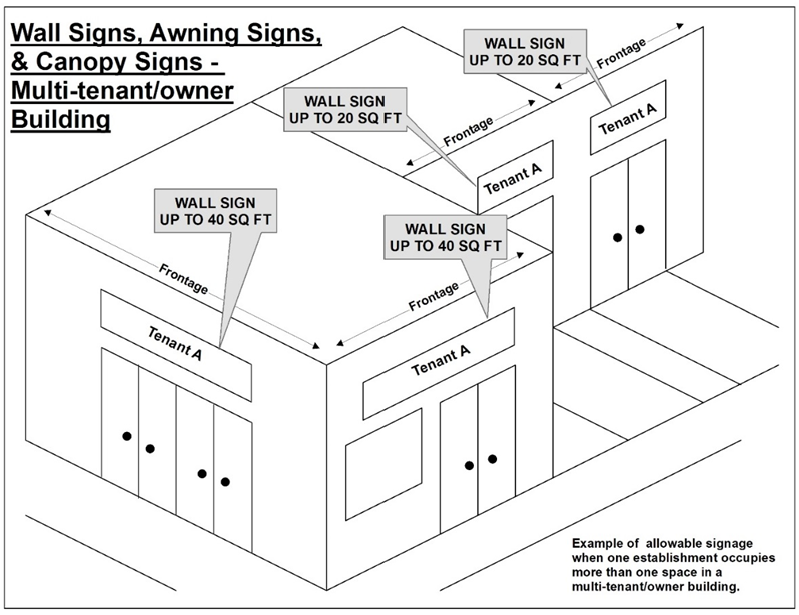
In the event that an establishment occupies more than one (1) space in a multiple-tenant/owner building, the establishment shall be permitted one (1) additional wall sign, awning sign, or canopy sign for each space with ground floor street frontage. The area of each additional sign shall not exceed the aforementioned formula as it applies to each space, or twenty (20) square feet, whichever is less.
For the purpose of this section, a space shall be defined as a portion of a multi-tenant/owner building that is separate and distinct from the rest of the building, which could itself be occupied by a single establishment and which has a separate entrance from the exterior of the building or a separate entrance from a common and clearly defined entryway that has direct access to the exterior of the building.
4.
Wall signs shall comply with the following:
a.
Shall not project more than twelve (12) inches from the wall or surface to which it is attached.
b.
Shall not exceed the height of the wall upon which it is attached.
c.
Shall not be painted directly on any exterior wall or surface.
d.
Shall not contain changeable copy.
5.
Awning signs and canopy signs shall comply with the following:
a.
Shall maintain a minimum of seven feet six inches (7'6") of clearance from the ground to the bottom of any such structure that projects over a walkway.
b.
Shall comply with the setback requirements set forth in subsection 11-3-3 G. of this title.
C.
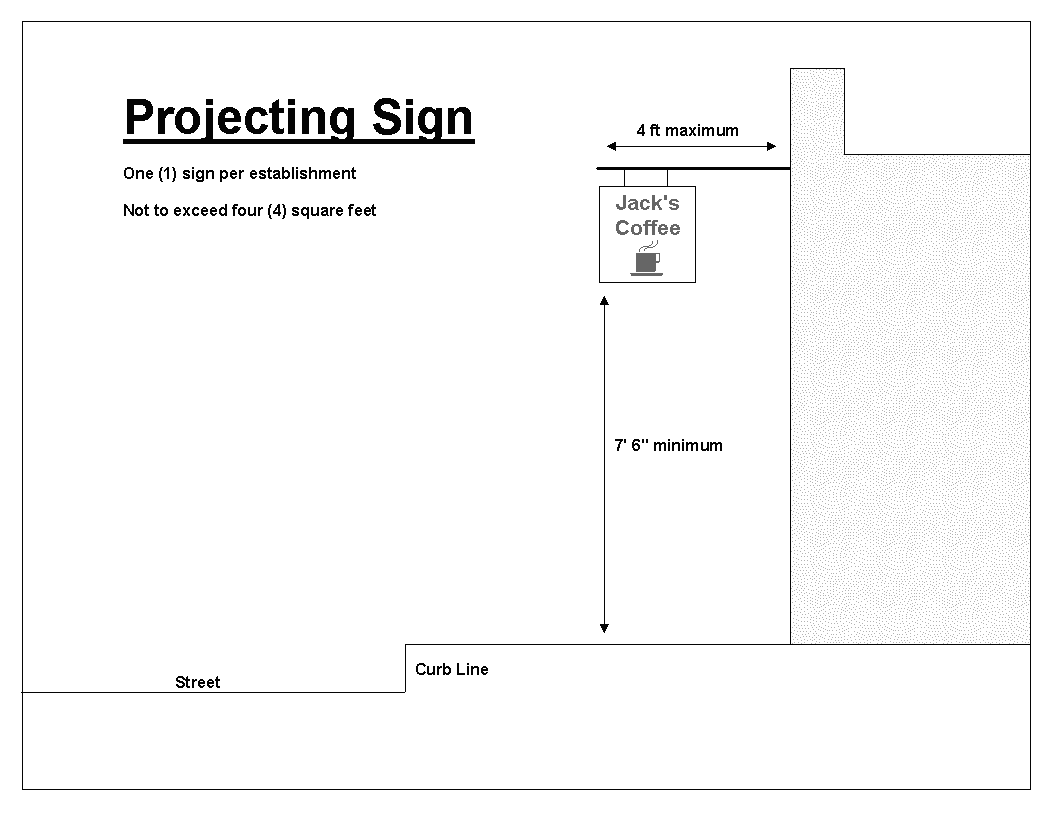
Projecting Signs:
1.
In the D-CM District, an establishment that does not have a freestanding sign or A-frame sign may have no more than one (1) projecting sign.
2.
Shall not exceed four (4) square feet in area.
3.
Shall only be located on a primary building facade.
4.
Shall only be located on the frontage of the establishment that the sign identifies, except as permitted in subsection 11-12-6 E.
5.
Shall not project higher than the roofline.
6.
Shall not project more than four (4) feet from the wall or surface to which it is attached.
7.
Shall maintain a minimum of seven feet six inches (7'6") of clearance from the ground to the bottom of any such sign that projects over a walkway.
8.
Shall contain only the name of the business, business owner, and/or appropriate logo.
9.
Shall not be internally illuminated.
10.
Shall not contain changeable copy.
11.
Shall be permitted to project over a public right-of-way, provided that the sign complies with the insurance requirements set forth in section 11-12-10 of this chapter.
D.
Electronic Message Board Signs:
1.
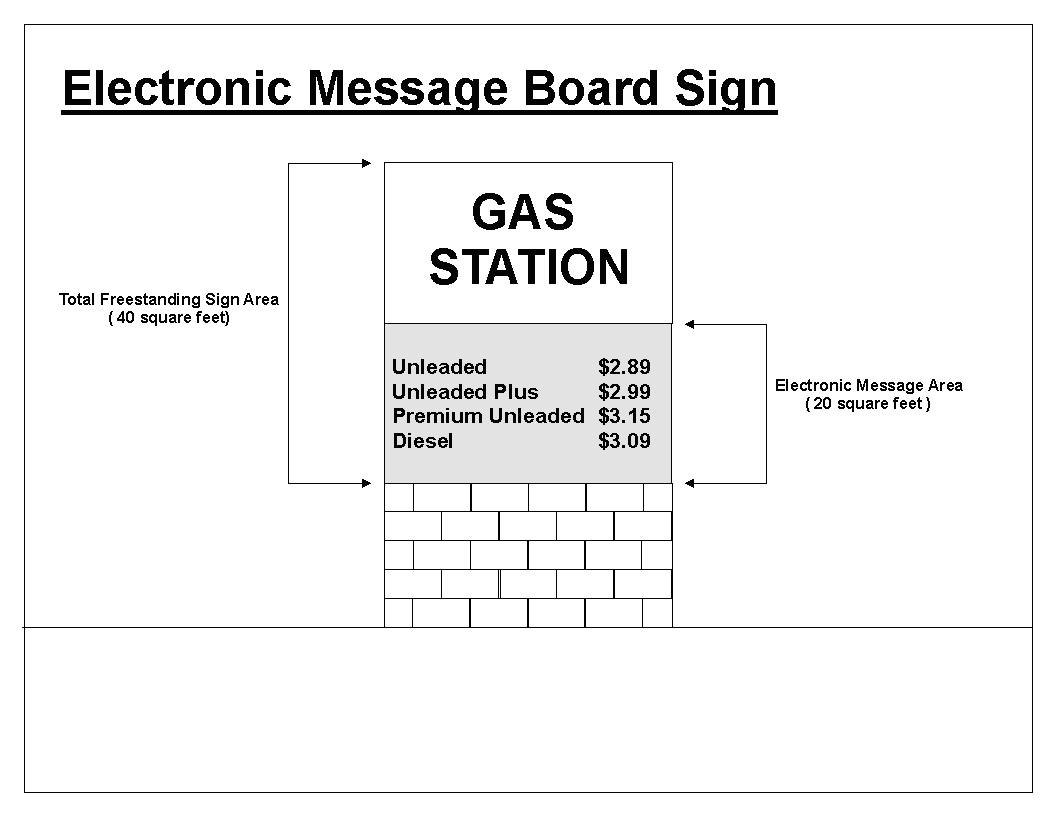
Electronic message board signs shall only be permitted when incorporated into the design of a freestanding sign.
2.
Shall not exceed twenty (20) square feet in area.
3.
Shall not contain graphics, logos, or displays that are animated, flashing, or scrolling. Messages must instantaneously change without transitions or off time.
4.
Shall comply with the illumination requirements set forth in subsection 11-12-3 A. of this chapter.
5.
The frequency of message change shall be restricted to no more than once every five (5) minutes.
Exception: The frequency of message change for time and temperature signs, as defined in section 11-2-2 of this title, shall be restricted to no more than once every five (5) seconds.
E.
Downtown Directional Signs:
1.
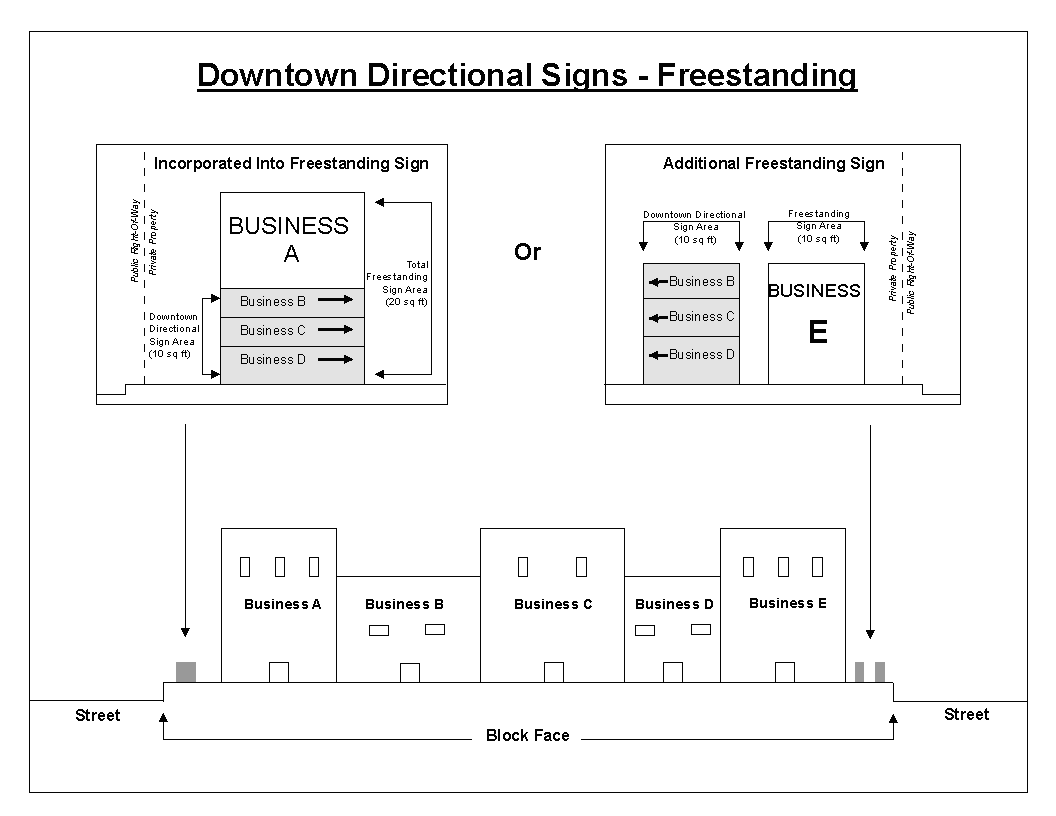
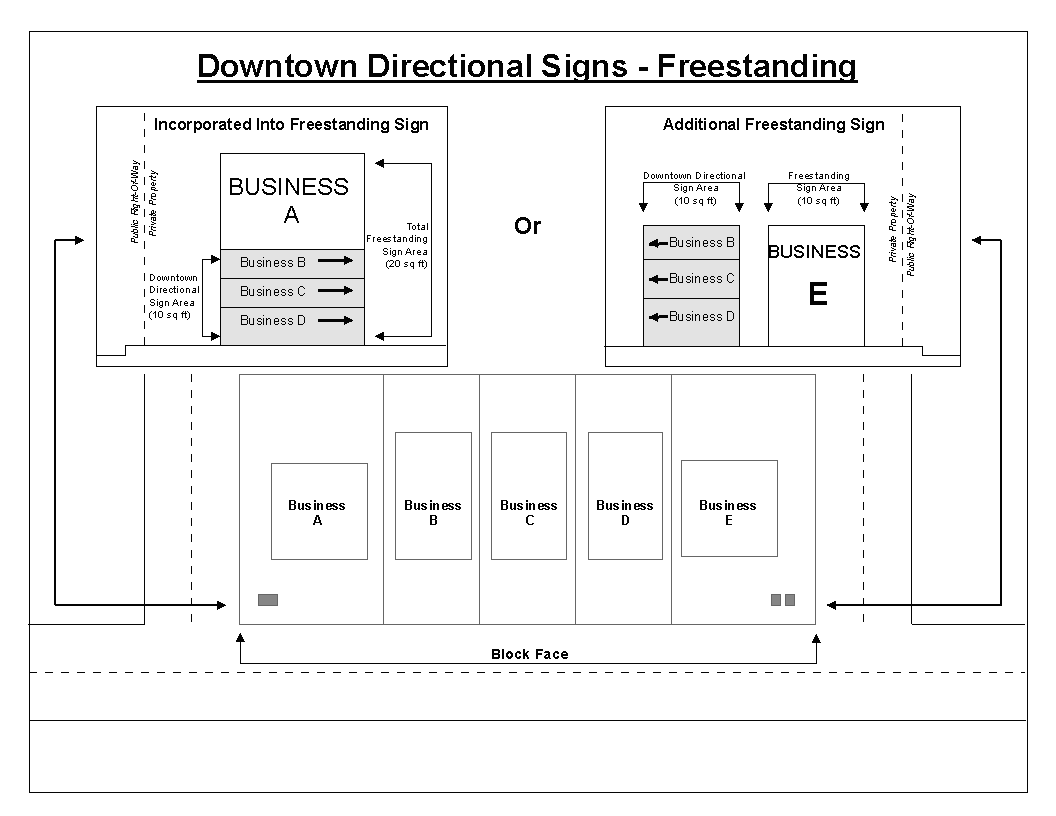
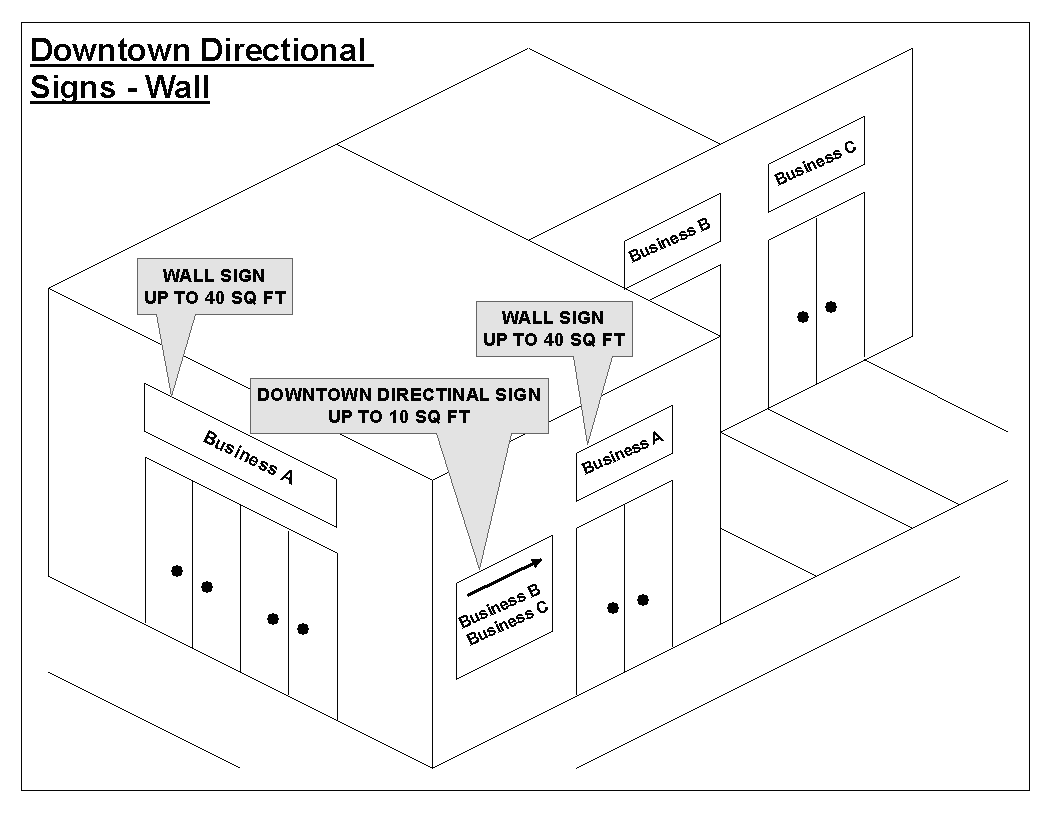
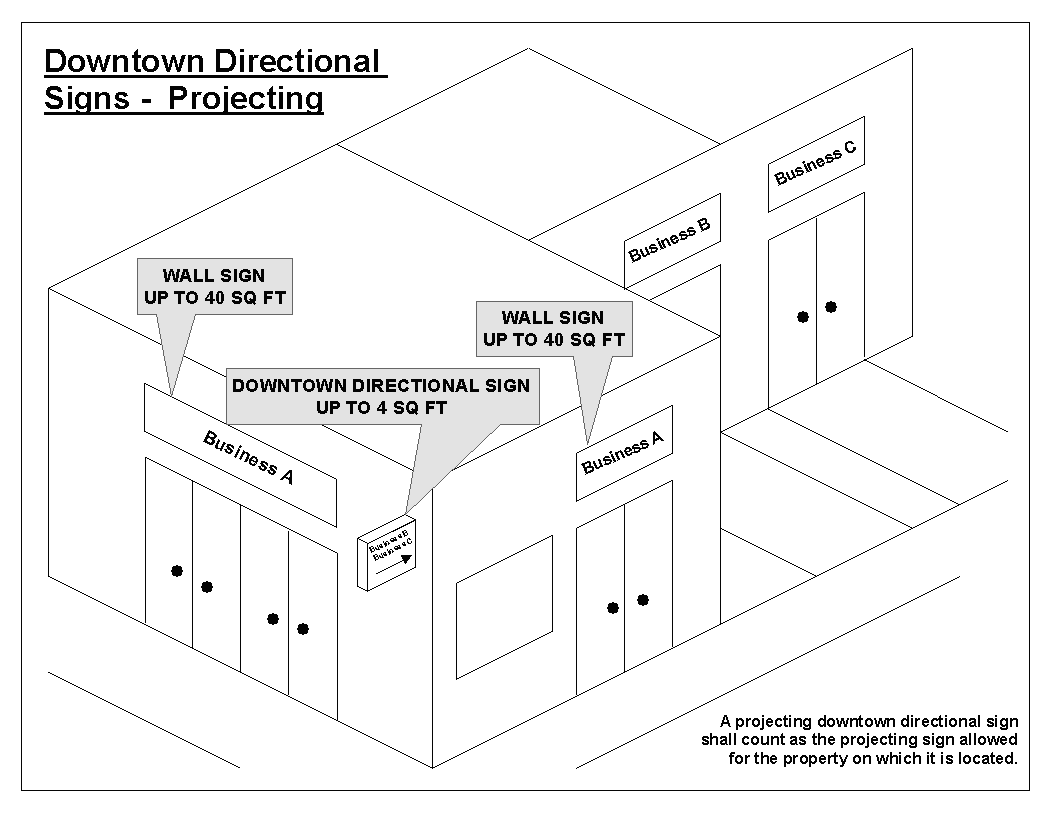
In addition to the signs permitted herein, a property owner of a corner lot in the D-CM or D-RSCM Districts may erect one (1) downtown directional sign, a wall sign or permanent freestanding sign listing the name and location of one (1) or more business establishments located on the same block face as the property on which the sign is located. A downtown directional sign may also be incorporated into the wall sign, projecting sign, or freestanding sign for the property on which it is located.
2.
Shall not exceed ten (10) square feet in area.
3.
Shall serve the purpose of providing directions and shall not serve solely as off-premise advertisement.
4.
As an alternative to a wall sign or freestanding sign, a projecting sign may be used as a downtown directional sign on corner lots in the D-CM District. Such sign shall count as the projecting sign allowed for the property on which it is located and shall comply with the regulations set forth in subsection 11-12-6 C. of this chapter.
5.
Shall not intrude into any public right-of-way, except as may be permitted for projecting signs under subsection 11-12-6 C. of this chapter.
6.
A permit application for a downtown directional sign must be completed and signed by the owner of the property on which the sign is to be located.
F.
A-Frame Signs:
1.
A-frame signs shall be permitted only for establishments that do not have a projecting sign. An establishment may have no more than one (1) A-frame sign.
2.
Shall not exceed four (4) feet in height.
3.
Shall have no sign panel in excess on six (6) square feet in area.
4.
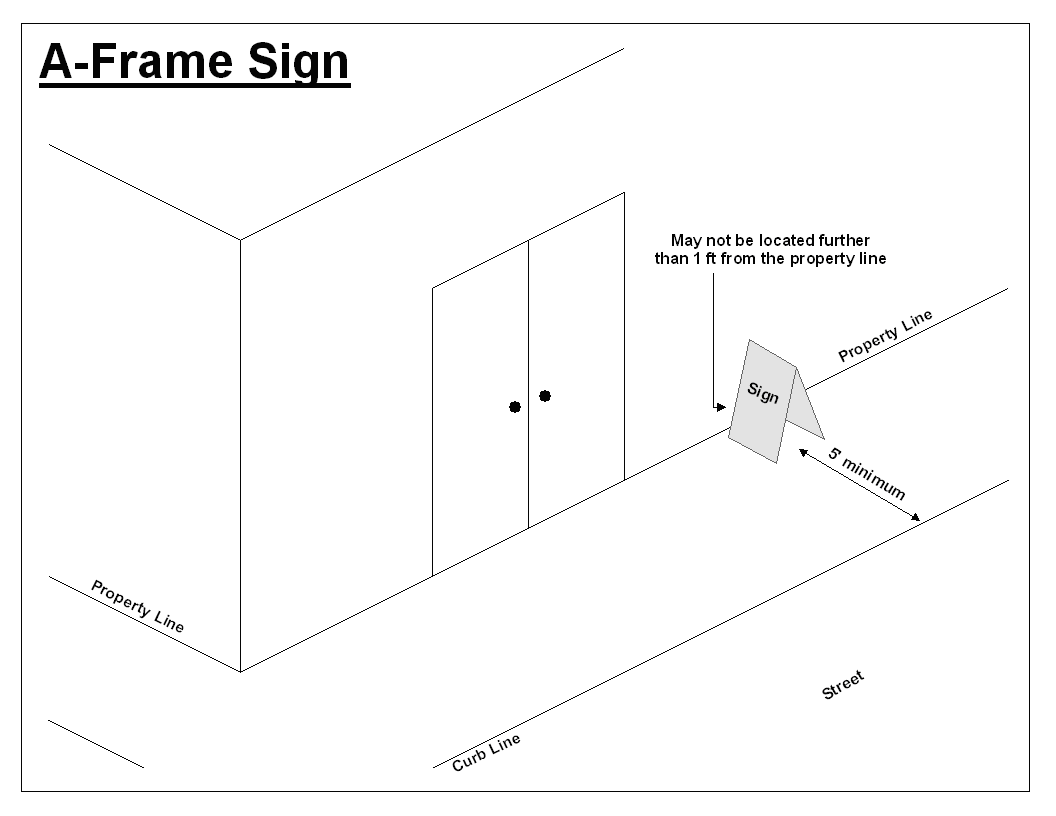
Shall be located no further than one (1) foot from the primary frontage property line of the displaying establishment, except that businesses located on lots that do not have frontage on Third Street or State Street may place one (1) additional A-frame sign at the intersection corner nearest the business.
5.
Shall only be displayed during the displaying establishment's hours of operation.
6.
Shall not be permanently anchored to the ground.
7.
Shall not be illuminated.
8.
Shall not be displayed during times of inclement weather such as high winds, heavy rain or snow.
9.
Shall not be placed so as to block private driveways, alleys, or walkways.
10.
Businesses shall be permitted to freely select and change the messages on A-frame signs.
11.
Shall be permitted to be located on public property, provided that the sign complies with the following:
a.
There shall be no less than five (5) feet of unobstructed sidewalk between the street curb and the primary frontage property line.
b.
The sign shall comply with the insurance requirements set forth in section 11-12-10 of this chapter. Additionally, the applicant shall sign a waiver of liability form provided by the city.
c.
The displaying establishment shall apply for a permit, as set forth in section 11-12-2 of this chapter, on an annual basis.
12.
A permit for an A-frame sign shall be revoked and the sign shall be removed if the sign is found to be in violation of the regulations established in this section three (3) or more times in a one-year period.
(Ord. No. 2011-47, § 1(Exh. A), 10-17-2011; Ord. No. 2014-23, § 1, 9-2-2014; Ord. No. 2015-15, § 1, 6-15-2015; Ord. 2017-19, § 6, 7-17-2017; Ord. No. 2019-17, §§ 60—63, 8-5-2019)
11-12-7: - TEMPORARY SIGNS:
The provisions of this section shall regulate all temporary signs, with the exception of all signs specifically described and regulated in section 11-12-8 of this chapter. If an establishment does not have an existing sign, a temporary sign may be used. Temporary signs may also be used by establishments with an existing sign, but shall be limited to events outside of the normal business activities to promote a special event.
A.
Temporary Sign Permit:
1.
Every applicant shall submit an application to the building commissioner, as set forth in section 11-12-2 of this chapter.
2.
An individual permit shall be limited to a maximum of fourteen (14) days.
3.
Temporary signs shall be removed within twenty-four (24) hours after the expiration of the permit unless a new permit has been obtained.
4.
No more than two (2) permits shall be issued for any establishment in any calendar year.
B.
Temporary Sign Regulations:
1.
Not more than two (2) temporary signs shall be permitted on a parcel of property.
2.
Shall not exceed forty (40) square feet in area.
3.
Shall not contain changeable copy.
4.
Shall not be illuminated.
5.
Shall be anchored and supported in a manner that prevents the signs from becoming hazardous to the public health and safety.
6.
Shall maintain a minimum of seven feet six inches (7'6") of clearance from the ground to the bottom of the sign if suspended over a walkway.
C.
Exceptions For Temporary Development Signs: Signs advertising the development or redevelopment of property are permitted for a period of one (1) year from the issuance of the permit or within thirty (30) days of completion of the development, whichever occurs first. All vacant lots within a development shall have erected signage which displays the lot number and/or address.
(Ord. No. 2011-47, § 1(Exh. A), 10-17-2011)
11-12-8: - EXEMPT SIGNS:
Every sign enumerated below that complies with the indicated requirements may be erected without a permit. The area of said signs shall not be debited against the sign area otherwise permitted under the terms of this chapter:
A.
Construction signs advertising the work being conducted on the property on which the sign is placed. In residential districts, such signs shall not exceed six (6) square feet in area. In nonresidential districts, such signs shall be limited to one (1) per street frontage and shall not exceed thirty-two (32) square feet in area. All such signs shall only be permitted while work is being aggressively pursued on the property, for a period not to exceed thirty (30) days.
B.
Directional and informational signs in private parking lots and vehicle entrances. Such signs shall not exceed three (3) square feet in area.
C.
Garage, yard, or rummage sale signs which do not exceed six (6) square feet in area and are placed on private residential property. Such signs shall be limited to one (1) per lot and shall only be permitted between the hours of 7:00 a.m. on Friday and 8:00 p.m. on Sunday.
D.
Governmental signs such as traffic control signs, railroad crossing signs, legal notices, danger signs, temporary emergency signs, and other such non-advertising signs.
E.
Historical markers, flags, or insignia, provided such signs are not displayed as an advertising device.
F.
Name and date signs which are carved, integrated, or inlaid so as to be part of a building at the time of construction.
G.
Political campaign signs announcing candidates seeking public office and/or signs in support of or opposition to any person, cause, issue, or referenda. Such signs shall be located on private property.
H.
Private property regulation signs such as no trespassing, no fishing, no hunting, beware of dog, etc. Such signs shall not exceed three (3) square feet in area.
I.
Professional nameplate signs indicating the building or suite number and/or the name of the occupant. Such signs shall be on the building or suite to which the sign pertains and shall not exceed one (1) square foot in area. Building directory signs indicating the names and suite numbers of individual tenants within a multiple-tenant building may be permitted when multiple tenants share an exterior door. Such signs shall be limited to one (1) per building, shall be located within ten (10) feet of the shared exterior door, and shall not exceed four (4) square feet in area.
J.
Public interest signs publicizing a charitable or nonprofit event of general public interest. Such signs shall be located on private property and may be displayed up to thirty (30) days prior to the event and for the duration of the event.
K.
Real estate signs indicating the sale, rental or lease of residential property. Such signs shall be located on private property, shall be limited to one (1) sign per lot, and shall not exceed six (6) square feet in area. All such signs shall be removed within five (5) days after the sale, rental, or lease of the property.
L.
Real estate signs indicating the sale, rental or lease of nonresidential property. Such signs shall be located on private property, shall be limited to one (1) sign per lot, and shall not exceed thirty-two (32) square feet in area. All such signs shall be removed within five (5) days after the sale, rental, or lease of the property.
M.
Residential nameplate signs indicating the house number and/or name of the occupant. Such signs shall be limited to one (1) per lot and shall not exceed two (2) square feet in area.
N.
Signs displaying construction job site rules for demolitions, infill developments, and extensive remodeling projects within Residential Area 1, as defined in section 11-2-2 and as depicted in section 11-5-5 of this title. Such signs are required to be displayed on the exterior of the chain link security fence and are required to have an area of six (6) square feet.
O.
Time and Temperature Signs: Such signs shall not be permitted in the B3 and B3E Business Districts.
P.
Temporary Directional Signs:
1.
Signs shall provide directional messages for commercial or noncommercial events or activities at a specified address within the city limits.
2.
Signs shall be permitted within the city's public right-of-way only.
3.
Signs shall not exceed four (4) square feet in surface area per face and three (3) feet in overall height. A sign shall be limited to a maximum of two (2) sign faces.
4.
Signs may be in place only on the days of the event or activity and only between the hours of 8:00 a.m. and 6:00 pm.
5.
Signs shall be free standing, not attached to any utility pole or structure or any traffic control sign and be setback a minimum of five (5) feet from the curb or edge of pavement.
6.
No attention attracting devices, including but not limited to, pennants, streamers, balloons, inflatable shapes, banners, flashing lights, or other illumination shall be attached to a direction sign or placed in the public right-of-way.
7.
Each sign shall have attached an adhesive label or other means to identify the name, address and telephone number of the person responsible for the placement and removal of each sign.
8.
No more than four (4) directional signs for each event or activity shall be placed in the public right-of-way.
9.
No greater than three (3) feet in height shall be placed within any portion of the visibility triangle as defined by section 11-2-2.
10.
If an owner of the lot adjacent to a right-of-way objects to the posting of a directional sign within the adjacent right-of-way, the sign shall not be posted or shall be immediately removed.
11.
If a sign is removed by a city official it will be retained for a period of five (5) days and then destroyed. The owner of such sign may claim them at City Hall between the hours of 8:00 a.m. and 5:00 p.m., Monday through Friday.
Q.
Temporary signs promoting or advertising city festivals or fairs that are officially sanctioned by resolution approved the city council. Such signs shall only be displayed during the period of the festival or fair.
R.
Public utility signs that serve as an aid to public safety or that show the location of public telephones, underground cables, etc.
S.
Window Signs: Window signs shall not occupy more than fifty percent (50%) of the total window area of a building facade. Window decals and graphics may be affixed to the interior or exterior of a window. All other window signs shall be placed on the interior side of the window. Televisions and computer monitors used as a window sign shall not be visible from the public roadway.
(Ord. No. 2011-47, § 1(Exh. A), 10-17-2011; Ord. No. 2015-15, § 2, 6-15-2015)
11-12-9: - PROHIBITED SIGNS:
The following signs are strictly prohibited:
A.
Billboards.
B.
Defunct Signs: Defunct signs shall be removed within ten (10) days notice to the owner by the city.
C.
Exposed neon on the exterior of the building and any neon on the interior of the building that is visible from the outside, including neon tubing used to line windows or highlight architectural features on the building, but excluding neon signs hanging inside the windows.
D.
Inflatable signs, pennants, streamers, spinners and similar signs. This section shall not apply to temporary signs advertising or promoting city festivals or fairs, as exempt by section 11-12-8 of this chapter.
E.
Mobile/portable signs.
F.
Off-premise advertising signs, except as permitted by subsections 11-12-6 E. and 11-12-6 F. of this chapter.
G.
Roof-Mounted Signs.
H.
Signs attached to trees, fences or public utility poles, other than warning signs issued by public utilities.
I.
Signs erected or maintained in such a manner that they interfere with, obstruct the view of or are likely to be confused with any authorized traffic sign, signal or device. Accordingly, no street graphic shall contain the words "stop," "go," "caution," "danger," "warning," or similar words.
J.
Signs erected, relocated, or maintained so as to prevent free access or egress from any door, window, fire escape or driveway.
K.
Signs that revolve, rotate or mechanically move in any manner.
L.
Signs painted directly on the surface of any exterior wall of any building.
M.
Signs which create a hazard to public traffic, by reason of obstruction of view, or any other means which endangers the safety and welfare of persons traveling on any public street, sidewalk, or alley.
N.
Any sign not expressly permitted by this chapter shall be deemed prohibited.
(Ord. No. 2011-47, § 1(Exh. A), 10-17-2011)
11-12-10: - INSURANCE OR BOND REQUIREMENTS:
A.
Insurance Required Prior To Permit: Every permit application for a sign which will be located in a public right-of-way, project over a public right-of-way, or which will be located so that it may fall upon the same, shall file with the community development department, before the permit is granted, a liability insurance policy covering all damage or injury that might be caused by the sign, or a certificate of insurance, issued by an insurance company authorized to do business in the state.
B.
Coverage Required: The policy shall be a multi-peril policy with the limits of liability not less than five hundred thousand dollars ($500,000.00). The city, its officers, agents and employees shall be named as additional parties insured.
C.
Length Of Coverage: Such liability insurance policy shall be maintained in force throughout the life of the permit; and if at any time it is not in full force, the permit shall be revoked.
D.
Bond In Lieu Of Insurance: In lieu of insurances as provided for in this section, the applicant may file an indemnity bond, with a corporate surety satisfactory to the building commissioner, in the amount on five hundred thousand dollars ($500,000.00), which will provide that the principal surety will indemnify and hold harmless the city, its officers, agents and employees from all claims, loss or suits resulting from such sign.
(Ord. No. 2011-47, § 1(Exh. A), 10-17-2011)
11-12-11: - NONCONFORMING SIGNS:
A nonconforming sign that does not pose an important peril to life or other property may remain and be maintained by ordinary repairs, but shall not be:
A.
Altered or enlarged in such a way as to increase its nonconformity. Any alterations to the manner of illumination shall conform to the provisions of this chapter.
B.
Replaced with a new sign, unless such sign conforms to the provisions of this chapter. Provided, however, that the sign panel on nonconforming freestanding signs may be refaced if the size of the panel is not increased and the sign post or support is not removed.
C.
Relocated, unless such relocation conforms to the provisions of this chapter.
D.
Reconstructed after incurring damage in an amount exceeding fifty (50) percent of its market value at the time of loss.
E.
Permitted after the activity, business, product, or service which the sign advertises is no longer conducted on the premises.
(Ord. No. 2011-47, § 1(Exh. A), 10-17-2011)
11-12-12: - LANDMARK SIGNS:
Signs that have received landmark designation and are nonconforming with respect to area, height, lighting, type, placement or location shall be exempt from the nonconforming provisions set forth in subsections 11-12-11 B., 11-12-11 D., and 11-12-11 E. of this chapter.
(Ord. No. 2011-47, § 1(Exh. A), 10-17-2011)
11-12-13: - VIOLATIONS; PENALTY:
A.
Penalty: Any person violating any of the provisions of this chapter shall, upon conviction thereof, be fined as provided for in title 1, chapter 3, section 1 of the City Code. Each day such violation is committed or continued shall constitute a separate offense.
B.
Settlement Of Violations: Any person accused of violation of this chapter may settle and compromise the claim of violation against him by paying to the city, within ten (10) days of the time such violation or offense was committed, the sum of fifty dollars ($50.00) for each violation or offense. Payment of such claim or claims shall be made at the Geneva Police Department offices, or in the fine/claim deposit boxes located upon the streets of the city. The funds received from such compromised claims shall be promptly turned over to the city treasurer to be credited to the general corporate fund. In the event such claim or claims are not paid within ten (10) days of the time of the offense, a notice to appear or a warrant (summons) may be issued for the arrest of the offender.
(Ord. No. 2011-47, § 1(Exh. A), 10-17-2011)
11-12-14: - MASTER SIGN PLAN FOR MULTI-TENANT/OWNER BUILDINGS:
The purpose of the master sign plan (MSP) is to establish an orderly and unified design approach to multiple business identification signs on buildings. A MSP shall include information on the number, styles, sizes, colors, locations, and materials used for existing business identification signs, and future signs installed on the building. Signs shown on a MSP should complement the architecture of the building, and demonstrate the use of common sign design elements and themes among the multiple signs shown on the plan.
A.
Initiation: The owner of a building or development containing multiple business entities (tenants/users) may elect to establish a MSP. Once established, each sign for the building/development shall conform to the approved MSP. Applications for approval of a MSP may be submitted for review and approval concurrently with the submittal of permit applications for proposed individual business identification signs.
B.
Application: The owner(s) of the property for which the MSP approval is sought shall file an application on forms provided by the building commissioner and shall contain or have attached thereto the following information:
1.
Name, address and telephone number of the applicant.
2.
A narrative description of the building/development and of the design approach/theme represented by the signs shown in the MSP.
3.
A description of each proposed sign. Any type of sign not specifically identified shall be deemed prohibited. For each sign detailed information shall be provided including the sign function, location, area, size and height, color pallets, illumination (if any), and materials.
4.
Two (2) hard copies and one (1) electronic copy of the plan showing the information required in subsection 3. above shall be submitted for each proposed sign.
C.
Fee: There shall be no application review fee for a MSP.
D.
Review: The building commissioner shall have the authority to approve, approve with conditions or deny applications for a MSP, except for properties located within a historic district. The standards set forth below shall serve as the basis for the building commissioner's review of a MSP. For properties located in a historic district, the building commissioner shall not approve a MSP unless the plan has been reviewed and approved by the historic preservation commission. A MSP shall meet the following objectives:
1.
Conforms to the requirements set forth in this chapter, unless otherwise granted relief as set forth in section 11-14-5A of this title.
2.
Implements the purpose and intent of this chapter.
3.
Achieves the goal of moderating the size and number of wall signs, reduces wall sign clutter, eliminates nonconforming signs, and precludes placement of wall signs over architectural features of the building.
4.
Is compatible with the signs and uses on adjacent and adjoining properties.
E.
Procedure After Approval Of A MSP:
1.
The property owner shall provide a copy of the approved MSP to all current business entities within the building or development, as well as to any future business entities prior to any closing on the sale of the property, or execution of a lease.
2.
An approved MSP does not negate the need for a sign permit for the installation of signs. All signs are required to obtain a permit as set forth in section 11-12-2 of this chapter. However, permit applications for individual signs within a historic district which conform to an approved MSP shall not require further review or approval by the historic preservation commission.
3.
The city shall review all sign permit applications for compliance with the approved MSP prior to the issuance of a permit.
F.
Expiration: Upon approval of a MSP, all sign permits issued thereafter shall conform to the plan. Once the MSP is approved, the approval shall run with the land and shall not change or dissolve with a change in ownership of the building/development.
G.
Changes: The owner(s) of a property may request an amendment to an approved MSP following the same application requirements and review procedures set forth in subsections 11-12-14 A. through 11-12-14 D. above. Any requested amendment to an approved MSP, including modification or termination of the plan, shall require the written consent of all property owners/tenants of each building involved.
H.
Existing Signs On Multi-Tenant/Owner Buildings: Signs, including legal nonconforming signs, located on a multi-tenant/owner building that were installed prior to the approval of a MSP for the building or development in which the building is located, may remain and be maintained by ordinary repairs but shall not be altered, enlarged, replaced, relocated or reconstructed unless such change conforms to the approved MSP for the building or development.
(Ord. No. 2011-47, § 1(Exh. A), 10-17-2011)

