
Geneva City Zoning Code
CHAPTER 13
NONCONFORMING LOTS, STRUCTURES AND USES
SECTION:
11-13-1: - PURPOSE:
The purpose of this chapter is to provide for the regulation and treatment of buildings, structures, lots and land uses considered nonconforming under the provisions of this title and specify those circumstances and conditions under which nonconforming structures shall be repaired, enlarged, moved, restored or terminated. (Ord. 95-28, 5-1-1995)
11-13-2: - AUTHORITY TO CONTINUE NONCONFORMITY:
Any nonconforming building, structure or use which existed lawfully at the time of the adoption of this title and which remains nonconforming, and any such building, structure or use which shall become nonconforming upon the adoption of this title, or of any subsequent amendments thereto, may be continued subject to the regulations set out in this chapter. (Ord. 95-28, 5-1-1995)
11-13-3: - NONCONFORMING LOTS OF RECORD:
When any nonconforming lot or parcel of land is of record with the Kane County recorder's office on or prior to May 1, 1995, and does not meet the minimum lot width, frontage, or lot area requirements of the zoning district in which it is located, it shall be considered conforming to the minimum lot width, lot frontage, or lot area requirements, and may be improved as follows:
A.
Single-family Residential Districts: In single-family residential districts, one (1) single-family dwelling and accessory uses may be constructed, altered, expanded or enlarged on a lot of record, provided the structures conform to the setback, lot coverage, building height, and floor area regulations of the district in which the property is located.
Exception: A single-family detached dwelling on a lot of record that does not meet the minimum lot frontage requirement of the district in which it is located shall conform to the following setback requirements:
B.
Business, Office Research, Industrial, and Multi-family Residential Districts: In the business, office research, industrial, and multi-family residential districts, and structure permitted in the particular district may be constructed, altered, expanded, or enlarged on a lot of record, provided the structure conforms to the regulations of the district in which it is located.
C.
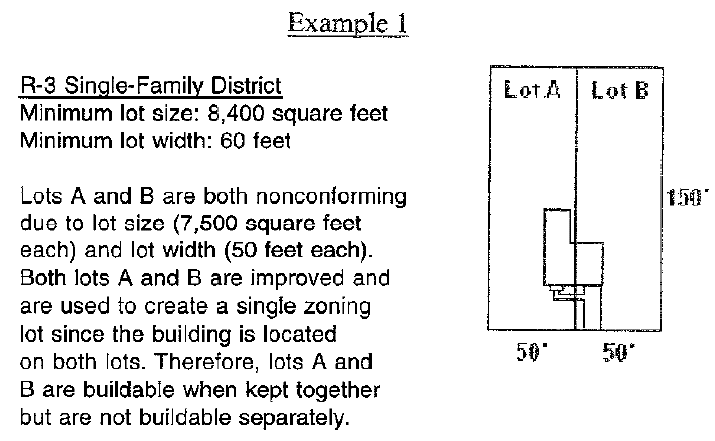
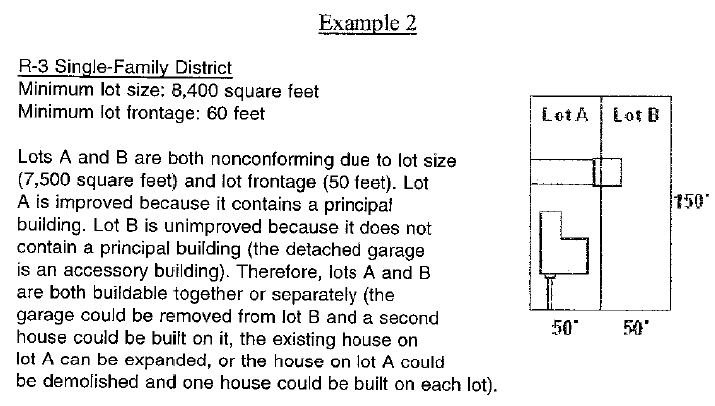
Two (2) Or More Lots Or Parcels Or Portions Thereof Used To Create One Zoning Lot: When two (2) or more improved lots or parcels of land or portions thereof are of record with the Kane County recorder's office on or prior to May 1, 1995, and any of the lots or parcels of land, or portions thereof, do not meet the minimum lot width, lot frontage, lot coverage, building height, floor area, setbacks or lot area requirements of the zoning district in which it is located, such two (2) or more lots, or portions thereof, shall be considered a single zoning lot and may not contain more than one principal structure or building. For purposes of this subsection, an "improved lot or parcel of land" is defined as one that contains a principal building or any portion of a principal building.
D.
Relationship To Zoning Map Amendments: Whenever the boundaries of a zoning district shall be changed so as to transfer an area from one zoning district to another, the foregoing provisions shall also apply to any lots made nonconforming by such change in zoning district. (Ord. 2005-31, 4-18-2005; Ord. No. 2010-16, § 1, 4-5-2010)
11-13-4: - CONTINUANCE OF NONCONFORMING BUILDINGS, STRUCTURES AND USES:
A.
Generally:
1.
Any nonconforming building, structure or use which existed lawfully at the time of the adoption of this title and which remains nonconforming; and any building, structure or use which shall become nonconforming upon the adoption of this title or of any subsequent amendment thereto, may be continued indefinitely subject to the regulations which follow.
2.
For the purpose of this section, a building or structure lawfully constructed or established on the effective date of this title shall be deemed to include any building or structure for which a building permit has been lawfully issued, and on which construction has begun within the required period of time allowed by the unexpired building permit then in effect.
B.
Nonconforming Buildings And Structures; Repairs, Alterations, Enlargements, Discontinuance And Condemnation:
1.
Ordinary Repairs:
a.
Ordinary or minor repairs and alterations may be made to a nonconforming building or structure. However, no structural alterations except those required by law shall be made in or to such building or structure, all or substantially all of which is designed or intended for a use not permitted in the district in which it is located. For the purpose of this section, "ordinary repairs or minor alterations" shall mean repairs or renovation costs which do not exceed fifteen percent (15%) of the market value of the structure.
b.
A nonconforming building in a residential district which contains residential uses may be altered in any way to improve livability provided no structural alterations shall be made which would increase the number of dwelling units.
2.
Additions And Enlargements: Except as provided below, a building or structure which is nonconforming as to setback, height and/or area regulations may be expanded or enlarged provided the expansion or the enlargement conforms to all of the regulations of the district in which it is located.
Exceptions for residential uses on nonconforming lots of record:
a.
A single-family detached dwelling erected on a lot of record that does not meet the minimum lot frontage requirement of the district in which is located shall conform to the following side setback requirements:
Exceptions for residential uses in residential area 1:
a.
A nonconforming building or structure may be expanded or enlarged, vertically and/or horizontally to the same degree as the existing encroachment into the side or rear setback.
b.
A nonconforming principal building or structure may be expanded or enlarged vertically to the same degree as the existing encroachment into the street setback.
c.
Notwithstanding the foregoing to the contrary, in no case shall the minimum side setback be less than two (2) feet, the minimum rear setback be less than five (5) feet and the minimum street setback be less than ten (10) feet.
d.
In cases where an existing nonconforming building or structure is located closer to a lot line than the required minimum setbacks, any expansion or enlargement of the nonconforming building or structure shall meet the minimum setbacks set forth in subsection B.2.c. of this section.
3.
Moving Of Nonconforming Building Or Structure: No building or structure which does not conform to all of the regulations of the district in which it is located shall be moved in whole or in part to any other location unless every portion of such building or structure is moved. The use of the building or structure at the new site shall be made to conform to all regulations of the district into which it is moved.
4.
Restoration Of Damaged Nonconforming Building Or Structure:
a.
Principal Single-Family Residential Detached Structures: Regardless of the extent of destruction or the cost of restoration, a nonconforming principal single-family detached residential building which is destroyed or damaged by fire or other casualty or act of God may be restored substantially to the condition in which it was before the occurrence. Reconstruction shall not increase any nonconformity. However, no repairs shall be made unless a building permit has been issued and reconstruction initiated within one year from the date of the destruction and is diligently prosecuted to completion. Further, reconstruction is permitted under this subsection only in situations where a single-family residential use is a permitted use in the district at the time of destruction. All other situations are subject to the requirements of subsection B4b of this section.
b.
All Other Buildings And Structures: A nonconforming building or structure which is destroyed or damaged by fire or other casualty or act of God to the extent that the cost of restoration to the condition in which it was before the occurrence will exceed fifty percent (50%) of the cost of restoration of the entire building or structure shall not be restored unless said building or structure and use thereof shall conform to all regulations of the district in which it is located. In the event that such damage or destruction is less than fifty percent (50%) of the cost of restoration of the entire building or structure new, no repairs or reconstruction shall be made unless such restoration is started within one year from the date of the partial destruction and is diligently prosecuted to completion. In support of the application for a construction permit, the applicant shall submit such information as may be required to demonstrate that the costs of the proposed repairs or renovations or reconstruction will not exceed fifty percent (50%) of the structural value of the entire structure.
5.
Expansion Of Use In A Nonconforming Building Or Structure: A conforming use in a nonconforming building or structure, may be expanded within the building or structure in which said use is presently located. However, no changes or structural alterations shall be made unless such changes or structural alterations and the use thereof conform to all the regulations of the district in which the building or structure is located.
6.
Nonconforming Fences And Walls: Fences and walls constructed prior to October 3, 1994, which do not conform to the provisions of this section, except for plant material, shall be considered legal nonconforming structures. However, any replacement of a nonconforming fence or wall, either by sections or of the whole, on a zoning lot in excess of fifty percent (50%) of its total area shall conform to the provisions of this section.
Ordinary repairs and maintenance may be made, provided such repairs and maintenance do not increase the height, or cause any other structural change, or the relocation of the fence.
C.
Nonconforming Use Of Buildings Or Structures:
1.
Change Of Use In Nonconforming Building Or Structure: The use of a nonconforming building or structure may be changed to another use permitted in the district in which the building or structure is located. However, no change shall extend or otherwise violate any provision made in this title for elimination of such nonconforming building or structure and the use thereof.
2.
Expansion Of Nonconforming Use: A nonconforming use of a part of a conforming building or structure, shall not be expanded or extended into any other portion of such building or structure.
3.
Discontinuance Of Nonconforming Use: If a nonconforming use of a conforming building or structure is discontinued for a consecutive period of one hundred eighty (180) days, it shall not be renewed. Any subsequent use of the building or structure shall conform to the use regulations of the district in which the premises are located.
D.
Nonconforming Use Of Land: The nonconforming use of land not involving a building or structure, or in connection with which any building or structure thereon is incidental or accessory to the principal use of the land, may be continued subject to the following provisions:
1.
Expansion: A nonconforming use of land shall not be expanded or extended beyond the area it occupies.
2.
Discontinuance: If a nonconforming use of land is discontinued for a period of one hundred eighty (180) consecutive days, it shall not thereafter be renewed. Any subsequent use of the land shall conform to the regulations of the district in which the land is located.
3.
Change Of Use: A nonconforming use of land shall not be changed to any other use except to a use permitted in the district in which the land is located.
E.
Nonconforming Landscaping:
1.
Landscaping is important in improving the overall appearance of the city and increasing the compatibility of different land uses. It is recognized that landscaping is difficult to install in conjunction with relatively small increments of change in a development project (such as relatively small building additions or changes of use) for the following reasons: a) the landscaping elements of a development project should be planned in a comprehensive and coordinated manner which is not feasible to implement with relatively small increments of change; b) nonconformities related to landscaping are difficult to resolve where the existing improvements limit the potential for a comprehensive landscaping plan to be implemented; and c) fragmented ownership in a development project can further reduce the potential for a comprehensive landscaping plan to be implemented with relatively small increments of change. Any development not complying with the requirements of this title as of the effective date hereof is considered legally nonconforming.
2.
Existing legally nonconforming landscaping is permitted to continue until one of the following changes occurs:
a.
Any new construction or addition of building floor area consisting of twenty five percent (25%) or more of the existing gross building floor area of the development project on the subject lot; or
b.
Any change from a residential use to a nonresidential use (or vice versa) consisting of twenty five percent (25%) or more of the existing gross building floor area of the development project on the subject lot.
3.
All required landscaping in accordance with chapter 10 of this title shall be provided in conjunction with either of the two (2) changes described above.
4.
All required landscaping shall be provided in conjunction with any new development of a vacant lot or with the total redevelopment (demolition and new construction) on a lot or zoning lot. (Ord. 95-28, 5-1-1995; Ord. 2003-19, 3-17-2003, eff. 5-1-2003; Ord. 2006-34, 5-15-2006, eff. 6-26-2006; Ord. No. 2010-16, § 1, 4-5-2010)

