
Geneva City Zoning Code
CHAPTER 5
RESIDENTIAL DISTRICTS
SECTION:
11-5-1: - PURPOSE:
The purpose of the residential districts is to divide the city into land use areas which reflect the character of both new and existing residential areas in accord with the general intentions of the city's comprehensive plan. The residential districts establish development standards and regulations reasonably required to protect existing and new development from the encroachment of incompatible land uses. (Ord. 95-28, 5-1-1995)
11-5-2: - ACCESSORY BUILDINGS AND USES:
In all residential districts, accessory buildings and uses, incidental to and on the same zoning lot as a principal use, in accordance with sections 11-3-3 and 11-3-4 of this title, are allowed. (Ord. 97-31, 6-2-1997)
11-5-3: - RELATED REGULATIONS AND REQUIREMENTS:
Other pertinent regulations contained within this title and other provisions of this code, that shall be required in all residential districts include, but are not limited to:
(Ord. 95-28, 5-1-1995)
11-5-4: - PARKING CLASSES FOR USES:
Numbers with parentheses following the permitted and special uses in the residential districts indicate the parking class for each use. For specific parking requirements, see chapter 11 of this title. (Ord. 95-28, 5-1-1995)
11-5-5: - RESIDENTIAL AREA MAP:
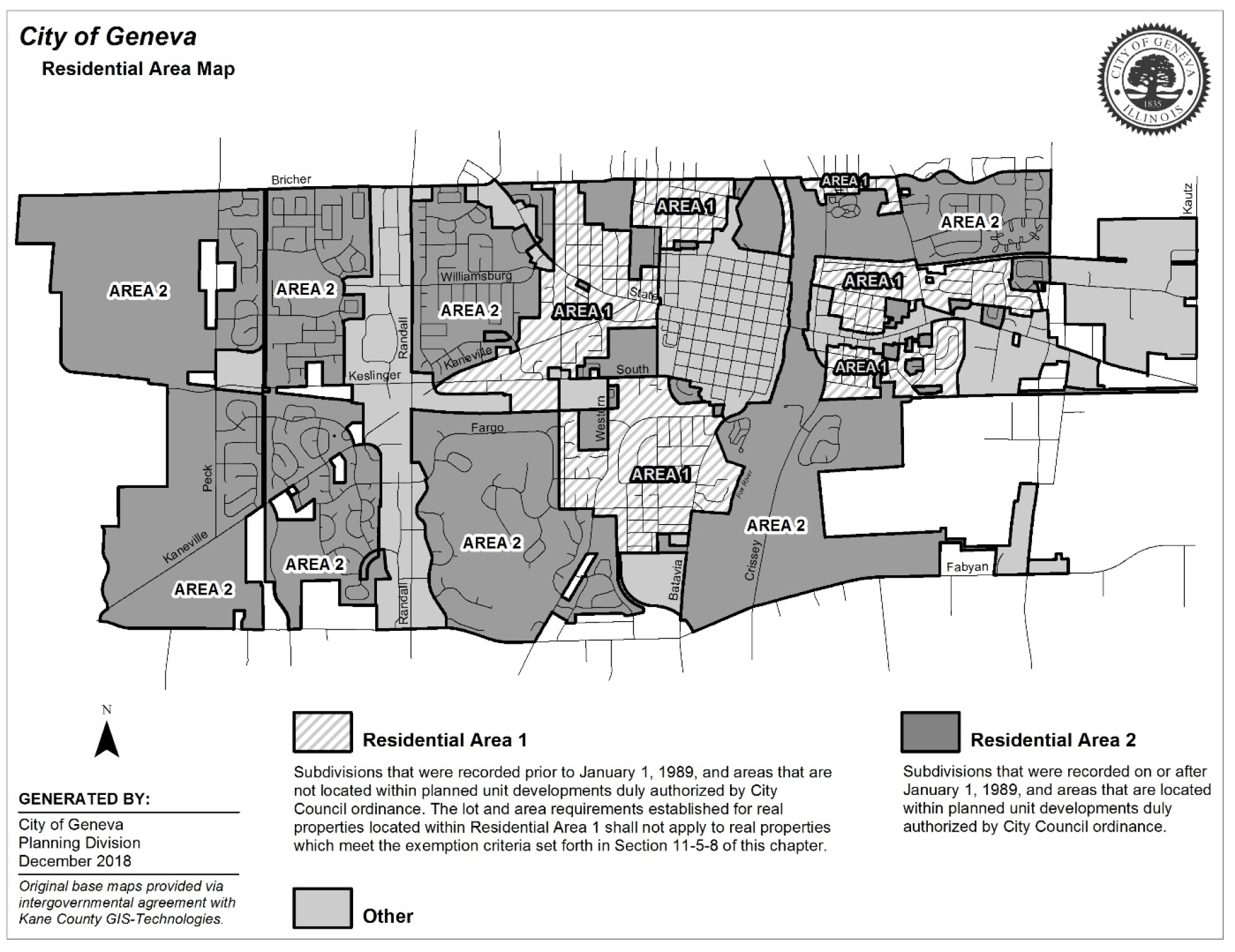
(Ord. 2003-19, 3-17-2003, eff. 5-1-2003; Ord. No. 2009-04, § 1, 2-2-2009; Ord. No. 2013-43, § 1, 11-18-2013; Ord. No. 2019-17, § 26, 8-5-2019)
11-5-6: - MAXIMUM FLOOR AREA TABLE:
Notes:
1. Partial square feet will be rounded to the nearest whole square foot for both lot size and floor area.
2. Lot coverage and building setback requirements shall be met in addition to floor area.
(Ord. 2003-19, 3-17-2003, eff. 5-1-2003)
11-5-7: - PARKS AND RECREATIONAL USES, FACILITIES AND STRUCTURES:
A.
Use Permissibility And Supplemental Regulations Table: The following table sets forth the use permissibility and supplemental regulations for parks and recreational uses, facilities and structures:
B.
Supplemental Regulations: The applicable supplemental regulations for the various parks and recreational uses, facilities and structures, as identified in the table in subsection A of this section, are set forth in this subsection (subsections B1 through B9 of this section):
1.
Parking:
a.
Number Of Parking Spaces Required: The number of required parking spaces shall be in accordance with section 11-11A-6 of this title. For Geneva park district facilities and uses only, the city may approve on street parking spaces in full or partial satisfaction of the parking requirement. However, for on street parking to be approved, the city may require the submittal of traffic and/or parking studies or other engineering plans or documentation demonstrating that such parking can be provided in a safe manner. The park district shall be responsible for all costs associated with the construction of on street parking spaces.
b.
Special Parking Calculation: For the uses, facilities or structures listed as special uses and under which this supplemental regulation is applicable, the parking requirements set forth in the zoning ordinance shall be the minimum number of parking spaces required, but the final number of required parking spaces shall be as determined by the city council upon recommendation of the planning and zoning commission. For all permitted uses for which this supplemental regulation is applicable, the parking requirement set forth in the zoning ordinance shall represent the required number of spaces, provided that if the park district proposes a lesser number of parking spaces, the district may submit information which supports a reduction of required parking for review and final approval by the director of community development.
2.
Principal Structures And Uses: The street, side and rear setbacks shall be as required within the zoning district in which the property is located, except where the side or rear lot line directly abuts a lot line of a lot zoned and used (or intended to be used) for residential purposes, in which case the required side and rear setbacks shall be not less than forty feet (40').
3.
Accessory Structures And Uses (Not Including Fences): Bleachers, portable toilets (permanent installations with visual screening), park benches, grills, refuse containers, and other similar accessory structures or hardscape elements shall be set back a minimum of twenty feet (20') from the lot line of a property zoned and used (or intended to be used) for residential purposes, except that walking, hiking or biking trails shall be set back a minimum of two feet (2') from the lot line of a property zoned and used (or intended to be used) for residential purposes, when not located within a right-of-way.
4.
Parking Lots: The street setback for off street parking lots shall be not less than twenty feet (20'). The side and rear setbacks for off street parking lots shall be in accordance with the required side and rear setbacks for principal structures and uses of the zoning district in which the property is located, except where the side or rear lot line directly abuts a lot line of a lot zoned and used (or intended to be used) for residential purposes, in which case the required side and rear setback shall be not less than forty feet (40').
5.
Athletic Fields, Courts, Playgrounds And Other Active Use Areas: The street setback for any athletic field, court, playground or other "active use area", as defined herein, shall be in accordance with the required street setback for principal structures and uses of the zoning district in which the property is located. The edge of the field of play for athletic fields, courts, playgrounds and other active use areas shall be set back a minimum of forty feet (40') from the lot line of any abutting property zoned and used (or intended to be used) for residential purposes.
For the purposes of this section, "active use area" shall be defined as that portion of a park site or recreational area that is designed to be regularly utilized by park users while engaged in the use of an amenity or equipment, including, but not limited to, playground equipment, sand play areas, garden areas, horseshoe pits, picnic areas (including grills and tables), and pavilions. Walking, hiking or biking trails shall not be considered an "active use area" for the purpose of this definition.
6.
Fences: Fences for athletic facilities up to eight feet (8') in height may be located within a required street, side, or rear setback. Fences for baseball or softball backstops, tennis courts, or other athletic facilities may be a maximum of twenty feet (20') in height, however for all fences greater than eight feet (8') in height, the required setback shall be the required street, side and rear setbacks of the zoning district in which the property is located, except where the side or rear lot line directly abuts a lot line of a lot zoned and used (or intended to be used) for residential purposes, in which case the required side and rear setbacks shall be not less than forty feet (40'). Fences shall be constructed with the finished surface facing the neighboring property with support posts placed to the inside, except in such cases where the posts are an integral part of the fence design which enhances the aesthetic appearance of the fence. These requirements shall not apply to decorative fences (i.e., split rail) that are not primarily intended to enclose or contain an athletic playing field or court.
7.
Other Agency Approval: Boardwalks, canoe portages, docks, fishing piers, natural open space, prairie restoration, wetlands and wildlife viewing areas are permitted; however, such uses, facilities and structures may be subject to separate review and approval from other regulatory agencies, including, but not limited to, the Illinois department of natural resources, the Illinois environmental protection agency, the United States army corps of engineers, the United States fish and wildlife service, county of Kane, etc.
8.
Accessory Use Only: Concession stands, permanent portable toilet installations and restroom facility buildings are only a permitted accessory use to another listed use, facility or structure. Permanent portable toilet installations and restroom facility buildings are required to be screened with a combination of solid fencing and landscaping.
9.
Water Park, Pool, Aquatic Center Or Spray Ground Expansion: An expansion that increases the permitted bather load by twenty-five percent (25%) or more of an existing water park, pool, aquatic center or water spray ground shall require special use approval.
C.
Landscaping: Landscape plans shall be designed in an effort to:
1.
Demonstrate that reasonable efforts have been made to retain existing desirable plant species and healthy plant materials through the integration of those materials into the park site;
2.
Contribute to the overall aesthetic appearance and environmental quality of the park site;
3.
Provide for an arrangement of plant materials and related landscape features, utilizing plant species, plant sizes and plant quantities which effectively soften the impact, where appropriate, of building walls, utility equipment, loading/unloading docks, trash/recycling containers and accessory structures. Such landscape plan shall not interfere with the security of the park site, or create potential safety hazards or property surveillance difficulties. Also, all proposed landscape plantings shall have a reasonable chance of long term survivability based upon anticipated pedestrian activity patterns, vehicular traffic and other use characteristics of the site;
4.
Provide for parkway trees at a ratio of one tree for each forty feet (40'), or fraction thereof, of street "frontage", as defined under the zoning ordinance. All parkway trees will be planted in accordance with the provisions of section 11-10-8 of this title, and will be maintained by the property owner for a two (2) year period of time from their initial installation.
D.
Review Processes For Parks And Recreational Uses, Structures And Facilities:
1.
Special Uses In Conformance With Supplemental Regulations: Applications for special uses shall be reviewed in accordance with the requirements set forth in section 11-14-4 of this title.
2.
Permitted Uses Subject To Administrative Review In Conformance With Supplemental Regulations: Review and approval by the city's development staff is required for uses, facilities or structures listed as permitted uses subject to administrative review in conformance with supplemental regulations. The planning division shall determine the specific plans and information that is required to be submitted for the administrative review process based upon the use, facility or structure being proposed; however, typically, a site plan, landscape plan, building elevation plans, engineering plans, and in some cases, traffic and/or parking studies, are required.
The city's development staff shall evaluate the proposed plans against all applicable regulations of this code. Where more restrictive than regulations found elsewhere in the zoning ordinance, the specific supplemental regulations for uses, facilities and structures contained herein shall apply. No planning and zoning commission or city council action is required in the review and approval of permitted uses subject to administrative review in conformance with supplemental regulations. Eighteen (18) folded sets of all required plans and information must be submitted. Within thirty (30) days of receipt of all required plans and information, the city shall review the plans and shall either issue a letter containing plan review comments, or a letter indicating approval of the plans, or approval with conditions. If modifications to the plans are necessary based upon the staff review comments, within twenty-one (21) days of receipt of the revised plans, the city shall either indicate its approval of the revised plans, approval with conditions, or shall issue additional review comments. The twenty-one (21) day review cycle shall apply to all subsequent reviews until such time as the city approves the plans or the petitioner withdraws the application. If the city fails to advise the park district, in writing, as to whether said plans and specifications comply with all applicable requirements within the time frames specified herein, the park district may proceed to construct the structure or facility.
3.
Permitted Uses: The building commissioner shall determine whether a building permit is required for structures listed as permitted uses. (Ord. 2008-36, 8-4-2008; Ord. No. 2019-17, §§ 27, 28, 8-5-2019)
11-5-8: - RESIDENTIAL AREA 1 EXEMPTION:
Real properties located within residential area 1, as defined in section 11-2-2 and as depicted in section 11-5-5 of this chapter, which comply with the following shall be exempt from the lot and area requirements established for real properties located within residential area 1:
A.
The real property is located within a subdivision (as defined in section 12-1-3 of chapter 12 hereof) approved by the city council after February 2, 2009 which consists of more than five (5) acres.
B.
The street yard(s) (as defined in section 11-2-2 and as depicted in section 11-15-3 of this chapter) of the of the real property is not located adjacent to or across the street from the street yard of a real property that is located in residential area 1 which is not itself exempt by the criteria established herein. This provision shall not include street yards that are adjoining designated front lot lines.
C.
The real property complies with the lot and area requirements established for real properties located within residential area 2.
(Ord. No. 2009-04, § 1, 2-2-2009)
CHAPTER 5
RESIDENTIAL DISTRICTS
ARTICLE A. - RR RURAL SINGLE-FAMILY RESIDENTIAL DISTRICT
SECTION:
ARTICLE B. - RE ESTATE SINGLE-FAMILY RESIDENTIAL DISTRICT
SECTION:
ARTICLE C. - R1 LOW DENSITY SINGLE-FAMILY RESIDENTIAL DISTRICT
SECTION:
ARTICLE D. - R2 MEDIUM DENSITY SINGLE-FAMILY RESIDENTIAL DISTRICT
SECTION:
ARTICLE E. - R3 MEDIUM TO HIGH DENSITY SINGLE-FAMILY RESIDENTIAL DISTRICT
SECTION:
ARTICLE F. - R4 HIGH DENSITY SINGLE-FAMILY RESIDENTIAL DISTRICT
SECTION:
ARTICLE G. - R5 LOW DENSITY TWO- AND THREE-FAMILY RESIDENTIAL DISTRICT
SECTION:
ARTICLE H. - R6 MEDIUM DENSITY TWO-AND THREE-FAMILY RESIDENTIAL DISTRICT
SECTION:
ARTICLE I. - R7 MULTIPLE-FAMILY RESIDENTIAL DISTRICT
SECTION:
ARTICLE J. - R PUBLIC SCHOOLS DISTRICT
SECTION:
11-5A-1: - DESCRIPTION AND INTENT:
The RR rural single-family residential district is intended to preserve those residential areas which are best suited for very large lot development and to maintain the character of existing low density single-family developments. (Ord. 95-28, 5-1-1995)
11-5A-2: - PERMITTED USES:
Accessory dwelling units.
Group homes (licensed by the state up to 8 persons with disabilities).
Parks and recreational uses in accordance with the use permissibility and supplemental regulations table for parks and recreational uses, facilities and structures contained in subsection 11-5-7A of this chapter. (08, 17, 33)
Private nine (9) hole golf clubs and accessory uses common to golf clubs including, but not limited to, tennis courts, swimming pools, event tents and clubhouses, except parking lots with more than twenty five (25) parking stalls, or containing pole mounted light fixtures, shall not be located within one hundred feet (100') of a lot used for residential purposes.
Single-family detached dwellings. (01)
(Ord. 95-28, 5-1-1995; amd. Ord. 2004-08, 2-17-2004; Ord. 2008-15, 3-3-2008; Ord. 2008-36, 8-4-2008; Ord. No. 2024-47, § 9, 10-21-2024)
11-5A-3: - SPECIAL USES:
Special uses, subject to the requirements of section 11-14-4 of this title, are as follows:
Agriculture, limited to the cultivation of crops.
Cemeteries. (30)
Community living centers, congregate living centers or senior citizen housing. (05)
Cultural institutions, including public libraries, museums and art galleries. (07)
Educational institutions (excluding school facilities owned and operated by Geneva Community Unit School District 304, see article J of this chapter).
Group homes (unlicensed by the state and/or more than 8 persons with disabilities).
Home occupations in detached accessory structures (per use).
Parks and recreational uses in accordance with the use permissibility and supplemental regulations table for parks and recreational uses, facilities and structures contained in subsection 11-5-7A of this chapter. (08, 17, 33)
Planned unit developments. (30)
Public utility and service uses, and civic buildings, as follows:
Fire stations. (08)
Police stations. (08)
Telephone exchange, telephone transmission equipment buildings and microwave relay
towers. (30)
Waterworks, reservoir, pumping station and filtration plant. (30)
Other municipal buildings not herein listed. (30)
Religious institutions. (06, 22)
(Ord. 95-28, 5-1-1995; amd. Ord. 99-35, 9-7-1999; Ord. 2004-08, 2-17-2004; Ord. 2008-36, 8-4-2008)
11-5A-4: - LOT AND AREA REQUIREMENTS:
A.
Lot Size Requirements:
1.
Principal Uses:
2.
Accessory Uses: Each accessory use may be established on the same lot as a principal use, provided that such lot meets the lot size requirements of the RR district and satisfies the requirements of sections 11-3-3 and 11-3-4 of this title.
B.
Setback Requirements:
1.
Principal Uses And Structures:
2.
Accessory Uses: Accessory uses and buildings shall meet the requirements of sections 11-3-3 and 11-3-4 of this title, and shall be no closer than twenty feet (20') to any rear property line.
C.
Maximum Lot Coverage: The total lot area occupied by any principal building, accessory building, together with all impervious surfaces shall not exceed thirty percent (30%).
D.
Maximum Building Height: No buildings or other structures erected within the RR district shall exceed thirty five feet (35') in height.
E.
Maximum Floor Area Ratio: In the RR district the maximum allowable floor area ratio shall be two-tenths (0.2). (Ord. 95-28, 5-1-1995)
CHAPTER 5
RESIDENTIAL DISTRICTS
11-5B-1: - DESCRIPTION AND INTENT:
The RE estate single-family residential district is intended to preserve those residential areas which are best suited for large lot development and to maintain the character of existing low density single-family developments. (Ord. 95-28, 5-1-1995)
11-5B-2: - PERMITTED USES:
Accessory dwelling units.
Group homes (licensed by the state up to 8 persons with disabilities).
Parks and recreational uses in accordance with the use permissibility and supplemental regulations table for parks and recreational uses, facilities and structures contained in subsection 11-5-7A of this chapter. (08, 17, 33)
Single-family detached dwellings. (01)
(Ord. 95-28, 5-1-1995; amd. Ord. 2004-08, 2-17-2004; Ord. 2008-36, 8-4-2008; Ord. No. 2024-47, § 10, 10-21-2024)
11-5B-3: - SPECIAL USES:
Special uses, subject to the requirements of section 11-14-4 of this title, are as follows:
Agriculture, limited to the cultivation of crops.
Cemeteries. (30)
Community living centers, congregate living centers or senior citizen housing. (05)
Cultural institutions, including public libraries, museums and art galleries. (07)
Educational institutions (excluding school facilities owned and operated by Geneva Community Unit School District 304, see article J of this chapter).
Group homes (unlicensed by the state and/or more than 8 persons with disabilities).
Home occupations in detached accessory structures (per use).
Parks and recreational uses in accordance with the use permissibility and supplemental regulations table for parks and recreational uses, facilities and structures contained in subsection 11-5-7A of this chapter. (08, 17, 33)
Planned unit developments. (30)
Public utility and service uses, and civic buildings, as follows:
Fire stations. (08)
Police stations. (08)
Telephone exchange, telephone transmission equipment buildings and microwave relay
towers. (30)
Waterworks, reservoir, pumping station and filtration plant. (30)
Other municipal buildings not herein listed. (30)
Religious institutions. (06, 22)
(Ord. 95-28, 5-1-1995; amd. Ord. 99-35, 9-7-1999; Ord. 2004-08, 2-17-2004; Ord. 2008-36, 8-4-2008)
11-5B-4: - LOT AND AREA REQUIREMENTS:
The lot and area requirements are hereby established for all real properties within the RE estate single-family residential district. These lot and area requirements will vary depending upon whether the real property is located in residential area 1 or residential area 2 as defined in section 11-2-2 and as depicted in section 11-5-5 of this chapter. The lot and area requirements established for real properties located within residential area 1 shall not apply to real properties which comply with the exemption criteria set forth in section 11-5-8 of this chapter. (Ord. No. 2009-04, § 1, 2-2-2009)
A.
Lot Size Requirements:
1.
Principal Uses:
2.
Accessory Uses: Each accessory use may be established on the same lot as a principal use, provided that such lot meets the lot size requirements of the RE district and satisfies the requirements of sections 11-3-3 and 11-3-4 of this title. (Ord. 95-28, 5-1-1995)
B.
Setback Requirements:
1.
Principal Uses And Structures:
Notes:
* Exceptions: After June 26, 2006, the construction of new single-family dwellings
or additions to existing single-family dwellings on interior lots within residential
area 1 (see section 11-5-5 of this chapter) shall be no closer to the front lot line
than the average front setback of the adjacent dwellings on either side of the subject
lot on the same block and on the same side of the street as the subject lot. In no
case, however, shall the required setback be less than 40 feet nor greater than 60
feet. Where an adjacent lot is vacant, the minimum district setback of 40 feet shall
be used to calculate the average setback for the vacant lot.
;hg;The street setbacks for new single-family dwellings or additions to single-family
dwellings on corner lots within residential area 1 shall be as follows: The street
setback from a front lot line shall be the same as the street setback from the front
lot line of the adjacent dwelling, but in no case shall the setback be less than 40
feet nor greater than 60 feet. Any street setback that is not to a front lot line
shall be 40 feet.
See definition of "lot line, front" in section 11-2-2 of this title.
(Ord. 2006-34, 5-15-2006, eff. 6-26-2006)
2.
Accessory Uses: Accessory uses and buildings shall meet the requirements of sections 11-3-3 and 11-3-4 of this title, and shall be no closer than twenty (20) feet to any side or rear lot line. Additionally, accessory uses and buildings with a total floor area in excess of five hundred fifty (550) square feet shall be permitted in the rear yard only. (Ord. 2003-19, 3-17-2003, eff. 5-1-2003; Ord. No. 2007-37, § 1, 9-4-2007)
C.
Maximum Lot Coverage:
1.
Within Residential Area 1 (See Section 11-5-5 Of This Chapter): The total lot area occupied by any principal building and accessory building(s), together with all impervious surfaces shall not exceed the following:
Note: Maximum lot coverage bonus for side/rear loaded attached or detached garages:
* The maximum lot coverage for a single-family dwelling may be increased by up to 5 percent if the dwelling qualifies for a garage bonus under subsection F2 of this section.
(Ord. 2006-34, 5-15-2006, eff. 6-26-2006)
2.
Within Residential Area 2 (See Section 11-5-5 Of This Chapter): The total lot area occupied by any principal building and accessory building, together with all impervious surfaces shall not exceed thirty percent (30%).
3.
Nonresidential Uses Within Residential Area 1 Or 2: The total lot area occupied by any principal building and accessory building(s), together with all impervious surfaces shall not exceed thirty percent (30%).
D.
Maximum Building Height:
1.
Within Residential Area 1 (See Section 11-5-5 Of This Chapter): The maximum height of any single-family dwelling or any residential accessory structures shall not exceed the following:
Notes: Maximum height bonus for increased setbacks:
* The maximum building height of a single-family dwelling may be increased 1 foot for every 2 feet of increase in both side yard setbacks (or in both a side yard setback and a street yard setback on corner lots) above the required setback to a maximum of 37 feet.
** The maximum building height of a single-family dwelling may be increased 1 foot for every 3 feet of increase in both side yard setbacks (or in both a side yard setback and a street yard setback on corner lots) above the required setback to a maximum of 38 feet.
2.
Within Residential Area 2 (See Section 11-5-5 Of This Chapter): The maximum height of any dwelling or any residential accessory structures shall not exceed thirty five feet (35').
3.
Nonresidential Uses: The maximum height of any nonresidential building or other structures shall not exceed thirty five feet (35').
E.
Maximum Floor Area Ratio (Only Applicable To Nonresidential Uses In Residential Area 1 And All Uses In Residential Area 2): The maximum allowable floor area ratio shall be two-tenths (0.2). (Ord. 2003-19, 3-17-2003, eff. 5-1-2003)
F.
Maximum Floor Area (Only Applicable To Residential Uses In Residential Area 1):
1.
Total Floor Area: The total floor area of the residential use within residential area 1 shall be as set forth in section 11-5-6, "Maximum Floor Area Table", of this chapter. See subsection F2 of this section for maximum floor area bonuses for residential garages. Refer to the definition of "maximum floor area for residential uses in residential area 1" in section 11-2-2 of this title to obtain the method for calculating floor area.
2.
Maximum Floor Area Bonuses For Residential Garages:
Notes:
* No more than 1 garage bonus may be applied to a lot.
** A "side loaded attached garage" is defined as a garage that is attached to the
principal structure and has the vehicle doors facing at least 90 degrees away from
both the front door of the house and the front yard of the property.
A "rear loaded attached garage" is defined as a garage that is attached to the principal
structure and has the vehicle doors facing 180 degrees away from both the front door
of the house and the front yard of the property.
A "tandem attached garage" is defined as a garage that is attached to the principal
structure and that provides for 2 or more parking spaces, one behind the other.
In order to qualify for the side/rear/tandem garage bonus, the garage shall not project
in front (toward the street) of the portion of the first floor livable floor area
located adjacent to the street yard.
*** A "detached garage" is defined as a garage that is not attached to the principal
structure.
In order to qualify for the detached garage bonus, the garage shall be located in
the rear yard and be not less than 10 feet from the dwelling on lots 20,000 square
feet and larger and not less than 5 feet from the dwelling on lots less than 20,000
square feet.
G.
Front Facing Garages (Only Applicable To Residential Uses In Residential Area 1): Any garage that does not qualify for a garage bonus under subsection F2 of this section shall have no more than one 2-car garage door or two (2) one-car garage doors facing a front lot line. (Ord. 2006-34, 5-15-2006, eff. 6-26-2006)
CHAPTER 5
RESIDENTIAL DISTRICTS
11-5C-1: - DESCRIPTION AND INTENT:
The R1 low density single-family residential district is intended for prime low density single-family areas in the city and to protect such residential areas from the encroachment of incompatible uses. (Ord. 95-28, 5-1-1995)
11-5C-2: - PERMITTED USES:
Accessory dwelling units.
Group homes (licensed by the state up to 8 persons with disabilities).
Parks and recreational uses in accordance with the use permissibility and supplemental regulations table for parks and recreational uses, facilities and structures contained in subsection 11-5-7A of this chapter. (08, 17, 33)
Single-family detached dwellings. (01)
(Ord. 95-28, 5-1-1995; amd. Ord. 2004-08, 2-17-2004; Ord. 2008-36, 8-4-2008; Ord. No. 2024-47, § 11, 10-21-2024)
11-5C-3: - SPECIAL USES:
Special uses, subject to the requirements of section 11-14-4 of this title, are as follows:
Agriculture, limited to the cultivation of crops.
Cemeteries. (30)
Community living centers, congregate living centers or senior citizen housing. (05)
Cultural institutions, including public libraries, museums and art galleries. (07)
Educational institutions (excluding school facilities owned and operated by Geneva Community Unit School District 304, see article J of this chapter).
Group homes (unlicensed by the state and/or more than 8 persons with disabilities).
Home occupations in detached accessory structures (per use).
Parks and recreational uses in accordance with the use permissibility and supplemental regulations table for parks and recreational uses, facilities and structures contained in subsection 11-5-7A of this chapter. (08, 17, 33)
Planned unit developments. (30)
Public utility and service uses, and civic buildings, as follows:
Fire stations. (08)
Police stations. (08)
Telephone exchange, telephone transmission equipment buildings and microwave relay
towers. (30)
Waterworks, reservoir, pumping station and filtration plant. (30)
Other municipal buildings not herein listed. (30)
Religious institutions. (06, 22)
(Ord. 95-28, 5-1-1995; amd. Ord. 99-35, 9-7-1999; Ord. 2004-08, 2-17-2004; Ord. 2008-36, 8-4-2008)
11-5C-4: - LOT AND AREA REQUIREMENTS:
The lot and area requirements are hereby established for all real properties within the R1 low density single-family residential district. These lot and area requirements will vary depending upon whether the real property is located in residential area 1 or residential area 2 as defined in section 11-2-2 and as depicted in section 11-5-5 of this chapter. The lot and area requirements established for real properties located within residential area 1 shall not apply to real properties which comply with the exemption criteria set forth in section 11-5-8 of this chapter. (Ord. No. 2009-04, § 1, 2-2-2009)
A.
Lot Size Requirements:
1.
Principal Uses:
2.
Accessory Uses: Each accessory use may be established on the same lot as a principal use, provided that such lot meets the lot size requirements of the R1 district and satisfies the requirements of sections 11-3-3 and 11-3-4 of this title. (Ord. 95-28, 5-1-1995)
B.
Setback Requirements:
1.
Principal Uses And Structures:
Notes:
* Exceptions: After June 26, 2006, new single-family dwellings or additions to existing
single-family dwellings on interior lots within residential area 1 (see section 11-5-5
of this chapter) shall be no closer to the front lot line than the average front setback
of the adjacent dwellings on either side of the subject lot on the same block and
on the same side of the street as the subject lot. In no case, however, shall the
required setback be less than 25 feet nor greater than 45 feet. Where an adjacent
lot is vacant, the minimum district setback of 25 feet shall be used to calculate
the average setback for a vacant lot.
The street setbacks for new single-family dwellings or additions to single-family
dwellings on corner lots within residential area 1 shall be as follows: The street
setback from a front lot line shall be the same as the street setback from the front
lot line of the adjacent dwelling, but in no case shall be setback be less than 25
feet nor greater than 45 feet. Any street setback that is not to a front lot line
shall be 25 feet.
See definition of "lot line, front" in section 11-2-2 of this title.
(Ord. 2006-34, 5-15-2006, eff. 6-26-2006)
2.
Accessory Uses: Accessory uses and buildings shall meet the requirements of sections 11-3-3 and 11-3-4 of this title, and shall be no closer than five feet (5') to any rear property line. (Ord. 2003-19, 3-17-2003, eff. 5-1-2003)
C.
Maximum Lot Coverage:
1.
Within Residential Area 1 (See Section 11-5-5 Of This Chapter): The total lot area occupied by any principal building and accessory building(s), together with all impervious surfaces shall not exceed the following:
Note: Maximum lot coverage bonus for side/rear loaded attached or detached garages:
* The maximum lot coverage for a single-family dwelling may be increased by up to 5 percent if the dwelling qualifies for a garage bonus under subsection F2 of this section.
(Ord. 2006-34, 5-15-2006, eff. 6-26-2006)
2.
Within Residential Area 2 (See Section 11-5-5 Of This Chapter): The total lot area occupied by any principal building and accessory building(s), together with all impervious surfaces shall not exceed forty percent (40%).
3.
Nonresidential Uses Within Residential Area 1 Or 2: The total lot area occupied by any principal building and accessory building(s), together with all impervious surfaces shall not exceed forty percent (40%).
D.
Maximum Building Height:
1.
Within Residential Area 1 (See Section 11-5-5 Of This Chapter): The maximum height of any single-family dwelling or any residential accessory structures shall not exceed the following:
Notes: Maximum height bonus for increased setbacks:
* The maximum building height of a single-family dwelling may be increased 1 foot for every 2 feet of increase in both side yard setbacks (or in both a side yard setback and a street yard setback on corner lots) above the required setback to a maximum of 37 feet.
** The maximum building height of a single-family dwelling may be increased 1 foot for every 3 feet of increase in both side yard setbacks (or in both a side yard setback and a street yard setback on corner lots) above the required setback to a maximum of 38 feet.
2.
Within Residential Area 2 (See Section 11-5-5 Of This Chapter): The maximum height of any dwelling or any residential accessory structures shall not exceed thirty five feet (35').
3.
Nonresidential Uses: The maximum height of any nonresidential building or other structures shall not exceed thirty five feet (35').
E.
Maximum Floor Area Ratio (Only Applicable To Nonresidential Uses In Residential Area 1 And All Uses In Residential Area 2): The maximum allowable floor area ratio shall be four-tenths (0.4). (Ord. 2003-19, 3-17-2003, eff. 5-1-2003)
F.
Maximum Floor Area (Only Applicable To Residential Uses in Residential Area 1):
1.
Total Floor Area: The total floor area of the residential use within residential area 1 shall be as set forth in section 11-5-6, "Maximum Floor Area Table", of this chapter. See subsection F2 of this section for maximum floor area bonuses for residential garages. Refer to the definition of "maximum floor area for residential uses in residential area 1" in section 11-2-2 of this title to obtain the method for calculating floor area.
2.
Maximum Floor Area Bonuses For Residential Garages:
Notes:
* No more than 1 garage bonus may be applied to a lot.
** A "side loaded attached garage" is defined as a garage that is attached to the
principal structure and has the vehicle doors facing at least 90 degrees away from
both the front door of the house and the front yard of the property.
A "rear loaded attached garage" is defined as a garage that is attached to the principal
structure and has the vehicle doors facing 180 degrees away from both the front door
of the house and the front yard of the property.
A "tandem attached garage" is defined as a garage that is attached to the principal
structure and that provides for 2 or more parking spaces, one behind the other.
In order to qualify for the side/rear/tandem garage bonus, the garage shall not project
in front (toward the street) of the portion of the first floor livable floor area
located adjacent to the street yard.
*** A "detached garage" is defined as a garage that is not attached to the principal
structure.
In order to qualify for the detached garage bonus, the garage shall be located in
the rear yard and be not less than 10 feet from the dwelling on lots 20,000 square
feet and larger and not less than 5 feet from the dwelling on lots less than 20,000
square feet.
G.
Front Facing Garages (Only Applicable To Residential Uses In Residential Area 1): Any garage that does not qualify for a garage bonus under subsection F2 of this section shall have no more than one 2-car garage door or two (2) one-car garage doors facing a front lot line. (Ord. 2006-34, 5-15-2006, eff. 6-26-2006)
CHAPTER 5
RESIDENTIAL DISTRICTS
11-5D-1: - DESCRIPTION AND INTENT:
The R2 medium density single-family residential district is intended for medium density single-family areas in the city and to protect such residential areas from the encroachment of incompatible uses. (Ord. 95-28, 5-1-1995)
11-5D-2: - PERMITTED USES:
Accessory dwelling units.
Group homes (licensed by the state up to 8 persons with disabilities).
Parks and recreational uses in accordance with the use permissibility and supplemental regulations table for parks and recreational uses, facilities and structures contained in subsection 11-5-7A of this chapter. (08, 17, 33)
Single-family detached dwellings. (01)
(Ord. 95-28, 5-1-1995; amd. Ord. 2004-08, 2-17-2004; Ord. 2008-36, 8-4-2008; Ord. No. 2024-47, § 12, 10-21-2024)
11-5D-3: - SPECIAL USES:
Special uses, subject to the requirements of section 11-14-4 of this title, are as follows:
Agriculture, limited to the cultivation of crops.
Cemeteries. (30)
Community living centers, congregate living centers or senior citizen housing. (05)
Cultural institutions, including public libraries, museums and art galleries. (07)
Educational institutions (excluding school facilities owned and operated by Geneva Community Unit School District 304, see article J of this chapter).
Group homes (unlicensed by the state and/or more than 8 persons with disabilities).
Home occupations in detached accessory structures (per use).
Parks and recreational uses in accordance with the use permissibility and supplemental regulations table for parks and recreational uses, facilities and structures contained in subsection 11-5-7A of this chapter. (08, 17, 33)
Planned unit developments. (30)
Public utility and service uses, and civic buildings, as follows:
Fire stations. (08)
Police stations. (08)
Telephone exchange, telephone transmission equipment buildings and microwave relay
towers. (30)
Waterworks, reservoir, pumping station and filtration plant. (30)
Other municipal buildings not herein listed. (30)
Religious institutions. (06, 22)
(Ord. 95-28, 5-1-1995; amd. Ord. 99-35, 9-7-1999; Ord. 2004-08, 2-17-2004; Ord. 2008-36, 8-4-2008)
11-5D-4: - LOT AND AREA REQUIREMENTS:
The lot and area requirements are hereby established for all real properties within the R2 medium density single-family residential district. These lot and area requirements will vary depending upon whether the real property is located in residential area 1 or residential area 2 as defined in section 11-2-2 and as depicted in section 11-5-5 of this chapter. The lot and area requirements established for real properties located within residential area 1 shall not apply to real properties which comply with the exemption criteria set forth in section 11-5-8 of this chapter. (Ord. No. 2009-04, § 1, 2-2-2009)
A.
Lot Size Requirements:
1.
Principal Uses:
2.
Accessory Uses: Each accessory use may be established on the same lot as a principal use, provided that such lot meets the lot size requirements of the R2 district and satisfies the requirements of sections 11-3-3 and 11-3-4 of this title. (Ord. 95-28, 5-1-1995)
B.
Setback Requirements:
1.
Principal Uses And Structures:
Notes:
* Exceptions: After June 26, 2006, new single-family dwellings or additions to existing
single-family dwellings on interior lots within residential area 1 (see section 11-5-5
of this chapter) shall be no closer to the front lot line than the average front setback
of the adjacent dwellings on either side of the subject lot on the same block and
on the same side of the street as the subject lot. In no case, however, shall the
required setback be less than 20 feet nor greater than 40 feet. Where an adjacent
lot is vacant, the minimum district setback of 20 feet shall be used to calculate
the average setback for the vacant lot.
The street setbacks for new single-family dwellings or additions to single-family
dwellings on corner lots within residential area 1 shall be as follows: The street
setback from a front lot line shall be the same as the street setback from the front
lot line of the adjacent dwelling, but in no case shall the setback be less than 20
feet nor greater than 40 feet. Any street setback that is not to a front lot line
shall be 20 feet.
See definition of "lot line, front" in section 11-2-2 of this title.
(Ord. 2006-34, 5-15-2006, eff. 6-26-2006)
2.
Accessory Uses: Accessory uses and buildings shall meet the requirements of sections 11-3-3 and 11-3-4 of this title, and shall be no closer than five feet (5') to any rear property line. (Ord. 2003-19, 3-17-2003, eff. 5-1-2003)
C.
Maximum Lot Coverage:
1.
Within Residential Area 1 (See Section 11-5-5 Of This Chapter): The total lot area occupied by any principal building and accessory building(s), together with all impervious surfaces shall not exceed the following:
Note: Maximum lot coverage bonus for side/rear loaded attached or detached garages:
* The maximum lot coverage for a single-family dwelling may be increased by up to 5 percent if the dwelling qualifies for a garage bonus under subsection F2 of this section.
(Ord. 2006-34, 5-15-2006, eff. 6-26-2006)
2.
Within Residential Area 2 (See Section 11-5-5 Of This Chapter): The total lot area occupied by any principal building and accessory building(s), together with all impervious surfaces shall not exceed forty percent (40%).
3.
Nonresidential Uses Within Residential Area 1 Or 2: The total lot area occupied by any principal building and accessory building(s), together with all impervious surfaces shall not exceed forty percent (40%).
D.
Maximum Building Height:
1.
Within Residential Area 1 (See Section 11-5-5 Of This Chapter): The maximum height of any single-family dwelling or any residential accessory structures shall not exceed the following:
Notes: Maximum height bonus for increased setbacks:
* The maximum building height of a single-family dwelling may be increased 1 foot for every 2 feet of increase in both side yard setbacks (or in both a side yard setback and a street yard setback on corner lots) above the required setback to a maximum of 37 feet.
** The maximum building height of a single-family dwelling may be increased 1 foot for every 3 feet of increase in both side yard setbacks (or in both a side yard setback and a street yard setback on corner lots) above the required setback to a maximum of 38 feet.
2.
Within Residential Area 2 (See Section 11-5-5 Of This Chapter): The maximum height of any dwelling or any residential accessory structures shall not exceed thirty five feet (35').
3.
Nonresidential Uses: The maximum height of any nonresidential building or other structures shall not exceed thirty five feet (35').
E.
Maximum Floor Area Ratio (Only Applicable To Nonresidential Uses In Residential Area 1 And All Uses In Residential Area 2): The maximum allowable floor area ratio shall be four-tenths (0.4). (Ord. 2003-19, 3-17-2003, eff. 5-1-2003)
F.
Maximum Floor Area (Only Applicable To Residential Uses in Residential Area 1):
1.
Total Floor Area: The total floor area of the residential use within residential area 1 shall be as set forth in section 11-5-6, "Maximum Floor Area Table", of this chapter. See subsection F2 of this section for maximum floor area bonuses for residential garages. Refer to the definition of "maximum floor area for residential uses in residential area 1" in section 11-2-2 of this title to obtain the method for calculating floor area.
2.
Maximum Floor Area Bonuses For Residential Garages:
Notes:
* No more than 1 garage bonus may be applied to a lot.
** A "side loaded attached garage" is defined as a garage that is attached to the
principal structure and has the vehicle doors facing at least 90 degrees away from
both the front door of the house and the front yard of the property.
A "rear loaded attached garage" is defined as a garage that is attached to the principal
structure and has the vehicle doors facing 180 degrees away from both the front door
of the house and the front yard of the property.
A "tandem attached garage" is defined as a garage that is attached to the principal
structure and that provides for 2 or more parking spaces, one behind the other.
In order to qualify for the side/rear/tandem garage bonus, the garage shall not project
in front (toward the street) of the portion of the first floor livable floor area
located adjacent to the street yard.
*** A "detached garage" is defined as a garage that is not attached to the principal
structure.
In order to qualify for the detached garage bonus, the garage shall be located in
the rear yard and be not less than 10 feet from the dwelling on lots 20,000 square
feet and larger and not less than 5 feet from the dwelling on lots less than 20,000
square feet.
G.
Front Facing Garages (Only Applicable To Residential Uses In Residential Area 1): Any garage that does not qualify for a garage bonus under subsection F2 of this section shall have no more than one 2-car garage door or two (2) one-car garage doors facing a front lot line. (Ord. 2006-34, 5-15-2006, eff. 6-26-2006)
CHAPTER 5
RESIDENTIAL DISTRICTS
11-5E-1: - DESCRIPTION AND INTENT:
The R3 medium to high density single-family residential district is intended for medium to high density single-family areas in the older areas of the city and to protect such residential areas from the encroachment of incompatible uses. (Ord. 95-28, 5-1-1995)
11-5E-2: - PERMITTED USES:
Accessory dwelling units.
Group homes (licensed by the state up to 8 persons with disabilities).
Parks and recreational uses in accordance with the use permissibility and supplemental regulations table for parks and recreational uses, facilities and structures contained in subsection 11-5-7A of this chapter. (08, 17, 33)
Single-family detached dwellings. (01)
(Ord. 95-28, 5-1-1995; amd. Ord. 2004-08, 2-17-2004; Ord. 2008-36, 8-4-2008; Ord. No. 2024-47, 13, 10-21-2024)
11-5E-3: - SPECIAL USES:
Special uses, subject to the requirements of section 11-14-4 of this title, are as follows:
Agriculture, limited to the cultivation of crops.
Cemeteries. (30)
Community living centers, congregate living centers or senior citizen housing. (05)
Cultural institutions, including public libraries, museums and art galleries. (07)
Educational institutions (excluding school facilities owned and operated by Geneva Community Unit School District 304, see article J of this chapter).
Group homes (unlicensed by the state and/or more than 8 persons with disabilities).
Home occupations in detached accessory structures (per use).
Parks and recreational uses in accordance with the use permissibility and supplemental regulations table for parks and recreational uses, facilities and structures contained in subsection 11-5-7A of this chapter. (08, 17, 33)
Planned unit developments. (30)
Public utility and service uses, and civic buildings, as follows:
Fire stations. (08)
Police stations. (08)
Telephone exchange, telephone transmission equipment buildings and microwave relay
towers. (30)
Waterworks, reservoir, pumping station and filtration plant. (30)
Other municipal buildings not herein listed. (30)
Religious institutions. (06, 22)
(Ord. 95-28, 5-1-1995; amd. Ord. 99-35, 9-7-1999; Ord. 2004-08, 2-17-2004; Ord. 2008-36, 8-4-2008)
11-5E-4: - LOT AND AREA REQUIREMENTS:
The lot and area requirements are hereby established for all real properties within the R3 medium to high density single-family residential district. These lot and area requirements will vary depending upon whether the real property is located in residential area 1 or residential area 2 as defined in section 11-2-2 and as depicted in section 11-5-5 of this chapter. The lot and area requirements established for real properties located within residential area 1 shall not apply to real properties which comply with the exemption criteria set forth in section 11-5-8 of this chapter. (Ord. No. 2009-04, § 1, 2-2-2009)
A.
Lot Size Requirements:
1.
Principal Uses:
2.
Accessory Uses: Each accessory use may be established on the same lot as a principal use, provided that such lot meets the lot size requirements of the R3 district and satisfies the requirements of sections 11-3-3 and 11-3-4 of this title. (Ord. 95-28, 5-1-1995)
B.
Setback Requirements:
1.
Principal Uses And Structures:
Notes:
* Exceptions: After June 26, 2006, new single-family dwellings or additions to existing
single-family dwellings on interior lots within residential area 1 (see section 11-5-5
of this chapter) shall be no closer to the front lot line than the average front setback
of the adjacent dwellings on either side of the subject lot on the same block and
on the same side of the street as the subject lot. In no case, however, shall the
required setback be less than 20 feet nor greater than 40 feet. Where an adjacent
lot is vacant, the minimum district setback of 20 feet shall be used to calculate
the average setback for the vacant lot.
The street setbacks for new single-family dwellings or additions to single-family
dwellings on corner lots within residential area 1 shall be as follows: The street
setback from a front lot line shall be the same as the street setback from the front
lot line of the adjacent dwelling, but in no case shall the setback be less than 20
feet nor greater than 40 feet. Any street setback that is not to a front lot line
shall be 20 feet.
See definition of "lot line, front" in section 11-2-2 of this title.
(Ord. 2006-34, 5-15-2006, eff. 6-26-2006)
2.
Accessory Uses: Accessory uses and buildings shall meet the requirements of sections 11-3-3 and 11-3-4 of this title, and shall be no closer than five feet (5') to any rear property line. (Ord. 2003-19, 3-17-2003, eff. 5-1-2003)
C.
Maximum Lot Coverage:
1.
Within Residential Area 1 (See Section 11-5-5 Of This Chapter): The total lot area occupied by any principal building and accessory building(s), together with all impervious surfaces shall not exceed the following:
Note: Maximum lot coverage bonus for side/rear loaded attached or detached garages:
* The maximum lot coverage for a single-family dwelling may be increased by up to 5 percent if the dwelling qualifies for a garage bonus under subsection F2 of this section.
(Ord. 2006-34, 5-15-2006, eff. 6-26-2006)
2.
Within Residential Area 2 (See Section 11-5-5 Of This Chapter): The total lot area occupied by any principal building and accessory building(s), together with all impervious surfaces shall not exceed forty percent (40%).
3.
Nonresidential Uses Within Residential Area 1 Or 2: The total lot area occupied by any principal building and accessory building(s), together with all impervious surfaces shall not exceed forty percent (40%).
D.
Maximum Building Height:
1.
Within Residential Area 1 (See Section 11-5-5 Of This Chapter): The maximum height of any single-family dwelling or any residential accessory structures shall not exceed the following:
Notes: Maximum height bonus for increased setbacks:
* The maximum building height of a single-family dwelling may be increased 1 foot for every 2 feet of increase in both side yard setbacks (or in both a side yard setback and a street yard setback on corner lots) above the required setback to a maximum of 37 feet.
** The maximum building height of a single-family dwelling may be increased 1 foot for every 3 feet of increase in both side yard setbacks (or in both a side yard setback and a street yard setback on corner lots) above the required setback to a maximum of 38 feet.
2.
Within Residential Area 2 (See Section 11-5-5 Of This Chapter): The maximum height of any dwelling or any residential accessory structures shall not exceed thirty five feet (35').
3.
Nonresidential Uses: The maximum height of any nonresidential building or other structures shall not exceed thirty five feet (35').
E.
Maximum Floor Area Ratio (Only Applicable To Nonresidential Uses In Residential Area 1 And All Uses In Residential Area 2): The maximum allowable floor area ratio shall be four-tenths (0.4). (Ord. 2003-19, 3-17-2003, eff. 5-1-2003)
F.
Maximum Floor Area (Only Applicable To Residential Uses in Residential Area 1):
1.
Total Floor Area: The total floor area of the residential use within residential area 1 shall be as set forth in section 11-5-6, "Maximum Floor Area Table", of this chapter. See subsection F2 of this section for maximum floor area bonuses for residential garages. Refer to the definition of "maximum floor area for residential uses in residential area 1" in section 11-2-2 of this title to obtain the method for calculating floor area.
2.
Maximum Floor Area Bonuses For Residential Garages:
Notes:
* No more than 1 garage bonus may be applied to a lot.
** A "side loaded attached garage" is defined as a garage that is attached to the
principal structure and has the vehicle doors facing at least 90 degrees away from
both the front door of the house and the front yard of the property.
A "rear loaded attached garage" is defined as a garage that is attached to the principal
structure and has the vehicle doors facing 180 degrees away from both the front door
of the house and the front yard of the property.
A "tandem attached garage" is defined as a garage that is attached to the principal
structure and that provides for 2 or more parking spaces, one behind the other.
In order to qualify for the side/rear/tandem garage bonus, the garage shall not project
in front (toward the street) of the portion of the first floor livable floor area
located adjacent to the street yard.
*** A "detached garage" is defined as a garage that is not attached to the principal
structure.
In order to qualify for the detached garage bonus, the garage shall be located in
the rear yard and be not less than 10 feet from the dwelling on lots 20,000 square
feet and larger and not less than 5 feet from the dwelling on lots less than 20,000
square feet.
G.
Front Facing Garages (Only Applicable To Residential Uses In Residential Area 1): Any garage that does not qualify for a garage bonus under subsection F2 of this section shall have no more than one 2-car garage door or two (2) one-car garage doors facing a front lot line. (Ord. 2006-34, 5-15-2006, eff. 6-26-2006)
CHAPTER 5
RESIDENTIAL DISTRICTS
11-5F-1: - DESCRIPTION AND INTENT:
The R4 high density single-family residential district is intended for high density single-family areas in the older areas of the city and to protect such residential areas from the encroachment of incompatible uses. (Ord. 95-28, 5-1-1995)
11-5F-2: - PERMITTED USES:
Accessory dwelling units.
Group homes (licensed by the state up to 8 persons with disabilities).
Parks and recreational uses in accordance with the use permissibility and supplemental regulations table for parks and recreational uses, facilities and structures contained in subsection 11-5-7A of this chapter. (08, 17, 33)
Single-family detached dwellings. (01)
(Ord. 95-28, 5-1-1995; amd. Ord. 2004-08, 2-17-2004; Ord. 2008-36, 8-4-2008; Ord. No. 2024-47, § 14, 10-21-2024)
11-5F-3: - SPECIAL USES:
Special uses, subject to the requirements of section 11-14-4 of this title, are as follows:
Agriculture, limited to the cultivation of crops.
Cemeteries. (30)
Community living centers, congregate living centers or senior citizen housing. (05)
Cultural institutions, including public libraries, museums and art galleries. (07)
Educational institutions (excluding school facilities owned and operated by Geneva Community Unit School District 304, see article J of this chapter).
Group homes (unlicensed by the state and/or more than 8 persons with disabilities).
Home occupations in detached accessory structures (per use).
Parks and recreational uses in accordance with the use permissibility and supplemental regulations table for parks and recreational uses, facilities and structures contained in subsection 11-5-7A of this chapter. (08, 17, 33)
Planned unit developments. (30)
Public utility and service uses, and civic buildings, as follows:
Fire stations. (08)
Police stations. (08)
Telephone exchange, telephone transmission equipment buildings and microwave relay
towers. (30)
Waterworks, reservoir, pumping station and filtration plant. (30)
Other municipal buildings not herein listed. (30)
Religious institutions. (06, 22)
(Ord. 95-28, 5-1-1995; amd. Ord. 99-35, 9-7-1999; Ord. 2004-08, 2-17-2004; Ord. 2008-36, 8-4-2008)
11-5F-4: - LOT AND AREA REQUIREMENTS:
The lot and area requirements are hereby established for all real properties within the R4 high density single-family residential district. These lot and area requirements will vary depending upon whether the real property is located in residential area 1 or residential area 2 as defined in section 11-2-2 and as depicted in section 11-5-5 of this chapter. The lot and area requirements established for real properties located within residential area 1 shall not apply to real properties which comply with the exemption criteria set forth in section 11-5-8 of this chapter. (Ord. No. 2009-04, § 1, 2-2-2009)
A.
Lot Size Requirements:
1.
Principal Uses:
2.
Accessory Uses: Each accessory use may be established on the same lot as a principal use, provided that such lot meets the lot size requirements of the R4 district and satisfies the requirements of sections 11-3-3 and 11-3-4 of this title. (Ord. 95-28, 5-1-1995)
B.
Setback Requirements:
1.
Principal Uses And Structures:
Notes:
* Exceptions: After June 26, 2006, new single-family dwellings or additions to existing
single-family dwellings on interior lots within residential area 1 (see section 11-5-5
of this chapter) shall be no closer to the front lot line than the average front setback
of the adjacent dwellings on either side of the subject lot on the same block and
on the same side of the street as the subject lot. In no case, however, shall the
required setback be less than 20 feet nor greater than 40 feet. Where an adjacent
lot is vacant, the minimum district setback of 20 feet shall be used to calculate
the average setback for the vacant lot.
The street setbacks for new single-family dwellings or additions to single-family
dwellings on corner lots within residential area 1 shall be as follows: The street
setback from a front lot line shall be the same as the street setback from the front
lot line of the adjacent dwelling, but in no case shall the setback be less than 20
feet nor greater than 40 feet. Any street setback that is not to a front lot line
shall be 20 feet.
See definition of "lot line, front" in section 11-2-2 of this title.
(Ord. 2006-34, 5-15-2006, eff. 6-26-2006)
2.
Accessory Uses: Accessory uses and buildings shall meet the requirements of sections 11-3-3 and 11-3-4 of this title, and shall be no closer than five feet (5') to any rear property line. (Ord. 2003-19, 3-17-2003, eff. 5-1-2003)
C.
Maximum Lot Coverage:
1.
Within Residential Area 1 (See Section 11-5-5 Of This Chapter): The total lot area occupied by any principal building and accessory building(s), together with all impervious surfaces shall not exceed the following:
Note: Maximum lot coverage bonus for side/rear loaded attached or detached garages:
* The maximum lot coverage for a single-family dwelling may be increased by up to 5 percent if the dwelling qualifies for a garage bonus under subsection F2 of this section.
(Ord. 2006-34, 5-15-2006, eff. 6-26-2006)
2.
Within Residential Area 2 (See Section 11-5-5 Of This Chapter): The total lot area occupied by any principal building and accessory building(s), together with all impervious surfaces shall not exceed forty percent (40%).
3.
Nonresidential Uses Within Residential Area 1 Or 2: The total lot area occupied by any principal building and accessory building(s), together with all impervious surfaces shall not exceed forty percent (40%).
D.
Maximum Building Height:
1.
Within Residential Area 1 (See Section 11-5-5 Of This Chapter): The maximum height of any single-family dwelling or any residential accessory structures shall not exceed the following:
Notes: Maximum height bonus for increased setbacks:
* The maximum building height of a single-family dwelling may be increased 1 foot for every 2 feet of increase in both side yard setbacks (or in both a side yard setback and a street yard setback on corner lots) above the required setback to a maximum of 37 feet.
** The maximum building height of a single-family dwelling may be increased 1 foot for every 3 feet of increase in both side yard setbacks (or in both a side yard setback and a street yard setback on corner lots) above the required setback to a maximum of 38 feet.
2.
Within Residential Area 2 (See Section 11-5-5 Of This Chapter): The maximum height of any dwelling or any residential accessory structures shall not exceed thirty five feet (35').
3.
Nonresidential Uses: The maximum height of any nonresidential building or other structures shall not exceed thirty five feet (35').
E.
Maximum Floor Area Ratio (Only Applicable To Nonresidential Uses In Residential Area 1 And All Uses In Residential Area 2): The maximum allowable floor area ratio shall be four-tenths (0.4). (Ord. 2003-19, 3-17-2003, eff. 5-1-2003)
F.
Maximum Floor Area (Only Applicable To Residential Uses in Residential Area 1):
1.
Total Floor Area: The total floor area of the residential use within residential area 1 shall be as set forth in section 11-5-6, "Maximum Floor Area Table", of this chapter. See subsection F2 of this section for maximum floor area bonuses for residential garages. Refer to the definition of "maximum floor area for residential uses in residential area 1" in section 11-2-2 of this title to obtain the method for calculating floor area.
2.
Maximum Floor Area Bonuses For Residential Garages:
Notes:
* No more than 1 garage bonus may be applied to a lot.
** A "side loaded attached garage" is defined as a garage that is attached to the
principal structure and has the vehicle doors facing at least 90 degrees away from
both the front door of the house and the front yard of the property.
A "rear loaded attached garage" is defined as a garage that is attached to the principal
structure and has the vehicle doors facing 180 degrees away from both the front door
of the house and the front yard of the property.
A "tandem attached garage" is defined as a garage that is attached to the principal
structure and that provides for 2 or more parking spaces, one behind the other.
In order to qualify for the side/rear/tandem garage bonus, the garage shall not project
in front (toward the street) of the portion of the first floor livable floor area
located adjacent to the street yard.
*** A "detached garage" is defined as a garage that is not attached to the principal
structure.
In order to qualify for the detached garage bonus, the garage shall be located in
the rear yard and be not less than 10 feet from the dwelling on lots 20,000 square
feet and larger and not less than 5 feet from the dwelling on lots less than 20,000
square feet.
G.
Front Facing Garages (Only Applicable To Residential Uses In Residential Area 1): Any garage that does not qualify for a garage bonus under subsection F2 of this section shall have no more than one 2-car garage door or two (2) one-car garage doors facing a front lot line. (Ord. 2006-34, 5-15-2006, eff. 6-26-2006)
CHAPTER 5
RESIDENTIAL DISTRICTS
11-5G-1: - DESCRIPTION AND INTENT:
The R5 low density two- and three-family residential district is intended for low density areas for two- and three-family dwellings, attached dwellings (townhouses), as well as single-family detached dwellings. (Ord. 95-28, 5-1-1995)
11-5G-2: - PERMITTED USES:
Accessory dwelling units.
Group homes (licensed by the state up to eight (8) persons with disabilities).
Parks and recreational uses in accordance with the use permissibility and supplemental regulations table for parks and recreational uses, facilities and structures contained in subsection 11-5-7A of this chapter. (08, 17, 33)
Single-family detached dwellings. (01)
Two-family detached dwellings. (01)
Three-family dwelling. (01)
(Ord. 95-28, 5-1-1995; amd. Ord. 2004-08, 2-17-2004; Ord. 2008-36, 8-4-2008; Ord. 2017-19, § 2, 7-17-2017; Ord. No. 2024-47, § 15, 10-21-2024)
11-5G-3: - SPECIAL USES:
Special uses, subject to the requirements of section 11-14-4 of this title, are as follows:
Agriculture, limited to the cultivation of crops.
Cemeteries. (30)
Community living centers, congregate living centers or senior citizen housing. (05)
Cultural institutions, including public libraries, museums and art galleries. (07)
Educational institutions (excluding school facilities owned and operated by Geneva Community Unit School District 304, see article J of this chapter).
Group homes (unlicensed by the state and/or more than 8 persons with disabilities).
Home occupations in detached accessory structures (per use).
Parks and recreational uses in accordance with the use permissibility and supplemental regulations table for parks and recreational uses, facilities and structures contained in subsection 11-5-7A of this chapter. (08, 17, 33)
Planned unit developments. (30)
Public utility and service uses, and civic buildings, as follows:
Fire stations. (08)
Police stations. (08)
Telephone exchange, telephone transmission equipment buildings and microwave relay
towers. (30)
Waterworks, reservoir, pumping station and filtration plant. (30)
Other municipal buildings not herein listed. (30)
Religious institutions. (06, 22)
(Ord. 95-28, 5-1-1995; amd. Ord. 99-35, 9-7-1999; Ord. 2004-08, 2-17-2004; Ord. 2008-36, 8-4-2008)
11-5G-4: - LOT AND AREA REQUIREMENTS:
A.
Lot Size Requirements:
1.
Principal Uses:
2.
Accessory Uses: Each accessory use may be established on the same lot as a principal use, provided that such lot meets the lot size requirements of the R5 district and satisfies the requirements of sections 11-3-3 and 11-3-4 of this title.
B.
Setback Requirements:
1.
Principal Uses And Structures:
2.
Accessory Uses: Accessory uses and buildings shall meet the requirements of sections 11-3-3 and 11-3-4 of this title, and shall be no closer than five feet (5') to any rear property line.
C.
Maximum Lot Coverage: The total lot area occupied by any principal building, accessory building, together with all impervious surfaces shall not exceed sixty five percent (65%).
D.
Maximum Building Height: No buildings or other structures erected within the R5 district shall exceed thirty five feet (35') in height.
E.
Maximum Floor Area Ratio: In the R5 district the maximum allowable floor area ratio shall be four-tenths (0.4) for all uses. (Ord. 95-28, 5-1-1995)
11-5G-5: - DISTRICT STANDARDS:
A.
Fee Simple Duplex: Following the date of adoption of this title, a fee simple transfer of ownership of a portion of a buildable lot improved with a side by side duplex structure (meeting the requirements for setbacks and lot area and width), where clearly each dwelling unit can be allocated to a portion of the single buildable lot, is permitted. Such fee simple transfer of ownership of a portion of the buildable lot with an improved duplex unit shall not constitute a subdivision of land for the application of this title.
Following the division of ownership of a duplex lot, each portion of the lot shall be treated as a separate zoning lot for purposes of placement and use of accessory structures. Required setbacks shall be applied to both ownership parcels as a single, platted lot.
Prior to the division of the lot, through an appropriate legal instrument duly recorded with the county recorder of deeds, the director of community development shall first require evidence of the following:
1.
That a party wall agreement has been executed between the prospective owners of each portion of the lot to be separated for ownership purposes.
2.
An accurate site plan or plat of survey, drawn to scale indicating the total lot area, the lot area of each portion to be divided for purposes of ownership and the location and identification of existing principal and accessory structures.
3.
Based on the site plan and plat of survey that the subject parcel meets the minimum lot area, lot width and required setbacks for the R5 district.
4.
Where ingress and egress to and from each dwelling unit is proposed through a shared access or driveway, the owners shall provide a written, executed instrument which provides for common access to both portions of the property intended for fee simple division.
Where the director of community development finds the above conditions to be satisfactory, a zoning permit authorizing the fee simple ownership division may be issued.
The provisions of this section to provide for fee simple transfer only and shall not apply to other forms of real estate ownership, including, but not limited to, condominiums or land contracts. (Ord. 95-28, 5-1-1995)
CHAPTER 5
RESIDENTIAL DISTRICTS
11-5H-1: - DESCRIPTION AND INTENT:
The R6 medium density two-and three-family residential district is intended for low to moderate density housing and to protect them from incompatible uses. The district is specifically intended for older, developed areas of the community. (Ord. 95-28, 5-1-1995)
11-5H-2: - PERMITTED USES:
Accessory dwelling units.
Group homes (licensed by the state up to 15 persons with disabilities).
Parks and recreational uses in accordance with the use permissibility and supplemental regulations table for parks and recreational uses, facilities and structures contained in subsection 11-5-7A of this chapter. (08, 17, 33)
Single-family detached dwelling. (01)
Three-family dwelling. (01)
Two-family dwelling. (01)
(Ord. 95-28, 5-1-1995; amd. Ord. 2004-08, 2-17-2004; Ord. 2008-36, 8-4-2008; Ord. No. 2024-47, § 16, 10-21-2024)
11-5H-3: - SPECIAL USES:
Special uses, subject to the requirements of section 11-14-4 of this title, are as follows:
Agriculture, limited to the cultivation of crops.
Cemeteries. (30)
Community living centers, congregate living centers or senior citizen housing. (05)
Cultural institutions, including public libraries, museums and art galleries. (07)
Educational institutions (excluding school facilities owned and operated by Geneva Community Unit School District 304, see article J of this chapter).
Group homes (unlicensed by the state and/or more than 15 persons with disabilities).
Home occupations in detached accessory structures (per use).
Parks and recreational uses in accordance with the use permissibility and supplemental regulations table for parks and recreational uses, facilities and structures contained in subsection 11-5-7A of this chapter. (08, 17, 33)
Planned unit developments. (30)
Public utility and service uses, and civic buildings, as follows:
Fire stations. (08)
Police stations. (08)
Telephone exchange, telephone transmission equipment buildings and microwave relay
towers. (30)
Waterworks, reservoir, pumping station and filtration plant. (30)
Other municipal buildings not herein listed. (30)
Religious institutions. (06, 22)
(Ord. 95-28, 5-1-1995; amd. Ord. 99-35, 9-7-1999; Ord. 2004-08, 2-17-2004; Ord. 2008-36, 8-4-2008)
11-5H-4: - LOT AND AREA REQUIREMENTS:
A.
Lot Size Requirements:
1.
Principal Uses:
2.
Accessory Uses: Each accessory use may be established on the same lot as a principal use, provided that such lot meets the lot size requirements of the R6 district and satisfies the requirements of sections 11-3-3 and 11-3-4 of this title.
B.
Setback Requirements:
1.
Principal Uses And Structures:
2.
Accessory Uses: Accessory uses and buildings shall meet the requirements of sections 11-3-3 and 11-3-4 of this title, and shall be no closer than five feet (5') to any rear property line.
C.
Maximum Lot Coverage: The total lot area occupied by any principal building, accessory building, together with all impervious surfaces shall not exceed sixty percent (60%).
D.
Maximum Building Height: No buildings or other structures erected within the R6 district shall exceed thirty five feet (35') in height.
E.
Maximum Floor Area Ratio: In the R6 district the maximum allowable floor area ratio shall be six-tenths (0.6). (Ord. 95-28, 5-1-1995)
11-5H-5: - RELATED REGULATIONS AND REQUIREMENTS:
In addition to the provisions of section 11-5-3 of this chapter, other pertinent regulations contained within this title, and other ordinances that shall be observed include:
Authorization and regulations regarding fee simple duplex in section 11-5G-5 of this chapter. (Ord. 95-28, 5-1-1995)
CHAPTER 5
RESIDENTIAL DISTRICTS
11-5I-1: - DESCRIPTION AND INTENT:
The R7 multiple-family residential district is intended for higher density residential areas in locations suitable for such uses. (Ord. 95-28, 5-1-1995)
11-5I-2: - PERMITTED USES:
Attached dwellings. (02)
Community living centers and congregate living centers. (05)
Group homes (licensed by the state up to 15 persons with disabilities).
Multiple-family dwellings. (02)
Parks and recreational uses in accordance with the use permissibility and supplemental regulations table for parks and recreational uses, facilities and structures contained in subsection 11-5-7A of this chapter. (08, 17, 33)
Senior apartments and senior housing. (03)
Three-family dwellings. (01)
Two-family dwellings. (01)
(Ord. 95-28, 5-1-1995; amd. Ord. 2004-08, 2-17-2004; Ord. 2008-36, 8-4-2008)
11-5I-3: - SPECIAL USES:
Special uses, subject to the requirements of section 11-14-4 of this title, are as follows:
Agriculture, limited to the cultivation of crops.
Buildings exceeding thirty five feet (35') in height, but in no case not to exceed sixty feet (60').
Cemeteries. (30)
Community living centers, congregate living centers or senior citizen housing. (05)
Cultural institutions, including public libraries, museums and art galleries. (07)
Educational institutions (excluding school facilities owned and operated by Geneva Community Unit School District 304, see article J of this chapter).
Group homes (unlicensed by the state and/or more than 15 persons with disabilities).
Home occupations in detached accessory structures (per use).
Parks and recreational uses in accordance with the use permissibility and supplemental regulations table for parks and recreational uses, facilities and structures contained in subsection 11-5-7A of this chapter. (08, 17, 33)
Planned unit developments. (30)
Public utility and service uses, and civic buildings, as follows:
Fire stations. (08)
Police stations. (08)
Telephone exchange, telephone, transmission equipment buildings and microwave relay
towers. (30)
Waterworks, reservoir, pumping station and filtration plant. (30)
Other municipal buildings not herein listed. (30)
Recreational clubs, private. (17)
Religious institutions. (06, 22)
Residential life care or life retirement facility. (03)
Skilled nursing care facility. (03)
(Ord. 95-28, 5-1-1995; amd. Ord. 99-35, 9-7-1999; Ord. 2004-08, 2-17-2004; Ord. 2008-36, 8-4-2008)
11-5I-4: - LOT AND AREA REQUIREMENTS:
A.
Lot Size Requirements:
1.
Principal Uses:
2.
Accessory Uses: Each accessory use may be established on the same lot as a principal use, provided that such lot meets the lot size requirements of the R7 district and satisfies the requirements of sections 11-3-3 and 11-3-4 of this title.
B.
Setback Requirements:
1.
Principal Uses And Structures:
Note:
1. Plus 1 foot for each 2 feet by which the building or structure exceeds 25 feet in height.
Transition Setback: Where property adjoins property in an RR, RE, R1, R2, R3, R4, R5 or R6 district or adjoins property mapped in the comprehensive plan for low density residential uses, a transition setback of not less than twenty five feet (25') shall be provided. Transition setbacks shall be landscaped in accord with subsection 11-10-5G of this title.
(Ord. No. 2017-27, § 1, 11-20-2017)
2. Accessory Uses: Accessory uses and buildings shall meet the requirements of sections 11-3-3 and 11-3-4 of this title, and shall be no closer than five feet (5') to any rear property line.
(Ord. No. 2017-27, § 1, 11-20-2017)
C.
Maximum Lot Coverage: The total lot area occupied by any principal building, accessory building, together with all impervious surfaces shall not exceed sixty five percent (65%).
D.
Maximum Building Height: No buildings or other structures erected within the R7 district shall exceed thirty five feet (35') in height, or increased by special use permit not to exceed sixty feet (60').
E.
Maximum Floor Area Ratio: In the R7 district the maximum allowable floor area ratio shall be two (2.0) for all uses. (Ord. 95-28, 5-1-1995)
11-5I-5: - RELATED REGULATIONS AND REQUIREMENTS:
In addition to the provisions in section 11-5-3 of this chapter, other pertinent regulations contained within this title, and other ordinances, that shall be observed include:
Authorization and regulations regarding fee simple duplex in section 11-5G-5 of this chapter. (Ord. 95-28, 5-1-1995)
CHAPTER 5
RESIDENTIAL DISTRICTS
11-5J-1: - DESCRIPTION AND INTENT:
The R public schools district is intended to apply to all public school facilities owned and operated by the Geneva Community Unit School District (CUSD) 304 that are located within the corporate limits of the city, or are to be annexed to the city, including elementary schools, middle schools, high schools, athletic facilities, playfields, field houses, transportation facilities and administration buildings. For the purposes of this article, references to specific school sites/facilities shall include the following properties:
Bus garage
301 McKinley Avenue
Coultrap Elementary School
1113 Peyton Street
Geneva CUSD 304 Administrative Center/Friendship Station
227 North Fourth Street
Geneva High School (including adjacent off site athletic fields)
415 Logan Avenue
Geneva middle schools
on Viking Drive
Harrison Street Elementary School
201 Harrison Street
Heartland Elementary School
3300 Heartland Drive
Western Avenue Elementary School
1500 South Western Avenue
Williamsburg School site
(Ord. 99-35, 9-7-1999; amd. Ord. 2001-65, 10-1-2001; Ord. 2005-24, 3-21-2005)
11-5J-2: - PERMITTED USES:[11]
Accessory uses incidental to and on the same zoning lot as a principal use, in accordance with the requirements of section 11-5J-5 of this article.
Athletic and recreational facilities with exterior lighting not to exceed sixty feet (60') in height, except for the Geneva High School football stadium where exterior lighting may be ninety feet (90') in height. (One space for every 4 stadium spectator seats; provided that parking areas throughout the high school campus will count toward this requirement.
Elementary and junior (middle) schools. (13)
Geneva Community Unit School District 304 administrative center/friendship station. (13)
Senior high schools. (21)
Storm water management facilities.
(Ord. 99-35, 9-7-1999; amd. Ord. 2005-24, 3-21-2005)
For specific parking requirements, see subsection 11-5J-6D of this article.
11-5J-3: - SPECIAL USES:
Special uses, subject to the requirements of section 11-14-4 of this title, are as follows:
Exterior lighting of the Geneva High School football stadium in excess of ninety feet (90'), and exterior lighting of other athletic and/or recreational fields or facilities exceeding sixty feet (60').
Public utility and service uses, and civic buildings, as follows:
Fire stations (08)
Police stations (08)
Telephone exchange, telephone transmission equipment buildings and microwave relay
towers (30)
Waterworks, reservoir pumping station and filtration plant (30)
Other municipal buildings not herein listed (30)
Transportation facilities/bus garage.
(Ord. 99-35, 9-7-1999; Ord. No. 2010-40, § 1, 10-4-2010)
11-5J-4: - LOT AND AREA REQUIREMENTS:
A.
Lot Size Requirements:
1.
Principal Uses:
a.
Minimum Lot Area:
Bus garage, thirty five thousand (35,000) square feet.
Geneva High School, forty-five (45) acres.
Geneva Middle School, twenty nine (29) acres.
Harrison Street Elementary School, Geneva CUSD 304 administrative center/friendship station and Coultrap Elementary School, seventy thousand (70,000) square feet.
Heartland Elementary School, eight (8) acres.
Other schools:
Elementary schools, eleven (11) acres.
Middle schools, twenty five (25) acres; provided however, that two (2) middle school buildings, including auditorium and theater facilities, may be located on the same zoning lot so long as that zoning lot has a minimum of fifty (50) acres.
Senior high schools (including adjacent athletic fields, fifty three (53) acres.
Storm water management facilities, five (5) acres. (Ord. 99-35, 9-7-1999; amd. Ord. 2001-65, 10-1-2001; Ord. 2005-24, 3-21-2005)
b.
Minimum Frontage: One hundred fifty feet (150').
2.
Accessory Uses: Each accessory use may be established on the same lot as a principal use, provided that such lot meets the lot size requirements of the R public schools district and satisfies the requirements of section 11-5J-5 of this article.
B.
Setback Requirements:
1.
The following minimum setbacks shall be maintained in the R public schools district:
_______
1. The minimum setback shall be the minimum distance required along a straight and
perpendicular line between a parking lot and the street lot line, rear lot line or
side lot line.
2. The required setback shall be applicable to all structures, except accessory dugout
structures, which shall have a street setback of 10 feet, and fences.
2.
Accessory Uses: Accessory uses and buildings shall meet the requirements of section 11-5J-5 of this article and shall be no closer than five feet (5') to any rear property line. Temporary facilities, as described in section 11-5J-5, shall meet the setback requirements for principal structures.
C.
Maximum Coverage: The total lot area occupied by any principal building, accessory building, together with all impervious surfaces, shall not exceed the following:
1.
For Harrison Street Elementary School, Coultrap Elementary School, Geneva High School and the administration center/friend station, seventy percent (70%).
2.
For a bus garage, one hundred percent (100%).
3.
For all other schools, fifty percent (50%).
D.
Maximum Building Height: In the R public schools district the maximum allowable building height shall be defined as the vertical measurement taken from the top of a foundation of a building or average grade at the foundation line (whichever results in greater height) to the highest point, vertex or ridge line of a roof and shall not exceed the following:
1.
For Geneva High School, Geneva Middle School, Geneva CUSD 304 administrative center/friendship station, Coultrap Elementary School and all other schools, forty six feet (46') in height.
2.
For Harrison Street Elementary School, Western Avenue Elementary School, Williamsburg school site and bus garage, thirty five feet (35') in height.
E.
Maximum Floor Area Ratio: In the R public schools district the maximum allowable floor area ratio shall not exceed those standards set forth in the Illinois school code, the health/life safety code for public schools promulgated by the state board of education, [12] the Building Officials and Code Administrators (BOCA) manuals as approved and enforced by the state board of education and the area I regional office of education and such other rules and regulations as may be promulgated by the general assembly, the state board of education and the area I regional office of education. (Ord. 99-35, 9-7-1999; Ord. No. 2016-18, § 1, 5-16-2016)
23 Illinois administrative code 180.
11-5J-5: - ACCESSORY BUILDINGS AND USES:
Accessory buildings, structures and uses shall comply with the requirements of sections 11-3-3 and 11-3-4 of this title; provided, however, that:
A.
In addition to those permitted yard obstructions set forth in subsection 11-3-3G of this title, the following yard obstructions will be permitted:
1.
Communications towers in the street (ST) and side (S) yards;
2.
Dumpsters and garbage disposals in the street (ST) yard;
3.
Patios in the street (ST) yard;
4.
Playhouses, gazebos and open sided summer houses in the side (S) yard; and
5.
Tennis courts in the street (ST) and side (S) yards.
6.
Temporary Facilities, per Title 23 of the Illinois Administrative Code Part 180, in the side (S) and rear (R) yards. Temporary facilities may include buildings such as modular or mobile classrooms, prefabricated classrooms, or similar buildings intended to address a space need until a permanent facility can be constructed or until there is no longer a need for the space.
B.
The provisions of subsection 11-3-4B shall not apply. (Ord. 99-35, 9-7-1999; Ord. No. 2016-18, § 2, 5-16-2016)
11-5J-6: - RELATED REGULATIONS AND REQUIREMENTS:
The following additional regulations and requirements shall apply in the R public schools district zoning classification:
A.
Performance Standards: All uses shall conform to the requirements of the Illinois environmental protection agency.
B.
Fences: With the exception of baseball, softball and other comparable backstops and fencing around athletic facilities, fences in the street setback, side setback and rear setback shall not exceed a height of eight feet (8'). Fences shall be constructed with the finished surface facing the neighboring property with support posts placed to the inside, except in such cases where the posts are an integral part of the fence design which enhances the aesthetic appearance of the fence. Fences shall be designed and constructed to resist a horizontal wind pressure of not less than thirty (30) pounds per square foot.
C.
Landscaping: Landscape plans shall be designed in an effort to:
1.
Demonstrate that reasonable efforts have been made to retain existing desirable plant species and healthy plant materials through the integration of those materials into the school site;
2.
Contribute to the overall aesthetic appearance and environmental quality of the school site;
3.
Provide for an arrangement of plant materials and related landscape features, utilizing plant species, plant sizes and plant quantities which effectively soften the impact of building walls, utility equipment, loading/unloading docks, trash/recycling containers and accessory structures, provided that such landscape plan does not interfere with the educational environment or the security of the school site, or create potential safety hazards or property surveillance difficulties. Also, all proposed landscape plantings shall have a reasonable chance of long-term survivability based upon anticipated pedestrian activity patterns, vehicular traffic and other use characteristics of the site.
4.
Provide for parkway trees at a ratio of one tree for each forty feet (40'), or fraction thereof, of street frontage. All parkway trees will be planted in accordance with the provisions of section 11-10-8 of this title, and will be maintained by the school district for a two (2) year period of time from their initial installation.
D.
Off-Street Parking And Access Regulations: Only the following provisions shall apply to this district: sections and subsections 11-11A-2C, D, H and J; 11-11A-3A4, A6b, A7, A10, A11a; 11-11A-6 and 11-11A-7. (Ord. 99-35, 9-7-1999)
11-5J-7: - SITE PLAN REVIEW:
Prior to the construction of any school building, any addition to an existing school building or any structure other than an accessory building or structure, Geneva Community Unit School District No. 304 shall submit to the city its site plans, civil engineering plans, exterior building elevation plans and lighting plans for review by the city to assure compliance with the provisions of this article. Sign plans and landscape plans shall be submitted to the city as they are developed by the school district and prior to the installation of signs and landscaping to assure compliance with the provisions of this article. Submitted plans and specifications or site plans shall be in the following form:
A.
Number And Size: Each submission shall include ten (10) copies of all full sized documents and drawings. For all graphic and plan drawings, a scale of not less than one inch equals one hundred feet (1" = 100') shall be used. In no event shall individual sheets or drawings exceed thirty inches by forty-two inches (30" × 42"). In addition, one set of reduced copies sized eleven inches by seventeen inches (11" × 17") shall be submitted. All sets of drawings submitted shall be folded.
B.
Personal Identification: The names and addresses of the persons responsible for preparing the plan.
C.
Zoning: The present zoning of the site and abutting property.
D.
Conditions Map: An existing conditions map showing the location, dimensions, size and height of the following, as applicable:
1.
Sidewalks, streets, alleys, easements and utilities, including street lighting and underground conduits for street lighting.
2.
Buildings and structures.
3.
Septic fields, wells and public sewer and water systems.
4.
Slopes, particularly slopes specifically in excess of fifteen percent (15%) and terraces and retaining walls.
5.
Driveways, entrances, exits, parking areas and sidewalks.
6.
Water mains and fire hydrants.
7.
Recreation areas and swimming pools.
8.
Natural and artificial watercourses and bodies of water and wetlands.
9.
Limits of floodplains.
10.
Significant geological features, if any.
11.
Areas that can reasonably be expected to or which do contain soils or materials contaminated with, but not limited to, heavy metals, petroleum products, PCBs, pesticides, fly ash or other toxic or hazardous materials.
12.
Underground storage tanks, if any.
13.
The topography of existing ground and paved areas, and elevations of streets, alleys, utilities, sanitary and storm sewers, buildings and structures. Topography is to be shown by dashed lines illustrating one foot (1') standard contour intervals and by spot elevations where necessary to indicate flat areas.
14.
General alignment and lengths of all streets and all property lines.
15.
All building restriction lines, highway setback lines, easements, covenants, reservations and rights-of-way.
16.
Date, scale and north point.
17.
Existing development on the site, including principal and accessory buildings, off-street parking and loading areas and other improvements as applicable.
E.
Site Plan Contents: A separate site plan showing the general location, dimensions, size and height of the following regarding the proposed development:
1.
For a site plan which includes any existing structures or other improvements, a footprint of those improvements that are to remain and those which will be removed.
2.
Sidewalks, streets, alleys, easements and utilities, including street lighting and underground conduits for street lighting.
3.
Buildings and structures with entrances and exits identified.
4.
Utility plan for water and for sewage disposal.
5.
Slopes, terraces and retaining walls.
6.
Driveways, entrances, exits, parking areas and sidewalks.
7.
Water mains and fire hydrants.
8.
Methods to control erosion on slopes of fifteen percent (15%) or more.
9.
Recreation areas.
10.
Natural and artificial watercourses and bodies of water and wetlands.
11.
Distances between buildings.
12.
Calculations of the following, as applicable:
a.
Number of parking spaces.
b.
Number of loading spaces.
c.
Total land area.
d.
Total open space.
e.
Total impervious surface.
f.
Total nonimpervious surface.
13.
Tentative plans for collecting and depositing stormwater and the method of treatment of natural and artificial watercourses, including a delineation of proposed limits of floodplains, if any.
14.
A general indication of proposed grading, surface, drainage, terraces, retaining wall heights, grades on paved areas shown by two foot (2') contours and approximate elevations.
15.
A landscape plan prepared in accordance with subsection 11-5J-6C of this article, upon completion of that plan by the school district's landscape architect or engineer.
16.
Fire hydrants, street lighting, underground conduits for street lighting and street trees on public rights-of-way immediately adjacent to the site.
17.
Any locations intended for the outdoor display or storage of goods and merchandise.
18.
Plans for minimizing the impact on existing wetlands.
19.
A lighting plan indicating all exterior building mounted and free standing lights and structures, including overall heights, type of lamp, luminaries and a statement that light sources will not be oriented in a manner which causes glare flickering or erratic intensities as to cause a nuisance beyond any zoning lot line, as well as a statement that direct and indirect illumination from any source of light shall not cause illumination in excess of one-half (½) footcandle when measured at any zoning lot line.
20.
Exterior building elevations of all proposed structures and exterior elevations of existing buildings when existing buildings are proposed to be structurally altered. Elevations shall indicate the materials to be used in the design of the structure and the proposed color scheme.
21.
Elevations of proposed free standing signs, as well as the intended sign message/display and the materials and colors intended for the sign. "Typical" elevations shall be provided for wall mounted signs including color renderings of all sign faces; views of supporting members, poles, bases and pedestals; side views which indicate both signage depth and projections; method of illumination, color samples, material indications and dimensions of all sign elements.
22.
A location map locating the site in relation to the nearest intersection of two (2) or more streets, at a scale that can be easily traced.
F.
Combining Maps: The requirements for the existing conditions map and the site plan discussed under subsections D and E of this section may be combined in a single map unless otherwise requested by the director of community development.
G.
Standards For Plans:
1.
Any building or structure shall be reasonably accessible to fire, police, emergency and service vehicles. When deemed necessary for access, emergency vehicle easements shall be provided. The access for fire, police and emergency vehicles shall be unobstructed at all times.
2.
Adequate on site water mains and fire hydrants shall be provided in accessible places in accordance with good firefighting and fire prevention practice.
3.
Adequate provision shall be made for the collection and disposition of all on site stormwater and natural water attributable to the proposed construction project.
4.
Adequate provision shall be made to avoid an increase in hazard to adjacent property from flood, increased runoff or water damage.
5.
Adequate on site provision shall be made for the collection and disposition of sanitary sewage.
6.
The obstruction of natural watercourses shall be prohibited.
7.
Adequate on site provision shall be made to control the slippage, shifting, erosion, accretion and subsidence of soil.
8.
Adequate provision shall be made to ensure that the location, lighting and type of signs and the relationship of signs to traffic control is appropriate for the site.
9.
Adequate on site provision shall be made to minimize the impact on existing or developing wetlands.
H.
Streets And Sidewalks: Streets and sidewalks shall, insofar as reasonably practicable, provide access and good traffic circulation to and from adjacent lands, existing streets and sidewalks. Provision shall be made to ensure that adequate entrance or exit drives will be provided and will be designed and improved so as to prevent traffic hazards or problems and to minimize traffic congestion in public streets, as approved by the city engineer.
If requested by the director of community development, the school district will retain a licensed engineer to perform a traffic impact study in accordance with good traffic engineering practices for the purpose of evaluating the impact of the proposed construction on traffic patterns in the area of the proposed construction project. In the event that the traffic impact study establishes the need for right-of-way improvements in the area of the proposed construction project, the city and the school district will meet and confer in an effort to determine an equitable sharing of responsibility therefor.
I.
Review Procedures: Within thirty (30) days of receipt of plans and specifications or site plans from the school district, the city shall review said plans and specifications or site plans and advise the school district, in writing, as to whether said plans and specifications or site plans comply with the requirements of this article. If the city determines that the plans and specifications or site plans do not comply with the requirements of this article, the city will advise the school district as to the nature of the noncompliance. If the city fails to advise the school district, in writing, as to whether said plans and specifications or site plans comply with the requirements of this article, or the extent to which said plans and specifications or site plans are noncompliant, then the school district may proceed to construct the school building or addition to an existing school building, as the case may be; provided, however, that the school district's commencement of such construction shall constitute its representation that its plans and specifications or site plans comply with the requirements of this article. If the city notifies the school district that the plans submitted do not comply with the requirements of this article, the school district shall resubmit its plans in response to the city's review comments. The city shall review and provide written comments on the revised plans within twenty one (21) days of receipt.
J.
Accessory Building/Structure Review: Prior to the construction of any new accessory building or structure or any addition to an existing accessory building or structure, other than the mere replacement of an existing accessory building or structure, the school district shall submit its most recent site plan and a sketch showing the location, dimensions, size and height of the proposed accessory building or structure to assure compliance with the provisions of this article. The city shall review said submitted plans and advise the school district within fifteen (15) days as to whether the proposed improvement complies with the requirements of this article. If the city notifies the school district that the submitted plans do not comply with the requirements, the school district shall resubmit its plans in response to the comments on noncompliance, whereupon the city shall review and provide written comments on the revised plans within seven (7) days of receipt. Should the city fail to provide written comment within the deadlines set forth in this subsection, the school district may proceed with the project as proposed.
K.
Expenses: The city will not charge the school district for its review of the material submitted to the city under this section; however, in the event that the city incurs expense for outside consultants in the review of those materials submitted by the school district under this section, then the school district will reimburse the city for its actual costs incurred therefor. (Ord. 99-35, 9-7-1999)

