
Greeley City Zoning Code
CHAPTER 9
- SIGN STANDARDS
Sec. 24-901.- Intent and applicability.
a.
Intent. The intent of the sign standards is to:
1.
Create an attractive aesthetic environment in the city.
2.
Enhance the quality and civic design of the community through the visual priority of buildings, streetscapes, open spaces, landscapes, and other investments in the public realm.
3.
Ensure that signs preserve and contribute to the unique character of distinct places and districts.
4.
Promote compatibility and tailor sign allowances to the particular location, street, and site.
5.
Promote safety of pedestrians, motorists, or other users of the public rights-of-way with proper location, construction, design, operation, and maintenance of signs.
6.
Improve economic viability by assuring that the city is a visually pleasant place to visit, conduct business, and live.
7.
Provide effective identification and communication for businesses, public places, neighborhoods, institutions, and other community destinations without excessive competition for visual attention.
8.
Protect property values and investments by minimizing adverse effects of signs on adjacent property.
9.
Ensure that the constitutionally guaranteed right of free speech is protected through appropriate standards for signs as a way of public communication.
10.
Encourage lawful nonconforming signs to come into full compliance with these regulations.
b.
Applicability. The provisions in this chapter shall apply to all signs within the city.
1.
Permits. All signs, including the replacement, repair, or major alteration of a sign, require a permit prior to installation unless specifically exempted by section 24-902. Fees for sign permits are as established in section 24-201.a. Community development department staff shall review sign applications for consistency with this chapter, and the building official shall be responsible for issuing sign permits.
2.
Change of copy. Once a structure receives legally conforming status from the city, the sign copy may thereafter be changed without a permit. All other copy changes, such as painted signs or channel lettering, shall require a sign permit. Where a sign frame or structure has been approved as a changeable copy sign, subsequent changes of copy only shall not require a permit.
3.
Interpretation. This chapter is not intended to and does not restrict speech on the basis of its content, viewpoint, or message. No part of this chapter shall be construed to favor commercial speech over noncommercial speech. Messages may be changed without the need for any approval or permit, provided that the size and structure of the sign are not altered. To the extent any provision of this chapter is ambiguous, the provision shall be interpreted not to regulate on the basis of the content of the message.
4.
Abandoned signs. Abandoned signs must be removed or covered upon determination of their abandonment. At the time that either a portion or all of a sign, sign frame, sign components, or sign supporting structure are no longer in use for a period of 90 consecutive days, the sign frame, sign components, or sign supporting structure shall be brought into conformance by removal or the placement of a new permitted conforming sign, components and structure.
(Ord. No. 36, 2021, § 4(app. A, § 4), 9-21-2021)
Sec. 24-902. - Exempt signs.
The following signs are exempt from the sign permit process provided the sign meets all other applicable requirements of this chapter and any other applicable building and electrical code. Unless specifically noted, exempt signs do not count towards the sign allowance specified for applicable the zoning district.
Any sign beyond the limits of this section shall require a permit and be subject to other general sign limits and standards.
a.
Required signs.
b.
Temporary signs. Temporary signs associated with approved temporary uses under section 24-1297, provided that the schedule for display and removal of the signs is set out in the temporary use permit.
c.
Construction site sign. Up to three site signs per street frontage are allowed as follows:
1.
Construction site signs on H-A, C-D, and all residentially zoned properties shall not exceed seven square feet of sign area per face and five feet in height. Properties greater than 2½ acres are allowed up to one 32-square-foot sign;
2.
Construction site signs on nonresidential zoned properties with less than 200 feet of lot frontage shall not exceed 24 square feet of sign area per face and eight feet in height;
3.
Construction site signs on nonresidential zoned properties greater than two hundred 200 feet and less than 500 feet of frontage shall not exceed 32 square feet of sign area per face and eight feet in height;
4.
Construction site signs on nonresidential zoned properties with greater than 500 feet of frontage shall not exceed 64 square feet per sign face and ten feet in height; and
5.
The sign may be displayed no more than 45 calendar days before and 45 calendar days after the completion of construction.
d.
Cornerstone sign. A cornerstone may be up to a total of four square feet in size.
e.
Directional on-premises sign. A property may have any number of directional on-premises signs sufficient to safely direct customers to key locations; however, each shall not exceed six square feet in size per face, nor five feet in height. Such signs shall not include the business name or logo but may include a single background color associated with the business.
f.
Yard and site signs. Yard signs and site signs are allowed in all zoning districts and are subject to the following provisions:
1.
The total cumulative sign area allowed for yard signs is as follows:
2.
No individual sign shall have a sign area that exceeds 32 square feet.
3.
Yard signs and site signs may be located on a property only with the consent of the property owner, authorized property manager, or legal tenant.
4.
In no event shall a yard sign or site sign be posted or displayed in a manner or location that limits sight visibility to the traveling public or in such a way that creates a vehicular or pedestrian traffic obstruction or hazard. If any yard sign exceeds six square feet, it is counted towards any applicable standards of section 24-902.c.
g.
Flag. Flags are allowed which do not exceed a maximum size of 150 square feet in size per flag. A total of 300 square feet flag area is allowed per property.
1.
No part of any flag when fully extended shall protrude over any public right-of-way or property line in any direction.
2.
The freestanding maximum mounting height of flags shall be equal to or less than the maximum building height allowed in the zone district in which the flag is located or ten feet above the height of the principal structure on the premises, whichever is less.
3.
The flagpole for any individual flag over 100 square feet must be set back at least equal to the flagpole height from the property line.
h.
Holiday decoration. Temporary decorations, lighting, or displays which are clearly incidental to and customarily and commonly associated with any national, state, local, religious, or commonly celebrated holiday shall be displayed not more than 60 days prior to the holiday and no more than 30 days after the holiday. The decorations may be of any type, number, size, location, illumination, or animation if the decorations are located so as not to conflict with traffic regulatory devices or create a traffic hazard.
i.
Incidental sign. The combination of incidental signs shall not exceed 1½ square feet in sign area per building entrance.
j.
Interior signs. Signs within a building, or other signs interior to a development and not legible beyond the boundaries of the property on which they are located, and which are not intended to attract off-site attention, shall not be counted for the purpose of zoning regulations toward sign calculations.
k.
Portable sign. One portable sign is allowed per storefront if it can meet all of the following conditions:
1.
Is located within 20 feet of the principal public entrance to the tenant or occupant that displays the sign;
2.
Is no larger than six square feet per face and no greater than 48 inches in height;
3.
Is located outside of clear vision zones in section 24-301.d.2;
4.
Is in place only during hours of operation;
5.
Is not posted or displayed in a manner or location that limits sight visibility to the traveling public or in such a way that creates a vehicular or pedestrian traffic obstruction or hazard;
6.
Two immediately adjacent tenants or occupants may share a single sign, not to exceed the standards listed above; and
7.
Any portion of a portable sign located within the public right-of-way must be authorized by a right-of-way revocable sign permit from the city.
l.
Public sign. Public signs may be of any type, number, area, height above grade, location, illumination, or animation required by the law, statute, or ordinance under which the signs are erected. Public signs, government signs, and signs on public bus benches and/or shelters in the right-of-way shall not be subject to a right-of-way revocable sign permit. Signs on governmental property outside of the right-of-way shall require a right-of-way revocable sign permit.
m.
Subdivision or multifamily entry signs. Detached wall signs or monument signs that are located within 40 feet of a street intersection that provides entry into a subdivision or multifamily complex, provided that they are no greater than 20 square feet in sign area, including all sign faces, and not greater than six feet in height. Two residential complex identification signs are allowed per intersection.
n.
Vehicle signs. It shall not be a violation of this chapter if the vehicle to which a sign is mounted, painted, or otherwise affixed is used for travel between home and work or is temporarily parked away from the business premises while being used to provide the business' services or products, or as personal transportation for the vehicle operator. A parked vehicle that contains or displays signs is allowed when:
1.
The sign does not extend more than one foot above the roofline of the vehicle;
2.
The vehicle is not illuminated or does not have flashing signs;
3.
The vehicle is licensed and operable; and
4.
The vehicle is in use or legally parked.
o.
Wind-driven devices. The following devices, which are designed to move with wind or forced air, are allowed as follows, provided that signs are not affixed to the device:
1.
Pennant. A pennant flag may be a maximum of one square foot per flag face, and pennant lines shall be no longer than the front lot line or exceed the height of the building. For residentially zoned properties, pennants are allowed for open house events only three days per year. For commercial and industrial zoned properties, pennants are allowed on a single property for any length of time, provided they are maintained and in good condition.
2.
Ground kite. Ground kites are allowed only in commercial or industrial zoned properties as follows:
(a)
Ground kites shall be affixed to the ground and shall not exceed two feet wide and eight feet tall.
(b)
One ground kite is allowed for every 25 feet of lot frontage.
3.
Sky dancer. Sky dancer devices are allowed only in commercial and industrial zoned properties as follows:
(a)
Sky dancers shall be affixed to the ground and shall not exceed two feet wide and eight feet tall.
(b)
One sky dancer is allowed for every 50 feet of lot frontage, with a maximum of three for each property.
4.
Wind signs. Wind signs cannot be used in combination on a property, unless approved in advance with a temporary sign permit.
p.
Window sign. A window sign is allowed but shall not exceed 25 percent of the glass surface of individual window panes visible from the public right-of-way.
(Ord. No. 36, 2021, § 4(app. A, § 4), 9-21-2021)
Sec. 24-903. - Prohibited signs.
Except for signs within buildings and not legible or intended to attract the attention of persons outside the building, or signs interior to a development, the following signs are declared to be a public nuisance and are prohibited in all zoning districts of the city. They must be removed unless determined to be legally nonconforming except as provided in section 24-907.
a.
Exposed incandescent, high-intensity exposed light bulbs. The use of exposed light bulbs independently or as a sign or portion of a sign visible from any property line on which the sign is located is prohibited.
b.
Flashing, animated or imitating signs, including signs that have moving, blinking, chasing, scrolling, or other animation effects. Signs either inside (including, but not limited to, open signs and electronic display signs, etc.) or outside of a building and which are legible from a public right-of-way must be removed except as follows:
1.
Time and temperature messaging, which changes its message instantly and does not change copy more frequently than every once every three seconds;
2.
Electronic message boards used by the city or other public agency to address a health, safety, or welfare matter; or
3.
Electronic message boards which do not change copy more frequently than every once every 30 seconds as otherwise permitted in this chapter.
c.
Imitating sign. Regardless of any clear safety concerns are present.
d.
Off-premises signs, except as follows:
1.
Temporary real estate signs which are located on a common area outlot, approved by the property owners' association; and
2.
When two or more adjacent landowners collocate signs on a single sign structure or on a shared property line through a legally binding agreement. For purposes of this provision, the combined lot frontage is used to determine the number of signs allowed.
e.
Nongovernmental signs on public utilities. No sign may be attached to utility poles or other public structures within the public right-of-way, except as specifically authorized by the city.
f.
Roof signs.
g.
Right-of-way signs. Except as otherwise permitted elsewhere in this chapter, no signs other than regulatory signs are allowed in the public right-of-way, except as provided by a right-of-way revocable sign permit.
1.
In addition to all other enforcement authority available to the city, the city may also remove or cause to be removed any illegal or unauthorized sign from the public right-of-way without notice to any party. The cost of removal as may be assessed by the city is the responsibility of the owner of the sign or, if unknown, the property owner.
2.
The city shall have the authority to dispose of all unauthorized or illegal signs removed from the public right-of-way without notice to the owner of such signs. The cost of removing and storing of removed signs as may be assessed by the city shall be the sole responsibility of the owner of the sign.
(Ord. No. 36, 2021, § 4(app. A, § 4), 9-21-2021)
Sec. 24-904. - Standards applicable to all signs.
a.
General standards.
1.
With the exception of real estate, election, ideological, and prohibited activities signs, signs shall not be permitted unless there is a primary structure on the parcel.
2.
All signs shall comply with the adopted building and electrical codes, model traffic code, historic preservation, and other codes and ordinances as adopted by the city. All electric signs shall comply with and bear independent testing laboratory labels. In the event of any conflict between any of these codes or ordinances and this chapter, the more restrictive provision shall apply.
3.
No person may damage, destroy, trim or remove any trees or shrubs located within the public right-of-way for increasing visibility of a sign. The director may authorize this work through an approved use by special review, site plan, or any other land use zoning permit.
4.
All signs shall be designed to be consistent and compatible with the character of the principal buildings to which the signs relate, including the use of similar or complementary colors and materials in the design and construction of signs and their surroundings.
b.
Sign lighting. Signs may be internally illuminated, backlit, or illuminated by down-lighting or by ground-mounted light fixtures that illuminate only the sign face and base and shall conform to the following:
1.
Illuminated signs on the C-D, H-A, and all residentially zoned properties or illuminated signs on commercial or industrial zoned properties immediately adjacent to residentially zoned properties shall either have an opaque background and translucent letters or letters without background lighting;
2.
In no case shall sign lighting create more than 0.1 footcandle impact on habitable residential uses in residentially zoned areas;
3.
Neon lighting shall only be permitted within the lettering or logo of a sign;
4.
Illumination of the sign face by down-lighting or ground-mounted light fixtures shall not exceed 50 footcandles as measured on the sign face; and
5.
Flashing or strobe lighting shall not be permitted, whether used as part of a sign or to draw attention to a site or location.
c.
Construction and maintenance standards.
1.
All signs and sign parts, portions, and materials shall be manufactured, assembled, and erected in compliance with all applicable state, federal, and city regulations and the adopted building and electrical codes.
2.
All signs, including those exempt from sign permits, shall be maintained and kept in good repair, and in conformance with the original sign permit. A sign that is maintained and kept in good repair shall meet the following criteria:
(a)
All sign supports, braces, guy wires, anchors, and related screening are kept in repair, in a proper state of preservation, including as may be required by section 24-803.d.
(b)
There is no evidence of deterioration, including chipped or peeling paint, rust, corrosion, fading, discoloration, broken or missing sign faces, text, logos, graphics, or other elements of the sign.
(c)
There are no missing, flickering, or inoperative lights that create a perception of deterioration or abandonment of the sign.
3.
Where repairs involve a nonconforming sign, the provisions of section 24-907 shall also apply.
4.
Any non-maintained sign shall be repaired or replaced within 15 calendar days following notification from the city. Noncompliance with such notice shall constitute a nuisance subject to enforcement actions.
5.
Signs, their structures and supports, and related screening shall be constructed of materials normally and typically intended to be used for such items.
(Ord. No. 36, 2021, § 4(app. A, § 4), 9-21-2021)
Sec. 24-905. - Permitted sign allowances.
This section provides allowances and standards for specific types of permitted signs.
a.
Awning sign.
1.
Awning signs greater than 25 percent of the exterior surface of the awning shall be permitted as and count to the wall sign allowance.
2.
The entire surface of the awning shall be considered the sign.
3.
The entire illuminated exterior area of an internally illuminated sign shall be included in the calculation of the sign area.
4.
Any portion of an awning sign projecting over the public right-of-way must obtain a right-of-way revocable sign permit.
b.
Canopy sign.
1.
If the canopy is attached to a building, all or a portion of the available wall sign allowance may be transferred to the canopy, subject to setback provisions.
2.
If the canopy is a freestanding structure, all or a portion of the available freestanding sign allowance may be transferred to the canopy, subject to setback provisions and height.
c.
Electronic messaging display (EMD).
1.
EMD signs are allowed only in the C-L, C-H, I-L, I-M, I-H, and PUD zone districts, and for institutional uses in any district. EMD signs require a site plan review subject to the process and criteria in section 24-207. An EMD sign in the C-L zone district or for institutional uses in any residential district is limited in hours of operation from 6:00 a.m. to 10:00 p.m.
2.
The area of the EMD shall not exceed 50 percent of a sign face.
3.
The EMD shall contain static messages only, with changes only occurring instantly, through dissolve or fade transitions, or with the use of other subtle transitions and frame effects. No message, image, change, or transition shall have the appearance or optical illusion of movement, including any illumination, flashing, scintillating or varying of light intensity.
4.
The displayed message shall not change more frequently than once per 30 seconds.
5.
The EMD shall have automatic dimmer software or solar sensors to control brightness for nighttime viewing. The intensity of the light source shall not produce glare, the effect of which constitutes a traffic hazard or is otherwise detrimental to the public health, safety or welfare. Lighting from the message module shall not exceed 600 nits (candelas per square meter) between dusk and dawn as measured from the sign's face.
6.
Applications for sign permits containing an electronic display shall include the manufacturer's specifications and initial nit (candela per square meter) rating and dimming method.
7.
All existing electronic message displays that contain an electronic changeable copy module which does not comply with the provisions of this section shall be made to conform to the duration of copy provisions upon the effective date of the ordinance approving such provisions.
8.
Any premises that contains an outdoor electronic message display shall not be allowed any temporary signs (per section 24-905.i).
_____
d.
Freestanding and monument signs. Table 24-9-2 provides the allowance for permitted freestanding signs:
1.
Freestanding signs in the H-A, C-D, R-E, R-L, R-M, and R-MH are only allowed through section 24-902, Exempt signs.
2.
All freestanding signs shall have a base covering at least 25 percent of the sign width, unless there is less than two feet clearance from the bottom of the sign.
3.
Where two or more property owners share a common lot line, the property owners may combine the lot frontage for the purpose of sharing a freestanding sign on or near the common lot line.
4.
If a lot has more than one street frontage, such as with corner lots, up to two cumulative lot frontages may be used to determine the maximum number of signs.
5.
Noncontiguous lot frontage is calculated separately.
e.
Projecting wall sign.
1.
A projecting sign shall not be higher than the top of the wall or the bottom of the roof eave.
2.
A projecting sign must have eight feet clearance from grade and may not extend more than four feet from the building wall except where the sign is an integral part of an approved canopy or awning.
3.
A projecting sign is included in the total wall sign allowance.
4.
A projecting sign over public right-of-way must obtain a revocable sign permit.
f.
Wall signs. Table 24-9-3 provides the allowance for permitted wall signs:
1.
No wall sign may be attached to or displayed against any parapet wall that does not extend at least 75 percent of the perimeter of the roof enclosed by the parapet. No sign shall exceed the height of the parapet wall. This standard does not apply to an existing building as of the date of the adoption of the Code.
2.
No wall sign may extend above the roofline of a building except as permitted on a parapet wall.
3.
No wall sign may be displayed on the wall of a mechanical room or penthouse or other such enclosed space which is not habitable by the occupants of the building.
4.
No sign, including any light-box or other structural part, shall exceed a depth of 20 inches.
g.
Public and institutional uses. Nonresidential institutional and public uses allowed in residential districts shall comply with the R-H zoning district sign standards. Public schools are encouraged to comply with the same standards as other public or institutional uses.
h.
Planned unit development (PUD). The provisions in this chapter shall be used to guide signs within planned unit development (PUD) requests. Proposed PUD development may include a specific and coordinated sign plan with standards that address size, height, design, lighting, color, materials, location and method of construction of all signs planned within the PUD. Absent a specific sign plan, the city shall apply sign standards closest to the zone district the PUD land uses represent. The city council may impose alternate standards relating to signs if it is determined that there are commensurate design trade-offs proposed for signs through the procedures and criteria in section 24-205.
i.
Temporary signs.
1.
Temporary signs shall be allowed per tenant in addition to the amount of permanent signs that is otherwise permitted. Except for signs exempt from permits in section 24-902, temporary signs shall require a temporary sign permit according to the standards of this section.
2.
The total amount of temporary signs shall not exceed 33 square feet in all residential zones and C-L zones or 50 square feet in all other commercial and industrial zones.
3.
Temporary signs shall be allowed for any individual commercial or industrial use for no more than a total of 60 days in any calendar year.
4.
If more than one temporary sign is proposed, each sign will count towards the total calendar year allowance (i.e., 3 signs for 20 days = 60 days). The total sign area for all signs shall not exceed the total amount of temporary sign allowance.
5.
Temporary signs associated with a temporary use under the provisions of section 24-405. Temporary uses shall be limited to the duration of the temporary use, not to exceed more than 90 days in any calendar year. The temporary sign permit may be extended for up to an additional 30 days, provided the community development director has granted an extension of the associated temporary use.
6.
Any property that contains an outdoor electronic messaging display shall not be permitted to have an additional temporary sign allowance.
7.
Balloons, inflatable signs and other inflatable objects containing text and/or graphics, which have a total visible area (individually or combined) that does not exceed 33 square feet shall be considered a temporary sign and shall require a sign permit. Balloons that do not contain text and/or graphics shall not require a sign permit. No balloon, inflatable sign, or other inflatable objects shall exceed the height of the principal building on the site, shall not extend over the public right-of-way when fully extended, shall not impede pedestrian or vehicular traffic.
8.
Searchlights or beacons shall be considered temporary signs, shall require a sign permit, and are allowed a maximum of three days per calendar year. Searchlights or beacons shall not be placed or used in such a way that impedes pedestrian or vehicular traffic, or results in light or glare at grade.
(Ord. No. 36, 2021, § 4(app. A, § 4), 9-21-2021)
Sec. 24-906. - Historic signs.
a.
Notwithstanding any other provisions of this chapter, a historic sign may be kept, used, owned, maintained, and displayed subject to the following provisions:
1.
The sign has been designated as a historic landmark by the Greeley Historic Preservation Commission (HPC); and
2.
The sign is structurally safe or is capable of being made structurally safe while maintaining its historic character. All structural repairs and restoration of the sign to its original condition shall be made within 365 calendar days of designation of the sign as a historic landmark and shall be subject to approval by the HPC prior to any work commencing.
b.
All signs that have been designated as historic landmarks shall be exempt from section 24-901.b.4 relating to abandoned signs if the sign continues to meet all of the requirements of this section.
c.
For the purposes of this section, if a historic sign has been moved from its original site, such sign shall no longer be considered a historic sign unless specifically so considered by the HPC. If such a sign is moved, a new sign permit shall be required for the new location.
d.
Words, symbols, or "ghost signs" that are painted, engraved or carved into a building and that no longer relate to the use or occupant of the building shall not be counted as a sign.
(Ord. No. 36, 2021, § 4(app. A, § 4), 9-21-2021)
Sec. 24-907. - Nonconforming signs.
a.
A legal nonconforming sign or sign structure may continue to exist until one of the following conditions occurs:
1.
The sign has been abandoned and not reestablished for 90 consecutive days or longer.
2.
Other than for routine maintenance involving spot repainting, cleaning, or light bulb replacement that does not make substantial improvements, if repairs involve nonconforming sign alterations other than allowed in 24-904.c, compliance with all provisions of this chapter shall be required.
3.
Changing the copy of an off-premises sign and nonconforming signs shall not be considered a change requiring compliance with this chapter unless there is a change to the size; a change, or removal of, a support structure or frame, or a portion thereof, whether replacing such structure or frame or not, and/or a change in the orientation of the sign.
b.
Lawfully nonconforming signs which are nonconforming due to size are included in the total sign allowance for the property as follows:
1.
If the excess signs are in the wall sign the amount greater than the allowed is considered a transfer to the freestanding sign allowance and the freestanding sign allowance is thereby reduced proportionally.
2.
If the nonconforming sign is freestanding, no transfer is allowed to the wall.
c.
Two or more legal, nonconforming, freestanding signs on the same lot may be combined into one new legal nonconforming sign. In this event, the maximum size of this new sign shall be 125 percent of the maximum size specified in section 24-905.d for the particular location and type of sign. This provision shall be utilized only one time per property.
d.
The director may approve alternative compliance nonconforming sign proposals one time per property as long as the proposed alternative reduces all elements of the sign nonconformance, by at least 50 percent. This one-time provision may be used to address all nonconforming signs on the site or for only one nonconforming sign type on the site.
e.
Temporary signs, window signs, and dilapidated signs shall not be considered legal nonconforming signs.
(Ord. No. 36, 2021, § 4(app. A, § 4), 9-21-2021)
Sec. 24-908. - Sign measurements and interpretation.
a.
Sign area. The area of a sign is measured by determining the total sign face, which includes the backing and the frame of the sign.
1.
The area of a sign shall be measured utilizing a single, continuous rectilinear perimeter of not more than 12 straight lines, the extreme limits of writing, representation, lines, emblems, or figures contained within all modules, together with any air space, materials or colors forming an integral part or background of the display or materials used to differentiate such sign from the structure against which the sign is placed. For replacement of existing signs, the applicant may choose to utilize an exact calculation of sign area in lieu of this requirement.
2.
A freestanding sign area and its support structure may be equal in size to 1½ times the maximum-sized sign allowance at that location. The base of a monument sign shall not be counted as part of the calculation, provided that:
(a)
The base does not account for more than one-third of the combined area of the sign face and the base; and
(b)
At least 60 percent of the bottom edge of the sign, including its supports and structure, has contiguous contact with the ground. Where the base has an unusual shape, such as circular or diamond-shaped, the bottom of the base shall be determined by measuring at a point that is one-third of the distance from the ground to the top of the base; and
(c)
Any portion of the base that contains a sign will be counted, with the exception of a numeral address that is clearly incidental to the sign.
3.
The area of a sign which has multiple sign faces not parallel to the right-of-way, such as V-shaped, triangles, or cubes, shall be calculated using the total of all faces which may be viewed at the same time from the public right-of-way or adjacent property.
4.
All writing, representations, emblems, or figures forming an integral part of a display used on an awning to identify, direct or attract the attention of the public shall be considered to be a sign for the purposes of measurement.
5.
Internally illuminated awning signs that are translucent, with backlighting, shall include the entire area of the awning in the calculation of the sign area. (See also section 24-905.a.)
b.
Sign height. The height of a sign shall be determined by measuring the vertical distance from the adjacent grade to the highest point of the sign or sign structure. For purposes of this section, "grade" as a point of measure shall mean either of the following, whichever yields a greater sign height:
1.
The elevation of the highest ground surface within a five-foot horizontal distance from the leading edge of the sign, when there is less than a ten-foot difference between the highest and lowest ground surfaces within a five-foot horizontal distance from said sign; or
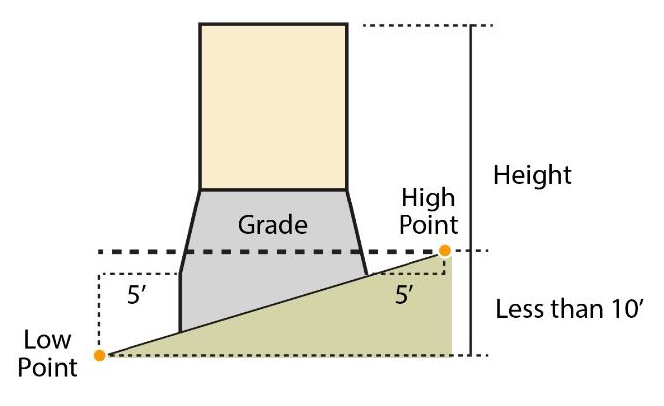
Figure 24-9-1: Sign height — Grade change of ten feet or less.
2.
An elevation ten feet higher than the lowest ground surface within a five-foot horizontal distance from the leading edge of the sign, when there is greater than a ten-foot difference between the highest and lowest ground surface within a five-foot horizontal distance from said sign.
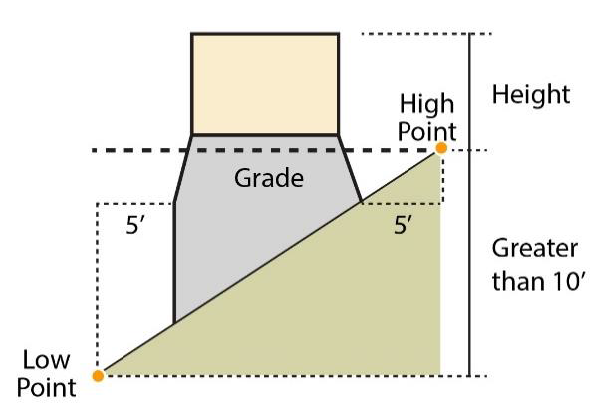
Figure 24-9-2: Sign height — Grade change more than ten feet.
c.
Orientation. The principal orientation of any sign shall be determined by the director in accordance with the intent and standards of this chapter, street classification, and the following:
1.
The orientation of a freestanding sign is to the nearest public right-of-way to which it is perpendicular or parallel;
2.
The orientation of a wall sign is to the nearest street with the highest traffic volume;
3.
The orientation of a projecting wall sign is to the nearest street with the highest traffic volume and to which the sign is most nearly perpendicular;
4.
The orientation of all other signs, including canopy signs, shall be to the nearest public right-of-way.
d.
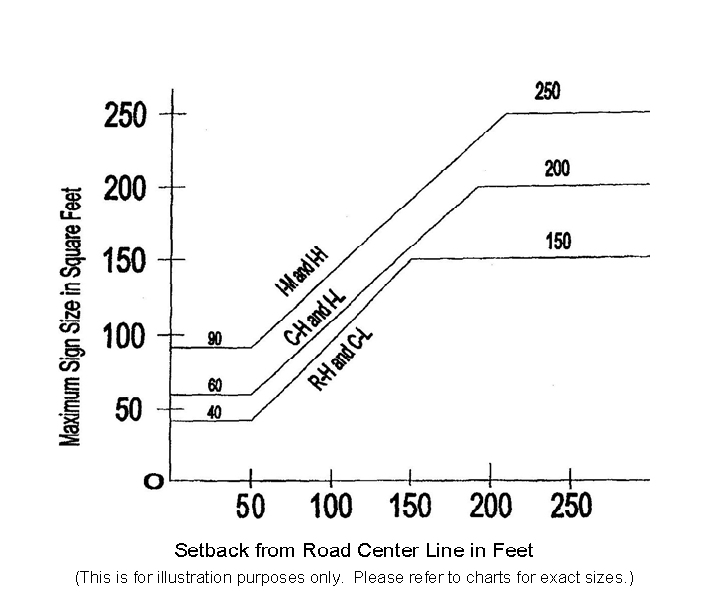
Sign setbacks. Sign setbacks are the minimum distance required between the apparent centerline of the right-of-way and any portion of a sign or sign structure. Where the property is adjacent to a frontage road, the centerline of the highway to the leading edge of the sign is used to determine setback (i.e., frontage road is disregarded for calculation of the setback).
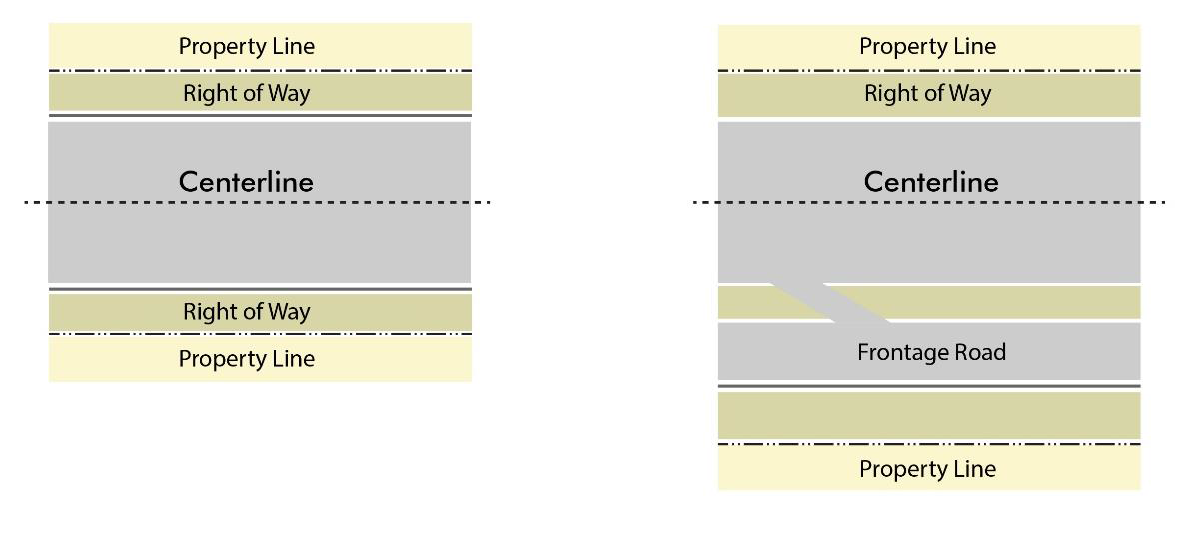
Figure 24-9-3: Sign setbacks from centerline.
(Ord. No. 36, 2021, § 4(app. A, § 4), 9-21-2021)
_____
Sec. 24-909. - Relief from standards.
a.
Alternative compliance. Conditions may exist where strict compliance is impractical or impossible, or where maximum achievement of the intent of this chapter can only be obtained through alternative compliance. Alternative compliance to the sign standards in this chapter shall be authorized according to the process and criteria in section 24-208, and are supplemented by this section.
1.
Requests for alternative compliance may be accepted in association with a sign permit, based on one or more of the following criteria:
(a)
Topography, soil, vegetation, or other site conditions are such that full compliance is impossible or impractical, or improved environmental quality would result from alternative compliance.
(b)
Space limitations, unusually shaped lots, and prevailing practices in the surrounding neighborhood may justify alternative compliance for infill sites and for improvements and redevelopment in older neighborhoods.
(c)
Safety considerations make alternative compliance necessary.
(d)
The proposed alternative is aesthetically more complementary to the site, better fits into the context of the area, improves the overall architectural appeal of the area and/or meets or exceeds the design objectives as described in the city's comprehensive plan. Where there is a strong architectural theme established in an area, the proposed alternative shall be consistent with or complementary to that theme. In an existing area where there is no established theme, the proposed alternative shall provide an architectural theme consistent with the comprehensive plan and improve the quality of development in the area.
2.
Application for alternative compliance shall include the following information:
(a)
Written description of the conditions provided in section 24-909.a.1 above, which apply to the subject property;
(b)
The applicant shall submit a sign plan consisting of a written statement addressing the proposal and the review criteria of this section and section 24-208, along with dimensioned graphic plans identifying the following items for all signs on the property:
(1)
Written and graphic illustration of the proposed alternative, including areas of departure from code standards;
(2)
Sign style, type, location, size (area), and height for wall and freestanding signs;
(3)
Materials and colors for all signs and support structures;
(4)
Sign illumination devices and brightness levels, if applicable.
b.
Variance. Variances to the dimensional standards established in this chapter shall be authorized according to the process and criteria in section 24-209, and are supplemented by this section. Variances to any other provision of this chapter shall not be permitted.
1.
In addition to the criteria in section 24-209, the zoning board of appeals shall consider the following additional factors for sign variances:
(a)
Historic value as determined by the historical preservation commission;
(b)
Architectural integrity.
2.
Sign variances shall not be transferable to a new location on the property unless first approved in writing by the director that the changed location on the site substantially complies with the conditions of the original variance. Changes to a sign that received a variance, with the exception of changes in sign text or copy that do not result in any structural changes to the sign, shall require compliance with all applicable provisions of this code.
3.
Any sign variance which was in effect and applied to an installed sign still in place prior to the adoption of this code may be continued under the provisions of that variance until a change to a sign is requested, at which time a new variance shall be applied for, or the sign shall comply with all applicable provisions of this chapter.
(Ord. No. 36, 2021, § 4(app. A, § 4), 9-21-2021)
Sec. 24-910. - Sign chart.
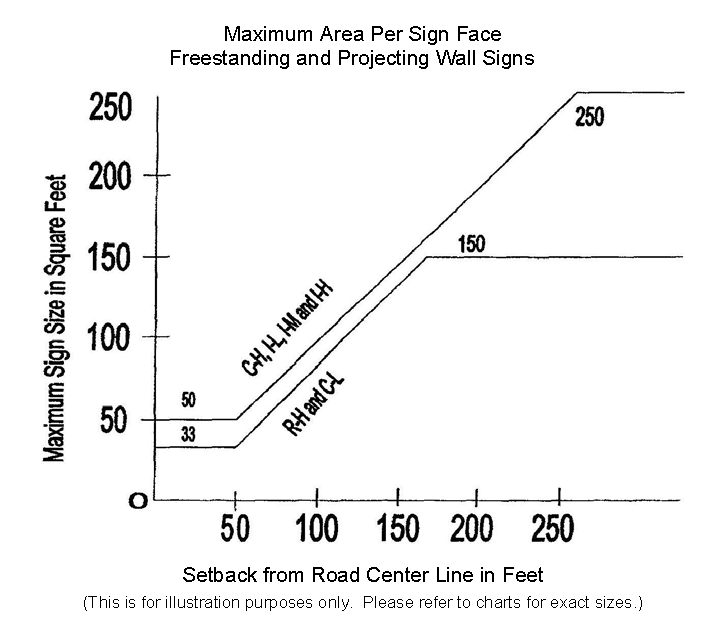
Secs. 24-911—24-1000. - Reserved.
_____

