
Greenville City Zoning Code
ARTICLE 19
2. - ADMINISTRATION ARCHIVED
Sec. 19-2.1. - Administrative and decision-making bodies.
19-2.1.1.
City council.
(A)
Powers and duties. Pursuant to the S.C. Code of Laws, the city council shall have the following powers and duties under this chapter:
(1)
Approval of the comprehensive plan. To adopt a comprehensive plan, or plan elements, pursuant to S.C. Code 1976, § 6-29-510 et seq.
(2)
Amendments to text and zoning district map. To review and decide:
(a)
Text amendments. Applications to amend the text of this chapter (text amendment) (subsection 19-2.3.2).
(b)
Zoning district map amendments (rezoning). Applications to amend the zoning district map (subsection 19-2.3.2).
(3)
Planned development district (PD) classification. To review and decide on applications for PD plans and amendments to the zoning district map for a planned development (PD).
(4)
Approval of design guidelines. To approve by resolution design guidelines for each preservation overlay (PO) district and the C-4 central business district that are recommended by the design review panels (subsection 19-2.1.4).
(5)
Approval of revitalization master plans. To approve by resolution land use plans and design guidelines for each neighborhood revitalization area concurrent with the establishment of an NRO district.
(6)
Authorization to encroach into the public right-of-way. To authorize by resolution the surface encroachment by any structure into the public right-of-way pursuant to section 36-15 of the Greenville Code of Ordinances.
(7)
Other. To take any other action not delegated to the planning commission, board of zoning appeals, design review panels, the administrator, or heads of city departments as the city council may deem desirable and necessary to implement the provisions of this chapter.
(8)
Approval to annex properties into the corporate limits. To review and decide on applications for annexation of properties into the corporate limits of the city pursuant to S.C. Code 1976, § 5-3-10 et seq. and the administrative manual.
19-2.1.2.
Planning commission.
(A)
Powers and duties. The planning commission shall have the following powers and duties under this chapter:
(1)
Preparation of the comprehensive plan. To initiate, develop, and maintain a comprehensive plan pursuant to S.C. Code 1976, § 6-29-510 et seq.
(2)
Amendments to text and zoning district map. To initiate, review and make recommendations to the city council to approve, approve with conditions, or disapprove:
(a)
Text amendments. Applications to amend the text of this chapter (text amendment) (subsection 19-2.3.2).
(b)
Zoning district map amendments (rezoning). Applications to amend the zoning district map (subsection 19-2.3.2).
(3)
Planned development. To review and make recommendations to the city council on PD plans and amendments to the zoning district map to a planned development (PD) district (subsection 19-2.3.3).
(4)
Design and specifications manual. To review and approve the design and specifications manual for the administration of the development and design standards (article 19-6).
(5)
Preliminary plats for subdivision. To review and decide preliminary plats for subdivision (subsection 19-2.3.13(A)(5)).
(6)
Minor subdivisions. To hear and decide appeals from decisions of the administrator on minor plats for subdivision (subsection 19-2.3.13(A)(4)).
(7)
Street name changes. To review and decide street name changes (subsection 19-2.3.13(C)).
(8)
Appeals. To hear and decide appeals taken by a party in interest to a decision or interpretation of the administrator, as related to sections 19-6.7 through 19-6.10, or the design and specifications manual.
(9)
Other powers and duties. To carry out those powers and duties as provided in section 2-372.
(10)
Annexation of properties into the corporate limits. To review and make recommendations to the city council on proposals for properties to be annexed into the corporate limits pursuant to S.C. Code 1976, § 5-3-10 et seq., and the administrative manual.
(11)
Multifamily residential development. To review and decide applications for multifamily residential development (subsection 19-2.3.13(D)).
(B)
Membership; number. The planning commission shall consist of seven residents of the city, appointed by city council. Terms of office shall be four years. Terms shall be staggered. No member shall serve more than eight consecutive years.
(C)
Planning commission procedures. All procedures of the planning commission shall comply with the provisions of sections 2-333 and 2-371 through 2-375.
19-2.1.3.
Board of zoning appeals.
(A)
Powers and duties. The board of zoning appeals shall have the following powers and duties under this chapter:
(1)
Special exceptions. To review and decide special exception permits specifically authorized under this chapter (subsection 19-2.3.5).
(2)
Variance permits. To review and decide applications for variance permits (section 19-2.3.7).
(3)
Appeals. To hear and decide appeals taken by any person aggrieved by a decision or interpretation of the administrator, as related to this chapter, other than sections 19-6.7 through 19-6.10 (subsection 19-2.3.16); and to hear appeals from decision of the city engineer as provided in section 19-4.3.2(G).
(B)
Membership. The board of zoning appeals shall consist of seven residents of the city, appointed by city council. Terms of office shall be three years. Terms shall be staggered. No member shall serve more than two consecutive full terms, nor more than eight consecutive years.
(C)
Board of zoning appeals procedures. All procedures of the zoning board of appeals shall comply with the provisions of section 2-333.
19-2.1.4.
Design review board.
(A)
Membership.
(1)
Number, chairperson, and assignment of members. There shall be a design review board consisting of a total of ten members, divided between two design review panels: the neighborhood design panel and the urban design panel. Each design review panel (DRP) shall consist of five members, and each shall have the jurisdiction and duties of a "board of architectural review" as provided in S.C. Code Sections 6-29-870 through 6-29-940 as from time to time amended. Each design review panel shall elect a chair and vice-chair. Council in exercising its appointment powers, shall thereupon designate the members to serve on the respective panels. Any member on one panel may serve as alternate member of the other panel, when a regular member is not available for service. The purpose of providing members of one panel being authorized to serve ex officio and to vote on the other panel is to maximize the qualified talent available for service whenever panel members have absences or conflicts. Terms of office for members shall be two years. Terms shall be staggered.
(2)
Qualifications. At least two members of each panel shall be from the planning or design professions, with one member of the neighborhood design panel having architectural or planning expertise with an interest in preservation. To the extent practical, both panels shall represent a cross section of community interests, and neither shall consist solely of design professionals. However, members shall have experience, training, or demonstrated interest in design, construction, preservation, or planning for buildings, site design, or landscaping.
(B)
Powers and duties.
(1)
Neighborhood design panel. The neighborhood design panel shall have the following powers and duties under this chapter:
(a)
Certificates of appropriateness.
1.
To review and decide based on design guideline criteria, standards, and adopted master plans applications for certificates of appropriateness within preservation overlay (PO) districts with residential character, or for structures listed on the National Register of Historic Places or for designated local landmarks in areas outside of the C-4 district (subsection 19-2.3.8, certificate of appropriateness).
2.
To delegate review of certain types of applications for certificates of appropriateness to the administrator (subsection 19-2.3.8, certificate of appropriateness).
(b)
Unreasonable hardship exemptions. To review and decide applications for unreasonable hardship exemptions in preservation overlay districts with residential character (subsection 19-2.3.8(H), unreasonable hardship exemption).
(c)
Appeals. To hear and decide appeals from the administrator's ruling in matters under the purview of the neighborhood design panel where there is an alleged error in any order, requirement, determination or decision (subsection 19-2.3.16, appeals from the decisions and interpretations of the administrator).
(d)
Preservation overlay districts. To recommend to the city council the establishment, expansion, reduction or elimination of any and all preservation overlay districts (subsection 19-3.2.2(P), preservation overlay district).
(e)
Local landmarks designation. To review and decide applications for local landmark designation.
(f)
Design guidelines. To establish and amend design guidelines for each preservation overlay district with residential character, subject to city council approval by resolution (subsection 19-2.1.1(A)(4), approval of design guidelines).
(g)
Inventory of city's historic resources. To maintain an inventory of residential and nonresidential buildings, structures, objects, sites and districts that comprise the historic resources of the city (subsection 19-2.3.4, preservation overlay districts).
(h)
National register nomination. To conduct the first review and evaluation of all proposed national register nominations within the city in accordance with procedures established by the state historic preservation office, and nominate buildings, structures, sites, objects or districts to the National Register of Historic Places in accordance with the standards set forth by the United States Department of the Interior and the state historic preservation office.
(i)
Advice and assistance.
1.
To provide advice and assistance to land owners and their agents concerning the treatment of the historical and visual characteristics of their properties listed on the National Register of Historic Places and/or located within preservation overlay (PO) districts.
2.
To provide advice and assistance to city council, city staff and other city boards and commissions regarding the appropriateness of development projects, either as requested by the city body or as required by this chapter.
(j)
Education. To engage in educational activities and publish information to further the understanding of historic preservation issues in the city.
(2)
Urban design panel. The urban design panel shall have the following powers and duties under this chapter:
(a)
Certificates of appropriateness.
1.
To review and decide based on design guideline criteria, standards, and adopted master plans applications for certificates of appropriateness within the C-4 zoning district, including any preservation overlay district, or for structures listed on the National Register of Historic Places or for designated local landmarks in areas inside of the C-4 district (subsection 19-2.3.8, certificate of appropriateness).
2.
To delegate review of certain types of applications for certificates of appropriateness to the administrator (subsection 19-2.3.8, certificate of appropriateness).
3.
To review and decide based on design guideline criteria and standards established in section 19-6.6.4 applications for certificates of appropriateness for: freestanding signs exceeding ten feet in height in any district; and sponsorship signs pursuant to subsection 19-6.6.6(E), sponsorship signs.
(b)
Unreasonable hardship exemptions. To review and decide applications for unreasonable hardship exemptions in the C-4 zoning district (subsection 19-2.3.8(H), unreasonable hardship exemption).
(c)
Appeals. To hear and decide appeals from the administrator's rulings in matters under the purview of the urban design panel, and design-related decisions pursuant to section 19-6.6 where there is an alleged error in any order, requirement, determination or decision (subsection 19-2.3.16, appeals from the decisions and interpretations of the administrator).
(d)
Design guidelines. To establish and amend design guidelines for the C-4 district including any preservation overlay district, subject to city council approval by resolution (subsection 19-2.1.1(A)(4), approval of design guidelines).
(e)
Advice and assistance.
1.
To provide advice and assistance to landowners and their agents concerning the use of good urban design practices.
2.
To provide advice and assistance to city council, city staff and other city boards and commissions regarding the appropriateness of development projects, either as requested by the city body or as required by this ordinance.
(f)
Education. To engage in educational activities and publish information to further the understanding of urban design issues in the city.
(C)
Design review board procedures. All procedures of the design review board shall comply with the provisions of section 2-333 of chapter 2 of the Greenville Code of Ordinances.
19-2.1.5.
City staff.
(A)
Administrator.
(1)
General. The administrator shall be the person designated by the city manager to administer and enforce all or portions of the provisions in this chapter, as described in the administrative manual.
(2)
Powers and duties. In addition to the authority and duties that may be conferred on the administrator by general law, the administrator shall have the following powers and duties under this chapter:
(a)
To review and decide applications for conditional use permits (subsection 19-2.3.6).
(b)
To review and decide applications for certificates of appropriateness as authorized by the design review panels (subsection 19-2.3.8(D)(3)).
(c)
To review and decide applications for site plan permits (subsection 19-2.3.9).
(d)
To review and decide applications for sign permits (subsection 19-2.3.10).
(e)
To review and decide applications for temporary use permits (subsection 19-2.3.11).
(f)
To review and decide certificates of zoning compliance (subsection 19-2.3.12).
(g)
To review and decide preliminary and final plats for minor subdivisions (subsection 19-2.3.13(A)(4)).
(h)
To review and decide final plats for major subdivisions (subsection 19-2.3.13(A)(5)).
(i)
To review and decide applications for land disturbance permits (subsection 19-2.3.13(B)).
(j)
To review and decide exceptions on land disturbance permits (subsection 19-2.3.13(B)(11)).
(k)
To review and decide certificates of conformity (subsection 19-2.3.14).
(l)
To initiate amendments to the text of this chapter and to review and prepare a staff report on applications to amend the text of this chapter (subsection 19-2.3.2).
(m)
To initiate amendments to the zoning district map and to review and prepare staff reports on applications to amend the zoning district map (subsection 19-2.3.2).
(n)
To review and prepare staff reports on PD plans, PD agreements, and amendments to the zoning district map for a planned development (PD) district (subsection 19-2.3.3).
(o)
To review and prepare staff reports on preliminary plats for subdivision (subsection 19-2.3.13(A)(5)).
(p)
To render interpretations of this chapter (subsection 19-2.3.15).
(q)
To establish application requirements and schedules for review of applications and appeals, to develop and recommend to the city manager modifications to the administrative manual, and to develop and recommend to the planning commission modifications to the design and specifications manual.
(r)
To review and make recommendations to the city council, planning commission, board of zoning appeals, and design review panels on applications for development approvals, where appropriate, and take any other action necessary to administer the provisions of this chapter.
(s)
To enforce the provisions of this chapter in accordance with article 19-10, enforcement.
(t)
To maintain the official zoning district map and other such records and official materials as relate to the adoption, amendment, enforcement or administration of this chapter.
(u)
To provide expertise and technical assistance to the city council, planning commission, board of zoning appeals and design review panels.
(v)
To submit to the city council and the state historic preservation officer an annual report summarizing the work of the DRP during the previous year.
(B)
City attorney. In addition to the authority and duties that may be conferred upon the city attorney by general law, the city attorney shall have the following powers and duties under this chapter:
(1)
General. To develop, and authorize the use of, forms for the transmittal of written findings of fact, conclusions of law, development approvals and permits, ordinances and other documents drafted by the city departments, city council, planning commission, board of zoning appeals, design review panels, or the administrator in connection with any requirement of this chapter.
(2)
Agreements, easements, performance agreements. To review as to form all development agreements, planned development agreements, easements, declarations of covenants, letters of credit, performance bonds or such other documentation in connection with any requirement of this chapter.
(3)
Counsel. To counsel the city council, planning commission, board of zoning appeals, design review panels, administrator, and city departments in regard to the legal issues that may arise in the review of applications for development approval and the general implementation of this chapter.
(C)
City manager. In addition to the authority and duties that may be conferred upon the city manager by general law, the city manager shall have the following powers and duties under this chapter:
(1)
Administrative manual. To review and approve the administrative manual prepared by the administrator governing the administration of this chapter.
(2)
Schedule of fees. To establish a schedule of fees governing applications for development permits and other approvals reviewed under this chapter.
(3)
Encroachments within public rights-of-way. To permit temporary surface encroachments and air rights encroachments pursuant to section 36-15.
(D)
Technical advisory committee. The technical advisory committee shall be appointed by the city manager to prepare recommendations to the administrator on conditional uses for nightclubs/bars, uses open after midnight, event venues, and other uses having similar characteristics. The committee may also prepare recommendations to the board of zoning appeals regarding special exception permits and appeals for conditional use permits for the uses described above. Representatives from the following agencies shall be appointed to the committee: police, fire, special events, planning, legal, economic development, building codes, business licensing, and other as deemed appropriate by the city manager. The city manager shall appoint the chair.
(E)
City engineer. In addition to the authority and duties that may be conferred upon the city engineer by general law, the city engineer shall have the following powers and duties under this chapter; any reference to the city engineer shall include his/her designee:
(1)
To receive applications for the placement of wireless communications facilities in the public rights-of-way;
(2)
To prescribe, in conjunction with the administrator, regulations implementing the requirements of this chapter with respect to the placement of wireless communications facilities in the public rights-of-way;
(3)
Subject to appeal, to issue decisions on applications for placement of wireless communications facilities in the public rights-of-way, and to grant, deny, or condition such applications as may be appropriate;
(4)
In conjunction with the administrator, to enter into agreements extending the time for action on any application, where extension is permitted under applicable law; and
(5)
To issue approvals for placement of wireless communications facilities in conjunction with the administrator, as provided in this chapter.
(Code 1997, § 19-2.1; Ord. No. 2007-52, § 19-2.1, 7-9-2007; Ord. No. 2008-59, 8-25-2008; Ord. No. 2009-46, § 1(exh. A), 6-8-2009; Ord. No. 2009-99, § 1(exh. 1), 12-14-2009; Ord. No. 2010-48, exh. A, 9-13-2010; Ord. No. 2012-38, 5-14-2012; Ord. No. 2013-66, exh. A(19-2.1), 10-28-2013; Ord. No. 2014-61, 8-11-2014; Ord. No. 2014-62, 8-11-2014; Ord. No. 2017-42, 5-22-2017; Ord. No. 2018-24, 4-9-2018; Ord. No. 2020-15, § Exh. A, 2-10-2020)
Sec. 19-2.2. - Common procedures.
The general provisions of this section shall apply to all applications for development approval and permit requests under this chapter, unless otherwise stated.
19.2.2.1.
Authority to file applications.
(A)
General. Applications submitted under this chapter pursuant to subsection 19-2.2.5, application submission, shall be submitted by the landowner; a person, business, or organization having rights in contract in the land; their authorized agent; the city council; the planning commission; the design review panels; or the administrator.
(B)
Applicant not the owner. If the applicant is not the owner of the land, the owner's name and contact information must be included in the application.
19-2.2.2.
Administrative manual. The administrator shall compile the requirements for application contents, forms, the submission and review schedule (including time frames for review) and fees in an administrative manual. The manual shall be approved by the city manager and shall be made available to the public.
19-2.2.3.
Preapplication conference.
(A)
General. A preapplication conference is desirable prior to submission of any application for development approval under this chapter. A potential applicant may request and receive a preapplication conference with the administrative official conducting the staff review on the application. The purpose of a preapplication conference is to familiarize the applicant with the provisions of this chapter required to permit the proposed development, to inform the applicant about the preparation of the application, and to afford the opportunity for the administrator to become familiar with the applicant's proposal.
(B)
Application conference may be required. If, after the initial review of an application, the administrator determines an application conference is necessary because of the complexity of the review issues, an application conference with the applicant may be required, and the application review shall not be completed until after the conference is concluded. A conference pursuant to this section shall be requested within ten business days after the application is determined sufficient pursuant to subsection 19-2.2.6, determination of sufficiency.
(C)
Application conference in lieu of sufficiency review. An applicant may request an application conference with the administrator in lieu of the sufficiency review period. If the application is determined to be insufficient, the applicant shall be advised of the deficiencies. The applicant may correct the deficiencies and resubmit the application for sufficiency determination. No further action shall be taken by the administrator on the application until the deficiencies are remedied.
(D)
Conditional use permit. Before consideration by the administrator for a conditional use permit for a nightclub/bar, uses open after midnight, event venues and other uses having similar characteristics, an applicant shall meet the technical advisory committee and provide information deemed relevant by the committee in support of the application. The committee shall prepare a recommendation to the administrator.
19-2.2.4.
Neighborhood meetings.
(A)
General. The purpose of the neighborhood meeting is to provide an opportunity for informal communication between applicants, occupants, and owners of nearby properties who may be affected by development proposals; to educate the occupants and owners about the proposed development and application; to receive comments and address concerns about the development proposal; and to resolve conflicts and outstanding issues, where possible.
(B)
Neighborhood meeting encouraged. Where not otherwise mandatory, a neighborhood meeting is strongly encouraged for all applications requiring a public hearing prior to submission of an application, provided the neighborhood meeting is not required under Section 19-2.2.4(C).
(C)
Neighborhood meeting required. Unless a waiver is granted by the administrator, a neighborhood meeting shall be required to be conducted prior to submission of the following applications:
(1)
Map amendment (rezoning), including PD (Planned Development) and FRD (Flexible Review District);
(2)
Major subdivision;
(3)
Special exception for: bed and breakfast inn.
(4)
Multifamily or a Certificate of Appropriateness which includes a multifamily use; or
(5)
Any application requiring a public hearing where the proposed project is commercial or multi-family in nature and abuts an existing single family detached use.
(D)
Notwithstanding the foregoing subsection and only with respect to applications requiring a public hearing, a neighborhood meeting may be required for a public hearing application under one or more of the following scenarios;
(1)
The chairperson of the planning commission, design review board, board of zoning appeals may, during a public hearing, direct an applicant to conduct a neighborhood meeting if it is determined that the application could potentially have negative land use, appearance, traffic, or other public facility impacts on neighboring properties.
(2)
The administrator may require an applicant to conduct a neighborhood meeting prior to a public hearing being scheduled if the administrator determines that:
(a)
One or more property owners are directly abutting the subject property has requested, via standard mail or email, a neighborhood meeting; or
(b)
Owners of 20 percent or more of the parcels within 1,000 feet of the subject property have requested, via standard mail or email, a neighborhood meeting.
(E)
Procedure. If a neighborhood meeting is convened, it should generally comply with the following procedures:
(1)
Time and place. The neighborhood meeting should be held during the hours of 6:00 p.m. to 9:00 p.m., Monday through Friday, at a place that is generally accessible to occupants of property in close proximity to the land subject to the application. Meetings may be held at a time and day different from above at the neighborhood's request. Meetings shall be held at least eight calendar days prior to the scheduled public hearing. Failure to do so may result in delay or denial of the application.
(2)
Notification. The applicant shall provide notification of the neighborhood meeting a minimum of five business days in advance of the meeting by first class mail to: all owners and occupants within 500 feet of the land subject to the application; any neighborhood organization that represents citizens within that area; the planning staff; and the review board. The notification shall state the time and place of the meeting.
(3)
Conduct of meetings. At the neighborhood meeting, the applicant shall explain the development proposal and application; answer questions; and, address the ways in which to resolve the attendees' concerns. Within two days of the meeting, the applicant shall provide the city a list of those in attendance with a summary of the attendee's concerns.
(F)
Exceptions. A neighborhood meeting is not required for the following types of applications:
(1)
Petitions for annexation of property into the corporate limits of the city.
(2)
Zoning map amendments associated with annexation petitions.
19-2.2.5.
Application submission. All applications for permits or development approval established by this chapter shall be submitted to the administrator pursuant to any established application submittal schedule, and in the form established by the administrator along with the fee established pursuant to subsection 19-21(5)(c)2. The administrator shall conduct the staff review on these applications.
19.2.2.6.
Determination of sufficiency.
(A)
Sufficiency review. Upon receipt of an application, the administrator shall determine if it is complete and includes information in sufficient detail to evaluate the application to determine whether it complies with the appropriate substantive requirements of this chapter. A reasonable period of time for conducting this sufficiency review shall be established in the administrative manual.
(B)
Application insufficient. If the application is determined to be insufficient, the applicant shall be notified of the deficiencies. The notice shall be in writing and mailed to the applicant's address as reflected on the application. The applicant may correct the deficiencies and resubmit the application for sufficiency determination. No further action shall be taken by the administrator on the application until the deficiencies are remedied. If the applicant fails to respond to the identified deficiencies within 30 business days, the application shall be considered withdrawn.
(C)
Application sufficient. When the application is determined sufficient, it shall be reviewed pursuant to the procedures and standards of this chapter.
19-2.2.7.
Preparation of staff report. After an application is determined sufficient, the administrator shall refer the application to the appropriate staff and any other review agencies for comment, review the application, and for applications requiring a public hearing, prepare a written staff report. The staff report shall be provided to the applicant and made available to the public within a reasonable amount of time before the scheduled public hearing on the application. The staff report shall include a staff analysis, staff comments, staff recommendation that the reviewing body approve (in whole or in part), approve with conditions, approve with modifications, or disapprove the application, any pertinent issues, comments or concerns raised at neighborhood meeting (if one is held), and any other items of similar context or pertinent for the approving body to take into consideration during deliberations. Conditions for approval may also be recommended to eliminate any areas of noncompliance or to mitigate any adverse effects of the development proposal.
19-2.2.8.
Scheduling public hearings.
(A)
Application to be scheduled for meeting. When an application for development approval is subject to a public hearing (see subsection 19-2.2.9(E), required notice and timing), the administrator shall ensure that the public hearing on the application is scheduled for a regularly scheduled meeting or a meeting specially called for that purpose by the decision-making or advisory body reviewing the application.
(B)
Timing. The public hearing on the application shall be scheduled so there is sufficient time for a staff report to be prepared and for the public notification requirements to be satisfied.
(C)
Public hearings. The city shall conduct one public hearing for all applications for text amendments, amendments to the zoning district map (rezonings), planned development districts, development agreements, special exception permits, variance permits, preliminary plats for subdivision, certificates of appropriateness (except for those delegated to the administrator), local landmark designations, unreasonable hardship exemptions, street name changes, and appeals of a decision or interpretation of the administrator.
19-2.2.9.
Public notification. All applications requiring public hearings shall comply with the S.C. Code of Laws, the provisions listed in table 19-2.2-1, required notice and timing, and the other provisions of this section with regard to public notification.
(A)
Content of mailed and published notice. All mailed and published notices for public hearings shall:
(1)
Identify the application number and the name of the applicant or the applicant's agent.
(2)
Indicate the date, time and place of the public hearing, or indicate the earliest date an administrative decision will be made.
(3)
Describe the site involved by street address or by tax map number (or both) and nearest cross street.
(4)
Identify the current zoning district designation of the site subject to the application.
(5)
Describe the nature, scope and purpose of the application or proposal.
(6)
Indicate the date and hours of availability and describe in which department the application, staff report, and related materials may be inspected by the public.
(7)
Include a statement describing where interested members of the public and adjoining property owners may submit written comments or evidence prior to the public hearing, or an administrative decision.
(8)
Include a statement that interested members of the public and adjoining property owners may appear at the public hearing, be heard, and submit evidence and written comments with respect to the application.
Posted notice may provide a phone number by which the information required above is available.
(B)
Mailed notice. When the provisions of this chapter (see subsection 19-2.2.9(E)) require that written or mailed notice be provided, the administrator shall be responsible for preparing and mailing the written notice. Notice shall be mailed to:
(1)
All property owners of the land subject to the application;
(2)
Surrounding property owners whose address is known by reference to the latest ad valorem tax records:
(a)
For applications subject to a public hearing, all property owners within 500 feet of the land subject to the application; or
(b)
For applications subject to an administrative decision requiring public notice, all property owners within 300 feet of the land subject to the application; and
(3)
Organizations that have registered to receive notice pursuant to subsection 19-2.2.9(F), registration to receive notice by mail or by email. Notice shall be deemed mailed by its deposit in the United States mail, first class, properly addressed, postage paid. The administrator shall certify that notice meeting the content requirements of subsection 19-2.2.9(A), content, was mailed. A copy of the mailed notice shall be maintained in the office of the administrator for public inspection during normal business hours.
(C)
Published notice.
(1)
When the provisions of this chapter require that notice be published, the administrator shall be responsible for preparing the content of the notice and publishing the notice in a newspaper of general circulation in the city. The content and form of the published notice shall be consistent with the requirements of the S.C. Code of Laws.
(2)
The administrator shall prepare a certificate affirming that published notice has occurred pursuant to the requirements of this subsection.
(D)
Posted notice.
(1)
When the provisions of this chapter require that notice be posted on the site subject to the application, notice shall comply with the following requirements:
(a)
Notice shall be posted on signs in a form established by the administrator.
(b)
The signs shall be placed by the applicant on the property that is subject to the application along each public street that abuts or transects the property, at intervals of not more than 500 feet.
(c)
The signs shall be posted in a manner that ensures visibility from public streets.
(2)
The applicant shall sign and provide to the administrator a certificate stating that posted notice has been provided in accordance with the requirements of this subsection. The affidavit shall be submitted to the administrator prior to the public hearing for the subject application.
(3)
The applicant shall ensure that the posted notice is maintained on the property until the completion of the public hearing on the application.
(4)
The signs shall be removed by the applicant within five days after the public hearing on the application.
(E)
Required notice and timing. Unless otherwise expressly provided in the S.C. Code of Laws or this chapter, notice shall be provided as follows:
(F)
Registration to receive notice by mail. Any organization may register with the administrator to receive written notice of applications pursuant to subsection 19-2.2.9(B), mailed notice. To be eligible for registration, the organization shall provide the administrator information in the form required by the administrator to ensure notification can be made to the organization. To continue to receive such notice, an organization shall re-register every two years. A fee to cover the cost of providing such notice may be required. In lieu of receiving written notice, the organization may request to receive an electronic mailing of notice (e-mail).
(G)
Deferral of application. An applicant may request that an advisory or decision-making body's consideration of an application at a public hearing be deferred by submitting a written request for deferral to the administrator.
(1)
Administrative review. The administrator shall consider and decide deferral requests if the public can be notified of the deferral within a reasonable period of time prior to the public hearing at which the application is to be heard. Such notification shall also provide the date of the re-scheduled public hearing at which the application will be considered by the advisory or decision-making body.
(2)
Review board review. If the public cannot be notified of the deferral within a reasonable period of time prior to the public hearing at which the application is to be heard, the request for deferral shall be placed on the public hearing agenda of the advisory or decision-making body on the date the application is to be considered and acted upon by the body.
19-2.2.10.
Withdrawal of application.
(A)
Submission of application. Any request for withdrawal of an application subject to a public hearing shall be submitted in writing to the administrator.
(B)
Prior to notice of public hearing. The administrator shall consider a request for withdrawal if it has been submitted prior to notification of a public hearing pursuant to subsection 19-2.2.9, public notification.
(C)
Subsequent to notice of public hearing. Once notice of a public hearing has occurred pursuant to subsection 19-2.2.9, public notification, the request for withdrawal of the application shall be placed on the public hearing agenda of the advisory or decision-making body on the date the application is to be considered and acted upon by the body.
19-2.2.11.
Examination and copying of application/other documents. Upon the established date of their availability and upon reasonable request and during normal business hours, any person may examine an application, the staff report, and materials submitted in support of, or in opposition to, an application in the office of the administrator. Copies of such materials shall be made available at a reasonable cost.
19-2.2.12.
Modification of application.
(A)
Prior to public hearing. No application requiring a public hearing may be modified after the administrator submits the required notice by publication to the newspaper of general circulation.
(B)
During public hearing. In response to questions or comments by persons appearing at the hearing or to suggestions or recommendations by the reviewing board, the applicant may agree to modify his application, including the plans and specifications submitted. Unless such modifications are so substantial or extensive that the reviewing board cannot reasonably be expected to perceive the nature and impact of the proposed changes without revised plans before it, the reviewing board may approve the application with the stipulation that the permit will not be issued until plans reflecting the agreed-upon changes are submitted and verified by the administrator.
19-2.2.13.
Conditions of approval.
(A)
General. Where the administrator or a reviewing board may, according to the express terms of this chapter, approve a permit or development with conditions, the administrator or such board may impose restrictions and conditions on the approval, the proposed use, and the premises to be developed or used pursuant to such approval as are required to ensure compliance with the general goals and policies of this chapter or with particular standards of this chapter to prevent or minimize adverse effects from the proposed development on surrounding lands.
(B)
Limitations. The restrictions and conditions imposed must be related in both type and scale to the impact that the proposed development would have on the public and surrounding development. All conditions imposed shall be expressly set forth in the permit approval.
(C)
Completing development in phases. A development may be constructed in phases or stages and the provisions of this chapter shall be applied to each phase as if it were the entire development. As part of the application contents, the landowner shall submit plans that clearly show the various phases or stages of the proposed development and the requirements of this chapter that will be satisfied with respect to each phase or stage. In cases when, because of weather conditions or other factors beyond the control of the landowner or when the decision-making body imposes additional requirements upon the landowner, the decision-making body may authorize the landowner to commence the intended use of the property or to occupy any building or to sell any subdivision lots before all of the requirements are fulfilled pursuant to the following:
(1)
Performance bond. A performance bond or other security satisfactory to the decision-making body is furnished;
(2)
Expiration of permit. A condition is imposed establishing an automatic expiration date on the permit, thereby ensuring that the permit recipient's compliance will be reviewed when application for renewal is made;
(3)
Enforcement. The nature of the requirements is such that sufficient assurance of compliance is given by the application of prevailing remedies and penalties cited in article 19-10, enforcement.
19-2.2.14.
Lapse of approval/vested rights.
(A)
General.
(1)
Permits subject to section. Lapse of approval shall occur as provided by this chapter for the following permits: special exception, conditional use, variance, site plan, or major subdivision preliminary plat.
(2)
Phased development. A landowner submitting an application for one of the permits referenced in subsection 19-2.2.14(A)(1) may propose to construct the development in phases. With the decision-making body's approval, the landowner may submit a phased development plan for the entire development which does not satisfy the requirements of a site specific development plan provided the landowner submits for the decision-making body's approval a site specific development plan for each phase in accordance with provisions of the ordinance in effect at the time of vesting.
(3)
Time limit. Lapse shall occur if development authorized by the permit is not commenced or a subsequent permit is not obtained within two years of the date of original granting of the permit (within five years for a conditionally approved phased development plan) or within one year of the date of granting an extension to the permit. If the permit lapses, all development must be suspended until a new permit is granted in accordance with the current procedures and standards established in this chapter. If the landowner exercises the rights authorized by the permit pursuant to the conditions therein, the permit shall run with the land and not be affected by a change in ownership.
(4)
Application for extension. At least 60 days prior to the end of the vesting period, the landowner of real property with a vested right may apply for a one-year extension of a permit pursuant to the procedures and standards established for its original approval. The decision-making body shall approve the application provided that no amendment to this chapter has been adopted that would prohibit approval. The decision-making body shall approve no more than five such annual extensions provided that the landowner requests an extension in the prescribed manner.
(5)
Contents of site specific development plan. All applications for permits under this chapter shall be reviewed by the administrator who shall determine whether the application is complete and includes information in sufficient detail to evaluate whether it complies with the appropriate substantive requirements of this chapter. The decision-making body may impose conditions and restrictions on its approval to ensure compliance with the goals, policies, and standards of this chapter and to prevent or minimize adverse effects from the development on surrounding lands.
(6)
Vested rights attach to real property. A vested right pursuant to this section is not a personal right, but attaches to and runs with the applicable real property. The landowner and all successors to the landowner who secure a vested right pursuant to this section may rely upon and exercise the vested right for its duration subject to applicable federal, state, and city laws adopted to protect public health, safety, and welfare, including, but not limited to, building, fire, plumbing, electrical, and mechanical codes and nonconforming structure and use regulations which do not provide for the grandfathering of the vested right. This section does not preclude judicial determination that a vested right exists pursuant to other statutory provisions. This section does not affect provisions of a development agreement executed pursuant to the South Carolina Local Government Development Agreement Act.
(B)
Conditions and limitations on vested rights. A vested right established by this section and in accordance with the standards and procedures of this chapter is subject to the following conditions and limitations:
(1)
If the decision-making body establishes a vested right for a phased development plan, a site specific development plan shall be required for approval with respect to each phase in accordance with regulations in effect at the time of vesting.
(2)
A vested right established under a conditionally approved site specific development plan or conditionally approved phased development plan may be terminated by the decision-making body upon its determination, following notice and public hearing, that the landowner has failed to meet the terms of the conditional approval.
(3)
A site specific development plan or phased development plan for which a variance, regulation, or special exception is necessary does not confer a vested right until the variance, regulation, or special exception is obtained.
(4)
A vested site specific development plan or vested phased development plan may be amended if approved by the decision-making body pursuant to the provisions of this chapter.
(5)
A validly issued building permit does not expire or is not revoked upon expiration of a vested right, except for public safety reasons or as prescribed by the South Carolina Building Code.
(6)
A vested right to a site specific development plan or phased development plan is subject to revocation by the decision-making body upon its determination, after notice and public hearing, that there was a material misrepresentation by the landowner or substantial noncompliance with the terms and conditions of the original or amended approval.
(7)
A vested site specific development plan or vested phased development plan is subject to later-enacted federal, state, or local laws adopted to protect public health, safety, and welfare, including, but not limited to, building, fire, plumbing, electrical, and mechanical codes and nonconforming structure and use regulations which do not provide for the grandfathering of the vested right. The issuance of a building permit vests the specific construction project authorized by the building permit to the building, fire, plumbing, electrical, and mechanical codes in force at the time of the issuance of the building permit.
(8)
A vested site specific development plan or vested phased development plan is subject to later-enacted governmental overlay zoning that imposes site plan-related requirements but does not affect allowable types, height as it affects density or intensity of uses, or density or intensity of uses.
(9)
Changes in the zoning district designation or the text of this chapter adopted subsequent to the vesting that affect real property does not operate to affect, prevent, or delay development of the real property under a vested site specific development plan or vested phased development plan without consent of the owner.
(10)
If real property having a vested site specific development plan or vested phased development plan is annexed into the city, the city council must determine, after notice and public hearing, in which the landowner is allowed to present evidence, if the vested right is effective after the annexation.
(11)
The decision-making body shall not require a landowner to waive his vested rights as a condition of approval or conditional approval of a site specific development plan or a phased development plan.
19-2.2.15.
Waiver of time limit for disapproved applications.
(A)
General. Whenever any application for which a public hearing is required is disapproved, the same type of application for all or a part of the same site shall not be considered for a period of one year after the date of disapproval unless a waiver of time limit is approved by the decision-making body pursuant to the requirements of this section. Only one request for waiver of time limit may be submitted by the land owner during the one-year period.
(B)
Waiver of time limit.
(1)
Owner or authorized agent. Only the owner of the site or the owner's authorized agent may submit a request for waiver of time limit.
(2)
Initiation. A request may be initiated by the owner or the owner's authorized agent by submitting a request for waiver of time limit to the administrator along with a fee established by the city manager.
(3)
Preparation of staff report and scheduling for meeting. After receipt of a request for waiver of time limit, the administrator shall prepare a staff report on the request (which includes copies of the minutes and vote on the original application) and schedule the matter for the next regularly scheduled meeting of the decision-making body.
(C)
Action. At the meeting for which the request for waiver of time limit is scheduled, the decision-making body shall consider the request, the staff report (including the minutes and vote on the application), other relevant support materials, statements made by the owner or the owner's authorized agent and approve, approve with modifications, or disapprove the request based on the standards in subsection 19-2.2.15(D), standards.
(D)
Standards. The waiver of time limit shall be approved only upon a finding by two-thirds of the membership of the decision-making body that the owner presented substantial evidence that demonstrates:
(1)
There is a substantial change in circumstances relevant to the issues and/or facts considered during review of the application that might reasonably affect the decision-making body's application of the relevant review standards to the development proposed in the application;
(2)
New or additional information is available that was not available at the time of the review that might reasonably affect the decision-making body's application of the relevant review standards to the development proposed;
(3)
A new application is proposed to be submitted that is materially different from the prior application; or
(4)
The final decision on the application was based on a material mistake of fact.
19-2.2.16.
Simultaneous processing of applications. Whenever two or more forms of review and approval are required under this chapter, the applications for those development approvals may, at the request of the applicant and at the option of the administrator, be processed simultaneously, so long as all applicable state and local requirements are satisfied. The decision-making entity may defer action on an application pending the decision of another decision-making entity or it may approve an application subject to conditions designed to ensure compliance with the requirements of this chapter and to protect the integrity of the decision-making entity's decision.
19-2.2.17.
Notification of decision. Within a reasonable period of time after a decision on an application as established in the administrative manual, the administrator shall notify the applicant of the decision by mail. Within a reasonable period of time after the decision, a copy of the decision shall also be made available to the public at the offices of the administrator during normal business hours.
19-2.2.18.
Public hearing procedures. All public hearings for applications held pursuant to this chapter shall comply with the following procedures:
(A)
Conduct of public hearing.
(1)
Burden of proof or persuasion. The burden to demonstrate that an application complies with applicable approval standards of this chapter is on the applicant.
(2)
Rights of all persons. Any person may appear at a public hearing and submit testimony, either individually or as a representative of a person or an organization.
(3)
Exclusion of testimony. The review board conducting the public hearing may exclude testimony that it finds to be irrelevant, immaterial or unduly repetitious.
(4)
Offers of testimony. In the event any evidence is excluded as irrelevant, immaterial or unduly repetitious, the person offering such evidence shall have an opportunity at that hearing to state for the record what the evidence would be, its relevance, and the need for its admission.
(5)
Continuance of public hearing. The board conducting the public hearing may, on its own motion, continue the public hearing to a fixed date, time and place.
(B)
General procedures and findings at public hearing.
(1)
Time. Any review board conducting a hearing shall act in accord with any time limits established in this chapter or the board's bylaws. Action shall be taken as promptly as possible in consideration of the interests of the applicant and the citizens of the city and shall include a statement of a recommendation or decision of approval, approval with modifications, approval with conditions, or disapproval (whichever is appropriate).
(2)
Form of decisions. The form of all decisions as reflected in the minutes of the reviewing board shall include at least the following elements:
(a)
Summary of information. A summary of the information presented before the body.
(b)
Summary of evidence in record. A summary of all evidence submitted into the record.
(c)
Statement of findings. A statement of findings or other factors considered, whichever is appropriate, and a statement of the basis upon which such facts were applied with respect to the relevant review standards, if required by state law.
(d)
Recommendation or decision. A statement of the decision of approval, approval with modifications, approval with conditions, or disapproval (whichever is appropriate).
19-2.2.19.
Modifications of permits. A minor deviation to an approved plan or permit may be approved by the administrator. In making a decision on a minor deviation, the administrator shall identify the facts and standards of this section that permit the approval or disapproval of the minor deviation. A minor deviation shall be limited to technical considerations which could not be reasonably anticipated during the approval process or any other change which has no material effect on the character of the approved development or any of its approved terms or conditions. The minor deviation shall comply with the standards of this chapter, the approved plan, and the original permit.
19-2.2.20.
Administrator review procedures. Review of all applications for approval which can be made by the administrator shall comply with the following procedures:
(A)
General review. After the application is determined sufficient (subsection 19-2.2.6), the administrator shall review and act upon the application.
(B)
Approval. If the administrator determines the application complies with the appropriate review standards, the application shall be approved or approved with conditions.
(C)
Fails to comply.
(1)
Notification and opportunity to submit revised application. If the administrator determines that the application fails to comply with the appropriate review standards, the applicant shall have an opportunity to submit a revised application. At the applicant's request, the administrator shall schedule a meeting with the applicant to discuss the application. The application shall be considered withdrawn if a revised application is not submitted within 30 calendar days from the date that the administrator advises the applicant that the application fails to comply with the review standards.
(2)
Review of re-submitted application. A revised application shall be reviewed by the administrator and approved, approved with modifications, approved with conditions, or disapproved, based on the appropriate review standards.
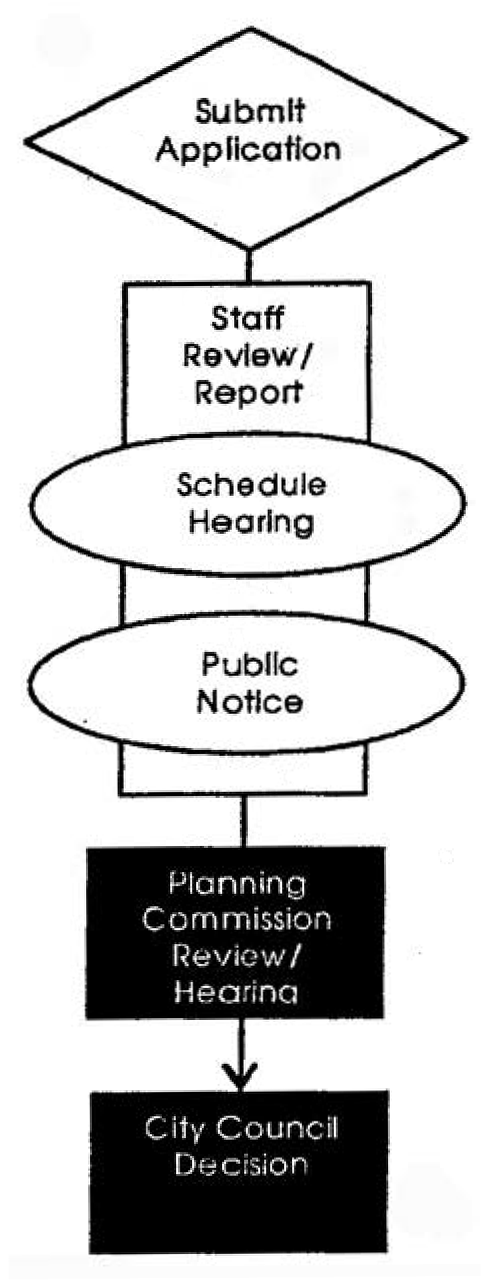
Amendments to Text and Zone District Map
(Code 1997, § 19-2.2; Ord. No. 2009-46, § 1(exh. A), 6-8-2009; Ord. No. 2009-99, § 2(exh. 2), 12-14-2009; Ord. No. 2012-38, 5-14-2012; Ord. No. 2014-62, 8-11-2014; Ord. No. 2014-64, exh.(19-2.2.4), 8-11-2014; Ord. No. 2015-36, 4-27-2015; Ord. No. 2020-15, § Exh. A, 2-10-2020; Ord. No. 2021-60, Exh. A, 8-23-2021; Ord. No. 2022-23, 5-9-2022; Ord. No. 2023-06, 1-23-2023)
Sec. 19-2.3. - Specific standards and other requirements for applications for development approval.
19-2.3.1.
General overview. A summary of the development review procedures for the different types of development approvals and permits in this section is provided in the administrative manual.
19-2.3.2.
Amendments to text and zoning district map.
(A)
Purpose. The purpose of this subsection is to provide a means for amending the text of this chapter or making an amendment to the zoning district map (rezoning).
(B)
Authority. The city council may adopt an ordinance amending the text of this chapter or amending the zoning district map (rezoning) upon compliance with the provisions of this section.
(C)
Initiation.
(1)
Amendment to the text of this chapter. An application to amend the text of this chapter may be initiated by the city council, the planning commission, the administrator, an owner of property in the city, or a citizen of the city.
(2)
Amendment to zoning district map. An application to amend the zoning district map (rezoning) may be initiated by the city council, the planning commission, the administrator, or by a person or entity who may submit applications pursuant to subsection 19-2.2.1, authority to file applications.
(D)
Procedures.
(1)
Application review, notification and scheduling hearing. The procedures and requirements for submission and review of an application, public notification, and scheduling the public hearing are established in section 19-2.2, common procedures. Prior to the preparation of the staff report, city staff may make recommendations to the administrator to include in the staff report.
(2)
Review and recommendation by planning commission. On the date of the referral of the application from the administrator, the planning commission shall conduct a public hearing on the application pursuant to subsection 19-2.2.18, public hearing procedures. At the public hearing, the planning commission shall consider the application, the relevant support materials, the staff report, the evidence presented at the hearing, and make a report to the city council recommending to approve, disapprove, or modify the application based on the standards in subsection 19-2.3.2(E), standards. If the planning commission fails to forward the report to city council within 30 calendar days from the date of referral (date of public hearing), the application is deemed to have been recommended for approval. Upon request or consent of the applicant, the planning commission may defer action on the application to a fixed date, time, and place.
(3)
Review and action by city council. After receipt of the report from the planning commission, the city council may receive public comments in addition to those provided at the public hearing. At the public meeting, the city council shall consider the application, the relevant support materials, the staff report, the report of the planning commission, and any testimony or other evidence submitted to the planning commission or to the city council. In its discretion, the city council may refer the matter to the planning commission for further study and recommendation on specific issues and for a supplemental report to be submitted to the city council within 65 days. If the referral requires additional public notification, it shall be given in accordance with subsection 19-2.2.9. The city council shall either adopt an ordinance amending the text of this chapter or the zoning district map (whichever is appropriate) or disapprove the application, based on the standards of subsection 19-2.3.2)(e), standards.
(4)
Two-thirds majority required in some circumstances. In the event the Planning Commission recommends denial of an application, in order for Council to adopt an ordinance amending the text of this chapter or the zoning district map (whichever is appropriate) as requested in the application, a favorable vote of two-thirds (2/3) of all City Council members is required.
(5)
District classification of annexed land.
(a)
Petition. When property is annexed into the corporate limits of the city by petition, the petitioner shall request the annexation to be accomplished prior to or simultaneously with the zoning. According to the request made, the petition shall then be acted upon in one of the two following procedures:
(1)
If the petitioner chooses to have the annexation considered prior to and separately from the zoning, then there shall be two ordinances. The first shall address annexation only. No zoning application shall be required prior to the passage of the annexation ordinance. Upon passage of the annexation ordinance, the uses and structures of the annexed property shall be subject to the city zoning district classification most analogous to the county zoning classification for the property in effect at the time of the annexation. The appropriate classification shall be determined by the city administrator after making a finding on the actual use of the property and the county zoning classification, and after comparing the applicable provisions of the county zoning classification with comparable ones in the city zoning ordinance. Within ten days of passage of the annexation ordinance, the property owner shall file to amend the city's zoning map to include the annexed property and apply for a zoning classification for the property. A filing fee shall not be charged for this application. If the property owner does not file within that time period, the administrator shall file to amend the zoning map and apply for appropriate zoning classification for the property. The zoning application will be processed pursuant to this section.
(2)
If the petitioner chooses to have annexation and zoning of the property considered at the same time, then the petitioner shall apply for a zoning designation at the same time the annexation petition is filed. The zoning application will be processed pursuant to this section and assessment of the merits of annexation will be considered by the planning commission and city council when the zoning application is considered. If annexation is approved, then the city council shall specify the zoning district classification to become effective upon the effective date of the annexation.
(3)
Whenever any person has chosen to pursue annexation and zoning of property under either subsection 19-2.3.2(D)(4)(a) or (b) the person having submitted the annexation petition may select the other approach prior to second reading of the annexation ordinance, provided all requirements of the approach thereby selected are then followed.
(b)
Referendum. When annexation is accomplished by special election or referendum, the annexed area shall be designated R-9 until further action by city council under this section. Upon passage of the annexation ordinance, the administrator shall file a zoning application for the area annexed, with the requested zoning classification being the city classification most analogous to the county classification applicable to the property at the time of its annexation. The owner of property may apply for a different zoning classification for the owner's property within 15 days of passage of the annexation ordinance without being charged an application fee.
(E)
Standards.
(1)
Text amendments. In determining whether to adopt or disapprove a proposed amendment, the city council should consider and weight the relevance of the following factors:
(a)
Consistent with comprehensive plan. Whether, and the extent to which, the proposed amendment is consistent with the comprehensive plan.
(b)
Consistent with chapter. Whether, and the extent to which, the proposed amendment is consistent with the provisions of this chapter and related city regulations.
(c)
Changed conditions. Whether, and the extent to which, there are changed conditions from the conditions prevailing at the time that the original text was adopted.
(d)
Community need. Whether, and the extent to which, the proposed amendment addresses a demonstrated community need.
(e)
Compatible with surrounding uses. Whether, and the extent to which, the proposed amendment is consistent with the purpose and intent of the zoning districts in this chapter, will promote compatibility among uses, and will promote efficient and responsible development within the city.
(f)
Development patterns. Whether, and the extent to which, the proposed amendment will result in a logical and orderly development pattern.
(g)
Effect on natural environment. Whether, and the extent to which, the proposed amendment will result in beneficial impacts on the natural environment and its ecology, including, but not limited to, water, air, noise, stormwater management, wildlife, vegetation, and wetlands.
(h)
Public facilities and services. Whether, and the extent to which, the proposed amendment will result in development that is adequately served by public facilities and services (roads, potable water, sewerage, schools, parks, police, fire, and emergency medical facilities).
(2)
Amendments to zoning district map. In considering a rezoning, the city council may adopt a change for only part of the area requested or for a less intense zoning district than requested by the applicant, or both. If the city council chooses to consider rezoning an area larger than requested or a more intense zoning district, the matter shall be referred to the planning commission for public hearing and recommendation consistent with the provisions of this chapter. In determining whether to adopt or disapprove the proposed amendment, the city council may consider and weight the relevance of the following factors:
(a)
Consistent with comprehensive plan. Whether, and the extent to which, the proposed amendment is consistent with the comprehensive plan.
(b)
Changed conditions. Whether, and the extent to which, there are changed conditions from the conditions prevailing at the time that the original designation was adopted.
(c)
Community need. Whether, and the extent to which, the proposed amendment addresses a demonstrated community need.
(d)
Compatible with surrounding uses. Whether, and the extent to which, the proposed amendment is compatible with existing and proposed uses surrounding the subject land and is the appropriate zoning district for the land.
(e)
Development patterns. Whether, and the extent to which, the proposed amendment will promote a logical and orderly development pattern.
(f)
Strip or ribbon commercial development. Whether, and the extent to which, the proposed amendment will result in undesirable strip or ribbon commercial development.
(g)
Isolated zoning district. Whether, and the extent to which, the proposed amendment will result in the creation of an inappropriately isolated zoning district unrelated to adjacent and surrounding zoning districts.
(h)
Property values. Whether, and the extent to which, the proposed amendment will result in significant adverse impacts on the property values of surrounding lands.
(i)
Effect on natural environment. Whether, and the extent to which, the proposed amendment will result in detrimental impacts on the natural environment and its ecology, including, but not limited to, water, air, noise, stormwater management, wildlife, vegetation, and wetlands.
(j)
Public facilities and services. Whether, and the extent to which, the proposed amendment will result in development that is adequately served by public facilities and services (roads, potable water, sewerage, schools, parks, police, fire, and emergency medical facilities).
19-2.3.3.
Planned development district.
(A)
General. This subsection establishes the procedures for review of the city's planned development (PD) zoning district.
(B)
Location. A PD zoning district classification may be established on any land that complies with all of the applicable standards of this section.
(C)
Unified ownership or control. The title to all land that is part of a PD zoning district classification shall be controlled by one person at the time of application and approval. A person shall be considered to control all lands either through ownership or by written consent of all owners.
(D)
PD zoning district classification, PD regulating plan, and statement of intent.
(1)
Procedure. Designation of a PD zoning district shall constitute an amendment to the zoning district map and text and follow the procedures established in subsection 19-2.3.2. Prior to the public hearing by the planning commission, the proposed PD shall be presented to the design review board, for advice and comments regarding the appropriateness of the design. The PD zoning district shall be controlled by a PD regulating plan and statement of intent as established in this section.
(2)
Standards. A PD zoning district classification, PD regulating plan, and statement of intent shall comply with the standards in subsection 19-3.2.2(N), PD district.
(3)
Conditions of approval. In approving a PD regulating plan and PD zoning district classification, the city council may impose appropriate conditions on the approval pursuant to subsection 19-2.2.13, conditions of approval.
(4)
Expiration. The approval of the adopting ordinance for a PD zoning district classification, the PD regulating plan and statement of intent may prescribe a time limit within which a final development plan must be submitted for approval, consistent with the provisions of subsection 19-2.2.14. Such time period shall not be extended with transfer of ownership.
(5)
Minor deviations. A minor deviation to a PD regulating plan may be approved by the administrator. In making a decision on a minor deviation, the administrator shall identify the facts and standards of this section that permit the approval or disapproval of the minor deviation. A minor deviation shall be limited to technical considerations which could not reasonably be anticipated during the approval process or any other change which has no material effect on the character of the approved PD or any of its approved terms or conditions. The minor deviation shall comply with the standards of this chapter, the PD regulating plan, and the statement of intent.
(6)
Major deviations. A major deviation to a PD regulating plan which would significantly alter the basic concept and general characteristics of the PD shall constitute an amendment of the PD and require approval by the city council in accordance with the amendment procedures established in article 19-2.3.2 of this ordinance. Examples of major changes may include, but are not limited to the following:
a)
Boundary changes.
b)
Increase in height or density.
c)
Change in vehicular access or circulation.
d)
Changes to less restrictive land uses, e.g. residential to commercial.
e)
Any change which the Administrator determines would significantly alter the basic concept and general characteristics of the PD.
(E)
Final development plan.
(1)
Procedure. The administrator shall review and take action for approval of the final development plan consistent with the provisions of section 19-2.2.
(2)
Standards. The final development plan shall be approved if it is in substantial conformance with the PD regulating plan, the statement of intent and all relevant standards in article 19-6, development and design standards, and the design and specification manual.
(3)
Conditions of approval. In approving a final development plan, the administrator may impose conditions pursuant to subsection 19-2.2.13, conditions of approval.
(4)
Effect. Approval of a final development plan shall constitute recognition by the city that the landowner may proceed to develop the land subject to the final PD plan when all other relevant permit approvals under this chapter and other municipal regulations are granted.
(5)
Amendments. A final development plan may be amended only in accordance with the procedures and standards for its original approval.
19-2.3.4.
Preservation overlay districts. The city council may designate one or more areas as preservation overlay (PO) districts upon receipt of a recommendation from the design review panels (DRP) and the planning commission.
(A)
Common procedures.
(1)
Initiation and determination of eligibility.
(a)
Requests to establish or modify PO districts may originate with the city council, the DRP, the planning commission, the administrator, any interested citizen, or citizen group and shall be presented to the DRP for consideration.
(b)
The DRP shall conduct a preliminary consideration of the eligibility of the proposed area based on the standards set forth in subsection 19.2.3.4(B). The DRP may conduct informal meetings with residents and property owners of the community, seek the advice of preservation professionals and historians, and conduct or receive any preliminary research or studies to assist with its decision regarding eligibility.
(2)
Preparation of a plan.
(a)
If the DRP determines that the general area is eligible to become a PO district, it shall notify the property owners in the proposed area by first class mail that an informational meeting will be conducted and that a task force will be formed to assist the DRP in preparing a preservation plan for the proposed PO district. The DRP shall appoint a task force comprised of individuals representing various interests in the proposed area and members of the DRP. The administrator shall serve on the task force.
(b)
The preservation plan shall detail the boundaries of the district, document the history and significance of the area, provide photographs of properties within the area, and present proposed design guidelines for new construction, demolition, removal in whole or part of structures, and alteration of the exterior appearance of buildings and structures.
(c)
The DRP shall make available the proposed preservation plan to all interested persons, including all property owners as reflected in the current county ad valorem tax records.
(d)
The DRP shall review the proposed preservation plan, including the proposed boundaries and design guidelines, and shall then vote whether to recommend that the area be designated as a PO district.
(3)
Establishment of PO districts.
(a)
The administrator shall forward the application and the DRP's recommendation to the planning commission for an amendment to include the proposed district on the zoning map. The application shall then be processed according to the procedures set forth in subsection 19-2.3.2, amendments to text and zoning district map.
(b)
The city council shall designate each proposed PO district by separate ordinance that shall include a map defining the overlay boundaries and a preservation plan that shall establish standards and conditions for future development in the district consistent with the purposes of the plan.
(4)
Amendments. An established PO district may be modified by adding or subtracting more than five parcels or may be dissolved only in accordance with procedures and standards for its original approval. Proposals to add fewer than five parcels to an established PO district may be processed administratively by the administrator.
(B)
Eligibility criteria. Areas meeting the following minimum criteria may be considered for PO designation, if properties in the areas:
(1)
Represent the work of noteworthy architects or builders, possess high artistic value, or represent a type, period or method of construction;
(2)
Include a site of a significant historical event;
(3)
Are associated with a person who contributed to the culture and development of the community, state or nation;
(4)
Taken as a whole, the properties embody distinguishing characteristics of a type, style, period or specimen in architecture or engineering; or
(5)
Have been designated a historic district in the National Register of Historic Places.
19-2.3.5.
Special exception permit.
(A)
Purpose. Special exceptions are uses that may be generally compatible with the other uses permitted in a zoning district but require individual review of their location, design, configuration, density, and intensity of use and may require the imposition of conditions to ensure the appropriateness of the use at a particular location.
(B)
Authority. The board of zoning appeals is authorized to review and decide on an application for a special exception permit pursuant to this subsection.
(1)
Uses authorized in zoning district. Only those uses identified as special exceptions in subsection 19-4.1.2, table of uses, are authorized to be considered as special exceptions under this section. The designation of a use as a special exception does not constitute an authorization that such use shall be approved as a special exception permit pursuant to this section. Rather, each proposed special exception shall be evaluated by the board of zoning appeals for compliance with the standards set forth in this section and the applicable standards for the use in section 19-4.3, use specific standards (if appropriate).
(2)
Change in nonconforming use. A nonconforming use that is proposed to be changed to another nonconforming use may also be considered for a special exception permit under this section. Any proposed change from one nonconforming use to another shall not be approved as a special exception permit unless it complies with the standards of this section.
(3)
Electronic message boards in residential districts. A sign in a residentially-zoned district that will include an electronic message board may be considered for a special exception permit under this section. Any proposed sign located in a residential district and includes an electronic message board shall not be approved as a special exception permit unless it complies with the standards of this section.
(C)
Procedure.
(1)
Application review, public notification and scheduling hearing. The procedures and requirements for submission and review of an application, public notification, and scheduling the public hearing is established in section 19-2.2, common procedures.
(2)
Review and action by board of zoning appeals. The board of zoning appeals shall conduct a public hearing on the application pursuant to subsection 19-2.2.18, public hearing procedures. At the public hearing, the board of zoning appeals shall consider the application, the relevant support materials, the staff report, the report of the technical advisory committee, and the evidence presented at the hearing. After the close of the public hearing, the board of zoning appeals shall approve, approve with modifications, approve with conditions, or disapprove the application based on the standards in subsection 19-2.3.5(D), standards.
(D)
Standards. A special exception permit shall be approved only upon a finding that the applicant demonstrates all of the following standards are met:
(1)
Special exception. For a use identified as a special exception in subsection 19-4.1.2, table of uses:
(a)
Consistent with the comprehensive plan. The proposed special exception is consistent with the comprehensive plan.
(b)
Complies with use specific standards. The proposed special exception complies with all standards in section 19-4.3, use specific standards.
(c)
Compatibility. The proposed special exception is appropriate for its location and compatible with the character of surrounding lands and the uses permitted in the zoning districts of surrounding lands, and will not reduce property values of surrounding lands.
(d)
Design does not have substantial adverse impact. The design of the proposed special exception minimizes adverse effects, including visual impacts of the proposed use on adjacent lands; furthermore, the proposed special exception does not impose significant adverse impact on surrounding lands regarding service delivery, parking and loading, odors, noise, glare, vibration, and does not create a nuisance.
(2)
Change in nonconforming use. A special exception permit that allows a person to convert an existing nonconforming use to another nonconforming use may be approved on a finding that the applicant demonstrates the following standards are met:
(a)
More or similar in character. The new nonconforming use is more in character with, or equal to, the uses permitted in the zoning district than the existing or prior nonconforming use.
(b)
Not substantially injure neighboring property. The new nonconforming use will not substantially and permanently injure the use of the neighboring property for those uses permitted in the zoning district.
(c)
Facilities and services. There is adequate infrastructure capacity available to serve the proposed special exception.
(d)
Use is permissible elsewhere. The use requested is one that is permissible in some zoning district pursuant to one of the permits referenced in this chapter.
(E)
Conditions of approval. In approving a special exception permit, the board of zoning appeals may impose conditions on the permit approval pursuant to subsection 19-2.2.13, conditions of approval.
(F)
Appeal. A person having a substantial interest affected by a decision of the board of zoning appeals may appeal from the decision of the board to the circuit court of the county by filing with the clerk of the court a petition setting forth plainly, fully, and distinctly why the decision is contrary to law. The appeal shall be filed within 30 days after the written decision of the board is mailed.
(G)
Recordation. The board of zoning appeals may require the applicant to record the special exception permit with the country register of deeds. The applicant shall submit proof of recordation to the administrator within 30 calendar days of the mailing of the written decision or the permit shall automatically and immediately be rendered invalid. The special exception permit shall be binding upon the landowners, their successors and assigns.
(H)
Inspection. Upon completion of the development authorized by the permit, the applicant shall contact the administrator to inspect and verify compliance with the provisions of this chapter and the conditions of the permit.
(I)
Effect. Issuance of a special exception permit shall authorize only the particular special exception that is approved in the permit. Unless limited by a condition of approval, a special exception permit, including any conditions, shall run with the land and shall not be affected by a change in ownership.
(J)
Expiration. The board of zoning appeals may prescribe a time limit within which the activity authorized by the permit shall begin or be completed, or both, consistent with the provisions of subsection 9-2.2.14.
(K)
Amendments. A special exception permit may be amended, extended or modified only in accordance with the procedures and standards established for its original approval.
19-2.3.6.
Conditional use permit.
(A)
Purpose. Conditional uses are uses that are generally compatible with the other uses permitted in a zoning district, but require individual review of their location, design, configuration, and density and intensity of use, and usually require the imposition of conditions to ensure the appropriateness of the use at a particular location.
(B)
Authority.
(1)
General. The administrator is authorized to review and decide on an application for a conditional use permit pursuant to this section.
(2)
Uses authorized. Only those uses identified as conditional uses in subsection 19-4.1.2, table of uses, are authorized to be considered for conditional use permits under this section. The designation of a use as a conditional use in subsection 19-4.1.2, table of uses, does not constitute authorization that such use shall be approved as a conditional use permit pursuant to this section. Rather, each proposed conditional use shall be evaluated by the administrator for compliance with the standards set forth in this section, and the standards for the use in section 19-4.3, use specific standards.
(C)
Procedure.
(1)
Initial submission of application and staff review. The procedures and requirements for submission and review of an application are established in section 19-2.2, common procedures.
(2)
Review and action by administrator. The administrator shall review and take action on the application consistent with the procedures and requirements of subsection 19-2.2.20, administrator review procedures.
(D)
Standards. A conditional use permit shall be approved only upon a finding that the applicant has demonstrated all of the following standards are met:
(1)
Complies with use specific regulations. The proposal must comply with the goals, policies, and standards of this chapter and, in particular, with the standards in section 19-4.3, use specific standards.
(2)
Facilities and services. There is adequate infrastructure capacity available to serve the proposed conditional use (roads, potable water, sewerage, schools, parks, police, fire, and emergency medical facilities).
(E)
Conditions of approval. In approving a conditional use permit, the administrator may impose conditions on the permit approval pursuant to subsection 19-2.2.13, conditions of approval.
(F)
Inspection. Upon completion of the development authorized by the permit, the applicant shall contact the administrator to inspect and verify compliance with the provisions of the ordinance and the conditions of the permit.
(G)
Effect. Issuance of a conditional use permit shall authorize only the particular conditional use that is approved in the permit. Unless limited by a condition of approval, a conditional use permit, including any conditions, shall run with the land and not be affected by a change in ownership.
(H)
Expiration. The administrator may prescribe a time limit within which the activity authorized by the permit shall begin or be completed, or both, consistent with the provisions of subsection 19-2.2.14.
(I)
Appeal. An applicant may appeal the decision of the administrator with respect to the issuance of a conditional use permit pursuant to the provisions of subsection 19-2.3.16.
(J)
Amendment. A conditional use permit may be amended, extended or modified only in accordance with the procedures and standards established for its original approval.
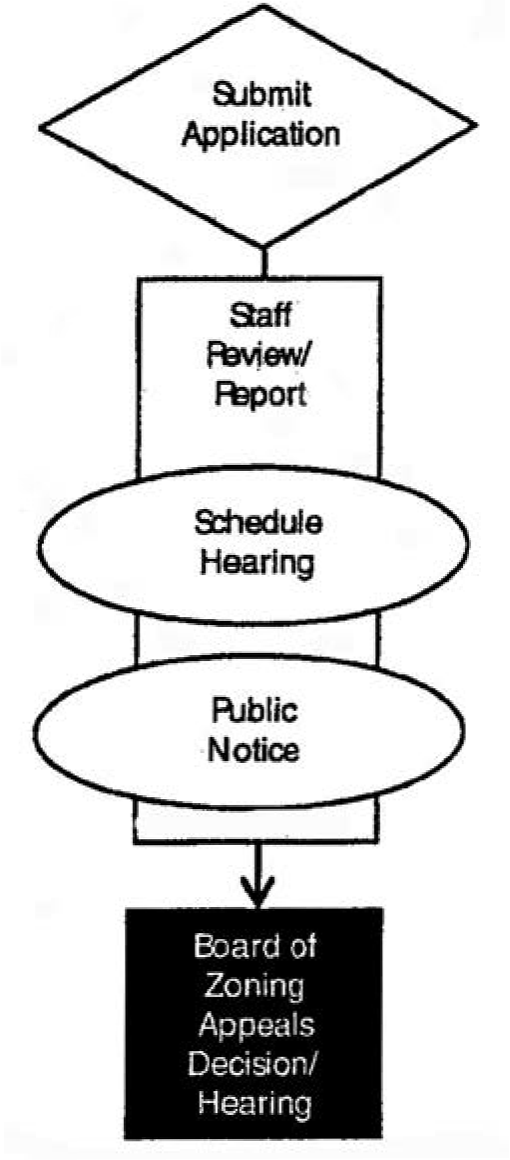
Variance Permit
19-2.3.7.
Variance permit.
(A)
Purpose. The purpose of a variance is to allow certain deviations from the dimensional standards of this chapter (such as height, setback, lot coverage, parking, landscaping, and signage standards), when the landowner demonstrates that, owing to extraordinary and exceptional conditions pertaining to a parcel of land neither created, nor self-inflicted, by the landowner (such as size, shape, topography, drainage), the literal application of the dimensional standards would result in unnecessary hardship to the landowner and the deviation would not be contrary to the public interest.
(B)
Authority. The board of zoning appeals is authorized to review and decide on a variance permit pursuant to this subsection.
(C)
Procedures.
(1)
Application review, notification and scheduling hearing. The procedures and requirements for submission and review of an application, public notification, and scheduling the public hearing are established in section 19-2.2, common procedures.
(2)
Review and action by board of zoning appeals. The board of zoning appeals shall conduct a public hearing on the application pursuant to subsection 19-2.2.18, public hearing procedures. At the public hearing, the board of zoning appeals shall consider the application, the relevant support materials, the staff report, and the evidence presented at the public hearing. After the close of the public hearing, the board of zoning appeals shall approve, approve with modifications, approve with conditions, or disapprove the application based on the standards in subsection 19-2.3.7(D), standards.
(D)
Standards.
(1)
Findings. A variance permit shall be approved only upon a finding that the applicant will suffer undue hardship if the chapter is strictly enforced and the board of zoning appeals finds that all of the following standards are met:
(a)
Extraordinary and exceptional conditions. There are extraordinary and exceptional conditions (such as size, shape, topography) pertaining to the particular piece of property for which the variance is sought that do not generally apply to other land or structures in the vicinity.
(b)
Not result of action by applicant. The special circumstances are not the result of the actions of the applicant.
(c)
Strict application deprives use. Because of the conditions in subsection 19-2.3.7(D)(1)(a), the application of this chapter to the property would effectively prohibit or unreasonably restrict the utilization of the property.
(d)
Minimum variance. The granting of the variance is the minimum action that will make possible the reasonable use of the land or structure which is not contrary to the public interest and which will carry out the spirit of this chapter.
(e)
Not detrimental. The authorization of the variance will not result in substantial detriment to adjacent property or to the public good, and the character of the district will not be harmed by the granting of the variance.
(f)
Consistency with this chapter. The granting of the variance will be generally consistent with the purposes and intent of this chapter.
(2)
Not grounds for variance. The following do not constitute grounds for a variance:
(a)
Nonconforming use of neighboring lands. The nonconforming use of neighboring lands, structures or buildings in the same zoning district that applies to the property for which the variance is sought.
(b)
Special exception. The existence of an approved special exception permit for the subject property.
(c)
Property could be utilized more profitably. The fact that the subject property could be utilized more profitably if a variance permit were granted.
(3)
Prohibitions. No variance permit shall be granted to:
(a)
Allow a use not permitted by right, conditional use, or by special exception in the district in which the property subject to the variance is located.
(b)
Change the zoning district boundaries on the zoning district map.
(E)
Conditions of approval. In approving a variance permit, the board of zoning appeals may impose conditions on the permit approval pursuant to subsection 19-2.2.13, conditions of approval.
(F)
Appeal. A person having a substantial interest affected by a decision of the board of zoning appeals may appeal from the decision of the board to the circuit court of Greenville county by filing with the clerk of the court a petition setting forth plainly, fully, and distinctly why the decision is contrary to law. The appeal shall be filed within 30 days after the written decision of the board is mailed.
(G)
Recordation. The board of zoning appeals may require the applicant to record the variance permit with the country register of deeds. The applicant shall submit proof of recordation to the administrator within 30 calendar days of the mailing of the written decision or the permit shall automatically and immediately be rendered invalid. The variance permit shall be binding upon the landowners, their successors and assigns.
(H)
Inspection. Upon completion of the development authorized by the permit, the applicant shall contact the administrator to inspect and verify compliance with the provisions of the chapter and the conditions of the permit.
(I)
Effect. Issuance of a variance permit shall authorize only the particular variance that is approved in the permit. Unless limited by a condition of approval, a variance permit, including any conditions, shall run with the land and not be affected by a change in ownership.
(J)
Expiration. The board of zoning appeals may prescribe a time limit within which the activity authorized by the permit shall begin or be completed, or both, consistent with the provisions of subsection 19-2.2.14.
(K)
Amendment. A variance permit may be amended, extended or modified only in accordance with the procedures and standards established for its original approval.
19-2.3.8.
Certificate of appropriateness.
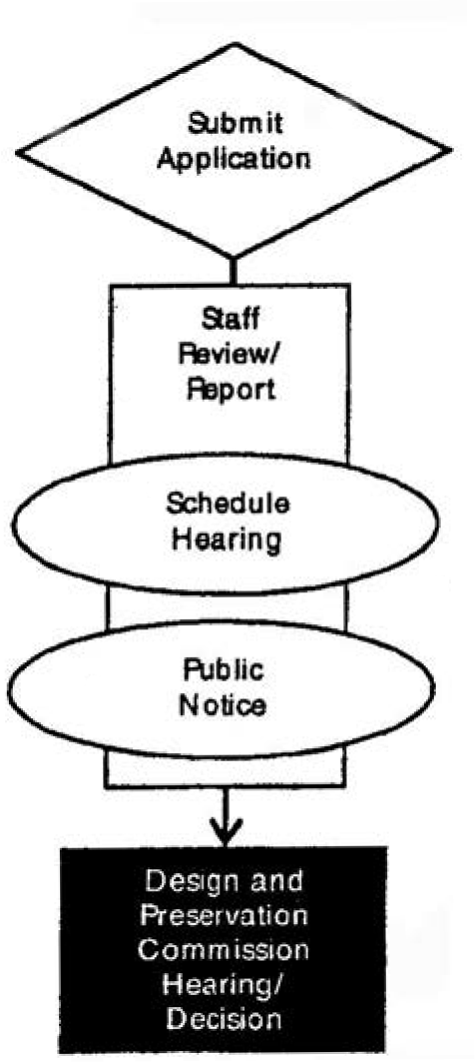
Certificate of Appropriateness
(A)
Purpose. The purpose of this subsection is to provide a mechanism for reviewing applications for demolition, new construction, additions, or alterations of exterior features in the preservation overlay (PO) districts, in the C-4 district, and to structures listed on the National Register of Historic Places or to designated local landmarks to ensure it is consistent with the applicable and approved standards and design guidelines, and the design principles in approved master plans, with due deference to the stated goals of council for streetscape design, park utilization, green spaces, infrastructure that is aesthetically pleasing and functional, and pedestrian oriented structures wherever possible so that the plans and practices of the city on design issues are compatible with one another.
(B)
Authority.
(1)
General. The design review board (DRB) panels are authorized to review and decide on an application for a certificate of appropriateness in the preservation overlay (PO) districts, in the C-4 district, to structures listed on the National Register of Historic Places or to designated local landmarks, and for exceptions to the sign standards per section 19-6.6.4(C)(7).
(2)
Administrator. By resolution, the DRB panels may delegate review of certain types of applications for certificates of appropriateness to the administrator who, in those cases, is authorized to review and decide on the application. Those types of applications for which a certificate of appropriateness may be reviewed by the administrator shall be listed in the administrative manual.
(C)
Applicability.
(1)
When required. Approval of a certificate of appropriateness pursuant to this section shall be required prior to any demolition, new construction, additions or alterations of exterior features in the preservation overlay (PO) districts or the C-4 district, to structures listed on the National Register of Historic Places or to designated local landmarks, and when a monument sign exceeding 18 feet in height is proposed.
(2)
Certificate of appropriateness not required.
(a)
Maintenance and repair. Nothing in this section shall be construed to prevent the ordinary maintenance or repair of any exterior architectural feature of structures designated as historic when the repair does not involve a change in design, material, color or outer appearance of the structure. Certificates of appropriateness are not required for alterations to the interior of a building or alterations to the use of a building (although other permits under this chapter may be required).
(b)
Demolition in C-4. Certificates of appropriateness are not required for demolition of structures in the C-4 district unless the structure is located in a preservation overlay (PO) district, listed on the National Register of Historic Places, on the list of "Protected Structures in the C-4 District," which is a list of structures deemed to be architecturally or historically significant to Greenville and approved by council by resolution or designated as a local landmark.
(D)
Procedure.
(1)
Informal review. Prior to submitting an application for a certificate of appropriateness, an applicant may seek advice from the DRP on a proposed project and matters pertaining to this section or subsection 19-3.2.2(P), preservation overlay district, or subsection 19-3.2.2(K), C-4 central business district. The purpose of submitting a project for informal review is to afford applicants and panel members an opportunity to exchange ideas in concept about a pending project. It is not a formal hearing, but it is intended to reduce the likelihood of misunderstandings and delay when the matter comes up for a hearing. No statements made in the preliminary comments are binding upon panel members at the time the matter is formally submitted for approval.
(2)
Review and decision by DRP.
(a)
Application review, notification and scheduling hearing. The procedures and requirements for submission application, public notification, and scheduling the public hearing are established in section 19-2.2, common procedures.
(b)
Review and action by DRPs. Each DRP shall conduct a public hearing on an application pursuant to subsection 19-2.2.18, public hearing procedures, whenever the matter has not been delegated to staff. At the public hearing, the DRP shall consider the application, the relevant support materials, the staff report, and the evidence presented at the public hearing. After the close of the public hearing, the DRP shall approve, approve with modifications, approve with conditions, defer for modifications, or disapprove the application based on the standards in subsection 19-2.3.8(E), standards. No application shall be deferred more than 60 days beyond the date of its submission without the consent of the applicant. If an application is deferred for modifications, the chairperson may select two panel members to apprise the applicant of perceived issues and possible options that might lead to approval.
(3)
Review and decision by administrator.
(a)
Review of application. The procedures and requirements for submission and review of an application are established in section 19-2.2, common procedures.
(b)
Review and action of administrator. After the application is determined sufficient, the administrator shall either:
1.
Review and approve, approve with modifications, approve with conditions, or disapprove the application based on the standards in subsection 19-2.3.8(E), standards (the administrator may consult with the DRP, other city staff and other professionals to assist in the decision); or
2.
Refer the decision on the application in the PO or C-4 districts to the appropriate DRP, which shall consider the application at its next regularly scheduled meeting pursuant to subsection 19-2.3.8(D)(2)(b), review and action by DRP.
(c)
Appeal to DRP.
1.
A person having a substantial interest affected by the decision of the administrator on an application may appeal to the DRP by filing a written appeal with the administrator within ten business days of the mailing of a written decision. The appeal shall specify the grounds for the appeal.
2.
The procedures for appeal are the same as those referenced in subsection 19-2.3.16, appeals from interpretations and decisions of the administrator, except that the appeal shall be heard by the DRP rather than the board of zoning appeals.
(E)
Standards.
(1)
Demolition. The demolition of structures in a preservation overlay (PO) district, of certain buildings in the C-4 district, of structures listed on the National Register of Historic Places, or of designated local landmarks may constitute an irreplaceable loss to the quality and character of the city. Absent an imminent threat to public safety as determined by the chief building official, no structure in a PO district, on the list of "Protected Structures in the C-4 District", structures listed on the National Register of Historic Places, or designated as a local landmark shall be demolished without first receiving a certificate of appropriateness for demolition by the appropriate DRB panel. The list of "Protected Structures in the C-4 District" shall be approved by council and maintained by the administrator. To qualify for the list, the structure must meet at least one of the following criteria:
(a)
Be a noteworthy representation of the design attributes promoted by the applicable guidelines;
(b)
Be designed by a nationally or regionally recognized architect;
(c)
Be a historically significant structure;
(d)
Have remarkably distinctive design features; or
(e)
Be part of a group of buildings that, together, contribute to the established streetscape. The DRB panel, in considering an application for demolition of a structure in a PO district or on the list of "Protected Structures in the C-4 District," shall be guided by balancing the contribution of the particular structure to the character of the district against the design merits of the proposed replacement project. In particular, the DRB panel shall consider the following:
1.
The historic or architectural significance of the structure.
2.
The importance of the structure to the integrity and character of the district.
3.
The difficulty or impossibility of reproducing such a structure because of its design, material, detail or unique location.
4.
Whether the structure is one of the last remaining examples of its kind in the neighborhood, the city, the region, the state, or the nation.
5.
Whether reasonable measures can be taken to save the structure from further deterioration, neglect, or collapse. For structures listed on the National Register of Historic Places or designated local landmark structures, reasonable measures shall include any and all measures provided for in the Secretary of Interior Standards for Rehabilitation.
6.
Evidence presented by the applicant proving unreasonable hardship to save a non-designated local landmark. Structures listed on the National Register of Historic Places or designated local landmarks shall be exempt from economic hardship consideration as a determining factor in demolition requests.
7.
The merit of the proposed replacement project in enhancing the character, harmony, and economic health of the community.
(2)
New construction, additions, or alteration of exterior features. A certificate of appropriateness for new construction, additions, or alterations of exterior features in a preservation overlay district or the C-4 district, or to structures listed on the National Register of Historic Places, or to a designated local landmark shall be approved only upon finding the applicant demonstrates the proposed new construction, additions or alterations of exterior features are consistent with the design guidelines established for the district and/or, where applicable, the standards and design guidelines for the landmark.
(F)
Conditions of approval. In approving a certificate of appropriateness, the DRP or administrator (whichever is appropriate) may impose conditions on the permit approval pursuant to subsection 19-2.2.13, conditions of approval.
(G)
Administrative modification. The administrator may determine that any person having in good faith substantially complied with the terms and conditions of a certificate of appropriateness may be exempted from strict compliance with technical details when a change is necessitated by an unforeseen problem discovered during permitting or construction, or for any minor change which does not substantially alter the character of the project as originally approved.
(H)
Inspection. Upon completion of development authorized by the permit, the applicant shall contact the administrator to inspect and verify compliance with the provisions of the ordinance and the conditions of the permit.
(I)
Unreasonable hardship exemption. If a certificate of appropriateness is disapproved or an applicant believes it is not possible to comply with the standards for approval for a certificate of appropriateness, the applicant may apply for an unreasonable hardship exemption from the DRP pursuant to this section.
(1)
Review and decision by DRP.
(a)
Application review, notification and scheduling hearing. The procedures and requirements for submission and review of an application for unreasonable hardship exemption, public notification, and scheduling the public hearing are established in section 19-2.2, common procedures.
(b)
Review and action by DRP. The DRP shall conduct a public hearing on the application for unreasonable hardship exemption pursuant to subsection 19-2.2.18, public hearing procedures. At the public hearing, the DRP shall consider the application, the relevant support materials, and the evidence presented at the public hearing. After the close of the public hearing, the DRP shall approve, approve with modifications, approve with conditions, defer for modifications, or disapprove the application based on the standards in subsection 19-2.3.8(H)(2), unreasonably hardship standards. If an application is deferred for modifications, the chairperson may select two panel members to apprise the applicant of perceived issues and possible options that might lead to approval.
(2)
Unreasonable hardship standards. An unreasonable hardship exemption shall be approved only upon a finding the applicant demonstrates all the following standards are met:
(a)
Exceptional conditions. There are exceptional conditions and unreasonable circumstances relevant to the property for which the unreasonable hardship exemption is sought which do not generally apply to other properties in the district.
(b)
Strict application creates unreasonable hardship. The application of the standards required for a certificate of appropriateness would effectively prohibit or unreasonably restrict the utilization of the property and result in an unreasonable hardship.
(c)
Minimum modification of standards. The granting of the unreasonable hardship exemption is the minimum action that will make possible the reasonable use of the land or structure that is not contrary to the purpose and intent of the approved design guidelines for the district.
(d)
Consistent with intent of guidelines. The unreasonable hardship exemption is consistent with the intent of the provisions of subsection 19-2.3.8(E), standards.
(J)
Appeal. A person having a substantial interest affected by a decision of the DRP may appeal from the decision of the commission to the circuit court of the county by filing with the clerk of the court a petition setting forth plainly, fully, and distinctly why the decision is contrary to law. The appeal shall be filed within 30 days after the written decision of the commission is mailed.
(K)
Submission of new application after disapproval. If the administrator or the DRP disapproves a certificate of appropriateness or unreasonable hardship exemption, the applicant may, at any time, submit a new application with new information addressing the reasons for disapproval.
(L)
Expiration. The DRP or administrator (whichever is appropriate) may prescribe a time limit within which the activity authorized shall begin or be completed, or both, on the certificate of appropriateness or unreasonable hardship exemption.
(M)
Amendment. A certificate of appropriateness or unreasonable hardship exemption may be amended, extended, or modified only in accordance with the procedures and standards established for its original approval.
19-2.3.9.
Site plan permit.
(A)
Purpose. Site plan review is required to ensure that the layout and general design of proposed development is compatible with surrounding land uses and complies with:
(1)
Article 19-6, development and design standards;
(2)
The design and specification manual; and
(3)
All other provisions of this chapter.
(B)
Applicability. All development, unless exempted pursuant to subsection 19-2.3.9(C), exemptions, shall be required to obtain a site plan permit pursuant to this section prior to issuance of a building permit.
(C)
Exemptions. Internal construction that does not increase gross floor area, increase the intensity of use, affect parking requirements, or require correction of nonconforming landscaping, buffering/screening or parking shall be exempt from the requirements of this section.
(D)
Procedures.
(1)
Submission and review of application. The procedures and requirements for submission and review of an application are established in section 19-2.2, common procedures.
(2)
Action by administrator. The administrator shall review and take action on the application for site plan permit consistent with the procedures and requirements of subsection 19-2.2.20, administrator review procedures. If a stormwater permit (subsection 19-7.5) is required for the development, submission and review shall occur concurrently with the site plan permit. Both the site plan permit and the stormwater permit, whenever required, must be approved or approved with comments prior to issuing a land disturbance permit or a building permit, as applicable to the scope of the work.
(E)
Standards. A site plan permit shall be approved only upon a finding that the applicant demonstrates all of the following standards are met:
(1)
Compatibility. The development and uses proposed in the site plan are allowed by right in the zoning district in which it is proposed or the applicant has obtained a special exception permit or conditional use permit.
(2)
Zoning district supplemental standards. The development and uses in the site plan comply with section 19-4.3, use-specific standards.
(3)
Development and design standards. The development proposed in the site plan and its layout and design comply with all standards in article 19-6, development and design standards and the design and specification manual.
(F)
Conditions of approval. In approving a site plan permit, the administrator may impose conditions on the permit approval pursuant to subsection 19-2.2.13, conditions of approval.
(G)
Appeal. An applicant may appeal the decision of the administrator with respect to the issuance of a site plan permit pursuant to the provisions of subsection 19-2.3.16.
(H)
Inspection. Upon completion of the development authorized by the permit, the applicant shall contact the administrator to inspect and verify compliance with the provisions of the chapter and the conditions of the permit.
(I)
Expiration. The administrator may prescribe a time limit within which the activity authorized by the permit shall begin or be completed, or both, consistent with the provisions of subsection 19-2.2.14.
(J)
Amendments. A site plan permit may be amended, extended, or modified only in accordance with the procedures and standards established for its original approval.
19-2.3.10.
Sign permits.
(A)
Purpose. The purpose of this subsection is to provide a mechanism for reviewing applications for sign permits to ensure all signs within the city comply with the standards of section 19-6.6, sign regulations.
(B)
Applicability. No sign, except those exempted pursuant to subsection 19-6.6.3, signs exempt from permit requirements, shall be erected, installed, displayed, structurally altered, or otherwise changed without the sign installer/owner having first obtained a sign permit from the administrator pursuant to this section and the standards of section 19-6.6, sign regulations.
(C)
Procedure.
(1)
Submission and review of application. The procedures and requirements for submission and review of an application are established in section 19-2.2, common procedures.
(2)
Action by administrator. The administrator shall review and take action on the application for a sign permit consistent with the procedures and requirements of subsection 19-2.2.20, administrator review procedures.
(D)
Standards. A sign permit shall be approved upon a finding that the application complies with the standards of section 19-6.6, sign regulations.
(E)
Conditions. In approving a sign permit, the administrator may impose conditions on the permit approval pursuant to subsection 19-2.2.13, conditions of approval.
(F)
Appeal. An applicant may appeal the decision of the administrator with respect to the issuance of a sign permit pursuant to the provisions of subsection 19-2.3.16.
(G)
Inspection. Upon completion of development authorized by the permit, the applicant shall contact the administrator to inspect and verify compliance with the provisions of the chapter and the conditions of the permit.
(H)
Expiration. If the activity authorized by a sign permit has not begun within six months from the date of issuance, the sign permit shall automatically and immediately be rendered invalid.
(I)
Amendments. A sign permit may be amended, extended or modified only in accordance with the procedures established for its original approval.
19-2.3.11.
Temporary use permits.
(A)
Applicability. The provisions of this subsection shall apply to all proposed temporary uses as set forth in subsection 19-2.3.11(C), standards, subsection 19-4.5.2, general standards for all temporary uses and structures, and subsection 19-4.5.3, specific standards for certain temporary uses and structures.
(B)
Procedure.
(1)
Initial submission of application. The procedures and requirements for submission and review of applications are established in section 19-2.2, common procedures.
(2)
Action by administrator. After the application is determined sufficient, the administrator shall review the application and approve, approve with modifications, approve with conditions, or disapprove the application for a temporary use permit based on the standards in subsection 19-2.3.11(C), standards.
(C)
Standards. A temporary use permit shall be approved upon a finding that the temporary use, as proposed, complies with the relevant standards in subsection 19-4.5.2, general standards for all temporary uses and structures, and subsection 19-4.5.3, specific standards for certain temporary uses and structures.
(D)
Conditions. In approving a temporary use permit, the administrator may impose conditions on the permit approval pursuant to subsection 19-2.2.13, conditions of approval.
(E)
Appeal. An applicant may appeal the decision of the administrator with respect to the issuance of a temporary use permit pursuant to the provisions of subsection 19-2.3.16.
(F)
Expiration. A temporary use permit shall be effective beginning on the date specified in the permit approval and shall remain effective for the period indicated on the permit.
(G)
Amendment. A temporary use permit may be amended, extended, or modified only in accordance with the procedures and standards established for its original approval.
19-2.3.12.
Certificate of compliance.
(A)
Purpose. In those circumstances where no site plan permit is required, a certificate of compliance shall be required in accordance with the provisions of this section in order to ensure that proposed land use/development complies with the standards of this chapter and to otherwise protect the public health, safety, and welfare of the citizens of the city.
(B)
Requirement. No building permit or certificate of occupancy shall be issued without approval of a certificate of compliance by the administrator pursuant to this section.
(C)
Standards. A certificate of compliance shall be approved by the administrator upon a finding that the application complies with all relevant standards of this chapter on the date of issuance of the certificate of compliance.
19-2.3.13.
Land development.
(A)
Subdivision.
(1)
Purpose. Subdivision review is required to ensure that the layout and design of a subdivision complies with:
(a)
Article 19-6, development and design standards; and
(b)
All other provisions of this chapter.
(2)
Applicability. The procedures and standards of this section shall apply to the division of land into two or more lots, building sites, or other divisions for the purpose of, whether immediate or future, sale, lease, or building development. It shall include all divisions of land involving a new street or change in existing streets; resubdivision involving the further division or relocation of lot lines of any lot or lots within an approved subdivision; or the alteration of any streets or the establishment of any new streets within any approved subdivision; the combination or consolidation of lots of record; and the installation, extension or alteration of a water, sewer or storm drainage utility.
(3)
Exemptions. The following divisions of land shall be exempt from the requirements of this section:
(a)
The combination or recombination of portions of previously platted lots where the total number of lots is not increased and the resultant lots comply with the standards of this chapter.
(b)
The division of land into parcels of five acres or more where no new public street; change to an existing public street; new water, sewer, or storm drainage utility; or change to an existing water, sewer, or storm drainage utility is involved.
(c)
The combination or recombination of entire lots of record where no new public street; change to an existing public street; new water, sewer, or storm drainage utility; or change to an existing water, sewer, or storm drainage utility is involved.
If, upon reviewing a proposed division of land, the administrator determines that the division is exempt from the requirements of this section, he shall certify on the plat that the division requires no further approval of the city prior to its being recorded.
(4)
Summary plat for minor subdivision.
(a)
General. Minor subdivisions constitute the subdivision of land into no more than two lots when:
1.
No new streets, alleys or other public ways are created.
2.
No changes are made to existing streets, alleys or other public ways.
3.
No new water, sewer or storm drainage utilities or changes to existing water, sewer or storm drainage utilities are required to serve the subdivided land.
4.
The division of land meets the minimum requirements of this chapter.
5.
No flag lot is created in a residential zoning district that is inconsistent with existing development patterns.
6.
The lots have a minimum of 20 feet of frontage on a public street that has been accepted for maintenance by the appropriate agency.
7.
No more than two lots have been created within the boundary of the original tract within the past five years.
(b)
Procedure.
1.
Initial submission of application and staff review. The procedures and requirements for submission and review of an application are established in section 19-2.2, common procedures.
2.
Review and action by administrator. The administrator shall review and take action on the application for summary plat consistent with the procedures and requirements of subsection 19-2.2.20, administrator review procedures.
(c)
Standards. A summary plat shall be approved on a finding that the application complies with the standards in article 19-6, development and design standards, all other relevant provisions of this chapter, and all other relevant city ordinances and regulations.
(d)
Recordation. The subdivider shall file for recording an approved summary plat with the office of the country register of deeds within seven calendar days after the date of approval and prior to the recording of any individual deeds for the subdivided lots. The subdivider shall submit proof to the administrator that the summary plat has been recorded.
(e)
Amendments. A summary plat may be amended, extended, or modified only in accordance with the procedures and standards established for its original approval.
(5)
Major subdivision.
(a)
Applicability. The standards and procedures of this subsection shall apply to all subdivision of land not considered a minor subdivision pursuant to subsection 19-2.3.13(A)(4), minor subdivisions.
(b)
Preapplication conference required. A preapplication conference, pursuant to the provisions of subsection 19-2.2.3, shall be required.
(c)
Preliminary plat.
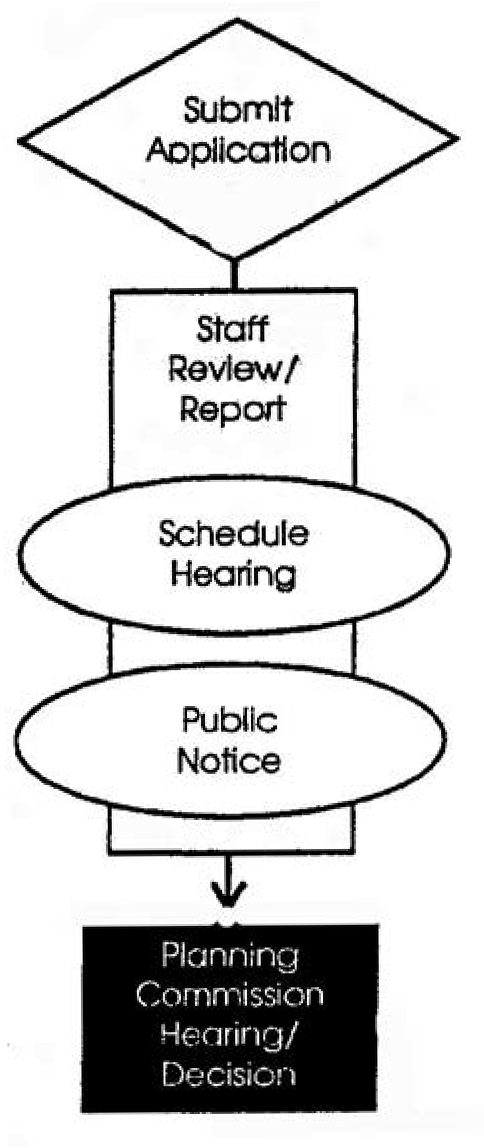
Preliminary Plat for Subdivisions
1.
Application review, notification, and scheduling of hearing. The procedures and requirements for submission and review of an application, public notification, and scheduling the public hearing for a preliminary plat for subdivision are established in section 19-2.2, common procedures.
2.
Review and action by planning commission. After referral of the application from the administrator, the planning commission shall conduct a public hearing on the application pursuant to subsection 19-2.2.18, public hearing procedures. At the public hearing, the planning commission shall consider the application, the relevant support materials, the staff report, and the evidence presented at the hearing. The planning commission shall approve, approve with modifications, approve with conditions, or disapprove the preliminary plat for subdivision within 60 days of the date the application was deemed sufficient, based on the standards in subsection 19-2.3.13(A)(5)(c)3, standards.
3.
Standards. A preliminary plat for subdivision shall be approved upon a finding the application complies with the standards in this chapter.
4.
Conditions. In approving a preliminary plat for subdivision, the planning commission may impose conditions on the permit approval pursuant to subsection 19-2.2.13, conditions of approval.
5.
Effect of approval. Approval of a preliminary plat for subdivision shall constitute approval of the development with the lot dimensions and alignments of streets identified on the preliminary plat.
6.
Lapse of preliminary approval. The approval of a preliminary plat for subdivision shall expire at the end of 24 months from the date approval was granted by the planning commission unless the applicant has submitted an application for approval of a final plat for subdivision for at least ten percent of the land area of the subdivision, consistent with the provisions of subsection 19-2.2.14.
7.
Amendment. A preliminary plat for subdivision may be amended, extended or modified only in accordance with the procedures and standards established for its original approval.
(d)
Grading and installation of improvements.
1.
Land disturbance permit. Upon approval of the preliminary plat for subdivision, the applicant shall obtain a land disturbance permit (subsection 19-2.3.13(B)) before clearing and grading of land and installation of improvements for the subdivision may begin.
2.
Inspection of streets. Upon completion of the grading and the placement of monuments, the administrator shall conduct an inspection of the rough grade and alignment of the proposed streets.
3.
Installation of water infrastructure. Upon completion of the inspection, if the grading and alignment of the streets are in conformance with the approved plans, the administrator shall issue a letter to Greenville Water stating that the subgrade and alignment of the streets are in conformance with the approved plans. The installation of water infrastructure or facilities may then begin according to the existing policy of Greenville Water.
(e)
Final plat.
1.
General. Within 24 months after approval of a preliminary plat and upon fulfillment of the conditions of the preliminary approval and, after the required improvements have been completed or a bond or cash has been posted in lieu of the improvements, the applicant shall submit an application for final plat for subdivision for review pursuant to this section.
2.
Initial submission of application and staff review. The procedures and requirements for submission and review of an application are established in section 19-2.2, common procedures.
3.
Action by administrator on final plat submittal. The administrator shall review and take action on the application for final plat for subdivision consistent with the procedures and requirements of subsection 19-2.2.20, administrator review procedures.
4.
Standards. The final plat for subdivision shall comply with the standards contained in the development and design standards and the design and specifications manual. No final plat for subdivision shall be approved until all required improvements have been installed and certification of their acceptability has been submitted to the administrator by the appropriate agencies, or until the owner or his authorized agent shall have supplied a surety satisfactory to the administrator as valid and enforceable.
5.
Approval. Upon a finding that the application complies with all applicable standards and all required dedications and improvements, or payments and guarantees in lieu thereof, have been installed on or finalized for the property, the administrator shall approve the application by signing the "certificate of approval for recording" on each copy of the final plat for subdivision.
6.
Recordation. The applicant shall file the approved final plat for subdivision with the office of the country register of deeds for recording within seven calendar days after the date of approval of the final plat for subdivision.
7.
Effect of final plat. The approval of a final plat for subdivision shall not be deemed to constitute or affect the acceptance by the city of the dedication of any street or other ground, public utility line or other public facility shown on the plat. However, the city council may by resolution accept any dedication made to the public of lands or facilities for streets, parks, or public utility lines. The city has no obligation to open any street even after acceptance of dedication.
(B)
Land disturbance permit.
(1)
Purpose. The purpose of this subsection is to ensure that no development or development activity disturbs or alters the surface of land in the city without a land disturbance permit approved pursuant to this section.
(2)
Authority. The administrator is authorized to approve or disapprove an application for a land disturbance permit.
(3)
Applicability. No development activity, unless exempted pursuant to subsection 19-2.3.13(B)(4), exemptions, shall disturb or alter, for any purpose, the surface of land in the city without a land disturbance permit.
(4)
Exemptions. The following activity is exempt from the requirements of this section, provided said activity does not materially alter existing runoff flow patterns or result in uncontrolled soil erosion and sedimentation:
(a)
Agricultural land management and agricultural practices, or the construction of on-farm buildings and structures less than one acre in size used in a farming operation.
(b)
Construction or land improvement of a single-family residence, one duplex dwelling or their accessory buildings which are separately built and are not part of a larger common plan as defined in subsection 19-7.5.1(E).
(c)
Additions to single-family residences and interior alterations to existing facilities.
(d)
Mining and mineral resource extraction operations conducted in accordance with a valid mining permit issued by the land and waste management division of the state department of health and environmental control.
(e)
Land-disturbing activities undertaken on forest land for the production and harvesting of timber and timber products regulated by the U.S. Forestry Service.
(f)
Emergency repairs or maintenance of existing structures and facilities that require ground to be broken provided that the repairs are performed in a manner consistent with the regulations of this chapter to the maximum extent feasible.
(g)
Construction activities of the state department of transportation conforming to the requirements of the latest edition of the South Carolina Standard Specifications for Highway Construction.
(h)
Activities relating to the routine maintenance and/or repair or rebuilding of the tracks, rights-of-way, bridges, communication facilities and any other related structures and facilities of a railroad company.
(i)
Land-disturbing activities that are conducted pursuant to, and are compliant with, another state or federal environmental permit, license or certification in which the state or federal permitting authority supersedes the city's authority as established by local ordinance and regulation.
(j)
Certain activities undertaken by utility providers that are not substantial land-disturbing activities and therefore are not intended to be regulated by this section provided that the repairs are performed in a manner consistent with the regulations of this chapter to the maximum extent feasible. These activities include, but are not limited to, the following:
1.
Installation of utilities on sites not part of a larger common plan and that disturbs less than 10,000 square feet.
2.
Land-disturbing activities conducted pursuant to a federal environmental permit, including permits issued under Section 404 of the Federal Clean Water Act, and including permits issued by the Federal Energy Regulatory Commission.
3.
Installation of utilities in a ditch section four feet or less in width.
4.
Installation of utility poles.
5.
Maintenance of easements and rights-of-way.
6.
Service connections, i.e., tapping main lines and/or setting meters, including installation of a manhole, bellhole, underground vault, valve box or fire hydrants.
7.
Projects for which an encroachment permit has been issued by the South Carolina Department of Transportation or the city that are not part of a larger common plan and that disturbs less than 10,000 square feet.
8.
Land-disturbing activities conducted by a utility provider filing environmental reports, assessments or impact statements with the United States Department of Agriculture, Rural Electrification Administration, in regard to a project.
(k)
Any case in which the administrator has granted a waiver of the permit requirements upon a determination that the integrity of this section will not be violated by such action.
(5)
Procedure.
(a)
Initial submission and review of application. The procedures and requirements for submission and review of an application are established in section 19-2.2, common procedures.
(b)
Action by administrator. The administrator shall review and take action on the application for a land disturbance permit. The administrator is authorized to approve or disapprove the application.
(6)
Standards. A land disturbance permit may only be granted after a site plan permit and stormwater permit, whenever required, have been approved or approved with comments.
(7)
Conditions. In approving a land disturbance permit, the administrator may impose conditions on the permit approval pursuant to subsection 19-2.2.13, conditions of approval.
(8)
Responsibilities of the applicant.
(a)
During any land-disturbing operation the applicant shall be responsible for carrying out the proposed work in accordance with the permit, approved plan, specifications, and time schedule in compliance with all the requirements of this chapter and any other state or federal permit.
(b)
The applicant shall maintain on-site at all times the stamped and approved set of plans from the city for the permitted land-disturbing activity.
(9)
Inspection.
(a)
Representatives of the city are authorized to enter upon any land or water to inspect development activity, to verify the existing conditions of a development site, and to verify compliance with this chapter whenever the city deems necessary.
(b)
The applicant shall contact the administrator to inspect and verify compliance with the provisions of this chapter and the conditions of the permit prior to initiating any activity, once construction is complete, and any other time as determined by the administrator, design and specifications manual, city specifications, or the regulations of this chapter.
(c)
All public infrastructure or work within the right-of-way must be approved by the administrator or be replaced to the standards of the design and specifications manual, city specifications, or the regulations of this chapter.
(10)
Expiration.
(a)
If development authorized by the permit is not commenced within 180 days of the date of the granting of the permit, no land-disturbing operation may occur until a new permit is issued.
(b)
If the applicant commences with the work as permitted, the permit shall automatically expire at the end of five years after the date of its issuance.
(c)
If the applicant commences with the work as permitted, and then construction activities are suspended for 180 days, the permit shall be considered null and void. The applicant shall apply for a new permit.
(d)
At least 60 days prior to the expiration date, the applicant may apply to the administrator for a one-year extension of a permit pursuant to the procedures and standards established for its original approval. No more than five such annual extensions may be granted.
(e)
A change in contractor shall require a new permit be issued. All development must be suspended until a new permit is granted in accordance with the current procedures and standards established in this chapter.
(C)
Street naming or name change.
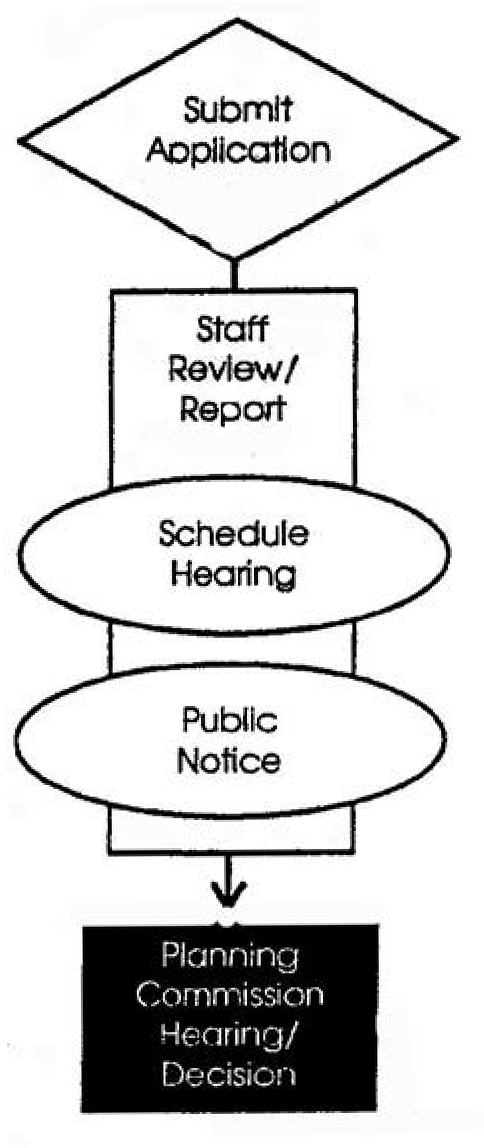
Street Name or Name Change
(1)
Purpose. The purpose of this subsection is to provide a procedure to ensure that streets are given names and that street naming occurs in an orderly and logical fashion.
(2)
Applicability. This section applies to the initial naming or the change in name of any street within the city (public and private), including, but not limited to, the laying out of a street in a subdivision plat, the marking of the name of a street anywhere along its location, or identification of a street in a deed or instrument.
(3)
Initiation. An application for authorization for a street name or name change shall be initiated pursuant to subsection 19-2.2.1, authority to file applications. An application for authorization for street name or name change may be undertaken simultaneously with and as part of an application for subdivision approval (subsection 19-2.3.13(A)).
(4)
Procedure.
(a)
Application review, notification and scheduling hearing. The procedures and requirements for submission and review of the application, public notification, and scheduling the public hearing are established in section 19-2.2, common procedures.
(b)
Review and action by planning commission. The planning commission shall conduct a public hearing on the application pursuant to subsection 19-2.2.18, public hearing procedures. At the public hearing, the planning commission shall consider the application, the relevant support materials, the staff report, and the evidence presented at the public hearing. After the close of the public hearing, the planning commission shall approve or disapprove the application based on the standards in subsection 19-2.3.13(C)(5), standards.
(5)
Standards. Street names shall not be duplicated within the city and shall be in conformance with the requirements of the design and specifications manual.
(6)
Recordation. Upon approval of a final plat for subdivision, the applicant shall file a request for recordation with the country register of deeds pursuant to the provisions of subsection 19-2.3.13(A)(5)(e)6, which plat shall reflect the approved street names. Upon a street name being changed, the administrator shall issue a certificate on behalf of the commission designating the change which shall be recorded in the office of the country register of deeds.
(7)
Amendment. An amendment to a street name or name change may be made only pursuant to the procedures and standards established for its original approval.
(8)
Decorative street name signs. A neighborhood may request permission from the traffic engineer for the city to use decorative street name signs at the expense of the neighborhood in place of the city's standard sign. At a minimum, the signs must have six-inch reflective (or other approved nighttime visibility features) white lettering in a noncursive font. The signs must be posted on metal poles and must be seven feet above street level. The neighborhood shall submit shop drawings that include the attributes of the sign. Also to be submitted is the neighborhood's plan for maintenance for the signs. The placement of the sign in the city right-of-way shall be determined by the traffic engineer for the city. Upon review and approval of the design for the signs and the maintenance plan, the city shall issue a revocable permit for use of the city right-of-way.
(9)
Private drives may be named. Private drives may be named provided the street name must be approved by the city engineer. All the street name restrictions that apply to public streets also apply to private drives. A legal address will be assigned on this drive only if the private drive is the primary emergency access route for a structure, has a width of 20 feet or greater, and, if applicable, has a cul-de-sac radius of 39 feet or greater. The construction of these drives must be approved by the city engineering, fire, police, and sanitation departments. In no case will a legal address be given to a drive facilitating a multifamily complex that provides adjacent parking on the street. It is the responsibility of the property owners of the private drive to provide and install street signs and stop signs approved by the traffic engineer for the city. The street name sign must comply with the requirements of subsection 19-2.3.13(c)(8).
(D)
Multifamily residential development.
(1)
Purpose. The purpose of this subsection is to require the review and approval of proposals for multifamily development containing three or more dwelling units.
(2)
Authority. The planning commission is authorized to review and approve, approve with modifications, approve with conditions, or disapprove an application for multifamily development.
(3)
Applicability. All multifamily development, unless exempted pursuant to subsection 19-6.8.2, applicability, shall be constructed, renovated, and reconstructed in compliance with section 19-6.8.
(4)
Procedure.
(a)
Initial submission and review of application. The procedures and requirements for submission and review of an application are established in section 19-2.2.
(b)
Preapplication conference required. A preapplication conference, pursuant to the provisions of subsection 19-2.2.3, shall be required.
(c)
Application review, notification, and scheduling of hearing. The procedures and requirements for submission and review of an application, public notification, and scheduling the public hearing for a land development permit for multifamily development are established in section 19-2.2, common procedures.
(d)
Review and recommendation by the design review board. Prior to review and action by the planning commission, all multifamily developments shall be presented to the design review board, for advice and comments regarding the appropriateness of the design.
(e)
Review and action by planning commission. After referral of the application from the administrator, the planning commission shall conduct a public hearing on the application pursuant to subsection 19-2.2.18, public hearing procedures. At the public hearing, the planning commission shall consider the application, the relevant support materials, the staff report, and the evidence presented at the hearing.
(5)
Standards. A multifamily residential development permit shall be approved upon a finding the application complies with all relevant standards of article 19-6, development and design standards, the design and specifications manual, and all other provisions of this chapter.
(6)
Conditions. In approving a multifamily residential development permit, the planning commission may impose conditions on the permit approval pursuant to subsection 19-2.2.13, conditions of approval.
(7)
Inspection. Upon completion of development authorized by the permit, the applicant shall contact the administrator to inspect and verify compliance with the provisions of the chapter and the conditions of the permit.
(8)
Expiration. The planning commission may prescribe a time limit within which the activity authorized by the permit shall begin or be completed, or both, consistent with the provisions of subsection 19-2.2.14. A change in ownership of the property shall not affect the time frame.
(9)
Amendment. A multifamily residential development permit may be amended, extended, or modified only in accordance with the procedures and standards established for its original approval.
(10)
Unauthorized development. Any person who develops a multifamily development without a land development permit or amended permit as provided under this section shall assume sole responsibility for removing the unpermitted development and restoring the conditions existing prior to the change at the person's sole expense.
(E)
Development naming.
(1)
Purpose. The purpose of this subsection is to provide a procedure to ensure that developments are given names and that development naming occurs in an orderly and logical fashion.
(2)
Applicability. This section applies to the initial naming or change in name of any development subject to review by the Planning Commission within the city. The process of street naming or street name changing is not included in this provision and is subject to subsection 19-2.3.13(C).
(3)
Initiation. An application for authorization for a development agreement name shall be initiated pursuant to subsection 19-2.2.1, authority to file applications. An application for authorization for a development agreement name may be undertaken simultaneously with and as part of an application for subdivision approval (subsection 19-2.3.13(A)).
(4)
Procedure.
(a)
Application review, notification, and scheduling hearing. The procedures and requirements for submission and review of the application, public notification, and scheduling the public hearing are established in section 19-2.2, common procedures.
(b)
Review and action by planning commission. The planning commission shall conduct a public hearing on the application pursuant to subsection 19-2.2.18, public hearing procedures. At the public hearing, the planning commission shall consider the application, the relevant support materials, the staff report, and the evidence presented at the public hearing. After the close of the public hearing, the planning commission shall approve or disapprove the application based on the standards in subsection 19-2.3.13(C)(5), standards.
(5)
Standards. Development agreement names shall not be duplicated within the city and shall be in conformance with the requirements of the design and specifications manual.
(6)
Recordation. Upon approval of a final plat for subdivision, the applicant shall file a request for recordation with the country register of deeds pursuant to the provisions of subsection 19- 2.3.13(A)(5)(e)6, which plat shall reflect the approved development agreement names.
(7)
Amendment. An amendment to a development agreement name may be made only pursuant to the procedures and standards established for its original approval.
19-2.3.14.
Certificate of conformity.
(A)
Applicability. The requirement of this section shall apply to any development in the city for which a permit has been issued pursuant to this chapter.
(B)
Certificate of conformity required. A certificate of conformity, indicating compliance with the requirements of approved permits and this chapter, shall be approved pursuant to this section prior to issuance of a certificate of occupancy.
(C)
Procedure.
(1)
Initial submission of application. The procedures and requirements for submission and review of applications are established in section 19-2.2, common procedures.
(2)
Affidavit of substantial compliance.
a.
Design review board. Any project required to obtain a certificate of appropriateness from the design review board must submit an affidavit of compliance certifying under penalty of perjury that, to the best of the affiant's knowledge, the exterior of the structure(s) and all site work were constructed in substantial compliance with the official certificate of appropriateness for the project issued under the provisions of section 19-2.2, common procedures. For purposes of this sub-section, the affidavit must be executed and submitted by the owner or his/her authorized agent.
b.
Planning commission. Any project required to obtain approval from the planning commission must submit an affidavit of compliance to the administrator certifying under penalty of perjury that, to the best of the affiant's knowledge, the project was constructed in substantial compliance with the official approval conditions for the project issued under the provisions of section 19-2.2, common procedures. For purposes of this sub-section, the affidavit must be executed and submitted by the owner or his/her authorized agent.
c.
Board of zoning appeals. Any project required to obtain approval from the board of zoning appeals must submit an affidavit of compliance to the administrator certifying under penalty of perjury that, to the best of the affiant's knowledge, the project was constructed in substantial compliance with the official approval conditions for the project issued under the provisions of section 19-2.2, common procedures. For purposes of this sub-section, the affidavit must be executed and submitted by the owner or his/her authorized agent.
(3)
Action by administrator. After the application is determined sufficient, the administrator shall review the application, the affidavit(s) of substantial compliance, and conduct a final inspection of the development for the purpose of verifying conformity with all applicable provisions of this chapter and all relevant terms and conditions of permits and approvals for the development. The administrator may require the preparation and submission of as-built drawings by the designer to verify compliance with the requirements of all permits and the requirements of this chapter. Upon a determination of conformity, the administrator shall approve a certificate of conformity and forward it to the applicant.
(D)
Temporary certificate of conformity.
(1)
General. At the discretion of the administrator, in cases when, because of weather conditions or other factors beyond the control of the applicant (exclusive of financial hardship), it would be unreasonable to require the applicant to comply with all the requirements of this chapter prior to the use of occupancy of a development, a temporary certificate of conformity may be issued for a period of time not to exceed six months.
(2)
Standards. The temporary certificate of conformity may be issued only upon a finding by the administrator that the materials submitted in the application demonstrates:
(a)
Substantially complete. The development is substantially complete and the site is in a safe, accessible, and useable condition.
(b)
Sureties and guarantees. Development sureties and guarantees have been provided to the city.
(E)
Conditions. In approving a certificate of conformity or a temporary certificate of conformity, the administrator may impose conditions on the permit approval pursuant to subsection 19-2.2.13, conditions of approval.
(F)
Expiration. A temporary certificate of conformity shall be effective beginning on the date specified in the permit approval and shall remain effective for the period indicated on the permit.
(G)
Amendment. A certificate of conformity or temporary certificate of conformity may be amended, extended or modified only in accordance with the procedures and standards established for its original approval.
19-2.3.15.
Interpretations by the administrator.
(A)
Authority. Interpretations of this chapter shall be made by the administrator, including interpretations of the text of this chapter; interpretations of the zoning district boundaries; interpretations of whether an unspecified use falls within a use classification, use category or use type allowed in a zoning district; and interpretations of procedures and application requirements for permits.
(B)
Initiation. A written interpretation may be requested by the city council; the planning commission; the board of zoning appeals; the DRP; any resident; any landowner; or, any person, business, or organization having rights in contract in land in the city or their authorized agent.
(C)
Procedure.
(1)
Submission of request for interpretation. A request for interpretation may be submitted to the administrator in a form established in the administrative manual.
(2)
Determination of sufficiency. Within five business days after a request for interpretation has been submitted, the administrator shall determine whether it is sufficient.
(a)
If the administrator determines the request is not sufficient, a notice shall be provided to the applicant specifying the deficiencies. The administrator shall take no further action on the request for interpretation until the deficiencies are remedied. If the applicant fails to respond to the deficiencies within 20 business days, the request for interpretation shall be considered withdrawn.
(b)
When the request for interpretation is determined sufficient, the administrator shall review the request and render an interpretation pursuant to the procedures and standards of this section.
(3)
Rendering of interpretation. After the request for interpretation has been determined sufficient, the administrator shall review and evaluate the request in light of the comprehensive plan, this chapter, the zoning district map, and other relevant codes and statutes, and then render an interpretation. The administrator may consult with the city attorney and other city staff before rendering an interpretation.
(4)
Form. The interpretation shall be in writing and sent to the applicant by mail.
(D)
Appeal. Any person aggrieved by a written interpretation from the administrator may appeal the interpretation pursuant to subsection 19-2.3.16, appeals from decisions and interpretations of the administrator.
(E)
Official record. The administrator shall maintain a record of written interpretations that shall be available for public inspection during normal business hours.
19-2.3.16.
Appeals from decisions and interpretations of administrator.
(A)
Right of appeal. Any person aggrieved or affected by a decision or interpretation of the administrator may appeal such decision or interpretation to the board of zoning appeals or to the planning commission, according to the following:
(1)
Planning commission. Appeals of decisions or interpretations of the administrator regarding the design and specifications manual, final PD plans, subdivision, and waivers to stormwater provisions shall be considered by the planning commission.
(2)
Board of zoning appeal. Appeals of decisions or interpretations of the administrator regarding all sections of this chapter, except the design and specifications manual, final PD plans, subdivision, waivers to stormwater provisions, and all matters under the purview of the design review panels, shall be considered by the board of zoning appeals.
(B)
Appeal procedure.
(1)
Initiation. An appeal pursuant to this section may be initiated with the administrator by filing a written notice of appeal within ten business days of the date of mailing of the written decision or interpretation.
(2)
Contents of appeal. The written notice of appeal shall specify the grounds for the appeal, a statement of the improper decision or interpretation, the date of that decision or interpretation, and all supporting materials related to the decision.
(3)
Record. Upon receipt of the written notice of appeal, the administrator shall transmit all the papers, documents, and other materials relating to the decision or interpretation appealed to the board of zoning appeals or planning commission (whichever is appropriate). These materials shall constitute the record of the appeal.
(4)
Scheduling of notice and hearing. The board of zoning appeals or planning commission (whichever is appropriate) shall hear the appeal at the first meeting that allows sufficient time to prepare the record and meet required notice provisions of this chapter.
(5)
Hearing by the board of zoning appeals. At the hearing, the person making the appeal may appear in person, or by agent or attorney, and shall state the grounds for the appeal and identify any materials or evidence from the record to support the appeal. The administrator shall be given an opportunity to respond as well as any other city staff or other person the board of zoning appeals deems necessary. After the conclusion of the hearing, the board of zoning appeals shall affirm, partly affirm, modify, or reverse the decision or interpretation based on the record and the requirements and standards of this chapter. The concurring vote of a majority of the members of the board of zoning appeals shall be necessary to reverse any decision or interpretation on appeal.
(6)
Hearing by the planning commission. At the hearing, the person making the appeal may appear in person or by agent or attorney, and shall state the grounds for the appeal and identify any materials or evidence from the record to support the appeal. The administrator shall be given an opportunity to respond, as well as any other city staff or other person the planning commission deems necessary. After the conclusion of the hearing and within 60 days of the filing of the appeal, the planning commission shall affirm, partly affirm, modify or reverse the decision or interpretation, based on the record and the requirements and standards of this chapter. The concurring vote of a majority of the members of the planning commission shall be necessary to reverse any decision or interpretation on appeal.
(C)
Effect of appeal. An appeal pending before the board of zoning appeals or the planning commission stays all proceedings in furtherance of the action appealed from unless the administrator certifies to the board of zoning appeals or planning commission (whichever is appropriate) after the notice of appeal is filed that, by reason of facts stated in the certificate, a stay would cause imminent peril to life or property. In such case, proceedings shall not be stayed otherwise than by a restraining order which may be granted by the board of zoning appeals or the planning commission (whichever is appropriate) or by a court of record on application, on notice to the administrator, and on due cause shown.
(D)
Appeal from the board of zoning appeals. A person having a substantial interest affected by a decision of the board of zoning appeals may appeal from the decision of the board to the circuit court of Greenvillecounty by filing with the clerk of the court a petition setting forth plainly, fully, and distinctly why the decision is contrary to law. This notice of appeal may be accompanied by a request for pre-litigation mediation in accordance with S.C. Code 1976, § 6-29-825. The appeal shall be filed within 30 days after the written decision of the board is mailed.
(E)
Appeal from the planning commission. A person having a substantial interest affected by a decision of the planning commission may appeal from the decision of the board to the circuit court of the county by filing with the clerk of the court a petition setting forth plainly, fully, and distinctly why the decision is contrary to law. This notice of appeal may be accompanied by a request for pre-litigation mediation in accordance with S.C. Code 1976, § 6-29-825. The appeal shall be filed within 30 days after the written decision of the commission is mailed.
19-2.3.17.
Public notice prior to the demolition of historically significant structures.
(A)
Purpose. The purpose of this subsection is to provide a reasonable amount of time for interested parties to address the issues of acquisition or salvage of structures, fixtures, or components of structures proposed for demolition that are included in the list of historically significant structures.
(B)
Applicability. No structure which is included in the list of structures with historic significance established under the criteria of subsection 19-2.3.17(C) may be demolished without first providing for public notice as provided in subsection 19-2.3.17(D) so that interested persons are afforded an opportunity to negotiate with the owner on the acquisition of the parcel and structure, the acquisition of the structure and its removal from the premises, or the acquisition of fixtures and components of the structure. This section does not apply to the demolition of structures located within PO, preservation overlay districts which are subject to the provisions of subsection 19-2.3.8, certificate of appropriateness, nor does it alter the requirements under other sections of this Code governing property maintenance, building permits, or demolition permits except to the limited extent of imposing additional requirements for public notice referenced in this section.
(C)
Criteria for designation of structures with historic significance. The DRP shall develop and maintain a list of structures with historic significance which:
(1)
Meet the criteria of federal or state statutes and regulations intended to protect or promote the preservation of historic structures;
(2)
Are included in an inventory of historic structures commissioned by the city council or the city manager; or
(3)
Are recommended for inclusion on the list by a community nonprofit organization having among its purposes architectural preservation or historic study of locations within the city. The recommendation must be substantiated by photographs and a factually documented written report establishing that:
(a)
The structure was once occupied by a person who achieved fame or notoriety;
(b)
The structure was once used in a manner which was important to the city; or
(c)
The structure has special architectural merits representative of architectural styles important in the city's history.
The DRP shall conduct a public hearing on the proposed list of structures with historic significance in accordance with subsection 19-2.2.9, public notification. The DRP shall make its recommendation to the city council which may adopt the list by resolution. The list shall be included in the administrative manual.
(D)
Public notice and opportunity for acquisition or salvage. Whenever any person applies for a demolition permit for a structure contained within the list of structures with historic significance, the administrator shall provide public notice pursuant to the provisions of subsections 19-2.2.9(C), published notice, and 19-2.2.9(D), posted notice. Within 30 days of the date of publication and posting of notice, any person may notify the owner of his interest in acquiring the structure and premises, acquiring the structure along with the right to move it from the premises, or acquiring fixtures and components of the structure. Upon expiration of the 30 days, the applicant for the demolition permit shall be entitled to a permit regardless of whether negotiations have occurred.
(E)
Imminent threat to public safety. The administrator may waive or reduce the otherwise-required provisions of this section if he finds that the delay in demolition made necessary by strict adherence to this section will result in a threat to public safety.
19-2.3.18.
Alternative equivalent compliance.
(A)
Purpose. The alternative equivalent compliance (AEC) procedure is proposed to provide a mechanism for allowing minor variations from the multifamily and nonresidential design standards. Approval of an AEC allows development to occur in a manner that meets the intent of this chapter, yet through an alternative design that does not strictly adhere to the multi-family or nonresidential design standards. Approval of an AEC is not a general waiver of regulations; rather, it authorizes a licensed architect, landscape architect, or engineer to recommend that a proposed alternative design meets the intent of this chapter.
(B)
Applicability. The AEC procedure is available only for the following sections:
(1)
Section 19-4, Use Regulations that protect single family-detached residential uses from proposed commercial development when abutting the protected use; and
(2)
Section 19-5, Dimensional Standards and Measurements that protect single family-detached residential uses from proposed commercial development when abutting the protected use; and
(3)
Section 19-6.2, Landscaping, buffering and screening that protect single family-detached residential uses from proposed commercial development when abutting the protected use; and
(4)
Section 19-6.4, Exterior Lighting that protects single family-detached residential uses from proposed commercial development when abutting the protected use; and
(5)
Section 19-6.5, Design standards for nonresidential development; and
(6)
Section 19-6.6, Sign Regulations that protect single family-detached residential uses from proposed commercial development when abutting the protected use; and
(7)
Section 19-6.8, Design standards for multifamily residential development.
(C)
Pre-application conference required. An applicant proposing alternative equivalent compliance shall request and attend a pre-application conference with the administrator in accordance with subsection 19-2.2.3. The pre-application conference materials provided by the applicant shall include a detailed description of how a proposed building design differs from the applicable design standard requirements; but complies with the intent of this chapter.
(D)
Decision-making responsibility. Final approval of an AEC request shall be the responsibility of the decision-making body responsible for deciding the application. Administratively-approved development shall receive written AEC approval from the administrator. The foregoing notwithstanding, alternative equivalent compliance with those sections set forth above in subsection (B) that protect single family-detached residential uses from proposed commercial development when abutting the protected use shall receive final approval from the planning commission.
(E)
Approval criteria. A request for alternative equivalent compliance shall be approved if the application is accompanied by a sealed recommendation from a licensed state architect or landscape architect, or professional engineer, that the proposed building design achieves the intent of the subject standards to the same or better degree than the subject standards. The foregoing notwithstanding, requests for alternative equivalent compliance with those sections set forth above in subsection (B) that protect single family-detached residential uses from proposed commercial development when abutting the protected use shall be evaluated in accordance with the following criteria:
(1)
Consistency with intent of applicable text amendment. The alternative equivalence shall be consistent with the stated purpose of the applicable text amendment to protect single family-detached residential uses.
(2)
Neighborhood compatibility. The alternative equivalence shall achieve the same neighborhood compatibility and maintain the harmony and character of established single-family residential areas as the applicable text amendment to protect single family-detached residential uses.
(3)
Access. The proposal will not create negative impacts to the abutting properties or rights-of-way, dedicated tracts, or easements.
(4)
Intent. The alternative equivalence will be equal to, or superior in, fulfilling the purpose and intent of the original protective text amendment requirements.
(5)
Safety. The proposal does not negatively impact any safety features of the project, nor create any hazardous features.
(6)
Services. The proposal will not create negative impacts to public services, including but not limited to fire and emergency services.
(F)
Effect. AEC approval shall apply only to the specific development for which it was requested and shall not establish a precedent for approval of other requests.
19-2.3.19.
Flexible review district (FRD).
(A)
General. This subsection establishes the procedures for review of the FRD applications. FRD applications shall consist of a FRD map, FRD development provisions, and FRD regulating plan.
(B)
Location. A FRD zoning district classification may be established on any lands that comply with all of the applicable standards of this section. The FRD regulating plan and FRD development provisions become the controlling zoning and development standards for the lands upon which they are applied.
(C)
FRD zoning district classification, FRD map, FRD development provisions and FRD regulating plan:
(1)
Procedure. Designation of a FRD zoning district shall constitute an amendment to the zoning district map and must follow the procedures established in subsection 19-2.3.2. Prior to the public hearing by the planning commission, the proposed FRD shall be presented to the design review board, for advice and comments regarding the appropriateness of the design. Submissions for permits within a FRD shall be controlled by the FRD development provisions and the FRD regulating plan as established by this section.
(2)
Standards. A FRD classification, FRD development provisions, and FRD regulating plan shall comply with the standards in subsection 19-3.2.2(U), FRD district.
(3)
Conditions of approval. In approving a FRD classification, FRD development provision, and FRD regulating plan, the city council may impose appropriate conditions on the approval pursuant to subsection 19-2.2.13, conditions of approval.
(4)
Expiration. The approval of the adopting ordinance for a FRD map, the FRD development provisions and FRD regulating plan may prescribe a time limit within which an application for site plan permit must be submitted for approval, consistent with the provisions of subsection 19-2.2.14. Such time period shall not be extended with transfer of ownership. If applicant is the city, the approval of the adopting ordinance for the FRD classification is not subject to time limits.
(5)
Minor deviations. A minor deviation to a FRD classification, FRD development provisions and FRD regulating plan may be approved by the administrator. In making a decision on a minor deviation, the administrator shall identify the facts and standards of this section that permit the approval or disapproval of the minor deviation. A minor deviation shall be limited to technical considerations which could not reasonably be anticipated during the approval process or any other change which has no material effect on the character of the approved FRD classification or any of its approved terms and conditions. The minor deviation shall comply with the standards of this chapter, the FRD regulating plan, and FRD development provisions.
(6)
Amendments. To the extent not otherwise authorized by subsection 19-2.3.19(D)(7), a FRD plan and/or FRD agreement may be amended or modified only in accordance with procedures and standards for its original approval.
(7)
Permitting. Site plan review is required in accordance with Section 19.2.3.9 to ensure that the layout and the general design of the proposed development is consistent with the approved FRD regulating plan and the FRD development provisions. In addition, the applicant shall provide architectural information (including building elevations) reflecting the mass, scale, form, materials and color of buildings and structures to ensure consistency with approved FRD regulating plan and FRD development provisions.
19-2.3.20.
Local landmark designation.
(A)
Purpose. The purpose of the local landmark designation is to:
(1)
Protect the beauty of the city and improve the quality of its environment through identification, recognition, conservation, maintenance and enhancement of sites, structures and fixtures which constitute or reflect distinctive features of the economic, social, cultural or architectural history of the city and its distinctive physical features;
(2)
Foster appropriate use and wider public knowledge and appreciation of such features, sites, structures and fixtures;
(3)
Resist and restrain environmental influences adverse to such purposes;
(4)
Encourage private efforts in support of such purposes; and
(5)
By furthering such purposes, promote the public welfare, strengthen the cultural and educational life of the city, and make the city a more attractive and desirable place in which to live and work.
(B)
Applicability. The requirements of this section shall apply to all local designations in the city as designated by the Design Review Board panel. This classification shall be applied in order to protect such features from demolition, encroachment, removal to inappropriate sites, or other adverse actions which would endanger those qualities of the feature which impart its value as a local landmark.
(C)
Designation. Designation as a local landmark for buildings, structures, sites, or cemeteries which have historic, architectural, aesthetic, social, or cultural significance to the city, the state, the region, or the nation. may be approved by the appropriate DRB panel with submission of a Request for Local Landmark Designation, and staff report presented during the required public hearing process.
(D)
Procedure.
(1)
Initial submission of application to Design Review Board. The procedures and requirements for submission application, public notification, and scheduling of public hearing are established in section 19-2.2, common procedures. Furthermore, only the property owner, or authorized agent, may submit an application request for property designation as a local landmark to the Planning and Development Department.
(2)
Review and recommendation by staff. Prior to an application being heard by the DRB panel, staff shall submit a report to the appropriate DRB panel.
(3)
Review and action by Design Review Board. A public hearing shall be conducted by the appropriate DRB panel on an application to designate a local landmark pursuant to subsection 19-2.2.18, public hearing procedures. At the public hearing, the panel shall consider the application, the relevant support materials, the staff report, and the evidence presented. After the close of the public hearing, the panel shall approve, approve with conditions, defer for modifications, or disapprove the application based on the standards in subsection 19-2.3.8(E), standards, and within this section. No application shall be deferred more than 60 days beyond the date of its submission without the consent of the applicant. If an application is deferred for modifications, the chairperson may select two panel members to apprise the applicant of perceived issues and possible options that might lead to approval.
(4)
Local landmark criteria. To qualify as a designated local landmark, the DRB panel shall consider the following criteria:
(a)
The historic or architectural significance of the landmark as it may relate to an event, person, design/construction, or information potential.
(b)
The importance of the structure to the integrity and character of a district or area.
(c)
The difficulty or impossibility of reproducing such a landmark because of its design, material, detail or unique location.
(d)
Whether the landmark is one of the last remaining examples of its kind in the neighborhood, the city, the region, the state, or the nation.
(e)
The landmark is at least 50 years in age, unless the DRB panel finds it to be in the best interest of the community to provide an exception to the age requirement for ensuring protection and recognition of significant local resources.
(f)
Whether the property is listed on the National Register of Historic Places or National Historic Landmarks.
(5)
General standards for preservation of designated local landmarks. These standards and design guidelines shall be made a material part of the designation and may be amended at the discretion of the DRB panel at the time of the public hearing.
(a)
The Secretary of Interior Standards for Rehabilitation shall be followed with any, but not limited to, modifications, alterations, additions, demolitions, relocations or similar treatments to a designated local landmark.
(b)
If the landmark is located within a Preservation Overlay District or C-4 district area, then any proposed work to the local landmark shall comply with applicable design guidelines and standards, in addition to the Secretary of Interior Standards for Rehabilitation.
(c)
A structure designated as a local landmark shall become part of the city's historic structures inventory, if otherwise not included.
(d)
Proposed demolition or relocation of a designated local landmark shall require Certificate of Appropriateness approval from the appropriate DRB panel prior to submittal of demolition permit request. The DRB panel shall review the request per section 19-2.3.8(E).
(Code 1997, § 19-2.3; Ord. No. 2007-52, § 19-2.3, 7-9-2007; Ord. No. 2007-58, exh. B, 8-27-2007; Ord. No. 2008-59, 8-25-2008; Ord. No. 2009-10, exh. A, 2-9-2009; Ord. No. 2009-22, § 2(exh. B), 3-23-2009; Ord. No. 2009-46, § 1(exh. A), 6-8-2009; Ord. No. 2009-99, § 3(exh. 3), 12-14-2009; Ord. No. 2012-38, 5-14-2012; Ord. No. 2013-56, 8-26-2013; Ord. No. 2013-66, exh. A(19-2.3), 10-28-2013; Ord. No. 2014-61, 8-11-2014; Ord. No. 2014-62, 8-11-2014; Ord. No. 2015-06, § 19-2.3.18, 1-26-2015; Ord. No. 2015-36, 4-27-2015; Ord. No. 2016-34, 6-27-2016; Ord. No. 2017-42, 5-22-2017; Ord. No. 2020-15, § Exh. A, 2-10-2020; Ord. No. 2021-41, Exh. A, 6-28-2021; Ord. No. 2021-47, Exh. A, 6-28-2021; Ord. No. 2022-30, 5-23-2022; Ord. No. 2023-08, 1-23-2023)

