
Greenville City Zoning Code
ARTICLE 19
4. - USE REGULATIONS ARCHIVED
Sec. 19-4.1. - Table of uses.
Table 19-4.1-1 sets forth the uses allowed within the general use zoning districts.
19-4.1.1.
Explanation of table.
(A)
P - Permitted uses. A "P" in a cell indicates that a use category is allowed by right in the respective district, subject to compliance with the use-specific regulations set forth in the final column of the table. Permitted uses are subject to all other applicable regulations of this chapter, including those set forth in article 19-6, development and design standards.
(B)
C - Conditional uses. A "C" in a cell indicates that a use category is allowed conditionally in the respective district, subject to compliance with the use-specific regulations set forth in the final column of the table and administrative approval in accordance with the procedures of section 19-2.2, common procedures.
(C)
S - Special exception uses. An "S" in a cell indicates that a use category is allowed only if reviewed and approved as a special exception in accordance with the special exception review procedures of subsection 19-2.3.5, special exception permit.
(D)
Prohibited uses.
(1)
General. A blank cell indicates that the use type is prohibited in the district.
(2)
Prohibited uses. Without limiting the generality of the foregoing, the following uses are specifically prohibited in all districts:
(a)
Any use that involves the manufacture, handling, sale, distribution, or storage of any highly combustible, toxic, or explosive materials in violation of the state fire code.
(b)
Rendering plants.
(c)
Slaughter houses/meat packaging plants.
(d)
Production of chemical, leather, rubber, or similar products.
(e)
The display and sale of motor vehicles except for approved auto/truck/recreational vehicle sales establishments.
(f)
The repair of more than one motor vehicle owned by a person living at a residence.
(g)
Storage outside of a substantially enclosed structure of any motor vehicle that is neither licensed nor operational.
(h)
The use of a motor vehicle, trailer, or shipping container in which, out of which, or from which any goods are sold, stored, services performed, or other business conducted except pursuant to subsection 19-4.5.3(F).
(E)
Additional regulations. Regardless of whether a use category is permitted by right or permitted as a conditional use or special exception, there may be additional regulations that are applicable to a specific use. The existence of these use-specific regulations is noted through a section reference in the last column of the table entitled "additional regulations." References refer to section 19-4.3, use-specific standards. These regulations apply to all districts unless otherwise specified.
(F)
Uses not listed. The administrator shall determine whether or not an unlisted use is part of an existing use category defined in section 19-4.2, use classifications, or is substantially similar to an already defined use, using the criteria in subsection 19-4.2.1(D)(2).
19-4.1.2.
Table of uses.
(Code 1997, § 19-4.1; Ord. No. 2007-52, § 19-4.1, 7-9-2007; Ord. No. 2008-59, 8-25-2008; Ord. No. 2008-70, 10-13-2008; Ord. No. 2008-71, 10-13-2008; Ord. No. 2008-81, 12-8-2008; Ord. No. 2009-48, exh., 6-8-2009; Ord. No. 2009-64, § 1, 8-3-2009; Ord. No. 2010-42, exh. A, 8-23-2010; Ord. No. 2010-43, exh. A, 8-23-2010; Ord. No. 2010-55, exh. A, 10-11-2010; Ord. No. 2011-14, exh., 1-24-2011; Ord. No. 2011-15, exh., 1-24-2011; Ord. No. 2011-32, exh., 4-11-2011; Ord. No. 2011-68, 8-22-2011; Ord. No. 2012-37, exh.(1), 5-14-2012; Ord. No. 2012-50, exh. A, 6-11-2012; Ord. No. 2013-59, exh. A(19-4.1), 9-9-2013; Ord. No. 2014-60, 8-11-2014; Ord. No. 2014-62, 8-11-2014; Ord. No. 2014-103, exh. A(19-4.1), 11-10-2014; Ord. No. 2015-05, exh.(19-4.1.2), 1-26-2015; Ord. No. 2015-37, 4-27-2015; Ord. No. 2015-40, 4-27-2015; Ord. No. 2015-73, 8-10-2015; Ord. No. 2015-75, 8-10-2015; Ord. No. 2016-35, 6-27-2016; Ord. No. 2018-79, Exh. A, 10-8-2018; Ord. No. 2020-10, 1-27-2020; Ord. No. 2021-16, § 2(Exh. A), 3-8-2021; Ord. No. 2021-37, Exh. A, 6-28-2021; Ord. No. 2021-51, Exh. A, 7-12-2021; Ord. No. 2022-47, 7-11-2021)
Sec. 19-4.2. - Use classifications.
19-4.2.1.
General.
(A)
Purpose. Use classifications organize land uses and activities into general "use categories" and specific "use types" based on common functional, product, or physical characteristics, such as the type and amount of activity, the type of customers or residents, how goods or services are sold or delivered, and site conditions. The use classifications provide a systematic basis for assigning present and future land uses into appropriate districts. Use classifications describe one or more uses having similar characteristics, but do not list every use or activity that may appropriately be within the classification.
(B)
Structure of this section.
(1)
Principal use characteristics and accessory uses. The "characteristics" subsection describes common characteristics of each use category. Principal uses are assigned to the category that most closely describes the nature of the principal use. Also listed are examples of common accessory uses, which, unless otherwise stated in this chapter, are allowed in conjunction with a principal use and are subject to the same regulations as the principal use.
(2)
Examples. The "examples" subsection lists common examples of uses included in the respective use category. The names of these sample uses are generic. They are based on common meanings and not on what a specific use may call itself. For example, a use that calls itself "wholesale sales," but sells mostly to consumers, is included in the retail sales and service category rather than the wholesale sales category. This is because the activity on the site matches the characteristics of the retail sales and service category.
(C)
Developments with multiple principal uses. When all principal uses of a development fall within one use category, the entire development is assigned to that use category. A development that contains a coffee shop, bookstore, and bakery, for example, would be classified in the retail sales and service category because all of the development's principal uses are in that category. When the principal uses of a development fall within different use categories, each principal use is classified in the applicable category and each use is subject to applicable regulations within that category. Developments with multiple principal uses, such as shopping centers, shall incorporate only those uses allowed in the underlying district.
(D)
Unlisted uses.
(1)
Procedure for approving unlisted uses. Where a particular use category or use type is not specifically listed in Table 19-4.1-1, the administrator may permit the use category or type upon a finding that the criteria of subsection 19-4.2.1(D)(2) are met. The administrator shall give due consideration to the intent of this chapter concerning the districts involved, the character of the uses specifically identified, and the character of the use in question.
(2)
Criteria for approving unlisted uses. In order to determine that the proposed use has an impact that is similar in nature, function, and duration to the other uses allowed in a specific district, the administrator shall assess all relevant characteristics of the proposed use, including, but not limited to, the following:
(a)
The volume and type of sales, retail, wholesale; size and type of items sold and nature of inventory on the premises;
(b)
Any processing done on the premises, including assembly, manufacturing, warehousing, shipping, distribution;
(c)
The nature and location of storage and outdoor display of merchandise; enclosed, open, inside or outside the principal building; and predominant types of items stored (such as business vehicles, works-in-process, inventory, and merchandise, construction materials, scrap and junk, and raw materials including liquids and powders);
(d)
The type, size and nature of buildings and structures;
(e)
The number and density of employees and customers per unit area of site in relation to business hours and employment shifts;
(f)
Transportation requirements, including the modal split for people and freight, by volume type and characteristic of traffic generation to and from the site, trip purposes and whether trip purposes can be shared by other uses on the site;
(g)
Parking requirements, turnover and generation, ratio of the number of spaces required per unit area or activity, and the potential for shared parking with other uses;
(h)
The amount and nature of any nuisances generated on the premises, including, but not limited to, noise, smoke, odor, glare, vibration, radiation and fumes;
(i)
Any special public utility requirements for serving the proposed use, including, but not limited to, water supply, wastewater output, pre-treatment of wastes and emissions required or recommended, and any significant power structures and communications towers or facilities; and
(j)
The impact on adjacent properties created by the proposed use will not be greater than that of other uses in the district.
(3)
Prohibited uses. Notwithstanding subsection 19-4.2.1(D)(2), all uses that are not listed in Table 19-4.1-1, table of uses, even given the liberal interpretation of subsection 19-4.2.1(D)(2), are prohibited.
(4)
Effects of finding by the administrator.
(a)
Typical uses: Added to this chapter. In making the determination described in subsection 19-4.2.1(D)(1), the administrator shall initiate an amendment to this chapter if he finds that the particular use category or use type is likely to be common or to recur frequently, or that omission of specific inclusion and reference to this chapter is likely to lead to public uncertainty and confusion. Until final action has been taken on such a proposed amendment, the determination of the administrator shall be binding on all officers and departments of the city.
(b)
Atypical uses: Determination binding. In making a determination whether to approve an unlisted use, the administrator's determination shall thereafter be binding on all officers and departments of the city without further action or amendment of this chapter provided the administrator finds the particular use or class of uses is of an unusual or transitory nature, or is unlikely to recur frequently.
19-4.2.2.
Residential use categories.
(A)
Household living.
(1)
Characteristics. Household living is characterized by the residential occupancy of a dwelling unit by a family. Tenancy is arranged on a month-to-month or longer basis. Accessory uses commonly associated with household living are garages, storage buildings, carports, swimming pools, basketball goals, etc. Home occupations are accessory uses that are subject to additional regulations (see subsection 19-4.4.3(C)).
(2)
Examples. Examples include occupancy of single-family dwellings, duplexes, and multidwelling structures; retirement center apartments; some group home facilities, if the individual units meet the definition of "dwelling unit;" manufactured homes; and other structures with self-contained dwelling units.
(3)
Exceptions. Lodging in a dwelling unit or where units are rented on a less than monthly basis is classified in the visitor accommodations category.
(B)
Group living.
(1)
Characteristics. Group living is characterized by the residential occupancy of a structure by a group of people who do not meet the definition of "household." The size of the group may be larger than the average size of a household. Tenancy is arranged on a monthly or longer basis. Generally, group living structures have a common eating area for residents. The residents may receive care, training, or treatment, as long as the caregivers also reside at the site. Common accessory uses include garages, storage buildings, etc.
(2)
Examples. Examples include dormitories, fraternities and sororities, monasteries and convents, and boardinghouses.
(3)
Exceptions.
(a)
Lodging where tenancy may be arranged for periods of less than 30 days is classified as visitor accommodations.
(b)
Lodging where the residents meet the definition of "household" and where tenancy is arranged on a month-to-month basis or for a longer period is classified as household living.
(c)
Most group home facilities are classified as institutions. However, group home facilities where individual units meet the definition of a "dwelling unit" in section 19-1.11, definitions, are classified as household living.
19-4.2.3.
Public and institutional use categories.
(A)
Community service.
(1)
Characteristics. The community services category includes uses of a public, nonprofit, or charitable nature providing a local service to people of the community. Generally, they provide the service on-site or have employees at the site on a regular basis. The service is ongoing, not just for special events. Community centers or facilities that have membership provisions are open to the general public to join at any time (for instance, any senior citizen could join a senior center). The use may provide special counseling, education, or training of a public, nonprofit, or charitable nature.
(2)
Examples. Examples include libraries, museums, senior centers, community centers, youth club facilities, and social service facilities.
(3)
Exceptions.
(a)
Civic clubs and private or commercial health clubs are classified as retail sales and service.
(b)
Parks are classified as parks and open space.
(c)
Uses where tenancy is arranged on a month-to-month basis or for a longer period are residential and are classified as household or group living.
(B)
Day care.
(1)
Characteristics. Day care uses provide care, protection, and supervision for more than six children or adults on a regular basis away from their primary residence for less than 24 hours per day. Examples include day care centers (13+ people); group day care homes (seven to 12 people); and preschools.
(2)
Exceptions. Day care does not include public or private schools or facilities operated in connection with an employment use, shopping center, or other principal use where children are cared for while parents or guardians are occupied on the premises or in the immediate vicinity. In-home care for six or fewer individuals is considered a home occupation (accessory use) and subject to the standards of subsection 19-4.4.3(C).
(C)
Educational facilities.
(1)
Characteristics. This category includes public and private schools at the primary, elementary, middle, junior high, or high school level that provide state-mandated basic education. This category also includes colleges and other institutions of higher learning that offer courses of general or specialized study leading to a degree. Colleges tend to be in campus-like settings or on multiple blocks. This category also includes business or trade schools. Accessory uses at schools include play areas, cafeterias, recreational and sport facilities, auditoriums, and before-school or after-school day care.
(2)
Examples. Examples include public and private daytime schools, boarding schools, military academies, universities, colleges, community colleges, nursing and medical schools not accessory to a hospital, seminaries, and business or trade schools.
(3)
Exceptions. Preschools are classified as day care uses.
(D)
Government facilities.
(1)
Characteristics. Government facilities include emergency response facilities (police, fire, and medical); detention centers; maintenance, storage, and distribution facilities; and other facilities for the operation of local, state, or federal government.
(2)
Examples. Examples include emergency response facilities (police, fire, and medical); maintenance facilities, detention centers; and post offices.
(3)
Exceptions.
(a)
Offices and courthouses are classified as offices.
(b)
Passenger terminals for airports and surface transportation are classified as transportation terminals.
(c)
City, county, or state parks are classified as parks and open space.
(d)
Water, wastewater, gas, electric, and other infrastructure services, whether public or private, are classified as utilities.
(e)
Waste and recycling services are classified as waste-related services.
(E)
Health care facilities.
(1)
Characteristics. Health care facilities include uses providing medical or surgical care to patients. Hospitals offer overnight care, while other medical facilities provide outpatient care only.
(2)
Examples. Examples include hospitals; medical centers; emergency medical care establishments; medical and dental clinics; and medical and dental labs.
(3)
Exceptions. Uses that provide exclusive care and planned treatment or training for psychiatric, alcohol, or drug problems, where patients are residents of the program, are classified as institutions.
(F)
Institutions.
(1)
Characteristics. Institutions provide a variety of facilities, including buildings that primarily provide meeting areas for religious activities; housing and care for the elderly or disabled; and housing related to treatment programs. Accessory uses include school facilities, food preparation, meeting rooms, parking, and staff residences.
(2)
Examples. Examples include churches, temples, synagogues, and mosques; nursing, convalescent, and assisted living homes; hospices; rehabilitation centers; some group homes for the physically disabled, mentally retarded, or emotionally disturbed; some residential programs for drug and alcohol treatment; and alternative or post-incarceration facilities (halfway houses).
(3)
Exceptions. Group home facilities or residential programs where individual units meet the definition of a dwelling unit in section 19-1.11 are classified as household living.
(G)
Parks and open areas.
(1)
Characteristics. Parks and open areas are uses of land focusing on natural areas consisting mostly of vegetative landscaping or outdoor recreation, community gardens, or public squares. Lands tend to have few structures. Accessory uses may include club houses, maintenance facilities, concessions, and parking.
(2)
Examples. Examples include parks; accesses to public water bodies; golf courses; public squares and plazas; recreational trails; greenways; botanical gardens and nature preserves; and cemeteries, columbaria, and mausoleums.
(H)
Transportation terminals.
(1)
Characteristics. This category includes facilities for the landing and takeoff of airplanes and helicopters, including loading and unloading areas. Aviation facilities may be improved or unimproved. This category also includes passenger terminals for bus or train service.
(2)
Examples. Examples include airports, helicopter landing facilities, bus passenger terminals, and train depots.
(3)
Exceptions.
(a)
Bus passenger stations for local service such as mass transit stops and park-and-ride facilities are classified as utilities.
(b)
Private helicopter landing facilities that are accessory to another use may be considered accessory uses subject to all the regulations and approval criteria for helicopter landing facilities.
(I)
Utilities.
(1)
Characteristics. This category includes both major utilities, which are infrastructure services providing regional or community-wide service, and minor utilities, which are infrastructure services that need to be located in or near the neighborhood where the service is provided. Communication towers also are a type of utility. Services may be publicly or privately provided.
(2)
Examples.
(a)
Examples of major utilities include water towers, water and wastewater treatment plants, public transit park and ride facilities, and electrical substations.
(b)
Examples of minor utilities include water and sewage pump stations, stormwater retention and detention facilities, telephone exchanges, and surface transportation stops.
(c)
Examples of communication towers include facilities for transmitting wireless phones and pager services, and television and radio broadcasting equipment.
(3)
Exceptions.
(a)
Maintenance yards and buildings are classified as industrial services.
(b)
Utility offices are classified as offices.
19-4.2.4.
Commercial use categories.
(A)
Eating establishments.
(1)
Characteristics. This category includes establishments that sell food for on-premises or off-premises consumption.
(2)
Examples. Examples include restaurants, drive-ins, fast food establishments, yogurt or ice cream shops, and pizza delivery.
(3)
Exceptions. Nightclubs and bars are classified as retail sales and service uses.
(B)
Office.
(1)
Characteristics. This category includes activities that are conducted in an office setting and that generally focus on business, government, professional, or financial services.
(2)
Examples. Examples include business services establishments; professional services such as lawyers, accountants, engineers, or architects; financial businesses such as lenders, brokerage houses or real estate agents; data processing; sales offices; government and public utility offices; and TV and radio studios.
(3)
Exceptions.
(a)
Offices that are part of and located with a principal use in another category are considered accessory to the firm's primary activity. Headquarter offices, when in conjunction with or adjacent to a principal use in another category, are considered part of the other category.
(b)
Contractors and others who perform services off-site are included in the office category if equipment and materials are not stored outside and fabrication, services, or similar work is not carried on at the site.
(c)
Medical and dental clinics, medical and dental labs, and blood-collection facilities are classified as health care facilities.
(d)
Check cashing establishments and day labor service agencies are classified as retail sales and service.
(C)
Outdoor entertainment.
(1)
Characteristics. This category includes large, generally commercial uses that provide continuous recreation or entertainment-oriented activities. They may take place in a number of structures that are arranged together in an outdoor setting.
(2)
Examples. Examples include golf driving ranges, miniature golf facilities, water parks, tennis facilities, ball fields, basketball courts, and stadiums.
(3)
Exceptions.
(a)
Banquet halls that are part of hotels or restaurants are accessory to those uses, which are included in the visitor accommodations or retail sales and service categories, respectively.
(b)
Indoor continuous entertainment activities such as theaters, bowling alleys, game arcades, pool halls, dance halls or indoor firing ranges are classified as "indoor entertainment" under retail sales and service.
(D)
Parking, commercial.
(1)
Characteristics. Commercial parking facilities provide parking that is not accessory to a specific use. A fee may or may not be charged. A facility that provides both accessory parking for a specific use and regular fee parking for people not connected to the use is also classified as a commercial parking facility. Accessory uses may include small structures intended to shield parking attendants from the weather.
(2)
Examples. Examples include short-term and long-term fee parking facilities (both lots and structures) and mixed parking facilities (partially accessory to a specific use, partially for rent to others).
(3)
Exceptions.
(a)
Parking facilities that are accessory to a principal use, but that charge the public to park for occasional events nearby, are not considered commercial parking facilities.
(b)
Parking facilities that are accessory to a principal use are not considered commercial parking uses, even if the operator leases the facility to the principal use or charges a fee to the individuals who park in the facility.
(c)
Park-and-ride facilities are classified as utilities.
(d)
Sales or servicing of vehicles is classified as vehicle sales and service.
(E)
Retail sales and service.
(1)
Characteristics. Retail sales and service firms are involved in the sale, lease, or rent of new or used products to the general public. They may also provide personal services or entertainment or provide product repair or services for consumer and business goods. Accessory uses may include offices, storage of goods, manufacture or repackaging of goods for on-site sale and parking.
(2)
Examples. Examples include uses from the four following groups:
(a)
Sales-oriented. Stores selling, leasing, or renting consumer, home and business goods, including art, art supplies, auto parts, bicycles, clothing, convenience items, dry goods, electronic equipment, fabric, furniture, garden supplies, gifts, groceries, hardware, home improvements, household products, jewelry, landscaping products, liquor, pets, pet food, pharmaceuticals, plants, pre-fabricated buildings, printed material, stationary, videos, and food sales.
(b)
Personal service-oriented. Banks, check-cashing establishments, day labor service agencies, laundromats, laundry and dry-cleaning establishments, tailors, art/photographic studios, photo services, photocopy and blueprint services, hair salons, tanning and personal care services, tattoo and body piercing establishments, martial arts schools, dance or music classes, health clubs and gyms, taxidermists, mortuaries, kennels and veterinary clinics, and animal grooming.
(c)
Entertainment-oriented. Bars and nightclubs, casinos or gambling establishments, indoor continuous entertainment activities such as bowling alleys, game arcades, pool halls, indoor firing ranges, cinemas, concert halls, and theaters, sexually oriented businesses, sports and concert arenas, convention and exhibition hall, lodges, civic clubs, and event venues.
(d)
Repair-oriented. Repair of household appliances, bicycles, clocks, watches, shoes, guns, canvas products, office equipment, locksmith, and upholstery.
(3)
Exceptions.
(a)
Laundry and dry-cleaning plants are considered industrial services.
(b)
Lumberyards and other building material sales that sell primarily to contractors and do not have a retail orientation are classified as wholesale sales.
(c)
Repair and service of consumer motor vehicles, motorcycles, and light and medium trucks is classified as vehicle sales and service.
(d)
Repair and service of agricultural, industrial, business, or consumer machinery, equipment, products, or byproducts is classified as industrial services.
(e)
Stockpiling and sales of sand, gravel, mulch, stone, or other aggregate material is classified as warehouse and freight movement.
(F)
Self-service storage.
(1)
Characteristics. Self-service storage uses provide separate storage areas for individual or business uses. The storage areas are designed to allow private access by the tenant for storing or removing personal property.
(2)
Accessory uses. Accessory uses may include living quarters for a resident manager, security and leasing offices, and outside storage of recreational vehicles. Use of the storage areas for sales, service, repair, or manufacturing operations is not considered accessory to the use. The rental of trucks or equipment is also not considered accessory to the use.
(3)
Examples. Examples include facilities that provide individual storage areas for rent. These uses are also called "mini-warehouses."
(4)
Exceptions. A transfer and storage business where there are no individual storage areas or where employees are the primary movers of the goods to be stored or transferred is classified as warehouse and freight movement.
(G)
Vehicle sales and service.
(1)
Characteristics. Vehicle sales and service uses provide direct sales of and services to passenger vehicles, light and medium trucks, and other consumer motor vehicles such as motorcycles.
(2)
Examples. Examples include rental and sales of automobiles or recreational vehicles, auto repair, auto servicing, auto wash and detail shops, car washes, transmission or muffler shops, towing services, auto upholstery shops, tire sales and mounting, taxicab services, or truck or trailer rental.
(3)
Exceptions. Refueling facilities for vehicles that belong to a specific use (fleet vehicles) are considered accessory uses if they are located on the site of the principal use.
(H)
Visitor accommodations.
(1)
Characteristics. This category includes dwelling units arranged for short-term stays of less than 30 days for rent, lease, or interval occupancy. Accessory uses may include pools and other recreational facilities, limited storage, restaurants, bars, meeting facilities, and offices.
(2)
Examples. Examples include bed and breakfast inns, hotels, and motels.
19-4.2.5.
Service and industrial use categories.
(A)
Industrial services.
(1)
Characteristics. Industrial services firms are engaged in the repair or servicing of agricultural, industrial, business, or consumer machinery, equipment, products, or byproducts. Firms that service consumer goods do so by mainly providing centralized services for separate retail outlets. Contractors and building maintenance services and similar uses perform services off-site. Few customers, especially the general public, come to the site.
(2)
Examples. Examples include welding shops; machine shops; tool repair; electric motor repair; repair of scientific or professional instruments; heavy equipment sales, rental, repair, or storage; heavy truck servicing and repair; tire retreading or recapping; truck stops; building, trades contractors with on-site storage/fabrication; printing, publishing and lithography; exterminators; janitorial and building maintenance services; fuel oil distributors; solid fuel yards; laundry, dry-cleaning and carpet cleaning plants; and photo-finishing laboratories.
(3)
Exceptions. Contractors and others who perform services off-site are included in the offices category if major equipment and materials are not stored at the site and fabrication or similar work is not performed at the site. However, if major equipment and materials are stored at the site or fabrication or similar work is performed at the site, then such uses are categorized as industrial services.
(B)
Manufacturing and production.
(1)
Characteristics. This category includes firms involved in the manufacturing, processing, fabrication, packaging, or assembly of goods. Products may be finished or semi-finished and are generally made for the wholesale market, for transfer to other plants, or to-order for firms or consumers. Custom industry is included (i.e., establishments primarily engaged in the on-site production of goods by hand manufacturing involving the use of hand tools and small-scale equipment). Goods are generally not displayed or sold on-site, but, if so, they are a subordinate part of sales. Relatively few customers come to the manufacturing site. Accessory uses may include caretaker's quarters.
(a)
Heavy manufacturing is the manufacture or compounding process of raw materials. These activities may involve outdoor operations as part of their manufacturing process.
(b)
Light manufacturing is the mechanical transformation of predominantly previously prepared materials into new products, including assembly of component parts and the creation, packaging, and processing of products for sale to the wholesale or retail markets or directly to consumers. Such uses are wholly confined within an enclosed building and do not emit noxious noise, smoke, vapors, fumes, dust, glare, odor, or vibration.
(2)
Examples.
(a)
Examples of heavy manufacturing include processing of food and related products; weaving or production of textiles; lumber mills and other wood products manufacturing; production of clay, bone, plastic, stone, or glass materials or products; concrete batching and asphalt mixing; electric power generation plants; production or fabrication of metals or metal products, including enameling and galvanizing; manufacture or assembly of machinery, equipment, instruments, including musical instruments, vehicles, appliances, precision items and other electrical items; and production of prefabricated structures, including mobile homes.
(b)
Examples of light manufacturing include production or repair of technology products, small machines or electronic parts and equipment; woodworking and cabinet building; computer design and development; research, development, and testing facilities and laboratories; apparel and high-tech fabric and textile production; and sign making.
(3)
Exceptions.
(a)
Manufacturing of goods to be sold primarily on-site and to the general public is classified as retail sales and service.
(b)
Manufacture and production of goods from composting organic material is classified as waste-related uses.
(C)
Warehouse and freight movement.
(1)
Characteristics. This category includes firms that are involved in the storage or movement of goods for themselves or other firms. Goods are generally delivered to other firms or the final consumer, except for some will-call pickups. There is little on-site sales activity with the customer present.
(2)
Examples. Examples include separate warehouses used by retail stores or other businesses; household moving and general freight storage; cold storage plants, including frozen food lockers; parcel services; and the stockpiling of sand, gravel, mulch, stone, or other aggregate materials.
(3)
Exceptions. Uses that involve the transfer or storage of solid or liquid wastes are classified as waste-related uses.
(D)
Waste-related services.
(1)
Characteristics. Waste-related services includes uses that receive solid or liquid wastes from others for disposal on the site or for transfer to another location, uses that collect sanitary wastes, or uses that manufacture or produce goods or energy from the composting of organic material or processing of scrap or waste material. This category also includes uses that receive hazardous wastes from others. Accessory uses may include recycling of materials and repackaging and transshipment of byproducts.
(2)
Examples. Examples include recycling and salvage centers, land-spreading of waste, sanitary landfills, tire disposal or recycling, waste composting, recycling processing facilities, incinerators, energy recovery plants, salvage and junk yards, recycling drop-off centers, and hazardous-waste collection sites.
(3)
Exceptions. Waste treatment plants are classified as utilities.
(E)
Wholesale sales.
(1)
Characteristics. Wholesale sales firms are involved in the sale, lease, or rent of products primarily intended for industrial, institutional, or commercial businesses. The uses emphasize on-site sales or taking of orders and often include display areas. Businesses may or may not be open to the general public, but sales to the general public are limited. Products may be picked up on-site or delivered to the customer.
(2)
Examples. Examples include sale or rental of machinery, equipment, heavy trucks, building materials, special trade tools, welding supplies, machine parts, electrical supplies, janitorial supplies, restaurant equipment and store fixtures; mail order houses; and wholesalers of food, clothing, auto parts, and building materials.
(3)
Exceptions.
(a)
Firms that engage primarily in sales to the general public or on a membership basis are classified as retail sales and service.
(b)
Firms that are primarily storing goods with little on-site business activity are classified as warehouse and freight movement.
(Code 1997, § 19-4.2; Ord. No. 2007-52, § 19-4.2, 7-9-2007; Ord. No. 2010-43, exh. B, 8-23-2010; Ord. No. 2012-37, exh.(2), 5-14-2012)
Sec. 19-4.3. - Use-specific standards.
19-4.3.1.
Residential uses.
(A)
Household living.
(1)
Manufactured home. Manufactured homes are subject to the following standards:
(a)
Manufactured home subdivision. All manufactured homes shall be located within an approved manufactured home subdivision.
(b)
Subdivision standards. All manufactured home subdivisions shall comply with the development standards established in section 19-6.7, streets, sidewalks, and utilities, and the procedures for granting subdivisions in subsection 19-2.3.13, land development.
(c)
Minimum size. The minimum area for a manufactured home subdivision shall be five acres. Each lot created shall have a minimum lot size of 5,000 square feet.
(d)
Minimum lot width and setbacks. Minimum lot width and setbacks for lots in a manufactured home subdivision shall be those set forth in Table 19-51-1 for residential uses in the R-6 zoning district.
(e)
Home orientation. All homes in a manufactured home subdivision shall be located on a lot so that the front door of the home is oriented to the street.
(2)
High-rise multiple-family dwelling.
(a)
Dimensional requirements. High-rise multiple-family dwellings located in the C-4 district shall comply with the dimensional requirements set forth in Table 19-5.1-1, table of dimensional standards. High-rise multiple-family dwellings located in all other permitted districts shall comply with the specific dimensional requirements set forth in the table below and also with the applicable base district regulations contained in article V. In cases of conflict between standards, those in the table below shall control.
(b)
Parking structures. In any district in which high-rise multiple-family dwellings are allowed, parking structures may be erected to meet the required parking. The parking structure shall comply with the required setbacks.
(c)
Nonresidential uses permitted, in RM-3 and OD districts. In RM-3 and OD districts, high-rise multiple-family dwellings may include any nonresidential uses that are permitted in the C-l district. The intent of allowing such uses is to provide convenience retail and personal services primarily to serve residents of the high-rise. The nonresidential uses shall be accessory to the residential use of the building and shall comply with any conditions that are required for such uses in the C-l district. The accessory nonresidential uses shall only be allowed on the first floor of the building.
(3)
Single-family dwelling, attached. Single-family attached dwellings shall comply, as applicable, with the standards in subsection 19-6.8.
(4)
Cottage subdivision.
(a)
Procedure for review. Cottage subdivisions shall be reviewed in accordance with the standards and requirements for a major subdivision in section 19-2.3.13(A)(5).
1.
Exception: Cottage subdivisions may have no more than 40 percent of the proposed lots front on a permanent unpaved, approved access easement, equal in width and an extension of the required private street easement or in direct connection to a public street, that may be necessary to comply with Section 19-4.3.1(4)(b)5. All other units must comply with Section 19-6.7.2. and the requirements for Cottage Subdivision.
(b)
Site configuration.
1.
Development size. Cottage subdivisions shall be located on a site of at least 21,780 square feet in size.
2.
Allowable uses. Allowable uses shall be limited to single-family detached dwellings and commonly associated accessory uses. Accessory uses may include common open space, a common building for the purposes of storage or recreation for residents of the cottage subdivision, and outdoor recreational features.
3.
Number of dwellings. A cottage subdivision shall include at least four dwellings. In no instance shall the gross density of the development exceed the density of the underlying zoning district.
4.
Common open space.
a.
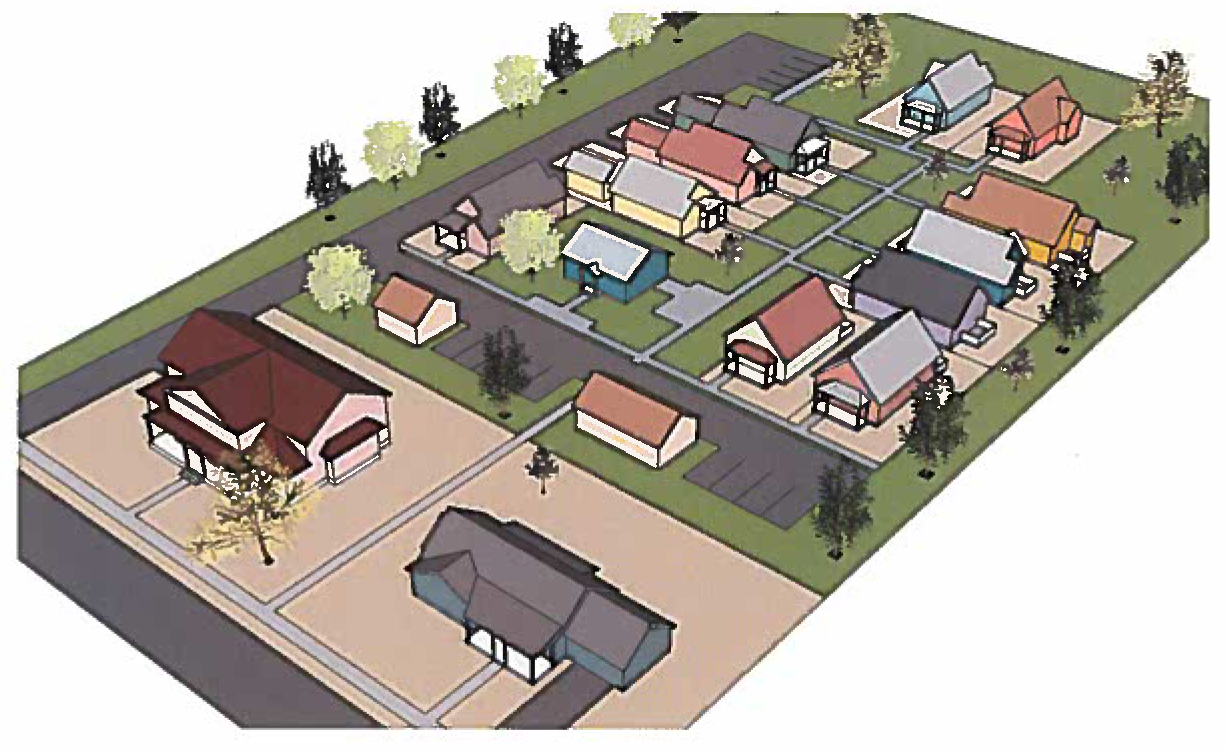
The cottage subdivision shall include common open space that comprises at least 30 percent of the total site. The common open space shall include a central green or lawn area fronting some or all of the dwellings, one or more shared surface off-street parking area(s) located away from the dwellings and common area, and a perimeter buffer area that incorporates landscaping materials, existing vegetation, or other features to buffer the subdivision from adjacent development (see Figure 19-4.3.1-1).
b.
The central green or lawn area shall include at least 375 square feet of area for each dwelling in the subdivision.
(1)
Permanent, unpaved, approved access easements shall not qualify as common open space central green or lawn area needed to meet this requirement.
c.
A common building located within the common open space area may be included as an accessory use, but in no instance shall the common building be larger than 1,500 square feet or serve as a permanent dwelling unit.
d.
Open space areas shall include improved pedestrian walkways that provide pedestrian access to each dwelling, shared parking areas, any common buildings, and the public sidewalk network.
e.
Ownership of the open space shall remain either with the developer or be conveyed to a homeowners' association or comparable legal entity under the laws of South Carolina.
f.
Maintenance of the land as permanent open space shall be ensured via the recordation of covenants or similar documents with the county registrar of deeds and noted (or referenced) on the site plan or final plat. This documentation shall also prescribe the nature and extent of continuing maintenance to the open space designed to preclude the creation of any nuisances.
5.
Dwellings fronting open space. Up to 60 percent of the dwellings in a cottage subdivision shall front common open space.
6.
Dwellings fronting internal streets and permanent, unpaved access easement. Dwellings in a cottage subdivision that front an internal street or unpaved access easement shall:
a.
Be oriented so that the front door of the dwelling faces the internal street or access easement;
b.
Include a front porch of at least ten feet in width and six feet in depth between the front facade of the dwelling and the street or access easement;
c.
Ensure that a street facing garage, if provided, is located at least 10 feet behind the front facade plane of the dwelling, including porches, and complies with the standards for street facing garage doors in subsection (b)(8) of this section.
Figure 19-4.3.1-1: Example layout of a cottage subdivision
7.
Dwellings fronting perimeter streets. Dwellings in a cottage subdivision that front a public street outside the development shall comply with the following standards:
a.
Lots shall maintain a minimum area of at least 75 percent of the minimum lot area for the underlying zoning district;
b.
Dwellings shall be oriented so that the front door of the dwelling faces the public street; and
c.
A street facing garage, if provided, shall be located at least ten feet behind the front facade plane of the dwelling, including porches, and comply with the standards for street facing garage doors in subsection (b)(8) of this section.
8.
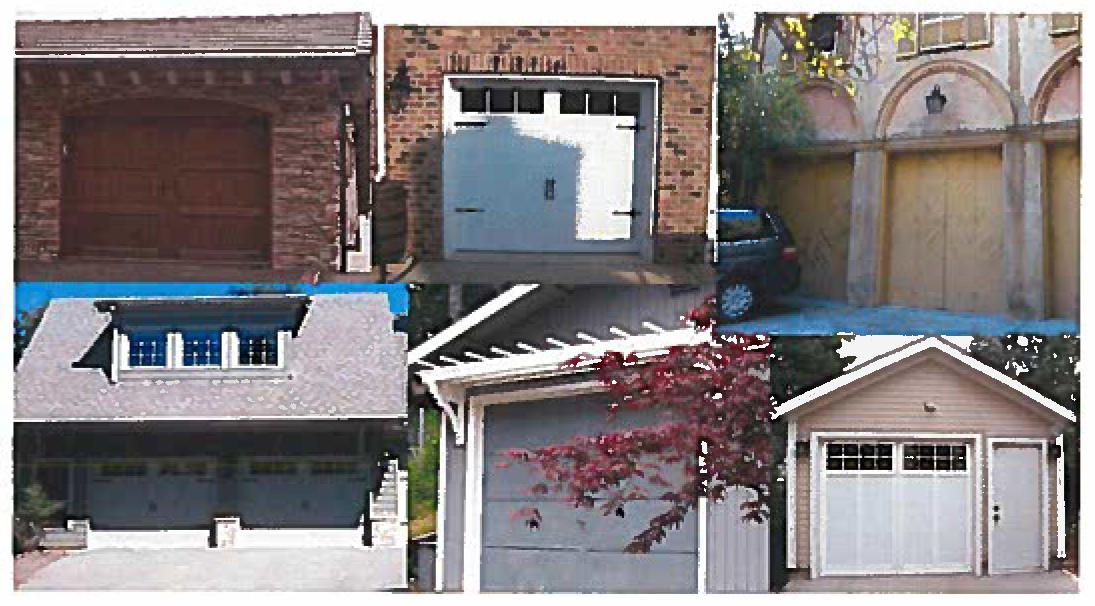
Street-facing garage doors.
a.
A street-facing garage door shall include at least two of the following features (see Figure 19-4.3.1-2):
i.
A garage door configured to appear as carriage house doors that open to the sides;
ii.
Arbor or trellis with a minimum depth of three feet over the garage door;
iii.
A roof overhang of at least two feet over garage door with columns, corbels, or another support structure;
iv.
An arch or arches over the garage door;
v.
Window dormers or a shed dormer;
vi.
An entry door with a minimum width of 30 inches;
vii.
A garage door and door trim of natural wood or material configured to appear as unpainted wood;
viii.
Windows within or above the garage door;
ix.
Eaves with exposed rafters, dentil moulding, or other detail appropriate to the architectural style of the structure; or
x.
Other feature as approved by the administrator.
b.
These standards shall not apply to garage doors facing internal streets within a cottage subdivision.
Figure 19-4.3.1-2: Examples of street-facing garage doors
9.
Surface parking.
a.
Each cottage subdivision shall incorporate at least one shared surface parking area that accommodates resident or guest parking. Surface parking areas shall include a total of at least one parking space for each dwelling unit plus one designated guest parking space for every four dwelling units. Provision of resident parking spaces within a shared surface parking area is not required in cases where resident parking is provided via individual driveways, garages, or by parking spaces along internal streets.
b.
In no instance shall a surface parking area be more than 300 linear feet from the dwelling it serves.
c.
Each surface parking lot or internal street shall be visible from at least one dwelling unit window in the development.
10.
Detached common garages. Detached garages serving more than one dwelling shall not exceed five car bays or include individual garage doors wider than 12 feet each.
11.
Storage space. Each individual dwelling shall have at least 40 square feet of covered storage space outside the heated floor area of the dwelling. Storage space may be located on an individual lot, adjacent to a common building, or within a common building.
12.
Perimeter buffer. A cottage subdivision may be required to incorporate a perimeter buffer along all lot lines shared with existing single-family detached dwellings, as determined by the administrator.
13.
Internal streets. Vehicular entryways into cottage subdivisions and internal streets serving the development shall be configured as private drives with a maximum pavement width of 22 feet.
(c)
Individual lot configuration.
1.
Dimensional requirements. The following table sets out the dimensional requirements for individual lots.
2.
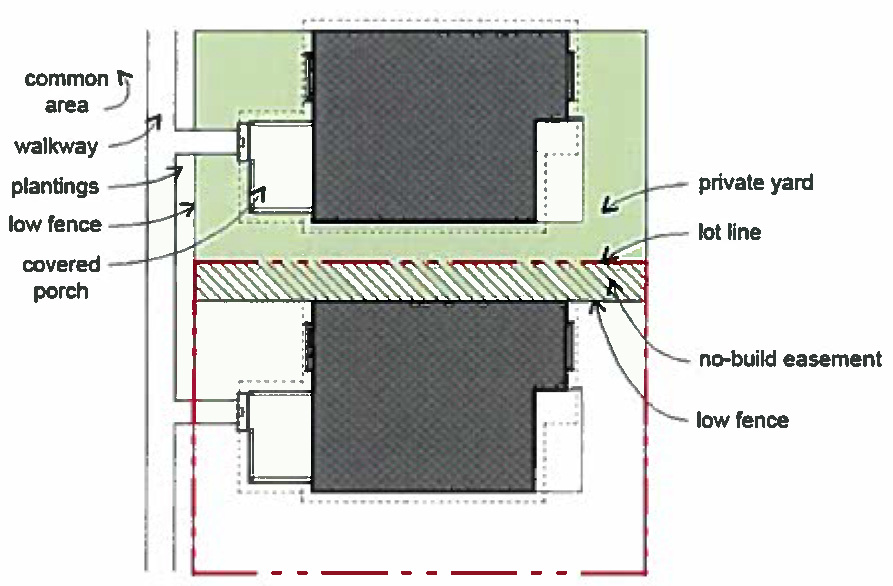
No-build easement. Any lot abutting another lot used for residential purposes in a cottage subdivision shall include a no-build easement on one side that extends from the lot line to the exterior wall of the dwelling (see Figure 19-4.3.1-3). The purpose for the use easement is to ensure that the adjoining property owner can use the entire side yard as private outdoor space.
Figure 19-4.3.1-3: No-build easement in the side yard
(d)
Dwelling unit configuration.
1.
Maximum height. A dwelling unit shall not exceed one and one-half stories, or 24 feet.
2.
Dwelling size. A dwelling unit shall be at least 600 gross square feet in size, but not more than 2,400 gross square feet in size, excluding garages.
3.
Front porch. A dwelling unit shall incorporate a covered front porch of at least ten feet in width and six feet in depth.
4.
Windows.
a.
The front facade shall incorporate a sufficient amount of windows to facilitate observation of the common area from within the dwelling.
b.
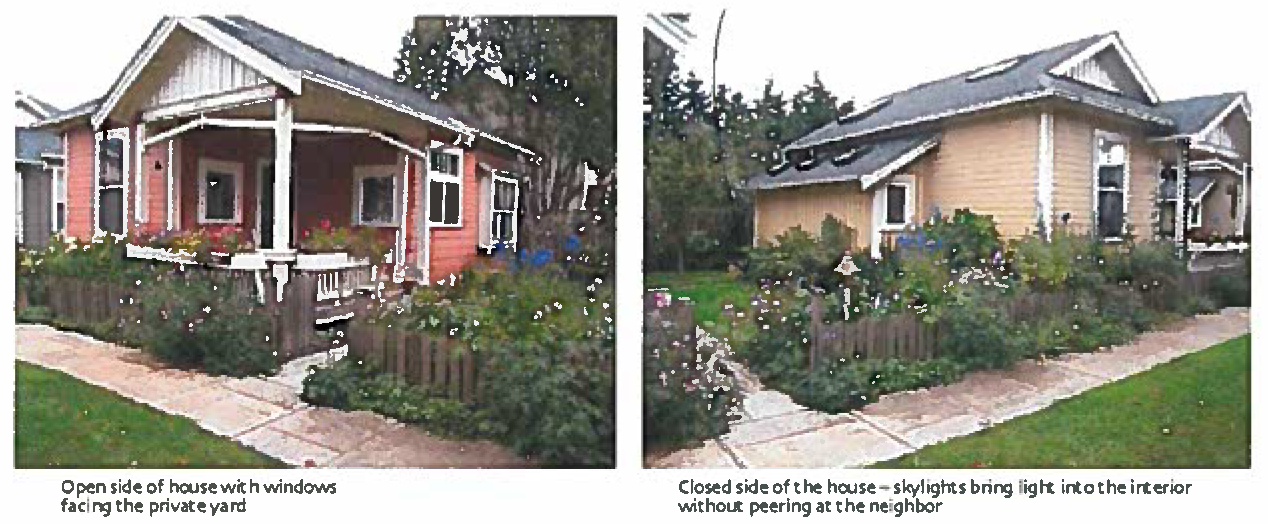
Windows on the side of the dwelling facing a side yard subject to a no-build easement held by an adjoining land owner shall remain opaque or be located above eye level to ensure privacy in the side yard of the abutting dwelling unit (see Figure 19-4.3.1-4).
Figure 19-4.3.1-4: Window placement on side facades
c.
In no instance shall window placement on exterior walls be configured in a manner that allows direct sight into another dwelling located 30 feet away or less.
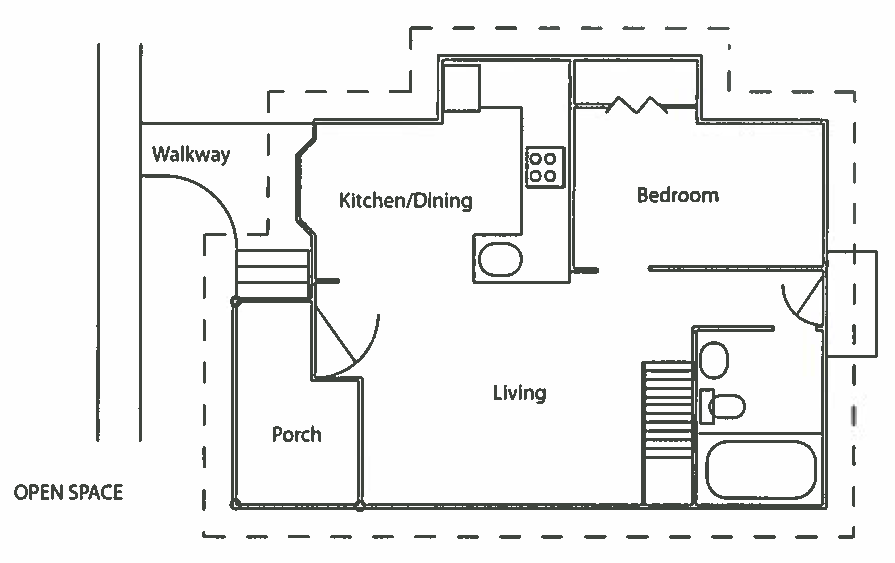
5.
Common room placement. Ground-floor public or common rooms (e.g., the living room, kitchen, dining, room, den, etc.) shall be located closer to the front door than bedrooms or bathrooms (see Figure 19-4.3.1-5).
Figure 19-4.3.1-5: Common rooms located close to the front door
6.
Refuse collection. Each dwelling unit shall maintain individual refuse collection containers. They shall be screened from view and located to the side or rear of the dwelling.
7.
Fences. Fences within front yards or side yards forward of the front facade plane shall not exceed 36 inches in height. Fences in rear yards or side yards behind the front facade plane shall not exceed 72 inches in height. In no instance shall a fence be placed within a no-build easement.
(e)
Homeowner's association. Each cottage subdivision should include a homeowner's or property owner's association, or comparable legal entity under the laws of South Carolina, that maintains control of common areas and takes responsibility for maintenance of common features in the neighborhood, in the event the developer has transferred ownership of the common areas. Homeowner's association documents shall be submitted to and reviewed by the city prior to approval of the subdivision.
(5)
Affordable housing.
(a)
Findings. City council finds that affordable housing is the essential foundation upon which to build a more sustainable future for the city of Greenville and to grow a more competitive workforce to meet the challenges of our regional, state, and global economy. City council finds that zoning regulations can be an effective tool for implementing the strategies to address the needs for affordable housing stock within the city. City council finds that the C-2 and C-3 zoning districts are an appropriate place for certain incentives provided in this section for the redevelopment of affordable housing types.
(b)
Purpose. This section is intended to promote a diversity of housing stock by providing certain incentives and regulatory standards for the creation of affordable housing units through redevelopment of hotels and motels to multi-family dwellings in the C-2 and C-3 zoning districts.
(c)
Availability. The affordable housing incentives and regulations provided in this chapter are available to all landowners in the C-2 and C-3 zoning districts as a use-specific standard when an applicant has demonstrated compliance with the conditions provided herein.
(d)
Definitions. For the purpose of this chapter, the following terms shall mean:
1.
Owner-occupied affordable housing unit: A dwelling unit where at least one occupant is an owner, and where all occupants have, in the aggregate, household income less than or equal to 100 percent of the area median income (AMI) for owner-occupied units. Area median income (AMI) shall be determined annually by the United States Department of Housing and Urban Development (HUD) as adjusted by the county.
2.
Rental affordable housing unit: A dwelling unit, where occupants have, in the aggregate, household income less than or equal to 80 percent of the area median income (AMI) for rental units. AMI shall be determined annually by HUD as adjusted by the county.
3.
Qualified household: Households where occupants have, in the aggregate, a household income less than or equal to 100 percent of the AMI for owner-occupied units, and a household income less than or equal to 80 percent of the AMI for rental units.
4.
Initial maximum allowable sales price: An amount equal to three times 100 percent of the AMI plus any subsidy available to the buyer.
5.
Affordable rent: Affordable rent is based on an amount not to exceed 30 percent of 80 percent of the AMI as published annually by HUD based on household size, inclusive of a utility allowance. Utility allowances are as provided by HUD guidelines.
6.
Household income: All sources of financial support, both cash and in kind, of adult occupants of the housing unit, to include wages, salaries, tips commissions, all forms of self-employment income, interest, dividends, net rental income, income from estates or trusts, Social Security benefits, pension benefits, or any other sources of financial support.
(e)
Applicability. Within the C-2 or C-3 zoning district, a property owner may elect to convert existing hotel or motel uses to multi-family dwelling units according to the standards in this section provided that the applicant demonstrates strict compliance with the conditions stated herein.
(f)
Land use standards. A redevelopment within the C-2 or C-3 zoning district may elect to provide for affordable housing units, in accordance with the following standards:
1.
Unit percentage. The number of owner-occupied affordable housing units and/or rental affordable housing units per development shall be one of the following at the election of the applicant:
a.
Thirty percent of the dwelling units, rounded up to the whole number, shall be restricted by deed as owner-occupied affordable housing units and/or rental affordable housing units for a period of at least 20 years; or
b.
Twenty percent of the dwelling units, rounded up to the whole number, shall be restricted by deed as owner-occupied affordable housing units and/or rental affordable housing units for a period of at least 25 years.
2.
Unit design. The affordable housing units shall be sized, in terms of square footage and number of bedrooms, comparable and proportional to the square footage and number of bedrooms of the market rate units in the development as a whole. The smallest affordable housing unit by bedroom count shall not be smaller than the smallest market rate unit with the same number of bedrooms. The affordable housing units shall be integrated and intermixed within the market rate units in a development and may not be clustered together or segregated from the market rate units. When a development contains multiple buildings, it shall incorporate into each building, affordable housing units comparable and in proportion, to the number of market rate units in the building so that affordable housing units are disbursed proportionately throughout the development. Exterior finishes of affordable housing units shall be indistinguishable from exterior finishes of market rate units.
3.
Density waiver. There shall be no maximum density or minimum lot size requirements.
4.
Additional units. The amount of multi-family dwelling units shall be no greater than the amount of guest rooms prior to the redevelopment of the original hotel or motel use.
5.
Parking reduction. The off-street parking requirements of section 19-6.1.3 shall be reduced by 30 percent.
6.
Land use development standards. All other land use and development standards of the C-2 or C-3 zoning district for multi-family development shall be provided, including but not limited to standards for height, area, setbacks, and buffers.
7.
Mixed use projects. The standards and incentives provided in this chapter shall apply only to the housing portions of the mixed use project.
(g)
Submittal requirements, procedures and enforcement.
1.
Prior to receiving a building permit for any portion of a redevelopment, the owner thereof shall provide, in writing, in the form of a memorandum of understanding to be filed with the Greenville City Council, to the satisfaction of the planning and development division, or its successor, information identifying the total number of efficiency, one bedroom, two bedroom, etc. and the respective square footage of the same and provide a breakdown of the number, location, size, square footage, bedrooms etc. of the affordable housing units. Prior to the issuance of a certificate of occupancy for any portion of a redevelopment, the owner thereof shall identify, in writing, to the planning and development division, or its successor, the units designated as owner-occupied affordable housing units and/or rental affordable housing units. Affordable housing units shall not be changed, modified, or amended in location, size, square footage etc. without first notifying and receiving in writing, approval from the planning and development division.
2.
Prior to the issuance of a certificate of occupancy for any portion of a redevelopment permitted pursuant to this section, the owner shall execute covenants satisfactory to the city that identifies the owner-occupied affordable housing units and/or the rental affordable housing units. The executed covenants shall restrict such units to occupancy or ownership by qualified households for a period of 20 years when 30 percent of the units are set aside as affordable housing units or 25 years when 20 percent of the units are set aside as affordable housing units pursuant to the sections above. The executed covenants shall be filed with the city of Greenville prior to the issuance of a certificate of occupancy.
3.
Prior to the issuance of a development permit, the owner shall submit plans in accordance with section 19-6.8 - Design standards for multifamily residential development. The plans shall demonstrate compliance with the standards provided in that section.
4.
The covenants for affordable housing units shall provide:
a.
For owner-occupied affordable housing units, the covenants shall identify the maximum allowable sales price, and provide that the initial maximum allowable sale price may be adjusted annually for inflation based on the increase in the area median income (AMI) or consumer price index, whichever is greater. Each owner of such units, prior to initial occupancy, shall be required to submit to the planning and development division, or its successor, a verified income report of household income of all members of the household. The covenants shall require notice to the planning and development division, or its successor, of any transfer of the owner-occupied affordable housing units and verification that the purchaser is a qualified household. Owner-occupied affordable housing units shall be subject to these resale restrictions for no fewer than the numbers of years elected by the developer provided for in this section. Such restrictions shall be recorded as deed restrictions for the affordable housing unit identified in the memorandum of understanding executed pursuant to the requirements in this section.
b.
For rental affordable housing units, the covenants shall require the owner to provide proof to the planning and development division, or its successor, at inception of every tenancy, and on an annual basis thereafter, that no more than affordable rent is being charged for the affordable housing units. The owner or licensed property manager acting on behalf of the owner, shall provide verified income reports of household income of all occupants of rental affordable housing units at the request of the planning and development division, or its successor. Rental affordable housing units shall be subject to these restrictions for no fewer than the number of years elected by the developer provided for in this section.
c.
If an affordable housing unit is converted from rental occupied to owner-occupied occupancy during the term of the covenants, the unit shall be subject to the owner-occupied affordable housing unit requirements as set out the sections above (to include an initial maximum sales price) for a term of months equal to the number resulting when subtracting from 300 months, the number of months the unit has been subject to the rental affordable housing covenants.
d.
Conversion of an affordable housing unit from owner-occupied to renter occupied occupancy shall not be permitted.
e.
Covenants shall require written notice to the planning and development division prior to any conversion taking place and shall require that the necessary covenant(s) and amendment(s) to the memorandum of understanding be filed with the city of Greenville.
5.
If the redevelopment is to be phased, each phase shall include affordable housing units concurrently with the market rate units in the particular phase in the same proportions in relations to the overall development requirements for affordable housing units. A phasing in plan must make the affordable housing units available concurrently with the market rates in proportions based on the overall percentages elected pursuant to this Code.
6.
Upkeep and maintenance of affordable housing rental units must be maintained at the same or better level provided to the market rate units.
(B)
Group living/boardinghouse. A boardinghouse shall be owner-occupied or shall be managed by a resident manager licensed as a property manager in accordance with state law.
19-4.3.2.
Public and institutional uses.
(A)
General.
(1)
Design standards. Except where specifically exempted by this chapter, nonresidential uses shall comply with the standards in subsection 19-6.5.
(2)
Public and institutional uses located within the OD, C-1, C-2, C-3, C-4, S-1, RDV, and PD districts open to the public between the hours of 12 midnight and 5:00 a.m. require a special exception permit, except when a conditional use permit is required, and, at a minimum, are subject to the following standards:
(a)
The standards for granting a special exception permit.
(b)
On-site traffic shall be directed away from abutting residential uses or residential districts between the hours of 12:00 midnight and 5:00 a.m.
(c)
Delivery, waste collection, and similar commercial traffic is prohibited between the hours of 12:00 midnight and 7:00 a.m.
(d)
Loitering, solicitation, and disorderly conduct is prohibited at all times; rules consistent with the provisions of the Greenville Code of Ordinances shall be posted in conspicuous locations and shall be enforced by the proprietors.
(e)
Exterior sound amplification is prohibited except in areas specifically authorized on the approved site plan and/or floor plan; all amplified sound shall be directed inward toward the facility and away from any adjoining use or public property. No exterior amplified sound shall be permitted between the hours of 10:00 p.m. and 11:00 a.m. Interior sound amplification shall be located only as reflected on an approved floor plan and shall be directed away from the principal entrance or directed toward the interior of the building.
(f)
Drive-through facilities shall be closed between the hours of 12:00 midnight and 5:00 a.m.
(g)
Exterior doors shall remain closed except to provide ingress and egress between the hours of 10:00 p.m. and 5:00 a.m.
(h)
The required permit, either special exception permit or conditional use permit, shall be limited to the applicant and shall not be transferrable. A copy of the special exception permit or the conditional use permit shall be maintained on the premises with other related inspection, licensing, and occupancy information.
(B)
In addition to applicable use-specific standards that follow, the administrator may impose conditions on a conditional use permit intended to mitigate any negative impacts of the use relating to:
(1)
The volume and type of sales, retail, wholesale; size and type of items sold and nature of inventory on the premises;
(2)
Any processing done on the premises, including assembly, manufacturing, warehousing, shipping, distribution;
(3)
The nature and location of storage and outdoor display of merchandise; enclosed, open, inside or outside the principal building; and predominant types of items stored (such as business vehicles, work-in-process, inventory, and merchandise, construction materials, scrap and junk, and raw materials including liquids and powders);
(4)
The type, size and nature of buildings and structures;
(5)
The number and density of employees and customers per unit area of site in relation to business hours and employment shifts;
(6)
Transportation requirements, including the modal split for people and freight, by volume type and characteristic of traffic generation to and from the site, trip purposes and whether trip purposes can be shared by other uses on the site;
(7)
Parking requirements, turnover and generation, ratio of the number of spaces required per unit area or activity, and the potential for shared parking with other uses;
(8)
The amount and nature of any nuisances generated on the premises, including but not limited to noise, smoke, odor, glare, vibration, radiation and fumes;
(9)
Any special public utility requirements for serving the proposed use, including but not limited to water supply, waste water output, pre-treatment of wastes and emissions required or recommended, and any significant power structures and communications towers or facilities; and
(10)
The impact on adjacent properties created by the proposed use will not be greater than that of other uses permitted in the district.
(C)
Day care. All day care facilities are permitted subject to the following standards:
(1)
Day care facilities shall comply with all applicable state regulations.
(2)
Day care homes (six or fewer people) are considered home occupations and shall comply with the requirements of subsection 19-4.4.3(C) and (F).
(3)
A day care facility operated by, and located on the site of, a religious institution may be allowed as an accessory use only if found to be compatible with adjacent areas in terms of hours of operation, noise, lighting, parking, and similar considerations, and if it does not cause significant traffic impacts.
(4)
In the C-1 district, day care facilities shall not exceed a gross floor area of 1,000 square feet.
(D)
Educational facilities.
(1)
Business school. In the C-1 district, business schools shall comply with the following standards:
(a)
Hours of operation shall be limited to between the hours of 7:00 a.m. and 9:00 p.m.
(b)
The gross floor area shall not exceed 1,000 square feet.
(2)
School, public or private. In the residential districts, schools may be approved as a special exception. Any redevelopment or addition to a school or its accessory facilities, or modification of parking or vehicular circulation patterns, shall also be reviewed as a special exception.
(3)
Trade school. Such use shall not involve activities that would otherwise not be permitted in the zoning district.
(E)
Medical facility, other than hospital. In the C-1 district, a medical facility, other than a hospital, shall comply with the following standards:
(1)
The use shall not exceed a gross floor area of 2,000 square feet.
(2)
Hours of operation shall be limited to the hours between 7:00 a.m. and 9:00 p.m.
(F)
Religious institution. Religious institutions may be approved as a special exception in selected districts. Any new building or addition to a religious institution shall also be reviewed as a special exception.
(G)
Wireless communications facility.
(1)
General requirements. All wireless communications facilities permitted under this chapter shall comply with the following general requirements in addition to other applicable provisions of this subsection 19-4.3.2(G):
(a)
Abandonment and removal. A wireless communications facility and any pole or support structure used solely for that wireless communication facility that has not been operated for a period in excess of 12 consecutive months, is abandoned and must be removed; provided the city must first provide written notice to the owner(s) in order to allow the owner(s) ten business days to rebut the assertion of abandonment. Any support structure other than a tower, and any property affected by placement of the wireless communications facility or modification of the support structure must be restored to its condition prior to attachment of the wireless communications facility, except as the city may otherwise direct. The city shall enforce removal by means of existing regulatory authority, with costs of removal or restoration jointly chargeable to the owner of the wireless communications facility or the support structure.
(b)
Multiple uses on a single parcel or lot. Wireless communications facilities may be located on a parcel containing another principal use on the same site or may be the principal use itself.
(c)
Required buffer yards. Wireless communications facilities or poles or support structures associated with the same shall not be located within street buffer yards that are required by subsection 19-6.2.4, Street buffer yards, with the exception of approved stealth wireless communications facilities.
(d)
Lighting and signage.
(i)
Lighting. Wireless communications facilities and associated pole or support structure shall not be lighted unless required by the Federal Communications Commission (FCC) or the Federal Aviation Administration (FAA), or unless the facilities are stealth facilities, and lighting is a concealment element.
(ii)
Signage. Except for signage that may be approved as a concealment element, signs located at or upon wireless communications facilities, placed on an associated pole or support structure in connection with the wireless communications facility, shall be limited to ownership and contact information, FCC antenna registration number (if required) and any other information as required by government regulation. Commercial advertising is strictly prohibited.
(e)
Site usage.
(i)
Any buildings, cabinets or shelters associated with the wireless communications facility, shall be used only to house equipment and other supplies in support of the operation of the wireless communications facility. Any equipment not used in direct support of such operation shall not be stored on the site.
(ii)
Where stealth facilities are not feasible, base station and accessory equipment shall be located, designed, and/or screened to blend with the existing natural, or built surroundings to reduce the visual impacts as much as technically feasible, and to be compatible with neighboring land uses and the character of the community.
(iii)
Except as part of a stealth facility, no ground mounted base station or accessory equipment is permitted in a residential zone with the exception of such cabinets which do not exceed the dimensions of other utility-associated cabinets within the immediate residential vicinity, and which are shielded or placed in a manner consistent with such other cabinets.
(iv)
The wireless communications facility shall not produce noise that would interfere with the peaceable enjoyment of adjoining properties.
(v)
The equipment installed as part of any wireless communications facility shall be minimized, so that the wireless communications facility is as unobtrusive as technically feasible.
(vi)
The elements of the wireless communications facility, and any pole or support structure to which it is affixed must be consistent with the overall design and character of the neighborhood and locations in which it is placed, and with publicly-available planned improvements to those neighborhoods. The design, including the physical dimensions of the pole or support structure, are to be considered in making this determination.
(f)
Exceptions.
(i)
Notwithstanding any other provision of the City Code, an applicant may obtain approval of an application for placement of a wireless communications facility and for any pole or support structure for which approval is sought as part of the application, if applicant demonstrates that denial of the application would constitute an effective prohibition within the meaning of 47 U.S.C. Section 332(c)(7) or otherwise violates applicable law such that the city is required to issue a permit for placement. Claims must be supported by sworn declarations, and engineering claims by licensed engineers authorized to practice in the State of South Carolina and qualified to attest to facts asserted.
(ii)
A Permit is not required under this section 19.4.3.2(G) for placement of cells on wheels for a temporary period as defined under FCC regulations; or for ordinary maintenance or replacement of equipment which does not increase the physical dimensions of a wireless communications facility or support structure, or defeat any applicable concealment element. Other modifications of a wireless communications facility, or of a support structure to accommodate a modification to a wireless communications facility, do require approval; provided, however, the city engineer, with the approval of the administrator, may exempt from approval immaterial increases in the physical dimensions of a wireless communications facility or support structure, provided the applicable concealment elements are not defeated. A permit under this chapter is not required for placement, installation, maintenance, operation or replacement of small wireless facilities in the rights-of-way for which a node site license is issued pursuant to Chapter 36, or for micro wireless facilities that are exempted from the permit requirements of Chapter 36. A permit otherwise is required, provided that for placement of a small wireless facility in any public right-of- way, a permit will be issued applying the standards and procedures of Chapter 36, and this subsection 19-4-3.2(G)(1).
(g)
Projects. When an application for a wireless communications facility is part of a network of planned facilities, an applicant may submit, or may be required by the city to submit, plans for the proposed network as a whole, and the city may evaluate the planned facilities considering the impact of the project as a whole, in order to ensure that the impact of the project is minimized.
(h)
Other obligations. The application for, and the placement of wireless communications facilities shall be subject to this chapter and regulations issued to implement this chapter. This section 19-4.3.2 shall not be interpreted to waive any obligations that may apply under other provisions of applicable law, including but not limited to building and electrical codes.
(i)
Design guidelines—generally. In order to provide guidance to applicants concerning the design of wireless communications facilities, support structures, and poles which comply with this chapter, the city engineer shall maintain and publish on the city's website a catalogue of site-specific designs that have been approved by the city, it being recognized that the same design as those set forth in in the catalogue should in most instances be deemed appropriate for a comparable location. A person who wishes to install a wireless communications facility may ask the city to review the design for installation in particular locations, and to add the design to the catalogue.
(2)
Towers, monopoles and colocation.
(a)
Types permitted. New towers must be either monopoles, or stealth facilities, and stealth facilities are preferred.
(b)
Availability of other suitable locations. New monopoles other than stealth facilities shall not be permitted unless the applicant makes the showing required by subsection 19-4.3.2(G)(1)(g)(i). Except in residential zoning districts, stealth facilities may be permitted if applicant demonstrates that no existing tower would permit the provision of personal wireless services to the area which the applicant proposes to serve, while satisfying the other provisions of this section 19-4.3.2(G).
(c)
Design. Towers shall be subject to the following:
(i)
Except where inconsistent with other provisions of the City Code, towers shall be engineered and constructed to accommodate a minimum number of collocations based upon their height:
(1)
Towers 60 to 100 feet shall support at least two communications providers;
(2)
Towers greater than 100 feet but less than 150 feet shall support at least three communications providers; and
(3)
Towers greater than 150 feet in height shall support at least four communications carriers.
(ii)
Except where inconsistent with other provisions of this Code, the equipment compound area surrounding the tower must be of sufficient size to accommodate base station and accessory equipment for the appropriate number of communications providers in accordance with subsection 19-4.3.2(G)(2)(c)(i).
(iii)
Towers shall be subject to terms and conditions that minimize the impact upon private and public property (including, where applicable, the public right-of-way), ensure consistency with the surrounding area, and employ concealment elements appropriate to the location proposed.
(iv)
Towers are not permitted within utility rights-of-way or in utility easements, except in accordance with the following requirements:
(1)
The easement area or public rights-of-way shall be a minimum of 100 feet in width;
(2)
The easement area or public rights-of-way shall contain overhead utility transmission and/or distribution structures that are 80 feet or greater in height;
(3)
The height of a tower or the highest point on the base station affixed to it may not exceed by more than 30 feet the height of existing utility support structures; and
(4)
The tower and all other elements of the wireless communications facility associated with it, shall be set back a minimum of 15 feet from all boundaries of the easement or right-of-way.
(d)
Setbacks. Unless otherwise stated herein, towers shall be set back from all property lines a distance equal to its engineered fall zone.
(i)
Residential uses. Where allowed in residential districts, towers shall be located at least 30 feet from the property line of a lot containing a residential use and, further, setback from any structure located thereon at a distance equal to its engineered fall zone.
(e)
Height. When allowed in residential districts, the highest point on the tower or base station affixed to it shall not exceed a height equal to 60 feet from ground level.
(f)
Fencing. Except for towers permitted under section (c)(iv), or where the requirement would defeat concealment elements, a tower and all other elements of the wireless communications facility associated with it shall be secured and enclosed with a fence not less than six feet in height. Fencing shall be screened in accordance with subsection 19-6.2.5. Barbwire is prohibited.
(3)
Roof-mounted communication towers and base stations.
(a)
Location. Except in the C-4 district, a proposed roof-mounted communication tower or base station may be permitted as an accessory or secondary use only on buildings that exceed 50 feet in height in accordance with subsection 19-5.2.9, Building height.
(b)
Height. In the C-4 district, a roof-mounted communication tower or base station shall not exceed a height to which it is visible from the adjacent public rights-of-way. For all other districts except S-1 and I-1, such roof-mounted facilities shall not exceed the height of 40 feet, and the height may be further limited as appropriate to issuance of the conditional use permit in light of the proposed location.
(c)
Equipment. All elements of the wireless communications facility and any pole or tower shall be of a color that will minimize their visual impact unless concealed by a parapet, located on the rear elevation, or configured to have a minimal visual impact as seen from the street or existing residential development.
(4)
Building, utility pole and light pole mounted wireless communications facilities.
(a)
Stealth facilities permitted. Base stations that are stealth facilities may be placed inside any existing building or other existing structures (other than off-premises signs) provided that the placement does not alter the physical dimensions of the structure. Portions of base stations that are stealth facilities may be attached to the side of any building or other existing structures, other than a single-family residential units and off-premises signs. However, installation is not permitted where it would adversely affect a historically significant or environmentally sensitive structure or area, and is only permitted where other elements of the wireless communications facility and pole or support structures can be appropriately concealed by placing those elements on the rooftop, within the building, underground, or by some other means that conceals them from view. Antennas must be located at least 20 feet above ground level, and may not extend into any rights-of-way except as part of approved signage.
(b)
Placement on existing utility poles outside of the rights-of-way.
(i)
Antennas associated with a wireless communications facility may be placed on an existing utility pole outside of the rights-of-way. The facilities must be small wireless facilities within the meaning of federal regulations, and shall be reviewed applying the standards applicable to placements on utility poles within the rights-of-way.
(c)
Mounted on light poles.
(i)
This section applies to light poles situated on private property, or public property other than the rights-of-way
(ii)
Wireless communications facilities may be placed on existing light poles subject to the same conditions that apply to existing utility poles provided that:
(1)
The design and placement of all elements of the wireless communications facility is consistent with the design of the light pole to which it will be attached and;
(2)
The design and placement of all elements of the wireless communications facility will not adversely affect the overall design of the area within which the light pole is located.
(3)
The city must know who will own and control the light pole, and who is responsible for emergency responses and ensuring the safety of the light pole.
(4)
The applicant must have and maintain a binding contract with the entity that owns or controls the light pole, which may include the city. Nothing in this ordinance prevents an entity that owns or controls a light pole, including the city, from imposing additional or stricter standards for the design of the light pole than may be imposed pursuant to the regulatory conditions in the permit issued pursuant to this section.
(d)
Replacement. For purposes of this section, if an existing utility or light pole must be replaced it may be replaced provided that it meets other applicable requirements of this section and:
(i)
The design of the replacement light pole is consistent with the design of the light pole that it replaces.
(ii)
In the case of the utility pole, the overall height of the pole, measured from ground level to the highest point including the wireless communications facility, does not increase by more than ten feet, and the diameter measured at six feet from the butt, does not increase by more than two inches; and
(iii)
In the case of the light pole, its overall height, measured from ground level to the highest point, including the wireless communications facility, does not increase by more than ten feet, and the design, height and proportions remain consistent with design of the light pole that is being replaced.
(5)
A permit will only be issued for a wireless communications facility and associated poles and support structures in the rights-of-way that are not, or will not be small wireless facilities, where the same (a) satisfy the conditions of Chapter 36; and (b) the facility is an approved stealth facility or the applicant shows that a permit must be issued to it as a matter of state or federal law.
(6)
Application and procedure. The administrator, in consultation with the city engineer and planning and development division shall develop forms requiring such information and documentation as they deem prudent and necessary for the city's review of eligible facilities requests and with respect to all other applications, the issuance of the approvals contemplated hereunder. The administrator, in consultation with the city engineer and planning and development division may develop regulations governing the number of applications that may be submitted by or on behalf of any person at any time, and may require a person, to identify all facilities that it intends to construct within the city, and (in the case of a person who will be leasing facilities to another) all facilities its lessees intend to install within the city. All applications shall be processed in accordance with the following time frames:
(a)
Upon receipt of the application, the administrator or his/her designee shall review such application to determine whether the application is complete, shall notify the applicant that the application is incomplete within 30 days of receipt or such shorter period as may be required in order to toll or reset the time for review under applicable FCC regulations. An application is incomplete if it omits or withholds any required information, or fails to provide information in sufficient detail to determine whether the application is eligible for administrative review, or to determine whether the work will be performed in accordance with, and will result in a wireless communications facility that complies with applicable law. If the applicant fails to respond to the notice of incompleteness within a time specified by the administrator, the application shall be denied. If applicant responds, but the application remains incomplete, the administrator shall promptly notify the applicant that the application remains incomplete, within the times specified by applicable law.
(7)
Miscellaneous.
(a)
Severability. Should any section or provision of this ordinance be decided by a court of competent jurisdiction to be unconstitutional or invalid, such decision shall not affect the validity of the Ordinance as a whole or any part thereof other than the part so declared to be unconstitutional or invalid.
(b)
Conflict with other Laws. Whenever the regulations of this ordinance conflict with the requirements of another South Carolina or Federal Statute or the City Code of Ordinances, the more restrictive standard shall govern.
(c)
No additional cost to the city. Whenever this ordinance specifies co-location, the replacement of an existing structure, or any other action (besides governmental approvals), all such action shall be taken at the sole expense of the applicant.
(d)
References to other laws. All references to state or federal laws and regulations refers to those laws and regulations as they may be amended from time to time.
19-4.3.3.
Commercial uses.
(A)
General.
(1)
Design standards. Except where specifically exempted by this chapter, nonresidential uses shall comply with the standards in subsection 19-6.5.
(2)
Commercial uses located within the OD, C-1, C-2, C-3, C-4, S-1, RDV, and PD districts open to the public between the hours of 12 midnight and 5:00 a.m. require a special exception permit, except when a conditional use permit is required, and, at a minimum, are subject to the following standards:
(a)
The standards for granting a special exception permit.
(b)
On-site traffic shall be directed away from abutting residential uses or residential districts between the hours of 12:00 midnight and 5:00 a.m.
(c)
Delivery, waste collection, and similar commercial traffic is prohibited between the hours of 12:00 midnight and 7:00 a.m.
(d)
Loitering, solicitation, and disorderly conduct is prohibited at all times; rules consistent with the provisions of the Greenville Code of Ordinances shall be posted in conspicuous locations and shall be enforced by the proprietors.
(e)
Exterior sound amplification is prohibited except in areas specifically authorized on the approved site plan and/or floor plan; all amplified sound shall be directed inward toward the facility and away from any adjoining use or public property. No exterior amplified sound shall be permitted between the hours of 10:00 p.m. and 11:00 a.m. Interior sound amplification shall be located only as reflected on an approved floor plan and shall be directed away from the principal entrance or directed toward the interior of the building.
(f)
Drive-through facilities shall be closed between the hours of 12:00 midnight and 5:00 a.m.
(g)
Exterior doors shall remain closed except to provide ingress and egress between the hours of 10:00 p.m. and 5:00 a.m.
(h)
The required permit, either special exception permit or conditional use permit, shall be limited to the applicant and shall not be transferrable. Copy of the special exception permit or the conditional use permit shall be maintained on the premises with other related inspection, licensing, and occupancy information.
(3)
Mobile food units. Vehicles, trailers, or other movable motorized or non-motorized units that sell food or beverages to the general public are classified as a "restaurant with no seating" use type within the "eating establishments" use category in Table 19-4.1-2: Table of Uses. Mobile food units are permitted subject to the following conditions:
(a)
An owner or operator of a mobile food unit shall obtain all required permits, including a City of Greenville business license, prior to operating in the city.
(b)
An owner or operator of a mobile food unit must receive the written permission of the property owner prior to locating on the premises.
(c)
The mobile food unit shall be located so that the physical unit and/or its customer service area does not block or impede access across any vehicular or pedestrian travel way, ADA-accessible parking area or pathway, or any service or emergency access way.
(d)
In addition to the generally applicable noise ordinance and other city ordinances, the use of a generator by a mobile food unit is prohibited within 100 feet of a residential district.
(B)
In addition to applicable use-specific standards that follow, the administrator may impose conditions on a conditional use permit intended to mitigate any negative impacts of the use relating to:
(1)
The volume and type of sales, retail, wholesale; size and type of items sold and nature of inventory on the premises;
(2)
Any processing done on the premises, including assembly, manufacturing, warehousing, shipping, distribution;
(3)
The nature and location of storage and outdoor display of merchandise; enclosed, open, inside or outside the principal building; and predominant types of items stored (such as business vehicles, work-in-process, inventory, and merchandise, construction materials, scrap and junk, and raw materials including liquids and powders);
(4)
The type, size and nature of buildings and structures;
(5)
The number and density of employees and customers per unit area of site in relation to business hours and employment shifts;
(6)
Transportation requirements, including the modal split for people and freight, by volume type and characteristic of traffic generation to and from the site, trip purposes and whether trip purposes can be shared by other uses on the site;
(7)
Parking requirements, turnover and generation, ratio of the number of spaces required per unit area or activity, and the potential for shared parking with other uses;
(8)
The amount and nature of any nuisances generated on the premises, including but not limited to noise, smoke, odor, glare, vibration, radiation and fumes;
(9)
Any special public utility requirements for serving the proposed use, including but not limited to water supply, waste water output, pre-treatment of wastes and emissions required or recommended, and any significant power structures and communications towers or facilities; and
(10)
The impact on adjacent properties created by the proposed use will not be greater than that of other uses permitted in the district.
(C)
Eating establishments.
(1)
General.
(a)
Eating establishments that encroach onto public property shall comply with the city's outdoor displays and cafes ordinance (see chapter 8, article VIII, of this Code).
(b)
Eating establishments on private property shall comply with the following standards:
1.
The eating establishment shall not obstruct the movement of pedestrians along adjoining sidewalks, or through other areas intended for public usage, ingress, or egress.
2.
Outdoor live entertainment shall not be allowed, unless separate approval is obtained for an outdoor entertainment use.
3.
In approving eating establishments, the decision-making body may impose conditions relating to the location, configuration, and operational aspects (including hours of operation, noise, and lighting) to ensure that eating establishments will be compatible with surrounding uses and will be maintained in an attractive manner.
(2)
Eating establishments in the C-1 district. Eating establishments in the C-1 district shall comply with the following standards:
(a)
The gross floor area shall not exceed 3,500 square feet.
(b)
Hours of operation shall be limited to between the hours of 6:00 a.m. and 10:00 p.m.
(c)
The sale of alcoholic beverages shall require a special exception permit.
(D)
Office. In the C-1 district, offices shall comply with the following standards:
(1)
The gross floor area shall not exceed 1,000 square feet.
(2)
Hours of operation shall be limited to the hours between 7:00 a.m. and 7:00 p.m.
(E)
Parking, commercial. In residentially zoned districts, parking lots for uses in nonresidential districts shall comply with the following standards:
(1)
The parcel on which the parking lot is located shall be adjacent to the nonresidential district on which the use is located;
(2)
A parking lot in a residential district shall not be used to exceed the maximum amount of parking allowed in subsection 19-6.1.3, and when shared by multiple uses, shall utilize shared parking based on provisions of subsection 19-6.1.9(A);
(3)
The parking lot design shall comply with all applicable landscaping, screening and buffering provisions of section 19-6.2;
(4)
The parking lot design shall comply with all applicable tree protection provisions of section 19-6.3;
(5)
Lighting of the parking lot shall comply with the provisions of section 19-6.4;
(6)
No ingress/egress of the parking lot shall be allowed onto a street with less than 2,200 average daily trips (based on most recent available traffic counts);
(7)
No signs, except directional signs, shall be allowed on a parking lot in a residential district, except for warning signs for nonconsensual booting and towing as required by section 42-182;
(8)
The parking lot shall not disrupt the character of an established residential streetscape; and
(9)
The conditional use permit is tied to the individual tenants using the parking lot and shall be limited to the tenant, and shall not be transferrable.
(F)
Retail sales and service.
(1)
Automobile parts and tire store. All merchandise, automobile parts, discarded parts, and similar materials shall be stored within an enclosed building or within an outdoor storage area which complies with screening requirements in subsection 19-6.2.5.
(2)
Bank, financial institution, or ATM. In the C-1 district, these uses shall comply with the following standards:
(a)
The gross floor area shall not exceed 1,200 square feet.
(b)
Neither drive-through nor drive-up facilities are permitted.
(3)
Body piercing/tattoo establishment. In the RDV district, these uses shall comply with the following standards:
(a)
Body piercing and/or tattoo establishments shall only be permitted within the Village of West Greenville as defined in subsection 8-33(p).
(b)
The uses shall not be permitted when adjacent to a single- family detached residential use or single-family residential district.
(4)
Casino or gambling establishment. Such uses shall be allowed only when allowed by the general law of the state. When allowed, the property line of any such use shall be at least 500 feet from the property line of any residential district, residential use, preservation overlay district, building on the National Register of Historic Places, park, religious institution, or school.
(5)
Convenience store.
(a)
In the C-1 district, convenience stores shall comply with the following standards:
1.
The gross floor area shall not exceed 1,500 square feet.
2.
Hours of operation shall be limited to the hours between 6:00 a.m. and 9:00 p.m.
3.
The sale of alcoholic beverages shall require a special exception permit.
(b)
Site configuration for convenience stores with gasoline sales.
1.
Lot area.
a.
Corner lots. Corner lots containing a convenience store with gasoline sales shall have a lot area of at least 40,000 square feet, with a frontage of at least 150 feet on each street side.
b.
Interior lots. Interior lots containing a convenience store with gasoline sales shall have a lot area of at least 30,000 square feet and a lot width of at least 120 feet.
2.
Site access. The site shall be limited to two vehicular access points from a street right-of-way. An access point shall be located at least 100 feet from another access or intersecting street right-of-way, and 15 feet from a lot line. A vehicular access point shall be no more than 40 feet wide.
3.
Cross access. A parking lot cross-accessway a minimum of 24 feet in width is strongly encouraged if a convenience store with gasoline sales is located adjacent to a commercial use.
4.
Stacking spaces. Fuel pump islands shall be configured with adequate stacking spaces so that at least one vehicle can queue at each end of the island without blocking driveways.
5.
Vehicular circulation. Fuel pump islands shall be at least 24 linear feet from designated off-street parking spaces, building entrances, or drive-through lanes.
6.
Structure placement. The convenience store, accessory buildings, fuel pumps, and storage tanks shall be located at least 50 feet away from residential districts.
7.
Landscape buffer. A landscape buffer having a minimum width of five feet and an average width of ten feet shall be required along public streets. Landscaping shall comply with the provisions of section 19-6.2, landscaping, buffering, and screening.
8.
Off-street parking location. Uses that locate more than 80 percent of the required off-street parking between the building and a public street shall incorporate an opaque decorative fence or wall of 36 inches in height within the required street buffer yard in addition to all required landscape plantings.
9.
Pedestrian crossing. The drive aisle in front of the primary entrance shall include a pedestrian crossing area that is at least 20 feet wide and includes a differing surface material or painting to indicate it as a pedestrian crossing area.
10.
Outdoor storage and display. Outdoor storage or display of equipment, materials, or products for sale is prohibited.
11.
Outdoor gathering areas. Outdoor gathering areas, if provided, shall be visible from the cash register area.
12.
Buffer screening per 19-6.2.3 (D) shall be required.
13.
Waste receptacles for customers. A convenience store with gasoline sales shall include at least one on-site waste receptacle near each public entrance and fuel pump island. The receptacle shall be maintained to function as intended during operating hours.
(c)
Principal building configuration for convenience stores with gasoline sales.
1.
Building placement. The principal building shall be parallel to a public street.
2.
Loading docks or facilities. Loading docks or facilities shall be located as far as practicable from residential districts and be fully screened from all off-site views.
3.
Transparency.
a.
Front building facades shall be configured so that at least 50 percent of the building wall between two feet and eight feet above grade remains transparent.
b.
Front building facades facing residential districts shall be configured so that at least 30 percent of the building wall between two feet and eight feet above grade remains transparent.
c.
In no instance shall window signs or other advertising reduce the minimum amount of required transparency.
4.
Facades.
a.
Primary building facades shall incorporate two or more of the following features:
i.
Recessed or display windows;
ii.
Offset surfaces, niches, insets, projections, or bas relief with a minimum depth of four inches;
iii.
Window indentations that incorporate a differing building material, texture. or color, along with an awning or overhang;
iv.
Differentiated piers, columns, or pilasters;
v.
Textured materials; or
vi.
Changes in wall plane (such as projections or recesses) with an offset or depth of at least one foot and a width of at least ten feet, located a minimum of every 30 feet.
b.
Side and rear building facades, if visible from public streets, shall have a similar architectural treatment as used on the primary or front facade.
c.
Prototypical or franchise designs shall be adapted to reflect the design standards of this subsection, the applicable base and overlay district standards, and the character of the city.
d.
Primary buildings shall include pedestrian walkways of at least five feet in width along the entire front building facade.
5.
Materials.
a.
All facades of a building visible from a public street or residential district shall present consistent materials and architectural style.
b.
Primary facade materials shall not change at outside corners, and shall continue around the corner to a logical point of conclusion such as a window or change in facade plane.
c.
The following materials shall not be used:
i.
Corrugated metal siding, however, high quality architectural metal siding may be used;
ii.
Exposed smooth-finished concrete block;
iii.
Styrofoam-backed or synthetic stucco within 12 feet of the grade level and within two feet of any exterior door jamb; or
iv.
Vinyl siding.
d.
Field colors used on the main body of a building shall be subdued and of low reflectivity; fluorescent and metallic paints are prohibited. However, nothing in this section shall prohibit the use of reflective colors on building roofs.
e.
Building materials shall either be similar to the materials already being used in the immediate area, or if dissimilar materials are being proposed, other characteristics such as scale and proportions, form, architectural detailing, color, and texture shall be utilized to ensure that enough similarity exists for the building to be compatible despite the differences in materials.
6.
Roof form. A convenience store shall maintain a pitched roof when located on a lot abutting or across a two-lane street from a residential district.
7.
Lighting. All lights and lighting (both interior and exterior) shall be designed and arranged so that the light source is not directly visible from adjacent lots or rights-of-way.
(d)
Accessory structures for convenience stores with gasoline sales.
1.
Fuel pump canopies.
a.
A fuel pump canopy shall not be located between the principal structure and a residential district.
b.
A canopy covering fuel pumps shall not exceed the facade length of the principal structure by more than 200 percent.
c.
A fuel pump canopy and the supporting columns shall maintain the same exterior materials, colors, and roof form as the principal building.
d.
Neon tubing or other comparable material is prohibited.
e.
Canopy lighting shall comply with exterior lighting standards, Section 19-6.4.
f.
Display of products for sale (other than fuel products) shall not be permitted beneath a canopy.
2.
Accessory car wash. An accessory car wash shall be integrated into the principal building, or if configured as a detached structure, use the same exterior materials and roof form as the principal building.
3.
Automated teller and vending machines. Automated teller machines and other vending machines shall be located within the principal building.
4.
Refuse and recycling containers.
a.
Refuse and recycling containers shall be located as far as reasonably practicable from adjacent residential districts.
b.
Refuse and recycling containers shall be configured so as to minimize their visibility from adjacent public streets or other gathering areas, and shall be fully screened by a wall that is constructed of the same material as the principal structure.
c.
The wall around refuse and recycling containers shall be the minimum height necessary to fully screen the refuse and recycling containers from off-site view.
d.
Refuse and recycling container enclosures shall incorporate opaque entry gates.
(e)
The special exception permit, when required, shall be limited to the applicant, and shall not be transferrable.
(6)
Check-cashing establishments, deferred presentment lenders, title loan companies, and dealers in precious metals. These uses shall comply with the following standards when located in a C-3 zoning district:
(a)
The use shall be located no closer than 3,000 feet, measured lot line to lot line, from the nearest check-cashing establishment, deferred presentment lender, title loan company, or dealers in precious metals; and
(b)
The uses shall be located within a group nonresidential development, shopping center, or the like with all structures constituting a minimum of 30,000 square feet; or
(c)
The use shall be located wholly within the confines of a grocery store or general merchandise retail establishment having a minimum of 30,000 square feet; and
(d)
The use shall have no separate access to the exterior of the building.
(7)
Event venue. In addition to complying with the standards for granting a special exception, such use shall comply with the following standards:
(a)
The conditional use permit shall be limited to the applicant or a legal entity authorized to be represented by the applicant, and shall not be transferrable.
(b)
Operation of the facility shall be limited to an "event venue," as defined by this Code, and substantially conform to the statements of the applicant and the content of the application. modification of the facility's operation shall require the applicant to seek a modification of the conditional use permit.
(c)
At all times during occupancy of the event venue, the applicant shall assign a manager to the premises that shall ensure compliance with the terms of the conditional use permit, the city code, and the applicable S.C. Code of Laws and regulations. Operation of the business shall comply at all times with the provisions of the South Carolina Alcoholic Beverage Control Act and the regulations of the department of revenue.
(d)
As may be recommended by the technical advisory committee, the administrator may require the applicant to retain outdoor security persons for functions that include the serving of alcoholic beverages. The security persons must possess a security officer registration certificate pursuant to S.C. Code 1976, title 40, chapter 18, or, as an alternative, may be an off-duty sworn law enforcement officer. No other employee may serve in the capacity of the security person unless so certified.
(e)
All food, utensils, and accessory materials shall be "packed-in" and "packed-out"; no debris or garbage shall remain on-premises after the function is concluded except in proper storage containers (dumpsters) that are screened from public view. No kitchen waste shall be introduced into the disposal system without installation of a DHEC-approved grease trap.
(f)
Rooftop decks shall have perimeter guard railing above table surfaces.
(g)
Exterior sound amplification is prohibited except in areas specifically authorized on an approved site plan; all amplified sound shall be directed inward toward the facility and away from any adjoining use or public property. Specified hours of exterior sound amplification shall be limited by the permit.
(h)
Interior sound amplification shall be directed away from the principal entrance or directed toward the interior of the facility. Except to provide ingress and egress, exterior doors and windows shall remain closed after 10:00 p.m.
(i)
Acoustic music and entertainment may be permitted in an adjacent outdoor space until 10:00 pm; after that time, music and entertainment shall be limited to the indoor area only with the doors closed.
(j)
Maximum occupancy may vary and shall be approved by the chief building inspector based upon alternative floor and seating plans, sealed by a registered architect, prior to granting a certificate of occupancy.
(k)
If adequate parking is not provided on the parcel of the event venue, the applicant shall provide a parking agreement showing that sufficient parking will be provided for all events prior to issuing a certificate of occupancy. The applicant shall be responsible for maintaining the parking agreement as long as the business remains in operation.
(l)
A copy of the conditional use permit shall be maintained on the premises with other related inspection, licensing, and occupancy information.
(m)
The administrator may attach additional conditions to the conditional use permit which will protect nearby uses from any adverse impacts reasonably expected to occur as a result of the operation of the event venue.
(8)
Grocery store. In the C-1 district, grocery stores shall comply with the following standards:
(a)
The gross floor area shall not exceed 5,000 square feet.
(b)
Hours of operation shall be limited to the hours between 6:00 a.m. and 9:00 p.m.
(c)
The sale of alcoholic beverages shall require a special exception permit.
(d)
Special exception permits, when required, shall be limited to the applicant, and shall not be transferrable.
(9)
Liquor store. Such use shall comply with the location and other standards established by the state for such use. Special exception permits, when required, shall be limited to the applicant, and shall not be transferrable.
(10)
Nightclub or bar. In addition to complying with the standards for granting a special exception, such use shall comply with the location standards established by the state and:
(a)
A conditional use permit shall be limited to the applicant or a legal entity authorized to be represented by the applicant, and shall not be transferrable.
(b)
Operation of the facility shall be limited to a "nightclub/bar," as defined by this Code, and shall substantially conform to the statements of the applicant and the content of the application. Modification of the facility's operation shall require the applicant to seek a modification of the conditional use permit. Operation of the business shall comply at all times with the provisions of the South Carolina Alcoholic Beverage Control Act and the regulations of the department of revenue.
(c)
At all times during its occupancy, the applicant shall assign a manager on the premises who shall ensure compliance with the terms of the conditional use permit, this Code, and the applicable S.C. Code of Laws and Regulations.
(d)
The applicant and all of its managers and employees responsible for serving any alcoholic beverage (current and future) shall participate in the merchant education/server training program offered by the Phoenix Center or comparable program offered by other vendors approved by the city police department. Evidence of satisfactory completion of this training for each employee shall be retained on-site and available for inspection by the administrator and the city police department. Current personnel shall receive training within 90 days of the date of the granting of a conditional use permit and future personnel shall receive training within 30 days of hiring.
(e)
As may be recommended by the technical advisory committee, the administrator may require the applicant to retain outdoor security persons during operation of the establishment. The security persons must possess a security officer registration certificate pursuant to S.C. Code 1976, title 40, chapter 18, or, as an alternative, may be an off-duty sworn law enforcement officer. No other employee may serve in the capacity of a security person unless so certified.
(f)
Occupant capacity of the establishment shall be established by the city building codes administrator. The applicant shall designate staff at all ingress/egress points to be responsible for monitoring the flow of patrons.
(g)
Exterior sound amplification shall be prohibited except in areas specifically authorized on the approved site plan; all amplified sound shall be directed inward toward the facility and away from any adjoining use or public property. Specified hours of exterior sound amplification shall be limited by the permit.
(h)
Interior sound amplification shall be located only as reflected on the approved floor plan and shall be directed away from the principal entrance or directed toward the interior of the building. Except to provide ingress and egress, exterior doors and windows shall remain closed after 10:00 p.m.
(i)
Rooftop decks shall have perimeter guard railing above table surfaces.
(j)
Loitering, solicitation, and disorderly conduct is prohibited at all times; rules consistent with the provisions of this Code shall be posted in conspicuous locations on the building and throughout the parking lot and shall be enforced by the proprietors.
(k)
The application shall comply with city noise, smoking, and encroachment ordinances.
(l)
A copy of the conditional use permit shall be maintained on the premises with other related inspection, licensing, and occupancy information.
(m)
The administrator may attach additional conditions to the conditional use permit which will protect nearby uses from any adverse impacts reasonably expected to occur as a result of the operation of the nightclub/bar.
(11)
Personal services, all other uses. In the C-1 district, these uses shall comply with the following standards:
(a)
The gross floor area shall not exceed 1,200 square feet.
(b)
Hours of operation shall be limited to the hours between 7:00 a.m. and 7:00 p.m.
(12)
Retail sales and services, all other uses. In the C-1 district, these uses shall comply with the following standards:
(a)
The gross floor area shall not exceed 1,200 square feet.
(b)
The hours of operation shall be limited to the hours between 6:00 a.m. and 9:00 p.m.
(c)
The sale of alcoholic beverages shall require a special exception permit.
(d)
Special exception permits, when required, shall be limited to the applicant, and shall not be transferrable.
(13)
Sexually oriented business.
(a)
Location.
1.
No sexually oriented business shall be operated within 1,000 feet of:
a.
A religious institution;
b.
A day care center or other school;
c.
A boundary of a residential district;
d.
A property line of a lot containing a structure having a residential use;
e.
A public park or recreation area;
f.
A public building; or
g.
A youth activity center.
2.
There shall be no establishment, substantial enlargement, or transfer of ownership or operation of a sexually oriented business within 1,000 feet of another sexually oriented business.
(b)
Measurement of distance. Distances provided in subsection 13(a) of this section shall be measured in a straight line, without regard to intervening structures, from the structure of the sexually oriented business to the nearest property line of the premises containing another sexually oriented business, a religious institution, day care center or school, a public park or recreation area, a public building, a youth activity center, a boundary of a residential district, or a lot containing a structure having a residential use.
(c)
Purpose; findings and rationale. The city's purpose, findings, and rationale for regulating the location of sexually oriented businesses is set forth in section 8-441 and the city hereby adopts and incorporates herein its stated findings and legislative record related to the adverse secondary effects of sexually oriented businesses, including the judicial opinions and reports related to such secondary effects.
(G)
Vehicle sales and services. All such uses shall comply with the following standards:
(1)
Vehicles, parts, or equipment shall not be stored, parked or displayed in any landscape area, the right-of-way, or in a location which obstructs visibility in sight triangles for streets and driveways.
(2)
All automobiles not displayed for sale or lease, automobile parts, discarded parts, and similar materials shall be stored within an enclosed building or within an outdoor storage area which complies with screening requirements in subsection 19-6.2.5, additional screening requirements.
(3)
Automobile sales and rental. Automobile sales and rental uses shall be subject to the following standards:
(a)
Site configuration.
1.
Minimum site size. Automobile sales or rental uses shall be located on a site at least two acres in area. Contiguous or adjacent parcels, including rights-of-way, under the same ownership and used for automobile sales or rental, shall be counted as one parcel to meet the minimum lot size.
2.
Multi-building developments. Developments of three or more buildings shall cluster the buildings close to one another in a campus-style configuration.
(b)
Vehicle display/storage areas. Vehicle display/storage areas shall be subject to the following standards:
1.
A vehicle display/storage area shall not be located within a required setback, required landscaping area, or required parking space.
2.
Vehicle display devices shall not be elevated more than two feet above grade.
3.
Areas used for display or storage of vehicles shall be paved. Use of permeable pavers or porous pavement is strongly encouraged.
4.
Display vehicles shall be arranged in an orderly fashion and provide reasonable room for pedestrian and vehicular maneuvering.
5.
No vehicles shall be displayed on top of a building.
6.
Junked or salvage vehicles are prohibited. All motor vehicles for sale shall be maintained in running condition.
(c)
Service areas. Automobile service areas shall take place entirely within an enclosed building. Service bay or garage doors that face a public right-of-way shall be recessed at least 15 feet beyond the main facade of the building. Service bay and garage doors shall not face residential districts.
(d)
Site features.
1.
Public address system. Automobile sales and rental uses shall not include a public address system that is audible off-site.
2.
Refuse and recycling containers. Refuse and recycling containers shall be located so as to minimize their visibility from adjacent public streets and be fully screened by a wall that is constructed of the same material as the principal structure. The wall shall be of the minimum height necessary to fully screen the refuse and recycling containers from off-site view. Refuse and recycling container enclosures shall incorporate opaque entry gates.
3.
Exterior lighting. In addition to lighting standards in section 19-6.4, automobile sales and rental uses that are adjacent to existing single-family homes shall extinguish all exterior lighting located within 100 feet of the single-family parcel, except lighting necessary for security or emergency purposes, by 10:00 p.m. or within one hour of closing, whichever occurs first. For the purposes of this subsection, the term "lighting necessary for security or emergency purposes" shall be construed to mean the minimum amount of exterior lighting necessary to illuminate possible points of entry or exit into a structure, to illuminate exterior walkways, or to illuminate outdoor storage areas. Such lighting may be activated by motion sensor devices.
4.
Screening wall. Lot lines abutting residentially zoned land shall incorporate a solid masonry wall with a minimum height of six feet. Canopy trees meeting the requirements of table 19-6.2-1 shall be planted along the wall with a maximum on-center spacing of 15 feet. Trees may be placed on either side of the wall. When trees are placed between the wall and lot line, a minimum planting strip of five feet in width shall be maintained between the wall and the lot line.
5.
Outdoor storage prohibited. Outdoor storage of materials, supplies, and equipment shall be prohibited.
(4)
The special exception permit shall be limited to the applicant and shall not be transferrable.
(H)
Bed and breakfast inn.
(1)
Generally.
(a)
Bed and breakfast inns are limited to ten guest rooms. In residentially-zoned districts bed and breakfast inns are limited to four guest rooms, unless the board of zoning appeals finds that additional rooms will not be detrimental to the residential character of the district.
(b)
The inn must be operated by the owner occupant of the property or by members of owner occupant's family also residing on the premises.
(c)
Cooking facilities shall be prohibited in quest rooms.
(d)
Guest rooms shall not be located in accessory structures.
(e)
Exterior alterations to the structure shall be approved by the design review board, through an application for certificate of appropriateness. Guest rooms shall not have individual exterior entrances.
(2)
Neighborhood meeting required. A neighborhood meeting shall be required to be conducted prior to submission of a special exception application for a bed and breakfast inn. (See section 19-2.2.4 neighborhood meetings.)
(3)
Site standards.
(a)
When located in a district zoned residential, single-family, a bed and breakfast inn shall only be located on a street with average daily trips of 2,200 or greater.
(b)
Bed and breakfast inns in residential districts shall not to be located within 200 feet of another bed and breakfast inn or group living facility.
(c)
Parking for a bed and breakfast inn shall not be located in the front yard of the facility, except when stacked in a typical residential driveway, and may be approved as turf or a pervious pavement system.
19-4.3.4.
Service and industrial uses.
(A)
General.
(1)
Design standards. Except where specifically exempted by this chapter, nonresidential uses shall comply with the standards in subsection 19-6.5.
(2)
Service and industrial uses located within the OD, C-1, C-2, C-3, C-4, S-1, RDV, and PD districts open to the public between the hours of 12:00 midnight and 5:00 a.m. require a special exception permit, except when a conditional use permit is required, and, at a minimum, are subject to the following standards:
(a)
The standards for granting a special exception permit.
(b)
On-site traffic shall be directed away from abutting residential uses or residential districts between the hours of 12:00 midnight and 5:00 a.m.
(c)
Delivery, waste collection, and similar commercial traffic is prohibited between the hours of 12:00 midnight and 7:00 a.m.
(d)
Loitering, solicitation, and disorderly conduct is prohibited at all times; rules consistent with the provisions of the Greenville Code of Ordinances shall be posted in conspicuous locations and shall be enforced by the proprietors.
(e)
Exterior sound amplification is prohibited except in areas specifically authorized on the approved site plan and/or floor plan; all amplified sound shall be directed inward toward the facility and away from any adjoining use or public property. No exterior amplified sound shall be permitted between the hours of 10:00 p.m. and 11:00 a.m. Interior sound amplification shall be located only as reflected on an approved floor plan and shall be directed away from the principal entrance or directed toward the interior of the building.
(f)
Drive-through facilities shall be closed between the hours of 12:00 midnight and 5:00 a.m.
(g)
Exterior doors shall remain closed except to provide ingress and egress between the hours of 10:00 p.m. and 5:00 a.m.
(h)
The required permit, either special exception permit or conditional use permit, shall be limited to the applicant and shall not be transferrable. A copy of the special exception permit or the conditional use permit shall be maintained on the premises with other related inspection, licensing, and occupancy information.
(B)
In addition to applicable use-specific standards that follow, the administrator may impose conditions on a conditional use permit intended to mitigate any negative impacts of the use relating to:
(1)
The volume and type of sales, retail, wholesale; size and type of items sold and nature of inventory on the premises;
(2)
Any processing done on the premises, including assembly, manufacturing, warehousing, shipping, distribution;
(3)
The nature and location of storage and outdoor display of merchandise; enclosed, open, inside or outside the principal building; and predominant types of items stored (such as business vehicles, work-in-process, inventory, and merchandise, construction materials, scrap and junk, and raw materials including liquids and powders);
(4)
The type, size and nature of buildings and structures;
(5)
The number and density of employees and customers per unit area of site in relation to business hours and employment shifts;
(6)
Transportation requirements, including the modal split for people and freight, by volume type and characteristic of traffic generation to and from the site, trip purposes and whether trip purposes can be shared by other uses on the site;
(7)
Parking requirements, turnover and generation, ratio of the number of spaces required per unit area or activity, and the potential for shared parking with other uses;
(8)
The amount and nature of any nuisances generated on the premises, including but not limited to noise, smoke, odor, glare, vibration, radiation and fumes;
(9)
Any special public utility requirements for serving the proposed use, including but not limited to water supply, waste water output, pre-treatment of wastes and emissions required or recommended, and any significant power structures and communications towers or facilities; and
(10)
The impact on adjacent properties created by the proposed use will not be greater than that of other uses permitted in the district.
(Code 1997, § 19-4.3; Ord. No. 2007-52, § 19-4.3, 7-9-2007; Ord. No. 2008-59, 8-25-2008; Ord. No. 2009-64, § 2(exh. B), 8-3-2009; Ord. No. 2009-95, exh., 12-14-2009; Ord. No. 2011-32, exh., 4-11-2011; Ord. No. 2011-68, 8-22-2011; Ord. No. 2013-55, 8-26-2013; Ord. No. 2013-59, exh. A(19-4.3), 9-9-2013; Ord. No. 2014-60, 8-11-2014; Ord. No. 2014-62, 8-11-2014; Ord. No. 2014-64, exh.(19-4.3.3), 8-11-2014; Ord. No. 2014-103, exh. A(19-4.3), 11-10-2014; Ord. No. 2015-05, exh.(19-4.3), 1-26-2015; Ord. No. 2015-08, § 19-4.3.3(E)(5), 1-26-2015; Ord. No. 2015-39, exh.(19.4.3), 4-27-2015; Ord. No. 2016-35, 6-27-2016; Ord. No. 2016-82, 11-28-2016; Ord. No. 2018-24, 4-9-2018; Ord. No. 2016-16, 1-28-2019; Ord. No. 2019-68, 9-9-2019; Ord. No. 2020-81, Exh. A, 11-9-2020; Ord. No. 2021-16, Exh. A, 3-8-2021; Ord. No. 2021-37, Exh. A, 6-28-2021; Ord. No. 2021-40, Exh. A, 6-28-2021; Ord. No. 2021-42, Exh. A, 6-28-2021; Ord. No. 2021-43, Exh. A, 6-28-2021; Ord. No. 2022-47, 7-11-2021; Ord. No. 2023-07, 1-23-2023)
Sec. 19-4.4. - Accessory uses and structures.
19-4.4.1.
Purpose. This section authorizes the establishment of accessory uses and structures that are incidental, customarily associated with, and subordinate to principal uses. The city's intent is to allow a broad range of accessory uses provided such uses are located on the same lot as the principal use and comply with the performance criteria set forth in this section.
19-4.4.2.
General development and operational standards.
(A)
Compliance with ordinance requirements. All accessory uses, structures, and activities shall be subject to the applicable general, dimensional, operational, and use-specific regulations set forth in this chapter, including the regulations that apply to the associated principal use. In case of any conflict between the accessory use/structure standards of this section and any other requirement of this chapter, the standards of this section shall control.
(B)
Time of establishment. No accessory use or structure shall be permitted on the subject lot until after the principal structure is permitted.
(C)
General conditions. All accessory uses and structures shall:
(1)
Be clearly incidental and customarily associated with the principal use;
(2)
Not involve the conduct of trade on the premises;
(3)
Be located and conducted on the same lot as the permitted principal use or structure; and
(4)
Be operated and maintained under the same ownership as the permitted principal use.
(D)
Location of accessory structures. Unless otherwise specified, all accessory structures shall comply with the following general location requirements:
(1)
An accessory structure may be located only in the side or rear yards of the principal building.
(2)
Accessory structures shall be located at least six feet from any principal or other accessory structure.
(3)
No accessory structure shall be located within any platted or recorded easement or over any utility.
(E)
Maximum height. The maximum allowed height for an accessory structure located at the setback shall be 20 feet; the maximum height may be increased one foot for each one foot of increase in setback beyond the minimum to a maximum height of 25 feet. In no case shall an accessory structure be taller than the associated principal structure.
(F)
Maximum floor area.
(1)
Accessory to residential uses. The maximum floor area of all structures accessory to residential uses shall not exceed 50 percent of the total floor area of the principal structure. Covered breezeways which connect an accessory structure to the principal structure shall not be enclosed, shall be a maximum of six feet wide, and shall be included in a building coverage and maximum floor area calculations of accessory structures.
(2)
Accessory to nonresidential uses. The maximum floor area of all structures accessory to nonresidential uses shall not exceed ten percent of the lot area on which the permitted principal use is located.
(G)
Residential occupancy. No accessory structure shall be used for a residence except as authorized by the decision-making body to be occupied by resident caretakers.
(H)
Approval of accessory uses and structures. Unless otherwise specified, an accessory use or accessory structure shall be treated as a permitted use in the district in which it is located. An accessory use or structure may be approved in conjunction with approval of the principal use or structure.
(I)
Temporary accessory uses and structures. Temporary accessory uses and structures shall be governed by the standards and temporary use permit procedures set forth in subsections 19-2.3.11 and section 19-4.5 of this chapter.
19-4.4.3.
Standards for specific accessory uses and structures.
(A)
Unlisted accessory uses or structures. Accessory uses and structures not listed in this subsection 19-4.4.3 may still be permitted subject to compliance with the general development and operational standards of subsection 19-4.4.2.
(B)
Caretaker's residence. Caretaker's residences are permitted as an accessory use in the OD, C-3, S-1, and I-1 districts, subject to compliance with the following standards:
(1)
Residential occupation of the premises shall be specifically required because of the nature of the principal use of the property or for the safekeeping of the property;
(2)
The caretaker's residence shall be located on the same premises with the principal use for which it is required;
(3)
There shall be no more than one caretaker's residence on the property and it shall be occupied only by owners or employees of the use for which it is required; and
(4)
The caretaker's residence shall be constructed so that the exterior of the premises provides a development style consistent with the principal structure.
(C)
Home occupations. A home occupation permit may be issued subject to the following standards:
(1)
Where allowed. The home occupation shall be operated entirely within the dwelling unit or a related accessory building and only by the persons maintaining a dwelling unit on the lot.
(2)
Area. The combined floor area of a home occupation shall not exceed 25 percent of the floor area of the principal structure.
(3)
Employees. A home occupation may employ no more than one person who is not a resident in the applicant's home.
(4)
Operational requirements.
(a)
The home occupation shall not involve the retail sale of merchandise except for products related directly to services performed.
(b)
No merchandise shall be displayed in such a manner as to be visible from off the premises.
(c)
No outdoor storage shall be allowed in connection with any home occupation.
(d)
No alteration of the residential character of the premises may be made and the hours and the manner in which the home occupation is conducted shall not be allowed to create a nuisance or disturbance.
(5)
Reserved.
(6)
Parking. Off-street parking shall be provided in accordance with the requirements of section 19-6.1, off-street parking and loading.
(7)
Prohibited home occupations. The following uses are prohibited as home occupations:
(a)
Landscaping business, other than office use;
(b)
Commercial greenhouse;
(c)
Contractor's business, other than office use;
(d)
Beauty salon or barber shop;
(e)
Automotive repair;
(f)
Furniture repair or cabinet shop;
(g)
Physician's or chiropractor's clinic.
(h)
Fortune telling.
(D)
Garages, carports, and off-street parking areas. In residential districts, such uses shall serve only the residents of the property and shall not be used for any purpose other than an approved home occupation.
(E)
Display, sale, and repair of motor vehicles in all zoning districts. The following activities are prohibited in all zoning districts:
(1)
The display and sale of passenger vehicles except for approved auto sales businesses that comply with all requirements of this chapter.
(2)
With the exception of vehicle sales and services establishments, the repair of more than one vehicle owned by a person residing at the location of the activity. Repair includes engine, body, or other repair; or painting.
(3)
Storage outside of a substantially enclosed structure of any motor vehicle that is neither licensed nor operational.
(F)
Day care homes. Day care homes (see section 19-1.11, definitions) shall comply with the requirements of the state and subsection 19-4.4.3(C), home occupations.
(Code 1997, § 19-4.4; Ord. No. 2007-52, § 19-4.4, 7-9-2007; Ord. No. 2015-90, exh.(19-4.4.2(e)), 9-28-2015; Ord. No. 2016-35, 6-27-2016; Ord. No. 2016-54, 9-12-2016)
Sec. 19-4.5. - Temporary uses and structures.
19-4.5.1.
Purpose. This section allows for the establishment of certain temporary uses of limited duration, provided that such uses are discontinued upon the expiration of a prescribed time period. Temporary uses do not involve the construction or alteration of any permanent building or structure.
19-4.5.2.
General standards for all temporary uses and structures. All temporary uses and structures shall meet the following general requirements, unless otherwise specified in this chapter:
(A)
All temporary uses shall obtain a temporary use permit pursuant to the procedures set forth in subsection 19-2.3.11.
(B)
The temporary use shall not be detrimental to property or improvements in the surrounding area or to the public health, safety, or general welfare.
(C)
The temporary use shall not have substantial adverse impacts on nearby residential uses.
(D)
Permanent alterations to the site are prohibited.
(E)
If the property is developed, the site of the temporary use and structure shall be located in an area that supports the temporary use without encroaching into, or creating a negative impact upon, existing buffers; open space; landscaping; pedestrian and vehicular traffic movements (including emergency vehicle access); and parking space availability.
(F)
If the property is undeveloped, the site of the temporary use and structure shall be located in an area with sufficient land area to enable the temporary use to function adequately, including any parking and traffic movement that may be associated with the temporary use, without disturbing sensitive or protected resources, including required buffers.
(G)
The temporary use shall not violate any applicable conditions of approval that apply to the principal use on the site.
(H)
Off-street parking shall be adequate to accommodate the proposed temporary use.
(I)
All approved temporary signs associated with the temporary use shall be removed when the activity ceases.
(J)
All otherwise applicable permits and inspections have been issued and approved.
19-4.5.3.
Specific standards for certain temporary uses and structures.
(A)
Seasonal sales. Seasonal sales, including the sale of such items as Christmas trees and pumpkins, seasonal produce, and other similar agricultural products, may be permitted pursuant to the provisions of subsection 19-2.3.11, temporary use permits, for a maximum of 90 days.
(B)
Sidewalk and parking lot sales. Pursuant to subsection 19-2.3.11, temporary use permits, sidewalk and parking lot sales located on the same lot as the merchant's principal use may be permitted for a maximum of 60 days per calendar year. There shall be no more than three temporary sidewalk or parking lot sales of goods per site per calendar year. Sidewalk sales on public sidewalks are not allowed except in the C-4 district and only upon issuance of an outdoor display and cafe encroachment permit pursuant to section 8-251 et seq.
(C)
Construction-related activities. Construction-related activities may be permitted subject to the following standards:
(1)
Temporary construction-related activities, including construction offices and storage buildings, outdoor storage, and employee parking areas, may occur on the same site as the construction activity without obtaining a temporary use permit. Such uses shall be removed within 30 days after issuance of a final certificate of occupancy.
(2)
Because of site constraints, construction-related activities may need to occur on a site that is adjacent to or nearby the construction site. In such cases, a temporary use permit is required. Such uses shall be removed and the site restored to its previous condition within 30 days after issuance of a final certificate of occupancy.
(D)
Temporary office facilities. Pursuant to subsection 19-2.3.11, temporary use permits, temporary facilities used as sales/leasing offices, including those located in a model unit of a residential project or used during construction to expand or replace a permanent building, may be permitted on the same site as the permanent use. Sales offices may be established for pre-sales or leasing prior to construction of the project.
(1)
Such temporary offices may remain on the site for a period of time not to exceed 12 months. This period may be renewed for a period of time not to exceed two six-month periods upon approval of the administrator 30 days prior to the expiration of the permit. In no event, however, shall such extensions allow the temporary use to remain on the site for more than two years.
(2)
In addition to meeting the general standards of subsection 19-4.5.2, all structures approved pursuant to this section shall meet the following standards and requirements:
(a)
Location. Such structures may be located anywhere on site except within existing vegetated buffers or other areas designated on the site plan to remain free from land-disturbance.
(b)
Other requirements.
1.
The temporary structure shall be either a modular building unit or a building constructed to the standards of the state building code.
2.
Underpinning, skirting, or other curtain wall materials shall be installed.
3.
All permits required by applicable building, electrical, plumbing, and mechanical codes shall be obtained prior to installation of the temporary structure.
4.
A sketch plan containing sufficient information to show compliance with the above standards shall be submitted to and approved by the administrator prior to installation of the temporary structure.
(E)
Use of travel trailer or motorized home as a temporary residence. The use of a travel trailer or motorized home as a temporary residence may be permitted subject to the following standards:
(1)
The applicant shall comply with the provisions of subsection 19-2.3.11 with respect to temporary use permits.
(2)
The temporary residence replaces the permanent residence of the applicant which has been rendered uninhabitable due to fire, vandalism, or natural disaster.
(3)
Use of the temporary residence shall be limited to the time needed to repair/restore the permanent residence to a habitable condition or six months, whichever is less. The administrator may extend the temporary use for additional six-month periods pursuant to the provisions of subsection 19-2.3.11.
(F)
Use of motor vehicle, trailer, or shipping container for sales, service, storage, or other business. The use of any motor vehicle, trailer, or shipping container in which, out of which, or from which any goods are sold, stored, services performed, or other businesses conducted shall be prohibited in all residential zoning districts, I-1 industrial districts, and on public property. Mobile food units, as defined in subsection 19-1.11, may operate in certain commercial districts pursuant to the use regulations for restaurants with indoor seating as provided in subsection 19-4.1.2, Table of Uses. However, this subsection shall not prohibit the use of a motor vehicle, trailer, or shipping container for the following uses without benefit of a temporary use permit, pursuant to subsection 19-2.3.11:
(1)
The sale of food products at:
a.
A city-approved event; or
b.
Properties of 2.0 acres or more where the principal use is a residential amenity area, by vendors with a valid mobile food vendor decal permit for a food truck, and with written consent by the applicable property owner and/or homeowners association, and approved temporary use permit.
(2)
Construction authorized by a building permit; or
(3)
The temporary loading and unloading of goods provided that no individual trailer or container is in place longer than 48 hours.
(G)
Portable storage units. Portable storage units may be permitted pursuant to subsection 19-2.3.11, temporary use permits, subject to the following standards:
(1)
No more than two units consisting of not more than a total of 320 square feet shall be permitted for a residence; no more than six units consisting of not more than 960 square feet may be permitted for a place of business.
(2)
When located upon property containing a residential use, the unit shall be used only for temporary incidental residential accessory use purposes; it shall not be used for nonresidential purposes or storage nor shall it be used in conjunction with a home occupation.
(3)
No utility shall be connected to the unit.
(4)
No unit shall remain in-place longer than 30 days without a permit issued by the administrator; the administrator may extend the use for an additional 90 days in 30-day increments pursuant to the provisions of subsection 19-2.3.11, temporary use permits. However, the unit shall not remain in-place more than 120 days in any 12-month period unless authorized pursuant to a natural disaster preventing the issuance of a permit authorizing the reconstruction of a permanent building.
(5)
Portable storage unit vendors shall file a monthly report with the administrator indicating the location of each leased unit within the city and shall include the lessee's name, mailing address, and installation date. Upon installation, the vendor shall affix a placard to the exterior of the unit visible from the street indicating its date of installation.
(Code 1997, § 19-4.5; Ord. No. 2007-52, § 19-4.5, 7-9-2007; Ord. No. 2008-68, 10-13-2008; Ord. No. 2022-24, 5-9-2022; Ord. No. 2023-07, 1-23-2023)

