
Greenville City Zoning Code
ARTICLE 19
6. - DEVELOPMENT AND DESIGN STANDARDS ARCHIVED
Sec. 19-6.1. - Off-street parking and loading.
19-6.1.1.
Intent. The intent of this section is to allow flexible methods to provide an adequate number of parking and loading spaces, to create or improve a pedestrian-oriented community, and reduce excessive paved surfaces which may otherwise lead to unnecessary heat buildup and stormwater runoff.
19-6.1.2.
Applicability.
(A)
General. The off-street parking, bicycle parking, and loading standards of this section shall apply to any new building constructed and to any new use established.
(B)
Exemptions:
(1)
The off-street parking and loading standards shall not apply in the C-4 district. However, prior to issuance of any building permit or certificate of occupancy, whichever is issued first, the owner of any new building constructed or any new use established in the C-4 district shall submit to the administrator an estimate of the parking requirements that the building or use is expected to generate, based on the ratios established in this section, and an indication of where or how that parking will be provided.
(2)
The off-street parking and loading standards of this section shall not apply to historic properties or properties located in a preservation overlay district.
(3)
The off-street parking, bicycle parking, and loading standards of subsections 19-6.1.2 and 19-6.1.3 shall not apply to parking areas which constitute the principal use of a site (commercial parking lots and parking structures).
(4)
The maximum off-street parking standards of subsections 19-6.1.2 and 19-6.1.3 shall not apply to developments which incorporate a parking structure.
(C)
Expansions and alterations. The off-street parking, bicycle parking, and loading standards of this section shall apply when an existing structure or use is expanded or enlarged. Additional off-street parking, bicycle parking, and loading spaces shall be required to serve on the enlarged or expanded area, provided that in all cases the number of off-street parking, bicycle parking, and loading spaces provided for the entire use (pre-existing plus expansion) must equal at least 75 percent of the minimum ratio established in this section.
(D)
Change of use. With the exception of projects that are eligible for adaptive reuse parking reductions pursuant to section 19-6.1.5(F), off-street parking, bicycle parking and loading shall be provided for any change of use pursuant to the following:
(1)
If the change of use constitutes less than 50 percent of the floor area of a structure or lot accommodating one or more uses (within a five-year period), the property shall comply with the provisions of this section to the greatest extent practicable as determined by the administrator provided the off-street parking and loading requirements equal at least 75 percent of the minimum ratio established by this section and provided further that compliance can be achieved in conformance with subsection 19-9.1.1(B).
(2)
If the change of use constitutes 50 percent or more of the floor area of a structure or lot accommodating one or more uses (within a five-year period), the property shall comply with the provisions of this section to the greatest extent practicable as determined by the administrator provided the off-street parking and loading requirements equal at least 100 percent of the minimum ratio established by this section and provided further that compliance can be achieved in conformance with subsection 19-9.1.1(B).
19-6.1.3.
Off-street parking requirements.
(A)
Schedule A. Unless otherwise expressly stated in this chapter, off-street parking spaces shall be provided in accordance with Table 19-6.1-1.
1 For a shopping center located on land contiguous to residentially-zoned land, and the gross floor area of eating establishments and or nightclubs/bars exceeds 25 percent of the gross floor area of the shopping center, the minimum parking requirement shall be prorated and adjusted upward based on the area of eating establishments and or nightclubs/bars in the shopping center.
(B)
Schedule B. Uses that reference "Schedule B" have widely varying parking and loading demand characteristics, making it impossible to specify a single off-street parking or loading standard. Upon receiving a development application for a use subject to Schedule B standards, the administrator shall apply the off-street parking and loading standard specified for the listed use that is deemed most similar to the proposed use or establish minimum off-street parking requirements on the basis of a parking and loading study prepared by the applicant. Such a study shall include estimates of parking demand based on recommendations of the Institute of Transportation Engineers (ITE), or other acceptable estimates as approved by the administrator, and should include other reliable data collected from uses or combinations of uses that are the same as or comparable with the proposed use. Comparability will be determined by density, scale, bulk, area, type of activity, and location. The study shall document the source of data used to develop the recommendations.
(C)
Off-street bicycle parking requirements. The minimum number of parking spaces for bicycles shall be equal to ten percent of the first 100 off-street parking spaces provided on a site, plus one percent of the number of off-street parking spaces exceeding 100. At least two bicycle parking spaces shall be provided for all sites.
19-6.1.4.
Off-street loading requirements. Unless otherwise approved by the administrator, every building or structure erected and used for business, trade, or industry shall provide space as indicated in this section for the loading and unloading of vehicles, with access to a public street or alley. The spaces shall be arranged so that no vehicle will be required to back onto a public street or way and so that vehicles may maneuver for loading and unloading entirely within the property lines of the premises. Off-street loading spaces shall be provided in the following numbers:
(A)
Commercial uses. Each use shall provide one loading space, measuring ten feet by 25 feet with overhead clearance of 14 feet, for each 20,000 square feet of gross floor area or fraction thereof.
(B)
Service and industrial uses. Each use shall provide loading spaces that measure ten feet by 50 feet with overhead clearance of 14 feet, based on the gross floor area as shown below:
(C)
Bus and truck terminals. Sufficient spaces to accommodate the maximum number of buses or trucks to be loading, unloading or stored at the terminal at any one time.
19-6.1.5.
Computation of parking and loading requirements.
(A)
Fractions. When measurements of the number of required spaces result in a fractional number, any fraction of less than one-half shall be rounded down to the next lower whole number and any fraction of one-half or more shall be rounded up to the next higher whole number.
(B)
Multiple uses. Except as provided in subsection 19-6.1.8, lots containing more than one use must provide parking and loading in an amount equal to the total of the requirements for all uses.
(C)
Gross floor area. With regard to the parking standards in this section, square footage refers to the gross floor area of a building, excluding warehouse and storage space which is accessory to the primary use. With regard to the loading standards in this section, square footage refers to the total gross floor area of a building.
(D)
Parking for unlisted uses. Parking requirements for uses not specifically listed in Table 19-6.1-1 shall be determined by the administrator based on the provisions of Schedule B.
(E)
Reduction of automobile parking for bicycle parking. The administrator may reduce the required number of off-street parking spaces by one automobile space for every six, or portion thereof, bicycle parking spaces provided.
(F)
Reduction of automobile parking for adaptive reuse projects.
(1)
Eligibility. To qualify for a parking reduction, adaptive reuse projects shall satisfy the following criteria:
(a)
The existing building(s) shall be at least 25 years old and constructed in accordance with building and zoning codes in effect at the time of construction; and
(b)
A minimum of 50 percent of the total building area shall be converted to a land use category other than the land use category for which the building was originally designed, pursuant to Table 19-4.1-2, Table of Uses.
(2)
Parking Reduction.
(a)
The minimum number of parking spaces required per Table 19-6.1-1 may be reduced by 25 percent for eligible adaptive reuse projects. Where a mix of uses is proposed, the 25 percent reduction shall be applied to the minimum parking requirement for each individual land use type.
(b)
Maximum parking space allowances shall remain applicable to eligible adaptive reuse projects pursuant to Table 19-6.1-1, Off-Street Parking Requirements.
(c)
Shared parking arrangements are encouraged for adaptive reuse projects pursuant to section 19-6.1.9(A). Shared parking studies for eligible adaptive reuse projects may apply the 25 percent reduction offered under this sub-section to determine minimum parking requirements for each individual land use type.
(d)
Expansions/additions to the floor area of a building(s) associated with an eligible adaptive reuse project shall comply with the minimum parking requirements of Table 19-6.1-1 and shall not be included within the 25 percent minimum parking reduction.
19-6.1.6.
Parking design and location standards. In addition to the design standards listed in section 19-6.5, the following shall apply to all parking lots:
(A)
Surfacing and maintenance. All required parking and vehicular driving surfaces shall be graded for drainage in accordance with article 19-7, stormwater management. All parking and vehicular driving surfaces required pursuant to minimum spaces required in Table 19-6.1-1 shall be surfaced with concrete or asphalt concrete pavement except as required or allowed in subsections 19-6.1.6(B), (C), (D) and (E) of this section. Alternative materials may be approved by the administrator. Alternative materials shall only be considered if such material exhibits equivalent load bearing and wear characteristics as concrete or asphalt concrete. All surfaces shall be maintained in sound conditions free of weeds, dust, trash, and debris.
(B)
Low impact development (LID) techniques required. All parking areas which exceed the number of parking spaces required by the minimum spaces required column and equal to or less than the maximum spaces allowed column as listed in Table 19.6-6-1-1 shall incorporate low impact development (LID) techniques for the area in which there are excess spaces. Each LID technique shall be approved by the administrator. Examples include but are not limited to bioretention areas and vegetative filter strips. The LID technique shall be sized to treat the first 0.5 inches of runoff from the excess spaces and will be in addition to the stormwater requirements set forth in article 19-7, stormwater management.
(C)
Fee-in Lieu of LID. In situations where the installation of an approved LID method is not preferred, a developer may select to pay a fee as set forth in the appendix A [to this Code], Fee Schedule, per each additional impervious space above the number of parking spaces required by the minimum spaces required column and equal to or less than the maximum spaces allowed column as listed in Table 19.6-1-1. The Fee-in-Lieu of LID Program applies to limited residential uses (multiple-family dwellings with four or more address points, multiple-family high-rise dwellings, and upper story dwellings), public and institutional, and commercial land uses within the city limits, excluding properties that are exempt from the parking requirements.
(D)
Overflow parking. All parking areas above the maximum number of spaces required in Table 19-6.1-1 are considered as overflow parking and shall be turf or an approved pervious paving system. Turf may be used for parking areas and vehicular driving surfaces only for parking areas which are designed not to be used more than ten times per year or for storage lots which generate less than 30 average daily trips.
(E)
Paving exemption for assembly uses. The administrator may waive the paving requirement for up to 50 percent of the required parking spaces and vehicular driving surfaces for assembly uses (religious institutions, sports facilities, and the like). The waiver may be granted only if evidence is presented to the administrator that these parking spaces and vehicular driving surfaces will be used less than five times per week and are not required for access by emergency vehicles. Parking areas for which paving is waived shall maintain a turf surface and be constructed with proper drainage.
(F)
Markings. All paved parking spaces shall be identified by surface markings and shall be maintained in a manner so as to be readily visible at all times. Such markings shall be arranged to provide for orderly and safe loading, unloading, parking, and storage of vehicles. Parallel parking spaces shall be marked with standard "cross" and "T" pavement markings as reflected in the design and specification manual. All striping shall be marked with four-inch lines. As appropriate, time and use restrictions may apply and signs shall be posted displaying the required information.
(G)
Backing movements prohibited. All off-street parking spaces and driveways, with the exception of parking areas for one-family and two-family detached dwellings, shall be arranged to require ingress and egress from the lot to a public street by forward motion of the vehicle. For single-family and two-family residences only, driveways may be used to satisfy minimum off-street parking requirements, provided that sufficient space is available to satisfy the minimum design standards.
(H)
Dimensions of parking stalls and driveways. All required parking spaces shall be designed to comply with the following minimum standards:
(I)
Overhang protection. Wheel or bumper guards or curbing shall be provided, located and arranged so that no part of any parked vehicle will extend beyond the boundaries of the parking space and into a pedestrian area, landscape area or beyond the property line of the site.
(J)
Stacked parking. Generally, no parking spaces shall be located so as to require the moving of any vehicle on the premises in order to enter or leave any other space. However, the administrator may, on a case-by-case basis, allow stacking spaces provided for auto-related uses to count toward the minimum required parking as long as such spaces are not part of areas required for site ingress or egress or areas intended for fueling. For example, stacking spaces may be permitted if the parking is dedicated to one use only.
(K)
Bicycle parking. Bicycle parking areas shall be located for the convenient access to site amenities and primary building entrances. Bicycle parking areas shall be located on a hardscape surface, physically separated from automobile parking lots. They shall be designed to provide adequate space for ingress and egress, and not impede pedestrian and vehicle circulation. Bicycle parking areas shall be designed to provide adequate space for ingress and egress. Bicycle racks shall be designed to support a bicycle frame in two places in a stable, upright position. Bicycle racks shall be securely anchored to the lot surface. Bicycle parking areas and bicycle racks shall be designed and installed as specified in the design and specifications manual.
19-6.1.7.
Vehicle queuing spaces. The vehicle queuing standards of this section shall apply unless otherwise expressly approved by the administrator.
(A)
Minimum number of spaces. Off-street queuing spaces shall be provided as follows:
(B)
Design and layout. Required queuing spaces are subject to the following design and layout standards:
(1)
Size. Queuing spaces shall be a minimum of eight feet by 20 feet in size.
(2)
Location. Queuing spaces may not impede on-site or off-site traffic movements or movements into or out of off-street parking spaces.
(3)
Design. Queuing spaces shall be separated from other internal driveways by raised medians if deemed necessary by the administrator for traffic movement and safety.
19-6.1.8.
Accessible parking for disabled persons. A portion of the total number of provided off-street parking spaces in each off-street parking area or facility shall be specifically designated, located, and reserved for the use by persons with physical disabilities. For more information about accessible parking requirements and specifications, reference the Building and Accessibility Codes adopted by the state of South Carolina and referenced in Chapter 6, Building and Building Regulations, of this Code.
(A)
Location of accessible parking spaces. Developments that include multiple buildings must locate accessible parking spaces in a manner that provides reasonable accommodation for access to each building.
(B)
Relationship to general off-street parking requirements. Accessible parking required by this section shall count towards the fulfillment of the general off-street parking requirements of subsection 19-6.1.3.
19-6.1.9.
Parking alternatives. The administrator may approve alternatives to the number of off-street parking spaces required by subsection 19-6.1.3, in accordance with the following standards:
(A)
Shared parking. The administrator may approve shared parking facilities for developments or uses with different operating hours or different peak business periods if the shared parking complies with all of the following standards:
(1)
Location. If located off-site, the shared parking spaces must be located within 600 feet of the primary entrance of all uses served, unless remote parking shuttle bus service is provided.
(2)
Shared parking study. A shared parking study that clearly demonstrates the feasibility of shared parking shall be submitted to the administrator. The study must be provided in a form established by the administrator. It must address, at a minimum, the size and type of the proposed development, the composition of tenants, the anticipated rate of parking turnover, and the anticipated peak parking and traffic loads for all uses that will be sharing off-street parking spaces. Use of data provided in Table 19-6.1-7 may be accepted as a shared parking study.
(3)
Agreement for shared parking. A shared parking plan (where the minimum required parking spaces are provided off-site) will be enforced through written agreement among all owners of record. An attested copy of the agreement between the owners of record must be submitted to the administrator in a form established by the city attorney. The agreement must be recorded with the country register of deeds before issuance of a building permit for any use to be served by the shared parking area. A shared parking agreement may be revoked only if all required off-street parking spaces will be provided in accordance with the requirements of subsections 19-6.1.2 and 19-6.1.3.
(B)
Off-site parking. The administrator may approve the location of required off-street parking spaces on a separate lot from the lot on which the principal use is located if the off-site parking complies with all of the following standards:
(1)
Ineligible activities. Off-site parking may not be used to satisfy the required off-street parking standards for residential uses (except for guest parking), convenience stores, or other convenience-oriented uses. Required parking spaces for persons with disabilities shall not be located off-site.
(2)
Location. No off-site parking space may be located more than 600 feet from the primary entrance of the use served unless remote parking shuttle bus service is provided. Off-site parking spaces may not be separated from the use served by a street wider than three lanes, unless a grade-separated pedestrian walkway, or other traffic control or remote parking shuttle bus service, is provided.
(3)
Agreement for off-site parking. In the event that an off-site parking area is not under the same ownership as the principal use served, a written agreement between the record owners will be required. The agreement must guarantee the use of the off-site parking area for at least ten years. An attested copy of the agreement between the owners of record must be submitted to the administrator for recordation in a form established by the city attorney. Recordation of the agreement must take place before issuance of a building permit or certificate of occupancy for any use to be served by the off-site parking area. An off-site parking agreement may be revoked only if all required off-street parking spaces will be provided in accordance with the requirements of subsections 19-6.1.2 and 19-6.1.3. No use shall be continued if the parking is removed unless substitute parking facilities are provided, and the administrator shall be notified at least 60 days prior to the termination of a lease for off-site parking.
(C)
Valet and tandem parking. The administrator may approve an off-street parking program utilizing limited tandem parking for commercial and industrial uses provided that the development requires 50 or more parking spaces. No more than 30 percent of the total number of spaces shall be designated as tandem. In addition, a valet parking attendant must be on duty during business hours.
(D)
On-street parking. Existing on-street parking spaces may be accepted by the administrator to meet the minimum parking requirements of this section.
(E)
Other eligible alternatives. The administrator may approve other alternatives to providing off-street parking spaces on the site of the subject development if the applicant demonstrates to the satisfaction of the administrator that the proposed plan will protect surrounding neighborhoods, preserve historic or heritage trees, maintain traffic circulation patterns, and promote quality urban design to at least the same extent as would strict compliance with otherwise applicable off-street parking standards.
19-6.1.10.
Use of required off-street parking areas.
(A)
General. Required off-street parking areas shall be used solely for the parking of licensed motor vehicles in operating condition. Required spaces may not be used for the display of goods for sale or lease or for long-term storage of vehicles, boats, or building materials, except as expressly allowed in this section.
(B)
Parking of commercial vehicles in residential districts. Excluding a school or church bus being used for its intended purpose, only one commercial vehicle shall be permitted per family within a residential district. Vehicles used for hauling explosives, gasoline or liquefied petroleum or oversized vehicles shall not be parked or stored in a residential district.
(C)
Parking of recreational vehicles in residential zones. Not more than one recreational vehicle per dwelling may be parked or stored on a lot in any residential zone and shall be located to the side or rear of the building on the lot on which the vehicle is located and shall not be located closer to the street than any adjoining residential structure.
(Code 1997, § 19-6.1; Ord. No. 2007-52, § 19-6.1, 7-9-2007; Ord. No. 2008-59, 8-25-2008; Ord. No. 2011-71, 9-12-2011; Ord. No. 2012-23, § 2, 4-9-2012; Ord. No. 2012-37, exh.(3), 5-14-2012; Ord. No. 2013-33, 6-10-2013; Ord. No. 2014-60, 8-11-2014; Ord. No. 2015-08, § 19-6.1-5, 1-26-2015; Ord. No. 2016-54, 9-12-2016; Ord. No. 2021-50, Exh. A, 7-12-2021; Ord. No. 2021-57, Exh. A, 8-23-2021)
Sec. 19-6.2. - Landscaping, buffering, and screening.
19-6.2.1.
General.
(A)
Purpose and intent. The purpose of landscaping, buffering, and screening requirements is to provide an aesthetically pleasing environment for property owners and residents of the city and other members of the public. The requirements are intended to maintain and enhance property values, enhance the appearance of all developments, provide adequate buffers between different land uses, improve the character, appearance, and micro-climate of the city, improve heat and noise abatement, and reduce erosion and stormwater runoff.
(B)
Applicability. These regulations shall apply on a citywide basis for the following proposed development plans:
(1)
Subdivision, construction, or reconstruction of all residential and nonresidential developments.
(2)
Construction of a parking structure or a vehicular use area.
(3)
Expansion, paving, or repaving of a nonconforming parking lot pursuant to the provisions of section 19-9.6, nonconforming parking lots.
(4)
Demolition of a structure within the C-4 district resulting in a vacant lot.
(5)
Change of use.
(a)
If a change of use constitutes less than 25 percent of the floor area of a structure or lot accommodating one or more uses (within a five-year period), the property shall comply with the provisions of this section and all other applicable city, state and federal regulations to the greatest extent practicable, as determined by the administrator, provided the new use fully complies with the requirements of subsection 19-6.2.3, buffering and screening requirements, and subsection 19-6.2.5, additional screening requirements.
(b)
If a change of use constitutes 25 percent or more but less than 50 percent of the floor area of a structure or lot accommodating one or more uses (within a five-year period), the property shall comply with the provisions of this section and all other applicable city, state and federal regulations, to the greatest extent practicable, as determined by the administrator, provided the new use fully complies with the requirements of subsection 19-6.2.2, street trees; subsection 19-6.2.3, buffering and screening requirements, and subsection 19-6.2.5, additional screening requirements.
(c)
If a change of use constitutes 50 percent or more of the floor area of a structure or lot accommodating one or more uses (within a five-year period), the property shall comply with the provisions of this section and all other applicable city, state and federal regulations, to the greatest extent practicable, as determined by the administrator, provided the new use fully complies with the requirements of subsection 19-6.2.2, street trees; subsection 19-6.2.3, buffering and screening requirements, 50 percent of the planting rate established in subsection 19-6.2.2(D)(4), interior parking lot landscaping, 50 percent of the perimeter buffer yard requirements established in subsection 19-6.2.4, street buffer yards, and subsection 19-6.2.5, additional screening requirements.
(C)
Exemptions. These regulations shall not apply to the construction or renovation of a single-family detached dwelling on an existing lot of record
(D)
Landscape plan required. A landscape plan shall be submitted as part of a site plan permit application for all developments listed in subsection 19-6.2.1(B). The landscape plan shall meet the requirements listed in the administrative manual.
(E)
Installation of plant material. Plant material must be installed according to American National Standards Institute (ANSI) A300 standards. This includes removal of straps, burlap wraps, cutting of wire baskets, and proper mulch techniques. Plant material will be inspected prior to the issuance of a certificate of occupancy and the permit will be held if it is determined that trees and/or shrubs are not installed correctly. Installation details that are consistent with ANSI A300 standards must be provided on all landscape plans submitted for review.
(F)
Maintenance. The owner of the property where landscaping is required shall be responsible for the maintenance and protection of all plant and screening material for the duration of the premises.
(1)
All landscape material, maintenance, and management shall conform to the minimum standards of the American National Standards Institute (ANSI) A300 Standards for Tree Care Operations.
(2)
Landscaped areas shall be maintained in good condition and kept free of dead plants, weeds, or debris. Failure to maintain or replace dead, damaged or diseased plant material or to repair a broken wall or fence within 30 days of notification shall constitute a violation of this section. If a catastrophic event occurs which destroys a large quantity of vegetation, the owner or lessee shall replant within a reasonable time period determined by the administrator, normally during the next planting season, which is November through March. Replaced plant material must be in compliance with the minimum size, spacing, and quantity standards of this section.
(3)
Mulch should be installed and maintained according to the American National Standards Institute (ANSI) A300 Standards for Tree Care Operations. The tree's root flare should always be visible with correct mulching techniques. Over-mulching, 'volcano' mulching, and/or covering the base of the tree with mulch is not acceptable and will be considered a violation of this ordinance.
(4)
Trees may only be pruned according to the standards of ANSI A300 Standards for Tree Care Operations. If aggressive trimming occurs, the property will be considered nonconforming and required to replace the trees with trees meeting the minimum size, spacing, and quantity standards of this section.
(5)
Buffer and screening material shall be maintained to meet the minimum size, spacing, and quantity standards of table 19-6.2-1.
(G)
Species variety.
(1)
Landscape plan species variety shall be in proportion to the number of trees and shrubs planted. The following minimum quantities shall be in the form of genus diversity:
(2)
Shrubs required to meet the requirements of this ordinance should be diverse in selection and utilize a variety of species. A monoculture of shrubs is not permitted on development plans subject to the conditions of section 19-6.2. A mix of evergreen and deciduous shrubs is recommended and all shrubs should be adapted to Greenville's climate zone. A minimum of 50 percent of all shrubs shall be considered native.
(3)
In the case of unusual site limitations, an exception may be requested and a different mix and number of species may be proposed for review and approval. A description of the unusual site limitations and the reasons for the proposed actions must accompany the request upon submittal of the site plan.
19-6.2.2.
Landscaping requirements.
(A)
General.
(1)
All planting areas shall be protected from vehicle damage by the installation of curbing or other methods approved by the administrator. Alternative barrier designs which provide improved infiltration or storage of stormwater are strongly encouraged.
(2)
The plant materials used in and around parking lots and adjacent to street rights-of-way and pedestrian ways shall be designed to ensure visibility at intersections and safety of pedestrians.
(3)
All planting areas shall be stabilized with ground covers, mulches, or other approved materials to prevent soil erosion and to allow rainwater infiltration. Rubber mulch is not acceptable. Mulch shall be applied according to guidelines in section 19-6.2.1(F)(3), to encourage healthy plant and tree growth.
(4)
All plant and other materials used to comply with this section shall be placed in such a manner as to ensure maintenance access, to maintain unobstructed sight distances, to avoid encroachment on neighboring property, and shall be a species suitable for proposed location, including conflicts with all utility easements and rights-of-way.
(5)
Any shrub used to comply with the eight-foot-tall screening requirement shall be evergreen, and at least four feet in height at the time of planting. Exception: Shrubs used to screen nonresidential uses from abutting single-family detached uses shall be six feet tall at the time of planting. Cultivars of evergreen shrubs that do not increase in spread size and provide a full natural screen at maturity shall not be used to meet screening requirements.
(6)
Plant height refers to the height of plants measured from the top of the root flare, and does not include the root ball or the plant's container.
(7)
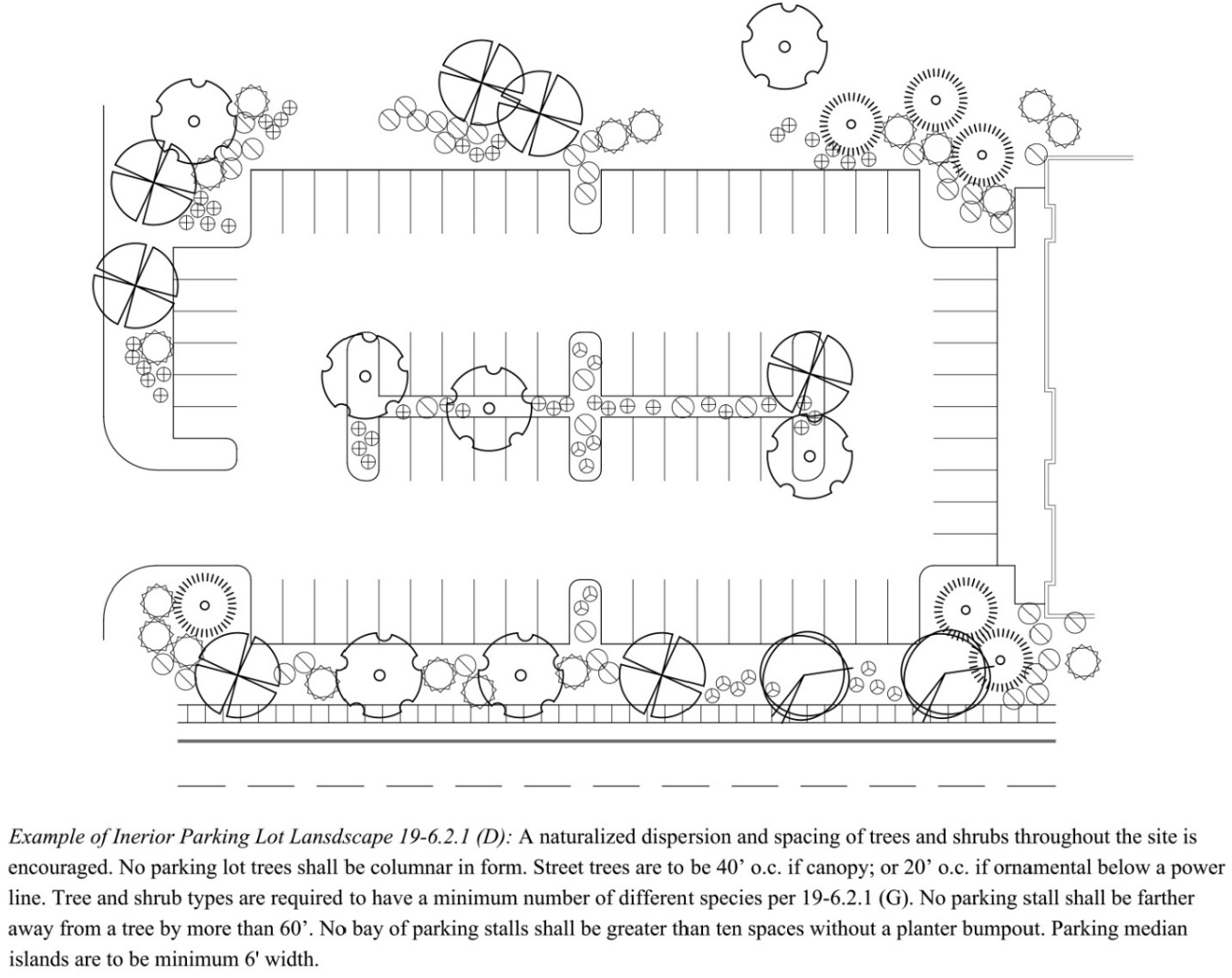
A naturalized dispersion and spacing of any required trees and shrubs throughout the site is encouraged.
(8)
Irrigation:
(a)
New installation. Rain sensors or clocks that receive local weather data shall be required on all automatic irrigation systems that will receive city water. Systems shall be designed, installed, and adjusted to not allow overhead irrigation to fall on non-permeable surfaces.
(b)
Required maintenance. All rain sensors shall be adjusted and set so that they automatically shut off the irrigation system after more than one-fourth inch of rainfall has occurred. All rain sensors shall be installed according to manufacturer's instructions in a location that will provide full exposure to rainfall such that accuracy of operation is ensured and shall be maintained in good working condition. No person shall, with the intent of circumventing the purpose of this section, adjust either the rain sensor or irrigation system so that the rain sensor is not able to override and turn off the irrigation system after one-fourth inch of rain has fallen.
(B)
Minimum planting size/height requirements. All landscape planting materials shall conform to the minimum size or height standards in table 19-6.2-1 at the time of planting as well as meet the standards of ANSI Z60.1 American Standard for Nursery Stock.
(1)
For newly planted trees the caliper measurement of the trunk shall be taken six inches above the top of the root flare up to and including four-inch caliper size. If the caliper at six inches above the top of the root flare exceeds four inches, the caliper should be measured at 12 inches above the top of the root flare.
(2)
For existing trees, the diameter measurement of the trunk shall be taken at DBH (diameter at breast height) 4.5 feet above the average ground level.
(3)
It is recommended that trees in planting areas less than 135 square feet be of a species known to thrive in low soil volume areas.
(C)
Street trees. Street trees shall be provided and maintained within, or adjacent to, all existing and proposed public street rights-of-way in accordance with the following requirements:
(1)
Street trees shall be approved by the administrator based on the location and use of the space.
(2)
Street trees shall be located in an area no further than ten feet from the existing or proposed street right-of-way line.
(3)
Street trees shall be planted at a spacing of 40 feet on-center for shade trees or 20 feet on-center for ornamental and understory trees along the entire length of the street frontage of the proposed development or as approved by the administrator based on the development plans. Ornamental and understory trees shall be used as street trees only when there is an overhead obstacle which would preclude the use of taller-growing shade trees.
(4)
Preserved existing trees of a three-inch DBH or greater may be used to satisfy the street tree requirement. Preserved existing trees shall meet all the requirements outlined in section 19-6.3., tree protection, be of an acceptable species, and alive and healthy at the time of final inspection. Tree species listed in Table A of Appendix E of the administrative manual are unacceptable for preservation.
(5)
Trees used to comply with street tree requirements shall not count toward the minimum number of trees required to meet interior parking lot landscaping.
(D)
Interior parking lot landscaping.
(1)
In addition to all other landscape requirements, all parking lots subject to this section 19-6.2 shall provide and maintain landscaped planting areas within the interior of the parking lot. These standards shall not apply to parking structures. Each planting area shall consist of at least 135 square feet, or as approved by the administrator.
(2)
In cases where the area required for the construction of the minimum parking spaces as required by section 19-6.1, off-street parking requirements, would cause the removal of a heritage tree, the administrator may modify the landscaping requirements and/or the parking requirements in order to preserve the affected heritage tree.
(3)
Interior planting areas shall be designed within parking areas as:
(a)
Islands located at the end of parking bays;
(b)
Islands located between parallel rows of cars, used to visually separate parking areas into pods;
(c)
Driveway medians, which shall have a minimum width of six feet.
(4)
Each interior planting area shall contain non-columnar approved shade trees and be planted at the following rates:
(a)
One shade tree and eight shrubs for every 2,000 square feet, or portion thereof, of the total parking lot area, including drives and service areas.
(b)
Not more than ten continuous parking spaces shall be allowed in a row of parking without separation by a 135-square foot median containing at least one shade tree.
(5)
Each parking space must be located within 60 feet of a tree measured from the closest point of the parking space to the tree trunk.
(6)
Shade trees are not to be located any closer than 15 feet apart measured from trunk to trunk.
(7)
Proposed shade trees being used to meet the interior parking lot landscaping requirements shall be located no further than ten feet and no closer than four feet from the edge of pavement.
(8)
Existing shade trees may be used to meet the interior parking lot landscaping requirements at the discretion of the administrator if the trees meet the intent of the interior parking lot landscaping requirements and the tree protection requirements.
(9)
Trees used to comply with interior parking lot requirements shall not count toward the number of trees required to meet the street tree requirements.
(10)
No more than 25 percent of required shrubs may be deciduous.
(11)
Bioswales, rain gardens, and other forms of low impact development (LID) located within parking lot islands are encouraged to help mitigate stormwater runoff. These applications should follow best management practices for landscape design and planting.
19-6.2.3.
Buffering and screening requirements.
(A)
Purpose. Buffer yards and screening are required in order to reduce the impact of a use of land on adjacent uses that are of a significantly different character, density, or intensity. Except as may be provided in other sections of this chapter, the width of the buffer yard shall be the same as the setback requirement in the applicable zoning district and all screening materials shall be located within the required yard. A buffer yard may only be occupied by permitted landscaping and screening materials, underground utilities, and stormwater retention areas. Buffer yards and screening shall be required in addition to any other landscaping requirement listed in this section.
(B)
Applicability. Buffer yards and screening shall be installed and maintained by the developer of:
(1)
A nonresidential or multifamily residential development adjoining either:
(a)
A residential use located in a residential zoning district; or
(b)
A vacant lot in a residential zoning district.
(2)
A parking structure containing ground level parking with the exception of structures having other permitted uses, fences, walls, or similar structures located between the parking structure and adjacent uses.
(C)
Permitted screening materials. The following items are permitted for use as screening materials. Alternative screening materials that are not listed may be used if approved by the administrator.
(1)
Evergreen buffer vegetation that is approved by the administrator and meets the minimum planting height and spacing requirements of table 19-6.2-1.
(2)
An earth berm may be used to achieve a portion of the minimum required six-foot height. Berms shall be covered with grass or mulch and shall be planted with other landscaping materials designed to meet the requirements of subsection 19-6.2.2(A) and (B). The slope of the berm shall not exceed the ratio of 3:1.
(3)
An opaque fence or wall measuring at least six feet in height, but not more than eight feet in height. If wood is used, only treated or rot resistant wood is acceptable. If masonry is used, walls shall be finished with brick, stone, textured concrete masonry units, or stucco. Chain-link, barbed wire, stock wire, chicken wire, and similar type fences are not permitted.
(D)
All nonresidential commercial or multi-family developments shall provide a buffer yard equal to ten percent of the lot depth, not to be less than ten feet and not to exceed 20 feet in width, along a rear and/or side lot line that abuts a single family detached use.
(1)
Buffer yards that are ten feet in width shall include a solid masonry wall located at the abutting property line and measuring at least eight feet in height, meeting the requirements of section 19-5.2.7, and canopy trees, meeting the requirements of table 19-6.2-1, planted along the outside perimeter with a maximum on-center spacing of 15 feet.
(2)
Buffer yards that are over ten feet and within 20 feet of depth shall include one of the following options:
(a)
A buffer yard that includes an alternating double row of various evergreen shrubs and may include a berm to achieve a minimum height at time of planting of eight feet, planted a maximum of 48 inches on-center; or
(b)
A buffer yard that includes vegetative screening meeting the following standards per a 100 linear feet and the requirements of table 19-6.2-1:
1.
Eight canopy trees (at least two evergreen); and
2.
Four understory trees (at least one evergreen); and
3.
Twenty-five shrubs (at least 16 evergreen shrubs).
(3)
The following are prohibited within the buffer zone:
(a)
Principal or accessory structures associated with the development;
(b)
Driveways, drive aisles, surface parking areas, or alleys;
(c)
Outdoor storage areas;
(d)
Outdoor dining or gathering areas;
(e)
Heating, cooling, or other mechanical equipment;
(f)
Signs;
(g)
Any other structure or use that would unduly interfere with the use and enjoyment of the adjacent single-family use as determined by the Administrator.
(4)
The administrator may reduce the buffer yard depth on side and/or rear property lines that abut a single-family detached use to a minimum of ten feet upon finding that provision of the required buffer yard is overly constraining to accommodate reuse of an existing structure. This allowance is not applicable for any project including expansion of a structure or new construction. Constraints may include, but are not limited to:
(a)
Location of existing building within an otherwise required entire buffer yard;
(b)
Existing parking/driveway areas or required parking and/or driveway access prevents provision of entire buffer depth;
(c)
Location of existing significant or heritage trees to be protected on site; or
(d)
High slope areas or other topographic considerations.
19-6.2.4.
Street buffer yards. In addition to the requirements of subsection 19-6.2.2, landscaping requirements, and subsection 19-6.2.3, buffering and screening requirements, vacant lots created by building demolition in the C-4 district, parking structures, parking lots, and outdoor display areas shall be buffered from streets and rights-of-way according to the following requirements:
(A)
The minimum width for any buffer yard shall be the same as the required district setback. Parking structures located in the C-4 district shall be exempt from the buffer yard requirement when utilizing fences, walls, or similar structures located between the ground level parking and the street or right-of-way.
(B)
All areas used for required buffer yards shall be located on the property. In unusual or extraordinary circumstances, as determined by the administrator, the public right-of-way may be used to meet the requirements of this section provided the property owner obtains permission from the owner of the right-of-way. Maintenance of the required perimeter buffer yard shall remain the responsibility of the private property owner and shall be maintained according to the minimum standards of the American National Standards Institute (ANSI) A300 Standards for Tree Care Operations.
(C)
A property shall have a continuous evergreen landscape buffer along the entire street frontage of the lot, excluding driveways. The landscape buffer must not interfere with any adjacent sidewalks and/or roadways located within the right-of-way. Plant material must meet the minimum planting height listed in table 19-6.2-1.
(D)
Vacant lots resulting from the demolition of buildings within the C-4 district and have not produced, within 180 days after demolition, plans for development, shall provide plantings consistent with the provisions of the following:
(a)
Provide required street trees (subsection 19-6.2.2).
(b)
Provide continuous screening (subsection 19-6.2.3(C)).
19-6.2.5.
Additional screening requirements. In addition to the landscaping and screening required in this section, evergreen screening shall be required to conceal specific areas of high visual impact or hazardous areas. Plants and a solid fence or wall, at least the height of the item being screened, but not more than eight feet tall, shall be installed around all sides, excluding access areas. Plant material must meet the minimum planting heights listed on table 19-6.2-1 and shall be installed around the following areas:
(A)
Loading and service areas.
(B)
Refuse collection points/recycling drop-off centers.
(C)
Ground level mechanical, heating and air-conditioning equipment (except for single-family detached dwellings, unless that equipment is visible from the public right-of-way).
(D)
Outdoor electrical or other aboveground utility equipment.
(E)
Outdoor storage lots.
(F)
Storage tanks.
(G)
Communication towers and associated equipment structures.
Access gates to these areas shall be solid and, to the extent practical, not oriented to a public street.
19-6.2.6.
Alternative landscape plan. At the discretion of the administrator, alternate landscaping plans, plant material, planting methods, or landscape design may be used where unreasonable or impractical situations would result from application of landscaping requirements, or where necessary to protect existing vegetation, or where a more creative plan is proposed which substantially complies with the intent of these requirements.
(Code 1997, § 19-6.2; Ord. No. 2007-52, § 19-6.2, 7-9-2007; Ord. No. 2009-22, § 3(exh. C), 3-23-2009; Ord. No. 2009-64, § 2(exh. B), 8-3-2009; Ord. No. 2011-18, 1-24-2011; Ord. No. 2012-23, § 3, 4-9-2012; Ord. No. 2015-05, exh.(19-6.1.3), 1-26-2015; Ord. No. 2015-24, exh., 3-23-2015; Ord. No. 2021-07, Exh. A, 1-25-2021; Ord. No. 2021-42, Exh. A, 6-28-2021)
Sec. 19-6.3. - Tree protection.
19-6.3.1.
General.
(A)
Purpose. The purpose and intent of subsection 19-6.3 is to protect existing tree cover; facilitate the incremental growth of the city's tree canopy; enhance and preserve the environmental and aesthetic qualities of the city; encourage site design techniques that preserve the natural environment and enhance the developed environment; control erosion, slippage, and sediment runoff into streams and waterways; increase slope stability; improve air quality; protect wildlife habitat and migration corridors; and reduce homeowner energy costs.
(B)
Applicability. Except as stated herein, the requirements of this section shall apply to all land-disturbing activities that require permit for existing and new development.
(C)
Exemptions. The following developments and activities shall be exempt from this section except where otherwise noted below:
(1)
Residential property consisting of an existing single-family home provided the owner acquires title to said developed lot on or before June 30, 2021 (for purposes of this ordinance, inter-spousal or inter-family transfers of interest, whether by operation law, deed or the creation of a trust does not constitute acquisition of title);
(2)
The removal of diseased, dead or naturally fallen trees, or trees that are found by the administrator to be a threat to the public health, safety, or welfare;
(3)
The selective and limited removal of vegetation or trees under ten inches diameter at breast height necessary to obtain clear visibility at driveways or intersections, or for the purpose of performing authorized field survey work;
(4)
The selective and limited clearing of utility easements to maintain their intended function; and
(5)
The removal of trees or vegetation on land zoned or lawfully used for:
i.
Stand-alone commercial garden centers, greenhouses, or nurseries; or
ii.
Agricultural and forestry activities, including tree farms and approved forestry management practices, except that if a site is substantially cleared of trees pursuant to legitimate agricultural or forestry activities, no development applications shall be accepted for 36 months from the date the clearing is completed. It shall be the burden of the property owner to prove that any timber harvesting or land clearing is conducted as a commercial timber operation. A forestry plan shall be submitted that demonstrates that the intended forestry activities will contribute to the long-term production of marketable forest products and ensure the continued existence of forests through regeneration. Conducting a timber sale as the sole timber management activity does not constitute a "commercial timber operation."
(6)
Residential property consisting of an existing single-family home where the owner acquires title on or after July 1, 2021, except for the Heritage Tree protections provided for below in Section 6.3.2(H) which shall apply to said property (for purposes of this ordinance, inter-spousal or inter-family transfers of interest, whether by operation law, deed or the creation of a trust does not constitute acquisition of title).
(7)
Tree clearing or cutting performed in order to comply with aeronautic safety requirements mandated by federal or State law or regulation.
(D)
Definitions:
For purposes of this Section 19-6.3, the following definitions shall apply; in the event of a conflict with those definitions set forth in Section 19-1.11, the definitions set forth below shall control:
(1)
Administrator means the department director who is the final authority for the application and interpretations of the ordinance.
(2)
Arborist means any person certified by the International Society of Arboriculture (ISA) as an arborist and a member in good standing with the ISA.
(3)
Boundary tree means a tree on adjacent property whose critical root zone intrudes across the property line of the site under consideration.
(4)
Buildable area means that area of the lot available for the construction of a dwelling and permissible accessory uses after having provided the required front, side, rear and any other special yards required.
(5)
Caliper means the diameter of a sapling to be planted measured six inches above the top of the root flare up to and including four-inch caliper size. If the caliper at six inches above the top of the root flare exceeds four inches, the caliper should be measured at 12 inches above the top of the root flare.
(6)
Construction means any new construction, renovation, expansion, clearing or other activity that requires a site permit or impacts the site's ability to support a tree canopy.
(7)
Cover area means that area which falls within the drip line of any tree.
(8)
Critical root zone means is represented by a concentric circle centering on the tree trunk with a radius equal in feet to one times the number of inches of the trunk diameter: (CRZ in ft = 1 x diameter inches)
(9)
Destroy means any intentional or negligent act or lack of protection that is likely to cause a tree to die within a period of five years.
(10)
Diameter at Breast Height (DBH) means the diameter of a tree measured at 4.5 feet above the ground.
(11)
Heritage Tree (See section 19-6.3.2 (H)).
(12)
Impacted tree means a tree that will suffer injury or destruction of 20 to 33 percent of its critical root zone.
(13)
Invasive plant means any plant that has been introduced to the region and has been shown to disrupt ecosystem processes. Reference lists for plants invasive in the Greenville area are available in Appendix E of the Administrative Manual.
(14)
Land-disturbing activities means any activity involving the clearing, cutting, excavating, filling, or grading of land or any other activity that alters land topography or vegetative cover.
(15)
Native or naturalized plant means any plant that was in existence in this region prior to European settlement or has since become thoroughly established without disrupting ecosystem processes.
(16)
Overstory/Canopy tree means a tree that normally attains a DBH in excess of 25 inches and a height in excess of 45 feet at maturity.
(17)
Pruning means the definition of the term as set forth in both the most recent International Society of Arboricultural pruning standards and guidelines and American National Safety Institute 300.33. At no time shall trimming, topping, tipping or flush cutting of trees be deemed a form of "pruning."
(18)
Saved tree means any healthy tree that is to be protected and not destroyed or injured during construction as required by this article.
(19)
Tree inventory means a survey provided by a certified arborist or licensed landscape architect, and a licensed surveyor that shows the location, species, and DBH of all trees greater than 3 inches DBH on site to be saved; and all trees on site greater than 6 inches to be destroyed, or impacted.
(20)
Tree protection plan means a document showing a visual plan for all existing trees that are to be saved and protected, and showing new trees required to meet replacement quantities.
(21)
Understory/Ornamental tree means a tree that normally attains a DBH of less than ten inches and a height of less than 45 feet at maturity.
19-6.3.2
Tree protection and replacement.
(A)
Tree inventory: The tree inventory and protection plan shall be submitted as part of a site plan permit application for any land disturbing permit activity, and all developments listed in subsection 19-6.3.1(B).
(1)
A legible tree inventory shall be submitted as part of an application for any land disturbing permit or activity, including storage or staging of equipment. The inventory shall show all trees greater than six inches DBH to be removed (or for residential property consisting of an existing single-family home where title to such property is acquired on or after July 1, 2021, trees that meet the heritage tree definition), and any tree three inches DBH or greater to be retained. Trees shall be clearly identified as either to be removed or retained. The inventory shall be in a form approved by the administrator and contain the information as required in Appendix E of the Administrative Manual.
(a)
The tree inventory shall include any boundary trees, i.e. trees on neighboring properties, which may experience any land disturbance, including storage of equipment or other material, within their critical root zone.
(b)
Invasive tree and prohibited tree species as defined in Appendix E of the Administrative Manual and all pinus species are exempt from tree protection requirements.
(c)
Encroachment within the critical root zone of trees located on adjacent properties is not allowed without written approval from that adjacent property's owner. If the limits of disturbance or land disturbance activity may reasonably be expected to occur within the critical root zone of trees located on adjacent properties, a letter from the tree's owner may be provided in lieu of tree protection for the tree. The letter must clearly state that the tree's owner is aware of the risk to the tree, that the land disturbing activity may result in the immediate or long-term death or demise of the tree, and that the City shall not be responsible for any damage or removal of the tree or its parts. The letter must be signed by the adjacent property owner and included with the landscape plan.
(B)
Tree removal and replacement: Development or activity that results in the removal or injury of trees six inches or greater in DBH (or for residential property consisting of an existing single-family home, trees that meet the heritage tree definition), that are not recognized invasive species as defined in Appendix E of the Administrative Manual, shall provide replacement or mitigation equal to or greater than the cumulative DBH of the trees removed and/or injured.
(1)
Trees required to meet landscape requirements, such as those specified in 19-6.2, may be used to meet tree replacement requirements.
(2)
Tree loss mitigation may be provided by retaining existing trees on site which meet the following criteria:
(a)
Trees are between three inches and six inches DBH;
(b)
Trees are in good health and are free of damage or disease, as verified by a certified arborist; and
(c)
Trees are not a recognized invasive or prohibited species as defined in Appendix E in Administrative Manual, or of the pinus species.
(3)
Where appropriate site conditions exist as determined by the administrator, replacement trees shall be canopy trees. Tree spacing shall be minimum 15 feet for canopy trees, ten feet for understory trees. Replacement trees should be distributed and spaced with a naturalized pattern.
(4)
In cases where tree mitigation is required but planting is not preferred by the applicant, the administrator shall approve a fee-in-lieu-of mitigation via a payment to the city's tree fund. Fees shall be based on market rates and updated periodically in Appendix E in Administrative Manual. Fee-in-lieu-of mitigation fees shall be capped at $25,000.00 per acre, to be adjusted upward or downward on a pro rata basis based upon the size of the parcel. By way of example, the fee-in-lieu would be capped at $12,500.00 for a one-half acre parcel and capped at $37,500.00 for a one and one-half acre parcel. The tree fund shall be managed by the city and shall be used solely for the purposes of:
(a)
Tree purchase and installation of new trees;
(b)
Maintenance of existing tree canopy on public property and rights-of-way;
(c)
Purchase of real property for the purposes of tree plantings; or
(d)
Administration of the above.
(C)
Tree density minimum. All properties subject to this subsection 19-6.3 shall provide and maintain at minimum one tree per 2,000 square feet minus building footprints and the area of athletic fields and courts.
(D)
Tree protection plan: A landscape plan shall be submitted for all existing trees that are to be saved and protected, and showing new trees required to meet landscape standards and replacement quantities.
(1)
A tree credit table shall be included in the tree protection plan, shall conform to the table standards as shown in Appendix E in Administrative Manual, and shall summarize:
(a)
Acreage of site excluding building footprint, athletic fields, and courts;
(b)
Square-footage of parking lot;
(c)
Trees planted to meet all landscape requirements, including parking, screening, street trees, and tree density minimum;
(d)
Cumulative DBH of trees greater than six inches to be removed;
(e)
Cumulative DBH of trees between three inches and six inches to be saved and used as mitigation for removal of trees greater than 6 inches;
(f)
Cumulative DBH of trees greater than six inches to be saved;
(g)
Total DBH to be mitigated;
(h)
Trees to be planted for 1:1 mitigation, and/or fee-in-lieu-of option total; and
(i)
Heritage trees being removed.
(E)
Tree planting standards. The form, size, quality, and proportions of proposed trees must meet the guidelines outlined in the ANSI Z60.1 American Standard for Nursery Stock. Installation and maintenance must meet ANSI A300 Standards. Existing trees on a property that are to be protected should be healthy and disease free.
(F)
Tree protection during construction.
(1)
Protective fencing is required for any tree to be retained following construction. Protective fencing shall be a minimum of four feet high and of durable construction; such as wood or metal fencing. Protective fencing shall completely encircle the critical root zone of all trees to be preserved. Protective fencing be in place prior to any earth disturbing activity begins and stay in place for the duration of the project. Fencing shall be required around the critical root zone of trees on adjacent properties or trees located in a public right-of-way. At no time shall silt fencing be used to provide tree protection.
(a)
Signs shall be installed on the protective fence visible on all sides of the fenced-in area (minimum one on each side and/or every 300 linear feet). The size of each sign must be a minimum of one foot by 1.5 feet and shall contain the following bilingual text in both English and Spanish: "TREE PROTECTION ZONE: KEEP OUT."
(b)
Groups of trees may be protected by one perimeter fence meeting the specifications outlined in this section.
(c)
No construction, grading, parking, equipment, or material storage, or any other activity, shall be allowed within the fenced area at any time during the project.
(d)
Trenching shall not be allowed without administrator's approval. Boring shall be allowed with consultation by an arborist and approval of the administrator.
(e)
Where compaction might occur due to traffic or materials through the tree protection zone, the area must first be mulched with a minimum four-inch layer of processed pine bark or wood chips or a six-inch layer of pine straw. Equipment or materials storage shall not be allowed within tree protection areas.
(G)
Inspections and ongoing maintenance.
(1)
Final landscape inspections will be conducted to ensure plant material is in good condition and planted correctly, as outlined in ANSI A300 and Z60.1.
(2)
Trees shown on a permitted landscape plan must be maintained to ANSI A300 standards for the duration of the site.
(3)
With approval from the administrator, a project may be granted a temporary CO, or bond their landscape for a limited time, to allow planting to occur in the dormant season of October through March.
(4)
Trees not meeting ANSI A300 and ANSI Z60.1 standards at time of right-of-way dedication may be rejected and require replacement prior to accepting the roadway dedication.
(5)
Trees located within the public right-of-way or on public land are the responsibility of the city and may not be trimmed or maintained by unauthorized personnel.
(H)
Heritage tree protections.
(1)
In order to protect significant trees, the city has established the Heritage Tree designation. The purpose of the heritage tree designation is to encourage the early identification of significant trees to be saved, thus resulting in developments that are more responsive to their environments and appear more mature upon completion.
(2)
A heritage tree is a tree that is in a healthy and disease-free condition, and is:
(a)
Twenty inches or greater DBH, located within the setback or buffer area of any property within the city
(b)
Forty inches or greater DBH, located anywhere within the city; or
(c)
Determined to be of cultural importance by the administrator located anywhere within the city. "Cultural importance" for the purposes of this subsection shall mean the historic significance of the tree as it may relate to an event or person.
(3)
In addition to the tree mitigation outlined in section 19-6.3.2(B), a heritage tree which is removed shall be assessed with a fee of $45.00 per caliper inch.
(4)
In no case shall the total of fee-in-lieu of mitigation together with heritage tree mitigation be greater than $25,000.00 per acre or a portion thereof. By way of example, the fee-in-lieu would be capped at $12,500.00 for a one-half acre parcel and capped at $37,500.00 for a one and one-half acre parcel.
(5)
No construction, grading, equipment, material storage, or any other activity, shall be allowed within the critical root zone of a heritage tree unless the steps taken to adequately ensure the health of the tree are submitted to the planning department in writing.
(6)
A Heritage Tree Disturbance Form shall be developed by the administrator and shall be submitted for the trimming, pruning, encroachment upon, or removal of any Heritage Tree, which may fall outside of development activities. The form shall be posted online on the city website and be made available upon request by contacting the administrator.
(a)
Heritage trees shall not be cut, removed, pushed over, killed, harmed, trimmed, sprayed, or destroyed without written approval via the Heritage Tree Disturbance Form.
(b)
The administrator shall approve Heritage Tree disturbance only upon a finding that the tree is in a dangerous or deteriorating condition and poses a risk to health, safety, or welfare.
(I)
Tree variance. If a landowner believes it is not possible to comply with the requirements of subsection 19-6.3.2(B) and/or (H), the landowner may apply for a tree variance from the administrator, which shall be approved only on a finding that the landowner demonstrates all the following standards are met:
(1)
Exceptional conditions. There are extraordinary and exceptional conditions (e.g., size, shape, topography) relevant to the particular piece of property for which the tree variance is sought which do not generally apply to other properties subject to subsection 19-6.3.
(2)
Not result of action by landowner. The special circumstances are not the result of actions by the landowner.
(3)
Strict application deprives use. The application of the requirements of subsection 19-6.3.2(B) and/or (H) would effectively prohibit or unreasonably restrict the utilization of the property.
(4)
Minimum variance. The approval of the tree variance is the minimum action that will make possible the reasonable use of the land that is not contrary to the public interest and that will carry out the purpose and intent of subsection 19-6.3.
(5)
Not detrimental. The approval of the tree variance will not result in substantial detriment to adjacent property or to the public good.
(6)
Consistent with the intent of subsection 19-6.3. The tree variance is consistent with the purpose and intent of the provisions of subsection 19-6.3, particularly subsection 19-6.3.2(B) and/or (H), as applicable.
The fact that the subject property could be utilized more profitably if a tree variance permit were granted does not constitute grounds for a tree variance. Appeals from the decision of the administrator may be taken to the Planning Commission in accordance with Section 19-2.1.2(A)(8) and Section 19-2.3.16(A)(1).
(J)
Mandatory review. As the purpose and intent of this ordinance is to protect existing tree cover and facilitate the incremental growth of the city's tree canopy, the planning commission shall review this ordinance every two years from the date of its passage to determine if its purpose is being effectively met and the planning commission shall recommend any changes that it deems necessary or appropriate.
19-6.3.3.
Tree protection during construction.
(A)
Protective fencing.
(1)
When and where required. Before grading begins, fencing shall be required, at a minimum, around the critical root zone of all trees that are to be preserved. Additional fencing shall be required around the critical root zone of trees on adjacent properties or located in a right-of-way.
(2)
Type of fencing. All fencing required by this section shall be a minimum of four feet high and of durable construction; such as wood or metal fencing.
(3)
Signs. Signs shall be installed on the protective fence visible on all sides of the fenced-in area (minimum one on each side and/or every 300 linear feet). The size of each sign must be a minimum of one foot by 1.5 feet and shall contain the following: "TREE PROTECTION ZONE: KEEP OUT."
(4)
Activity within a fenced tree protection zone. No construction, grading, parking, equipment, or material storage, or any other activity, shall be allowed within the fenced area.
(5)
Maintenance of fencing. For existing trees to be counted toward required tree credits, they must be protected during the entire development period, beginning prior to the commencement of site work. Encroachment within the tree protection zone is permitted to allow the landscape contractor access to complete site work.
(B)
Encroachments. Encroachments within the critical root zones of any tree being preserved to comply with required tree credits, or within designated tree protection zones, shall occur only in rare instances. If such an encroachment is anticipated, a written request must be made to the city parks and recreations administrator for allowance of encroachment. Request must detail preventative measures taken. If approved the following preventative measures shall be employed:
(1)
Clearing activities. The removal of trees adjacent to a tree protection zone can cause inadvertent damage to the protected trees. Wherever possible, it is advisable to cut minimum two-foot trenches along the limits of land-disturbance, so as to cut, rather than tear, roots. Trenching is required for the protection of historic and heritage trees.
(2)
Soil compaction. Where compaction might occur due to traffic or materials through the tree protection zone, the area must first be mulched with a minimum four-inch layer of processed pine bark or wood chips or a six-inch layer of pine straw. Equipment or materials storage shall not be allowed within tree protection areas.
(Code 1997, § 19-6.3; Ord. No. 2007-52, § 19-6.3, 7-9-2007; Ord. No. 2009-22, § 3(exh. C), 3-23-2009; Ord. No. 2011-18, 1-24-2011; Ord. No. 2013-66, exh. A(19-6.3), 10-28-2013; Ord. No. 2021-07, Exh. B, 1-25-2021)
Sec. 19-6.4. - Exterior lighting.
19-6.4.1.
Purpose. Exterior lighting shall meet functional and security needs in a way that does not adversely affect the adjacent properties or street rights-of-way. The degree to which exterior lighting affects a property or street right-of-way should consider the light source, level of illumination, hours of illumination, and the need for illumination.
19-6.4.2.
Applicability. The requirements of this section shall apply to all lands within the city with the exception of properties owned by the City of Greenville and properties within the C-4 district. Lighting required by the Federal Aviation Administration and the SCDOT are also exempt from these requirements.
19-6.4.3.
General design standards. All exterior lighting shall meet the following design standards:
(A)
No blinking, flashing or fluttering lights or other illuminated device that has a changing light intensity, brightness, or color is permitted in any district except for temporary holiday displays.
(B)
Neither the direct nor reflected light from any outdoor light source shall create a traffic hazard to operators of motor vehicles or to operators of aircraft and no colored lights may be used in such a way as to be confused or construed as street-traffic control or air-traffic control devices.
(C)
Background spaces such as parking lots shall be illuminated as unobtrusively as possible to meet the functional needs of safe circulation and protection of people and property. Foreground spaces, such as building entrances and outside seating areas, shall utilize local lighting that defines the space without glare.
(D)
Light sources shall be concealed or shielded to the maximum extent feasible to minimize the potential for direct glare and unnecessary diffusion on adjacent property and rights-of-way.
(E)
The style of light standards and fixtures shall be consistent with the style and character of architecture proposed on the site.
(F)
All outdoor lighting not necessary for security purposes shall be reduced, activated by motion sensors devices, or turned off during non-operating hours.
(G)
Light fixtures used to illuminate flags, statutes, or any other objects mounted on a pole, pedestal, or platform shall use a narrow cone beam or light that shall not extend beyond the illuminated object.
(H)
For upward-directed architectural, landscape, and decorative lighting, direct light emissions shall not be visible above the building roof line.
(I)
Light fixtures shall be located on the periphery of the areas with light sources directed into parking areas. No light sources shall be located on building facades directed outward toward property boundaries or adjacent rights-of-way.
19-6.4.4.
Specific standards for lighting.
(A)
Light fixtures within residential districts shall be wall-mounted or mounted on wood, concrete, fiberglass, or painted metal poles no higher than 15 feet above finished grade. Bollard-type lighting fixtures shall have a height not less than three feet nor more than four feet.
(B)
Light fixtures within nonresidential districts shall be wall-mounted or mounted on wood, concrete, fiberglass, or painted metal poles; with the exception of outdoor entertainment uses and SCDOT interstate interchange high-mast lighting, mounting heights shall not exceed 30 feet above finished grade. Bollard-type lighting fixtures shall have a height not less than three feet nor more than four feet.
(C)
Shielding.
(1)
Luminaires of 175 watts or less may be used without cutoff except that no direct glare shall be perceptible to persons on a public right-of-way.
(2)
Luminaires of between 175 watts and 400 watts shall feature, at a minimum, semi-cutoff.
(3)
Luminaires in excess of 400 watts shall feature full cut-off and shall not emit any direct light above the horizontal plane of the fixture.
(4)
Shielding shall not be required for lamps which accent entranceways, art, water features/fountains, landscaping, sculptures, statuary, and other similar objects provided the light is concealed and narrowly focused on the object of interest.
(5)
Wall pack fixtures shall be full-cutoff.
(6)
Luminaries lighting vertical surfaces from the "bottom up" (building facades, steeples, trees, billboards, signs, flags, etc.) shall not exceed 175 watts with the exception of SCDOT highway signage luminaires.
(D)
Lighting levels.
(1)
Lighting for on-site parking areas, pedestrian walkways and sidewalks, and on-site streets and driveways shall provide maintain an average illumination of at least one footcandle.
(2)
Light level shall be no greater than 0.3 footcandle when measured at the abutting property line to property improved with a residential use and one footcandle when measured at the property line abutting property improved with a non-residential use or the public right-of-way.
(3)
The maximum light level at any point on a property shall not exceed 20 maintained footcandles.
(4)
For property improved with non-residential commercial and multi-family uses that abut a property line of a single-family detached use, exterior illumination levels shall be reduced to 25 percent or less of the normal permitted levels one hour after business closing to one hour before business opening. Security lighting may be used within these restricted time periods. Security lighting shall be reduced to 25 percent or less of the normal permitted levels. Motion sensor activation may be allowed to cause the light to resume normal permitted illumination levels only when activated and shall be programmed to be reduced back to 25 percent or less of normal illumination levels within five minutes after activation has ceased. Motion sensors must be configured such that they are not triggered by activity off of the property.
(E)
Outdoor entertainment uses shall comply with the following standards.
(1)
Luminaire mounting heights shall not exceed 80 feet above finished grade.
(2)
Luminaires shall be equipped with glare control packages (louvers, shields, visors, or similar) and the fixtures shall be aimed to direct their beams within the primary performance area.
(3)
Luminaires shall be extinguished within one hour of the end of an event, or as soon as all patrons exit the premises, whichever is earlier.
(F)
Canopy lighting. Areas under vehicular canopies shall have a maximum point of horizontal illuminance of 20 maintained footcandles. The sides or top of the canopy shall not be illuminated, except as permitted by permanent sign standards, section 19-6.6.4. Lighting under canopies shall be designed so as to not create glare beyond the outside edge of the canopy; acceptable methods include the following:
(1)
The use of recessed fixtures incorporating lens covers that are recessed or flush with the bottom surface (ceiling) of the canopy; or
(2)
The use of light fixture shields or the canopy edge itself.
19-6.4.5
Light measurement. Light measurements shall be made with an approved metering device at ground level (finished grade) consistent with manufacturer's specifications. The meter shall have an accuracy tolerance of no greater than plus or minus five percent and shall have been calibrated within one year of use. Light levels are specified, calculated, and measured in footcandles (FC). All FC values referenced in this section are maintained footcandles.
(Code 1997, § 19-6.4; Ord. No. 2007-52, § 19-6.4, 7-9-2007; Ord. No. 2009-35, 5-11-2009; Ord. No. 2021-40, Exh. A, 6-28-2021)
Sec. 19-6.5. - Design standards for nonresidential development.
19-6.5.1.
Purpose and intent. These standards are designed to promote and enhance the quality and character of the built environment in the city. More specifically, the purposes of this subsection are to:
(A)
Encourage high quality development as a strategy for investing in the city's future;
(B)
Ensure development remains compatible with its context;
(C)
Maintain and enhance the quality of life for the city's citizens;
(D)
Shape the city's appearance, aesthetic quality, and spatial form;
(E)
Promote compatibility between nonresidential development and adjacent residential uses;
(F)
Provide property owners, developers, architects, builders, business owners, and others with a clear and equitable set of parameters for developing land;
(G)
Encourage a pedestrian- and bicyclist-friendly environment;
(H)
Ensure greater public safety, convenience, and accessibility through the physical design and location of land-use activities.
19-6.5.2.
Applicability.
(A)
These standards shall apply to new construction, renovation, or reconstruction of existing structures that exceeds 25 percent of the current fair market value of the structure. This shall be based on a market appraisal performed by a certified appraiser at the applicant's expense or shall be determined by the Greenville County Tax Office. This shall not be construed to require demolition of an existing structure in order to comply with these standards. In such cases, the administrator may grant a waiver of the requirements if presented with a certification by a registered architect or engineer that compliance is not practicable on an existing building. These standards shall not apply to routine maintenance and repair of a structure or other feature on the surrounding site.
(B)
In the event of conflict between these design standards or other standards in this chapter, the more stringent or restrictive standard shall apply.
19-6.5.3.
Exceptions. The standards of this section shall not apply to developments in the following areas or to the following uses:
(A)
Industrial district;
(B)
C-4, central business district;
(C)
PO, preservation overlay district;
(D)
NRO, neighborhood revitalization overly district, when the adopted design standards are more stringent than the requirements of this section;
(E)
PD, planned development district, when the adopted design standards are more stringent than the requirements of this section;
(F)
Utilities.
(G)
Convenience stores with gasoline sales, section 19-4.3.3(E)(5).
19-6.5.4.
Timing of review. Compliance with the standards in this subsection shall be determined as part of the review for a final development plan. site plan permit, conditional use permit, or certificate of compliance, as appropriate.
19-6.5.6.
Alternative equivalent compliance. Unless expressly prohibited, the design standards in this section may be modified in accordance with the standards and procedure in section 19-2.3.18.
19-6.5.7.
Nonresidential design standards.
(A)
Orientation.
(1)
Buildings shall be configured in a manner that enhances pedestrian activity, regardless of the location of the main entrance or building setbacks through any of the following features:
(a)
Orientation of the building towards adjacent streets, sidewalks, or open spaces;
(b)
The inclusion of storefront windows and awnings;
(c)
Avoidance of monolithic, un-broken facade wall planes;
(d)
Pedestrian-oriented entrances; or
(e)
Similar features that foster an active public realm.
(2)
Nonresidential and mixed-use development shall be configured in a manner that creates and enhances access to existing and planned transit features or bicycle/pedestrian trail.
(3)
Multiple building developments shall be oriented in at least one of the following formats (see Figure 19-6.5.1):
(a)
Buildings facing each other across a relatively narrow vehicular access area with pedestrian amenities in a "main street" character;
(b)
Buildings framing and enclosing at least three sides of parking areas, public spaces, or other site amenities; or
(c)
Buildings framing and enclosing outdoor dining or gathering spaces for pedestrians between buildings.
Figure 19-6.5-1: Examples of the orientation of multiple building developments
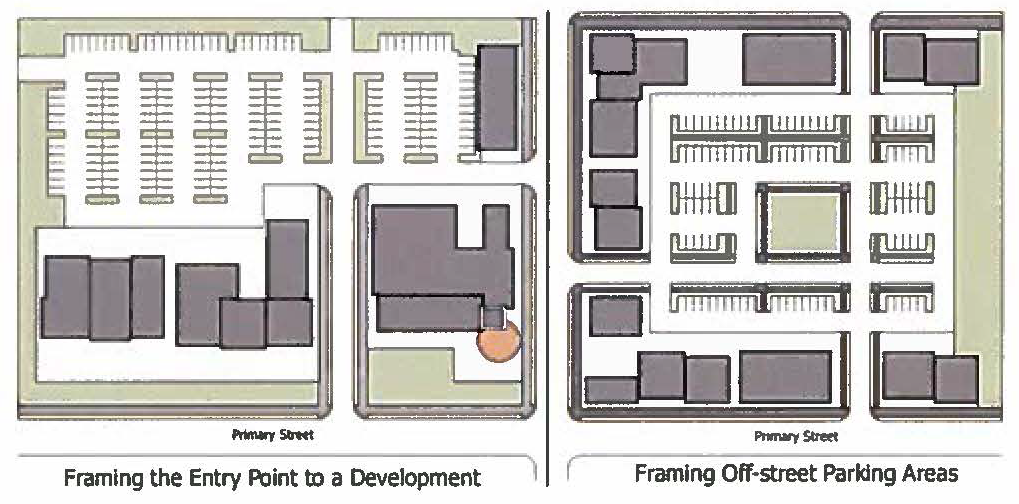
(4)
Outparcels.
(a)
To the maximum extent practicable. outparcels and their buildings shall be situated in order to define street edges, entry points, and spaces for gathering or seating between buildings (see Figure 19-6.5-2).
(b)
Spaces between buildings on outparcels shall be configured with small scale pedestrian amenities such as plazas, seating areas, pedestrian connections, and gathering spaces.
Figure 19-6.5-2: Orientation of outparcel buildings
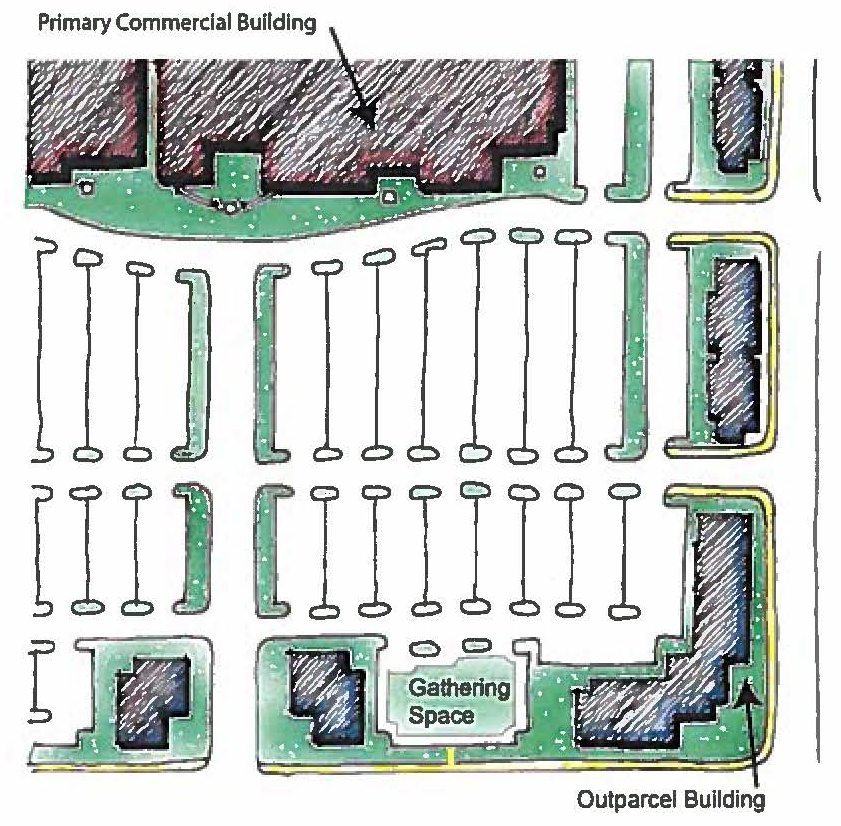
(5)
Maximum building height is subject to Section 19-5.2.9, building height.
(B)
Entrances.
(1)
Public/customer entrances shall incorporate the following features:
(a)
Overhangs, awnings, canopies, or other projections of at least five feet from the building wall;
(b)
Exterior lighting to illuminate the entryway during hours of operation after sundown; and
(c)
Windows within or beside entry doors that allow entrants to see into the building.
(2)
Front entrances shall be provided that face the street from which the building derives its street address with exception allowed for multiple building development. Nothing in these standards shall prevent a secondary entrance from facing a parking lot or open space. Buildings on corner lots may incorporate an entrance on the corner.
(3)
Adjacent to single-family detached dwellings, front entrances shall not:
(a)
Face an adjacent single-family detached dwelling, including across the street.
(b)
Include gathering or patron waiting areas outside the building, that face residential dwellings.
(c)
Include speakers or other devices that produce music or other noise that is audible beyond a lot line abutting a detached single-family dwelling.
(4)
For buildings over 10,000 square feet in gross floor area, public/customer entrances shall be clearly defined and incorporate at least two of the following features and entrances for retail sales and service uses over 30,000 gross square feet shall incorporate three of the following features:
(a)
Covered roof projections of at least 60 inches in depth that emphasize the primary entrance location;
(b)
Distinctive roof forms, towers, gables, roof ridges, peaks, or other features that differ in height by three feet or more from the balance of the roof;
(c)
Window walls of uninterrupted glass with a minimum height of 20 feet and a minimum width of 30 feet adjacent to the entryway doors;
(d)
Covered or shaded pedestrian courts, patios, or plazas of at least 100 square feet adjacent to the entrance;
(e)
Fountains, pools, or other water features;
(f)
Canopy trees planted no greater than 40 feet on-center along the front facade wall; or
(g)
Public art.
(C)
Building facades.
(1)
Blank monolithic walls with little or no architectural detail or items that add visual interest shall be prohibited from facing public streets or residential dwellings.
(2)
Buildings shall include awnings, canopies, arcades, or overhangs with a minimum projection of four feet from the building wall adjacent to a public sidewalk for weather protection (see Figure 19-6.5-3).
Figure 19-6.5-3: Awnings along a public sidewalk
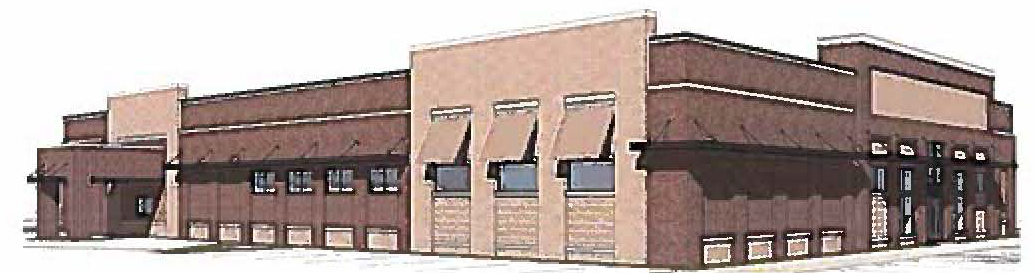
(3)
Buildings of 10,000 square feet in gross floor area or less shall incorporate two or more of the following features on all facades visible from public streets, parking areas, and residential dwellings. Buildings of more than 10,000 gross square feet shall incorporate three or more of the following features on similar facades:
(a)
Recessed or display windows;
(b)
Offset surfaces, niches, insets, projections, or bas relief with a minimum depth of four inches;
(c)
Window indentations that incorporate a differing building material, texture, or color, along with an awning or overhang;
(d)
Differentiated piers, columns, or pilasters:
(e)
Textured materials;
(f)
Roofline changes, coupled with correspondingly aligned wall offset or facade material changes, changes in the roof planes, or changes in the height of a parapet wall: or
(g)
Changes in wall plane (such as projections or recesses) with an offset or depth of at least one foot and a width of at least ten feet, located a minimum of every 30 feet.
(4)
Buildings of two or more stories should be configured to include a discernible base, middle, and top (see Figure 19-6.5-4).
Figure 19-6.5-4: Base, middle, and top
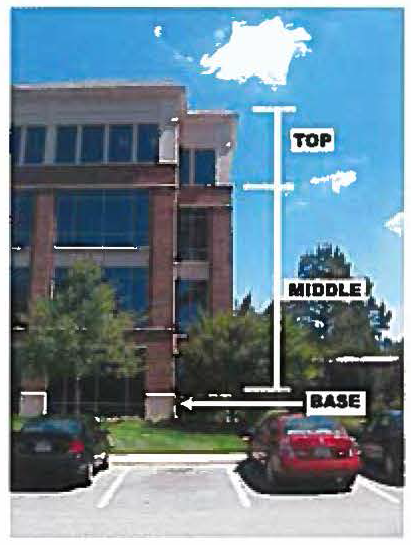
(5)
Single story commercial retail and service buildings over 20 feet in height shall be designed with pedestrian-scaled articulation to mitigate the perception of height.
(6)
Side and rear building facades, if visible from public streets, shall have a similar architectural treatment as used on the primary or front facade.
(7)
Prototypical or franchise designs shall be adapted to reflect the design standards of this subsection, the applicable base and overlay district standards, and the character of the city.
(8)
Commercial retail and service buildings shall include pedestrian walkways of at least five feet in width along the entire front building facade.
(9)
Commercial retail and service front building facades of 30 feet or more in width shall be configured as a series of individual ground-floor storefronts, discrete building modules, wines, recesses, or recesses from the primary facade wall (see Figure 19-6.5-5).
Figure 19-6.5-5: Example configuration of a retail building facade
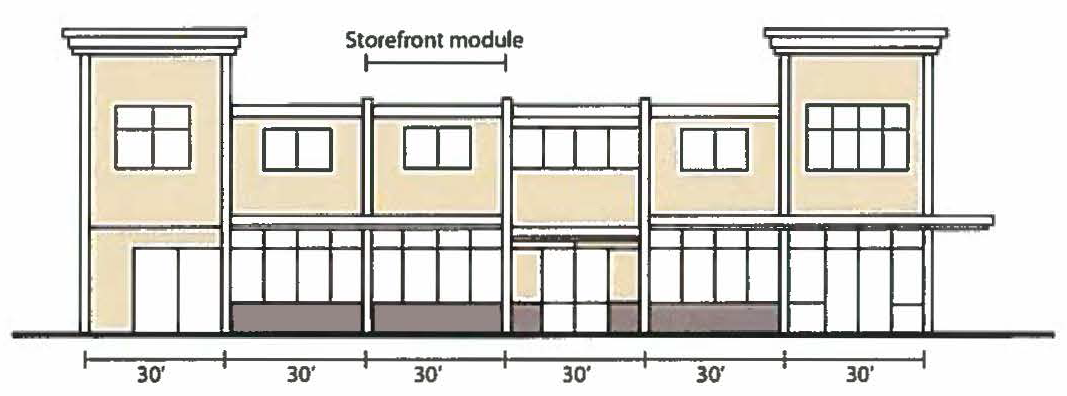
(10)
Outbuildings located in front of other buildings within the same development shall include a consistent level of architectural detail on all four sides of the building as well as exterior materials and colors that are compatible with the primary building in the development.
(D)
Roof form.
(1)
Overhanging eaves and roof rakes on gable ends shall extend at least 12 inches past the supporting walls.
(2)
Flat roofs shall incorporate parapet walls with three-dimensional cornice treatments designed to conceal the roof and roof-mounted mechanical equipment. All parapet walls visible from a public street shall be finished.
(3)
A parapet wall shall be the same or similar in color and material to the building and shall not exceed 25 percent of the height of the supporting wall.
(4)
Except for cupolas, and steeples, sloped roofs shall include two or more sloping roof planes with greater than or equal to one foot of vertical rise for every three feet of horizontal run (1:3). and less than or equal to one foot of vertical rise for every one foot of horizontal run (1:1).
(5)
All roof vents, pipes, antennae and other roof penetrations should be of a color that will minimize their visual impact unless concealed by a parapet, located on the rear elevation, or configured to have a minimal visual impact as seen from the street or existing residential development.
(6)
Within developments with multiple buildings, building heights shall be varied to avoid the appearance of an elongated building mass. This can be achieved by stair-stepping building heights or by varying roof forms.
(7)
Green roofs, which use vegetation to improve stormwater quality and reduce runoff, are permitted as an alternative to the roof forms described in this subsection.
(8)
Buildings of more than 10,000 gross square feet:
(a)
Shall include a variety of different roof forms or roof line changes. Roof line changes shall include changes in roof planes or changes in the top of a parapet wall.
(b)
When roof line changes are included on a facade that incorporates wall offsets or material or color changes, roof line changes shall be vertically aligned with the corresponding wall offset or material or color changes.
(c)
Parapet walls shall include three-dimensional cornice treatments with a perpendicular projection a minimum of six inches from the parapet facade plane.
(E)
Transparency.
(1)
Windows and doors shall be architecturally related to the style, materials, and details of the building they serve.
(2)
Nonresidential buildings open to the public shall provide visual transparency into interior spaces at entrances and along the street-facing facades in the form of clear glass windows, doors, or storefront systems (see Figure 19-6.5-6), with the exception of sexually-oriented businesses as defined in Chapter 8, Article 12, of the Code of Ordinances.
(a)
In buildings with ground floor commercial retail and service uses. street-facing facades and facades adjacent to a public sidewalk or pedestrian pathway shall have at least 60 percent transparency between two feet and eight feet above grade.
(b)
Windows in commercial retail and service buildings used for the display of merchandise may be credited for up to 25 percent of transparency requirements and shall comply with the sign ordinance.
(c)
Windows on side ground floor facades may consist of clear, frosted, or spandrel glass, and may be organized into a display window configuration.
(d)
Windows or doors shall be positioned to avoid direct views into the windows of an existing adjacent residential dwelling.
(e)
Clerestory windows are encouraged on all facades.
(f)
Reflective or heavily tinted glass that obstructs views into the building shall not count towards transparency requirements.
Figure 19-6.5-6: Facade transparency (windows) along a street facade
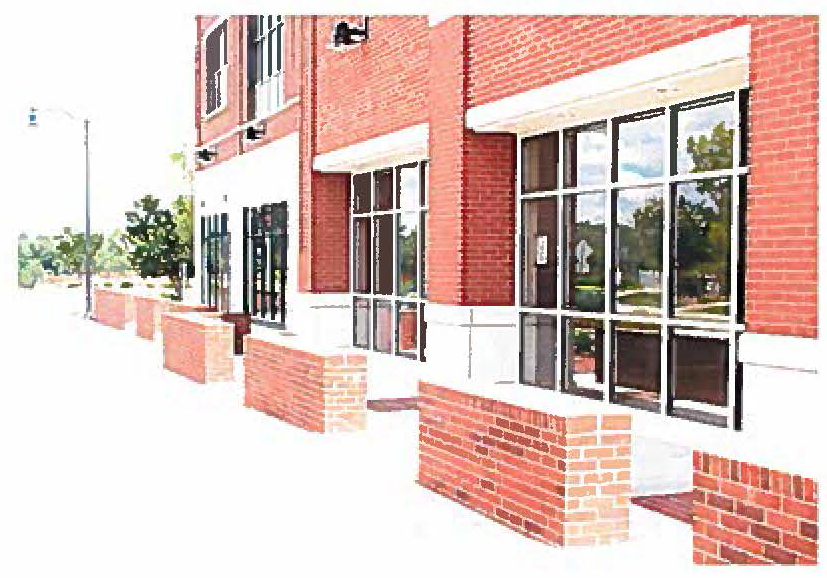
(F)
Materials.
(1)
All facades of a building visible from a public street or residential district shall present consistent materials and architectural style.
(2)
Accessory buildings and structures shall be similar in materials and architectural style to the primary building.
(3)
Where two or more materials are proposed to be combined on a facade, the heavier and more massive elements shall be located below the lighter elements (e.g., brick shall be located below stucco). Use of a heavier material as a detail on the corner of a building or along cornices or windows is acceptable (see Figure 19-6.5-7).
Figure 19-6.5-7: Example of multiple building materials
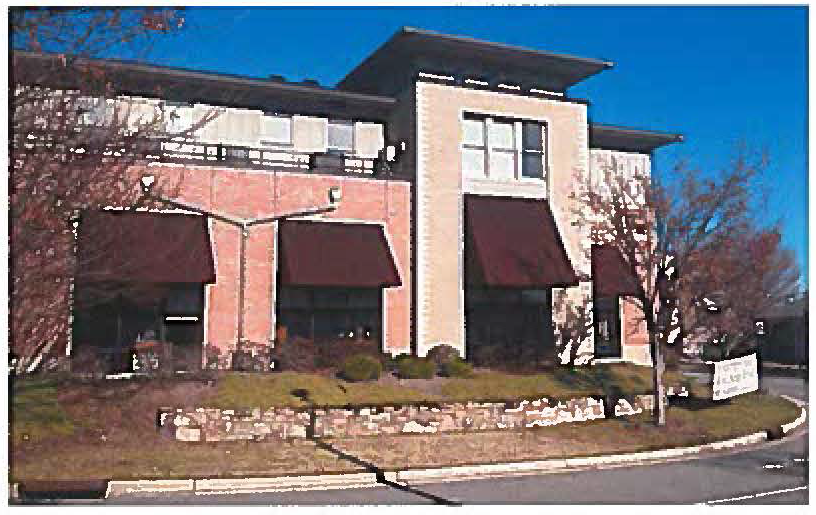
(4)
Primary facade materials shall not change at outside corners, and shall continue around the corner to a logical point of conclusion such as a window or change in facade plane.
(5)
Material changes shall occur along a horizontal line or where two forms meet. It is acceptable, however, that change of materials occur as accents around windows, doors, cornices, or as a repetitive pattern.
(6)
The following materials shall not be used:
(a)
Corrugated metal siding, however, high quality architectural metal siding may be used;
(b)
Exposed smooth-finished concrete block;
(c)
Styrofoam-backed and synthetic stucco within 12 feet of the grade level and within two feet of any exterior door jamb;
(d)
Vinyl siding;
(e)
Lap siding on the ground floor; or
(f)
Where buildings are more than 10.000 gross square feet, painted or split-faced concrete masonry units shall be prohibited on front facades or facades facing public streets.
(7)
Field colors used on the main body of a building shall be subdued and of low reflectivity; fluorescent and metallic paints are prohibited. However, nothing in this section shall prohibit the use of reflective colors on building roofs.
(8)
Building materials shall either be similar to the materials already being used in the immediate area, or if dissimilar materials are being proposed, other characteristics such as scale and proportions, form, architectural detailing, color, and texture shall be utilized to ensure that enough similarity exists for the building to be compatible despite the differences in materials.
(9)
Where nonresidential buildings are adjacent to single-family detached dwellings, primary exterior building materials shall be similar in composition and arrangement to that used on surrounding single-family detached dwellings (see Figure 19-6.5-8).
Figure 19-6.5-8: Similar building materials to adjacent single-family dwellings
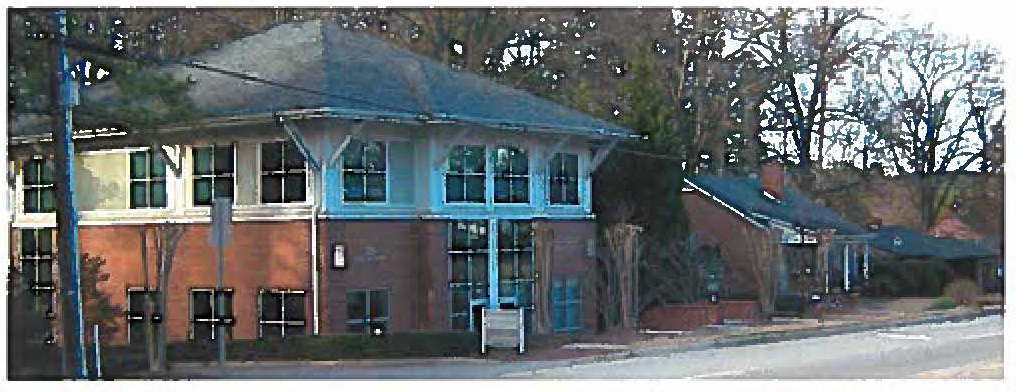
(G)
Drive-throughs.
(1)
If covered, the roof over a drive-through shall have the same architectural design and materials as the primary portion of the structure.
(2)
A drive through shall not be located in front of a building or on the same building facade as the primary entrance.
(3)
Drive-throughs shall be located so as to not compromise the quality of the pedestrian experience at any public street edge.
(4)
Pedestrian pathways that cross queuing or stacking lanes shall be raised and made prominent to ensure pedestrian visibility and safety.
(5)
In no instance shall a drive-through face residential dwellings.
(6)
Speakers shall be directed away from adjacent residential dwellings and shall not be audible beyond shared lot lines.
(H)
Service areas.
(1)
Refuse collection and service areas shall be fully screened from view from public streets or off-site public open space areas. These areas shall be integrated into the principal building architecture to the maximum extent practicable (see Figure 19-6.5-9).
(2)
Above-ground refuse containers shall comply with the below standards:
a.
Above-ground refuse containers shall comply with the applicable setback requirements. No above-ground refuse container shall be located less than 15 feet from the property line of any abutting property improved with a single-family detached use.
b.
Above-ground refuse containers shall be fully screened from the view of adjoining property, public streets, and thoroughfares. Above-ground refuse containers shall be screened on three sides with a permanent building, decorative masonry wall, wood fencing or landscaping, not less than six feet in height or at least one foot above the height of the enclosed dumpster, whichever is greater. In-ground refuse containers shall be screened with evergreen plantings.
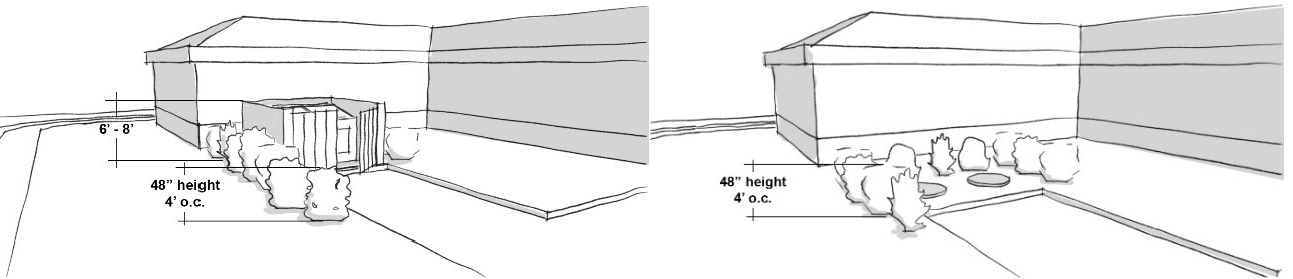
Above-ground refuse In-ground refuse
(3)
Times of service. Deliveries, waste collection, and similar commercial activity is prohibited between the hours of 10:00 p.m. and 7:00 a.m.
(4)
Utility boxes and meters should not be located in front of street-facing facades.
(5)
Loading, service, and equipment areas that are associated with an outparcel building shall be screened through the use of structural elements and similar materials attached to and integrated with the building.
(6)
Automated teller machines (ATM's) shall use materials that reflect the architecture of the surrounding buildings and neighborhood. Walk-up ATM's shall be oriented to pedestrian walkways.
(7)
Vending machines, ATM's. service areas, mechanical equipment, loading areas, and similar functional elements shall be located away from residential districts, or shall be configured in a manner that prevents any negative impacts (visual, auditory, or otherwise).
Figure 19-6.5-9: Screening elements integrated with the building
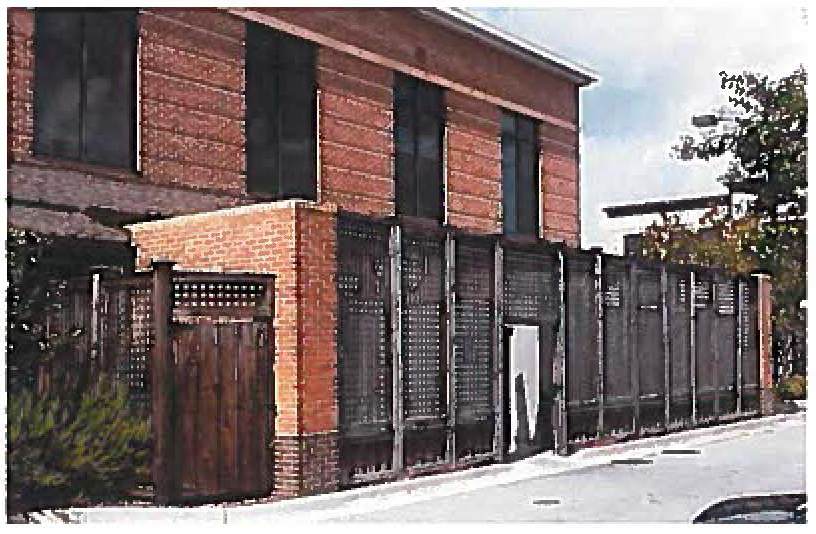
(I)
Outdoor storage.
(1)
Areas for outdoor storage are permitted to the side or rear of the principal building, no closer than 20 feet of any public right-of-way, sidewalk, or internal pedestrian way unless screened by a wall or fence with gate(s).
(2)
Areas for outdoor storage shall be fully screened from off-site view.
(3)
Outdoor display of goods for sale may be permitted in areas immediately adjacent to the entrance(s). Outdoor display areas shall be located within 20 feet of the building facade wall and within 40 feet of a building entrance. In no instance shall an outdoor display obstruct pedestrian circulation or interfere with ingress to or egress from the building entrance (see Figure 19-6.5-10).
Figure 19-6.5-10: Outdoor display of goods at store entrance
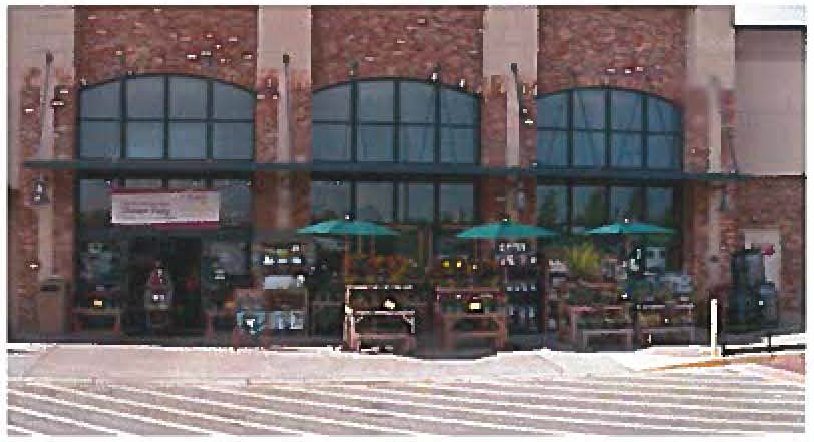
(J)
Outdoor dining.
(1)
Outdoor dining or other outdoor activities that generate noise, as defined by noise standards, chapter 16, article II, division 3, or excessive lighting, as defined by lighting standards, section 19-6.4, shall not be located on any building side that abuts a single-family detached use. Any such outdoor dining or activity areas shall be positioned in such a manner that the building shall shield the dining or other outdoor activity from such residential use.
(K)
Parking lot location.
(1)
Parking areas shall be located and designed to reduce or eliminate visual or operational impacts to surrounding properties and shall comply with all relevant off-street parking and landscaping requirements.
(2)
Surface parking lots containing 40 or more spaces shall be divided into discrete areas (pods) not exceeding 30 parking spaces. An internal path or sidewalk located within landscaped areas between, and connecting, the parking pods is required where there are more than three pods or the configuration of the pods makes it difficult for pedestrians to access the building (see Figure 19-6.5-11).
Figure 19-6.5-11: Large surface parking lot configuration with internal pathways
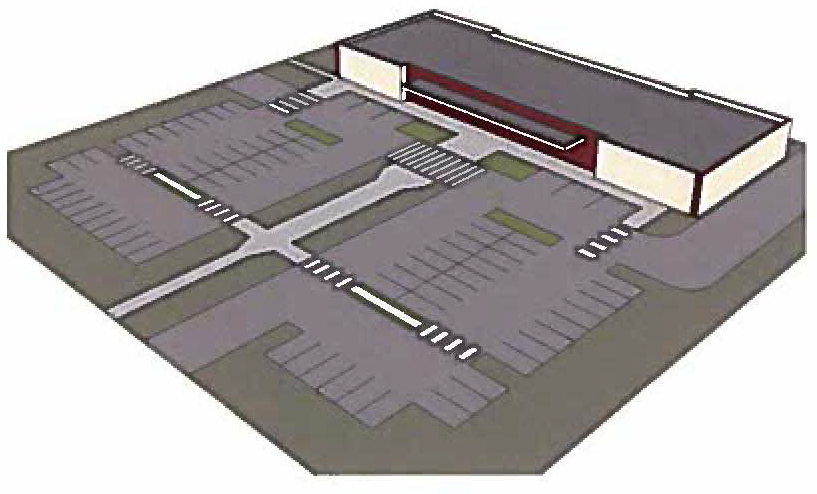
(3)
The drive aisle in front of the primary entrance of a building shall include a pedestrian crossing area that is at least 20 feet wide and includes a raised surface above the surrounding asphalt and a differing surface material or painting to indicate it as a pedestrian crossing area.
(4)
Parking structures, when provided, shall include the following:
(a)
Clear sight lines of abutting streets, driveways, and pedestrian pathways;
(b)
Light-colored interior walls and ceilings;
(c)
Adequate and uniform interior lighting without glare to surrounding properties.
(5)
No more than 20 percent of the total parking spaces (up to a maximum of 100 spaces) may be located in the front yard adjacent to the primary street. If more than one street abuts the property, the designation of the primary street shall be determined by the administrator.
(6)
No more than 50 percent (length) of the first 30 feet (depth) of the primary lot frontage may be occupied by off-street surface parking spaces. The primary lot frontage is the portion of a lot that abuts the street from which the lot derives its street address (see Figure 19-6.5-12).
Figure 19-6.5-12: Parking spaces may occupy up to 50 percent of the primary lot frontage
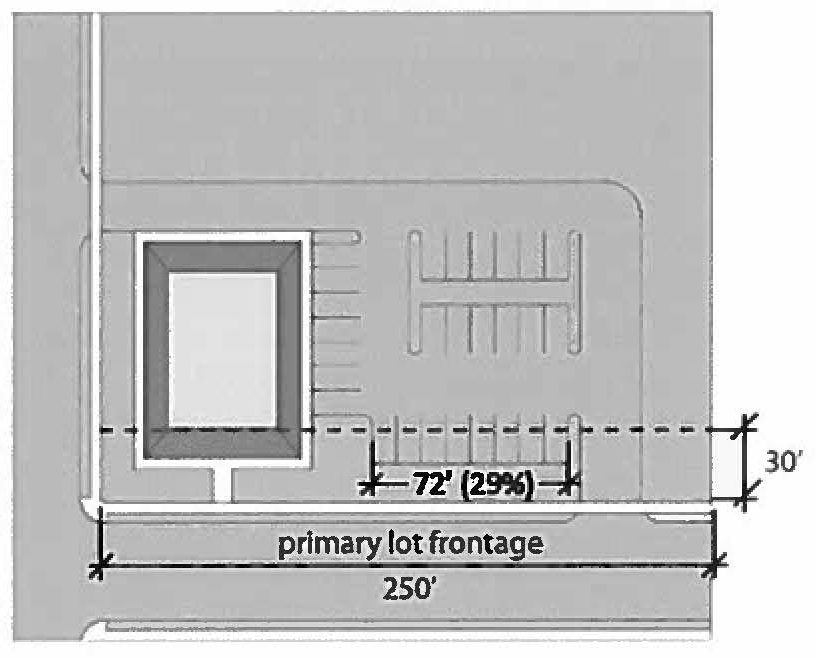
(7)
Off-street parking shall be located away from lot lines shared with single-family detached dwellings, to the maximum extent practicable.
(L)
Circulation.
(1)
Clearly defined, safe, pedestrian access shall be provided from parking areas and adjacent public sidewalks to building entrances.
(2)
All internal pedestrian walkways shall be distinguished from driving surfaces through the use of durable, low-maintenance surface materials such as pavers, bricks, or scored/stamped concrete or asphalt to enhance pedestrian safety and comfort, as well as the attractiveness of the walkways (see Figure 19-6.5-13).
(3)
Adjacent nonresidential developments shall provide for vehicular and pedestrian circulation between sites, through alley or parking lot connections, hard surface walkways, and similar measures to the maximum extent practicable.
Figure 19-6.5-13: Pedestrian walkway from parking area to building entrance
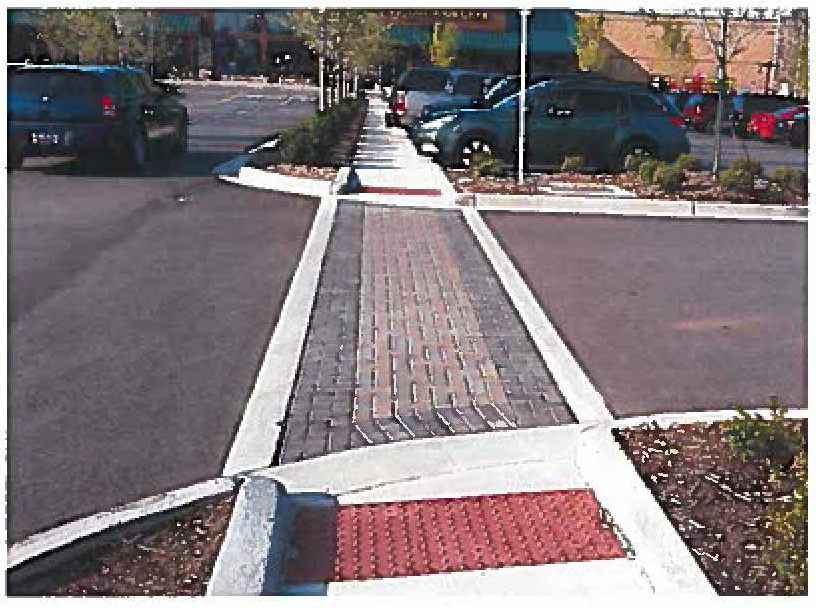
(M)
Landscaping and screening.
(1)
Off-street parking areas shall be landscaped in accordance with subsection 19-6.2.2(D).
(2)
A landscape buffer having a minimum width of five feet and an average width of ten feet shall be required along all parking areas facing public streets. The average width may be reduced to five feet with the incorporation of a low, decorative wall.
(3)
Nonresidential development shall incorporate foundation plantings along building facades that face public streets or single-family dwellings. Foundation plantings shall consist of evergreen and deciduous shrubs spaced no farther than three feet on-center and located within three feet of the building wall.
(4)
Buffer screening per 19-6.2.3(D) shall be required.
(5)
The setback widths and use restrictions for buffer zones shall be considered the minimum standard for nonresidential development abutting property improved with a single-family detached use and shall supersede lesser requirements applicable to development generally.
(N)
Fences.
(1)
Chain link fences shall not be allowed in front yards or adjacent to residential dwellings.
(2)
If chain link fences are used in side or rear yards, they shall be vinyl-coated.
(3)
Barbed wire fences are prohibited.
(O)
Buffer zone adjacent to single-family uses.
(1)
Nonresidential development shall provide a buffer zone comprised of landscaping and screening elements, within the minimum setback from the lot line of any abutting property improved with a single-family detached use, as set forth in Sec. 19-6.2.3 Buffering and screening requirements.
(Code 1997, § 19-6.5; Ord. No. 2007-52, § 19-6.5, 7-9-2007; Ord. No. 2009-22, § 3(exh. C), 3-23-2009; Ord. No. 2009-50, exh., 6-8-2009; Ord. No. 2015-07, § 19-6.5, 1-26-2015; Ord. No. 2021-38, Exh. A, 6-28-2021; Ord. No. 2021-39, Exh. A, 6-28-2021; Ord. No. 2021-42, Exh. A, 6-28-2021; Ord. No. 2021-45, Exh. A, 6-28-2021)
Sec. 19-6.6. - Sign regulations.
19-6.6.1.
General.
(A)
Purpose and intent.
(1)
The purpose of this section is to promote the public health, safety, and welfare; and regulate the markets through a comprehensive system of reasonable, effective, consistent, content-neutral, and nondiscriminatory sign standards and design requirements. With these concepts in mind, this section is adopted for the following purposes:
(a)
To protect property values, the local economy, and the quality of life by preserving and enhancing the appearance of the streetscape which affects the image of the city.
(b)
To promote the free flow of traffic and protect pedestrians, cyclists, and motorists from injury and property damage caused by, or which may be partially attributable to cluttered, distracting, and/or illegible signage.
(c)
To promote the use of signs which are aesthetically pleasing, of appropriate scale, and integrated with the surrounding buildings and landscape, in order to meet the community's expressed desire for quality development.
(d)
To promote and accomplish the goals, policies, and objectives of the comprehensive plan.
(e)
To balance public and private objectives by allowing adequate signage for business identification.
(f)
To provide design standards which are consistent with other applicable provisions of the city land development ordinance.
(g)
To prevent property damage and personal injury from signs which are improperly constructed or poorly maintained.
(2)
To achieve these purposes, it is the intent of this section:
(a)
To provide reasonably uniform standards while allowing functional flexibility, encourage variety, and create an incentive to relate signage to basic principles of good design.
(b)
To assure that public benefits derived from expenditures of public funds for the improvement and beautification of streets, and other public structures and spaces, are protected by exercising reasonable control over the character and design of sign structures which are near the rights-of-way.
(c)
To provide an improved visual environment for the citizens of, and visitors to, the city.
(B)
Permit required. Unless specifically exempted in subsection 19-6.6.3, a sign permit shall be obtained prior to erection, installation, display, structural alteration, or change of any sign.
(C)
Compliance with building and electrical codes. All signs in their installation, maintenance, and removal must comply with the provisions of the building and electrical codes adopted by the city.
(D)
Responsibilities of sign owner. It shall be the responsibility of the sign owner to maintain the sign and ensure compliance with the provisions of the section.
(E)
Setbacks; obstruction of visibility at intersections. Freestanding signs shall not extend within two feet of a street right-of-way, unless specifically stated otherwise. Freestanding signs shall not obstruct vision between a height of three feet and nine feet, measured from street grade closest to the sign, within the sight triangle.
(F)
Measurement of height when base is located below grade of road. When a sign's base is located below the grade of a road that is adjacent to the property and to which it is oriented, the sign height shall be measured from the grade of that road.
(G)
Measurement of face area. The dimensional requirements for sign faces shall be considered the allowable area of any one sign face, whether the sign is single-faced, back-to-back, or V-type.
(H)
Maintenance. All signs shall meet the following provisions for maintenance. Signs that do not meet these provisions shall be repaired or removed within 30 days after receipt of notification from the administrator. Nonconforming signs are subject to the provisions of section 19-9.5, nonconforming signs.
(1)
The area around a sign shall be properly maintained so as to make the sign readily visible.
(2)
All nonfunctioning bulbs or damaged sign face/panels shall be replaced or repaired.
(3)
All sign copy shall be maintained securely on the sign face/panel and all missing copy shall be replaced.
(4)
All sign structures, framework, and poles shall be structurally sound.
(5)
Prohibited cabinet signs may only provide maintenance to internal lighting.
(I)
Signs in or over public right-of-way. No projecting sign or awning sign shall project more than 42 inches over a public right-of-way, provided that no part of the sign shall encroach within a vertical plane measured two feet from the edge of the adjacent street pavement. The bottom edge of the sign must maintain a clearance of at least seven feet from the finish grade level below the sign. An air rights encroachment permit shall be required pursuant to subsection 19-2.1.1(A)(5) or 19-2.1.5(C)(3).
(J)
Display of noncommercial messages. Any sign authorized in this section may display a noncommercial message in lieu of other copy.
19-6.6.2.
Prohibited signs. Unless specifically permitted elsewhere in this section, the following signs shall be prohibited:
(A)
Signs which imitate an official traffic sign or signal, or contain words or symbols displayed in a manner which could mislead or confuse drivers of vehicles, or which display intermittent lights resembling the color, size, shapes or order of lights customarily used in traffic signals or on emergency vehicles or on law enforcement vehicles.
(B)
Signs which utilize lights, individually, as part of a lighting component, or in any other manner, that flash, strobe, pulsate, blink, twinkle, and/or that create a sense of movement by scrolling, rolling, expanding and contracting written messages or visual images, and/or that recreate or simulate moving video images.
(C)
Signs employing motion in such a manner as to obstruct or interfere with a driver's view of approaching, merging, or intersecting traffic, or of a traffic signal, device or sign, or which would otherwise interfere with a driver's operation of a motor vehicle.
(D)
Sign lighting that casts intense illumination onto any residential premises located in any residential district in a manner that by intensity, duration, location, or other characteristic is incompatible with a residential character.
(E)
Roof signs.
(F)
Portable signs.
(G)
Beacons or search lights.
(H)
Inflatable signs.
(I)
Vehicle signs.
(J)
Pennants.
(K)
Snipe signs.
(L)
Off-premises signs, except such signs that identify, advertise, or give directions to government, quasi-government, nonprofit, charitable, cultural, educational, religious, or similar uses.
(M)
Abandoned signs.
(N)
Dilapidated signs.
(O)
Type I outdoor advertising signs, except as provided for in subsection 19-6.6.5, Outdoor advertising signs.
(P)
Flags containing text or graphics advertising a business, service, or product.
(Q)
The use of flat panel, cabinet or box signs, as building signs, is prohibited, unless used in a multi-tenant development where the predominant sign type is flat panel, cabinet or box.
(R)
Pylon Signs except as noted in Table 19-6.6-3: Freestanding Signs.
19-6.6.3.
Signs exempt from permit requirement. A permit shall not be required for the following types of signs, provided all applicable provisions of this section are met. Such signs shall not be considered in determining the allowable number or size of signs on a lot.
(A)
Traffic signs, including directional, warning and informational signs, owned by the city or SCDOT, and located in public rights-of-way or other adjacent property.
(B)
Official notices issued, or required to be posted, by any federal, state, county or municipal government.
(C)
Signs not exceeding one square foot in area and bearing only the property address, names of owners or occupants of the premises, or other identification of premises, and not having a commercial message.
(D)
Governmental flags, except when displayed in connection with commercial promotion.
(E)
Indoor signs not observable from outside the building.
(F)
Temporary window signs that do not exceed 20 percent of the total glazed window area.
(G)
Suspended signs which conform to the following:
(1)
Not more than one sign per business entrance not exceeding two square feet in area shall be allowed; and
(2)
Signs shall be mounted perpendicular to the building wall and such that the bottom edge of the sign is at least seven feet from the grade level below the sign.
(H)
Time and temperature only signs.
(I)
Public utility signs not exceeding one square foot in area provided they are placed on the utility's equipment.
(J)
Window signs not exceeding two square feet, indicating business hours of operation, credit cards which are accepted on the premises, or group affiliations with which the business is associated, or clubs or groups which utilize, recommend, inspect or approve the business for use by its members, and non-illuminated "open" and "closed" signs.
(K)
Private traffic direction signs located on the premises for which directions are indicated not exceeding three square feet for each sign.
(L)
Gasoline pump signs. Signs shall be allowed on gasoline pumps so as to provide information to the public such as gallons, price, octane rating, and type of fuel. As the trade name of the business is oftentimes incorporated into the name for the different types of fuel, the trade name and any associated symbols shall be permitted on the pumps as flat signs not to exceed three square feet in area per sign face.
(M)
Campaign signs which conform to the following:
(1)
Such signs shall not be located on public property or in public rights-of-way. Signs must be confined wholly to placement on private property, with permission of the property owner.
(2)
Signs shall not be erected earlier than 60 days prior to the election or referendum to which they apply.
(3)
Signs shall be removed within five days after the election or referendum to which they apply. Signs for candidates in a runoff election may be maintained until the final election to which the signs apply.
(4)
Signs shall not exceed six square feet per sign face, and shall not exceed a height of four feet.
(5)
The regulations of this subsection do not prohibit the use of outdoor advertising signs.
(N)
Project signs. One sign announcing a development and displaying the names of the building contractors, architects, engineers and craftsmen, finance organization, realtors, and similar information is allowed upon the premises of any work under construction or any work of major repair or improvement provided the sign does not exceed 60 square feet in area, is set back a minimum of ten feet from the property line, is not located within the sight triangle, and the sign is removed within seven days after completion of the work.
(O)
Home occupation signs. One non-illuminated sign shall be permitted for each home occupation provided the sign face does not exceed two square feet in area and that such sign is mounted flat against the wall of the principal structure.
(P)
Building graphics. Drawings painted on buildings that contain no copy, symbols or other references to products or services.
(Q)
Real estate signs.
(1)
Freestanding signs offering property for sale, rent, lease, or development shall be allowed subject to the following:
(a)
For a single-family residential lot, one eight-square-foot sign is allowed per street front of the property.
(b)
For all properties other than single-family residential, one 32-square-foot sign is allowed per street front of the property.
(c)
For parcels with street frontage exceeding 500 feet, one sign may be displayed at 500-foot increments.
(2)
Building signs offering property for sale, rent, lease, or development shall be limited to one 32-square-foot sign per street frontage of the building.
(3)
A real estate sign shall be removed following rental, lease, or sale of the subject property.
(R)
Banners and flags which advertise and promote charitable fundraisers, community awareness events, festivals sponsored by nonprofit organizations, anniversaries for nonprofit organizations, government, quasi-government, cultural, educational, religious or similar uses, and similar civic commemorations and occurrences. Such signs shall not be displayed more than 30 days prior to the event being promoted and shall be removed within 15 working days of the end of such event. Such signs may be displayed on utility poles if brackets specifically designed to display such signs on utility poles are used.
(S)
Wall signs located at a service entrance provided there is not more than one per business and the sign does not exceed four square feet in area.
(T)
Temporary noncommercial signs as follows: Such signs are permitted in any district provided the sign shall be erected for not more than seven consecutive days within a six-month period, shall be confined wholly to placement on private property, and shall not exceed five square feet in copy area and four feet in height. Such signs in residential areas shall not be illuminated.
(U)
Signs on or a part of a vending machine, donation container, and similar accessory equipment, which are an integral part of the equipment and advertise only the products or services available from that equipment.
(V)
Scoreboards and other signs at outdoor recreation facilities, and oriented to the interior of such facilities.
19-6.6.4.
Permanent signs.
(A)
Window signs. Window signs are those signs which are attached to or located within 12 inches of the interior of a window. Window signs may be displayed in ground floor windows only. Allowances for the number and size of window signs are provided in table 19-6.6-1, window signs.
(B)
Building signs. Building signs are those types of signs attached to a building, and include wall signs, awning signs, and projecting signs. Allowances for the number and size of building signs are provided in table 19-6.6-2, building signs. Applicants are encouraged to submit sign plans for evaluation during the building permit review process.
(1)
Standards for all building signs.
(a)
The application of extraneous information on a building sign, such as services provided by the business, telephone numbers, hours of operation, etcetera, is not permitted. This information may be allowed in certain cases as window graphics.
(b)
Building signs for businesses occupying space above the ground floor of a building are generally not allowed. Identification for these businesses should be limited to an area on or adjacent to the ground floor door leading to the upper floor space. However, wall signs may be allowed on the upper story, parapet, or penthouse of a building as part of a comprehensive sign program for the building approved by the administrator.
(c)
The use of awnings for the primary purpose of providing signage is generally not appropriate. The application of text or graphics to an awning must be compatible with the design standards provided in the administrative manual. Internal illumination of semi-opaque awnings is not permitted.
(d)
The use of flat panel, cabinet or box signs is prohibited unless used in a multi-tenant development where the predominant sign type is flat panel, cabinet or box.
(e)
Building signs may only be displayed on facades that include a customer entrance or the appearance of display windows.
(2)
Standard for group development. Group developments which are subject to the provisions of the nonresidential design standards in section 19-6.5 shall submit a comprehensive sign program for design review by the administrator. Standards for evaluating sign programs are listed in the administrative manual. Applicants are encouraged to submit a comprehensive sign program for evaluation during the building permit review process.
(C)
Freestanding signs. Freestanding signs are those types of signs that are supported by a structure secured to the ground and are wholly independent of any building, other than a sign structure, for support. Freestanding signs include monument signs, decorative post signs, freestanding suspended signs, and pylon or pole signs. Allowances for the number and size of freestanding signs are provided in table 19-6.6-3, freestanding signs. Applicants are encouraged to submit sign plans for evaluation during the site plan permit review process.
(1)
Lighting. Freestanding signs may be illuminated internally, provided the background is opaque allowing only the letters and logo to light, or with a shielded spot light located at the base of the sign.
(2)
Address. The address of the property shall be displayed on the freestanding signs oriented to the street on which the address is assigned. The address shall be displayed using a character size of at least six inches tall.
(3)
Landscaping. It is the intent of this section to ensure that freestanding signs are an integral part of the overall built and landscaped environment of a site. Landscaping around the base of a freestanding sign may be used to soften a blank base of a sign and to help integrate a sign into its surroundings. Guidelines for the use of landscaping around a sign base are provided in the administrative manual. General landscape requirements are listed in subsection 19-6.2.2, landscaping requirements.
(4)
Electronic message boards and "pre" and "menu" boards. Electronic message boards and "pre" and "menu" boards shall incorporate a photo cell, or similar technology, that adjusts brightness of the sign relative to outdoor ambient light, and may be included on monument and pylon signs, subject to the following conditions.
(a)
Electronic message boards.
1.
When such signs are to be located within the OD, C-1, C-2, C-3, C-4, S-1, RDV, or I-1 districts, the area of the electronic sign face shall not exceed 30 percent of the overall sign face, and the electronic message shall maintain a static message for at least six seconds, and shall not utilize any of the techniques prohibited by subsection 19-6.6.2(B).
2.
When such signs are to be located in the R-9, R-6, RM-1, RM-1.5, RM-2, or RM-3 districts, such signs may be approved only as a special exception by the board of zoning appeals, and the area of the electronic sign face shall not exceed 30 percent of the overall sign face area, the electronic message shall maintain a static message for at least 12 seconds, the sign shall display no message between 9:00 p.m. and 6:00 a.m., and shall not utilize any of the techniques prohibited by subsection 19-6.6.2(B). The size of such signs may not exceed the limits provided in subsection 19-6.6.4(C)(6)(d), unless an exception to the sign standards is granted pursuant to subsection 19-6.6.4(C)(7).
(b)
"Pre and "Menu" boards. One pre-menu board and one menu board in conjunction with each drive-through lane use and shall not count toward the maximum signage for a property, subject to the following standards:
1.
Maximum sign area shall be 48 square feet.
2.
Maximum sign height shall be 8 feet.
3.
"Pre" and "Menu" boards shall be set back a minimum of 15 feet from the street right-of-way line and from lot lines of abutting property improved with non-residential uses.
4.
At any time when the drive-through use is closed to the public, the "pre" and "menu" board shall be turned off and shall remain off until the drive-through use is open to the public.
5.
Speakers shall be directed away from adjacent residential dwellings and noise shall be subject to provisions of chapter 16, article II, division 3, Noise.
6.
"Pre" and "Menu" boards shall be skirted to the ground with permitted materials.
(5)
Standards for group development. For group developments where multi-tenant freestanding signs are used, the number of tenant panels on each sign shall be limited to five, plus the name of the development; provided, however, that each tenant which occupies at least 10,000 square feet of space in the development shall be allowed a panel on one of the development's multi-tenant signs on each street frontage of the development.
(6)
Design review.
(a)
All signs proposed in the C-4, central business district, or a PO, preservation overlay district, require review by the design review board, which shall supersede subsections 19-6.6.4(C)(6)(c) and (d).
(b)
The application of extraneous information to a sign, such as services provided by the business, telephone numbers, hours of operation, etcetera, is not permitted. This information may be allowed in certain cases as window graphics.
(c)
Freestanding signs that do not exceed the size and height limits provided in table 19-6.6-3, freestanding signs, do not require design review.
(d)
The applicant for a sign permit may obtain an increase in sign area and/or sign height by requesting design review by the administrator. The administrator may allow sign height up to ten feet and or sign area up to 36 square feet for a sign that meets the design standards listed in the administrative manual. All signs are reviewed on a case-by-case basis for quality of design, compatibility with the aesthetic quality of the site, and the character of the district, in which they are proposed.
(7)
Exceptions to sign standards. Unusual site conditions or other design factors may warrant signs not otherwise permitted by these regulations. The design review board, through an application for a certificate of appropriateness, is authorized to grant an exception to allow an increase in sign area and or sign height, up to 25 feet, or other design-related modifications based on the following findings:
(a)
There are exceptional or unusual circumstances associated with the property involved, such as, but not limited to:
1.
Size of the development parcel.
2.
Frontage on an interstate highway.
3.
Visual obstructions.
4.
Unusual building location on-site.
5.
Certain uses which are primarily for entertainment, recreation, conference, or exhibition venues, which are open to the public and which have regularly-changing events, such as convention and exhibition halls, theaters and cinemas, sports stadiums and arenas.
(b)
The exception is consistent with the intent and purpose of the sign regulations and will not constitute a grant of special privilege or entitlement inconsistent with limitations applied to other properties in the vicinity with the same zoning.
(c)
The sign exception is for superior design that will not result in visual clutter and is consistent with the intent and purpose of these sign regulations.
When an electronic message board is proposed as a special exception in the R-9, R-6, RM-1, RM-1.5, RM-2, RM-3 districts, the board of zoning appeals is authorized to grant similar exceptions to sign standards, provided the sign meets the standards in subsection 19-6.6.4(C)(7)(a), (b), and (c), as well as the special exception criteria.
(D)
Appeals to the design review board.
(1)
An applicant may appeal a design-related decision of the administrator on an application to the design review board by filing a written appeal with the administrator within ten business days of the mailing of a written decision. The appeal shall specify the grounds for the appeal.
(2)
The procedures for appeal are the same as those referenced in subsection 19-2.3.16, appeals from interpretations and decisions of the administrator, except that the appeal shall be heard by the design review board rather than the board of zoning appeals.
19-6.6.5.
Outdoor advertising signs.
(A)
Type I signs.
(1)
Spacing: Minimum distance from certain uses. Type I outdoor advertising signs shall not be located closer than 1,000 feet to another Type I outdoor advertising sign or an historic property listed on the national register, a PO (preservation overlay district), or a public park; or closer than 500 feet to a residential district or cemetery, the C-4 central business district, or the right-of-way of I-385, I-185, Pleasantburg Drive, Pete Hollis Highway, Mills Avenue, Haywood Road, Woodruff Road, Verdae Boulevard, Church Street or Roper Mountain Road. These distances shall be computed whether the existing sign or protected use is within the city limits or not.
(2)
Districts where permitted. Type I outdoor advertising signs shall only be permitted in C-3, S-1 and I-1 districts.
(3)
Maximum area. No single sign face shall exceed 378 square feet in area. Extended advertising area shall not exceed 50 square feet in area.
(4)
Maximum height. Type I outdoor advertising signs shall not exceed 35 feet in height.
(5)
Setback. All parts of a Type I outdoor advertising sign shall be located no closer than 15 feet from a public right-of-way.
(6)
Number of faces. Two faces shall be allowed per Type I outdoor advertising sign structure. These faces shall be parallel to each other or at an interior angle to one another not greater than 60 degrees. There shall be no double-decker or side-by-side Type I outdoor advertising signs.
(7)
Signs not to be counted as part of total number of allowed on-premises signs. Type I outdoor advertising signs shall not count toward the total number of permanent signs allowed on the premises on which they are located.
(8)
Maximum number. The maximum number of Type I outdoor advertising signs permitted within the city shall not exceed the maximum number of legally-established conforming Type I outdoor advertising signs existing on June 11, 2001. However, in the event that unincorporated areas are annexed into the city, the total number of allowable Type I outdoor advertising signs shall be increased by the number of legally-established conforming Type I outdoor advertising signs existing in the territories annexed on the effective date of annexation.
(9)
Determination of maximum. All conforming Type I outdoor advertising signs existing on June 11, 2001, shall be re-permitted for purposes of determining the maximum number of allowed signs. By August 31, 2001, the sign owners shall submit to the city the following information for each existing Type I outdoor advertising sign:
(a)
Location (e.g., address and/or tax map number of parcel);
(b)
Size of each sign face, excluding extended advertising space;
(c)
Height of each sign;
(d)
Name, address and telephone number of the owner of each sign, and the same information of any person having a security interest in each sign;
(e)
If the parcel on which a sign is located is not owned by the owner of the sign, the remaining term of the lease;
(f)
Digital or professionally processed color photographs of each sign face and sign structure that has such quality and clarity as to make identification reliable; and
(g)
Date of erection of sign.
Any existing Type I outdoor advertising sign that is not re-permitted shall be classified as a prohibited and illegal sign and shall be completely removed within 60 days of notification to the sign owner.
(10)
New signs as replacements.
(a)
A sign permit shall be required for the construction and erection of Type I outdoor advertising signs. No permit to construct or erect a Type I sign shall be issued until the city has verified that at least one existing Type I outdoor advertising sign has been completely removed.
(b)
The maximum area allowed for sign faces of new Type I signs as replacements shall not exceed the sign face area of the sign being replaced or the maximum area allowed in subsection 19-6.6.5(A)(5) whichever is less.
(c)
The construction or erection of a Type I outdoor advertising sign shall be completed within the time frame of the sign permit.
(11)
Zoning amendments for specific locations.
(a)
Type I signs.
1.
The owner of a Type I sign may apply to city council for authorization to remove the sign and to replace it with another Type I sign at the same or different location when the site of the replacement sign would not otherwise permit the use under this section, provided the application is submitted in accordance with the process for zoning amendments under this chapter.
2.
The owner of a Type I sign may apply to city council for authorization to remove the sign and replace it with another Type I sign at the same location or at a comparable location without the necessity of treating the matter as a zoning amendment for action by city council, which may be taken by resolution. The city council in its discretion may also authorize the use of LED lighting, or comparable digital luminance, for the face of the sign in such instances with due regard to nearby land uses and the compatibility of the proposed luminance with those uses. If the application for the replacement of Type I signs results in a reduction in the total number of sign faces in the city, then city council may allow an increase in the height and face size of individual replacement signs beyond what is otherwise permitted under this section.
(b)
No approval shall be granted for a proposed new location of the replacement sign unless the sign owner first makes an affirmative showing that the replacement sign will be "aesthetically compatible" with the area where it is to be located and that the sign will not adversely impact public safety as a consequence of its design, construction, or placement. Approval for a replacement sign at the same location shall consider factors similar to those provided in this section for a new location, but also take into consideration the benefits arising from the improved appearance of a nonconforming sign at the same location or the removal of signs at other locations.
(c)
For purposes of determining whether the proposed sign will be "aesthetically compatible", city council shall consider the following:
1.
The height of the sign in relation to the height of surrounding structures and vegetation;
2.
The vertical elevation of the sign site in relation to the elevation of nearby properties;
3.
The sight distance from nearby properties to the sign's site;
4.
The sign's potential for blocking views otherwise available to occupants of nearby properties;
5.
The sign's potential for blocking views otherwise available to motorists and pedestrians on nearby streets and sidewalks;
6.
The extent of the sign's reasonably anticipated impact on the values of nearby properties;
7.
The suitability of the sign's proportions and structural design for the character of nearby uses authorized under existing zoning and the city's land use plan; and
8.
Other comparable and reasonable considerations relevant to the proposed sign site and the uses and designs of nearby properties and nearby rights-of-way.
(d)
The city council's approval may establish conditions on the appearance, location, and positioning of the replacement sign needed to ensure compliance with the purposes of this subsection.
(12)
Reserved.
(13)
Federal aid highways. Implementation of this section shall be subject to federal and state statutes otherwise applicable to Type I signs.
(B)
Type II Signs. Type II outdoor advertising signs shall be permitted on city-approved public transportation shelters only.
19-6.6.6.
Special purpose signs.
(A)
Automobile dealerships. Automobile dealerships shall be allowed one automobile franchise sign per franchise which does not count toward the total allowable number of signs on the premises. The size and height of each sign shall comply with the provisions for permanent signs in subsection 19-6.6.4.
(B)
Movable signs on public right-of-way. Movable signs shall be permitted on public right-of-way, provided the following conditions are met:
(1)
The sign face shall not exceed 19½ square feet in area.
(2)
Sign height shall not exceed 6.5 feet, measured vertically from the ground level to the top of the sign, nor three feet in width measured at its widest points. All measurements shall include any frame.
(3)
A city encroachment permit shall be required for any sign placed on public property or in the public right-of-way. Each sign shall be subject to such requirements as the city manager from time-to-time approves for purposes of safety, durability, and appearance.
(4)
No encroachment permit shall be required for movable signs on private property. However, requirements otherwise in place for sign permits on private property are not affected by this section.
(C)
Temporary signs. Temporary signs shall be limited to one 32-square-foot sign per tenant. Such signs shall be securely attached to a building or other permanent structure. A permit for such signs shall be issued for not more than one 30-day period per quarter. With reasonable cause and in the public interest, the city manager may approve, upon written request, modifications to the size of the sign and its duration for display.
(D)
Seasonal use signs. Seasonal use signs shall be permitted subject to the following:
(1)
One freestanding sign and/or one wall sign shall be allowed per seasonal use;
(2)
Each sign face shall not exceed 16 square feet in area;
(3)
A new sign permit shall be required for each new season; and
(4)
Signs shall be removed when the use closes for the season.
(E)
Sponsorship signs. In addition to other district requirements, "indoor entertainment facilities," "outdoor entertainment facilities," "the Bons Secour Wellness Arena," and "TD Center" may display product or business names to identify certain elements of the building, including, but not limited to, building entrances and ticket windows subject to the following limitations:
(1)
Such signage shall be limited to four per facility;
(2)
Such signage shall include the word "entrance," "ticket office," or whatever element is being named;
(3)
Such signage shall not be internally illuminated;
(4)
Such signage shall not be allowed in residential districts;
(5)
A sign permit shall be required for each sponsorship sign; and
(6)
Such signage shall receive a certificate of appropriateness from the design review committee in order that the design review committee may evaluate the appropriateness of the size, design, and placement of such signs and product logos for compatibility with the overall architecture of the building on which the sign will be placed.
(F)
Banners for institutional uses. Institutional uses, as defined in this article, may display banners on the premises of the institutional use.
(1)
The size of banners shall not exceed seven square feet.
(2)
The number of banners allowed shall be three per acre, or portion thereof, of the institutional use's property.
(3)
When multiple institutional uses are co-located in a campus-like setting, the total number of allowed banners shall be based on the overall acreage of the combined properties. Each individual institutional use shall be allowed the number of banners equal to the total number of allowed banners divided by the total number of co-located institutional uses.
(4)
A sign permit shall be obtained prior to displaying banners. As part of the permit application, the applicant shall submit a plan indicating where and on what type of structure the banners will be displayed, how the banners and/or hardware will be mounted, engineered drawings showing the mounting structure can support the banners regarding wind load, the duration of the banner display, and written consent from the property owner if banners will be displayed off-premises (in a co-location situation).
(5)
Faded, tattered, or unsecured banners and mounting hardware which is broken or bent shall be removed or repaired in a timely manner.
(G)
Banners for commercial uses. Commercial use may display banners on the premises of the commercial use.
(1)
The size of banners shall not exceed seven square feet.
(2)
The number of banners allowed shall be three per acre, or portion thereof, of the commercial use's property.
(3)
For multi-tenant developments such as shopping centers and office parks, the total number of allowed banners shall be based on the overall acreage of the combined properties.
(4)
The banner shall not display a commercial message, i.e., a business name, product, or service.
(5)
A sign permit shall be obtained prior to displaying banners. As part of the permit application, the applicant shall submit a plan indicating where and on what type of structure the banners will be displayed, how the banners and/or hardware will be mounted, engineered drawings showing the mounting structure can support the banners regarding wind load, the duration of the banner display, and written consent from the property owner if banners will be displayed off-premises (in a multi-tenant situation).
(6)
Faded, tattered, or unsecured banners and mounting hardware which is broken or bent shall be removed or repaired in a timely manner.
(H)
Off-premises signs. Off-premises signs shall be permitted under the following conditions:
(1)
The off-premises sign shall be in lieu of all on-premises freestanding signs. An easement between the grantor (property owner where the sign is located) and the grantee (property owner where the business is located) shall be recorded, and shall include:
(a)
A prohibition of on-premises freestanding signs on the property of the grantee;
(b)
A provision providing notice to the city when the easement is terminated.
The easement shall be provided to the city for review prior to recording.
(2)
The off-premises sign shall only be installed on a multi-tenant sign that complies with the provisions of subsection 19-6.6.4. An off-premises sign shall not be installed on a nonconforming sign.
(3)
The property on which the off-premises sign is located shall be within 1,000 feet of the property on which the business being advertised is located.
19-6.6.7.
Sign tables. The tables referred to in this section are set out below:
(Code 1997, § 19-6.6; Ord. No. 2007-30, exh., 5-14-2007; Ord. No. 2007-51, exh. A, 7-9-2007; Ord. No. 2007-52, § 19-6.6, 7-9-2007; Ord. No. 2008-07, 1-28-2008; Ord. No. 2008-16, 2-11-2008; Ord. No. 2009-46, § 1(exh. A), 6-8-2009; Ord. No. 2009-50, exh., 6-8-2009; Ord. No. 2009-94, exh., 12-14-2009; Ord. No. 2010-48, exh. A, 9-13-2010; Ord. No. 2011-33, exh., 4-11-2011; Ord. No. 2011-86, 11-14-2011; Ord. No. 2012-37, exh.(4), 5-14-2012; Ord. No. 2012-61, att., 7-23-2012; Ord. No. 2012-70, att., 8-27-2012; Ord. No. 2013-56, 8-26-2013; Ord. No. 2017-92, 11-13-2017; Ord. No. 2018-78, Exh. 1, 10-8-2018; Ord. No. 2021-40, Exh. A, 6-28-2021)
Sec. 19-6.7. - Site development and related infrastructure.
19-6.7.1.
General design principles.
(A)
Intent. The intent of this section is to establish flexible design principles for development that includes the installation or modification of public and private infrastructure. Development proposals shall be evaluated in the context of these design principles and the decision-making body shall, to the extent feasible, balance the site-specific development issues with these principles. The objective of this process is to promote development that functions in a manner consistent with the needs of its users; the capacity and design of the interconnecting infrastructure; and the characteristics of the natural environment and neighborhood within which the development is located.
(B)
Design standards. The arrangement, character, extent, width, grade, and location of public and private infrastructure shall conform to all applicable federal and state regulations and the design and specifications manual.
(C)
Site alteration. Infrastructure shall be designed to minimize the alteration of site topography. Infrastructure shall accommodate natural grades to the maximum feasible extent; minimize the removal of existing ground cover and subsoil; and minimize the importation of fill material.
(D)
Natural resource protection. Development shall be designed to preserve and enhance wildlife habitat; historic/heritage trees; significant stands of trees; waterways and other natural features; and buffers wherein structures, impervious surfaces, and land-disturbances are restricted.
(E)
Wetlands. Development shall preserve and enhance the natural hydrologic, hydraulic, water quality, and other functions of wetlands within and downstream of the development as well as preserve and enhance the natural infiltration and storage characteristics of the site in conformance with the requirements of article 19-7, stormwater management.
(F)
Natural drainage. Development shall minimize alteration of site topography; channelization and alteration of natural drainage patterns is discouraged and peak discharge rates shall conform to the requirements of article 19-7, stormwater management.
(G)
Green infrastructure. Development shall maximize the use of "green infrastructure" consisting of interconnected networks of landscaped areas, open spaces, wetlands, parks, tree preserves, and native plant vegetation that naturally manages stormwater, reduces flooding, captures pollution, and improves water quality. Development shall also maximize the use of rain gardens, bio-swales, green roofs, tree planting, permeable pavement, and other landscape-based drainage features that promote, protect, and mimic natural hydrologic functions. Buffers shall be provided to enhance water quality, preserve wildlife habitat, and protect trees, waterways, and other natural features; structures, impervious surfaces, and land-disturbances are restricted within buffers. All stormwater conveyance measures and buffers shall conform to the requirements of article 19-7, stormwater management.
19-6.7.2.
Access standards.
(A)
Design standards. The arrangement, character, extent, width, grade, and location of public and private streets shall conform to all applicable federal and state regulations and the design and specifications manual. All streets shall be designed to complement existing and proposed streets, streetscapes, walkways, bikeways, and public art ("complete streets"); topographic conditions; public convenience and safety, especially fire, police, and emergency responders; and the land uses proposed to be served by such streets.
(B)
Street projection. Streets shall be designed to provide a network of interconnected streets, walkways, and bikeways. Except as authorized by subsection 19-6.7.2(E), the street layout of a proposed development shall provide for the continuation or projection of streets, alleys, bikeways, and walkways adjacent to the area being developed. Proposed streets, alleys, bikeways, and walkways shall continue at a width (equal or greater) and an alignment consistent with the streets, alleys, bikeways, and walkways being continued and the provisions of the design and specifications manual.
(C)
Traffic calming. Streets shall be designed to provide an acceptable level of service; enhance visual interest; and integrate physical measures designed to improve the safety and utility of streets for nonmotorized users.
(D)
Points of access. Development shall provide cross-access between compatible, adjacent land uses unless determined by the decision-making body to be infeasible due to topography; environmental constraints; or property configuration/shape. Development may be required to share driveway access with adjoining properties, consistent with the provisions of the design and specifications manual. Restrictions to access, including, but not limited to gates; gatehouses, guard houses, etc., are prohibited unless such access is determined by the decision-making body to be necessary for public safety.
(E)
Half-streets and abutting rights-of-way. If a development abuts an existing public street, the developer shall dedicate to the city additional rights-of-way along the subject street in an amount sufficient to meet the minimum required by the design and specifications manual. Half-streets, involving the platting or the construction of one-half of the otherwise required street width are prohibited. If a development abuts an existing half-street, the decision-making body may require the remaining half of the street to be platted and the full section constructed to conform to the requirements of the design and specifications manual.
(F)
Dead-end streets. Dead-end streets are prohibited unless determined by the decision-making body to be necessary due to topography; environmental constraints; property configuration/shape; property accessibility; and compatibility with adjacent land uses. If determined to be necessary, a turnaround shall be provided conforming to the requirements of the design and specifications manual. When a development includes a dead-end street intended for future continuation, the developer shall provide and maintain a temporary turnaround within the right-of-way.
(G)
Federal and state highways/thoroughfare access. If a development abuts a federal or state highway, major or minor thoroughfare, or similar type street, access to the subject highway may be prohibited and the development may be required to provide a parallel street or reverse frontage on an interior street to provide access for the lots adjacent to the highway.
(H)
Reserve strips. Reserve strips designed to limit access to streets, alleys, or public lands are prohibited unless conveyed to the city under conditions meeting the approval of the decision-making body.
(I)
Sight triangles. At street intersections, the intersecting street rights-of-way shall be connected to create a sight triangle as specified in the design and specifications manual. This additional right-of-way shall be offered for dedication to the city or SCDOT, as appropriate.
(J)
As-built drawings. Upon installation of all streets, a developer shall furnish the administrator with drawings depicting the precise location of all streets pursuant to the provisions of the design and specifications manual. No offer of dedication shall be made until the developer furnishes the administrator with as-built drawings.
(K)
Offer of dedication. Public streets, rights-of-way, and appurtenant storm drainage shall be designed and constructed to the standards of the design and specifications manual and shall be offered for dedication to the city (or SCDOT or other public authority, as appropriate). The city council may, by resolution, accept the offer of dedication. All liability and maintenance shall remain with the developer until accepted by the city council after approval of a final plat pursuant to subsection 19-2.3.13(A)(5), major subdivision, and the expiration of the required warranty.
(L)
Private streets and private access ways. The planning commission may approve the installation of private streets or private access ways via an access easement if found to further the purposes of the city's land development regulations in a manner consistent with the protection of the public's interest. The private streets or private access ways shall be conveyed to a property owners' association or a condominium regime incorporated pursuant to the South Carolina Code of Laws. All liability and maintenance shall remain with the developer until conveyed to the property owners' association or condominium regime. The design and construction of these private streets and private access ways shall conform to the requirements of the design and specifications manual.
(M)
Disclosure statement. In those instances in which the planning commission approves the use of private streets or private access ways conveyed by perpetual easement, a statement shall be recorded in the office of the county register of deeds in conjunction with the property owners' declaration of covenants (and documented on the final plat) wherein the rights and obligations of the interested parties and the city are enumerated; to wit:
"Each owner of property shown on this plat is provided access to a public street by an easement recorded in the Office of the Greenville County Register of Deeds in Book _____ at Page _____ in which each property owner has a perpetual undivided interest of access. Further, this easement shall provide ingress and egress to agents and employees of the City of Greenville for the purpose of establishing, maintaining, repairing, etc., designated public utilities located within the easement and providing public services, including, but not limited to, fire and police protection, to the properties reflected on this plat. Approval of this plat by the City of Greenville through its authorized agents does not constitute a representation that the easement is actually constructed as shown on the plat or that the easement meets the design standards certified to by the design engineer. The city in its sole discretion may prohibit further subdivision of any lot reflected on this plat. The city will not accept any offer of public dedication of this private access way unless it is designed and constructed to prevailing public street standards and 100 percent of the costs of improvements are assessed to the lots reflected on the plat."
(N)
Driveway/access way connections to streets. Driveways and private access ways shall be connected to streets via a standard concrete apron in conformance with the design and specifications manual. Some commercial, industrial, and shared driveways/private access ways shall be considered as creating street intersections and shall comply with the relevant street design standards of this section and the design and specifications manual.
(O)
Driveway/access way spacing. The arrangement, character, extent, width, grade, and location of all driveways and private access ways shall conform to all applicable federal and state regulations and the design and specifications manual. Driveways and private access ways shall be located as far as possible from street intersections and shall align with opposing driveways, private access ways, and streets; no driveway or private access way shall be located within the curb radius of an intersection.
(P)
Traditional neighborhood development. As part of its approval of a planned development plan and agreement, the city council may approve the modification of these standards to accommodate the principles of traditional neighborhood development as reflected in the prevailing standards established by the Institute of Transportation Engineers. The PD plan and agreement shall reflect the street standards applicable to the development.
19-6.7.3.
Utility standards.
(A)
Design standards. The arrangement, character, extent, width, grade, and location of public and private utilities shall conform to all applicable federal and state regulations and the design and specifications manual.
(B)
Easements. In any case in which a developer installs, or causes the installation of, conduit or other support structures for the use of providers of water, sewerage, electric power, natural gas, communications, cable television, or other utility services, the developer shall convey easements to such providers acceptable to the city and such providers to enable them to operate and maintain such services, consistent with the city's need to operate and maintain its streets and public utilities, including sanitary sewerage and storm drainage facilities.
(C)
Recording of easements. All easements shall be individually recorded on instruments acceptable to the administrator and referenced on a final plat after installation and before the public utility is placed in service.
(D)
Connection to sanitary sewerage. Whenever it is legally possible to connect a principal use or structure to a sewer line by extending a connecting line not more than 300 feet from the principal use or lot corner closest to the end of the existing sewer line, then no use requiring sewage disposal service may be made of such use or structure unless connection is made to such line. Connection to such sewer line is not legally possible if, in order to make connection with such line, it is necessary to extend the connecting line through property not owned by the owner of the property to be served by the connection and, after diligent effort, the easement necessary to extend the connecting line cannot reasonably be obtained.
(E)
Utility extension. If the decision-making body determines that it is necessary for the orderly development of the city to extend utility facilities of a proposed development to serve other properties, such facilities shall be extended either no more than 300 feet as required by subsection 19-6.7.3(D) or to the respective property lines of the proposed development to accommodate connection.
(F)
Enlargement of utilities. If the decision-making body determines that it is necessary for the orderly development of the city to install larger size utility facilities than is required to accommodate the requirements of the proposed development, the decision-making body may require the developer to install the larger size facilities.
(G)
Compatibility. Utility facilities shall be designed and constructed in a manner to minimize interference with pedestrian or vehicular traffic and to facilitate maintenance without undue damage to improvements and facilities located within the development.
(H)
Underground utilities. Development may be served by electric power, natural gas, telephone, and cable television services, consistent with the plans and standards of the appropriate agency. All plans shall be reviewed and approved by the administrator for consistency with plans proposed for streets and public utilities. All utility distribution lines, pipes, conduit, and cable television shall be installed underground except as authorized by the administrator and approved by the city manager in consideration of the unique characteristics of the subject development and the utility agency's standards of service. This section does not prohibit the installation of aboveground cabinets and pedestals, or comparable structures or fixtures, that are necessary to support the required underground facilities, nor does it require the burial of utilities when existing aboveground lines, pipes, conduit, and cable are repaired, replaced, or installed to improve service in developed areas that are not being redeveloped.
(I)
As-built drawings. Upon installation of all public utilities, a developer shall furnish the administrator with drawings depicting the precise location of all utilities pursuant to the provisions of the design and specifications manual. No public utility facility shall be placed in service and no offer of dedication shall be made until the developer furnishes the administrator with "as-built" drawings.
(J)
Offer of dedication. Public utility facilities shall be designed and constructed to the standards of the design and specifications manual and shall be offered for dedication to the city prior to placing the facility in service. All liability and maintenance shall remain with the developer until accepted by the city and expiration of the required warranty.
19-6.7.4.
Illumination. All streets, driveways, sidewalks, parking lots, entrances, exits, common areas, and facilities in nonresidential and multifamily buildings shall be sufficiently illuminated to promote the security of property and the safety of persons using such facilities. Lighting within any development that unnecessarily illuminates any other development, street, sidewalk, etc., or substantially interferes with the use and enjoyment of such other facility is prohibited. All lighting shall comply with the requirements of section 19-6.4, exterior lighting, and the design and specifications manual.
19-6.7.5.
Fire protection. All development shall provide a fire protection system including fire hydrants sufficient to provide adequate fire protection for the buildings located or proposed to be located within the development. Installation of a system of fire hydrants that provides fire flow deemed adequate to the fire chief to every part of the building without laying out 500 or more feet of hose from any hydrant shall presumptively satisfy this requirement. The fire chief may authorize a deviation from this standard if another arrangement more satisfactorily complies with this requirement.
(Code 1997, § 19-6.7; Ord. No. 2009-45, exh., 6-8-2009)
Sec. 19-6.8. - Design standards for multifamily residential development.
19-6.8.1.
Purpose and intent. This section establishes design standards for multifamily residential development. Multifamily development proposals shall be evaluated in the context of these standards and the decision-making body shall, to the extent feasible, balance the building and site specific development issues with these standards. The objective of this process is to promote multifamily development that functions in a manner consistent with the provisions of section 19-1.3, purpose and intent, and the following:
(A)
Provide a range of housing types designed for various life stages, lifestyles, and incomes;
(B)
Ensure multifamily residential development takes place in a manner consistent with the nature, context, scale, and proportion of the natural and built environment within which it is located;
(C)
Promote greater compatibility between multifamily residential development and other allowable uses in the city, particularly single-family residential development;
(D)
Strengthen neighborhoods by incorporating best practice methods for multi-family development, such as Crime Prevention Through Environmental Design (CPTED);
(E)
Establish a minimum level of quality for multifamily residential development; and
(F)
Preserve and improve property values and protect private and public investment.
19-6.8.2.
Applicability.
(A)
Except where exempted by section 19-6.8.3, exemptions, these standards shall apply to all new construction, renovation, or reconstruction of existing structures accommodating three or more dwelling units.
(1)
Renovation and reconstruction shall be defined as construction activity having a cost that exceeds 25 percent of the current fair market value of the structures. Current fair market value shall be calculated by a licensed appraiser at the applicant's expense utilizing industry standards or the market values established by the office of the county tax assessor.
(2)
In cases where an existing development cannot comply with these standards during renovation or reconstruction, the administrator may rely upon the certification of a licensed architect or structural engineer to verify that compliance is not practicable.
(B)
In the event of conflict between these design standards or other standards in this chapter, the more stringent or restrictive standard shall apply.
19-6.8.3.
Exemptions. The following multifamily developments are exempt from the requirements of this subsection:
(A)
Structures located within the C-4 Central Business District;
(B)
Structures located within PD Planned Development Districts that incorporate multifamily development design standards;
(C)
Structures located within PO Preservation Overlay Districts, to the extent that overlay standards are more restrictive than the requirements of this section;
(D)
Structures located within NRO Neighborhood Revitalization Overlay Districts, to the extent that overlay standards are more restrictive than the requirements of this section; and
(E)
Routine maintenance and repair of multifamily residential development.
(F)
Hotel or motel uses that are converted to multifamily developments in accordance with the standards and procedure in section 19-4.3.1(A)(5), Affordable Housing.
19-6.8.4.
Timing of review. Compliance with the standards in this subsection shall be determined as part of the review for a land development permit, final development plan, site plan permit, conditional use permit, certificate of compliance, or certificate of conformity, as appropriate.
19-6.8.5.
Compliance with site development standards. Multifamily residential development shall comply with the standards in subsection 19-6.7, site development and related infrastructure.
19-6.8.6.
Crime Prevention Through Environmental Design. Multifamily residential development shall adhere to the generally accepted Principles of Crime Prevention Through Environmental Design (CPTED), to the maximum extent practicable. These principles involve the design of walkways, fences, lighting, signage and landscape to enhance natural site surveillance, control of access, and clear definition of public and private spaces.
19-6.8.8.
Alternative equivalent compliance. Unless expressly prohibited, the design standards in this section may be modified in accordance with the standards and procedure in section 19-2.3.18.
19-6.8.9.
Multifamily design standards.
(A)
Orientation.
(1)
Multifamily residential buildings shall be configured in a manner that activates street frontages and enhances pedestrian activity by orienting buildings and entrances towards adjacent streets, sidewalks, and open spaces (see Figure 19-6.8-1).
(2)
Multi-building developments shall be configured so that buildings at the perimeter are similar in scale to adjacent development and there is a gradual transition to larger or more intense buildings.
(3)
Principal buildings shall be sited to maximize natural ventilation, solar access, and access to views, to the maximum extent practicable
Figure 19-6.8-1: Buildings oriented towards streets and sidewalks
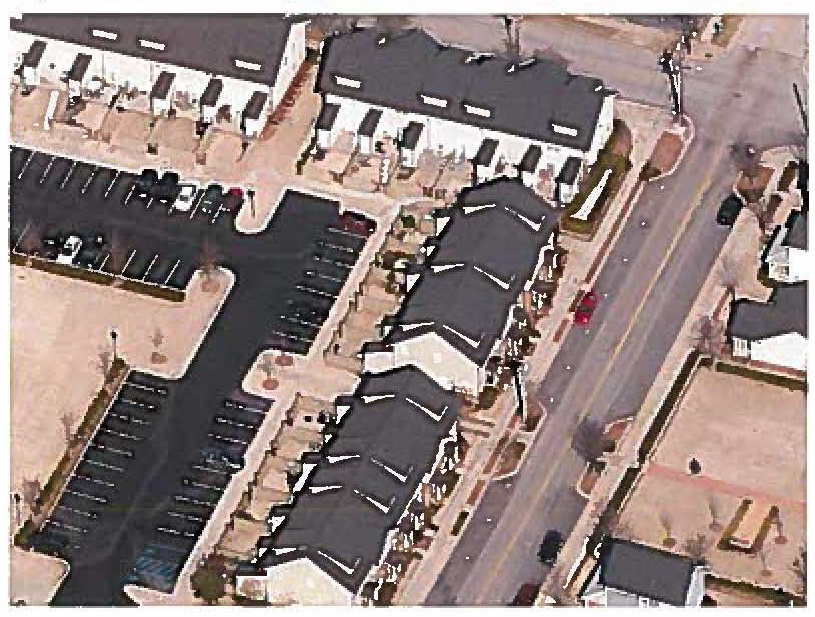
(B)
Setbacks and height
(1)
Front setbacks shall be within 75 and 125 percent of the average setback of existing structures along the same block face, provided that no building shall encroach upon the minimum setback requirement (see Figure 19-6.8.2). In cases where the average front setback is not discernible (e.g. the block face is vacant or lacks more than one building), the minimum front setback shall be established by the base zoning district standards.
Figure 19-6.8-2: Allowable front setbacks
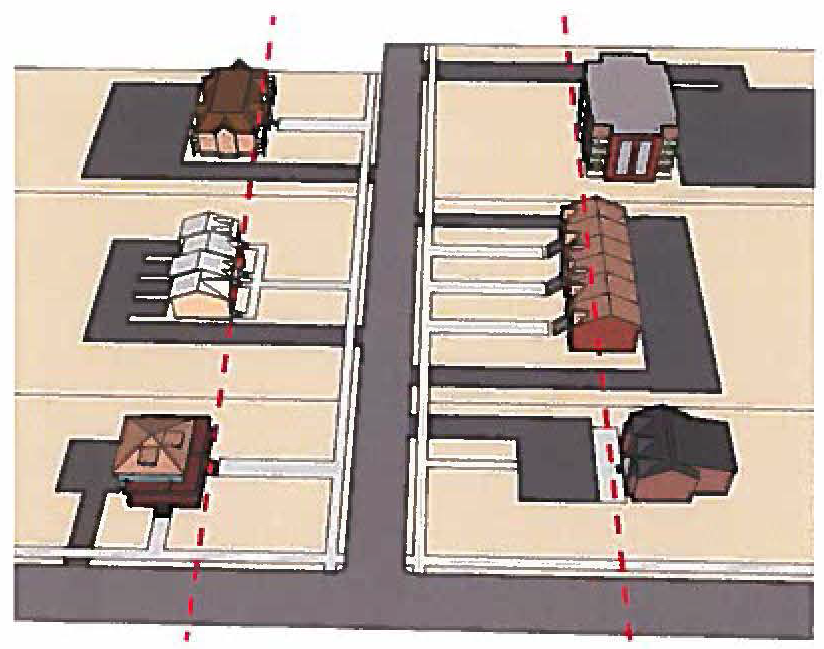
(2)
All multifamily residential buildings, regardless of height, shall provide a minimum 25-foot setback from the lot line of any abutting property improved with an existing single-family detached use or a parcel zoned R-6 or R-9.
(3)
Maximum building height is subject to Section 19-5.2.9, building height.
(C)
Entrances.
(1)
All entrances shall be adequately illuminated and oriented to promote natural surveillance.
(2)
Street-level, street-facing multifamily units should have a street-oriented entrance or, in-lieu thereof, a shared street-oriented entrance for every two street-level, street facing units.
(3)
Street-facing entrances for individual dwellings should include at least 36 square feet of usable porch or stoop area that is elevated above street level to create a separation of public and private space and to help activate the street.
(4)
Shared building entrances shall be pedestrian-scale and covered with canopies or overhangs.
(5)
Exterior open stairways and corridors serving more than one dwelling and facing a public street or single-family detached dwelling are prohibited.
(D)
Building facades.
(1)
Multifamily building elevations facing a public street or single-family dwelling shall reflect consistent design, textures, colors, and features.
(2)
Front building facades of 30 feet or more in width shall be configured as a series of individual building modules, wings, recesses, or projections from the primary facade wall with a minimum width of 15 feet and a maximum width of 30 feet each. Modules, wings, recesses, or bump outs shall deviate from the primary building facade plane by a distance of at least four feet.
(3)
Facade treatment. Multifamily residential building facades shall incorporate at least three of the following design features (see Figure 19-6.8-4):
(a)
Changes in wall plane (such as projections or recesses) with an offset or depth of at least one foot, a width of at least ten feet, located a minimum of every 25 feet;
(b)
Distinctive architectural features, such as a repeating pattern of pilasters, columns, recesses, or niches varying from the facade plane by a minimum of four inches;
(c)
Roofline changes, coupled with correspondingly aligned wall offset or facade material changes, including changes in the roof planes or changes in the height of a parapet wall;
(d)
Awnings or other weather protection for pedestrians;
(e)
Distinct changes in texture and color of wall surfaces;
(f)
A covered front porch or other designated gathering area occupying at least 25 percent of the front facade width;
(g)
Vertical accents or focal points such as towers, spires, cupolas, window walls, or widow walks;
(h)
Distinctive window trim:
(i)
Art work or bas relief;
(j)
Repetitive ornamentation, including decorative features such as wall-mounted light fixtures, with a maximum spacing of 50 feet; or
(k)
Other comparable elements, as approved by the decision-making body.
(4)
Vents, exhaust vents, and downspouts shall be incorporated into the overall design.
(5)
All building facades should incorporate a base, middle, and cap; visually lighter elements shall progress from base to cap. Distinctive architectural features such as: porches, columns, pilasters, bay windows, dormers, projecting eaves, and awnings are encouraged.
(6)
Upper-story decks or patios should be configured to avoid direct views into the private spaces of adjacent single-family dwellings.
Figure 19-6.8-4: Facade treatment with covered porches, changes in wall plane, and
distinct changes in color and texture
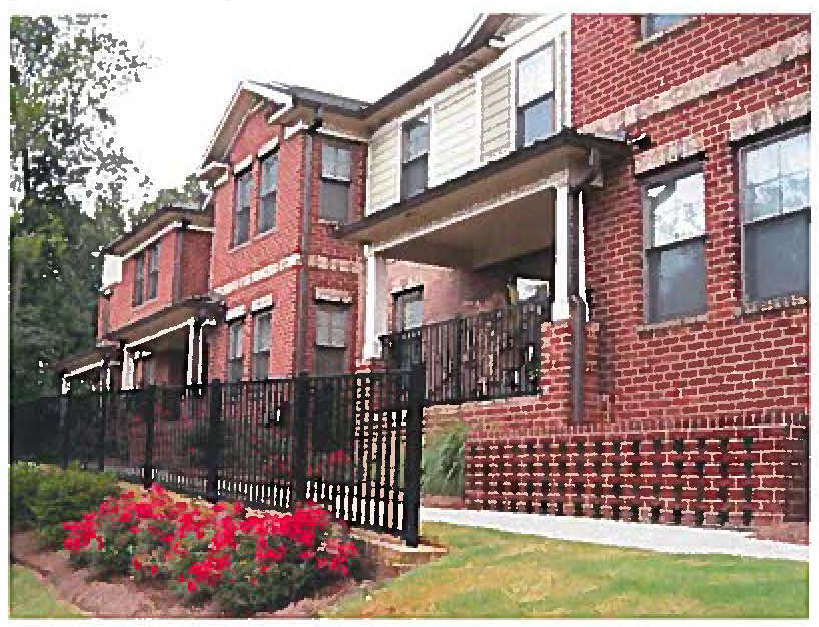
(E)
Service areas.
(1)
Private storage space shall be provided within, or immediately adjacent to, each dwelling.
(2)
Exterior mechanical equipment, vending machines, service and delivery areas, outdoor storage, and accessory uses and structures that may produce noise, odors, glare, vibration, etc:
a.
Shall be screened from view of public and common areas and adjacent properties (see Figure 19-6.8-5), and
b.
Shall be located away from adjacent residential dwellings or integrated into the building's architecture.
(3)
Above-ground refuse containers shall comply with the below standards:
a.
Above-ground refuse containers shall comply with the applicable setback requirements. No above-ground refuse container shall be located less than 15 feet from the property line of any abutting property improved with a single-family detached use.
b.
Above-ground refuse containers shall be fully screened from the view of adjoining property, public streets, and thoroughfares. Above-ground refuse containers shall be screened on three sides with a permanent building, decorative masonry wall, wood fencing or landscaping, not less than six feet in height or at least one foot above the height of the enclosed dumpster, whichever is greater. In-ground refuse containers shall be screened with evergreen plantings.
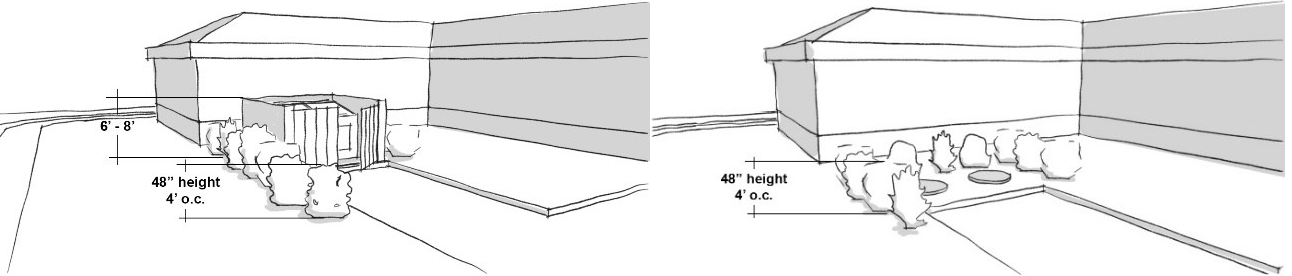
Above-ground refuse In-ground refuse
(4)
Times of service. Deliveries, waste collection, and similar commercial activity is prohibited between the hours of 10:00 p.m. and 7:00 a.m.
Figure 19-6.8-5 Service area screening
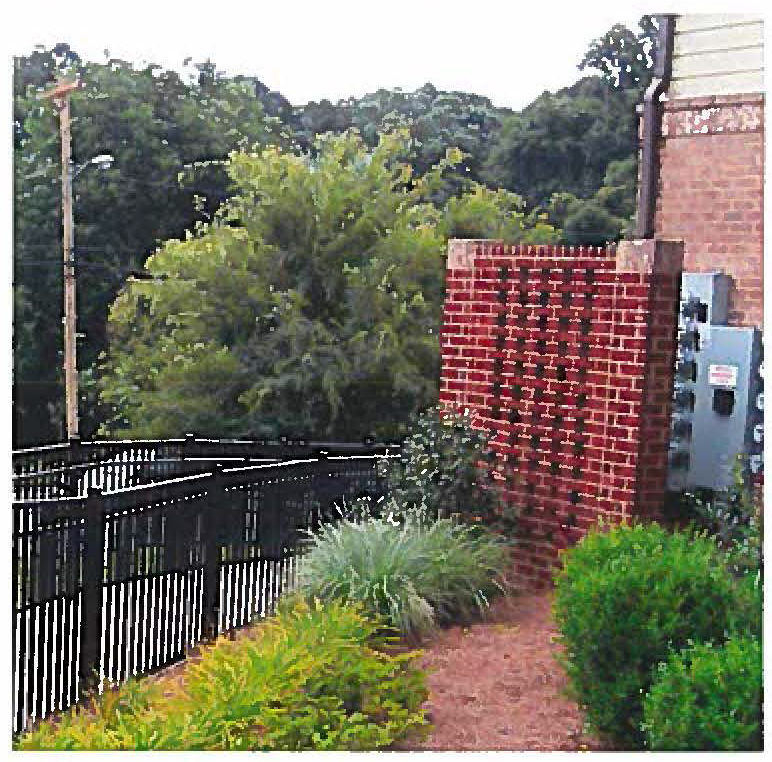
(F)
Roof form.
(1)
Pitched roofs shall include variation in planes, slope, and features (see Figure 19-6.8-6).
(2)
Overhanging eaves and roof rakes on gable ends shall extend at least six inches past the supporting walls.
(3)
Flat roofs shall incorporate parapet walls with three-dimensional cornice treatments designed to conceal the roof and roof-mounted mechanical equipment. All parapet walls visible from a public street shall be finished.
(4)
The parapet wall shall be similar in color and material to the building and shall not exceed 25 percent of the height of the supporting wall.
(5)
Within developments with multiple buildings, building heights shall be varied to avoid the appearance of an elongated building mass. This can be achieved by stair-stepping building heights or by varying roof forms.
(6)
When adjacent to single-family detached dwellings, the roof form of multifamily residential buildings shall complement the character of surrounding structures.
(7)
Green roofs, which use vegetation to improve stormwater quality and reduce runoff, may be incorporated as an alternative to the roof forms described in this subsection.
(8)
All roof vents, pipes, antennae and other roof penetrations should be of a color that will minimize their visual impact unless concealed by a parapet, located on the rear elevation, or configured to have a minimal visual impact as seen from the street or existing residential development.
Figure 19-6.8-6: Gabled roof form
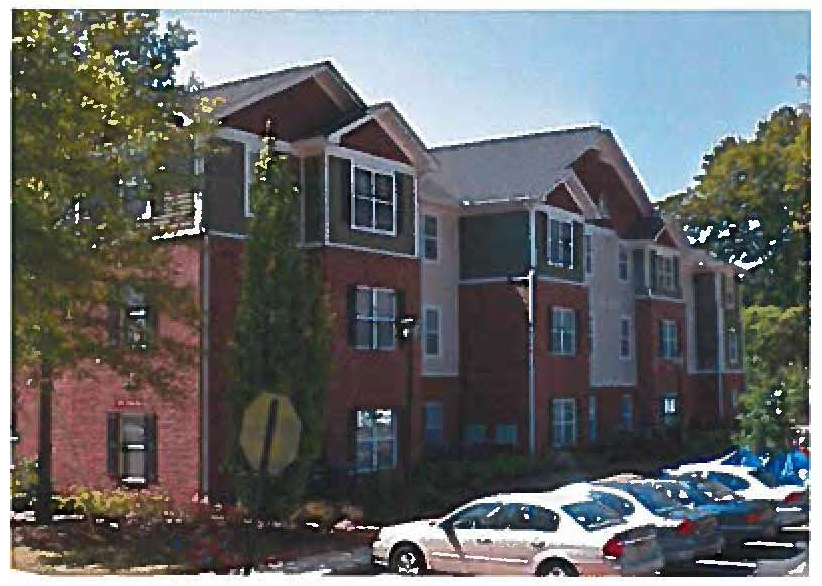
(G)
Transparency.
(1)
Street-facing facades shall have a minimum glazed area of 20 percent. All other building facades shall have a minimum glazed area of ten percent (see Figure 19-6.8-7).
(2)
Windows on side facades shall be positioned to avoid direct views into the windows of an existing adjacent residential dwelling.
(3)
Windows and doors of proposed dwelling units shall allow for casual surveillance of the parking and common open space areas.
(4)
Windows shall complement the rhythm, size, proportion, and trim of adjacent residential buildings.
Figure 19-6.8-7: Multifamily window transparency
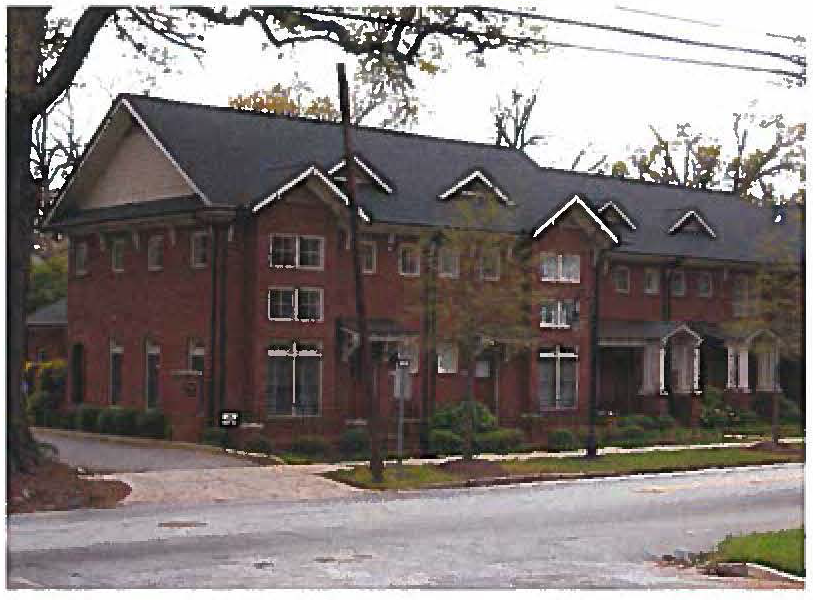
(H)
Materials.
(1)
Building facades shall incorporate a coordinated color scheme consisting of matte finishes. Gloss finishes may be used for trim and accent. Florescent and metallic paints are prohibited. However, nothing in this section shall prohibit the use of reflective colors on building roofs.
(2)
Colors and finishes shall be consistent throughout the development and all sides of the buildings.
(3)
Accessory buildings and structures shall be similar in materials and architectural style to the primary building.
(4)
Building materials shall either be similar to the materials already being used in the immediate area or, if dissimilar materials are being proposed, other characteristics such as scale and proportions, form, architectural detailing, color, and texture shall be utilized to ensure that enough similarity exists for the building to be compatible despite the differences in materials. (See Figure 19-6.8-8)
Figure 19-6.8-8: Multifamily development in context with similar building materials
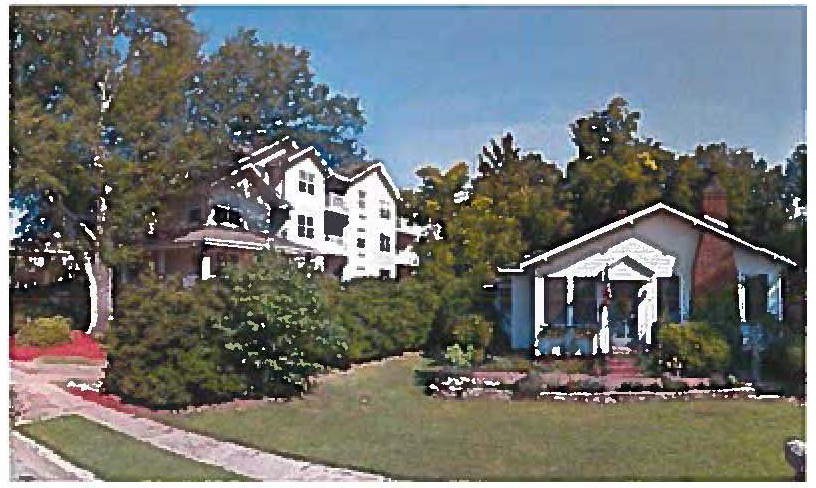
(5)
Where two or more materials are proposed to be combined on a facade, the heavier and more massive elements shall be located below the lighter elements (e.g., brick shall be located below stucco). Use of a heavier material as a detail on the corner of a building or along cornices or windows is acceptable. (See Figure 19-6.8-9)
Figure 19-6.8-9: Heavier materials below lighter elements
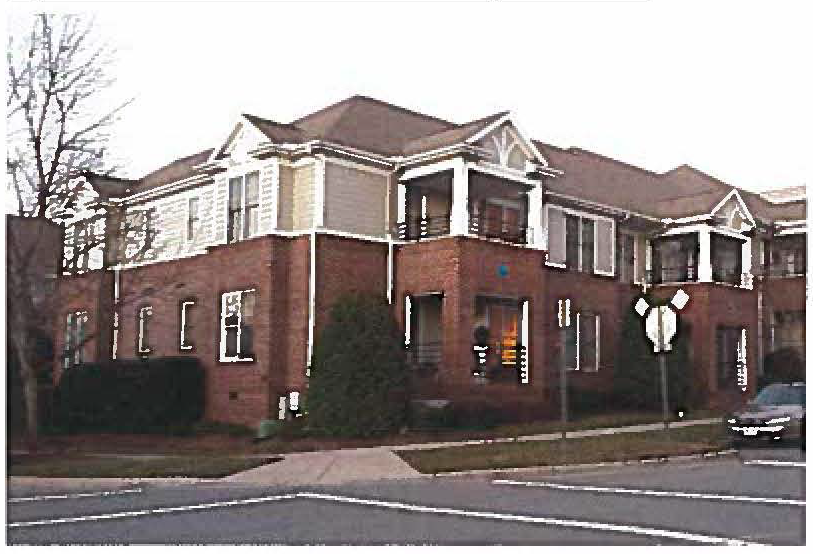
(6)
Primary facade materials shall not terminate or change at outside corners, and shall continue a minimum distance of two feet from the front corners along the side facades.
(7)
Material changes shall occur along a horizontal line or where two forms meet. It is acceptable, however, that change of materials occur as accents around windows, doors, cornices, or as a repetitive pattern.
(8)
The following materials shall not be used:
(a)
Corrugated metal siding, however, high quality architectural metal siding may be used;
(b)
Exposed smooth-finished concrete block;
(c)
Styrofoam-backed and synthetic stucco within 12 feet of the grade level and within two feet of any exterior door jamb; or
(d)
Vinyl siding.
(I)
Open space.
(1)
A minimum of 200 square feet of open space per dwelling shall be provided, one-half of which may be private. The decision-making body may waive the provision of "common open space" or apply an alternative condition to the standard, provided the property is within a quarter-mile of public open space or contains 50 or fewer dwellings.
(2)
Connections to adjacent greenways, parks, trails, etc., shall be provided.
(3)
Common open spaces shall be located adjacent to common facilities such as laundry rooms, mail rooms/sites and community centers; visual access to shared open spaces shall be enhanced via windows opening from kitchens, living rooms, and dining rooms.
(4)
Physical access to common open space shall be as direct as feasible from the dwellings and designed to discourage nonresident access. Outdoor seating shall be encouraged to accommodate adult supervision.
(5)
Active recreation facilities shall be located in a manner to reduce adverse impacts upon residents, both on- and off-site; it shall have well-defined edges such as walkways, buildings, or landscaping.
(6)
Passive and active recreation space and facilities shall be provided in a form and an amount appropriate to the anticipated types of residents in the development (e.g., families with young children, the elderly, etc.). (See Figure 19-6.8-10)
(7)
Some form of private open space (i.e., patio, porch, deck, balcony, yard, etc.) is encouraged for each dwelling with boundaries between private and common open space established by elements such as low walls and landscaping.
(8)
Development is encouraged to provide both passive and active recreation spaces as part of its "green infrastructure" (see subsection 19-6.7.1(G), green infrastructure); the linking of open spaces is encouraged to form an uninterrupted network of "vehicle-free" areas.
Figure 19-6.8-10: Active recreation facilities
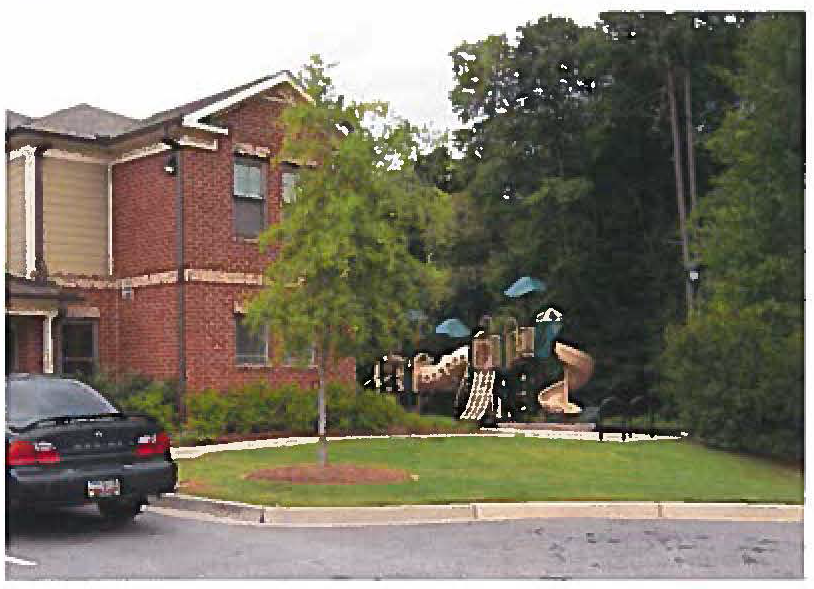
(J)
Parking lot location.
(1)
Parking areas shall be located and designed to reduce or eliminate visual and operational impacts on surrounding lands and shall comply with the provisions of section 19-6.1, off street parking and loading and section 19-6.2, landscaping, buffering and screening.
(2)
Parking structures, when included, shall provide:
(a)
Building facade treatment and materials similar to facades with residential units;
(b)
Clear sight lines of abutting streets, driveways, and pedestrian pathways;
(c)
Light-colored interior walls and ceilings; and
(d)
Adequate and uniform interior lighting without glare to surrounding properties.
(3)
Parking areas for multifamily developments with at least 20 units shall provide spaces dedicated for auto maintenance with access to water, electricity, and drainage.
(4)
At least 75 percent of the provided off-street parking shall be located within parking structures or in the side or rear yards of multi-family residential buildings. Garage doors or vehicular entrance points to parking structures shall be located at least ten feet behind the street-facing building facade.
(K)
Access and circulation.
(1)
Multifamily residential development located adjacent to routes serviced by mass transit shall provide pedestrian circulation and queuing locations, if applicable, to access mass transit vehicles.
(2)
Site entrance locations (vehicle and pedestrian) shall complement adjacent and opposite land use entrances in scale, design, and location. Entrances shall be located in a manner designed to retain the character of the adjacent land uses and not create adverse impacts.
(3)
Ingress and egress from off-street surface parking areas serving multifamily residential development adjacent to single-family detached dwellings shall be limited to the street fronting the development. In the case of corner lots, off-street parking areas may be accessed by either street fronting the development.
(L)
Landscaping and screening.
(1)
Site development shall minimize the alteration of site topography; preserve and enhance natural resources; utilize the natural carrying capacity of the land; and comply with the provisions of section 19-6.2, landscaping, buffering, and screening.
(2)
Development is encouraged to provide landscaped areas as part of its "green infrastructure" (see subsection 19-6.7.1(G), green infrastructure), or include low impact development (LID) techniques, where appropriate.
(3)
Installed landscaping shall be of a climate appropriate or native drought-tolerant species, or shall be automatically irrigated.
(4)
Landscaping shall not obscure lighting.
(5)
Stormwater management facilities (such as retention ponds) should be incorporated with the landscape design of the site and shall be configured to serve as an active or passive recreation amenity for residents.
(6)
Building foundations shall be landscaped along the full length of each front and rear facade. Landscaping shall wrap around the corners and shall continue around building sides to a logical conclusion point or a minimum distance of ten feet, whichever is less.
(7)
Foundation landscaping shall have an average depth of six feet and a minimum depth of four feet. Foundation landscaping depth along a sidewalk may be reduced by up to 50 percent, where needed to provide for adequate pedestrian circulation or pedestrian amenities.
(8)
Buffer yard screening per 19-6.2.3(D) shall be required.
(9)
The setback widths and use restrictions for buffer zones shall be considered the minimum standard for multi-family development abutting property improved with a single-family use and shall supersede lesser requirements applicable to development generally.
(M)
Exterior lighting.
(1)
The lighting of all parking areas, pedestrian walkways, entrances, and exterior portions of the site shall be designed for its specific task and shall comply with the provisions of section 19-6.4, exterior lighting.
(2)
Exterior lighting fixtures shall be:
(a)
Vandal-resistant;
(b)
Compatible with building architecture; and
(c)
Scaled (dimension and intensity) to complement its context.
(3)
Adjacent to single-family dwellings:
(a)
Exterior lighting heights, whether pole-mounted or wall-mounted, shall not exceed a maximum height of 15 feet above grade.
(b)
Lighting levels shall be consistent with the provisions of section 19-6.4, exterior lighting.
(c)
Uplighting of building or site features shall be directed away from adjacent properties.
(d)
Internally illuminated signage or awnings are prohibited.
(N)
Pedestrian walkways.
(1)
Pedestrian walkways at least four feet wide shall be provided between buildings, streets, driveways, community spaces, and off-street parking.
(2)
Sudden changes of grade or sharp turns resulting in "blind spots" are discouraged.
(3)
Walkways shall transect common open space to enhance visual access while minimizing conflicts between vehicles, bicycles, and pedestrians.
(4)
Entry points and intersections of pedestrian walkways should be framed by landscaping consisting of plant, lighting, and hardscape materials scaled to the pedestrian context.
(O)
Fences and walls.
(1)
Walls and fences shall comply with the provisions of subsection 19-5.2.7, features allowed within required setbacks.
(2)
Chain link fences are prohibited.
(3)
When located adjacent to an existing wall or fence on a different lot, fences and walls shall be configured to avoid creation of tight corners or areas difficult to maintain.
(4)
All fences and walls shall be maintained in good repair and in a safe and attractive condition, including but not limited to, the replacement of missing, decayed, or broken structural and decorative elements. Any deteriorated, damaged, or decayed fence materials shall be repaired and any fence or wall post or section that leans more than ten degrees from vertical shall be repaired to correct that condition.
(5)
Wherever a fence or wall is installed, if one side of the fence or wall appears more "finished" than the other (e.g., one side has visible support framing and the other does not), then the more "finished" side of the fence shall face adjacent lands rather than the interior of the lot (see Figure 19-6.8-12).
(6)
Fences located between a front building facade and the street it faces shall not exceed three feet in height.
Figure 19-6.8-12: Finished side of fence facing adjacent property
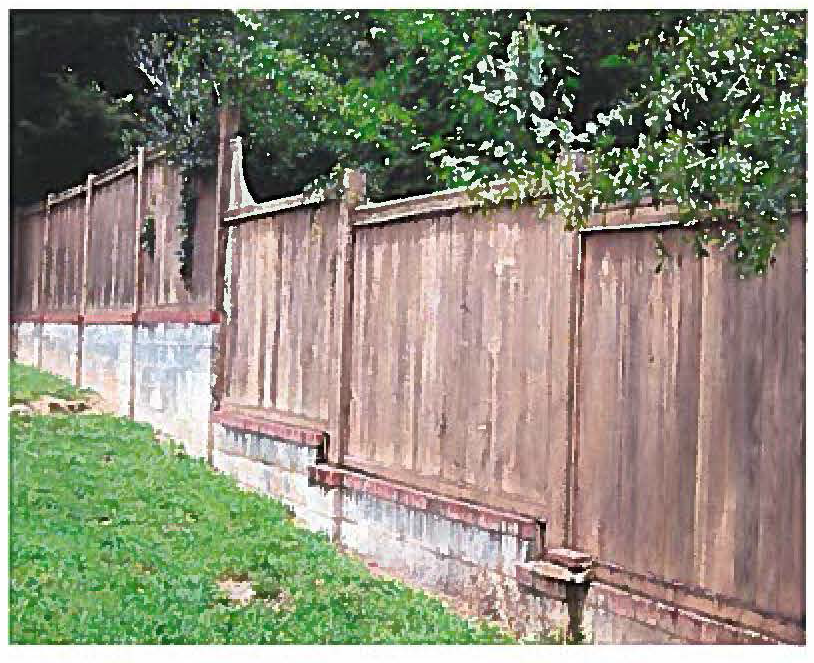
(Code 1997, § 19-6.8; Ord. No. 2009-48, exh., 6-8-2009; Ord. No. 2015-06, § 19-6.8, 1-26-2015; Ord. No. 2018-37, 5-21-2018; Ord. No. 2020-81, Exh. A, 11-9-2020; Ord. No. 2021-39, Exh. A, 6-28-2021; Ord. No. 2021-40, Exh. A, 6-28-2021; Ord. No. 2021-42, Exh. A, 6-28-2021; Ord. No. 2021-43, Exh. A, 6-28-2021; Ord. No. 2021-45, Exh. A, 6-28-2021)
Sec. 19-6.9. - Single-family residential infill standards
19-6.9.1.
General purpose and intent. This section is intended to achieve neighborhood compatibility, maintain the harmony and character of established single-family residential areas, and guide residential infill development to occur in an orderly and desirable manner. It is also intended:
(A)
To minimize the impact of garages/carports and driveways on the character of established single-family residential areas, by addressing the location of garages/carports and driveways and the orientation of garage openings relative to the street.
(B)
To minimize the visual impact of a stormwater detention/retention facility within established single-family residential neighborhoods in order to maintain the predominant characteristics of the neighborhood to the greatest extent possible.
(C)
To limit stormwater runoff impact on adjoining properties created by new construction and additions.
(D)
To preserve and protect existing tree canopy to the extent practicable and to ensure future tree canopy consistent with established single-family residential areas.
19-6.9.2.
Applicability. The provisions of this section shall apply to the following developments located in established single-family residential areas, except those zoned S-1:
(A)
New lots created by summary plat or major subdivision (subsection 19-2.3.13).
(B)
Construction of a new single-family detached dwelling, duplex dwelling, or garage/carport.
(C)
Addition of an attached garage/carport.
(D)
Installation and/or expansion of a driveway.
(E)
Renovations/additions to a dwelling whose construction value exceeds 50 percent of the fair market value of the property as reflected on the Greenville County Tax Assessor's role. Renovations/additions phased over a five-year period shall be combined to determine applicability of the percent threshold criteria. Renovations/additions which do not alter the site are exempt, but are calculated in the five-year phased period above.
(F)
Additions that increase the principle building footprint square footage by more than 40 percent. Additions phased over a five-year period shall be combined to determine the applicability of the percent threshold criteria.
19-6.9.3.
Definitions. For the purposes of this section, the following definitions apply:
Block means the lots and or residential buildings fronting both sides of a section of street located between intersecting streets.
Established single-family residential area means an area developed with single-family residential dwellings having one or more of the following characteristics:
(A)
Was platted or developed more than 25 years ago;
(B)
Is in a subdivision that is more than 80 percent built out and that was platted more than 15 years ago;
(C)
Is bounded on two or more sides by existing residential development; or
(D)
Is within an unplatted area that contains lots of two and one-half acres or less where 80 percent or more of the lots or tracts have been developed for at least 15 years.
19-6.9.4.
Garages, carports, and driveways.
(A)
In established single-family residential areas, garages, carports, and driveways shall be constructed in a way to be consistent with the predominant development pattern and rhythm of the block.
(B)
Attached garages/carports shall not open onto a front yard, unless:
(1)
Sixty percent of existing dwellings in the block have attached garages/carports which open onto a front yard; or
(2)
The garage is integrated into the design of the house and is set back at least ten feet from the front of the house, including up to five feet of a porch that spans at least 50 percent of the front façade of the house. Garage width shall not exceed 50 percent of the width of the front façade of the house. (See Figure 19-6.9.2)
(C)
Attached garages/carports may open onto the special yard of a corner lot. The front door of the house shall not face the special yard.
(D)
Detached garages/carports shall comply with the provisions of section 19-4.4, accessory uses and structures.
(E)
If a garage/carport is not provided, driveways/parking shall be located to the side and/or rear of the dwelling, and shall not exceed ten feet wide, except in the rear yard. (See Figure 19-6.9.2)
(F)
If a garage/carport is provided, driveways/parking shall not be allowed in the front yards, except for access to front-loaded garages that are permitted. A garage is allowed access via an apron the width of the garage opening and 20 feet deep tapering to a ten-foot wide driveway. The administrator may allow wider driveways and/or parking pads in the front yard based on consistency with existing character of the block and in compliance with the stated purpose and intent of this section. (See Figure 19-6.9.2)
(G)
Parking in a front yard may be allowed by conditional use when conditions exist that do not allow access to the side or rear yard (i.e. topography, limited space between an existing house and lot line (an area less than ten feet wide)). Backup space in a front yard may be allowed by conditional use when access to an adjacent street may be difficult due to traffic patterns on the street. The administrator shall determine that the design and landscaping of the parking and or backup space ensures adequate stormwater mitigation and protection of the character of the block.
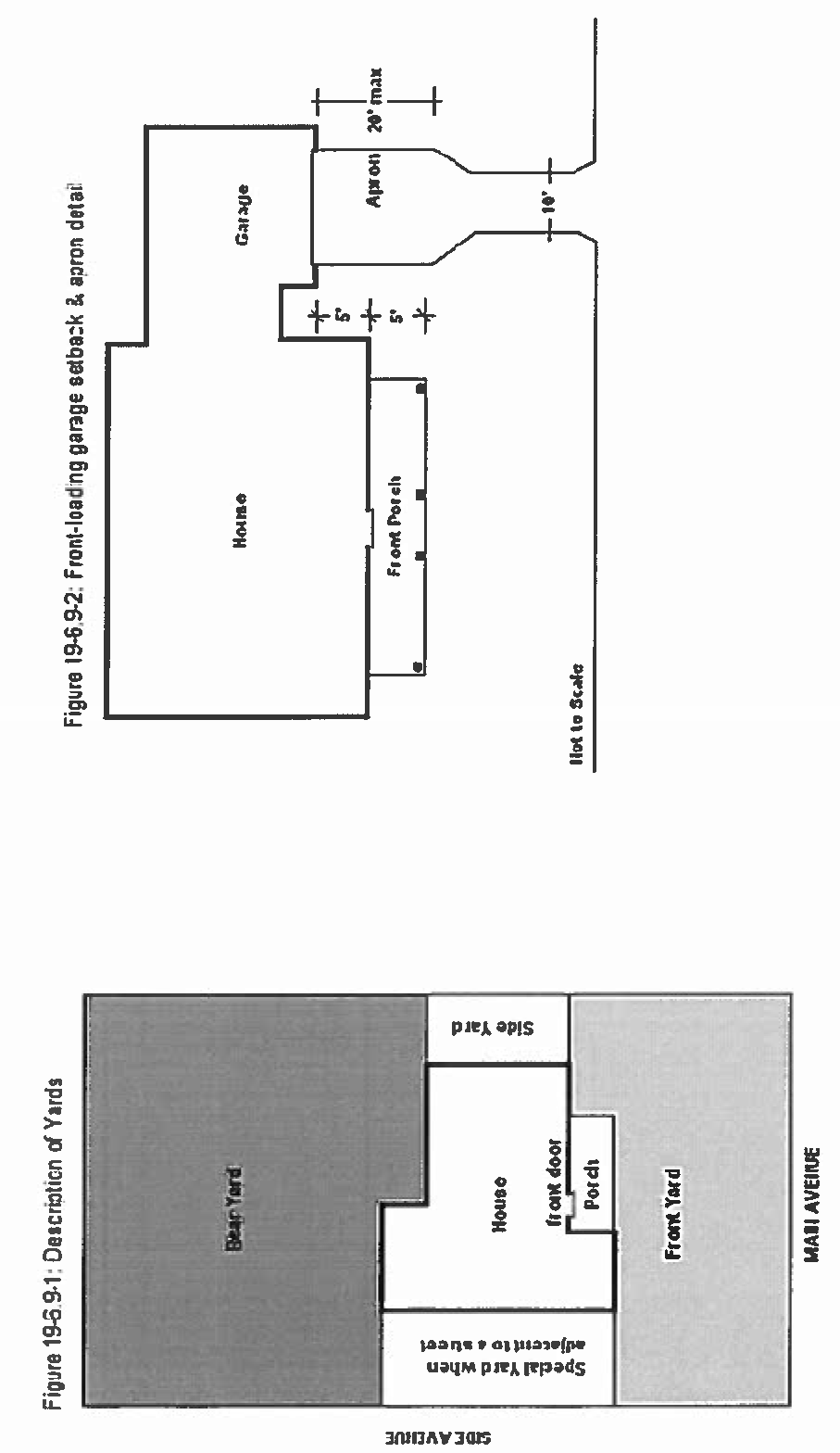
19-6.9.5.
Stormwater detention/retention standards.
(A)
For subdivisions of two to 15 lots where stormwater quantity requirements of article 19-7, stormwater management, apply to infill subdivisions, the following requirements shall apply:
(1)
Where aboveground detention/retention facilities are proposed, they shall:
(a)
Be located at least 20 feet from an exterior property line;
(b)
Be sloped in a manner that is easily maintained; and
(c)
Be designed as an amenity to the development, when deemed feasible by the administrator. Amenity features may include additional landscaping, fountains, trails or other features acceptable to the administrator.
19-6.9.6.
Stormwater runoff standards. The following performance standards shall apply to all single-family residential buildings, including single-family projects on vacant land, or land made vacant after the demolition of existing structures.
(A)
A grading plan that includes details as specified in the administrative manual shall be submitted with the application for a single-family building permit, when the property is not part of a larger common plan.
(B)
Single-family detached and duplex lots shall not exceed 60 percent total impervious coverage (i.e. parking, driveways, stairs, pools, patios, sidewalks), inclusive of the 40 percent maximum lot coverage for all roofed areas.
(C)
Setback slopes shall not exceed four foot horizontal to one vertical. Runoff collected from impervious surfaces shall be discharged at a setback distance of at least 20 feet from the property line.
(D)
If the applicant cannot meet the requirements of subsection 19-6.9.6(C), a grading plan as outlined in subsection 19-6.9.6(A) and that incorporates stormwater best management practices to convey and dissipate stormwater runoff discharges shall be submitted and approved by the administrator.
19-6.9.7.
Tree protection and replacement. Protection of existing tree cover is intended to preserve the visual and aesthetic qualities of the city, to encourage site design techniques that preserve the natural environment and enhance the developed environment; to control erosion, slippage, and sediment runoff into streams and waterways; to increase slope stability; and to protect wildlife habitat and migration corridors. Preservation or provision of trees near structures also serves to conserve energy by reducing heating and cooling costs.
(A)
Tree surveys are not required for single-family lots or single-family subdivisions. However, the location, species, and size of trees that are proposed to be retained and/or planted to meet these requirements shall be shown on the required site plan.
(B)
Including required street trees, one canopy tree shall be planted for each 3,000 square feet of lot area or portion thereof, excluding building footprints. Such trees shall be a minimum 2.5-inch caliper and may be planted anywhere on the lot. Each existing canopy tree proposed to be retained and measuring at least six inches in diameter shall count as two new trees.
(C)
Trees that are retained to meet the requirement of (B) above shall be protected during construction consistent with the provisions of subsection 19-6.3.3.
(Ord. No. 2014-68, 8-11-2014; Ord. No. 2016-3, exh., 1-25-2016; Ord. No. 2016-35, 6-27-2016; Ord. No. 2017-25, 2-27-2017)
Sec. 19-6.10. - Traffic impact analysis.
19-6.10.1.
Purpose. A traffic impact analysis assesses the effects of the projected traffic generation from a proposed development on the surrounding transportation network. These studies range in detail and complexity depending upon the type, size and location of the development. These studies are used to evaluate whether a development is appropriate for a site given its projected impact and the type of transportation improvements required to accommodate the development.
19-6.10.2.
Requirement for analysis. A traffic impact analysis shall be submitted by a developer in support of an application if the administrator determines that a proposed development will generate new trips as shown below, based on the classification of the street that the site fronts. For sites that front more than one street, the lower threshold shall govern.
•
Arterial: 100 new trips
•
Collector: 75 new trips
•
Local residential: 50 new trips
•
Local low volume: 25 new trips
A traffic impact analysis shall also be submitted by a developer in support of any application for re-zoning to PD or FRD, unless waived by the administrator. The completed traffic impact analysis shall be a component of the application to the planning commission. In instances where the administrator does not waive the traffic impact study, the applicant may petition the planning Commission for a waiver due to undue hardship.
The administrator's determination shall be based upon reasonable expectations of time-of-day usage of similar developments; when developments are projected to have an intensity of usage which varies from day-to-day, week-to-week, or month-to-month, the administrator shall base the determination of peak hour upon maximum utilization. The analysis shall be prepared by a registered engineer licensed in the state; it shall utilize trip generation data reflected in the current edition of Trip Generation published by the Institute of Transportation Engineers provided (see also design and specifications manual); however, the administrator may approve the use of alternative data resulting from analysis deemed to be more consistent with the subject development.
19-6.10.3.
Required improvements. Improvements to the existing transportation infrastructure by a developer will be required as a condition of permit issuance if the projected overall intersection delay for the build-out year of the development increases by more than ten percent of the overall intersection existing delay.
(Code 1997, § 19-6.10; Ord. No. 2007-52, § 19-6.10, 7-9-2007; Ord. No. 2021-49, Exh. A, 7-12-2021)
Sec. 19-6.11. - Building numbering.
(A)
General. Any person owning property within the city upon which any building has been constructed shall adopt, properly display, and maintain legible building numbers as designated by the city. Such numbers shall be attached to and maintained on the building at all times by the owner, occupant, or person in-charge of the premises. It shall be unlawful to tamper with or remove such numbers in such manner that the numbers are not legible to persons traveling along the sidewalk or roadway in front of such building. At the sole discretion of the city, a change of building numbers may become necessary and the requirements of this section shall apply.
(B)
Design standards.
(1)
Building numbers shall be displayed as Arabic numerals.
(2)
Building numbers shall be located on the front of the building adjacent to the main entryway.
(3)
Building numbers shall contrast in color to the portion of the building to which the numbers are attached.
(4)
Building numbers shall be a minimum of four inches in height.
(5)
Building numbers shall be installed a minimum height of three feet and a maximum height of ten feet above the finished grade of the main entryway.
(Code 1997, § 19-6.9; Ord. No. 2009-09, 2-9-2009; Ord. No. 2014-68, 8-11-2014)
Sec. 19-6.12. - Design Standards for Neighborhood Revitalization Overlay Districts.
(A)
Single-Family Detached and Duplex Dwellings. New housing should be compatible with the existing fabric of the community and promote a walkable environment.
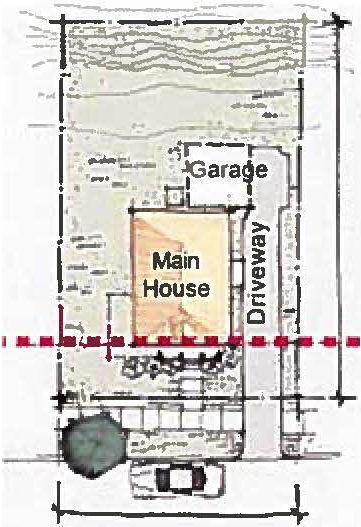
(1)
Lot Width-40 feet minimum.
(2)
Driveways: Shall at no point be wider than ten feet (except in rear yard or connecting to an alley) and shall only be located to the side and/or rear of a house. Parking in a front yard may be allowed by zoning administrator when conditions exist that do not allow access to the side or rear yard (i.e. topography, limited space between an existing house and lot line (an area less than ten feet wide). Backup space in a front yard may be allowed by zoning administrator when access to an adjacent street may be difficult due to traffic patterns on the street. The administrator shall determine that the design and landscaping of the parking and or backup space ensures adequate stormwater mitigation and protection of the character of the block.
(3)
Walkways: All houses shall have a sidewalk between three and five feet wide that connects the front porch to the public sidewalk, or the front porch to the driveway if no public sidewalk exists.
(4)
Retaining Walls: Must be faced in stone, brick, or stucco, if visible from the public street.
(5)
Foundation: Slab foundations shall be elevated a minimum of 16 inches above finished grade on all elevations and shall consist of brick/stone. Crawlspace foundations shall consist of brick/stone veneer at a minimum height of 16 inches above finished grade on all elevations (zoning administrator may make exceptions considered for accessibility requirements).
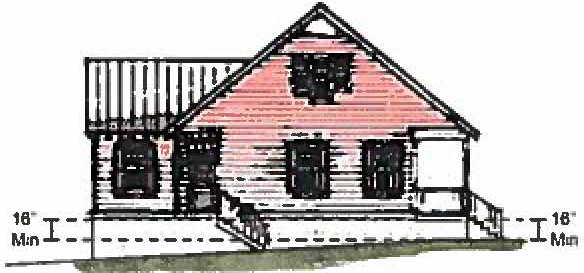
(6)
Building Height: 30 feet maximum, as defined in section 19-5.2.9(A).
(7)
Roof: Shall be gable or hipped with pitch between 3/12 and 14/12.
(8)
Eave Overhang: 12 inch minimum.
(9)
Chimneys: Must be faced in stone or brick.
(10)
Attached or Detached Garages: Must be located behind the back wall of the primary structure.
(11)
Accessory Structures: See section 19-4.4.
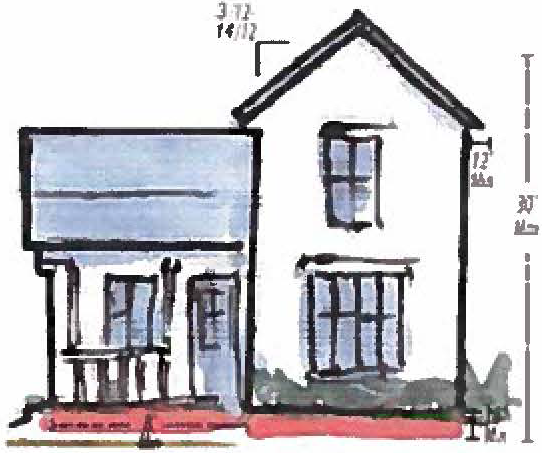
(12)
Front Porches: Must have a front porch at least six foot minimum depth and eight foot minimum width from edge of wall to edge of porch. Porches shall not be enclosed and have at least two columns with a minimum six inch nominal diameter each.
(13)
Exterior Walls: No concrete block masonry or metal panel is permitted. Stucco may be used as an accent.
(14)
Trim Details: Four inch nominal width minimum for siding or two inch minimum for brick masonry trim shall be used at windows, doors, corners, cornices, eaves, rakes, and fascias.
(15)
Fenestration (Doors and Windows): 25 percent minimum of the front facade shall be fenestrated and 10% minimum of each of the side and rear facades shall be fenestrated.
(B)
Single-Family Attached- New single-family attached housing should be compatible with the existing fabric of the community and promote a walkable environment.
(1)
Driveways: All driveways/parking areas shall be located to the side and/or rear of a unit. No front yard parking locations are permitted. Parking in a front yard may be allowed by zoning administrator when conditions exist that do not allow access to the side or rear yard (i.e. topography, limited space between an existing house and lot line (an area less than ten feet wide). Backup space in a front yard may be allowed by zoning administrator when access to an adjacent street may be difficult due to traffic patterns on the street. The administrator shall determine that the design and landscaping of the parking and or backup space ensures adequate stormwater mitigation and protection of the character of the block.
(2)
Shared Alleys: All attached developments shall be required to share a rear parking access through the use of a shared alley. To the extent possible, alleys shall be accessed via the side of the block. Where not possible (i.e., infill development in block interiors), alleys shall be accessed via the primary street but shall have no more than two curb cuts.
(3)
Walkways: Each individual unit shall have a sidewalk between three and five feet wide that connects the front porch to the public sidewalk (no shared walkway).
(4)
Retaining Walls: Must be faced in stone, brick, or stucco, if visible from the public street.
(5)
Foundation: Slab foundations shall be elevated a minimum of 16 inches above finished grade on all elevations and shall consist of brick/stone veneer. Crawlspace foundations shall consist of brick/stone veneer at a minimum height of 16 inches above finished grade on all elevations (zoning administrator may make exceptions considered for accessibility requirements).
(6)
Building Height: 30 feet maximum, as defined in section 19-5.2.9(A).
(7)
Roof: Shall be gable or hipped with pitch between 3/12 and 14/12.
(8)
Eave Overhang: 12 inch minimum.
(9)
Roof Massing: All dwelling units shall have at least one gable or dormer facing the public street. Roof massing should be used to delineate each unit from one another.
(10)
Chimneys: Must be faced in stone or brick
(11)
Garages: Shall be provided only along the rear of the main dwelling structure and shall be accessed via a shared alley (no front-facing garages).
(12)
Accessory Structures: See section 19-4.4.
(13)
Porches: Each dwelling unit shall have a front porch at least 6 foot minimum depth and eight foot minimum width from edge of wall to edge of porch. Porches shall not be enclosed and have at least two columns with a minimum six inch nominal diameter each.
(14)
Doors: Each dwelling unit shall have a front door that faces the public street.
(15)
Exterior Walls: No concrete block masonry or metal panel is permitted. Stucco may be used as an accent.
(16)
Trim Details: Four inch nominal width minimum for siding or two inch minimum for brick masonry trim shall be used at windows, doors, corners, cornices, eaves, rakes, and fascias.
(17)
Fenestration: 25 percent minimum of the front facade and ten percent minimum of the rear facade shall be fenestrated. On end units only, ten percent minimum of the side facade shall be fenestrated.
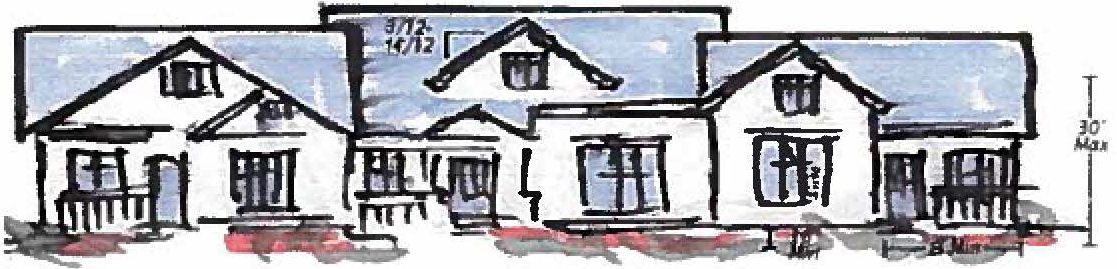
(Ord. No. 2020-43, 5-11-20)

