
Greenville City Zoning Code
ARTICLE 19
5. - DIMENSIONAL STANDARDS AND MEASUREMENTS ARCHIVED
Sec. 19-5.1. - Table of dimensional standards.
All primary structures shall be subject to the dimensional standards set forth in the following table. These standards may be further limited or modified by other applicable sections of this chapter. Rules of measurements and permitted exceptions are set forth in section 19-5.2, definitions/measurements.
(Code 1997, § 19-5.1; Ord. No. 2007-52, § 19-5.1, 7-9-2007; Ord. No. 2008-25, 3-25-2008; Ord. No. 2009-22, 3-23-2009; Ord. No. 2012-49, 6-11-2012; Ord. No. 2014-68, 8-11-2014; Ord. No. 2015-05, exh.(19-5.1-1), 1-26-2015; Ord. No. 2016-17, exh. A, 3-28-2016; Ord. No. 2017-25, 2-27-2017; Ord. No. 2020-10, 1-27-2020; Ord. No. 2020-81, Exh. A, 11-9-2020; Ord. No. 2021-43, Exh. A, 6-28-2021; Ord. No. 2021-44, Exh. A, 6-28-2021; Ord. No. 2021-45, Exh. A, 6-28-2021)
Sec. 19-5.2. - Definitions/measurement.
19-5.2.1.
Lot area. Lot area refers to the amount of horizontal land area contained inside the lot lines of a lot or site. Public rights-of-way shall not be included in calculating minimum lot area, except where specifically allowed by this chapter. A lot supporting a residential use may include public rights-of-way in calculating minimum lot area or maximum density provided the lot adjoins curb lawns as defined in the design and specifications manual having a minimum depth (measured parallel with the right-of-way) of four feet pursuant to the following:
(A)
The portion of the curb lawn that may be included in the minimum lot area shall be contained within the right-of-way between the streetside line of the sidewalk (or edge of right-of-way/front property line if no sidewalk is present) and a line parallel therewith that represents the streetside boundary of the curb lawn exceeding the four feet minimum depth as measured along the lot width (projected from the intersection of the side lot lines and the right-of-way), inclusive of driveways.
(B)
This provision shall apply to curb lawns exceeding the four feet minimum depth (measured parallel with the right-of-way) within all rights-of-way abutting corner and double frontage lots.
(C)
This provision shall not affect any other dimensional standard, definition, or measurement established by this chapter.
(D)
This provision shall not affect the city's rights and privileges to use, or allow the use of, the right-of-way referenced in this provision for all intended purposes. Routine maintenance of the curb lawn shall be the responsibility of the lot owner utilizing this provision.
19-5.2.2.
Lot width. Lot width refers to the horizontal distance between side lot lines. Lot width shall be measured as the distance between the side lot lines as measured at the front setback line.
19-5.2.3.
Lot depth. Lot depth refers to the average horizontal distance between the front lot line and the rear lot line.
19-5.2.4.
Minimum lot dimensions/setbacks.
(A)
General. Any lot that is created, developed, used, or occupied shall meet the minimum lot area, width, and coverage requirements set forth in this chapter for the zoning district in which it is located. The setback line establishes the required minimum distance of any permitted structure from a property line.
(B)
Setback, front. A front setback is a setback that extends across the full width of a site, the depth of which is the distance between the front property line and the furthermost projection of a building or structure along a line parallel with the front lot line, excluding allowable projections set forth in subsection 19-5.2.7.
(1)
The administrator shall establish a front setback for a single-family dwelling that is less, or greater, than the otherwise required front setback in order to maintain the existing pattern of front yards established by the principal uses contiguous to, and on either side of, the dwelling (if the front yards of the neighboring uses are not the same, the administrator shall establish a setback that represents the average of the two neighboring yards).
(2)
The administrator may reduce the otherwise required front, rear, and side setbacks for residential and nonresidential principal uses by an amount not to exceed ten percent of the otherwise required minimum for the protection of natural features on the site, which may include trees, waterways, topography or stream buffers.
(C)
Setback, rear. A rear setback is a setback that extends across the full width of a site, the depth of which is the distance between the rear property line and the furthermost projection of a building or structure along a line parallel with the rear lot line, excluding allowable projections set forth in subsection 19-5.2.7.
(D)
Setback, side. A side setback is a setback on that portion of a lot that is not adjacent to a private or public street. It extends from the rear of the required front setback, or the front property line of the site where no front setback is required, to the front of the required rear setback, or the rear property line where no rear setback is required, the width of which is the distance between the side property line and a line parallel thereto on the site.
19-5.2.5.
Multiple-family developments. Multiple-family developments do not have internal setback requirements. However, the appropriate setbacks prescribed for the zoning district in which the development is located shall be applied to the external boundaries of the overall development lot or site.
19-5.2.6.
Visibility at intersections and driveways. At each location formed by the intersection of two streets or a driveway and a street (except within the C-4 district), a sight triangle as defined in article XI of this chapter shall be maintained. Within the sight triangle no fence, wall, sign or other structure, no slope or embankment, no parked vehicle, no hedge, foliage or other planting, and no other object shall be placed, erected, or maintained that would obstruct visibility between a height of three feet and nine feet measured vertically from the ground level at the pavement.
19-5.2.7.
Features allowed within required setbacks. Driveways, walkways, on-grade patios, in-ground pools, plants, retaining walls, pergolas, arbors, and other landscape features may be located within any required setback. In addition, the following table lists features that may be located within any required setbacks, subject to the specific limitations noted:
19-5.2.8.
Corner lots and double frontage lots. On corner and double frontage lots, the front setback requirement shall be met on all street frontages of the property. Where one of the front yards that would normally be required on a corner or double frontage lot is not in keeping with the prevailing yard pattern, the administrator may waive the requirement for the normal front yard and substitute therefore a special yard requirement, which shall not be less than 10 feet. Side and rear setbacks shall be determined based upon both the orientation of the lot and upon the orientation of structures built or to be built on the lot. Fences or walls located within a yard adjacent to a street approved by the administrator as not constituting a front yard shall comply with the following requirements:
(A)
Fences and walls that exceed heights of 30 inches, constructed within five feet of the property line, shall not be opaque above a height of seven feet and shall be subject to the additional screening requirements pursuant to the provisions of section 19-6.2, landscaping, buffering and screening.
19-5.2.9.
Building height.
(A)
General. Building height is the vertical distance measured from the average elevation of the proposed finished grade at the front of the building to the highest point of the coping of a flat roof, to the deck line of a mansard roof, or to the mean height level between the eaves and ridge of a gable, hip, or gambrel roof.
(B)
Exceptions. Spires, belfries, cupolas, chimneys, antennas, water tanks, ventilators, elevator housings, mechanical equipment or other such structures placed above the roof level and not intended for human occupancy shall not be subject to height limitations.
(C)
Building height increases.
(1)
With the exception of single-family detached dwellings, duplexes, and their related accessory structures in established single-family residential areas, and with the further exception of buildings listed in the sub-sections below, buildings may exceed the maximum building height permitted in the zoning district pursuant to Table 19-5.1-1, table of dimensional standards, in the following ways:
a.
Building sides facing property improved with other than single-family detached use(s).
i.
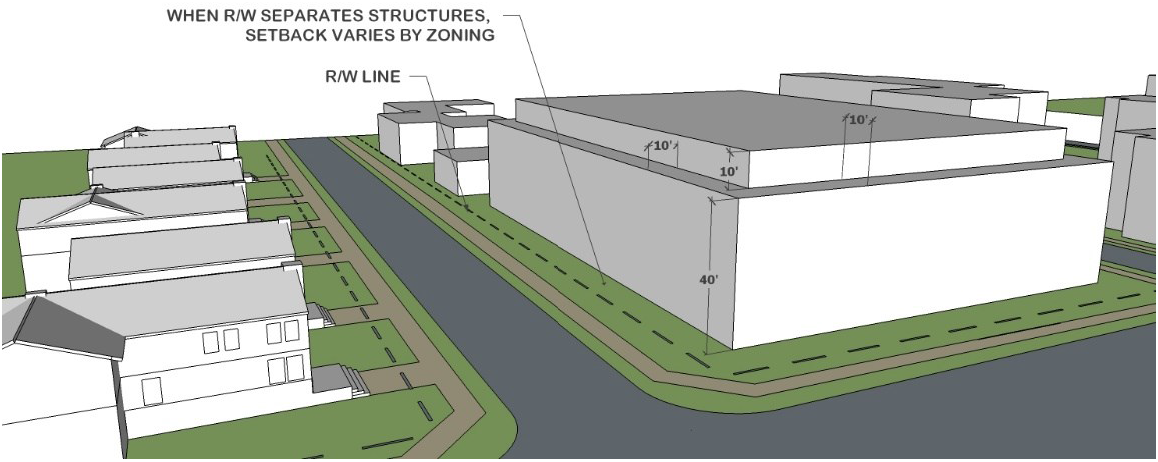
Increase in building height, above the maximum permitted by the assigned zoning district, may occur through either a step-back design approach or entire building wall setback, as permitted hereunder:
1.
Building Wall Step-back:
a.
A building wall step-back may occur at least ten horizontal feet measured from the building facade; and
b.
There shall be no greater than a 20 foot vertical distance in between step-backs.
2.
Entire building wall setback:
a.
The entire building wall facing a property improved with other than a single-family detached use shall be setback from the property line of any abutting property improved with other than a single-family detached use at a minimum ratio of one horizontal foot for each two vertical feet of additional building height above the maximum.
b.
Commercial and multi-family building sides that face abutting property improved with single-family detached use(s).
i.
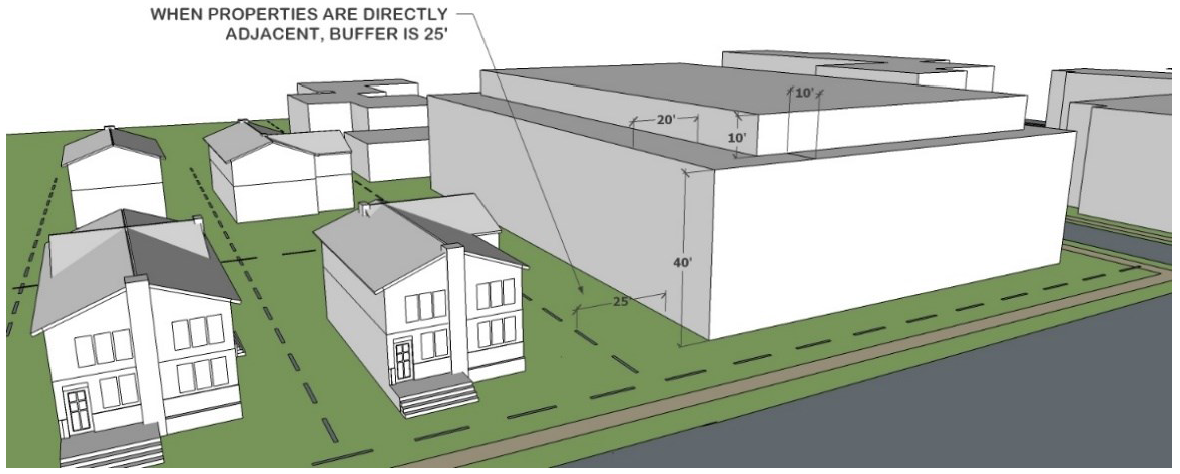
Increase in building height, above the maximum permitted by the assigned zoning district and not to exceed 50 feet in total height, may occur through either a step-back design approach or entire building wall setback, as permitted hereunder:
1.
Building Wall Step-back:
a.
A building wall stepback may occur at least 20 horizontal feet measured from the building façade; and
b.
There shall be no greater than a 20 foot vertical distance in between step-backs.
2.
Entire building wall setback:
a.
The entire building wall facing a single-family use shall be setback from the property line of any abutting property improved with a single-family use at a minimum ratio of one horizontal foot for each one vertical foot of additional building height above the maximum, beginning at the 45 foot setback line.
b.
At a setback between 25 feet and 45 feet from the property line adjacent to a single-family use, buildings shall not exceed the maximum building height permitted in the zoning district
(2)
High-rise apartments. No portion of a high-rise apartment shall project inward over the lot from the side and rear lot lines of the lot at angles representing six feet in height for each one foot of horizontal distance from such lot lines.
19-5.2.10.
Lot coverage. Lot coverage is the area of a lot which may be covered by all buildings on a lot except that parking structures shall not count toward maximum lot coverage. High-rise apartments may exceed the otherwise-required maximum lot coverage provided the structure above the first floor level includes landscaped roof gardens, solariums, recreational spaces or the like designed to accommodate the building occupants on a square foot per square foot basis to an amount not to exceed 35 percent of the total square footage of the lot.
19-5.2.11.
Cluster subdivision.
(A)
General. The developer of a residential subdivision having a minimum area of two acres may request that the planning commission approve a major subdivision as a cluster subdivision wherein the dimensional requirements of the lots may be reduced provided that:
(1)
The total number of lots shall not exceed the total number of lots otherwise permitted in the district in which they are located, based on the gross property acreage minus all street rights-of-way; and
(2)
The remaining land area not included within streets, easements, floodway, above-ground stormwater detention/retention facilities, or recreational structures shall be dedicated to permanent open space.
(B)
Dimensional requirements. With the exception of building height, there are no minimum dimensional requirements (lot size, lot width, maximum lot coverage, and internal (within the development) setbacks). At locations adjoining uses external to the development, permitted uses shall comply with the otherwise-required setbacks. The preliminary and final plats shall reflect the proposed and approved dimensional requirements respectively.
(C)
Open space requirements.
(1)
The land area offered for open space shall constitute a minimum of 25 percent of the gross property acreage of the tract (and not less than one-half acre).
(2)
Ownership of the open space shall remain either with the developer or be conveyed to:
(a)
A homeowners' association or other legal entity under the laws of the state;
(b)
The city (upon approval of the city council);
(c)
A public jurisdiction or agency (upon its approval); or
(d)
A nonprofit or quasi-public organization whose purpose is the protection and conservation of open space (upon its approval).
(3)
Maintenance of the land as permanent open space shall be ensured via the recordation of covenants or similar documents with the country register of deeds and noted (or referenced) on the final plat. This documentation shall also prescribe the nature and extent of continuing maintenance to the open space designed to preclude the creation of any nuisances.
(Code 1997, § 19-5.2; Ord. No. 2007-52, § 19-5.2, 7-9-2007; Ord. No. 2008-69, 10-13-2008; Ord. No. 2009-22, § 1(exh. A), 3-23-2009; Ord. No. 2009-45, exh., 6-8-2009; Ord. No. 2011-45, 5-23-2011; Ord. No. 2015-26, exh., 3-23-2015; Ord. No. 2015-90, exh.(19-4, 19-5), 9-28-2015; Ord. No. 2016-35, 6-27-2016; Ord. No. 2018-37, 5-21-2018; Ord. No. 2021-43, Exh. A, 6-28-2021)

